Flashback : Dallas

A Miscellany: History, Ads, Pop Culture

Category: Deep Ellum

Deep Ellum: Life Along Central Track
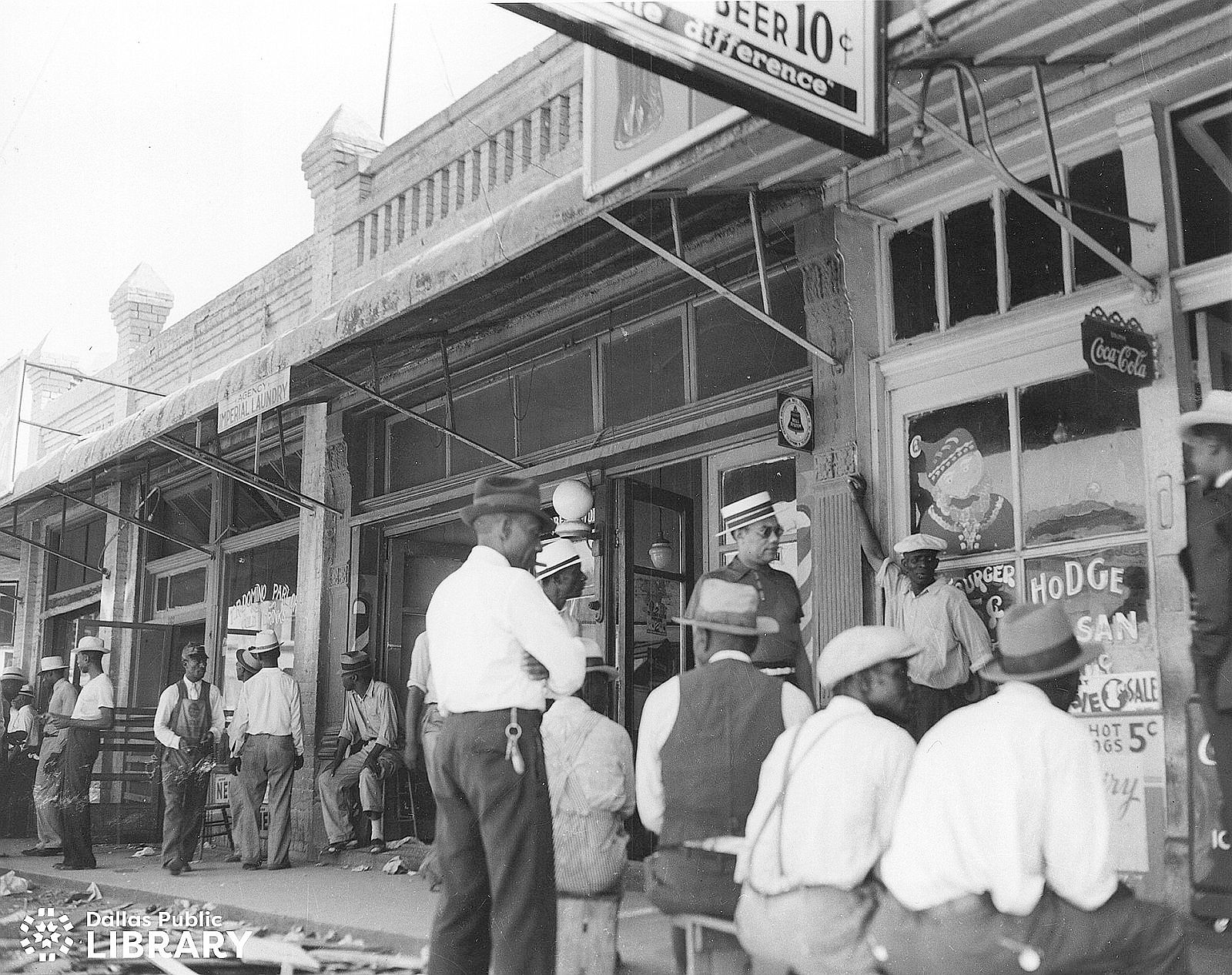
The heart of Deep Ellum… (Dallas Public Library photo)

by Paula Bosse

One of my happiest Flashback Dallas research deep-dives resulted in the post “The Gypsy Tea Room, Central Avenue, and The Darensbourg Brothers.” It was prompted by a photo I had seen for years but had never really known what it showed. I loved writing that, and I’m so happy that it is a perennially popular post. Here is that original photo, below, which shows people walking along the row of barber shops, cafes, pool rooms, domino parlors, taverns, and other businesses:
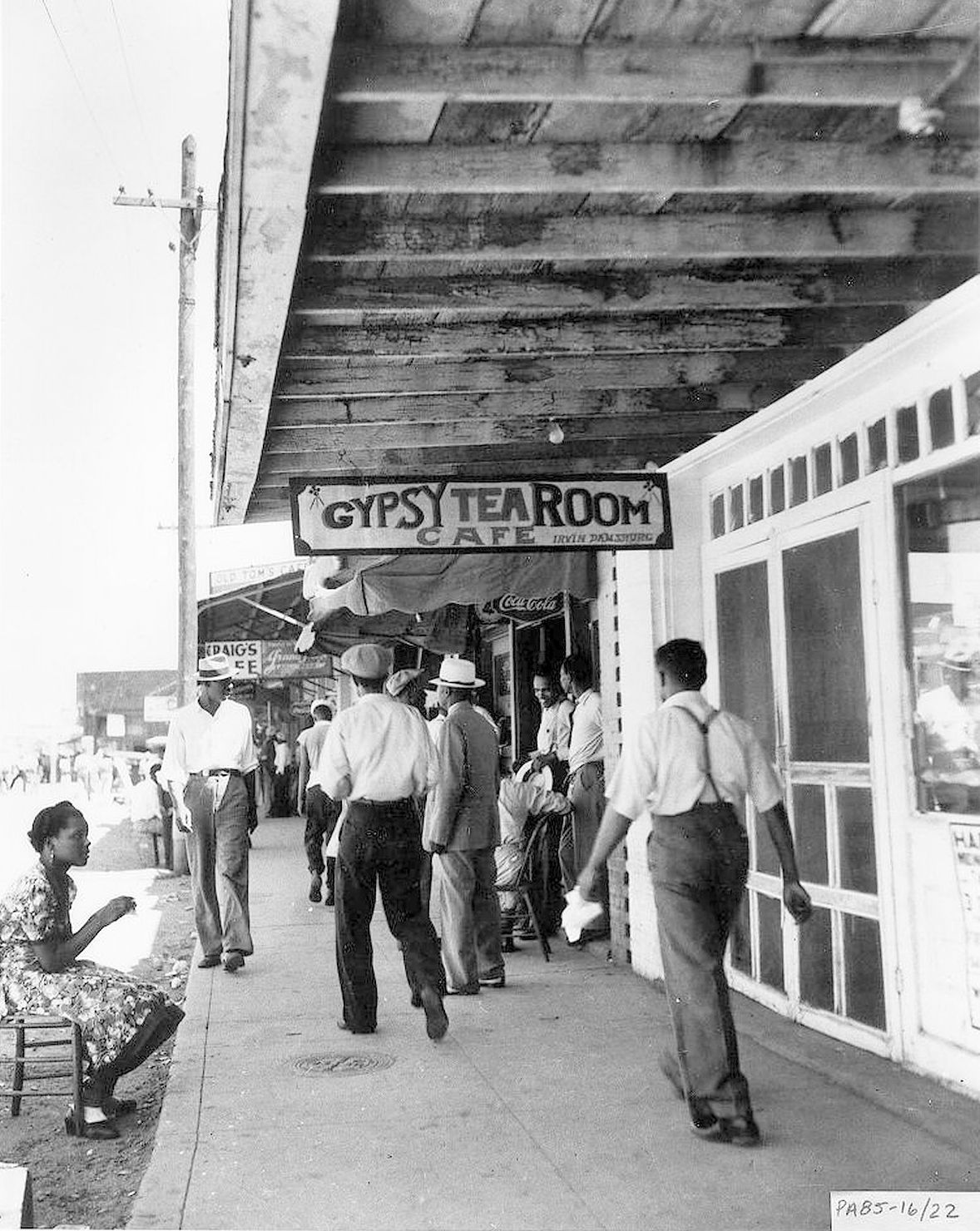
gypsy-tea-room_dallas-public-libraryDallas Public Library photo

The view is to the south — Elm Street is in the distance, where that building juts out to the left. The street about the same distance away to the north (behind the photographer) was Pacific. Someone walking out of the Gypsy Tea Room would have been facing the old train depot. Between the depot and the block of businesses were railroad tracks (not in frequent use in the 1930s, the time of these photos) — the unpaved road that ran alongside the tracks was Central Avenue (when North Central Expressway was built years later, it closely followed the path of these railroad tracks). This general area was considered the heart of Deep Ellum and was filled with Black-owned retail establishments and was a gathering place for social activities and entertainment.

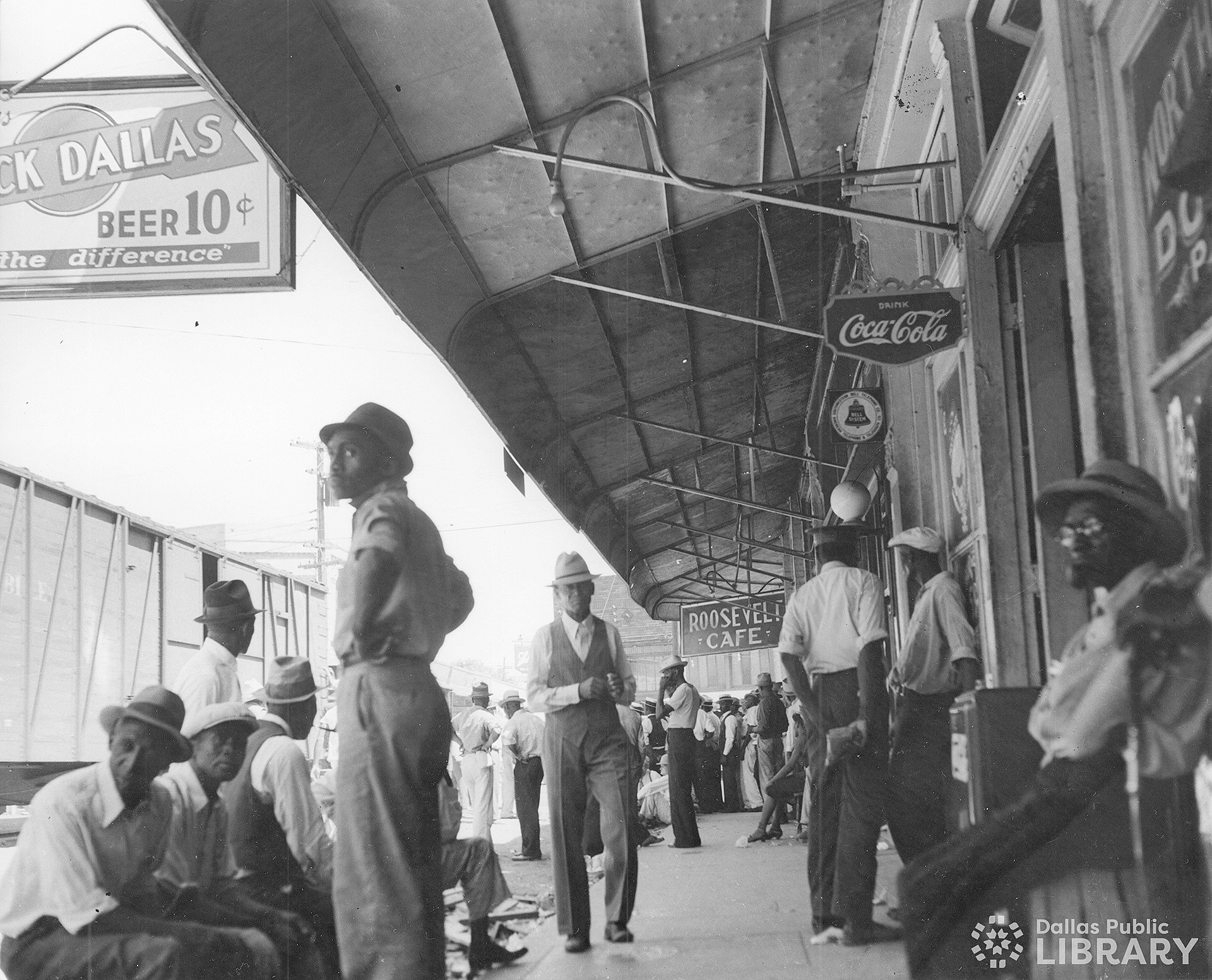
A while back, I came across two other photos, which I recognized as being “companion” photos to the “Gypsy Tea Room” one — the one at the very top of this post, and the one below.
Dallas Public Library photo

The photo immediately above shows the Roosevelt Cafe, which was at 201 N. Central, and the North Pole Domino Parlor (a partial window sign is seen at the right), at 207 Central. A train is passing. This photo and the photo at the very top both show partial signs for Black Dallas beer. (All images are larger when clicked.)

For a better idea of where these photos were taken, see the map below (it shows a detail from a 1921 map — about 15 years before these photos were taken). (See the larger, full Sanborn map here.)
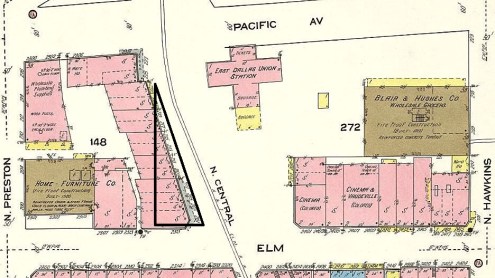
central-ave_1921-sanborn_sheet-17_det1921 Sanborn map (det) showing where photos were taken

*

These are just great, great photos. There aren’t enough photographs like this which capture everyday life in Dallas’ minority communities. Deep Ellum was a thriving Black area at the time. Read a contemporary description of the good things and the bad things going on in this vibrant neighborhood in a (mostly uncondescending) chapter in the WPA Guide to Dallas, “Deep Ellum: Harlem in Miniature.”

**

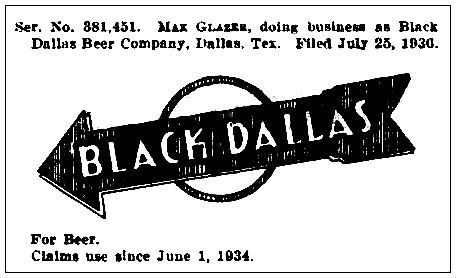
What about “Black Dallas Beer”? I haven’t found a lot about it, but it apparently began as a Dallas-brewed beer in the 1930s but was later brewed elsewhere. (A mention of its Schepps Beer affiliation is here.)
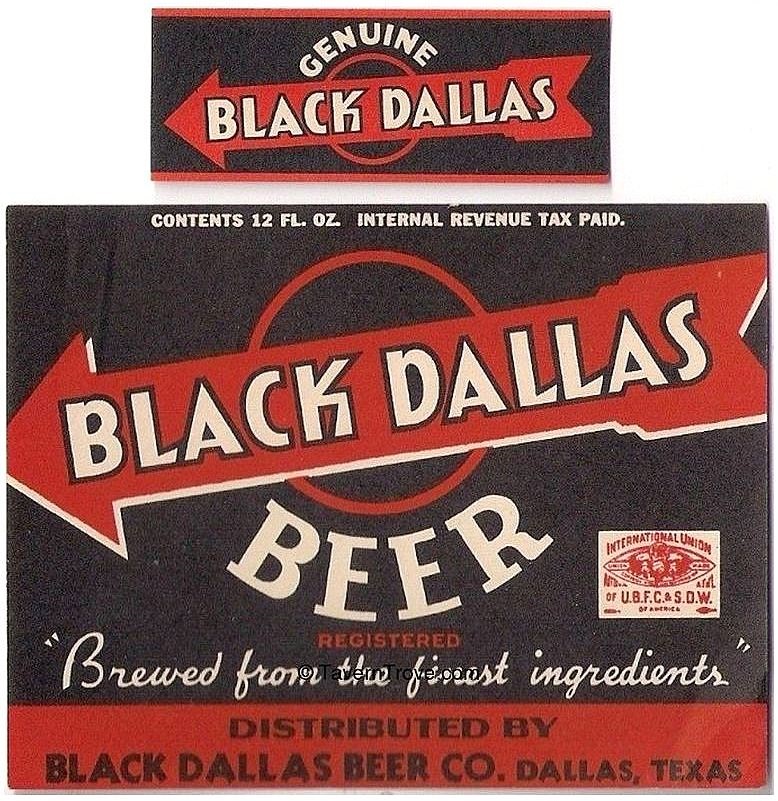
black-dallas-beer_taverntrove_label1937, via Taverntrove.com

black-dallas_beer_u-s-patent-office_090836U.S. Patent Office bulletin, Sept. 8, 1936

“Don’t be a sissy! Drink Black Dallas Beer — Made Without Sugar.”
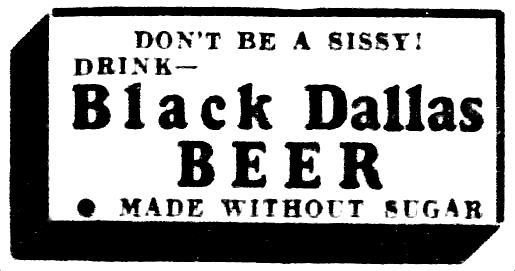
black-dallas_beer_ad_waco-times-herald_052237Waco Times-Herald, May 22, 1937

A “Famous Black Dallas Malt Liquor” popped up a few decades later — at that point, there was no connection to Dallas, except for the name and the fantastic label boasting the Dallas skyline. “Smooth as Evening Dusk.”
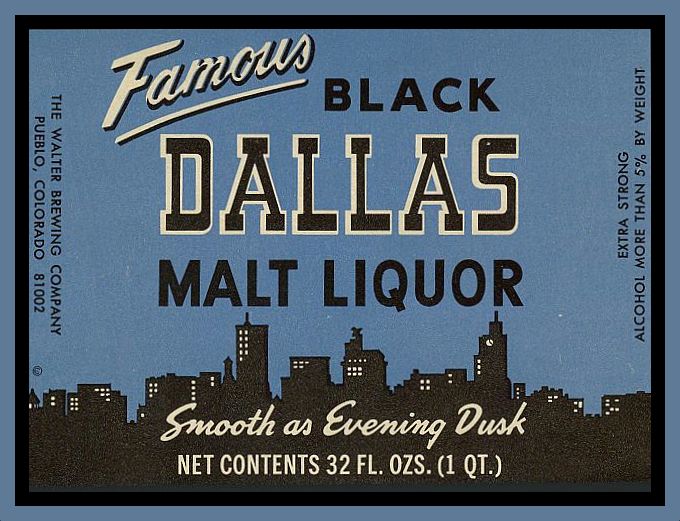
fbd_beer_black-dallas-malt-liquor_ebayeBay

***

Sources & Notes

The top Dallas Public Library photo — “[African American men walking and sitting along North Central Avenue in downtown Dallas in the early 1930’s]” — is from the Saxon Collection, Texas/Dallas History & Archives Division of the Dallas Public Library; its call number is PA85-16/4.

The second photo — “Gypsy Tea Room Cafe located in Deep Ellum” — is from the WPA Dallas Guide & History Collection of the Dallas Public Library — its call number is PA85-16/22.

The third photo — “[African American men seated on benches and standing outside of the Roosevelt Cafe in downtown Dallas in the 1930’s]” — is from the Saxon Collection, Texas/Dallas History & Archives Division of the Dallas Public Library; its call number is PA85-16/5.

Much more info on this Deep Ellum block can be found in the previously linked post from 2015, “The Gypsy Tea Room, Central Avenue, and The Darensbourg Brothers.”

See my other Flashback Dallas posts on Deep Ellum here.

*

Copyright © 2024 Paula Bosse. All Rights Reserved.
Gritty Dallas — 1969

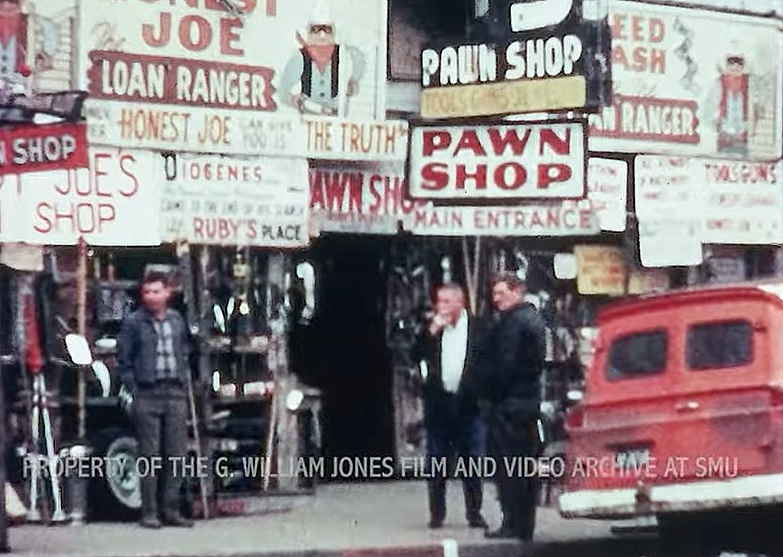
honest-joes-pawn-shop_deep-ellum_perkins-school-recruitment-film_1969_jones-film_SMU_5.13Honest Joe’s: sign overload in Deep Ellum

by Paula Bosse

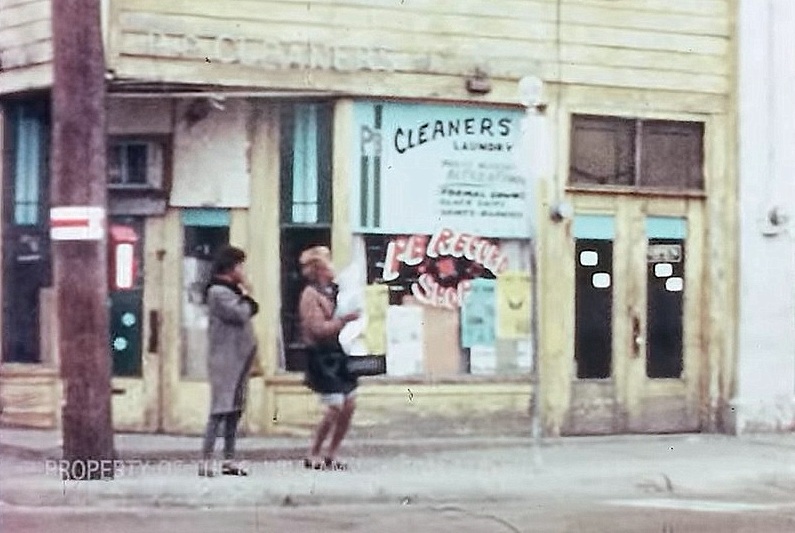
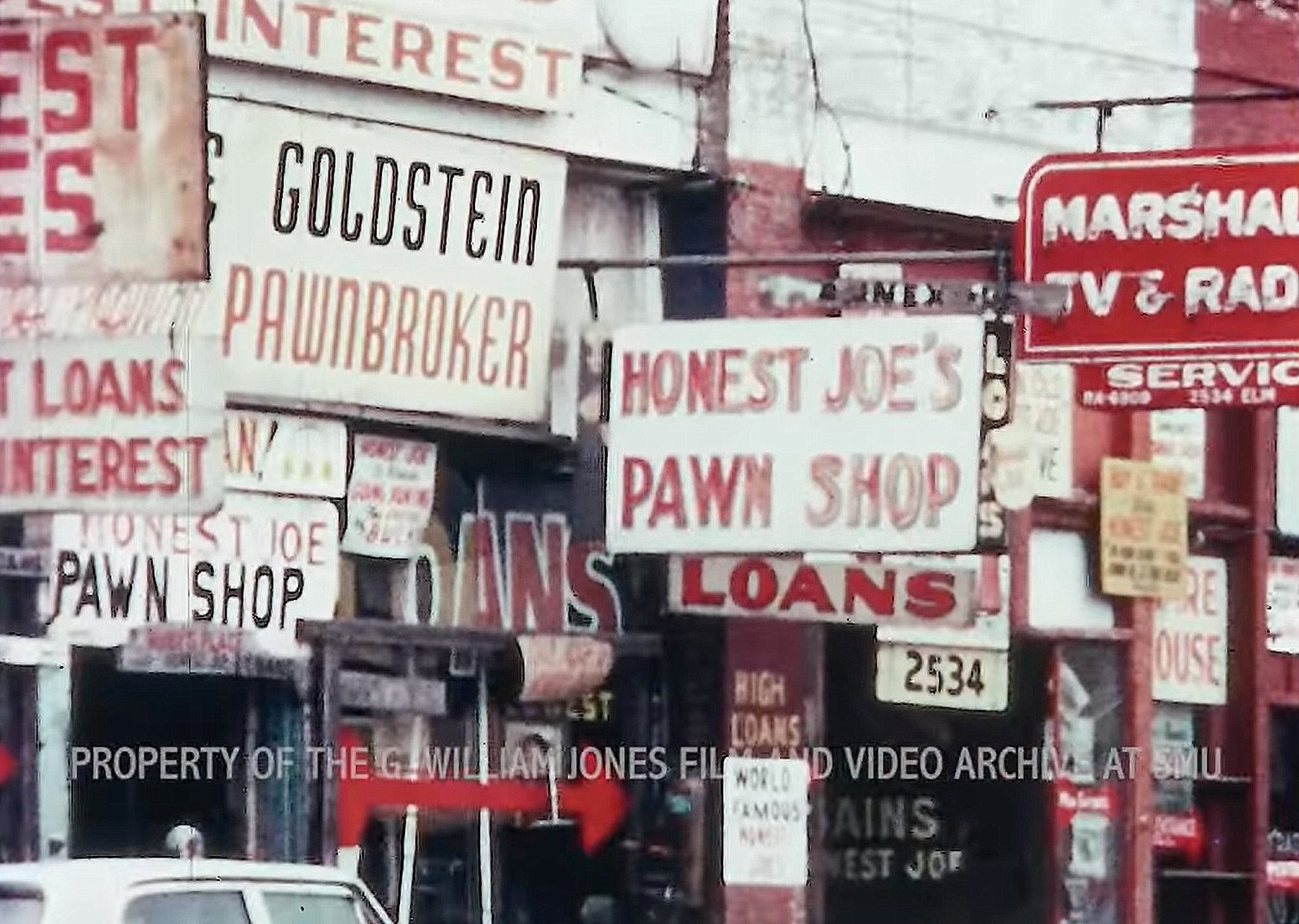
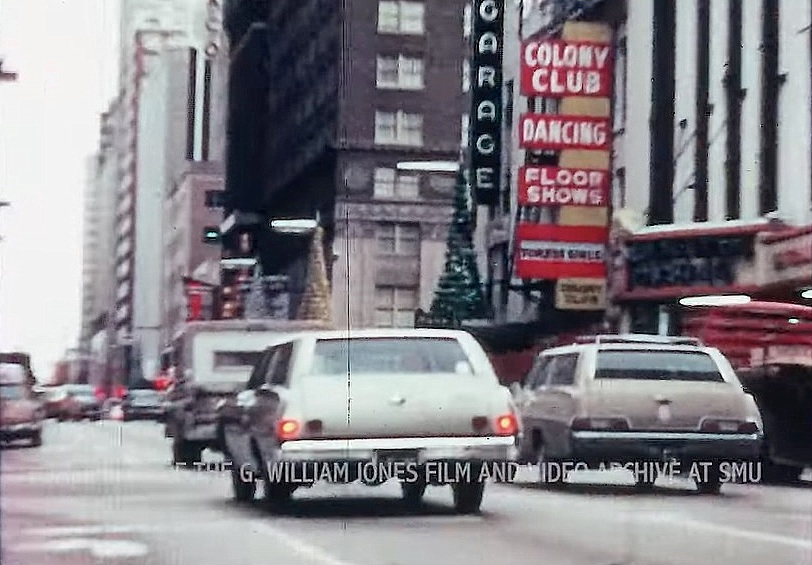
Here are a few things I found when I clicked on something I normally wouldn’t have, but I’m glad I did. These are screenshots from a 20-minute film made in 1969 by SMU’s Perkins School of Theology. (I certainly hope SMU has the original somewhere — or at least a crisper copy — because the quality of this 54-year-old film is, as you can see in these screenshots, pretty low-resolution.) The title of this offering on YouTube is the supremely un-sexy “Perkins School of Theology (SMU) Orientation and Recruiting Film — 1969.” Which is all well and good, but, let’s face it, how many of us would click on that? I wouldn’t! But it was the thumbnail that drew me in — a shot of the Colony Club, the famous burlesque club on Commerce Street. What did that have to do with theology school? I clicked and started fast-forwarding until I found the Colony Club — and it paid off, because I found a bunch of cool shots of places that, for the most part, don’t exist anymore.

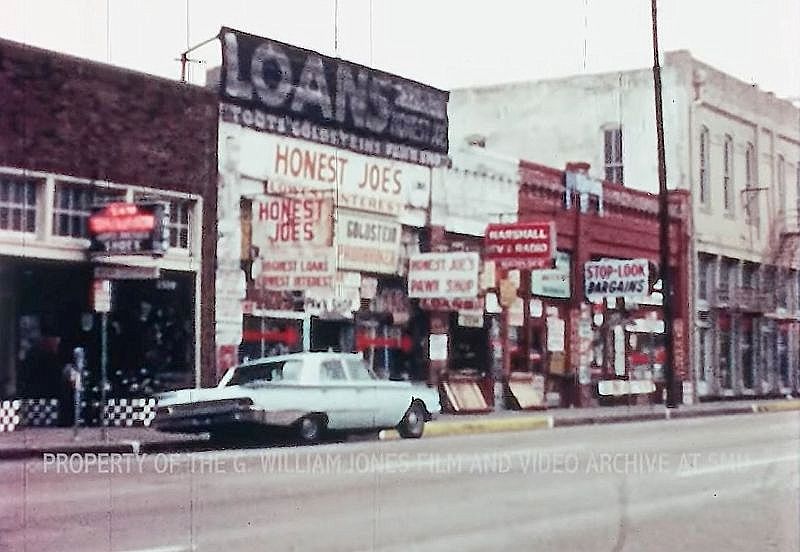
The image above shows one of dozens of pawn shops in Deep Ellum, Honest Joe’s Pawn Shop, owned by Joe Goldstein. (Various Goldstein family members ran a dizzying number of pawn shops in Deep Ellum. I mean a LOT.) In 1969, Honest Joe’s and its adjacent office and warehouse spread from 2516 Elm to 2526 Elm — most of these buildings still stand (see them today, here), but others were torn down to make way for the highway-palooza. (Two more photos of Honest Joe’s are at the end of this post.)

*

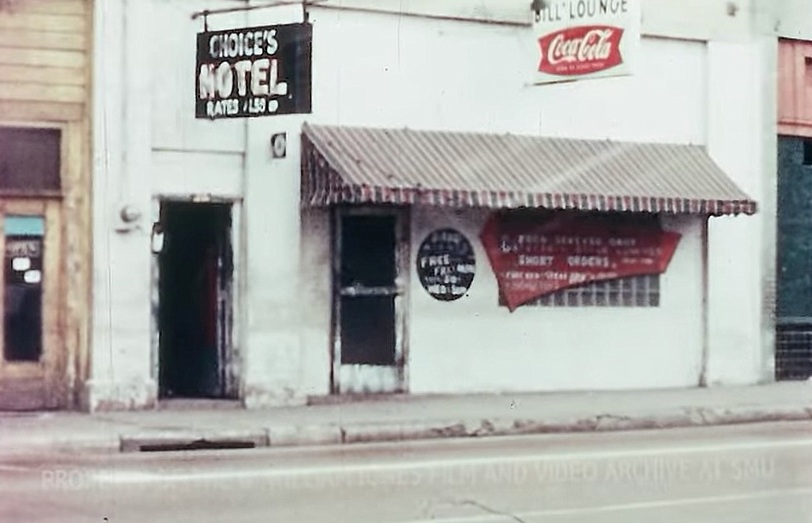
The two shots below were in the same block — keep panning right from the P B Cleaners (2700 S. Ervay, at Grand Avenue — now Al Lipscomb Way), and you’ll see Choice’s Hotel and Bill’s Lounge next door. What’s there now? Nothing.

p-b-cleaners_choices-hotel_perkins-school-recruitment-film_1969_jones-film_SMU_8.38

bills-lounge_choices-hotel_perkins-school-recruitment-film_1969_jones-film_SMU_8.33

*

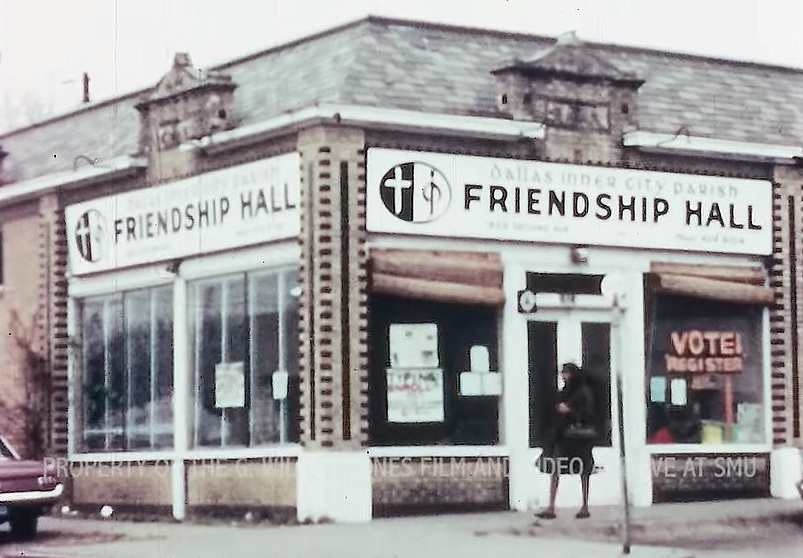
This is Friendship Hall (Dallas Inner City Parish), at 1823 Second Avenue. It was one of many businesses and homes condemned by the city and torn down to expand Fair Park and build new parking lots. See where this used to be, here.

friendshop-hall_perkins-school-recruitment-film_1969_jones-film_SMU_6.25

*

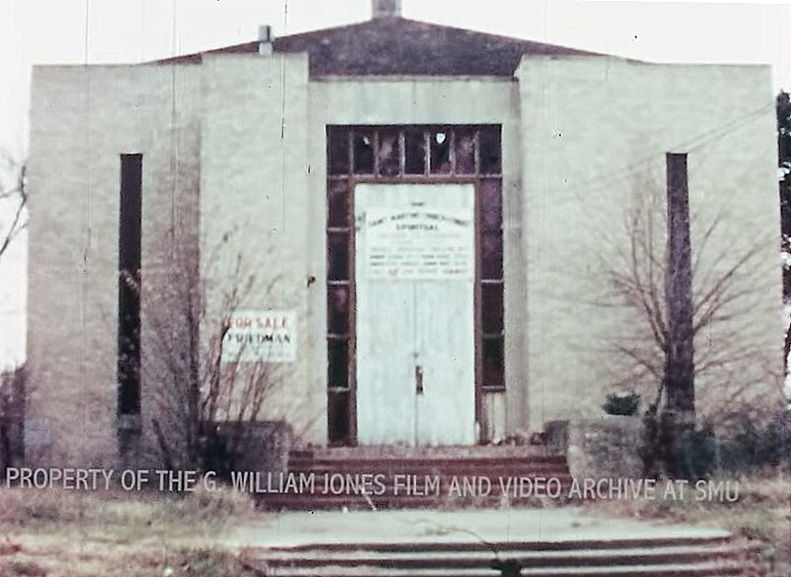
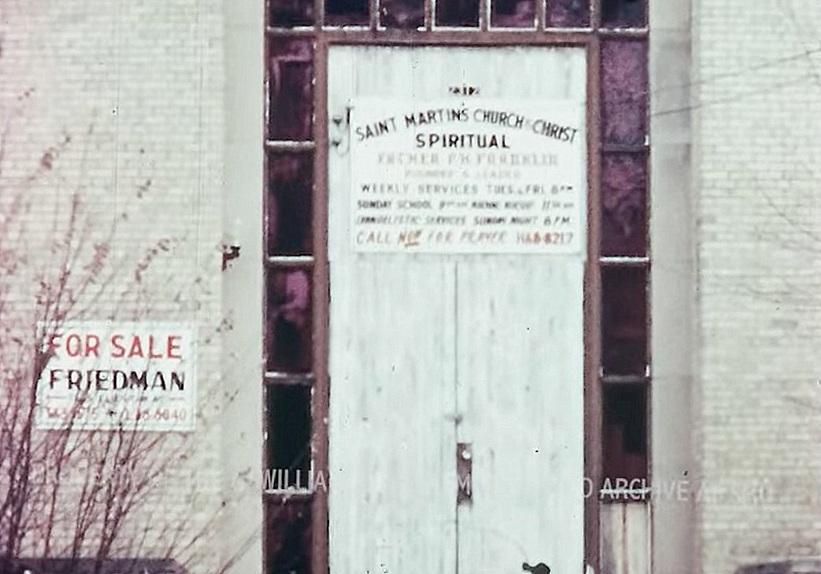
St. Martin’s Spiritual Church of Christ, 2828 Carpenter. This is such an unusual-looking building. It’s gone, but there’s a new church in its place, here.

st-martins-church-of-christ-spiritual_perkins-school-recruitment-film_1969_jones-film_SMU_8.03

st-martins-church-of-christ-spiritual_perkins-school-recruitment-film_1969_jones-film_SMU_8.08

*

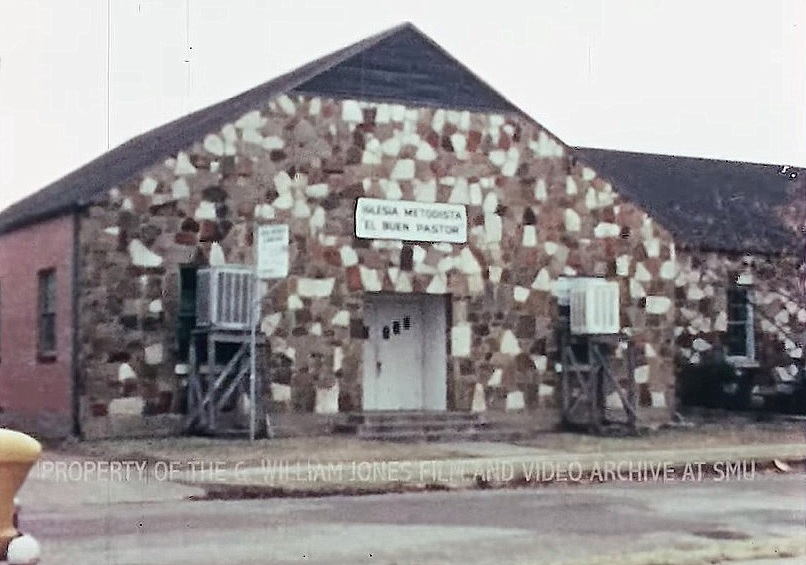
Iglesia Metodista, 1800 Park Avenue (at Beaumont), not too far from Old City Park. Wow, this area (a couple of blocks’ worth, anyway) has been developed way beyond what I would have guessed. The church once stood, I think, in this grassy area.

iglesia-methodista_perkins-school-recruitment-film_1969_jones-film_SMU_5.54

*

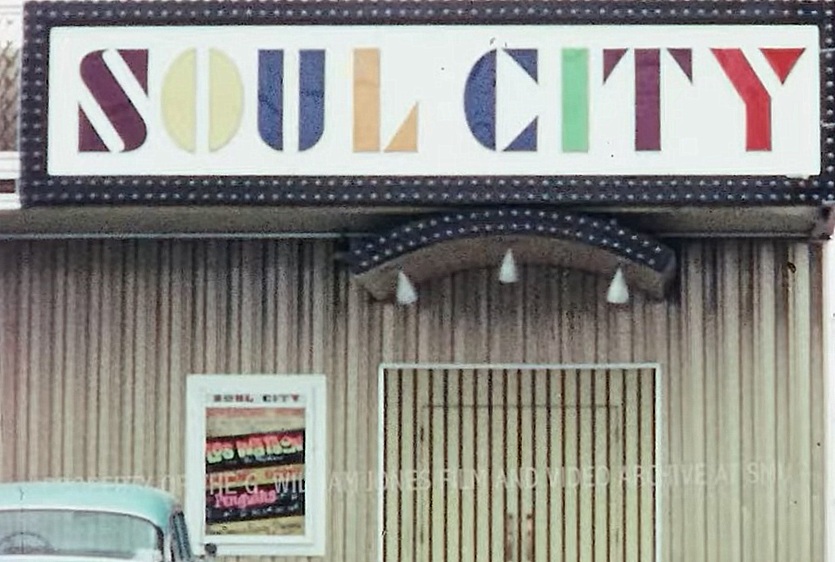
Soul City, 4714 Greenville Avenue, near University Blvd. (you might know it from its recent incarnation as a Vespa dealership). This wasn’t in a “gritty” neighborhood, but it was close to the filmmakers’ home, the SMU campus, and, surely, there were reprobates cavorting inside who could have benefited from a good Methodist sermon. From what I gather, this was a cool place for cool people to see cool bands. The building still stands, here. I don’t think it’s occupied at the moment.

soul-city_choices-hotel_perkins-school-recruitment-film_1969_jones-film_SMU_19.03

*

Speaking of reprobates, their Big D mecca for many years was Commerce and Akard, home to all sorts of places you probably wouldn’t book for a Mother’s Day brunch. Clogging up this area at various times were strip joints and dive bars, including the Colony Club, the Theatre Lounge, and the Carousel Club. The Colony Club was at 1322½ Commerce. That whole block (and the one just beyond it — across Akard — home to the Baker Hotel) went bye-bye a long time ago.

colony-club_perkins-school-recruitment-film_1969_jones-film_SMU_4.29

*

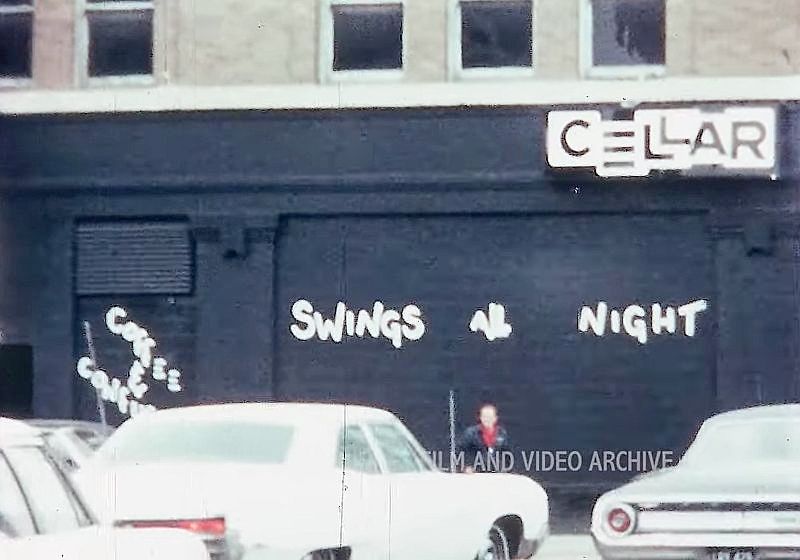
And, like Soul City, the legendary Cellar was cool, but I’ll bet there were more illicit substances in this downtown “coffeehouse” than in the Greenville Ave. club. “Swings all night.” It stood at 2125 Commerce (at what is now Cesar Chavez). This building appears to be gone.

cellar_perkins-school-recruitment-film_1969_jones-film_SMU_4.43

*

More shots of Honest Joe’s Pawn Shop, which took up a good chunk of the 2500 block of Elm. See what this view looks like today, here (I warn you: do not rotate 180 degrees). I assume the tall white building bit the dust for highway construction. I would have loved to have wandered around that place and chatted with Joe. I bet that guy saw some stuff. Deep Ellum has lost most of its grittiness. It used to be so cool. Thank you, seminary students from 1969, for preserving this for future generations, ’cause in a few years, the place won’t be recognizable.

honest-joes-pawn-shop_deep-ellum_perkins-school-recruitment-film_1969_jones-film_SMU_5.06

honest-joes-pawn-shop_deep-ellum_perkins-school-recruitment-film_1969_jones-film_SMU_17.41

***

Sources & Notes

All images are screenshots from the film “Perkins School of Theology (SMU) Orientation And Recruiting Film – 1969” — see it on YouTube here. It’s odd. It is from the keeps-on-giving G. William Jones Film and Video Archive, Hamon Arts Library, Southern Methodist University.

If you like this kind of thing, perhaps you will consider supporting me on Patreon. I post something there every day. More info is here.

honest-joes-pawn-shop_deep-ellum_perkins-school-recruitment-film_1969_jones-film_SMU_5.13_sm

*

Copyright © 2023 Paula Bosse. All Rights Reserved.
Pacific Avenue Warehouse District

pacific-warehouse-district_ebayLooking west on Pacific, from about Good Street

by Paula Bosse

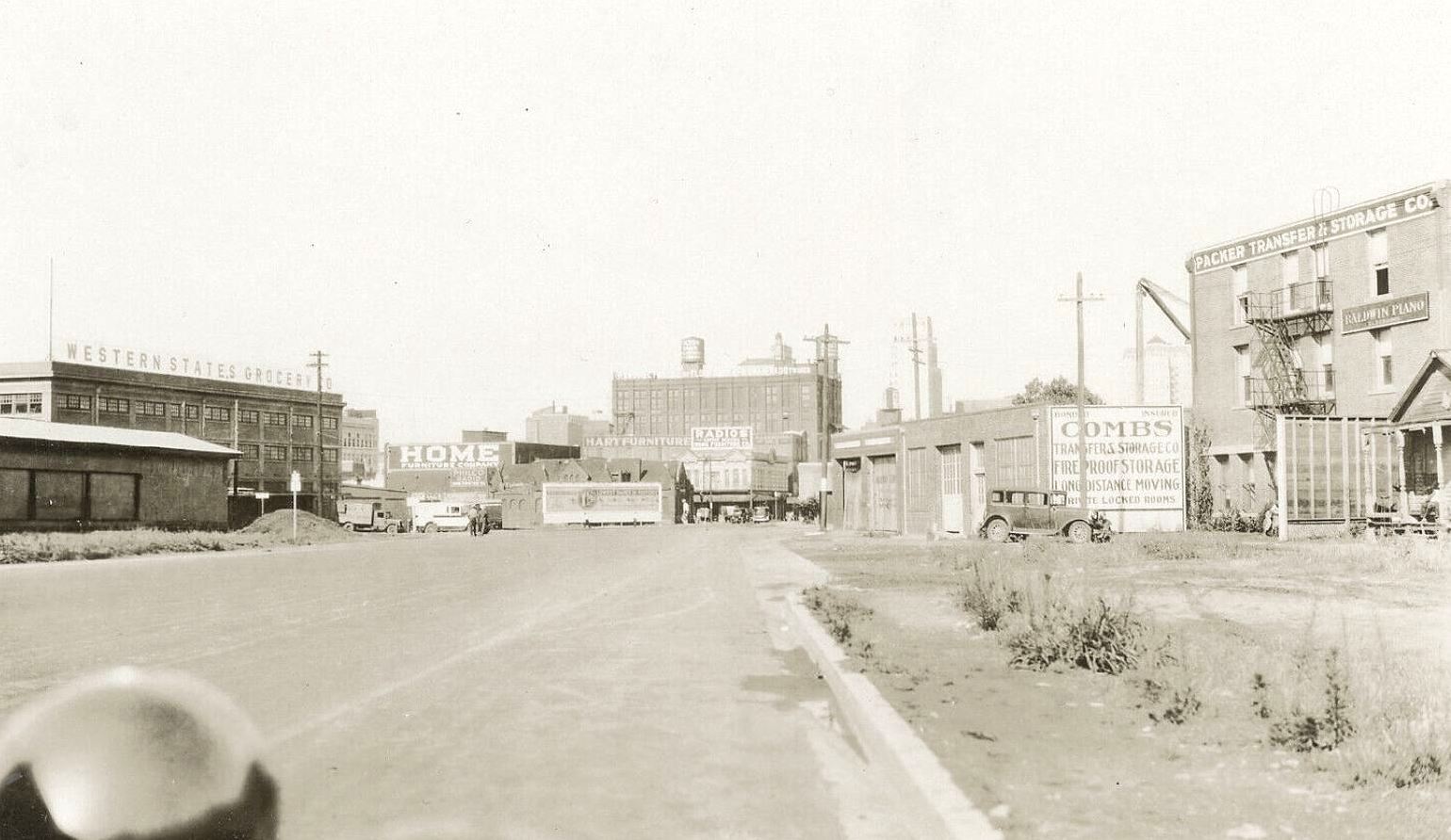
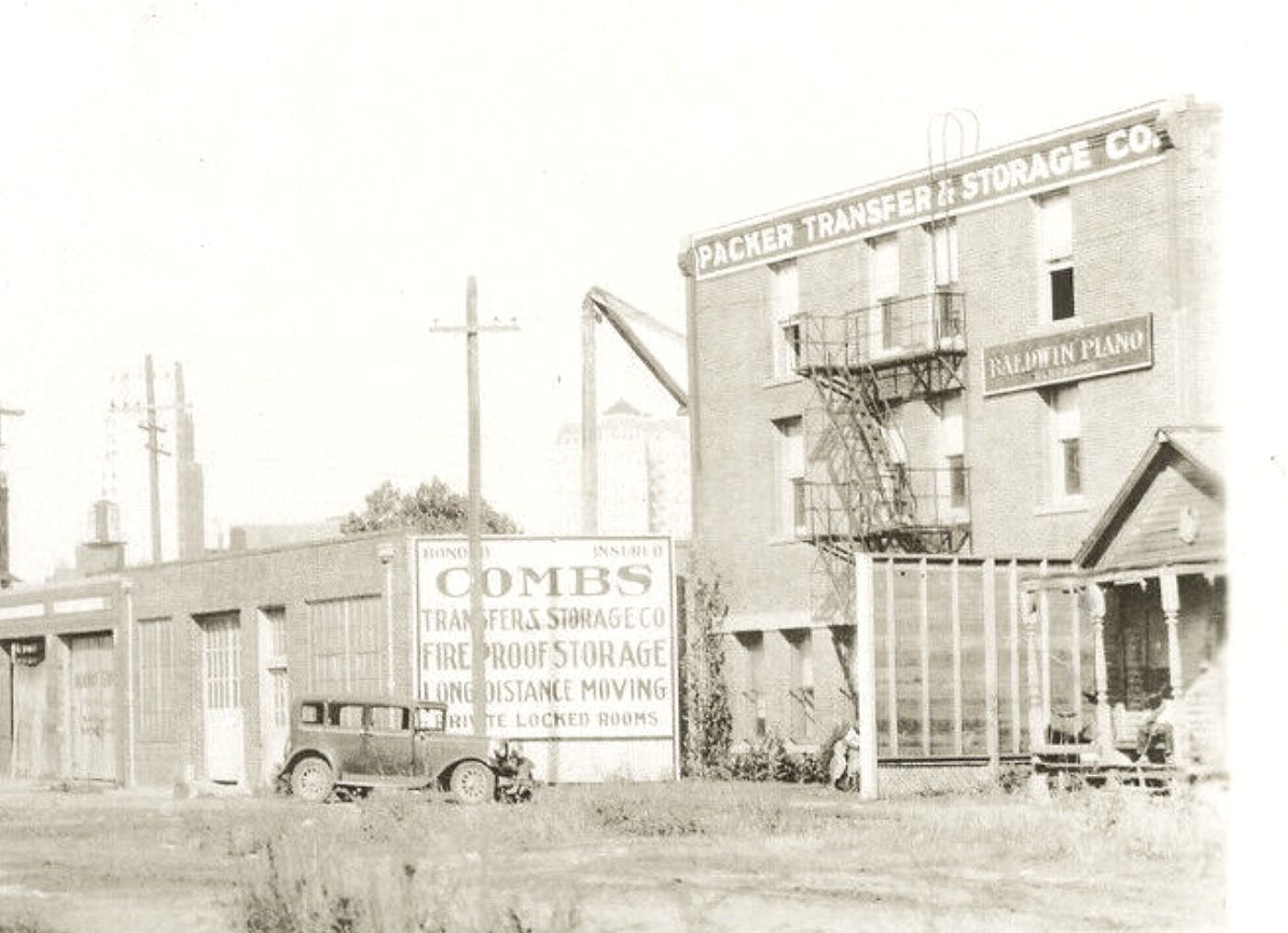
Wandering around the eBay “sold” archives, I came across this unusual photo taken in a not terribly scenic part of town. After checking addresses of these businesses in the 1932 city directory, it looks like the photographer (who appears to have been seated in a car) snapped this shot on N. Pacific Avenue, a block or so west from Good Street (now Good-Latimer). Deep Ellum-adjacent. The view is southwesterly, toward downtown. The businesses are mostly warehouses. See what this view looks like today, 90 years or so later, via Google Street View, here.

I was excited to see two familiar 19th-century buildings which I’ve written about and feel a weird kinship with: the abandoned and shuttered old Union Depot (which I wrote about here) and the Union Depot Hotel (which I wrote about here) — located about where Pacific takes a slight jog to the right. It’s like seeing old friends.

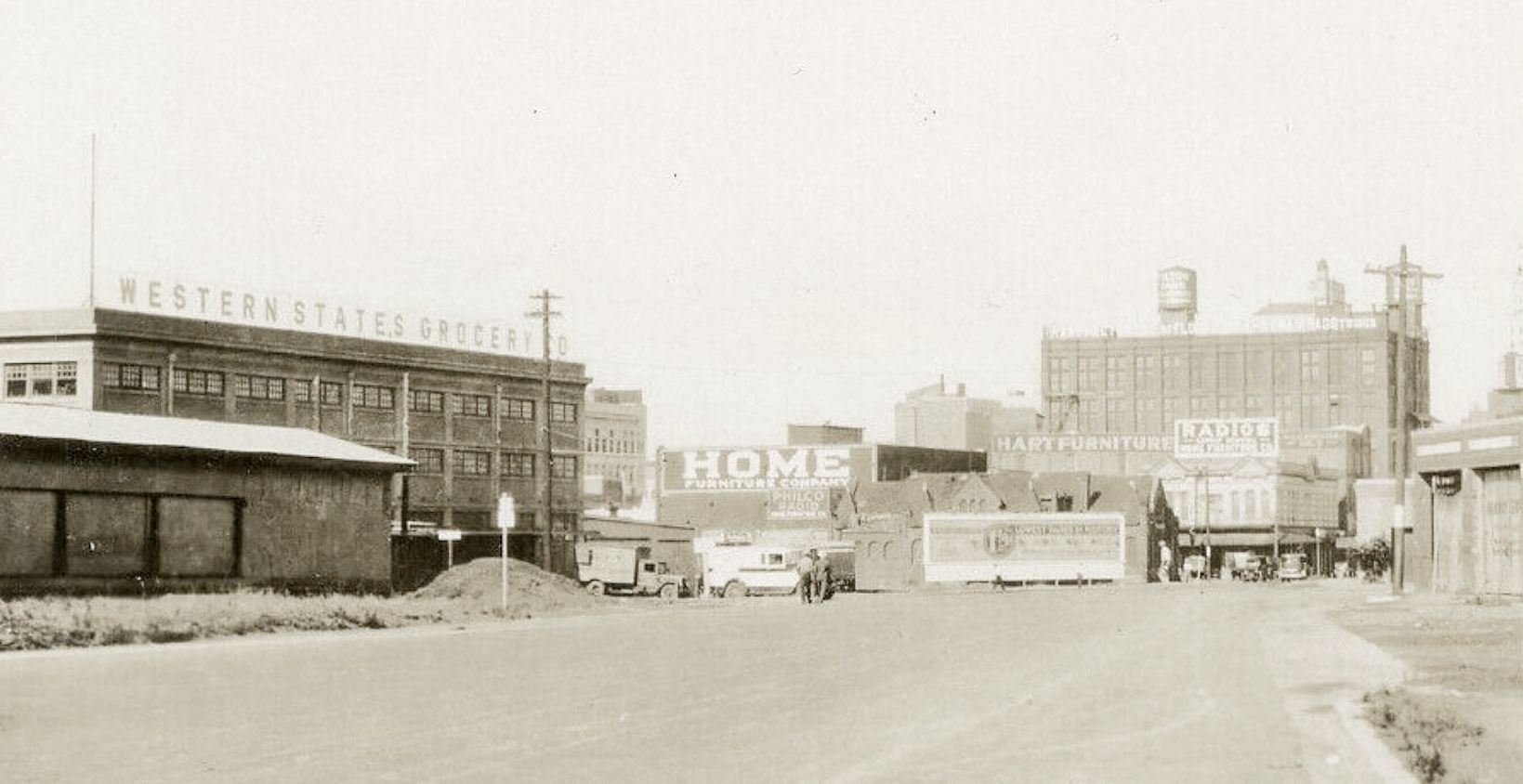
Here are some rather grainy magnifications of the eBay “snapshot” (click to see larger images).

*

Below: the Western States Grocery Co. was located at the southwest corner of Hawkins and Pacific. The Home Furnishings Co. was at 2301-2311 Elm Street (at Preston). Many of the buildings in this view (except for the 5-story-ish tall building straight ahead and to the right) can be seen in this 1921 Sanborn map. (Is that the pre-Pegasus Magnolia Building seen in the distance behind the 5-story building at the right? If so, that would mean that this photo was taken before 1934.)

pacific-toward-downtown_ebay_det-1

*

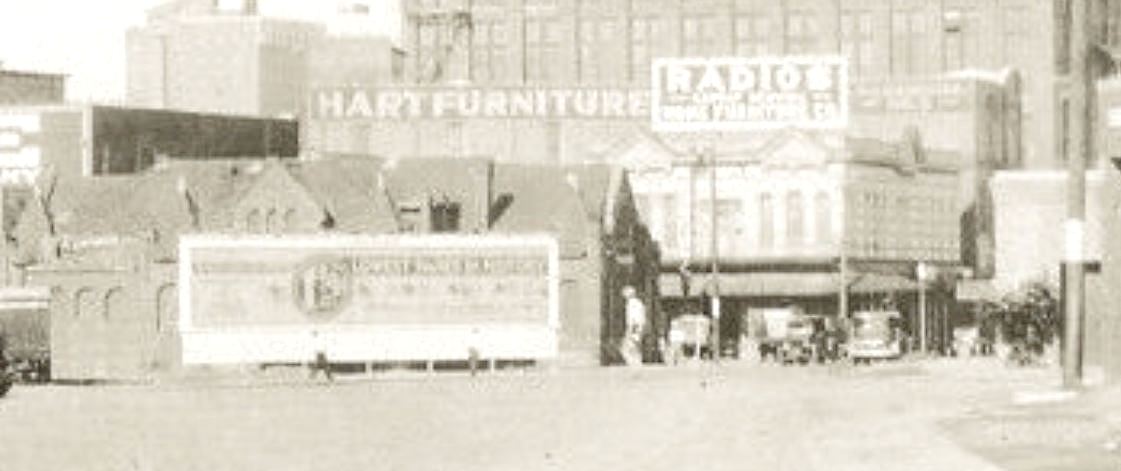
The building seen below in the foreground at the left is the old Union Depot. I’ve seen so many photos of this building — but it looks TINY here! Just across the street (railroad tracks) from it (in the building seen immediately below the “Radios” sign) is the old Union Depot Hotel. The H&TC railroad used to run between them — Central Avenue later (basically) became Central Expressway. I was really excited to see these two buildings.

The taller building seen in the background, behind the Hart Furniture sign, can be seen in this 1921 Sanborn map — the 5-story building at the southwest corner of Pacific and Preston was home to the Fulton Bag and Cotton Mills (another story was added around 1935).

pacific-toward-downtown_ebay_depot-and-hotel

*

The Combs Transfer & Storage Co., the Packer Transfer & Storage Co., and the Baldwin Piano Ware Room were all at 2507-2509 Pacific. It looks like the two buildings seen in this detail (the short one and the taller one) have somehow miraculously survived the insane redevelopment of everything on all sides of it (I’ve haven’t been to Deep Ellum in a few months, but these two buildings seem to be the ones which you can see in the most recent Google Street View). Also, looming like a ghostly whisper in the background (above “Combs”) is the Medical Arts Building.

pacific-toward-downtown_ebay_medical-arts-bldg

*

I wonder why someone decided to take this photo? I’m glad they did, because it’s not a view I’ve ever seen. I love finding photographs taken in places that most people wouldn’t think were interesting enough to document for posterity. Like this one. Thanks, anonymous photographer!

*

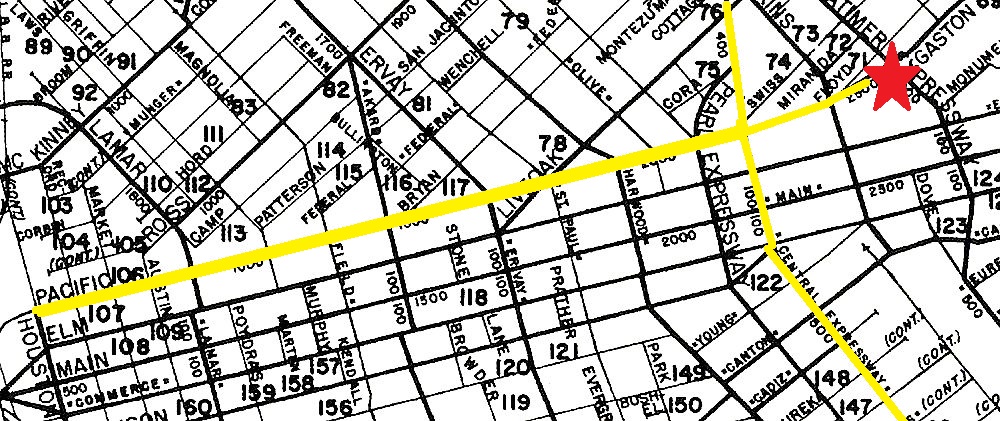
I just picked the closest historical map I had easy access to — the 1952 Mapsco. My guess is that the photograph is from the 1930s. The star is about where the photo was taken — just west of what is now Good-Latimer, just before Pacific becomes Gaston — with a view to the west.

pacific-toward-downtown_mapsco_19521952 Mapsco (det.)

***

Sources & Notes

Photo found on eBay — it looks like the item sold a couple of weeks ago, in Sept. 2022.

pacific-warehouse-district_ebay_sm

*

Copyright © 2022 Paula Bosse. All Rights Reserved.
Miscellaneous Dallas #2

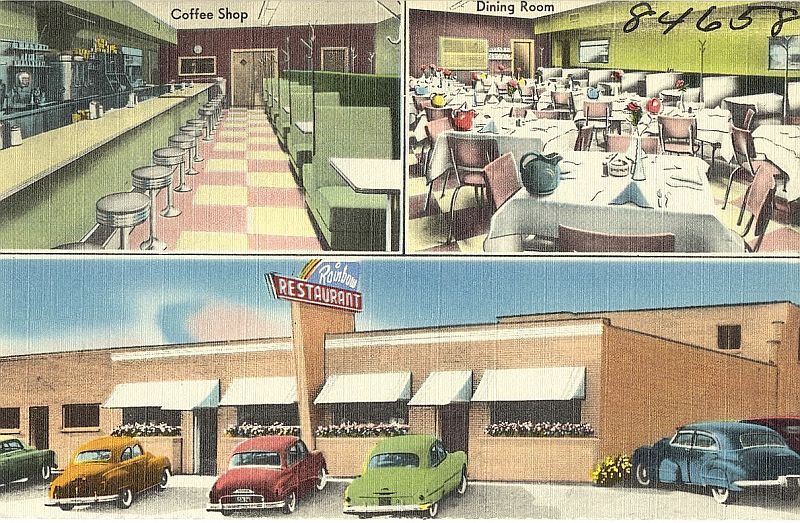
rainbow-restaurant_tichnor-bros-collection_boston-public-libraryOpen 24 hours, plenty of free parking…

by Paula Bosse

And now, a bunch of homeless, random images (all are larger when clicked).

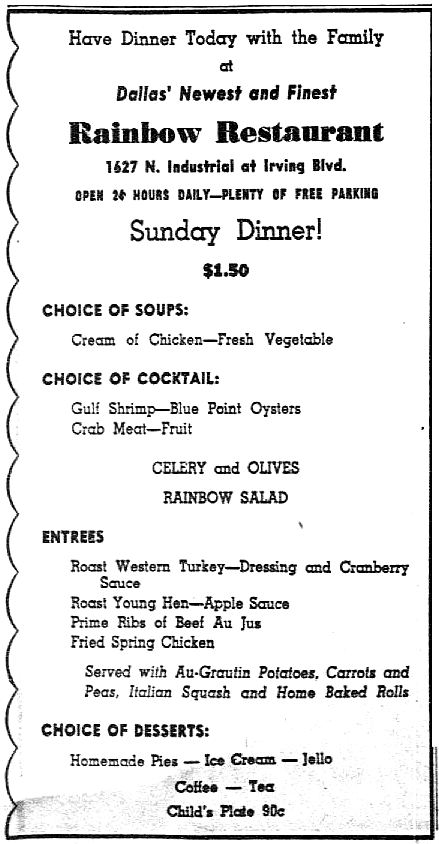
Above, the 24-hour Rainbow Restaurant, 1627 N. Industrial at Irving Blvd. Below, its menu.

rainbow-restaurant_ad_dec-19511951

*

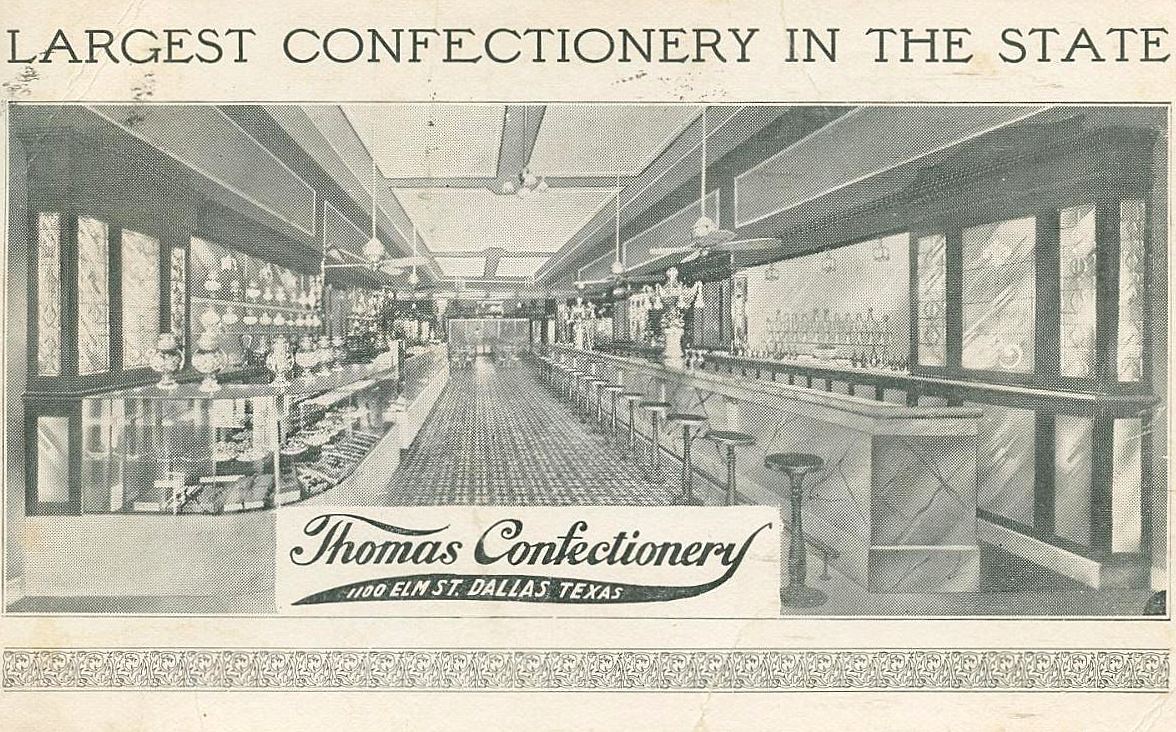
Thomas Confectionery, 1100 Elm Street. “Largest Confectionery In the State.” Popular date spot with the pre-flapper generation.

thomas-confectionary_postcard_1911_sam-rayburn-house-museum-via-portal1911 (via Portal to Texas History)

thomas-confectionery_0915121912. Dallas Morning News want-ad

*

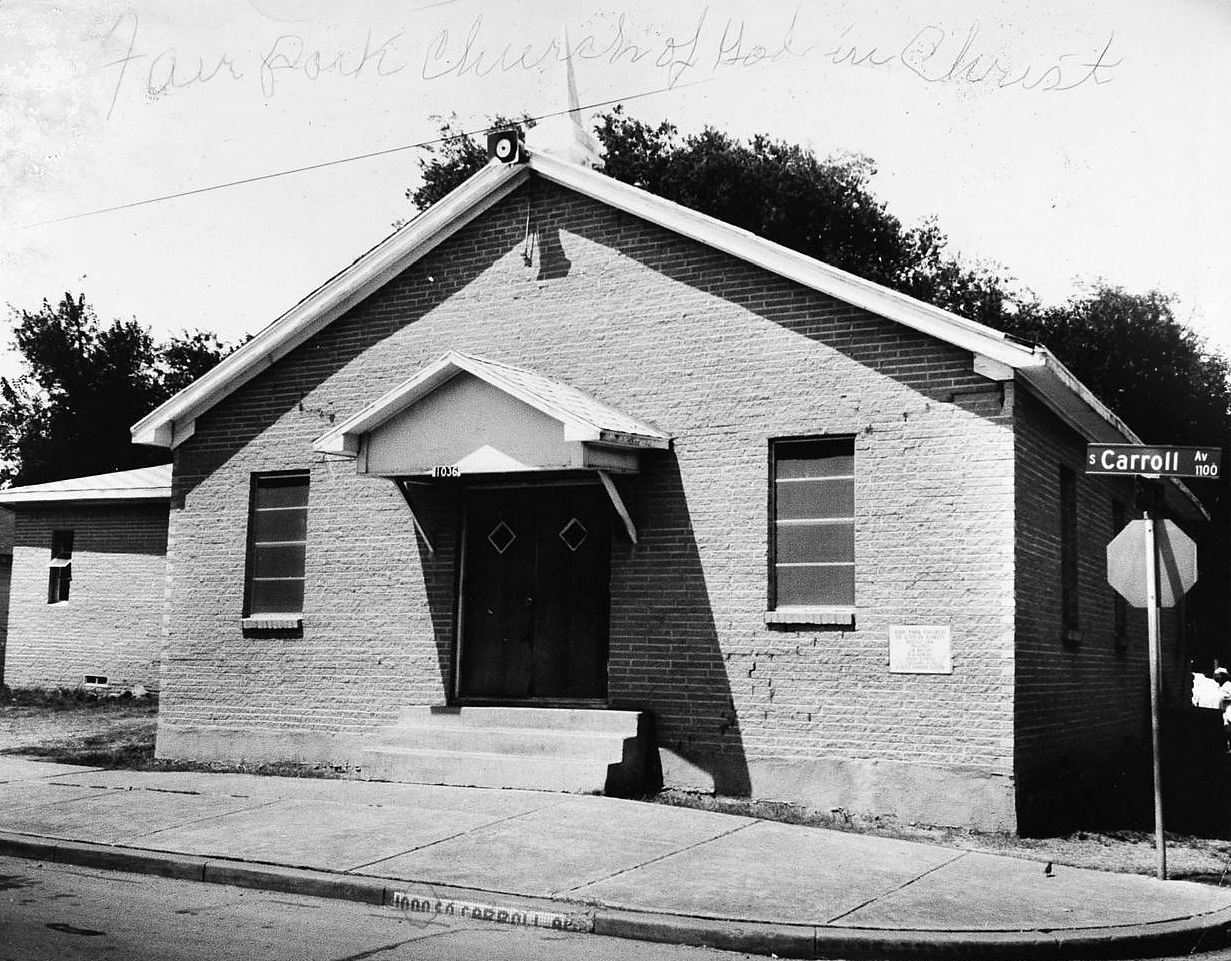
Fair Park Church of God in Christ, 1036 S. Carroll Ave.

fair-park-church-of-god-in-christ_1974_USC-libraries 1974 (via USC Libraries)

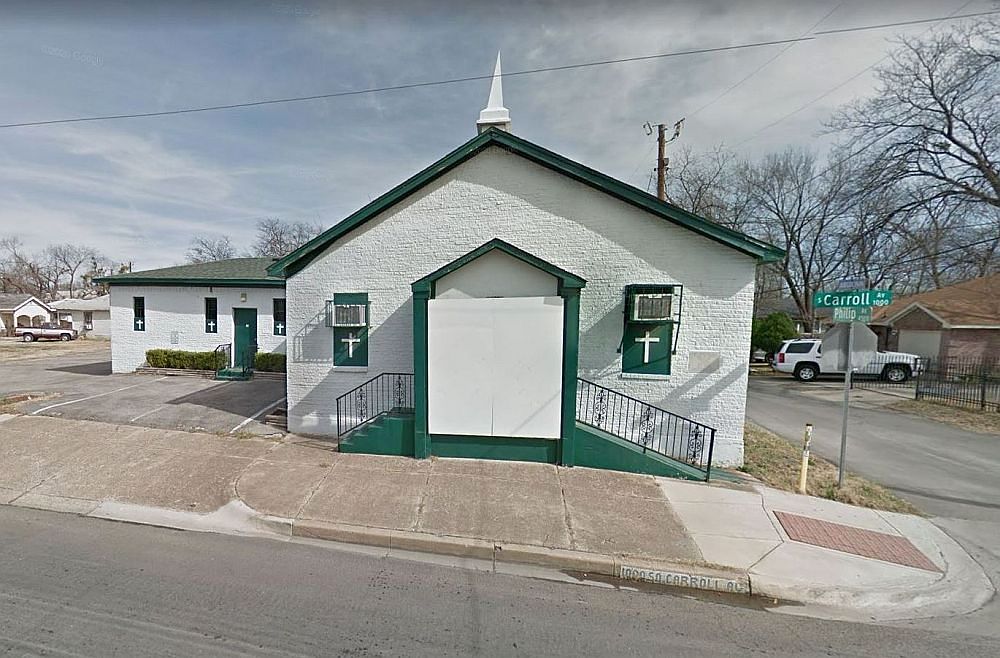
And it’s still standing! (I love that the curb tiles are still there.)

fair-park-church-of-god-in-christ_google-street-view-20172017 (via Google Street View)

*

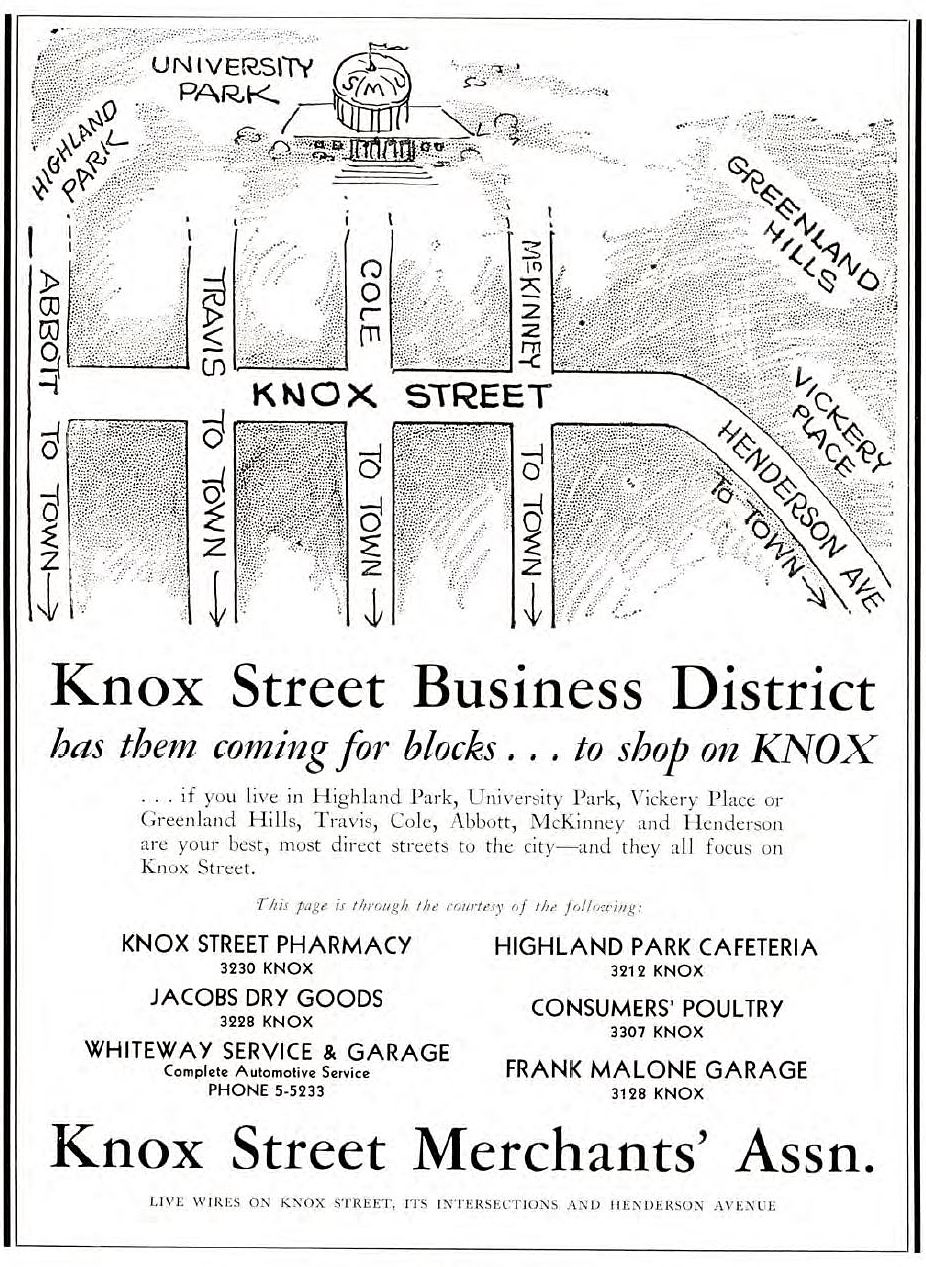
The Knox Street Business District, pre-Central Expressway. …Way pre.

knox-street-business-district_1932-smu-rotunda1932 (via SMU Rotunda)

*

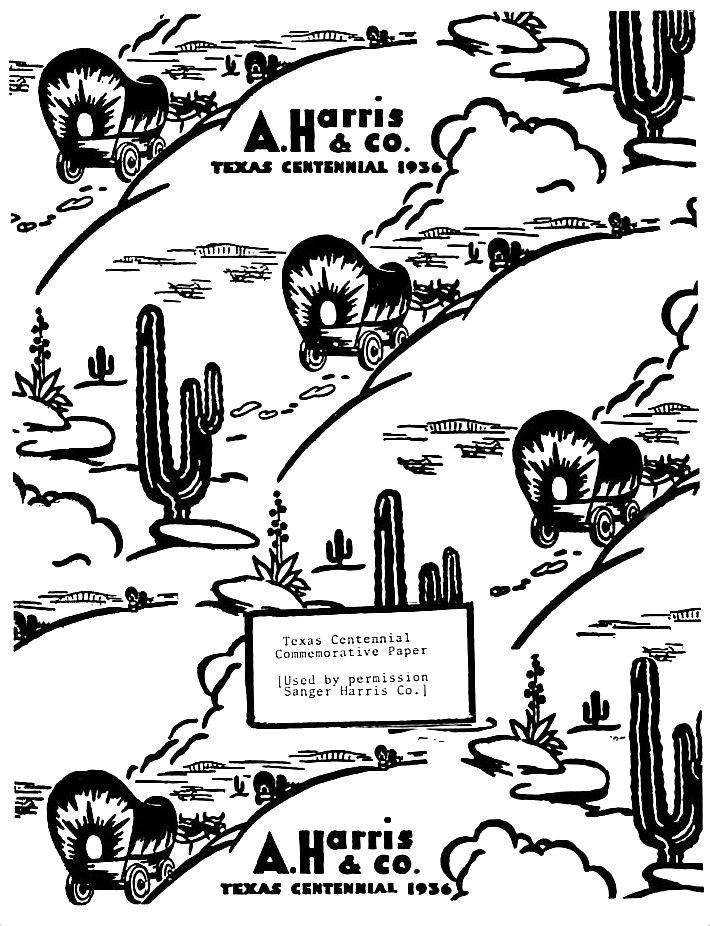
A. Harris & Co. — Texas Centennial Commemorative Paper (gift wrap?).

tx-centennial_a-harris_gift-paper_elm-fork-echoes_april-1986_portal-tx-hist1936 (via Portal to Texas History)

*

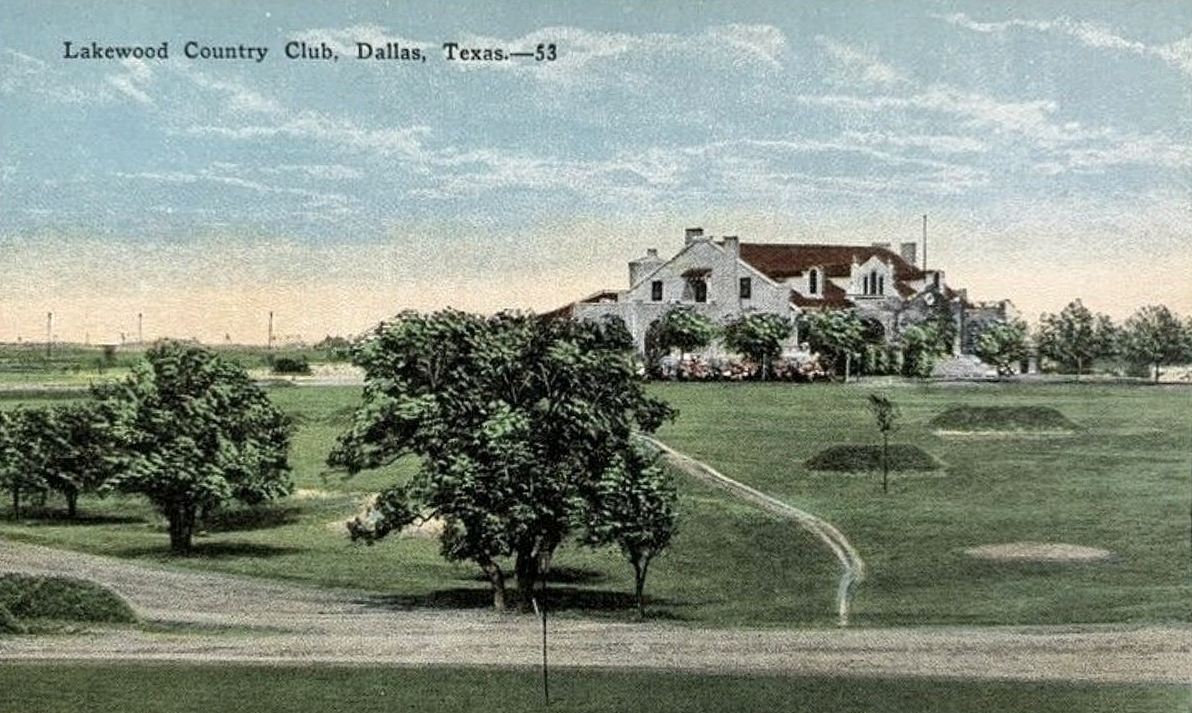
The Lakewood Country Club (see it before the landscaping in this photo from this post).

lakewood-country-club_postcard_ebay(via eBay)

*

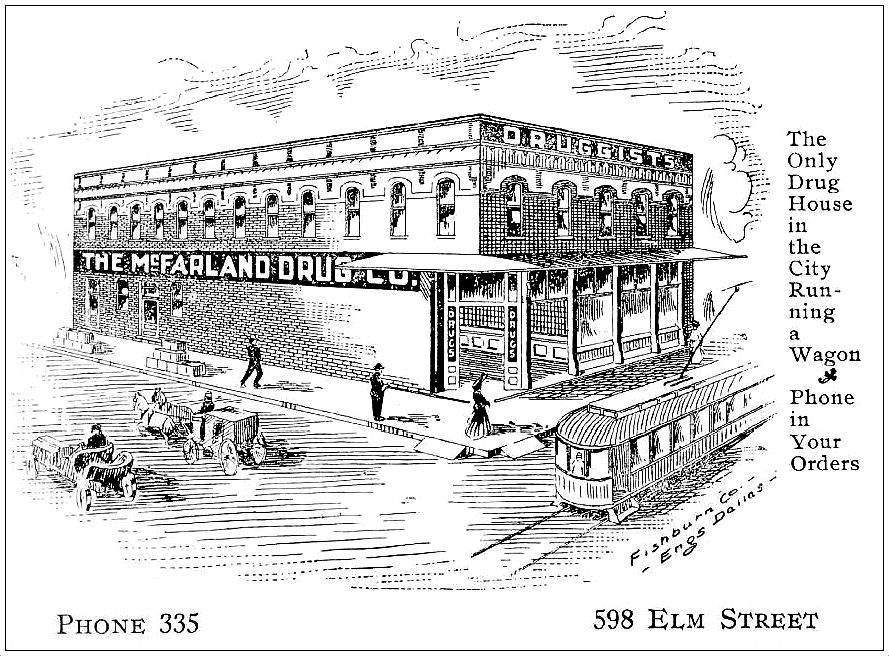
The McFarland Drug Co., 598 Elm, at Hawkins, in Deep Ellum (later became 2424 Elm).

mcfarland-drug-co_hints-to-housekeepers_degolyer_SMU_19051905 (via DeGolyer Library, SMU)

*

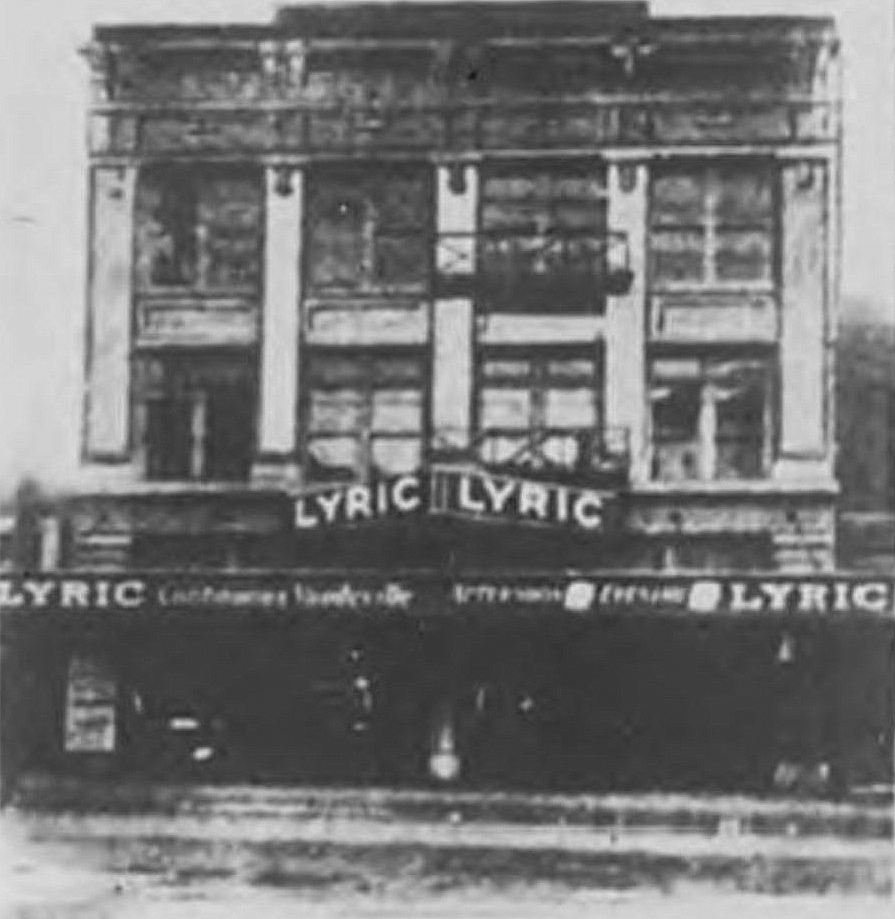
The Lyric Theatre, 364 Elm, near Stone (later 1602 Elm).

lyric-theater_degolyer-lib_SMU_dallas-theaters_nd1907-ish (via DeGolyer Library, SMU)

*

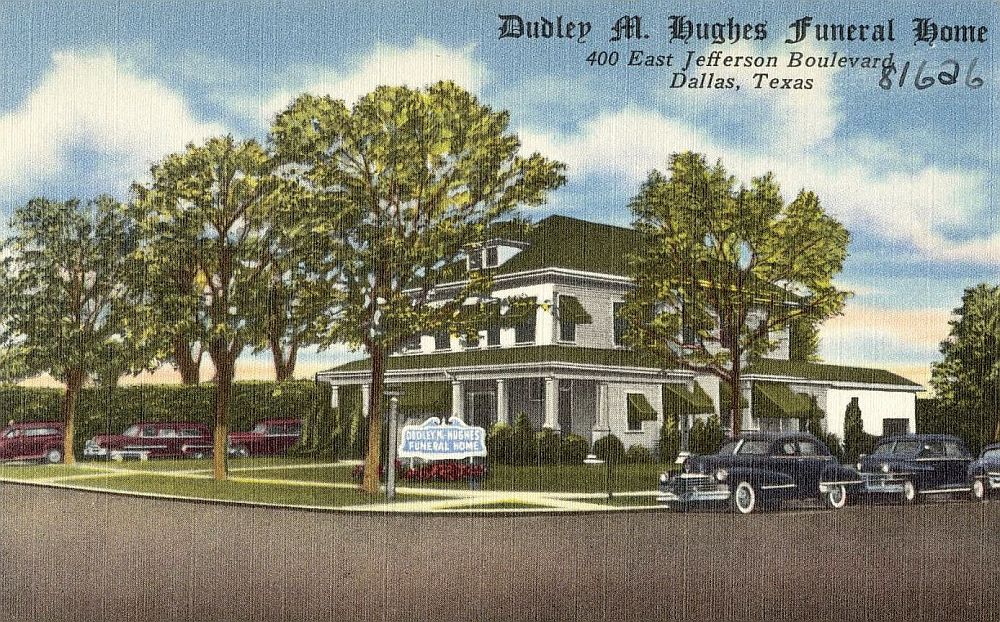
Dudley M. Hughes Funeral Home, 400 E. Jefferson Blvd, Oak Cliff.

dudley-hughes-funeral-home_tichnor-bros_boston-public-library(via Tichnor Bros. Collection, Boston Public Library)

*

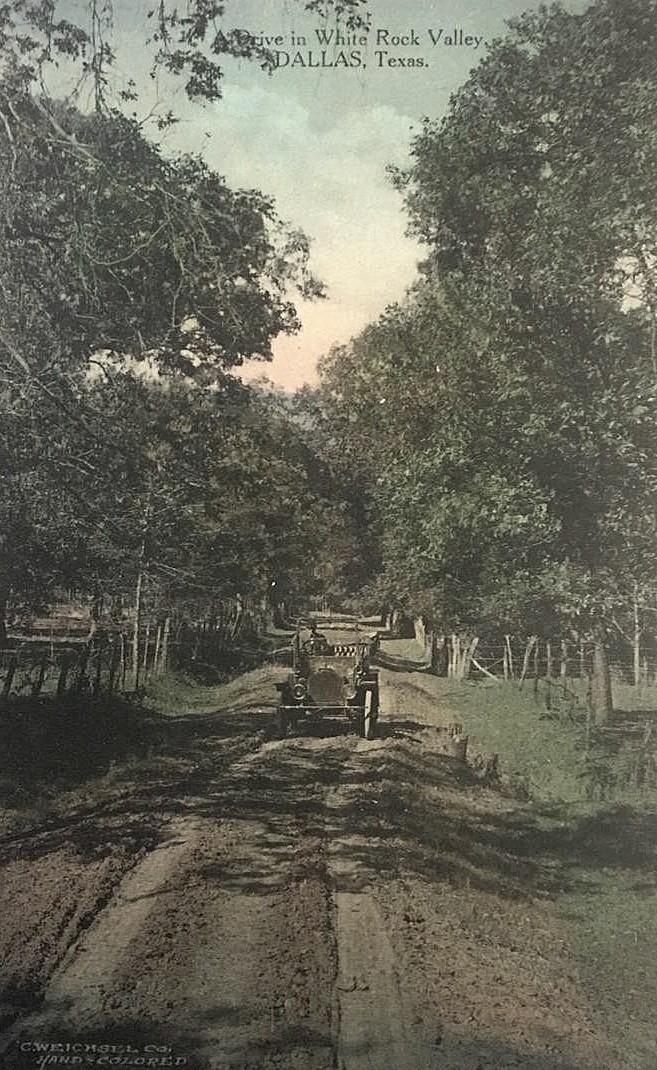
“A Drive in White Rock Valley.” Before the lake.

white-rock-valley_postcard_1912_ebay(via eBay)

***

Sources & Notes

Rainbow Restaurant postcard is from the Tichnor Bros. Postcard Collection, Boston Public Library.

See the first installment of “Miscellaneous Dallas” here.

rainbow-restaurant_tichnor-bros-collection_boston-public-library_sm

*

Copyright © 2021 Paula Bosse. All Rights Reserved.
African-American Businesses and Notable Dallasites — 1930

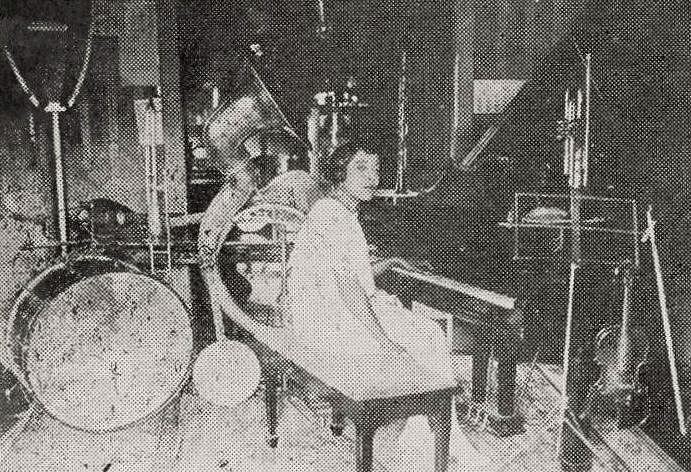
mme-pratt-muisc-teacher_dallas-negro-directory_1930_portal_det“Madame Pratt” in her music studio

by Paula Bosse

I’ve recently posted lots of photos of black schools and black churches which appeared in the Official Directory: Dallas Negro Churches, Schools and Other Activities; Civic, Business, Fraternal, Social, Etc., an absolutely fantastic historical document (which is scanned in its entirety on the Portal to Texas History site here) — now I thought I’d post some of the businesses and people featured in the directory.

First is the woman seen above, Ella Rice Pratt (1893-1966) who was known professionally as “Madame Pratt” and seems to have taught an extremely wide range of musical instruments. According to this 1930 ad, she was “The only woman of her race in Texas who performs successfully upon two instruments at the same time.”  (Most images are larger when clicked.)

mme-pratt-muisc-teacher_dallas-negro-directory_1930_portal1930

Her 1966 obituaries (one of which is here ) list a string of accomplishments, including having studied music at the New England Conservatory in Boston, toured as a concert pianist, trained a 30-piece touring orchestra, and opened what was described as “the first music studio in Dallas where Negro musicians could receive training on all instruments” (Dallas Morning News, Oct. 3, 1966). Not only was she a notable Dallasite, so were members of her family: her father, Charles A. Rice was a principal at Booker T. Washington High School (and is the namesake of Charles Rice Elementary School), her mother, Sally Rice, was the first supervisor of Griggs Park, and her husband, T. W. Pratt was a long-time principal in Dallas schools (at the time of this directory he was the principal of the Pacific Avenue School (he might be seen in this photo which also appeared in the 1930 Negro Directory). The Pratts lived at 3612 Thomas Ave., near Washington, where Madame Pratt also had her studio. (Her headstone in Lincoln Memorial Park has musical notes engraved on it.)

*

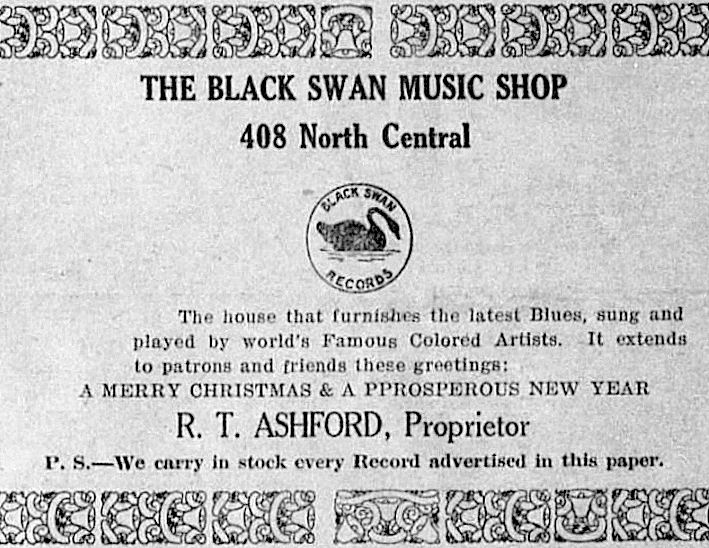
Speaking of music, R. T. Ashford was a prominent businessman (he was one of the founders of the Dallas Negro Chamber of Commerce) who owned R. T. Ashford’s Music Shop, a popular record store at 408 N. Central (at Swiss), just north of Deep Ellum. Before this 1930 directory was issued, Ashford had called his shop “Black Swan Music”(I’m not sure whether this was an “homage” to the Black Swan record label or some sort of partnership). Ashford’s store was apparently very popular and Ashford himself seems to have been taken seriously by record labels whenever he would recommend local talent (he appears to have figured prominently in Blind Lemon Jefferson’s recording career). Ashford moved from Central Avenue to Hall Street in 1931, but he was a Deep Ellum music and business fixture for many, many years. I think the location of Ashford’s record shop (if not the actual store) can be seen in this photo from 1919 (on the street-level floor of the Thorburn Broom & Brush building). (Fun fact, perhaps only to me: Ashford’s Music Shop was next door to a business proprietor named “Simpson.”)

ashfords-music-shop_dallas-negro-directory_1930_portal1930

ashford_dallas-express_122223Dallas Express, Dec. 1923

*

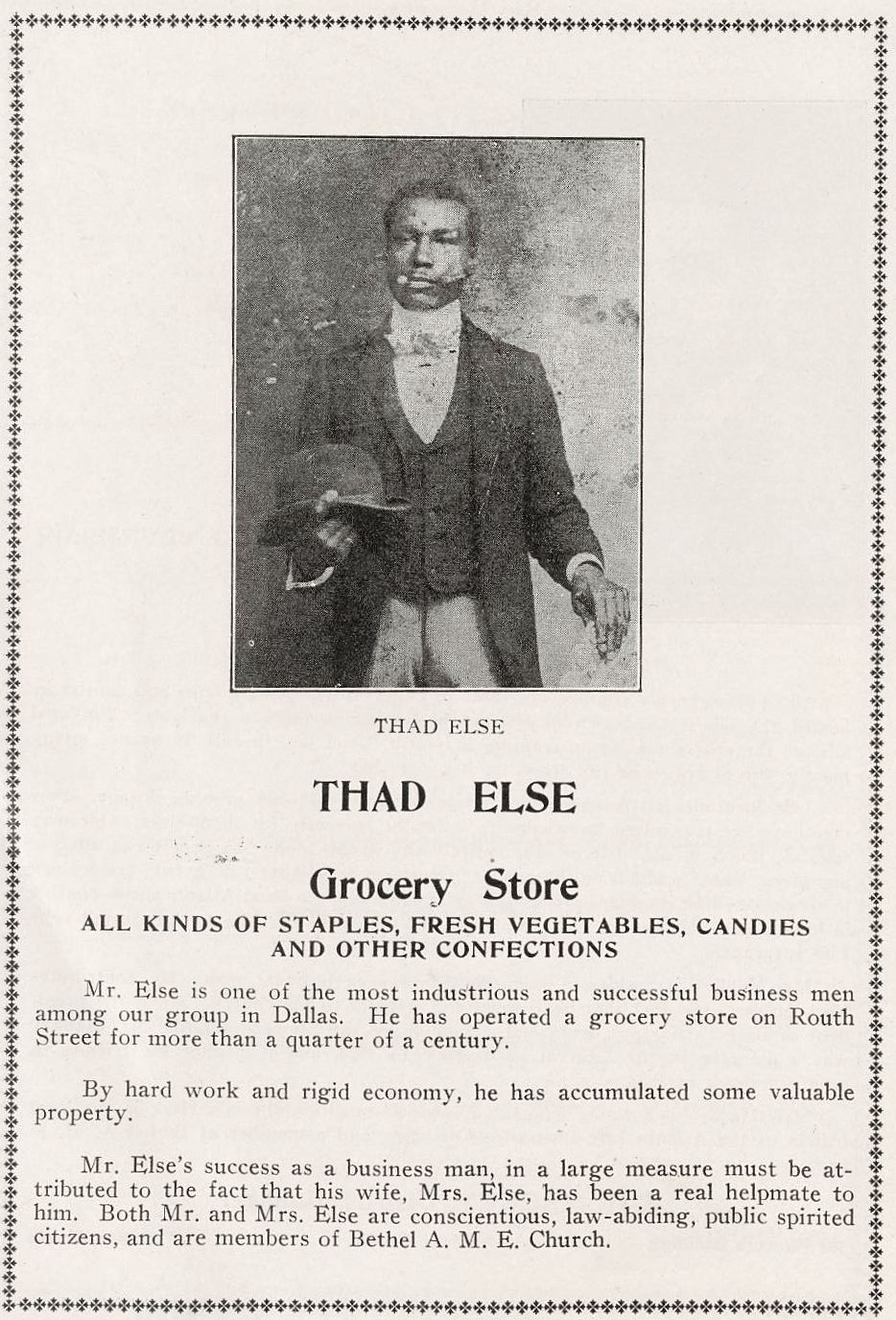
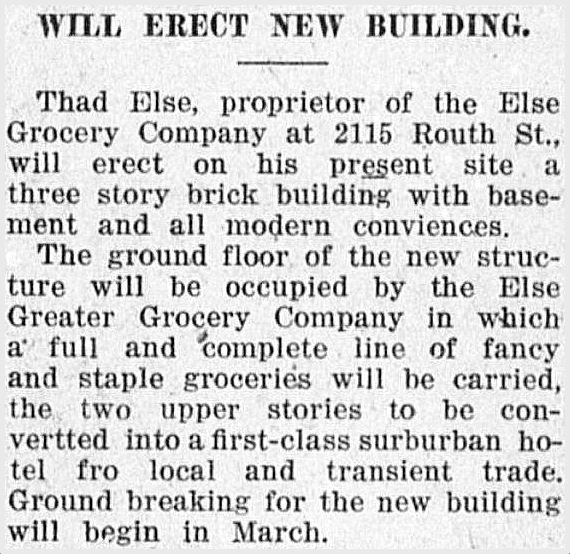
Another entrepreneur was Thad Self, whose main business seems to have been a grocery/general merchandise store on Routh Street south of Colby. He also owned a transfer company, a hotel/boarding house, a barber shop, a cafe, and at least one other general store. Most of his companies were located in buildings on the neighboring lots at 2113 Routh and 2115 Routh, one or both of which he appears to have purchased in 1913 for $100 (about $2,600 in today’s prices). He built a large three-story building on Routh in 1913 (which, according to this 1921 Sanborn map) was built over the Dallas Branch of the Trinity which snaked through downtown and the State-Thomas area — that  basement was probably pretty damp.

thad-else_dallas-negro-directory_1930_portal1930

thad-else_dallas-express_120619_HOTELDallas Express, Dec. 6, 1919

*

Speaking of hotels, one of the most prominent hotels in the era when blacks were not allowed to stay in “white” hotels by law was the Powell Hotel at 3115 State Street (between Ellis and Hugo), owned by D. H. Powell and his wife Susie. In May, 1929 Powell was issued a permit to tear down a frame house at 3115 State, and he built his 40-room hotel on the property soon after. The Powell Hotel was where almost every notable African-American visitor to the city stayed. By the late 1940s, Powell had built something of a hotel empire in Dallas with several locations. (I will have to write more about him in a future post!) I like this very early ad, from the 1930 directory, describing it as the “Powel Hotel & Pleasure Dome.” The photo shows a pleasant-looking place, but you and I and Kubla Khan and Coleridge would probably agree it’s no Xanadu.

powell-hotel_dallas-negro-directory_1930_portal1930

powell-hotel_legacies_spring-2007Dallas Public Library, via Legacies, Spring, 2007

*

Speaking of “resting places”… another essential element in any community is the funeral home. One of Dallas’ most prominent undertaking firms for black Dallas was the E. J. Crawford Funeral Home at 804 Good (now N. Good-Latimer, between Live Oak and Bryan), founded by Mr. Crawford in 1909. “The last word in funeralizing.”

crawford-funeral-home_dallas-negro-directory_1930_portal1930

crawford_e-j_dallas-express_020422Dallas Express, Feb. 4, 1922

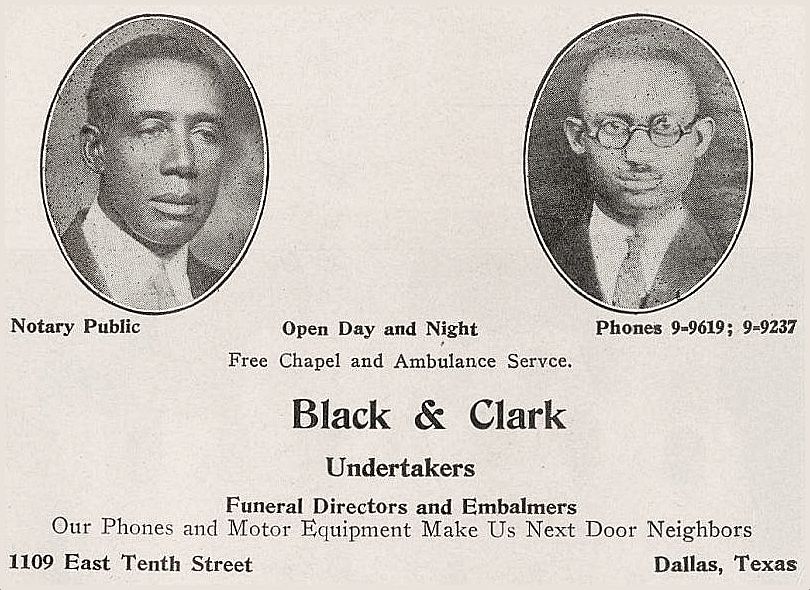
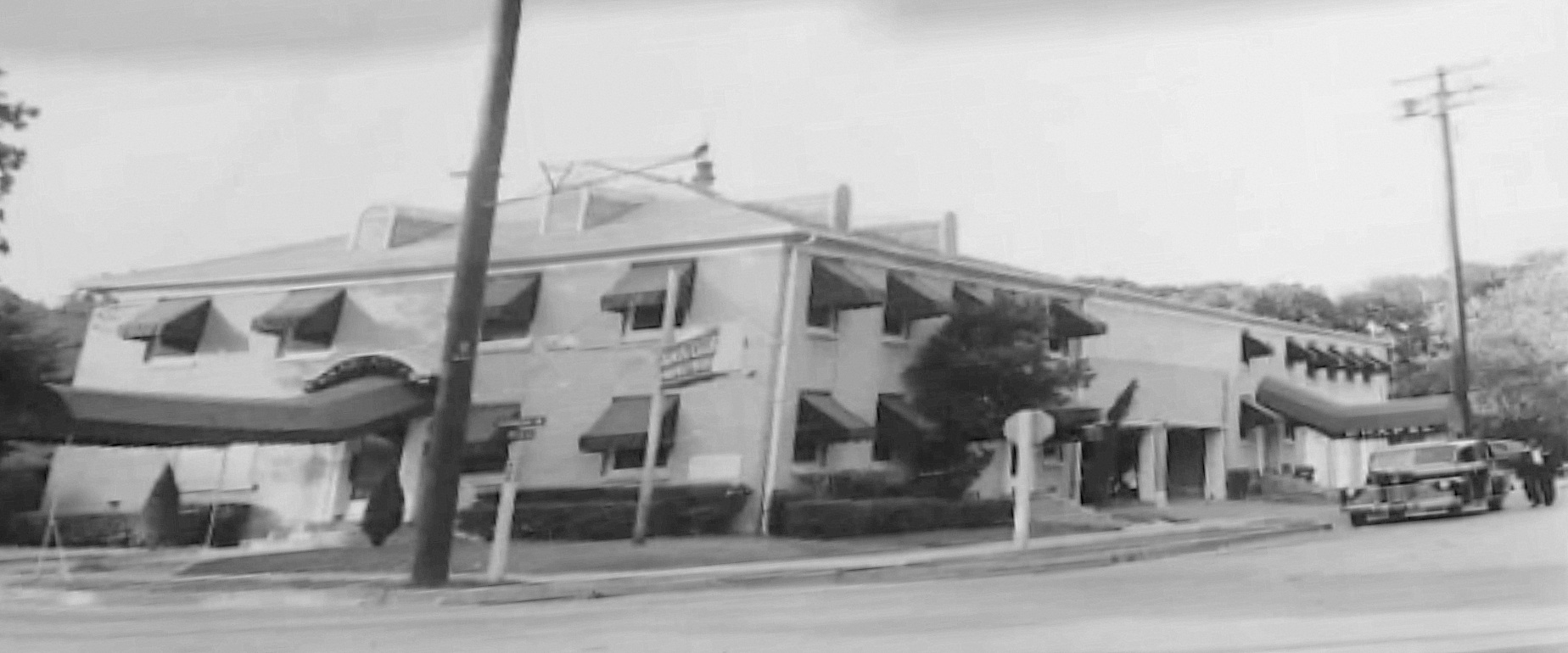
Another prominent funeral home/ambulance service was Black & Clark, founded originally around 1914 by S. C. Black; in 1927 he was joined by his nephew C. J. Clark. For years they were located in Oak Cliff, at 1109 E. Tenth St., west of what is now South R. L. Thornton, near Cliff Avenue. This funeral home is still in business, and there was recently a profile of the Dallas institution on Channel 5 News (watch it here).

black-and-clark-undertakers_dallas-negro-directory_1930_portal1930

black-and-clark_archives_1802-n-washington1802 N. Washington (woozy screenshot of photo in Ch. 5 news story)

*

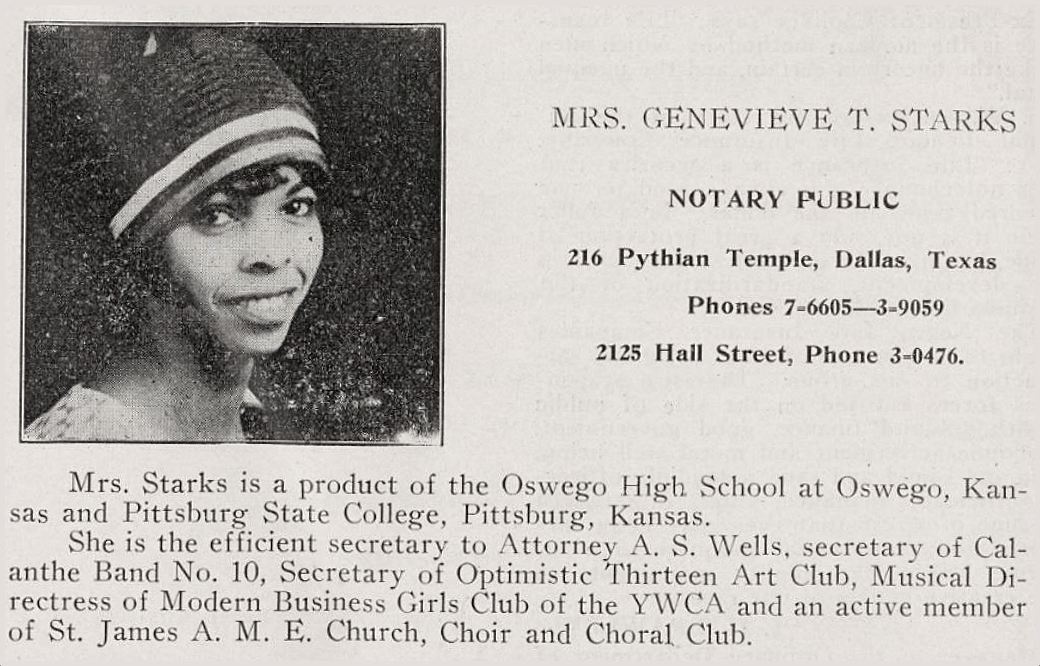
This is Genevieve T. Starks, a woman with a lot of extra-curricular activities! I love this photo.

genevieve-starks_dallas-negro-directory_1930_portal1930

*

The G Clef Club was organized around 1921 by Lincolnia Hayes Morgan, music supervisor for Dallas’ (black) public schools. A blurb about the group appeared in The Crisis, the official publication of the N.A.A.C.P.: “The objects of the club are to assist worthy music students and to raise the music standard of the community” (June, 1921).

g-clef-club_dallas-negro-directory_1930_portal1930

*

A popular singing group was the Belt Sacred Quartette (comprised of J. J. Mollis, J. Poindexter, F. W. Grant, and N. Tisdale) — listen to their recording of “I Have Another Building” below.

belt-sacred-quartette_dallas-negro-directory_1930_portal1930

belt-sacred-quartette_blackwell-OK-journal-tribune_072332Blackwell (OK) Journal-Tribune, July 23, 1932

*

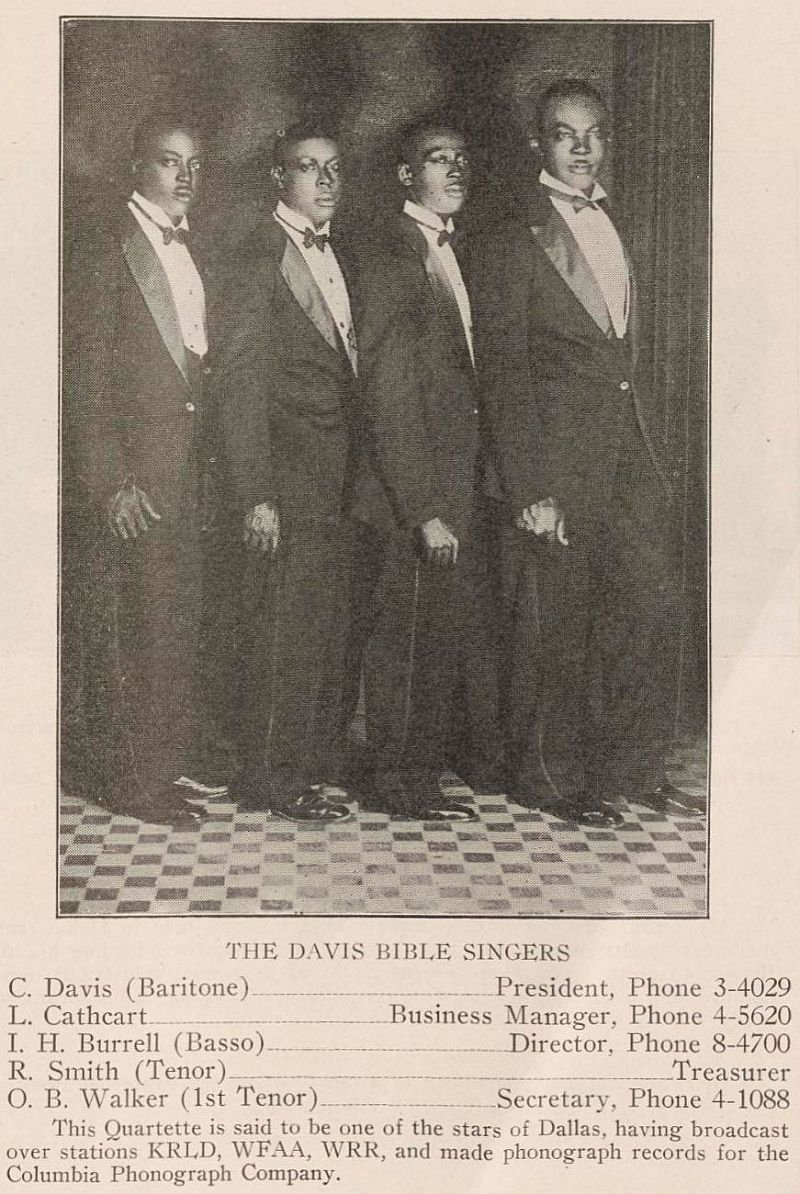
The Davis Bible Singers (C. Davis, I. H. Burrell, R. Smith, and O. B. Walker) seem to have been pretty popular, having appeared on KRLD, WFAA, and WRR radio. They even recorded for Columbia Records (listen to their great recording of “Daniel Saw the Stone” below).

davis-bible-singers_dallas-negro-directory_1930_portal1930

*

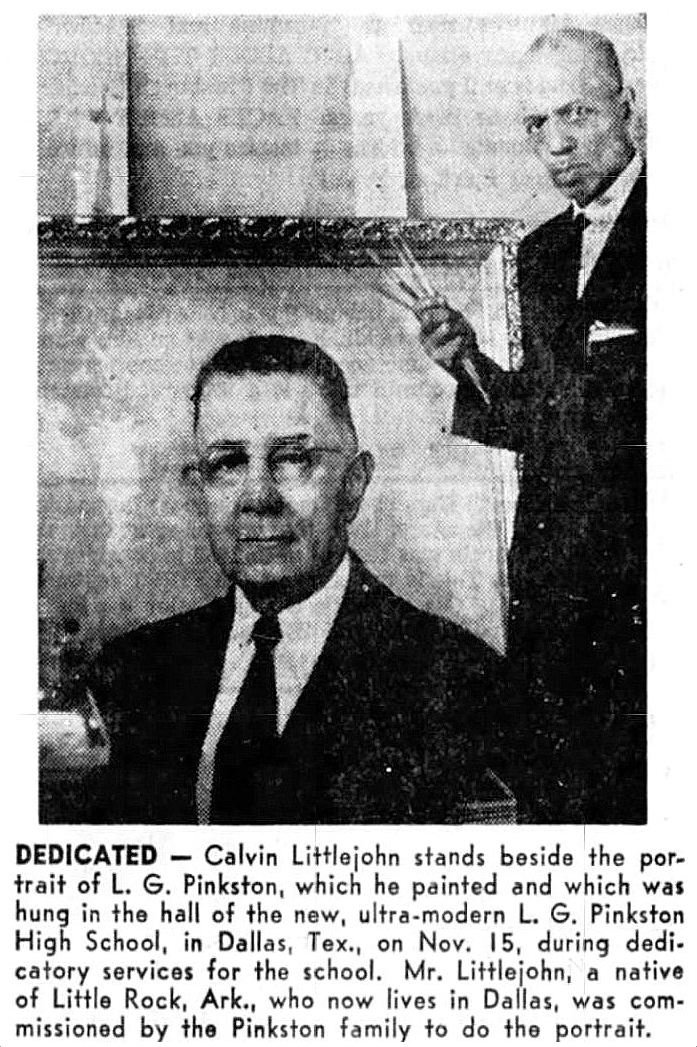
One of the most important doctors in Dallas in the 1920s and ’30s was Dr. Lee Gresham (L. G.) Pinkston (1883-1961), who opened the Pinkston Clinic at 3305 Thomas Avenue, between Hall and Central, in 1928 or 1929 (it made its first appearance in the 1929 city directory). In 1954, Pinkston — physician, surgeon, and civic leader — was one of the first five black doctors allowed to practice in a “white” Dallas hospital (St. Paul’s Hospital) — before that, the only hospital in Dallas where black doctors could practice was the Pinkston Clinic, which had 15 beds (32 beds were allotted for black patients at St. Paul’s in 1954). (See a photo of the five doctors here, Dr. Pinkston is seated.) A new West Dallas school — Pinkston High School — was named in Dr. Pinkston’s honor and opened in 1964, three years after his death. 

pinkston-clinic_dallas-negro-directory_1930_portal1930

pinkston-clinic_DHSDallas Historical Society

Below, a portrait of Dr. Pinkston with the artist, Calvin Littlejohn (whom I’d known only as a photographer previously), destined to hang in the new school.

pinkston-l-g_portrait_calvin-littlejohn_pittsburgh-PA-courier_112864Pittsburgh (PA) Courier, Nov. 28, 1964

***

Sources & Notes

All 1930 images are from Official Directory: Dallas Negro Churches, Schools and Other Activities; Civic, Business, Fraternal, Social, Etc. compiled by James H. Smith, 1930; from the Tarrant County Black Historical and Genealogical Society, via the Portal to Texas History. This fantastic resource is scanned in its entirety here.

See the two other Flashback Dallas posts which also use this wonderful directory as a source:

mme-pratt-muisc-teacher_dallas-negro-directory_1930_portal_det_sm

*

Copyright © 2020 Paula Bosse. All Rights Reserved.
Stop at the Delmonico — ca. 1919

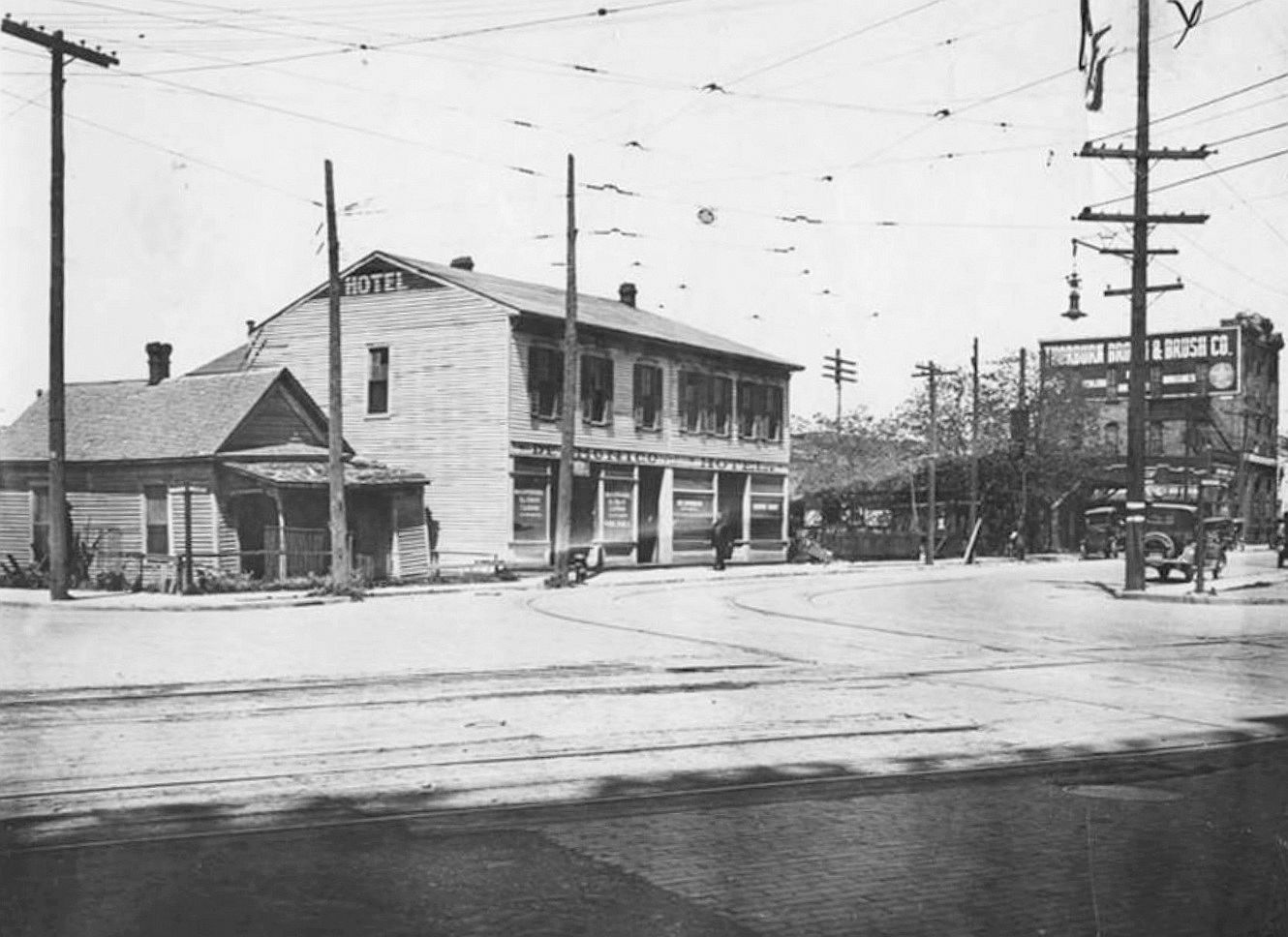
delmonico-hotel_degolyer_SMU_ca-1919The Delmonico Hotel & Thorburn Broom factory… (click for larger image)

by Paula Bosse

How does one refer to the area just above Pacific and Central, where Swiss once crossed Central? “Deep Ellum-adjacent”? “Far North Deep Ellum”? The “Extreme Western Edge of Old East Dallas”? It was very close to the old union railroad depot, where the T&P and H&TC tracks crossed (about where Pacific and Central crossed). It was once a bustling area, but after the depot closed in the ‘teens, it didn’t bustle so much anymore. 

The photo above — looking to the northeast and taken about 1918 or 1919 — shows the Delmonico Hotel (at 2309-2311 Swiss Avenue) and, to the right, the Thorburn Broom & Brush Co. factory (2405-2409 Swiss). (See the Swiss Avenue occupants of these two blocks as listed in the 1919 Dallas directory here.) The street that runs between the two blocks is Central Ave. The railroad tracks running horizontally at the bottom of the photo run along Pacific, and the streetcar tracks curve up and to the right to run along Swiss.

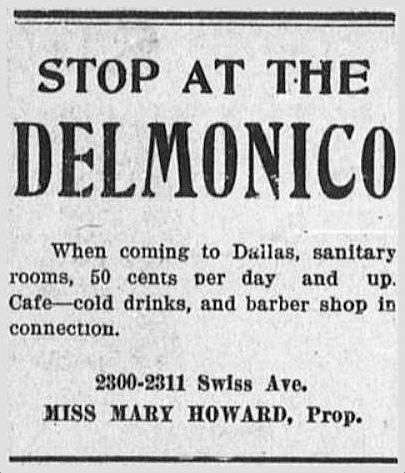
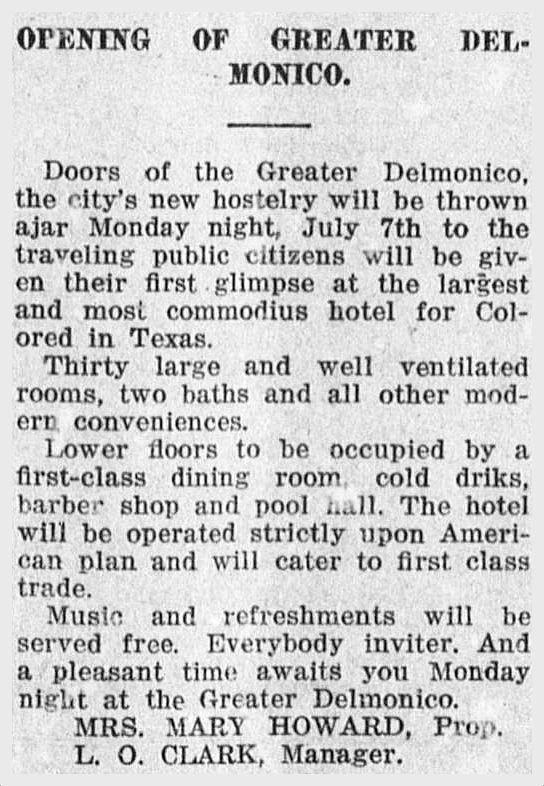
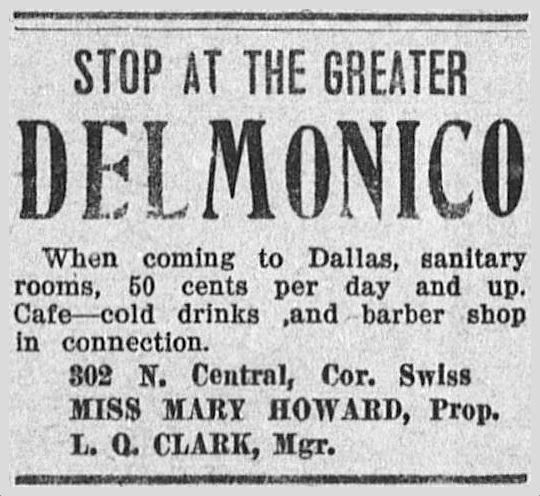
The Delmonico Hotel was at this location for only a couple of years until it moved a block around the corner, facing Central — the new, larger “Greater” Delmonico opened in July, 1919, occupying the upper floor at 302 Central. The proprietress of both locations was Miss Mary Howard (later Mrs. L. O. Clark). Miss Howard was, apparently, an enterprising African American woman who ran what was described in Dallas’ premiere black newspaper as “the largest and most commodious hotel for Colored in Texas… [catering] to first class trade” (Dallas Express, July 5, 1919). It remained in business at its second location on Central Ave. until 1927 or 1928.

delmonico-hotel_dallas-express_011119Dallas Express, Jan. 11, 1919

Above, an ad for the hotel’s first location (the address should read “2309-2311 Swiss”). Below, a nice article on the opening of the second location on Central.

delmonico-hotel_dallas-express_070519_NEW-greater-delmonicoDallas Express, July 5, 1919

delmonico-hotel_dallas-express_082319Dallas Express, Aug. 23, 1919

It’s interesting that the 1919 Dallas directory has a business listing for this hotel (the first location, the one seen in the photo) — it is the sole hotel for “colored” patrons listed (denoted with the letter “c” — you can see the list of hotels from the 1919 directory here).

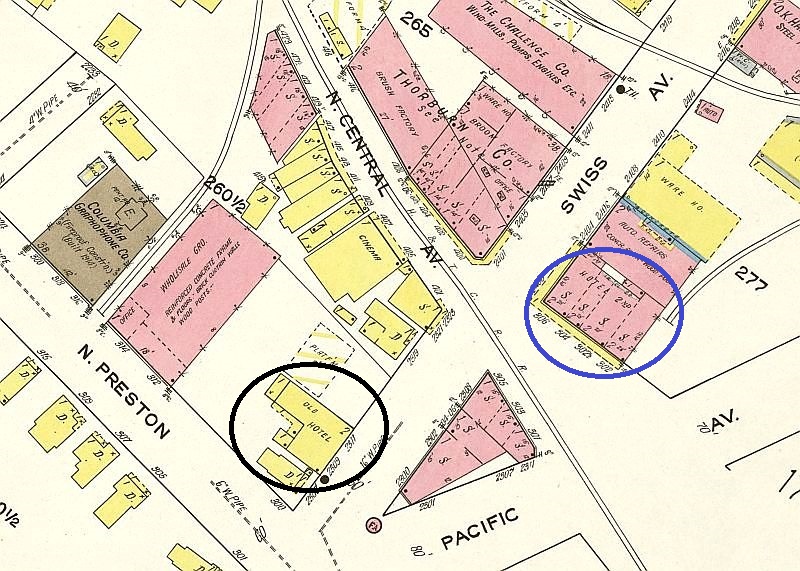
The first location can be seen in this detail of a 1921 Sanborn map, circled in black; the second location is circled in blue; the Thorburn Co. broom factory at Swiss and Central is labeled. (All images are larger when clicked.)

delmonico_swiss-central_sanborn_1921-sheet-14-det

The 2300 block of Swiss is no longer there — it is now empty land beneath the elevated North Central Expressway. The 2400 block (where the broom factory stood) is still there and is the site of a self-storage business (the Thorburn factory once stood here, across from the Lizard Lounge).

*

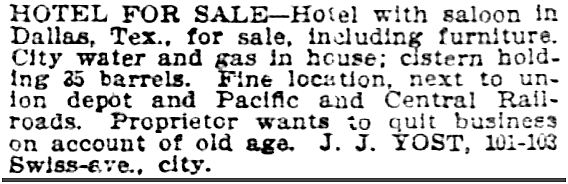
The large white building housing the Delmonico appears to have been built in 1889 by Swiss-born John Jacob (“J. J.”) Yost, who soon opened the Bear Hotel, which seems to have been a popular rooming house/hotel for German immigrants. By 1902 Yost was looking for a buyer for the hotel (“with saloon”) and placed the ad seen below (an ad which appeared not too long after a court notice appeared in the papers showing  that Yost had been found guilty of operating a “disorderly house” (a brothel) and had been fined $200, which was a huge fine at the time).

bear-hotel_dmn_042602_for-saleDallas  Morning News, April 26, 1902

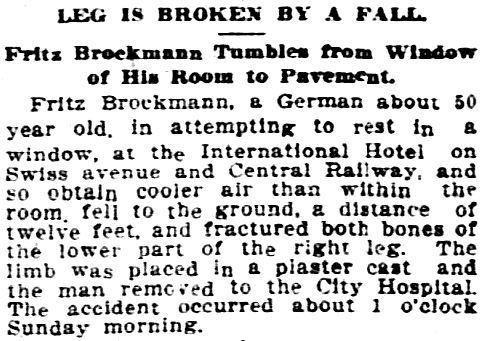
As Yost described it, the hotel really was in “a fine location” — just a block or two from a very busy passenger-train depot. Perhaps he was asking too much for it, but the Bear Hotel appears to have remained in operation until 1906, when it became the International Hotel (which was in business until 1918 when the hotel became the Delmonico, the first of these hotels to be owned by an African American for a strictly black (segregated) clientele). Below is an amusing (or terrifying) news tidbit from 1909 about a guest at the International Hotel. When you find yourself asking “what did people do before air-conditioning?” remember what happened to poor Fritz Brockmann:

international-hotel_dmn_070509
DMN, July 5, 1909

**

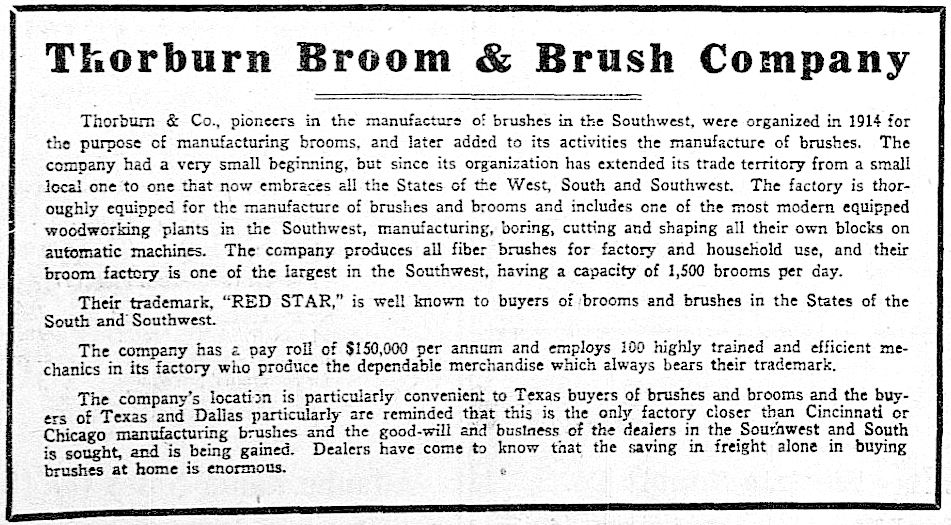
The Thorburn Broom & Brush Co. manufactured … brooms and brushes in their factory seen at the right in the photo above. A few bristly factoids about the company were included in a Chamber of Commerce-like series of ads from 1922.

thorburn-broom-brush_june-1922June, 1922

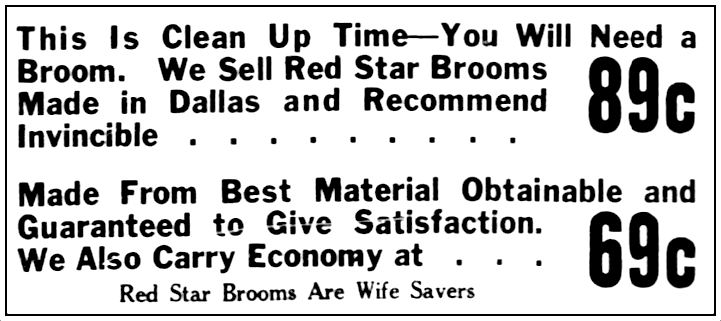
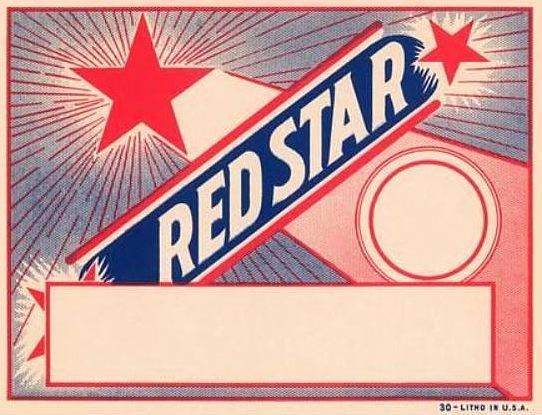
Thorburn’s marquee brand seems to have been the trademarked Red Star brooms (“Red Star brooms are Wife Savers”).

thorburn_red-star-brooms_1924Piggly Wiggly ad, 1924

red-star-broom-label

***

Sources & Notes

Top photo — titled “[Swiss Avenue at Central and the Houston and Texas Central Tracks]” — is attributed to George A. McAfee and is from the DeGolyer Library, SMU Libraries, Southern Methodist University; more information on this photo may be found here.

More info about the old Union Depot — which was one block south from the location seen in the photo above — can be found in these Flashback Dallas posts:

  • “The Old Union Depot in East Dallas: 1897-1935,” here
  • “The Union Depot Hotel Building, Deep Ellum — 1898-1968,” here
  • “The Gypsy Tea Room, Central Avenue, and The Darensbourg Brothers,” here

*

Copyright © 2018 Paula Bosse. All Rights Reserved.
Jefferson Dagnal’s Saloon, Deep Ellum — 1906

fritts-and-dagnal_brent-burton
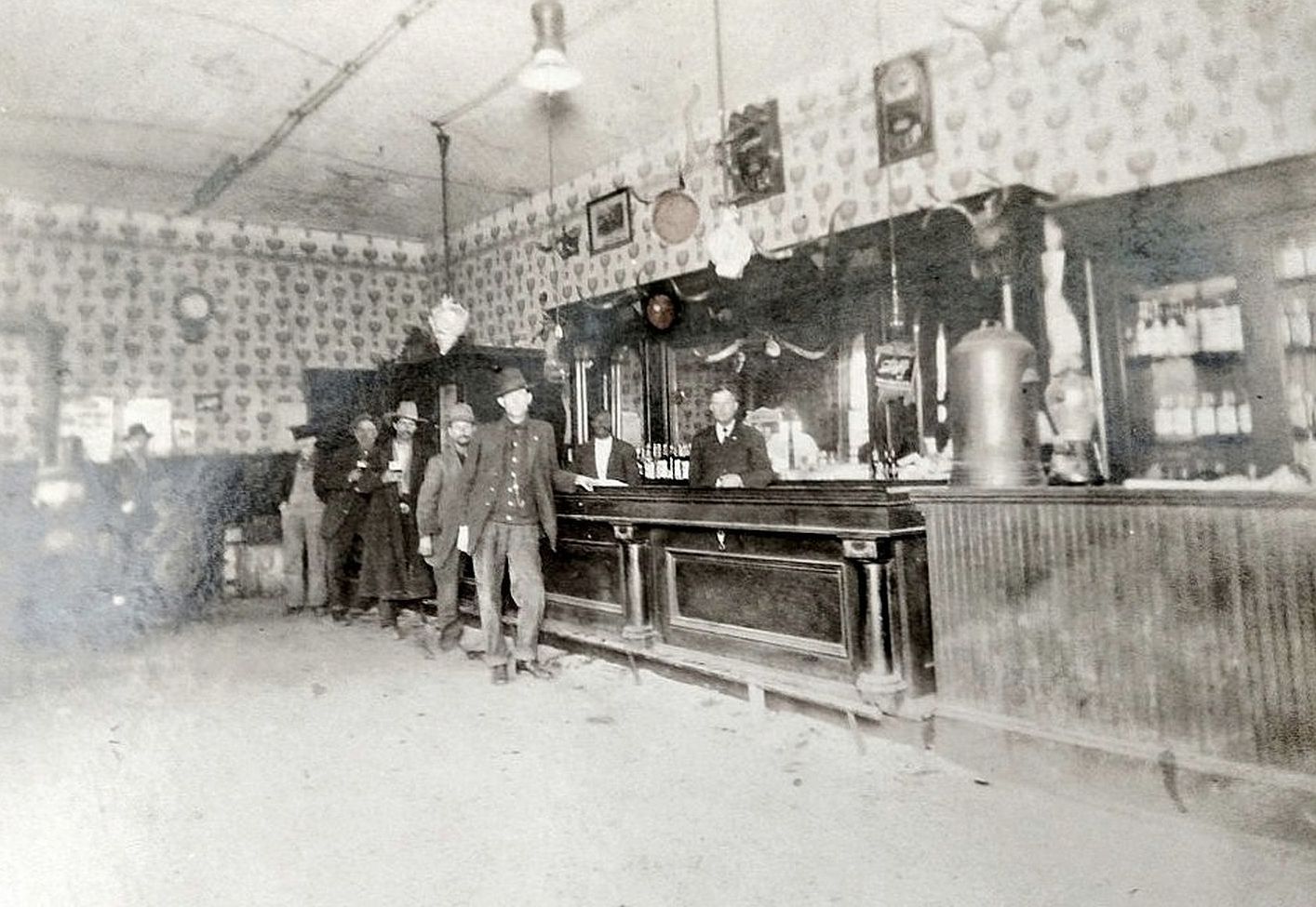
“Fritts & Dagnal,” Deep Ellum saloon… (photo: Brent Burton)

by Paula Bosse

Reader Brent Burton commented on one of my tweets on Twitter to say that he had an old photo showing his great-great-grandfather standing in a saloon he had owned in Dallas around the turn-of-the-century and wanted to know how he might access old Dallas directories in order to try to determine where the bar had been. I told him that online scans of city directories are available for free from the Dallas Public Library and the Portal to Texas History (more on this is in my post How to Access Historical Dallas City Directories Online”). I also offered to see what I could find out.

The photo is the one above (click it to see a larger image). All he knew was that it was taken in a bar owned by his great-great-grandfather Jefferson Davis Dagnall (whose last name is most often spelled “Dagnal” in various documents such as census records, directories, and his death certificate, so I will refer to him with this spelling) and that the photo was taken in the late 1800s or early 1900s. I figured it would be pretty easy to find the info because his name was so uncommon, but that was complicated by the fact that his name was spelled and misspelled many different ways — I think I came across five or six permutations. It took a long time to figure out where that photo was most likely taken — mainly by going through census records and looking at all the city directories — year by year — to pin down where he was working each year. And he got around — he lived at a new address almost every year, and changed jobs almost as frequently.

Jefferson Davis Dagnal was born in 1861, probably in Fort Bend, Texas. His father, a South Carolina native, appears to have died fighting in the Civil War; Jeff (…I call him Jeff…) was 3 years old when his father died. By 1880 he was a teenager, working on a Dallas-area farm. In 1883, Jeff was working as a blacksmith. According to city directories, he held the following jobs: store clerk, laborer, streetcar driver, house-mover, electrician, and bartender.

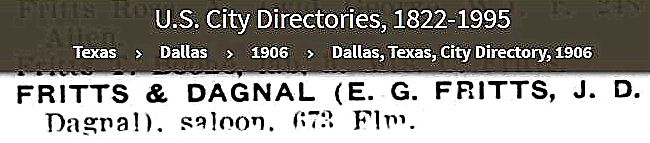
1905 was the year he seems to have settled into bartending, a job he held in various establishments in Deep Ellum for a decade, until his death in 1915. He appears to have owned (or co-owned) only one of these bars: Fritts & Dagnal. It seems the venture with partner E. G. Fritts was short-lived: its only listing is in the 1906 directory — by 1907 Jeff had moved on, tending bar elsewhere.

1906-directory_dagnal_saloon_fritts-and-dagnal_673-elm

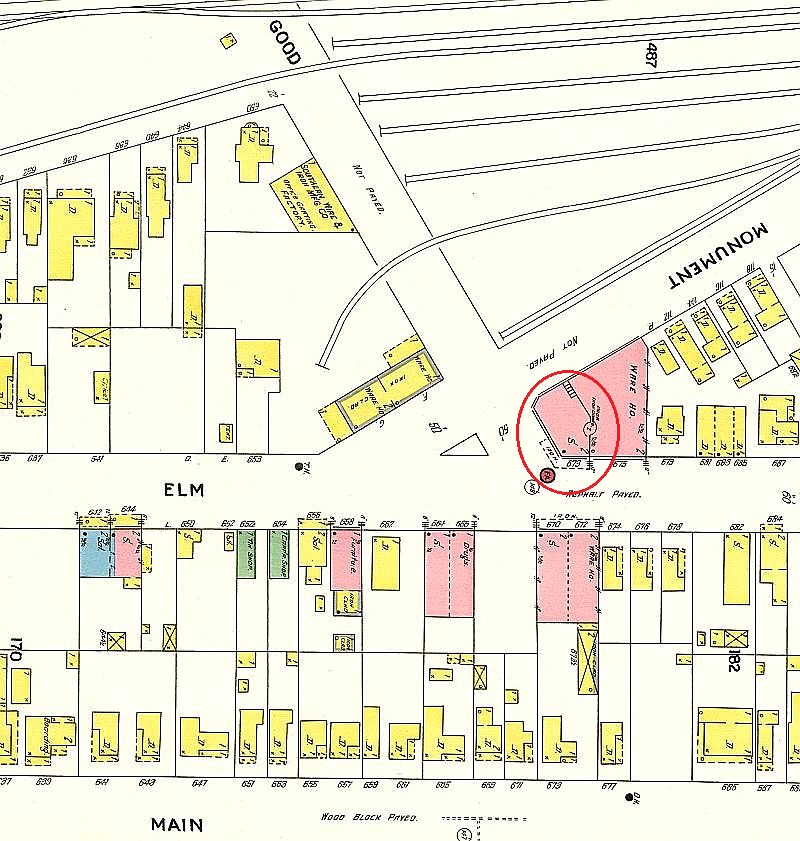
The saloon was listed in the 1906 city directory as being at 673 Elm — that address was changed in 1911 and became 2603 ½ Elm. This was in Deep Ellum, at the northeast corner of Elm and Good (possibly on the second floor). Below is a 1905 Sanborn map showing the location (the full map is here).

673-elm_fritts-and-dagnal_sanborn_sheet-42_1905_det
1905 Sanborn map, detail

The lot that building stood on at Elm and what is now Good-Latimer is empty, but a current-ish look at the location, from Google Street View, can be seen here (I am attempting to post a view from 2015, before all the construction work was going on near the Elm and Good-Latimer intersection — but just move up or down Elm a bit on Google and you’ll see construction images take over).

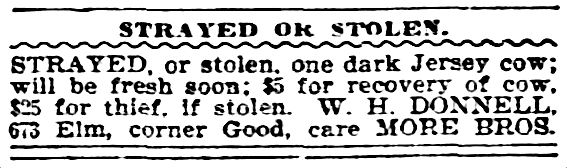
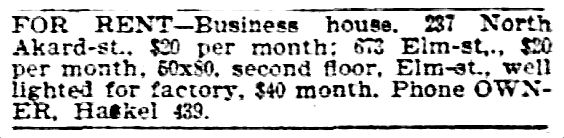
Below, a couple of ads from around the time Jeff Dagnal and E. G. Fritts decided to start up their short-lived saloon at 673 Elm: the first ad shows that it was not unusual in 1905 for large livestock to be kept in Deep Ellum (where they might even have been “rustled”), and the second ad shows that both the upstairs and downstairs spaces of the building at 673 Elm were available to rent:

1905_673-elm_strayed_dmn_051305Dallas Morning News, May 13, 1905

1906_673-elm_for-rent_dmn_050606DMN, May 6, 1906

(According to the Inflation Calculator, those 1906 rents of $20 and $40 would be about $550 and $1,100 in today’s money.)

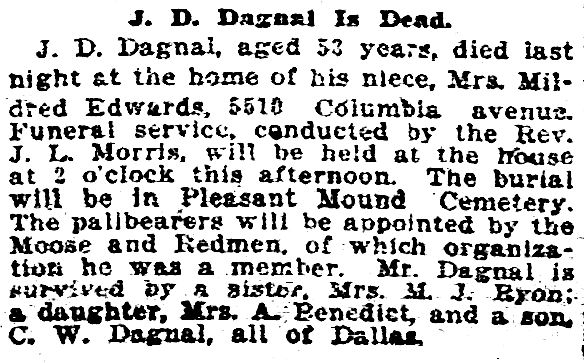
Jefferson Davis Dagnal died in Dallas on Feb. 25, 1915. His death certificate — with information provided by his daughter, Cora — listed his occupation as “blacksmith,” even though he had been a bartender (and, briefly, a saloon owner) for at least the last ten years of his life.

1915_dagnal_death_dmn_022615
DMN, Feb. 26, 1915

*

One interesting thing about Mr. Dagnal, was his relationship with his wife Alice, the mother of his second child, Clarence, who was born in 1893. Alice and Jeff appear to have hit a rough patch in their marriage pretty early on. In the 1900 census, they were living in different cities, and each claimed to be widowed. I don’t know if they ever officially divorced (or even if they officially married), but I suppose it was easier in that era to claim a spouse had died rather than admit the shame of divorce or abandonment. By 1903 both were living in Dallas — at the same address. But by 1904 they were living apart, and Alice was, again, claiming to be a widow — even though an alive-and-kicking Jeff was listed in the directory right under her name!

1904-directory_dagnal_alice-and-jeff1904 Dallas directory

I have come across this phenomenon so frequently that I now question every “widow” or “widowed” claim I come across. Information from the U. S. Census (where people give false ages and incorrect marital status ALL THE TIME) should be taken with a grain of salt!

***

Sources & Notes

Photo of Jefferson Dagnal’s saloon was shared with me by Dagnal’s great-great-grandson, Brent Burton and is used here with his permission. Jeff is probably in the photo — in 1906 he would have been 45 years old. Thank you for the great photo, Brent!

All images are larger when clicked.

*

Copyright © 2018 Paula Bosse. All Rights Reserved.
 

R. S. Munger’s Cotton Gin Manufactory

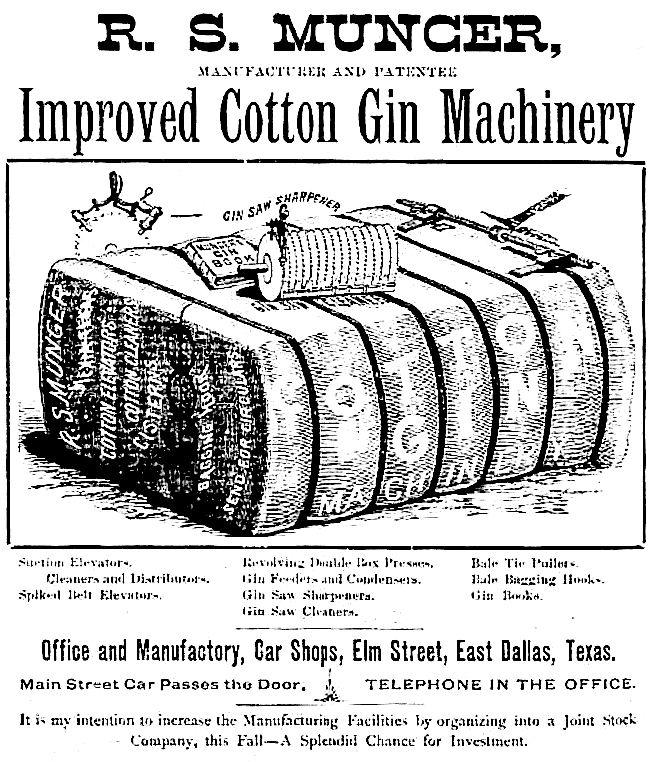
munger-improved-cotton-gin_1889-dallas-directory_detElm & Trunk, the early years (detail of an ad from 1889)…

by Paula Bosse

When R. S. Munger moved to Dallas from Mexia around 1885, even he probably had no idea how revolutionary his patented inventions would become to the world of agriculture — he had several patents, but his “improved” cotton gin was hailed as the most significant advance in cotton ginning since Eli Whitney’s original invention. Munger had been producing his equipment for a while in Mexia, but he knew that in order for his company to grow, he would have to move to a larger city, one served by the all-important railroad. He arrived in 1885 and moved into an existing “East Dallas” building owned by the wealthy banker (and former cotton farmer…) William H. Gaston (who later became an officer of the company).

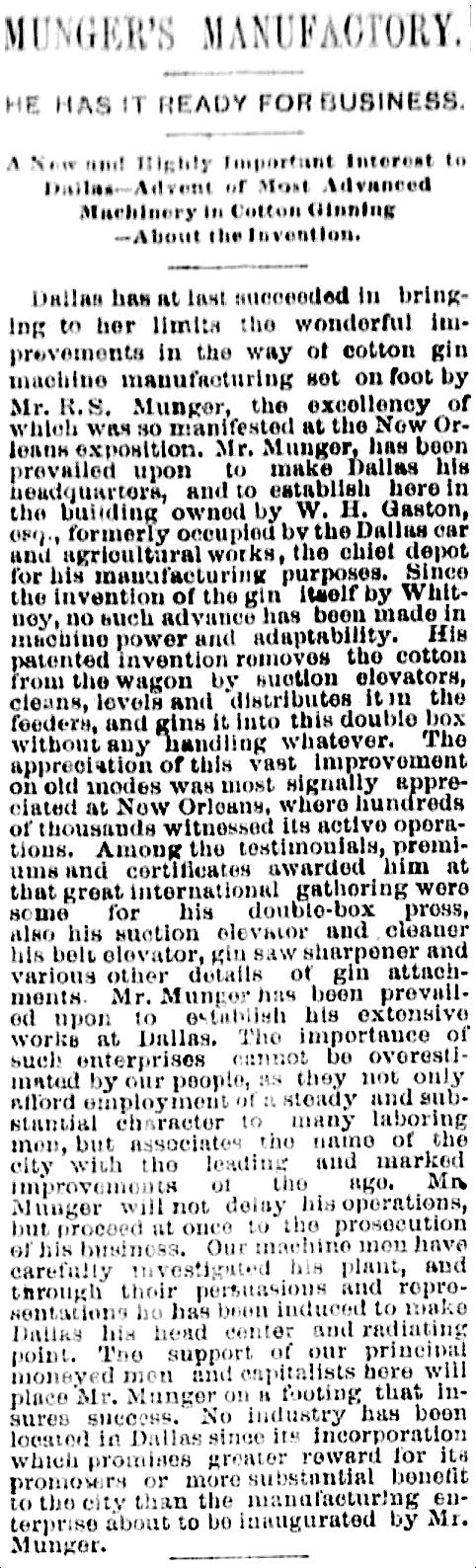
The following article appeared in an 1885 edition of the Dallas Herald. It is bulging with superlatives and grand statements which actually weren’t exaggerations: because of Munger’s relocation to Dallas and his products’ massive success, the city became a national hub of agricultural machinery manufacturing. This had a huge impact on Dallas’ economic development, and the unnamed writer of this article deserves credit for his prescient words. (Click to see larger image.)

munger_to-dallas_dallas-weekly-herald_052885Dallas Weekly Herald, May 28, 1885

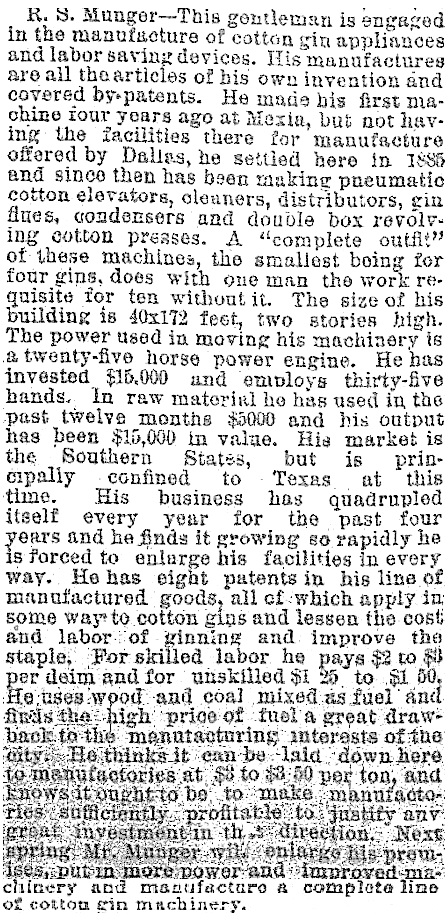
Another article describes just what Munger’s “improvements” were and also has a description of his factory — the heart of which was a 25 horsepower engine (a quick Google search tells me that 25hp is the size of a standard outboard motor engine).

munger_dmn_092886
Dallas Morning News, Sept. 28, 1886

A very early want-ad:

munger_dmn_072886_very-early-ad
DMN, July 28, 1886

(You can read about Mr. Munger’s career accomplishments in A History of Greater Dallas, published in 1909, here, and in the Handbook of Texas entry here.)

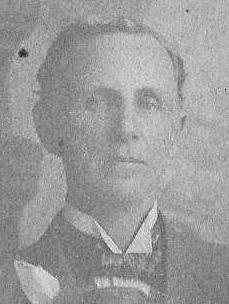
munger-r-s_find-a-graveR. S. Munger (1854-1923)

Fast-forward to today: the factory which Munger began in Dallas in the 1880s is somehow still standing and is known by most as the Continental Gin Building.

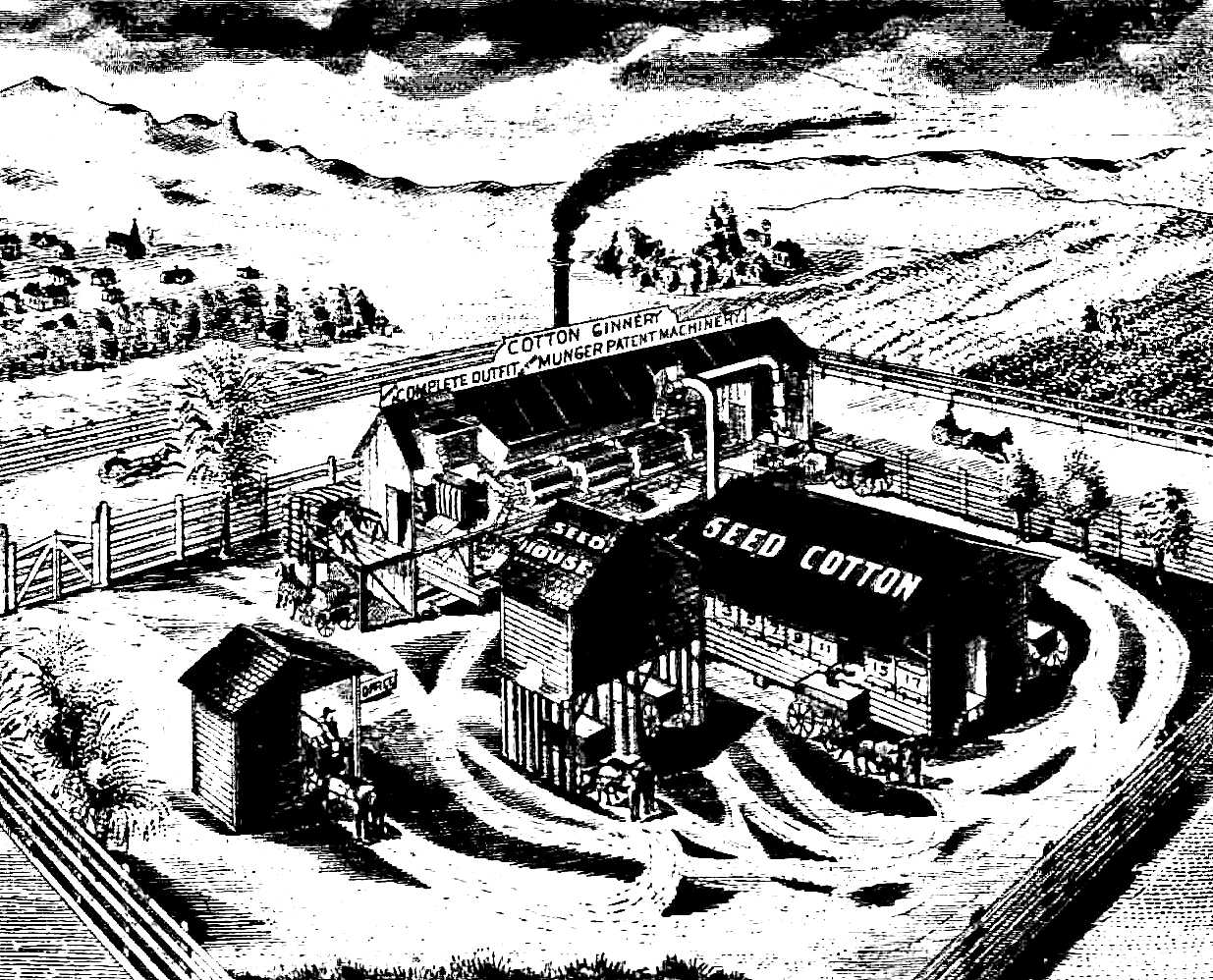
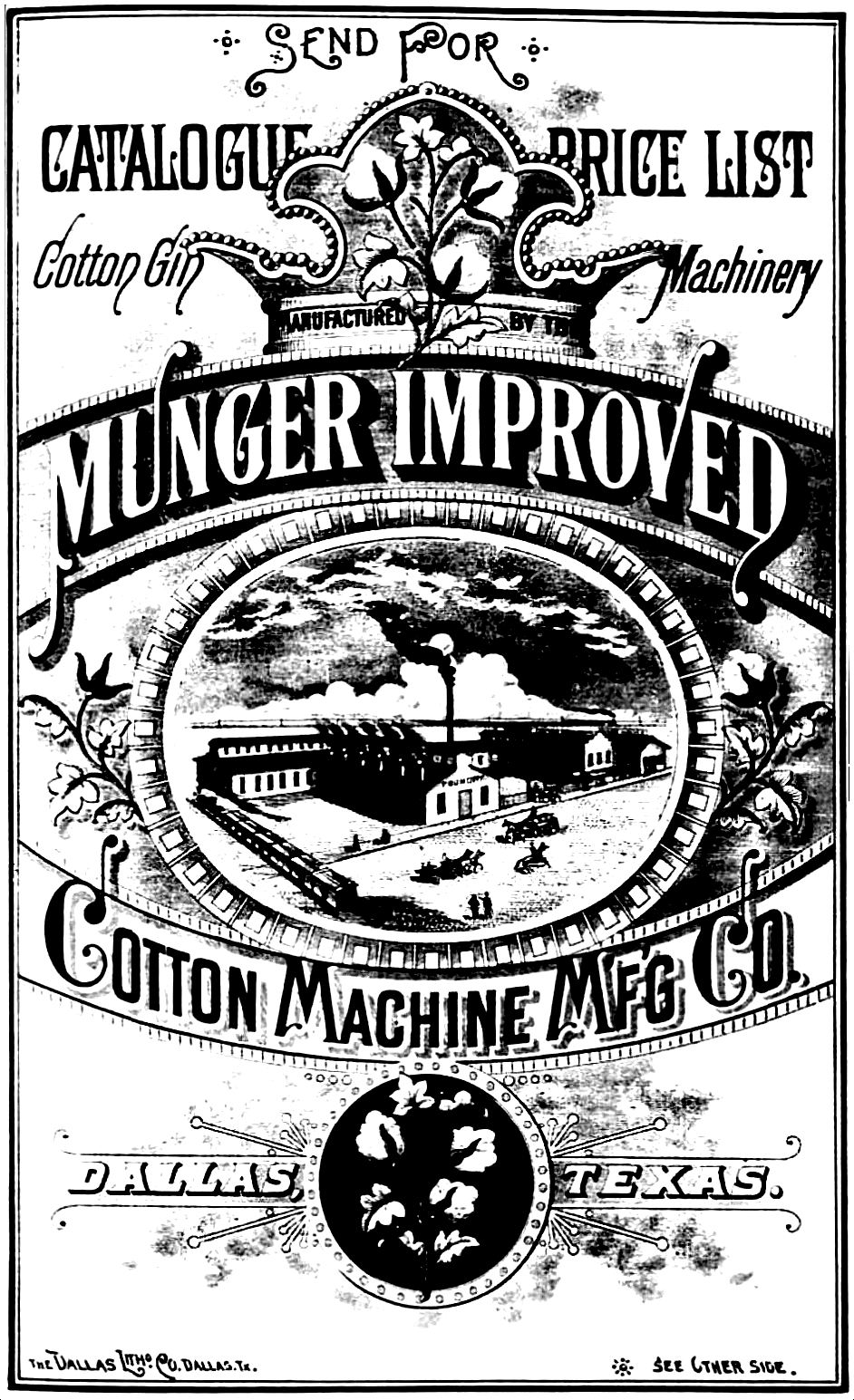
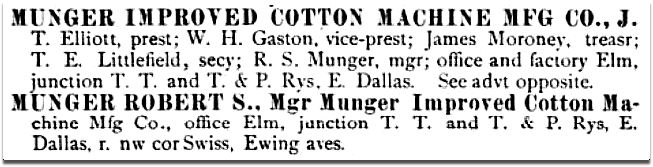
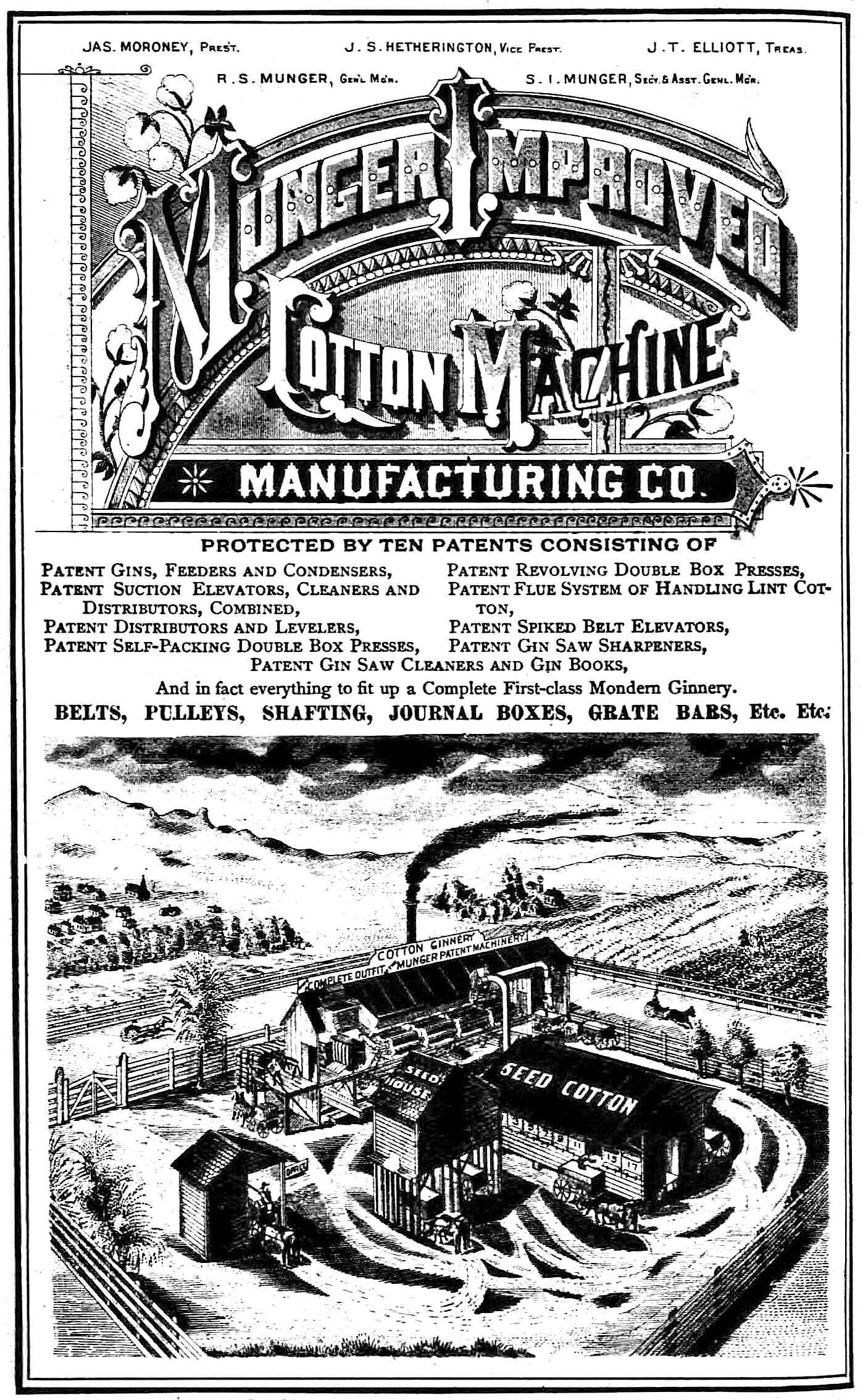
Here are a few very early ads of Munger’s cotton-gin-manufacturing empire, from city directories (the illustrated ads are full-page, which even in 1886 cost a pretty penny).

munger-improved-cotton-gin_1886-dallas-directory_listingDallas city directory, 1886

munger-improved-cotton-gin_1886-dallas-directory_aDallas city directory, 1886

munger-improved-cotton-gin_1886-dallas-directory_bDallas city directory, 1886

munger-improved-cotton-gin_1888-dallas-directory_listingDallas city directory, 1888

munger-improved-cotton-gin_1889-dallas-directoryDallas city directory, 1889

***

Sources & Notes

Photo of Robert Sylvester Munger from Find-a-Grave.

All other sources noted.

An aerial view of the complex of former Continental Gin Co. buildings can be seen via Google here.

More on the Continental Gin Company can be found in these Flashback Dallas posts:

*

Copyright © 2018 Paula Bosse. All Rights Reserved.
 

Holy Blues: Blind Willie Johnson and Arizona Dranes — 1920s

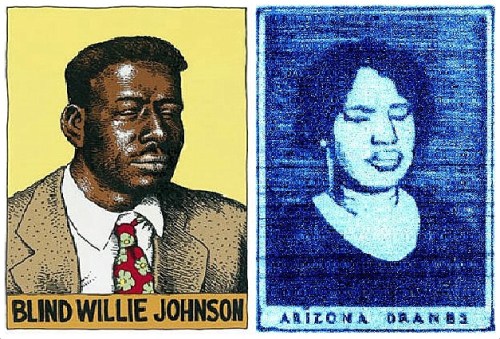
johnson-dranes

by Paula Bosse

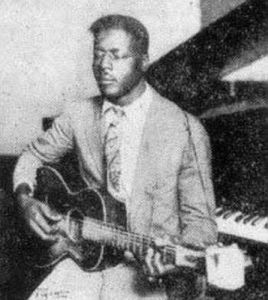
Today a little Sunday-go-to-meetin’ music, courtesy of two powerful singers who recorded at about the same time — late 1920s — and who both spent time in Dallas. Blind Willie Johnson was from Marlin, Texas, but he recorded much of his music in Dallas and regularly played street corners in Deep Ellum. Arizona Dranes, also a native Texan, lived in Dallas for several years and was, like Johnson, blind. Listening to both of them, you can hear their influence in the gospel and blues music that came after them. Read about the short life and career of Blind Willie Johnson here. Read about the life and career of Arizona Dranes from Michael Corcoran, here and here. And listen to their music below. It’s fantastic. (All of the tracks by Johnson were recorded in Dallas.)

blind-willie-johnson
Blind Willie Johnson, 1927-ish?

That guitar!

*

*

Here he is with his wife singing behind him.

*

Johnson’s song “Dark Was the Night, Cold Was the Ground” was included on the Voyager Gold Record, a collection of music chosen to represent Earth’s culture and diversity, carried into space aboard the Voyager.

*

*

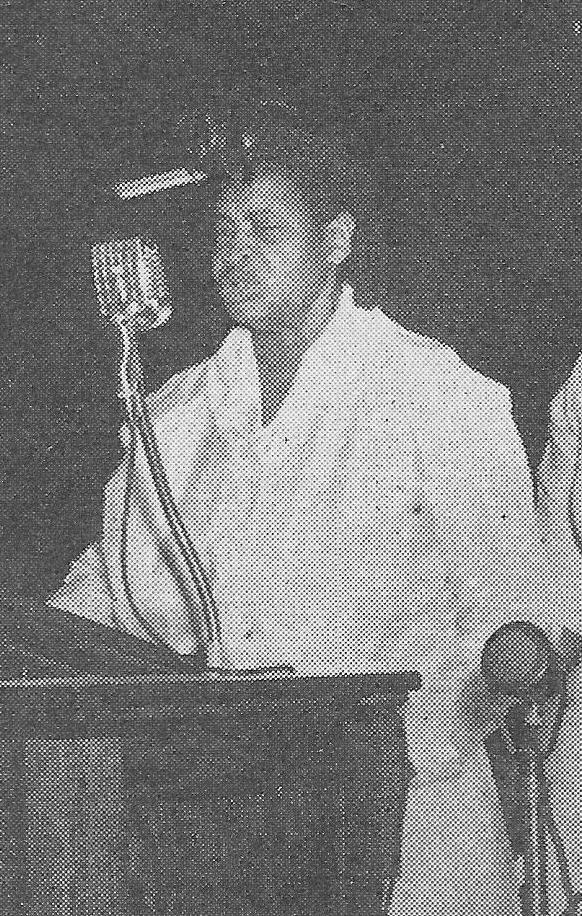
arizona-dranes_1953_corcoran
Arizona Dranes in 1953

That voice!

*

The song below starts off deceptively “plinky” but picks up considerably when Arizona starts to sing.

*

Want to know more about Arizona Dranes? Michael Corcoran can tell you what you need to know.

*

Copyright © 2016 Paula Bosse. All Rights Reserved.

Dallas Fire Stations — 1901

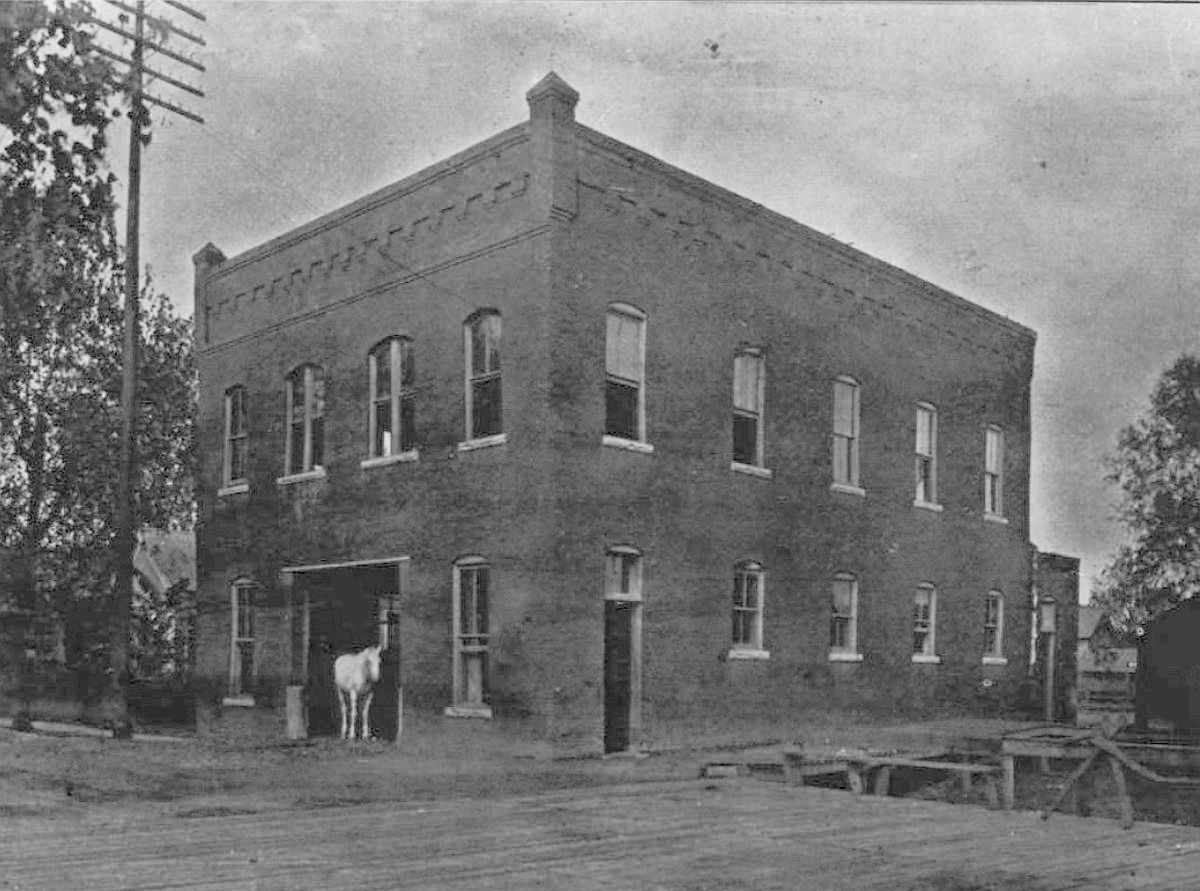
fire-dept_engine-co-3_gaston-and-college_1901Fire horse in Old East Dallas relaxing between calls (click for larger image)

by Paula Bosse

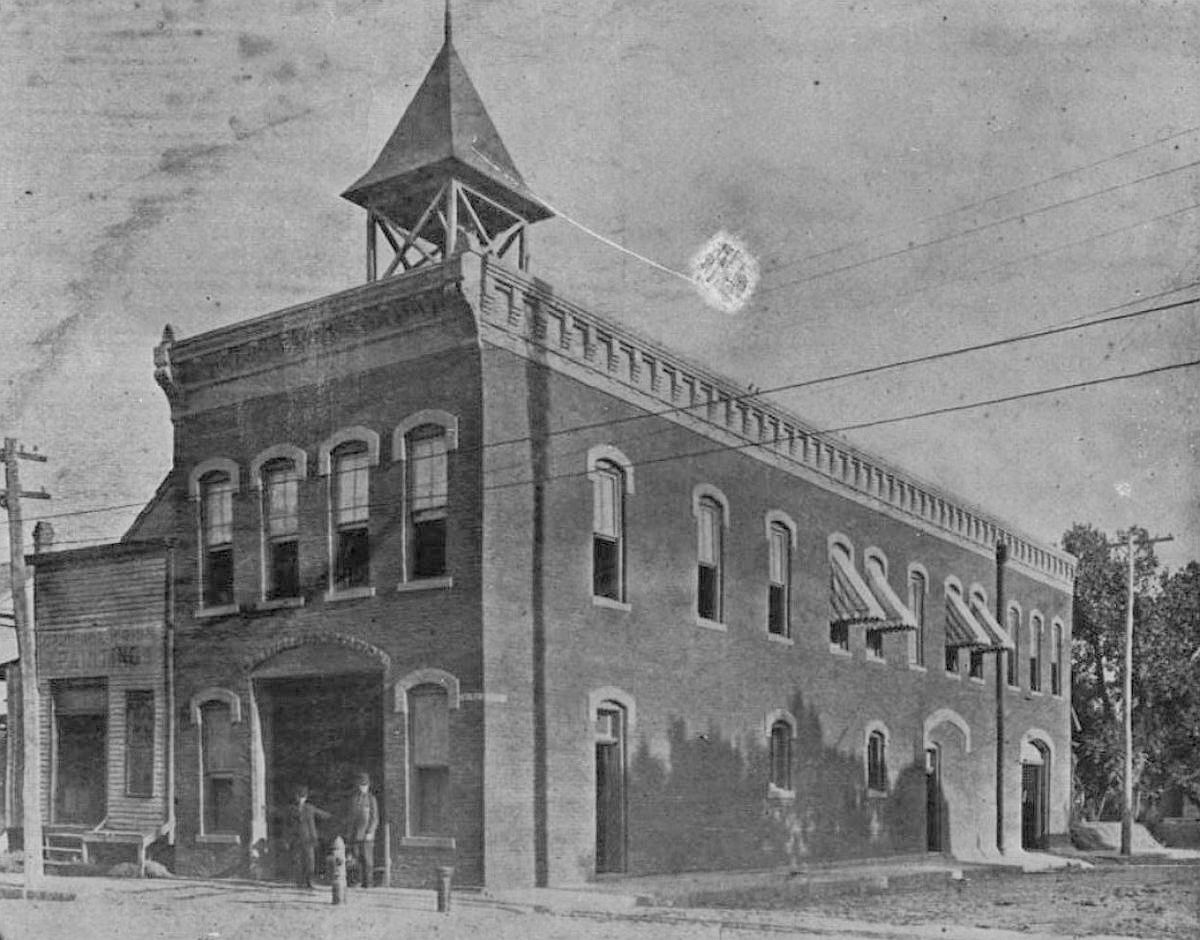
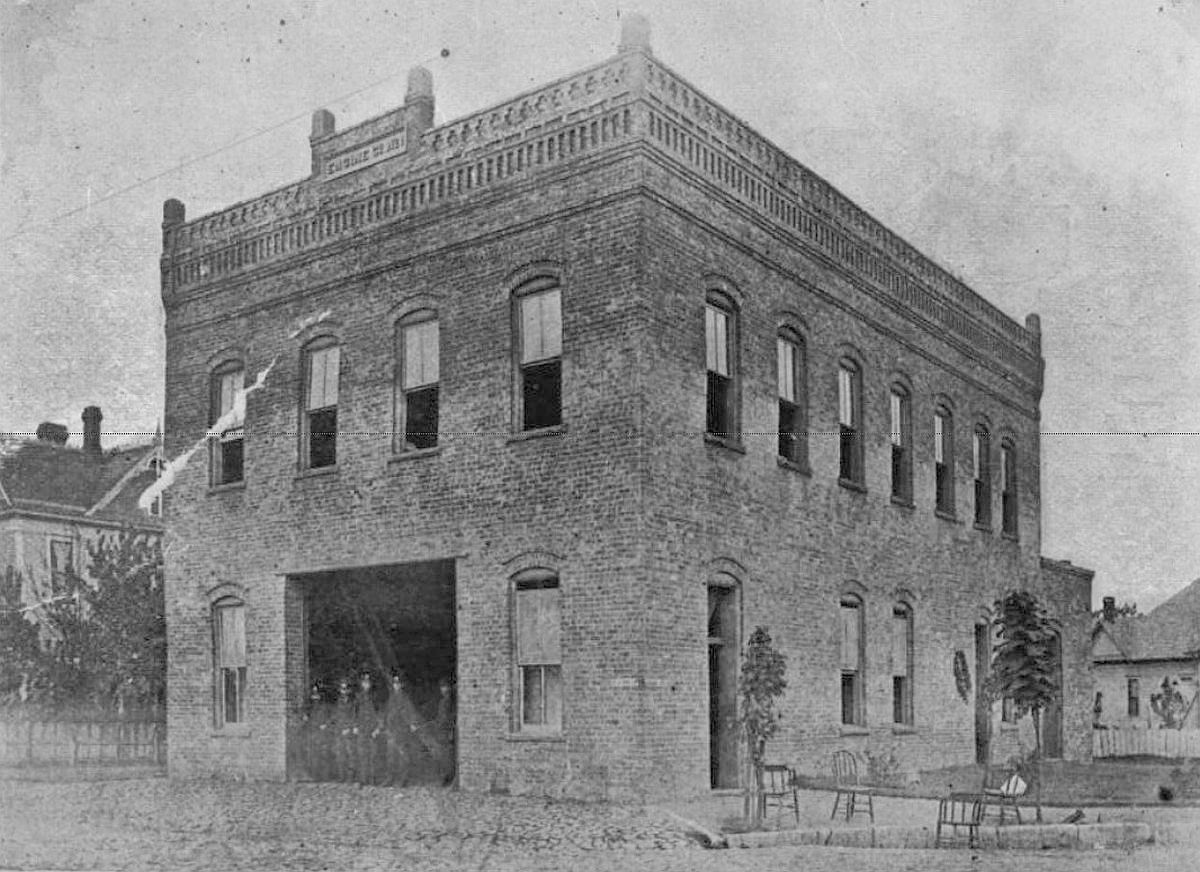
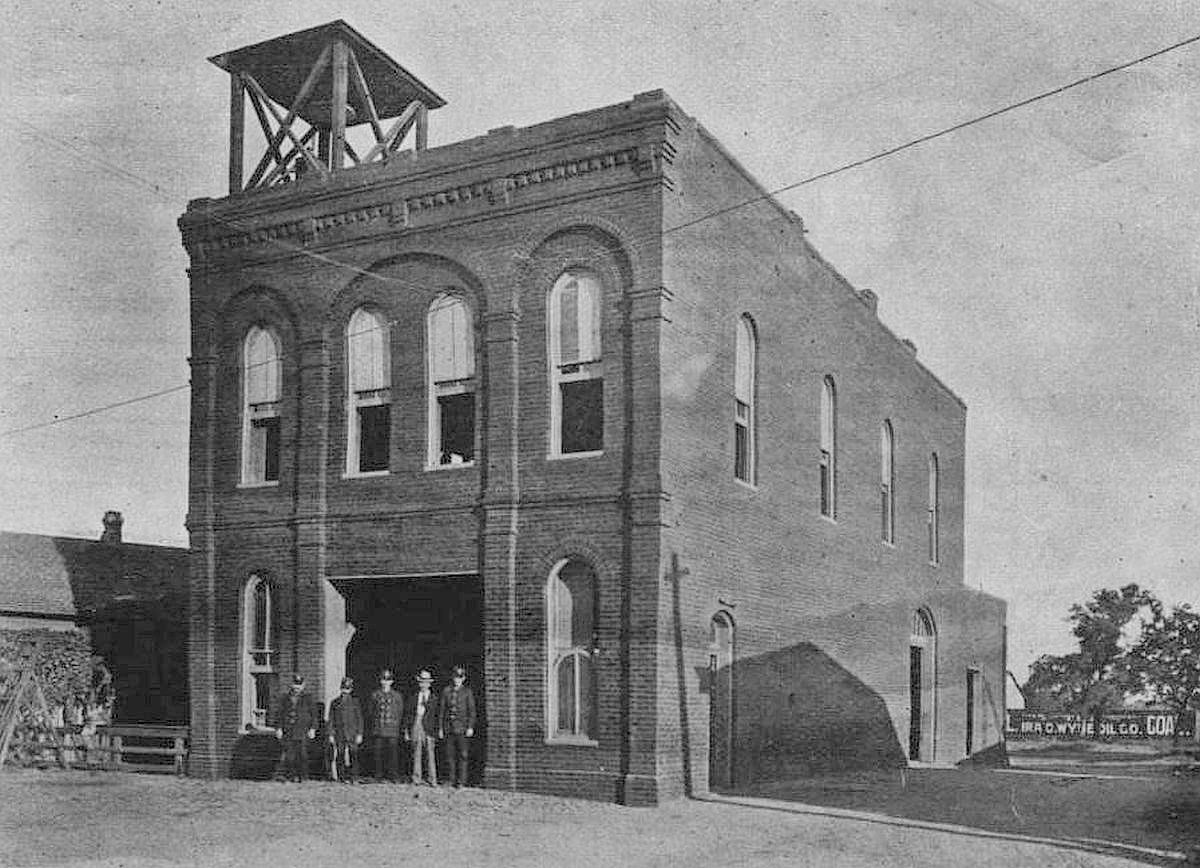
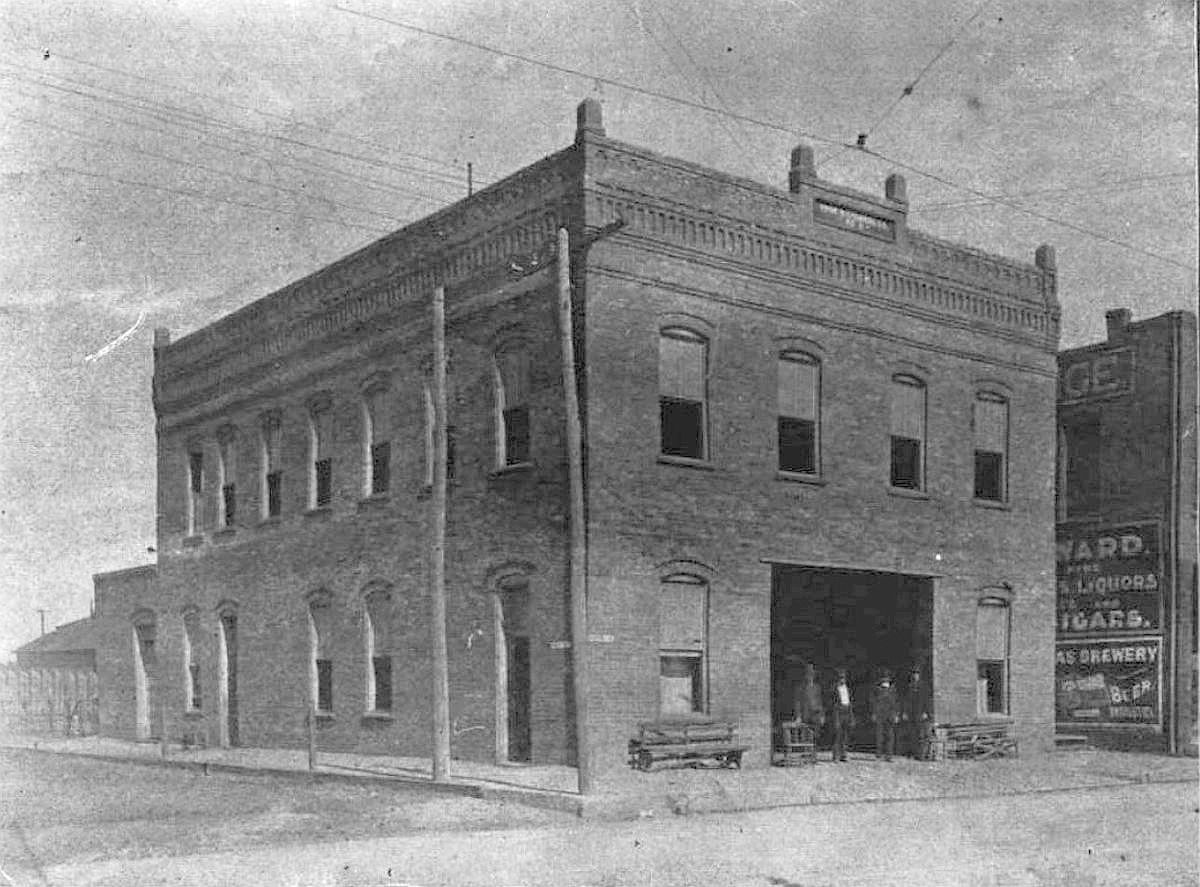
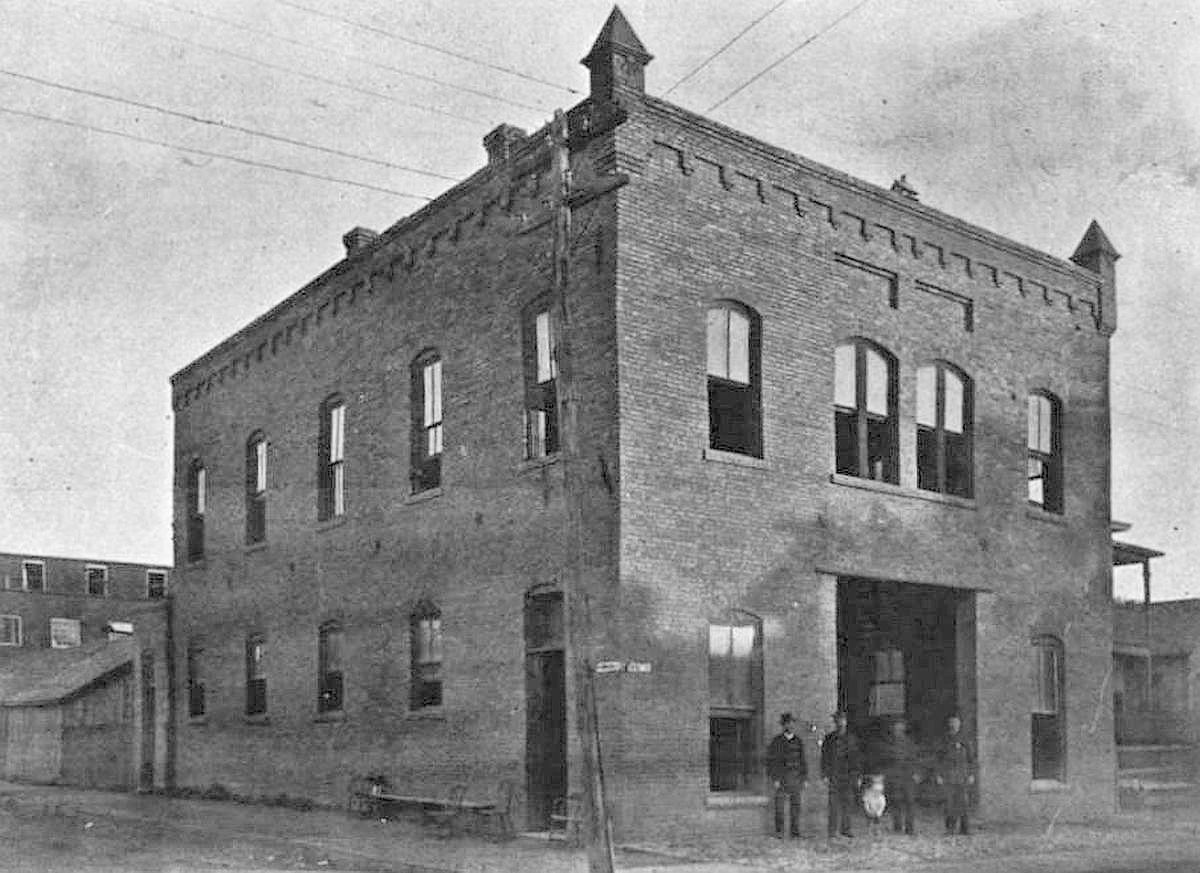
A few turn-of-the-century photos of Dallas’ fire stations, from a 1901 photographic annual. These seven firehouses were built between 1882 and 1894. One of these buildings is, miraculously, still standing on McKinney Avenue, in the heart of Uptown.

*

At the top, Engine Co. No. 3, at Gaston and College Avenues. In service: January, 1892. Equipment: an Ahrens Steamer, capacity 750 gallons per minute, and a Cooney Hose Carriage. See it on a 1905 Sanborn map here; see the present location (Gaston and Hall) here. (And since I just used it a few days ago, here’s a 1921 Sanborn map, showing Mill Creek running right through the property.)

*

fire-dept_central-station_main-harwood_1901

Above, Central Fire Station, Main and Harwood Streets. In service: October, 1887. Equipment: a double-sixty-gallon Champion Chemical Engine and a City Hook and Ladder Truck. See it on a 1905 Sanborn map here; see the present location here (the site of the old City Hall/Municipal Building).

*

fire-dept_mckinney-leonard_engine-co-1_1901

Engine Co. No. 1, McKinney Avenue and Leonard. Equipment: an Ahrens Steamer, 750 gallons per minute, and a Cooney Hose Carriage. In service: August, 1894. See it on a 1905 Sanborn map here; see the present location here. NOTE: This is the only one of these firehouses still standing. I wrote about it here.

UPDATE: Well, sort of. Thanks to a comment on Facebook, I researched this station a bit more and found that it was rebuilt and modernized at the end of 1909 — using materials from the original building seen above, built on the same plot of land. So instead of being 122 years old, the building on McKinney today is a mere 106 years old.

*

fire-dept_commerce-hawkins_engine-co-2_1901

Engine Co. No. 2, Commerce and Hawkins Streets. In service: January, 1882. Equipment: an Ahrens Steamer, capacity 750 gallons per minute, and a Cooney Hose Carriage. See it on a 1905 Sanborn map here; see a shot-in-the-dark guess at a present location here.

*

fire-dept_ervay-kelly_hose-co-2_1901

Hose Co. No. 2 and Chemical Co. No. 2, Ervay Street and Kelly Avenue. In service: September, 1894. Equipment: a Cooney Hose Carriage and double-sixty-gallon Champion Chemical Engine. See it on a 1905 Sanborn map here; see the present location here (right behind where the word “Cedars” is).

fire-dept_bryan-hawkins_hook-and-ladder-1_1901

Hose Co. No. 1 and Hook and Ladder Co. No. 1, Bryan and Hawkins Streets. In service: January, 1893. Equipment: Preston Aerial Truck with 75-foot extension ladder, and a Cooney Hose Carriage. See it on a 1905 Sanborn map here; see the approximate present location here.

*

fire-dept_commerce-akard_engine-co-4_1901

Engine Co. No. 4, Commerce and Akard Streets, next door to the City Hall. In service: August, 1894. Equipment: an Ahrens Steamer, capacity 1,100 gallons per minute, and a Cooney Hose Carriage. See it on a 1905 Sanborn map here; see the present location here (just out of frame at the right was the City Hall; the block is now the site of the Adolphus Hotel).

*

city-hall_1901_fire-dept-annual_portal

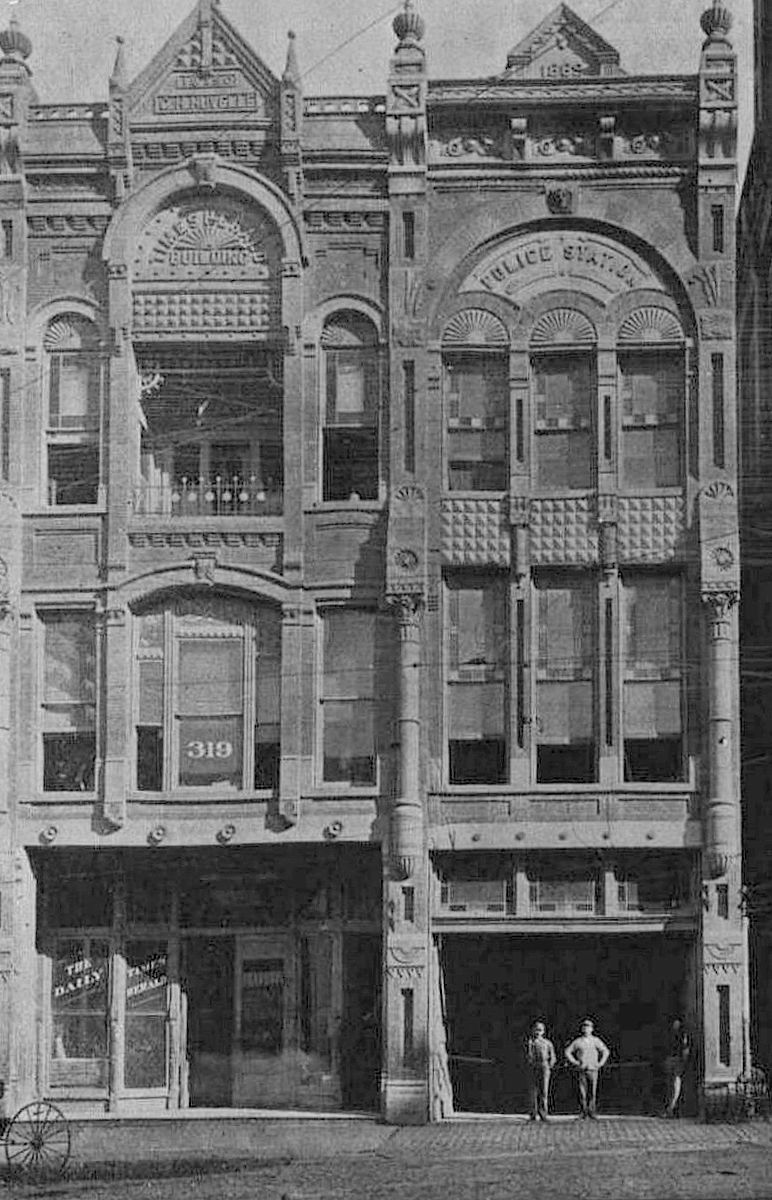
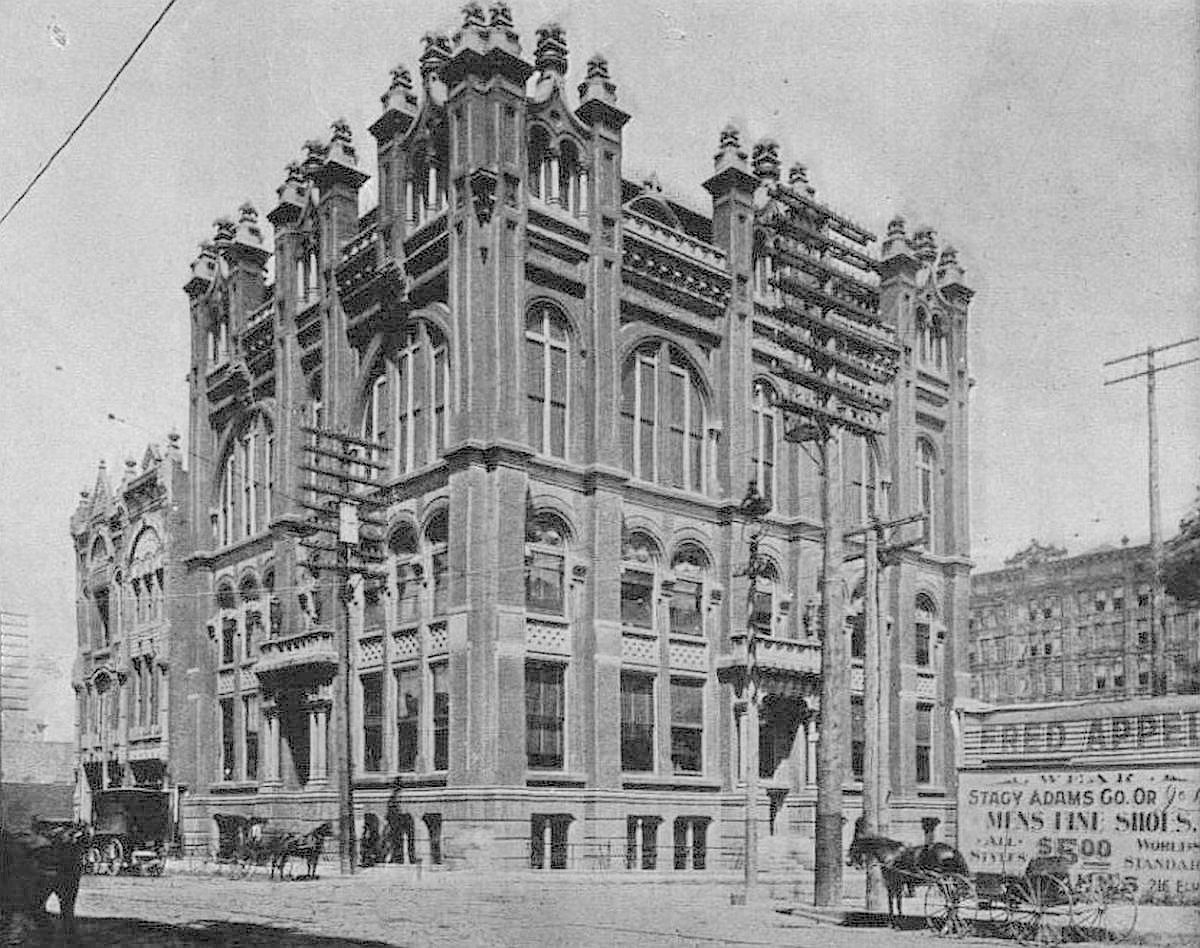
City Hall, Commerce and Akard Streets, now the location of the Adolphus Hotel. Half of the shorter building to the left housed the police department and Engine Co. No. 4.

*

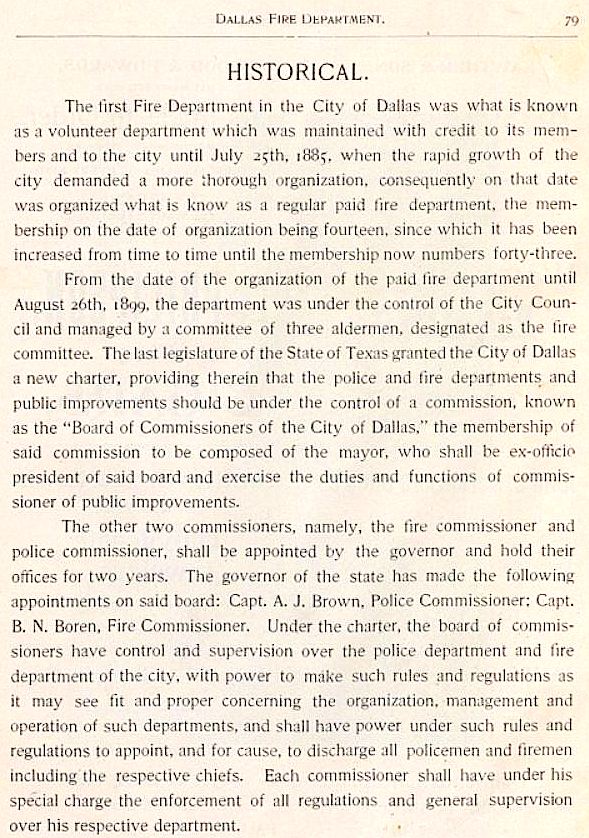
The “Historical” page from the book (click to read).

fire-dept-hist_dallas-fire-dept-annual_1901_portal

**

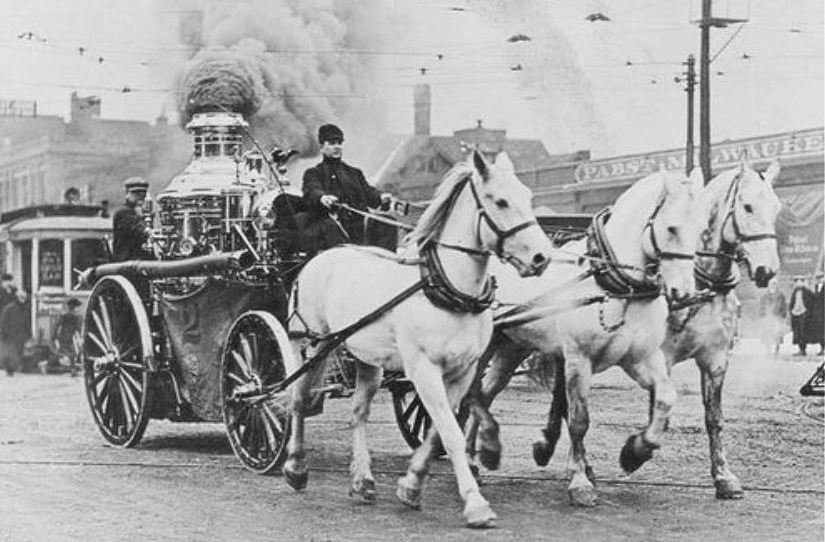
Since there is no sign of the actual equipment in these photos, here’s what horse-drawn steam engines (Ahrens steamers) looked like at this time. (Photo from the Wisconsin Historical Society).

fire-steam-engine_wisconsin-hist-soc

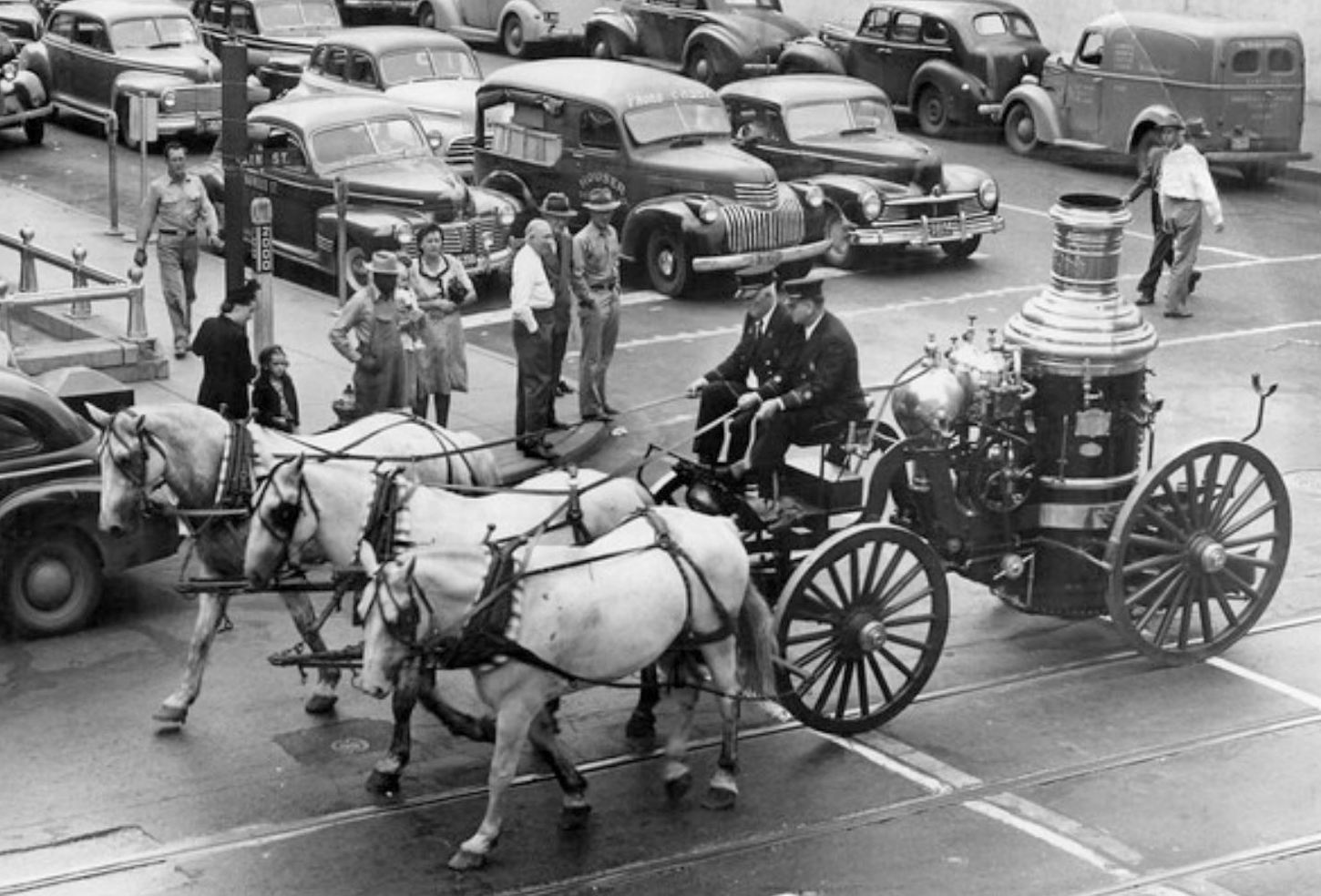
UPDATE: I found this photo on Flickr, showing equipment from those early days being driven through the streets of Dallas during a fire prevention parade.

fire-department_pumper_flickr_coltera

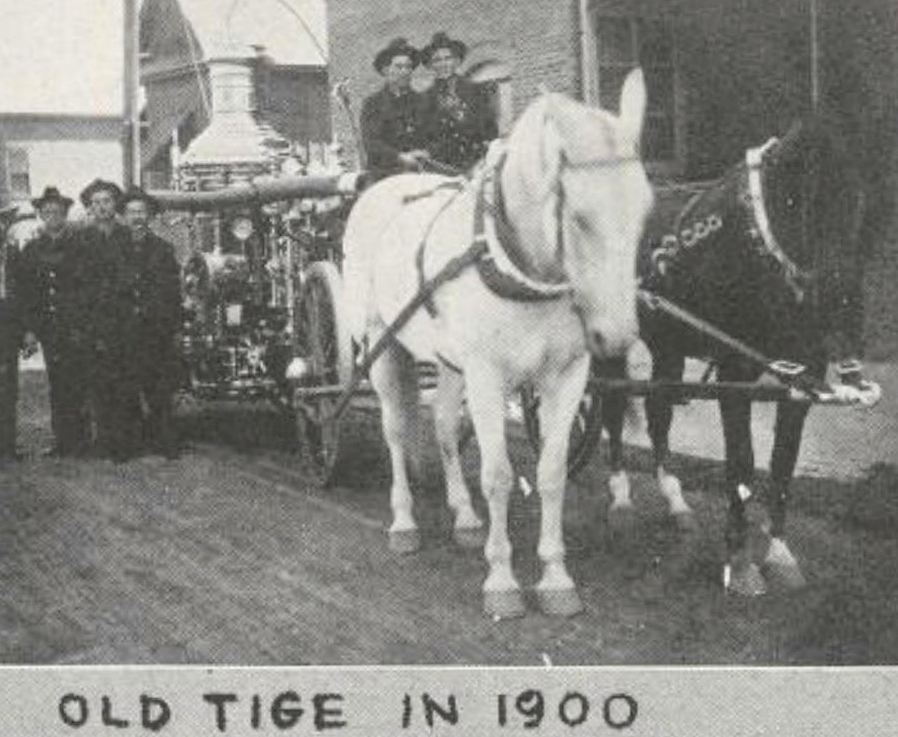
UPDATE: Lo and behold, a photo from 1900 of Old Tige, the 600 gallons-per-minute steam pumper, built in 1884, which was in service with the Dallas Fire Department until 1921. (Old Tige can be seen in the Firefighters Museum across from Fair Park.) Found at the Portal to Texas History.

old-tige_1900_fire-dept-bk_1931_portal

***

Sources & Notes

Photos by Clifton Church, from the Dallas Fire Department Annual, 1901, which can be viewed in its entirety on the Portal to Texas History, here.

A contemporary map of Dallas (ca. 1898) can be viewed on the Portal to Texas History site, here.

More Flashback Dallas posts on historic Dallas firehouses can be found here.

All photos larger when clicked.
*

Copyright © 2016 Paula Bosse. All Rights Reserved.