Flashback : Dallas

A Miscellany: History, Ads, Pop Culture

Category: Deep Ellum

The Dallas Express — A Look Inside the Offices of the City’s Most Important Black Newspaper — 1924
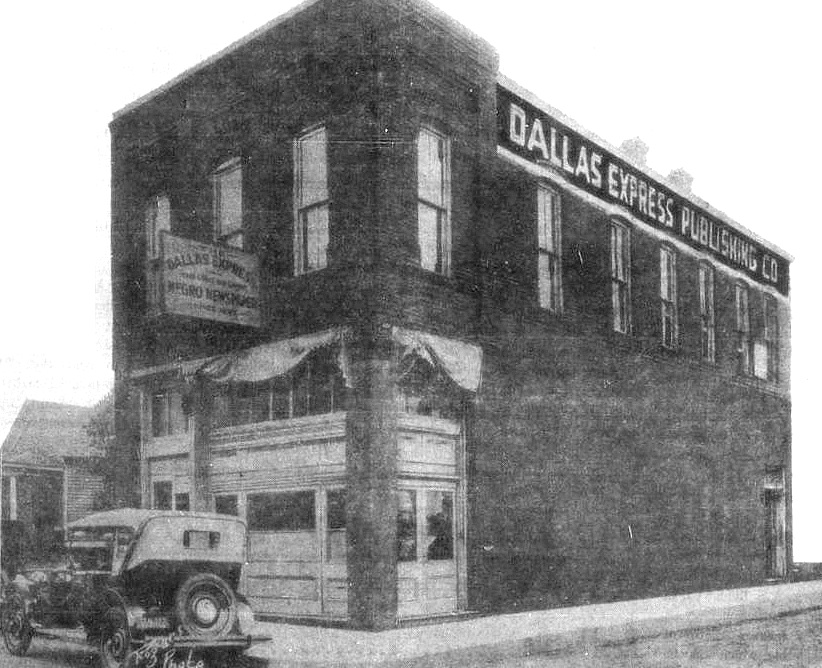
dallas-express-bldg_dallas-express_0607242600 Swiss, home of The Dallas Express (click for larger image)

by Paula Bosse

Without question, The Dallas Express (1892/3-1970) was the most important and most widely-read black-owned newspaper published for Dallas’ African-American community. In addition to stories of particular interest to its Dallas and Texas readership, it also covered national and international news, and in the Jim Crow era, when black Dallasites were rarely mentioned in white-owned newspapers except in crime reports, The Express reported on the people, the businesses, the churches, and the achievements of their large community. They also wrote about politics and issues of race and discrimination. One of the paper’s slogans was “A Champion of Justice, A Messenger of Hope.”

I’ve been interested in newspapers, journalism, and the actual physical process of printing newspapers for as long as I can remember, but until a couple of years ago, I was not aware of The Dallas Express, founded in 1892 by publisher/editor W. E. King. Discovering this paper and its stories about my hometown has been eye-opening. The Dallas Express is an important — and often overlooked — source of Dallas history. I love reading through issues of The Express because unlike white-owned papers of this period, it presents a realistic and human chronicle of the everyday lives of Dallas’ black men and women, something which was almost completely ignored by The Dallas Morning News and The Dallas Times Herald.

For many years, the offices of the Express were just north of Deep Ellum, at 2600 Swiss — at the corner of Good Street, about where Brad Oldham’s Traveling Man sculpture stands today. (I have a feeling the actual location was in the middle of what is now Good-Latimer. See the location on a 1921 Sanborn map here.) Happily, the Express printed a full-page ad for itself in the June 7, 1924 edition, so we can see what the Swiss Avenue building, its offices, and its production rooms looked like. These photos were taken by noted Dallas photographer Frank Rogers. (Apologies for the muddy quality of these photos — I’d love to see the crisp originals!)

*

These photos show the Dallas Express offices as they looked in 1924, when the newspaper had already been in business for 32 years. The exterior of the two-story building can be seen in the photo at the top — standing next to a private residence. (Click photos to see larger images.)

Below, president and business manger (and, later, owner), C. F. Starks:
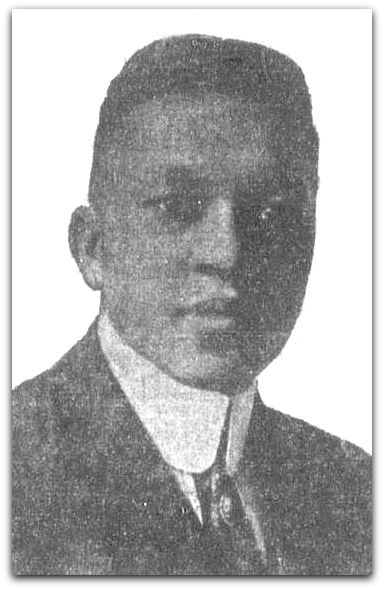
dallas-express_c-f-starks_pres-business-mgr_060724

The editor’s office (John W. Rice was the editor at this time and is, presumably, the man in the foreground):

dallas-express_editors-office_060724

The business office:

dallas-express_business-office_060724

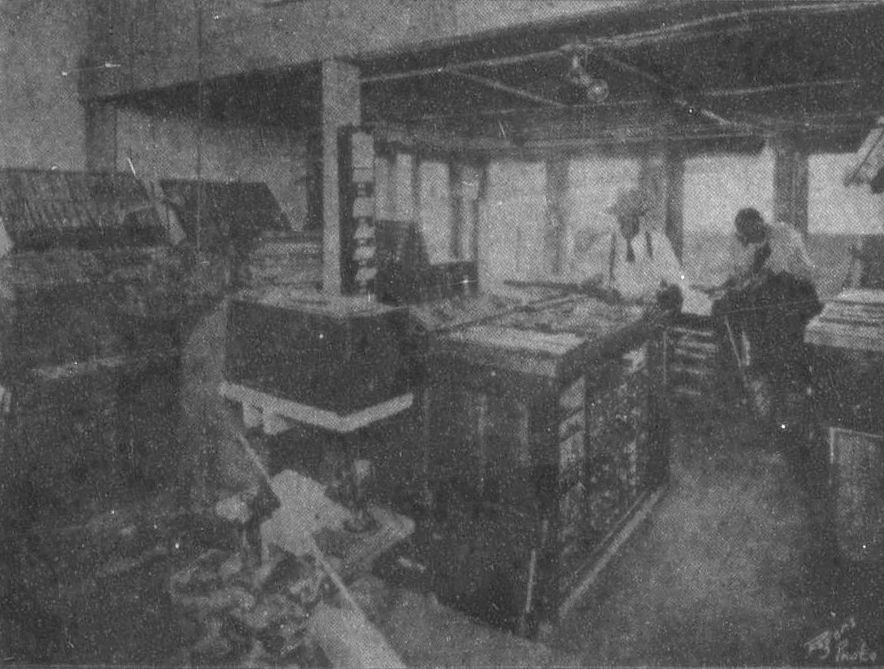
The composition room:

dallas-express_composition-room_060724

The linotype department (I have written about my fascination with linotype machines here):
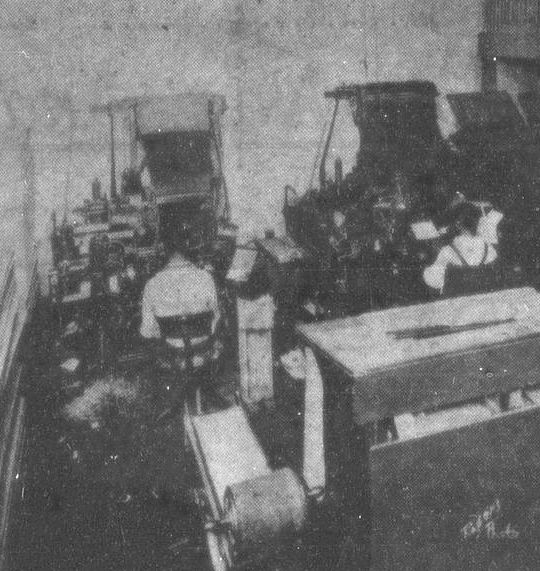
dallas-express_linotype_060724

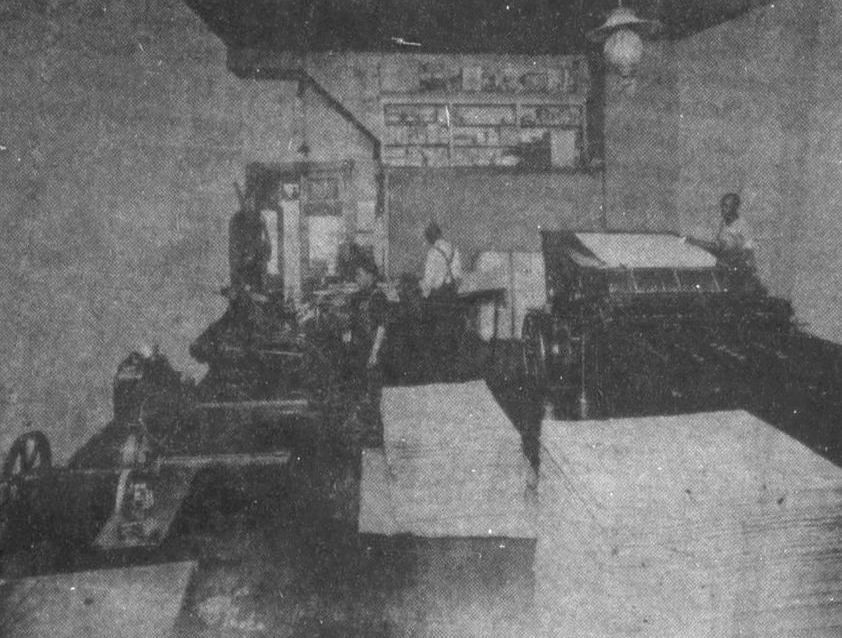
And the press room:

dallas-express_press-room_060724

The text from the ad (this special “Pythian Edition”of the paper was printed to coincide with the 40th annual meeting of the Knights of Pythias):

“YOUR Paper,” The 5th Largest of its Kind in America, Commends The Knights of Pythias Along With All of the Other Fraternities Represented Here for Their WONDERFUL PROGRESS.

THE EXPRESS believes that much of the splendid success which has come to the Fraternities of Texas, has come because of the fact that they have told the public “well and often” about the benefits which they offer and the advantages which they bring. And too, this paper takes a great deal of PRIDE in the thought that it has helped to bring this to pass because it is the medium in Texas best fitted to tell the world about the PROGRESS of the institution of our State.

These views of our force and the equipment at our plant explain why we can guarantee “Distinctive Service” and “Meritorious Printing” to every one of our customers.

The 20,000 copies in this special issue will go to every corner of America and to some foreign countries. No other journal of the Race in the Southwest does this.

The Dallas Express Pub. Co. Solicits Your Patronage not because it is a Negro institution but because it can guarantee to you the sort of service that you need. No job too small for the greatest consideration. No order too big for us to fill.

TEXAS’ OLDEST AND LARGEST NEGRO NEWSPAPER AND PRINTING PLANT
In Dallas Since 1892
2600 Swiss Avenue

*

The full-page ad:
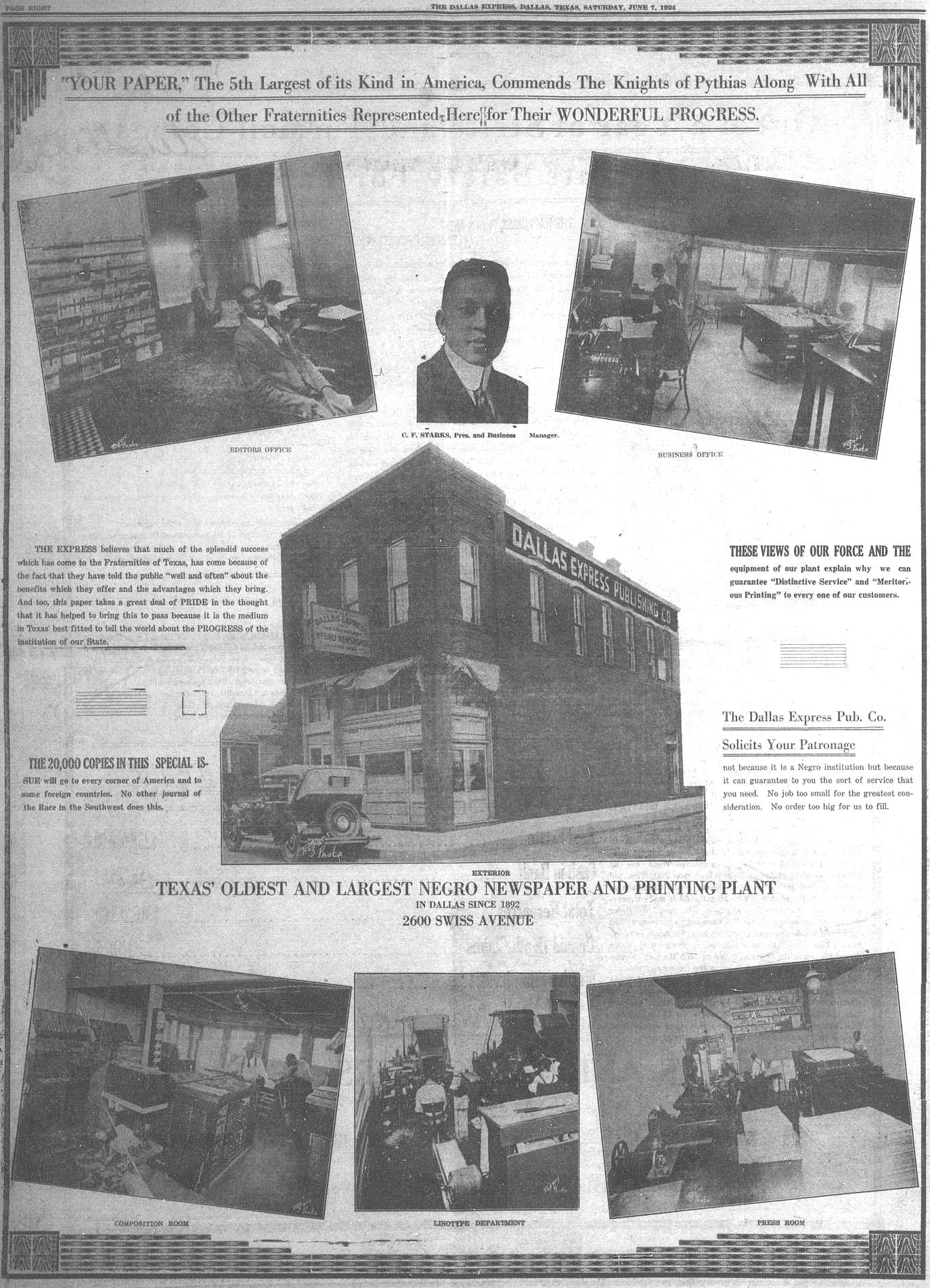
dallas-express_060724_p8_full-page
Dallas Express, June 7, 1924

Another photo of the printing room appeared in an Express ad which ran in the paper the following week:
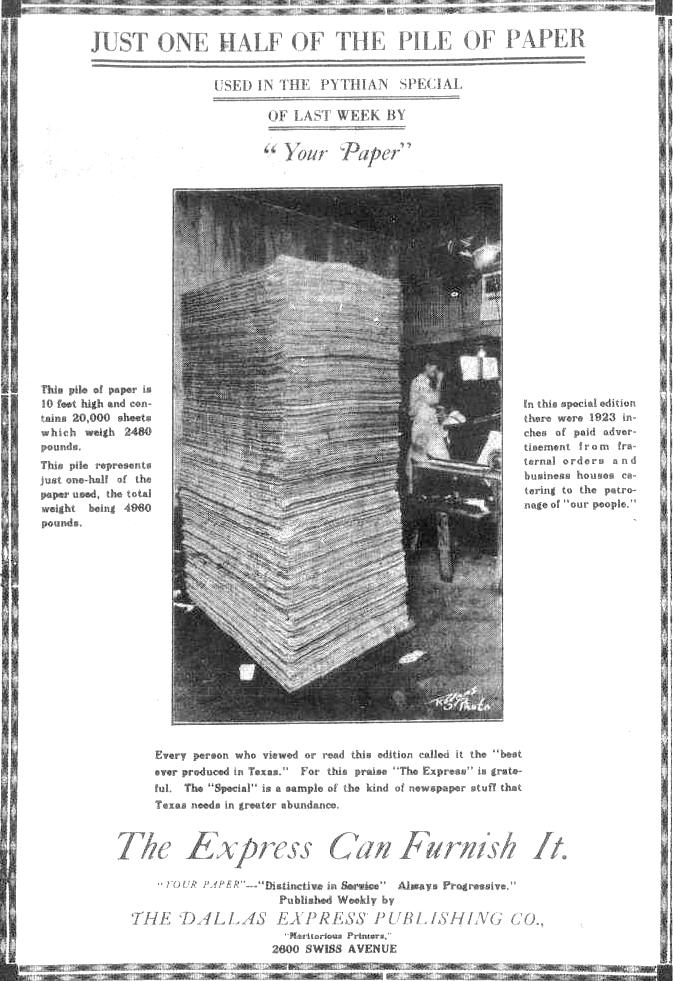
dallas-express_061424_ad
Dallas Express, June 14, 1924

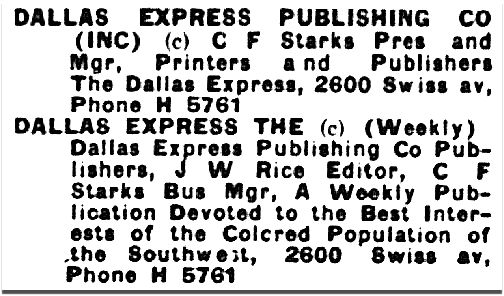
dallas-express_1923-directory
1923 Dallas directory

***

Sources & Notes

Photos by Frank Rogers. Original prints might be in the Frank Rogers Collection at the Dallas Public Library, but nothing showed up when I searched the DPL database. Original crisp prints would be wonderful to see!

Photos appeared in the June 7, 1924 edition of The Dallas Express. The full newspaper can be found here. Only a few years’ worth of scanned issues of The Express are available on UNT’s Portal to Texas History site — mostly 1919-1924 — they can be accessed here.

Read about The Dallas Express at the Portal to Texas History, here; the Wikipedia entry is here.

*

Copyright © 2016 Paula Bosse. All Rights Reserved.
 

The Union Depot Hotel Building, Deep Ellum — 1898-1968

union-depot-hotel_1909_uta-detThe old Union Depot Hotel, about 1909 (click for larger image)

by Paula Bosse

Above, we see the hotel known originally as the Union Depot Hotel, built in 1898 across from the very busy old Union Depot, at the intersection of two major rail lines: the Houston & Texas Central (the H&TC, which ran north-south) and the Texas & Pacific (the T&P, which ran east-west). The tracks crossed at the intersection of Central and Pacific — streets named after the two railroads — in the area east of downtown we now call Deep Ellum. The hotel was on the southwest corner of that intersection.

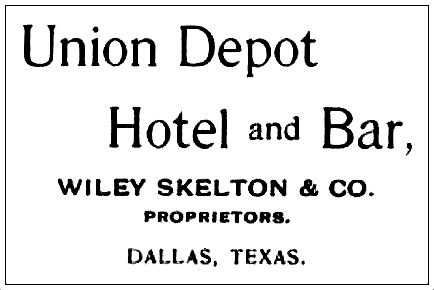
The large, two-story hotel (which also housed a popular cafe and bar) was built by William S. Skelton — more commonly known as Wiley Skelton — to cash in on the large number of travelers coming to Dallas via the bustling passenger depot right across the street. When it opened, it was charging a hefty two bucks a day (the equivalent of about $60.00 in today’s money) — a large-ish sum in 1899, but … location, location, location. This two-dollar-a-day rate to stay at Skelton’s hotel was the same as the base rate of Dallas’ ritziest, priciest hotels, The Windsor and The Oriental. How could Skelton’s “wrong side of the tracks” hotel charge similar rates as the city’s most elegant hotels? Convenience, convenience, convenience. The Union Depot Hotel could not have been more convenient to weary travelers unless it had been located inside the depot.

union-depot-hotel_houston-post_012599Houston Post, Jan. 25, 1899

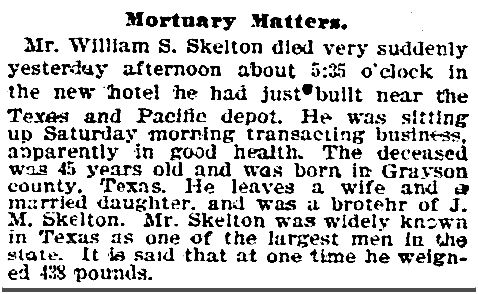
Skelton was a popular and successful businessman (and noted saloon pugilist) who was known far and wide for his substantial physical bulk. He was a founding member of the city’s “fat men’s club” and was reported to be the heaviest man in the city. When he died suddenly at the age of 45 (probably not a huge surprise, as his obituary mentioned that his weight had, at one time, reached 438 pounds), his new hotel had been open only weeks (perhaps only days).

skelton_dmn_011699Dallas Morning News, Jan. 16, 1899

His unexpected death threw the running of the hotel into confusion. His brother (another famed “fighting fat man”) took over the business side of its operations and occasionally placed ads in the paper seeking a hard-to-find buyer.

union-depot-hotel_1901_portal1901 ad

union-depot-hotel_dmn_111602DMN, Nov. 16, 1902

Eventually the hotel was sold, and it went through several owners and name changes over the years. Then, in 1916, a major catastrophe struck: brand new Union Station, which was waaaay on the other side of town, opened, consolidating passenger rail service to one depot, resulting in the shuttering of most of the city’s smaller depots. Location, location, location wasn’t such a great thing for the old Skelton hotel after this.

The hotel went through many changes over the years, but after the closing (and later razing) of the old Union Depot, it was on a general, inevitable, slide downward. By the time it was demolished in 1968 — when large swaths along Central Avenue were leveled to facilitate highway construction — the building was in disrepair and, apparently, long-vacant. It stood for 70 years.

*

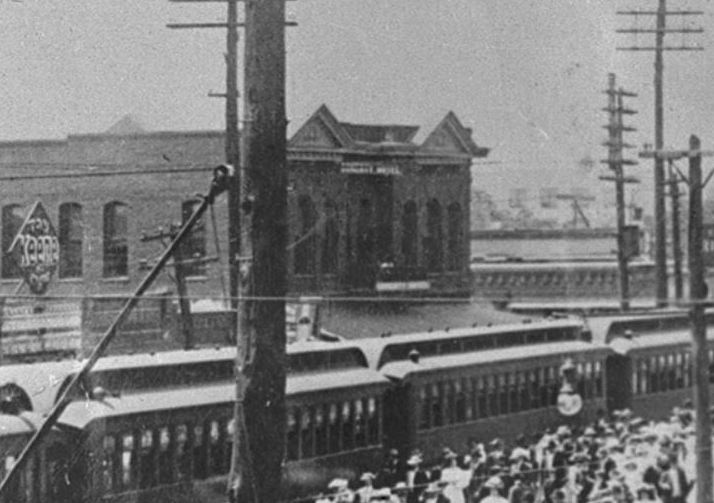
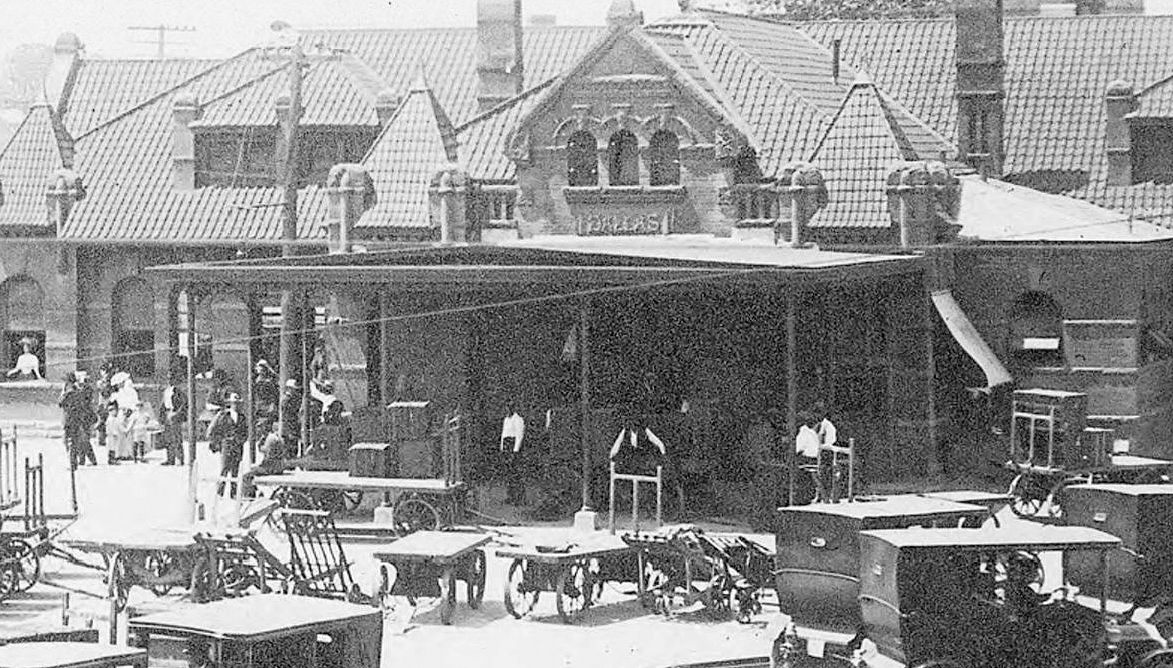
Below is a photo taken from Elm Street in 1908 or 1909, when the hotel (seen at the top left) was owned by Charles S. Conerty and named the Conerty Hotel (you can see the name on two signs, but you have to really zoom in to make them out). Conerty, an Irishman who had previously run bars, owned the hotel very briefly. By May of 1909, plagued with legal troubles stemming from his being charged with selling liquor on a Sunday, Conerty sold the hotel (which he seems to have been running as a boarding house), stating in his classified ad that he was “leaving city.” (He did not leave the city.) In 1910, with a new owner, the hotel was once again known as the Union Depot Hotel.

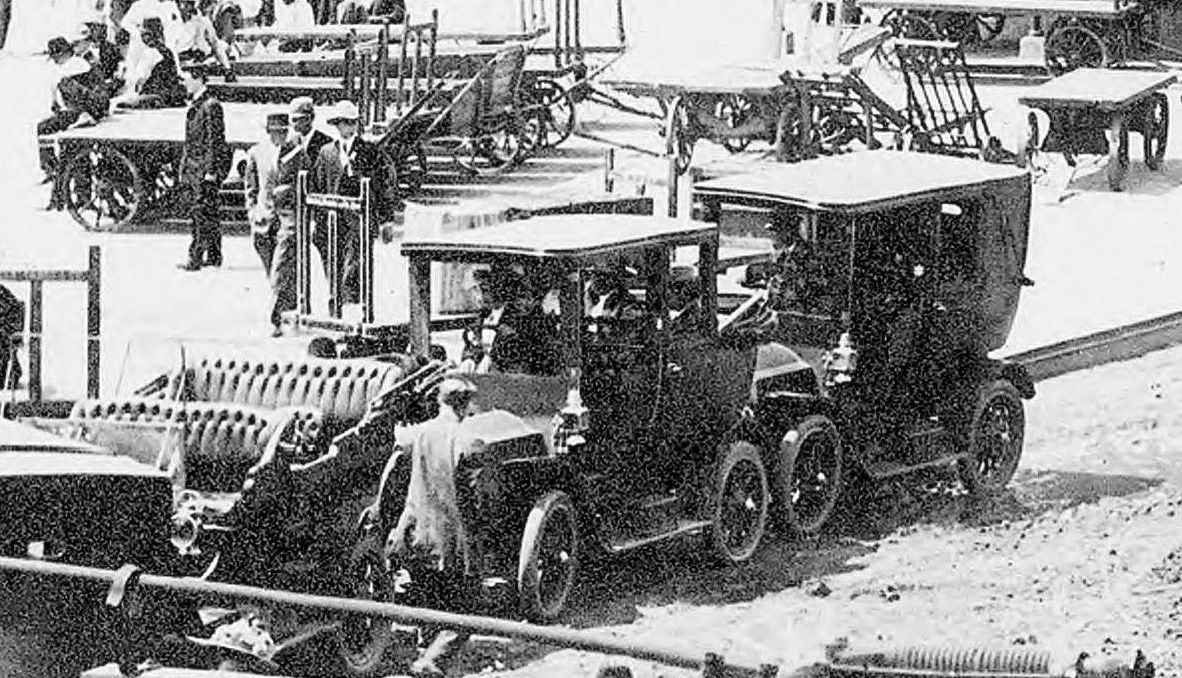
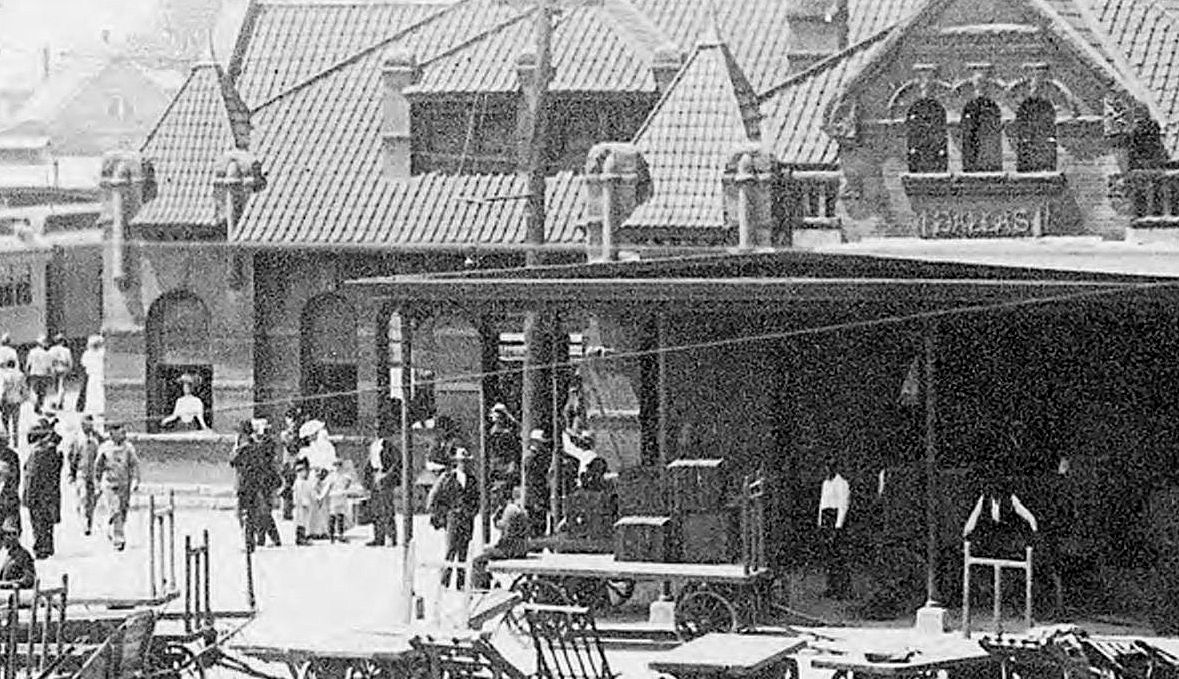
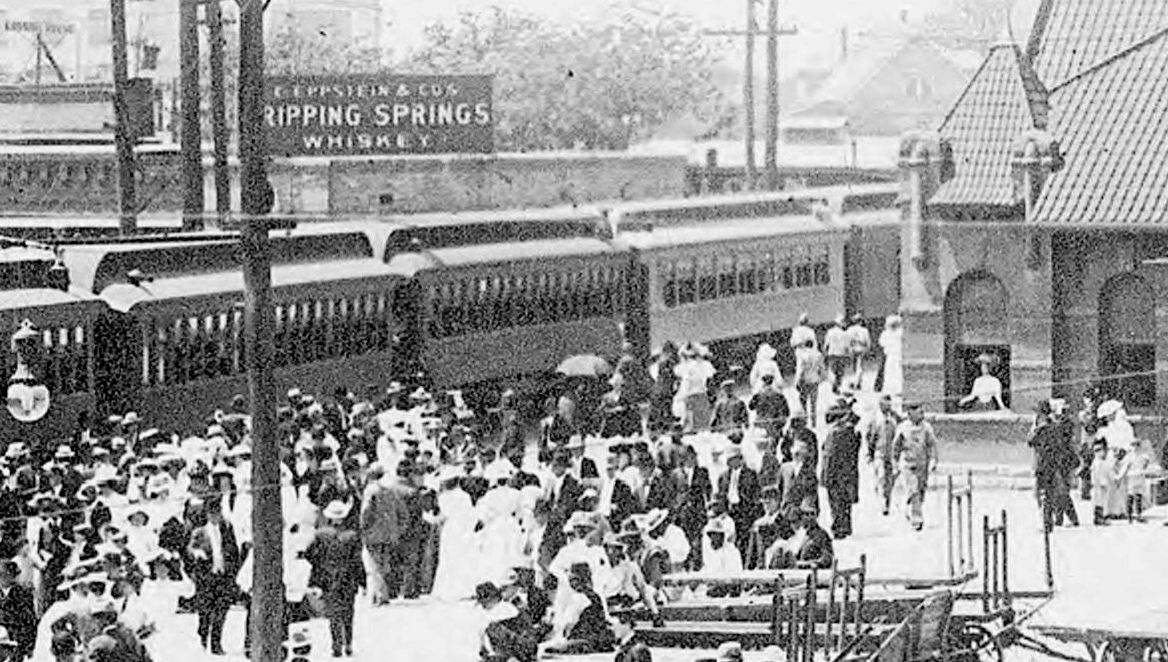
Back to the photo. Across Central Avenue from the hotel is the old Union Depot, where there was always a lot going on. Let’s look at the photo a little more closely. (Click photos to see larger images.)

old-union-depot_degolyer_ca1910

old-union-depot_degolyer_det1

old-union-depot_degolyer_det2

old-union-depot_degolyer-det3

old-union-depot_degolyer_det4

old-union-depot_degolyer_det5

old-union-depot_degolyer_det6

Just seven or eight years after this photo was taken, all that human traffic was gone.

In the fall of 1968, having been vacant for years and counting down its final hours, Dallas Morning News writer Doug Domeier wrote about the old run-down hotel which had long outlived the passenger depot it had been built to serve (see the article “Demolition Leveling Once-Noisy Deep Elm,” DMN, Oct. 19, 1968). Domeier’s entertaining article about those early days includes memories of Lizzie Mae Bass, who once worked in the hotel’s cafe as a waitress and remembers when “horses back[ed] away in fright when a locomotive pulled in at the lively intersection linking the Houston and Texas Central with the Texas & Pacific.”

And today? You’d never EVER suspect that that patch of empty land at the edge of Deep Ellum was ever occupied by one of the city’s busiest train depots.

*

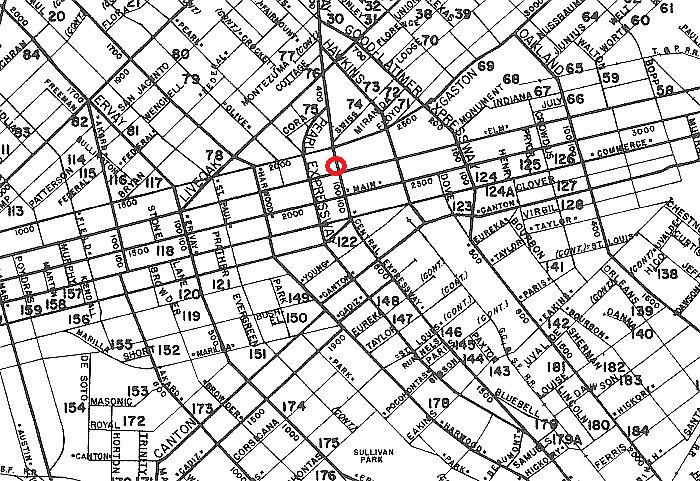
So where was it? Get a good visual idea of how things were laid out in the Sanborn map from 1905, here. Below is a street map that shows where the hotel was (red star) and where the train depot was (blue star). These days? Depressing. See it here (the view is looking north from Elm — the hotel would have been under the overpass, the train station straight ahead).

union-depot-hotel_1952-mapsco1952 Mapsco

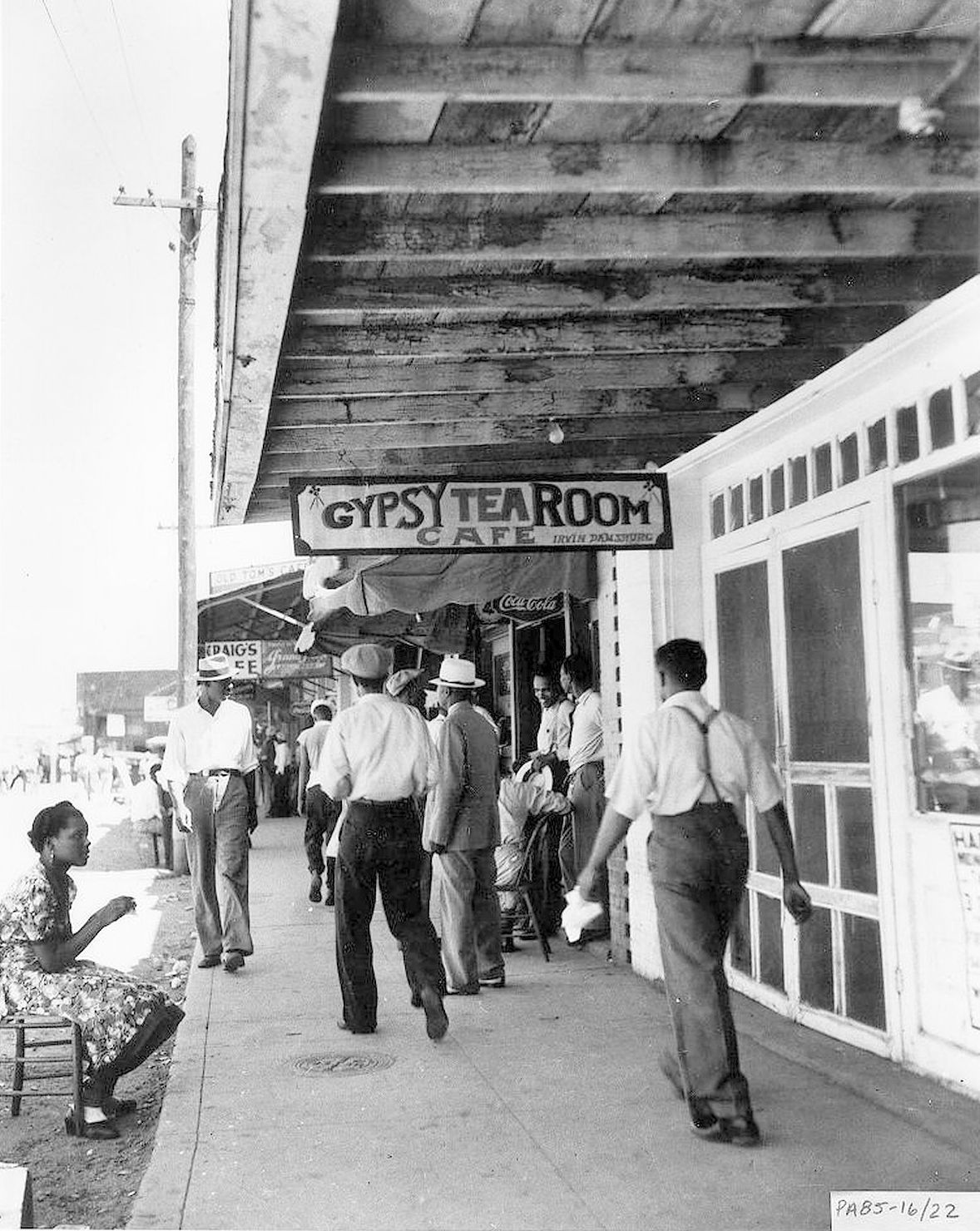
It’s interesting to note that during the heyday of the Union Depot, the west side of the block of Central Ave. which ran between Elm and Pacific was the only block in this area not filled with black-owned businesses or residences. When the depot shut down and white-owned businesses moved out, the block began to fill with popular African-American establishments. It’s also interesting (to me, anyway!) to realize that the Gypsy Tea Room of the 1930s was just a few steps to the left of the hotel in the top photo. It took me forever to try to figure out where the Gypsy Tea Room had been — I wrote about it here.

***

Sources & Notes

Top photo is a detail of a larger photo, from the Squire Haskins Photography, Inc. Collection, University of Texas at Arlington Libraries; it is accessible here. The same photograph is shown in full farther down the post — this copy is from the DeGolyer Library, Central University Libraries, Southern Methodist University, and it is accessible here. The quality of both photos makes it difficult to zoom in on them with much clarity, but both sites offer very large images to view.

As mentioned above, an entertaining Dallas Morning News article full of historical info about the area around the depot is highly recommended: “Demolition Leveling Once-Noisy Deep Elm” by Doug Domeier (DMN, Oct. 19, 1968). (I’m not sure why the hotel is referred to as the “Grand Central Station Hotel” throughout — just substitute “Union Depot Hotel” whenever you come across that incorrect name.) The article also has a few paragraphs about the Harlem Theater which was also about to be torn down as part of what Domeier described as the “brutal change” then affecting Deep Ellum.

See a great early-’20s photo of the hotel building (the Tip-Top Tailors moved in around 1922) in the book Deep Ellum: The Other Side of Dallas by Alan Govenar and Jay Brakefield, here (the view is from Pacific to the southwest).

A related Flashback Dallas post — “The Old Union Depot in East Dallas: 1897-1935” — can be read here.

All images larger when clicked.

*

Copyright © 2016 Paula Bosse. All Rights Reserved.


The Gypsy Tea Room, Central Avenue, and The Darensbourg Brothers

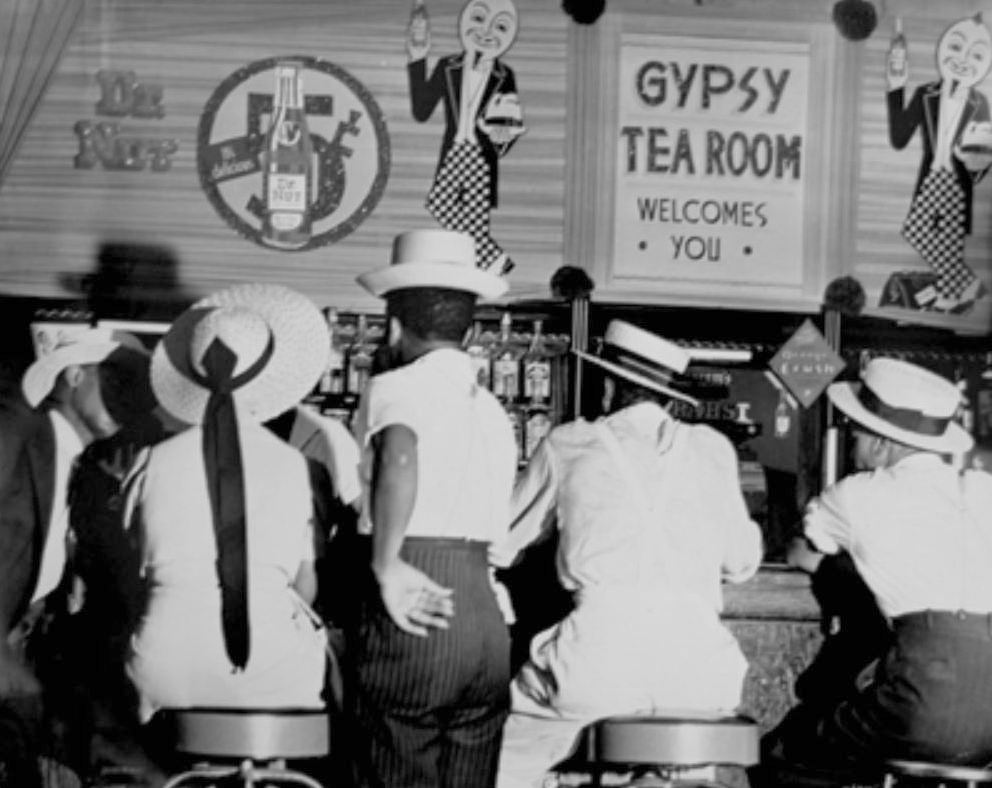
gypsy-tea-room_dallas-public-libraryThe 200 block of Central Ave., about 1937…  (Dallas Public Library photo)

by Paula Bosse

I’ve seen this photograph of Deep Ellum for years, and I’ve always loved it. But for some reason, I always thought this showed Elm Street — across from the Knights of Pythias Temple, just west of Good-Latimer (probably because that’s where a recent club with the same name was located). In fact, this scene was captured a couple of blocks west, just north of Elm, on Central Avenue, sometimes referred to as Central Track, along the Houston & Texas Central railroad tracks — a part of Deep Ellum that’s been gone for more than 60 years.

gypsy-tea-room-location_1952-map.jpgAfter Central Expwy. replaced Central Ave. (1952 Mapsco)

This area — which many have described as being the very heart of Deep Ellum in the 1920s through the 1940s (and which was somewhat ironically referred to as “the gay white way of the Negro in Dallas” by an uncredited WPA writer) — was demolished to make way for the construction of North Central Expressway (which closely followed the H&TC Railway tracks). This photo was taken in the 200 block of North Central Avenue, looking south toward Elm (the building farthest in the background, jutting out to the left, is across Elm, on the south side of the street). To the immediate left of this photo (out of frame) was the old union depot (read about it here).

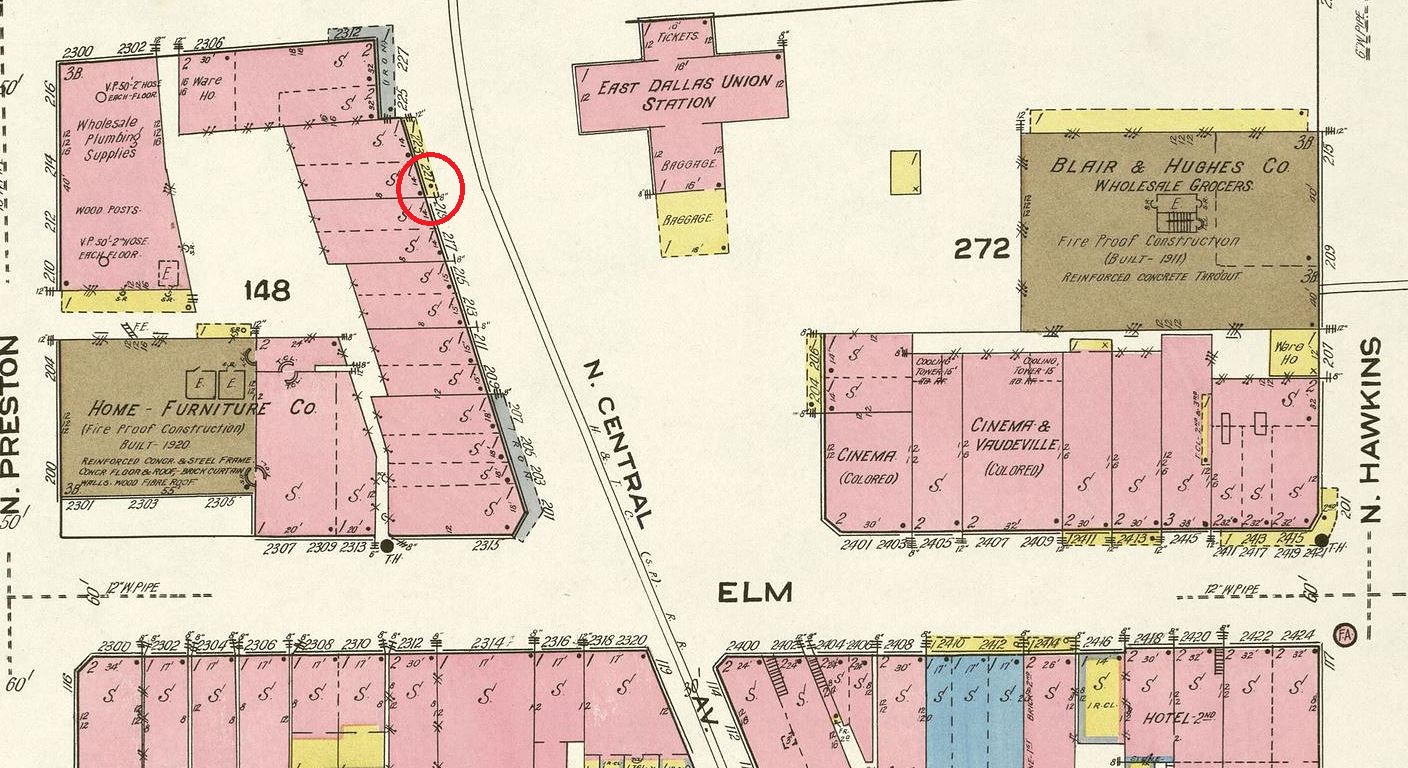
You can see that the Sanborn map from 1921 shows that same building jutting out. (See the full Sanborn map here; it might be more helpful to see this detail rotated to show the same view as the photo, here.)

sanborn-map_1921_sheet-17-det1921 Sanborn map, detail (click for larger image)

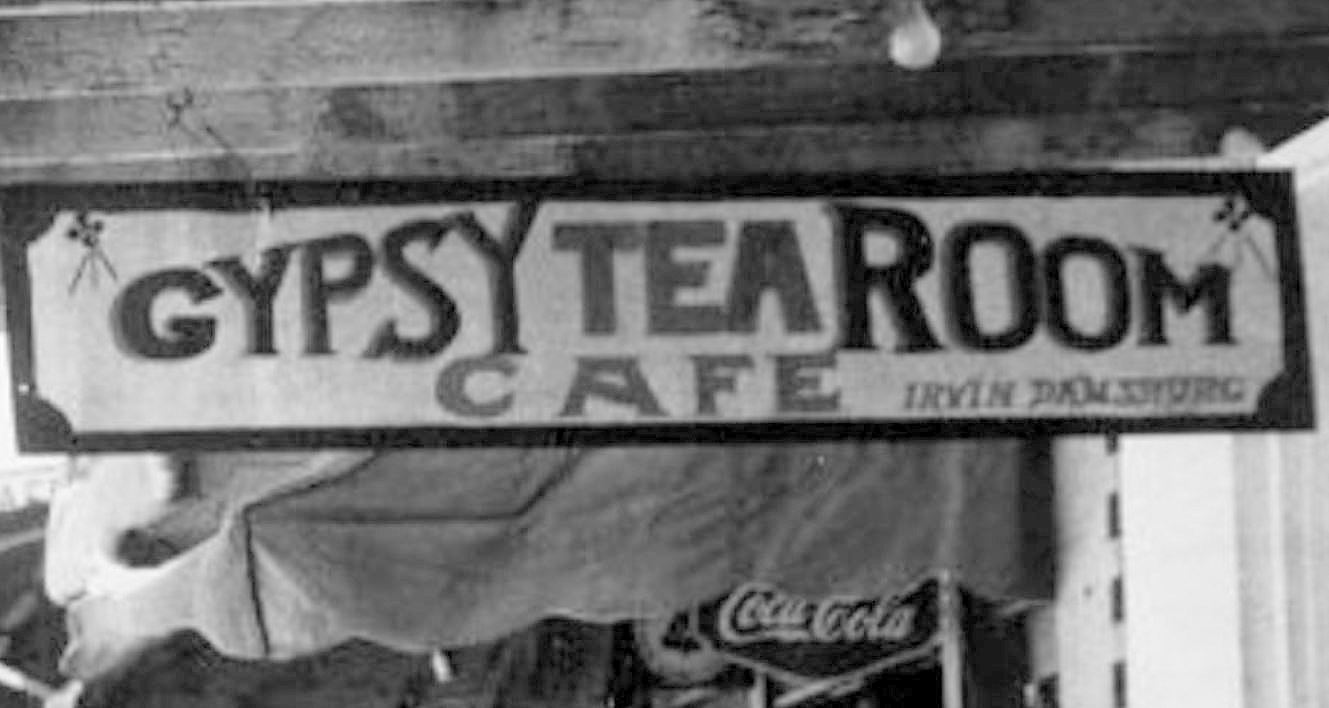
Information about The Gypsy Tea Room is scant. The proprietor was a man named Irvin Darensbourg, whose family was from the black community of Killona, Louisiana in St. Charles Parish; they appear to have been of French Creole extraction, and the family’s last name was probably correctly spelled as D’Arensbourg.

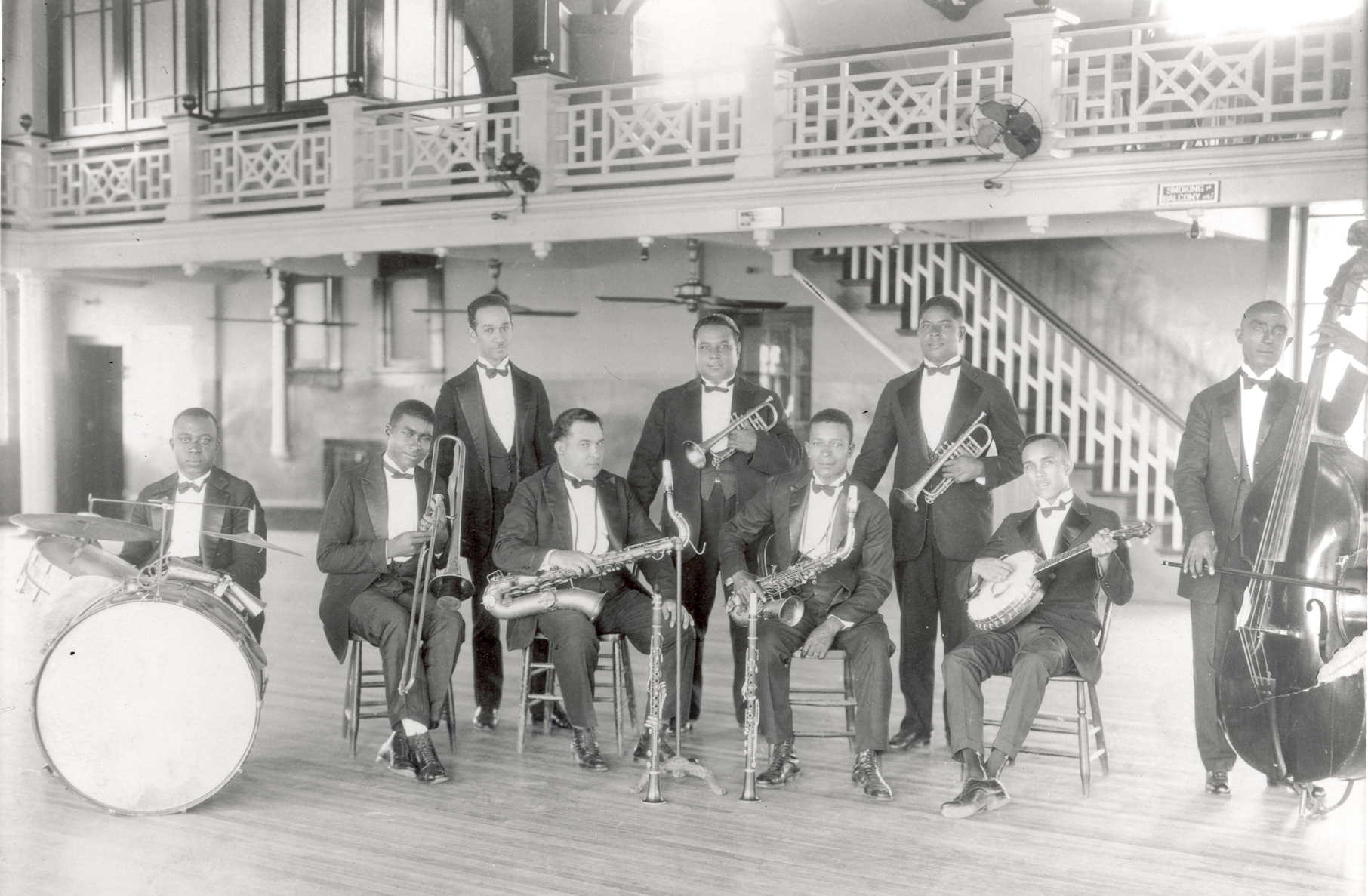
The Darensbourgs were an interesting family (and not just because their mother’s maiden name was Louise Jupiter!). There were several children, and at least two of them were professional musicians: Percy Darensbourg (1899-1950) and Caffery (often spelled “Caffrey”) Darensbourg (1901-1940). Both played with several jazz bands, and Percy even made a few recordings, playing banjo. Below are a couple of promotional photos showing them at work in the 1920s, when they were still based in New Orleans, before they settled in Dallas. (These are cropped details — click pictures to see the full photos.)

Percy Darensbourg, with Lee Collins‘ band, 1925 or 1926:

percy-darensbourg_duke_det

Listen to Percy on banjo, here:


And, below, Caffery Darensbourg, with Manuel Perez’s Garden of Joy Orchestra (click photo to see full band — the other band members are identified here):

caffery-darensbourg_tulane-library

The first of the brothers to arrive in Dallas from New Orleans was Percy, in about 1929, and for the next few years he continued to make his living as a professional musician. Caffery followed in 1932 and opened the short-lived Frenchie’s Creole Inn on Boll Street. Their non-musician brother Irvin was here by 1935 and promptly opened the Green Tavern at 217 Central Avenue, just a few doors down from Percy’s drinking establishment, the Central Tavern Inn, at 223 Central. At about this same time, Percy was also running a club at 3120 Thomas called The Gay Paree — which The Dallas Morning News described as a “swanky negro night club” (April 12, 1938) in a short mention of Percy’s being fined for selling alcohol to an already-inebriated customer.

But back to that 200 block of Central Avenue — the one pictured in the photo at the top. Between 1937 and 1939, Irvin also owned/ran a small restaurant or cafe — and later a pool hall — out of 219½ Central. The Darensbourgs had that block locked up.

*

In 1935, a song called “In a Little Gypsy Tea Room” by Bob Crosby swept the country. It was a huge hit. Suddenly there were scads of places popping up all over calling themselves The Gypsy Tea Room or The Little Gypsy Tea Room. Some might have been actual tearooms, but there were also a lot of clubs and bars with the “tea room” name — the most famous of these was The Gypsy Tea Room in the Tremé district of New Orleans, at Villere & St. Ann, which opened the same year the song was being played incessantly by every dance band in the nation. This famous New Orleans nightclub booked the biggest jazz bands around and was a legendary musician’s hangout.

gypsy-tea-room_new-orleans_1942_tulane-libNew Orleans’ Gypsy Tea Room, 1942 (via Tulane University)

gypsy-tea-room_NOLA_myneworleansNew Orleans’ Gypsy Tea Room, 1930s (via MyNewOrleans.com)

The Darensbourgs most likely knew the club, its owner, its patrons, and the musicians who played there. Perhaps Irvin Darensbourg decided to name his own little Gypsy Tea Room in Dallas in honor of the New Orleans landmark. Whatever the case, Deep Ellum’s Gypsy Tea Room appears to have come and gone fairly quickly (and one assumes there was more than tea being sipped inside).

*

The life of a tavern and club operator could be a hard one, especially in those days, especially in the black neighborhoods of Deep Ellum and North Dallas. Irvin seemed to be forever sleeping on a relative’s couch and had a different address every few months. By 1940 he had moved to Fort Worth to open another bar, and after that … I’m not sure what became of him — but one hopes that he met a less violent end than his brothers did here in Dallas. According to Caffery’s death certificate, he died in 1940 after having been shot in the abdomen while “in a public place.” His death was ruled a homicide. Percy, who by all indications was the most stable and successful of the brothers, was also killed — in 1950 he was stabbed in the neck (!) while out on the street at 4:20 AM.

**

As for the original photograph, I’ve pored over it and looked through directories, but I can’t pinpoint the exact year this photo was taken or determine what the actual address of the Gypsy Tea Room was. Since it was mentioned in the WPA Dallas Guide and History, which was written and compiled between 1936 and 1940 and contains the only contemporary mention of the Tea Room, my guess is that this photograph was taken about 1937, as this was the last year that Old Tom’s Tavern (209 ½ Central) seems to have been in business (although the bar that replaced it was owned by the same person, and the sign seen in this photograph could well have remained up for a while).

Craig’s Cafe, at 213 Central, was in business between 1929 and at least 1946 when property began to be demolished in order to begin construction on the expressway. The Gypsy Tea Room looks to be either two or three doors down from Craig’s place. My guess is that it’s 219 Central. The 1937 street directory has Irvin Darensbourg (whose name is constantly mangled and misspelled everywhere) listed as being the proprietor of both the Green Tavern (at 217 Central) as well as an unnamed restaurant at 219-A (sometimes written as 219 ½) Central. The 1938 and 1939 directories specify Darensbourg’s business at this address in those years is a pool hall, not a restaurant. So I’m going to venture that Irvin Darensbourg ran the Gypsy Tea Room at 219 Central Avenue in 1937. 

1937_gypsy-tea-room_central_1937-directory
1937 Dallas directory

That was exhausting!

***

Sources & Notes

Photo of the Gypsy Tea Room at the top of this post is from the Texas/Dallas History & Archives Division of the Dallas Public Library: “Gypsy Tea Room Cafe located in Deep Ellum” is from the WPA Dallas Guide & History Collection of the Dallas Public Library — its call number is PA85-16/22.

Thanks to Bob Dunn of the Lone Star Library Annex for deciphering “Darensbourg” from this badly garbled printed name on the Gypsy Tea Room sign.

gypsy-tea-room-sign

Here are a few of the numerous ways this Darensbourg’s family’s name is misspelled across the internet:

D’Arensbourg
Darensbourg
Darensburg
Darenbourg
Darenburg
Darnburg
Darnsberg
Dansberg

Darensborough

And I’m still not actually sure whether it’s “Irvin” or “Irving,” or “Caffery” or “Caffrey.”

When clicked, the photo of Percy Darensbourg above opens up to show the full band — the personnel is identified in a caption from the book Oh, Didn’t He Ramble: The Life Story of Lee Collins: “Lee’s band in Dallas, 1925 or 1926. From the left: Coke Eye Bob (Arthur Joseph?), Mary Brown, Freddie ‘Boo-Boo’ Miller, Octave Crosby, Henry Julien, ‘Professor’ Sherman Cook, Lee, and Percy Darensburg [sic].”

A couple of other versions of “In a Little Gypsy Tea Room,” if you must:

  • The version by The Light Crust Doughboys (no strangers to Deep Ellum), recorded in 1935 in Dallas at 508 Park, is here.
  • The at-least-peppier version by Louis Prima and His New Orleans Gang, also recorded in 1935, is here.

See what the area once occupied by the vibrant street life of Central Track looks like now, here. The expressway overpass is now planted about where the photo was taken. It’s a shame this important part of town — in a way it was Dallas’ second downtown — was bulldozed into oblivion.

*

Copyright © 2015 Paula Bosse. All Rights Reserved.

Movie Houses Serving Black Dallas — 1919-1922

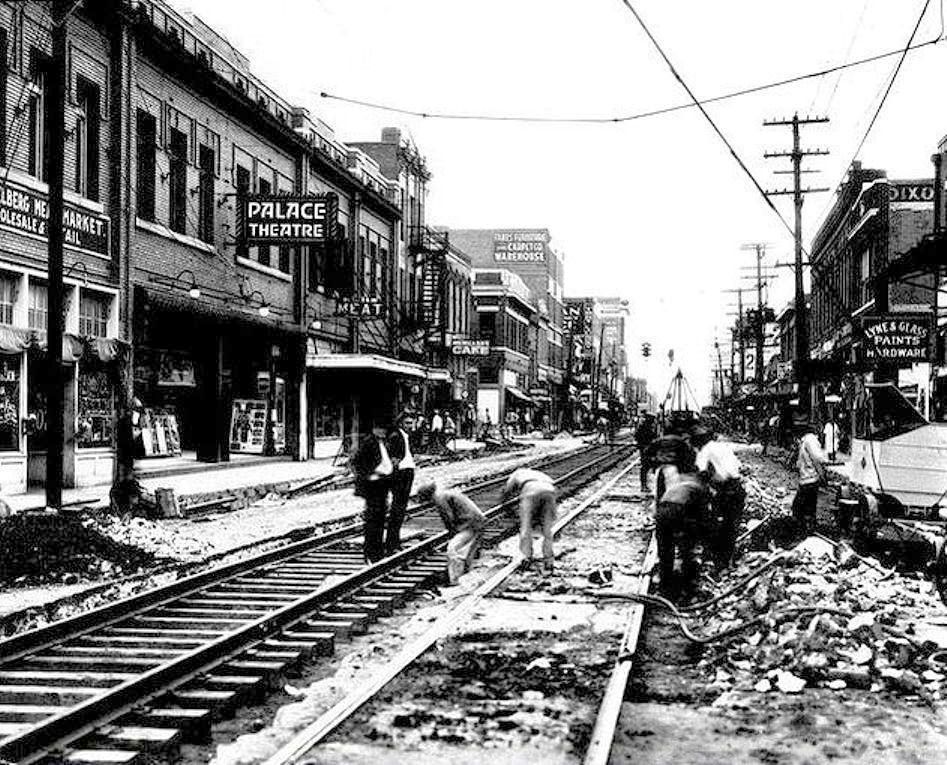
palace-theatre_elm-st_1922-dplThe Palace Theatre, Elm St., Deep Ellum, 1922 (click for larger image)

by Paula Bosse

In 1920, movie theaters — like most places in Dallas at the time — were segregated. If black customers were allowed at all in the downtown white vaudeville and movie houses, they had separate entrances and restricted seating areas (generally in the balcony). But Dallas’ African-American community had their own popular theaters, run by enterprising and energetic men who endlessly promoted their jam-packed and constantly-changing bills.

Judging by the amount of ad space purchased in the black-owned and operated Dallas Express, there were four main movie theaters catering to black Dallasites around 1920: the Grand Central Theatre, run by John Harris, the Mammoth Theatre, run by Joe Trammell, the Palace Theatre, run initially by Felix Moore, and the High School Theatre, run by Herbert Batts; the first three of these houses were in Deep Ellum, the last one was in what was then called “North Dallas.’ The theaters played both “white” films and films with “all-Colored casts.” The advertising for these theaters is great — far more ad space was available in the tiny Express to publicize the movies, the popular but now-forgotten Silent Film stars of the era, and the proprietors themselves than was available to the theaters on the other end of Elm Street in the much larger, white-owned News, Journal, or Times Herald. Sometimes it’s good being the big fish in the little pond — absolutely everybody knows who you are.

*

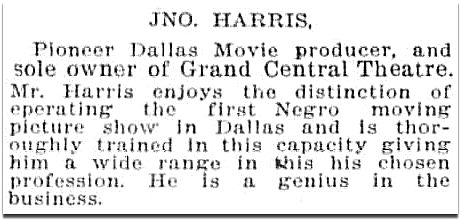
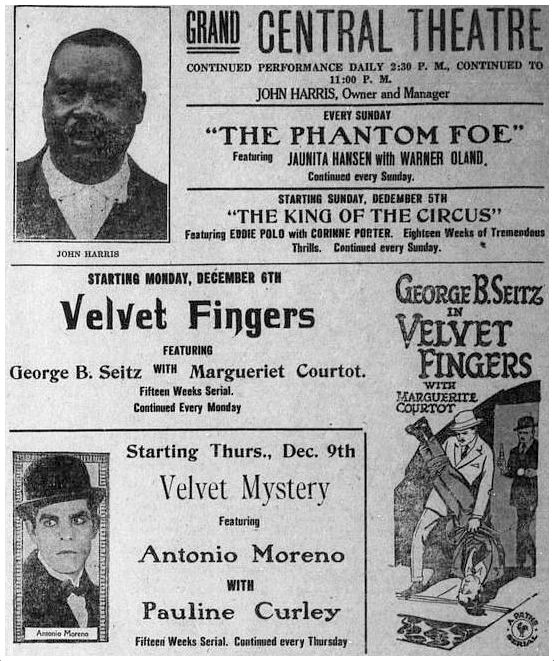
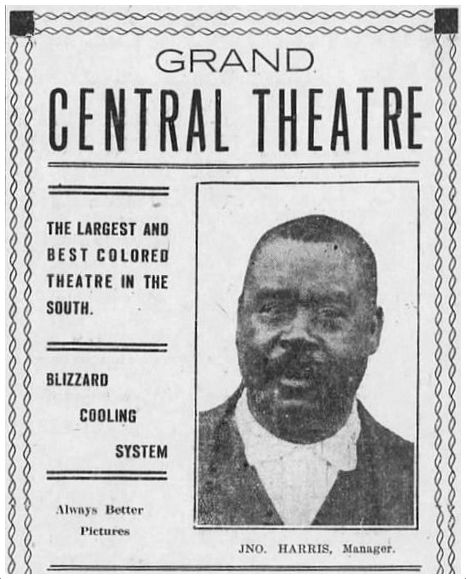
The Grand Central Theatre was at 405-407 N. Central Ave. (which later became Central Expressway), between Swiss and Live Oak on the outer northern edge of Deep Ellum. John Harris, the owner, put himself in practically all of his ads. He included this autobiographical sketch in one of them:

micheaux-grand_dallas-express_052821-detDallas Express, May 28, 1921

I’m not sure if he operated “the first Negro moving picture show in Dallas,” but I wouldn’t doubt it — the man was a dynamo who possessed not only a bold self-confidence, but he also seems to have had an unlimited promotional budget. UPDATE: The first appearance of a theatrical enterprise by John Harris shows up in the 1913 city directory (directories generally collected their information the previous year, so he was probably in business in 1912). Harris is listed under the “Amusements” section at the same address as the Grand Central Theatre, a name which came later. The same 1913 directory also lists the Star Theatre, which later became the Palace (see below). These are the only two theatres designated as “colored.” It’s unclear whether the theaters hosted live performances or showed movies. Or both.

The Grand Central advertised relentlessly. (Click ads to see larger images.)

grand-central-theatre_dal-express_120420Dec. 4, 1920

grand-central-theatre_dal-express_051421May 14, 1921

grand-central-theatre_dallas-express_080621Aug. 6, 1921

Below, an ad showing one of the offerings to be a Ben Roy Motion Picture Corp. movie called “My Baby” which was “made in Dallas, featuring William Lee and All Colored Cast.”

grand-central-theater_dal-express_052722May 27, 1922

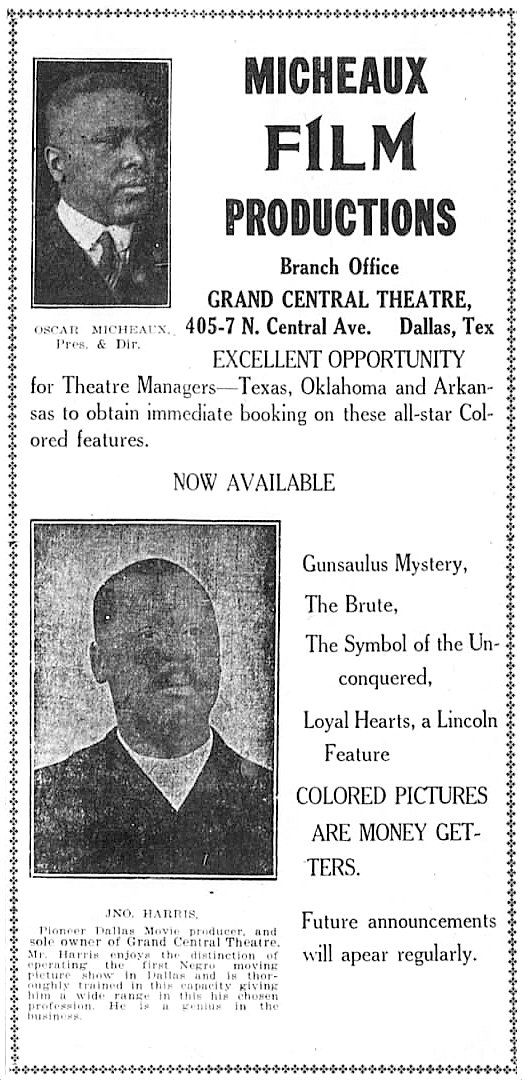
Harris was connected with the legendary black filmmaker Oscar Micheaux. Not only did he regularly run his films, but he also seems to have been working as a booker, promoter, and distributor of Micheaux’s films and ran the Micheaux Film Productions branch office out of the Grand Central. “Colored Pictures are Money-Getters.”

micheaux_dallas-express_051421May 14, 1921

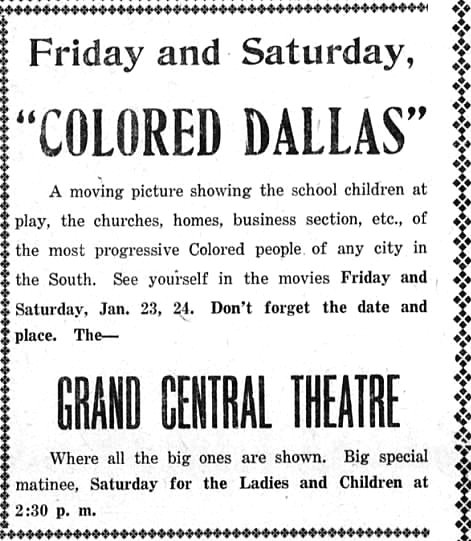
One ad that caught my attention was this one, for a locally-shot film called “Colored Dallas.” I really, REALLY want to see this, but the possibility of an extremely minor, 95-year-old silent film having survived into the 21st century is slim.

colored-dallas_dallas-express_012420Jan. 24, 1920

*

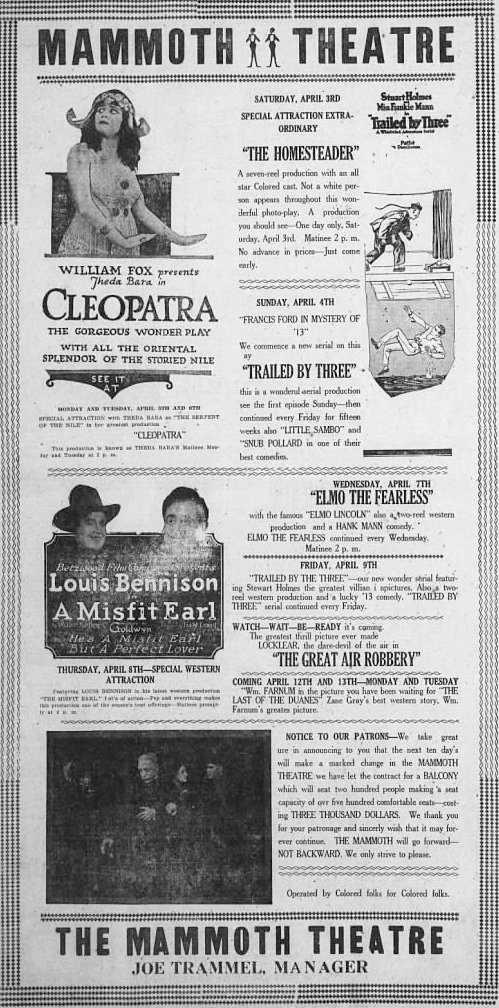
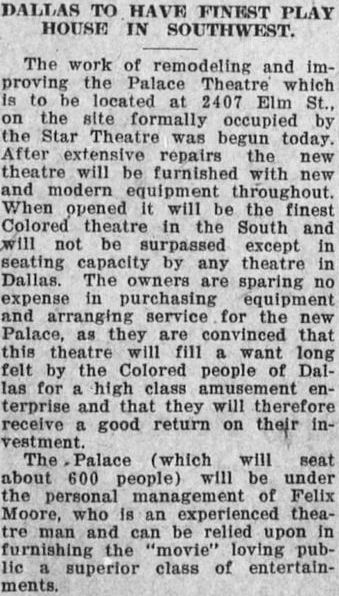
The Mammoth Theatre was located at 2401 Elm Street, between Central and Hawkins. It opened in late 1919 — the run-up to the opening was publicized in this Dallas Express item.

mammoth_dallas-express_112219Nov. 22, 1919

The Mammoth might not have advertised quite as much as the Grand Central did, but it frequently took out splashy full-page ads. Full-page! I bet that royally irked John Harris. Below, a Mammoth ad from 1920.

mammoth_dallas-express_040320April 3, 1920

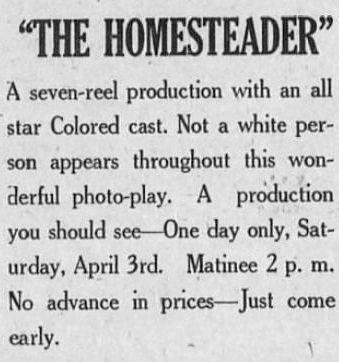
Two details from the above ad:

mammoth_dallas-express_040320-det-2

mammoth_dallas-express_040320-det
“Operated by Colored folks for Colored Folks.”

The owner, Joe Trammell, seems to have had an inexhaustible source of money for advertising — those frequent full-pagers (unusual for the time) must have cost a pretty penny. I couldn’t find much information about any of these men, but I stumbled across this photo of Trammell, tacked on to one of his … um … mammoth ads.

mammoth_joe-trammell_dallas-express_021221Feb. 12, 1921

*

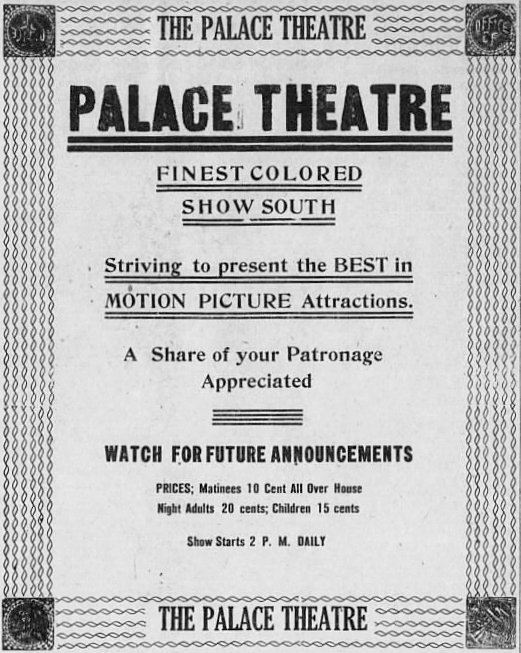
The Palace Theatre, seen in the photo at the top, was at 2407 Elm Street, just a couple of doors down from the Mammoth. (This Palace is not to be confused with the “white” Palace Theatre, the stalwart of Theater Row at the other end of Elm.) It opened in 1920 in the remodeled space formerly occupied by the Star Theatre,

palace_dallas-express_030620March 6, 1920

palace_dallas-express_050820May 8, 1920

*

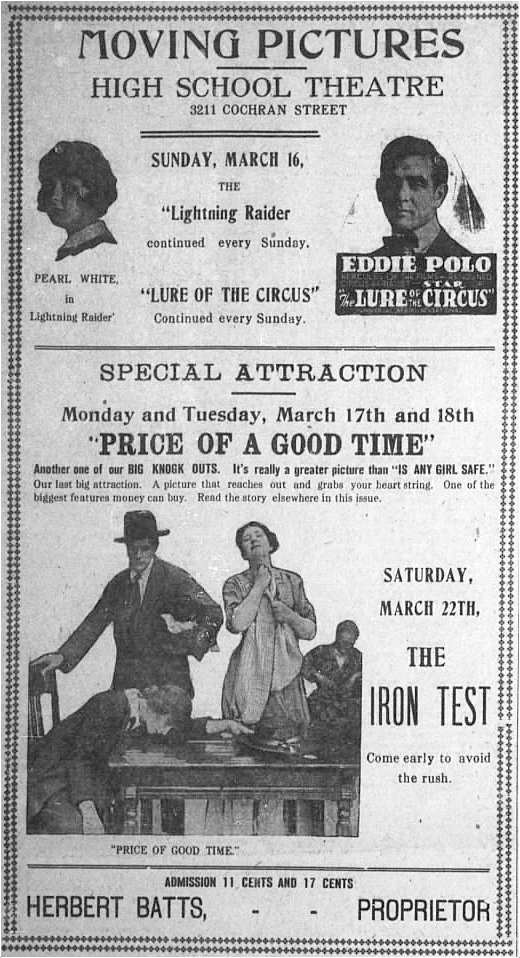
Lastly, moving up to North Dallas, we find the High School Theatre, located at 3211 Cochran, between Central and N. Hall Street. The reason for its name was its close proximity to the Colored High School (the only high school for African-American students at the time — it would soon merge with and relocate to the new Booker T. Washington High School a short distance away). The following businesses were in this same block: the High School Cold Drink Stand, the High School Cafe, the High School Shine Parlor, and the High School Tailor Shop. Location, location, location.

high-school-theater_dallas-express_031519March 15, 1919

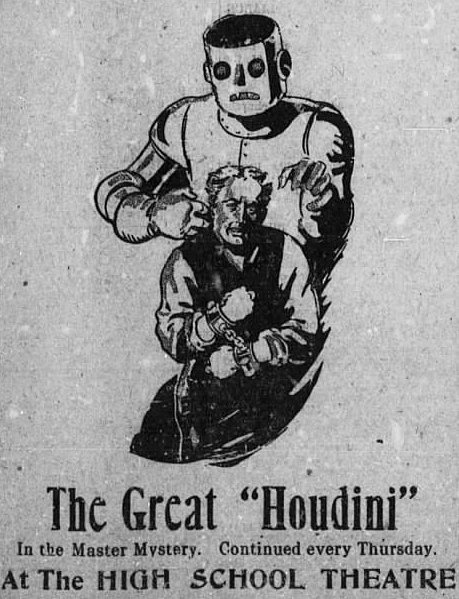
My favorite High School Theatre ad is this one, touting a serial called “The Master Mystery” starring Houdini … one of the screen’s first appearances of a robot! (Check out a scene featuring both Houdini and the robot/automaton, here.)

houdini_dallas-express_031519March 15, 1919

*

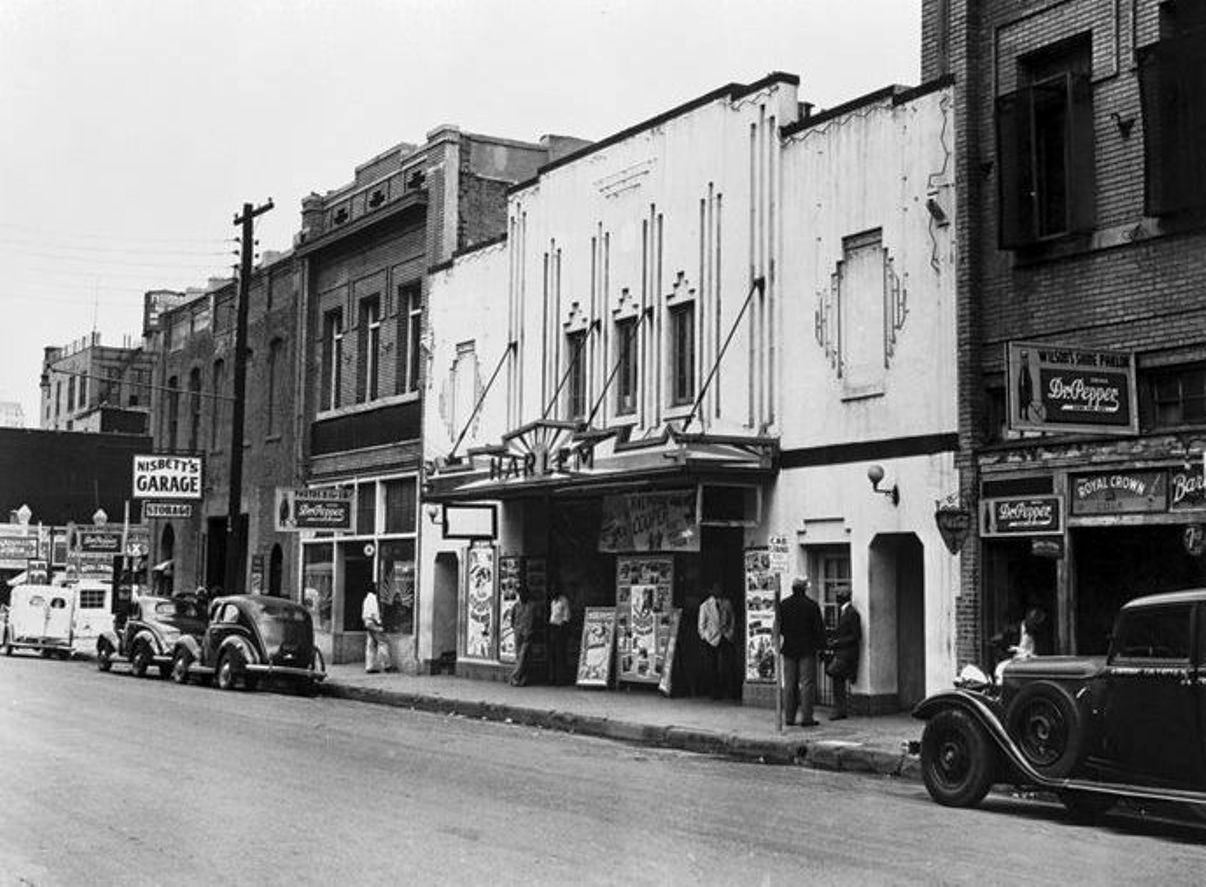
The only one of these theaters still in business in 1930 was the Palace. by 1937, the Palace had become the Harlem Theatre.

harlem-theatre_deep-ellum

harlem-theatre_dpl

***

Sources & Notes

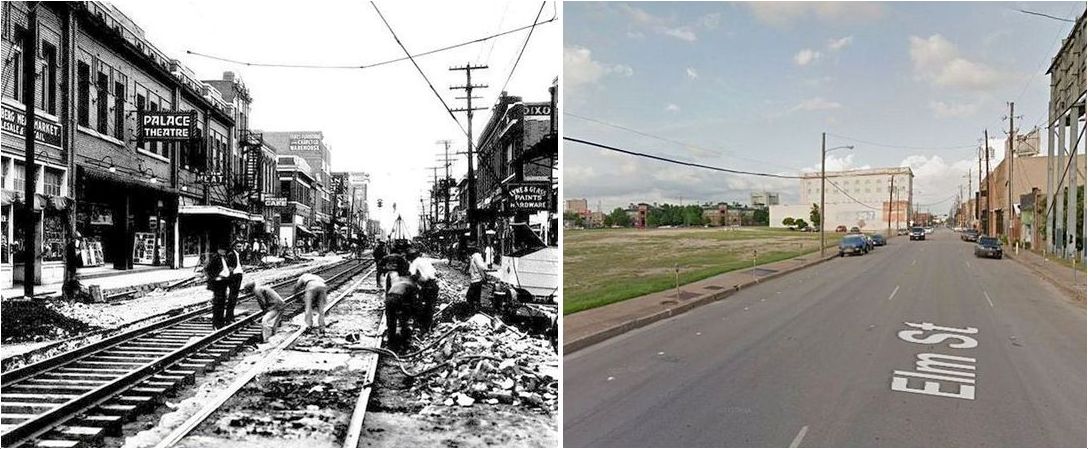
Top photo showing Elm Street and the Palace Theatre and the bottom two photos showing the Harlem Theatre are from the Texas/Dallas History & Archives Division, Dallas Public Library. The upsetting view of what that stretch of Elm looks like now can be seen on Google Street View, here. Below, side-by-side, 1922 and 2015 — Elm St. looking east to Deep Ellum, the Knights of Pythias temple in both images down the street on the left. Look what we’ve lost.

elm-looking-east_1922-2015

All ads and clippings from The Dallas Express, as noted. A few years’ worth of this important newspaper, which served Dallas’ African-American community, can be accessed here.

More on Oscar Micheaux, here.

Another Flashback Dallas post on a theater serving the black community is “Oak Cliff’s Star Theatre — 1945-1959.”

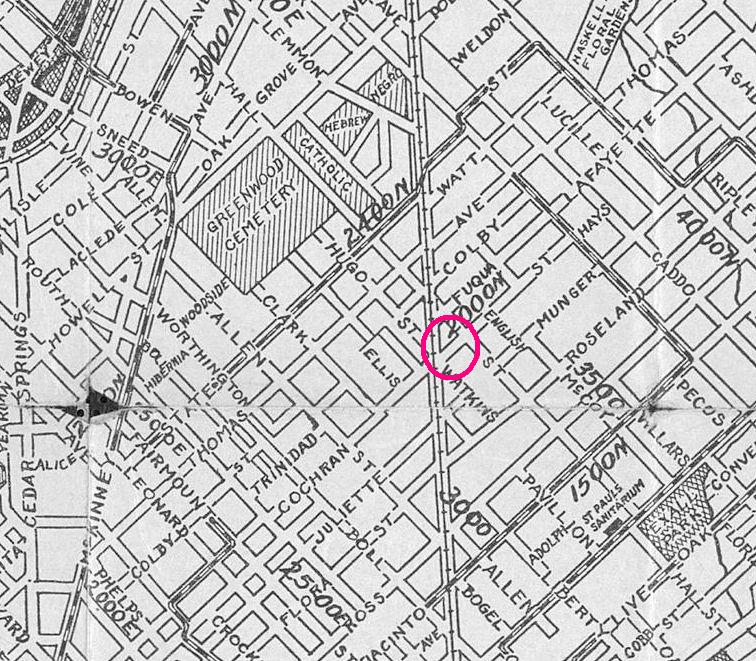
A 1919 map from UNT’s Portal to Texas History shows the location of the Grand Central Theatre (red square), the Mammoth (blue), and the Palace (yellow).

black-cinemas_ca1920_deep-ellum

The High School Theatre — up in “North Dallas” (adjacent to present-day Uptown) — is seen on a different portion of the same map, below.

black-cinemas_ca1920_north-dallas

Most images are larger when clicked.

*

Copyright © 2015 Paula Bosse. All Rights Reserved.

“A Perfect Auto Tent” — 1921

ad-dallas-tent-awning_dmn_061221-smRemember to turn off engine before retiring for the night…

by Paula Bosse

Personally, I don’t understand why anyone would want to be outside when it’s 157 degrees, but for those of you who are insistent campers who might be heading out for a sweaty and bug-filled weekend in the wilderness, might I direct your attention to the “automobile tent,” ready for purchase in 1921 at the Dallas Tent and Awning Co. at 2620 Main Street, in the heart of Deep Ellum. Adjusted for inflation, the cost of this admittedly charming-looking “car tent” would be the equivalent of about $200.

My weekend? I will be camped out in a blissfully air-conditioned house — shades drawn, blinds closed — with an iced tea in hand, moving slowly, and not smelling like insect repellent.

*

Copyright © 2015 Paula Bosse. All Rights Reserved.

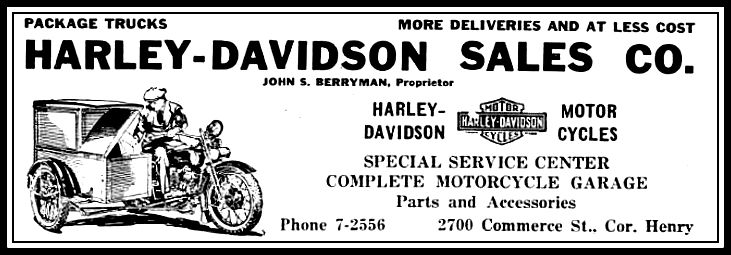
Harley-Davidson Sales Co. Ad — 1929

ad-harley-davidson_directory_1929-smBeyond sidecars…

by Paula Bosse

I have to say, I love this delivery vehicle!

***

Advertisement from the 1929 city directory. Harley-Davidson — 2700 Commerce Street, at Henry — was in Deep Ellum, in the same block currently occupied by Angry Dog.

Click picture for larger image.

*

Copyright © 2015 Paula Bosse. All Rights Reserved.
A Distant Dallas Hall on the Horizon — 1914

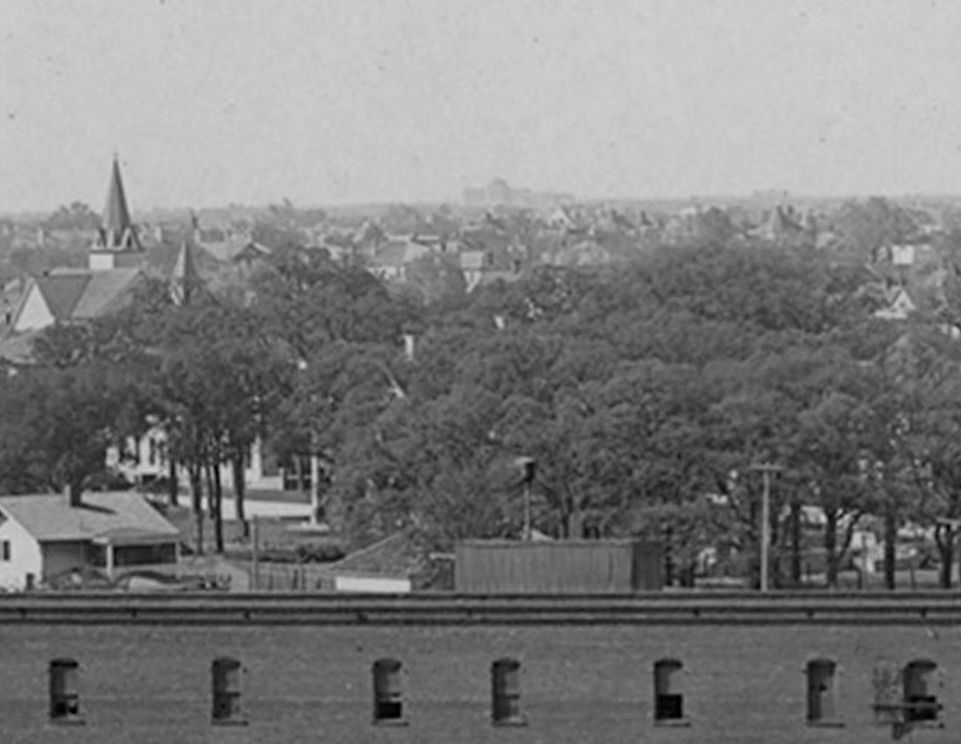
dallas-hall_continental-gin_det_1914A clear line of sight, from Deep Ellum to SMU (click for larger image)

by Paula Bosse

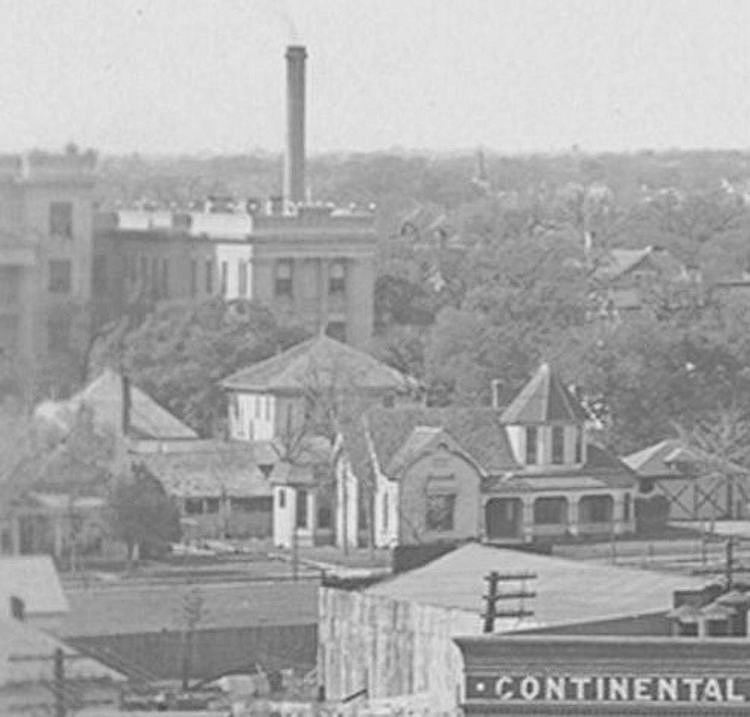
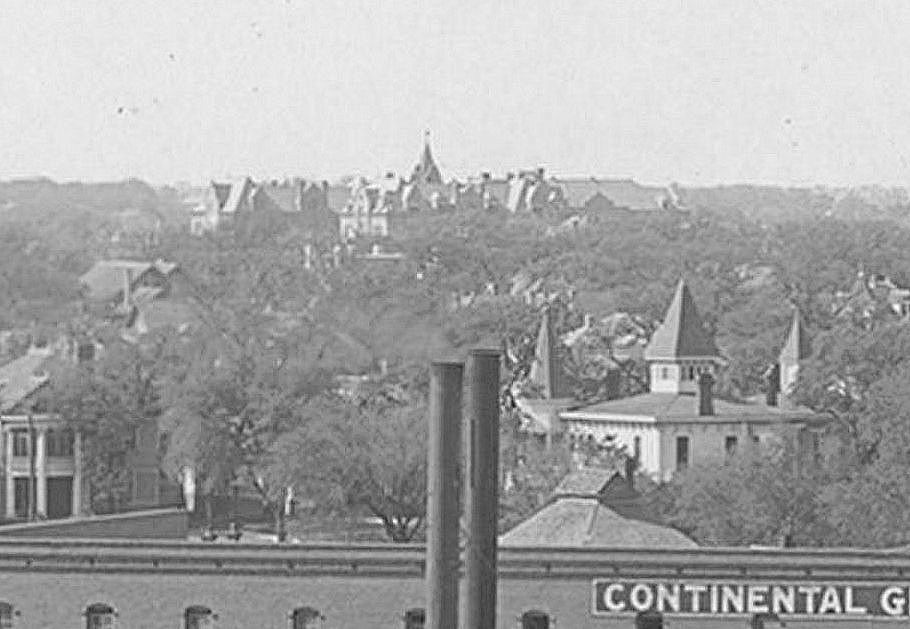
A quick “bonus” post: a detail of an incredible photo of the Continental Gin building which shows a ghostly Dallas Hall looming in the distance. Dallas Hall was the first building on the SMU campus, and in 1914 — a year before classes began — the far off building was way, way out in the country. SMU is a little over 5 miles from Deep Ellum. That’s quite a view.

***

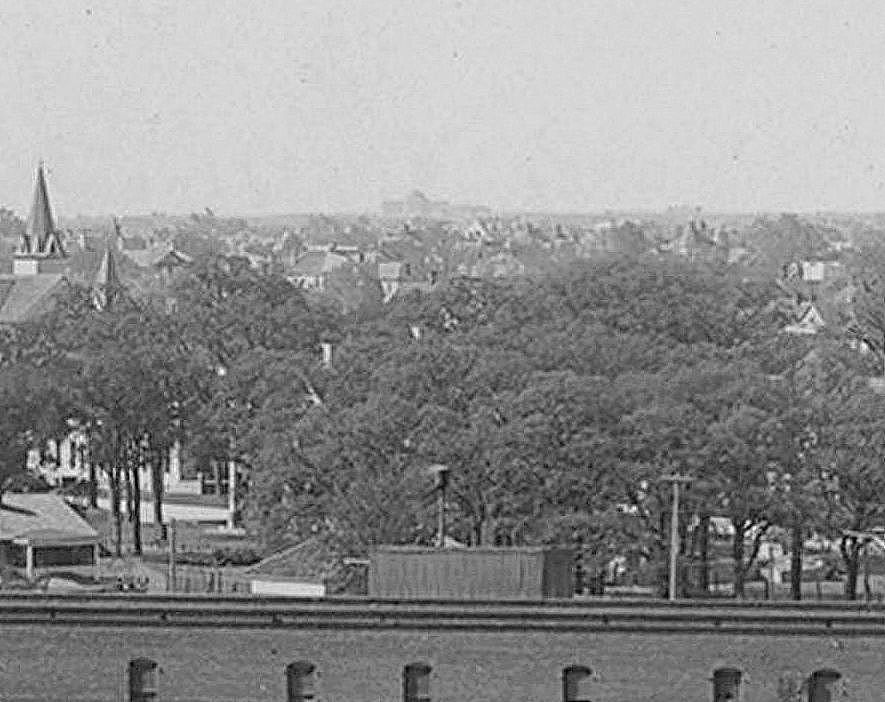
This detail is from a photo featured in a previous Flashback Dallas post, “The Continental Gin Complex — 1914,” which can be seen here. I’ve just added this detail — and two other magnified details showing Baylor Hospital and the old Ursuline campus — to the post.

The original photograph, titled “Continental Gin Company on Elm Street, Facing North” by Charles Erwin Arnold, is from the George W. Cook Dallas/Texas Image Collection housed at the DeGolyer Library, Central University Libraries, Southern Methodist University. The photo and its details can be viewed here. It really is one of my favorite historical Dallas photos ever.

*

Copyright © 2015 Paula Bosse. All Rights Reserved.
 

The Continental Gin Complex — 1914

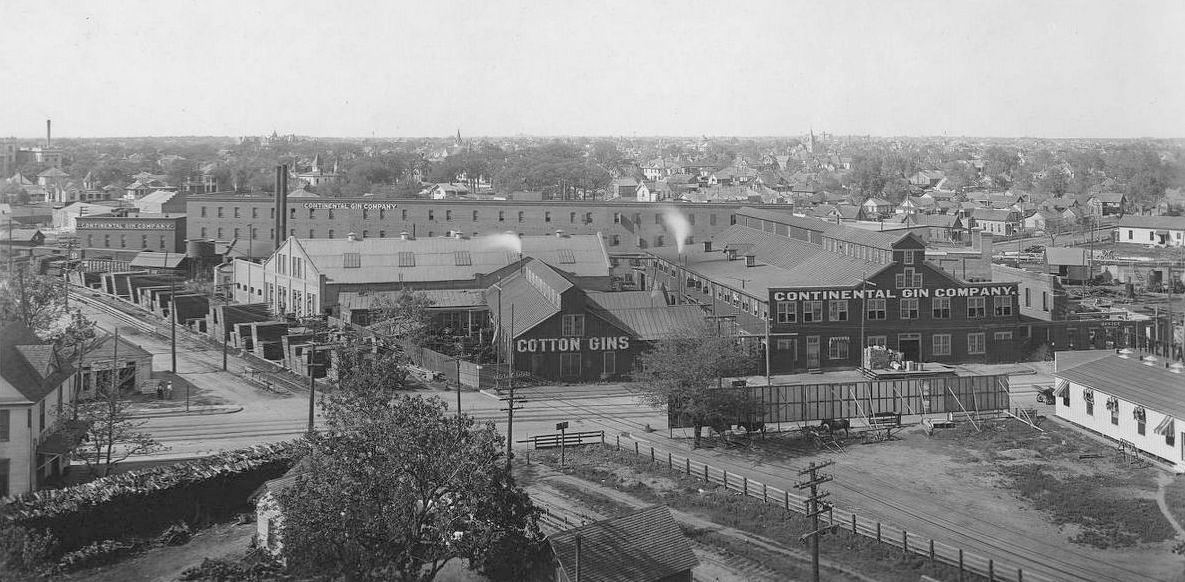
continental-gin-bldg_1914_cook-degolyer-smu-bwPhoto by Chas. Erwin Arnold (DeGolyer Lib., SMU) (click for larger image)

by Paula Bosse

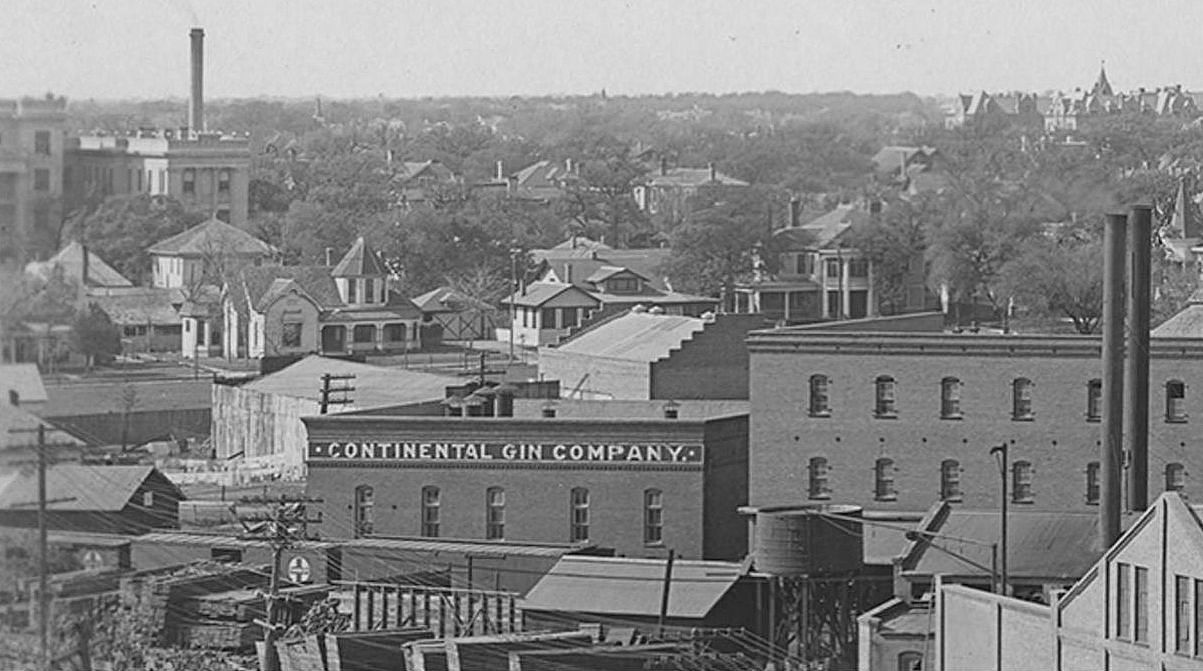
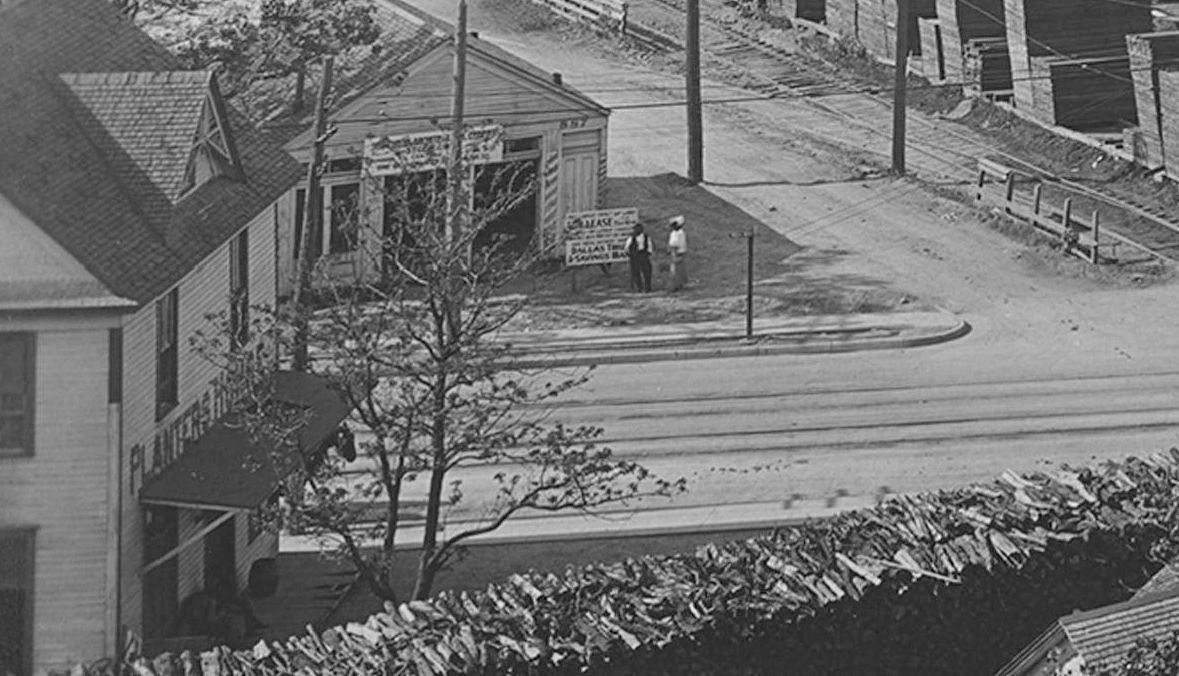
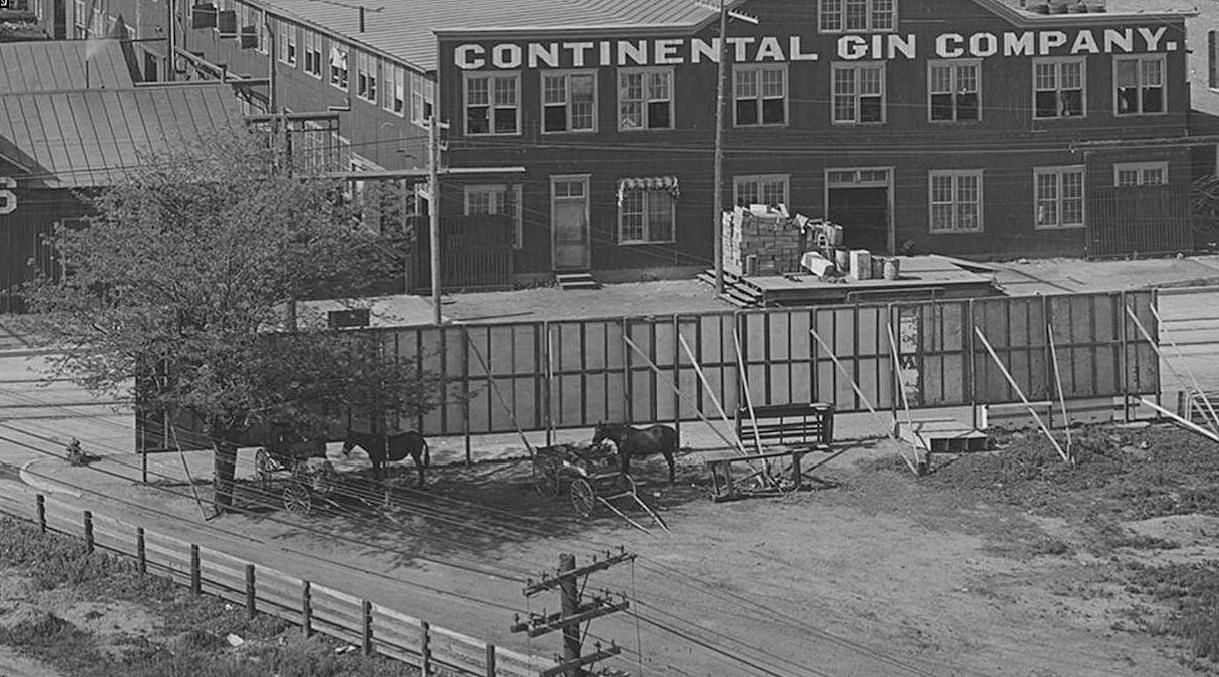
This is a really wonderful view of the Continental Gin Company complex, a Dallas landmark, much of which is, remarkably, still standing in Deep Ellum. Granted, my experience is limited, but I’ve never seen a photograph from this period showing the manufacturing end of Deep Ellum and the residential neighborhood just beyond it to the north. This is another incredible image from the George W. Cook Collection at the DeGolyer Library at SMU. A few magnified details, below. (Click for much larger images.)

continental-gin-bldg_1914_cook-degolyer-det1_bw

continental-gin-bldg_1914_cook-degolyer-det2_bw

continental-gin-bldg_1914_cook-degolyer-det3_bw

And zooming into the distance….

continental-gin_baylor_1914_bwThe back side of Baylor, at the top left. See it from the front here.

continental-gin_ursuline_1914_bwIn the middle at the top, Ursuline. (See more views of it here.)

continental-gin_smu_1914_bwAnd, my favorite, SMU’s Dallas Hall, waaaaaaaaaaaaaay in the distance. SMU hadn’t even officially opened when this photo was taken!

map_1919_continental-gin-bldg1919 map

***

Photograph titled “Continental Gin Company on Elm Street, Facing North” by Charles Erwin Arnold; from the George W. Cook Dallas/Texas Image Collection housed at the DeGolyer Library, Central University Libraries, Southern Methodist University. The photo and its details can be viewed here (I have altered the color in the images seen in this post).

Map detail from a large 1919 Dallas street map (which can be seen via the Portal to Texas History, here).

A view of this area from the 1921 Sanborn maps can be found here (click to make larger). (What’s a Sanborn map? Wikipedia tells you here.)

I wrote at length about the history of the Continental Gin complex of buildings in the post “Munger’s Improved Continental Gin Company,” here.

All images larger when clicked.

*

Copyright © 2015 Paula Bosse. All Rights Reserved.
 

From Blacksmithing to Auto Body Repair: A Guy Who Knew How to Change With the Times

palace-shop_1920sThe Palace Shop — 2814 Main St., Deep Ellum…

by Paula Bosse

The building seen above in a photo from the 1920s is still standing on Main Street in Deep Ellum — and it still looks very much the same. It goes back to at least the 1910’s and has most recently been an art gallery/production studio; when I went to see a gallery show there several months ago, I was almost more interested in the building than in the art. It’s pretty cool.

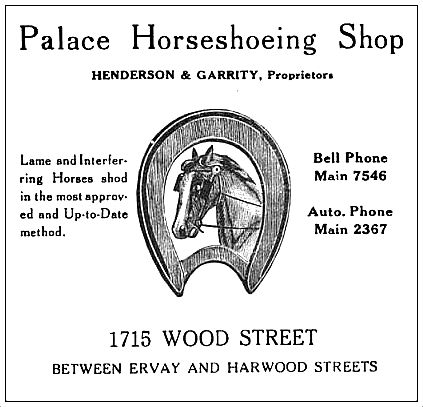
The building has housed a lot of automotive-related endeavors over the years, including, the Palace Shop, a business which originally started out as a blacksmith shop in 1889 (in a different location — at what is now Commerce and Lane).

palace-horseshoeing_bldg-code_19141914 ad

As the horse-shoeing business began to slack off, the owner — an early automobile enthusiast named Gus Henderson, Sr. — shrewdly made the transition from blacksmith to auto body repair guy. His business expanded and he made the move to Main Street.

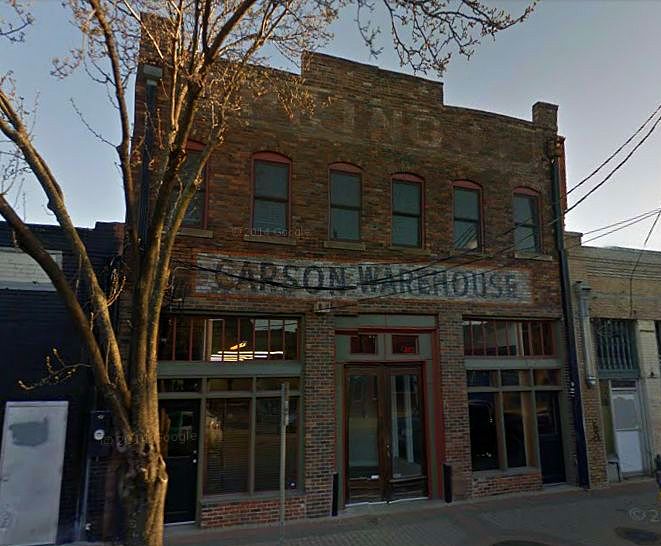
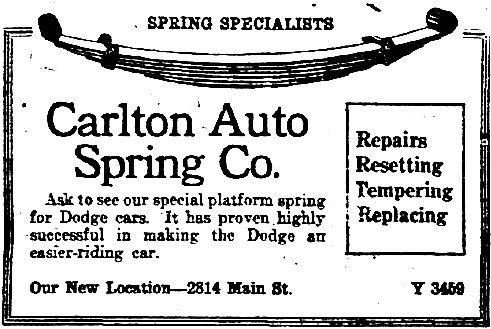
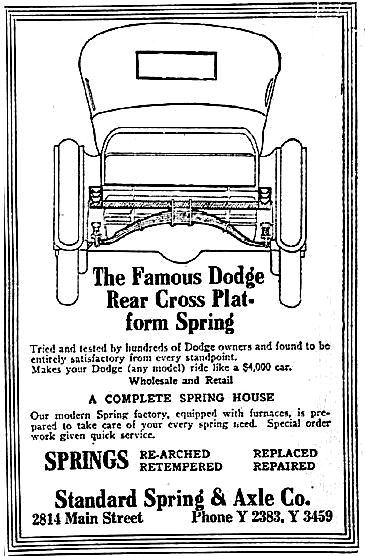
Below is what the building looks like today, still pretty much the same. The word at the top is “springs” which can be explained by there having been a “spring specialist” at that address for several years (the Carlton Auto Spring Co., later bought out by the Standard Spring & Axle Co.), but I’m not sure what the “Carson” refers to — anyone know? (Should it be “Carlton”?)

palace-shop_now_googleGoogle Street View

carlton-auto-spring_dmn_0219221922

standard-spring_dmn_1008221922

I’m always happy to see these old buildings still in use a hundred years after they were built — a sad rarity for Dallas. Thank you, Deep Ellum!

***

Sources & Notes

The often-unreliable Dallas Central Appraisal District info has the construction date of the building as 1913. The earliest business I can find at that address is something called Star Manufacturing Co. — in business there in 1915. (The city’s street numbers were changed in 1911, so it’s difficult to pinpoint what was in that location previously — the street numbers in that block of Main Street would have been between 744 and 774, per the 1909 Worley’s directory.)

*

Copyright © 2014 Paula Bosse. All Rights Reserved.
 

Michael G. Owen, Jr. — Dallas Sculptor of Lead Belly

leadbelly_three-views_paul-l_yelp

by Paula Bosse

Above, three views of “Leadbelly,” the sculpted head of the blues legend, by Michael G. Owen, Jr., 1943.

Michael Owen (profiled here previously as the 15-year-old soap-sculptor who made headlines at the 1930 State Fair of Texas), was the youngest member of the group of artists loosely affiliated with the Dallas Nine group who were making a name for themselves in the 1930s and ’40s. He studied life drawing as a student of Olin Travis and painting as a student of Jerry Bywaters, but he was most proficient as a sculptor. He is best known for his award-winning 1943 bust of bluesman Lead Belly, a piece in the permanent collection of the Dallas Museum of Art (which can be seen in a 1951 DMFA catalog here).

In a 1950 letter to the (then-) Dallas Museum of Fine Arts, Owen recounted how Lead Belly sat for him in New York and sang “Goodnight Irene” as Owen worked on a clay model. Owen was living in Greenbelt, Maryland at the time, and Louisiana-born Lead Belly was living in New York City, but I’d like to think that the two men reminisced about their formative days in Dallas where Owen was a much-talked-about young artist and Lead Belly performed on the streets of Deep Ellum with Blind Lemon Jefferson.

I noticed in the newspaper article that the stone was called black Belgian marble. Actually it isn’t so exotic. It was quarried not far from Charlottesville, Virginia, and is called Black Serpentine. It was the first time I have ever heard of the stuff being black. If you’ll notice it seems quite a bit more crystalline than marble.

The way I happened to do the head went like this. A young fellow I had known in Dallas by the name of Ralph Knight had gone to New York a year or so after I went to Washington. He was interested in folk music and became acquainted with Leadbelly. It was at Ralph’s instigation that I did the head — he got me the stone, sent pictures (I first roughed out the head in clay at home in Greenbelt) and then arranged the sitting at his apartment in New York. Leadbelly sat for me one afternoon and I finished the clay model at that time. From that I worked out the stone cutting, only being able to work on it in my spare time. All in all it was about a full month’s work, I guess. During the time he was “sitting” for me (playing his guitar and singing) he played “Goodnight Irene,” but at that time the folk music devotees did not consider the tune “true folk music.” Still it pleased me when it became a popular song. It’s too bad Leadbelly couldn’t have lived to see himself gain such popularity. (Mike Owen in 1950, from a letter excerpted in the book Lone Star Regionalism, The Dallas Nine and Their Circle)

Sadly, Mike Owen’s career stalled soon after this 1940s artistic high point. He eventually settled in Oregon, where he was sidelined by multiple sclerosis. He died in 1976 at the age of 60.

owen-michael_1930s
Mike Owen in his early 20s

I’m not sure how often the piece is displayed at the Dallas Museum of Art, but it’s a wonderful work of art. When I saw it a couple of years ago, I just stood and stared at it for ages. It’s really fantastic. And it’s fitting that it resides here in Dallas where Michael Owen was once a part of a group of Texas artists whose influence continues to be felt today.

It also seems fitting to throw in this classic from Mr. Ledbetter, who, like Mike Owen, spent time honing his craft in Dallas:

lead-belly-wikipedia

***

Sources & Notes

“Leadbelly” sculpture by Michael G. Owen, Jr. is in the collection of the Dallas Museum of Art.

Photo of the artwork is by Paul L. as posted on Yelp.

Photo of Lead Belly from Wikipedia.

Quote from Mike Owen’s letter to the DMFA (April 11, 1950) can be found in the superb book Lone Star Regionalism, The Dallas Nine and Their Circle, 1928-1945 by Rick Stewart (Austin: Texas Monthly Press, Dallas Museum of Art, 1985) — the best book on Dallas art of this period.

Read the Handbook of Texas entry about Huddie Ledbetter (aka Lead Belly/Leadbelly) here.

Other Flashback Dallas posts on Owen:

  • Young Mr. Owen’s star-turn as the teenager who carved the WFAA transmitter plant from 8,400 pounds of Ivory Soap is here.
  • Owen’s monument to SMU Mustangs’ mascot Peruna, commissioned in 1937, is here.

UPDATE: Read about a recently discovered large painting by Owen up for auction in Dallas in 2019 here.

*

Copyright © 2014 Paula Bosse. All Rights Reserved.