Flashback : Dallas

A Miscellany: History, Ads, Pop Culture

Category: Downtown

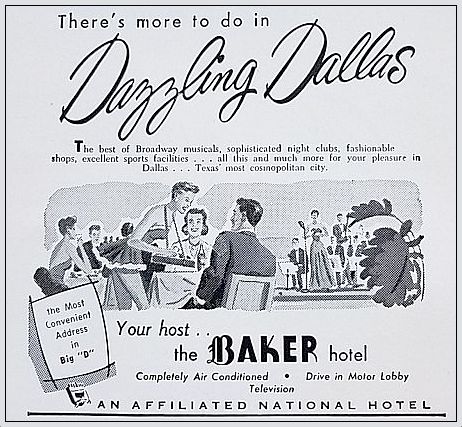
The Baker Hotel

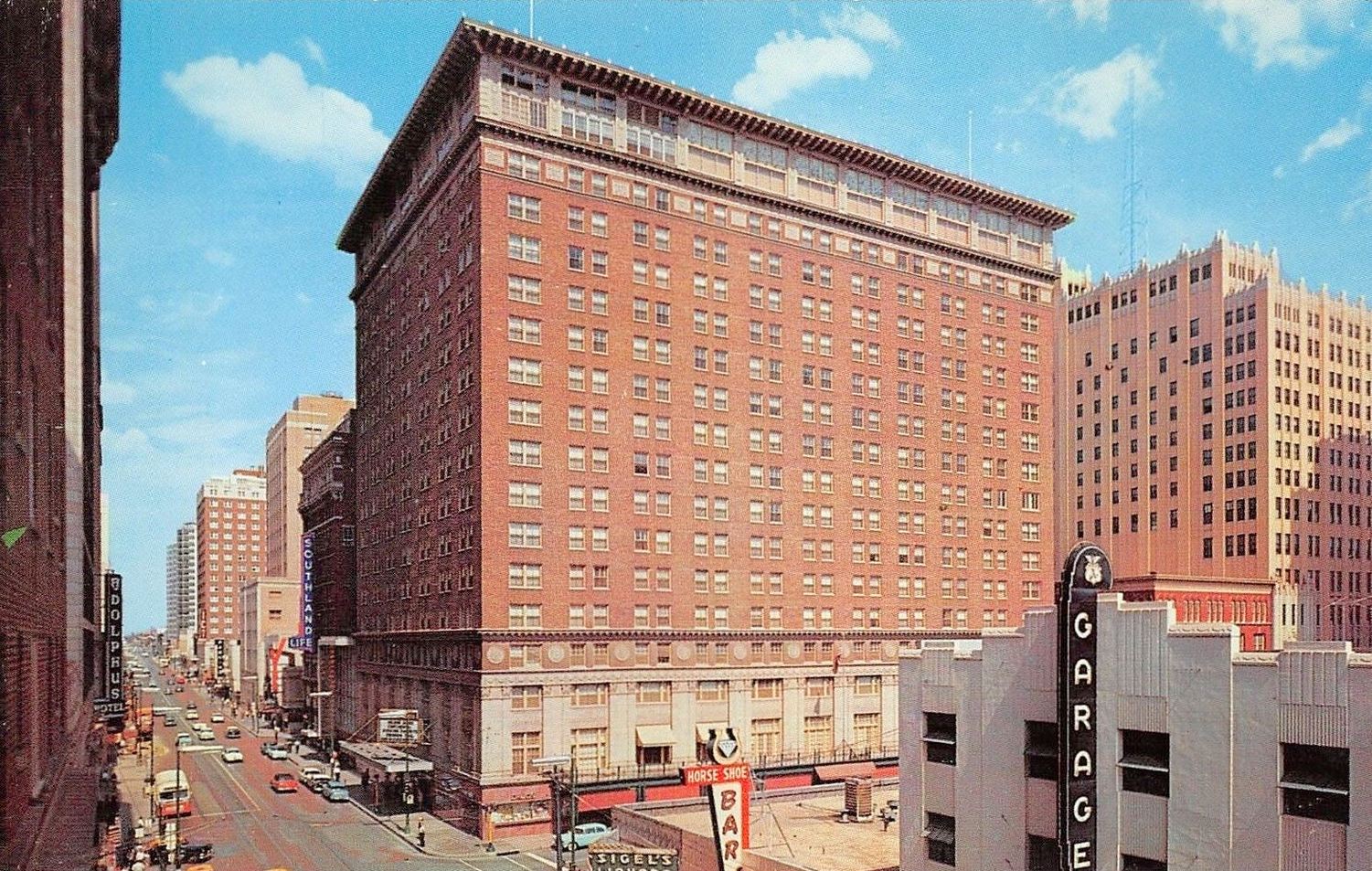
baker-hotel_postcardLooking east on Commerce from Akard…

by Paula Bosse

Above, a postcard view of the stately Baker Hotel, located catty-corner from the Adolphus, at the southeast corner of Commerce and Akard — the view here is to the east on Commerce. The parking garage at the lower right looks like the swanky Nichols Bros. Garage (yes, “swanky” — see the 1945 ad here).

The Baker was not only home to well-heeled patrons and top-flight nightclub entertainment, it was also a home-away-from-home for celebrities passing through Dallas.

baker-hotel_cigarette-girl_this-week-in-dallas_dec-1956Cigarette girls in 1956

Built in 1925, the Baker Hotel was demolished in 1980. (Check out the photos by Frank Booth showing the Baker’s implosion in 1980, here.)

*

Copyright © 2017 Paula Bosse. All Rights Reserved

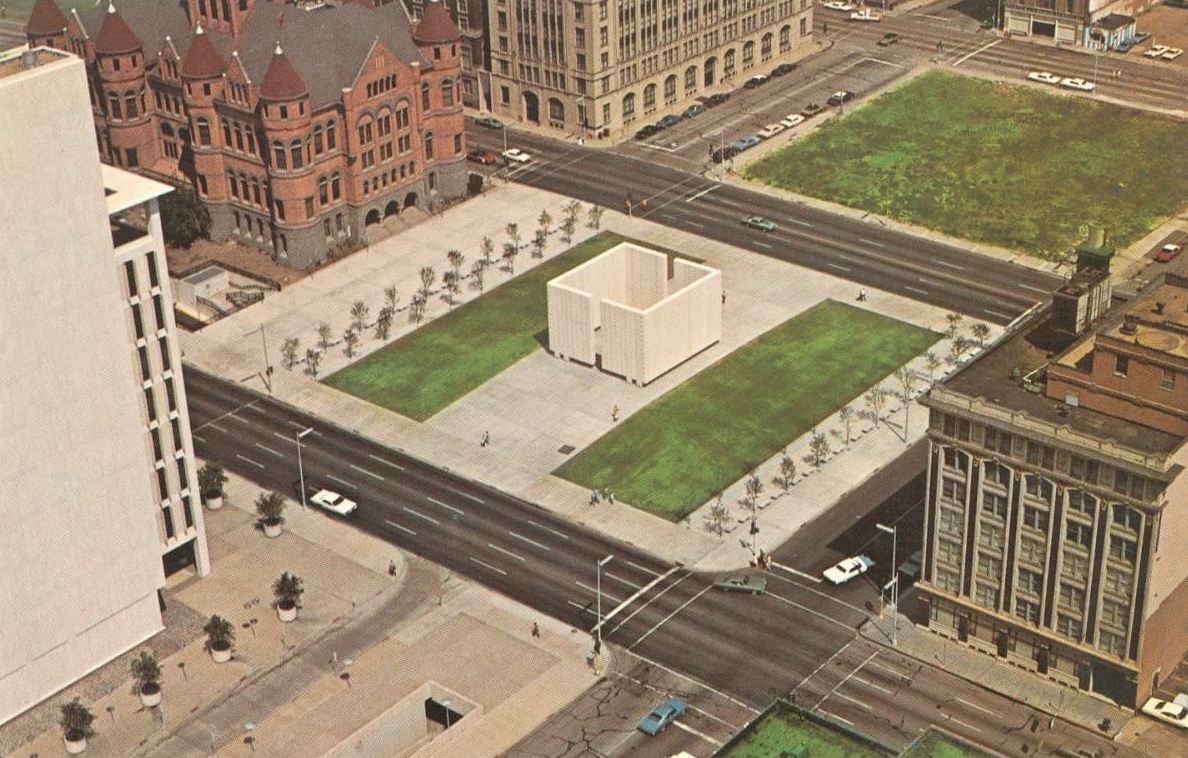
Aerial View of the JFK Memorial — 1970

jfk-memorial_postcard_portalThe JFK memorial, newly dedicated…

by Paula Bosse

The Kennedy Memorial — designed by architect Philip Johnson at the behest of Stanley Marcus — was dedicated on June 24, 1970. This postcard view is one I’ve never seen before. The caption from the back of the card:

jfk-memorial_postcard_portal_caption

***

Sources & Notes

Postcard “Aerial of John Fitzgerald Kennedy Memorial, Dallas, Texas” from the Texas History Collection provided by Dallas Heritage Village to the Portal to Texas History; more here.

*

Copyright © 2017 Paula Bosse. All Rights Reserved.

Dallas Skyline, Looking West — 1970

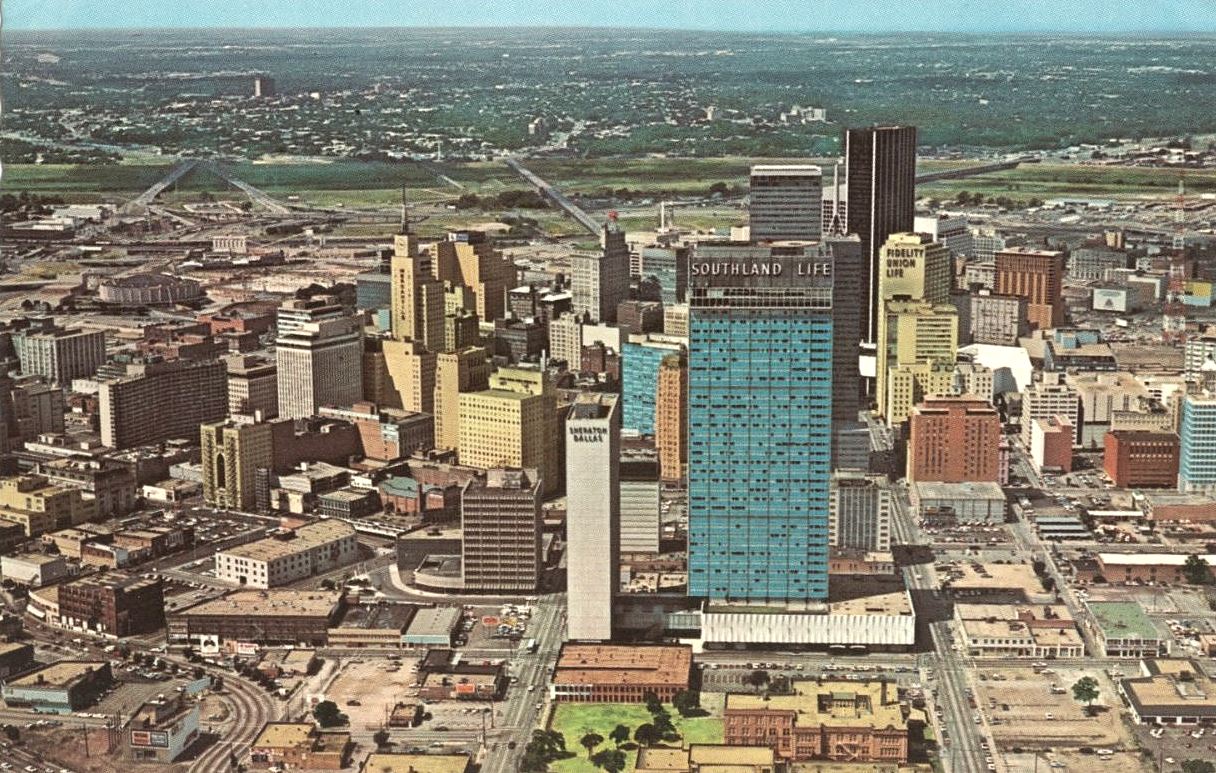
skyline-looking-west_southland-center_1970_portalSouthland Life welcomes you to Big D…

by Paula Bosse

This is a view of the Dallas skyline that isn’t seen that often — a view across downtown toward the west. This 1970 Southland Center postcard has the heliport-topped Southland Life Building (one of the few downtown buildings designed to face to the east) and the Sheraton Hotel front and center. It’s really interesting to zoom in on this photo and look around — for instance, the sight of the Hilton/White Plaza/Indigo hotel at the left, at Harwood and Main across from the Municipal Building, is a little disorienting (I think it’s the empty lot/parking lot at Elm and Harwood).

Have a little fun and zoom way in on this photo of 1970 downtown Dallas on the Portal to Texas History website, here.

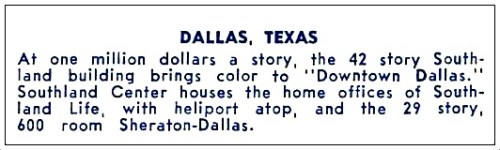
skyline-looking-west_southland-center_1970_portal_info

***

Sources & Notes

Postcard was provided to the Portal to Texas History by Dallas Heritage Village; more info on this can be found on the Portal, here.

*

Copyright © 2017 Paula Bosse. All Rights Reserved.

Nighttime on Commerce Street — 1957

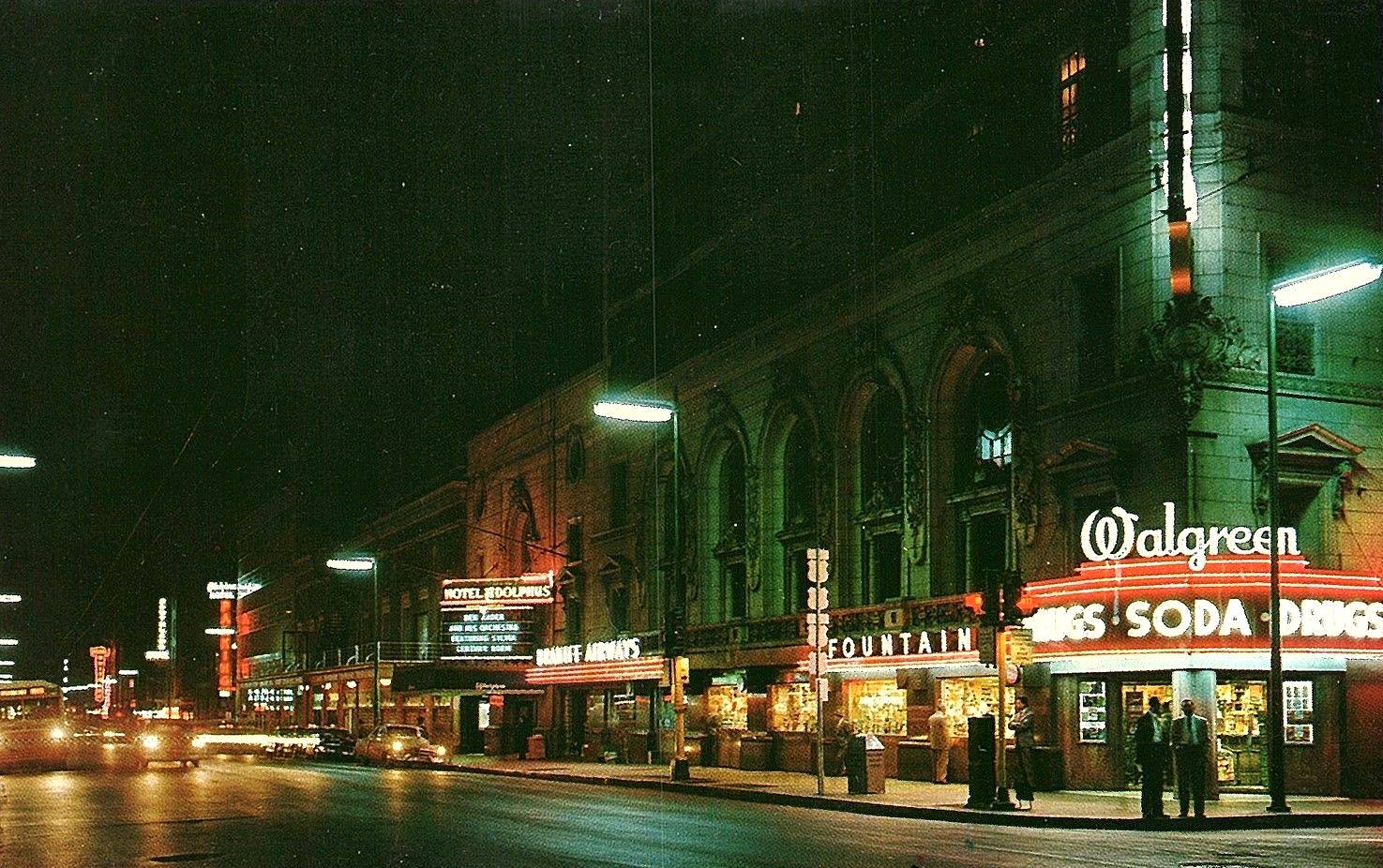
commerce-street_walgreens_adolphus_1957_ebayThe Adolphus block, at Commerce & Akard…

by Paula Bosse

I love this photo showing Commerce Street, looking west from Akard — especially the green light on the walls of the Adolphus. And that heart-stoppingly beautiful deco “Walgreen” font and neon. Downtown Dallas in the ’40s and ’50s is a place I wish I had known, back when drug stores had soda fountains and hotels had “supper clubs.”

This photo was probably taken in March, 1957, when Ben Arden and His Orchestra “featuring Sylvia and her violin” were appearing at the Century Room in the Adolphus Hotel. Downtown Dallas looked pretty good in 1957.

***

Sources & Notes

Postcard photo — “Night view of Commerce Street in downtown Dallas, Texas” — by Leonard Raef; it is currently up for bids on eBay, here. (Thanks to Teresa Musgrove Gibson for posting this today in the Retro Dallas Facebook group!)

I don’t know if I’ve linked to this huge photo of the Adolphus on the Dallas City Hall website, but take a look at it here (then click again to make it really big). I have to say, I think I prefer that Commerce-and-Akard corner with the bright lights of the Walgreens to the more sedate, stripped-down look of the same corner today — it’s still a beautiful  building, of course, but, man, that neon was just fantastic.

UPDATE: Some people who remember downtown at this time have thought this might show Main Street. As far as I know, Main has never been a one-way street (as seen in the photo above), but there was a Walgreen store at the northwest corner of Main and Akard, one block away. Seems counter-productive to have two drugs stores so close together, but there you are.

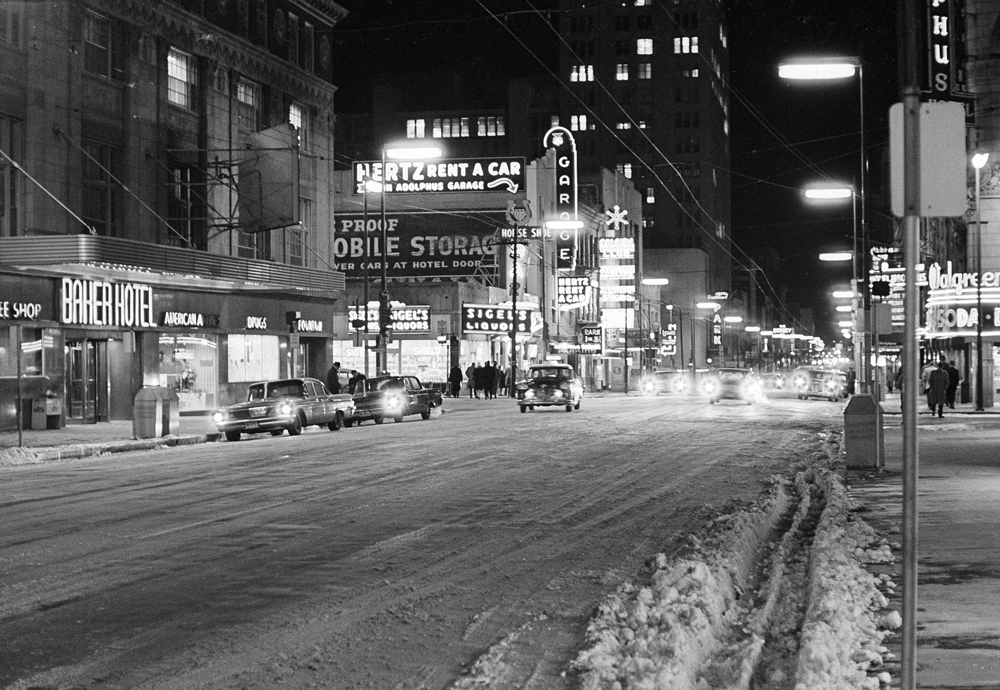
The color photo shows the northwest corner of Commerce and Akard, taken from the front of the Baker Hotel. The same corner can be seen at the right of this black-and-white photo from 1962:

Downtown Dallas Texas

*

Copyright © 2017 Paula Bosse. All Rights Reserved.

Titche’s Discovers the Suburbs — 1961-1968

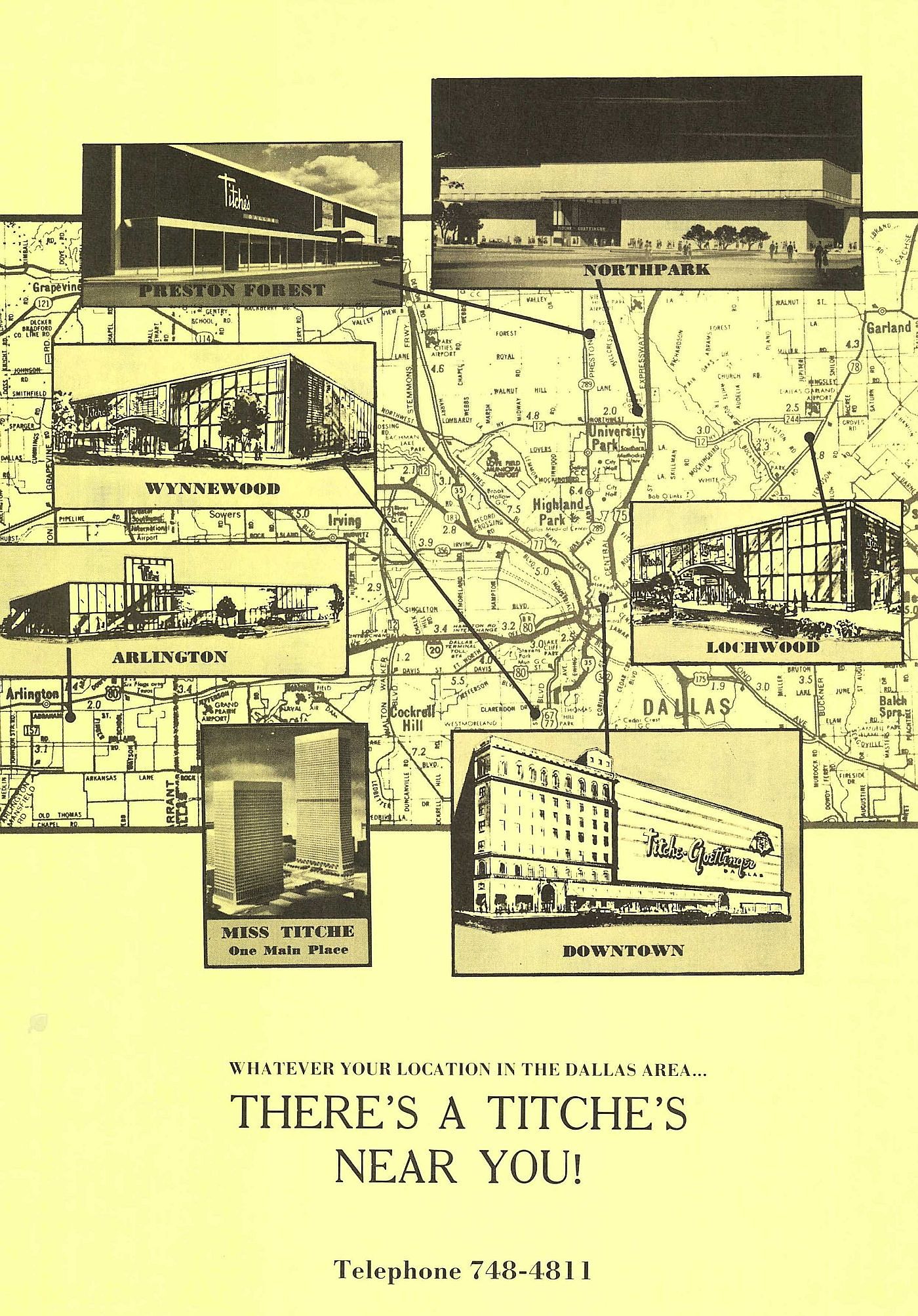
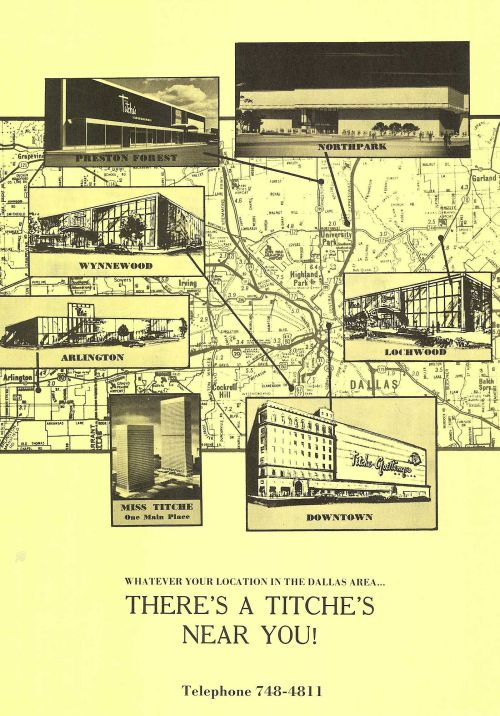
titches_dallas-stores_1969-directoryTitche’s has you covered… (click to see larger image)

by Paula Bosse

Edward Titche and Max Goettinger founded the Titche-Goettinger department store in Dallas in 1902, and in 1904 they moved into the new Wilson Building. In the late 1920s they built their own George Dahl-designed building at Main and St. Paul, which was greatly enlarged and expanded in 1955. The store was popular with downtown shoppers, and profits continued to rise. The next logical step was to open additional stores. It took a while (59 years), but in October, 1961 they opened three — three! — new suburban stores. How was that possible? Because Titche’s (or their then-parent company) purchased the Fort Worth department store chain The Fair of Texas, and several of its stores were re-christened as Titche’s stores (the others eventually became Monnig’s stores).

The ad above is from the 1969 Dallas city directory and shows that by 1969, there were seven Titche’s stores in the Dallas area. Titche’s bit the dust decades ago, and I have to admit that the only Titche’s store I actually remember ever being in was the one in NorthPark (and I might mostly be remembering Joske’s…). I had no idea about any of these other stores (other than the one at Main and St. Paul, which I wish I had been to!).

*

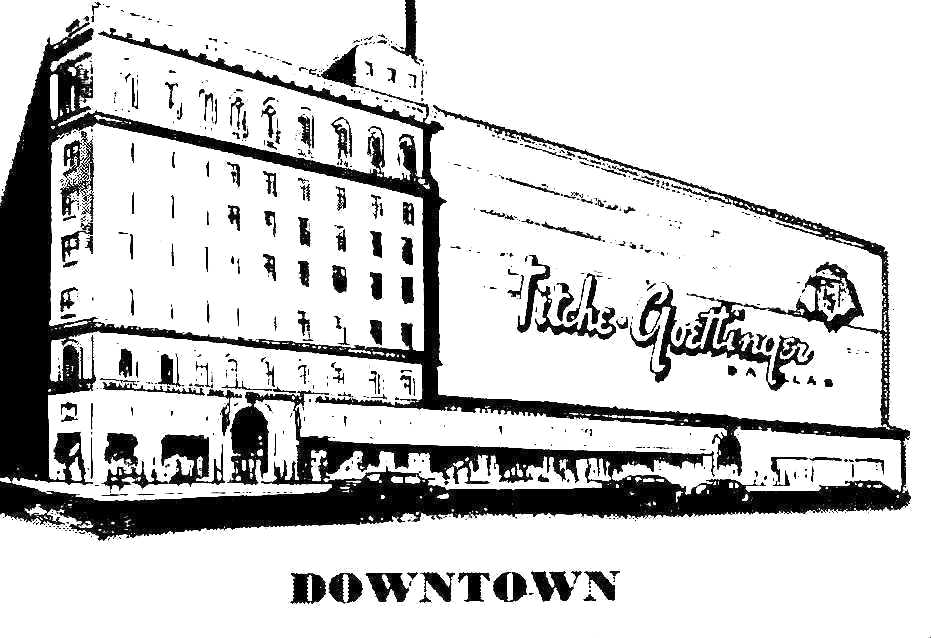
The oldest store in the ad above was the one on Main at St. Paul, still standing, still looking good (but, sadly, with that fab logo gone forever).
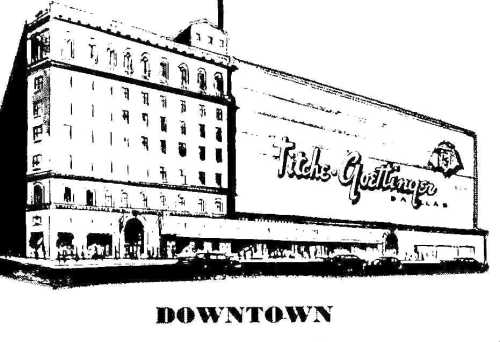
titches_1969-directory_downtown

*

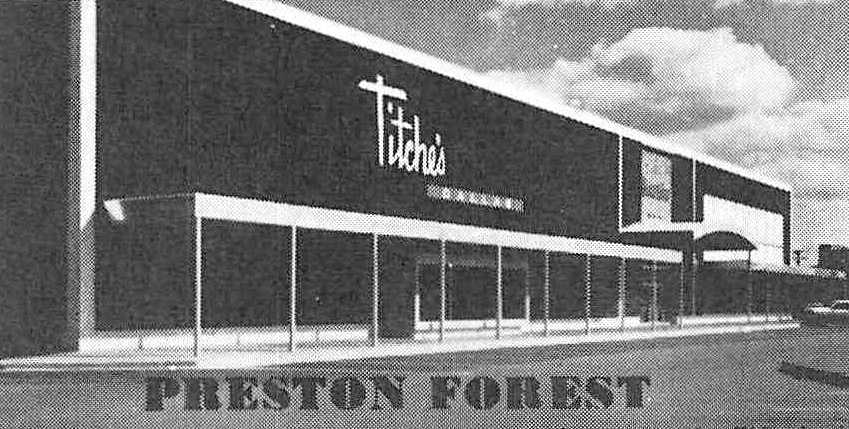
The second store was located in North Dallas in the Preston Forest Shopping Center, at the southeast corner of Preston Road and Forest Lane. When this opened as Titches’ first suburban store, the paint must still have been wet. It was originally built as a Fair of Texas store, with its opening scheduled for August, 1961. It was opened in October, 1961 as a Titche’s store — remodeled from the original Amos Parrish Associates of New York design (seen here, in a rendering). (The Fair version was much more interesting!)
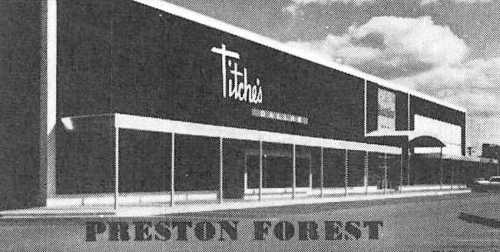
titches_1969-directory_preston-forest

*

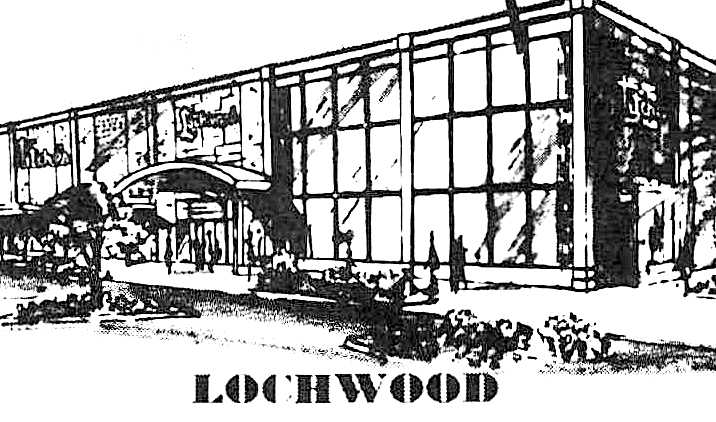
One week later (!), the next two stores opened on the same day: in the Wynnewood Shopping Village in Oak Cliff, and in the Lochwood Shopping Village on Garland Road in far East Dallas. These two stores had been Fair stores and had opened at the same time in August, 1960. The two drawings below look pretty much the same as the rendering of the pre-remodeled Preston Forest store (all designed by Amos Parrish Assoc.). (An interesting tidbit about the Lochwood location: when this store was built by The Fair of Texas — a department store with Fort Worth roots going back to the 1880s or 1890s — it was the first Fair store in Dallas. In honor of this hands-across-the-prairie moment of business expansion, a truckload of Fort Worth dirt was brought over and “mixed symbolically” with Dallas dirt at the 1959 Lochwood groundbreaking.)
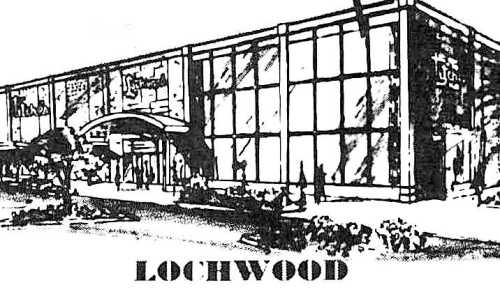
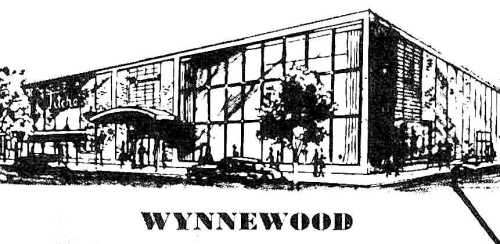
titches_1969-directory_lochwood

titches_1969-directory_wynnewood

*

The Arlington store was also a former Fair store; it opened as Titche’s in July, 1963.
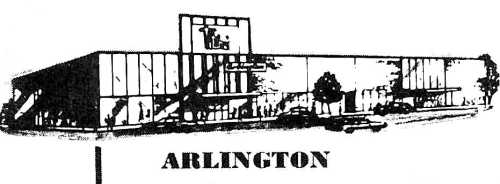
titches_1969-directory_arlington

*

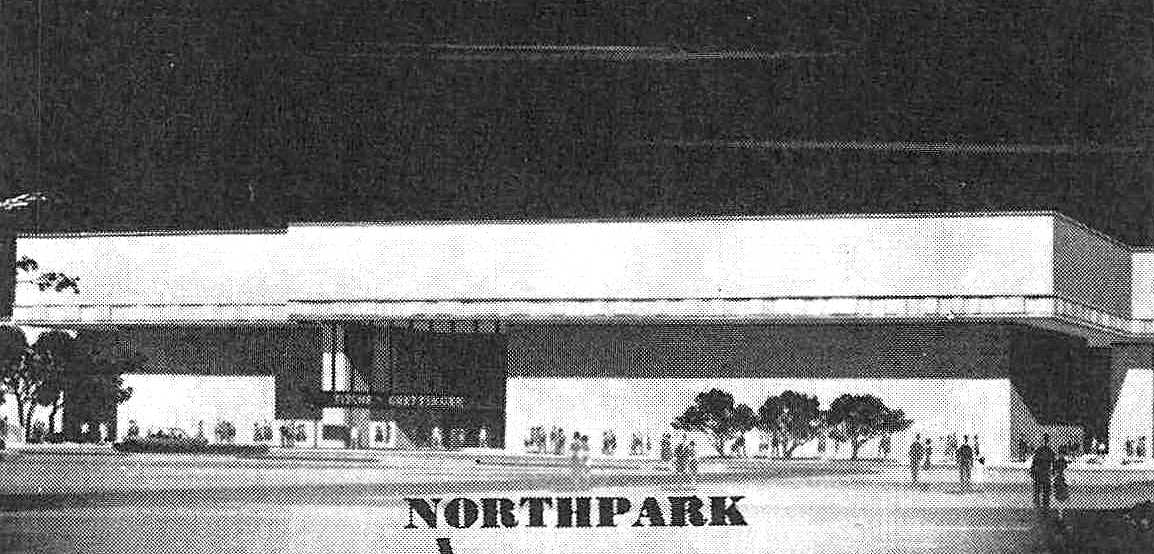
The NorthPark store — which occupied a quarter of a million square feet — was one of the first five stores to open in the brand new mall, in July 1965. NorthPark Center is known for its wonderfully sleek, clean, no-nonsense modern architecture (as seen below), but an early proposed Titche’s rendering from 1962 (seen here) looks a little fussy.
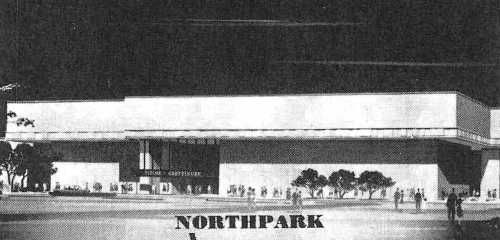
titches_1969-directory_northpark

*

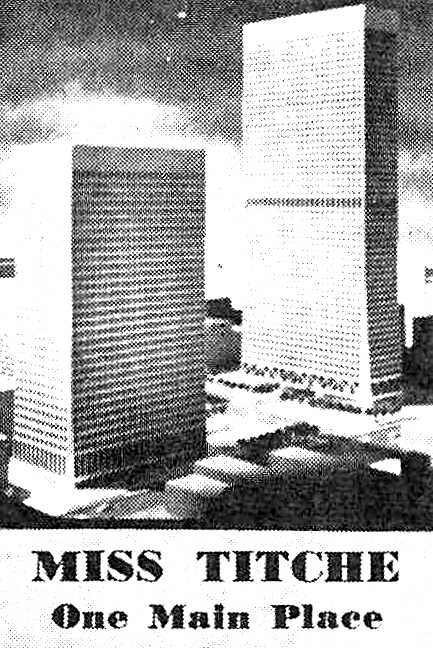
And, lastly, in this 1960s wave of expansion, a second downtown Dallas location was opened in the new One Main Place in December, 1968 in the form of “Miss Titche,” a concept-store created to appeal to “career girls” who worked downtown and enjoyed shopping during their lunch hours. It was located on the “plaza level” which sounds like it might have been part of the then-new underground tunnel system of shops. If newspaper ads are anything to go on, it looks like Miss Titche managed to hang on until at least 1975.
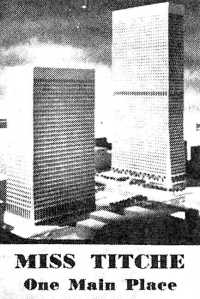
titches_1969-directory_one-main-place

*

Titche’s continued opening new stores into the 1970s, but in August, 1978, it was announced that Titches’ parent company, Allied Stores Corp., was changing the names of all Dallas-area Titche’s stores to “Joske’s.” The nine Titche’s stores operating until the changeover were the flagship store downtown, Preston Forest, Lochwood Village (which became The Treehouse in 1974), Wynnewood, Arlington, NorthPark, Town East, Irving, and Red Bird.

And, just like that, after 72 years, the name of one of Dallas’ oldest department stores vanished.

titches_logo_1963

***

Sources & Notes

Ad and details from the 1969 Polk’s Greater Dallas City Directory.

More on Titche-Goettinger can be found at the Department Store Museum, here.

Images larger when clicked.

*

Copyright © 2017 Paula Bosse. All Rights Reserved.


La Reunion Tower

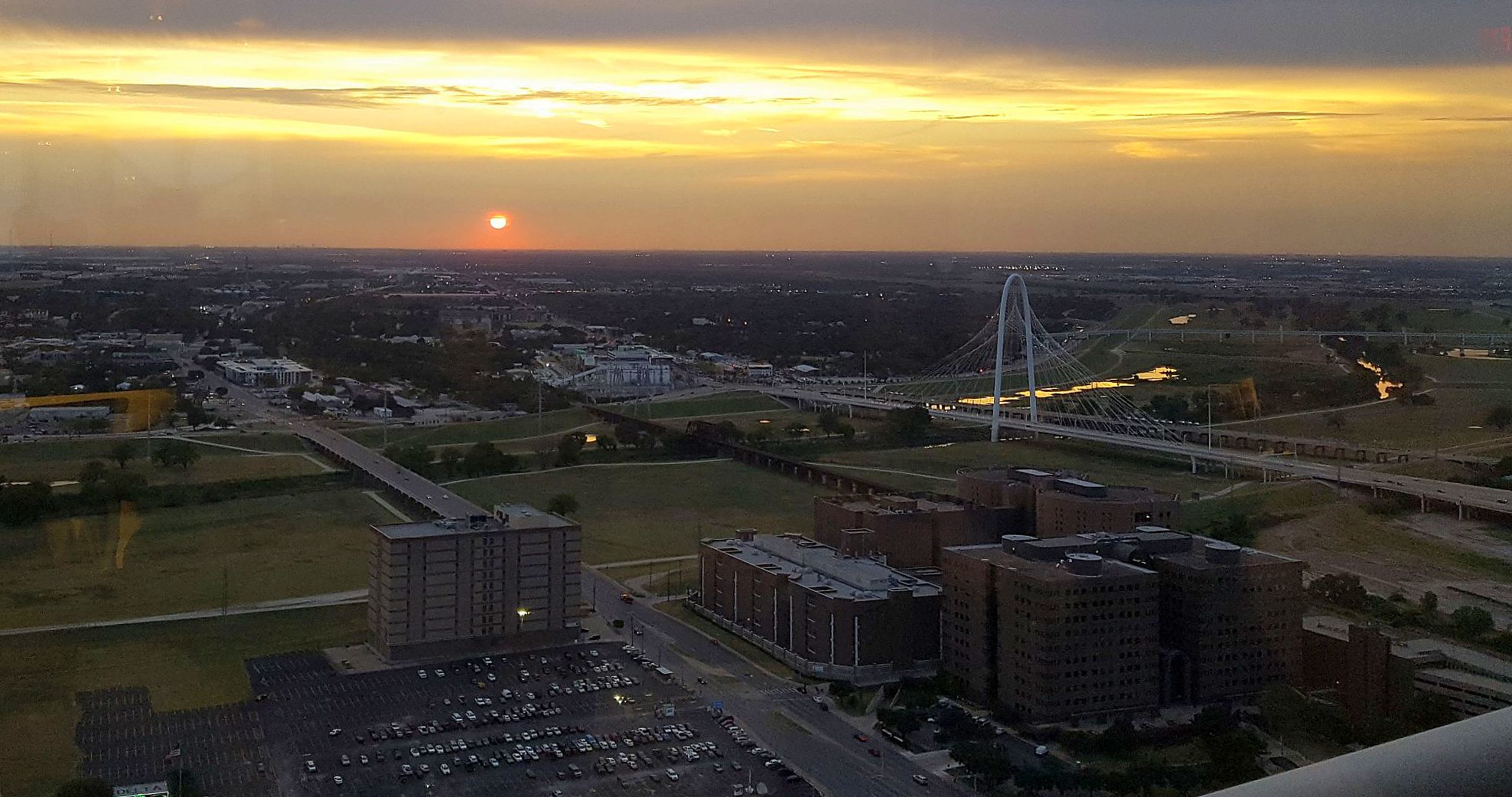
reunion-tower_skyline_091217Big D from inside the ball…

by Paula Bosse

On Tuesday night I gave a little talk on the history of the La Reunion colony as part of the Dallas Historical Society’s Pour Yourself Into History series. The event was held in the *very nice* Five Sixty by Wolfgang Puck restaurant high atop Reunion Tower — right in the ball. I was a bit of a last-minute fill-in presenter, and I hesitated to accept the invitation because I always feel awkward talking in front of more than, say, two or three people, but I really, really wanted to go up to the top of Reunion Tower.

I hadn’t been to Reunion Tower since a family outing back in the ’80s. Back then I was most fascinated by the fact that the restaurant slowly revolved to give diners a leisurely 360-degree view of the city (I always imagined it spinning out-of-control, pinning diners — and their meals — against the walls with centrifugal force, like a fine-dining version of the Spindletop ride at Six Flags, or The Rotor ride at the State Fair of Texas); but now, decades later, as an adult, the image of the spinning restaurant was eclipsed by the real star: the VIEW.

As you can imagine, the view is unbelievably spectacular — especially at night when Dallas is at its most glamorous. The ticket price is fairly steep to get up to the observation deck, and a meal and/or cocktails at the restaurant will set you back a goodly amount, but it is, without question, the most fabulous view of the city you’ll ever see. And you see all of it. When I started my talk about the history of the La Reunion colony of the 1850s (which was located about 5 miles due west of Reunion Tower, in West Dallas) the view was pretty much the one seen in the photo above; by the time I finished, we were, serendipitously, looking out over where the plucky colonists of “French Town” had toiled unsuccessfully 160 years ago. (Estimates on the boundary of La Reunion’s 2,000-acre land is the area now bounded by Westmoreland on the west, Hampton on the east, Davis on the south, and the Trinity River on the north — the southwest corner is marked here on Google Maps.)

It was a little noisy at the event Tuesday night, so if you were one of the very nice people who turned out, you might not have been able to hear anything I said! If you’d like to hear more about the history of La Reunion (and about Reunion Tower — and how, if a marketing agency had had its way, it might have been named “Esplanade” Tower), I enthusiastically recommend this very entertaining radio piece from Julia Barton (the La Reunion segment begins at about the 5:15 mark).

**

I took photos, but they don’t do justice to the view. The really breathtaking vistas are at night, and, sadly, none of those photos came out. Seriously, if you’ve never been up Reunion Tower — or if you haven’t been since it was opened in 1978 — you should definitely go now. Better still, go at sunset and enjoy the best view in Dallas as you sip delicious cocktails.

The view stretches for miles. Here’s a cropped view of Dealey Plaza (click to see it really big).

reunion-tower_dealey-plaza_triple-underpass_091217a

And, at sunset, the jail has never looked lovelier.

reunion-tower_sunset_jail_091217

Back down on terra firma, looking up and saying “goodbye” to the ball.

reunion-tower_the-ball_091217

Thank you, Dallas Historical Society, for inviting me to be part of your event! And thanks to everyone who came out … and up!

***

Sources & Notes*

Photos by Paula Bosse. Click ’em to see ’em bigger.

For more information of the La Reunion colony, see other Flashback Dallas posts here.

*

Copyright © 2017 Paula Bosse. All Rights Reserved.
Main and Ervay — The Favorite Downtown View of Postcard Publishers

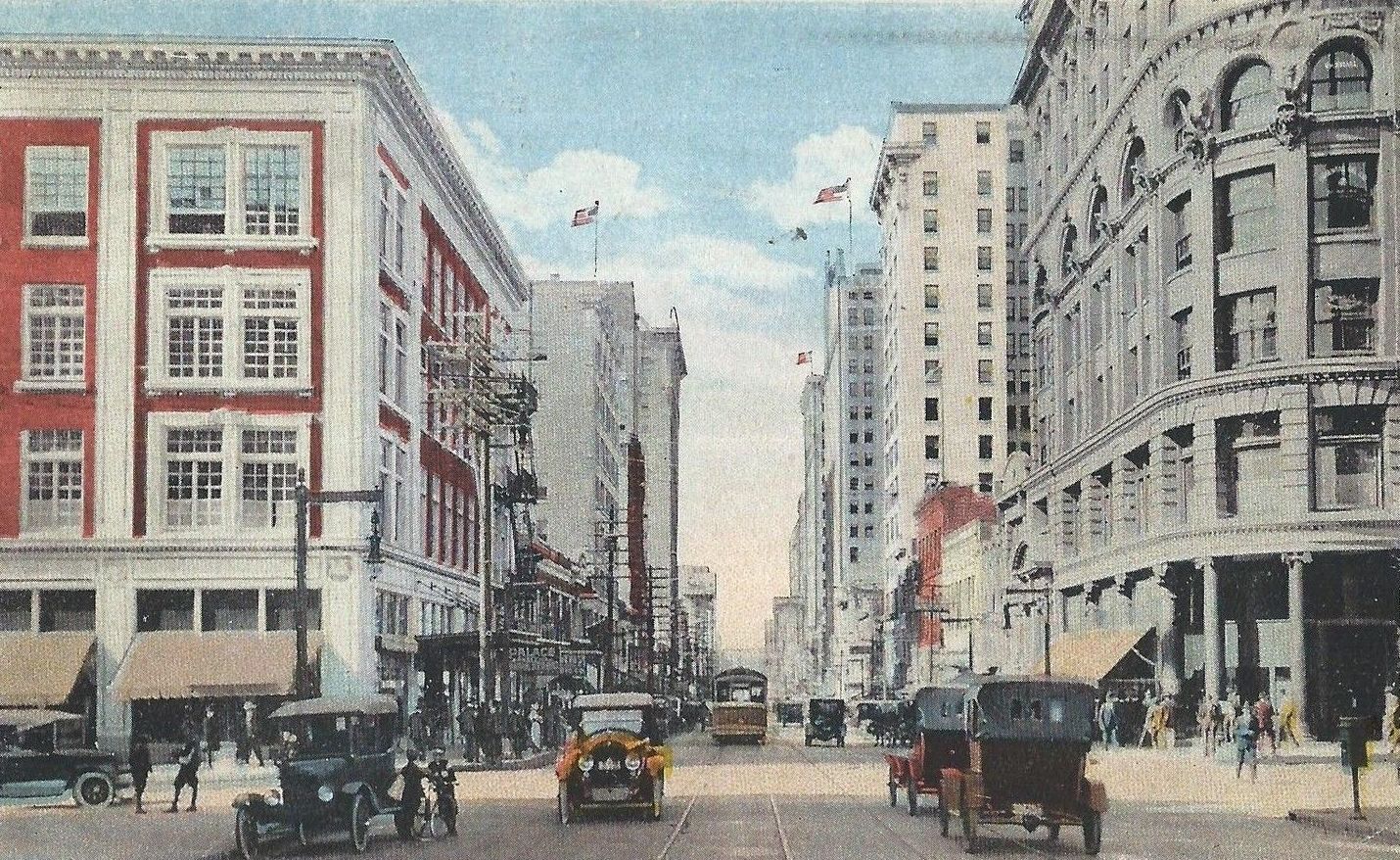
main_west-from-ervay_ebayLandmarks a-plenty… (click to see larger image)

by Paula Bosse

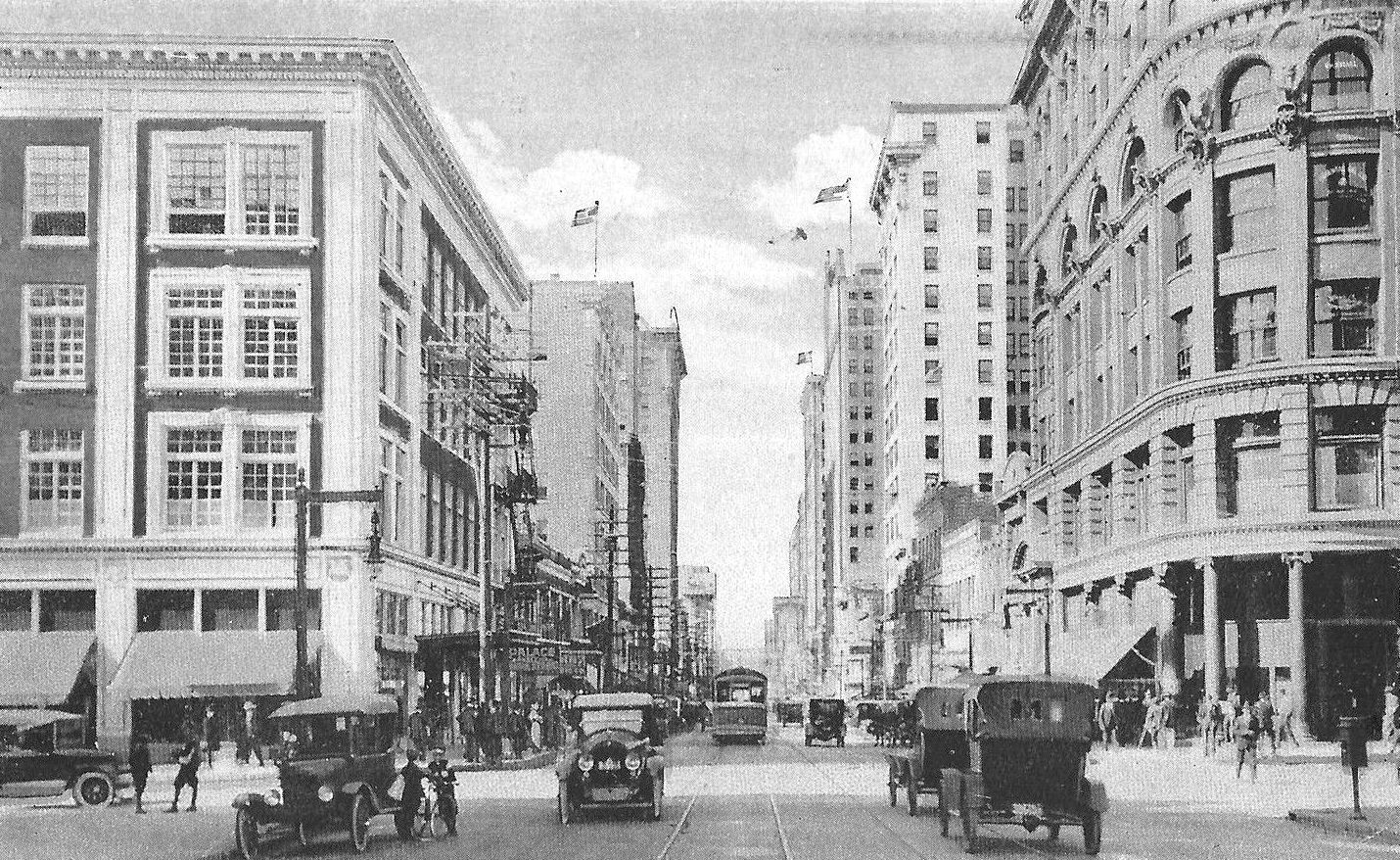
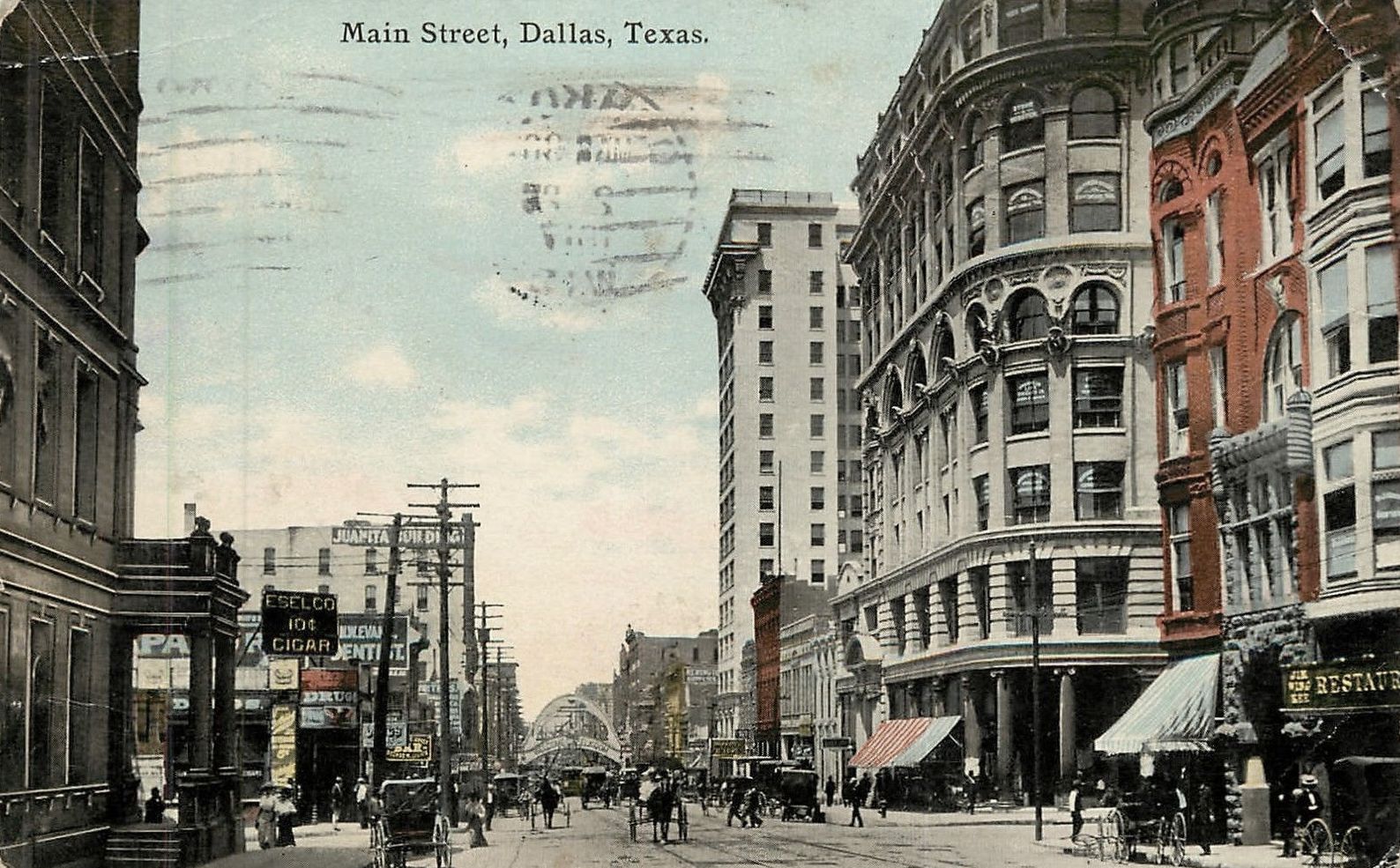
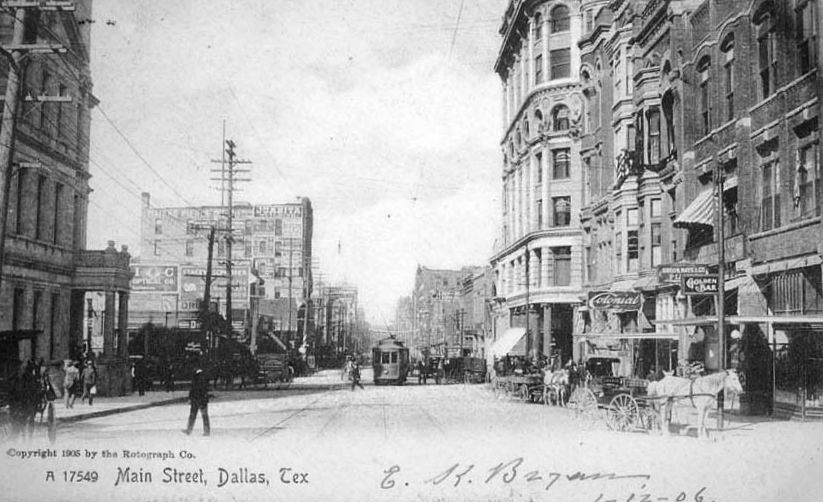
Without question, the most popular view of downtown Dallas offered to postcard buyers in the early years of the 20th century — the one repeated over and over and over — is Main Street looking west from Ervay. The constant is the Wilson Building, which opened in 1904 and has elegantly held the fort at the northwest corner ever since. Later came the skyscraping Praetorian Building at Main and Stone. And a few years later, Neiman-Marcus arrived at the southwest corner of Main and Ervay to firmly establish the intersection as one of the city’s most impressive.

I love these colorized postcards, but it’s always interesting to see them drained of color — they look more realistic, but they still have that air of otherworldliness.

main_west-from-ervay_ebay_bw

Here are a couple more. This one is lacking Neiman’s (built in 1914), taken around 1908 or 1909 (the Elk’s Arch can be seen in the distance).

main-ervay-elks-arch_postcard_ebay.jpg

And this one, before the Praetorian Building was built in 1907.

main-st_1905

***

Sources & Notes

Postcards from eBay.

Click pictures to see larger images.

*

Copyright © 2017 Paula Bosse. All Rights Reserved.


The Square Dancing Craze in Big D — Late 1940s

calamity-jane_premiere_-sam-bass_majestic-theatre_july-1949Hoedown at the Majestic, 1949…

by Paula Bosse

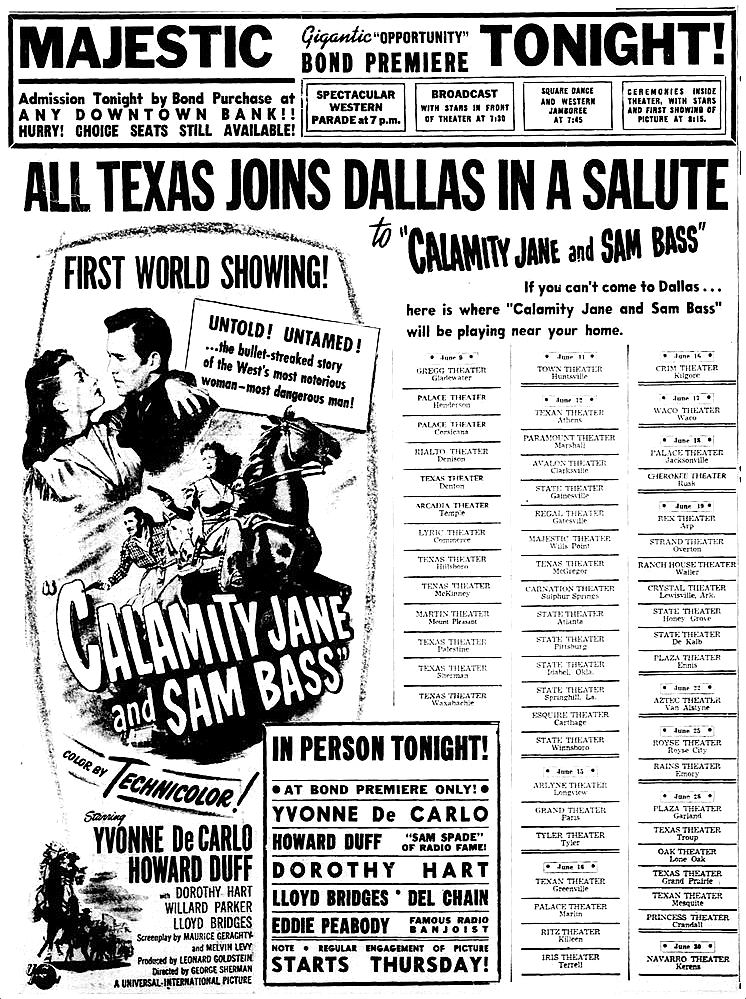
The photo above appeared in a show-biz trade publication showing part of the festivities which swirled around the world premiere of the movie “Calamity Jane and Sam Bass” starring Yvonne DeCarlo and Howard Duff at the Majestic Theatre on June 8, 1949. Several of the film’s stars made personal appearances and were made honorary deputies by Sheriff Bill Decker, sworn in by Judge Lew Sterrett (yes, Lily Munster was an honorary Dallas deputy sheriff!). There was a parade, a live show performed by the actors on the Majestic’s stage before the movie, a block party, and square dancing in Elm Street, with music provided by the Big D Jamboree band.

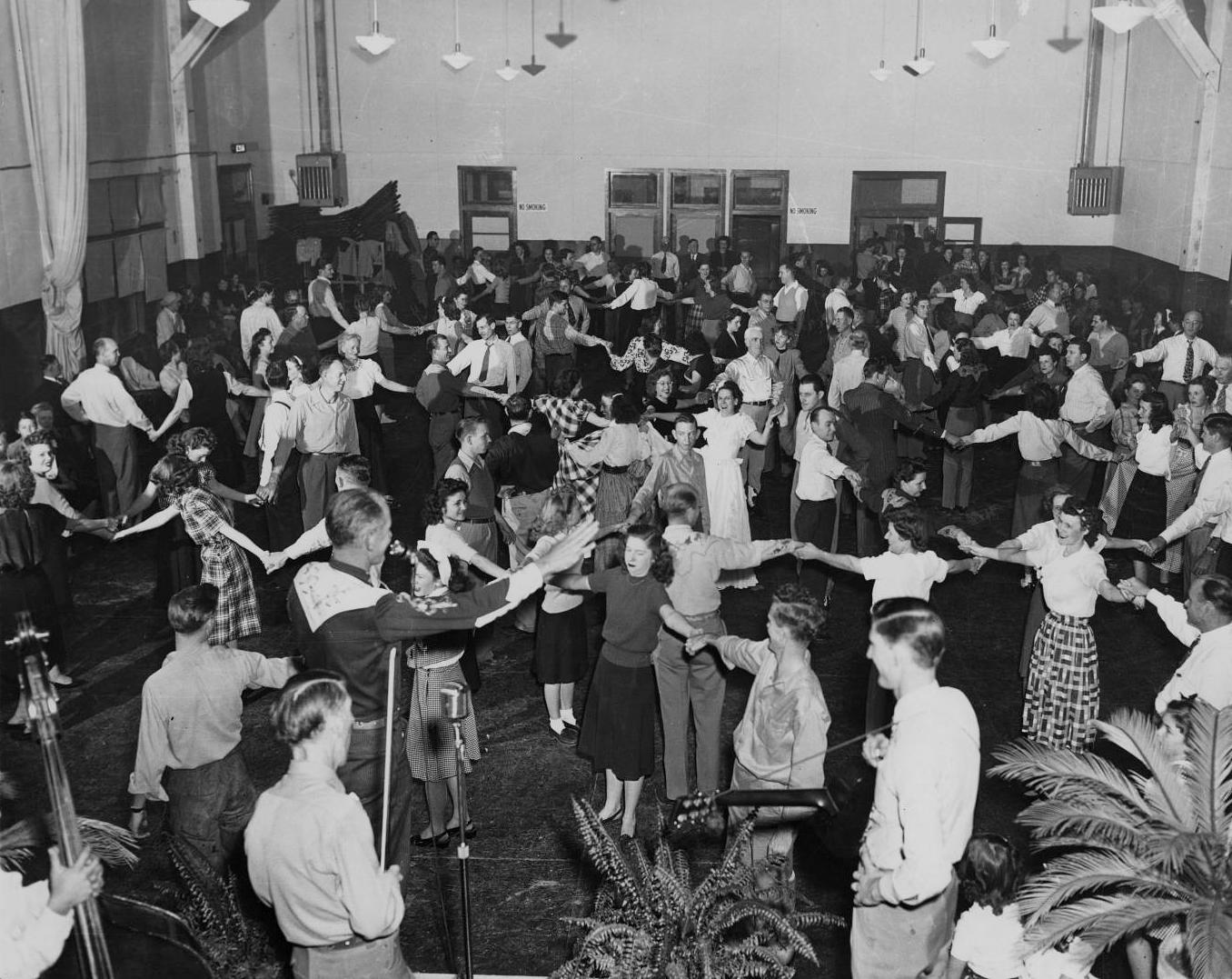
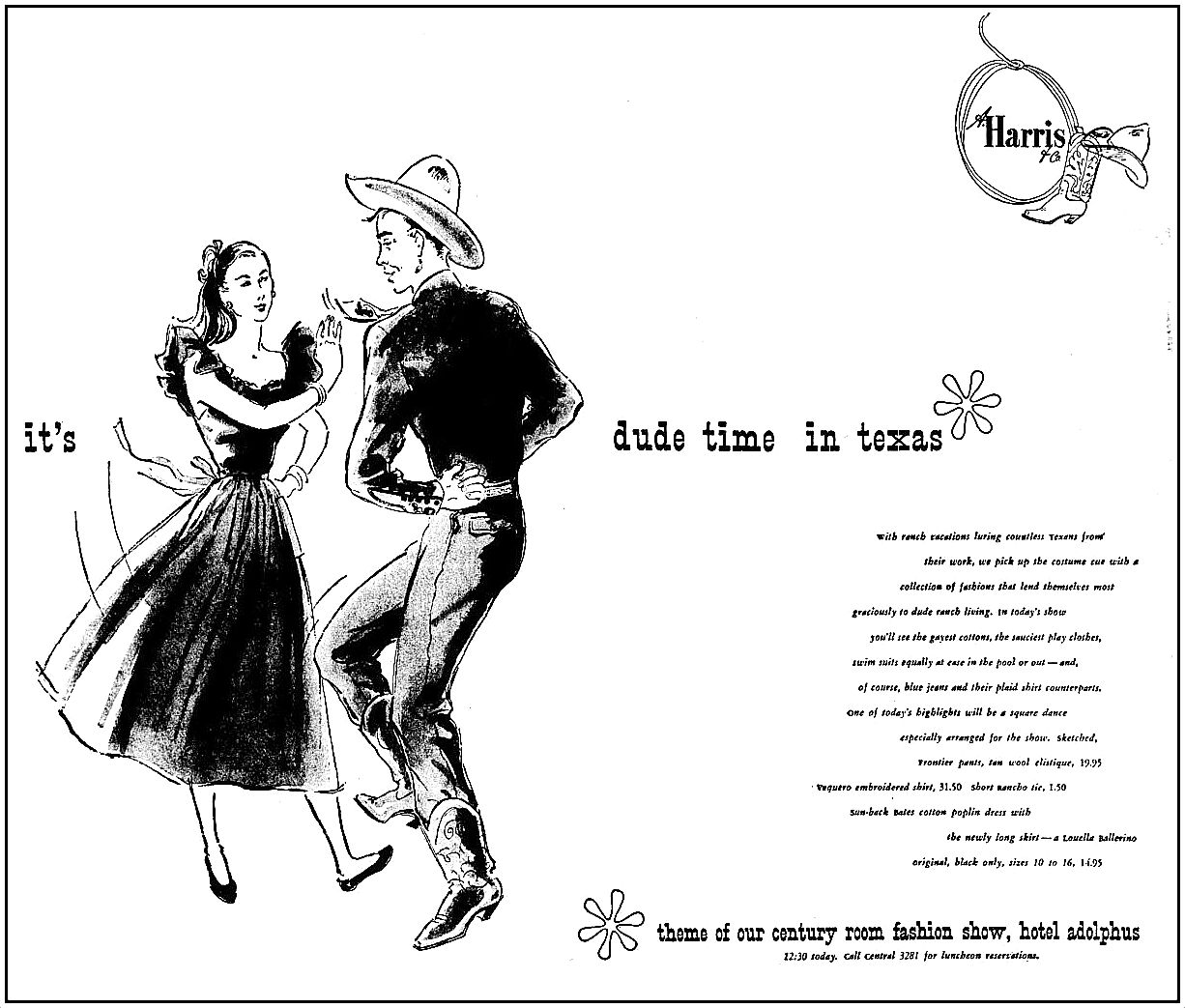
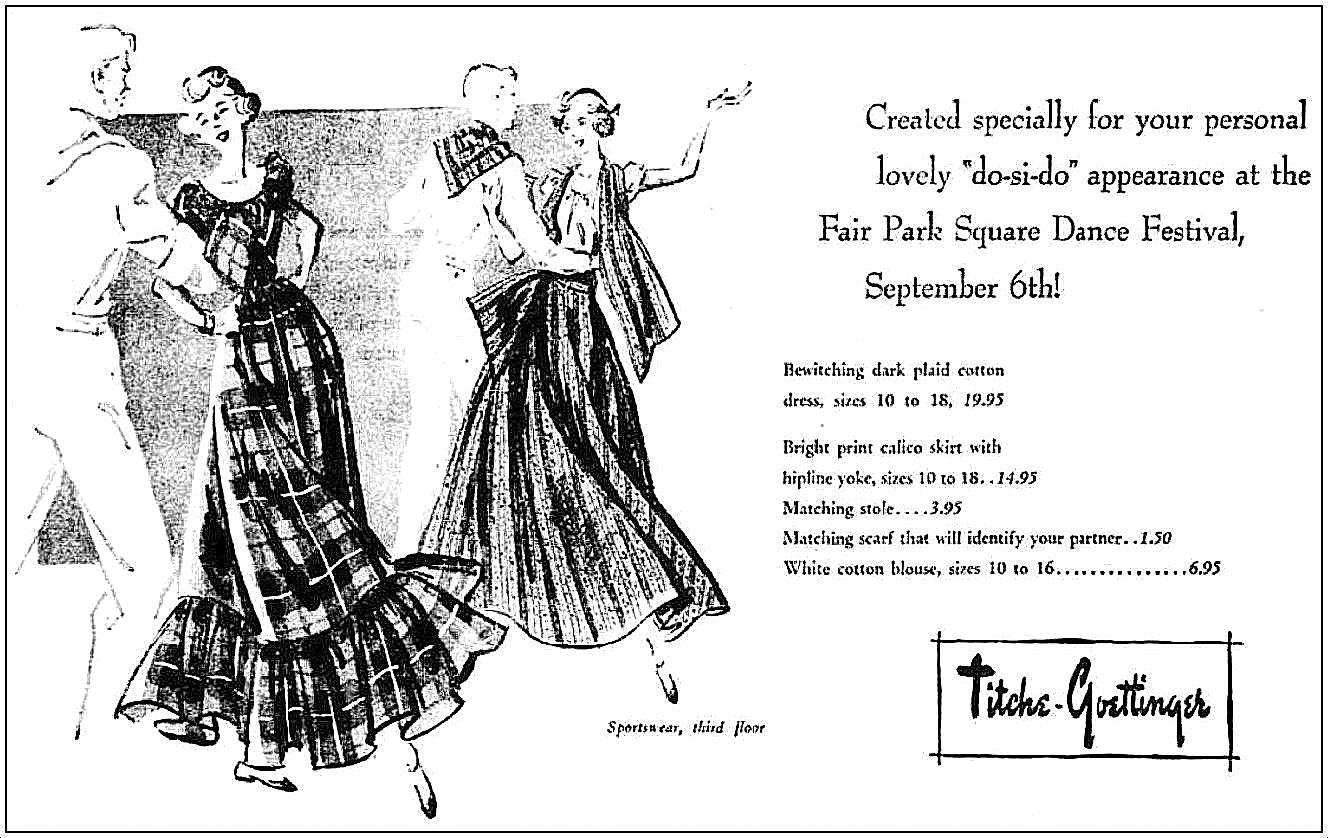
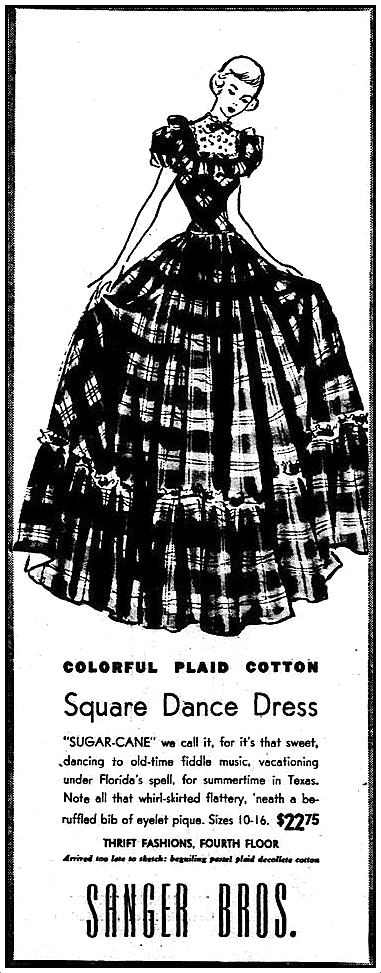
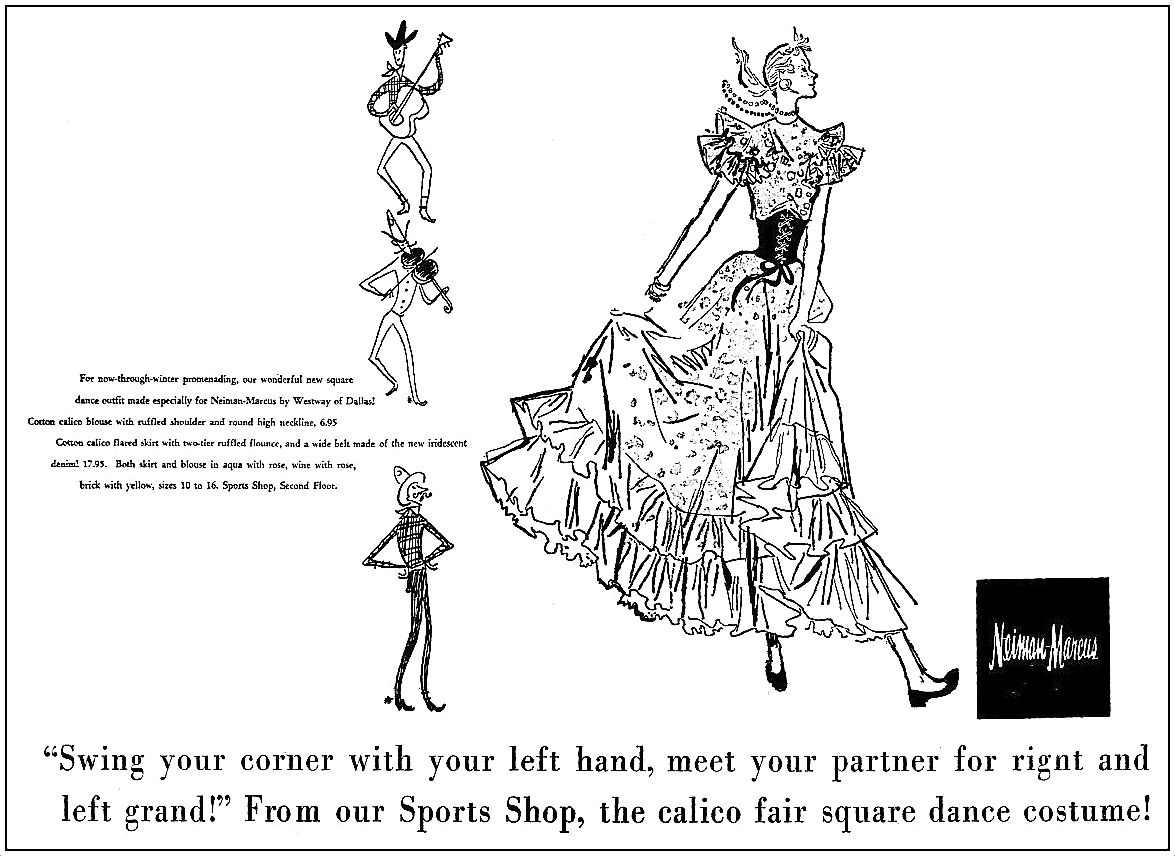
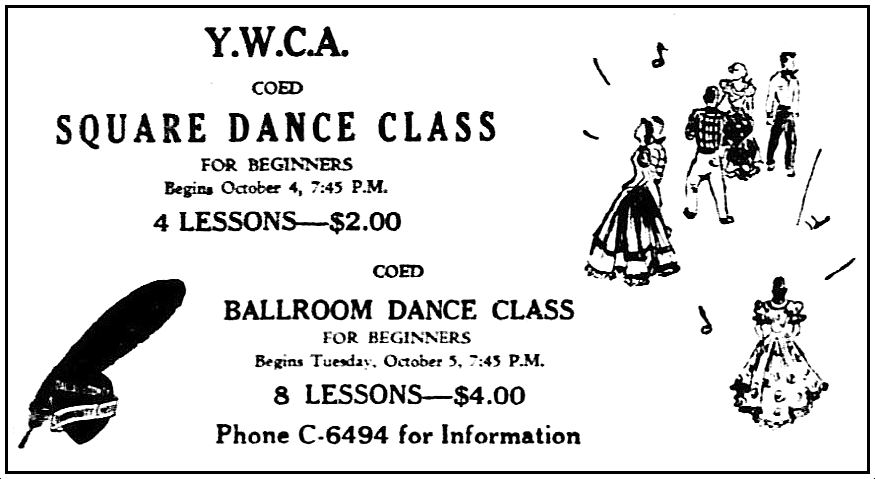
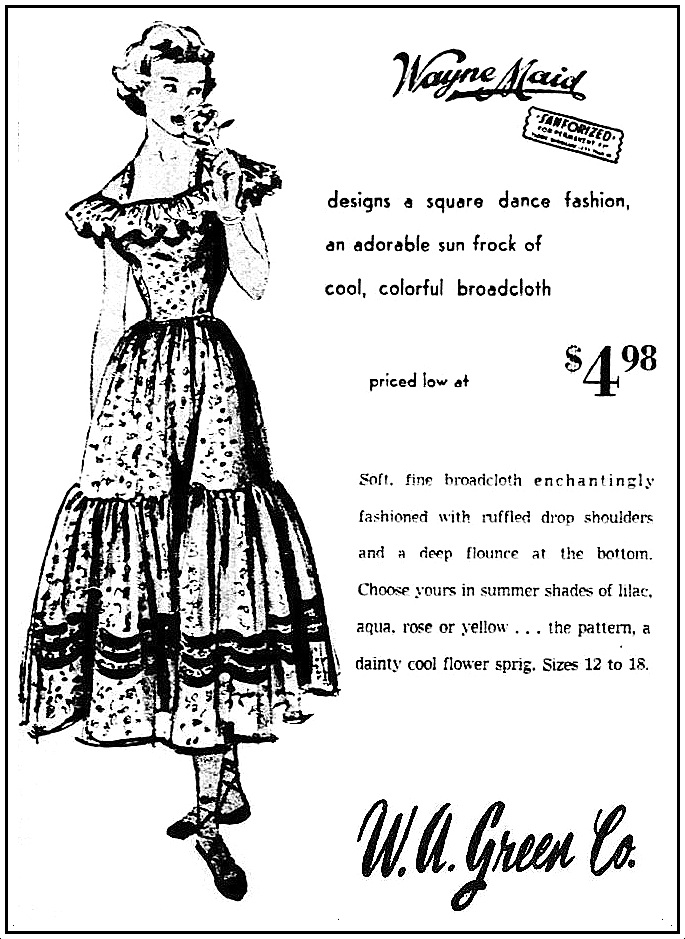
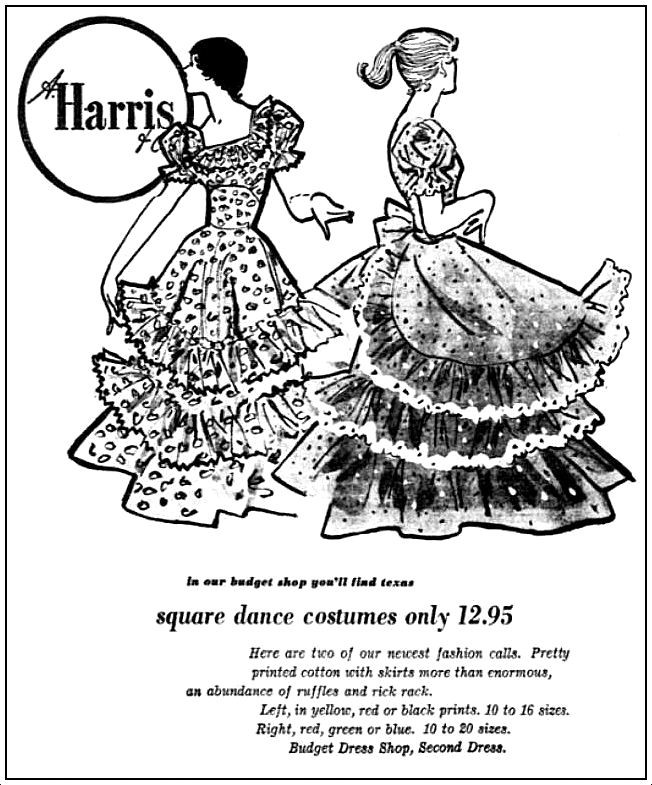
In 1949, as unlikely as it seems, square dancing was a HUGE fad which swept the country (or at least the Southwest). The peak years of the retro craze were probably 1948 to 1950, and its impact was pretty big locally, not only on the dance floor, but also in the fashion pages. When you see every major Dallas department store — even Neiman’s — selling calico and gingham square dance fashions … well, it’s big.

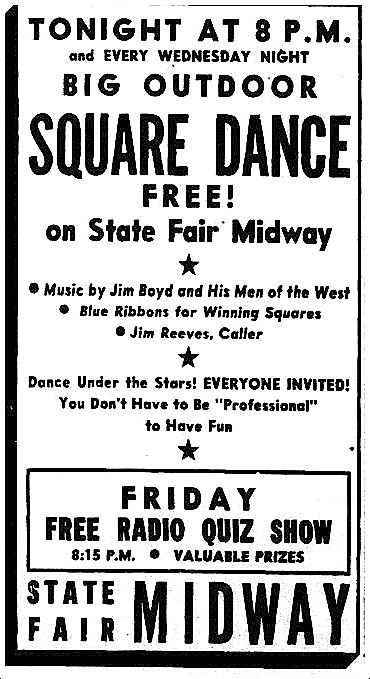
Not only were there lessons available everywhere, but there were clubs and weekly events all over town — every Wednesday in the summer of 1949, there was a big outdoor square dance held at the Fair Park Midway, with music courtesy of local celeb Jim Boyd.

I’m not sure when it stopped (…I’m assuming it has…), but for decades, a lot of us participated in square dancing as part of gym class in elementary school. This interesting throw-back take on physical fitness seems to have begun around 1950 or ’51. Not everyone was thrilled about this odd-but-charming grade-school rite of passage — some ultra-conservative communities complained, but the wholesome and old-timey dancing won out and became a standard part of Texas schools’ physical education curriculum.  Forget young people’s cotillions — most Texas children had their first experience dancing with a partner to the strain of a cowboy fiddle and a voice telling us to “allemande left” and “do-si-do.” And I’m sure we’re all better for it.

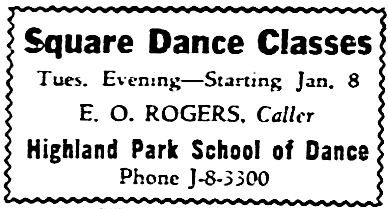
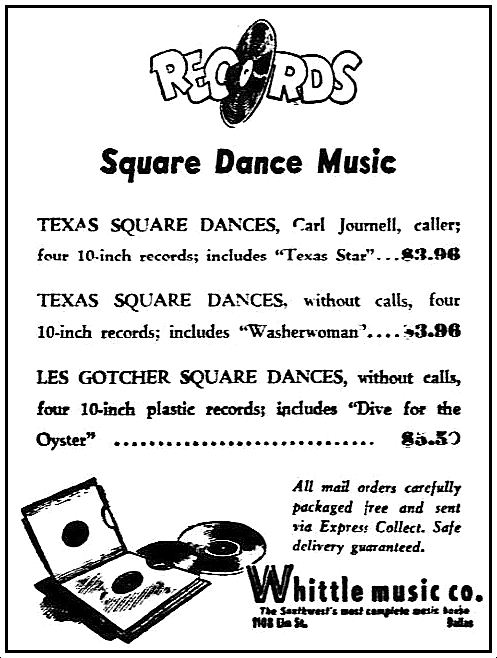
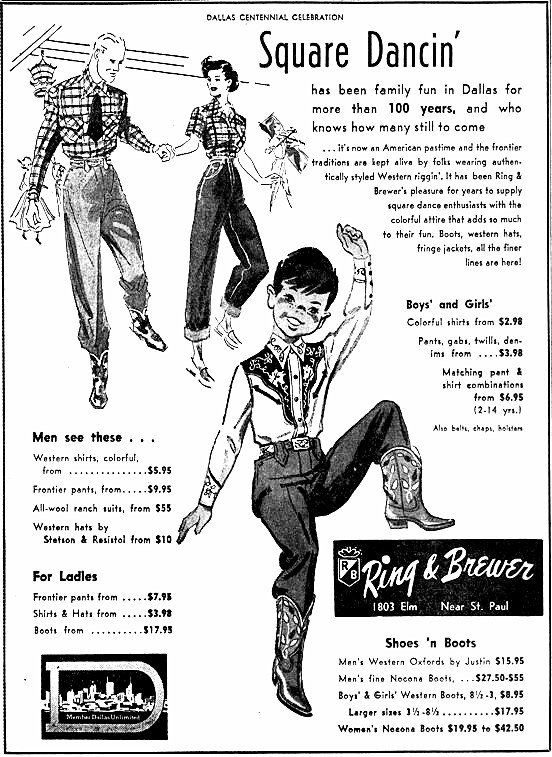
Here are a bunch of ads and things (click pictures to see larger images):

square-dance_la-reunion-place_squire-haskins_dallas-municipal-archivesSquare dance at La Reunion Place (Dallas Municipal Archives)

square-dance_jan-1946_highland-park
1946

square-dance_may-1947_a-harris
1947

square-dance_aug-1948_titches
1948

square-dance_jan-1948_sanger-bros1948

square-dance_oct-1948_neiman-marcus
1948

square-dance_april-1948_a-harris
1948

square-dance_oct-1948
1948

square-dance_dec-1950_e-m-kahn
1949

square-dance_june-1949_w-a-green
1949

square-dance_may-1949_fair-park-midway
1949

square-dance_nov-1949_a-harris
1949

square-dance_march-1949_whittles
1949

square-dance_oct-1949_a-harris
1949

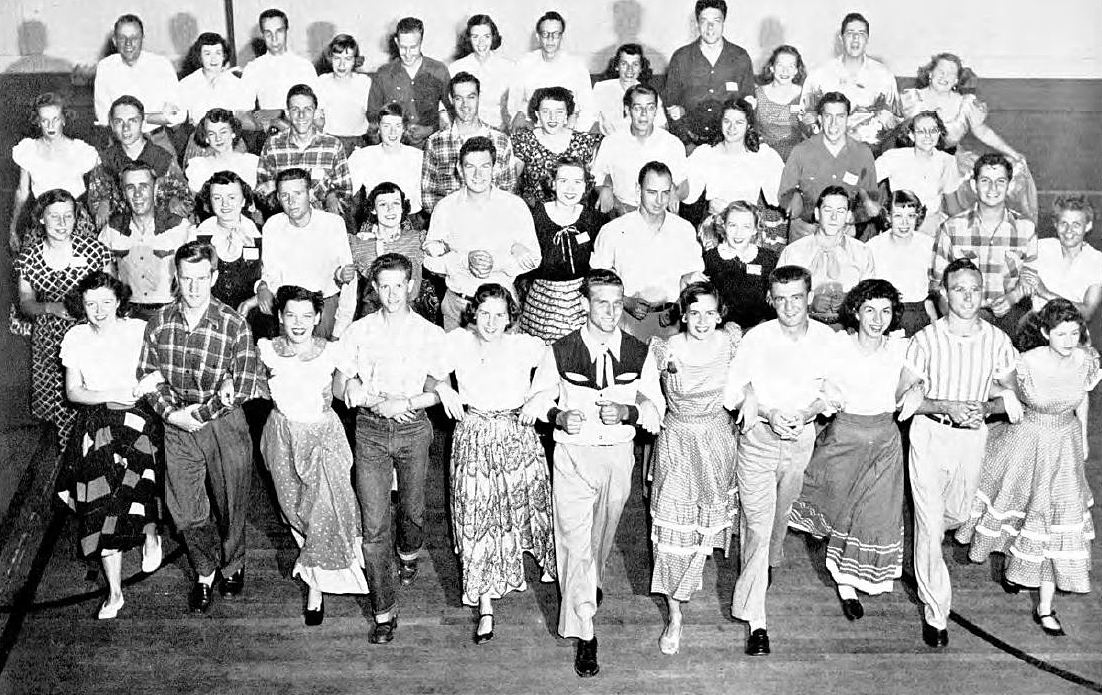
square-dancing_promenaders_smu_1951-yrbk1951

Above, a photo of the Promenaders, a group of SMU students whose purpose is described in the 1951 yearbook as being “to promote the appreciation of square and folk dancing on this campus.” (Think you recognize any of those faces? See who’s in the photo here.)

dallas_ringandbrewer_1956
1956
***

Sources & Notes

Premiere of “Calamity Jane and Sam Bass” was held at the Majestic Theatre on June 8, 1949, and it seems to have been a pretty big deal. There was newsreel footage filmed that night — wonder if it’s floating around anywhere?

square-dance_calamity-jane_majestic_june-1949

Photo of the square dance taken at La Reunion Place is by Squire Haskins and is from the Dallas Municipal Archives; is can be seen on UNT’s Portal to Texas History site, here.

Photo of the SMU Promenaders square- and folk-dancing group is from the 1951 Rotunda, the yearbook of Southern Methodist University.

Jim Boyd was a country-western singer who appeared in a few Hollywood films and was a Dallas disc jockey for many years. He also appeared around town often as a performer and personality. Dallas filmmaker Hugh V. Jamieson, Jr. and director Milton M. Agins made a short film called “Saturday Night Square Dance” (made in either 1949 or 1950); it features Boyd and his Men of the West band, plus square dance groups Silver Spur Square Set and Thompson Square Dance Club. I can find nothing on the two groups, but it seems likely that this film was made in Dallas. The quality of the film uploaded to YouTube is not very good, but, who knows — you might see your parents or grandparents in there if they were big square dancers! You can watch it here.

All images larger when clicked.

*

Copyright © 2017 Paula Bosse. All Rights Reserved.


“Sometimes I Run”: Dallas Noir — 1973

5-sometimes-I-run_stanley-maupin_hoseStanley Maupin at work…

by Paula Bosse

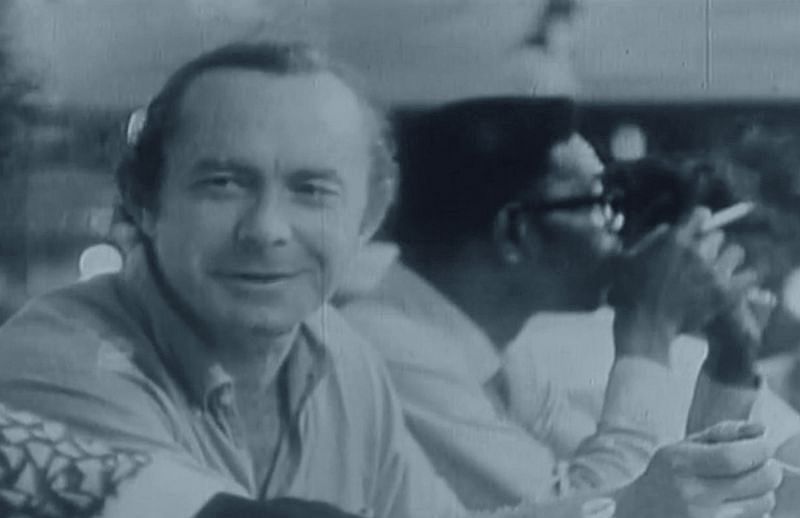
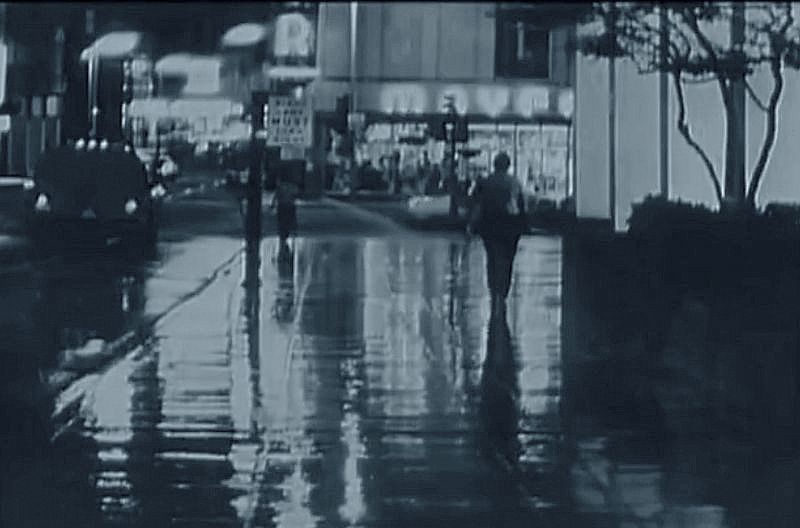
Several years ago, Robert Wilonsky wrote a Dallas Observer article about the short documentary “Sometimes I Run” — I watched it immediately afterward, and it’s stuck with me ever since. The 22-minute film, shot in 1973 by SMU film student Blaine Dunlap (who also made the fun 1970 Sunset High School film I wrote about earlier this year) shows Dallas Public Works Dept. street flusher Stanley Maupin at his job sweeping the downtown sidewalks late at night, accompanied by a soundtrack of jazz music and Maupin’s philosophical musings. It’s cool, gritty, seedy, nostalgic, and somehow life-affirming, all at the same time. Also, Dallas always looks best at night — the wet streets add a definite noir-ness to the overnight municipal goings-on which were happening when most Dallasites were home in bed. (See the bottom of this post for various sites on which you can watch the film in its entirety.)

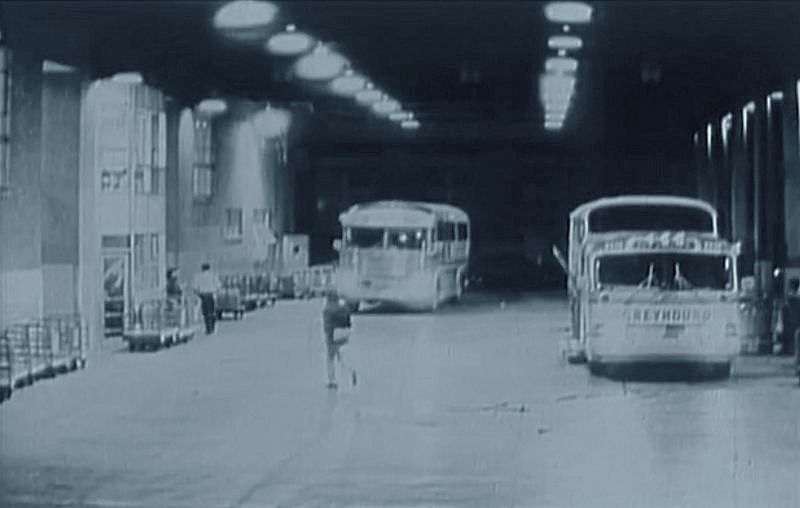
It took the opening moments of this film to remind me that, yes, I DO remember (if vaguely) seeing that revolving beam of light shot from the “rocket” on top of the Republic Bank Building. You can see it at about :35. Also included in the film are Franklin’s, the Greyhound Bus station, the Capri movie theater, a late-night-diner, the Mayfair department store, the Municipal Building, Sanger-Harris, and much more. And while Maupin’s philosophical pronouncements might be a bit heavy-handed at times, I have to admit that I could listen to him talk for hours, if only to hear his accent, a Dallas-area trapping of the past that one doesn’t come across nearly often enough these days.

Here are a few screen captures.

2-franklins_sometimes-when-i-run

3-greyhound_stometimes-when-i-run

6-keep-dallas-clean_sometimes-when-i-run

7-diner_sometimes-when-i-run

8-diner-2_sometimes-when-i-run

9-mayfair_sometimes-when-i-run

10-city-hall_sometimes-when-i-run

11-repub-bank-bldg

***

Sources & Notes

The 44-year-old award-winning student film, “Sometimes I Run,” directed by Blaine Dunlap, can be seen in its entirety in several places online: on Vimeo (good sound and video), on YouTube (via South Carolina Arts Commission), and at the Texas Archive of the Moving Image (from the collection of the Dallas Municipal Archives). Sound by Ron Judkins, music by Ken Watson.

More on filmmaker Blaine Dunlap can be found in “Spotlight on Dallas Filmmakers: Blaine Dunlap” by Laura Treat, here.

I have tried to find some history on Stanley Maupin, but I didn’t come up with much. He lived in Irving as a boy, but as a teenager, he attended North Dallas High School and, later, McMurry College in Abilene.

maupin-stanley_NDHS_1953
North Dallas High School yearbook, 1953

maupin-stanley_mcmurry-college_1956_freshman_portalMcMurry College yearbook, 1956
Born in 1935, he appears to have died in 1985, perhaps in a shocking way (which I have been unable to verify) — see comments from his grandchildren in the YouTube video here.

Some background on the film can be found in an article by Don Clinchy, here.

Read a 1986 interview with Blaine Dunlap (by Bo Emerson, Atlanta Journal-Constitution, Oct. 24, 1986) here.
*

Copyright © 2017 Paula Bosse. All Rights Reserved.


The Swiss Avenue Car on Main Street — ca. 1900

swiss-ave-streetcar_main-and-market_cook-degolyer_c1900Main and Market, looking east…

by Paula Bosse

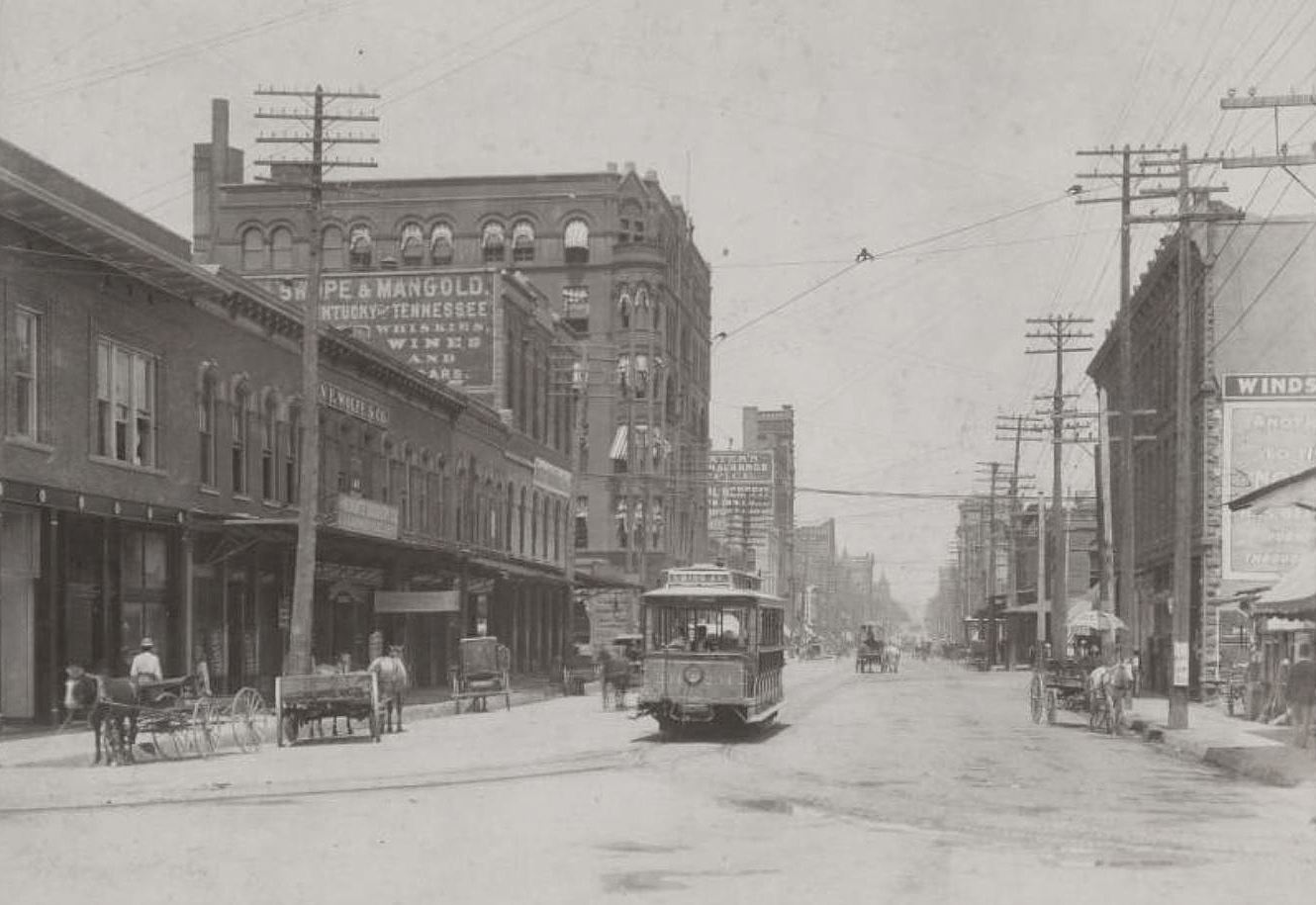
Here’s another great photo from the George W. Cook collection at SMU. This one shows Main Street sometime between 1899 and 1902 (the year asphalt was laid on Main and the year that Sanger Bros. expanded their building from two stories to six); we’re looking east from Market Street. (The aesthetically challenging view as seen today on Google is here.)

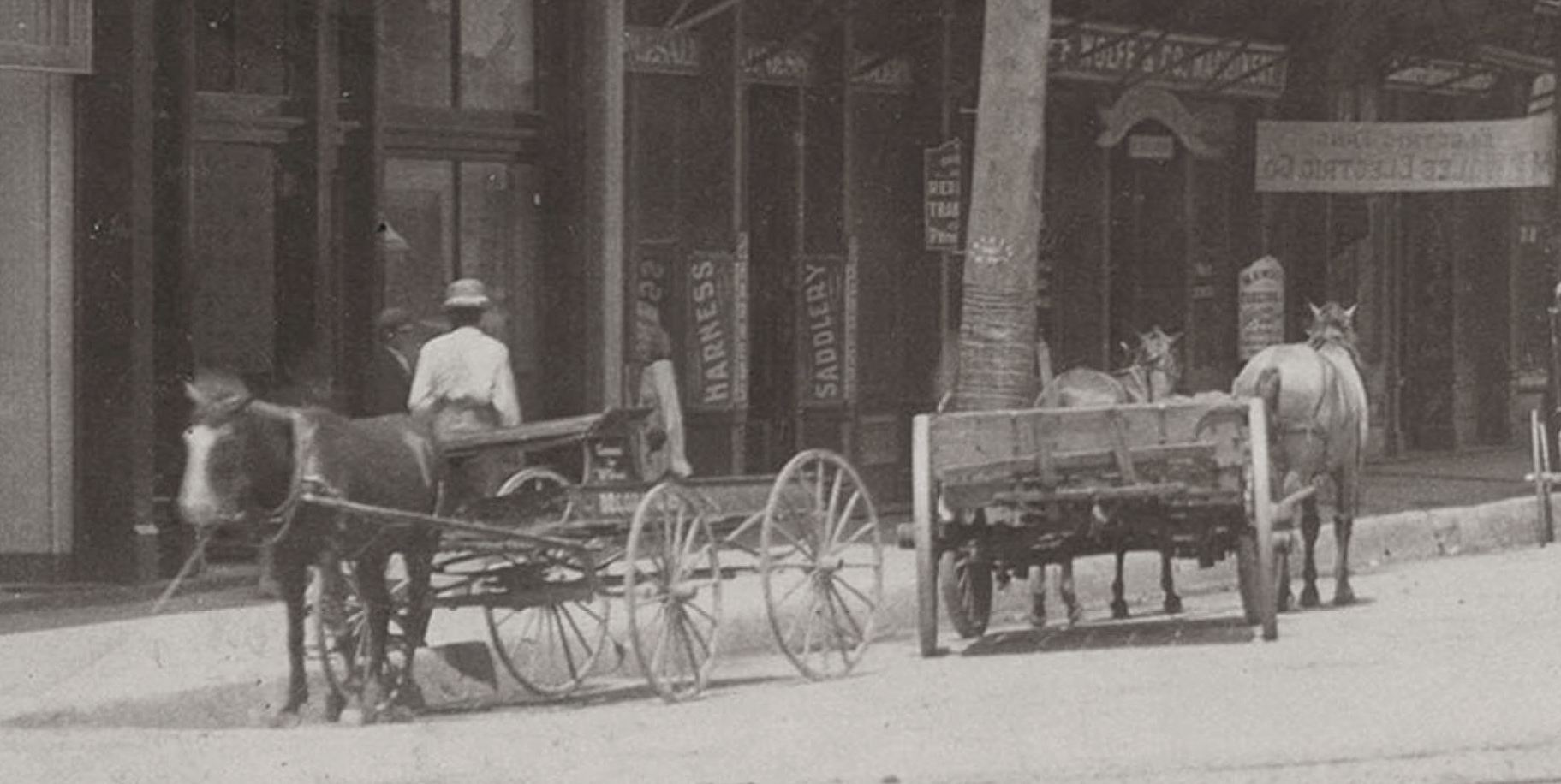
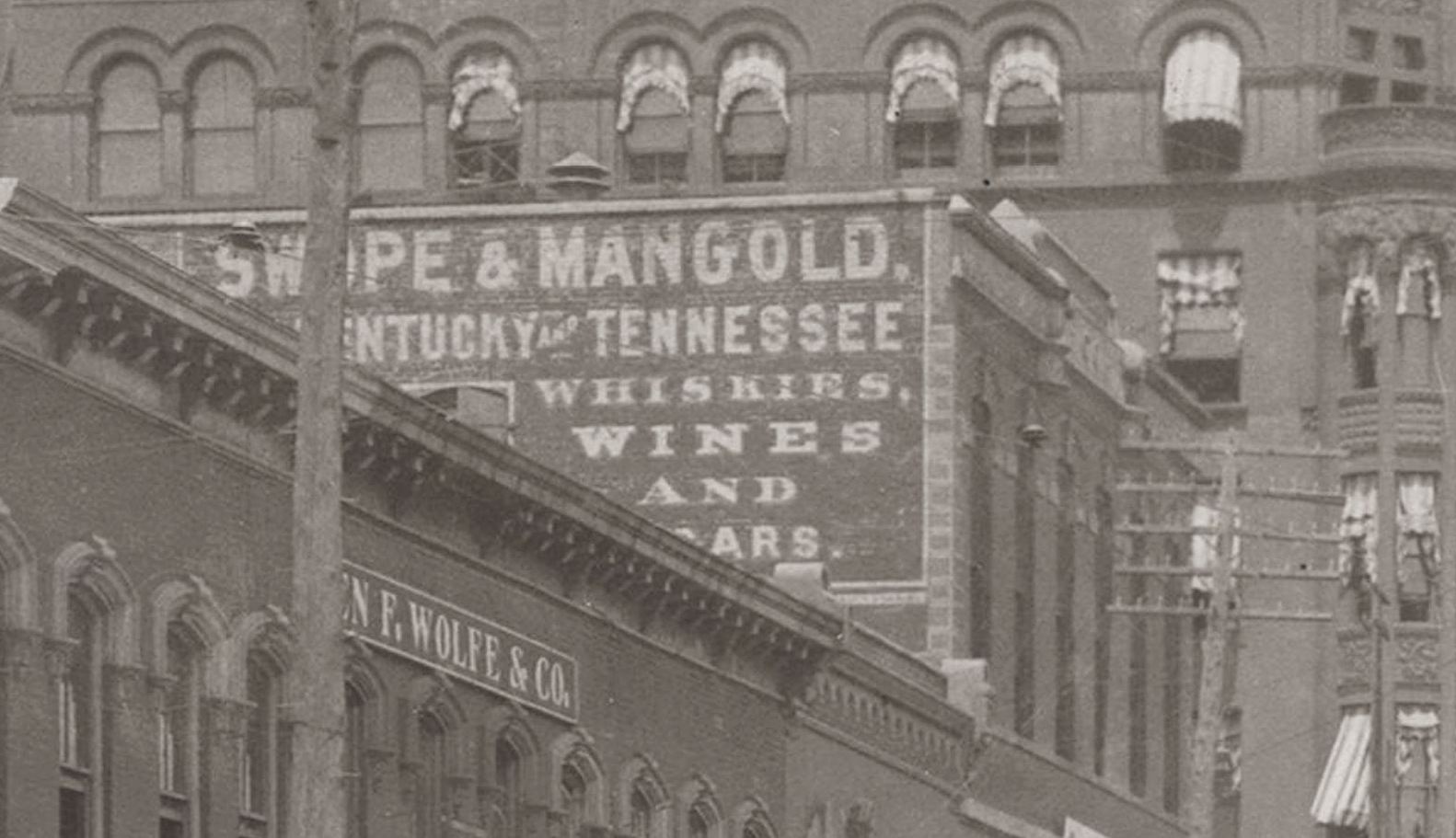
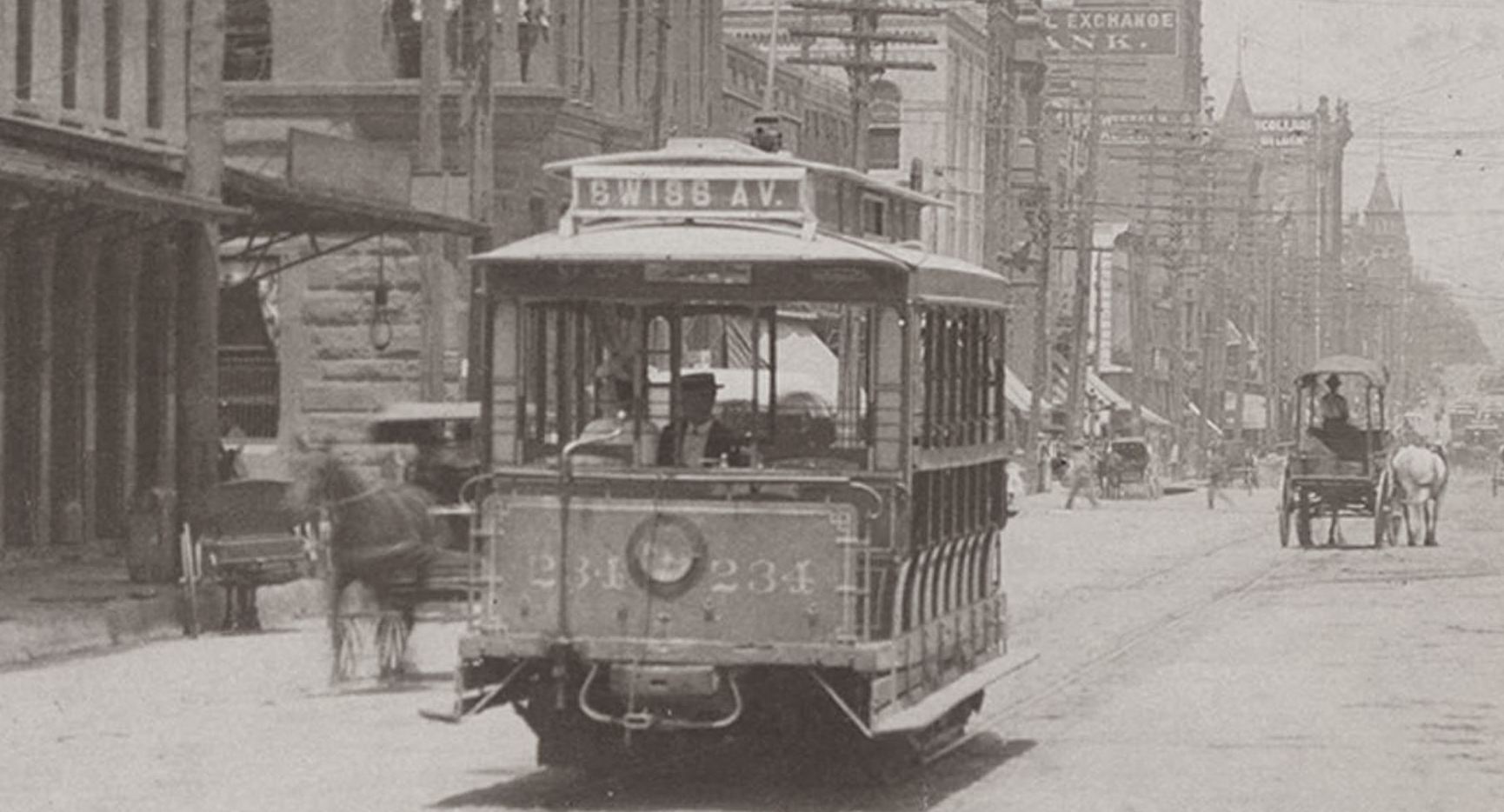
On the north side of Main (at the left), we can see horse-drawn wagons parked in front of a group of businesses including Konantz Saddlery Co., Ben F. Wolfe & Co. (machinery), a banner across the sidewalk for the Southwestern Electrical Engineering & Construction Co., Swope & Mangold wholesale and retail liquor company; then past Austin Street, on the corner, is the Trust Building, with the then-two-story Sanger Bros. building right next door (Sanger’s would build that up to six floors in 1902 and would eventually take over the Trust Building); across Lamar is the North Texas Building, with Charles L. Dexter’s insurance company advertised on the side; and, beyond, the Scollard Building, etc. The Windsor Hotel can be seen on the south side of the street in the foreground. And in the middle, an almost empty little streetcar with “Swiss Av.” on it, moving down Main underneath a canopy of hundreds of ugly electric wires zig-zagging overhead. Let’s zoom in around the photo to see a few closeups (all images are much larger when clicked).

Wagons parked at the curb:

swiss-car_1

*

Is that someone in the window looking down the street?

swiss-car_2

*

Swope & Mangold was one of the oldest “liquor concerns” in turn-of-the-century North Texas.

swiss-car_3

*

The electric streetcar shared the roadway with horses, buggies, and wagons.

swiss-car_4

*

I can’t quite make out the writing on the umbrella or on the sign posted on the pole. Part of the old Windsor Hotel can be seen at the right. At the bottom corner is a shop that sold “notions” and household goods, and just out of frame were a fish market and a meat market.

swiss-car_5

*

And the little Swiss Avenue car 234. Lotsa free seats.

swiss-car_4-a

*

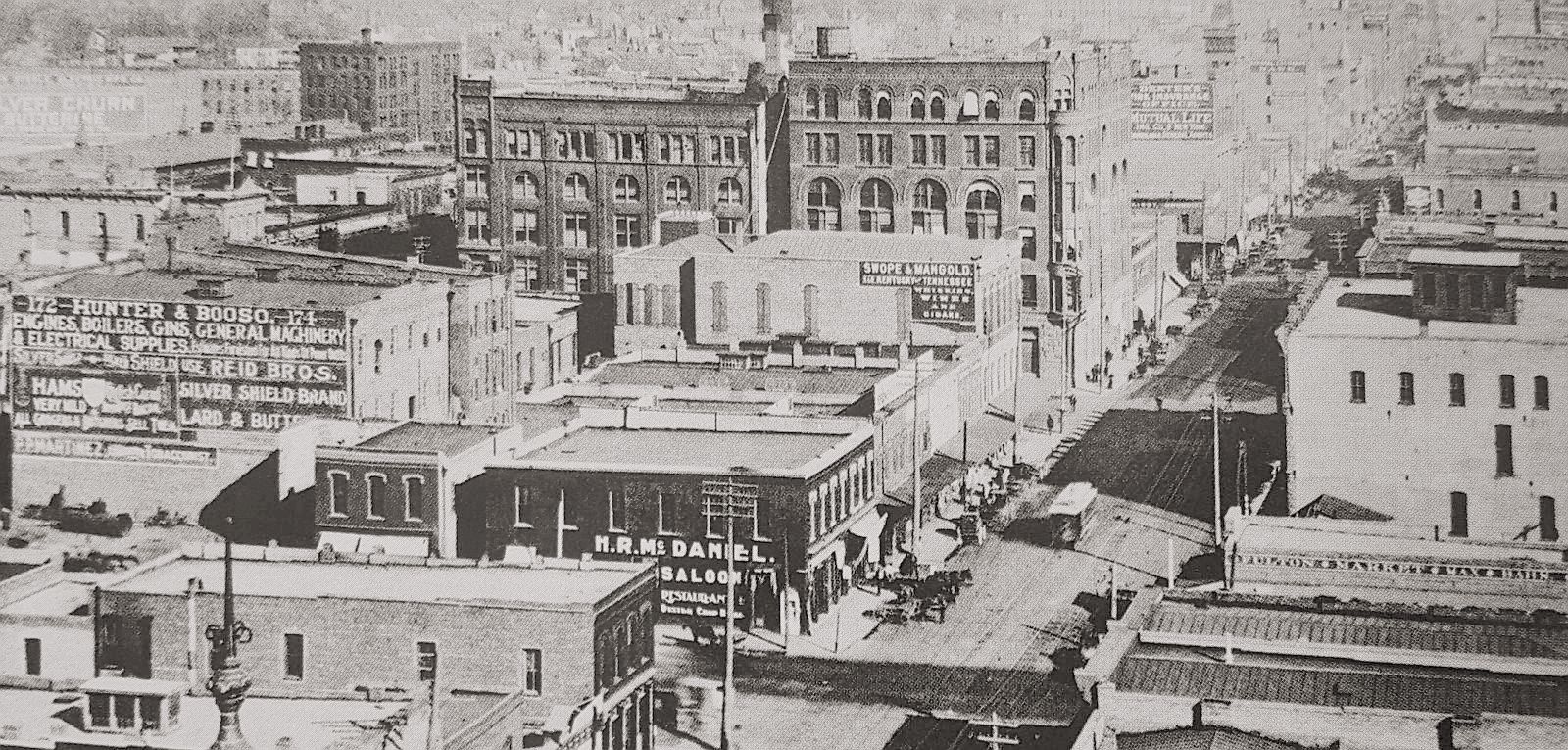
Here’s another view of Main Street looking east, taken around the same time. There’s even a streetcar in about the same spot.

main-street-birdseye_ca-1900_dallas-rediscov_p42_DHS

*

See the 1899 Sanborn map for this general area here (note that Record Street was once Jefferson Street).

***

Sources & Notes

Top photo — titled “Main Street between Austin and Market Streets” — is from the George W. Cook Dallas/Texas Image Collection, DeGolyer Library, Central University Libraries, Southern Methodist University; more information on this photo is here.

The circa-1900 bird’s-eye view photo at the bottom is from the collection of the Dallas Historical Society, found in the book Dallas Rediscovered by William L. McDonald (p. 42).

*

Copyright © 2017 Paula Bosse. All Rights Reserved.