If you collect stereoview photos and/or Texas Centennial memorabilia, hie yourself over to eBay for some (pricey) goodies (see the link at the bottom of the page). Here are a few stereoview “monoviews.”
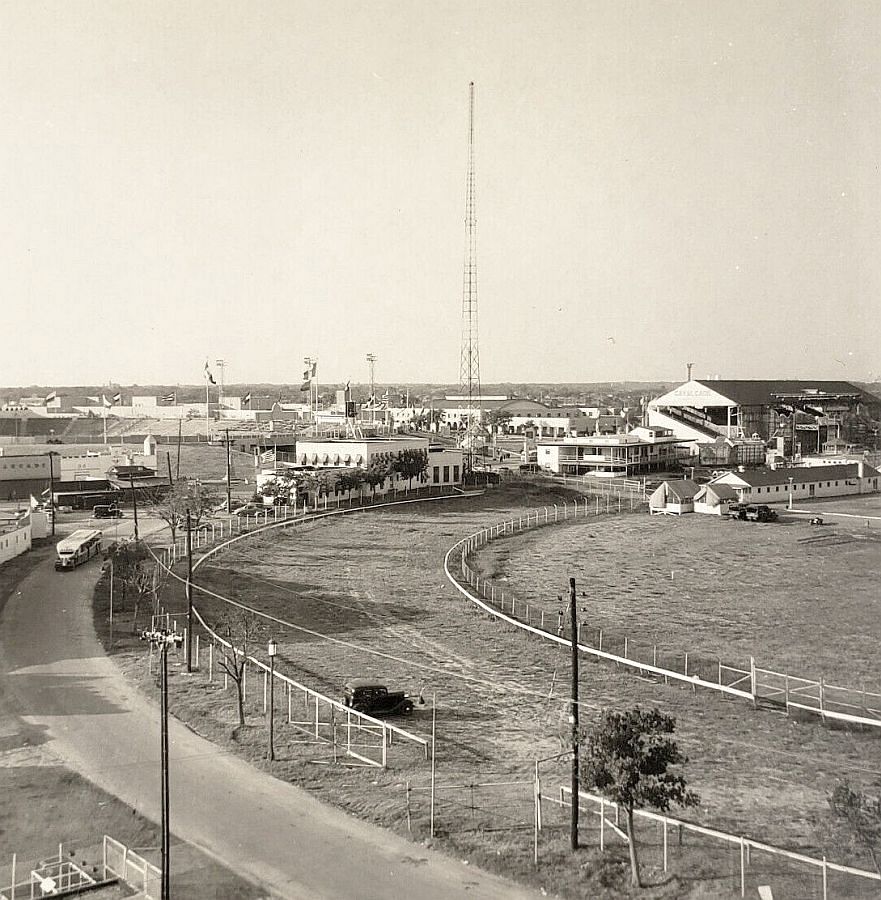
Above, part of the Fair Park racetrack, with the reviewing stand for the “Cavalcade of Texas” pageant at the right. If you look closely on the horizon — at the right, above the Cavalcade stands, you’ll see two towers. Are those the two water towers over in Lakewood at Abrams and Goliad (which I wrote about here)?
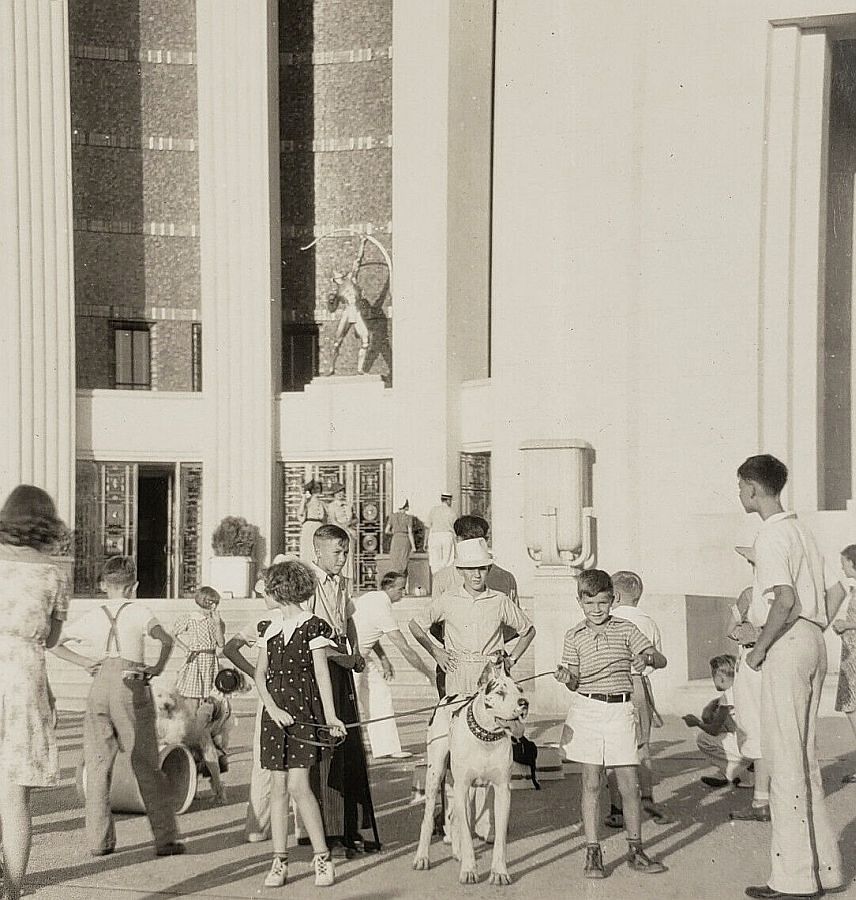
Here are a few more. The first one with kids and dogs at the Hall of State:
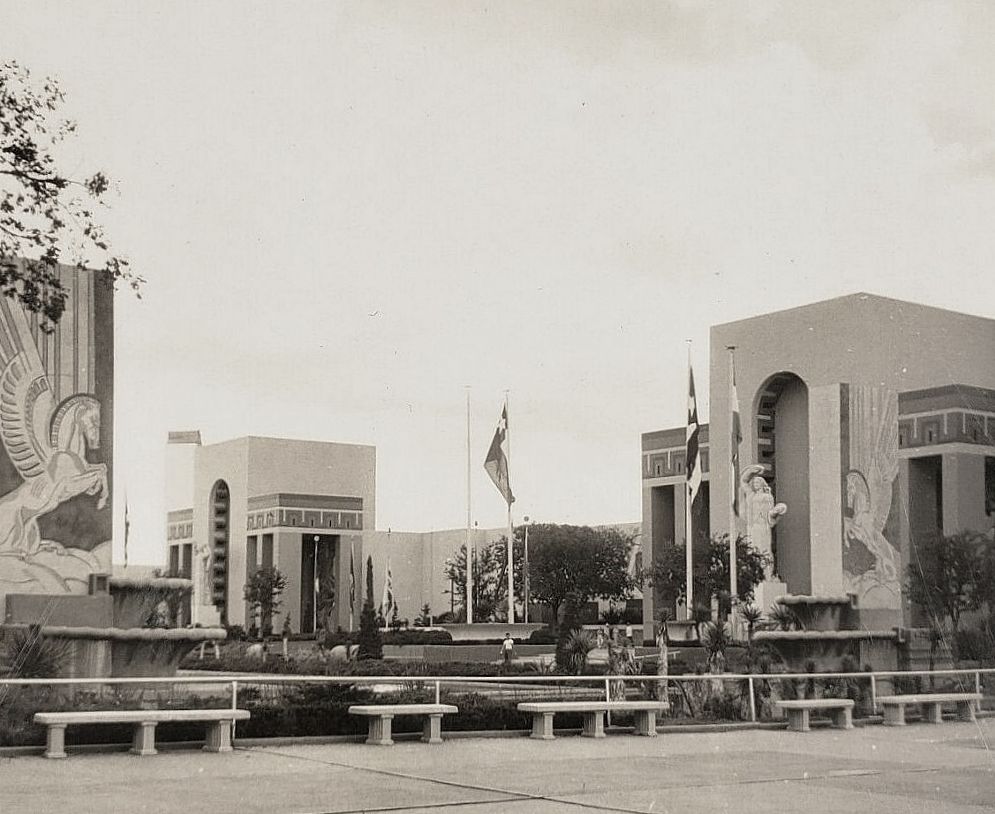
Pegasuses (“pegasi”?) at the Esplanade:
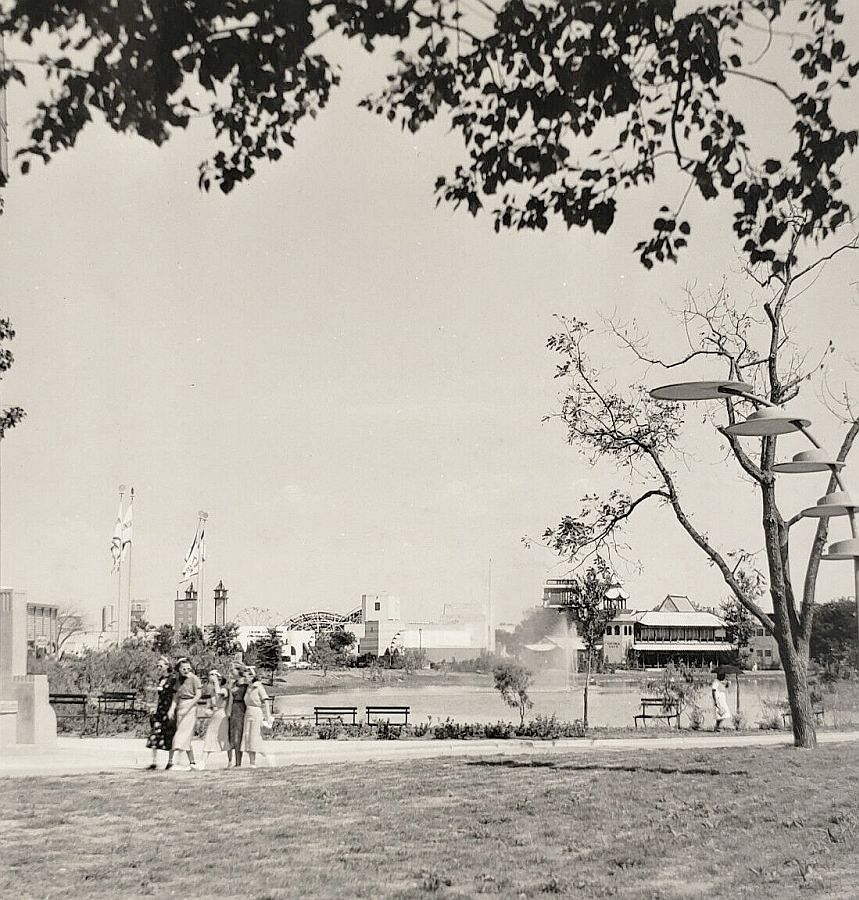
Strolling by the lagoon (and past one of my favorite crazy Centennial design features — those amazing flying-saucer lights!):
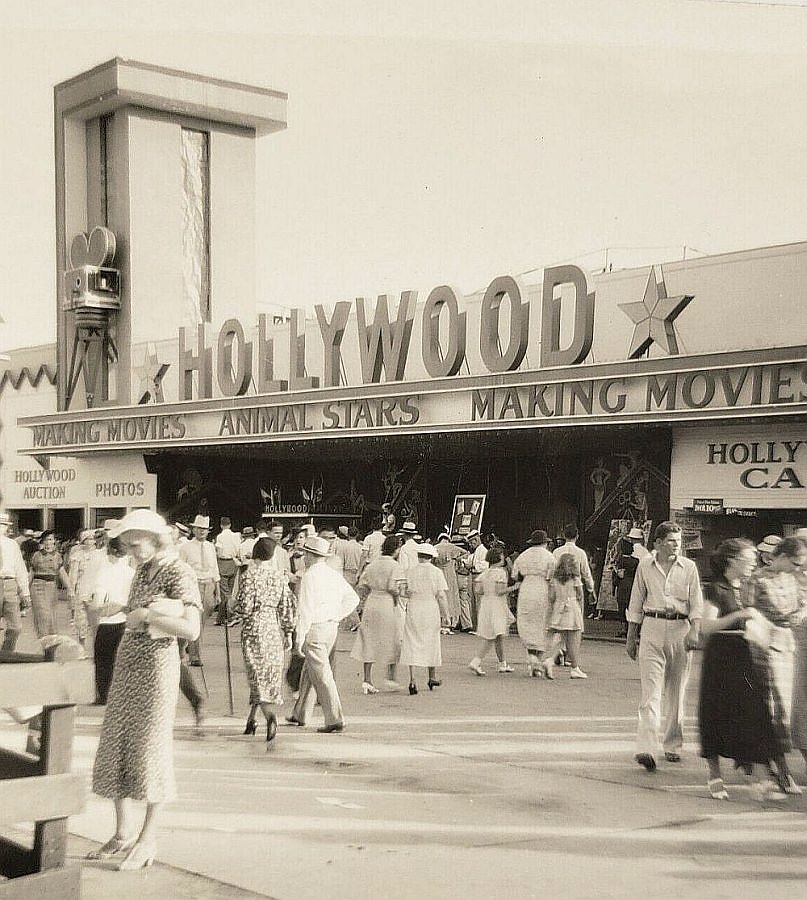
I love the camera on the marquee (and those dresses!) at the Hollywood exhibit:
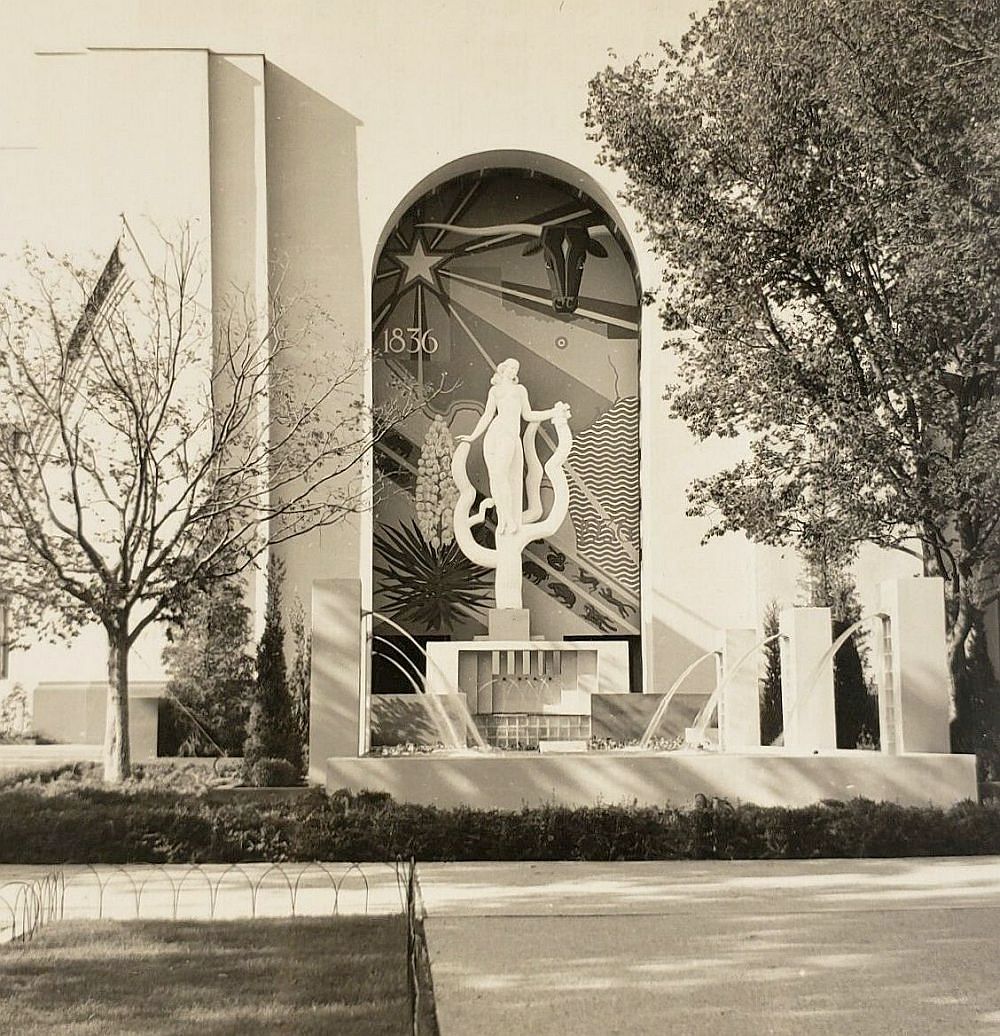
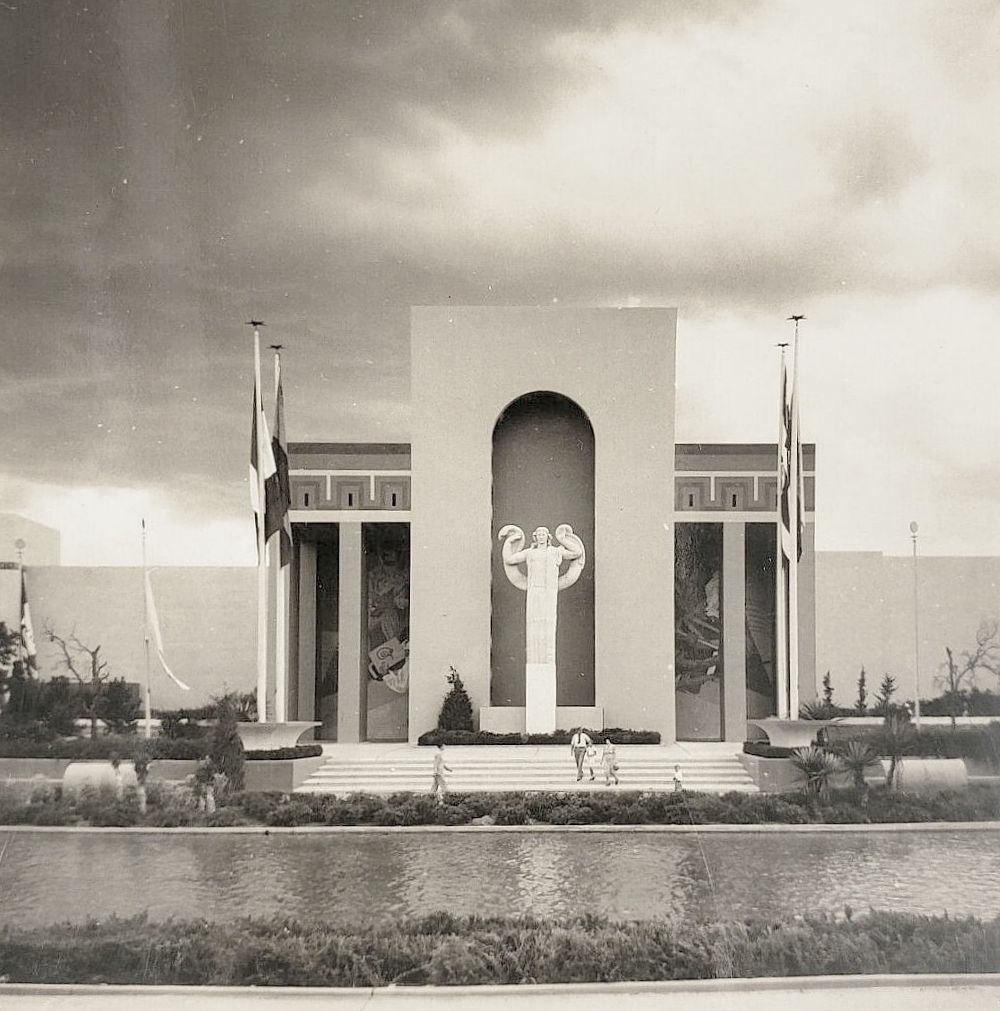
One of my favorite Fair Park artworks — the lady in the niche, at the Administration Building (Women’s Musuem):
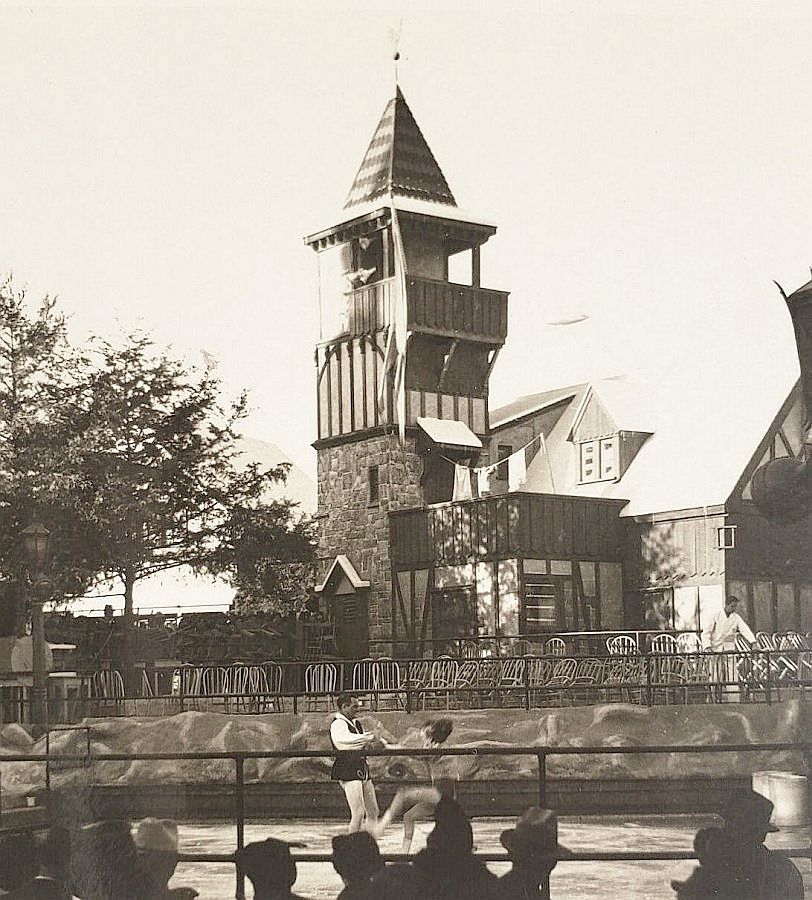
I did not know there was an outdoor ice rink at the Centennial — ice skating performances at the “Black Forest” cafe:
Can’t go wrong with another monumental woman in a niche:
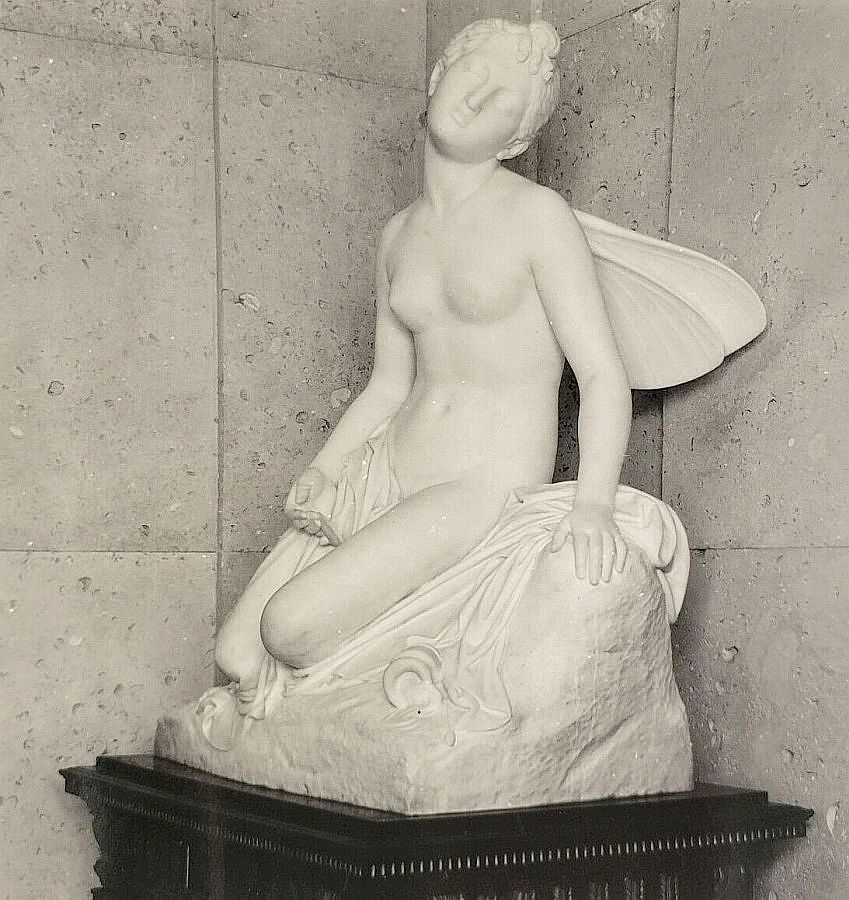
A sculpture of a slumbering fairy at the Dallas Museum of Fine Arts:
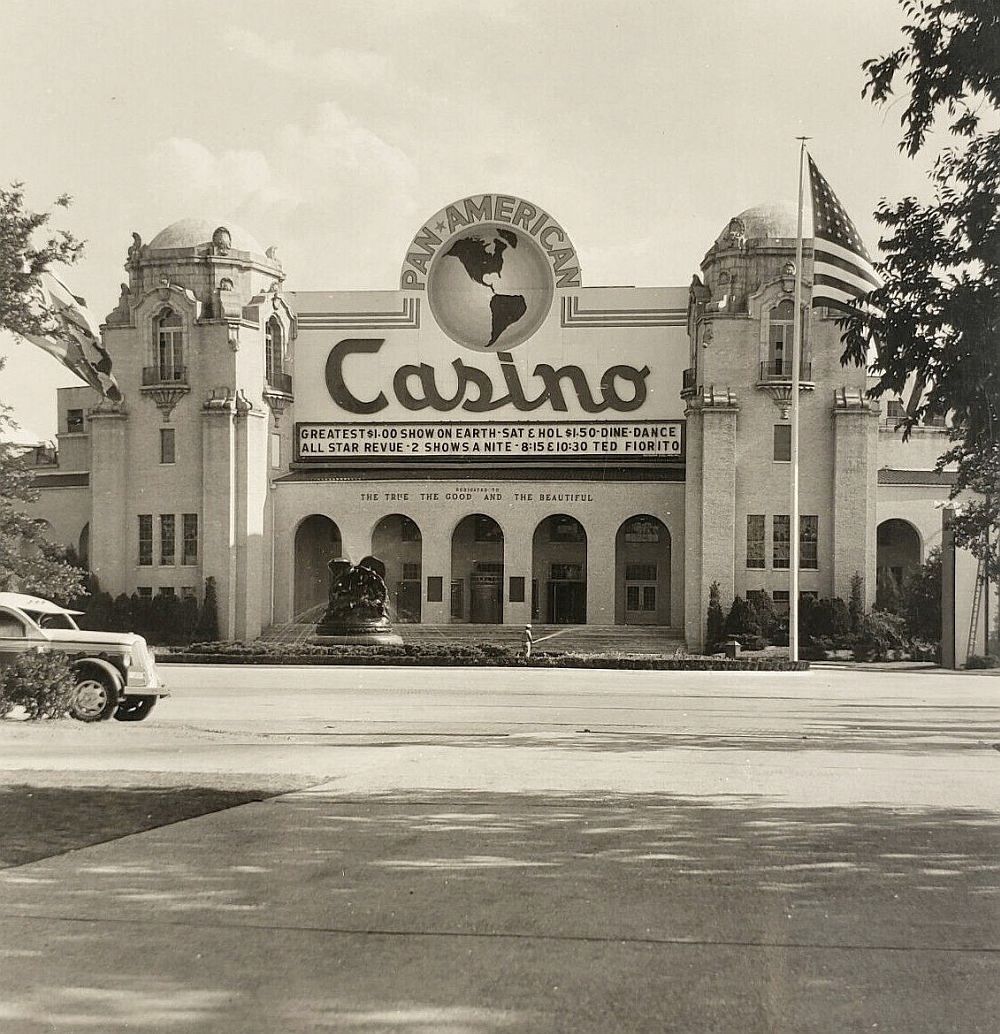
And, jumping ahead a year, a souvenir from the Pan-American Exposition in 1937: the Music Hall dressed up as the “Casino.”
***
Sources & Notes
All images are from eBay, and almost all are currently for sale. See these and more here.
There are a bunch of Flashback Dallas posts on the Texas Centennial — they can be found here.
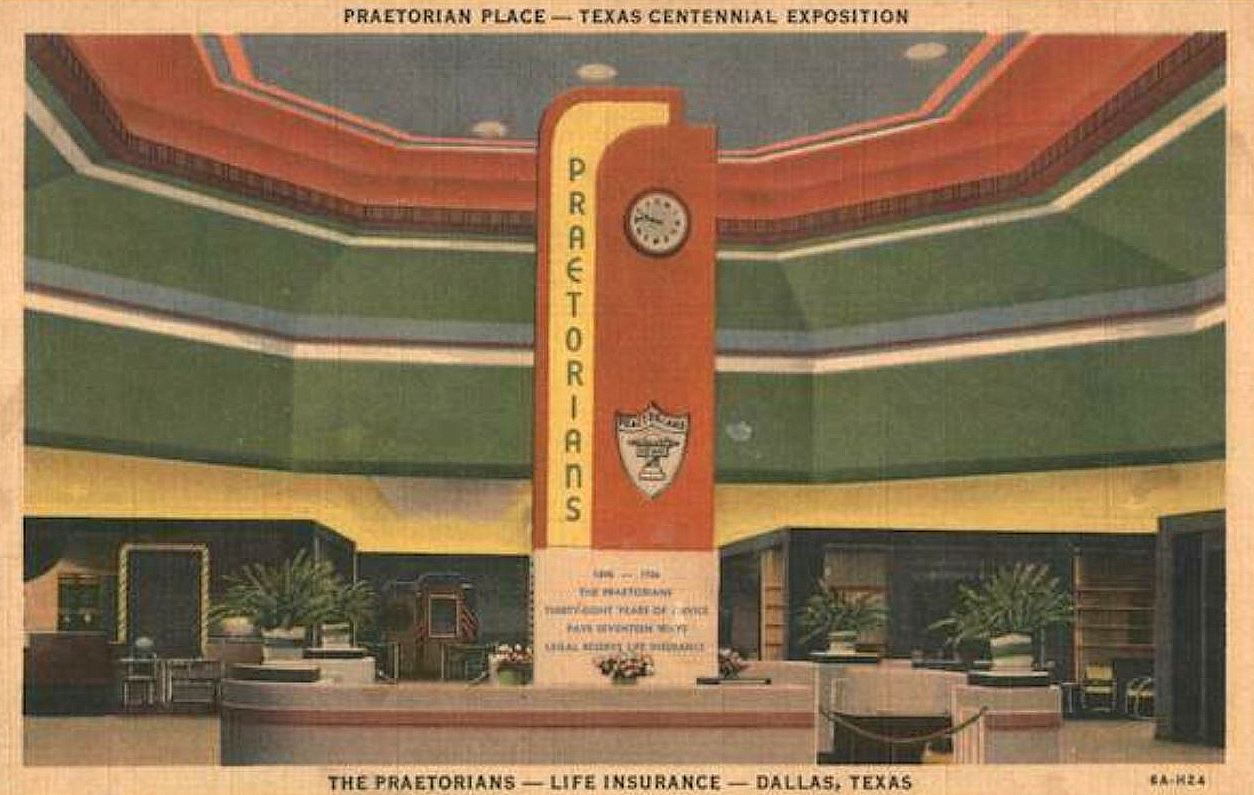
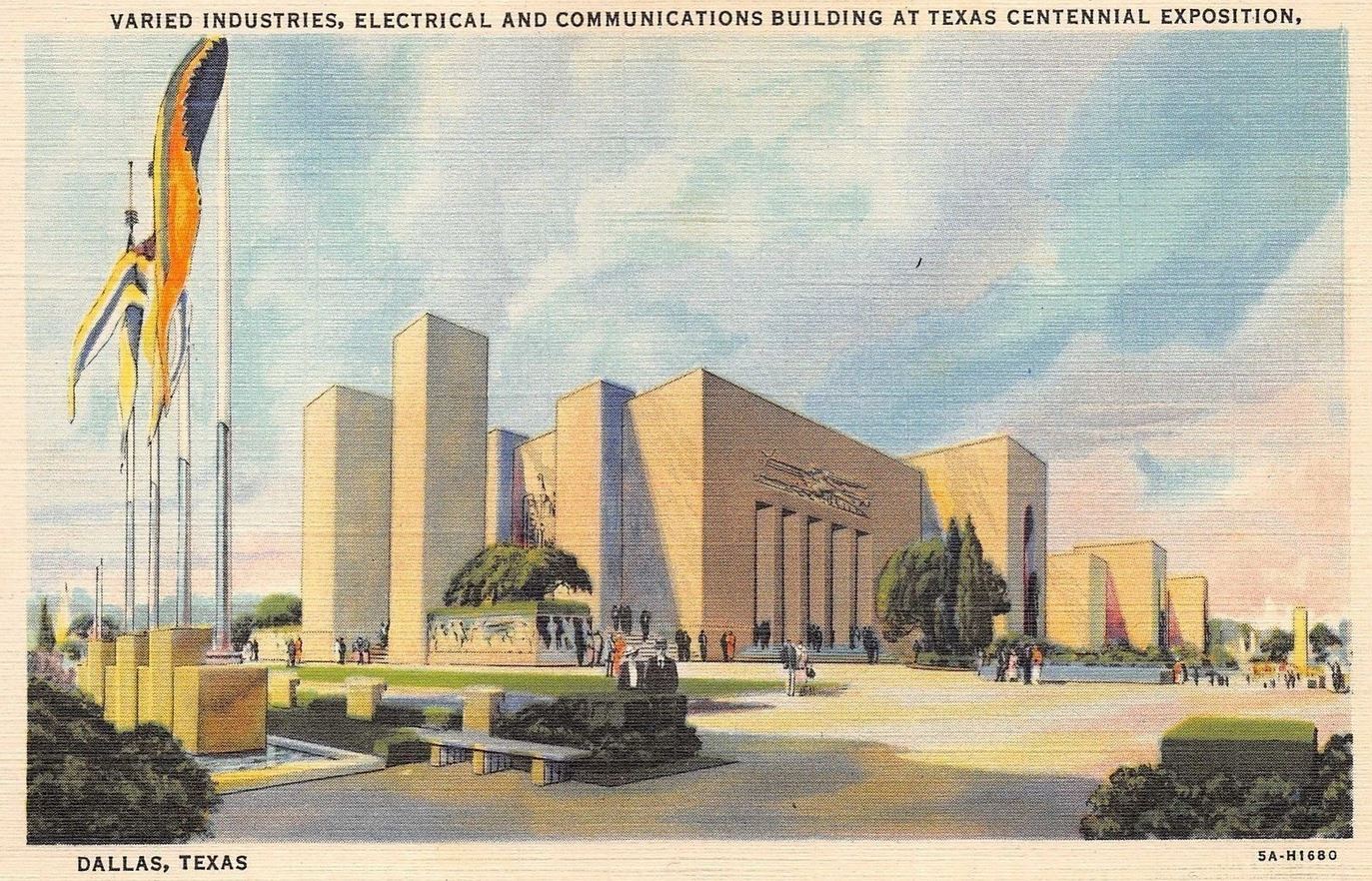
I’ve seen so many Dallas postcards that it’s always a little bit of a jolt when I see one I’ve never seen before, like the one above. The Praetorians Life Insurance exhibit was inside the Varied Industries building (below). So much is written about the architecture of Fair Park — but we don’t hear a lot about the interiors. I don’t think there are many color photos in existence. This is a colorized image, but the colors in real life were pretty vibrant. Even the floors were fantastic! One of my favorite “finds” was the ad at the top of the post “State Fair Coliseum/Centennial Administration Building/Women’s Museum/Women’s Building” — it’s a color photo (!) which shows glimpses of the interior, the furniture, and, best of all, the custom linoleum.
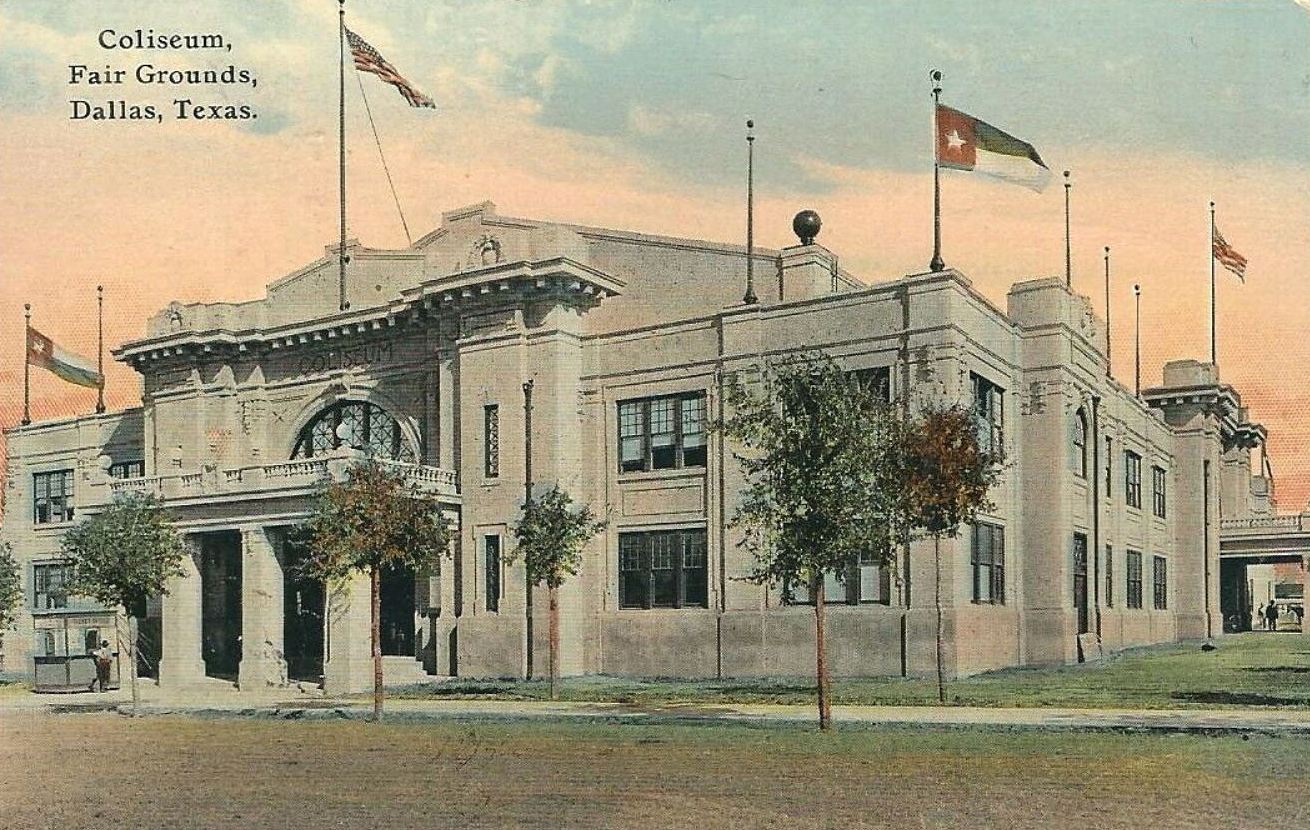
And speaking of the Fair Park Coliseum, this is a great postcard (with a 1911 postmark):
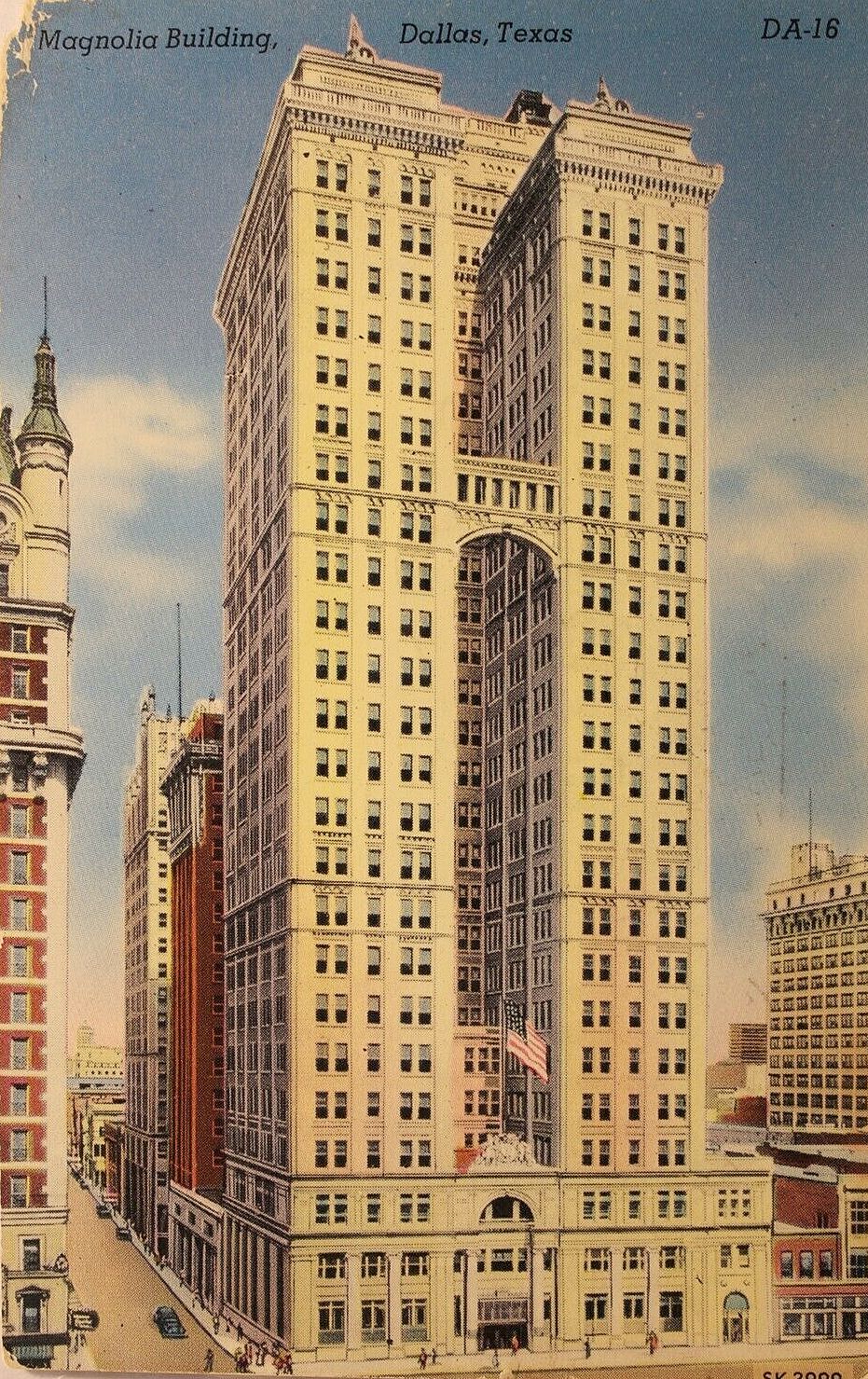
And here’s the Magnolia Building — it never gets old:
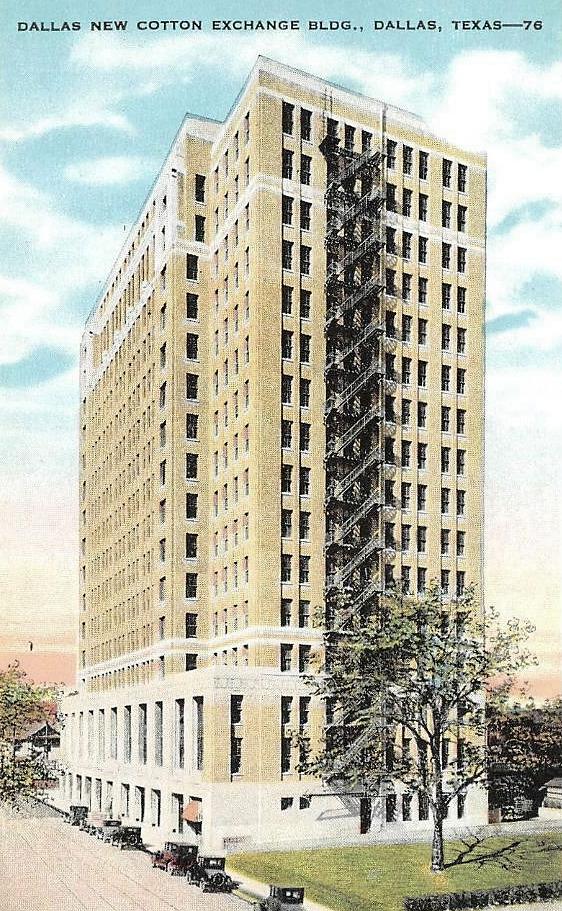
The “new” Cotton Exchange Building, at St. Paul and San Jacinto (I wrote about the old and new Cotton Exchange buildings here — scroll down to #4):
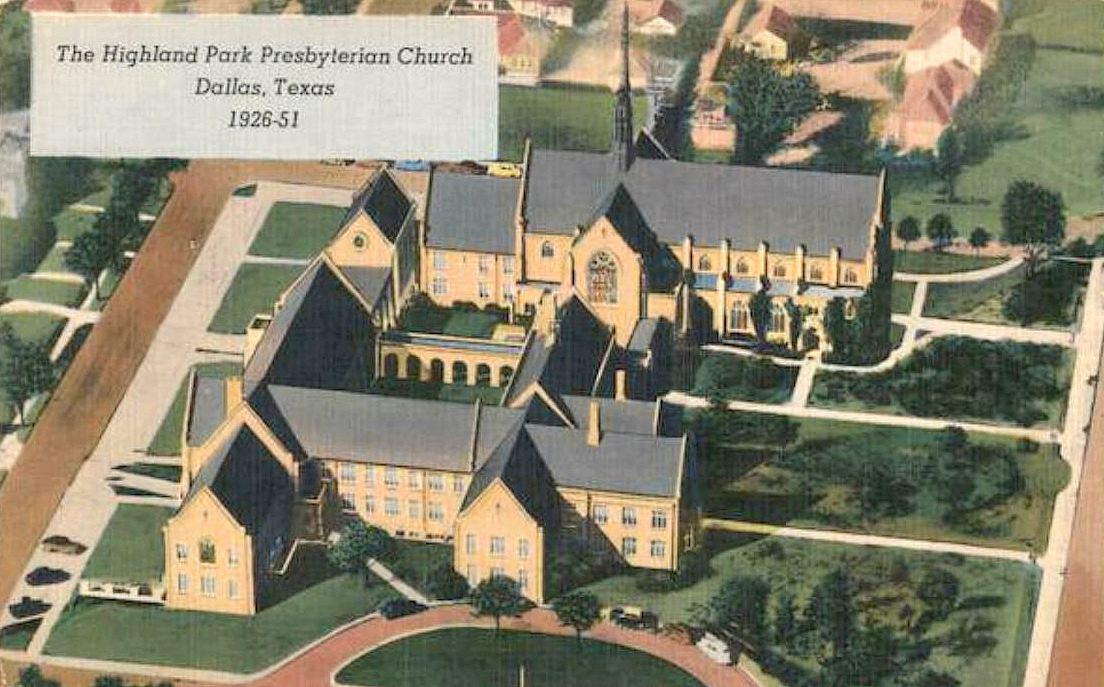
Highland Park Presbyterian Church (circa 1940s):
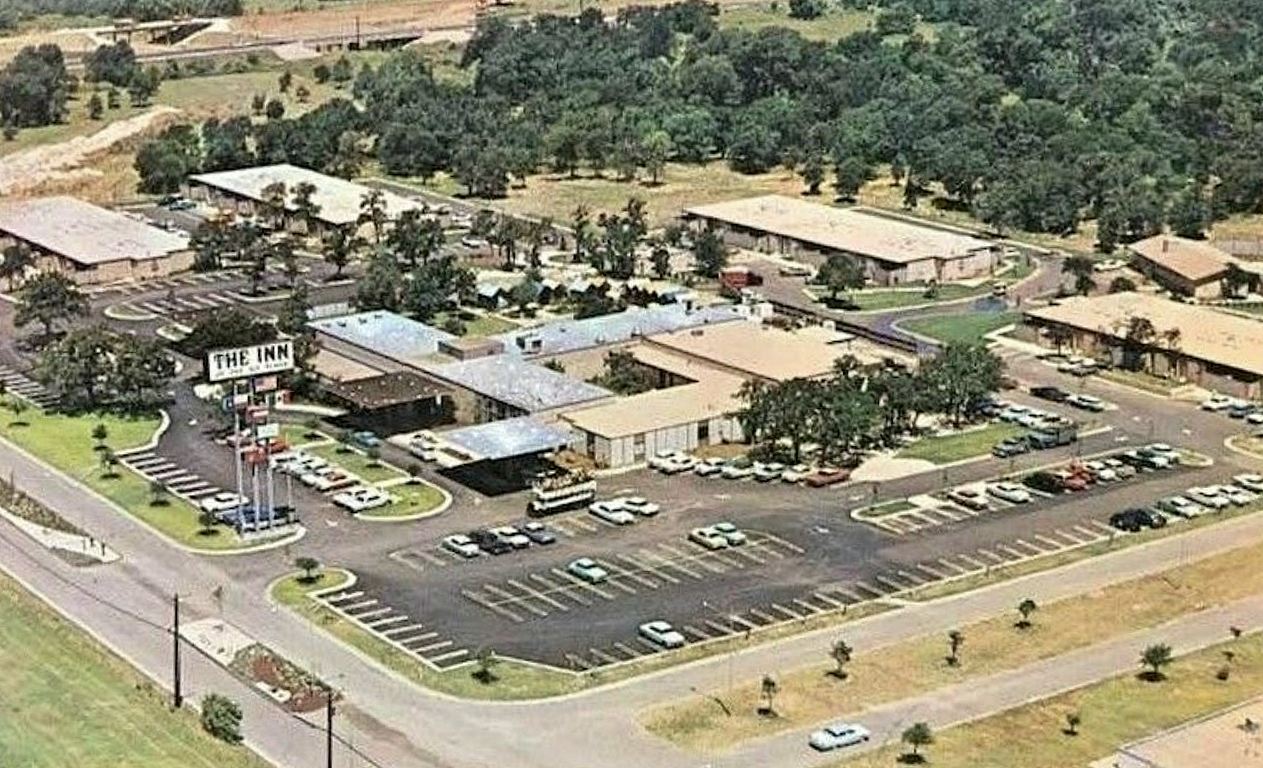
The Inn of the Six Flags — along the DFW turnpike in Arlington. I’d never seen this postcard — and the resolution is pretty bad — but I post this almost entirely to drink in that unbelievably pastoral view of 1960s Arlington.
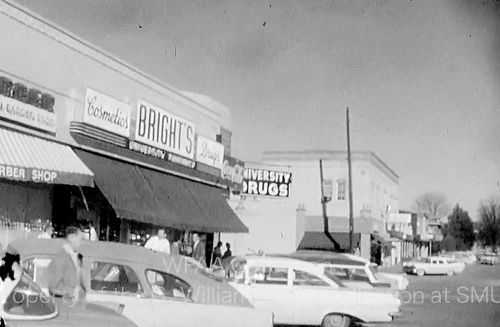
Bright’s Drug Store, 6327 Hillcrest, University Park
by Paula Bosse
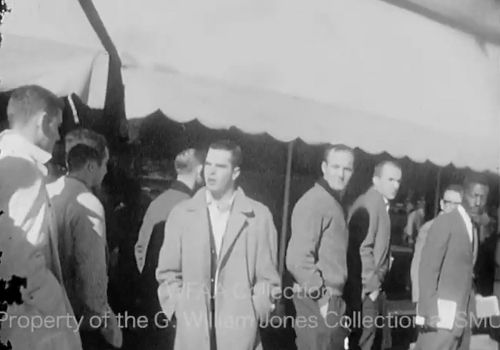
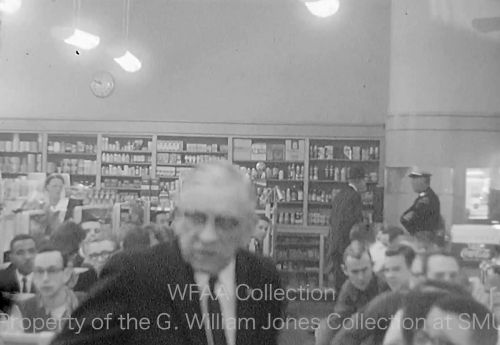
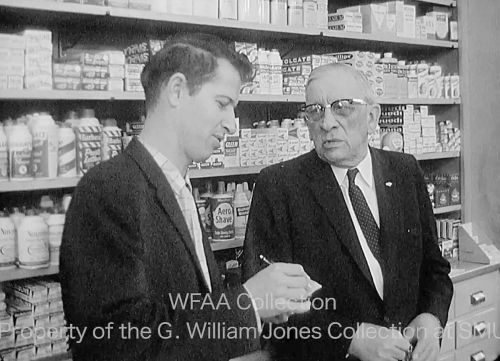
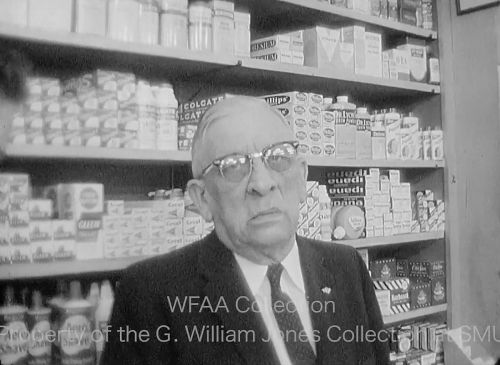
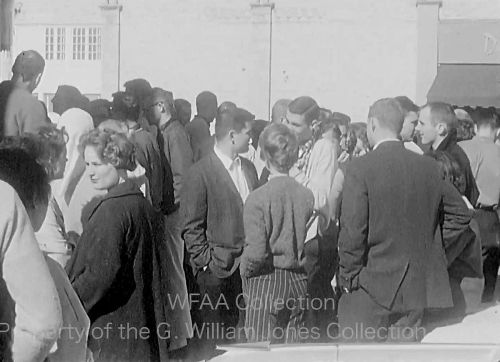
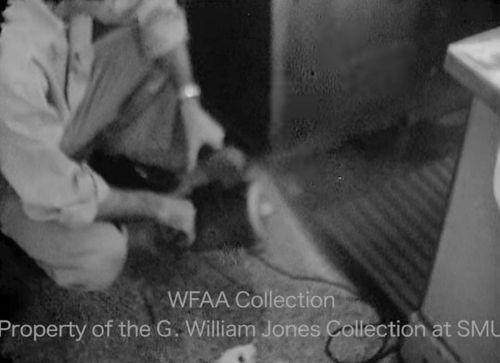
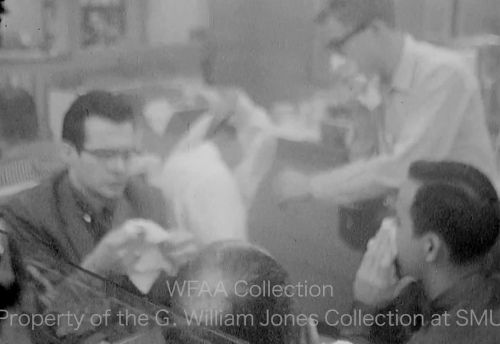
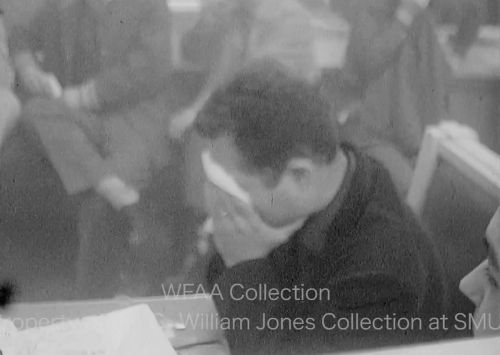
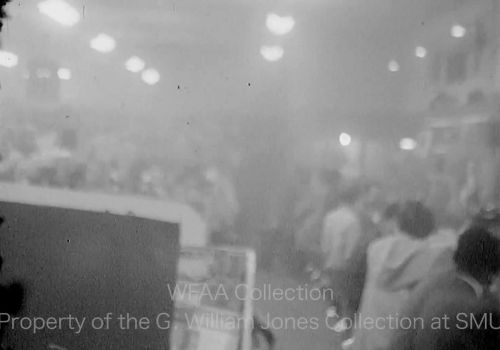
This week the G. William Jones Film & Video Collection at SMU posted another fantastic clip from their WFAA News archive on their YouTube channel. This one shows an incident I had heard about since I was a child. It shows a peaceful “sit-in” demonstration at the University Pharmacy at the southwest corner of Hillcrest and McFarlin, across from the SMU campus. The sit-in was organized by theology students at SMU’s Perkins School of Theology to protest the owner’s refusal to serve Black customers at his lunch counter. The student demonstration was conducted by a group of silent students — it was a peaceful protest without violence. Until, that is, the owner, pharmacist C. R. Bright, called in a fumigator to set off a cloud of insecticide inside the pharmacy in an extreme attempt to run off the protesters. The students did not leave until Bright closed the drug store. Many of the students then picketed in front of the business as anti-protester demonstrators showed up to heckle and jeer, some waving little Confederate flags handed out by Bright. My mother, who lived nearby at the time and had recently graduated from SMU (but was not a theology student) was there, and she says she can still feel the burn of that pesticide in her throat and says that no one present that day could believe a person would do what Bright did. (And she’s in it! She’s seen sitting at the counter, engulfed by a cloud of insecticide.)
Here is the silent clip from January 9, 1961 (the direct link on YouTube is here):
*
I took the photo below at an exhibit at the downtown Dallas Public Library in 2017. It shows the students outside the pharmacy as a crowd jeers at them.
via Dallas Public Library
In 1961, there were only 4 or 5 Black students attending SMU. Black students were allowed to attend only the theology and law schools — there were no Black undergraduates until 1962, when Paula Elaine Jones became the first African American full-time undergraduate student at SMU.
In 1961, African Americans were routinely refused service at white-owned establishments in Dallas (as they were in the rest of the Jim Crow South). The sit-in at the University Pharmacy was the result of a Black theology student being refused service at Bright’s lunch counter. There had been a small demonstration at the drug store a couple of nights before the one seen in the film above — it ended when Bright closed early.
The sit-in that grabbed the headlines began around 10:00 on the morning of Monday, Jan. 9, 1961, when 60-75 SMU students, including Black theology students Earl Allen and Darnell Thomas, entered the drug store and sat silently at the counter and in booths. Allen and Darnell were refused service. In protest, the large group of students refused to leave. After about an hour, Bright was quoted by a WBAP news reporter as saying, “This is a good time to kill some cockroaches…” and called an exterminator service. When the exterminators arrived, they turned on fumigating machines inside the business, filling the place with clouds of kerosene-based insecticide which covered the students, the lunch counters, the dishes, the food, and the store’s merchandise. (Bright was a pharmacist, who was no doubt aware of potential physical harm this would cause.)
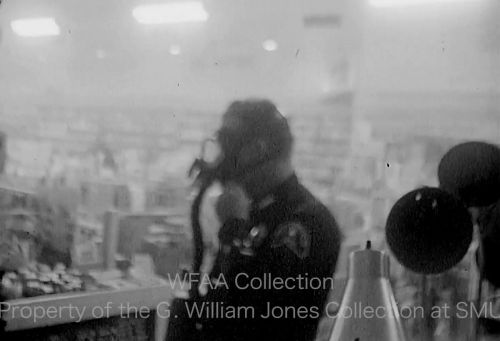
The students sat there, breathing through handkerchiefs and holding their ground, silent. A University Park policeman, Lt. John Ryan was there, but the police were not actively involved (although Ryan did have a handy gas mask). After half an hour, the students left when Bright closed the store. Bright re-opened an hour or two later (the lunch counter remained closed). Students silently picketed as hecklers jeered.
The SMU student newspaper — The SMU Campus — covered the sit-in. The article contained an unsurprising, unapologetic quote from the 75-year-old C. R. Bright:
Bright steadfastly refuses to integrate his lunch counter. Says the drug store owner, “We are not serving them now and we’ll never serve them.” He continues to explain that it “is against my principle” and “I know it would wreck my business.” (The SMU Campus, Feb. 1, 1961)
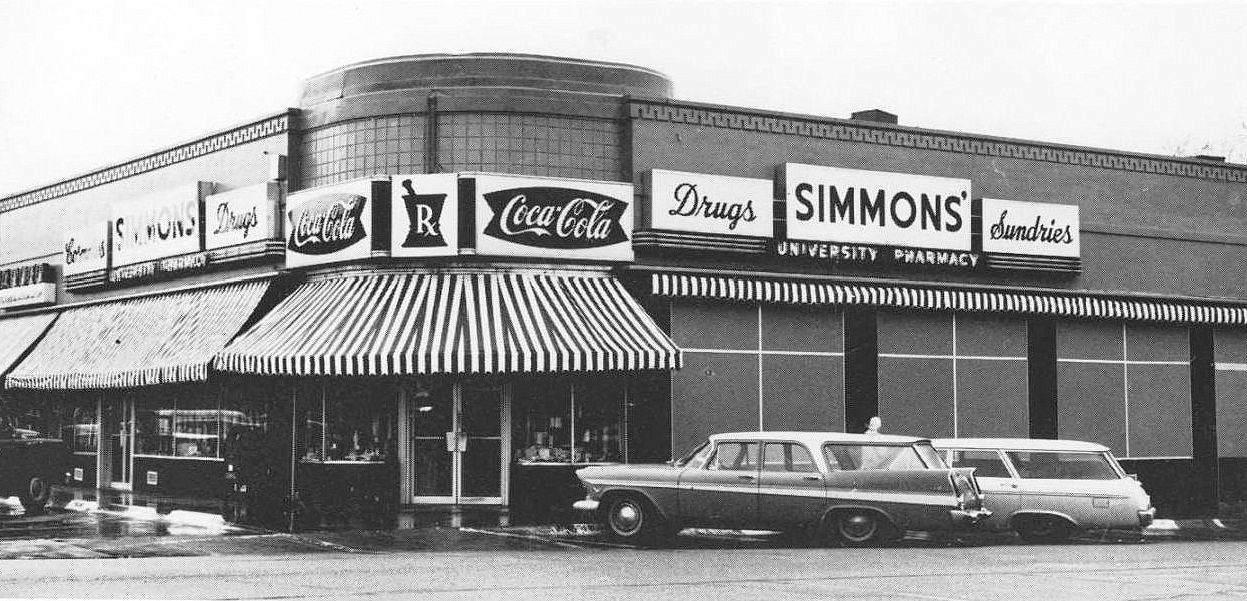
Bright retired soon after and sold the business to an up-and-coming young whippersnapper named Harold Simmons, who went on to build a multi-multi-multi-million-dollar empire from that first business investment.
UPDATE, BURY THE LEDE DEPT: Thanks to comments by two readers, I have learned that Christopher R. Bright was the father of former Dallas Cowboys owner H. R. “Bum” Bright. Oh dear.
***
Sources & Notes
All screenshots are from WFAA news footage from the WFAA News Film Collection, G. William Jones Film & Video Collection, Hamon Arts Library, Southern Methodist University; the clip has been posted to the SMU Jones Film channel on YouTube here.
Read coverage of the sit-in (as well as a critical editorial which called the protest “immoral”) in the Feb. 1, 1961 edition of The SMU Campus, the student newspaper — it can be accessed on the SMU Libraries website here, or it can be read in a PDF I’ve made, here.
Read a lively account of the sit-in in a WBAP-Channel 5 news script here (via the Portal to Texas History).
For those with access to the Dallas Morning News archives, the incident is covered in an article by Jim Lehrer: “Protesting Students Sit In, Walk Picket Line at Store” (DMN, Jan. 10, 1961).
Another great clip showing a historical lunch-counter protest in Dallas (the city’s first, I believe) in April of 1960 is also available on the SMU Jones Film YouTube channel — it can be viewed here. Here is a description of what’s happening in the footage: “Rev. Ashton Jones, a white minister from Los Angeles, and Rev. T. D. R. V. Thompson, Black pastor of the New Jerusalem Institutional Missionary Baptist Church, 2100 Second Avenue, together visit segregated lunch counters in downtown Dallas department stores; the peaceful sit-in protests take place at the counters of the Kress Department Store, the H. L. Green Department Store, and the Tea Room of Sanger Bros. department store. This was the first publicized demonstration against Dallas’ segregated eating establishments, and several members of the media — both white and African American — are covering the historic event (Silent).”
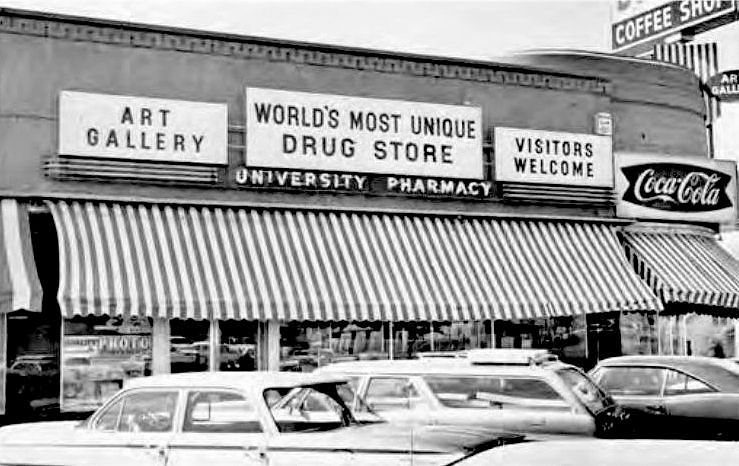
Lastly, in a related Flashback Dallas post, there was a previous University Pharmacy which was located, at separate times, on the northwest and southwest corners of Hillcrest and McFarlin — the owner of the very first University Pharmacy built the Couch Building, which can be seen in the background of the top photo of this post. That earlier post, “University Park’s “Couch Building” Goes Up In Flames (1929-2016),” can be found here. A pertinent 1965 photo from that post which shows Simmons’ University Pharmacy, the Couch Building, and the Toddle House (which was also the site of a 1961 sit-in by SMU students) can be seen here.
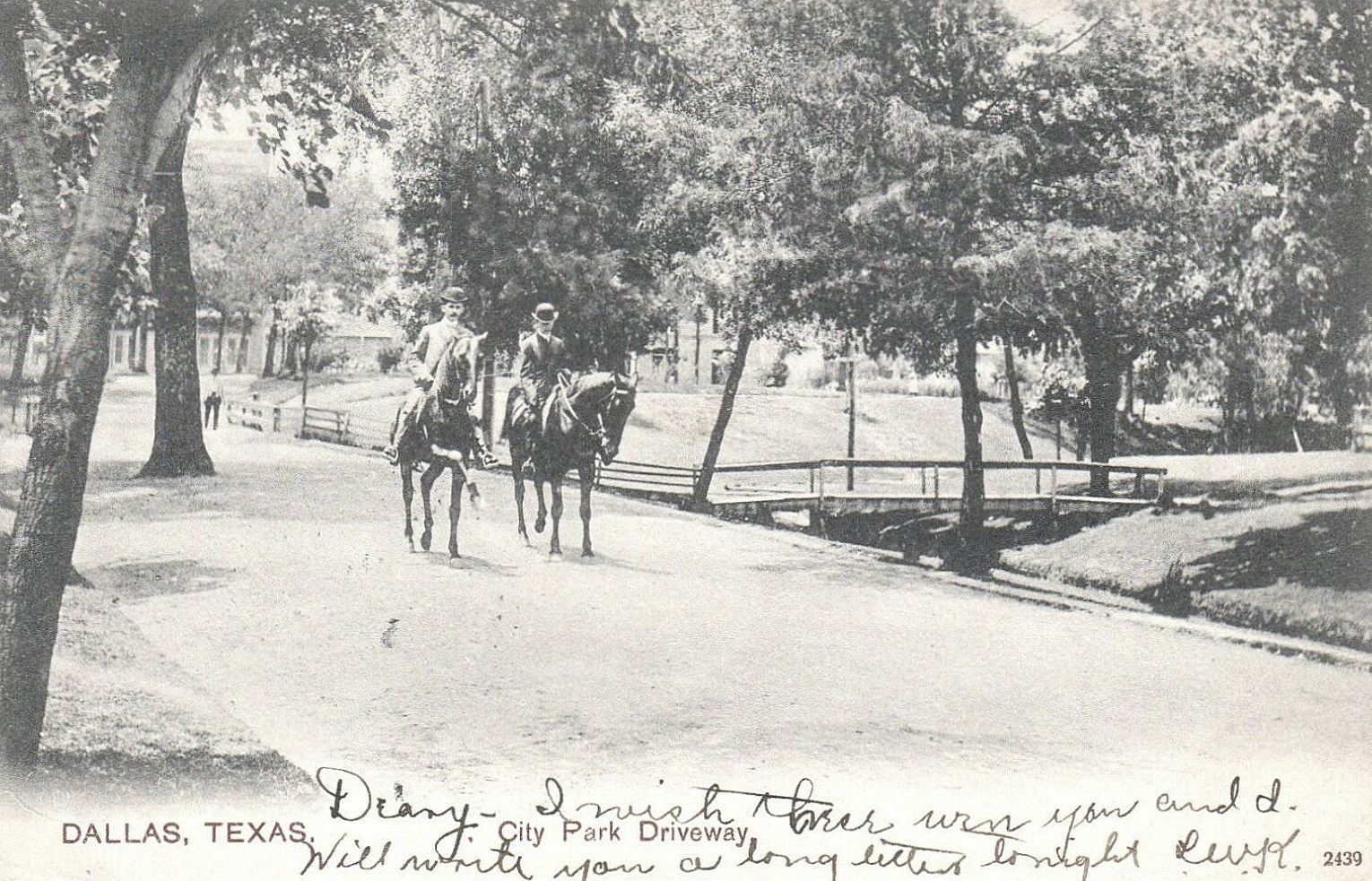
Out for a leisurely ride through the park. Have derby, will travel.
***
Sources & Notes
This real-photo postcard from January, 1907 was addressed to 19-year-old Gussie Holland, then studying in Maryland. Gussie was the daughter of the Dallas publisher and former mayor, Franklin Pierce Holland. Found on eBay.
What better time to share this seasonal article from the Christmas, 1959 edition of The Shamrock:
Next to a helping of black-eyed peas, about the most important thing to Texans on New Year’s Day is a good football bowl game. And to Texans, there is no bowl game more important than the Cotton Bowl contest played each year in Dallas. Many even would rather do without their “black-eyes” than to miss this annual grid classic.
Texans have long been noted for their bragging and their love of football. In the Cotton Bowl game, they believe they have something which warrants a little boasting. Since 1937 when the classic was inaugurated, they have succeeded in showing the nation that they, too, can stage top grid productions.
There’s more to the Cotton Bowl Festival than a football game, however. The host city of Dallas resembles a three-ring circus during the week preceding the big game. The game is played on New Year’s Day except when that holiday falls on Sunday. In that event, it is played on Monday, January 2.
The list of events for Cotton Bowl Week this year contains something of interest for all visitors. The National Finals Rodeo, the first “world series of rodeo,” will be staged in the new State Fair Livestock Coliseum, December 26-30. The popular Broadway production, “My Fair Lady,” will be presented by the national company of the show in the State Fair Music Hall all during the week.
There will be a fashion show for the ladies and the Texas sportwriters will sponsor the annual Texas Sports Hall of Fame luncheon, honoring great athletes and coaches of the past. There will also be college and high school basketball tournaments, a tennis tournament, and a bowling tournament.
The big event prior to the game will come on New Year’s Eve with the annual Cotton Bowl Festival parade through downtown Dallas. Bands will play, colorful floats will be displayed and the Cotton Bowl Queen will make an official appearance, along with the many princesses representing each school in the Southwest Conference.
The Cotton Bowl game was conceived and originally promoted as a private enterprise by J. Curtis Sanford, a Dallas businessman. The first game was played on January 1, 1937, and featured Texas Christian University and Marquette University. TCU, with L. D. Meyer scoring two touchdowns, a field goal and a conversion, defeated Marquette, 16 – 6.
The classic eventually became a Dallas civic enterprise, produced under the auspices of the Cotton Bowl Athletic Association. The CBAA later became an agency of the Southwest Athletic Conference. Thus the Southwest Conference sponsors and controls the event, making it unique among all post-season games. The Conference voted in 1942 to send its championship team to the Cotton Bowl game as hosts. The opposition is chosen from the top teams in the nation.
The Cotton Bowl Stadium has a seating capacity of 75,504 fans. At $5.50 a seat, that represents close to half a million dollars in receipts. Each competing team receives 39 per cent of the gate with seven per cent earmarked to be paid toward retiring the bonded indebtedness on the Cotton Bowl Stadium. The remaining 22 per cent goes to the Cotton Bowl Athletic Association. After paying the expenses for the year, the Association gives the remainder of its income to the Southwest Conference.
Thus each team in the eight-school league realizes a financial assistance from the annual classic.
A helping of black-eyed peas and a serving of Cotton Bowl football are two items most Southwesterners like on their New Year’s Day menu.
***
Sources & Notes
This article is from the Christmas, 1959 edition of The Shamrock, the quarterly publication of the Shamrock Oil and Gas Corporation; this magazine is part of the Southwest Collection, Special Collections Library, Texas Tech University — the entire issue has been scanned and may be viewed as a PDF here.
NorthPark was the mall of my childhood — in fact, I don’t recall my family going to any other mall. I loved going there at Christmastime — to see the decorations, to watch a puppet show, to slide down those pillars, and, of course, to visit Santa. These photos from the Instagram feed of NorthPark Center are very nostalgic.
*
Above, 1971. How to get to Santa: take a right at the fountain, walk and walk (…and walk) — things start picking up the closer you get to Neiman’s — hang a right at N-M, and there he is!
*
Admiring a snowman, ca. 1970.
*
Also admiring a “tree” suspended over one of the iconic NP fountains, ca. 1970.
*
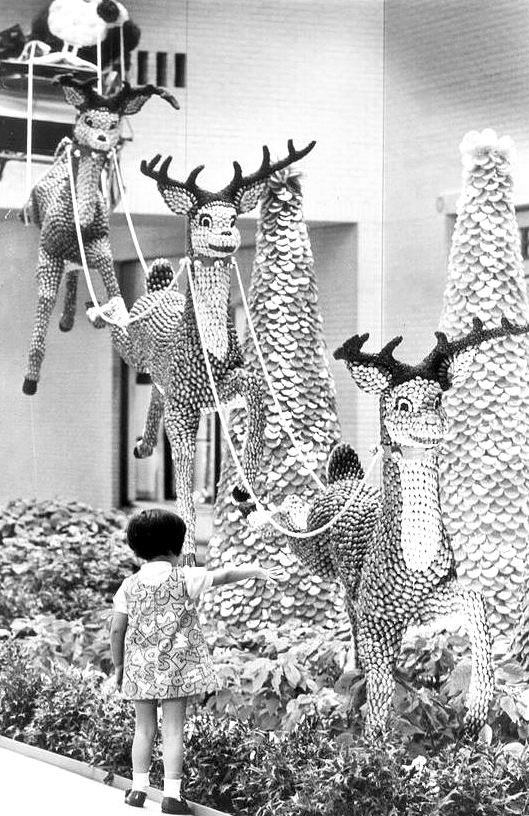
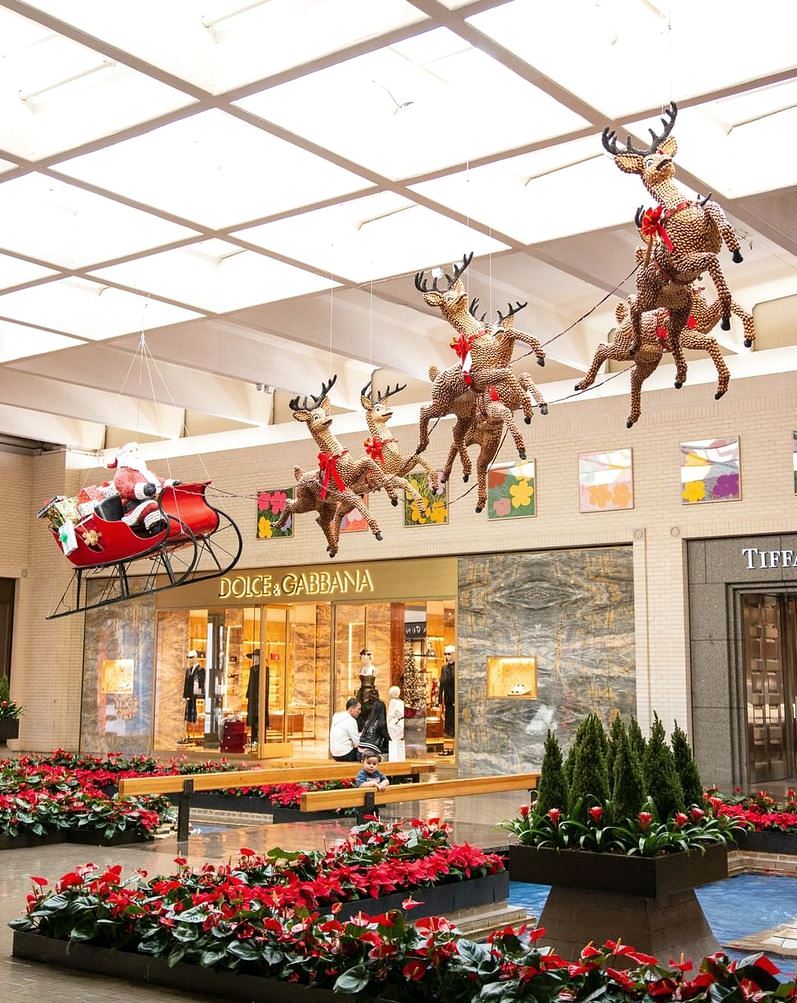
If you’ve been to NorthPark at Christmas you’ve seen the aerial display of Santa and his sleigh being whisked away by flying reindeer. This is NorthPark Center’s caption from Instagram: “Flying high over Neiman Marcus Fountain Court, the vintage Candy Santa and Pecan Reindeer installation has been a special part of NorthPark’s holiday tradition since 1965. The handcrafted display, consisting of real pecans, almonds, red and black licorice, marshmallows, sour cherries, raisins, and other candies, portrays Santa and his reindeer on their way to deliver presents to children all over the world.” Those pecan-studded reindeer really fascinated me as a kid. (The photo below is undated.)
They’re still flying high, to the delight of 21st-century children:
*
And, lastly, what every child saw before and after a holiday visit to NorthPark. When your car pulled into a parking spot you were filled with excited anticipation, and when you left, you were over-stimulated and exhausted. But happy.
**
Merry Christmas and Happy Holidays to everyone!
***
Sources & Notes
Unless otherwise noted, all photos from the Instragram feed of @NorthParkCenter.
See many, many more Flashback Dallas Christmas posts from years gone by here.
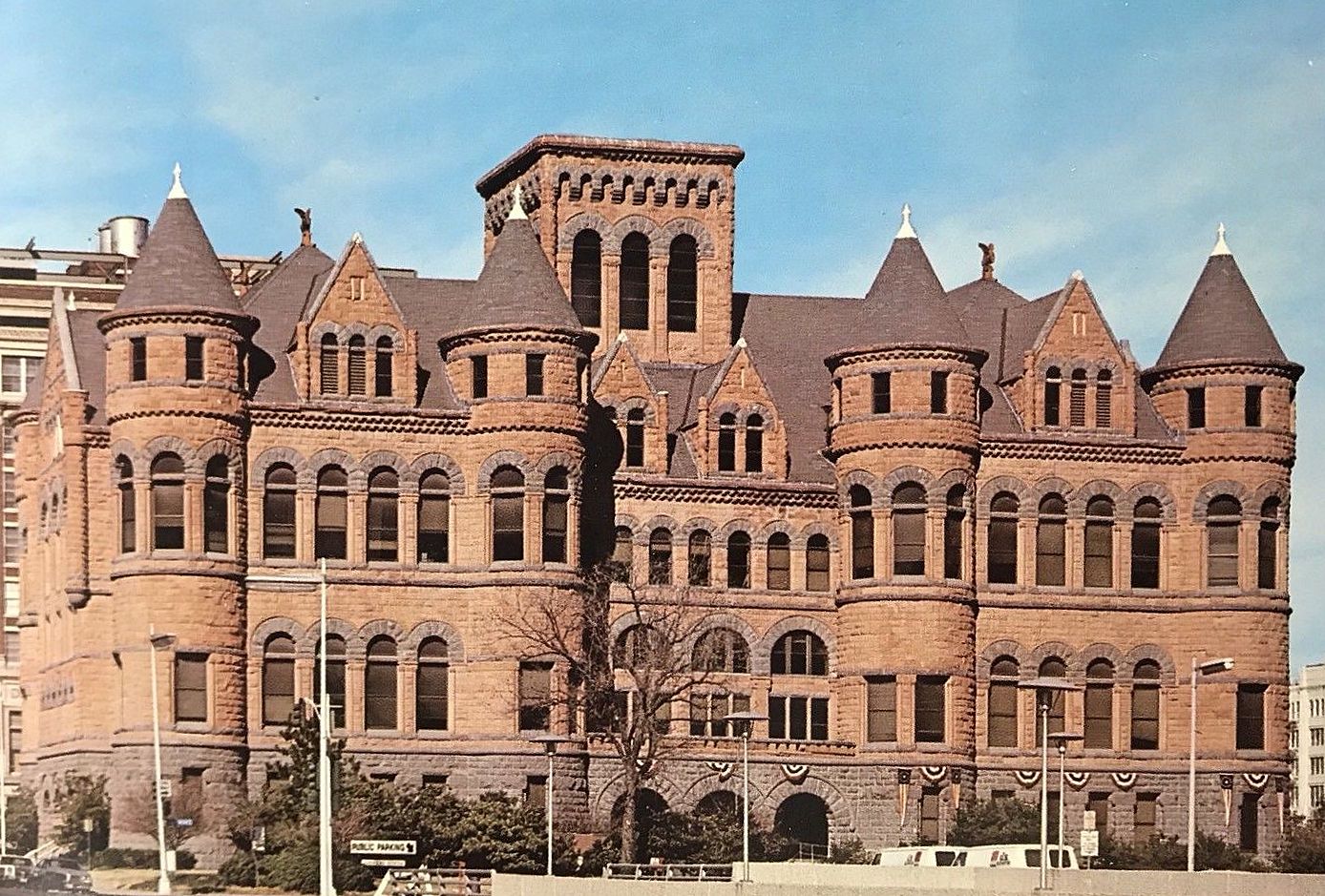
A nice view of Main Street, looking west toward the probably pretty new courthouse (built in 1892). Streetcars, the St. George Hotel, the North Texas Building, the Trust Building. Much the same shot is seen in this photo from 1954 (more buildings, less sky).
I hope citizens back then weren’t getting too attached to that beautiful clock tower, because it would go bye-bye in April, 1919 after it had been determined that it might be on the verge of collapse.
From The Dallas Morning News, Jan. 22, 1919:
COURTHOUSE TOWER IS ORDERED REMOVED
Believing the courthouse tower to be a nuisance to the safety of persons in the building, the Commissioners Court yesterday ordered H. A. Overbeck, architect, to prepare specifications for its removal. The tower will be leveled off even with the balcony.
Mr. Overbeck recently made an inspection of the tower, reporting that while there is no immediate danger, it is altogether advisable that the tower be demolished, as a strong windstorm might cause it to collapse. The walls have numerous cracks in them, the sandstone is disintegrating in places, and some of the iron supports are rusted and deteriorating, he said.
The work of removing the tower will begin as soon as Mr. Overbeck can complete the necessary plans.
It wasn’t even 30 years old. The tower came down a few months later at a cost to the county of $10,000 (the equivalent today of about $153,000).
From The Dallas Morning News, April 20, 1919:
COST $10,000 TO REMOVE COURTHOUSE TOWER
The work of razing the courthouse tower was completed this week, and workmen yesterday began tearing down the scaffold and improvised elevator shaft which had been erected to facilitate the removal of the large quantity of stone and steel contained in the old tower.
It is estimated that there were close to 75 tons of material in the tower. It cost the county $10,000 to have it removed.
75 tons!
But, oh dear — it looked bad without the tower. Real bad. …I mean REAL bad.
Yikes
But, thankfully, the Dallas County Courthouse got a brand new clock tower in 2007, and Old Red looks beautiful again!
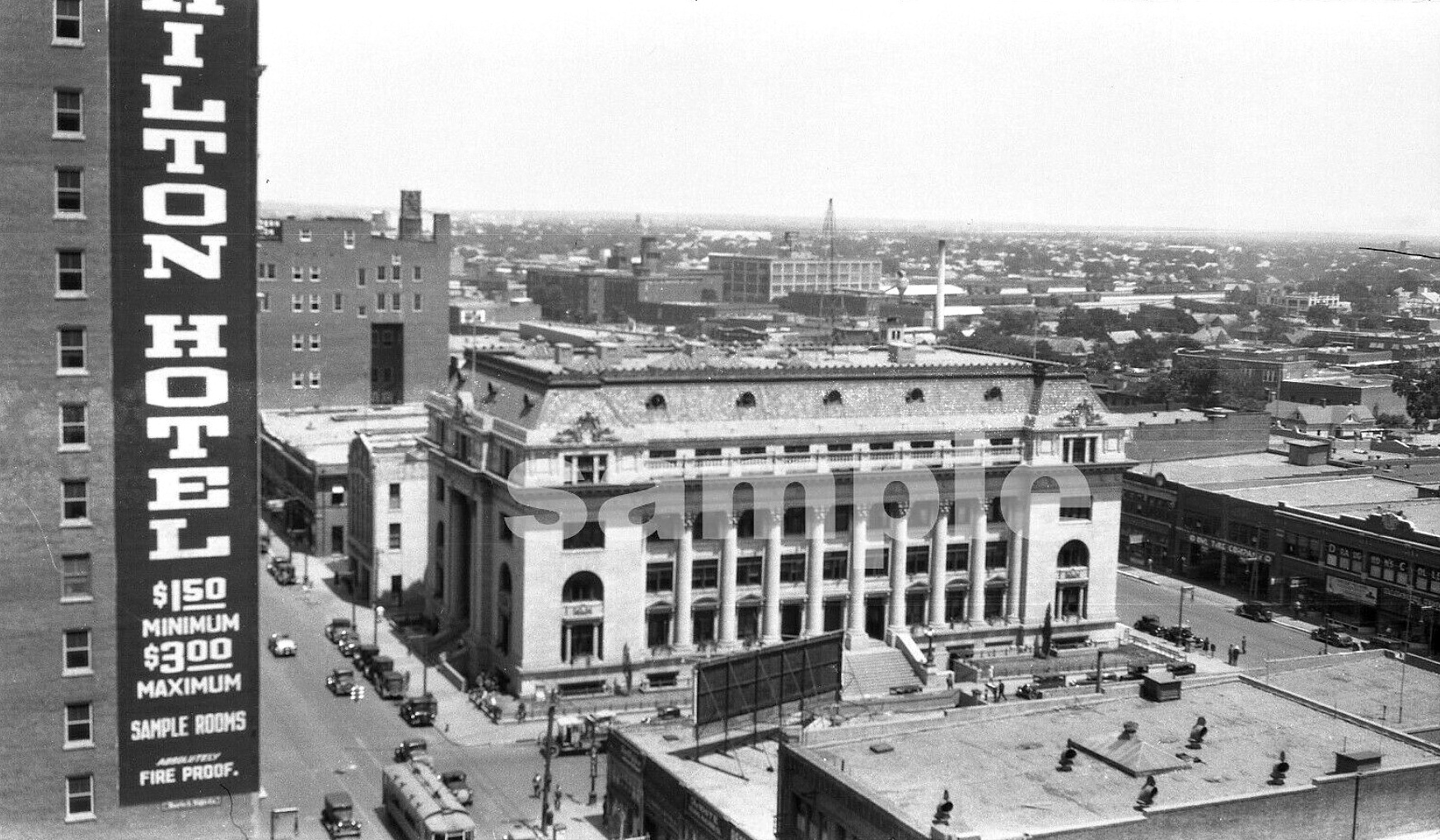
Sometimes I wonder if I’ll ever have the time or energy to write a proper historical post again. I’m still dealing with a lengthy illness of a family member, a situation which has all but taken over my life. Someday I’ll get back to researching and writing. But for now, here’s a really cool photo I came across on eBay a year ago — I’ve never seen this view of the Municipal Building. Or the Hilton. I like this photo so much I’m posting it even though it has a dreaded watermark.
***
Sources & Notes
Photo found on eBay.
To flesh this out a bit, check out these related Flashback Dallas posts:
The G. William Jones Film and Video Collection at SMU is the gift that keeps on giving (see their YouTube channel here). In addition to their vast non-Dallas-history holdings, they are the repository of the WFAA news film archives, which is an incredible collection of local news segments from Channel 8. And now they’ve begun digitizing and uploading film from KERA-Channel 13. There are all sorts of clips posted on the YouTube channel so far — I really, really loved the Blackie Sherrod profile — and I’m not even a sports fan! My guess is that a lot of it comes from the legendary local news show Newsroom, including the one I’m writing about here.
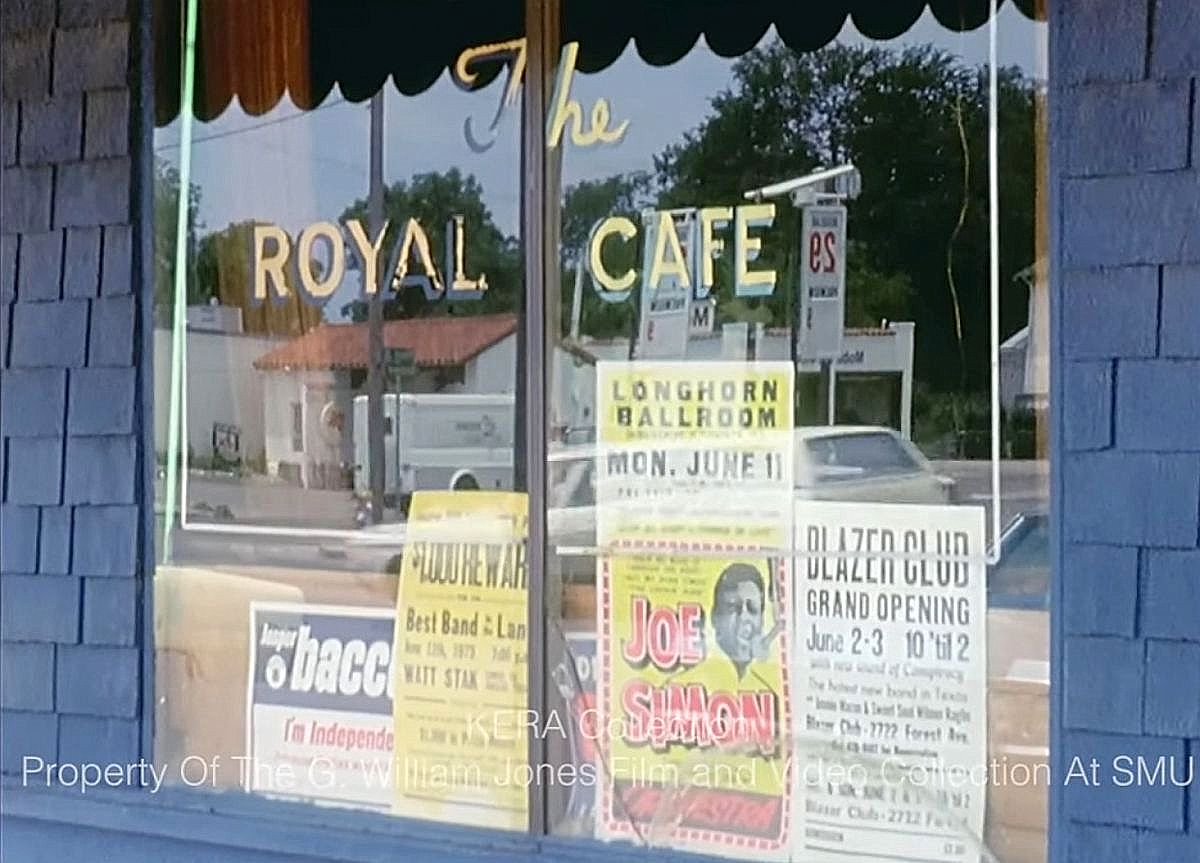
This story from 1973 was about a recent increase in crime in the Black neighborhoods of South Dallas and State-Thomas/Hall Street. Crime stories are pretty much the same decade in and decade out, but this piece is great because of the almost 8 full minutes of footage showing parts of town that the media largely ignored (ignores). I haven’t seen most of these areas as they existed when this piece was shot — many of these buildings don’t exist at all anymore. A couple of these places are “famous,” most are not. But this is just great. (Scroll to the bottom of the post for places and addresses seen in the film.)
*
I was particularly excited to see the exterior of the Ascot Room, which I wrote about in the Flashback Dallas post “1710 Hall: The Rose Room/The Empire Room/The Ascot Room — 1942-1975” — it was an important music club, but I had been unable to find any images of its exterior. Until now! Granted, it’s looking a bit long in the tooth in 1973, but this was so cool to see!
Ascot Room (1710 Hall, at Ross) *
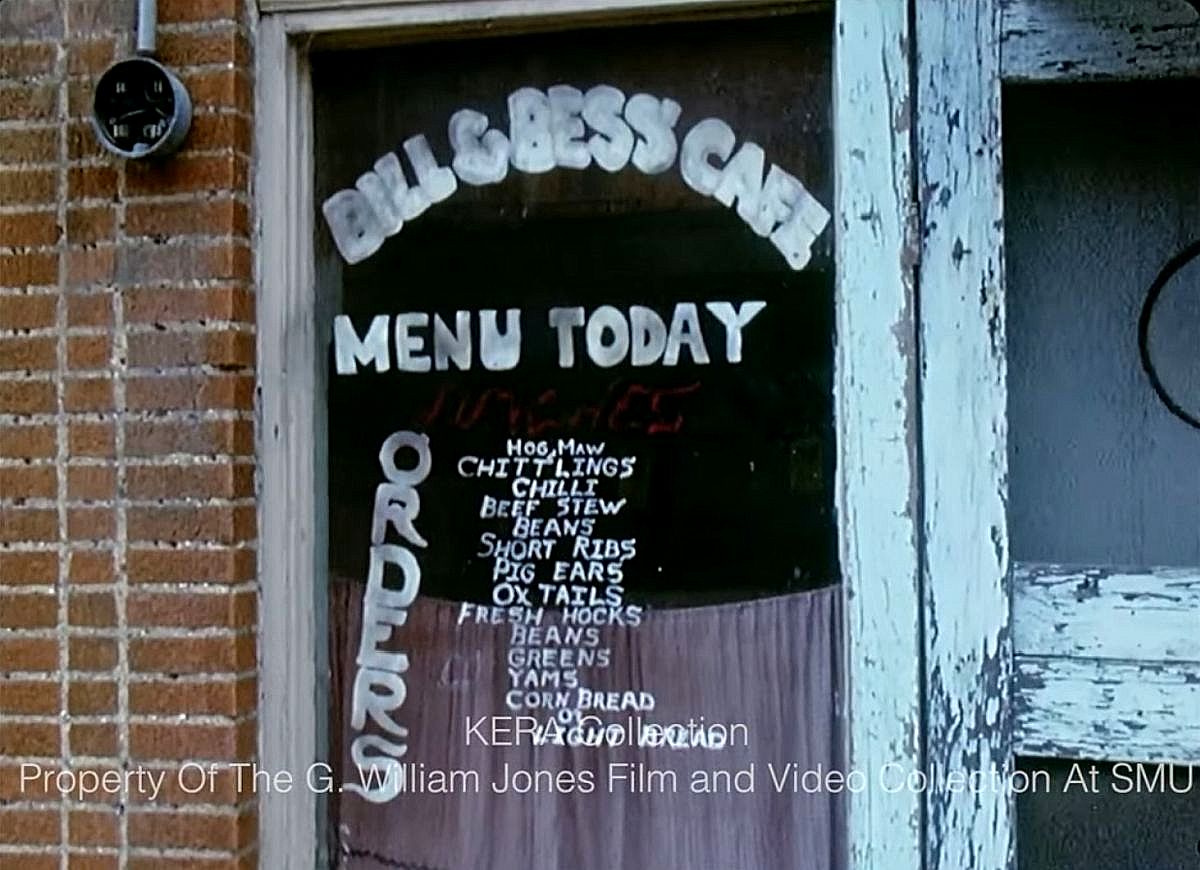
Bill & Bess’ Cafe
*
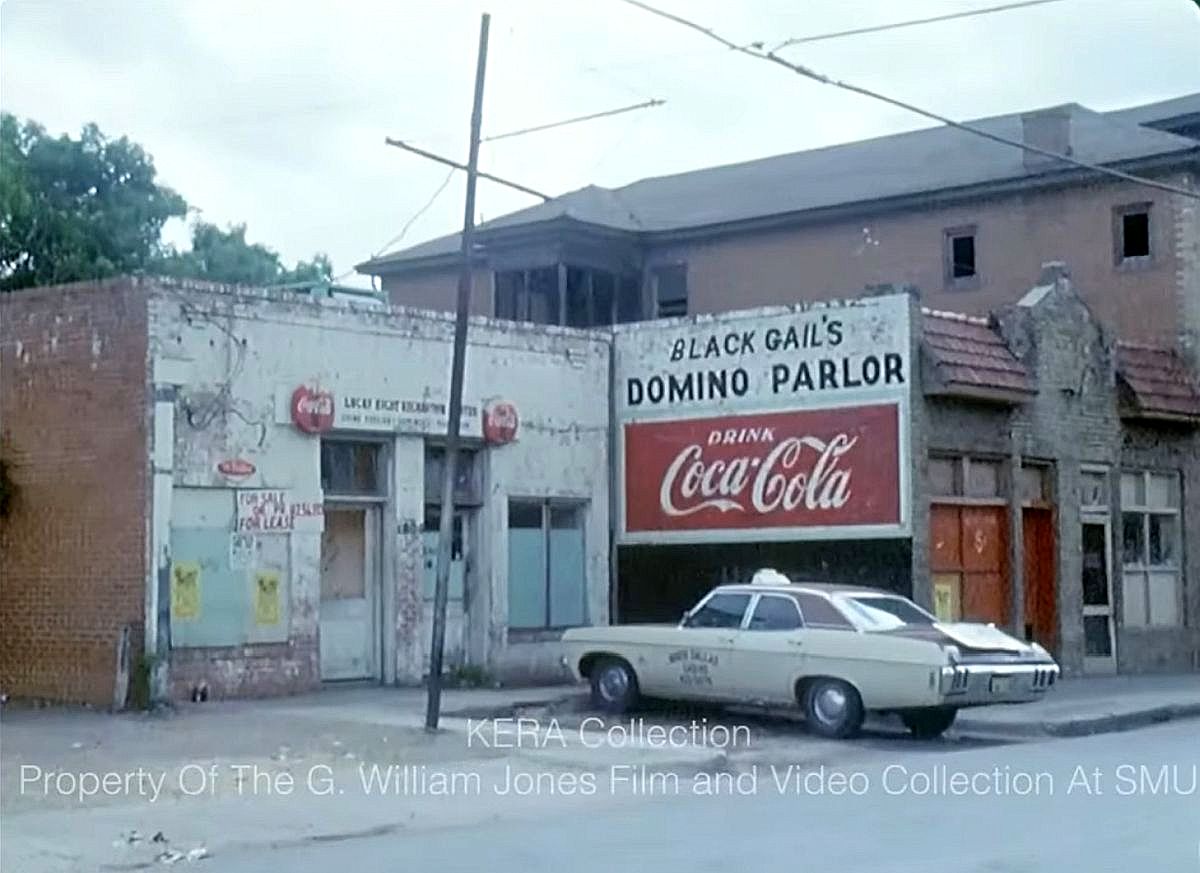
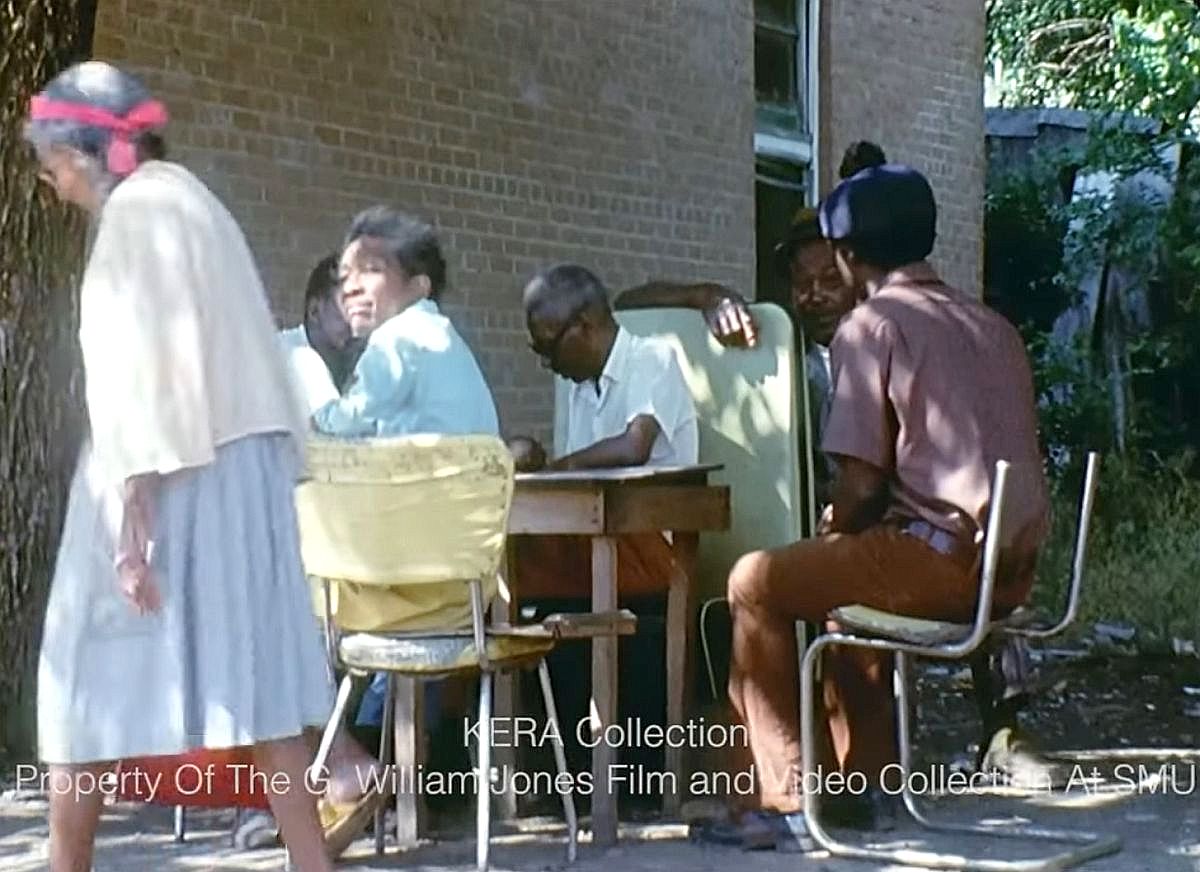
Lucky Eight Recreation Center (1804 Hall); Black Gail’s Domino Parlor
*
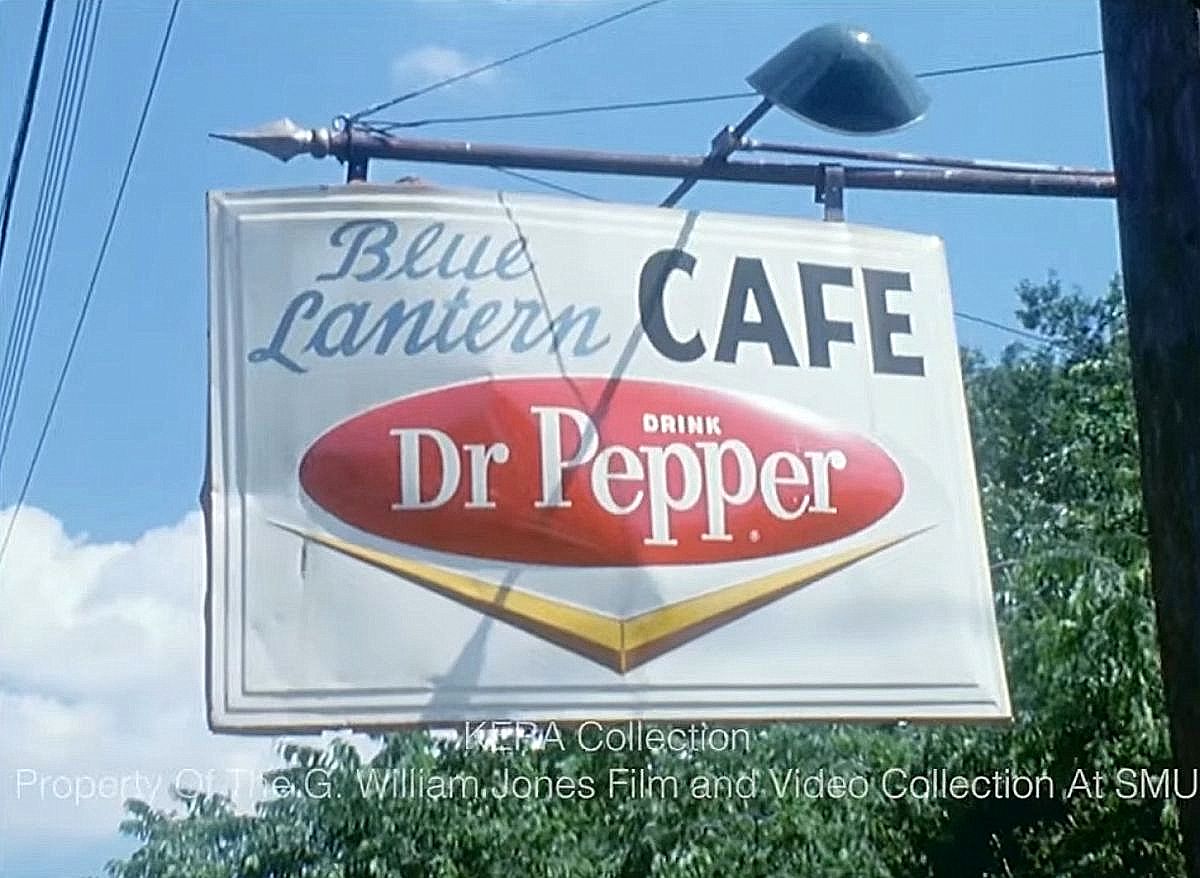
Blue Lantern Cafe (1609 Hall)
*
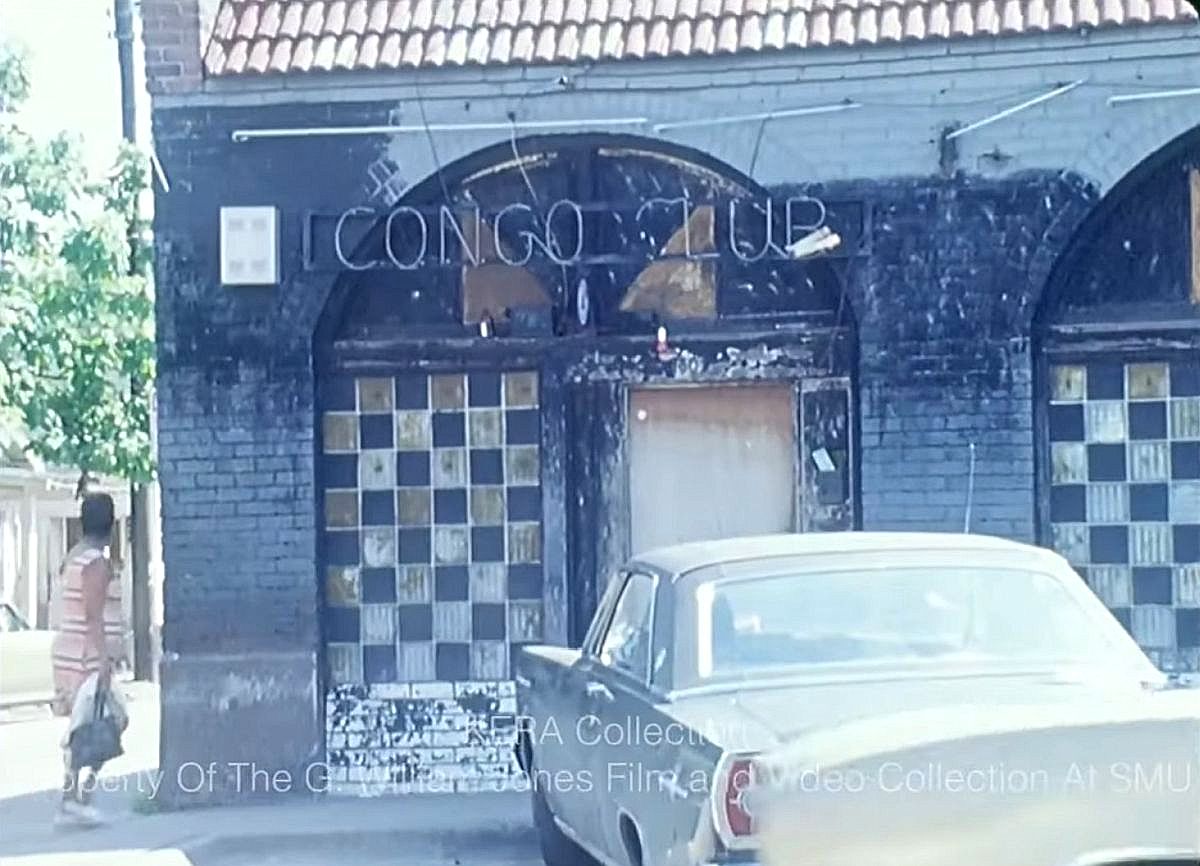
Congo Club (1801 Hall, at Roseland)
*
East Texas Bar-B-Q/East Texan Barbecue (2311 Hall)
*
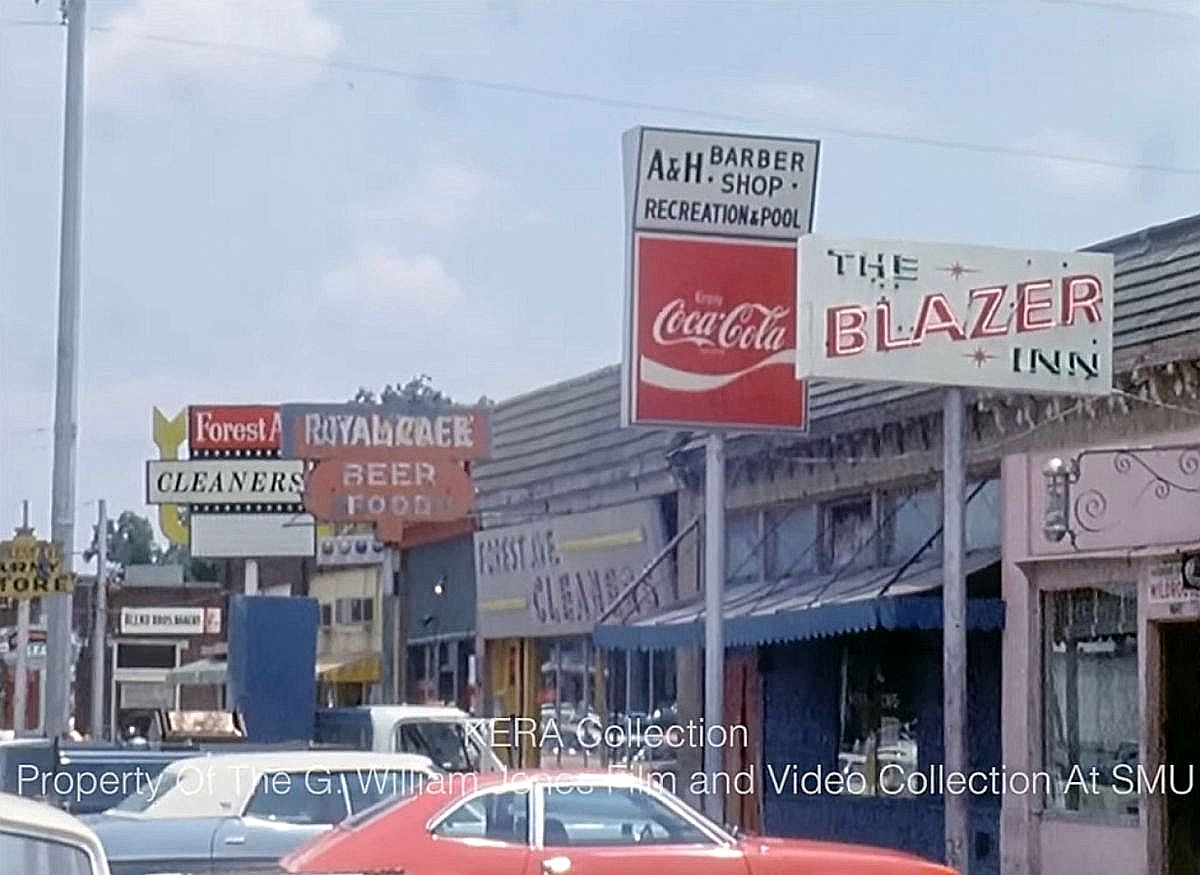
2700 block of Forest Avenue (now Martin Luther King Jr. Blvd.)
*
1700 block of Hall Street, north from Ross
*
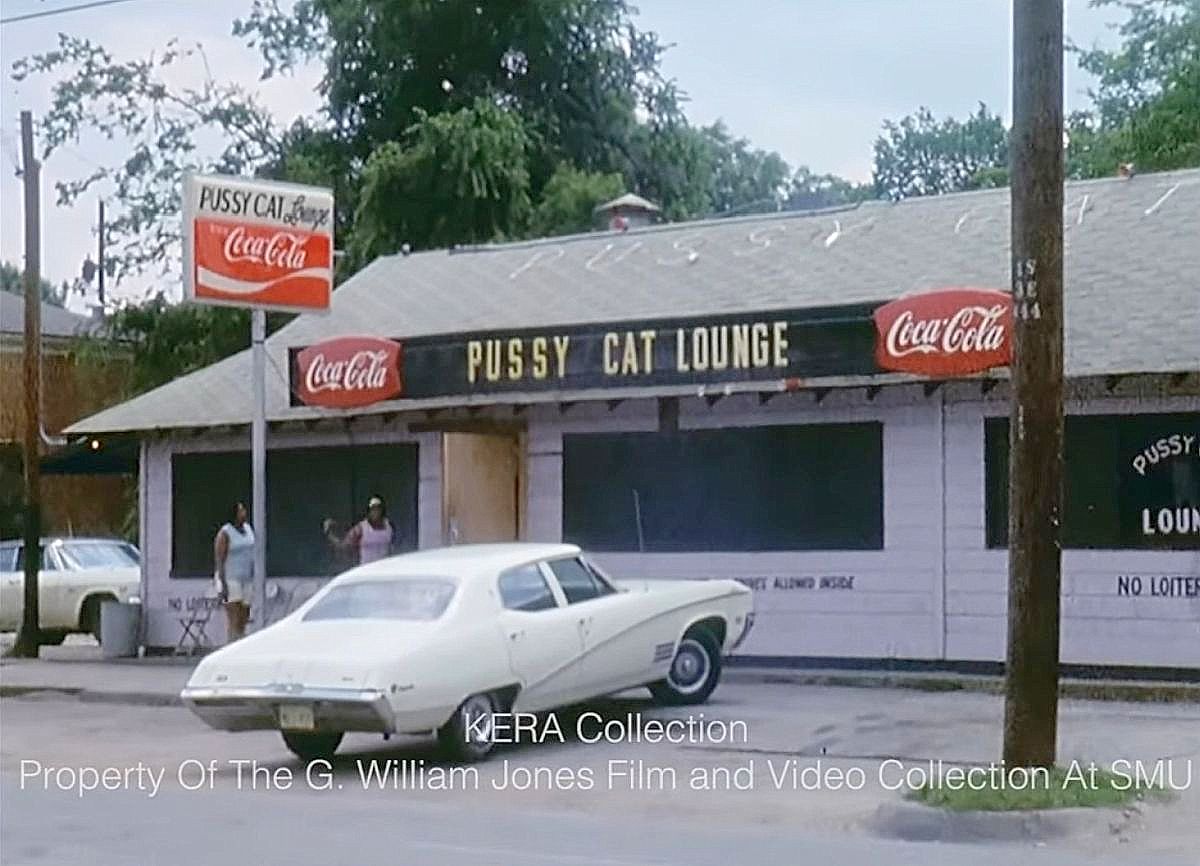
Pussy Cat Lounge (3410 Forest Ave. — now part of Fair Park)
*
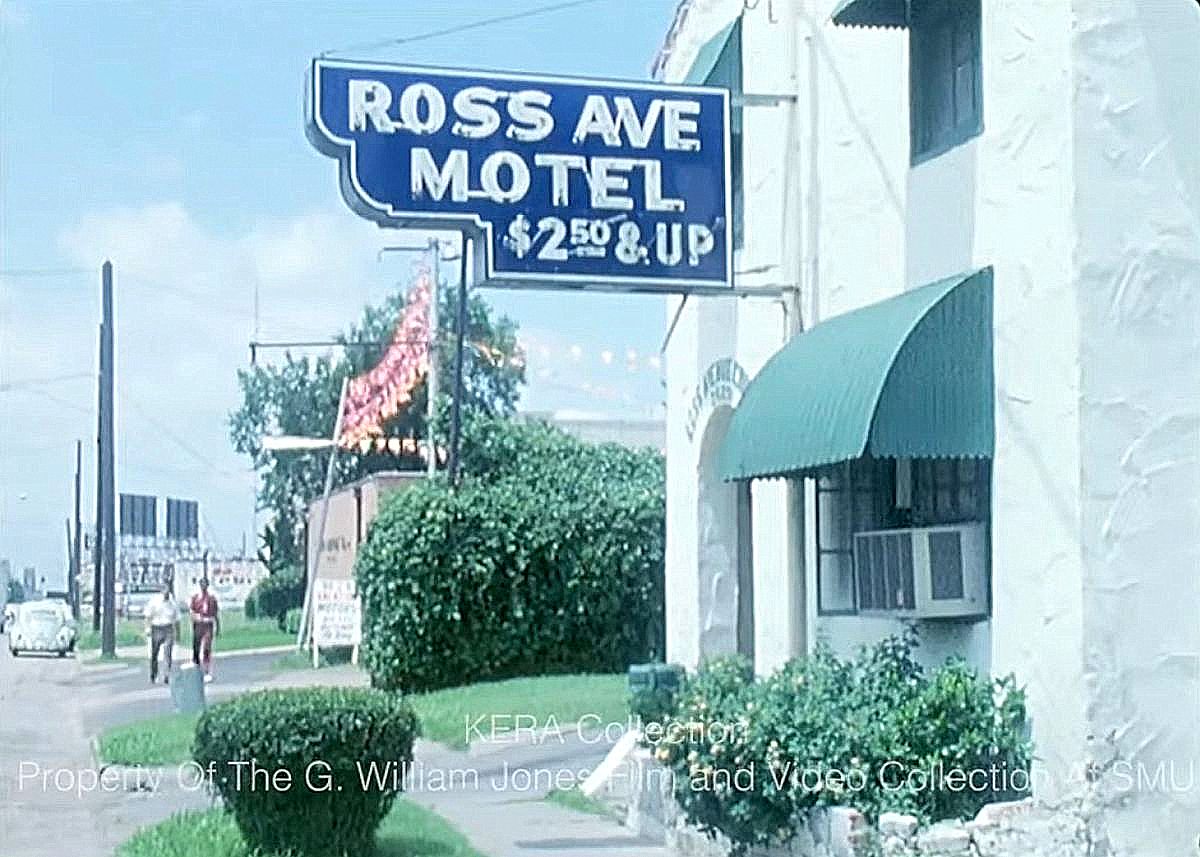
Ross Avenue Motel (3629 Ross) — see what it looked like new here
*
2700 block of South Boulevard
Very cool! Thanks, SMU!
**
Here are some of the places seen in the film, with addresses (if I could find them), in the order they appear (several places make more than one appearance):
Elite Theater (sign): 2720/2722 Forest Ave. (closed; originally the White Theater, which opened in 1934)
Blazer Inn: 2722 Forest (in the old theater)
A & H Barber Shop, Recreation, Pool: 2724 Forest
Royal Cafe: 2726 Forest
Royal Barber Shop: 1813 Hall
Soul Shop
Hall’s Hotel: 1809 1/2 Hall
Corner of Hall & Roseland
Busy Bee Cafe: 1612 Hall
Red Door
Black Gail’s Domino Parlor: 1802 Hall
Congo Club: 1801 Hall (at Roseland)
Ascot Room: 1710 Hall (at Ross)
East Texas Bar-B-Q (listed in directories as East Texan Barbecue): 2311 Hall
Mary’s Place
Bill & Bess’ Cafe
Watson’s Cafeteria: 1715 Hall
Jim’s Liquor: 1713 Hall
Alvacado Inn: 1726 Hall
Stewart Motors: 3509 Ross
Vacation Motors: 3623 Ross
Ross Avenue Motel: 3629 Ross
1600 block of Hall, looking toward Ross
Your Thrift Shop: 1622 Hall (warehouse), 3302 Ross
Forest Avenue Store: 2716-A Forest
Hooper’s Jeweler: 2720 Forest
Front of old Elite Theater, then the Blazer Inn: 2722 Forest
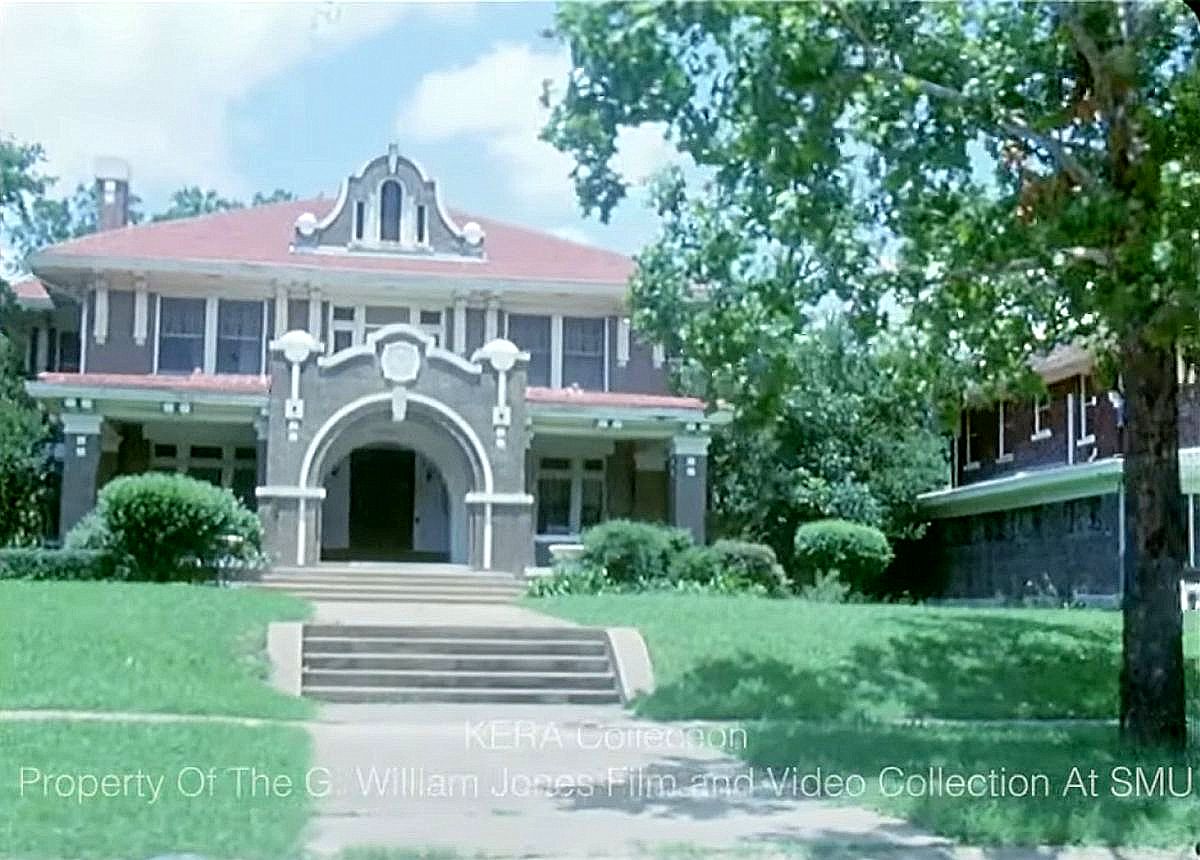
2700 block of South Blvd. shows homes at 2707 South Blvd. and 2711 South Blvd.
Liberty Bail Bond Service: 1611 Hall (Theodore Greer, bondsman)
Blue Lantern Cafe: 1609 Hall
Dallas Police Substation: Bexar and Municipal streets
***
Sources & Notes
All images are screenshots from the YouTube video “KERA Report On Crime In Dallas — June 1973,” from the KERA Collection, G. William Jones Film and Video Collection, Hamon Arts Library, Southern Methodist University.
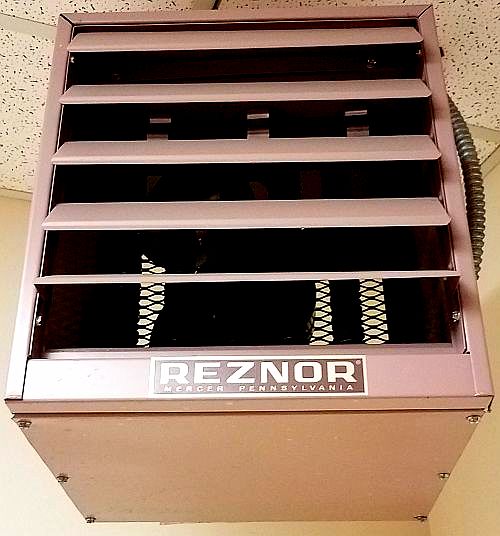
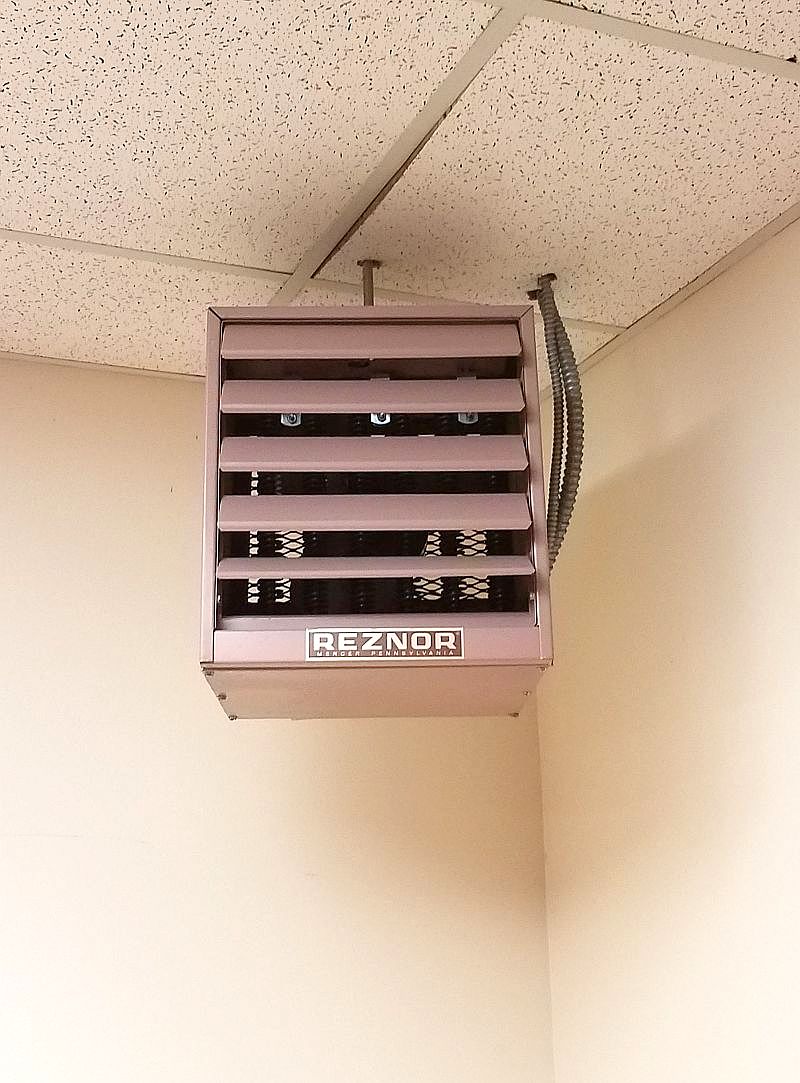
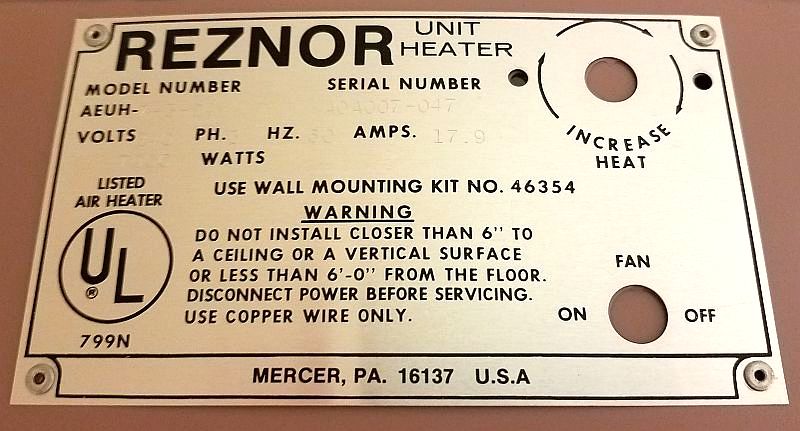
A couple of years ago I was putting in a lot of hours volunteering at the Dallas Historical Society, which, if you don’t know, is housed in the basement of the Hall of State in Fair Park. Whenever I left from the ground-level side exit, I passed this cool-looking pink heater hanging from the ceiling. First — it’s pink. Second — it’s made by a company called “Reznor.” To amuse myself, I named this heater “Vent Reznor” and would say “Hey, Vent” or “Bye, Vent” whenever I’d pass it. And then I looked it up and saw that this company — based in Mercer, Pennsylvania — was, in fact, established by the great-grandfather of Nine Inch Nails founder Trent Reznor, in 1884.
None of this is historical, and only by the greatest stretch of imagination is it related to Dallas history, but it amuses me, and I’m hoping that posting this will exorcise “Head Like a Hole” from my brain, where it keeps playing over and over and over! (Oh — here’s a Dallas connection: one of the best concerts I ever saw was at the Arcadia, where the up-and-coming little band Nine Inch Nails opened for my idols, the Jesus and Mary Chain. Both bands were amazing. …And loud. (NIN was louder.) But only one of them has the sheerest of sheer connections to the Dallas Historical Society. And it isn’t JAMC.)
***
Sources & Notes
Photos by Paula Bosse, taken in May, 2019 in the basement of the Hall of State, outside the offices of the Dallas Historical Society.

 A view of Fair Park not often seen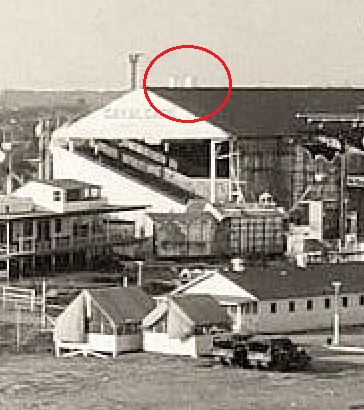



 Bright’s Drug Store, 6327 Hillcrest, University Park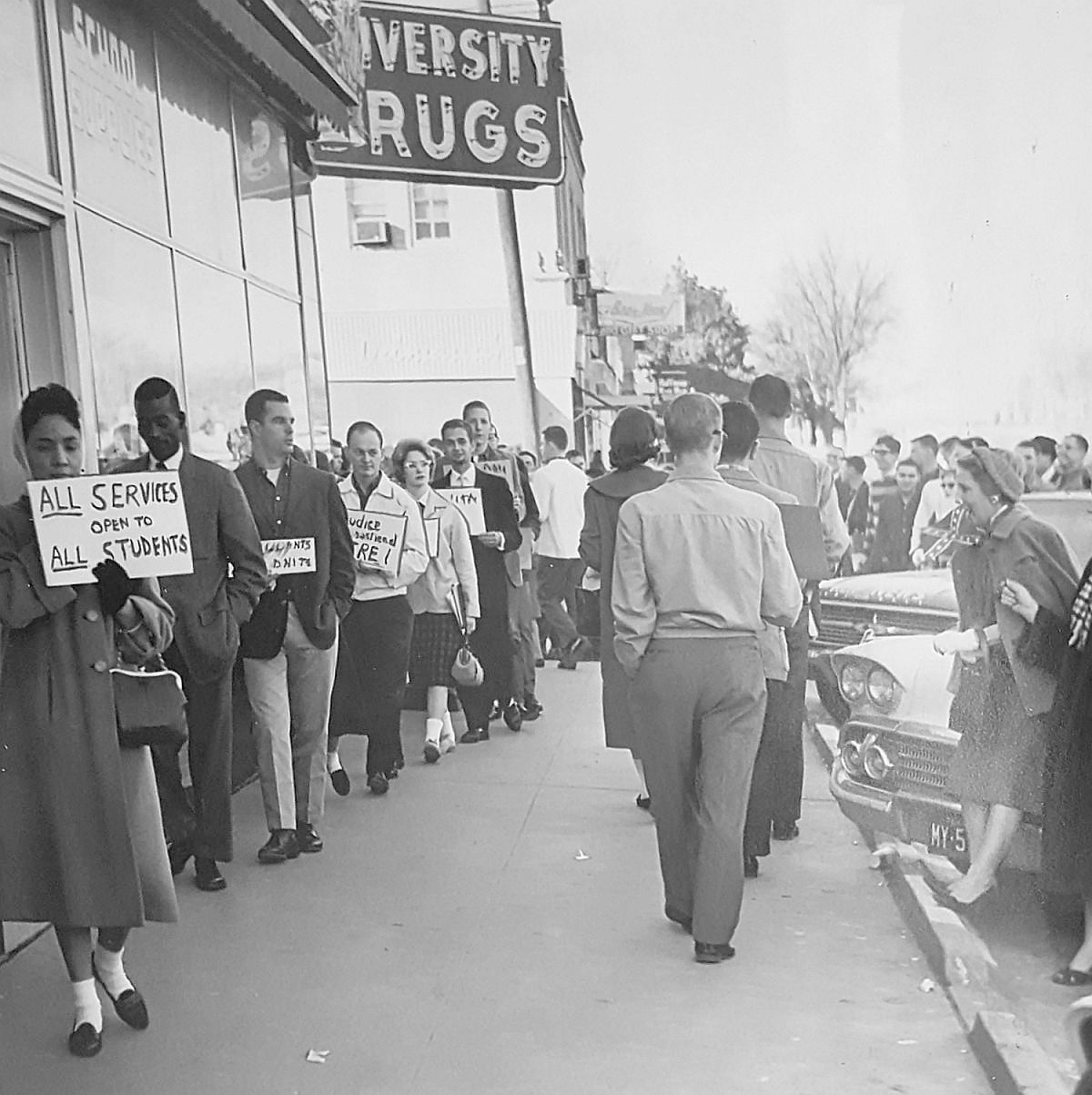
















 Flashback : Dallas