Flashback : Dallas

A Miscellany: History, Ads, Pop Culture

Category: Neighborhoods

Dallas Bookstores — 1974
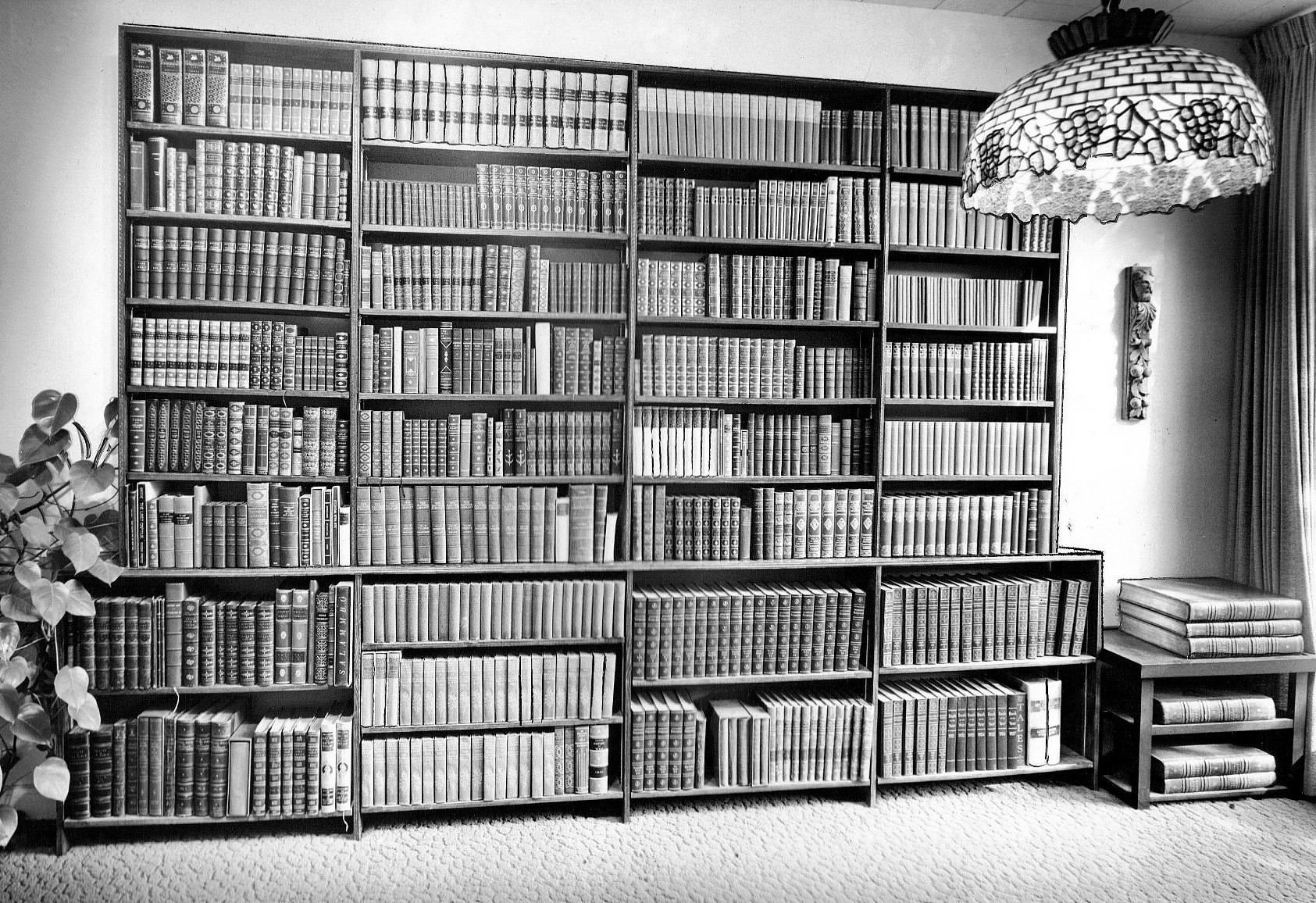
abs_cedar springs_1974Aldredge Book Store, 2506 Cedar Springs

by Paula Bosse

Today is my father’s birthday. Dick Bosse. I always try to post something bookstore-related on May 22 in his honor.

In the early 1970s, the Aldredge Book Store moved from its original location in an old house on McKinney Avenue (2800 McKinney) to a strip of shops on Cedar Springs (2506 Cedar Springs at Fairmount). Later (early ’80s?) it moved to its final location at 2909 Maple Avenue. My father worked there his entire adult life, starting as a bookseller during his SMU days and ending up as the owner of the store which he ran until his death in 2000.

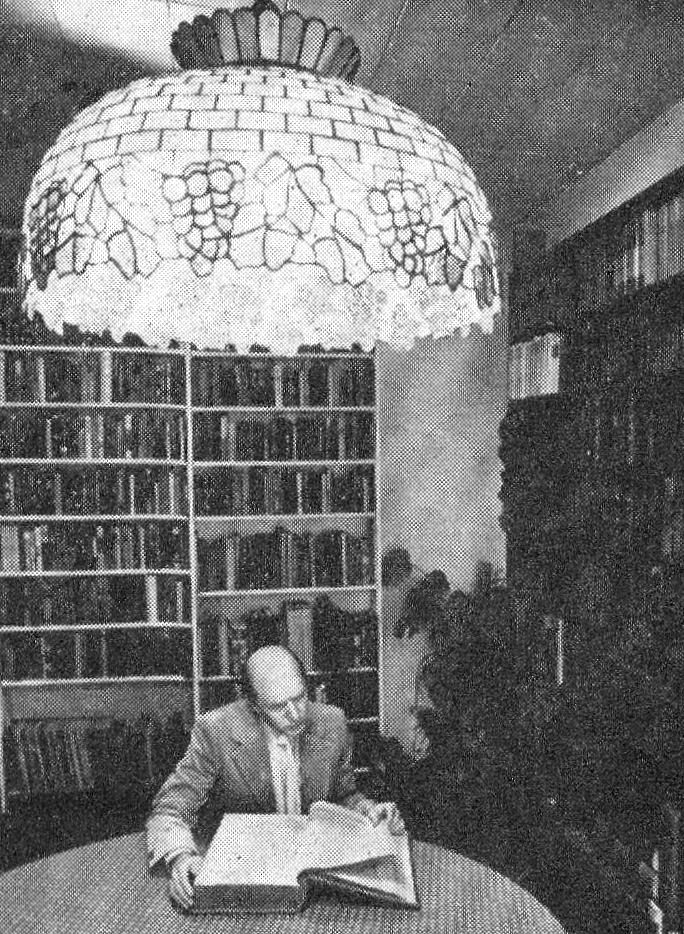
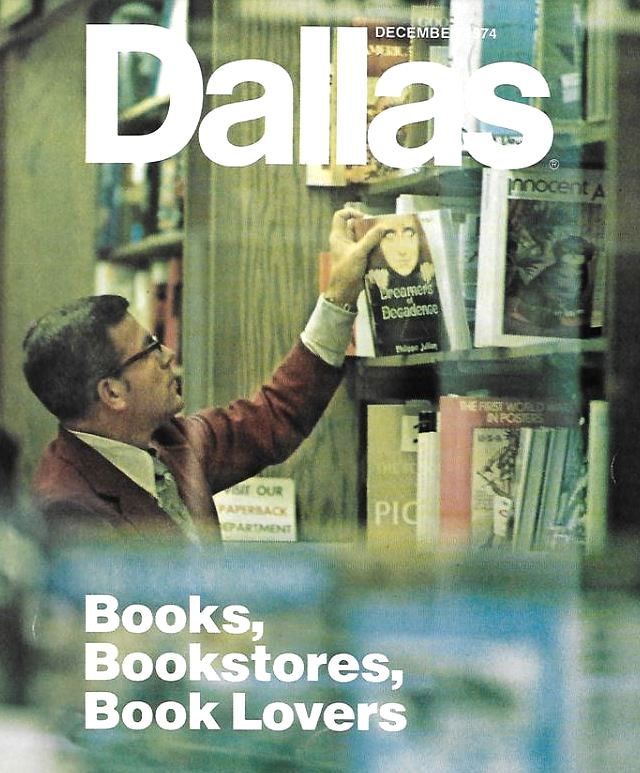
When the store was on Cedar Springs, he was the manager. It was a weird, long, thin store with lots of rooms opening off a hallway painted bright yellow (my retinas!). The most impressive room was the one at the back, where all the expensive books were. A huge window looked out onto a hidden, sunken courtyard. The photo at the top shows one of the walls of bookcases. The photo below shows my father in 1974 in a staged pose looking uncharacteristically serious in that same room — straight ahead of him was the very pretty courtyard (I wonder if it’s still there?).
abs_dick-bosse_dallas-magazine_dec-1974

I spent so much time there that I can still remember where everything was. This was back when that used to be a cool, funky neighborhood. The Quadrangle was nearby, but I always got lost in what felt like a torturous maze of shops. I preferred the Sample House, where I spent as much time as I could. (That store — in a creaky old — house was one of my favorite childhood haunts. Again, I remember where absolutely everything was.)

I stumbled across an ad from 1946 with a photo of the Cedar Springs building in it — at the time it was being “completely reconditioned and restyled” — I’m surprised to learn that that building is so old (see it today on Google Street View here). (I’m not sure what’s going on with that address in the ad, but this building is definitely in the 2500 block of Cedar Springs.)
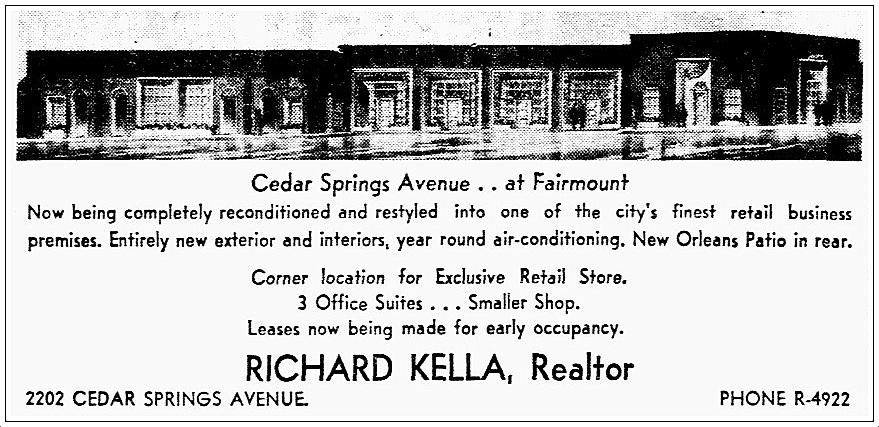
ABS_aldredge_cedar-springs-fairmount_033146March, 1946

*

The reason I know the picture of my father is from 1974 is because it appeared in a Dallas Chamber of Commerce magazine article about Dallas bookstores, published in December, 1974 — the lengthy article was titled “Books, Bookstores, Book Lovers” by Colleen O’Connor, with photos by Jack Caspary. It profiled several of the city’s major booksellers of the day, including Henry Taylor of Preston Books (soon to become Taylor Books/Taylor’s), Ken Gjemre of Half-Price Books (which was then an empire of only four stores), Pat Miers of The Bookseller, Bill Gilliland of Doubleday (late of McMurray’s), and Larry Snyder of Cokesbury. When the article came out, Dallas was “fifth in the country for per capita [book] sales.” So many bookstores!

The author misidentified Sawnie Aldredge, the original owner of the Aldredge Book Store, as “Sonny” and somehow managed to pull some quotes from my father which make him sound like a pretentious snob (which he definitely was NOT), but it’s a great look at a time when Dallas had tons of bookstores — even though my father might not have been overly impressed with some of them when he said, “Unfortunately, the majority of bookstores today are ‘schlock shops’ that sell Snoopy dolls and Rod McKuen” (now that sounds like him!).

I’ve scanned the entire article which you can read here.
dallas-bookstores_dec-1974_cover

***

Sources & Notes

More Flashback Dallas posts on The Aldredge Book Store can be found here.

*

Copyright © 2020 Paula Bosse. All Rights Reserved.
Texlite, Borich, Pegasus

texlite_feb-1949_ad_pegasus-det

by Paula Bosse

Texlite. If you’re a lover of all-things-Dallas, you should know that name. Texlite made many, many, many, many, MANY enamel, electric, and neon signs, including, most famously, the rotating Flying Red Horse — Pegasus — which arrived in Dallas in 1934 to sit atop the city’s tallest building, the Magnolia Petroleum Building, serving as a beacon, a landmark, and as a sort of city mascot.

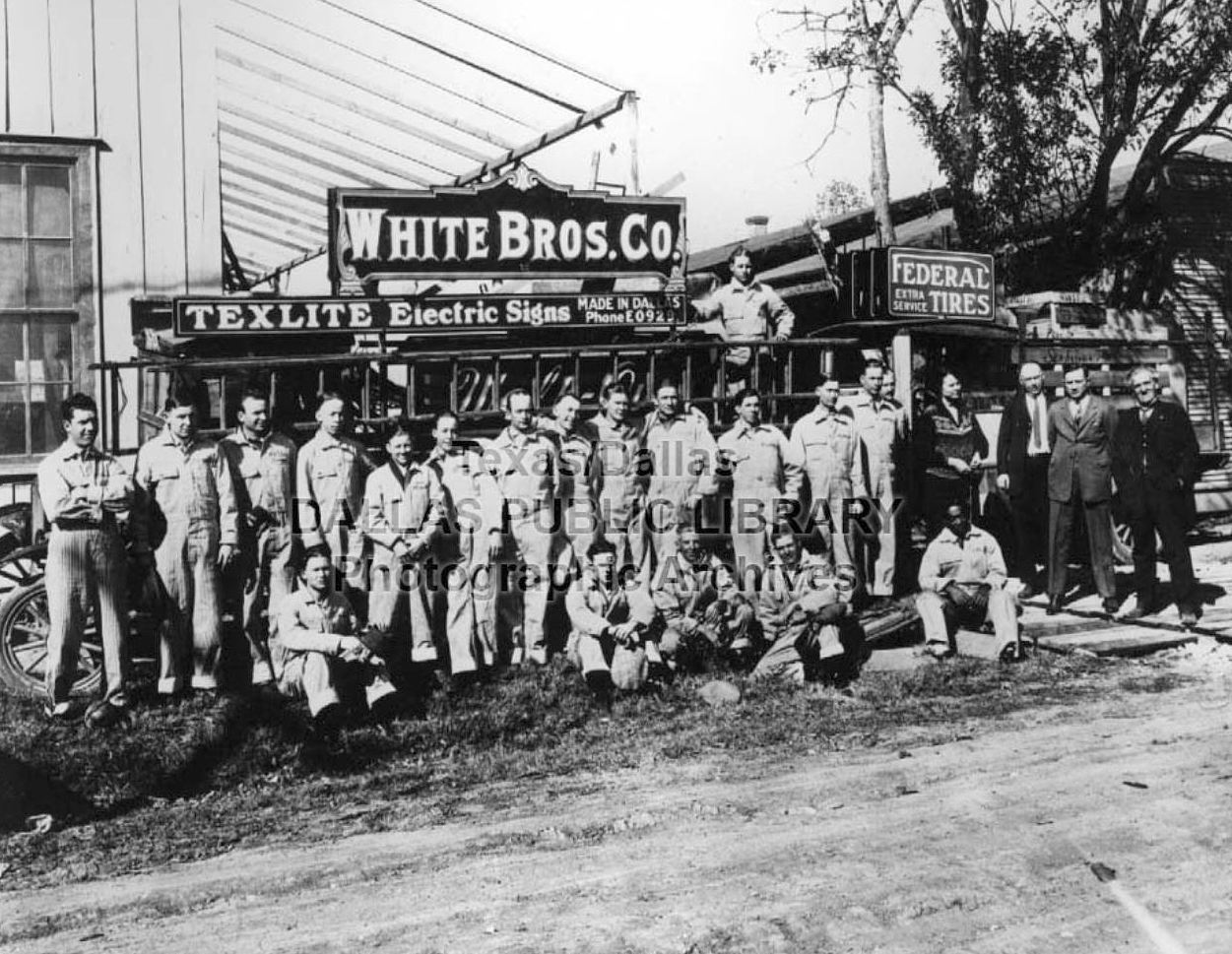
Texlite’s  roots went back to 1879 when Italian immigrant Peter Samuel Borich (1849-1932) arrived in Dallas. His obituary noted that he was a graduate of the Royal Italian Naval School and that he served in the Italian Merchant Marine before he arrived in Dallas, where he established the Borich Sign Co. A very early location of his shop is said to have been on the current site of the Magnolia Building (and Pegasus), on Sycamore Street (now Akard). (See the post “19th-Century Sign-Painting and Real-Estating” for more about this location.) He appears to have been the go-to sign-painter for decades and was a very successful businessman.

The Borich company eventually branched out (and eventually became Texlite, a separate entitity) to become a pioneer in electric and neon signs: in 1926 Texlite built and sold the first neon sign west of the Mississippi, in St. Louis (their first neon sign in Dallas was a sign for the Zinke shoe repair store (1809 Main) which depicted an animated hammer tapping on a shoe heel). 

The Borich sign company focused on painted or printed signs while Texlite handled the electric signs. P. S. Borich retired in the 1920s and moved to Los Angeles after the death of his wife. The last time the Borich company name appeared in the Dallas directory was 1930 (when it looks like it became United Advertising Corporation of Texas, owned by Harold H. Wineburgh, who was also a Texlite partner/owner). 

During World War II, Texlite, like many manufacturers, jumped into war-production work, making airplane and ship parts; during the Korean War they made bomber fuselages. 

I don’t know when Texlite went out of business (or was acquired and merged into another company). As successful as Texlite was (and it was incredibly successful), what more important achievement could it have had than to have been the maker of our iconic Pegasus? 

*

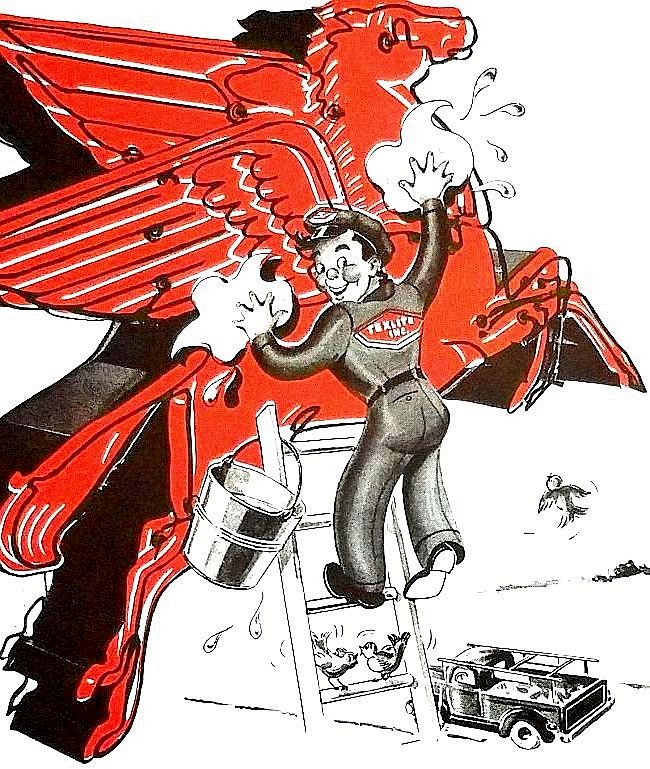
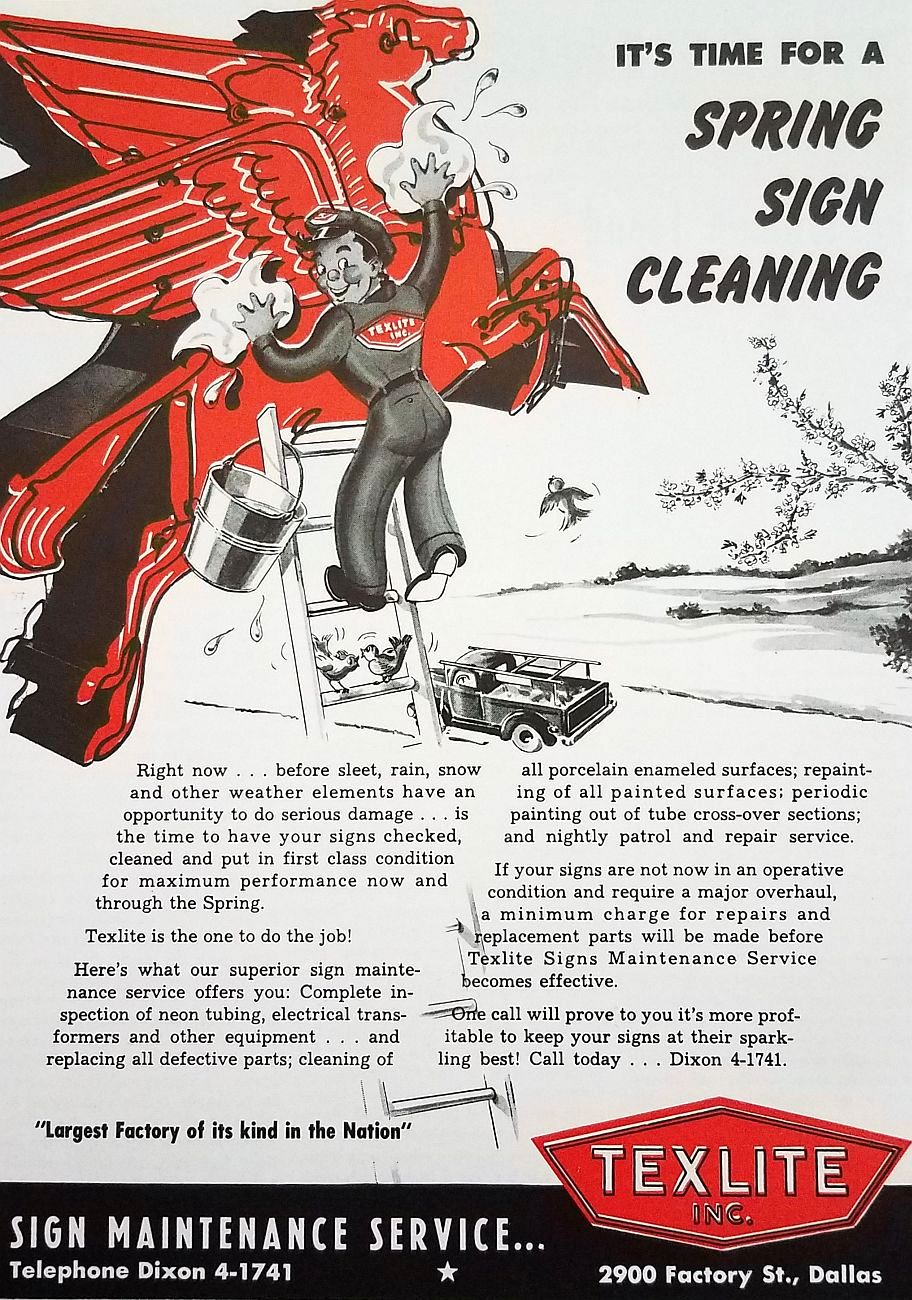
Here are a few random images from the Borich/Texlite history. First, a great ad from 1949, when Pegasus was a fresh 15-year-old. “It’s Time For a Spring Sign Cleaning.” (Click to see a larger image.)

texlite_feb-1949-ad1949 ad

And another ad, this one with a wonderful photo, from 1954.

texlite_pegasus_ad_ca-1954_heather-david_flickr1954 ad, via Flickr

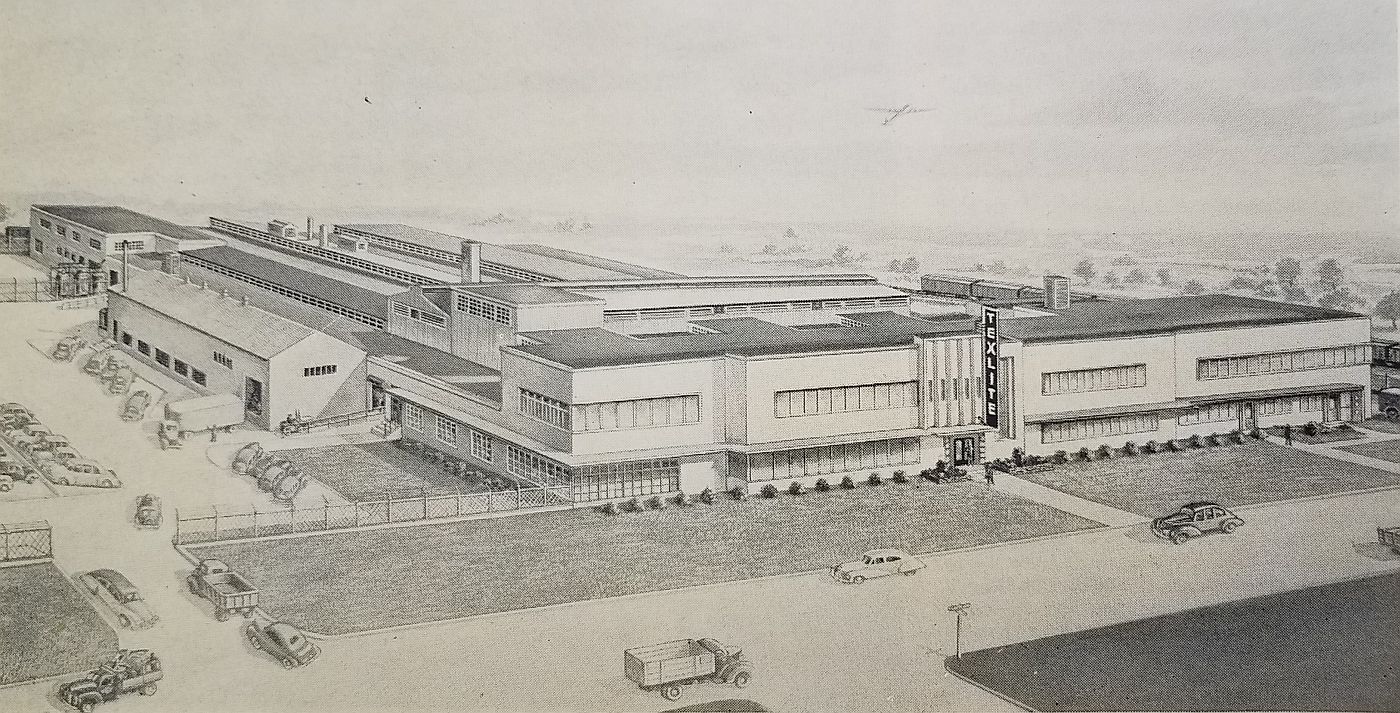
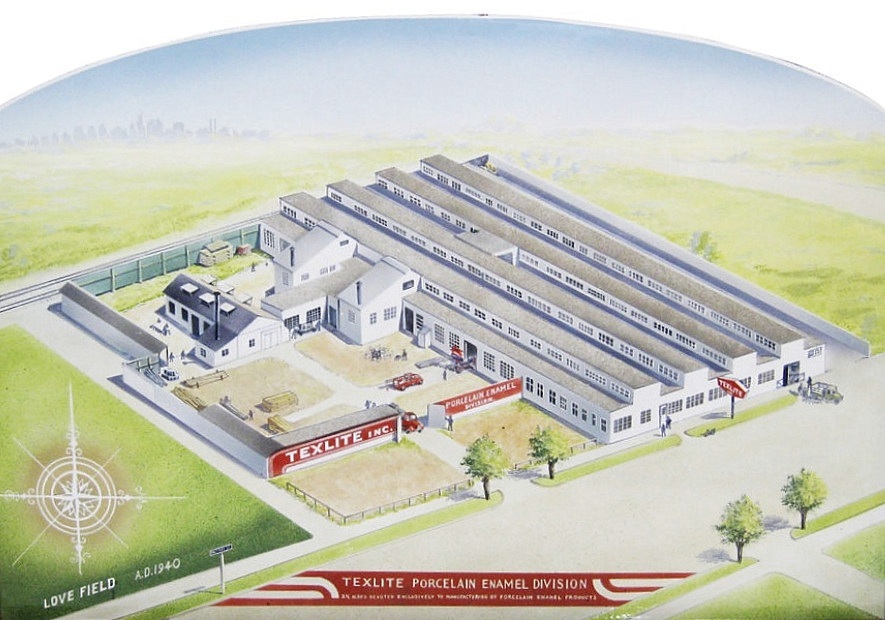
In 1949 Texlite built a huge new factory in an industrial area near Love Field, at 3305 Manor Way. Below is the architectural rendering. The caption: “New home of Texlite, Inc. is being completed at 3305 Manor Way at a total of $1,000,000. The new, two-story plant, providing 114,000 square feet of factory and office space, will provide facilities for trebling Texlite’s output. Grayson Gill is the architect, and O’Rourke Construction Company are the general contractors.” (Dallas magazine, Feb. 1949)

texlite-new-bldg_dallas-chamber-of-commerce-mag_feb-1949

Below, the previous factory, located at 2900 Factory Street, also near Love Field:

texlite-sign_1940

I assume this 1940 sign was made by Texlite. Below are a couple of details, showing playful hints of Pegasus.

texlite-sign_1940_det-1

texlite-sign_1940_det-2via Mecum Auctions

I wondered where Factory Street was — here it is on a 1952 map — it looks like it was absorbed into a growing Love Field.

texlite_factory-st_mapsco-19521952 Mapsco

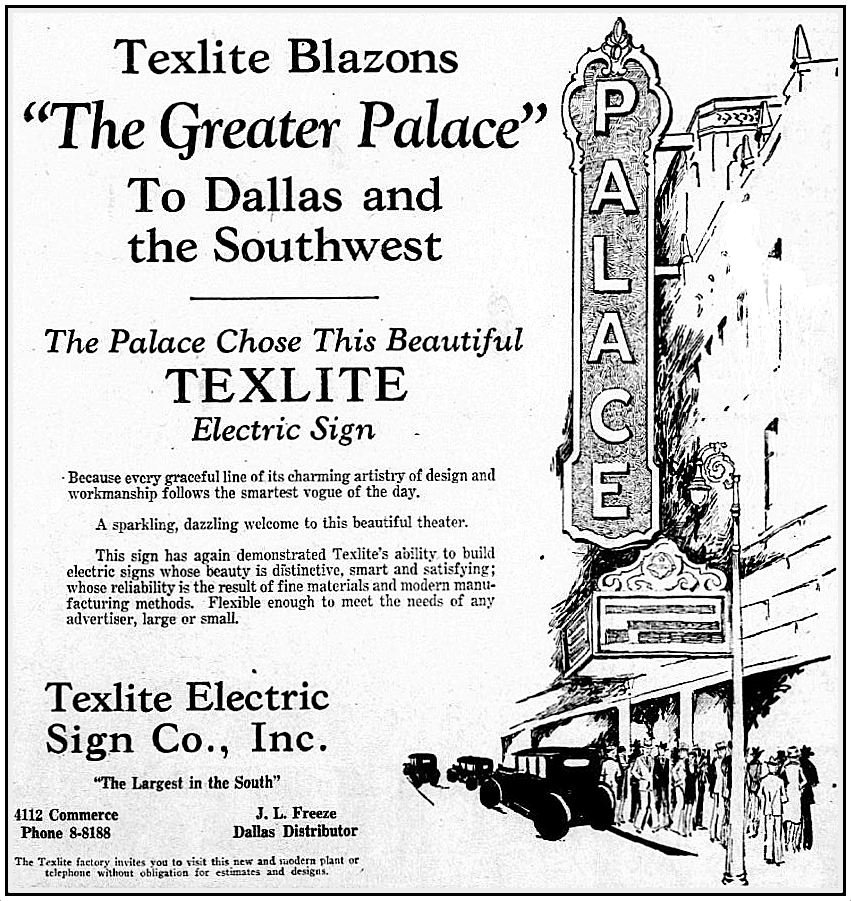
One of Texlite’s many theater clients was the Palace Theatre for whom they designed and installed a new electric sign in January, 1929 (at which time, by the way, the theater’s name was “officially” changed — however briefly — to the Greater Palace; the theater was renovated and enlarged, with a new emphasis on the Elm Street entrance rather than the entrance on Pacific). 

texlite_palace_jan-1929Jan., 1929

Going back a couple of years, with the separate companies sharing ad space in the 1927 city directory:

borich-texlite_dallas-directory_19271927 Dallas directory

And a photo of the Texlite building circa 1930:

texlite_DPL_ca-1930Dallas Public Library

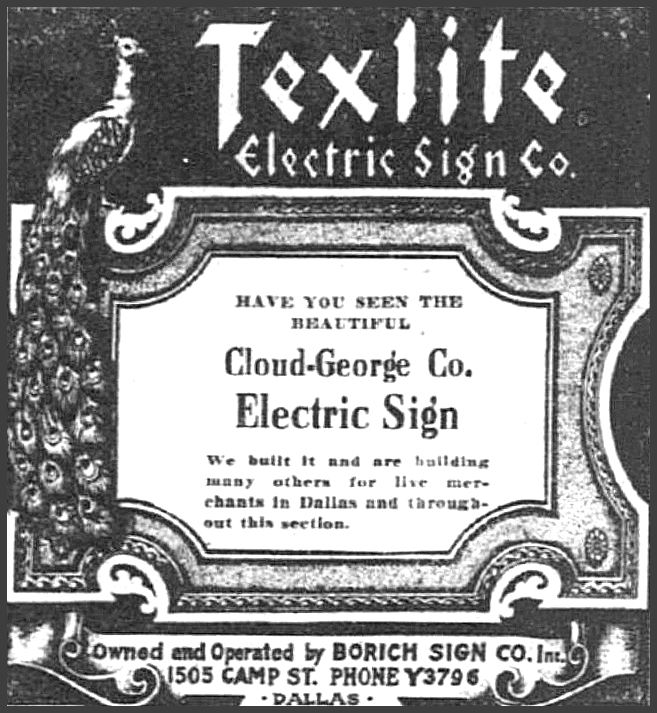
The first ad I found which had both the “Borich” and “Texlite” names together was this one from 1923 for the Cloud-George Co., a women’s clothing boutique (1705 Elm) run by the somewhat notorious Miss A. B. Cloud.

texlite_borich-sign_sept-1923Sept., 1923

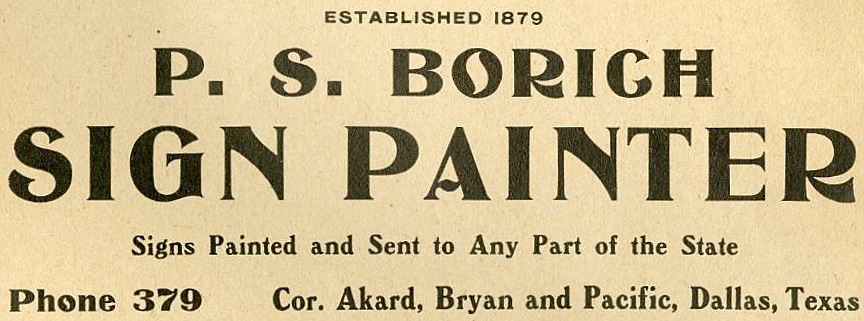
The company occupied several locations over the years — the location in 1902 can be seen here, at the right, looking west on Pacific (from the Flashback Dallas post “Views from a Passing Train — 1902”).

edmunds_pacific-bryan_free-lib-phil_19021902, via Free Library of Philadelphia

borich_dallas-directory_1902Dallas directory, 1902

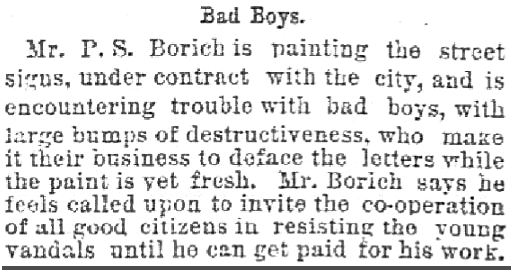
P. S. Borich’s sign-painting wasn’t restricted only to businesses — he was also regularly retained by the city to paint street signs.

borich_dmn_080686Dallas Herald, Aug. 6, 1886

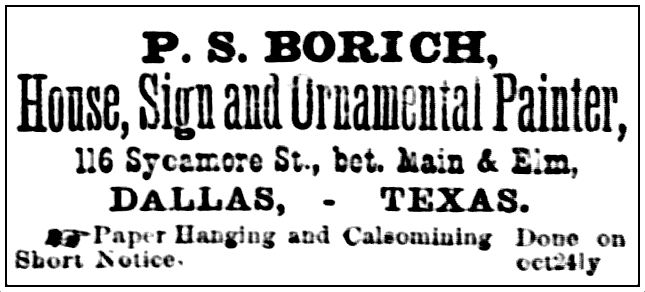
And, below, the earliest ad I could find — from 1879, the year Borich arrived in Dallas. (Thanks to this ad, I can now add “calsomining” to my vocabulary.)

borich_nortons-union-intelligencer_110179Norton’s Union Intelligencer, Nov. 1, 1879

**

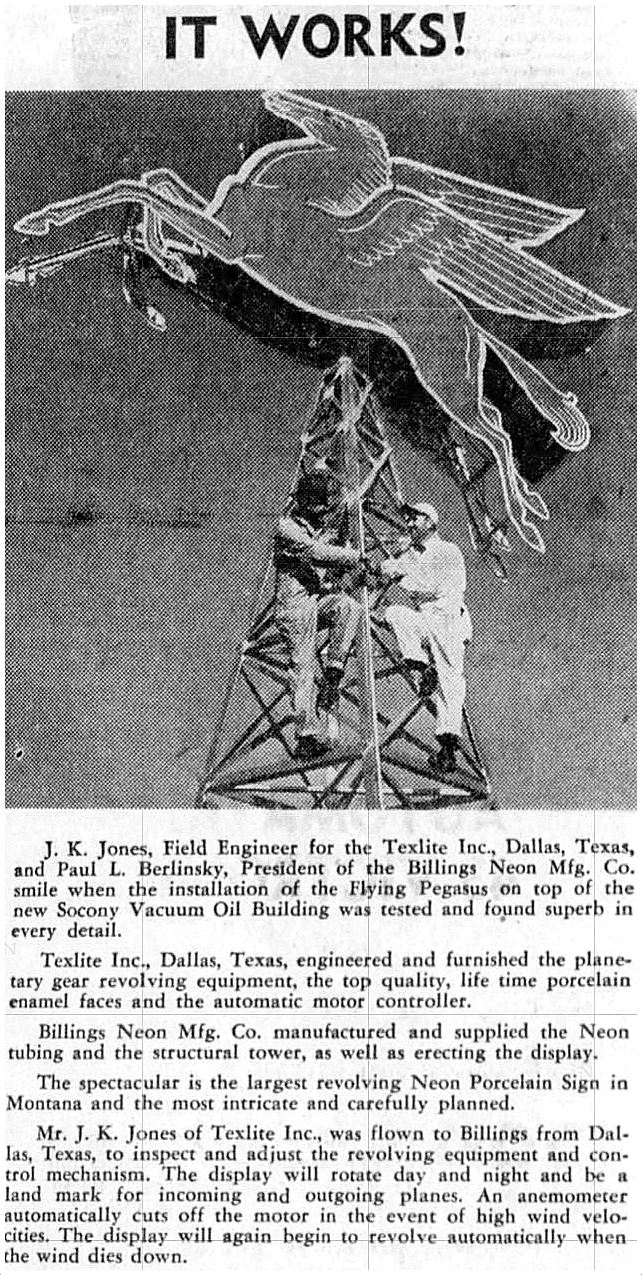
Here’s an interesting little bonus: a Pegasus “mini-me” in Billings, Montana, created with help from the Pegasus experts in Dallas (click for larger image).

texlite_pegasus-in-montana_billings-MT-gazette_052255Billings Gazette, May 22, 1955

***

Sources & Notes

Top image is a detail from a 1949 ad found in the Feb., 1949 issue of Dallas, the magazine published by the Dallas Chamber of Commerce.

Photo showing the exterior of the Texlite building circa 1930 is from the collection of the Dallas Public Library, Call Number PA87-1/19-59-36.

Check out another Texlite sign which I wrote about in the Flashback Dallas post “Neon Refreshment: The Giant Dr Pepper Sign.”

I’m always excited to see places I write about show up in old film footage. Watch a short (20-second) silent clip of Texlite workers striking in June, 1951 at the 3305 Manor Way location in WBAP-Channel 5 footage here (the workers were on strike in a wage dispute — more info is in the news script here); film and script from the KXAS-NBC 5 News Collection, University of North Texas, via the Portal to Texas History.

The company made tons of signs and exteriors for movie theaters around the country, including the Lakewood Theater (whose sign was recently re-neonized!).

Thank you, Signor Borich!

texlite_feb-1949_ad_pegasus-det-sm

*

Copyright © 2020 Paula Bosse. All Rights Reserved.
Highland Park’s Azaleas

azaleas_turtle-creek_spring_swb-phone-book_1968_ebaySpringtime in Dallas…

by Paula Bosse

I just realized I haven’t seen the azaleas this year. I don’t really hear about people doing it anymore, but when I was a kid, my mother always made a point every Spring to drive us around Highland Park, Exall Lake, and Turtle Creek to see the beautiful azaleas, which were in bloom everywhere you looked.

Local lore has it that the first big splash azaleas made in Dallas were in the early 1930s when Joe Lambert, Jr. (of the still-going-strong, 100-plus-year-old legendary Lambert’s Landscape Co.) imported 100 or more plants from Shreveport to Dallas — to the home of Mr. and Mrs. Walter W. Lechner in the 6900 block of Lakewood Boulevard. Azaleas apparently don’t grow well in Dallas soil unless you know what you’re doing, and Lambert knew what he was doing, because his azaleas thrived in Lakewood, and they were a huge hit with people who would drive from miles away to look at the exotic blooms.

That success led to numerous calls from residents of Highland Park, which, in turn, led to lots and lots of landscaping work for the Lambert family — so much so that they moved their business from Shreveport to Dallas.

Of particular note was the estate of Mr. and Mrs. Fred Penn at the corner of Preston and Armstrong where azalea bushes were planted terrace-like to prevent soil erosion on the part of their property which sloped down to the banks of Turtle Creek. One newspaper report said there were more than 500 azalea bushes on the Penn estate. It caused a sensation — the plants began to pop up all around Turtle Creek, and people flocked to Highland Park to see them.

In a 1971 newspaper article it was estimated there were 50,000 azaleas in Dallas parks. I have no idea what the number is these days, but for two weeks every year, it is an absolute pleasure to drive around Highland Park and Oak Lawn — and every other part of town where azaleas bloom — and to enjoy Dallas’ brief, very pretty springtime.

**

A Channel 5 news story from 1979 (which you can watch here) says that azaleas was first brought to Dallas by the La Reunion settlers, which would have been in the 1850s. The earliest mention I could find was in an 1886 ad in The Dallas Morning News — there were several other ads before the turn of the century offering the exotic “imported” plants for sale.

azaleas_dmn_031386
March, 1886

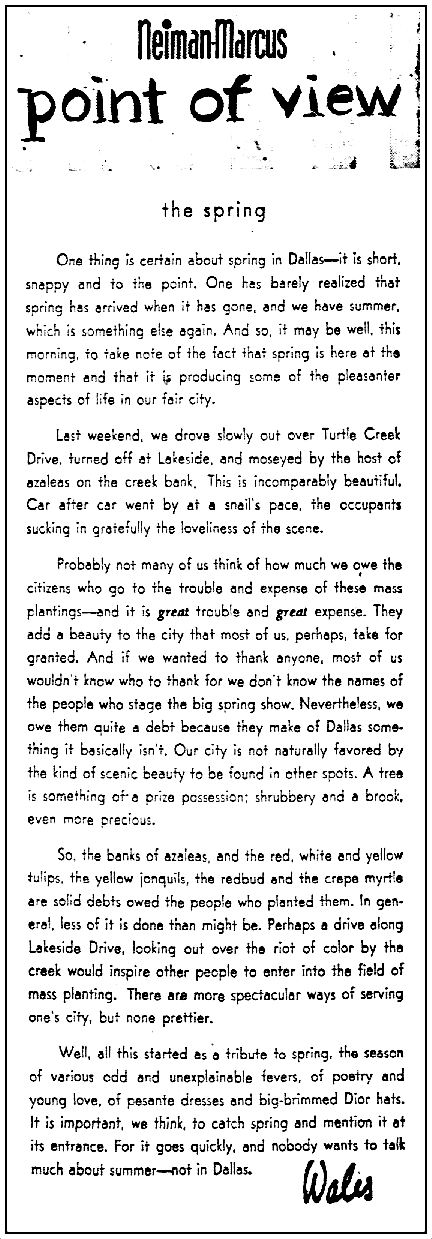
In the 1950s there was an explosion of interest in people heading to Lakeside Drive every spring in order to commune with nature and gaze lovingly at the profusion of azaleas. I mean, lordy, read this breathless ode to the azalea in this detail of a Neiman-Marcus ad. (These little essays by “Wales” appeared regularly in N-M ads — I always suspected they were written by Stanley Marcus,  but “Wales” was apparently Warren Leslie, a Neiman’s executive and spokesperson who later wrote the controversial book Dallas Public and Private.) (Click for larger image.)

azaleas_032753_neiman-ad-det
March, 1953

And here’s evidence of the bumper-to-bumper traffic along Lakeside Drive and the mass of humanity armed with cameras converging on the banks of Turtle Creek in (silent) footage from Channel 8, shot on April 10, 1960 (it seems almost criminal, though, that the film is in black and white!) — the pertinent clip begins at the :43 mark. (From the WFAA Newsfilm Collection, G. William Jones Collection, Hamon Library, SMU.)


*

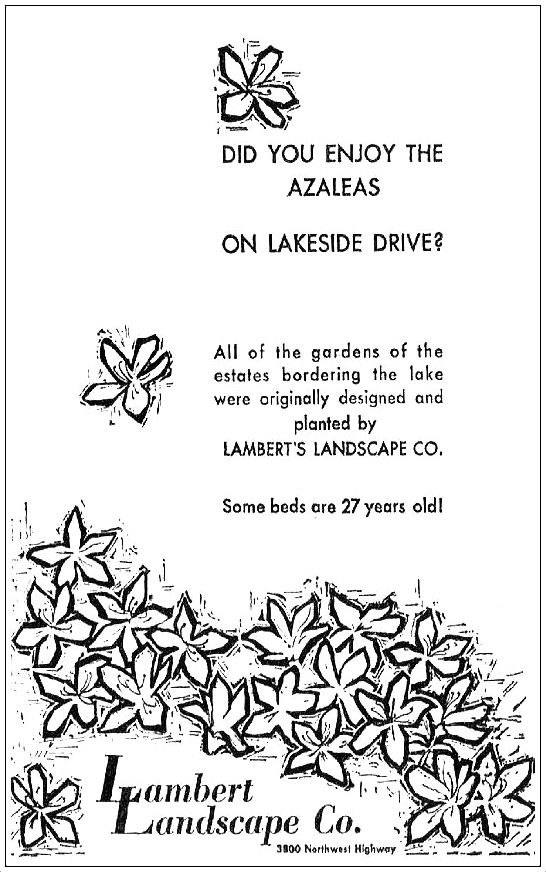
Here’s a Lambert’s ad, from 1963:

azaleas_041763_lamberts-ad
April, 1963

Another WFAA clip, this one from 1972, which shows azaleas in COLOR — not in Highland Park, but in downtown Dallas during the 3rd annual Azalea Festival:


*

Here’s a postcard view:

turtle-creek_azaleas_ebay

And here’s a photo I took a couple of years ago of my favorite searingly hot-pink variety (seen here before the peak of the blooming period — note the still bloomless bush to the right):

azaleas_turtle-creek_2018_paula-bosse

Sorry I missed you, azaleas. Next year, for sure.

***

Sources & Notes

Top photo is from the cover of Southwestern Bell’s 1968 Dallas phone book.

Bottom photo by Paula Bosse, taken March 29, 2018.

azaleas_turtle-creek_spring_swb-phone-book_1968_ebay_sm

*

Copyright © 2020 Paula Bosse. All Rights Reserved.


“Guys and Dolls” at the State Fair Music Hall — 1951

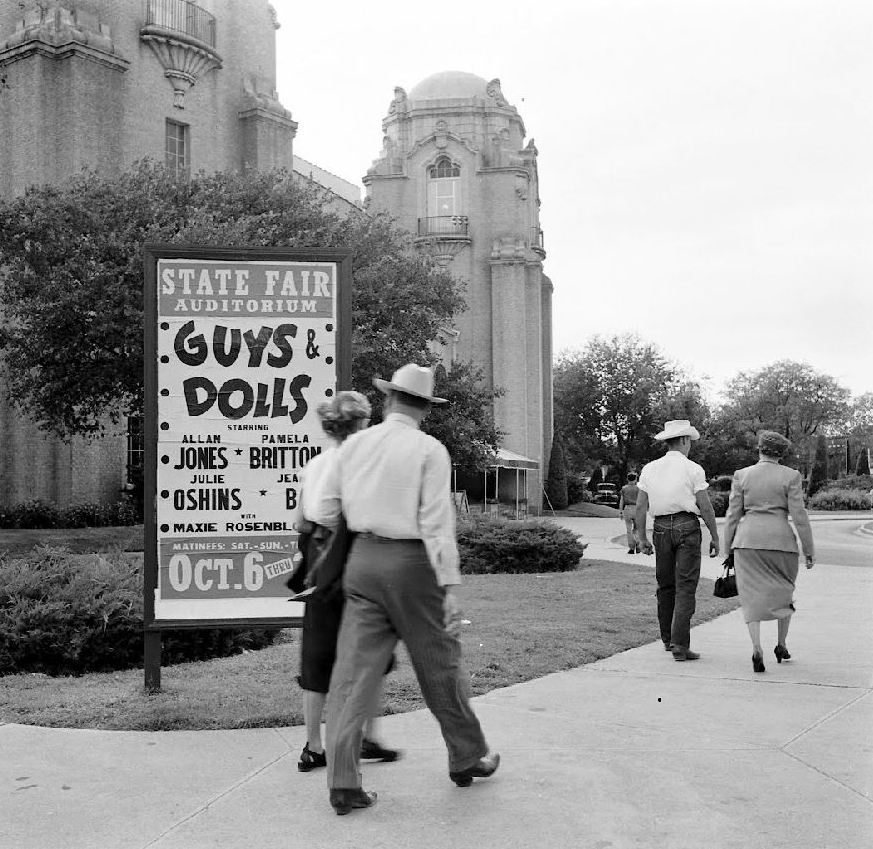
sfot_guys-and-dolls_music-hall_1951_john-dominis_life-mag
Wearing the *dress* boots… (photo: John Dominis, © Time, Inc.)

by Paula Bosse

This is the most Texans-going-to-the-theater photo I’ve ever seen.

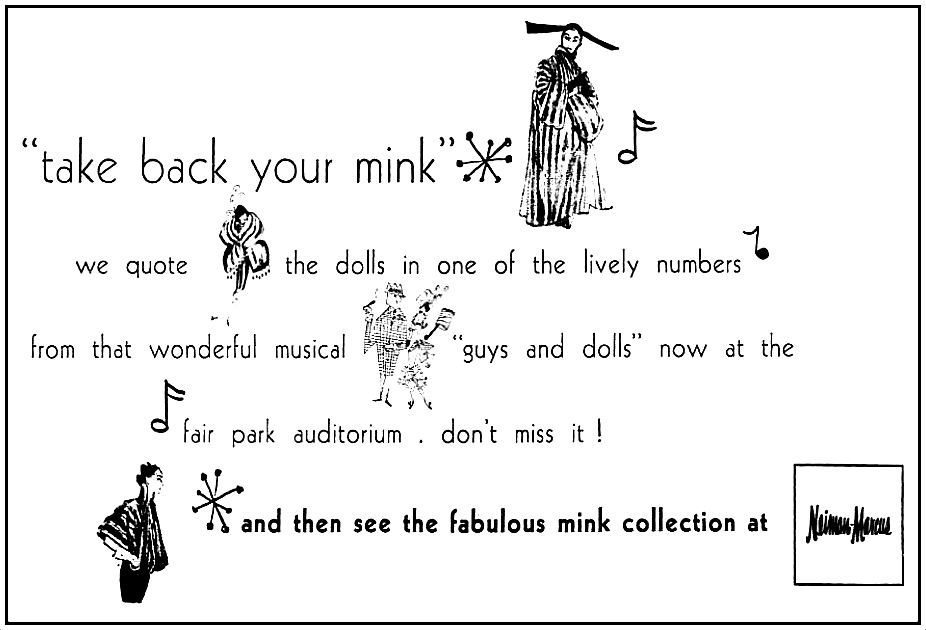
And this is the most Texans-selling-minks ad I’ve ever seen:

neiman-marcus_ad_guys-and-dolls_oct-1951

***

Sources and Notes

Photo by John Dominis, taken in October, 1951 on assignment for Life magazine, ©Time, Inc.; more info is here.

Neiman-Marcus ad is also from October, 1951.

“Take Back Your Mink” is a song from “Guys and Dolls” (hear it here), the musical that played during the 1951 State Fair of Texas, starring Pamela Britton, Allan Jones, Jeanne Ball, and Slapsie  Maxie Rosenbloom.

sfot_guys-and-dolls_music-hall_1951_john-dominis_life-mag_sm

*

Copyright © 2020 Paula Bosse. All Rights Reserved.
The Southland Center: Mid-Century Cool — 1959

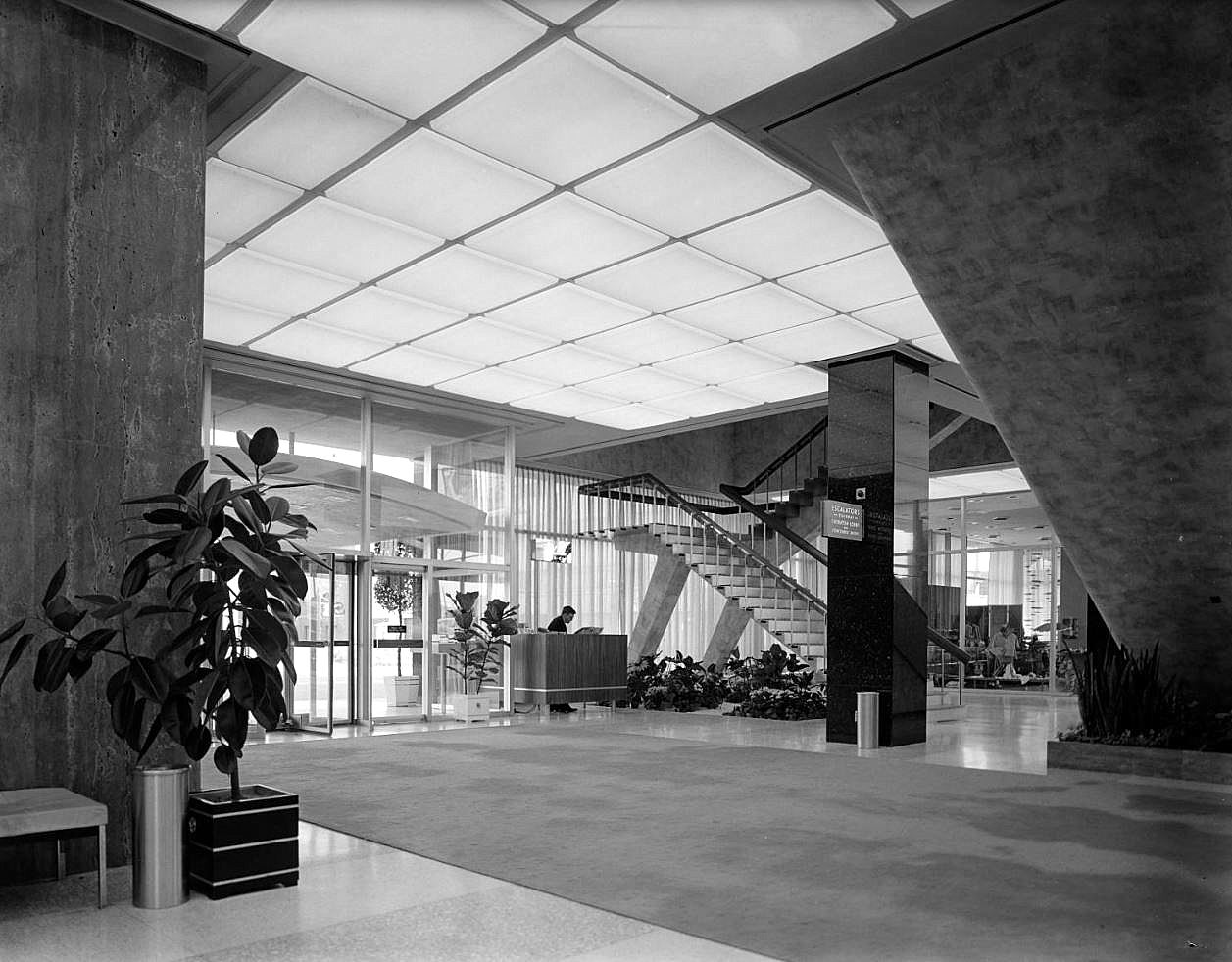
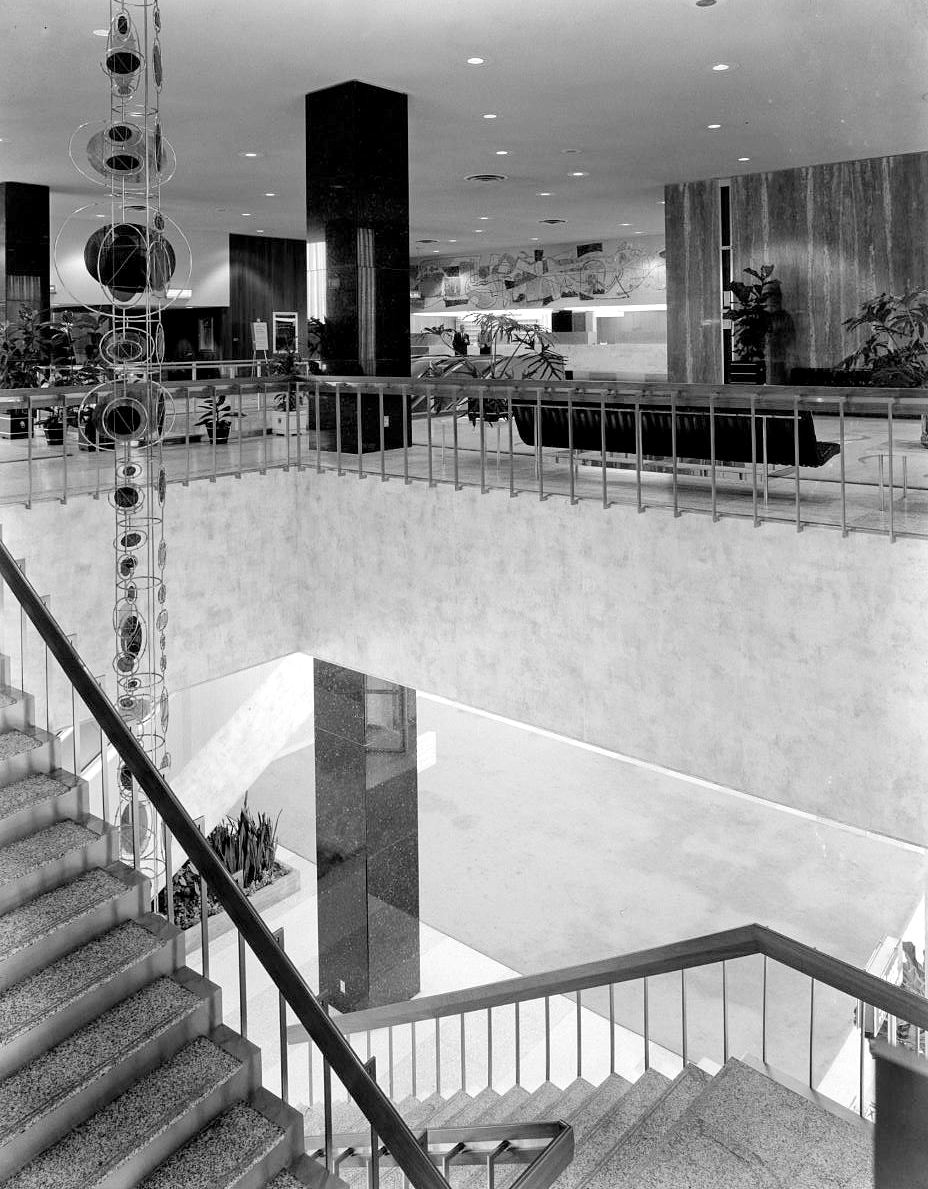
southland-ctr_john-rogers_1959-60_portal_interior-lobby_stairsWelcome.… (photo by John Rogers, via the Portal to Texas History)

by Paula Bosse

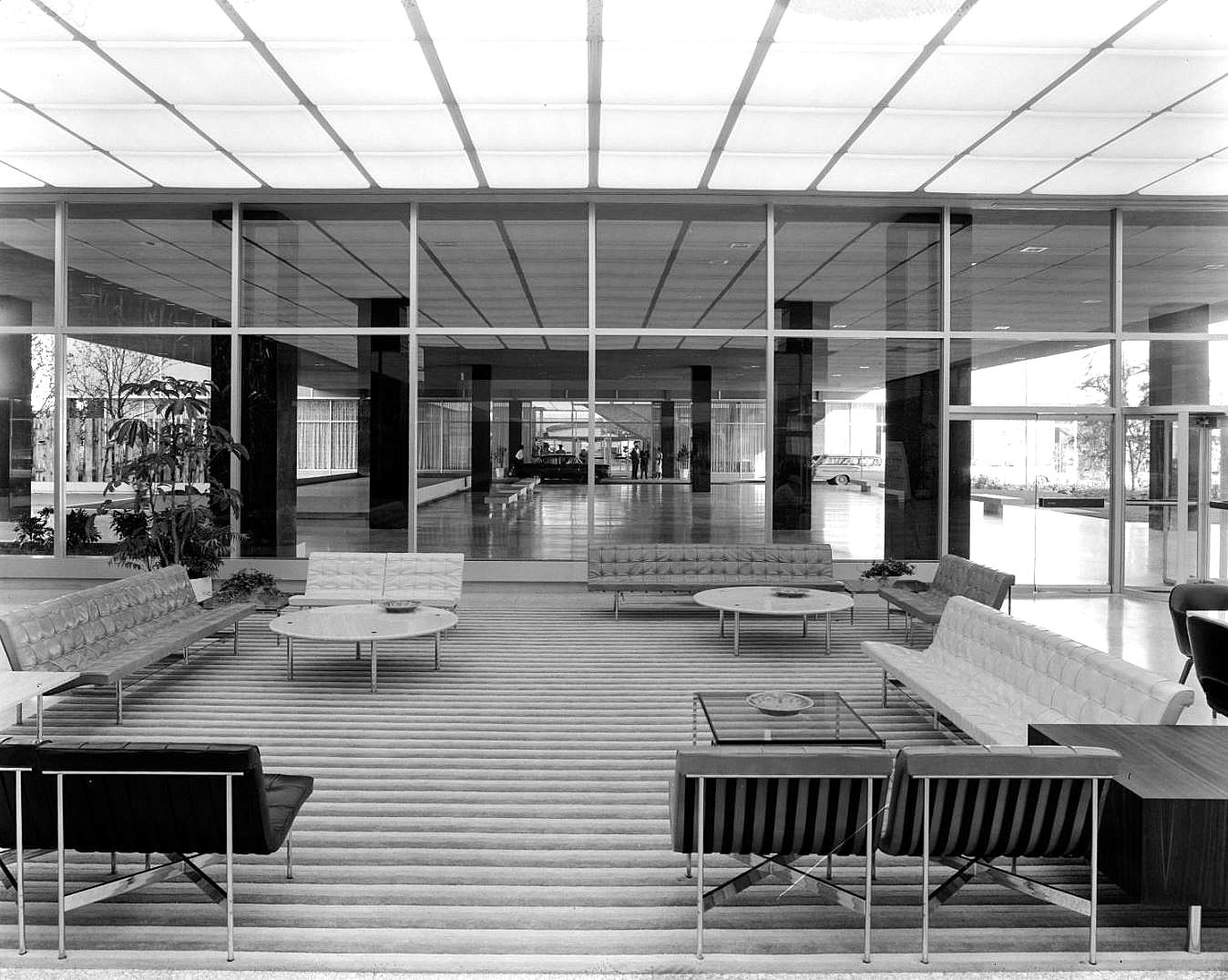
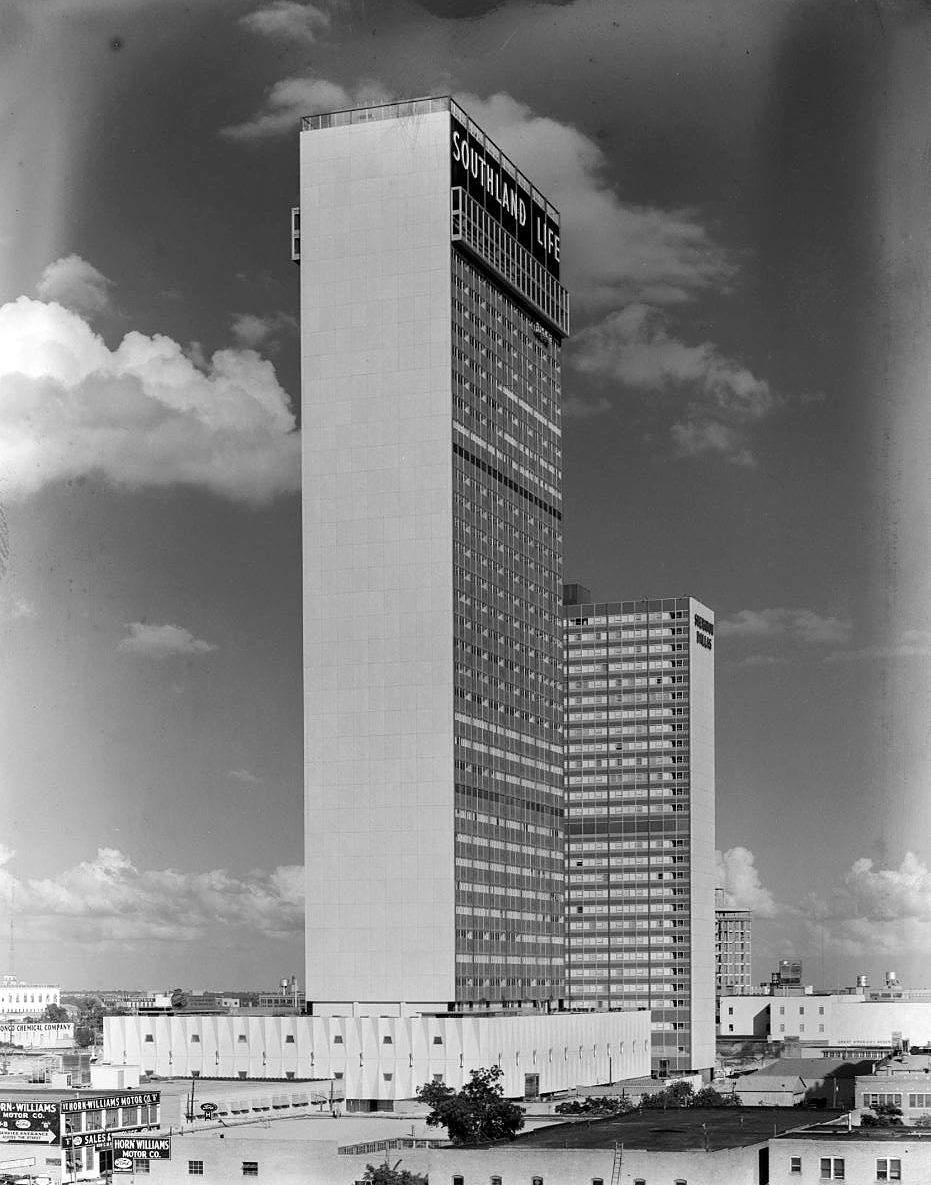
When it opened in 1959, the Southland Center (the Southland Life Building and the Sheraton Dallas hotel) boasted the tallest building west of the Mississippi. It was obviously a huge, multi-million-dollar construction project, but it was also a very costly decor project in which no expense was spared on the interior design of the buildings. An admirable amount of attention was paid to artistic elements such as site-specific commissioned artwork, and input from artists and designers was welcomed. It was an interior decorator’s dream job in which absolutely everything was NEW and modern. I love this period of design. Here are a few photos from the new Southland Center which I could look at all day.

I love all the glass and the sharp, crisp lines of the furniture. (All photos are by John Rogers — see the link below each photo to go to its Portal to Texas History page where you can zoom in and see details more clearly.)

southland-ctr_john-rogers_1959-60_portal_floor-lobbyvia Portal to Texas History

This is a fantastic shot  — you can see a couple of the commissioned artworks. At the left, extending from the ceiling of the second-floor lobby of the Sheraton to the ground floor is a “stamobile” kinetic sculpture titled “Totem” by Richard Filipowski. In the background at the top center of the photo, above the registration desk, is a Venetian-glass-and-broken-marble mural by Lumen Martin Winter.

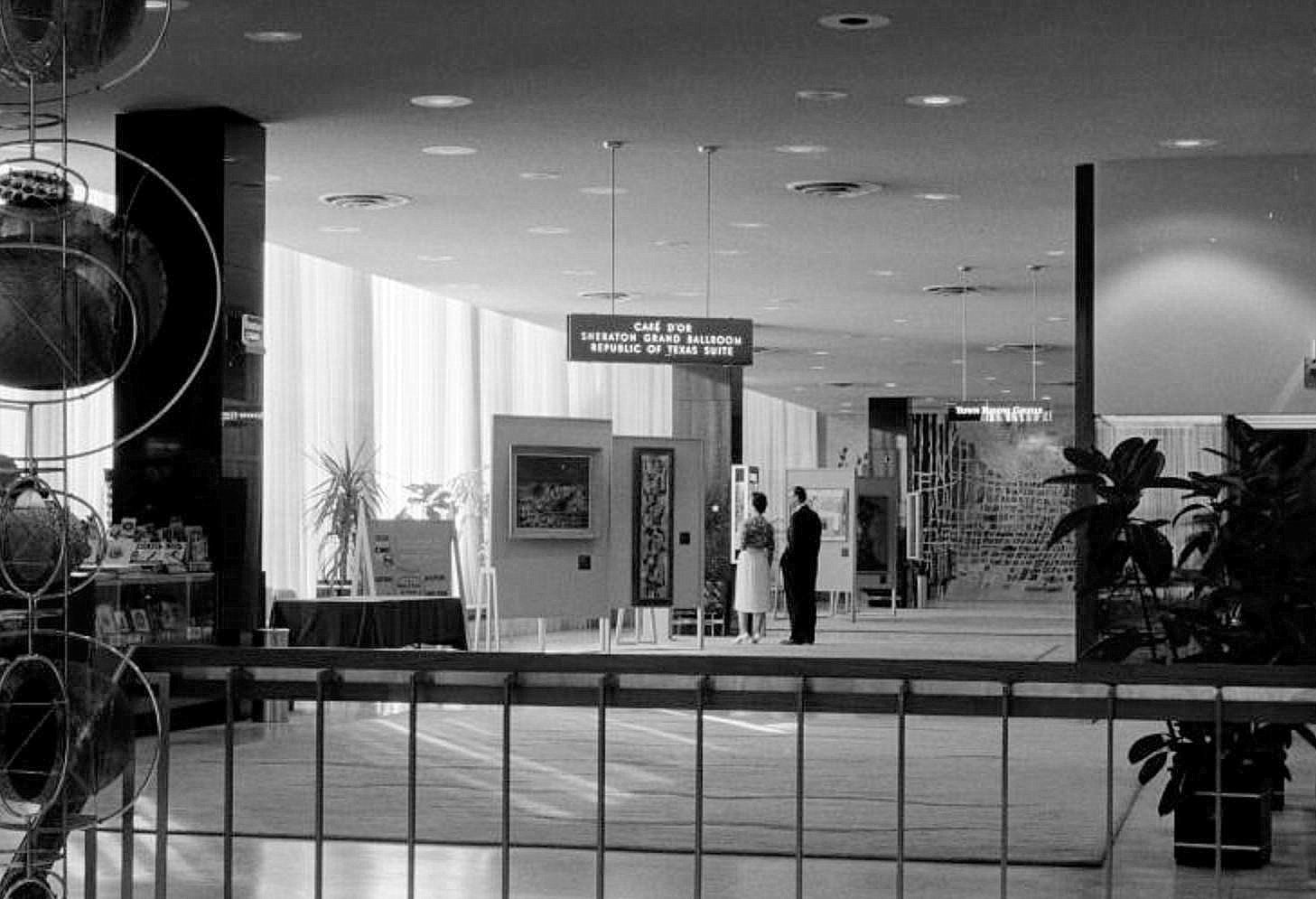
southland-ctr_john-rogers_1959-60_portal_interior-with-stairsvia Portal to Texas History

Speaking of art, another commissioned work can be seen in this detail of a photo: at the back, barely seen, is “Texas Sunburst,” a glass-tile mosaic mural by Gyorgy Kepes with additional work by Robert Preusser, located on the second-floor lounge concourse. Kepes designed the vibrant tile mosaic on the St. Jude Chapel downtown (the recent restoration of which I wrote about here), and he was also a contributor another wonderful mid-century architectural landmark in Dallas, Temple Emanu-El. (I spotted a brief glimpse of a bit of this Sheraton mural in color in a WFAA clip from June, 1974 in a story about, of all things, an ESP convention.)

southland-ctr_john-rogers_1959-60_portal_stairs-escalators_kepes-detvia Portal to Texas History

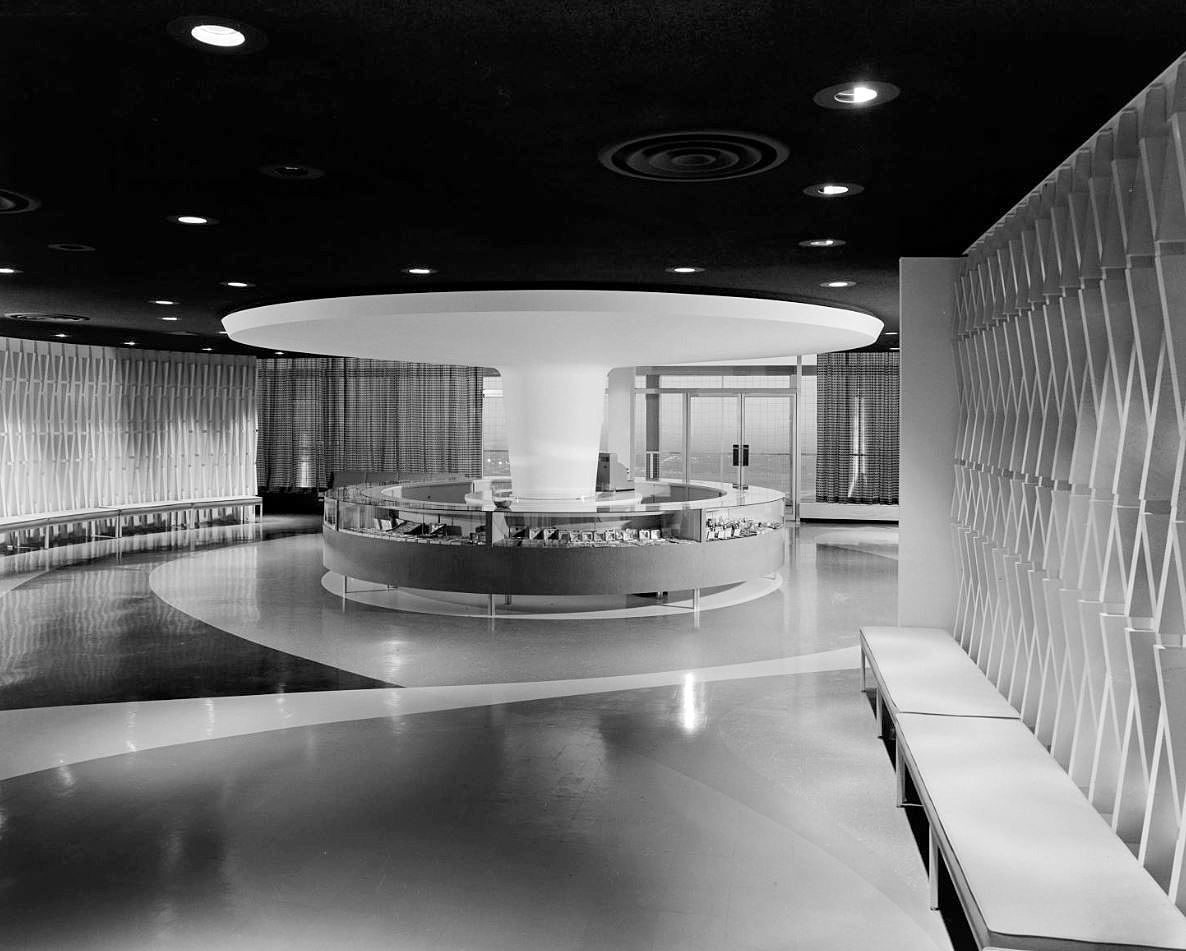
Here’s a jewelry kiosk, which is sort of Deco-futuristic — like something you’d see in a 1930s movie set on a spaceship. (Is that the “rocket” of the Republic Bank Building seen outside the window at the right? It was practically right next door, as seen in this photo.)

southland-ctr_john-rogers_1959-60_portal_jewely-vendorvia Portal to Texas History

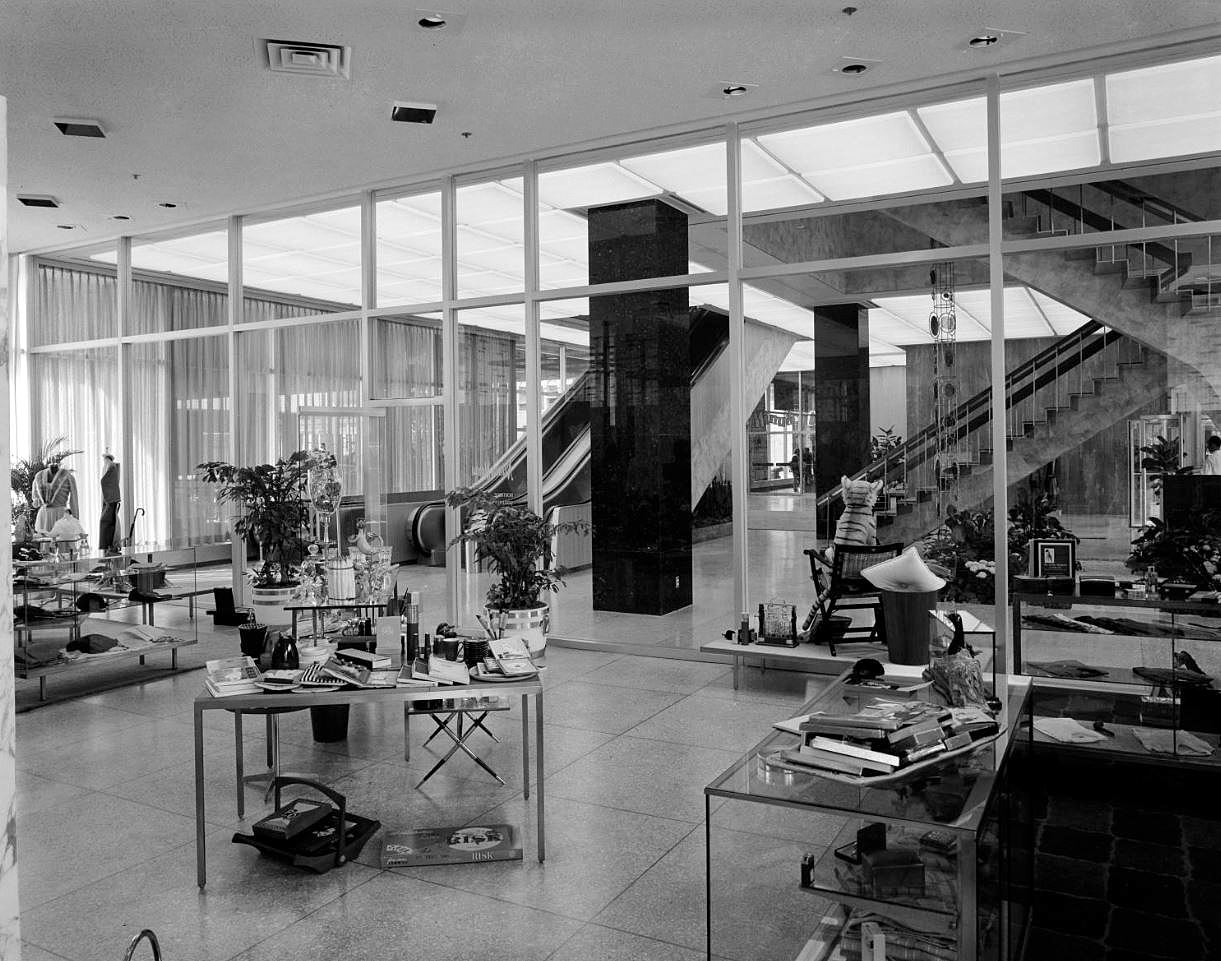
This shows a couple of ground-level retail shops, with more wonderful floor-to-ceiling glass “walls” (the glass-cleaning must have been an ongoing nightmare!). If you needed a stuffed tiger toy, a game of Risk, paint brushes, or stationery… this shop was made for you. (In the background is the entrance to the Minute Chef, an informal restaurant which also featured original artwork by Gyorgy Kepes.)

southland-ctr_john-rogers_1959-60_portal_ground-floor-stairs-shopvia Portal to Texas History

And, lastly, a shot of the neighboring Southland Center towers, high above everything else on the edge of downtown.

southland-ctr_john-rogers_1959-60_portal_southland-life-skyscraper-and-sheratonvia Portal to Texas History

***

Sources & Notes

All photos are by John Rogers, from the John Rogers and Georgette de Bruchard Collection, provided to the Portal to Texas History by the UNT Libraries Special Collections, University of North Texas; see all 25 of Rogers’ photos of the Southland Center, taken in 1959/1960, here.

See a list of the permanent art as well as exhibited art at the Southland Life Building/Sheraton Dallas in the scanned 1959 catalog “Made in Texas by Texans.”

See photos of the Southland Center under construction in the Flashback Dallas post “On Top of the World: The Southland Center.”

southland-ctr_john-rogers_1959-60_portal_interior-lobby_stairs_sm

*

Copyright © 2020 Paula Bosse. All Rights Reserved.
Lamar, South from Pacific — ca. 1902

lamar_south-from-pacific_katy-flyer_martinez-cigars_ca-1902_degolyer_SMUSaloons and cigars… (click for larger image)

by Paula Bosse

Above, Lamar Street, looking south from Pacific Avenue; a notation on the back of the photo reads “about 1902.” The intersection straight ahead is Elm Street, then a jog, before it continues south to Main and Commerce. (See what this view looks like today, here.)

The business seen at the left (northeast corner of Elm and Lamar) is P. P. Martinez (the popular cigar retailer, wholesaler, and, I think, manufacturer, whom I hope to write about someday); the business at the right (northwest corner of Elm and Lamar) is Sam Freshman, a liquor wholesaler (his store entrance was on Elm, and his saloon entrance was on Lamar). Across Elm (southeast corner,) at the left, is E. M. Kahn, men’s clothiers (“Kahn” rhymes with “can”). Sanger Bros. was at the southwest corner and is either obscured or not clearly visible. The old Dallas Morning News building can be seen further south, on the right, at the northwest corner of Commerce and Lamar.

A look at the 1902 Dallas directory shows these types of businesses with Lamar addresses, between Pacific and Elm:

4-Saloons
3-Restaurants
3-Barbers (one of which had a want-ad for a “good lady barber”)
1-Newsstand
1-Tailor
1-Shoemaker

A busy little block.

See this intersection in 1905 Sanborn maps here and here.

*

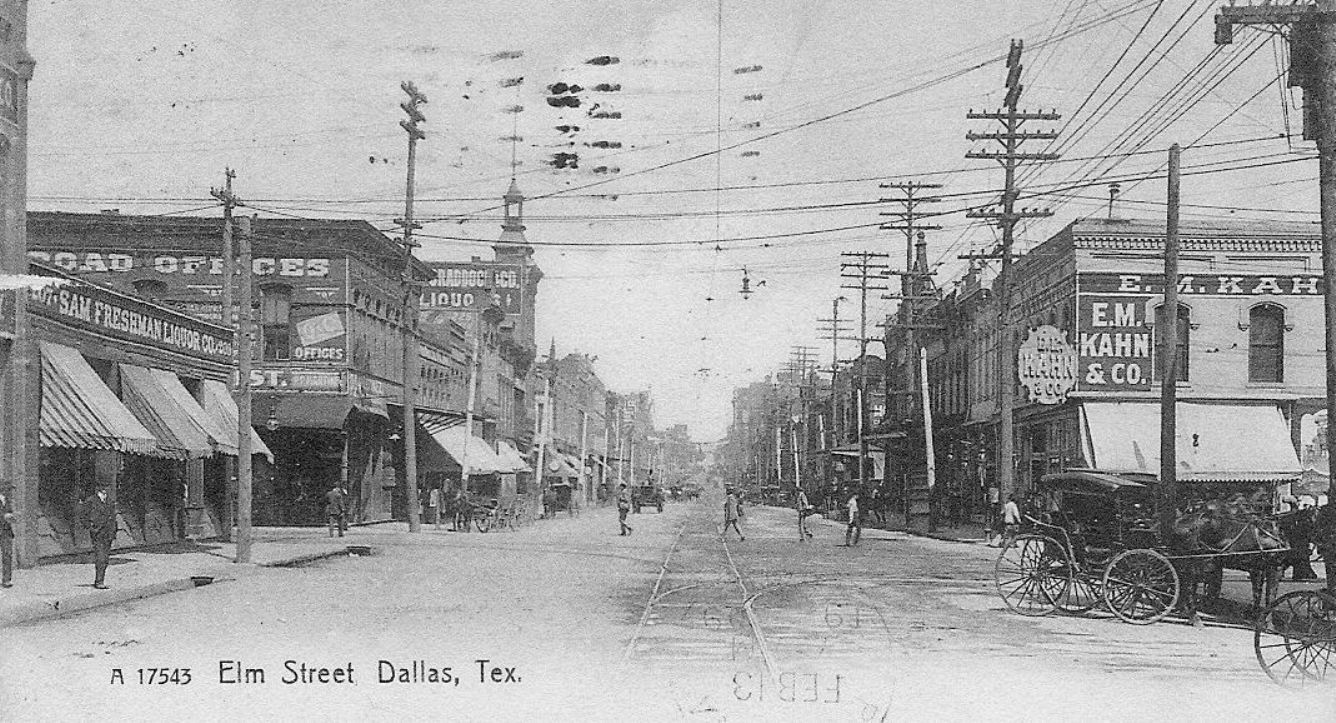
Below is a photo showing Elm Street looking east, with Sam Freshman’s store seen at the left and E. M. Kahn & Co. at the right (this postcard is postmarked 1909):

elm-street_postcard-1909-lg

***

Sources & Notes

Top photo — “[Looking South on Lamar at Pacific; E.M. Kahn & Company is Visible at Southeast Corner of Elm and Lamar]” — is from the George A. McAfee Photographs collection, DeGolyer Library, SMU Libraries, Southern Methodist University; more info is here. (Farris Rookstool III sent an enhanced image, here. Thanks, Farris!)

Second image is a postcard (found on eBay) from the Flashback Dallas post “Elm Street — 1909.”

lamar_south-from-pacific_katy-flyer_martinez-cigars_ca-1902_degolyer_SMU_sm

*

Copyright © 2020 Paula Bosse. All Rights Reserved.

Architectural Crossroads: Commerce and Akard

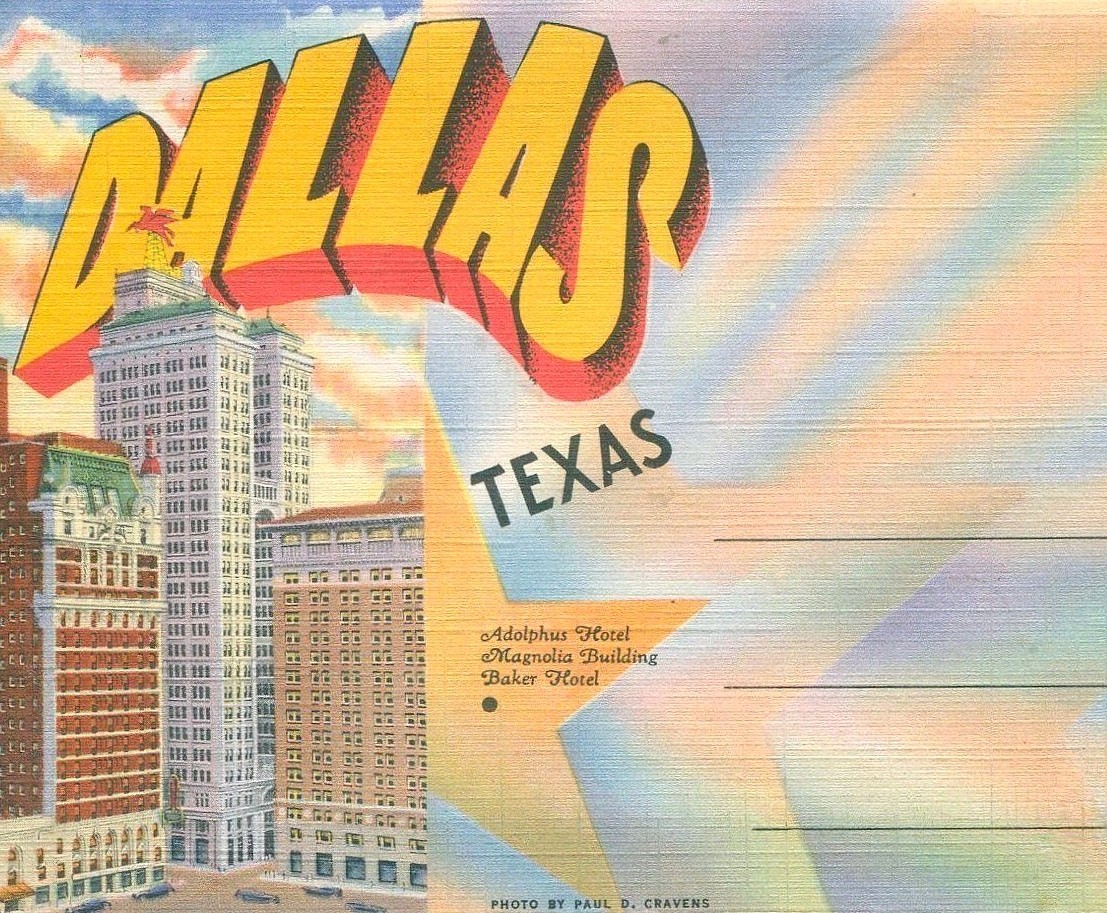
dallas-postcard_adolphus_magnolia_baker_ebay

by Paula Bosse

In Dallas’ early days, Commerce Street was once considered so far off the beaten path that major businesses did not build there. By 1925, though, the intersection of Commerce and Akard streets boasted three Dallas showplaces: the Adolphus Hotel (still standing), the Magnolia Building (still standing), and the Baker Hotel (not still standing). (Before that, it was the Adolphus, the Magnolia, and Busch’s other hotel, the swanky Oriental.)

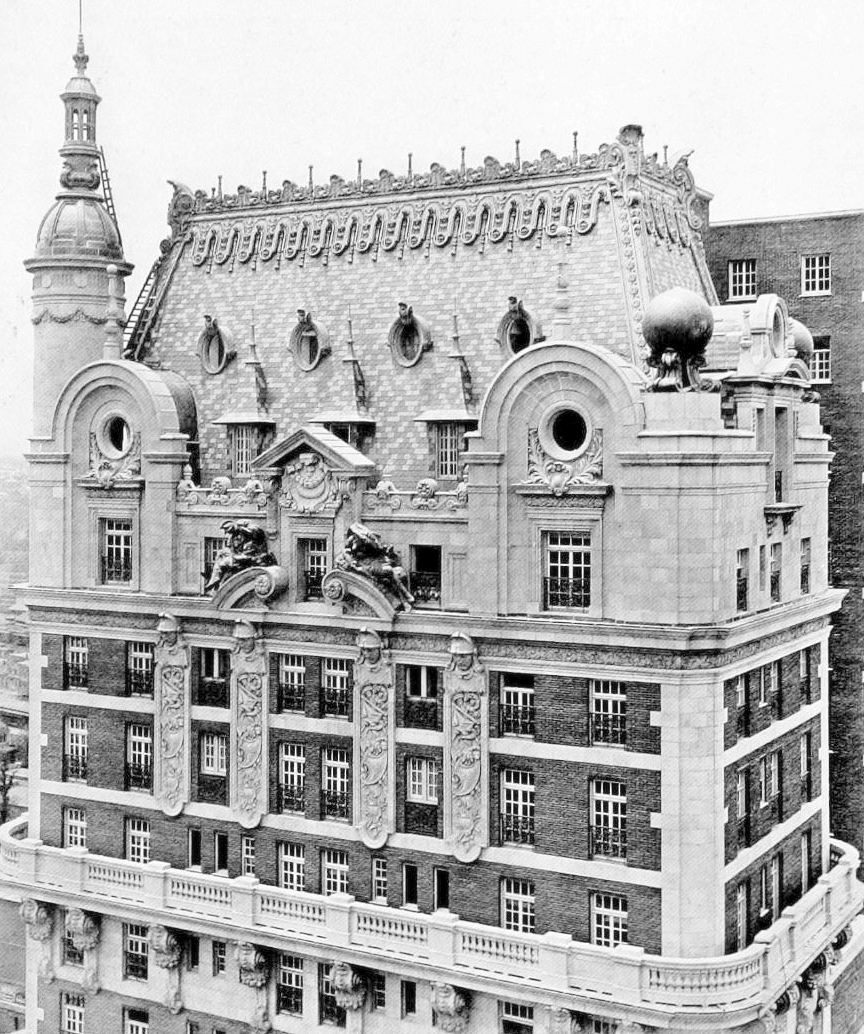
Ever noticed that the corner “turret” of the Adolphus looks like a traditional German beer stein? An ode to the source of namesake Adolphus Busch’s wealth? I certainly hope so!

adolphus_terracotta-detail_western-architect_july-1914

***

Sources & Notes

Top image is from a pack of postcards, found on eBay.

Detail of the Adolphus is from the Flashback Dallas post “Dallas in ‘The Western Architect,’ 1914: The Adolphus Hotel.”

dallas-postcard_adolphus_magnolia_baker_ebay_sm

*

Copyright © 2020 Paula Bosse. All Rights Reserved.

Magnolia Gas Station No. 110 — 1920

magnolia-gas-station_atlantic-terra-cotta-co-coll_UT_frank-rogersDallas’ finest filling station…

by Paula Bosse

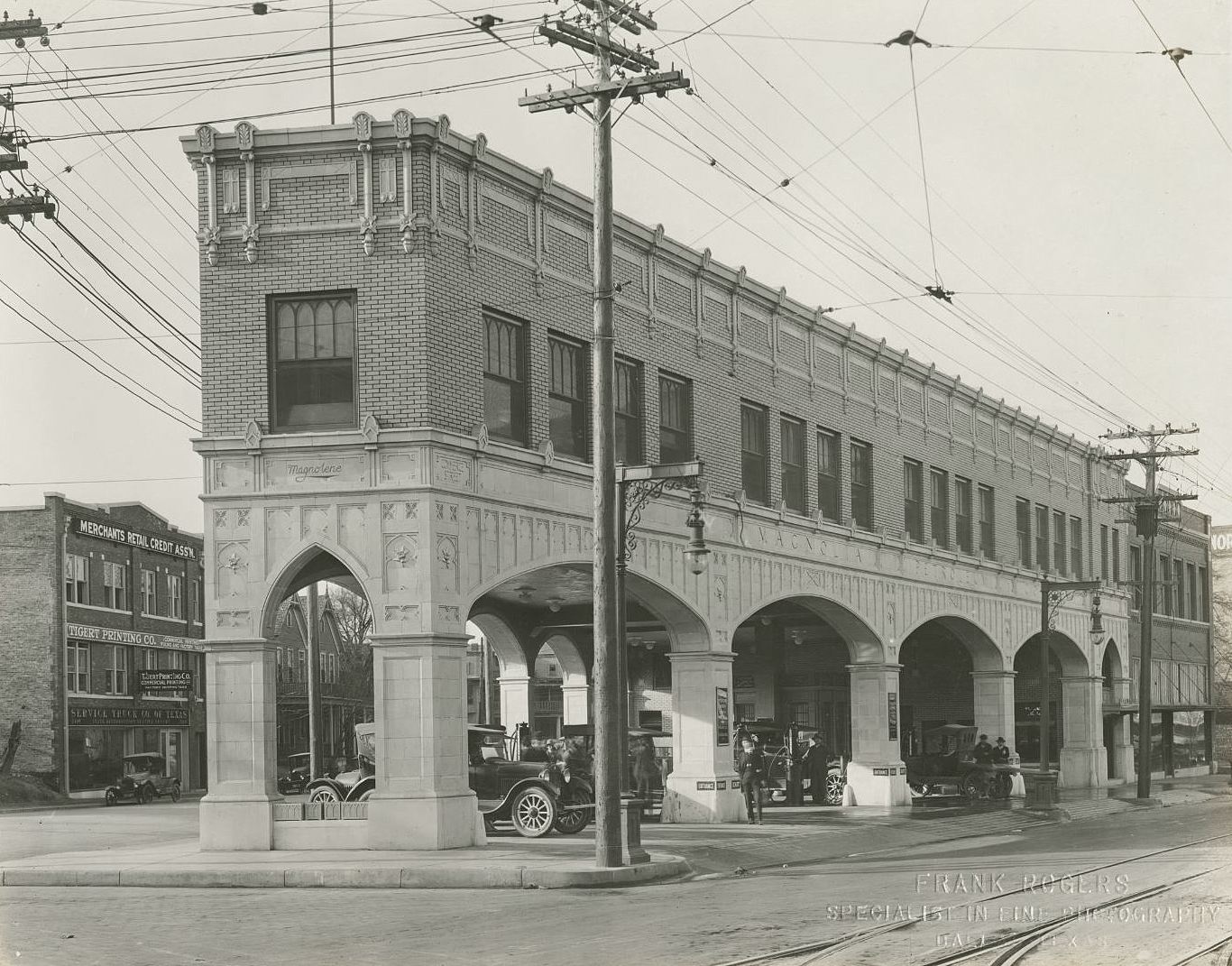
The building seen above turns 100 this year. You know it — you’ve probably said, “I love that building!” at some point in your life. It was built by the Magnolia Petroleum Co. on the triangular piece of land where Commerce Street, Jackson Street, and Cesar Chavez Blvd. meet (Cesar Chavez was originally Preston Street). Before the building’s construction, this intersection was known as “Five Points” — after its construction, it was known as “Pershing Square” (notable for its inconveniently placed middle-of-the-street horse- and dog-watering fountain, which I will write about in the future).

This distinctive brick and terra cotta “semi-Gothic” building was built in 1920, with two stories and a basement; Magnolia service station #110 was on the ground level, and regional offices of the company were above (the massive Pegasus-topped Magnolia Building had not yet been built). Lang & Witchell, Dallas’ premier architects, designed the building.

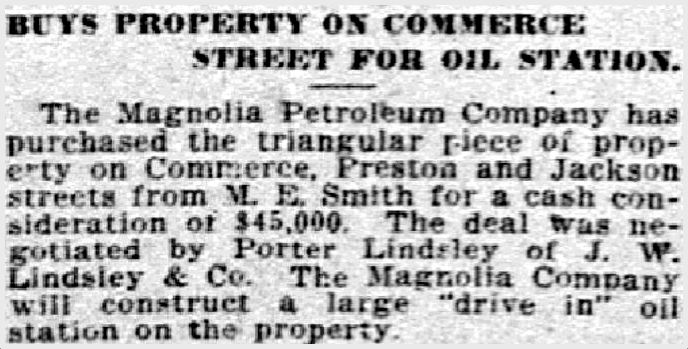
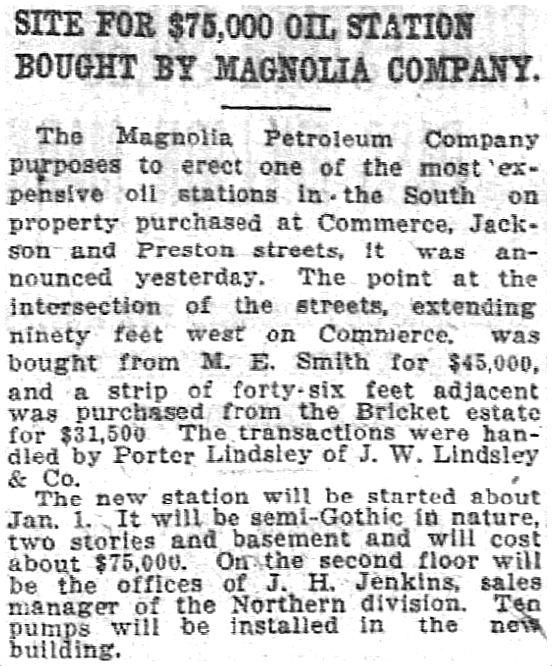
magnolia-petroleum-station_dmn_091919Dallas Morning News, Sept. 19, 1919

magnolia-petroleum-station_dmn_113019DMN, Nov. 30, 1919

After the 10-pump service station opened, The Dallas Morning News noted that there were 64 gas stations in Dallas (18 were Magnolia stations) — this station was the largest and most expensive to build. Cost of the land and construction was estimated at $175,00 — the equivalent today of about $2.5 million dollars.

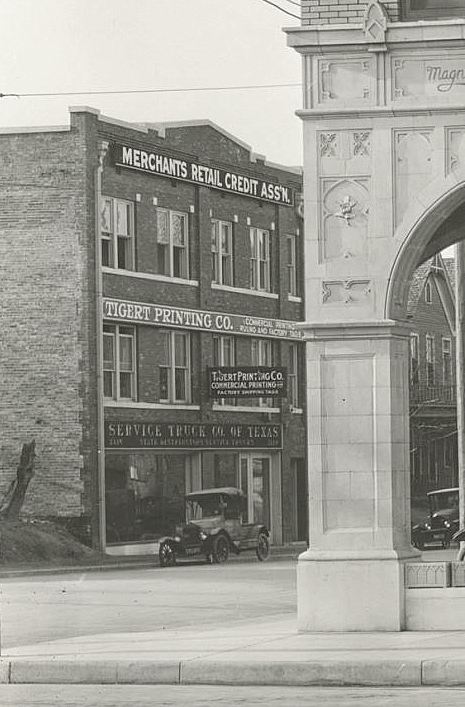
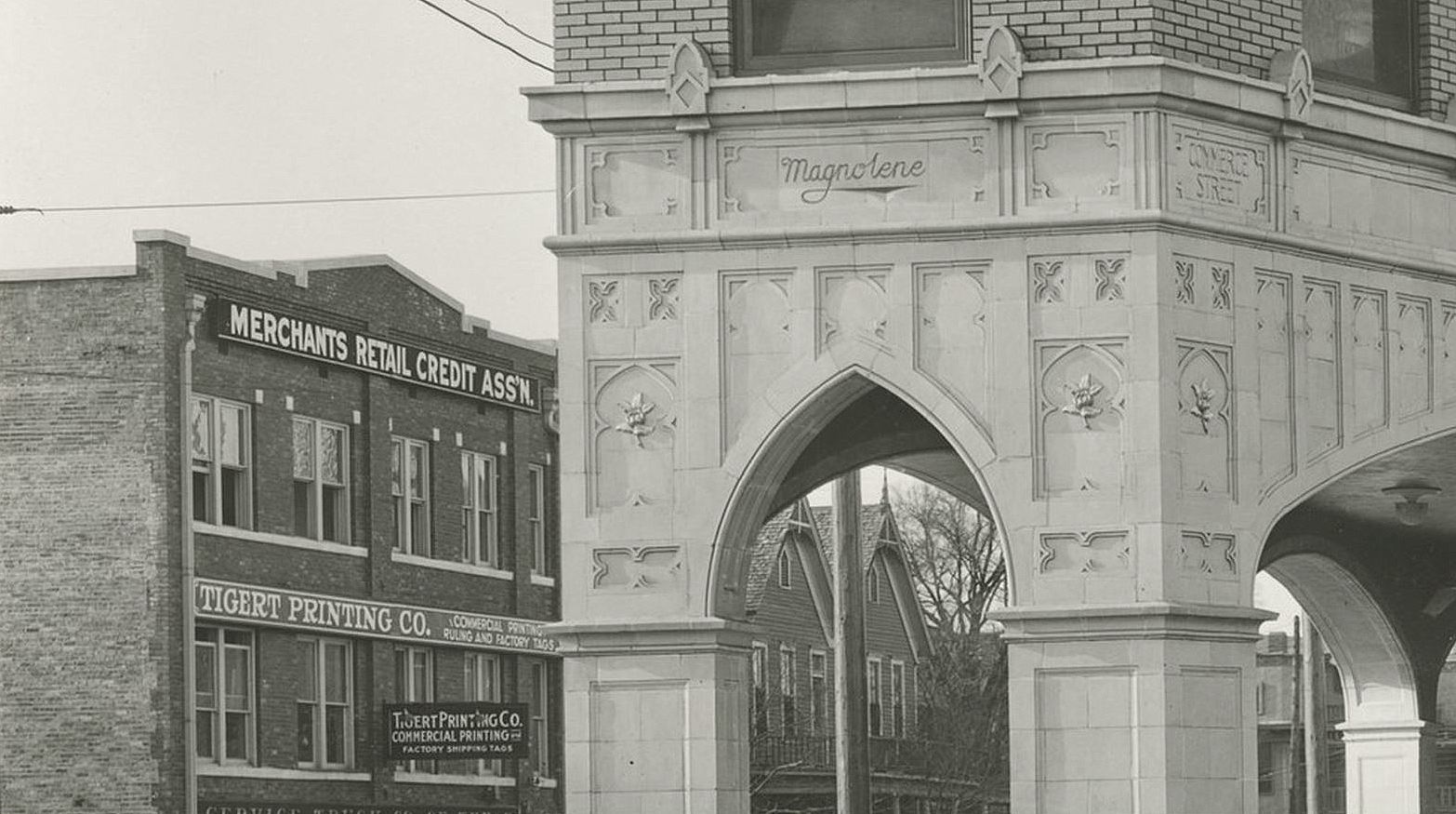
Businesses seen in the photo occupying the three-story building across the street at 2114-16 Jackson are Service Truck Co. of Texas, Tigert Printing Co., and Merchants Retail Credit Association. That building was sandwiched between residences (the house on the left is out of frame). All the way at the right of the photo is a glimpse of rooming houses. Across Commerce was an entire block of auto dealerships and auto supply houses (not seen in this photo). See the service station and environs on a 1921 Sanborn map here.

Let’s zoom in on this great Frank Rogers photo to see some of the details. First, a better look at that three-story office building on Jackson. (All photos are larger when clicked.)

magnolia-gas-station_atlantic-terra-cotta-co-coll_UT_frank-rogers_det-1

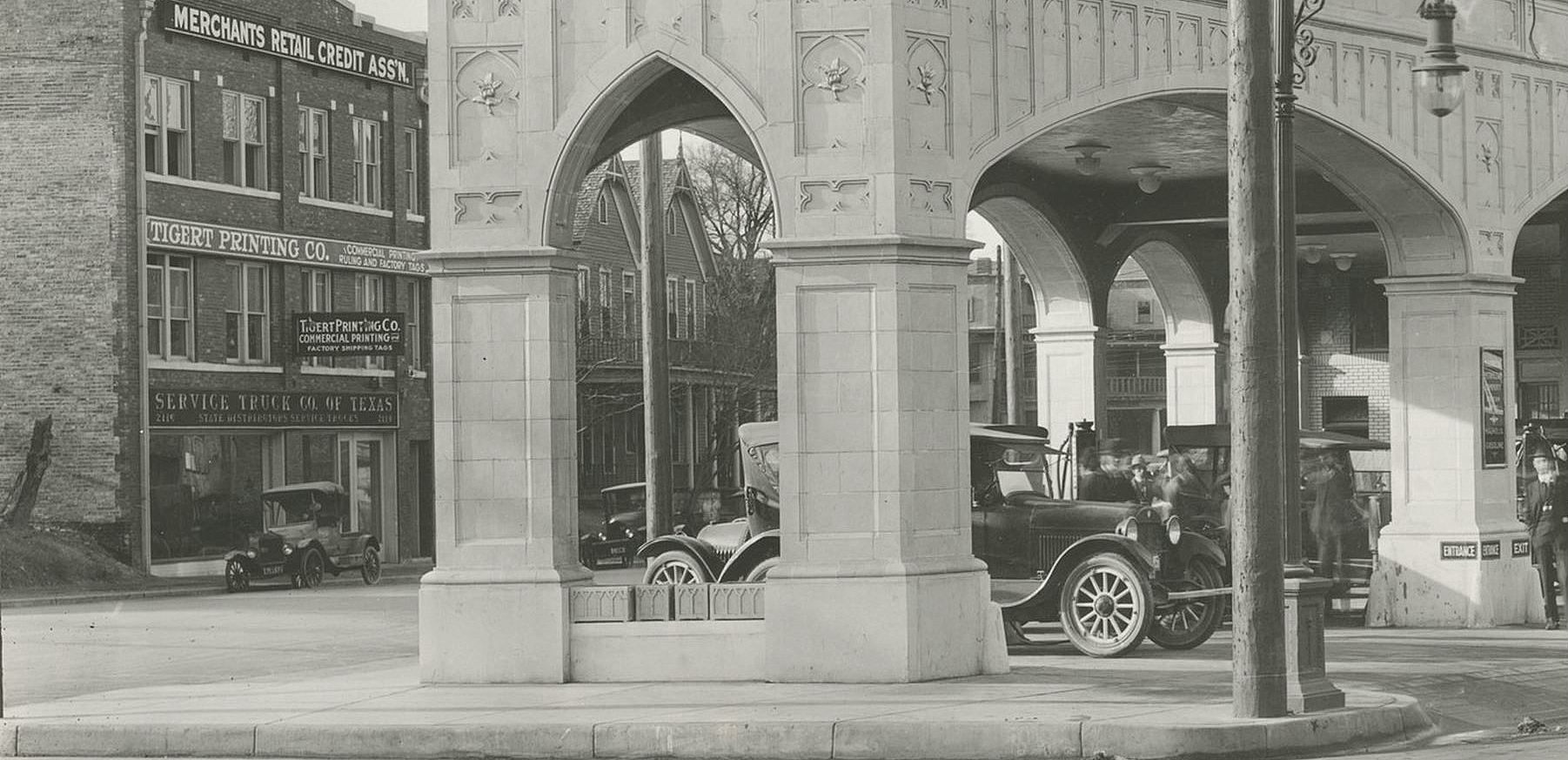
Pulling back a bit, you can see the rooming houses through the arches. You can also see details of the gas station as well as decorative elements of the exterior of the building, including sculptural depictions of magnolias. (I love this cropped detail. Taken out of context, you’d never guess you were looking at Dallas.)

magnolia-gas-station_atlantic-terra-cotta-co-coll_UT_frank-rogers_det-5

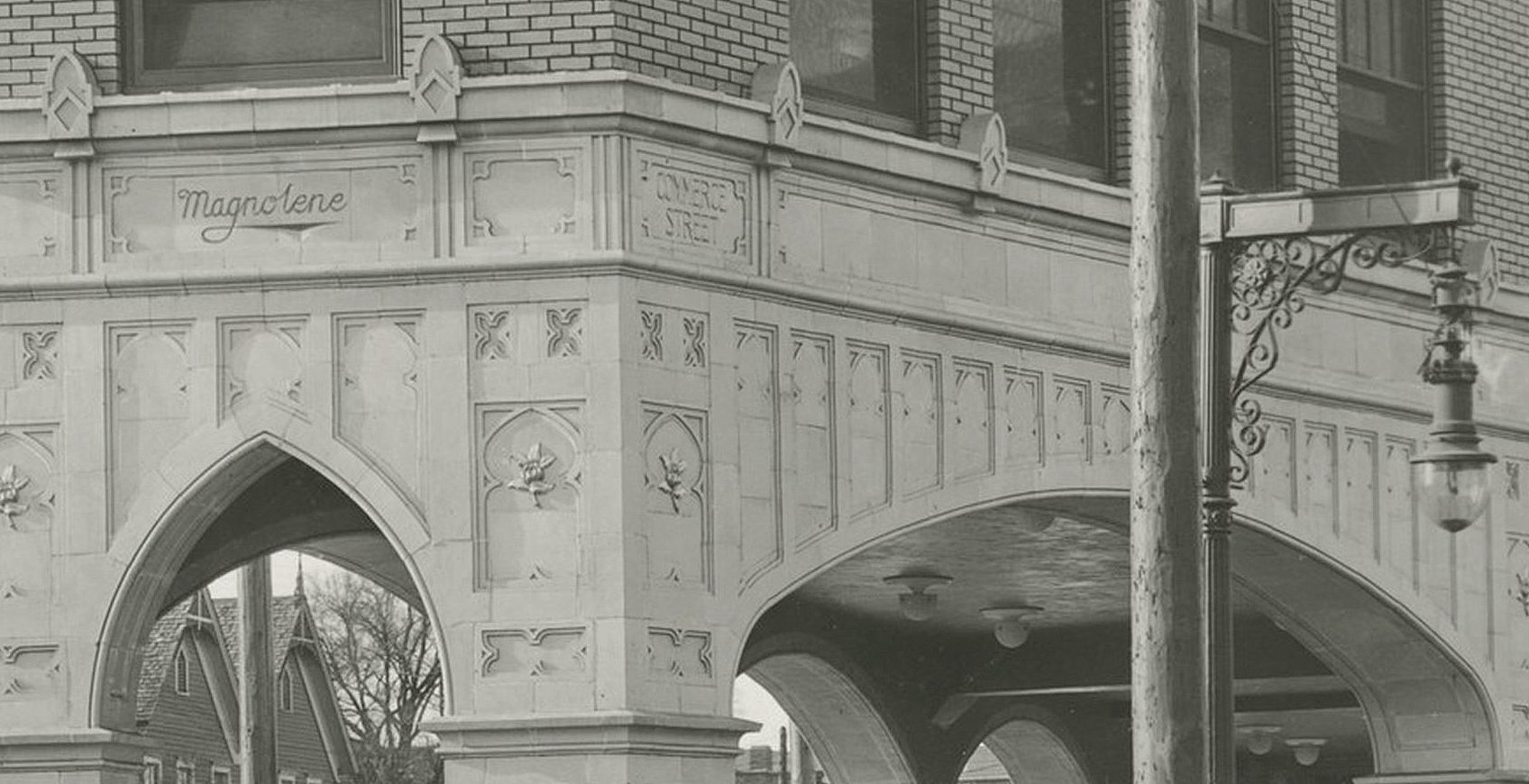
Moving up, you can see the word “Magnolene,” the Magnolia Petroleum Co.’s brand of motor oil; you can also see the words “Commerce Street” (“Jackson Street” is carved into the Jackson side of the building — see here).

magnolia-gas-station_atlantic-terra-cotta-co-coll_UT_frank-rogers_det-2

Here’s a closer look — “Magnolene” is, I think, long gone (as are those cool windows), but “Commerce Street” and “Jackson Street” live on today. Also, check out that very appealing street light. 

magnolia-gas-station_atlantic-terra-cotta-co-coll_UT_frank-rogers_det-3

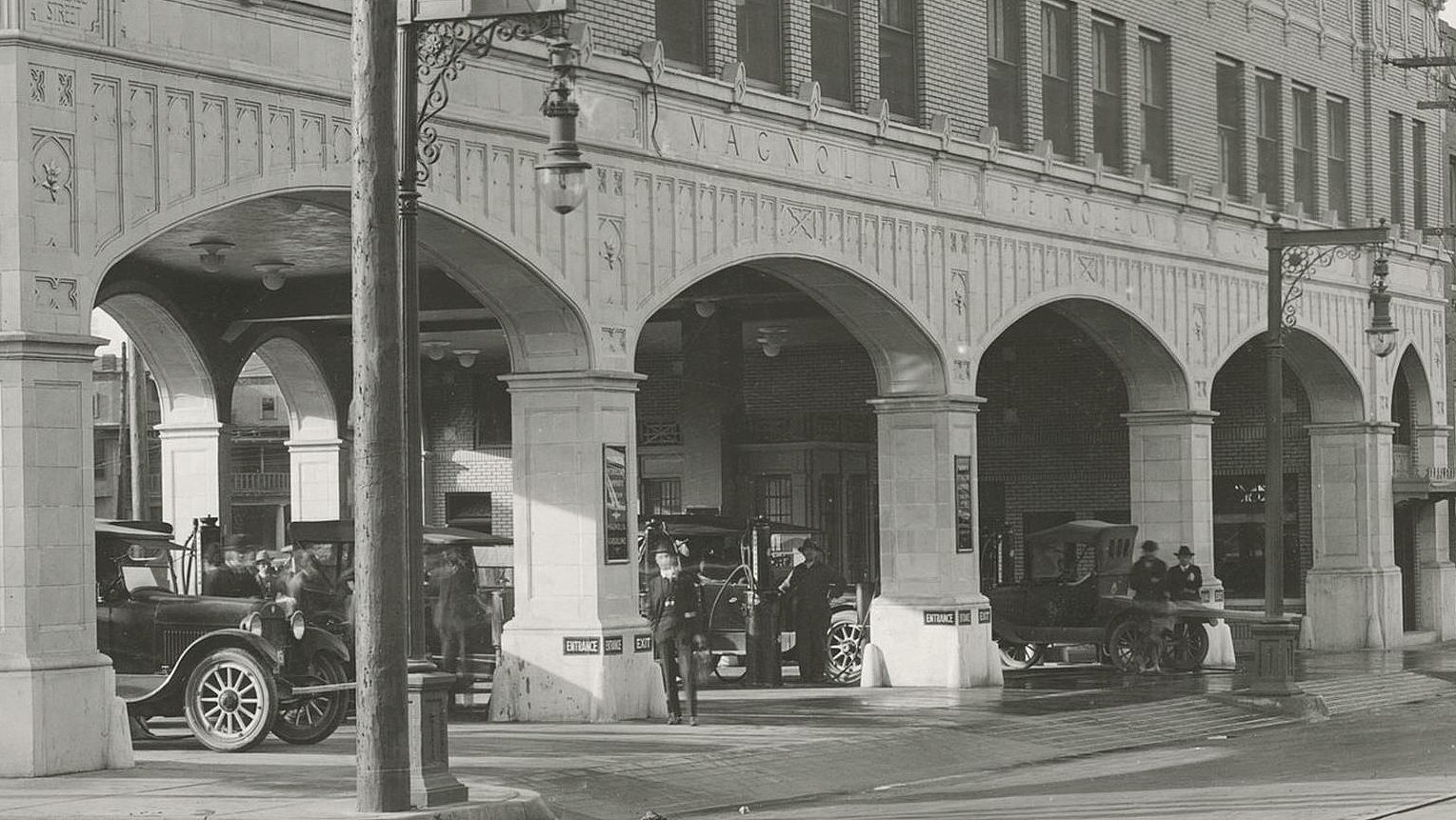
And another, closer look at the gasoline pumps and customers. There is so much incredible detail in the design of this building — when was the last time you saw such an aesthetically appealing gas station?

magnolia-gas-station_atlantic-terra-cotta-co-coll_UT_frank-rogers_det-6

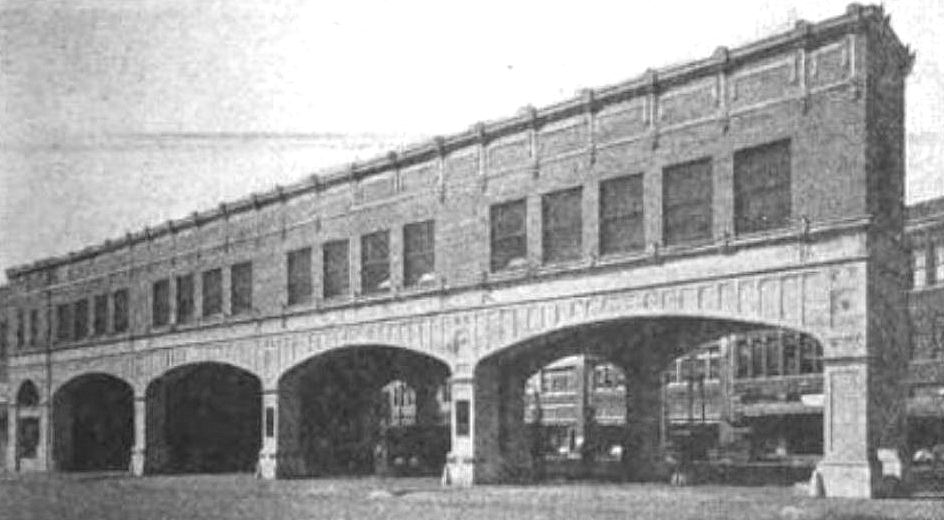
Here’s a photo from a 1922 ad for Atlanta Terra Cotta Co., which supplied several Magnolia stations in Texas with building materials — this was taken from the Jackson Street side (see the full ad here).

magnolia-petroleum-station_manufacturers-record_121422_ad-det

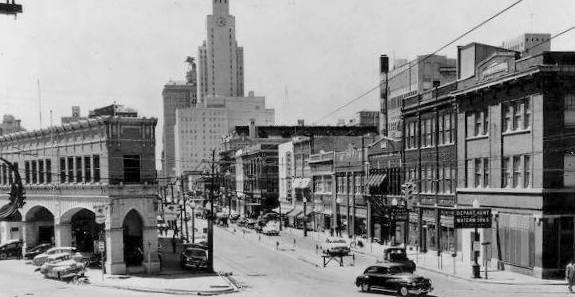
Here’s the building a couple of decades later:

magnolia-petroleum-station_KLIF-bldg_dallas-public-library_crop

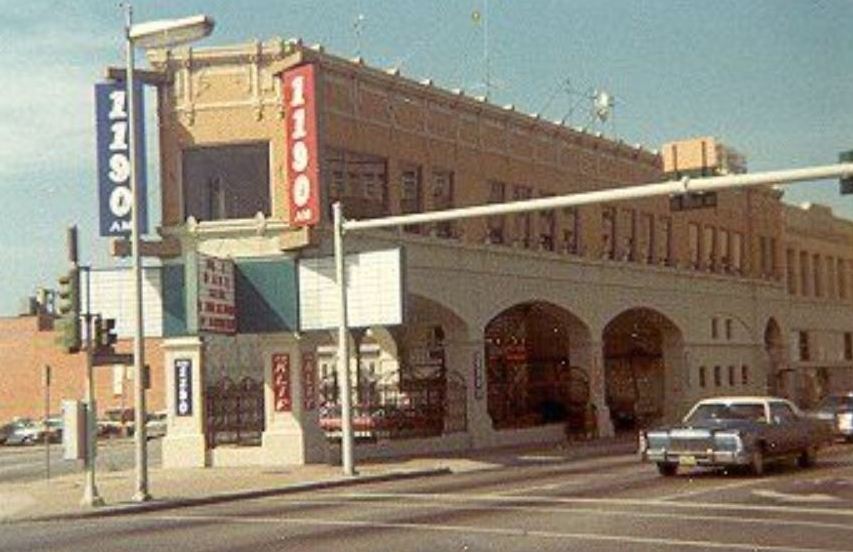
And here it is as many Dallasites remember it, as the studios of KLIF radio, “The Mighty 1190,” where the DJ’s booth was at the “point” and passersby could watch from the street. Later it was the home of the Dallas Observer for many years. (I’m not sure of the original source of this photo, but if anyone knows or has a better quality image, let me know!)

KLIF_color

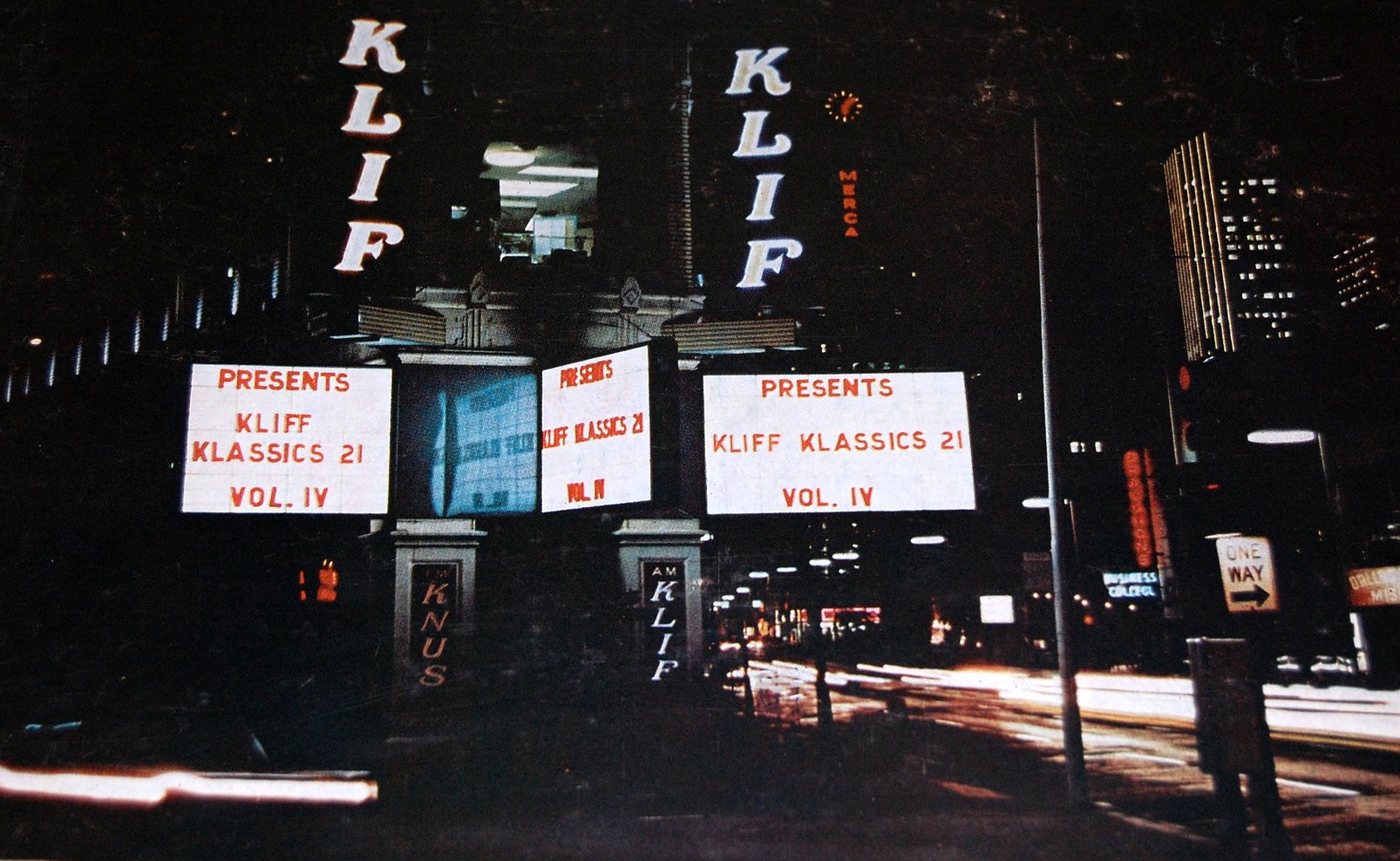
This shows the building a little earlier — it’s a cropped photo that appeared on the album cover “KLIF — KLIFF Klassics,” from about 1969 — you can see the DJ’s booth lit up.

klif_kliff-klassics_vol-iv_album-cover_ca-1969_flickr
via Flickr

Today the building is part of an “adaptive reuse” development called “East Quarter” — I read that the building was slated to house a restaurant (or two), but I don’t know what the current status of that project is.

It’s nice to know that a favorite building from my childhood is still around. Happy 100th!

***

Sources & Notes

Top photo is titled “Magnolia Filling Station, Pershing (Dallas, Tex.): exterior view of front entrance, corner perspective” by Dallas photographer Frank Rogers; it is from the Atlantic Terra Cotta Company Architectural records and photographs, 1914-1941, Architectural Terra Cotta, Alexander Architectural Archives, University of Texas Libraries, The University of Texas at Austin; more info can be found here.

The same photo appeared uncredited accompanying the Dallas Morning News article “Filling Stations of Dallas Are Finest” (DMN, April 10, 1921). 

The photo taken from the Jackson Street side is from an ad for the Atlanta Terra Cotta Co. which appeared in Manufacturers Record (Dec. 14, 1922). (The Atlanta Terra Cotta Co. of Georgia and the Atlantic Terra Cotta Co. of New York were separate companies but were under the same management.)

The photo from the 1940s/1950s is “[Pershing Square in downtown Dallas, Texas]” — I have cropped it; from the Ford Motor Company Building Collection, Dallas Public Library (call number: PA85-39/16).

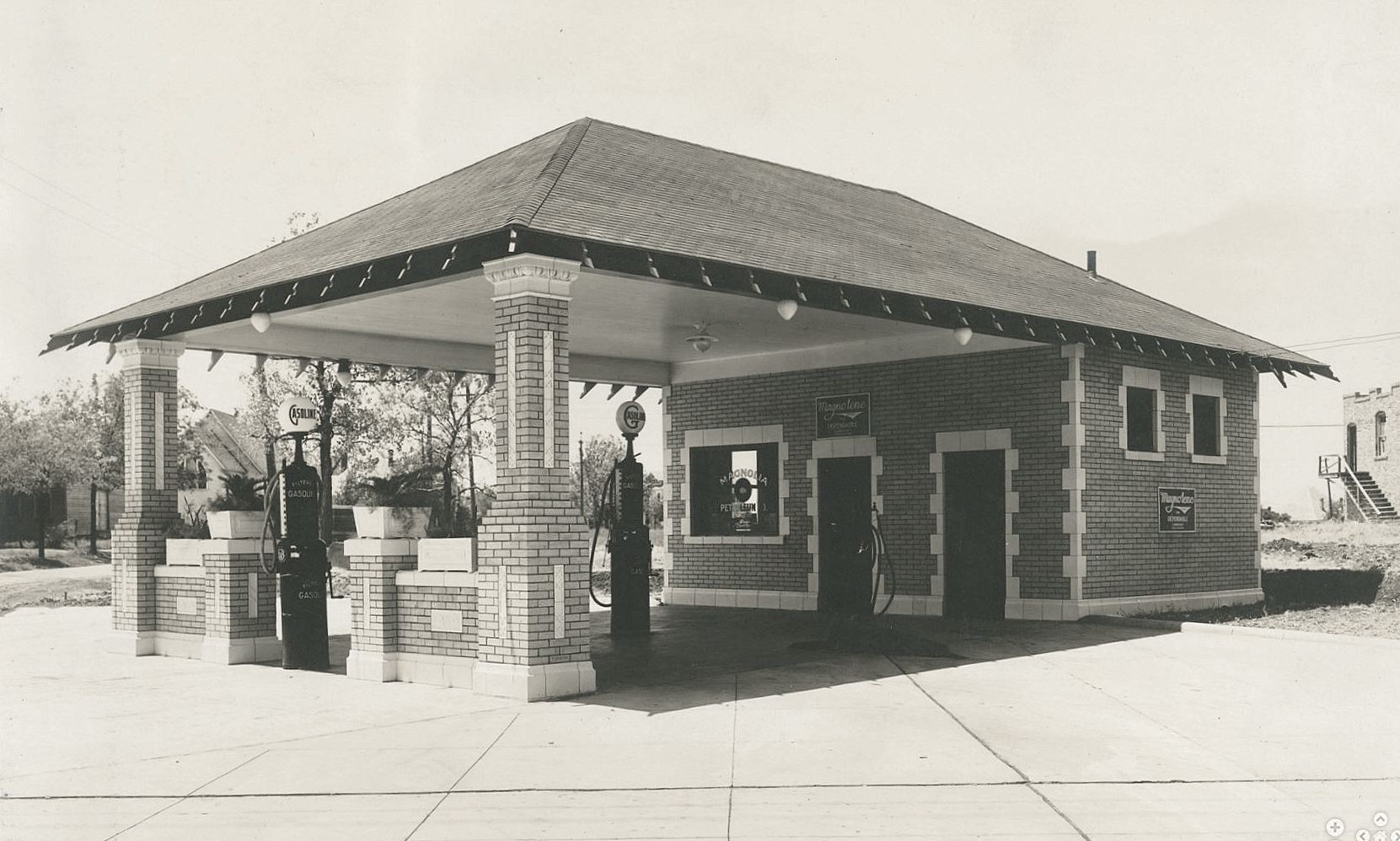
Here is another photo from the same collection as the main photo in this post — this shows another Magnolia filling station in Dallas, this one a smaller, more traditional station (more info here).

magnolia-filling-station_atlantic-terra-cotta-co-coll_UT

magnolia-gas-station_atlantic-terra-cotta-co-coll_UT_frank-rogers_sm

*

Copyright © 2020 Paula Bosse. All Rights Reserved.

West Jefferson Blvd. at Night

oak-cliff_jefferson-blvd_night_oldoakclifflodge_flickrW. Jefferson & S. Madison

by Paula Bosse

I love night-time views of a lit-up city, and this circa-1949 bird’s-eye view of West Jefferson Boulevard in Oak Cliff, looking east, is pretty cool. If this photo had a soundtrack, it would be moody and atmospheric saxophone music.

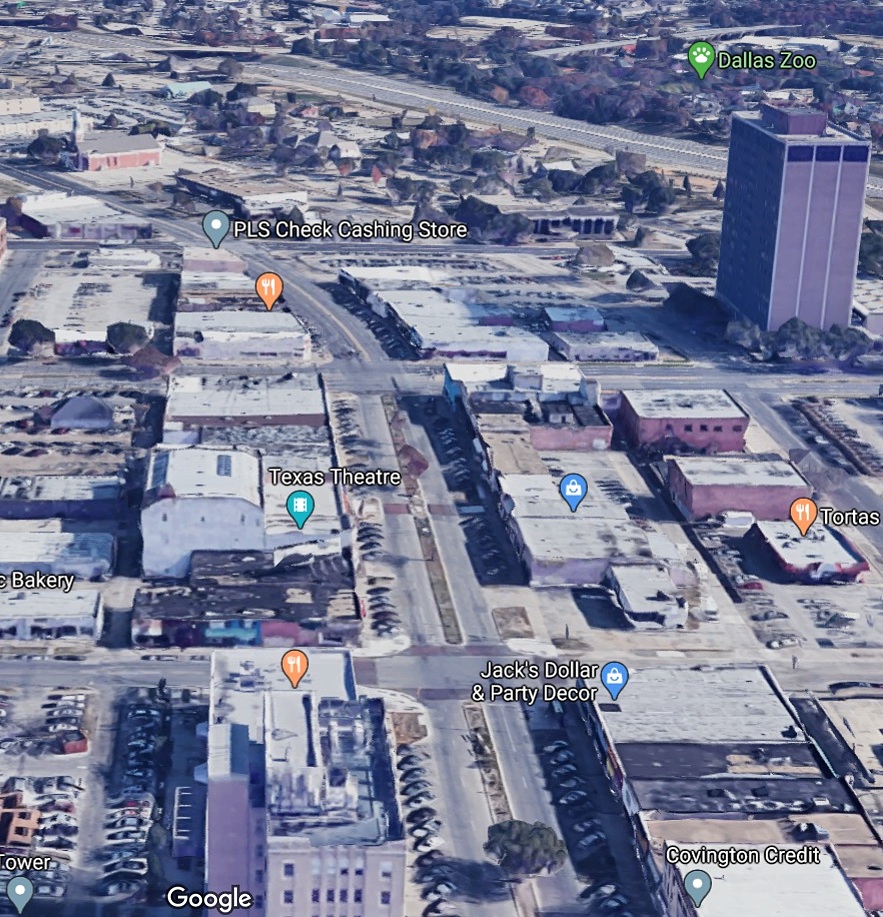
Hunt’s department store was at 303 W. Jefferson, and the Oak Cliff Bank & Trust Co. was at 250 W. Jefferson — S. Madison is the intersecting street in the center of the photo. At the upper left you can see the bright lights and triangular marquee of the Texas Theatre. Below is a view of the same street today, still recognizable.

oak-cliff_jefferson-blvd_google-aerialGoogle Maps

***

Sources & Notes

Top photo is from the Flickr photostream of OldOakCliffLodge, here.

oak-cliff_jefferson-blvd_night_oldoakclifflodge_flickr_sm

*

Copyright © 2020 Paula Bosse. All Rights Reserved.
Influenza Pandemic Arrives in Dallas — 1918

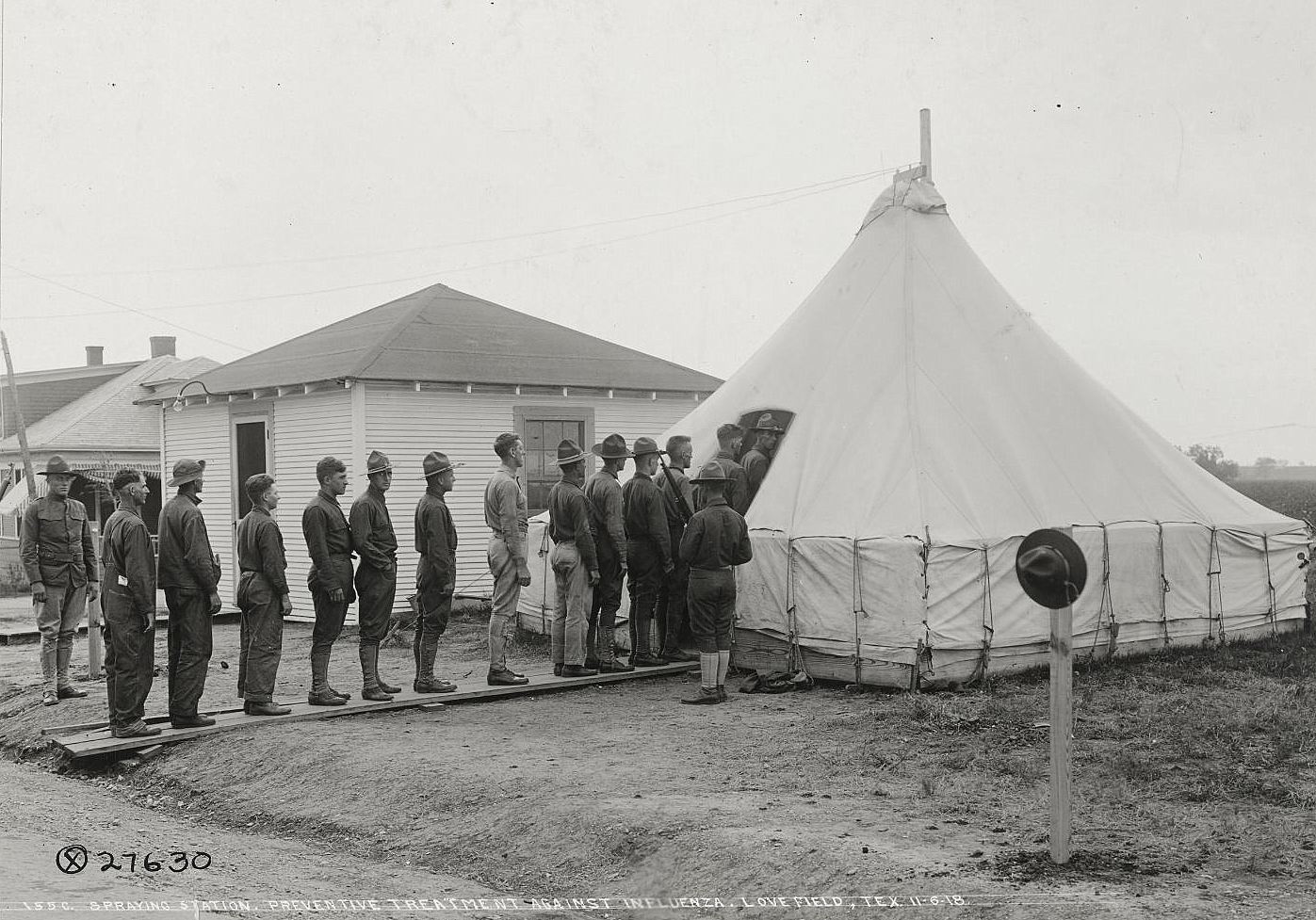
influenza-epidemic_love-field_1918_natl-archivesIn line at the Love Field “spraying station” (click for larger image)

by Paula Bosse

I write this as the U.S. is bracing for the spread of COVID-19, the novel coronavirus which has just been declared a world-wide pandemic by the World Health Organization — this inescapable news item reminds me of a previous post I wrote about the local response to another major epidemic. In 2014, Dallas (of all unlikely places) was ground-zero in the U.S. for a feared Ebola outbreak — back then I wondered how Dallas had handled health crises in the past, specifically the spectre of the Spanish Influenza, which, like the coronavirus, swept around the globe. So I wrote “When the Spanish Influenza Hit Dallas — 1918,” and I have to say, it was pretty interesting. The flu first hit the regional military bases during World War One: Love Field, Camp Dick at Fair Park, and Camp Bowie in Fort Worth. It wasn’t long before people beyond the WWI camps were contracting the Spanish Flu, and then it just spread and spread and spread.
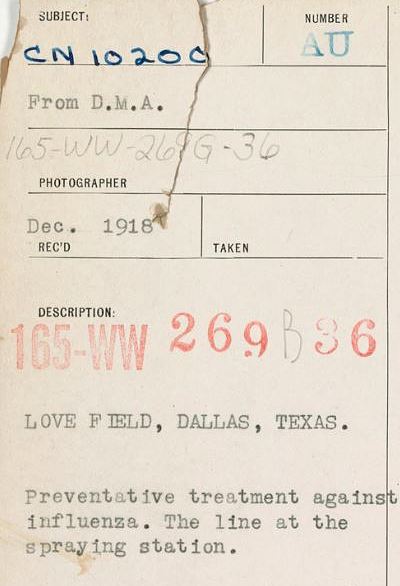
The photo above, from December, 1918, shows Love Field military personnel waiting in line to be “sprayed” — the caption reads:

Love Field, Dallas, Texas: Preventative Treatment against influenza.
The line at the spraying station.

influenza-epidemic_love-field_1918_natl-archives_INFO

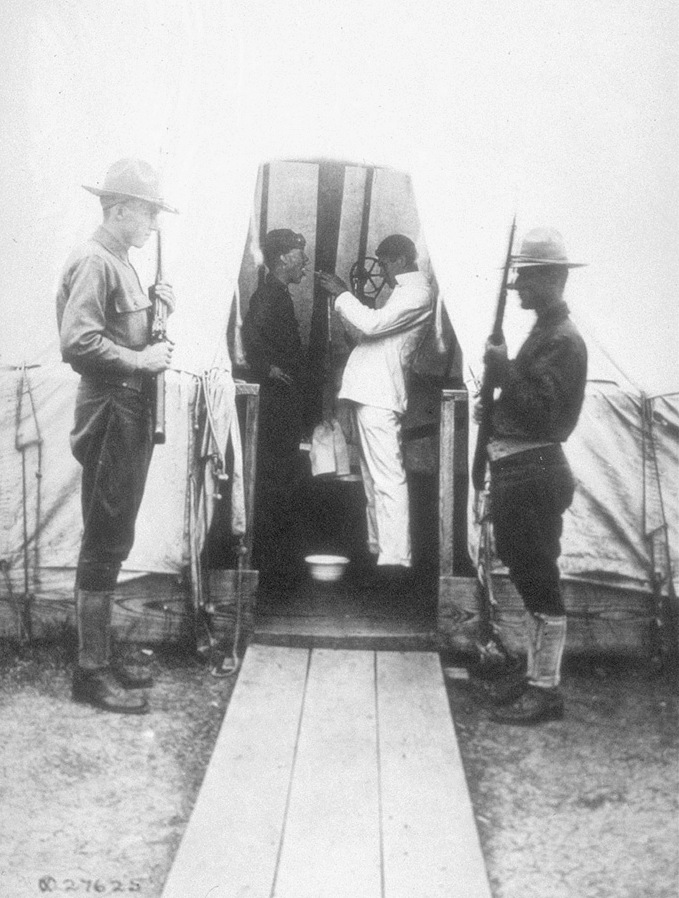
Here’s the throat-sprayer waiting inside the tent:

spanish-influenza_love-field_otis-historical-archives_nmhm_110618Love Field, Nov. 6, 1918

spanish-influenza_dmn_100118_sprayingDallas Morning News, Oct. 1, 1918

I’m not sure how effective this spraying was, but the advice given to Dallasites in 1918 is still good today: wash your hands, keep your surroundings clean, and do not spit in streetcars!

***

Sources & Notes

Top photo is from the National Archives at College Park; more info is here.

Second photo, showing the inside of the “spraying station,” is from the Otis Historical Archives, National Museum of Health and Medicine; more info is here

For a more detailed post about how Dallas dealt with the Spanish Influenza, read the 2014 Flashback Dallas post “When the Spanish Influenza Hit Dallas — 1918.”

influenza-epidemic_love-field_1918_natl-archives_sm

*

Copyright © 2020 Paula Bosse. All Rights Reserved.