Flashback : Dallas

A Miscellany: History, Ads, Pop Culture

Category: Neighborhoods

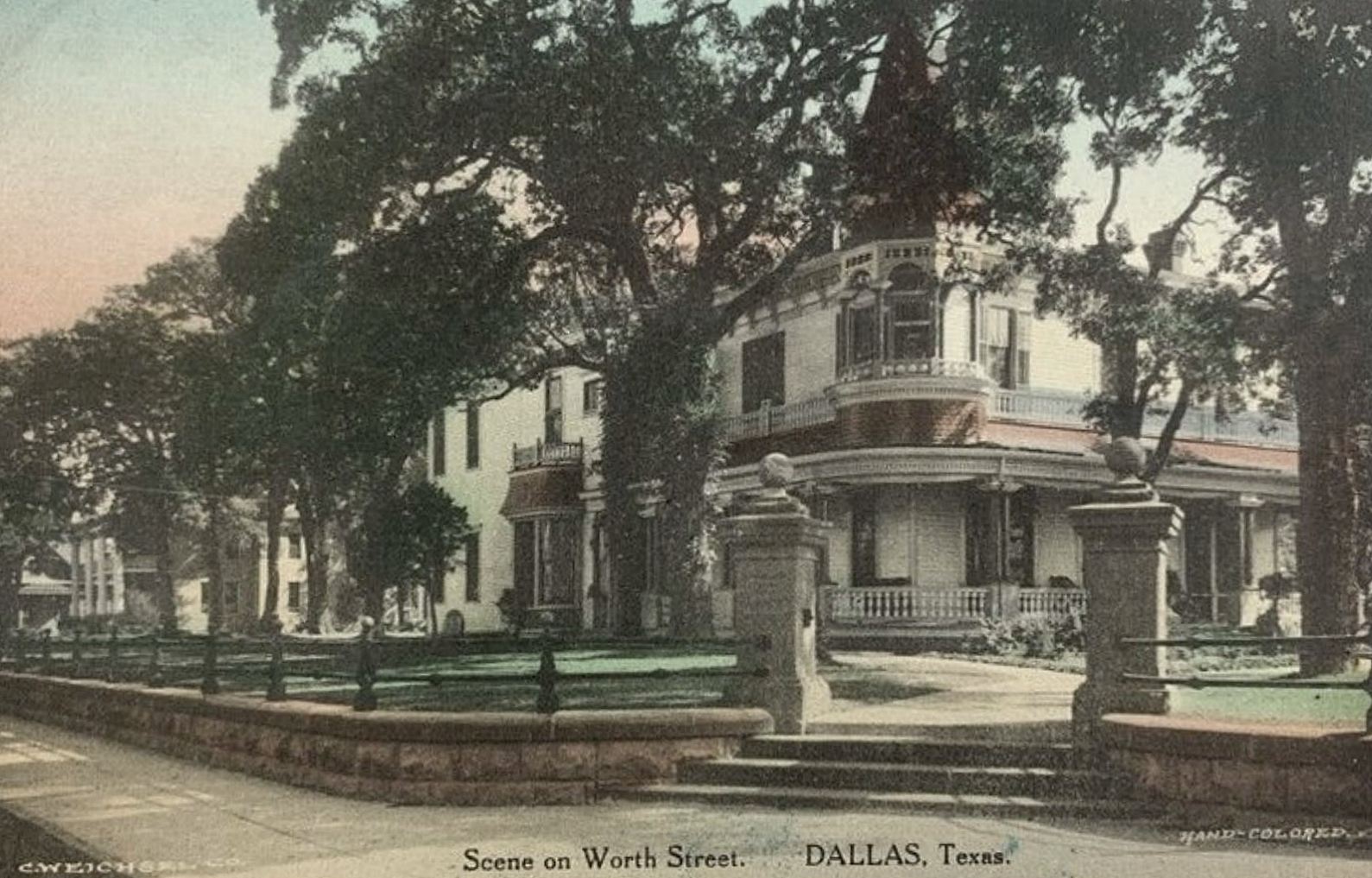
Worth Street, A Century Ago

worth-street_461_rppc_1908_ebay“A hearty welcome awaits…” (click for larger image)

by Paula Bosse

Above is a photograph of the new home of traveling salesman Everett F. Bray (1873-1915) and his wife Erminia Connor Bray (1874-1962); they had moved to Dallas in 1907 with their young children Everita and Melville. The picture-postcard is dated Aug. 28, 1908 and was sent to a friend with Erminia’s message:

Dearie, I hope it won’t be very long before I can have the pleasure of entertaining you in my Dallas home. […] A hearty welcome awaits you at 461 Worth St. Dallas any old time.

worth-street_461_rppc_1908_ebay_msg

The 1905 Sanborn map of this Old East Dallas neighborhood (which, more specifically, is in OED’s Peak’s Suburban Addition) can be found here (461 is an empty lot, near the upper right corner). After the city-wide address-change of 1911, the 400 block of Worth became the 4400 block. As is the case with many of the houses in this neighborhood, Erminia’s house still stands. …But with a whole lot more vegetation.

worth-street_google-street-view_20162016 Google Street View

*

Worth Street — which stretches through Junius Heights, Munger Place, and Peak’s Suburban Addition — may be a bit funkier these days, but there are still many beautiful homes lining the street. Below are a couple of postcards from a century ago, well before the “funky” era.

worth-street_postcard_weichsel_ebay

worth-street_corner_postcard_weichsel_ebay

**

After I posted the top image on Instagram, a person (whose handle is @uneik_image_inc) made this interesting comment:

We have painted quite a few houses on Worth Street! Interesting fact: lots of these homes are built on Bois D’Arc tree stumps for foundation piers and a solid 85% are still standing and being lived in!

***

Sources & Notes

All postcards are from eBay.

The Brays had moved from their Worth Street home by 1915 when 41-year-old Everett Bray was killed in an automobile accident. Erminia — known as “Minnie” — lived almost 50 years longer than her husband, dying in Duncanville in 1962 at the age of 88.

worth-street_461_rppc_1908_ebay_sm

*

Copyright © 2019 Paula Bosse. All Rights Reserved.


Beautiful Lake Cliff — ca. 1906

lake-cliff_cook-colln_degolyer_smu

by Paula Bosse

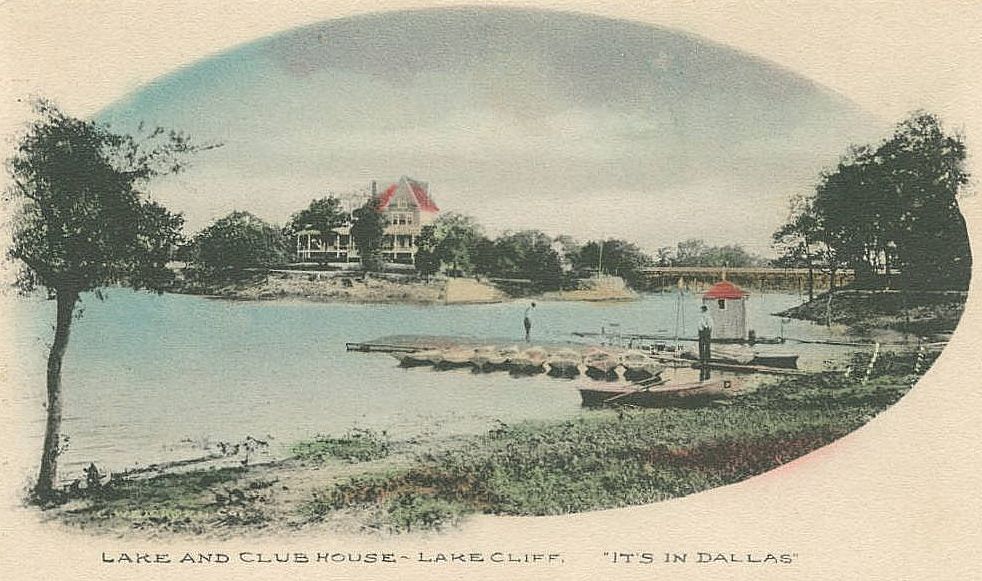
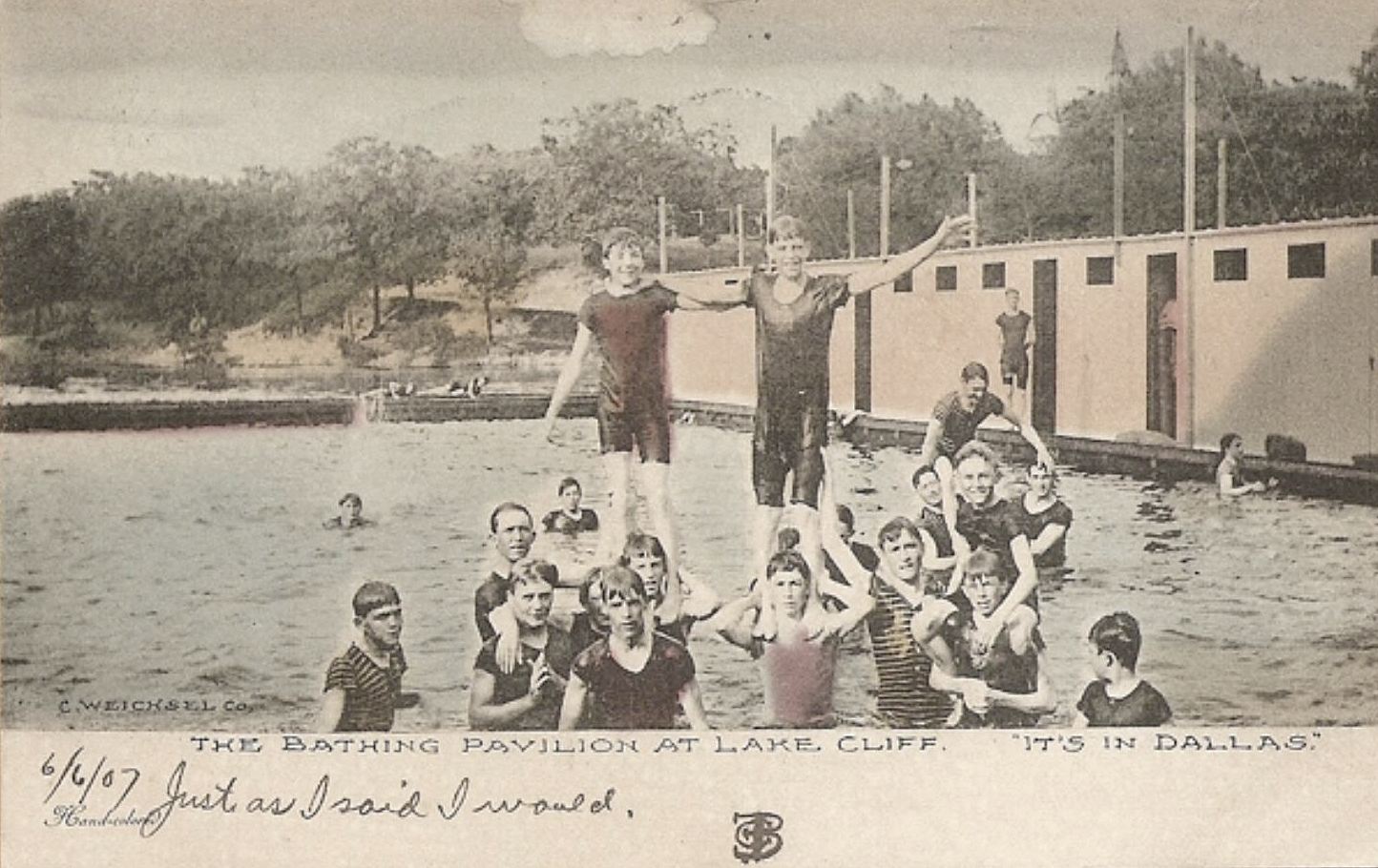
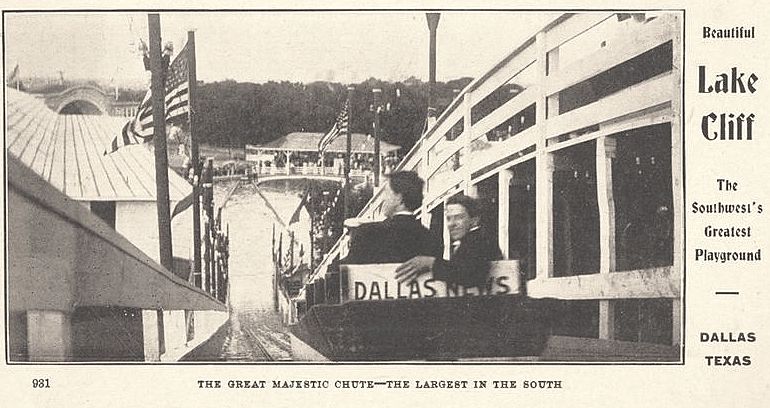
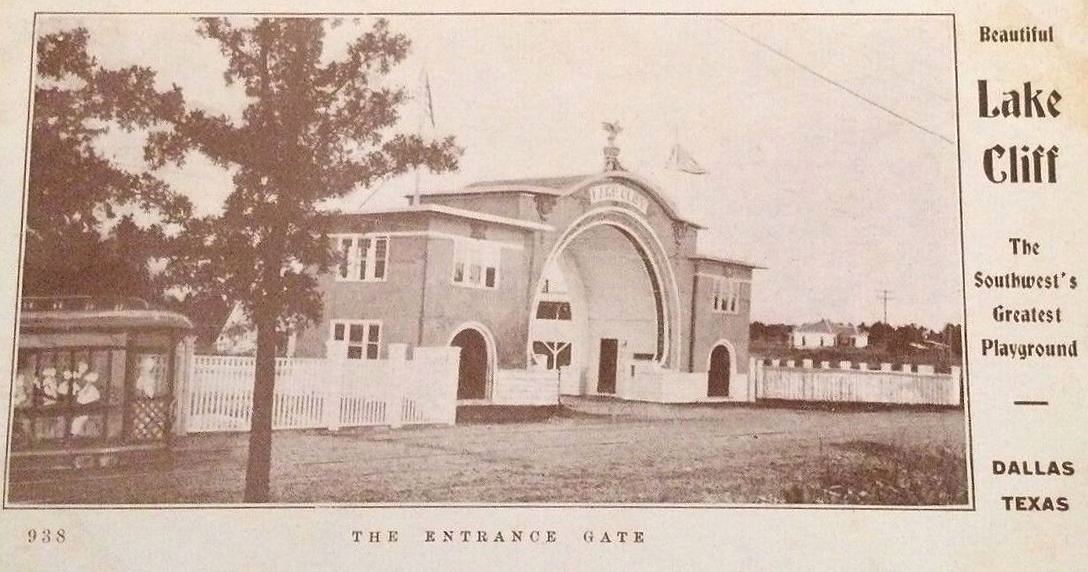
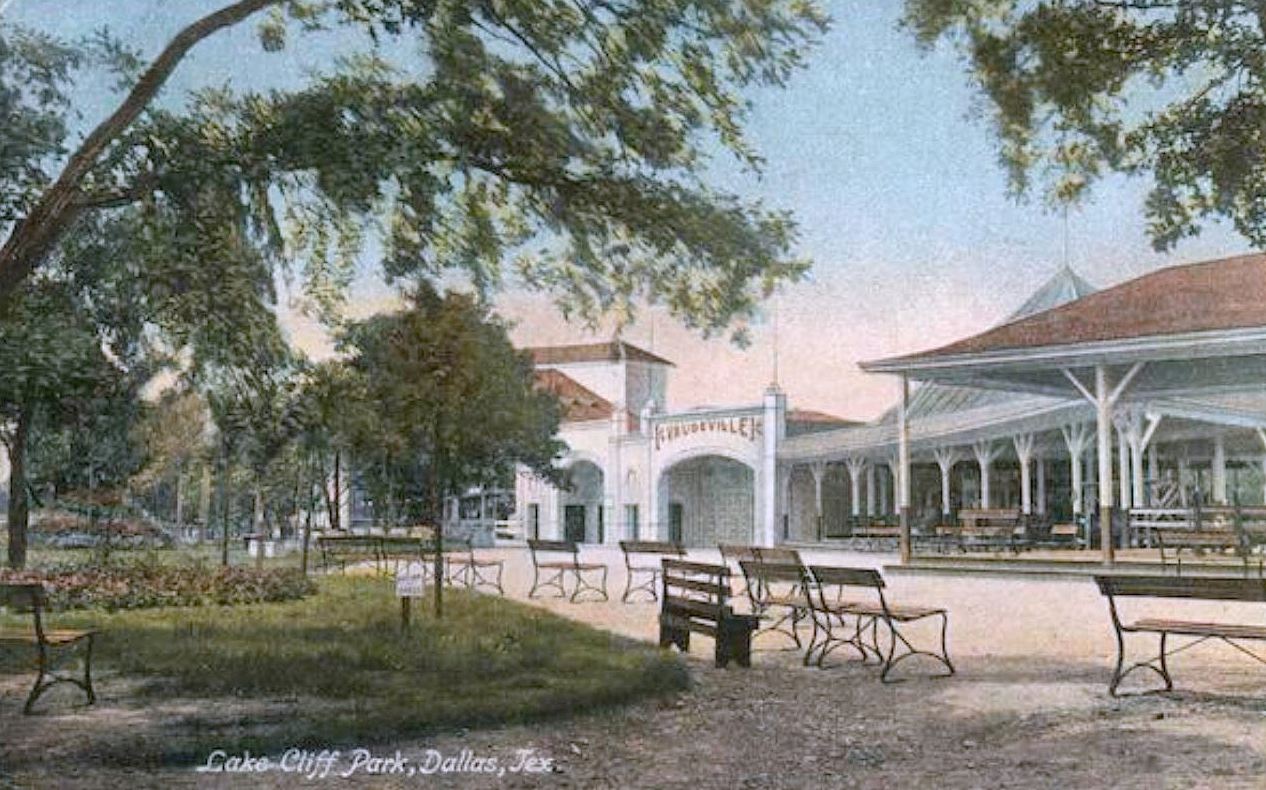
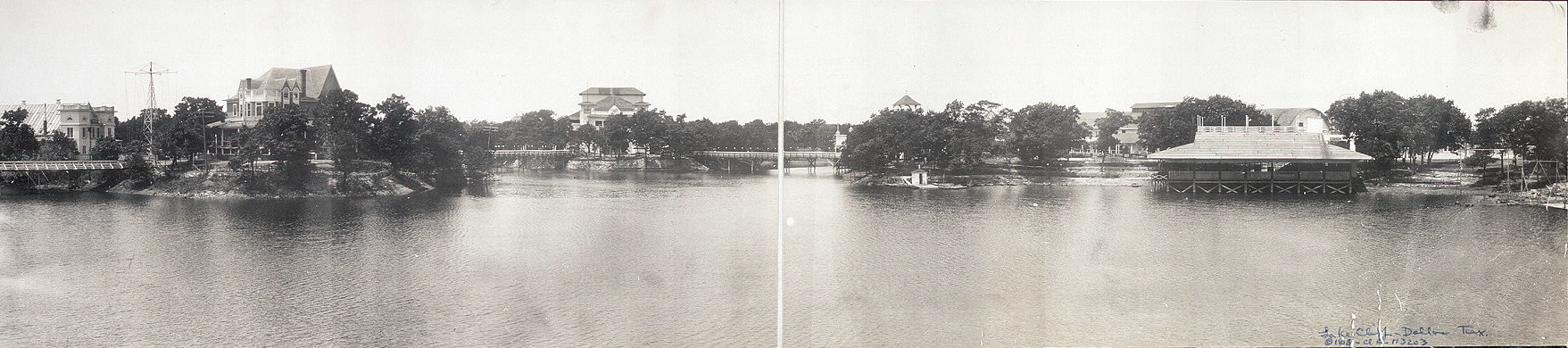
Enjoy these images of Lake Cliff, which, 100 years ago, was “the greatest amusement park in the Southwest.” The slogan “It’s in Dallas” should really have read “It’s in Oak Cliff” — and back then Oak Cliff had everything!

  • Mystic River
  • Shoot-the-Chutes (read this!)
  • Open-Air Circus
  • Roller Coaster
  • Casino
  • Natatorium
  • Carousel
  • Tennis Courts
  • Restaurant
  • Baseball Grounds
  • Skating Rink
  • Trolley Cars
  • Penny Vaudeville
  • Casino Band and Orchestra
  • Circle Swing
  • Japanese Village
  • Boating
  • Swimming
  • Ferris Wheel

Whew.

Below, some wonderful postcards and photos. (Click to see larger images.)

The first one shows the cafe and the “circle swing” (see a swing in action here).

lake-cliff_swing-ride_postcard_ebay

lake-cliff_c1910_postcard_degolyervia DeGolyer Library, Southern Methodist University

lake-cliff-bathing_1910s_postcard_degolyervia DeGolyer Library, SMU

swim_lake-cliff-pool_ca-1907_flickr_coltera

lake-cliff_flickr_coltera

lake-cliff_postcard

lake-cliff_shoot-the-chutes_1908

shoot-the-chute_lake-cliff_ebay

skating-rink_lake-cliff_cook-colln_degolyer_1via Cook Collection, DeGolyer Library, SMU

lake-cliff_sunday-afternoon-concert_1906_portal

lake-cliff_club-house-cafe_postcard_ebay

lake-cliff_postcard_weichsel_ebay

lake-cliff_entrance_postcard_ca-1905_ebay

lake-cliff-park_benches_ebay

lake-cliff-park_rose-garden

lake-cliff-pavilion_oak-cliff-high-school-yrbk_1925Oak Cliff High School yearbook, 1925

lake-cliff_clogenson_1908_LOCPhoto by Clogenson, ca. 1908, via Library of Congress

lake-cliff_1906_portal_attractions-1

lake-cliff_1906_portal_attractions-2From 1906 promotional brochure, via Portal to Texas History

Jump forward to the 1940s — when it was more of a big pool, without all the flash and filigree:

swim_lake-cliff-pool_1947_flickr_coltera

Take a look at it now in this stunningly beautiful drone video by Matthew Armstrong:

*

***

Sources & Notes

Top image is from a postcard in the George W. Cook Collection at SMU’s DeGolyer Library, here.

Most other uncredited images were found around the internet, several from Coltera’s Flickr stream.

More on Lake Cliff can be found in this article by Rachel Stone from the Oak Cliff Advocate (be sure to click the link to see the full 1906 promotional brochure on “the Southwest’s greatest playground” (it’s “Clean, Cool, Delightful”)).

lake-cliff_cook-colln_degolyer_smu_sm

*

Copyright © 2019 Paula Bosse. All Rights Reserved.

Urban Landscape with Biplane

magnolia-building_airplane_postcard_ebay
Scraping the sky…

by Paula Bosse

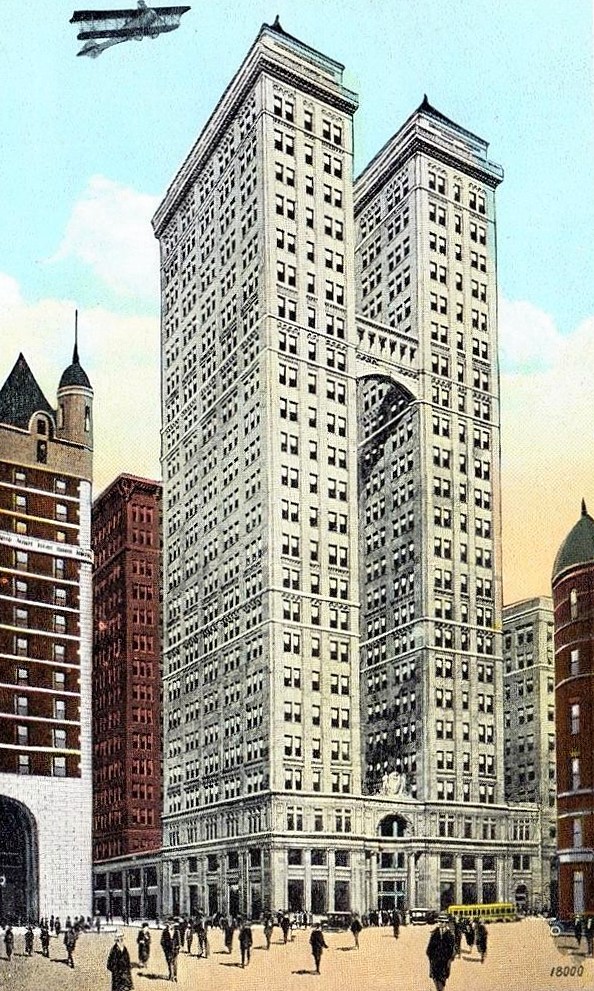
When the Magnolia Petroleum Building was built in 1924, it was Dallas’ tallest building. It was so tall, in fact, that it appears to be encroaching into biplane airspace in this romanticized postcard. If you squint, it looks as if the Dallas citizenry is fleeing from an air attack as a plane buzzes the Magnolia Building. …Perhaps a Texan King Kong is swatting at it from the other side.

***

Sources & Notes

Postcard from eBay. The view is to the northeast, from Commerce and Akard, with the Adolphus Hotel partially visible on the far left and the old Oriental Hotel partially visible on the far right.

See a fantastic photo of these buildings from around the same time in the Flashback Dallas post “The Adolphus, The Oriental, The Magnolia.”

*

Copyright © 2019 Paula Bosse. All Rights Reserved.

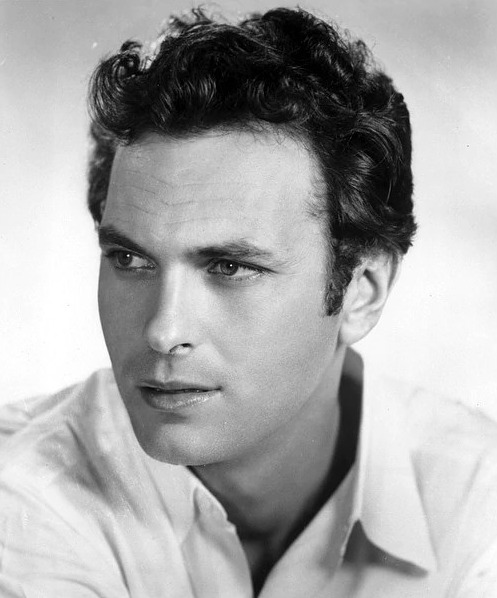
Rip Torn and Ann Wedgeworth’s Dallas Wedding — 1955

1948_torn-rip_taylor-high-school_1948-yrbk_senior-photo
E. R. “Rip” Torn, the pride of Taylor High School

by Paula Bosse

One of my favorite actors — Rip Torn — has died. My favorite performance of his was as Larry Sanders’ producer, Artie, on The Larry Sanders Show. He was PERFECT in that role. And I loved a little-seen movie he did in the ’70s called Payday in which he played a hard-living country-music singer (watch the trailer here; the full movie is currently on YouTube). But, really, I liked him in everything I saw him in.

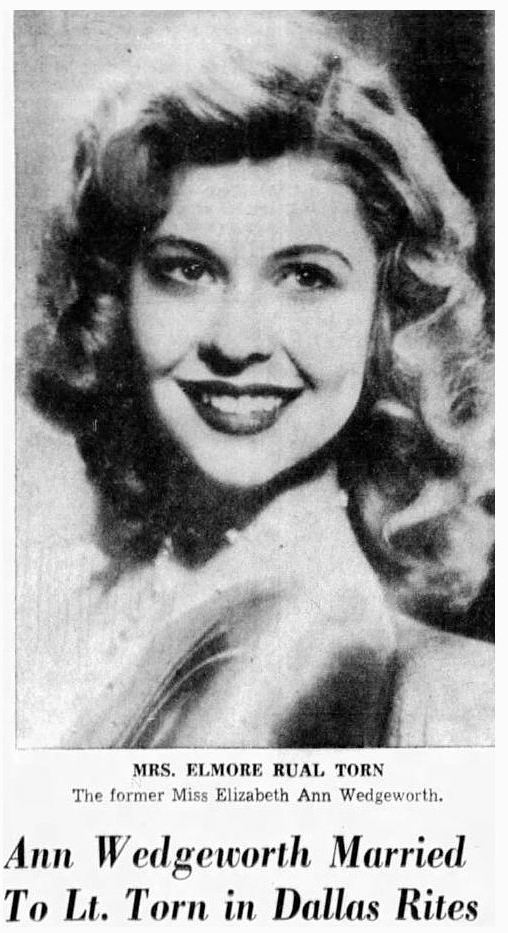
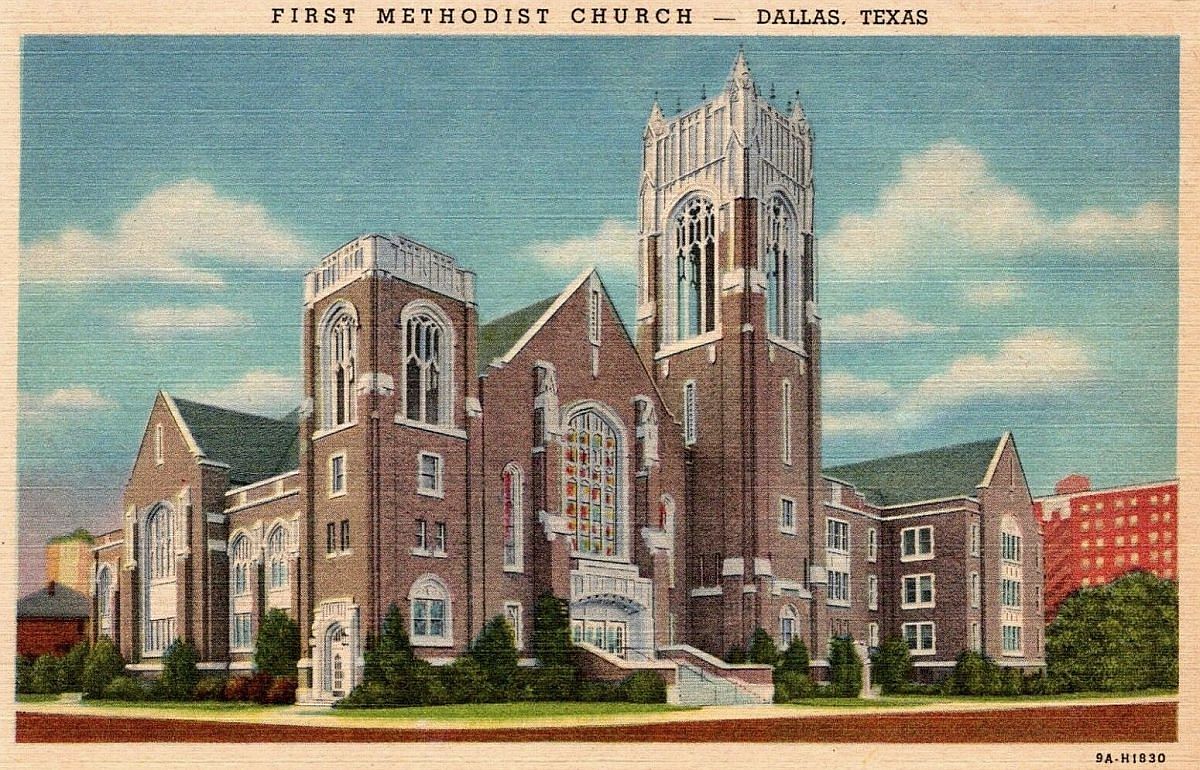
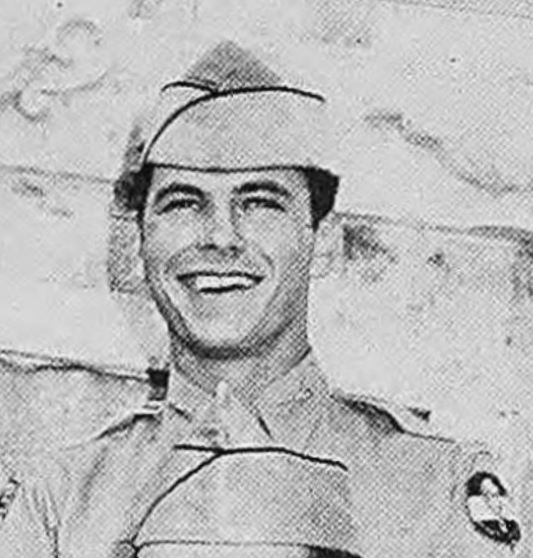
A couple of years ago I wrote about Dallas-reared actress Ann Wedgeworth and was surprised to discover that she had been married to fellow Texan Rip Torn (born Elmore Rual Torn) and their wedding had been in Dallas. They had probably met in Austin in 1952 or 1953 when both were members of the University of Texas Curtain Club acting group. They were married in downtown Dallas on Saturday, January 15, 1955 at First Methodist Church on Ross and Harwood, with Rev. Calvin W. Froehner officiating. The 20-year-old bride wore rose-hued lace and satin; the 23-year-old groom probably wore a military uniform as he was then serving in the U.S. Army Military Police.

torn-rip_ann-wedgeworth_wedding_austin-american_012555
Austin American, Jan. 25, 1955

torn-rip_ann-wedgeworth_wedding_taylor-daily-press_012355
Taylor (TX) Daily Press, Jan. 23, 1955

methodist_first-methodist-church_ebay

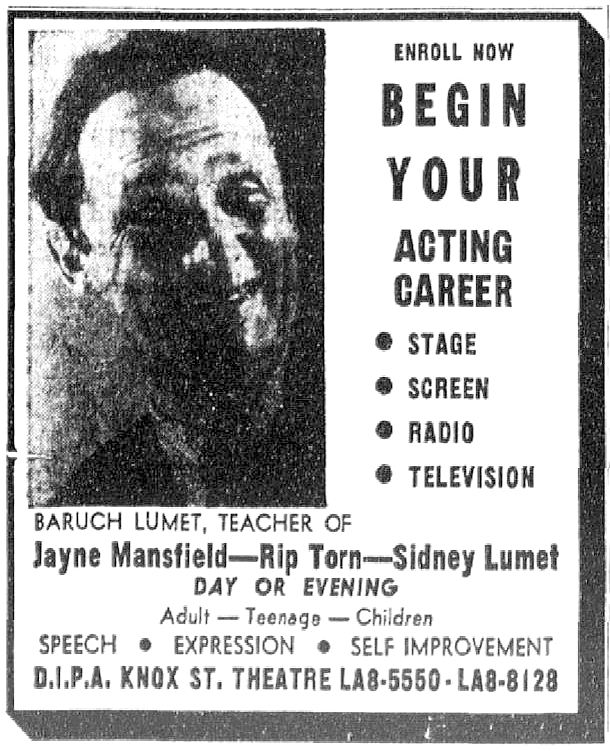
At some point — probably around the time of his marriage — Rip (and possibly Ann) took acting lessons at the Dallas Institute of Performing Arts on Knox Street. D.I.P.A. was run by Baruch Lumet (father of Hollywood director Sidney Lumet).

torn-rip_lumet-acting-school-ad_061558
1958

Rip (who was called “Skip” as a child, which is nowhere near as good as “Rip”) moved to New York later in 1955 when Rip’s army hitch was finished, and both began working in New York theater fairly soon after their arrival. They had a daughter Danae and were married until their divorce in 1961.

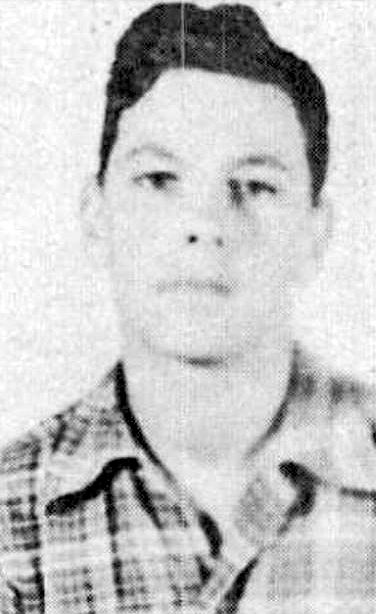
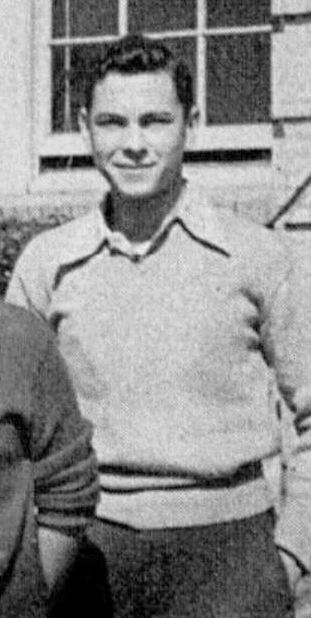
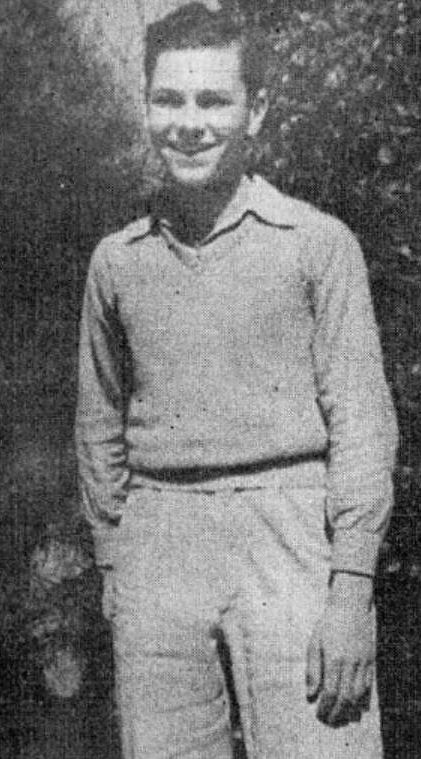
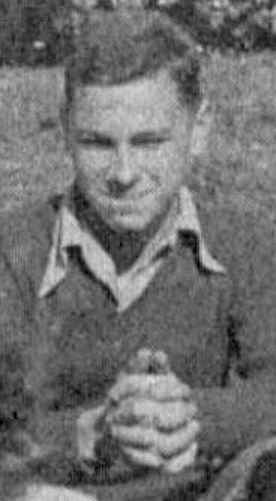
Below are a few photos of Rip Torn from high school and college yearbooks. (Most images are larger when clicked.)

1946_torn-rip_longview-high-school_1946-yrbk_sophomore-photo
1946, Longview (TX) High School, sophomore

1947_torn-rip_longview-high-school_1947-yrbk_junior-photo
1947, Longview High School, junior

1947_torn-rip_longview-high-school_1947-chemistry-club-president
1947, Longview High School, Chemistry Club president

1947_torn-rip_longview-high-school_1947-school-paper-sports-editor
1947, Longview High School, sports editor of the school paper

1947_torn-rip_longview-high-school_1947-yrbk_junior-class-treasurer
1947, Longview High School, Junior Class treasurer

1948_torn-rip_taylor-high-school_1948-yrbk_senior-photo
1948, Taylor (TX) High School, senior

1948_torn-rip_taylor-high-school_1948-yrbk_annual-business-mgr
1948, Taylor High School, yearbook staff, business manager

1950_rip-torn_tx-a-and-m_soph_class-officer
1950, Texas A & M, Sophomore Class parliamentarian

1951_torn-rip_radio-guild_UT_1951-yrbk
1951, University of Texas, junior, Radio Guild

1952_torn-rip_UT_yrbk_1952_sigma-chi
1952, University of Texas, senior, Sigma Chi fraternity

rip-torn_glamor-shot
Hollywood glamour shot

RIP, Rip (1931-2019).

***

Sources & Notes

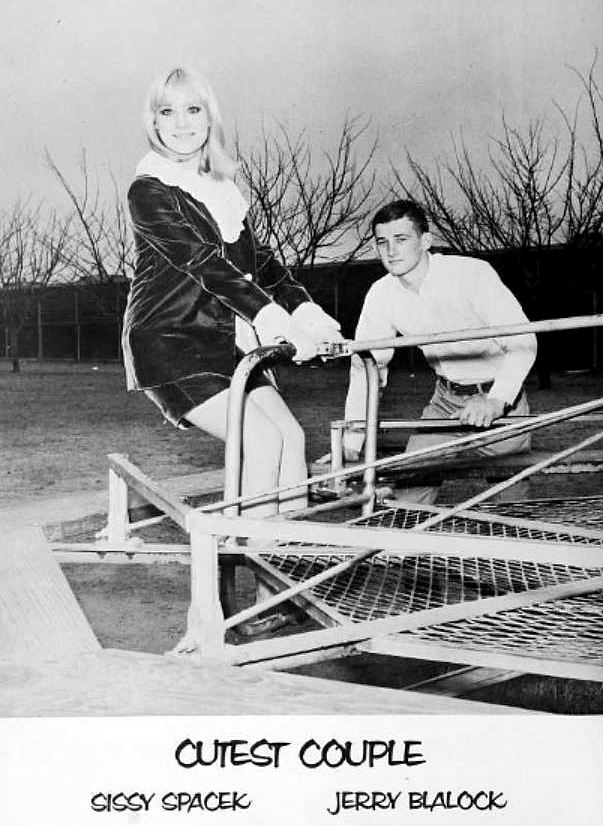
Rip Torn had a famous first-cousin, Sissy Spacek — Rip’s mother and Sissy’s father were brother and sister. I checked the Quitman High School yearbook (Sissy’s alma mater) and found her mod and groovy 1968 senior photos. Here’s one, showing her as a class favorite, voted “Cutest Couple” with Jerry Blalock. (And, yes, that really is her.)

spacek-sissy_quitman-high-school_senior-photo_1968_cutest-couple

And, since I’m on a roll, here’s a photo of Rip Torn’s mother, Thelma Spacek, when she was a student at Southwestern College (Georgetown, TX) in 1927. Rip had that same profile.

torn-rip_mother_thelma-spacek_southwestern-univ_georgetown_1927

*

1948_torn-rip_taylor-high-school_1948-yrbk_senior-photo_sm
RIP

*

Copyright © 2019 Paula Bosse. All Rights Reserved.


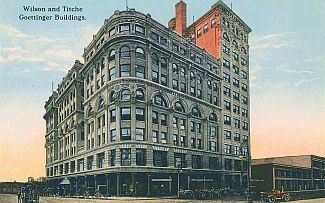
The Wilson Building and the *New* Wilson Building — 1911

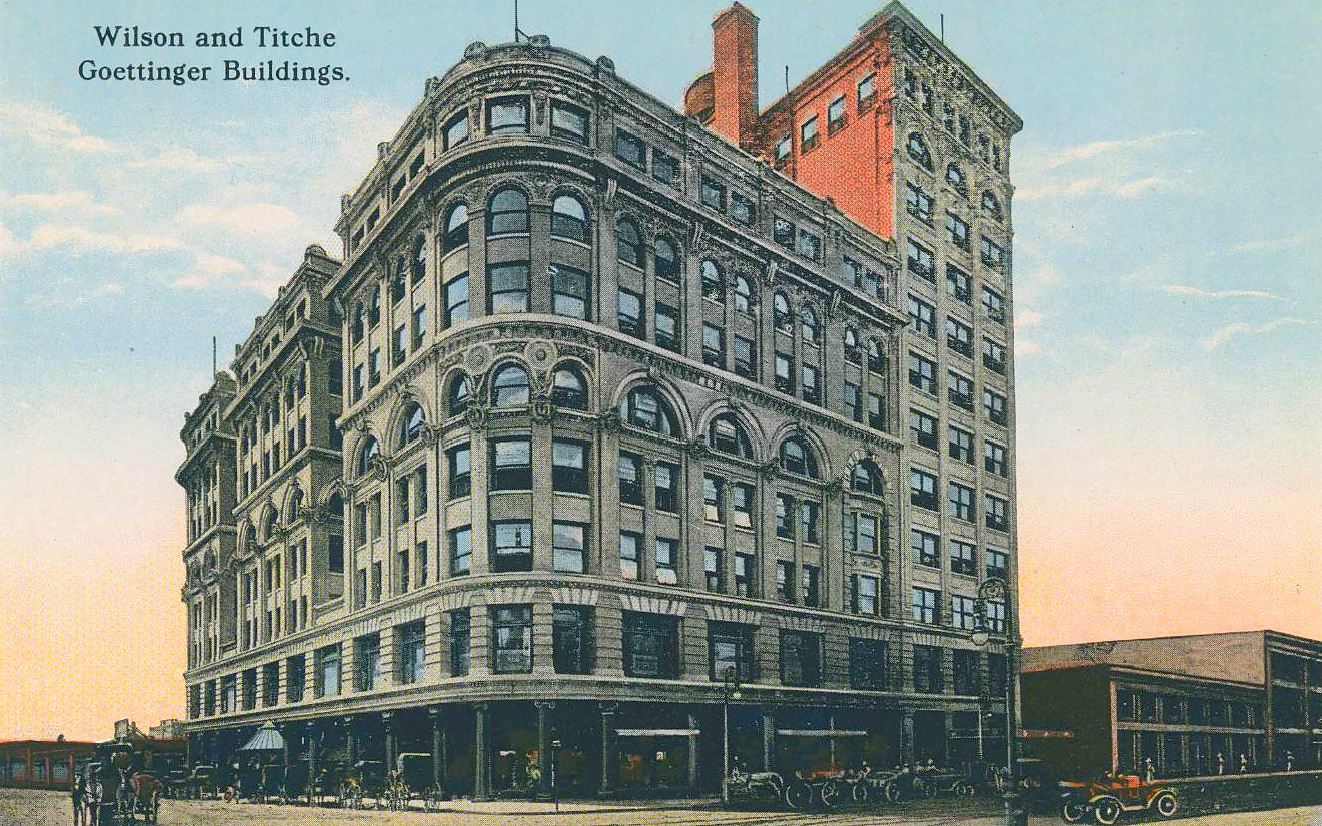
wilson-bldg_titches_postcard
Elm and Ervay… (click for larger image)

by Paula Bosse

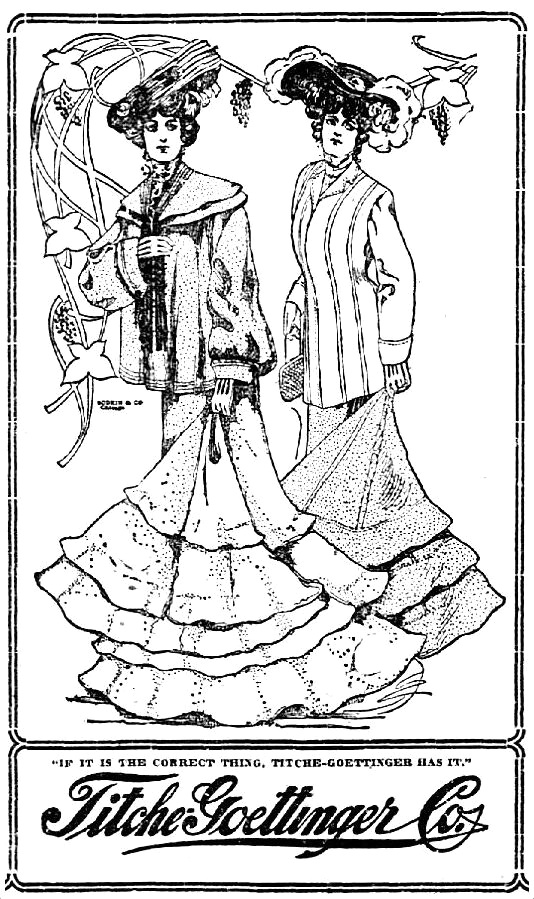
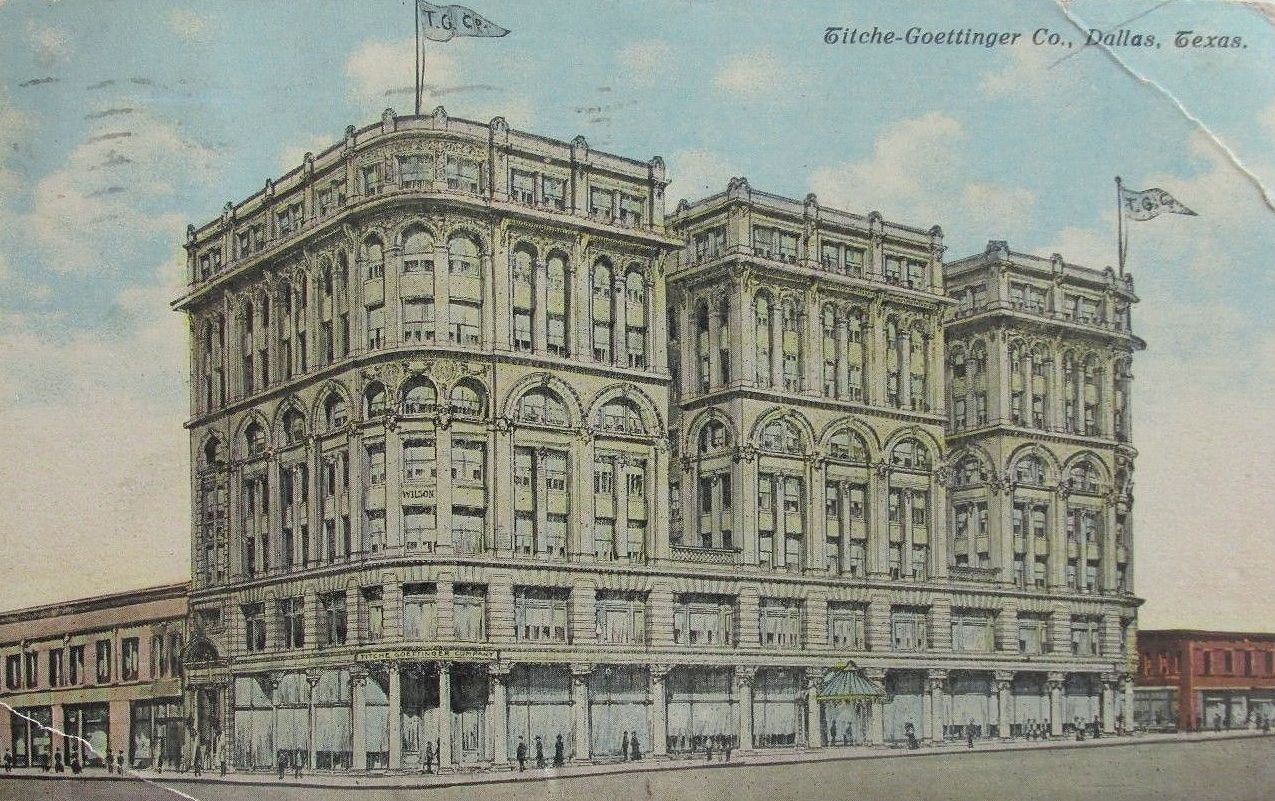
This beautiful postcard shows the original eight-story Wilson Building, built by J B. Wilson in 1902-1904, and its twelve-story companion, which was known as both the “New Wilson Building” and the “Titche-Goettinger Annex” when it was built in 1911. Remarkably, both buildings are still standing at Main-Ervay-Elm. (The view above is looking southwest, with Ervay at the left, and Elm at the right. See this view today on Google Street View here.)

The original building — surely one of Dallas’ most beautiful landmarks — was the home of the Titche-Goettinger department store (which occupied the first two floors and the basement) as well as an important downtown office building. Until seeing this postcard, I had no idea there was a porte-cochère facing Ervay (it can be seen above at the left, under the parasol-like canopy).

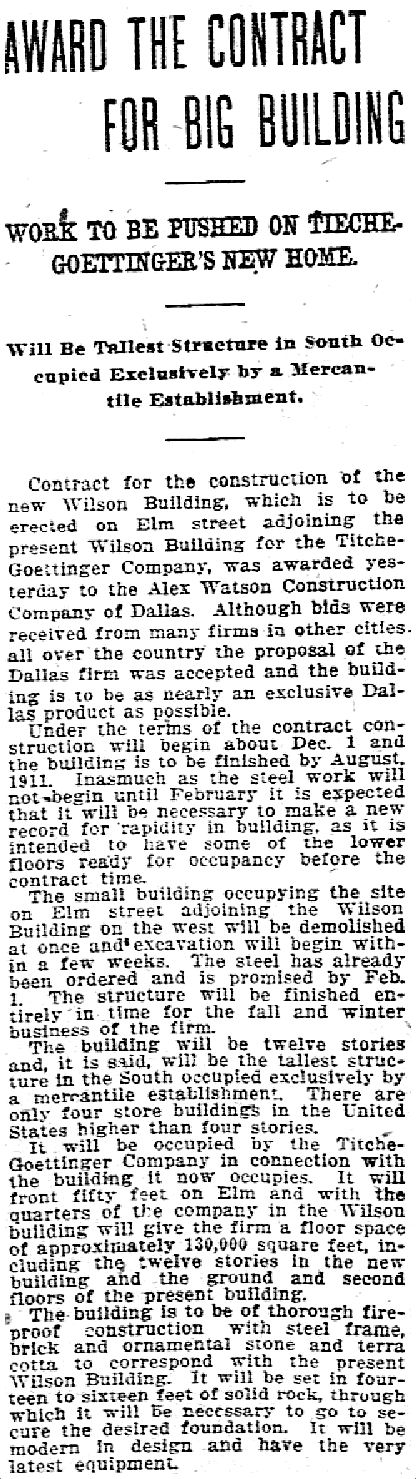
By 1910 Titche’s was so successful that it needed to expand, and it was decided that a new “skyscraper” would be built right next door — the department store would continue to occupy its space in the “old” Wilson Building but would also take over the new building (occupying all twelve floors!). According to The Dallas Morning News, the new building would be “the tallest structure in the South occupied exclusively by a mercantile establishment. There are only four store buildings in the United States higher than four stories” (DMN, Nov. 13, 1910).

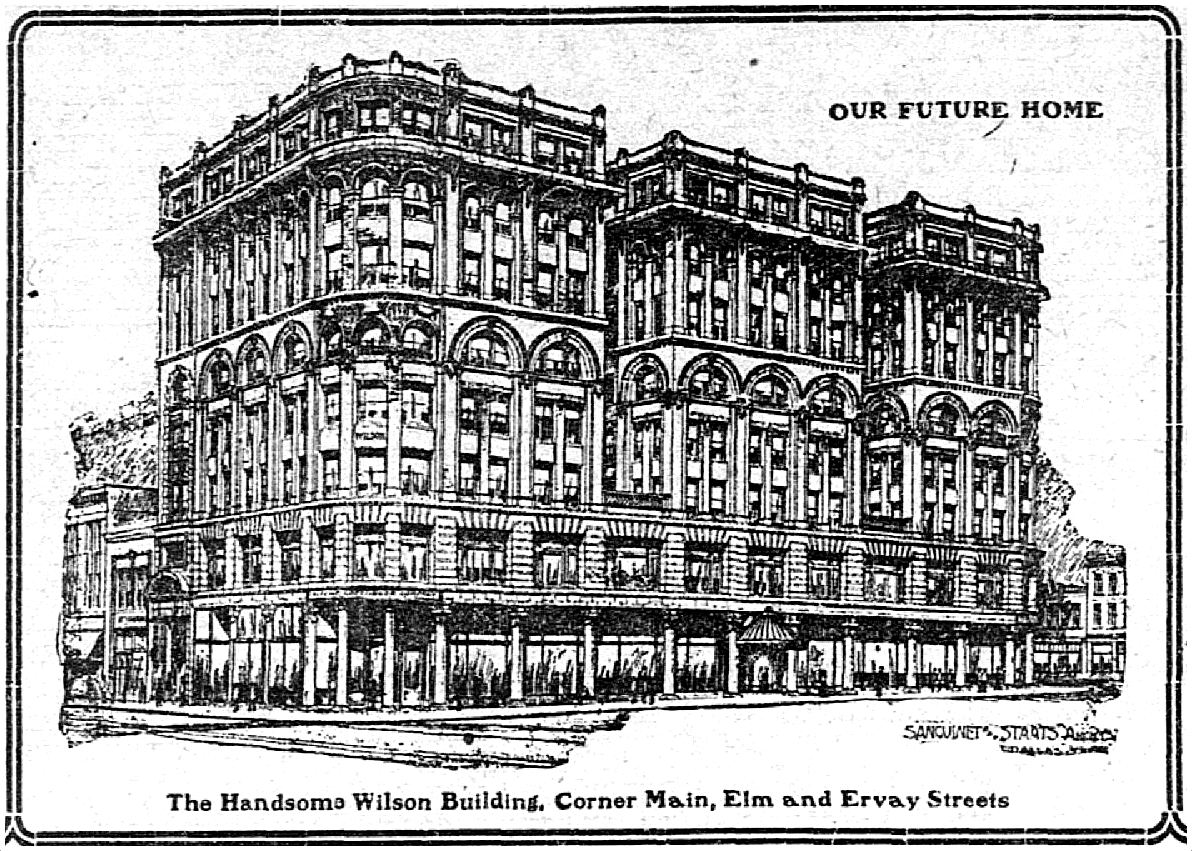
Below are a couple of details from a “coming soon” ad from Titche-Goettinger in September, 1903, showing a drawing of the building (still under construction) from the Fort Worth architectural firm Sanguinet & Staats. (All images are larger when clicked.)

wilson-bldg_titches_092703_coming-soon_ad-det_1DMN, Sept. 27, 1903

wilson-bldg_titches_092703_coming-soon_ad-det_2DMN, Sept. 27, 1903

titche-goettinger_wilson-bldg_postcard_postmarked-1912

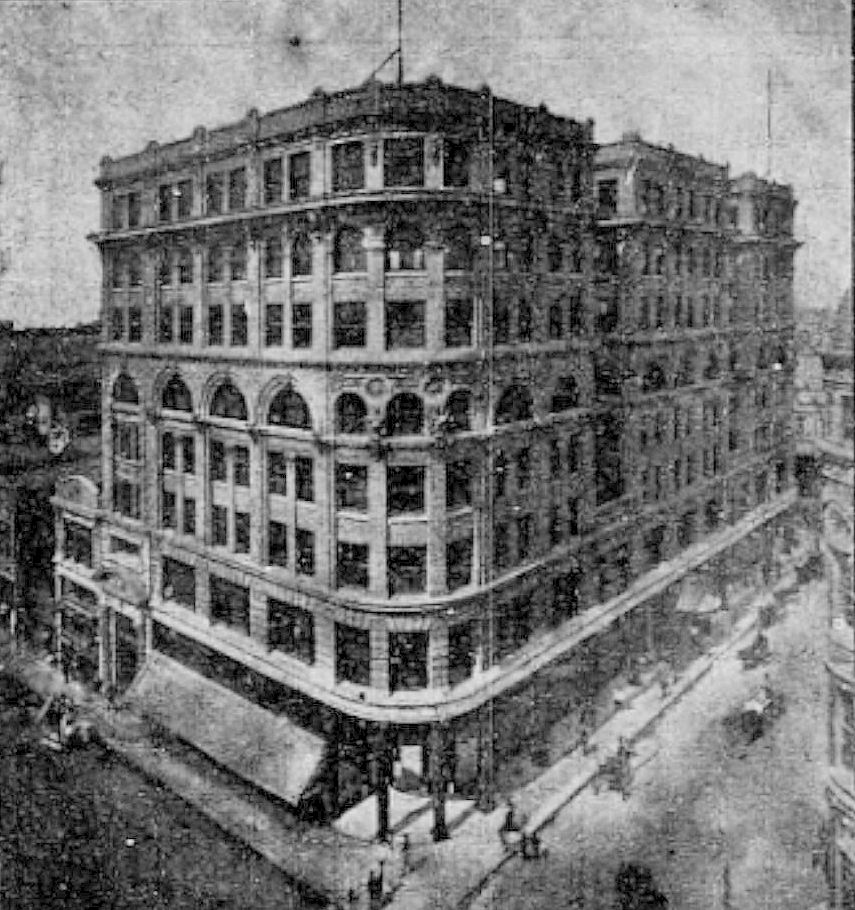
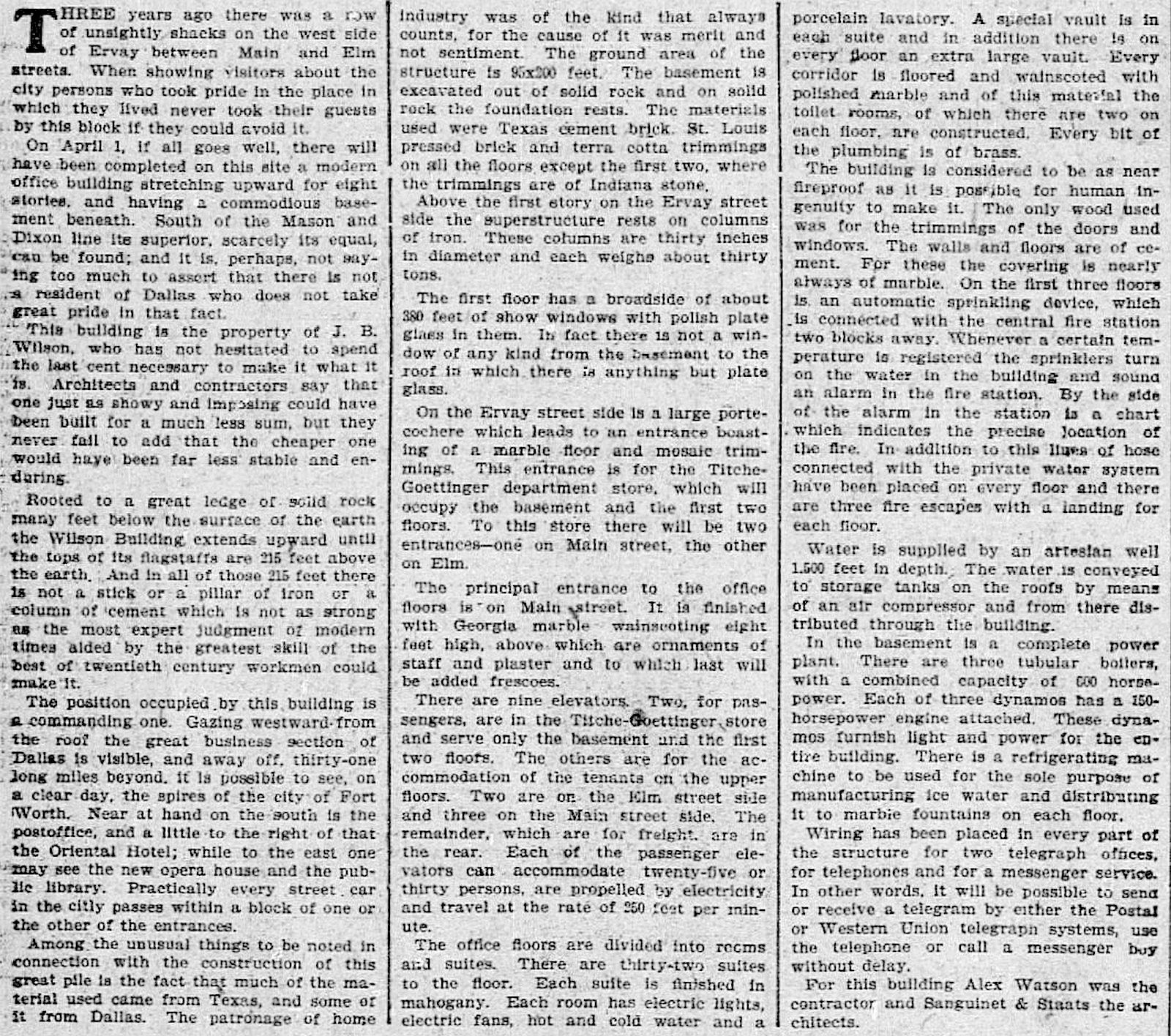
The two photos and article below ran in The Dallas Morning News on March 13, 1904 under the headline “Completion of the Great Eight-Story Wilson Building in Dallas.” The caption of the photo immediately below read “This view was taken from the postoffice, and is the first to show the entire Ervay street front.”

wilson-bldg_dmn_031304_newly-completed_clogenson

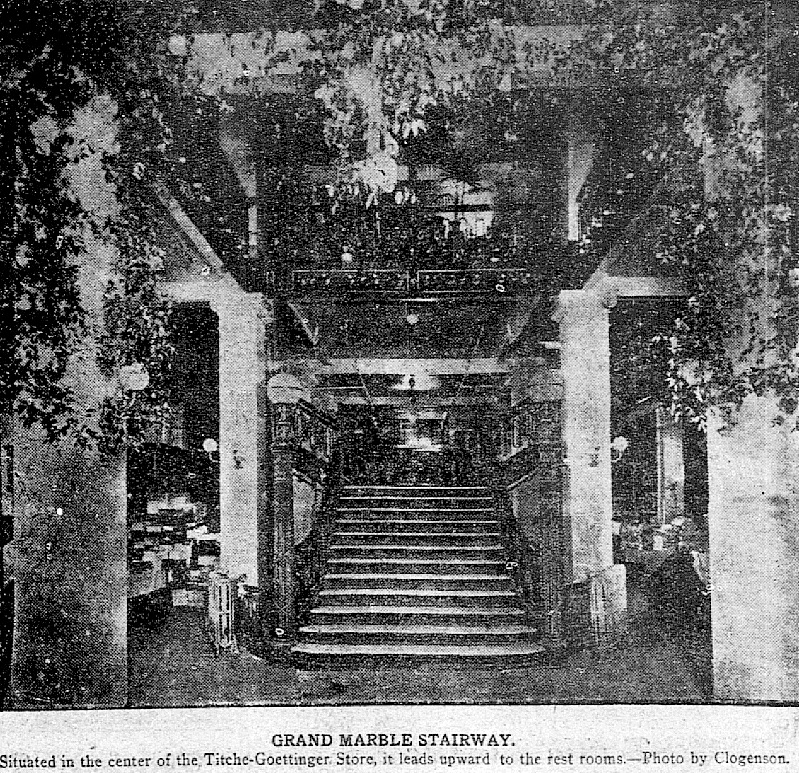
Although the quality of the image below isn’t great, it’s interesting to see this “grand marble stairway,” a feature which was removed in 1911 while the new “annex” was under construction, in order to give Titche’s even more room. The grand staircase was replaced by elevators. (The “rest rooms” referred to in the caption were more “lounge” than bathroom — a place where ladies could sit, relax, and even jot off a few letters as they recovered from their bout of intense shopping.)

wilson-bldg_dmn_031304_grand-stairway_clogenson

The accompanying article (click to read):

wilson-bldg_dmn_031304_completed_textDMN, March 13, 1904

Jump forward six years to the announcement of the “new” Wilson Building:

wilson-bldg_expansion_dmn_111310DMN, Nov. 13, 1910

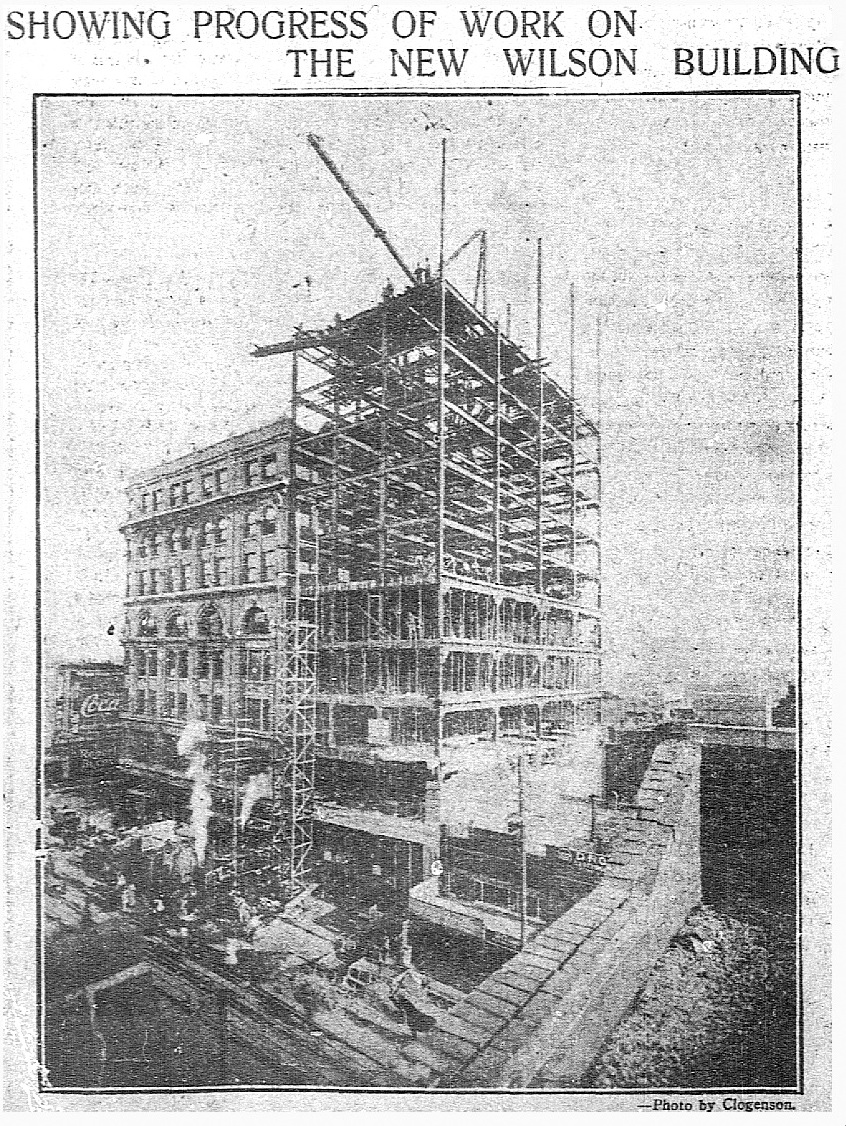
Here it is under construction:

wilson-bldg_expansion_dmn_032811_clogensonDMN, March 28, 1911

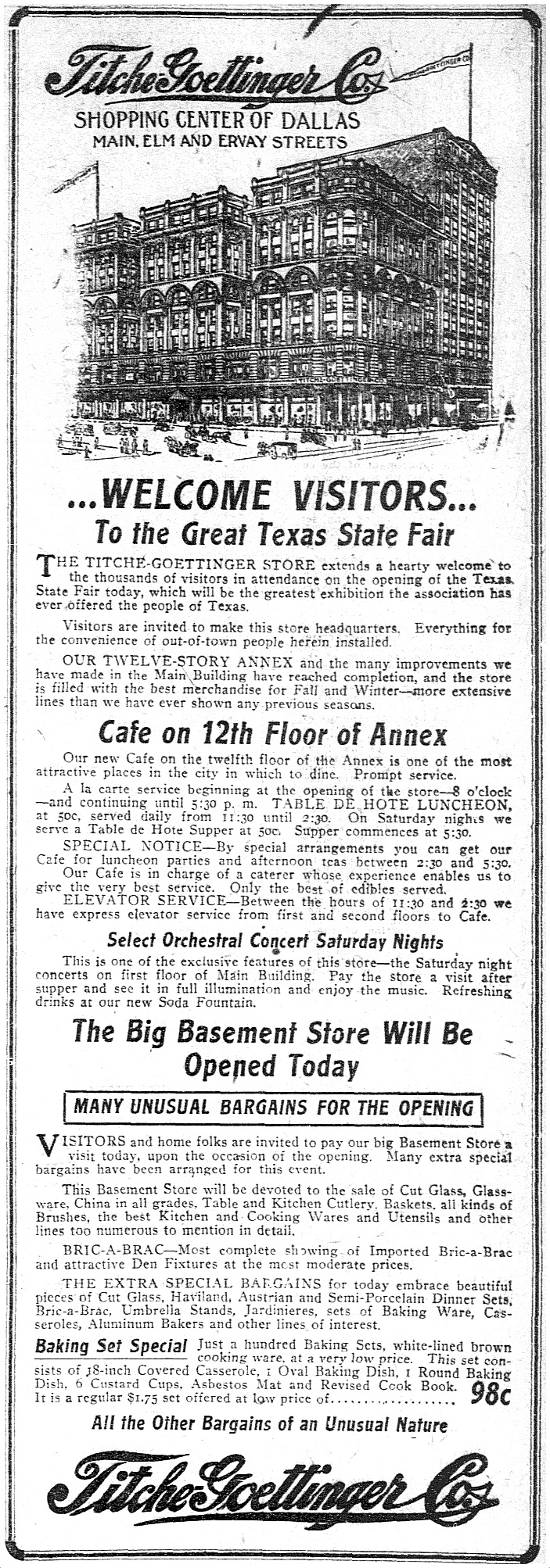
They rushed to be ready to open in time to dazzle State Fair of Texas visitors — and they made it:

wilson-bldg_titche-annex_101411DMN, Oct. 14, 1911

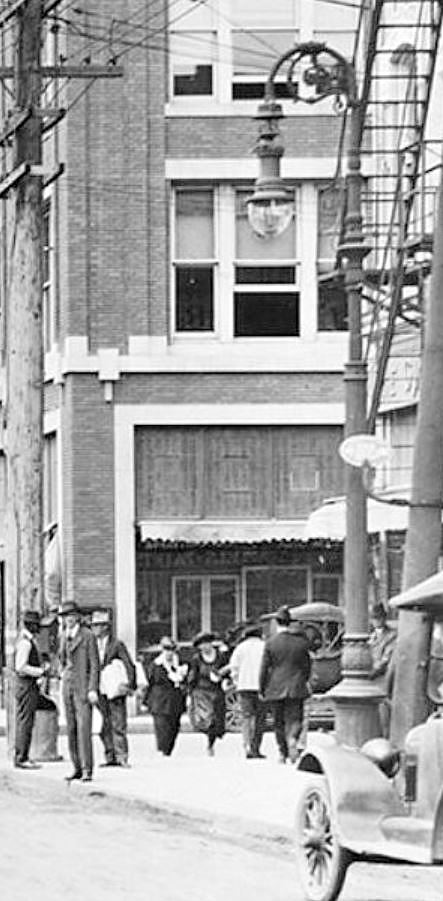
And, below, the completed building, in a photo looking east on Elm (this photo shows one of the brand new street lights written about in the post “The Grand Elm Street Illumination — 1911”). (See this view today on Google Street View, here.)

wilson-bldg_expansion_dmn_121611_clogensonDMN, Dec. 16, 1911

*

wilson-bldg_titches_postcard_sm

***

Sources & Notes

See photos of the original building under construction in the Flashback Dallas post “The Wilson Building Under Construction — 1902.”

I love looking at Sanborn maps. See what was going on at Main-Ervay-Elm in 1899 (before any Wilson buildings), in 1905 (one year after the arrival of the first one), and in 1921 (ten years after the annex went up).

*

Copyright © 2019 Paula Bosse. All Rights Reserved.

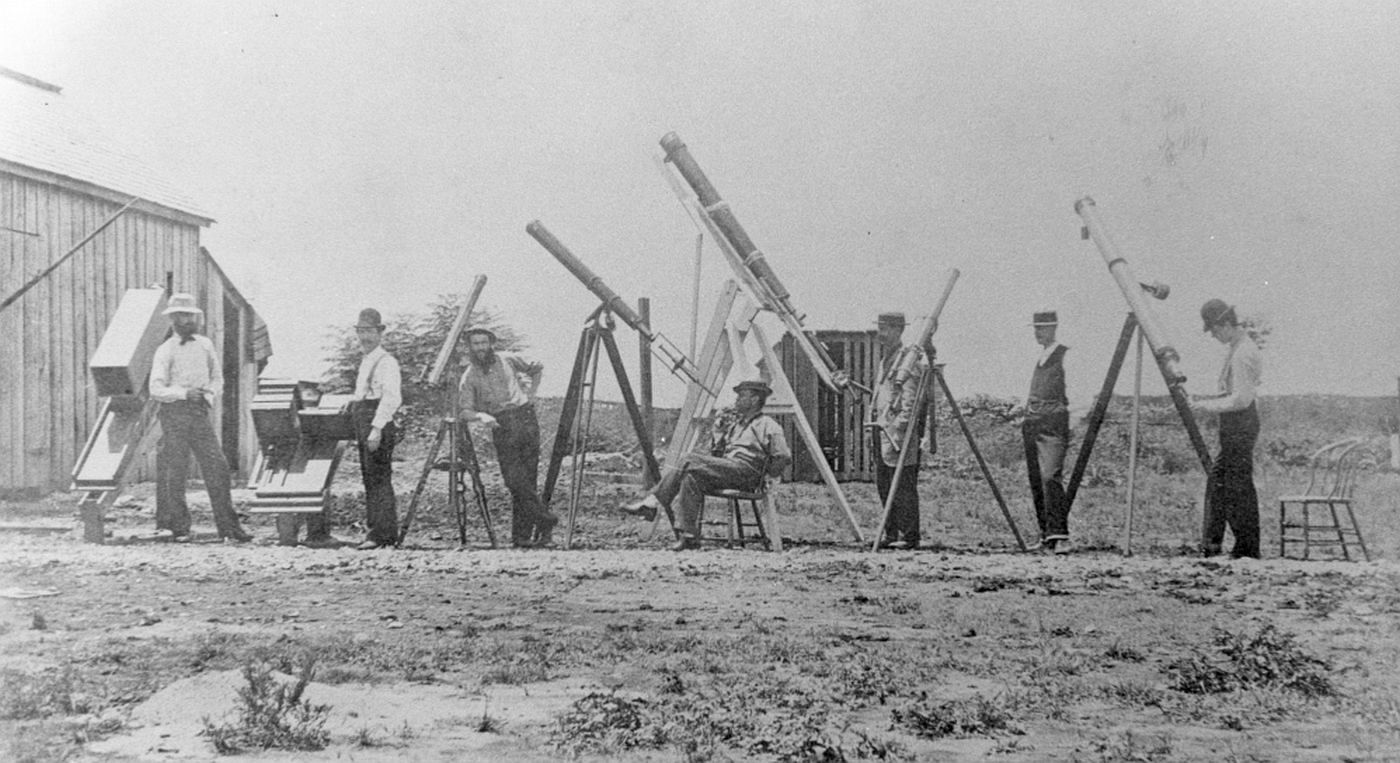
Viewing the 1878 Solar Eclipse in North Texas

solar-eclipse_fort-worth_july-1878_portal
Waiting…

by Paula Bosse

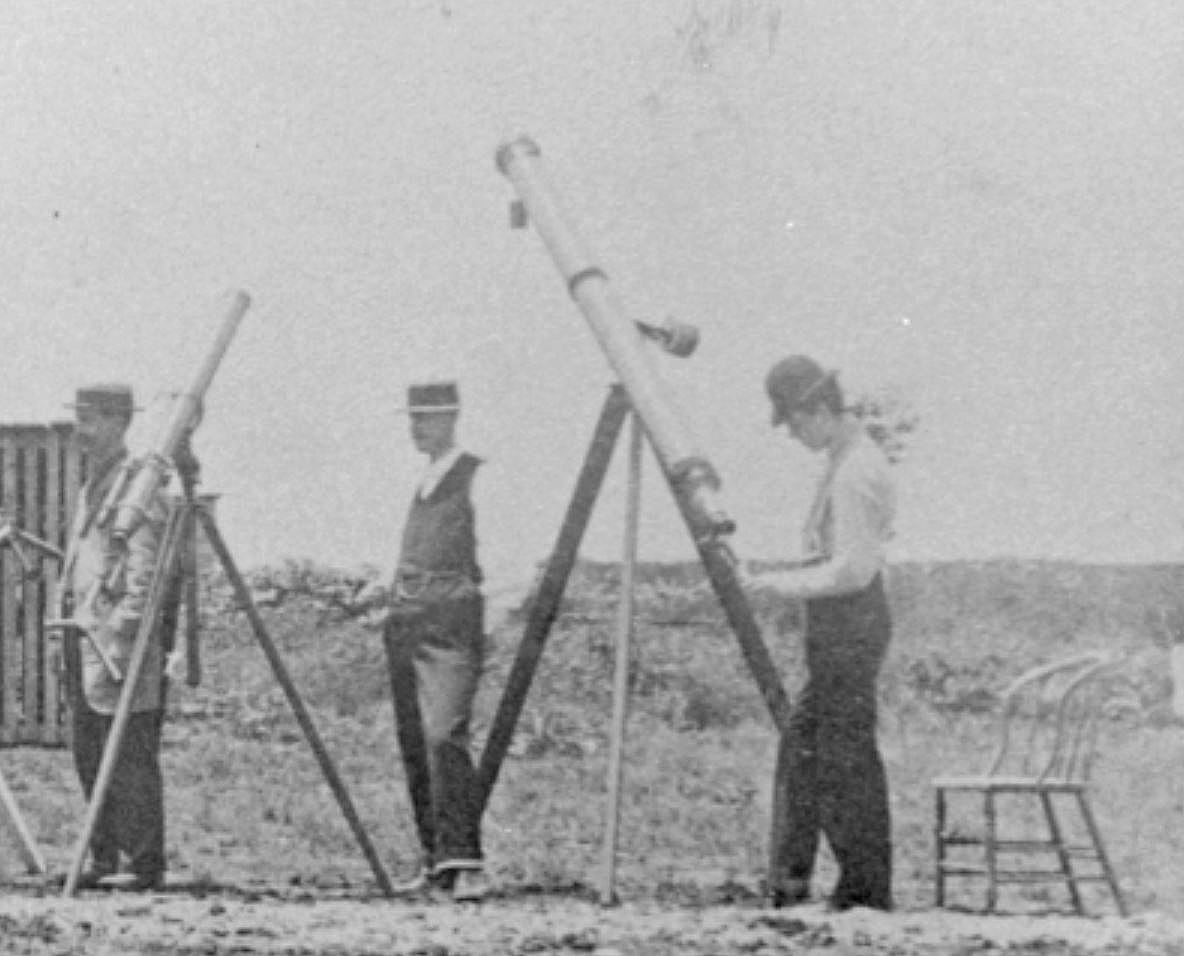
Today there will be a solar eclipse, best viewed in Chile and Argentina. On July 29, 1878, there was also a solar eclipse — that one was fully visible in the United States, and the best place to observe it in Texas was Fort Worth. As seen in the photo above, interest in the event was high. A party of academics from Harvard and other institutions set up on the property of S. W. Lomax of Fort Worth. They were joined by Alfred Freeman, a photographer from Dallas who was a successful portrait photographer and who also sold his photographs of special events (such as this one of a 4th of July parade and this one of a Mardi Gras parade in Dallas) — he no doubt sold reproductions of his eclipse photos taken on July 29th. (He is not identified in this photo, but he may the second man from the right. Freeman is a pretty interesting person, and I hope to write about him soon.)

Here are a few magnified details.

solar-eclipse_fort-worth_july-1878_portal_freeman_det

solar-eclipse_fort-worth_july-1878_portal_astronomers-1_det

solar-eclipse_fort-worth_july-1878_portal_astronomers-2_det

*

Read several lengthy articles on the preparation for the viewing and the description of the eclipse itself in these contemporary articles (they may not be easily viewable on mobile devices):

***

Sources & Notes

Top photo is titled “Total Solar Eclipse in Fort Worth (1878),” from the collection of Tarrant County College Northeast and can be found on the Portal to Texas History, here.

Newspapers linked above are also via the fabulous Portal to Texas History.

*

Copyright © 2019 Paula Bosse. All Rights Reserved.

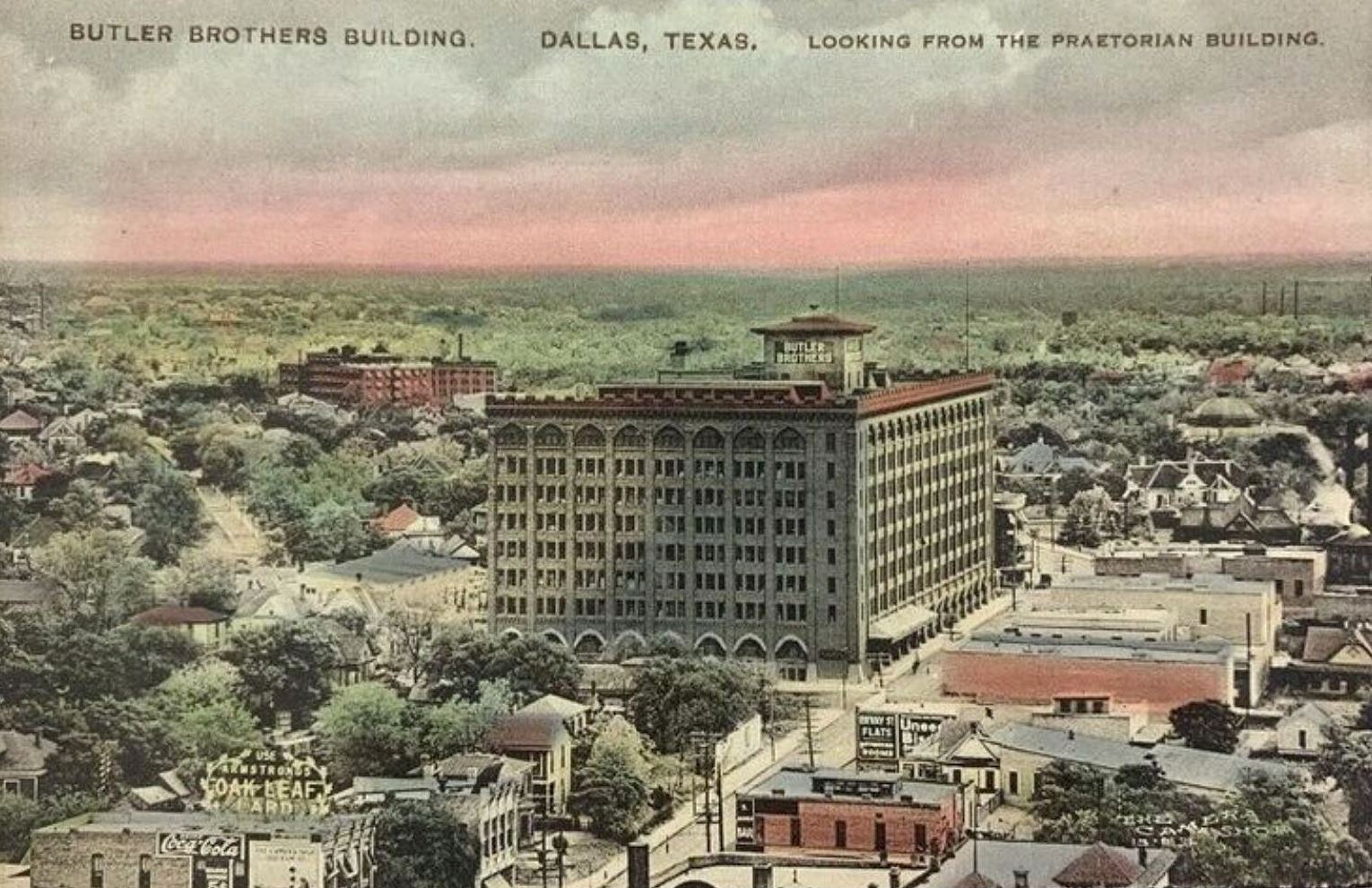
Butler Brothers Building, As Seen From the Praetorian

butler-brothers_looking-from-praetorian_postcard_ebayButler Brothers, in its natural habitat… (click for larger image)

by Paula Bosse

Today, a wonderful postcard image showing the Butler Brothers building, built in 1910/1911 and still standing at South Ervay, between Young and Marilla, across the street from the present-day City Hall). It’s set in the middle of businesses, residences, and lots of greenery. The view is from the Praetorian Building at Main and Stone (which, at the time was the tallest building in Dallas, but which is no longer standing).

Here’s another view of mammoth Butler Brothers building, in a detail from a panoramic photo of the Dallas skyline in 1913 (see the full photo here):

1913-pano-4

And another view from a RPPC photo taken by John R. Minor Jr. in 1911 (showing the Adolphus under construction?).

skyline-view_butler-bros_rppc_1911_ebay_front_john-minorvia eBay

***

Sources & Notes

Colorized postcard found in an old eBay listing.

Source info on black-and-white panoramic photo detail is at the original post, “‘New Dallas Skyline’ — 1913,” here.

More on the construction of Butler Brothers can be found in this post (scroll down to #6).

*

Copyright © 2019 Paula Bosse. All Rights Reserved.

The Grand Elm Street Illumination — 1911

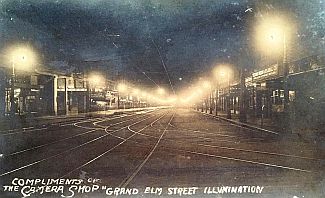
elm-street_illuminated_night_rppc_ebay

by Paula Bosse

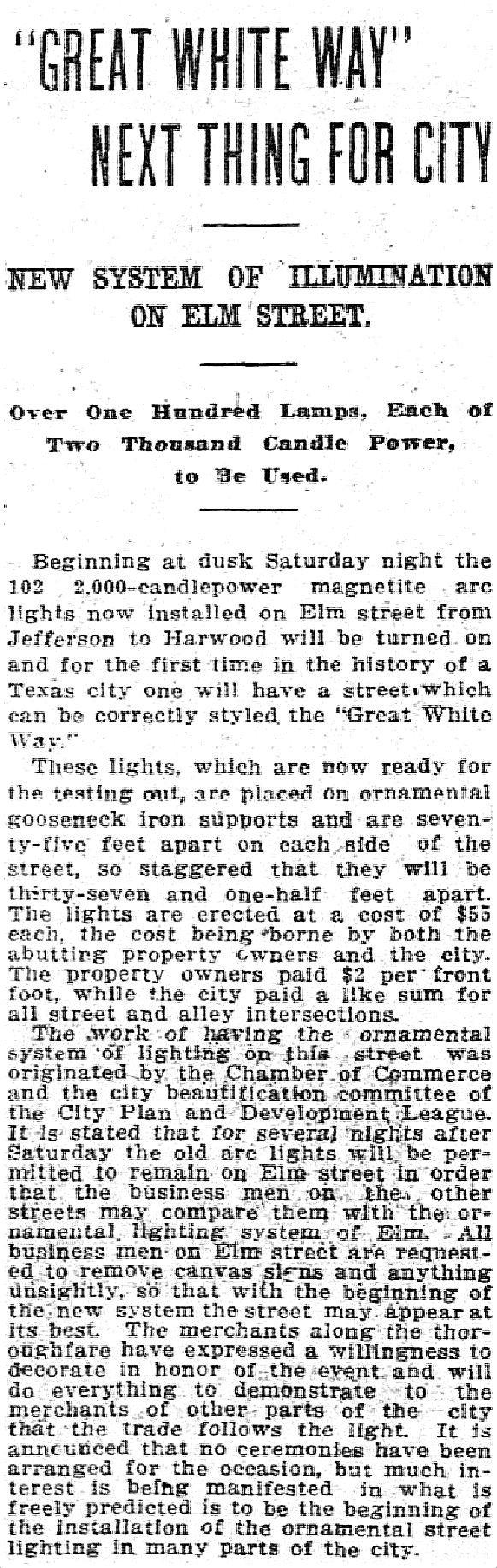
As most of Dallas has now clawed its way back into the world of full electric power after last weekend’s surprise “weather event” (…although, as I write this another big storm is passing through the area), I thought this image might be a timely one. It’s from late 1911 and shows Elm Street with its brand new electric street lights, the installation of which prompted Dallas boosters to dub the street “The Great White Way.” The view is from Ervay, looking west.

1910-1911 was a time of remarkable growth in Dallas. Construction had been started or completed on three important downtown buildings (the Adolphus Hotel, the Southwestern Life Building, and the Butler Brothers building); the historic Oak Cliff viaduct was nearing completion; the dam at the city’s new White Rock reservoir was in operation; and — lo and behold! — ornamental electric street lights (with underground conduits) had been installed along Elm Street, from Market to Harwood.

The buzzword in municipal governments of large American cities at that time was “ornamental street lighting.” What was it? According to The Dallas Morning News:

“Ornamental street lighting” contemplates just what the term signifies. Instead of somewhat indiscriminate and often far from attractive methods of lighting the streets of a city, the adoption of a systematic plan by which, with the placing of uniform lights of pleasing design at regular intervals, a street is not only illuminated, but is ornamented as well. (DMN, Nov. 5, 1910)

The article went on to say that this type of street lighting was an essential element of a progressive and prosperous city (which Dallas most certainly was): not only did it help beautify the city, it also increased property values and helped to decrease crime. …And Dallas leaders really, really wanted it. They just didn’t want to pay for it. Somehow, an agreement was struck in which the cost of the materials, installation, and maintenance of these “ornamental street lights” would be paid for by Elm Street merchants and/or property owners; after one year, the City would take possession of the lights and assume responsibility for their upkeep. Seems like a novel way to fund a city project.

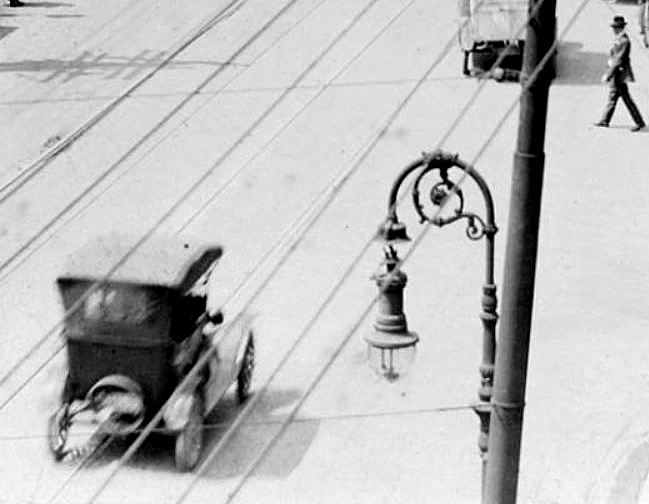
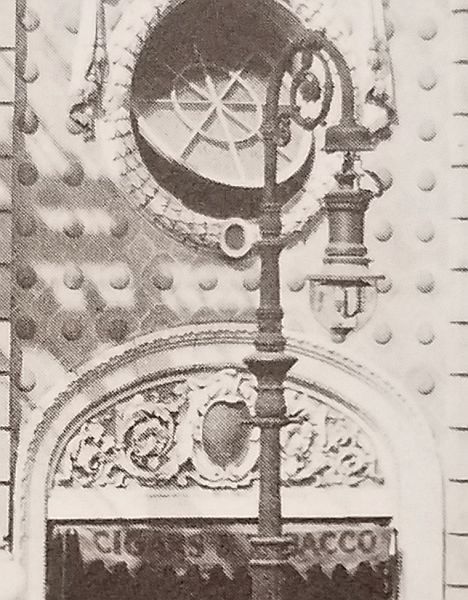
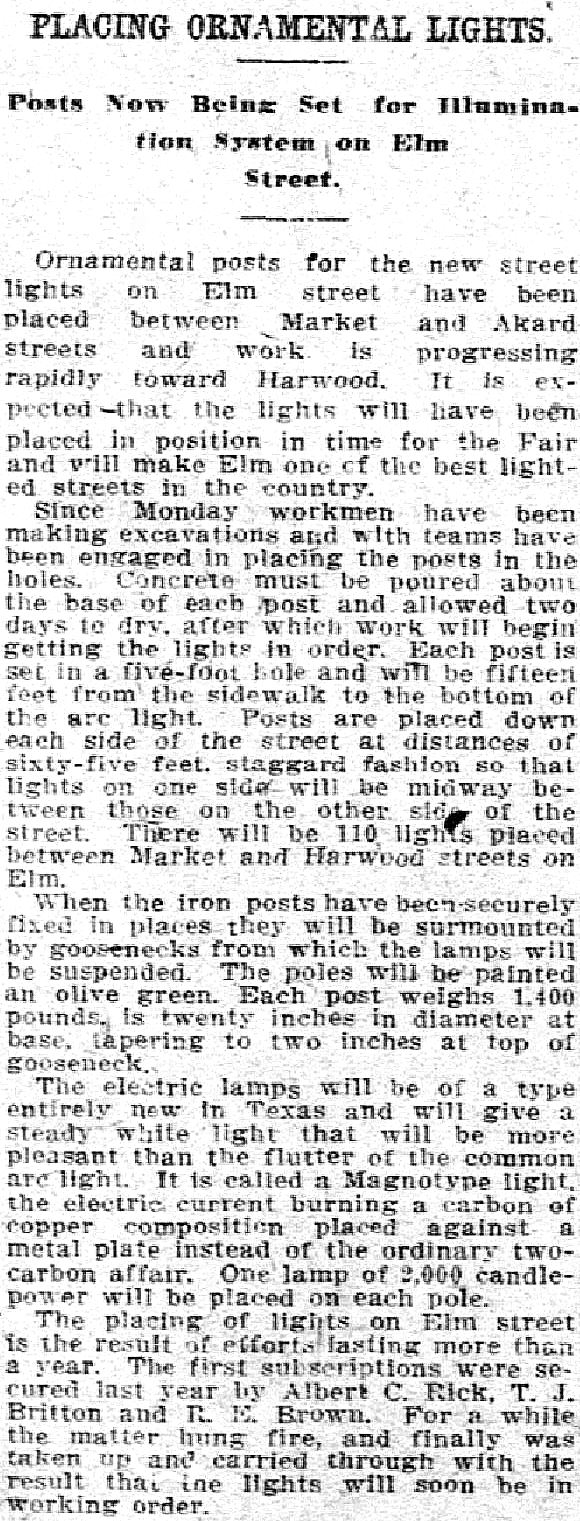
Dallas’ first “ornamental” lights and poles (which, because I like details like this, were painted a soothing olive green) were topped with “bishops’ crooks” (or “shepherd’s crooks”) fashioned in wrought iron, with the lamps suspended from the gooseneck bend. Just over 100 of the magnetite arc lights were installed along Elm, staggered on opposite sides of the street to maximize the illumination’s reach.

The electric lamps will be of a type entirely new in Texas and will give a steady white light that will be more pleasant than the flutter of the common arc light. […] One lamp of 2,000 candlepower will be placed on each pole. (Dallas Morning News, Sept. 14, 1911)

The project was delayed for several months for a variety of reasons (not least of which was the fact that the first shipload of iron poles was mysteriously “lost at sea” as it was en route from New York to Galveston…), but the festive grand unveiling was finally held on September 30, 1911, just in time for Dallas to show off another civic accomplishment to out-of-town visitors who would soon be streaming into town to attend the State Fair of Texas. Dallas’ “Great White Way” thrilled all who beheld it and blazed proudly every night from sunset to midnight. Business owners on Main and Commerce streets were envious of all that fresh, new, well-distributed light over on Elm, and it wasn’t long before those streets had also replaced their garish and old-fashioned, fluttering, stuttering arc lights with the brash new ornamental lights.

Here is a photo of what the lights looked like in December, 1911 (the photo shows the new 12-story Wilson Building annex):

wilson-bldg_expansion_dmn_121611_clogenson

Below are examples of what these street lights looked like a few years after they had been introduced in 1911 (the first two are details of photos from a post found here, and the third one is a detail of a photo taken in front of the Queen Theatre at Elm and Akard in 1914). (UPDATE: I’ve just found a TON of these lamp posts in the historic “Wilson block” area along Swiss Avenue!! See one on Google Street View here.)

street-light_det-2

street-light_det-1

elm-st-ornamental-street-light_elm-akard_queen-theatre_ca-1914

*

Read the progress report on the installation of the new lighting system (all images are larger when clicked):

elm-street_illuminated_dmn_091411_detailsDMN, Sept. 14, 1911

Excited anticipation of the soon-to-be “Great White Way” was building:

elm-street_illuminated_dmn_092711DMN, Sept. 27, 1911

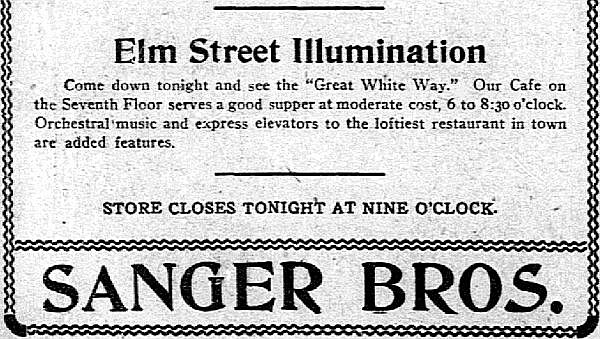
Sanger Bros. was one of the many businesses celebrating the arrival of the ornamental lighting. On the day the lights were to debut in downtown Dallas, the department store ran an ad which invited Dallasites to dine in their “lofty” seventh-floor cafe and, afterwards, stroll along the well-lit thoroughfare and soak up the brand new illumination:

elm-street_illuminated_093011_sangers-ad_detSept. 30, 1911, the night the lights were turned on

Below is the News’ report of the inaugural switch-flipping. (Missing from the article was the fact that someone had been stabbed that night as crowds jostled each other in the streets and along the sidewalks, climaxing with the perp being chased for several blocks before being apprehended; all of this had happened under the glow of the expensive, new, very-bright, law-enforcement-aiding artificial light — that new lighting system was already paying off!)


elm-street_illuminated_dmn_100111
DMN, Oct. 1, 1911

elm-street_illuminated_night_rppc_ebay_sm

***

Souces & Notes

Postcard showing “Grand Elm Street Illumination, Compliments of the Camera Shop” is from an old eBay listing. (There is also a copy in the George W. Cook Collection at SMU’s DeGolyer Library, here — you can zoom in a bit more for details, even though, ironically, it’s still pretty difficult to make much out in the shadows. A line from the postcard message reads, “This is a photo of Elm Street at night — pretty swell I think.”)

Businesses seen on the right side of the photo are the Texas Seed & Floral Co. and the Lontos Cafe, which were located near the northwest corner of Elm and Ervay (years later, this was the appoximate site of the Palace Theatre); the Wilson Building (then the Titche-Goettinger department store) is either wholly out of frame at the extreme left, or is only partially visible.

In 1911 — before the ornamental lights were installed — Dallas had something like 1,000 electric (and a few gas) street lights in operation around the city; the arrival of the brighter and more aesthetically appealing Brave New Luminescence of Elm Street’s “Great White Way” spelled the inevitable phasing-out of the old-fashioned arc lights.

Read about how Dallas responded to the 1912 lighting of the Oak Cliff viaduct, the world’s longest concrete bridge, at the bottom of this post.

*

Copyright © 2019 Paula Bosse. All Rights Reserved.

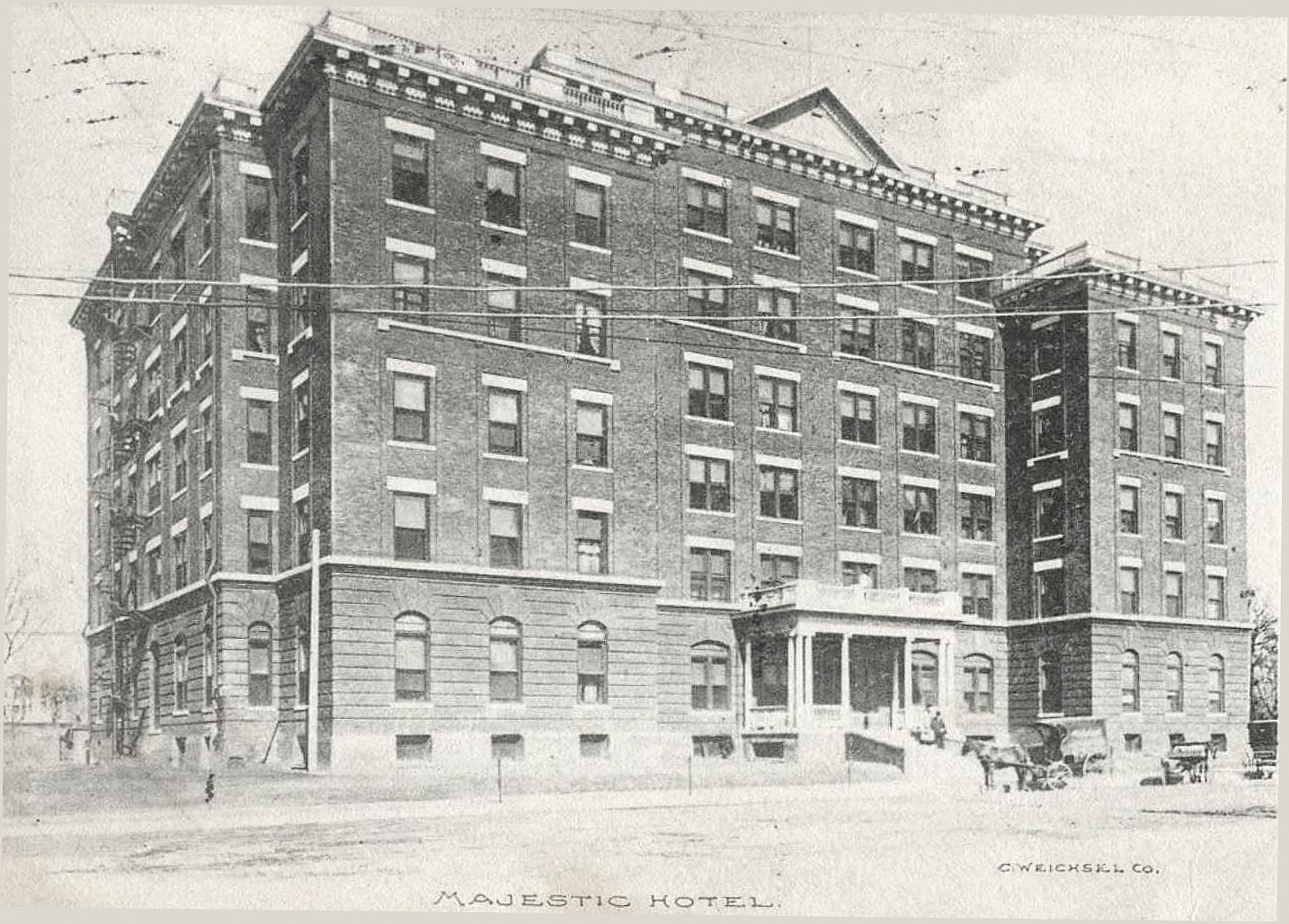
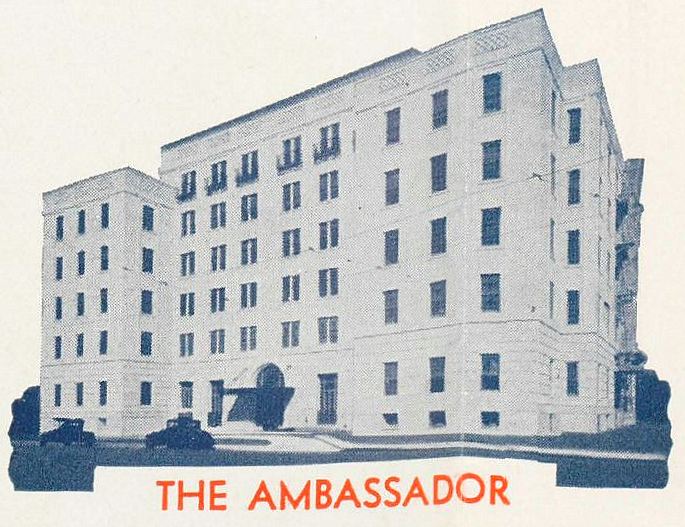
The Majestic Hotel/The Park Hotel/The Ambassador Hotel: R.I.P. — 1904-2019

majestic-hotel_portal_postcard

by Paula Bosse

The historic Ambassador Hotel at 1312 S. Ervay in the Cedars was destroyed by fire this morning — the building was 115 years old and was under renovation. Watching news footage of flames engulfing the South Dallas landmark is heart-wrenching.

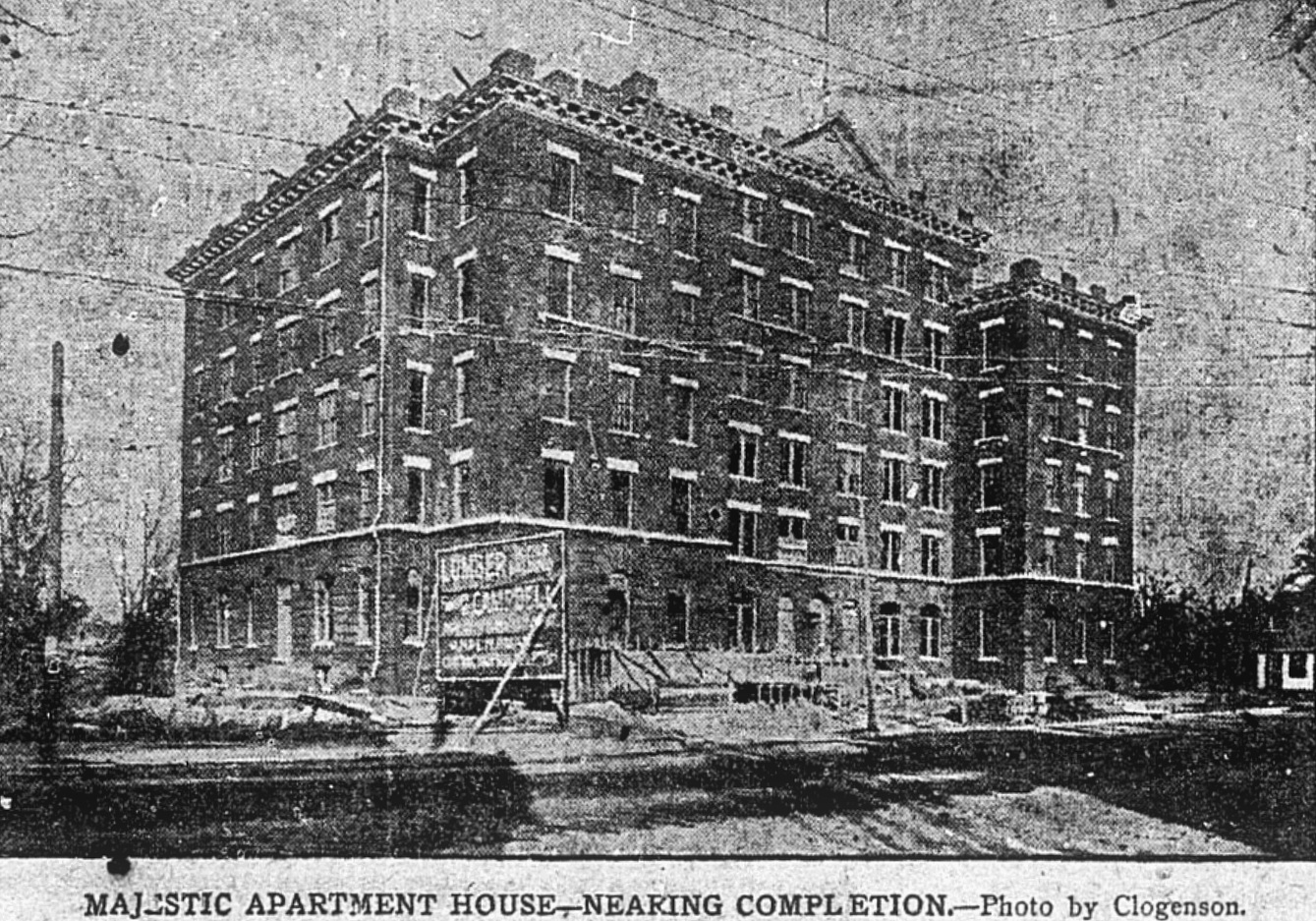
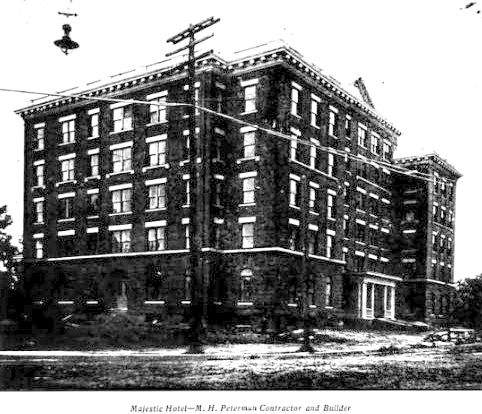
Built in 1904 alongside City Park, the Majestic Apartment Hotel opened in early 1905. It was designed by popular local architect Earle Henri (E. H.) Silven (who, incidentally, was arrested on suspicion of setting fire to the then-historic Knepfly Building in 1906, a fire which resulted in two deaths, but a grand jury declined to prosecute because of insufficient evidence — I actually wrote about this fire in passing a few years ago in a completely unrelated post).

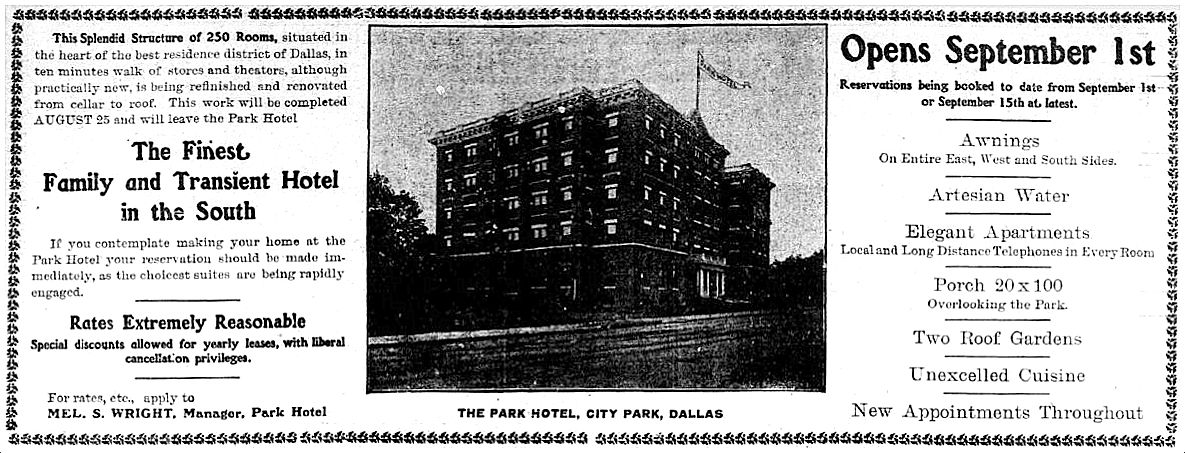
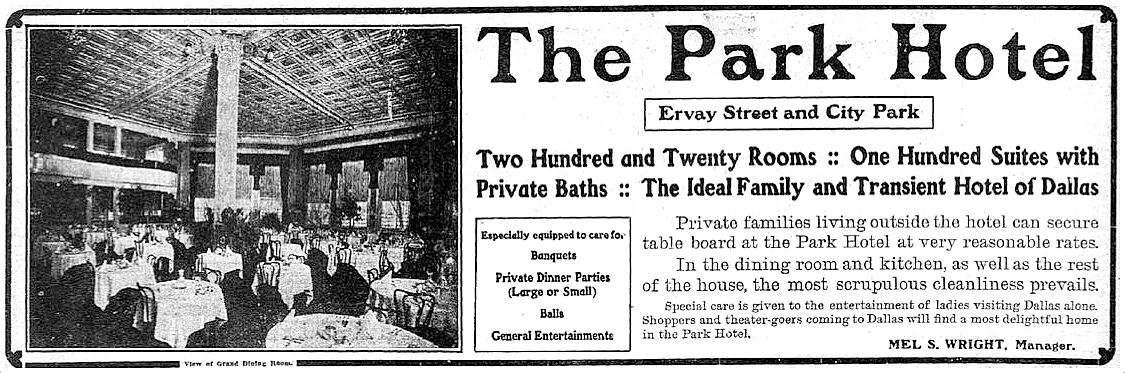
The Majestic was originally an “apartment hotel” which was more apartment house than hotel, intended for long-term residents. Financial backing of this endeavor was shaky, and the Majestic soon fell into receivership; after a change of owners, the newly renamed Park Hotel opened in 1907. Several years later, in 1933, it became the Ambassador Hotel. Over the 115-year life of the building, these various incarnations came with a dizzying number of owners and operators, and news of its impending renovation and rebirth was heard frequently over the past 20 or 30 years. Recent plans, though, seemed like they were actually going to finally happen. …And now, unfortunately, they won’t.

Below are several images of the hotel, beginning back when Dallasites were still using a horse and buggy to get around. (All images are larger when clicked.)

majestic-apartment-hotel_dmn_010105Majestic Apartment House, Dallas Morning News, Jan. 1, 1905

majestic-hotel_1905-directory
Majestic Hotel, 1905 Dallas directory (ad, detail)

majestic-hotel_come-to-dallas_degolyer_SMU_ca1905
Majestic Hotel, 1905 (via DeGolyer Library, SMU)

I’m not sure which iteration of the hotel is seen in this postcard, but here it is viewed from City Park, with the Confederate Monument in the foreground:

confederate-monument_city-park_majestic-hotel_cook-colln_degolyer_smu
(via DeGolyer Library, SMU)

The Park Hotel opened in September, 1907.

1907_park-hotel_dmn_081107Park Hotel, August 11, 1907

1907_park-hotel_dmn_100107Park Hotel, Oct. 1, 1907

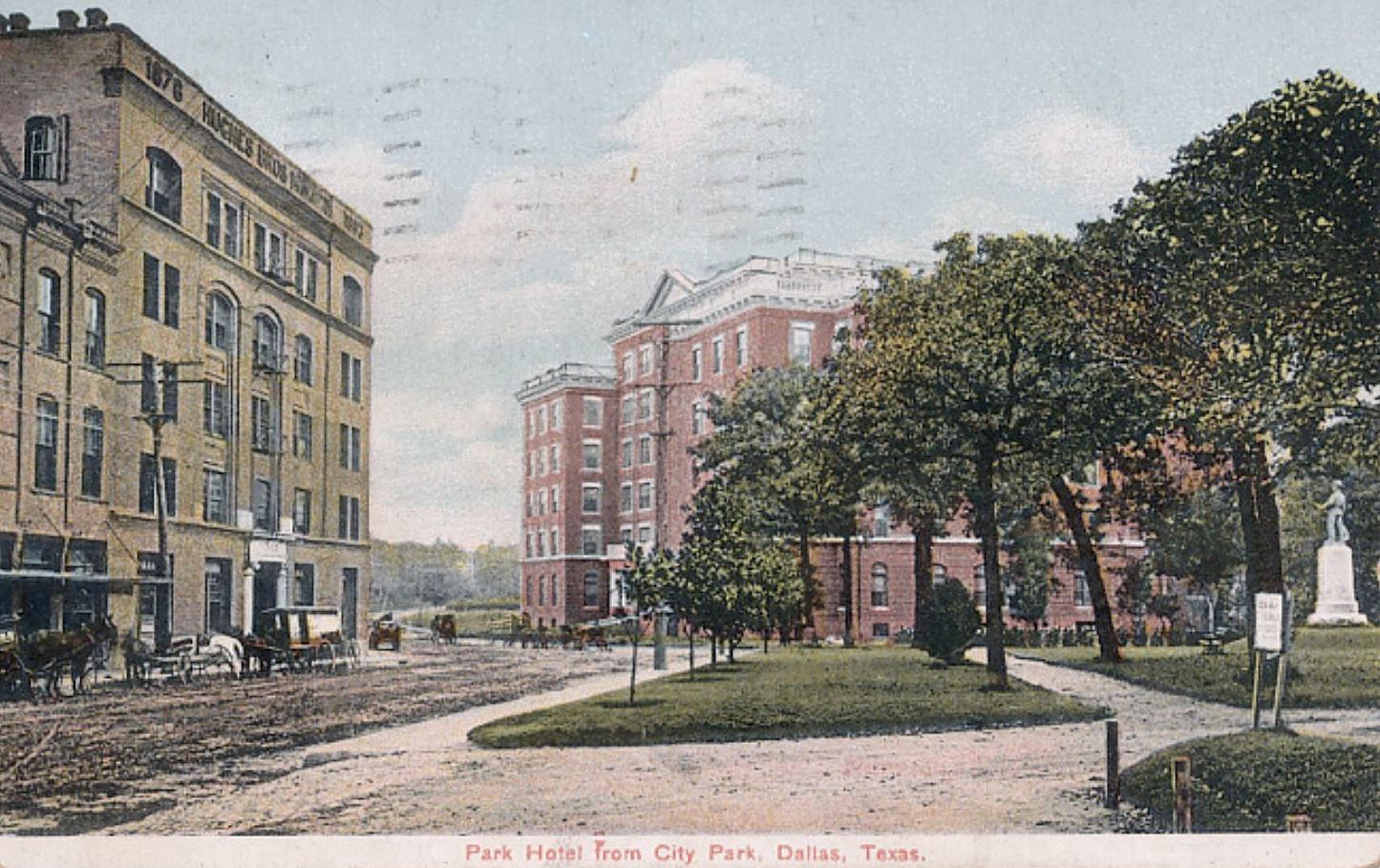
One of my favorite views of the hotel is the one immediately below, taken from City Park, with the Hughes Candy factory at the left (the original photo is here):

park-hotel_hughes-brothers_flickr_coltera

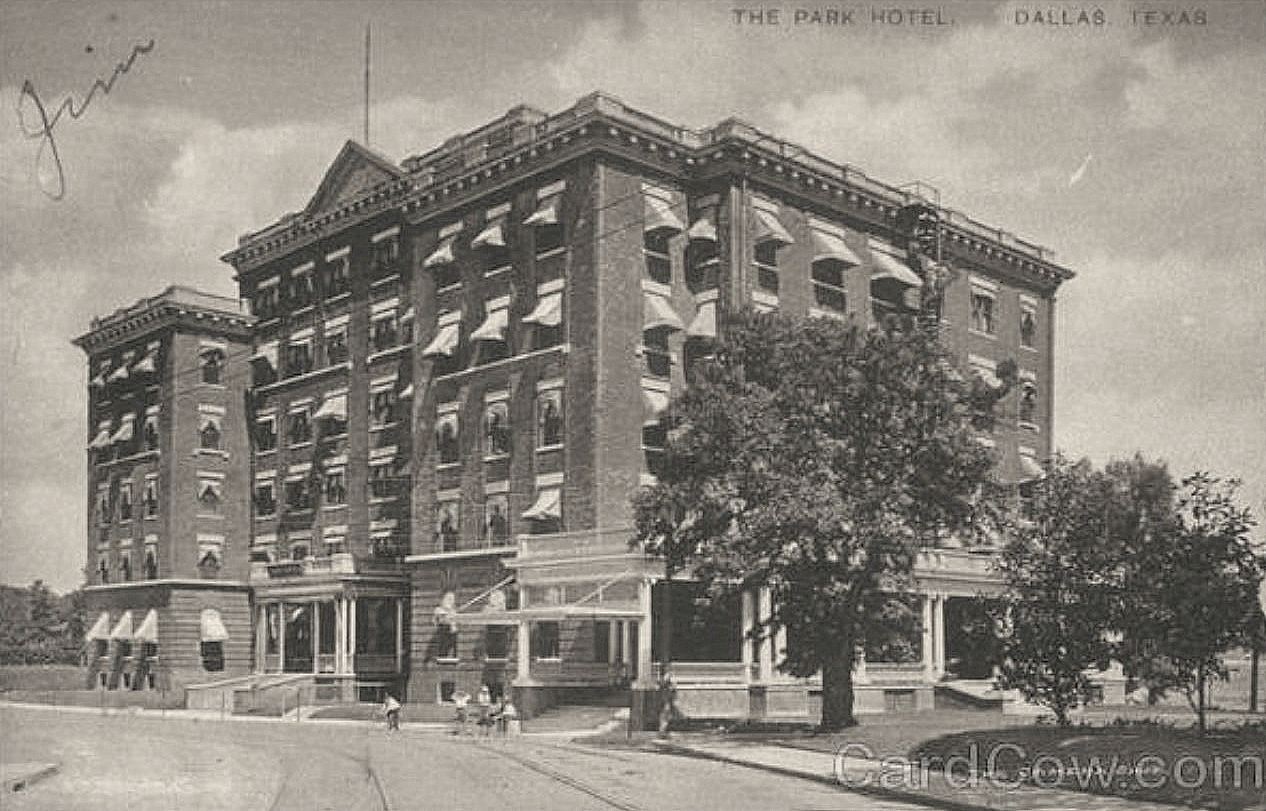
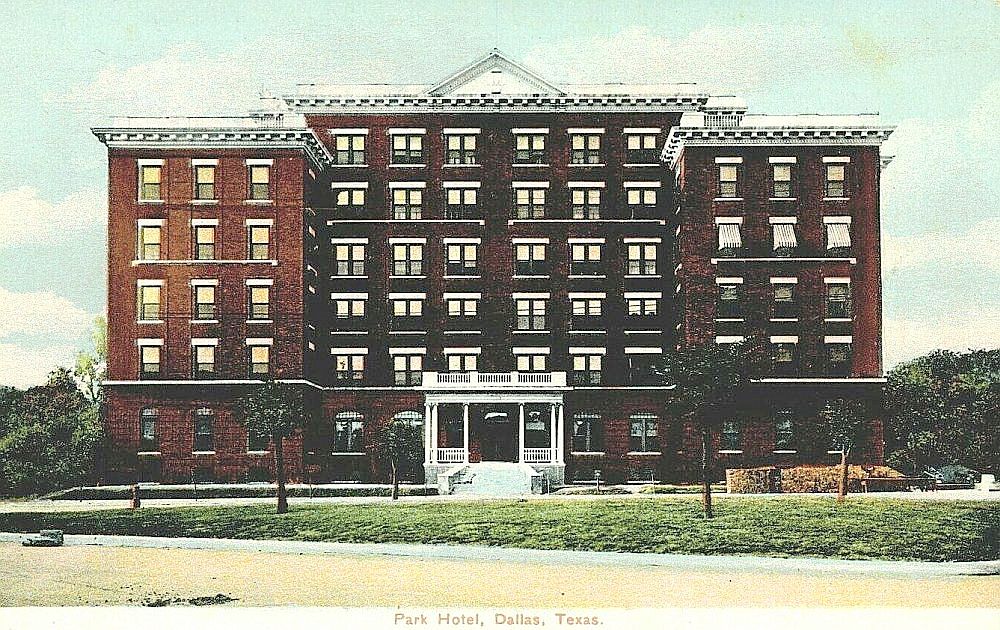
park-hotel_postcard

park-hotel_postcard_ebay_postmarked-1913

park-hotel_postcard_ebay_clogenson

In 1933 the hotel got a new stucco exterior and tile roof and was renamed the Ambassador.

ambassador_dallas-friendly-city-invites-you_1930s_degolyer-library_smu
(via DeGolyer Library, SMU)

Ambassador Apartment Hotel Dallas

For a while the hotel served as a retirement community — here is an odd, incredibly wordy ad, beckoning retirees with prospects of late-life romance, while also sharing (somewhat) accurate local history:

ambassador_013072_ad
Ambassador Retirement Hotel ad, Jan. 30, 1972

ambassador-hotel_historic-dallas_fall-1982_portal_photo
ca. 1982

This morning:

ambassador-on-fire_DFR_twitter_052919Dallas Fire Rescue, via Twitter

*

For old time’s sake, a Google Street View from 2018 (here) and from 2021 (here):

ambassador_google_july-20182018

ambassador_google_feb-2021
2021

***

Sources & Notes

Top image from the Portal to Texas History.

Read a comprehensive history of the building in an article by Harvey J. Graff in Historic Dallas here and here.

Read the City of Dallas Designation Report from 1982 seeking Landmark Status here.

Read the 2018 application for inclusion in the National Register of Historic Places (with MANY pages of photos) here.

Coverage of today’s fire can be found on the NBC-DFW site here; a 2017 video walk-through of the Ambassador in happier, more optimistic times can also be found on the Channel 5 site, here.

*

Copyright © 2019 Paula Bosse. All Rights Reserved.

Theaters at 1517 Elm: The Garden, The Jefferson, The Pantages, The Ritz, and The Mirror — 1912-1941

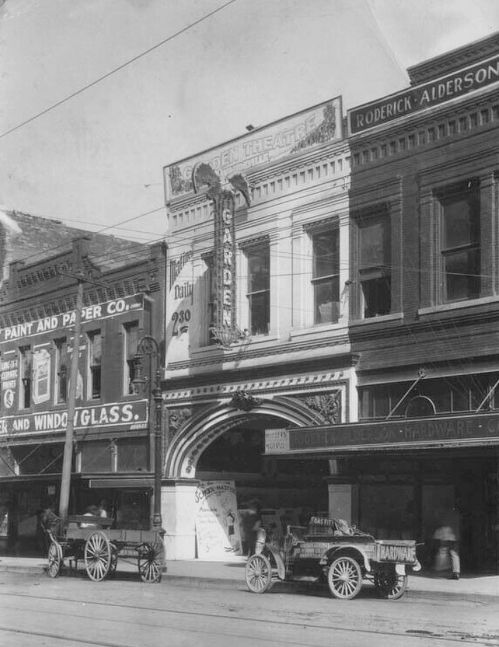
garden-theatre_ca-1912_ebayThe Garden Theatre, ca. 1912

by Paula Bosse

The photo above shows the Garden Theatre, located at 1517 Elm, on the north side of the street, between Akard and Stone Street. It was opened in the fall of 1912 by partners W. J. Brown and R. J. (Ray) Stinnett (who also operated the Cycle Park Theatre at Fair Park). The Garden was a vaudeville stop for touring companies.
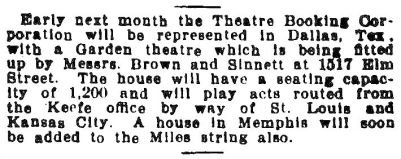
1912_garden-theatre_variety_sept-1912Variety, Sept. 1912

It was one of many local theaters which simulcast World Series baseball games via telegraph updates, in the days before radio and TV (I wrote more about this fascinating subject here).

1912_garden-theatre_101612Oct. 16, 1912

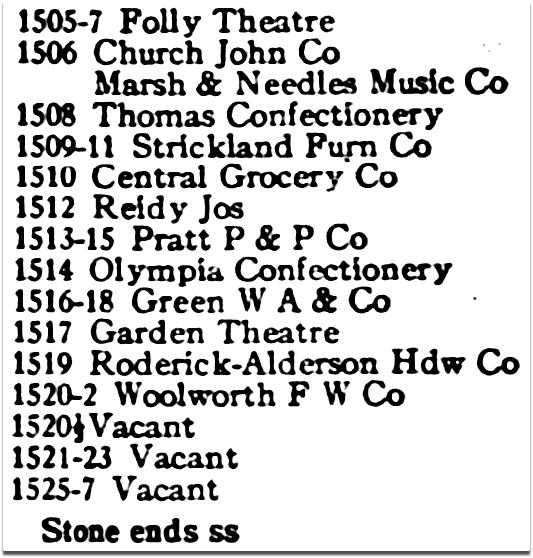
As seen in the top photo, the Garden Theatre sat between the Pratt Paint & Paper Co. and the Roderick-Alderson Hardware Co.

garden-theatre_1913-directory_1517-elm1913 Dallas city directory

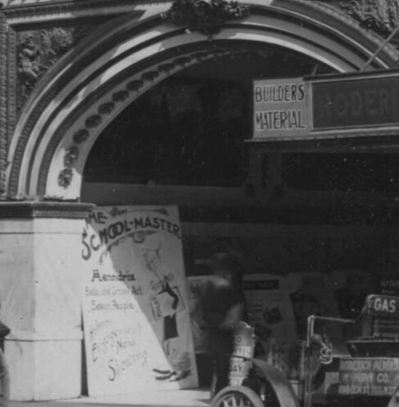
The photo at the top was found on eBay, with the seller-provided date of 1912. Zooming in, one can see a placard in front of the theater advertising the appearance of the Hendrix Belle Isle Musical Comedy Company (misspelled on the sign as “Henndrix”) — for many years this troupe toured with a production called “The School-Master”/”School Days,” the very production seen here on offer to audiences at the Garden. (Read a review of a 1912 Coffeyville, Kansas performance of the troupe’s bread-and-butter act here.)
garden-theatre_ebay_det

In April, 1913 Brown and Stinnett split, with Brown taking the Cycle Park action and Stinnett keeping the Garden (and a handful of other theaters).

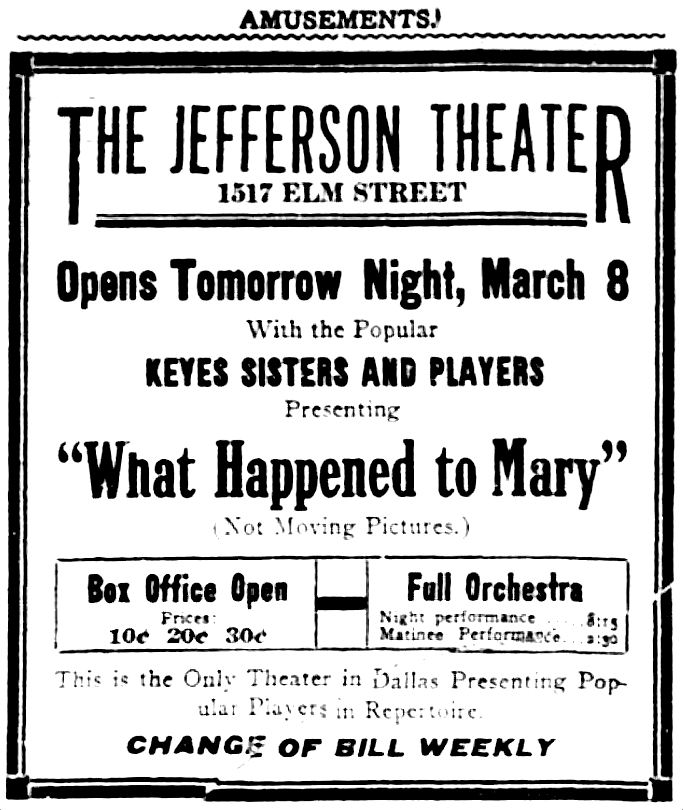
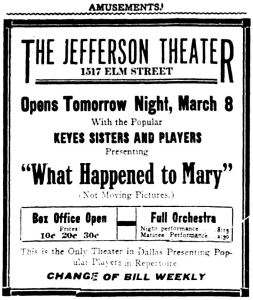
On March 8, 1915 the theater changed its name and reopened as the Jefferson Theater. As the ad below stated, “This is the only theater in Dallas presenting popular players in repertoire […] Not moving pictures.”
1915_jeffersosn-theater-opens_dmn_030715March 7, 1915

I’m not sure where the “Jefferson” name came from, but….

jefferson-theater_061115June 11, 1915

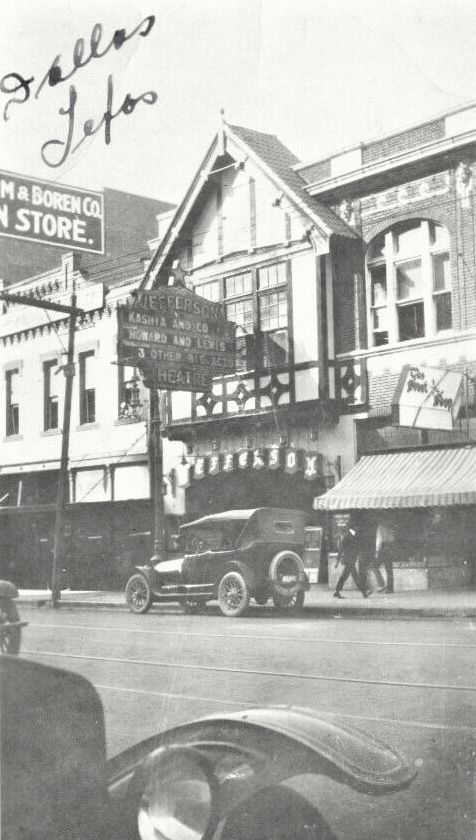
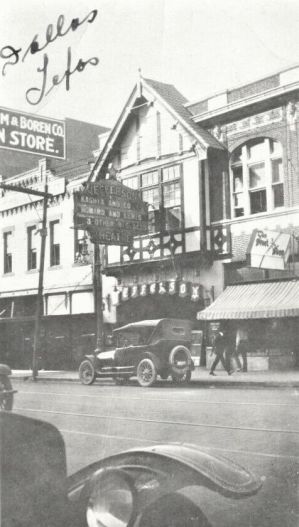
The photo below shows the Jefferson with an unusual olde-English-style half-timbered facade — I doubt that lasted long. The photo is undated, but the marquee advertises vaudeville mainstays Kasmir & Co. (Sophie Kasmir — or Sophia Kasmir — was a prima donna of note) and comedians Howard & Lewis.
theater_jefferson-theater_RPPC_ebayeBay

There were a few back-and-forths as far as operators and leases of the Jefferson, but in 1923, Ray Stinnett “sold” (or probably more accurately sub-leased) the theater in order to concentrate on his other (bigger! better! brighter!) venture, the next-door Capitol Theater, but he reacquired it in 1925 and renamed it the Pantages. (This has caused confusion, with some thinking it had become the Pantages earlier — the confusion is understandable, as the Jefferson was affiliated with the Pantages vaudeville circuit between 1917 and 1920, and during that time the word “Pantages” appeared prominently on the theater’s marquee, but it was still the Jefferson. See a photo from May, 1925, showing the Jefferson from the Pacific side here, after it had become a Loew’s-affiliated theater.)

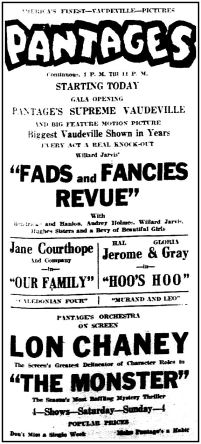
The Jefferson became the Pantages Theater on December 27, 1925, when Stinnett opened the newly remodeled venue which offered vaudeville stage acts as well as motion pictures. (All images are larger when clicked.)
pantages-opening_122725Dec. 27, 1925

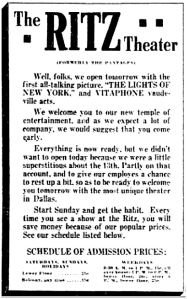
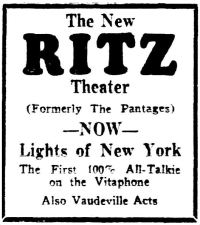
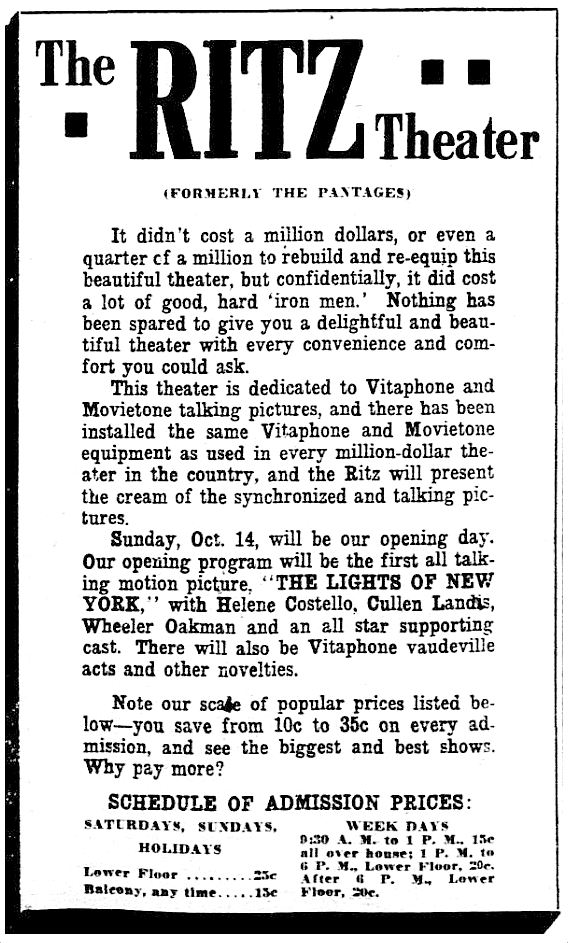
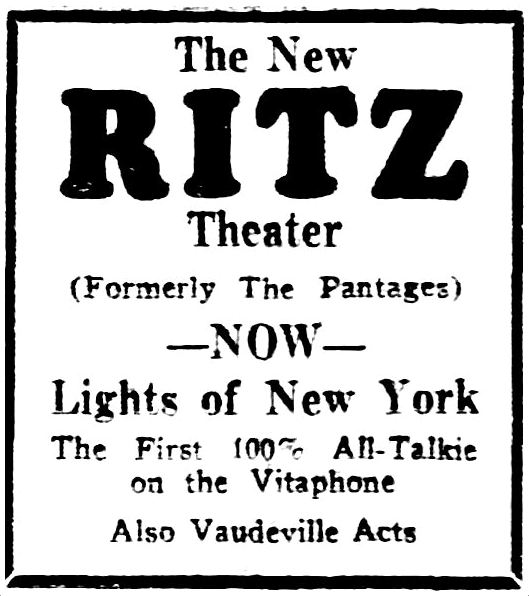
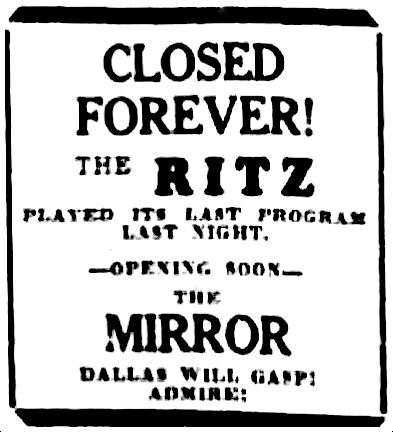
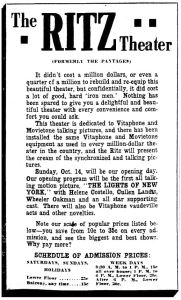
That incarnation didn’t last too long. Goodbye, Pantages, hello, Ritz. The Ritz Theater opened on October 14, 1928, operated by the R & R (Robb & Rowley) chain but leased from Stinnett. The first film shown was “The Lights of New York,” the first all-talking feature-length movie.
1928_ritz_101028Oct. 10, 1928

1928_ritz_101328
Oct. 13, 1928

1928_ritz_101528Oct. 15, 1928

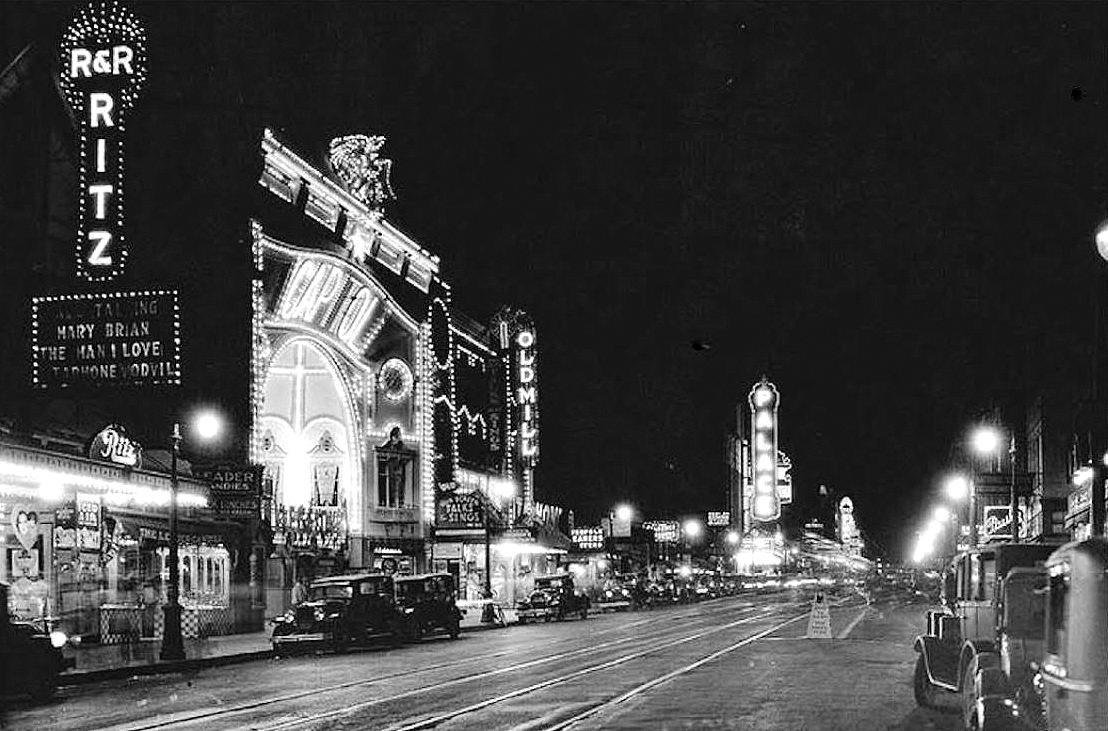
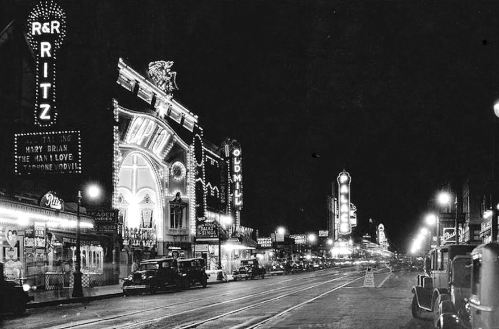
Below, a 1929 photo showing the 1500 and 1600 blocks of Elm Street, the heart of Theater Row: seen here are the Ritz, Capitol, Old Mill, and Palace theaters (the regal Queen was a few doors west of the Ritz, at the corner of Elm and Akard).
ritz_capitol_old-mill_palace_photo_sherrodphoto from “Historic Dallas Theatres” by D. Troy Sherrod

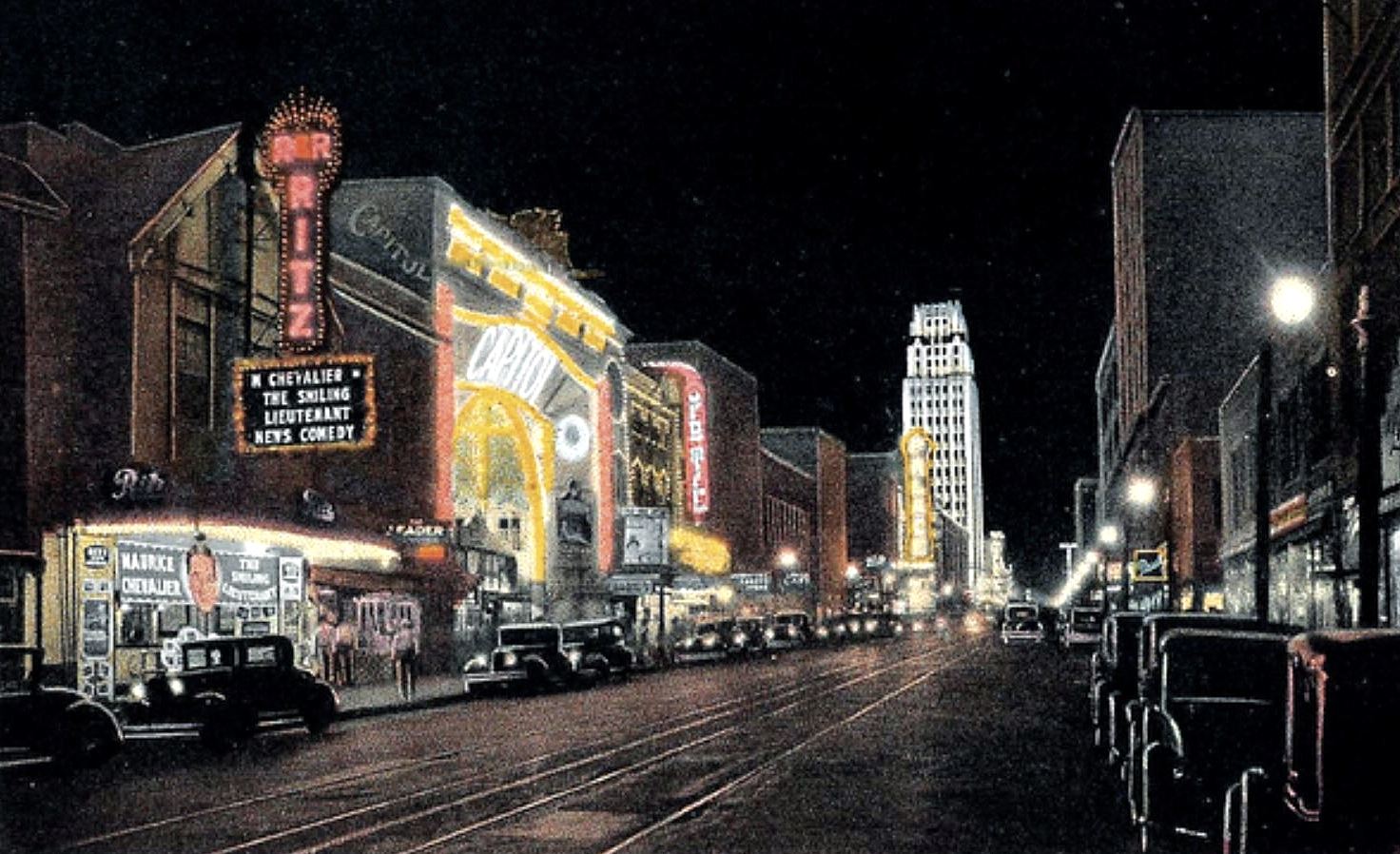
A postcard showing the Ritz (and neighbors) a couple of years later, in 1931:

ritz_capitol_old-mill_palace_postcard_cinematreasures

But the Ritz didn’t last all that long either — a little over three years.
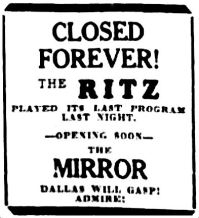
1931_ritz-mirror_120831Dec. 8, 1931

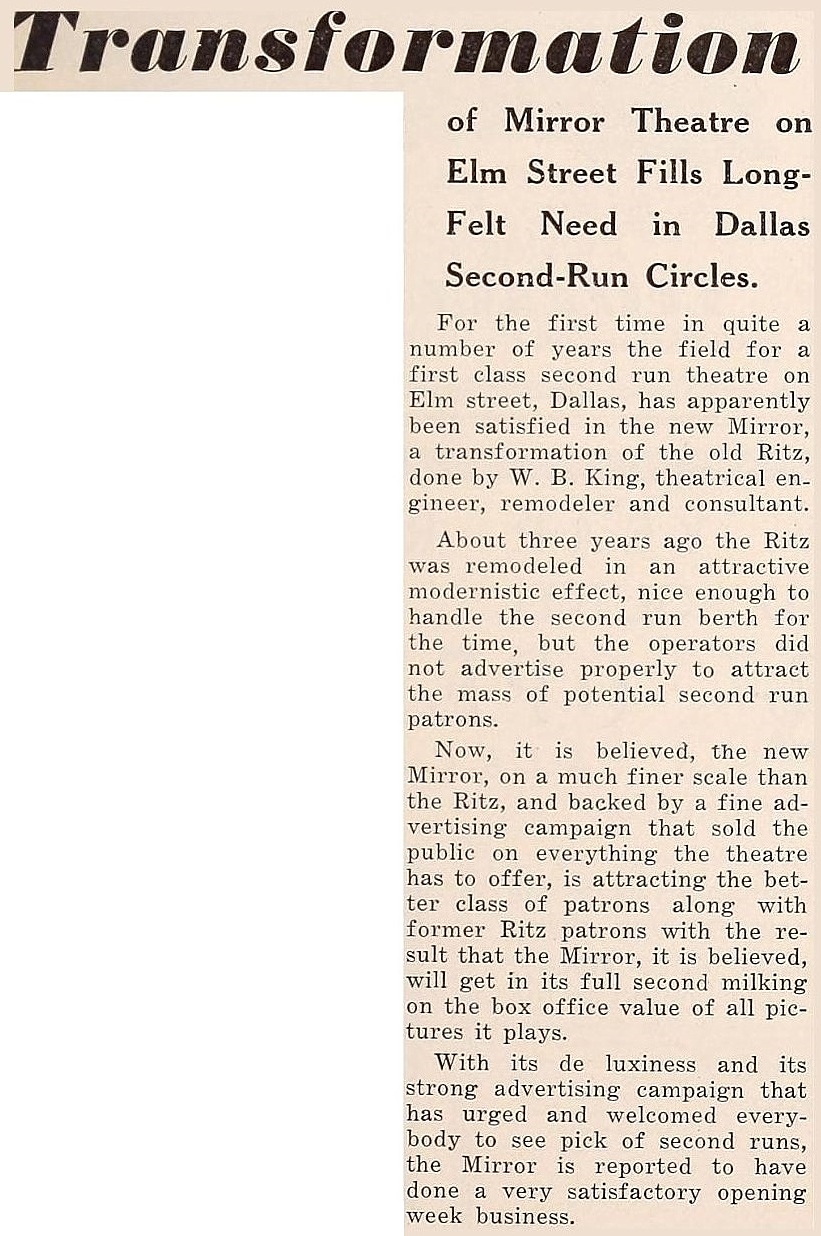
In 1931 the theater was acquired by the Hughes-Franklin company (as in Howard Hughes, the super-rich Texan who had an obsession with Hollywood). The plan was to renovate the building and rename it the Mirror, “a duplicate, in so far as possible, of the famous Mirror Theater of Hollywood. A feature will be the extensive use of mirrors in the lobby and foyer” (Dallas Morning News, Nov. 29, 1931).

mirror_motion-picture-times_122931Motion Picture Times, Dec. 29, 1931

The Mirror Theater opened at 1517 Elm on Christmas Day, 1931.

1931_mirror_122531
Dec. 25, 1931

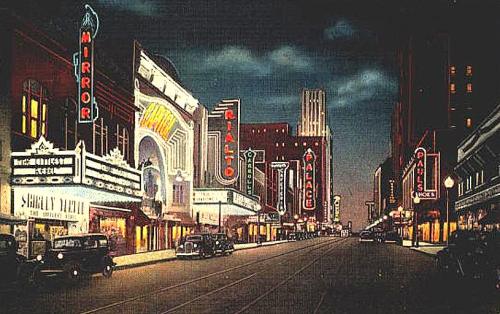
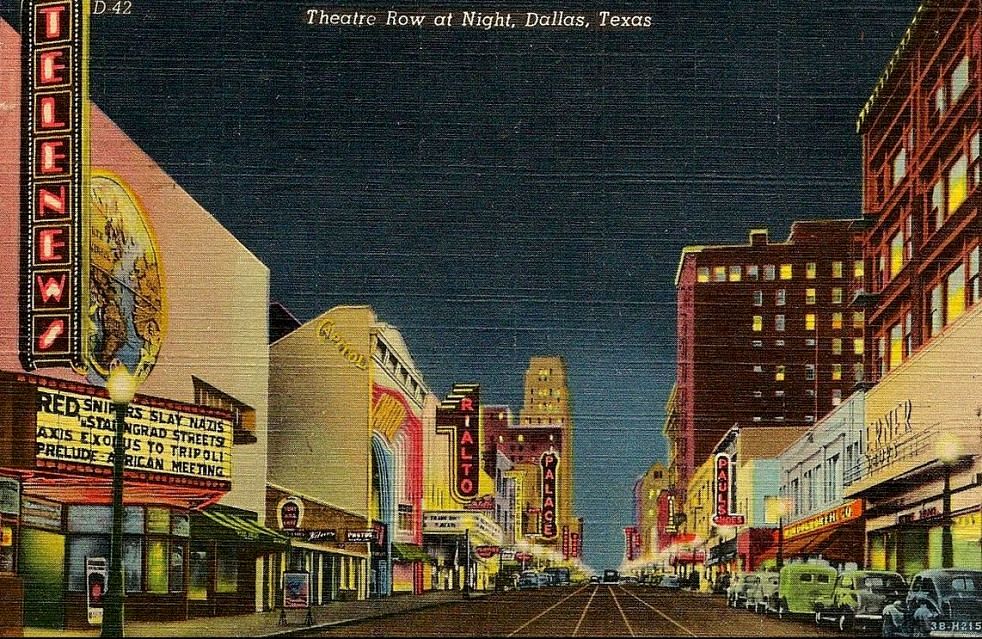
Theater Row, 1936:

theater-row_mirror_march-1936

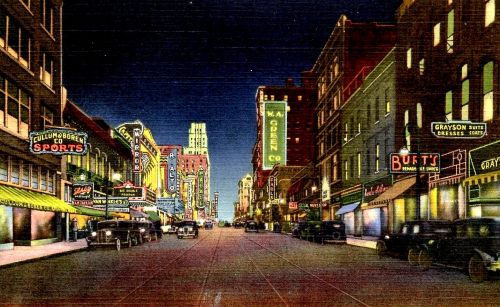
More Elm Street:

mirror-capitol-rialto-palace-melba-majestic_theater_row_night_big

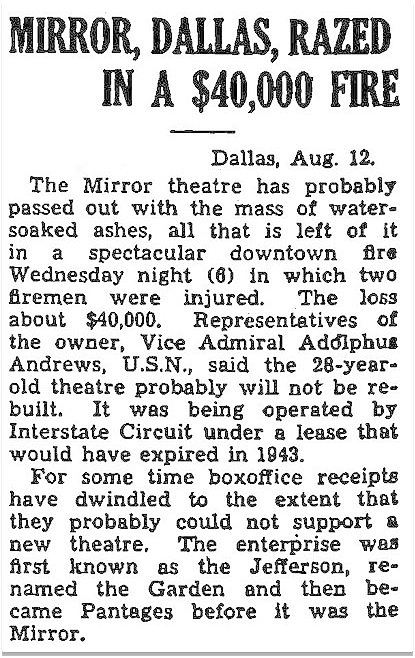
The Mirror chugged on for several years as a second-run house, apparently less and less profitable as the years passed. On August 4, 1941 the theater burned down in an early-morning fire. The property owner, Vice Admiral Adolphus Andrews, decided against rebuilding.
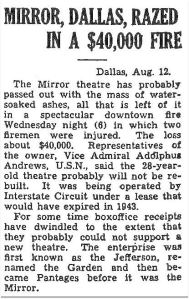
mirror-fire_variety_081341Variety, Aug. 13, 1941

Here’s the same view as seen above, only now the space next to the Capitol is a nondescript one-story retail building. (The Telenews, a theater showing newsreels, opened in November 1941.)
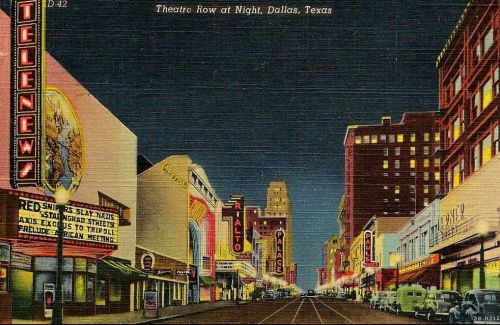
telenews_missing-mirror-post-fire_capitol_postcard

Below, a photo from around 1942, the first time in 30 years without a theater at 1517 Elm Street.
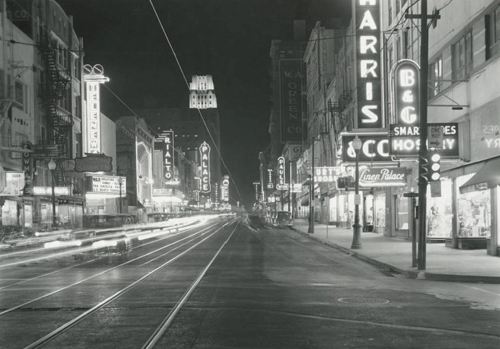
theater-row_by-george-mcafee_degolyer_SMUphoto via the DeGolyer Library, SMU

***

Sources & Notes

Top photo of the Garden Theatre is from an old eBay listing.

More Flashback Dallas posts on Dallas theaters can be found here.

*

Copyright © 2019 Paula Bosse. All Rights Reserved.