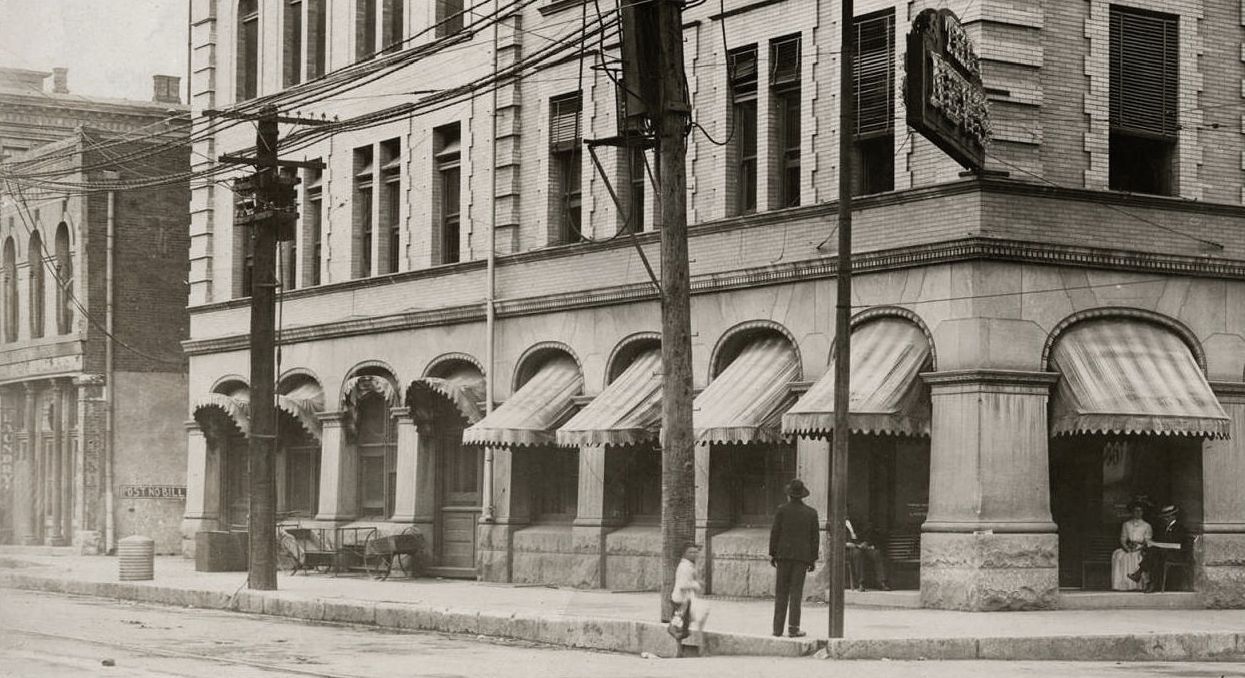
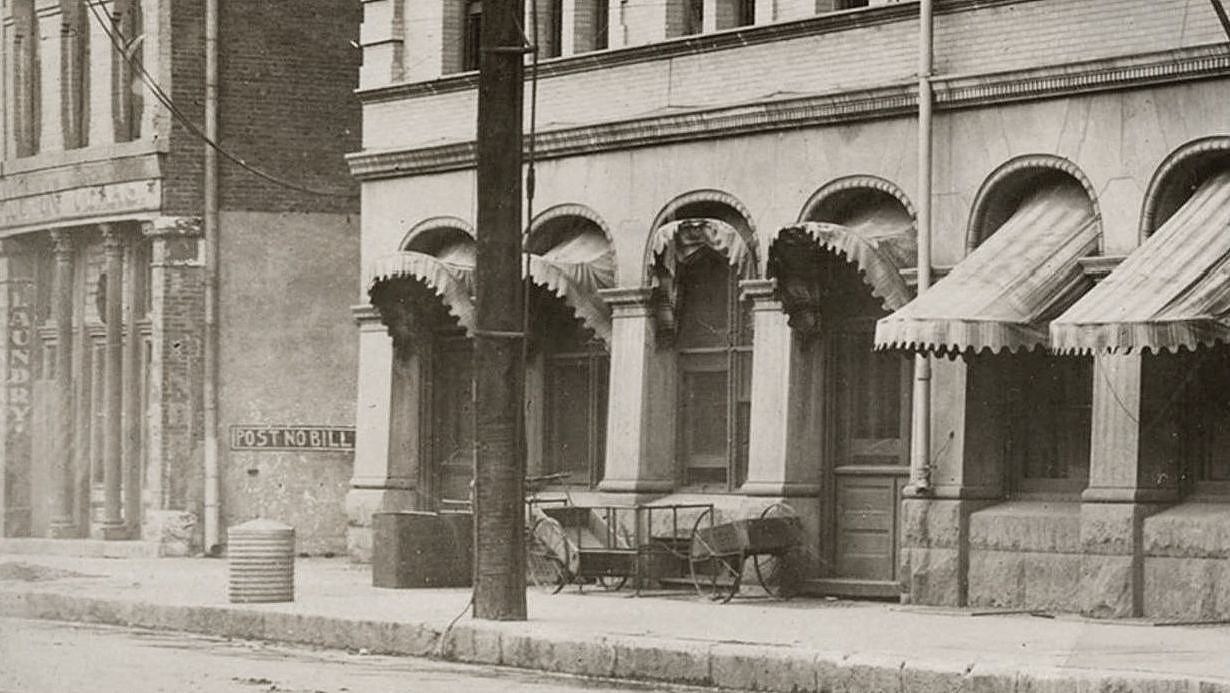
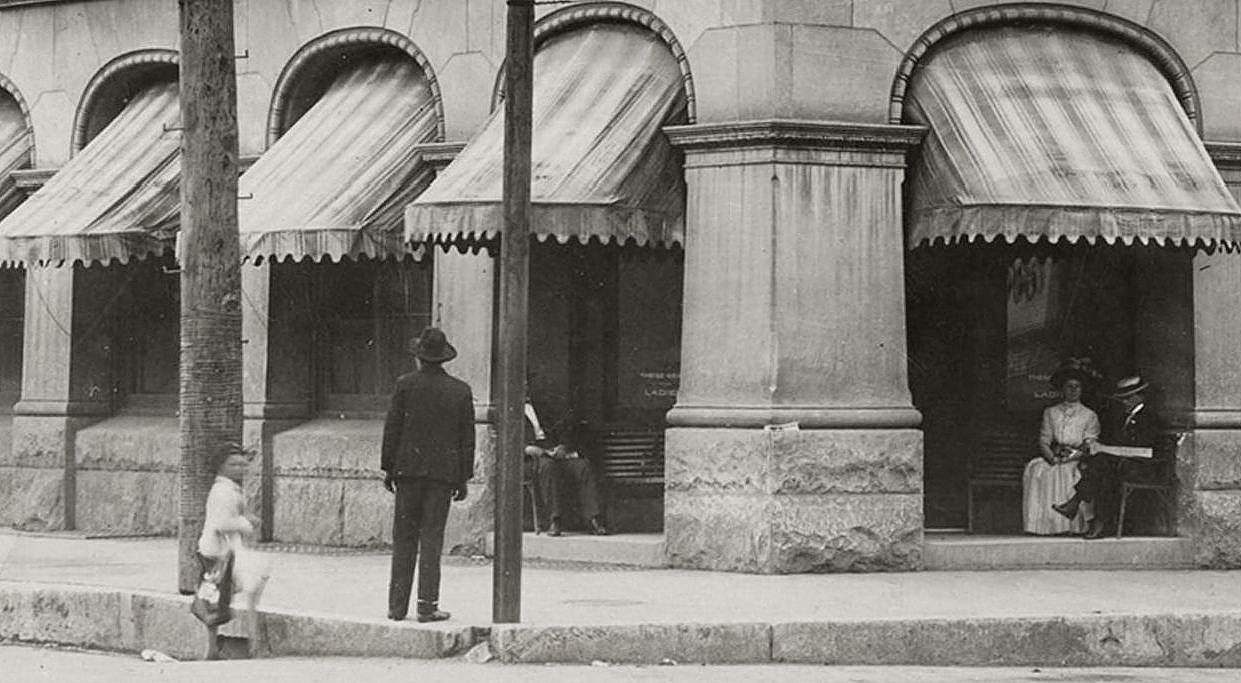
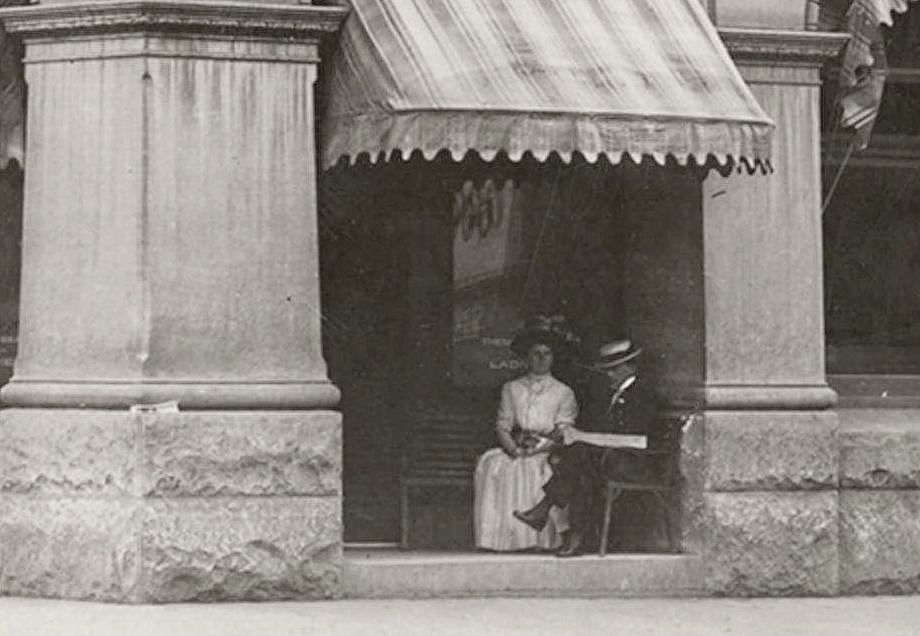
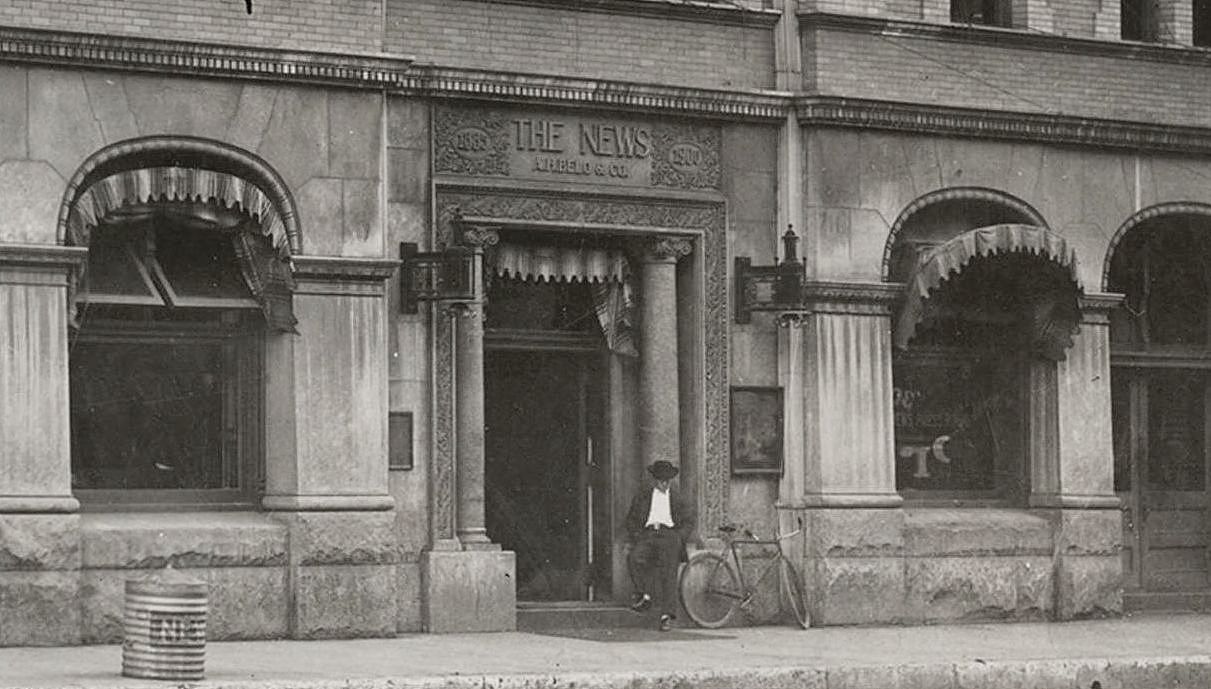
Here is another great photo from the DeGolyer Library at SMU, this one showing the then-new Dallas Morning News building anchoring the northwest corner of Commerce and Lamar. For me, it’s another case of the individual quiet vignettes that comprise the photograph being more interesting than the larger picture taken as a whole. (All pictures are much larger when clicked.)
***
Sources & Notes
Photograph from the Belo Records collection at the DeGolyer Library, Central University Libraries, Southern Methodist University, seen here.
For another view of the same building, see these posts:
“The Dallas Morning News Building, Inside and Out — ca. 1900,” here
“Lively Street Life Outside the Dallas Morning News Building — 1900,” here
For other photographs I’ve zoomed in on, see here.
Above, three views of “Leadbelly,” the sculpted head of the blues legend, by Michael G. Owen, Jr., 1943.
Michael Owen (profiled here previously as the 15-year-old soap-sculptor who made headlines at the 1930 State Fair of Texas), was the youngest member of the group of artists loosely affiliated with the Dallas Nine group who were making a name for themselves in the 1930s and ’40s. He studied life drawing as a student of Olin Travis and painting as a student of Jerry Bywaters, but he was most proficient as a sculptor. He is best known for his award-winning 1943 bust of bluesman Lead Belly, a piece in the permanent collection of the Dallas Museum of Art (which can be seen in a 1951 DMFA catalog here).
In a 1950 letter to the (then-) Dallas Museum of Fine Arts, Owen recounted how Lead Belly sat for him in New York and sang “Goodnight Irene” as Owen worked on a clay model. Owen was living in Greenbelt, Maryland at the time, and Louisiana-born Lead Belly was living in New York City, but I’d like to think that the two men reminisced about their formative days in Dallas where Owen was a much-talked-about young artist and Lead Belly performed on the streets of Deep Ellum with Blind Lemon Jefferson.
I noticed in the newspaper article that the stone was called black Belgian marble. Actually it isn’t so exotic. It was quarried not far from Charlottesville, Virginia, and is called Black Serpentine. It was the first time I have ever heard of the stuff being black. If you’ll notice it seems quite a bit more crystalline than marble.
The way I happened to do the head went like this. A young fellow I had known in Dallas by the name of Ralph Knight had gone to New York a year or so after I went to Washington. He was interested in folk music and became acquainted with Leadbelly. It was at Ralph’s instigation that I did the head — he got me the stone, sent pictures (I first roughed out the head in clay at home in Greenbelt) and then arranged the sitting at his apartment in New York. Leadbelly sat for me one afternoon and I finished the clay model at that time. From that I worked out the stone cutting, only being able to work on it in my spare time. All in all it was about a full month’s work, I guess. During the time he was “sitting” for me (playing his guitar and singing) he played “Goodnight Irene,” but at that time the folk music devotees did not consider the tune “true folk music.” Still it pleased me when it became a popular song. It’s too bad Leadbelly couldn’t have lived to see himself gain such popularity. (Mike Owen in 1950, from a letter excerpted in the book Lone Star Regionalism, The Dallas Nine and Their Circle)
Sadly, Mike Owen’s career stalled soon after this 1940s artistic high point. He eventually settled in Oregon, where he was sidelined by multiple sclerosis. He died in 1976 at the age of 60.
Mike Owen in his early 20s
I’m not sure how often the piece is displayed at the Dallas Museum of Art, but it’s a wonderful work of art. When I saw it a couple of years ago, I just stood and stared at it for ages. It’s really fantastic. And it’s fitting that it resides here in Dallas where Michael Owen was once a part of a group of Texas artists whose influence continues to be felt today.
It also seems fitting to throw in this classic from Mr. Ledbetter, who, like Mike Owen, spent time honing his craft in Dallas:
***
Sources & Notes
“Leadbelly” sculpture by Michael G. Owen, Jr. is in the collection of the Dallas Museum of Art.
Photo of the artwork is by Paul L. as posted on Yelp.
Quote from Mike Owen’s letter to the DMFA (April 11, 1950) can be found in the superb book Lone Star Regionalism, The Dallas Nine and Their Circle, 1928-1945 by Rick Stewart (Austin: Texas Monthly Press, Dallas Museum of Art, 1985) — the best book on Dallas art of this period.
Read the Handbook of Texas entry about Huddie Ledbetter (aka Lead Belly/Leadbelly) here.
Other Flashback Dallas posts on Owen:
Young Mr. Owen’s star-turn as the teenager who carved the WFAA transmitter plant from 8,400 pounds of Ivory Soap is here.
Owen’s monument to SMU Mustangs’ mascot Peruna, commissioned in 1937, is here.
UPDATE: Read about a recently discovered large painting by Owen up for auction in Dallas in 2019 here.
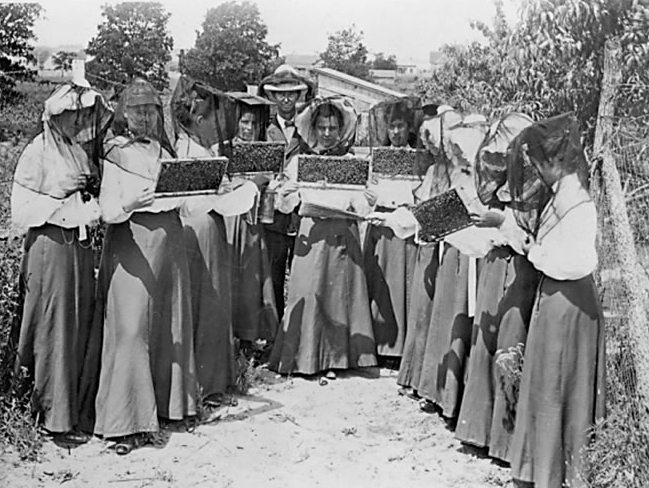
Beekeeping class at the College of Industrial Arts (later Texas Woman’s University) in Denton, around 1905. Pop quiz!
***
Sources & Notes
Photo from The Woman’s Collection of Texas Woman’s University.
Beekeeping was a popular “hobby” for women at the turn of the century, but for a look at larger-scale Texas honey production at this time, check out the article “The Bee Industry of Texas” from the 1904 edition of the Texas Almanachere.
For information on present-day North Texas beekeeping, the website of the Dallas-based Texas Honeybee Guild is here.
Do you dream of a home of your own? Then go and see the beautiful scenic Stevens Park Estates. “The Ideal Place for Your Home.” There you will find the ideal place for your “dream home.” A beautiful 146-acre park — 18 holes of golf — modern fan-shaped lots — broad sweeping boulevards — in fact, everything to make you realize the maximum enjoyment out of your home.
***
Sources & Notes
Ad from 1930.
History of Oak Cliff’s Stevens Park Estates can be found here and here.
What? You didn’t know the Trinity River was straightened?
by Paula Bosse
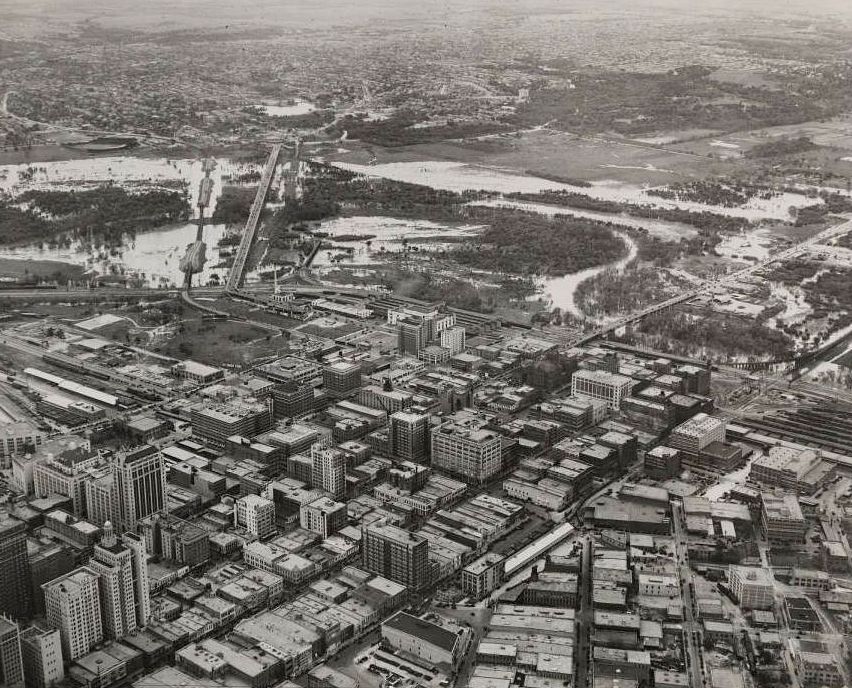
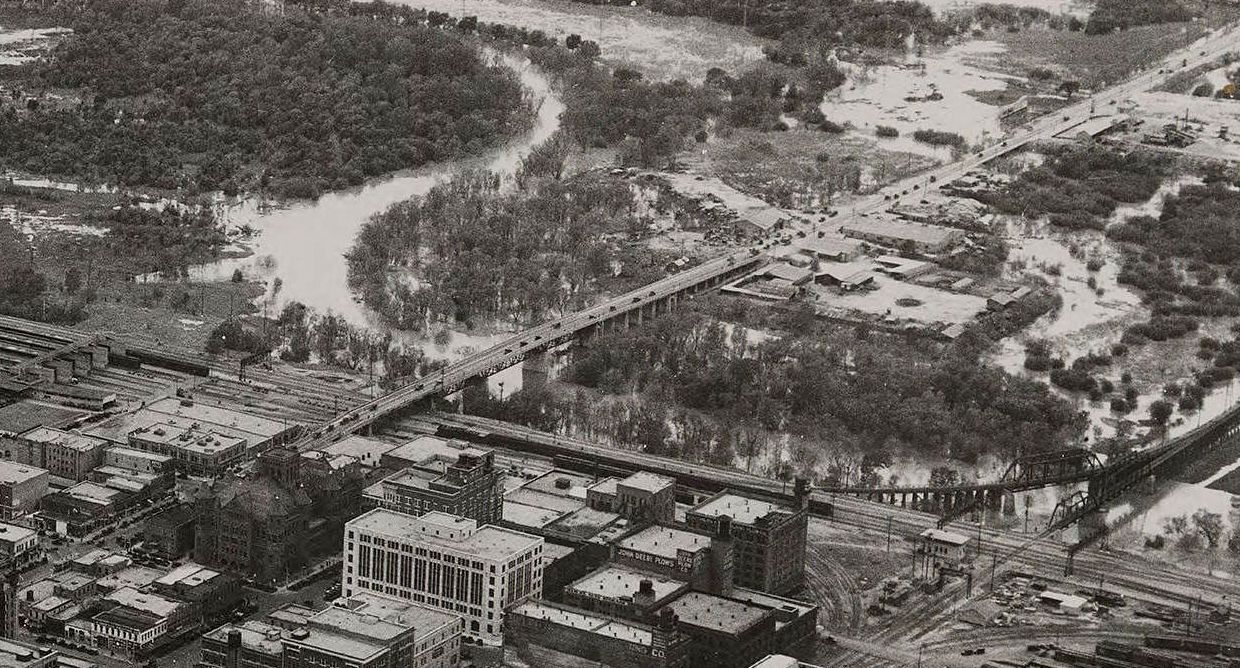
Back before Dallas decided to straighten out the Trinity River and move it a mile or two to the west (in an attempt to prevent future flooding), the river ran only about a block from the Old Red Courthouse. It’s so strange looking at this picture and seeing a river in a place where we’ve never seen it. It’s a shame they moved it (who knew you could “move a river”?), but flooding was a major issue, and, in fact, it looks like there was flooding the day this photo was taken. Below, you can see a magnified view — it looks so different from what we’re used to that it takes a second to get your bearings. Imagine how different Dallas would feel today if the Trinity had been allowed to run its natural course.
***
Sources & Notes
Photograph by Lloyd M. Long, from the Edwin J. Foscue Map Library, Central University Libraries, Southern Methodist University; it can be seen here (with many of the buildings labeled) and here (without the labeling).
SMU has the photo dated “ca. 1930s or 1940s,” but I think it may be from the late ’20s. I’ve seen non-specific dates of the river’s realignment from the 1920s to the 1930s, but a couple of landmarks in the photo above place it sometime between 1925 (the year the Santa Fe buildings were constructed) and 1933 (the year the Hippodrome Theater — seen here, on Pacific — became the Joy Theater).
UPDATE: The river was straightened in 1928. See fascinating information about the when, where, why, and how of the Trinity River realignment, below in the comments — it was a true feat of modern engineering.
A few Trinity River-related links: the Trinity Commons Foundation site is here; the Trinity River Corridor Project site is here; and an interesting look at plans and proposals for the future of Dallas and the Trinity River can be read on the American Institute of Architects (Dallas) site here.
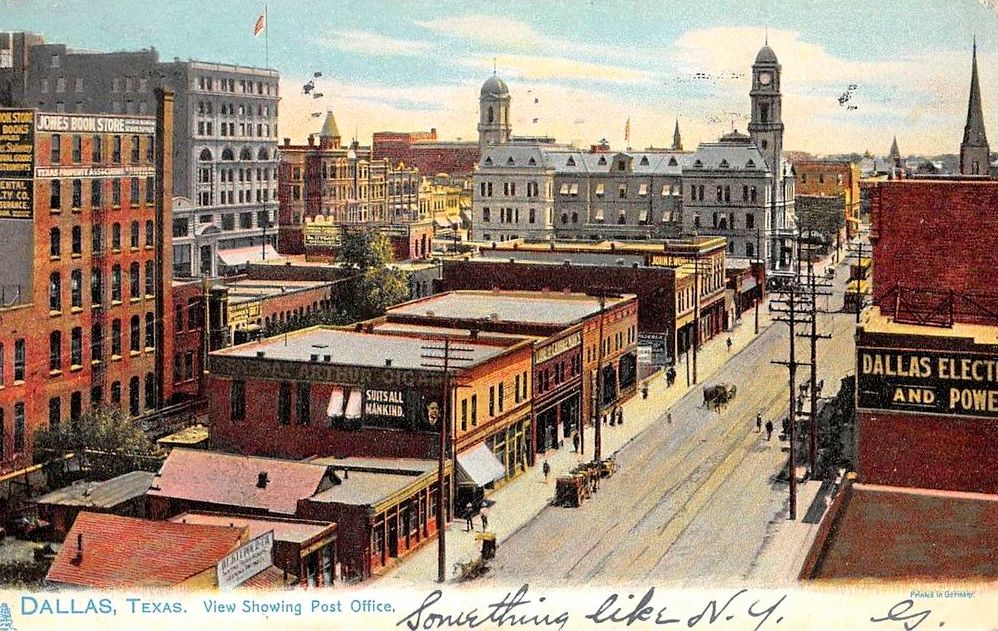
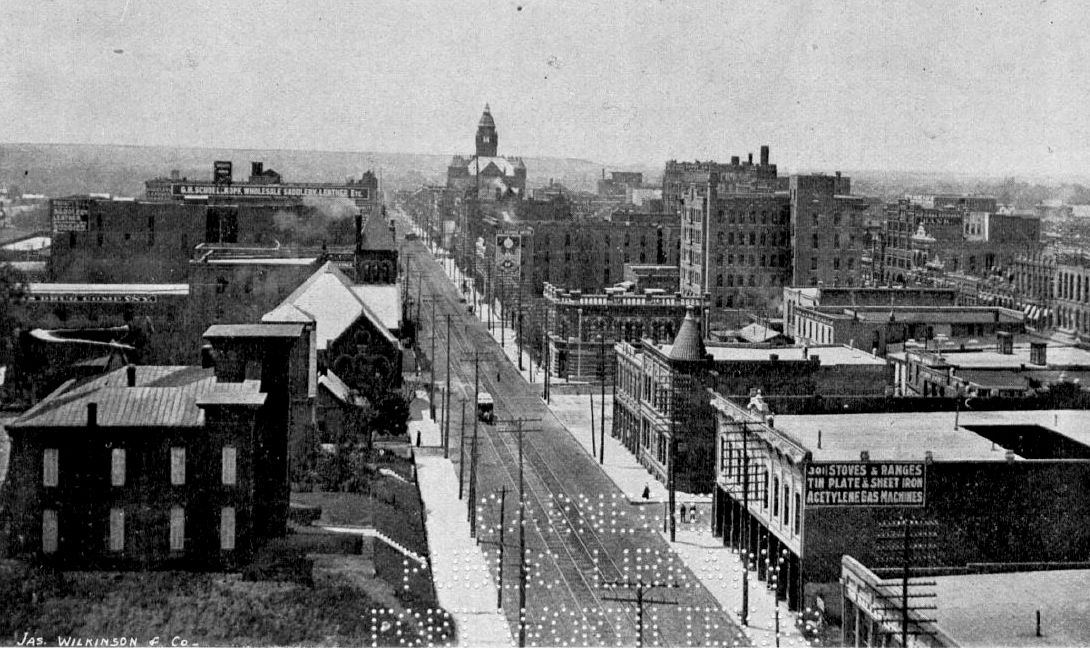
The companion photo from the one I posted yesterday. Both were taken by the same photographer (Jas. Wilkinson) and both appeared in The Bohemian magazine in 1900. It appears that both were probably taken from the top floor or roof of the Oriental Hotel at Commerce & Akard. The building about half-way up in this picture — the one on the right with the conical turret — is the Texas Land & Mortgage Company (seen here), located at Commerce and Field, placing the photographer at Commerce and Akard (the Oriental Hotel).
So it seems likely that the photo from yesterday (seen here) was from the Oriental looking north up Akard.
***
Photograph from The Bohemian magazine (1900) in the collection of the Fort Worth Public Library (which perforated the library’s name into the image).
The Hall of Negro Life at the Texas Centennial Exposition, Fair Park
by Paula Bosse
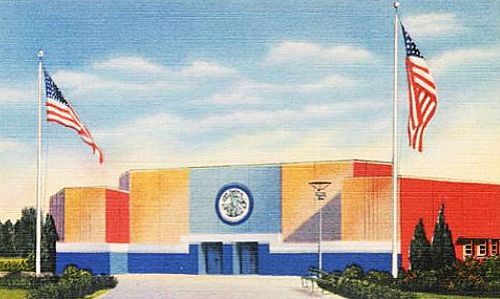
Juneteenth, the anniversary of the date that African American Texans learned they were freed from slavery, was celebrated at the Texas Centennial Exposition with a day of entertainment and exhibits. It was also the day that the Hall of Negro Life — a federally funded exhibition hall acknowledging and honoring the history and accomplishments of African Americans in the United States — was officially dedicated.
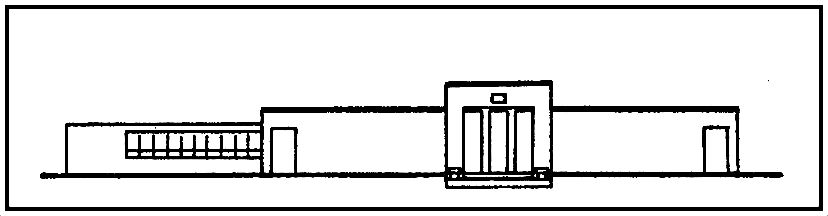
One of the more interesting things I’ve stumbled across is a drawing of the proposed building (published in J. Mason Brewer’s The Negro In Texas History in 1935). I don’t believe I’ve seen this before. It’s interesting to note the changes from original proposal to finished product.
Among the large collection of art by black artists displayed in the Hall of Negro Life were four murals by the artist Aaron Douglas, depicting black history in Texas. Below are the two murals that survive, “Into Bondage” and “Aspiration.” These are incredible murals, and it must have been an emotional experience for those Juneteenth visitors in 1936 to be surrounded by all four powerful pieces in the lobby of a government-backed project that formally recognized the contributions of fellow African Americans.
“Into Bondage” by Aaron Douglas, 1936 (Corcoran Gallery of Art)
“Aspiration” by Aaron Douglas, 1936 (Fine Arts Museum of San Francisco)
***
Sources & Notes
Black-and-white photograph of the Hall of Negro Life from the Private Collection of Mary Newton Maxwell, Portal to Texas History, here.
Photo of proposed Hall of Negro Life from An Historical and Pictorial Souvenir of the Negro In Texas History, written by J. Mason Brewer (Dallas: Mathis Publishing Co., 1935).
More on the Hall of Negro Life, from the Handbook of Texas, here.
More on the Hall of Negro Life from The Crisis, the magazine of the NAACP, in the July, 1936 article “Negroes and the Texas Centennial” by Jesse O. Thomas,here.
How was this important Juneteenth celebration at the Texas Centennial covered by The Dallas Morning News? Well, the paper actually devoted a lot of space to the day’s events in a fairly lengthy article which appeared on June 20, 1936. I think the DMN editorial board probably thought they were being magnanimous in the amount of coverage given, but, really, the article — though brimming with a certain amount of probably well-intentioned jubilation — is so unremittingly racist that it’s actually shocking to see this sort of thing in print in a major newspaper. I encourage you to check out the article published on June 20, 1936 which carries the laboriously headlined and sub-headlined “Negroes Stage Big Juneteenth at Centennial; Dallas Eats Cold Supper and Cotton Patches Emptied as Thousands Inspect Magic City; Hall Is Dedicated; Dusky Beauties Prance; Cab Calloway Does His Stuff For Truckers.”
I’m not sure what more I can offer, except to say that in today’s money — with inflation taken into account — that little $3 bondage device for a child’s thumb would run you a cool 40 bucks in 2014. (Updated: in 2024, make that $55!)
I picture Mrs. J. C. Thompson assembling the inventory herself, at the kitchen table in her little frame house on Melba Street in Oak Cliff, the Victrola playing in the other room, having a chirpy one-sided conversation with the imaginary “Dr. Thompson.” I wonder if she sold any?
To quote the Messrs. Python: “Guaranteed to break the ice at parties!”
***
Sources & Notes
Ad from The Dallas Morning News, Nov. 18, 1923. I’m not sure there was a follow-up.






 The Hall of Negro Life at the Texas Centennial Exposition, Fair Park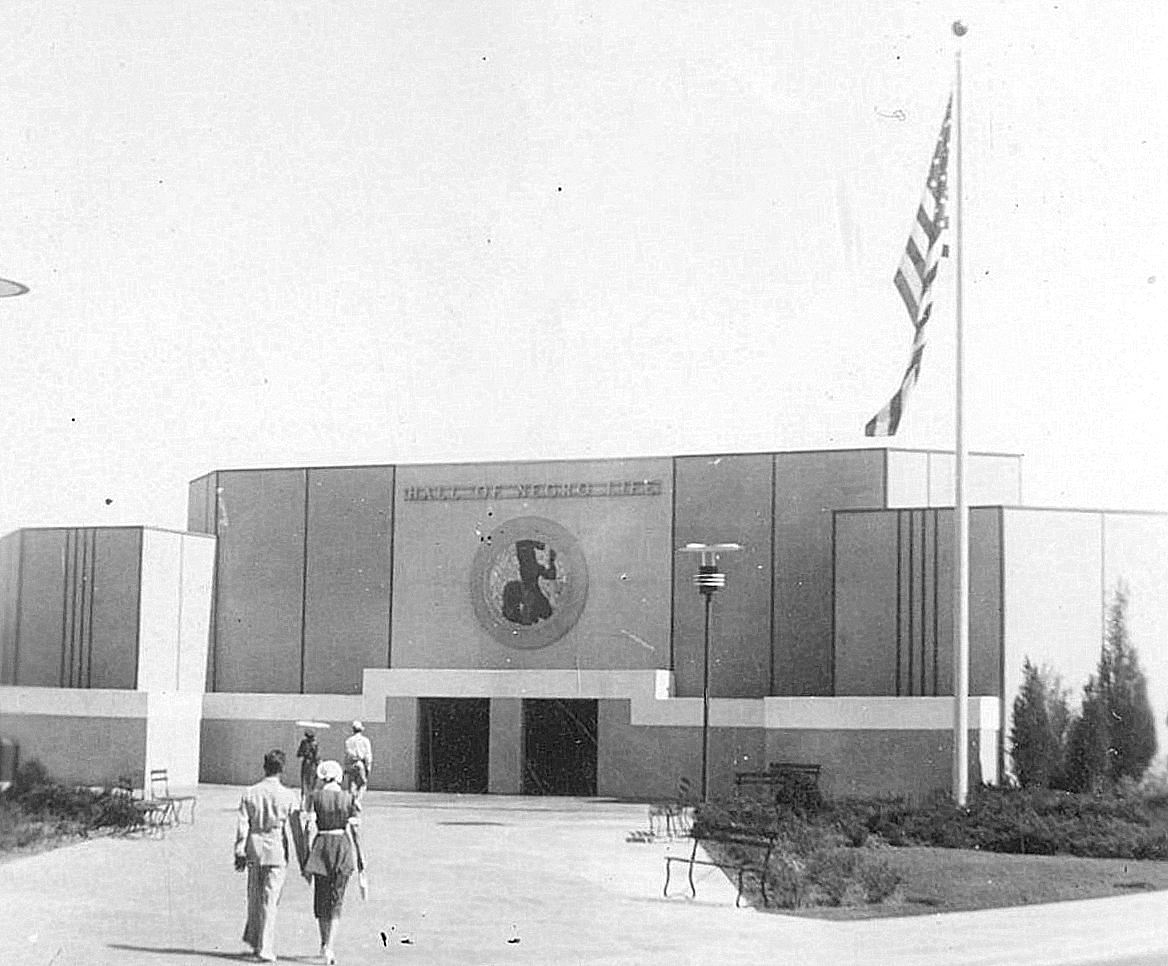

 “Into Bondage” by Aaron Douglas, 1936 (Corcoran Gallery of Art)
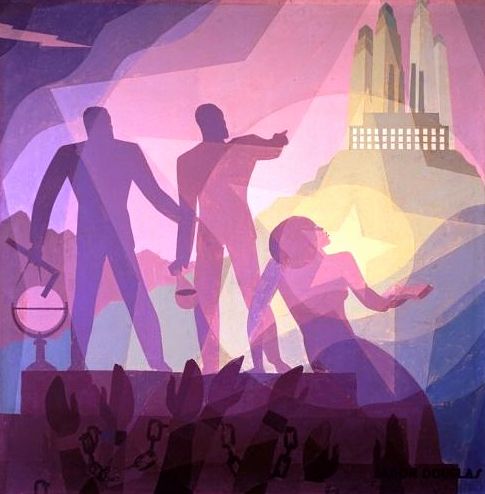 “Aspiration” by Aaron Douglas, 1936 (Fine Arts Museum of San Francisco)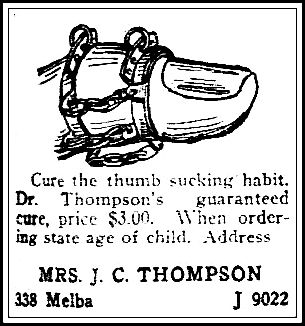
 Flashback : Dallas