Flashback : Dallas

A Miscellany: History, Ads, Pop Culture

Category: Neighborhoods

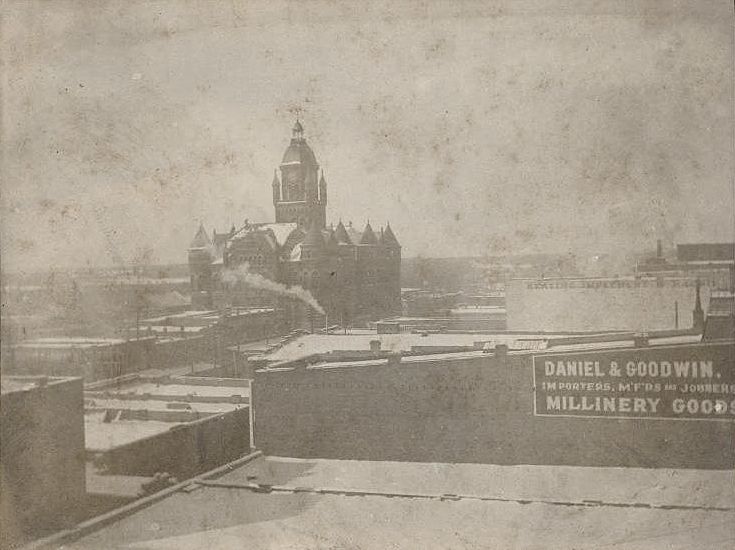
Courthouse in the Mist/Smoke/Murk — 1901

old-red_dallas-courthouse_1901_degolyerThe ethereal Old Red Courthouse…

by Paula Bosse

I love this photo of the Old Red Courthouse from 1901. (I guess in 1901 it would have been the New Red Courthouse….) The dreamy quality is probably due less to a romantic mists of Avalon effect (which, incidentally, I’ve seen from the Glastonbury tor, and it’s beautiful!) and maybe due more to just a lot of soot and smoke. …Or something altogether more prosaic, like a damaged photograph or plate. Here’s the courthouse a little closer:

old-red_dallas-courthouse_1901_degolyer_det

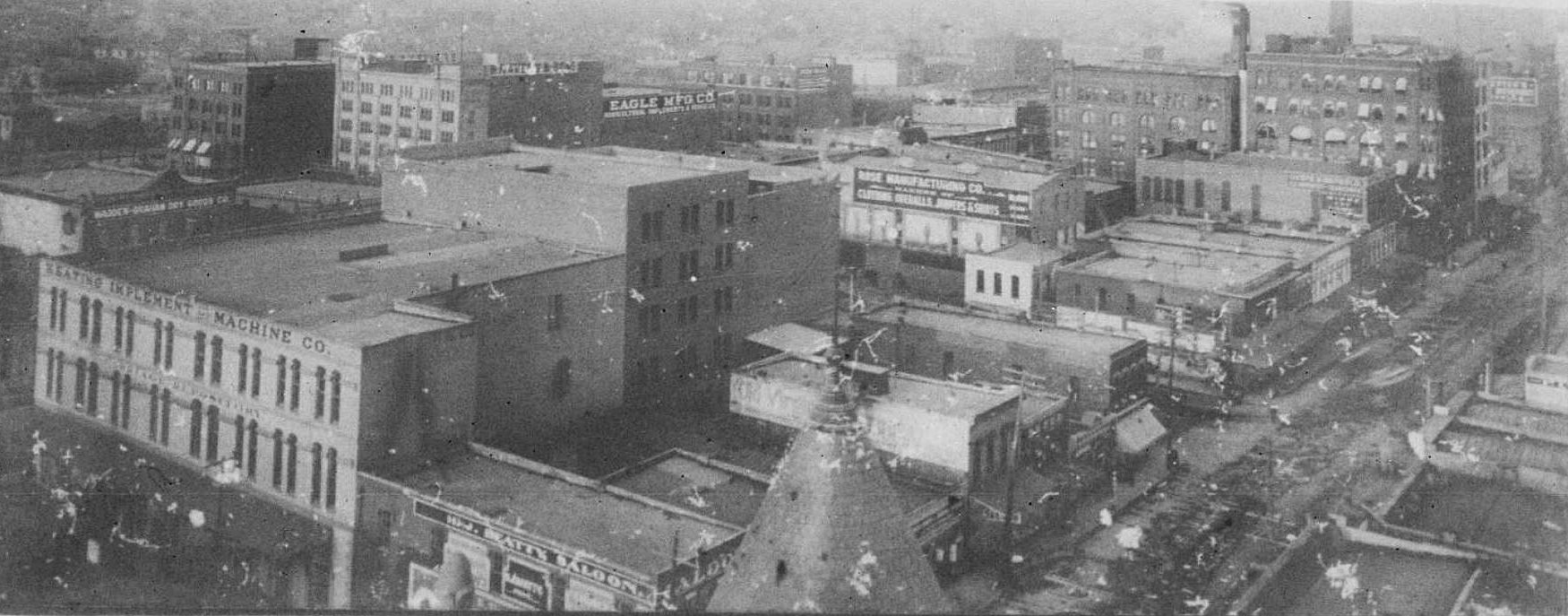
In the image at the top of the page, you can see some of the words for the “Keating Implement & Machine Co.” painted on the white building, seen just above the “Daniel & Goodwin” building on the right side of the photograph. The photo below shows the view from the courthouse, taken about 1900. In the bottom left corner, you can see the Keating building. The reverse view isn’t soft and mysterious (or even all that interesting), but I like that Old Red gets in a tiny Hitchcock-like cameo in the center foreground.

old-red_northeaset-from-courthouse_1900_degolyer_SMU

***

Sources & Notes

Top photo — titled “[Dallas Courthouse]” — is from the George A. McAfee Photographs collection, DeGolyer Library, SMU Libraries; more information on this photo can be found here.

The view from the courthouse — titled “Looking northeast from Courthouse circa 1900” — is from the Collection of Dallas Morning News negatives and copy photographs, DeGolyer Library, SMU Libraries; more information on this photo can be found here.

Please consider supporting me on Patreon, where I post exclusive content several times a week.

old-red_dallas-courthouse_1901_degolyer_sm

*

Copyright © 2023 Paula Bosse. All Rights Reserved.

St. Mark’s From the Air

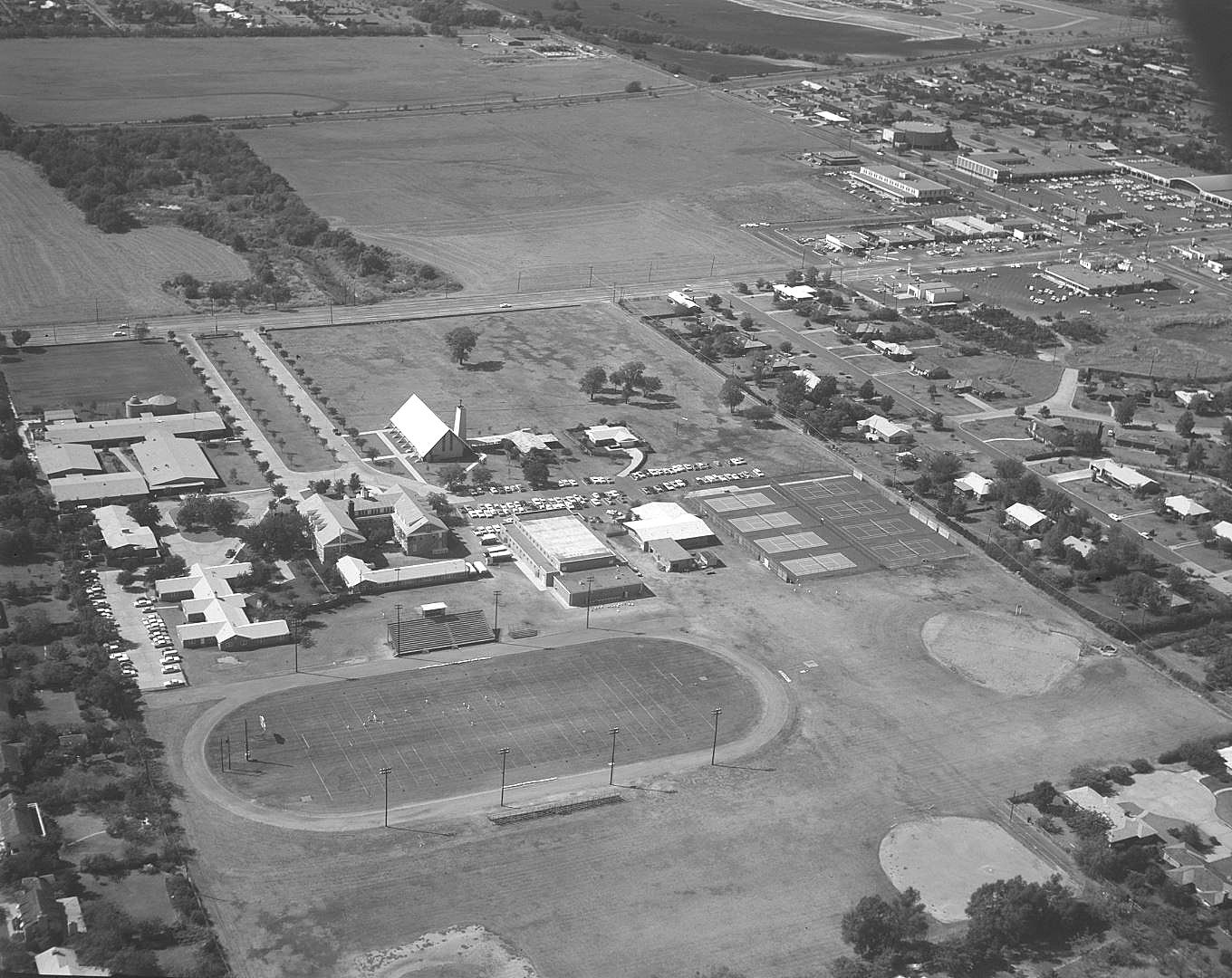
st-marks_preston-royal-to-the-west_squire-haskins_UTAGo west, young man…

by Paula Bosse

The photo above shows an aerial view of the St. Mark’s campus, with a view to the northwest. So. Much. Space. The horizontal road in the top third of the photo is Preston Road. In the top right corner, at 5923 Royal Lane, is the round St. Luke’s Episcopal Church, which was built in 1959. (I have learned only tonight that the architect of that church — and many other buildings around Dallas — was designed by architect William H. Hidell Jr., who studied with George Dahl. Hidell grew up in the same house I grew up in — several decades earlier. Small world.) Across the street from the round church is the Preston Royal fire station, built in 1958, and recently destroyed by a tornado (and which I wrote about here). This photo is undated, but it was obviously taken sometime after 1959. That amount of empty land is surprising. (If you really want to freak out about miles of nothing in North Dallas, check out this unbelievable photo of Preston and Valley View in 1958, pre-LBJ).

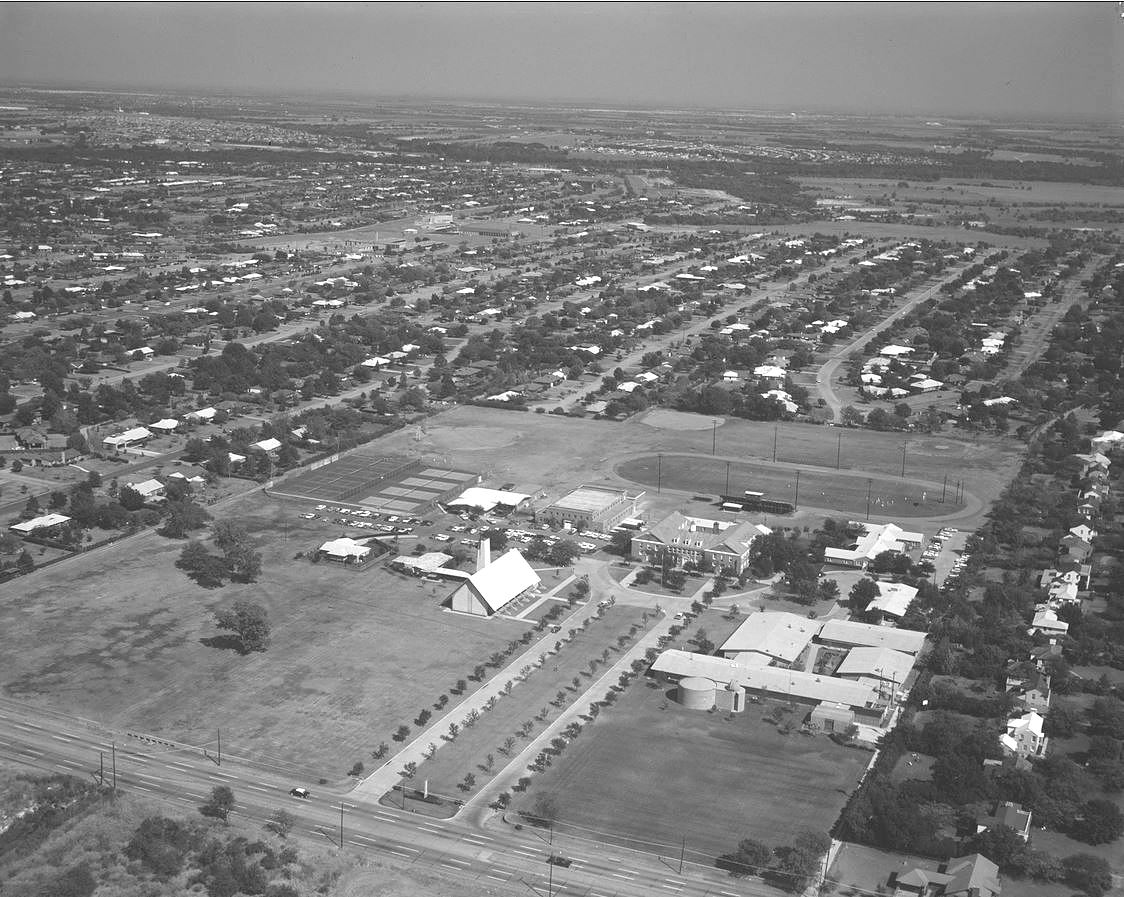
And here are two other St. Mark’s-centric photos from the same flight — all taken by Squire Haskins (see links below for very large images on the UTA website). Below, a view to the northeast:

st-marks-aerial_to-northeast_squire-haskins_UTA

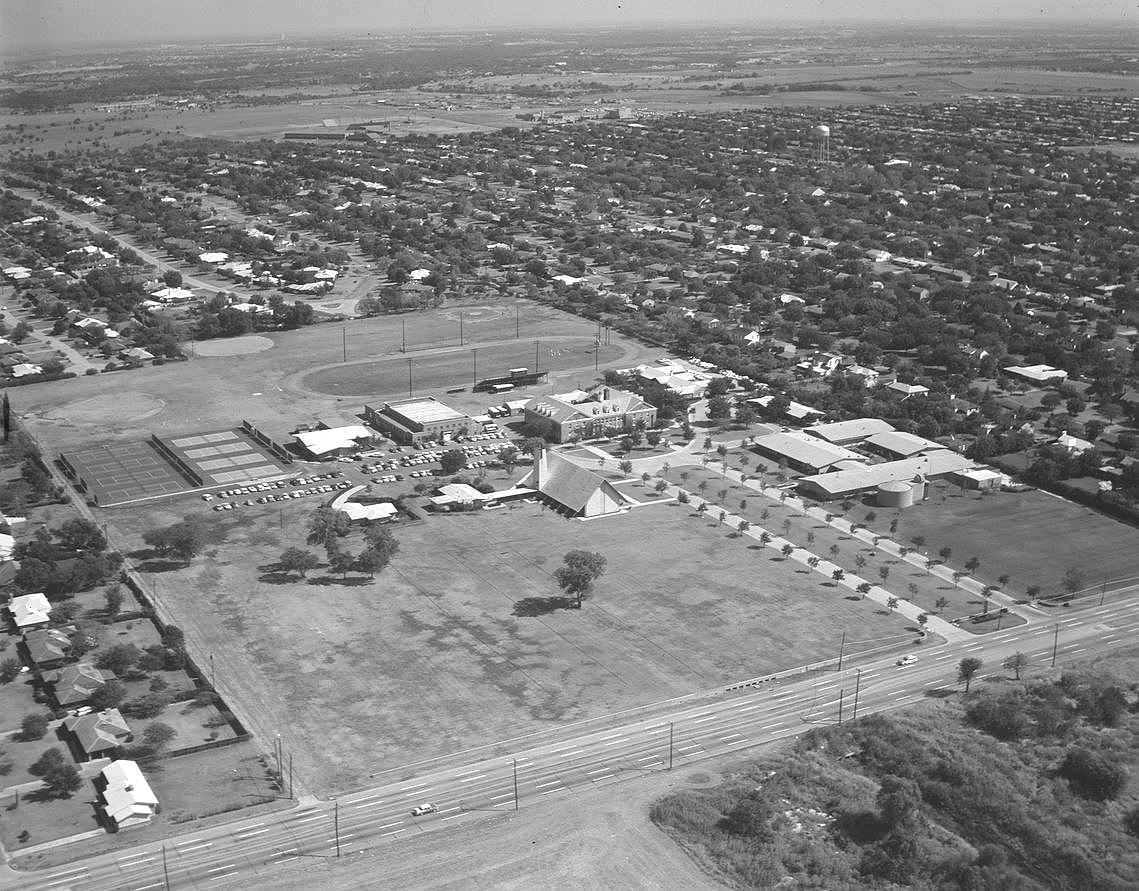
And a view to the southeast:

st-marks-aerial_to-southeast_squire-haskins_UTA

***

Sources & Notes

These three aerial photos are by Squire Haskins, from the Squire Haskins Photography Inc. Collection, University of Texas at Arlington Libraries. Read more information about these individual photos: the first one is here (view to the northwest); the second is here (view to the northeast); and the third is here (view to the southeast). Click the pictures on the UTA site to see really, really big images.

Please consider supporting the work I do at Flashback Dallas by funding me on Patreon, where I post exclusive content.

st-marks_preston-royal-to-the-west_squire-haskins_UTA_sm

*

Copyright © 2023 Paula Bosse. All Rights Reserved.

Southland Center Observation Deck — 1967

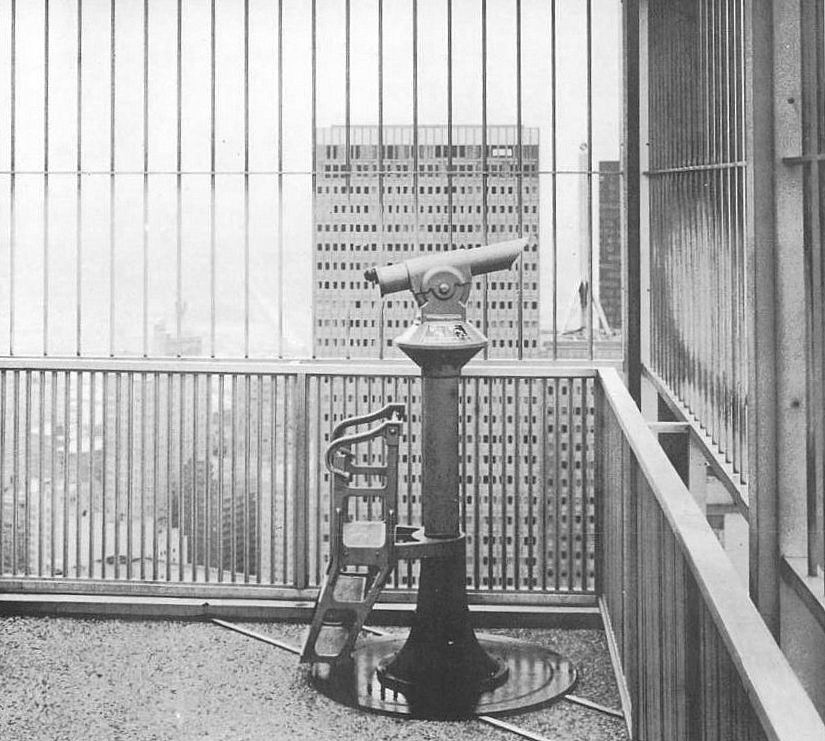
southland-life_observation-deck_HPHS_1967-yrbk_photo550 feet above street level…

by Paula Bosse

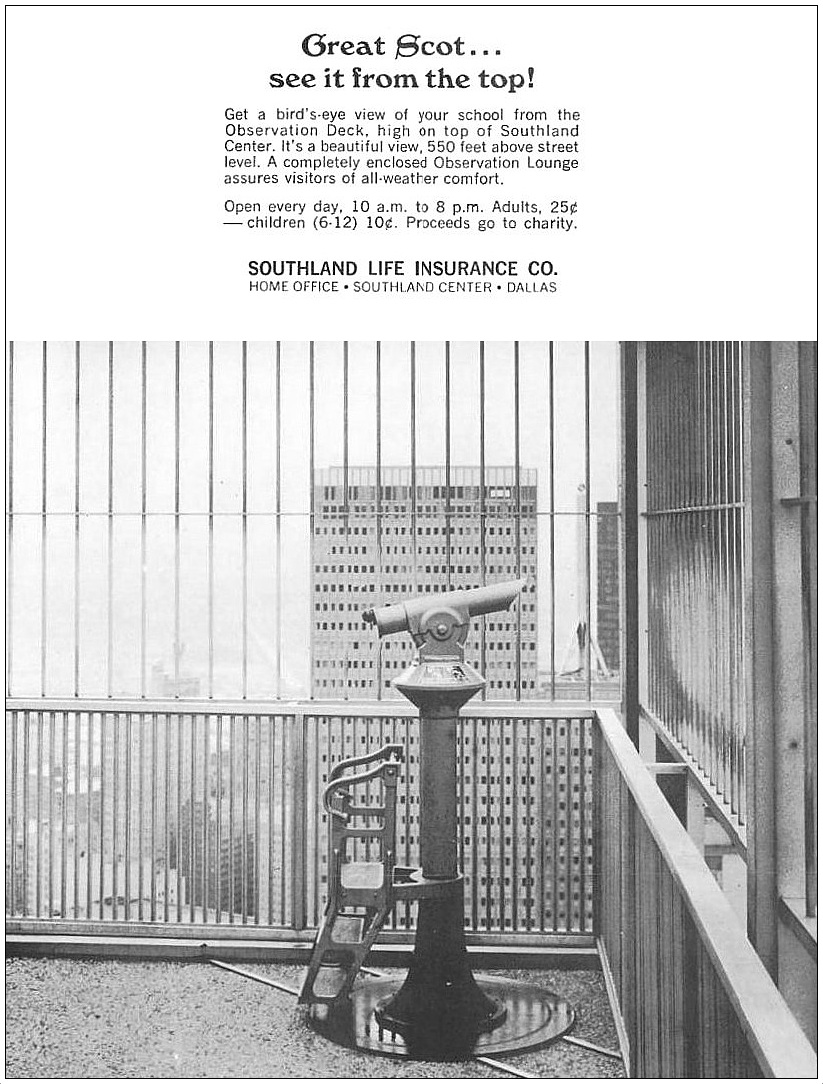
I never experienced the observation deck atop the Southland Life Insurance Building (or any of the observation decks sprinkled throughout downtown — other than Reunion Tower, I guess), but I see a lot of people mention it in fond childhood memories. Here it is in an ad from the 1967 Highland Park High School yearbook.

*

GREAT SCOT… SEE IT FROM THE TOP!

Get a bird’s-eye view of your school from the Observation Deck, high on top of Southland Center. It’s a beautiful view, 550 feet above street level. A completely enclosed Observation Lounge assures visitors of all-weather comfort.

Come every day, 10:00 a.m. to 8:00 p.m. Adults, 25¢ — children (6-12) 10¢. Proceeds go to charity.

Southland Life Insurance Co.
Home Office  •  Southland Center  •  Dallas

southland-life_observation-deck_HPHS-yrbk_1967

*

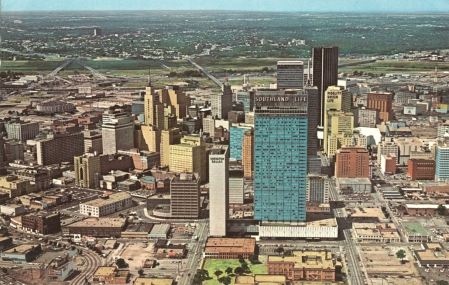
The observation deck and “lounge” was opened to the public on the 41st floor of the Southland Life Building on Oct. 31, 1956 (the top floor — the 42nd — had a private heliport). I can’t find when it finally closed, but it was open until at least the 1980s.

A search around the internet turned up an interesting bit of footage of the observation deck in 1962 — from a cameo appearance in the TV show “Route 66” (there were a couple of episodes shot in Dallas — I haven’t seen this entire episode, but the clip below has a few cool locations). The pertinent footage begins at the 4:43 mark and lasts for about 2 minutes (if, like me, any hint of fictional animal danger is a problem, you might want to stop around the 5:00 mark). (A couple of cast connections to our fair city: David Wayne, the actor featured in this episode, would later return to Big D as Digger Barnes in “Dallas,” and Dallas actress K Callan — seen in a scene at Love Field at 4:10 — was both a student and a teacher at Our Lady of Good Counsel in Oak Cliff.) From this clip, it looks like there might have been several of the telescopes around the perimeter of the building. (I’d love to see this in color — to see those shimmering blue glass tiles up close.) (This full episode — one of three filmed in Dallas — can be watched on YouTube, here. You’ll see Love Field, the Marriott Motor Hotel, the Southland observation deck, the SMU campus, the Trade Mart, a Wyatt’s cafeteria and grocery store (6126 Luther Lane, in Preston Center), Sheriff Bill Decker’s actual office, and a drive-in movie theater.)

*

Is there an observation deck there these days?

skyline-looking-west_southland-center_1970_portal

***

Sources & Notes

Top photo/ad is from the 1966 Highland Park High School yearbook. 

Check out these related Southland Center posts:

southland-life_observation-deck_HPHS_1967-yrbk_photo_sm

*

Copyright © 2023 Paula Bosse. All Rights Reserved.

The Mercantile Bank Building — 1951

mercantile_squire-haskins_dec-1951_UTASquire Haskins Collection, UTA Special Collections

by Paula Bosse

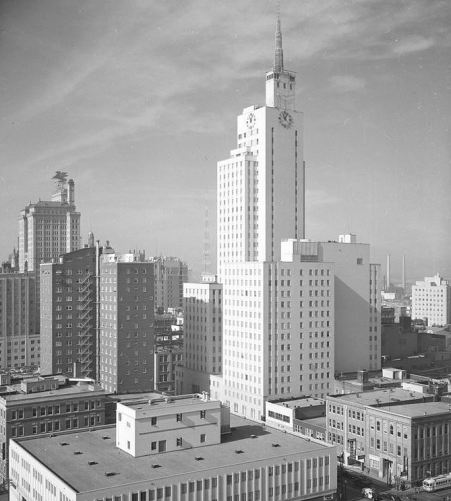
Photo of one of my favorite downtown buildings, the Mercantile, taken by ace photographer Squire Haskins in December 1951. See a very large image of this at the UTA website, here. Zoom in and take a look around. Check out all the landmarks. You’ll probably find Waldo while you’re at it.

***

Sources & Notes

“Downtown Dallas — Mercantile Building” by Squire Haskins, taken on Dec. 11, 1951; from the Squire Haskins Photography, Inc. Collection, University of Texas at Arlington Libraries, Special Collections — more information can be found here. (I have slightly cropped the image.)

mercantile_squire-haskins_dec-1951_UTA_sm

*

Copyright © 2023 Paula Bosse. All Rights Reserved.

Crescent Cafe: Warehouse District — 1944-1952

crescent-cafe_mckinney-and-lamar_ebay904 McKinney Avenue, at N. Lamar

by Paula Bosse

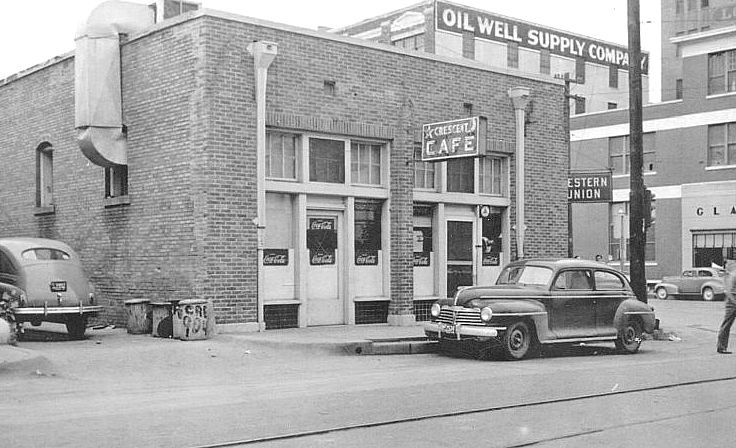
The Crescent Cafe once stood at 904 McKinney Avenue, at the corner of N. Lamar. Also seen in this photo is the national headquarters of the Oil Well Supply Company (2001 N. Lamar), a sign for Western Union (2026 N. Lamar), and part of the Binswanger glass company (2019-21 N. Lamar).

See this corner now, on Google Streete View, here.

About all I can tell you about this place is that it was in operation from about 1944 to 1952 (in the 1950 city directory, Mrs. Olive West was listed as the owner — by 1952, Mrs. Josephine Cashlon had taken over).

Mrs. West ran the cafe (breakfast and lunch only, closed on Sundays) for several years, but on Sept. 23, 1950, an ad appeared in the classifieds which read:

CAFE — OWNER
Industrial.
Wonderful location.
Bargain.
904 McKinney

Olive was ready to move on.

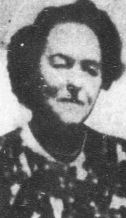
A week and a half after the ad appeared, Olive died in a car accident on her way to a nephew’s funeral in Sherman (the nephew had also died in a car accident). No word on whether Mrs. Cashlon (a former waitress who had probably long dreamed of running her own restaurant) had purchased the Crescent Cafe before Mrs. West’s unfortunate demise. 

crescent-cafe_olive-westOlive West (1890-1950)

***

Sources & Notes

Photo found on eBay.

crescent-cafe_mckinney-and-lamar_ebay_sm

*

Copyright © 2023 Paula Bosse. All Rights Reserved.

John W. Smothers’ Tin Shop, Hall & Floyd

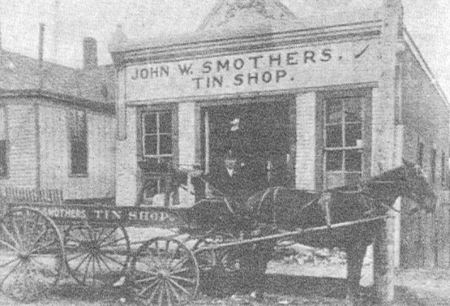
smothers-tin-shop_ebaySmothers (in car) and employees, ca. 1913

by Paula Bosse

John W. Smothers (1869-1925) came to Dallas from Huntsville, Missouri around 1890 to begin his career as a “tinner” working for a family friend/in-law, Frank T. Payne. By 1905, Smothers had married a girl from back home, had a child, and had apparently done well enough in the trade to buy a lot on College Ave. (now N. Hall St., in Old East Dallas) where he built his own tin-manufacturing shop, specializing in various sheet metal work. 

smothers_ad_1909-directory
1909 city directory ad

It looks like this business lasted until about 1918, when Smothers retired and sold the building to his old friend, F. T. Payne. It became a grocery store in 1919. Smothers died in 1925 at the age of 56 — his death certificate lists the cause of death, somewhat alarmingly, as “exhaustion and malnutrition” following a long illness — an extreme case of St. Vitus Dance

smothers_tin-shop_photo_ancestryvia Ancestry.com

Originally 212 N. College Ave., the address of Smothers’ tin shop became 912 N. College Ave. in 1911 when new addresses were assigned around the city. (See the location of the shop on a 1921 Sanborn map here.) It sat diagonally across the street from Engine Company No. 3, seen below in a photo from about 1901:

fire-dept_engine-co-3_gaston-and-college_1901Fire station, Gaston & College, ca. 1901

College Avenue was renamed and became Hall Street around 1946, and the address of the old tin shop building changed again, to 912 N. Hall Street, which is in the area now swallowed up by Baylor Hospital (see what 912 N. Hall looks like now on Google Street View, here).

***

Sources & Notes

Top photo found on eBay. A copy is also in the George W. Cook Dallas/Texas Image Collection, DeGolyer Library, Southern Methodist University — it can be accessed here. The SMU photo (apparently from the collection of Ralph Smothers, John’s son) has a notation on the back which reads “912 College Ave. <now Hall St.> about 1913 or 14? John Smothers [in car], [James E.] Curly Wilson left, Bob Critcher right.”

Photo of the fire station with the ghostly horse is by Clifton Church and is from the Dallas Fire Department Annual, 1901, which can be viewed in its entirety on the Portal to Texas History, here. (I used this image in my 2016 post “Dallas Fire Stations — 1901.”)

(“Tinner” was not an unusual word to have come across in the early part of the 20th century, but in the 1910 census, the enumerator was either confused or did not understand what was being said, because Smothers’ trade is listed as “tuner” — it looks like the enumerator then just made a weird leap to attempt to explain this and added “piano” under “General Nature of Business,” which Ancestry.com then repeats in its OCR-generated records. That “piano tuner” profession caused me a lot of confusion! To add insult to injury, OCR tells us that his occupation in 1900 was “turner,” and an illegible entry in the 1920 census transforms him into a “retired farmer”! Always approach census record information with a grain of salt — for many, many reasons!)

smothers-tin-shop_ebay_sm

*

Copyright © 2023 Paula Bosse. All Rights Reserved.

Pig Stand No. 2, Oak Cliff

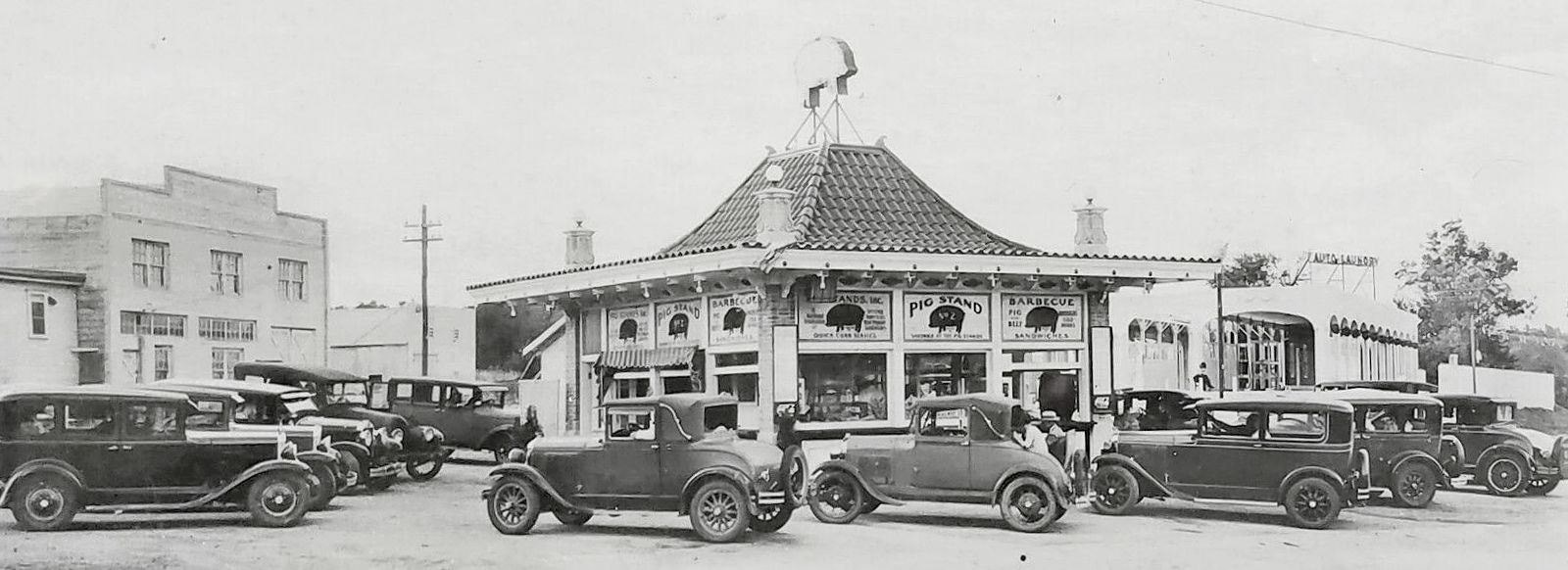
pig-stand-no-2_dallas_ebayWaiting in cars for pig sandwiches

by Paula Bosse

I’ve seen a cropped version of this photo, but not the full image. It’s great! I don’t mean to keep posting about restaurants, but seeing this photo was too good not to share. (As I type this, it’s available on eBay, here.)

It shows Pig Stand No. 2 at 1301 N. Zang in Oak Cliff, probably about 1928. It appears that this was the second “No. 2” — it was announced that this brand-new building had just begun construction in January 1928.

Work was started last week on the new Pig Stand, Zang’s Boulevard and Colorado Street, for the Pig Stands Company, a Dallas institution, now operating in 39 cities in 12 states. The ornamental building has been adopted as a standard design for the many future stands now contemplated over the country by this concern. In this building will be embodied modern sanitary features complying with all requirements and laws. It will be faced with brick and highly colored tile with ornamental stone trimmings and a clay tile sweeping roof in several shades. The exterior as well as the interior will be illuminated electrically with the cornice and ornaments decorated out in varied contrasting colors. The Pig Stands Co., starting less than five years ago with small capital, has developed into a national institution. Architects F. J. Woerner and Co. designed and will supervise this work, while M. W. McDade will have charge of the construction. (Dallas Morning News, Jan. 26, 1928)

At the right is the Oak Cliff/Tramway Auto Laundry at 1307 N. Zang.

pig-stand-no-2_dallas_ebay_det

I love the couple in the rumble seat!

***

Sources & Notes

Photo currently available for sale on eBay, here.

Read a history of Dallas’ Pig Stand empire — long considered to be the first-ever drive-in restaurants, a revolutionary contribution to American social culture — in the Texas Monthly article “The History of the Pig Stands” by Daniel Vaughn (Feb. 2015).

Architect Frank Woerner designed many notable commercial and residential buildings in Dallas, including the Stoneleigh Hotel, the Couch Building across from SMU, the old Union Depot in Deep Ellum, and the beautiful home of Max Rosenfield on South Boulevard.

pig-stand-no-2_dallas_ebay_det_sm

*

Copyright © 2023 Paula Bosse. All Rights Reserved.

Kimball High School, Off Campus — Ads, 1959-1961

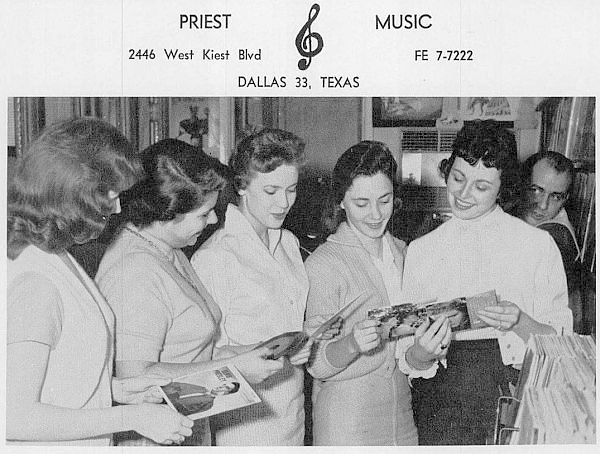
priest-music_kimball-high-school_1959-yrbk
Browsing the Elvis releases, 1959

by Paula Bosse

A few years ago I posted several Oak Cliff-centric ads found in the 1963 and 1967 Kimball High School yearbooks (see those ads here). I’m back for another installment.

**

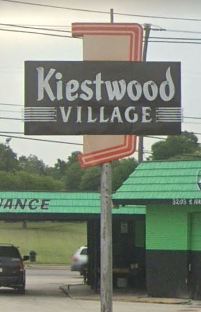
Above, a photo I really love, showing five Kimball girls checking out Elvis records at Priest Music (2447 W. Kiest Blvd). No, they don’t look like high school girls, and, yes, they are. The man at the right is, apparently, the owner, Frank M. Anderson (whom, I think, changed the name of the store to Music Hall the following year?). I posted this ad on my Facebook page last week, and one man wrote, about the owner: “Frank, the owner. His shop was known for its collection of Jazz and Classical albums. We became friends as I got into Jazz thanks to the Great Pete Fountain!” And because, why not, here’s a recent Google Street View of the Kiestwood Village sign which was probably there at that little shopping strip when Frank and the girls were photographed for this ad. 

kiestwood-village_2022

*

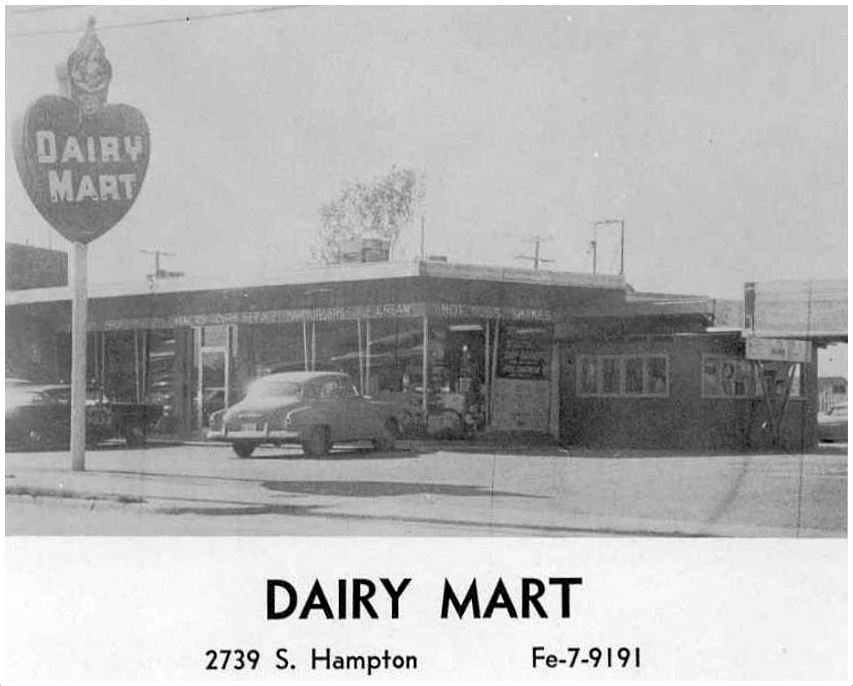
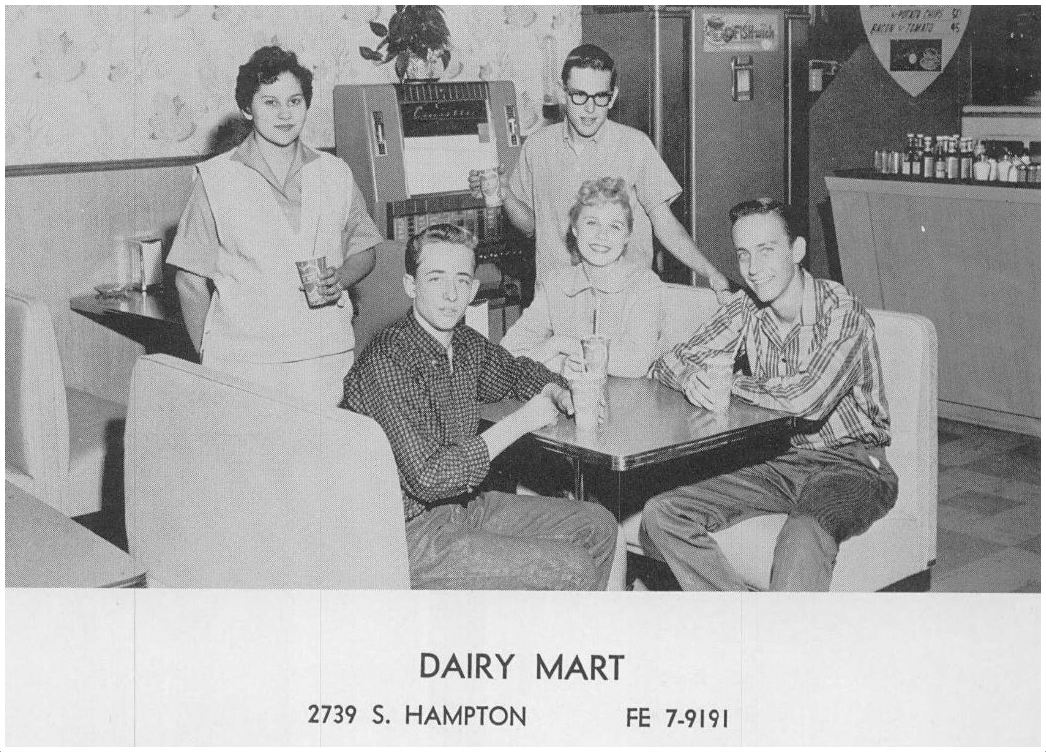
Dairy Mart (2739 S. Hampton):

kimball-high-school_1960-yrbk_dairy-mart1960

kimball-high-school_1959-yrbk_dairy-mart1959

*

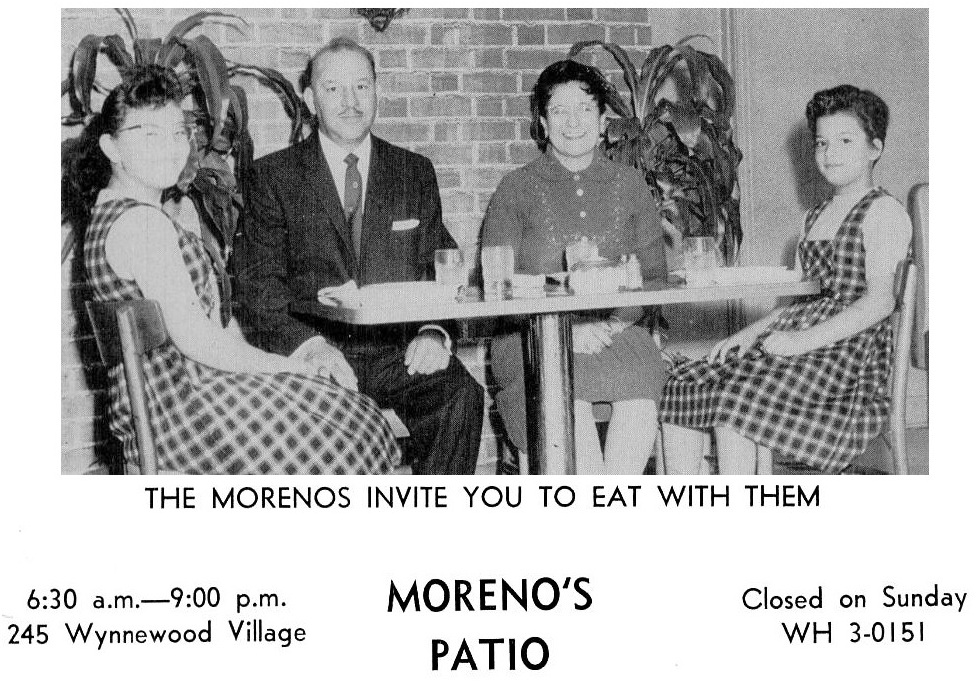
Moreno’s Patio (245 Wynnewood Village):

kimball-high-school_1961-yrbk_morenos-patio_restaurant1961

*

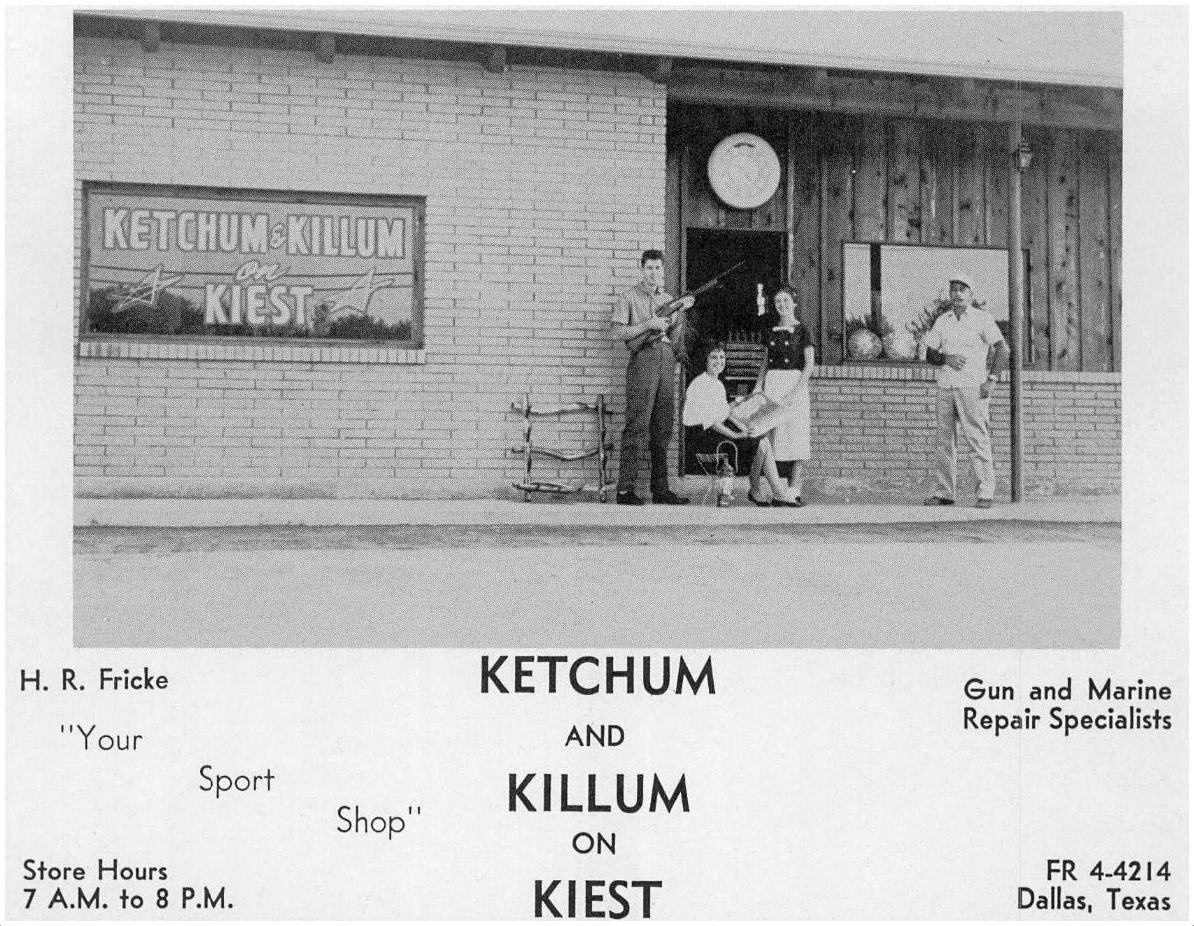
Ketchum & Killum (334 W. Kiest) — a sporting goods store with perhaps the best name ever (UPDATE: or not — see the comments below):

kimball-high-school_1961-yrbk_ketchum-and-killum1961

*

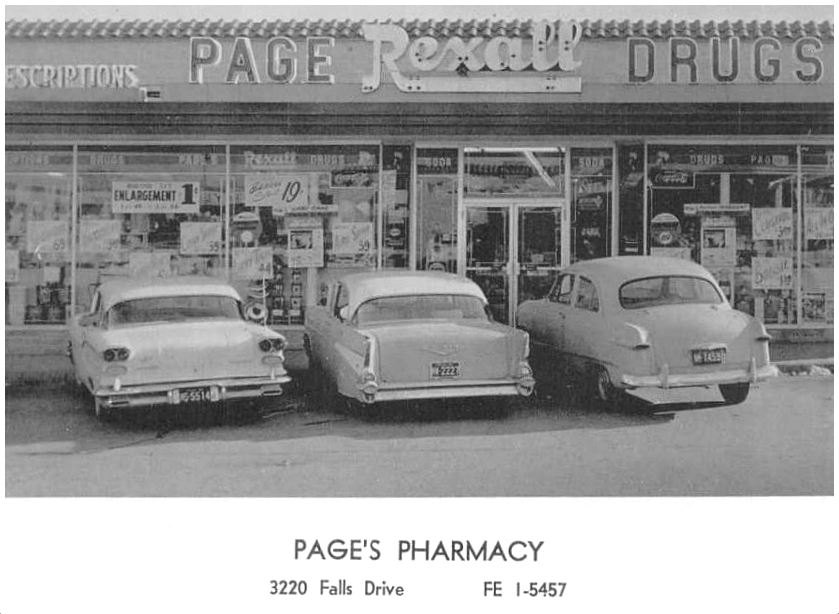
If you’re in need of some bandages or Mercurochrome after being a little too curious at Ketchum & Killum, head over to Page’s Pharmacy (3220 Falls Dr.):

kimball-high-school_1959-yrbk_page-drugs1959

*

For all things “fun,” Playland (3900 W. Illinois):

kimball-high-school_1959-yrbk_playland1959

***

Sources & Notes

All ads from the 1959, 1960, and 1961 yearbooks of Justin Kimball High School in Oak Cliff.

More Kimball yearbook ads can be found in the Flashback Dallas postA Few Ads From the Pages of the 1963 and 1967 Kimball High School Yearbooks.”

priest-music_kimball-high-school_1959-yrbk_sm

*

Copyright © 2023 Paula Bosse. All Rights Reserved.

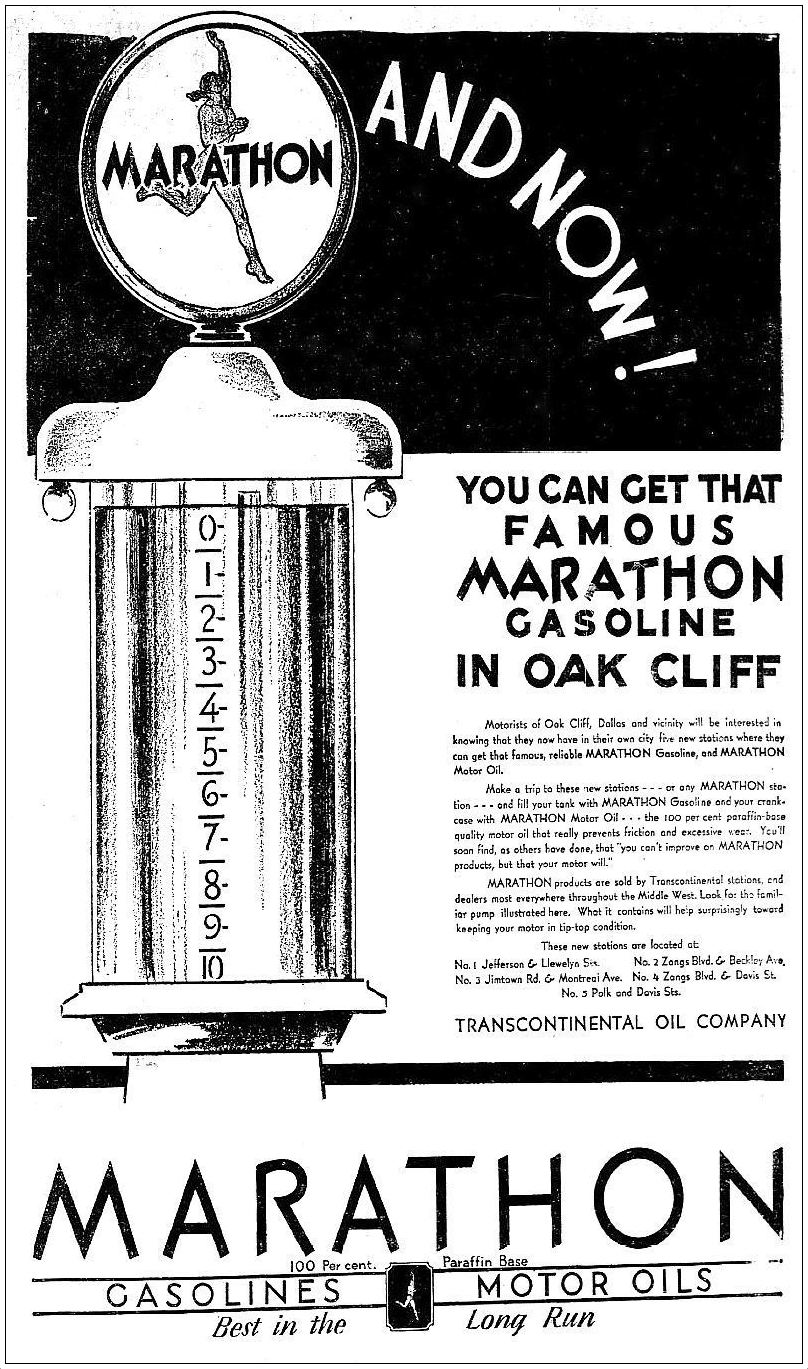
“You Can Get That Famous Marathon Gasoline in Oak Cliff” — 1930

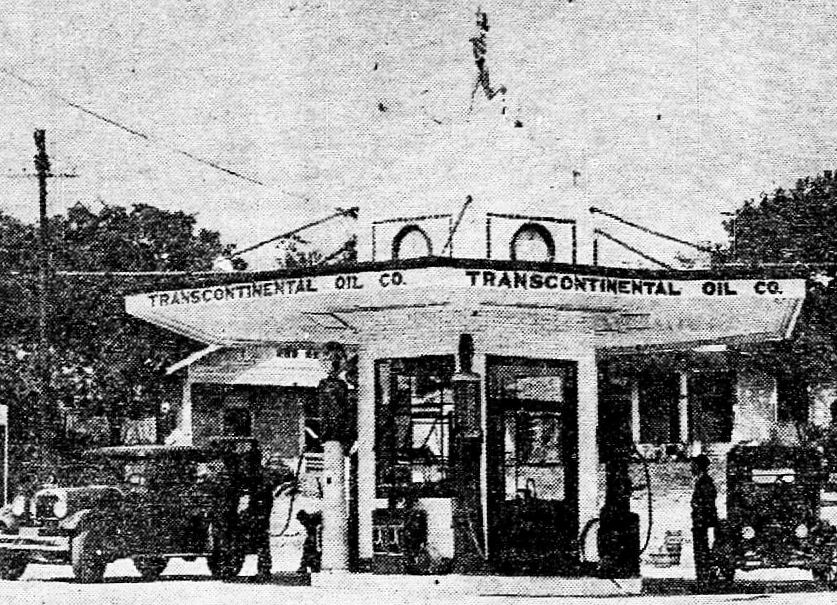
marathon_transcontinental-oil_gas-station_smithsonian_1930Somewhere in Oak Cliff, 1930, via Smithsonian Inst.

by Paula Bosse

Rejoice, Oak Cliff residents of 1930: you’re getting five Marathon gas stations! I’m not sure why these stations were only in Oak Cliff and no other part of Dallas, but they were (a sixth station joined this elite group a year or so later).

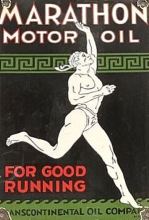
I have a fascination with old gas stations, but I have to admit I’m not familiar with Marathon Gasoline or Marathon Oil products or the Transcontinental Oil Co. (they  had a refinery in Fort Worth), but for whatever reason, the Marathon stations in Dallas — all emblazoned with an image of the Greek runner Pheidippides — appear to have faded away by about 1942 when I guess the last straggler finally crossed the finish lane, collapsed, and died. Farewell, Pheidippides.

The photo above shows one of those first 5 stations in Dallas. The location is not specified. 

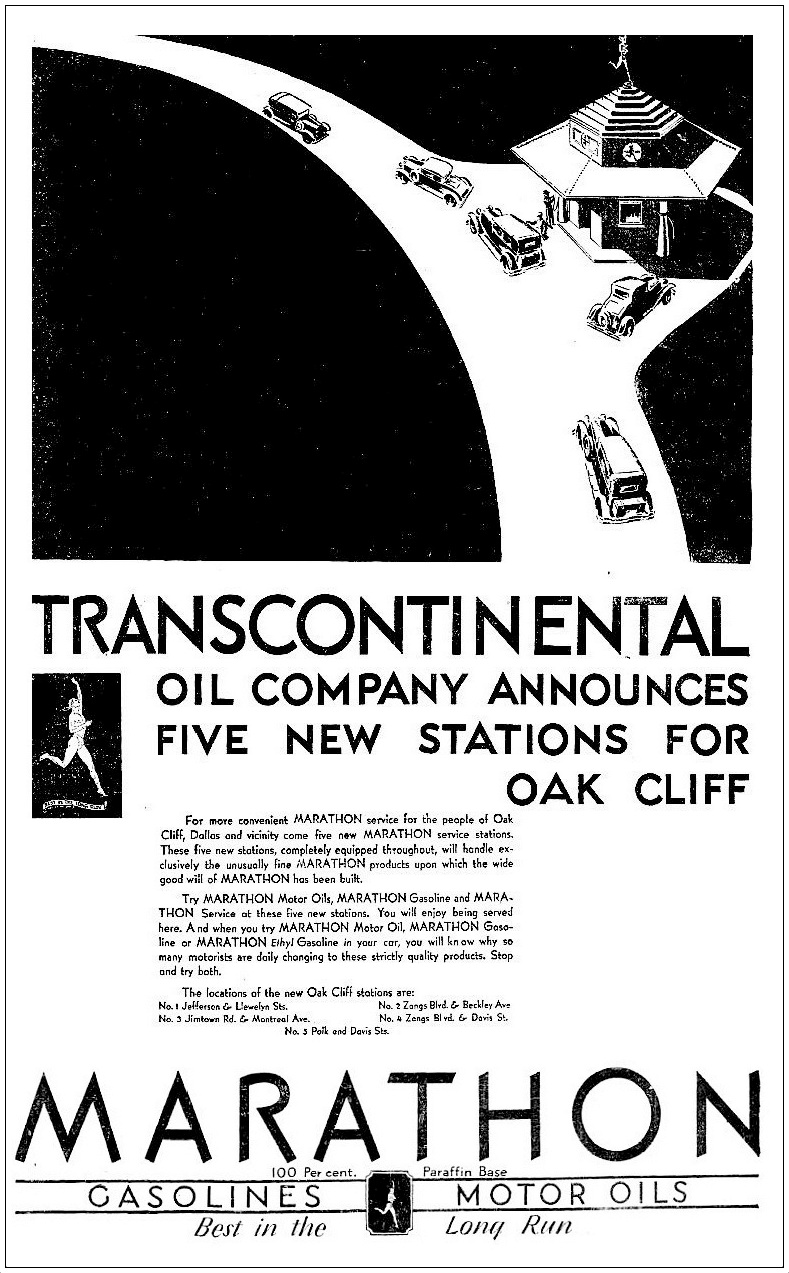
Marathon stations in the O.C. in 1930:

marathon_transcontinental-oil_gas-station_050430_ad_det

  • No. 1: Jefferson & Llewellyn Sts. (539 W. Jefferson)
  • No. 2: Zangs Blvd. & Beckley Ave. (1111 N. Zang)
  • No. 3 Jimtown Rd. & Montreal Ave. (2120 W. Clarendon Dr.) (in 1931, residents petitioned the city to change the name of the street to “Clarendon” because they thought “Jimtown” was too déclassé)
  • No. 4: Zangs Blvd. & Davis St. (137 W. Davis — this was the station that lasted the longest, appearing to have closed by the time the 1942 city directory was published)
  • No. 5: Polk & Davis Sts. (938 W. Davis)
  • (No. 6: 1804 W. Jefferson)

It doesn’t look like any of the old buildings are still standing, but there IS one of the exact same design still standing in Miami, Oklahoma — a group restored it and even added period gas pumps (which someone later stole) — see it below. 

marathon-station_miami-okla_google-street-view_2016Miami, OK, Google Street View July 2016

Not all of the Dallas stations had the same design — a press release describes the stations of possessing “distinctive architecture.” Another of the Oak Cliff locations looked very different (and certainly more distinctive):

marathon_station_oak-cliff_1930
Somewhere in Oak Cliff, 1930

The one above is the same design seen in this local ad:

marathon_transcontinental-oil_gas-station_042730-adApril 1930

marathon_transcontinental-oil_gas-station_050430_adMay 1930

marathon_rec_ebay

marathon_ebay

***

Sources & Notes

Top photo is from the American Petroleum Institute Photograph and Film Collection, National Museum of American History, Archives Center, Smithsonian Institution — more info can be found here.

I seem to post a lot about gas stations. Here are a few notable posts:

marathon_transcontinental-oil_gas-station_smithsonian_1930_sm

*

Copyright © 2023 Paula Bosse. All Rights Reserved.

The Bullen Store, Exposition Avenue — 1896-1936

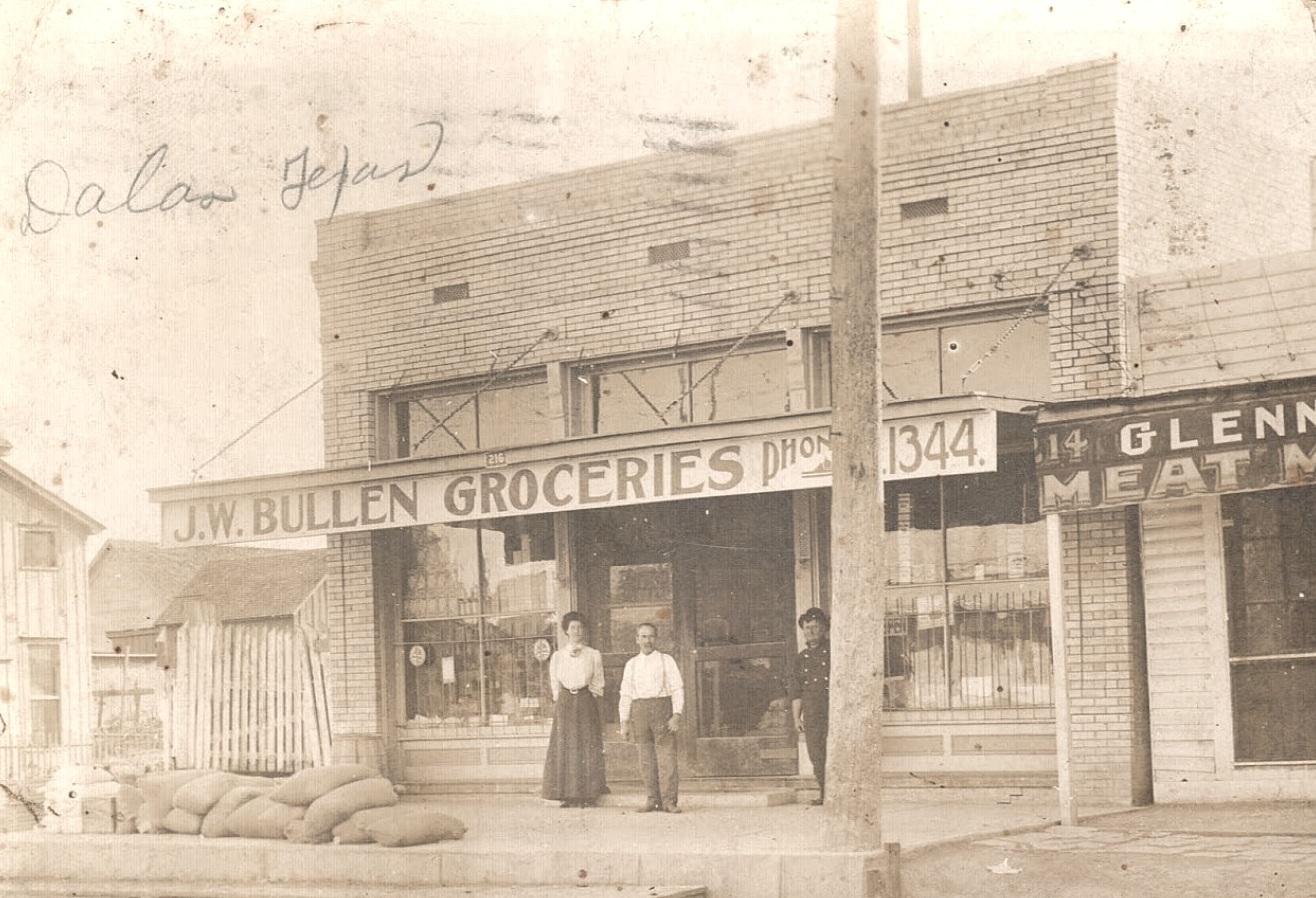
bullen-store_exposition-avenue_ca-1905Exposition Ave., ca. 1905 (photo: Bullen family, used with permission)

by Paula Bosse

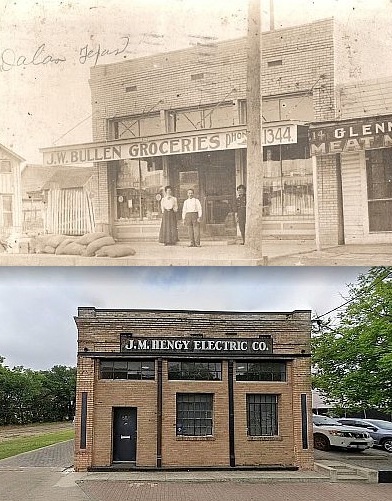
If you’re reading this, you probably have a fascination with old buildings. When was it built? What had it been? How has it not been torn down? One such building — which, though interesting, doesn’t really strike one as particularly old — is the small building at 507 Exposition Avenue, a few blocks from Fair Park. Actually, the thing that jumped out at me was the sign on the building reading “J. M. Hengy Electric Co.” — back in 2015 I wrote a long post about the exceedingly litigious Hengy family (“F. J. Hengy: Junk Merchant, Litigant”) (J. M. was the grandson of F. J.). The Hengy Electric Co. was in business at that location from at least the 1930s until at least the 1960s. I’m not sure why the current owners kept this sign, but I’m glad they did, because it’s why I noticed it.

This building was most likely built in the 1890s, and it was home to a grocery store owned by J. W. Bullen (John Wesley Bullen Sr.), a Tennesse native who came to Texas in the late 1870s and, after a few years of farming in the area, settled in Dallas. He worked for the Santa Fe railroad for a while before opening this grocery on Exposition Avenue in the 1890s — easy to give directions to because the Gulf, Colorado and Santa Fe (GC&SF) Railway tracks ran right alongside the store. Bullen’s grocery was a neighborhood mainstay for at least 40 years. He retired in 1936, and he and his wife, Mary, eventually moved to California to live with their daughter. J. W. Bullen died in California in 1948, at the age of 89 — his life spanned the Civil War to the advent of television.

Below, J. W. Bullen is shown with his brothers, Thomas, James, and Joseph — he is at the bottom right.
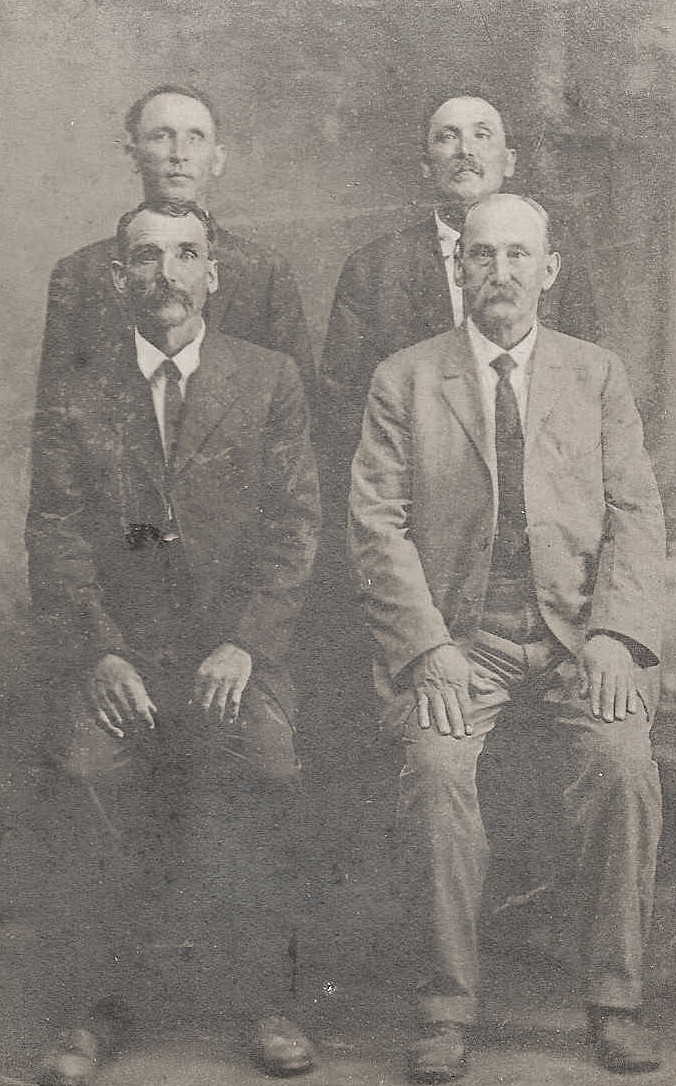
bullen-j-w_sitting-right_ancestryvia Ancestry.com

I came across the photo at the top of this post on the Dallas Historical Society discussion forum (“The Phorum”) back in 2017 (it’s taken 5½ years for me to finally write this!) — the thread is here. A Bullen relative posted this photo, and I was ecstatic to see it! It’s such a great image — I have never seen a photo of Exposition Park from this period. (I asked Mr. Bullen — the man who posted this photo — if I could reproduce it, and he very nicely gave me permission.)

I would guess that the photo dates from sometime around 1904-1906, when the Glenn Brothers meat market occupied the space next door (originally 214 Exposition and later 505 Exposition).
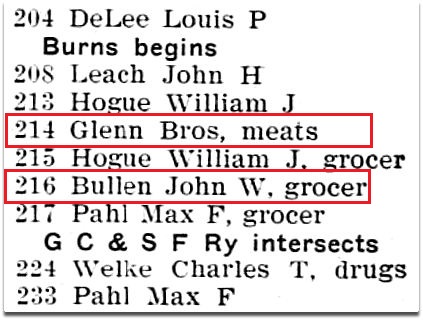
1905-directory_bullen-glenn-bros1905 Dallas city directory

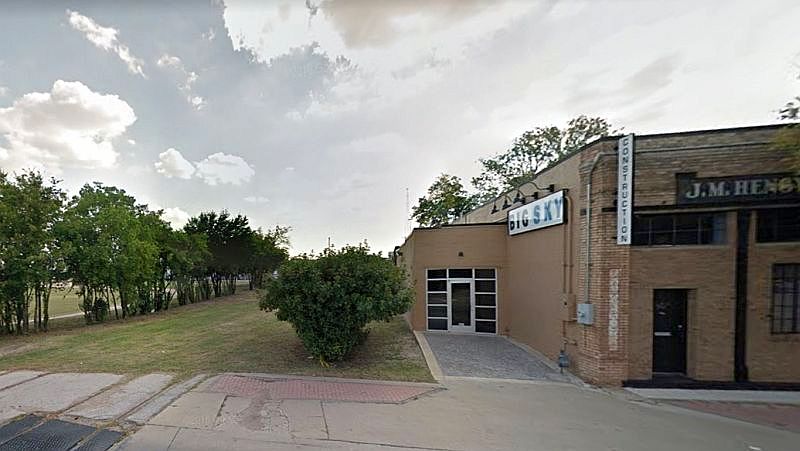
The Hengy business originally occupied the Glenn Bros. space for several years, from at least 1930. After Bullen’s retirement, Hengy moved into the larger space at 507 Exposition. Today it is occupied by Big Sky Construction.
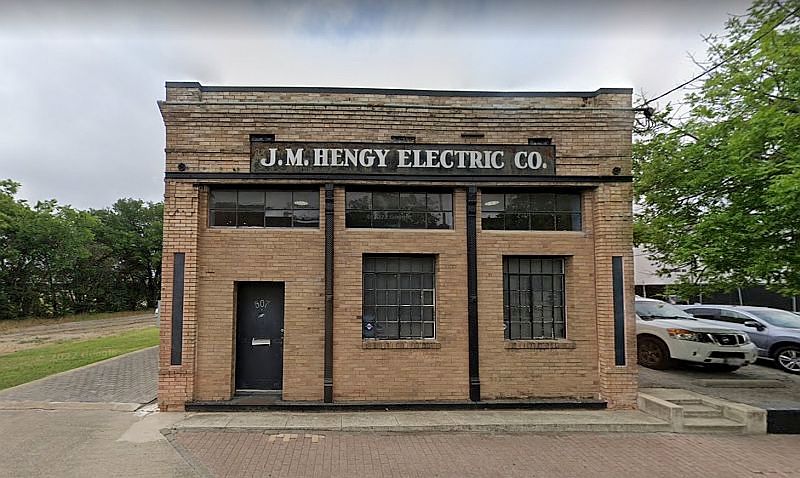
507-exposition_google-street-view_may-2022
Google Street View, May 2022

The railroad tracks have been pulled up, but below are two Google Street Views from 2012 showing where they once were — they couldn’t have been much closer to Bullen’s store! That’s got to have rattled the merchandise (and the store’s occupants) several times a day.
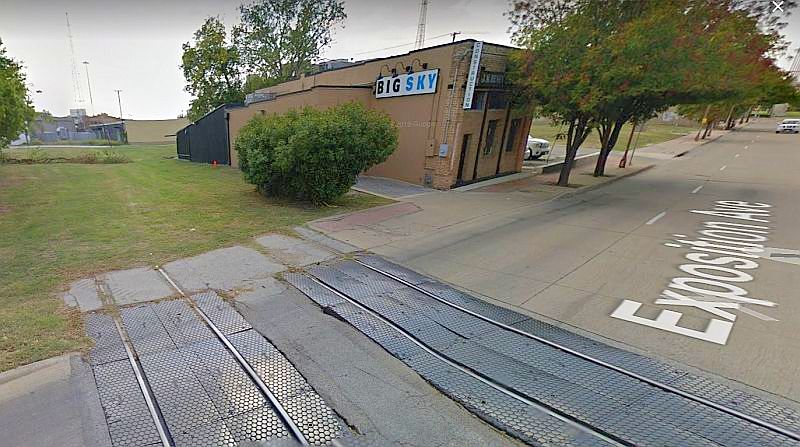
507-exposition_google-street-view_sept-2012Google Street View, Sept. 2012

507-exposition_google-street-view_sept-2012_bGoogle Street View, Sept. 2012

*

The address of Bullen’s store was originally 216 Exposition Avenue. After the citywide address change in 1911, it became 507 Exposition Avenue. The store was in business by at least 1896, but a newspaper article on the 62nd wedding anniversary of Mr. and Mrs. Bullen says that the business began in 1893. At this time, development of Exposition Park was exploding (see the 1889 ad I posted yesterday, here).
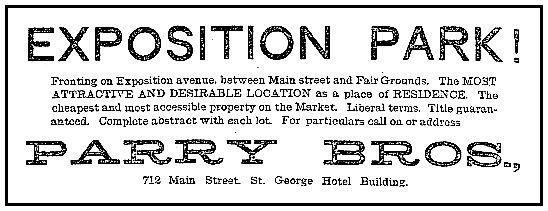
expo-park_ad_dmn_1012891889

If you look at Sanborn maps of this area (the 1899 map is here, the 1905 map is here, and the 1921 map is here) you see that almost all of the buildings in the area are houses (designated by the letter “D,” for “dwelling”). Having only ever known the area in recent times, it’s hard to imagine this ever having been an almost entirely residential neighborhood. And, back in the 1890s, it was also full of livestock.
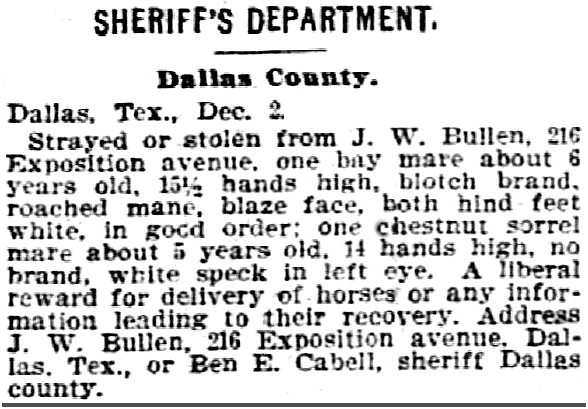
bullen_dmn_120397_stolen-horsesDallas Morning News, Dec. 3, 1897

*

Here’s a map of Dallas from 1898, with Bullen’s store way on the edge of the world, under the star.
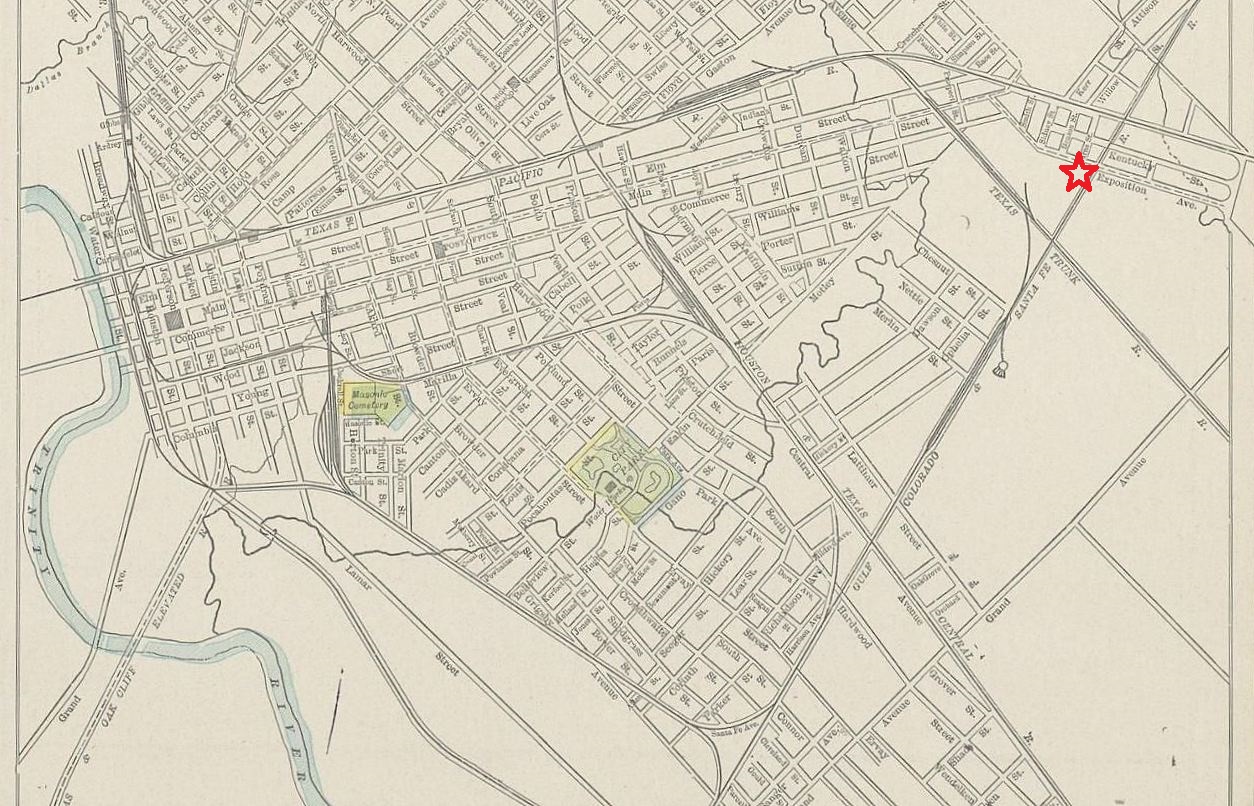
1898-map_bullen-store_expositionvia Portal to Texas History

*

507-exposition_then-now_ca-1905-2022

***

Sources & Notes

Photo is from the family collection of Joseph Bullen II, used with permission.

I would LOVE to see historical photos of the Expo Park area — from any time, really, but especially from the time it was primarily residential. If you have any photographs, please let me know!

See this building today on Google Street View, here.

Biographical information on J.W. Bullen from “J. W. Bullens Observe Their Anniversary” (Dallas Morning News, Nov. 22, 1942).

More Flashback Dallas posts on Exposition Park can be found here.

bullen-store_exposition-avenue_ca-1905_sm

*

Copyright © 2023 Paula Bosse. All Rights Reserved.