Flashback : Dallas

A Miscellany: History, Ads, Pop Culture

Category: Photographs

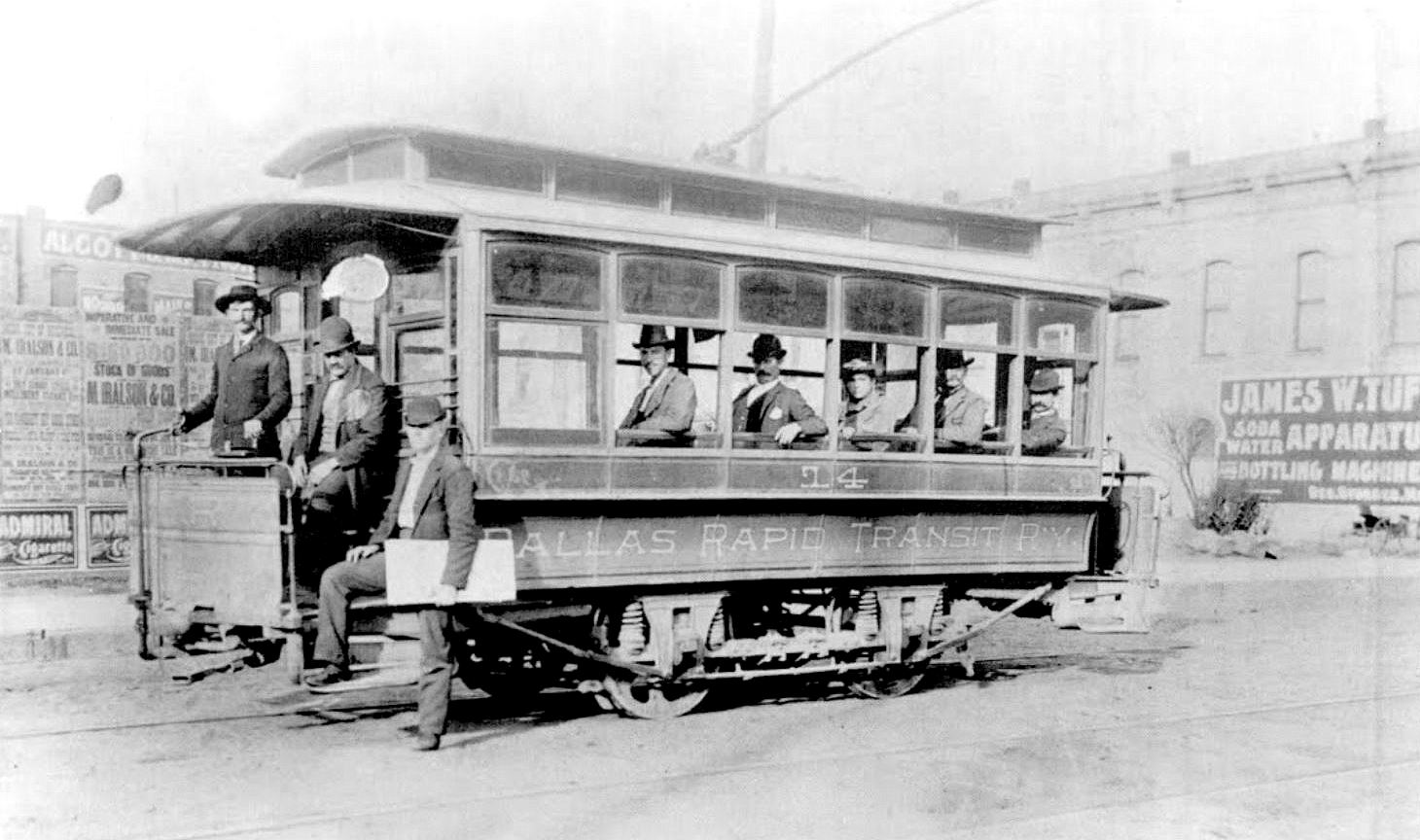
Dallas Rapid Transit, Est. 1888

dallas-rapid-transit_cyclone_cook-coll_degolyer_smu-detRide the Cyclone to Fair Park… 

by Paula Bosse

The Dallas Rapid Transit Railway chugged into town in 1888, going from charter to operation in seven months. And that included laying their own track. The “dummy” steam engine (a locomotive designed to appear more like a friendly little streetcar and less like a hulking locomotive) seen above, carried passengers from the Windsor Hotel at Commerce and Austin through South Dallas (via S. Lamar and Forest Ave., now MLK Blvd.) to Fair Park. It started business just in time to ferry crowds to the State Fair. The fare was 20 cents, which seems pricey, but this might have been “surge” pricing charged only during the “Greatest Fair and Exposition in the World.” (According to the Inflation Calculator, 20¢ in 1888 would be the equivalent to more than $5 in today’s money.)

ad_dallas-rapid_dmn_101488
Dallas Morning News, Oct. 14, 1888

The new street railway was particularly appreciated by developers looking to sell land in southern Dallas, still considered a “suburb” in the 1880s. Residential streetcar service was essential to prospective builders and buyers, and as soon as the Rapid Transit line was up and running, its name was popping up in South Dallas real estate ads for additions with names like Chestnut Hill, Edgewood, and South Park.

chestnut-hill_edgewood_dmn_031689
DMN, March 16, 1889

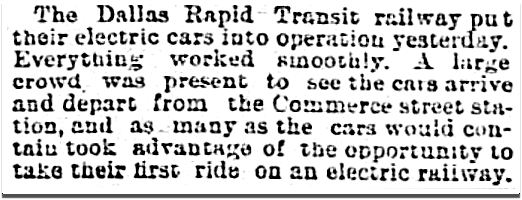
In March of 1890 — after a year and a half of steady growth — the Dallas Rapid Transit Railway went electric, tossing out their old steam-powered cars (not even 18 months old!) for brand new, ultra-modern cars powered by electricity. (For a bit of perspective, parts of the country were still relying on the really old-fashioned mule-drawn streetcars.) Dallas’ first electric-powered streetcar hit the rails on March 9, 1890.
dallas-rapid_dmn_031090_electric
DMN, March 10, 1890

Understandably, the sight of these newfangled streetcars was quite the topic of fascinated conversation. How exactly did they work, anyway? The Dallas Morning News published an article with helpful information for the Dallasites of 1890 (and 2016!). (Click to see larger image.)

dallas-rapid_dmn_032390_electric
DMN, March 23, 1890

The photo below (which appears in the great book McKinney Avenue Trolleys) is a staged publicity photo with a woman at the helm, showing that the new electric streetcar was so easy to operate that “even a woman” could do it. In tow behind the sparkling new electric streetcar was the old, past-it steam car, with its engineer racing to try to catch up with the new technology. Get with it, man, it’s 1890!

dallas-rapid-transit-railway_mckinney-ave-trolleys-bk_towing-dummySouthern Traction, April 10, 1973 (via McKinney Avenue Trolleys)
dallas-rapid-transit-railway_mckinney-ave-trolleys-bk_dplDallas Public Library photo (via McKinney Avenue Trolleys)

Initially, the track was only 4 miles long, but that had more than doubled soon after the switch to electric cars.

dallas-rapid-transit_dmn_100190
DMN, Oct. 1, 1890

Things seemed to be going well. The company was expanding, speeds were increasing, and … “No dust”!

dallas-rapid_dmn_102791
DMN, Oct. 27, 1891

But … in 1894 the company went into receivership and was sold in December of that year for $35,000.

dallas-rapid_dmn_120594
DMN, Dec. 5, 1894

It appears that the company struggled on under different owners and slightly different names through at least 1909, but instead of those twilight years being filled with reflective contemplation and bass fishing, they were spent mired in endless lawsuits.

But let’s not dwell on the sputtering end of a business — let’s look back to the beginning, when the H. K. Porter Co. of Pittsburgh, Pennsylvania was proud to show off its new light locomotive with the noiseless steam motor which was headed, full of hope and enthusiasm, for the little city that could, Dallas, Texas.

dallas-rapid-transit_cyclone_cook-coll_degolyer_smu

dallas-rapid_dmn_032288
DMN, March 22, 1888

dallas-rapid_dmn_091088
DMN, Sept. 10, 1888

**

The steam-powered Cyclone — seen at the top — went on an adventure through the streets of downtown in 1889 when, under a full head of steam, it jumped the tracks and kept on going down paved streets until it crashed into a curb on Main!

cyclone_dmn_043089
DMN, April 30, 1889

***

Sources & Notes

Image at the top (and bottom), “Dallas Rapid Transit, ‘Cyclone’ Locomotive No. 1,” from the George W. Cook Dallas/Texas Image Collection, DeGolyer Library, Southern Methodist University; more information here.

Read an interview with J. E. Henderson, president of the Dallas Transit Railway company, commenting on his new street railway (“The New Rapid Transit,” DMN, Oct. 14, 1884) here (yes, it IS difficult to read!).

The two photos of Dallas Rapid Transit electric streetcars are from the book McKinney Avenue Trolleys by Jim Cumbie, Judy Smith Hearst, and Phillip E. Cobb (Charleston: Arcadia Publishing, 2011). If you’re interested in this topic, this book seems pretty essential!

The history of early streetcars in Dallas can be read in the  pages of the WPA Dallas Guide and History here (scroll to the bottom of the page and continue to the following page).

*

Copyright © 2016 Paula Bosse. All Rights Reserved.
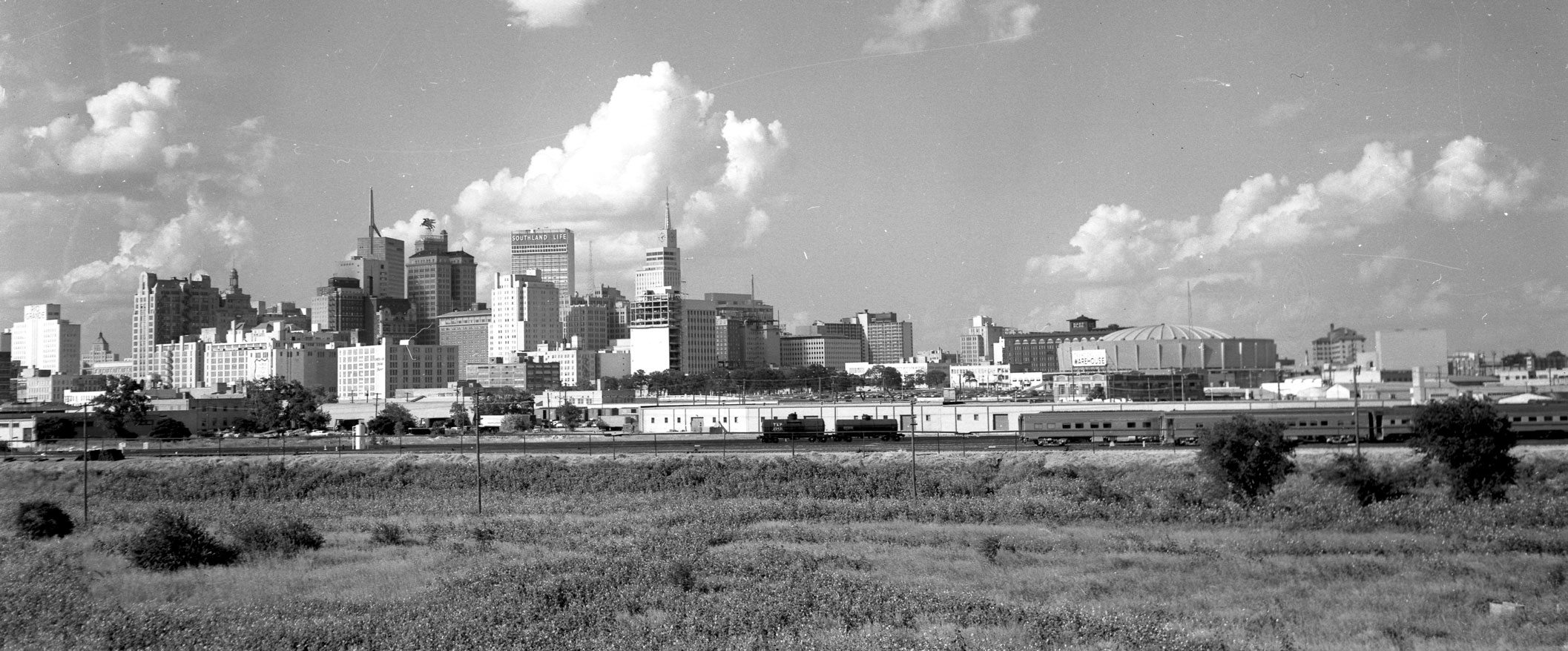
The Dallas Skyline: Spot the Landmarks

skyline_from-swMid-Century Big D… 

by Paula Bosse

The Dallas skyline is always changing, and it’s always been impressive. The late-’50s/early-’60s version above looks quaint by today’s standards, but it’s one of my favorite skyline periods. I’ve never been a huge fan of the Convention Center, but the rest of it? Pretty great.

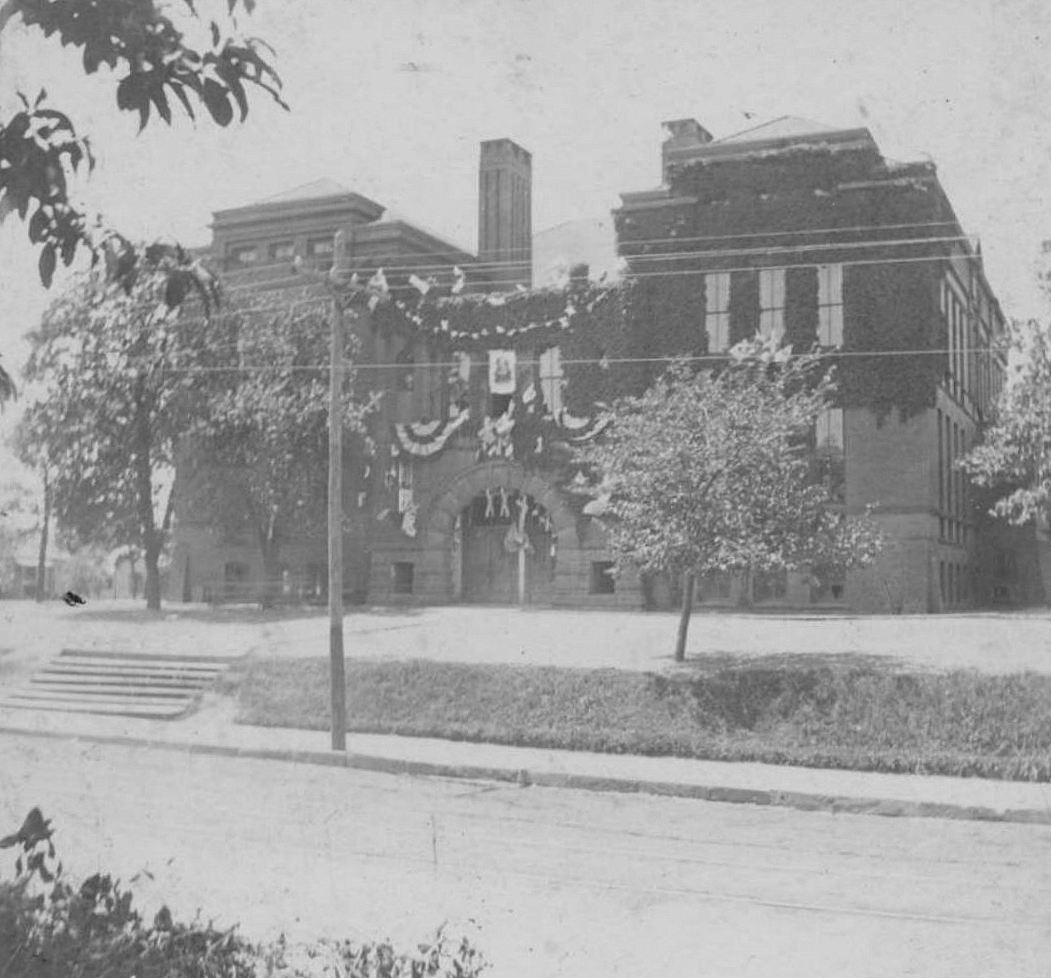
In order to make way for the George Dahl-designed Dallas Memorial Auditorium/Dallas Convention Center (which opened in 1957), the old Columbian School/Royal Street School (built in 1893) was demolished. At the time of its razing, it had most recently served as the city’s school administration building and as a book warehouse. Here are a couple of photos of the school, long before the bulldozers arrived.

columbian-school_flanders-site
via James Edwards Flanders site

columbian-school_cook-collection
Cook Collection, SMU

Also interesting was that this land — which the city had been buying up for many years (some as a result of condemnation/eminent domain) also included four pioneer cemeteries. Read more about what happened to those cemeteries here.

dallas-convention-center_flickr-coltera

***

Sources & Notes

Top photo is from a site containing several photos relating to early KRLD radio and TV, with the occasional shot of Dallas streets and buildings, here.

Other sources, if known, are noted.

*

Copyright © 2016 Paula Bosse. All Rights Reserved.

The Adolphus, The Oriental, The Magnolia

adolphus_magnolia_oriental_TSHA-1977-annual-mtg_portal_sm
Akard looking north… (click me!!)

by Paula Bosse

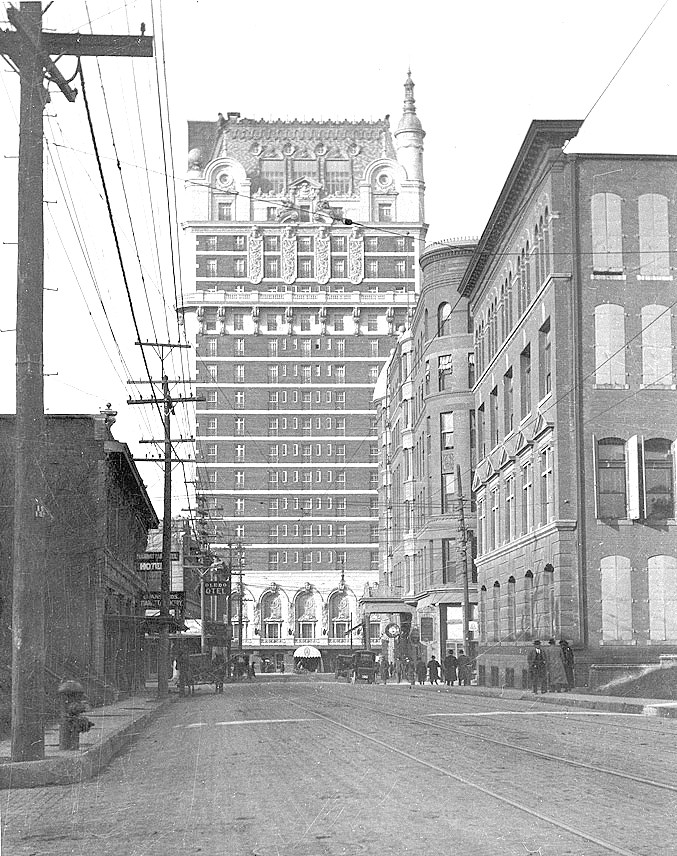
This is just great. I’ve never seen this photo, which was taken sometime between 1922 and 1924. Dallas has never looked more … architectural. (Click that photo — it’s worth seeing it bigger.)

The view is looking north on Akard toward Commerce, from some building on or near Jackson Street. The Adolphus Hotel (built in 1912 and still standing) is straight ahead, the shorter Oriental Hotel (1893-1924) is in the middle, and the Pegasus-less Magnolia Petroleum Building (built in 1922 and still standing) towers above both of them.

I don’t think I’ve seen the Oriental from this angle. And I’ve never noticed all those windows in the Magnolia Building that look directly across into other windows. (That must be … strange.) And since I recently posted photos of this same block of S. Akard, I immediately recognized the short building with the odd-shaped cut-out/crest-like decoration in it opposite the Oriental.

Here’s the same view a few years earlier — about 1913, before the Magnolia was built:

adolphus_1913_dpl_via-d-mag-online

I love these photos. And how nice that two of these landmark buildings are still alive and kicking!

***

Sources & Notes

Top photo appeared in the program for the 1977 Texas State Historical Association Annual Meeting of 1977 (held, appropriately enough, in the Baker Hotel, which was built on the corner previously occupied by the Oriental); I found it on the Portal to Texas History site, here. (Dear printers of things like this: please never EVER use brown ink to print photographs. If anyone knows of a cleaner, sharper copy of this great photo, please let me know!)

Second photo is from the Texas/Dallas History Division, Dallas Public Library; I found it posted on the D Magazine site, accompanying the article “How Haunted Is the Adolphus Hotel?” here.

Photos larger when clicked.

*

Copyright © 2016 Paula Bosse. All Rights Reserved.
 

A Few Photo Additions to Past Posts — #2

flippen-auto_park-cities-photohistory_gallowayLooking west on Ross from Harwood (click for larger image)

by Paula Bosse

I have so much stuff crammed into overflowing digital files that it’s a bit overwhelming. Time to chip away at some of these odds and ends. Here are a few photographs that I am adding to previous posts.

The photo above shows Ross Avenue from N. Harwood. The Flippen Auto Co. and the former Conway house once stood on land now occupied by the Dallas Museum of Art. I’ve just added this to my post “The Beginning of the End of Ross Avenue’s Downtown Mansions — 1925.” (Photo from The Park Cities, A Photohistory by Diane Galloway.)

*

This view of Elm Street has been added to “Elm Street, Looking West From Griffin.” (Photo from the University of Texas at Arlington Special Collections; link here.)

elm-street_UTA

*

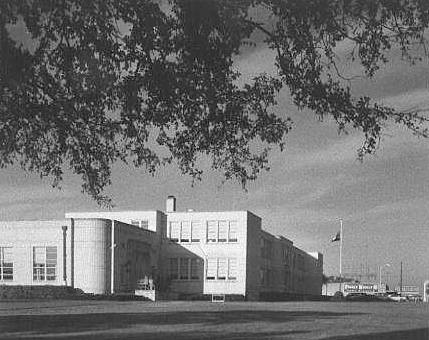
A Pinterest board maintained by the DISD allowed me to grab this not-great-but-still-better-than-I’ve-been-able-to-find-elsewhere photo of my grade school alma mater, Stonewall Jackson. My favorite hard-to-see detail is the Piggly Wiggly grocery store in the distance. This is where my family shopped. I can still remember the layout of the inside of that store at Mockingbird and Matilda. I’ve added this photo to my 2014 post “Happy 75th Anniversary, Stonewall!”

stonewall_DISD-pinterest

*

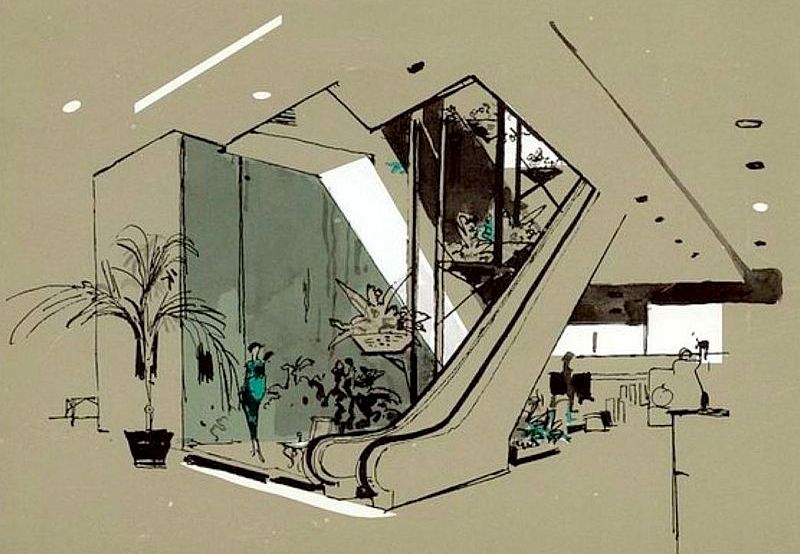
Another image I found on some random Pinterest page while looking for something else, is this Neiman-Marcus postcard, one of several promotional cards. I’ve added it to two others in the post “Luncheon at The Zodiac Room, Darling.”

n-m_escalator_pinterest

*

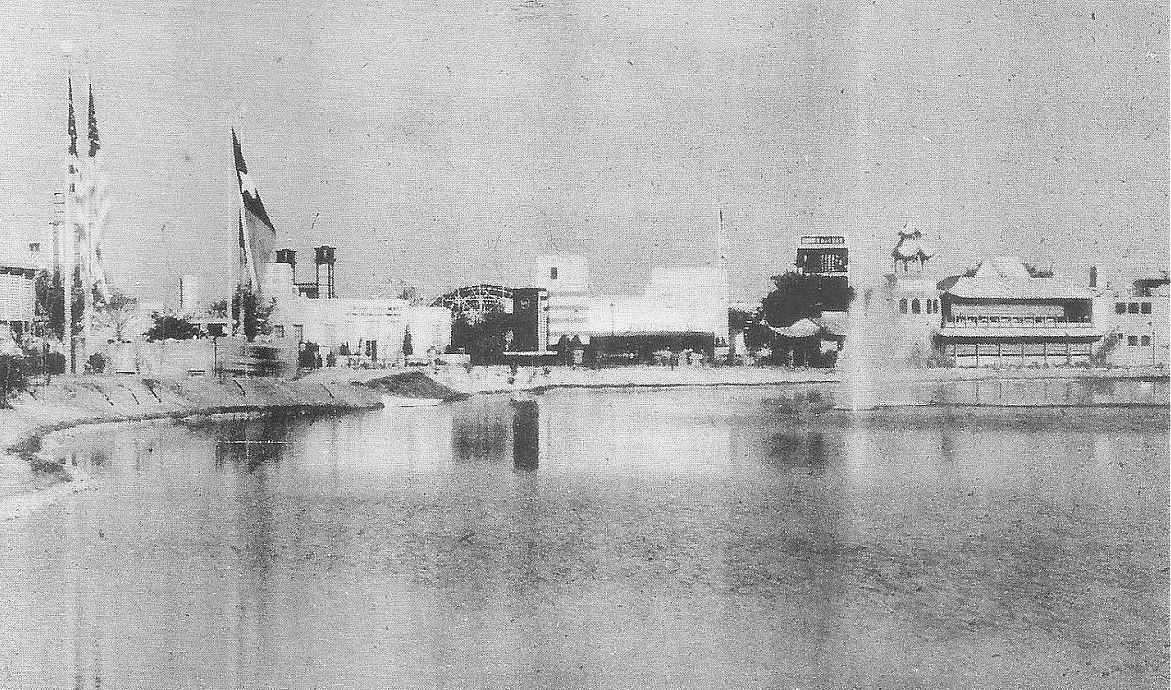
Not great resolution in this postcard photo of the huge NCR cash register at the Texas Centennial, but it’s a cool view, across the lagoon (the attendance-counting cash register is right of center, next to the pagoda). I’ve added it to “The Giant Cash Register at the Texas Centennial — 1936.”

tx-centennial_lagoon_cash-register_1936

*

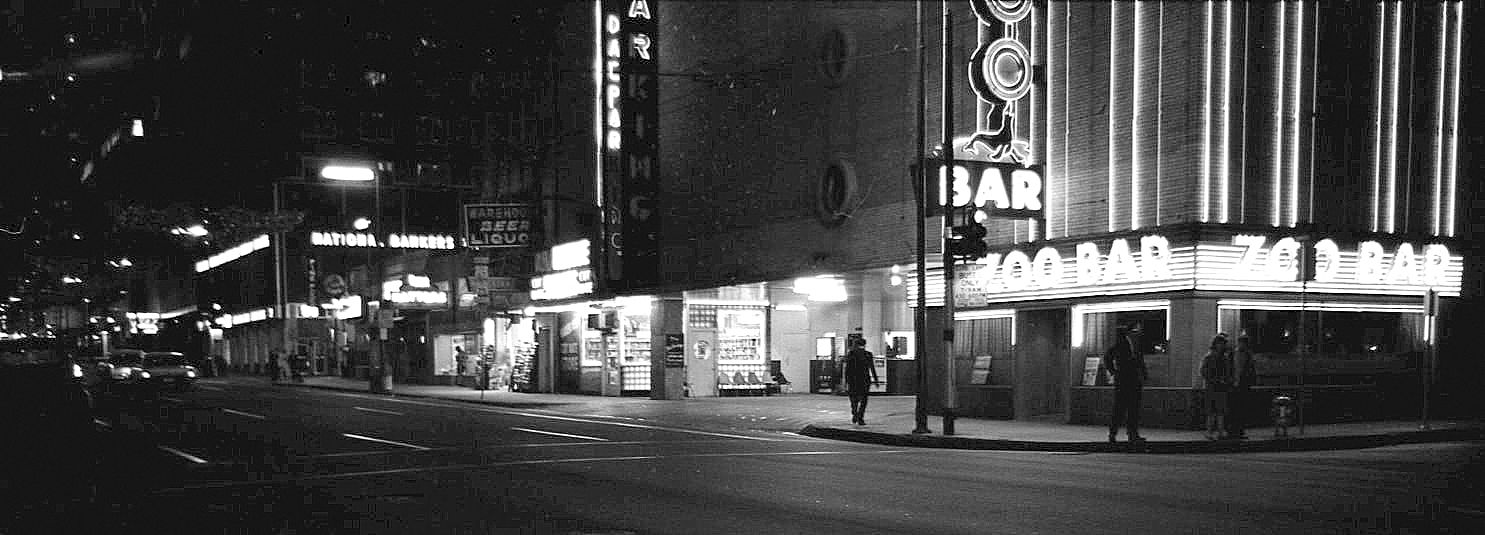
This is a fantastic photo of the somewhat notorious Zoo Bar on Commerce Street, taken by Dallas Times Herald photographer Bill Bell on November 22, 1963, at the end of an exhausting day following the Kennedy assassination (photo from the Sixth Floor Museum Collection, Portal to Texas History, here). I have added this photo to the post “Gene’s Music Bar, The Lasso Bar, and the Zoo Bar.”

zoo-bar_dth-photo_112263_sixth-floor-museum_portal_cropped

*

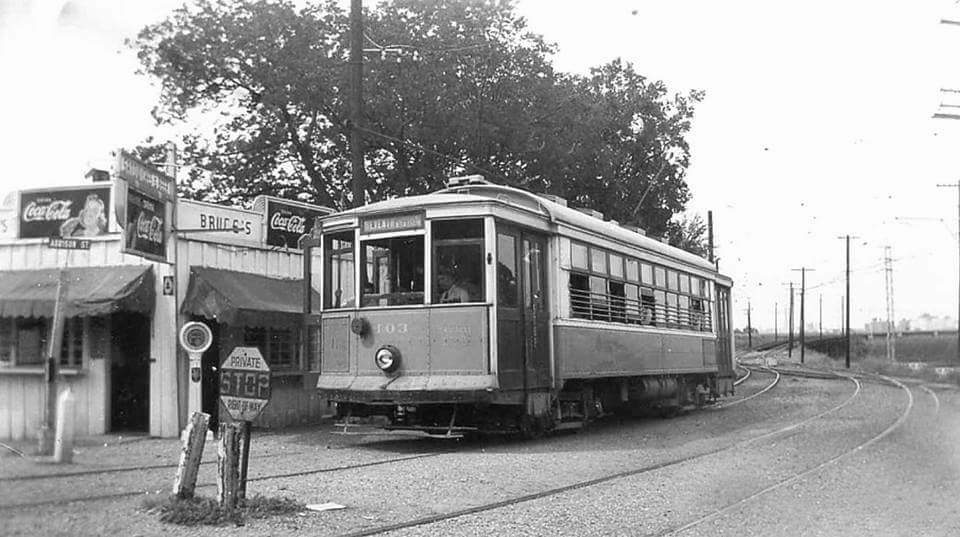
I’ve added this photo of the Oak Cliff streetcar stop at E. Jefferson Blvd. and Addison St. to the post “Waiting on a Streetcar on a Sunny Winter Day in Oak Cliff — 1946.”

oak-cliff-streetcar-stop_addison-jefferson

*

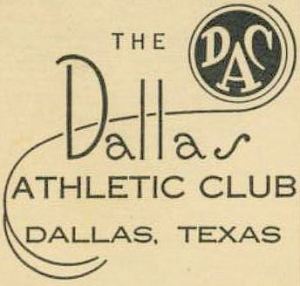
Here’s a charming little matchbook from the 1950s, advertising the Dallas Athletic Club’s golf club, which opened up near Mesquite in the ’50s (matchbook from the George W. Cook collection, DeGolyer Library, SMU, here). I’ve added it to the post “The Dallas Athletic Club Building, 1925-1981.”

dallas-athletic-club_matchbook_cook-collection_degolyer_smu_a

dallas-athletic-club_matchbook_cook-collection_degolyer_smu_b

*

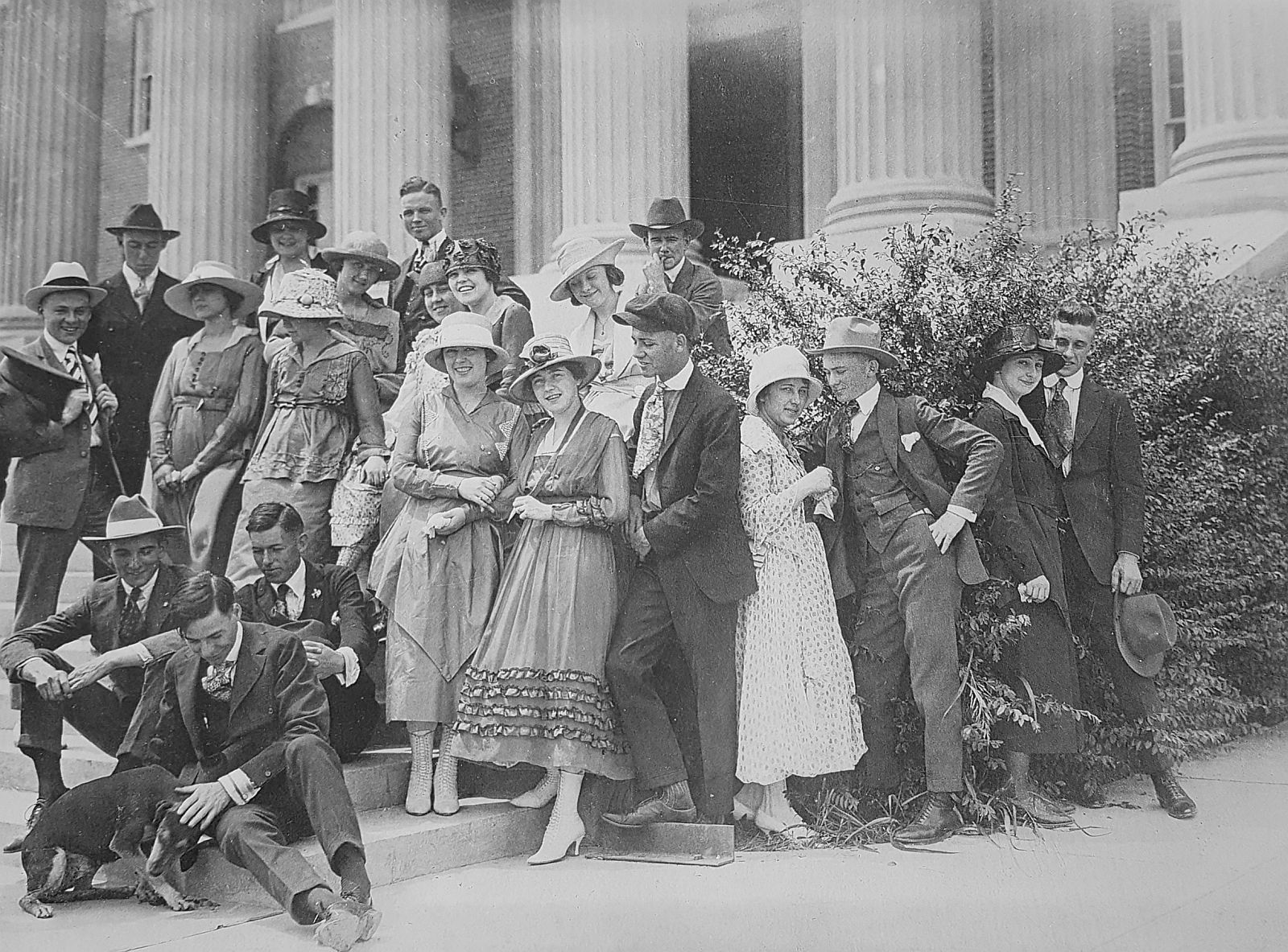
I’ve added the photo below (from Diane Galloway’s The Park Cities, A Photohistory) to the post “An Afternoon Outing with SMU Frat Boys and Their Dates — 1917.” I’m not sure why this group of young people was photographed so extensively that day, but I really love this series of photos.

smu_group-date_park-cities-photohistory_galloway

*

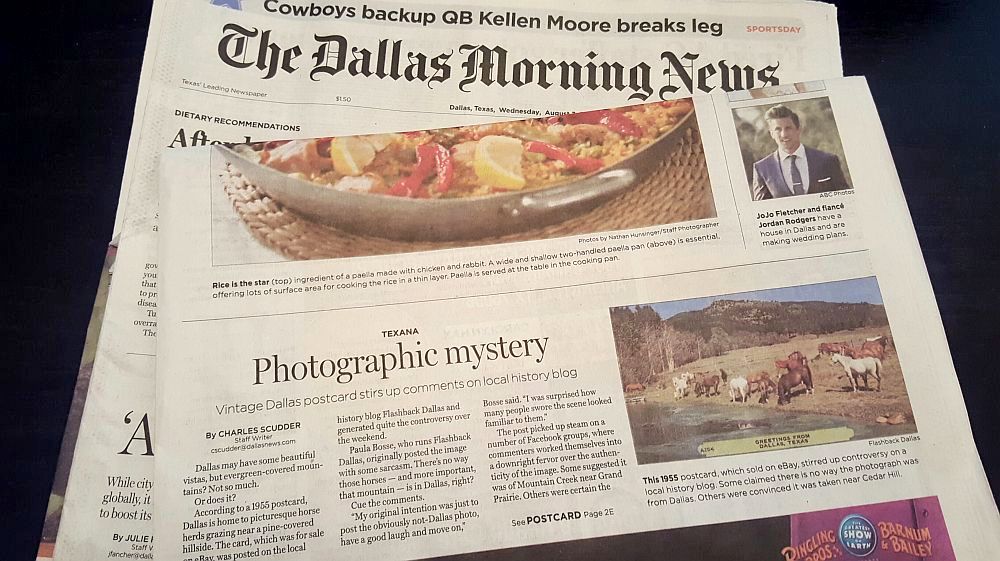
And, lastly, I’ve added this photo to a post from a just a few weeks ago — “‘Greetings From Dallas, Texas’ — 1955.”  This was one of those strange posts that ended up taking on a life of it own across the internet, with people arguing vehemently for and against whether the photograph on a postcard was actually taken anywhere near Dallas. Somehow The Dallas  Morning News got ahold of it and published an online article about it. That was weird enough, but then it actually appeared in the newspaper itself! Ha!

DMN_080316DMN, Aug. 3, 2016

***

All images larger when clicked.

*

Copyright © 2016 Paula Bosse. All Rights Reserved.

J. L. Long, Woodrow Wilson — 1958

woodrow_long_022758_squire-haskins_UTA_smBuccaneers, Wildcats: represent… (click for B-I-G image)

by Paula Bosse

Another fab aerial photo from Squire Haskins: a 1958 southwesterly shot of J. L. Long Jr. High School (on the left) and Woodrow Wilson High School.

…I am not unfamiliar with these East Dallas institutions. 

***

Sources & Notes

Photo taken above Lakewood by Squire Haskins on Feb. 27, 1958. From the Squire Haskins Photography, Inc. Collection, UTA Libraries, Special Collections — more info here. To see UTA’s super-gigantic image, click the photo!

*

Copyright © 2016 Paula Bosse. All Rights Reserved.

Pacific Avenue: Watch for Trains! — ca. 1917

pacific-akard_park-cities-photohistory_frank-rogersToo close for comfort…

by Paula Bosse

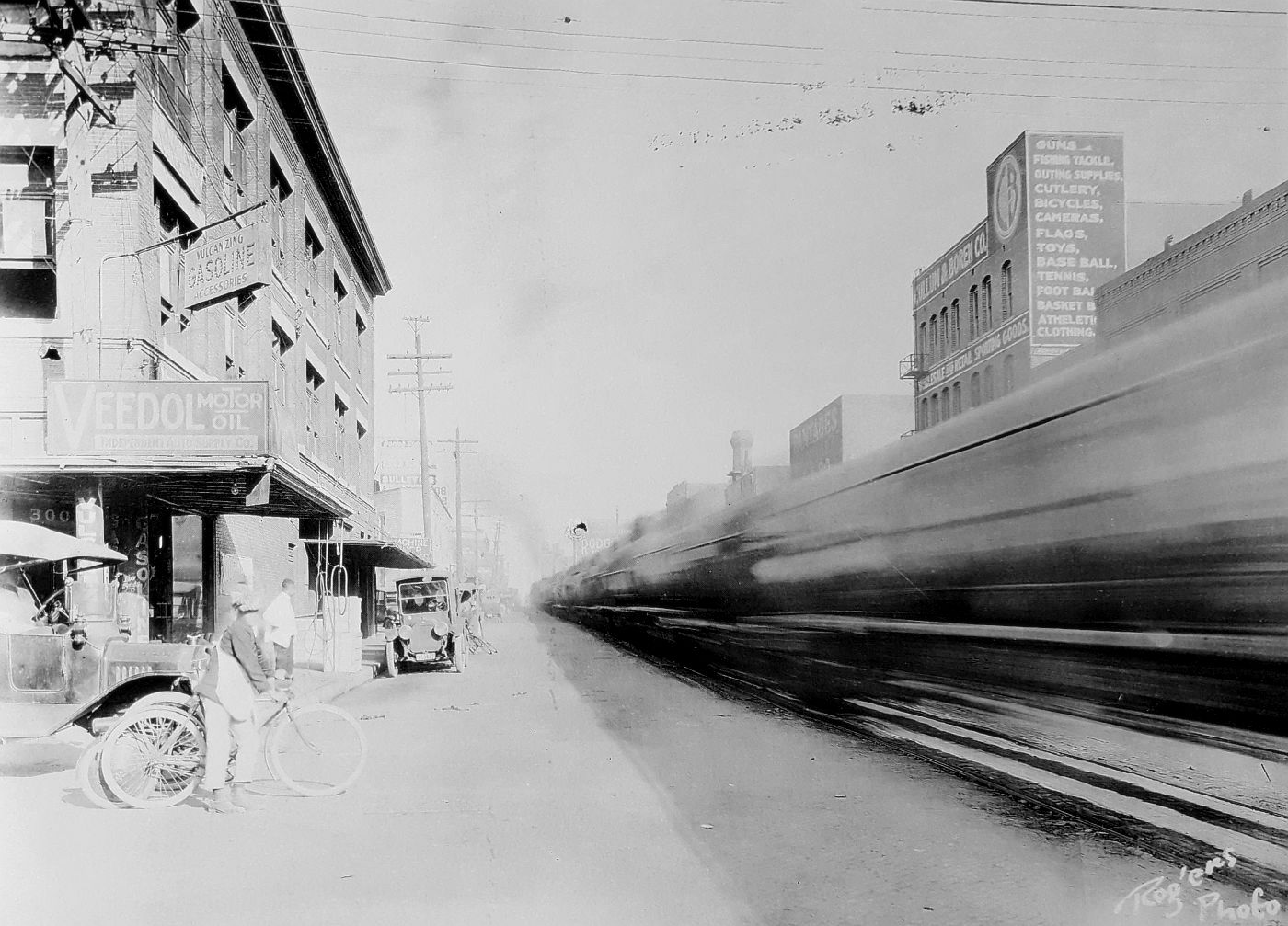
Some people don’t realize that Pacific Avenue used to be lined with the railroad tracks of the Texas & Pacific Railway (hence the name “Pacific”). When trains weren’t barreling down Pacific regularly, the thoroughfare was used by non-locomotive traffic like pedestrians, bicycles, horses, and automobiles. When a huge cinder-spewing train screamed through, everything came to a resigned halt until it passed by. I can’t even imagine what that was like. I wonder how many times people, horses, vehicles, etc. didn’t manage to get out of the way in time?

When Union Station opened in 1916, trains that had previously run through the central business district now went around it (which probably cut the number of people rushed to the hospital with train-related injuries substantially).

The photo above shows Pacific looking east from N. Akard, as a blur of a train whooshes by. The Independent Auto Supply Co. (300 N. Akard) is at the left, and, at the right, the back side of Elm Street businesses, including Cullum & Boren and, to its left, the Jefferson Theater, with “Pantages” painted on the side. (The Jefferson was the Dallas home of the Pantages Vaudeville Circuit from 1917 until 1920, the year the Pantages people bugged out for the greener pastures of the Hippodrome, leaving the Jefferson to start a new relationship with the Loew’s circuit people. At the end of 1925, the Jefferson Theater was actually renamed the Pantages Theater. …Kind of confusing.)

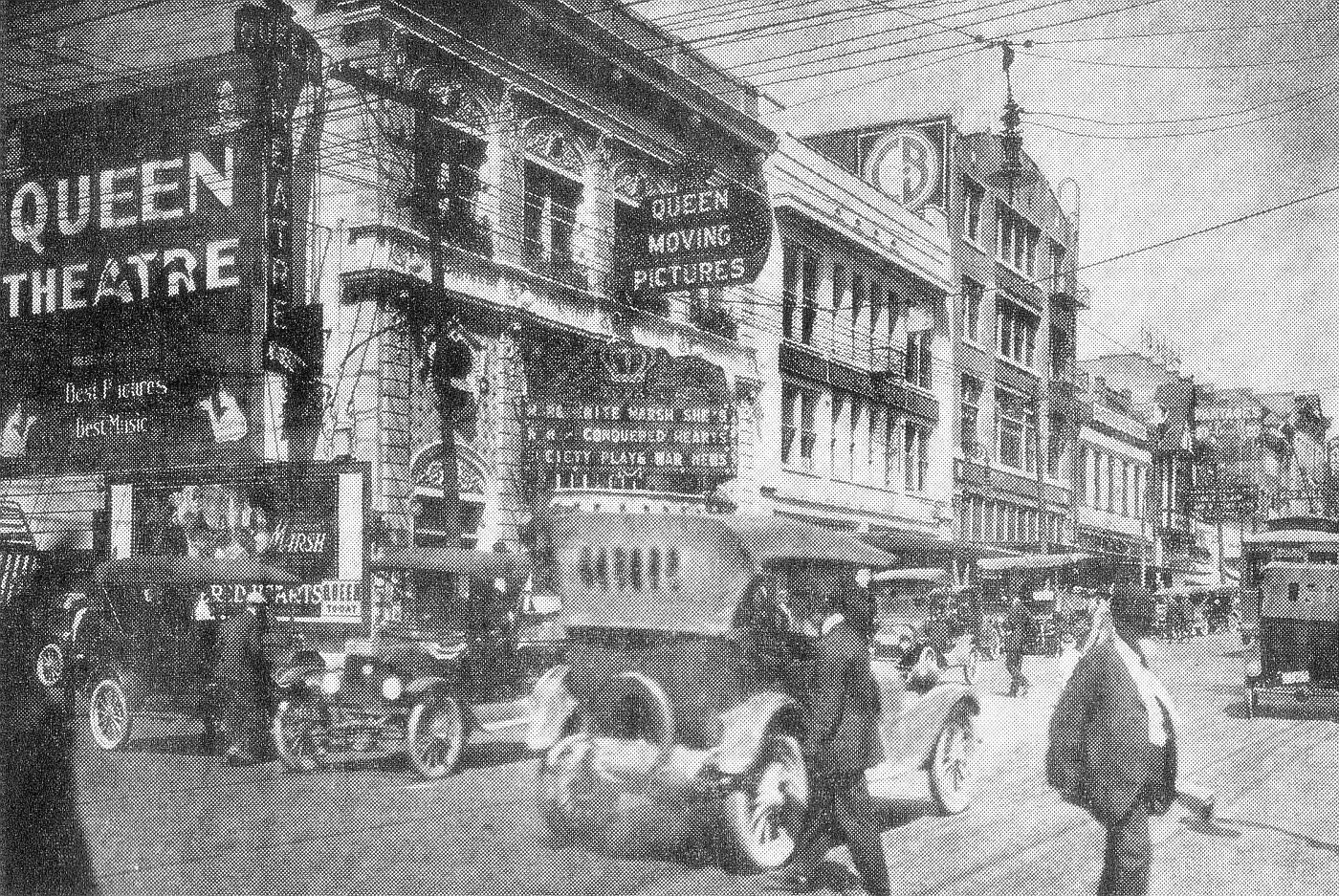
Below, Elm Street in 1918 — what the other side of those buildings looked like. Cullum & Boren’s “CB” logo can be seen painted on the side of its building. (Click photo for much larger image.)

dallas-movie-palaces_1918_dth_020556

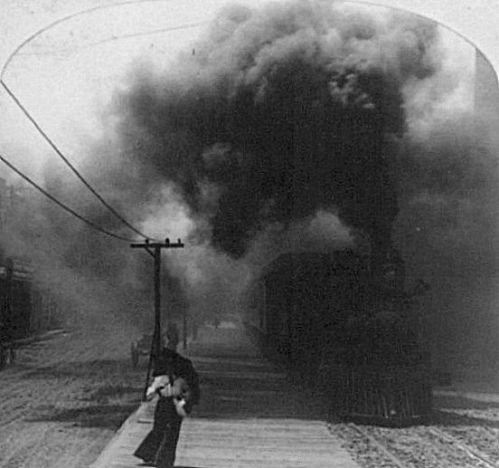
But back to Pacific in its scary, sooty, T&P-right-of-way days. This is what things looked like in 1909.

t-and-p-flier_1909_loc

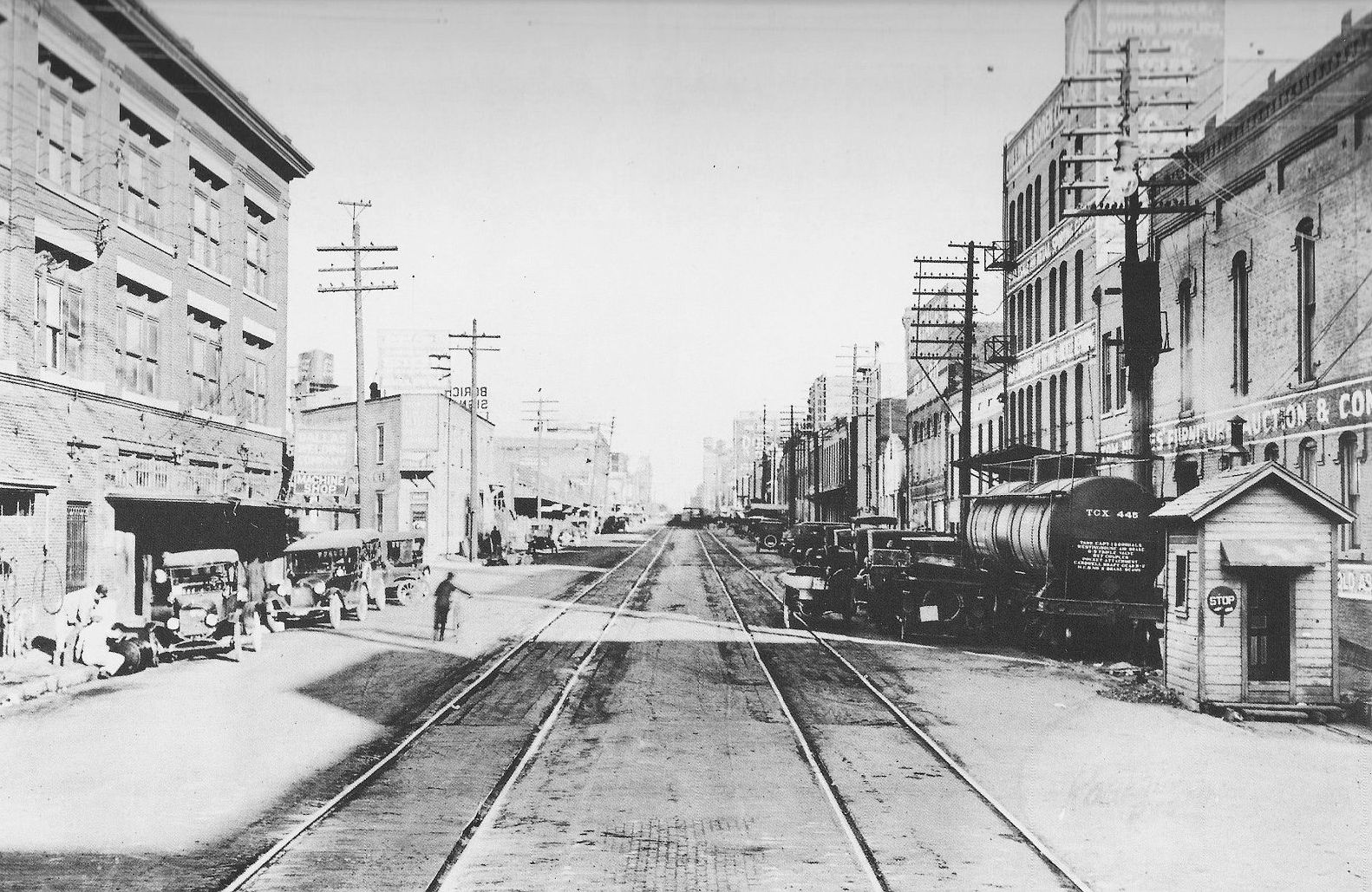
Fast-forward to 1920 — the trains had long stopped running, but the tracks remained, an eyesore and an impediment to traffic. (Cullum & Boren, again, at the right.)

pacific-ave_showing-t-and-p-tracks_1920

And another one.

pacific_ave_ca-1920_legacies_fall-1990

Thanks to the Kessler Plan, those unsightly tracks were finally removed from Pacific in 1923. Below, a photo from 1925. Big difference. Thanks, George Kessler!

pacific_bryan_looking-east_lost-dallas_doty

***

Sources & Notes

Top photo (by Frank Rogers) from the book The Park Cities, A Photohistory by Diane Galloway (Dallas: Diane Galloway, 1989). The photo is credited to John Stull/R. L. Goodson, Jr., Inc./Consulting Engineers.

More info on the 1918 photo of Elm Street, which was featured in the post “Dallas’ Film Row — 1918,” here.

More info on the super-sooty Pacific Avenue photo, here.

More on the de-track-ified Pacific, here.

Not sure of the source of the first 1920 photo; the second 1920 photo is from Legacies, Fall 1990, here.

*

Copyright © 2016 Paula Bosse. All Rights Reserved.
 

Neiman-Marcus Expands — 1927

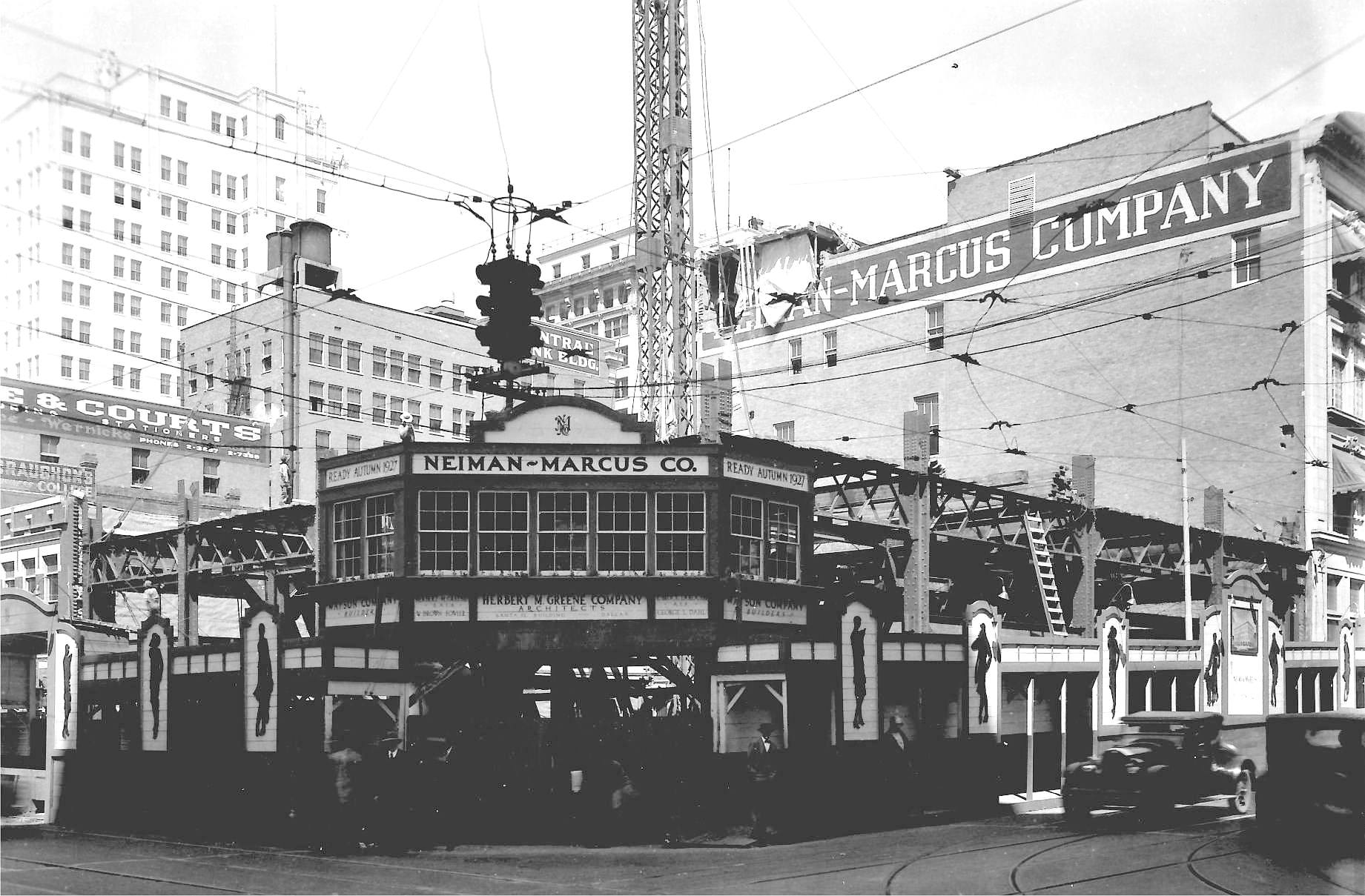
n-m_construction_1927_pioneers-of-dallas-co-FB-page_coll-frances-james_2The first addition under construction, 1927…

by Paula Bosse

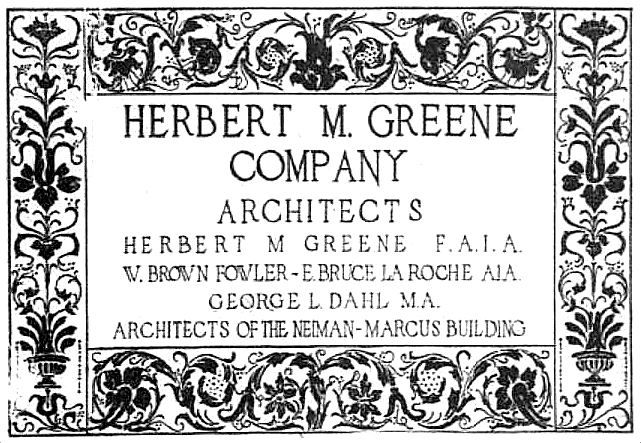
In 1927, construction began on Neiman-Marcus’ first expansion. The addition was adjacent to the famed department store, which had occupied its spot at Main and Ervay since its construction in 1914. (This was the company’s second location – their original store, which opened in 1907 at Elm and Murphy, was destroyed by fire in 1913.) The store had outgrown its old building, and expansion was deemed necessary. The new addition was designed by the Herbert M. Greene architectural firm, led by George L. Dahl. While the new building was going up, the old building was being renovated and updated. 

The photo above shows the construction of the addition, which extended the store’s footprint from Main all the way to Commerce. One of the interesting features of this construction was the look of the site itself.

One of the features of the Neiman-Marcus project is the ornamental barricade, containing window boxes and fashionable silhouettes, which has been put up around the new construction. (Dallas Morning News, May 8, 1927)

It’s the nicest-looking hard-hat area I’ve ever seen!

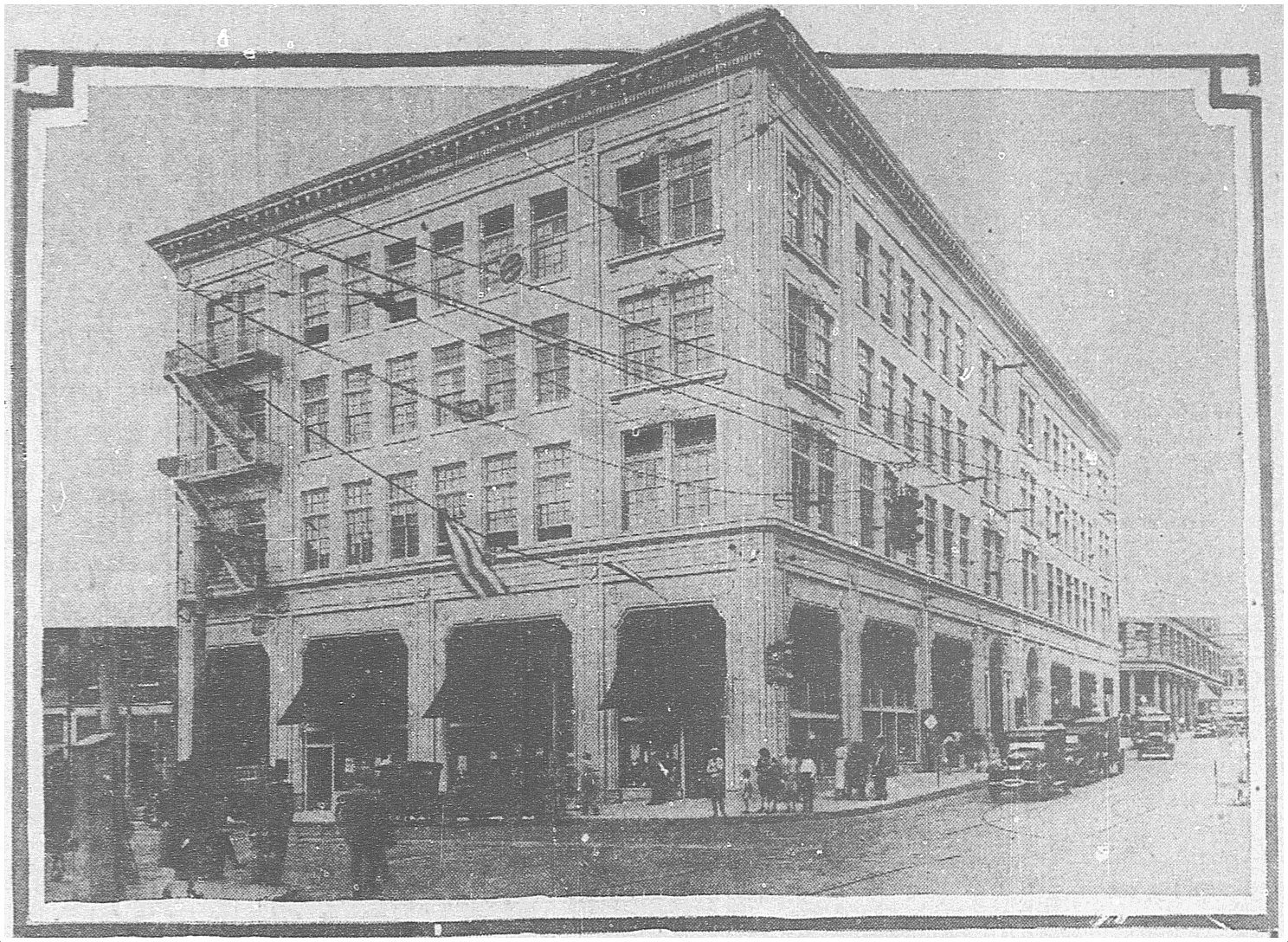
The new building (which was four floors, but was designed so that sixteen additional stories could be added if needed) opened in October, 1927. Less than a month after the formal opening of this new building, another addition was announced — it opened the following year. With that “third unit” opening in 1928, Neiman-Marcus had increased its size by 50% (there would be further expansions over the years), and its sales were the highest in the company’s history. Also, notable at this time was the fact that a full 40% of the store’s sales were to people who lived “in other cities of the Southwest.”

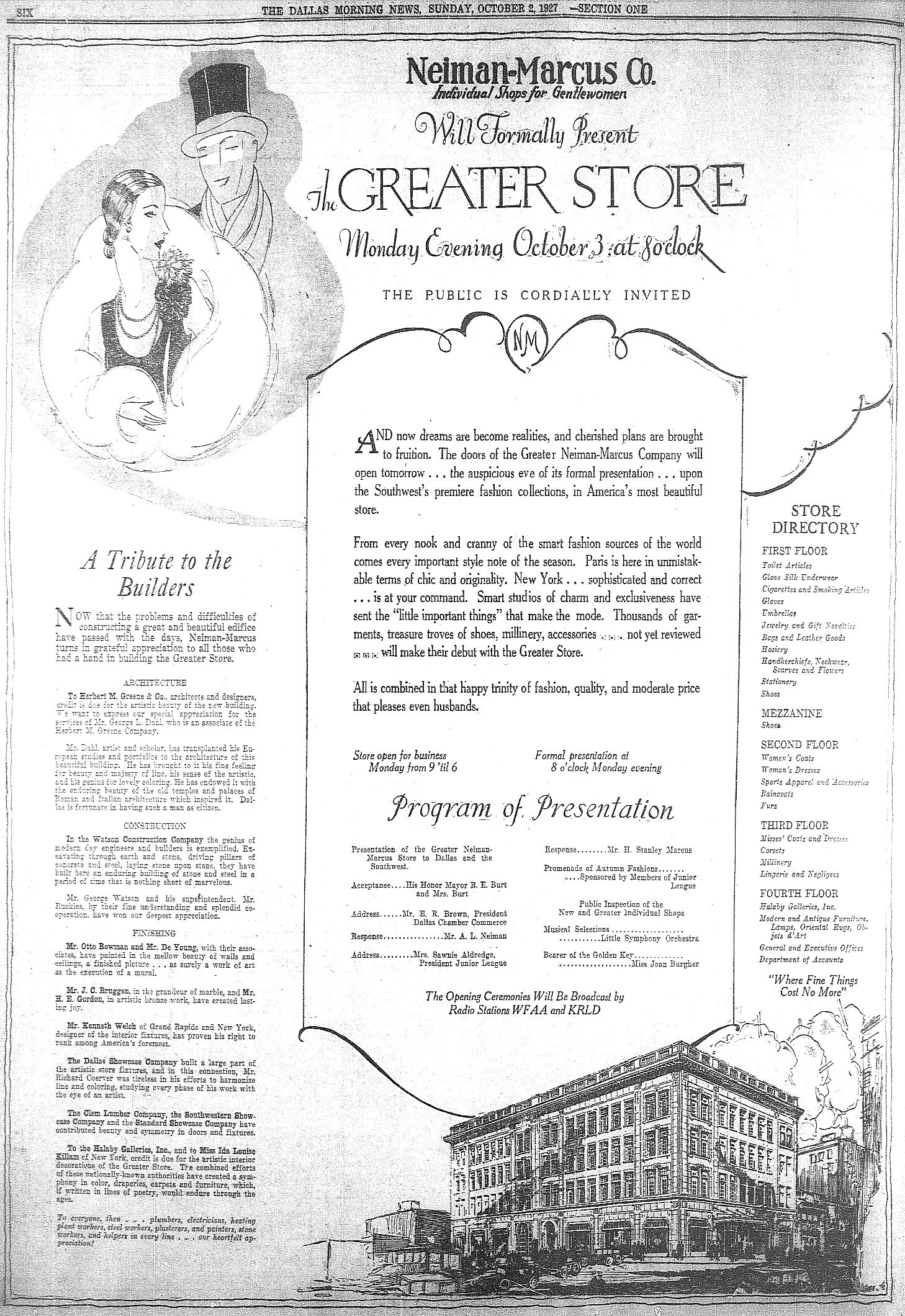
The formal opening on Oct. 3, 1927 attracted a crowd estimated at more than 25,000 people. Invited guests wore gowns and tuxedoes.

n-m_new-addition_dmn_100227
Expansion completed.

*

n-m_construction_dmn_100227_full-page-ad
Oct. 2, 1927 (full-page ad — click to see larger image)

n-m_addition_dmn_100227_architects
Oct., 1927

***

Sources & Notes

Top photo was posted in the Facebook group Pioneers of Dallas County; it is from the collection of Dallas historian Frances James.

A special section of The Dallas Morning News which coincided with the opening of the expanded store appeared in the October 2, 1927 edition of the paper; in it are several photos and articles.

Read more about the history of the Neiman Marcus building on Wikipedia, here.

*

Copyright © 2016 Paula Bosse. All Rights Reserved

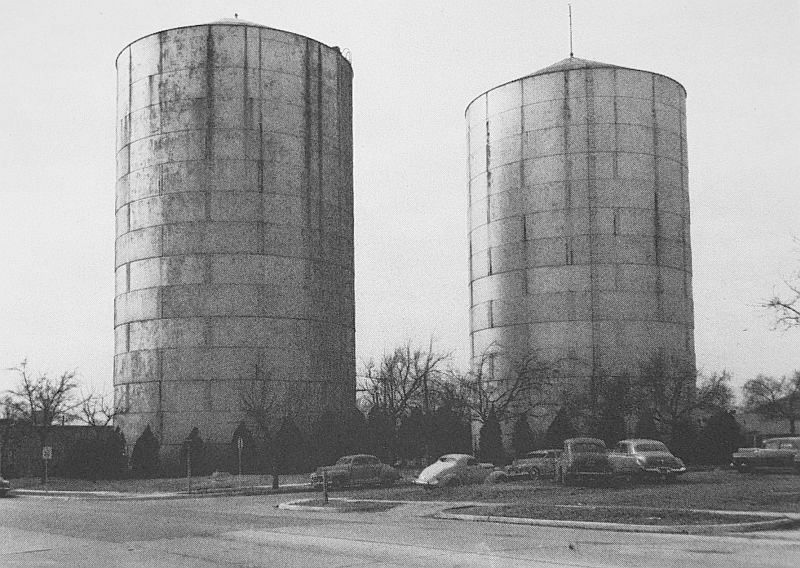
The Twin Standpipes of Lakewood Heights: 1923-1955

lakewood_water-towers_reminiscencesAbrams and Goliad, y’all… (click for larger image)

by Paula Bosse

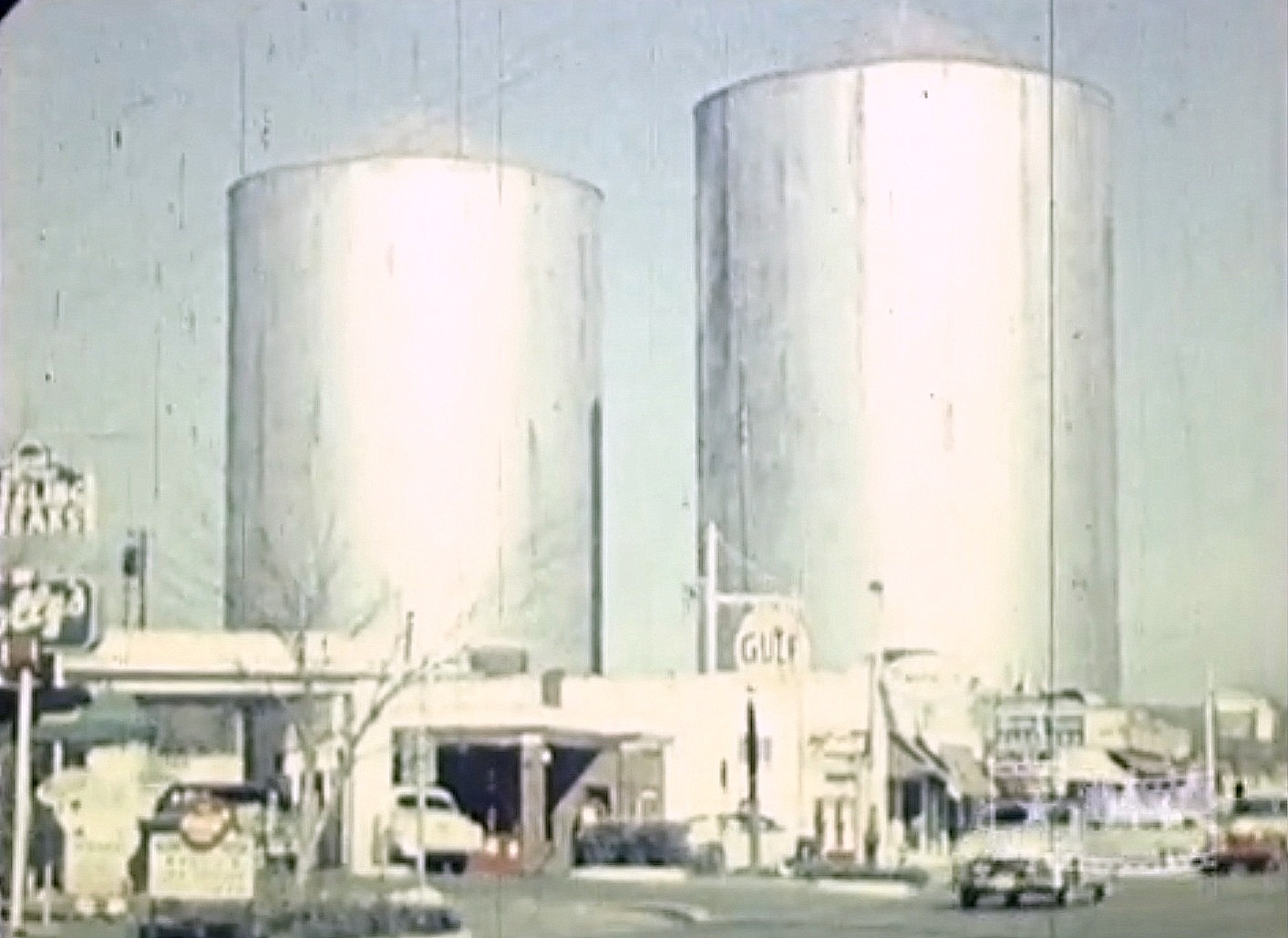
The two large water towers pictured above loomed over the East Dallas neighborhood of Lakewood Heights for over 30 years. They sat at the southwest corner of what was then known as Greenville Road (not to be confused with Greenville Avenue) and Aqueduct Avenue — the streets are known today as Abrams Road and Goliad Avenue. The towers replaced a previous (single) water tank, which, by the early 1920s, was proving inadequate for the needs of an exploding Lakewood area.

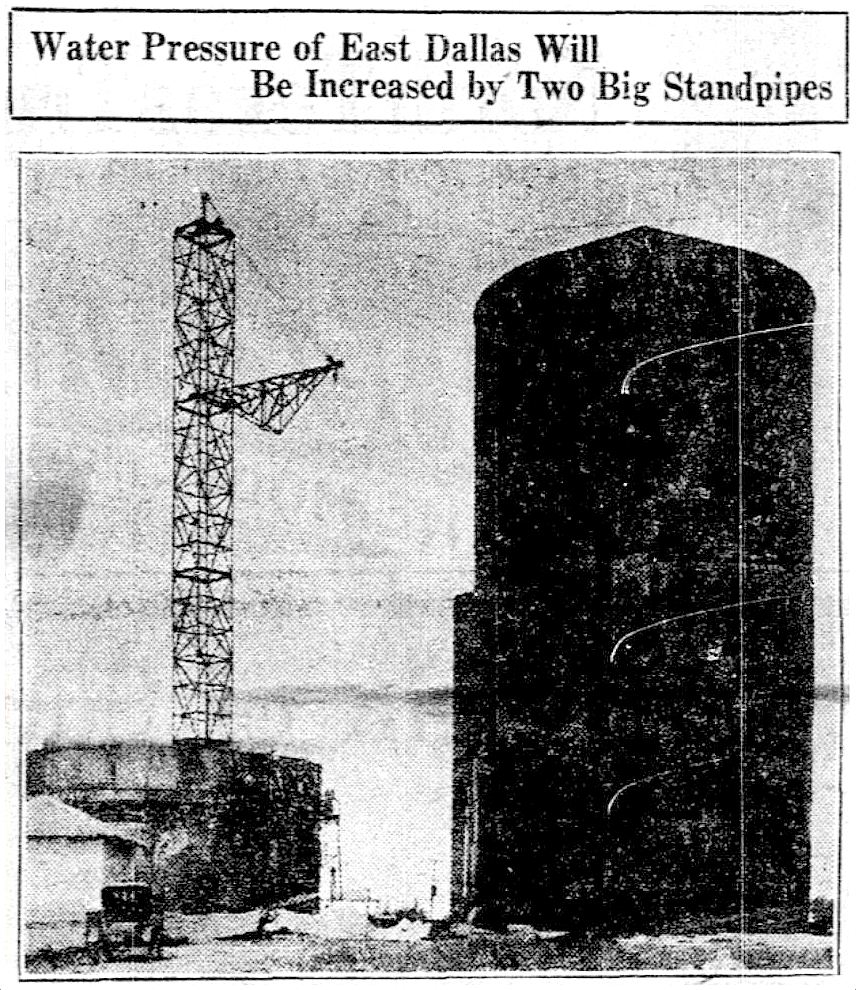
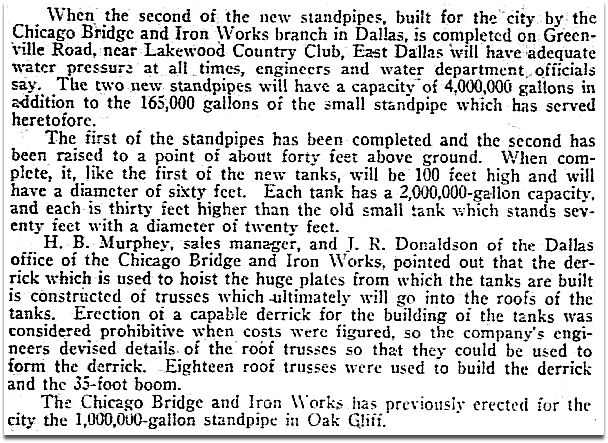
These water tanks — called “standpipes” — were really big: each was 100 feet tall, 60 feet in diameter, and held two million gallons of water. They were erected in October, 1923 and, rather surprisingly, stood until 1955. Even though I grew up in this part of town, I never knew about these tanks until a couple of years ago when I saw a photo in a Dallas history group. It’s hard to believe those industrial behemoths were smack dab in the middle of what is now a jam-packed residential neighborhood.

**

Here are a few photos featuring cameo appearance by the omnipresent tanks. In the first one, from the 1930s, they can be seen at the top right, ghostlike in the distance.

lakewood-shopping-ctr_streetcar-tracks_ca1938_reminiscences

*

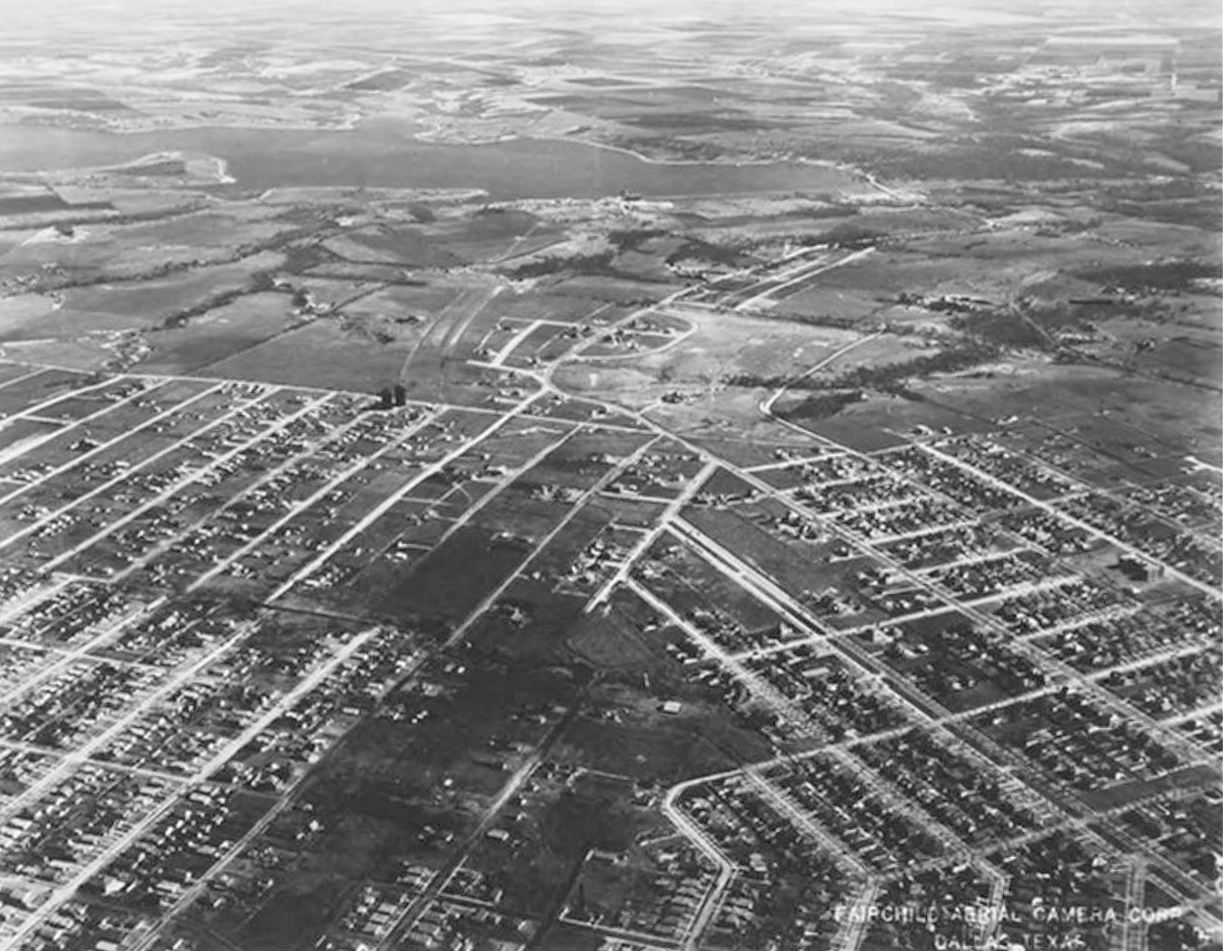
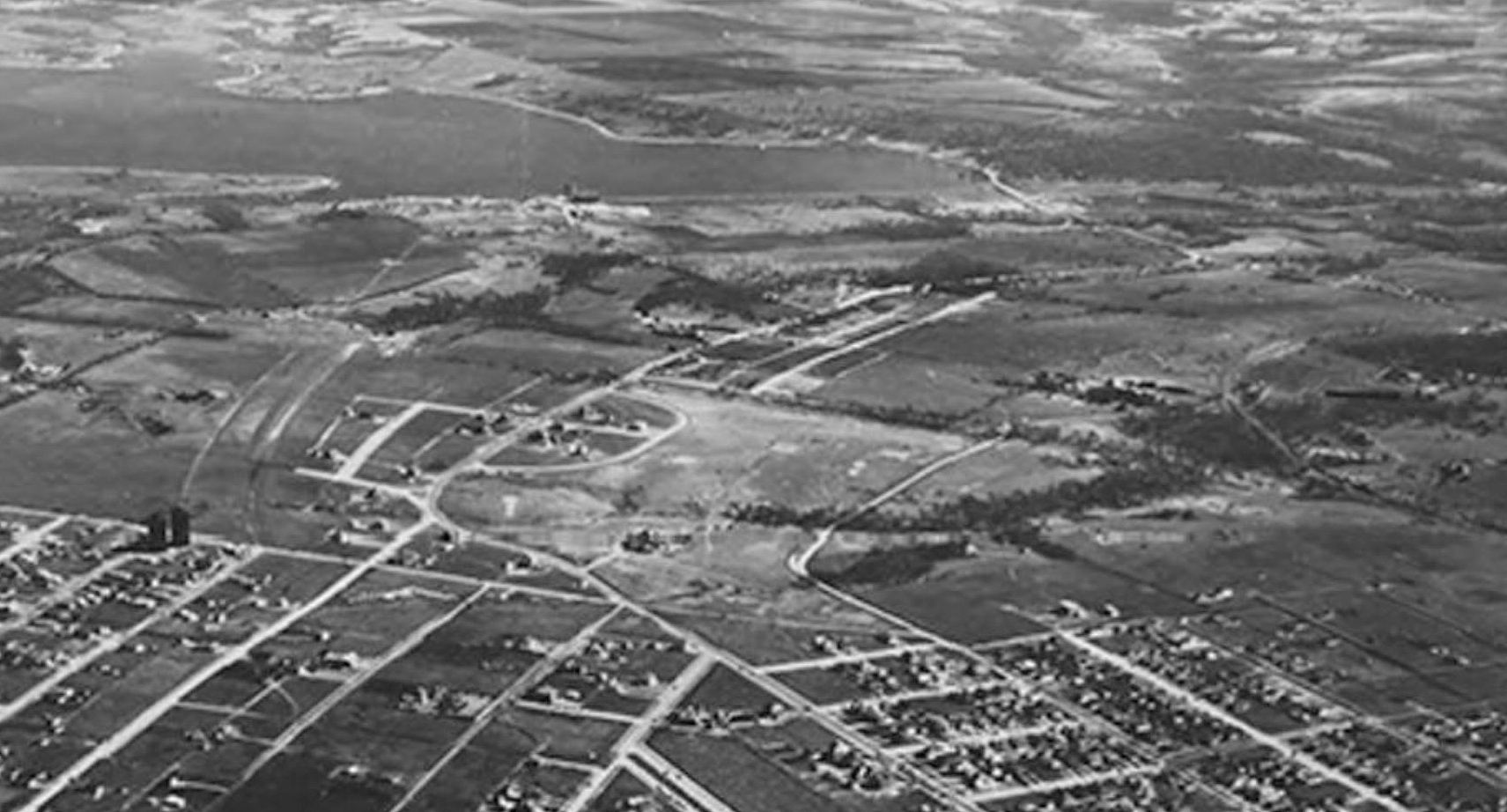
Then there’s this fantastic aerial shot of what would later become the fully developed Lakewood area (and beyond). Looking east, White Rock Lake is in the distance, and the two towers — brand new when this photo was taken in 1923, and taller than anything else in the photograph — are at the left.

east-dallas_lakewood_fairchild_1923_cook-coll_degolyer_smu

Let’s zoom in a bit:

east-dallas_lakewood_fairchild_1923_cook-coll_degolyer_smu_det

*

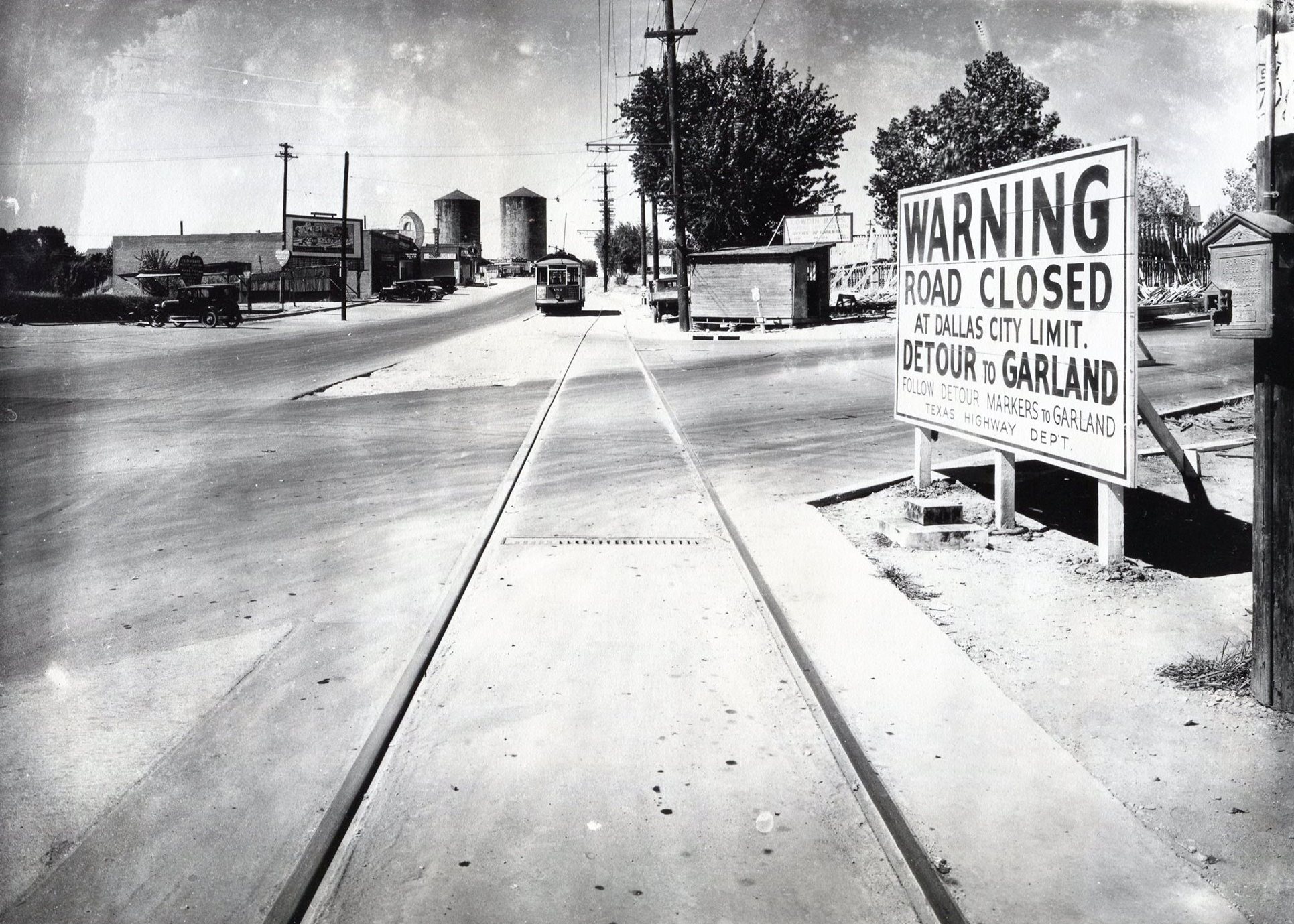
And here is a really wonderful photo which was posted in the Dallas History Facebook group by Mary Doster from the collection of her husband Jim Doster, showing Abrams, looking north, in 1925. (The location of the twin tanks was actually outside the Dallas city limits in 1919 — see the boundary on a 1919 map here.) I never get tired of seeing streetcars, especially traveling down streets I drive everyday.

water-tanks_abrams_dallas-hist-FB-jim-dosterCollection, Jim Doster

**

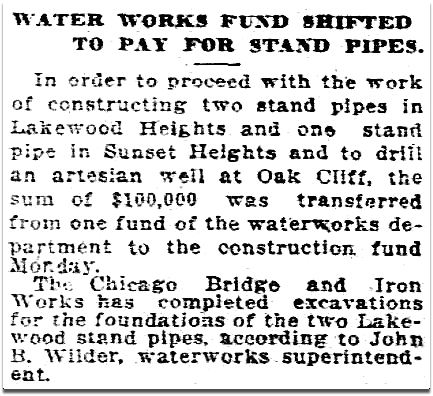
A few articles about the tanks’ beginning in 1923.

water-towers_dmn_022723Dallas Morning News, Feb. 27, 1923

water-towers_dmn_100723a
DMN, Oct. 7, 1923

water-towers_dmn_100723b
DMN, Oct. 7, 1923

*

Here’s a screenshot from a silent film produced by the City of Dallas waterworks department, showing them at traffic-level, with a view to the northwest from Abrams.

stand-pipes_lakewood_TAMI_water-dept-film_6.39

The tanks were dismantled in 1955 (pertinent articles are listed below, in the “Notes” section). Their fate, post-dismantling? One of them was destined to be reassembled in Tarrant County for the Hurst-Euless-Bedford water system, and the other one was “to be kept as stand-by storage for the city” (DMN, June 7, 1955).

standpipes_dmn_060755
RIP in HEB…

***

Sources & Notes

First two photos from the book Reminiscences, A Glimpse of Old East Dallas.

Aerial photo — titled “East Dallas — 1923” — is a Fairchild Aerial Surveys photograph, from the George W. Cook Dallas/Texas Image Collection, DeGolyer Library, Central University Libraries, Southern Methodist University; more information is here. (I have adjusted the color.)

Screenshot is from a City of Dallas silent film, shot for the water department — the film is in the TAMI collection here, and the standpipes pop up at the 6:39-ish mark. Thanks to John Botefuhr for posting the link to this film on the Lakewood 1925-1985 Facebook group.

More on the tanks’ removal in 1955 can be found in these Dallas Morning News articles:

  • “Familiar Old Landmark To Be Removed” (DMN, March 20, 1955)
  • “Offers Vary on Standpipe” (DMN, April 26, 1955)
  • “East Dallas Landmark Coming Down” (DMN, June 7, 1955 — has photo taken from inside the tank looking up as dismantling was underway)

The present-day view seen in the top photo — looking south on Abrams — can be seen on Google Street View here.

A very interesting Sanborn Map from 1922 — before the twin tanks were built, but still showing the “Lakewood Heights Water Works” — can be found here. There’s, like, nobody living there, man.

I’d love to see other photos of these particular “standpipes” — if anyone has any, forward them to me and I’ll include them in this post. Contact info is at the top.

As always, images are magically larger when clicked.

*

Copyright © 2016 Paula Bosse. All Rights Reserved.


Dallas Skyline — ca. 1974

skyline_aerial_1974_getty-images_watermarkSo many landmarks! (click for larger image)

by Paula Bosse

I try to avoid using photos with watermarks, but this is a great view of the Dallas skyline, taken by famed photographer Charles Rotkin. Below, another of his photos.

aerial_skyline_corbis_1974

***

Photos by Charles Rotkin. Top photo from Corbis/VCG via Getty Images. Bottom photo ©Charles E. Rotkin/CORBIS (I can no longer find this image on the new Getty site). CORBIS/Getty says that both of these photos were taken on Jan. 1, 1974, but I’ve found that their date info is sometimes inaccurate.

2004 obituary of Charles Rotkin is here.

Click photos for larger images.

*

Copyright © 2016 Paula Bosse. All Rights Reserved.

Gene’s Music Bar, The Lasso Bar, and The Zoo Bar

genes-music-bar_dallas-memorabiliaGene’s Music Bar, S. Akard Street (click for larger image)

by Paula Bosse

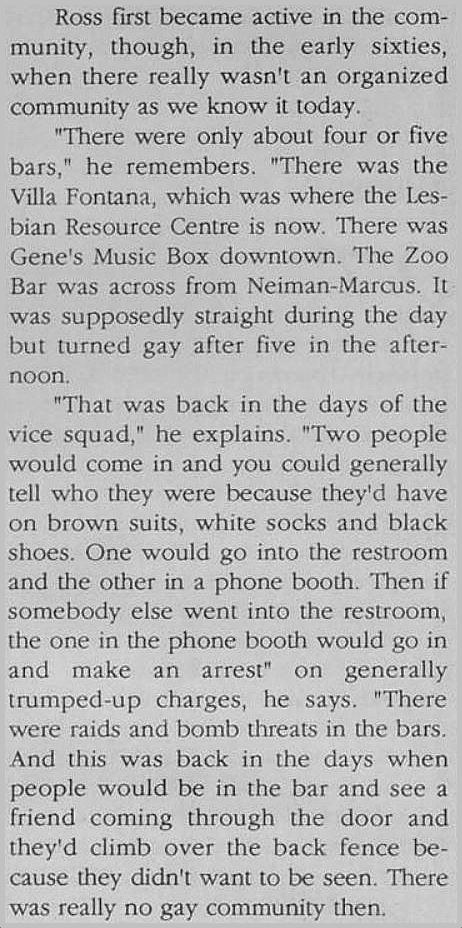
In Dallas’ pre-Stonewall days, there were only a handful of gay bars in the city, and they weren’t widely known beyond those who frequented them. Those were the days when “homosexual behavior” was illegal, and vice raids on gay bars and clubs were frequent occurrences. In an interview with the Dallas Voice Alan Ross remembered what the bar scene was like in Dallas in those days (click for larger image):

gay-dallas_dallas-voice_092190_alan-ross
Dallas Voice, Sept. 21, 1990

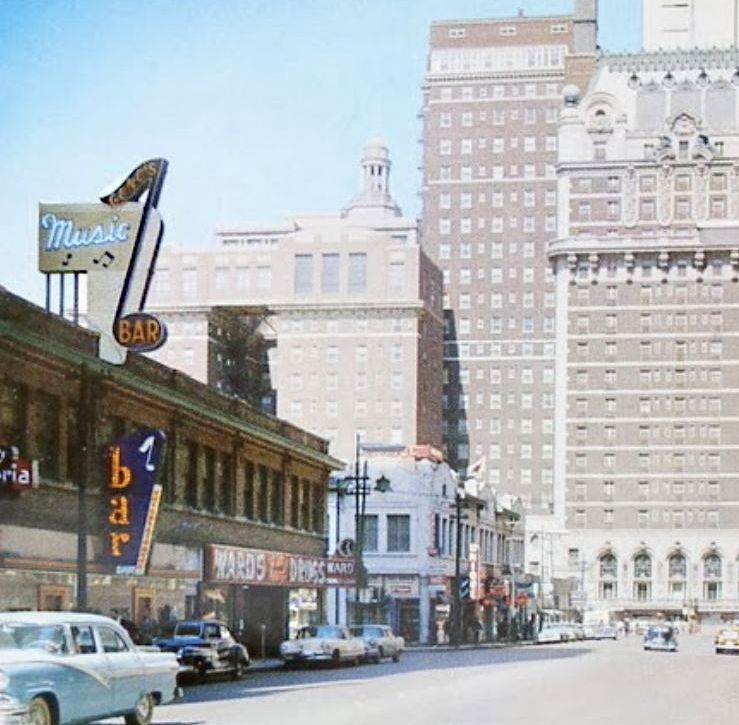
There was the well-appointed Le Boeuf Sur Le Toit (later renamed Villa Fontana), one of Dallas’ earliest gay bars, located on Skiles Street near Exall Park in the area now known as Bryan Place, and there were rougher, seedier places, generally downtown. Three of those downtown bars (which apparently catered to a “straight” clientele during the day and a gay clientele at night) were Gene’s Music Bar and The Lasso — both on S. Akard, in the shadow of the Adolphus Hotel — and The Zoo Bar, on Commerce, “across from Neiman-Marcus.”

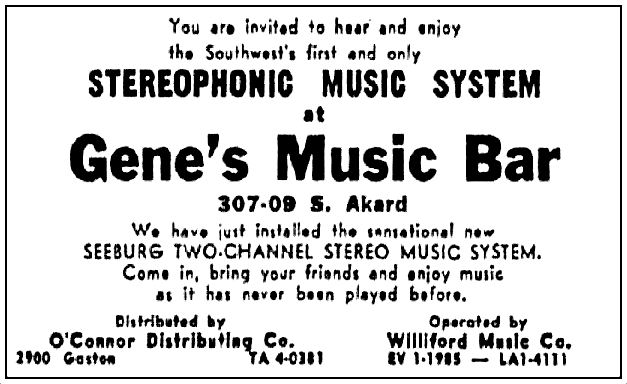
Gene’s Music Bar (pictured above) at 307-09 S. Akard began as a place where hi-fi bugs could sip martinis and listen to recorded music played on “the Southwest’s first and only stereophonic music system.” Not only did it have the sensational Seeburg two-channel stereo system, but it also boasted one of the best signs in town.

genes_dmn_110958
Nov. 1958

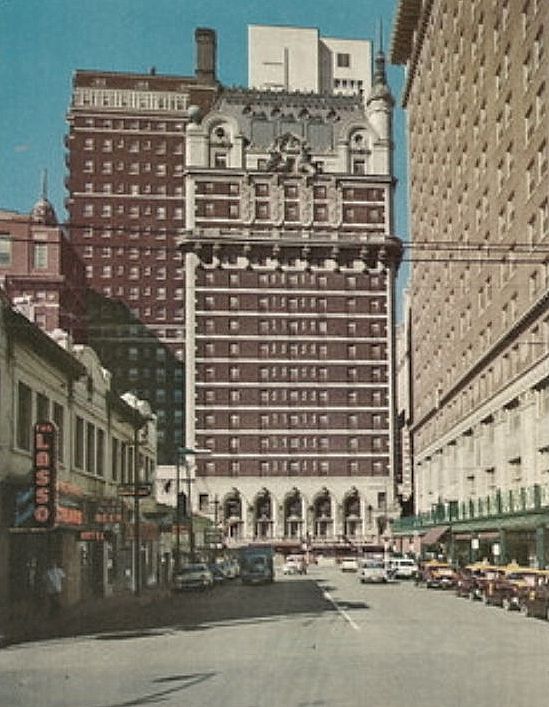
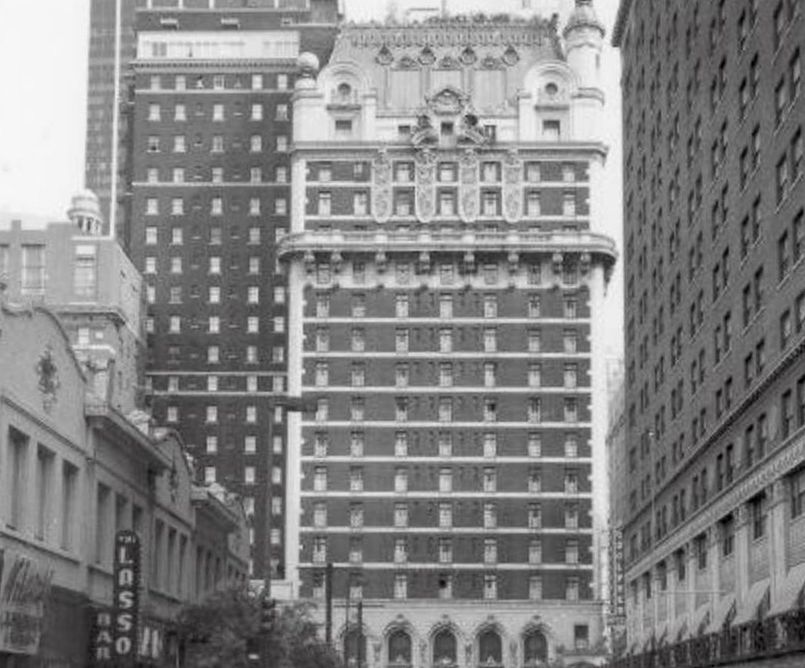
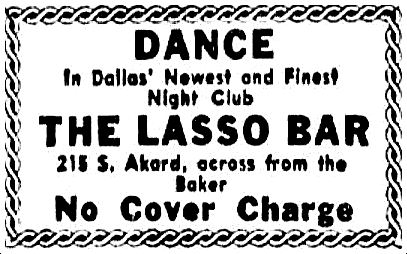
The Lasso Bar at 215 S. Akard was in the next block, across from the classy Baker Hotel, and a hop, skip, and a jump from the elegant Adolphus. Its proximity to the impressive Adolphus meant that the Lasso snuck its way into lots of souvenir picture postcards and Dallas Chamber of Commerce publicity photos. Its sign was pretty cool, too.

lasso-bar_postcard

adolphus_lasso-bar_tx-hist-comm

lasso-bar_dmn_031358
March, 1958

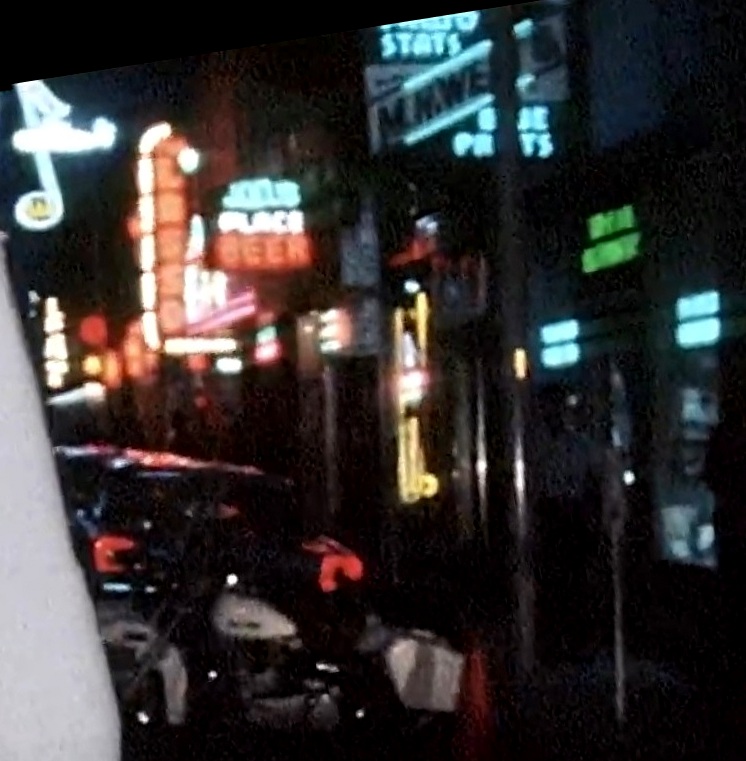
The image below gives you an idea of what that block looked like at night, neon blazing. (This super-blurry screenshot is from WFAA-Channel 8 coverage of 1969’s Texas-OU weekend, here — at 6:16 and 9:13.)

lasso-bar_jones-film_WFAA_101169

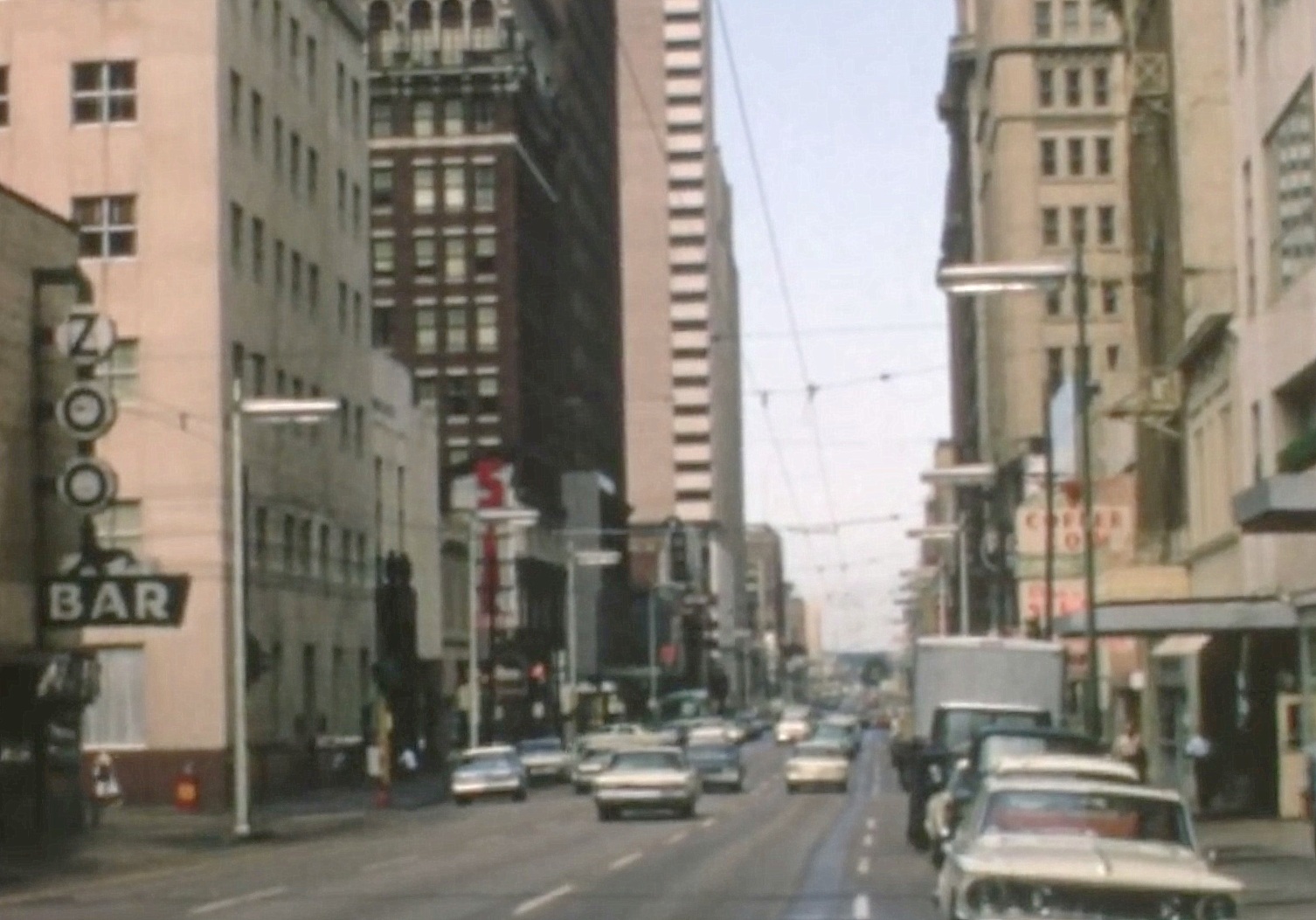
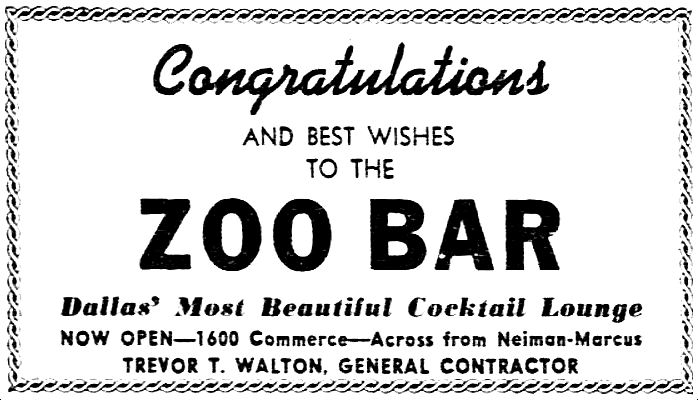
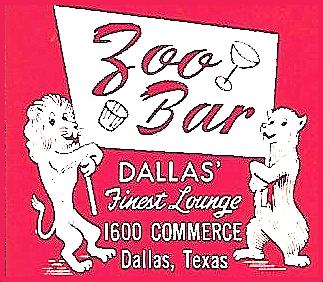
The Zoo Bar at 1600 Commerce began as a cocktail lounge and often had live piano music. It was across from Neiman’s and it was 3 blocks from Jack Ruby’s Carousel Club (downtown Dallas ain’t what it used to be). It also had a better-than-average sign.

zoo-bar_youtube_19661966

zoo-bar_dth-photo_112263_sixth-floor-museum_portal_croppedNov., 1963

zoo-bar_dmn_092752
Sept., 1952

zoo-bar_matchbook_ebay_2     zoo-bar_matchbook_ebay_1

These three downtown bars, popular as hangouts for gay men, had their heyday in the 1960s and ’70s. By the mid 1970s, the LGBT scene was shifting to Oak Lawn. An interesting article about the uneasy relationship between the “old” Oak Lawn and the “new” Oak Lawn can be found in a Dallas Morning News article by Steve Blow titled “Last Oak Lawn Settlers Brought Controversy” (Dec. 9, 1979).

***

Sources & Notes

Top photo of Gene’s Music Bar is from the blog Old Dallas Stuff.

Color photo of the Lasso and the Adolphus is from an old postcard. Black-and-white photo of the Lasso and the Adolphus is from the Texas Historical Commission site, here.
Blurry shot of Gene’s Music Bar and the Lasso Bar at night is a cropped screenshot from daily footage shot by WFAA-Channel 8 on Oct. 11, 1969 — the night before the Texas-OU game; from the WFAA Newsfilm Collection, G. William Jones Film and Video Archive, Hamon Arts Library, SMU.

Color image of the Zoo Bar and Commerce Street is a screenshot from home movie footage of the 1966 Memorial Day parade in downtown Dallas, shot by Lawrence W. Haas, viewable on YouTube. Black-and-white photo of the Zoo Bar from the Sixth Floor Museum Collection, via the  Portal to Texas History, here (I’ve cropped it). Zoo Bar matchbook from eBay.

Read more about Dallas’ gay bar scene in the article I wrote for Central Track, “Hidden in Plain Sight, A Photo History of Dallas’ Gay Bars of the 1970s,” here.

More on the the persistent arrests and police harassment that went on in gay clubs in Dallas for many, many years can be found in the Dallas Voice article by David Webb, “DPD Vice Unit Wages 50-Year War Against Gay Men” (Aug. 3, 2007), here.

*

Copyright © 2016 Paula Bosse. All Rights Reserved.