Flashback : Dallas

A Miscellany: History, Ads, Pop Culture

Category: Postcards

Year-End List! My Favorite (Non-Photo) Images Posted in 2015

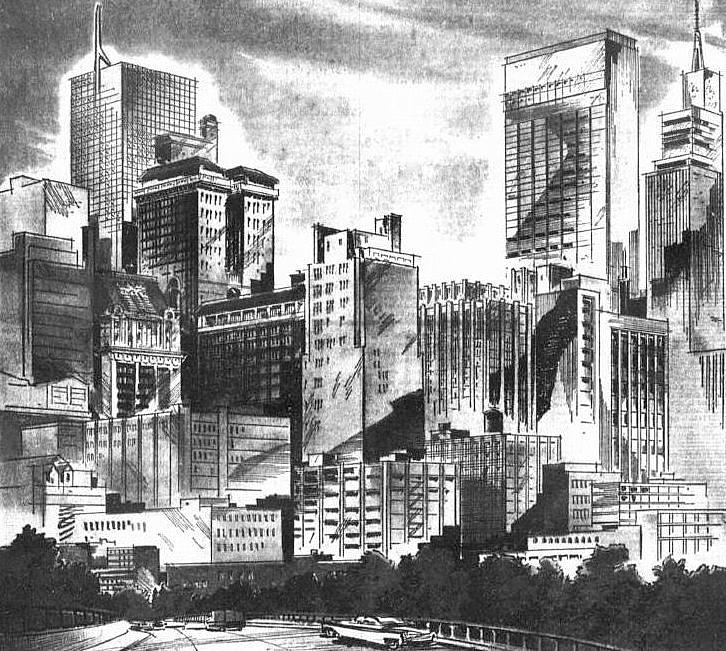
skyline_1960_dmn_100260I feel a sudden yen for a mid-century cocktail….

by Paula Bosse

It’s the end of the year, the traditional time for lists! Today I’m posting a list of my top ten favorite images that I’ve posted over the past year — either art or postcards (my favorite photographs of the year will be posted tomorrow). For more info on the images — and to see the post they appeared in — click on the title of the post (sources are generally at the bottom). Most images are larger when clicked — some are quite a bit larger.

*

“The Dallas Skyline, Vibrant & Sophisticated — 1960” (above) — an idealized rendering of the downtown skyline, oddly missing Pegasus.

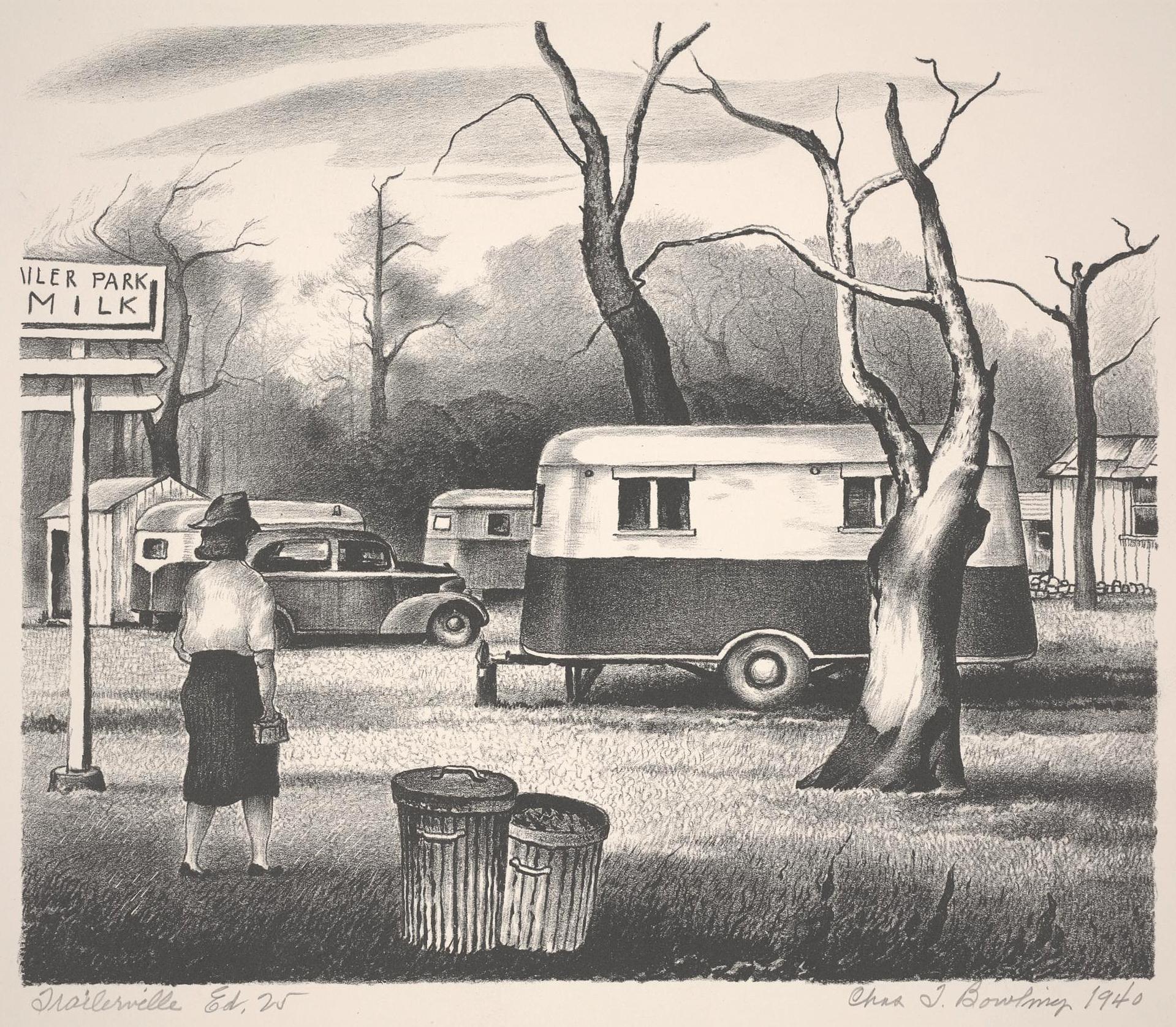
“‘Trailerville’ by Charles T. Bowling — 1940.”

bowling_trailerville_1940_dmaDMA

“Winter Scene: The Belo Mansion & The Cathedral of the Sacred Heart — ca. 1902.”

cathedral_snow_flickr-coltera

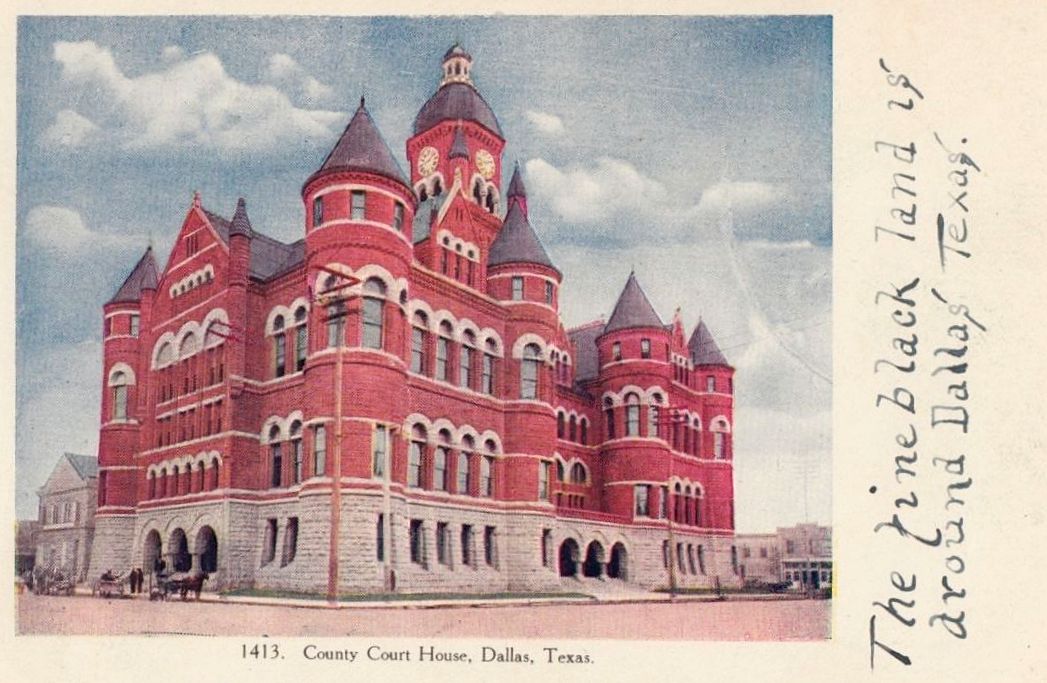
“The Fine Black Land Is Around Dallas, Texas.”

old-red-courthouse_early

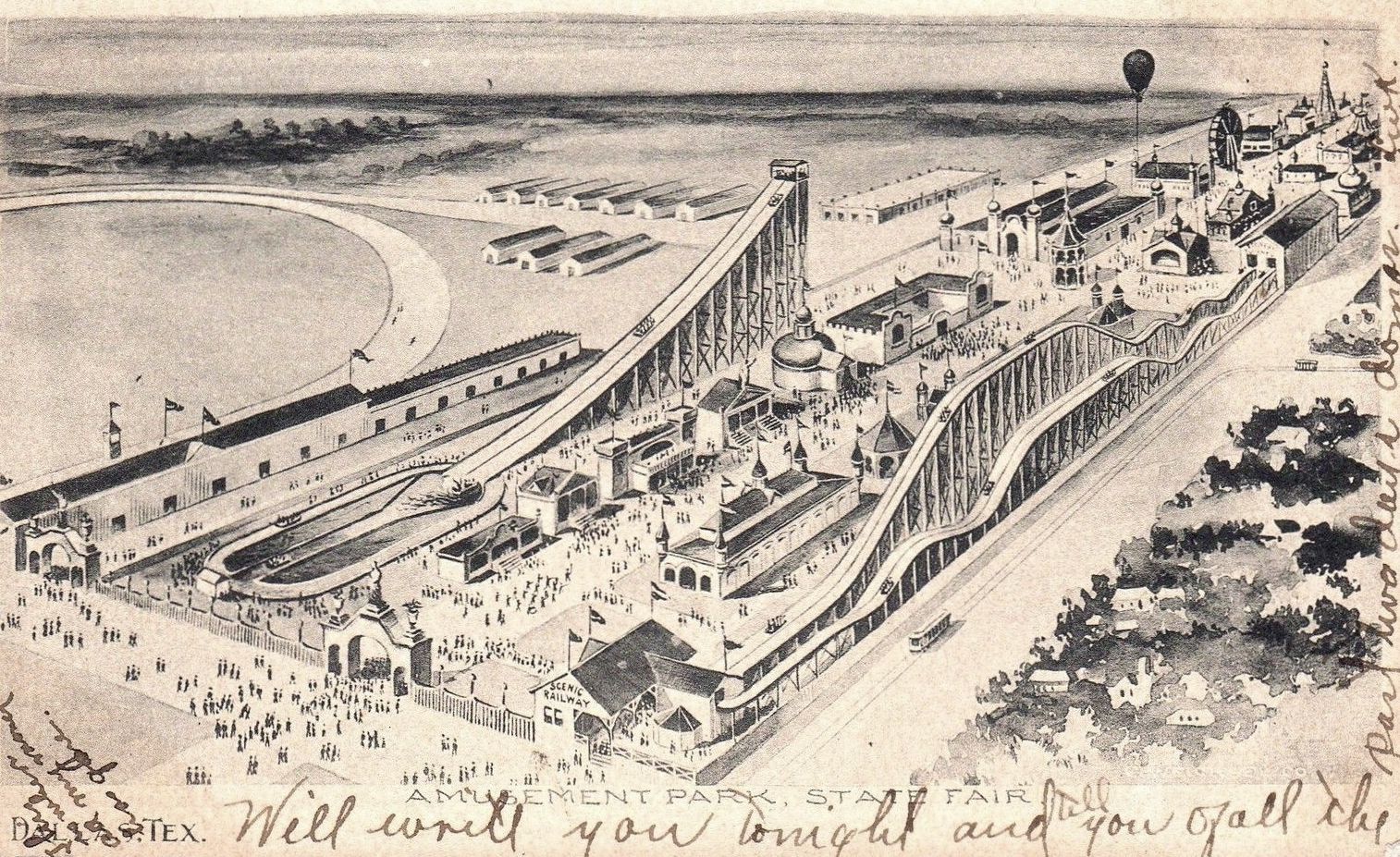
“The State Fair of Texas: ‘This Is Where All My Money Has Gone.'”

state-fair_ebay

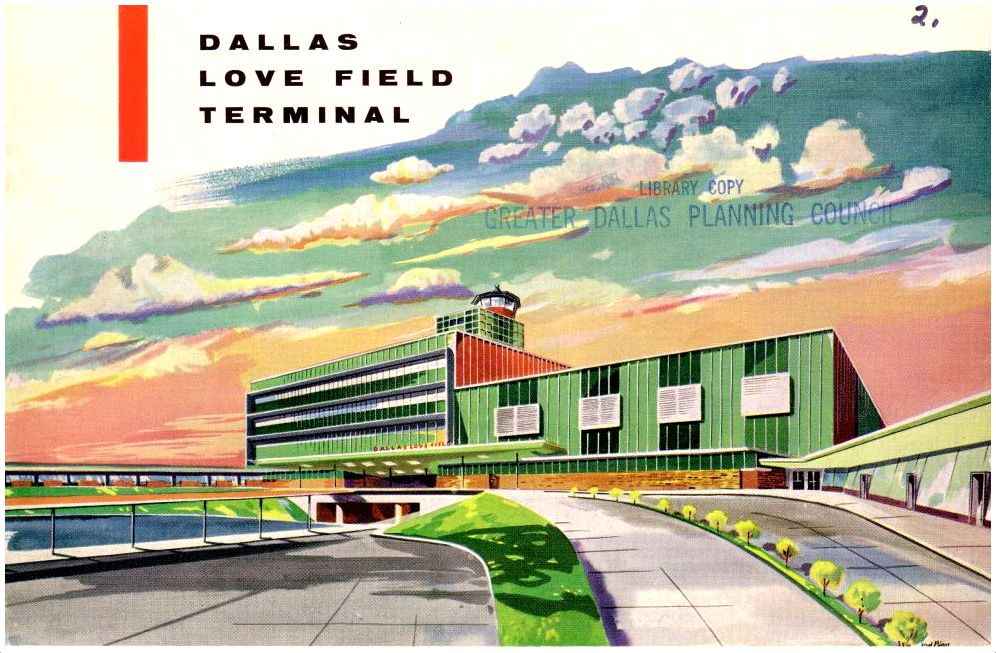
“Love Field, The Super-Cool 1950s Era.” (Super-cool photos also in this post!)

love-field_1957

“Main Street — ca. 1942.”

main-street-canyon_ebay

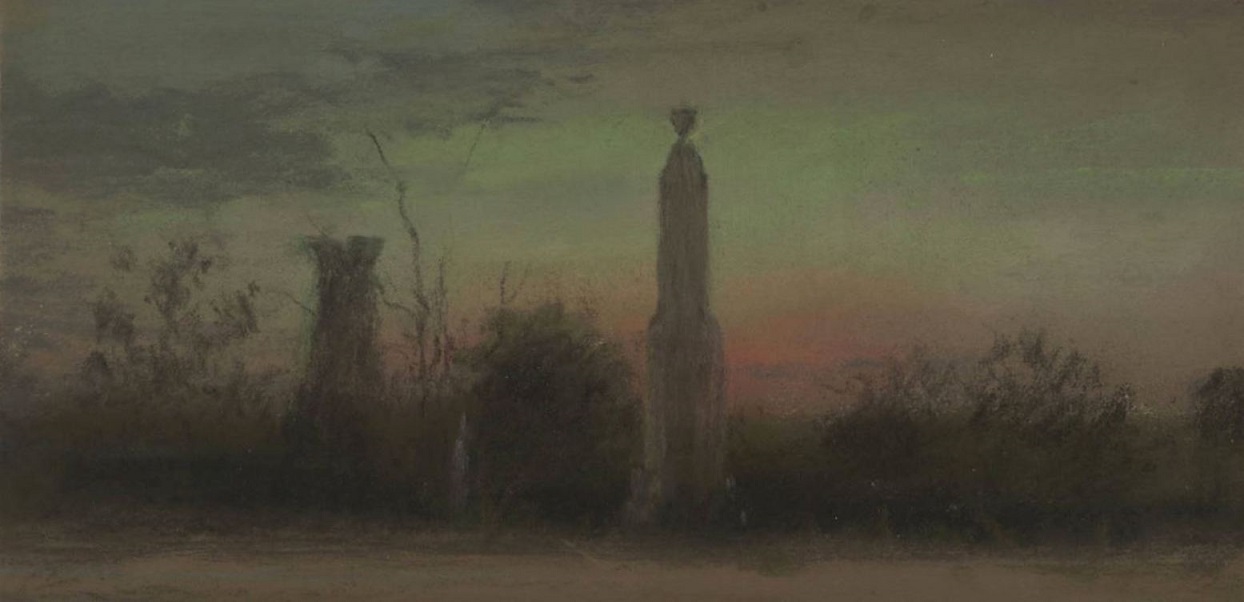
“‘Cemetery at Twilight’ by Frank Reaugh.”

reaugh_cemetery-at-twilight_nd_UT_ransom-ctr

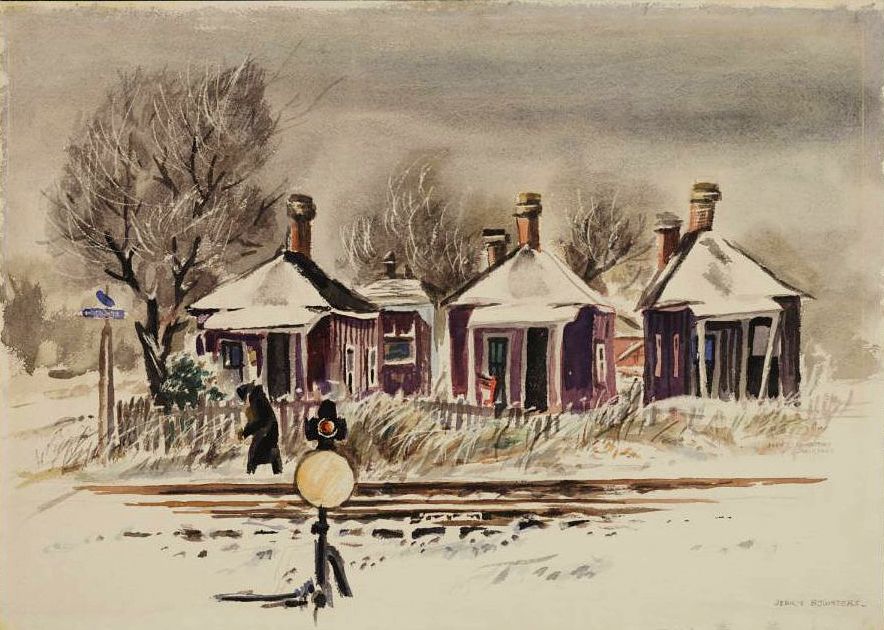
“‘Along the Tracks’ in the Fair Park Area.” (Painting by Jerry Bywaters.)

bywaters_along-the-tracks_fair-park_smu_1947

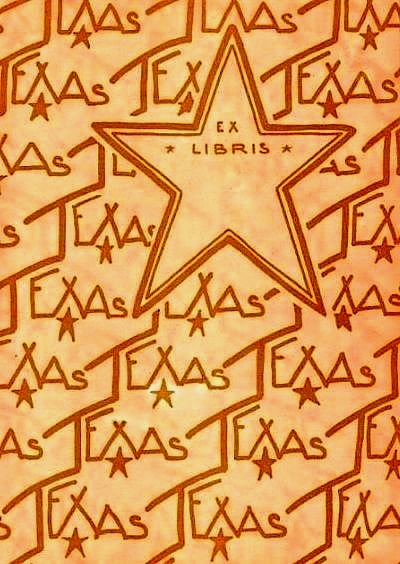
“Texas Texas Texas Texas Texas Texas Texas — 1930” (Woodrow Wilson High School yearbook endpaper.)

woodrow_texas-endpaper_1930-yrbk

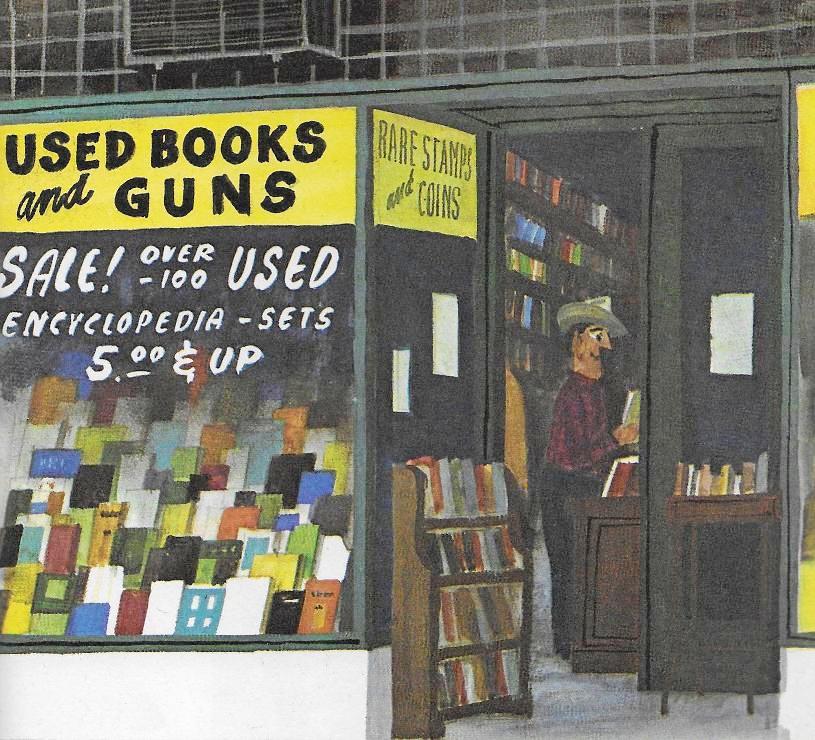
Honorable Mention: Not specifically Dallas-related, but it IS Texas-related: “‘Used Books & Guns’ — 1967.”  I’ve updated the post with a photo, which may or may not be the actual San Antonio bookstore which appeared as an illustration in a children’s book.

used-books-and-guns_SASEK

***

For all the “Year-End Best of 2015” lists, click here.

For the “Year-End Best of 2014” lists, click here.

*

Copyright © 2015 Paula Bosse. All Rights Reserved.

Main Street — ca. 1942

main-street-canyon_ebay_smallThe Merc, Titche’s, the White Plaza (click for much larger image)

by Paula Bosse

I love postcards like this. All signs of people, automobiles, and streetcars have been magically erased. Poof! This lunchtime scene of empty streets and sidewalks — looking west down Main from Harwood at 12:30 PM — was definitely a view never seen by a human being!

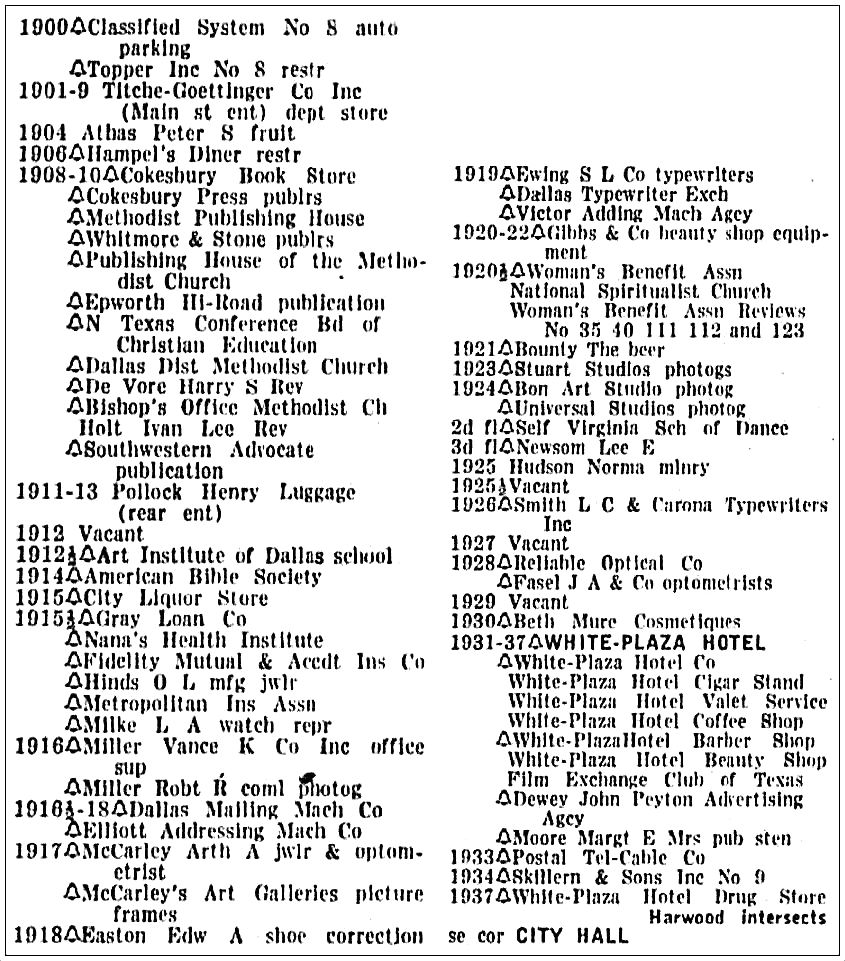
In trying to figure out the year of this image, I narrowed it down to about 1942 — that was the year the Mercantile Building was completed, and that was also about the time that Henry Pollock’s luggage store packed up (…as it were…) and vacated 1911-13 Main (the store was no longer listed at this address by the time the 1943 directory was issued). That’s not to say that the sign painted on the side of the building didn’t remain after Pollock had left, but later occupants would most likely have painted over it as soon as they moved in.

Speaking of directories, here’s a look at the businesses in the 1900 block of Main — between St. Paul and Harwood — in 1941. (Click for larger image.)

main-st_19411941 Dallas directory

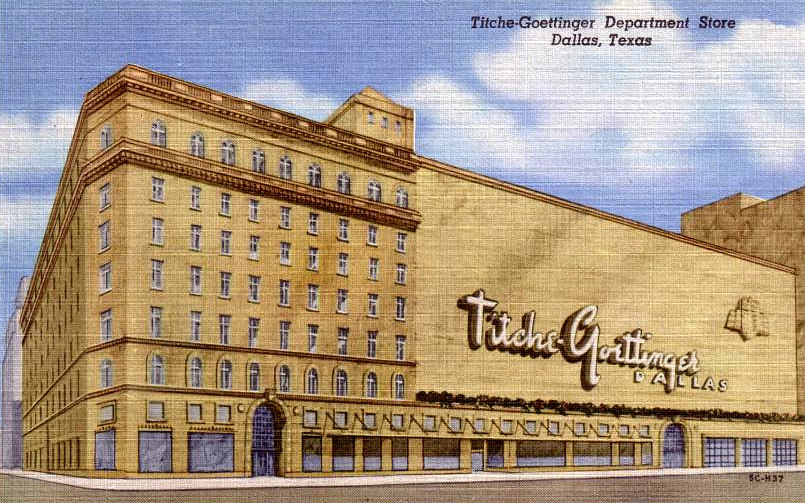
For me, the interesting thing about this postcard is seeing the Titche’s building (at the corner of St. Paul) before it was expanded. The small buildings between Titche’s and the White Plaza Hotel (a hotel which was originally Dallas’ first Hilton — Conrad’s first-ever hotel to bear his name) were demolished sometime around 1952, and the expansion began that year, its 50th in business in Dallas.

The original building was built in 1929, designed by George Dahl (whose office was, a few years later, right across the street); the architectural firm responsible for the expansion was Thomas, Jameson & Merrill.

Here’s what the building looked like before the expansion (with another magic erasure — this time, the hotel at the end of the block has been removed to make way for an unobstructed view of the moon):

titches_night.jpg

And here’s the building after its expansion:

titches

***

Sources & Notes

More on the Titche’s expansion in the Dallas Morning News article “Titche’s Reports Plans to Double Present Size” by Edd Routt (Sept. 7, 1952).

Present-day photo of the Titche’s building, from Wikipedia, is here.

Present-day street view showing roughly the same vantage point as the postcard at top, can be seen on Google Street View, here.

A previous Flashback Dallas post — “George Dahl’s Titche-Goettinger Building” — is here.

All images larger when clicked.

*

Copyright © 2015 Paula Bosse. All Rights Reserved.


Sivils Drive-In, An Oak Cliff Institution: 1940-1967

sivils_tichnorOak Cliff’s landmark hangout (click for larger image)

by Paula Bosse

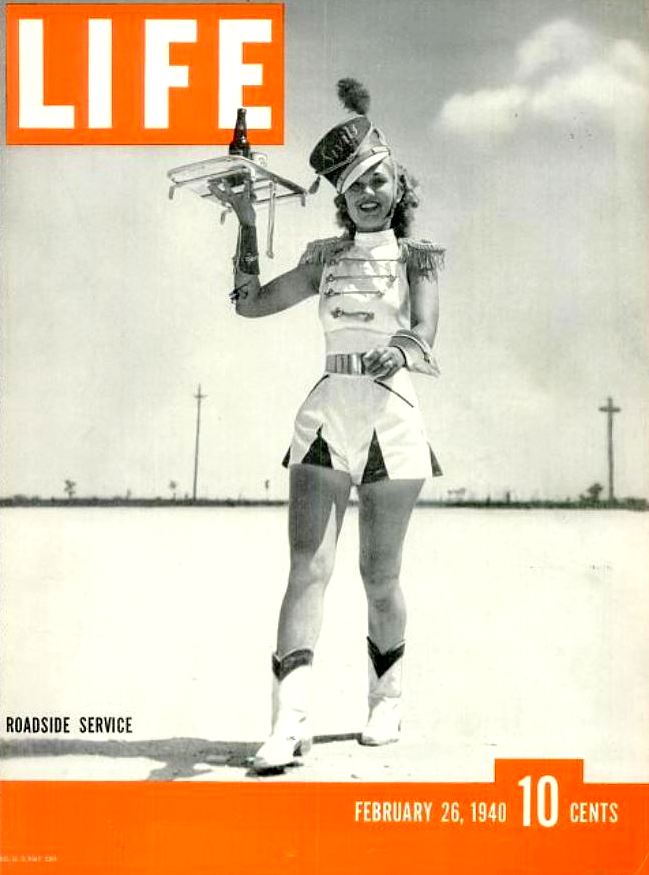
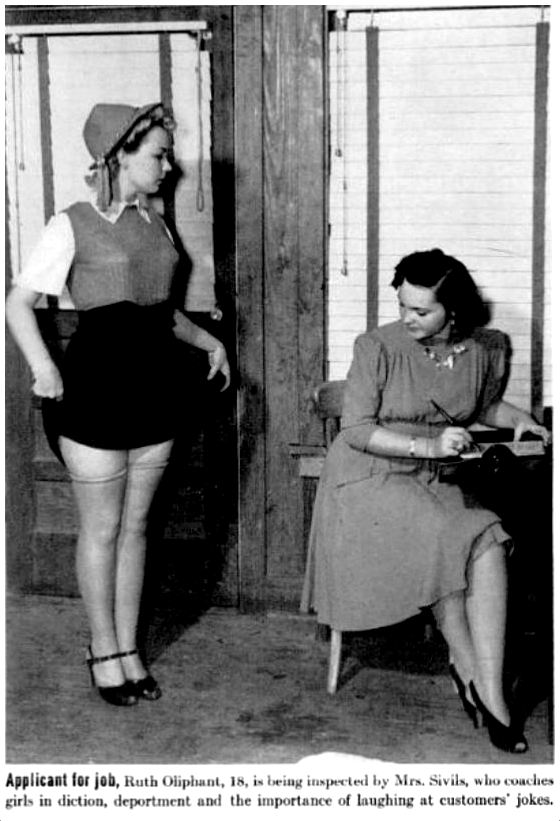
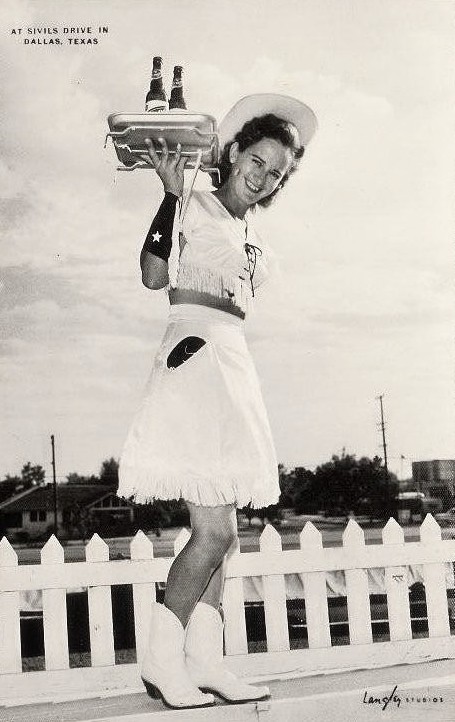
When J. D. Sivils (1907-1986) and his wife, Louise (1918-2006), brought their “Sivils” restaurant to Dallas in June 1940, their Houston drive-in of the same name had already been featured as a Life magazine cover story, garnering the kind of incredible national publicity that any business owner would have killed for! And all because of their carhops — “comely, uniformed lassies” whom Mrs. Sivils insisted on calling “curb girls” (which might have a slightly different connotation these days…). Life — never a magazine to overlook pretty young girls in sexy outfits — not only devoted a pictorial to the “curb girls,” they also put one of them (Josephine Powell of Houston) on the cover, wearing the Sivils’ uniform of (very, very short!) majorette’s outfit, plumed hat, and boots.

sivils_houston_life-mag_022640Feb. 26, 1940

louise-sivils_life-magazine_1940Louise Sivils and a prospective “curb girl” (Life)

Four months after the blitz of national attention the drive-in received from the Life story, Sivils came to Dallas. The drive-in was located in Oak Cliff at the intersection of West Davis and Fort Worth Avenue on “three acres of paved parking space.”

sivils-map

The day the drive-in opened, a photo of the not-yet-legendary Sivils appeared in The Dallas Morning News (see “Sivils to Open Dallas Place Thursday,” DMN, June 27, 1940). Other than this, there is surprisingly little in the pages of The News about this drive-in’s opening — surprising because it became such a huge part of the lives of Oak Cliff’s teens in the ’40s, ’50s, and ’60s. It’s one of those places that seems to have reached almost mythic proportions on the nostalgia scale.

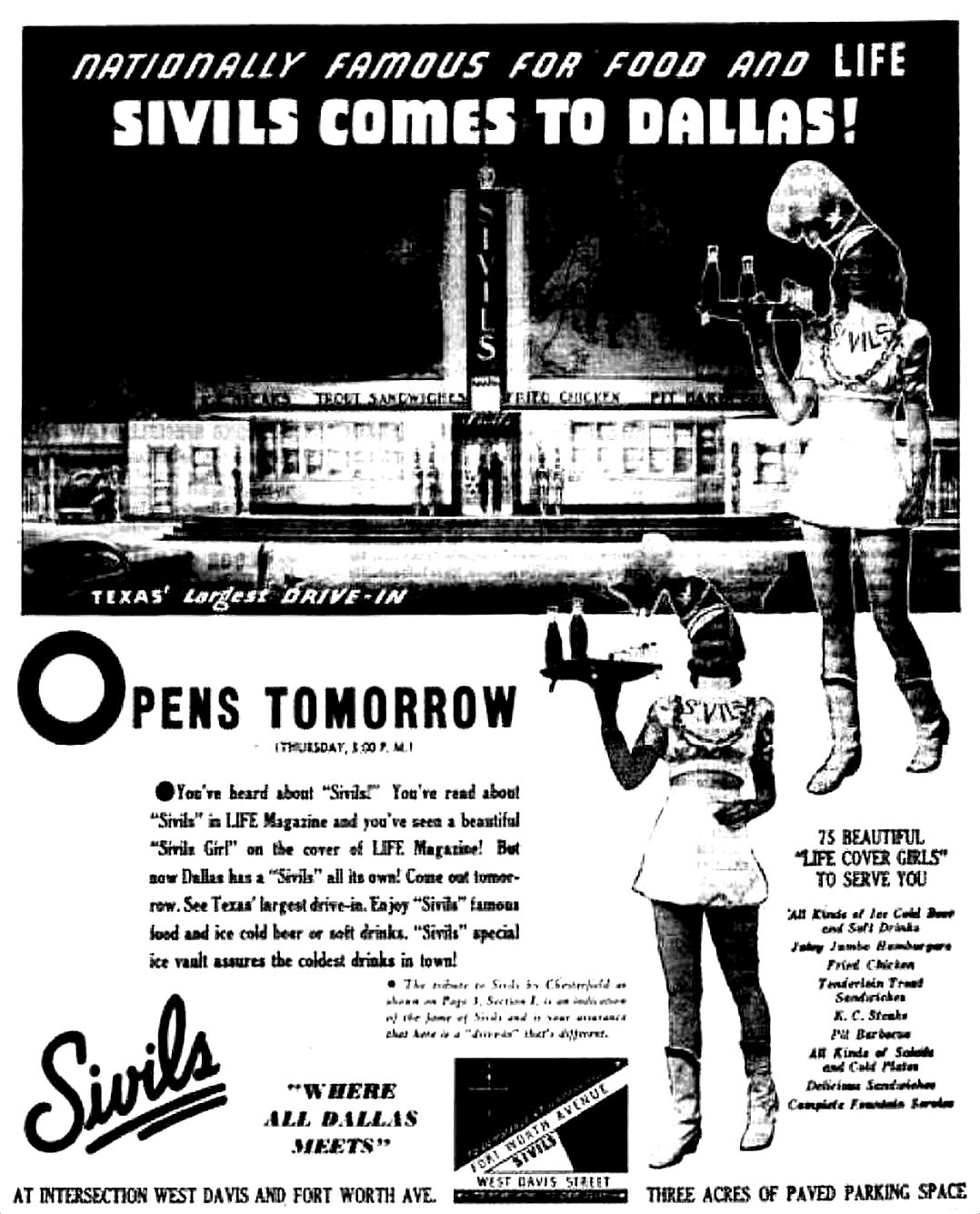
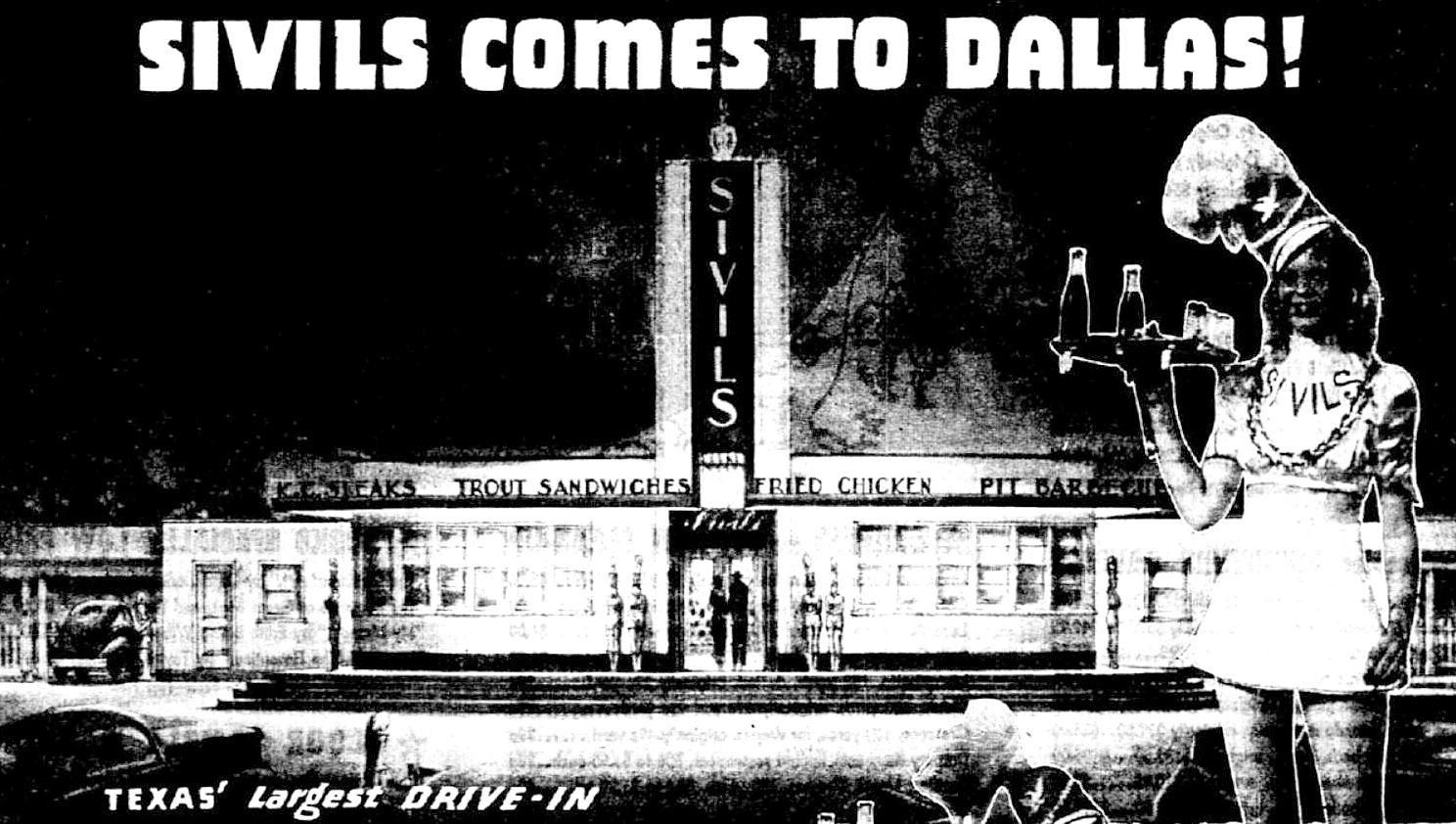
Sivils didn’t quietly sneak into town, though. Take a look at this very large, very expensive newspaper ad, which ran the day before OC’s soon-to-be favorite hang-out opened. (Click for larger image.)

sivils_dmn_062640_lgJune 26, 1940

*

Nationally Famous for Food and LIFE
SIVILS COMES TO DALLAS!

Texas’ largest drive-in
Opens tomorrow

(Thursday 3:00 PM)

You’ve heard about “Sivils”! You’ve read about “Sivils” in LIFE Magazine and you’ve seen a beautiful “Sivils Girl” on the cover of LIFE Magazine! But now Dallas has a “Sivils” all its own! Come out tomorrow. See Texas’ largest drive-in. Enjoy “Sivils” famous food and ice cold beer or soft drinks. “Sivils” special ice vault assures the coldest drinks in town!

75 Beautiful “LIFE Cover Girls” to Serve You

All Kinds of Ice Cold Beer and Soft Drinks
Juicy Jumbo Hamburgers

Fried Chicken
Tenderloin Trout Sandwiches
K.C. Steaks
Pit Barbecue
All Kinds of Salads and Cold Plates
Delicious Sandwiches
Complete Fountain Service

Sivils – “Where All Dallas Meets”
At intersection West Davis and Fort Worth Ave.
Three Acres of Paved Parking Space

*

100-150 “curb girls” were employed by Sivils at any given time in those early days, and it was open 24 hours a day. The place was hopping. Sounds fantastic. Wish I’d seen it.

sivils_matchbook_coltera-flickrvia Flickr

sivils_carhop_postcard_ebay
eBay

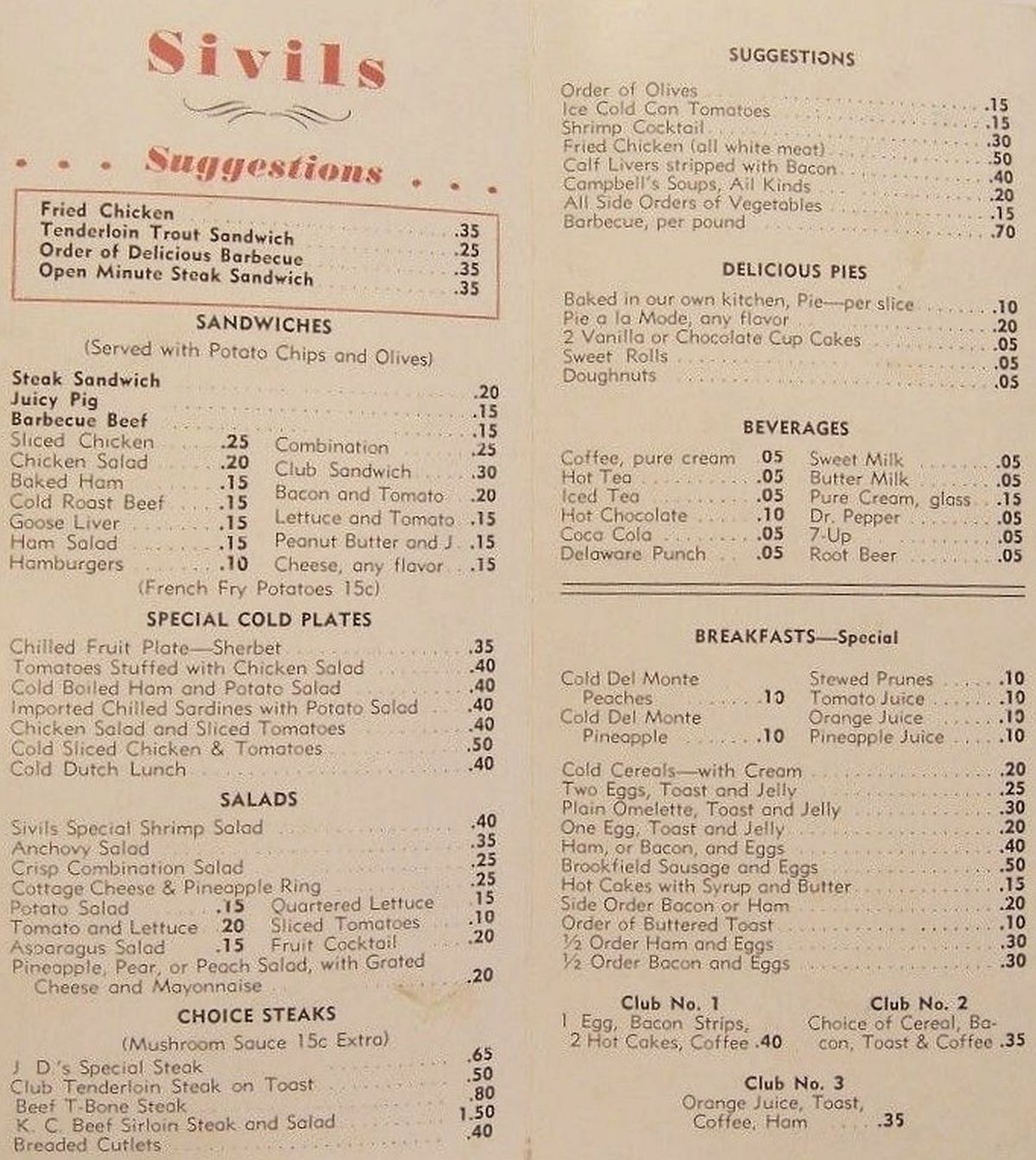
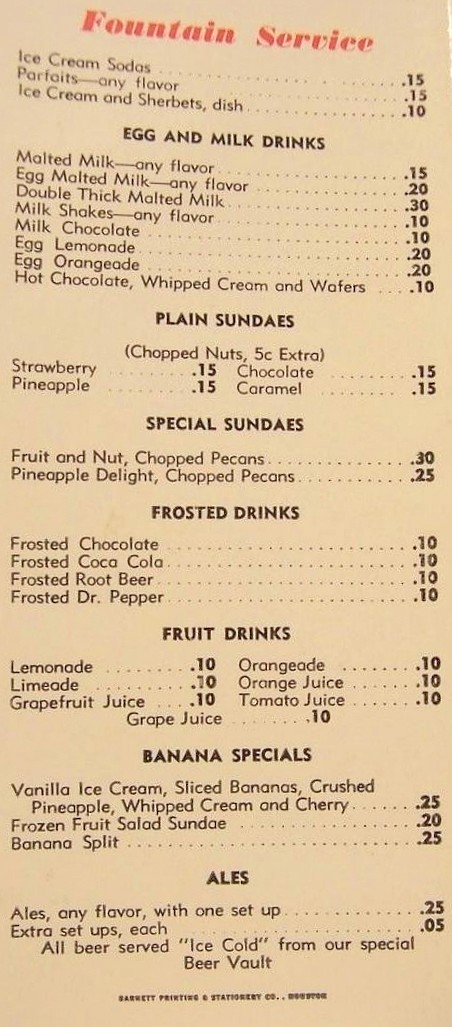
Below, a scanned menu (click to see larger images):

sivils-menu_1940s_ebay_cover

sivils-menu_1940s_ebay_b

sivils-menu_1940s_ebay_avia eBay

***

Sources & Notes

Top postcard from the Boston Public Library Tichnor Brothers Postcard Collection on Flickr, here.

Read the 4-page Life article (and see several photos of the Houston “curb girls”) here (use the magnifying glass icon at the top left to increase the size of the page).

Interesting quote from that article:“They work in 7½-hour shifts, six days a week, for which they get no pay but average $5 a day in tips.” Doesn’t sound legal…. (The Inflation Calculator tells us that $5 in 1940 money is equivalent to just over $83 in today’s money.)

Sivils closed in 1967, possibly because Mr. and Mrs. Sivils wanted to retire, but it seems more likely that Oak Cliff’s being a dry area of Dallas since the 1950s was killing its business. Check out the News article “Big Head Expected as Oak Cliff Beer Issue Foams” by Kent Biffle (DMN, Aug. 17, 1966) which appeared just months before another election in which the “drys” outvoted the “wets.” (More on Oak Cliff’s crazy wet-dry issues, here.)

J. D. Sivils was interviewed in a short documentary about Dallas carhops, filmed in the early 1970s. In it, he talks about the early days of Sivils and — best of all — there is film footage galore of the drive-in from his collection. Watch it in my previous post — “‘Carhops’ — A Short Documentary, ca. 1974” — here. (Below a screenshot of Sivils from the film.)

sivils-carhops-film

Read the article “Carhops, Curb Service, and the Pig Sandwich” by Michael Karl Witzel (Texas Highways, Oct. 2006) in a PDF, here (increase size of article with controls at top of page).

Another Flashback Dallas post on drive-in culture — “Carhops as Sex Symbols — 1940” — is here.

sivils_dmn_062640-det

Click pictures for larger images.

*

Copyright © 2015 Paula Bosse. All Rights Reserved.

Turn-of-the-Century Maple Avenue

maple-ave_colteraHope this wasn’t between McKinney & Cedar Springs…

by Paula Bosse

When the fashionable and wealthy began to move their residences north from the downtown area, they built their homes along Maple Avenue, between McKinney and about where the Stoneleigh Hotel now stands. This exclusive neighborhood of imposing houses hit its stride in the first decade of the 20th century.

One of the well-to-do families who lived on Maple at this time was that of G. B. Dealey, founding editor of The Dallas Morning News. His son Ted Dealey wrote at length about all of his boyhood neighbors in his very entertaining book, Diaper Days of Dallas. Rather ominously, though, these amusing and colorful childhood memories end with this paragraph:

I hate to write this paragraph because some people may think I had a pernicious influence on the neighborhood. But there were five men living on Maple between McKinney and Cedar Springs who committed suicide in the 1900s. Not all in one day, or one week, or one month, of course, but over a period of years.

Wow. The distance between McKinney Avenue and Cedar Springs is only two-tenths of a mile!

Beautiful houses, though!

***

Postcard from Flickr, here.

Paragraph from Diaper Days of Dallas by Ted Dealey (Nashville: Abingdon Press, 1966), p. 39.

Click postcard to see larger image.

*

Copyright © 2015 Paula Bosse. All Rights Reserved.

Six Flags’ Historical Press Bookshop — 1965

six-flags-bookshop

by Paula Bosse

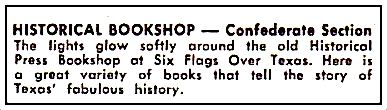
Six Flags Over Texas had a bookstore: the Historical Press Bookshop, located in the “Confederate Section.” Who knew? I was surprised when I ran across this postcard, but I figured it was a place to buy gum, film (remember film?), giant combs emblazoned with the Six Flags logo, and this very postcard. But no. It was a bookstore that sold rare Texana, including historic books, prints, and documents. At Six Flags. …Over Texas. …Land of Pink Things and Log Rides.

The description from the back of the postcard:

six-flags-bookshop_back

The store was ostensibly owned by Six Flags developer Angus Wynne, Jr., but the contents were owned by Ted W. Mayborn, wealthy petroleum trade journal publisher, writer, and Texas history aficionado. In a playful bow to having an antiquarian bookstore inside a theme park (!), he hired female family members to dress up in cowgirl outfits and brandish six-shooters in a bid to “protect” the (probably very expensive) merchandise.

I’m not really sure how this worked — or why anyone would think this was a good idea. Would one find oneself enjoying a day at Six Flags only to stumble across this unexpected cache of rare books and feel compelled to pick up a leather-bound first edition or a fragile broadside? Or would one go to Six Flags expressly to visit the bookstore and browse the stock — despite the fact that it was in an amusement park? Would one have one’s purchase shipped, or would one lug it around the park, through Casa Magnetica, past Skull Island, and into the Spelunker’s Cave?

There has to be a story behind this unusual business endeavor. Did Ted save Angus from choking one time? Did he win the franchise in a poker game?

I’m not sure how long the Historical Press Bookshop lasted. My guess? Longer than it should have.

Weirder than discovering that a bookshop was once part of the Six Flags experience was learning that Mr. Mayborn owned a real bookshop called the Red Barn Bookstore and that my father worked for him for a few months, a time my mother described as being brief but stressful. I think I can understand why.

Click pictures for larger images.

*

Copyright © 2015 Paula Bosse. All Rights Reserved.


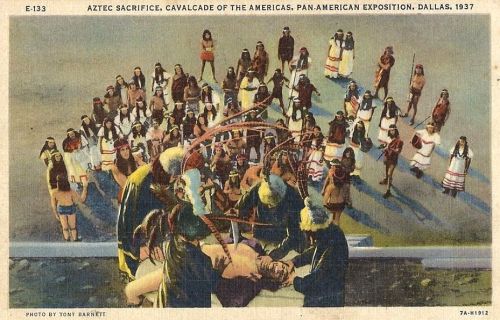
When a Virgin Sacrifice at Fair Park Almost Caused an International Incident — 1937

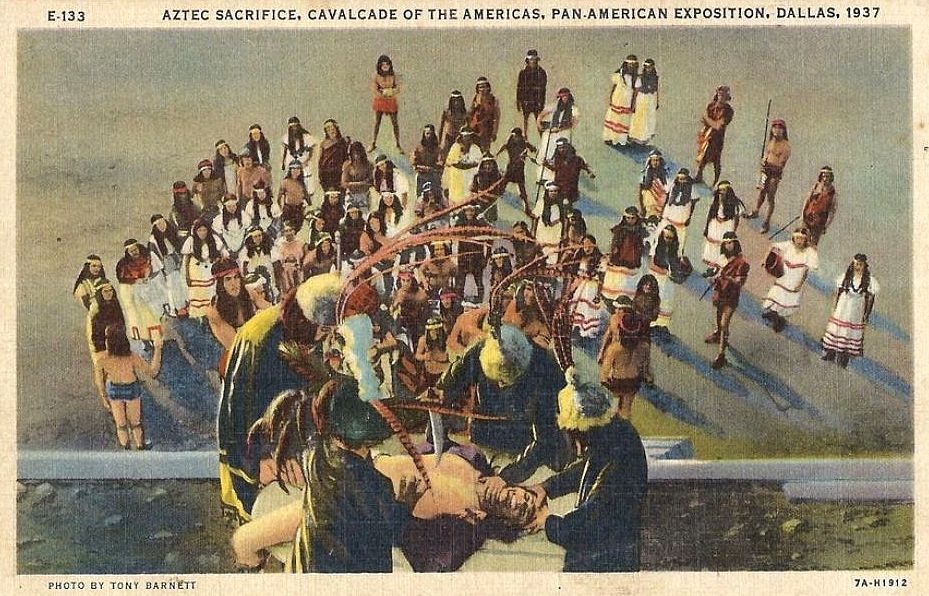
pan-american_aztec-sacrifice_colteraAztec sacrifice with a warrior, not a virgin, on the official postcard

by Paula Bosse

The Greater Texas and Pan-American Exposition at Fair Park was a four-and-a-half-month extravaganza which opened in June, 1937 as a follow-up of sorts to the previous year’s Texas Centennial Celebration. According to promotional material, its goal was to celebrate the Americas and “to promote the feeling of international goodwill between the twenty-one independent nations of the New World.” (It was also hoped that the city could rake in some more Centennial-sized cash.)

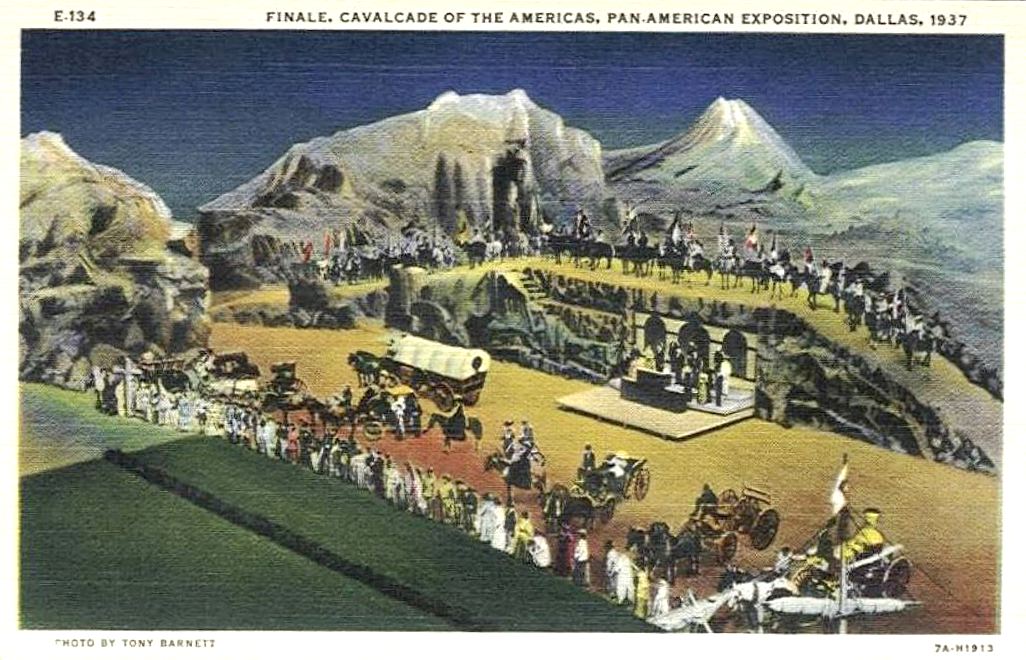
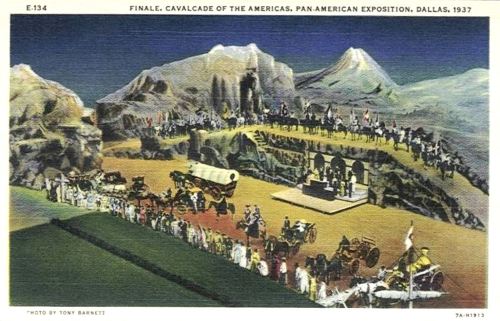
One of the biggest attractions of the Pan-American Expo was a huge production called Cavalcade of the Americas, which presented highlights from the history of Latin America and the United States. There were scenes from ancient Mexico, Columbus’ landing, the Revolutionary War, Stephen F. Austin’s arrival in Texas, the settling of the Old West, etc., right up to FDR’s participation in the Inter-American Peace Conference in Argentina in 1936. Utilizing much of the same infrastructure as the previous year’s Cavalcade of Texas, it was staged outdoors, in the old racetrack, with a 300-foot stage and elaborate scenery depicting an ocean, mountains, and a smoking volcano. Horses, wagons, “ships,” and a cast of hundreds took part in the production.
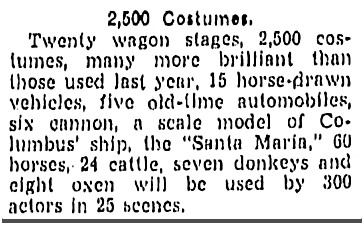
cavalcade-americas_FWST_060637Fort Worth Star-Telegram, June 6, 1937

It was quite elaborate. The postcard view below will give you an an idea of the scale of what was being billed as the world’s biggest stage.(I  believe the whole thing revolved — or at least part of it did — with another stage on the side facing away from the audience; the scenery, cast, and perhaps the donkeys, would change out before revolving to face the audience.)
cavalcade_1937

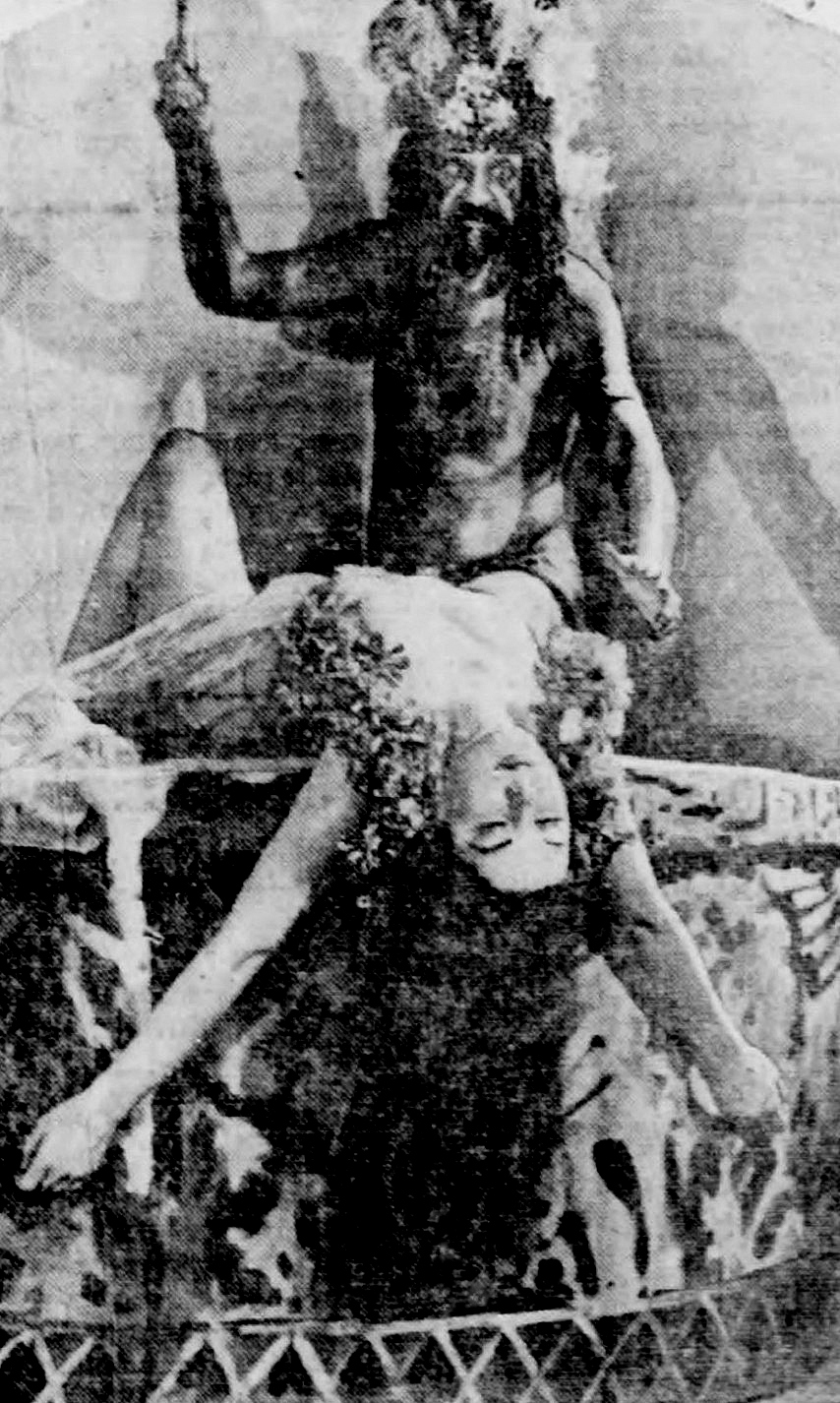
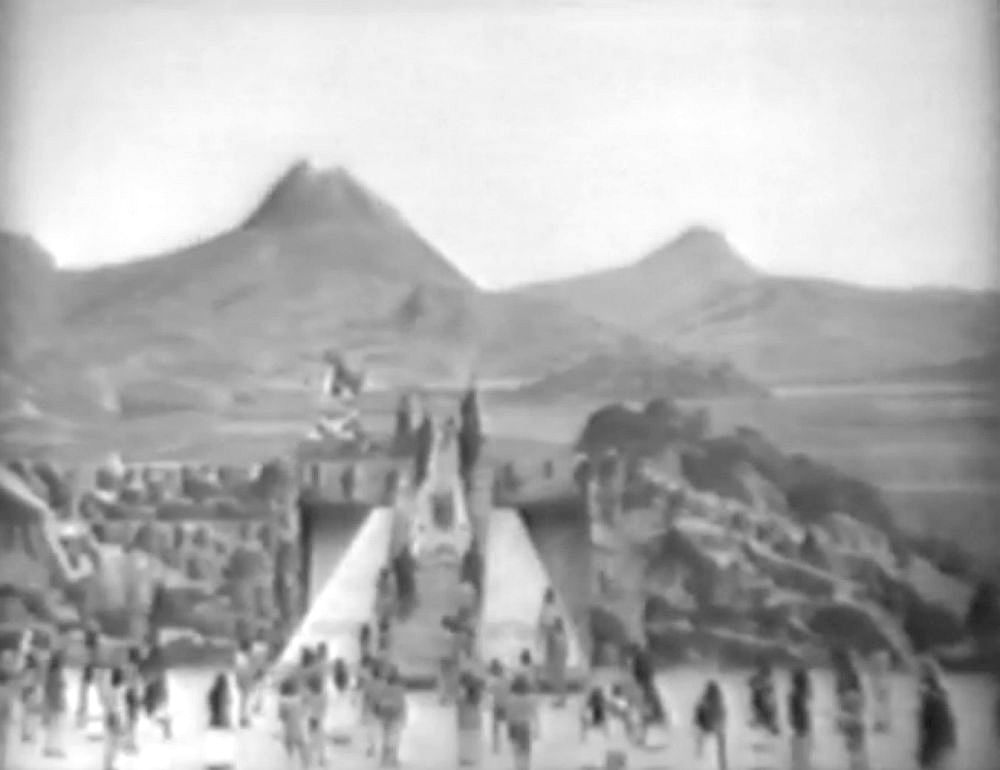
The opening scene featured an Aztec sacrifice and an angry volcano. Start big! This relatively brief portion of the show caused a lot of headaches (and/or much-welcomed publicity) for the producers, State Fair organizers, and, probably, the image-conscious Dallas Chamber of Commerce. But why? As originally written (by the remarkably prolific Jan Isbelle Fortune), the Aztec sequence involved the sacrifice of a struggling young maiden atop a blood-stained pyramid. Two months before the opening of the Expo, a rather sensationalistic photo of this historical reenactment appeared in the pages of newspapers across the country, no doubt resulting in raised eyebrows and whetted appetites. (Click to enlarge!)
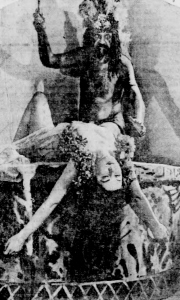
aztec_greencastle-indiana-daily-banner_080437Greencastle (Indiana) Daily Banner, 1937

The star of this scene was 17-year-old Geraldine Robertson, who had been crowned Queen of the Centennial the previous year and who played a multitude of roles in the current production, including Cortés’ “lover and interpreter,” a young woman in a Boston Massacre scene, Martha Washington, and the wife of Jim Bowie. Here she is in real life in 1936, with Jean Harlow platinum-blonde hair, posing for one of a seemingly endless number of publicity photos.
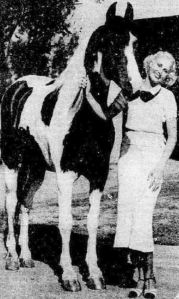
robertson-geraldine_queen-of-centennial_1936Geraldine Robertson, 1936

And the thing that caused so much trouble? Probably not what you would assume.

Before the Exposition opened, the Dallas-based Mexican Consul, Adolfo G. Dominguez, became aware of this casting choice. And that was when the mierda probably first hit the ventilador. Dominguez was adamant that the virgin be replaced with the more historically accurate male warrior. He probably said much the same thing to the Cavalcade producers when confronting them about his concerns before the Expo began as he did when he said this in a Dallas News article on the topic weeks later:

“We Mexicans feel that use of a girl in the role can bring nothing but racial prejudice and misconception of the true meaning of the Aztec human sacrifice as it was performed, not thousands of years ago, as has been wrongly represented, but as late as 1521.” (DMN, July 28, 1937)

The producers acquiesced, and when the Exposition began its run on June 12, 1937, the opening scene of the Cavalcade did, in fact, feature a sacrificial warrior. But on Sunday, July 25, the producer of the extravaganza brought the scantily-clad virgin back and nixed the warrior, hoping the added sex appeal and pizzazz would increase audience numbers. (Interestingly, when the Exposition opened, tickets to Cavalcade of the Americas cost 50⊄ — about $8.00 in today’s money — but on July 18, it was announced that, except for 600 reserved seats, admission to the show would be free. Promoters said this was being offered as a gesture of goodwill to Expo visitors, but one wonders if they weren’t having a hard time filling the 3100-seat grandstand.)

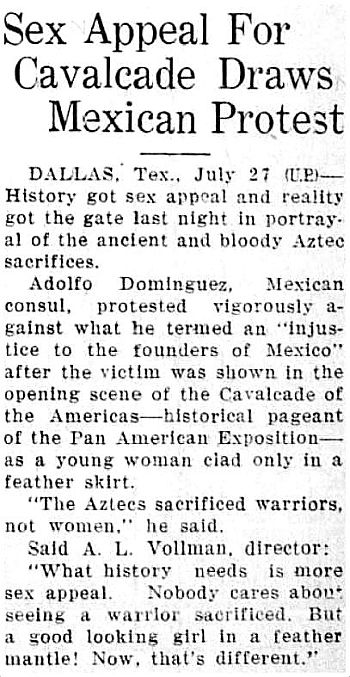
Señor Dominguez was not amused by this sexed-up revamping and protested. A. L. Vollman, the Cavalcade’s producer-director pooh-poohed the diplomat’s protestations and responded in true impresario fashion: “What history needs is more sex appeal.” That didn’t go over particularly well with the consul, who thought he’d already dealt with the problem weeks before. (Click to see larger image.)
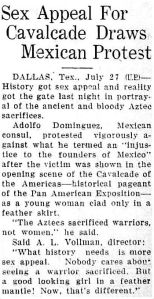
aztec_waxahachie-daily-light_072737Waxahachie Daily Light, July 27, 1937

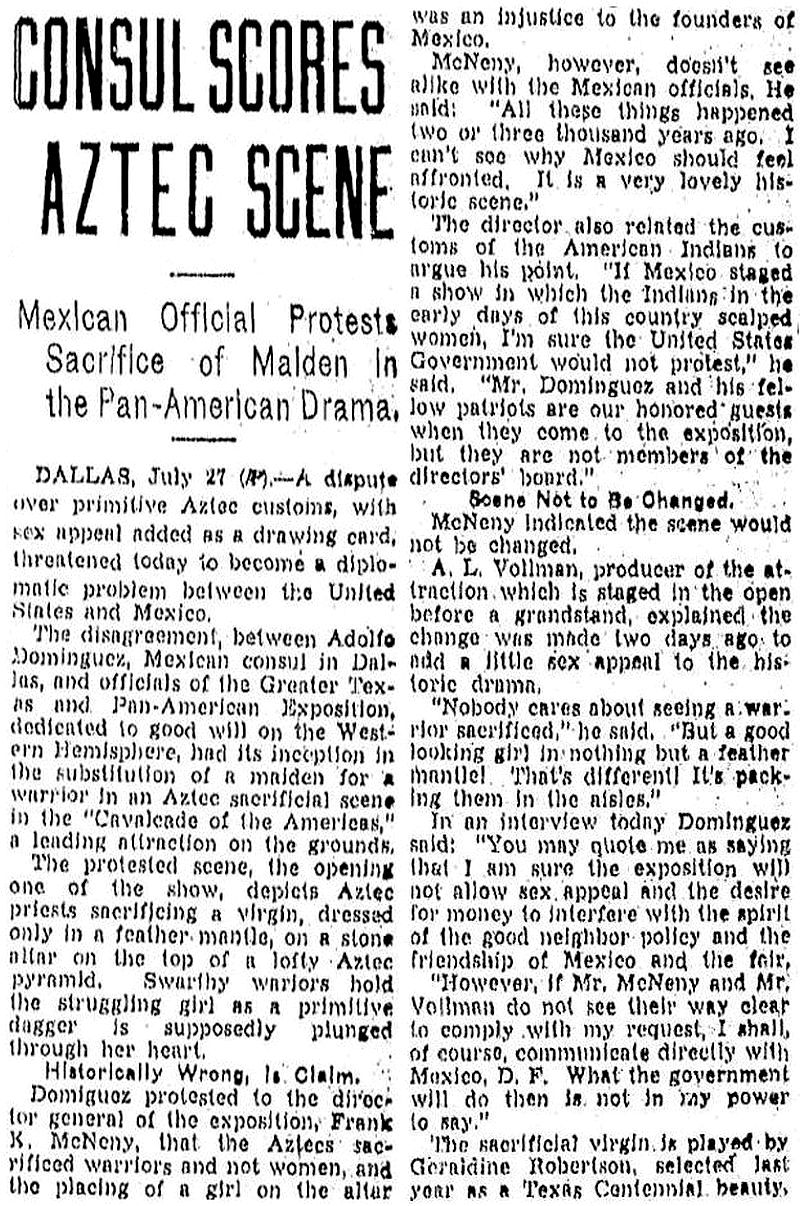
Dominguez complained to Frank K. McNeny, Director General of the Exposition, saying that the scene was historically inaccurate and was an injustice to the founders of Mexico. McNeny disagreed, saying that the scene involving the plunging of a dagger into the breast of a sacrificial virgin was “a very lovely historic scene.” He declined to bring back the warrior, because, as Vollman noted, the revamping had increased attendance: “It’s packing them in the aisles.” An exasperated Dominguez said that if the change from maiden back to warrior was not made, he would take the matter to the Mexican government.
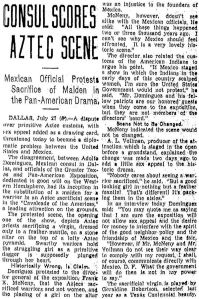
aztec_FWST_072837FWST, July 28, 1937

At this point, a disagreement over the gender of a character in what was, basically, an oversized school history pageant was dangerously close to setting off an international incident. It was also causing embarrassment for local civic leaders who were looking upon the Exposition as a major marketing tool for the city as well as a symbolic display of Pan-American solidarity and goodwill. Can’t we all just get along, amigo?

The refusal of the Cavalcade to UN-revamp the show did not deter the Mexican Consul who, by now, was probably more het-up than ever. Dominguez decided to go over McNeny’s head. He pulled out the written agreement he had made with fair officials back in the spring — which clearly stated that a male warrior and NOT a young woman would feature in the theatrical human sacrifice — and he took it to the top man, State Fair president Fred F. Florence. Florence discussed the matter with his board of directors who voted “to a man” to uphold the original agreement.

The warrior would be reinstated as the writhing victim on the bloody sacrificial stone. The sexy maiden would have to hand over the 30-foot-long robe, which had been made from 9,000 feathers and which had trailed behind her as she was carried up the great pyramid at Tenochtitlán. The actor playing the warrior was probably happy to get back in the spotlight. Geraldine Robertson, the virgin who had trailed that robe, was relegated to a role as a daughter of Montezuma.

Presumably the dagger kept plunging into the flailing warrior’s heart twice nightly for the remainder of the show’s run, and the memory of that short-lived international squabble was quickly forgotten (…until now).

And they all lived happily ever after. / Vieron felices por siempre.
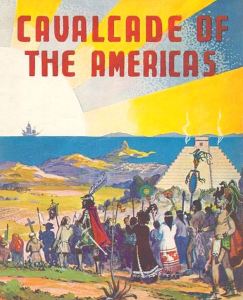
panamerican_cavalcade_watermelon-kid

*

Hey! If you’ve read this far, here’s a little reward. A Universal Newsreel titled “Pan-American Exposition Is Opened For 1937, Dallas, Tex.” — which contains 20 whole seconds of the Aztec (warrior) scene!  — can be viewed on the T.A.M.I. (Texas Archive of the Moving Image) site, HERE. The entire short newsreel is interesting (sadly, it has no sound), but if you want to jump to the sacrifice scene, it begins at the :49 mark. (If you’re watching on your desktop, make sure to click the little square just to the left of the speaker icon beneath the viewing area to watch it full-screen.
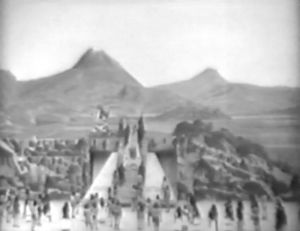
aztec_newsreelSuper-grainy screenshot from the Universal newsreel, 1937

***

Sources & Notes

Postcards of the Pan-American Exposition are from “the internet.”

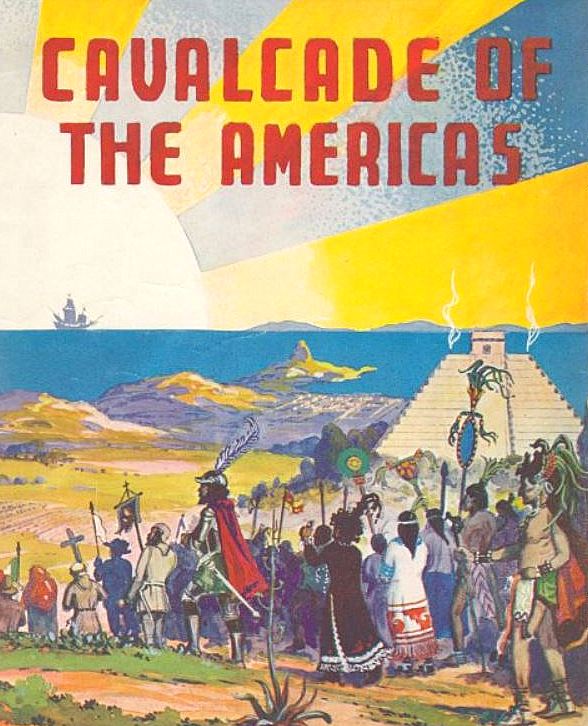
Color souvenir program image from the Watermelon Kid site; background on the Pan-American Exposition can be found on the same site, here.

All other clippings as noted.

Related Dallas Morning News articles:

  • “As Sacrificial Virgin, Star of Cavalcade Put In Showy Opening Act” (DMN, July 26, 1937)
  • “Cavalcade Dispute Is Won by Consul As Virgin Is Replaced” (DMN, July 28, 1937)

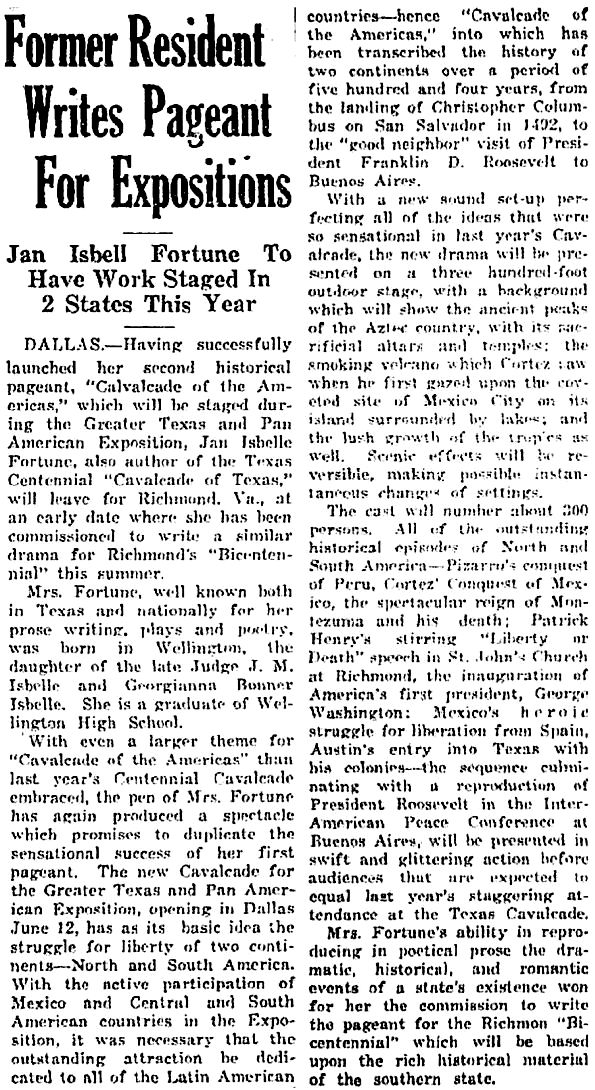
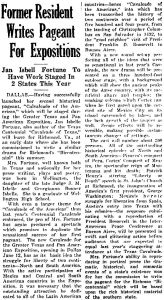
Below, an interview with Jan Fortune on her Cavalcade of the Americas; it appeared in her hometown newspaper, The Wellington (Texas) Leader on March 18, 1937. She also wrote the Centennial’s big production, Cavalcade of Texas, the previous year, in 1936.
jan-isbell-fortune_wellington-tx-leader_031837

And, speaking of Aztec human sacrifices in DFW (a phrase I don’t believe I’ve ever written…), the following tidbit was contained in an article about Six Flags Over Texas’ 1970 season.
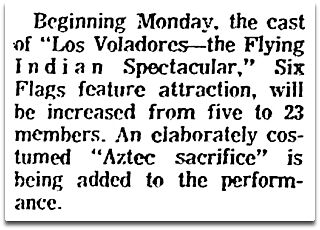
aztec_FWST_052170-six-flagsFWST, May 21, 1970

Promotional material about Los Voladores — a group of aerialists from Mexico — informs us that in their show “a beautiful maiden’s life is given as tribute to Tlaloc, the rain god.” Those beautiful maidens can’t catch a break. Sorry, Adolfo.

*

Copyright © 2015 Paula Bosse. All Rights Reserved.

Stacy’s Lounge on The Miracle Mile — 1950

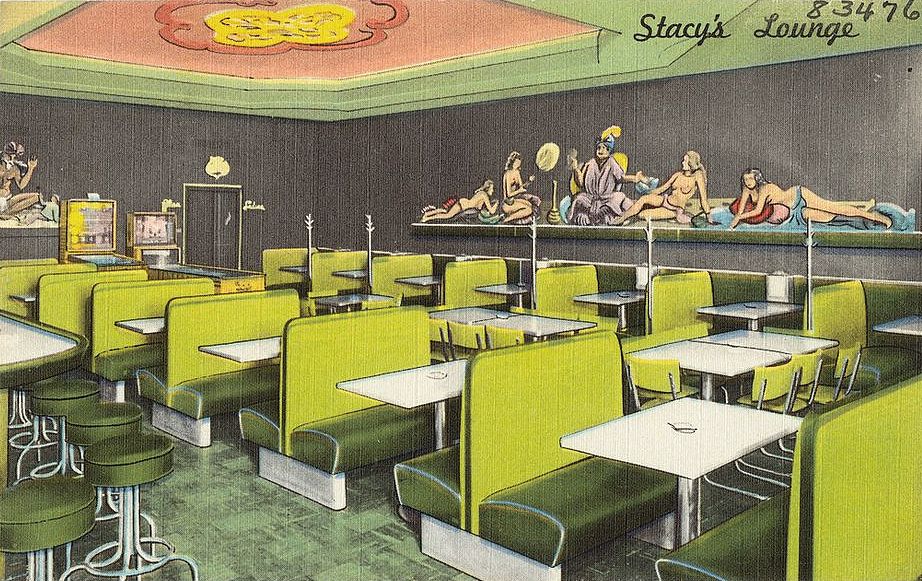
stacys-loungeStacy’s has it all: murals, pinball, ashtrays

by Paula Bosse

Today: a quick look back at a short-lived bar, Stacy’s Lounge, once located along the famed Miracle Mile. Actually, this postcard may be about all that remains from what was, apparently, a fairly short-lived drinking establishment.

stacys-lounge_1951-dirctry1951 Dallas directory

The above line is from the 1951 city directory, but that listing appears to have been published posthumously. By November of 1950, Stacy’s space at 5721 West Lovers Lane had been taken over by another bar called The Magic Lounge (later the Magic Grille/Herb’s Magic Grill).

Stacy — whomever he or she was — was not afraid of color and decor. I mean … for one thing … those murals. The exotic scenes featuring bare-breasted women, men in turbans, and, I think, a cobra are a little unexpected. They’re either great or awful. Patrons in 1950 might have thought they were awful when they walked in, but by closing time, they probably thought they were … slightly less awful. And the colors! They’ve obviously been pumped up for the postcard, but I’m sure the two-toned green vinyl (great booths!) and the pink and yellow molded and recessed ceiling were attention-grabbing. Imagine it crowded, dark, smoky, and loud. I’ve been in old bars that kind of look like this, just grungier, scuffed up, and sagging. This is pretty much what your favorite dive bar looked like when it was new and shiny. (I just realized I’ve never seen a vintage postcard with a pinball machine in it. And a jukebox. And a cartoon Indian fakir. I’ve hit the trifecta!)

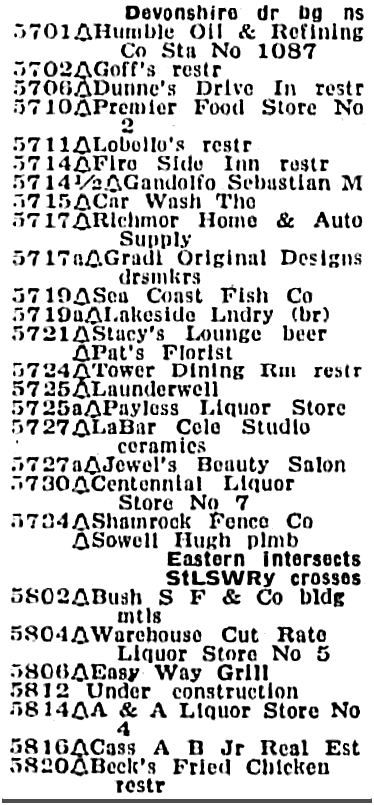
So what other businesses filled that block of Lovers in 1950-51? (Click for larger image.)

stacys-lounge_1951-directory_block1951 city directory

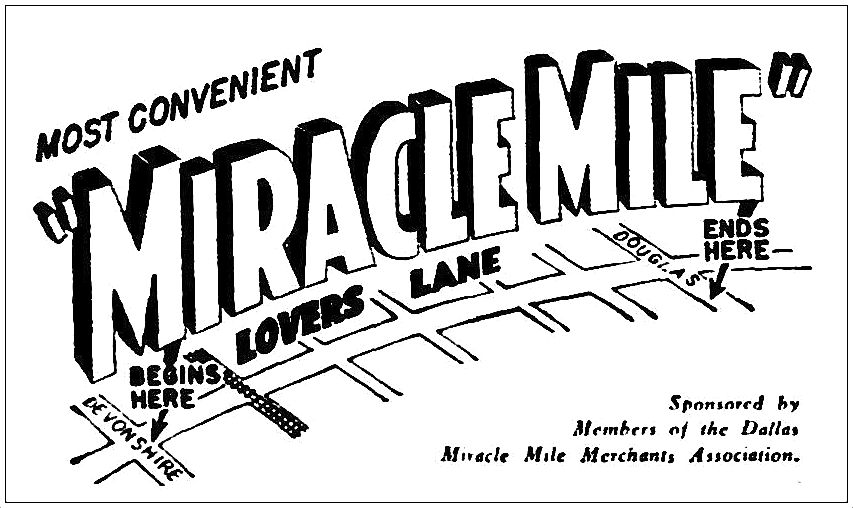
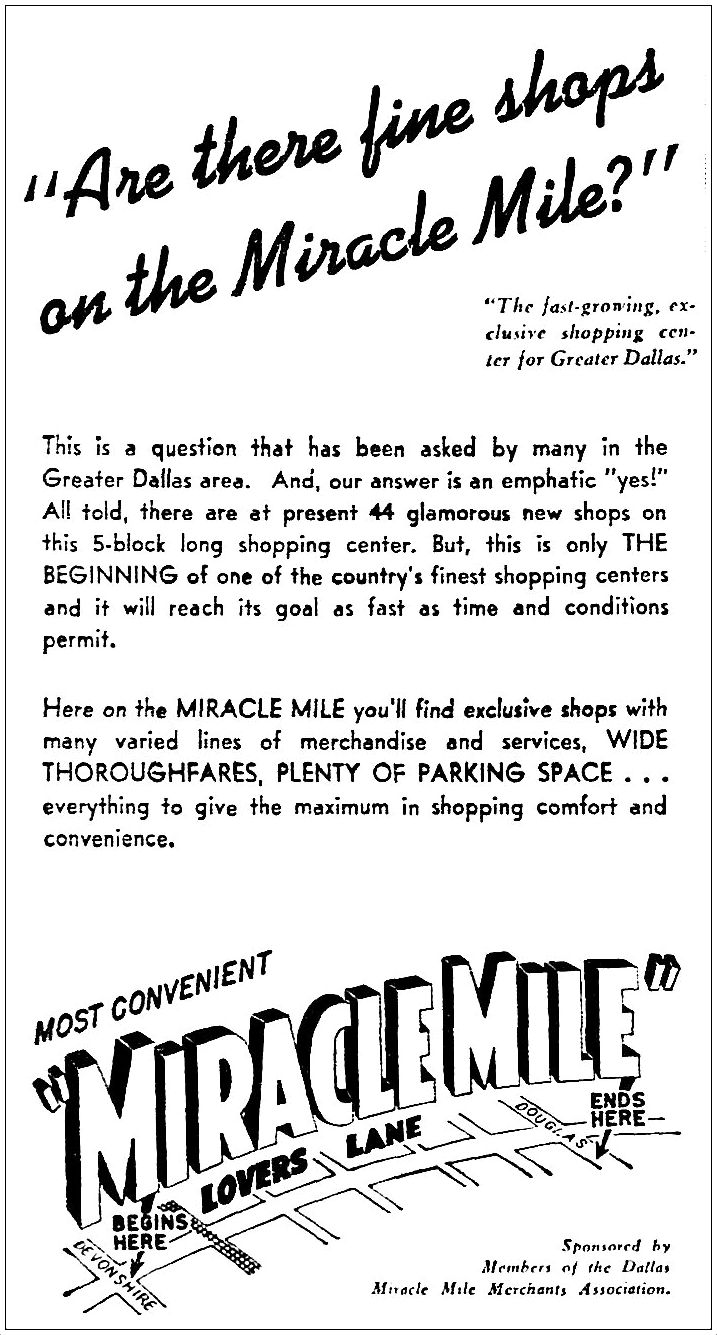
Speaking of The Miracle Mile (you don’t really hear people referring to the Miracle Mile anymore, do you?), when the name of the shopping area debuted in 1947, the official boundaries were Devonshire on the west and Douglas on the east. Some people insist it goes all the way down to the Inwood Theater. This rather adamant Dallas Miracle Mile Merchants Association advertisement illustration would disagree with that notion.

miracle-mile-merchants-assn_ad_april-1947_det

miracle-mile-merchants-assn_ad_april-1947
April, 1947

I’m still not sure why it was called the Miracle Mile, unless it had something to do with the price of real estate. Part of it was in Dallas (the couple of blocks west of what was the St. Louis and Southwestern/Cotton Belt railroad — now the tollway), and part of it was in University Park. (And I suppose still is.) Most of the bars and restaurants were in the Dallas portion, because University Park was dry. Another notable thing about Lovers Lane is that the address numbering is a crazy mess — there’s West Lovers Lane, Lovers Lane, and East Lovers Lane, and every time you pass from one stretch to the next, the abrupt address-changes will make your head spin. (I had no idea it was so crazy until I read Helen Bullock’s very informative and entertaining article about the Miracle Mile in a Sept. 10, 1961 article in The Dallas Morning News, “Walk a Miracle Mile.”)

But back to Stacy — I never actually discovered who Stacy was. Oh well. The particulars of Stacy’s Lounge may be lost to history, but the image of its colorful interior lives on in a 65-year-old garishly-colored postcard.

***

Sources & Notes

Postcard is from the great Boston Public Library Tichnor Brothers Postcard Collection on Flickr, here. I dip into the collection now and again to see what I can find out about those arresting and unreal-looking images — see those past posts here.

Currently at the old Stacy’s Lounge address (though in a newer building) is the Nicholson-Hardie Nursery & Garden Center; the location on a map is here.

You might even say that Stacy’s Lounge has got it going on. Do you have this song going through your head like I do? That’s going to be hard to get out of there.

*

Copyright © 2015 Paula Bosse. All Rights Reserved.
Elm Street at Night, Coming & Going — 1950s

elm-st-night_ebayHave a sudden hankering for a fistful of roasted peanuts?

by Paula Bosse

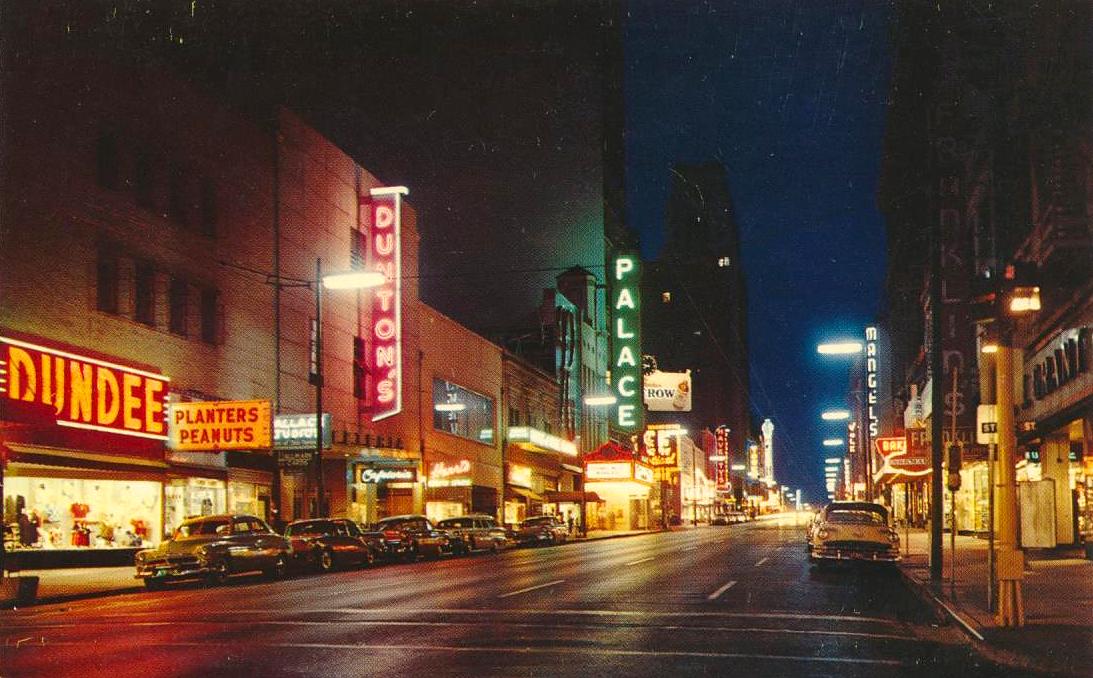
Two postcards from the Fabulous Fifties showing Dallas’ Theater Row, lit up at night — one looking east (above), and one looking west (below).

The top view — taken from about Stone — was probably taken in the early- to mid-’50s. (See the same view today, here.) The following Elm Street businesses — all of which can be seen in this postcard — were listed in the 1953 city directory:

1602 Elm — W. T. Grant (dept. store)
1605 — Dundee Smart Clothes
1607 — Planters Peanuts (This place fascinates me!)
1607a — Wallace Studios (photography studio)
1609 — Dunton’s Cafeteria
1610 — Franklin’s (women’s clothing)
1613 — Henri’s Hollywood Beauty Studio
1614 — Baker’s Shoes
1623 — Palace Theatre

ERVAY crosses
1700 — Mangel’s (women’s clothing)
1705 — Lee Optical
1713 — Haverty’s (furniture)
1806 — Volk Bros. (dept. store)

ST. PAUL crosses
1907 — Tower Theatre
1911 — Melba Theatre (barely visible)
1921 — Majestic Theatre

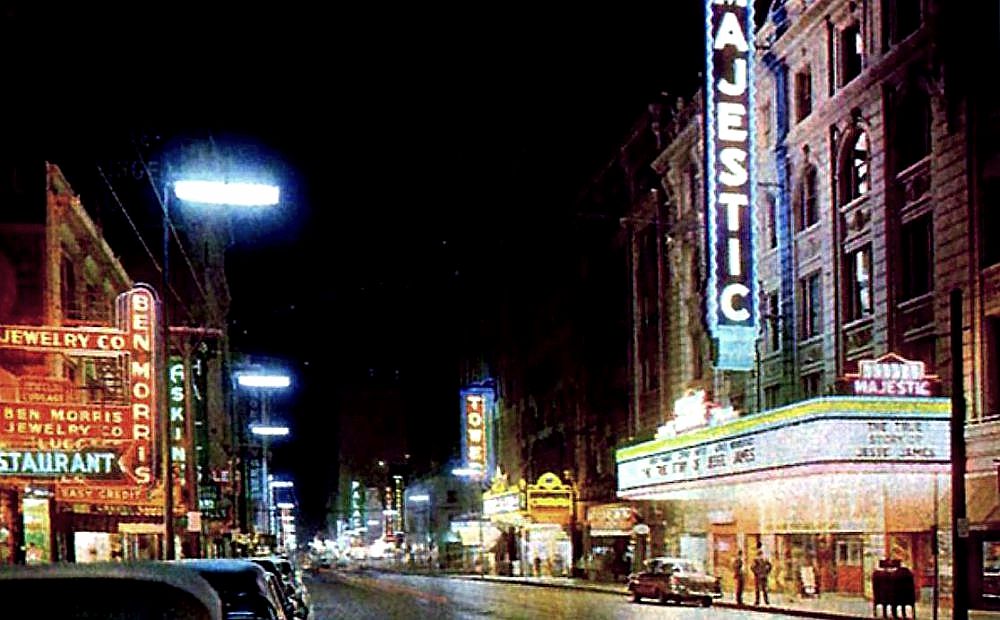
Here’s Elm looking west, taken at about North Harwood. (See the same view today, here.) The movie playing at the Majestic, “The True Story of Jesse James,” was released in February, 1957.

elm-street-night_ca1957

The businesses seen here, on the south side of the street:

1918 Elm — Hall’s Credit Clothiers
1922 — Askin’s Credit Clothing Store
1924 — Ben Morris Jewelry
1926 — Majestic Cafe (*possibly* — I’m not sure if it was there in 1958)

In all my wanderings through photos of old Dallas, my biggest regret is that I never experienced downtown-Dallas movie-going in the 1930s, 1940s, and 1950s. Mr. Peanut, we hardly knew ye (or in my case, I never knew ye).

***

Sources & Notes

Top postcard from eBay.

Second postcard from the Billy Holcomb Collection, found on Cinema Treasures here. (If anyone has a better image of this, let me know!)

The thought of buying warm, just-roasted nuts on the sidewalk of a busy downtown street makes me feel all nostalgic for something I’ve never actually experienced. It looks like the Planters Peanut shop was in a couple of different locations before it moved to the one seen above at 1607 Elm — first at 1519 Main (in about 1929), and then the 1500 block of Elm, next to Cullum & Boren (from 1931). Read a few memories of this Elm Street shop here; and see photos of a shop still operating in Memphis, here.

*

Copyright © 2015 Paula Bosse. All Rights Reserved.

Waking Up Every Day To an Unimpeded View of Lake Cliff Park

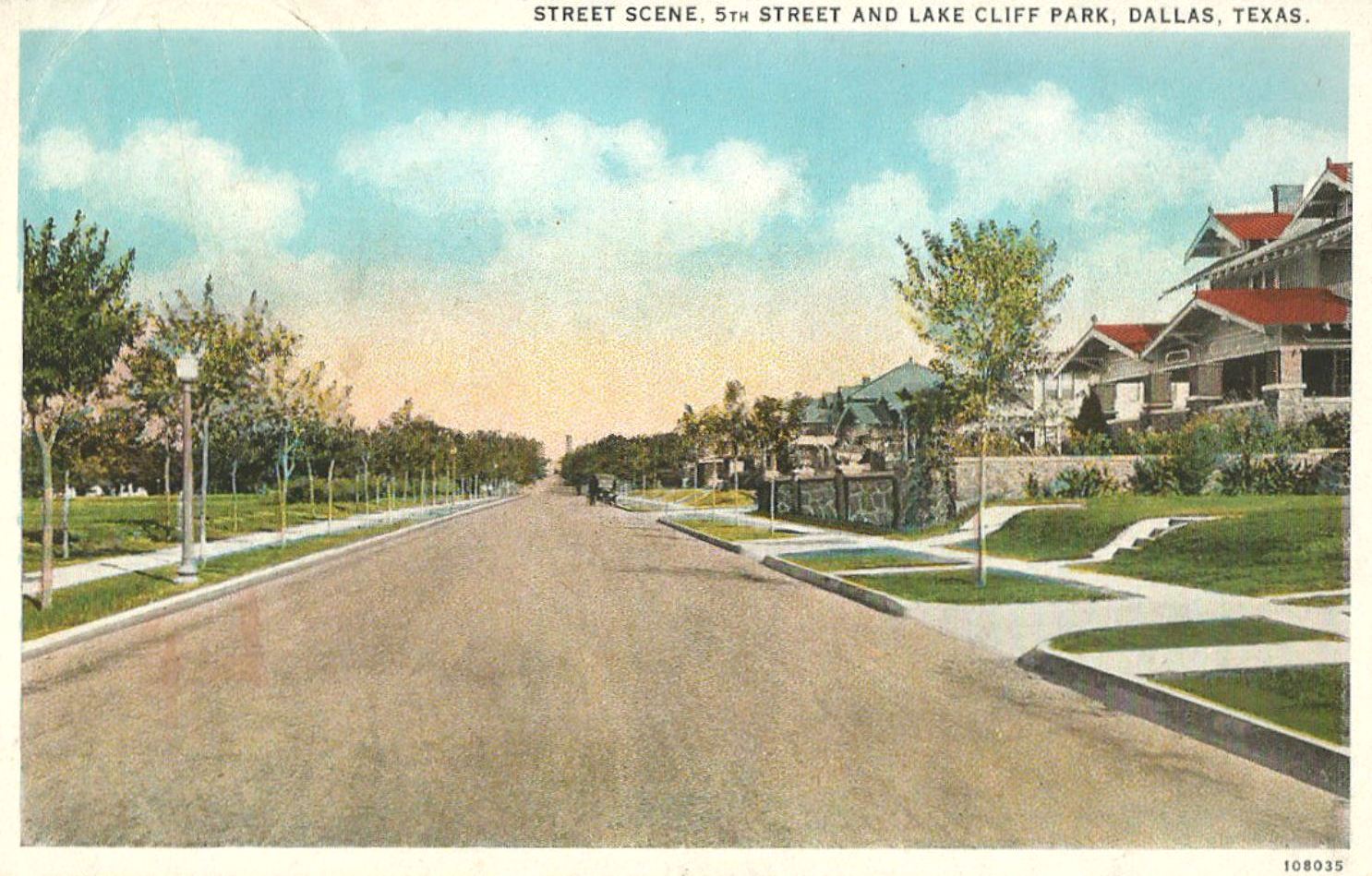
oak-cliff_5th-street_lake-cliff-park_ebayThe red-roofed Frank Rogers house, E. Fifth & N. Denver, Oak Cliff

by Paula Bosse

I saw this postcard of a row of houses on East Fifth Street in Oak Cliff and wondered if the house with the red roof and the low stone wall was still standing. Happily, it is. With a little digging, I discovered that the house at 320 E. Fifth Street was built in 1922 or very, very early 1923 for Frank Rogers, one of Dallas’ top photographers. A photographer would want to live with a beautiful view, and he certainly had it there — Lake Cliff Park was right across the street. (The artist Frank Reaugh also lived on East Fifth, a block or two to the west.) Frank Rogers (1878-1961) lived in the house he built at the corner of East Fifth and North Denver until his death at the age of 82.

It appears that Rogers bought the property in the survey area known as Robinson’s Park Place in December of 1920 for $8,000. The address does not exist until his house is built — it shows up for the first time in the 1923 city directory. The 1922 Sanborn map (see it here) shows the corner lot empty — as well as most of the rest of the lots along East Fifth between North Crawford and North Denver.

Here are a few bits and pieces of random information from a search on the address. In 1933, Rogers’ German Shepherd got loose. That park would have been an absolute paradise for a dog on the lam.

roger_dmn_090233Sept. 2, 1933

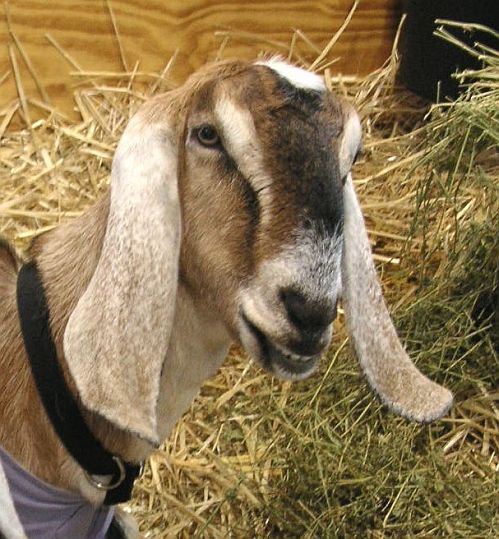
And in 1936, for some reason Rogers was selling a “Nubian milch goat,” a friendly source of milk which was, presumably, kept on the property. Was it being sold at the behest of neighbors? The publication Milch Goat Dairy (1917) informs us that “no member of the goat family is more peaceful or gentle than the Nubian, and while the bucks of this breed have the same odor that all goat bucks have, the odor is far less in this breed.” Still. The other well-heeled neighbors might have had a few goat-related issues.

320_dmn_111736-goatNov. 17, 1936

Nubian goat! (Wikipedia)

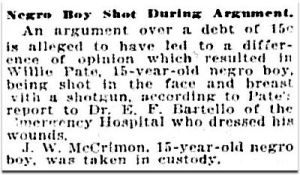
There was a room or small apartment at the rear of the house, and directories show that (at least through the ’20s) there was an ever-changing roster of lodgers who lived there — every year a different name was listed. They were most likely employees. In 1929, the occupant was J. W. McCrimon/McCrimmon, who may have been the same person who, as a minor in 1922, was accused of wounding another minor with a shotgun.

mccrimon_dmn_082922Dallas Morning News, Aug. 29, 1922

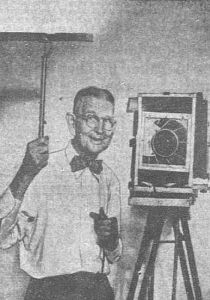
Frank Rogers began his career as a newspaper photographer who later ran his own photography studio with his son, Norman. He preferred commercial jobs to bread-and-butter studio portraiture, though he did both. Whatever kind of job he was doing, he preferred to use flash powder when he could, a practice which caused several injuries (and even fires!) over the years.

A news article in 1945 described one such incident: during a commissioned job in which he was taking hundreds of employee photographs for a large company, his flash-powder gun exploded and he was “seriously burned on the hands and face. His spectacles, physicians told him, probably saved his eyesight” (DMN, Feb. 10, 1945).

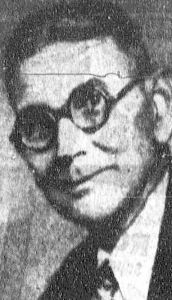
And here he is in those spectacles:

rogers-frank_portrait

Here’s another photo of the happy-looking photographer, posing with his camera and the potentially incendiary accoutrement.

rogers-frank_at-work_ca-1950s

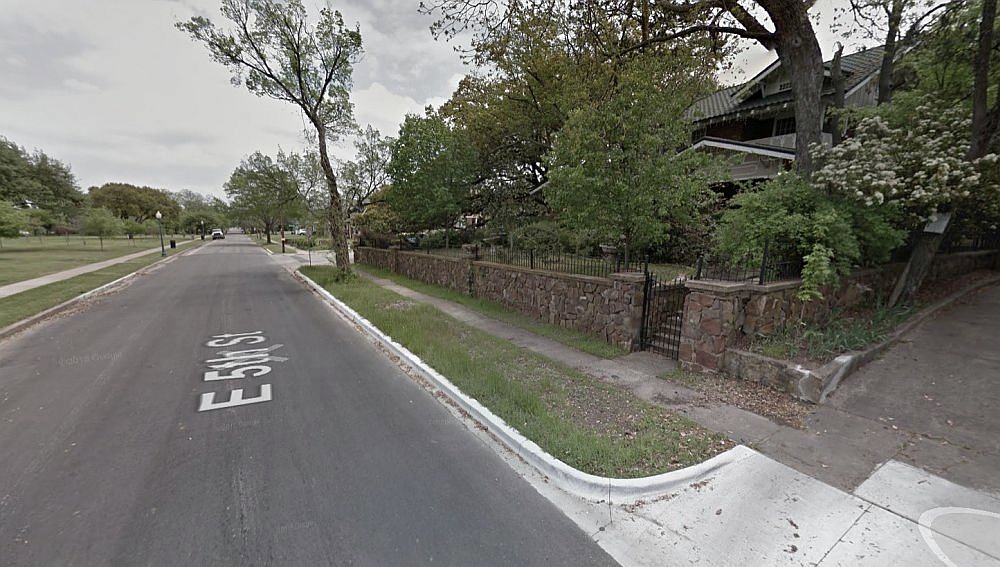
But back to the house. Here it is today.

rogers-house_googleGoogle Street View

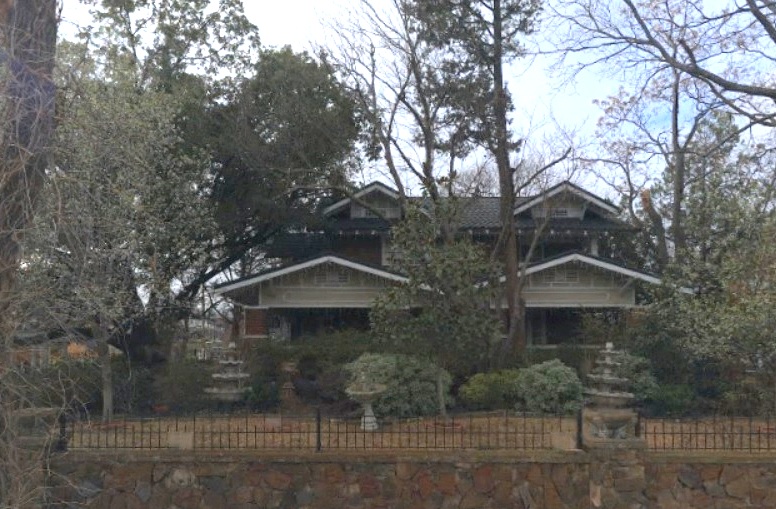
And another view, this time with the front of the house visible.

rogers-house_bingBing StreetSide

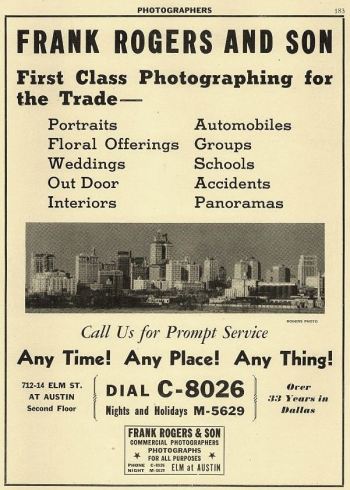
If I had access to flash powder, I’d go out today and take an extremely well-lit photo of an old Dallas building (and hope I’d survive the experience) — as a nod to Frank Rogers, his cool house, and all the wonderful photos of Dallas he took in the first half of the 20th century. Thanks, Frank!

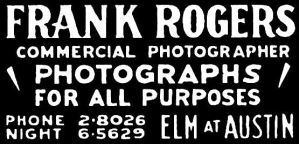
rogers-frank_ad_dallas-directory_1944-45
Frank Rogers and Son ad, 1944-45 Dallas directory

rogers-frank_1936-directory1936 Dallas directory

***

Sources & Notes

Postcard is from eBay.

Frank Rogers was a busy man. If you’re interested in Dallas history (and I’m guessing you are if you’re reading a Dallas history blog), you’ve probably seen dozens and dozens (and dozens) of his photos without even knowing it. The Frank Rogers Collection is housed at the Dallas Public Library. I’ve used a few of his photos in previous posts — one of my favorites is his view of the Akard Street Canyon, here.

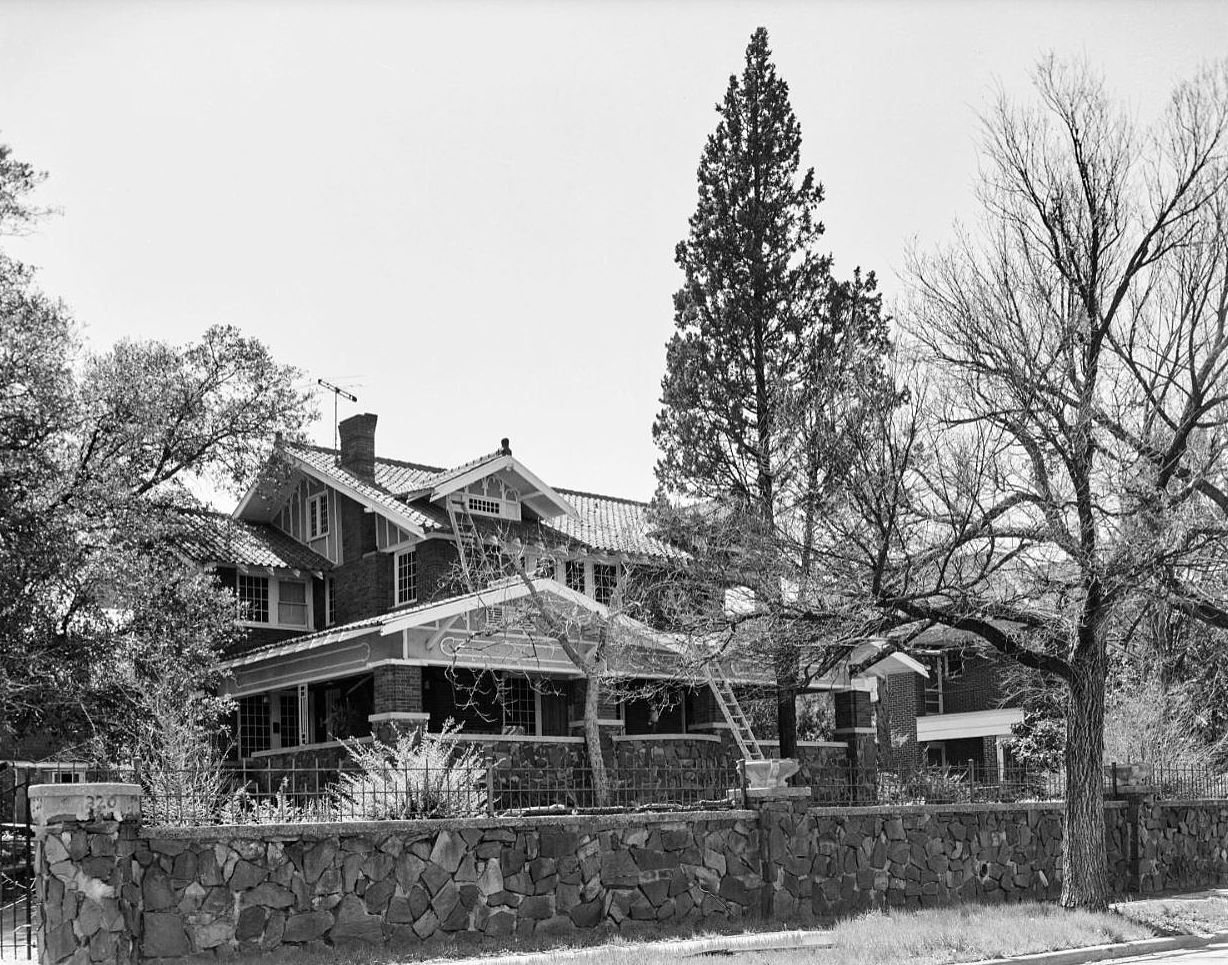
Another photo of the house can be seen in the 1980 photo below, from the Texas Historical Commission Historical Resources Survey, via the Portal to Texas History, here.

rogers-frank_home_320-east-fifth_oak-cliff_portal_1980

Take a tour of the Lake Cliff Park area via Google Street View, here.

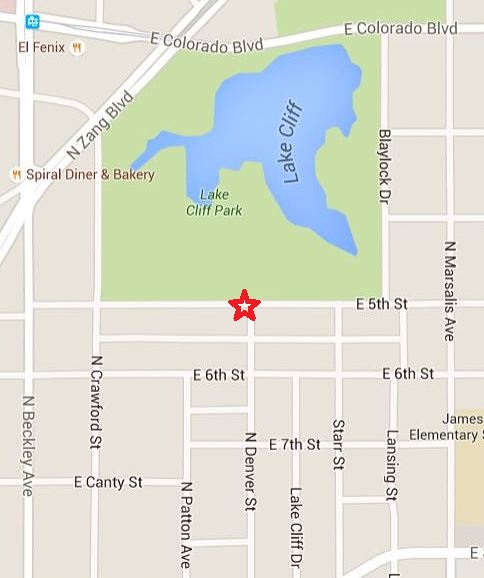
And finally, here’s where Frank’s house is, marked in red.

rogers-house_googleGoogle Maps

*

Copyright © 2015 Paula Bosse. All Rights Reserved.

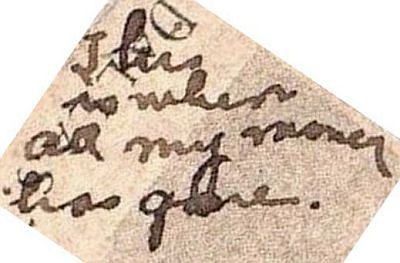
The State Fair of Texas: “This Is Where All My Money Has Gone”

state-fair_ebay

by Paula Bosse

Today is the last day of the fair. If you haven’t been yet, you should go! Have fun — and watch your moolah drain from your wallet at an alarming rate. It’s a tradition!

state-fair_money

***

Postcard from eBay. Click it to see a REALLY  BIG image!

*

Copyright © 2015 Paula Bosse. All Rights Reserved.