Flashback : Dallas

A Miscellany: History, Ads, Pop Culture

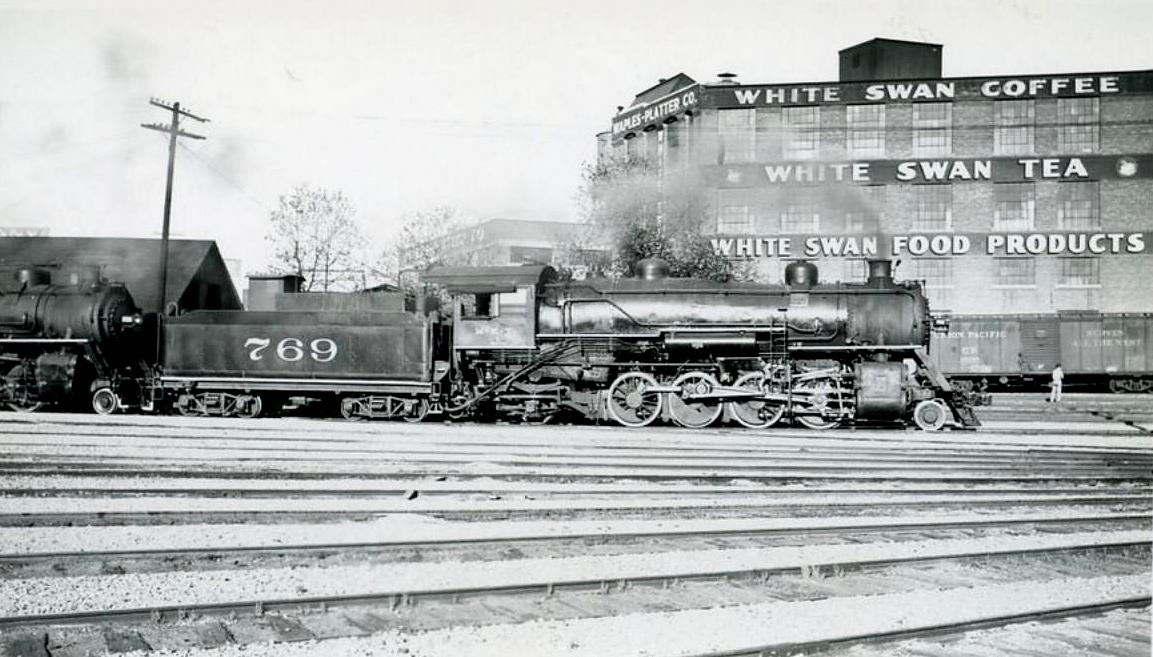
Locomotive & The White Swan Building

white-swan-bldg_locomotive_flickr_colteraBack when the N. Lamar area was a bit more industrial

by Paula Bosse

Just a quick one today: loco chugging past the White Swan Building.

***

Sources & Notes

Image from Flickr, captioned “Vintage postcard: MKT railroad engine, White Swan Building, Dallas, Texas”; viewable on Flickr here.

The historic White Swan Building is located at 2200 N. Lamar, just north of Woodall Rodgers; it currently houses the House of Blues.

*

Copyright © 2015 Paula Bosse. All Rights Reserved.

Newsboy

newsboy_RPPC_ebay_sm“Nickel a copy, mister.”

by Paula Bosse

In 1912, The Dallas Morning News reported that there were over 700 newsboys in the city of Dallas, over 200 messenger boys, and “hundreds of other working boys between the ages of 6 and 17” (DMN, July 19, 1912). Some of these boys were working to help out their families, but many were homeless. Child labor was a major concern throughout the country, and most larger cities, such as Dallas, had “newsie homes” and associations to look after the interests of the boys.

***

Sources & Notes

Newsboy photo found on eBay.

To read “Story of a Street Waif” (DMN, Dec. 22, 1912) — a somewhat Dickensian fictionalized account of a resilient Dallas newsboy written by Mrs. M. L. Kauffman (Sam Houston’s granddaughter, the former Margaret Belle Houston) — click here.

Photographer Lewis Wickes Hine had perhaps the greatest impact on the reform of child labor laws. Hine traveled the country photographing and interviewing working children in order to put a human face to a growing problem. Some of his photos can be seen here; his Wikipedia entry is here.

Photos of newsboys from previous Flashback Dallas posts can be found here.

*

Copyright © 2015 Paula Bosse. All Rights Reserved.

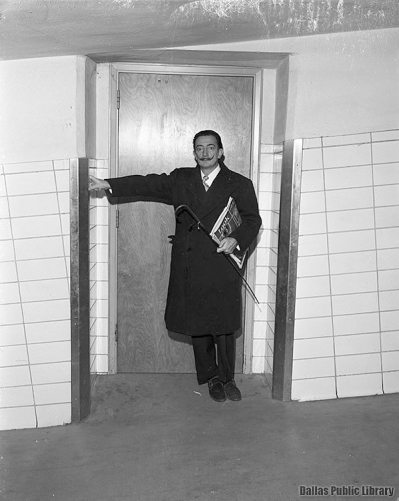
Salvador Dali Brings “Nuclear Mysticism” to Dallas — 1952

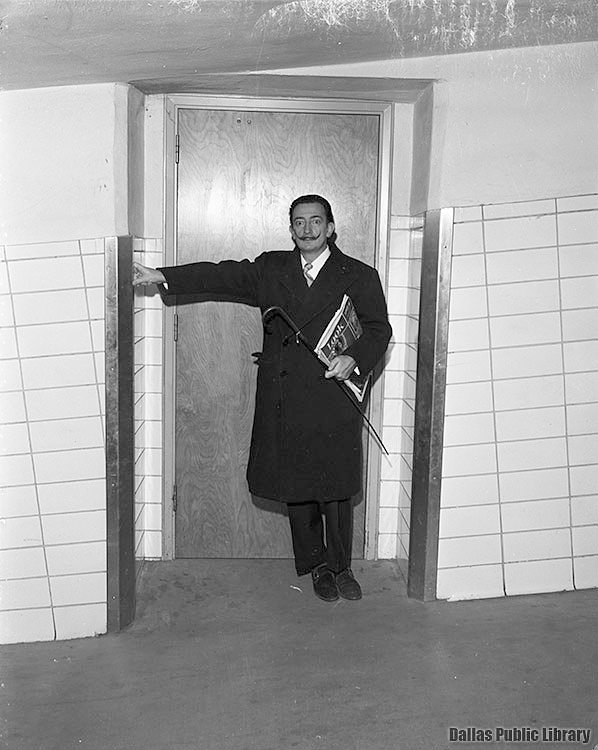
dali_union-station_feb-1952_dplDali does Dallas (in a slanted doorway at Union Station)

by Paula Bosse

The artist and pop phenomenon Salvador Dali came to Dallas in 1952 to present a lecture at McFarlin Auditorium on the SMU campus as part of the popular Community Course series. This was during his “Nuclear Mysticism” period, during which his paintings were influenced by the atomic age, science, and religion. One of the examples of this direction in his art is his painting “Raphaelesque Head Exploding” from 1951.
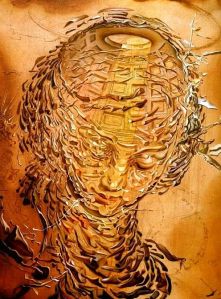
dali-raphaelesque-head_1951“Raphaelesque Head Exploding”

This 1952 American lecture tour included at least three stops in Texas: Houston, Fort Worth, and Dallas. Dali and his wife, Gala, arrived in Dallas on the afternoon of Thursday, February 14, 1952, after the artist had spoken at a members-only event and luncheon at Fort Worth’s River Crest Country Club earlier in the day. The lecture at McFarlin Auditorium was on Saturday night, Feb. 16. One wonders what he did in Dallas on his free day Friday.

While in Dallas, Dali was interviewed at the Baker Hotel by Paul Crume of the Morning News, a bit of an odd choice, in that Crume — author of the very popular front-page “Big D” column — was generally the paper’s go-to humor writer, an indication, perhaps, that Dali was considered less of a serious artist than as a quirky and larger-than-life entertainer. Which… fair enough.

One of the interesting little morsels that Dali told Crume was that he was amazed that his dreams in Texas had all been in technicolor, a relative rarity for him.

“Astonishing! In New York, all black and white. In Texas, all in color. In Italy, everybody dreams in color. In France, not so much. It is very mysterious. But in Houston, I am dream in color twice. And then, last night here [in Dallas].” (DMN, Feb. 17, 1952)

Dali loved dreaming in technicolor and mentioned it several times throughout his career. This little tidbit from Earl Wilson’s column in 1944 is amusing (if weighted down by Wilson’s unfortunate lapses into dialect).
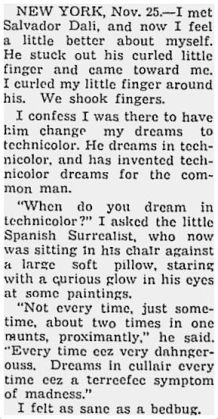
dali_earl-wilson_112644New York Post, Nov. 26, 1944

To dream in technicolor every time “is very dangerous. Dreams in color every time is a terrific symptom of madness.” …I’m not sure what that says about Texas and/or Texans.
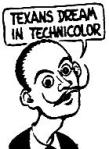
dali-caricature_technicolor

***

Sources & Notes

Top photo (dated Feb. 15, 1952) shows Salvador Dali standing in a slanted doorway at Union Station in Dallas (it seems likely that the photo was taken on Feb. 14th when he arrived in Dallas from Fort Worth, and was then published on Feb. 15th); it is from the Hayes Collection, Dallas History & Archives Division, Dallas Public Library (Call Number PA76-1/7171).

(Regarding this crooked door frame at Union Station: when Dali saw it he exclaimed, “A Dali-an door!”) (He would have loved Casa Magnetica at Six Flags.)

Articles about Dali’s visit to Dallas can be found in the archives of The Dallas Morning News:

  • “Key to New Art Revealed by Dali” (It’s Mysticism)” — an unbylined review, probably written by Paul Crume (DMN, Feb. 17, 1952)
  • “Texas Tints Dreams of Artist Dali” — interview by Paul Crume, conducted in the Baker Hotel (DMN, Feb. 17, 1952)
  • “Big D” column by Paul Crume (DMN, Feb. 19, 1952)

An entertaining 1965 appearance by Dali on Merv Griffin’s talk show can be seen here. He talks about dreaming in “glorious technicolor” at about 4:55. And, I mean… it’s just a great example of Dali as entertainer.

*

Copyright © 2015 Paula Bosse. All Rights Reserved.


A Dip in the HP Pool — 1924

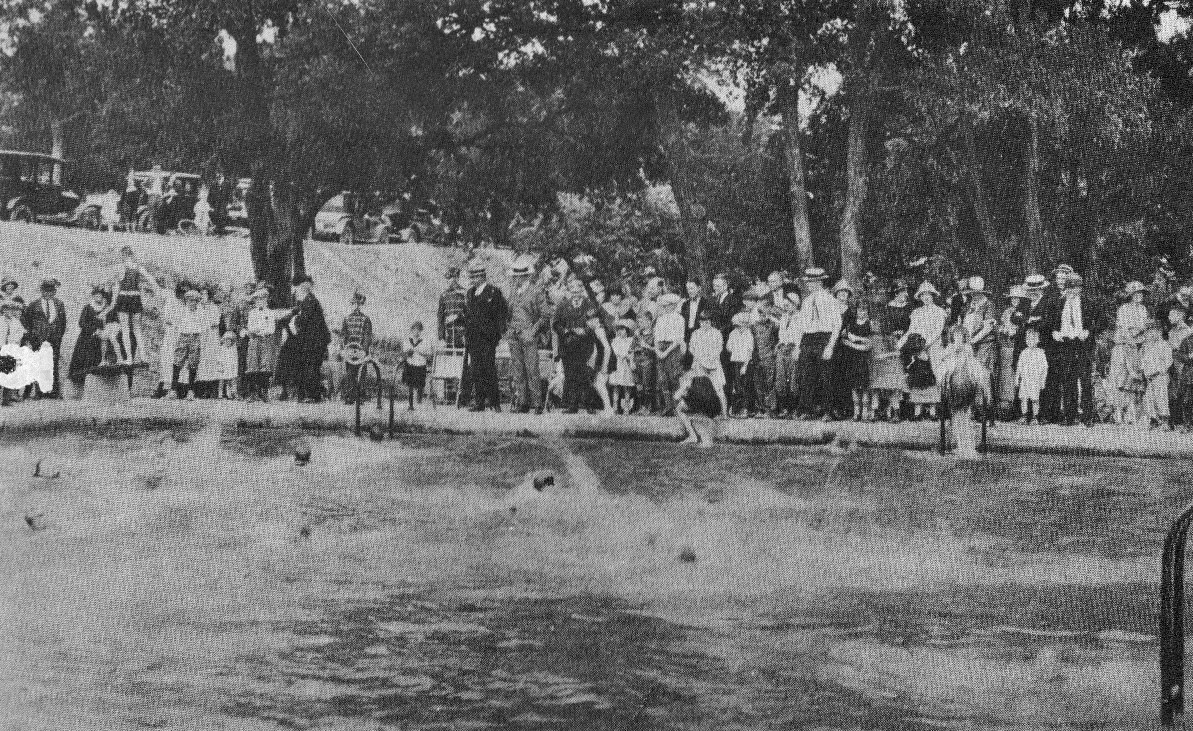
hp-pool_aDedication & formal opening of the HP pool, 1924

by Paula Bosse

Even though “municipal pool” and “Park Cities” don’t really seem to belong in a sentence together, the still-going-strong pool in Highland Park is over 90 years old. The photo above shows crowds gathered at the formal opening of the brand new Highland Park swimming pool, dedicated on May 17, 1924. The caption of this photo which ran in The Dallas Morning News on May 18, 1924 reads: “The above shows the group of Highland Park citizens gathered at the new municipal swimming pool Saturday afternoon for the formal opening exercises. Mayor Frank M. Smith is seen standing in the middle of the group. Seated by his side is former mayor Henry L. Davis in whose administration the movement for the installation of the pool was started.”

Oh, to have witnessed the fabulously wealthy (or near-fabulously wealthy) sashaying down the street toward the pool, dressed in their mandated bathrobes and swimsuits. Or their raincoats and swimsuits. (“[Regulations governing use of the pool require that] swimmers must dress at home in their bathing suits, but may come through the streets to the pool so clad if they wear a raincoat or a bathrobe over their swimming garb.” — Dallas Morning News, May 18, 1924)

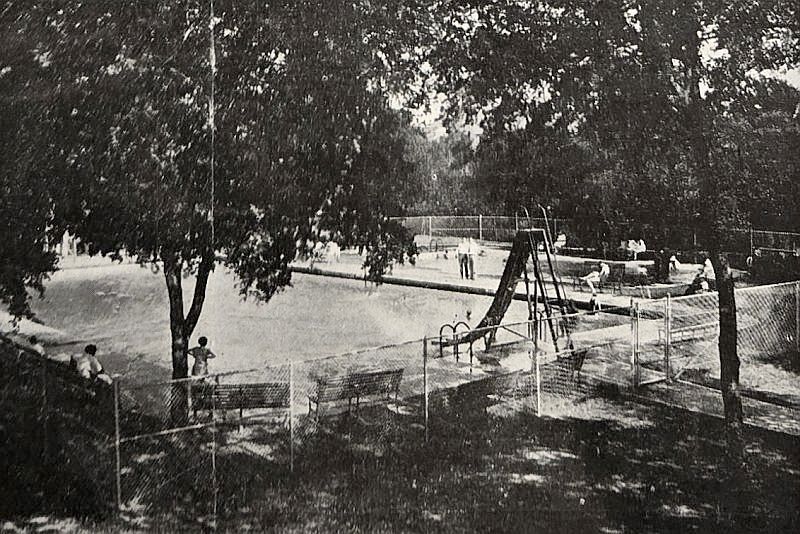
The municipal pool is in Davis Park on the south side of Lexington Avenue, in the “natural amphitheater” between St. Johns and Drexel. The 50 x 100-foot pool (reduced somewhere along the way from the original plan of a 60 x 140-foot pool) cost about $10,000 when it was built with municipal funds in 1924. The pool was very popular amongst Highland Park residents, and, as can be seen in the photos, it was located in one of the prettiest settings in Dallas.

hp-pool_highland-park-paper_june-1927_DPL

***

Sources & Notes

Top photo is from a postcard issued as part of the Park Cities Bank “Heritage Series” in the 1970s; the credit line on the postcard reads “Donated by Mr. Burton Gilliland.” Thanks to the Lone Star Library Annex Facebook group for use of the image. (The printed description of the postcard has an incorrect date of 1923.)

Bottom photo is from Highland Park (an interesting newspaper published by developers Flippen-Prather), June 1927, Periodicals Collection, Dallas History and Archives, Dallas Public Library.

More on the pool’s opening can be found in the Dallas Morning News article “Highland Park Pool Dedicated Saturday” (May 18, 1924).

Official site of the HP pool? Here it is.

*

Copyright © 2015 Paula Bosse. All Rights Reserved.
The Wilson Building & Its Tenants — 1908/1909

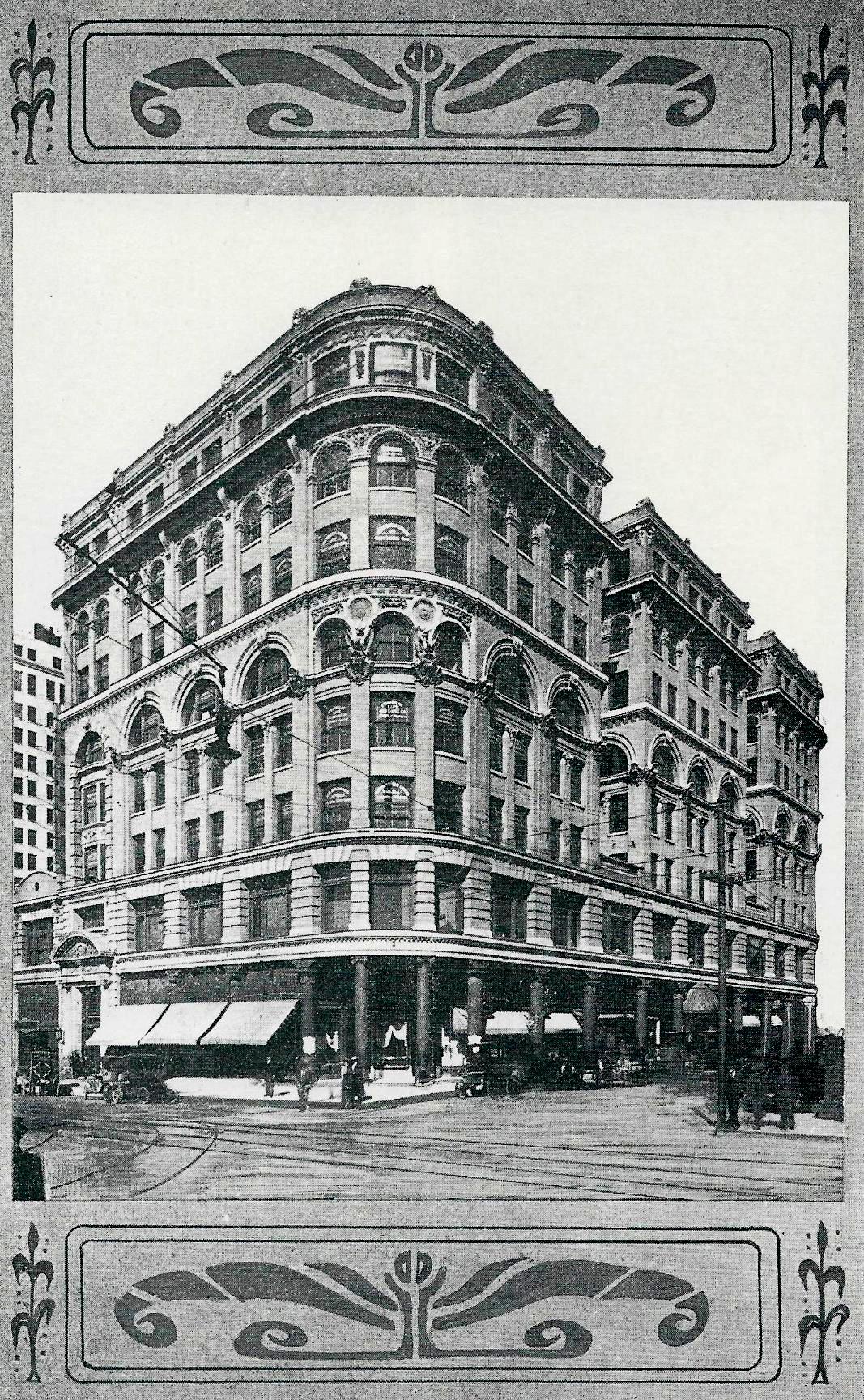
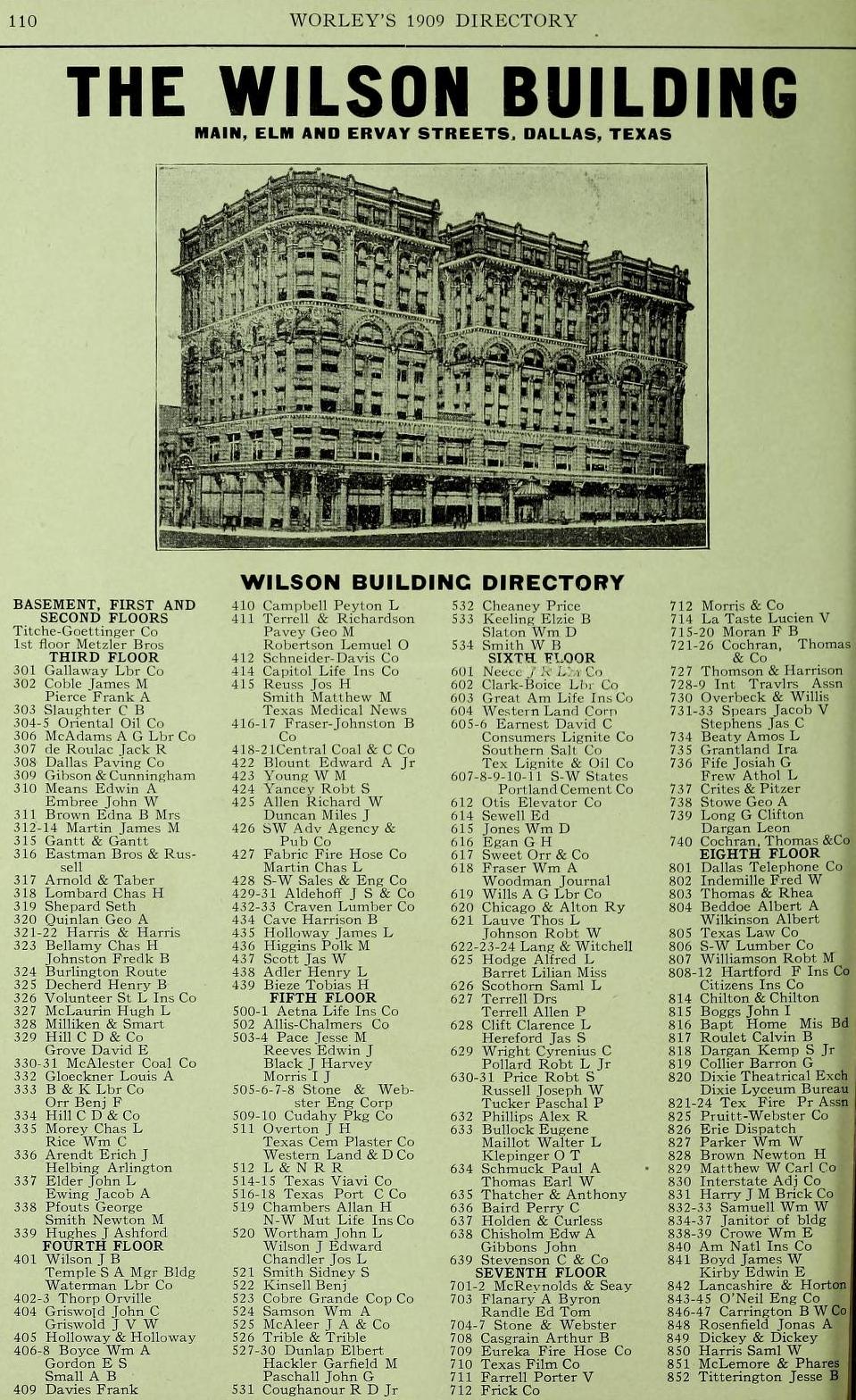
wilson-bldg_greater-dallas-illus-1908Forever & always, Dallas’ most beautiful building (click for larger image)

by Paula Bosse

I love the Wilson Building. Who doesn’t? Every time I realize it’s still standing, I’m actually kind of shocked. To find a 100-plus-year-old building still standing in Dallas is a rarity. If the wrecking ball ever strikes this building, there will definitely be hell to pay.

I’d never seen the above photo, which was published along with lovely art nouveau borders in the book Greater Dallas Illustrated, The Most Progressive Metropolis of the Southwest (1908). I’m fascinated by office buildings of the first half of the twentieth century that had business names painted on upper-floor windows. I always think of Sam Spade’s office.

sam-spade_sign-window

I was really hoping to find at least ONE detective agency in the Wilson Building at that time, but steep rents and a choosy leasing agent were probably working against such downmarket enterprises setting up shop in such a grand palace. Below is the list of occupants in the building at about the time the top photo was taken. Aside from the Titche-Goettinger department store occupying the basement and first two floors, Dallas’ premier office building was home to several important local business concerns, lots of insurance companies and agents, some notable architects (Lang & Witchell, C.D. Hill, Overbeck & Willis), and a surprising number of osteopaths (including Edna B. Brown, one of only two women specifically mentioned by name). (Click directory page for larger image.)

wilson-bldg-occupants_1909-directory

***

Photo of the Wilson Building from Greater Dallas Illustrated (Dallas: Friends of the Dallas Public Library, 1992 — originally published in Dallas in 1908). The Wilson Building is located on Main and Elm at Ervay.

It’s doubtful that it would fall victim to the wrecking ball, but the Wilson Building may not actually be protected from any possible future threat of demolition. For clarification, see the comment near the top of the comments section in this Dallas Morning News article on recent demolition in the same block, here.

Sam Spade image is a still from the 1941 Humphrey Bogart film The Maltese Falcon, based on Dashiell Hammett’s novel. (Poor Archer….)

Directory page from Worley’s 1909 city directory.

My previous post — “The Wilson Building Under Construction — 1902” — can be found here.

Click pictures for larger images.

*

Copyright © 2015 Paula Bosse. All Rights Reserved.

Main Street and Flags, Flags, Flags — ca. 1917

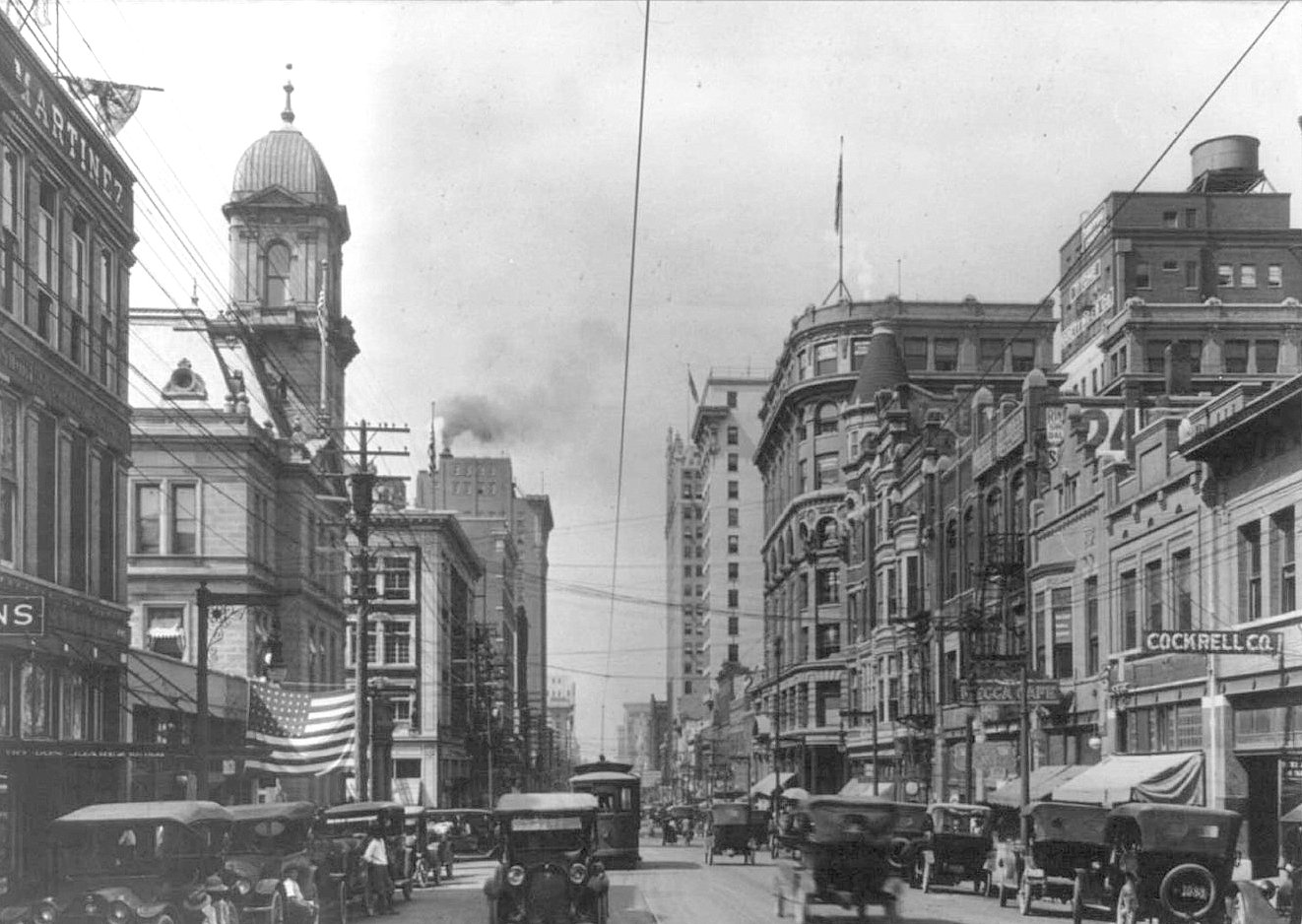
downtown_ca1917_LOCFind the flags! (click for larger image)

by Paula Bosse

This is a cool photo. I have no idea if it was taken anywhere around July 4th, but I post it today because today is July 4th, AND I see 5 — possibly 6 — American flags in this photograph of Main Street. The patriotism displayed here may have more to do with World War I than Independence Day, but why not post it on the 4th of July?

Enjoy the holiday!

***

Photo identified as “Texas, Dallas, 1917, Business section” by the Library of Congress; photo info here.

For the previous Flashback Dallas post “4th of July — Sweating in Formation,” which shows a parade from the 1870s or 1880s, click here.

*

Copyright © 2015 Paula Bosse. All Rights Reserved.

“The Last Time I Saw Texas” — 1953/58

neiman-marcus_texas-mapThat “X” is in the wrong spot, y’all…. (click for larger image)

by Paula Bosse

Before I begin, I offer apologies in advance to Oscar Hammerstein II (original lyricist of “The Last Time I Saw Paris”), NeimanMarcus (with or without the hyphen), haters of Texas stereotypes, and, especially, Fort Worth.

In a Dallas item connected with “Independence Day” in only the most tangential way possible, I thought I’d share a little cabaret song I stumbled across today whilst rummaging through the internet. It’s a humorously re-written version of the Academy Award-winning hit song “The Last Time I Saw Paris,” (…um, the one in FRANCE….), written in 1940 by Oscar Hammerstein II (lyrics) and Jerome Kern (music).

Partial lyrics were reported by Earl Wilson in his syndicated gossip/entertainment column, “Broadway Last Night,” twice — first in 1953, after he’d seen Juliana Larson sing it at the Sherry Netherland Hotel, then later, in 1958, after he’d heard Connie Moore sing it at the St. Regis Maisonette. Both women had Texas ties (Constance Moore actually grew up in Dallas), so I’m sure both enjoyed singing the ditty (in what one hopes was in an ever-so-amusing sophisticated style, à la Noël Coward).

At the Neiman-Marcus store
They sell the usual furs
And the cutest children’s Cadillacs
And yachts marked “His” and “Hers.”

The last time I saw Texas
And the oil was in her hills,
The kiddies bought their lunch at school
With hundred-dollar bills.

The last time I saw Texas,
All Dallas was so gay,
We’d burned Fort Worth to the ground
On Independence Day.

Happy Independence Day, Fort Worth!

***

Listen to Noël Coward sing “The Last Time I Saw Paris” (before FW was being burned to the ground), here.

Juliana Larson (aka Juliana Bernhardt) was a former John Powers model who married wealthy Houston oilman Walter Bedford Sharp, Jr. (whose father was a business partner with Howard Hughes’ father). She started in light opera in Texas and moved on to New York nightclubs. She seems to be known mostly as the wife of a Texas oilman and a permanent fixture on Best Dressed lists. She horrified everyone when she showed up to a Metropolitan Opera opening night wearing trousers — see her delighting in the publicity she received from that, in Life magazine (Nov. 24, 1952), here.

Constance Moore was born in Iowa but grew up and began her career in Dallas. More about her here and here; glamour photos here.

The “Texas” lyrics were reported by Earl Wilson to have been written by David Roger (for Juliana Larson, in 1953) and by Earl Brent (for Connie Moore, in 1958). The partial lyrics Wilson quoted in 1953 and 1958 were the same. …So there you go. (I changed the order of one line, because it seems that Wilson got the lines of the first verse in the wrong order.)

I’m not sure where I found that Neiman’s map, but it’s cool. (Why IS the “X “is the hinterlands, anyway?)

Enjoy your 4th of July weekend! And don’t burn anything down!

*

Copyright © 2015 Paula Bosse. All Rights Reserved.

Commerce Street — 1942-ish

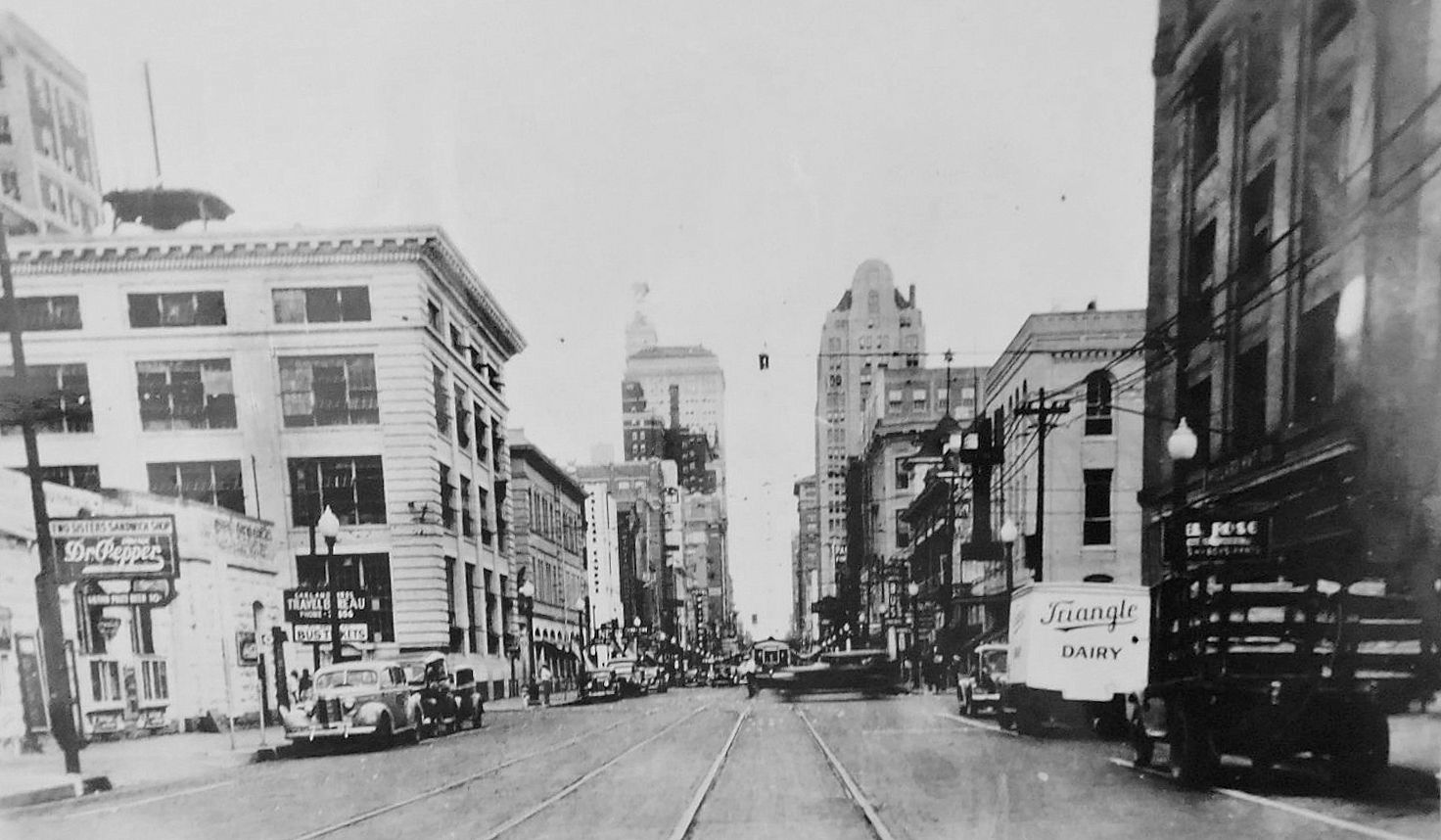
commerce-st_RPPC-1942_ebayCommerce St. (click for larger image)

by Paula Bosse

Today, a somewhat random shot of Commerce Street from the early 1940s.

…And now I have a hankering for a Dr Pepper.

***

Cropped shot of an item currently being offered on eBay, here.

*

Copyright © 2015 Paula Bosse. All Rights Reserved.

A New Turbine Power Station for Big D — 1907

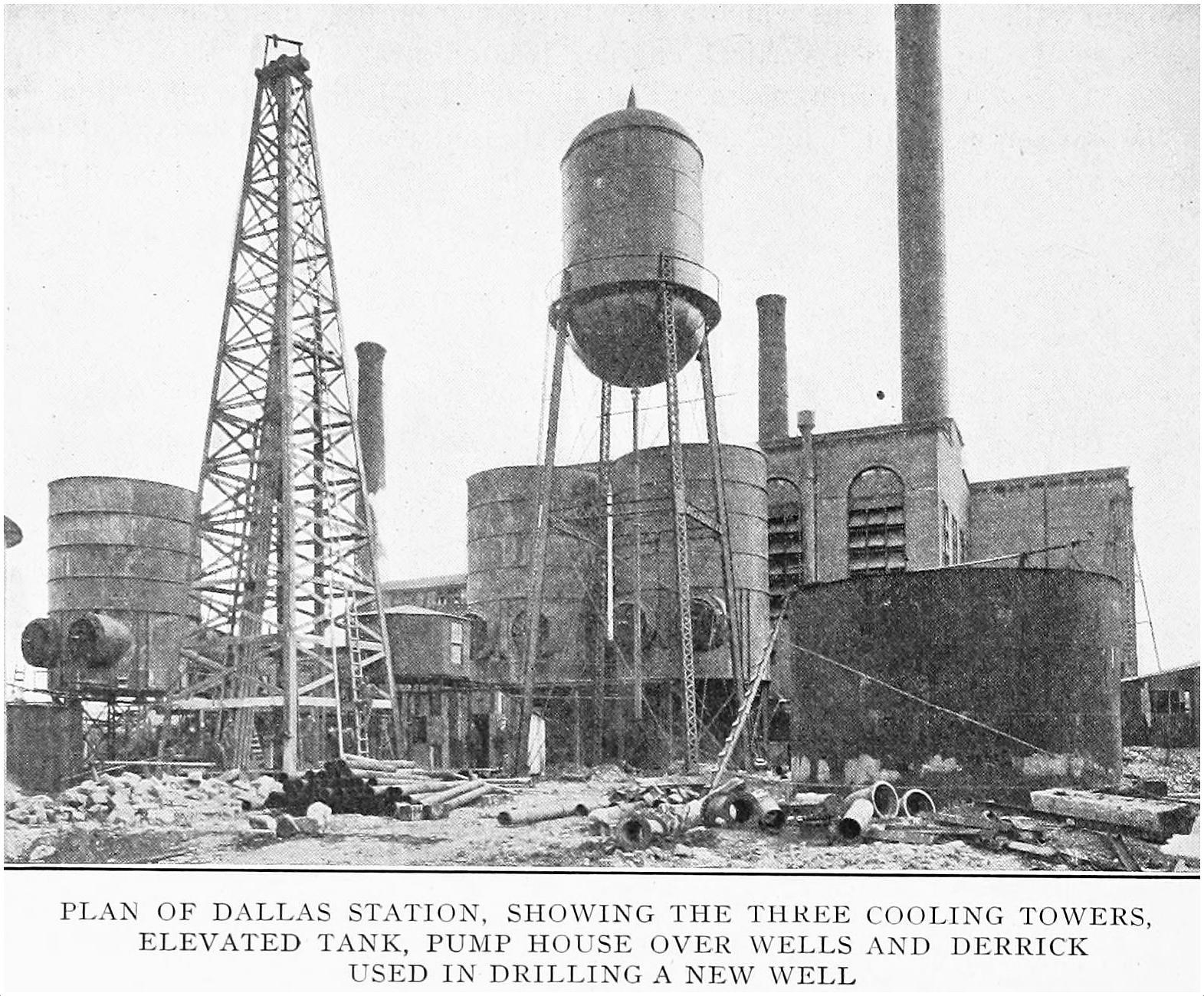
power-station_1907New and old power plants, 1907 (click for much larger image)

by Paula Bosse

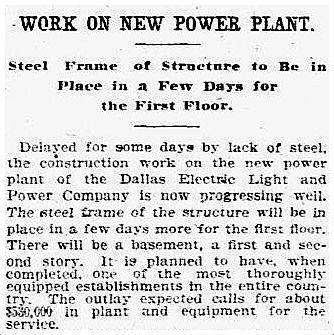
Construction began in 1906 on a new power plant for the Dallas Electric Light & Power Company. It was built next to the old power plant, and it furnished electricity for the city’s lighting and power needs as well as for its streetcars and interurban cars. When construction began, the project was expected to cost more than $500,000 (over $13 million in today’s money), a large (but necessary) expenditure for the growing city.

power-station_dmn_020906Dallas Morning News, Feb. 9, 1906

The photo at the top shows the new plant on the left, and the old 19th-century plant on the right. Here, a view from the other side:

power-station_ext_1907

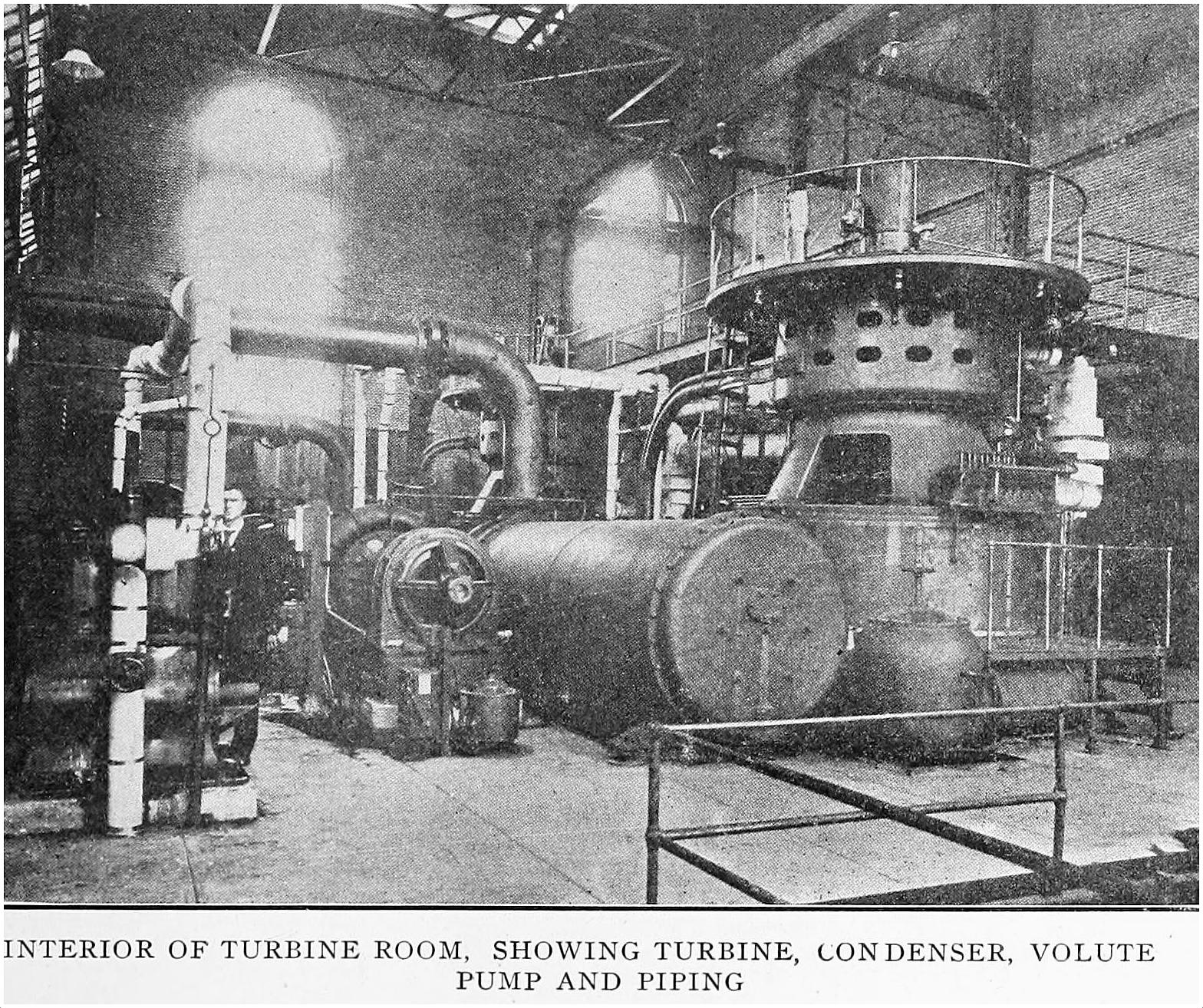
Inside? A lot of fascinating stuff that looked like this (as well as a stern-looking man who appears to be trying to avoid the camera):

turbine-rm_1907

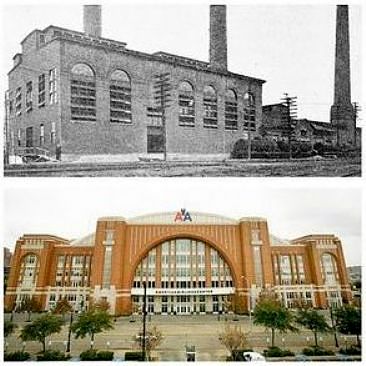
The power station was northwest of downtown, between the MKT and Cotton Belt and Rock Island railroad yards (approximately where the American Airlines Center is today). Before the Trinity was straightened and moved, the plant was only about half a mile from the banks of the river. Even though the grade of the new station’s floor was built above the highest flood level, the historic flood of 1908 put the plant out of commission for several days, but — probably because it was filled with brand new equipment — the city’s power was restored much faster than one might have expected.

***

Sources & Notes

Photos are from the Street Railway Journal, May 18, 1907 (Vol. XXIX, No. 20). To view the entire 7-page article — which includes more photographs as well as several floorplans and schematics, all of which are very cool (even to someone like me who has absolutely no idea of what any of it means!) — check it out, here.

The American Airlines Center incorporated elements of the 1907 plant’s design into its own:

aac

My previous related post, “DP&L’s Twin Smokestacks,” can be read here.

Photos are much larger when clicked.

*

Copyright © 2015 Paula Bosse. All Rights Reserved.


The “Semi-Convertible” Streetcar — 1907

semi-convertible-streetcar_1907_smEXTRA long… (click for larger image of car)

by Paula Bosse

Ah, the “grooveless-post semi-convertible” streetcar with the “extra long platforms,” the cherry and maple interior, the domed ceiling, and the clusters of frosted globes. Sounds nice.

semi-convertible-streetcar_int_1907“Interior of Car for Dallas” (click for larger image)

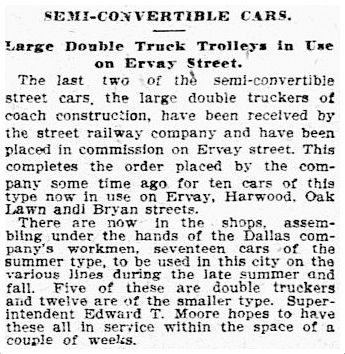
semi-convertible-streetcar_dmn_082907Dallas Morning News, Aug. 29, 1907

***

Photos from Street Railway Journal, April 6, 1907; original article can be accessed here. Above scans from an old eBay listing.

Want to know more about the Brill Convertible and Semi-Convertible Cars? Sure you do! Hie yourself here.

*

Copyright © 2015 Paula Bosse. All Rights Reserved.