Flashback : Dallas

A Miscellany: History, Ads, Pop Culture

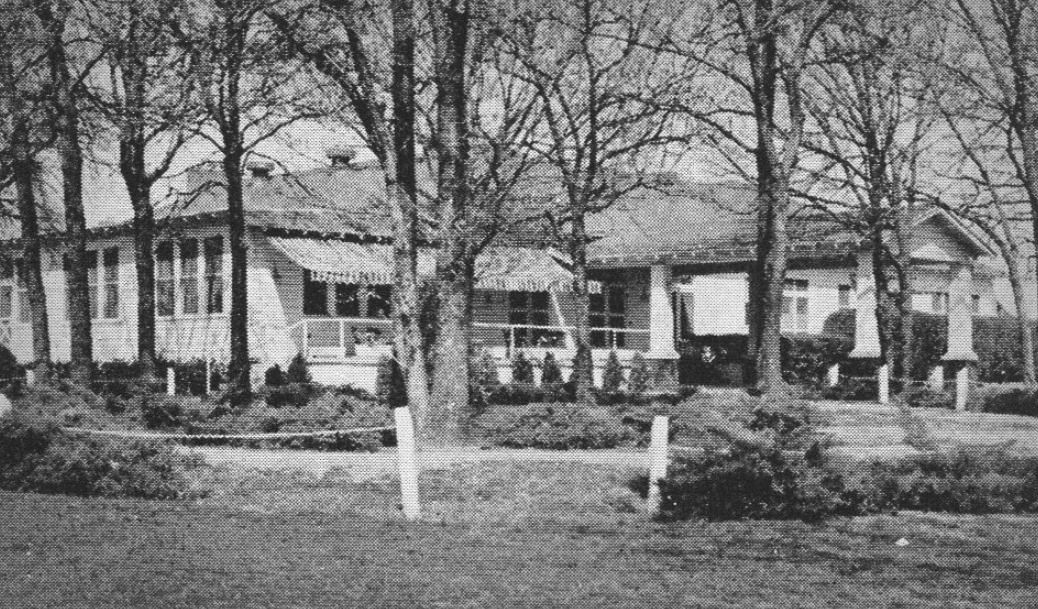
Brook Hollow Country Club — 1940s

brook-hollow-country-club_1940sA modest clubhouse…

by Paula Bosse

A photo of Brook Hollow Country Club from a 1940s guide for newcomers. This photo is from a page of the area’s country clubs. This looks positively quaint.

***

Sources & Notes

From an early edition of “So This Is Dallas,” a guide for new residents of Dallas — this edition is from the early ’40s. Thanks to the Lone Star Library Annex Facebook group for loan of the image.

The Brook Hollow Golf Club is a bit swankier these days. The official site is here.

*

Copyright © 2014 Paula Bosse. All Rights Reserved.

Back When Bookstore Fixtures Were a Thing of Beauty! — 1940s

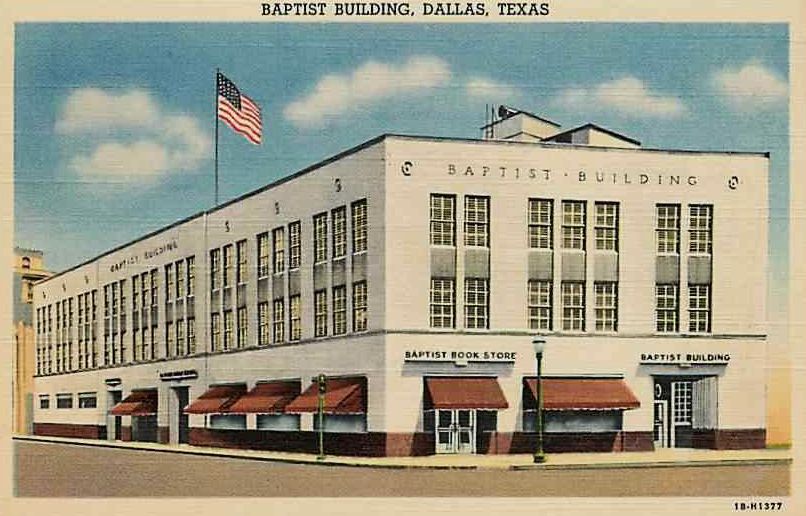
baptist-book-storeErvay & Pacific — “Book Corner” (click for larger image)

by Paula Bosse

In July of 1941 the Baptist Building opened at Ervay and Pacific. Part of the ground floor (“the Book Corner”) was occupied by the Baptist Book Store, which sold mostly religious material, but which also stocked dictionaries (“and other items of similar nature”) and children’s books (“We have books for every type and age of juvenile from the Picture Books of Children from three to five to the vigorous youth wanting stories of the romantic west”). The ad below appeared in a booklet put together to welcome newcomers to the city, about 1946:

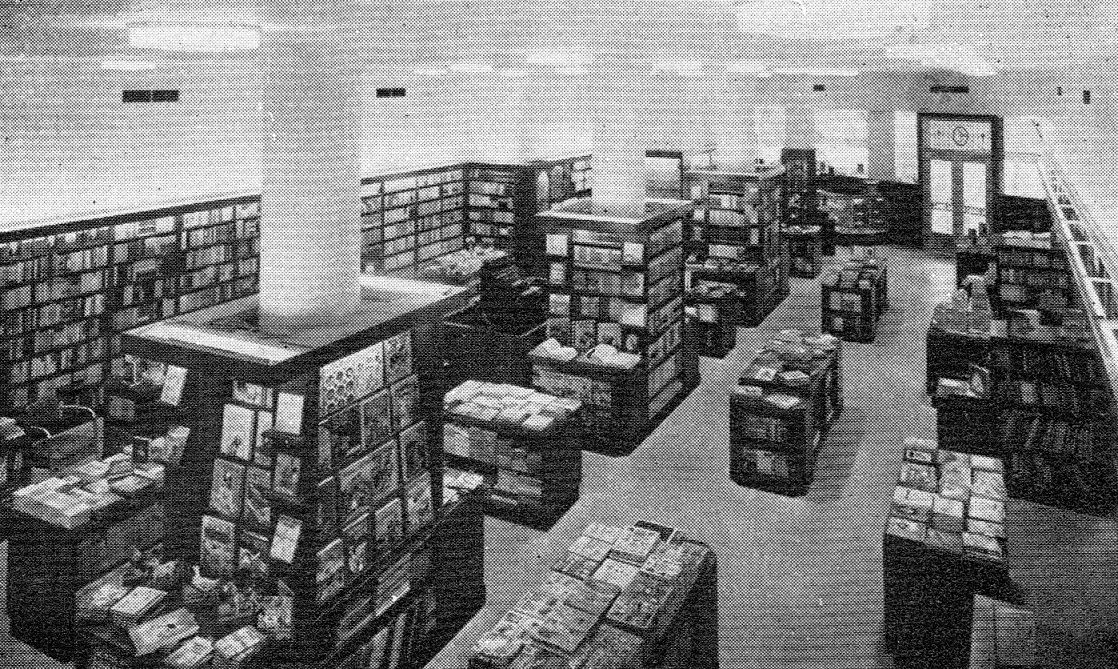
baptist-book-store_ca1946(click for larger image of bookstore interior)
*

Having grown up in a family-run bookstore (and having worked in various other bookstores for a large chunk of my life), I’m always fascinated by old photos of bookstore interiors, and this one is just great. (Click the image above to see the photo of the store much larger.) I’m particularly fascinated by the fixtures encircling the pillars — I’m not sure I’ve ever seen the problem handled in such a sophisticated way. And is that recessed lighting shining down on the slatwalls? This is a really wonderful-looking bookstore. The only thing that looks out of place is what appears to be an old-fashioned chunky cash register, center left. Everything else in this photo makes the bookseller in me practically giddy with nostalgia.

baptist-book-store_dmn_092847-det

***

Ad is from a publication called “So This is Dallas” published by “The Welcome Wagon.” It is undated but is probably from immediately after the war. This slim booklet was printed for several years in slightly different editions for people who were considering a move to Dallas or for people who had just moved here. These booklets are wonderful snapshots of the time, with everything the prospective Dallasite would need: facts, photos, and ads.

Bottom image is a detail from a 1947 ad.

*

I am fascinated by photographs of vintage bookstore interiors — especially Dallas bookstore interiors, of which there are precious few to be found. I would love to see any photos of Dallas bookstores before, say, 1970. If you have any, please send them my way! My contact info is in the “About/Contact” tab at the top of the page. Thanks!

*

Copyright © 2014 Paula Bosse. All Rights Reserved.


Getting Married on the Radio — 1922

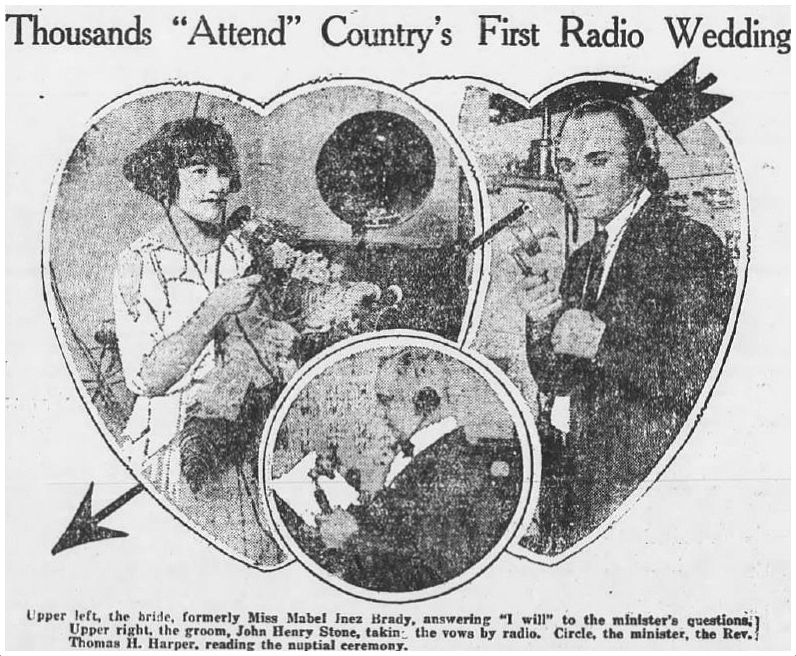
radio-wedding_corbis_062922Inez & John, exchanging vows on Dallas radio, 1922

by Paula Bosse

An early radio stunt happened in Dallas on the night of June 29, 1922 when a couple exchanged wedding vows over the air, with the bride, the groom, and the minister each broadcasting from the studios of different Dallas radio stations: WDAO, WRR, and WFAA. These were the very early days of radio, and when the wedding was broadcast, WDAO had been on the air for a little over a month, and WFAA for less than a week! (WRR, Dallas’ first radio station had been on the air for about a year, but most of that time it had been operating as a one-way radio dispatcher for the city’s fire and police departments). In June of 1922, these were the only three Dallas-based radio stations, and they all worked together in this “historic” broadcast. (This early media stunt was a full 47 years before Tiny Tim and Miss Vicki got hitched on the Tonight Show.)

DALLAS COUPLE TO WED BY RADIO THURSDAY NIGHT

DALLAS — The first wireless marriage ceremony ever performed in which neither the bride, the groom, nor the officiating minister will be at the same place is to be solemnized here Thursday night when Miss Inez Mabel Brady, Dallas society girl, becomes the bride of John H. Stone, operator at WRR, the municipal broadcasting station.

It is estimated that more than 25,000 radio fans will “witness” the tying of the radio nuptial knot.

Three Dallas broadcasting stations will be used in the ceremony. Rev. Thomas Harper, pastor of the Central Congregational Church, who has been asked to officiate, will repeat the marriage ritual into the transmitter of [WFAA,] the broadcasting station on the roof of [the Dallas Morning News] building. The bride and her attendants will be at the Automotive Electric Company’s radio station [WDAO, on South Ervay], while the groom will make his responses from WRR, the station of which he is in charge.

Operating staffs of the three stations are working out the details of the ceremony, which will include a broadcasted wedding march.

(– Fort Worth Star-Telegram, June 28, 1922)

Obviously new to the hustle of radio promotion, The Dallas Morning News (owner of WFAA) mentioned the event only a couple of times — fleetingly. They did note that “This probably will be audible to one of the largest audiences ever ‘hearing’ a wedding ceremony” (DMN, June 28, 1922). It’s not known just how many people tuned in to listen to the ceremony (probably a considerable number), but the story made news around the country, as can be seen in this article from The Durham Morning Herald in Durham, North Carolina:

radio-wedding_durham_071322a

radio-wedding_durham_071322-bDurham (NC) Morning Herald, July 13, 1922 (click for larger image)

The broadcast had only a tiny hiccup:

radio-wedding_winfield-daily-press_kansas_063022Winfield (Kansas) Daily Press, June 30, 1922

As successful as the radio wedding was, the marriage between Inez Brady and John H. Stone does not appear to have lasted very long. At the time of the wedding, Inez was just out of school and was only 16 or 17 years old (the descriptions of her as a “society girl” and “debutante” were, I think, a bit of an exaggeration). According to the news stories surrounding the wedding, she “fell in love” with Mr. Stone’s voice on the radio. None of that bodes well for a lasting marriage. The 1923 city directory had the newlyweds renting rooms on McMillan, off Lower Greenville, but the 1924 directory had John in Oak Cliff and Inez in Old East Dallas. She re-married in 1928 at the creaky old age of 22, and he seems to have left WRR to work in some capacity for RCA. The marriage might not have lasted, but they both had a “brush-with-celebrity” story to tell (and re-tell) for the rest of their lives.

***

Sources & Notes

Top photo from CorbisImages, ©Bettmann/CORBIS.

I’m not sure which ended first — Mr. and Mrs. Stone’s wedded bliss or the radio station WDAO, which ceased operation sometime in 1923. A good look at the history of early local radio can be found at DFW Radio Archives, here. (WRR and WFAA continue to march forward, just a few years shy of their 100th anniversaries!)

*

Copyright © 2014 Paula Bosse. All Rights Reserved.

Vickery Place: “Above the City” — 1911

vickery-place-dmn_061111“An Unstinted Supply of the Very Best Water” (click for larger image)

by Paula Bosse

Vickery Place is the place to be!

  • Most Convenient
  • Most Reasonable
  • Most Desirable

And the water! Gobs of it! Look for the flag on the derrick over the artesian well — you can see it from St. Mary’s College on Ross!

***

Ad for the new Vickery Place Addition appeared in the June 11, 1911 edition of The Dallas Morning News.

Vickery Place website is here.

Vickery Place wiki is here.

*

Copyright © 2014 Paula Bosse. All Rights Reserved.


Urban Crisis: “The Walls Are Rising” — 1967

walls_lake_1967
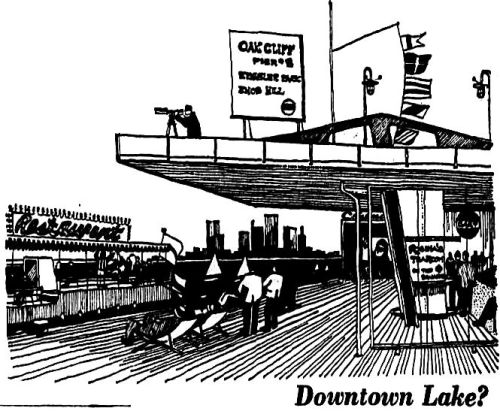
Oak Cliff Pier? Just one part of Dallas’ urban future as envisioned in 1967…

by Paula Bosse

In 1967, the Dallas chapter of the American Institute of Architects unveiled a project it had been working on under the sponsorship of the Greater Dallas Planning Council for over a year — a 40-minute color slide presentation with recorded narration called “The Walls are Rising,” directed by writer-photographer Ron Perryman of Austin. Enslie “Bud” Oglesby — one of Dallas’ top architects and the chairman of the committee behind the project — said of the film:

I saw here an opportunity to demonstrate the problems which poor planning bring and the results that can come from a sound, unified planning program…. (Fort Worth Star-Telegram, June 18, 1967)

The rather more urgent tone of the brochure that accompanied the film was a bit more dire:

We cannot afford to lose any more time in developing a coordinated plan to make Dallas a more beautiful and effective city, for all around us the walls are rising, the city is being built… We are designing by default instead of summoning our vitality, wealth resources, talents and human vision to create a design plan that will give Dallas quality and character all its own.

The goal of the project was to create awareness among city officials, planners, and designers (as well as among the public) of the immediate need to address the conscious physical design of the city in order to improve its future “livability.” The argument was that the city of Dallas was, in 1967, an unplanned and uncoordinated chaotic urban environment dominated by (and practically strangled by) the automobile; it was overwhelmed by traffic, noise, and visual clutter, and it lacked much-needed green spaces and personal “refuges.”

It was stressed that the film was not a plan, per se, but was, instead, an outline of suggestions that the AIA and the Greater Dallas Planning Council were proffering for discussion (and, one assumes, hoping would be implemented). Among their suggestions were the following (some of which have been adopted, but many of which have been “on the table” for decades now and which Dallas leaders continue to debate):

  • A 6-mile hike-and-bike trail from Turtle Creek to Reverchon Park
  • A rapid transit system (the report stressed that it would be urgently needed by 1980)
  • The creation of downtown parks
  • The development of downtown apartment housing
  • A centralized transportation hub (bus, rail, air)
  • The reduction in noise, visual clutter, and traffic
  • More “sensitive” freeway planning, which should be designed (or re-designed) for the driver and not for the automobile
  • More awareness of the pedestrian in designing downtown and neighborhood streets, especially in regard to safety and accessibility
  • Development of, yes, the Trinity River and its levees, including a downtown lake and sailboat-dotted marina, with apartments and a variety of entertainment and shopping venues lining the “shore”
  • And, most unexpectedly, a “scenic link” which would connect Fair Park to the Dallas Zoo, incorporating a sort of shuttle service between the two locations (and across the Trinity) via an elevated gondola ride (!)

As fun and fanciful as fresh ideas on getting to Oak Cliff are, the film seems to have been more of a warning of what the city’s future might be if it continued down its then-current path of … having basically no plan at all. The film started off by assaulting the viewer’s senses with several minutes of “blaring, cacophonous music” and a rush of chaotic images — and opened with the ominous words, “We are living in an accident.” The League of Women Voters issued a report in 1968 called “Crisis: The Condition of the American City” in which they described “The Walls Are Rising” as “a horror film.”

What sounds a bit like a sophisticated A/V presentation was screened for dozens and dozens and dozens of groups in the Dallas area between 1967 and about 1972: it was shown to various Chambers of Commerce, Rotary, Kiwanis, and Lions clubs, women’s groups, church groups, business groups, arts organizations, and on and on and on. The film would usually be introduced by an architect who would also lead a discussion and answer questions afterward. If you were a member of a civic or professional group in the late ’60s, chances are pretty good you saw “The Walls Are Rising.”

Which is why it’s so surprising that all traces of the film seem to have vanished in the intervening years. I contacted the Dallas Municipal Archives, the Texas/Dallas History & Archives Division of the Dallas Public Library, AIA Dallas, and Dallas Center for Architecture. Everyone was very helpful, but … nothing. Designs for Dallas and the later Goals for Dallas are better known projects, but it seems that there would be something connected with this film lying around somewhere. I’d love to see it. It sounds like it would be entertaining and informative … and depressing. We’ve come so far. …We haven’t come far at all.

**

walls_FWST_061867Fort Worth Star-Telegram, June 18, 1967 (click for larger image)

***

Sources & Notes

“The Walls Are Rising” was introduced to the Dallas public in Dorothie Erwin’s article, “A Design for Dallas Proposed,” which ran in the Feb. 12, 1967 edition of The Dallas Morning News. Additional descriptions of the film can be found in the article “A Courageous Look at Today’s City” by Larry Howell (DMN, May 3, 1968).

*

UPDATE: Jan. 9, 2015 — Great news! AIA Dallas has found the film and has scheduled a screening!

  • To read my follow-up post “‘The Walls Are Rising’ — FOUND!” click here.
  • To read Robert Wilonsky’s Dallas Morning News article on the newly-found film, click here.
  • For info on the AIA Dallas screening, click here.

UPDATE: Jan. 20, 2015 — The public screening and panel discussion at the Sixth Floor Museum was great! Read about it here.

UPDATE: May, 22, 2015 — AIA Dallas has digitized and uploaded the film to Vimeo. Watch the complete film here.

*

Copyright © 2014 Paula Bosse. All Rights Reserved.


The Peruna Monument — 1937

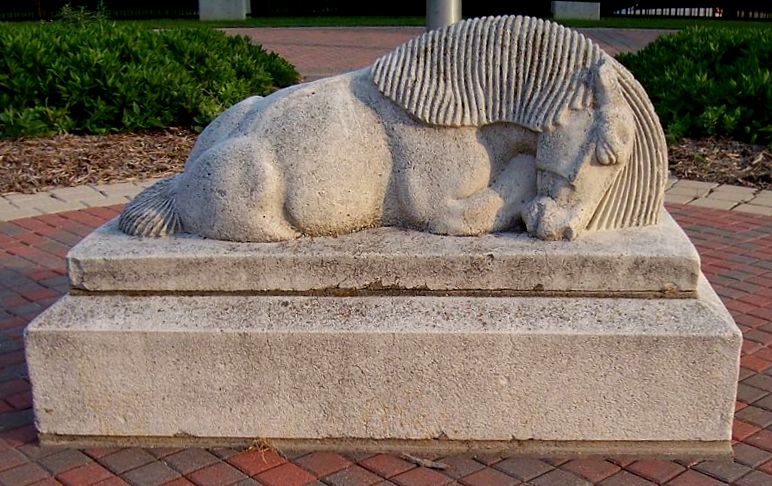
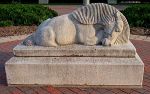
owen_peruna_monument_flickrMichael Owen’s Peruna monument today, SMU campus (photo by David Steele)

by Paula Bosse

When Peruna — SMU’s beloved Shetland pony that served as the Mustangs’ first live mascot — died in 1934, there was an immediate call to erect a memorial monument over the little horse’s grave, but it wasn’t until 1937 that a serious push for the erection began. Money was raised by the student council, which asked every student to contribute at least ten cents to the fund, and the search was on for the right sculptor.

The commission went to young Michael G. Owen, Jr., who, at only 21, was the same age as many of the students who were hiring him. (It has been erroneously reported that Owen attended SMU, but he did not.) Michael Owen was well-known within the Dallas art community and had made a mark for himself as something of an artistic prodigy — as a teenager, he had been on the periphery of the movement that spawned the Dallas Nine group of Regionalist artists, and he had  been mentored by many of the older artists, most notably Jerry Bywaters.

owen_peruna_smu-campus_050537
SMU Semi-Weekly Campus, May 5, 1937 (click for larger image)

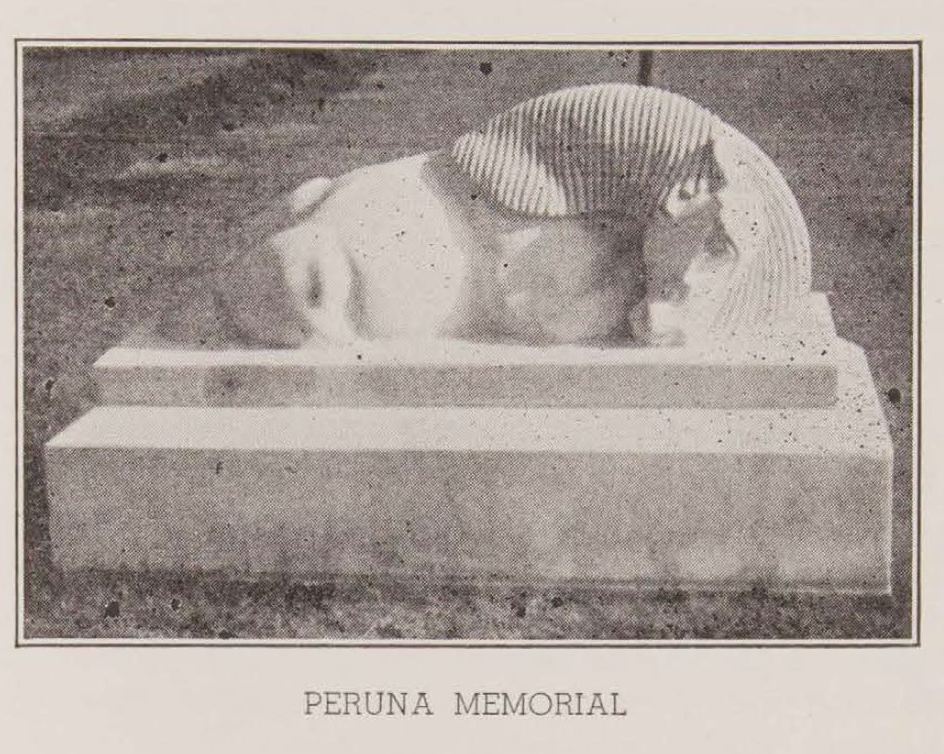
Owen worked quickly and completed the memorial — which was six feet long and four feet high and carved from 2,800 pounds of hard limestone — in time for the unveiling just outside Ownby Stadium on May 19, 1937.

The result was a quietly emotional — and even a very sweet — monument depicting the small slumbering horse atop a stone slab, with an inscription reading “Peruna I.” Jerry Bywaters wrote a glowing review of the piece, even though he seems a bit taken aback to find what he called “a memorial to a midget horse” on a college campus to be “one of the best pieces of memorial sculpture in the State.”

“Accustomed to seeing rather bad sculptured monuments erected to Confederate soldiers, Texas Rangers, political dignitaries or such abstract ideas as justice, plenty, or  beauty, it is slightly confusing to find a very good piece of sculpture set up as a memorial to a midget horse. […] Whatever the paradox of the situation, this monument is surely one of the best pieces of memorial sculpture in the State.” (Jerry Bywaters  in The Dallas Morning News, May 23, 1937)

peruna-memorial_mike-owen_m-book_1937_SMU-archives1937 (SMU Archives)

When Ownby Stadium was demolished and the new Ford Stadium built, the Peruna I monument was moved to the new stadium where it has become a memorial to all the Perunas.

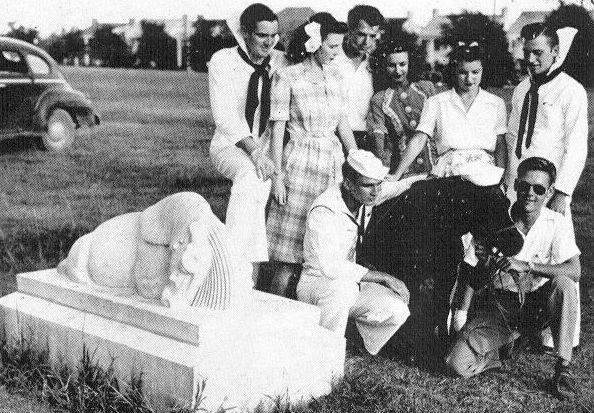
owen_peruna-memorial_wiki_1944With Peruna III, during WWII (Wikipedia)

owen_peruna-statue_1950-degolyer-DET1950 (DeGolyer Library, SMU)

***

Sources & Notes

Top photo by David Steele, from Flickr, here.

Article from SMU’s The Semi-Weekly Campus (May 5, 1937, p. 3), here.

Photo of Peruna III with sailors from the Peruna page on Wikipedia, here.

Bottom photo (cropped) of the Peruna monument from the DeGolyer Library, Central University Libraries, Southern Methodist University, here.

Previous Flashback Dallas posts on Mike Owen:

  • “Give a 15-Year Old 8,400 Pounds of Soap and He’ll Carve You a Radio Transmitter — 1930” is here.
  • “Michael G. Owen, Jr. — Dallas Sculptor of Lead Belly” — is here.

UPDATE: Read about a recently discovered large painting by Owen up for auction in Dallas in 2019 here.

The previous post on the untimely demise of Peruna is here.

owen_peruna_monument_flickr_sm

*

Copyright © 2014 Paula Bosse. All Rights Reserved.

Little Peruna: He Died With His Mustang Bridle On — 1934

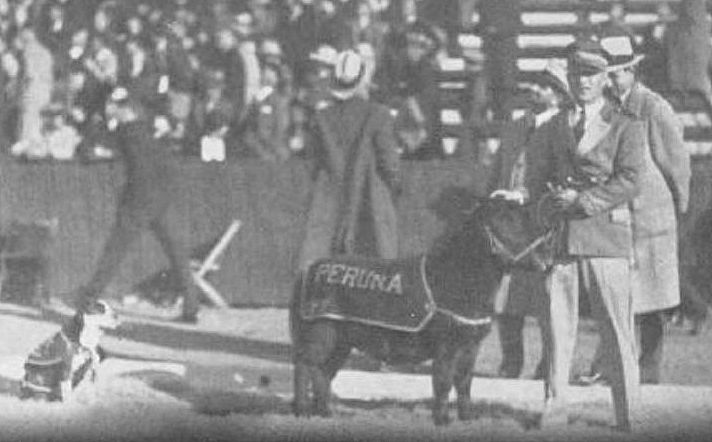
peruna-rotunda_1933Peruna, waiting for the Mustangs to score (photo: SMU)

by Paula Bosse

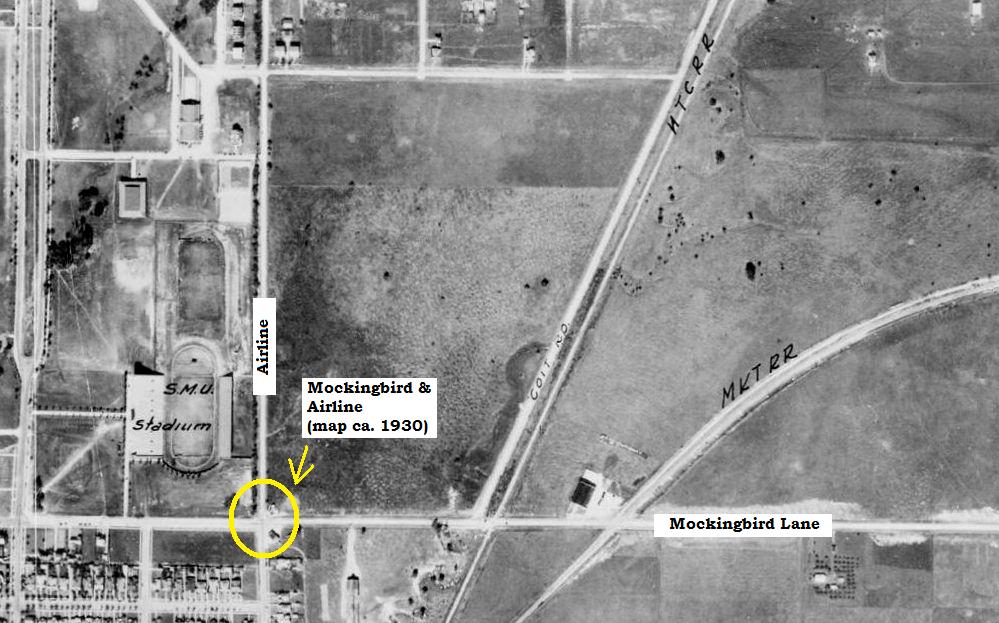
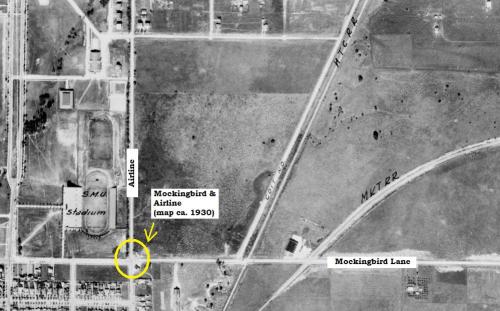
On October 30, 1934, shortly before midnight, Peruna, the 28-inch-tall little black Shetland pony mascot of the Southern Methodist University Mustangs, somehow liberated himself from his stable and wandered across campus and out into the intersection of Mockingbird and Airline where he was, sadly, struck by a hit-and-run driver and died soon after. As the newspaper account noted the next day, when the tragic accident occurred, “He was wearing a bridle of Red and Blue, the Mustang colors.”

Peruna had been the football team’s mascot for only two years, but he was an immensely popular attraction, and he was treated as something of a celebrity wherever he appeared, both at home and when traveling with the football team and the Mustang band. He did things most horses didn’t do, like ride in taxi cabs and sashay though hotel lobbies. Crowds at football games loved watching the little horse race across the field — even the ardent  supporters of the opposing teams were charmed by him. And he was, of course, much loved at SMU; his death was a hard blow to the student body.

When he was buried at Ownby Stadium, the band played the usually rousing fight song as a mournful dirge, and the flags on campus flew at half mast.

I’m an animal lover, and stories about the demise of animals are not things I normally find entertaining, especially when phrases like “the midget pony,” “the wee mascot,” “the stout-hearted little mascot,” and “the midget wonder horse” are constantly (and effectively) used by journalists to tug at the readers’ heart-strings. But the Peruna obituary/funeral coverage that was printed in The Dallas Morning News is so wonderfully and ridiculously over-the-top that that one yearns to know who wrote the uncredited story. I have created a little scenario in my head in which the writer had been (and I apologize…) “saddled” with writing a story about a horse’s funeral, but instead of handing it in the pedestrian short-and-vaguely-moving report that was expected, he decided — to hell with it — that he would just go full-throttle and produce the most outrageously grief-stricken story ever written about the untimely death of a college mascot. After what one assumes was the downing of much whiskey and much chuckling to himself (I suspect this was written by a sportswriter), a 500-word obit ran on Nov. 1, 1934:

CO-EDS AND GRID STARS SOB AS PERUNA IS BURIED
(The Dallas Morning News, Nov. 1, 1934)

In sight of the very gridiron on which he pranced to lasting fame, Peruna, stout-hearted little mascot of the Southern Methodist University Mustangs, was laid to rest Wednesday afternoon.

As co-eds sobbed openly and hardened football heroes found difficulty in brushing back the tears, the body of the diminutive pony was lowered into its grave in the shadow of Ownby Oval. His coffin was draped in red and blue, the school colors, and a huge M, the Mustang emblem, graced the top of the casket.

Across the way, on the campus of the big university itself, the flag fluttered at half mast. The school band, looking noticeably bare without Peruna prancing about, playing “Peruna,” the varsity song, in the tempo of a dirge. Hundreds of heads were bowed when the strains of the alma mater, “Varsity,” offered a final tribute to the wee mascot.

Peruna’s career was as colorful as that of the team he represented. Given to the school in November, 1932, by T. R. Jones, loyal Mustang supporter, the midget horse immediately became the constant companion of the team on its journeys from one side of the continent to the other.

Only last week Peruna was feted in New York, parading through the lobbies of the city’s swankiest hotels, whose clerks sniff haughtily at the thought of a dog or a cat entering the sacred portals of their hostelries….

In was in Shreveport where he slipped and cut his leg as he started to Centenary Stadium in a taxicab. His wound was stitched, and the faithful little animal pranced proudly with the band during the between-halves parade.

But Peruna prances no more. And if the music of Bob Goodrich and his Mustang band at Austin Saturday fails by a scant margin of being at its peppiest, it will be because the band has dedicated every tune on that day to the memory of its best friend.

That must have been fun to write.

The year following Peruna’s demise, the Rotunda — SMU’s yearbook — featured a two-page illustrated spread “Dedicated to the famous Mascot of the Mustangs … ‘Peruna.'”
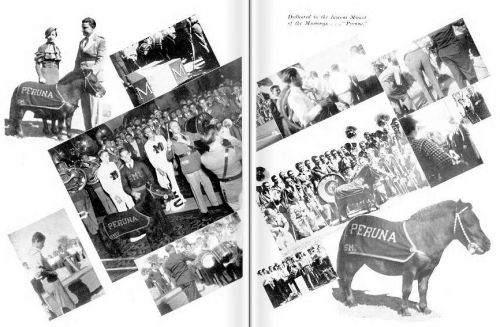
peruna_memorial_rotunda_1935

See Peruna’s very, very sweet memorial statue on the SMU campus here.

The loss of Peruna left the Mustangs without a mascot. Peruna’s son was proffered as a replacement, but even though “Little Peruna had been dressed in its father’s blanket and was prepared to give its all for SMU,” the school declined to bring Peruna fils on board. A successor — Peruna II — was eventually appointed, the first of many over the past eighty years. We’re now up to, I believe, Peruna IX, and the little stallion is still as popular as ever. May the “stout-hearted little mascot” continue to prance proudly for the SMU Mustangs.
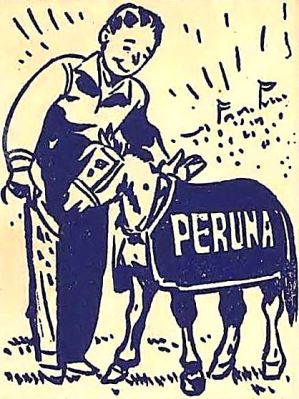
peruna_smu-rotunda_19391939 Peruna (SMU Rotunda)

peruna_varsity-shop_cully-culwell_culwell-ranch_1960-SMU-rotunda1960 Peruna (SMU Rotunda)

***

Sources & Notes

Top photo from the 1933 SMU yearbook, The Rotunda. The two-page spread is from the 1935 Rotunda.

For an idea of what the area looked like at the time of Peruna’s terrible midnight accident — large open fields to the north and east of the campus, and, to the south, a probably dimly-lit Mockingbird Lane — here is a detail from a 1930 aerial map from the Edwin J. Foscue Map Library at Southern Methodist University (the full map can be seen here):
smu-aerial_1930(click for larger image)

Check out these articles in the Dallas Morning News archives:

  • “Car Kills Peruna Back From Victory Over New Yorkers; SMU Mascot Known To Over Half Nation, Dies With Bridle On” (DMN, Oct. 31, 1934)
  • “Co-Eds and Grid Stars Sob As Peruna Is Buried” (DMN, Nov. 1, 1934)
  • “Grieving Mustangs Won’t Take Son of Peruna for Mascot” (DMN, Nov. 11, 1934)

Peruna on Wikipedia, here.

If you really want to know about Peruna, though, you need to go to the horse’s mouth — his page on the SMU website, here.

Read about the Peruna monument by Dallas artist Michael G. Owen, Jr. which was dedicated on the SMU campus in 1937, here.

*

Copyright © 2014 Paula Bosse. All Rights Reserved.

Mercantile National Bank Ad — 1960

merc_ad_1960-det

by Paula Bosse

I love you, Merc! Why aren’t you in EVERY Dallas ad?

ad-mercanitle_city-directory-1960(click for larger image)

***

Ad from the 1960 city directory. I don’t know who did the artwork for this ad, but I love it.

*

Copyright © 2014 Paula Bosse. All Rights Reserved.
A Downtown Gas Station! — 1949

tyler-service-stn_degolyer_1949-det1Gas station at Elm & Houston! (click for larger image) (SMU Libraries)

by Paula Bosse

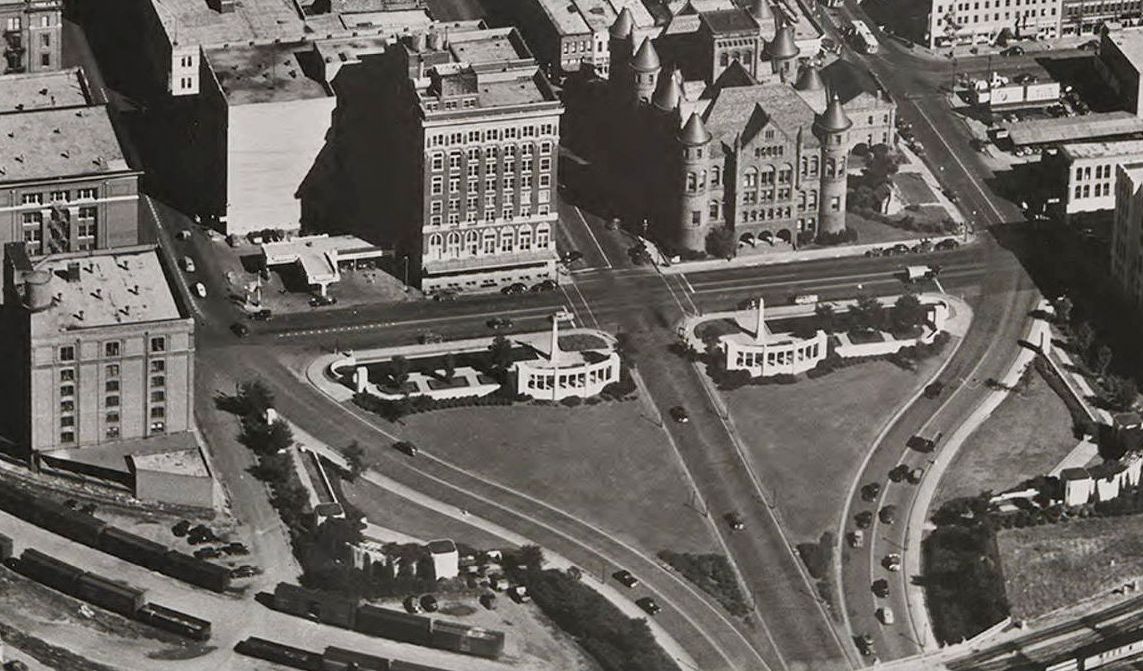
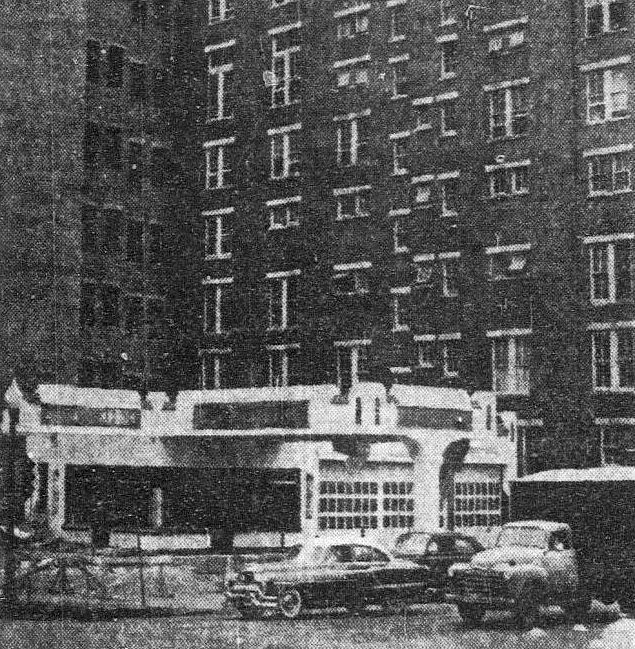
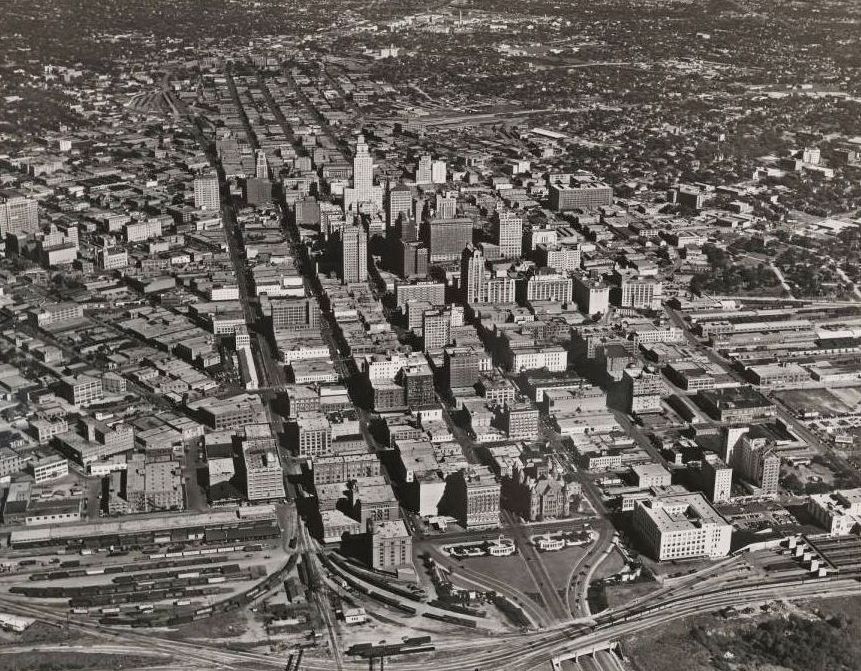
There was a time when gas stations populated the central business district in downtown Dallas. But now? I’m not sure I’ve ever seen a gas station in the heart of downtown. Which is probably why the station seen above (from a detail of a larger aerial view of downtown) stood out so much when I was looking at the photo. And it wasn’t located just anywhere downtown, but it was in the primo location opposite Dealey Plaza at the “gateway” to the city. It doesn’t fit in that space very well — it’s a corner crying out for a more substantial structure — but … wouldn’t it be nice to have an actual full-service gas station downtown again?

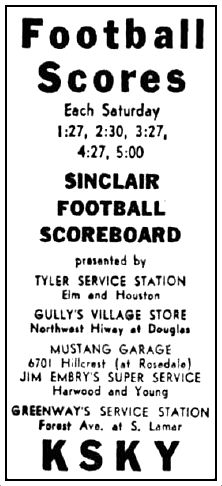
The Tyler Service Station (and before that the Longhorn Service Station) held down the corner at Elm and Houston streets in the 1940s but was demolished in 1953 to make way for the construction of the Records Building/Criminal Courts Building annex. And, hallelujah, I found a photo of the service station from ground-level — and it was pretty cool-looking!

gas-station_elm-and-houston_1950s

tyler-service-stn_dmn_100948Oct. 9, 1948

And, finally, here’s the original photo I saw in which that long-gone gas station jumped out at me, another wonderful photo by Lloyd M. Long, taken in May, 1949. You never know what odd things you’ll discover if you just take the time to explore.

downtown_degolyer_1949Aerial photo by Lloyd M. Long, 1949 (Foscue Map Library, SMU)

***

Sources & Notes

Lloyd M. Long photo (“Downtown Dallas, looking east”), from the Edwin J. Foscue Map Library, Central University Libraries, Southern Methodist University; it can be viewed here.

Click pictures for larger images.

*

Copyright © 2014 Paula Bosse. All Rights Reserved.


Cowboys and Indians on Elm Street — 1915

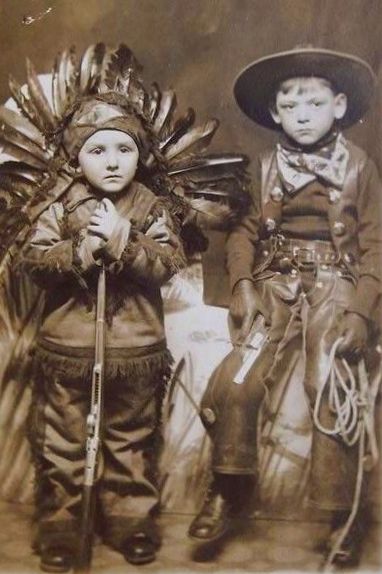
lawrence_kiddie-photoPhoto by Joe Lawrence, circa 1915

by Paula Bosse

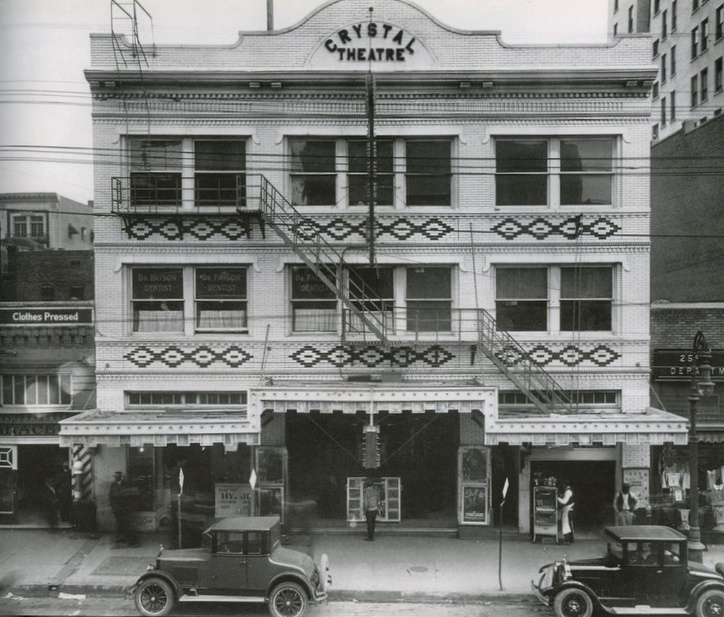
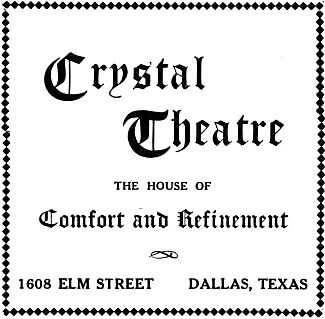
The photo above, showing two not-terribly-thrilled children dressed up in Old West costumes, was taken by Joe Lawrence in his “Crystal Electric Studio” at 1608 Elm Street, one of many small businesses located above the Crystal Theater.

crystal-theaterThe Crystal Theatre — with office space above (click for larger image)

Joseph Z. Lawrence (1884-1943) was born in Romania and settled in Dallas in 1909. In 1915 he was doing business as a photographer at 1608 Elm Street. Lawrence later owned the Lawrence Art Galleries on Pacific Avenue, and, along with his son Harry, was an early supporter of the Dallas Nine artists.

***

Sources & Notes

Top studio photo by Joe Lawrence, found on eBay.

Photo of the Crystal Theater found on Pinterest, here. A photo of the 101-year old building taken during the recent spate of downtown demolition — with the wrecking ball literally INCHES away from it — is here. The Dallas Morning News article it comes from is here.

At some point the address of the building (originally 1608-10) became 1610 Elm, perhaps when it was extensively remodeled in the late 1920s and became a retail store.

crystal-theater_building-code-bk_19141914 — “Comfort & Refinement”!

*

Copyright © 2014 Paula Bosse. All Rights Reserved.