Flashback : Dallas

A Miscellany: History, Ads, Pop Culture

South Ervay & Jackson — 1946

“Have you had your lemonade today?”

by Paula Bosse

Above, the intersection of South Ervay (at left, with cars headed north) and Jackson Street (at right, with pedestrians walking east), about 1946. All those little shops…. And look at that cool Sun Drop Lemonade ad painted on the Jackson Street side of the building! Below, that same corner today (2014).

ervay-jackson-google

…Yep.

**

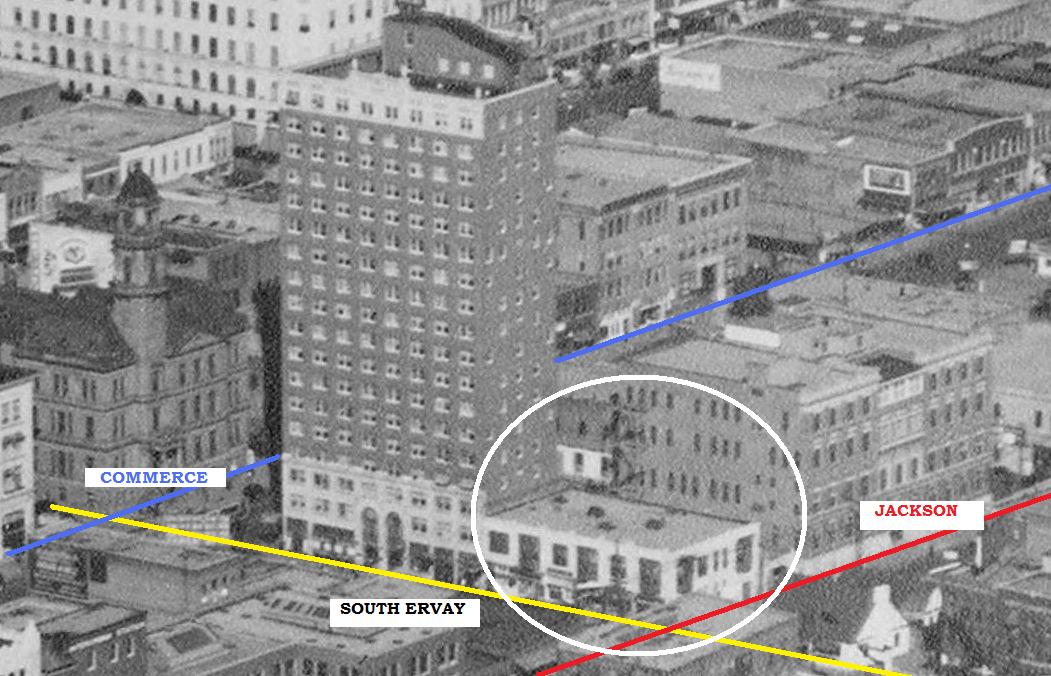
UPDATE: When I posted this photo originally, I thought it showed the southwest corner of S. Ervay and Commerce, but reader Brian Pranger corrected me on Twitter. He is absolutely correct when he suggested that the view is actually the northeast corner of S. Ervay and Jackson (I have corrected the errors above). Just to verify, I found an aerial photo of the intersection from 1935 that shows the building in question. Here is a detail with my clunky labeling (click for larger image):

ervay-jackson_1935_smu

Thank you, Brian! (And I ALWAYS welcome corrections!)

***

Sources & Notes

Top photo from Jim Wheat’s Dallas County, Texas Archives. Wheat estimates the photo was taken around 1946, with the following businesses identified: Modern Finance Co., 204 S. Ervay; South Ervay Barber Shop, 208 S. Ervay; Apex Hotel (probably pretty dodgy, but who wouldn’t want to stay at the “Apex Hotel”!), 208 1/2 S. Ervay; Perfect Hand Laundry & Dry Cleaning, 210 S. Ervay.

“Today” photo from Google Street View.

The last image is a detail from a 1935 aerial view of the “Mid-Town Business District,” taken by Lloyd M. Long; it is part of the Edwin J. Foscue Map Library, Central University Libraries, Southern Methodist University. SMU’s labeled version of this map can be seen here (the building in question is adjacent to the Allen Building, which on SMU’s map is #38, at the top right — use the zoom function to see all sorts of things!).

*

Copyright © 2014 Paula Bosse. All Rights Reserved.

Highland Park High School — 1939

hphs_1939Highland Park High School

by Paula Bosse

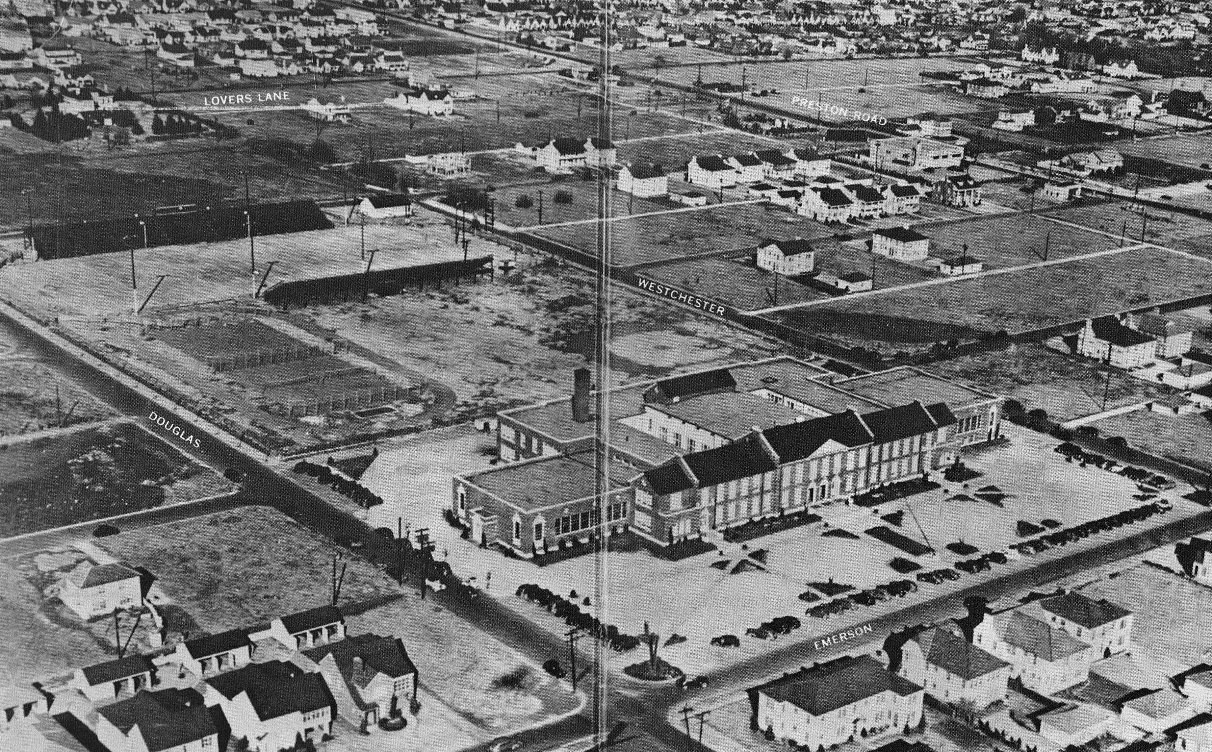
Great photo of the neighborhood around Highland Park High School (its second location — I had no idea), from the 1939 HPHS yearbook. I would have thought the Park Cities would have been built up more by then.

The description, from the back of the 1970s-era postcard this image appeared on:

In 1937, Highland Park High School moved to 4220 Emerson from its original home on Normandy. This aerial view — taken from a double-page spread in the 1939 Highlander — shows the entire physical plant of [the] High School. R. C. Dunlap was the President of the Highland Park District Board of Education that year.

Bounded by Emerson, Douglas, Lovers Lane and Westchester — covering five full city blocks — Highland Park High School looks, today, much as it did in 1939. Only the neighborhood has changed as it has continued to develop. Significant additions have been made to the educational facilities in order to keep teaching techniques right up to date.

Today, ninth, tenth, eleventh and twelfth graders from both Park Cities attend Highland Park High School — still recognized as one of the best educational institutions in the country.

***

Sources & Notes

Photo from the 1939 HPHS Highlander yearbook; later issued as a postcard as part of the Park Cities Bank “Heritage Series” in the 1970s. Thanks to the Lone Star Library Annex Facebook group for use of the image.

A very, VERY large scan of this image can be viewed here.

**

Here’s an awkwardly cropped photo of the first HPHS, from 1928 (click for larger image):

old-hphs_1928_crop

Another from the same series of postcards, issued in the 1970s. The description on the back:

Sunny days almost always found upperclassmen chatting on the front steps at High School. These photographs were taken from a 1928 copy of The Highlander — the Highland Park High School annual.

H. E. Gable was the superintendent that year. Ben Wiseman replaced E. S. Lawler as principal at the end of the school year.

The front steps at 3520 Normandy are still a gathering spot, but today’s students attend Highland Park Middle School — grades six, seven and eight. Senior High School moved to a new building at 4220 Emerson in 1937. Additions and remodeling have kept both of these educational facilities right up to the minute in technology and equipment.

*

Copyright © 2014 Paula Bosse. All Rights Reserved.

“Howdy, Y’all!”

tx-centennial_postcard_1936

by Paula Bosse

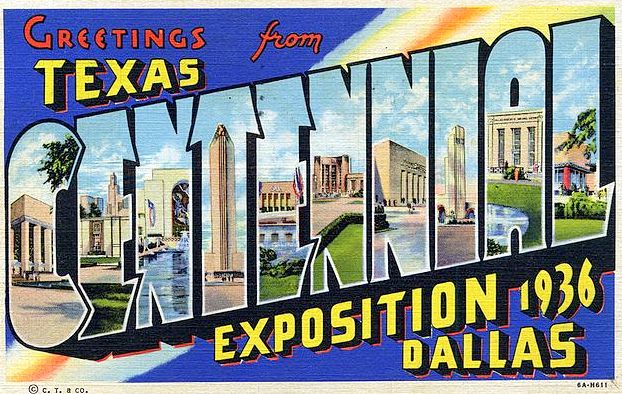
Thanks so much to the fine folks at The State Fair of Texas for the Throwback Thursday social media love today! They graciously shared our Texas Centennial posts. Welcome, new visitors!

And don’t forget, Big Tex is counting down those days….

***

State Fair of Texas website is here. Get ready, y’all!

*

Copyright © 2014 Paula Bosse. All Rights Reserved.

The Runyonesque Pearl Street Market, Full of Colorful Characters and an Army of Rats

bob-taylors-cafe_ebayProduce seller, Pearl Street Market

by Paula Bosse

Last week I wrote about the produce market area in the neighborhood where the Farmers Market was eventually built, mainly because I had come across the above undated and unidentified photograph. I really wanted to know more about this photo, and the more I read about the area known in the ‘teens through the ’50s as the Pearl Street Market, the more I became fascinated by it.

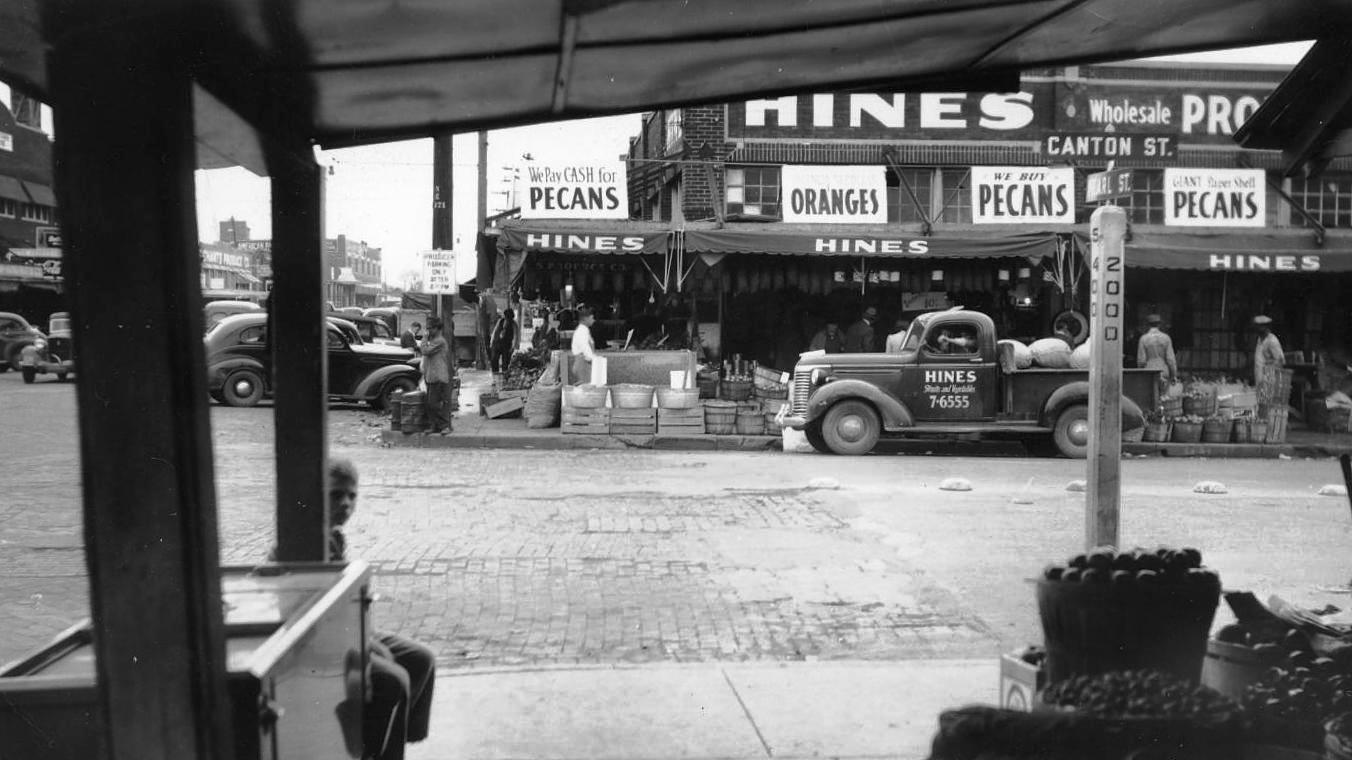
I love this photo, but, sadly, I never found out who cafe-namesake Bob Taylor was, and I never discovered the identity of the man sitting on the sidewalk with his produce. BUT, I did realize that this produce seller was right across the street from one of the biggest wholesale produce sellers in Dallas, the Hines Produce Company. In fact, the photo below might show my mystery man’s view across the street. Both photos show the intersection of the 2000 block of Canton and the 400 block of South Pearl, the heart of the Pearl Street Market.
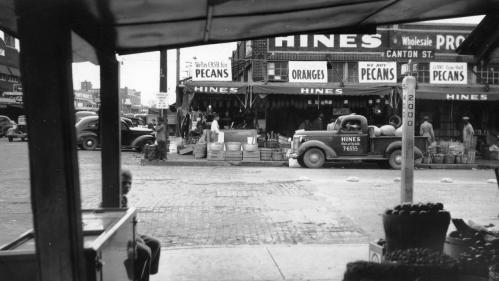
hines_canton-pearlHines Wholesale Produce Company, Canton & S. Pearl

These two scenes look so wholesome — produce peddlers selling their fresh fruits and vegetables, quaint old cars and trucks parked along streets that are still vaguely familiar-looking, and the overall old-fashioned-ness of everything — all presented in nice, sharp, black-and-white photographs that always make me feel a little nostalgic, even though I wasn’t actually around back then and have nothing, really, to be nostalgic about.

But “wholesome” is not a word that would have been associated with the Pearl Street Market. In fact, this was a part of town your mother would probably strongly suggest you not visit. Here are a few of the illicit activities that went on here on a fairly regular basis:

  • Brawls in cafes, often involving weaponized broken beer bottles
  • Shootings
  • Stabbings
  • Pickpocketing
  • Burglary
  • Robberies (of victims both asleep and awake)
  • Gambling
  • Muggings
  • Drug dealing
  • Arson
  • Hit-and-runs
  • Vehicular homicides
  • Regular homicides
  • Prostitution (I’m just guessing…)
  • Shoplifting
  • Vagrancy
  • Selling another man’s melons and fleeing with the money
  • The occasional being “severed” by a train
  • Etc.

A typical police blotter story went something like this:

[Miss Esther Lee Bean] told physicians she was attacked by another woman who broke a beer bottle on her head and then used the jagged neck of the bottle as a weapon, cutting her several times on the right arm…. The affray occurred in a cafe in the 400 block of South Pearl. (Dallas Morning News, Dec. 17, 1938)

So … yes, very nostalgic.

Crime was a big problem, but what seems to have been even more upsetting to the people of Dallas was the general squalor of the place. Sanitary conditions were appalling. Rotting fruit and vegetables were thrown in the street, and live chickens were kept in cages, doing things that chickens do (which probably shouldn’t be done that close to things people might eat). And there were NO public toilets in the area — visiting farmers (who often bypassed the flea-bag hotels and slept in their trucks — or even on the sidewalks) routinely used the alleys as “comfort stations.” And then there were the rats. LOTS of rats. A staggering number of rats. Rats absolutely everywhere. Typhus? Not just a rumor. City sanitation crews would come by daily to hose the place down, but there was so much solid matter going down the drains that sewers were frequently clogged. It was, in a word, disgusting.
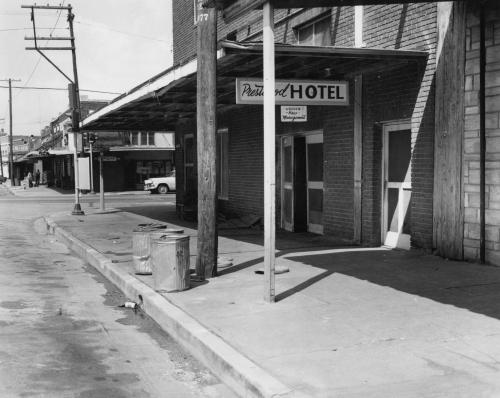
hotel_pearl_1959_portalA typical hotel near Pearl & Canton, a bit cleaner by the ’50s

For years this part of Dallas, just south of the central business district, had been a place where farmers (and produce brokers) had been selling their fruits, vegetables, poultry, eggs, pecans, and whatever else they could haul into town. It was all very informal, and for much of that time it was completely unregulated. This part of town had been the base of the “truck farmers” since at least 1912. Before that, the market was at Pearl and Main, and in the earliest days it was at Ervay and Elm.

In 1914 a city-sanctioned (and presumably regulated) municipal retail market where vendors would sell directly to consumers was proposed, but eventually consumers became irritated that the produce they bought at the municipal market was significantly more expensive than that which could be purchased from the “hucksters” who parked along Pearl Street and roamed residential neighborhoods. The Pearl Street vendors sold primarily to wholesale customers, but over time, they opened up their stalls to the public and did a bustling business with housewives. The wholesale market was hit pretty hard by the 1930s as the number of independent grocers — once the major buyers on Pearl Street — diminished as chain stores took over. Those housewives became more and more important as time went on.

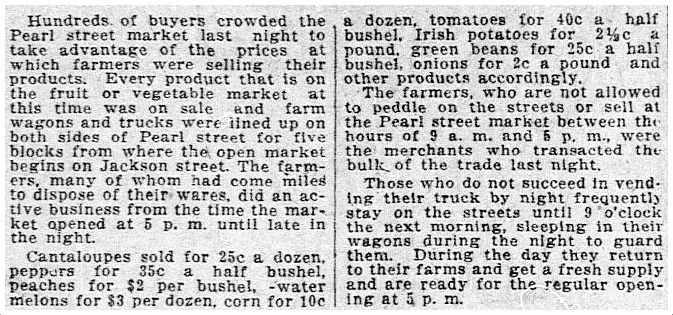
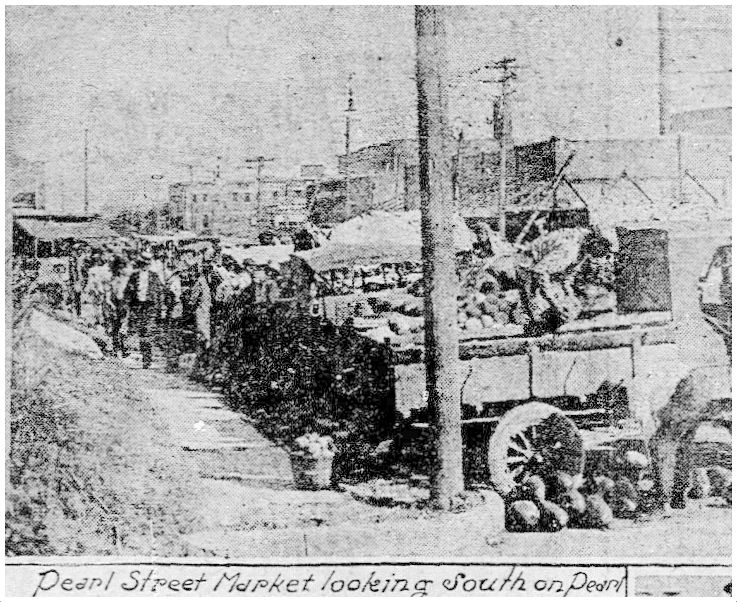
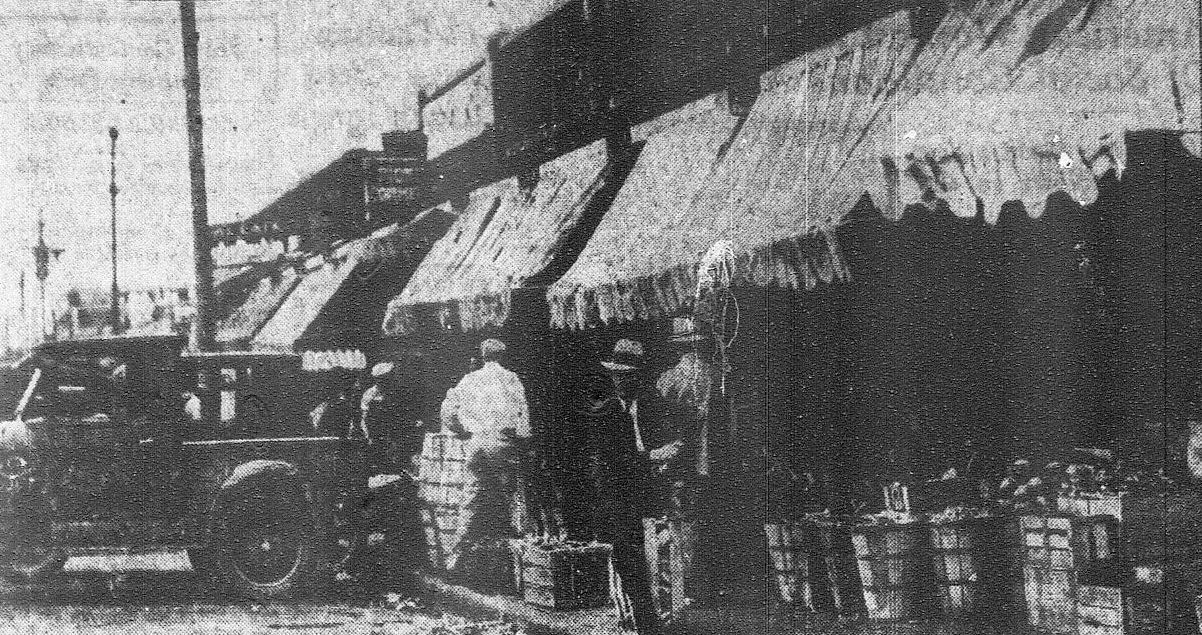
farmers_dmn_071721DMN, July 17, 1921 (click to enlarge)

farmers_dmn_071721afarmers_dmn_071721c

farmers_dmn_071721bDMN, July 17, 1921

By the 1920s, the Pearl Street Market was well-established, and it was where one went to buy fresh (and “fresh”) fruits and vegetables. And according to this real estate ad, business was booming:

produce-mkt-dist_dmn_110423DMN, Nov. 4, 1923

In 1933, The Dallas Morning News printed a fantastic, full-page, Runyonesque article about the “Pearl Streeters,” written by Eddie Anderson, who interviewed the colorful characters of the area and described the buzzing street life. With tongue only partially in cheek, he wrote: “Chicago has its Water Street. In New York you will find it on Washington. And if you go abroad there is the famous Smithfield Market of London and the vaulted bazars of Constantinople. In Dallas, it is Pearl Street.” Below, a photo that accompanied the story (click for larger image).
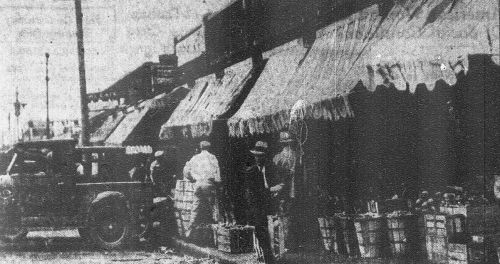
pearl-st-mkt_dmn_051433a

Anderson’s story was certainly entertaining, but it mostly glossed over the area’s more unsavory aspects. By 1938, there were louder and louder demands to clean up the neighborhood. Housewives organized and protested the deplorable conditions of the area, echoing points covered in a scathing Morning News editorial in which it was described as “a hazard to the health of the city because of the number of persons who visit it and because 75 per cent of the vegetables and poultry consumed in Dallas pass through that market” (DMN, Aug. 17, 1938).

In the early 1940s, the city finally stepped in and built the forerunner to the Farmers Market that we know today. By the 1950s, things in the squalor department had settled down a bit, and photos featuring pretty suburban housewives examining the produce and smiling children sampling fresh strawberries.

Nary a rat to be seen.

*

A street map of the Canton & Pearl area in about 1920, back when Canton Street was still part of an uninterrupted grid. (Note that many of the street names have changed over the years.)

1919-map

***

Sources & Notes

Top photo (with Bob Taylor’s Cafe in the background) is from the author’s collection.

Photos of the Hines Produce Co. and the Prestwood (?) Hotel are from the Dallas Municipal Archives’ Dallas Farmers Market / Henry Forschmidt Collection, via the Portal to Texas History. You can browse this great collection here.

Map detail is from the very large “1919 Map and Guide of Dallas & Suburbs” (C. Weichsel Co.), via the Portal to Texas History, here.

The following DMN articles on the Pearl Street Market/Farmers Market are worth a read:

  • “Pearl Street Market in Morning, Dallas’ Most Picturesque and Busiest Place in City” (July 19, 1925)
  • “$1,500 Dope Cache Found Under Pile of Pineapples” (July 15, 1936), a story about a heroin bust with a headline that seems right out of The Weekly World News
  • “Let’s Keep Our Pantry Clean,” editorial by Harry C. Withers (DMN, Aug. 17, 1938)
  • “Dallas: The Old Public Market” by Tom Milligan (Aug. 15, 1966)

And even though I linked to it above, it’s so good and such a fun read that I’m going to mention it again: I highly recommend Eddie Anderson’s “Pearl Street Market As It Sees Itself” (May 14, 1933), here. Edward Anderson was an interesting guy: read about him at the Handbook of Texas here; read about his novels and see photos, here. All these years I’ve had his novel Thieves Like Us on my bookshelf, but I had never gotten around to reading it. Now I have a reason to!

I’ve gathered a pretty entertaining collection of crime reports from the Pearl & Canton neighborhood into one handy document, which can be read in all its seedy glory, hereSERIOUSLY. THIS IS FANTASTIC STUFF!

*

Copyright © 2014 Paula Bosse. All Rights Reserved.

No. 4 Hook and Ladder Company, Oak Lawn — 1909

fire-dept_no-4-hook-company_ebay
Oak Lawn Fire Station

by Paula Bosse

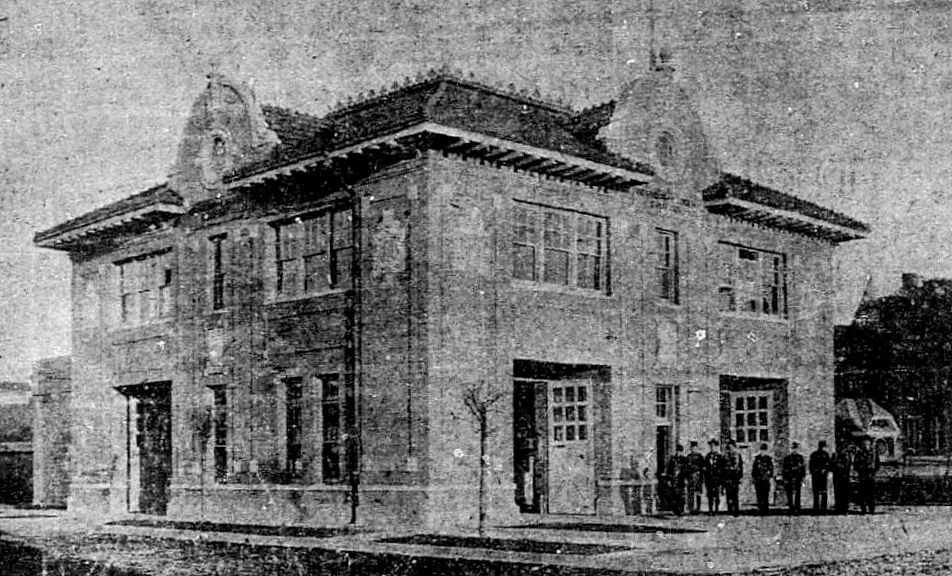
The photograph below appeared in The Dallas Morning News on December 5, 1909 under the headline, “Fire Station Lately Erected in the Oak Lawn District.”

fire-station_oak-lawn_clogenson_dmn_120509

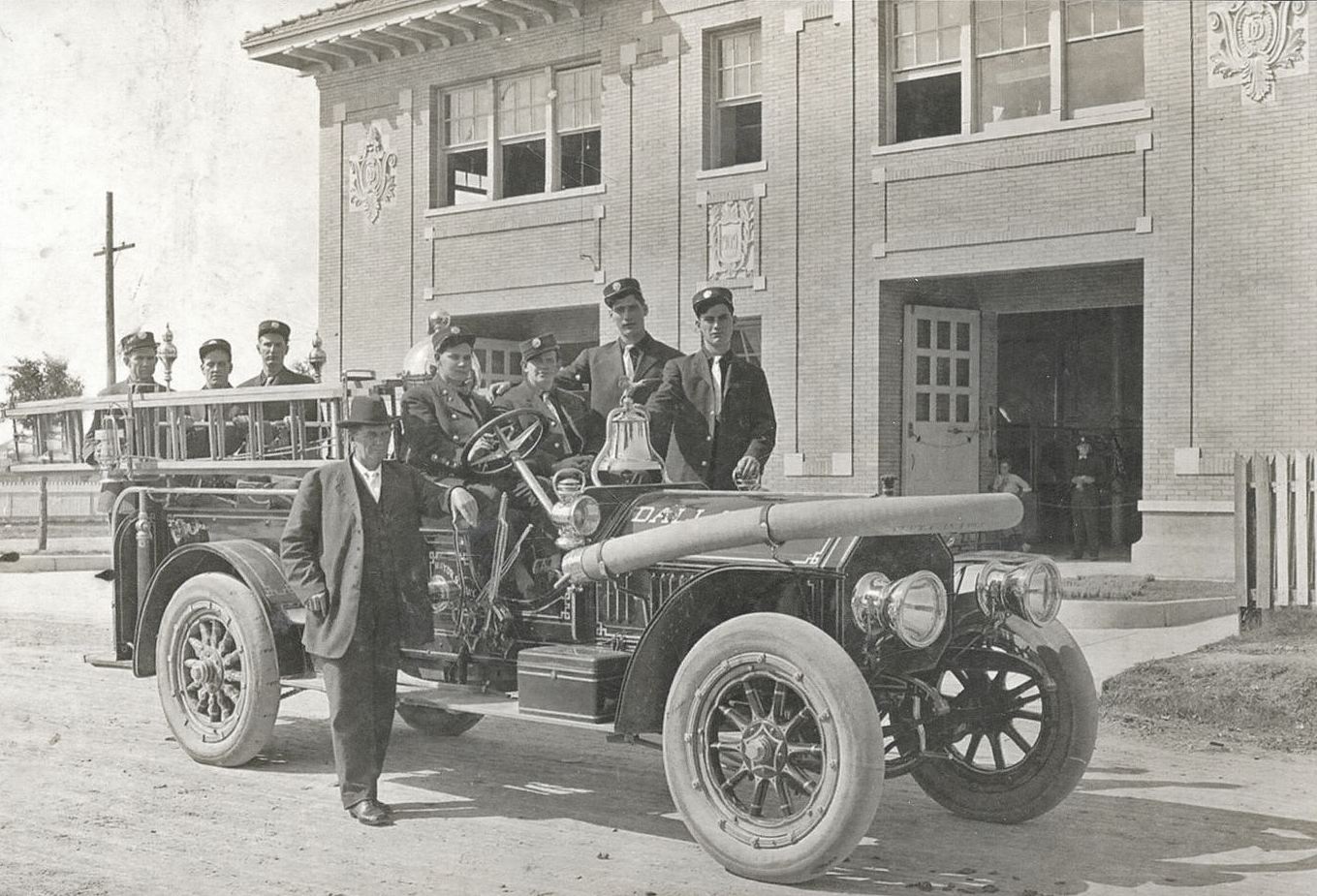
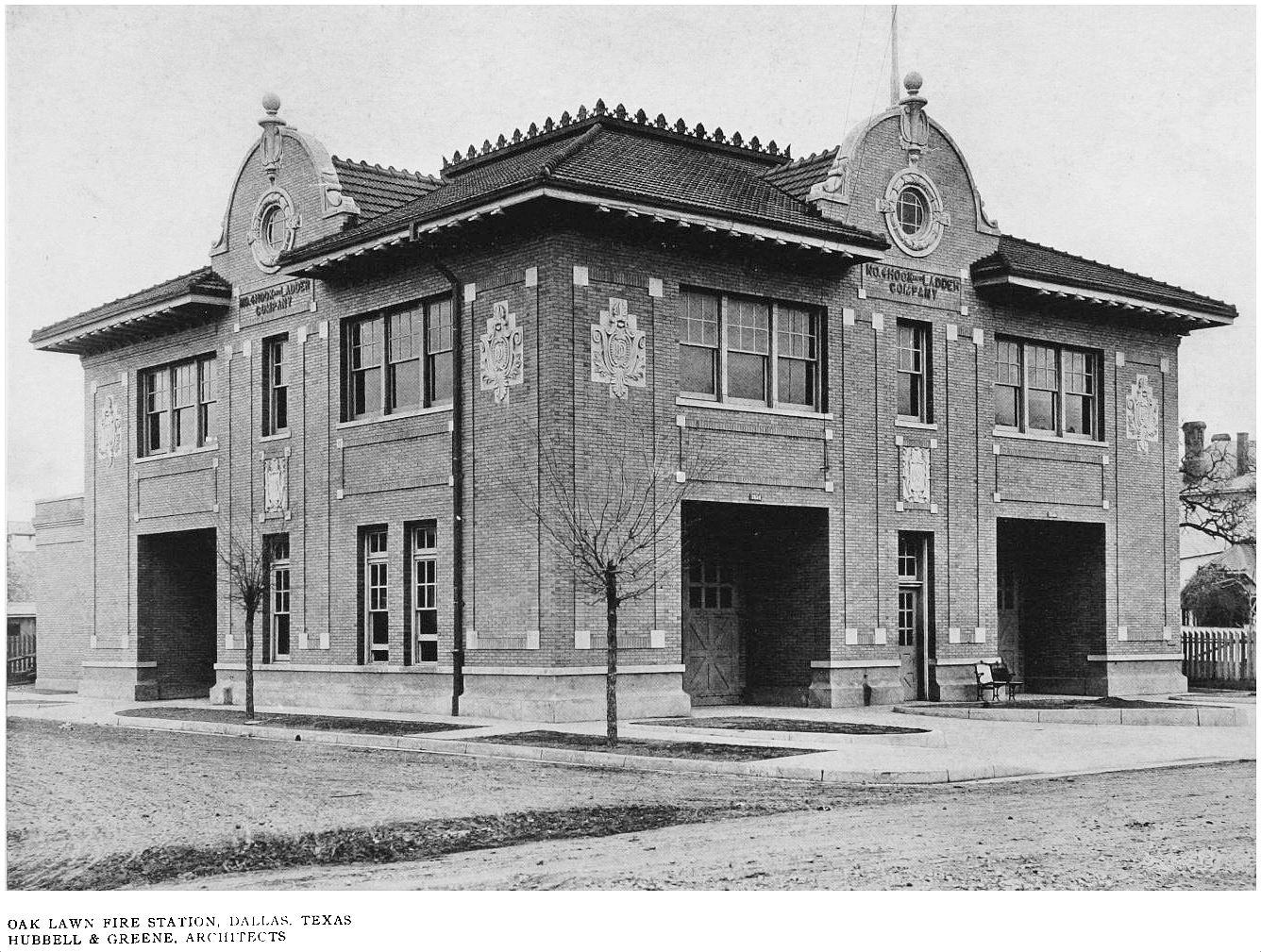
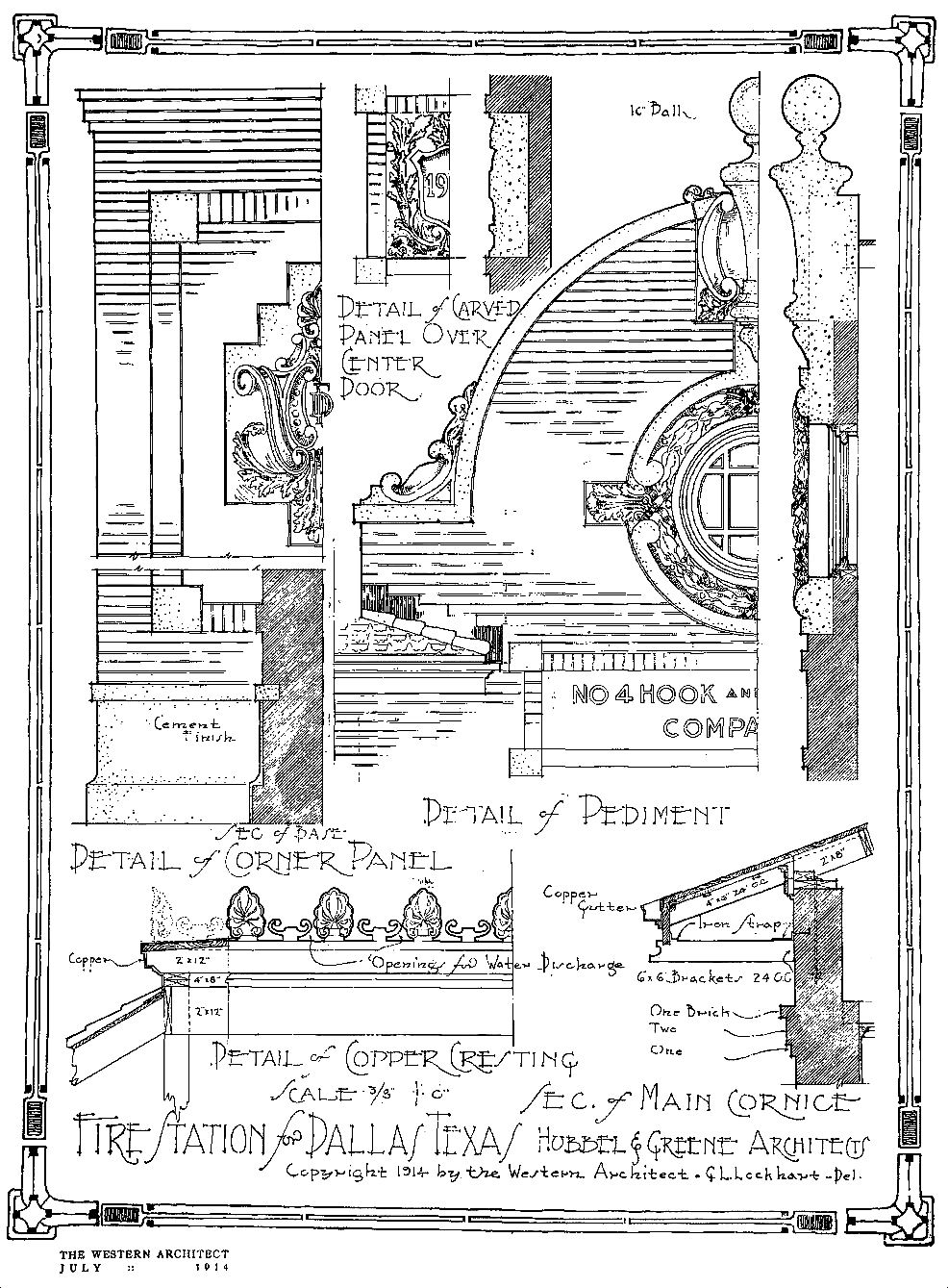
“Hook & Ladder Company No. 4” (now known as the more prosaic “Station No. 11”), was designed by noted architects Hubbell & Greene. It was built at Cedar Springs Road and Reagan Street in 1909 as the first “suburban” fire station in Dallas. Still a working firehouse, the Mission Revival building is a designated historic landmark and is listed in the National Register of Historic Places.

firehouse-oak-lawn_google

*

Below, a photo and architectural plan which appeared in the 1914 “Western Architect” journal (more about this here):

firehouse_oak-lawn_western-architect_july-1914

firehouse_oak-lawn_western-architect_july-1914_architectural-details_2

*

Another photo of the historic firehouse, from a 1931 publication, captioned “No. 11 Engine Co., Cedar Springs & Reagan”:

cedar-springs_fire-station_fire-dept-bk_1931_portal

***

Sources & Notes

Top photo found on eBay.

1909 Dallas Morning News photograph by Clogenson.

Color image of the station as it looks today from Google Street View.

Final photograph is from The Man in the Leather Helmet: A Souvenir Booklet of The Dallas Fire Department (1931), via the Portal to Texas History.

For more on the history of this historic fire station, see the page devoted to it on the Dallas Fire Rescue Department website, here. Also, see the City of Dallas Landmark Structures and Sites page here.

*

Copyright © 2014 Paula Bosse. All Rights Reserved.

Mary Sloan’s Stylized Dallas Skyline

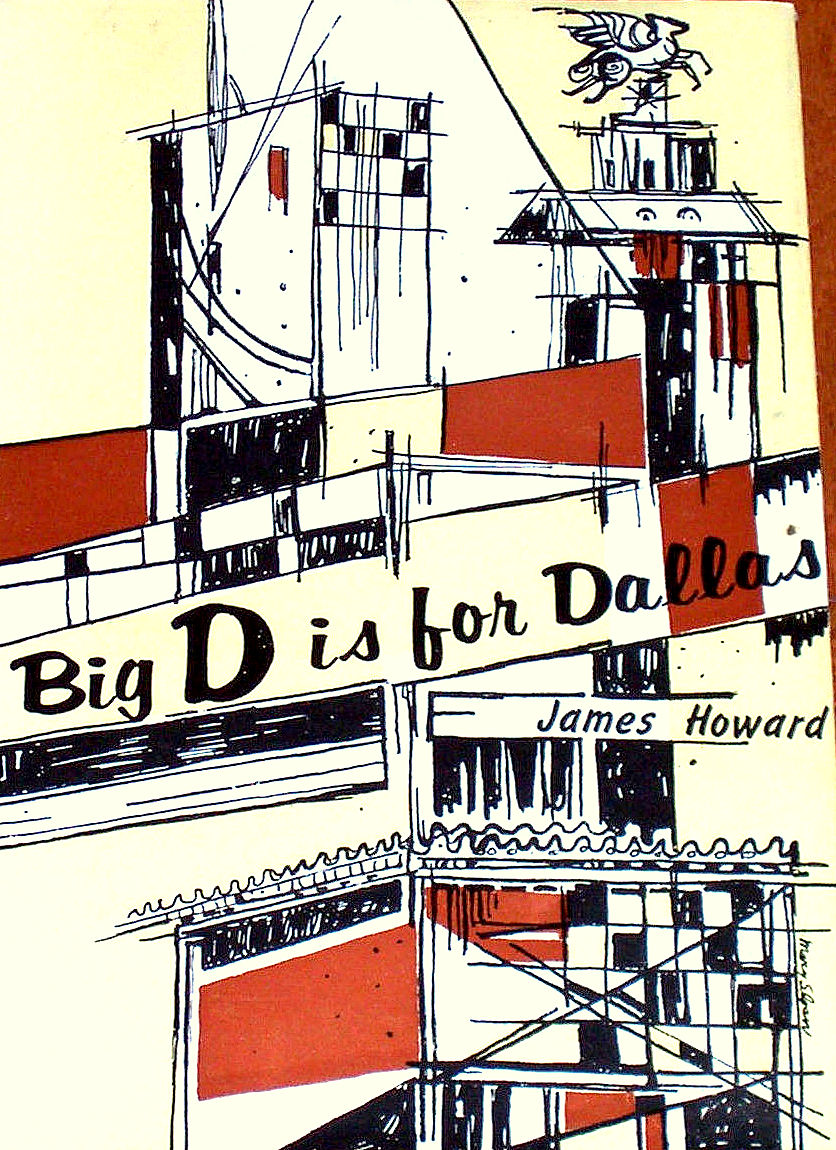
mary-sloan_jacket-art_front_1957-smArt by Mary Sloan, 1957

by Paula Bosse

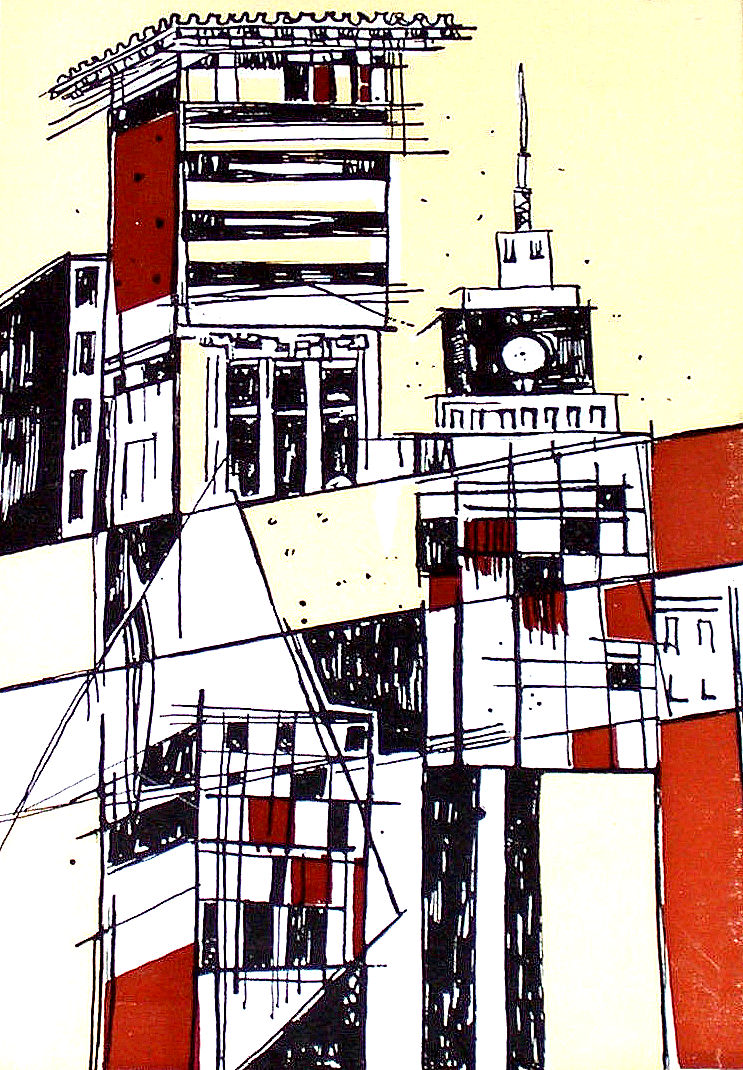
Dust jacket artwork and design are often taken for granted, which makes no sense because the cover of a book does actually tend to drive book sales. Things have improved in recent years, but in the past, these artists were frequently not credited at all. Here’s an example, though, of jacket art that actually gives full credit to the artist, Mary Sloan. This fantastic, stylized depiction of the Dallas skyline positively reeks (in a good way) of mid-century illustration. I don’t think I’ve seen this before, which is a bit of a surprise, because I was a bookseller for many years, specializing in Texana titles. I’m not sure how this one escaped me, but I’m pretty sure I’d remember this cover art.

Mary Sloan was born Mary Key in about 1925 and grew up in Denton. She studied art in Denton and Austin, working under noted Texas artists such as William Lester, Everett Spruce, and Charles Umlauf. She won numerous art competitions and is represented in several Texas museums. She settled with her husband and family in Corpus Christi where she taught art for many years at Del Mar College. In addition to painting and drawing, she was also a proficient mosaic artist and designed glass and stone mosaic murals. I don’t know if she did any other book jacket art — it would be a shame if this is all she did, because I think it’s really great.

mary-sloan_jacket-art_back_1957_smRear panel of dust jacket

mary-sloan_ad_swhq_1957-det

mary-sloan_swhq_1957_ad-text

***

Sources & Notes

Dust jacket for Big D is for Dallas by James Howard (Austin: self-published, 1957), a collection of biographical profiles of Dallas business luminaries.

Black-and-white image of the cover art and accompanying text are from an ad that appeared in the Southwestern Historical Quarterly in 1957.

*

Copyright © 2014 Paula Bosse. All Rights Reserved.

Society Ladies and Their Great Big Hats

shakespeare-club_c1895The Dallas Shakespeare Club

by Paula Bosse

Had The Graduate been set near the beginning of the twentieth century rather than the middle of it, that famous scene out by the pool (er…near the horse trough) might have gone something like this:

Mr. McGuire: I just want to say one word to you. Just one word.

Benjamin: Yes, sir?

Mr. McGuire: Are you listening?

Benjamin: Yes, sir, I am.

Mr. McGuire: …”Millinery.”

Benjamin: …Exactly how do you mean?

Mr. McGuire: There’s a great future in millinery. Think about it. Will you think about it?

Benjamin: Yes, I will.

Mr. McGuire: Enough said. That’s a deal.

***

Sources & Notes

Photograph of the Dallas Shakespeare Club is from the Dallas Historical Society; it appears in the book Women and the Creation of Urban Life in Dallas, Texas, 1843-1920 by Elizabeth York Enstam (College Station: Texas A & M University Press, 1998). Enstam’s caption of this photograph identifies two women in the front row, on the right as Sallie Griffis Meyer (1863-1932), future president of the Dallas Art Association, and May Dickson Exall (1859-1936), president of the Dallas Shakespeare Club from 1886 until her death. Ms. Enstam has labeled this photo as “about 1895.” 

*

Dialogue (all but one word) from the film version of The Graduate, screenplay by Buck Henry, based on the novel by Charles Webb. “Millinery adaptation” by Paula Bosse, based on the screenplay by Buck Henry which was based on the novel by Charles Webb.

*

Copyright © 2014 Paula Bosse. All Rights Reserved.

Dallas in Song: Chamber-of-Commerce-Approved vs. Hard Reality

texas-in-my-soul_willie-nelson

by Paula Bosse

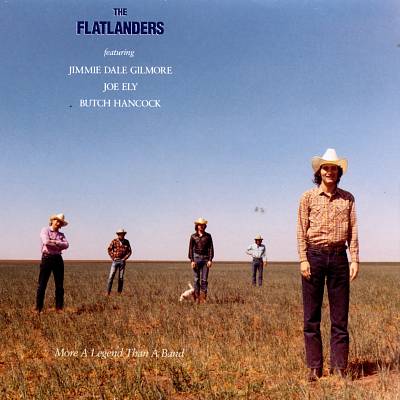
One of the best-known songs about Our Fair City is the dark and cynical “Dallas” by The Flatlanders (written by Panhandle-born Jimmie Dale Gilmore). It may be the best representation of the city ever written. I mean, how can you ever improve upon the immortal line, “Dallas is a rich man with a death wish in his eye”?

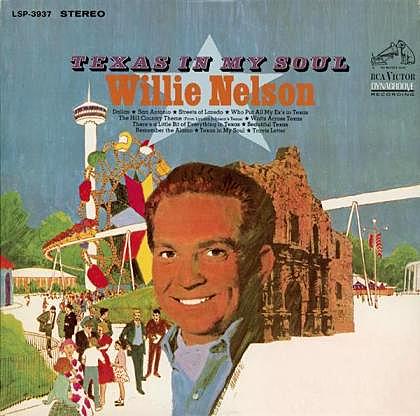
In August of 1967, right in the middle of The Summer of Love and several years before The Flatlanders recorded their song, Willie Nelson recorded a very different song which was also called “Dallas.” These two songs offer the yin and the yang of Dallas, a city people seem to love or hate.

flatlanders-cover

Willie’s song, written by Stovall and Groom (the Groom being Dewey Groom, the country musician who owned Dallas’ Longhorn Ballroom), appeared as the lead track on Willie’s “Texas In My Soul,” a concept album of covers (!) produced by Chet Atkins and released in 1968. I love Willie, but that song is pretty awful. I’m not sure if Willie picked it or Chet picked it, but … oh dear. I love songs from Willie’s early recording years — when he was trying to branch out from a successful songwriting career to being a performer — and he sounds great on the song, and the production is Nashville-studio-impeccable, but … those lyrics. If the Dallas Chamber of Commerce had a stamp of approval for songs about Dallas, I’m sure they would have stamped the bejabbers out of this one. It’s a very positive, damn near chirpy song about the city — and it’s got to be one of the only songs out there to name-check Central Expressway, LBJ, Love Field, Highland Park, Neiman’s, and the Cotton Bowl in lyrics like this:

Take a ride on her Central Expressway — breeze down the LBJ.
Look her over good, you’ll have to say: she’s the best-dressed city in the USA.

Uh-huh. It does have one absolutely great line which is (unintentionally) pure Dallas: “She swings like a blonde with a millionaire” — and, if you’re familiar with Jimmie Dale Gilmore’s song, you probably immediately think of these lines from his later 1972 song:

Well, Dallas is a woman who will walk on you when you’re down,
But when you are up, she’s the kind you want to take around,
But Dallas ain’t a woman to help you get your feet on the ground.
Yes Dallas is a woman who will walk on you when you’re down.

But as Jimmie Dale says, Dallas will always look great from a DC-9 at night.

*

To hear the mercifully very short song Willie recorded but did not write, check it out:

*

To listen to the sublime Jimmie Dale Gilmore-penned “Dallas” by The Flatlanders (sung by Gilmore, with Joe Ely and Butch Hancock, accompanied by a musical saw), listen to this:

*

Two very different perspectives of Dallas, one written by a conservative middle-aged local businessman in the go-getting 1960s (Dewey Groom), the other by a young, long-haired outsider in the cynical, post-hippie 1970s (Gilmore). People who actually live in Dallas are either much more tolerant of (or oblivious to) the city’s shortcomings — or we’re just born self-promoters. I’m thinking it’s mostly the latter. #worldclasscity

***

Thanks to my friend Steve Ray of the Texas Music Office for bringing the Willie Nelson song to my attention!

For more on the “Texas In My Soul” album (which has what must be one of the worst album covers ever), see the review at AllMusic.com, here.

Willie’s Nelson’s website is here. (If anyone knows of a Dallas song written by Willie, please let me know!)

The Flatlanders site is here. (Incidentally, there is a very cool, previously unreleased 1972 version of “Dallas” on the new “Odessa Tapes” album.)

For my previous post on Dewey Groom, see here.

*

Copyright © 2014 Paula Bosse. All Rights Reserved.

Linz Bros. Glasses Ad — 1936

ad-linz-glasses_dmn_030836

by Paula Bosse

“Have your glasses made to order.”

Opticians should consider bringing back the surprisingly accurate elf-and-tape-measure method.

*

Copyright © 2014 Paula Bosse. All Rights Reserved.

Canton Street: Poultry, Pecans, and Future Luxury Lofts

2200-canton_farmers-mkt_portalThe 2100 block of Canton — there’s a lot going on here (click for much larger image)

by Paula Bosse

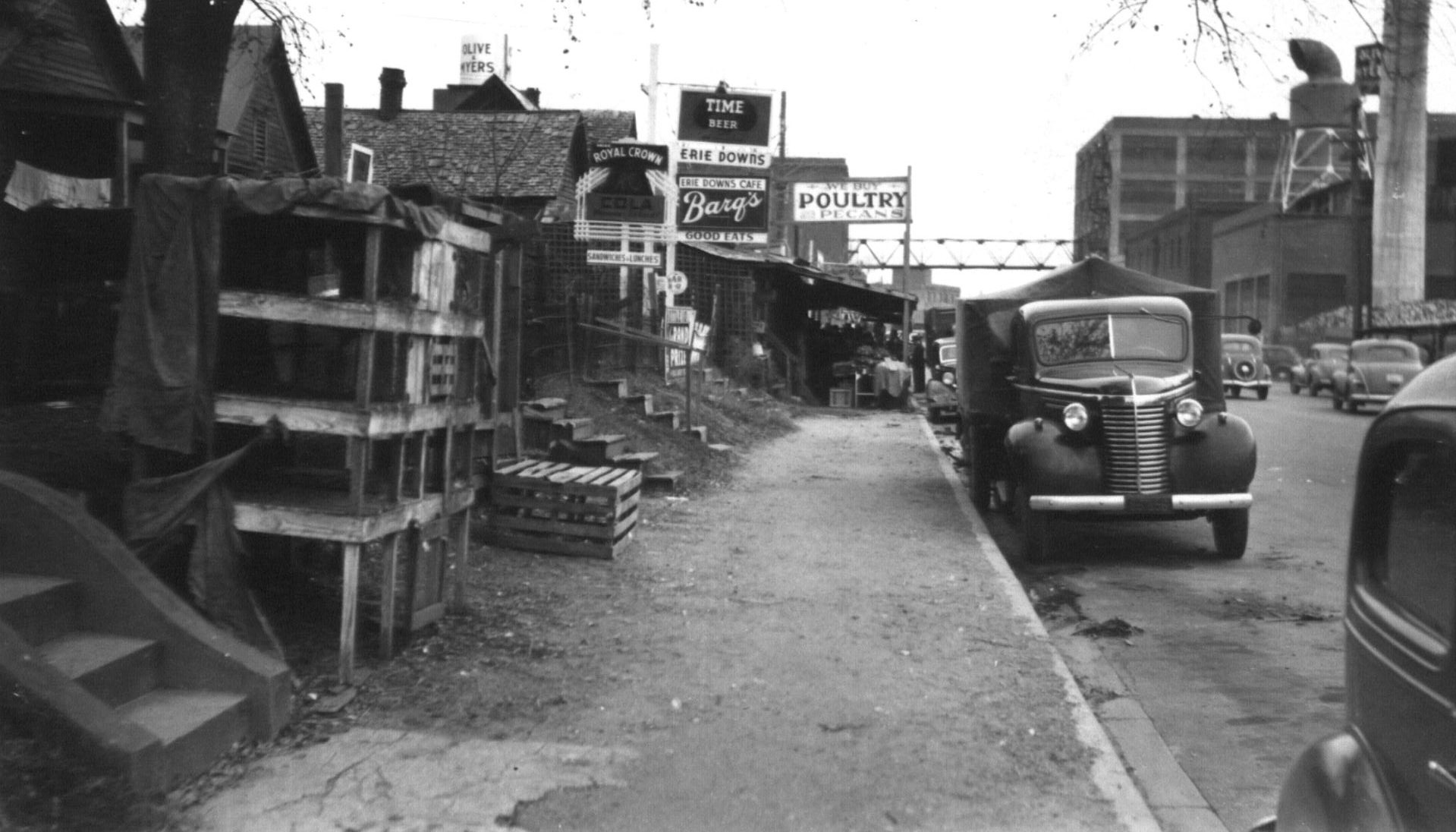
While reading about the “produce market district” (aka the wholesale fruit and vegetable businesses in the Farmers Market area), I came across the above unlabeled photograph. At first glance I thought the building at the top right was the Adam Hats building/Ford assembly plant, but the neighborhood didn’t look right. But on seeing the two Olive & Myers signs (a manufacturer I have to admit I’d never heard of), this seems to be a view of Canton Street, looking east from Cesar Chavez. The only thing that remains today is that cool building, which now contains pricey lofts and is known simply as “2220 Canton.” Below, the same view today.

2220-canton_googlemaps

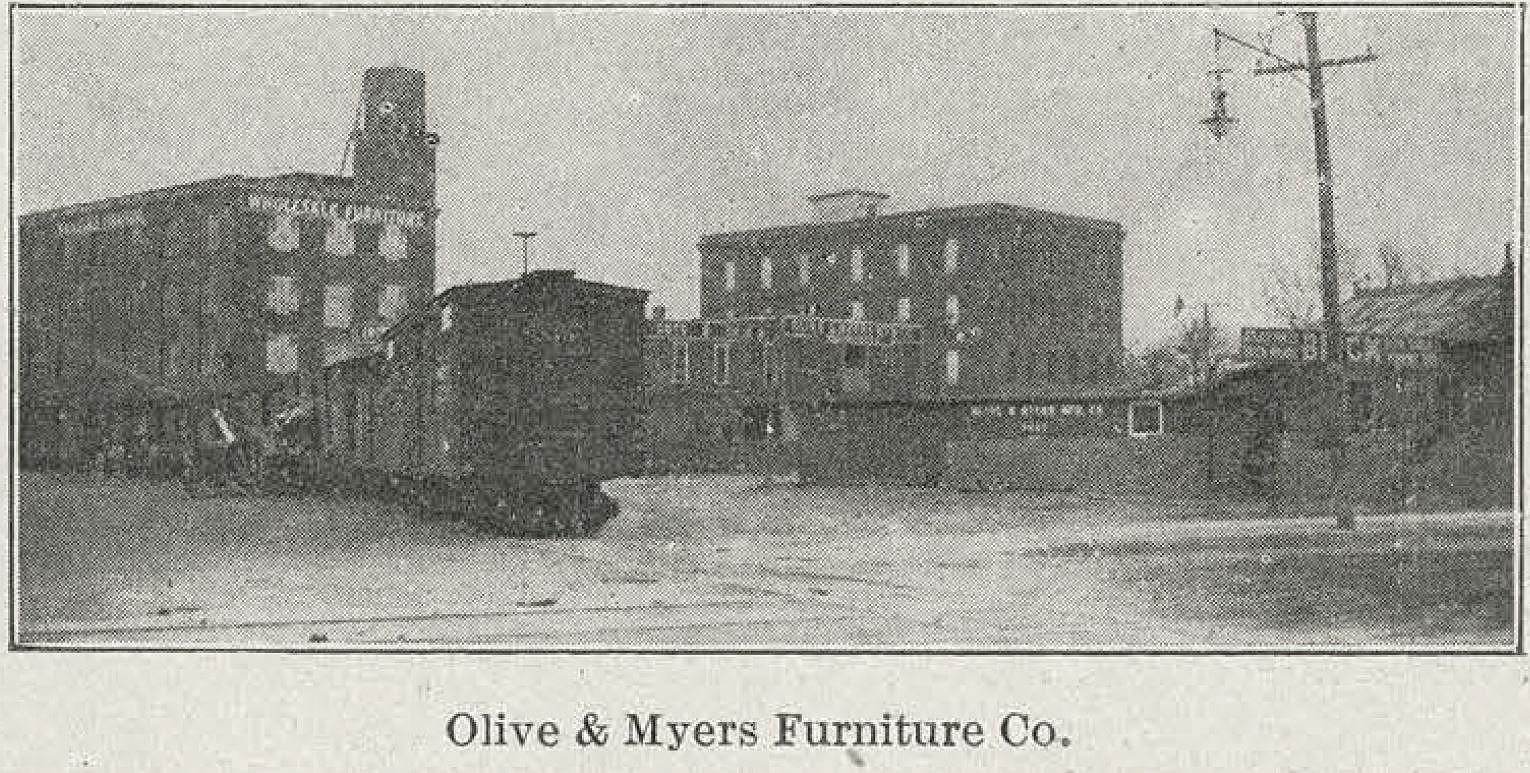
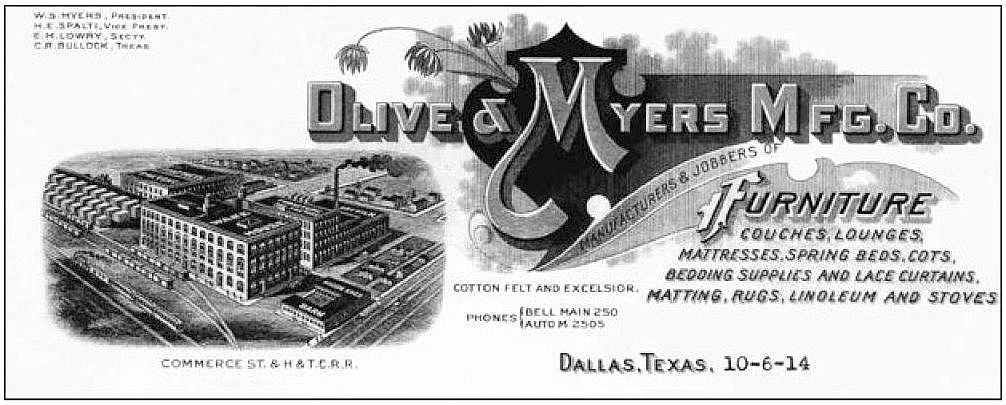
The Olive & Myers Manufacturing Company was founded in Dallas in 1899 by two Iowa transplants and became a very successful furniture wholesaler and manufacturer. The company was housed in a large complex of buildings grouped near the Farmers Market; the six-story building seen above was built around 1925. Even though it was quite attractive back then, the building’s current incarnation as super-swanky luxury digs (with a heated rooftop pool) would certainly put those poultry sellers of yore to shame.

The sidewalk chicken coops may be gone, and the neighborhood no doubt smells a lot better, but, I have to say … a seedy and unsavory 1940s-era Canton Street looks a whole lot more lively and interesting than the scrubbed and fumigated 21st-century version.

olive-myers_dmn_112837-logo

olive-and-myers_come-to-dallas_degolyer_SMU_ca1905ca. 1905

olive-myers_hist-of-an-opportunity_degolyer-lib_SMU_ca-1910
ca. 1910

olive-myers_legacies_spring-2013

olive-myers_centennial-ad_june-19361936 Texas Centennial ad – click to see very large detail of buildings

***

Sources & Notes

Top photo is from the Dallas Municipal Archives, via the Portal to Texas History. It was included in a large scrapbook — I looked at every single page, which was a bit of a slog, but persistence paid off, and I was rewarded with this incredible photo which was ALL THE WAY AT THE END — p. 166 of 169! The scrapbook page is here. (The Erie Downs Cafe is listed in the 1942 and 1945 city directories as being at 2117 Canton.)

Color image from Google Street View, 2014.

Olive-Myers logo from a 1937 ad.

The circa-1905 photo is from a publication I neglected to note, but which I know is in the collection of the DeGolyer Library, Southern Methodist University.

The blurry circa-1910 photo is from a publication called “History of an Opportunity: Facts About Dallas and Texas,” accessible in a PDF here; DeGolyer Library, SMU.

The letterhead dated “10-6-14” is from the Spring, 2013 issue of Legacies, via the Portal to Texas History.

For a follow-up post of sorts, I wrote about the darker side of the market area — full of crime and vermin — in the post “The Runyonesque Pearl Street Market, Full of Colorful Characters and an Army of Rats,” here.

Click pictures for larger images.

*

Copyright © 2014 Paula Bosse. All Rights Reserved.