Flashback : Dallas

A Miscellany: History, Ads, Pop Culture

Highland Park Methodist Church — 1927

hp-methodist-church_1927-degolyerHighland Park Methodist Church, 1927 (click for larger image)

by Paula Bosse

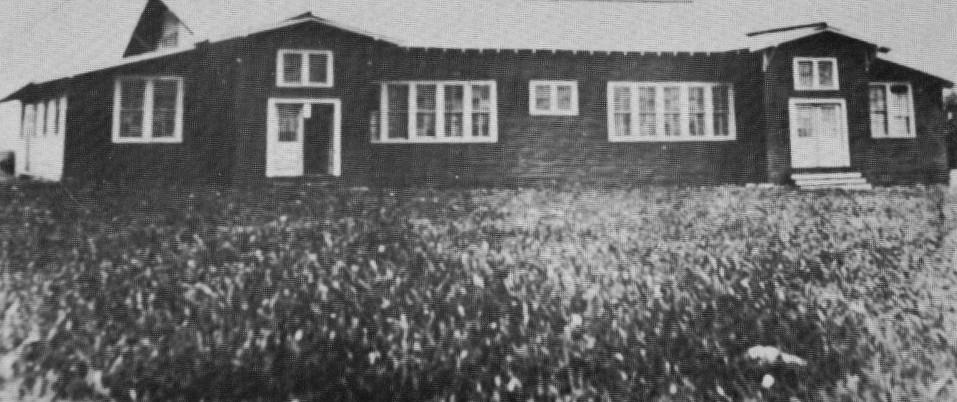
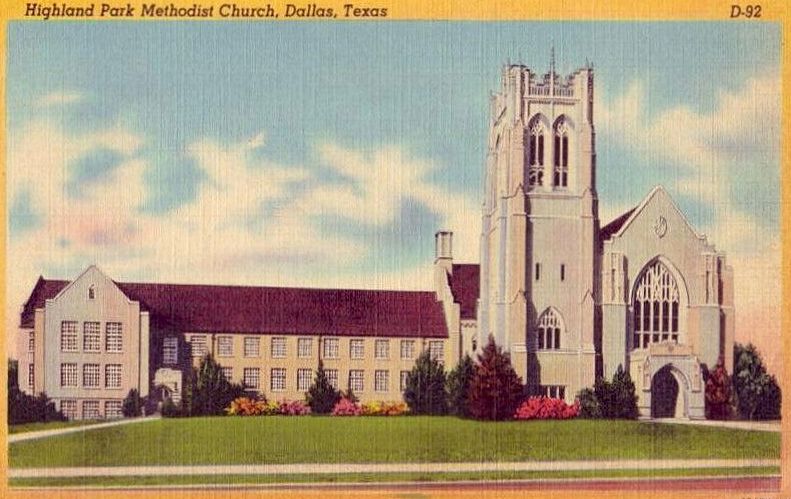
The beautiful Highland Park Methodist Church (now Highland Park United Methodist Church) was designed by architects Mark Lemmon and Roscoe DeWitt (who also designed several of the buildings on the adjacent SMU campus, as well as Woodrow Wilson and Sunset high schools, to name only a few of their projects). According to the HPUMC website, the first church — a temporary building which was referred to as “The Little Brown Church” — was built at Mockingbird and Hillcrest in 1917. It wasn’t until 1927 that the beautiful French Gothic-inspired building we know today was built on that same site. (At one time, Highland Park Methodist Church was the largest Methodist church in the world.)

(Incidentally, Mark Lemmon built his lovely cottage-like home on Mockingbird, across the street from both the church and the SMU campus, where at any time of the day or night, he could look out his front window and gaze with satisfaction upon his beautiful church and the ever-growing university campus dotted with buildings he had designed.)

hp_methodist-church_post-card-series“The Little Brown Church” — built 1917

hpmc_postcard_color

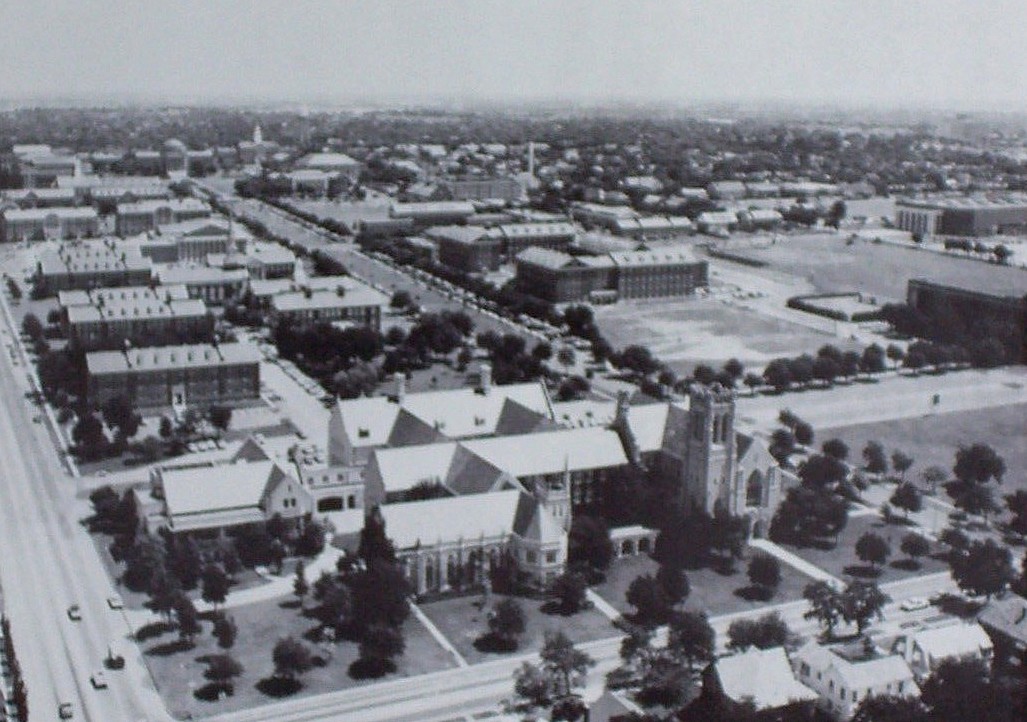
hpmc_golden-prologue-backChurch and SMU campus, Hillcrest and Mockingbird, 1960s

Highland Park Methodist Church Dallas, TX

***

Top photo by Joseph Neland Hester, taken in 1927. From the DeGolyer Library, Central University Libraries, Southern Methodist University; photo can be seen here. (UPDATE: I erroneously labeled the direction of this photo previously. It actually shows the back of the church, looking toward Mockingbird. It would have been taken from about where the Meadows Museum is now. If this is incorrect, please let me know!)

Photo of “The Little Brown Church” from the Park Cities Bank Heritage Series, used courtesy Lone Star Library Annex Facebook Group.

Aerial view from the back cover of Golden Prologue to the Future: A History of Highland Park Methodist Church by Doris Miller Johnson (Parthenon Press, 1966).

Other images from postcards.

For more on the history of Highland Park United Methodist Church check out the Wikipedia page here; check out the church’s history page here.

All photos larger when clicked.

*

Copyright © 2014 Paula Bosse. All Rights Reserved.

Dallas’ Frank Lloyd Wright Skyscraper — 1946

frank-lloyd-wright_rogers-lacy_1946-smThe Rogers Lacy Hotel, designed by Frank Lloyd Wright

by Paula Bosse

Feast your eyes on that fantastic skyscraper. That building was *this close* to being built in Dallas. And even though it was designed in 1946 (!), it looks modern enough to fit right in with the city’s celebrated 21st-century skyline.

Frank Lloyd Wright designed this 47-story hotel for millionaire East Texas wildcatter Rogers Lacy, to be built at the southwest corner of Commerce and Ervay, catty-corner from the also fabulous (if not quite so futuristic-looking) Mercantile National Bank Building.

Even though he had a firm distaste for the overly-populated, traffic-clogged, modern American city, Wright jumped at the chance to design a hotel smack dab in the middle of one of the country’s largest and fastest-paced cities. In fact, the Lacy Hotel was one of Wright’s pet projects, and he went all-out in his attempt to convince his wavering client of the merits (both aesthetic and utilitarian) of the multi-million-dollar skyscraper he had, apparently, been dreaming of for decades.

While Wright worked on swaying Lacy in his favor, John Rosenfield — the influential arts critic of The Dallas Morning News — worked on winning over the people of Dallas. Rosenfield really pulled out the stops when writing about the project; his promotion of the proposed hotel (in print as well as behind-the-scenes) was as tireless as it was passionate.

The startlingly new architectural design combined with Wright’s salesmanlike pronouncements on how he had transcended what he saw as the crushing gloom of hotel space caused quite a bit of excitement. Lacy, the Texas oil man with deep pockets, was eventually won over. But a client’s enthusiasm and an architect’s full-bore persuasion can sometimes go only so far. After an initial gung-ho response from the Lacy camp, communication with Wright began to get spotty (causing a freak-out at Taliesin), and plans never really got underway. When Lacy died unexpectedly at the end of 1947, the project was scrapped, and Frank Lloyd Wright’s dream of a soaring glass skyscraper was never realized.

If only we could go back and nudge Rogers Lacy to sign off on this building’s construction. It’s amazing how Wright’s concept here predicted the later glass-clad, atrium-centered architecture that has been a Dallas staple for decades. If Wright’s Lacy building were announced today — even without the weight of Frank Lloyd Wright’s name attached to it — I think news of its construction would, again, be met with excitement.

***

Sources & Notes

The Frank Lloyd Wright drawing of the proposed Rogers Lacy Hotel is from the cover of the Spring 2009 issue of Legacies: A History Journal for Dallas and North Central Texas. Charles T. Marshall’s extremely entertaining article, “Where Dallas Once Stood: Frank Lloyd Wright and the Rogers Lacy Hotel,” is in this issue, and it’s a great read, illustrated with photos of the key players and additional architectural drawings of the hotel; you can read the full article here.

Wright’s biggest champion in Dallas was legendary Dallas Morning News critic John Rosenfield (he and Wright were also personal friends). His articles on the proposed Rogers Lacy hotel appeared in the DMN, including the ones listed below:

  • “Famed Architect Confers on New Dallas Hotel Plans” (DMN, March 28, 1946)
  • “47-Story, Windowless Dallas Hotel Designed by Celebrated Architect” (DMN, July 28, 1946) — Rosenfield’s extensive, soaring description of the planned building
  • “Dallas’ Dream Hotel Soon Coming To Life” (DMN, Aug. 11, 1946)
  • “Wright Bares Lacy Hotel Plans” (DMN, June 22, 1947) — the unveiling to the Dallas public of the final plans (which was accompanied by the images contained in the Legacies article linked above)

*

Copyright © 2014 Paula Bosse. All Rights Reserved.

Exline Park Swimming Pool — 1950s

exline-pool_hickman_1957_briscoe-ctr

by Paula Bosse

Summer’s running out, kids.

Plan your waning pool-time opportunities accordingly.

exline_hickman_1955

***

Photos by R. C. Hickman, taken at Exline Park swimming pool; top photo taken on Aug. 6, 1957, bottom photo on July 27, 1955. Both photos © R. C. Hickman/Dolph Briscoe Center for American History.

*

Copyright © 2014 Paula Bosse. All Rights Reserved.

Big Tex and His Dressers

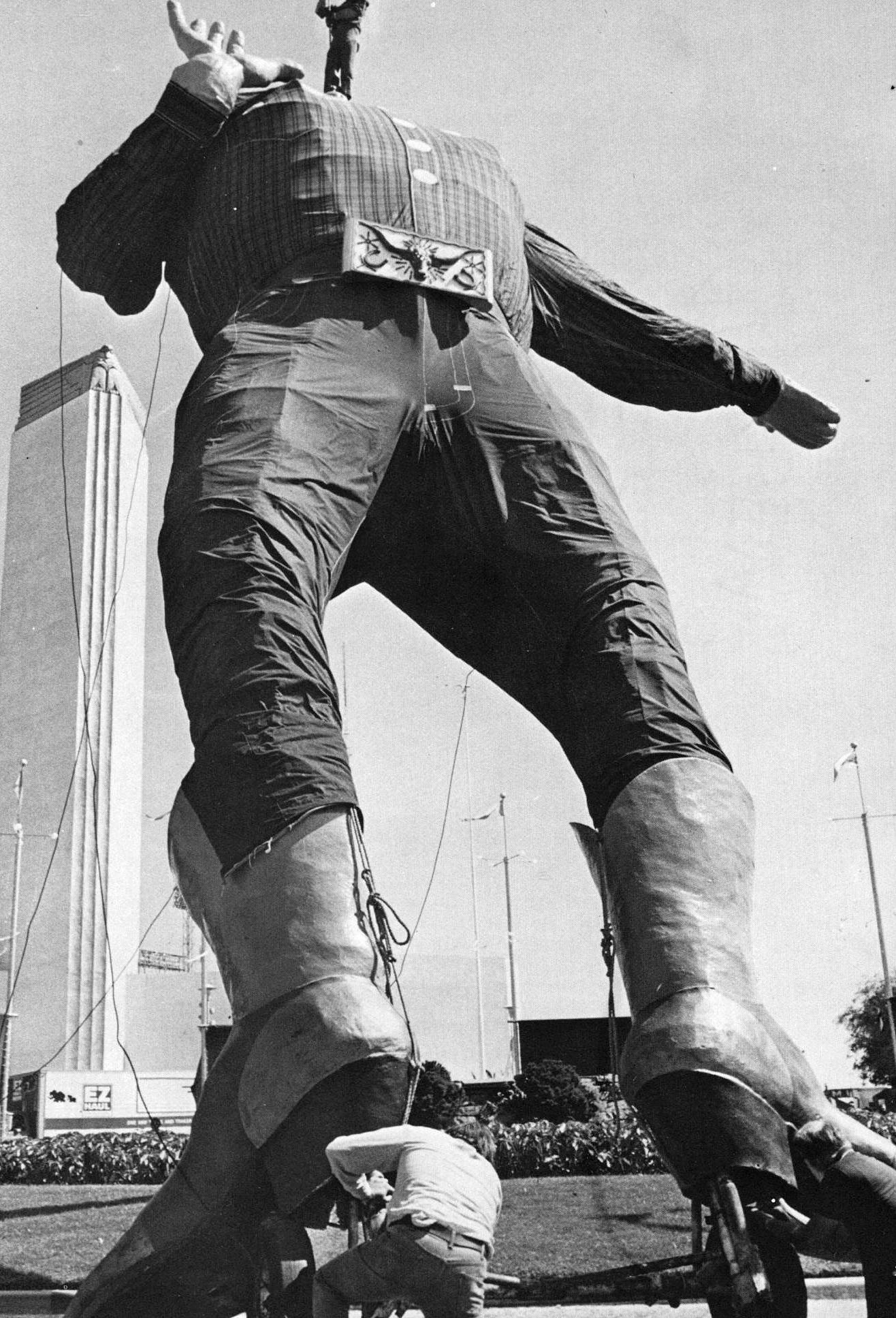
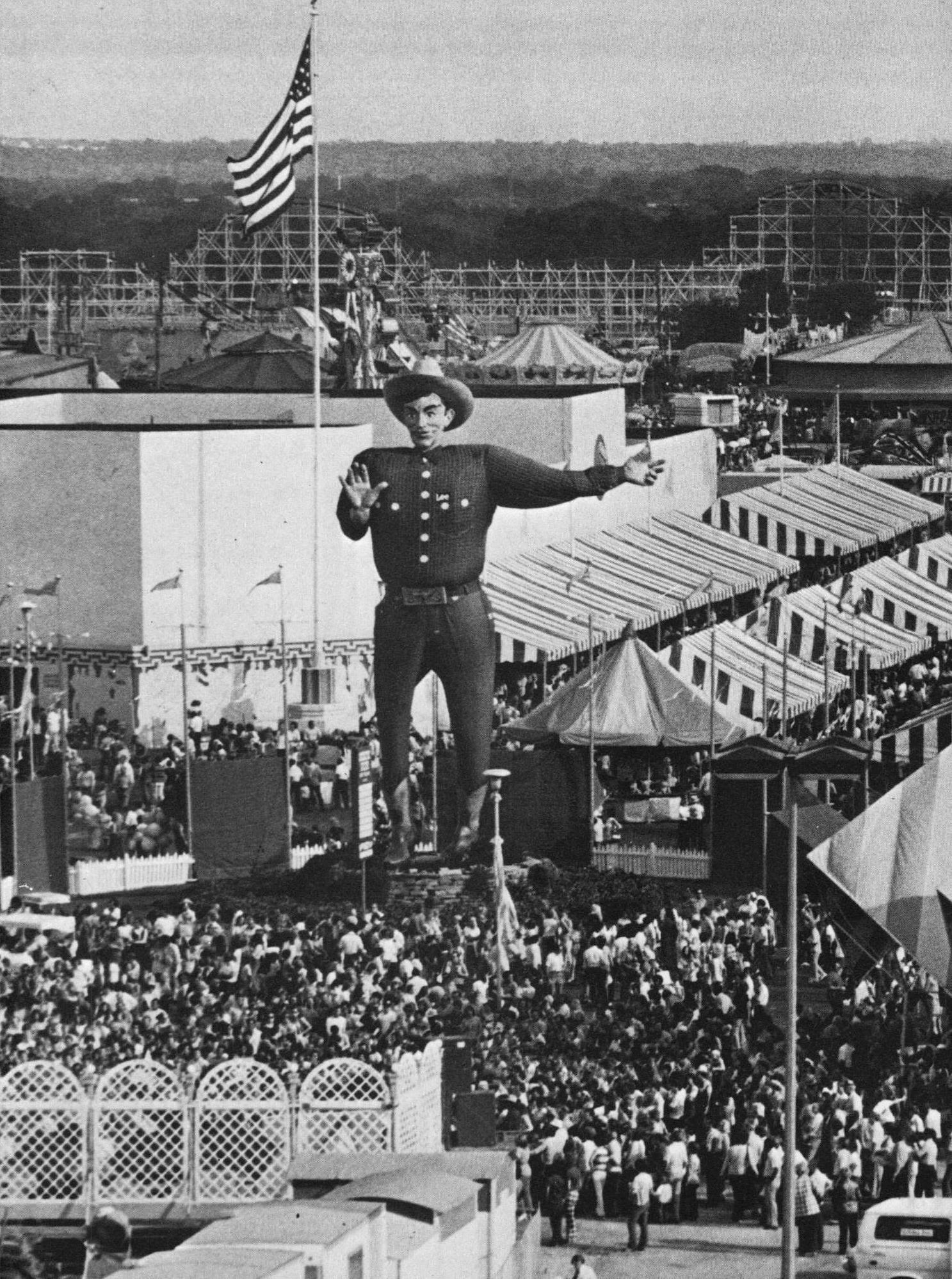
big-tex_headless_1970s
Headlessness and wardrobe malfunctions being attended to…

by Paula Bosse

It’ll probably all get straightened out in the end.

When I worked in a bookstore that had frequent visits by costumed characters for children’s events, we were told to make sure children never saw the characters without their costume heads because it might freak the kids out. If true, that photo above has the potential to scar some impressionable youngsters for life.

Above, Big Tex in dishabille.

Below, all pulled together.

big-tex_tx-historian_sept1976-sm

***

Sources & Notes

Top photo of a headless Big Tex is from the Sept. 1976 issue of Texas Historian, a Texas State Historical Association publication of the Junior Historians of Texas.

Second photo, of a put-together Big Tex is a State Fair of Texas photo from the same issue of Texas Historian.

Click images to make Bit Tex REALLY big!

*

Copyright © 2014 Paula Bosse. All Rights Reserved.

Happy 75th Anniversary, Stonewall!

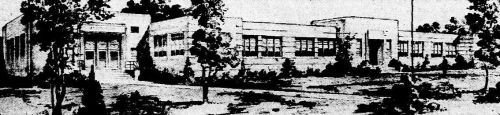
1938-stonewall-jackson-elementary-school_renderingStonewall Jackson Elementary School, 1938 rendering (click for larger image)

by Paula Bosse

Classes begin today for students in DISD schools, one of which is Stonewall Jackson Elementary School, located at Mockingbird and Matilda. Stonewall turns 75 years old this year (2014), and I’m proud to say it’s where I spent many years as a happy student. When I learned recently that the school had originally been built as a single-story building (instead of the two stories we know today), I was pretty surprised, and this little unknown nugget prompted me to look into the early years of my alma mater.

In the 1920s and ’30s, Dallas was expanding very quickly northward from Vickery Place, the residential neighborhood around Belmont and Greenville. As the area we now know as Lower Greenville and the M Streets was developed, the two elementary schools (Vickery Place School, then at Miller and McMillan, and Robert E. Lee, at Matilda and Vanderbilt) were soon filled to capacity. Building a new school to serve burgeoning “Northeast Dallas” was an immediate necessity. So in 1938, the city purchased a 9-acre chunk of land along Mockingbird, one block east of Greenville Avenue and right alongside the Denison interurban tracks that ran on Matilda (when I was growing up a couple of blocks away, I used to see remains of those tracks but didn’t know what they had been used for — I wrote about those tracks here and here). The land had been part of the vast Caruth land holdings.

The building was designed by architect C. H. Griesenbeck. It had eleven classrooms, a cafeteria, and an auditorium with a seating capacity of 400. Although originally built as a one-story building, Griesenbeck was mindful that expansion would be necessary in the future, and his design took into account that a second story would be added in the years to come. Construction began in late 1938 and was scheduled to be completed for the opening of the 1939-40 school year.

The name of the new school was decided upon a few months later:

“Stonewall Jackson’s name was chosen for the new school, Dr. Norman R. Crozier, superintendent, said because of the high ideals of Thomas Jonathan Jackson, one of the unique and romantic figures of the War Between the States, and as a companion to its nearest school, Robert E. Lee.” (Dallas Morning News, Feb. 1, 1939)

But if you’re going to sink a hundred thousand dollars into a school, you’ve got to have houses for families to live in to make sure your future student pool doesn’t run dry — and at that time very few houses had been built that far north. Cut to W. W. Caruth, Jr., son of the Caruth family patriarch who basically owned everything north of Mockingbird (Caruth owned a huge expanse of land once estimated at being over 30,000 acres). Not long after selling the land at Mockingbird and Greenville to Dr Pepper, Caruth fils began to develop the land around the then-under-construction school — he called the new neighborhood “Stonewall Terrace.”

The property went fast.
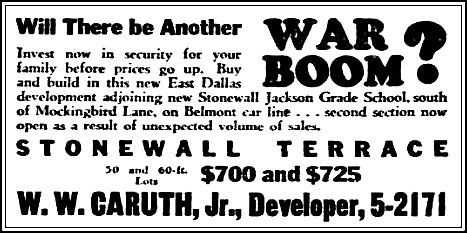
stonewall-terrace_dmn_092339September, 1939

As the neighborhood was taking shape and the construction of the school building was nearing completion, the school’s official boundaries were announced:

“Boundaries of the Stonewall Jackson School will be from the alley south of Morningside on the east side of Greenville Avenue and from the alley south of Mercedes on the west side of Greenville to the M-K-T Railroad on the north.” (DMN, Sept. 3, 1939)

Despite some problems with labor shortages, the school managed to open on time, on Sept. 13, 1939, the start of the new school year.

The school and the neighborhood grew quickly, and the number of students soon doubled. In 1950 the school board approved preliminary plans for an addition to the school. This addition (which would cost $369,000 and be handled by the architectural firm of Tatum & Quade) would include a first-floor wing with four classrooms, a gymnasium, and a lunchroom, and a second story containing eight classrooms, a library, and a music room. (The cost of construction would probably have been quite a bit more had the original architect not had the foresight to design the building with the expectation that a second story would be added in the future.)

The construction was substantial enough that it had to be done during the 1951-52 school year. Because the old lunchroom was being dismantled while the new wing was being built, students were required to bring their lunches the entire year. All they could get at school was milk. No fish sticks, no Salisbury steak, no chess pie. Just milk. Sorry, kids.

The new addition was completed in time for the beginning of the 1952 school year. And that’s the version of the building that stands today, looking pretty much unchanged.
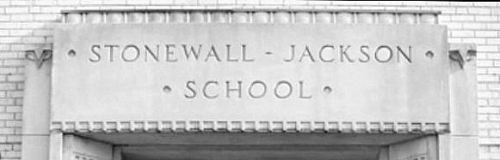
stonewall_front

It was a cool building then, and it’s a cool building now. It’s sad to see how much of the playing fields keep disappearing as ugly portable buildings take over, but the new garden is a great new addition — I wish they’d had that when I was there.

I really loved that school. When I was a student there, grades went from 1st to 7th, and I loved all seven years I spent there. Thanks for the great childhood memories, Stonewall. And Happy 75th Anniversary!
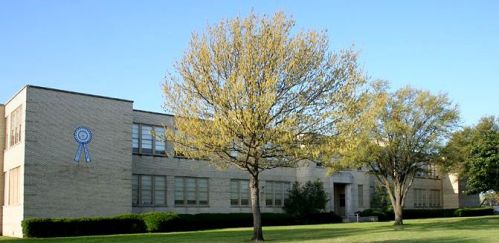
stonewall-nowPhoto: DISD

***

Sources & Notes

Top image is architect C. H. Griesenbeck’s architectural rendering of Stonewall Jackson Elementary School, originally a one-story building.

Here are a few articles to check out in the Dallas Morning News archives:

  • “$11,250 Offer Made for New School Site” (DMN, Oct. 26, 1938)
  • “Contracts for $104,150 Let on Northeast Dallas School” (DMN, Dec. 22, 1938)
  • “New Northeast Dallas School Named Jackson; Board Pays Tribute to Famous General” (DMN, Feb. 1, 1939)

And, yes, it probably sounds weird to outsiders, but students actually do call the school “Stonewall” — just like we call Woodrow Wilson High School (the high school Stonewall feeds into) “Woodrow.” It’s like a secret handshake.

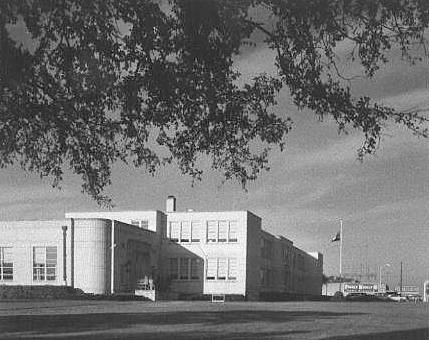
Below, an undated photo from DISD’s Pinterest board (if you squint, you can see the Piggly Wiggly at the southwest corner of Mockingbird and Matilda).
stonewall_DISD-pinterest

UPDATE: After years of controversy, Stonewall Jackson Elementary School will be rechristened “Mockingbird Elementary” in 2018. Whatever its name, it’s still a great school!

*

Copyright © 2014 Paula Bosse. All Rights Reserved.

Candy Stripers Moonlighting as Six Flags Map Sellers — ca. 1961

six-flags_map-sellers_c1961

by Paula Bosse

“Yes, sir, you absolutely must have a map!”

When going to an amusement park meant going in a suit and tie. …And hat.

I see maybe a couple of teenagers. Otherwise … rather ominously … no children.

***

Six Flags Over Texas, probably in its opening year, 1961.

Click for larger image.

*

Copyright © 2014 Paula Bosse. All Rights Reserved.

Big Tex, Old Tex, Big Ol’ Tex — Whatever You Call Him, Otis Dozier Wins (1954)

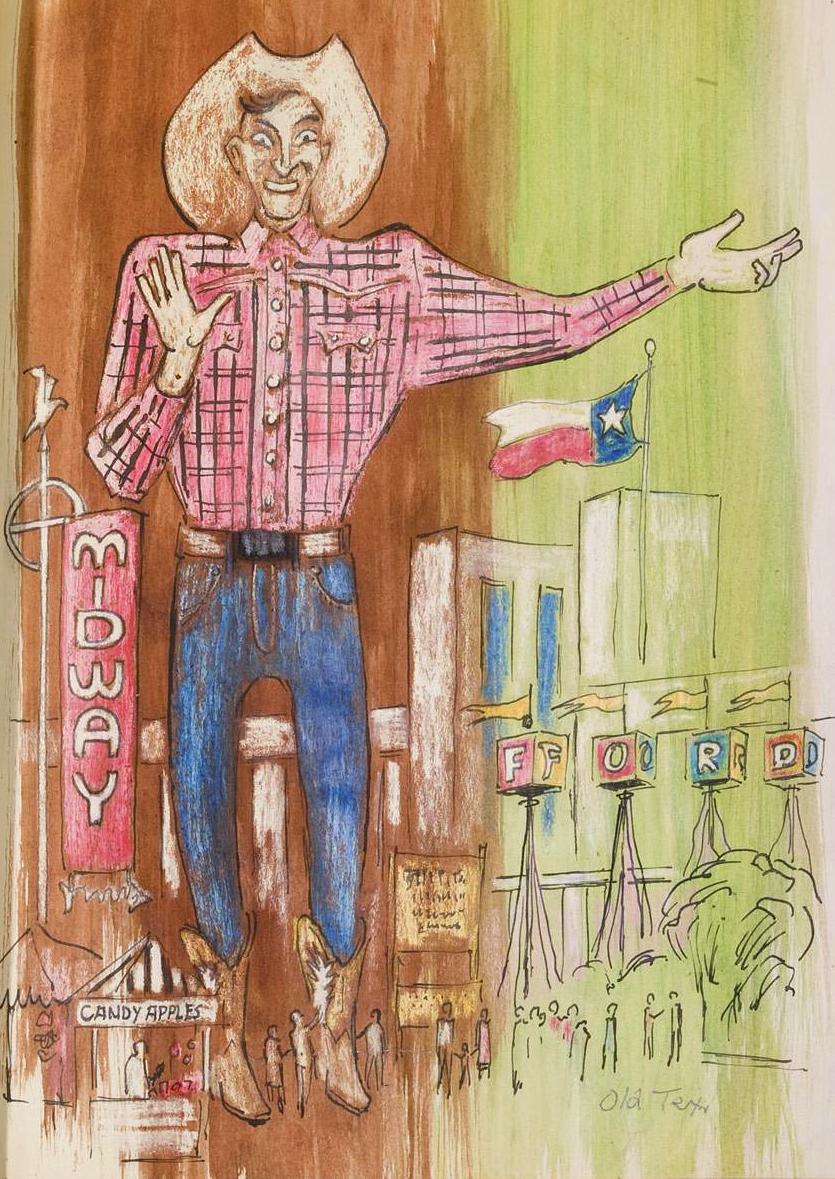
dozier_big-tex_sketchbook_1954_dma“Old Tex” sketch by Otis Dozier, 1954 — Dallas Museum of Art

© Marie Scott Miegel and Denni Davis Washburn

by Paula Bosse

Hey, y’all, guess what’s just around the corner. Whenever you start seeing pictures of Big Tex, you know that the State Fair of Texas can’t be too far away.

There have been a lot of artistic depictions of Big Tex over the years, but I think this sketch by Dallas artist Otis Dozier (1904-1987) may be my all-time favorite. And I’ve only just discovered it! (Thank you, DMA!)

***

This wonderful ink, watercolor, and crayon sketch of “Old Tex” is contained in one of Otis Dozier’s sketchbooks, now in the collection of the Dallas Museum of Art, a gift of the Dozier Foundation (© Marie Scott Miegel and Denni Davis Washburn). To see details on this work, see the page on the DMA’s website, here.

The Otis Dozier sketchbooks have been digitized in a joint project between the Dallas Museum of Art, SMU’s Bywaters Special Collections at the Hamon Arts Library, and SMU’s Norwick Center for Digital Services. To read about this fantastic collection, see the SMU Central University Libraries page, here.

*

This week, the Dallas Museum of Art launched a new digital database in which its entire collection is now accessible online! This is great news for many reasons, not least being that it allows the public to see works that are rarely — if ever — displayed in the museum. Such as this one. To read more about assembling this incredible database, read the DMA’s announcement, here.

To look up your favorite artist, check to see what the DMA has, here.

For the biography of the Forney-born Dozier (who was one of the members of the famed Dallas Nine group), see the Handbook of Texas entry here.

Click picture for larger image.

*

Copyright © 2014 Paula Bosse. All Rights Reserved.


University Park, Academic Metropolis — ca. 1915

university-hillcrest_1915University Park, prime real estate (click for larger image; see below for HUGE image)

by Paula Bosse

In the 1970s, Park Cities residents received oversized postcards in the mail featuring historic photos of the area. This “Heritage Series” was presented by the Park Cities Bank and later by Fidelity Bank. I’ll be sharing these wonderful images in the weeks to come. First up is this hard-to-fathom view of the intersection of University and Hillcrest, seen around 1915 when SMU opened, taken from Dallas Hall on the university campus. The description:

“In 1915, University Park was a sparsely populated community north of Dallas. At the time, most Dallas residents thought of Highland Park as ‘country living.’ This photo was taken from SMU’s Dallas Hall looking west along University Boulevard with the cross street being Hillcrest. The two-story home seen on the northwest corner of University and Hillcrest has long been replaced with a series of commercial buildings.”

***

UPDATE: For a much, much larger image of this photo, click here.

“Heritage Series” postcards used courtesy of the Lone Star Library Annex Facebook page. Postcard credits image to Dallas Public Library.

There is a book all about the houses that were built in that first block of University: The Block Book by Bonnie Wheeler (a review of which can be read here). (You probably won’t be able to find a copy of it, but if you do, snap it up. I see only one copy for sale online, and it is rather outrageously priced at just under $500!)

*

Copyright © 2014 Paula Bosse. All Rights Reserved.

“Oak Cliff Is To Dallas What Brooklyn Is To New York” — 1891

ad-oak-cliff_mercury_031291The Southern Mercury, March 12, 1891 (click for larger image)

by Paula Bosse

Oak Cliff and the whole “Brooklyn” comparison is not a new one. Developers were using it to lure people to the “soft green cliffs” of the newly-incorporated area where “there is not a night in the hot months of summer when discomfort is felt from the heat” and where “people from all parts of the United States can be observed enjoying the delights of the seaside in the interior of Texas.” A veritable paradise. Just like Brooklyn.

Hats off to the enthusiastic scribe who penned this incredibly wordy advertisement beckoning the “live and progressive” readership of The Southern Mercury to invest in the ground-floor of Dallas’ Brooklyn.

*

OAK CLIFF, THE BEAUTIFUL RESIDENCE AND EDUCATIONAL CITY OF THE SOUTHWEST

The city of Oak Cliff derives its name from the massive oaks that crown the soft green cliffs and stands about two hundred and fifty feet above and to the southward and westward of the city of Dallas, overlooking the city, and the view is carried away over the city proper. Cool and healthful breezes prevail during the heated term, and there is not a night in the hot months of summer when discomfort is felt from the heat, and sound and refreshing sleep is not possible. To the south and southwest for hundreds of miles stretches level and unobstructed prairie, over whose bosom these breezes sweep from the gulf without infection from any unsalubrious conditions.

The Oak Cliff Elevated railway, substantially constructed, forms a belt of ten miles, encircling Oak Cliff, but at no place more than three miles from the business section of Dallas. Cars run every ten minutes day and night from either side of the court house, Dallas. Fare, five cents.

Oak Cliff is a wonderful and well-nigh magical growth of two years; the first house was completed at Oak Cliff twenty-seven months ago. It now has a population of about seven thousand, a large proportion of whom are from amongst the best people of the different towns of the state of Texas. They are a live and progressive people. Oak Cliff has just incorporated, and one of the first moves of the city government will be the building of several large, commodious fine brick and stone public school buildings, and provide for a large free school fund.

Oak Cliff contains a strictly moral people; intoxicating liquors cannot be found anywhere within her limits, – in keeping with this general policy, no sort of questionable resorts are tolerated.

Oak Cliff now has 1,500 to 2,000 residences, costing from $1,500 to $50,000. It has thirty miles of paved streets and avenues; is now building about six miles of cross-town street railway, to be operated by electricity. It has a successful water system, affording pure, clear spring water. A hotel costing $100,000 has been in successful operation since last June.

Oak Cliff has a park of about 150 acres of natural rustic beauty, diversified with hill and dale, and set off with clumps of royal trees. In the park is a beautiful lake with an average depth of 20 feet, equipped with good boats, where people from all parts of the United States can be observed enjoying the delights of the seaside in the interior of Texas.

Oak Cliff is to Dallas what Brooklyn is to New York.

For further information, address,

Dallas Land & Loan Co., Dallas, Texas.

***

Ad from the pages of The Southern Mercury, March 12, 1891.

A previous come-on from the developers of Oak Cliff can be found here.

*

Copyright © 2014 Paula Bosse. All Rights Reserved.

Oak Cliff Presbyterian Church, Organized 1890

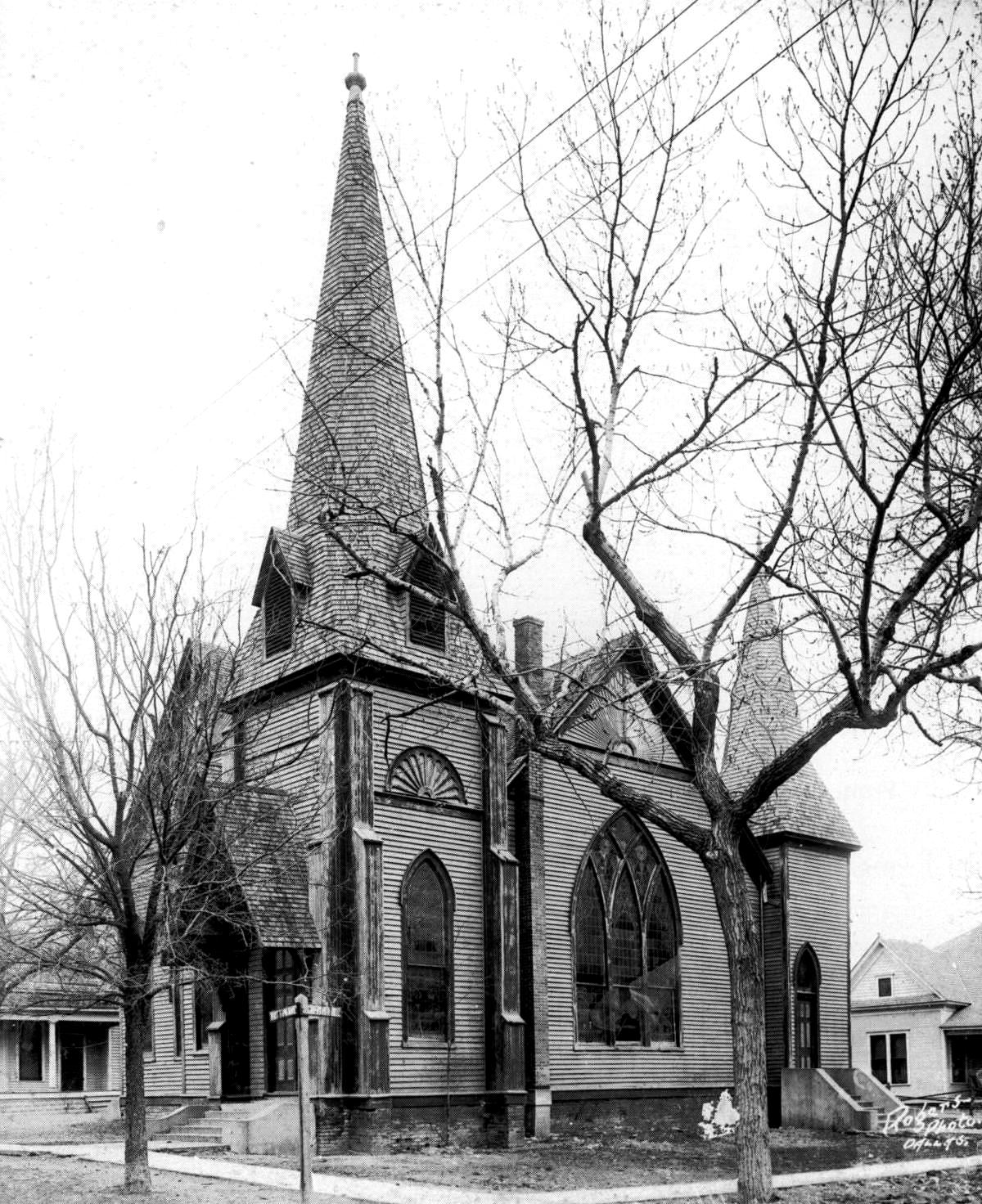
oak-cliff-presbyterian_smOak Cliff Presbyterian Church, ca. 1897

by Paula Bosse

I came across this photograph of a church a couple of days ago and was mesmerized by its charming woodiness. According to its caption, it was the Oak Cliff Presbyterian Church, at the corner of Ninth Street and St. George (now Patton). Its first pastor was the Rev. W. L. Lowrance who had organized the church in 1890 with fewer than twenty members. Church membership grew steadily, and in 1923, having finally outgrown the small wood frame building, the congregation moved to their next location at Tenth and Madison (contributing to Tenth Street’s appearance in Ripley’s Believe It Or Not as the street having more churches per mile than any other street in the world). At some point this lovely church was razed.

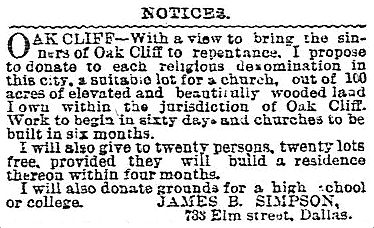
I’ve found little else on its earliest history. but I came across this advertisement placed in The Dallas Morning News in 1891:

simpson_oak-cliff-land-donation_dmn_031491(DMN, March 14, 1891)

Col. James B. Simpson was something of a learned Renaissance-man around Dallas. He had been the editor of The Dallas Herald for many years and was a civic leader with real estate interests. I’m not sure if this ad has anything to do with the establishment of the Oak Cliff Presbyterian Church, but it’s interesting to note that construction of the new church was mentioned as being under construction one month after this ad’s appearance. Time was running out for those Oak Cliff sinners (even though one newspaper report stated that the building wasn’t occupied until 1893).

Rev. Lowrance, an apparently well-liked and respected pastor, retired at the end of 1903.

lowrance_dmn_122903-photo“Dr. W. L. Lowrance of Oak Cliff”

lowrance_dmn_dmn_122903(DMN, Dec. 29, 1903 — click for larger image)

The Oak Cliff Presbyterian Church lives on, now on S. Hampton. One can only assume that the building it occupies today is not quite as charming as the little woody one that was built 120 years ago.

***

Sources & Notes

Top photo (by the Rogers Photo Studio, circa 1897) appeared in the Fall 2009 issue of Legacies magazine, here.

Though the first Oak Cliff Presbyterian Church was on Ninth St., the second one was on Tenth St., and that seems reason enough to direct attention to the article “Road to Glory: Tenth Street Becomes Church Street” by René Schmidt — it appeared in the same issue of Legacies as the church photo, and you can read it here.

Read more about this “Street of Churches” and its staggering fourteen churches (!) in the May 1, 1950 edition of The Dallas Morning News.

*

Copyright © 2014 Paula Bosse. All Rights Reserved.