Flashback : Dallas

A Miscellany: History, Ads, Pop Culture

Olsen-Stelzer Cowboy Boot Saleslady — 1939

Portrait with boots…

by Paula Bosse

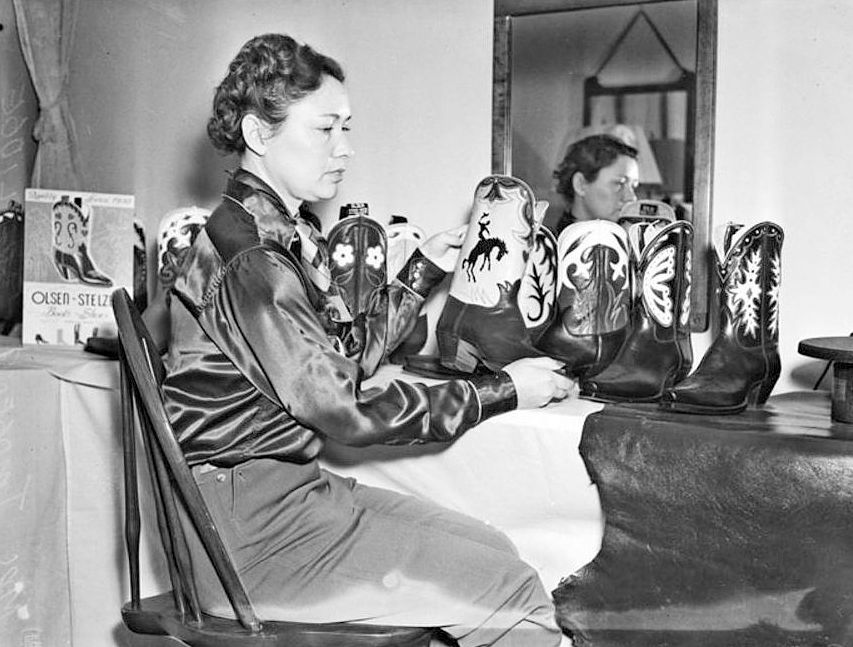
Above, Dallas resident Imogene Cartlidge is seen at a shoe retailers’ convention in San Antonio in 1939. Cartlidge was an employee of the Olsen-Stelzer boot company in Henrietta, Texas, and she was said to be “the only woman boot salesman on record.” I’m a big fan of cowboy boots of this period, and I have to say that I am ashamed that I was unaware of the famous Olsen-Stelzer company, which lasted from 1900 until the 1980s. The company is back in business again, led by Tom Cartlidge, whose parents began selling the boots in 1938 — Imogene is his mother. I wish them all the best of luck, because the world needs as many great-looking cowboy boots as it can get!

olsen-stelzer_dmn_120146

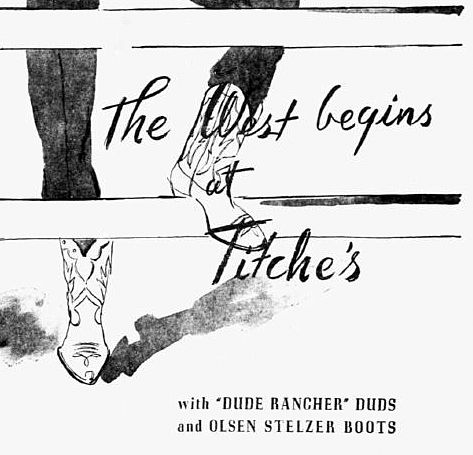
“The West begins at Titche’s”? First I’m hearing of this. Who knew? Nice ad, though.

olsen-stelzer_dmn_120146det

olsen-stelzer_dmn_103055

olsen-stelzer_1941

Best of all is this absolutely fantastic video from 1956 about the company:

olsen-stelzer-logo

olsen-stelzer-box

***

Sources & Notes

Photo of Imogene Cartlidge is from the San Antonio Light Photograph Collection, University of Texas San Antonio Libraries Special Collections, Institute of Texan Cultures.

Titche’s ad from 1946.

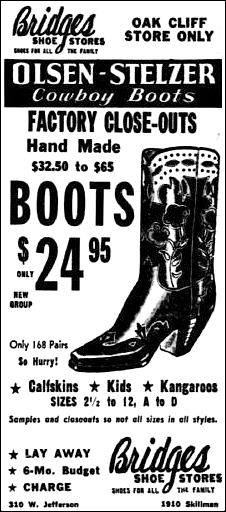
Bridges Shoe Store ad from 1955. (Bridges seems to have been the only place in Dallas where the boots were regularly sold — or at least regularly advertised. And you could get them ONLY IN OAK CLIFF!) (I hear the West begins at Oak Cliff….)

The video can be found on the home page of the Olsen-Stelzer website here.

The last image is the lid of an Olsen-Stelzer boot box, which belongs to my aunt — she keeps Christmas ornaments in it. (Sadly, no sign of the boots!)

The history of the company (and, again, that great video) can be found here.

*

Copyright © 2014 Paula Bosse. All Rights Reserved.

Zion Evangelical Lutheran Church: Germans on Swiss — ca. 1900

by Paula Bosse

The Zion Evangelical Lutheran Church was established in 1879 by German immigrants. In 1899 the congregation moved its church and school to the location seen in the photograph above, at 207 Swiss Avenue (street numbers have changed, but it was in the block between what is now Good-Latimer and Cantegral). The building remained in that location until at least 1921.

***

Photograph from the University of Texas at San Antonio, UTSA Libraries, Digital Collections.

For more on the history of the Zion Evangelical Lutheran Church in Dallas, see here.

*

Copyright © 2014 Paula Bosse. All Rights Reserved.

So This Cowboy Goes Into a Psychiatrist’s Office…

cowboy-therapy-cartoon_sat-evening-post_kaz

by Paula Bosse

Well, bless his heart.

***

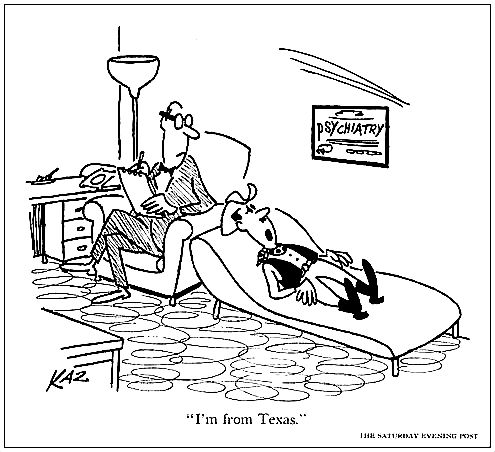
Cartoon by Kaz from The Saturday Evening Post.

Munger’s Improved Continental Gin Company

continental-gin_munger-from-natl-reg-appA Dallas landmark… (click for larger image)

by Paula Bosse

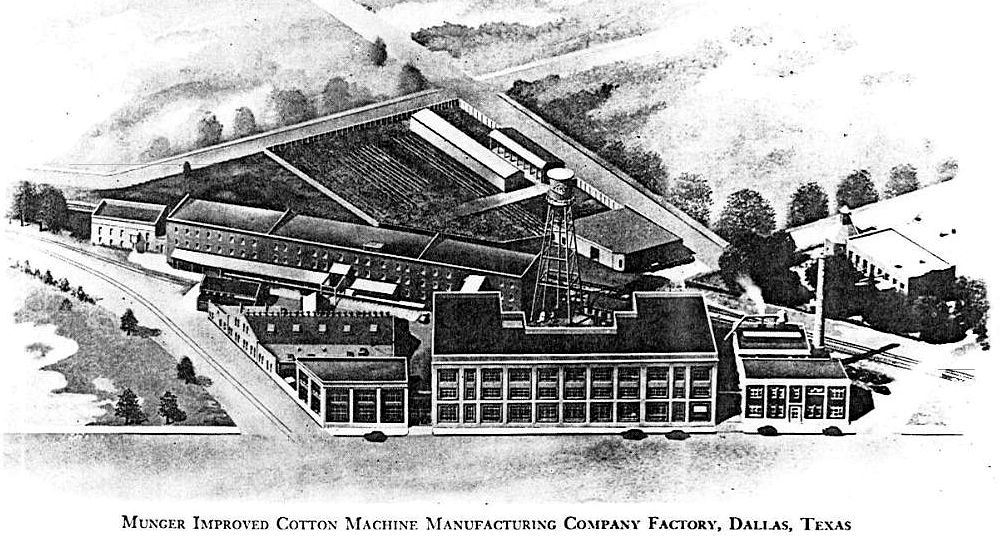
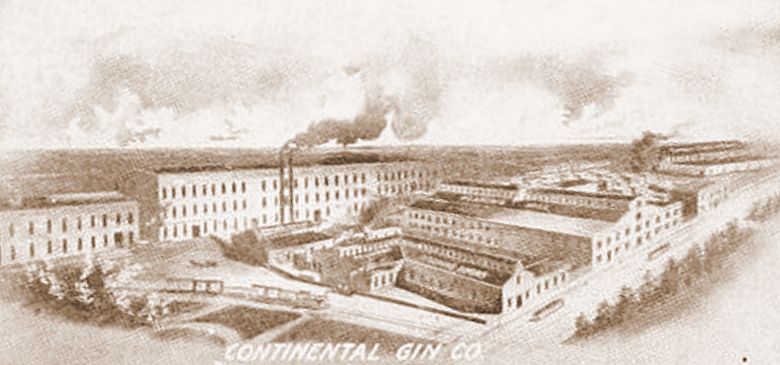
The Continental Gin Co. complex of buildings at Elm and Trunk is a Deep Ellum fixture which was successfully petitioned by the city in 1983 to be added to the National Register of Historic Places. No longer a manufacturing hub, it is now home to artists’ studios and residential lofts. The earliest of the buildings still standing were built in 1888 and the latest ones (the ones closer to Elm) were built in 1914. The company was incredibly successful, which was no surprise when one realizes that fully ONE-SIXTH of the world’s cotton grew within a 150-mile radius of Dallas at the time! It’s no wonder that Dallas was a hotbed of cotton gin manufacturing.

continental-gin_munger-drawing_Munger Catalogue and Price List, 1895

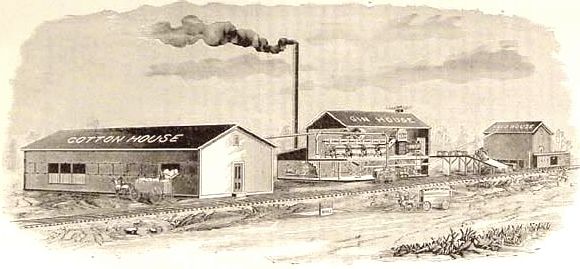
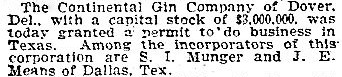
Robert S. Munger (yes, that Munger) patented several inventions that improved the cotton ginning process, and in 1888 he built a large manufacturing plant for his Munger Improved Cotton Machine Company. In 1900, after several extremely successful years, his company and several other companies that held important industry patents were absorbed by the Continental Gin Co. of Birmingham, Alabama, and, practically overnight, the Continental Gin Co. became the largest manufacturer of cotton gins in the United States. Munger retained a financial interest in the company, but he left the running of the business to his brother, S.I. Munger. R.S. Munger turned his creative talents to real estate and developed the exclusive Munger Place neighborhood. The Continental Gin Co. closed in 1962.

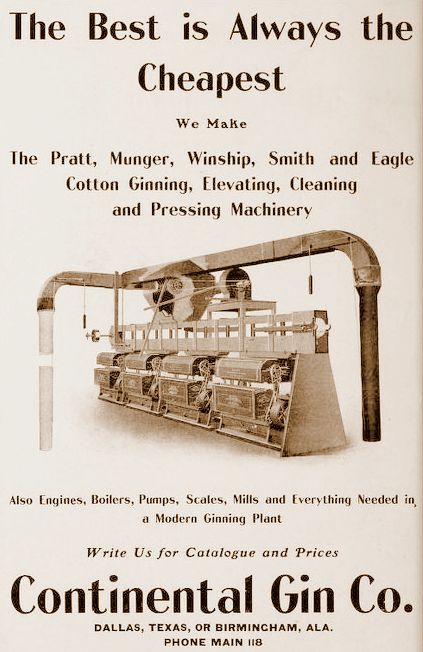
continental-gin-co_1912The Standard Blue Book of Texas, 1912-1914

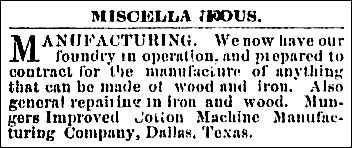
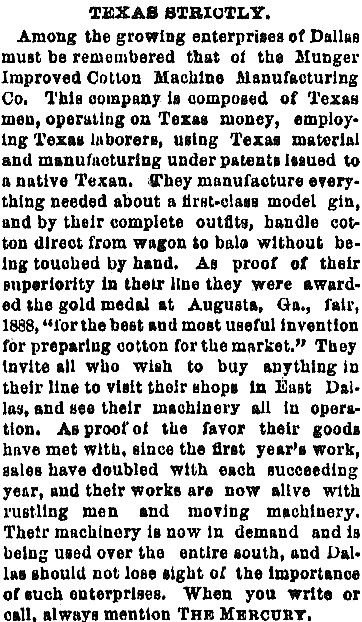
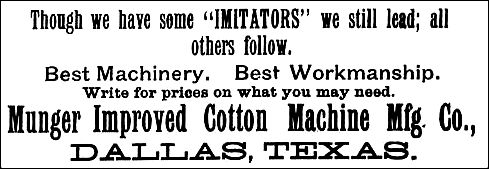
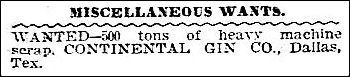
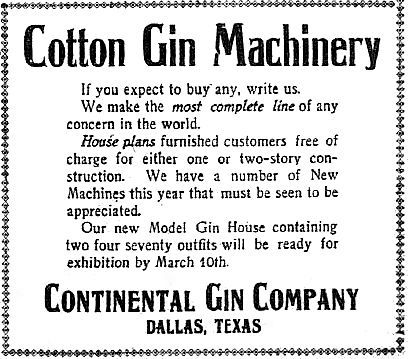
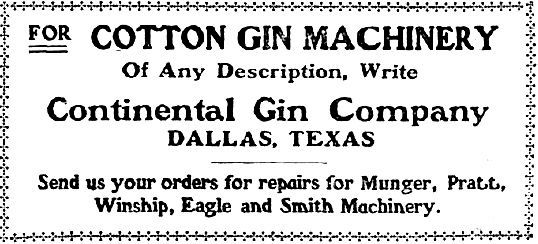
A few newspaper items regarding the Munger Improved Cotton Machine Company and the Continental Gin Company.

munger_dal-herald_101387The Dallas Herald, Oct. 13, 1887

munger_merc_053089The Southern Mercury, May 30, 1889

munger_merc_072892The Southern Mercury, July 28, 1892

munger_merc_041393The Southern Mercury, April 13, 1893

continental-gin_dmn_072600Change is imminent. (Dallas Morning News, July 26, 1900)

continental-gin_dmn_042001FIVE HUNDRED TONS! (DMN, Apri 20, 1901)

continental-gin_dmn_032203DMN, March 22, 1903

continental-gin_dmn_082005DMN, Aug. 20, 1905

continental-gin_dmn_060107DMN, June 1, 1907

continental-gin_worleys_1909Worley’s Dallas Directory, 1909

continental-gin_ad_dallas-police_1910Dallas Police, 1910

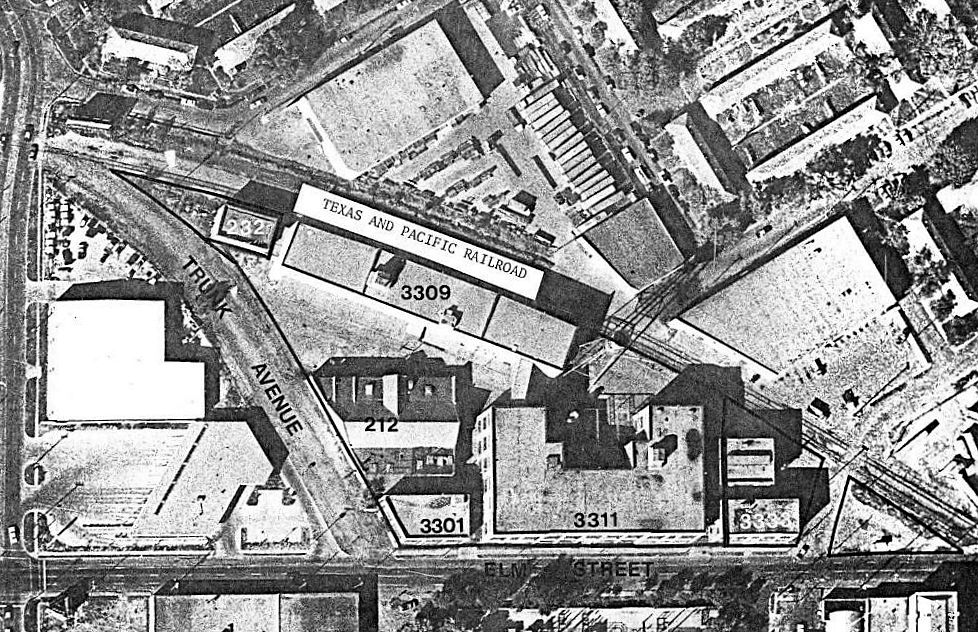
continental-gin-aerial-natl-reg-appPhotograph that accompanied the application to the National Register of Historic Places regarding the structures under consideration: 3301-3333 Elm St. and 212 & 232 Trunk Ave. (Landis Aerial Photography, 1980)

***

Sources & Notes

Handbook of Texas biography of Robert Sylvester Munger (1854-1923) is here.

The top image (which, by the way, took me FOREVER to find, is labeled as the Munger company, but the expansion would seem to indicate that this is the Continental Gin Company, after 1914. Whatever the case, it’s a great image!

That image and the aerial photograph of 1980 are included in the city’s application to have the complex included in the National Register of Historic Places, submitted in 1983. The detailed application — as a Texas Historical Commission PDF — can be accessed here.

The second image, of the early days of the Munger Improved Cotton Machine Company is from a bookseller’s online listing for Munger’s 13th Annual Catalogue and Price List (1895) — the item may still be available for a mere $435 and can be found here.

See an aerial view of what the area looks like today, via Google, here.

To see an incredible 1914 photograph of the buildings and the residential area to the north, see my post “The Continental Gin Complex — 1914,” here.

More on Robert S. Munger and more early company ads can be found in the post “R. S. Munger’s Cotton Gin Manufactory,” here.

*

Copyright © 2014 Paula Bosse. All Rights Reserved.


Mrs. Turner Attacked Miss Hulsey in the Spoolroom with a Knife

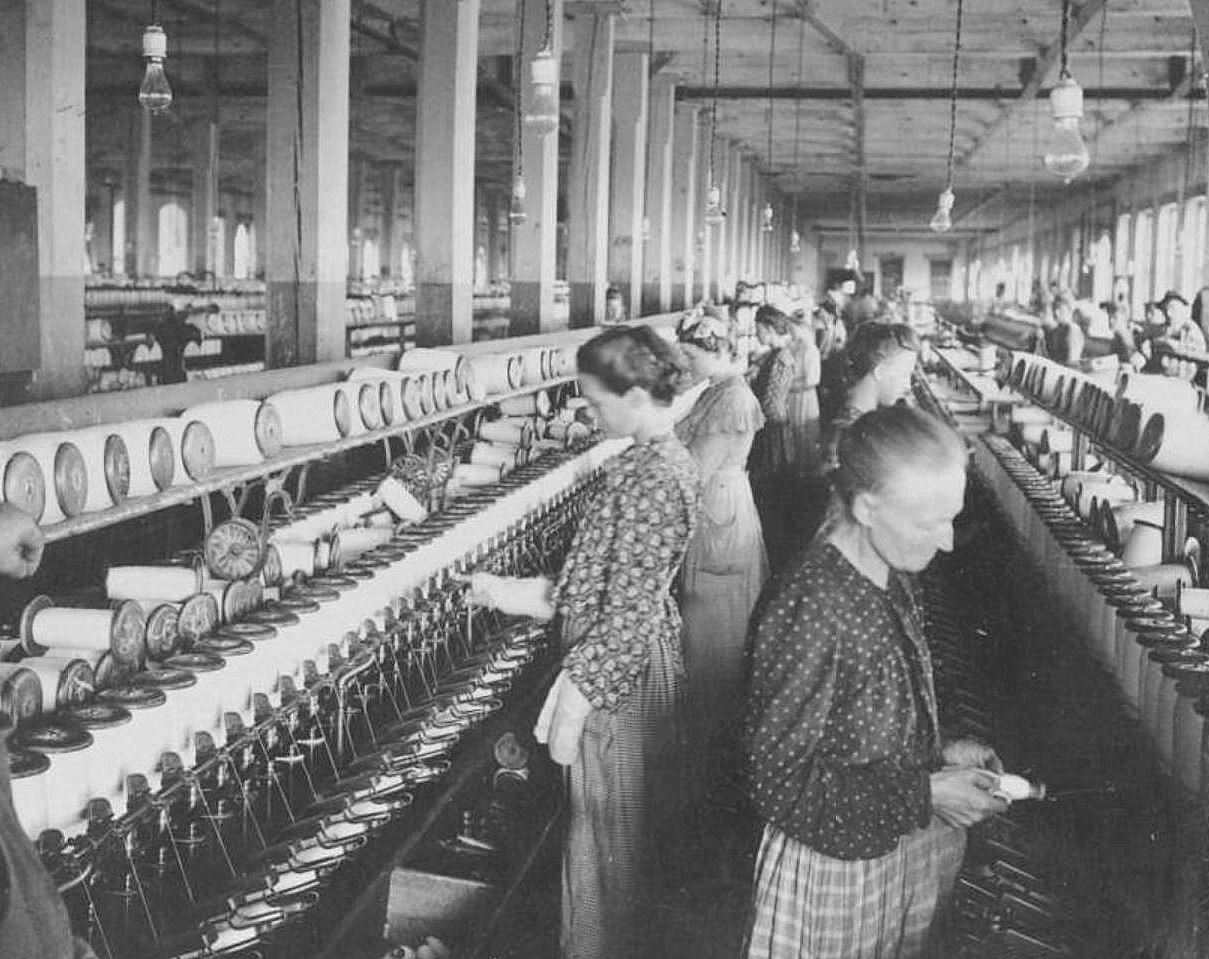
spoolroom_jones-coll_degolyer_smuSpoolroom of the Dallas Cotton Mills…

by Paula Bosse

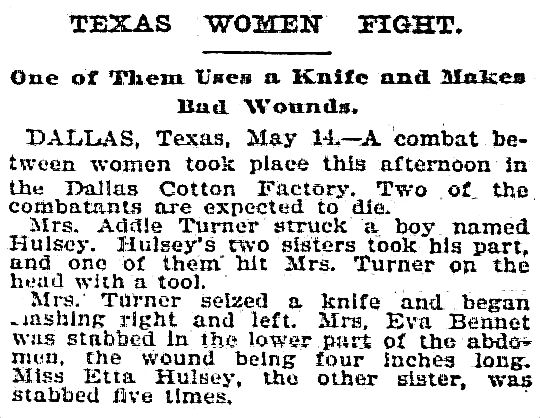
The spoolroom of the Dallas Cotton Mills was no place for the faint of heart, as this eyeball-popping story from The Dallas Morning News will attest (click for larger image):

dallas-cotton-mills_attack_dmn_051697DMN, May 16, 1897

The story even made it into the pages of The New York Times:

spoolroom-slashing_nyt_051597
NYT, May 15, 1897

(The women apparently survived.)

*

Sources & Notes

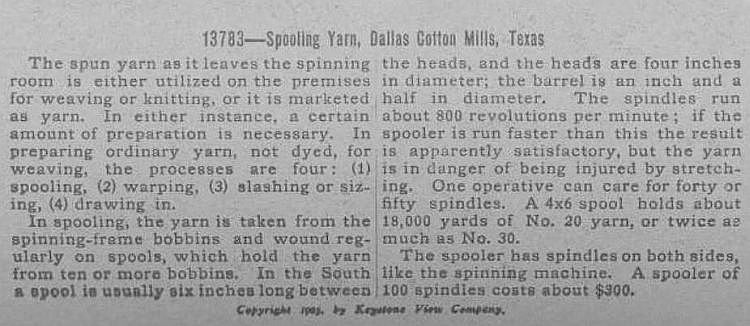
Photo (“Spooling Yarn, Dallas Cotton Mills, Dallas, Texas”) is from a stereograph, circa 1905, from the Lawrence T. Jones III Texas Photographs Collection, DeGolyer Library, Central University Libraries, Southern Methodist University; it is accessible here.

The descriptive text from the back of the card:

spoolroom_jones-coll_degolyer_smu_text

*

Copyright © 2014 Paula Bosse. All Rights Reserved.

My Birthdays at Kirby’s: Filet Mignon for Everyone!

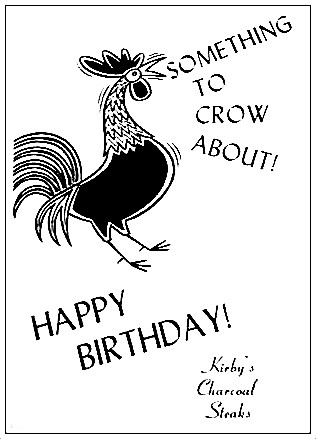
kirbys-birthday

by Paula Bosse

I grew up in the Lower Greenville area, and since we had a nice steakhouse just a couple of blocks away, that’s where we always went for family birthdays and special occasions: Kirby’s. I had forgotten about the birthday cards they sent out until my mother came across one in a recent move which was addressed to “Miss Paula Bosse.” Other than receiving actual mail, the thing that made these cards really exciting for a child was the inclusion of a dime. I always thought of it as a little birthday treat, but my mother suggested it was more of a subtle reminder to the parents to spend that dime on a call for reservations.

I loved that place. It was very dark. My brother and I always had the same thing: a non-alcoholic, super-sweet Shirley Temple from the bar, a salad with big chunks of roquefort in the salad dressing, a baked potato, and, oh my god, a filet mignon. I was mesmerized by the bacon wrapped around the steak. And the little wooden marker that showed how the meat was cooked. It was a nice, friendly neighborhood steakhouse. It was loud and happy. You could hear the steaks sizzling on the grill. It was always a treat to go to Kirby’s. And the place smelled GREAT! Even out on the sidewalk.

I was sad when they tore the building down, and even though there is now a chain of restaurants with the name “Kirby’s” — they even built a new one a couple of blocks down from the original location — there’s no way it could ever be the same.

Looking around for the history of the original “Kirby’s Charcoal Steaks,” I was surprised to discover that the man who owned Kirby’s — B. J. Kirby — was the son of the man who founded the Pig Stand chain of drive-ins. The Pig Stand started in Dallas, and it was the first drive-in restaurant EVER. They had the first carhops. The first onion rings. The first Texas toast. The Kirby’s steakhouse location — 3715 Greenville — had actually been a Pig Stand! B. J. Kirby had grown up working at his father’s restaurants, and when his father died, he sold all the Pig Stands except for the Greenville Avenue location (i.e. Pig Stand No. 4). In 1954 he turned the pig-sandwich-serving drive-in into a nice sit-down steakhouse which remained popular until the restaurant closed in 1987 when Mr. Kirby retired.

Watch Ch. 5 news footage of B. J. Kirby and the auction of the restaurant fixtures at UNT’s Portal to Texas History site, here.

kirbys_ch-5_closing_screencap_portal

I could really go for a bacon-wrapped filet mignon right about now. And one of those Shirley Temples would even hit the spot.

kirbys_1958

kirbys_color

kirbys_1951

***

Sources & Notes

“Something to Crow About!” card from the author’s collection.

Color photo of the Kirby’s sign is a screenshot from the Channel 5 news coverage of the auction of the Kirby’s fixtures, which aired April 14, 1987, viewable here; from the KXAS-NBC 5 News Collection, UNT Libraries, via the Portal to Texas History.

First ad from 1958; bottom ad from 1951.

Watch the 14-minute documentary “Carhops,” in which B. J. Kirby remembers life working as a kid for his father, here (also interviewed are other drive-in Dallas icons, J. D. Sivils and Jack Keller).

An entertaining history of the Pig Stand No. 4 and its transformation into Kirby’s Charcoal Steaks can be found here.

*

Copyright © 2014 Paula Bosse. All Rights Reserved.

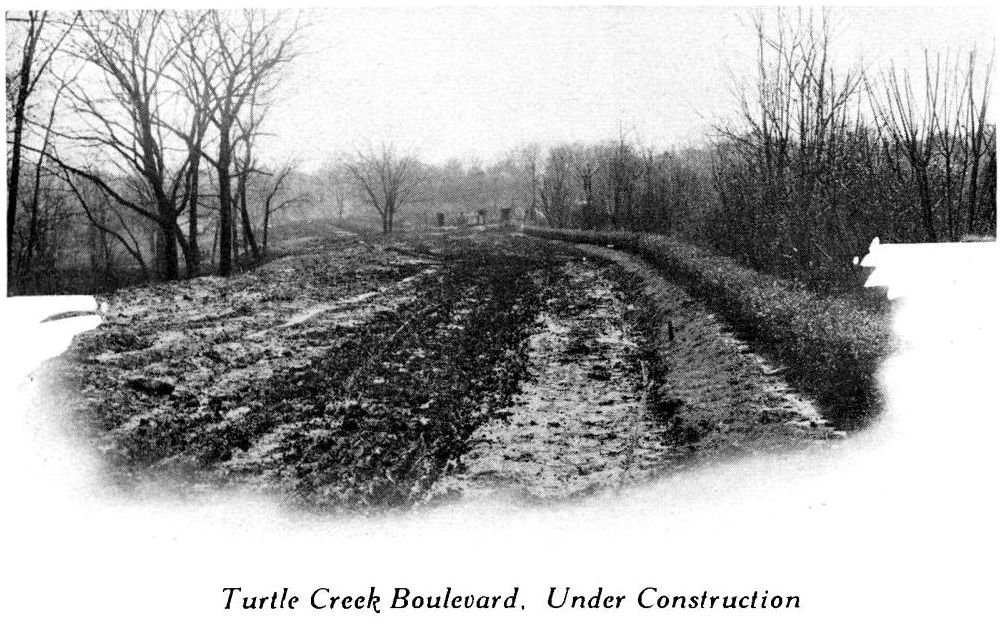
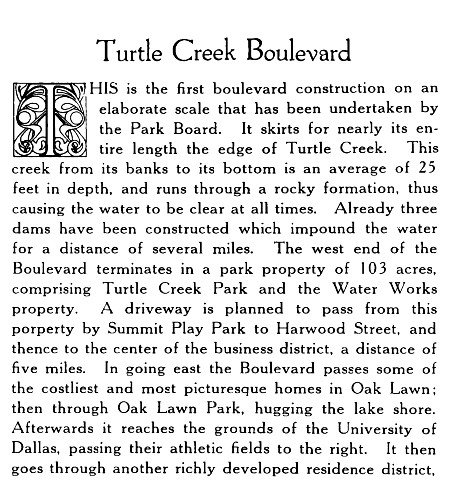
The Construction of Turtle Creek Boulevard: “Ascending & Descending Cliffs and Ravines” — 1915

turtle-creek-blvd-1

by Paula Bosse

What was going on a hundred years ago in Oak Lawn? Turtle Creek Boulevard was being constructed! Construction was overseen by the Park Board, which probably explains why it is one of the most beautifully landscaped roadways in Dallas.

turtle-creek-blvd-2

turtle-creek-blvd-3

turtle-creek-blvd_text-1turtle-creek-blvd_text-2

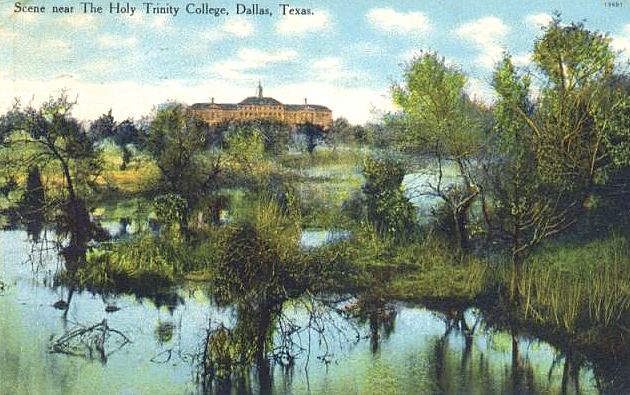
Incidentally, the “University of Dallas” mentioned above refers to the original location of the University of Dallas, first called Holy Trinity College. It moved northward in the 1940s, and Jesuit High School took over the building. I’m really surprised to learn that this huge building was located near Turtle Creek and Blackburn until Jesuit moved north to ITS new home in the early 1960s.

And here it is, snug on the banks of the turtle-infested creek, around 1909 (in a photograph that does not do the lushly beautiful area justice).

***

Sources & Notes

Photos and text from the Report for the Year 1914-15 of the Park Board of the City of Dallas (Dallas, 1915), pp. 63-64.

*

Copyright © 2014 Paula Bosse. All Rights Reserved.

Booker T. Washington Marching Band — 1937

booker-t-washington_marching-band_1937_dhs

by Paula Bosse

Marching band. Everyone’s favorite class in high school. Band director A. S. Jackson is at the right.

***

Sources & Notes

From the J. L. Patton Collection, Dallas Historical Society.

*

Copyright © 2014 Paula Bosse. All Rights Reserved.

Mme. Koneman, High-Class Milliner

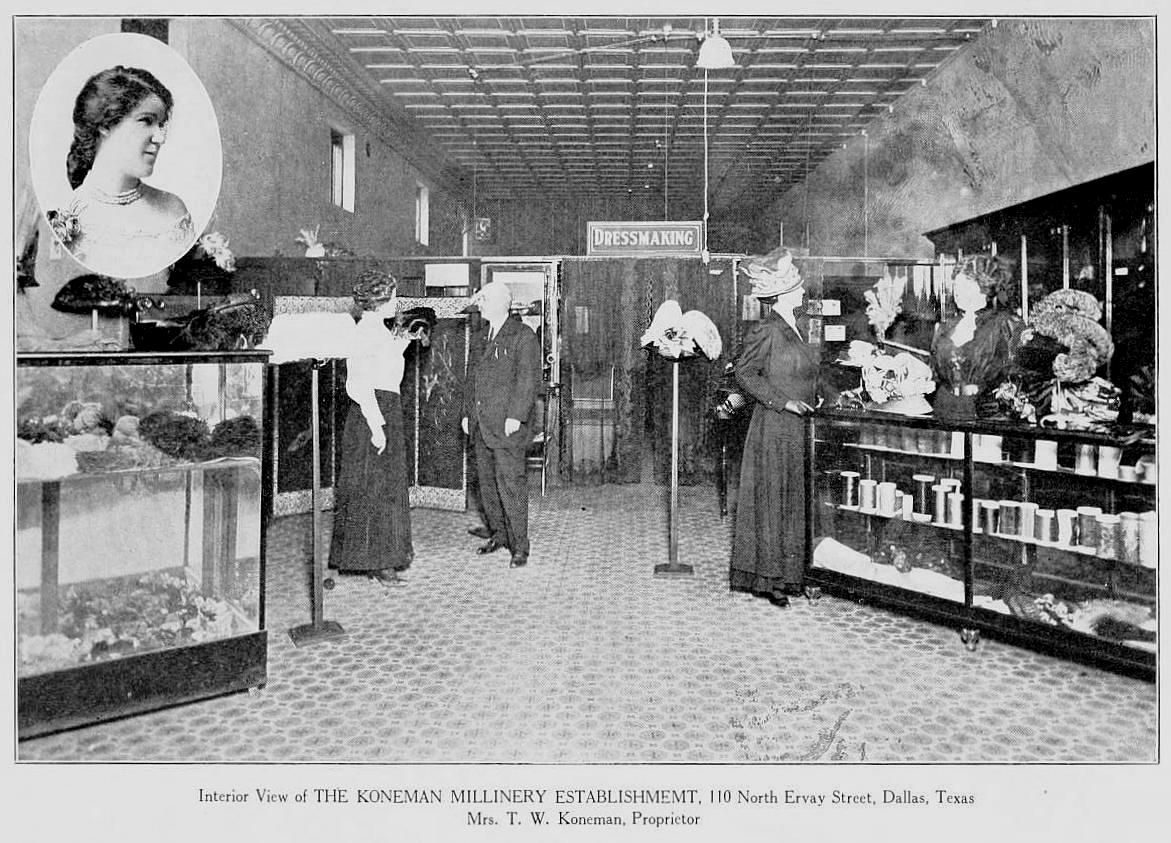
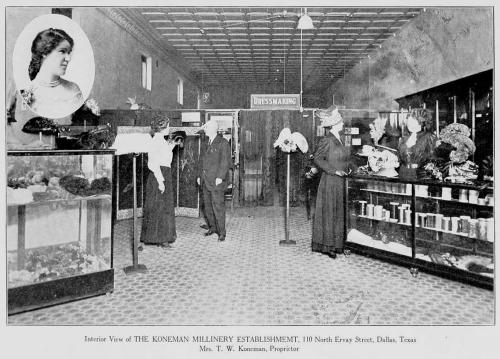
Madame Koneman’s fashion emporium, 1912 (click for larger image)

by Paula Bosse

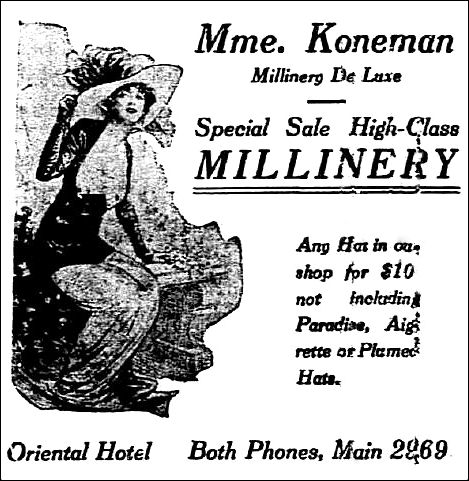
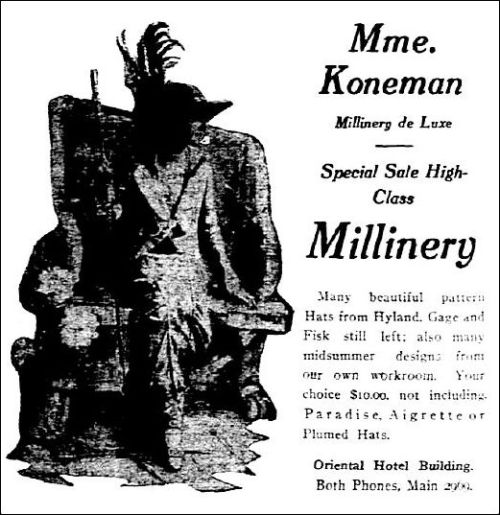
Behold, the Koneman Millinery Establishment, which actually looks a little plain for a millinery shop housed in the ornate Oriental Hotel building. When I see old ads or photos like this, I always wonder about the people pictured in them. I’m assuming that the woman in the oval inset at the left was the proprietess, “Mme. Koneman.” So who WAS she, this woman who had a “high-class” business that catered to a “high-class” clientele? I poked around a little and found these ads from 1913.
koneman-millinery_dmn_060113

koneman-millinery_dmn_060813

koneman-millinery_dmn_061413

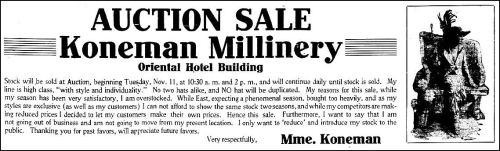
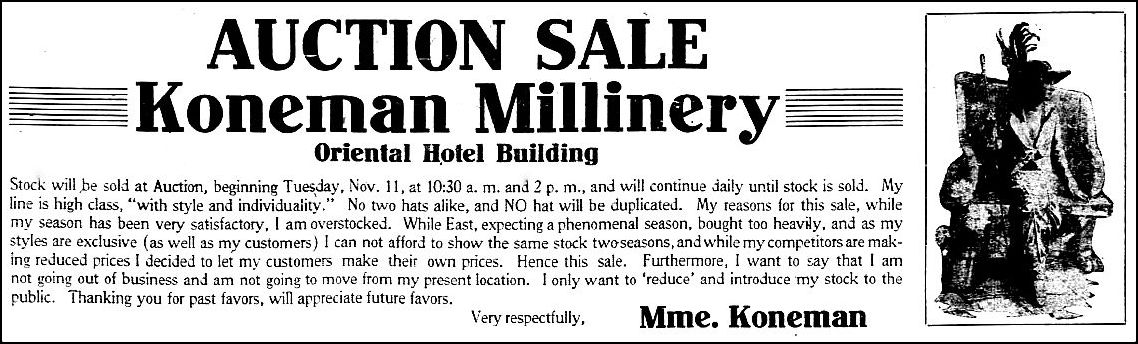
koneman-millinery_dmn_110913(click for larger image)

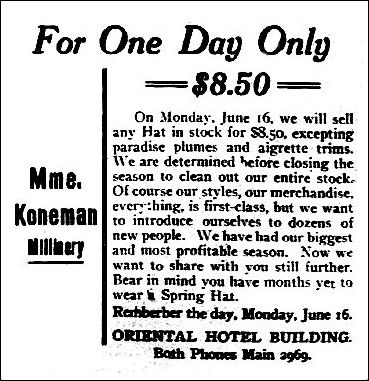
Ooh. Those last few sentences of the above ad seem a little defensive, as if she’s addressing nasty gossip. “Furthermore, I want to say that I am not going out of business.” When you see a sentence like that — in an advertisement — that sends up some furiously waving red flags. And … just one month after that ad, this miniscule tidbit in teeny-tiny letters appeared in the paper at the end of 1913:

Dallas Morning News, Dec. 21, 1913

Oh dear. D-I-V-O-R-C-E. And, guess what? There were no more ads for the millinery shop.

But, alarmingly, THIS appeared on the wire services on February 17, 1917:

Fort Worth Star-Telegram, Feb. 17, 1917

Oh DEAR! Shot by a widower with two children, who tried to kill both her and himself after he flew into a jealous rage in a New Orleans hotel lobby. Working with feathers and plumes and felt and velvet (probably) does not prepare one for being shot at!

Ten days after being shot, it was reported that the 36-year old Mrs. Koneman (whose first name was either “Matilda” or “Mathilda”) was released from the hospital in New Orleans. The jealous suitor, 40-year old Edgar J. Hargrave (or “Hargrove”), remained in the hospital, slowly recovering (but with a bullet still lodged in his head!). “Policemen expect to arrest Hargrave on a charge of shooting with intent to murder as soon as he is able to leave the institution.” He was an “oil salesman” from Houston.

One week later, Hargrave/Hargrove was released from the hospital and was transferred to Parish Prison where he awaited arraignment on attempted murder. Meanwhile, Matilda/Mathilda, a material witness in the case, had been arrested when the D.A. heard she was about to leave town. Out on a $650 bond, she was ordered to stay in the city until the arraignment.

On March 16, one month after being shot in the lobby of the Grunewald Hotel, Mrs. Koneman was in court recounting her near-death experience, and I’m sure the people back in Dallas were eating up every last morsel in the scandalous testimony about the spurned lover who tried to kill the divorcée who used to sell them great big hats with aigrette plumes in that bleakly unadorned hat shop over on Ervay!
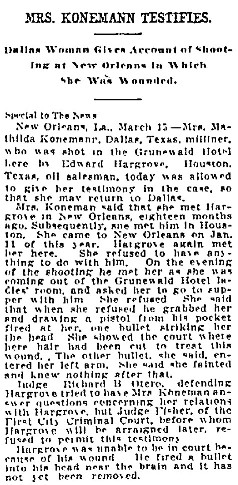
koneman-testifies_dmn_031617-smDMN, March 16, 1917 (click for larger image)

(UPDATE: A reader kindly forwarded me a more detailed account of the shooting incident between the spurner and the spurnee, in a longer article from the New Orleans Times-Picayune (Feb. 17, 1917). Click here to read the article, with a blurry photo of Hargrave.)

And then — rather anticlimactically — the trail ran cold. What was the verdict? What happened to Edgar? Whither Mme. Koneman? Mrs. Koneman was reported to be living in Galveston at the time of the shooting, but by the summer of 1922 she was back in Dallas, checked into the Southland Hotel. The last shred of info I found about her was this classified ad from June, 1922, which raises even more questions.

DMN, June 15, 1922

I’m not really sure what this was all about, but it’s safe to say there would have been very few lags in the conversation between Dallas and California!

***

Top ad from The Standard Blue Book of Dallas, 1912-1914 (Dallas: A. J. Peeler & Co.).

“Dallas Woman Shot” article from the Fort Worth Star-Telegram, Feb. 17, 1917. This was a wire service story that was printed around the country, but, oddly enough, the news doesn’t seem to have made its way into the DMN until ten days after the shooting!

All other ads and articles from the Dallas Morning News. The Koneman Millinery ads were from 1913.

*

Copyright © 2014 Paula Bosse. All Rights Reserved.

Remember the Alamo! …In Fair Park?

alamo_replica_fair-park_seewatermelonkidpage

by Paula Bosse

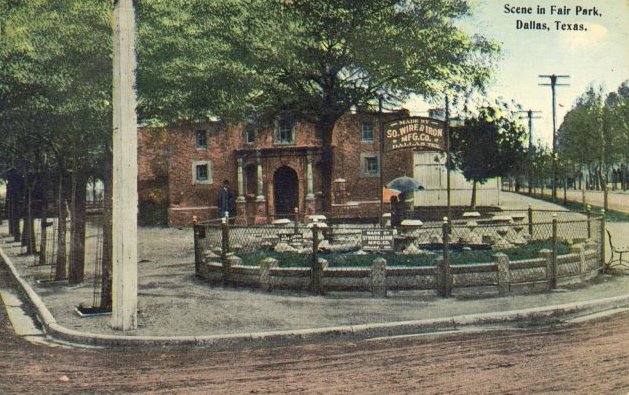
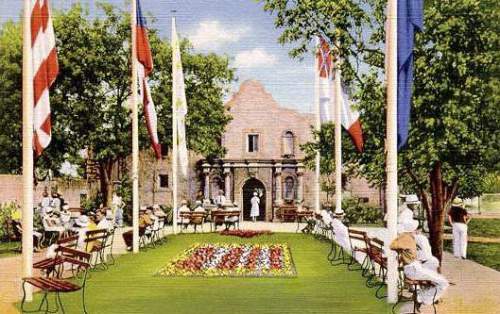
Today, on the anniversary of the fall of the Alamo, I bring you news that Dallas has outdone San Antonio by having hosted two Alamos. TWO! Both in Fair Park. The first one was a gift to the city by G. B. Dealey and the Dallas Morning News — it stood stoically at the entrance to the fairgrounds from 1909 until 1935 — and the second one was a rebuilding of the first which was torn down to make way for the the splendor of the Art Deco Centennial extravaganza and lasted from 1936 until 1951. And here I’d never heard mention of Dallas having had ANY Alamos.

The idea came from Dallas Morning News executive George Bannerman Dealey. He sent architect J. P. Hubbell (of Hubbell & Greene) to San Antonio to meticulously photograph, sketch, and measure the original structure — this included making note of every stain, every crack, every instance of broken plaster, etc. — in order to reproduce an exact replica of the historical landmark (at half the size of the original). The Morning News offered to pay for and build the replica (the cost was estimated at $5,000) and asked only that it be placed in a primo location (at the entrance!), that it be open to the public during the day but be available to the DMN people to use for private/company functions after hours, and that the Park Board maintain the building and its landscaping. The Park Board jumped at the gift, and the news of our very own “little Alamo” was met with giddy anticipation. Even the rival Dallas Times Herald was swept up in the excitement and suggested a “Meet Me at the Alamo at the Dallas State Fair” slogan in an editorial.

San Antonio and the Daughters of the Republic of Texas (who managed and maintained the historic shrine) were not terribly amused by this, but The News (in the expected torrent of its own self-congratulatory publicity about its magnanimous gift “not to Dallas, but to the State”) humbly insisted that the much, much, MUCH smaller Alamo would only drum up steady tourism of people who wanted to see the real thing. San Antonio and the Daughters seemed to get over it eventually. Dealey had made a good point, though, when he said that only a very small percentage of Texans had been able to see the Alamo in person, and this was an excellent way to bring history alive for North Texans.

The replica was dedicated on the opening day of the fair in 1909, and curious crowds lined up to see the startlingly realistic reproduction of the building which Mayor S. J. Hay described as being “sacred to every patriotic citizen of the State.” The brand new Alamo (made to look old and worn and battle-scarred) was a hit. In fact, it seems to  have been a very popular exhibit for the length of its stay — a total of 42 years. Other than being visited by thousands and thousands of fair-goers and families and schoolchildren, it was also used to house soldiers briefly during both World War I and World War II. It was visited by numerous people who claimed to be related to Alamo heroes like Crockett, Bowie, and Travis, and there were even a couple of instances of visits by 100-year-old men who said they had known Crockett and Bowie when they were children.

And, oddly, even Comanche Chief Quanah Parker stopped by to check the place out. I’ll end with his salient observations upon seeing the Alamo replica when visiting Dallas as a guest of the State Fair in 1909:

White men talk a great deal about their history. They don’t all play brave in making it. They don’t all care as much for getting it right as for getting it like they want it. Alamo fight was brave like Indians fight, don’t care for safety and for life. This Alamo house brings back to me thought of the ‘Dobe Walls’ fight a long time ago. It must make Texas people feel good to look at this and think of what it stands for. It was a fine thing for The News to put it here. (DMN, Oct. 27, 1909)

*

Above, opening day crowds. “Scene in front of the Replica of the Alamo Chapel During the Ceremony of Presentation.” Photo by Henry Clogenson. (DMN, Oct. 17, 1909)

Dallas’ second Alamo (which made its debut at the Texas Centennial in 1936) no longer had its primo location at the entrance to Fair Park, but it at least had a bit of room to breathe. As with the first replica, an architect was sent to San Antonio to bring back exact measurements — this time it was the incomparable George Dahl (if you’re not familiar with his work, you need to look him up). And this time, San Antonio and the Daughters of the Republic of Texas were not happy at ALL: there was a sternly worded petition from San Antonio to the governor and threats to legally force a halt to the construction. Guess they got over it. Again.

alamo_art-institute-of-chicago_1936

But eventually, the Alamo fell. It was razed in August of 1951, after years of neglect. Stalwart Texas demolition workers must have blanched a bit at being informed that their job was to destroy the very symbol of Texas heroism and independence.

***

Top postcard from a page on the Watermelon Kid’s great Dallas history site, here.

Photo of the “brand new” Alamo in 1936 from the Ryerson & Burnham Archives, Art Institute of Chicago, here.

*

Copyright © 2014 Paula Bosse. All Rights Reserved.