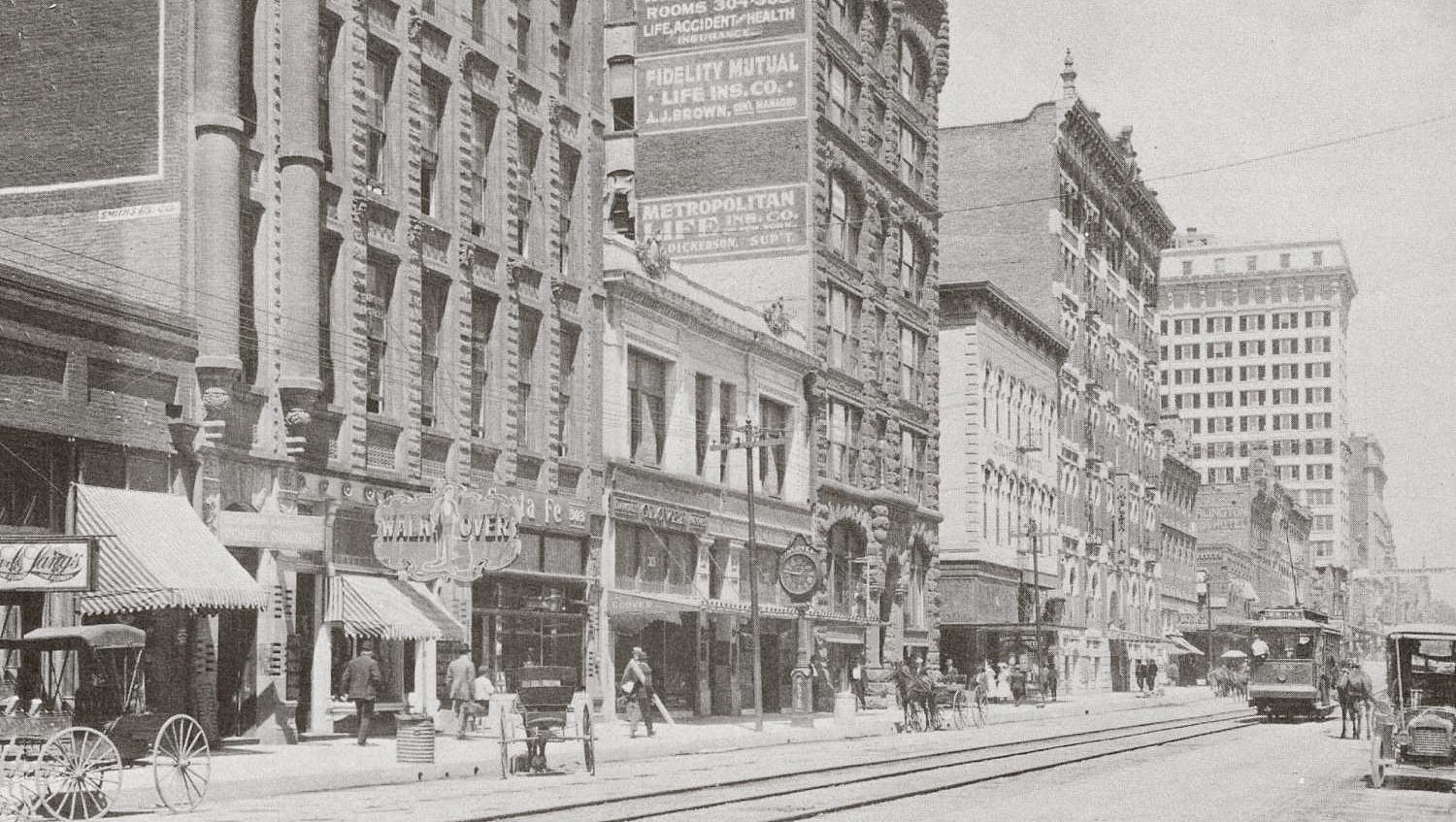
Here’s Main Street, looking east, from about Field. This is another of those odd photos showing streets shared by horse-drawn buggies and automobiles. And an electric streetcar. The days of those horses clip-clopping down Main Street were running out. (And I’m sure the horses were much relieved.)
This photo was taken sometime between 1909, when the Praetorian Building opened (it’s the tall white building in the background, with the Wilson Building behind it at the other end of the block), and 1911, when the street numbers changed (you can see the address of “303” next to the words “Santa Fe” — the Gulf, Colorado & Santa Fe Railway offices were at 303 Main Street in the 1909 city directory).
Also seen in this photo are the tall Scollard Building (the one with the advertising painted on its side) and, one building away, the Imperial Hotel.
Photo from a pamphlet for the Texas State Historical Association’s annual meeting in Dallas in 1977, found on the Portal to Texas History, here. Sadly, the photo was printed in sepia ink, which, argh. As always, if you know of a sharper image, please let me know!
See two postcards from just after the turn on the last century which show not-terribly-exciting (though still interesting) views of the otherwise-impressive State Fair of Texas, in the 2015 post “The Periphery of the Texas State Fair Never Looked Better.”
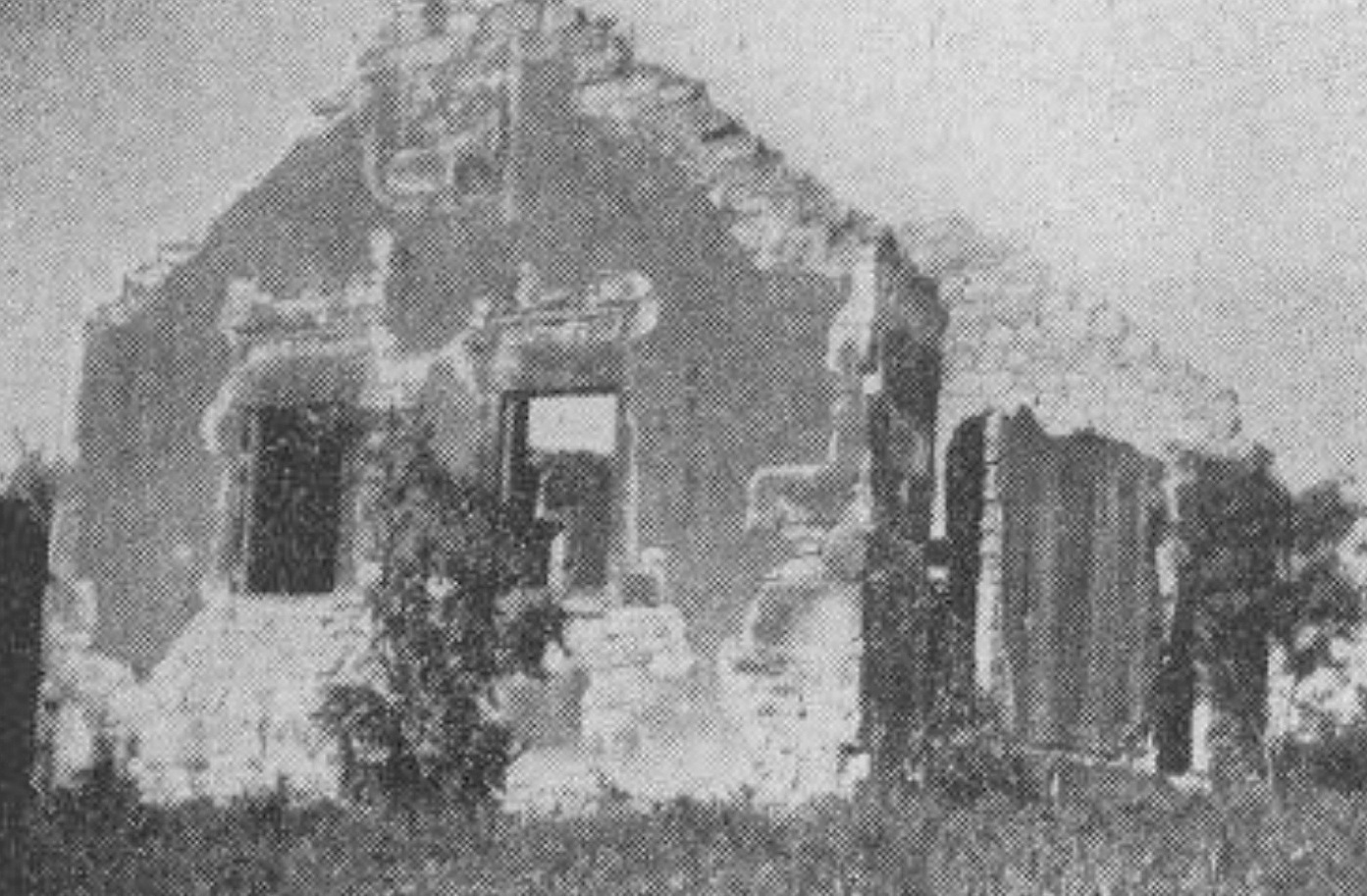
Ruins of the Delord house… (click for larger image)
by Paula Bosse
I’m the first to admit that my knowledge of the La Reunion colony — an 1850s European utopian settlement which was located a little west of the Trinity River, later the site of Cement City — is not as thorough as it should be. There are a few photos of ruins of the “Old French Colony” which one sees fairly regularly, but I don’t think I’ve seen the one above before. It appeared in a Texas Centennial brochure printed in 1935. The date of the photo is not provided, but it was probably taken in the 1930s. The caption: “Texas Landmarks Series. No. 12. RUIN OF ‘LA REUNION,’ OLD FRENCH COLONY, Dallas, Texas.” (I’m not sure what landmarks 1-11 were, but this was an interesting choice to illustrate Dallas to potential out-of-town visitors coming for the Texas Centennial Exposition in 1936.)
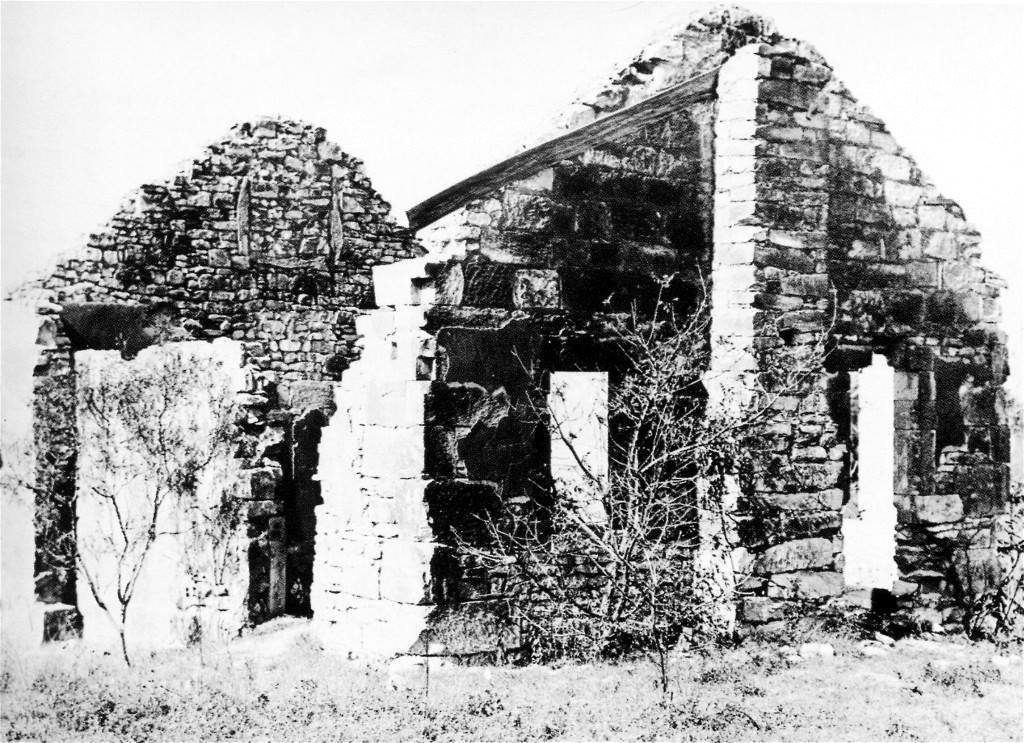
This is the Delord house, the last survivor of buildings directly connected to members of the utopian colony. Here’s another photo of the house — it appeared in the WPA Dallas Guide and History, with the caption “Delord House, Last of Reunion.”
Below, a description of the house, built shortly after the La Reunion colony had sputtered its last breaths, and its location, from The Dallas Journal in 1936:
Constructed [in 1859] by Francois, Joseph and Pierre Girard, Jr., sons of Pierre Girard, one of the colonists. This house faced on North Westmoreland Avenue near the intersection of Highway 80. It was built for and occupied by Alphonse Delord, a banker who came to the colony from Paris, France, with his wife, daughter, and son in the year of 1856.
The house was built in 1859 for the widow of Alphonse Delord shortly after the colony had ceased to function as a Fourierist phalange, or self-contained, cooperative community, as its founders had intended. Madame Delord had invested heavily in the short-lived La Reunion Company, and when it dissolved, received forty acres of land as her share of the communal property. On this tract Pierre, Joseph, and Francois Girard, three brothers who had come to Texas with their father in 1856 and had taken up the occupation of architects and builders, constructed a house for her. She resided here until the outbreak of the Civil War in 1861 when she returned to France with their children.
The La Reunion settlement was not far from this house. According to George Cretien, who was born in the La Reunion colony, “The village of the colonists was located about a mile northeast of the Delord place on the bluff that the cement company has mostly destroyed for the making of its product” (Dallas Morning News, Sept. 17, 1933).
The most recent photo I found of the house still (sort of) standing was the one below (click to see a larger image), from a 1943 Dallas Morning News story about emergency war-time housing built by the Federal Public Housing Authority for North American Aviation workers (see “View War Housing Site,” DMN, Sept. 12, 1943). They had to build a LOT of housing (800 dwellings on the same tract the DeLord house was crumbling onto), and that quaint stone house built in the 1850s might have been bulldozed to make way for cheap housing which was meant to be temporary (which actually ended up not being temporary).
Just a guess on my part that this was when the old stone house bit the dust. If it managed to survive the FPHA bulldozers, please let me know.
It would have been nice to have preserved such an early relic of an important era in Dallas’ history — and there was a move to do that very thing. But, well, there you go.
***
Sources & Notes
Top photo from a Texas Centennial brochure printed by the A. H. Belo Corporation in 1935; the brochure can be viewed on the Portal to Texas History site, here.
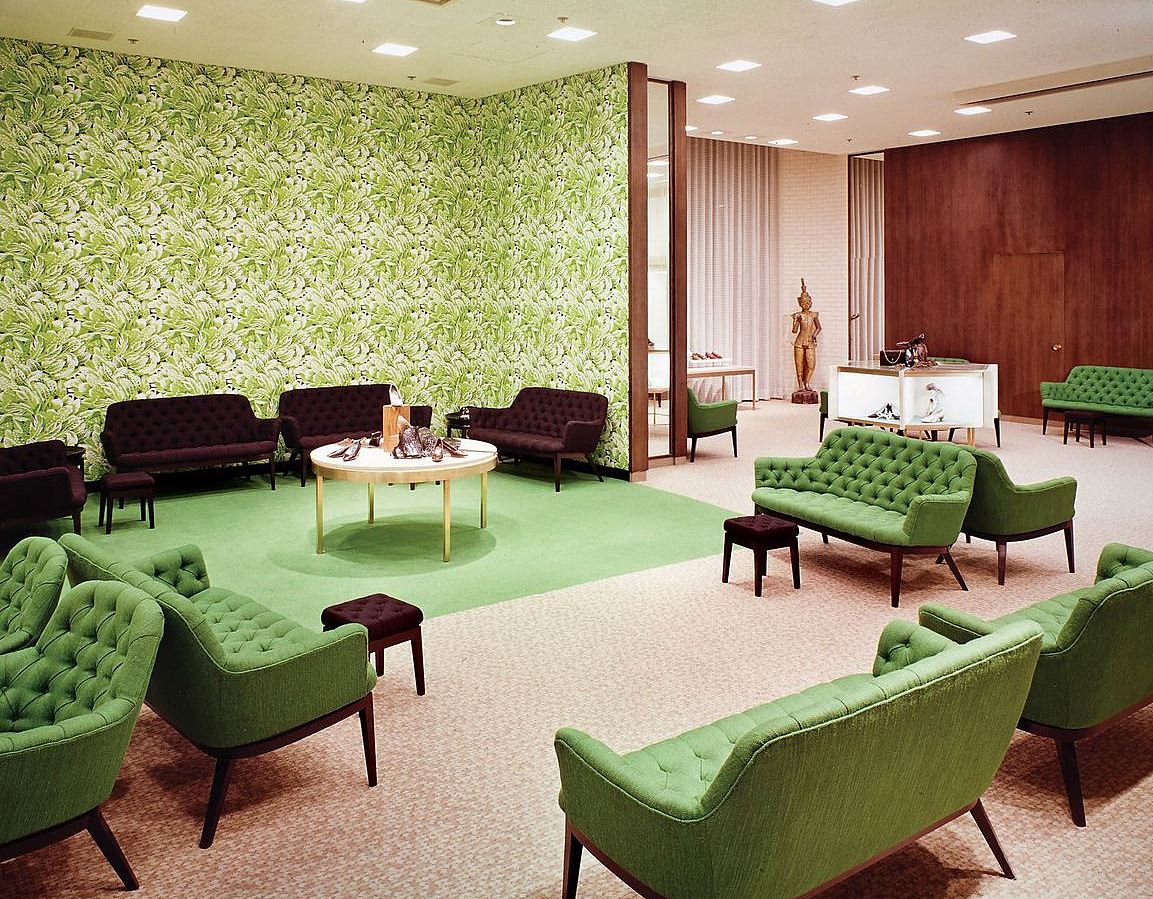
1965 photo by Ezra Stoller. It appeared in the December 1, 2016 New York Times magazine as part of a slideshow, here; it was a companion to a short article about Stanley Marcus by James McAuley, here.
I never thought of myself as a fan of lime green upholstery until I saw that salon furniture. The wallpaper is a bit … busy (in a tasteful, sophisticated way…), but that furniture is, as they say, to die for. (And the door that disappears into the wall is a nice touch.)
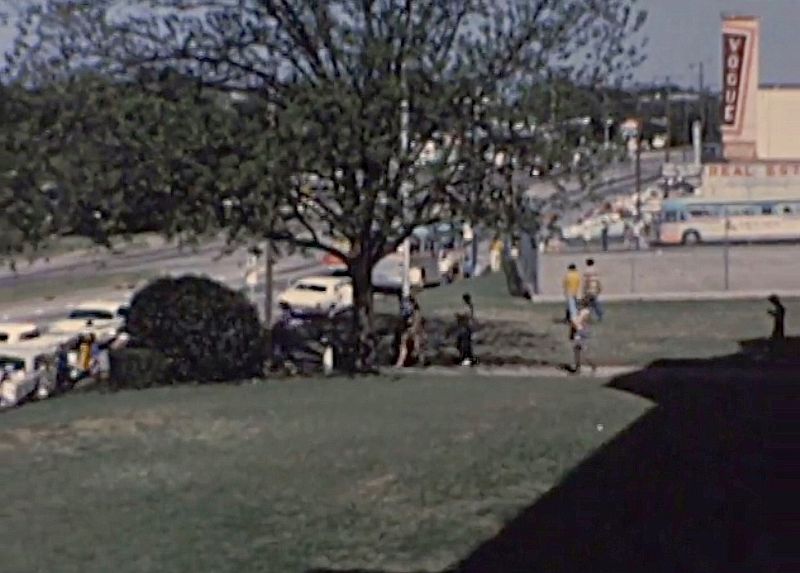
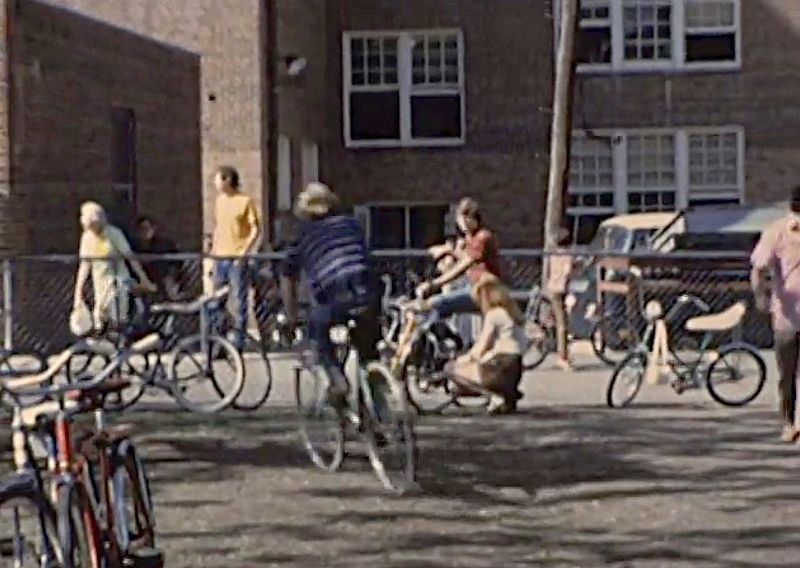
Thanks to the heads-up from UNT media librarian and film/video archivist Laura Treat, I now know about “Spotlight on North Texas,” a collaborative project between the University of North Texas Libraries and the Texas Archive of the Moving Image (TAMI) to preserve North Texas film history. The bulk of the collection centers on Denton County, but there are the occasional glimpses of Dallas, such as the 3-part “Sunset on Film” which was shot by student James Dunlap in and around Sunset High School in 1970 on Super-8 film (without sound). It’s definitely a student effort — nerdy and charming — but it has lots of great footage, and if you are a Sunset alum, you’ll probably see a lot of familiar sights from your Oak Cliff school days. And for those who missed the era when high school students dressed like extras from The Partridge Family or The Brady Bunch — and who swarmed to get their bikes after school (when was the last time you saw that?!) — this will be almost exotic.
PART 1 (running time 7:55) is here (click image on UNT site, then click the “play” arrow — don’t forget to watch in full-screen). The images below are screenshots from the digitized film; they are larger — and grainier — when clicked.
More about last year’s “Spotlight on North Texas” project can be found here. You can see what’s been uploaded here. They also have a Facebook page, here.
All images in this post are screenshots taken from the film(s) “Sunset on Film,” which was donated by Blaine Dunlap to the Spotlight on North Texas collection, University of North Texas Media Library; accessible on the UNT-hosted Portal to Texas History website.
More on filmmaker Blaine Dunlap can be found in “Spotlight on Dallas Filmmakers: Blaine Dunlap” by Laura Treat, here.
The Jimi Hendrix Experience, Love Field, 4/20/69 (Jones Film Collection, SMU)
by Paula Bosse
One of the advantages of living in a major American city is that all the biggest entertainers visit at one time or another. Let’s take three of the biggest entertainers of 1969: Jimi Hendrix, Glen Campbell, and Tiny Tim. All were huge, and all came to Dallas. And, luckily for us, they were captured on film in interviews by reporters from WFAA-Channel 8.
For me, without question, the most exciting interview was the one with Jimi Hendrix, who, standing on the tarmac of Love Field with bandmates Mitch Mitchell and Noel Redding on April 20, 1969 (yes, 4/20…), gives a great, relaxed interview to a very lucky Channel 8 reporter, Doug Terry. (I love the look on Terry’s face throughout the interview.) Watch it here:
A few screenshots (click to see slideshow):
April 20, 1969, WFAA-Ch. 8 News (Jones Film Collection, SMU)
4/20/24 UPDATE: After several years of trying to contact the reporter, Doug Terry, I finally heard from him! Here are a few paragraphs from his email to me (used with his permission), with some interesting tidbits about how some of these interviews were conducted:
I was still a college student most of the time I worked at WFAA. I handed in my resignation after covering the north Texas pop festival in that same year. [Watch one of Doug’s Texas International Pop Festival reports from Lewisville here.] Your comment about being in a large city and its advantages was something that I did not fully grasp until years later. The access was wonderful, I saw Hendrix at least three times, on one occasion being in the dressing room with a camera when he warmed up for a show (that footage is nowhere to be found).
There are two aspects to mention about that interview. First, I was a weekend reporter and late night news anchor at Ch. 8 and I assigned myself to go interview him. In those days, one could call up the airlines when a notable person was coming in and they would give the flight number and arrival time. Amazing. Most of the people at the station at that time probably had no idea who Jimi was and wouldn’t have cared if they did know.
The other interesting point is the work of the photographer. Ordinarily, we did over the shoulder interviews, the camera to the back and side of the reporter. The fact that this was shot from the side made all the difference. As a shooter, he was not otherwise outstanding but this interview would be much less interesting if it had been shot in the traditional line-up sort of way. The two bandmates goofing around was distracting but great.
Thank you, Doug! I love this interview — I’m so glad you assigned yourself to the duty!
*
Jimi Hendrix appeared at least 4 times in Dallas:
Feb. 16, 1968: Fair Park Music Hall
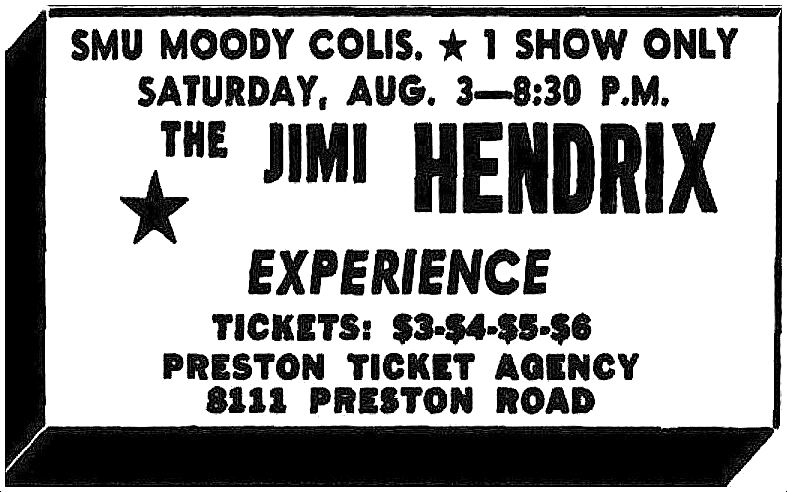
Aug. 3, 1968: Moody Coliseum, SMU
April 20, 1969: Memorial Auditorium (where he was headed after the Ch. 8 interview)
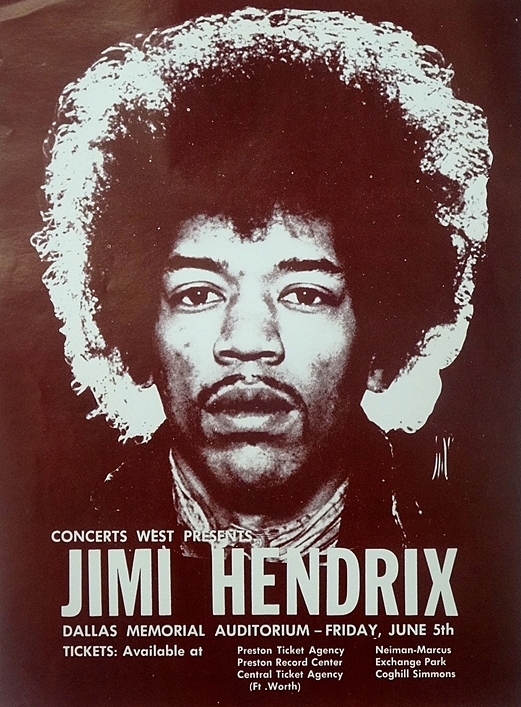
June 5, 1970: Memorial Auditorium
July 28, 1968
Two surprising errors (grammatical and factual) appear in a Neiman-Marcus tie-in ad (of sorts) which states that Jimi would be at Memorial Auditorium, rather than Moody Coliseum. Despite the error, it’s cool that Neiman’s was expanding its cultural horizons to include someone like Jimi Hendrix in one of its ads (which was featuring teen fashions, but still). N-M has always had its finger on the pulse of current fashions — and Jimi Hendrix was certainly fashionable.
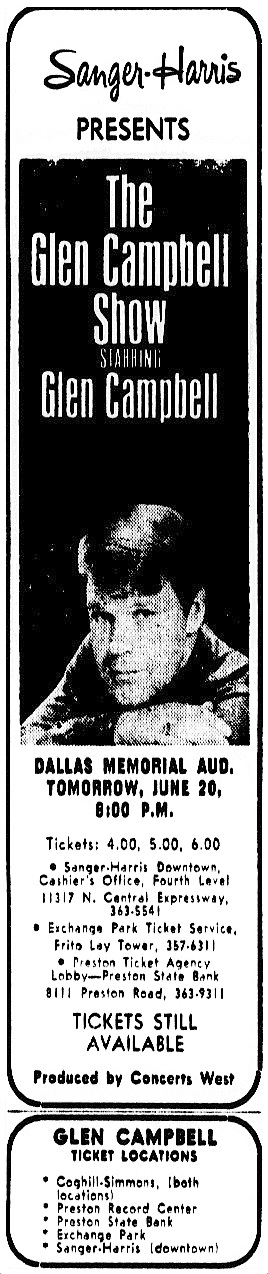
Glen Campbell was in town for several days in June, 1969. He arrived at Love Field on June 15 and was met by a “high-spirited throng” of teenage admirers. He was here to promote the release of the movie True Grit (in which he appeared with John Wayne), as well as to perform at Memorial Auditorium on June 19, 1969.
June 19, 1969
He was actually in Dallas the previous year, in March, 1968, to perform at the State Fair Music Hall with Bobbie Gentry. An interview with the pair begins at 3:57:
**
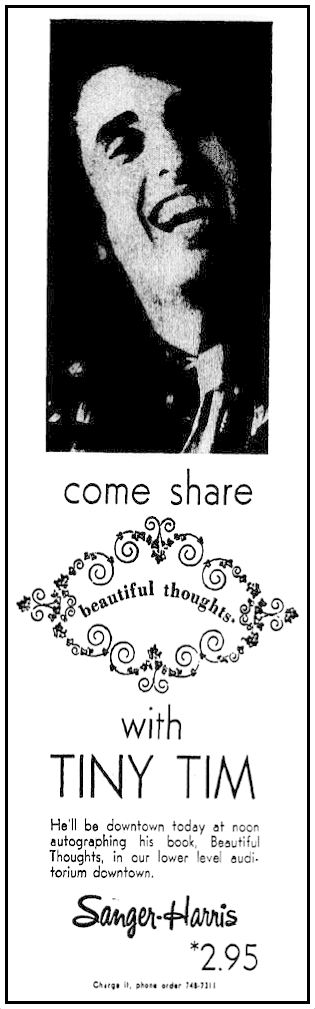
And Tiny Tim was in Dallas on June 17, 1969 to appear at a book-signing at the downtown Sanger-Harris department store. The signing was a bit more sedate than his previous visit to Dallas when he caused something of a riot on January 23, 1969 while making an appearance at the Melody Shop in NorthPark. I’m not sure what sort of crowd the Melody Shop thought they’d get for their little “autograph party,” but it’s safe to say they did not expect 5,000 over-excited teenagers. The news report the next day was peppered with words like “pandemonium,” “swarm,”“mob scene,” and “human wall.” (Read about that bizarre event here). His drawing power continued the next year when Tiny made his Dallas performing debut at … of all places … Abe Weinstein’s Colony Club, one of the city’s top “burlesque” houses. He was booked for an incredible 9-night run (!) in September, 1970. It was a major success. Dallas apparently loved Tiny Tim. And, of course, years later, Bucks Burnett’s Edstock and Burnett’s tiny Tiny Tim museum continued the Big D/Tiny Tim lovefest.
June 17, 1969
WFAA-Ch. 8 interview (screenshot)
***
Sources & Notes
Video is from the WFAA Newsfilm Collection, held at the Hamon Arts Library, Southern Methodist University; screenshots are from those clips. Any requests to license these clips (or any of the other thousands at SMU!) should be directed to curator Jeremy Spracklen.
4/20/24 UPDATE: Passages from former Channel 8 reporter Doug Terry are from an email to me on April 16, 2024, reprinted with his permission.
Hit the Dallas Morning News archives to find a little pre-Music Hall interview with Jimi Hendrix conducted by “YouthBeat Editor” Marge Pettyjohn: “A Real Experience” (DMN, Feb. 25, 1968). Her interview with Tiny Tim (“Magical Mystery Tour: On Meeting Tiny Tim,” DMN, Jan. 25, 1969) is also worth checking out, as is the Jean Kelly article “5,000 Kids Mob Tiny Tim” (DMN, Jan. 24, 1969).
While you’re in the archives, look for the interview with Glen Campbell at Love Field amidst the frenzied teenage girls: “High-Spirited Throng — Fans Mob Glen Campbell at Airport” by Maryln Schwartz (DMN, June 17, 1969).
Why, yes, we ARE accessible by streetcar… (click for larger image)
by Paula Bosse
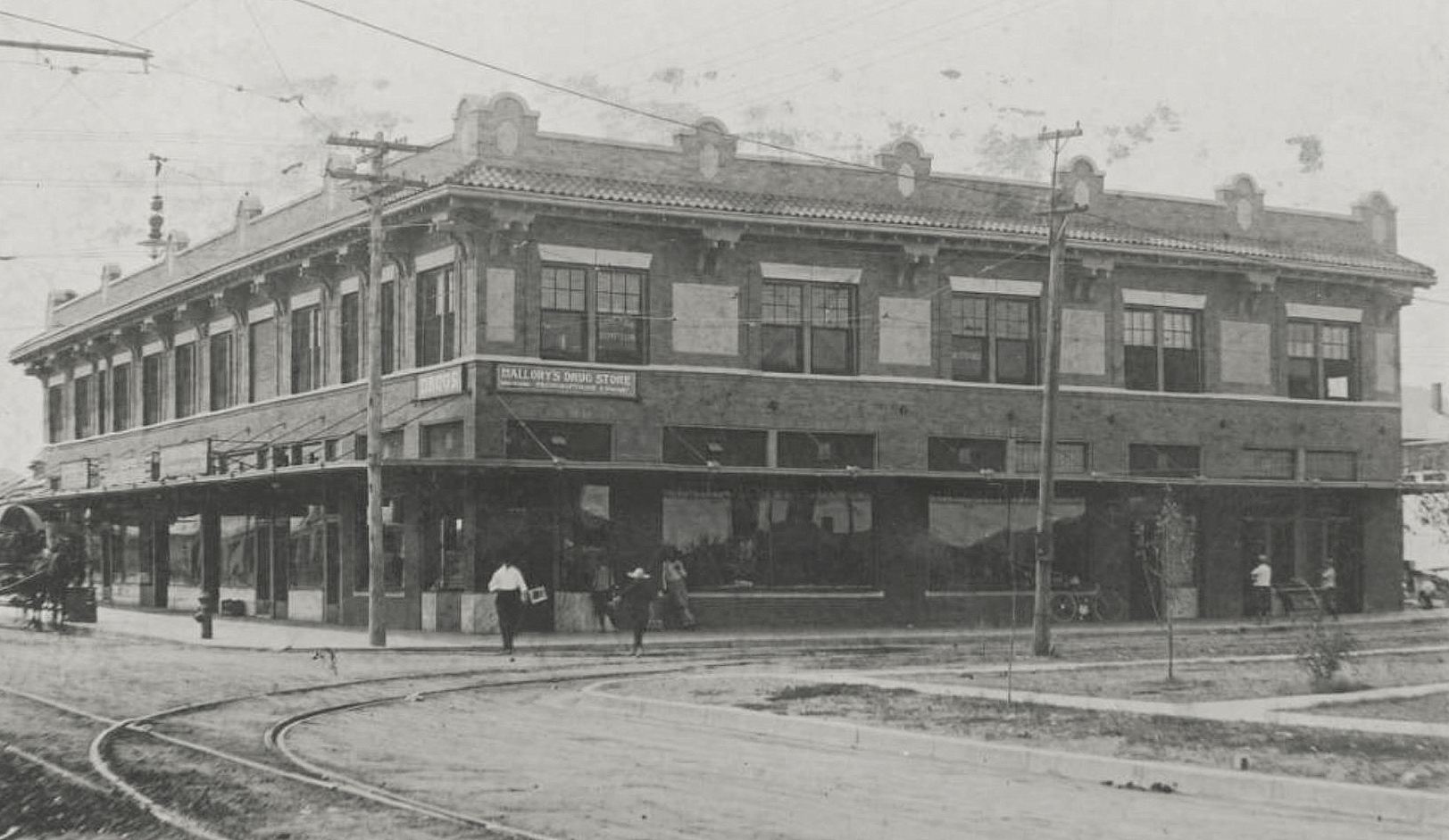
Every time I pass the northwest corner of West Jefferson and Tyler in Oak Cliff, I admire this building. Actually, I love this building. And I’m always surprised it’s still there.
This photo shows Tyler St. to the right and Jefferson Blvd. heading off to the left. See what it looks like today on Google Street View, here.
It appears to have been built in 1911 or 1912. And it still looks pretty good.
Thank you, Oak Cliff!
***
Sources & Notes
Real photo postcard titled “Mallory’s Drug Store” from the George W. Cook Dallas/Texas Image Collection, DeGolyer Library, Central University Libraries, Southern Methodist University; see the card front and back and read more information here.
A couple of other photos can be found in the post “Dallas in ‘The Western Architect,’ 1914: Businesses,” here (scroll down to number 7). Seems the building was designed by architect C. A. Gill, the man behind the famed Gill Well.
Dallas teens loved Tiny Tim… (Sanger-Harris book-signing, June 1969)
by Paula Bosse
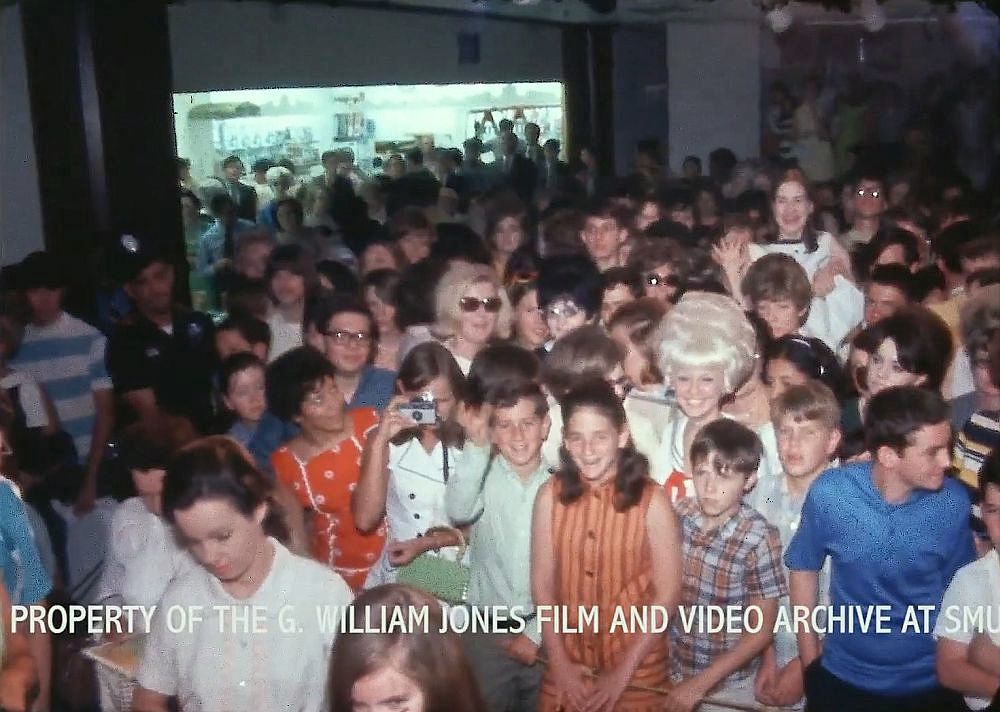
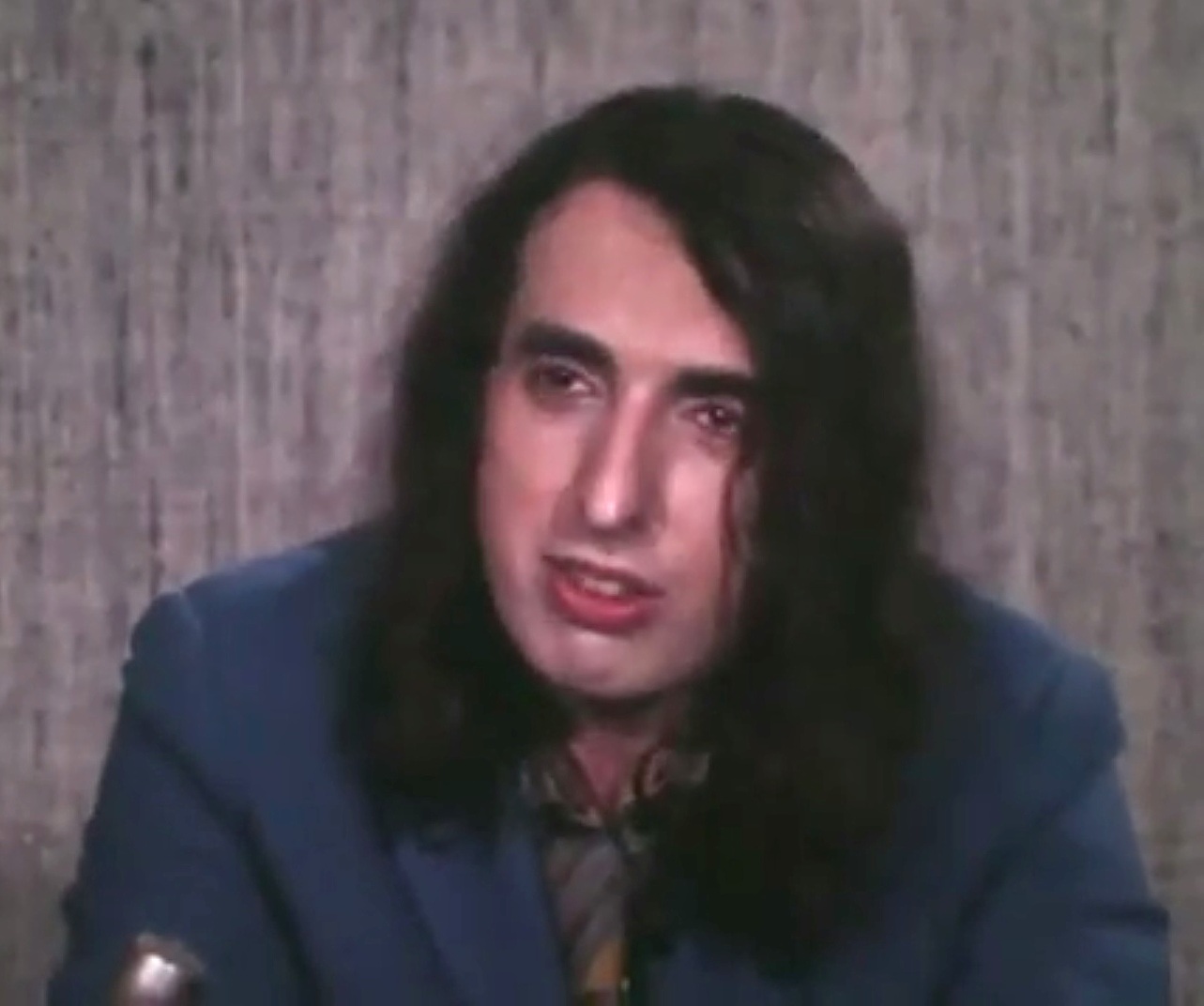
Tiny Tim — one of the most … unusual performers of the 1960s — was a hit with teenagers when he made his first appearance in Dallas at the Melody Shop in NorthPark mall on January 23, 1969. What had been expected to be a nice little autograph party which might attract a small number of fans and curiosity-seekers turned into something altogether unexpected.
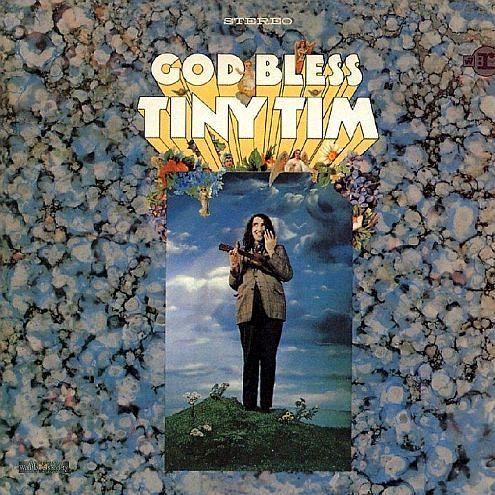
Tiny Tim (…”Tiny”? “Tim”? “Mr. Tim?”…) had the unlikeliest of hits during the hippie-era: “Tiptoe Through the Tulips,” a lilting little ukulele-accompanied song which had originally been a hit in 1929. Tiny Tim’s first few appearances on U.S. television must have caused a lot of heads to be scratched and/or jaws to be dropped. He was just kind of … weird. But gentle, and he seemed to be a genuinely nice fellow who just happened to have a penchant for songs from the megaphone-era of popular music. If you’ve never seen footage of a Tiny Tim performance, search for a clip of him on the Tonight show around 1968.
So anyway, Tiny was booked to do a little autograph party at the Melody Shop in NorthPark mall. I’m not sure what sort of crowd they thought they’d get, but it’s safe to say they did not expect 5,000 teenagers. The news report the next day was peppered with words like “pandemonium,”“swarm,” “mob scene,” and “human wall.” Who knew a 36-year-old man who strummed a ukulele and sang songs from the Victrola-age in a nasal falsetto would whip up that much enthusiasm amongst Texas teenagers?
My favorite description of the “riot” was this one:
Inside, a disheveled Tiny Tim was crouched on the floor behind a row of electric organs….. “Pretend he’s not in the store,” directed a manager. Tiny Tim, his shirttail out and his orange, green and brown tie twisted to the side, huddled alone on the floor. (“5,000 Kids Mob Tiny Tim,” Dallas Morning News, Jan. 24, 1969)
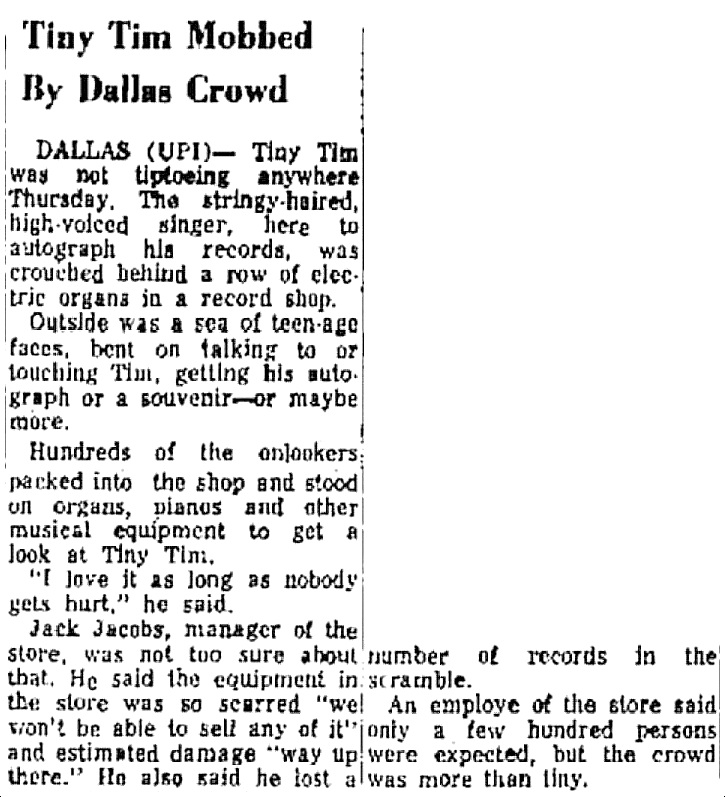
The story was even picked up by wire services. (Click article below to see a larger image.)
Amarillo Globe Times, Jan. 24, 1969
Tiny was back in Dallas a few months later, this time to do a book-signing at the downtown Sanger-Harris. (Yes! He wrote a book!)
June 17, 1969
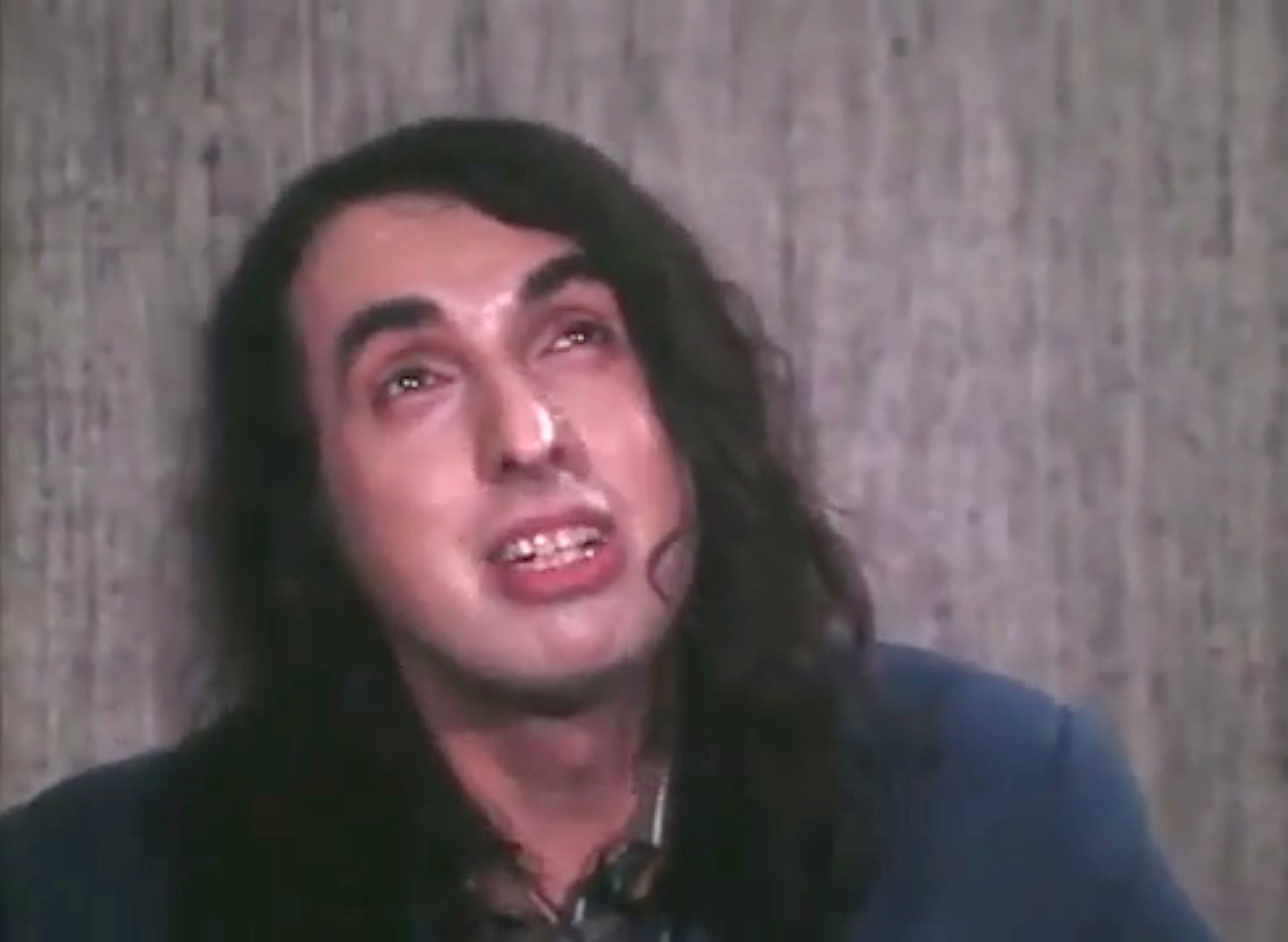
No riot was reported this visit, but Sanger’s still packed by fans who wanted a book signed by Mr. Tim (who signed with a pink quill pen). While in town, he give a little interview and an impromptu performance at a press conference (am I the only person who sees shades of Jeffrey Tambor here?):
*
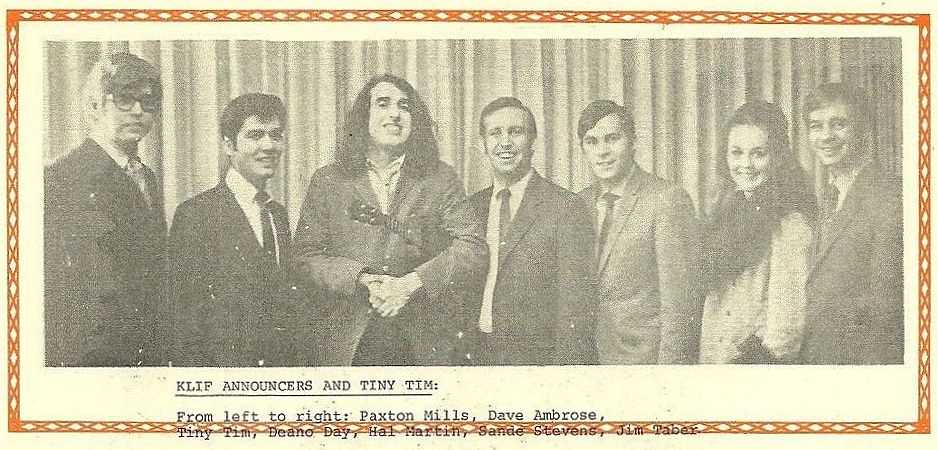
Also in 1969, he took time out to pose with KLIF on-air talent Paxton Mills, Dave Ambrose, Deano Day, Hal Martin, Sande Stevens (not sure if she worked for KLIF), and Jim Taber, seen below.
But wait, there’s more… he was back in Dallas in September, 1970 for a NINE-DAY engagement (two shows nightly) at Abe Weinstein’s famed downtown burlesque house. (I don’t know if the strippers took the time off while Tiny was in residence or if they might have entertained between his sets.) Here’s a clip from a press conference during that visit:
And, why not, here’s an early publicity photo of Herbert Khaury, the man who would one day become famous as the singer Bing Crosby once described as having (I paraphrase) a vibrato big enough to throw a Labrador through.
***
Sources & Notes
The 1969 Chanel 8 video is from the WFAA Newsfilm Collection held by the Hamon Arts Library, Southern Methodist University; it is posted on YouTube here (the first image and the three color photos of Tiny Tim are screenshots I captured from the video); the 1970 footage is from the same source and can be found on YouTube here.
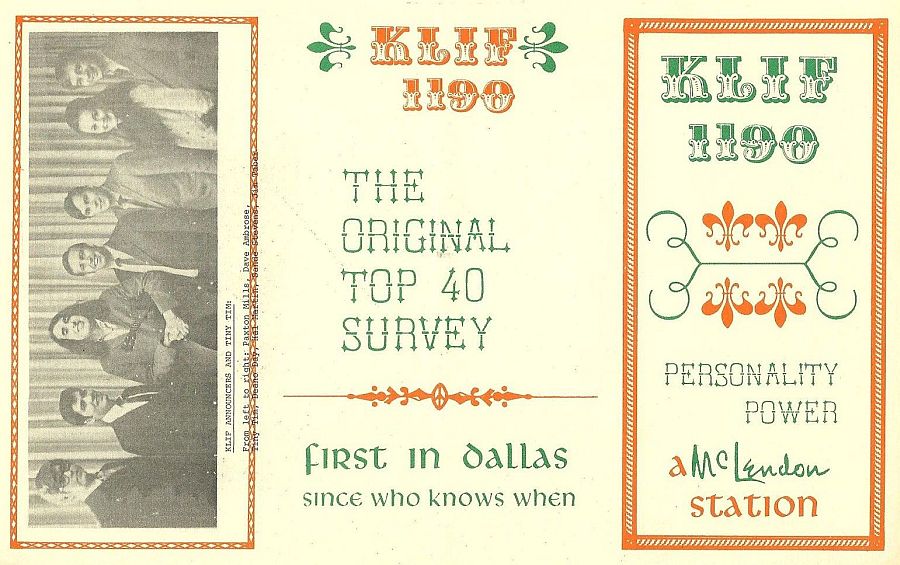
KLIF promotional material found on eBay several months ago. The back of the card lists the KLIF’s top 40 of the week, here.
Glamour shot of Mr. Khaury found somewhere on the internet.
One would be remiss in not mentioning Tiny Tim’s other ties to Dallas, namely his association with Bucks Burnett’s Edstock and Burnett’s tiny Tiny Tim museum from the 1990s. I’d link to articles in the Dallas Observer, but every time I go to the DO site my computer freezes. I encourage you to seek out these articles yourself.
More on Tiny’s January, 1969 visit to Dallas can be found in these Dallas Morning News articles:
“5,000 Kids Mob Tiny Tim” by Jean Kelly, with photo (DMN, Jan. 24, 1969)
“Magical Mystery Tour: On Meeting Tiny Tim” by Marge Pettyjohn, “YouthBeat” editor, with photo (DMN, Jan. 25, 1969)
Sally Rand autographing the shorts of a “rickshaw boy”… (click for larger image)
by Paula Bosse
Periodically I add photos or pertinent clippings to old posts. Here’s the latest bunch. (Most are larger when clicked.)
Above, a great photo from the Texas Centennial showing famed fan-dancer Sally Rand (who was one of the top attractions in Amon Carter’s competing Fort Worth Frontier Centennial Exposition) autographing the short-shorts of her dishy rickshaw driver, Guy Johnsen. (This must have been one of the highlights of Johnsen’s life — it was mentioned in his 2005 obituary!) I’ve added this photo to the post “Forget the Ferris Wheel, Take a Ride in a Centennial Rickshaw — 1936.” (Source: George W. Cook Collection, DeGolyer Library, SMU, here.)
*
Speaking of the Centennial, I’m adding this photo of one of the most popular attractions of the Exposition — Lady Godiva, who rode a horse through the Streets of Paris show, clad only in a wig — to the post “Lady Godiva and the ‘Flesh Shows’ of the Texas Centennial — 1936.” (Source: George W. Cook Collection, DeGolyer Library, SMU, here.)
*
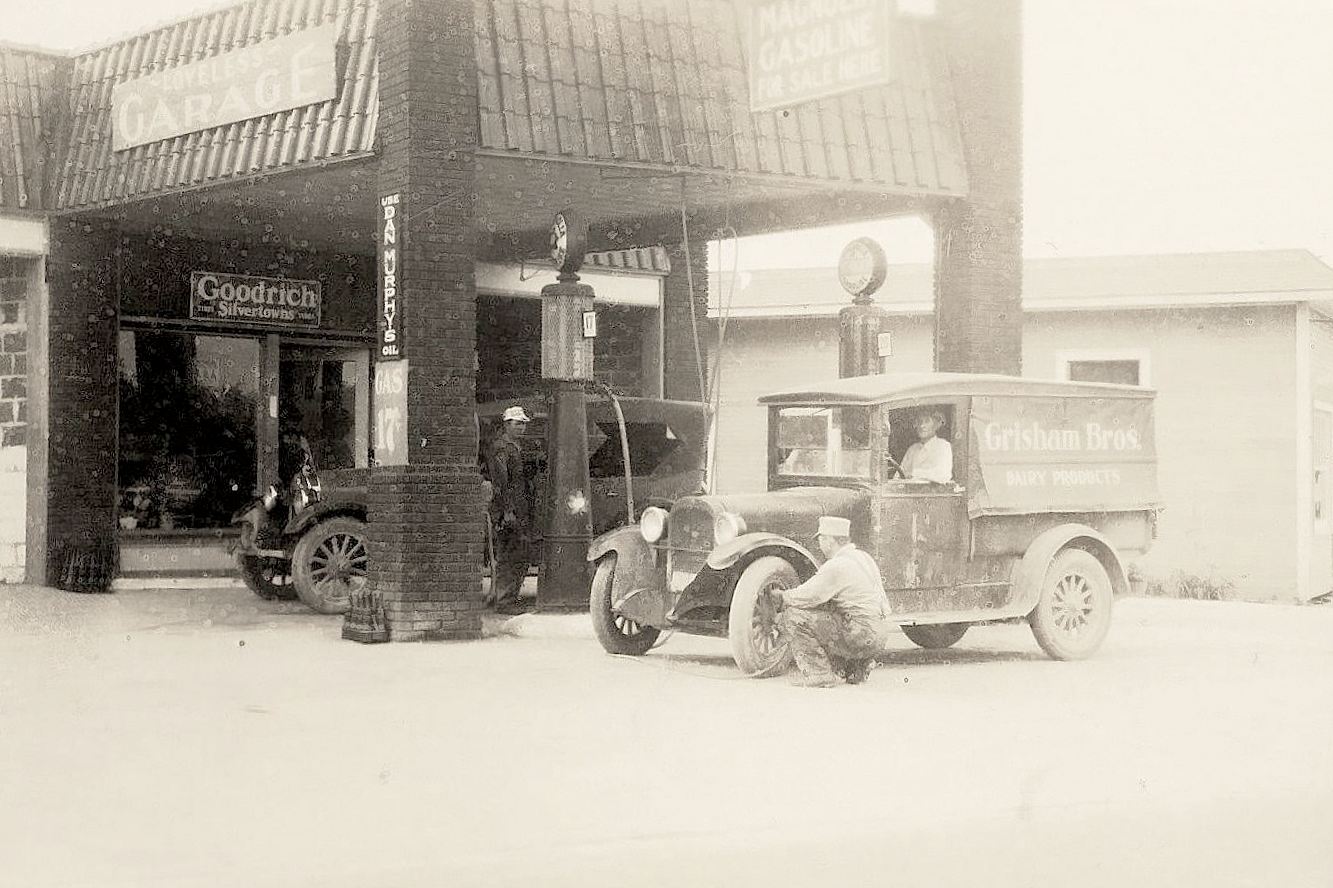
What grizzled Dallasite hasn’t informed visitors about the connection between the famed “Filling Station” on Greenville Avenue and Bonnie & Clyde? After writing the post, I exchanged a series of entertaining and informative emails with the grandson of the man who built the old gas station and garage in the early 1930s and which still stands. Mr. Loveless graciously sent me several photos, including this one, showing the early days of the station. (Also, I’ve recently learned that Jack Ruby owned or ran a short-lived tavern called Hernando’s Hideaway, which would have been right next door to the filling station. So not only did Bonnie and Clyde fuel up there, chancer are good that Ruby did, too.) My original post: “The Filling Station on Greenville Avenue: From Bonnie & Clyde to Legendary Burger Place.” (Source: Jeb Loveless family photo)
*
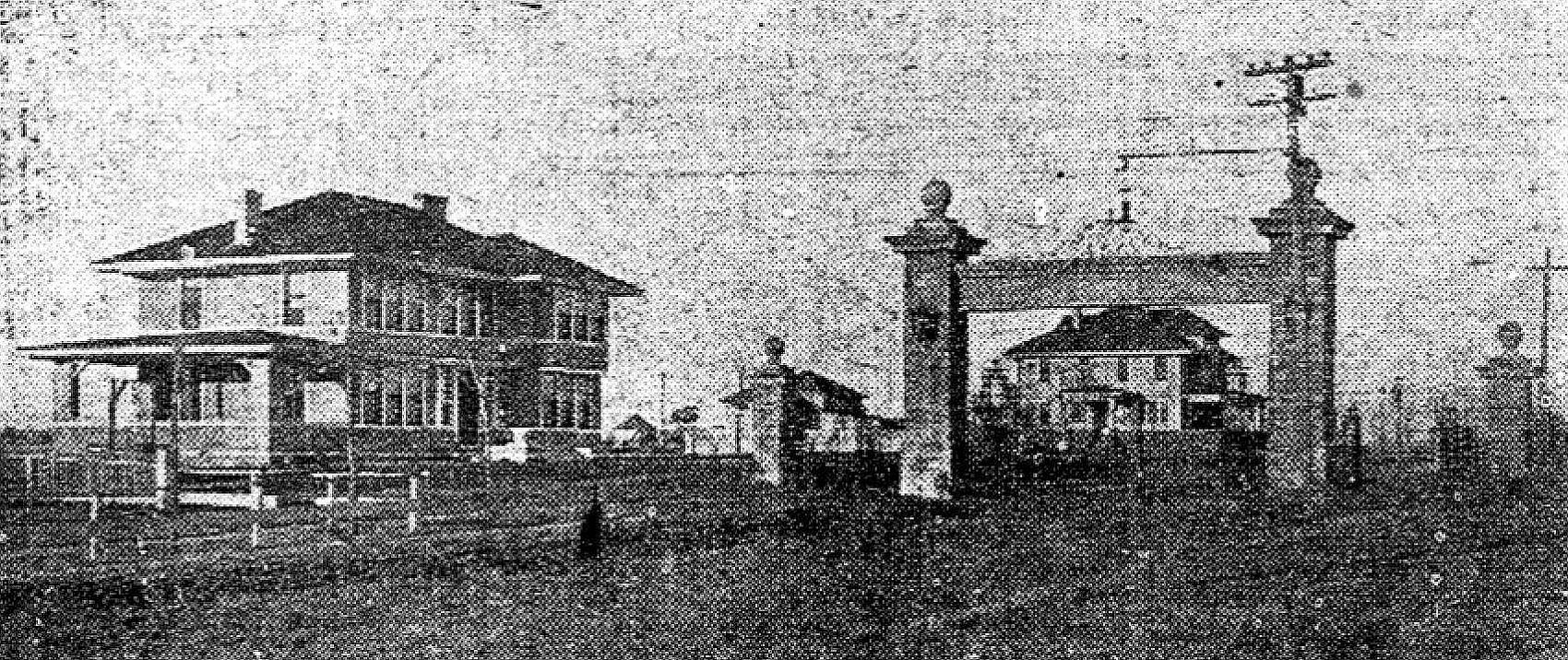
I’ve come across some cool photos of the Junius Heights pillars I wrote about a few months ago — one I found in a 1909 ad, and one that I came across on a Dallas history group. They’re both really great. I’ve added these two photos and a few more things to the post “The Gateway to Junius Heights.” (Source: top photo, Dallas Morning News, Nov. 25, 1909; second photo, personal collection of Jerry Guyer.)
*
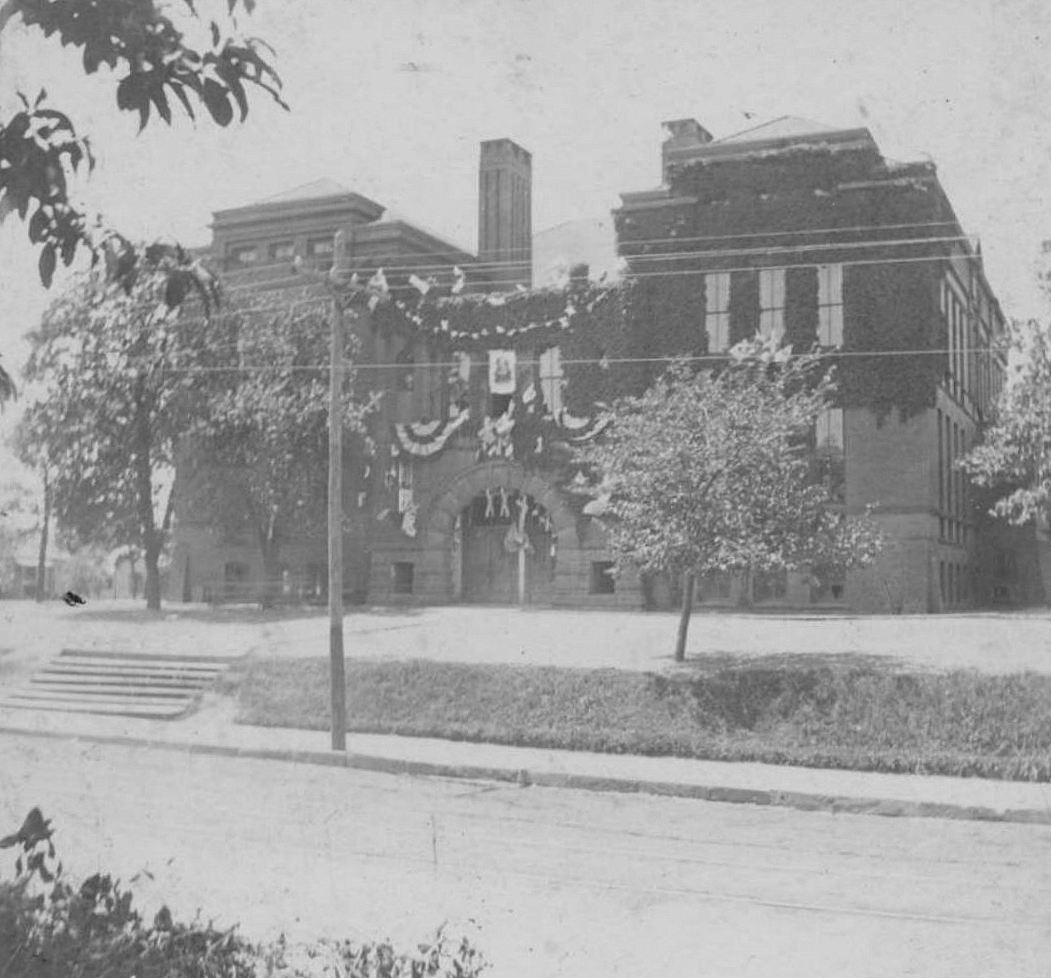
This photo of the Columbian School/Royal Street School (which was built in 1893 and bulldozed in 1955 to make way for Memorial Auditorium) has been added to “The Dallas Skyline: Spot the Landmarks.” (Source: George W. Cook Collection, DeGolyer Library, SMU, here)
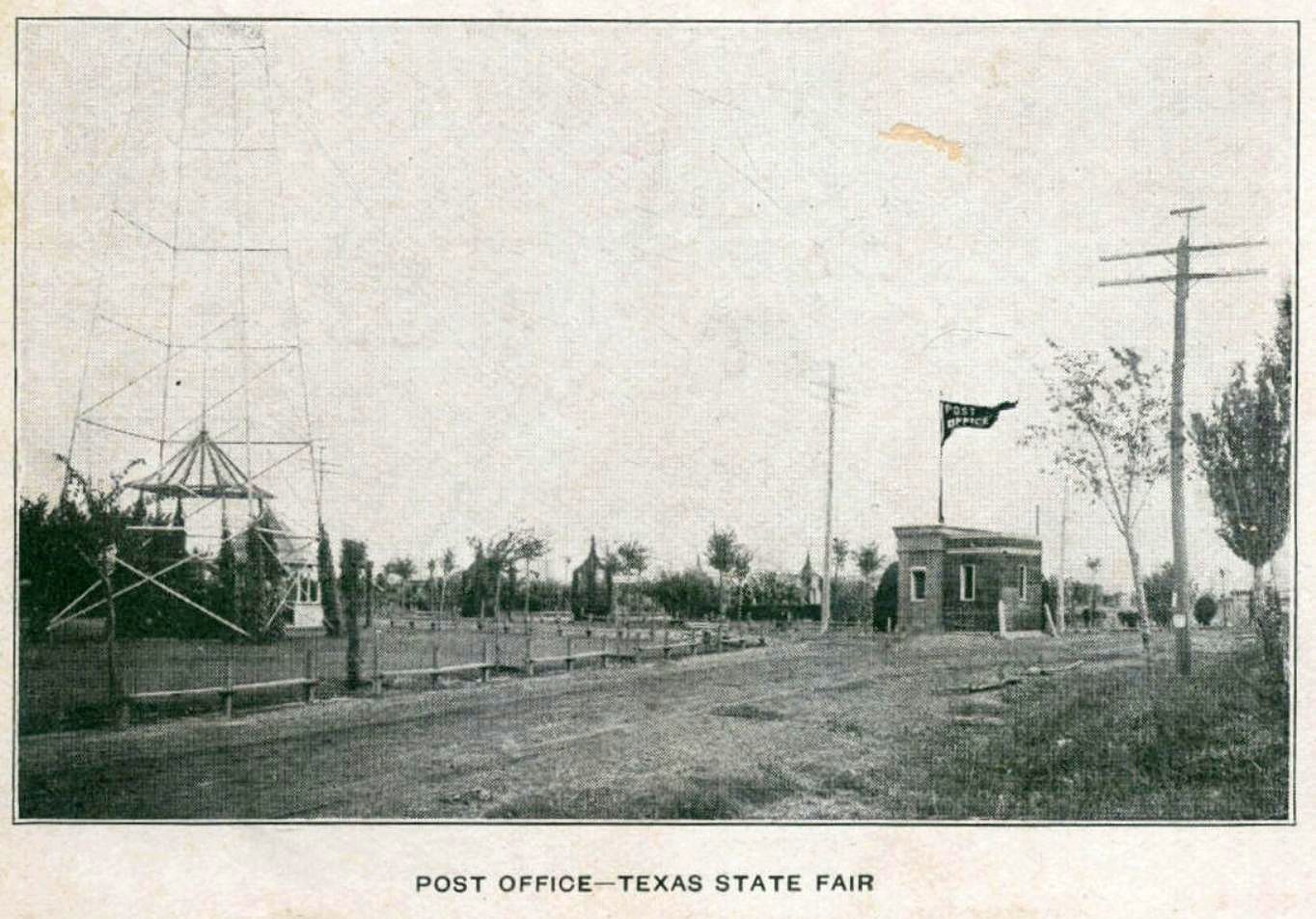
And I’ve cleared up a few questions I had about this photo of a little-bitty, turn-of-the-century post office at Fair Park by adding some information to the post “A Post Office on the Fairgrounds?”
Above, Commerce Street, looking east from Ervay, with the old Post Office/Federal Building on the northeast corner (replaced by the Mercantile Bank Building in the early 1940s). In the background, at the right side of the photo, the Metropolitan Business College, at Commerce and St. Paul.
See a view of Commerce looking west in 1913 — showing the Metropolitan Business College in the foreground and the new Adolphus Hotel a few blocks away, here.
Another eastward-looking view — from about 1895, when the post office was still pretty new — is here.
And the present-day Google Street View of Commerce and Ervay looks like this.
***
Sources & Notes
I’m not sure of the original source of this photograph, but I found it on Coltera’s Flickr stream (I didn’t save the link and I can’t find it again). If anyone knows of a sharper image of this photo, I’d love to see it!

 Powered by oats, electricity, and gasoline…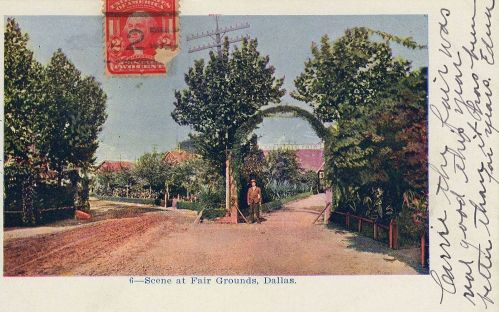














 Flashback : Dallas