Flashback : Dallas

A Miscellany: History, Ads, Pop Culture

“Delusions of Affability” — Marijuana in 1930s Dallas
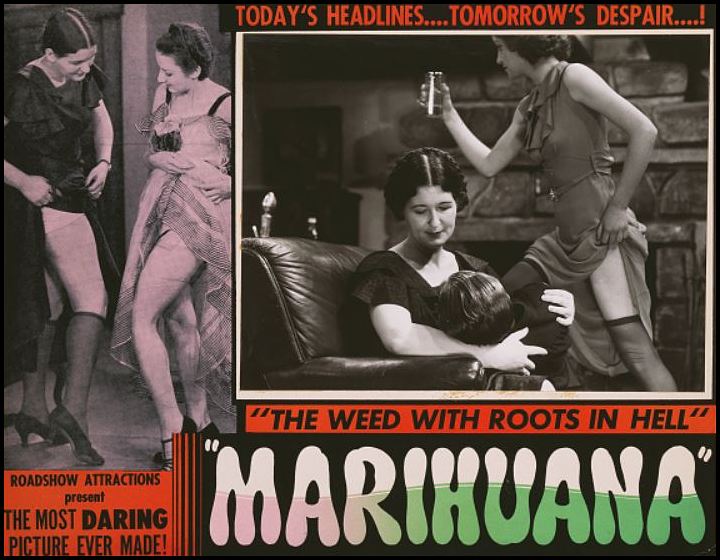
marihuana-film_poster
“The weed with roots in hell…”

by Paula Bosse

Today is April 20, also known as the cannabis-friendly “4/20 Day.” So why not take a look at the early days of marijuana awareness in Big D?

The “marijuana problem” in Dallas didn’t really start to be reported regularly in the pages of The Dallas Morning News until the 1930s, but there were a few stories that showed up in the early 1920s, such as this one about a raid on an opium-den-style house in Little Mexico in 1921 (click for larger image).

marijuana_dmn_041321DMN, April 13, 1921

Heading into the 1930s, the legality of the possessing and selling marijuana was fairly vague. After reading a bit about what was happening in Dallas in regard to “Mexican cigarettes,” I’m still not sure when the possession and selling of marijuana became illegal. The federal, state, and local laws all seemed to be different, and all were constantly in flux. There might even have been conflicting laws on the city and county books. Like I said, confusing. Nevertheless, here are a couple of interesting tidbits from the opening months of 1931 concerning the first charge in Dallas County against a person selling marijuana and the first conviction in Dallas County for a person selling marijuana. (According to the Inflation Calculator, today’s equivalent to the $25-to-$500 fine of 1931 would be, approximately, a $395-to-$7,900 fine.)

A Mexican was placed in the county jail Wednesday after a charge of selling marijuana had been filed against him in County Criminal Court, the first time in history of that body such a charge has been brought against a defendant. […] The Mexican was still ‘smoked up’ when arrested. (DMN, Jan. 29, 1931)

The penalty for selling “Mexican dope weed” was a fine of $25-$500 or a jail sentence of one month to one year.

The first conviction on record in County Criminal Court for selling marijuana, Mexican ‘loco weed,’ was given Thursday when Judge Noland G. Williams sent Manuel Garino to the county jail for thirty days. (DMN, Feb. 6, 1931)

Still, marijuana was considered only a minor annoyance locally — the Asst. D.A. even went so far as to say that there was “little use of the drug in Dallas.”

Actually, throughout the ’30s, a lot of policemen didn’t even know what marijuana plants looked like — one wonders how much marijuana-related activity was going on all around them in plain view? In these early days, when the police did stumble onto large quantities of “loco weed,” it was sometimes merely by accident while investigating something else.

And then, suddenly — around the mid ’30s — marijuana was everywhere. Just in time for the Texas Centennial, when thousands and thousands of potential new customers would be flooding into the city! Enterprising individuals were growing it all over the place — in their yards, in their fields with other crops, and even on a little island called Bois d’Arc Island in the middle of the Trinity River bottoms, a few miles south of Dallas (where 3,000 pounds was seized in July, 1938).

Even though the purchasing, the selling, the use, and the growing of marijuana was going on all over the city — in white, black, and Hispanic neighborhoods — the main areas of enforcement were, unsurprisingly, in Little Mexico and Deep Ellum, areas populated by minority citizens.

Police Sergt. O. P. Wright stopped a 22-year-old Negro languidly puffing a cigarette as he walked in the 400 block of North Central Tuesday.

“What kind of a cigarette is that, boy” inquired the Sergeant.

“Rough cut,” replied the languid one. (“Policeman Sniffs Air, Catches Marijuana Smoker,” DMN, June 22, 1938)

The federal government was attempting to deal with the marijuana problem — by taxing it so highly that it would discourage those participating in the loco weed trade: $100 tax on every ounce! At a time when you could buy a joint for anywhere from a dime to a quarter. Talk about your “sin tax”!

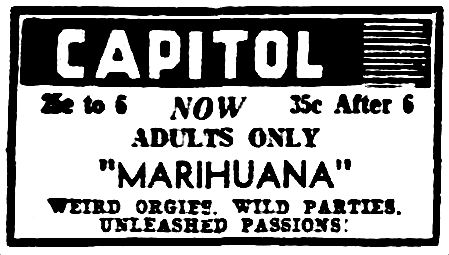
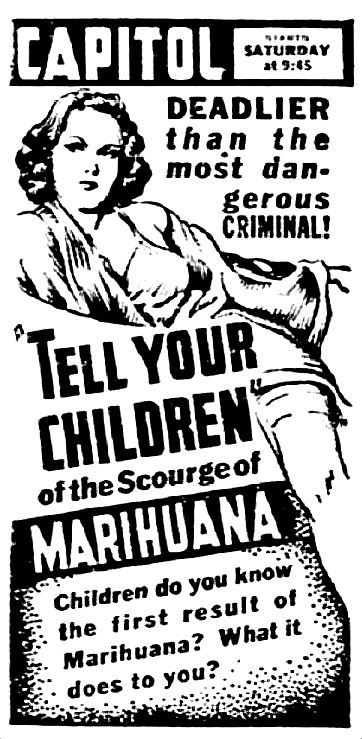
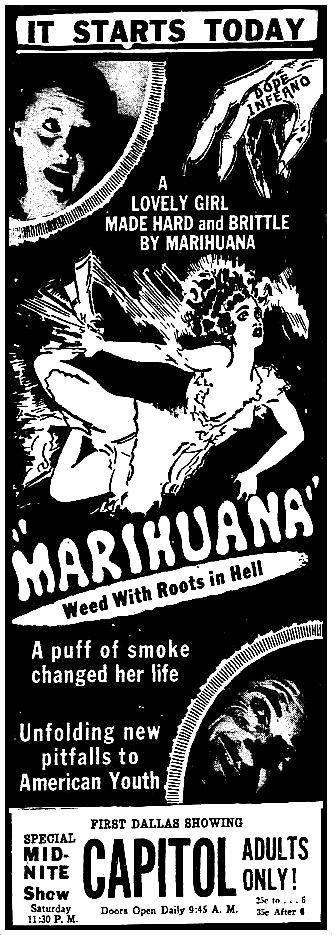
Marijuana/marihuana was generally demonized as a highly addictive drug which caused psychosis and led, inevitably, to all sorts of heinous acts and/or lewd behavior. …Or death. A lot of helpful, cautionary exploitation movies began to appear on Dallas screens, such as Marihuana from 1936 (which, incidentally, had an Oak Cliff child actor — Gloria Brown — in the cast). Below, the pomp and bug-eyed bally-hoo adorning the entrance to the lovely Capitol Theater, beckoning the Elm Street passerby to check out the film. …In order to be well-informed.
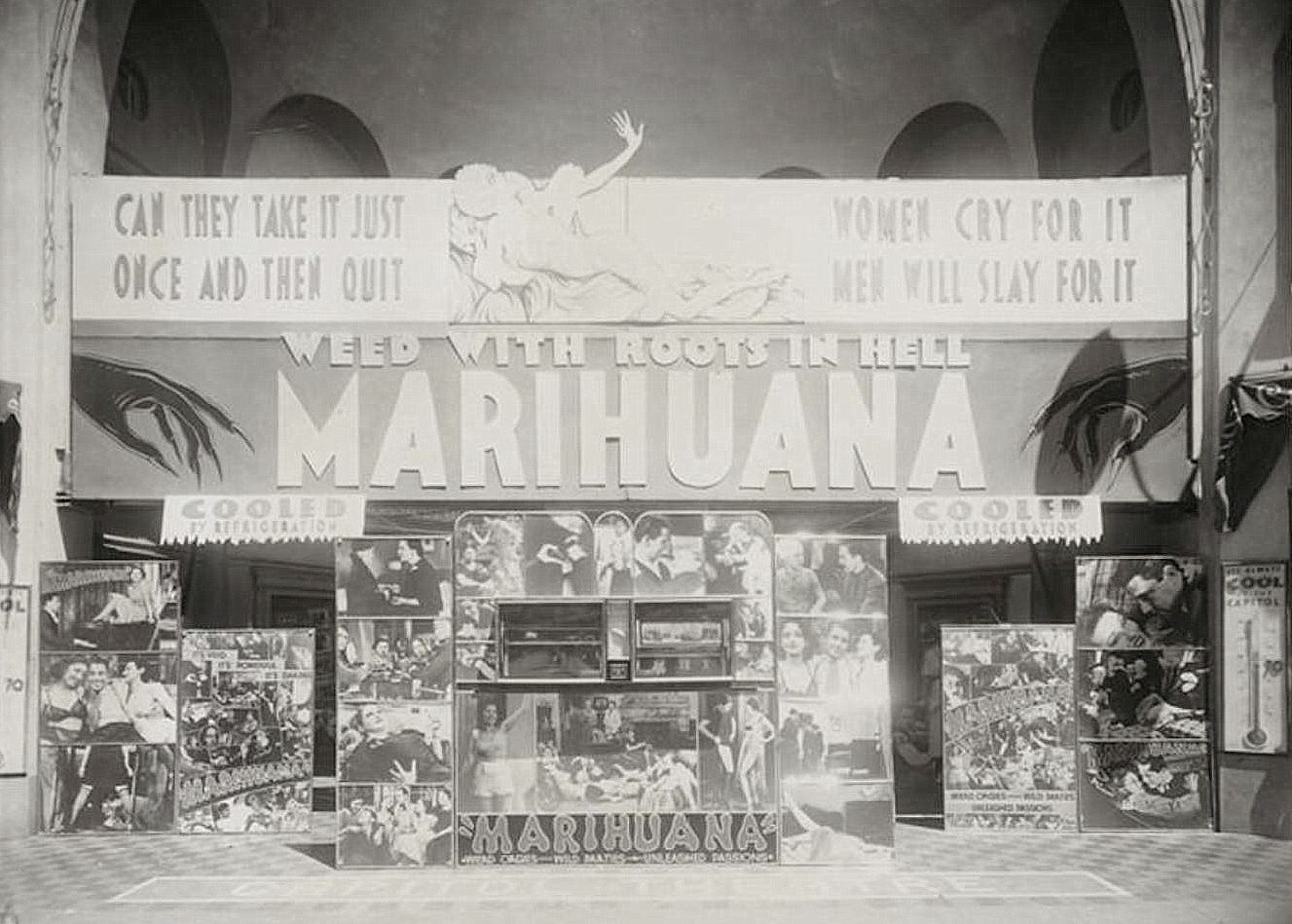
marihuana_capitol_1936_cook-collection_degolyer-library_SMU
George W. Cook Collection, DeGolyer Library, SMU
marihuana-film_dmn_080136
Aug., 1936

marihuana-film_dmn_080536
Aug. 1936

marihuana-film_dmn_061639June, 1939 (back by popular demand!)

(The full Marihuana film can be viewed free here, although it’s surprisingly dull.)

Even though most marijuana warnings were dire and filled with exclamation marks, I kind of like this more subdued one: “Smoking of the weed gives the subject delusions of riches, success and affability” (DMN, Dec. 21, 1936).

And there you have it, a little slice of unexpected Dallas historical trivia.

***

Sources & Notes

A few pertinent articles from the archives of The Dallas Morning News:

  • “Marijuana Smallest Worry of Dallas in Narcotic Violations” (DMN, March 6, 1931)
  • “Uncover Cache of Loco Weed, Lock Up Seven; Police Led to Mexican Dope Trailing Bogus Coin Milling” (DMN, March 30, 1932) — great story about cops who stumbled across marijuana when tracking down counterfeit half-dollar coins (counterfeit 50-cent pieces?!). My favorite part of this story is at the very end: “One of the Mexicans carried twenty-seven of the coins in one of his shoes.” Wow.
  • “Stalk of Marijuana Seven Feet Tall Is Found in Oak Cliff” (DMN, Aug. 7, 1934)
  • “3,000 Pounds of Marijuana Seized By Raiders on River Bottom Farm; Haul Valued at $25,000” (DMN, July 30, 1938)
  • “Marijuana Den With Open Air Resort Raided; 6 Arrested; $100 Worth of Cigarettes Found; Plants in Back Yard Destroyed by Officers” (DMN, June 25, 1936) — “This is the first open-air marijuana den I have ever encountered in all my years of service.”
  • “Policeman Sniffs Air, Catches Marijuana Smoker, Three Others” (DMN, June 22, 1938)

Related Flashback Dallas post: “3800 Main: Fritos Central — 1947,” here

*

Copyright © 2016 Paula Bosse. All Rights Reserved.
White Rock Lake From Above — 1925-1926

white-rock-lake_fairchild-aerial_1925_legacies_fall-2002Fairchild Aerial Survey photograph, 1925 (click for larger image)

by Paula Bosse

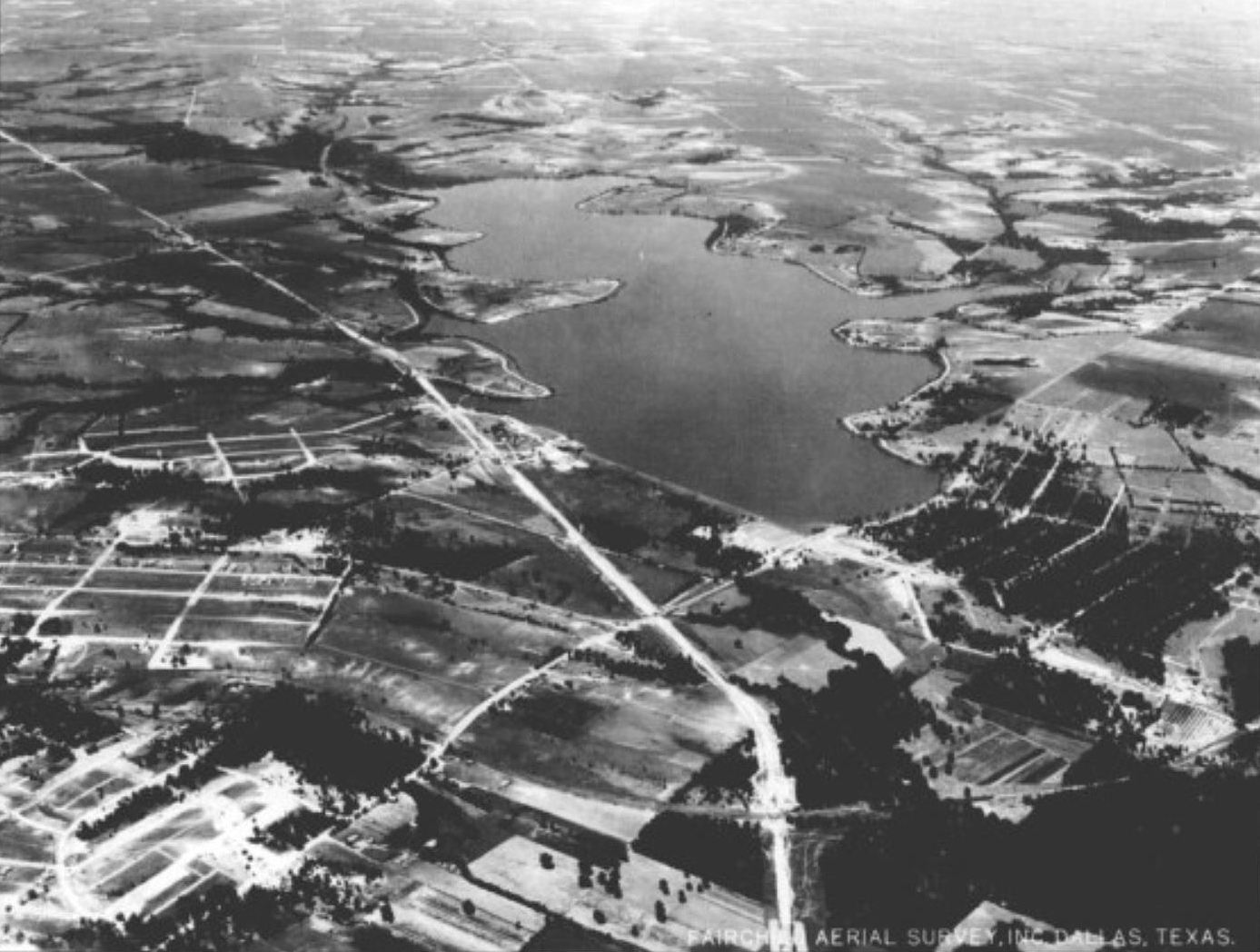
Above, a striking view of White Rock Lake, looking north, with Garland Road and the Houston & Texas Central Railroad tracks (becoming the Texas & New Orleans Railroad tracks in 1934) crossing at the lower center of the photograph, just southwest of the lake. Another Fairchild Aerial Survey photo is below — this one is from 1926, and its wider view shows just how undeveloped this area was at the time.

white-rock-lake_fairchild-aerial_degolyer_smu_1926Fairchild Aerial Survey photo, 1926 (DeGolyer Library, SMU)

*

Here’s a present day view. (Click the image below to see a huge Google Earth image.)

white-rock-lake_google-earth_sm

***

Sources & Notes

Top photo from the very interesting article “From Water Supply to Urban Oasis: A History of the Development of White Rock Lake Park” by Steven Butler (Legacies, Fall 2002), here.

Bottom photo, titled “White Rock Lake Aerial Overview (Unlabeled)” is from the DeGolyer Library, Central University Libraries, Southern Methodist University; it can be accessed (and magnified greatly) here. The “labeled” version — which identifies roads and landmarks — is here. From the SMU description: “This is one of 38 photographic prints taken by Fairchild Aerial Survey, Inc. of White Rock Lake for Dr. Samuel G. Geiser, SMU.” The full set of the White Rock Lake aerial photos is here. A map here shows where the grid maps are in relation to the lake as a whole.

Thanks to “Not Bob” for linking to the Google Earth image in the comments!

These photos are big. Click them!

*

Copyright © 2016 Paula Bosse. All Rights Reserved.


Bonnie Parker: “Buried In an Ice-Blue Negligee” — 1934

bonnie-parker_mortician-account_cook-colln_degolyer(George W. Cook Collection, DeGolyer Library, SMU)

by Paula Bosse

This amazing (and amazingly gruesome) first-hand account of an unnamed McKamy-Campbell Funeral Home undertaker details the incredible amount of work required to prepare the bullet-ridden body of celebrity outlaw Bonnie Parker for burial. This odd little historical document comes from the absolutely fantastic George W. Cook Dallas/Texas Image Collection housed in SMU’s DeGolyer Library. The four-page handwritten document can be viewed in its entirety on SMU’s Central University Libraries’ website here. Below is the full account, transcribed by SMU, with a few corrections/additions made by me.

*

Tear this up please? Tear this up please?

Heres [sic] first hand on Bonnie & Clyde as we had Bonnie. She was about the size of Rose Grace, weighing a 100 pounds. (a thousand pounds of dynamite though) She was very pretty of course her skin was somewhat tan. Her nails were beautiful. Likewise her toe nails. Her toes looked like fingers. The cuticles pushed back, the nails filed to a point, and a deep coral shade polish on them, the most beautiful toes I ever saw, just perfect. Her permanent just a month old we had it waved. Her face, right side was blown off. We fixed this and you could hardly tell it. Just one bullet went through her brain, however and number grazed her head as there were 3 big holes in her scalp, but not through skull. Her left eye terribly black, however I used eye shadow on other eye to match, so that was covered up. Now, her body was just mutilated and torn to pieces from shots. Her right hand nearly blown off (known as her trigger hand) her body besides being full of bullet holes was full of buckshot, pellets all over her

[Page 2] body. We received body ten minutes of nine. Joe and I sewed on her until three that afternoon. At that time they say 25,000 people were lined up outside. It took 2 hours picking dirt, rocks etc. from her hair then to wash it and have waved. A tattoo on right leg two hearts one read Roy, the other Bonnie. Roy you know was her Husband (Roy Thornton now in Pen) All fluid the undertaker in Arcadia La. used leaked out she was torn up so she was a a [sic] mass of blood, caked & dried. Several hours in bathing her. Had to scrape some of it off, and used gold dust to remove most of it. Had skin slip that night account Fluid leaking from it, began to smell the next morning, turning dark, smelling worse. The last day was rotten so to speak The odor was awful. Her Mother thought [sic] sat in room alone with her head over casket. How she stood it Lord knows. The other children couldn’t. Mother fainted 2:30 that night I asked if she wouldn’t like to go home, she went. By then the entire house smelt. We had to keep her so Sister Billy that was in jail in Ft Worth could get out & come to Funeral. She was buried in an all steel metal casket. Paper said $1000.00 wrong about $600 maybe less. Paper said $1000.00 vault Wrong there was no vault Page 2

[Page 3] Buried in an ice Blue Neglegee [sic] (is this spelled right) She was dressed in expensive clothes when killed. About 40,000 people came to view her. Paper said $1,500.00 damages done to Funeral Home. Wrong about the extent of $2.50. They did not tear windows etc as stated. The woman next door though turned Hose on Them to keep her flowers from being walked on. We had 38 officers stationed (3 shifts) all over house and front & back yard keeping crowd in order and all of us as well. 4 operators on the 4 phones. They rang every minute for two days & nights. More people came to see Bonnie then [sic] to see Clyde. Our new Porch Furniture was damaged. We had a Rubber mat about ½ inch in thickness all over Funeral House. Officers

[Page 4] stationed to keep people on it so as not to wear rug out (Big movie Star) my picture was shown in Movies. The paper stretched their stories. She was not to become a Mother as stated. She was diseased slightly though as stated. Now you have it first hand as I worked on her. Joes [sic] & My work was praised very highly in every other line in papers. And if I do say it, It was good. And she looked swell no trace of disfigures showing. The crowd did not steal anything to take home. All paper talk. Example crowd lined up as Far as Fair Park, now judge how it looked. They brought their Lunches. Such Fools.

*

Below, two photographs of the McKamy-Campbell Funeral Home, located at 1921 Forest Avenue in South Dallas, besieged by curious spectators.

mckamy-campbell

mckamy-campbell_dallas-municipal-archives

**

I’m unsure who the “Rose Grace” was who was mentioned on the first page.

The “gold dust” mentioned in the account as being used to remove caked blood from Bonnie’s body was actually Gold Dust Washing Powder or Gold Dust Scouring Soap, a popular, commercially-available “all-purpose cleaning agents” — Wikipedia article is here.

***

Sources & Notes

Top image of the handwritten account on Adolphus Hotel stationery is from the aforementioned George W. Cook Dallas/Texas Image Collection, DeGolyer Library, Central University Libraries, Southern Methodist University, viewable here.

First photo of the McKamy-Campbell Funeral Home is reproduced all over the internet; the second photo is from the files of the Dallas Police Dept., Dallas Municipal Archives, via the University of North Texas’ Portal to Texas History database, here.

Even though the identity of the person who wrote this account is not known, he (…it was probably a man) mentions that he was seen in newsreel footage of the funeral of Bonnie Parker. My wild guess is that he can be seen in this clip from a longer newsreel on the funerals and burials of Bonnie and Clyde at the 2:34 mark. I could never find who his co-worker “Joe” was.

*

Is this our man laying flowers on Bonnies casket?

bonnie-burial_newsreel-screengrab

If you really want to see the state of the bodies of Bonnie (and Clyde) — before and after their time with their undertakers — they’re easy to find via your favorite search engine.

More Flashback Dallas posts on Bonnie & Clyde here.

If you like what you’ve seen on Flashback Dallas, please consider supporting me on Patreon, where for as little as $5 a month, you can receive all-new updates several times a week (if not daily!). More information can be found at Patreon, here.

*

Copyright © 2016 Paula Bosse. All Rights Reserved.

Radio Mobile Units — ca. 1940

kfaa_mobile-unit_wfaa-fam-albumWhat? You’ve never heard of KFAA? (click for larger image)

by Paula Bosse

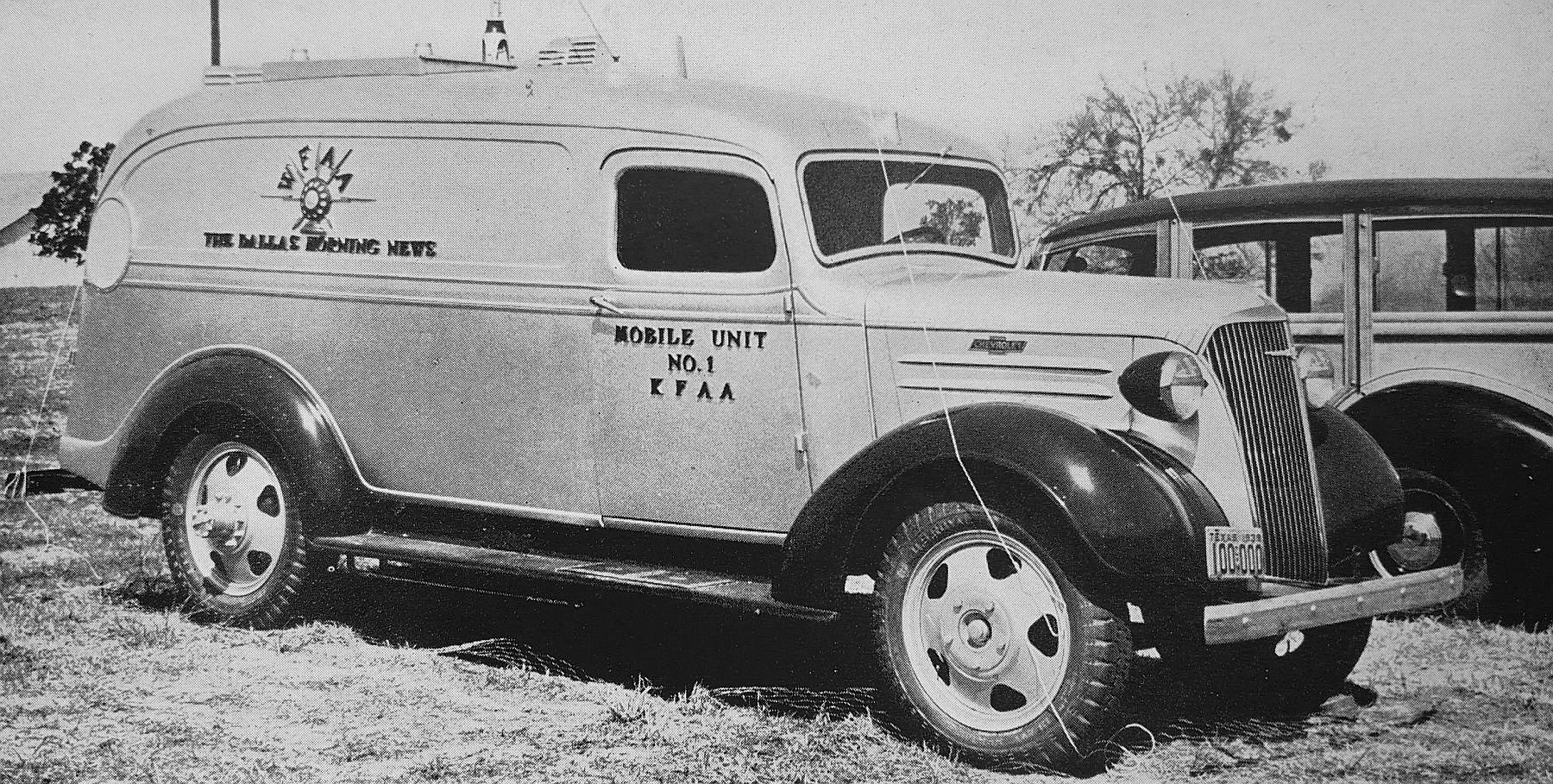
Check out these pre-war mobile units for radio stations WFAA and WBAP. The unit above actually had its own call letters — KFAA — and was licensed as a separate station. (That logo!) The caption, from a 1941 promotional booklet issued by stations WFAA (Dallas), WBAP (Fort Worth), and KGKO (Wichita Falls):

The WFAA Mobile Unit shown here is a complete short wave broadcasting station on wheels. The unit has its own call letters, KFAA, because it is a self-contained and separately licensed station. The amazing array of facilities contained in this one-and-one-half-ton truck includes a transmitter, generator, receiving equipment, public address system and pre–amplifiers. The transmitter tower on top of the truck can be raised to a height of 35 feet, making it possible to pick up the mobile unit’s signals for re-broadcast from a distance of 50 miles.

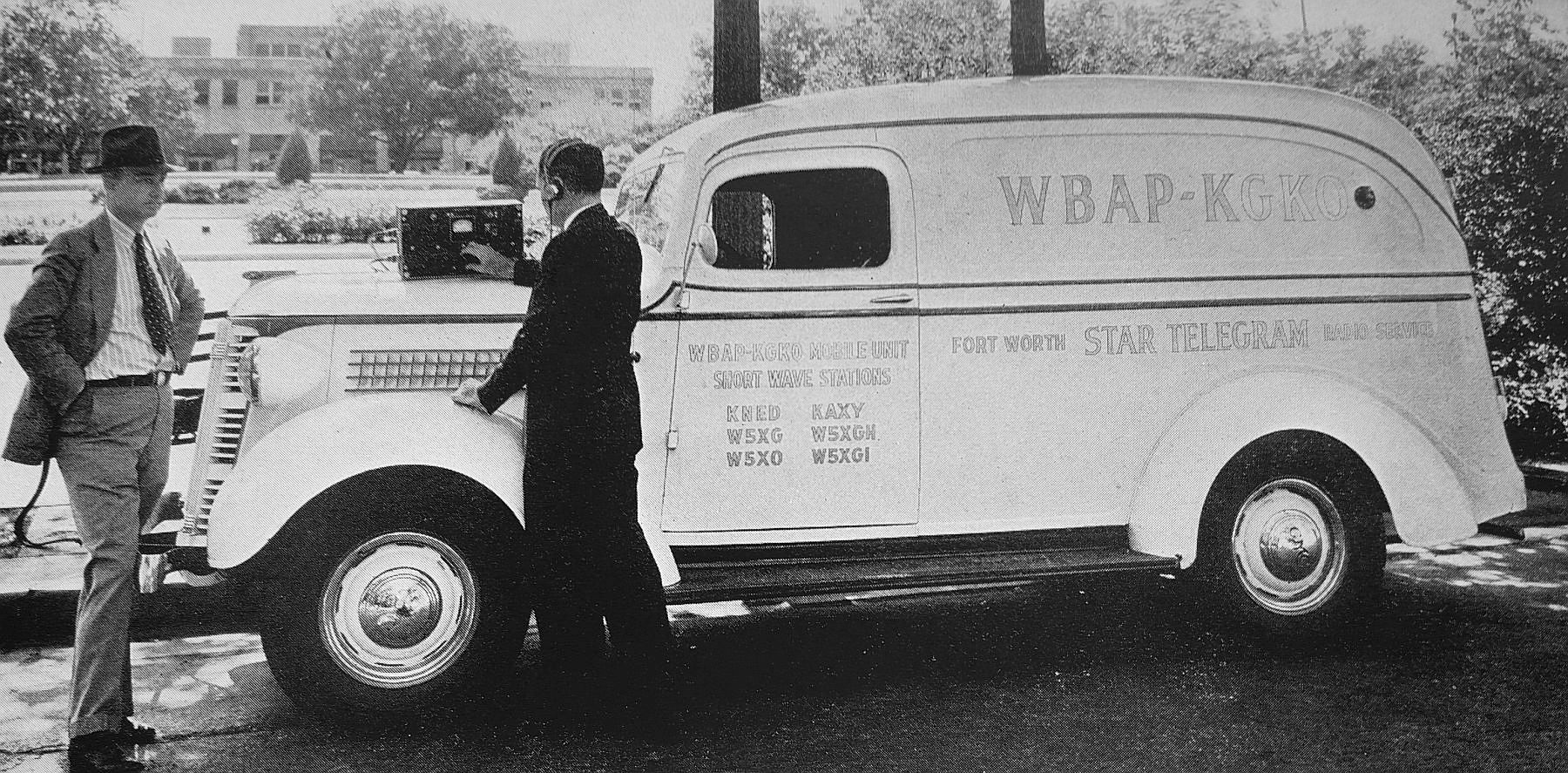
Here’s the WBAP/KGKO unit:

wbap-mobile-unit

Fort Worth Star-Telegram Mobile Radio Unit – with Chief Engineer R. C. “Super” Stinson, left, and A. M. Woodford, production man, handling a remote or “nemo” pickup from Burnett Park, Fort Worth. The WBAP-KGKO Mobile Unit carries six short wave transmitters and receivers besides a power plant capable of generating electricity for a small town of 500 people. This unit “swam” through a recent flood in Brady, Texas, established communication from the stricken area and received the congratulations of the Texas Highway Patrol. It also played a star role in the Amarillo storm.

***

Photos from the booklet WFAA, WBAP, KGKO Combined Family Album (Dallas-Fort Worth, 1941).

Why were arch-rivals WFAA (owned by The Dallas Morning News) and WBAP (owned by The Fort Worth Star-Telegram) co-publishing a promotional booklet? Because they shared the same transmitter and had an extremely odd broadcasting agreement. Read about it in my previous post “WFAA & WBAP’s Unusual Broadcasting Alliance,” here.

Click those photos!

*

Copyright © 2016 Paula Bosse. All Rights Reserved.

The Moskovitz Cafe

moskovitz-cafe_winegarten-schechterA stool is waiting for you… (click for larger image)

by Paula Bosse

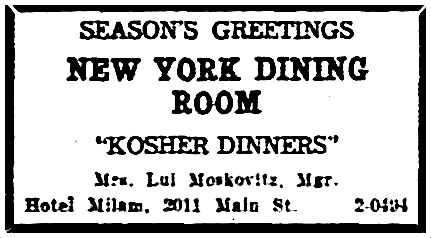
The Moskovitz Cafe was located at 2216 Elm Street, between S. Pearl and what is now Cesar Chavez Blvd., in an area of predominantly Jewish businesses. The restaurant served “Kosher and American cooking” and was owned and run by Lui Moskovitz, a Romanian immigrant, and his Polish-born wife, Eva. Eva, recently widowed, had arrived in Dallas in about 1928 with her three children and seems to have married Lui that same year. They had run another restaurant before the Moskovitz Cafe: the New York Kosher Dining Room on Commerce had been located across from the Adolphus Hotel for several years before it moved to 2011 Main, around the corner from City Hall. After that closed, they ran the Moskovitz Cafe between about 1937 and about 1944.

In 1945 there was no Lui or Eva Moskovitz in the Dallas directory. There was, however, an Eva Haberman — it appears that the Moskovitzes had split, Lui had left town, and Lui’s ex-wife had taken back the name of her late first husband. At this time she must have been about 60 years old, but she worked for the next few years as a department store seamstress and lived with one or more of her three sons from her marriage to Nathan Haberman. She died in April, 1961. Not only is there no trace of Lui after his time in Dallas, there is also no trace of 2216 Elm.

moskovitz_dmn_0101361936 ad

moskovitz-cafe_elm-st_1943-directory
Elm St. businesses, 1943 Dallas directory (click for larger image)

moskovitz_map
Location of Moskovitz Cafe (det. of a 1919 map)

***

Sources & Notes

Photo appeared in the book Deep in the Heart: The Lives & Legends of Texas Jews, A Photographic History by Ruthe Winegarten and Cathy Schechter (Austin: Eakin Press, 1990); from the collection of the Dallas Jewish Historical Society.

I’m not sure who the people in the photo are. When the Moskovitz Cafe opened, Lui would have been in his mid-40s and Eva would have been in her early 50s. UPDATE: Per the comment below (from Eva’s grandson), the woman in the white apron is the proprietress, Eva Moskovitz, and the man at the cash register is her son, Jack Haberman.

More information about Mrs. Eva Haberman can be found in her obituary, published in The News on April 19, 1961.

All images larger when clicked.

*

Copyright © 2016 Paula Bosse. All Rights Reserved.


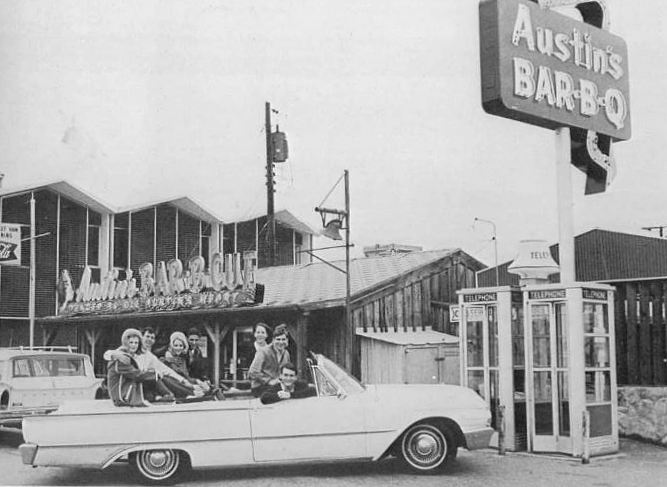
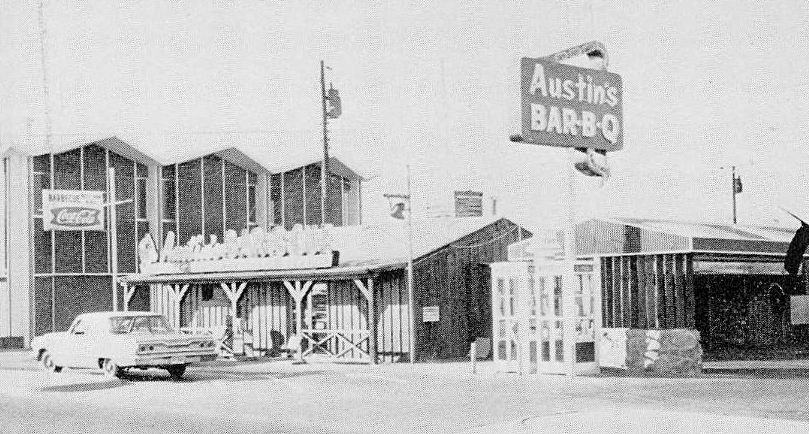
Bull Pen Barbecue/Austin’s Barbecue — 1949-2000

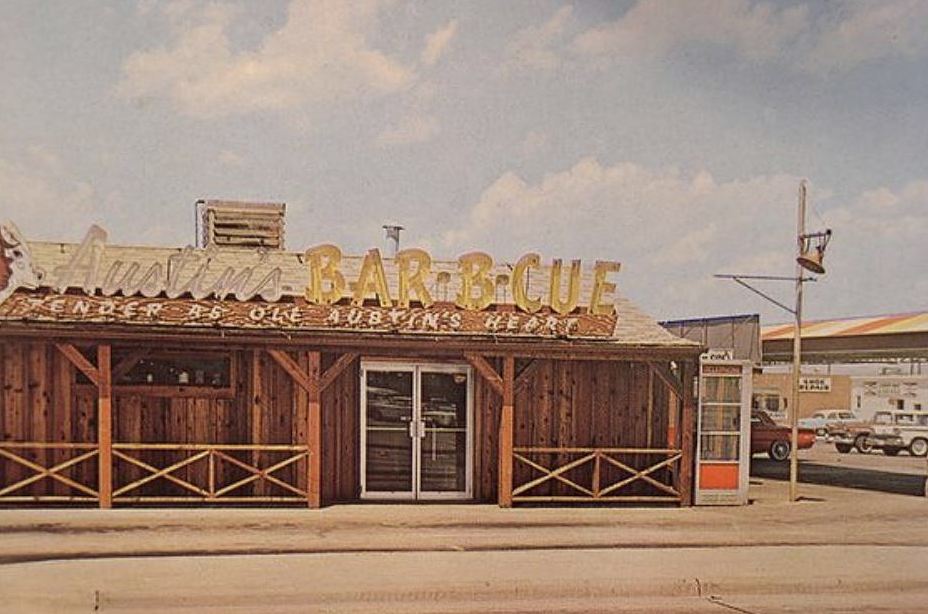
austins-barbecue_postcard_pinterest“As Tender as Ole Austin’s Heart…”

by Paula Bosse

One of my major failings as a Dallasite is that I don’t know Oak Cliff. Like at all. Every time I go over there, I get lost. I can’t remember my family ever going to Oak Cliff when I was a kid, except to visit the zoo. This explains why I had no idea how important a cultural landmark Austin’s Barbecue was when I posted a bunch of Oak Cliff ads the other day. That post has been shared hundreds and hundreds of times now and, inevitably, the only thing people mention — and rhapsodize about — is Austin’s Barbecue. …I had no idea!

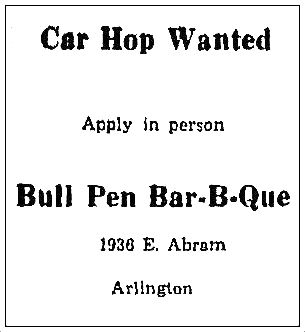
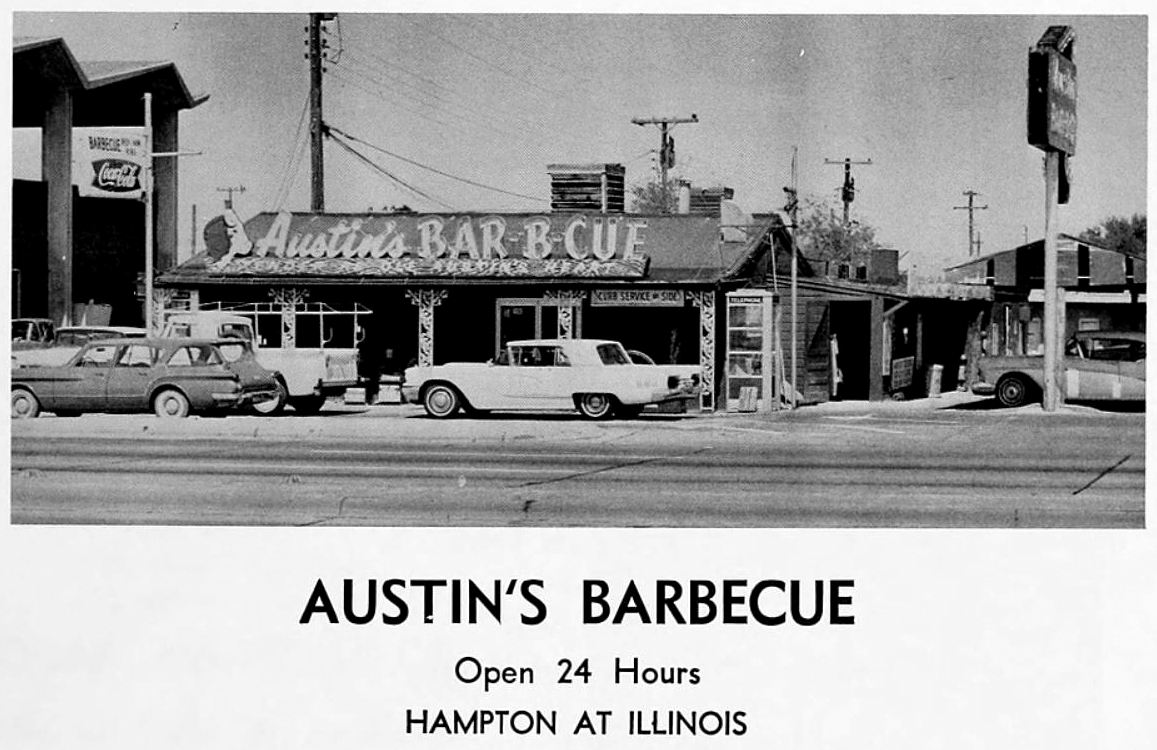
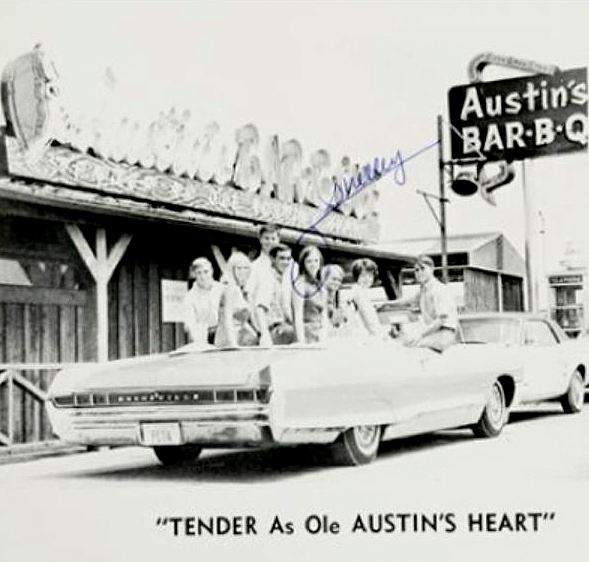
The famed BBQ joint at the northeast corner of Illinois Avenue and Hampton Road opened in 1949 as B & G Barbecue but soon became known as Bull Pen Barbecue, run jointly by owners Bert Bowman and Austin Cook. In 1956 or 1957, another Bull Pen opened in Arlington. After Oak Cliff went dry (a dark day for many Oak Cliffites), Bowman — who firmly believed that BBQ and beer were a match made in heaven — left for Arlington and Cook stayed in Oak Cliff and changed the restaurant’s name to Austin’s Barbecue. (“Bull Pen Barbecue” was still appearing in ads as late as Oct. 1957 — the official name changeover seems to have  happened in 1958.)

austins-bar-b-q_sunset-high-school_1967-yrbk1967 Sunset High School yearbook

*

The following memory of starting the business was apparently written by Austin Cook in 1990:

Dear Family & Friends,

I will try to tell you a little more about my being in the restaurant business. We borrowed $10,000 and bought out some one and it was B and G Barbecue. You see I always spell out Barbecue because when I went in business they hadn’t started abbreviating it like it is today.

After we had been there awhile we changed the name to The Bull Pen. Our slogan was “Come in and Shoot the Bull with Austin and Bert.” We used that name until they voted beer out of Oak Cliff. That really set us back, but maybe it was the best thing for us. We put another place in Arlington and that place was going pretty good. My partner wanted to get rid of the place in Oak Cliff. I traded him my part of the one in Arlington for his part in the one in Oak Cliff. Everyone said I was crazy.

When we bought that first place it was way out in the country, but they were building a bunch of houses not too far away. There was an airport across the street from the place. They kept talking about building a shopping center where the airport was. I remember the first day we ran a hundred dollars, and I thought we would never make it.

We started making money and we paid that ten thousand dollars back and we drew fifty dollars a week just like I was making in the grocery store. We started out with a barbecue sandwich and a hamburger. Then we started adding different things until we had a menu. We started getting those workers in the houses, and the business took off. We had beer also to go with the barbecue. My mother wasn’t too happy about that, but Dad said if that was the way I wanted to make my living it would be all right. In about a year or two we had a customer make us up a menu and we put in Barbecue plates for one dollar and twenty five cents. When I left they we were getting $4.99 for them. After I left I think they went to over seven dollars.

They always told me that you weren’t a success until you were in debt a hundred thousand dollars, and I went to the bank and borrowed all they would let me have. Then I went to my landlord and sold him the idea that I wanted to improve his property, and he loaned me the balance I needed to remodel, and I built a restaurant that held a hundred and twenty-five. Many times I was almost broke and didn’t know what I was going to do, but something always happened and I came out of it.

*

Both the Bull Pen in Arlington and Austin’s in Oak Cliff were successful and long-lived. Austin Cook retired at the end of 1993, and the business was taken over by his stepson, John Zito who had already been working at the restaurant for several years. Austin’s Barbecue closed in July, 2000, and the building was demolished soon after, replaced with an Eckerd drug store (now a CVS). Bert Bowman (born Glynbert Lee Bowman) died in 1989 at the age of 66; Austin O. Cook died at in 2006 at 86. And now I kind of feel like I know them, and I’m really sorry I never sampled their sandwiches.

*

Below, a Bowman and Cook timeline (most pictures and clippings are larger when clicked).

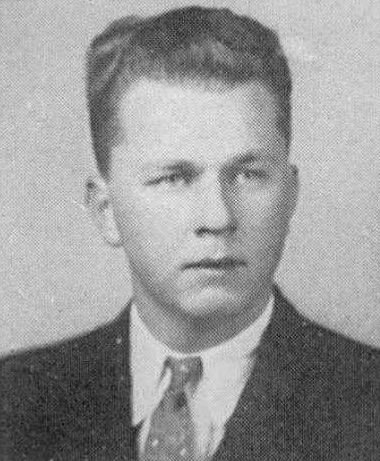
austin-cook_sunset-high-school_1937Austin Cook, Sunset High School, 1937

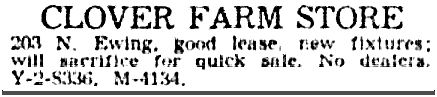
Before Cook and Bowmen met — probably around 1947 — each had been dabbling in different businesses. In early 1947, Cook leased a Clover Farm Store building at 203 N. Ewing and opened the Libby & Cook grocery with partner Lendal C. Libby.

LIBBY-COOK_dmn_021047February, 1947

LIBBY-COOK_1947-directory1947 Dallas directory

Bert Bowman worked there as a meat-cutter.

bowman_1947-directory_GROCERY-w-AUSTIN1947 Dallas directory

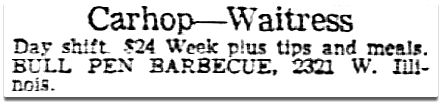
The grocery store was in business at least into 1949, the year that Bowman and Cook decided to ditch the groceries and start their own business at 2321 W. Illinois, in a part of Oak Cliff which was just starting to be developed. Their BBQ place was originally called B & G Barbecue, which — according to Cook’s letter above — was the name of the restaurant he and Bowman bought out. I guess they felt it was easier to keep the name for awhile.

b-and-g-1951-directory1951 Dallas directory

The name “Bull Pen Barbecue” didn’t come until later. In fact, the first appearance of the Bull Pen name associated with this address doesn’t show up in local newspaper archives until a want-ad placed in the summer of 1952.

bull-pen_dmn_082652_FIRSTAugust, 1952

A probably related “Bull Pen No. 2” opened in South Dallas in 1953. It appears to have been very short-lived.

bull-pen-no-2_dmn_100853
October, 1953

By the fall of 1957, Cook and Bowman had opened another Bull Pen — this one in Arlington, and this one a success.

bull-pen_arlington_grand-prairie-daily-news_091557
September, 1957

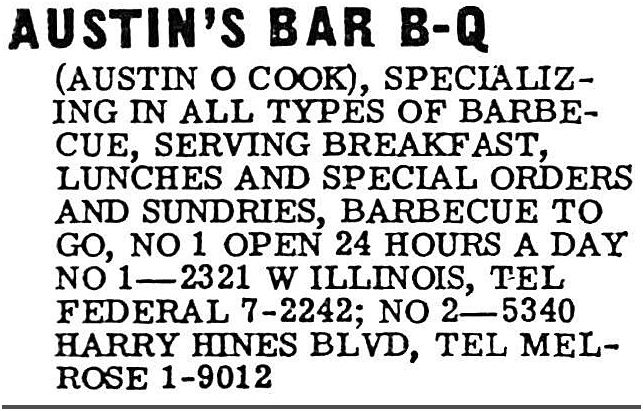
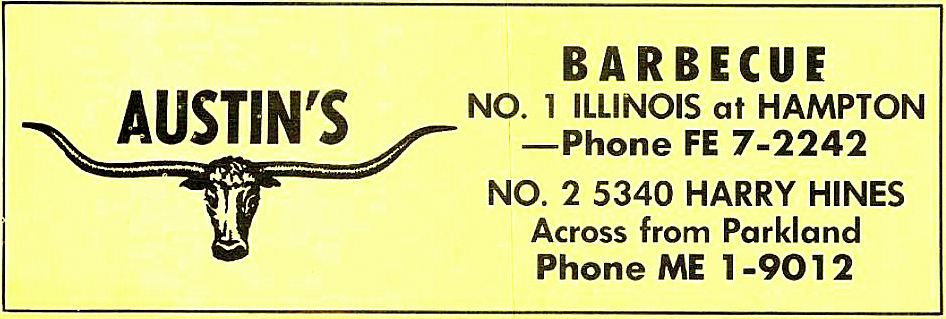
And then Oak Cliff went dry, the worst thing that could happen to a restaurant that sold a lot of beer. Similar businesses which relied heavily on beer sales began to desert Oak Cliff. Bowman did not think their original drive-in could survive, but Cook disagreed. Bowman sold his half-interest in the Oak Cliff location to Cook, and Cook sold his half-interest in the Arlington location to Bowman. Cook changed the name of his now solely-owned restaurant to Austin’s Barbecue, and his success continued, despite the fact that he could no longer sell beer. He was doing well enough that, in 1961, he opened a second location, on Harry Hines across from Parkland Hospital (a location which lasted through 1964).

austins-barbecue_1962-directory_two-locations
1962 Dallas directory

austins-barbecue_1963-directory_two-locations_ad
1963 Dallas directory

By 1963, Austin’s was a well-established teen hang-out and wisely placed ads in Oak Cliff high school annuals. Apparently everyone went there!

oak-cliff_austins_bar-b-cue_kimball-yrbk_19631963 Kimball High School yearbook

austins-bar-b-q_sunset-high-school_1964-yrbk.det1964 Sunset High School yearbook

austins_car-teens_flickr-coltera
Date and source unknown, via Flickr

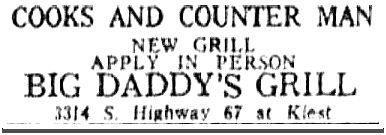
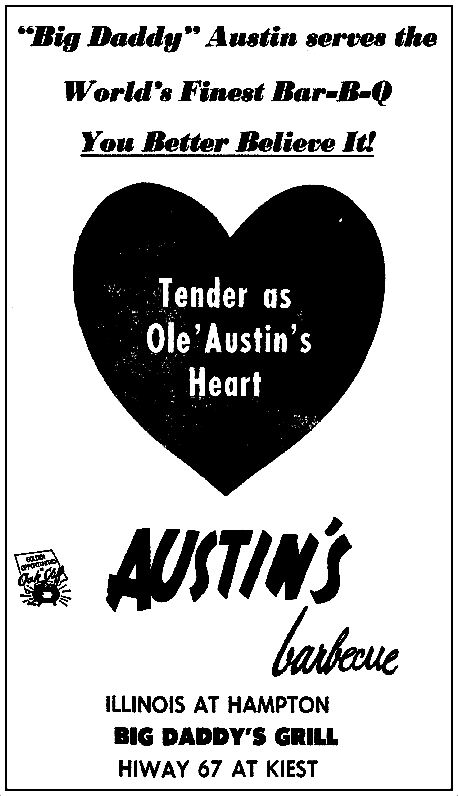
In 1964, Cook — known as “Big Daddy” — opened another restaurant, this one called Big Daddy’s Grill.

big-daddys_dmn_063064June, 1964

austins-barbecue_dmn_081466-adAugust, 1966

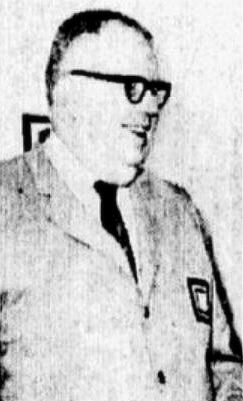
The restaurant was a bona fide Oak Cliff landmark, and Cook was an active participant in community business affairs. Below, a detail of a photo showing Cook as a member of the Oak Cliff Chamber of Commerce.

austin-cook_dmn_082568-photo-det
late 1960s

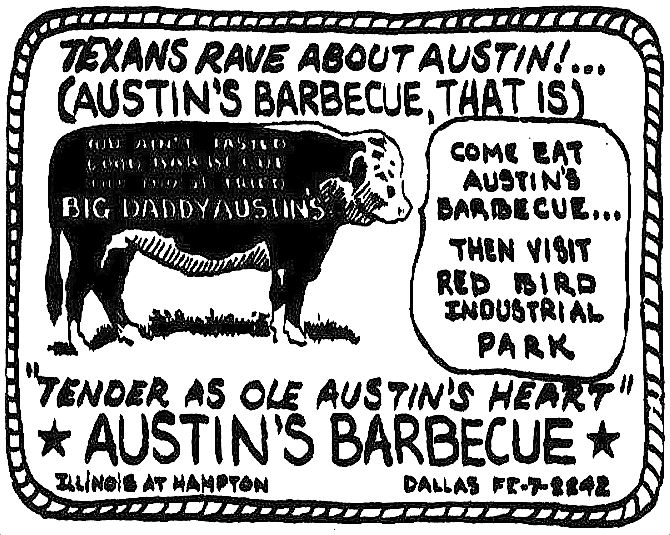
Cook participated in a series of Oak Cliff Chamber of Commerce campaigns and even included oddities like “Come eat Austin’s barbecue… and then visit Red Bird Industrial Park” in his ads. Make a day of it!

austins-barbecue_092968
September, 1968

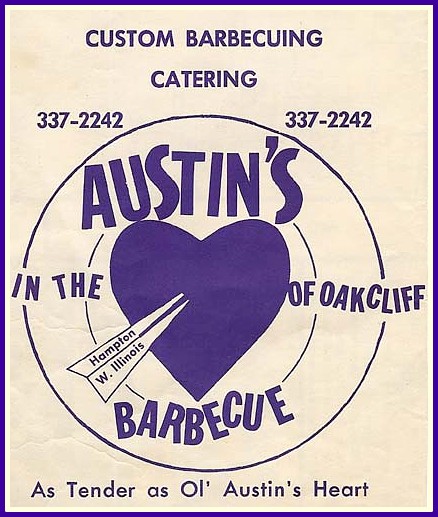
ad_austins-barbecue
via OakCliff.org

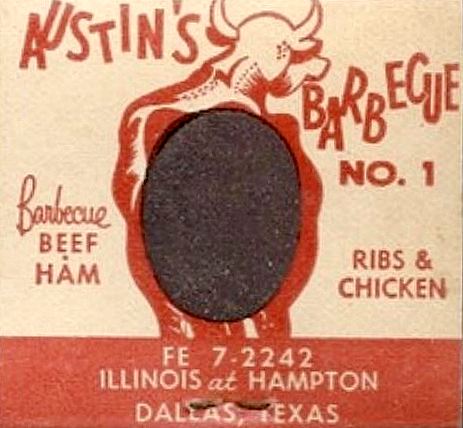
austins_matchbk_flickr_coltera
via Flickr

***

Sources & Notes

Color postcard at the top found on Pinterest, here.

The letter from Austin Cook was quoted on the DHS Phorum, here. More from the Phorum on The Bull Pen/Austin’s is here.

More can be found in the Dallas Morning News archives in the following stories:

  • “Austin’s Bar-B-Q Grows With Oak Cliff” (DMN, Aug. 14, 1966)
  • “Barbecue To Go — Staff, Customers Mourn Closing of Oak Cliff Institution” (DMN, July 13, 2000)
  • “Closed But Not Forgotten — Oak Cliff Eatery Marks Half-Century of Barbecue With Memorable Auction” (DMN, Aug. 27, 2000)
  • “John P. Zito — Operated Oak Cliff Landmark Austin’s Barbecue For 19 Years” by Joe Simnacher (DMN, Oct. 14, 2003)

Read the obituaries of Bert Bowman (1989) and Austin O. Cook (2006) here.

The Oak Cliff Advocate article “A Look Back at Austin’s Barbecue” by Gayla Brooks is here (with tons of memories from readers in the comments).

Not mentioned in this post is the connection of Officer J. D. Tippit (who moonlighted as a keeper of the peace at Austin’s) and other tangential/coincidental associations to the Kennedy assassination. It’s well documented elsewhere. Google is your friend.

*

Copyright © 2016 Paula Bosse. All Rights Reserved.

A Few Ads From the Pages of the 1963 and 1967 Kimball High School Yearbooks

oak-cliff_austins_bar-b-cue_kimball-yrbk_1963_a
BBQ in the OC, 1963

by Paula Bosse

A few random, nostalgic ads from the 1963 and 1967 Kimball High School yearbooks.

**

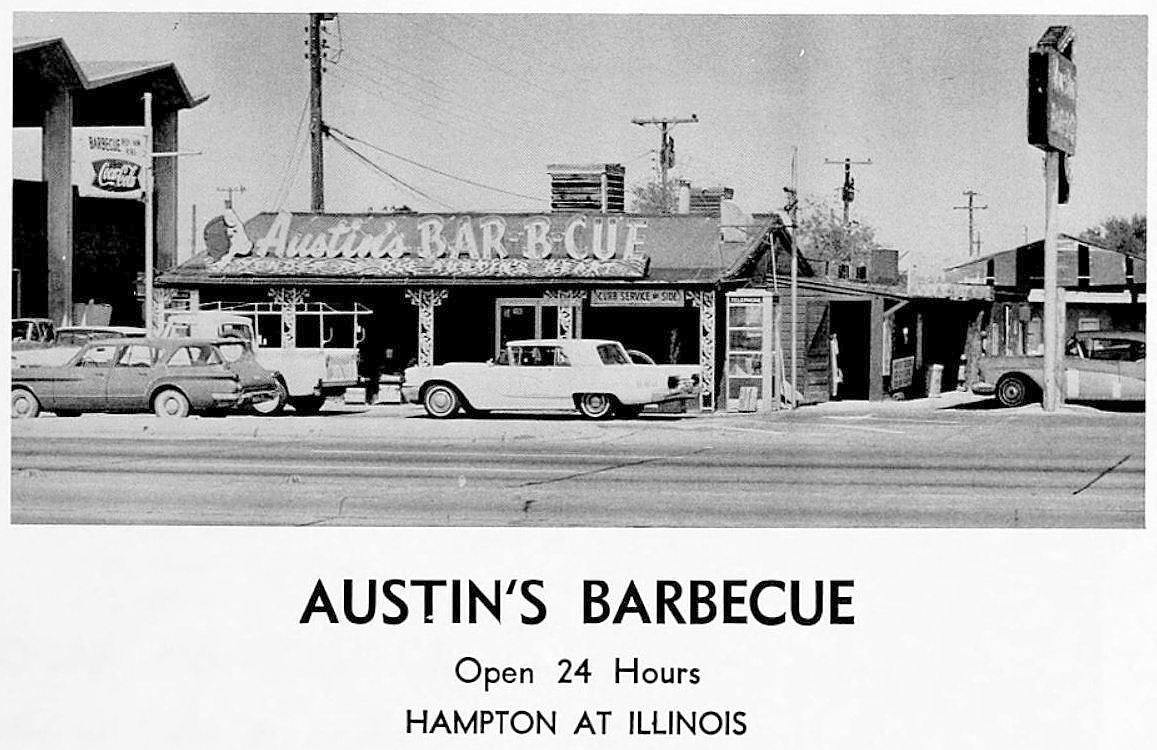
Above, Austin’s Barbecue.

*

Below, the Wynnewood Pharmacy:

oak-cliff_wynnewood-pharmacy_kimball-yrbk_1963_a1963

*

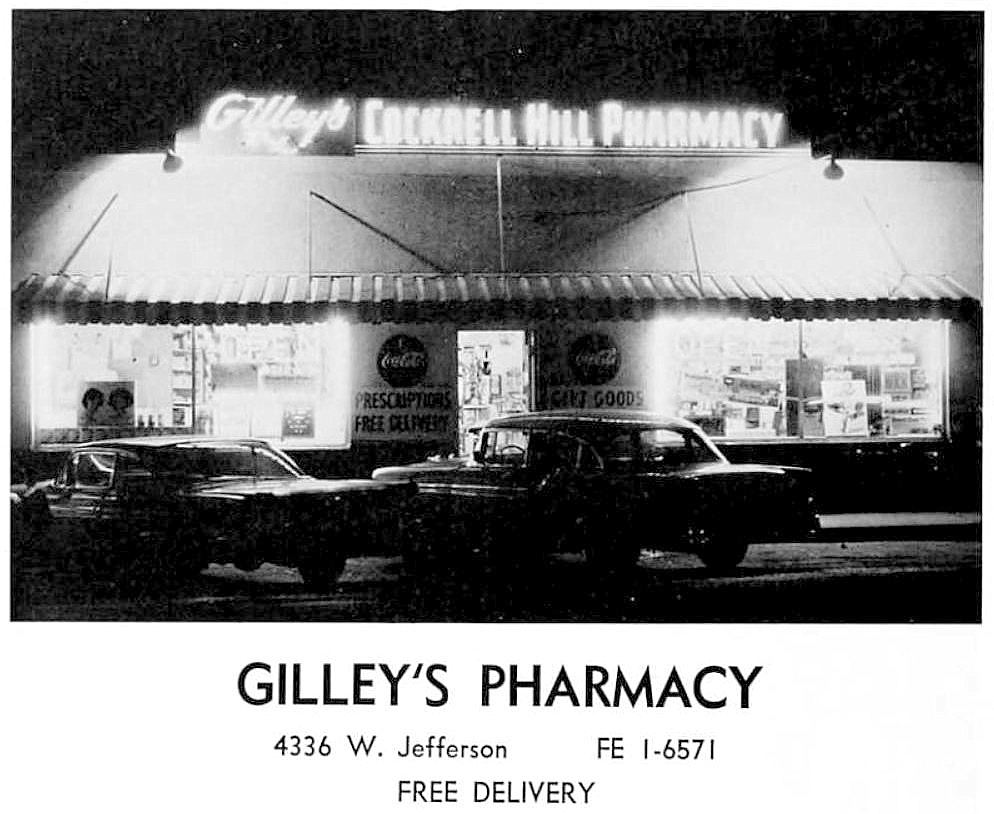
Gilley’s Cockrell Hill Pharmacy:

oak-clliff_gilleys-cockrell-hill-pharmacy_kimball-yrbk_1963_a1963

*

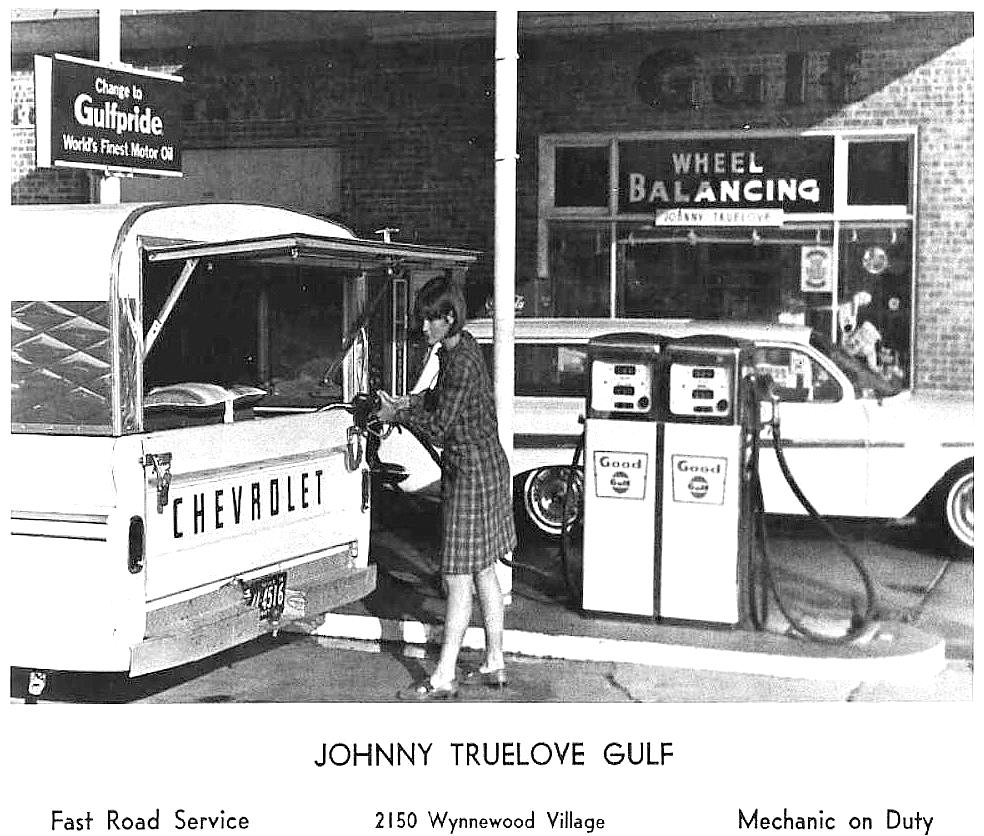
Johnny Truelove Gulf station:

truelove-gulf-station_kimball-yrbk_1963_a1963

truelove-gulf-station_kimball-yrbk_1967_a1967

*

Sammy’s Westcliff (a favorite of Marsha and her Aqua-Netted pals):

sammys_oak-cliff_1967-kimball-yrbk_a1967

*

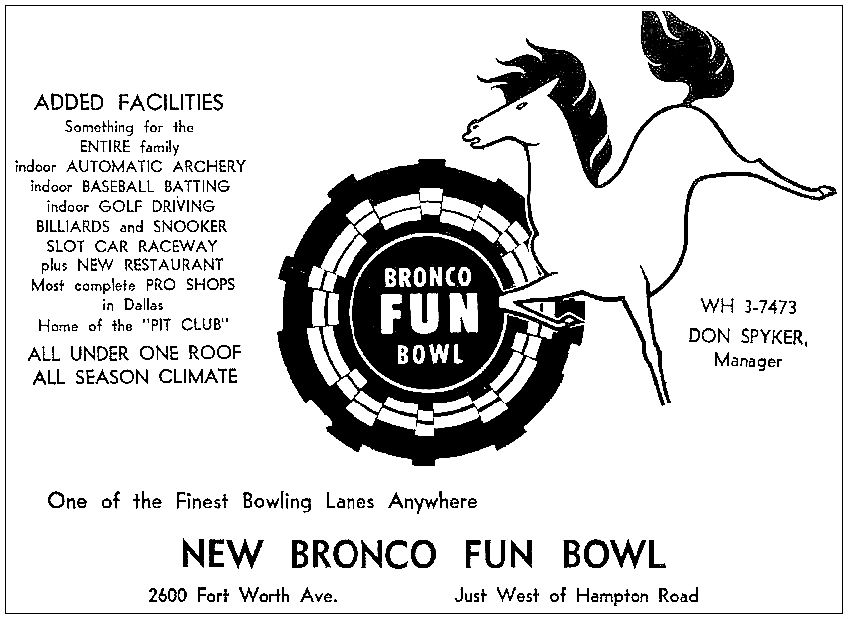
And the late, lamented Bronco Bowl:

ad-bronco-bowl_kimball-yrbk_1967_a1967

*

And for those who want to browse the retail offerings of Wynnewood Village in 1963, here is a handy list (click to see a larger image):

oak-cliff_wynnewood-village_kimball-yrbk_1963_a1963

***

Sources & Notes

All ads from the 1963 and 1967 Kimball High School yearbooks.

More than you’d ever want to know about The Bull Pen/Austin’s Barbecue in my follow-up post, here.

*

Copyright © 2016 Paula Bosse. All Rights Reserved.

West Jefferson in the Truman Years

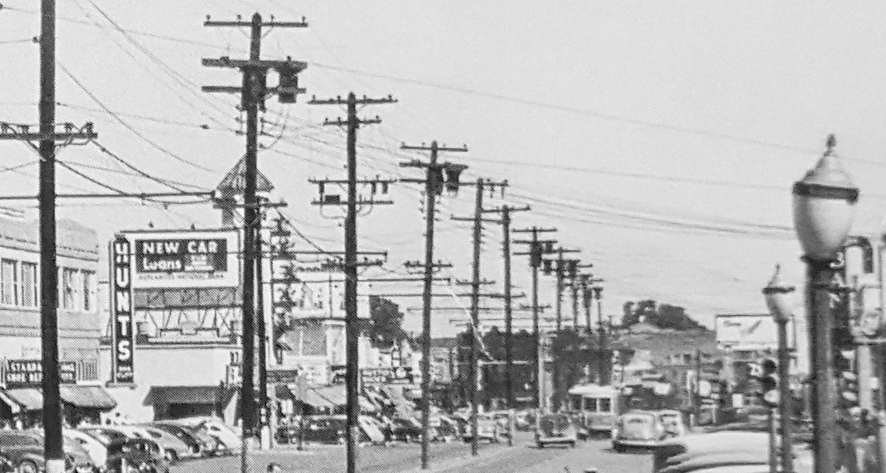
oak-cliff_w-jefferson_frontier-top-tierW. Jefferson & S. Bishop (click for very large image)

by Paula Bosse

Here we see West Jefferson Blvd. in Oak Cliff, looking east from just west of the intersection with South Bishop. Not being proficient in dating automobiles, I’m unsure of the date, but the Hoffman Optical Co. (seen on the right) did not appear in the 1948 city directory, but was there by 1951. The current view from this intersection can be seen on Google Street View here. Even though the visual blight of those telephone poles is unappealing, I have to say, I prefer the livelier W. Jefferson of 60-something years ago.

If you squint, you can just see the Texas Theatre in the distance on the left — under the pointy roof, behind the “New Car” billboard. Here’s a magnified detail (click to see a larger image) — you can (barely) see “TEXAS” spelled out on the vertical sign.

oak-cliff_w-jefferson_tx-theatre_det

The first thing I noticed in this photo is this odd black vehicle driving away from the photographer — I keep seeing a bulky version of Harold’s customized hearse from the movie Harold and Maude. What is this?

oak-cliff_w-jefferson_vehicle

Here are the businesses that occupied the couple of blocks seen here (from S. Bishop to S. Zang) in 1951:

w-jefferson_1951a          w-jefferson_1951b
1951 city directory (click to read!)

*

Copyright © 2016 Paula Bosse. All Rights Reserved.
 

Goodbye, Merle

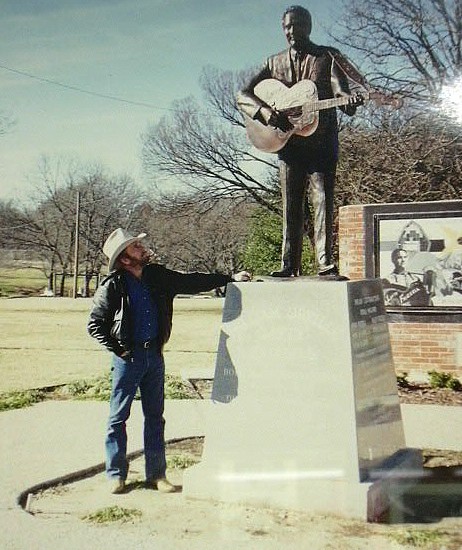
merle_lefty_corsicanaMerle and Lefty, in Corsicana

by Paula Bosse

The great Merle Haggard died today, on his 79th birthday. My earliest music memories are hearing his songs on the radio. Even people who don’t listen to country  music know who Merle Haggard is (and are probably fans).

One of his idols was Lefty Frizzell, the Corsicana-born legend whose first hits were recorded in Dallas. Merle helped raise the funds in the late ’80s and early ’90s for the wonderful statue of Lefty which now stands in Jester Park in Corsicana. The picture above shows Merle visiting the statue. (Whenever I’m in Corsicana, I always drop by Jester Park to spend some time with Lefty.)

As far as Merle and Dallas, the earliest mention I could find was from January, 1965. Country music was covered only sporadically in the pages of The Dallas Morning News back then, but his early-’65 stop at the Sportatorium may have been Merle’s first appearance in Dallas — appropriately enough, it was at the Big D Jamboree. “California country music team” Merle and Bonnie Owens were guest performers, along with Billy Grammer and James O’Gwynn of the Grand Ole Opry, and the regular Jamboree cast of thirty, for the Jan. 30, 1965 Saturday-night Big D Jamboree show.

RIP, Merle. Thanks for everything.

***

The top picture is a photo I took of an original photograph which is hanging in the Lefty Frizzell Museum, which is also in Corsicana’s Jester Park (as part of the Pioneer Village).

Merle’s obituary in Variety — which includes entertaining salty quotes from the man himself — is here.

*

Copyright © 2016 Paula Bosse. All Rights Reserved.
 

From the Vault: Dallas and the Spanish Influenza

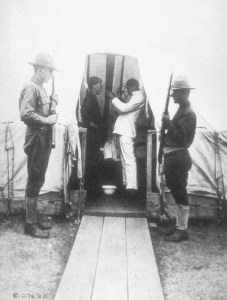
spanish-influenza_love-field_otis-historical-archives_nmhm_110618Throat-spraying at Love Field, 1918

by Paula Bosse

A cold has been dragging me down for the past few days — the perfect excuse to re-run an old post about communicable diseases! I’ve felt pretty bad, but at least it isn’t the Spanish Influenza. Or, for that matter, Ebola. I originally wrote this post (about how the Spanish Influenza had ripped through the city in 1918 and 1919) as a response to the then-current concern that a deadly Ebola pandemic might similarly race around the world, set off by the unexpected cases of the Ebola virus spreading here in Dallas. Thankfully, that didn’t happen.
Read the original post — “When the Spanish Influenza Hit Dallas — 1918” — here.

And, remember: cover your mouth when you cough and don’t spit in the streets, because NOBODY expects the Spanish Influenza!

*

Copyright © 2016 Paula Bosse. All Rights Reserved.