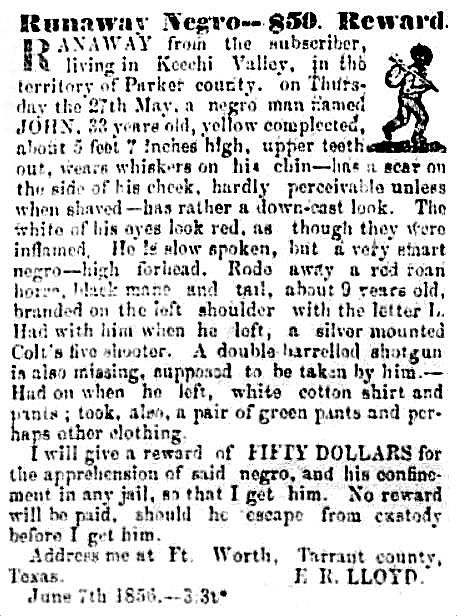
For some reason, I think I had always convinced myself that there weren’t slaves in the Dallas area. Wishful thinking, I suppose. A sobering post from last year — “Ads for Slaves, Lost Found, and For Sale in the Pages of The Dallas Herald” — contains several ads similar to the one above and can be read here.
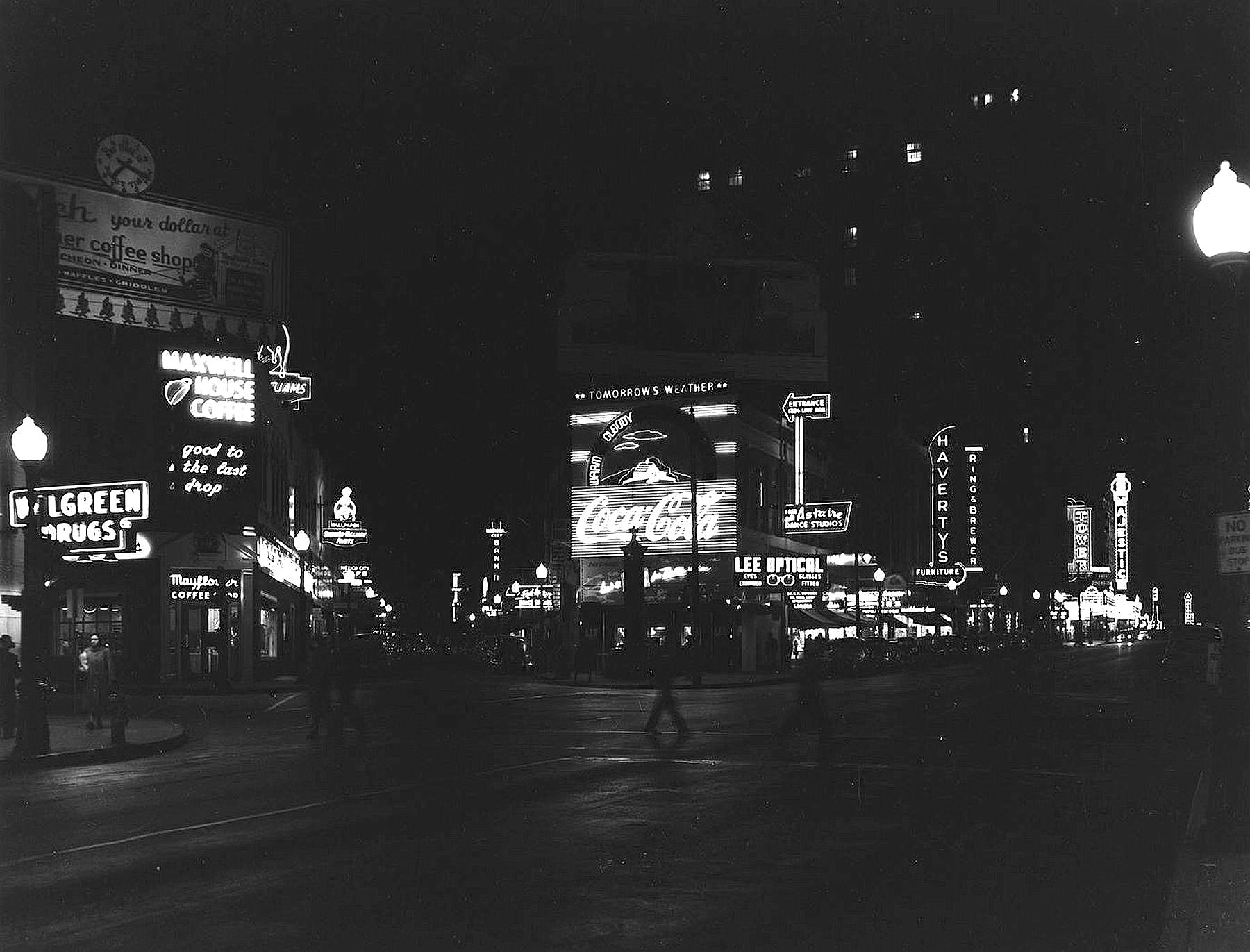
Here’s what 7:18 PM looked like at the old five-point intersection of Ervay, Live Oak, and Elm streets on January 7, 1953, a Wednesday night. All that neon — especially that Coca-Cola sign, which was probably flashing and strobing like crazy — gives this scene a sort of mini-Times Square feel. Imagine this intersection on a Friday or Saturday night when the streets and sidewalks would have been packed with people heading to theaters, restaurants, and night clubs!
On the left, at the street light (I love those street lights!) and the Walgreen’s sign, is N. Ervay. To the left of the Coca-Cola sign is Live Oak, which used to come through to Elm. To the right, Elm Street, heading east.
So many interesting things here: the Mayflower Coffee Shop (with its “Anytime Is Donut Time” clock and its animated Maxwell House Coffee sign), that incredible neon sign above the Lee Optical store which gave the forecast, that Fred Astaire Dance Studios sign (with “Astaire” in a fantastic neon font), and the Tower and Majestic theater signs lit up for moviegoers who ventured to the movies on a school night. Unseen: the public restrooms (or “public comfort stations”) hidden beneath the street, with the entrance (I think) on the Lee Optical triangular “corner.”
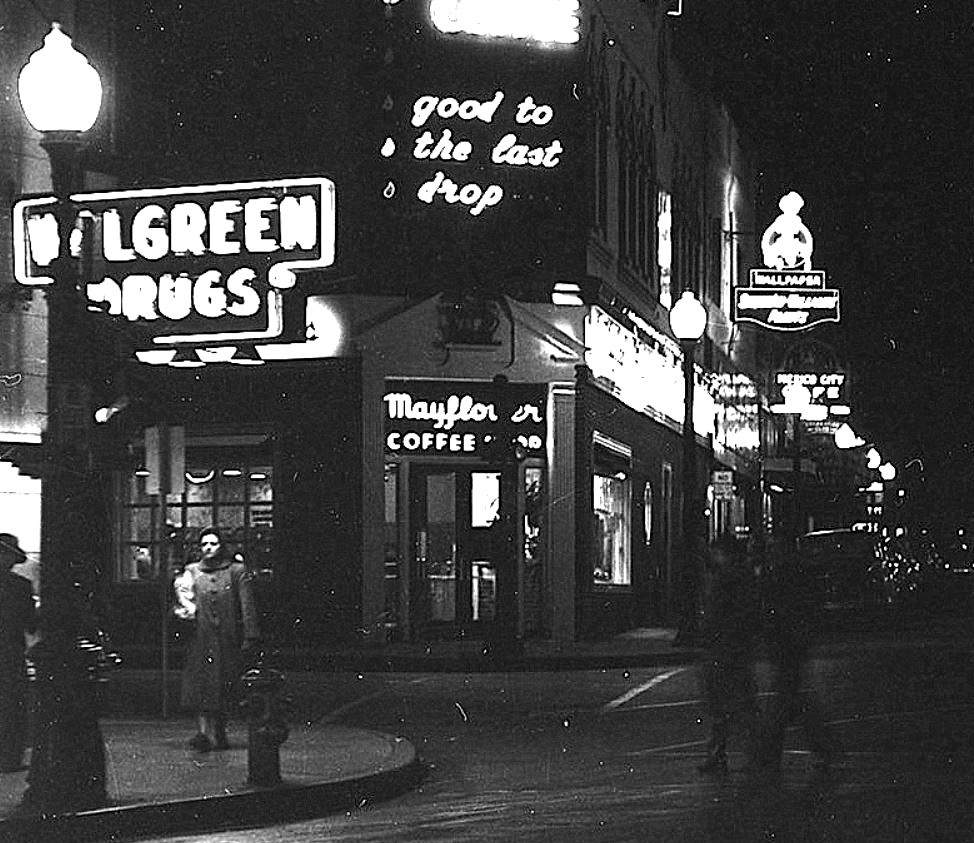
I love all the neon, but this quiet little vignette of a woman carrying some sort of sack or parcel down a chilly downtown street is why I wish I had been around back then — it’s weird to feel nostalgia for a time and place you never actually experienced.
*
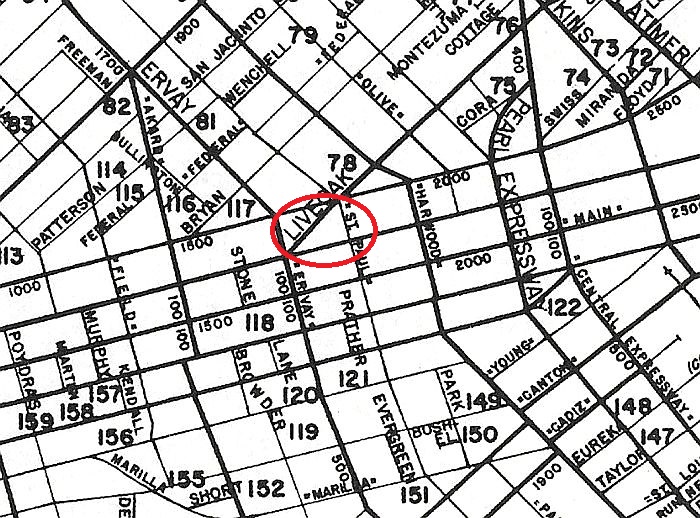
A map showing that this intersection once had five points.
1952 Mapsco (click for larger image)
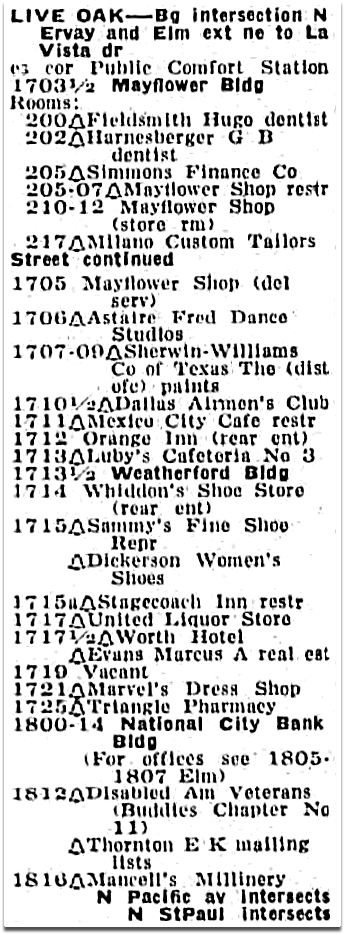
A listing of the businesses along Live Oak, between N. Ervay and N. St. Paul, from the 1953 city directory (click to read):
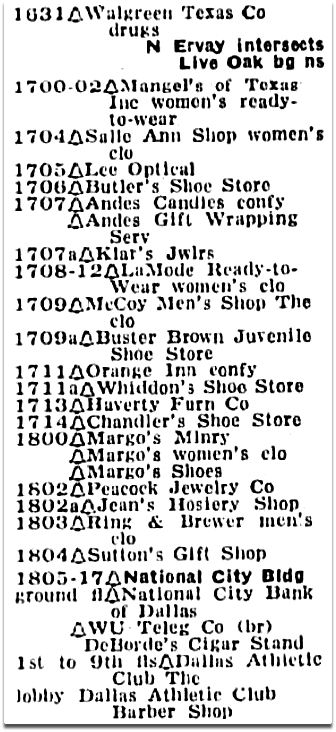
And the businesses along Elm, between N. Ervay and the old Dallas Athletic Club:
***
Sources & Notes
This photograph — an untitled night scene — was taken by Squire Haskins on Jan. 7, 1953; from the Squire Haskins Photography, Inc. Collection at the University of Texas at Arlington Libraries, Special Collections, accessible here.
See this same view during the DAY in the post “Tomorrow’s Weather at Live Oak & Elm — 1955-ish,” here.
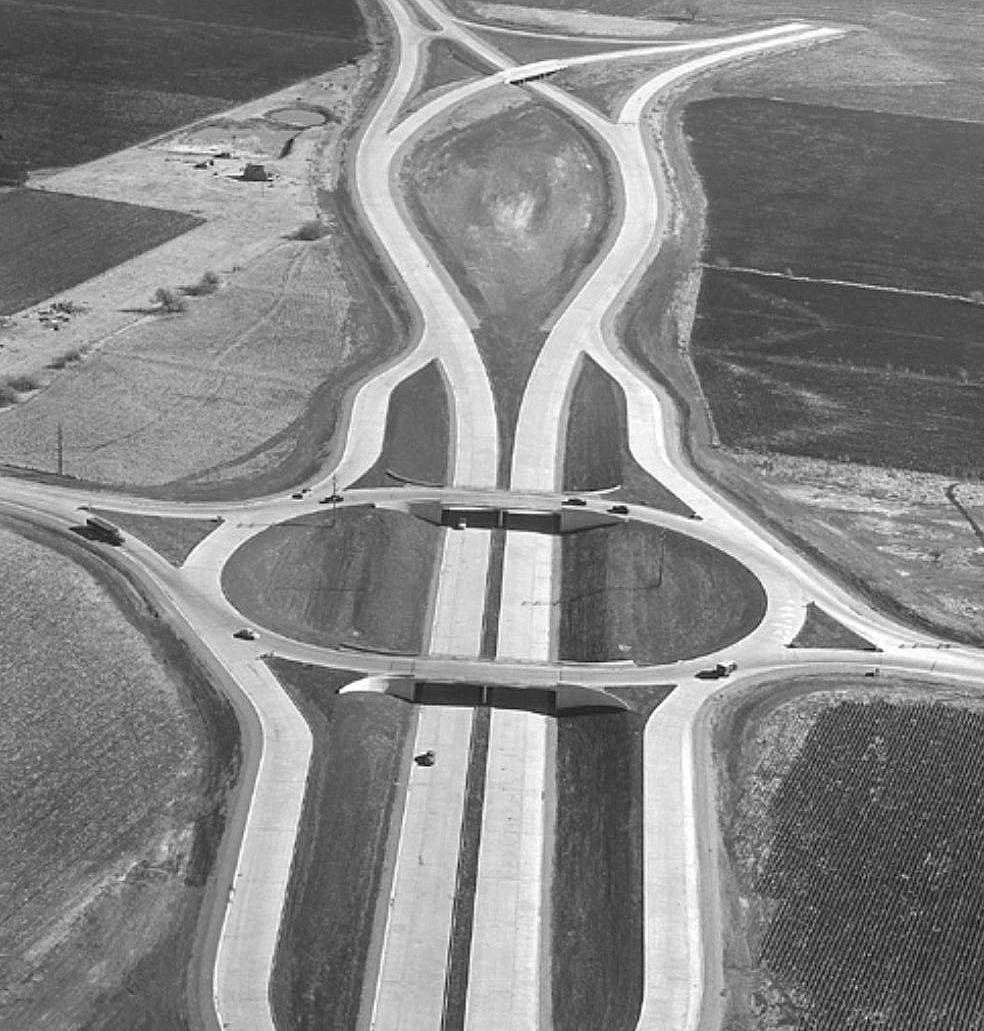
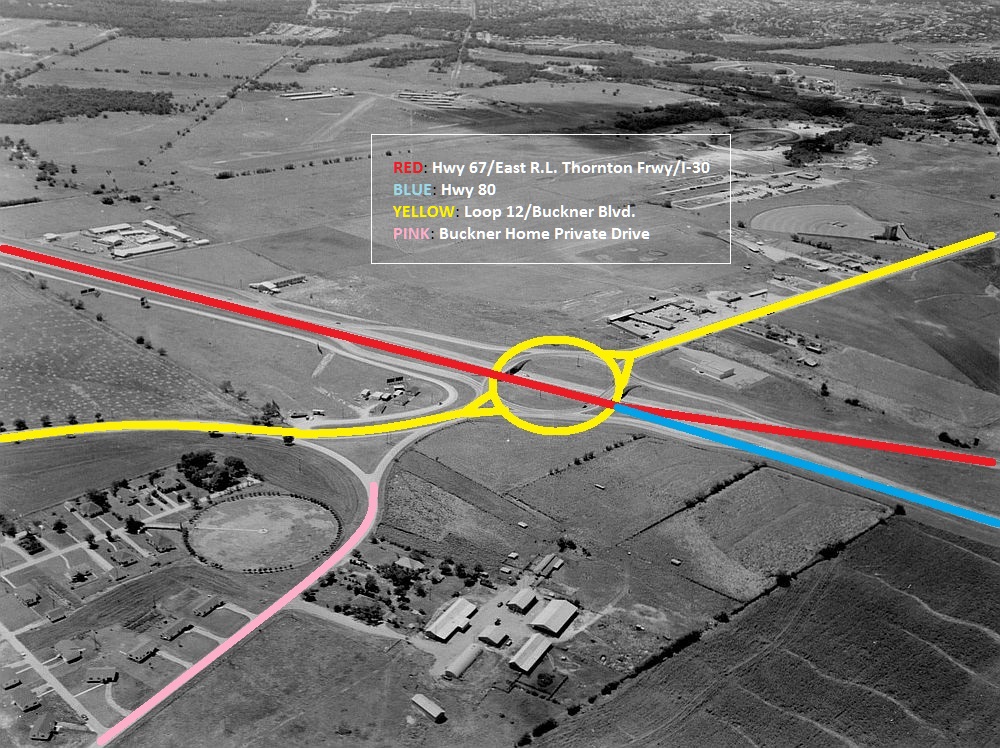
Above, a wonderful photo showing Highway 67 (now East R. L. Thornton Freeway and I-30) splitting off into Highway 80, just east of Loop 12/Buckner Blvd., surrounded by lots and lots of open land. At the top right, along Buckner, you can see the Buckner Drive-In, above it the original location of the Devil’s Bowl Speedway, and farther over, to the left, White Rock Airport. Part of the sprawling property belonging to the Buckner Orphans Home can be seen at the bottom left. Today, this is right about at the Dallas/Mesquite border. Except for the highways, this is pretty unrecognizable today!
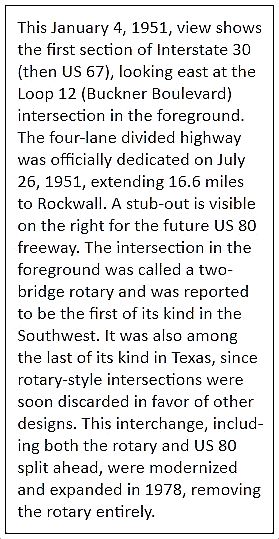
Here is a second photo, dated Jan. 4, 1951, with Oscar Slotboom’s caption below (from Slotboom’s exhaustively researched book and website, Dallas-Fort Worth Freeways).
*
The Buckner Orphans Home was founded in 1879; it was both a home for orphaned children and a working farm, and at its height, it occupied some 3,000 acres of land (!). Take a look at a 1911 photo here to give you an idea of the size of the place. The buildings seen at the bottom left of the photo above were houses used by Buckner staff; the Home itself is out of frame.
Buckner Children’s Home
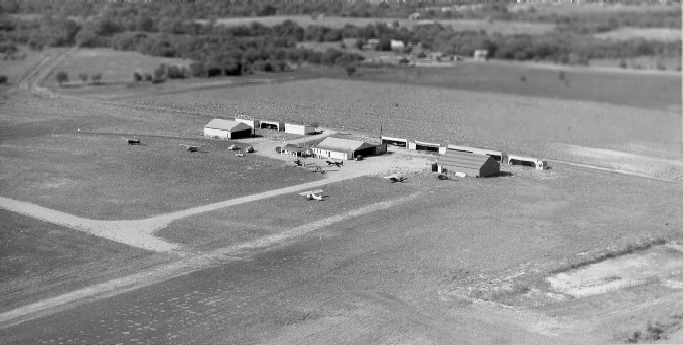
White Rock Airport opened about 1941 and was in use until 1974. Here is a photo of it soon after it opened.
White Rock Airport
(Several more photos and memories about this airport can be found here.)
Devil’s Bowl Speedway opened in March, 1941. If you wanted to see jalopy races, you headed to Devil’s Bowl. (DBS is still around, nearby, at a different location.)
The Buckner Boulevard Drive-In opened on June 4, 1948. It was the first drive-in in Dallas to have individual car speakers that one placed in one’s car. (More on the Buckner Drive-In can be found at Cinema Treasures, here.)
***
Sources & Notes
Top photo is from the TxDOT Photo Files and can be viewed on the Texas State Archives’ Flickr page, here; the date is given as “circa 1940,” but as the drive-in didn’t open until 1948, the date of the photo is probably closer to 1950. (The second aerial photograph — from Oscar Slotboom’s fantastic Dallas-Fort Worth Freeways — is dated 1951, so I’ve updated the title of this post.)
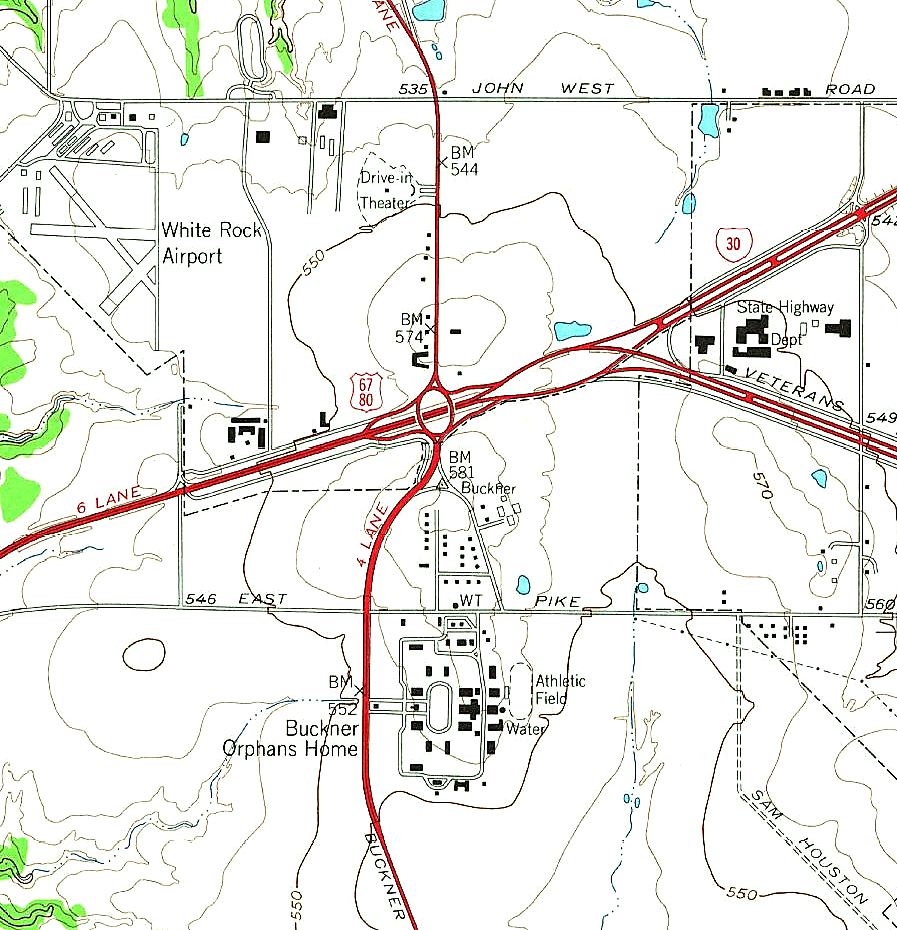
Thanks to Mark’s comment below, I’ve found this detail of a 1957 topo map from the United States Geological Survey. It’s a few years after the photo above was taken, but it shows the layout of the Buckner Children’s Home more fully. (The east-west highway called “East Pike” here is now known as Samuell Blvd.) Click map for larger image.
The Dallas/Mesquite city limits boundaries have moved over the years, but a current view of the boundary — which involves the area seen in this photo (seriously, this exact area) — can be seen here.
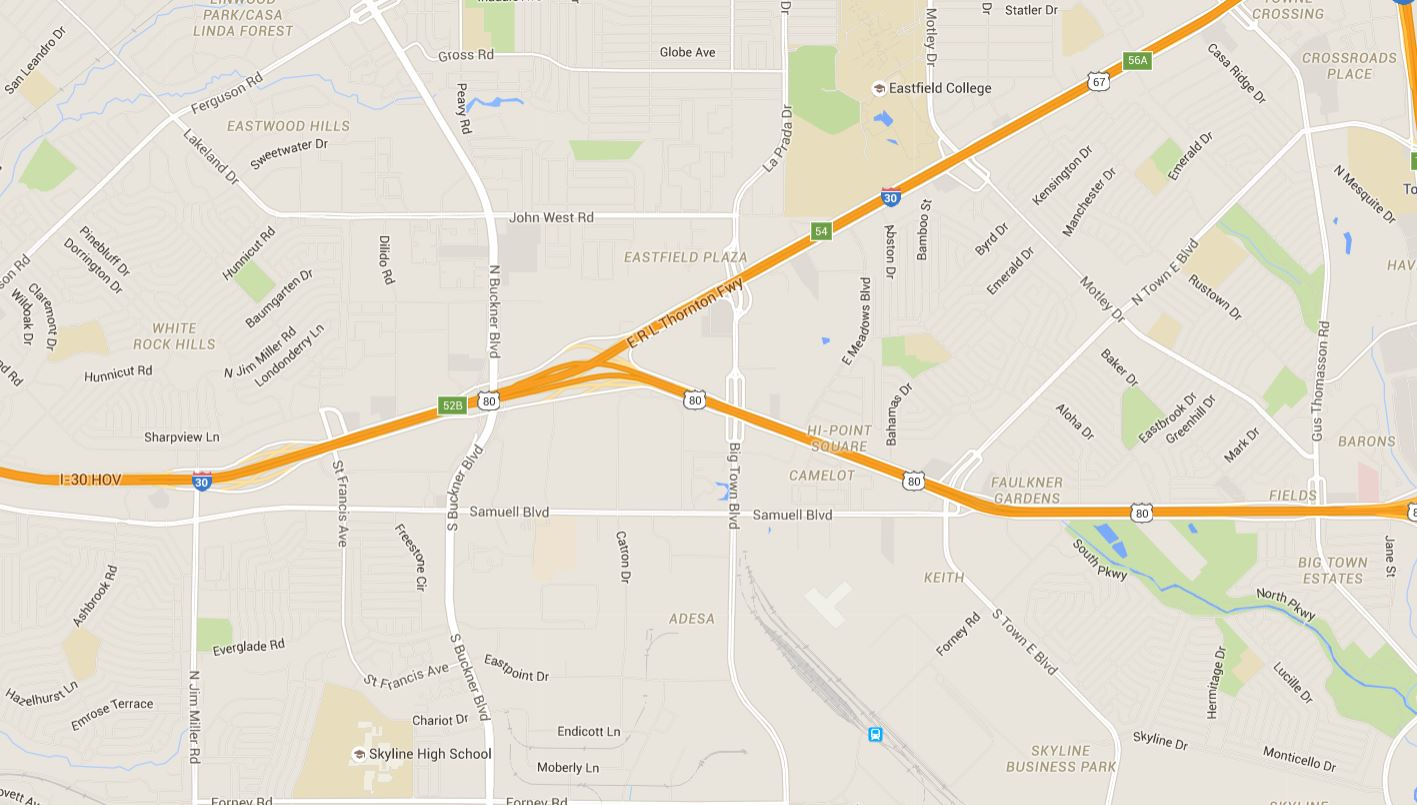
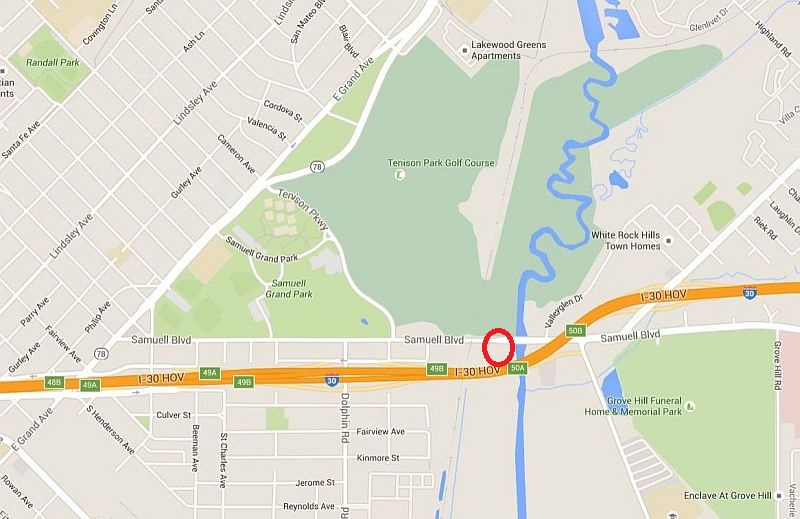
Below, a current Google Maps view of this interchange:
And, if like me, you need some helpful guidance:
Thanks to members of the Dallas History Facebook group for helping me figure out what I was looking at, especially David and Chuck — thanks, guys!
You know that theme music for the TV show Dallas? Actually, that should just be a statement of fact: you KNOW that theme music for the TV show Dallas. We all do. But you know what you DON’T know? You don’t know what the French did to “improve” the J.R.-watching experience. For reasons which I don’t exactly understand, they had someone (Jean Renard) write a theme song for the show. A song. Une chanson. With lyrics. To all-new music. Sounds crazy and unnecessary, but it was a big hit on the French pop charts. And it’s so gloriously awful and fabulously weird that it must be shared. This is not a joke. This is the actual music that accompanied Dallas when it was shown on French television.
I give you a rough approximation of the lyrics (the French lyrics are here).
Dallas, your ruthless world, Dallas, where might is right, Dallas, and under your relentless sun, Dallas, only death is feared.
Dallas, home of the oil dollar, Dallas, you do not know pity; Dallas, the revolver is your idol, Dallas, you cling to the past.
Dallas, woe to him who does not understand, Dallas, one day he will lose his life. Dallas, your ruthless world, Dallas, where might is right.
And here it is. Sing along!
*
Catchy, huh? What could be better than hearing it sung? Watching it being sung! I’m not sure who the singer is, but he’s attacking this song with a rock attitude that totally isn’t warranted.
*
Nice hat!
This was a big, big hit in France. I’ve even seen the word “beloved” used to describe it. Remember this the next time you might feel a lack of confidence or a twinge of inadequacy in the presence of a chic and sophisticated Parisian. Stand tall, my fellow Texans, and remember OUR Dallas theme.
*
Silly Frenchmen.
*
UPDATE: Julia Barton has hipped me to her segment about “Dallas” which aired on public radio’s “Studio 360” in 2011, focusing on the sometimes surprising global and sociopolitical impact of this pop-culture juggernaut. I went to college in the UK, and there wasn’t a day that passed without several people gleefully asking me about J.R. Ewing. It was weird. Had the TV show never existed, I’m sure I would have been queried endlessly (and possibly angrily) about JFK, and I might well have been shunned — yes, shunned! (I remember when people embarking on international trips pre-Southfork were advised to respond to the question “Where are you from?” with the somewhat vague answer “Texas” rather than the explosively specific “Dallas,” because, post-assassination, we were “the city of hate” around the planet.) I’d much rather have had people ask me about a soap opera character than blaming my hometown for killing an American president. So, um, thanks, Lorimar!
Listen to Julia Barton’s 15-minute “Studio 360” segment here (audio plays above J.R.’s silhouette).
***
Read about this odd practice the French have of concocting whole new TV theme songs for American television shows, here.
I can’t believe I’ve never heard of this. All thanks to my friend Carlos Guajardo for passing along this very entertaining nugget of Dallas kitsch! Thanks, Carlos!
I might have bought a Flying Merkel in 1911 for the name alone.
The Texas Motorcycle Company was at 1605 Commerce. This ad is from 1911, but see what that block of Commerce looked like two years later in the detail of a larger photo, below. The motorcycle company was next to Worley’s, in the building with the Knight Tires/Stutz Auto signs.
Imagine two years before: Commerce would have been filled with Flying Merkels on test drives, zipping in and out of traffic!
***
Sources & Notes
Ad from the 1911 Dallas High School yearbook.
Photo is a detail from a larger photo contained in my earlier post “Horses, Carriages, Horseless Carriages — Commerce Street, 1913,” here.
I always wonder about those old, decaying buildings — sometimes they’re little more than shacks — which are somehow still standing, in areas that will probably never be gentrified. Like Samuell Boulevard, just south of Tenison Golf Course, two or three miles south of White Rock Lake. The north side of Samuell is a lovely, manicured golf course. The south side? Rough, man.
Before Samuell Blvd. was Samuell Blvd., it was known as East Pike, and it served as the highway to Terrell. This explains the large number of tourist courts and motels which dotted the road. Also, the Tenison golf course was right about at the very edge of the city limits — which explains the large number of bars, taverns, liquor stores, and other assorted dens of iniquity all clustered together at the wet/dry line (wet in Big D, dry beyond).
The local papers were full of a veritable pu pu platter of crimes and offenses committed along the East Pike, almost all of which were generally traced back to alcohol consumption. Police and city inspectors spent a lot of time in the area, called to various of these joints to handle reports of public intoxication, selling alcohol to minors, selling alcohol to those already drunk, general rowdiness, unsanitary conditions, noise, brawls, “suggestive dancing,” gambling, hold-ups, shootings, suicides, and murder.
One of those rural drinking establishments was Red’s Turnpike Open-Air Dance, which appears to have opened in 1946 in the 3700 block of Samuell (even though it didn’t have an actual street address in city directories), between the Belt railway and White Rock Creek. In 1948, the tavern burned down in an early morning fire (a not-uncommon fate for these types of businesses). The Dallas Morning News reported that “firemen were hampered by a lack of fire hydrants in the vicinity and pumped water from White Rock Creek to fight the blaze” (DMN, May 3, 1948). …Wasn’t enough.
From its ashes sprang Keller’s drive-in, in 1950, in the same general spot. In a 2015 Lakewood Advocate interview, Jack Keller described the location of his first drive-in as being “the last wet spot going into East Texas, right across from hole number two” of the golf course. “We had a lot of fun down there.”
Who doesn’t love hamburgers? Keller’s probably helped the area’s reputation, as its arrival eventually ushered in a less seedy clientele than the old East Pike of the ’30s and ’40s was known for. Less riff-raff, better food.
***
Sources & Notes
Photo of Red’s Turnpike from the Dec. 14, 1946 issue of Texas Week magazine.
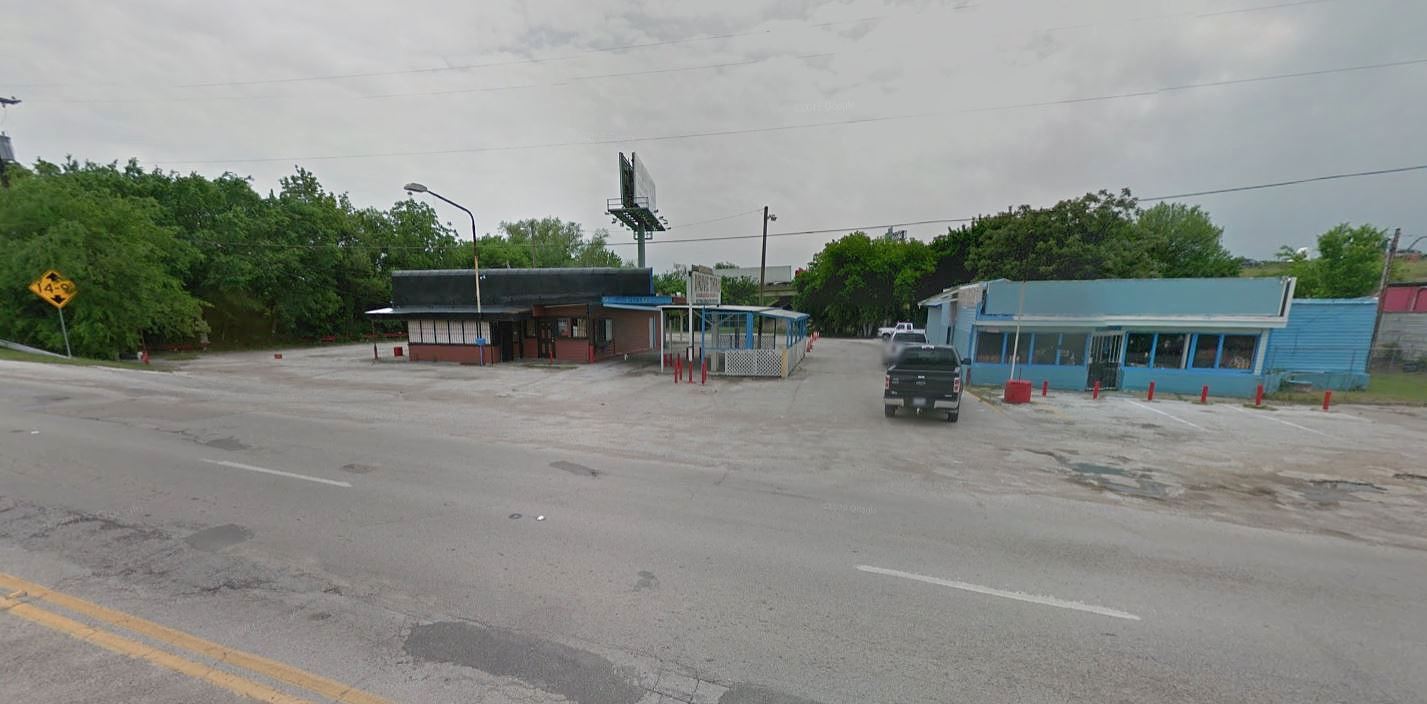
Here’s what the spot where Red’s once stood looks like now (the Keller’s location here closed in 2000):
Google Street View, 2015
Google Maps
Take a virtual look at the area on Google Street View, here.
Above, Dallas lunch ladies shelling what looks like black-eyed peas for an unidentified school’s midday meal. I can’t say I’ve ever imagined lunchroom employees ever doing something like this. In the 1920s and ’30s, schools used fresh foods when they could, but they were definitely using a lot of canned fruits and vegetables, too. All this effort — and all these women — for peas.
In a quick search for what school lunch menus were like in the late ’20s and early ’30s, here were a few delicacies that would never be found in a school cafeteria these days:
Roast veal
Sardine sandwiches
Creamed onions
“Italian hash”
Banana and peanut salad
Salmon loaf
Tongue salad
Stuffed dates
Prune whip/prune salad/prune pudding
Yummy!
***
Sources & Notes
Photo from the Texas/Dallas History & Archives Division, Dallas Public Library.
The Oak Cliff church’s first pastor? (click for larger image)
by Paula Bosse
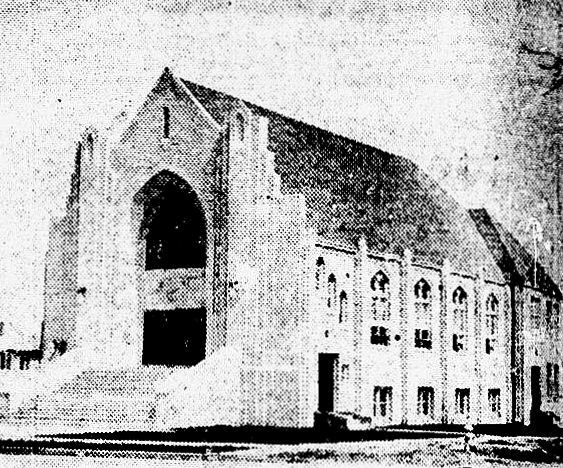
I stumbled across this photograph tonight and was really taken with it. It shows a man standing in front of the Winnetka Congregational Church in Oak Cliff, located at W. Twelfth and S. Windomere streets — on land now part of the property of the W. E. Greiner school. The church was organized in 1914, but by 1925 they were making plans to expand. A new church was built in 1929, just across W. Twelfth, facing Windomere.
The new building still stands, but Winnetka Congregational Church doesn’t seem to have made it past the 1950s.
Nice though that newer church is, I think I prefer the smaller one from 1914 with the uncomfortable-looking man standing in front of it.
***
Sources & Notes
Top photo from the Tulane University Digital Library (with the name of the church misspelled as “Winnietka”), here.
I love Sanborn maps. Here’s one from 1922 which shows what the neighborhood looked like then. The original small wood frame church can be seen just north of a neighborhood completely undeveloped, except for the Winnetka School. Check out the very large map, here.
Background on the church can be found on the Oak Cliff Yesterday blog, here.
If you REALLY want to learn about this church’s history, there is a book, History of Winnetka Congregational Church, Dallas, Texas by Sarah E. Johnson (1935). Looks like the Dallas Public Library has a copy, here.
And, lastly,here’s what the church built in 1929/1930 looks like today. (The original church was built in the area seen in the background, now part of the Greiner campus.)
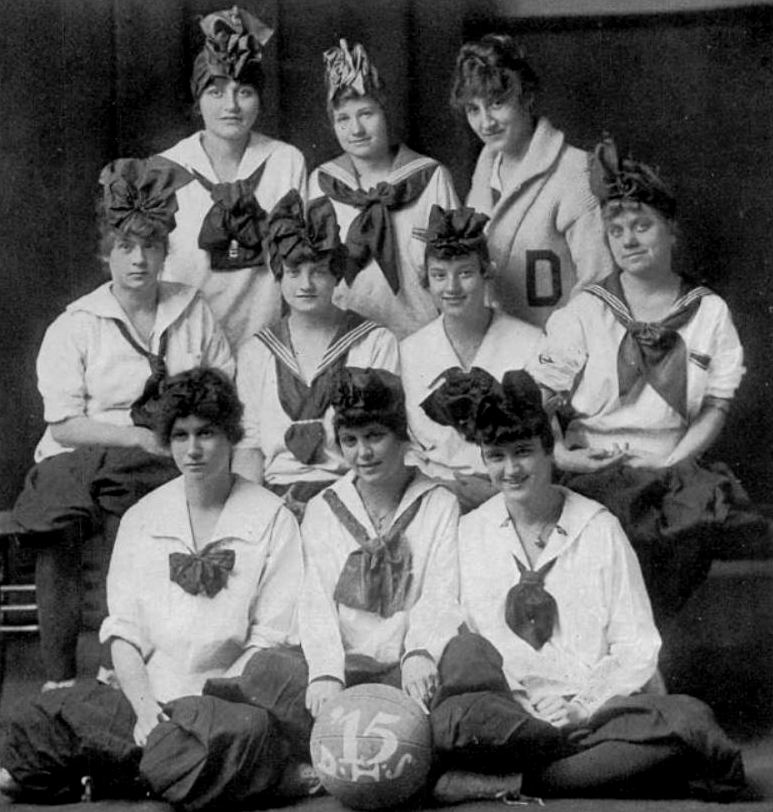
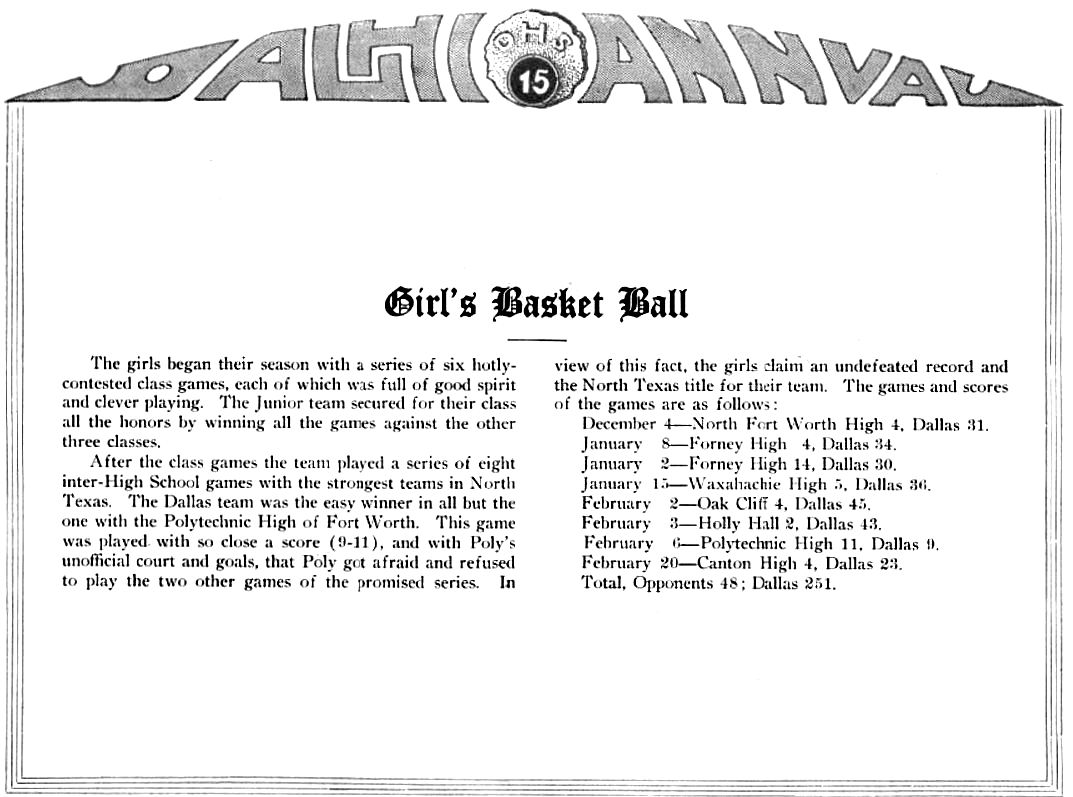
The girls’ basketball (or “basket ball”) team of Dallas High School (later known as Crozier Tech) had a great season in 1915! They won 7 of their 8 games, losing only to Fort Worth’s Polytechnic High (by one measly basket). Most of their opponents were trampled by the DHS team, several managing to score no more than a mere 2 or 4 points (!). And, let’s face it, without the drag caused by those elaborate and cumbersome uniforms and … um … headgear, DHS would no doubt have scored even higher.
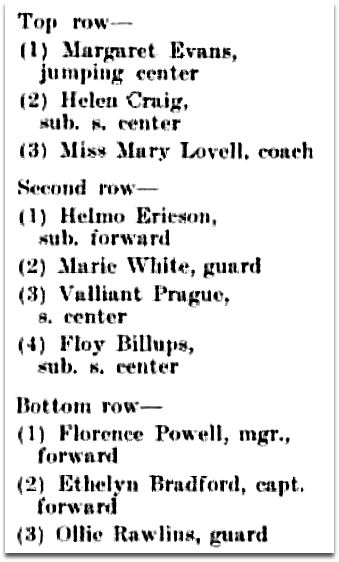
Below, the roster (containing some great names like Helmo, Valliant, Floy, and Ollie).
And the wrap-up of the season, from the yearbook, with more than a hint of bitterness toward the Fort Worth team:
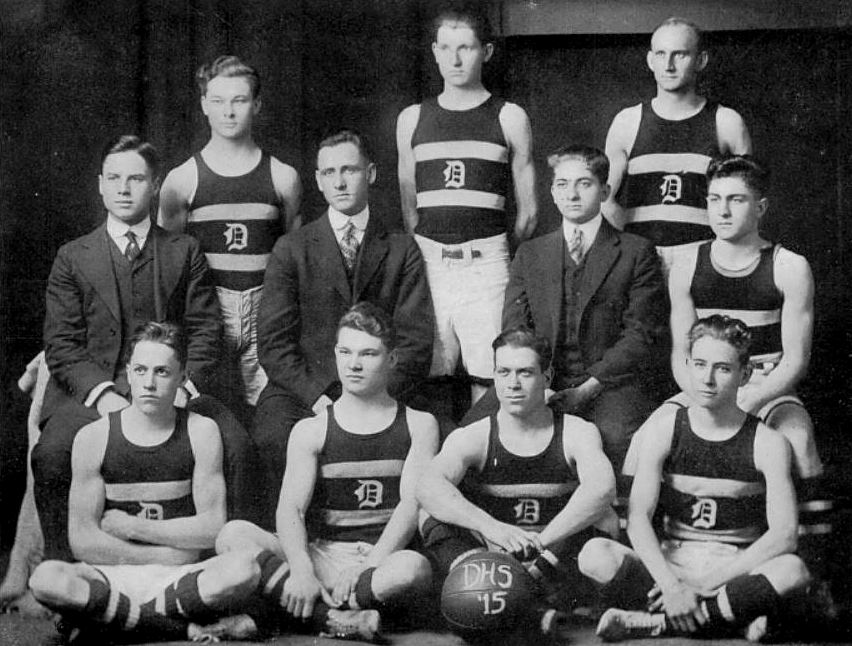
And the boys’ team? Oh dear. They won only 4 out of 8 games. But at least their uniforms were better suited to the sport.
***
Sources & Notes
From the pages of the 1915 Dallas High School yearbook — the “Dal-Hi” annual.

 The Dallas Herald, June 7, 1856

 No, not Paris, TEXAS…. (via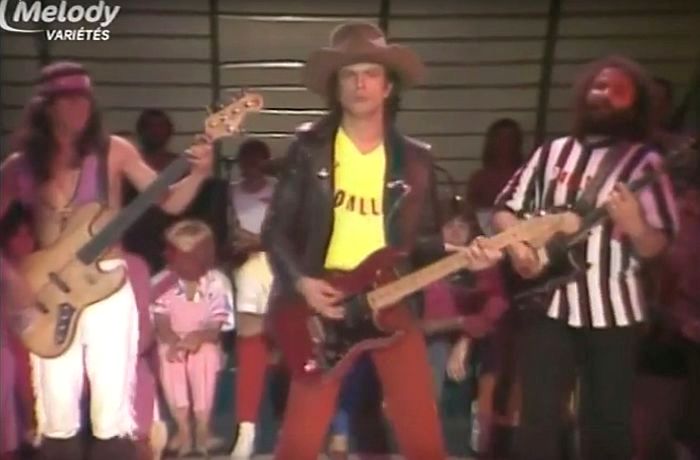






 Flashback : Dallas