Flashback : Dallas

A Miscellany: History, Ads, Pop Culture

Tag: Dallas TX

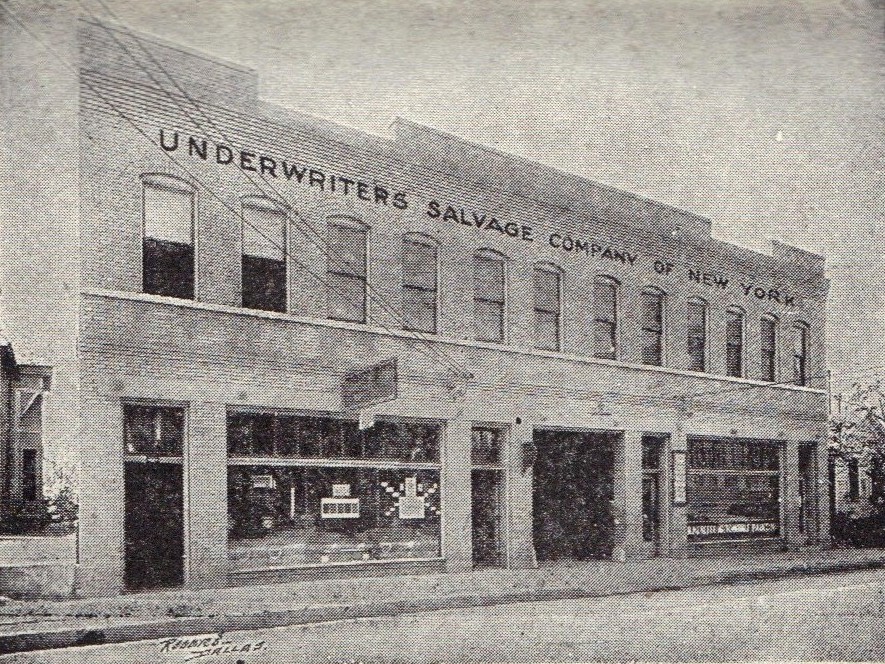
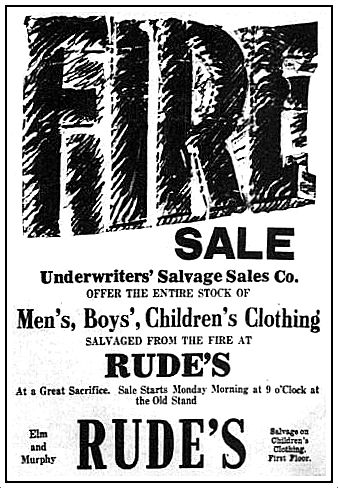
Underwriters Salvage Co., Dallas Warehouse — 1920

underwriters-salvage_1920The company’s Dallas warehouse on N. Lamar (click for larger image)

by Paula Bosse

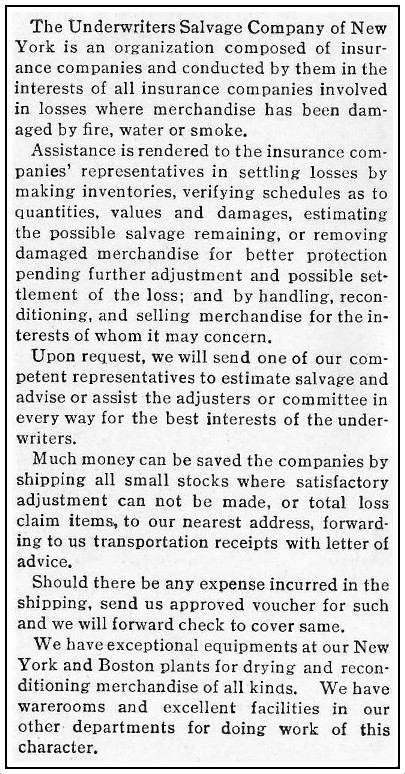
The Underwriters Salvage Company of New York (founded in 1893) was a business that worked with insurance companies and merchants in settling losses due to merchandise damaged by fire, water, etc. In their words:

underwriters-salvage-co_1920Underwriters Salvage Co., 1920

There were branch offices in cities around the country, including Dallas, which was the location of the company’s Southwestern offices, or, their “Gulf Department,” located in the American Exchange National Bank Bldg. on Main St. The warehouse pictured above was at 2014-16 North Lamar (in the West End warehouse district, between McKinney Ave. and Munger). Not only would merchandise being readied for processing be stored there, there would probably also be large fans going full-blast to dry out and remove the smell of smoke from items that would soon be sold for bargain prices, either to the public or to wholesalers via “fire sales” or public auctions.

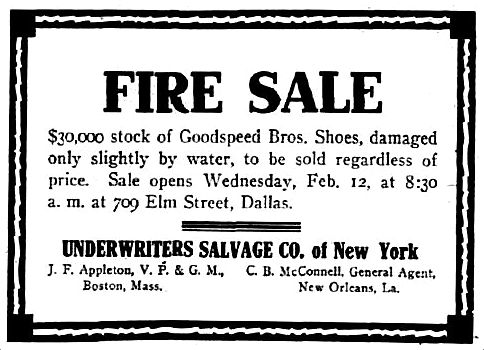
The company’s most famous fire sale (which they were quick to mention in later national advertising) was the huge dispersal of merchandise from the big fire at Neiman-Marcus in 1964. Instead of the usual, somewhat dull, inventories of shoes or boys’ coats or rope (“all sizes”), that sale included Neiman’s eye-poppingly expensive fur coats and other luxury goods (and, I think, every single piece of merchandise in the store that survived), all marked down to bargain basement prices. Now THAT is a fire sale.

*

underwriters-salvage_dmn_0210131913

underwriters-salvage_dmn_0622241924

underwriters-salvage_dmn_0613241924

***

Top photo and text excerpt from a tiny pocket-sized booklet/calendar issued by the Underwriters Salvage Company of New York in 1920, featuring photos of the company’s branches around the United States.

*

Copyright © 2015 Paula Bosse. All Rights Reserved.

Texas Independence Day: The Most Patriotic Bank Ad EVER — 1921

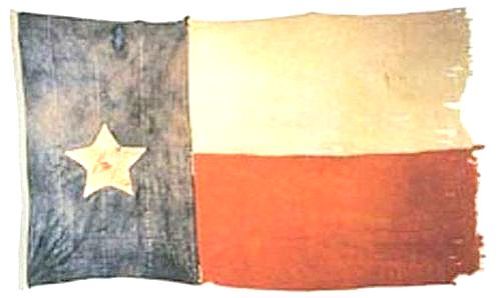
tx-flag

by Paula Bosse

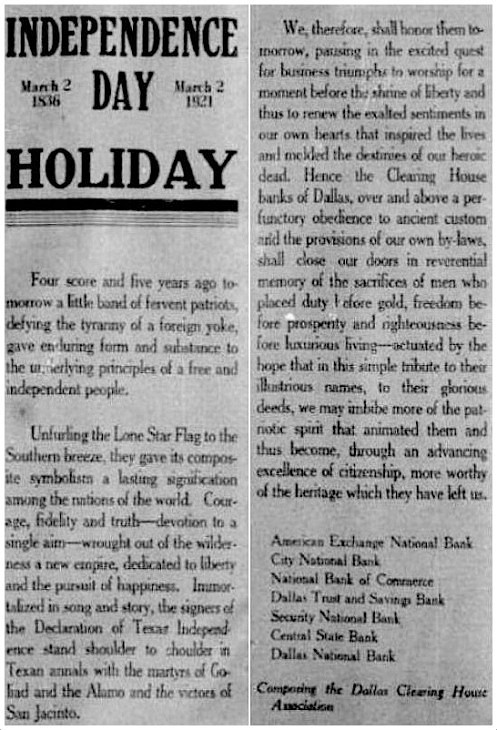
Today is the anniversary of Texas Independence. Below, you will find the most heart-swellingly patriotic bank ad ever penned. Before you plunge in, you might want to get a hanky. (Transcription below.)

tx-independence_ad_dmn_030121Dallas Morning News, March 1, 1921

Four score and five years ago tomorrow a little band of fervent patriots, defying the tyranny of a foreign yoke, gave enduring form and substance to the underlying principles of a free and independent people.

Unfurling the Lone Star Flag to the Southern breeze, they gave its composite symbolism a lasting signification among the nations of the world. Courage, fidelity and truth — devotion to a single aim — wrought out of the wilderness a new empire, dedicated to liberty and the pursuit of happiness. Immortalized in song and story, the signers of the Declaration of Texas Independence stand shoulder to shoulder in Texan annals with the martyrs of Goliad and the Alamo and the victors of San Jacinto.

We, therefore, shall honor them tomorrow, pausing in the excited quest for business triumphs to worship for a moment before the shrine of liberty and thus to renew the exalted sentiments in our own hearts that inspired the lives and melded the destinies of our heroic dead. Hence the Clearing House banks of Dallas, over and above a perfunctory obedience to ancient custom and the provisions of our own by-laws, shall close our doors in reverential memory of the sacrifices of men who placed duty before gold, freedom before prosperity and righteousness before luxurious living — actuated by the hope that in this simple tribute to their illustrious names, to their glorious deeds, we may imbibe more of the patriotic spirit that animated them and thus become, through an advancing excellence of citizenship, more worthy of the heritage which they have left us.

American Exchange National Bank
City National Bank
National Bank of Commerce
Dallas Trust and Savings Bank
Security National Bank
Central State Bank
Dallas National Bank

Composing the Dallas Clearing House Association

*

Remember the Alamo! And remember the men who placed “righteousness before luxurious living”! (Even though that last part’s not exactly a sentiment that Dallas is typically known for….)

*

Copyright © 2015 Paula Bosse. All Rights Reserved.

“Along the Tracks” in the Fair Park Area

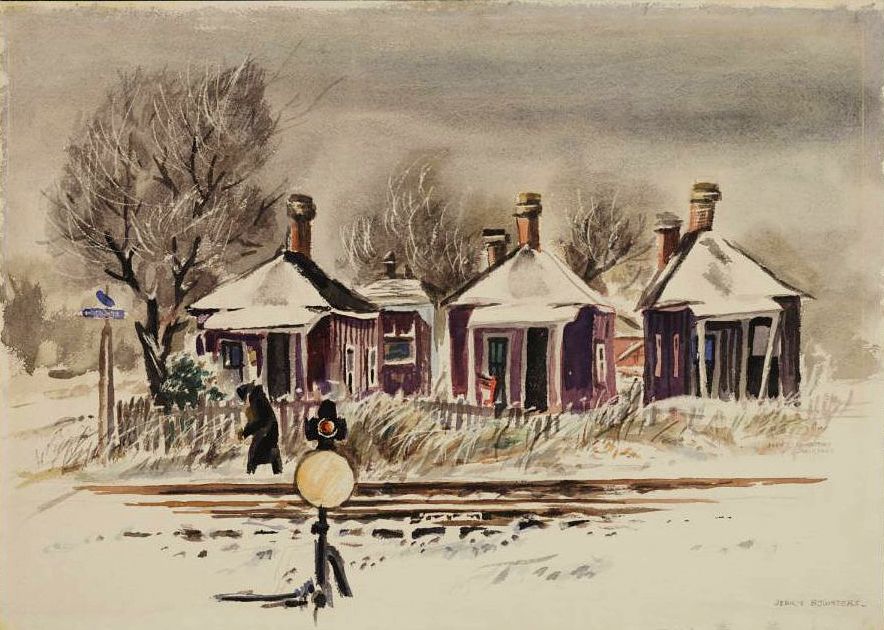
bywaters_along-the-tracks_fair-park_smu_1947“Along the Tracks” by Jerry Bywaters, 1947 (Hamon Arts Lib., SMU)

by Paula Bosse

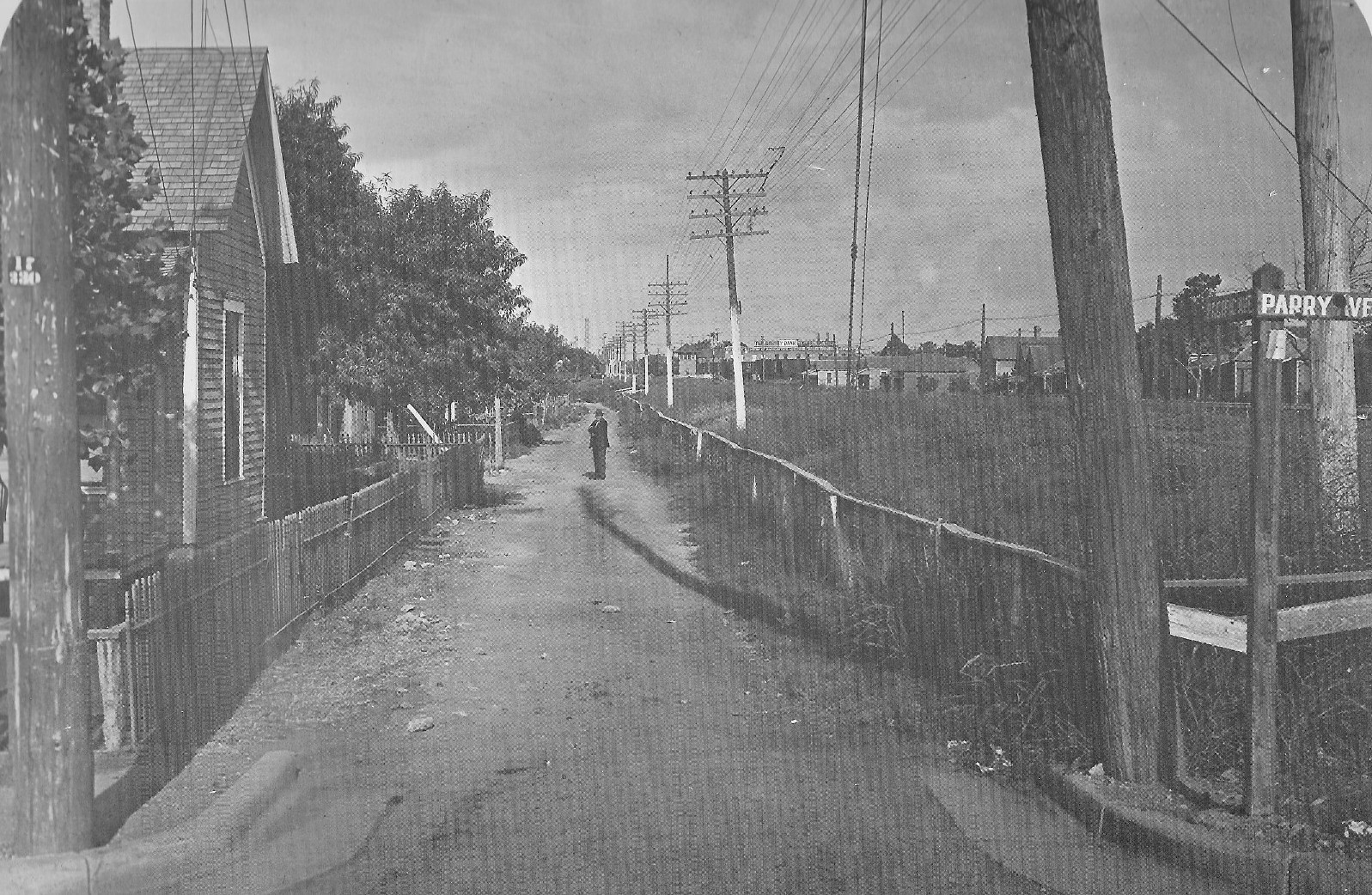
As we’re currently experiencing an extended period of cold, snowy, icy weather, what better time than now to post this atmospheric watercolor by Jerry Bywaters? Titled “Along the Tracks,” it was painted during a very cold and snowy early January of 1947, in the area around Fair Park (where Bywaters worked as the head of the Dallas Museum of Fine Arts). Railroad tracks ran on either side of Fair Park — the Texas & New Orleans tracks ran along Trunk on the west side, and the Texas & Pacific tracks ran along Pacific on the east side. The DMFA was on the very western edge of Fair Park, and as it was bitterly cold, Bywaters probably wasn’t traipsing any farther than he had to — the west side of Fair Park near the T&NO tracks would certainly have been more convenient for him. But I came across a photo that looks pretty much the same as the scene Bywaters painted, only from the T&P side to the east, so who knows?

pacific-parry_ca1916_greene

The photo above (taken around 1916) shows the intersection of Pacific and Parry, looking west on Pacific. “Along the tracks.”

***

Sources & Notes

Jerry Bywaters’ painting “Along the Tracks” is from the Bywaters Special Collections in the Hamon Arts Library at Southern Methodist University; it can be accessed here. As far as I can tell, that street sign doesn’t actually say anything, but if you see something in the scribble, let me know!

The 1916-ish photograph of the Pacific and Parry intersection is from Dallas, The Deciding Years by A. C. Greene (Austin: Encino Press, 1973).

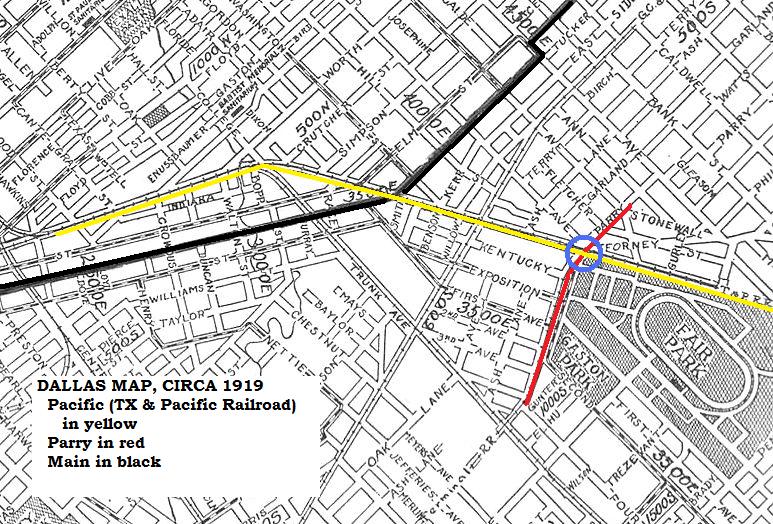
Here is a 1919 map detail showing the area around Fair Park (full map is here):

pacific-parry_1919

When Bywaters painted “Along the Tracks” it was REALLY cold. A couple of photos from the Jan. 1, 1947 edition of The Dallas Morning News show a snow-dusted Cotton Bowl and two very cute Oak Cliff teenage girls ice skating on West Jefferson Blvd.

*

Copyright © 2015 Paula Bosse. All Rights Reserved.

“Dallas in Winter” by Guy Wiggins — ca. 1942

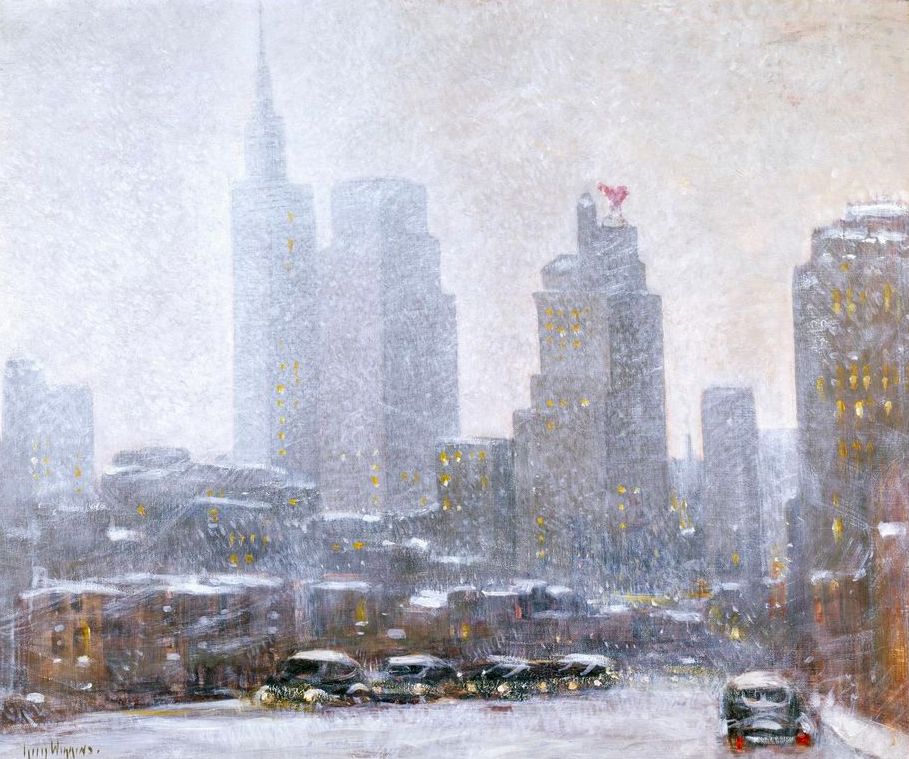
wiggins_dallas-in-winter_c1942_dma“Dallas in Winter” by Guy Carleton Wiggins (Dallas Museum of Art)

by Paula Bosse

A nostalgic look back at a snowy Dallas scene from the 1940s by Guy Wiggins (1893-1962), an artist most remembered for his snow scenes of New York City. Wiggins was apparently quite fond of Dallas and was a frequent visitor, beginning in the 1920s. He had countless gallery shows here over the years, and while in town he’d often present lectures and “master classes” to arts groups and women’s groups. According to articles in local newspapers, Wiggins painted views of the Dallas skyline several times, paintings which no doubt found their way into private collections and are probably still hanging on the walls of local art patrons. In 1952, his daughter and her family moved here, giving Wiggins yet another reason to visit.

The wonderful snow scene above is in the collection of the Dallas Museum of Art; this is the DMA’s description of the painting:

A rare snowstorm in Dallas captured the eye of Guy Carleton Wiggins, who recorded this scene from the downtown vantage point of Live Oak and Pearl streets, showing the skyline’s distinctive historic landmark of the red statue of Pegasus on the Magnolia building.

Although born and raised in the East, where he was affiliated with the artists’ colony in Old Lyme, Connecticut, Wiggins traveled widely throughout the United States during his career. He became known for urban winter scenes such as this one.

***

Sources & Notes

The painting “Dallas in Winter” by Guy Carleton Wiggins is from the Patsy Lacy Griffith Collection, Dallas Museum of Art; it was a bequest of Patsy Lacy Griffith. More information on the painting can be found on the DMA’s website, here.

(Patsy Lacy Griffith was the daughter of oil millionaire Rogers Lacy, who was this close to building the incredible Frank Lloyd Wright-designed hotel downtown. I wrote about it in a previous post, here.)

More on the career of Guy Wiggins, from Wikipedia, here, and from a 2011 New York Times profile of the Wiggins family of painters, here.

Because he visited so often and had many friends here (and because he apparently painted very quickly), Wiggins’ paintings were well represented in private collections in Dallas. (One of his earliest patrons was Miss Ela Hockaday, of the Hockaday School for Girls, who loaned one of her paintings for an exhibit at the Dallas Public Library in 1930.) Among works depicting views of the city were oil studies with the titles “Morning Over Dallas,” “The Akard Canyon,” “Dallas: Morning From Cliff Towers,” and “Dallas Nocturne,” all of which were probably still damp when first shown, as The Dallas Morning News reported that they had been painted “little more than a week ago” before they went on display at the Ed Spillars gallery on Fairmount at the end of December, 1948 (DMN, Dec. 22, 1948). I’d love to see these paintings.

Want “Dallas in Winter” hanging on your walls? Buy the poster from the DMA Shop here. Look at it longingly when it’s 157 degrees in August.

*

Copyright © 2015 Paula Bosse. All Rights Reserved.

“The Fine Black Land Is Around Dallas, Texas”

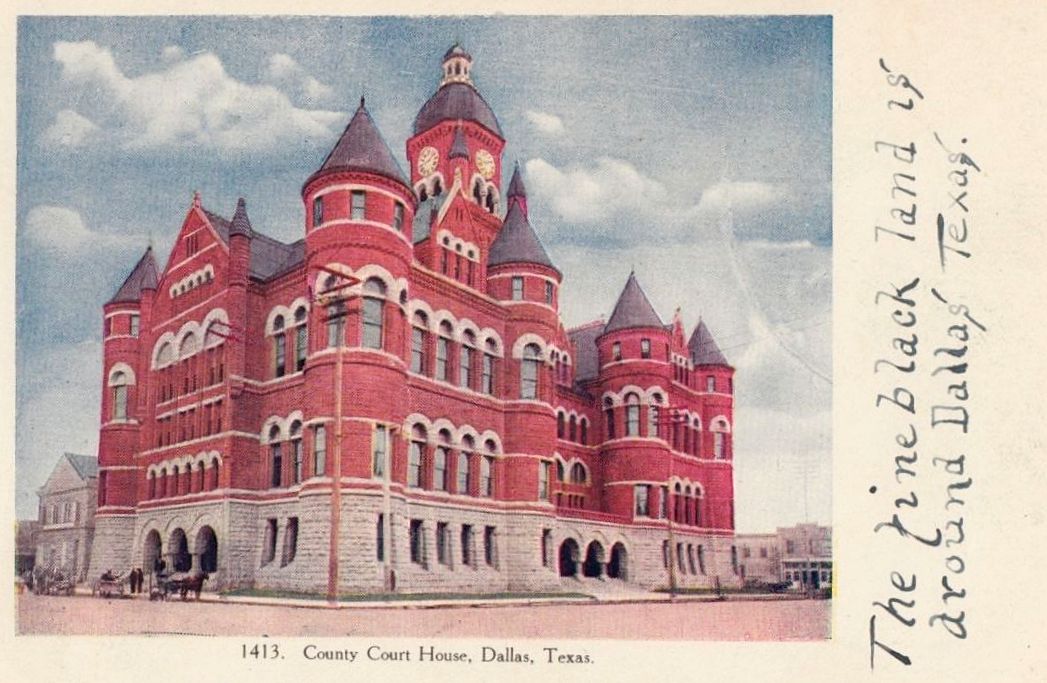
old-red-courthouse_earlyOld Red doesn’t disappoint (click for larger image)

by Paula Bosse

A quick note to the folks back home on an impressive picture postcard.

*

Copyright © 2015 Paula Bosse. All Rights Reserved.

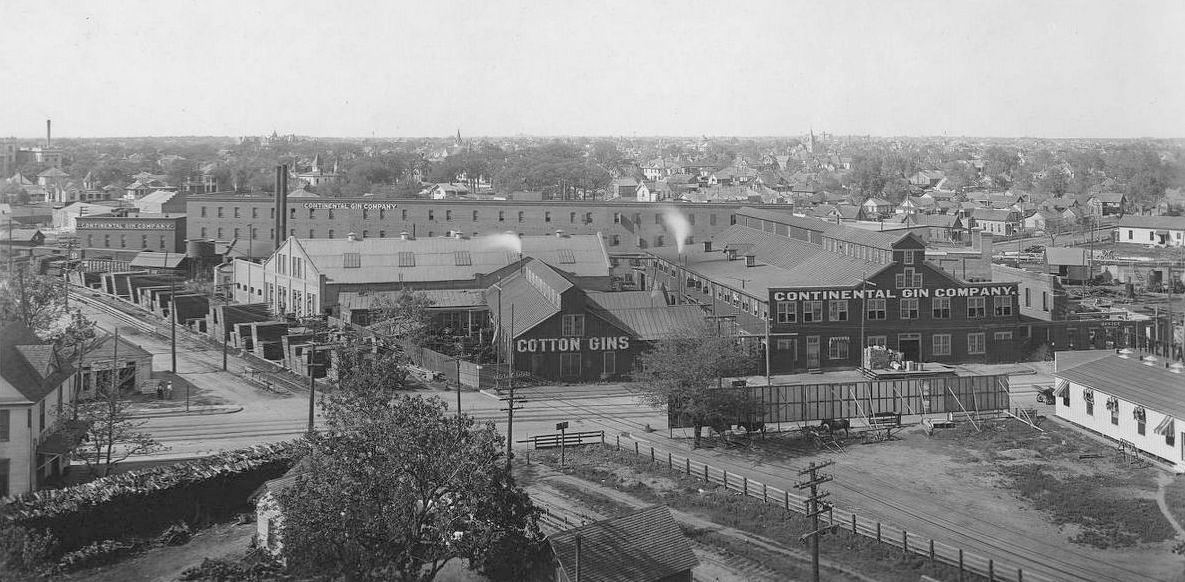
The Continental Gin Complex — 1914

continental-gin-bldg_1914_cook-degolyer-smu-bwPhoto by Chas. Erwin Arnold (DeGolyer Lib., SMU) (click for larger image)

by Paula Bosse

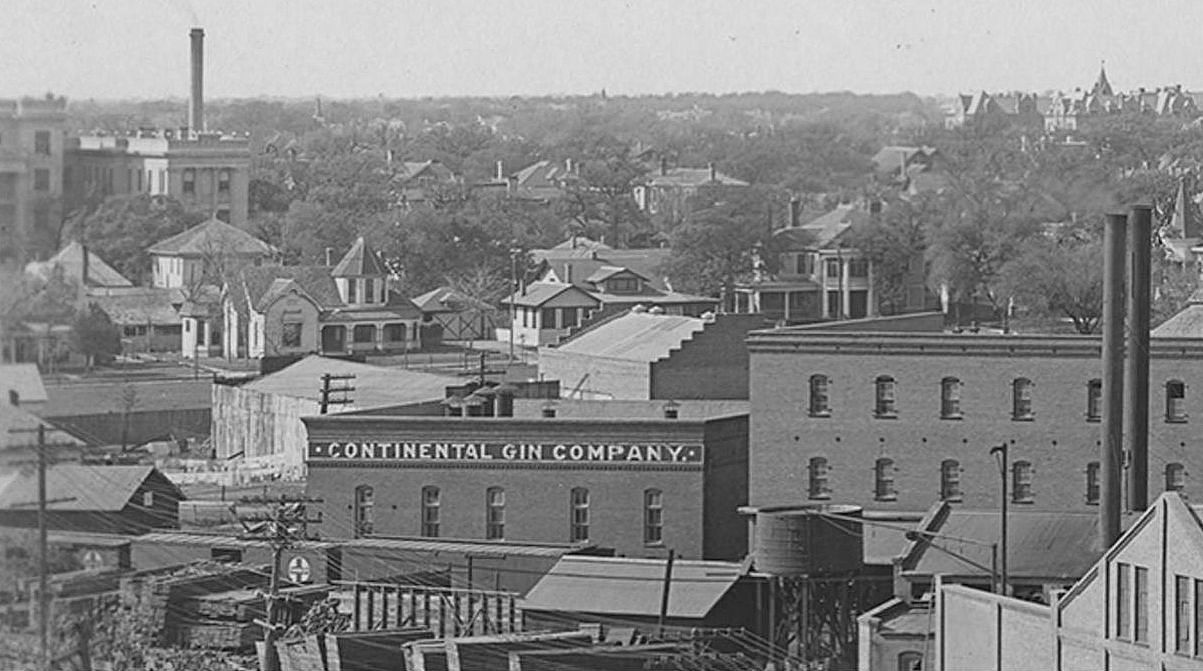
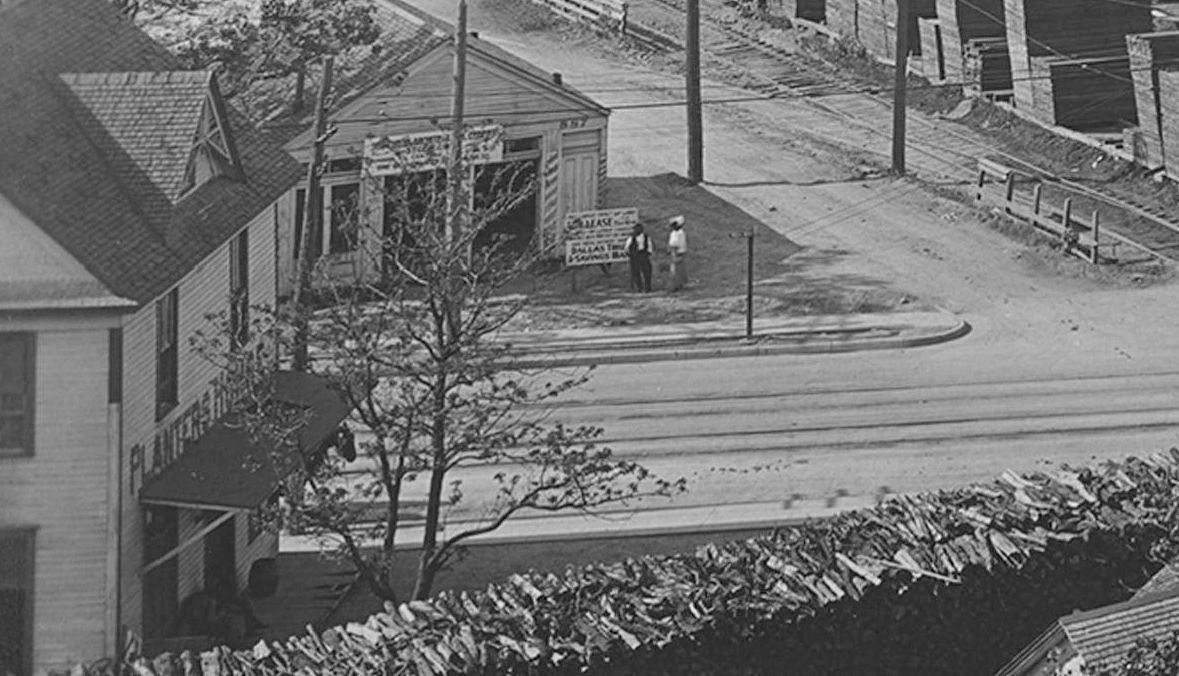
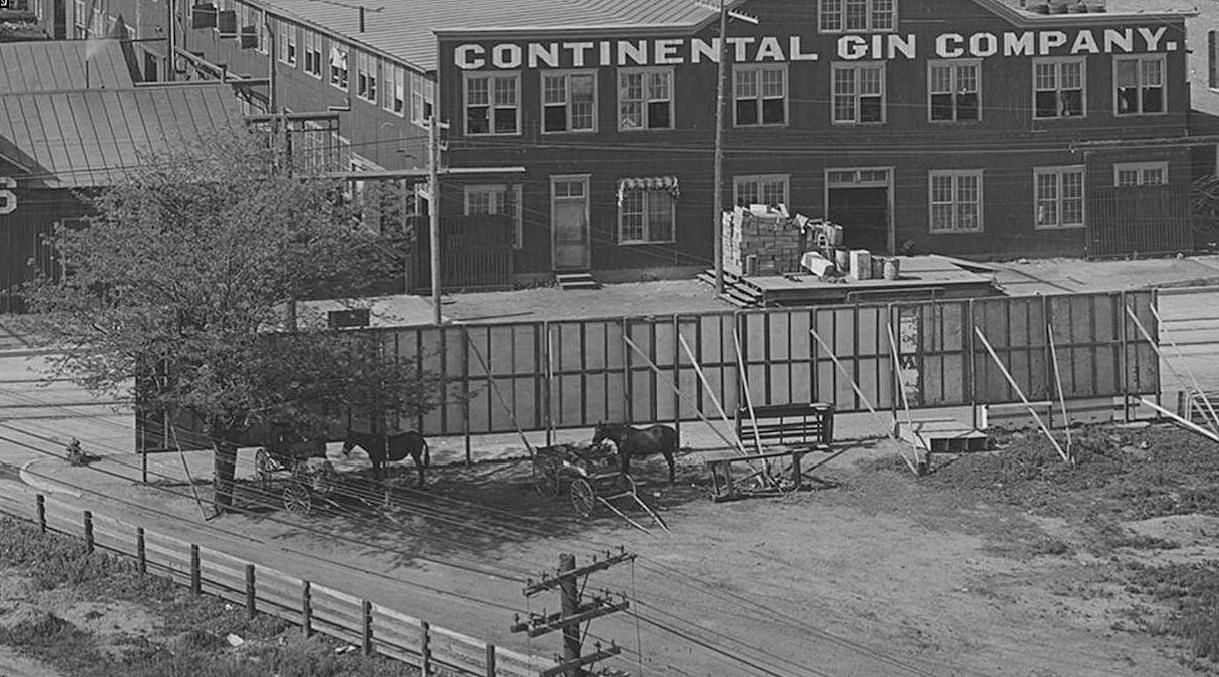
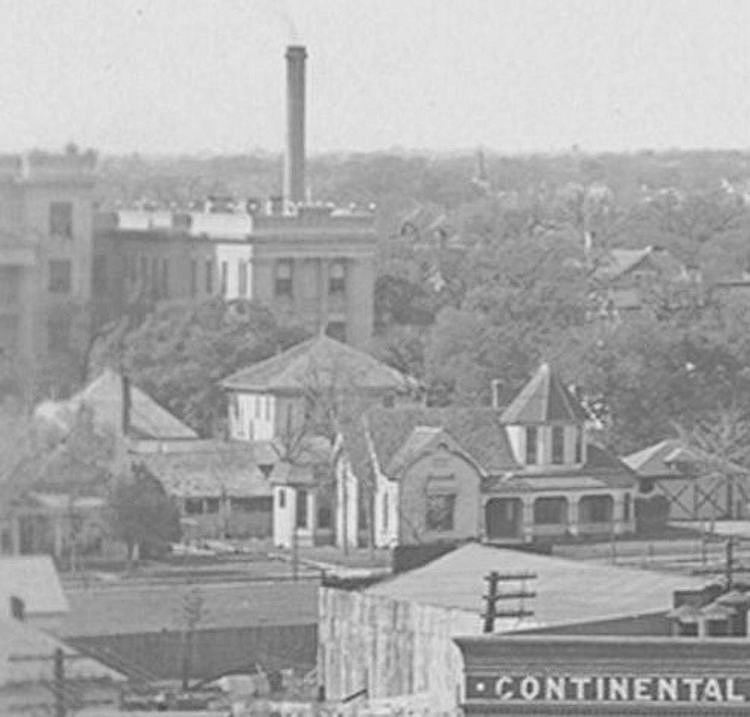
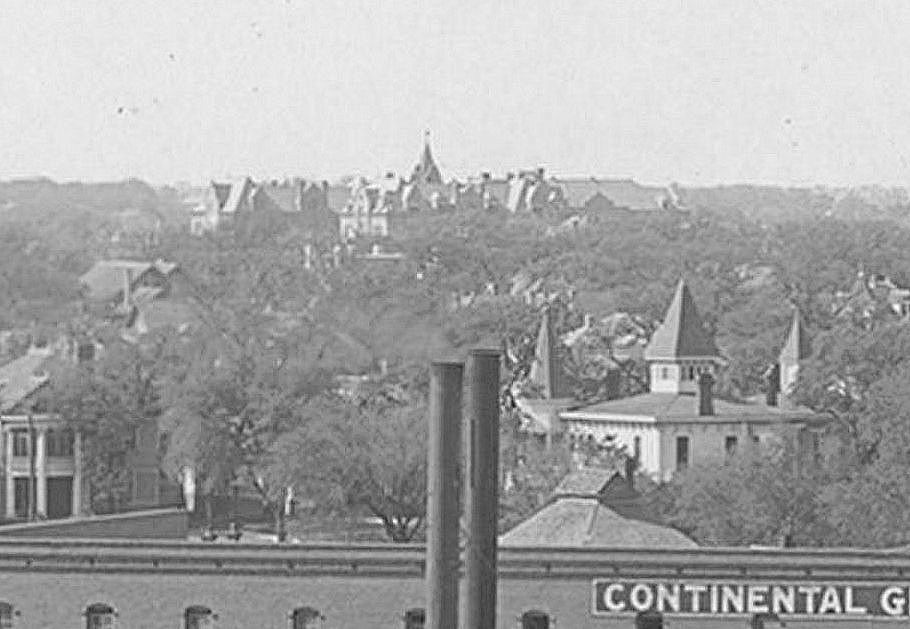
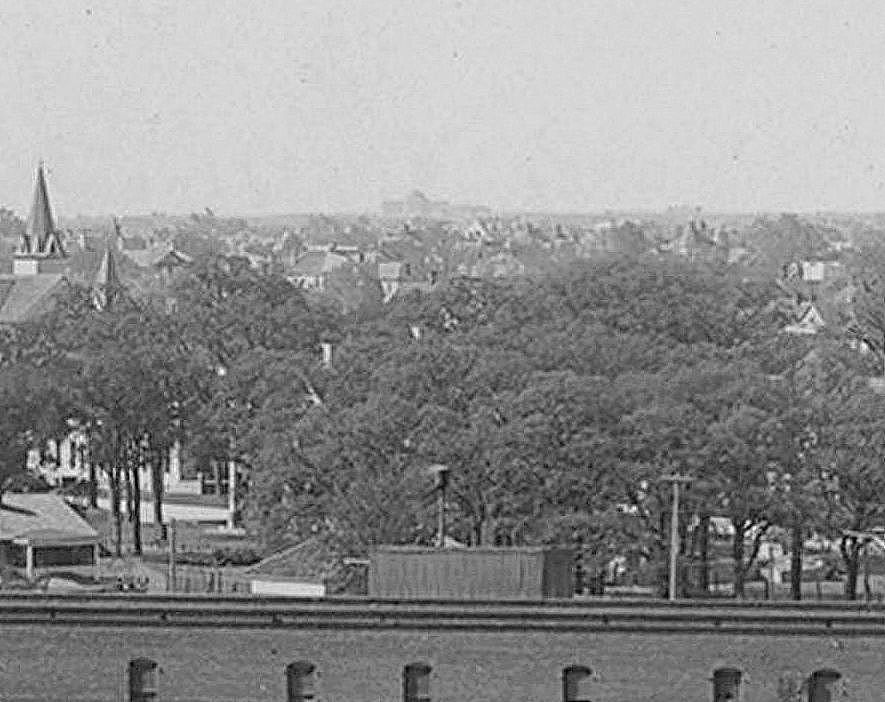
This is a really wonderful view of the Continental Gin Company complex, a Dallas landmark, much of which is, remarkably, still standing in Deep Ellum. Granted, my experience is limited, but I’ve never seen a photograph from this period showing the manufacturing end of Deep Ellum and the residential neighborhood just beyond it to the north. This is another incredible image from the George W. Cook Collection at the DeGolyer Library at SMU. A few magnified details, below. (Click for much larger images.)

continental-gin-bldg_1914_cook-degolyer-det1_bw

continental-gin-bldg_1914_cook-degolyer-det2_bw

continental-gin-bldg_1914_cook-degolyer-det3_bw

And zooming into the distance….

continental-gin_baylor_1914_bwThe back side of Baylor, at the top left. See it from the front here.

continental-gin_ursuline_1914_bwIn the middle at the top, Ursuline. (See more views of it here.)

continental-gin_smu_1914_bwAnd, my favorite, SMU’s Dallas Hall, waaaaaaaaaaaaaay in the distance. SMU hadn’t even officially opened when this photo was taken!

map_1919_continental-gin-bldg1919 map

***

Photograph titled “Continental Gin Company on Elm Street, Facing North” by Charles Erwin Arnold; from the George W. Cook Dallas/Texas Image Collection housed at the DeGolyer Library, Central University Libraries, Southern Methodist University. The photo and its details can be viewed here (I have altered the color in the images seen in this post).

Map detail from a large 1919 Dallas street map (which can be seen via the Portal to Texas History, here).

A view of this area from the 1921 Sanborn maps can be found here (click to make larger). (What’s a Sanborn map? Wikipedia tells you here.)

I wrote at length about the history of the Continental Gin complex of buildings in the post “Munger’s Improved Continental Gin Company,” here.

All images larger when clicked.

*

Copyright © 2015 Paula Bosse. All Rights Reserved.


Carhops as Sex Symbols — 1940

male-car-hops_AP_1940“At your service, ma’am…” / AP Photo

by Paula Bosse

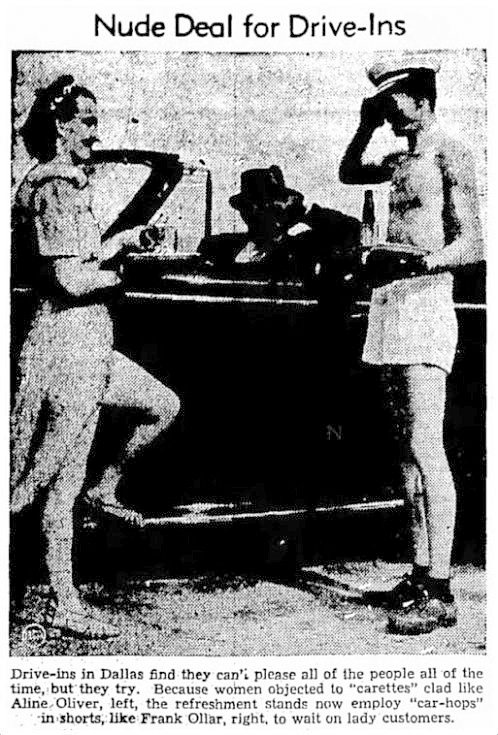
In 1940, Dallas was in a tizzy about the sudden fad of scantily-clad “girl carhops.” This scourge had made its way to Dallas from Houston (brought to Oak Cliff by the enterprising husband and wife team behind Sivils Drive-In), and in April of 1940, it was a newspaper story with, as it were … legs. For a good month or two, stories of sexy carhops were everywhere.

The girls started wearing uniforms with very short skirts — or midriff-baring costumes with cellophane hula skirts. Some of the women reported an increase in tips of $25 or more a week — a ton of money for the time.

The public’s reaction ranged from amusement to outrage. There were reports of community matrons who reported the “indecent” attire to the police department and demanded action. Other women were annoyed by the objectification of young womanhood. Lawmakers in Austin discussed whether the practice of waitresses exposing so much extra skin posed a health risk to consumers.

But it wasn’t until a woman from Oak Cliff piped up that something actually happened. She complained that she didn’t want to look at girls’ legs when she stopped in at her local drive-in — she wanted to look at men’s legs. Drive-in owners thought that was a GREAT idea, and the idea of the scantily-clad male carhop was born.

carhops_FWST_042840Fort Worth Star-Telegram, Apr. 28, 1940 

One might think that the woman behind this “equal ogling” campaign was sort of proto-feminist, until you get to the part where she said that the whole girl carhop thing was “wrong socially and economically and should not be tolerated” (DMN, Apr. 27, 1940) — not because of the skin flashed, but because men needed jobs, not girls. And that also raised hackles. Two married women who had been carhops wrote to the Dallas News to speak up for these girls and women who were “at least coming nearer to making a living wage than at any other time of their existence. […] The girl carhops are either supporting their family or sharing the expenses. […] Why all the storm about a leg? It is nothing more than you see at a movie and a vaudeville” (DMN, May 5, 1940).

The photo at the top ran in newspapers around the country with the headline: “Adonis and Apollo of Roadside Bring Trade to Daring Stand.”

First large roadside stand Friday to bow to the demand of Dallas women and feature husky young male carhops in shorts was the Log Lodge Tavern at Lemmon and Midway where four six-footers found jobs. Above, in blue shorts, white sweatshirt and cowboy boots, Joe Wilcox serves Pauline Taylor who smiles her approval of the idea. Bound for another car is James Smith, at right.

April, 1940 must have been a slow news month, because this story really got around (click to see a larger image).

sexy-carhops_corsicana-daily-sun_042740Corsicana Daily Sun, April 27, 1940

One intrepid reporter even tracked down a Texas Ranger (!) to ask his opinion, to which the Ranger replied, “…letting those roadside glamor boys wear boots is nothing more than a slam at the state. People think of booted Texans as men, not as fancy-panted carhops.” The whole article, below, is pretty amusing.

sexy-carhops_anniston-AL-star_042840Anniston (AL) Star, April 28, 1940

There were other male carhops around town, some not quite so hunky. This guy — game as he was — really needed to reconsider his outfit.

carhops_xenia-ohio-daily-gazette_050340Xenia (Ohio) Daily Gazette, May 3, 1940

But back to the female carhops and their siren-like hold over their male customers. This was, by far, the best story to hit the wires:

sexy-carhops_waxahachie-daily-light_071640
Waxahachie Daily Light,  July 16, 1940

***

Sources & Notes

Top image from the Associated Press, 1940. 

The Log Lodge Tavern was located at 7334 Lemmon Avenue, which was across from Love Field and adjacent to the Log Lodge Tourist Court. It was located approximately where the red circle is below, on a page from the 1952 Mapsco (click for larger image).

lemmon-ave_mapsco-1952

Check out these related articles from The Dallas Morning News:

  • “Skimpiest Costumes Bring Biggest Wages” (DMN, April 24, 1940)
  • “Women To Fight Girl Carhops; Slogan: Let Us See Men’s Legs” (DMN, April 26, 1940)
  • “Adonis and Apollo of Roadside Bring Trade to Daring Stand” (DMN, April 27, 1940)
  • “Word For Carhops Grass Skirts And All” (letter to the editor) (DMN, May 5, 1940)
  • “Went Crazy Over Car Hops, Wife Says of Fugitive” (DMN, July 16, 1940)

UPDATE: This has been a weirdly popular post — it’s gotten thousands and thousands of hits and even resulted in a short radio interview on Dallas’ public radio station, KERA. I don’t really add anything new to this story, but if you’d like to listen to the interview conducted by Justin Martin, it is here.

If you like what you’ve seen on Flashback Dallas, please consider supporting me on Patreon, where for as little as $5 a month, you can receive all-new updates several times a week (if not daily!). More information can be found at Patreon, here.

*

Copyright © 2015 Paula Bosse. All Rights Reserved.

“Everyday Life” on Elm Street — ca. 1905

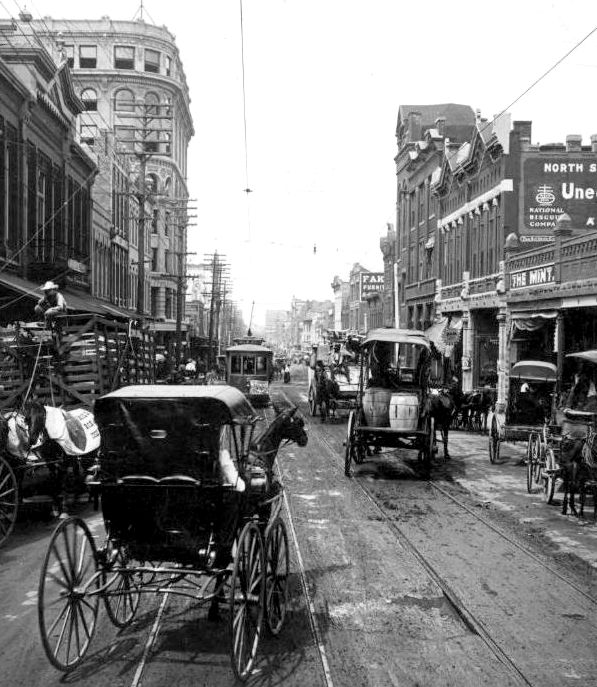
elm-street_everyday-life_UCR-smallElm Street rush hour

by Paula Bosse

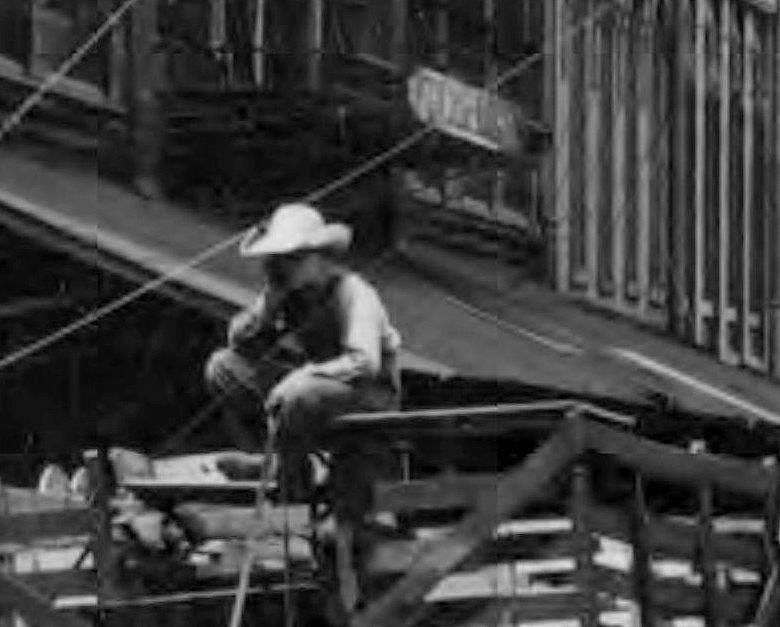
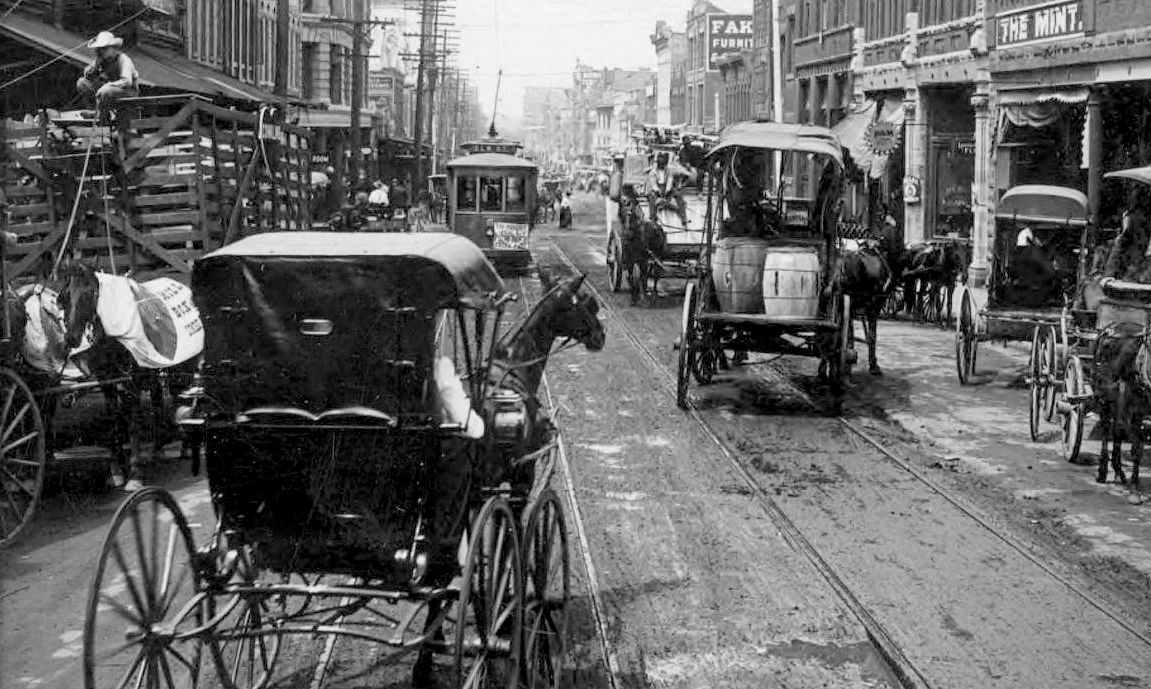
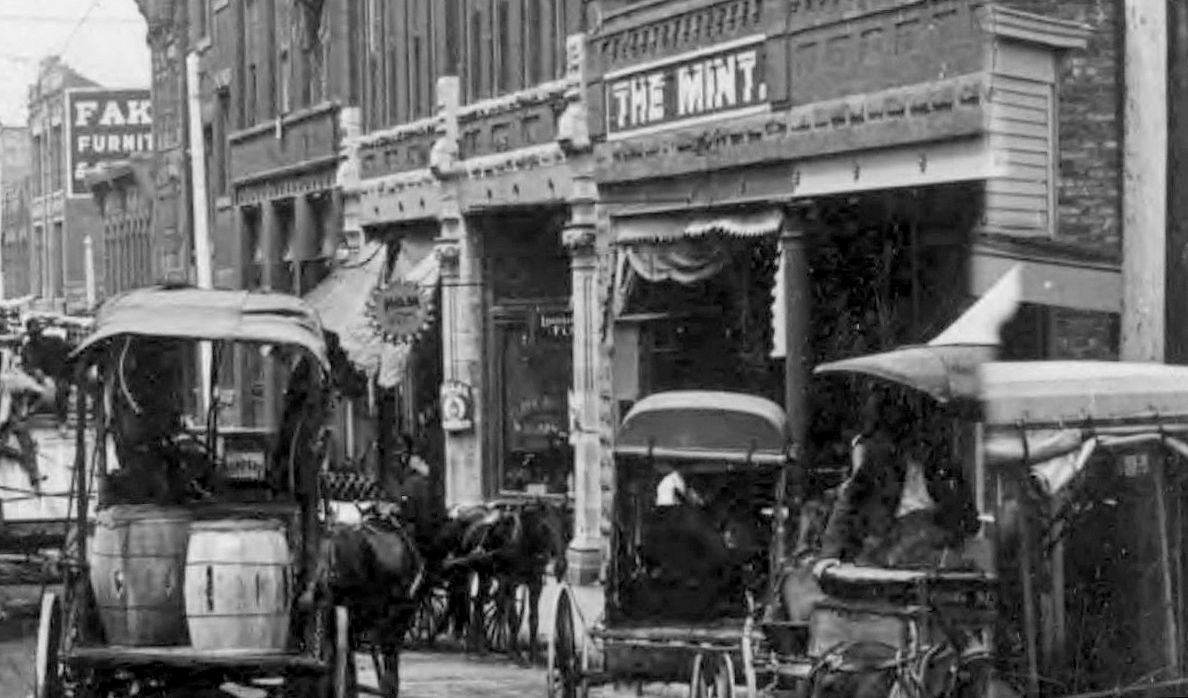
Automobiles would be rolling down Elm Street very soon, but even when the traffic was still mostly horse-related, there’s a lot going on here: horses, buggies, barrels, saloons, a bored kid on a wagon, a street car, and the Wilson Building.

elm-st_everyday-life_UCR-det

elm-st_everyday-life_UCR-zoom(click for larger images)

And what was The Mint? The Mint was a saloon. I’m not sure when it first set up shop in Dallas, but it was listed in an 1877 directory, one of the city’s earliest.

elm-st_everyday-life_mint_UCR

Speaking of 1877, read about a typical frontier day at The Mint in two accounts of a stabbing, from The Dallas Herald in April, 1877, here, and the follow-up, here.

***

Sources & Notes

Photo is from a stereograph titled “Everyday Life, Elm Street, Dallas, Tex.” from the Keystone-Mast Collection, UCR/California Museum of Photography, University of California at Riverside; it can be accessed here.

Images larger when clicked.

*

Copyright © 2015 Paula Bosse. All Rights Reserved.

Mardi Gras: “Our First Attempt at a Carnival Fete” — 1876

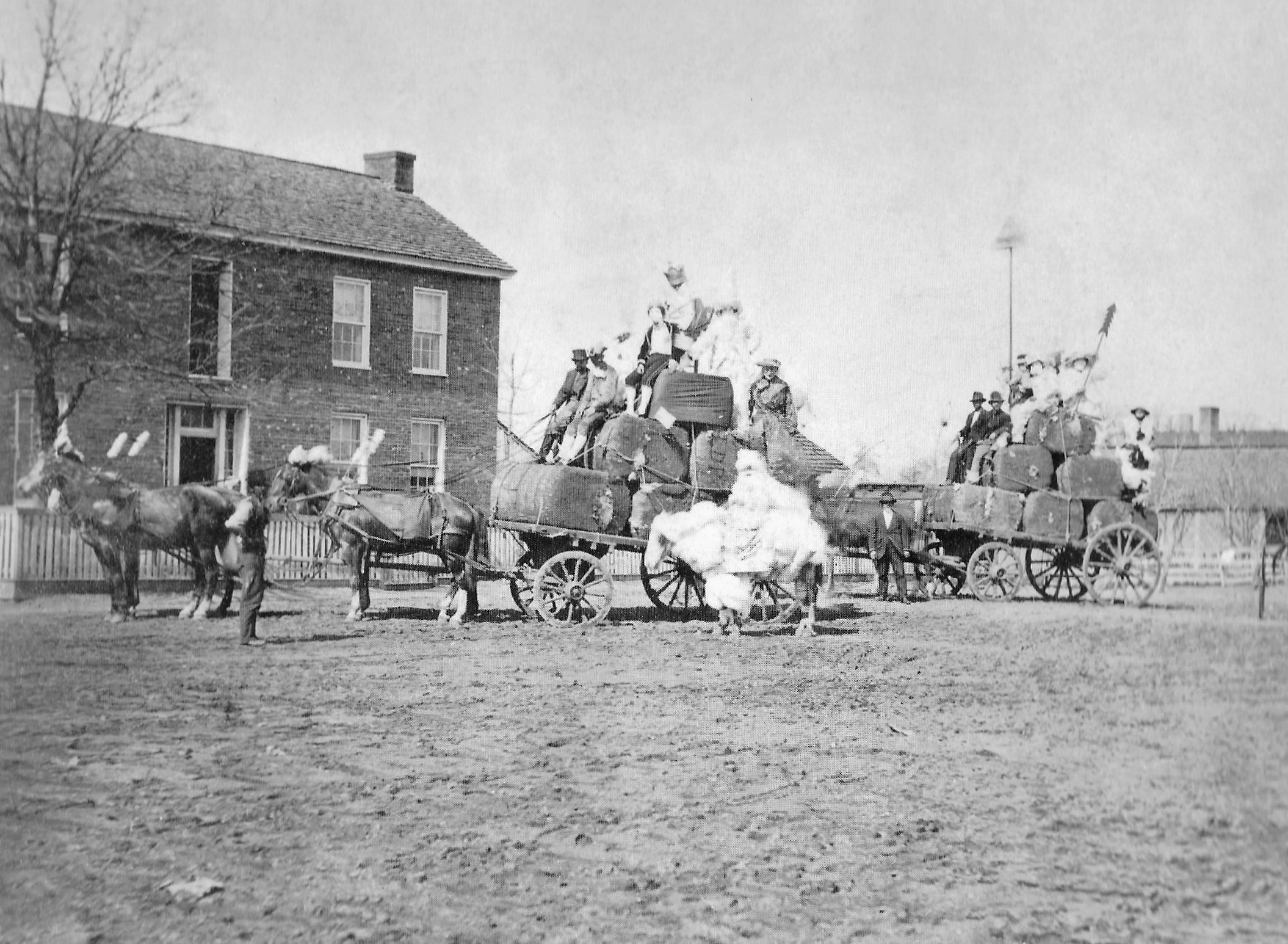
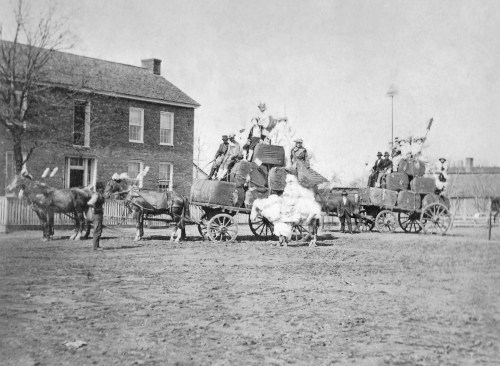
mardi-gras_dhs_1876When cotton was Rex (click for much larger image)

by Paula Bosse

In the 1870s, if a Dallas resident wanted to celebrate the glitzy revelry of Mardi Gras with a parade and balls and didn’t want to travel all the way to New Orleans, the place to go was Galveston. Galveston had a lock on Texas Mardi Gras galas. But Dallas being Dallas, there were soon plans to stage a massive Carnival right here. The day-long celebration debuted on February 24, 1876, which, oddly, was on a Thursday. (Mardi Gras that year was actually on Tuesday, Feb. 29, and it was probably celebrated early in Dallas so as not to interfere with the hey-we-got-here-first celebrations in New Orleans and Galveston.)

It was estimated that the festivities cost the city more than $20,000 (which, if the Inflation Calculator is to be believed, would be the equivalent of almost $450,000 in today’s money). The city was cleaned up in preparation for the anticipated onslaught of visitors and was decorated with flags and bunting along the lengthy parade route of Main, Elm, and Commerce streets. Revelers had elaborate costumes made for the processions and the grand masked balls, some with fabric imported for the occasion from France
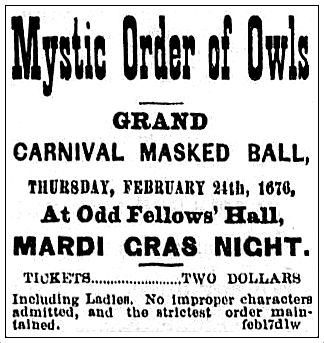
mardi-gras_dal-herald_021876Dallas Herald, Feb. 18, 1876 (not 1676!)

The Dallas Herald and The Dallas Commercial were incessant in their whipping up of excitement for the big day. And it worked. People streamed into town from all over Texas. Hotels were packed, and it was estimated that over 20,000 spectators watched one or both of the day’s parades.

The following day, The Dallas Herald apparently devoted their entire front page to coverage of the event, under this wordy headline:

A Day in Dallas, Our First Attempt at a Carnival Fete. The City Aglow with Enthusiasm and Wild with Rollicking Revelry. Visit of King Momus — His Cordial Reception by the People — The Procession in His Honor. The Season of Merry-Making Brought to a Happy Close with Balls and Bouts — Well Done, Dallas!

(Sadly, this issue is not available online, perhaps because there were none found to scan as it sold out more than five editions and was probably the paper’s best-selling edition to-date.)

Dallas’ first Mardi Gras had been an unqualified triumph, and newspaper editors and city leaders were beside themselves with joy. The parade — and the city — had been covered enthusiastically and favorably by newspapers around the country, and the success of the huge celebration was seen as having been better advertising for the exuberant and growing city than could ever have been hoped.

Galveston? Pffft!

**

A few tidbits from that first Mardi Gras.

There were very few “incidents” reported surrounding the festivities. That’s not to say there weren’t a lot of incidents that occurred that day, just that not a lot of them found their way into the newspapers (apparently whiskey was free-flowing all day long, and one suspects there were “incidents” aplenty connected with that). Among the very few non-“jolly” things that happened on Carnival Day and the day following included the following:

  • A small boy had been run over by a carriage (“but not dangerously hurt”)
  • A child and a horse had been burned severely when a can of gasoline was thrown into a bonfire “to increase the flame”
  • A member of the Stonewall Greys who had participated in the noontime parade had fallen whilst “foolishly scuffling” and had “received a slight but painful wound from a bayonet”

Also, there was some sort of “fireball discharged from a rocket” which caused some consternation:
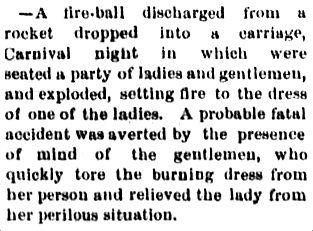
fireball_dal-herald_022676Dallas Herald, Feb. 26, 1876

*

All residences and businesses along the parade route during the evening procession were “commanded” to be illuminated. Even if gasoline-fueled bonfires were raging along the parade route, the elaborate procession was probably poorly lit.

*

My favorite “float” was the huge wagon of lumber meant to draw attention to East Texas timber and the thriving lumber industry in Dallas. One report said “the immense moving forest of pine” was drawn by “32 yoke of oxen” — another said “nearly 100 Texan steers.” Whatever it was, that must have been spectacular to see.
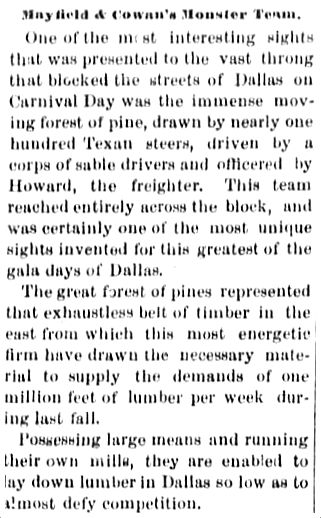
oxen-team_dal-herald_022676Dallas Herald, Feb. 26, 1876

*

The massive amount of publicity and praise that Dallas received quite clearly irked other cities. Austin seemed especially perturbed. There had been a small outbreak of smallpox in McKinney preceding the big day, and several digs at Dallas (like the one below) appeared in newspapers around Texas, accusing the city’s leaders of knowingly endangering the welfare of the entire state just so they could put on their little parade. The exaggerated furor passed fairly quickly, and the het-up schadenfreude expressed by rival cities was amusing.
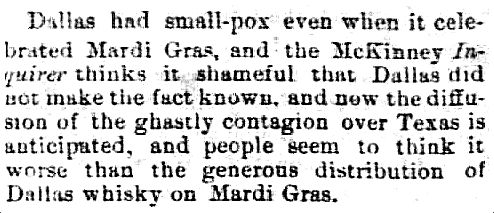
small-pox_austin-weekly-standard_031676Austin Weekly Standard, Mar. 16, 1876

*

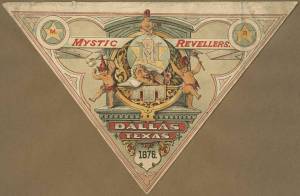
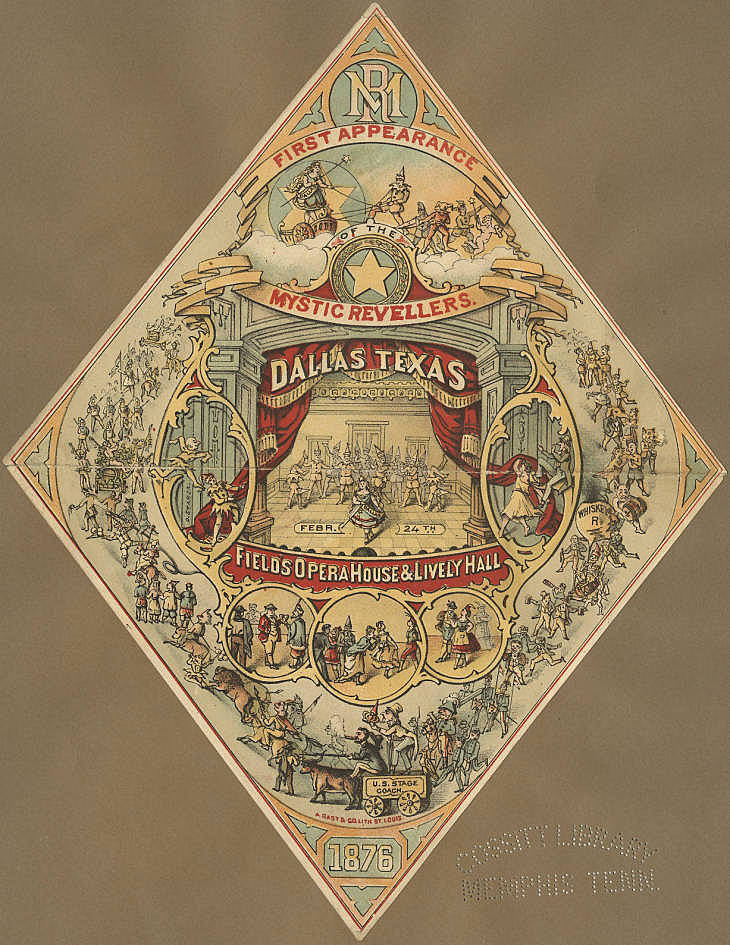
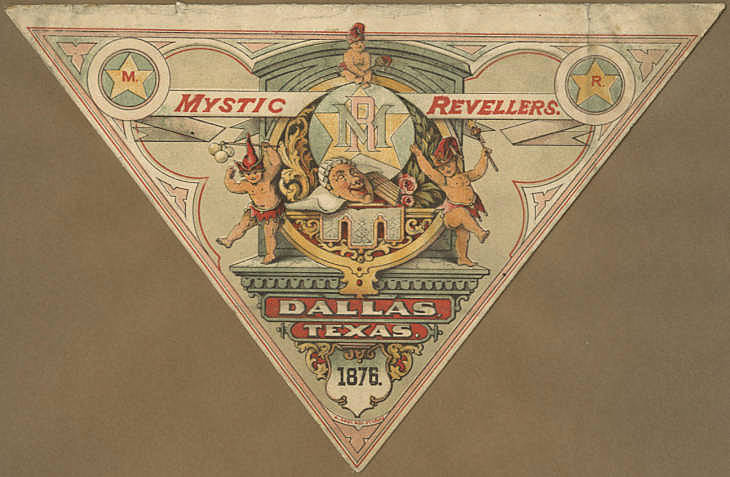
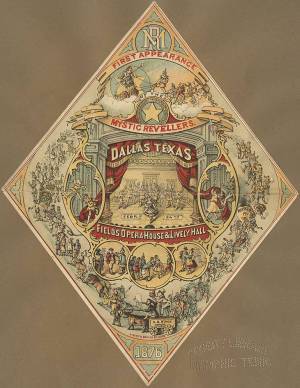
An invitation issued by the Mystic Revellers:
mardi-gras_mystic-revellers_invitation_1876_memphis-public-library

mardi-gras_mystic-revellers_1876_envelope_memphis-public-libraryColton Greene Collection, Memphis Public Libraries

*

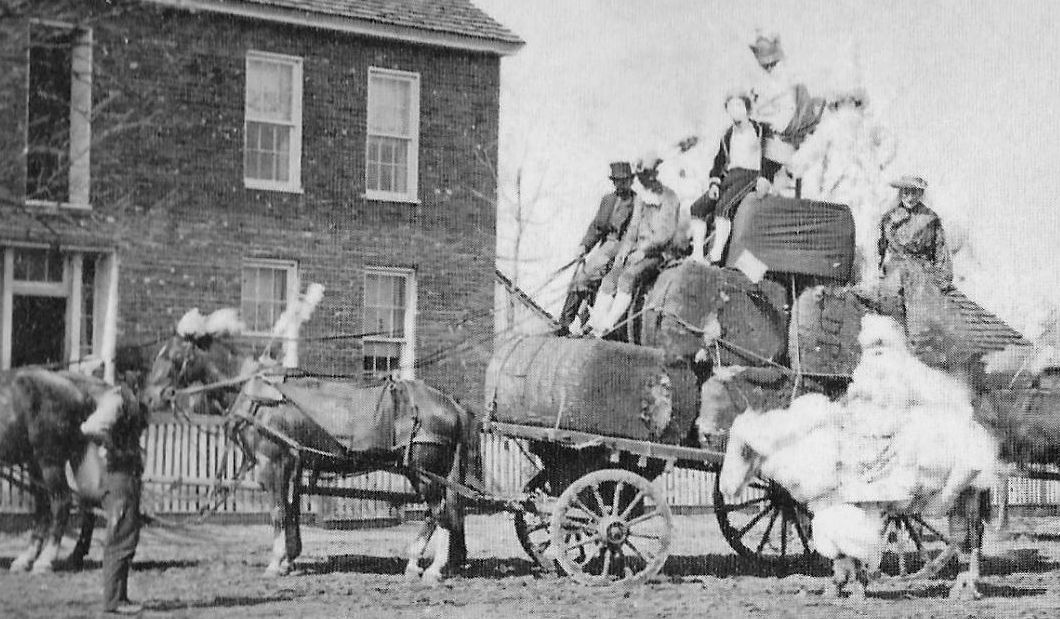
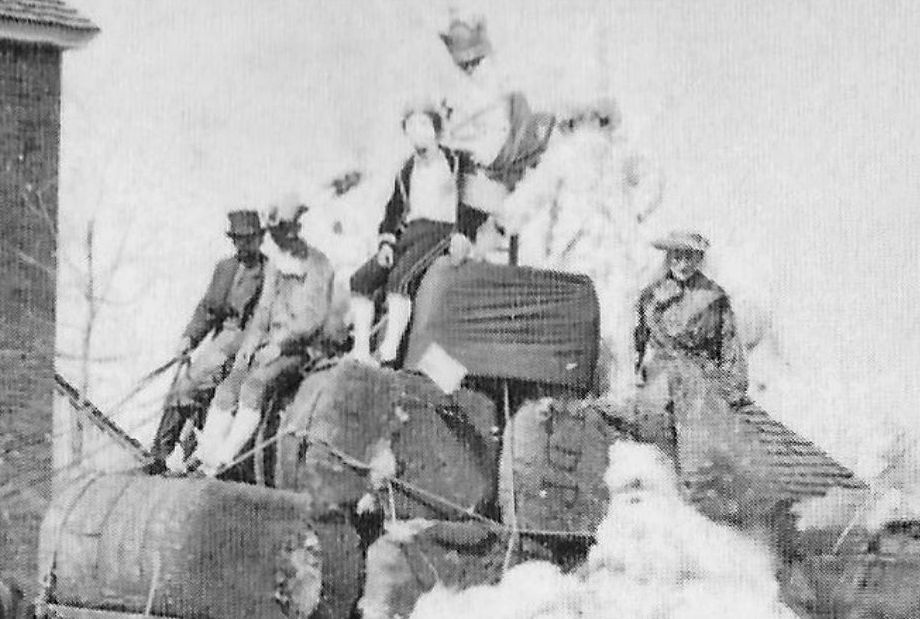
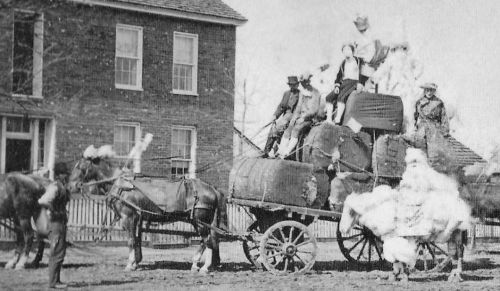
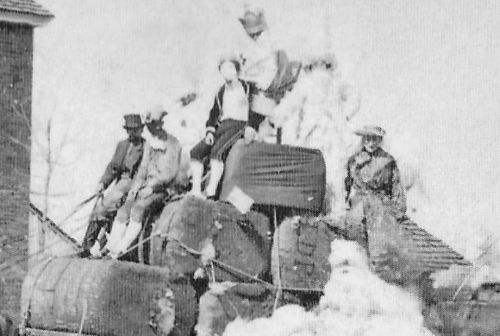
The photo at the top shows the parade wagons representing the brand new Dallas Cotton Exchange (which seems to have been organized the previous month). As described in The Galveston Daily News, the Cotton Exchange’s offering “represent[ed] King Cotton enthroned on six bales of cotton, with numerous subjects appropriately costumed, and occupying two cars” (Feb. 25, 1876). Below are a couple of magnified details of the photo. I’m not sure, but it looks as if the horse and rider in the foreground are covered with cotton. Like tarring and feathering … but fun … and with cotton. The King of Cotton is surrounded by what look like henchmen. The masked man on the right in the elaborate costume is both cool and kind of creepy. (Click both photos for larger images.)
mardi-gras_1876-det1

mardi-gras_1876-det2

***

Sources & Notes

Top photo appeared in the book Historic Photos of Dallas by Michael V. Hazel (Nashville: Turner Publishing Co., 2006); photo from the Dallas Historical Society.

Newspaper clippings as noted.

To read the coverage of Dallas’ Mardi Gras parades and balls —  “a grand pageant and general jollification” — see the front page of The Galveston Daily News (Feb. 25, 1876), here (third column, top of page — zoom controls are on the left side of page).

I wrote a previous post called “Mardi  Gras Parade in Dallas — ca. 1876” which features a photograph which might be from this first Mardi Gras. That post and photo can be seen here.

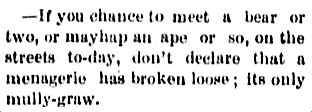
Happy Mardi Gras!
mully-graw_dal-herald_022476Dallas Herald, Feb. 24, 1876

Photos larger when clicked.

*

Copyright © 2015 Paula Bosse. All Rights Reserved.

Roseland — 1916

roseland_terrill-yrbk_1916The Roseland Theater, 1613 Main St. (click for larger image)

by Paula Bosse

Despite its grainy quality, I really like this photo. It shows people walking past the Roseland Theater at 1613 Main Street, a theater I’d never heard of. I couldn’t find out much about it other than that it doesn’t seem to have lasted very long (from at least 1914 until at least 1916). It was owned/managed by P. G. Cameron, who ran several theaters and was in the general “amusements” business around town (he had run the Fair Grounds Skating Rink back in the aughts for a short while, until the place was shut down because of the discovery of a prostitution operation being conducted there … on city-owned property).

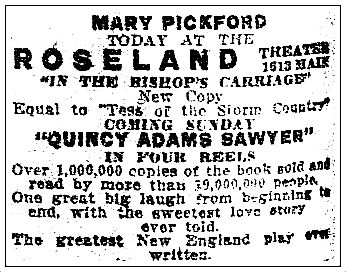
roseland_dmn_050914Dallas Morning News, May 9, 1914

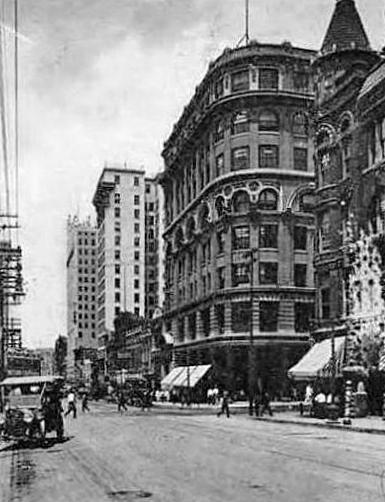
In 1916, the north side of Main Street contained three theaters: the Nickelodeon (1607 Main), the Roseland (1613 Main), and the Best (1615 Main). This is the much-beleaguered (and now mostly demolished) block of Main, which in 1916 was anchored by the dazzling Praetorian and Wilson buildings. The Roseland occupied part of what was once the Everts Jewelers building. Below, another view of this block in 1916, with the theater(s) on the right, about halfway between the tall white Praetorian Building and the stately rounded Wilson Building.

main-st_1916_smu-rotunda_sm Another grainy photo, Main looking west

I like this Roseland photo because it’s a candid shot taken by a teenager on the sidewalk of a lively downtown Dallas who had happened upon his teacher away from school. And the sign is cool. Too bad it’s so hard to see.

roseland_terrill-yrbk_1916_det

***

Sources & Notes

Photo from the 1916 Terrillian, the Terrill School yearbook. (The caption for the photo of one of the school’s teachers: “Passing by or coming out, Mr. F.?”)

Photo of Main Street, looking west, from the 1916 Rotunda, the yearbook of SMU.

See what the 1600 block of Main looked like in 1909, here. Much of the block has been demolished.

See the 1921 Sanborn map showing this block, here.

Below, a recent (2015) Google Street View of the building that housed the Roseland: the really lovely shorter white building. This building may already have been razed. What a shame. (UPDATE — 2018: Yep, demolished.) The current view (as I assume this block is ever-changing) can be seen on Google Street View here.

roseland_google2015, not long for this world….

*

Copyright © 2015 Paula Bosse. All Rights Reserved.