Flashback : Dallas

A Miscellany: History, Ads, Pop Culture

Tag: Dallas TX

East on Elm

elm-street_gentrys_city-of-dallas-websiteShouldn’t there be cars?

by Paula Bosse

There has been some heavy-duty editing to this post!

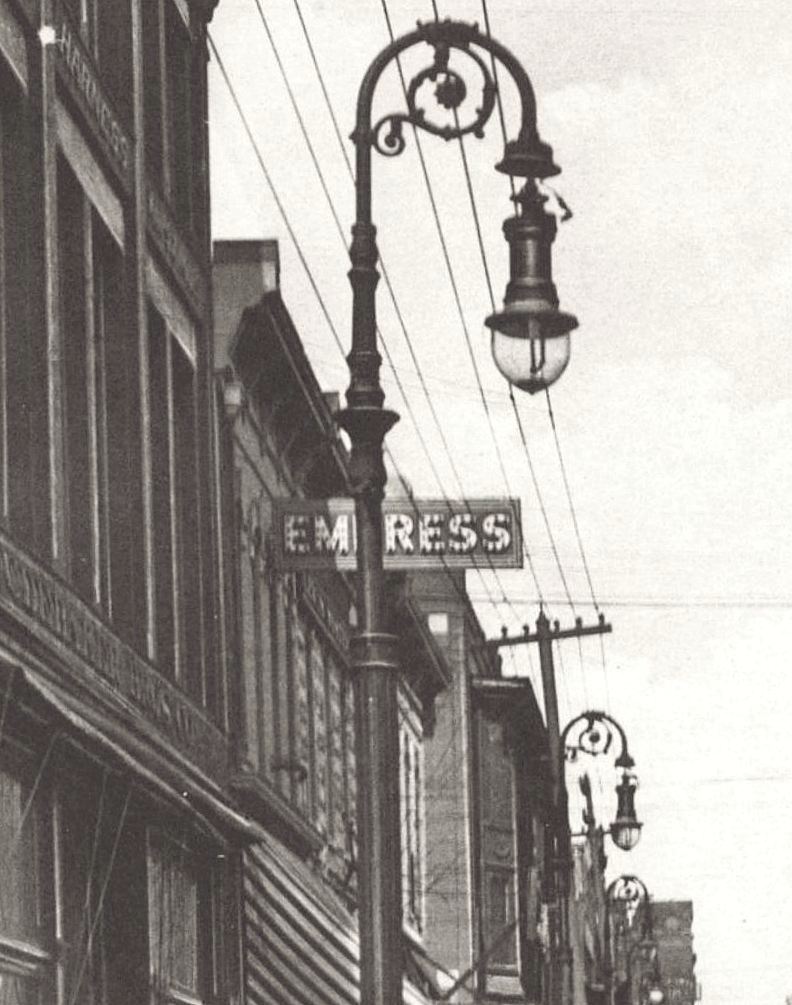
Here’s an interesting photo I stumbled across last night on the City of Dallas website. There wasn’t any information about it, but it appears to be a view to the east, taken from the 1400 block of Elm Street (where Exchange Place — originally Scollard Court — intersects). See what it looks like today on Google Street View here.

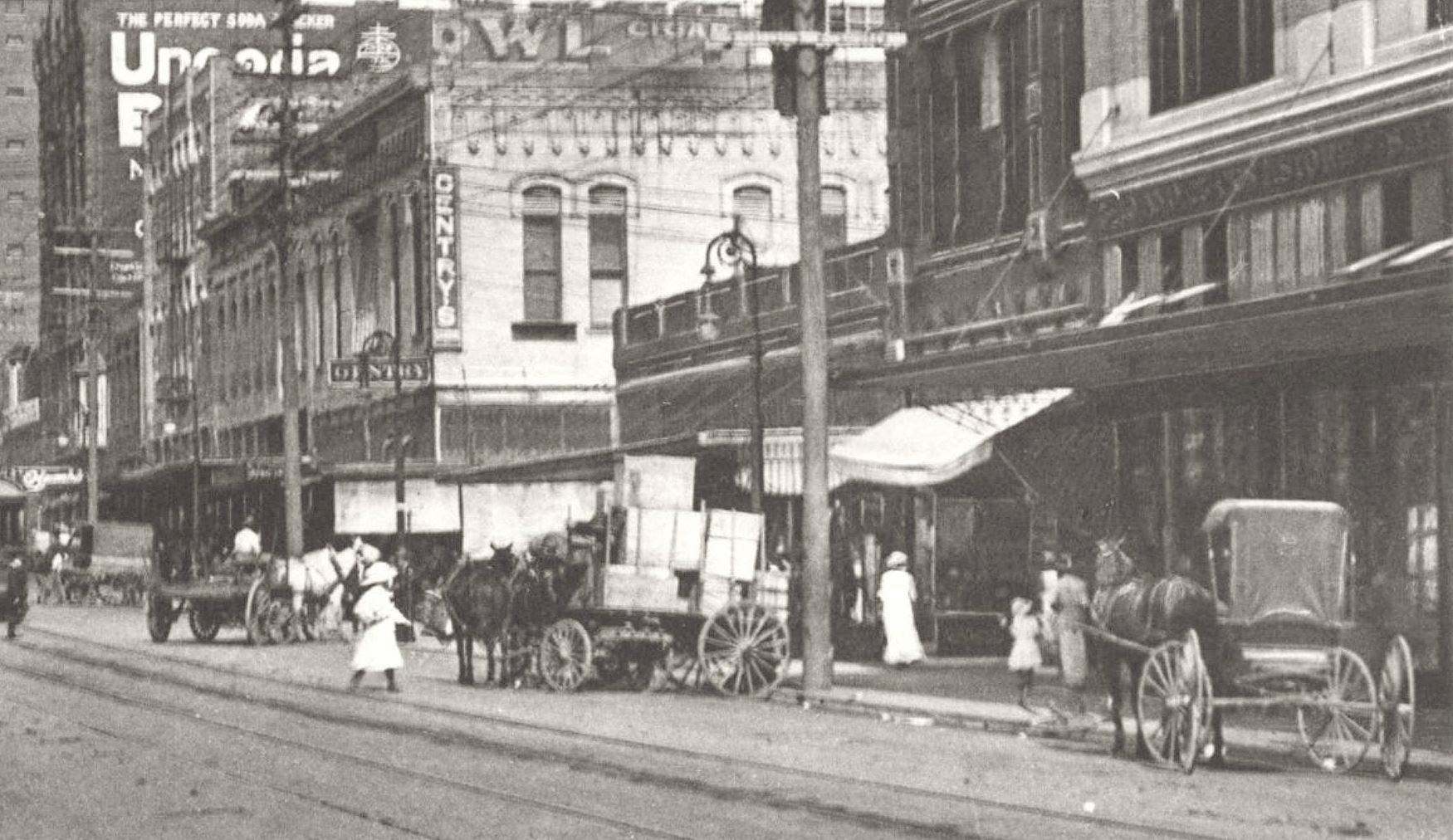
The main landmarks are what I call the Wilson Building Jr. (the tall dark building in the distance, located on Elm near Ervay), the Praetorian Building (the tall white building at the right, at Main and Stone), and L. W. Gentry’s photography studio in the middle of the photo at the right.

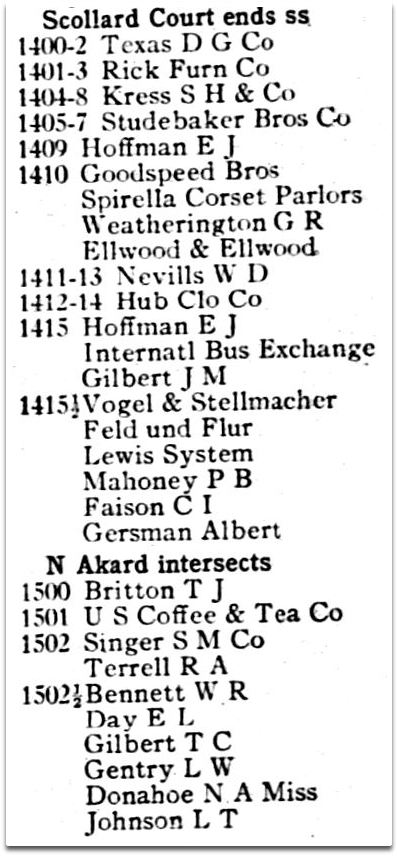
Gentry’s was upstairs at 1304 Elm from about 1904 until about 1911. In 1912, Gentry moved a block down the street to 1502 Elm, at Akard, where he took over the upstairs studio of photographer J. C. Deane. (I wrote about Deane and this building here.)

There is a sign reading “Empress” at the left. That was the Empress Theatre, which was at 1409 Elm from about 1912 to 1915. Directly across the street is a 3-story building with a sign for the Spirella Corset Parlors at 1410 Elm.

Back to the left, across the street, is the hard-to-read sign for Studebaker Bros. of Texas at 1405 Elm. Directly across the street is the new Kress Building (you can see part of the distinctive “K” from the company’s logo at the top right). Kress was at 1404-8 Elm — the building was erected in 1911 and opened that same year in November.

The “new Wilson Building” was also built in 1911, and Gentry’s took over the space above T. J. Britton’s store at Elm and Akard in 1912. And all these places appeared in the 1912 directory (except for the Empress, which was open in 1912 but might not have made the listing deadline). So I’m going to guess that this photo is from 1912 or 1913.

gentry_1912-directory_1502-ELM1912 Dallas directory, Elm Street

But this photo looks older than 1912. So many horses! The only vehicle not pulled by a horse in this photo is the streetcar. Where are the cars? In 1911, Dallas was pretty car-crazy — you’d expect to see at least ONE horseless carriage in there somewhere. It doesn’t sound like a lot, but in 1911, there were about one thousand automobiles registered in Dallas County, and the city was quickly becoming a major distribution hub for car companies (“Dallas Automobile Center of the Southwest,” Dallas Morning News, Dec. 31, 1911). (Check out this photo from 1911 taken a couple of blocks away. The only animals seen are actually riding IN an automobile!) Were cars banned from Elm Street? Seems unlikely. …I’m pretty sure I’m overthinking this.

(Ironically enough, the full entry for Studebaker Bros. which appears in the 1912 directory reads: “Carriages, wagons, buggies, street sprinklers, harness.” Nary a mention of an automobile. That arrived the following year.)

It might just be that I’ve had a very stressful couple of weeks, and it was really late when I originally wrote this. But I’ve had a refreshing night’s sleep, and I’m still fixating on this car thing. (Shouldn’t there be cars on Elm Street in 1912?) So I’m just going to stop looking at this photo, assume that it was snapped when all cars in the area were just out of frame, and wrap this thing up.

**

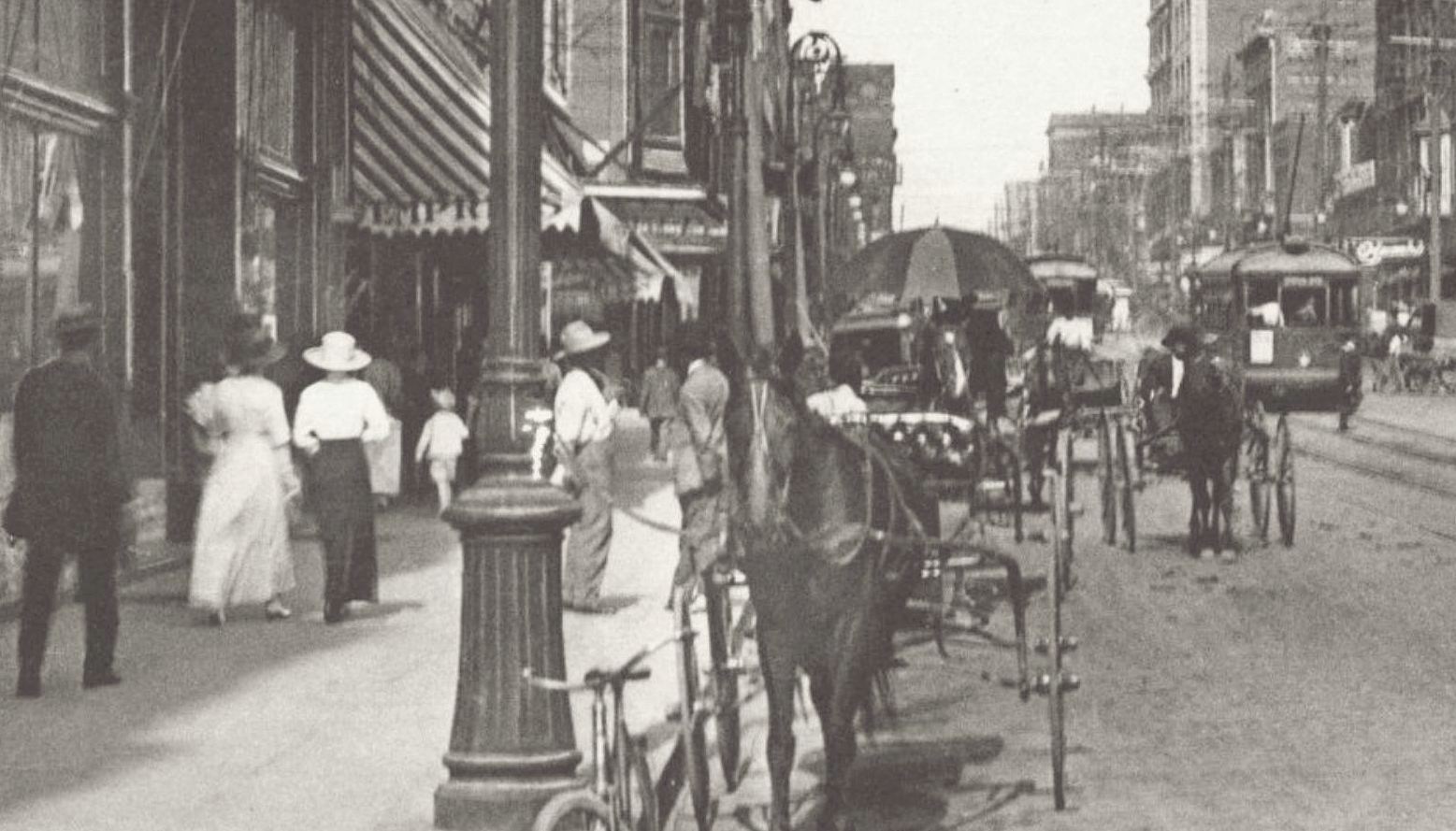
Here are a few zoomed-in details.

elm-street_gentrys_city-of-dallas-website_det1

elm-street_gentrys_city-of-dallas-website_det2

elm-street_gentrys_city-of-dallas-website_det3

I love these decorative lamp posts (more examples can be seen in a post I really enjoyed writing, “The Grand Elm Street Illumination — 1911”).

***

Sources & Notes

Photo found on the City of Dallas website, here (banner photo).

I have edited this after seeing the reader comment below. I realized that I was basing the original location on Lemuel W. Gentry’s first studio, which was a block or two west from the one seen in the photo. (I kept saying to myself, “That building looks so much like the one the Deane studio was in.” Because… it was the exact same building!) Thanks, NotBob.

Here’s a closer shot of Gentry’s studio around 1915 — on the southeast corner of Elm and Akard, right across the street from the new Queen Theatre. (This photo originally appeared in this post.)

queen_cinema-treasures

NOW we see cars!

elm-street_gentrys_city-of-dallas-website_sm

*

Copyright © 2022 Paula Bosse. All Rights Reserved.

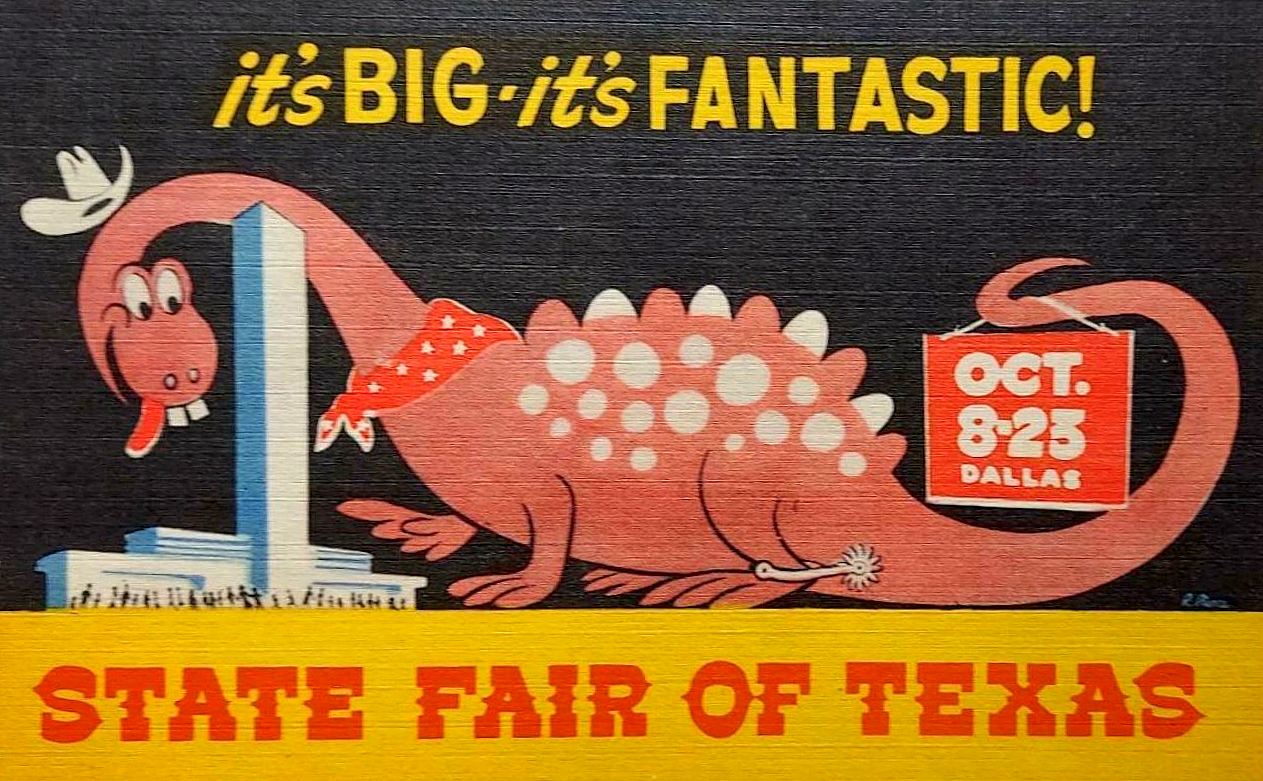
“It’s Big, It’s Fantastic!” — State Fair of Texas, 1949

sfot_1949_ebay_aWhen dinosaurs roamed Fair Park…

by Paula Bosse

Uh, hmm. Let’s see….

Dinosaur? Check.

Wearing a cowboy hat? Check.

Wearing a bandana? Check.

Wearing spurs? (!) Check.

With buck teeth? Check.

Looming over an art deco building? Check.

It must be time for the fair!

***

Sources & Notes

Postcard found on eBay.

sfot_1949_ebay_a_sm

*

Copyright © 2022 Paula Bosse. All Rights Reserved.

Pacific Avenue Warehouse District

pacific-warehouse-district_ebayLooking west on Pacific, from about Good Street

by Paula Bosse

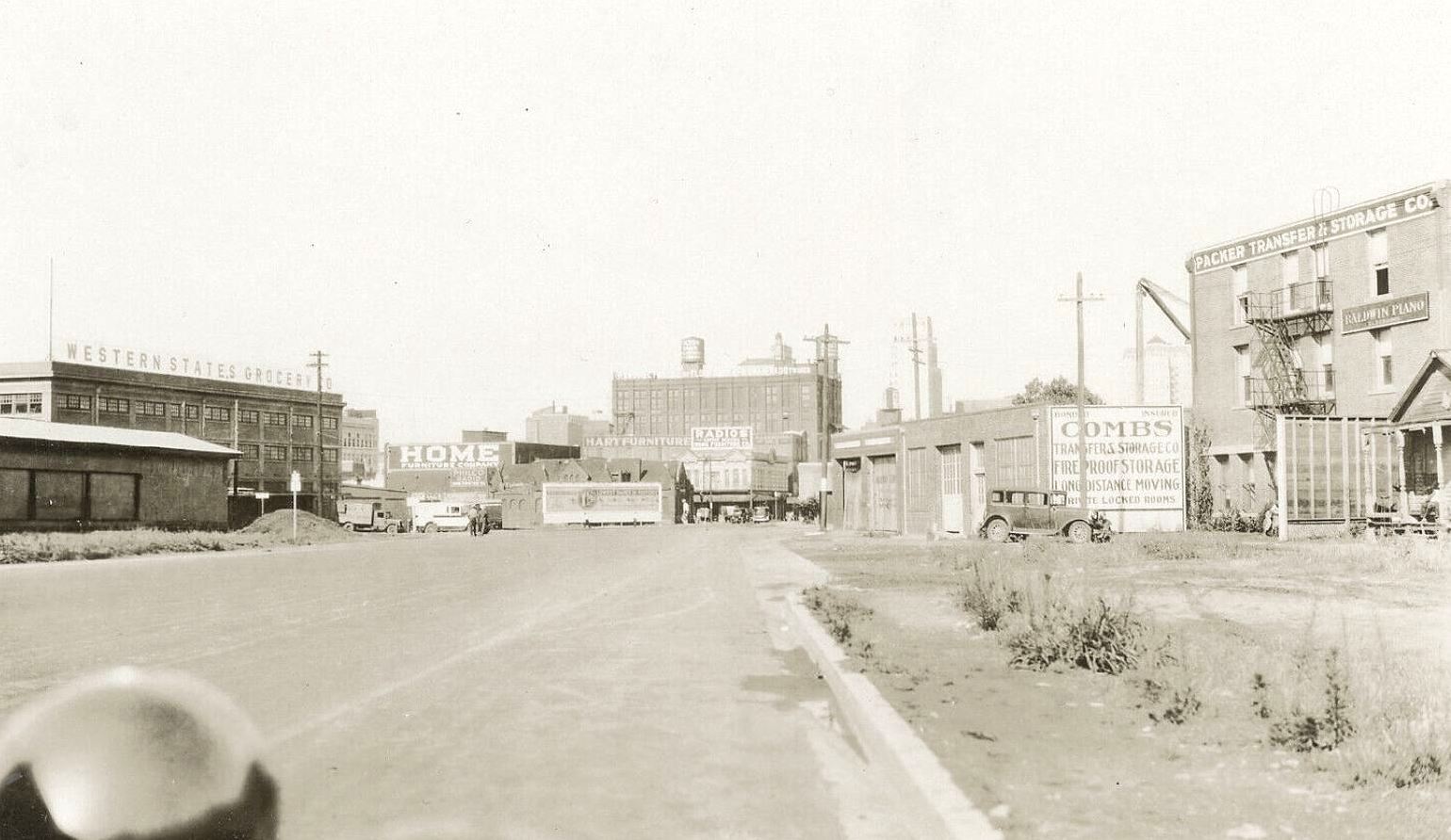
Wandering around the eBay “sold” archives, I came across this unusual photo taken in a not terribly scenic part of town. After checking addresses of these businesses in the 1932 city directory, it looks like the photographer (who appears to have been seated in a car) snapped this shot on N. Pacific Avenue, a block or so west from Good Street (now Good-Latimer). Deep Ellum-adjacent. The view is southwesterly, toward downtown. The businesses are mostly warehouses. See what this view looks like today, 90 years or so later, via Google Street View, here.

I was excited to see two familiar 19th-century buildings which I’ve written about and feel a weird kinship with: the abandoned and shuttered old Union Depot (which I wrote about here) and the Union Depot Hotel (which I wrote about here) — located about where Pacific takes a slight jog to the right. It’s like seeing old friends.

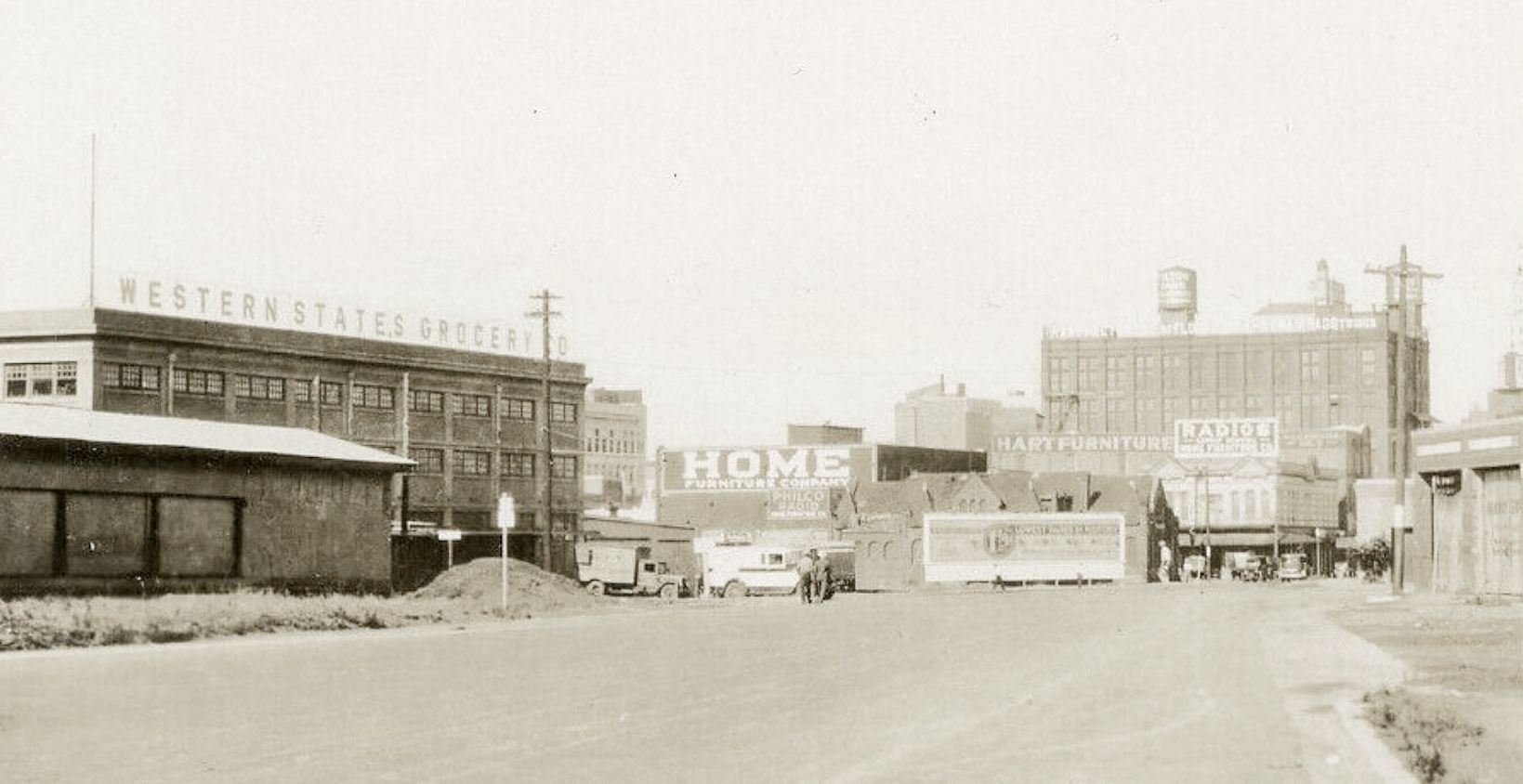
Here are some rather grainy magnifications of the eBay “snapshot” (click to see larger images).

*

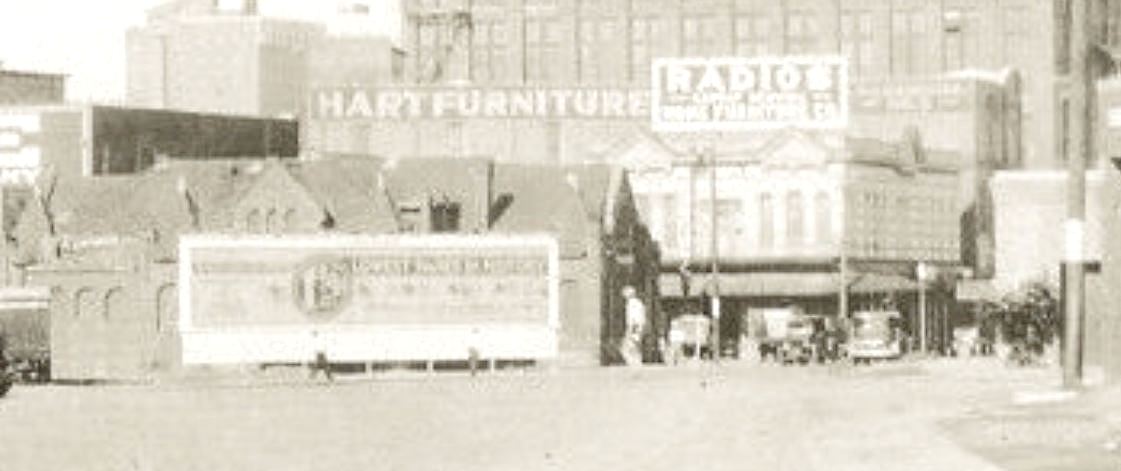
Below: the Western States Grocery Co. was located at the southwest corner of Hawkins and Pacific. The Home Furnishings Co. was at 2301-2311 Elm Street (at Preston). Many of the buildings in this view (except for the 5-story-ish tall building straight ahead and to the right) can be seen in this 1921 Sanborn map. (Is that the pre-Pegasus Magnolia Building seen in the distance behind the 5-story building at the right? If so, that would mean that this photo was taken before 1934.)

pacific-toward-downtown_ebay_det-1

*

The building seen below in the foreground at the left is the old Union Depot. I’ve seen so many photos of this building — but it looks TINY here! Just across the street (railroad tracks) from it (in the building seen immediately below the “Radios” sign) is the old Union Depot Hotel. The H&TC railroad used to run between them — Central Avenue later (basically) became Central Expressway. I was really excited to see these two buildings.

The taller building seen in the background, behind the Hart Furniture sign, can be seen in this 1921 Sanborn map — the 5-story building at the southwest corner of Pacific and Preston was home to the Fulton Bag and Cotton Mills (another story was added around 1935).

pacific-toward-downtown_ebay_depot-and-hotel

*

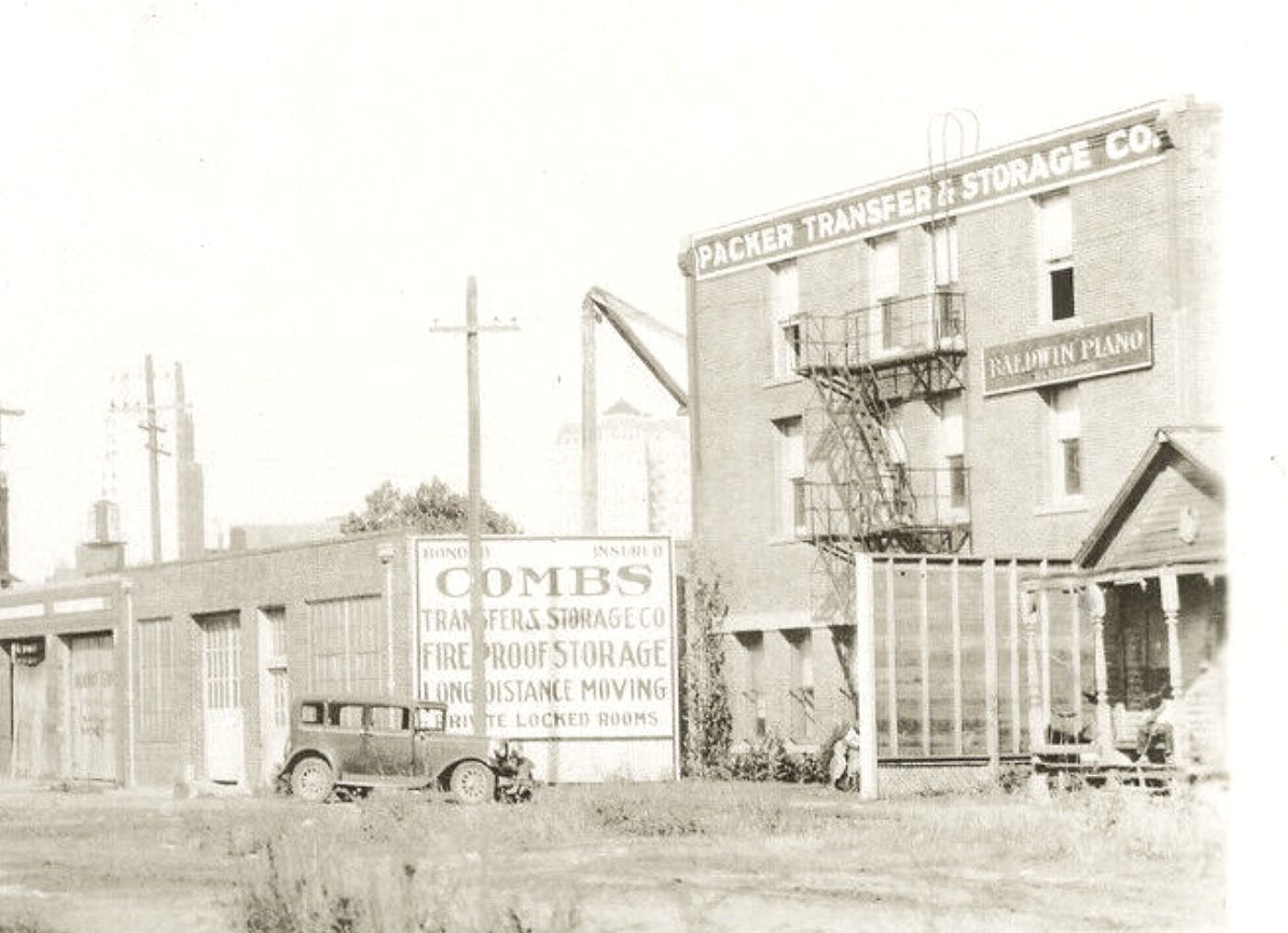
The Combs Transfer & Storage Co., the Packer Transfer & Storage Co., and the Baldwin Piano Ware Room were all at 2507-2509 Pacific. It looks like the two buildings seen in this detail (the short one and the taller one) have somehow miraculously survived the insane redevelopment of everything on all sides of it (I’ve haven’t been to Deep Ellum in a few months, but these two buildings seem to be the ones which you can see in the most recent Google Street View). Also, looming like a ghostly whisper in the background (above “Combs”) is the Medical Arts Building.

pacific-toward-downtown_ebay_medical-arts-bldg

*

I wonder why someone decided to take this photo? I’m glad they did, because it’s not a view I’ve ever seen. I love finding photographs taken in places that most people wouldn’t think were interesting enough to document for posterity. Like this one. Thanks, anonymous photographer!

*

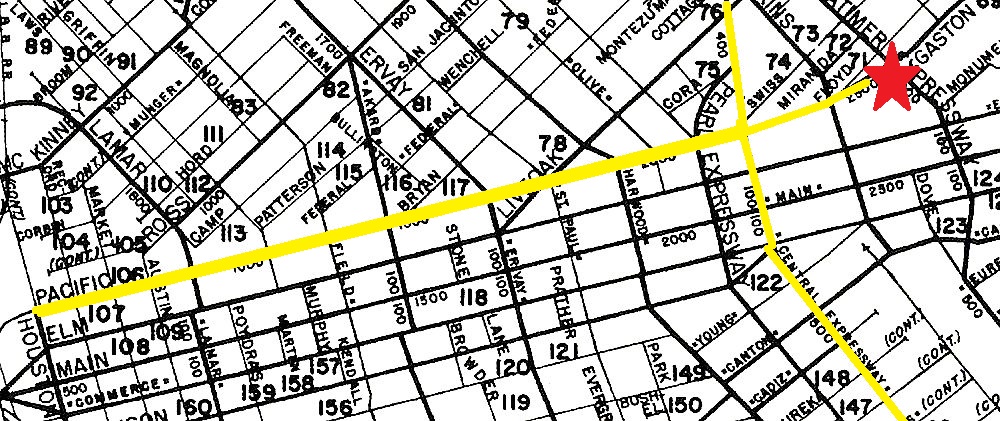
I just picked the closest historical map I had easy access to — the 1952 Mapsco. My guess is that the photograph is from the 1930s. The star is about where the photo was taken — just west of what is now Good-Latimer, just before Pacific becomes Gaston — with a view to the west.

pacific-toward-downtown_mapsco_19521952 Mapsco (det.)

***

Sources & Notes

Photo found on eBay — it looks like the item sold a couple of weeks ago, in Sept. 2022.

pacific-warehouse-district_ebay_sm

*

Copyright © 2022 Paula Bosse. All Rights Reserved.

Safari Redux

safari_squire-haskins_1961_UTA_1Dallas? Yes!

by Paula Bosse

Back in 2014 — when Flashback Dallas was still in its blogging infancy — I wrote about the Safari Steak House in North Dallas in the post “Back When Preston Royal Was ‘Exotic’ and Had Its Very Own Elephant.” There were a few errors in that post which I corrected today, thanks to a couple of commenters on the original post who pointed out that what I thought showed the Safari restaurant at Preston & Royal showed, instead, the Houston location. Kind of embarrassing!

What better time than this to say that I ABSOLUTELY WELCOME CORRECTIONS!! I’d like this blog to be as unpedantically accurate as possible, so, please, if you see I’ve smugly written something which is blatantly incorrect, please let me know! I’ll be happy you let me know.

I invite you to check out that original post, now updated with a couple of photos of the actual Dallas Safari Steak House, including the one above, taken by the estimable Squire Haskins in 1961.

***

Sources & Notes

Photo “Safari Steak House, Dallas, Texas” by Squire Haskins, 1961, from the Squire Haskins Photography Inc. Collection, University of Texas at Arlington Libraries, Special Collections — more info on this photo can be found here. (Thank you for the links, Tom Bowen!)

The Safari space is now occupied by Royal China, which I love from the days I worked across the street at Borders.

safari_squire-haskins_1961_UTA_1_sm

*

Copyright © 2022 Paula Bosse. All Rights Reserved.

Cedar Crest, L. O. Daniel’s Country Home

daniel-l-o_cedar-crest_flickr_coltera
Still standing on West Jefferson Blvd. in Oak Cliff

by Paula Bosse

While looking for something on W. Lee “Pappy” O’Daniel (former governor and U.S. senator), I came across the image above, which I had mistakenly labeled “O’Daniel” rather than “Daniel.” It had nothing at all to do with W. Lee O’Daniel but, instead, showed a house belonging to L. O. Daniel. Who was L. O. Daniel? I’d never heard of him.

Lark Owen Daniel Sr. (1866-1927) was a wealthy businessman who made big money from… hats! He sold a lot of hats through his wholesale millinery company, and he was also involved in some spectacular real estate dealings (a newspaper article in 1907 mentioned he had just sold a couple of lots on Elm Street for $30,000 — if you believe online inflation calculators, that would be the equivalent of almost a million dollars in today’s money!). As a proven earner of big bucks, he was also the first president of the Dallas Chamber of Commerce.

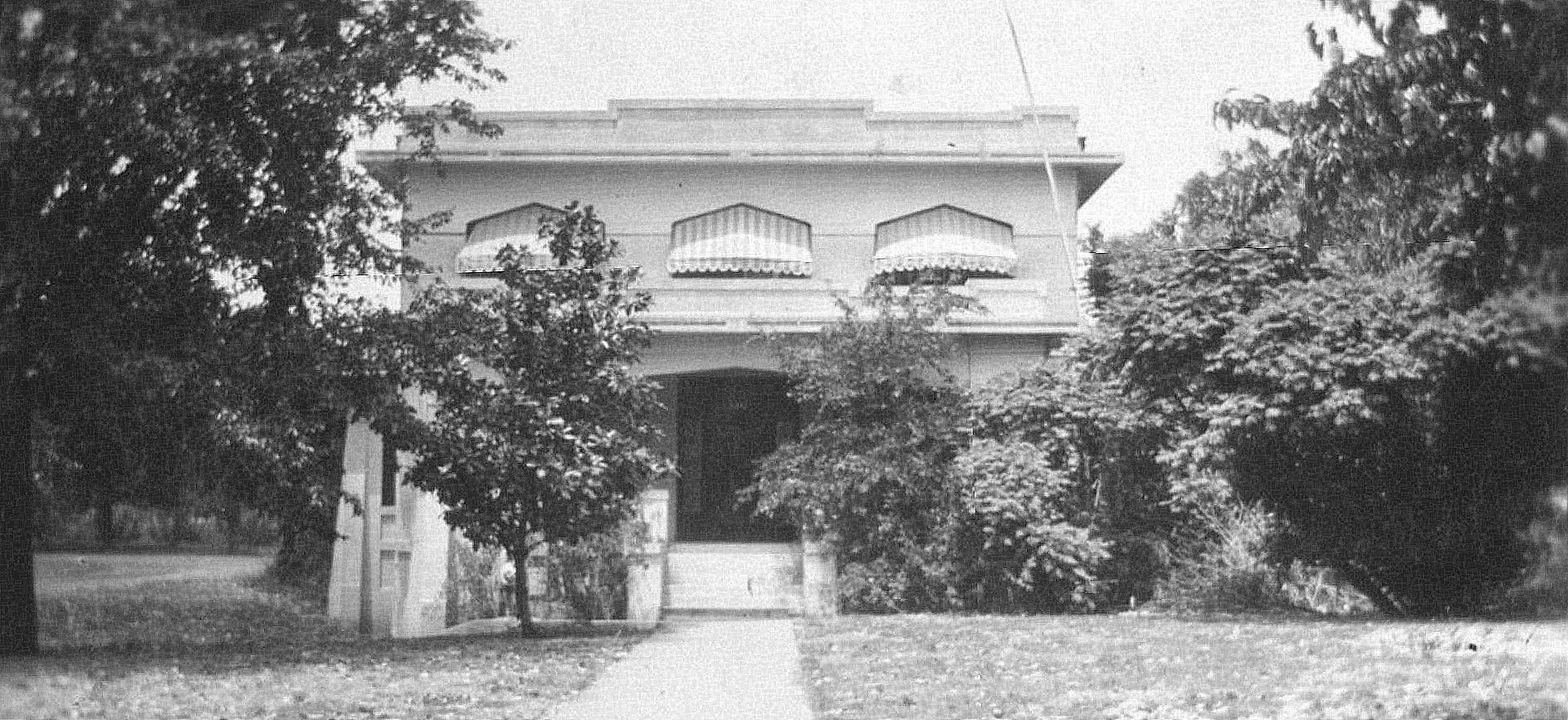
Even before that huge real estate sale, Daniel was swimming in hat-cash. In 1901 he bought 27 acres near the Fort Worth Interurban rail line and built a 5,000-square-foot, 3-story, 15-room Victorian mansion. He named the house “Cedar Crest.” I don’t know if it was technically in Oak Cliff at that point, but it was definitely outside the Dallas city limits. This is the way Daniel’s address appeared in the 1910 city directory:

daniel-l-o_directory_19101910 Dallas directory

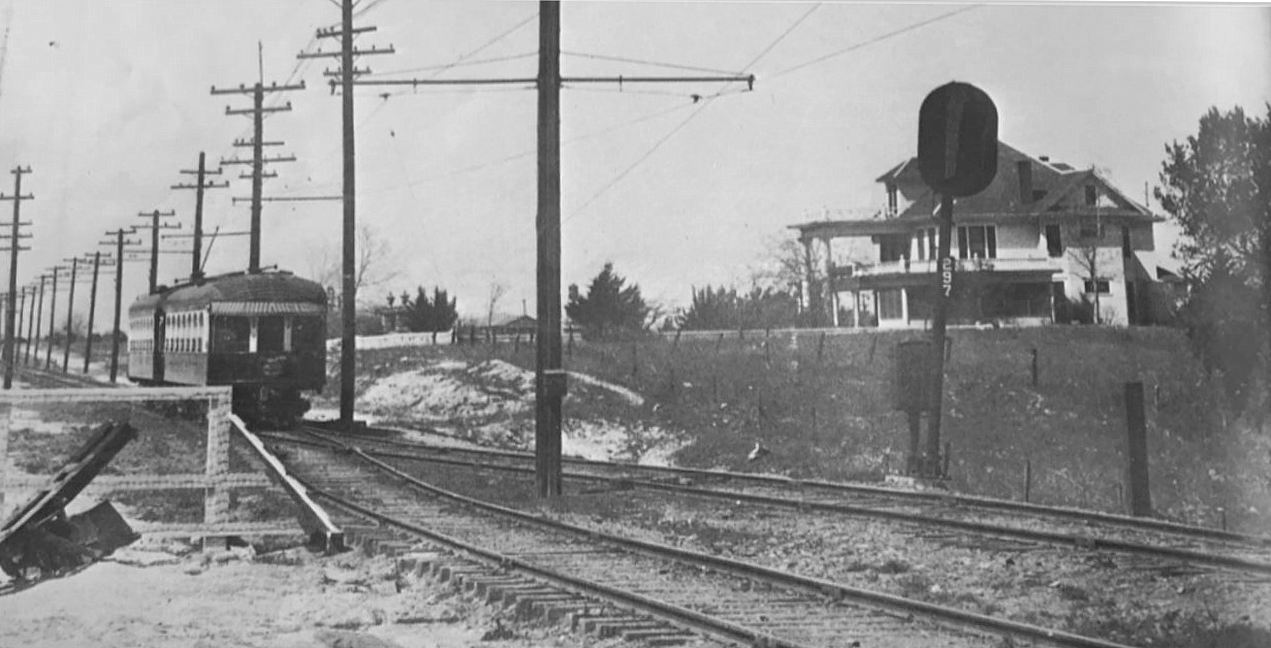
And here’s a photo of an interurban trundling along, uncomfortably close to the house:

cedar-crest_interurban_oak-cliff-advocate

The luxurious splendor of the somewhat isolated Cedar Crest apparently emitted a high-pitched siren-call which was frequently heard by area bandits: it was burgled quite a few times (at least 3 times in one 12-month period). After one incident in which a burglar wandered through the house in the dead of night and woke Mrs. Daniel as he stood over her as she lay in bed, Oak Cliff police said that they found no trace of the trespasser but saw where he had hitched his horse and get-away buggy, out back in the orchard. In another incident a few months later, Mrs. Daniel — who had been alerted by an employee that the family car was about to be stolen from the “automobile house” — ran out to the garage armed with a revolver and fired three shots at the thieves, scaring them away (I don’t think she was attempting to fire warning shots — I think she fired AT them). This may seem extreme, but the newspaper noted that the value of the car (in 1915) was an eye-watering $4,000 (more than $110,000 in today’s money!). I don’t know where Mr. Daniel was during all this, but Mrs. Daniel was not about to let that car go anywhere!

One summer, the Daniels rented out Cedar Crest while they vacationed elsewhere. The ad in the paper specified that only “responsible parties without small children” were welcome. I hate to keep harping on about the money, but a two-month stay at L. O.’s “beautiful country home” would set some responsible childless person/s back a cool $300 (almost $9,000 in today’s money). (Who would pay such an exorbitant amount of money to stay in an un-airconditioned house in North Texas during the height of the summer?)

daniel_house-for-rent_summer-1912
Summer 1912

L. O. Daniel died in Feb. 1927. His business empire was closed down, and the large Cedar Crest swath of land he owned was put up for sale in 1929.

daniel_cedar-crest_april-1929April 1929

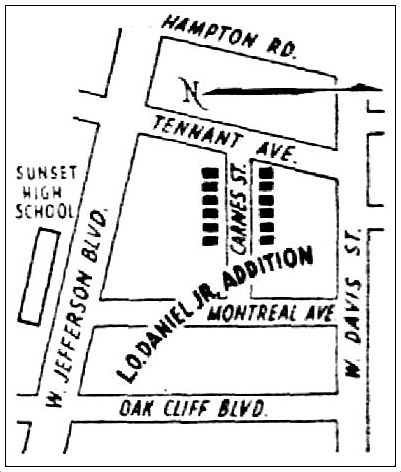
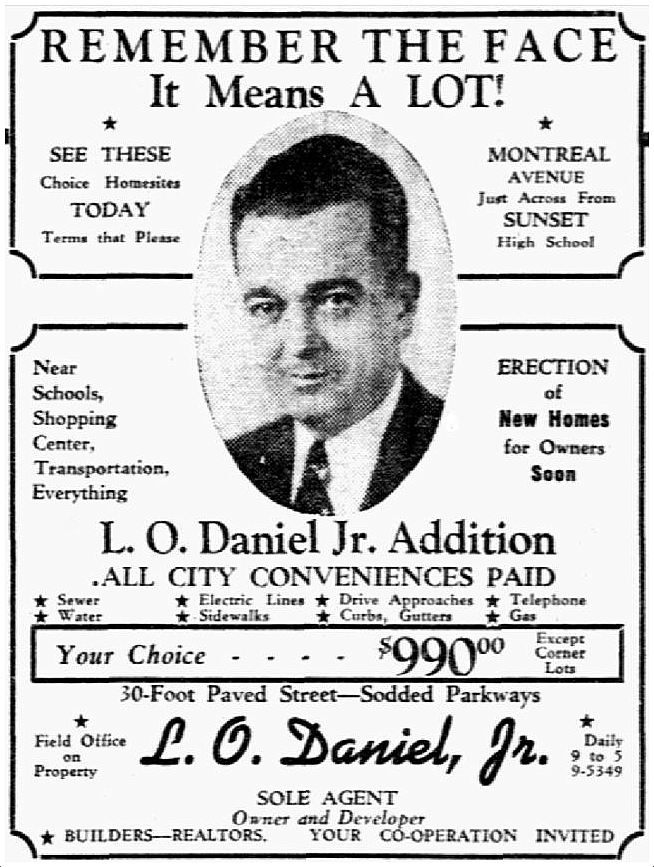
I’m not sure what happened with that specific transaction, but his son, L. O. Daniel Jr., ended up breaking that land up into parcels and selling residential lots as part of the “L. O. Daniel Jr. Addition,” beginning in about 1940.

daniel-addition_june-1940_mapJune 1940

daniel-addition_nov-1940November 1940

*

This beautiful house is — somehow — still standing. It is located at 2223 West Jefferson in Oak Cliff, facing Sunset High School (see it on Google Street View here). Over the years the mansion fell into disrepair, but in the early ’80s the house was restored by two men — Martin Rubin and Earl Remmel — and it received historical landmark status in 1984. Cedar Crest was purchased a few years ago and has gone through additional restoration/renovation — it currently serves as the impressive law offices for the firm of Durham, Pittard & Spalding.

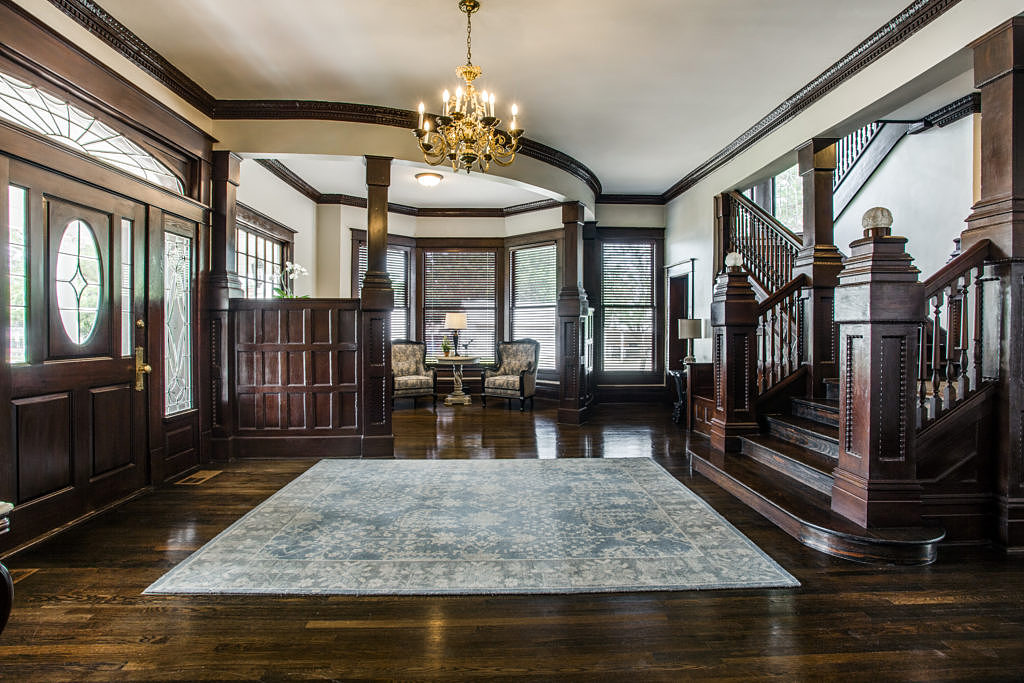
There are lots of photos online. View some on the Zillow site — which show what it looked like before it was recently updated — here. See some really beautiful photos on CedarCrestOakCliff.com, here. I particularly love this one:

cedar-crest_entry_cedar-crest-oak-cliff-dot-com

**

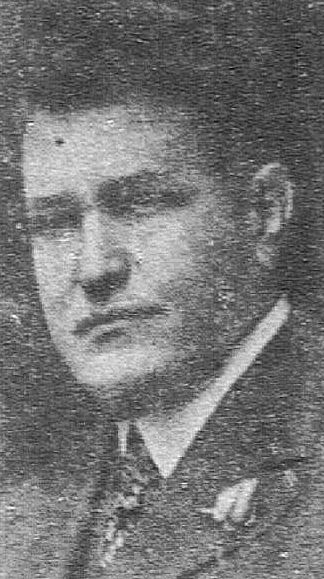
It shouldn’t have been so hard to find a photo of L. O. — but this is about all I could find. Followed by a hats-hats-hats! ad.

daniel_l-o_photo

daniel_oct-1915_adOct. 1915

***

Sources & Notes

Postcard at top (circa 1909) found a few years ago on the Flickr stream of Coltera (not sure if he’s still posting there — if not, that’s a shame, because he had amazing things!).

Photo of the interurban from the 2017 Oak Cliff Advocate article “Law Firm Renovates Historic Mansion on Jefferson” by Rachel Stone (click the link at the bottom of the article to read a piece published in Texas Lawyer which includes information on specific restoration/renovation work done on the house).

There are so many great homes in the L. O. Daniel area — look at a whole bunch on the L. O. Daniel Neighborhood Association website here.

Also recommended is the 2019 Candy’s Dirt article “What’s in a Name For L. O. Daniel?” by Deb R. Brimer.

daniel-l-o_cedar-crest_flickr_coltera_sm

*

Copyright © 2022 Paula Bosse. All Rights Reserved.

Old Lake Highlands

white-rock-lake_old-lake-highlands_1956_don-jones1956, Room to spread out…

by Paula Bosse

The photo above — taken in 1956 — shows an aerial view of Old Lake Highlands, looking southwesterly toward White Rock Lake. The street in the foreground is Kirkwood Drive.

But for even older Old Lake Highlands, we need to cast our minds back to 1927, when W. H. Brouse began to advertise for one of his many East Dallas developments. One of the ads from the Lake Highlands Co. (W. McCarty Moore, President and H. W. Brouse, Director of Sales) read:

IN THE MAKING — LAKE HIGHLANDS, “THE INCOMPARABLE”

Another High-Class Residence  Section For Dallas on White Rock Lake

Believing in Dallas — believing in the continued rapid absorption of territory to the north and east for homes — and especially that beautiful terrain surrounding White Rock Lake, Lake Highlands was conceived and made possible by the owning company.

The tract — some 117 acres — is especially advantageously located in that it is right on the lake itself — just a short drive from the dam, and is bounded by water on three sides. A peninsular piece of ground, in fact.

The ad also noted that “lots will be large — prices low”: $1,100 and $1,200 (about $18,000-$19,500 in today’s money).

lake-highlands-co_dmn_100927_det1927

*

And, in a Dallas Morning News real estate advertorial were these additional deets:

Lake Highlands is situated just beyond Dixon’s Branch, on the east shore of the lake, and is accessible directly from the downtown section by Swiss and Gaston avenues and the old Garland road, leading into the lake road. This, in turn, gives access to the 100-foot boulevard, which will circle the whole development, and from which lead streets seventy feet in width, reaching every lot in the development. Roadways and streets will be surfaced with white gravel, while curbs and sidewalks will be installed in advance of building development, as will all utilities, lights, water, gas and sewer facilities….

Construction will be restricted to homes to cost $5,500 to $7,500 minimums [$90,000-$122,000 today], depending on the location of the lots on which they are built. Materials will be limited to brick, hollow tile and stucco, so as automatically to eliminate the fire hazard and also to assure permanence.

I’m sure life on the lake in 1927 was worth every penny.

kirkwood_white-rock-lake_googleGoogle Maps

***

Sources & Notes

I came across the photo at the top of this post several years ago in a photo blog hosted by The Dallas Morning News, but the blog doesn’t seem to exist any longer. The caption noted that the photo had been shared by Lynn Jones who had come across it when going through a collection of color slides inherited by her husband when Don Jones died in 2010.

Quotes from the real estate advertorial, “Plan Homes at White Rock” (Dallas Morning News, Oct. 9, 1927).

white-rock-lake_old-lake-highlands_1956_don-jones_sm

*

Copyright © 2022 Paula Bosse. All Rights Reserved.

Happy World Mosquito Day!

ad-acme-screen-co_terrill-yrbk_1924“Ding it!” (1924 ad)

by Paula Bosse

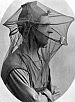
I have discovered that today — August 20 — is World Mosquito Day. Personally, I would save any mosquito-related celebrating until the entire species has been eradicated (…or at least eradicated from anywhere near ME), but, according to the National Institute of Allergy and Infectious Diseases, this day “marks the anniversary of the discovery that mosquitoes transmit the parasite that causes malaria. On this day in 1897, Sir Ronald Ross discovered the malaria parasite in the stomach tissue of an Anopheles mosquito. His work later confirmed that mosquitoes are the vector which carries this devastating parasite from human to human.”

So, thanks for that, Sir Ronald Ross.

In 2017 I wrote about Dallas’ early battles with mosquitoes — and I really enjoyed discovering how people dealt with them before window screens. Read that post here: “The Mosquito Bar.”

mosquito-net-pith-helmet-pipe_sm

*

Copyright © 2022 Paula Bosse. All Rights Reserved.

Summer Rerun: Street Life Around Neiman’s — ca. 1920

6-ervayNewsboy racing down Ervay…

by Paula Bosse

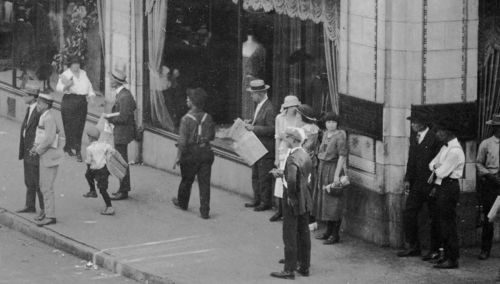
The image above is a small detail from a photo of the Neiman-Marcus building at Main and Ervay — the streets and sidewalks around the store are crammed with people and traffic. This is one of my all-time personal favorite posts, originally posted all the way back in the first months of Flashback Dallas, in May 2014. Check out other wonderful “hidden” glimpses (as well as the equally wonderful original photograph from SMU’s DeGolyer Library) in the post “‘There Are Eight Million Stories in the Naked City…” — ca. 1920.”

*

Copyright © 2022 Paula Bosse. All Rights Reserved.

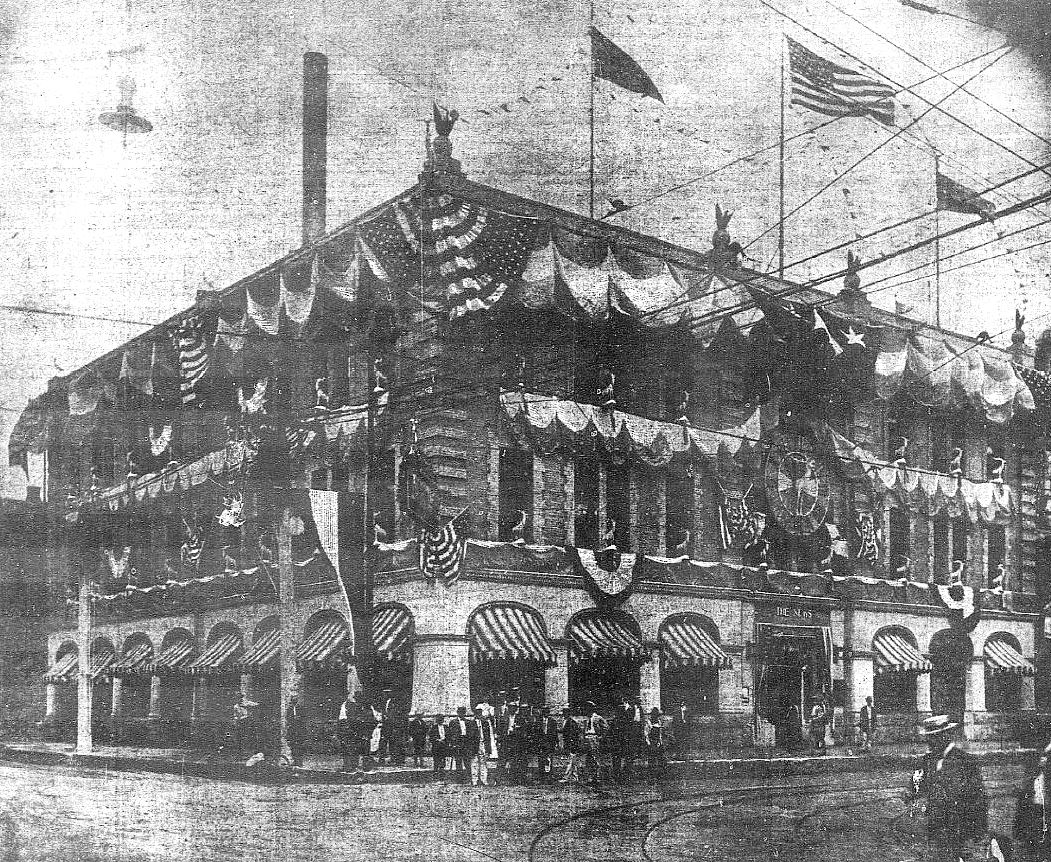
Elks-a-Plenty — 1908

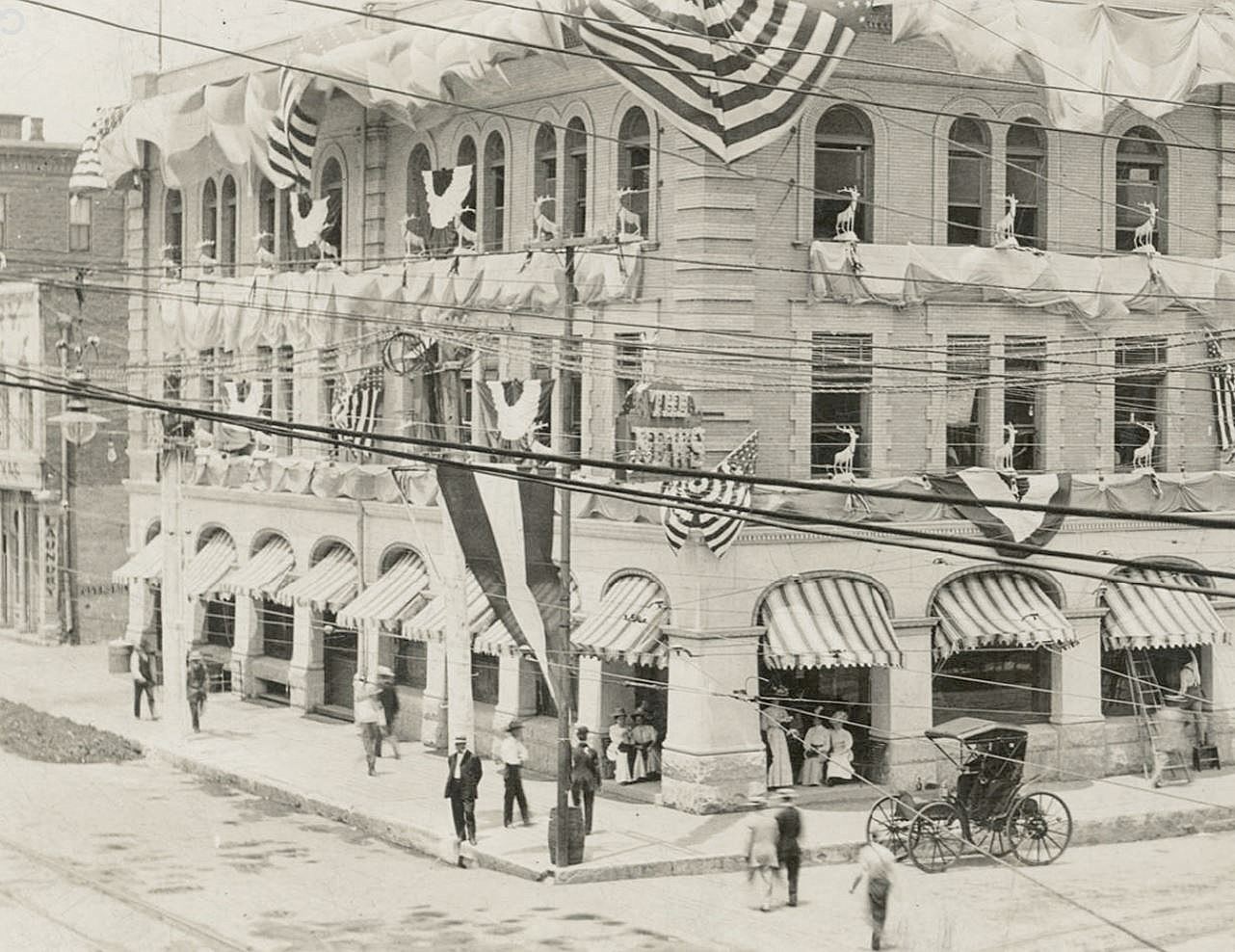
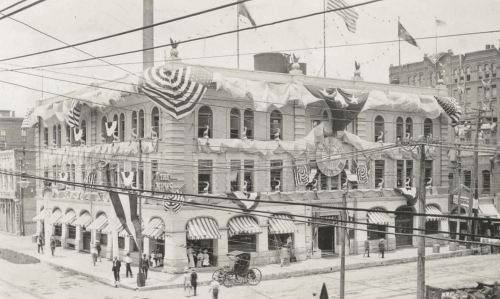
dmn-bldg_decorated-for-elks-convention_1908_cook-collection_SMU_fullBegirt with ruffles and studded with elks…

by Paula Bosse

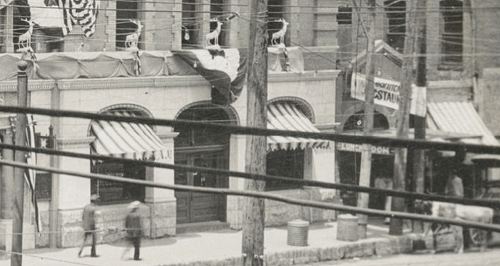
Conventions have always been important to Dallas. One of the most important conventions ever to descend upon the city was the annual convention of the Benevolent and Protective Order of Elks in July 1908. There were approximately 38,000 attendees, but when you added to that number spouses and various others with business, social, or just looky-loo interests, it was estimated that more than 100,00 out-of-towners clogged the streets of our fair burg during the time of the convention. Dallas was a sizeable city in 1908, but the sudden swarming into town of 100,000 people (twice the actual population of the city!) must have been… challenging. (And profitable!)

Dallas welcomed the Elks with enthusiasm and open arms. Everyone knew they were coming, and everywhere there were splashes of the Elk colors, purple and white. A special (and later notorious) semi-permanent arch was erected to span Main Street at Akard. And businesses competed with one another to see who could decorate their building with the most spectacular and festive bunting.

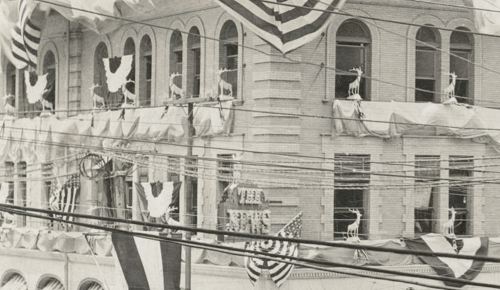
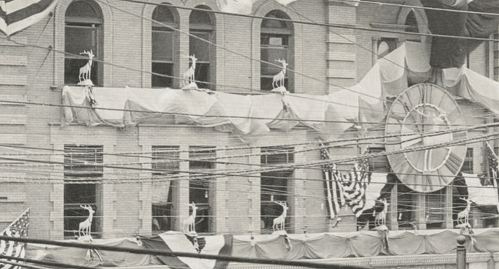
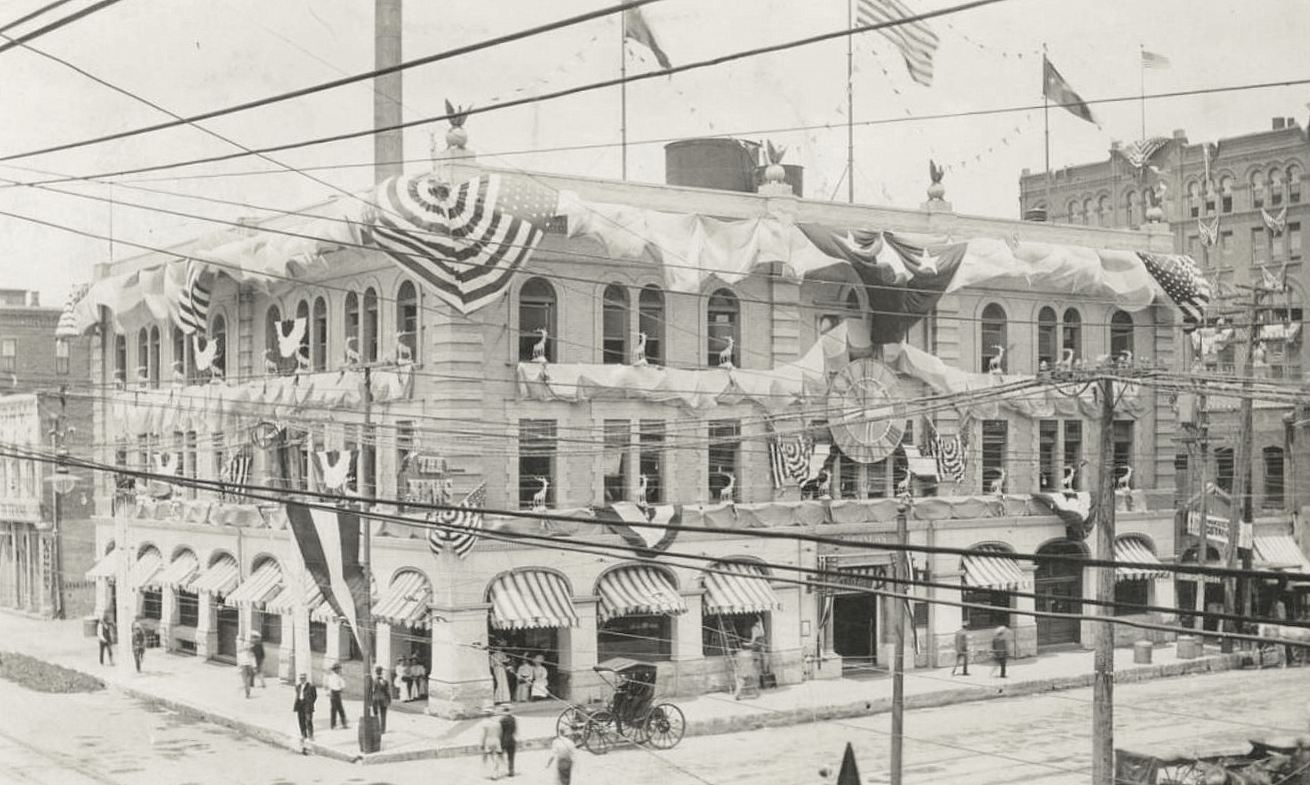
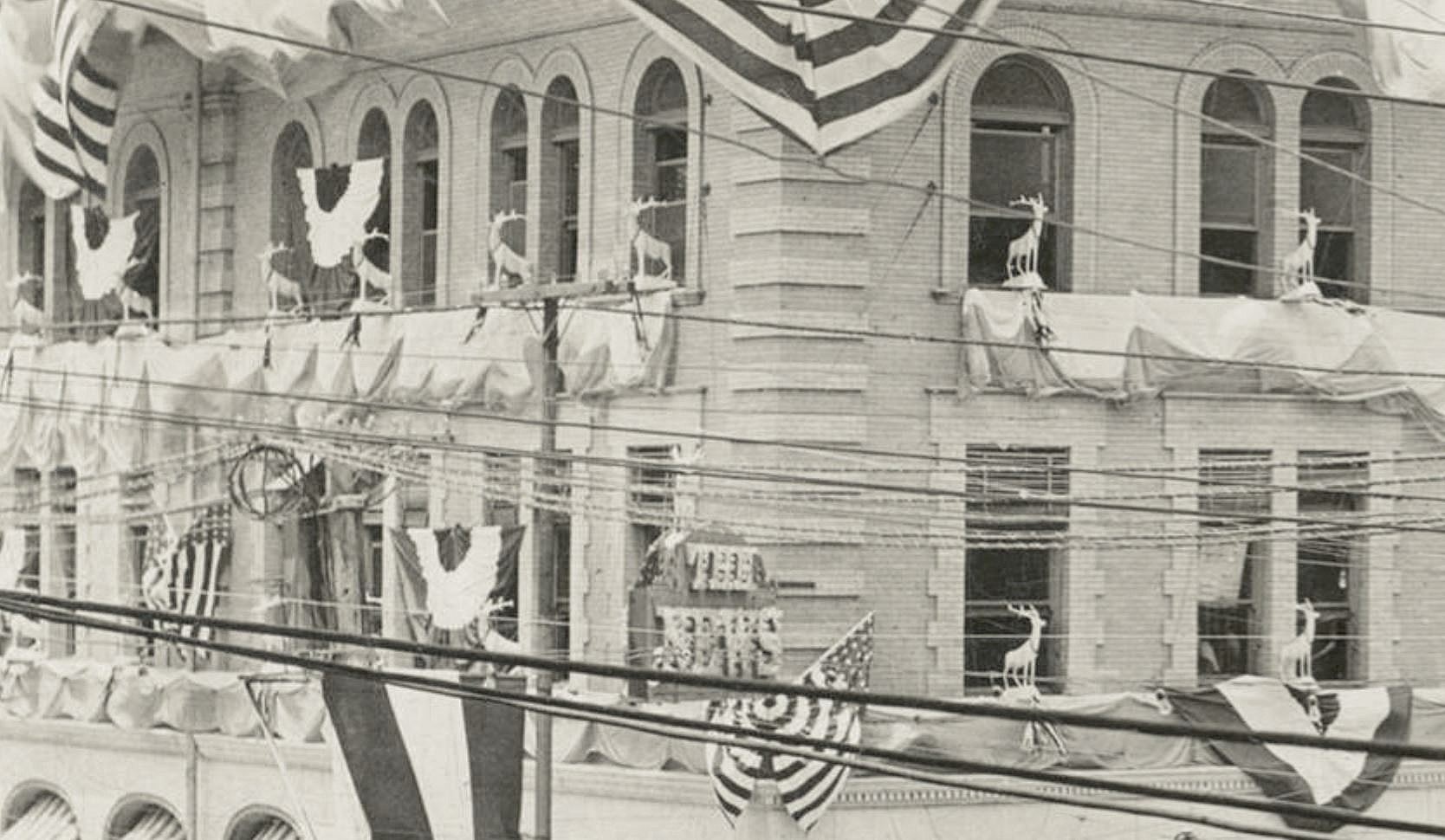
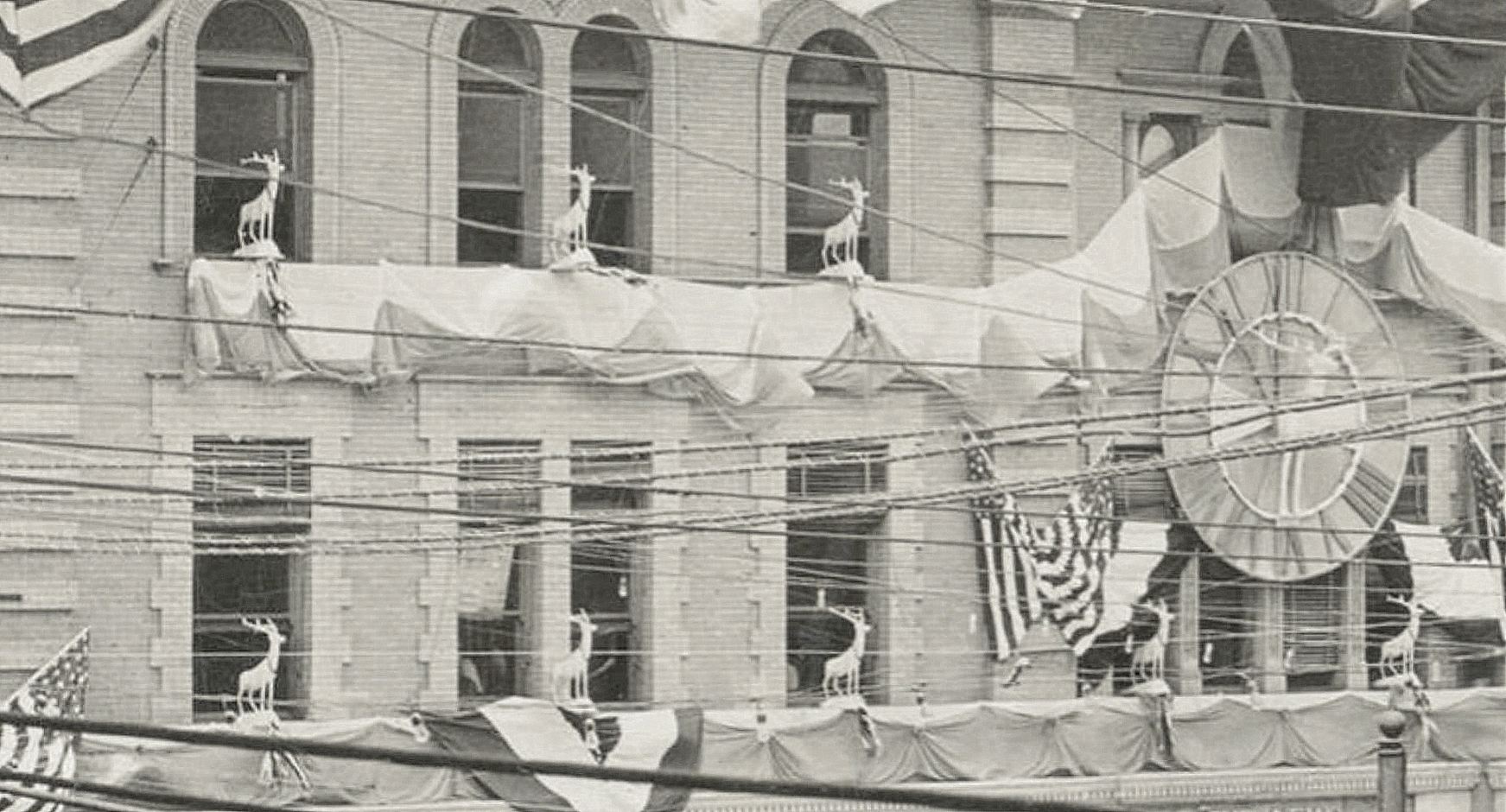
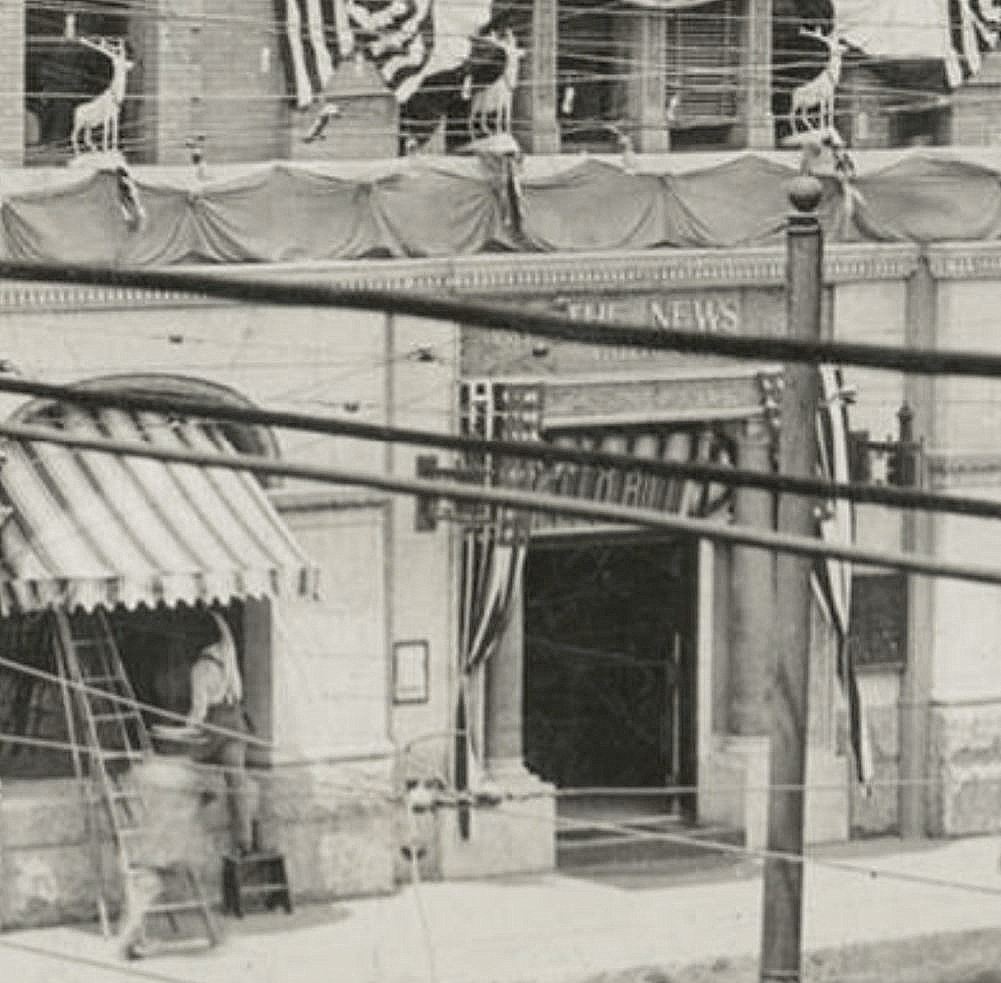
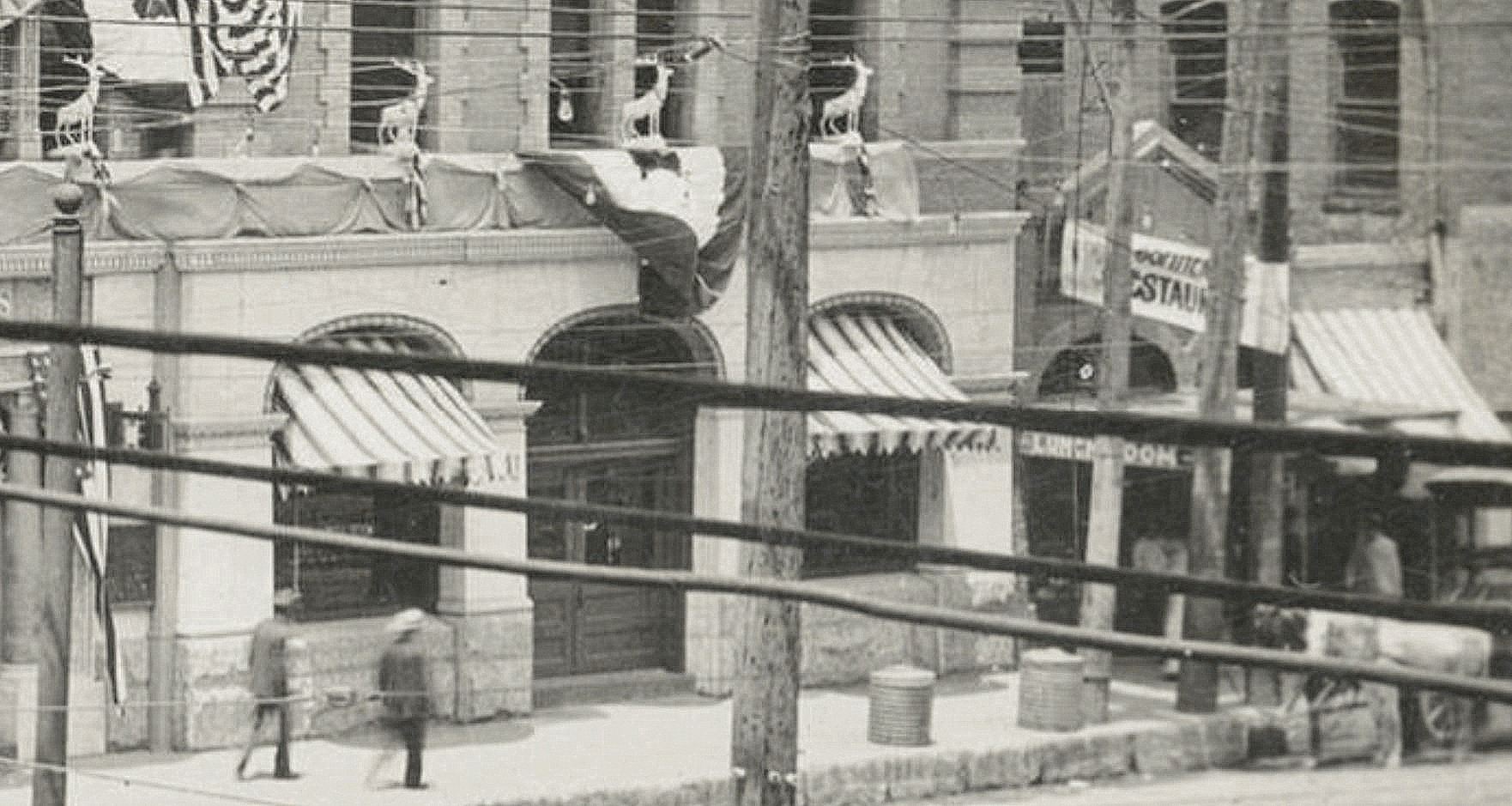
Above is a photo of the Dallas Morning News Building at the northwest corner of Commerce and Lamar, crammed full of flags, bunting, pennants, cowbells, lights, little statues of elks, medium-sized statues of elks, and large statues of elks. (There is an elk in every window.) It also had a large clock erected which was perpetually stuck at an Elk-y 11:00 and a parallelogram-shaped sign which lit up to flash the Elk greeting “Hello, Bill!” So… a lot. But what might seem like overkill — like The News was trying a little too hard to be noticed… the Elks loved it. LOVED IT. They loved it so much that they awarded the newspaper an award of $250 for the best decorated building in the city (that would be about $8,000 in today’s money!). Scroll down to read a breathless description of these decorations, with details of absolutely everything that was flapping, clanging, flashing, billowing, and throbbing at Commerce and Lamar in the summer of 1908. (I have to put this sentence from the article here because I love it so much: “To the bottom of each of these flags are attached small cowbells of different tones, so that with every strong whiff of wind there is a discordant but merry jingle.”)

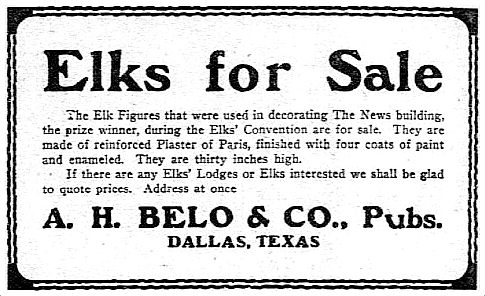
So, those elk statues. I mean… they’re fantastic. Little elks in every window, illuminated by a single electric bulb positioned “between the forefeet” of each mini-elk. And then there are the larger ones appearing to step out of — or off of — the building. But back to those little elks — are you wondering what happened to them after the conventioneers headed back home? Wonder no more!
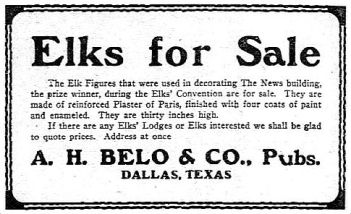
elks_news-bldg_belo-ad_071808Dallas Morning News, July 18, 1908

That would have been a great souvenir!

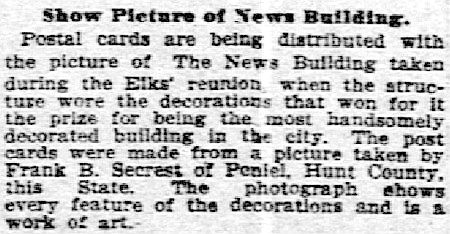
The photo at the top of this post (by Frank B. Secrest of Hunt County) was issued that summer as a postcard. The News did not miss an opportunity to mention it:
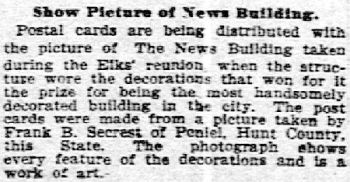
elks_news-bldg_dmn_080708DMN, Aug. 7, 1908

*

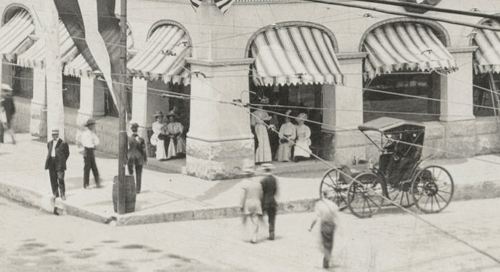
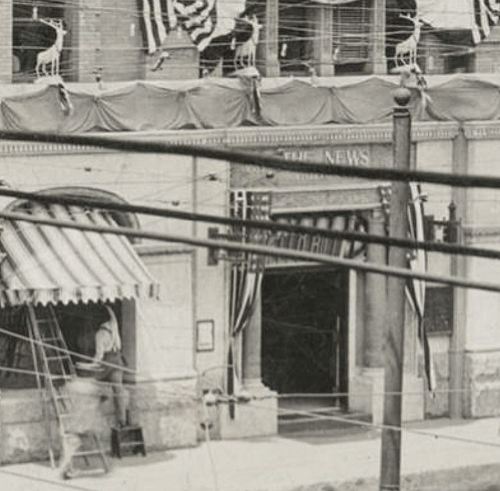
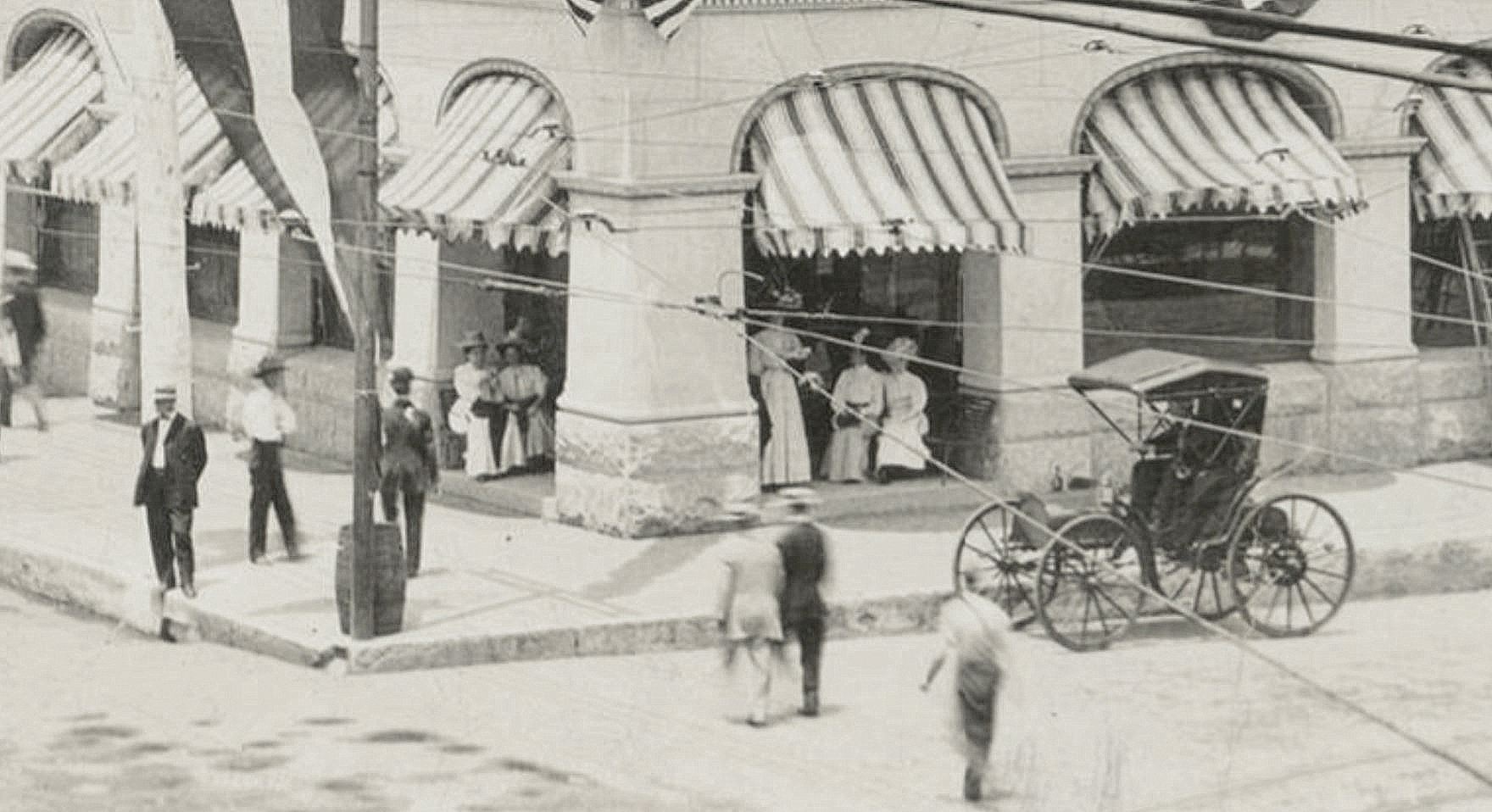
And because I love to zoom in on these sorts of photos, here are a few magnified details:
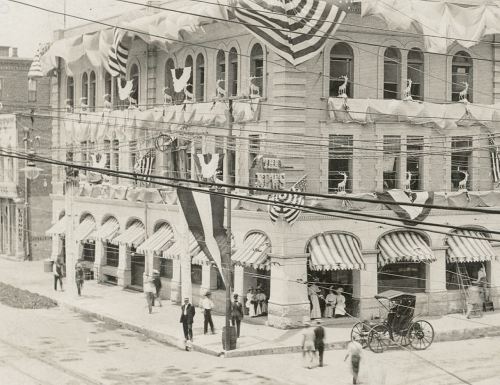
dmn-bldg_decorated-for-elks-convention_1908_cook-collection_SMU_det-2

dmn-bldg_decorated-for-elks-convention_1908_cook-collection_SMU_det-3

dmn-bldg_decorated-for-elks-convention_1908_cook-collection_SMU_det-4

dmn-bldg_decorated-for-elks-convention_1908_cook-collection_SMU_det-5

dmn-bldg_decorated-for-elks-convention_1908_cook-collection_SMU_det-6

dmn-bldg_decorated-for-elks-convention_1908_cook-collection_SMU_det-7

**

Here is a lengthy description of the decorations, from The Dallas Morning News — direct from the horse’s mouth:

To decorate The News Building in celebration of the coming of the Elks has been the labor of two men for more than a month, and of a dozen for two days: for, though it was only three days ago that the first bit of color appeared on the outer walls, the preparations were begun in the seclusion of a workshop early in June. The draping of the building with bunting and flags was done under the direction of W. T. Senter of the National Decorating Company of St. Louis, and of Edward A. Gebhard, librarian of The News. In working out their scheme they have used 4,200 yards of bunting, purple, white and purple, and twenty-four immense flags, and disposed of it in such artistic fashion as to avoid a sense of crowding.

PURPLE, WHITE AND PURPLE RUFFLES

The building is thrice begirt with big ruffles of purple, white and purple. But, to begin at the topmost, three large flags, one the United States, another the Texas and the other The News’ flag, float high above the Lamar street side of the building. To the bottom of each of these flags are attached small cowbells of different tones, so that with every strong whiff of wind there is a discordant but merry jingle. From one to the other of the flagstaffs hundreds of small pennants in the colors of the Elks flutter gayly in the breeze. Festooned from the heavy cornice which crowns the building are heavy folds of purple, white and purple so arranged that with every vagrant breeze it swells and sinks like the surface of water. Once on the Lamar street side, over the entrance, again at the corner and once on the Commerce street side this bunting is gathered around an immense United States flag, fashioned fan-shape. Poised on the cornice of the building at the corner, as if surveying the land preparatory of a leap, is the graceful figure of an elk, five and a half feet high, made out of plaster of Paris, painted and enameled until he glistens.

The two lower ledges of the building are draped in similar fashion, except that the streamers at these places are narrower than those that festoon the cornice. Above the main entrance on the Lamar street side and extending from below the second story to the third-story ledge is the piece de resistance. Here set in an embrasure of the building, is a clock dial twelve feet in diameter. The gilt letters marking the divisions of the circle are two feet high. The hands point to the hour of 11. The pure white head and shoulders of an elk seven feet high are shown in the center one foot forward, as if he were about to emerge from the fluffy mass of purple and white bunting that forms the background dial. On each side an immense flag is gathered in a way to make it fan-shaped. Circling the clock dial are six large incandescent lights.

WHOLE HERD OF ELKS

From the third-story corner of the building, above which stands a five and one-half foot Elk, as if surveying the country from a precipice, are festooned two twelve-foot flags that fall almost to the second-story ledge of the building. One is gathered around on the Commerce and the other on the Lamar street side. And there yet remains to speak of the most distinctive feature of the whole scheme of decoration. The News, in preparation for this event, had made a whole herd of elks. There are forty-two of them, each thirty-two inches tall, and one, mounted on a pedestal, stands poised from the ledge of every window in the building. They are pure white, made of plaster Paris, painted twice and then enameled. Between the forefeet of every one is an electric bulb. The elks are from models designed by Mr. Gebhard and were cast in The News Building.

BRILLIANT ILLUMINATION

Of course the whole building is brilliantly lighted. In addition to the electricity used ordinarily, which lights the exterior of The News Building pretty well, bulbs have been studded profusely midst the decorations and over the Lamar street entrance is a parallelogram of electric lights which illuminate the sign, “Hello, Bill!”

*

The article then launches into more self-promotion, with an, admittedly, interesting description of the layout of the News Building:

ATTRACTS GENERAL ATTENTION

The building of The News attracted general attention from the thousands of visiting Elks. Many expressed their surprise that a city the size of Dallas had such a complete, modern building and equipment, and the compliments concerning The News as a newspaper have been very pleasing.

The News Building has all the modern fireproof features. It occupies a space of 300×100, having three floors and a basement, the whole being used by the newspaper. Its business office is one of the handsomest in the State, and, as one visitor remarked, it looks more like a prosperous bank than the ordinary newspaper office.

The first floor is given up to the business and circulation departments, the press room and the mailing department. In the basement are the paper storage rooms and the power department. On the second floor are the editorial rooms, telegraph rooms and the general circulation department and the newspaper job department, besides the Employes’ Library and Recreation Room. On the third floor are the composing and the linotype rooms, the stereotype room and the engraving department.

INDIVIDUAL ELECTRIC MOTORS

Every piece of machinery in the house is operated by its own individual electric motor. Power is supplied from two immense engines and generators combined, the engine room being one of the show places in the building, having a metal ceiling and white glazed brick on the walls, with a cement floor. The press room contains two three-deck presses, one quadruple press and one sextuple press.

TWO DAILY NEWSPAPERS

The Dallas News is the offspring of The Galveston News, which was established in 1842. The two papers are under the same management. The publication offices of The News, Galveston and Dallas, 315 miles apart, are connected by special wires for interchange of news matter. The Galveston paper supplies the southern part of the State and the Louisiana border, while the other covers all North Texas and goes well into Arkansas, Oklahoma and New Mexico.

THREE SPECIAL TRAINS

For upward of a quarter of a century the two papers have operated at their own expense, every day in the year, three special newspaper trains, one running Galveston to Houston, one Dallas to Denison and the third Dallas to Fort Worth. The Dallas News covers hundreds of thriving towns throughout its territory, many of them before breakfast time, through its unrivaled facilities of distribution. Starting in 1885, The Dallas News has been a continuous success, and has achieved an enviable reputation wherever American newspapers are known. As an advertising medium it is in a class by itself so far as papers in this section of the country are concerned. Starting at 1885 with thirty-three classified ads in its Sunday issue, it now runs each Sunday about 2,000. It is a success because it is enterprising and because it is clean, both in its news columns and in its advertising columns; because it is fair-minded and because its efforts have always been uplifting from a moral and intellectual standpoint and fair to every interest.

*

And then it launches into many, many testimonials from Elk visitors on how much they love the decorations. This is the first. You get the idea.

J. T. McNulty of Baltimore, grand trustee of the Elks, prominent in National circles of the Knights of Columbus and a central figure in the Ancient Order of Hibernians of America, who has traveled largely and visited every State in the Union, being prominent in business and political circles said: “I have been to many conventions, my son, and have seen many decorations, but the one at The News plant, in my estimation ‘takes the cake,’ figuratively and literally speaking. It is the most unique, the most artistic and the most beautiful I have ever seen in all my attendance at conventions in this country, and I have attended many of them. I was agreeably surprised at the way Dallas has decorated, but nothing gave me such a shock of pleasurable surprise as the first sight I had of The News’ decorations.”

*

And this is the dark and grainy photo that ran with the article:
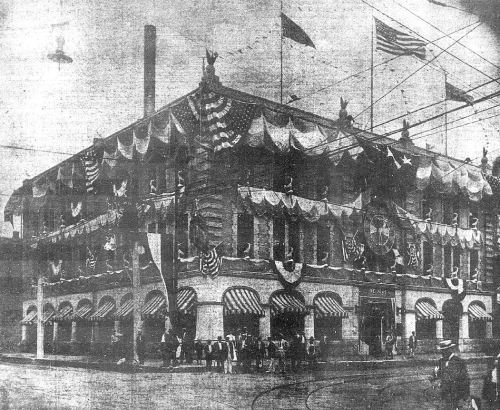
dmn-bldg_elks_dmn_071508_photoDMN, July 15, 1908

**

I kinda want an elk statue now. Also, according to the article, I now know the Morning News has its own flag. Can someone point me to more info?

**

Most of the larger downtown buildings went crazy with decorations, such as the Oriental Hotel (southeast corner of Commerce & Akard), seen here festooned up the wazoo. If you see a photo from 1908 with a Dallas building that’s looks like this, blame it on the Elks.

oriental-hotel_postcard_elks_1908_ebay

***

Sources & Notes

Top photo — titled “[The News, First Prize for Decorations, Dallas, Texas]” — is from the George W. Cook Dallas/Texas Image Collection, DeGolyer Library, Southern Methodist University; more info on this photograph (postcard) can be found here.

Lengthy quote is from the article “Dallas News Building Decorated In Honor of the Elk’s Grand Lodge Which Is Now Holding Its Annual Session and Grand Jubilee in This City,” The Dallas Morning News, July 15, 1908.

More Elks-related Flashback Dallas posts:

And more photos of this beautiful Dallas News Building can be found in these posts:

dmn-bldg_decorated-for-elks-convention_1908_cook-collection_SMU_full_sm

*

Copyright © 2022 Paula Bosse. All Rights Reserved.

The Fountain: “A Resort for Gentlemen” — ca. 1911

by Paula Bosse

This postcard (which has a 1911 postmark) shows The Fountain, a well-appointed drinking establishment (not lacking in ceiling fans). The caption reads:

Meet me at the Fountain, a Resort for Gentlemen, 1518 Main Street, Dallas, Texas.
John H. Senchal, Propr.
Don’t fail to see the Greatest Fair on Earth at Dallas, Texas.

This bar-with-food was located on the south side of Main, steps away from the present location of Neiman Marcus. It was in the block seen in the picture below (it is just out of frame at the bottom right, next door to the Colonial Theater):

Main Street looking east from Akard

Its address was originally 350 Main — after the city-wide address change in 1911, it became 1518 Main. It appears to have opened in 1907 and was in business until at least 1918 (after Dallas voted to go “dry,” the former saloon became The Fountain Cafe). Here are a few early ads for the “High-Class Stags’ Cafe” in its early go-go “gentlemen’s resort” days: 

Dallas Morning News, Oct. 1907

Dallas directory, 1909

Dallas Police annual, 1910

A few years later, the owner, John Henry Senchal, opened Senchal’s Buffet and Senchal’s Restaurant and Rathskeller at 1614-1618 Main.

Dallas directory, 1915

*

Johnnie Senchal — born in Galveston in 1875 to a French father and American mother — appears to have been a popular, civic-minded man’s-man. He frequently traveled with Dallas businessmen to other cities and states to act as a booster for the city. He also indulged in sporty activities such as being a regular wrestling referee and sponsoring horse races at the State Fair of Texas (in 1914 a $2,000 “Fountain Purse” was offered — in today’s money, more than $56,000!). One 1915 newspaper report said he was “probably the best known saloon man in the city.” He was very successful and was not hurting for money.

He also seems to have had a cozy relationship with members of the Dallas police department — a situation which is probably commonplace between saloon-owners and cops. One news story described how he had leapt to the defense of a policeman who was waylaid by a large group of men while he was walking prisoners to jail — a huge brawl broke out, and Senchal and the cop emerged victorious. Also — in a story which wasn’t fully explained — Senchal and another man ponied up $5,000 in bond money ($140,000 in today’s money!) for a Dallas policeman who was charged in the fatal shooting of a 17-year-old, Those are some strong ties between a saloonkeeper and the local constabulary, man.

In 1912 there was another confusing story concerning a man who had been arrested and convicted for being the owner/lessee/tenant of an establishment which was “knowingly permitted to be used as a place in which prostitutes resorted and resided for the purpose of plying their vocation. […] The house was a ‘disorderly house.’ Prostitutes resorted there and displayed themselves in almost a nude condition.” The man who was charged was seen there on a number of occasions “dancing with the prostitutes.” The man appealed his conviction because he had been charged with being the owner/lessee/tenant of this “bawdy house” — but the lessee/tenant was none other than Johnnie Senchal and another man. As far as I can tell, Senchal was not charged with anything regarding this case. 

But a couple of years later, in 1914, he was charged with running a “disorderly house” (a term often meaning a bordello or gambling den, but also meaning a place which is frequently the site of disturbances and is generally considered to be a public nuisance). It seems Johnnie and other were offering “cabaret” entertainment which might gotten out of hand. From The Dallas Morning News:

Alleging that the cabarets are conducted as “disorderly houses,” [charges were filed] on behalf of the State of Texas against owners of three restaurants in the downtown section. Affidavits accompanying the petitions alleged that women were allowed to drink at the places and to act in an unbecoming manner. (DMN, March 12, 1915)

I’m not sure exactly what constituted “an unbecoming manner,” but Johnnie Senchal was one of the men charged. At the very same time he was fighting this violation of the cabaret ordinance, it was reported that “an involuntary petition in bankruptcy has been filed in the United States court here against John Senchal and J. O. Walker, partners in the saloon business on Main Street. The petition was filed by local brewery agents and whisky houses” (DMN, June 20, 1915). Bankrupt! Even though he was apparently rolling in dough for years, he was rather ironically pushed to bankruptcy because he couldn’t pay his own bar tab.
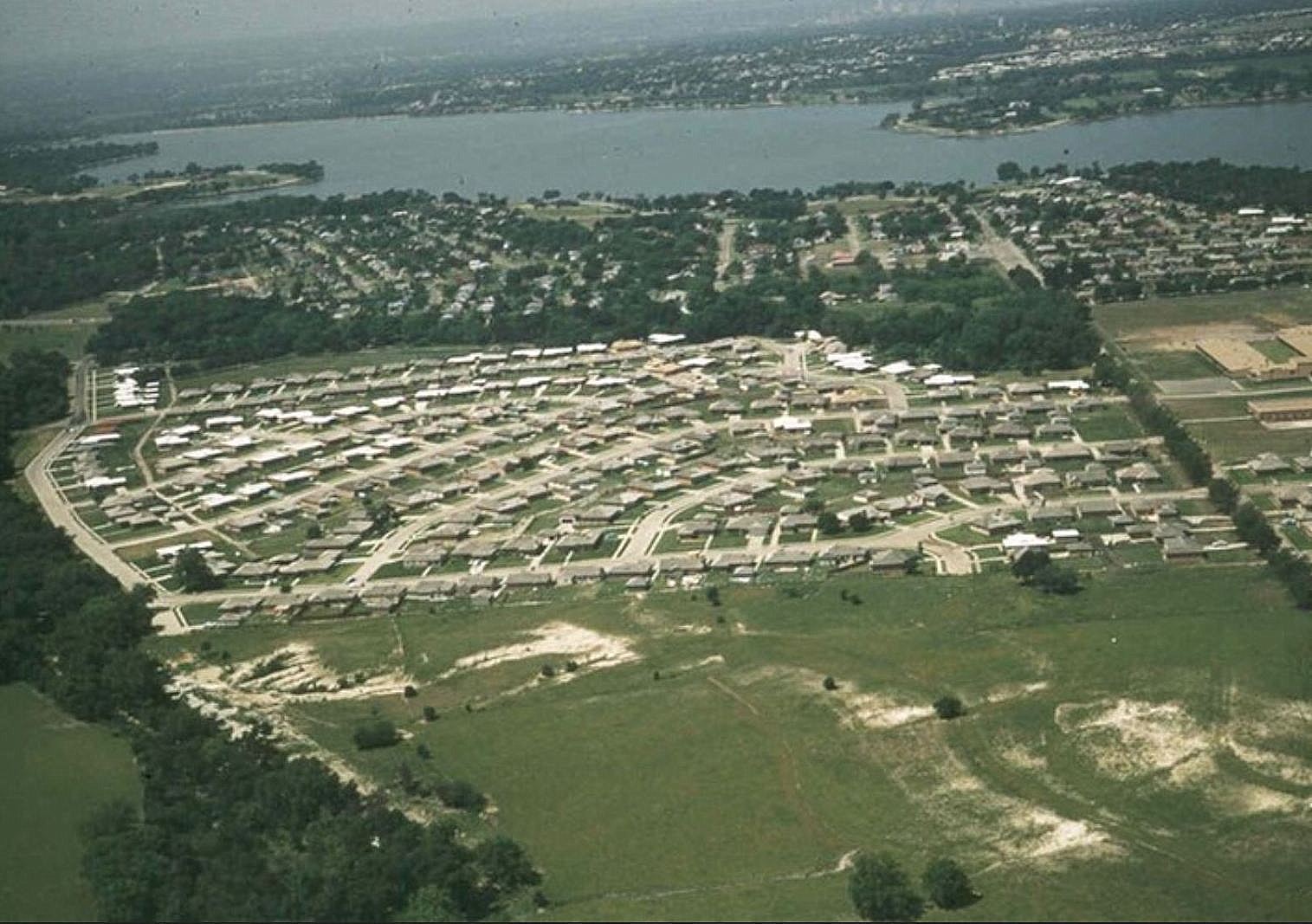
And so Johnnie put the barkeeper’s life behind him. And I mean he REALLY put it behind him: he became a fervent speaker at Anti-Saloon League events, saying that having been forced out of the saloon game was actually a godsend — he was quoted as saying that his profits increased 75-80% when he stopped selling alcohol and became a full-time restaurateur. That seems unlikely, but that’s where he was in 1918, an improbable evangelist for Prohibition. 

Soon after, he and his family moved to Houston, where he opened a small cafe. On Oct. 9, 1929, after closing-time, Johnnie Senchal died in his cafe from a self-inflicted gunshot wound. He was 54 years old.

***

Sources & Notes

Postcard of The Fountain found on eBay.

Postcard of Main Street found on Flickr.

*

Copyright © 2022 Paula Bosse. All Rights Reserved.