Flashback : Dallas

A Miscellany: History, Ads, Pop Culture

Tag: Dallas TX

From the Vault: The Ladies’ Reading Circle

ladies-reading-circle_negro-leg-brewer_1935The Ladies, circa 1935

by Paula Bosse

I’ve been researching civil rights issues in Dallas, and one name I keep coming across is Miss Callie Hicks (1894-1965), an African-American schoolteacher, civic leader, and officer of the local chapter of the NAACP. She was also a member of the Ladies’ Reading Circle, a Dallas group organized in 1892 by and for literary- and history-minded black women. She can be seen in the circa-1935 photo above, seated, second from the right. I enjoyed learning about this group of women, and the post I wrote, “The Ladies’ Reading Circle: An Influential Women’s Club Organized by Black Teachers in 1892,” can be read here.

I just added a picture of the charming house the group bought in the late-’30s and maintained for many years as a place which provided housing and career training for young women. Unbelievably, this State-Thomas-area house is still standing.

lrc-home_2616-hibernia_google2616 Hibernia (Google Street View)

*

Copyright © 2015 Paula Bosse. All Rights Reserved.


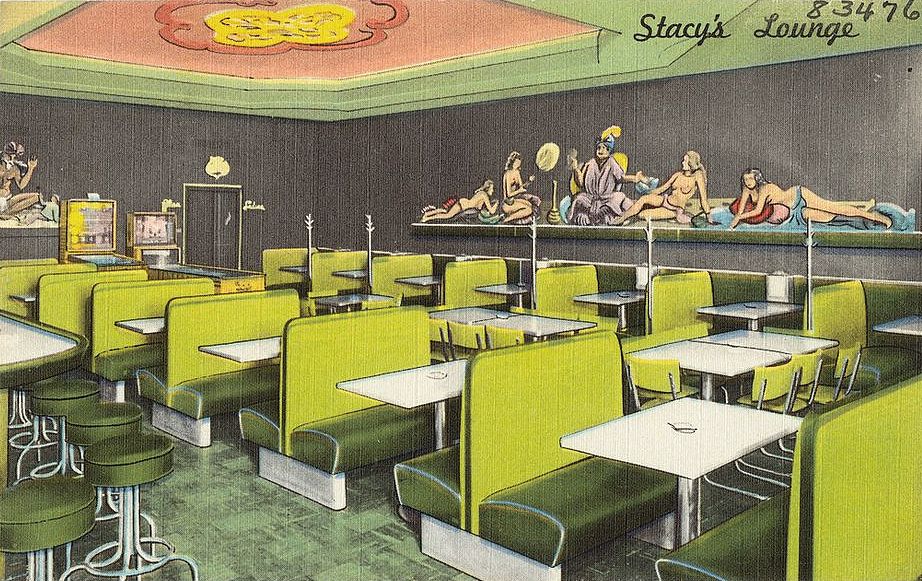
Stacy’s Lounge on The Miracle Mile — 1950

stacys-loungeStacy’s has it all: murals, pinball, ashtrays

by Paula Bosse

Today: a quick look back at a short-lived bar, Stacy’s Lounge, once located along the famed Miracle Mile. Actually, this postcard may be about all that remains from what was, apparently, a fairly short-lived drinking establishment.

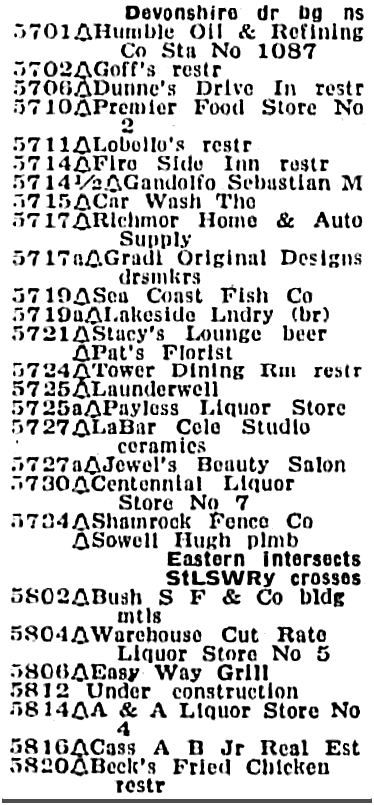
stacys-lounge_1951-dirctry1951 Dallas directory

The above line is from the 1951 city directory, but that listing appears to have been published posthumously. By November of 1950, Stacy’s space at 5721 West Lovers Lane had been taken over by another bar called The Magic Lounge (later the Magic Grille/Herb’s Magic Grill).

Stacy — whomever he or she was — was not afraid of color and decor. I mean … for one thing … those murals. The exotic scenes featuring bare-breasted women, men in turbans, and, I think, a cobra are a little unexpected. They’re either great or awful. Patrons in 1950 might have thought they were awful when they walked in, but by closing time, they probably thought they were … slightly less awful. And the colors! They’ve obviously been pumped up for the postcard, but I’m sure the two-toned green vinyl (great booths!) and the pink and yellow molded and recessed ceiling were attention-grabbing. Imagine it crowded, dark, smoky, and loud. I’ve been in old bars that kind of look like this, just grungier, scuffed up, and sagging. This is pretty much what your favorite dive bar looked like when it was new and shiny. (I just realized I’ve never seen a vintage postcard with a pinball machine in it. And a jukebox. And a cartoon Indian fakir. I’ve hit the trifecta!)

So what other businesses filled that block of Lovers in 1950-51? (Click for larger image.)

stacys-lounge_1951-directory_block1951 city directory

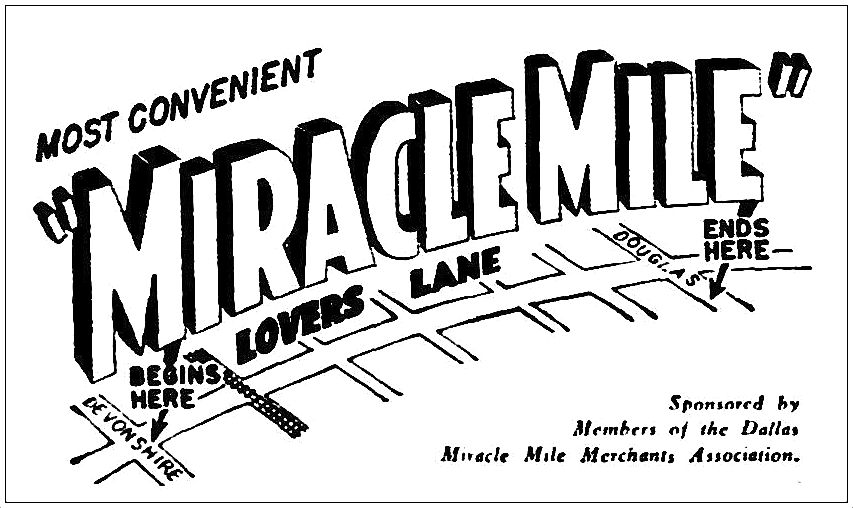
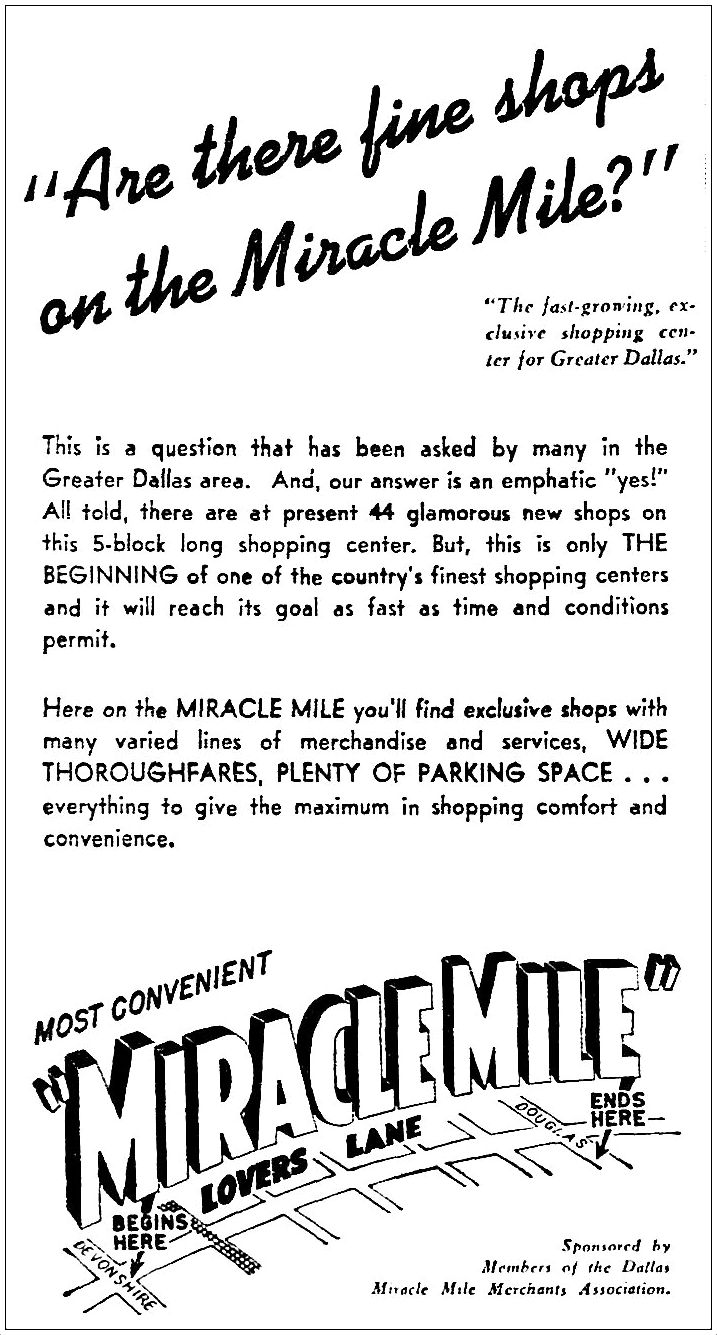
Speaking of The Miracle Mile (you don’t really hear people referring to the Miracle Mile anymore, do you?), when the name of the shopping area debuted in 1947, the official boundaries were Devonshire on the west and Douglas on the east. Some people insist it goes all the way down to the Inwood Theater. This rather adamant Dallas Miracle Mile Merchants Association advertisement illustration would disagree with that notion.

miracle-mile-merchants-assn_ad_april-1947_det

miracle-mile-merchants-assn_ad_april-1947
April, 1947

I’m still not sure why it was called the Miracle Mile, unless it had something to do with the price of real estate. Part of it was in Dallas (the couple of blocks west of what was the St. Louis and Southwestern/Cotton Belt railroad — now the tollway), and part of it was in University Park. (And I suppose still is.) Most of the bars and restaurants were in the Dallas portion, because University Park was dry. Another notable thing about Lovers Lane is that the address numbering is a crazy mess — there’s West Lovers Lane, Lovers Lane, and East Lovers Lane, and every time you pass from one stretch to the next, the abrupt address-changes will make your head spin. (I had no idea it was so crazy until I read Helen Bullock’s very informative and entertaining article about the Miracle Mile in a Sept. 10, 1961 article in The Dallas Morning News, “Walk a Miracle Mile.”)

But back to Stacy — I never actually discovered who Stacy was. Oh well. The particulars of Stacy’s Lounge may be lost to history, but the image of its colorful interior lives on in a 65-year-old garishly-colored postcard.

***

Sources & Notes

Postcard is from the great Boston Public Library Tichnor Brothers Postcard Collection on Flickr, here. I dip into the collection now and again to see what I can find out about those arresting and unreal-looking images — see those past posts here.

Currently at the old Stacy’s Lounge address (though in a newer building) is the Nicholson-Hardie Nursery & Garden Center; the location on a map is here.

You might even say that Stacy’s Lounge has got it going on. Do you have this song going through your head like I do? That’s going to be hard to get out of there.

*

Copyright © 2015 Paula Bosse. All Rights Reserved.

The Dallas News Special: Fast Train to Denison — 1887

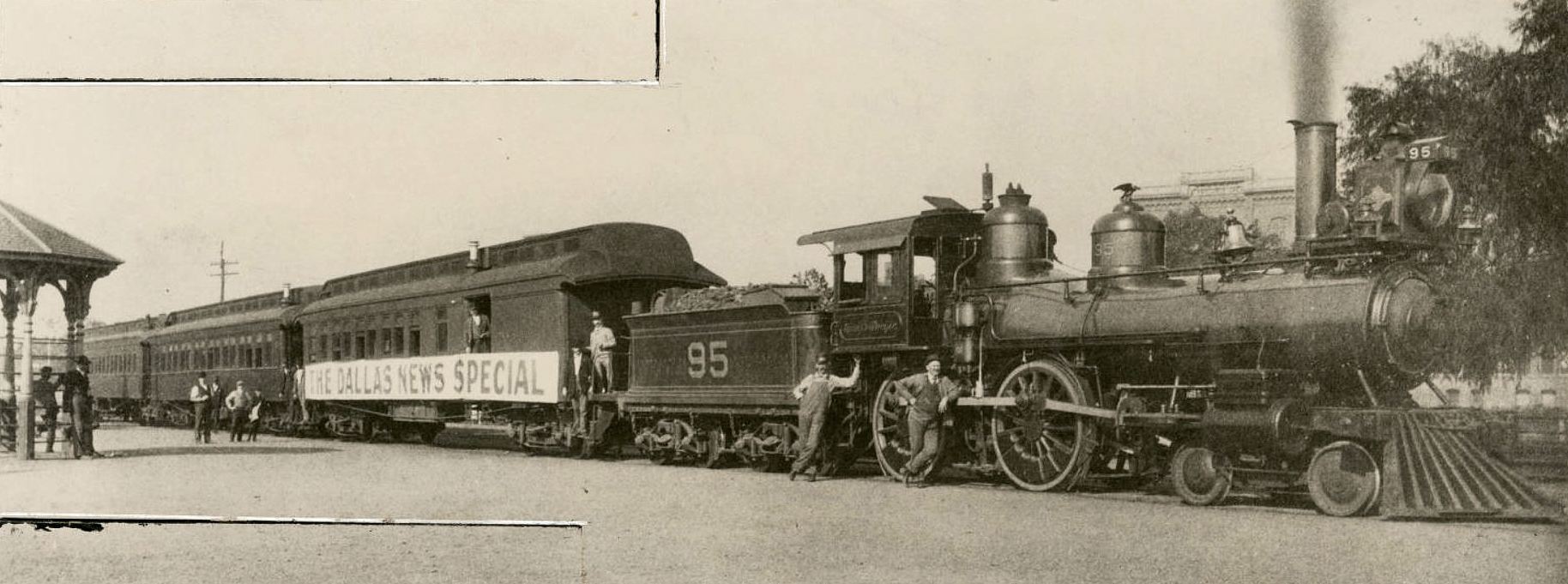
dallas-news-special_belo-collection_smuThe Dallas Morning News, full speed ahead! (Belo Collection, SMU)

by Paula Bosse

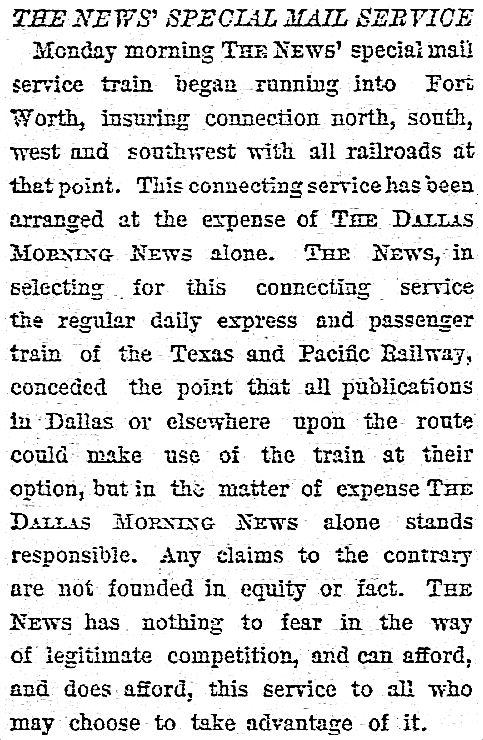
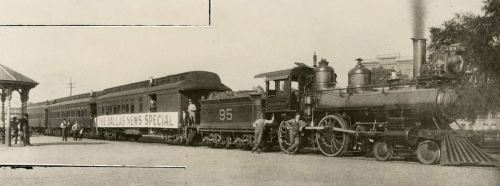
In October 1885, The Galveston News decided to launch a sister publication in Dallas, The Dallas Morning News. They sent 26-year-old George Bannerman Dealey to run it. Before that first month was up, go-getter Dealey had made a special arrangement with the Texas & Pacific railroad — “at considerable expense to The News” — to extend its route and pop into Dallas to pick up papers destined for its subscribers west of the city. (The photo at the top may or may not show that very first “Special Mail train.”)
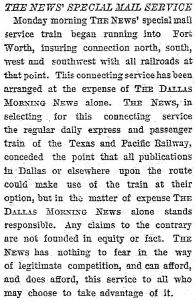
news-train-fort-worth_dmn_102885DMN, Oct. 27, 1885 (click for larger image)

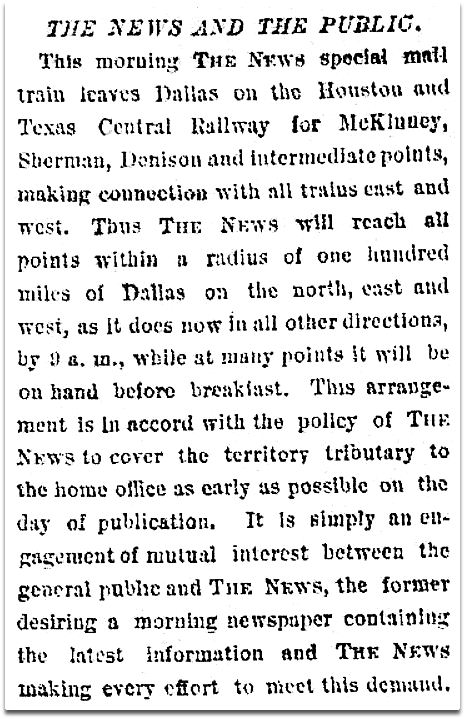
A year and a half later, The News one-upped itself and made the announcement that it would operate a special train to Denison — again, “at a vast expense.” This train would transport editions of the paper in the wee small hours in order to assure that The Dallas Morning News would actually BE a morning newspaper for as many of its subscribers as possible, whether they lived “within a block of the press” or a hundred miles away (DMN, Sept. 30, 1888). News-hungry Denisonians could read their papers over breakfast at the same time their Dallas counterparts did.
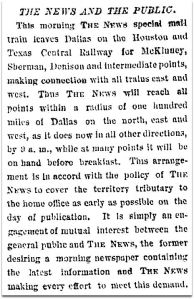
news-train_dmn_052287DMN, May 22, 1887

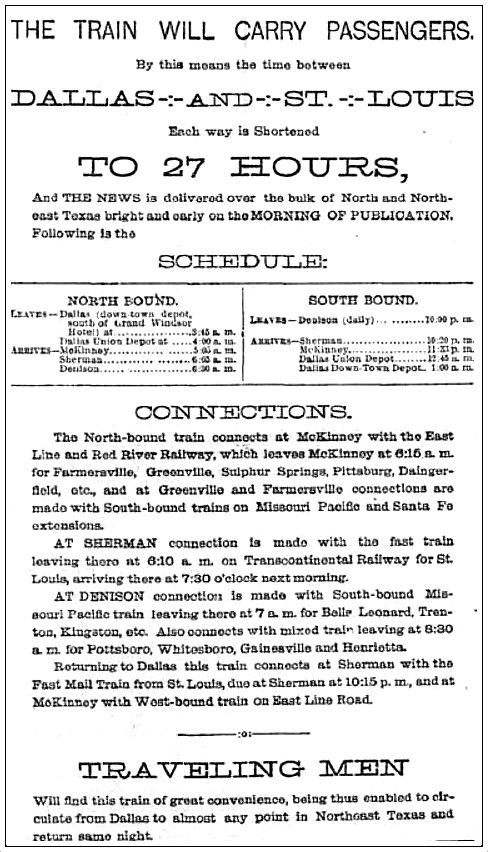
The train was dubbed by some “The Comet” (not to be confused with the MKT’s later Katy Komet). It was a “fast train” that carried passengers as well as newspapers along the Houston and Texas Central rails.

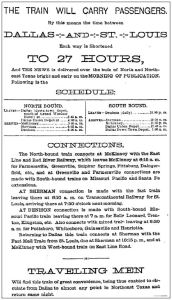
ad-special-news-train_dmn_052287-det

ad-special-news-train_dmn_052287-det2DMN, May 22, 1887

Not only was this a clever way to extend its reach and expand its circulation, but, as the Handbook of Texas notes, it also “enabled the paper to meet the threat of the St. Louis newspapers, which in 1885 had a larger circulation in North Texas than did any state paper.”

A rousing account of the first Dallas-to-Denison run appeared in the pages of both The Dallas News and The Galveston News (which often shared content). A link to that full story is below, but here are a few passages from an article written the next year, touting the wondrous success of the News Special, written as only a nineteenth-century newspaperman could write it (and the writer might well have been G. B. Dealey himself).

First, one encounters a mention of Plano in a more grandiose combination of words than one might expect, as the writer describes his pleasant pre-dawn train trip along the route.

Plano was reached before the drowsy god of day had wiped his eyes at the first yawn. He rolled over in his couch by the time it reached McKinney, and he was sitting on the side of it when the train was at Melissa. And here the mocking birds, with no ruddier iris upon their breast, but moved with the spirit that makes the burnished dove mourn out his love, made the air resonant with their chatter and their songs. Into Sherman and Denison the train plunged and the trip was done.

Um, yes. Then he breaks it down in a little more specifically. Actually, a LOT more specifically.

It starts. Two minutes are consumed at the Missouri Pacific crossing five miles out, two minutes at Caruth’s, five minutes for water, two minutes at Richardson, two minutes at the Cotton Belt crossing, three minutes at Plano, two minutes at Allen, three minutes at McKinney, two minutes at Melissa, fifteen minutes at Anna for a meeting point, three minutes at Van Alstyne, two minutes at Howe, five minutes at Sherman. Total forty-eight minutes. The distance between Sherman and Dallas is sixty-four miles. The time card calls for two hours and five minutes from Dallas to that point. Forty-eight minutes is consumed in stoppages. Anyone can make the calculations, sixty-four miles in seventy-seven minutes, and see the terrific speed that this train makes, has made for over a year, and made it without a single accident, and it is a good road — an awful good road — to make it over.

And then he congratulates his employer on giving even its most distant readers “an even whack.”

Is there anything like this in the history of newspapers? True, some of them in the north run special trains on special occasions, but THE NEWS stands without a rival in this sustained work of giving its remote patrons an even whack with its people of the city. (–The Dallas Morning News, Sept. 30, 1888)

Below, a train identified as this H&TC News Special to Denison, even though it looks remarkably similar to the T&P train (in the photo above) which may or may not have been that earlier 1885 mail train to Fort Worth. Dealey is identified as the man in the light-colored suit, standing on the steps (he also resembles the man in the top photo, but now with a full beard).
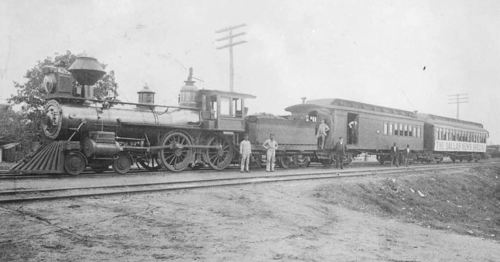
dallas-news-special_train-to-denison_1887_mcafee_degolyer_SMU

The train would slow down as it neared a small-town depot, and, without stopping, a man would toss bundles of papers from the train into the waiting arms of another man on the platform, who would then divide them up and hand them off to men and boys on horseback who would race to deliver them to stores and homes before breakfast.

The Dallas Morning News ran its hot-off-the-presses newspapers up to Denison for several decades on this train until, presumably, cheaper trucks were pulled into action. But did the rather less romantic trucks, rattling up to Grayson County, inspire the mockingbirds to “[make] the air resonant with their chatter and their songs” as had the noble locomotive speeding the news through the night? I think not.

*
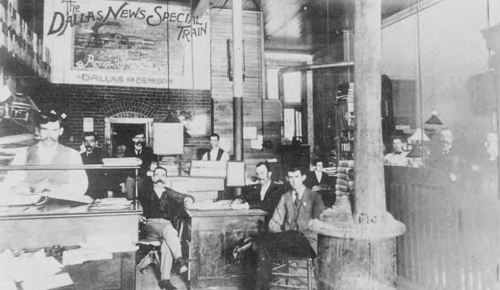
dallas-news-train_degolyer-lib_SMU_ca-1885Dallas News offices, via DeGolyer Library, SMU

***

Sources & Notes

Top photo, titled “The Dallas Morning News special train,” is from the Belo Records, DeGolyer Library, Central University Libraries, Southern Methodist University; it can be viewed here. It’s a bit confusing, but this may show the inaugural run of the DMN’s special train to Fort Worth on May 22 ,1885, along the Texas & Pacific Railway. If anyone has suggestions on where this photo may have been taken, please let me know.

I came across a cropped version of the second photo in the March 1976 issue of Texas Historian, with the caption: “The Comet, Dallas News special train operated between Dallas and Denison in 1887. G. B. Dealey, then Dallas News business manager, stands on first car platform.” The version seen above is from the George A. McAfee photographs collection, DeGolyer Library, Southern Methodist University here; it is titled ”The Dallas News Special (H&T.C.).”

If you’re into trains (and even if you’re not), you might enjoy reading the following three stories from The Dallas Morning News:

  • “Special Mail Service, Observations of a Staff Correspondent Along the Route” (DMN, Oct. 27, 1885), describing the new Fort Worth route and how The News convinced (i.e. paid) the Texas & Pacific Railway to include a stop in Dallas to load up on newspapers and haul them westward, can be read here.
  • “The News in North Texas, The Special Mail Train Service” (DMN, May 23, 1887), a rousingly written ride-along narrative, is here. (I would advise more fragile readers to skip to the next paragraph when they come across mention of a cute little calf — nineteenth-century journalism is not for the overly sensitive.)
  • “News Special Train, Between Dallas and Denison Before Day, Remarkable Record, But the Following Cheerful Narrative Tells the Whole Story, Extending Over Sixteen Months, Over Fifty Miles An Hour” (DMN, Sept. 30, 1888), another genuinely exciting and poetic account of the special train and its crew, again, probably written by Dealey, can be read here. The few sentences that are illegible at the bottom of the first column: “He rang it with jerks in town, he rang it clangingly at crossings, but away out in the solitudes of the country, softly and gently he would peal it slowly, as if he had quit; softly as if his head had dropped upon his bosom. Lyerly is promoted now. Lasher is on the regular passenger train, and R. R. Roe has beautifully and [evenly?] taken his place. But Gentry still sits upon his old seat on the right hand side and watches growing into beefhood the….” 

*

Copyright © 2015 Paula Bosse. All Rights Reserved.

Dunking For Apples at a Halloween Night “Spooks’ Party”

halloween-party_dallas-parks_portalKids used to really have to WORK for those treats!

by Paula Bosse

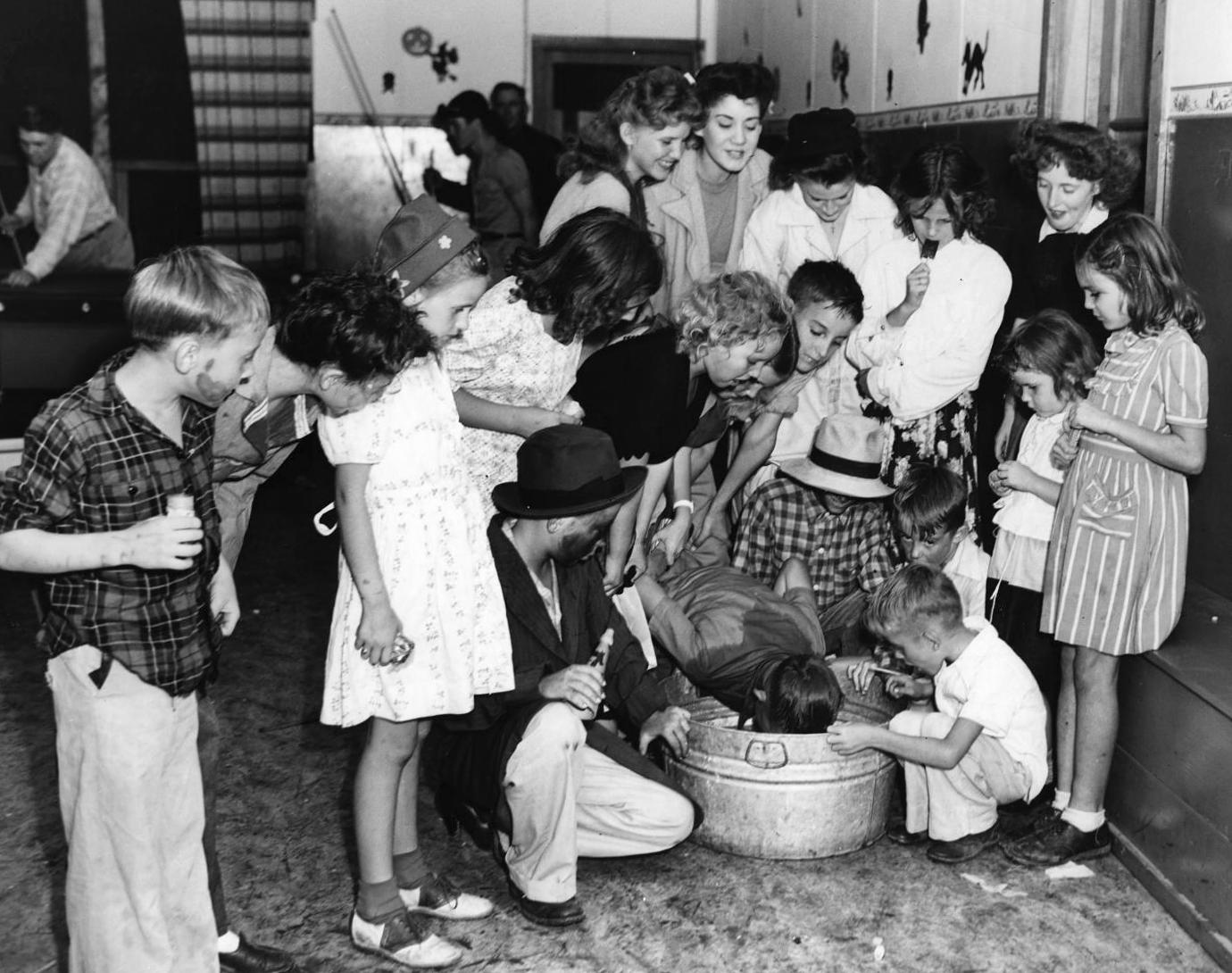
In an effort to steer young revelers to safe Halloween festivities, the Dallas Park and Recreation Department organized parties in community centers around Dallas in the 1930s and ’40s. One of those parties (in an unidentified location) can be seen above, in a photograph titled “Dunking for Apples — Hallowe’en Night — October 31 at Spooks Party.”

The party’s apple-bobbing is in full swing. All eyes are on the dunker, who has obviously been hard at work, dunking down well past his shoulders. A couple of young hobos appear to be in attendance, both with prominent five o’clock shadows. Even though the party is for children, the adults seem to be having more fun than the kids, but perhaps this is early in the evening. And the party’s not just for the small-fry — there’s a pool game going on in the background, providing dunk-free entertainment for dads (and other men who might have wandered in).

Happy Halloween! Dunk responsibly!

***

Sources & Notes

This photograph comes from the Dallas Municipal Archives, accessed through the Portal to Texas History, here. The photographer is Harry Bennett. The photo is undated, but it looks like it is from the early 1940s. These city-sponsored parties appear to have started in the late-1930s as a way to keep children out of mischief and away from the riotous celebrations downtown (which I wrote about previously, here).

More Halloween photos from the Dallas Park and Recreation Department collection, taken by Harry Bennett — perhaps taken the same year, perhaps at the same location — can be seen here.

Click picture for larger image.

*

Copyright © 2015 Paula Bosse. All Rights Reserved.

From the Vault: The Mayhem of Halloweens Past

halloween-trick-or-treatBoo!

by Paula Bosse

I enjoy researching and writing every single one of these Flashback Dallas posts. Some more than others. The one I wrote last year on the insane Halloweens that used to plague the city? I LOVED that one. Check it out here. It’s pretty entertaining, if I do say so myself!

*

Copyright © 2015 Paula Bosse. All Rights Reserved.

Views of Dallas by Bruno Lore — 1931

skyline_smu_1931Bruno Lore’s Dallas, in purples and pinks

by Paula Bosse

Bruno J. Lore (1890-1963) was a Fort Worth artist and illustrator who spent much of his career working for the Southwestern Engraving Company. Known as “the dean of Fort Worth commercial artists,” Lore had a long and successful career, counting among his many clients colleges and universities who commissioned him to create artwork for their yearbooks (and, perhaps as a friendly or persuasive perk, he was often asked to pick the campus beauties who would be featured in those same yearbooks). Even though information about Lore is scant, he seems to have had steady yearbook work, with his illustrations appearing in several Southern and Southwestern college annuals, primarily in the 1920s and ’30s. In Dallas, his artwork appeared in editions of SMU’s Rotunda.

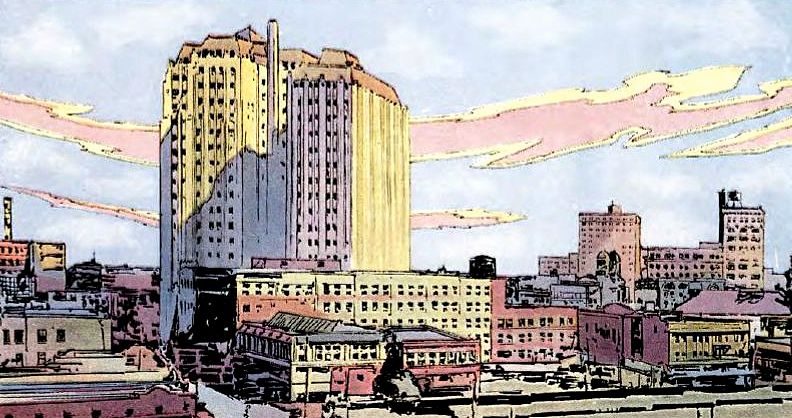
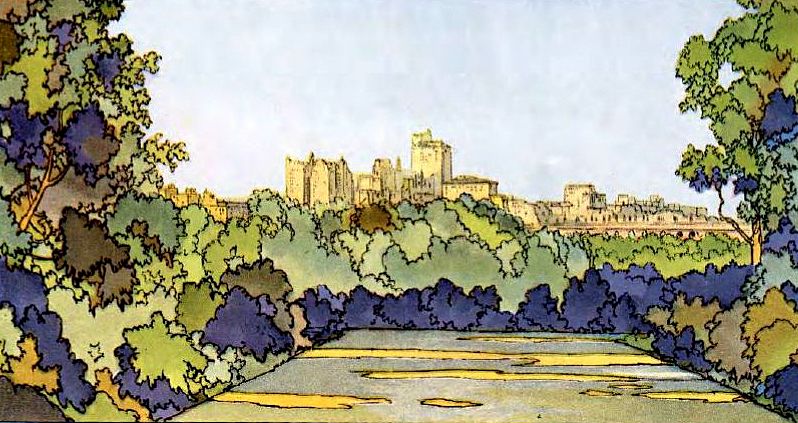
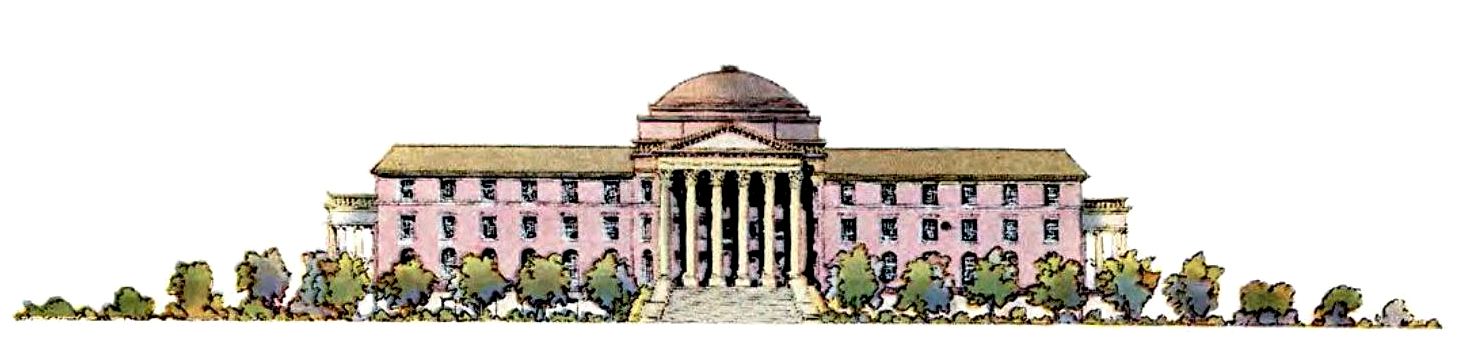
Below are Lore’s vividly colorful views of the SMU campus and the Dallas skyline which appeared in the 1931 Rotunda and provided a lively, modern exuberance to an otherwise fairly standard college yearbook.

rotunda_1931_advertising-header

smu-rotunda_1931-intto

dallas-hall_smu-rotunda-1931

skyline_smu-rotunda-1931

skyline-3_smu-rotunda-1931

skyline-5_smu-rotunda-1931

skyline-2_smu-rotunda-1931

skyline-6_smu-rotunda-1931

skyline-4_smu-rotunda-1931

skyline-8_smu-rotunda-1931

skyline-7_smu-rotunda-1931

saddleburr_smu-rotunda-1931

students_smu-rotunda-1931

smu-1931rotunda_1931_title-page

*

Lore was doing yearbook work (along with his other commissions) into at least the ’40s. His later years seem to have been focused on Western art, and he produced several paintings. He seems to be most fondly remembered by collectors as the artist who was responsible for several decades’ worth of Western-themed cover art for souvenir annuals of the Fort Worth Rodeo and the Southwestern Exposition and Fat Stock Show.

lore_FWST_012173Fort Worth Star-Telegram, Jan. 21, 1973

***

Sources & Notes

All artwork is from the 1931 Rotunda, yearbook of Southern Methodist University. The above illustrations are unattributed, but it seems fairly certain that they are by Bruno J. Lore, who is mentioned in the school’s newspaper, The Daily Campus, as providing the artwork for the 1931 Rotunda. This edition of the yearbook also contains eight somewhat more staid views of campus scenes in pencil or ink and wash which are attributed to Lore. Lore’s yearbook work was apparently done remotely, and he often worked from photographs.

*

Copyright © 2015 Paula Bosse. All Rights Reserved.

Horses, Carriages, Horseless Carriages: Commerce Street — 1913

new-skyline_c1912_degolyer_smuWest on Commerce, from about St. Paul (click for larger image) / SMU

by Paula Bosse

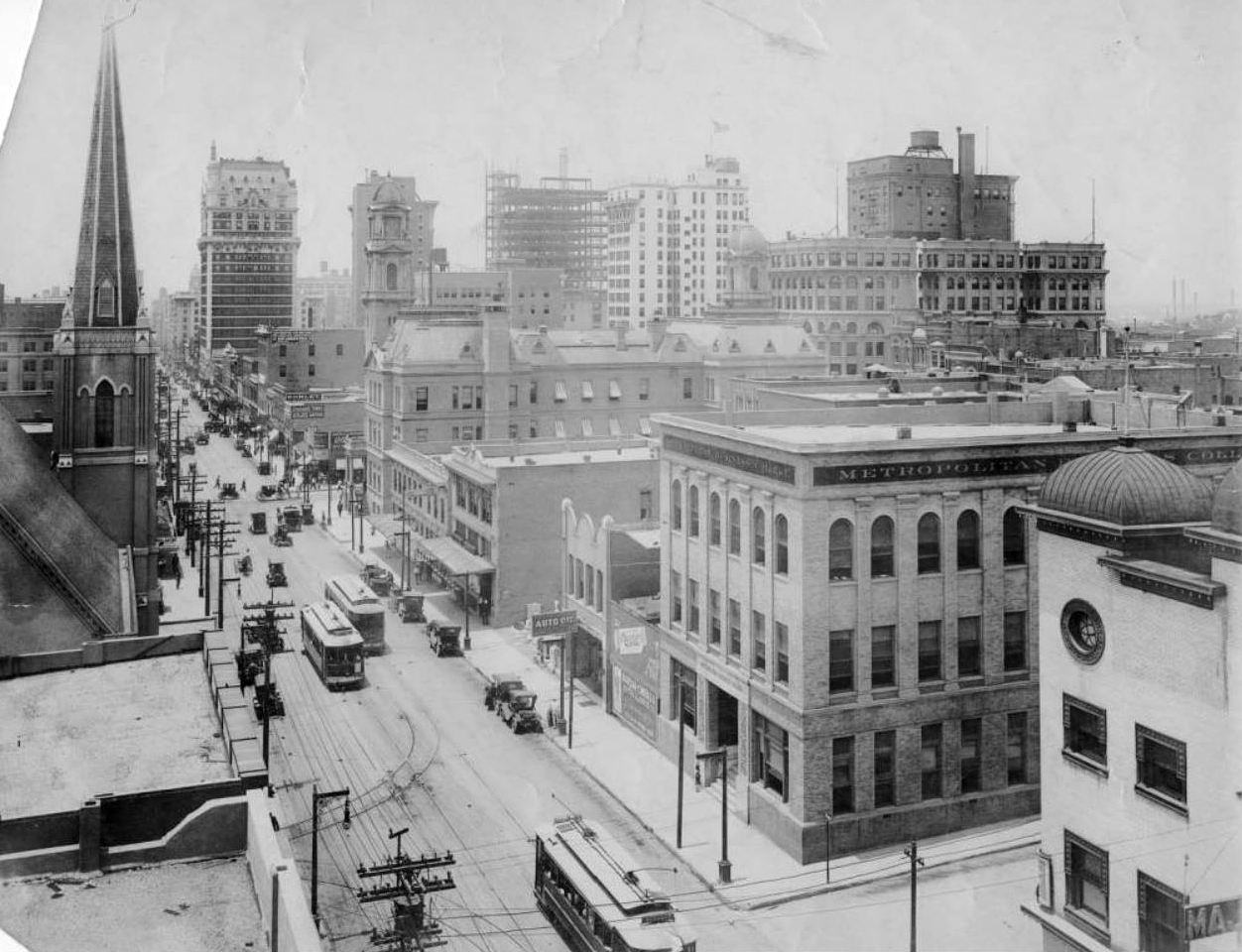
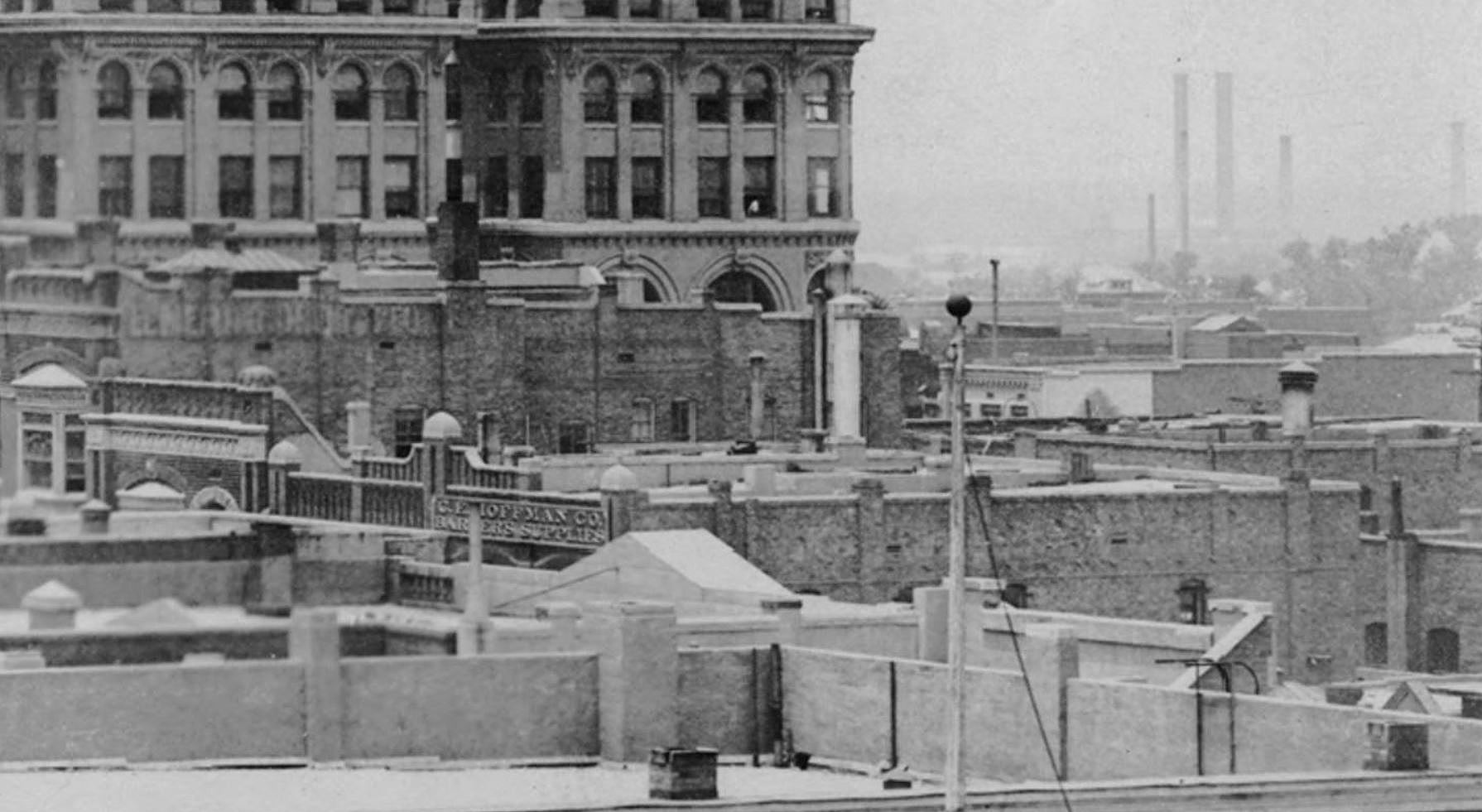
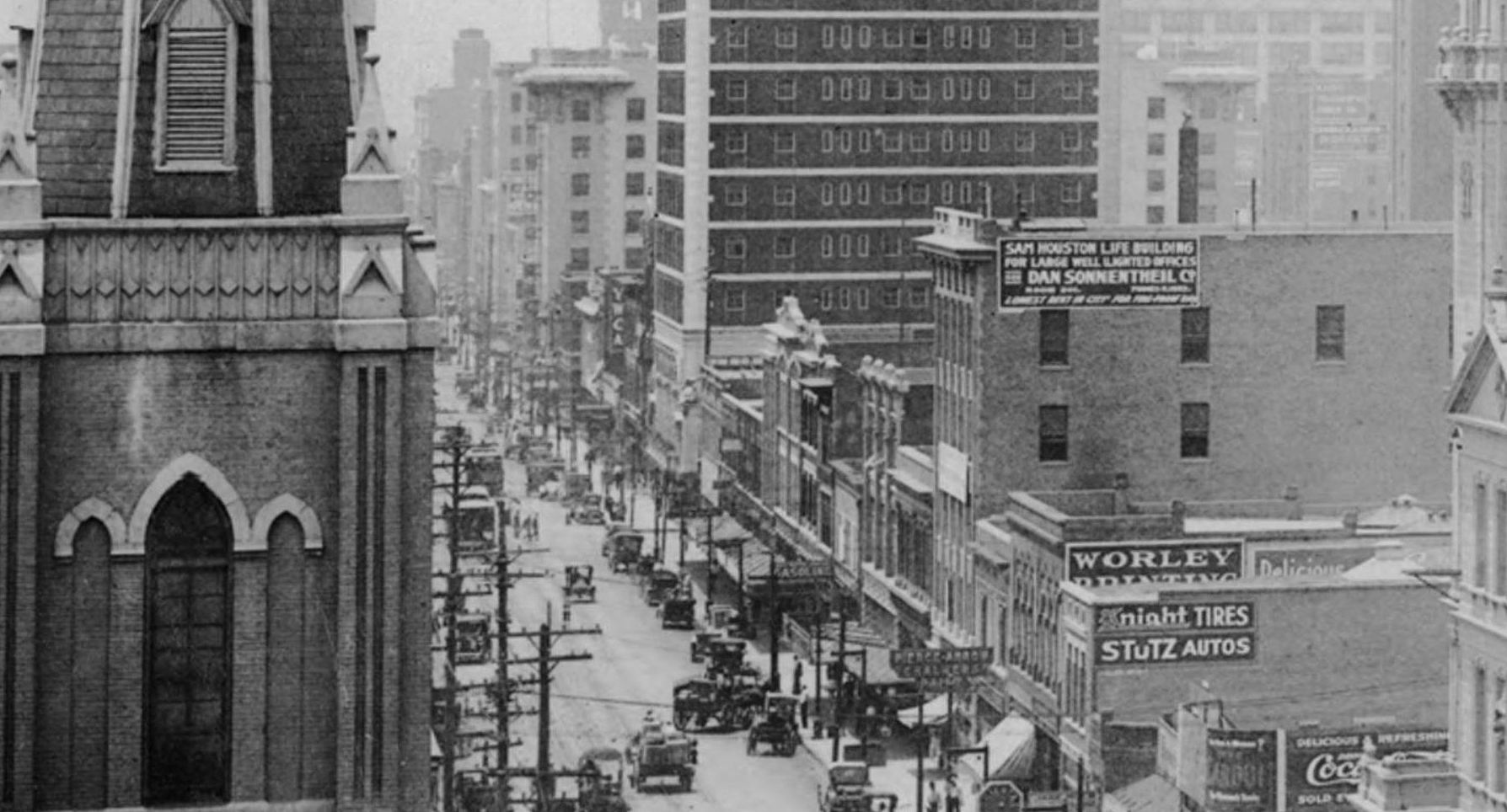
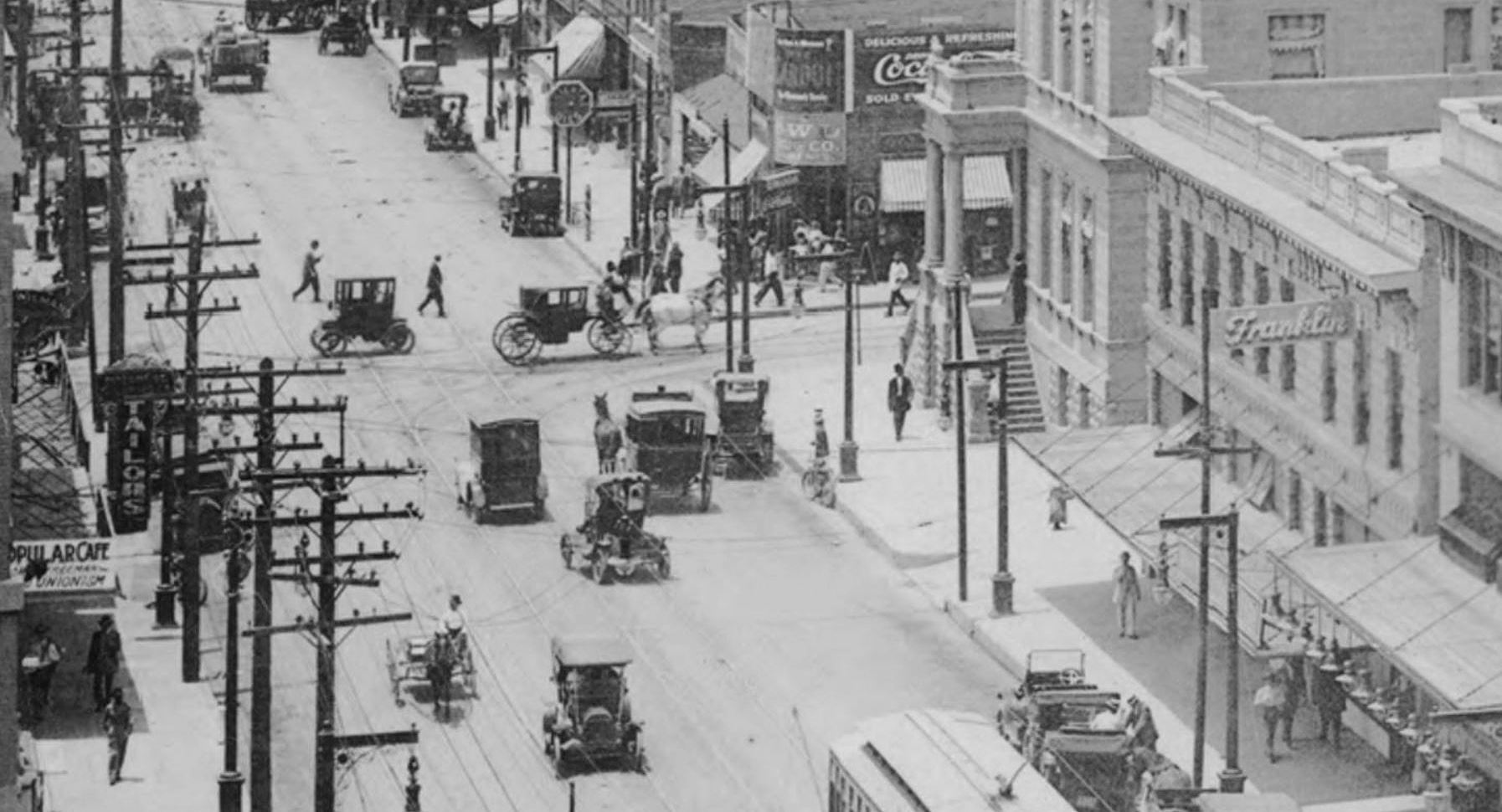
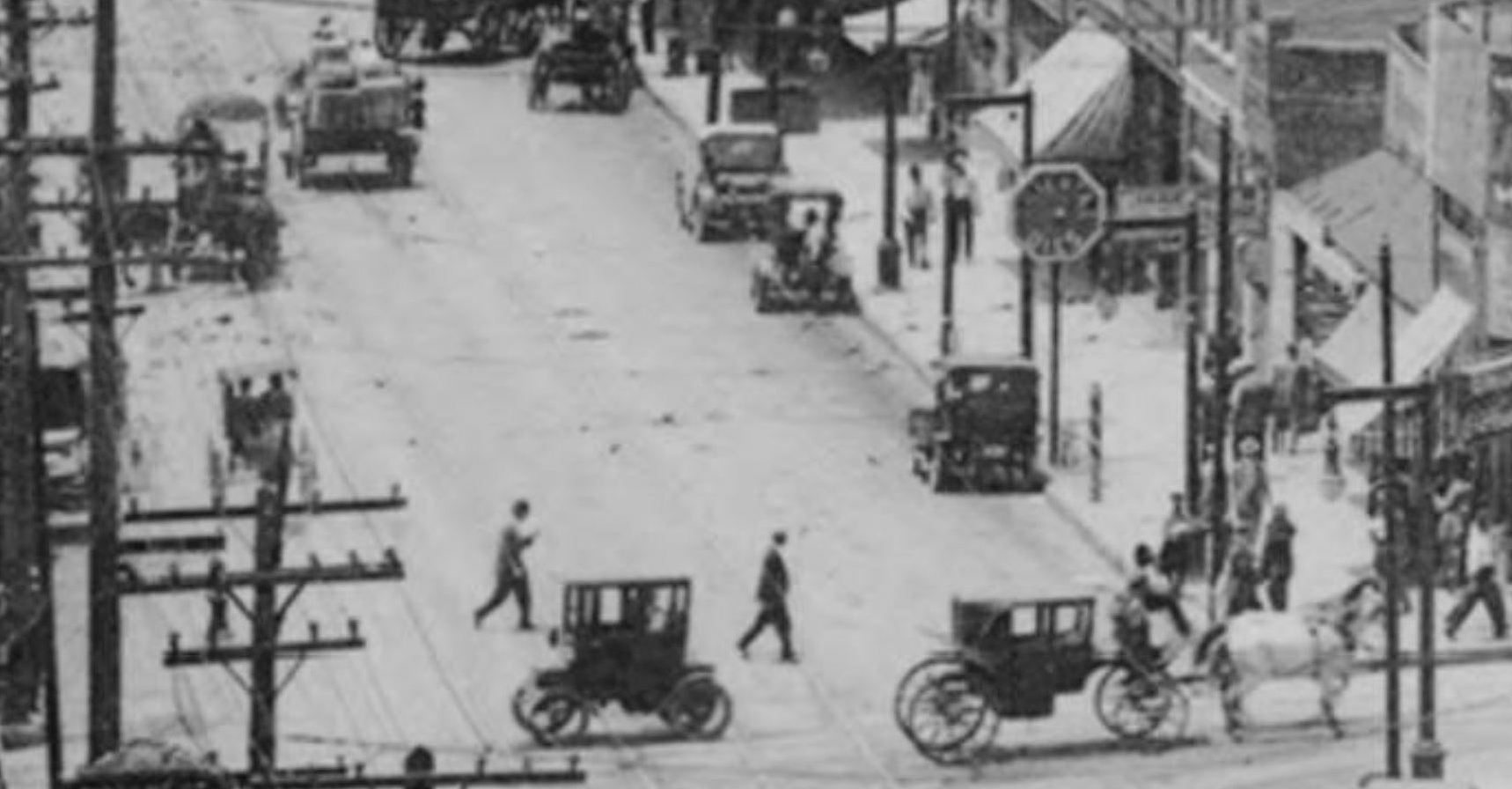
The photo above is from the indispensable collection at SMU’s DeGolyer Library. It shows a very busy Commerce Street in 1913, taken from the top of the YMCA building at St. Paul, looking west. The two landmarks at either end of Commerce are the first location of the Majestic Theatre at 1901 Commerce (northeast corner of Commerce and St. Paul), seen in the bottom right corner, and the Adolphus Hotel at the top left. I love this photo, mostly because it shows horse-drawn conveyances and automobiles sharing the streets in an already car-crazy Dallas, something that might not be that noticeable at first glance until you start zooming in to see magnified details. Let’s zoom in. Way in. (All images much larger when clicked.)

1-rooftops-skyline

2-traffic-skyline-1

Dallas has begun to look like a big city.

3-traffic-skyline-2

Below, the building on the right with the steep steps is the old Post Office/Federal Building at Ervay. The Mercantile Bank Building was built on that site in 1942.

4-traffic-skyline-3

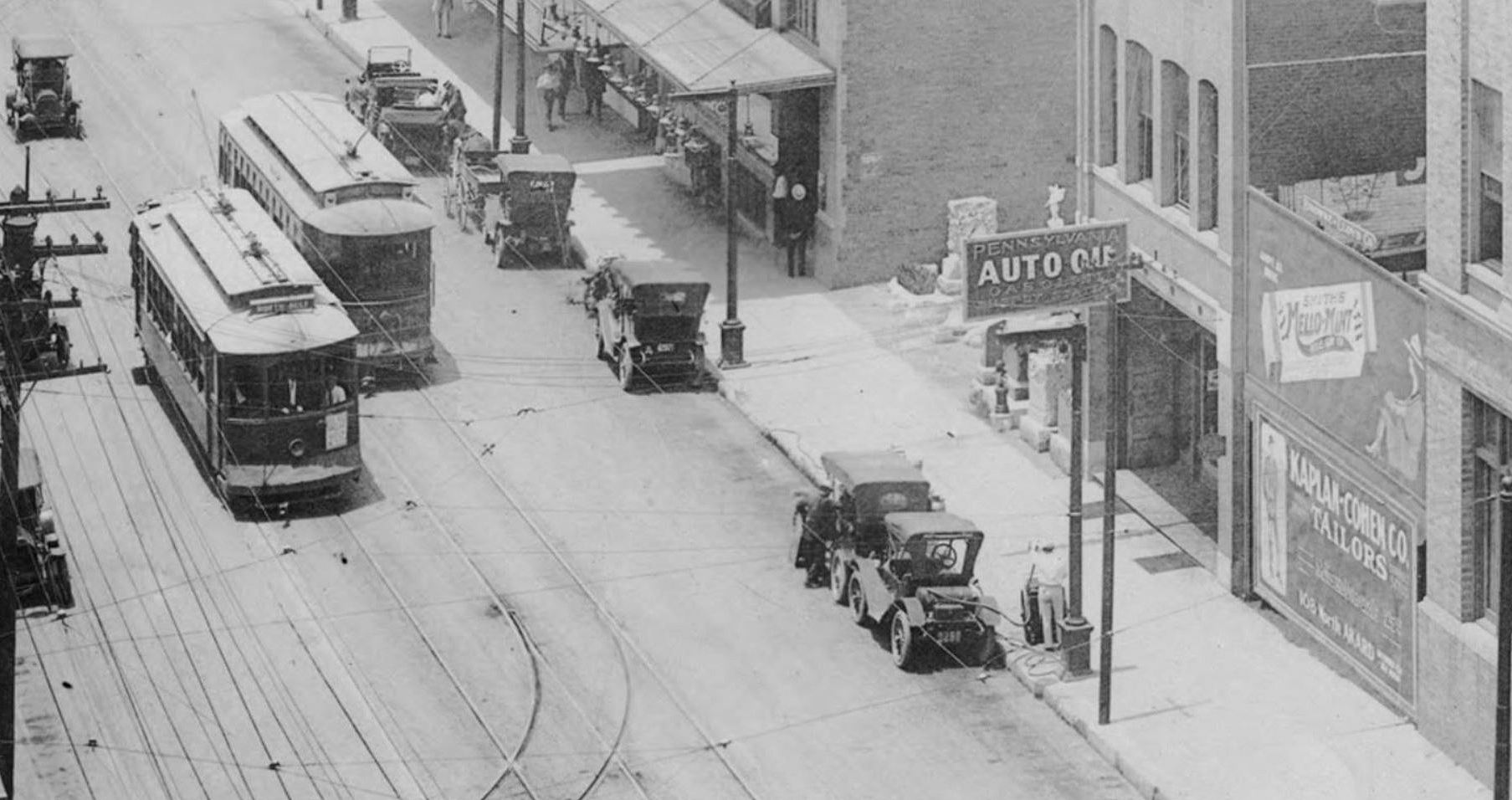
I love the detail below for a couple of reasons: first, the car at the curb at the lower right is parked next to what is purported to be the first gas pump in Dallas (the sign next to it that looks like a stop sign says “Oriental Oils” — more below); secondly, the ratio of cars to horses is pretty even.

5-traffic-skyline-4

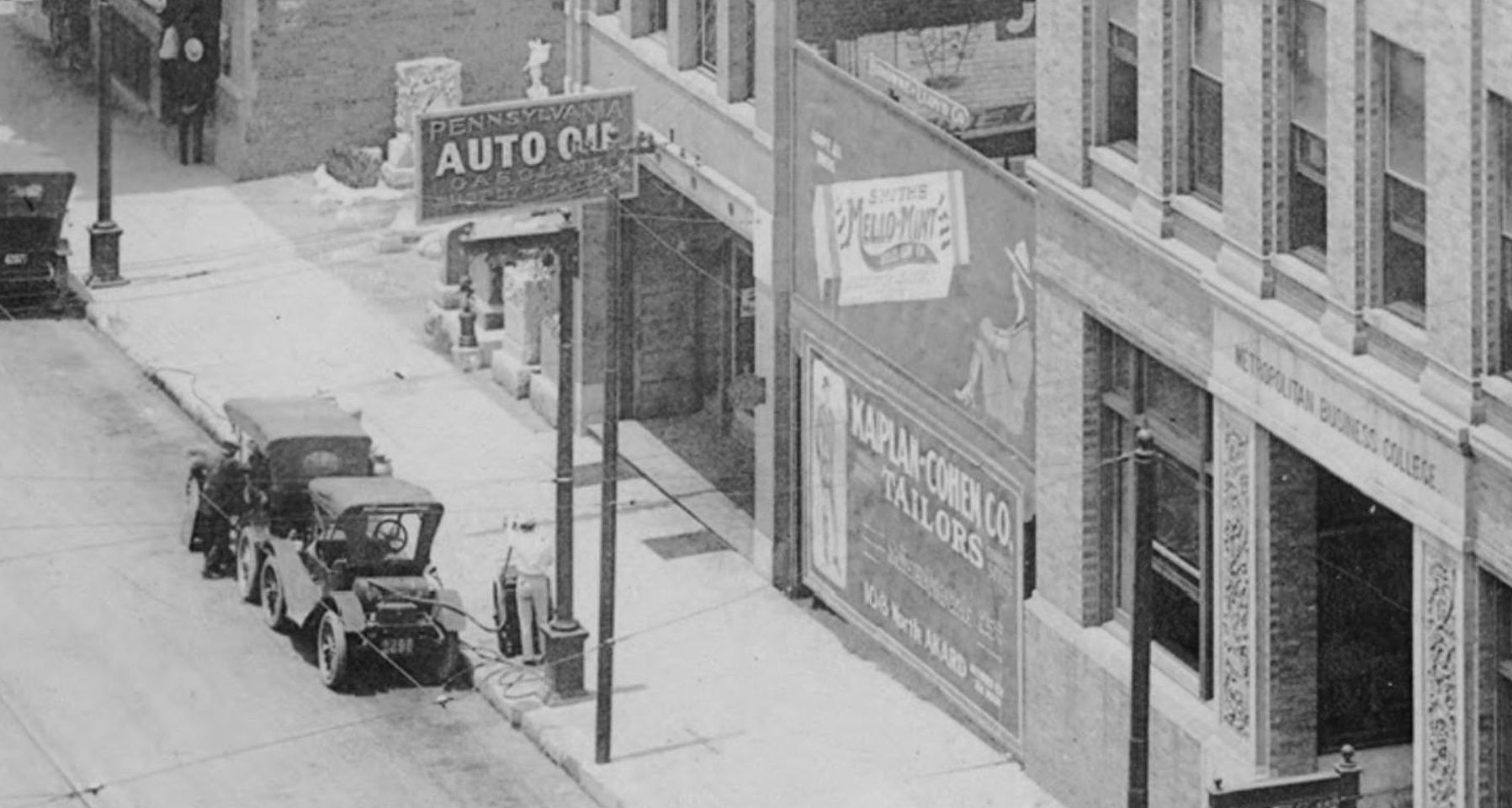
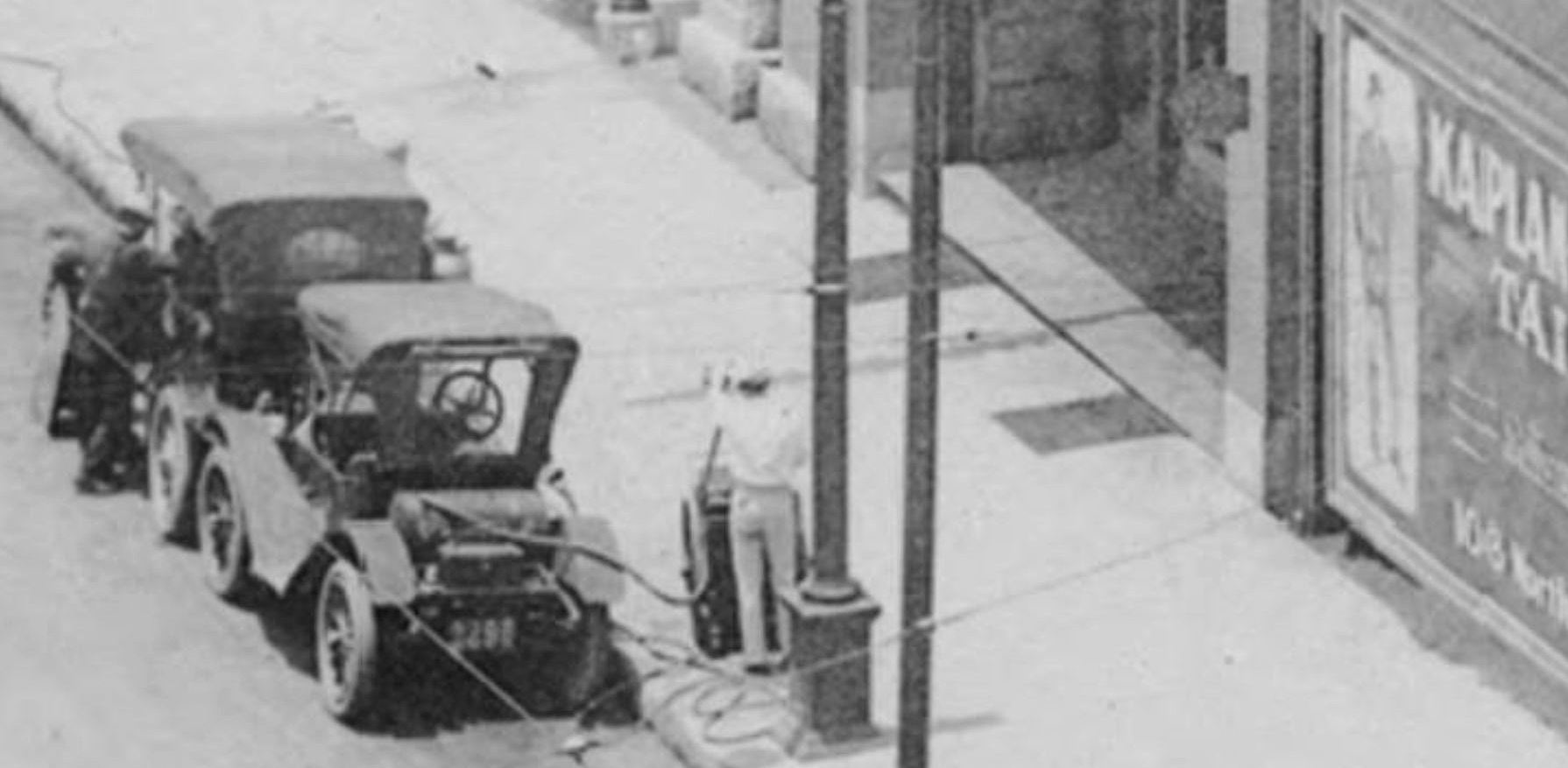
A block east of the Oriental Oil gasoline feuling station is the Pennsylvania Oil Company feuling station, at 1805 Commerce. When I first saw this last year, I was so excited to discover this seemingly mundane little detail that I wrote an entire post about these early curbside gas pumps (read “Oriental Oil Company: Fill ‘er Up, Right There at the Curb” here).

7-gas-skyline-1

And a couple more close-ups of this exotic thing which I still find inexplicably fascinating.

8-gas-skyline-2

9-gas-skyline-3

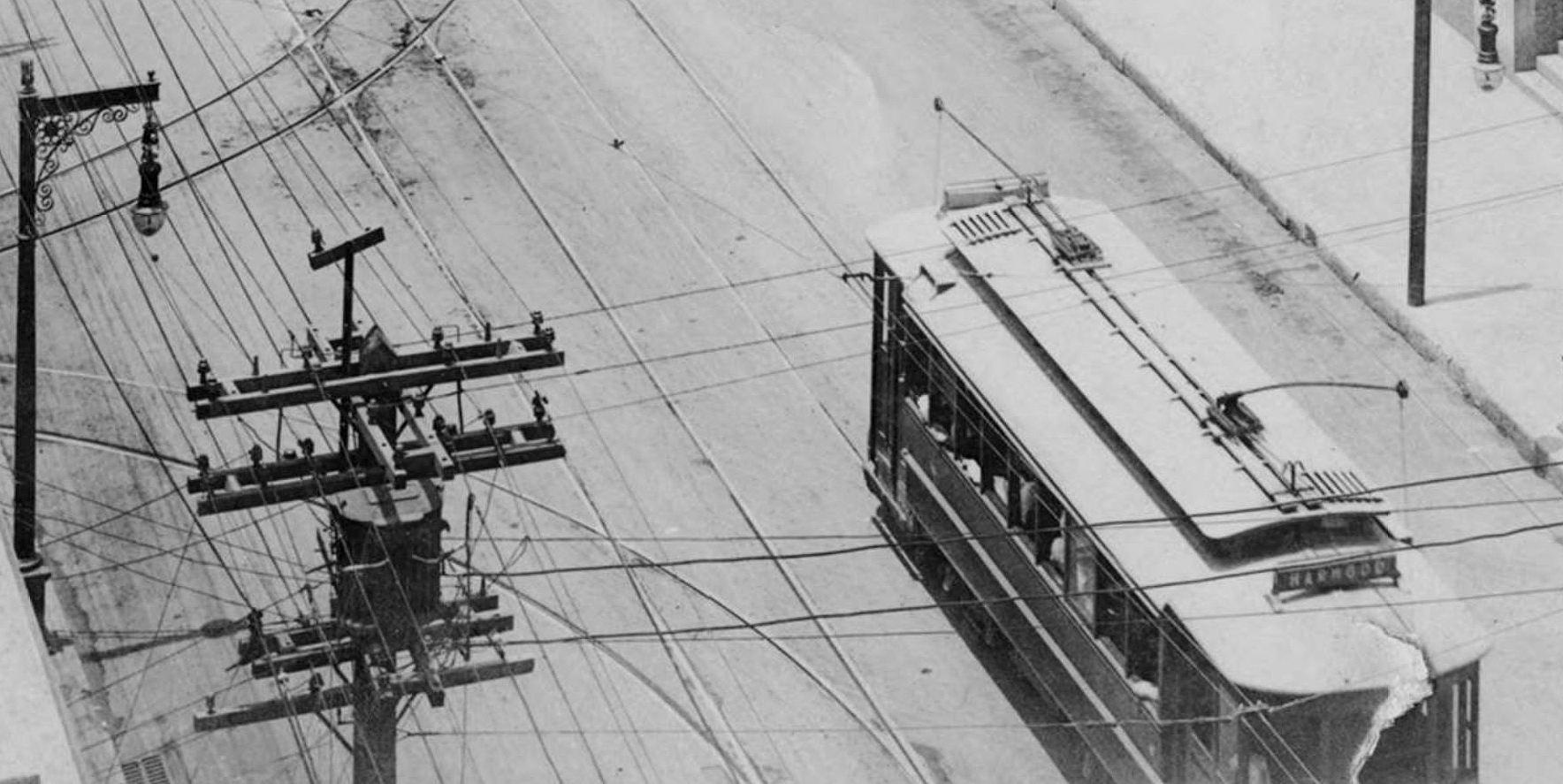
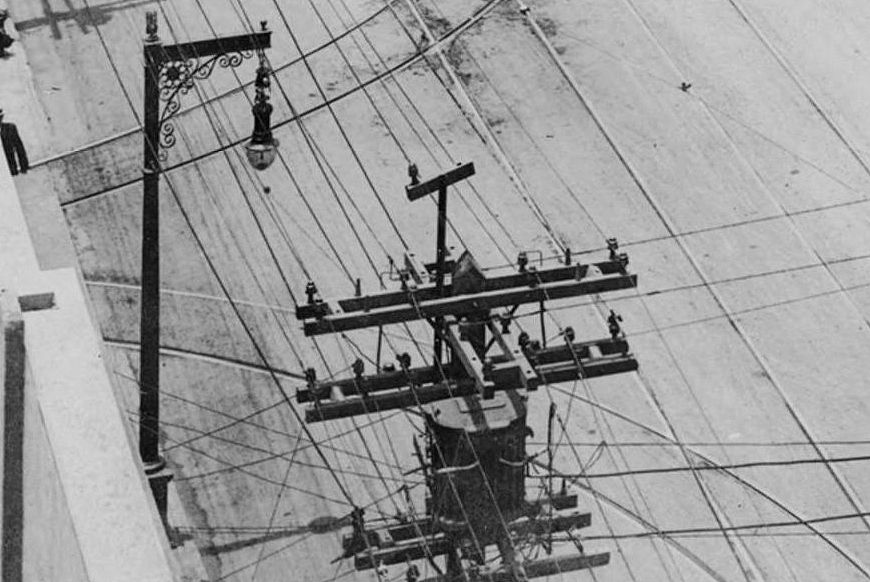
So many wires, and tracks. The Harwood streetcar is cool, but that streetlight is cooler.

10-lamp-skyline-1

11-lamp-skyline-2

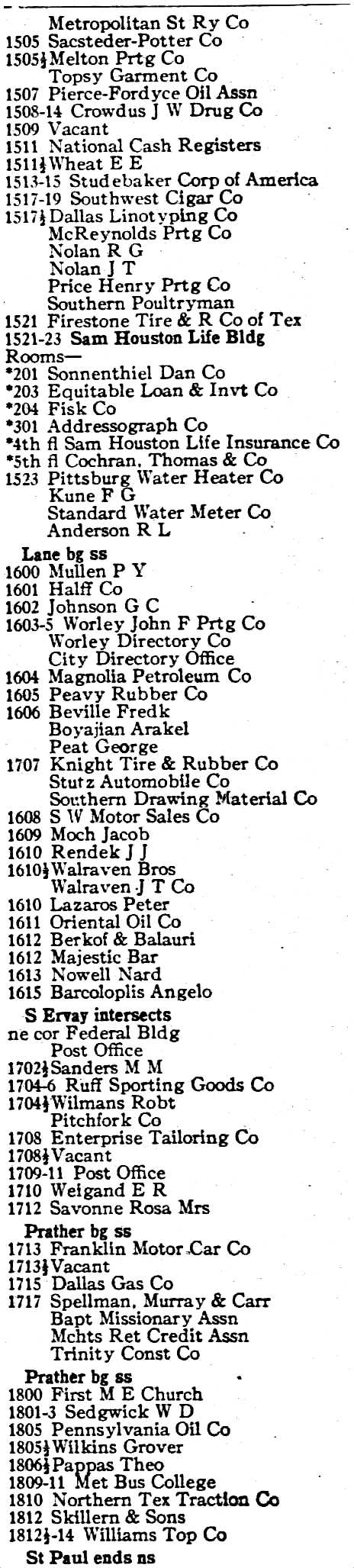
Below, a listing of most of the businesses seen along this stretch of Commerce, from the 1913 Dallas directory.

commerce-street_1913-directory***

Original photo is titled “New Skyline from Y.M.C.A., 1912 & 1913,” taken by Jno. J. Johnson, from the DeGolyer Library, Central University Libraries, Southern Methodist University; it can be viewed here. I have corrected the color.

The current Google Street View of Commerce looking west from St. Paul can be seen here. Very different.

UPDATE: This photograph is from 1913. The Busch Building (later the Kirby Building) began construction on the steel superstructure of the building at the end of December, 1912. The building had reached 13 stories by May, 1913 and was completed in November or December, 1913. I have updated the title from “ca. 1912” to “1913.”

All of these images are really big. Click them!

*

Copyright © 2015 Paula Bosse. All Rights Reserved.

The Terrill School — 1914

terrill-school_tx-almanac_1914-detThe Terrill School, 4217 Swiss Avenue

by Paula Bosse

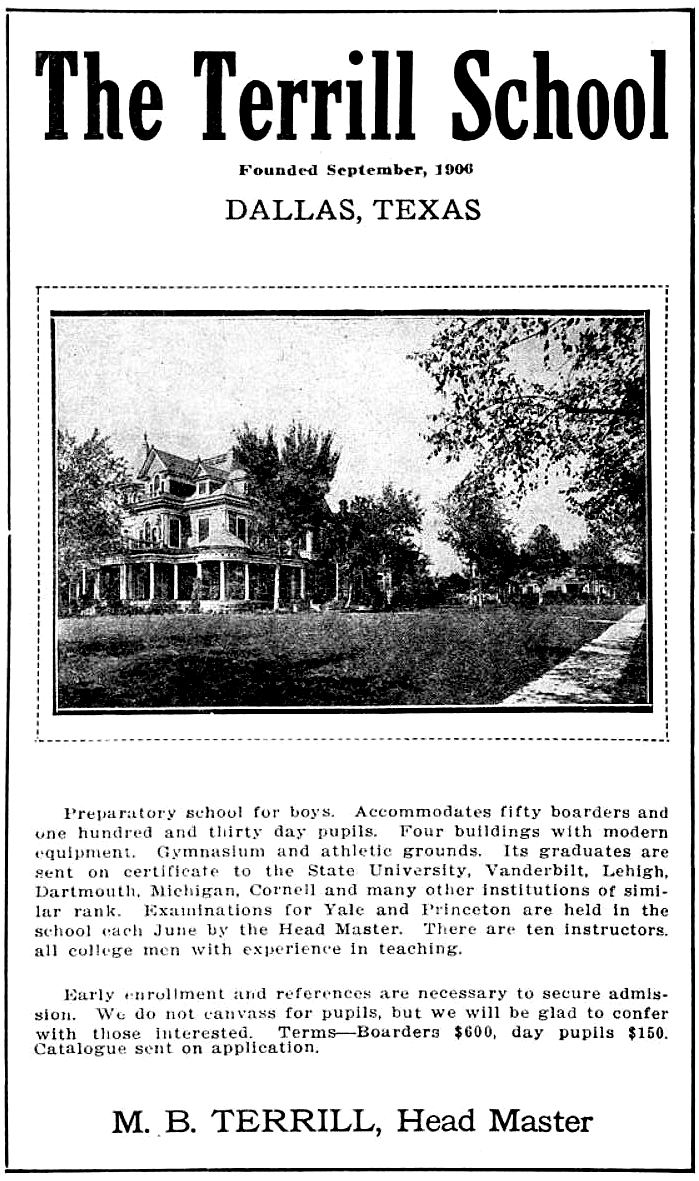
The Terrill School was for many years THE top prep school for boys in Dallas. Founded in 1906, it was located at the corner of Swiss and Peak in Old East Dallas until a move to Ross Avenue in the early ’30s. After a series of mergers over a span of years, it eventually became St. Mark’s School of Texas. Below, an ad that appeared in the 1914 edition of The Texas Almanac. (Click for larger image.)

terrill-school_tx-almanac_1914

I’m never sure how accurate The Inflation Calculator is, but when those numbers are run through it, in today’s money, parents would be forking over $14,000 a year if their sons lived on the campus, or $3,500 a year if they were students who lived at home.

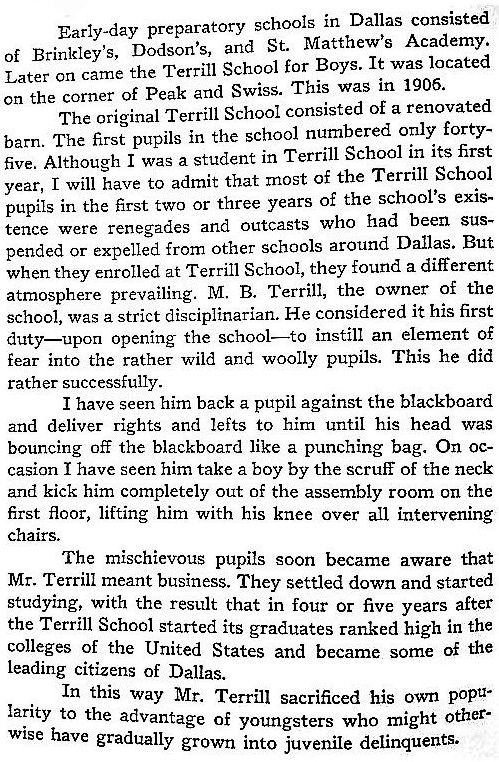
Hundreds, if not thousands, of successful businessmen and civic leaders spent time at the Terrill School. According to an eyebrow-raising account of life at Terrill — written by Dallas Morning News publisher Ted Dealey — those early days sounded more like a reform school than a prestigious prep school. One can only hope the practices he describes below did not last very long.

terrill_dealey_p28from “Diaper Days of Dallas” by Ted Dealey (1966)
Seems to have turned Ted Dealey around!

***

Sources & Notes

Ad from the 1914 edition of The Texas Almanac.

The passage by Ted Dealey is from his (highly recommended!) book, Diaper Days of Dallas (Nashville: Abingdon Press, 1966), p. 28.

More photos and background on The Terrill School can be found in the post “George Cacas, The Terrill School’s Ice Cream Man — 1916,” here.

*

Copyright © 2015 Paula Bosse. All Rights Reserved.

From the Vault: The Britling Cafeteria

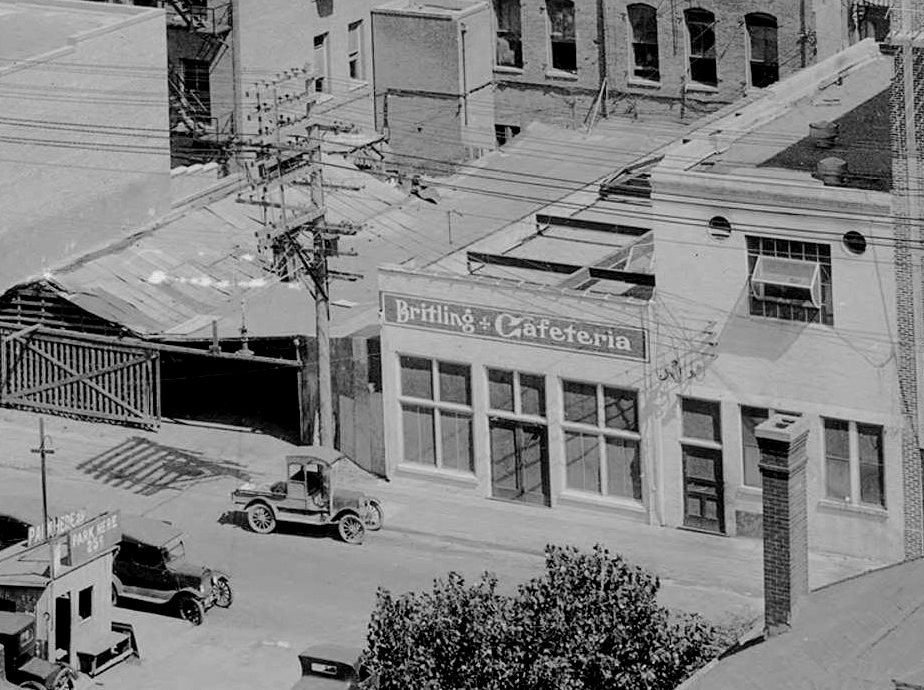
britling-cafeteria_rear-entrance_degolyerThe 1300 block of Jackson Street

by Paula Bosse

Last year I wrote about the Britling Cafeteria, an apparently well-known Southern restaurant chain, founded about a hundred years ago. Its first restaurant outside the Deep South was in Dallas, where it opened at 1316 Commerce Street at the end of 1922 (the rear entrance on Jackson Street is seen above). I’m a sucker for nostalgic restaurant articles, so I wrote one myself! Check out the post “The Britling Cafeteria Serves Those Who Serve Themselves,” here.

I would never have known about that swanky cafeteria had I not seen a fantastic George McAfee photo from the collection of SMU’s DeGolyer Library — the image above is a magnified detail of the original, much larger photograph. See that original photo, along with five zoomed-in details, in the post “Downtown Dallas, ca. 1923 — Zooming in on the Details,” here.

A “from the vault” two-fer.

*

Copyright © 2015 Paula Bosse. All Rights Reserved.


The Republic Bank Building’s Death-Ray Beacon

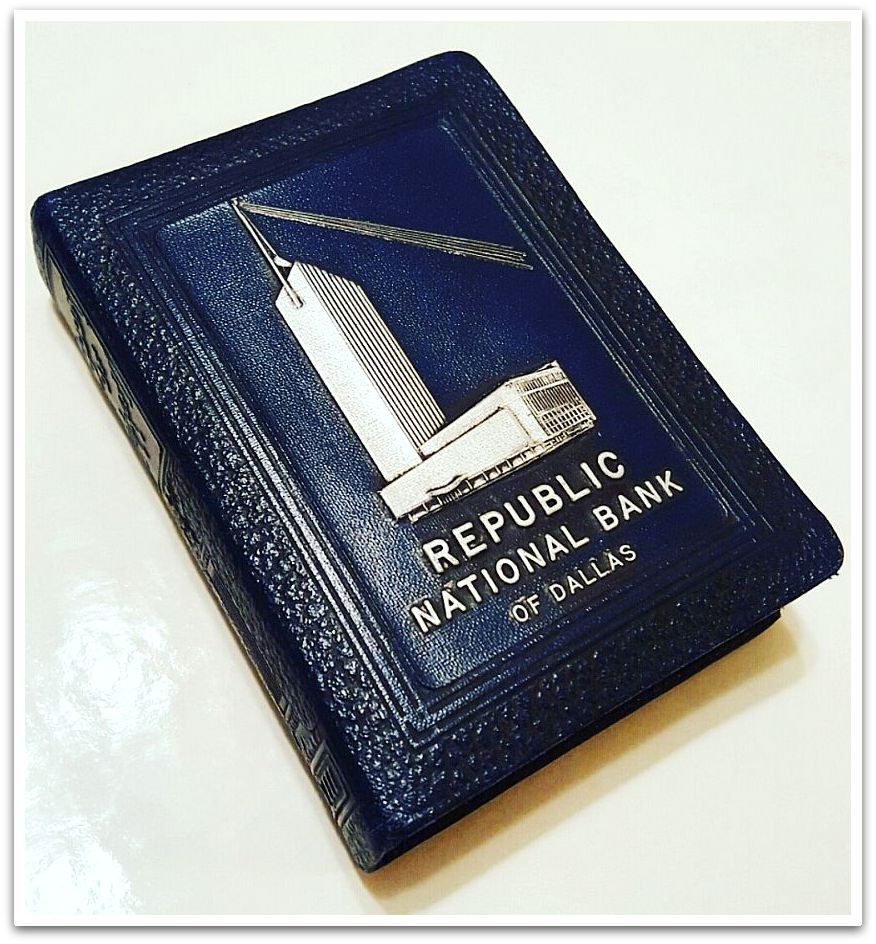
repub-natl-bank_book-bankThis novelty bank is WAY cooler than a toaster! (photo: Paula Bosse)

by Paula Bosse

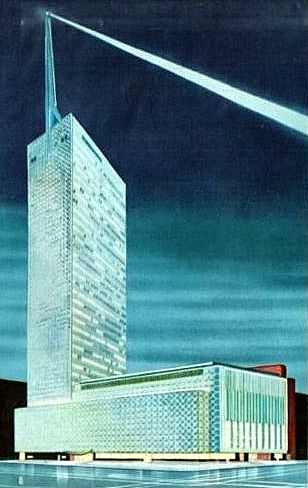
I’m not a big collector of things, but when I saw this little book-shaped bank, probably a promotional item given away by the Republic National Bank in, I would guess, the 1950s, I really wanted it. I love that building, and I especially love images showing that powerful sci-fi-looking beacon on top of it.

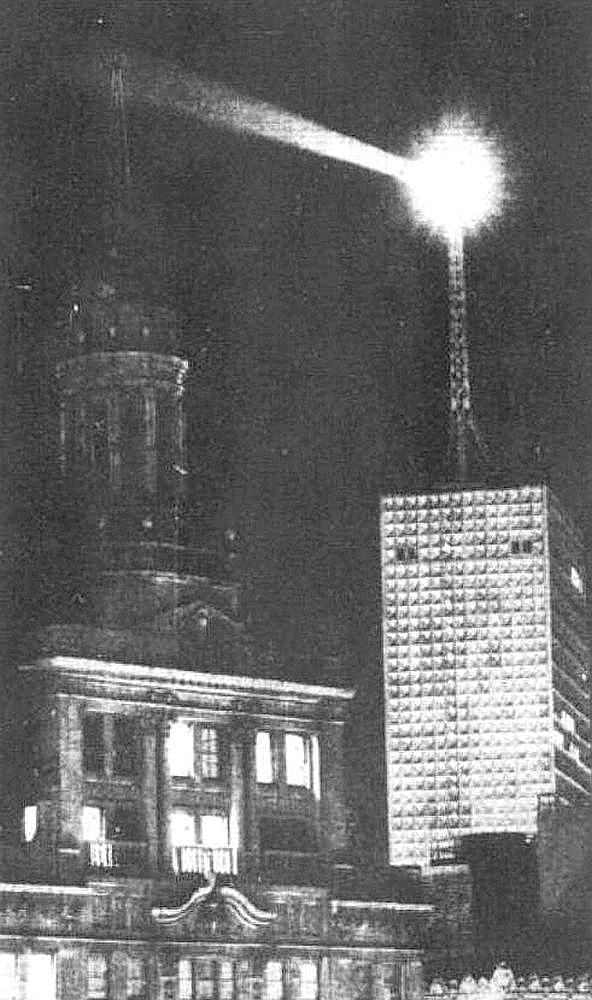
About that beacon. I’ve never actually seen a photograph of that thing in action … until today. Here is a great photo (I’d love to see the original…) during a test-run of the blinding searchlight. (The Davis Building — previous home of Republic National Bank — is seen at the left.) (Click to see larger image.)

beacon_mid-50s

When the Republic Bank Building opened in December, 1954, it was Dallas’ tallest building — helped out by the added oomph of that rocket on top. In an article detailing the specifics of the building, was this:

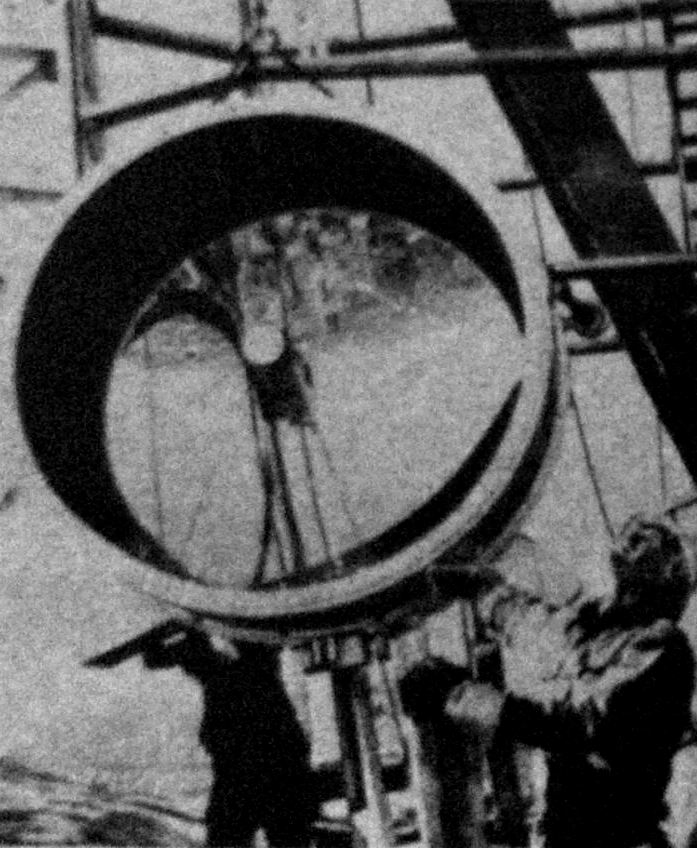
The 150-foot ornamental tower […] supports a beacon light with a lens five feet in diameter. The rotating light of almost a half-billion candlepower was designed for visibility of 120 miles. (DMN, Nov. 28, 1954)

Wow. I don’t even know what “half-billion candlepower” IS, but I bet it cut through the night sky like a hot knife through butter. And visible for 120 miles? …ONE HUNDRED AND TWENTY MILES?! I can’t even imagine what that death-ray must have looked like, rotating and pulsing and stabbing through the night sky probably hundreds of times every night. (I  just checked on this. The light rotated twelve times a minute, or once every five seconds. 720 times an hour! If this pace actually kept up over the years, that’s thousands of times every night!) At some point, the beacon was turned off, most likely from complaints from pilots trying to fly in and out of Love Field (possibly from Atoka, Oklahoma, which is … 120 miles from Dallas).

beacon_repub-natl-bankFive feet in diameter…

I have searched and searched to find out when the beacon/searchlight was finally turned off for good. My assumption was that it was fairly early on, because I’m sure it was a major problem for aircraft and was probably shut down at the emphatic insistence of the FAA, but when I asked around on a history group, people told me they remembered seeing it in the ’60s (a couple of people even said they thought they remembered it in the ’70s). If anyone can tell me when this beam finally stopped beaming, I would love to know.

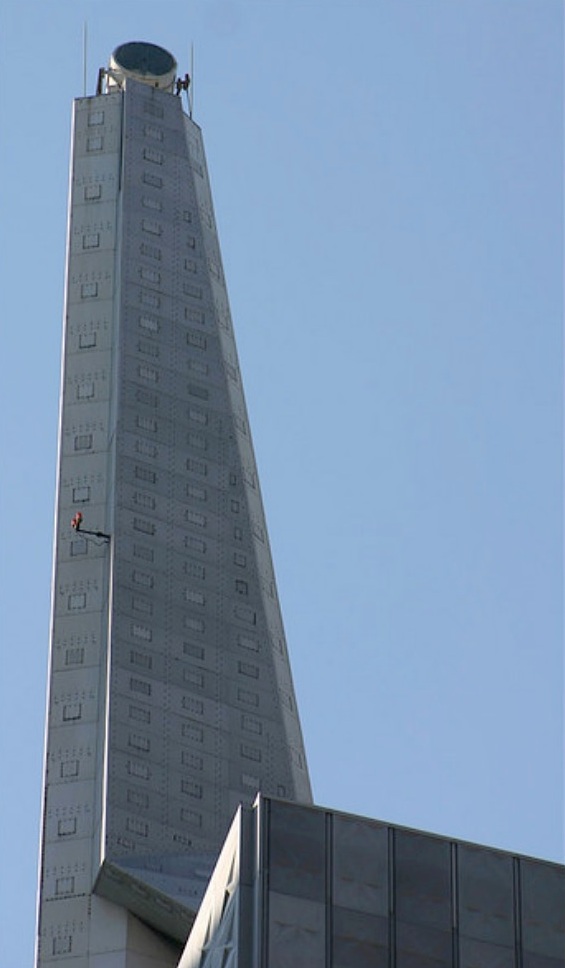
The rocket’s original red, white, and blue lights — made not of neon but of “Lumenarc” tubing (“a newly-developed, super-brilliant luminous tube” — DMN, Dec. 1, 1954) — were turned off in the 1980s, but lighting returned in the early 2000s when the building was being remodeled for residential living, and it continues to stand out as an important part of the Dallas skyline.

rocket_repub-center-websiteToday (via RepublicCenter.com)

That giant lens is still up there, and it might even still function, but the building is no longer the city’s tallest, and were it to be turned on today, that light would pierce right through neighboring buildings — not over them, but into them. If it hit you, it would be like an old cartoon where you would be able to momentarily see an x-ray image of your skeleton. Here’s a photo from 2006 in which you can see the light at the top of the rocket. (Click it!)

republic-bank-bldg_rocket_beacon_scott-dorn_2006_flickrPhoto by Scott Dorn/Flickr

There’s also a great photo of this which I included in one of my favorite Flashback Dallas posts, showing the rocket and searchlight from above, taken in 1968 from Republic Tower 2, here.

republic-national-bank_beacon_front

***

Sources & Notes

That “book bank” is mine! It’s very small — about 3.5″ x 4.5″, covered in blue cloth to mimic a book (it even has a title — “Book of Thrift” — embossed on the spine); it was manufactured by Bankers Utilities Co., which made similar novelty banks for companies all over the country. It has no key — I found one comment online that suggested that they were never issued with keys because the banking institution wanted the young owners of the banks to have to go into the bank in order to retrieve their savings — just like Mom and Dad had to. It’s a cool little bank — much better than a toaster!

Scott Dorn’s photograph can be viewed on Flickr, here.

Not sure what “candlepower” is? I read the Wikipedia article, here, but I’m still not exactly sure. Imagine the light from half a billion candles, I guess. In other words, BRIGHT. Super-cool bright. Retina-damaging bright.

The building is now Gables Republic Tower (website here), a ritzy apartment building.

And, again, if you have information about when the plug was pulled on the painfully powerful revolving spotlight, let me know!

*

Copyright © 2015 Paula Bosse. All Rights Reserved.