Flashback : Dallas

A Miscellany: History, Ads, Pop Culture

Category: 1910s

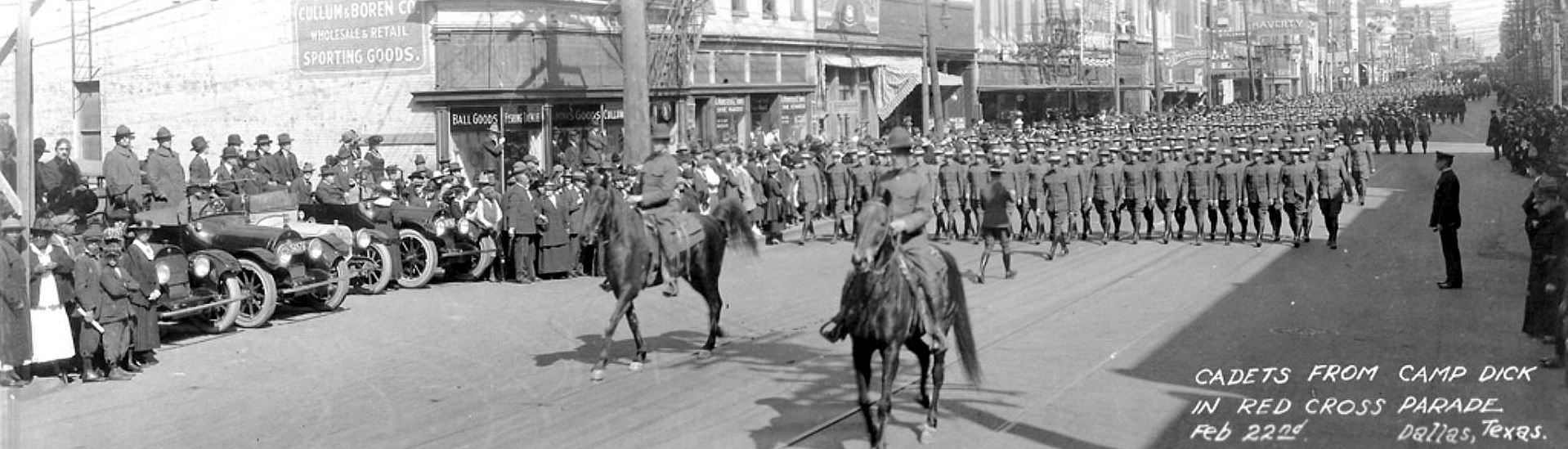
Children and Cadets: Junior Red Cross Parade — 1918

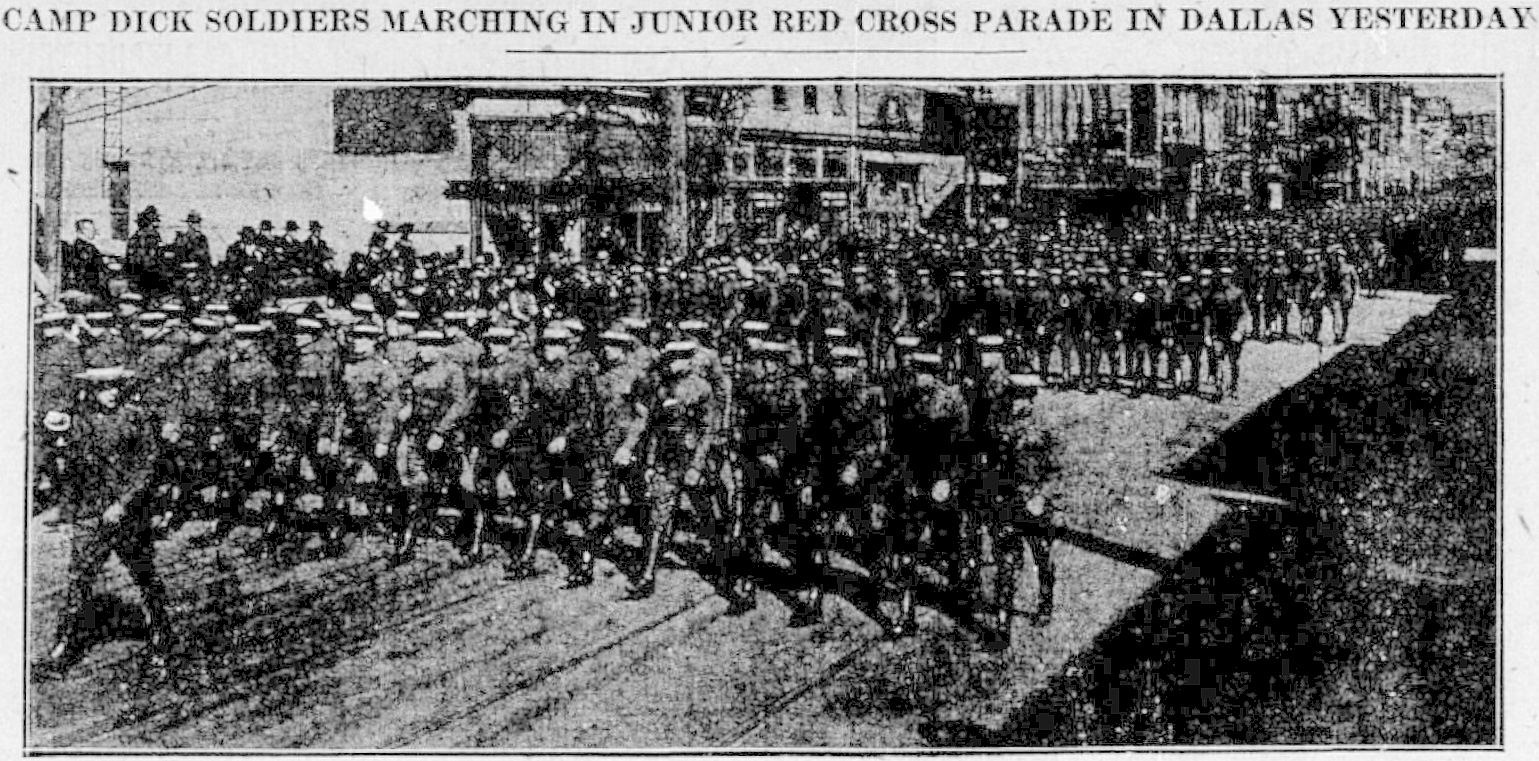
wwi_jr-red-cross-parade_022218_camp-dick-soldiers_waruntold-siteCadets from Camp Dick march down Elm… (click for larger image)

by Paula Bosse

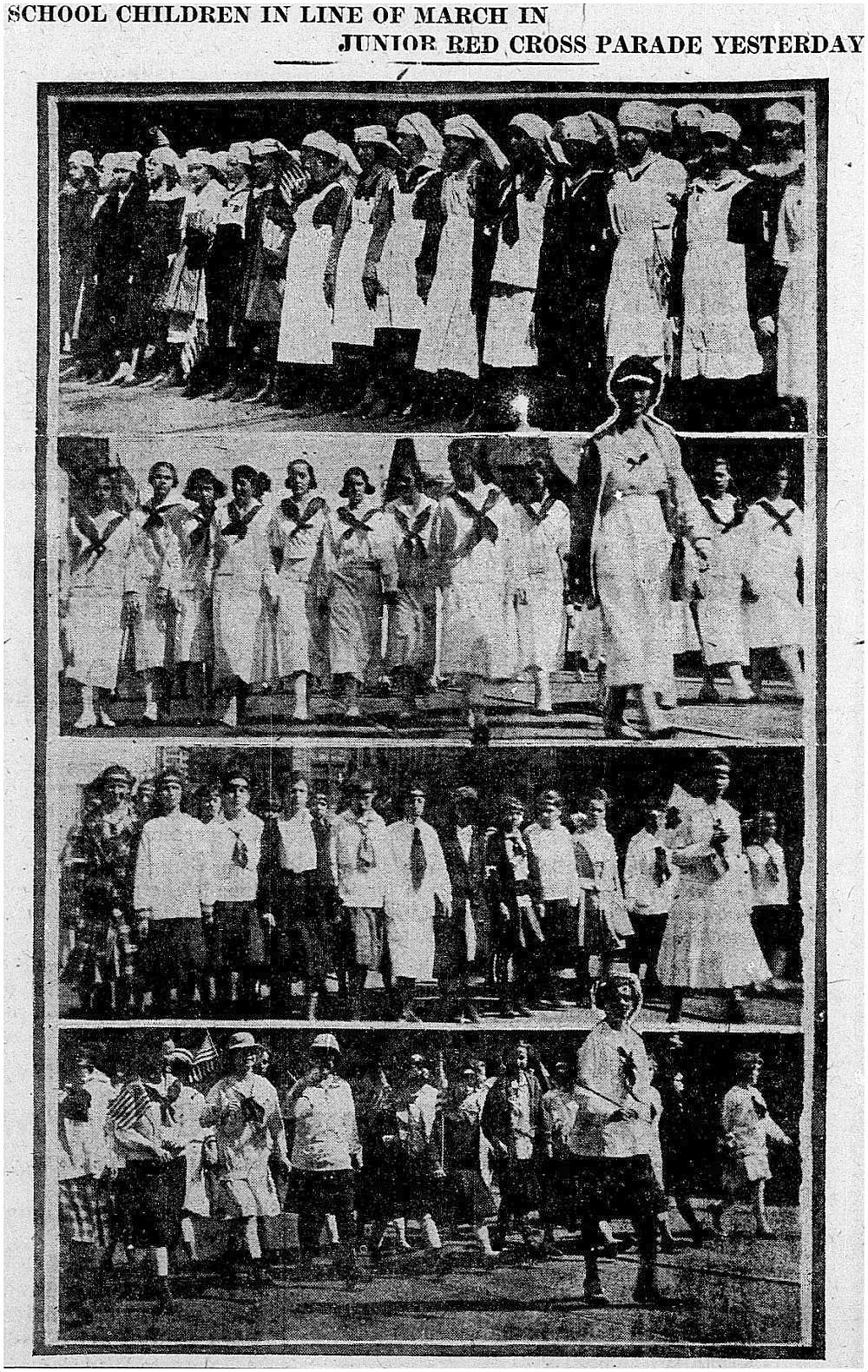
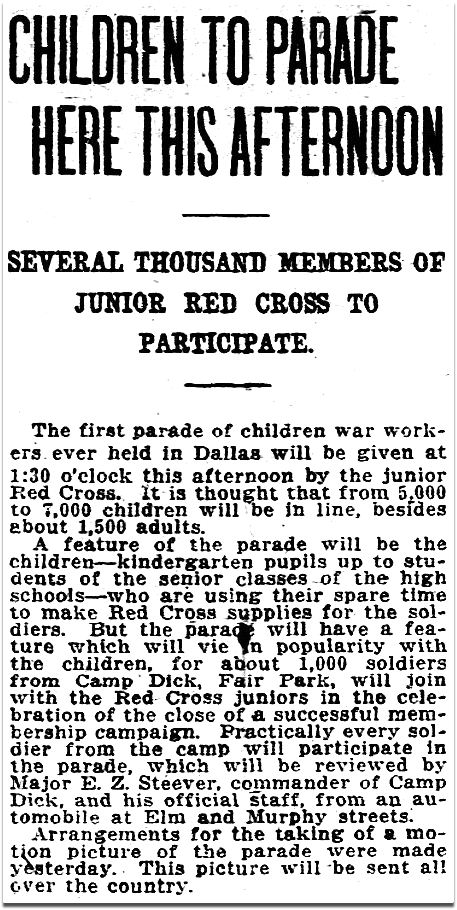
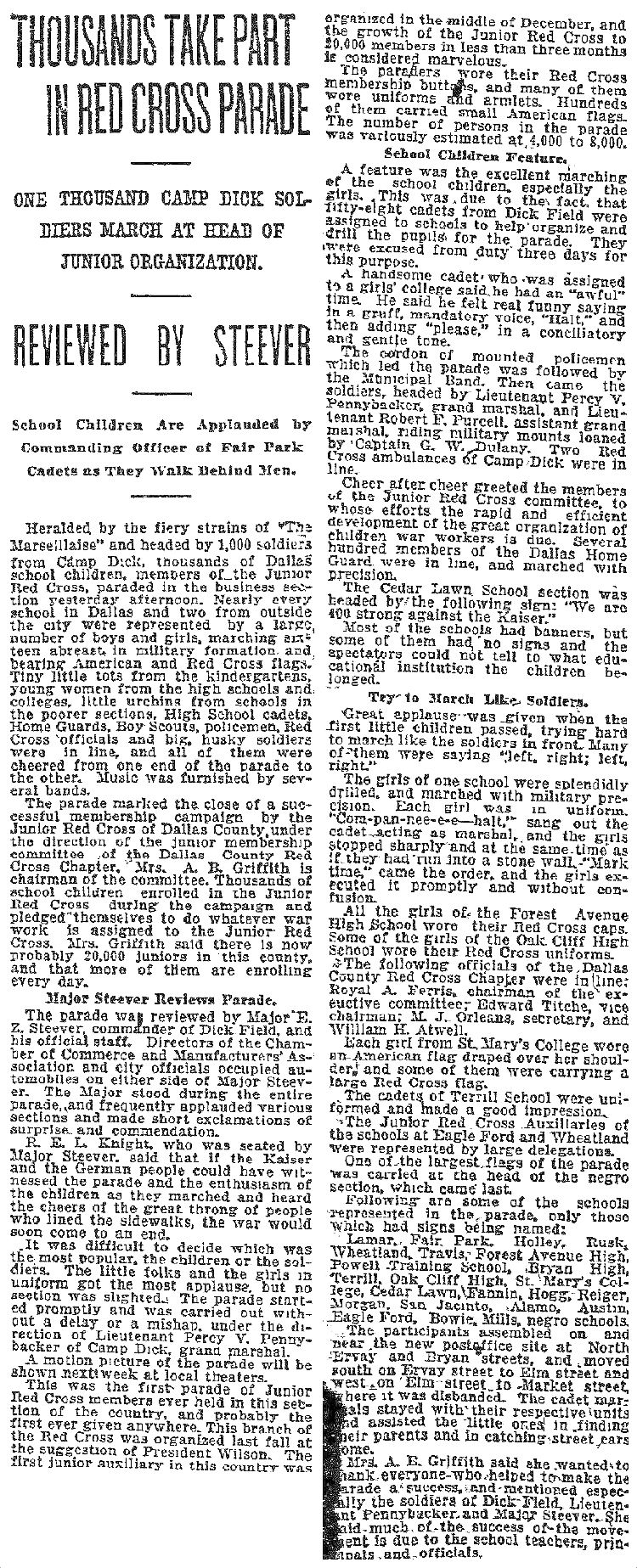
Today is Veteran’s Day, a national day of observance which originally began as Armistice Day in 1919 to mark the end of hostilities in World War I. I was thinking of posting something non-WWI-related, but I stumbled across this wonderful photo showing a WWI-era parade down Elm Street and couldn’t pass up the opportunity to share it. The parade was comprised almost entirely of children who had contributed to the war effort through the Junior Red Cross. The parade was described as “the first parade of children war workers ever held in Dallas.” The number of children (said to represent every school in Dallas) was estimated at up to 8,000 marchers, from kindergarteners to high school seniors.

The parade — which took place on February 22, 1918 — also featured 1,000 or so men based at Camp John Dick, the Air Service training camp at Fair Park. Seeing this parade must have been quite a novelty for Dallasites, as cadets had begun to arrive at Camp Dick only 16 days previously (airmen had been stationed at Love Field a little longer, but only by a couple of months).

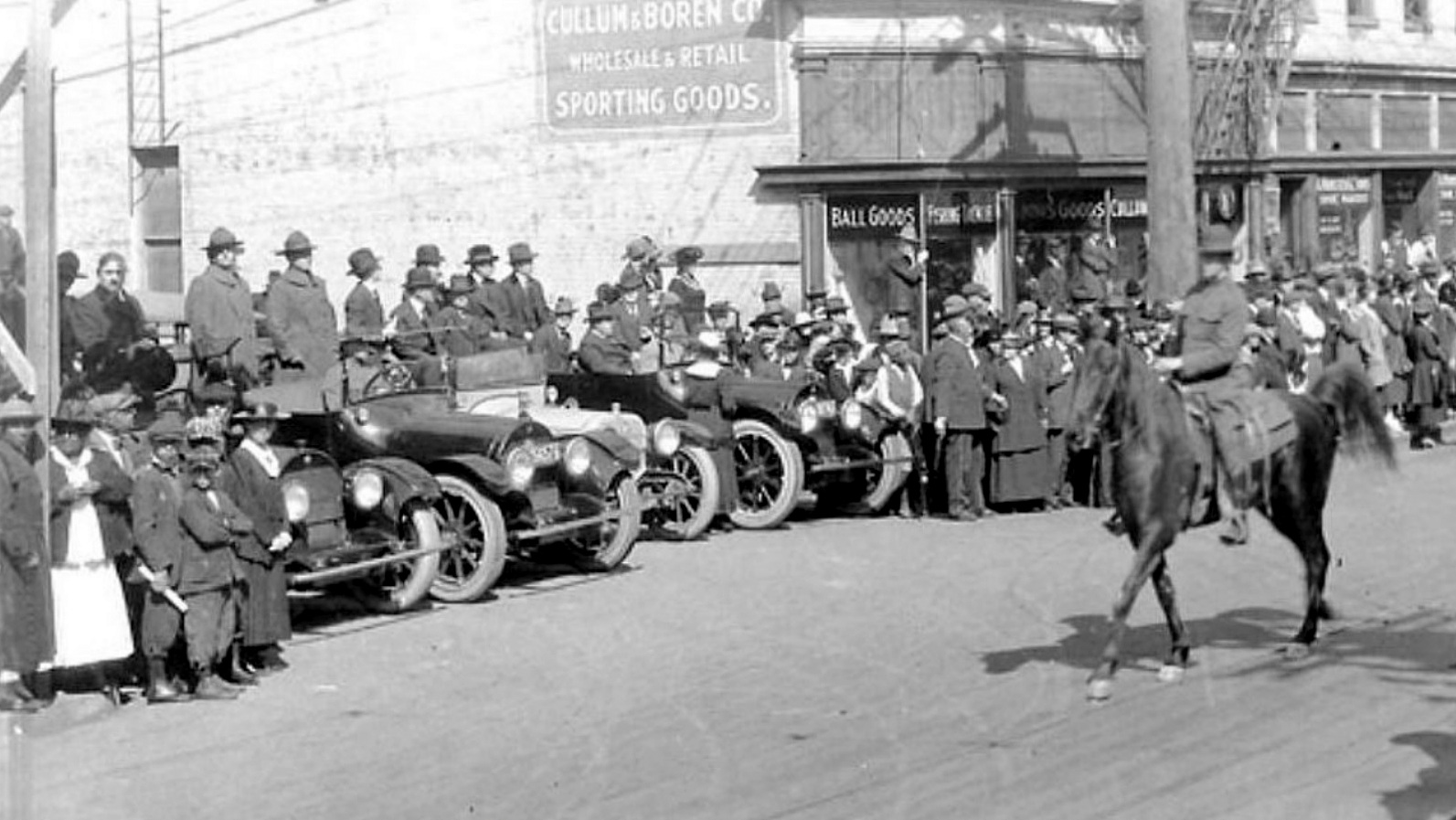
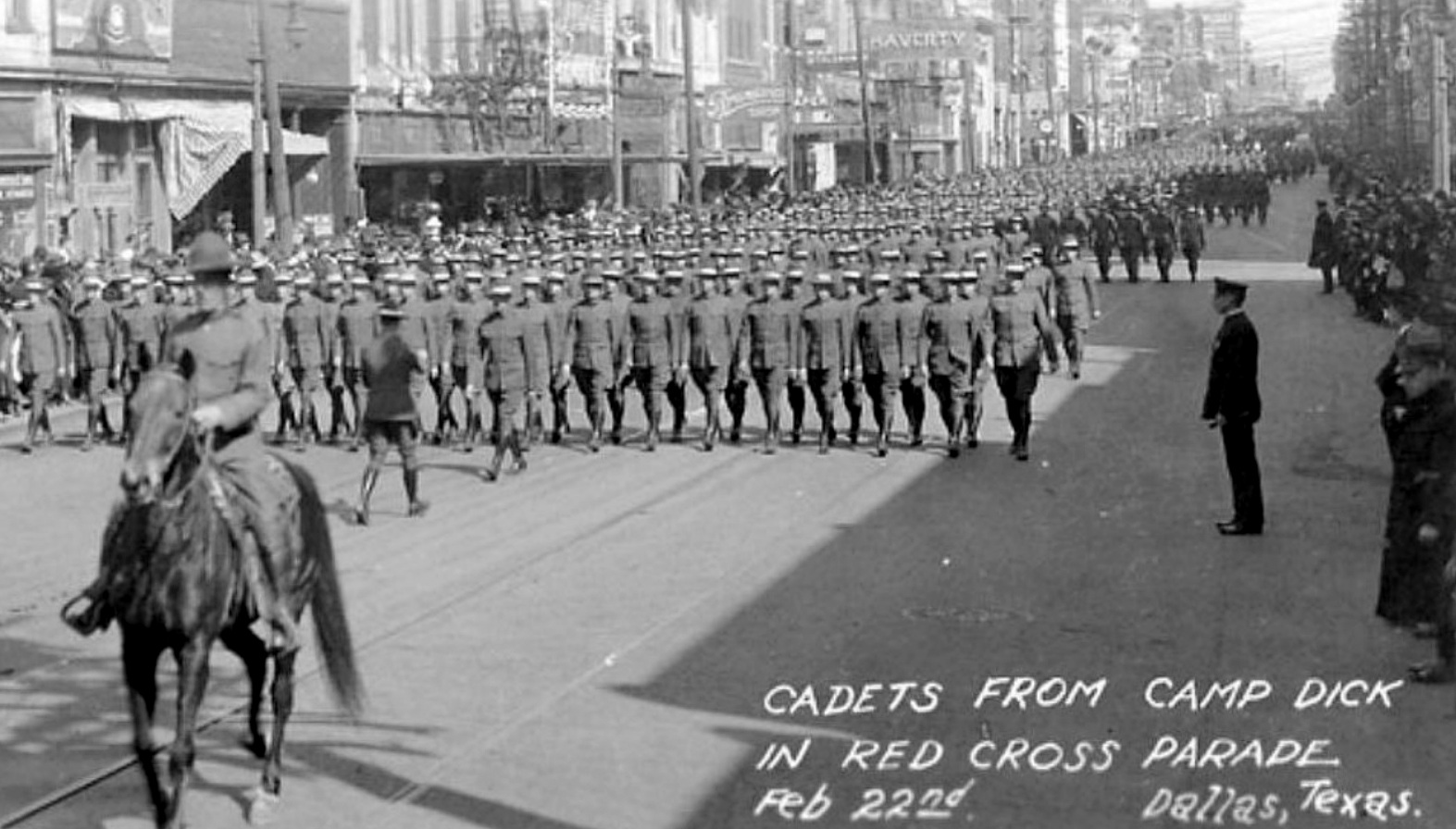
Below, I’ve taken the photo from the top and broken it into two halves and then magnified them. The parade was heading west on Elm Street and can be seen here passing Cullum & Boren (1509-1511 Elm), a downtown sporting goods mainstay just a few doors east of Akard. (See a similar view of Elm Street from later that year — in September — from a Dallas Times Herald photo, here.)

wwi_jr-red-cross-parade_022218_det1

wwi_jr-red-cross-parade_022218_det2

And the children.

wwi_jr-red-cross-parade_dmn_022318Dallas Morning News, Feb. 23, 1918

wwi_jr-red-cross-parade_dmn_022218
DMN, Feb. 22, 1918

wwi_jr-red-cross-parade_dmn_022218_camp-dick-soldiers

wwi_jr-red-cross-parade_dmn_022318
DMN, Feb. 23, 1918, photo and article

***

Sources & Notes

Top photo titled “Cadets From Camp Dick in Red Cross Parade, Feb. 22nd, Dallas, Texas” found on the site War Untold, The Collection of Andrew Pouncey, here (click “continue reading” at  bottom of post).

More on the Camp John Dick Aviation Concentration Camp from The Atlantic in the article “What America Looked Like: Bayonet Practice During WWI” (with a great photo), here.

Other Flashback Dallas WWI-related posts here:

Armistice Day Wikipedia page is here.

All pictures and clippings are larger when clicked.

*

Copyright © 2016 Paula Bosse. All Rights Reserved.


Marvin’s Drug Store, Main and Akard

akard-looking-north_colteraLooking north up Akard from Main… (click for larger image)

by Paula Bosse

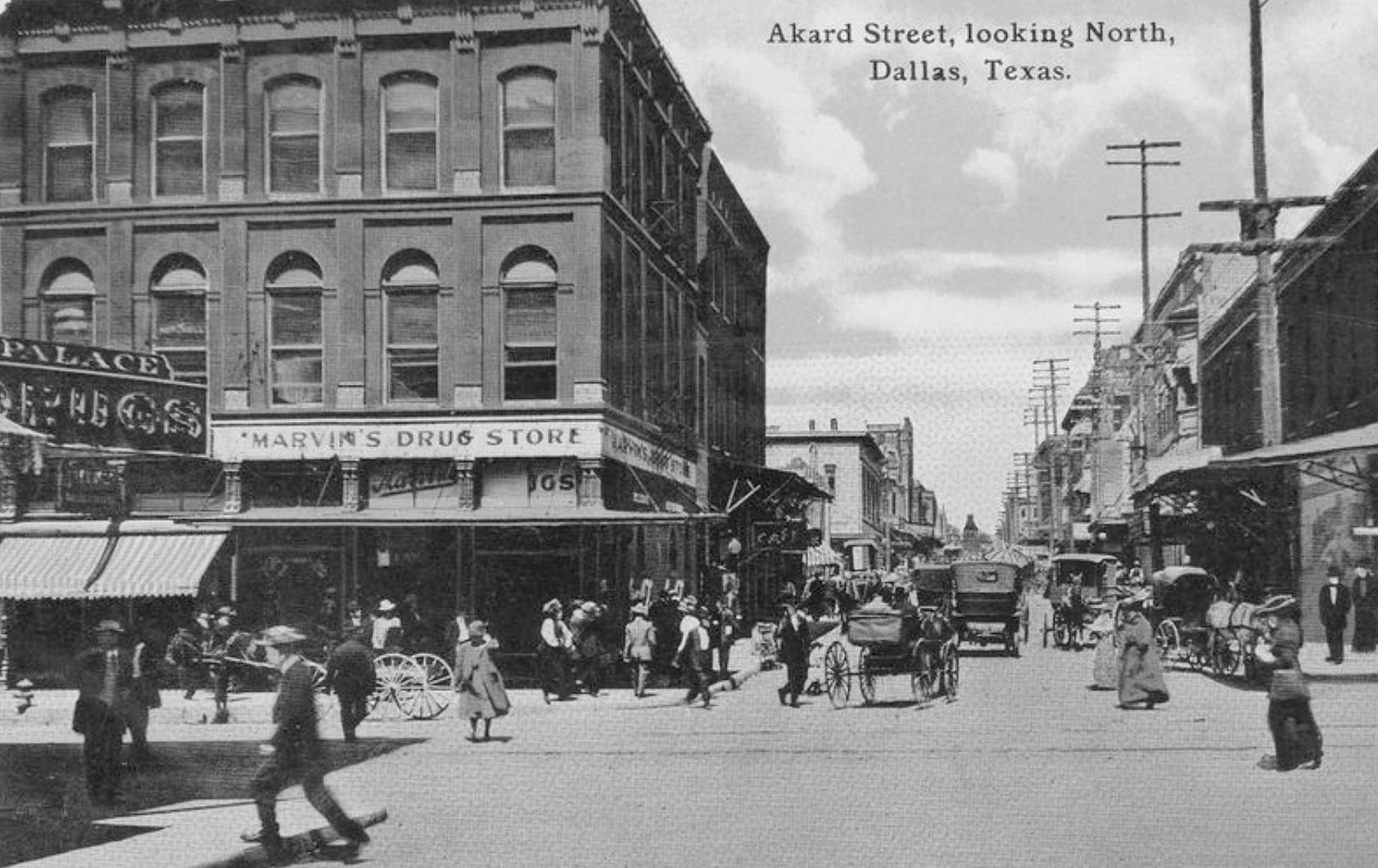
This postcard shows a bustling downtown at the intersection of Main and Akard (the view straight ahead is North Akard). Marvin’s Drug Store, on the northwest corner, was at 1415 Main, and the Palace Drug Store, on the southwest corner, was at 1414 Main. The Palace Drug Store moved to this location in December of 1909, and I’d guess the original photo used here was taken around 1910. See what this view looks like today here.

I love colorized postcards from this period, but sometimes draining them of their color gives a more realistic view of the scene (but doing this can also add a weird surreal flavor when you begin to notice evidence of the artist’s heavy hand — check out the two creepy Edvard Munch-like blank-faced pedestrians at the far right). (Click for larger image.)

akard-looking-north_coltera_bw

The building housing Marvin’s Drug Store was originally known as the Rowan Building, seen below in 1899 — its distinctive cupola was unceremoniously cropped from the postcard view.

rowan-bldg_1889-photo_detail_natl-city-bank-ny-ad_1939

In this photo you can see “Rowan” on the cupola:

rowan-bldg_marvins-drug-store_ebay

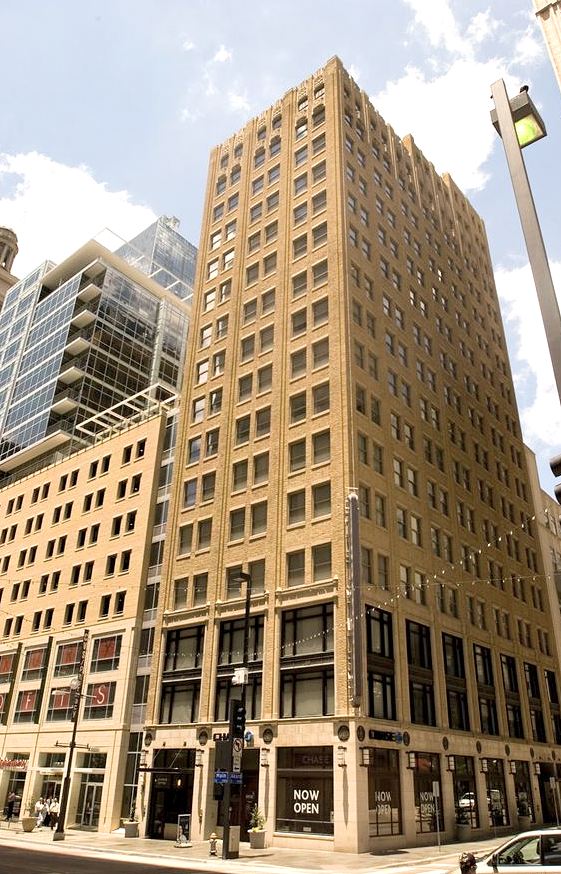
This attractive building was torn down in order to build the taller Marvin Building, which was originally intended to be 24 stories but was later downgraded to 16 stories, then to 10, then to 4 (but with plans to add more at a later date). When the new building opened in 1927, the namesake drugstore was retained as its ground-floor anchor tenant. This new structure was known as the Marvin Building until 1931 when the Gulf States Life Insurance Company purchased it and it became known as the Gulf States Building (coincidentally, ol’ Z. E. “Zeke” Marvin not only owned the Marvin Building and the Marvin Drug Company, but he was also the former president and CEO of the Gulf States Insurance Company). A Lang & Witchell-designed six-story addition was built in 1935. This 16-story building is still  standing and has been converted into residential loft space.

gulf-states-bldg_chamberlin-site

***

Sources & Notes

The postcard at the top is from the incredible Flickr collection of Christian Spencer Anderson (aka “Coltera”), here.

The 1899 photo of the Rowan Building is a detail from a 1939 ad for the National City Bank of New York.

The sepia-toned photo is from eBay.

The color photo of the Gulf States Building is from the Chamberlin Roofing and Waterproofing site, here. (See that photo REALLY big here.)

Click pictures to see larger images.

*

Copyright © 2016 Paula Bosse. All Rights Reserved.

2908 McKinney: The Emergency Home — 1912

emergency-home_dmn_031312_photo2908  McKinney Avenue, brand new in 1912… (click for larger image)

by Paula Bosse

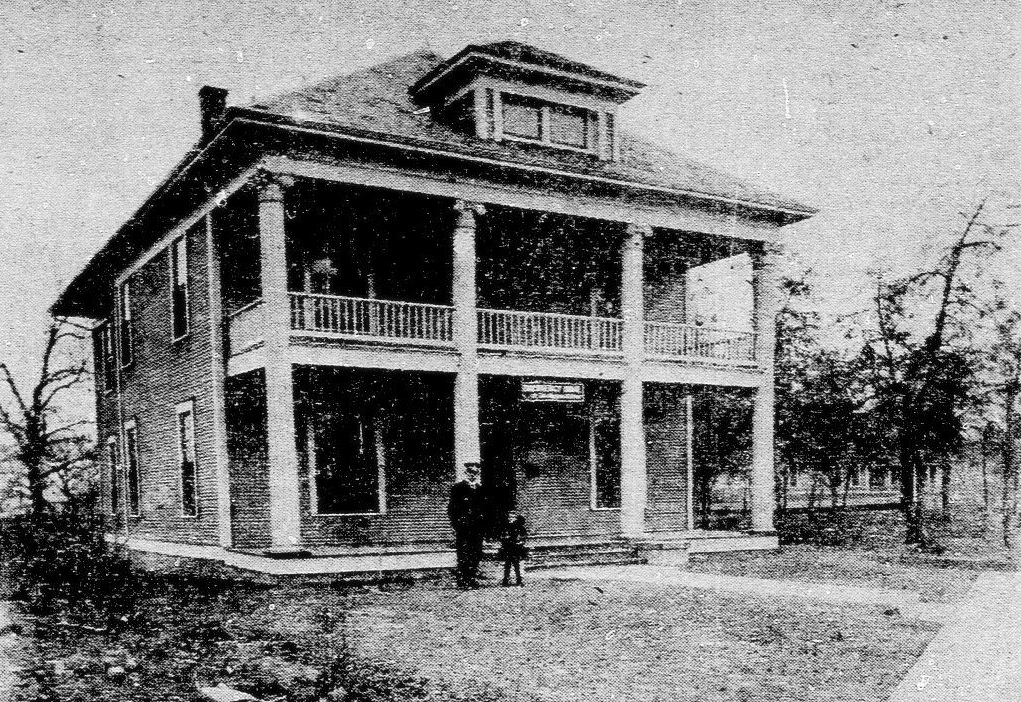
Above, the brand new Salvation Army “Emergency Home” in 1912. The accompanying headline and caption, from The Dallas Morning News (March 13, 1912):

American Salvation Army Home for Destitute

This place has been secured as shelter for unfortunate women and children. It is centrally located on McKinney Avenue, near Allen Street.

This “haven for unfortunates” was established on McKinney Avenue to temporarily house those (mostly women and children) who needed a helping hand until they were able to secure work and a permanent home.

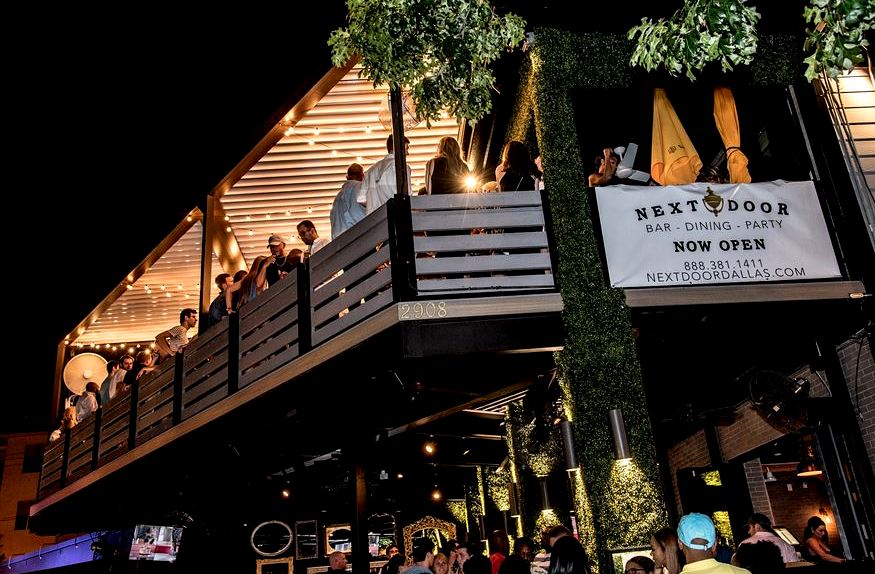
It appears that the home lasted only a couple of years. By the 1915 city directory, the house was vacant. It later became a private residence, a rooming house, a children’s clothing and furniture shop, a crime scene, a marble-top table emporium, a place to buy aquariums, a PR firm, the Dallas bureau of Texas Monthly, and a whole  bunch of bars and restaurants.

The 1912 house is still standing, and it’s currently a bar and restaurant catering to the young, Uptown party-set. Maybe the Salvation Army should set up a kettle out front this Christmas.

**

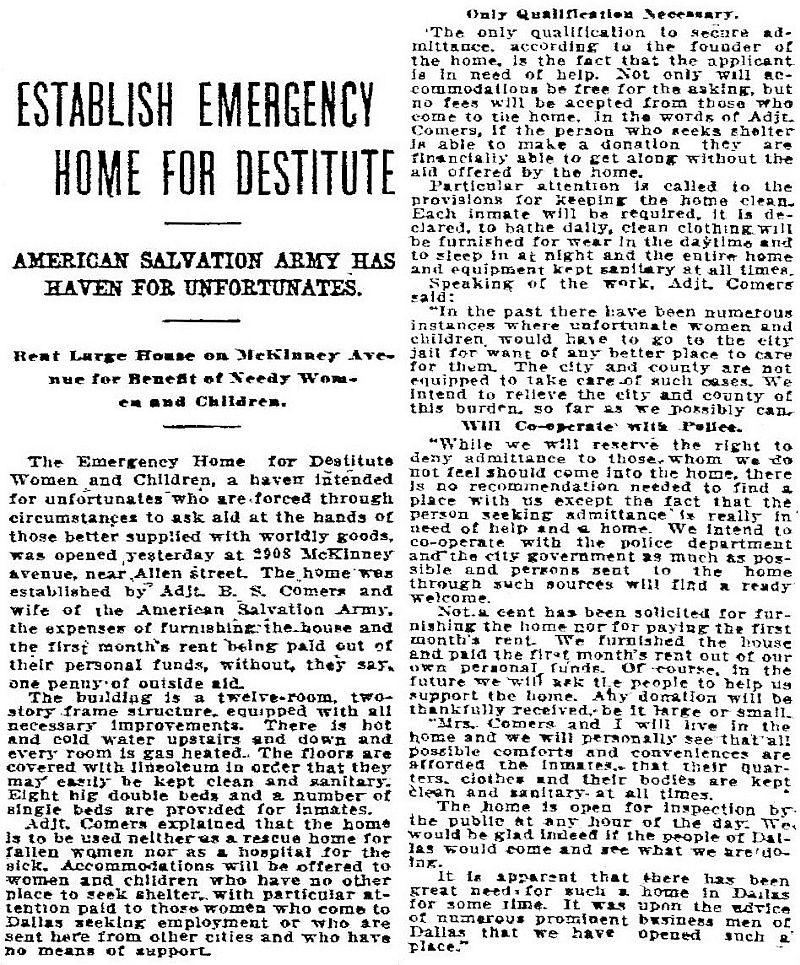
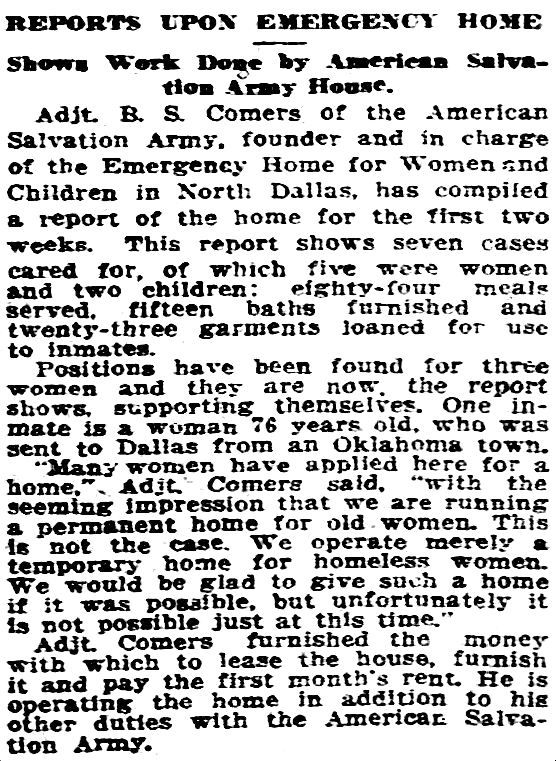
Below, a couple of articles about the first days of the “Emergency Home” (click for larger images):

emergency-home_dmn_022412
DMN, Feb. 24, 1912

emergency-home_dmn_031312
DMN, March 13, 1912

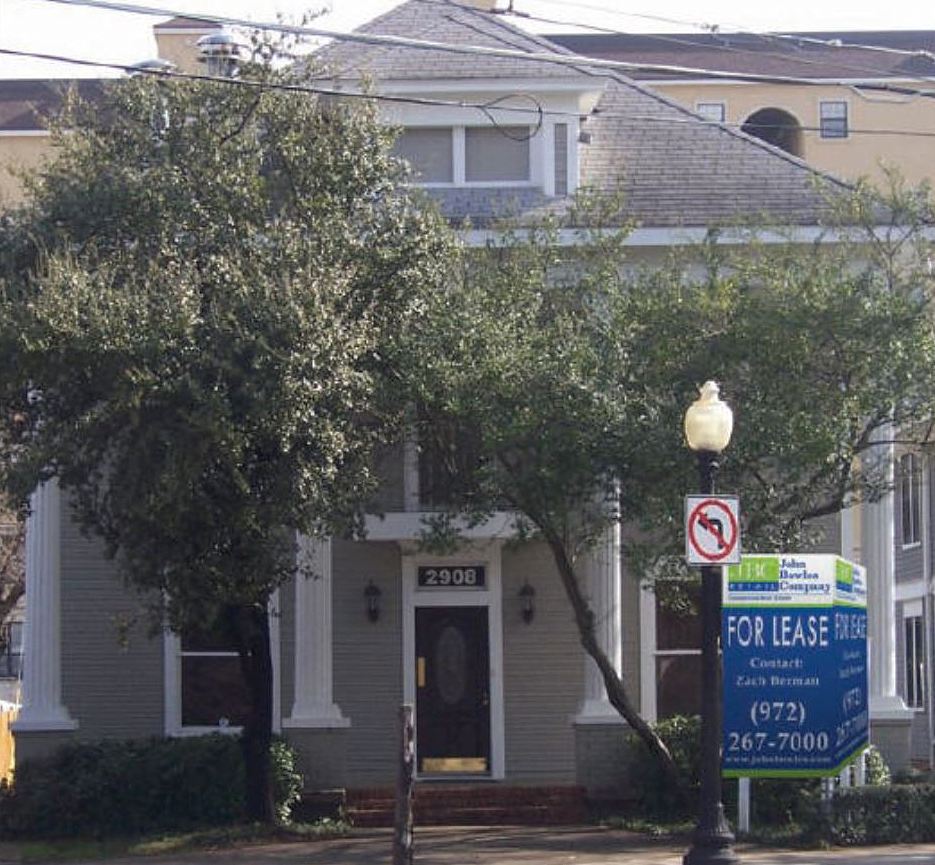
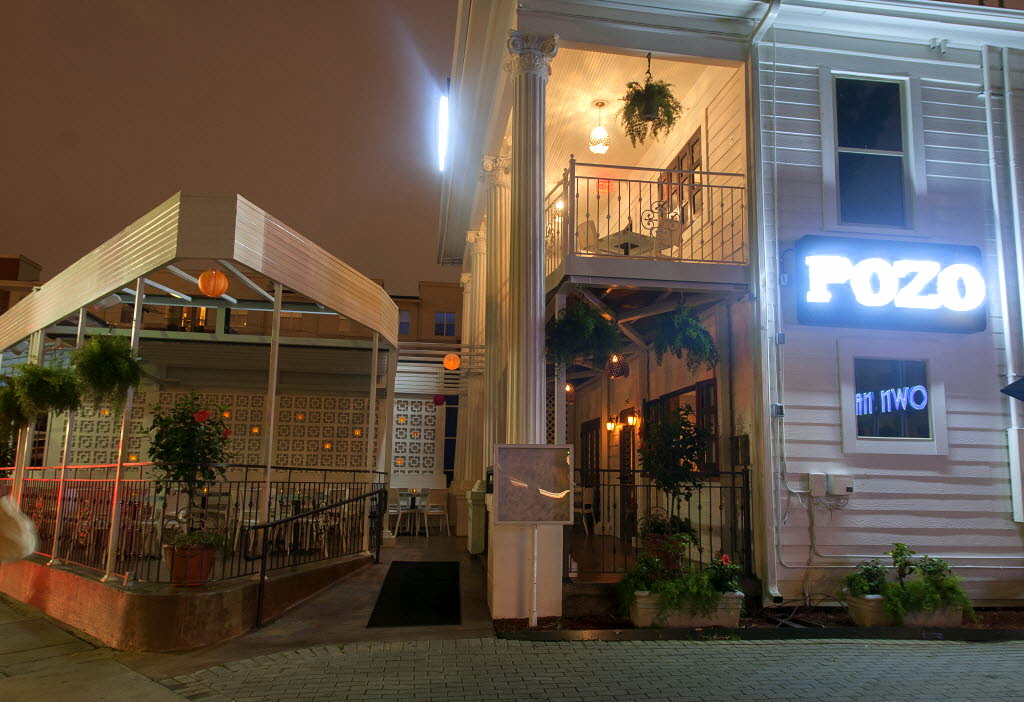
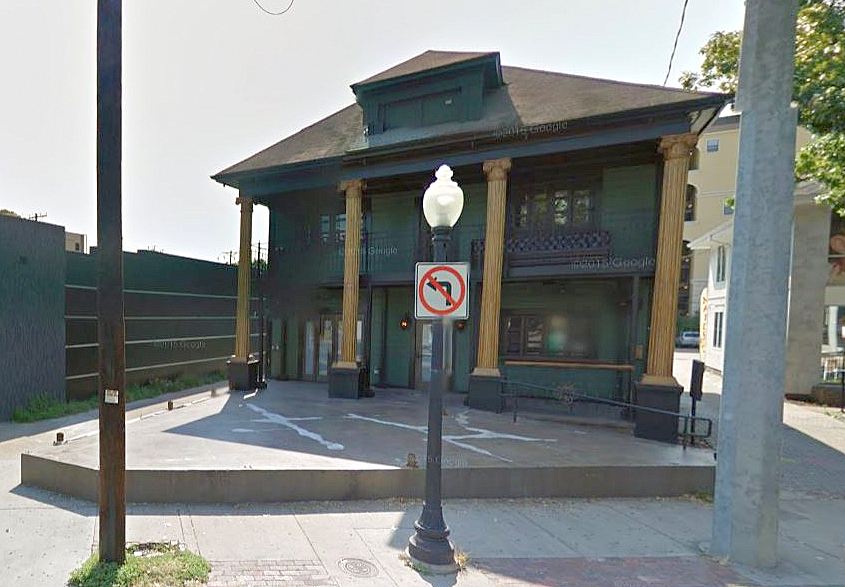
And a few photos of the house in recent years, showing a variety of paint colors and renovations.

2908-mckinney_for-lease

pozo_dmn_eatsblog_062013Dallas Morning News/Eats Blog

2908-mckinney_google_jan-2015Google Street View

2908-mckinney_dcadDallas Central Appraisal District photo — see it HUGE here

2908-mckinney_then-nowThen and now-ish

next-door_d-mag_2016Bret Redman/D Magazine

***

Sources & Notes

Top photo appeared in The Dallas Morning News on March 13, 1912 (photo by Clogenson).

As of this writing, 2908 McKinney Avenue is the bar/restaurant Next Door.

A couple of other Flashback Dallas posts concerning surprisingly old buildings along McKinney Avenue which have been re-purposed to attract Uptown nightlife:

Click photos and clippings for larger images.

*

Copyright © 2016 Paula Bosse. All Rights Reserved.


Labor Day Parade — 1911

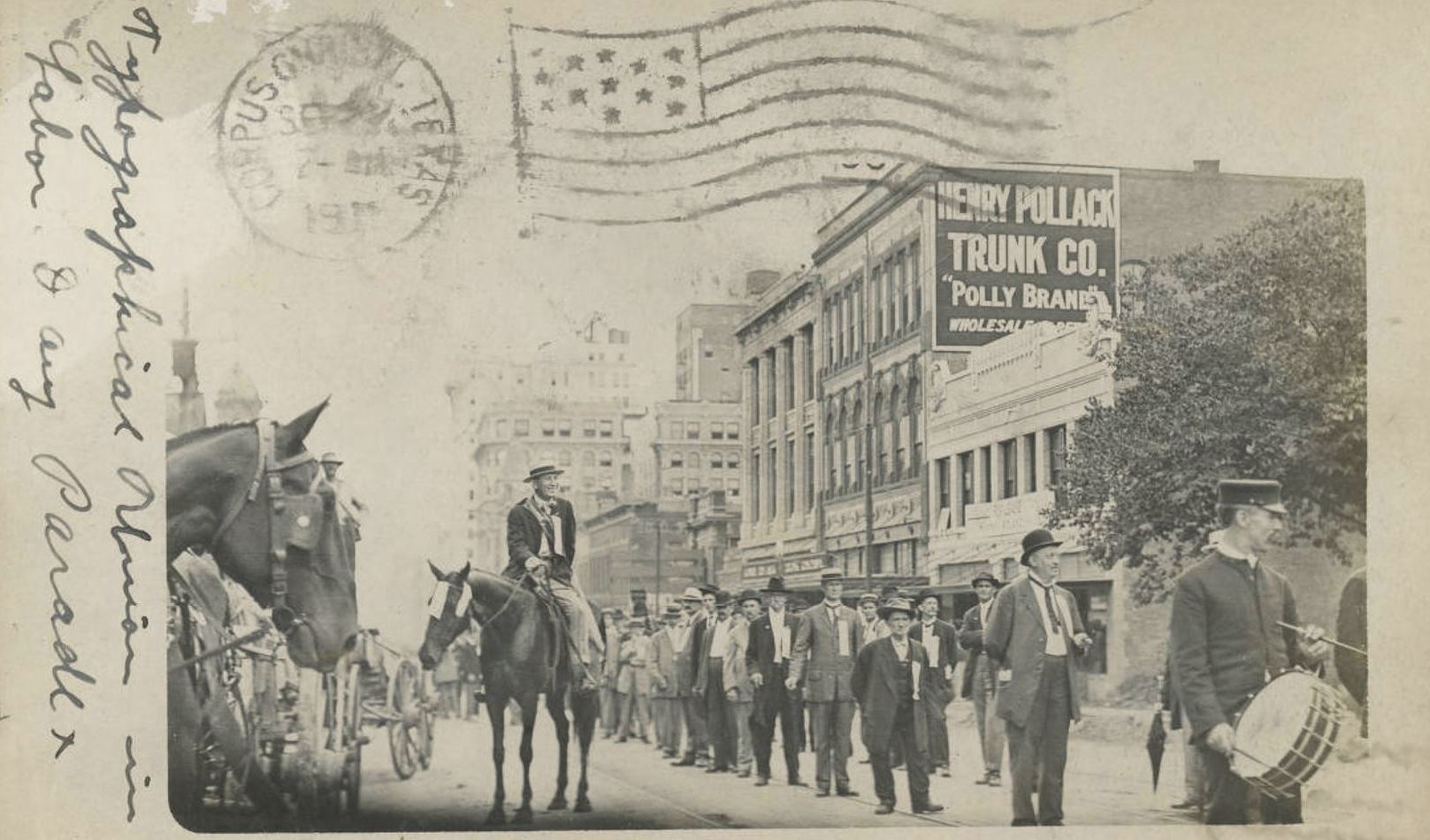
labor-day-parade_typographical-union_ca1911_cook-colln_degolyerUnion men on parade… (click for larger image)

by Paula Bosse

The photo above shows members of the Typographical Union marching in the Labor Day Parade held on Sept. 4, 1911. The photograph was taken looking west on Main Street toward St. Paul. (The Henry Pollack Trunk Co. was in the 1900 block, later occupied by the Titche’s building, now the Universities Center.)

The real photo postcard was sent three weeks later by John R. Minor, Jr. (a member of the union who worked as a linotype operator at The Dallas Morning News) to his mother, Mrs. Ada L. Minor, who was convalescing in Corpus Christi. (It’s possible the 27-year-old Minor was in this photo.)

Coverage of the day’s festivities can be read in the DMN article “Labor Day in Dallas Excels Past Record” (Sept. 5, 1911) here.

May your Labor Day not be spent walking behind a horse!

*

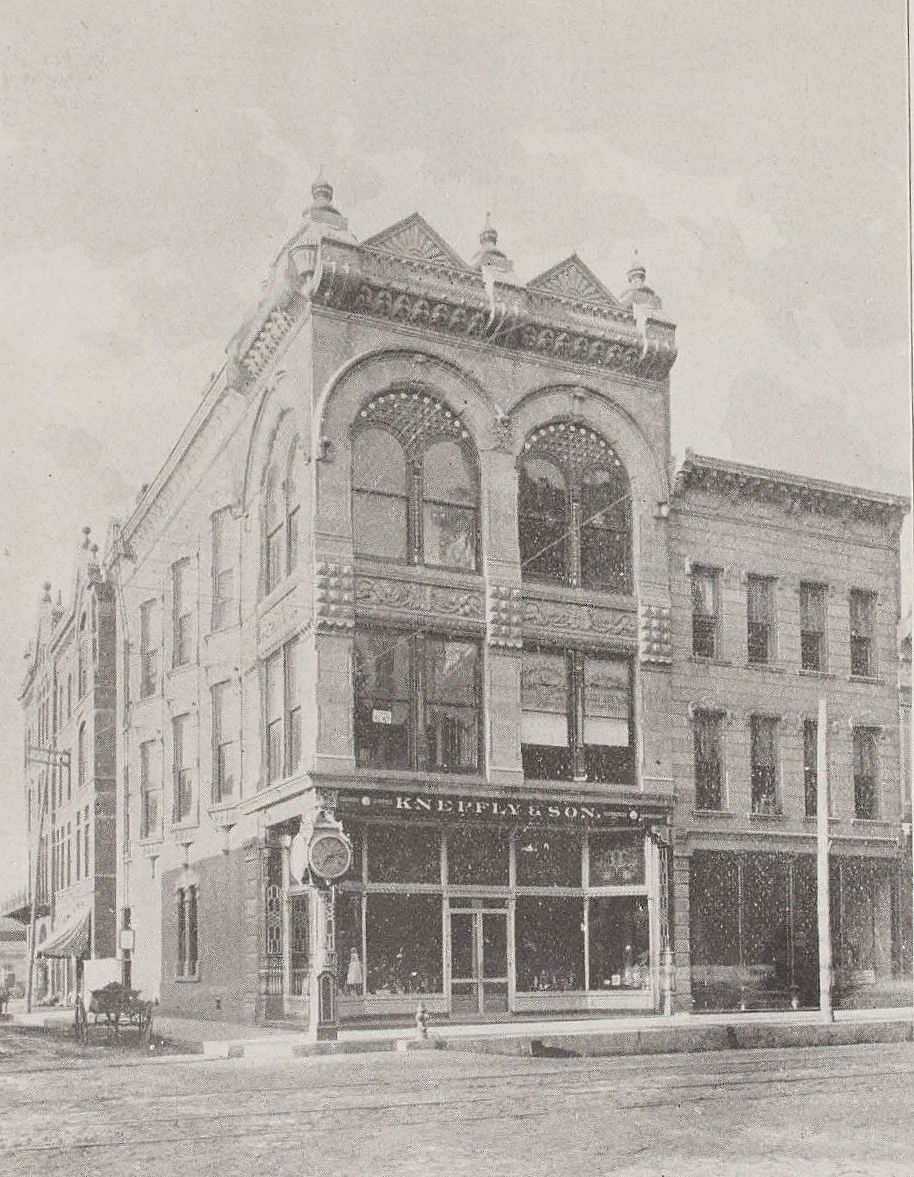
I feel I have to insert this bit of trivia here, if only because I spent so much time reading about the Minor family: in 1906, when John R. Minor, Jr. was 22 years old, the building in which he had a third-floor apartment was consumed by fire in the early hours of the morning. The three-story Knepfly Jewelry Building — built in 1888 on the southwest corner of Main and Poydras — was something of a landmark. The fire spread through the building so quickly that the only way to escape was to jump. Minor jumped and broke both legs and his pelvis. He was not expected to live, but he managed to pull through and spent several weeks in the hospital recovering. Two of the other top-floor residents died — one of whom had also jumped. Here’s the building. Minor had to jump past the telegraph wires on the Poydras (left) side of the building (the telegraph wires can be seen better in this photo from Dallas Rediscovered). He landed on his feet in the middle of the street. It’s amazing he didn’t break more bones. (Click for larger image.)

knepfly-bldg_church_dallas-through-a-camera_ca-1894_SMU

If he had marched in the 1911 Labor Day parade — which went west down Elm from about Pearl, then back east on Main from Lamar — he would have walked right past the building. On second thought, if he broke both legs and his pelvis, a mile-long march in a parade might have been a little taxing. (Maybe he’s the one on the horse!)

***

Sources & Notes

Postcard titled “Typographical Union in Labor Day Parade” is from the George W. Cook Dallas/Texas Image Collection, DeGolyer Library, Southern Methodist University; more info (and an image of the message side of the card) can be found here.

The photo of the Knepfly Building is by Clifton Church, from his book Dallas, Texas Through a Camera (1894), accessed from the DeGolyer Library, SMU Libraries, Southern Methodist University; more info is here.

Click pictures to see larger images.

*

Copyright © 2016 Paula Bosse. All Rights Reserved.


Pacific Avenue: Watch for Trains! — ca. 1917

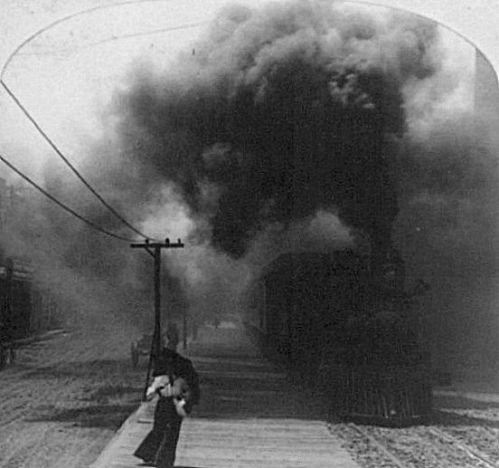
pacific-akard_park-cities-photohistory_frank-rogersToo close for comfort…

by Paula Bosse

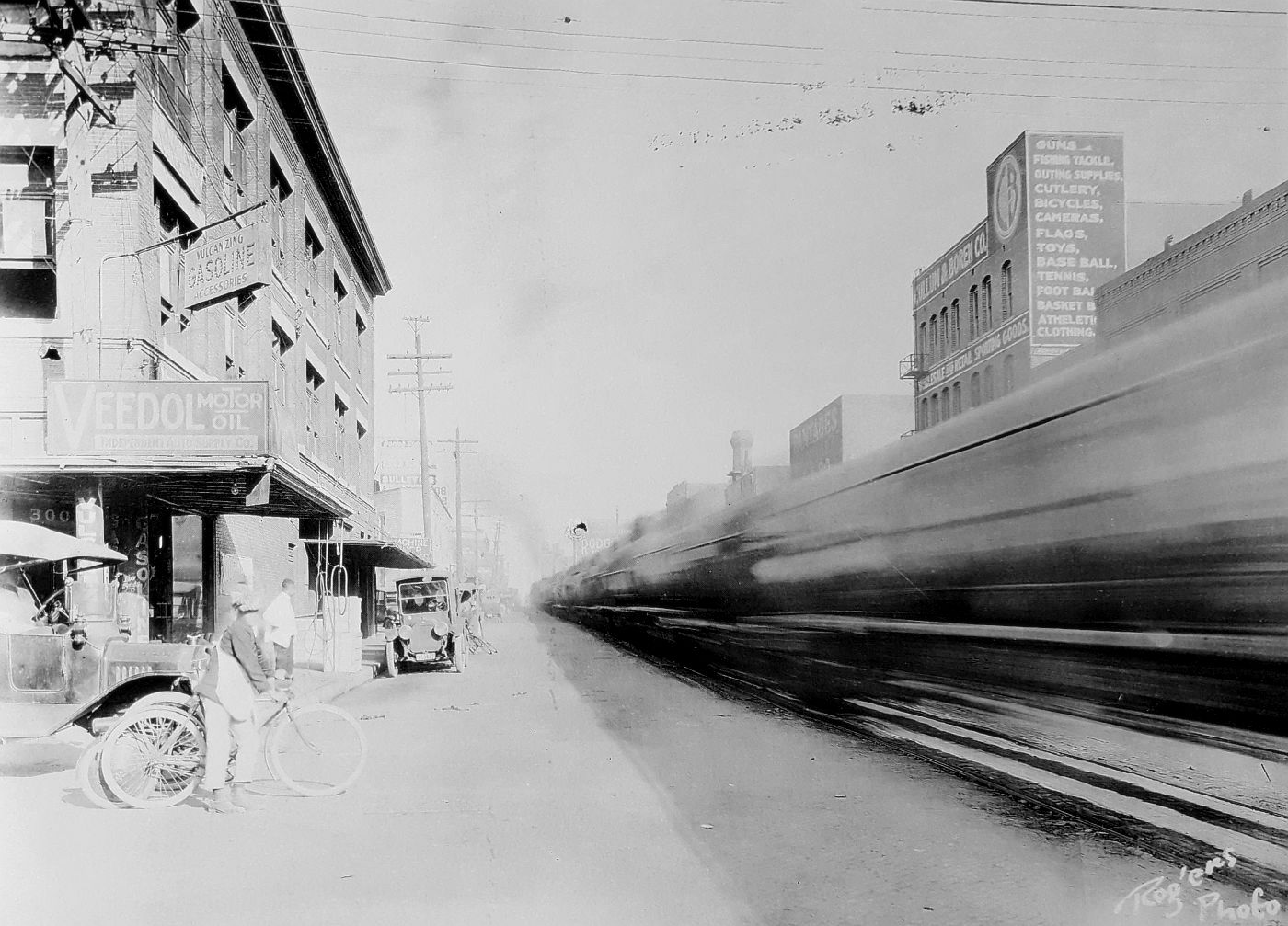
Some people don’t realize that Pacific Avenue used to be lined with the railroad tracks of the Texas & Pacific Railway (hence the name “Pacific”). When trains weren’t barreling down Pacific regularly, the thoroughfare was used by non-locomotive traffic like pedestrians, bicycles, horses, and automobiles. When a huge cinder-spewing train screamed through, everything came to a resigned halt until it passed by. I can’t even imagine what that was like. I wonder how many times people, horses, vehicles, etc. didn’t manage to get out of the way in time?

When Union Station opened in 1916, trains that had previously run through the central business district now went around it (which probably cut the number of people rushed to the hospital with train-related injuries substantially).

The photo above shows Pacific looking east from N. Akard, as a blur of a train whooshes by. The Independent Auto Supply Co. (300 N. Akard) is at the left, and, at the right, the back side of Elm Street businesses, including Cullum & Boren and, to its left, the Jefferson Theater, with “Pantages” painted on the side. (The Jefferson was the Dallas home of the Pantages Vaudeville Circuit from 1917 until 1920, the year the Pantages people bugged out for the greener pastures of the Hippodrome, leaving the Jefferson to start a new relationship with the Loew’s circuit people. At the end of 1925, the Jefferson Theater was actually renamed the Pantages Theater. …Kind of confusing.)

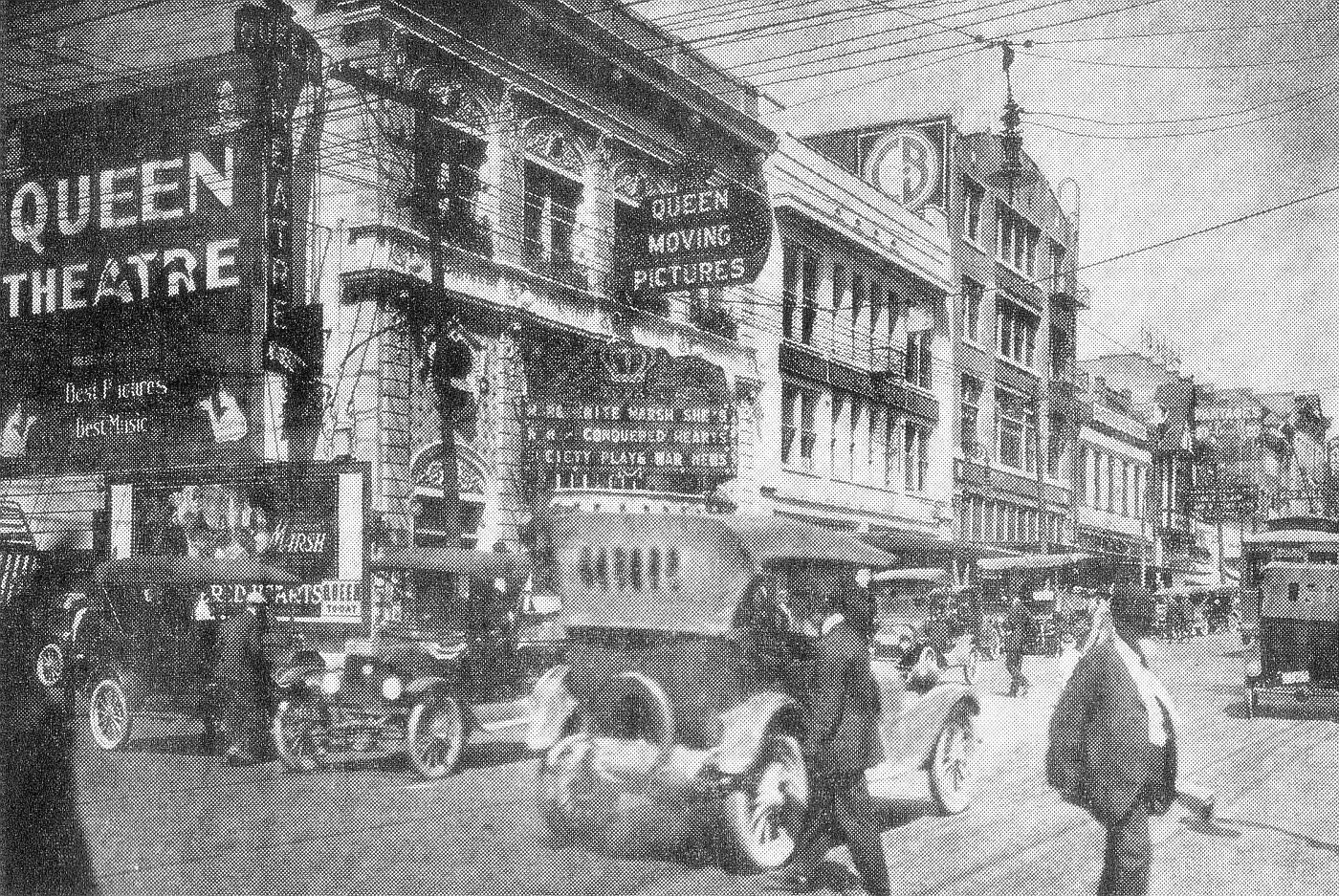
Below, Elm Street in 1918 — what the other side of those buildings looked like. Cullum & Boren’s “CB” logo can be seen painted on the side of its building. (Click photo for much larger image.)

dallas-movie-palaces_1918_dth_020556

But back to Pacific in its scary, sooty, T&P-right-of-way days. This is what things looked like in 1909.

t-and-p-flier_1909_loc

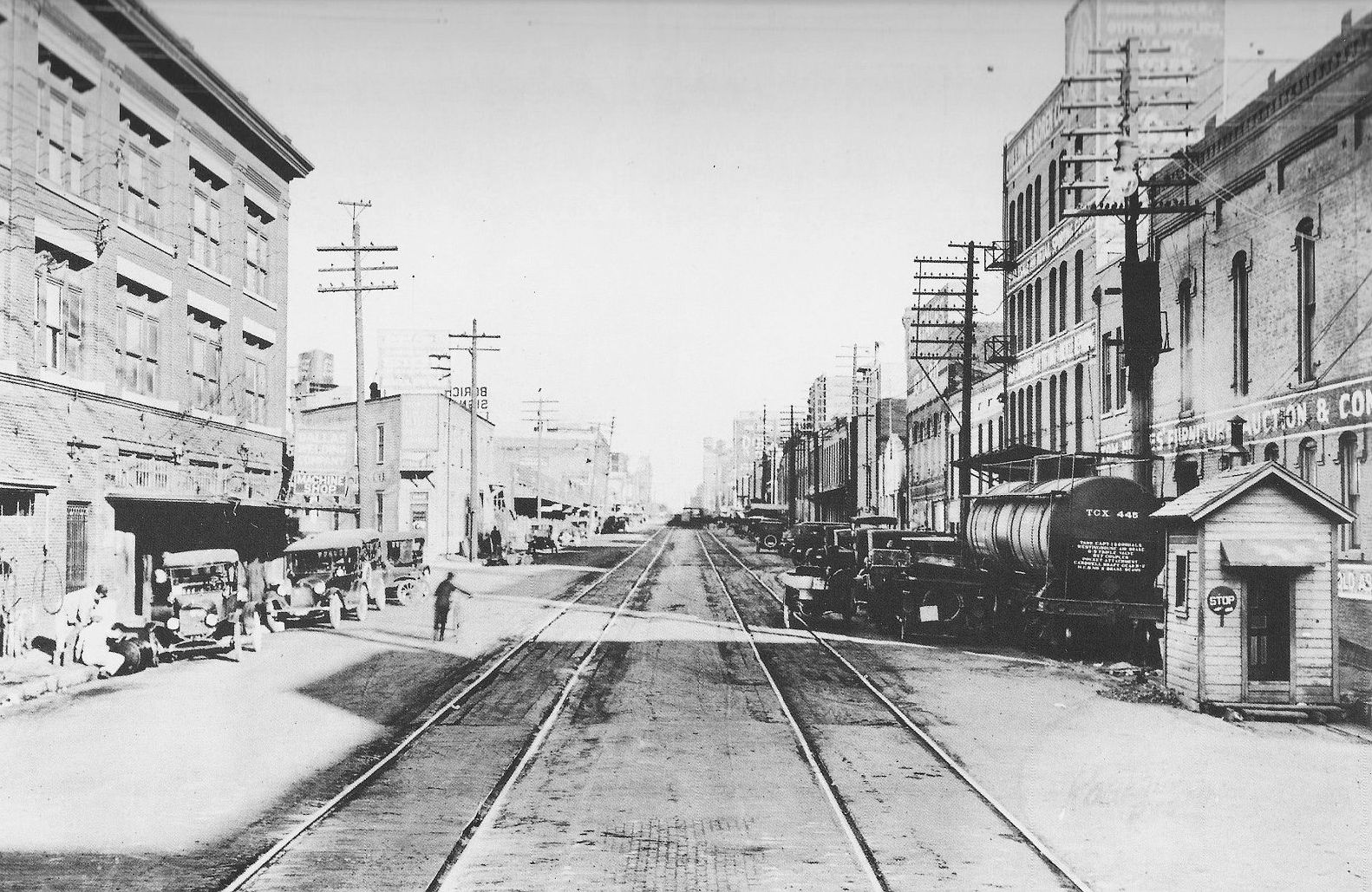
Fast-forward to 1920 — the trains had long stopped running, but the tracks remained, an eyesore and an impediment to traffic. (Cullum & Boren, again, at the right.)

pacific-ave_showing-t-and-p-tracks_1920

And another one.

pacific_ave_ca-1920_legacies_fall-1990

Thanks to the Kessler Plan, those unsightly tracks were finally removed from Pacific in 1923. Below, a photo from 1925. Big difference. Thanks, George Kessler!

pacific_bryan_looking-east_lost-dallas_doty

***

Sources & Notes

Top photo (by Frank Rogers) from the book The Park Cities, A Photohistory by Diane Galloway (Dallas: Diane Galloway, 1989). The photo is credited to John Stull/R. L. Goodson, Jr., Inc./Consulting Engineers.

More info on the 1918 photo of Elm Street, which was featured in the post “Dallas’ Film Row — 1918,” here.

More info on the super-sooty Pacific Avenue photo, here.

More on the de-track-ified Pacific, here.

Not sure of the source of the first 1920 photo; the second 1920 photo is from Legacies, Fall 1990, here.

*

Copyright © 2016 Paula Bosse. All Rights Reserved.


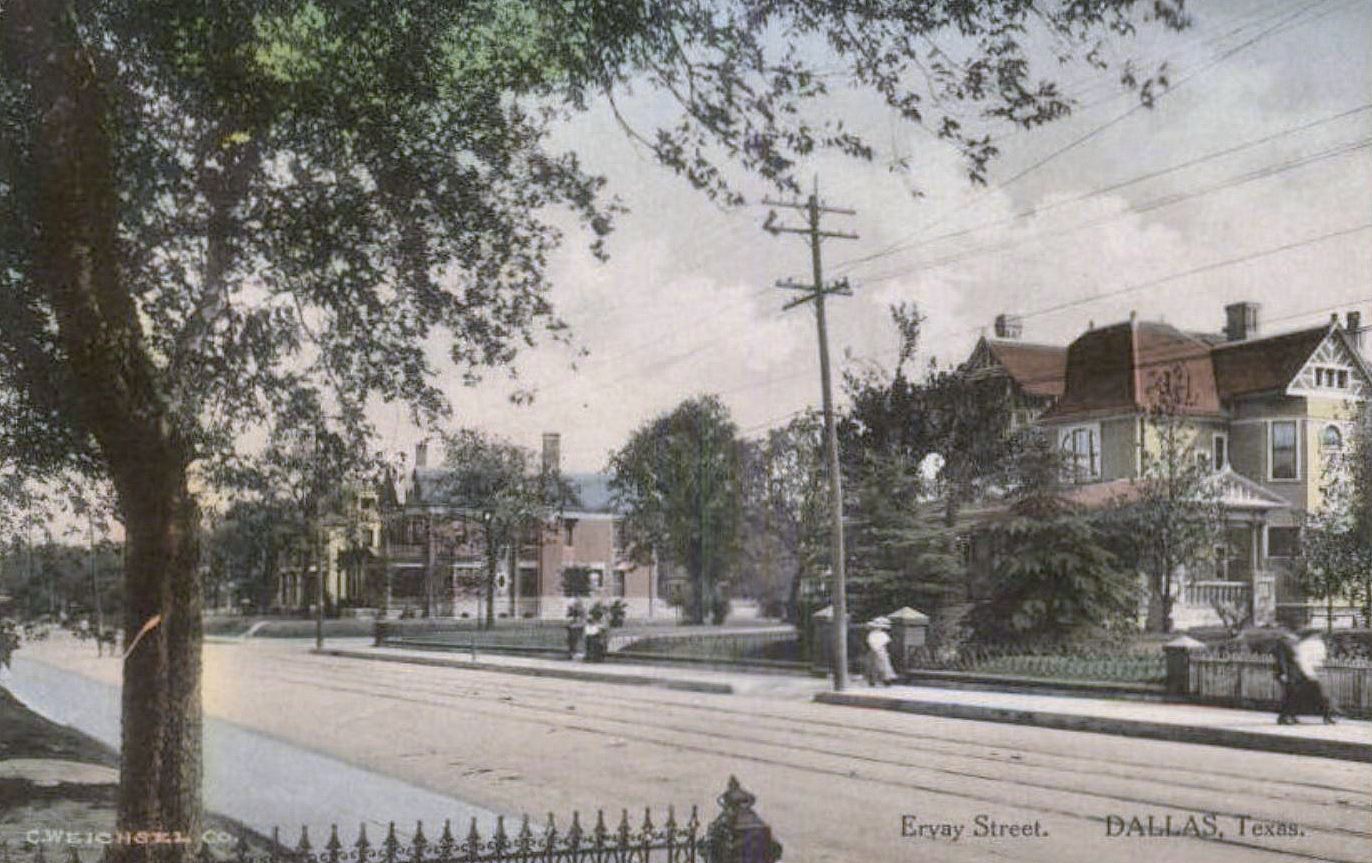
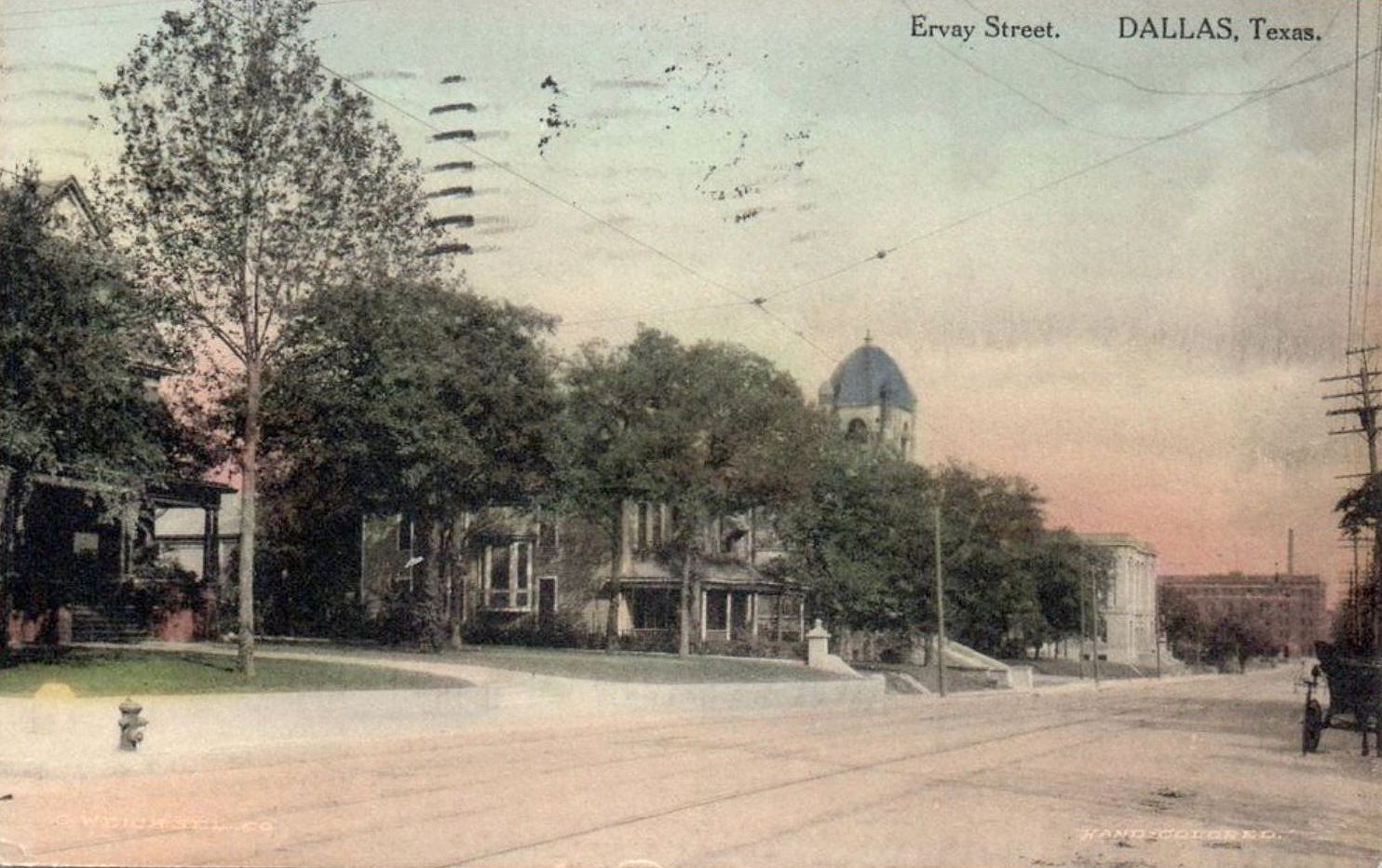
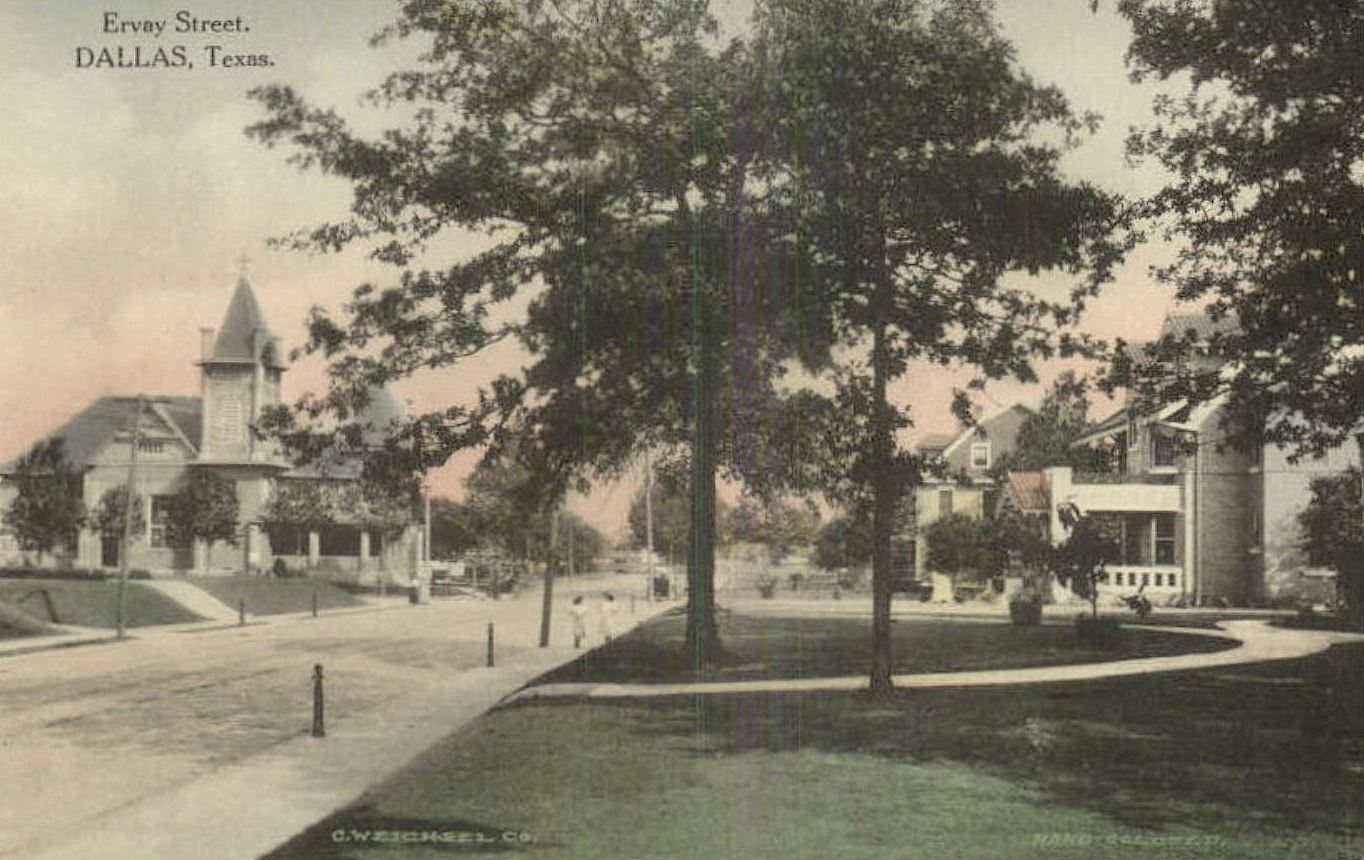
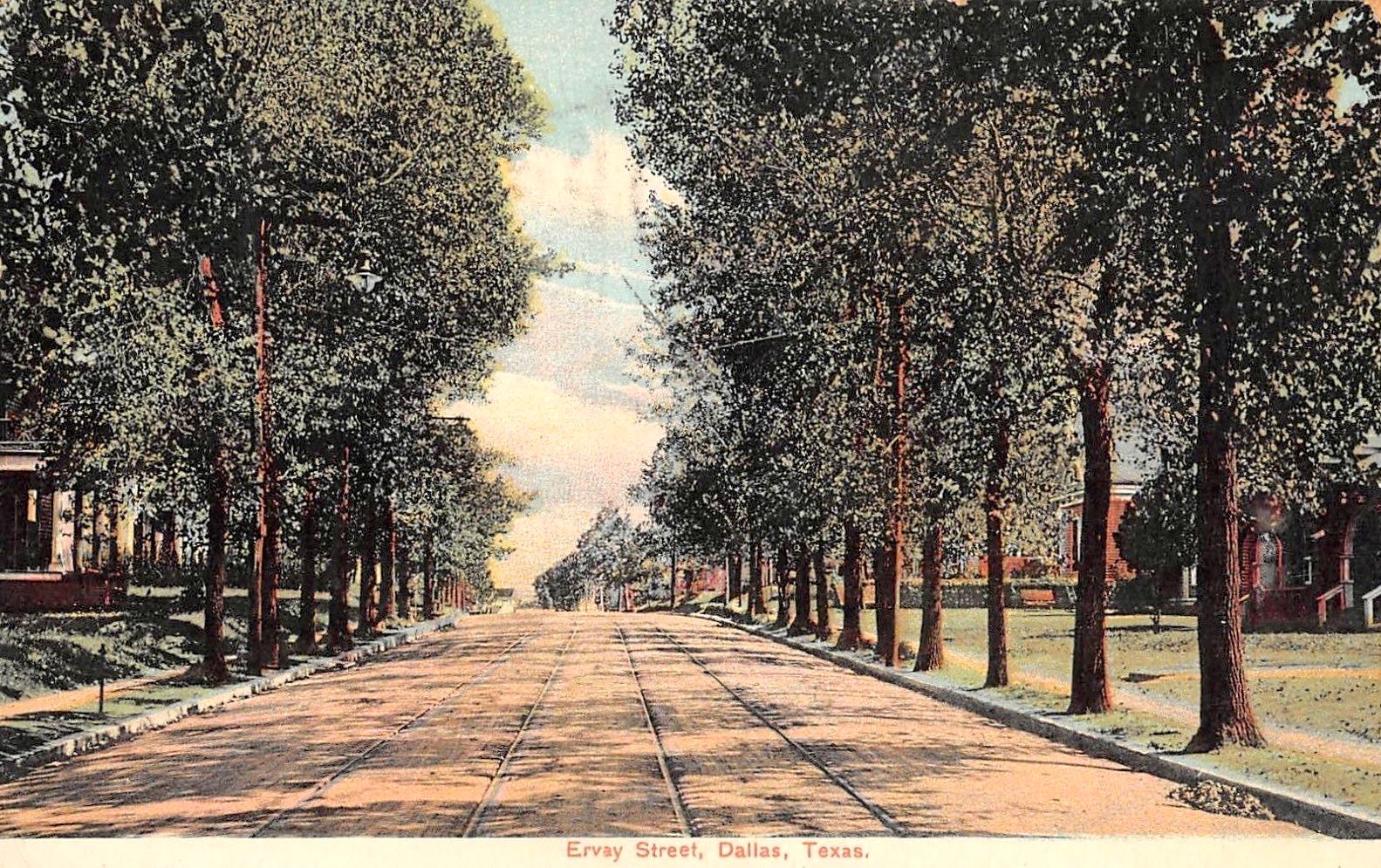
Beautiful South Ervay Street — ca. 1910

ervay_coltera_flickrStreet life in South Dallas

by Paula Bosse

Today, a few hand-colored postcards from around 1910 showing the lovely houses that used to line Ervay Street in South Dallas. Hard as it is to believe today, the stretch of South Ervay from just outside the central business district down to its end at Forest Avenue (now Martin Luther King, Jr. Blvd.), was once a very nice area where many of the city’s most fashionable and well-to-do Jewish families (and, later, African American families) lived. The intervening century has not been kind to South Dallas. I’m not sure of the location in the postcard above, but it certainly looks like a very pleasant neighborhood — one that no longer exists in this mostly blighted area.

*

Below, S. Ervay looking south. The rounded top of Temple Emanu-El can be seen at the left. The light-colored building in the next block was the Columbian Club. The hotel most recently known as the Ambassador (which burned down three years after I originally wrote this post) is set back on a curve of the street and is hidden by the Columbian Club. The red building is the Hughes candy plant (still standing). A Google Street View of this area today can be seen here.

ervay-street_ebay

*

Below, we see a view still looking south, but now much farther down Ervay, almost to Forest Avenue (now MLK). The church on the left is the James Flanders-designed Ervay Street Methodist Episcopal Church (South), built in 1908 at the corner of corner of Ervay and South Boulevard — it’s interesting that a Methodist church was located in the center of Dallas’ largest Jewish residential neighborhood. (More on the church from a Dallas Morning News article from July 1, 1908, here. See this area on a 1922 Sanborn map here.)

ervay-residence_coltera

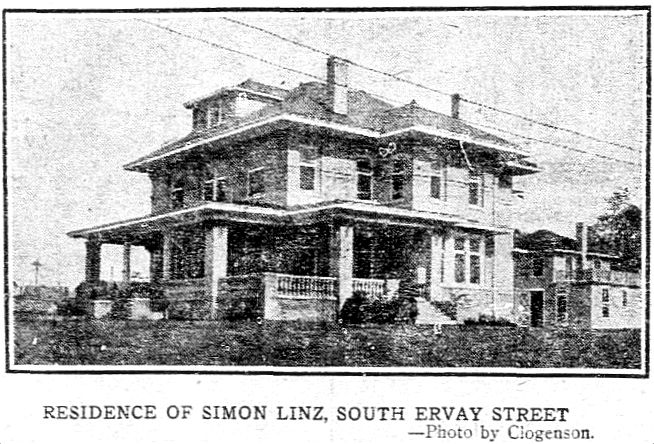
Not seen in the view above is one house worth mentioning. The house — just out of frame at the left, with the steps leading up to it, was the home of Simon Linz, of Linz Jewelers fame. Here is what the Linz house looked like in 1908:

linz-house_dmn_010108Dallas Morning News, Jan. 1, 1908

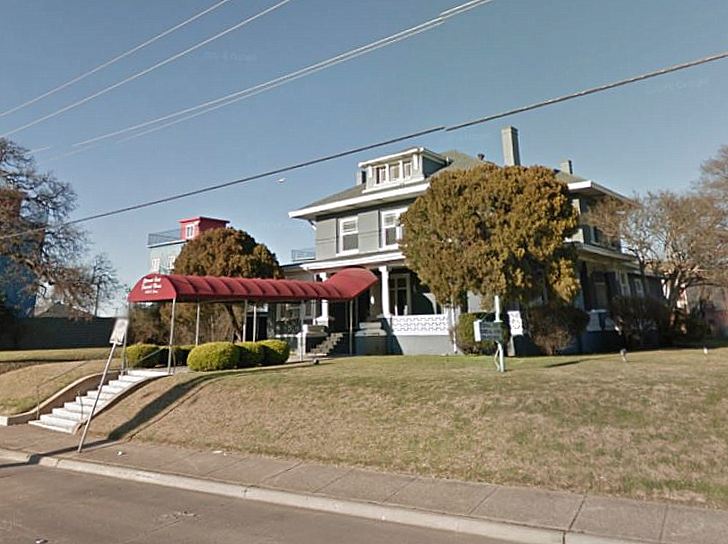
Remarkably, this house is still standing. It is currently a funeral home at 2830 S. Ervay. The present-day image below, showing the pretty house and the neatly landscaped yard, is a little deceptive; see what the Google Street View looks like just south — where the Flanders church once stood — here. (If you’re up to it, reverse the Google view and move back toward town.)

linz-house_2830-828-s-ervay_google
Google Street View

Hold on, little house!

This was once such a beautiful part of Dallas….

ervay_postcard_clogenson_postmark-1908

**

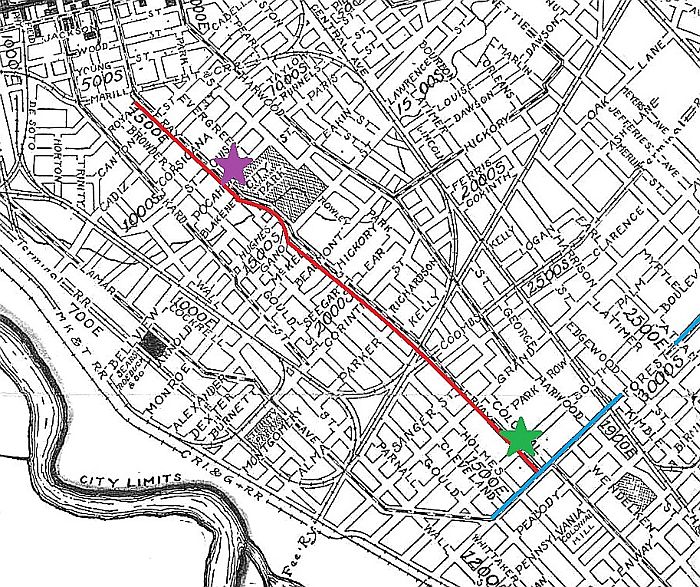
Below, a detail of a 1919 map showing S. Ervay down to Forest. The purple star shows the location of Temple Emanu-El and the Columbian Club. The green star shows the location of the Linz house and the Ervay St. Methodist Episcopal church. (Click for larger image.)

e-ervay_map_1918_portal
1919 map via Portal to Texas History

 ***

Sources & Notes

First and third postcards are from Flickr: here and here. Others found on eBay.

*

Copyright © 2016 Paula Bosse. All Rights Reserved.

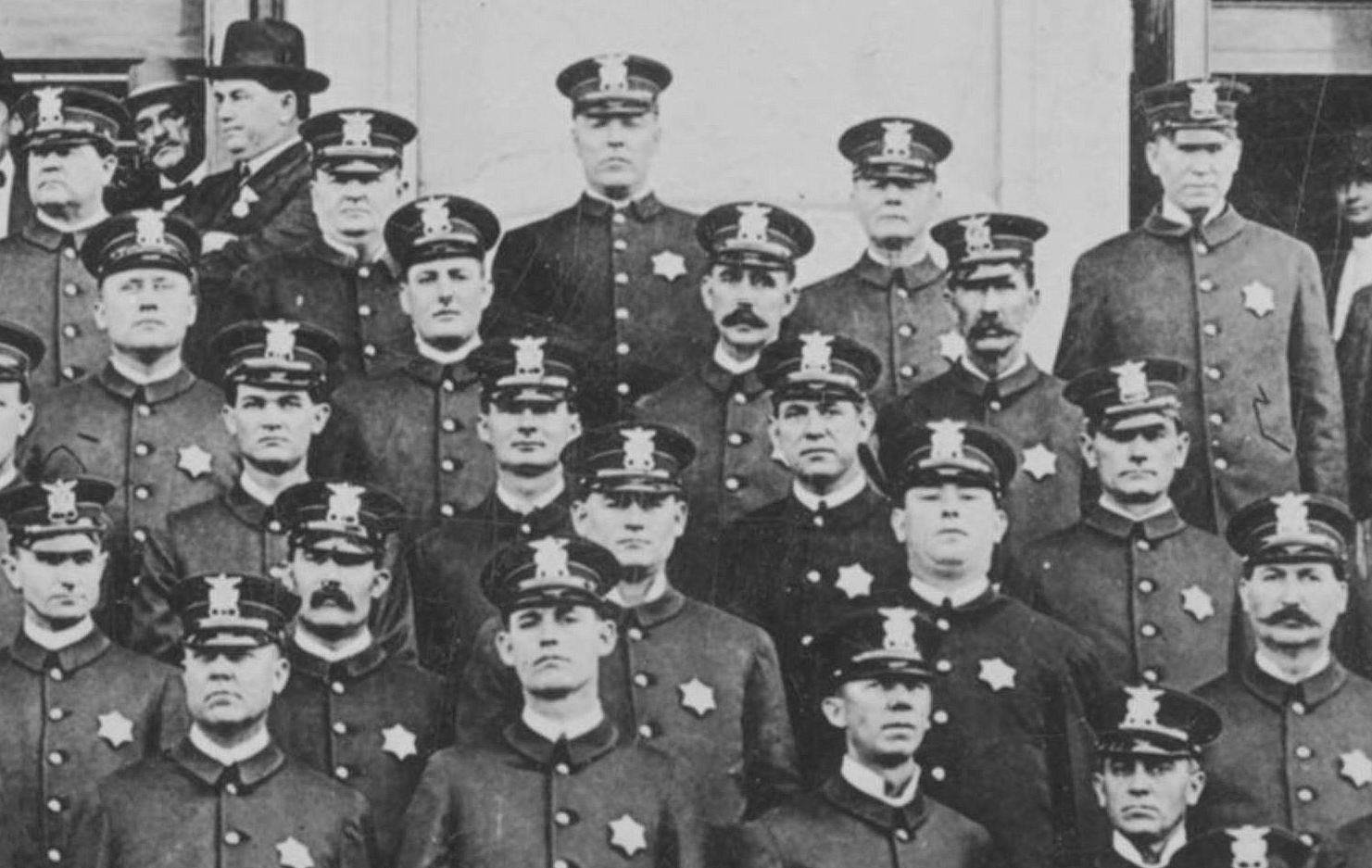
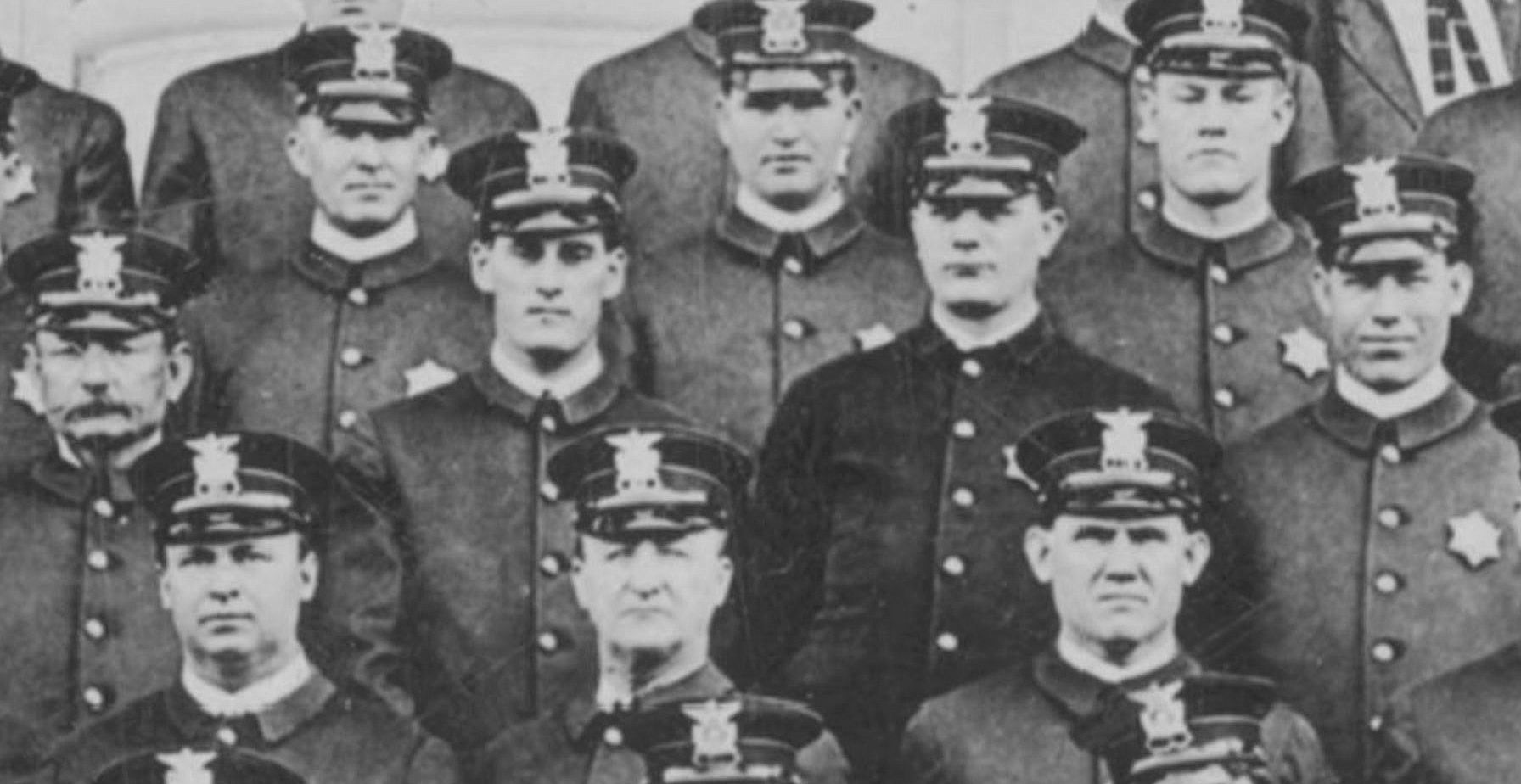
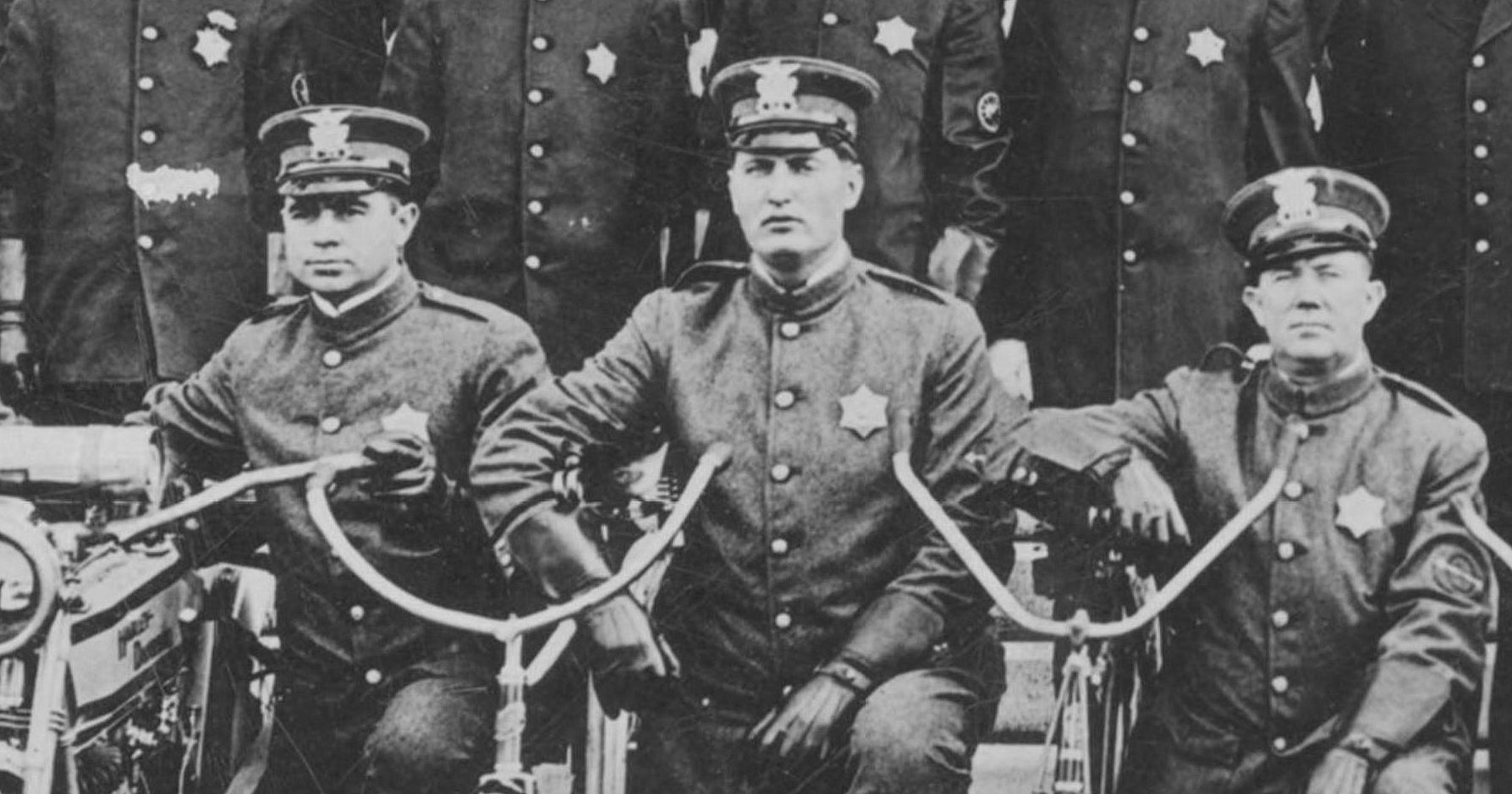
Dallas Police Department — 1914

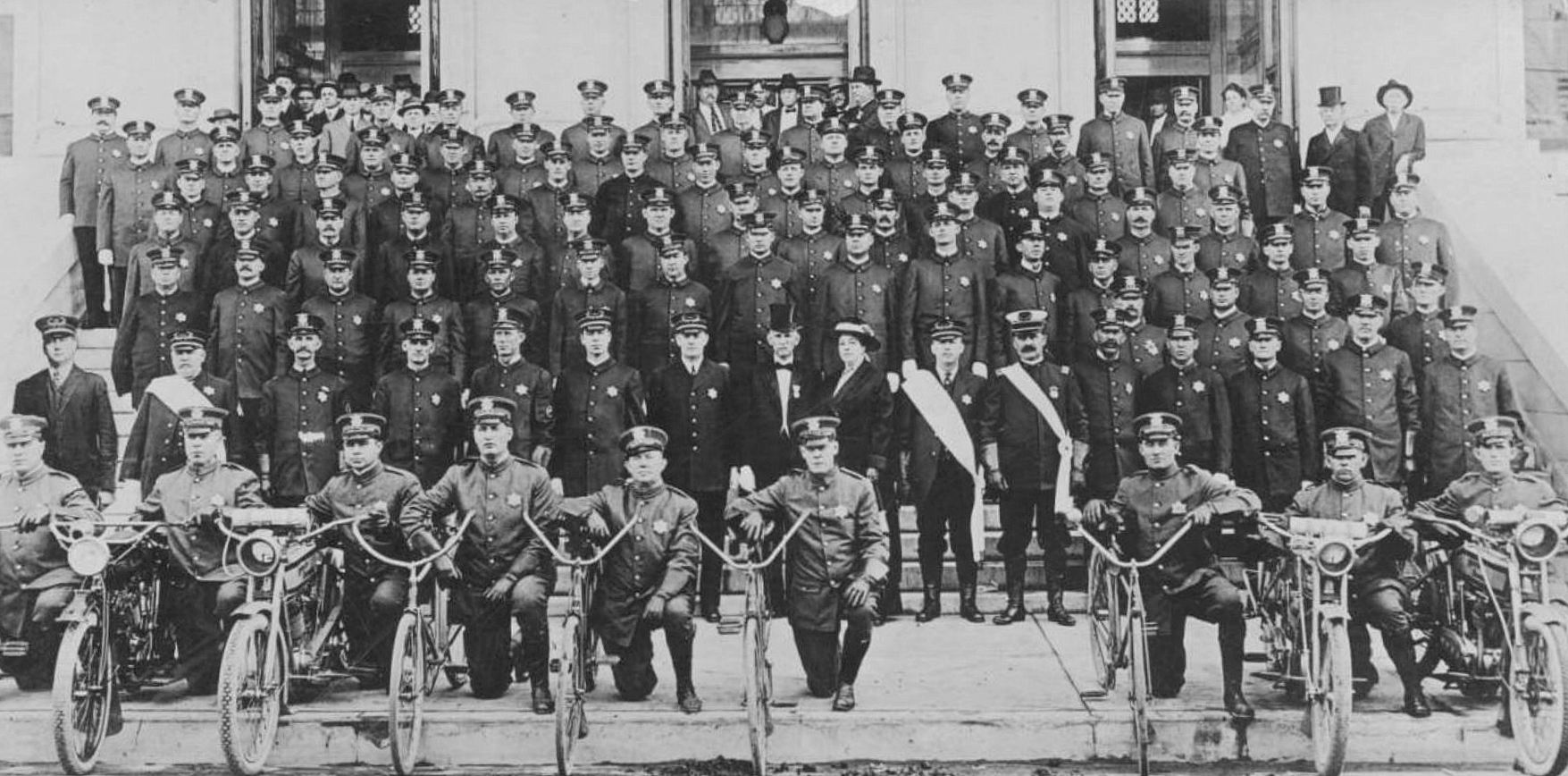
dallas-police-dept_opening-of-city-hall_101714_cook-colln_degolyer_smuOn the steps of the Municipal Building (click for much larger image)

by Paula Bosse

dallas-police-dept_frank-rogers_101714_cook-colln_degolyer_smu

police_1914_det3

police_1914_det4

police_1914_det5

***

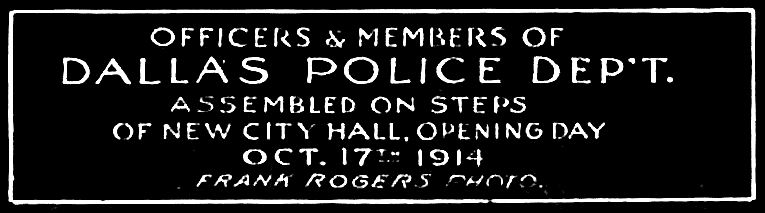
“Officers & Members of Dallas Police Dept. Assembled on Steps of New City Hall, Opening Day, Oct. 17th 1914,” photo by Frank Rogers, from the George Cook Collection, DeGolyer Library, Central University Libraries, Southern Methodist University; more information here. I have edited the image.

All images very large when clicked.

*

Copyright © 2016 Paula Bosse. All Rights Reserved.

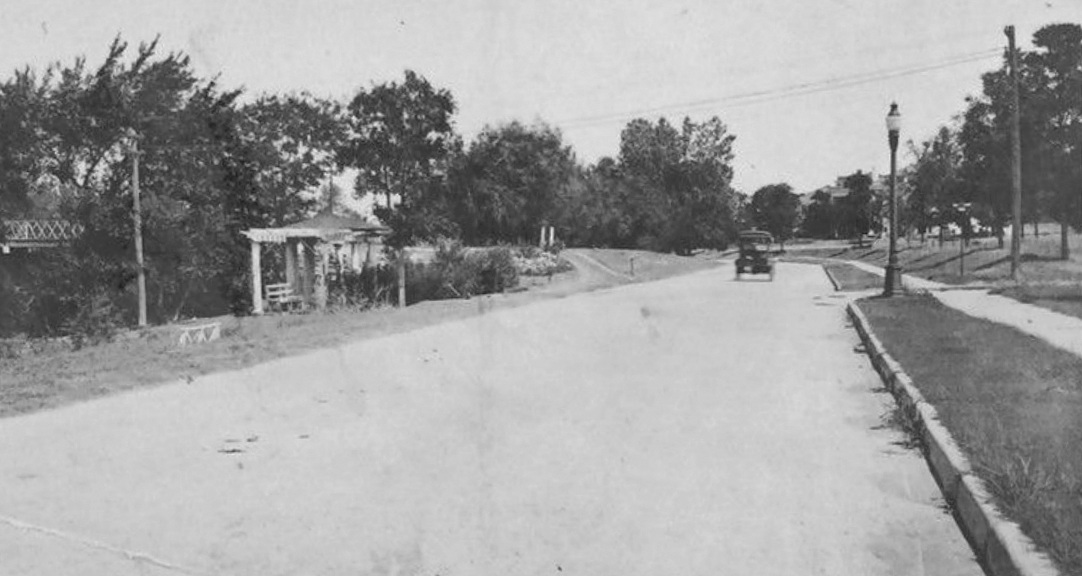
Lakeside Drive, Highland Park

hp_lakeside-drive_rppc_ebayLakeside Drive traffic…

by Paula Bosse

Above is a photo of Lakeside Drive in Highland Park. When I saw the bridge at the left I immediately thought this was Lakeside Park at Lexington Avenue. Lexington would be the street on the right, on the other side of the streetlamp.

Is that some sort of covered seating area at the left, facing the street? This seems too early for bus stops — surely it’s not a jitney stop. (Were jitneys even allowed in Highland Park?)

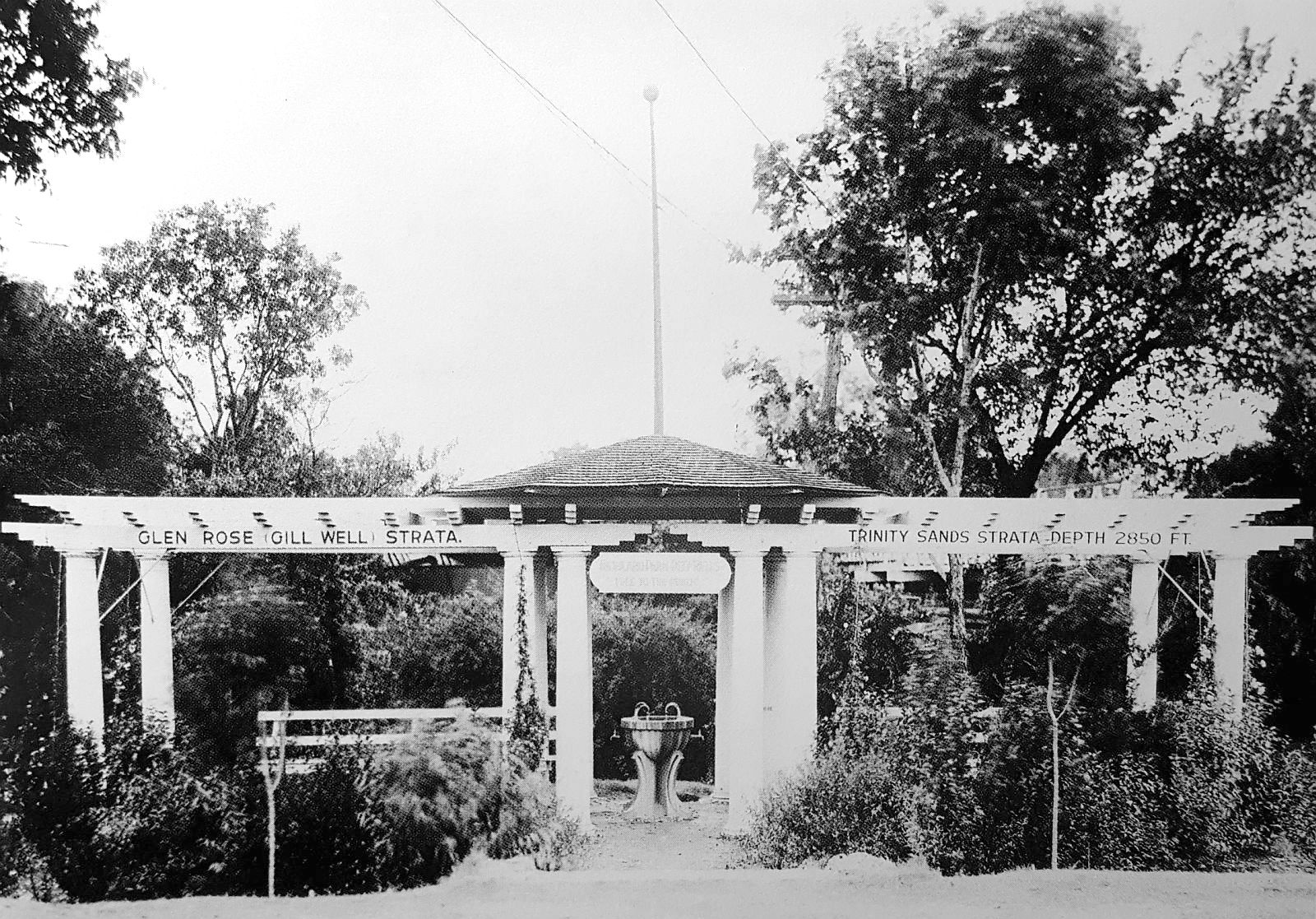
UPDATE: Aha! It’s the public mineral-water fountain that dispensed the highly mineralized “Gill Well” water. I wrote more about this than you probably want to know here. Here’s a better photo of what it looked like:

gill-well_highland-park_dallas-rediscoveredvia Dallas Rediscovered

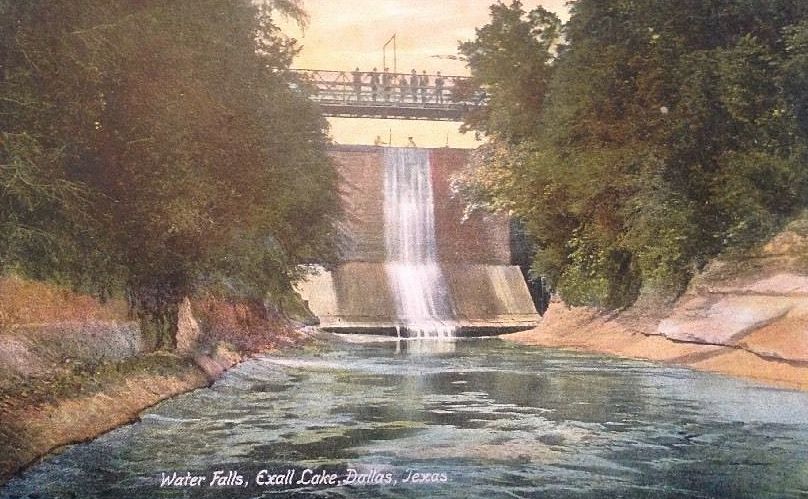
Here’s the view from the bridge — the waterfall! Lakeside Drive is to the right, out of frame. (UPDATE: Read more about this bridge in the comments below.)

exall-lake-waterfall

Roughly the same view (but with the bridge across Exall Lake hidden behind trees) can be seen here. A map is here.

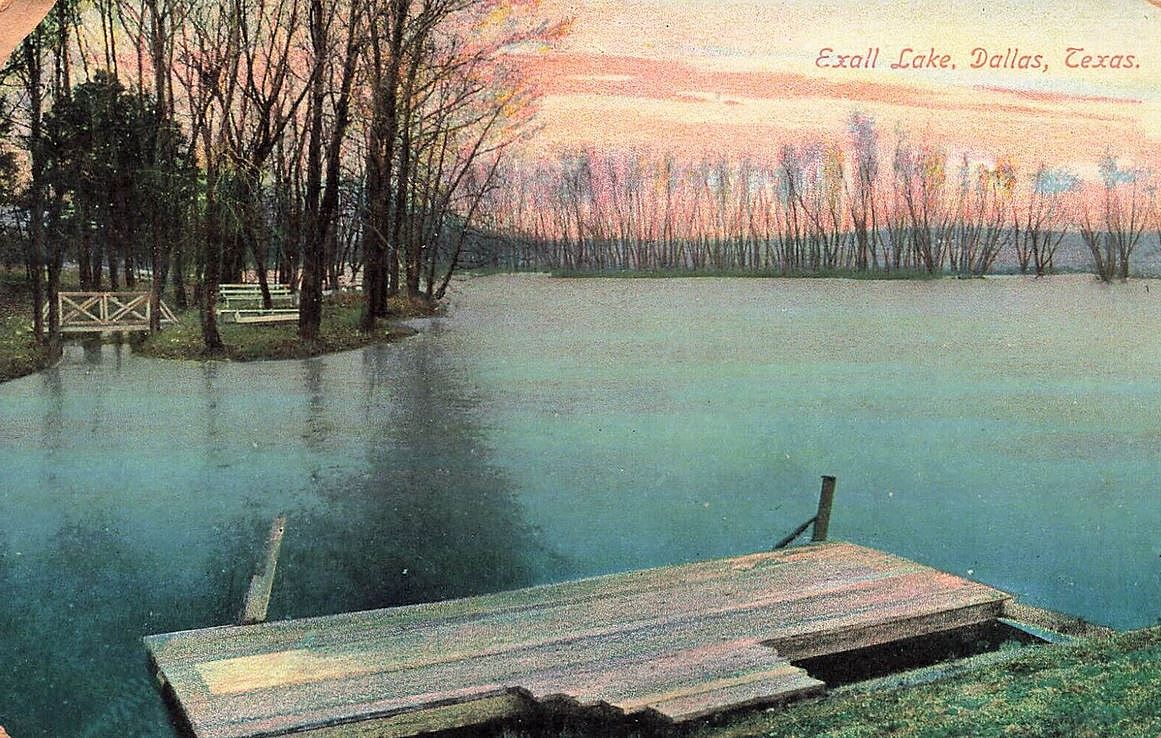
And here’s the very pretty lake:

exall-lake_postcard_ebay

***

Sources & Notes

The photo — probably from the ‘teens? — is by L. J. Higginbotham and is from a real photo postcard titled “Lake Side Drive in Highland Park” — found on eBay.

Color postcards from eBay.

See the Sanborn map from 1921, showing what was in this Lakeside/Lexington area at the time, here.

Every time I magnify the already blurry image, I swear I see a couple of people sitting on the bench under the covered area. But I might be imagining it. Or maybe they’re ghosts. Waiting for a bus.

*

Copyright © 2016 Paula Bosse. All Rights Reserved.

Belmont & Greenville: From Caruth Farmland to Hub of Lower Greenville

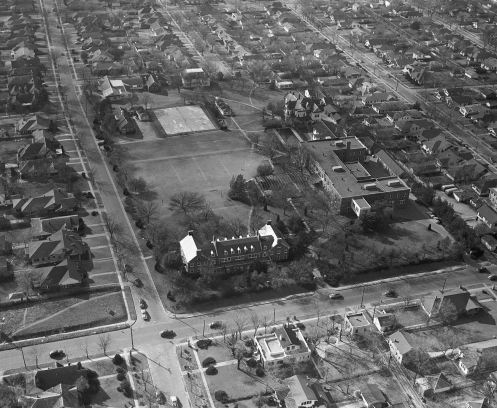
hockaday_aerial_squire-haskins_022750_UTA
Hockaday campus, 1950 (UTA Libraries)

by Paula Bosse

If you’ve driven down lower Greenville Avenue lately, you’re probably aware that the buildings that most recently housed a retirement home at the northwest corner of Belmont and Greenville were scheduled to be been torn down. When I drove past that intersection a few weeks ago and saw the entire block leveled, I was shocked. It’s weird suddenly not seeing buildings you’ve seen your entire life. It got me to wondering what had been on that block before. I’d heard that Hockaday had occupied that block for several years, but even though I’d grown up not too far away, I’d only learned of that within the past few years. When I looked into this block’s history, the most surprising thing about it is that it has passed through so few owners’ hands over the past 140 or so years.

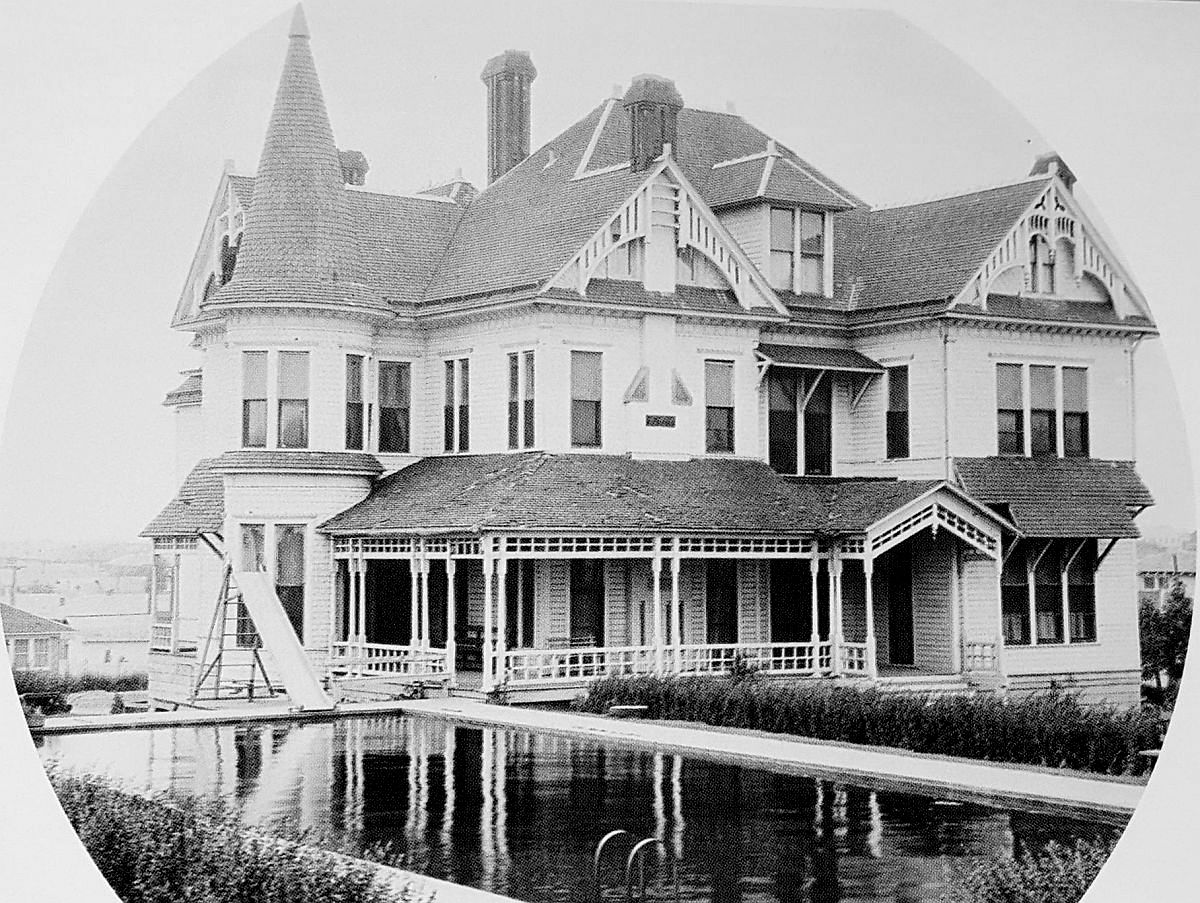
As far as I can tell, the first owner or this land was Walter Caruth (1826-1897), a pioneer merchant and farmer who arrived in this area in the 1840s (some sources say the 1850s), along with his brother, William. Over the years the brothers amassed an absolutely staggering amount of land — thousands and thousands of acres which stretched from about Inwood Road to White Rock Lake, and Ross Avenue up to Forest Lane. One of Walter Caruth’s tracts of land consisted of about 900 acres along the eastern edge of the city — this parcel of land included the 8 or 9 acres which is now the block bounded by Greenville, Belmont, Summit, and Richard, and it was where he built his country home (he also had a residence downtown). The magnificent Caruth house was called Bosque Bonita. Here is a picture of it, several years after the Caruths had moved out (the swimming pool was added later).
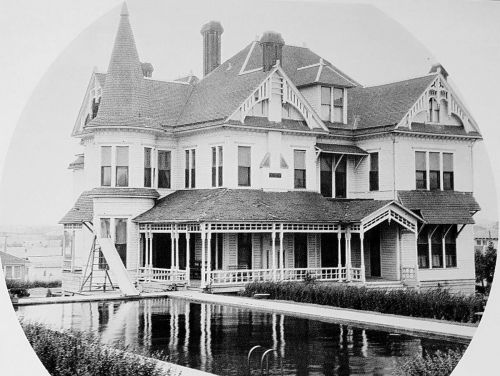
caruth_bosque-bonita_dallas-rediscovered

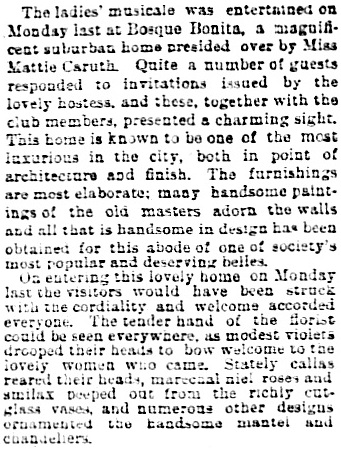
Most sources estimate that the house was built around 1885 (although a 1939 newspaper article stated that one of Walter’s children was born in this house in 1876…), but it wasn’t until 1890 that it began to be mentioned in the society pages, most often as the site of lavish parties. (Click pictures and  articles to see larger images.)
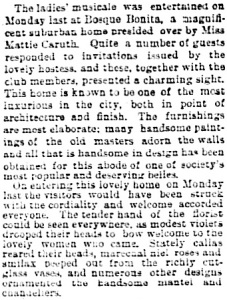
bosque-bonita_dmn_020390Dallas  Morning News, Feb. 3, 1890

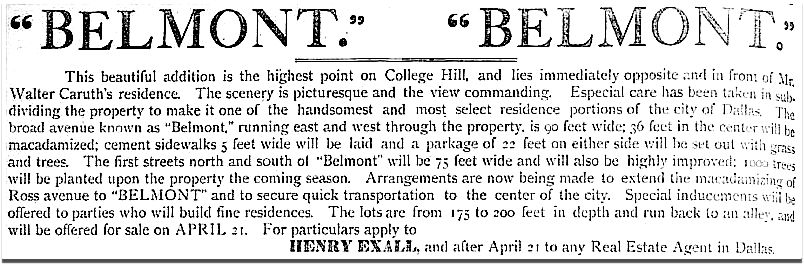
At the time, the Caruth house was one of the few buildings in this area — and it was surrounded by endless acres of corn and cotton crops. It wasn’t long, though, before Dallas development was on the march eastward and northward. This ad, for the new Belmont Addition, appeared in April of 1890, and it mentioned the Caruth place as a distinguished neighboring landmark.
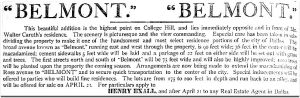
belmont-addition_dmn_041690
DMN, April 16, 1890

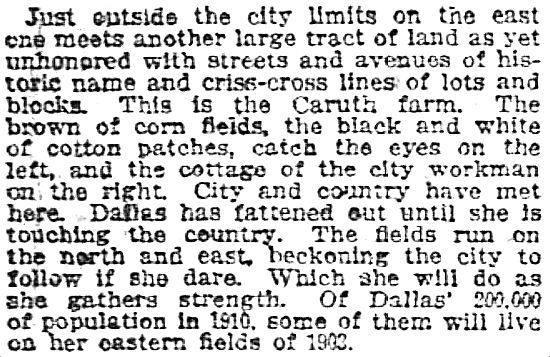
By the turn of the century — after Caruth’s death in 1897 — it was inevitable that this part of town (which was not yet fully incorporated into the City of Dallas) would soon be dotted with homes and businesses.
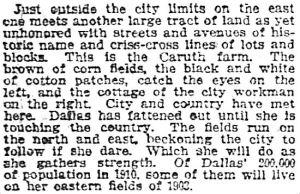
caruth-farm_dmn_092703
DMN, Sept. 27, 1903

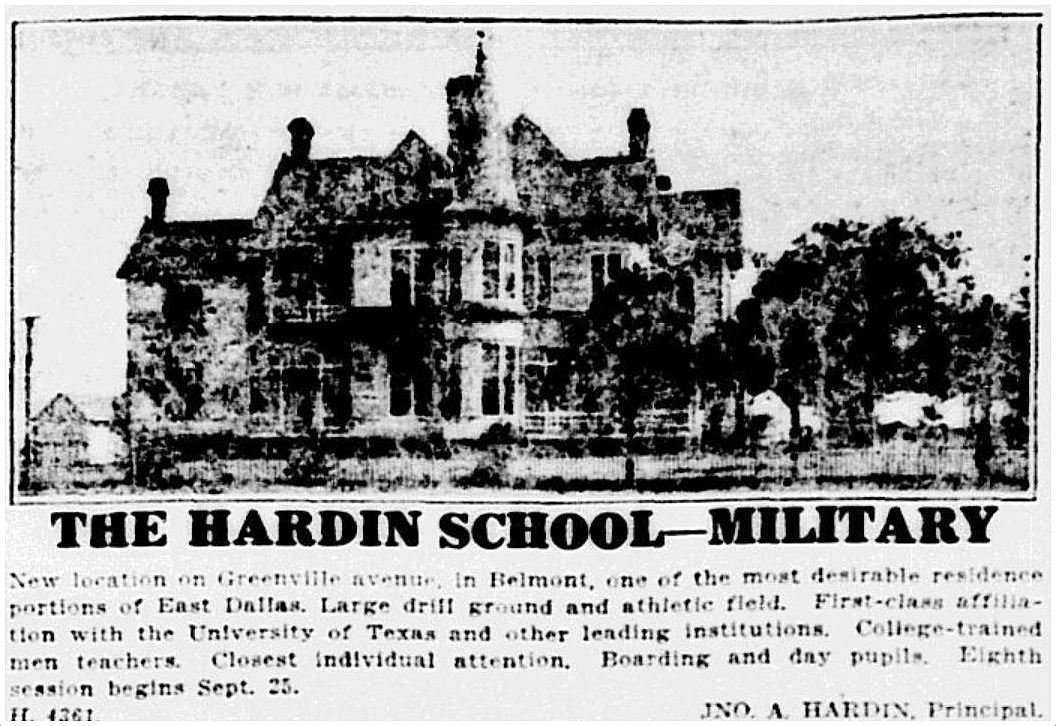
At one time the Caruth family owned land in and around Dallas which would be worth the equivalent of billions of dollars in today’s money. After Walter Caruth’s death, the Caruth family became embroiled in years of litigation, arguing over what land belonged to which part of the family. I‘m not sure when Walter Caruth’s land around his “farmhouse” began to be sold off, but by 1917, the Hardin School for Boys (established in 1910) moved into Bosque Bonita and set up shop. It operated at this location for two years. The Caruth house even appears in an ad.
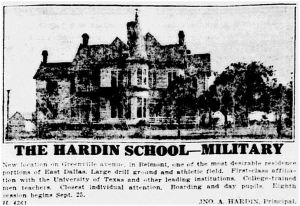
hardin-school_dmn_071517_bosque-bonita_ad
DMN, July 15, 1917

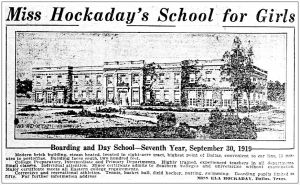
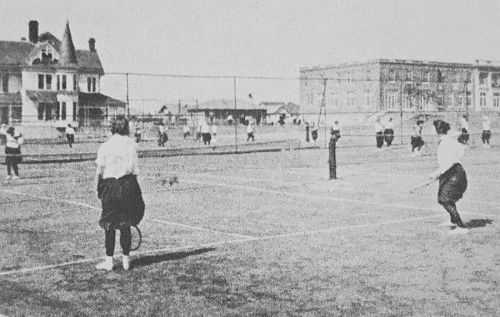
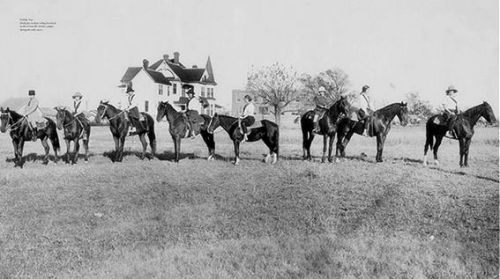
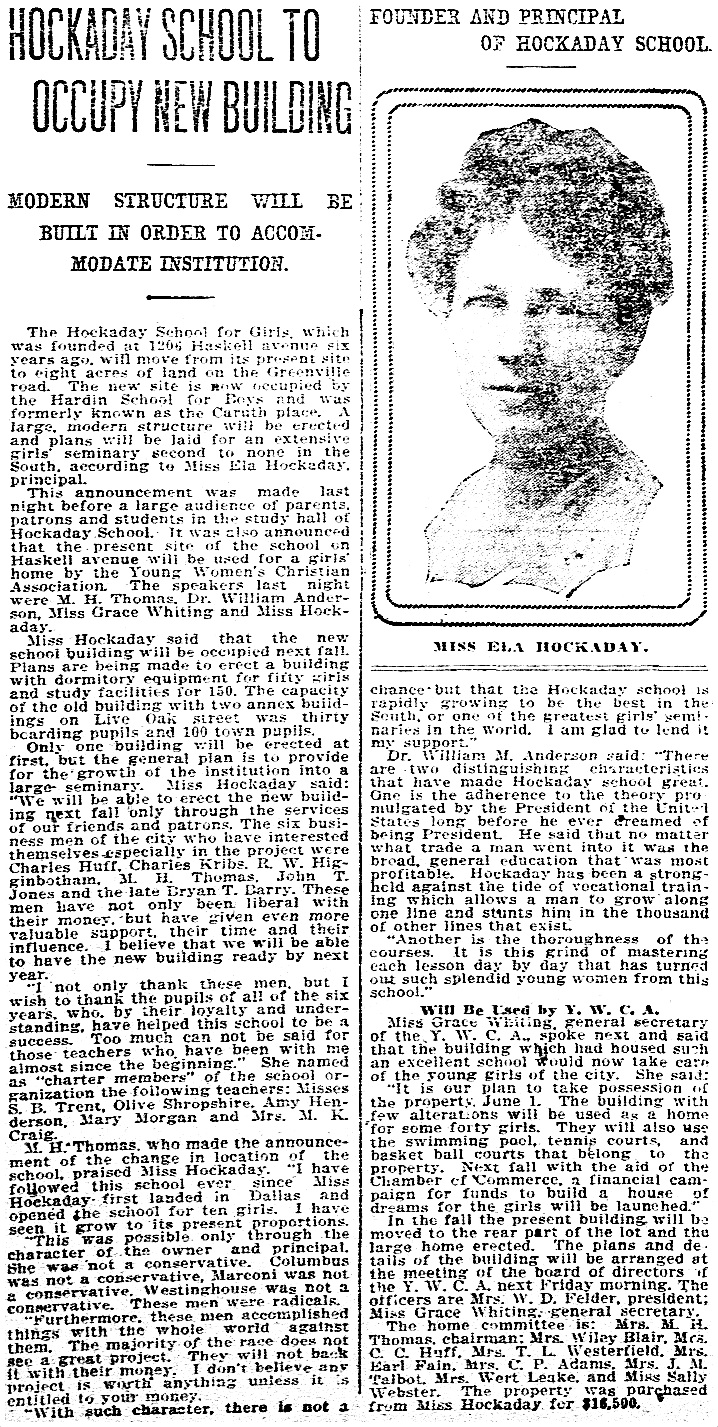
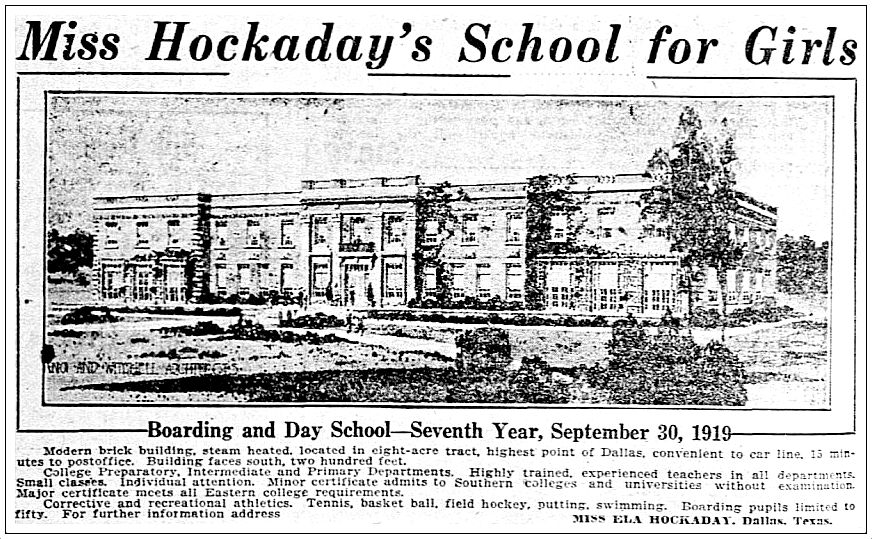
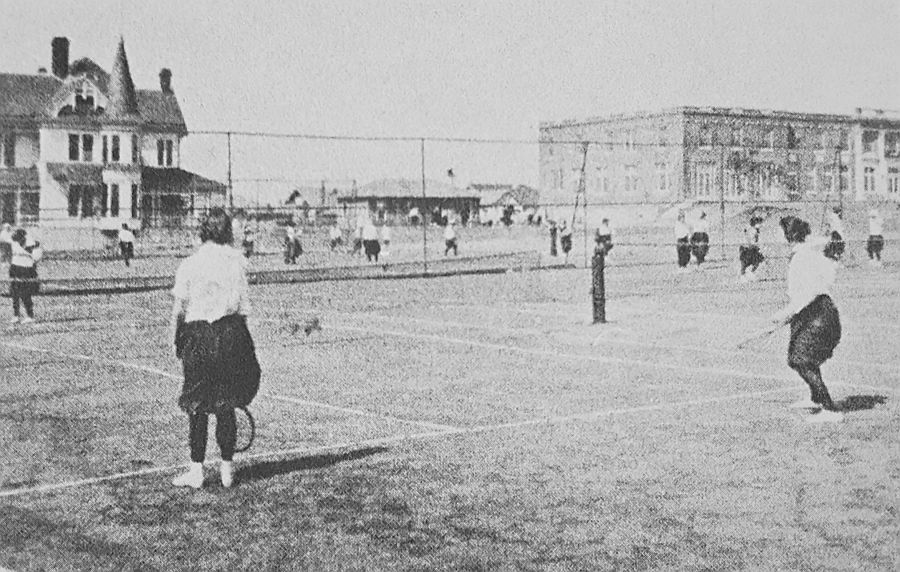
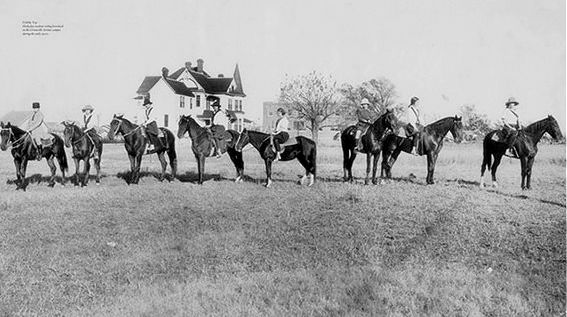
I’m not sure if the Hardin School owned the land or was merely leasing it and the house, but in 1919, Ela Hockaday announced that she had purchased the land and planned to move her school — Miss Hockaday’s School for Girls (est. 1913) — to this block and build on it a two-story brick school building, a swimming pool (seen in the photo above), tennis courts, basketball courts, hockey fields, and quarters for staff and girls from out of town who boarded.
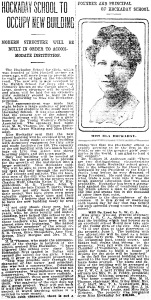
hockaday_dmn_051119DMN, May 11, 1919

hockaday_dmn_070619
DMN, July 6, 1919

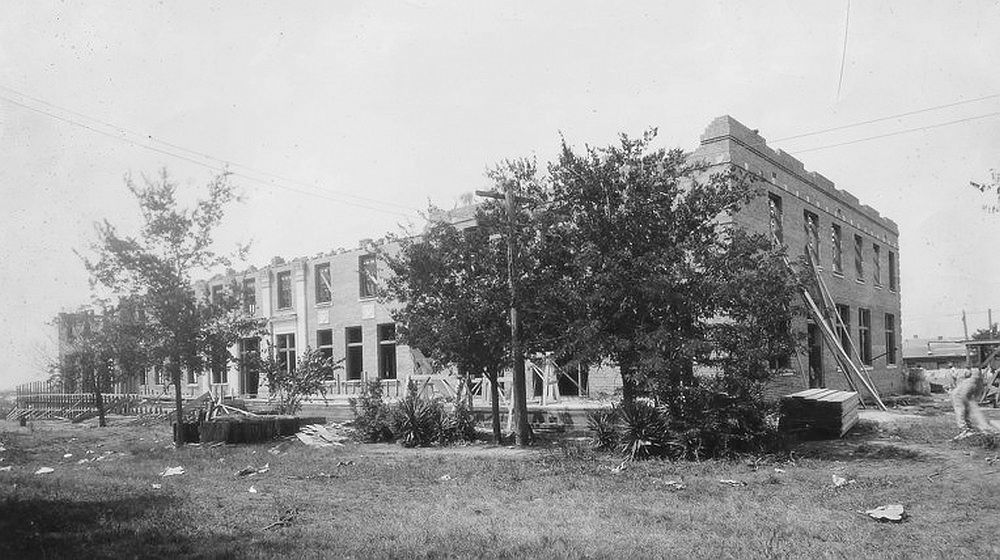
Ground was broken in July of 1919, and the first session at the new campus began on schedule in September. Below, the building under construction. Greenville Avenue is just out of frame to the right.
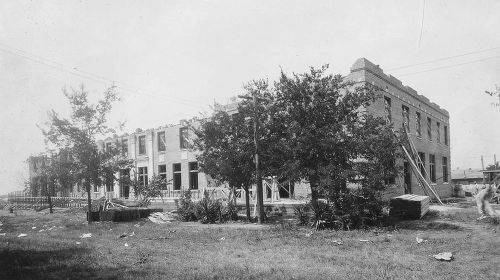
hockaday_greenville_construction_hockaday100Photo: Hockaday 100

hockaday_greenville-ave_1919_reminiscences

hockaday_greenville-belmont_1920s_horses

The most interesting thing I read about the Hockaday school occupying this block is that very soon after opening, the beautiful Caruth house was moved from its original location at the northwest corner of Belmont and Greenville. It was rolled on logs to the middle and back of the property. “Bosque Bonita” became “Trent House.” Former student (and later teacher) Genevieve Hudson remembered the moving of the house in an oral history contained in the book Reminiscences: A Glimpse of Old East Dallas:
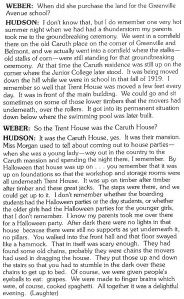
caruth-house_hockaday_reminiscences-bk

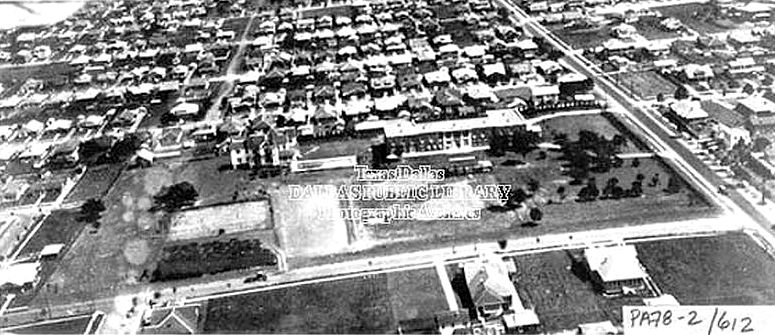
You can see the new location of the house in the top aerial photo, and in this one:
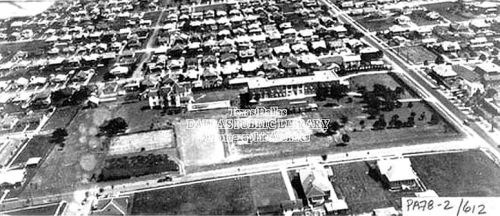
hockaday_aerial_dpl
Dallas Public Library

Another interesting little tidbit was mentioned in a 1947 Dallas Morning News article: Caruth’s old hitching post was still on the property — “on Greenville Avenue 100 feet north of the Belmont corner” (DMN, May 2, 1947). I’d love to have seen that.

After 42 years of sustained growth at the Greenville Avenue location (and five years after the passing of Miss Hockaday), the prestigious Hockaday School moved to its current location in North Dallas just after Thanksgiving, 1961. Suddenly, a large and very desirable tract of land between Vickery Place and the M Streets was available to be developed. Neighbors feared the worst: high-rise apartments.

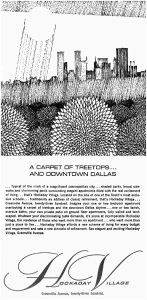
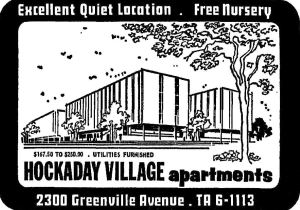
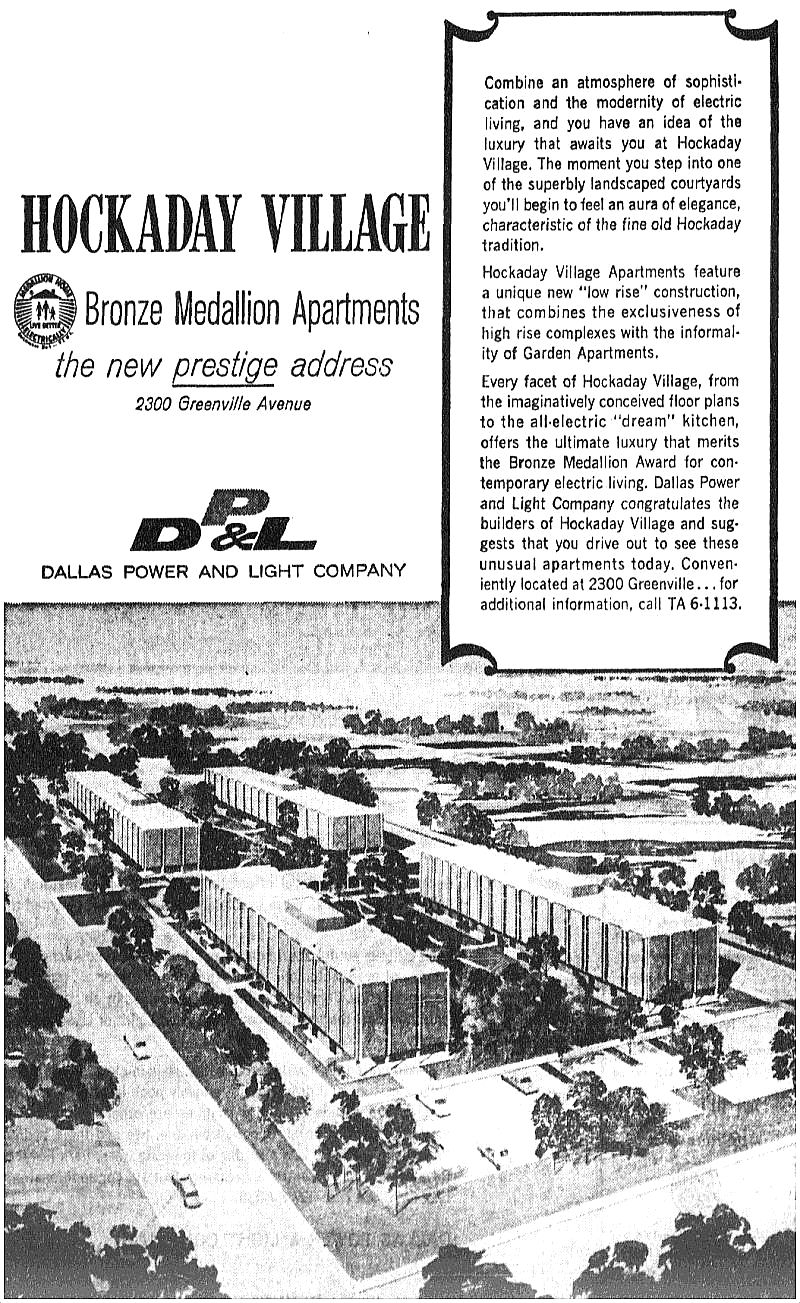
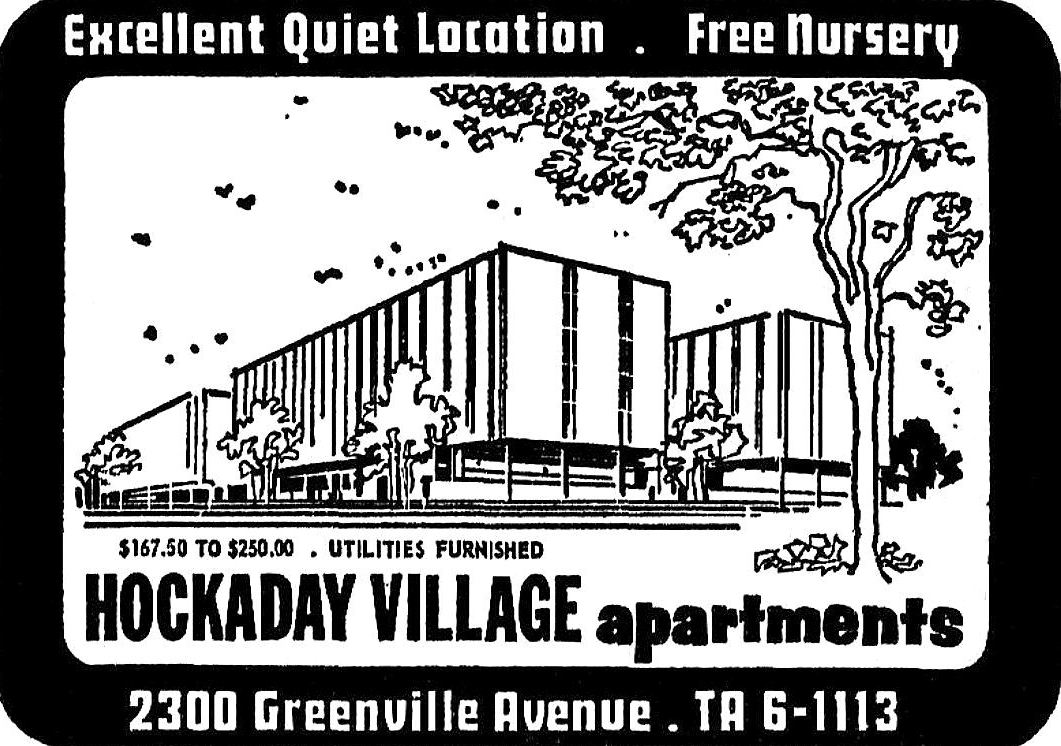
The developer proposed a “low-rise,” “semi-luxury” (?) group of four 5-story apartment buildings, each designed to accommodate specific tenants: one for swinging singles (“where the Patricia Stevens models live”), one for single or married adults, one for families with children, and one for “sedate and reserved adults.” It was to be called … “Hockaday Village.” The architect was A. Warren Morey, the man who went on to design the cool Holiday Inn on Central and, surprisingly, Texas Stadium.

Bosque Bonita — and all of the other school buildings — bit the dust in preparation for the apartment’s construction. Hockaday Village (…what would Miss Hockaday have thought of that name?) opened at the end of 1964.
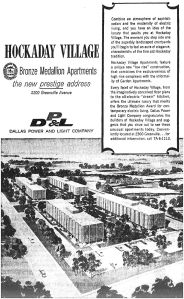
hockaday-village_dmn_101864
Oct. 1964

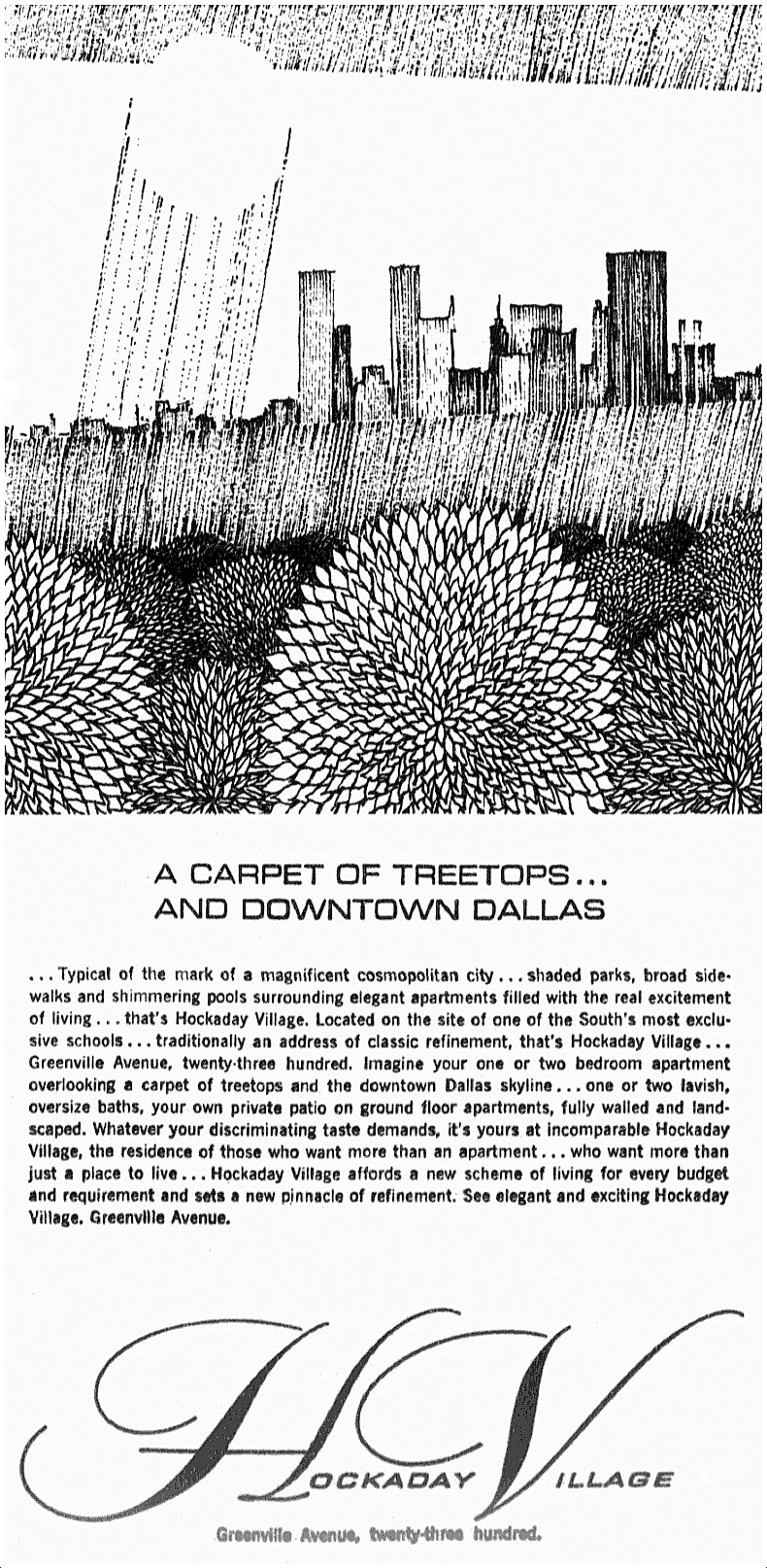
hockaday-village_dmn_101864_carpet-of-treetops
Oct. 1964

hockaday-village_dmn_031365
March 1965

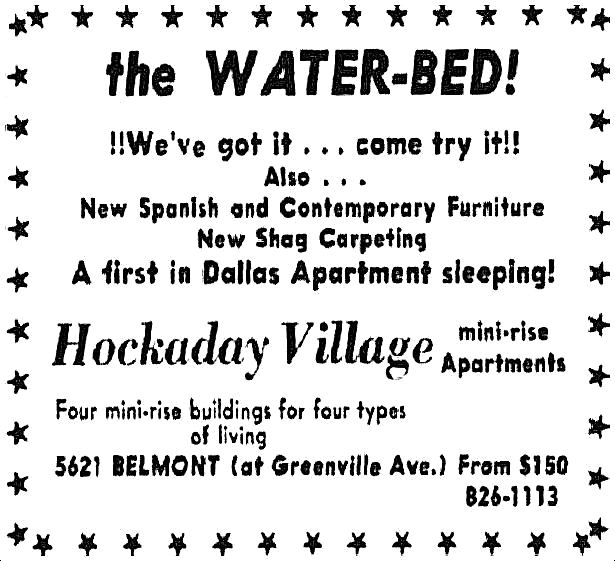
And then before you knew it, it was the ’70s, the era of waterbeds and shag carpeting. (Miss Hockaday would not have tolerated such tackiness, and I seriously doubt that Mr. Caruth would have ever understood why shag carpeting was something anyone would actually want.)
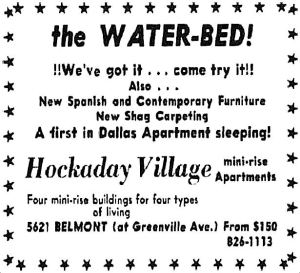
hockaday-village_dmn_052271_waterbeds
1971

Then, in 1973, the insistently hip ads stopped. In April, 1974 this appeared:
hockaday-village_FWST_042874
Fort Worth Star-Telegram, April 28, 1974

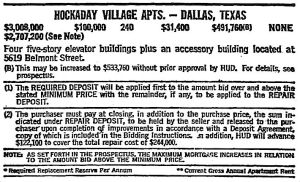
The apartments were being offered for public auction by the “Office of Property Disposition” of the Federal Housing Authority and HUD. Doesn’t sound good. So who bit and took the plunge? The First Baptist Church of Dallas, that’s who. The plan was to redevelop the existing apartments into a retirement community called The Criswell Towers, to be named after Dr. W. A. Criswell. But a mere three months later, the Baptists realized they had bitten off more than they could chew — the price to convert the property into a “home for the aged” would be “astronomical.” They let the building go and took a loss of $135,000. It went back on the auction block.

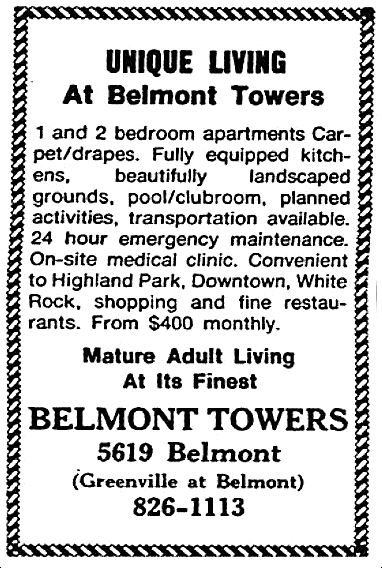
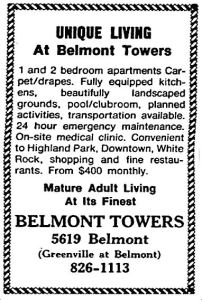
Two years later, in the summer of 1976 … the old Hockaday Village became Belmont Towers — and the new owners must have thought the Baptists’ idea was a good one, because Belmont Towers advertised itself as “mature adult living at its finest” — “perfect for retired or semi-retired individuals.”
hockaday-village_dmn_043083_belmont-towers
April 1983

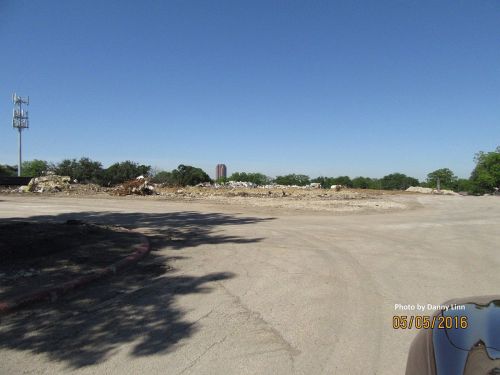
It was Belmont Towers for 20-or-so years. In 1998, the buildings were renovated and updated, and it re-opened as Vickery Towers, still a retirement home and assisted living facility. A couple of years ago it was announced that the buildings would be demolished and a new development would be constructed in its place. It took forever for the 52-year-old complex to finally be put out of its misery since that announcement. Those buildings had been there my entire life and, like I said, it was a shock to see nothing at all in that block a few weeks ago.
vickery-towers_050516_danny-linn-photoPhoto: Danny Linn

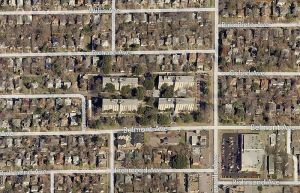
In the 140-or-so years since Walter Caruth acquired this land in the 1870s or 1880s, it has been occupied by Caruth’s grand house, a boys school, the Hockaday School, and four buildings which have been apartments and a retirement community. And that’s it. That’s pretty unusual for development-crazy Dallas. I’ll miss those familiar old buildings. I hope that whatever is coming to replace them won’t be too bad.
greenville-belmont_bing_aerial
Bing Maps

***

Sources & Notes

The top aerial photograph is by Squire Haskins, taken on Feb. 27, 1950 — from the Squire Haskins Photography Inc. Collection, University of Texas at Arlington Libraries, Special Collections, accessible in a massive photo here (click the thumbnail). Greenville Avenue is the street running horizontally at the bottom. The Hockaday Junior College can be seen at the northwest corner of Belmont and Greenville — the original location of Bosque Bonita before it was rolled across the campus.

That fabulous photo of Bosque Bonita is from the book Dallas Rediscovered by William L. McDonald.

Photo of Hockaday girls playing tennis is from the book Reminiscences: A Glimpse of Old East Dallas.

Photo of girls on horseback … I’m not sure what the source of this photo is.

Photo of the block, post-razing is by Danny Linn who grew up in Vickery Place; used with permission. (Thanks, Danny!)

All other sources as noted.

In case you were confused, the Caruth Homeplace that most of us might know (which is just south of Northwest Highway and west of Central Expressway) was the home of Walter Caruth’s brother William — more on that Caruth house can be found here.

The Hockaday School can be seen on the 1922 Sanborn map here (that block is a trapezoid!).

More on the history of the Hockaday School can be found at the Hockaday 100 site; a page with many more photos is here. Read about the history of the school in the article “Miss Ela Builds a Home” by Patricia Conner Coggan in the Spring, 2002 issue of Legacies, here.

Additional information can be found in these Dallas Morning News articles:

  • “Proposal to Change Hockaday Site to Apartment Zoning Opposed” (DMN, Oct. 29, 1961)
  • “Retirement Home Plans Going Ahead” (regarding the purchase by the First Baptist Church of Dallas) (DMN, June 15, 1974)
  • “Church Takes $135,000 Loss on Property” (DMN, Sept. 10, 1974)

*

If you made it all the way through this, thank you! I owe you a W. C. Fields “hearty handclasp.”

*

Copyright © 2016 Paula Bosse. All Rights Reserved.

From the Vault: From a Miserable “Squatter-Town” to Beautiful Reverchon Park

reverchon_park_baseball“After…”

by Paula Bosse

Read about the open-air slum that once occupied the land of one of Dallas’ prettiest parks in my previous post “Reverchon Park, Site of a Hovel Town Once Known as ‘Woodchuck Hill,'” here.

*

Copyright © 2016 Paula Bosse. All Rights Reserved.