Flashback : Dallas

A Miscellany: History, Ads, Pop Culture

Category: 1950s

Christmastime in Lakewood — 1951

xmas_WWW_1952Mad tree-trimming fun ahead (click for larger image)

by Paula Bosse

Above, Woodrow kids with a Christmas tree crammed into their convertible, taking a moment to wave at someone in the distance, probably a classmate coming out of Harrell’s Drug Store. Next stop, wholesome 1950s tree-trimming fun, complete with mugs of warm cocoa and Perry Como singing about Christmas on the radio.

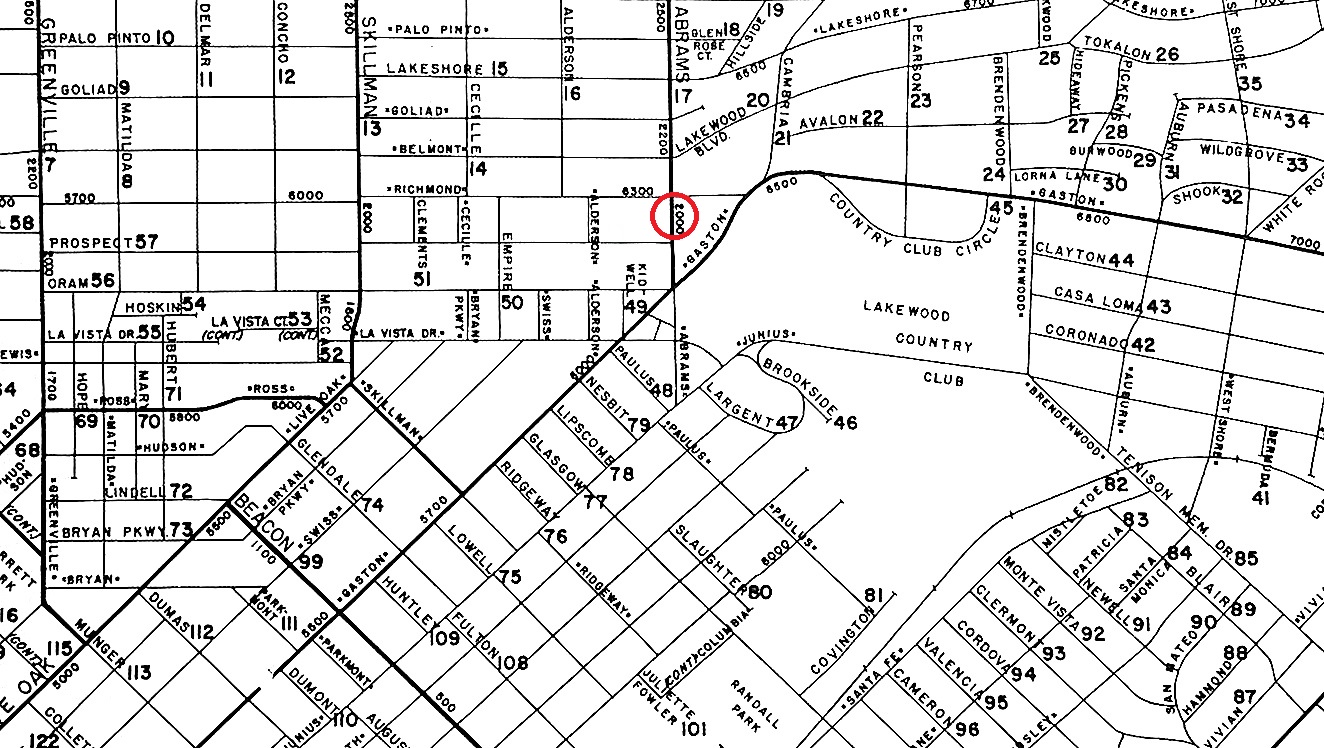
If you’re familiar with Lakewood, it might take a second to get your bearings, but this was Abrams Road. It’s now the short stretch known as Abrams Parkway, directly across Abrams from the Lakewood Whole Foods — it basically serves as a parking lot for the businesses now occupying these buildings.

Here is a list of the businesses seen in this 1951 photo, along with what currently occupies those same buildings:

  • 2015 Abrams: then, Abrams Road Cleaners; now, The Heights (formerly Legal Grounds)
  • 2017 Abrams: then, Massey’s Beauty Salon & Barber Shop; now, part of Blow Hair Salon
  • 2019 Abrams: then, Lakewood Shoe Service; now, Blow Hair Salon
  • 2021 Abrams: then, Lakewood Recreation Club; now, Scalini’s Pizza & Pasta
  • 2023 Abrams: then, Lakewood Sporting Goods; now, part of Curiosities
  • 2025 Abrams (mostly out of frame): then, Teter Plumbing Co.; now, Curiosities (an emporium of eclectic antiques and overall super-cool stuff)

Just out of frame to the right, a couple of doors down, was the old El Chico restaurant, now Hollywood Feed.

A detail of a page from the 1952 Mapsco, which will be confusing to those who might not know about the weird “Abrams Bypass” that happened in the early ’80s (click for larger image).
1952-mapsco_lakewood-det

Here’s what this strip looks like today (or recently, anyway — Legal Grounds is now The Heights):
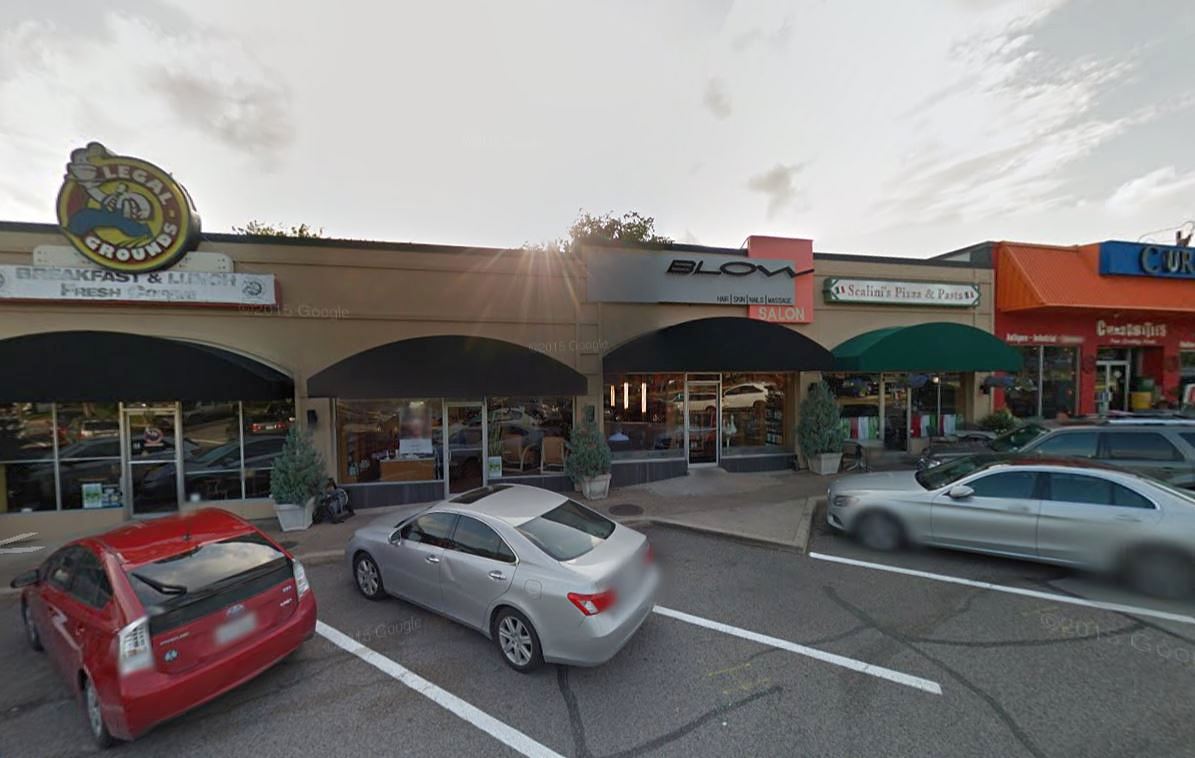
abrams_today_google-street-viewGoogle Street View

***

Photo from the 1952 Woodrow Wilson High School yearbook, The Crusader. Apologies for the quality — the photo appeared across two pages and was scanned at a pretty low resolution. It’s still pretty cool, though.

To see a magnified detail of the businesses on the left half of the photo, click here; for those on the right half, click here.

Since I don’t have access to a street directory showing this block’s info in 1951, here are the businesses that occupied that block per the 1948 and 1953 directories:

48-53

When in doubt, click pictures to see if they get bigger — they usually do!

*

Copyright © 2015 Paula Bosse. All Rights Reserved.
Merry Christmas From the Dallas Police Department’s Parking Enforcement Squad

xmas_santa_DPDSanta on Elm Street (click for larger image)

by Paula Bosse

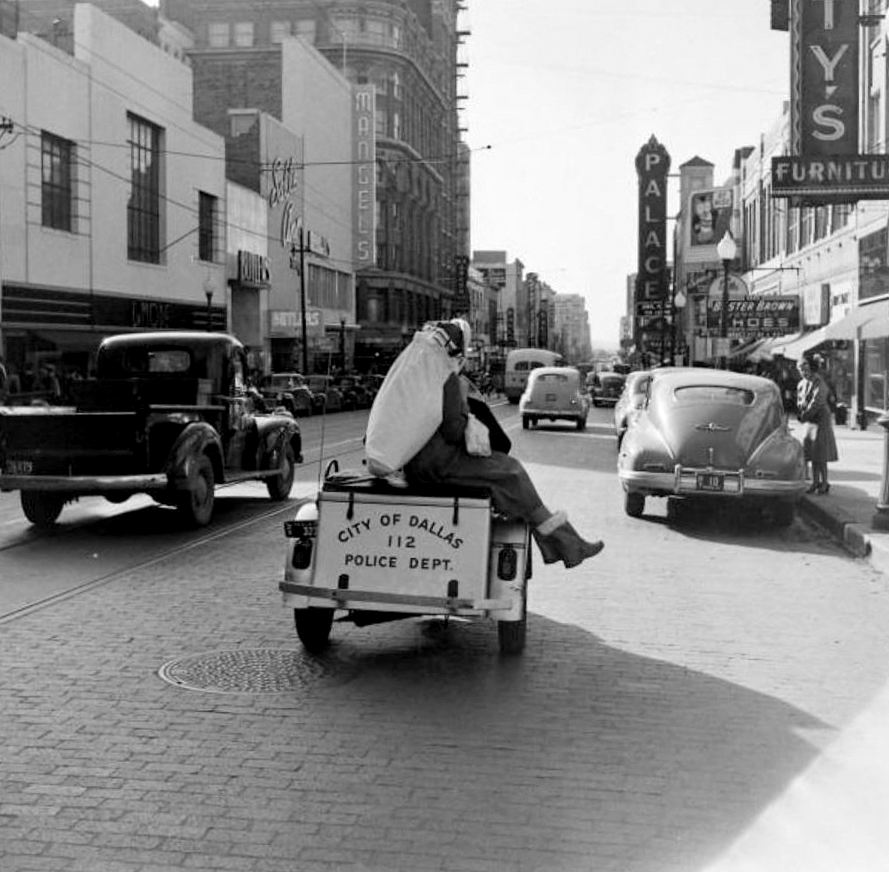
I don’t know what the story is behind this photograph of Santa Claus riding on the back of a three-wheeled motorcycle (they were used by the Dallas Police Department to patrol downtown streets for parking violations). Maybe Santa’s sleigh has broken down and he’s thumbed a ride to get to a scheduled event at a department store. Let’s hope it wasn’t the result of said sleigh being parked in a No Parking zone and a rather too strenuous ticket dispute by Mr. Claus necessitating a visit to the station to discuss the situation further. (Look at the brick-paved street!)

***

I’m not sure of the original source of this photo, but I want to thank reader Chris Walker for sending this to me. Thank you, Chris!

*

Copyright © 2015 Paula Bosse. All Rights Reserved.
Ervay, Live Oak, and Elm: Just Another Wednesday Night — 1953

ervay-live-oak-elm_haskins_uta_010753“Tomorrow’s weather: warm & cloudy”

by Paula Bosse

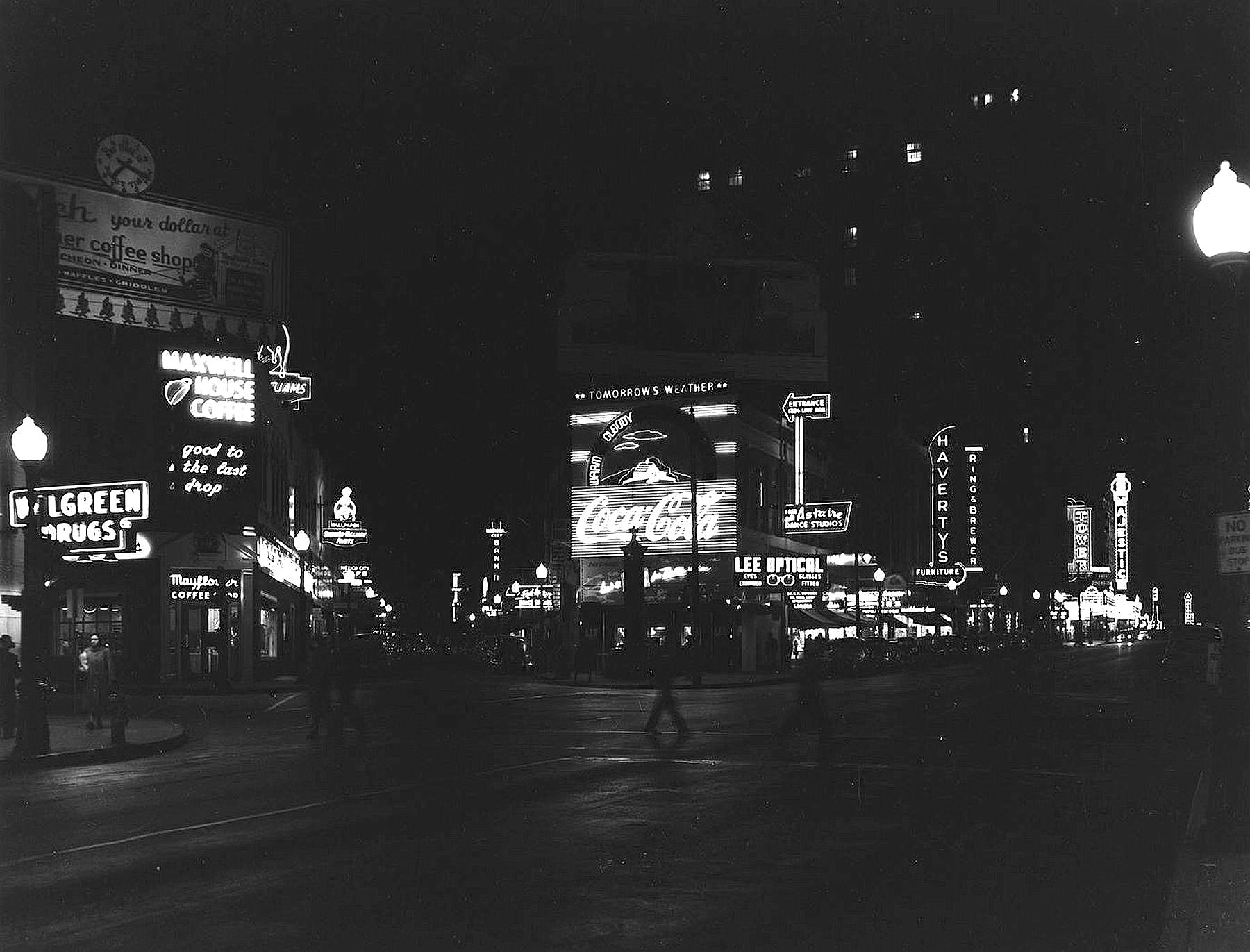
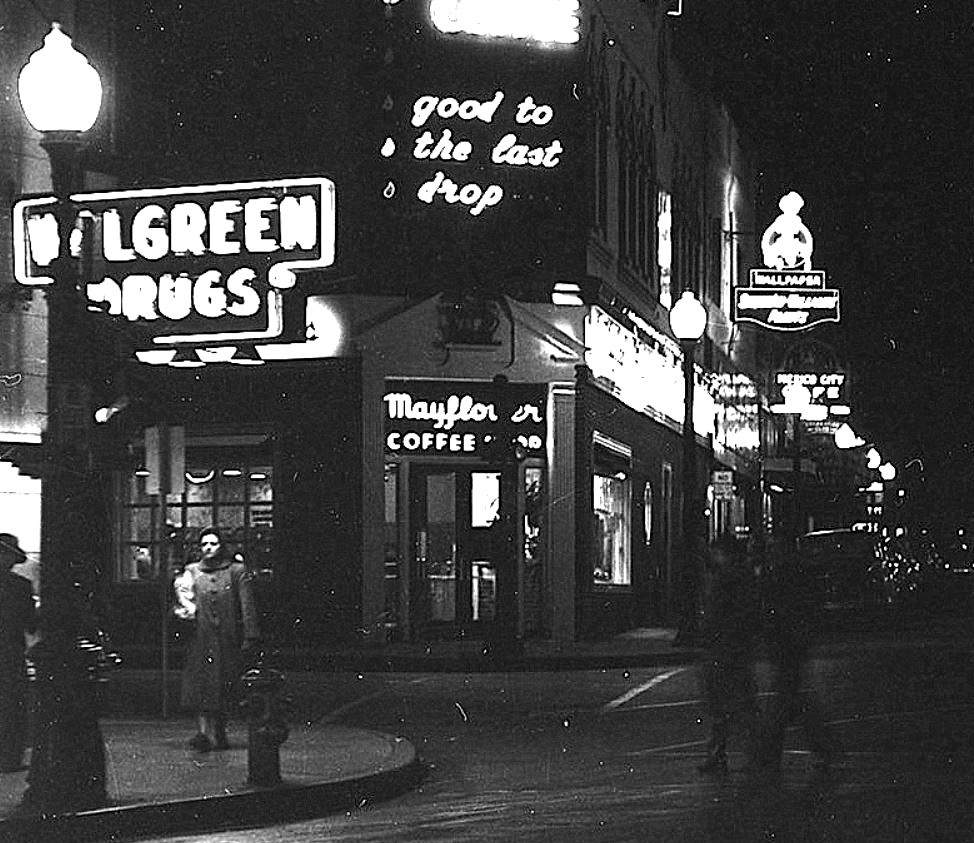
Here’s what 7:18 PM looked like at the old five-point intersection of Ervay, Live Oak, and Elm streets on January 7, 1953, a Wednesday night. All that neon — especially that Coca-Cola sign, which was probably flashing and strobing like crazy — gives this scene a sort of mini-Times Square feel. Imagine this intersection on a Friday or Saturday night when the streets and sidewalks would have been packed with people heading to theaters, restaurants, and night clubs!

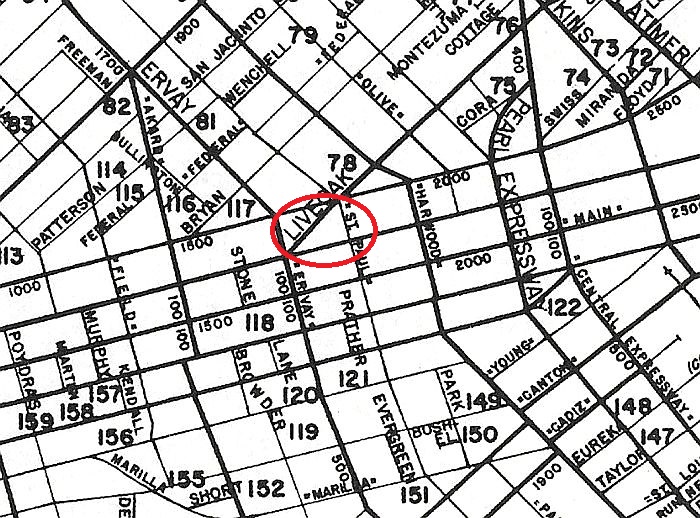
On the left, at the street light (I love those street lights!) and the Walgreen’s sign, is N. Ervay. To the left of the Coca-Cola sign is Live Oak, which used to come through to Elm. To the right, Elm Street, heading east.

So many interesting things here: the Mayflower Coffee Shop (with its “Anytime Is Donut Time” clock and its animated Maxwell House Coffee sign), that incredible neon sign above the Lee Optical store which gave the forecast, that Fred Astaire Dance Studios sign (with “Astaire” in a fantastic neon font), and the Tower and Majestic theater signs lit up for moviegoers who ventured to the movies on a school night. Unseen: the public restrooms (or “public comfort stations”) hidden beneath the street, with the entrance (I think) on the Lee Optical triangular “corner.”

I love all the neon, but this quiet little vignette of a woman carrying some sort of sack or parcel down a chilly downtown street is why I wish I had been around back then — it’s weird to feel nostalgia for a time and place you never actually experienced.

elm-ervay-live-oak_squire-haskins_uta_010753-det

*

A map showing that this intersection once had five points.

ervay-elm-live-oak_1952-mapsco1952 Mapsco (click for larger image)

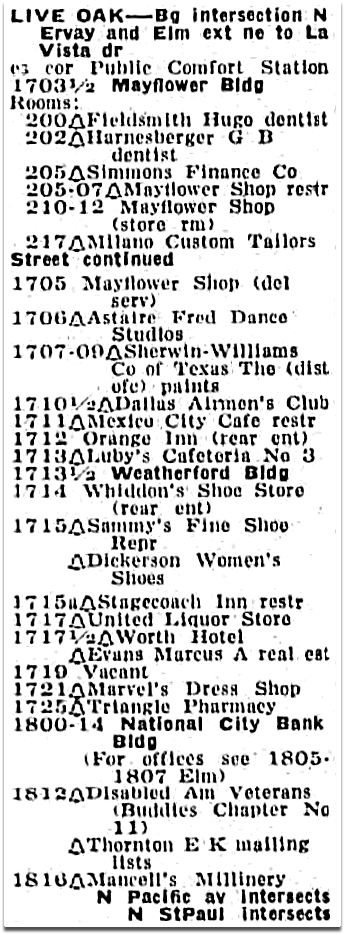
A listing of the businesses along Live Oak, between N. Ervay and N. St. Paul, from the 1953 city directory (click to read):

live-oak_1953-directory

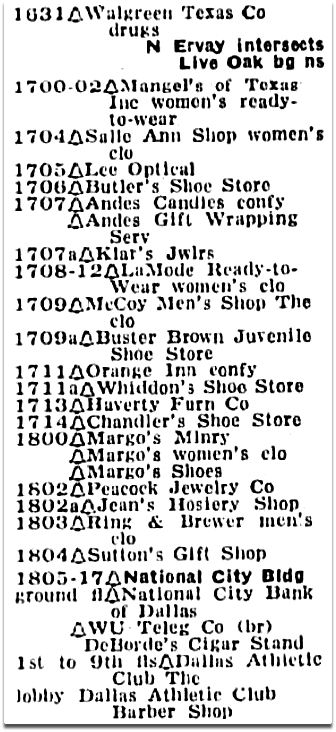
And the businesses along Elm, between N. Ervay and the old Dallas Athletic Club:

elm-st_1953-directory-1

***

Sources & Notes

This photograph — an untitled night scene — was taken by Squire Haskins on Jan. 7, 1953; from the Squire Haskins Photography, Inc. Collection at the University of Texas at Arlington Libraries, Special Collections, accessible here.

See this same view during the DAY in the post “Tomorrow’s Weather at Live Oak & Elm — 1955-ish,” here.

*

Copyright © 2015 Paula Bosse. All Rights Reserved.
The 67-80 Split Near Mesquite — ca. 1951

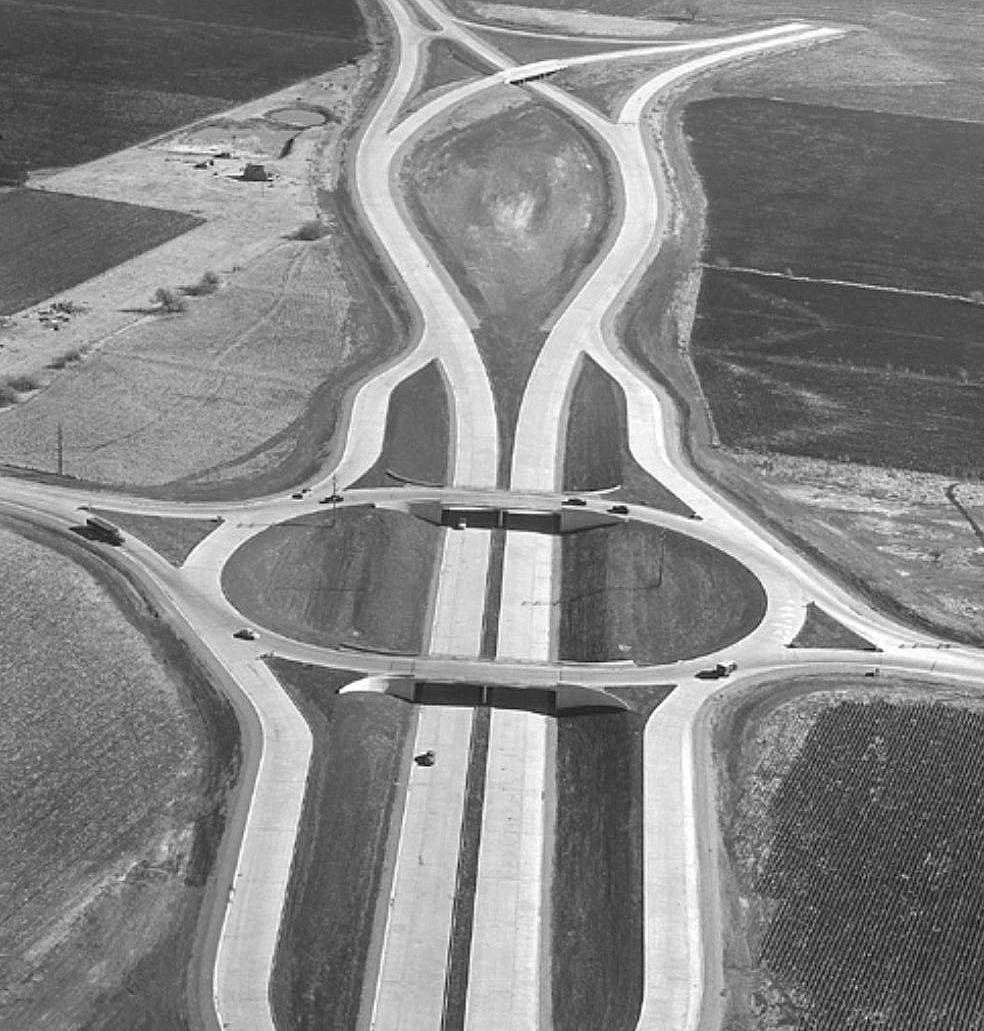
interchange_hwys-67-and-80_THC_flickr_largeFar East Dallas (click for VERY LARGE image)

by Paula Bosse

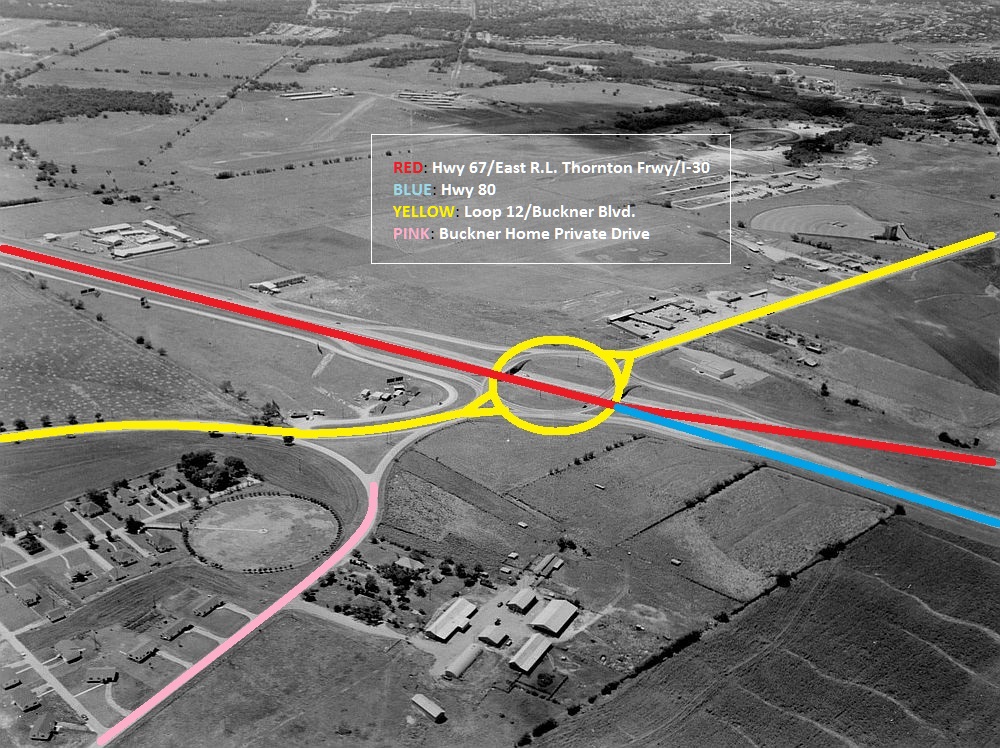
Above, a wonderful photo showing Highway 67 (now East R. L. Thornton Freeway and I-30) splitting off into Highway 80, just east of Loop 12/Buckner Blvd., surrounded by lots and lots of open land. At the top right, along Buckner, you can see the Buckner Drive-In, above it the original location of the Devil’s Bowl Speedway, and farther over, to the left, White Rock Airport. Part of the sprawling property belonging to the Buckner Orphans Home can be seen at the bottom left. Today, this is right about at the Dallas/Mesquite border. Except for the highways, this is pretty unrecognizable today!

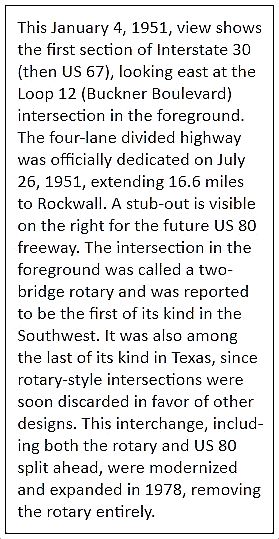
Here is a second photo, dated Jan. 4, 1951, with Oscar Slotboom’s caption below (from Slotboom’s exhaustively researched book and website, Dallas-Fort Worth Freeways).

thornton-frwy_1951_dfw-freeways

thornton-frwy_1951_dfw-freeways_INFO_pdf-p40

*

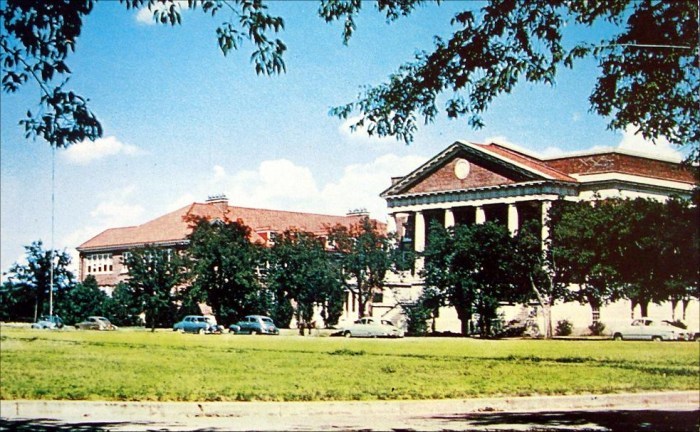
The Buckner Orphans Home was founded in 1879; it was both a home for orphaned children and a working farm, and at its height, it occupied some 3,000 acres of land (!). Take a look at a 1911 photo here to give you an idea of the size of the place. The buildings seen at the bottom left of the photo above were houses used by Buckner staff; the Home itself is out of frame.

buckner-orphans-homeBuckner Children’s Home

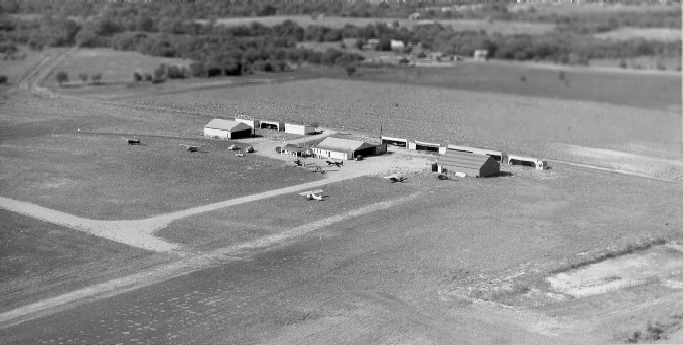
White Rock Airport opened about 1941 and was in use until 1974. Here is a photo of it soon after it opened.

white-rock-airport_early-1940sWhite Rock Airport

(Several more photos and memories about this airport can be found here.)

Devil’s Bowl Speedway opened in March, 1941. If you wanted to see jalopy races, you headed to Devil’s Bowl. (DBS is still around, nearby, at a different location.)

The Buckner Boulevard Drive-In opened on June 4, 1948. It was the first drive-in in Dallas to have individual car speakers that one placed in one’s car. (More on the Buckner Drive-In can be found at Cinema Treasures, here.)

***

Sources & Notes

Top photo is from the TxDOT Photo Files and can be viewed on the Texas State Archives’ Flickr page, here; the date is given as “circa 1940,” but as the drive-in didn’t open until 1948, the date of the photo is probably closer to 1950. (The second aerial photograph — from Oscar Slotboom’s fantastic Dallas-Fort Worth Freeways — is dated 1951, so I’ve updated the title of this post.)

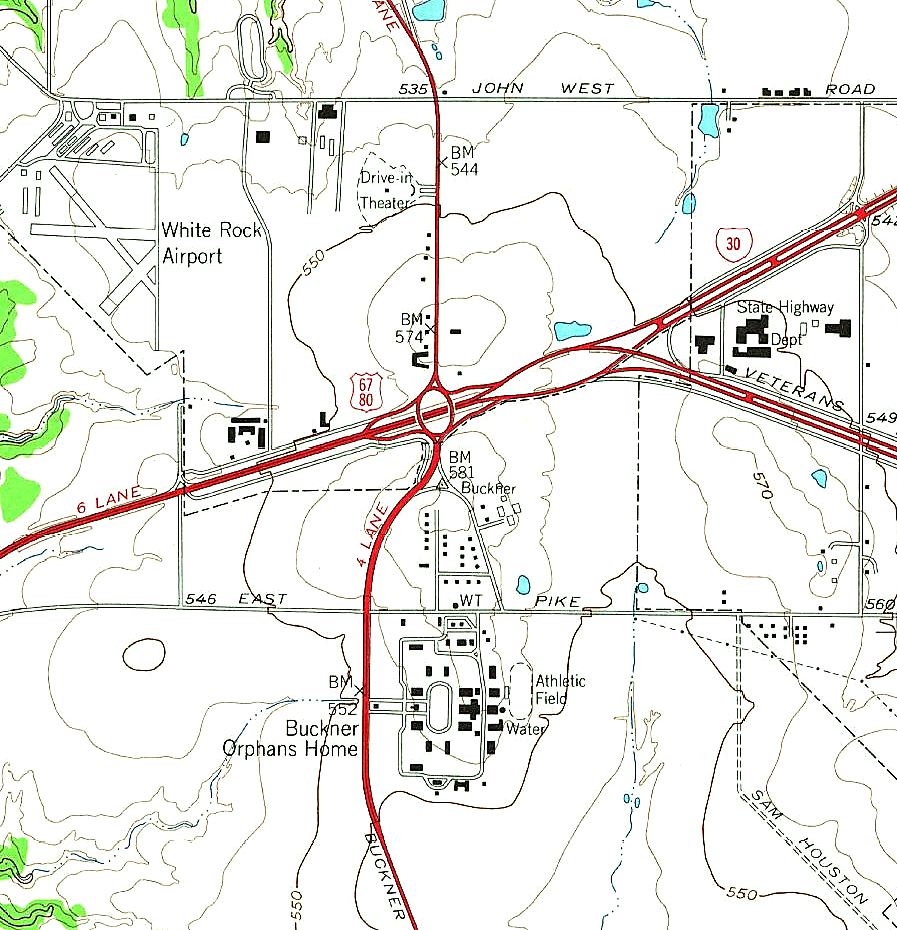
Thanks to Mark’s comment below, I’ve found this detail of a 1957 topo map from the United States Geological Survey. It’s a few years after the photo above was taken, but it shows the layout of the Buckner Children’s Home more fully. (The east-west highway called “East Pike” here is now known as Samuell Blvd.) Click map for larger image.

1957-topo_usgs

The Dallas/Mesquite city limits boundaries have moved over the years, but a current view of the boundary — which involves the area seen in this photo (seriously, this exact area) — can be seen here.

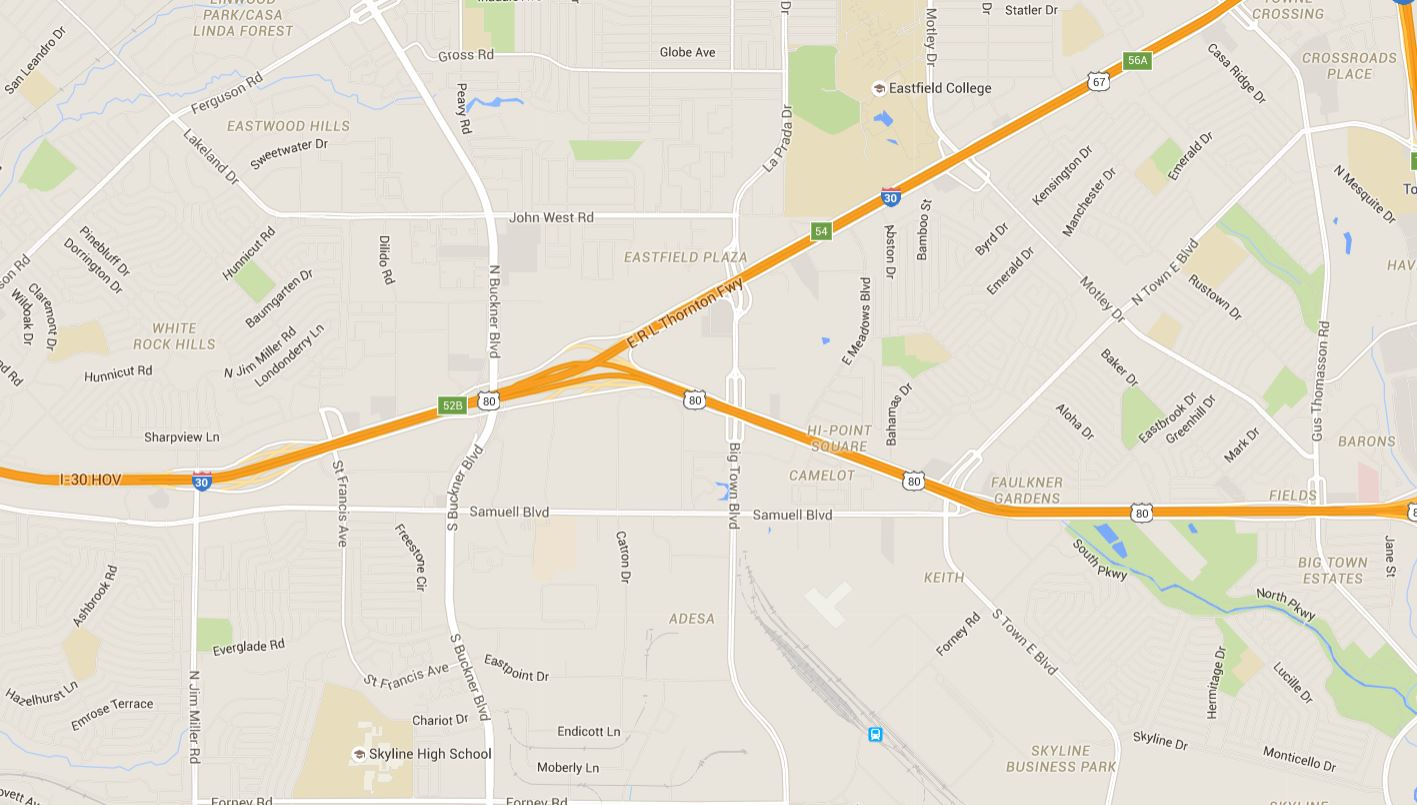
Below, a current Google Maps view of this interchange:

interchange-map

And, if like me, you need some helpful guidance:

interchange_marked.jpg

Thanks to members of the Dallas History Facebook group for helping me figure out what I was looking at, especially David and Chuck — thanks, guys!

Click pictures and articles for larger images.

*

Copyright © 2015 Paula Bosse. All Rights Reserved.
Downtown Parking Innovations

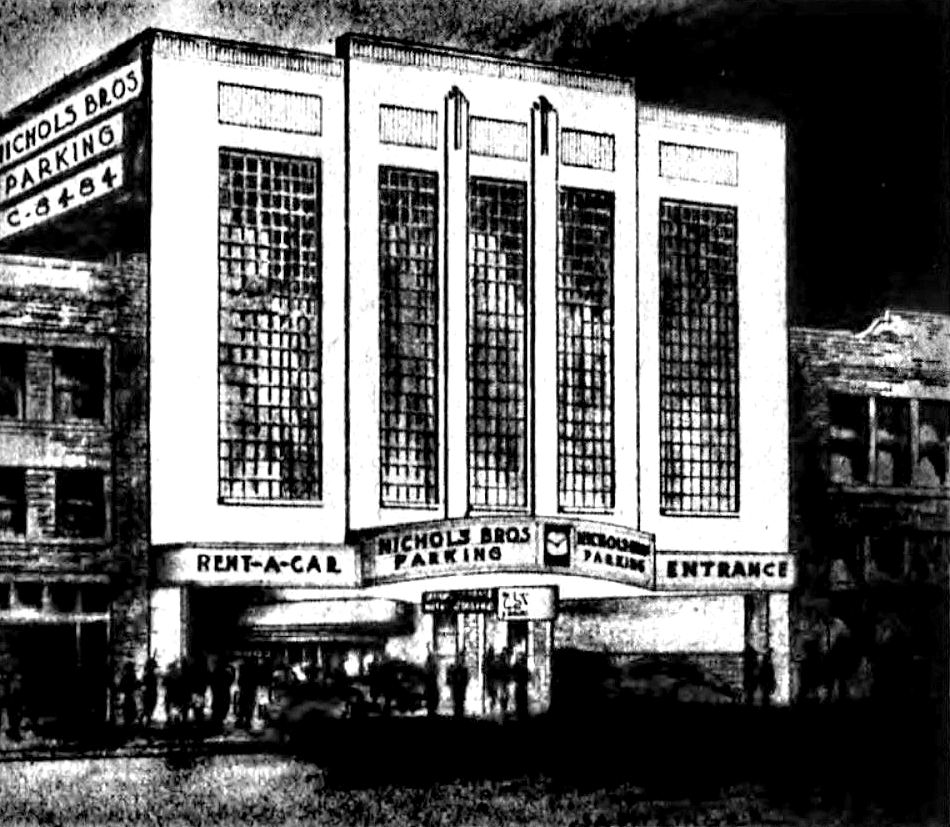
ad-nichols-bros-parking-garage_1945-directory-detSplendiforous parking garage, 1945

by Paula Bosse

Here are a couple of ways developers have attempted to cope with the parking needs of downtown Dallas. I’m not sure how long either of these parking garages lasted, but I give them both A’s for effort.

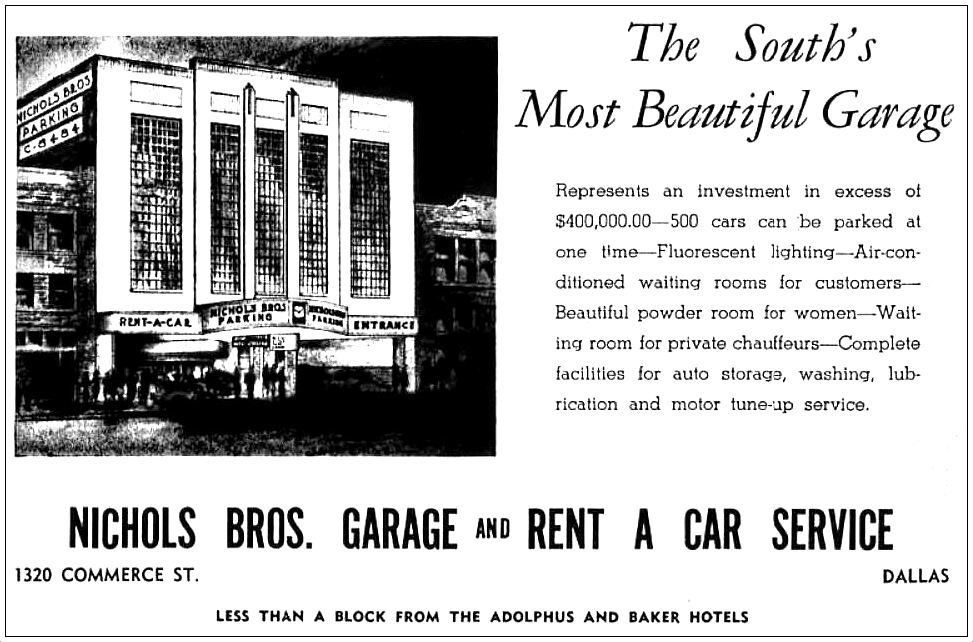
First, 1945: Nichols Bros. Garage & Rent-a-Car Service at 1320 Commerce (just east of Field). Just look at all these amenities — women and chauffeurs are not forgotten.

…Fluorescent lighting — Air-conditioned waiting room for customers — Beautiful powder room for women — Waiting rooms for chauffeurs — Complete facilities for auto storage, washing, lubrication and motor tune-up service.

ad-nichols-bros-parking-garage_1945-directory1945 Dallas directory

I don’t know how long this lasted, but if you’re going to have a garage downtown, it might as well look like that one!

*

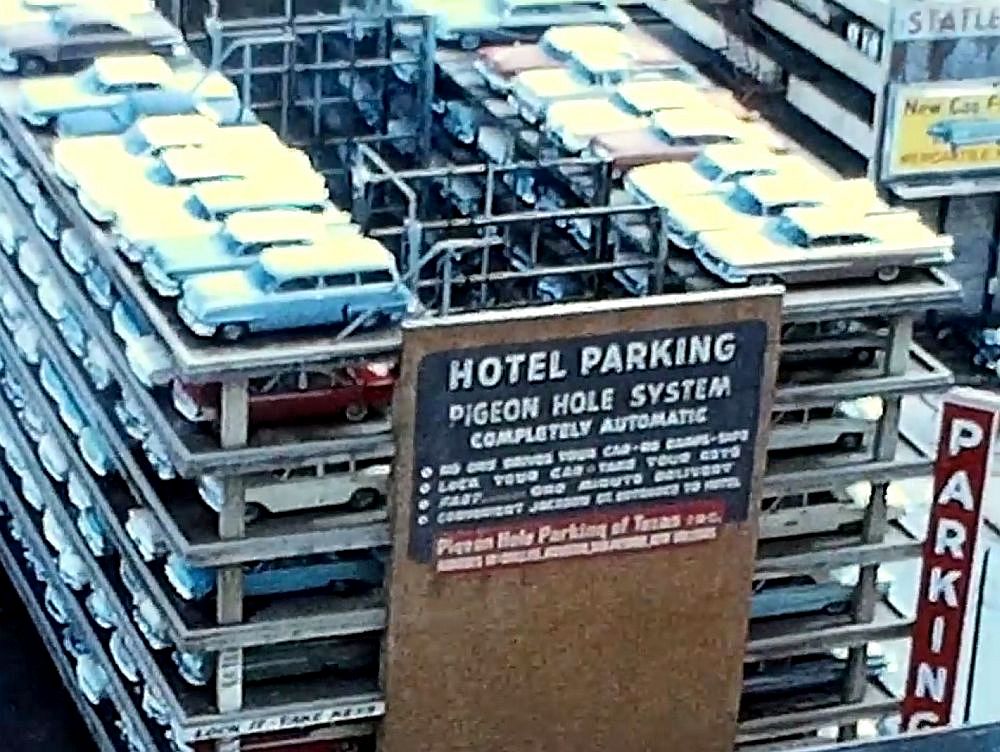
pigeon-hole-parking_dallas_1962_sign

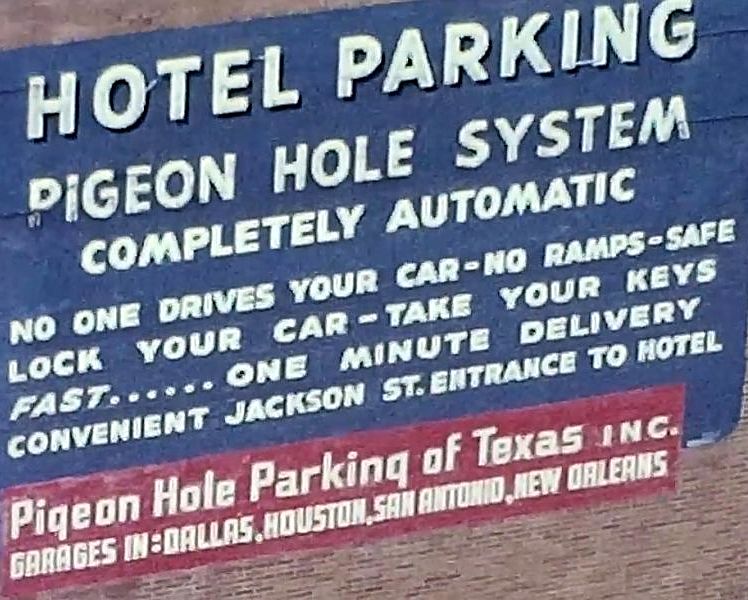
Then in 1954, the 8-story Dallas Carpark at Jackson and St. Paul arrived (a second one at Jackson and Lane was under construction that same year). It was a franchise of the Pigeonhole Parking System of Spokane, utilizing “car-parking machines” invented by Leo Sanders of Spokane, Washington. I’m not exactly sure how these worked, but cars were hoisted and lowered on elevators, and the whole parking process, from start to finish, was conducted without an attendant ever actually touching the cars. Again, I don’t know how long this endeavor was in business (at least through the early 1960s), but — parking-garage-history neophyte that I am — I’ve never heard of such a thing. (There’s a video showing how it worked — thanks, “Not Bob” for posting this in the comments)!

*
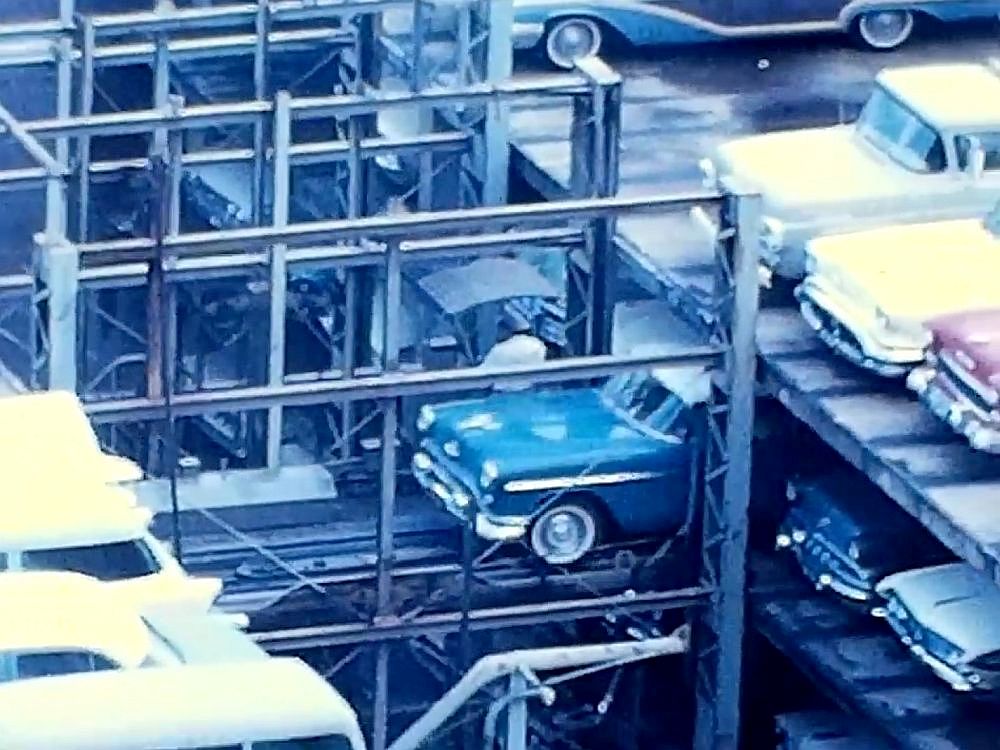
UPDATE: “Found” film footage of a family’s trip to Dallas in 1962 actually shows this pigeon-hole system in action. The whole short video is interesting, but the pigeon-hole footage is what got me really excited — it begins at the 1:32 mark.

*
A couple of screenshots:

pigeon-hole-parking_dallas-1962

pigeon-hole-parking_dallas-1962_b

***

Sources & Notes

Nichols Bros. ad from the 1945 city directory.

The 1951 Universal Newsreel segment can be found on Vimeo here (thanks to “Not Bob”).

1962 YouTube video of found footage can be seen here (thanks to Robert Wilonsky of The Dallas Morning News for posting this link!).

See photos and read about the elevator-centric Dallas Carpark at Jackson and St. Paul in these Dallas Morning News articles:

  • “Parking Gets Lift in Downtown Area” by Robert F. Alexander (DMN, Sept. 26, 1954) (with photos)
  • “Pigeonhole Parking Now in Operation” (DMN, Oct. 10, 1954)

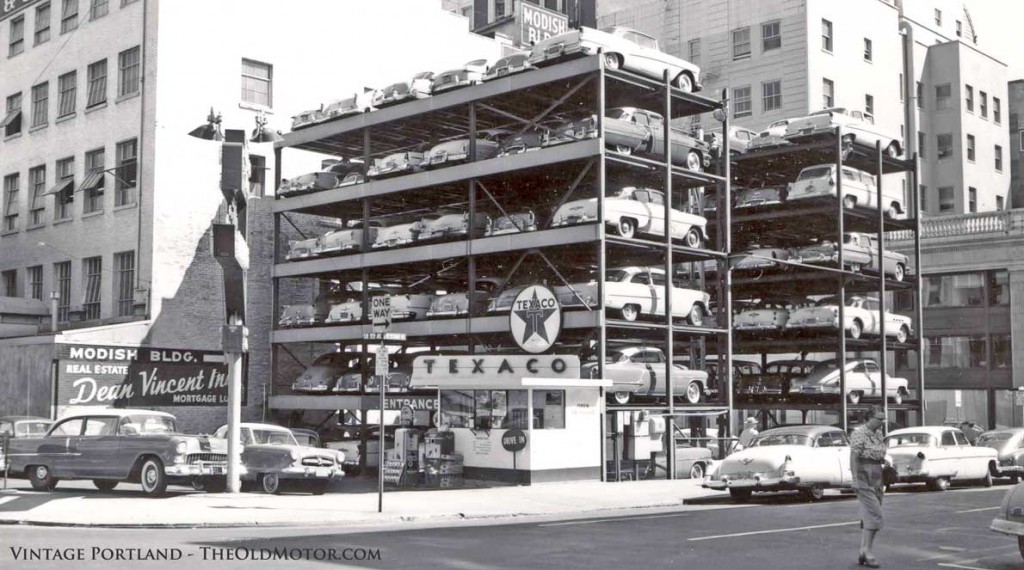
See several photos of the “pigeon-hole” parking system in other parts of the country in the article “Pigeon Hole Parking — An Amusement Park Ride for Your Car,” here. Here’s one in Portland, Oregon (the Dallas Carpark was 8 levels high):

pigeon-hole-parking_portland-oregon_oldmotorblog

*

Copyright © 2015 Paula Bosse. All Rights Reserved.
Sivils Drive-In, An Oak Cliff Institution: 1940-1967

sivils_tichnorOak Cliff’s landmark hangout (click for larger image)

by Paula Bosse

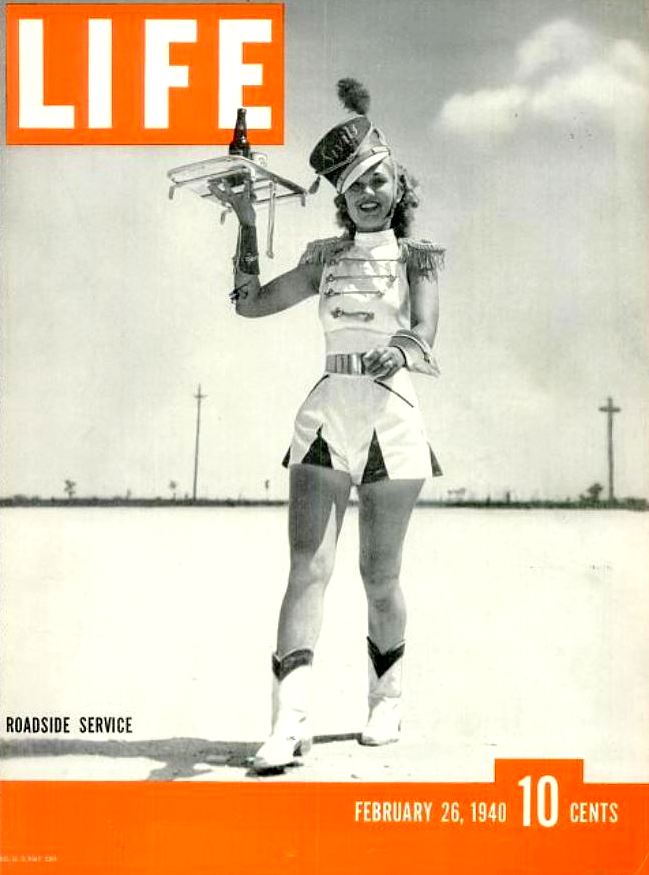
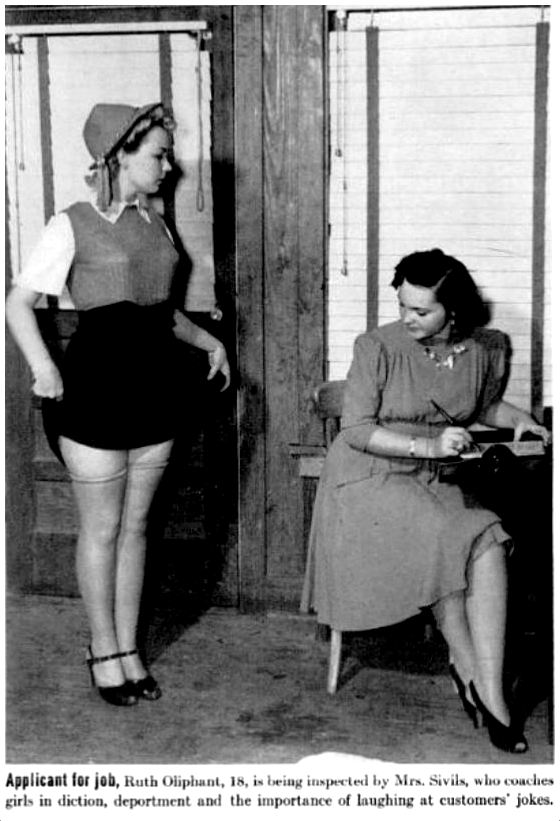
When J. D. Sivils (1907-1986) and his wife, Louise (1918-2006), brought their “Sivils” restaurant to Dallas in June 1940, their Houston drive-in of the same name had already been featured as a Life magazine cover story, garnering the kind of incredible national publicity that any business owner would have killed for! And all because of their carhops — “comely, uniformed lassies” whom Mrs. Sivils insisted on calling “curb girls” (which might have a slightly different connotation these days…). Life — never a magazine to overlook pretty young girls in sexy outfits — not only devoted a pictorial to the “curb girls,” they also put one of them (Josephine Powell of Houston) on the cover, wearing the Sivils’ uniform of (very, very short!) majorette’s outfit, plumed hat, and boots.

sivils_houston_life-mag_022640Feb. 26, 1940

louise-sivils_life-magazine_1940Louise Sivils and a prospective “curb girl” (Life)

Four months after the blitz of national attention the drive-in received from the Life story, Sivils came to Dallas. The drive-in was located in Oak Cliff at the intersection of West Davis and Fort Worth Avenue on “three acres of paved parking space.”

sivils-map

The day the drive-in opened, a photo of the not-yet-legendary Sivils appeared in The Dallas Morning News (see “Sivils to Open Dallas Place Thursday,” DMN, June 27, 1940). Other than this, there is surprisingly little in the pages of The News about this drive-in’s opening — surprising because it became such a huge part of the lives of Oak Cliff’s teens in the ’40s, ’50s, and ’60s. It’s one of those places that seems to have reached almost mythic proportions on the nostalgia scale.

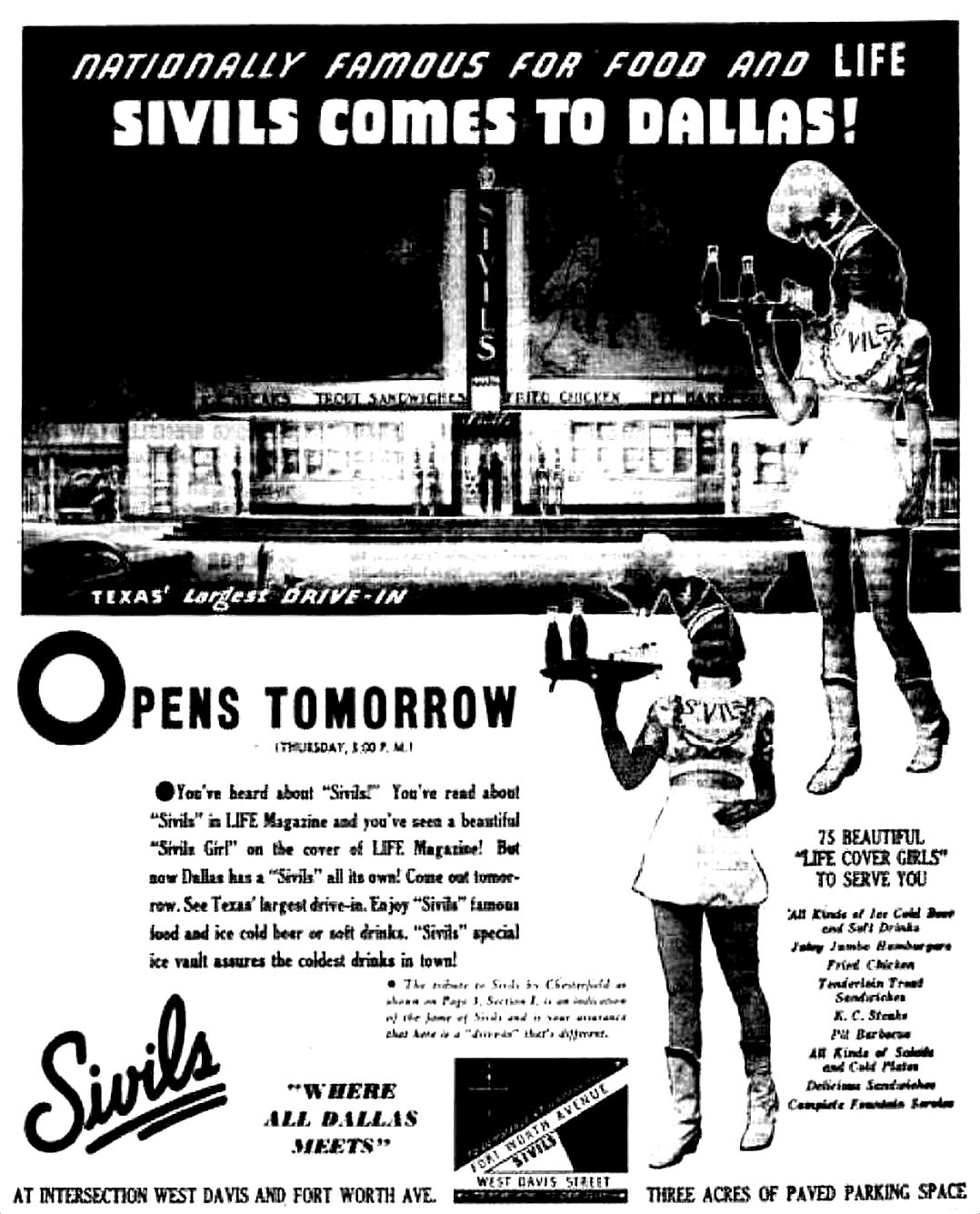
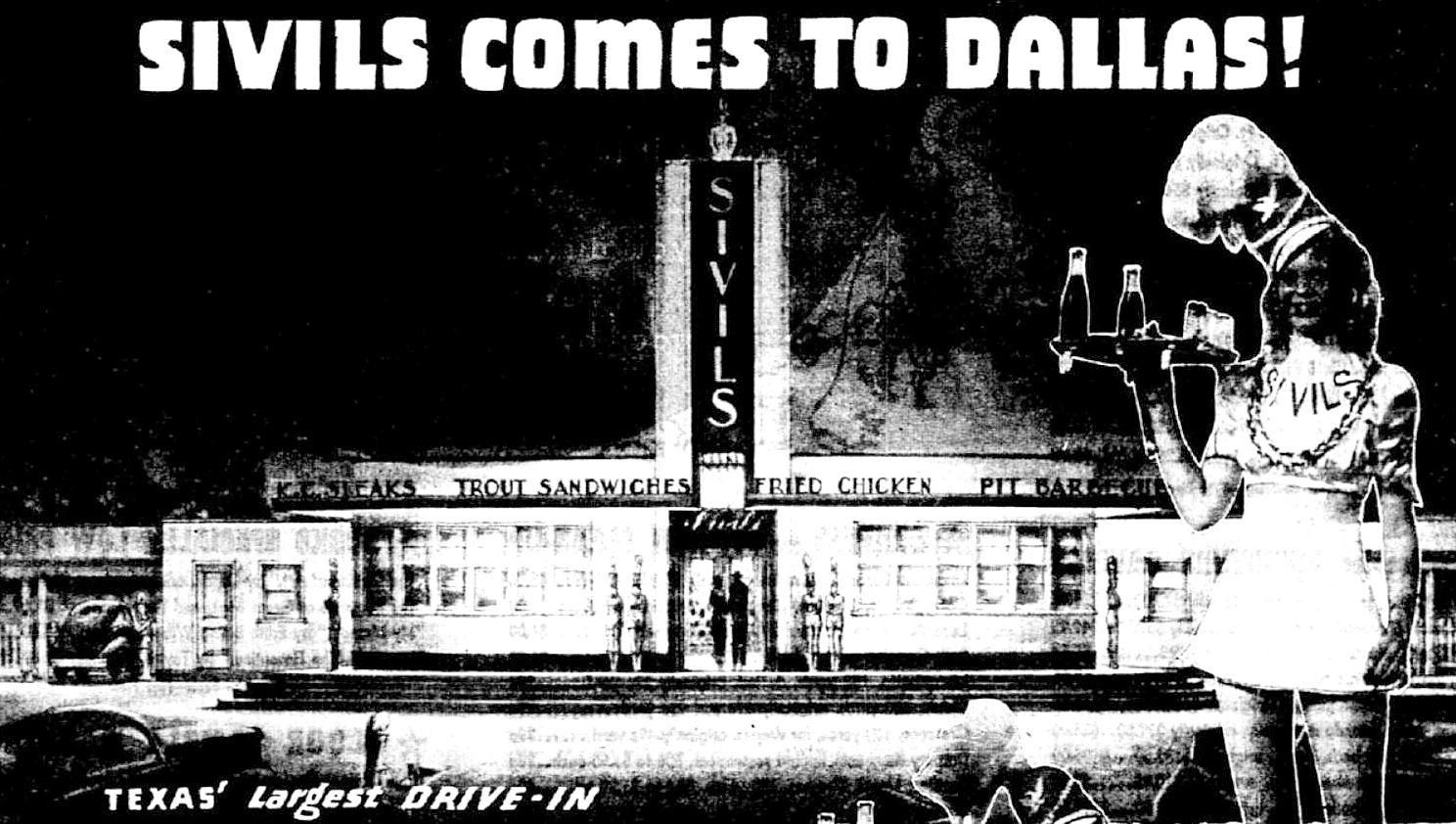
Sivils didn’t quietly sneak into town, though. Take a look at this very large, very expensive newspaper ad, which ran the day before OC’s soon-to-be favorite hang-out opened. (Click for larger image.)

sivils_dmn_062640_lgJune 26, 1940

*

Nationally Famous for Food and LIFE
SIVILS COMES TO DALLAS!

Texas’ largest drive-in
Opens tomorrow

(Thursday 3:00 PM)

You’ve heard about “Sivils”! You’ve read about “Sivils” in LIFE Magazine and you’ve seen a beautiful “Sivils Girl” on the cover of LIFE Magazine! But now Dallas has a “Sivils” all its own! Come out tomorrow. See Texas’ largest drive-in. Enjoy “Sivils” famous food and ice cold beer or soft drinks. “Sivils” special ice vault assures the coldest drinks in town!

75 Beautiful “LIFE Cover Girls” to Serve You

All Kinds of Ice Cold Beer and Soft Drinks
Juicy Jumbo Hamburgers

Fried Chicken
Tenderloin Trout Sandwiches
K.C. Steaks
Pit Barbecue
All Kinds of Salads and Cold Plates
Delicious Sandwiches
Complete Fountain Service

Sivils – “Where All Dallas Meets”
At intersection West Davis and Fort Worth Ave.
Three Acres of Paved Parking Space

*

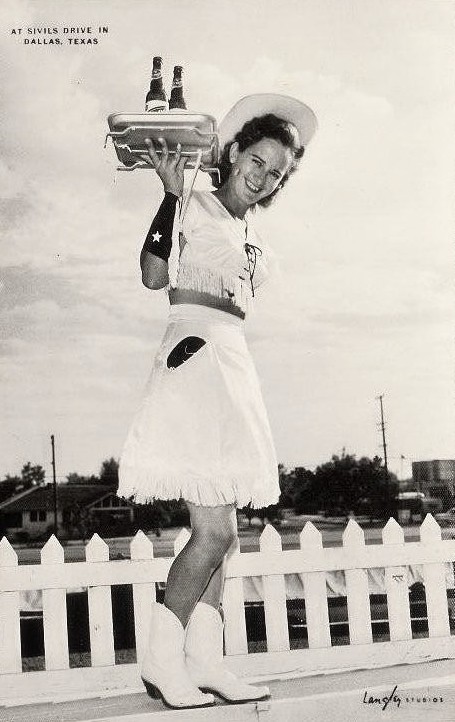
100-150 “curb girls” were employed by Sivils at any given time in those early days, and it was open 24 hours a day. The place was hopping. Sounds fantastic. Wish I’d seen it.

sivils_matchbook_coltera-flickrvia Flickr

sivils_carhop_postcard_ebay
eBay

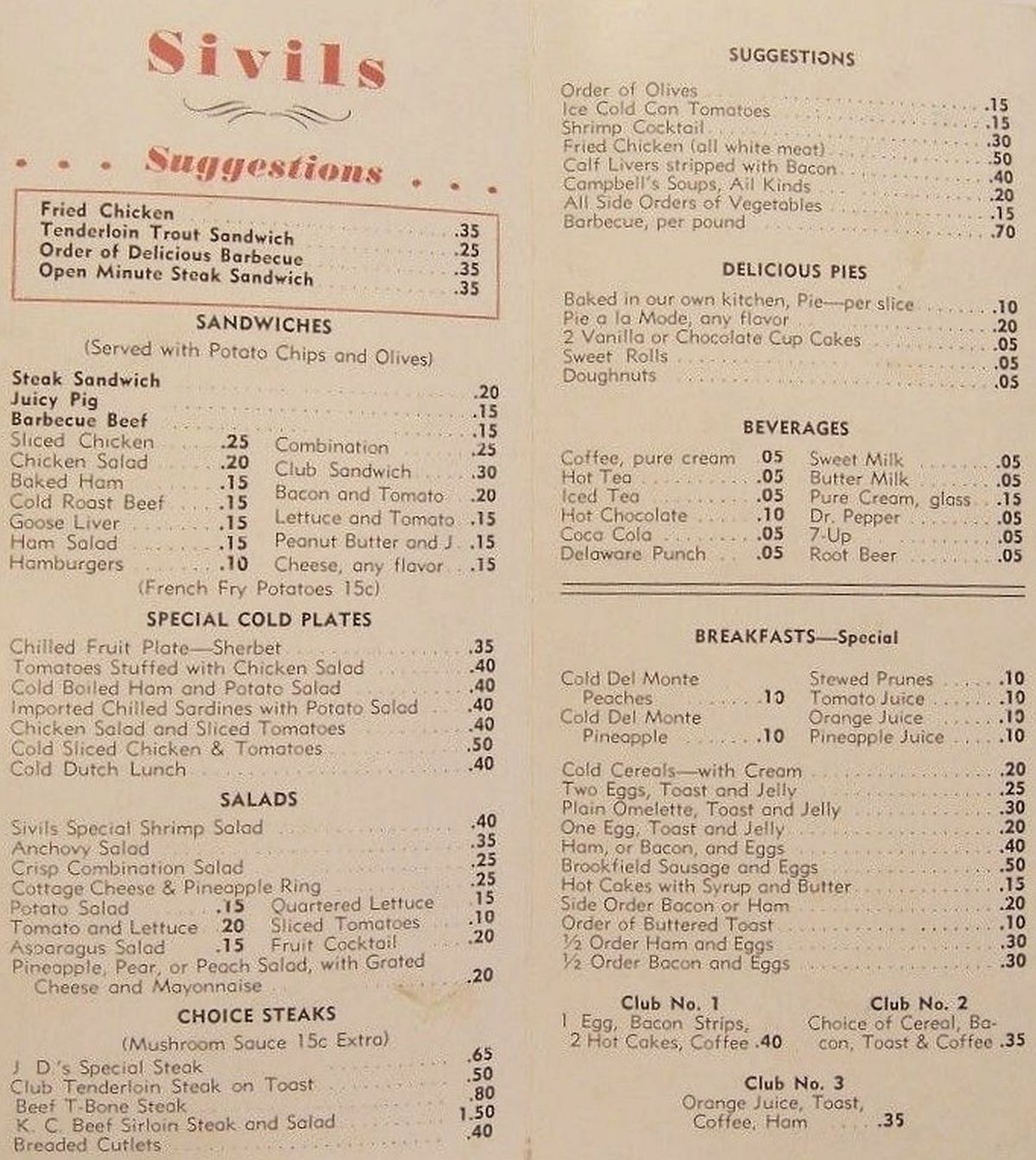
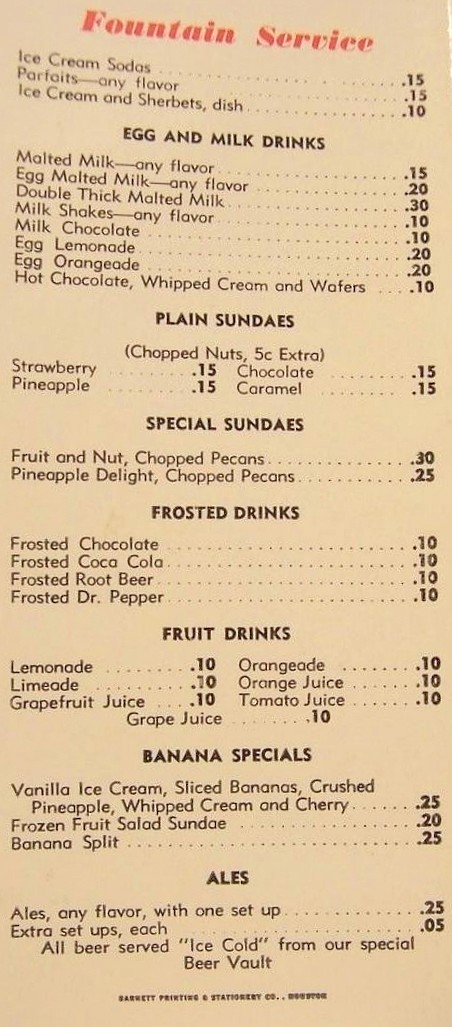
Below, a scanned menu (click to see larger images):

sivils-menu_1940s_ebay_cover

sivils-menu_1940s_ebay_b

sivils-menu_1940s_ebay_avia eBay

***

Sources & Notes

Top postcard from the Boston Public Library Tichnor Brothers Postcard Collection on Flickr, here.

Read the 4-page Life article (and see several photos of the Houston “curb girls”) here (use the magnifying glass icon at the top left to increase the size of the page).

Interesting quote from that article:“They work in 7½-hour shifts, six days a week, for which they get no pay but average $5 a day in tips.” Doesn’t sound legal…. (The Inflation Calculator tells us that $5 in 1940 money is equivalent to just over $83 in today’s money.)

Sivils closed in 1967, possibly because Mr. and Mrs. Sivils wanted to retire, but it seems more likely that Oak Cliff’s being a dry area of Dallas since the 1950s was killing its business. Check out the News article “Big Head Expected as Oak Cliff Beer Issue Foams” by Kent Biffle (DMN, Aug. 17, 1966) which appeared just months before another election in which the “drys” outvoted the “wets.” (More on Oak Cliff’s crazy wet-dry issues, here.)

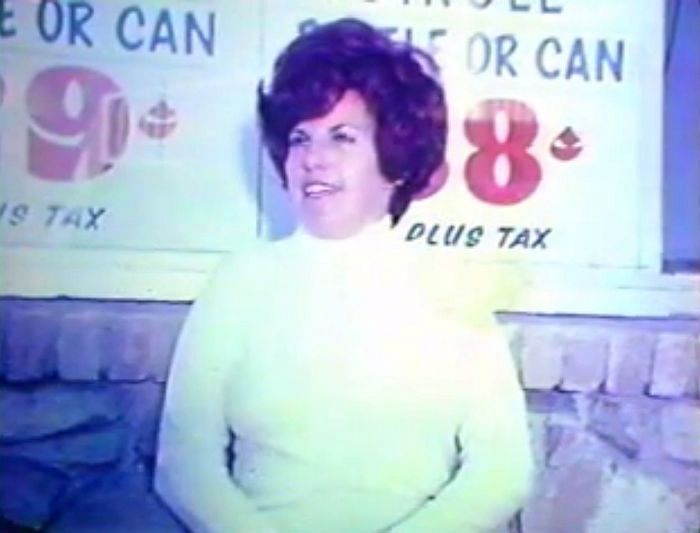
J. D. Sivils was interviewed in a short documentary about Dallas carhops, filmed in the early 1970s. In it, he talks about the early days of Sivils and — best of all — there is film footage galore of the drive-in from his collection. Watch it in my previous post — “‘Carhops’ — A Short Documentary, ca. 1974” — here. (Below a screenshot of Sivils from the film.)

sivils-carhops-film

Read the article “Carhops, Curb Service, and the Pig Sandwich” by Michael Karl Witzel (Texas Highways, Oct. 2006) in a PDF, here (increase size of article with controls at top of page).

Another Flashback Dallas post on drive-in culture — “Carhops as Sex Symbols — 1940” — is here.

sivils_dmn_062640-det

Click pictures for larger images.

*

Copyright © 2015 Paula Bosse. All Rights Reserved.
“Carhops” — A Short Documentary, ca. 1974

carhops_title
Schlitz on its way…

by Paula Bosse

The carhop is an oddly American invention — and it began here in Dallas in the 1920s, with boys and young men serving customers in cars at J. G. Kirby’s Pig Stand drive-in restaurants. In 1940, Sivils hit Dallas, but this time with young women as servers — young women in skimpy outfits. There was no looking back — from then on, pretty girls showing a lot of leg and hoping for big tips carried trays of food, soft drinks, and beer to cars full of waiting customers.

One of the few remaining “old school” drive-ins is Keller’s on Northwest Highway, still doing good business today. Around 1974 or 1975, SMU film teacher Pat Korman made a short documentary about Dallas carhops past and present (the result, it seems, of reading a Dallas Morning News article by Rena Pederson). He interviewed B. J. Kirby (owner of Kirby’s steakhouse on Lower Greenville and son of Jesse Kirby, founder of the Pig Stand pig-sandwich empire, which, as legend has it, had the very first carhops), J. D. Sivils (owner of Sivils drive-ins, who, along with his wife, was an important figure in the evolution of curb-side dining), and Jack Keller (owner of Keller’s Hamburgers). The three businessmen reminisce about the early days of drive-in restaurants in Dallas as a lot of cool historical film footage unspools and photographs from the ’20s to the ’50s are flashed on the screen. Also interviewed are four women carhops who were working at Keller’s at the time, talking about their jobs.

It’s a cool film. Big cotton-candy hair, accents you wish were still around, and cans and cases of Schlitz, Schlitz, Schlitz.

The 14-minute film is in two parts on YouTube. Here is the first part:

*
And here is the second part:

*
Below, screenshots of the interviewees.

sandy-carhopsSandy

shirley-carhopsShirley (as of Jan. 2015, she’s been a fixture at Keller’s for 50 years!)

rita-carhopsRita

nancy-carhopsNancy

kirby_carhopsB. J. Kirby

sivils-carhopsJ. D. Sivils

keller-carhopsJack Keller

kellers-menu-board_carhopsNo. 5 — 80¢

***

Sources & Notes

“Carhops” — filmed sometime in the early ’70s — was directed by Patrick Korman, shot by Ron Judkins, and produced by Don Pasquella. It premiered at Jesuit High School in April 1976. The film is on YouTube in two parts, here and here. (By the way, if you look at the YouTube comments under part two, you’ll see a comment from Sandy herself. She’s still looking good in the avatar photo.) (The music at the beginning and end of the film is great! I’m pretty sure it’s the legendary steel guitarist Ralph Mooney and the equally legendary guitarist James Burton; I love those guys! I urge to go get a copy of their album “Corn Pickin’ and Slick Slidin.'”)

Rena Pederson is thanked in the credits. She wrote a great article in The Dallas Morning News called “Carhops Fading, Those Were the Days” (Aug. 25, 1974) — she interviewed many of the same people seen in the film.

The Keller’s Northwest Highway location celebrates its 50th anniversary this year. Shirley — one of the carhops featured in the film — has worked there since it opened in 1965. As of Jan. 2015, she was still there! Go by and see her! Check out a Lakewood Advocate story on Shirley, here.

Also, take a look at a Dallas Morning News article on Keller’s 50th anniversary, here — scroll down to the slideshow to check out some great photos from its early days.

Read about sexy male carhops who plied their trade in skimpy outfits — a short-lived fad in Dallas inspired by the success of drive-ins like Sivils — in my previous post “Carhops as Sex Symbols — 1940,” here.

*

Copyright © 2015 Paula Bosse. All Rights Reserved.

American Airlines, Planes-a-Plenty — 1951

american-airlines_russell-lee_briscoe-1“Dallas Terminal” / ©Dolph Briscoe Center for American History

by Paula Bosse

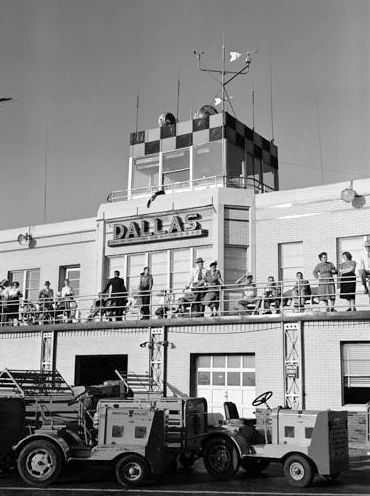
A few photos of Love Field, hangars, and American Airlines airplanes, all taken in 1951 by Russell Lee for a story in Fortune magazine.

american-airlines_briscoe-2

american-airlines_briscoe-3

american-airlines_briscoe-4

american-airlines_briscoe-5

***

Photos ©Dolph Briscoe Center for American History; all photos are by Russell Lee from the collection of his photographs at the University of Texas at Austin. I am unable to post links because I can no  longer find them on the website (!).

This time pictures aren’t larger when clicked. All apologies to fans of the wonderful Russell Lee, for these less-than-crisp images.

*

Copyright © 2015 Paula Bosse. All Rights Reserved.
“Fifteen Miles From Dallas” by Jimmie Davis — 1951

jimmie-davisThe former (and future) governor of Louisiana…

by Paula Bosse

Let’s listen to Jimmie Davis — erstwhile country singer and two-time governor of Louisiana — sing a ditty about his gal named Alice (…rhymes with “Dallas”) who lives on Akard Street.

***
Too bad the Decca promotion people misspelled his name in this 1951 ad!

jimmie-davis_15-miles-from-dallas_1951_ebay

***

Jimmie Davis is most famous for his hit song “You Are My Sunshine.” His New York Times obituary is here.

The Singing Governor’s Wikipedia entry is here.

Ad from eBay (click for larger image).

*

Copyright © 2015 Paula Bosse. All Rights Reserved.
Stacy’s Lounge on The Miracle Mile — 1950

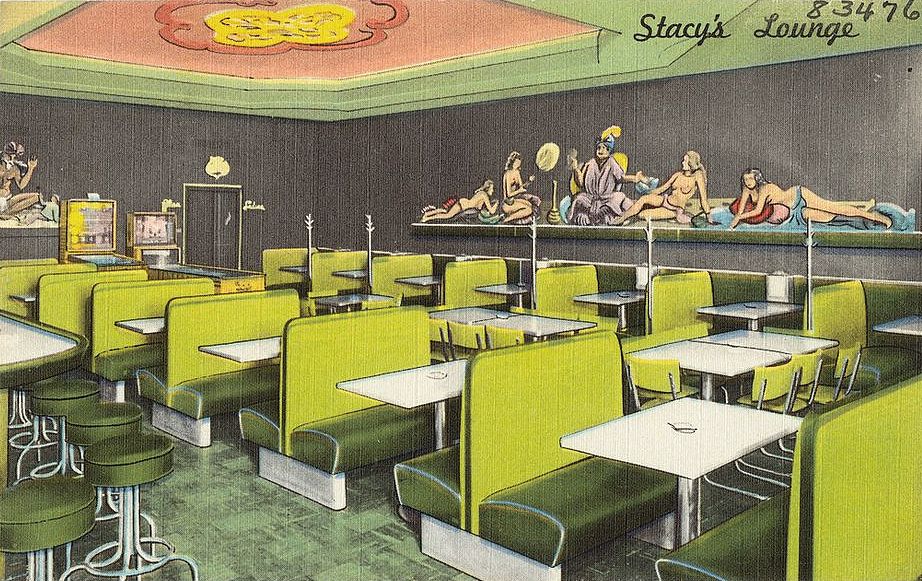
stacys-loungeStacy’s has it all: murals, pinball, ashtrays

by Paula Bosse

Today: a quick look back at a short-lived bar, Stacy’s Lounge, once located along the famed Miracle Mile. Actually, this postcard may be about all that remains from what was, apparently, a fairly short-lived drinking establishment.

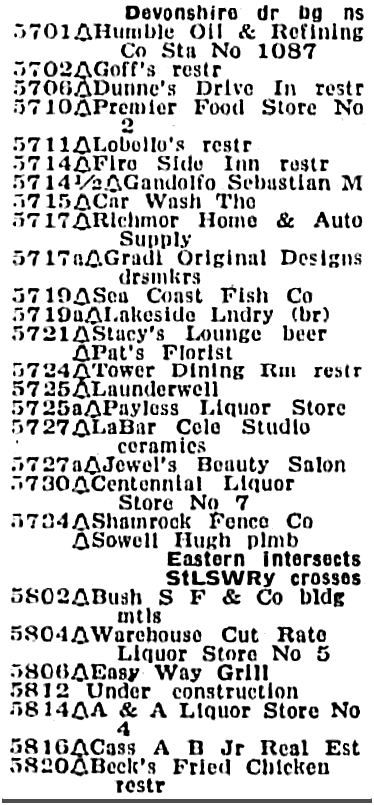
stacys-lounge_1951-dirctry1951 Dallas directory

The above line is from the 1951 city directory, but that listing appears to have been published posthumously. By November of 1950, Stacy’s space at 5721 West Lovers Lane had been taken over by another bar called The Magic Lounge (later the Magic Grille/Herb’s Magic Grill).

Stacy — whomever he or she was — was not afraid of color and decor. I mean … for one thing … those murals. The exotic scenes featuring bare-breasted women, men in turbans, and, I think, a cobra are a little unexpected. They’re either great or awful. Patrons in 1950 might have thought they were awful when they walked in, but by closing time, they probably thought they were … slightly less awful. And the colors! They’ve obviously been pumped up for the postcard, but I’m sure the two-toned green vinyl (great booths!) and the pink and yellow molded and recessed ceiling were attention-grabbing. Imagine it crowded, dark, smoky, and loud. I’ve been in old bars that kind of look like this, just grungier, scuffed up, and sagging. This is pretty much what your favorite dive bar looked like when it was new and shiny. (I just realized I’ve never seen a vintage postcard with a pinball machine in it. And a jukebox. And a cartoon Indian fakir. I’ve hit the trifecta!)
So what other businesses filled that block of Lovers in 1950-51? (Click for larger image.)

stacys-lounge_1951-directory_block1951 city directory

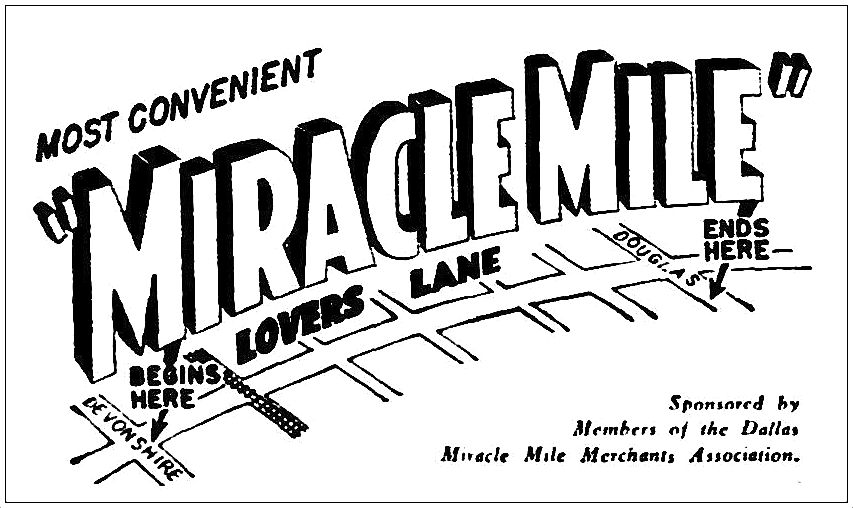
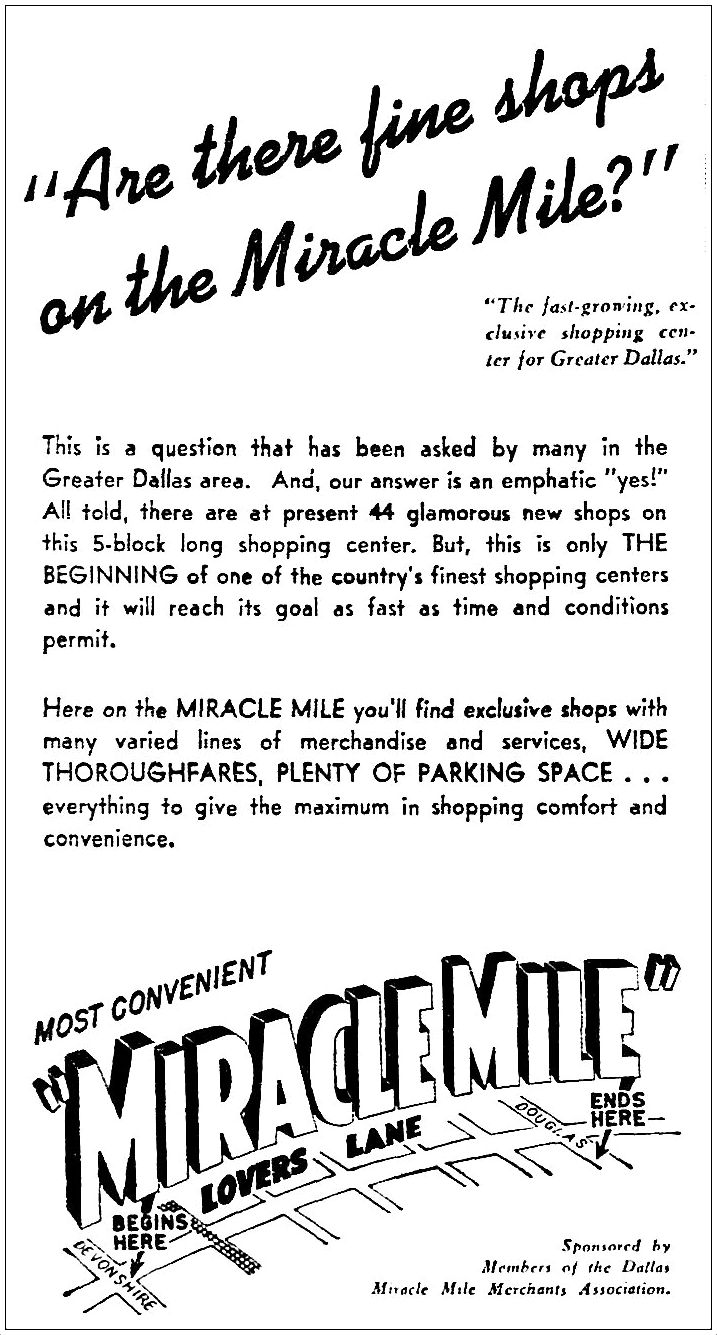
Speaking of The Miracle Mile (you don’t really hear people referring to the Miracle Mile anymore, do you?), when the name of the shopping area debuted in 1947, the official boundaries were Devonshire on the west and Douglas on the east. Some people insist it goes all the way down to the Inwood Theater. This rather adamant Dallas Miracle Mile Merchants Association advertisement illustration would disagree with that notion.

miracle-mile-merchants-assn_ad_april-1947_det

miracle-mile-merchants-assn_ad_april-1947
April, 1947

I’m still not sure why it was called the Miracle Mile, unless it had something to do with the price of real estate. Part of it was in Dallas (the couple of blocks west of what was the St. Louis and Southwestern/Cotton Belt railroad — now the tollway), and part of it was in University Park. (And I suppose still is.) Most of the bars and restaurants were in the Dallas portion, because University Park was dry. Another notable thing about Lovers Lane is that the address numbering is a crazy mess — there’s West Lovers Lane, Lovers Lane, and East Lovers Lane, and every time you pass from one stretch to the next, the abrupt address-changes will make your head spin. (I had no idea it was so crazy until I read Helen Bullock’s very informative and entertaining article about the Miracle Mile in a Sept. 10, 1961 article in The Dallas Morning News, “Walk a Miracle Mile.”)

But back to Stacy — I never actually discovered who Stacy was. Oh well. The particulars of Stacy’s Lounge may be lost to history, but the image of its colorful interior lives on in a 65-year-old garishly-colored postcard.

***

Sources & Notes

Postcard is from the great Boston Public Library Tichnor Brothers Postcard Collection on Flickr, here. I dip into the collection now and again to see what I can find out about those arresting and unreal-looking images — see those past posts here.

Currently at the old Stacy’s Lounge address (though in a newer building) is the Nicholson-Hardie Nursery & Garden Center; the location on a map is here.

You might even say that Stacy’s Lounge has got it going on. Do you have this song going through your head like I do? That’s going to be hard to get out of there.

*

Copyright © 2015 Paula Bosse. All Rights Reserved.