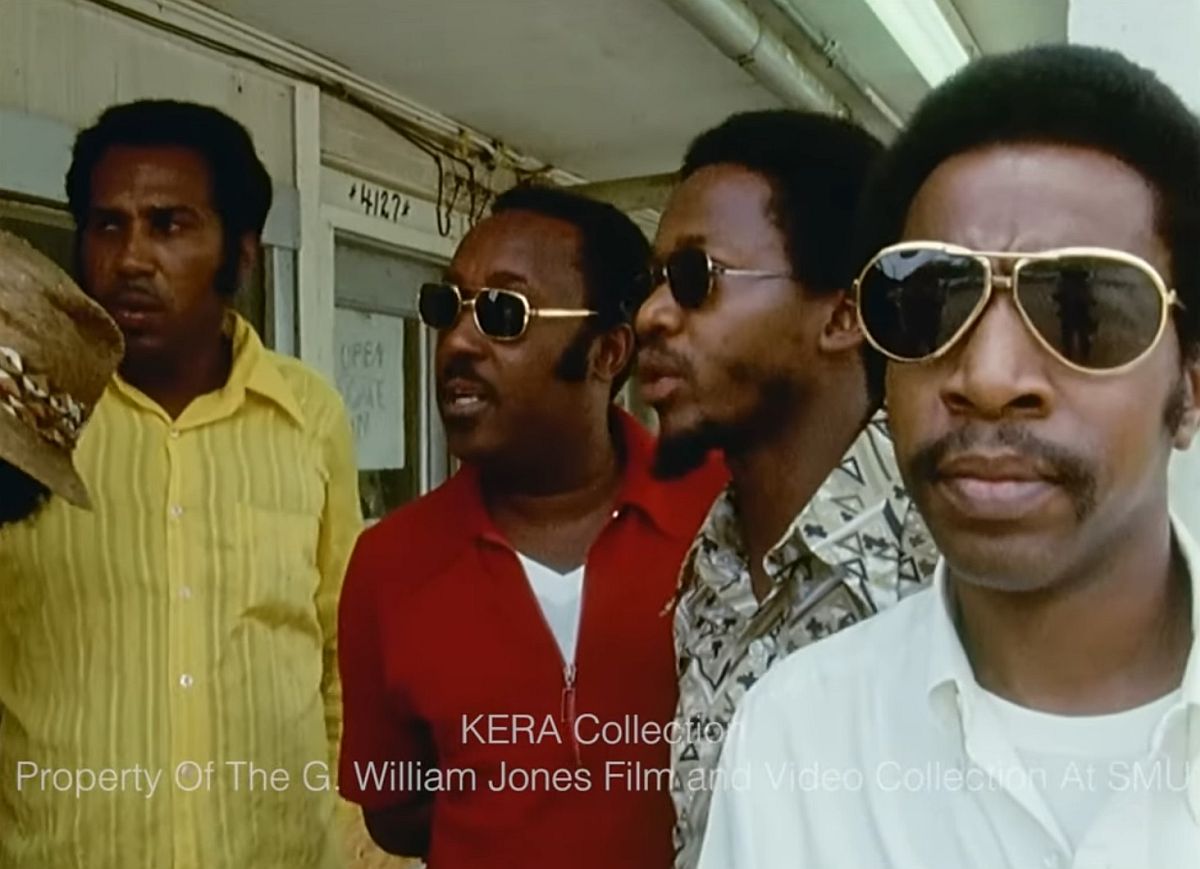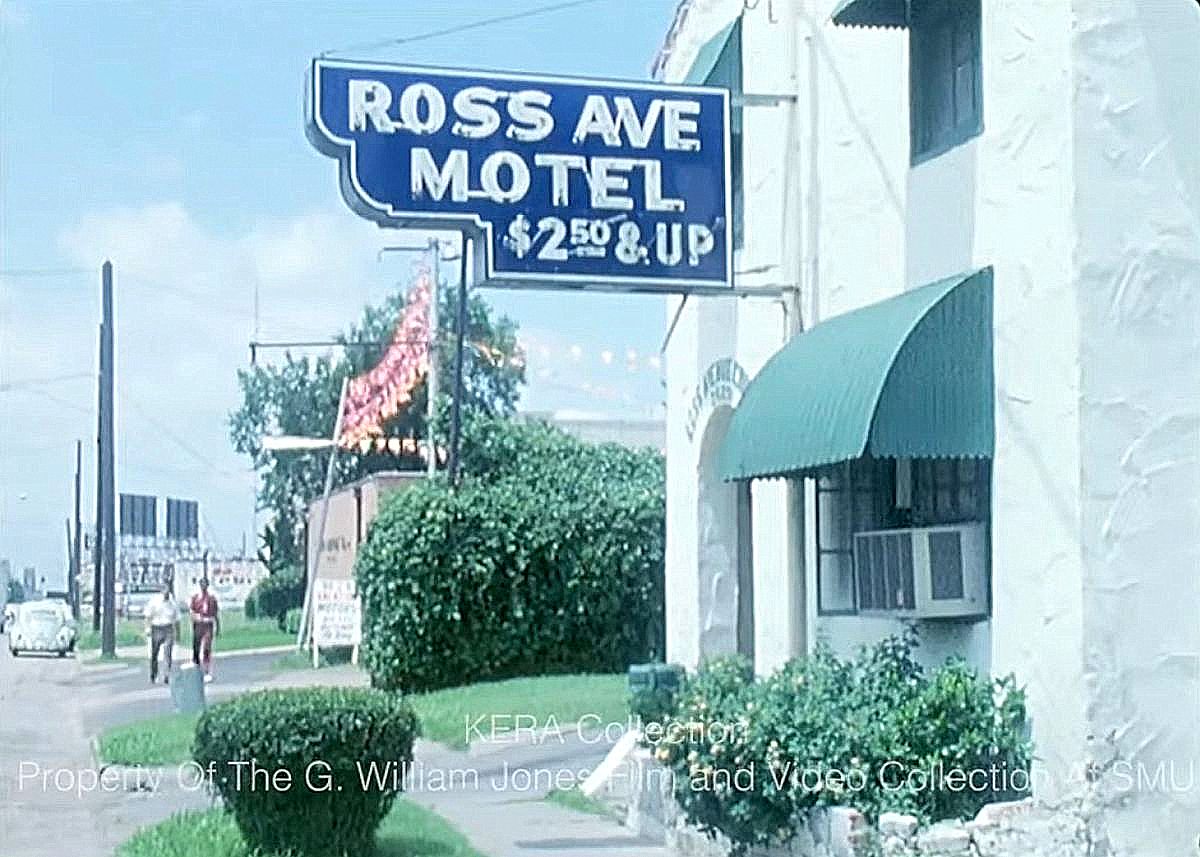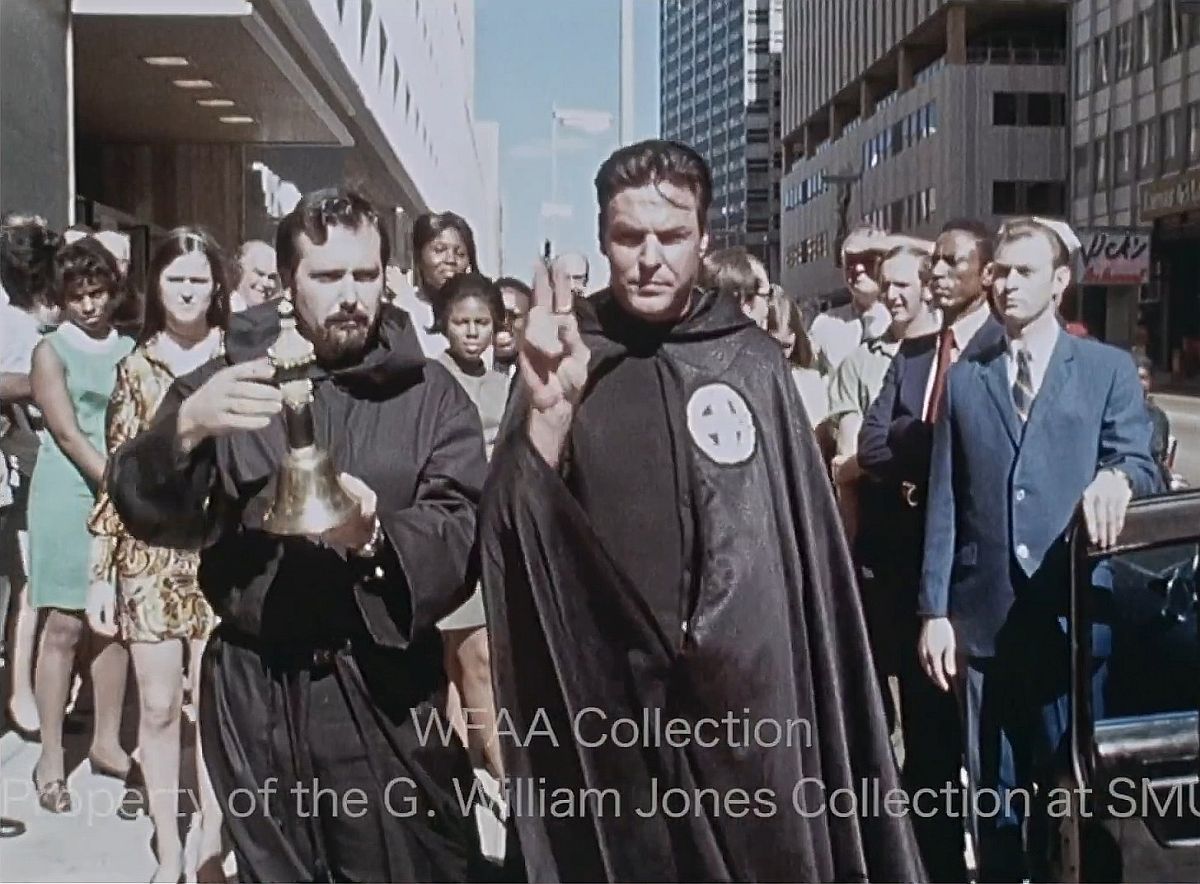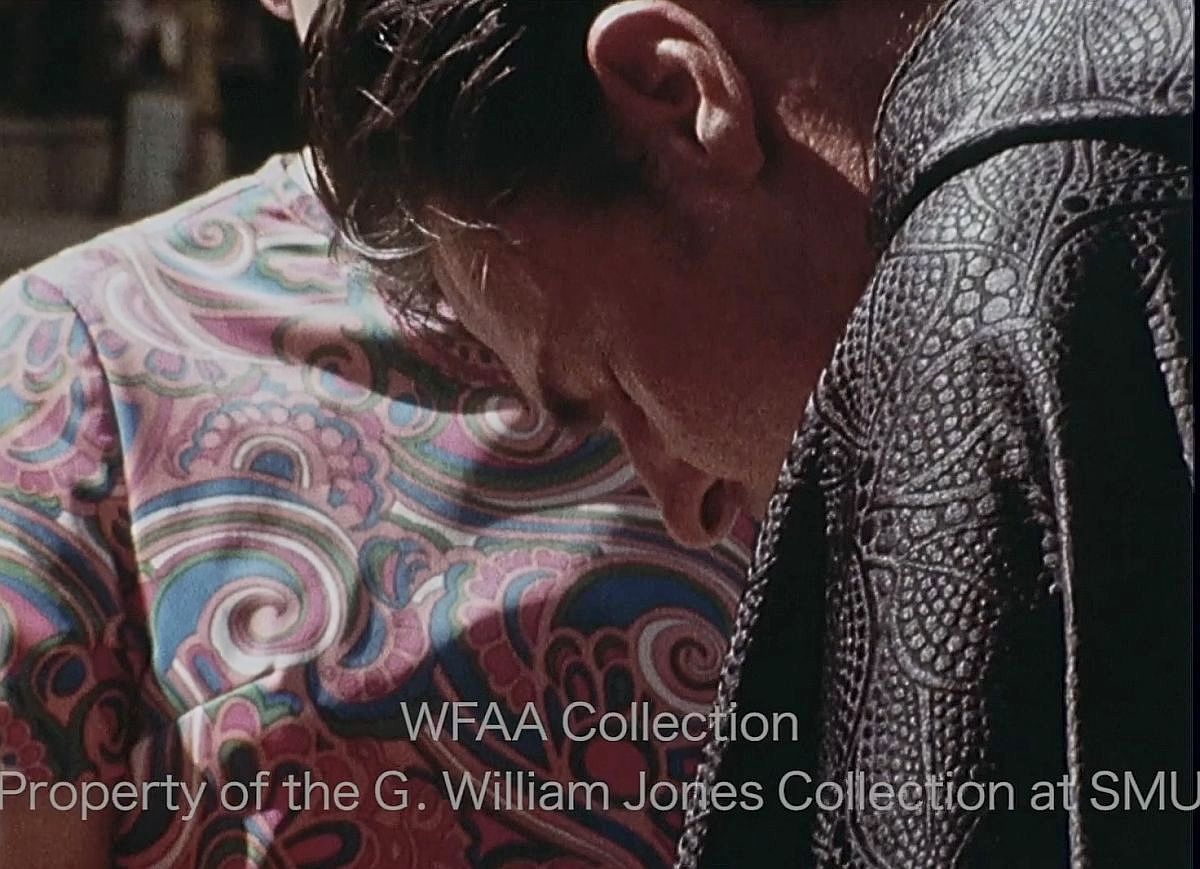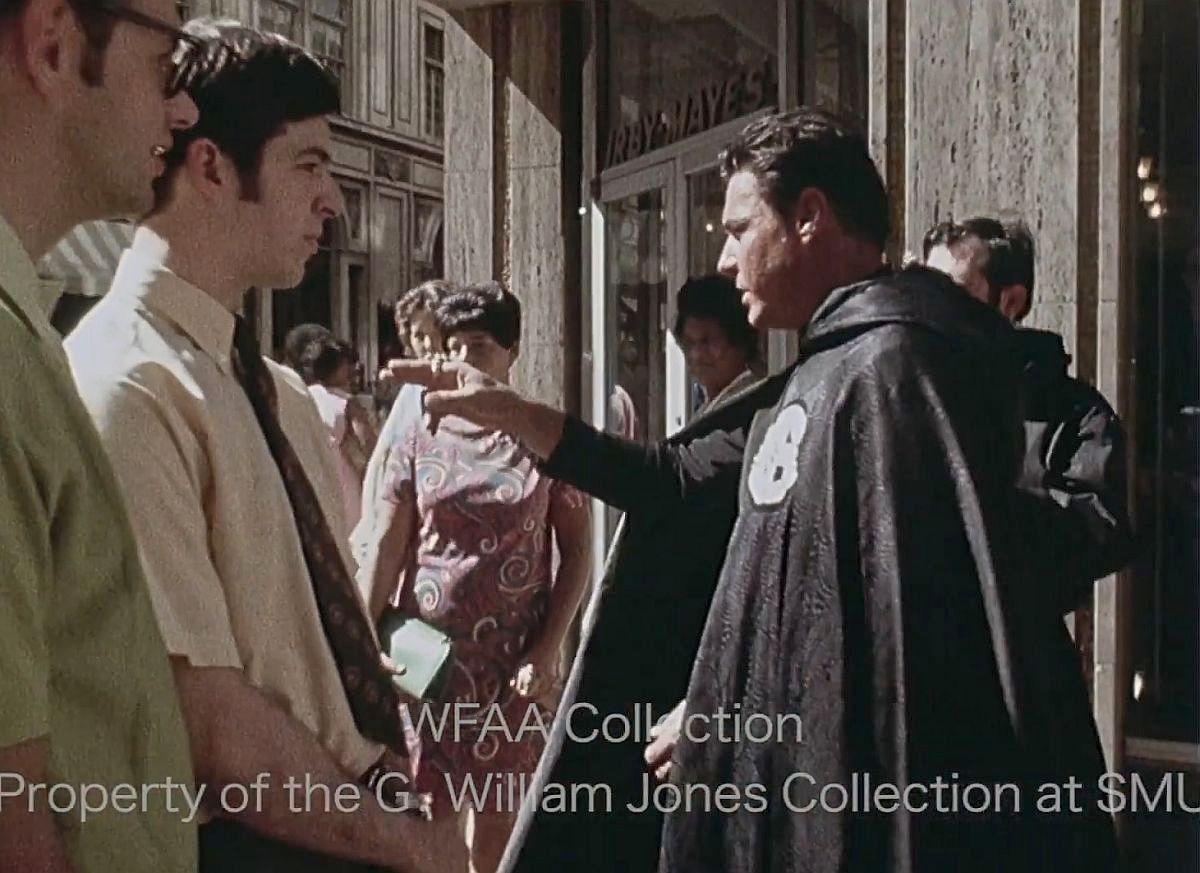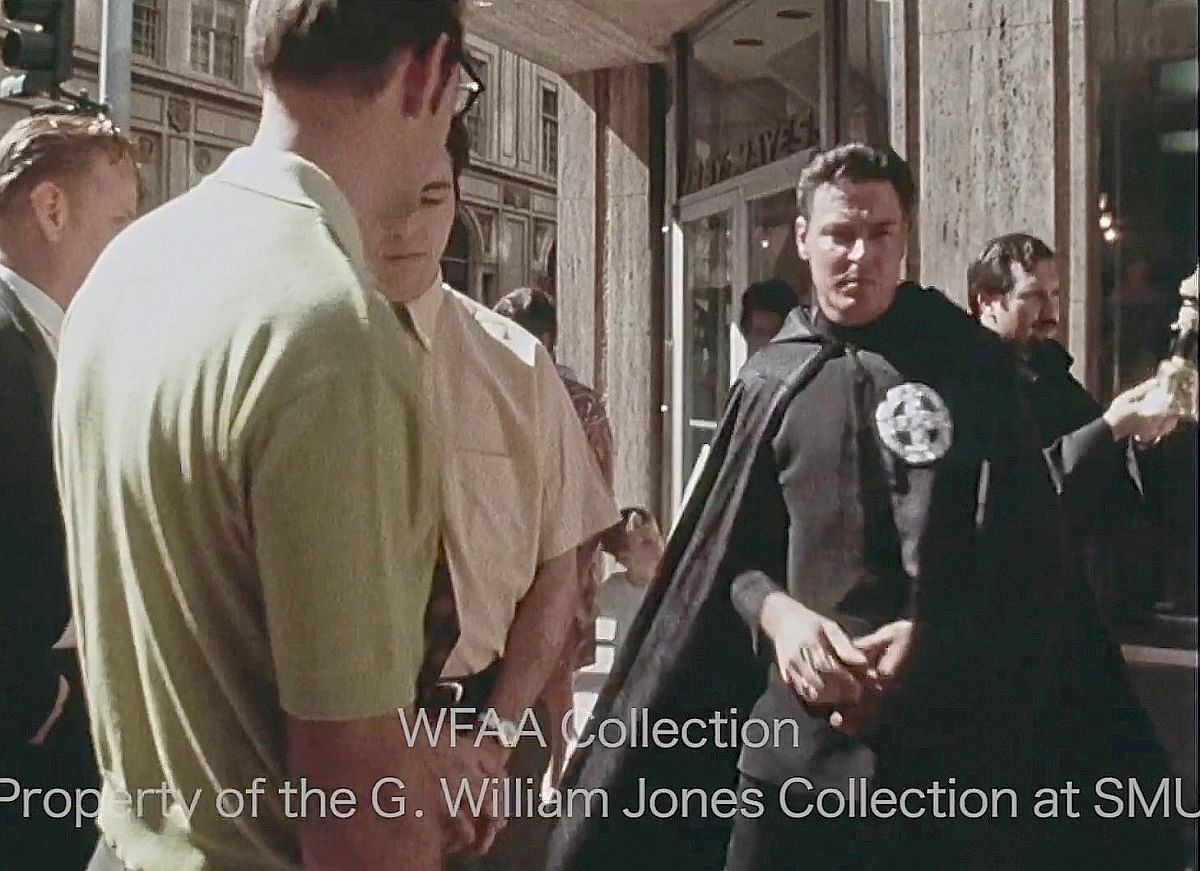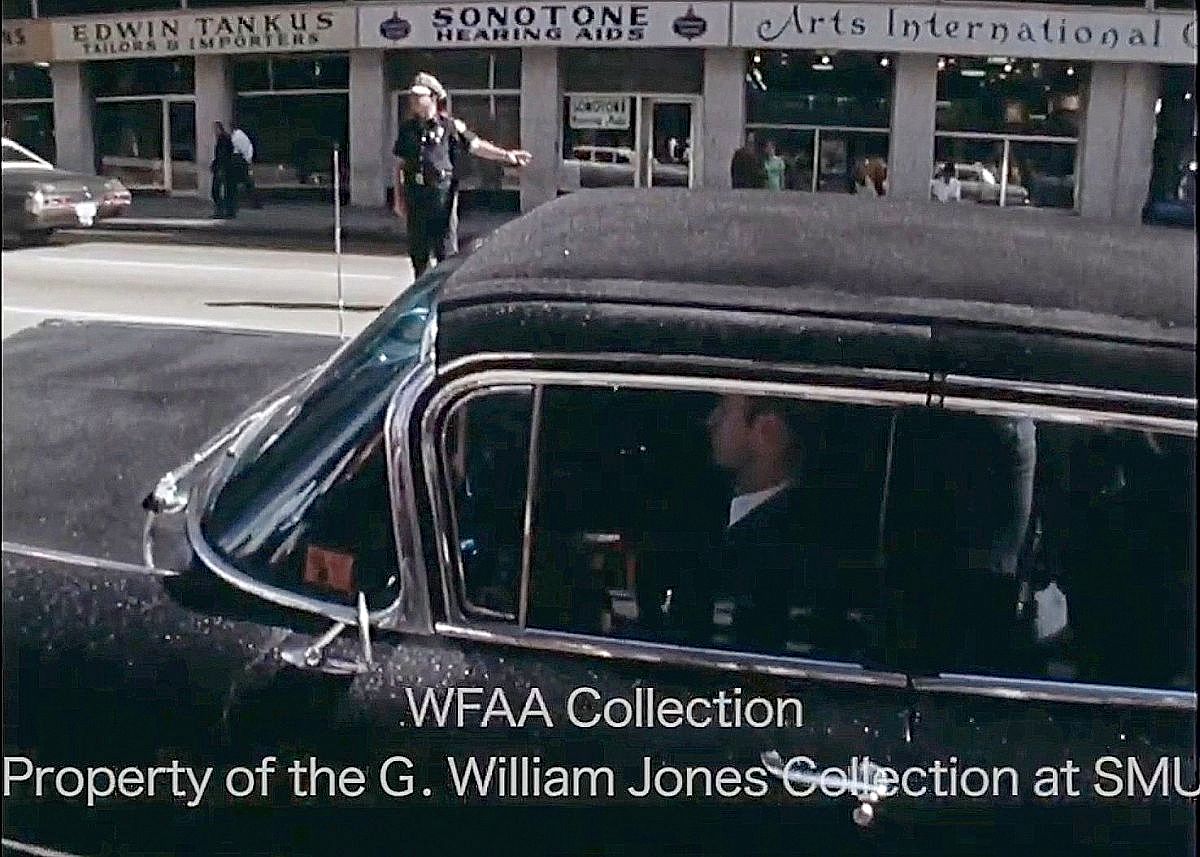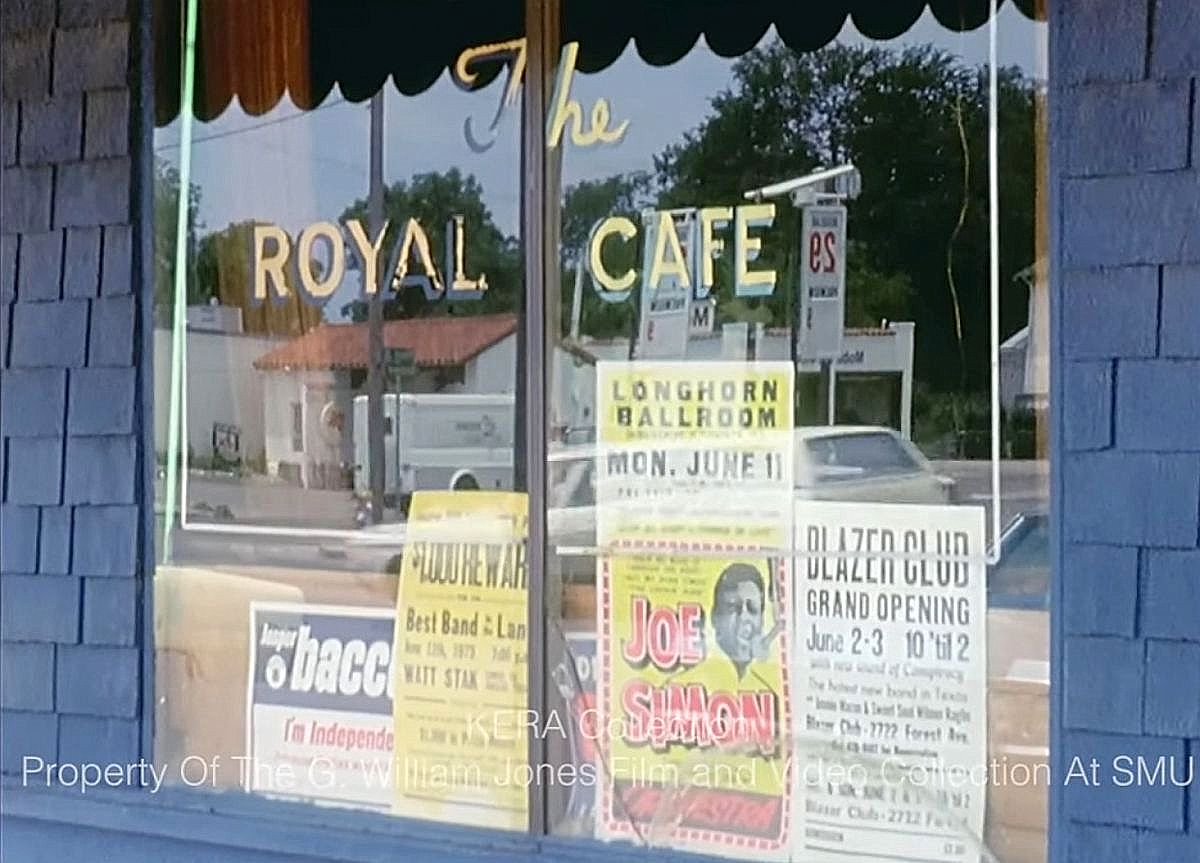
On Sept. 4, 1970, at the corner of Commerce and Ervay, a “white-magic warlock” named Gene de Jean conducted a ceremony to lift a heinous curse placed on Dallas in 1963 by a somewhat vague “malevolent black-magic coven” — this curse, which, uncoincidentally, preceded the JFK assassination, had apparently hung over the city for 7 long years. Fortunately, the media had been alerted, and we have film footage of the historic occasion in which a mysterious warlock lifted a nasty curse which no one in Dallas knew had been cast in the first place.
Do-gooding warlock Gene de Jean arrived in a “velvetized Cadillac” (a Cadillac COVERED IN BLACK VELVET!) with a be-robed bell-ringing acolyte, and, with Neiman-Marcus in the background, he uttered a few incantations and proclaimed the curse lifted. He also “blessed” a few random people in the crowd for good measure before walking back to the waiting velvetized warlock-mobile, his job done. In his wake there was much rejoicing and/or confused looks exchanged on Commerce Street. Thank you Mr. de Jean!
*
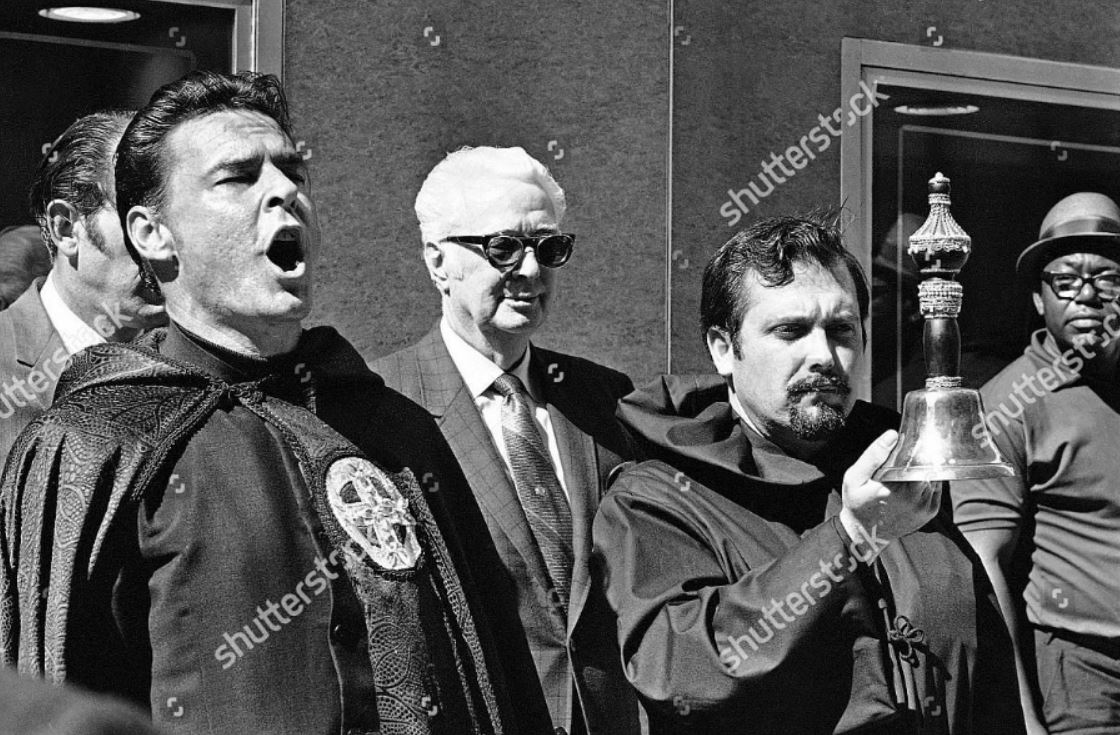
In something of a kill-joy article, the Associated Press revealed that “Gene de Jean” was a warlock stage-name. In non-warlock life he was Gene McIntosh, mild-mannered Houston psychologist. When pressed by the reporter, Gene said that it was “pure coincidence” that the Texas Association of Magicians was wrapping up its 25th annual convention 2 blocks away at the Statler Hilton (which can be seen in the background of the footage). So, yes, Gene McIntosh and Lee Thompson (the bell-ringing “acolyte”) were well-known Houston magicians/illusionists in town for a magicians’ convention. And — why not? — a friendly curse-lifting.
**
Here’s the footage — at the 12:19 mark — captured by a WFAA-Channel 8 News cameraman for posterity.
*
And a few screenshots of the warlock in action.
Associated Press photo by Ferd Kaufman
Seriously — how do you cover a car with velvet?
Voilà! Curse lifted!
**
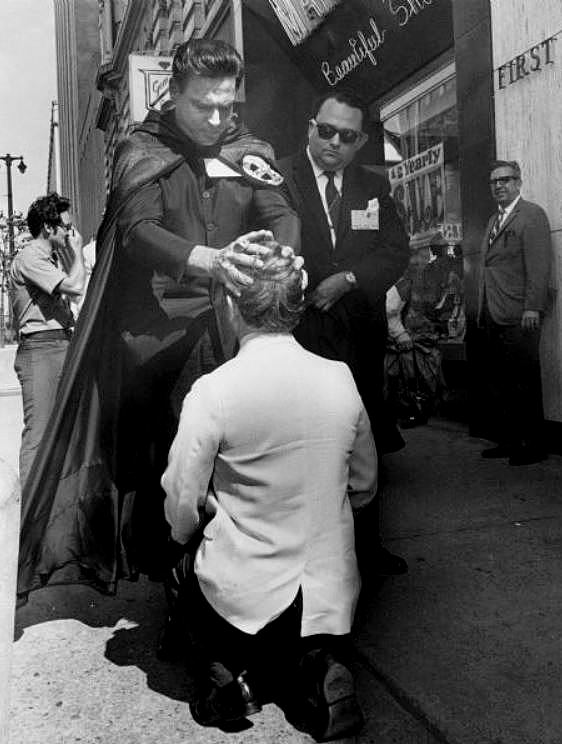
Doing a little research, I have to say, when I came across the photo below, I felt a twinge of betrayal. Or at least disappointment. It shows Gene de Jean on the streets of Milwaukee (Milwaukee?!!) in June, 1970. The guy in the sunglasses is also seen with him in Dallas. The caption of this photo: “A self-described warlock (male witch) in black flowing cape bestowed a blessing right here in Old Milwaukee Tuesday. Gene De Jean blessed the city and a number of passersby at N. 3rd St. and W. Wisconsin Ave. He was in town for a magician’s convention.” Was it all just a schtick, Gene? And I thought we had something special.
Video and screenshots are from the WFAA NewsFilm Collection, G. William Jones Film Collection, Hamon Arts Library, Southern Methodist University; the footage is from Sept. 4, 1970 and can be found on YouTube here (clip begins as the 12:19 mark).
When I posted a version of this on my Facebook page a few weeks ago, David B. commented with a couple of informative links about Gene McIntosh (who died in 2006): this overview of his career as a magician, and this tale of a stunt he performed while driving from Houston to Dallas in 1959, blindfolded the whole way. RIP, Gene.
Linda Coffee, 27 years old, on her way to the Supreme Court to make history
by Paula Bosse
UPDATE 5/4/22: See a brand-new video interview with Linda Coffee — recorded yesterday in Lakewood — in which she responds to the leaked Supreme Court draft, here. Also, the companion Dallas Morning News article (paywall) is here.
**
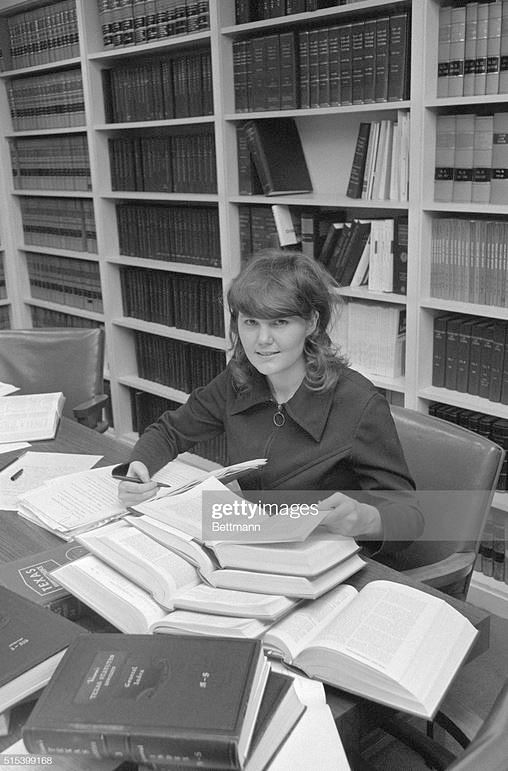
The most important woman in the abortion rights fight is someone you’ve never heard of: LINDA COFFEE, the Dallas attorney who took the local case of Roe v. Wade from Dallas all the way to the U.S. Supreme Court in a successful battle to have the ban on abortion in Texas declared unconstitutional. She began the case when she was only 26 years old and less than two years out of UT Law School.
Coffee was the driving force of this landmark legal case from the very beginning but preferred to leave the limelight to her co-counsel, Sarah Weddington, who joined the team a short time after the case was underway. (Weddington, an Austin lawyer, was *also* only in her 20s!)
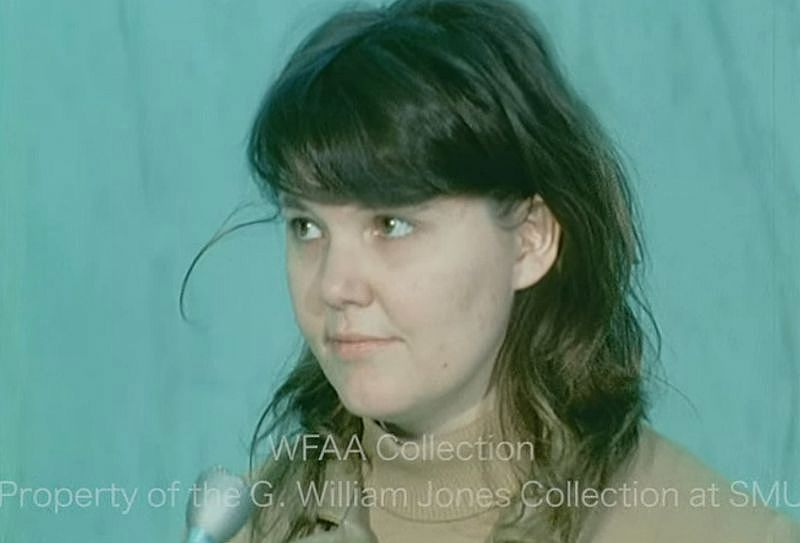
The image above is a screenshot of a 1970 television interview with Coffee in news footage from the WFAA archive, a treasure trove of historical film clips housed at SMU as part of the Hamon Arts Library’s G. William Jones Film & Video Collection (the WFAA archive is viewable on YouTube here, with additions being made all the time).
This rare, recently unearthed Channel 8 interview from June, 1970 has Coffee discussing the ramifications of her first win in the long legal journey which would ultimately end in victory in the U.S. Supreme Court. It is almost certainly her first TV interview. (Read the notes of the YouTube clip for the full description.)
*
My mother was involved in all sorts of women’s political groups in Dallas in the 1970s (and beyond). Meetings of various progressive political organizations and committees were often held at the First Unitarian Church on Preston Road in University Park (yes, University Park was an unlikely hotbed of activism!), and my mother knew Linda Coffee through these women’s groups. I had heard Linda’s name over the years but didn’t really know much about her until I came across this short Channel 8 interview. I’ve been working in these archives for SMU and wasn’t able to identify this unidentified woman but felt sure my mother would know who she was. I was talking to my mother on the phone trying to describe her: “I’m not sure who she is. She appears to be a lawyer, but she just looks too young and too… disheveled to be a lawyer. A little scroungy.”“Oh!” my mother said instantly, “Linda Coffee.” And she was right! She hadn’t even seen the footage.
I immediately loved Linda from my introduction to her in this footage. She’s earnest, confident, smart, pixie-ish, and she looks a little like a “real-person” version of Linda Ronstadt. I wonder if she ever imagined she would be responsible for one of the most famous legal cases of the 20th century?
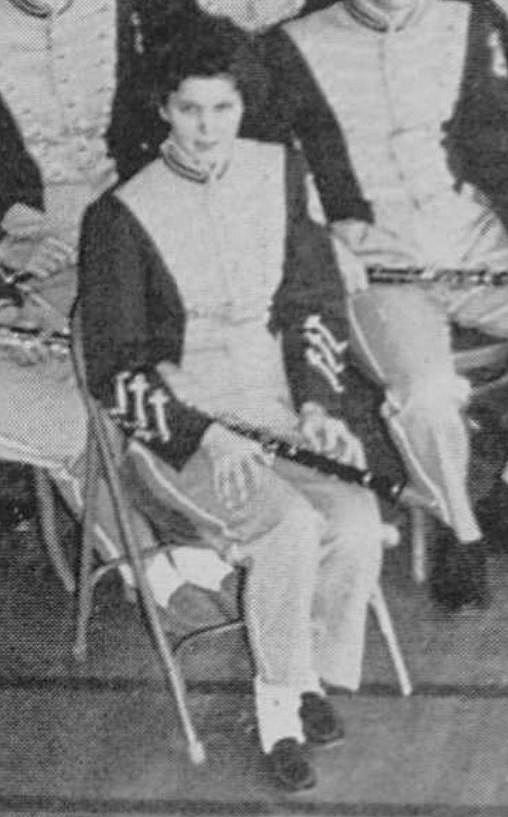
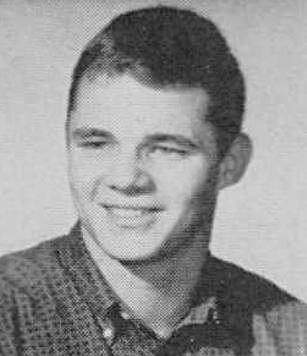
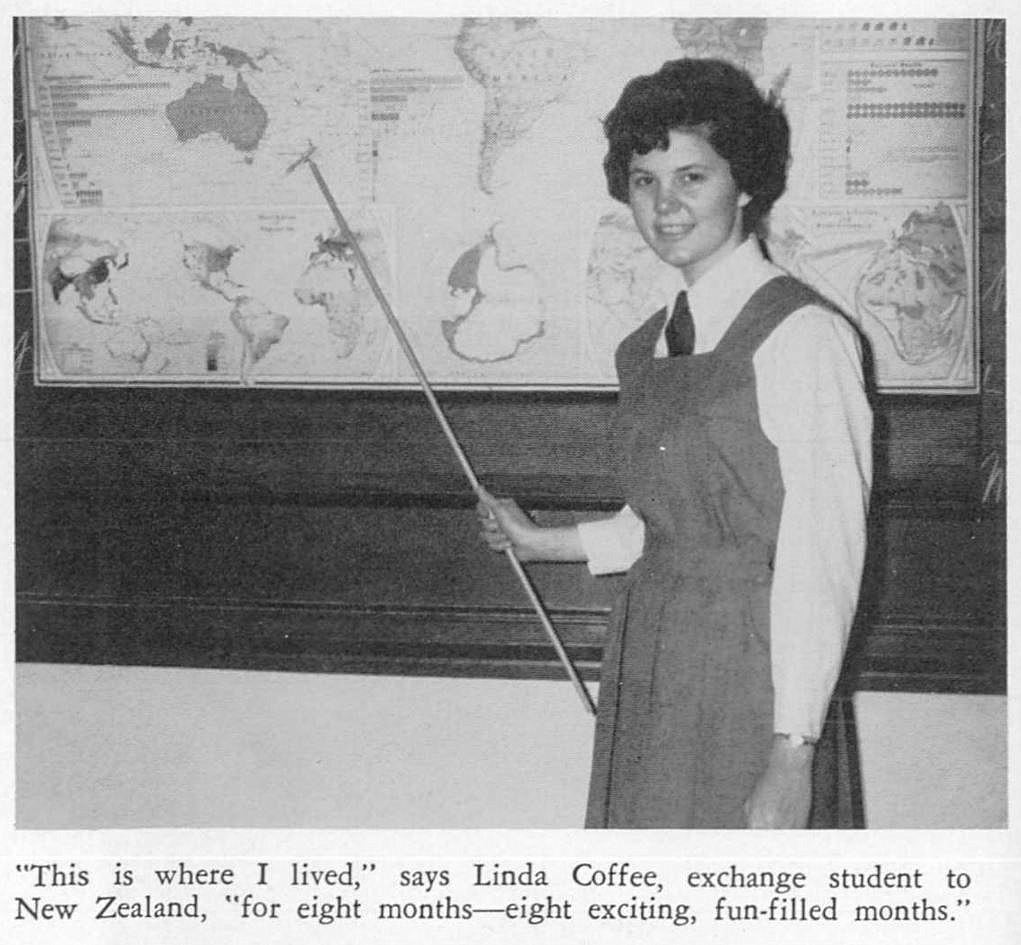
I decided to look into her background in Dallas, and I was pretty surprised to see that she grew up one street over from where I grew up (she lived in the 5700 block of Anita) and went to my East Dallas alma mater, Woodrow Wilson High School (she and musician Steve Miller were there at the same time, Class of 1961 — she was in the band, he was on the football team — wonder if they ever met?).
Linda Coffee, Woodrow band, 1961
Steve Miller, senior photo, 1961
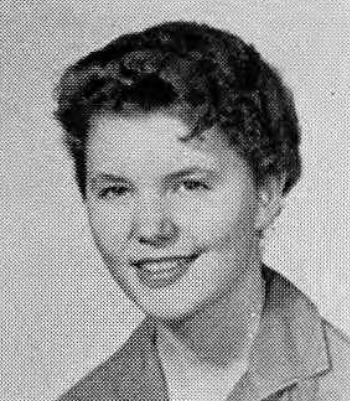
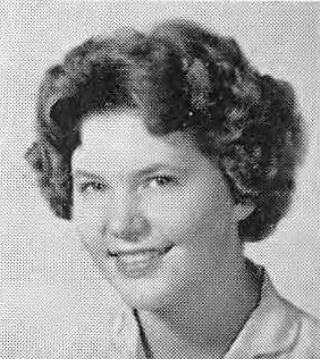
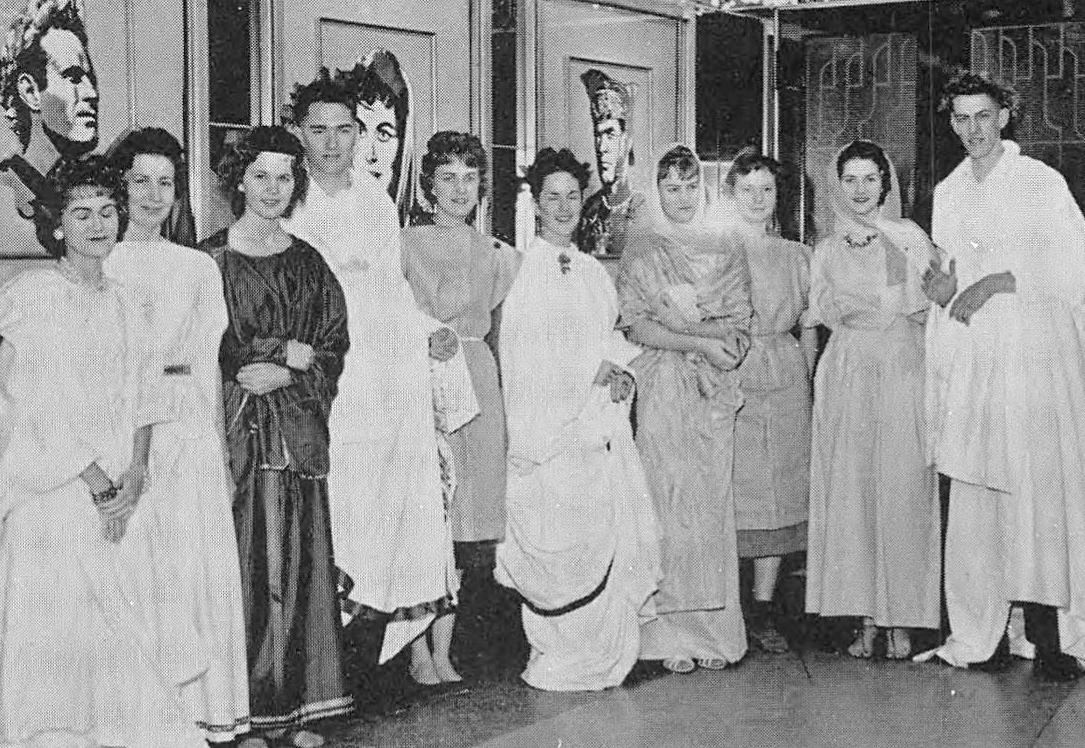
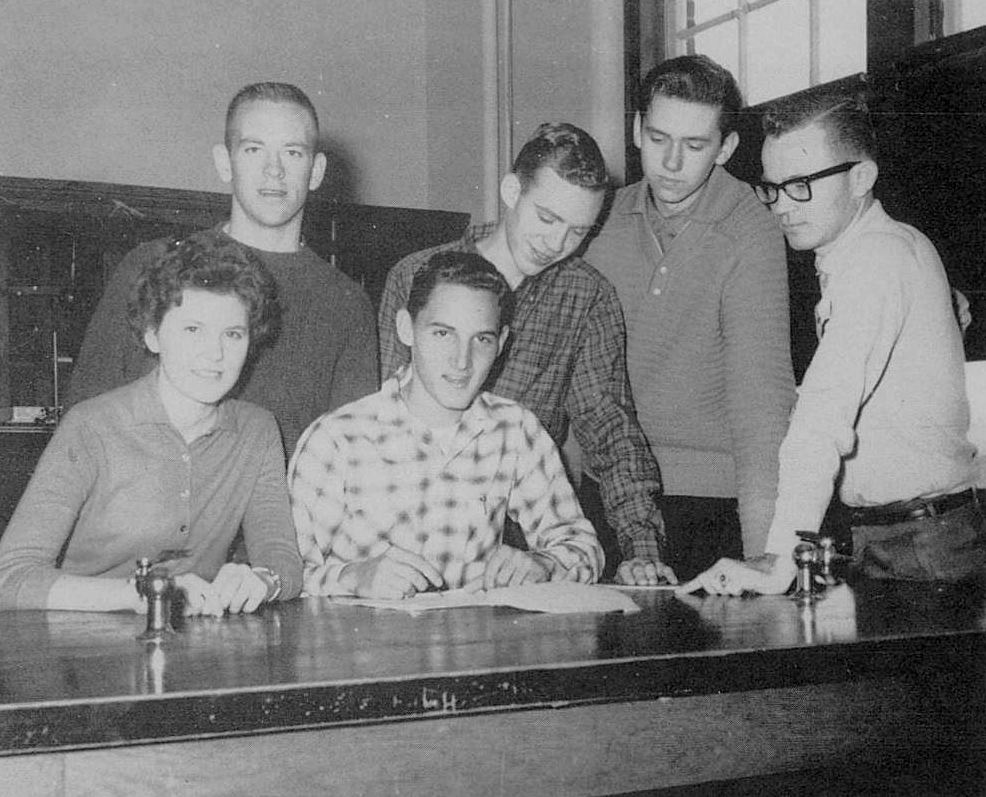
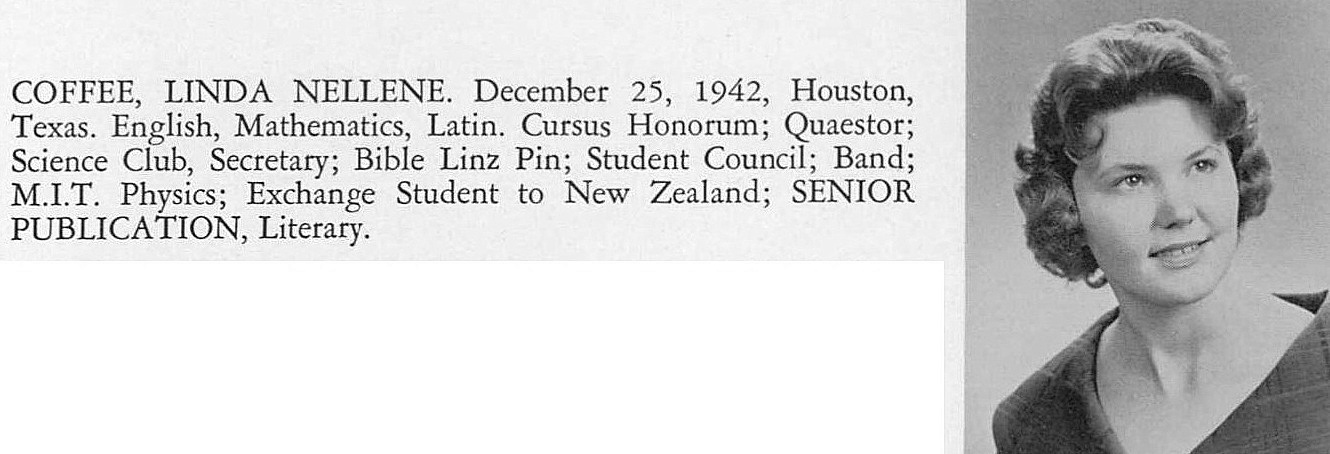
While we’re at it, here a few more photos of Linda Coffee in high school.
Linda Coffee, Woodrow sophomore, 1959
Linda Coffee, Woodrow junior, 1960
Linda (dark robe) with the Latin club, attending “Ben Hur” screening downtown, 1960
Linda and other officers of the Woodrow Science Club, 1961
Linda pointing to New Zealand, 1961
Linda Coffee, Woodrow Wilson High School, senior photo, 1961
She apparently excelled at everything and had a wide range of interests.
After graduating from Woodrow, she went to RIce University where she majored in German, then went on to law school at the University of Texas where she passed the Texas bar exam with the second highest score in the class. After becoming a lawyer, she was a law clerk in Dallas for District Judge Sarah T. Hughes (she and another female clerk were profiled in a 1968 Dallas Morning News article which carried the unfortunate headline, “The Law Clerks Are Girls”). It wasn’t long after this that she began working on a case to challenge the constitutionality of a vague Texas law which banned abortions. In January, 1973, Linda Coffee and co-counsel Sarah Weddington won their case in the U.S. Supreme Court. Linda had just turned 30.
I would highly recommend (and I mean HIGHLY RECOMMEND) the Vanity Fair profile of Linda Coffee written by Joshua Prager titled “Roe v. Wade’s Secret Heroine Tells Her Story.” Reading this when I knew virtually nothing about Linda made me want to know more about her and made me want to share her story with as many people as possible. How is it that this lawyer who has had such a massively important impact on modern life (especially women’s lives) isn’t a household name? Prager’s article tells you why. Joshua Prager has expanded this article to a full book concerning the Roe case which will be published in a couple of weeks: The Family Roe, An American Story.With the current news of the newly implemented controversial legislation by the State of Texas, this book could not possibly be more timely.
*
Thank you, Linda. Thank you, Sarah.
**
UPDATE, Dec. 16, 2021: Watch the interview with Linda Coffee by The Dallas Morning News, conducted on Dec. 9, 2021 at Linda’s home in Mineola. Read the companion DMN article here (article may require a subscription to view).
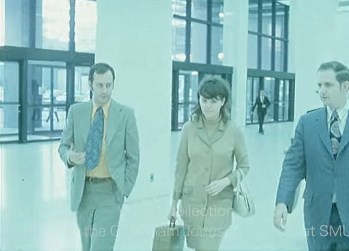
Update, June 25, 2022: Another short snippet (silent) of Linda Coffee has popped up in the WFAA archives. She is seen walking through the Dallas County Courthouse on Jan. 20, 1972, talking to WFAA reporter Phil Reynolds (she was working as an attorney on a case unrelated to Roe v. Wade). A screenshot is below — the pertinent footage begins at 21:21 here.
Jan. 20, 1972
***
Sources & Notes
Top image is a screenshot of a June, 1970 interview of Linda Coffee conducted by Channel 8 reporter Phil Reynolds; this interview can be seen on YouTube here (from the WFAA archive, G. William Jones Film & Video Collection, Hamon Arts Library, Southern Methodist University). Bottom image is from a WFAA clip from December, 1971 here.
All high school-era photos of Linda Coffee are from various editions of The Crusader, the yearbook of Woodrow Wilson High School.
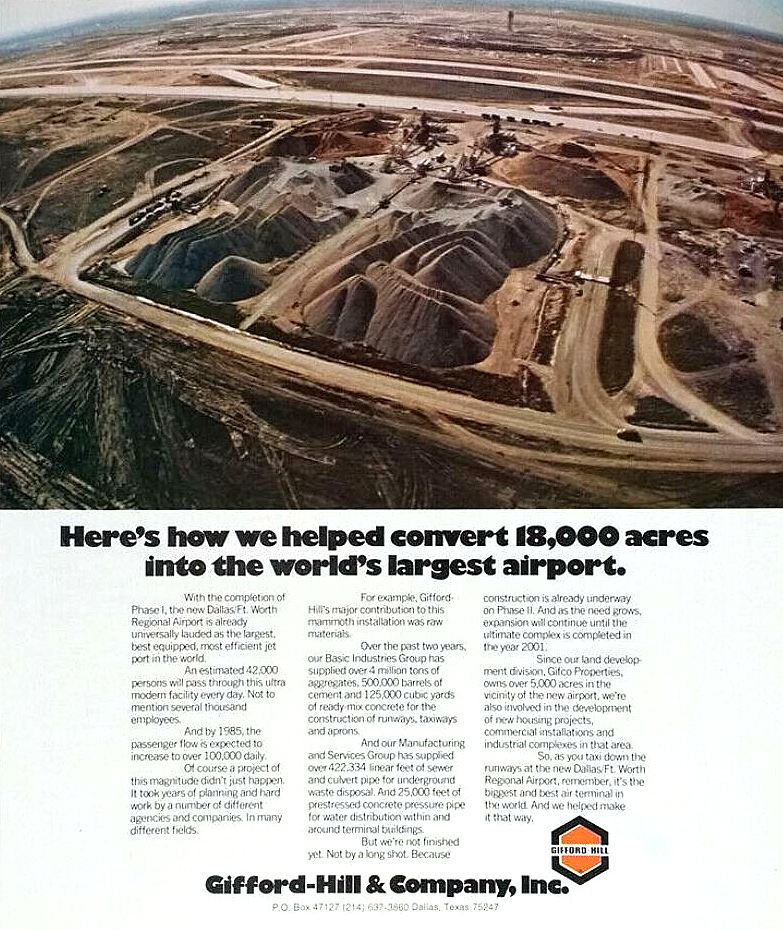
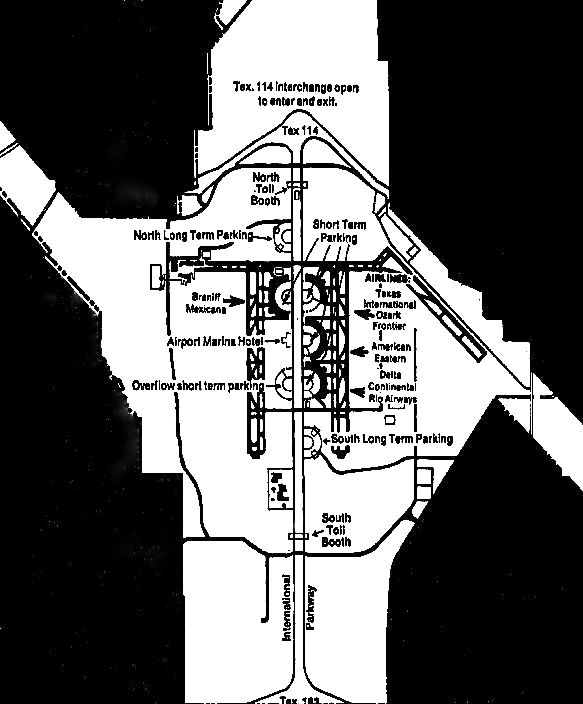
A couple of ads letting the nation know that construction of the new Dallas-Fort Worth International Airport was progressing and would soon be the biggest, bestest… um, BIGGEST airport ever! “Phase I” was completed by the end of 1973, and DFW opened for business in January, 1974.
The first ad, from Gifford-Hill (click to see larger image — transcription below):
Here’s how we helped convert 18,000 acres into the world’s largest airport.
With the completion of Phase I, the new Dallas/Ft. Worth Regional Airport is already universally lauded as the biggest, best equipped, most efficient jet port in the world.
An estimated 42,000 persons will pass through this ultra modern facility every day. Not to mention several thousand employees.
And by 1985, the passenger flow is expected to increase to over 100,000 daily.
Of course a project of this magnitude didn’t just happen. It took years of planning and hard work by a number of different agencies and companies. In many different fields.
For example, Gifford-Hill’s major contribution to this mammoth installation was raw materials.
Over the past two years, our Basic Industries Group has supplied over 4 million tons of aggregates, 500,000 barrels of cement and 125,000 cubic yards of ready-mix concrete for the construction of runways, taxiways and aprons.
And our Manufacturing and Services Group has supplied over 422,334 linear feet of sewer and culvert pipe for underground waste disposal. And 25,000 feet of prestressed concrete pressure pipe for water distribution within and around terminal buildings.
But we’re not finished yet. Not by a long shot. Because construction is already underway on Phase II. And as the need grows, expansion will continue until the ultimate complex is completed in the year 2001.
Since our land development division, Gifco Properties, owns over 5,000 acres in the vicinity of the new airport, we’re also involved in the development of new housing projects, commercial installations and industrial complexes in that area.
So, as you taxi down the runways at the new Dallas/Ft. Worth Regional Airport, remember, it’s the biggest and best air terminal in the world. And we helped make it that way.
Gifford-Hill & Company, Inc. Dallas, Texas
1969, Highland Park High School yearbook
*
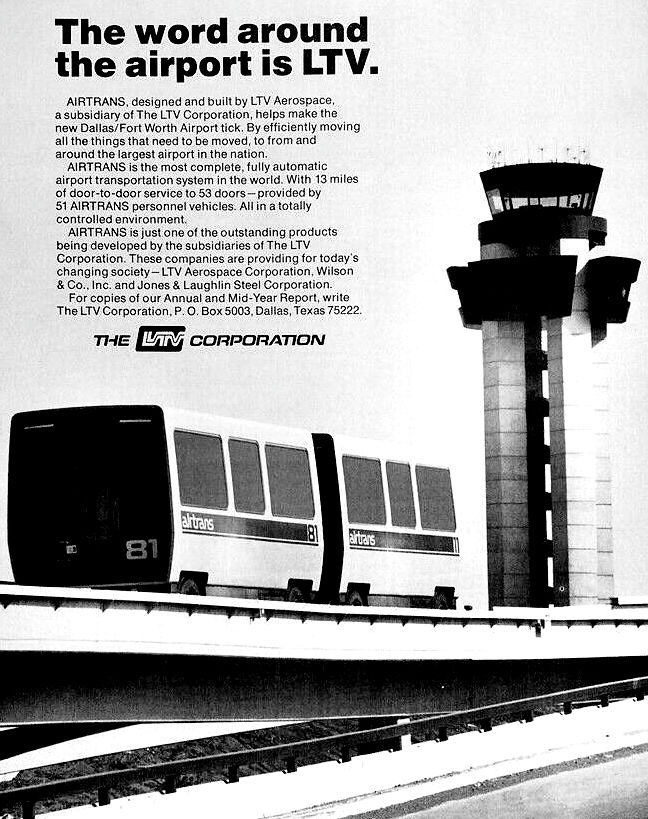
The second ad, from LTV, touting their automated AIRTRANS all-electric transportation system which carried people and cargo around the airport.
The word around the airport is LTV.
AIRTRANS, designed and built by LTV Aerospace, a subsidiary of The LTV Corporation, helps make the new Dallas/Fort Worth Airport tick. By efficiently moving all the things that need to be moved, to from and around the largest airport in the nation.
AIRTRANS is the most complete, fully automatic airport transportation system in the world. With 13 miles of door-to-door service to 53 doors – provided by 51 AIRTRANS personnel vehicles. All in a totally controlled environment.
AIRTRANS is just one of the outstanding products being developed by the subsidiaries of The LTV Corporation. These companies are providing for today’s changing society – LTV Aerospace Corporation, Wilson & Co., Inc. and Jones & Laughlin Steel Corporation.
*
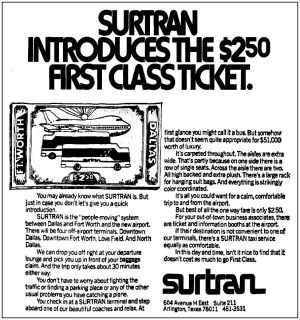
And because AIRTRANS is getting its day in the sun, here’s a local ad for its troubled “surface” counterpart (I just learned that “SURTRAN” stands for “surface transportation”) — the bus/taxi/limo system designed to get people to the airport from Dallas or Fort Worth. As this ad says, a one-way bus ticket was $2.50 (about $15.00 in today’s money). SURTRAN seems to have been financially troubled from the beginning — SURTRAN service ended at the end of October, 1984.
Sept., 1973
*
End of Phase I:
1973
***
Sources & Notes
Gifford-Hill ad with color photo and LTV ad found on eBay.
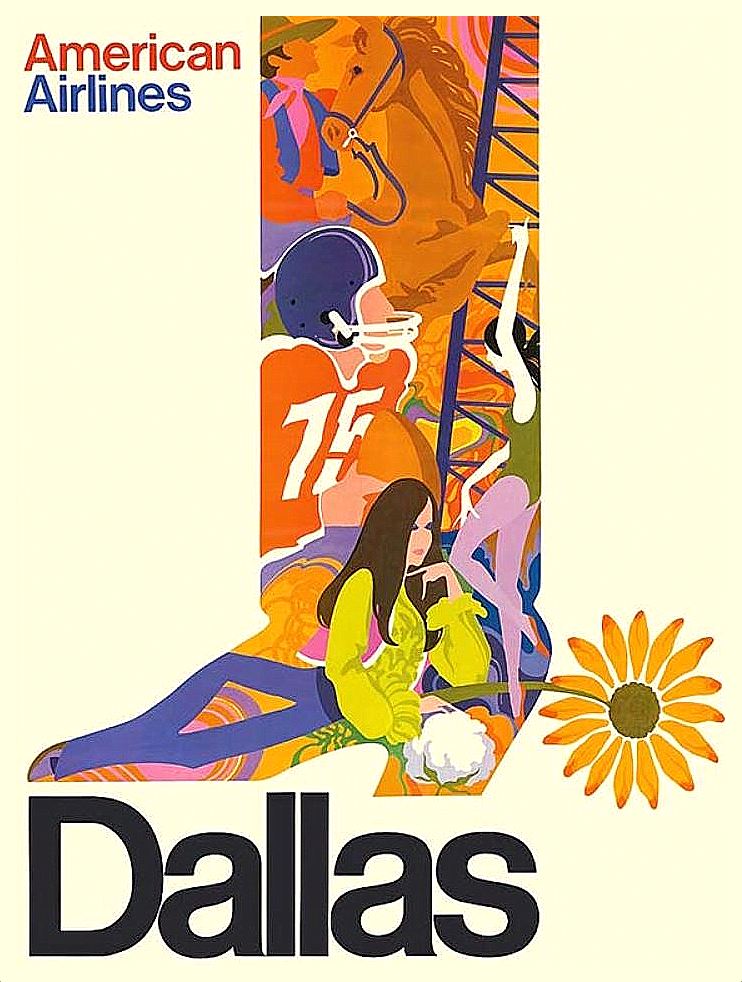
Remember those “Panoramic Texas” license plates from a few years ago? The ones that featured everything Texas had to offer, including the space shuttle? That’s kind of what this American Airlines vintage travel poster reminds me of — if it were designed by someone who had never been to Dallas. You got your cowboy, your horse, your oil derrick, your trapeze artist/ballerina, your circa-1970 Mary Tyler Moore/Mary Richards, your great big cotton boll… and a football player who should probably be wearing different colors. All contained in a psychedelic cowboy boot with a flower for a spur.
Works for me! (I hope those weary travelers weren’t too disappointed when they stepped off the plane.)
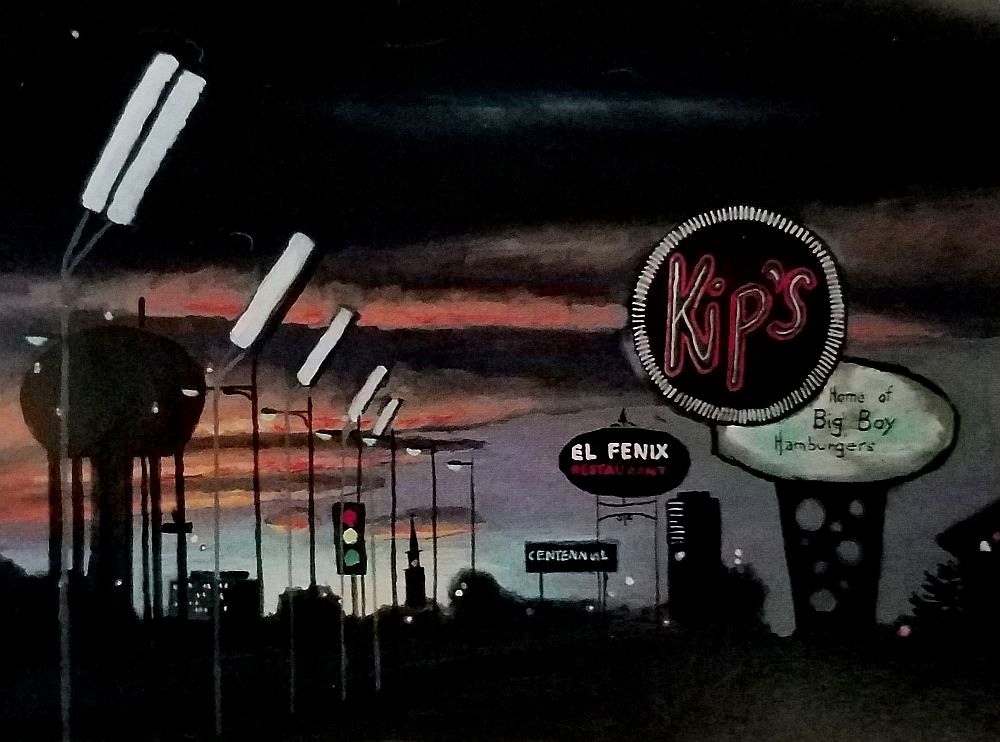
You’re a Dallasite. You’ll probably immediately recognize the location of this (somewhat uncharacteristic) painting by famed Dallas painter Jerry Bywaters: it’s Northwest Highway, looking west from just past Hillcrest. Its title — “City Suburb at Dusk” — is a bit misleading. It was sort of a suburb (Preston Hollow) back when Jerry was a young man, but by 1978, when this was painted, its “suburb” days were long, long gone.
I love this painting. On the “suburb” side it’s got Kip’s, El Fenix, Centennial Liquor, and the cool curved Preston Tower. On the University Park side it’s got the silhouettes of the omnipresent water tower (once a much more pleasing shape than it is today, back when it was painted in a whimsical red-and-white checkerboard pattern), the spire of the Park Cities Baptist Church, and a Preston Center-adjacent office building. West Northwest Highway never looked so tranquil.
***
Sources & Notes
“City Suburb at Dusk” by Jerry Bywaters, 1978 — oil on masonite, 18 x 24, collection of G. Pat Bywaters.
Printed in American Art Review, Vol. XX, No. 1, 2008.
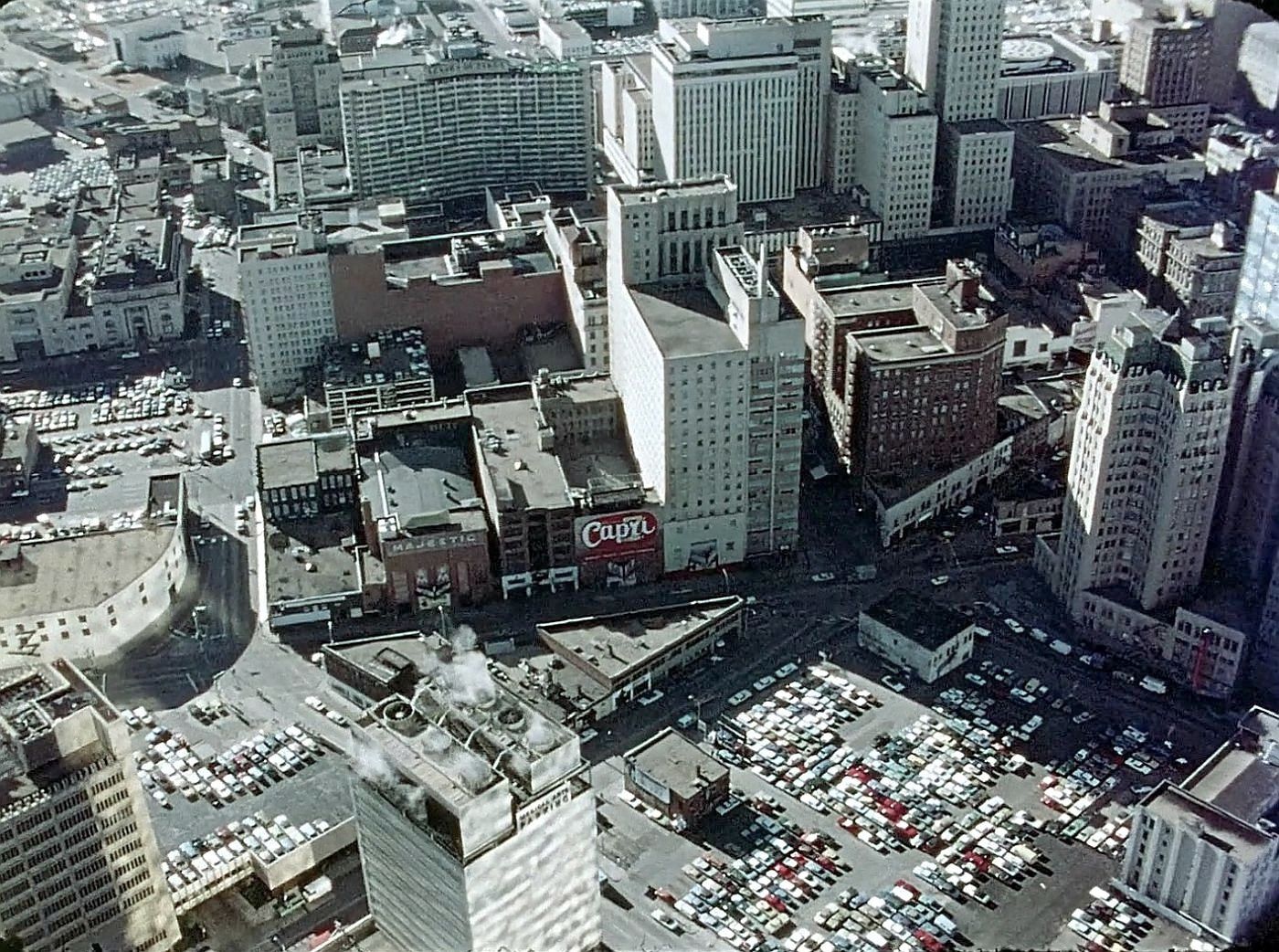
This is a cool aerial shot of downtown, looking toward the south, with a nice look at the back side of the waning Movie Row, with the Pacific Avenue rear entrances of the Majestic and Capri theaters visible. I’m not sure of the date, but the Melba Theater was renamed the Capri on Dec. 25, 1959 and was ultimately demolished in 1980 or 1981, and the Medical Arts Building (seen in the middle at the far right) was demolished in 1977. I’m guessing the ’70s, if only because of the vast expanse of parking lots.
***
Sources & Notes
Another instance of muddled/incomplete notes on my end. This is a screenshot from… something. I don’t remember if the image seen here is a photo or is from moving footage shot over Dallas.
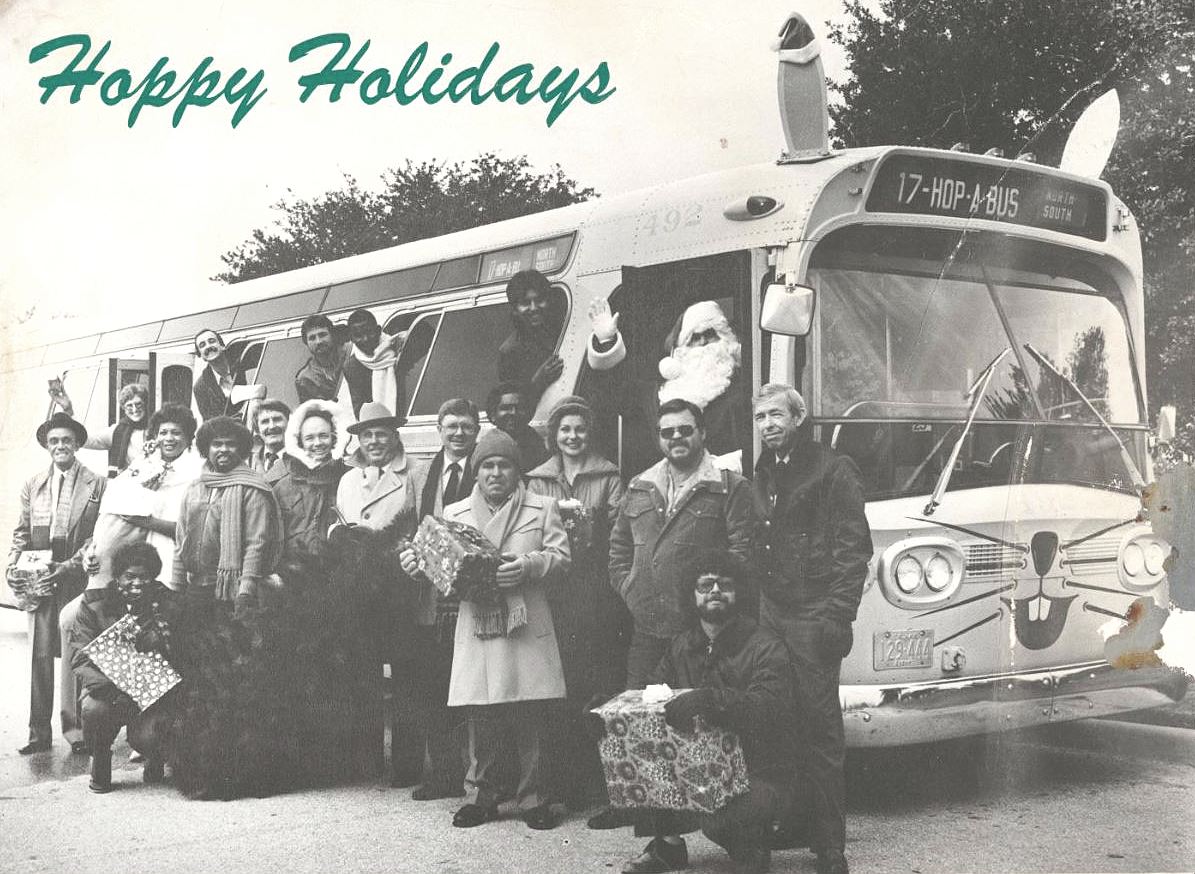
Season’s Greetings from Dallas Transit System and friend…
by Paula Bosse
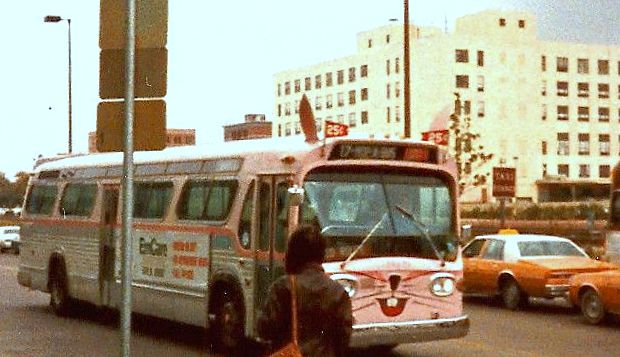
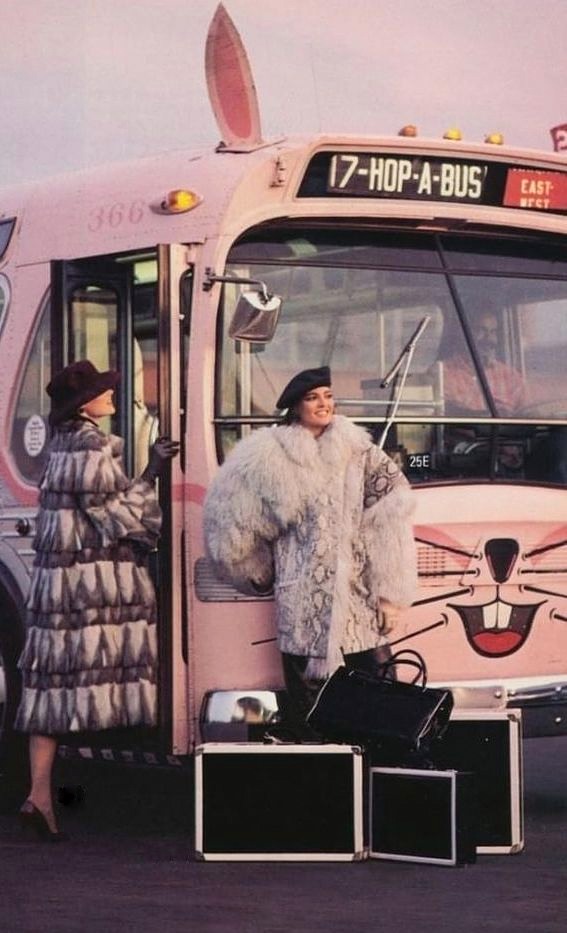
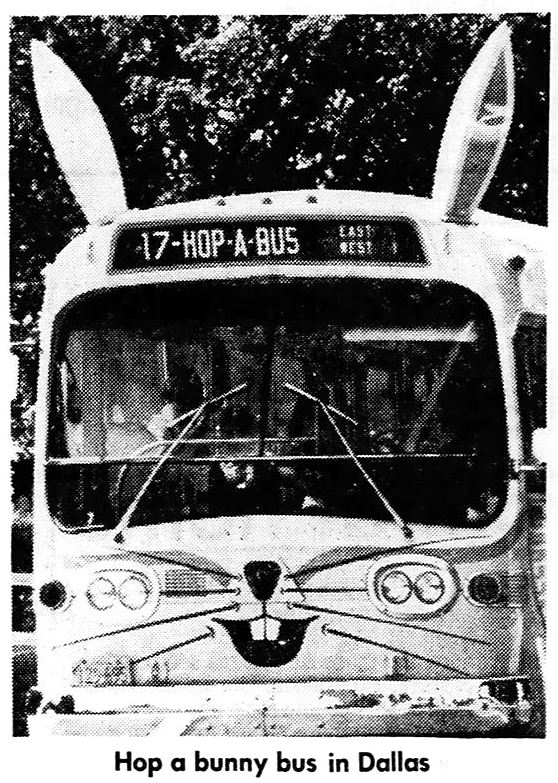
Aww, the Bunny Bus — surely Dallas Transit System’s most whimsical creation.
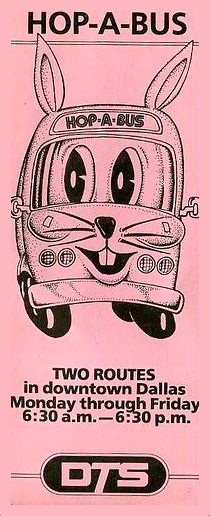
The earliest days of the DTS Hop-a-Bus saw a fleet of five, 19-passenger (non-whimsical) mini-buses which shuttled people back and forth across downtown. You could “hop on” and “hop off” for short trips, for a nominal fare (a dime), traveling along Main Street between Houston and Pearl, Monday-Friday, during working hours.
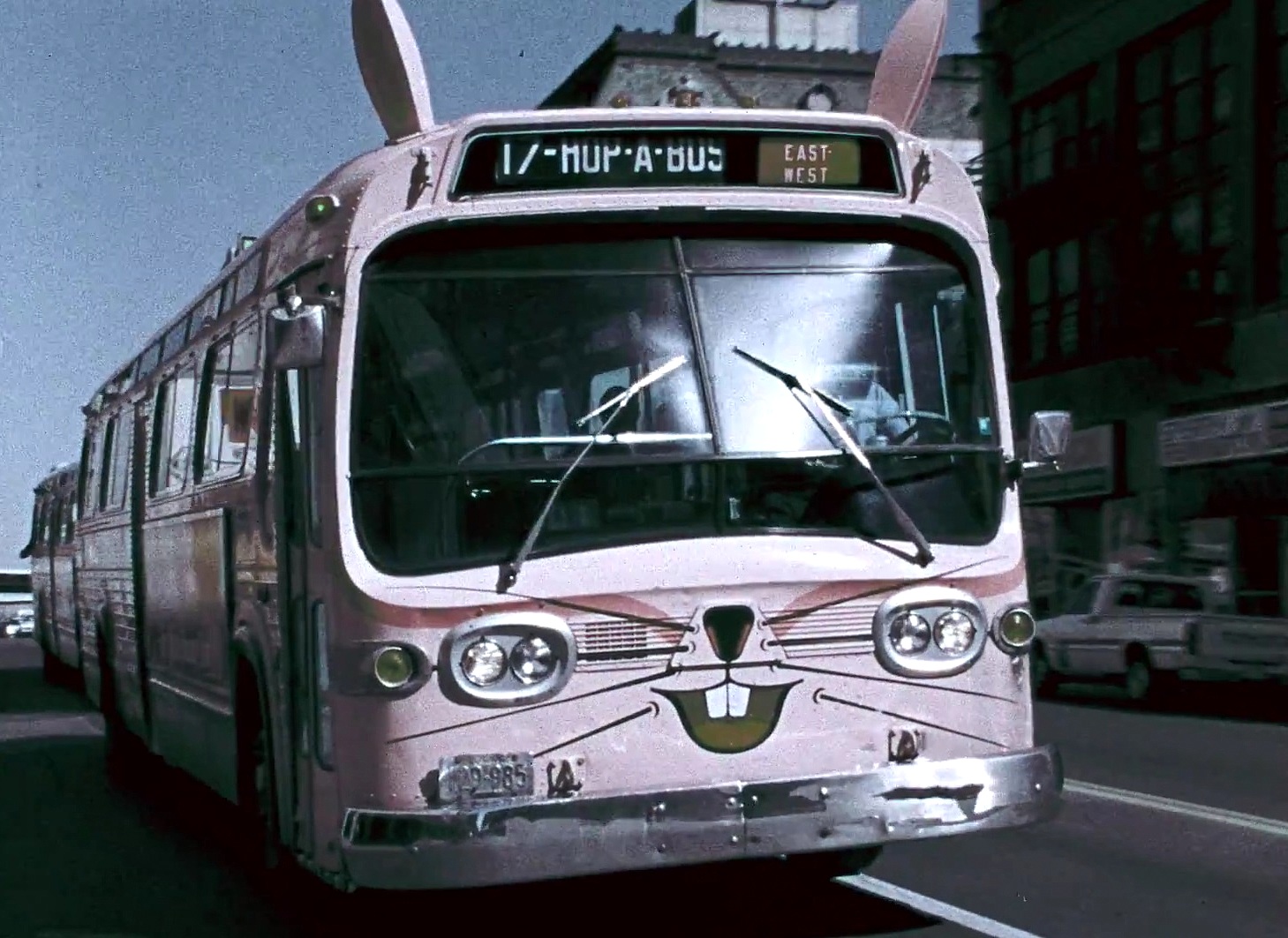
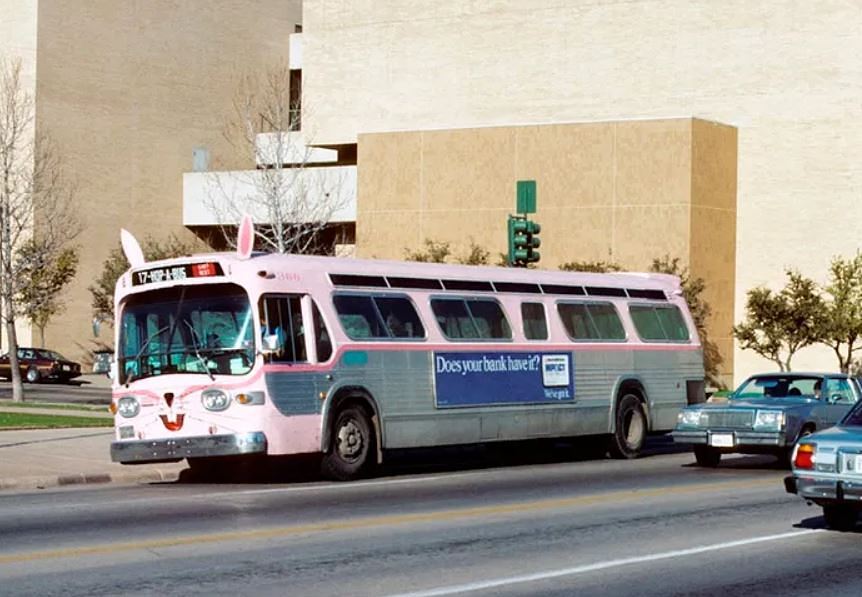
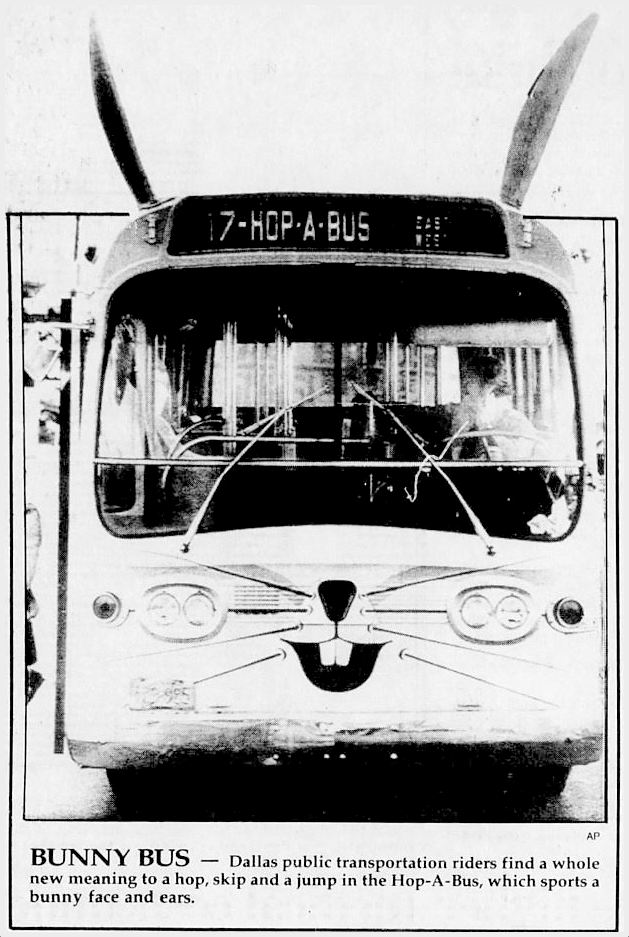
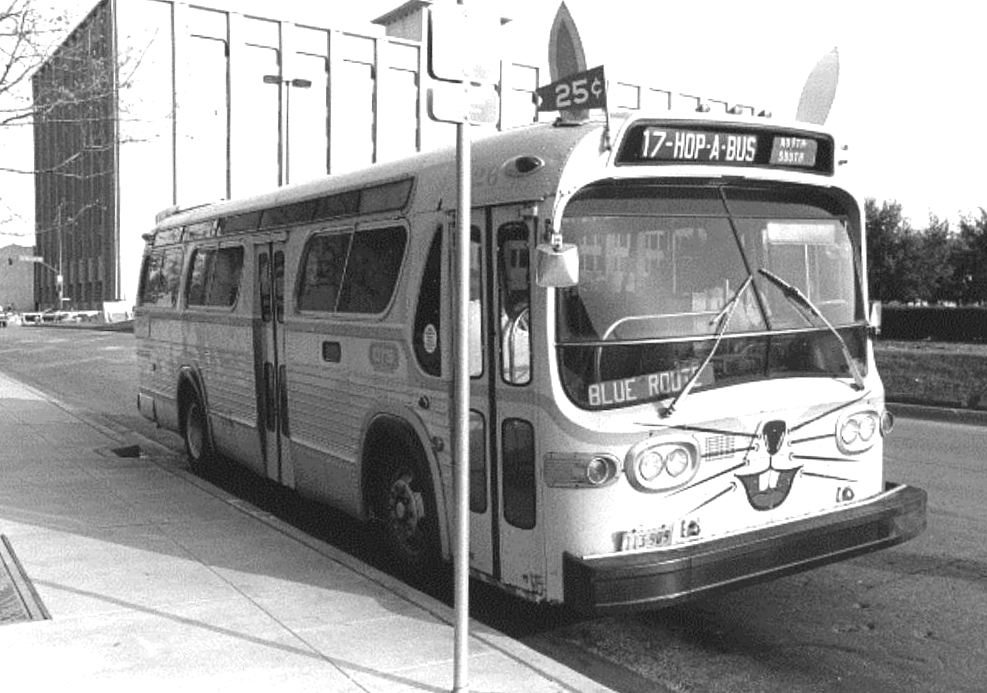
The service was very popular and quickly outgrew the mini-buses — in March, 1976 they went full-size, but ridership of these two large buses was disappointly slow to grow, mainly because people couldn’t tell the difference between the Hop-a-Bus and every other downtown bus. So, in October, 1978, someone, in his or her infinite wisdom, decided to paint the two special buses pink and add a bunny face and aluminum bunny ears (I seem to remember a tail, but I think I’ve added that in my own imagination). Voilà! Instantly recognizable!
At first, a lot of people hated them (describing them as “grotesque”), but pretty soon, downtown denizens fell for their charming appeal, and ridership increased substantially (seriously, you could see those things coming from blocks away!). Tourists loved them: they provided great photo opportunities, and they made getting around an unfamiliar city very easy — when lost, just jump on a pink bus and you’ll probably get to where you need to go.
Photos of the two pink “bunny buses” appeared in newspapers around the country. They even moonlighted at nights and on the weekends when DTS rented them out during off-duty hours — most notably to the pink-loving Mary Kay corporation and to the bunny-loving Dallas Playboy Club (which used the buses to ferry patrons from the Central Expressway club to Dallas Cowboys games).
The iconic (yes, “iconic”!) buses amused and delighted Dallasites until November, 1986. The bunny-bus fleet had increased to five 1966 GMC buses (at one point there had been as many as seven), and even though the fare had increased to 25 cents, they were still very, very popular with the public. But the pink buses were discontinued at the end of 1986 and sold. And, let’s face it, the streets of downtown Dallas have never been quite the same. Imagine if they were still around (and they SHOULD be!) — Instagram would be overrun with millions of bunny bus photos.
Below are a few photos and a video of our decades-gone transit pal, the cute, friendly Bunny Bus. RIP.
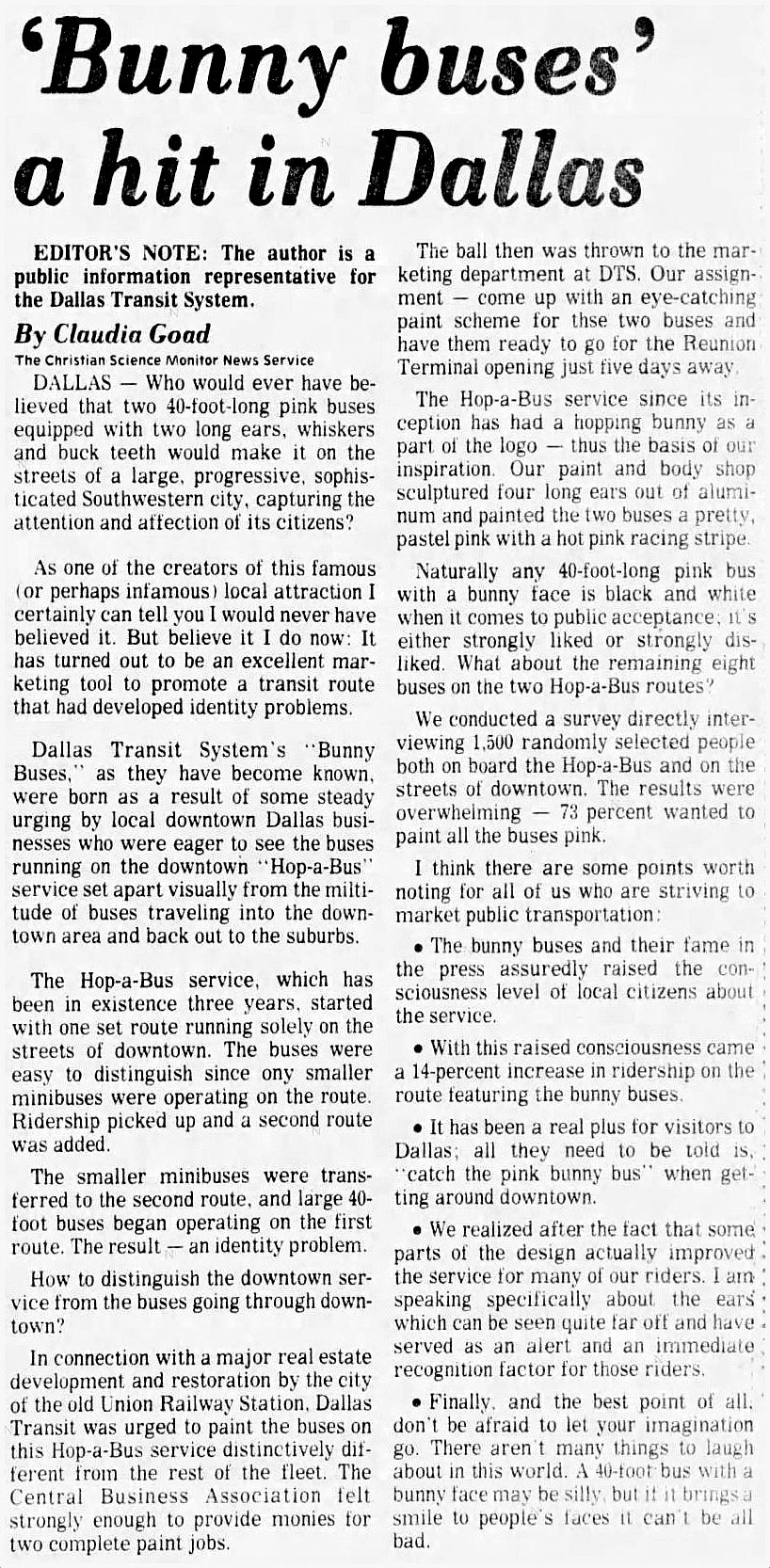
Here’s a great history of the Hop-a-Bus in an article widely syndicated around the country in 1979 — it was written by Claudia Goad, spokesperson for the DTS (click for larger image).
by DTS’ Claudia Goad, wire story, April 1979
And, finally, a look at a 1976 Channel 8 story on the month-old Hop-a-Bus, before it was transformed into a bunny (from the WFAA News archives at SMU).
Top image is from the Dallas Transit System (DTS) 1985 calendar — the entire calendar can be found at the Portal to Texas History, here, from the DART Historical Archive.
There is a “Bring Back the Bunny” Facebook page, here.
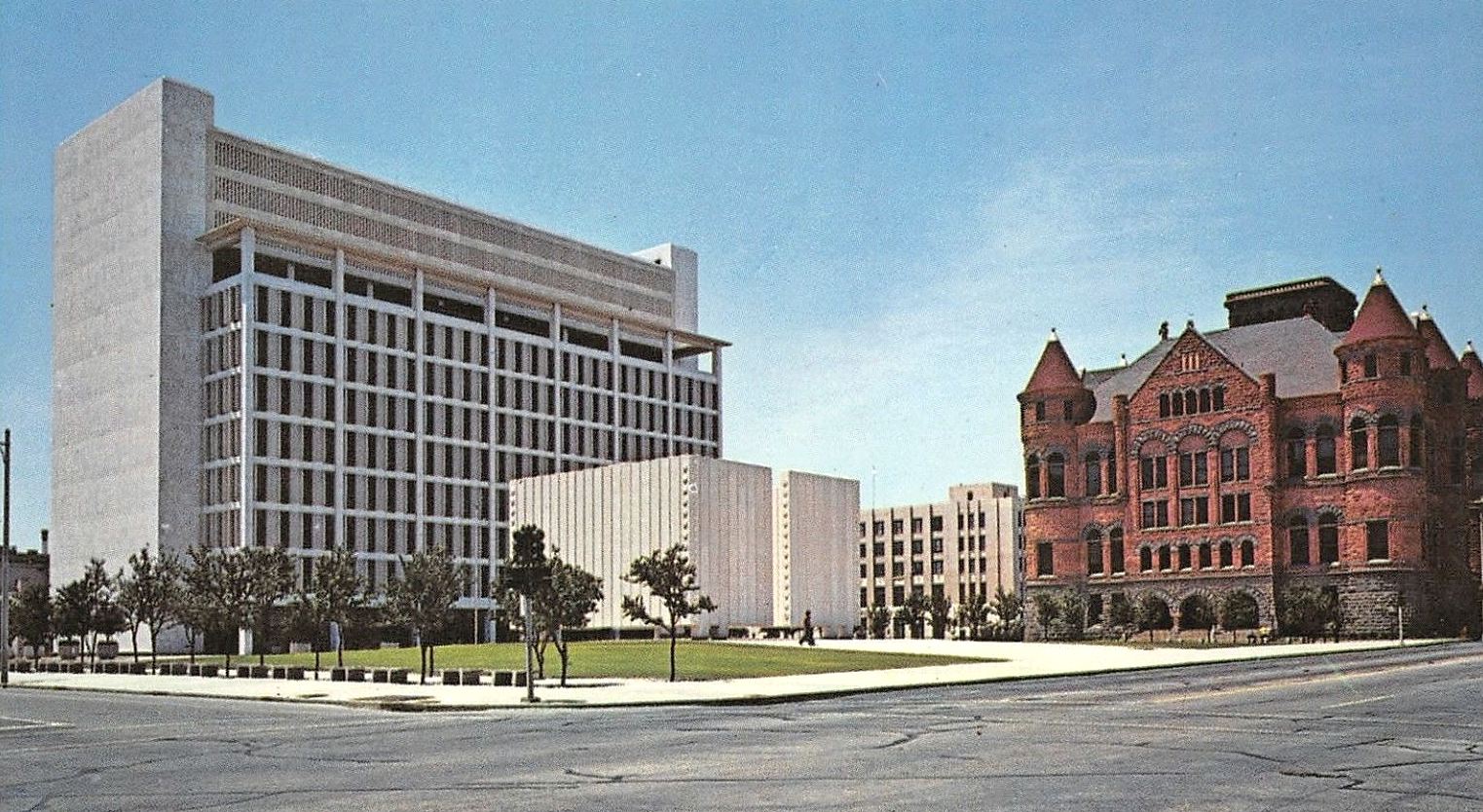
A view of the new John F. Kennedy Memorial, the not-new Old Red Courthouse, and the not-old-but-not-really-new “new” County Courthouse, in a postcard photo by Bob Glander.
The text on the back of the postcard reads:
The old and the new County Courthouses with the Kennedy Memorial. The new Courthouse was dedicated Feb. 4, 1966 and the Kennedy Memorial June 24, 1970, Dallas, Texas. Photo by Bob Glander.”
See the same view — from Main and Market — today, via Google Street View, here.
***
Sources & Notes
Postcard found somewhere online.
Previous Flashback Dallas posts with images to compare imagined and actual views of the “Courthouse Complex”:
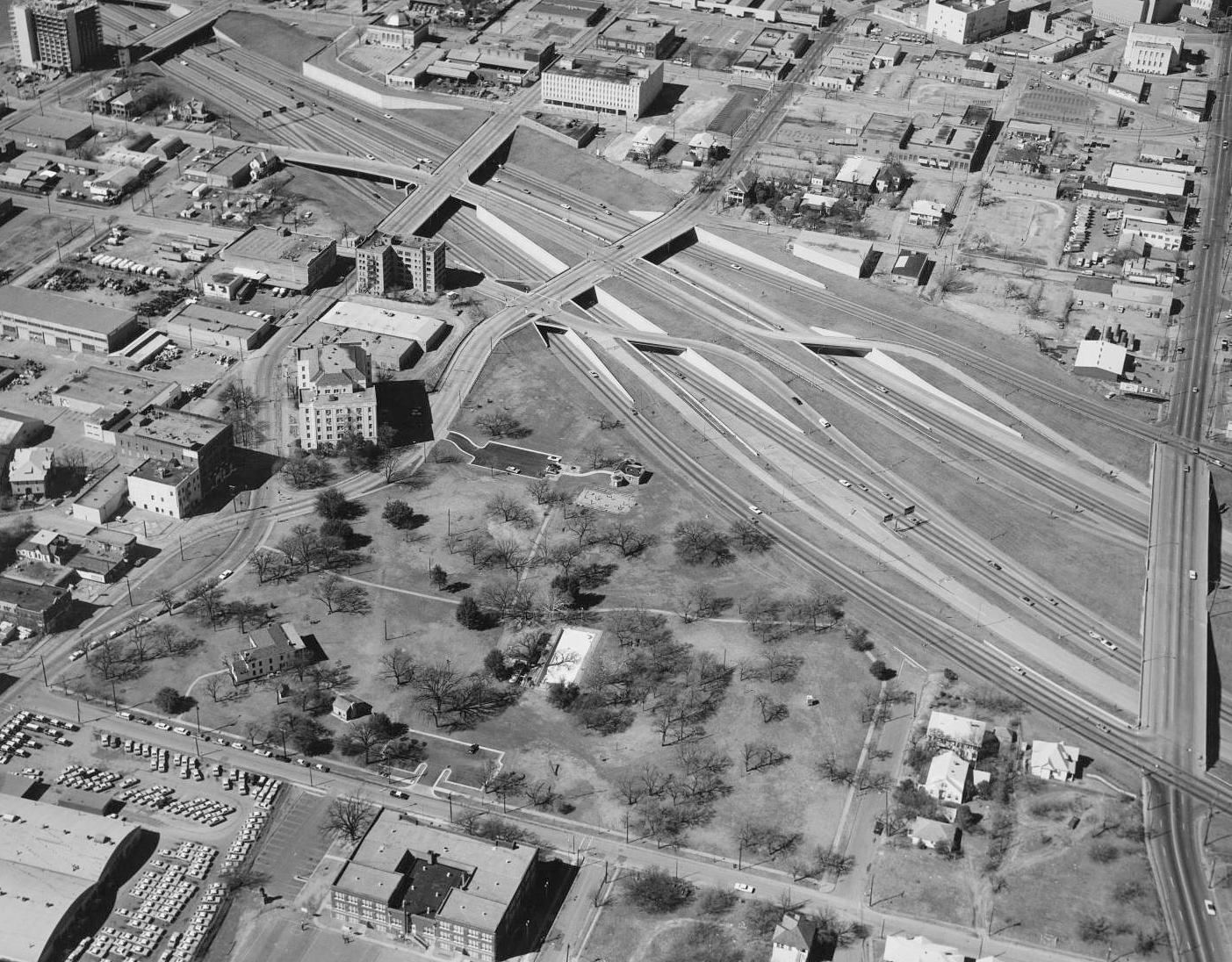
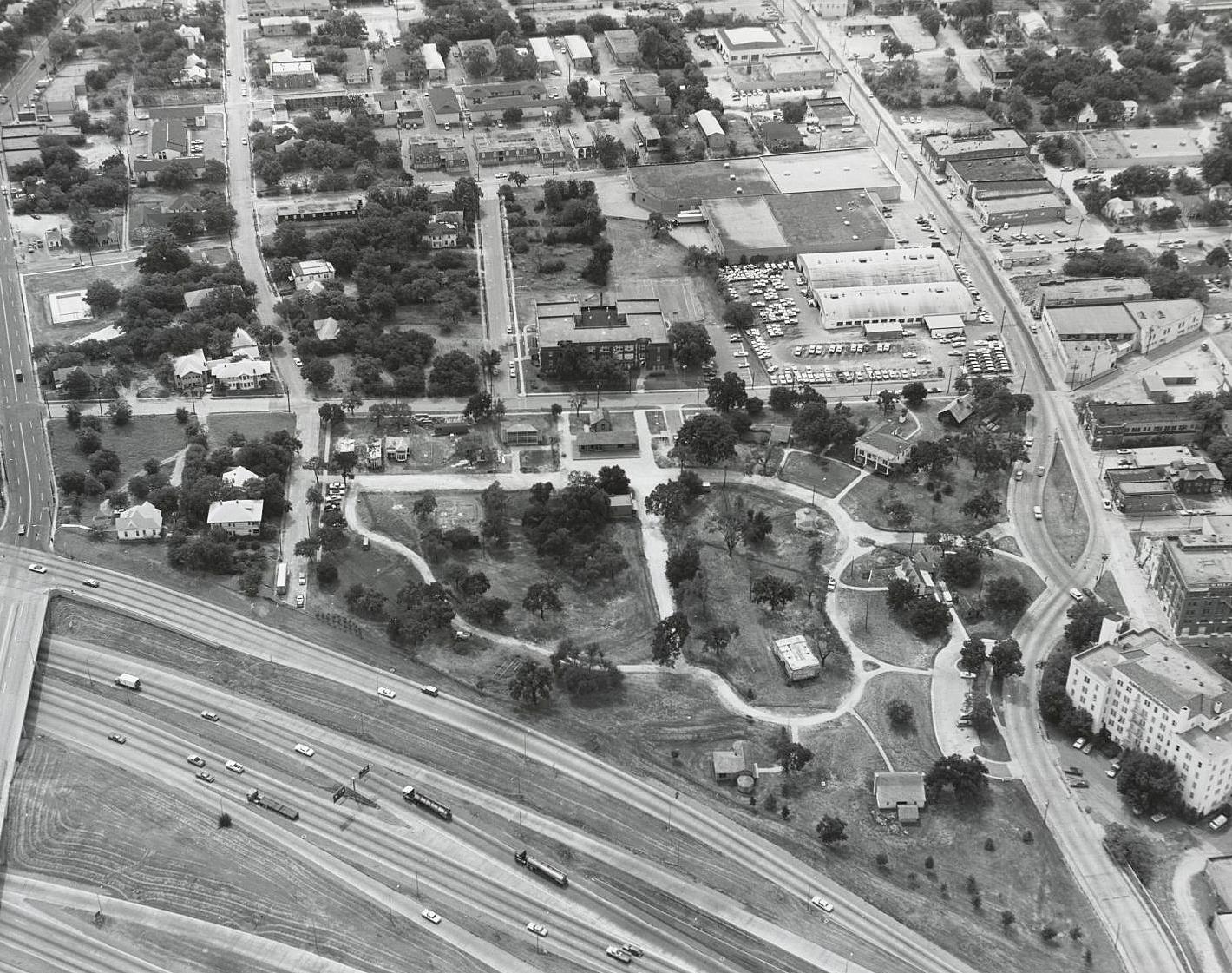
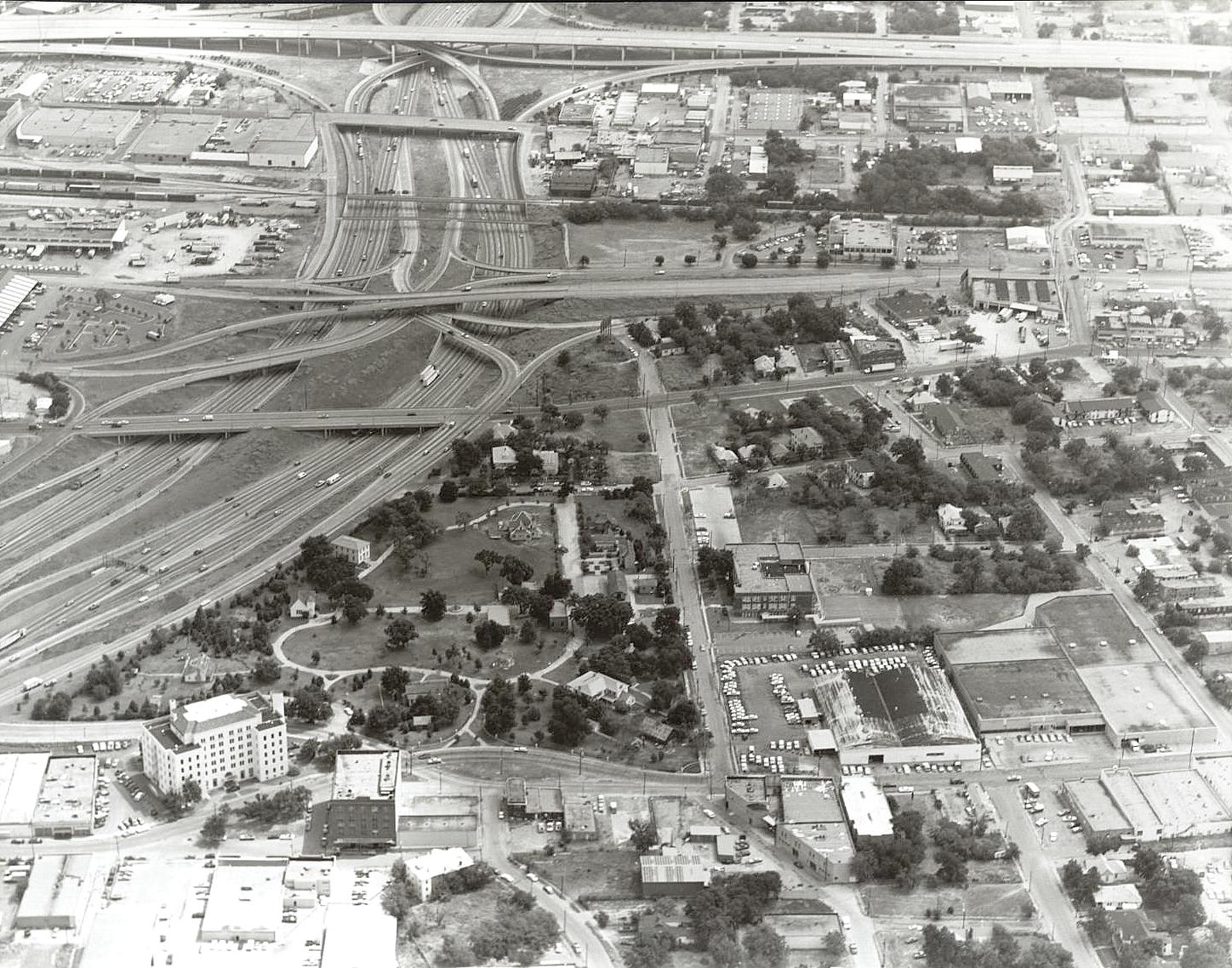
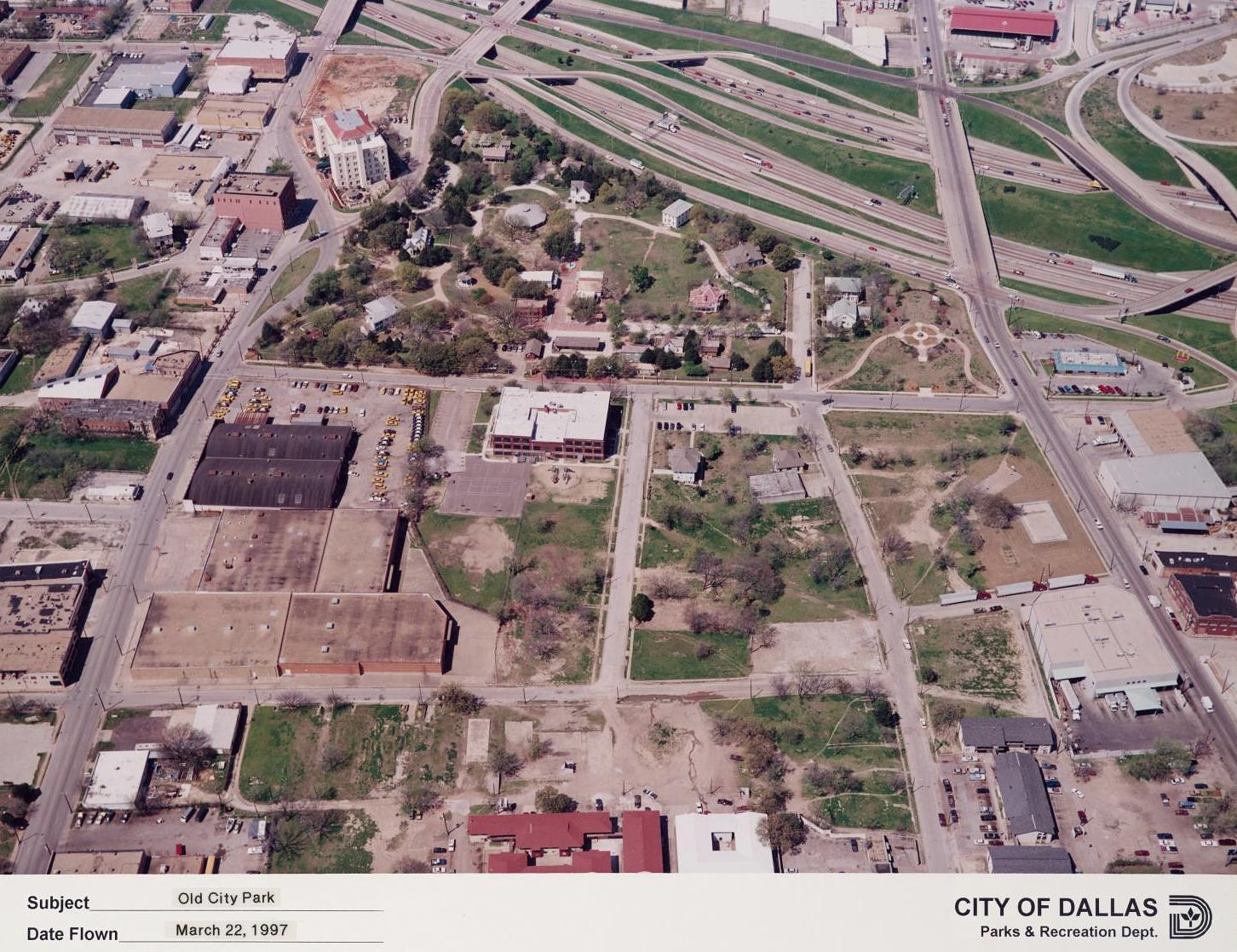
These eight aerial photos of City Park/Old City Park in The Cedars, just south of downtown, show the encroachment of an ever-increasing acreage of asphalt onto what was once the city’s most beautiful park. (All photos are from the Dallas Municipal Archives, and all are larger when clicked.) The one thing present in all photos is the late Ambassador Hotel (RIP).
Above, in 1948, before the cement mixers arrived (photo by Barnes Aerial Surveys).
Below, 1954.
Squire Haskins, Dallas Municipal Archives, 1954
1966:
Squire Haskins, Dallas Municipal Archives, 1966
1969:
Squire Haskins, Dallas Municipal Archives, 1969
1972:
Squire Haskins, Dallas Municipal Archives, 1972
1975:
Squire Haskins, Dallas Municipal Archives, 1975
Circa 1982:
Dallas Municipal Archives, ca. 1982
1997:
Reginald D. Loftin, Dallas Municipal Archives, 1997
Today-ish (or at least before the Ambassador burned down in May, 2019):
Google Maps
***
Sources & Notes
All photos are from the Dallas Municipal Archives Collection, via the Portal to Texas History; they can all be found here.
I had never seen footage of legendary Texas Ranger Manuel T. “Lone Wolf” Gonzaullas (1891-1977) until now. There is a short clip of him recounting a run-in with a man who shot him in WFAA-Channel 8 footage from March, 1970 (filmed at the Southwest Historical Wax Museum in Fair Park). Gonzaullas was a long-time resident of Dallas, from 1923 until his death in 1977, living for much of that time in Lakewood, in the 6900 block of Westlake.
*
Here are a couple of screenshots from the news footage. In the first he is seen standing in front of his wax figure.
And in the second, he’s joking with WFAA-Channel 8 News reporter Phil Reynolds, who seems a little star-struck.
*
Below are a few random Lone Wolf-related photos and articles. (There are tons of histories of Gonzaullas and the Texas Rangers out there — please hunt them down for specifics on his long and respected career in law enforcement. These are just a few things that I found interesting, some of which are of no historical importance!)
The earliest newspaper mention of Gonzaullas I could find was about his participation in an El Paso-to-Phoenix automobile road race in 1919. Biographers have noted that the colorful Gonzaullas sometimes embellished the truth, especially about his early days, and it’s interesting to note that in coverage of this race, Gonzaullas was described as being a “noted European racing driver” who had previously won 32 first-place finishes and 92 second-place finishes (!). The car he had entered in the race was a Locomobile, which he was reported to have driven to El Paso from Atlantic City. He was also identified as being “a Cuban […] who first won his spurs on the Havana track” (his birthplace is usually said to be Spain, where he was born to naturalized American citizens who were visiting that country at the time). He told the papers he had been left with temporary blindness and a permanently injured left arm in a previous auto accident — and another injury was about to come: he didn’t finish the El Paso-to-Phoenix race because his car suffered two debilitating mishaps, including one in which he was thrown from the car “and a blood vessel in his stomach was broken.” He was also said to be accompanied by “Mrs. Gonzaullas,” despite the fact that he did not marry Laura Scherer until April, 1920.
El Paso Times, Oct. 16, 1919 (click for larger image)
In December, 1919, Los Angeles newspapers reported that Mr. Gonzaullas, “who has gold mining interests in Mexico,” was in town, visiting from Havana. Accompanying him was “Mrs. Gonzaullas,” who was indulging in a shopping excursion. They were staying at the Hotel Stowell.
Los Angeles Evening Express, Dec. 3, 1919
While at the Stowell (and about to return to Texas), Gonzaullas put a for-sale classified in the Los Angeles paper, saying that he “must sell within next 24 hours my beautiful combination 2 or 4 passenger Locomobile Roadster Special.” The Cuban’s racing days would seem to be ending.
Los Angeles Evening Express, May 8, 1920
Less than two weeks later — and a month after finally marrying Laura in California — the newly wed Gonzaullas was back in El Paso, looking for a “lost or strayed” pet monkey. It appears the monkey was found (…or replaced…), but in September the Gonzaullases were selling their little “Java monkey,” along with its cage and traveling case. M. T. became “Lone Wolf” after he joined the Texas Rangers in 1920. Perhaps a monkey was not considered an appropriate pet for a lawman. (This is my favorite weird and obscure “Lone Wolf” tidbit.)
Gonzaullas was in and out of the Rangers throughout his career. In 1923, he moved to Dallas where he was stationed as a permanent prohibition agent (he busted a lot of booze-loving Dallasites).
Dallas Morning News, Feb. 25, 1923
In 1929, Gonzaullas was a sergeant in the Texas Rangers, and the photo below captured the first time that the men of Company B had all been together at the same time in the same place — in Fort Worth. The caption for this photo: “Texas’ Guardians, United After 10 Years. Capt. Tom R. Hickman, Gainesville, brought Ranger Company B together Friday for the first time in more than 10 years. Here they are just before visiting the Southwestern Exposition and Fat Stock Show. Left to right, W. H. Kirby, Abilene; H. B. Purvis, Lufkin; Captain Hickman; Sergt. M. T. Gonzaullas, Dallas; Dott E. Smith, Abilene; and James P. Huddleston, Dallas.” (Fort Worth Record-Telegram, March 16, 1929) (Read the full story, “Ranger Company B Rides In to Stock Show” here.)
Company B in Fort Worth, FW Record-Telegram, Mar. 16, 1929
In 1933, the Texas Rangers were dissolved, later to re-emerge as part of the newly formed Department of Public Safety in 1935. Gonzaullas served for several years as the head of the DPS’s Bureau of Intelligence in Austin, a Texas version of the FBI. In 1940, he stepped down from that position to rejoin the Rangers. He took over command of his old Company B, which was stationed in Fair Park, and remained in that position for 11 years until his retirement.
Austin Statesman, Feb. 14, 1940
Austin American, Feb. 15, 1940
In 1942, at the age of 50, Gonzaullas filled out a registration card during World War II, as all men were required to do. (A distinguishing physical characteristic of a “bullet hole thru left elbow” was noted.)
Below, a photo from 1944 showing mounted Texas Rangers of Company B in Marshall, Texas: (left to right) Tulley E. Seay, C. G. (Kelly) Rush, Stewart Stanley, Dick Oldham, Capt. M. T. Gonzaullas, R. A. (Bob) Crowder, Ernest Daniel, Joe N. Thompson, Robert L. Badgett, and Norman K. Dixon.
Capt. Manuel Trazazas Gonzaullas retired in July, 1951 and traveled between Dallas and Hollywood where he worked as a consultant on Western TV shows and films. He died in Dallas on Feb. 13, 1977 at the age of 85.
The first three images are screenshots of WFAA-Channel 8 news film shot in March, 1970, from the WFAA Collection, G. William Jones Collection, Hamon Arts Library, Southern Methodist University; the footage can be viewed on YouTube here.
A brief biography of M. T. Gonzaullas can be found at the Handbook of Texas, here.
There were several comprehensive and entertaining articles and interviews which appeared around the country about Gonezaullas’ career when he retired. If you have access to newspaper archives, I would recommend the article “The ‘Lone Wolf’ Lays Down His Guns” by Don Hinga which appeared in The St. Louis Post-Dispatch on July 22, 1951.