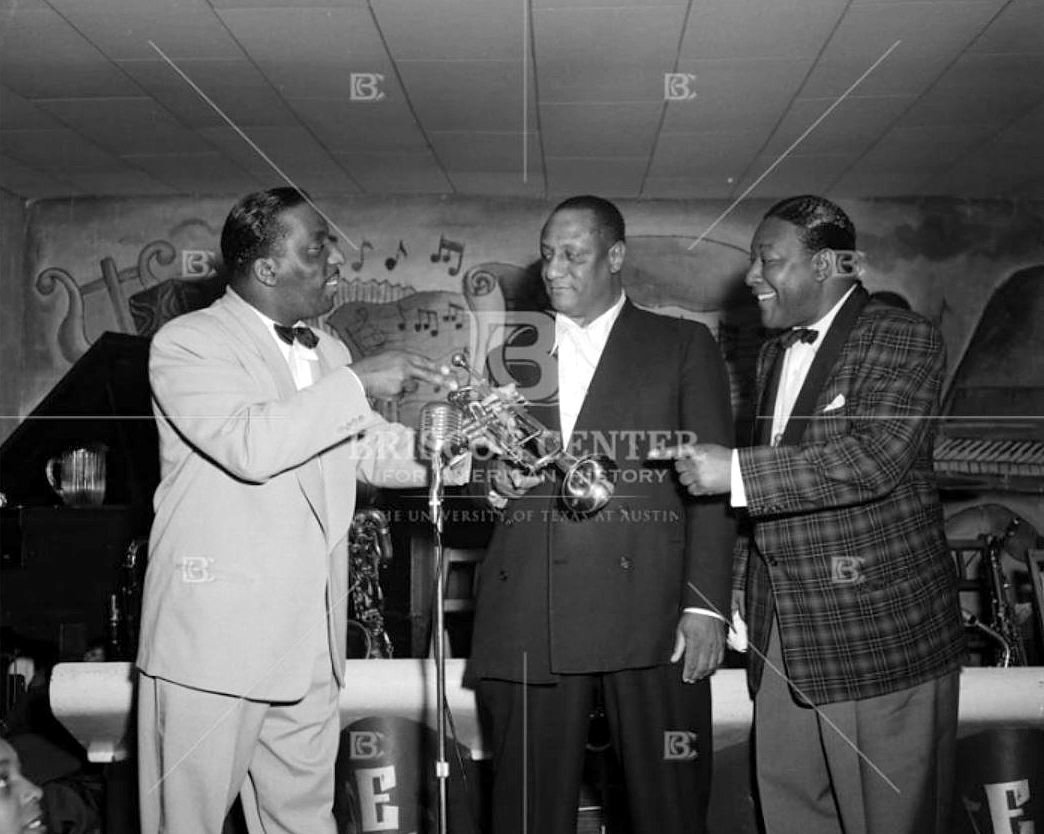
Flashback : Dallas

A Miscellany: History, Ads, Pop Culture

Category: Modern Ads

Halloween Party? Don’t Forget the Dr Pepper! — 1947
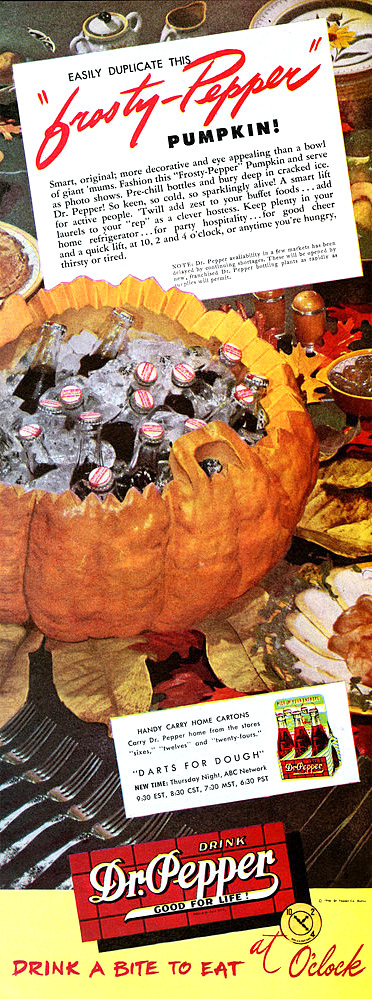
dr-pepper_halloween_1947_flickr“‘Twill add zest to your buffet foods…”

by Paula Bosse

(While searching for a Halloween advertisement, I unexpectedly came across reports of a federal grand jury case brought against Dallas-based Dr Pepper for violating strict wartime sugar-rationing. Scroll down to read about the legal case.)

Happy Halloween! Might I propose an eye-catching party suggestion? The “Frosty-Pepper Pumpkin”! Hollow out a pumpkin, fill it with cracked ice, and load it up with bottles of Dr Pepper. Voilà!

The text of the ad, from the fall of 1947:

EASILY DUPLICATE THIS “frosty-Pepper” PUMPKIN!

Smart, original; more decorative and eye appealing than a bowl of giant ‘mums. Fashion this “Frosty-Pepper” Pumpkin and serve as photo shows. Pre-chill bottles and bury deep in cracked ice. Dr. Pepper! So keen, so cold, so sparklingly alive! A smart lift for active people. ‘Twill add zest to your buffet foods … add laurels to your “rep” as a clever hostess. Keep plenty in your home refrigerator … for party hospitality … for good cheer and a quick lift, at 10, 2 and 4 o’clock, or anytime you’re hungry, thirsty or tired. 

NOTE: Dr Pepper availability in a few markets has been delayed by continuing shortages. These will be opened by new, franchised Dr. Pepper bottling plants as rapidly as supplies will permit.

HANDY CARRY HOME CARTONS
Carry Dr Pepper home from the stores 
“sixes,” “twelves” and “twenty-fours.”
 
“DARTS FOR DOUGH”
NEW TIME: Thursday Night, ABC Network
9:30 EST, 8:30 CST, 7:30 MST, 6:30 PST

Drink Dr. Pepper
GOOD FOR LIFE!

DRINK A BITE TO EAT at 10, 2 and 4 o’clock

***

Sources & Notes

Ad found on Flickr, here.

“Darts for Dough”? I had to look that up. It was a radio game show involving quizzes and dart-throwing, created by Orval Anderson and Bert Mitchell at WFAA radio. It debuted in the summer of 1943 as a strictly local program, but it’s popularity was such that it moved to Hollywood in August, 1944 and — still run by the WFAA creators — it began to be broadcast “coast to coast” for several years, moving to television by 1950. It was originally developed in Dallas as a sponsorship vehicle for Dallas-based Dr Pepper and was frequently advertised as “Darts for Dough — The Dr Pepper Show.”

1947 was a big year for Dr Pepper — that was the year their beautiful (and sorely missed) plant opened at Mockingbird and Greenville.
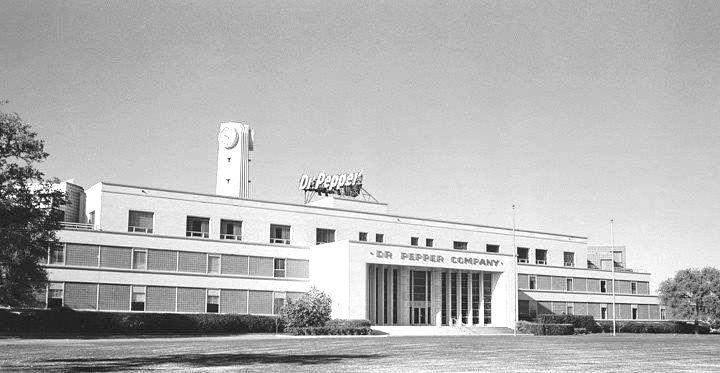
dr-pepper-plant_pinterest

1947 was also a noteworthy year for the company, because of a large federal grand jury indictment which charged several corporations and individuals — including Dr Pepper and some of its bottlers and employees — with sugar-rationing violations (these “irregularities” appear to have begun in the last months of World War II, when wartime food rationing was still serious business). Black-market sugar! A district representative of Dr Pepper was assessed a small fine, but charges of conspiring to violate sugar-rationing regulations which were brought against the DP parent-company were ultimately dismissed, a ruling which angered Federal Judge Alfred P. Murrah, who seems to have been extremely unhappy about the dismissals, as can be read in his blistering statement below.
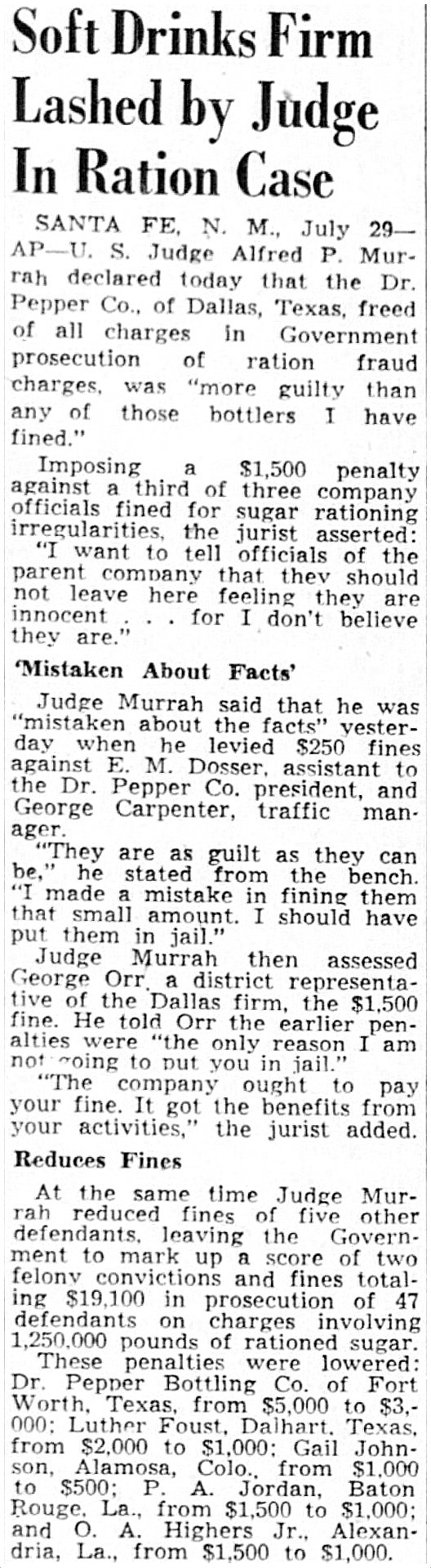
dr-pepper_sugar-rationing-case_waco-news-tribune_073047
AP story, via Waco News-Tribune, July 30, 1947

Two of the individuals charged in the case — New Mexico residents — received prison sentences in what was described as “the largest black market sugar operation on record,” involving over a million pounds of sugar.

This “Happy Halloween!” post took a bit of an unexpected dark detour. Let’s cleanse our palate with something happier: another party idea with Dr Pepper and a hollowed-out pumpkin (found on eBay).
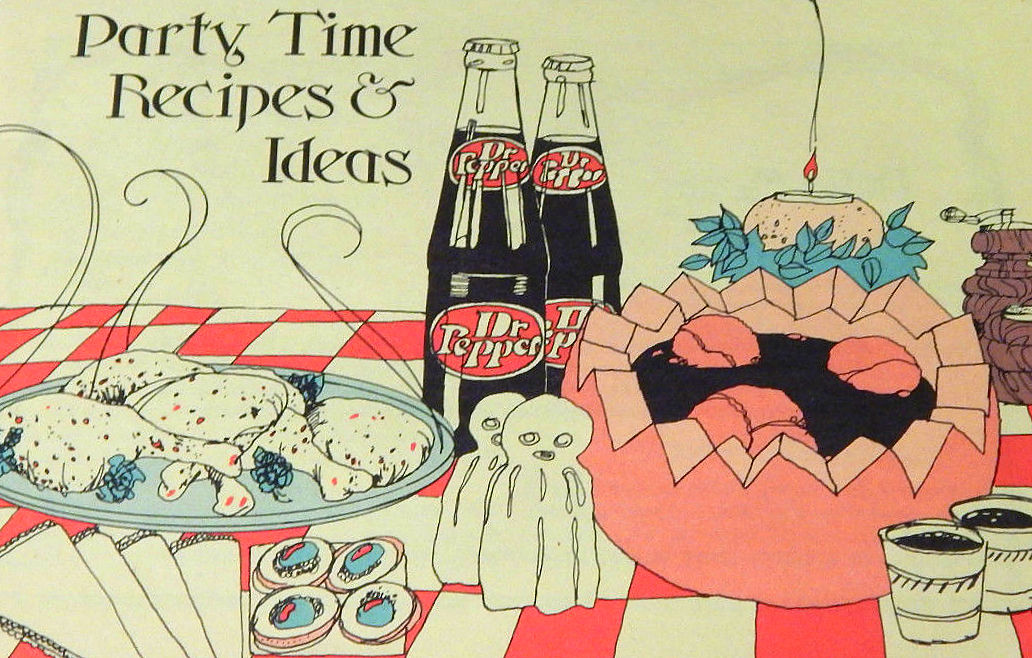
halloween_dr-pepper_booklet_ebay

More Halloween posts from Flashback Dallas can be found here.

*

Copyright © 2017 Paula Bosse. All Rights Reserved.
 

Neiman-Marcus Welcomes You to the Fair with Jeweled Mementos and Picasso Paintings — 1948

n-m_picasso_1948_fair_jewelryN-M’s 1948 “mementos of Texas…” (click for larger image)

by Paula Bosse

For many who come to Dallas from all across the state to visit the State Fair of Texas, a trip downtown to see the legendary Neiman Marcus department store is a must-see item on the itinerary. This was perhaps more the case years ago when the store was still owned by members of the Marcus family who were eager boosters of the annual event and placed several ads each year which graciously welcomed State Fair visitors to the city. For many years Neiman’s offered “souvenirs” for the tourists, ranging from relatively inexpensive Texas-centric knick-knacks to very expensive Texas-centric knick-knacks.

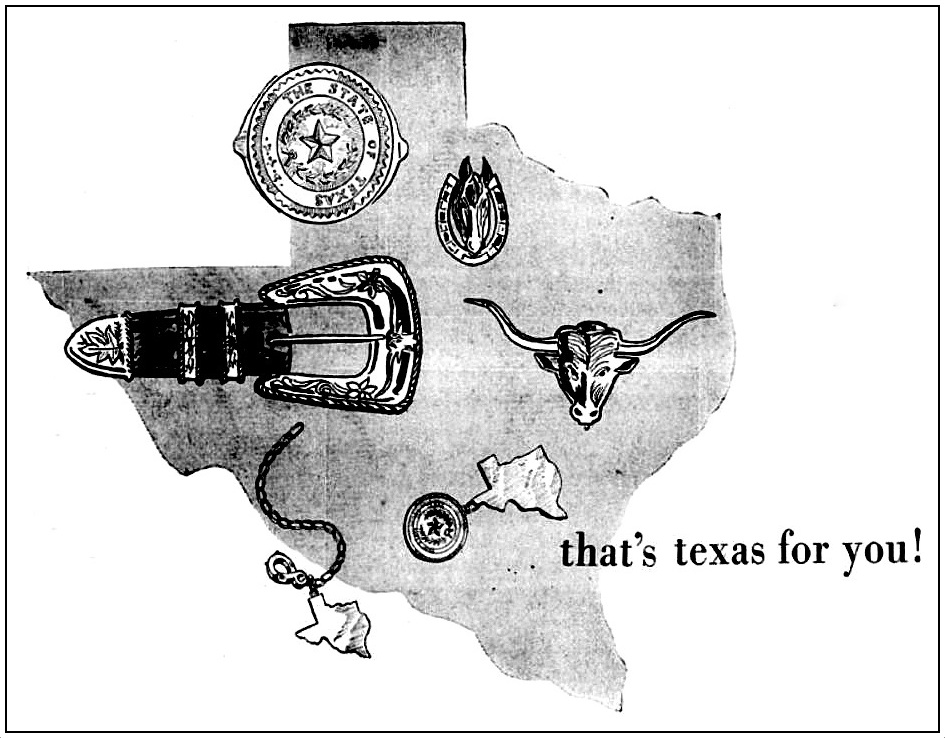
The 1948 N-M offerings can be seen below in an ad that boasts “A 14K gold welcome to Dallas and the State Fair!” (Click the ad below to see a larger image — to see an image of the ad copy alone, click here.)

ad-neiman-marcus_state-fair_1948_full

Here are the trinkets which no doubt wowed them back home in the nicer neighborhoods of Houston and Midland. (I’ve included ball-park prices in today’s money– according to the whiz-bangy Inflation Calculator — in parentheses.)

  • Texas Seal containing circular knife and file: $55 (about $550 in today’s money)
  • Gold belt buckle, made to order: $325 ($3,300)
  • Hand-tooled belt: $5 ($50)
  • Scarf clip, horse with ruby eyes and ruby studded collar: $500 ($5,100)
  • Hand-carved scarf pin, gold steer head with ruby eyes: $500 ($5,100)
  • Pocket key chain with Texas charm: $45 ($450)
  • Texas chain and Texas seal cuff links: $80 ($800)

For the cheap monogrammed hats, giant sunglasses, and salt water taffy, you’d have to head to Fair Park.

Another attraction at Neiman’s during the 1948 State Fair of Texas was an art exhibit: the first showing in Texas of original works by Pablo Picasso. The exclusive show was specifically scheduled to coincide with the State Fair and was prominently displayed on the 4th Floor of the store, in the Decorative Galleries. Twelve canvases — some never before seen in the United States — were “secured directly from Picasso’s studio at Antibes in Southern France,” via Samuel M. Kootz, Picasso’s rep in the U.S. Think about that for a second: in 1948 Pablo Picasso was the world’s most famous living artist, and there was an exhibit of his recent works — some never before seen in the United States — in a department store. In Texas. That was, as they say, a pretty good “get” for the soon-to-be President of the company, Stanley Marcus.

The Picasso exhibit was an early example of Neiman-Marcus’ dedication to bringing international arts and culture to Dallas — an idea which later manifested itself in the store’s Fortnight celebrations (which also ran to coincide with the State Fair in order to maximize publicity, foot traffic, and sales).

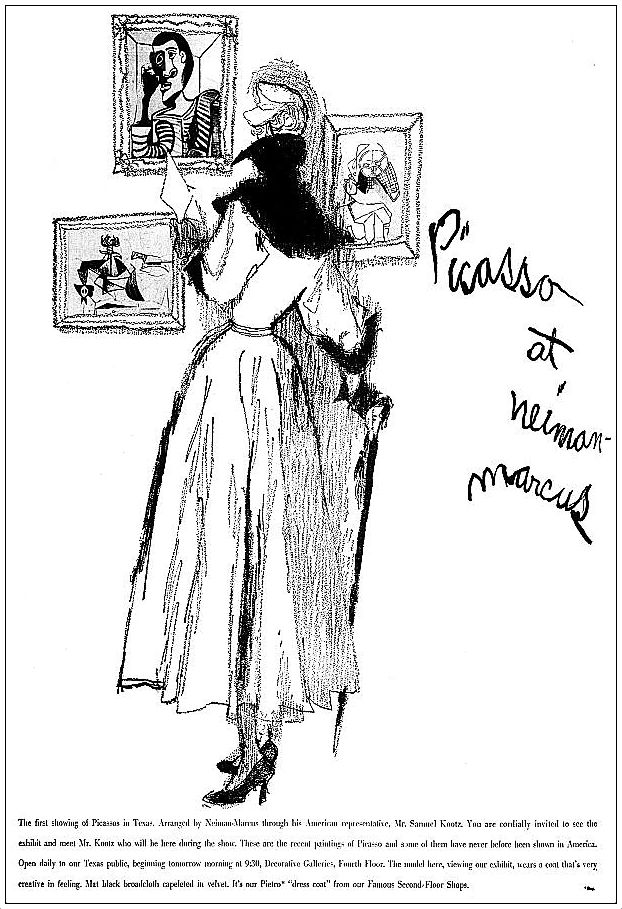
Stanley Marcus was an experienced buyer of art, and his relationship with Mr. Kootz was obviously warm — how else might one explain the inclusion of redrawn Picasso paintings (all of which appeared in the N-M show) in a store advertisement? Pretty ballsy. (Click ad below to see a larger image — the text alone can be seen larger here.)

picasso_n-m_1948

For those who might be interested, these are the first Picasso paintings ever publicly shown in Texas:

  • “Seated Woman” (1929)
  • “Sailor” (1943)
  • “Still Life with Mirror” (1943)
  • “Head” (1944)
  • “Still Life with Skull and Pitcher” (1945)
  • “Cock and Knife” (1947)
  • “Woman” (1947)
  • “Still Life with Coffee Pot” (1947)
  • “Owl and Arrow” (1947)
  • “Concierge’s Daughter with Doll” (1947)
  • “Blue Owl” (1947)
  • “The Glass” (1947)

Another art-world highlight in Dallas during the 1948 State Fair of Texas was the showing of Salvador Dali’s painting “Spain” at the Dallas Museum of Fine Arts in Fair Park (from the collection of Edward James, loaned by the Museum of Modern Art in New York). A Dallas Morning News headline — “Fair Interest to Divide Over Picasso and Dali” — seemed to imply that culturally-inclined Dallasites and/or fair-goers would have to choose one over the other in the battle of which famous Spanish artist-celebrity was most worthy of their attention: “Team Pablo” vs. “Team Salvador.” In regard to Dallas and its (somewhat late-blooming) openness to modern art, the first sentence of the article is interesting:

The simultaneous presence in Dallas during the period of the State Fair of Texas of original works by two of the world’s best-known living artists underscores heavily the swift progress toward cultural maturity in local thinking and planning. (Rual Askew, DMN, Oct. 3, 1948)

“Cultural maturity” and planning — both were in evidence in Dallas in the fall of 1948.

Thousands of Texans had their very first in-the-flesh glimpse of a Picasso canvas or a Dali painting in Dallas during the 1948 State Fair of Texas — either at a tony department store that sold $500 gold-and-ruby scarf pin “souvenirs,” or amongst the hot-dog-eating and roller-coaster-riding hoi polloi in Fair Park. That’s a pretty good reach for fine art.

It’s not all about the automobile shows!

***

Sources & Notes

Ads from October, 1948.

Click pictures to see larger images.

*

Copyright © 2017 Paula Bosse. All Rights Reserved.


Titche’s Discovers the Suburbs — 1961-1968

titches_dallas-stores_1969-directoryTitche’s has you covered… (click to see larger image)

by Paula Bosse

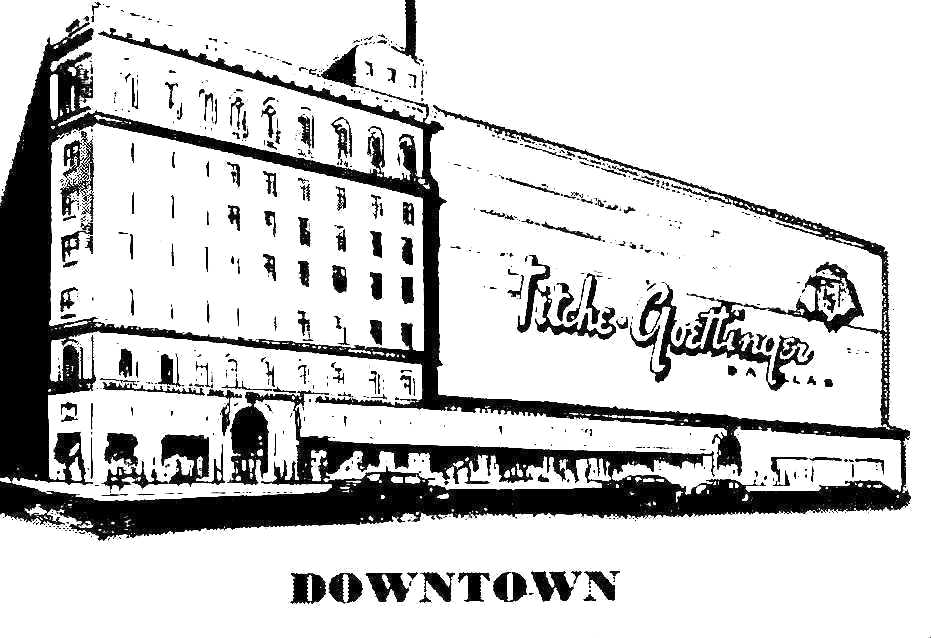
Edward Titche and Max Goettinger founded the Titche-Goettinger department store in Dallas in 1902, and in 1904 they moved into the new Wilson Building. In the late 1920s they built their own George Dahl-designed building at Main and St. Paul, which was greatly enlarged and expanded in 1955. The store was popular with downtown shoppers, and profits continued to rise. The next logical step was to open additional stores. It took a while (59 years), but in October, 1961 they opened three — three! — new suburban stores. How was that possible? Because Titche’s (or their then-parent company) purchased the Fort Worth department store chain The Fair of Texas, and several of its stores were re-christened as Titche’s stores (the others eventually became Monnig’s stores).

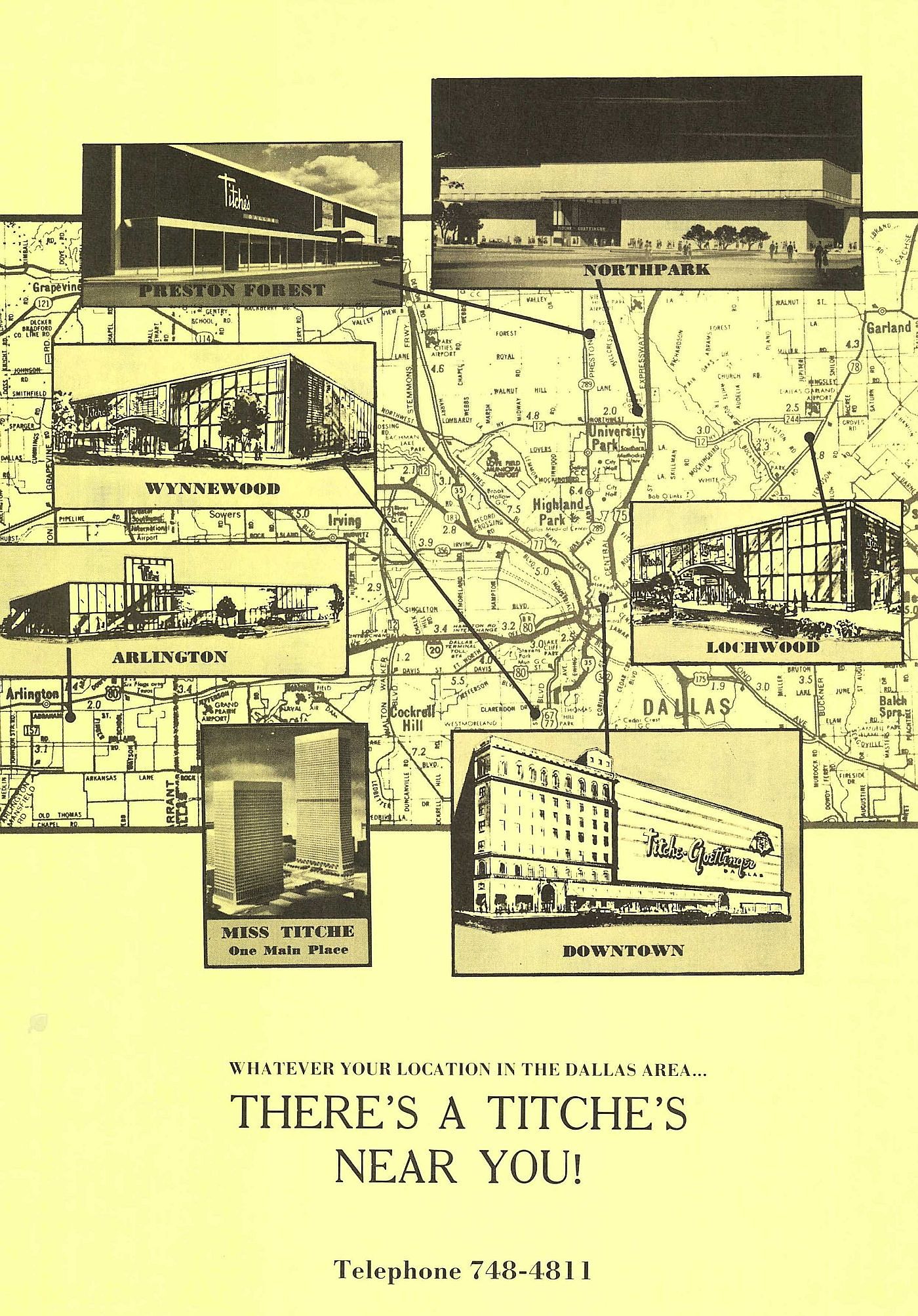
The ad above is from the 1969 Dallas city directory and shows that by 1969, there were seven Titche’s stores in the Dallas area. Titche’s bit the dust decades ago, and I have to admit that the only Titche’s store I actually remember ever being in was the one in NorthPark (and I might mostly be remembering Joske’s…). I had no idea about any of these other stores (other than the one at Main and St. Paul, which I wish I had been to!).

*

The oldest store in the ad above was the one on Main at St. Paul, still standing, still looking good (but, sadly, with that fab logo gone forever).

titches_1969-directory_downtown

*

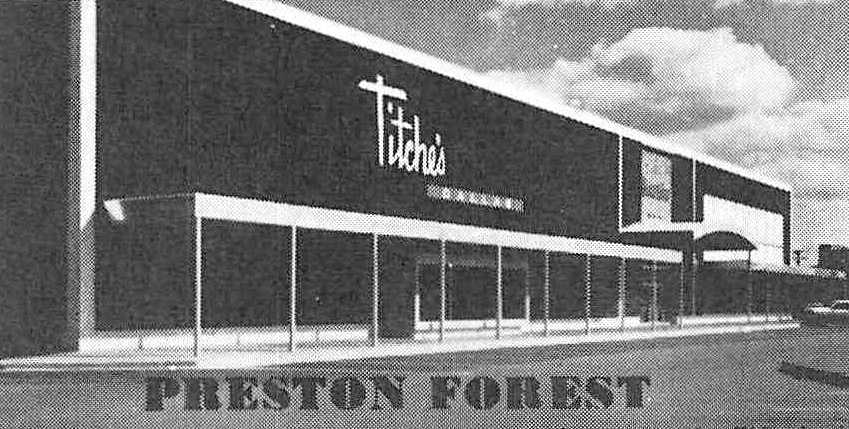
The second store was located in North Dallas in the Preston Forest Shopping Center, at the southeast corner of Preston Road and Forest Lane. When this opened as Titches’ first suburban store, the paint must still have been wet. It was originally built as a Fair of Texas store, with its opening scheduled for August, 1961. It was opened in October, 1961 as a Titche’s store — remodeled from the original Amos Parrish Associates of New York design (seen here, in a rendering). (The Fair version was much more interesting!)

titches_1969-directory_preston-forest

*

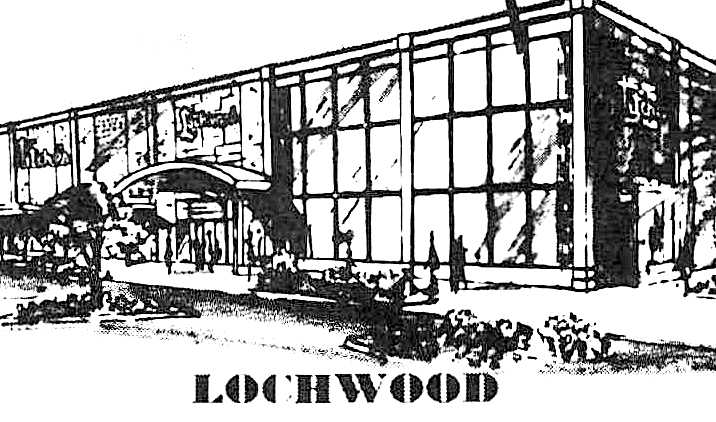
One week later (!), the next two stores opened on the same day: in the Wynnewood Shopping Village in Oak Cliff, and in the Lochwood Shopping Village on Garland Road in far East Dallas. These two stores had been Fair stores and had opened at the same time in August, 1960. The two drawings below look pretty much the same as the rendering of the pre-remodeled Preston Forest store (all designed by Amos Parrish Assoc.). (An interesting tidbit about the Lochwood location: when this store was built by The Fair of Texas — a department store with Fort Worth roots going back to the 1880s or 1890s — it was the first Fair store in Dallas. In honor of this hands-across-the-prairie moment of business expansion, a truckload of Fort Worth dirt was brought over and “mixed symbolically” with Dallas dirt at the 1959 Lochwood groundbreaking.)

titches_1969-directory_lochwood

titches_1969-directory_wynnewood

*

The Arlington store was also a former Fair store; it opened as Titche’s in July, 1963.

titches_1969-directory_arlington

*

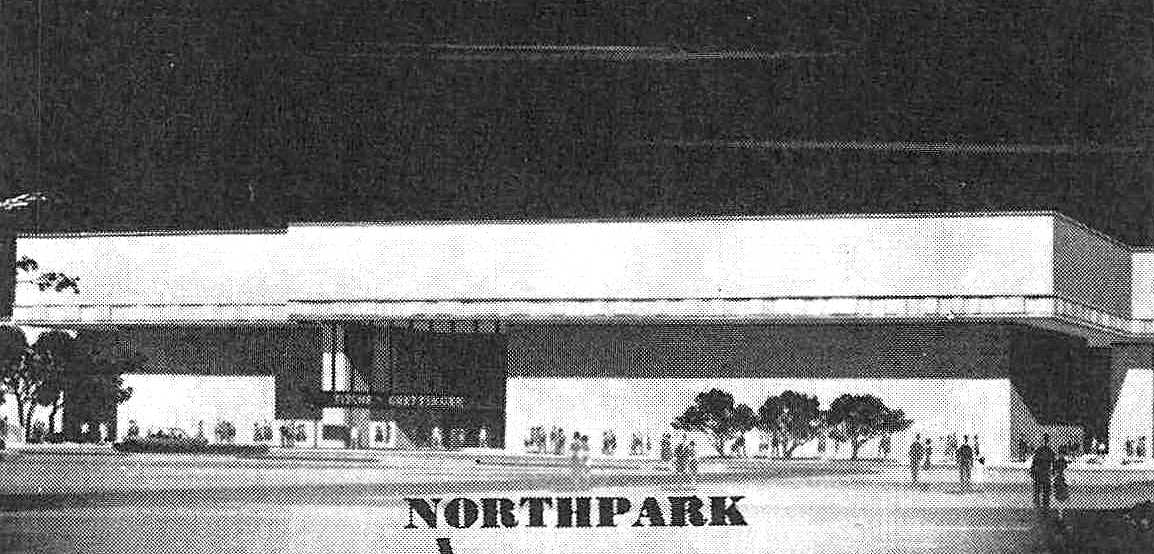
The NorthPark store — which occupied a quarter of a million square feet — was one of the first five stores to open in the brand new mall, in July 1965. NorthPark Center is known for its wonderfully sleek, clean, no-nonsense modern architecture (as seen below), but an early proposed Titche’s rendering from 1962 (seen here) looks a little fussy.

titches_1969-directory_northpark

*

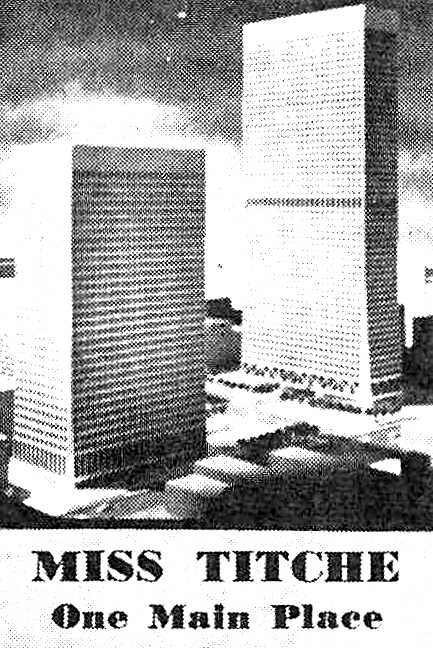
And, lastly, in this 1960s wave of expansion, a second downtown Dallas location was opened in the new One Main Place in December, 1968 in the form of “Miss Titche,” a concept-store created to appeal to “career girls” who worked downtown and enjoyed shopping during their lunch hours. It was located on the “plaza level” which sounds like it might have been part of the then-new underground tunnel system of shops. If newspaper ads are anything to go on, it looks like Miss Titche managed to hang on until at least 1975.

titches_1969-directory_one-main-place

*

Titche’s continued opening new stores into the 1970s, but in August, 1978, it was announced that Titches’ parent company, Allied Stores Corp., was changing the names of all Dallas-area Titche’s stores to “Joske’s.” The nine Titche’s stores operating until the changeover were the flagship store downtown, Preston Forest, Lochwood Village (which became The Treehouse in 1974), Wynnewood, Arlington, NorthPark, Town East, Irving, and Red Bird.

And, just like that, after 72 years, the name of one of Dallas’ oldest department stores vanished.

titches_logo_1963

***

Sources & Notes

Ad and details from the 1969 Polk’s Greater Dallas City Directory.

More on Titche-Goettinger can be found at the Department Store Museum, here.

Images larger when clicked.

*

Copyright © 2017 Paula Bosse. All Rights Reserved.
 

Weber’s Root Beer Stands: “Good Service with a Smile”

webers-root-beer_traces-of-texasFeeling parched?  (click for larger image)

by Paula Bosse

I’ve heard of these legendary root beer stands from family members, but, sadly, I missed their heyday, which seems to stretch from the 1920s to the 1950s. The photo above was taken around 1940 in Dallas at an unknown location. (The 1940 Dallas directory lists only two stands that year: at Greenville and Richmond — currently a 7-Eleven — and at 1119 N. Zang.)

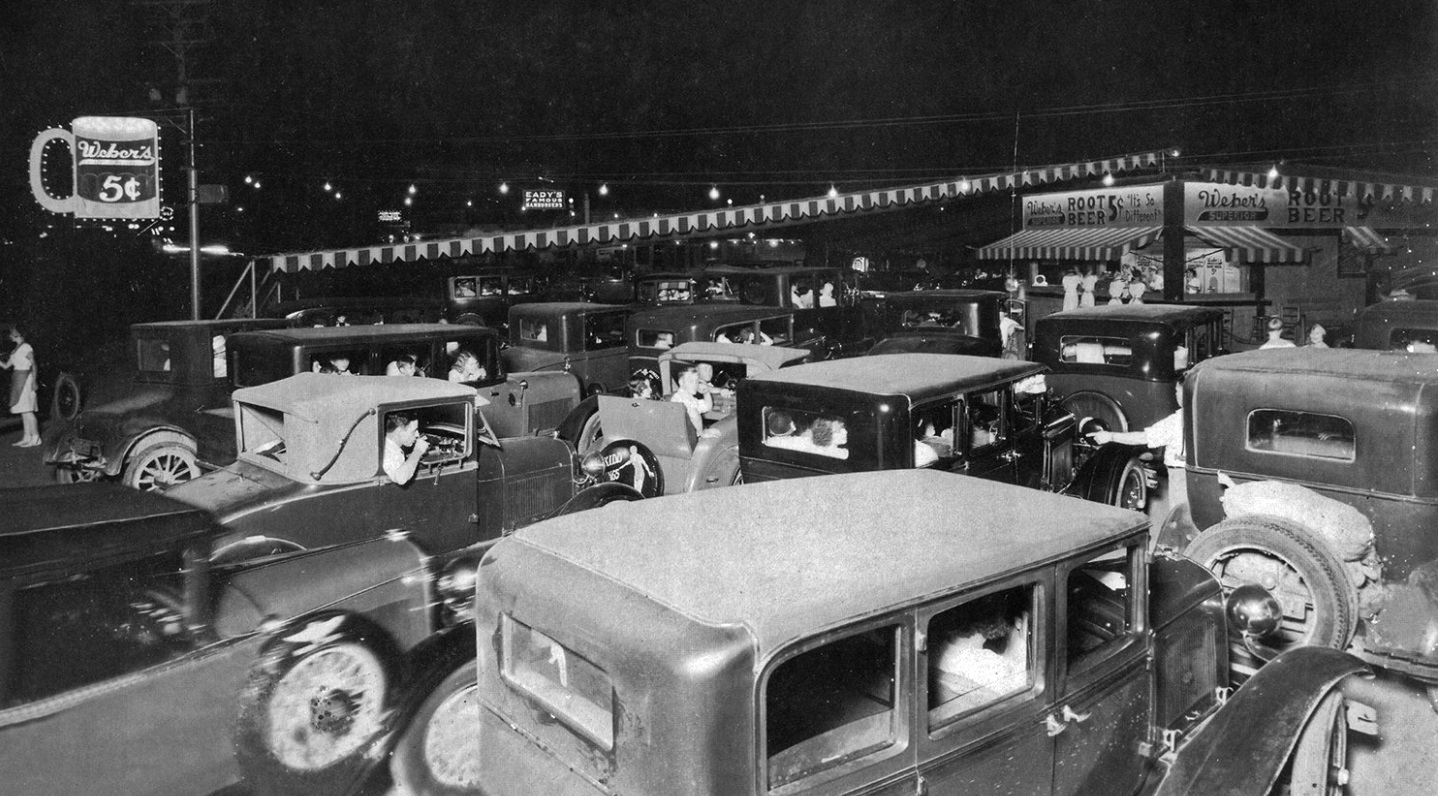
Here’s another photo, this one from 1930, taken at night, with a jam-packed lot filled with thirsty teenagers, rumble seats, and future jalopies.

webers_root-beer_traces-of-texas

In the photo above, a sign for Eady’s Famous Hamburgers can be seen in the background. This would seem to indicate that this photo was taken at one of the two locations where both Eady’s and Weber’s were neighbors: in Oak Cliff in the 1100 block of Zang, or near the Lower Greenville intersection of Greenville and Richmond. So it’s possible the two photos were taken at the same Weber’s Root Beer stand.

“It’s So Different”

ad-webers-root-beer_1930-dallas-technical-high-school-yrbk_frank-rogers

***

Sources & Notes

Top photo appeared on the fantastic Facebook page Traces of Texas. It was submitted by reader Shelly Tucker showing her aunt (second from left) working as a Weber’s carhop around 1940.

The second photo is from Traces of Texas’ Twitter feed; the source is unknown.

Ad is from the 1930 yearbook of the Dallas Technical High School (later named Crozier Tech); the photo is by the always-busy Dallas photographer, Frank Rogers.

*

Copyright © 2017 Paula Bosse. All Rights Reserved.
 

The Square Dancing Craze in Big D — Late 1940s

calamity-jane_premiere_-sam-bass_majestic-theatre_july-1949Hoedown at the Majestic, 1949…

by Paula Bosse

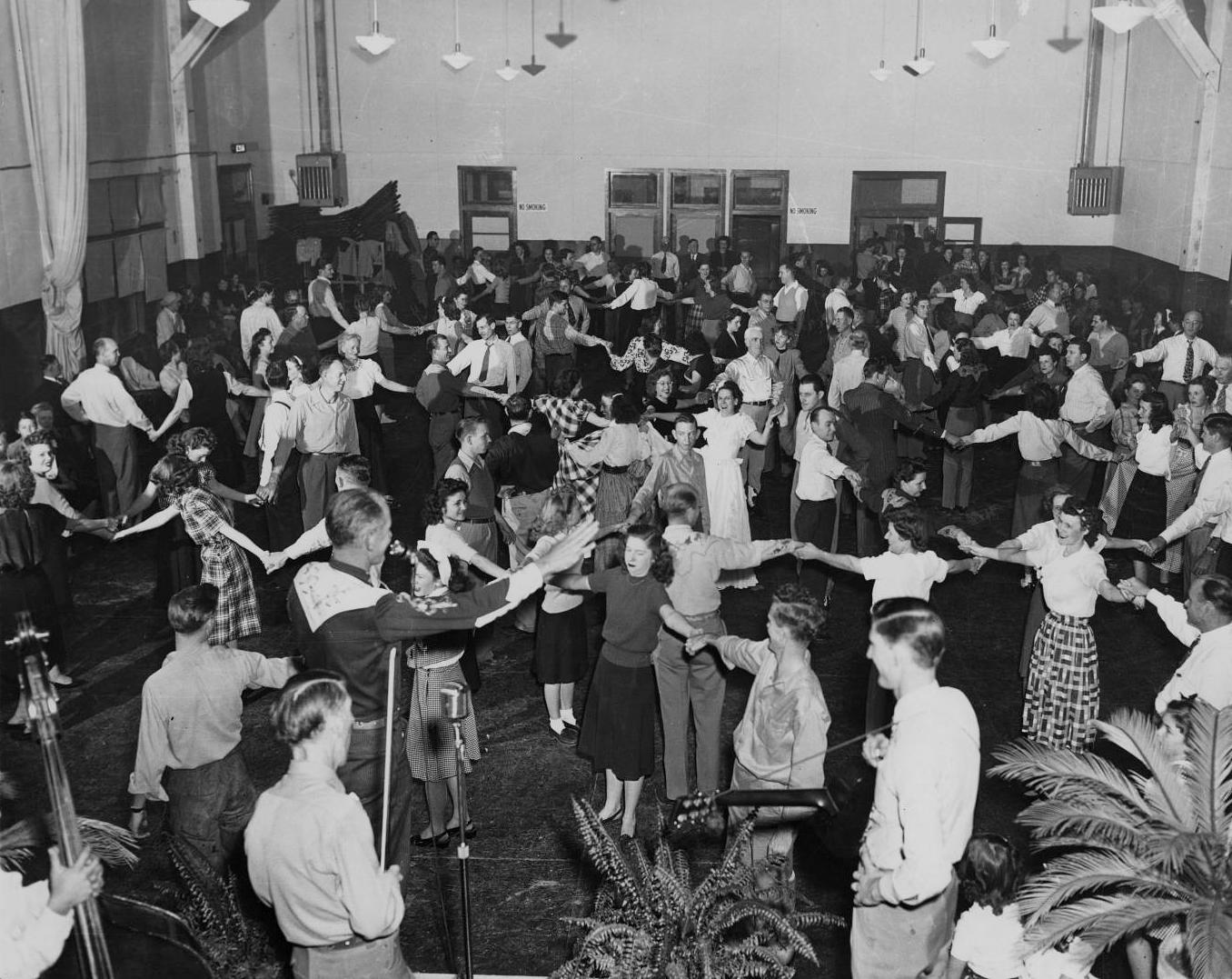
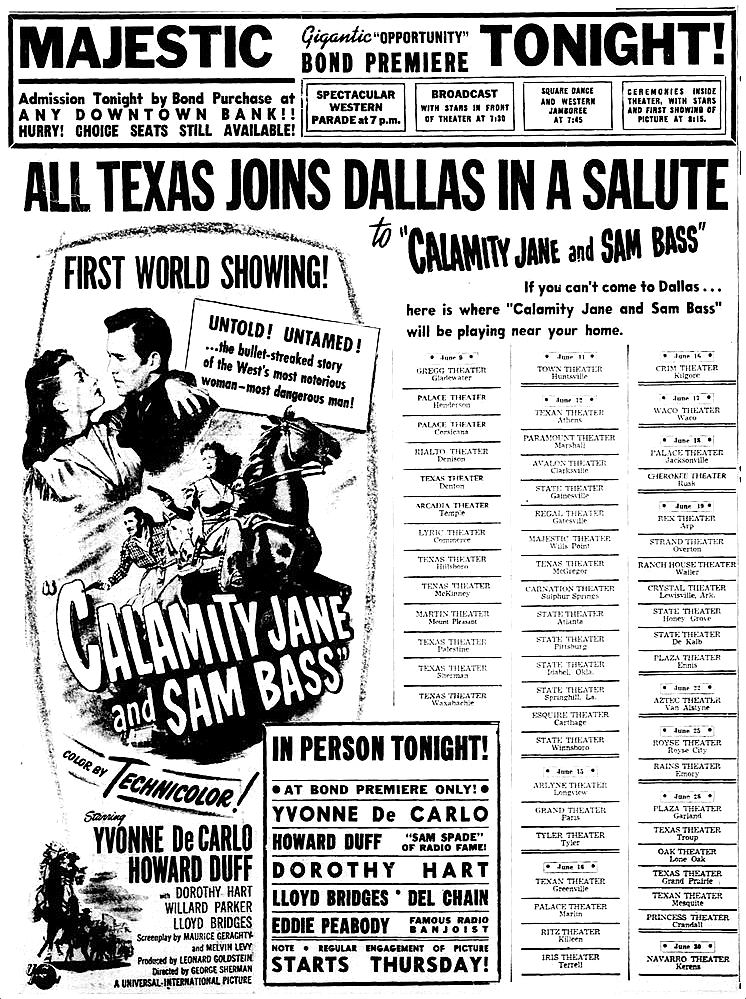
The photo above appeared in a show-biz trade publication showing part of the festivities which swirled around the world premiere of the movie “Calamity Jane and Sam Bass” starring Yvonne DeCarlo and Howard Duff at the Majestic Theatre on June 8, 1949. Several of the film’s stars made personal appearances and were made honorary deputies by Sheriff Bill Decker, sworn in by Judge Lew Sterrett (yes, Lily Munster was an honorary Dallas deputy sheriff!). There was a parade, a live show performed by the actors on the Majestic’s stage before the movie, a block party, and square dancing in Elm Street, with music provided by the Big D Jamboree band.

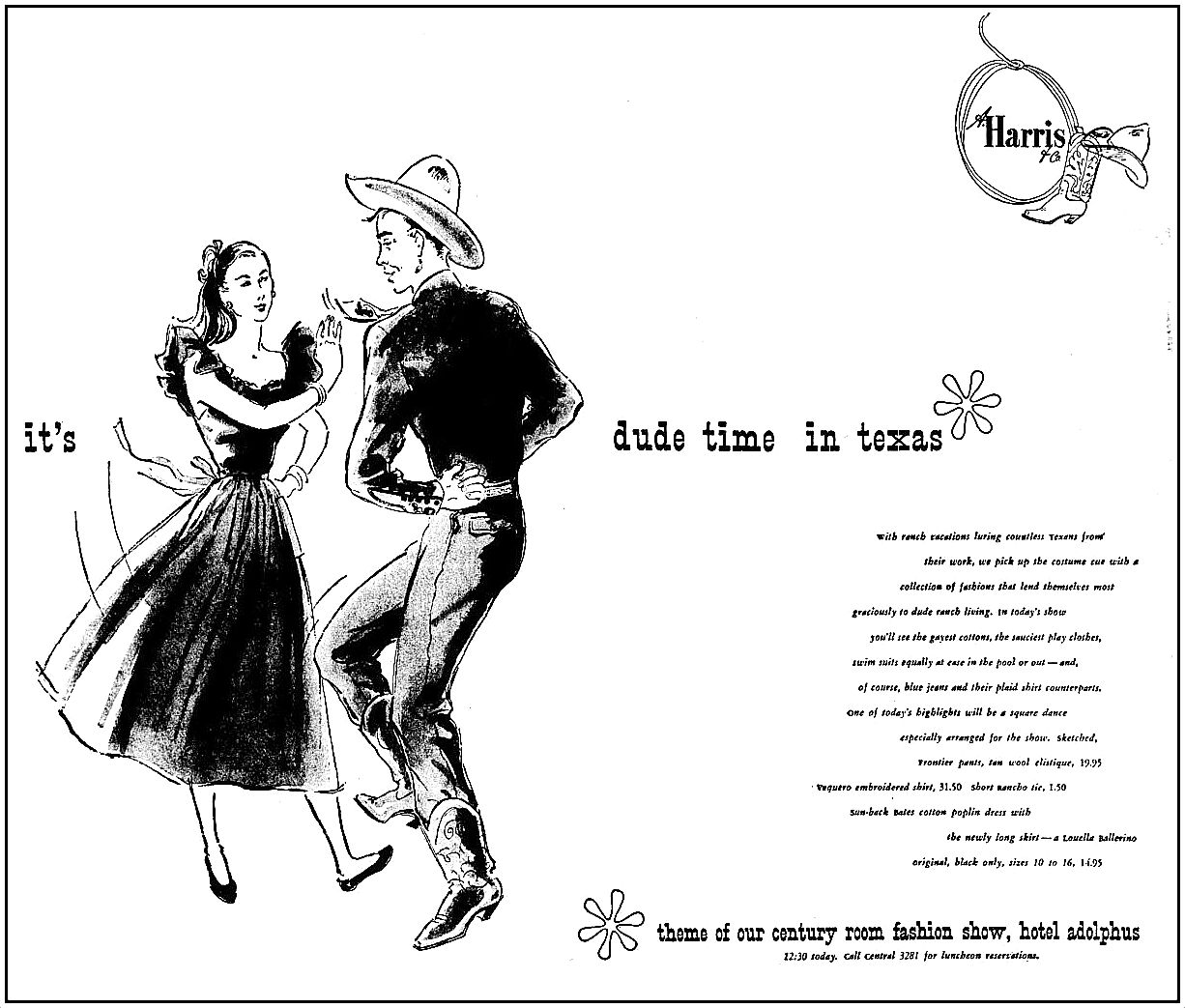
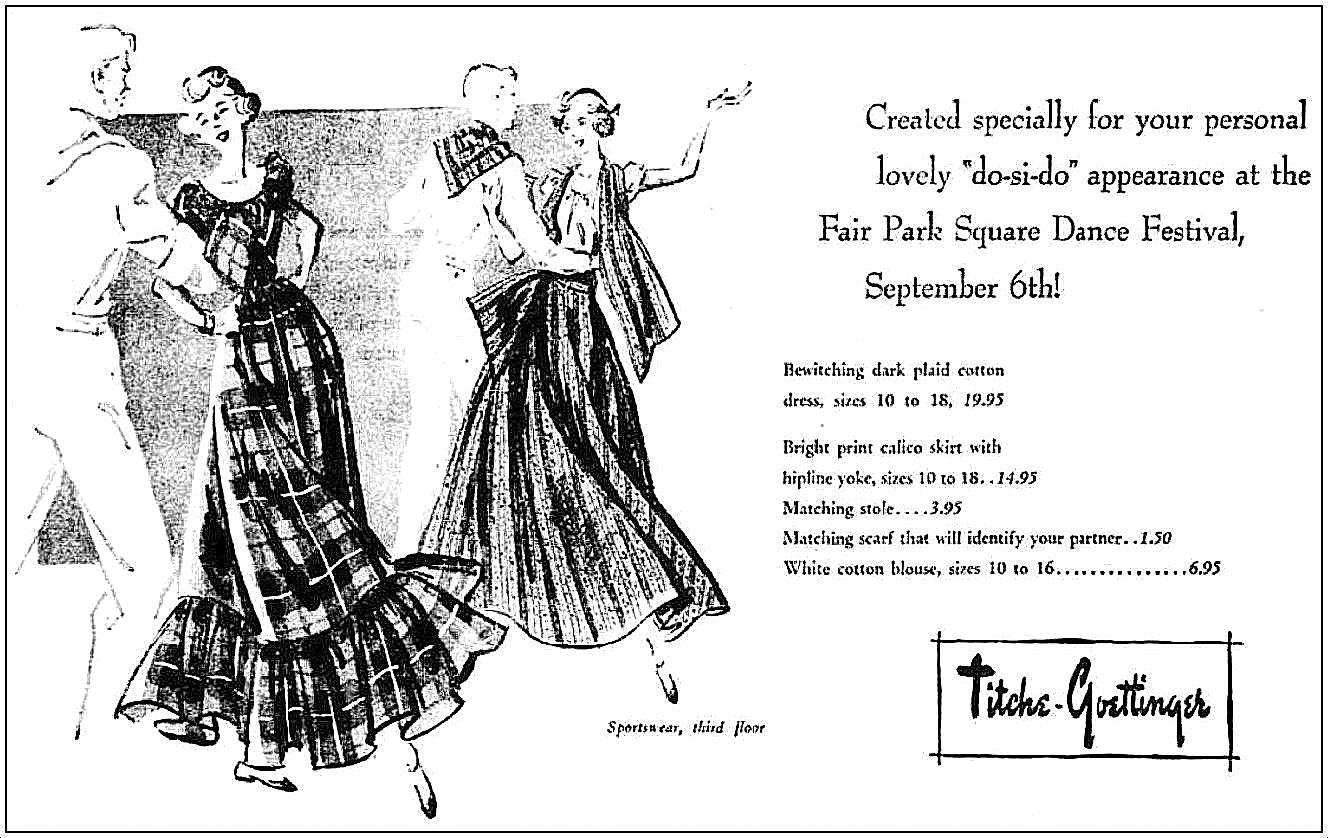
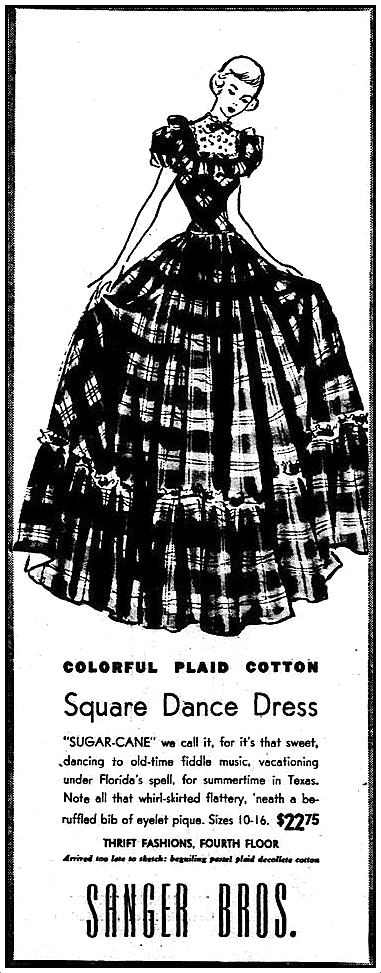
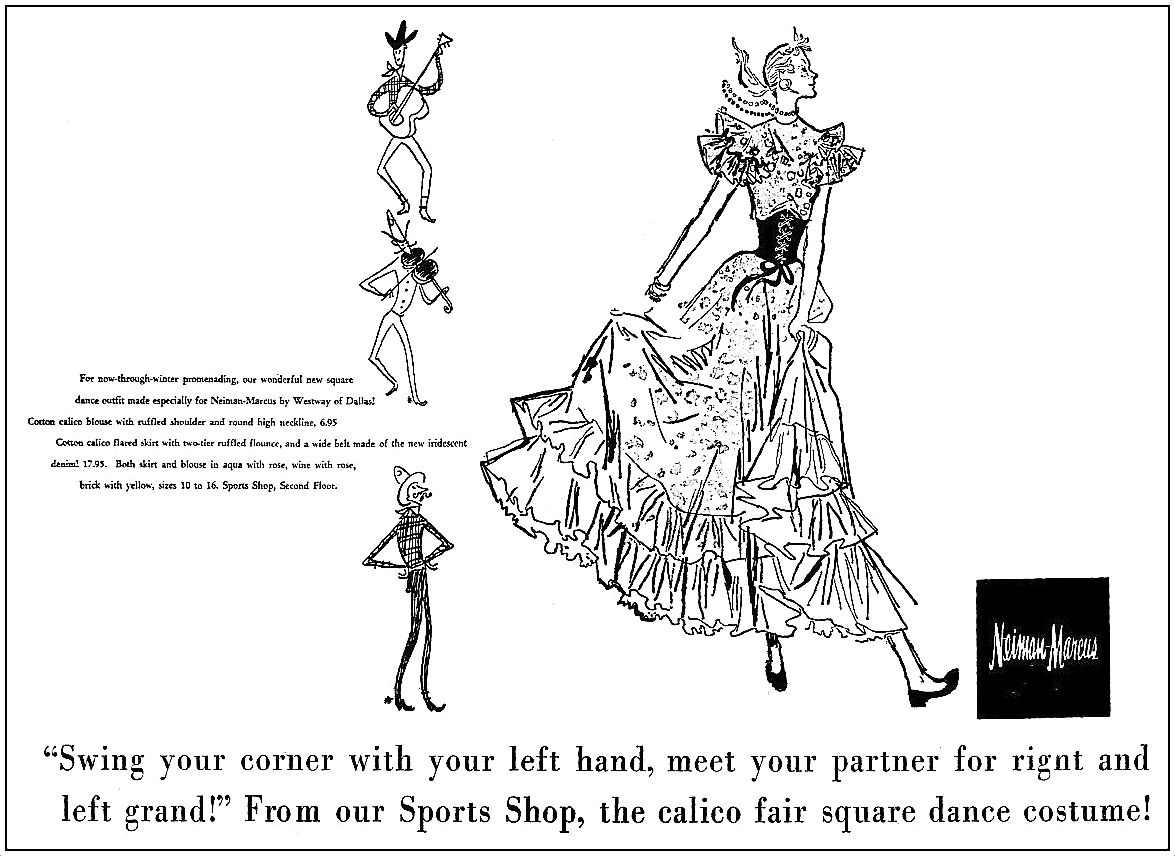
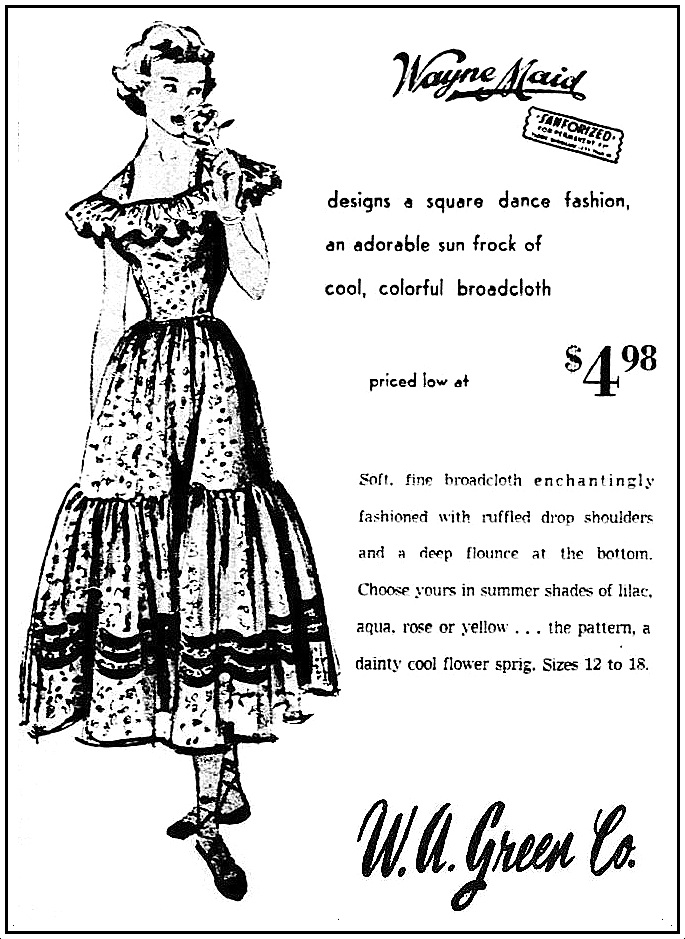
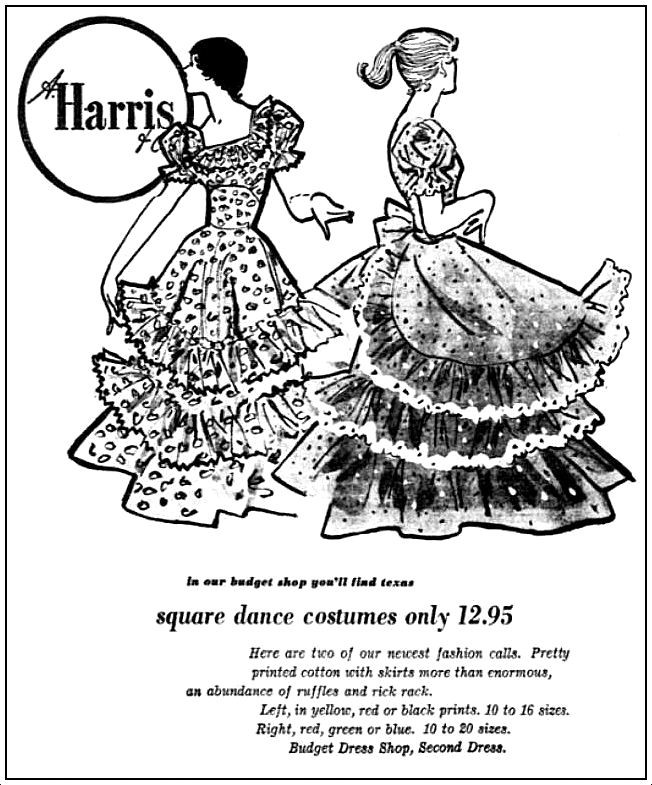
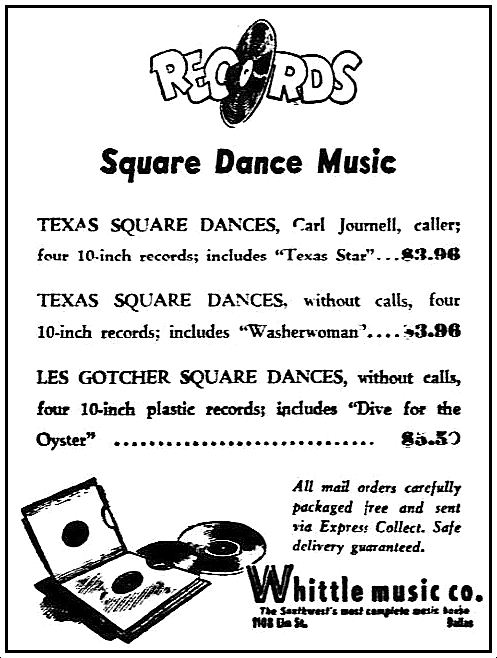
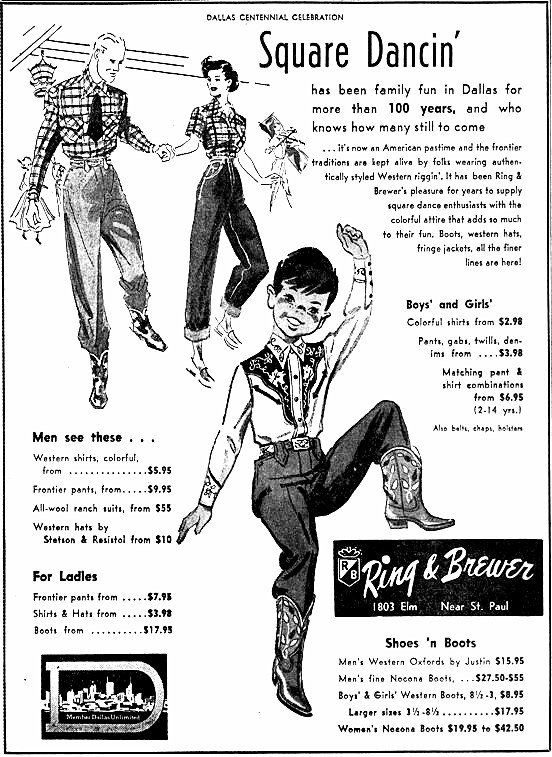
In 1949, as unlikely as it seems, square dancing was a HUGE fad which swept the country (or at least the Southwest). The peak years of the retro craze were probably 1948 to 1950, and its impact was pretty big locally, not only on the dance floor, but also in the fashion pages. When you see every major Dallas department store — even Neiman’s — selling calico and gingham square dance fashions … well, it’s big.

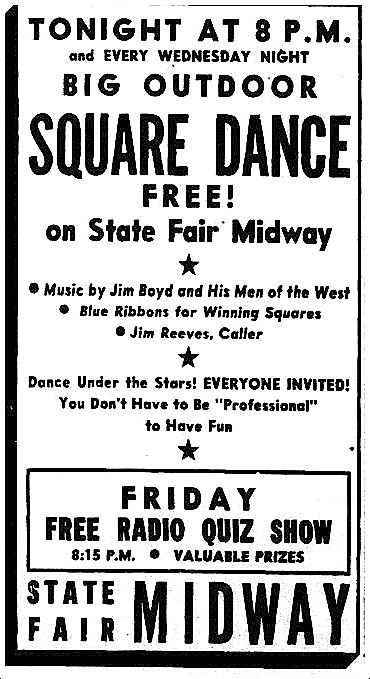
Not only were there lessons available everywhere, but there were clubs and weekly events all over town — every Wednesday in the summer of 1949, there was a big outdoor square dance held at the Fair Park Midway, with music courtesy of local celeb Jim Boyd.

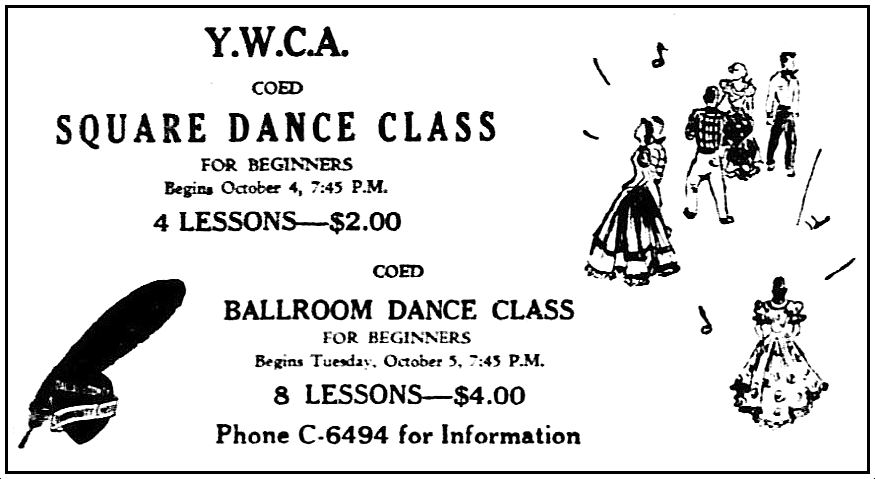
I’m not sure when it stopped (…I’m assuming it has…), but for decades, a lot of us participated in square dancing as part of gym class in elementary school. This interesting throw-back take on physical fitness seems to have begun around 1950 or ’51. Not everyone was thrilled about this odd-but-charming grade-school rite of passage — some ultra-conservative communities complained, but the wholesome and old-timey dancing won out and became a standard part of Texas schools’ physical education curriculum.  Forget young people’s cotillions — most Texas children had their first experience dancing with a partner to the strain of a cowboy fiddle and a voice telling us to “allemande left” and “do-si-do.” And I’m sure we’re all better for it.

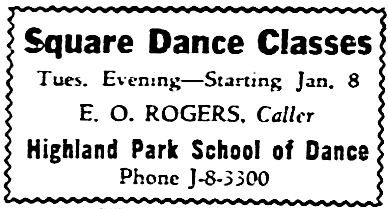
Here are a bunch of ads and things (click pictures to see larger images):

square-dance_la-reunion-place_squire-haskins_dallas-municipal-archivesSquare dance at La Reunion Place (Dallas Municipal Archives)

square-dance_jan-1946_highland-park
1946

square-dance_may-1947_a-harris
1947

square-dance_aug-1948_titches
1948

square-dance_jan-1948_sanger-bros1948

square-dance_oct-1948_neiman-marcus
1948

square-dance_april-1948_a-harris
1948

square-dance_oct-1948
1948

square-dance_dec-1950_e-m-kahn
1949

square-dance_june-1949_w-a-green
1949

square-dance_may-1949_fair-park-midway
1949

square-dance_nov-1949_a-harris
1949

square-dance_march-1949_whittles
1949

square-dance_oct-1949_a-harris
1949

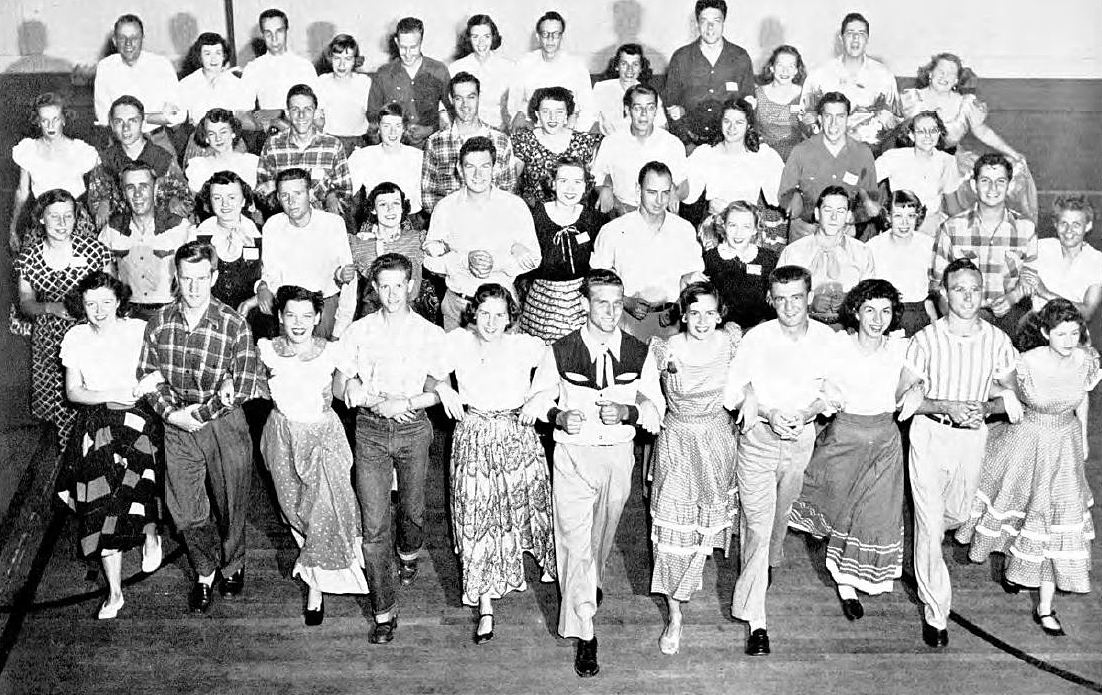
square-dancing_promenaders_smu_1951-yrbk1951

Above, a photo of the Promenaders, a group of SMU students whose purpose is described in the 1951 yearbook as being “to promote the appreciation of square and folk dancing on this campus.” (Think you recognize any of those faces? See who’s in the photo here.)

dallas_ringandbrewer_1956
1956

***

Sources & Notes

Premiere of “Calamity Jane and Sam Bass” was held at the Majestic Theatre on June 8, 1949, and it seems to have been a pretty big deal. There was newsreel footage filmed that night — wonder if it’s floating around anywhere?

square-dance_calamity-jane_majestic_june-1949

Photo of the square dance taken at La Reunion Place is by Squire Haskins and is from the Dallas Municipal Archives; is can be seen on UNT’s Portal to Texas History site, here.

Photo of the SMU Promenaders square- and folk-dancing group is from the 1951 Rotunda, the yearbook of Southern Methodist University.

Jim Boyd was a country-western singer who appeared in a few Hollywood films and was a Dallas disc jockey for many years. He also appeared around town often as a performer and personality. Dallas filmmaker Hugh V. Jamieson, Jr. and director Milton M. Agins made a short film called “Saturday Night Square Dance” (made in either 1949 or 1950); it features Boyd and his Men of the West band, plus square dance groups Silver Spur Square Set and Thompson Square Dance Club. I can find nothing on the two groups, but it seems likely that this film was made in Dallas. The quality of the film uploaded to YouTube is not very good, but, who knows — you might see your parents or grandparents in there if they were big square dancers! You can watch it here.

All images larger when clicked.

*

Copyright © 2017 Paula Bosse. All Rights Reserved.
 

“Serving the Southwest From Dallas” — 1928

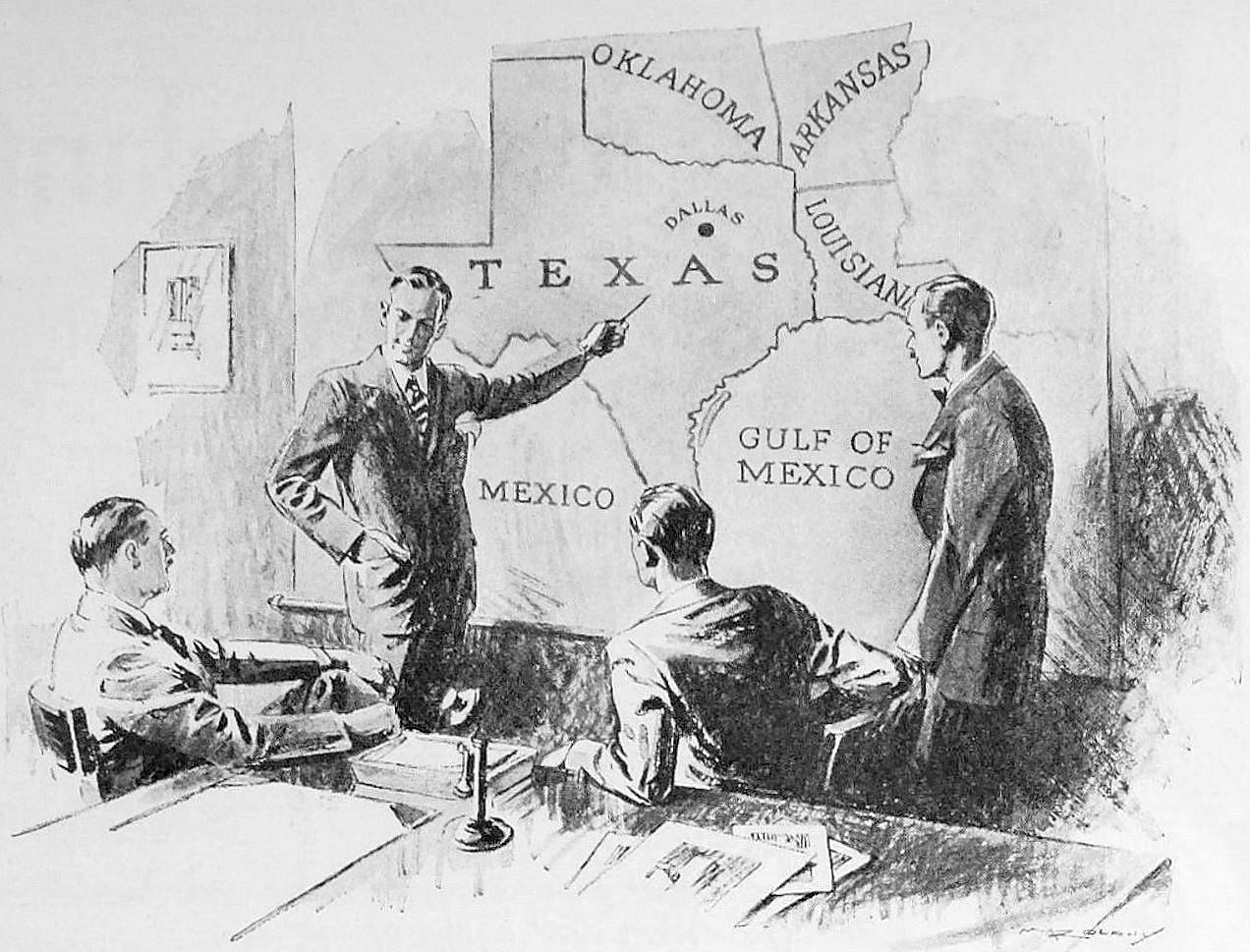
industrial-dallas-inc_nations-business-mag_060528_illusAll roads lead to Dallas…

by Paula Bosse

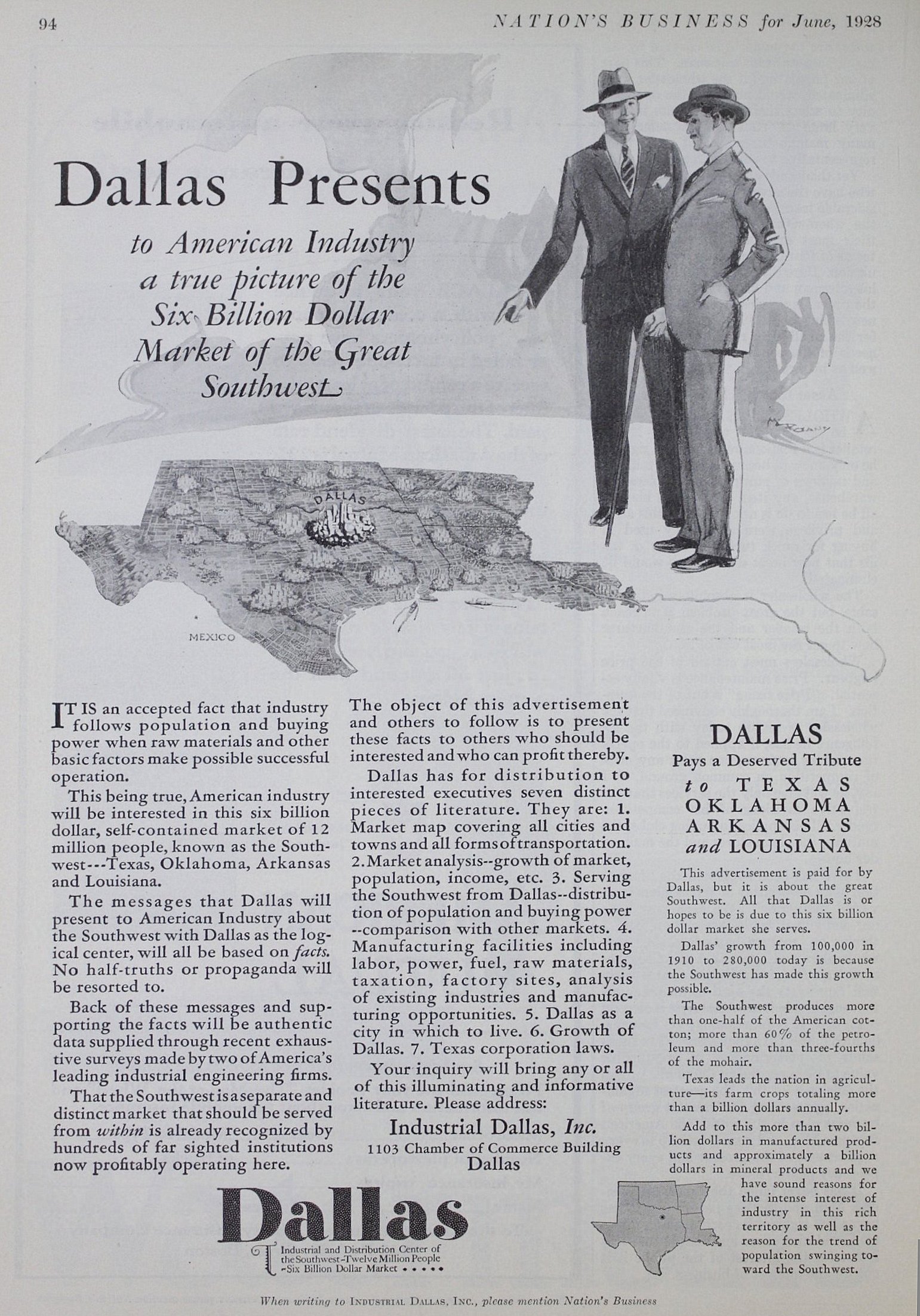
Industrial Dallas, Inc. was a nonprofit corporation formed by directors of the Dallas Chamber of Commerce to boost national awareness of Dallas’ favorable business climate and its role as a major hub of business and manufacturing in Texas and in the neighboring states Oklahoma, Arkansas, and Louisiana. The idea was to promote Dallas in a series of advertisements placed in national business-oriented magazines; the three-year campaign (1928-1931) had a budget of $500,000 (the equivalent of $7,000,000 in today’s money) and was led by banker and Dallas booster (and future mayor) R. L. Thornton. Despite the fact that this campaign coincided with the first years of the Great Depression, Industrial Dallas, Inc. was considered a success: it attracted hundreds of new companies to Dallas and firmly established the city’s national reputation as an important commercial center and as a dynamic young city offering limitless business opportunities.

industrial-dallas-inc_nations-business_060528

*

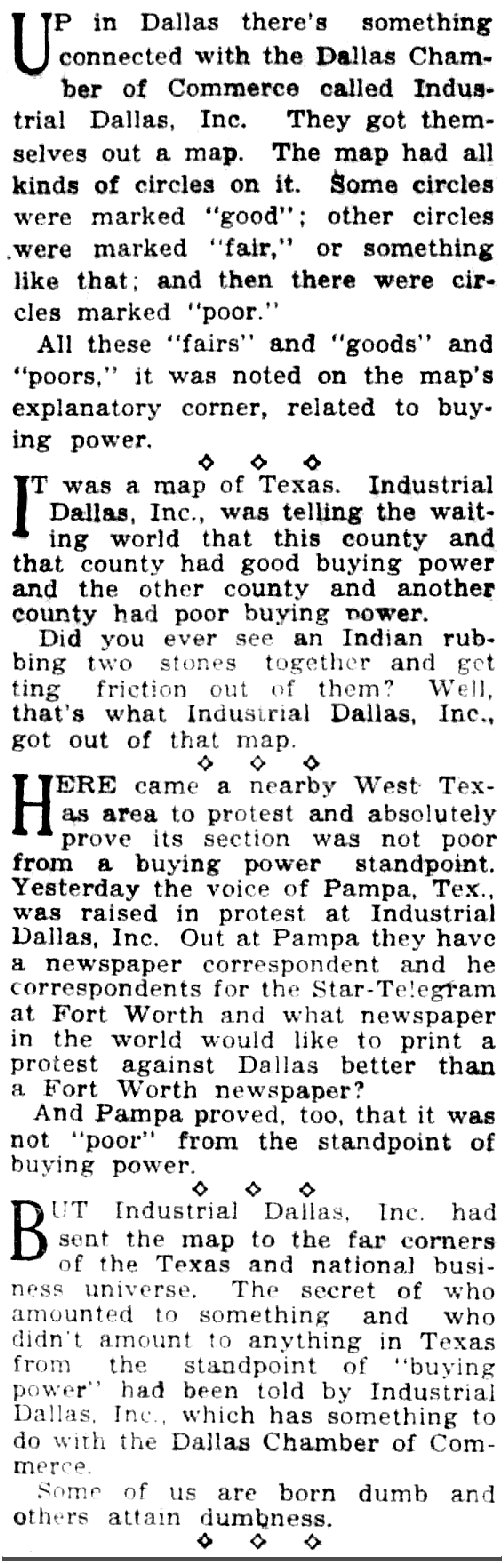
Not everyone was smitten with these Dallas ads, however. Texans who did business beyond the “acceptable” concentric circles of the Dallas, Inc. map were annoyed, as can be seen in this amusing piece by a writer for the Waco newspaper (click to see larger image).

industrial-dallas-inc_waco-news-tribune_121328
Waco News-Tribune, Dec. 12, 1928

The map:

industrial-dallas-traffic-world_092129_ebay_det

***

Sources & Notes

Two Industrial Dallas, Inc. ads appeared it the June 5, 1928 issue of the magazine Nation’s Business (the top illustration is a detail, the second is a full-page advertisement).

The ads were intended to run only three years — until spring of 1931 — but they continued to run until at least the very beginning of 1932. In 1959, Industrial Dallas, Inc. was resurrected for another publicity blitz (led by Dallas Power & Light president C. A. Tatum, Jr.), and ads again appeared in national publications for three years. One of this later series of ads can be seen here.

An interesting little sidebar about this campaign was that it was expressly credited with attracting the Firestone Tire and Rubber Co. to build a new “Master Super Service Station” at the northwest corner of Ross and Harwood in 1929 as part of the company’s multi-million-dollar national expansion program. The company purchased what was then the home of the Knights of Columbus, but it had been known since its construction around 1900 as the grand Conway residence, a palatial house designed by architect H. A. Overbeck for prominent lumber dealer J. C. Conway (it was the childhood home of his daughter Gordon Conway, a noted fashion illustrator). It was reported that after the Firestone Co. purchased the property, Harvey Firestone, Jr. had two carved mahogany mantels removed from the house and shipped to the home he was building “in the North.” It’s sad that such a lovely home (seen here) — not even 30 years old! — would be torn down to build a service station. But time and tide wait for no man. Especially in Dallas.

Images larger when clicked.

*

Copyright © 2017 Paula Bosse. All Rights Reserved.
 

Country Music — Every Saturday Night on Channel 11

country-music_saturday-night_channel-11_ktvt_1969The warm-up for wrestling…

by Paula Bosse

I have a surprisingly deep knowledge of classic country music. And it can all be traced back to sitting with my father every Saturday night as he watched the jam-packed lineup of country music TV shows on KTVT-Channel 11.

Followed by wrestling.

Which I also have a surprisingly deep knowledge of. If only by osmosis.

Thank you, Channel 11, for providing this bonding time with my father, which I didn’t really appreciate as a child, but I do now.

(And, yes, I’m happy that my antiquarian bookseller father and Comparative Literature-degree-holding mother often took our family to the Sportatorium to see both country music package-shows and wrestling matches. You can’t say our family wasn’t well-rounded.)

***

Sources & Notes

1969 ad from an odd little local publication (which probably used to belong to my father) called Country and Western — The Sound That Goes Around the World, published in DFW by PegAnn Production.

*

Copyright © 2017 Paula Bosse. All Rights Reserved.
Happy Mother’s Day from Mrs. Baird’s Bread — 1949

mothers-day_mrs-bairds_freshie_dmn_050649

by Paula Bosse

Sure hope Mom can handle all that gluten!

Happy Mother’s Day!

***

Sources & Notes

Newspaper ad from 1949. The “Freshie” ad campaign — featuring a Mrs.-Baird’s-Bread-obsessed kid — ran in Texas newspapers from about 1945 to 1953. More of the ads can be seen in the post “The ‘Freshie’ Ads for *-@!!@!* Delicious Mrs. Baird’s Bread — 1945-1953,” here.

*

Copyright © 2017 Paula Bosse. All Rights Reserved.


Roth’s, Fort Worth Avenue

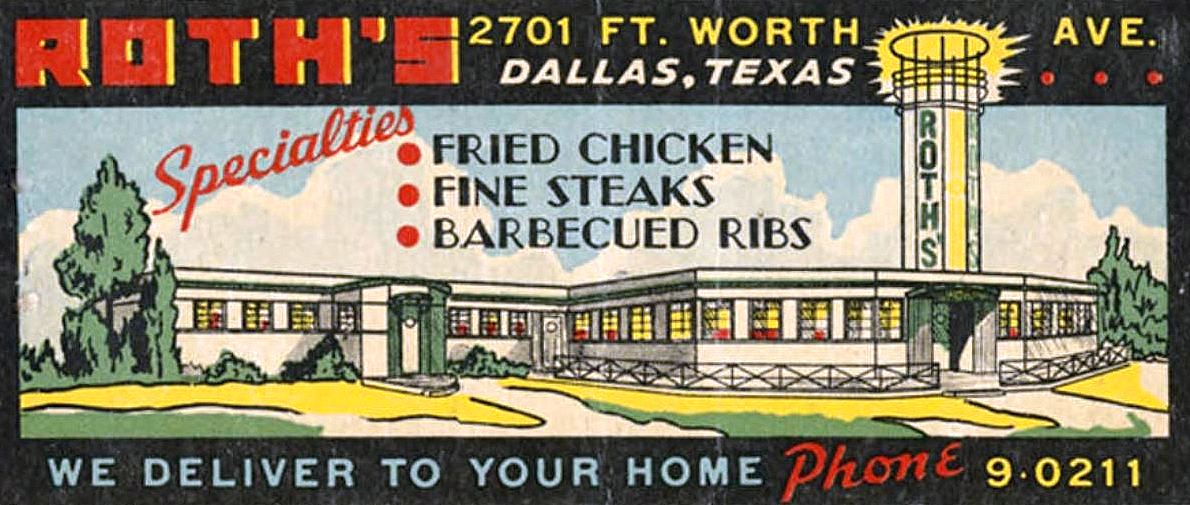
roths_cook-collection_smuSign me up, Mr. Roth…

by Paula Bosse

When I see a building like this, I always hope I can find a photo of it somewhere, but all I’ve been able to come up with is this energetic rendering from a 1940s matchbook cover. Roth’s (which was advertised variously as Roth’s Cafe, Roth’s Restaurant, and Roth’s Drive-In) was in Oak Cliff, on Fort Worth Avenue. It opened in about 1940 or ’41 and operated a surprisingly long time — until about 1967. When Roth’s opened, its address was 2701 Fort Worth Avenue, but around 1952 or ’53 the address became 2601. (I think the numbering might have changed rather than the business moving to a new location a block down the street.)

During World War II, Mustang Village — a large housing development originally built for wartime workers (and, later, for returning veterans and their families) — sprang up across Fort Worth Avenue from the restaurant. It was intended to be temporary housing only, but because Dallas suffered such a severe post-war housing shortage, Mustang Village (as well as its sister Oak Cliff “villages” La Reunion and Texan Courts) ended up being occupied into the ’50s. Suddenly there were a lot more people in that part of town, living, working, and, presumably, visiting restaurants.

As the 1960s dawned, Mustang Village was just a memory, and Roth’s new across-the-street neighbor was the enormous, brand new, headline-grabbing Bronco Bowl, which opened to much fanfare in September 1961. I don’t know whether such close proximity to that huge self-contained entertainment complex hurt or helped Roth’s business, but it certainly must have increased traffic along Fort Worth Avenue.

Roth’s continued operations until it closed in 1967, perhaps not so coincidentally, the same year that Oak Cliff’s beloved Sivils closed. Ernest Roth, like J. D. Sivils, most likely threw in the towel when a series of “wet” vs. “dry” votes in Oak Cliff continued to go against frustrated restaurant owners who insisted that their inability to sell beer and wine not only damaged their own businesses but also adversely affected the Oak Cliff economy. The last straw for Sivils and Roth may have been the unsuccessful petition drive in 1966/1967 to force a “beer election” (read about it here in a Morning News article from Aug. 17, 1966).

As far as that super-cool building seen at the top — I don’t know how long it remained standing, but when Roth’s closed, a mobile home dealer set up shop at 2601 Fort Worth Avenue, and mobile homes need a lot of parking space….

The building on the matchbook cover above is, unfortunately, long gone (as is the much-missed Bronco Bowl); the area today is occupied by asphalt, bland strip malls, and soulless corporate “architecture” (see what 2701 Fort Worth Avenue looks like today, here).

*

The man behind Roth’s was Ernest W. Roth, a Hungarian immigrant who had worked for many years as maître-d’ at the Adolphus Hotel’s tony Century Room. He decided to go out on his own, and around 1940, he and his business partner Joseph Weintraub (who was also his brother-in-law) opened the Oak Cliff restaurant which boasted two dining rooms (with a seating capacity of 350, suitable for parties and banquets), fine steaks, and, on the weekends, a live band and dancing. Ernest’s wife, Martha, and their son Milton were also part of the family business. When the restaurant opened, there wasn’t much more out there on the “Fort Worth cut-off,” but the place must have been doing something right, because Roth’s lasted for at least 27 years — an eternity in the restaurant business. It seems to have remained a popular Oak Cliff dining destination until it closed around 1967.

*

The real story, though, is the Roth family, especially Ernest’s mother, Johanna Roth, and even more especially, his older sister, Bertha Weintraub.

Johanna Rose Roth was born in 1863 in Budapest, where her father served as a member of the King’s Guard for Emperor Franz Josef. She and her husband and young children came to the United States about 1906 and, by 1913, eventually made their way to San Antonio. In the ’40s and ’50s she traveled by airplane back and forth between San Antonio and Dallas, visiting her five children and their families — she was known to the airlines as one of their most frequent customers (and one of their oldest). She died in Dallas in 1956 at the age of 92.

Johanna’s daughter Bertha Roth Weintraub had a very interesting life. She too was born in Hungary — in 1890. After her husband Joe’s death in the mid ’40s, a regular at her brother’s restaurant, Abe Weinstein — big-time entertainment promoter and burlesque club empresario — offered Bertha a job as cashier at the Colony Club, his “classy” burlesque nightclub located across from the Adolphus. She accepted and, amazingly, worked there for 28 years, retiring only when the club closed in 1972 — when she was 82 years old! It sounds like she led a full life, which took her from Budapest to New York to San Francisco to San Antonio to Austin and to Dallas; she bluffed her way into a job as a dress designer, ran a boarding house in a house once owned by former Texas governor James Hogg, hobnobbed with Zsa Zsa Gabor and Liberace, was a friend of Candy Barr, and, as a child, was consoled by the queen of Hungary. She died in Dallas in 1997, a week and a half before her 107th birthday. (The story Larry Powell wrote about her in The Dallas Morning News — “Aunt Bertha’s Book Filled With 97 Years of Memories” (DMN, Nov. 17, 1987) — is very entertaining and well worth tracking down in the News archives.)

weintraub-bertha-roth_texas-jewish-post_021590
Bertha Roth Weintraub

I feel certain that the extended Roth family found themselves entertained by quite a few unexpected stories around holiday dinner tables!

***

Sources & Notes

Matchbook cover (top image) is from the George W. Cook Dallas/Texas Image Collection, DeGolyer Library, Central University Libraries, Southern Methodist University; more info is here.

Photo of Bertha Weintraub is from The Texas Jewish Post (Feb. 15, 1990), via the Portal to Texas History, here.

*

Copyright © 2017 Paula Bosse. All Rights Reserved.

1710 Hall: The Rose Room/The Empire Room/The Ascot Room — 1942-1975

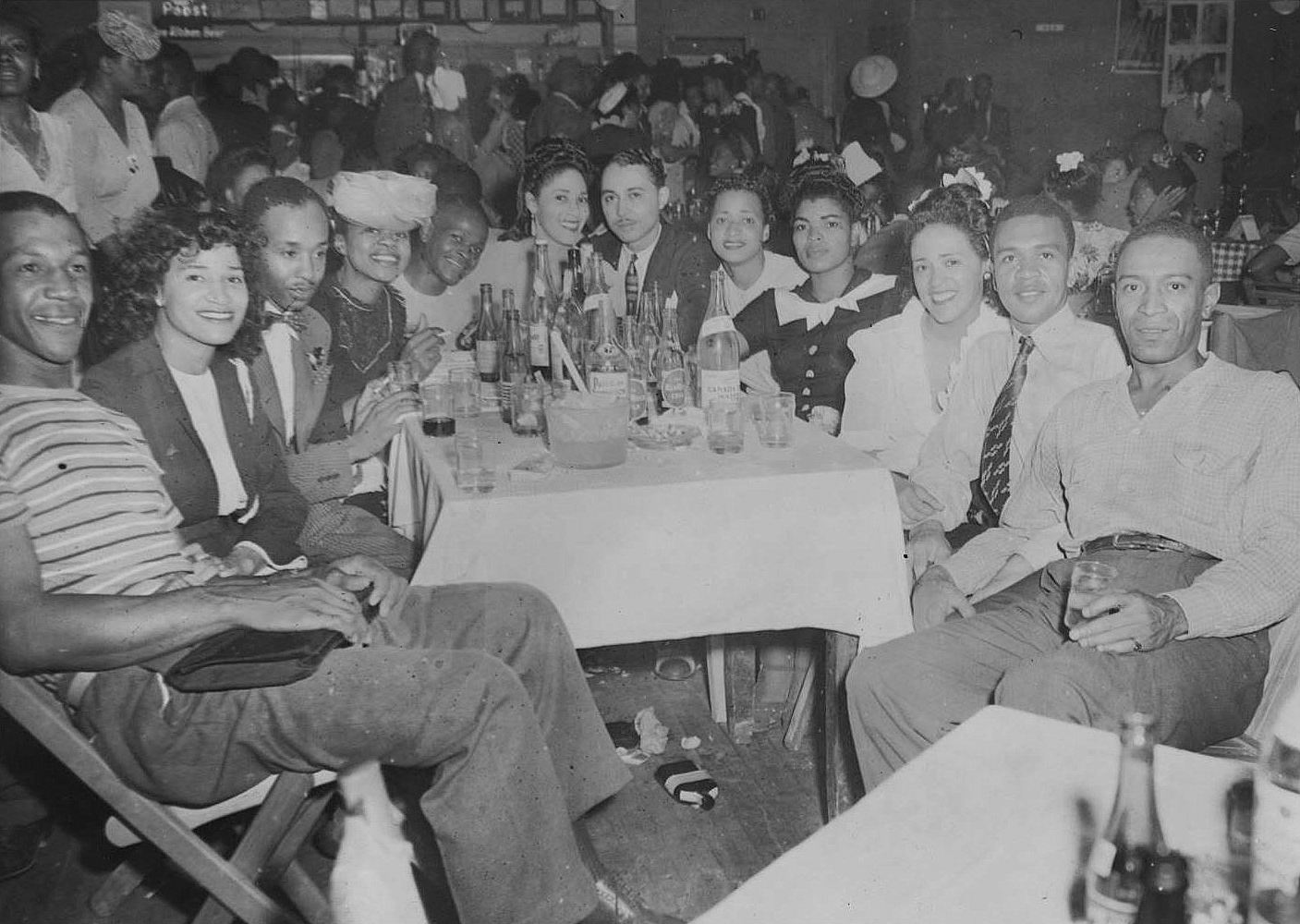
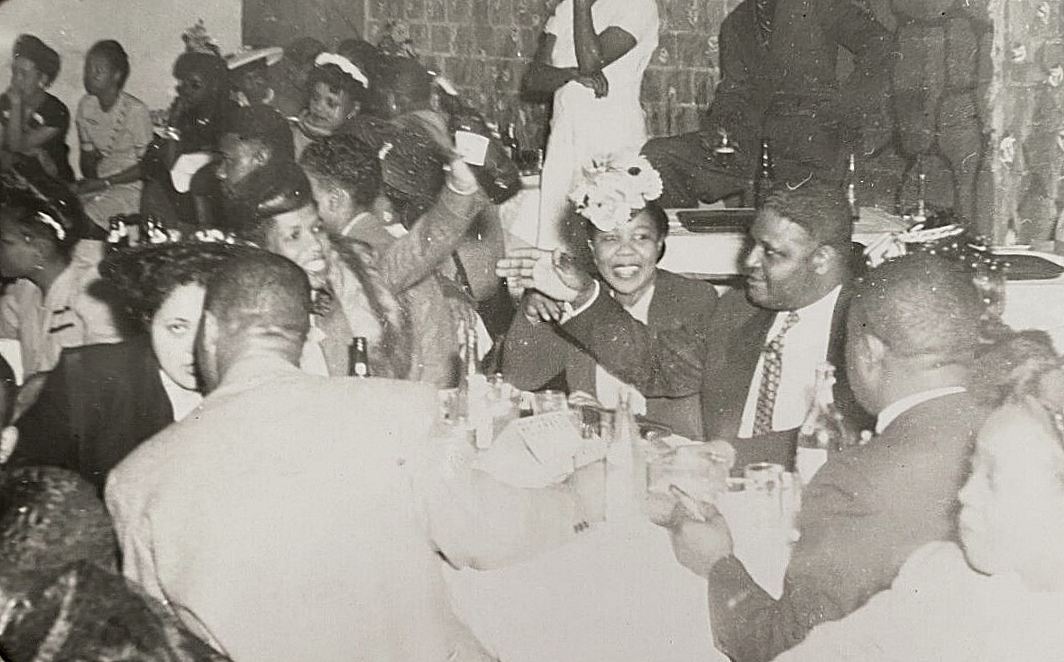
rose-ballroom_aug-1942_cook-collection_degolyer_smuThe Rose Ballroom, 1942

by Paula Bosse

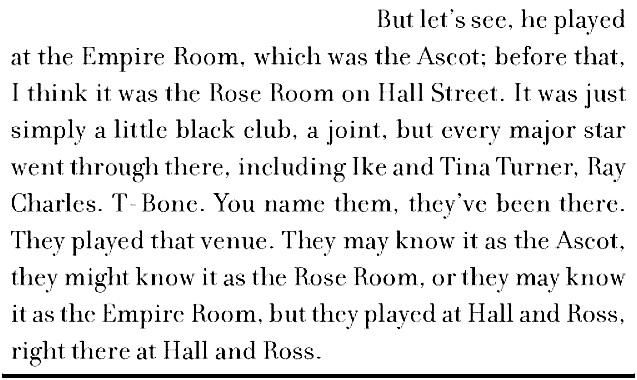
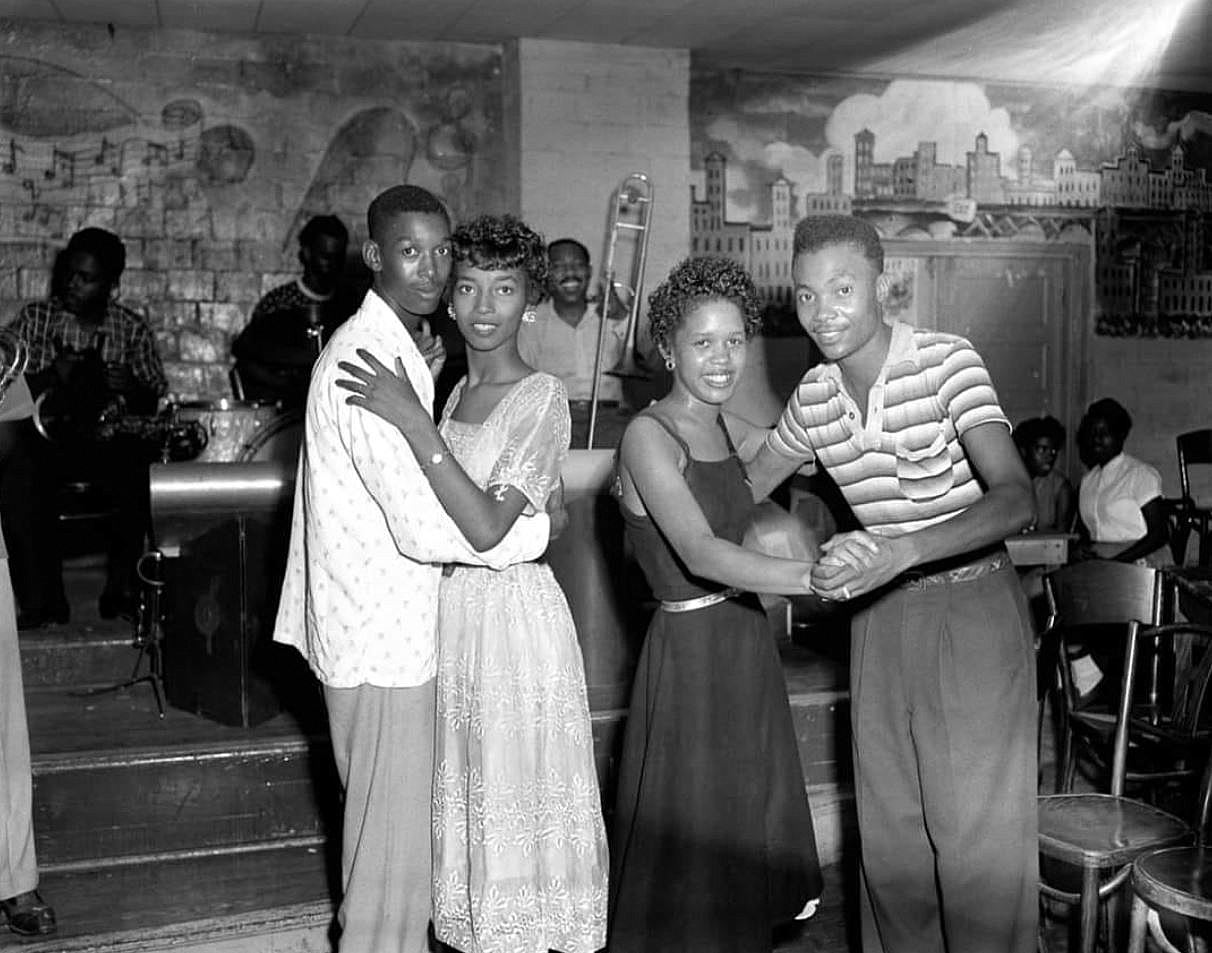
The photo above was taken at the Rose Ballroom at 1710 Hall Street (a few steps off Ross Avenue) in August, 1942. 1710 Hall was the home to a string of very popular black nightclubs: the Rose Ballroom (1942-1943), the Rose Room (1943-1951), the Empire Room (1951-1969) (not to be confused with the nightclub of the same name in the Statler Hilton), and the Ascot Room (1969-1975). There seems to have been some overlap of owners and/or managers and/or booking agents, but they all appear to have been very popular “joints” (as described by Freddie King’s daughter), where both big-name touring musicians as well as popular local acts played. Icons T-Bone Walker and Ray Charles were regulars (there are stories of Ray Charles sleeping on the Empire Room’s stage during the time he was living in Dallas in the ’50s). Everybody seems to have played there. Below, a quote from Wanda King, talking about her father, blues legend Freddie King — from the book Texas Blues: The Rise of a Contemporary Sound by Alan Govenar (all clippings and photos are larger when clicked):

rose-room_freddie-king_wanda-king_texas-blues_govenar

Some of the acts scheduled to appear in early 1946 at the Rose Room were Erskine Hawkins, Louis Armstrong, Lionel Hampton, Buddy Johnson, and Andy Kirk. …Wow.

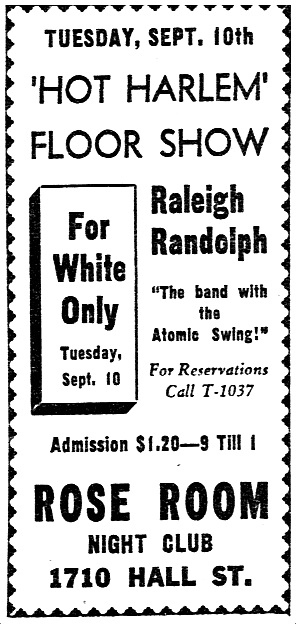
In the days of segregation, when Dallas police threatened to shut the club down if the owner allowed white patrons to mix with black patrons, the club scheduled “white only” nights where Caucasian audiences could see their favorite non-Caucasian performers. (Before these special club nights, which seem to have started in 1945, a revue would be taken “on the road” — over to the Majestic Theatre on Elm Street — to perform live onstage.)

rose-room_dmn_092945-ad
1945

rose-room_dmn_090846_ad
1946

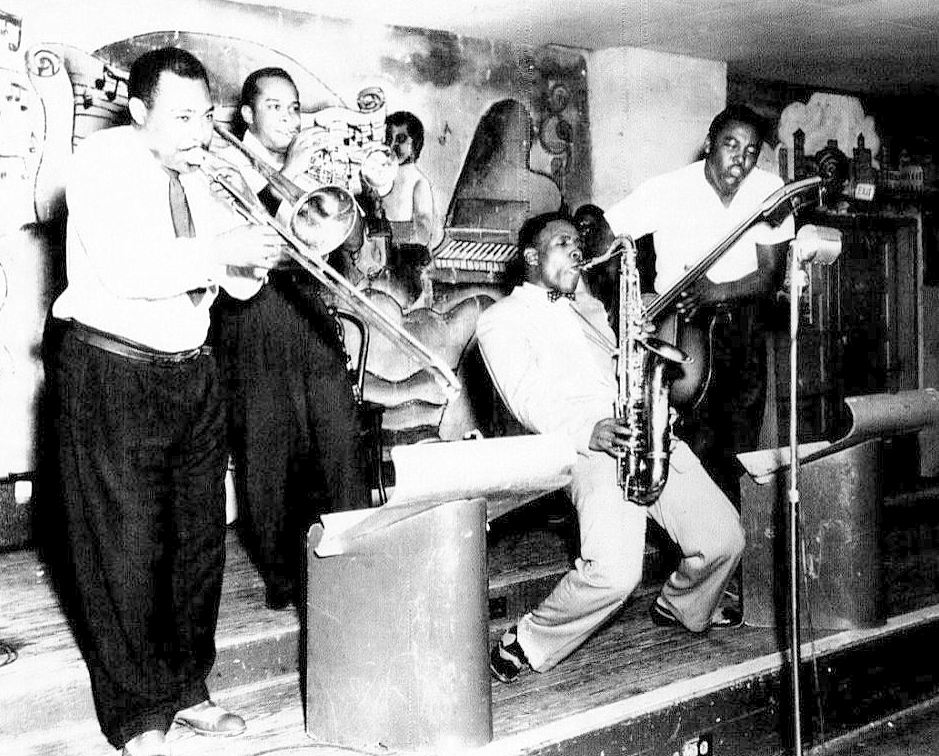
The photo up there at the top showed the audience — here’s the stage (1946 photo of the E F Band by Marion Butts, from the Marion Butts Collection, Dallas Public Library):

rose-room_the-e-f-band_marion-butts_dpl_1946

And here’s what the stage looked like when the club became the Empire Room (onstage is Joe Johnson in a 1954 photo by R. C. Hickman, taken from a great article about Hickman in Texas Highways, here):

empire-room_joe-johnson_1954_r-c-hickman_tx-highways_020299

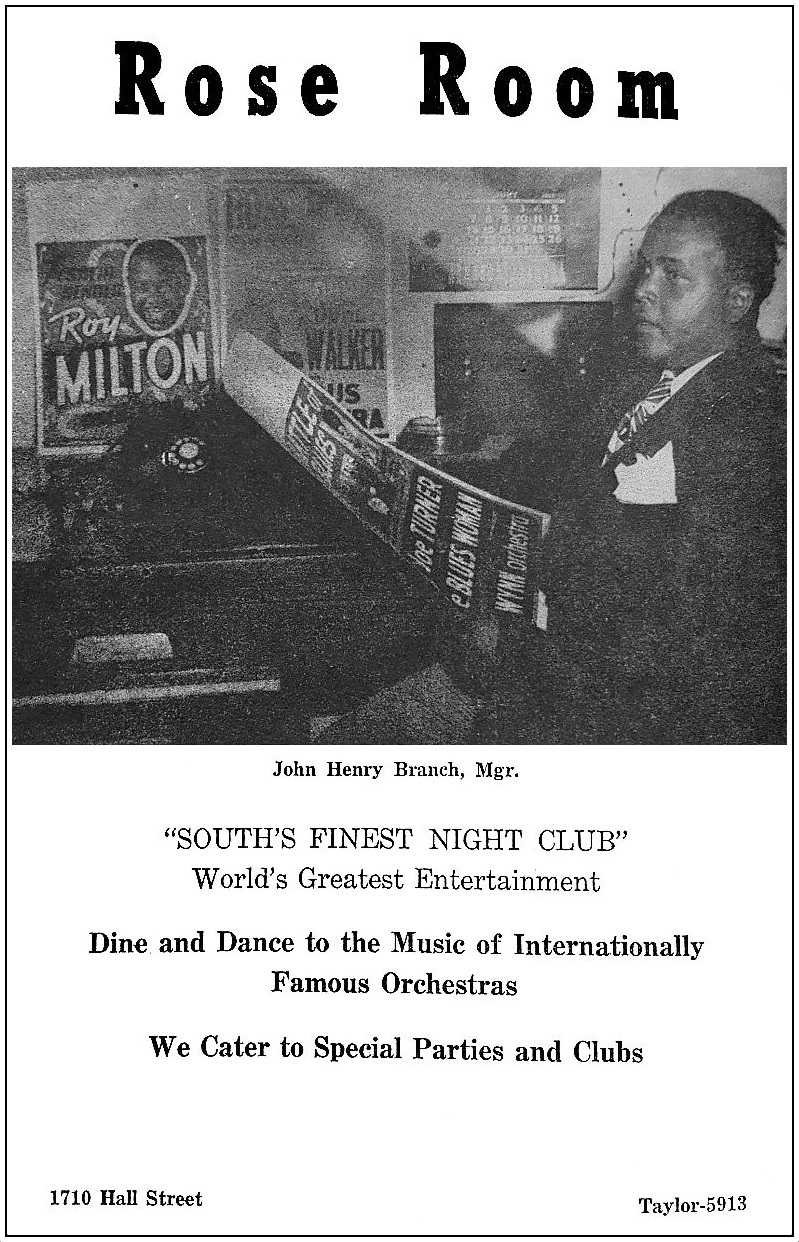
One thing that probably helped set the Rose Room/Empire Room apart from a lot of the other clubs in town at this time was the man who booked the shows — and who booked acts all over the area: John Henry Branch. The guy knew everyone. Here he is in an ad from 1947:

rose-room_1947-1948-negro-directory_dallas

Aside from booking acts and musicians for black clubs, he also booked acts for white clubs — including Jack Ruby’s Carousel and Vegas clubs. In fact, Branch chatted with Ruby at the Empire Room the night before Ruby shot Oswald — Ruby had come in to check on a piano player Branch was booking for a gig at the Vegas Club in Oak Lawn. Branch supplied testimony to the Warren Report, and while it’s not all that riveting (because there wasn’t that much to tell), it’s still interesting to hear how Branch describes his own club and Ruby’s personality (“You can’t never tell about him — he’s a weird person.”) — you can read his testimony here.

I have to admit, I’d never heard of the Rose Room or the Empire Room before I saw the photo at the top of this post. I really missed out. So much fantastic music! And I missed it. It’s just another reminder that Dallas has an incredible music history.

rose-room_texas-blues_govenar-brakefieldfrom the Texas African American Photography Archive

rose-room_1944-45-directory_hall-street
1700 block of Hall Street, 1944-45 city directory

What’s at 1710 Hall these days? A vacant lot — soon to be developed, no doubt. Ross Avenue ain’t what it used to be….

rose-room_photo_green-cover_ebayeBay

empire-room_teenage-dance_hickman_080656Teen dance, Aug. 6, 1956 (photo by R. C. Hickman)

empire-room_l-g-mccutcheon_hickman_042351_briscoe-center_watermarkApr. 23, 1951 (photo by R. C. Hickman, Briscoe Center, Univ. of TX)

**

UPDATE: After many fruitless attempts to find a photo of the exterior of this building, I stumbled across it in a 1973 filmed report from KERA, recently uploaded by the G. William Jones Film and Video Collection at SMU. Below is a screenshot showing the Ascot Room a couple of years before it finally closed, looking a little worse for wear. The 8-minute film (which you can watch here) shows tons of locations in the Black neighborhoods of South Dallas (along Forest Avenue/MLK Blvd.) and “North Dallas” (along Hall Street) — the Ascot Room can be seen briefly at the 1:46 mark. (More on this film can be found in the Flashback Dallas post “Black Dallas — 1973.”)

ascot-room_june-1973_kera-collection_jones-collection_SMUAscot Room, 1973 (screenshot, Jones Collection, SMU)

***

Sources & Notes

Top photo from the George W. Cook Dallas/Texas Image Collection, DeGolyer Library, Central University Libraries, Southern Methodist University; more info on this photo is here. Someone has written this on the photo: “Aug. 42, Dallas, Rose Room” — in August, 1942 the club was known as the Rose Ballroom; it changed its name to the Rose Room in early 1943.

1973 screenshot is from a 1973 film (my guess is that it was broadcast on Channel 13’s “Newsroom”) from the KERA Collection, G. William Jones Film and Video Collection, Hamon Arts Library, Southern Methodist University.

Wanda King quote is from the book Texas Blues: The Rise of a Contemporary Sound by Alan Govenar (College Station: Texas A & M University Press, 2008).

Rose Room ad featuring John Henry Branch is from the 1947-48 Dallas Negro City Directory (with thanks to Pat Lawrence!).

More about the hopping Hall Street area can be found in the Flashback Dallas post “Life on Hall Street — 1947,” here.

*

Copyright © 2017 Paula Bosse. All Rights Reserved.