I love ads from high school yearbooks — especially when they feature students. Here are several from the Bryan Adams 1961 and 1962 yearbooks. (Click the ads to see larger images.)
Above, the J. C. Penney store in Casa View at 2596 Gus Thomasson. Great ad! (1962)
Below, Jackson’s Sporting Goods in Casa Linda. (1962)
*
Gingham Girl Dance Studio on Northwest Highway (“We Also Feature Baton Lessons”). (1961)
*
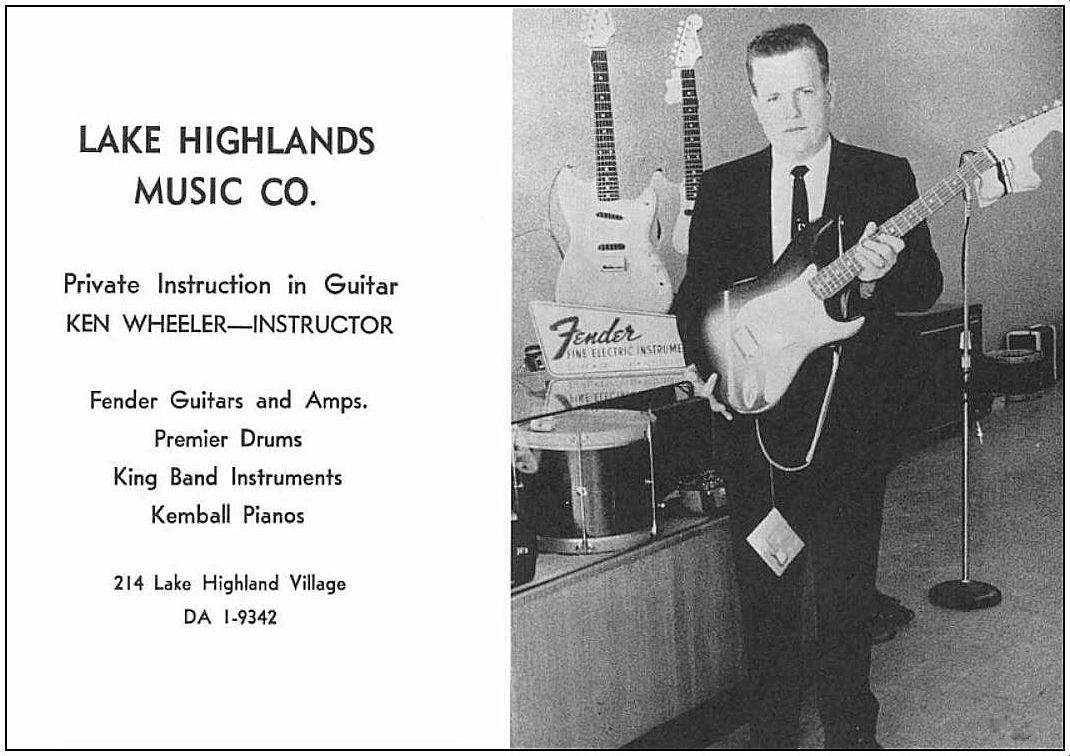
Lake Highlands Music Co. — guitar lessons by Ken Wheeler. (1961)
*
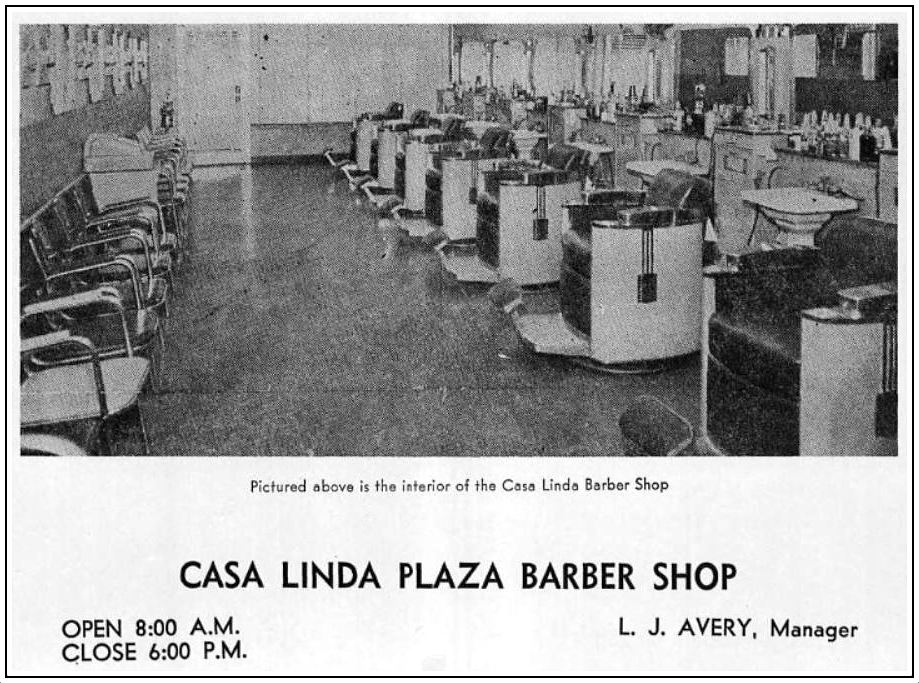
Casa Linda Barber Shop. (1962)
*
Ethel Shipp — female attire, from tots to teens and beyond; Casa Linda and Casa View. (1961)
*
Dallas Ice Arena — ice skating at Fair Park. (1962)
*
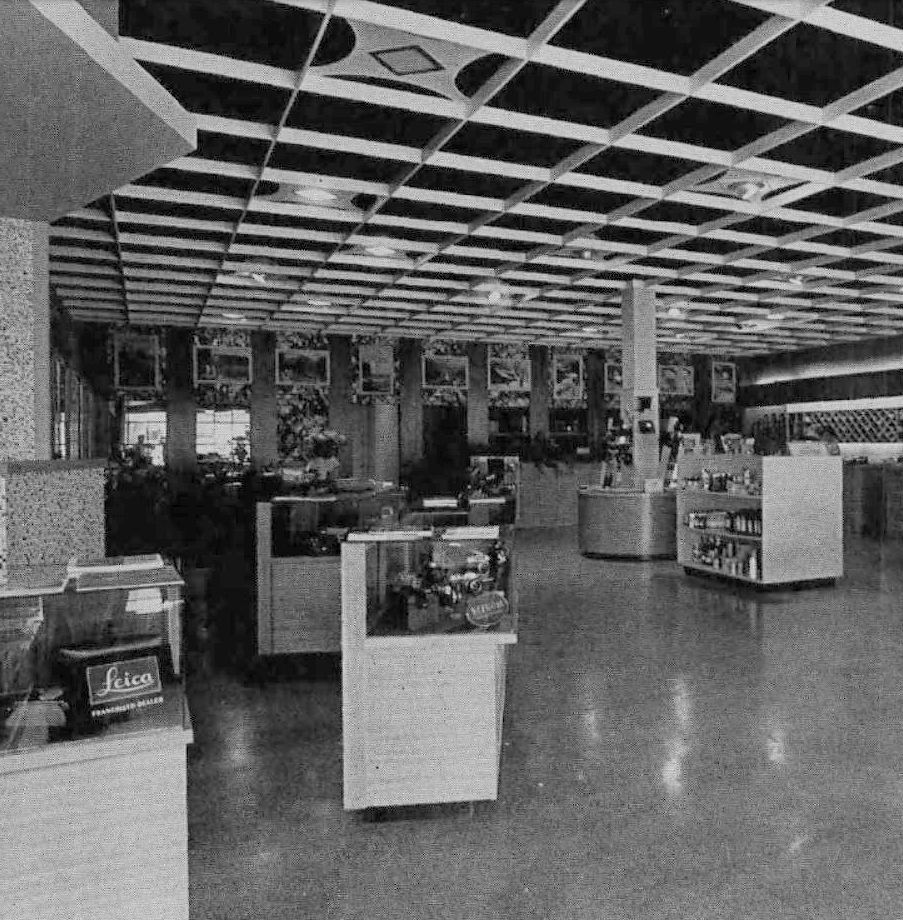
Cooter’s Village Camera Shop — Highland Park Village. (First ad 1961, second 1962)
*
Pop’s Spaghetti House (Frank Da Mommio and Pop Da Mommio), on Gaston, near Baylor. (1962)
*
Colbert’s in Casa Linda. (1962)
*
Stone’s Shoes, Northlake Shopping Center. (1962)
*
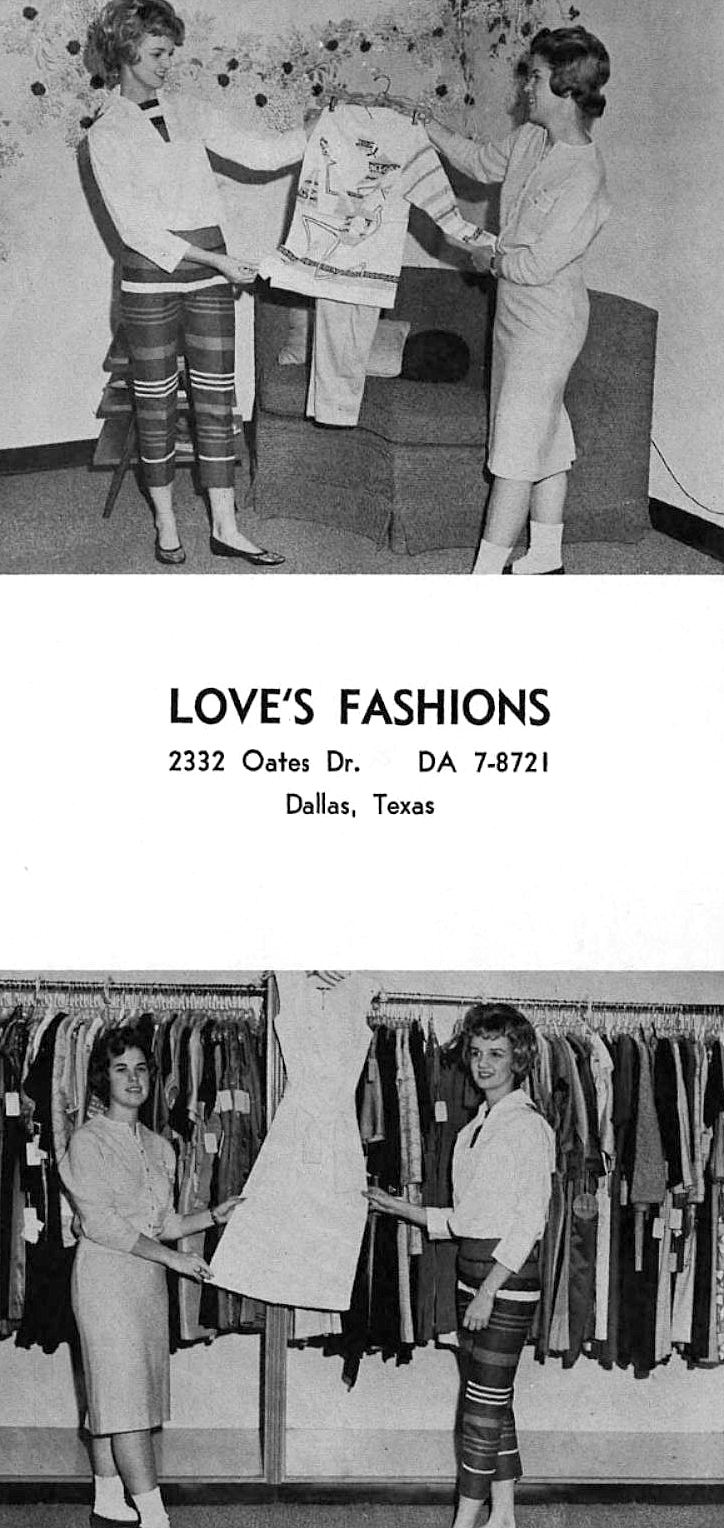
Love’s Fashions, on Oates. (Those striped pants are cool!) (1962)
*
Smitty’s Party Room, Bakery, and Coffee Bar, also on Oates Drive. (1961)
*
KBOX and their happenin’ djs: Jerry Clemmons, Johnny Borders, Pat Hughes, Chuck Benson, Bill Holley, and Gary Mack. (1961)
*
And my favorite ad because of its association to greatness: Belvick Electric Company, Garland Road. Greatness? Here’s a hint: the proprietors are Jerry Dauterive and Buck Dauterive. Maybe it’s just because I watch a lot of television, but any fan of the classic animated show “King of the Hill” (created by Mike Judge, who lived in Garland for several years) will recognize the name “Dauterive” — as in Bill Dauterive, Hank Hill’s sad-sack friend. It’s such an unusual name and there are so many Dallas jokes in the show that I figured the men in this ad must have some sort of connection to the TV show. It turns out that the character is named for series writer-producer Jim Dauterive, a native Dallasite and … a Bryan Adams alum! And Buck was his father. According to an interview in White Rock Lake Weekly, Jim Dauterive liked to slip neighborhood references into the show: he named a character in the show “Gus Thomasson,” had Hank Hill direct someone to a liquor store near White Rock Lake, and even snuck in a mention of Louanns on Greenville. So there you have it! (Ad from 1961.)
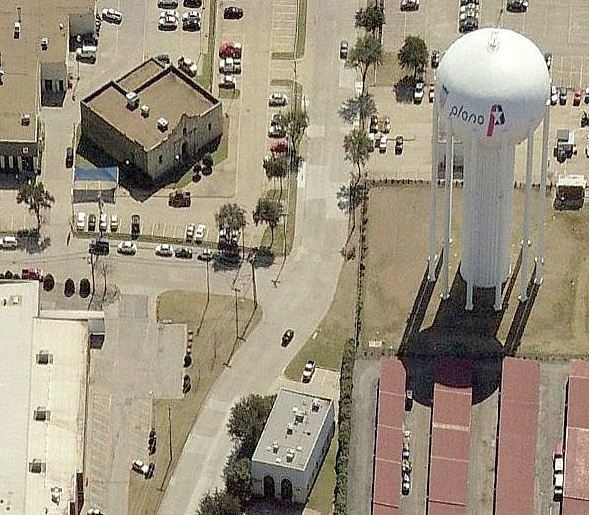
Today is Texas Independence Day. This time last year after posting a photo of the Alamo somewhere, I was informed that there was, in fact, an Alamo replica right here in DFW. I knew about the one(s) in Fair Park, but Plano? Yep, near 75 and Parker Road, at the corner of Lexington and Premier, just west of the highway. See a southward-looking aerial view on Google here; below is the same view, from Bing.
Bing Maps
Here it is at street level:
Bing Streetside
So, um, why is that there?
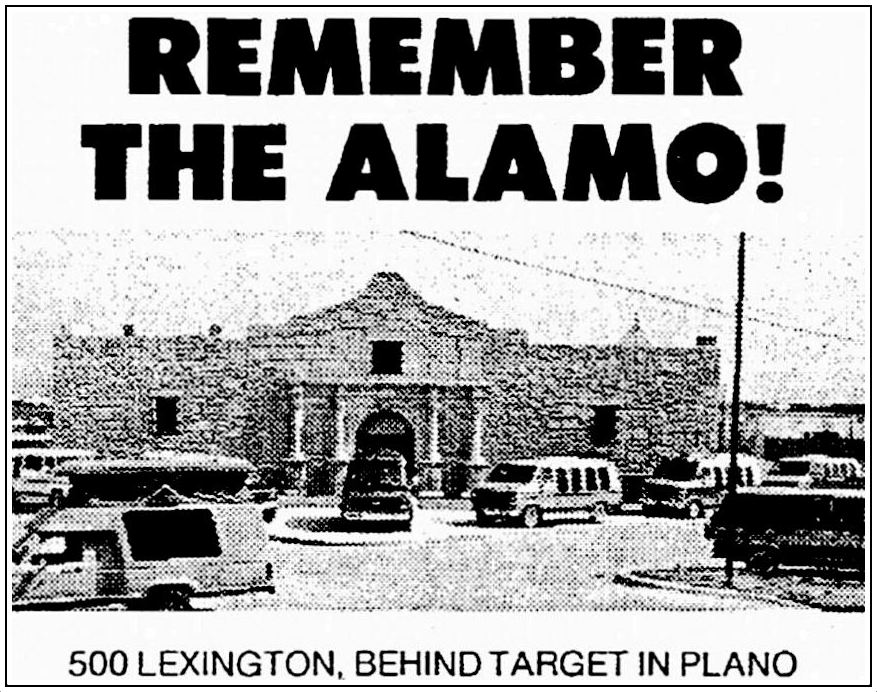
Not being up on my Plano history, and never having been aware of this, it took me a long time to find anything about it. Which is pretty surprising, because you’d think there would be all SORTS of articles about a very large replica of one of the most famous structures in the world (yes, I’m going to say “in the world”), standing right here in the Metroplex. And it’s been standing here for at least 35 years! I managed to find a couple of ads and an article about the building — it had started out as an arcade called the Alamo Fun Center and later became part of a car dealership — but I could never find out who built it or why. I thought I’d come back to it in a year — so I could post it on Texas Independence Day — and see if I could find more, looking with fresh eyes. So I tackled it again today, and, glory be, I’ve just discovered that Rick Saigling wrote a piece for Plano Magazine last November titled “Remember the Alamo Fun Center” which answered all of my questions (and had photos of the building when it was new).
The Plano Alamo was built in 1982 by brothers-in-law Nathan White and Gene Cason and other investors as a “fun center” to house a Texas-themed arcade featuring video games, miniature golf, etc. While popular with Plano kids, the Alamo Fun Center was not a successful venture, and it shut its ornately carved doors after only a relatively short time in business. There you have it. Thank you, Rick. I now have closure.
The earliest (only?) mention I found of the “Fun Center” was the ad below, which appeared in The Wylie News a short time before its grand opening in the summer of 1982. The ad seems to indicate that the name of this “western theme park” is Lone Star Recreation Park and Alamo Fun Center (click to see a larger image).
The Wylie News, July 29, 1982
A few months after the Alamo Fun Center opened, Larry Lange Cadillac moved to its new location on the adjacent property. I’m not sure exactly when it closed, but the Plano Alamo was taken by the advancing forces of Larry Lange Cadillac in 1983 or 1984. For whatever reason, the building remained (what Texan is going to demolish the Alamo?) and was incorporated into the Larry Lange business plan.
June, 1983
In May, 1984, the ad below announced the grand opening of the Larry Lange Adventure Center — the Alamo had been emptied of its batting cages and pizza ovens and had been transformed into an “Indoor Van Showroom Which is ‘As Large as Texas’!” (That doesn’t seem to have lasted very long.)
May, 1984
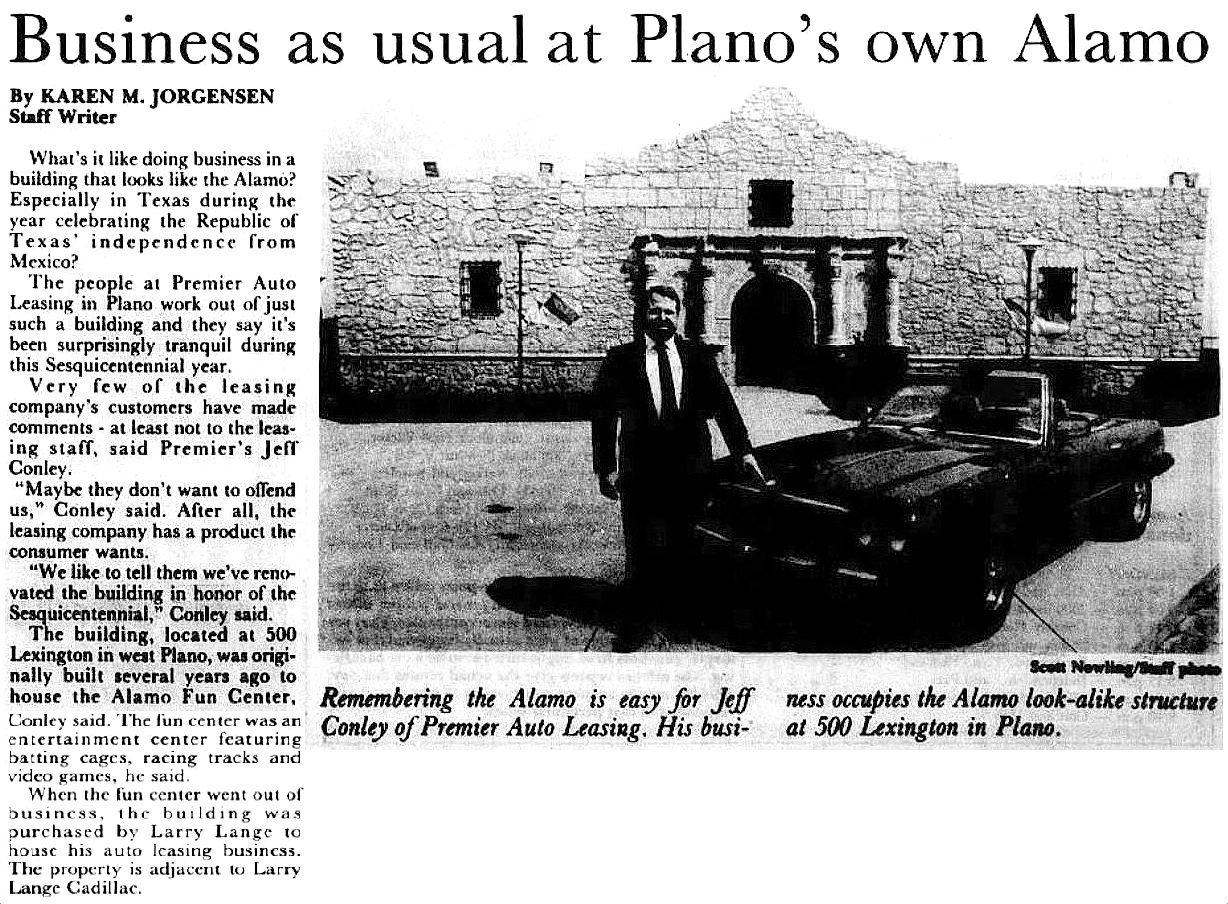
Two years later, in 1986 — the year of the Texas Sesquicentennial — The Plano Star Courier checked in with the then-current occupants of the hometown Alamo, Premier Auto Leasing, to see what it was like working in the Alamo. In Plano. An employee made the impossible-to-believe statement that very few people ever actually commented on the fact that they were leasing their vehicle from a company that occupied a building shaped like the Alamo.
Plano Star Courier, July 22, 1986
In 1999, Diane Jennings of The Dallas Morning News wrote a story on “mock Alamos” around the state. She checked in on the Plano location, then owned by Crest Cadillac, and found it was being used as a warehouse. The general manager, Michael Coston, was not a fan of the building for several reasons, not least of which was the replica’s design.
As a native Texan and history buff, he worries that the inaccurate construction may “deface the fame of the how-many-ever we say gave their lives there.” He is particularly irritated by the parapet, the rounded hump over the door, which most people associate with the Alamo facade, but which was actually added by the U.S. Army decades after the battle. (DMN, Feb. 28, 1999)
Today Crest Cadillac appears to have forsaken Plano for Frisco, but the property is still in the Crest auto family — it’s now occupied by Crest Volvo. But what of The Alamo? It’s now the home of Crest Collision, a body shop.
So there you have it, the story of Plano’s Alamo.
Instead of rushing out to get a Mirabeau B. Lamar tattoo to show my Texan-ness in these waning hours of Texas Independence Day, I’ve decided instead to post a few photos of the real Alamo, which, strangely enough, was also a neighbor to a car dealership, the Clifton George Ford Motor Co. Remember the Model-T!
Second-from-last photo by an unidentified photographer, circa 1918, from the E. O. (Eugene Omar) Goldbeck Photography Collection, Harry Ransom Center, The University of Texas at Austin; more information and a larger image may be found here.
Rick Saigling’s Plano Magazine article “Remember the Alamo Fun Center” (November 21, 2016) is here. It includes several photos of the Alamo Fun Center in 1982/83 and interviews with a former owner and employee. See a (large!) close-up of the unexpectedly ornate stone façade of the Plano Alamo here. (If you’re interested in Plano history, Rick’s also written a nice nostalgic piece, “I Remember When Plano Was a Sleepy Town,” here.)
The Jimi Hendrix Experience, Love Field, 4/20/69 (Jones Film Collection, SMU)
by Paula Bosse
One of the advantages of living in a major American city is that all the biggest entertainers visit at one time or another. Let’s take three of the biggest entertainers of 1969: Jimi Hendrix, Glen Campbell, and Tiny Tim. All were huge, and all came to Dallas. And, luckily for us, they were captured on film in interviews by reporters from WFAA-Channel 8.
For me, without question, the most exciting interview was the one with Jimi Hendrix, who, standing on the tarmac of Love Field with bandmates Mitch Mitchell and Noel Redding on April 20, 1969 (yes, 4/20…), gives a great, relaxed interview to a very lucky Channel 8 reporter, Doug Terry. (I love the look on Terry’s face throughout the interview.) Watch it here:
A few screenshots (click to see slideshow):
April 20, 1969, WFAA-Ch. 8 News (Jones Film Collection, SMU)
4/20/24 UPDATE: After several years of trying to contact the reporter, Doug Terry, I finally heard from him! Here are a few paragraphs from his email to me (used with his permission), with some interesting tidbits about how some of these interviews were conducted:
I was still a college student most of the time I worked at WFAA. I handed in my resignation after covering the north Texas pop festival in that same year. [Watch one of Doug’s Texas International Pop Festival reports from Lewisville here.] Your comment about being in a large city and its advantages was something that I did not fully grasp until years later. The access was wonderful, I saw Hendrix at least three times, on one occasion being in the dressing room with a camera when he warmed up for a show (that footage is nowhere to be found).
There are two aspects to mention about that interview. First, I was a weekend reporter and late night news anchor at Ch. 8 and I assigned myself to go interview him. In those days, one could call up the airlines when a notable person was coming in and they would give the flight number and arrival time. Amazing. Most of the people at the station at that time probably had no idea who Jimi was and wouldn’t have cared if they did know.
The other interesting point is the work of the photographer. Ordinarily, we did over the shoulder interviews, the camera to the back and side of the reporter. The fact that this was shot from the side made all the difference. As a shooter, he was not otherwise outstanding but this interview would be much less interesting if it had been shot in the traditional line-up sort of way. The two bandmates goofing around was distracting but great.
Thank you, Doug! I love this interview — I’m so glad you assigned yourself to the duty!
*
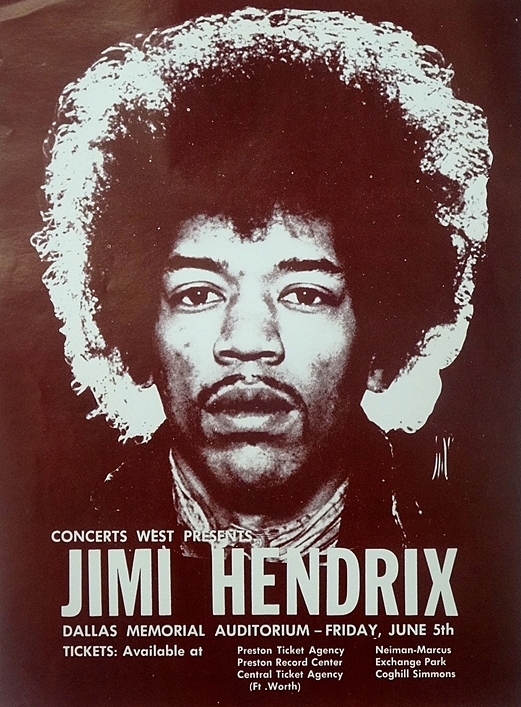
Jimi Hendrix appeared at least 4 times in Dallas:
Feb. 16, 1968: Fair Park Music Hall
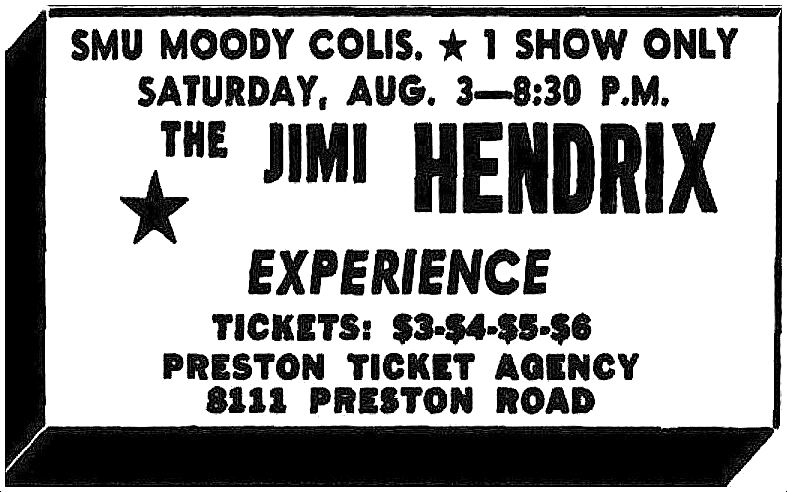
Aug. 3, 1968: Moody Coliseum, SMU
April 20, 1969: Memorial Auditorium (where he was headed after the Ch. 8 interview)
June 5, 1970: Memorial Auditorium
July 28, 1968
Two surprising errors (grammatical and factual) appear in a Neiman-Marcus tie-in ad (of sorts) which states that Jimi would be at Memorial Auditorium, rather than Moody Coliseum. Despite the error, it’s cool that Neiman’s was expanding its cultural horizons to include someone like Jimi Hendrix in one of its ads (which was featuring teen fashions, but still). N-M has always had its finger on the pulse of current fashions — and Jimi Hendrix was certainly fashionable.
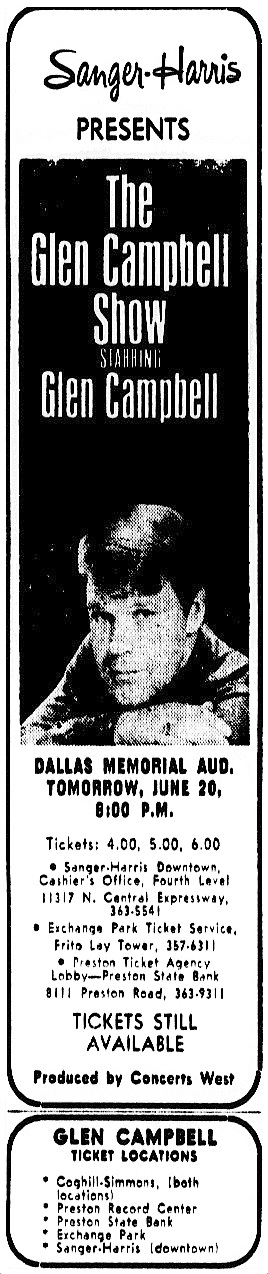
Glen Campbell was in town for several days in June, 1969. He arrived at Love Field on June 15 and was met by a “high-spirited throng” of teenage admirers. He was here to promote the release of the movie True Grit (in which he appeared with John Wayne), as well as to perform at Memorial Auditorium on June 19, 1969.
June 19, 1969
He was actually in Dallas the previous year, in March, 1968, to perform at the State Fair Music Hall with Bobbie Gentry. An interview with the pair begins at 3:57:
**
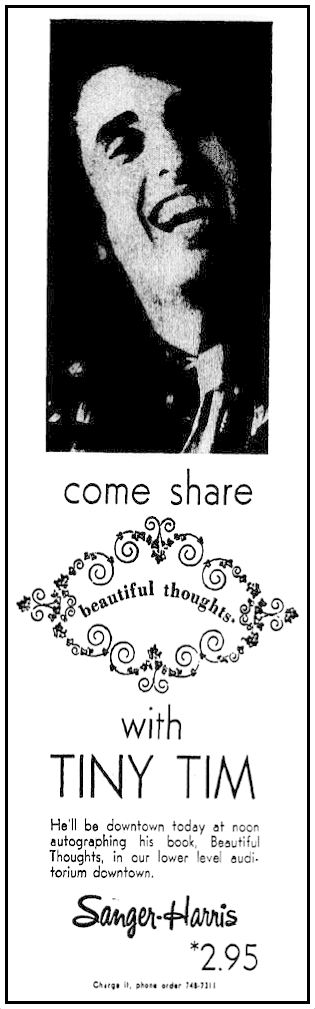
And Tiny Tim was in Dallas on June 17, 1969 to appear at a book-signing at the downtown Sanger-Harris department store. The signing was a bit more sedate than his previous visit to Dallas when he caused something of a riot on January 23, 1969 while making an appearance at the Melody Shop in NorthPark. I’m not sure what sort of crowd the Melody Shop thought they’d get for their little “autograph party,” but it’s safe to say they did not expect 5,000 over-excited teenagers. The news report the next day was peppered with words like “pandemonium,” “swarm,”“mob scene,” and “human wall.” (Read about that bizarre event here). His drawing power continued the next year when Tiny made his Dallas performing debut at … of all places … Abe Weinstein’s Colony Club, one of the city’s top “burlesque” houses. He was booked for an incredible 9-night run (!) in September, 1970. It was a major success. Dallas apparently loved Tiny Tim. And, of course, years later, Bucks Burnett’s Edstock and Burnett’s tiny Tiny Tim museum continued the Big D/Tiny Tim lovefest.
June 17, 1969
WFAA-Ch. 8 interview (screenshot)
***
Sources & Notes
Video is from the WFAA Newsfilm Collection, held at the Hamon Arts Library, Southern Methodist University; screenshots are from those clips. Any requests to license these clips (or any of the other thousands at SMU!) should be directed to curator Jeremy Spracklen.
4/20/24 UPDATE: Passages from former Channel 8 reporter Doug Terry are from an email to me on April 16, 2024, reprinted with his permission.
Hit the Dallas Morning News archives to find a little pre-Music Hall interview with Jimi Hendrix conducted by “YouthBeat Editor” Marge Pettyjohn: “A Real Experience” (DMN, Feb. 25, 1968). Her interview with Tiny Tim (“Magical Mystery Tour: On Meeting Tiny Tim,” DMN, Jan. 25, 1969) is also worth checking out, as is the Jean Kelly article “5,000 Kids Mob Tiny Tim” (DMN, Jan. 24, 1969).
While you’re in the archives, look for the interview with Glen Campbell at Love Field amidst the frenzied teenage girls: “High-Spirited Throng — Fans Mob Glen Campbell at Airport” by Maryln Schwartz (DMN, June 17, 1969).
Dallas teens loved Tiny Tim… (Sanger-Harris book-signing, June 1969)
by Paula Bosse
Tiny Tim — one of the most … unusual performers of the 1960s — was a hit with teenagers when he made his first appearance in Dallas at the Melody Shop in NorthPark mall on January 23, 1969. What had been expected to be a nice little autograph party which might attract a small number of fans and curiosity-seekers turned into something altogether unexpected.
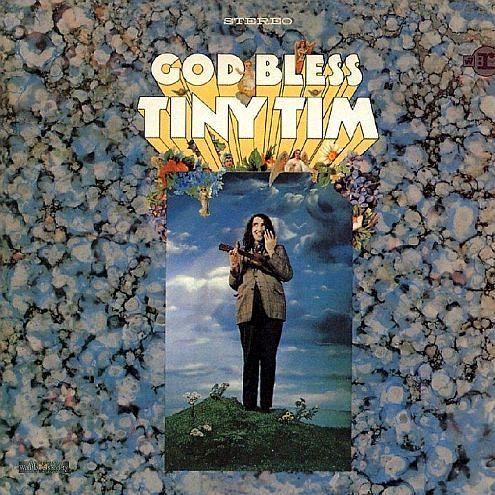
Tiny Tim (…”Tiny”? “Tim”? “Mr. Tim?”…) had the unlikeliest of hits during the hippie-era: “Tiptoe Through the Tulips,” a lilting little ukulele-accompanied song which had originally been a hit in 1929. Tiny Tim’s first few appearances on U.S. television must have caused a lot of heads to be scratched and/or jaws to be dropped. He was just kind of … weird. But gentle, and he seemed to be a genuinely nice fellow who just happened to have a penchant for songs from the megaphone-era of popular music. If you’ve never seen footage of a Tiny Tim performance, search for a clip of him on the Tonight show around 1968.
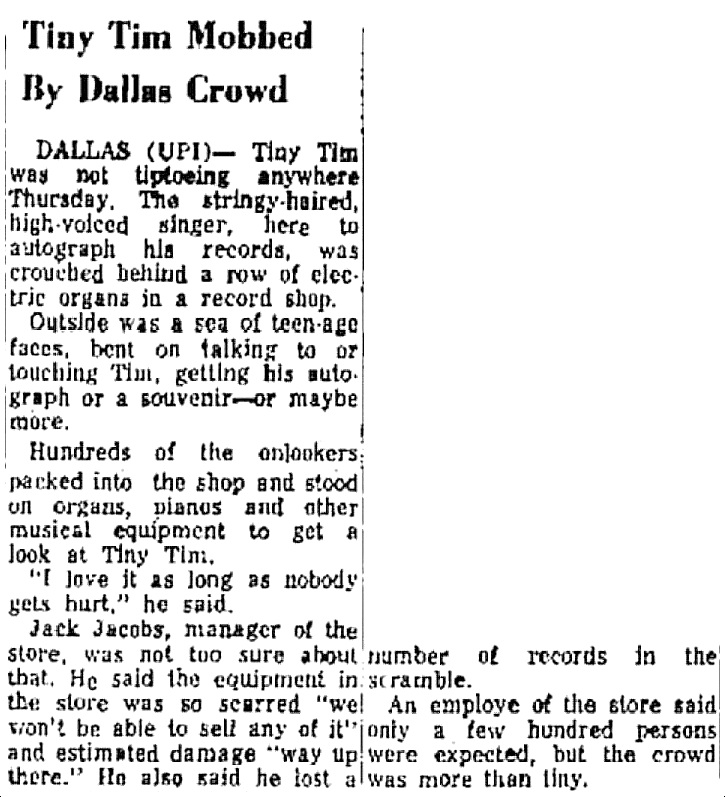
So anyway, Tiny was booked to do a little autograph party at the Melody Shop in NorthPark mall. I’m not sure what sort of crowd they thought they’d get, but it’s safe to say they did not expect 5,000 teenagers. The news report the next day was peppered with words like “pandemonium,”“swarm,” “mob scene,” and “human wall.” Who knew a 36-year-old man who strummed a ukulele and sang songs from the Victrola-age in a nasal falsetto would whip up that much enthusiasm amongst Texas teenagers?
My favorite description of the “riot” was this one:
Inside, a disheveled Tiny Tim was crouched on the floor behind a row of electric organs….. “Pretend he’s not in the store,” directed a manager. Tiny Tim, his shirttail out and his orange, green and brown tie twisted to the side, huddled alone on the floor. (“5,000 Kids Mob Tiny Tim,” Dallas Morning News, Jan. 24, 1969)
The story was even picked up by wire services. (Click article below to see a larger image.)
Amarillo Globe Times, Jan. 24, 1969
Tiny was back in Dallas a few months later, this time to do a book-signing at the downtown Sanger-Harris. (Yes! He wrote a book!)
June 17, 1969
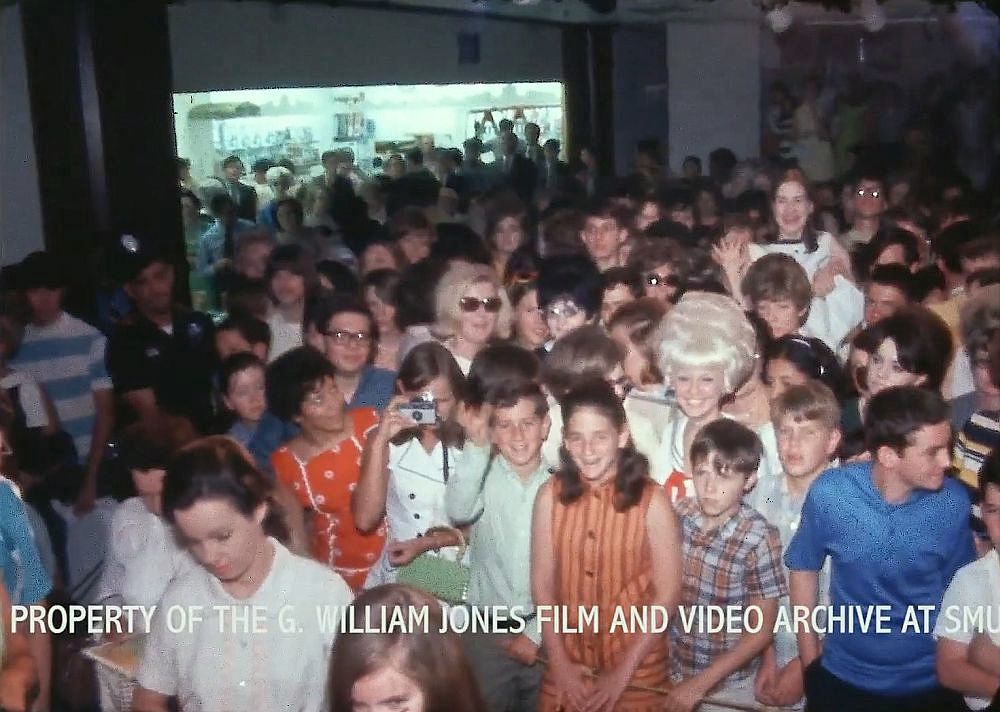
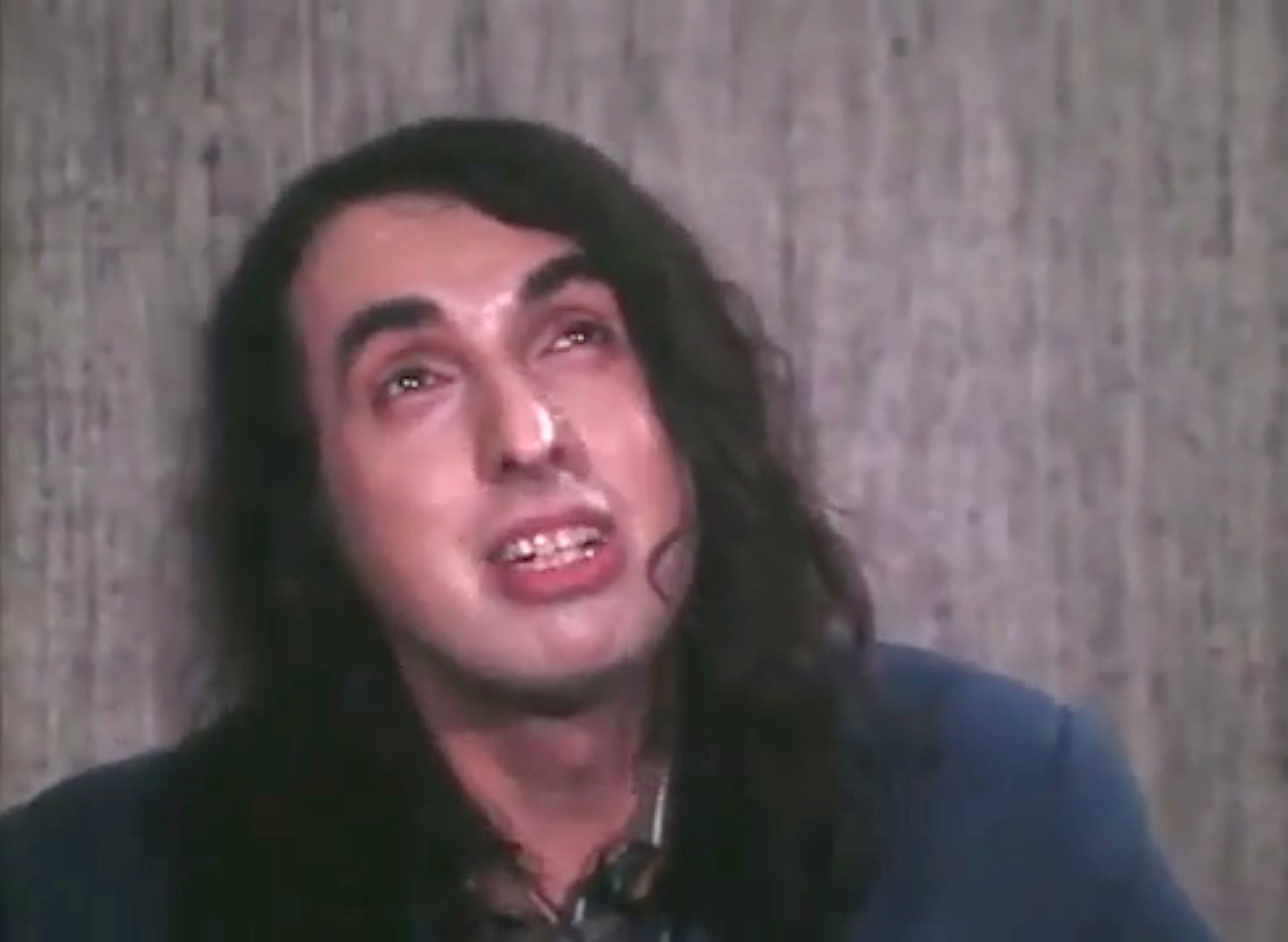
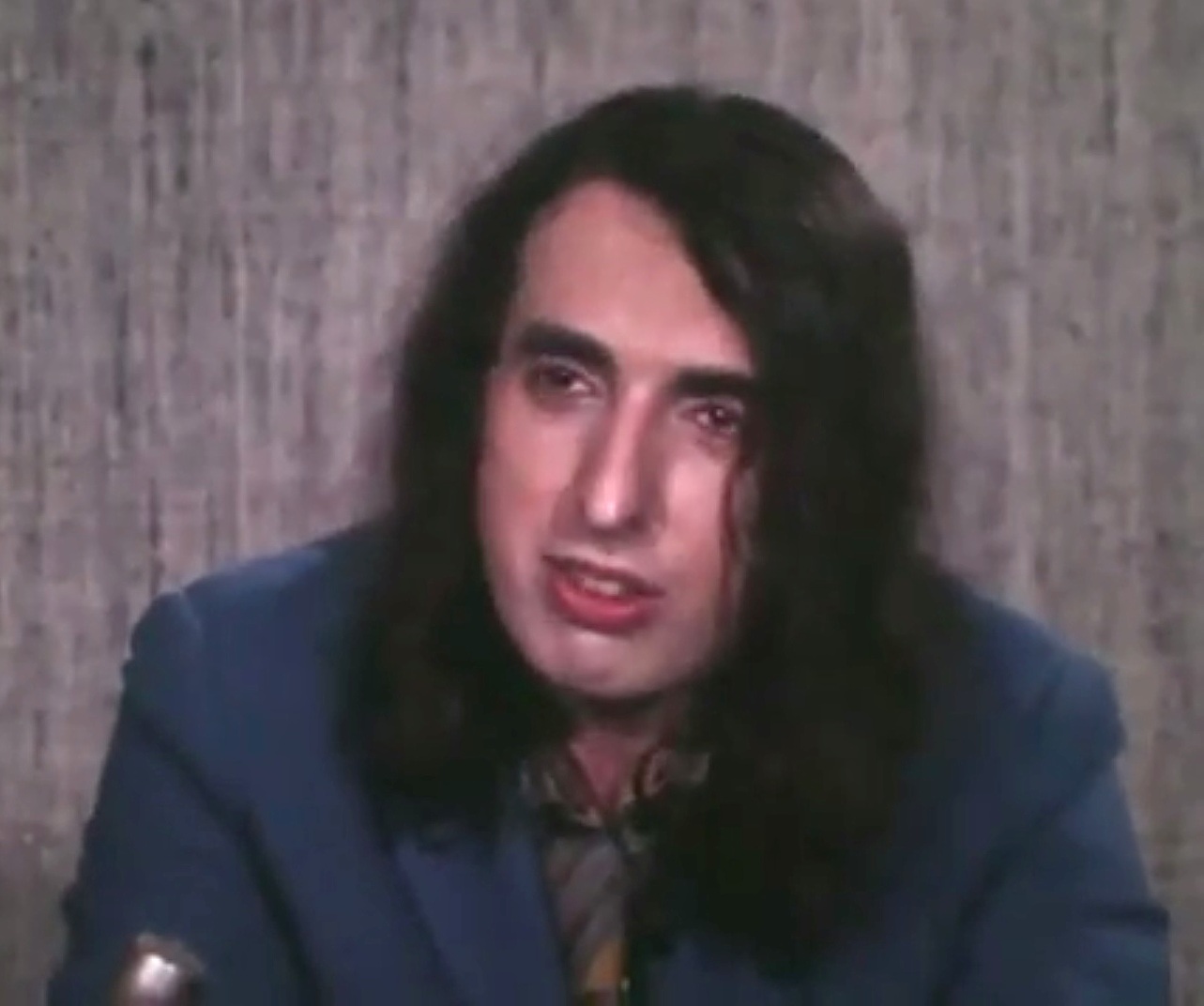
No riot was reported this visit, but Sanger’s still packed by fans who wanted a book signed by Mr. Tim (who signed with a pink quill pen). While in town, he give a little interview and an impromptu performance at a press conference (am I the only person who sees shades of Jeffrey Tambor here?):
*
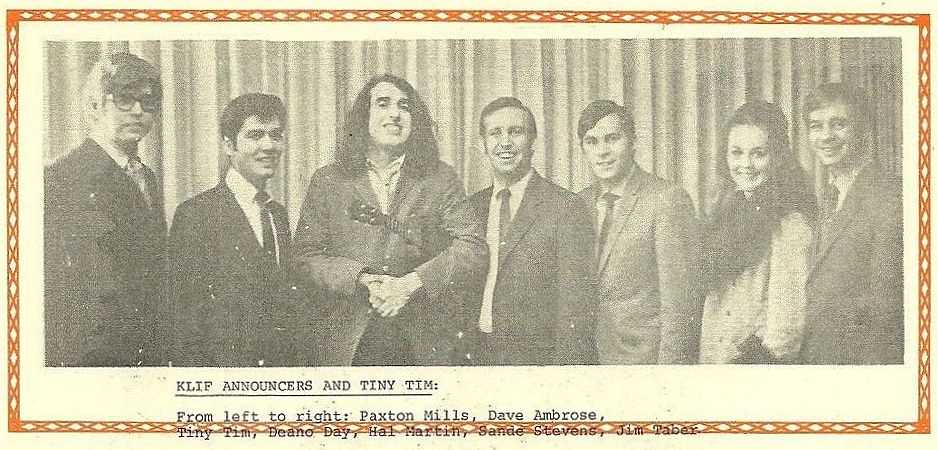
Also in 1969, he took time out to pose with KLIF on-air talent Paxton Mills, Dave Ambrose, Deano Day, Hal Martin, Sande Stevens (not sure if she worked for KLIF), and Jim Taber, seen below.
But wait, there’s more… he was back in Dallas in September, 1970 for a NINE-DAY engagement (two shows nightly) at Abe Weinstein’s famed downtown burlesque house. (I don’t know if the strippers took the time off while Tiny was in residence or if they might have entertained between his sets.) Here’s a clip from a press conference during that visit:
And, why not, here’s an early publicity photo of Herbert Khaury, the man who would one day become famous as the singer Bing Crosby once described as having (I paraphrase) a vibrato big enough to throw a Labrador through.
***
Sources & Notes
The 1969 Chanel 8 video is from the WFAA Newsfilm Collection held by the Hamon Arts Library, Southern Methodist University; it is posted on YouTube here (the first image and the three color photos of Tiny Tim are screenshots I captured from the video); the 1970 footage is from the same source and can be found on YouTube here.
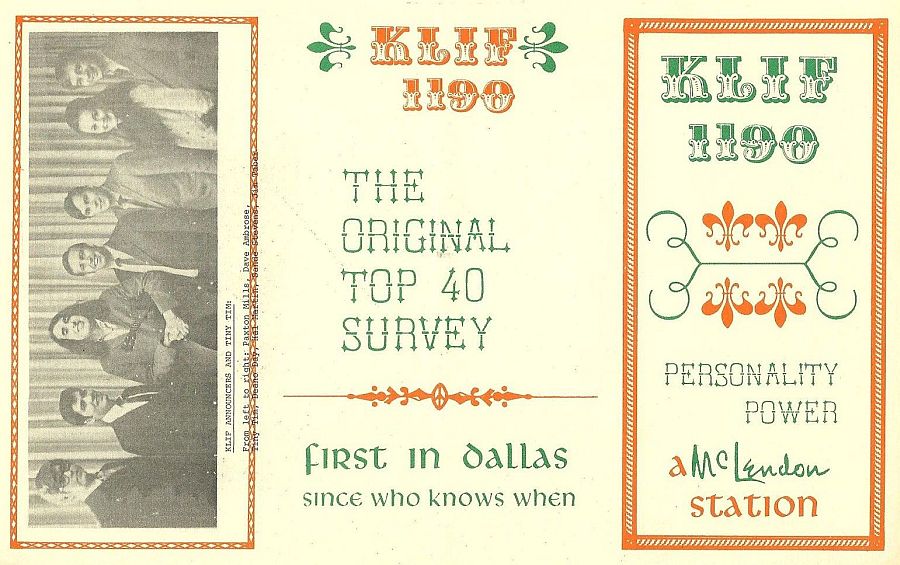
KLIF promotional material found on eBay several months ago. The back of the card lists the KLIF’s top 40 of the week, here.
Glamour shot of Mr. Khaury found somewhere on the internet.
One would be remiss in not mentioning Tiny Tim’s other ties to Dallas, namely his association with Bucks Burnett’s Edstock and Burnett’s tiny Tiny Tim museum from the 1990s. I’d link to articles in the Dallas Observer, but every time I go to the DO site my computer freezes. I encourage you to seek out these articles yourself.
More on Tiny’s January, 1969 visit to Dallas can be found in these Dallas Morning News articles:
“5,000 Kids Mob Tiny Tim” by Jean Kelly, with photo (DMN, Jan. 24, 1969)
“Magical Mystery Tour: On Meeting Tiny Tim” by Marge Pettyjohn, “YouthBeat” editor, with photo (DMN, Jan. 25, 1969)
Elm & Ervay, 89 years ago… (click for larger image)
by Paula Bosse
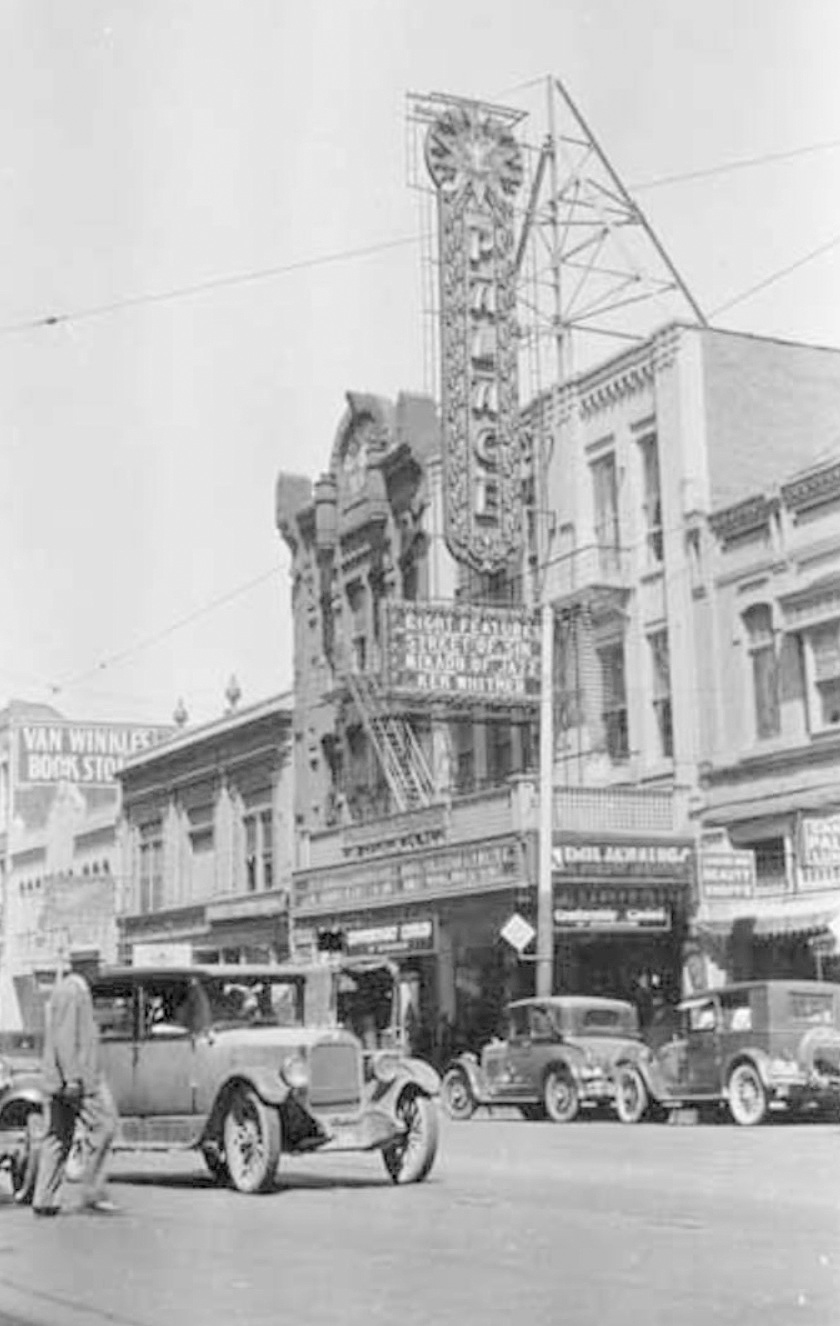
The photograph above is not the greatest quality, but it’s a photo I’ve never seen before. It shows the Palace Theatre in the 1600 block of Elm Street, just west of Ervay, with the well-known (and very large) Van Winkle’s Book Store in the background. One of the things that makes this photo so interesting is seeing the cumbersome support tower on top of the building holding up the ornate Palace sign. See what a slightly different Palace sign looked like the next year, lit up in neon, here.
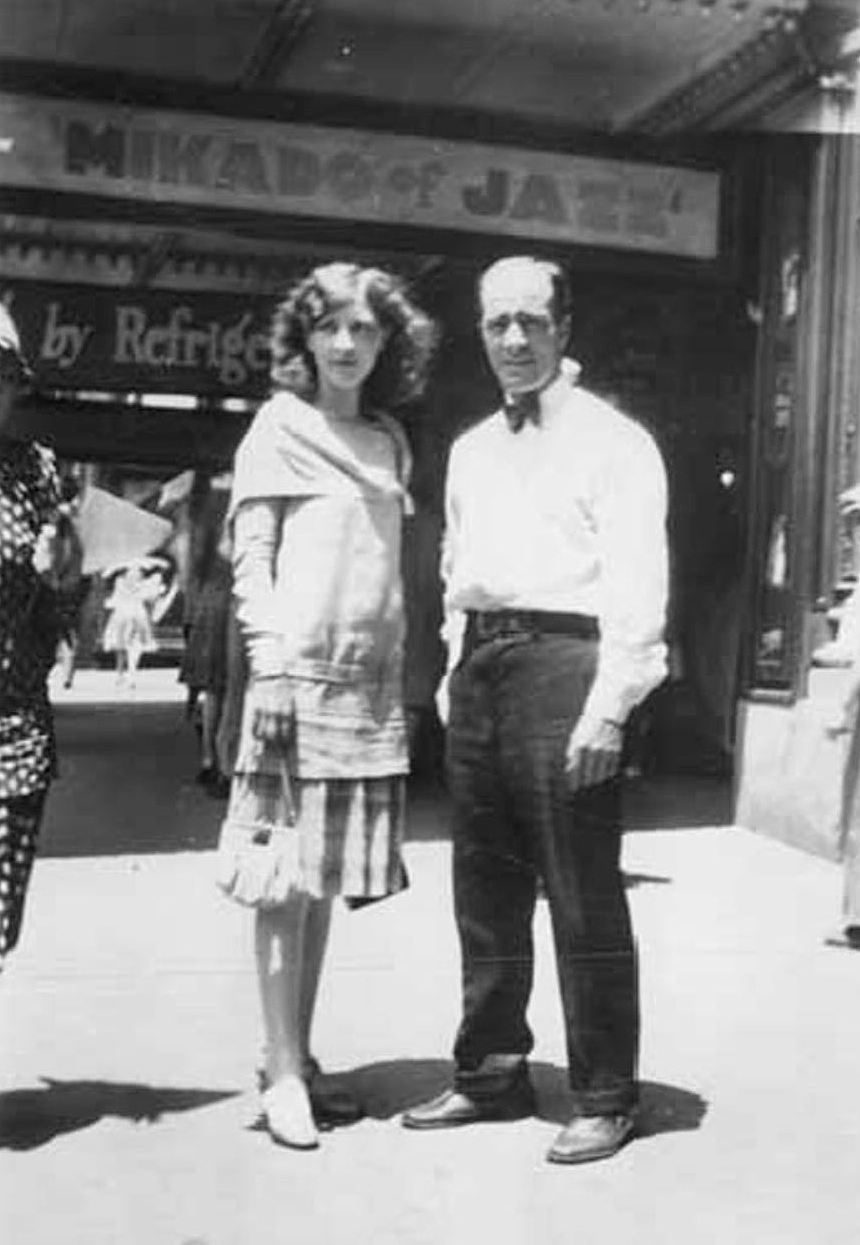
The photo above was an amateur snapshot, taken to document the tour of the traveling live stage revue The Mikado of Jazz which played the Palace in late May of 1928. The photo below — which shows the revue’s stage manager and his wife standing on the sidewalk in front of the Palace — was taken at the same time.
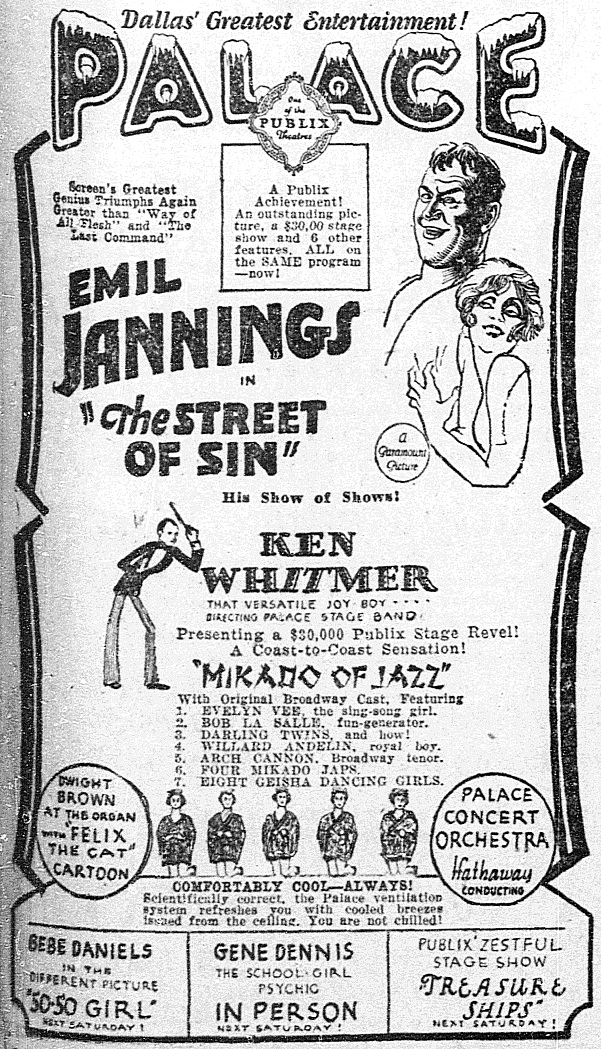
Part of a sign visible behind them was probably advertising that the theater was “cooled by refrigerated air.” The ad at the bottom of this post includes this informative little tidbit:
COMFORTABLY COOL — ALWAYS!
Scientifically correct the Palace ventilation system refreshes you with cooled breezes issued from the ceiling. You are not chilled!
What was The Mikado of Jazz? It appears to have been a jazzed-up version of The Mikado — making Gilbert & Sullivan relevant to 1920s’ audiences — like Hamilton for the Jazz Age (“This is said to be the first time that any comic opera has been syncopated and presented with a stage band.” — Dallas Morning News blurb, May 20, 1928)
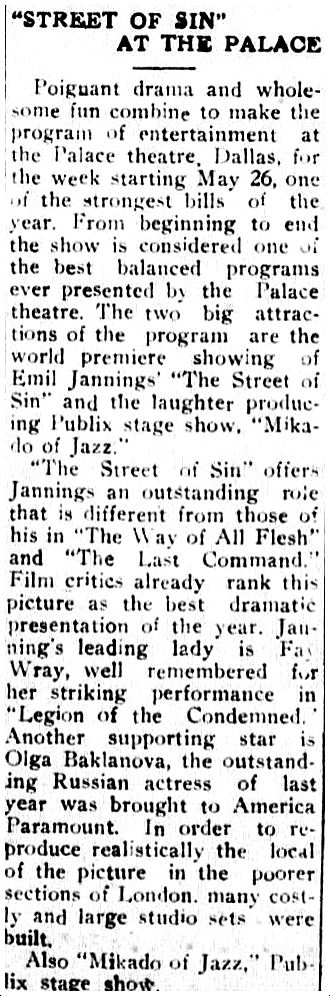
Also on the bill was the “world premiere” (?) of the film The Street of Sin, starring Emil Jannings and Fay Wray, a live stage orchestra, an organ player, and a Felix the Cat cartoon.
Texas Mesquiter (Mesquite), May 25, 1928
All at the Palace — “Dallas’ Greatest Entertainment!” Enjoyed at a comfortable temperature.
May 27, 1928
***
Sources & Notes
Photographs (taken in May, 1928) are from the Rene Irene Grage Photograph and Ephemera Collection, 1921-1930s, University of Washington Libraries, Special Collections: more information on the first photo (the view of the theater from across the street) is here; more info on the second photo is here.
For other posts that show the Palace in this era, see these posts:
“Next-Door Neighbors: The Palace Theater and Lone Star Seed & Floral — 1926,” here
I’m not in the Casa View area very often, but I was driving through last week and noted that a lot of the elements of the shopping center looked as if they were original to the buildings — specifically the little metal doo-dads along the top of the canopies over the sidewalks. I came across the photo above tonight and was happy to see those little doo-dads back when they were relatively new. The shopping center is a little confusing to me, but I think this is what that building pictured above looks like these days. (Why, why, WHY did someone think this “remodel” of the buildings was a good idea! Slapping on a new facade and removing the decorative metal doo-dads was an unfortunate decision.)
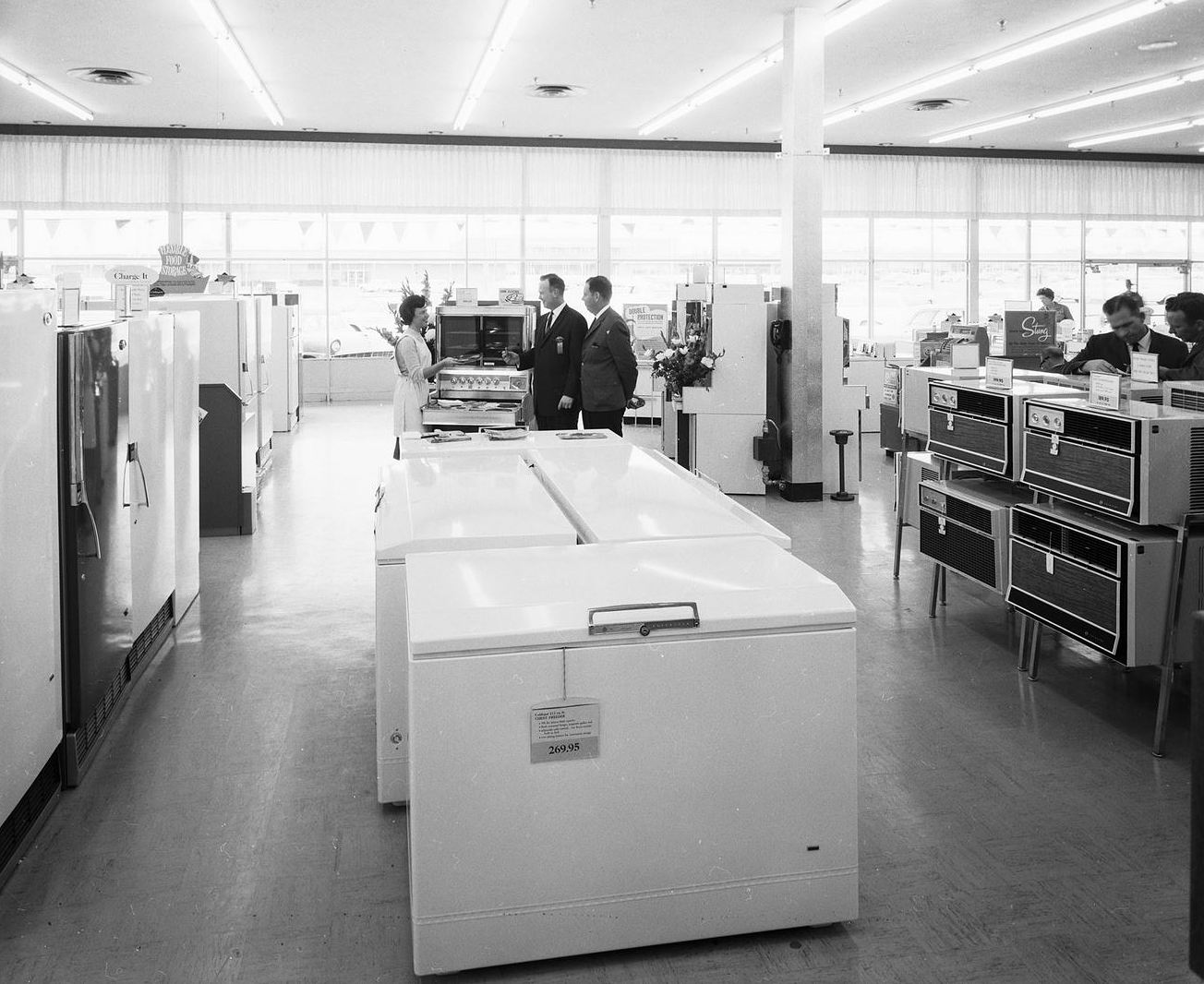
The Sears store pictured above is actually the second Sears in Casa View. The first store opened in October, 1956 at 2211 Gus Thomasson (here’s what the location of the first store looks like now — metalwork still there but that cool brick exterior has been painted over). It was Dallas’ fifth Sears store and opened in the still-under-development Casa View neighborhood. It wasn’t a full department store — its merchandise was limited mostly to appliances and automotive products. It was also a place to pick up catalog orders. (Click photos and ads to see larger images.)
Oct. 25, 1956
Apparently the store was so successful that in March, 1964, a brand new Sears opened up in a five-times-larger location (2310 Gus Thomasson) across the street — the photo at the top of this post was probably taken when it was in its first months.
March 12, 1964
Its interior — seen below in all its pristine, blinding whiteness — is fantastic. (Is that woman in the apron serving cookies she’s just baked?)
*
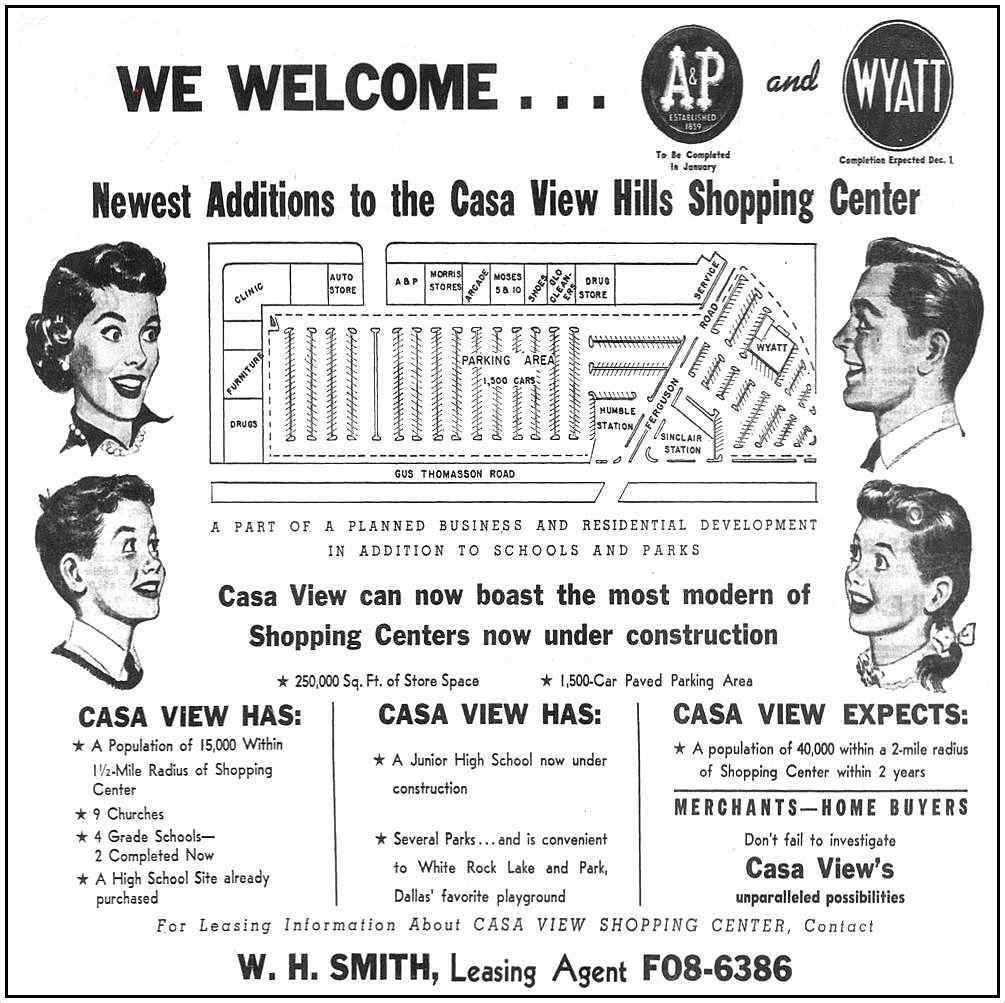
The reason I was confused by the shopping area is that it was built in phases. The first part was built in 1953 and was originally known as Casa View Hills Shopping Center. (Click the ad below to see a larger image.)
Oct. 4, 1953
But then the ownership changed hands in early 1955, and it was renamed Casa View *Village* and reopened in April under the new name.
In the meantime (I might have this chronology a bit out of whack), Casa View Center had been built in 1954, diagonally across the street. And then in 1955, construction began on an expanded Casa View Village. (This might have been its second expansion. Casa View was hopping in the mid-’50s!) And Sears had had stores in both Casa View Village and Casa View Center. It’s all kinda confusing.
The Casa View Shopping Center (I don’t know what its official name is these days, but I’m going with this) is looking a little ragged these days, but it still has a quirky charm, and I’m happy to see it still chugging along after 60 years.
***
Sources & Notes
Photos by Squire Haskins from the Squire Haskins Photography, Inc. Collection, UTA Libraries Special Collections. More info on the top photo showing the exterior of the Sears building can be found here; more info on the interior photo is here. (Click on the thumbnails on the UTA pages to see very large images.)
A Reuben sandwich sings to me, like a siren to a sailor…
by Paula Bosse
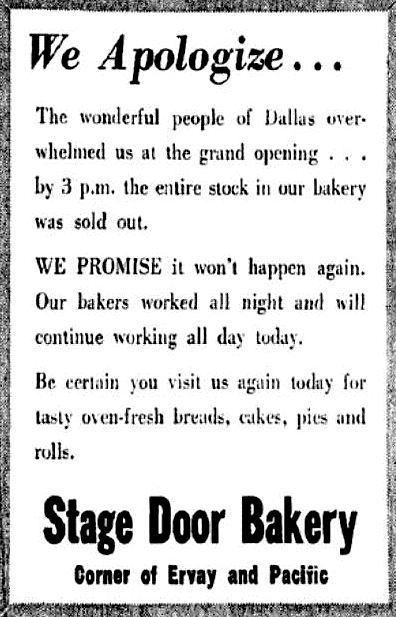
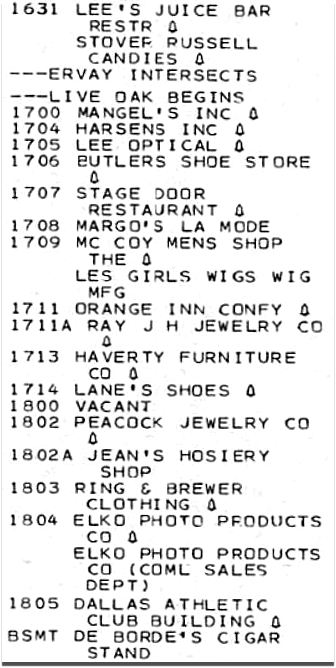
Why does Dallas have so few delis? Here’s one that seemed to be pretty popular in the 1960s: the Stage Door Restaurant and Delicatessen (and bakery), located at 1707 Elm, between the Palace Theater and the Dallas Athletic Club. It opened in June 1965 and lasted until the end of 1968 (when it was replaced by a restaurant called King Beef). I doubt there was any connection with the famous Stage Deli in New York, but manager Milton Stackel certainly had kosher cred of his own, having worked for twenty years at Grossinger’s, the legendary Jewish resort in the Catskill Mountains. I’m not sure how he found himself operating an eatery in downtown Dallas, Texas, but I’m glad he was here.
To any Milton Stackel-like entrepreneurs out there reading this:
DALLAS NEEDS DELIS!!
Authentic Jewish delicatessens!
Please!
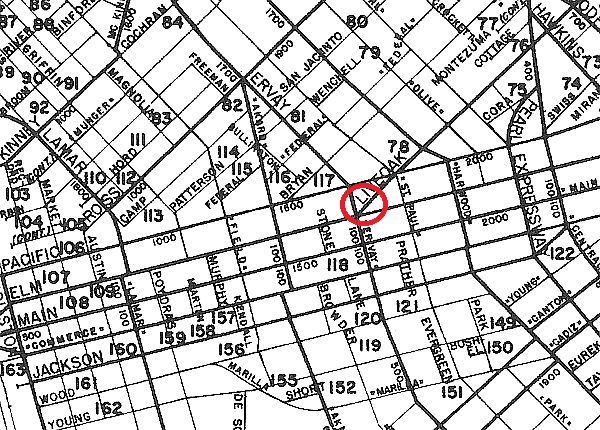
The apparently quite popular eatery was located at/near the old five-point Elm-Ervay-Live Oak intersection (seen here a dozen years earlier — the Stage Door would later be between Lee Optical and Haverty’s). There were two dining areas, one of which was The Playbill Dining Room which served an “international-type cuisine in a Gay Nineties atmosphere.” There was also a thriving take-out deli and the nearby bakery. And now? Come on, Dallas restaurateurs! Get to work!
Top image is a screengrab from a YouTube video, here, containing footage shot downtown by Lawrence W. Haas on Memorial Day, 1966.
Read more about the opening of the new business (and see a photo of the interior) in the Dallas Morning News article “Stage Door Restaurant Makes Debut in Dallas” (DMN, June 3, 1965).
The idyllic view from an East Dallas villa…. (click for larger image)
by Paula Bosse
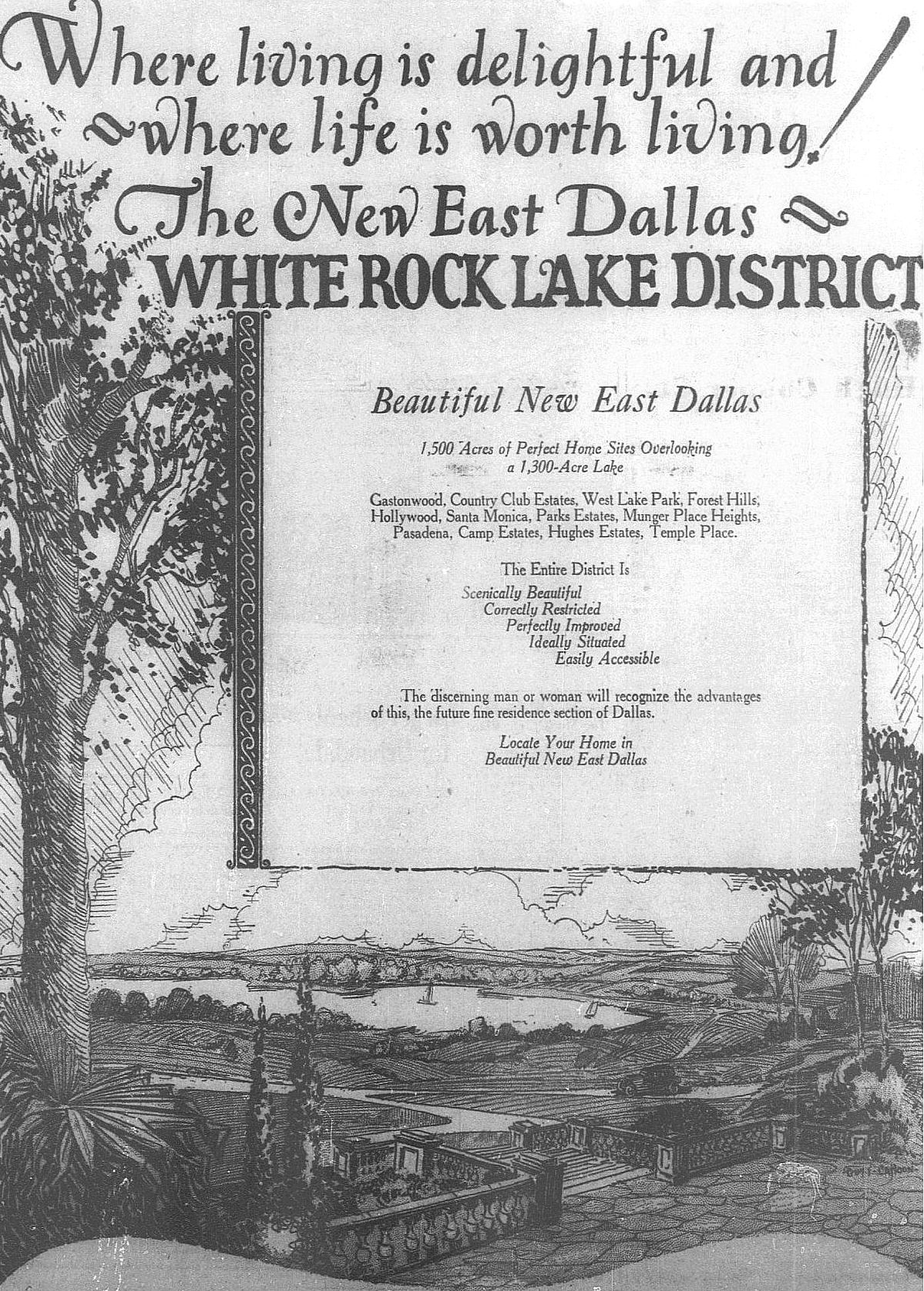
In 1926, East Dallas was in a frenzy of development. There were so many new neighborhoods: Gastonwood, Country Club Estates, West Lake Park, Forest Hills, Hollywood, Santa Monica, Parks Estates, Munger Place Heights, Pasadena, Camp Estates, Hughes Estates, Temple Place.
*
The New East Dallas WHITE ROCK LAKE DISTRICT Where living is delightful and where life is worth living!
***
Sources & Notes
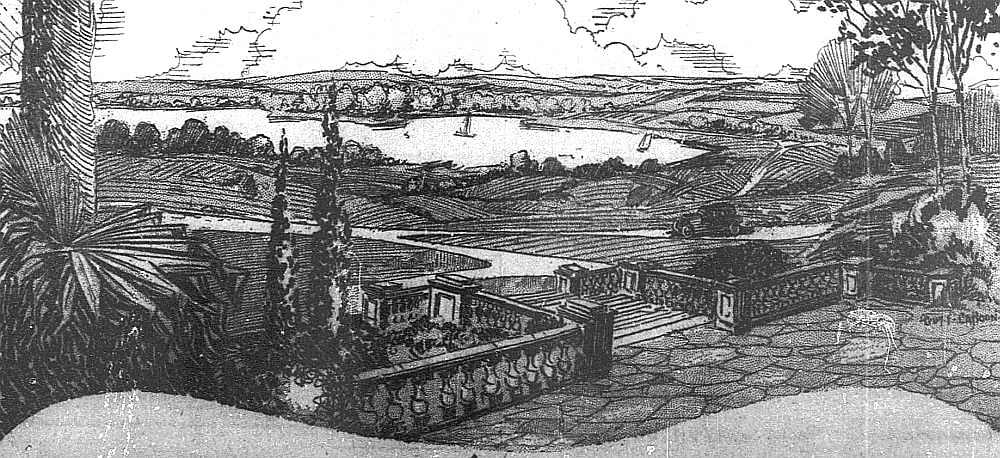
Ad from May, 1926. The detail — which shows a heart-stoppingly lovely vision of what might or might not have been a view from a home in the “White Rock Lake District” — is a Dallas I’ve never seen, but it’s one I’ll dream of.
To read a very informative article (or, I think it’s probably more of an “advertorial” written by a real estate company with land holdings in East Dallas), rifle through the Dallas Morning News archives until you find the article/advertisement titled “East Dallas Section Has Fast Growth” (DMN, May 2, 1926). As I said, it’s quite informative — with detailed info on the micro neighborhoods of East Dallas, many of which I’d never heard of.
Is that a ship? And an iceberg? (click for larger image)
by Paula Bosse
Here’s a cool little ad for what was basically a parking garage that also sold gas and tires (and which seems to have had a ship on top of its building … a building which might be shaped like … an iceberg?). This snazzy-looking garage was at 501 N. Akard (at Patterson) — it was one of several “Classified System” garages that dotted downtown from the early 1930s until at least the early ’70s. The Akard location was station No. 1.
Below, an ad from 1935 informing patrons that they could drive in, have tires installed, and pay for them sometime in the future — for as little as 50 cents a week (which would come out to about $35 a month in today’s money). “YOU DON’T NEED CASH.” (Click ad to see a larger image.)
1935 ad
I love the kooky design of the building, but that ship is just … odd. I like it, I just don’t get it. Maybe that’s the “classified” part.
***
Sources & Notes
Color image is a matchbook cover found on Flickr, here.
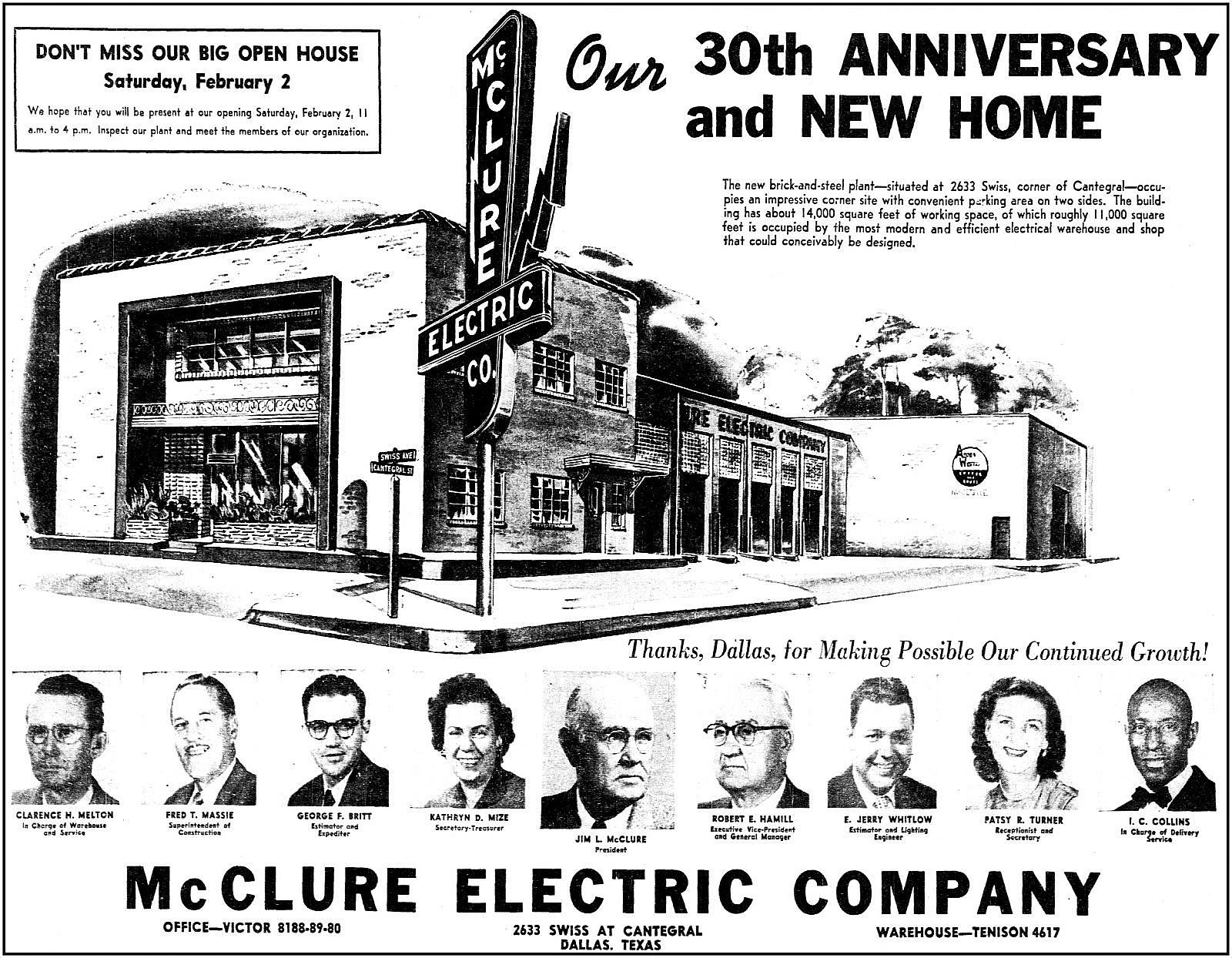
This is one of those idealized postcards from the ’40s and ’50s in which everything looks more pristine and perfect than was ever possible in real life. I love the postcard-version of this building, located at 2633 Swiss Avenue. And, glory be, it’s still standing — it just doesn’t look anywhere near as nice as it does in this postcard. (Why must people paint brick buildings? It looked so much better in 1952 when it was brand new. Today it looks like this.)
The McClure Electric Co. — which started life as the Emerson-McClure Electric Co. in 1922 — moved into their swanky new digs at Swiss and Cantegral in early 1952 and remained in business there until at least 1966. In the early ’70s, the building was home to Jim Dandy Fast Foods/Jim Dandy Fried Chicken for several years. Later, it appears that it might have been split up into office space. Currently it seems to be a fruit and vegetable produce company.
And that poor building has lost all its character.
*
1952 ad
Swiss & Cantegral, 1952 Mapsco
***
Sources & Notes
Postcard found on Flickr.
More on the McClure company’s grand opening at this Swiss Avenue location can be found in the Dallas Morning News article “McClure Electric Company at Home in Modern Plant” (DMN, Feb. 1, 1952).


























 Flashback : Dallas