Flashback : Dallas

A Miscellany: History, Ads, Pop Culture

Category: Modern Ads

The Republic Bank Building and Spain’s “Casa de Los Picos”
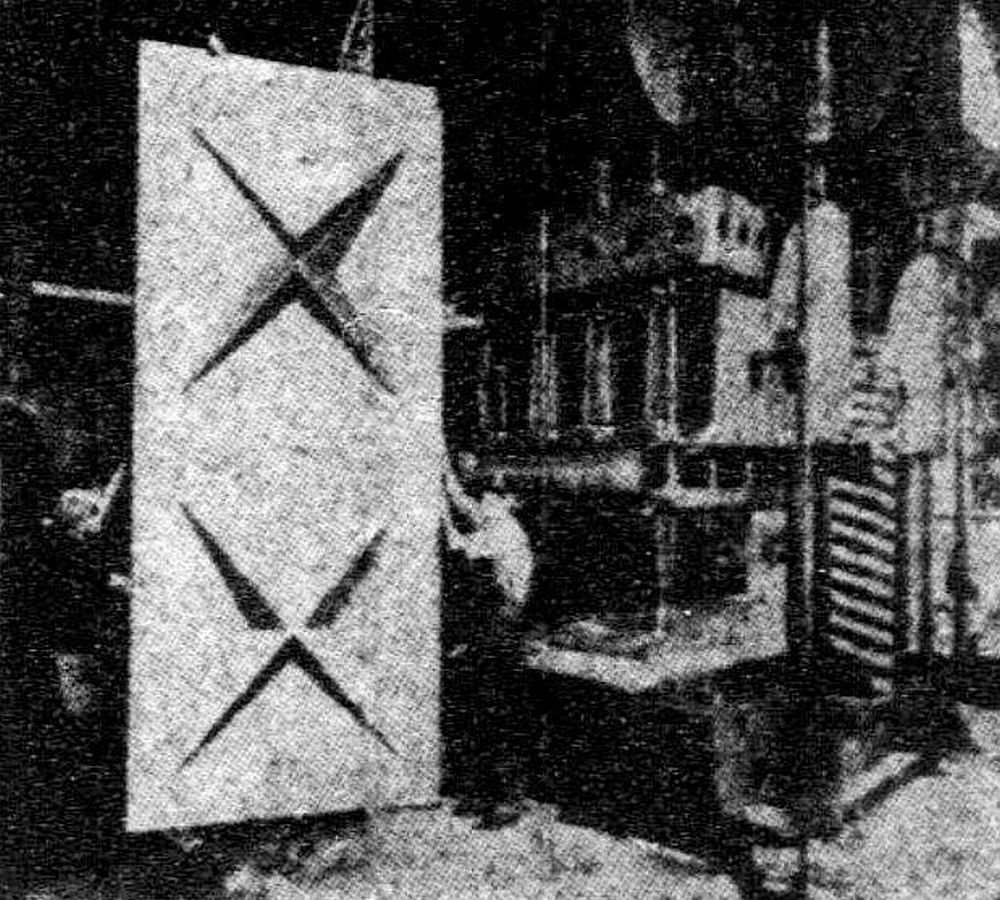
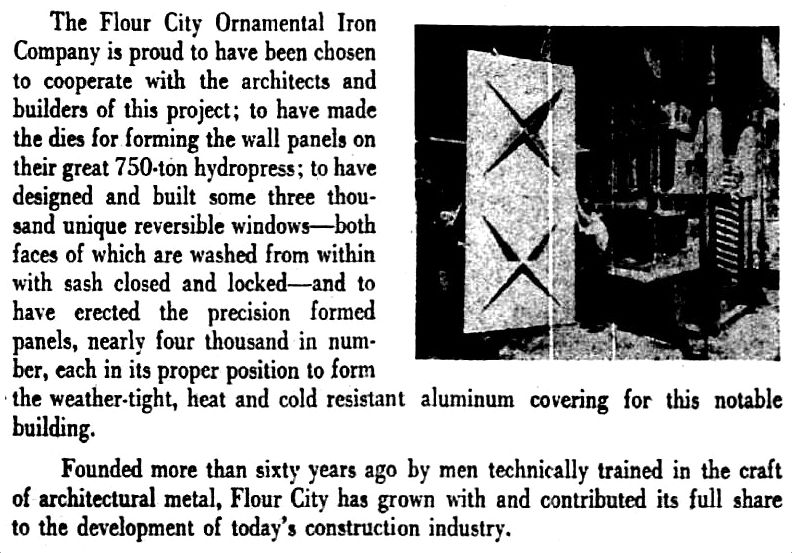
flour-city-ad_dmn_120154-panelFlour City Ornamental Iron Co. employees hard at work (click for larger image)

by Paula Bosse

Did a 15th-century building in Spain inspire one of Dallas’ most distinctive and recognizable skyscrapers?

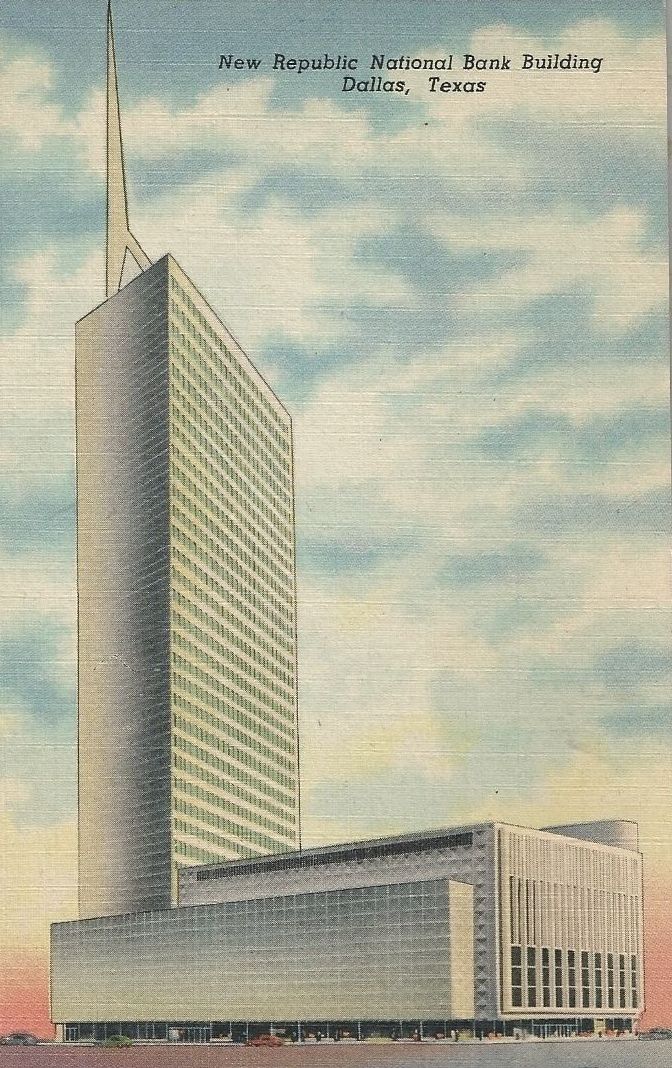
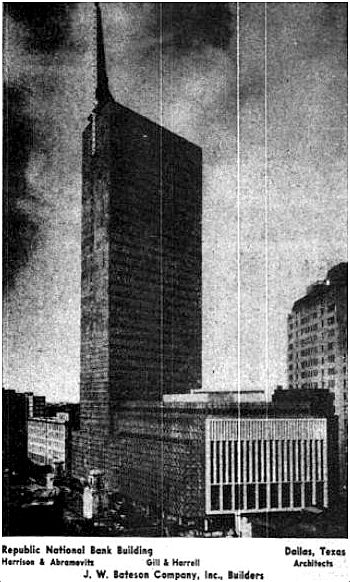
While reading about the construction of the Republic Bank Building, I came across the great, GREAT photo above which was part of an ad which ran about the time of the grand opening of the just-completed big, splashy Republic Bank Building in December, 1954. The ad this photo appeared in was for the Flour City Ornamental Iron Co. in Minnesota — the company that manufactured the thousands of pressed and embossed aluminum panels that covered the building’s exterior. These star-embossed panels — along with the distinctive and forever-cool “rocket” on the top of the building — gave the Dallas skyline a new super-modern look and an instantly recognizable landmark.

But back to that photo. It’s pretty cool. I had never really thought about those panels, but now I know that these iconic architectural adornments were manufactured in Minneapolis (…”New York CITY?!”) at the Flour City Ornamental Iron Co. Almost four thousand of these aluminum panels, a mere 1/8th of an inch thick (!), along with three thousand windows (which were reversible, so that the exterior sides could be washed from inside the building) were made in Flour City’s Minneapolis factory and transported to Dallas. From the ad:

The Flour City Ornamental Iron Company is proud to have been chosen to cooperate with the architects and builders of this project; to have made the dies for forming the wall panels on their great 750-ton hydropress; to have designed and built some three thousand unique reversible windows — both faces of which are washed from within with sash closed and locked — and to have erected the precision-formed panels, nearly four thousand in number, each in its proper position to form the weather-tight, heat and cold resistant aluminum covering for this notable building.

So, discovering that was interesting. But maybe even more interesting was this paragraph:

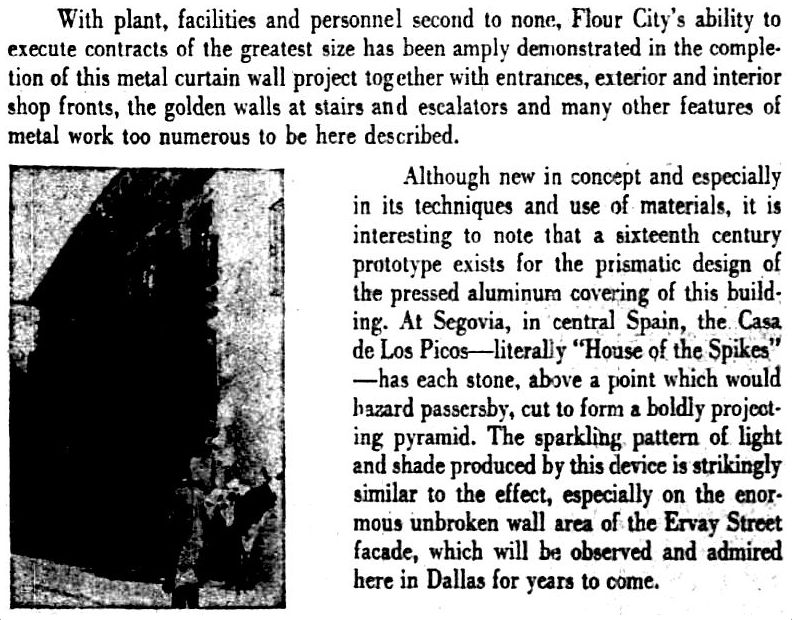
Although new in concept and especially in its techniques and use of materials, it is interesting to note that a sixteenth century [sic — it’s actually fifteenth century] prototype exists for this prismatic design of the pressed aluminum covering of this building. At Segovia, in central Spain, the Casa de Los Picos — literally ‘House of the Spikes’ — has each stone, above a point which would hazard passersby, cut to form a boldly projecting pyramid. The sparkling pattern of light and shade produced by this device is strikingly similar to the effect, especially on the enormous unbroken wall area of the Ervay Street side, which will be observed and admired here in Dallas for years to come.

I looked up Casa de Los Picos. It’s fantastic.

casa-de-los-picos_trover-websiteCasa de Los Picos, Segovia, Spain / via Trover.com

Was this design an homage of sorts to the Spanish building, conceived by the building’s main architects, Wallace K. Harrison and Max Abramovitz of the New York firm Harrison & Abramovitz? Or was it just Flour City exaggerating their work’s architectural significance? Whichever — I’m excited to have discovered Casa de Los Picos … because of an advertisement! I love this building — here it is again.
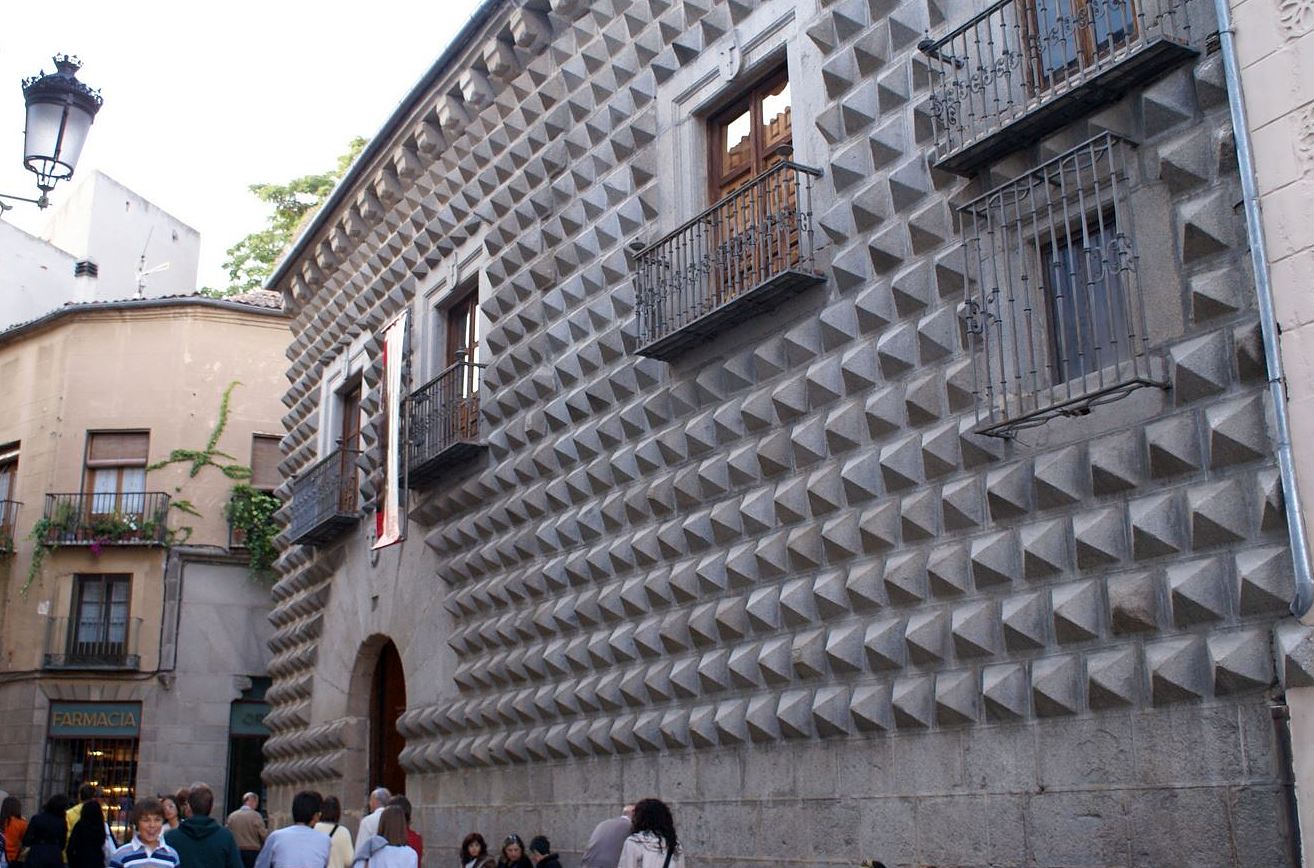
casa-de-los-picos_wikimediaWikimedia (click for gigantic image here)

And here’s an extreme close-up of the hometown favorite.
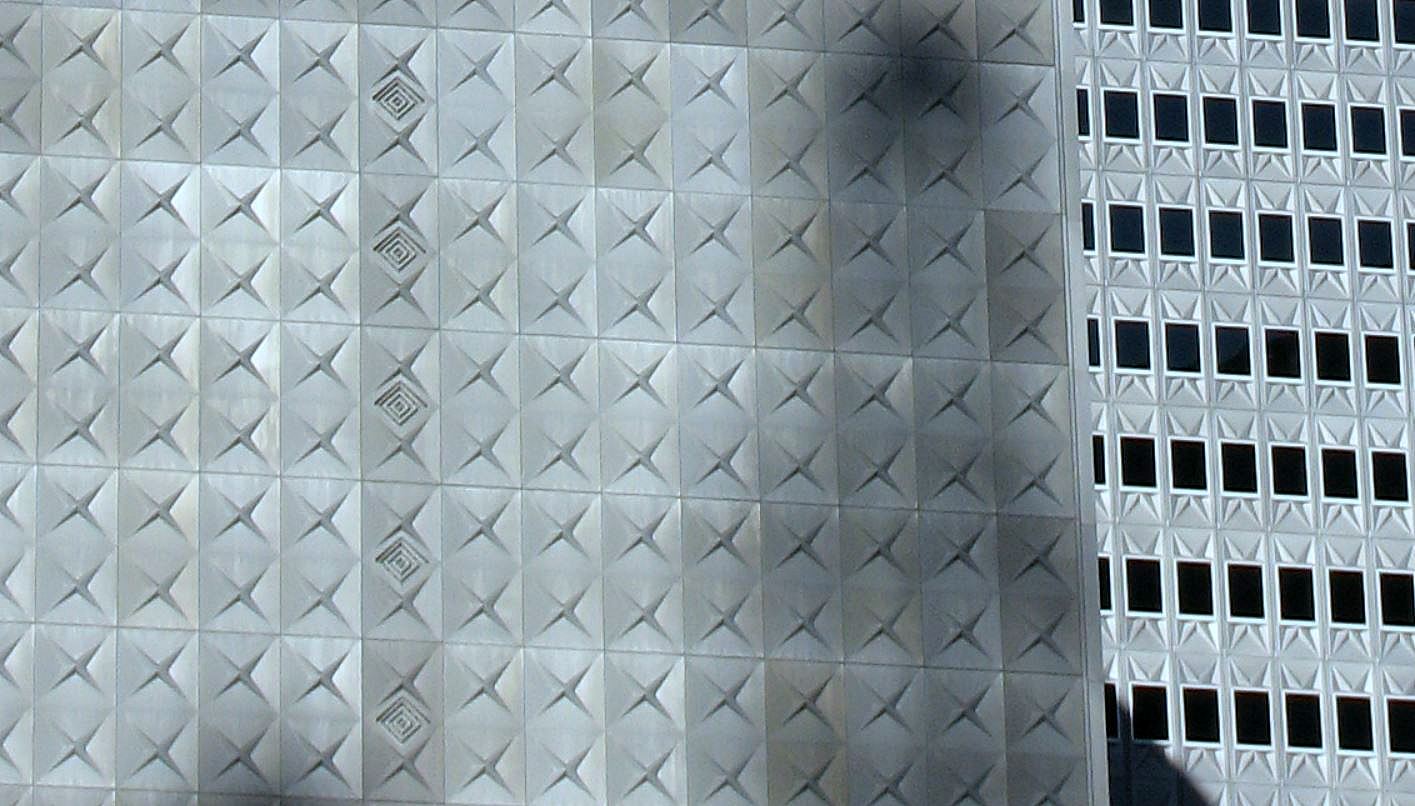
panels_wikimedia-detWikimedia (see a fuller image image here)

You learn something new every day.

Here’s the original 1954 Flour City advertisement, broken into readable sections (click for larger images).
ad-flour-city_dmn_120154a

ad-flour-city_dmn_120154b

ad-flour-city_dmn_120154c

ad-flour-city_dmn_120154d

ad-flour-city_dmn_120154e

republic-national-bank

***

Sources & Notes

Wikipedia round-up:

  • Flour City Ornamental Iron Works Company, here
  • Casa de Los Picos (en Español), aqui
  • Harrison & Abramovitz, architects, here
  • Republic Bank Building, here

See a whole passel of photos of the exterior of Case de Los Picos, here.

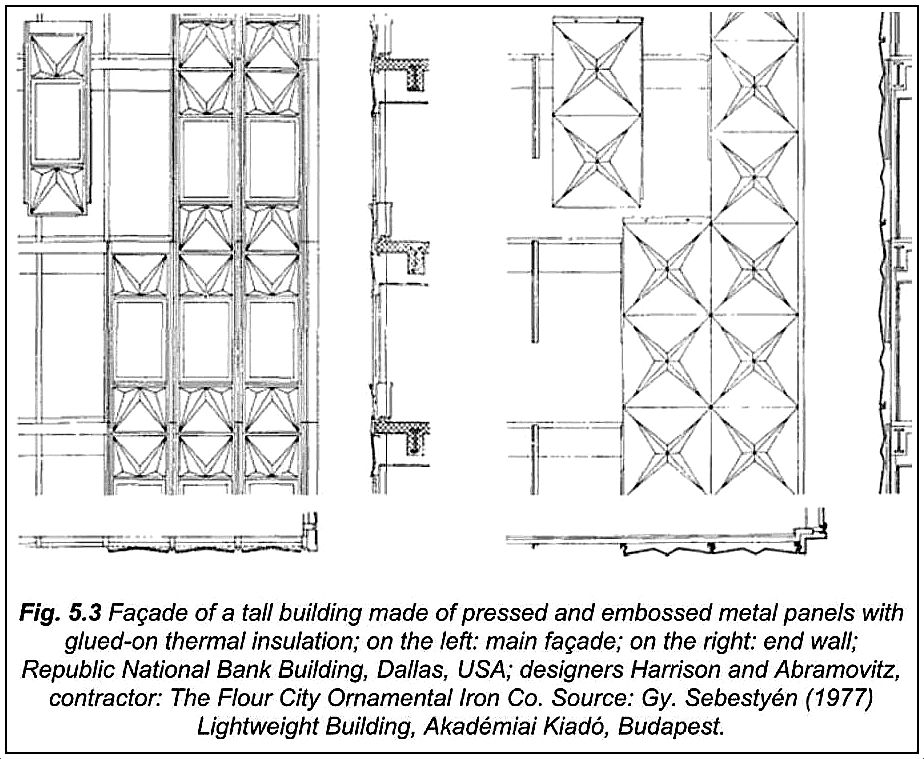
Here’s something I stumbled across in the middle of stumbling across other things — a schematic of the aluminum panels — I don’t know if they are original architectural drawings or not. They are contained in the book Construction, Craft to Industry by Gyula Sebestyen (London: E & FN Spon, 1998); you can find it here.
panel-details_construction-craft-to-industry_

I found surprisingly little information on Flour City’s contribution to the Republic Bank Building on the internet. Anyway, thanks, Minnesota, for playing such an important role in the construction of — and look of — one of my favorite Dallas buildings!

My previous post on this great building — “The Republic National Bank Building: Miles of Aluminum, Gold Leaf, and a Rocket” — is here.

When in doubt, click pictures for larger images.

*

Copyright © 2015 Paula Bosse. All Rights Reserved.


“The Fair Is In the Air — Let’s Go!”

state-fair_1923Look at this 1923 typeface!

by Paula Bosse

Here we are again in the final days of another State Fair of Texas. Why not take a look at a few random images of the fair over the years. (Click pictures for larger images.)

First, from 1900, the entrance to the fairgrounds. (It appears to be the same view as the top postcard seen in a previous post, here, just a few steps inside the archway.)

fairgrounds-main-entrance_bohemian_1900_fwplFort Worth Public Library

*

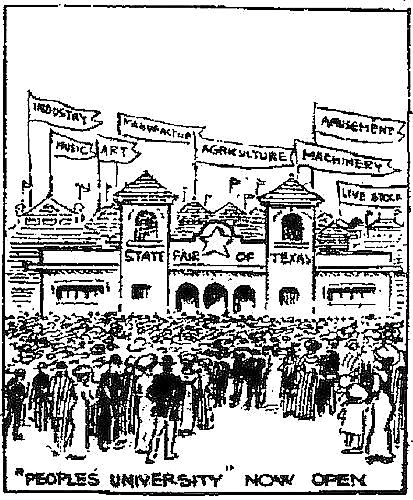
A cartoon from The Dallas Morning News in 1912 — “The People’s University.” Remember, it’s not just about Ferris wheels and candy apples.

state-fair_dmn_102012-cartoonDMN, Oct. 20, 1912

*

1921. Don’t miss The Whip.

state-fair_1921

*

From the Texas Centennial in 1936, a shot of a remarkably spotless Midway. (Am I the only one who would have paid to see the “28-Ft. Monster” do battle with whatever freakish specimens were ensconced within the walls of the Ripley’s Believe It Or Not building?)

tx-centennial-midway_1936_ebay

*

During World War II, no fair was held between 1942 and 1945. “Not until the boys come home, will there be another State Fair of Texas.”

state-fair_wwii_tx-almanac_1945-46

*

By the ’50s, everything was back to normal. Big Tex had arrived, and this ad promises “She’s a LULU in ’52.” Martin & Lewis and whatever a Thrillcade was!

state-fair_dmn_092552_lg

*

And, lastly, an aerial view of the Midway from 1966. Now this IS all Ferris wheels and candy apples. (To watch a short collection of color footage from the damp 1967 SFOT — including a sad, rainy parade downtown — click here.)

state-fair_1966_UNTUniversity of North Texas

***

Sources & Notes

1900 photo of the entrance to the fair is from The Bohemian magazine (1900) in the collection of the Fort Worth Public Library (those perforations in the photo are the FWPL’s).

1921 photo — I’m afraid I have no source on this one.

1936 postcard of the Centennial Midway is from eBay.

Patriotic WWII ad is from the 1945-1946 Texas Almanac.

Photo of the 1966 Midway is from the University of North Texas University Libraries blog, here.

My previous collection of SFOT photos over the decades appeared in the post “So Sorry Bill, But Albert Is Taking Me To The State Fair of Texas,” here.

Other Flashback Dallas posts on the State Fair of Texas are here; posts specifically on the Texas Centennial are here.

Again … some of these pictures are pretty dang big — when in doubt, click ’em!

*

Copyright © 2015 Paula Bosse. All Rights Reserved.


“A City Built On the Solid Rock of Service” — 1927

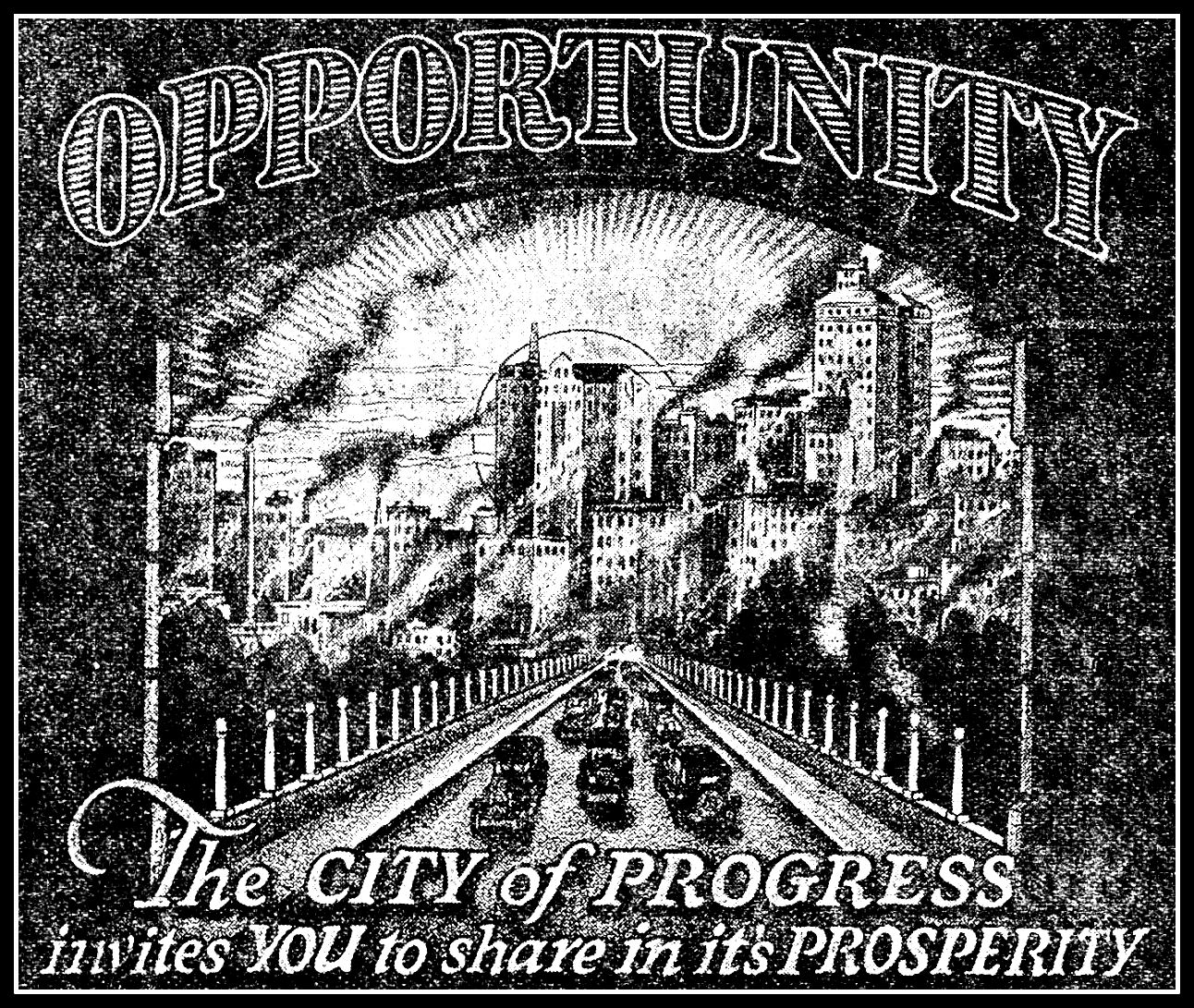
ad-dallas-chamber-of-commerce_tx-almanac_1927-det“Opportunity!”

by Paula Bosse

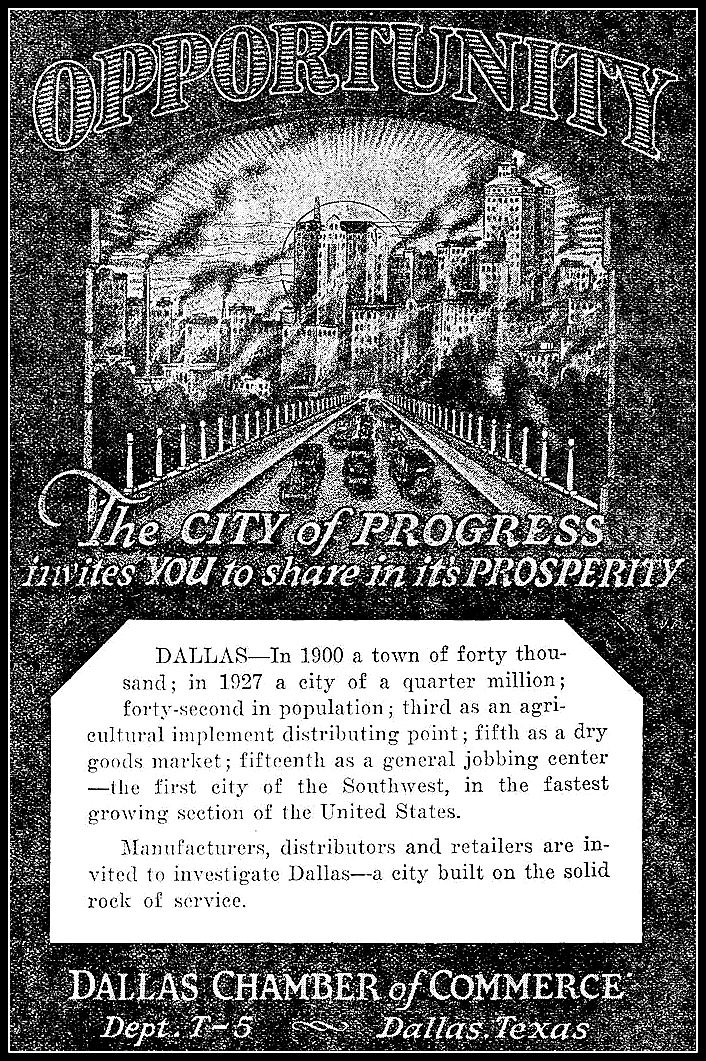
Below, a 1927 Dallas Chamber of Commerce ad with some interesting statistics.

ad-dallas-chamber-of-commerce_tx-almanac_1927

*

OPPORTUNITY

The CITY OF PROGRESS invites YOU to share in its PROSPERITY.

DALLAS–in 1900 a town of forty-thousand; in 1927 a city of a quarter million; forty-second in population; third as an agricultural implement distributing point; fifth as a dry goods market; fifteenth as a general jobbing center–the first city of the Southwest, in the fastest growing section of the United States.

Manufacturers, distributors and retailers are invited to investigate Dallas–a city built on the solid rock of service.

*

Pretty impressive. And the illustration of a dynamic city on the other side of that viaduct is all but throbbing with energy.

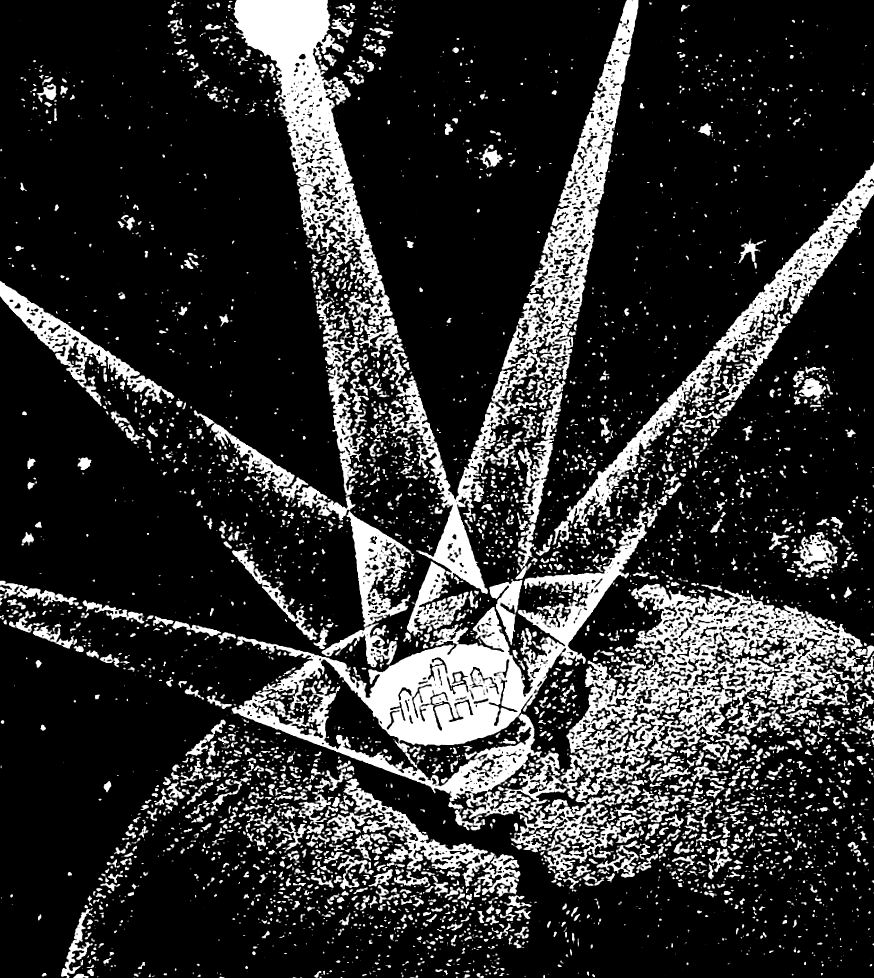
The illustration from a 1929 Chamber of Commerce ad is even less modest: it shows Dallas as the center of the universe, center stage on Planet Earth, lit up by the sun and the giant Klieg lights of space.

ad-dallas-chamber-of-commerce_tx-almanac_1929-det

I kind of think Dallas has pretty much always seen itself like this.

***

Sources & Notes

Ads from the 1927 and 1929 editions of The Texas Almanac and State Industrial Guide.

*

Copyright © 2015 Paula Bosse. All Rights Reserved.
Cadillac + Neiman-Marcus = “Practical” — 1956

ad-cadillac_neiman-marcus_1956Gowns and storefront by N-M, bumpers by Cadillac

by Paula Bosse

One need not be “prominent” to own a Cadillac or to shop at Neiman’s (… but it certainly helps).

***

Sources & Notes

Thanks to reader Kevin Smith for sending this to me!

Click ad to read text and to see those N-M gowns practically life-size.

*

Copyright © 2015 Paula Bosse. All Rights Reserved.

“The Only Motel Located In the Park Cities” — 1964

university-house-hotel_smu-rotunda_1965-detA palm tree, a palm tree, my kingdom for a palm tree… (click for large image)

by Paula Bosse

Behold, an architect’s rendering of University Park’s first motel (… motel?!). With palm trees! (The architects — Barron, Heinberg and Brocato  — were from Alexandria, Louisiana, where they might actually have palm trees. Perhaps they assumed they grew in Dallas. Or could be imported. Or just looked nice as a whimsical garnish.) Palm trees or not, look at that great mid-century design!

Plans for the University House Motel were announced in December, 1963 — it was to be built on Hillcrest at Binkley, right across the street from SMU by Edward T. Dicker, the man who built 3525 Turtle Creek. (Interestingly, according to a press release printed in The Dallas Morning News on Dec. 8, 1963, real estate transactions for the property involved a land lease from Shell Oil Co.) With 60 suites, it was the perfect location for hotel lodgings for parents visiting their children in college.

This was to be both a major commercial addition to University Park as well as something of an architectural departure. The closest hotel/motel alternative (according to the ad below, anyway) was farther away than might have been convenient for visiting families — the (also super-cool-looking) Holiday Inn was all the way down Central, just past Fitzhugh.

ad-holiday-inn_central-expwy_smu-rotunda_1965
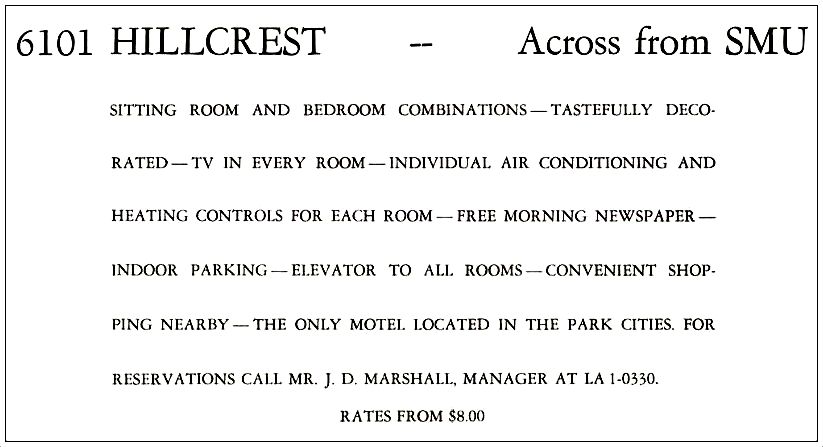
If I were a visiting parent, I’d probably choose the University House option because of its unbelievably close proximity to the campus. And if I saw the ad below, I’d definitely book a room — pronto!

university-house-hotel_smu-rotunda_1965(click to read text)

When construction was complete and the motel opened for business, the sans-palm-tree reality of the building had to have been a bit of a disappointment to anyone who had salivated over that sleek Mid-Century Modern drawing (even though I’m sure the interior decor was much nicer than most motels). Maybe it’s just me. It sort of looks like the drawing. …Sort of….

university-house_smu-rotunda_1965

The University House hung on for several years, then changed ownership and names several times. It is now the site of the much-expanded and certainly much-swankified Hotel Lumen. Interestingly, the skeleton of the original building is still in there somewhere. As Alan Peppard wrote in the Dallas Morning News on Oct. 16, 2006 soon after Hotel Lumen opened, “The old hotel was gutted back to nothing but the concrete frame and rebuilt as a hip University Park hotel.” (To see what things look like now, click here — the renovated original building is on the left, the expansion is on the right.)

In the 21st century, Hotel Lumen is exactly the kind of hotel that comfortably-well-off-but-still-tastefully-hip SMU parents want to stay in when they arrive in town to visit the progeny. All that’s missing are a few palm trees….

***

The University House Motel ad appeared in the 1965 Southern Methodist University Rotunda yearbook. That same yearbook also contained the Holiday Inn ad and the photograph of the University House Motel. (The photo appeared over the yearbook’s cheeky “Why be discreet?” caption and was featured in the previous Flashback Dallas post, “The SMU ‘Drag’ — 1965,” here.)

The 1965 ad has the nightly rate at the University House Motel at $8 — about $60 in today’s money, adjusted for inflation. Not bad for parents who could afford to send their children to SMU and who weren’t staying downtown at the Adolphus, the Baker, or the Hilton.

Photos of Hotel Lumen — inside and out — can be found on their website, here.

Click pictures for larger images.

*

Copyright © 2015 Paula Bosse. All Rights Reserved.


The Stoneleigh Court Apartment Hotel — 1923/1924

stoneleigh_1923_natl-reg-application
Still standing, still beautiful…

by Paula Bosse

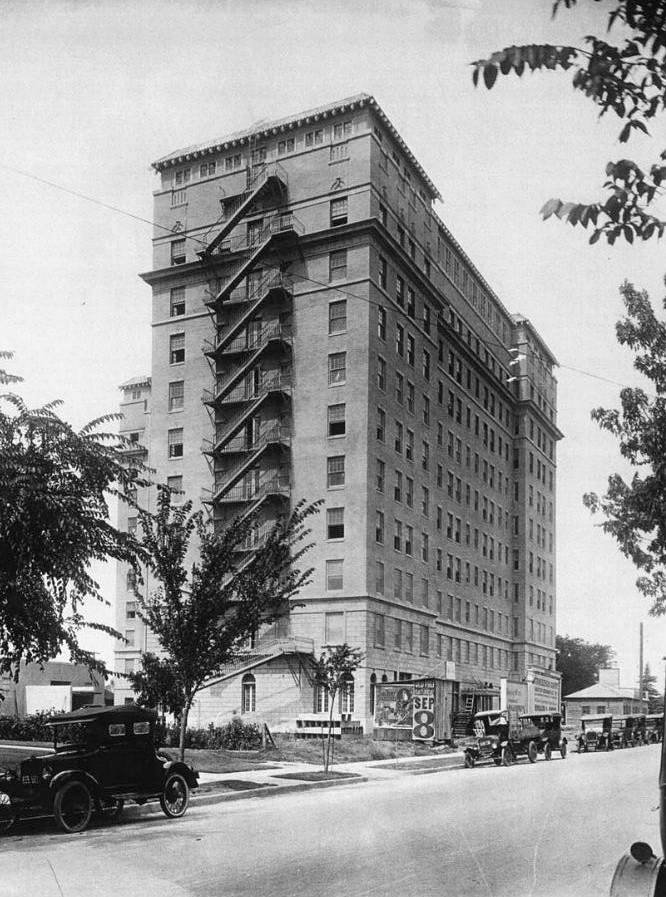
Above, the Stoneleigh Hotel (originally known as the Stoneleigh Court Apartment Hotel) in 1923, in its final weeks of construction. When the Stoneleigh opened in October, 1923 at the corner of Maple Avenue and Wolf Street, it was a swanky apartment house, with hotel amenities (a few rooms were set aside for “transient” travelers). Thankfully, the Frank J. Woerner-designed building still stands and remains a lovely hotel.

Originally there were 125 apartments (which ranged from 1-5 rooms each), all of which were fully furnished (linens, silver, kitchen utensils, dishes, telephones, etc.), and maid service was provided. There were also radios in every room (a pretty new-fangled thing at the time). Each apartment had a kitchenette and a private bath, and ice water was piped to all apartments. Another innovative feature was the Servidor delivery service which allowed residents and hotel staff to conduct transactions without ever having to look one another in the eye or exchange stilted chit-chat. There was a grocery store, a pharmacy, a beauty shop, and a barber shop on the premises. There were smoking rooms, billiards rooms, and lounges on the ground floor and a grand ballroom on the top floor. And apartments were “handsomely furnished, [with] a color scheme of taupe, blue and mulberry being observed alternately on the various floors.” Sign me up!

*

Below, an early ad (click to see a much larger image of the illustration on its own).

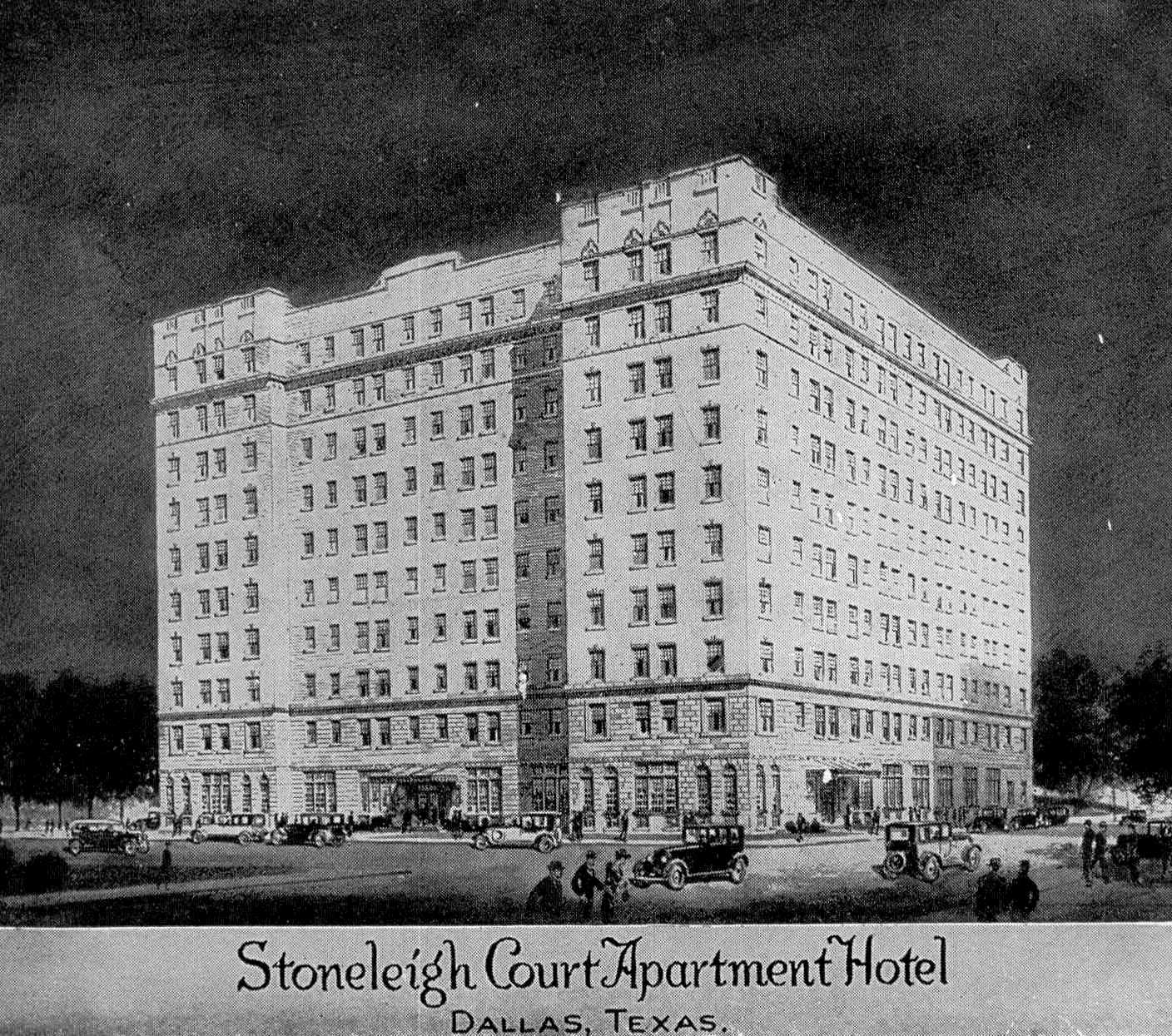
ad-stoneleigh_terrill-yrbk_1924

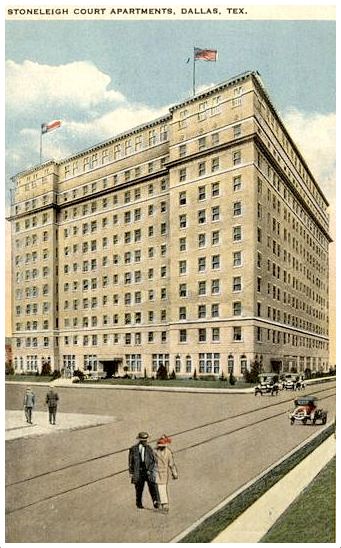
And, of course, the obligatory postcard in which the building looks familiar, but which its surroundings seem somewhat … romanticized.

stoneleigh_court_apartments

*

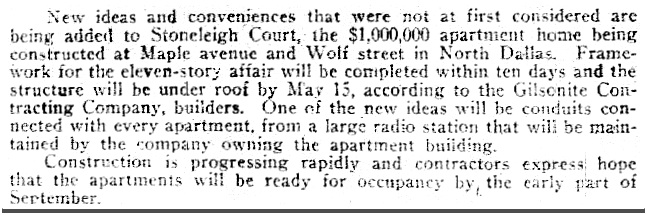
A grainy photo from the construction and its caption:

stoneleigh-hotel_dmn_042223_under-construction_photo

stoneleigh-hotel_dmn_042223_under-construction_captionDallas Morning News, April 22, 1923

***

Sources & Notes

Photo of the building nearing the end of its construction is from the application to the National Register of Historic Places, which can be found in a PDF, here. (Dallas Historical Society photo.)

Ad is from the 1924 Terrill School yearbook.

To read a lengthy article published a few days before the Stoneleigh officially opened — “Stoneleigh Court Most Pretentious Apartment Hotel in the Southwest” (Dallas Morning News, Oct. 14, 1923) (with “pretentious” used here in a good way!) — click here.

Not sure what an “apartment hotel” is? See Wikipedia, here.

The Stoneleigh is currently called “Le Méridien Dallas, The Stoneleigh,” and the official website is here.

*

Copyright © 2015 Paula Bosse. All Rights Reserved.

Fly United to Chicago in Only Eight Hours!

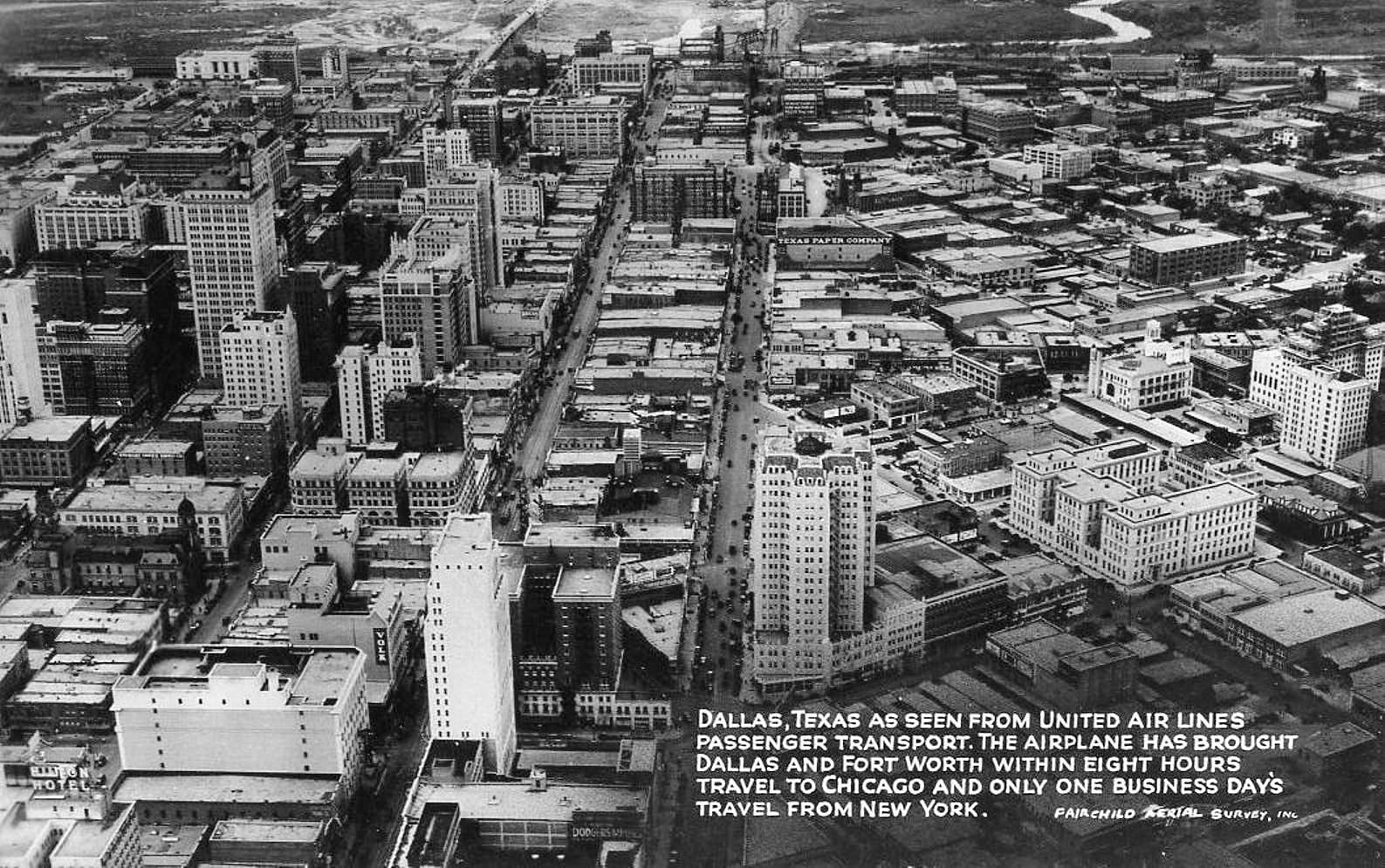
aeiral_united-air-lines_fairchild_ebay_rppcHow many buildings can you identify? (click for larger image)

by Paula Bosse

Dallas, Texas as seen from United Air Lines passenger transport. The airplane has brought Dallas and Forth Worth within eight hours travel to Chicago and only one business day’s travel from New York.

Back when it took all day to fly to New York from Dallas.

This is another great aerial photo by the Fairchild Aerial Survey company, probably taken by Lloyd M. Long. Date-wise? Late-1920s? Before the Trinity was straightened (beginning in 1928), with land being cleared in the area that would become Dealey Plaza? 1928-ish? Or could it have been the very early 1930s? The United Air Lines promotional postcard was issued around 1932 or 1933.

It wasn’t until 1933 that United introduced its new Boeing “twin motor airline transports” and boasted that they would finally “bring the city within eleven and a half hours of New York City” (Dallas Morning News, Aug, 16, 1933).

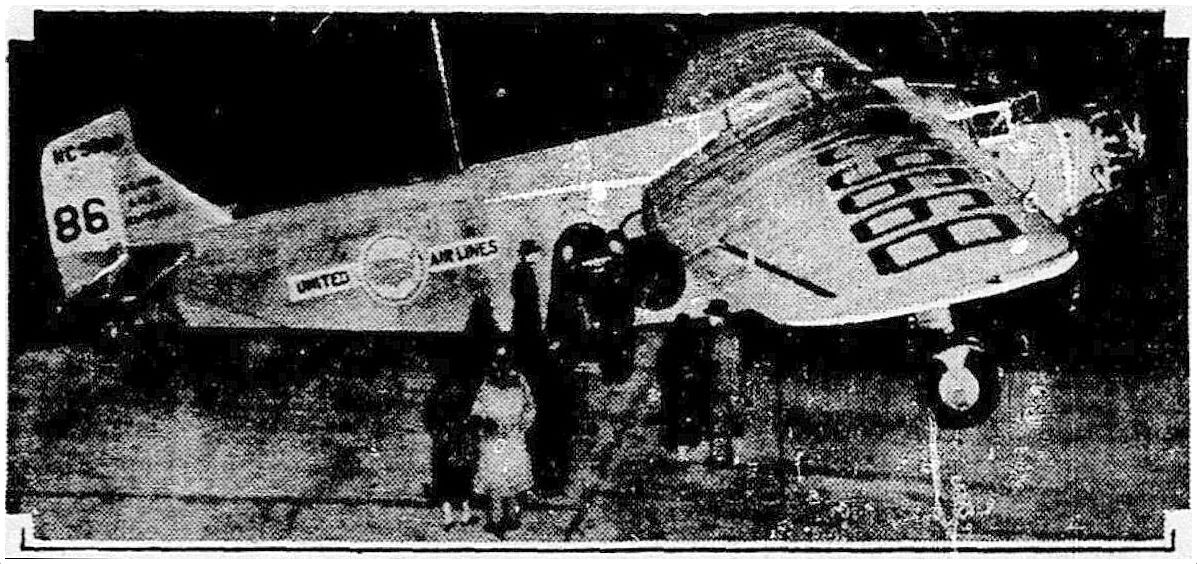
Below is a photo from a Dallas newspaper ad showing one of United’s planes from the earlier, more carefree days of 1932, when passengers were still trudging through the skies at a more leisurely pace.

united-air-lines_ad-det_dmn_110432United Air Lines ad, detail, 1932

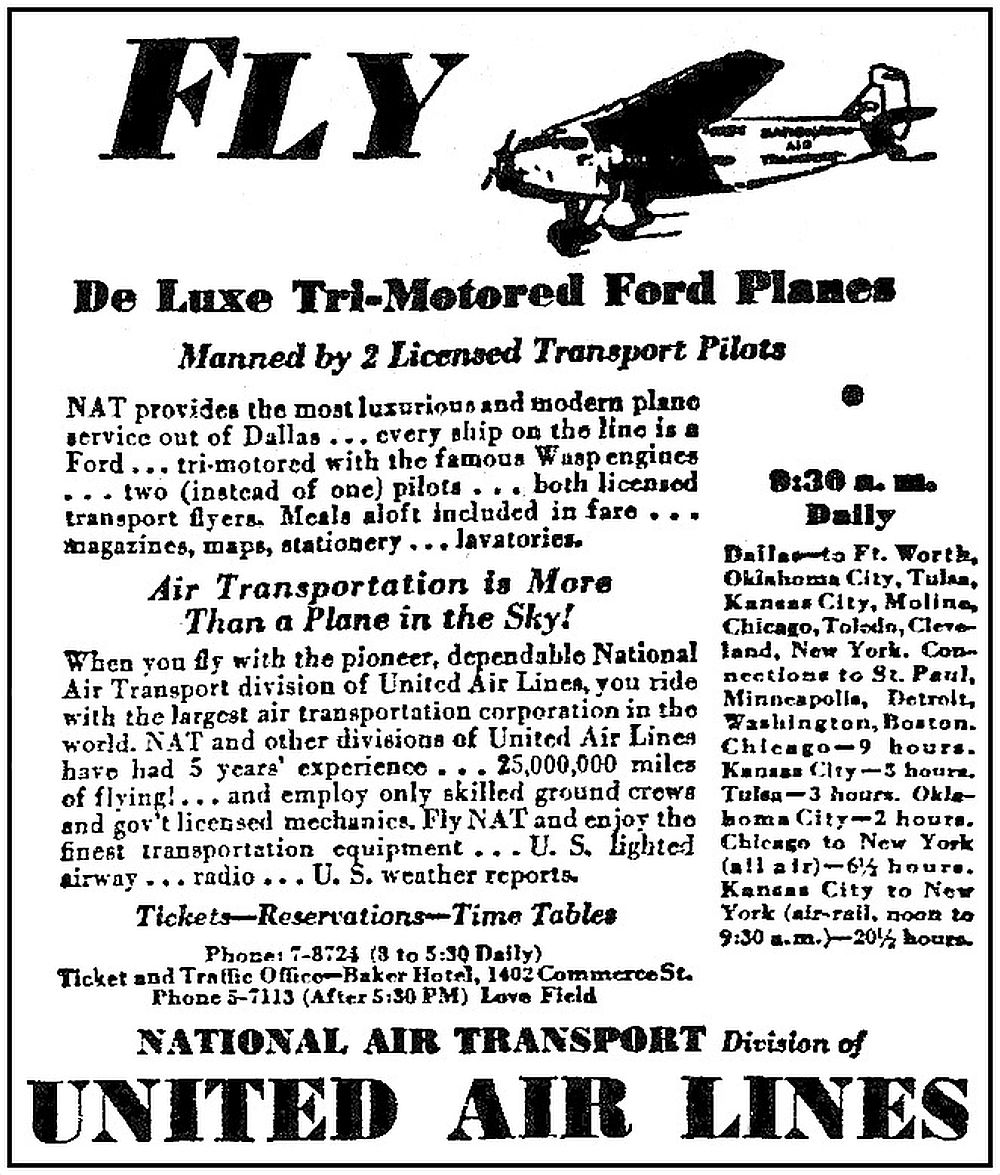
And an even earlier ad, from 1931, when a flight from Love Field to Chicago was nine hours long (today a direct flight from Love Field to Chicago takes about two hours and fifteen minutes). And if you wanted to continue to NYC, you had to board another plane and fly from Chicago to New York, adding another six and a half hours!

united-air-lines_dallas-to-nyc_1931
1931 ad

FLY

De Luxe Tri-Motored Ford Planes Manned by 2 Licensed Transport Pilots
 
NAT provides the most luxurious and modern plane service out of Dallas … every ship on the line is a Ford … tri-motored with the famous Wasp engines … two (instead of one) pilots … both licensed transport flyers. Meals aloft included in fare … magazines, maps, stationery … lavatories. 

Air Transportation is More Than a Plane in the Sky! 

When you fly with the pioneer, dependable National Air Transport division of United Air Lines, you ride with the largest air transportation corporation in the world. NAT and other divisions of United Air Lines have had 5 years’ experience … 25,000,000 miles of flying! … and employ only skilled ground crews and gov’t licensed mechanics. Fly NAT and enjoy the finest transportation equipment … U.S. lighted airway … radio … U.S. weather reports.

*

In an interesting side-note, the first pilot to fly a mail plane between Kansas City and Dallas (on May 12, 1926) was Richard Dobie, brother of Texas literary legend, J. Frank Dobie. In 1926 he flew a Curtiss Carrier Pigeon; in 1933, he’d worked his way up to the speedy and powerful Boeing. He flew for United for several years.

***

Sources & Notes

Top image is a promotional postcard, found on eBay.

Read more about the tri-motor airplane (manufactured by the Ford Motor Company and affectionately known as the “Tin Goose”) in the article “Ford’s Tri-Motor” by Edward J. Vinarcik (Advanced Materials and Processes, Oct. 2003) here.

All images larger when clicked.

*

Copyright © 2015 Paula Bosse. All Rights Reserved.


The Caveteria: “Marvelous Food at Moderate Prices”


caveteria_ebay
The finest in downtown basement dining (click for larger image)

by Paula Bosse

How could you NOT want to dine in a restaurant called a “Caveteria”? It was a cafeteria in the basement — the cave — of the swanky Baker Hotel, and it looks like it was a nice cheap place to grab a quick lunch downtown in the 1920s and 1930s.

caveteria_baker-hotel_postcard_ebay

*

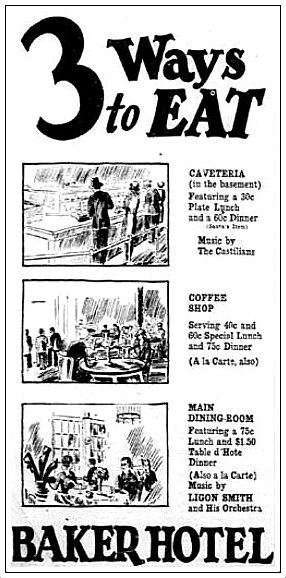
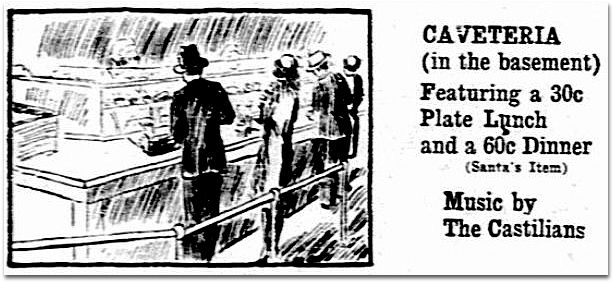
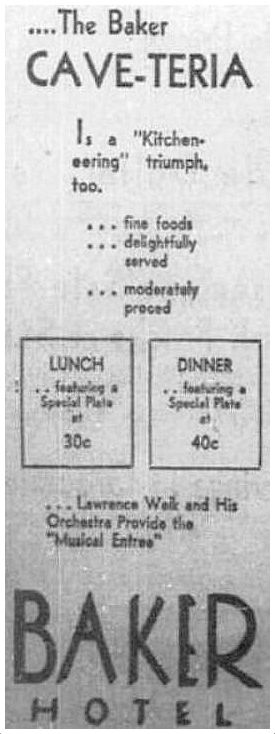
The Baker Hotel had “3 ways to eat”: one could eat cheap in the basement Caveteria (where, according to the Inflation Calculator, a 30-cent lunch in 1927 was the equivalent of about four bucks today), eat sort of cheap in the probably street-level coffee shop (lunch was about $6.75 there), and eat not cheap in the main hotel dining room (where lunch was over $10.00). (There was also the Peacock Terrace night club, well beyond reach of basement-dwelling diners.)

caveteria_dmn_120427

caveteria_dmn_120427-det1927

*

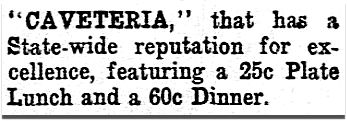
The price actually went down to a quarter by 1931 and had a “State-wide reputation for excellence.”

caveteria_dmn_020131DMN, Feb. 1, 1931

*

A year later the price was holding at 25 cents and it seems like a pretty good deal.

caveteria_dmn_021532DMN, Feb. 15, 1932

*

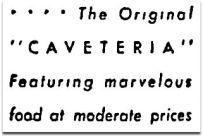
“The Original ‘Caveteria'” — accept no imitations! At least one other hotel in the Baker chain — the Gunter, in San Antonio — had a “Caveteria,” but apparently Dallas’ was first. In fact, the word and the hotel made their way into H. L. Mencken’s The American Language, Supplement One (see here).

caveteria_corsicana-daily-sun_031632Corsicana Daily Sun, Mar. 16, 1932

*

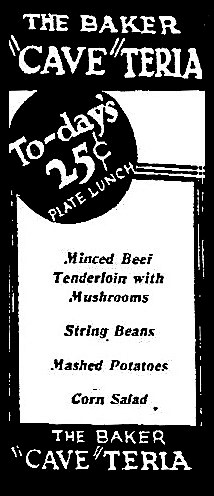
Oh yeah — live bands played while you ate your hearty meal of minced beef tenderloin. Even Lawrence Welk settled in for a stint as the “musical entree” in 1934.

caveteria_dmn_022234-lawrence-welkFeb., 1934

*

In 1942, the space once occupied by the Caveteria was turned over to the USO:

The Baker Hotel has provided the USO with what used to be the Caveteria in the basement of the hotel. It will be known as USO Club in the Cave. The entrance will be through the Akard Street entrance of the hotel.  (Dallas Morning News, Jan. 27, 1942)

*

And there it is — another place I wish I’d been able to visit.

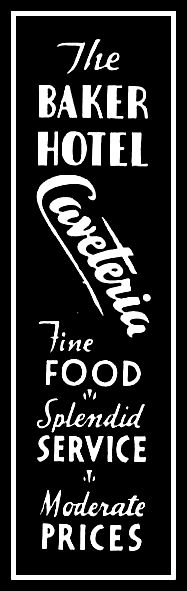
“Fine food. Splendid Service. Moderate prices.”

ad-baker-hotel-caveteria

***

Sources & Notes

Color postcards found on eBay.

The Baker Hotel opened in 1925 at Commerce & Akard on the site where the Oriental Hotel had previously stood, catty-corner from the Adolphus.

*

Copyright © 2015 Paula Bosse. All Rights Reserved.


Movie Houses Serving Black Dallas — 1919-1922

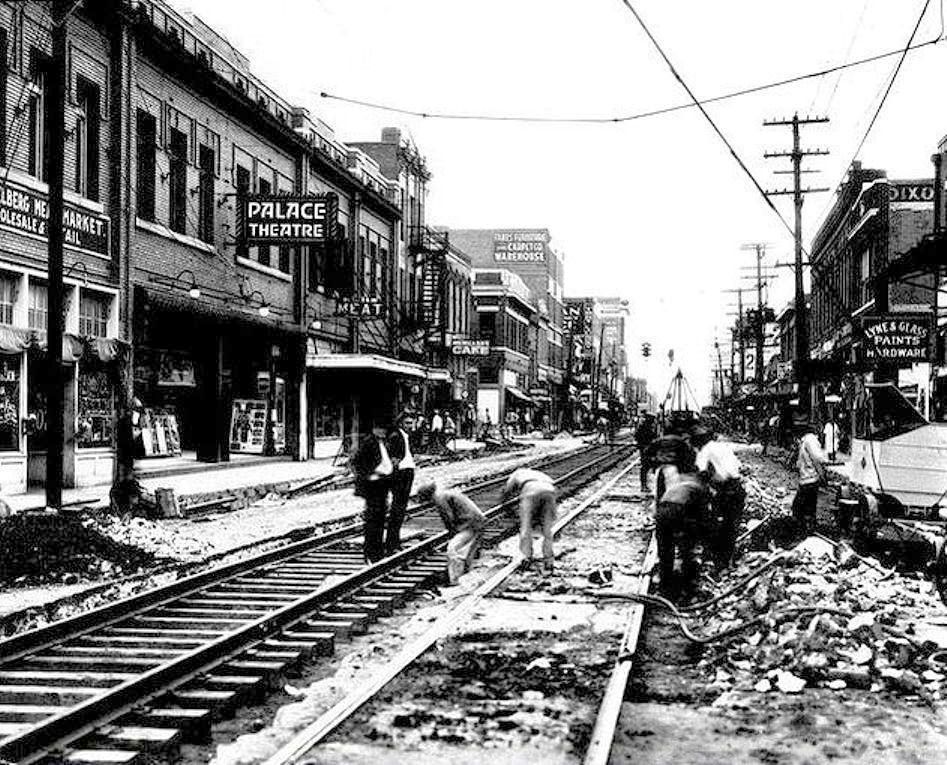
palace-theatre_elm-st_1922-dplThe Palace Theatre, Elm St., Deep Ellum, 1922 (click for larger image)

by Paula Bosse

In 1920, movie theaters — like most places in Dallas at the time — were segregated. If black customers were allowed at all in the downtown white vaudeville and movie houses, they had separate entrances and restricted seating areas (generally in the balcony). But Dallas’ African-American community had their own popular theaters, run by enterprising and energetic men who endlessly promoted their jam-packed and constantly-changing bills.

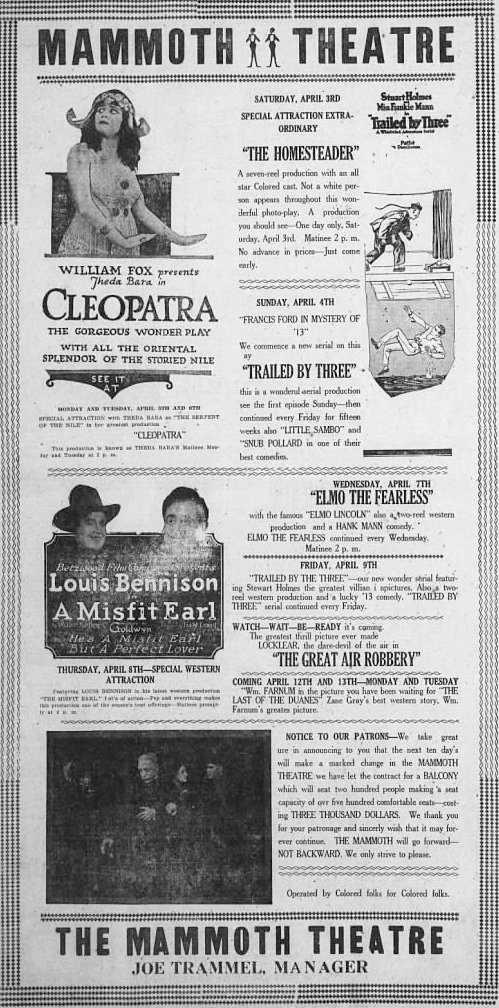
Judging by the amount of ad space purchased in the black-owned and operated Dallas Express, there were four main movie theaters catering to black Dallasites around 1920: the Grand Central Theatre, run by John Harris, the Mammoth Theatre, run by Joe Trammell, the Palace Theatre, run initially by Felix Moore, and the High School Theatre, run by Herbert Batts; the first three of these houses were in Deep Ellum, the last one was in what was then called “North Dallas.’ The theaters played both “white” films and films with “all-Colored casts.” The advertising for these theaters is great — far more ad space was available in the tiny Express to publicize the movies, the popular but now-forgotten Silent Film stars of the era, and the proprietors themselves than was available to the theaters on the other end of Elm Street in the much larger, white-owned News, Journal, or Times Herald. Sometimes it’s good being the big fish in the little pond — absolutely everybody knows who you are.

*

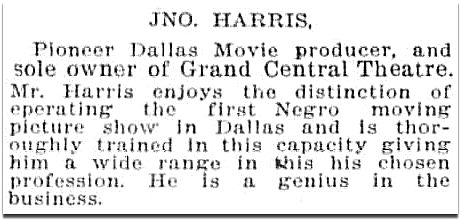
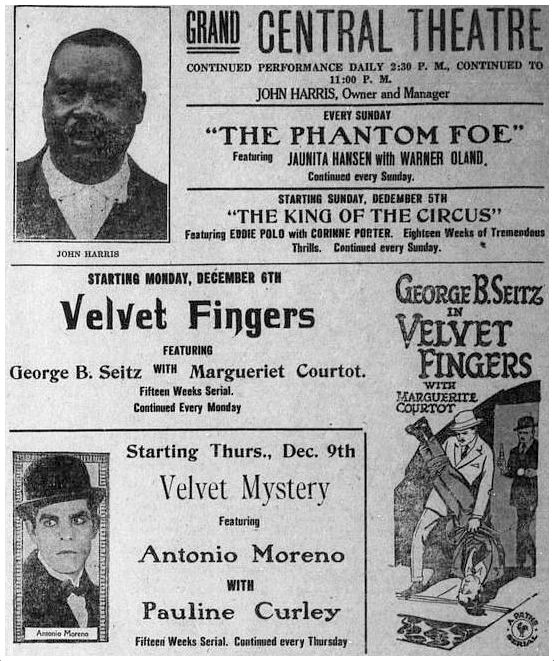
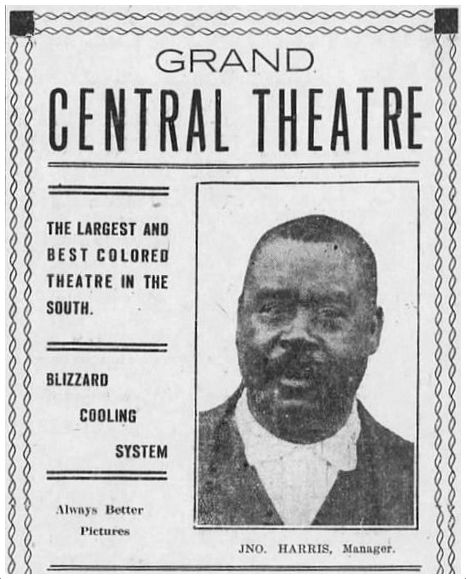
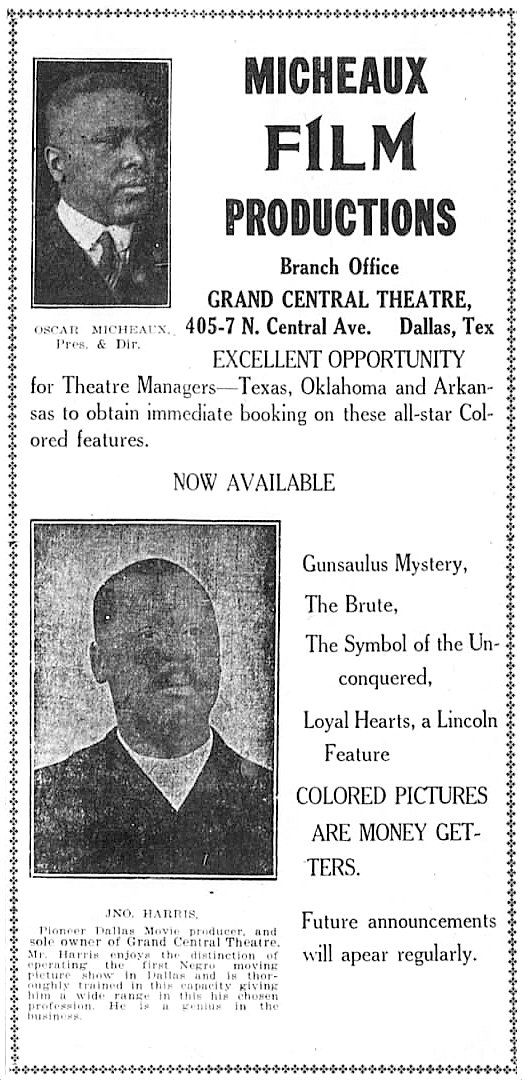
The Grand Central Theatre was at 405-407 N. Central Ave. (which later became Central Expressway), between Swiss and Live Oak on the outer northern edge of Deep Ellum. John Harris, the owner, put himself in practically all of his ads. He included this autobiographical sketch in one of them:

micheaux-grand_dallas-express_052821-detDallas Express, May 28, 1921

I’m not sure if he operated “the first Negro moving picture show in Dallas,” but I wouldn’t doubt it — the man was a dynamo who possessed not only a bold self-confidence, but he also seems to have had an unlimited promotional budget. UPDATE: The first appearance of a theatrical enterprise by John Harris shows up in the 1913 city directory (directories generally collected their information the previous year, so he was probably in business in 1912). Harris is listed under the “Amusements” section at the same address as the Grand Central Theatre, a name which came later. The same 1913 directory also lists the Star Theatre, which later became the Palace (see below). These are the only two theatres designated as “colored.” It’s unclear whether the theaters hosted live performances or showed movies. Or both.

The Grand Central advertised relentlessly. (Click ads to see larger images.)

grand-central-theatre_dal-express_120420Dec. 4, 1920

grand-central-theatre_dal-express_051421May 14, 1921

grand-central-theatre_dallas-express_080621Aug. 6, 1921

Below, an ad showing one of the offerings to be a Ben Roy Motion Picture Corp. movie called “My Baby” which was “made in Dallas, featuring William Lee and All Colored Cast.”

grand-central-theater_dal-express_052722May 27, 1922

Harris was connected with the legendary black filmmaker Oscar Micheaux. Not only did he regularly run his films, but he also seems to have been working as a booker, promoter, and distributor of Micheaux’s films and ran the Micheaux Film Productions branch office out of the Grand Central. “Colored Pictures are Money-Getters.”

micheaux_dallas-express_051421May 14, 1921

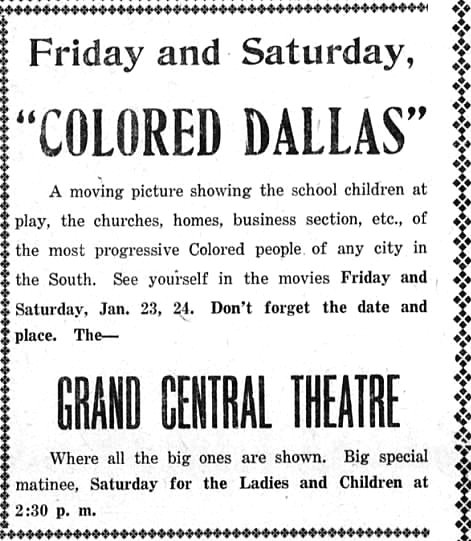
One ad that caught my attention was this one, for a locally-shot film called “Colored Dallas.” I really, REALLY want to see this, but the possibility of an extremely minor, 95-year-old silent film having survived into the 21st century is slim.

colored-dallas_dallas-express_012420Jan. 24, 1920

*

The Mammoth Theatre was located at 2401 Elm Street, between Central and Hawkins. It opened in late 1919 — the run-up to the opening was publicized in this Dallas Express item.

mammoth_dallas-express_112219Nov. 22, 1919

The Mammoth might not have advertised quite as much as the Grand Central did, but it frequently took out splashy full-page ads. Full-page! I bet that royally irked John Harris. Below, a Mammoth ad from 1920.

mammoth_dallas-express_040320April 3, 1920

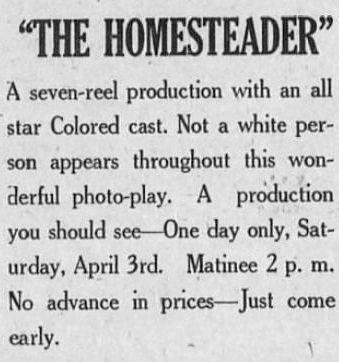
Two details from the above ad:

mammoth_dallas-express_040320-det-2

mammoth_dallas-express_040320-det
“Operated by Colored folks for Colored Folks.”

The owner, Joe Trammell, seems to have had an inexhaustible source of money for advertising — those frequent full-pagers (unusual for the time) must have cost a pretty penny. I couldn’t find much information about any of these men, but I stumbled across this photo of Trammell, tacked on to one of his … um … mammoth ads.

mammoth_joe-trammell_dallas-express_021221Feb. 12, 1921

*

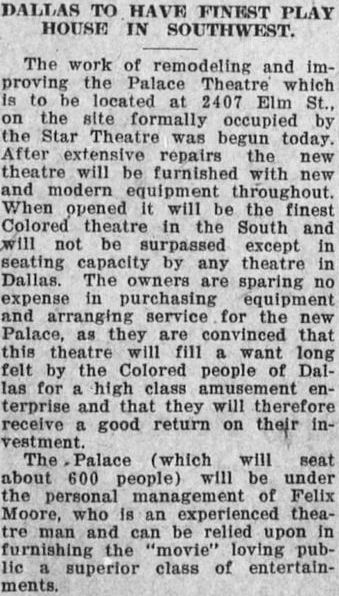
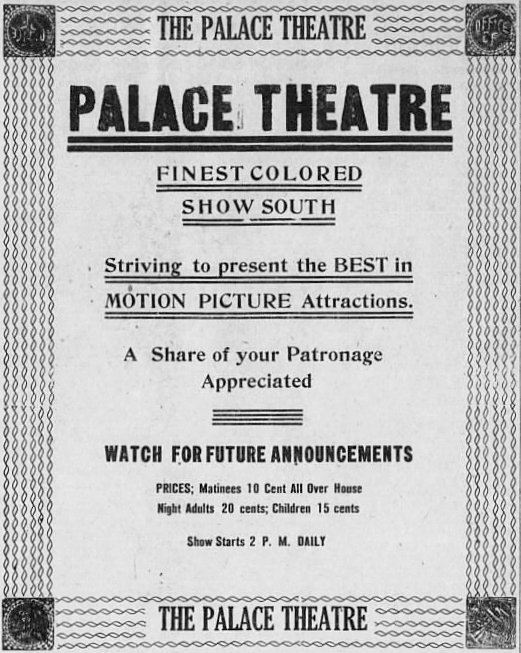
The Palace Theatre, seen in the photo at the top, was at 2407 Elm Street, just a couple of doors down from the Mammoth. (This Palace is not to be confused with the “white” Palace Theatre, the stalwart of Theater Row at the other end of Elm.) It opened in 1920 in the remodeled space formerly occupied by the Star Theatre,

palace_dallas-express_030620March 6, 1920

palace_dallas-express_050820May 8, 1920

*

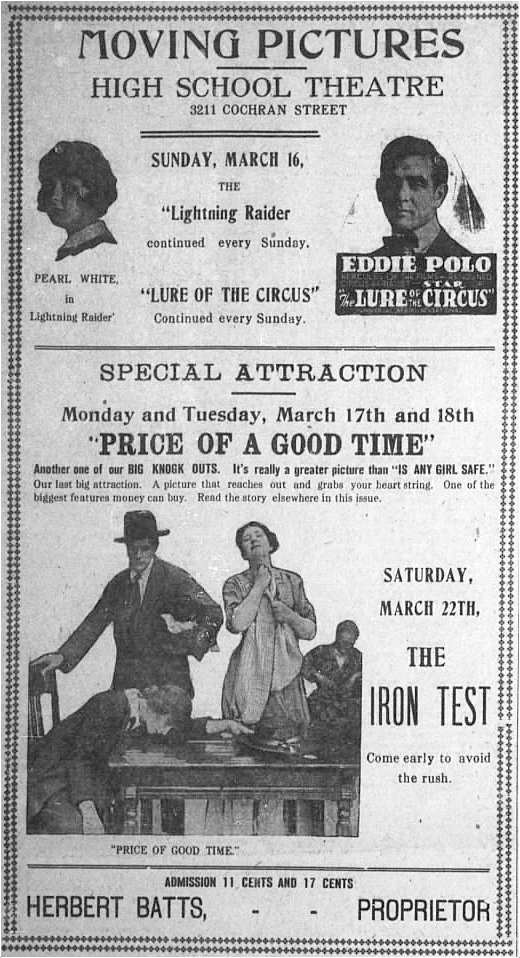
Lastly, moving up to North Dallas, we find the High School Theatre, located at 3211 Cochran, between Central and N. Hall Street. The reason for its name was its close proximity to the Colored High School (the only high school for African-American students at the time — it would soon merge with and relocate to the new Booker T. Washington High School a short distance away). The following businesses were in this same block: the High School Cold Drink Stand, the High School Cafe, the High School Shine Parlor, and the High School Tailor Shop. Location, location, location.

high-school-theater_dallas-express_031519March 15, 1919

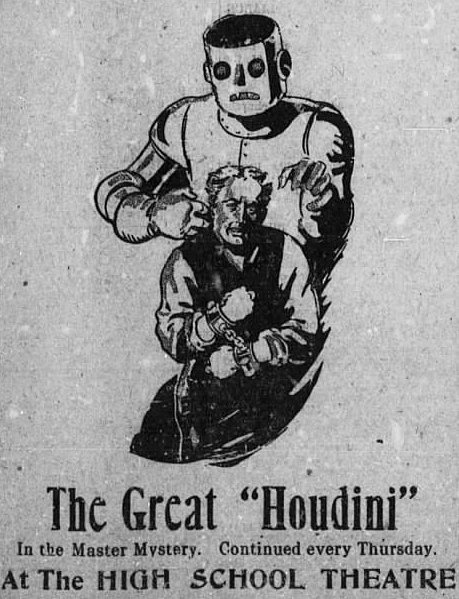
My favorite High School Theatre ad is this one, touting a serial called “The Master Mystery” starring Houdini … one of the screen’s first appearances of a robot! (Check out a scene featuring both Houdini and the robot/automaton, here.)

houdini_dallas-express_031519March 15, 1919

*

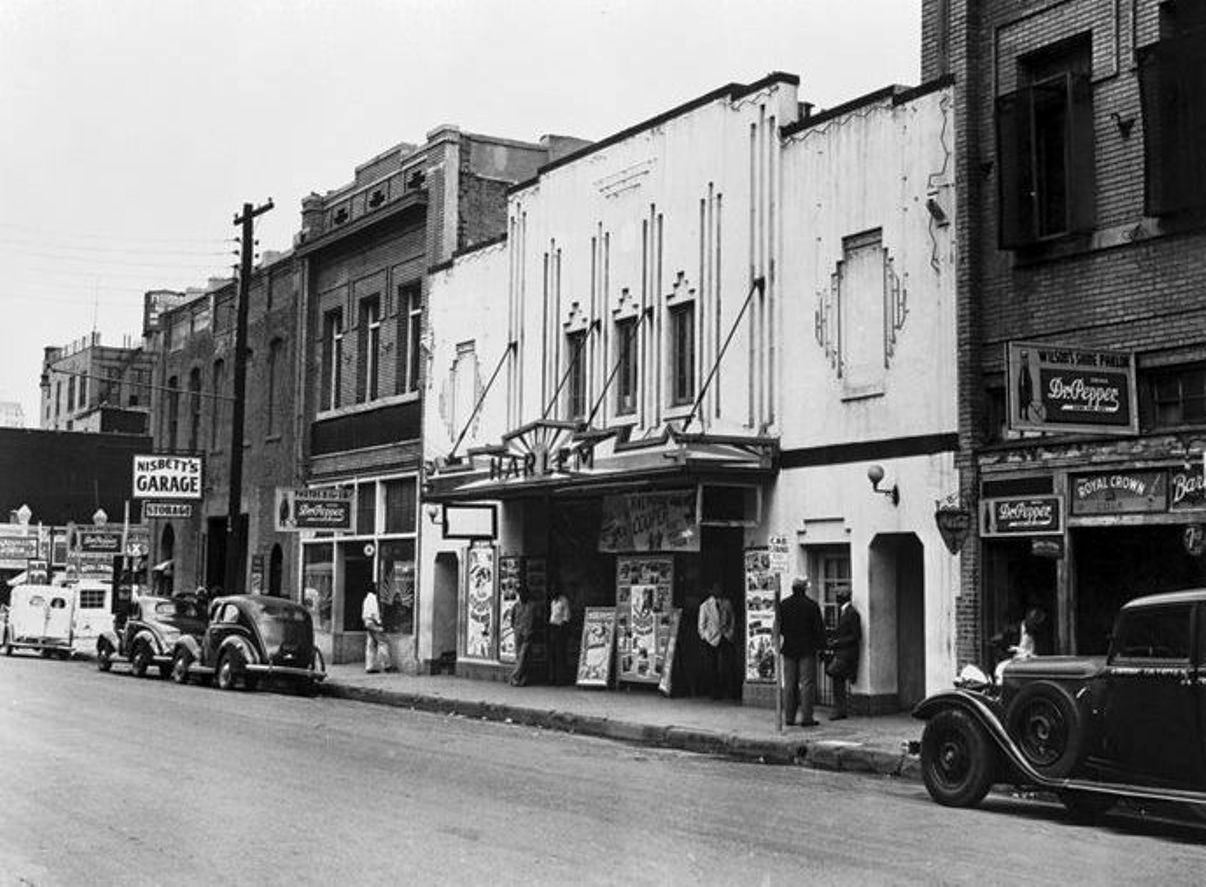
The only one of these theaters still in business in 1930 was the Palace. by 1937, the Palace had become the Harlem Theatre.

harlem-theatre_deep-ellum

harlem-theatre_dpl

***

Sources & Notes

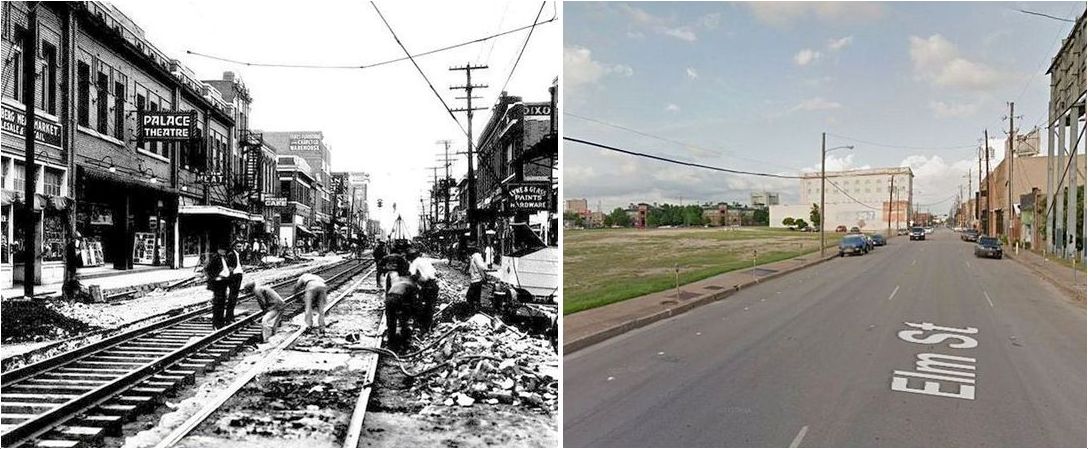
Top photo showing Elm Street and the Palace Theatre and the bottom two photos showing the Harlem Theatre are from the Texas/Dallas History & Archives Division, Dallas Public Library. The upsetting view of what that stretch of Elm looks like now can be seen on Google Street View, here. Below, side-by-side, 1922 and 2015 — Elm St. looking east to Deep Ellum, the Knights of Pythias temple in both images down the street on the left. Look what we’ve lost.

elm-looking-east_1922-2015

All ads and clippings from The Dallas Express, as noted. A few years’ worth of this important newspaper, which served Dallas’ African-American community, can be accessed here.

More on Oscar Micheaux, here.

Another Flashback Dallas post on a theater serving the black community is “Oak Cliff’s Star Theatre — 1945-1959.”

A 1919 map from UNT’s Portal to Texas History shows the location of the Grand Central Theatre (red square), the Mammoth (blue), and the Palace (yellow).

black-cinemas_ca1920_deep-ellum

The High School Theatre — up in “North Dallas” (adjacent to present-day Uptown) — is seen on a different portion of the same map, below.

black-cinemas_ca1920_north-dallas

Most images are larger when clicked.

*

Copyright © 2015 Paula Bosse. All Rights Reserved.

“A Perfect Auto Tent” — 1921

ad-dallas-tent-awning_dmn_061221-smRemember to turn off engine before retiring for the night…

by Paula Bosse

Personally, I don’t understand why anyone would want to be outside when it’s 157 degrees, but for those of you who are insistent campers who might be heading out for a sweaty and bug-filled weekend in the wilderness, might I direct your attention to the “automobile tent,” ready for purchase in 1921 at the Dallas Tent and Awning Co. at 2620 Main Street, in the heart of Deep Ellum. Adjusted for inflation, the cost of this admittedly charming-looking “car tent” would be the equivalent of about $200.

My weekend? I will be camped out in a blissfully air-conditioned house — shades drawn, blinds closed — with an iced tea in hand, moving slowly, and not smelling like insect repellent.

*

Copyright © 2015 Paula Bosse. All Rights Reserved.