Flashback : Dallas

A Miscellany: History, Ads, Pop Culture

Category: Advertisements

Highland Park High School: Ads from the 1966 Yearbook

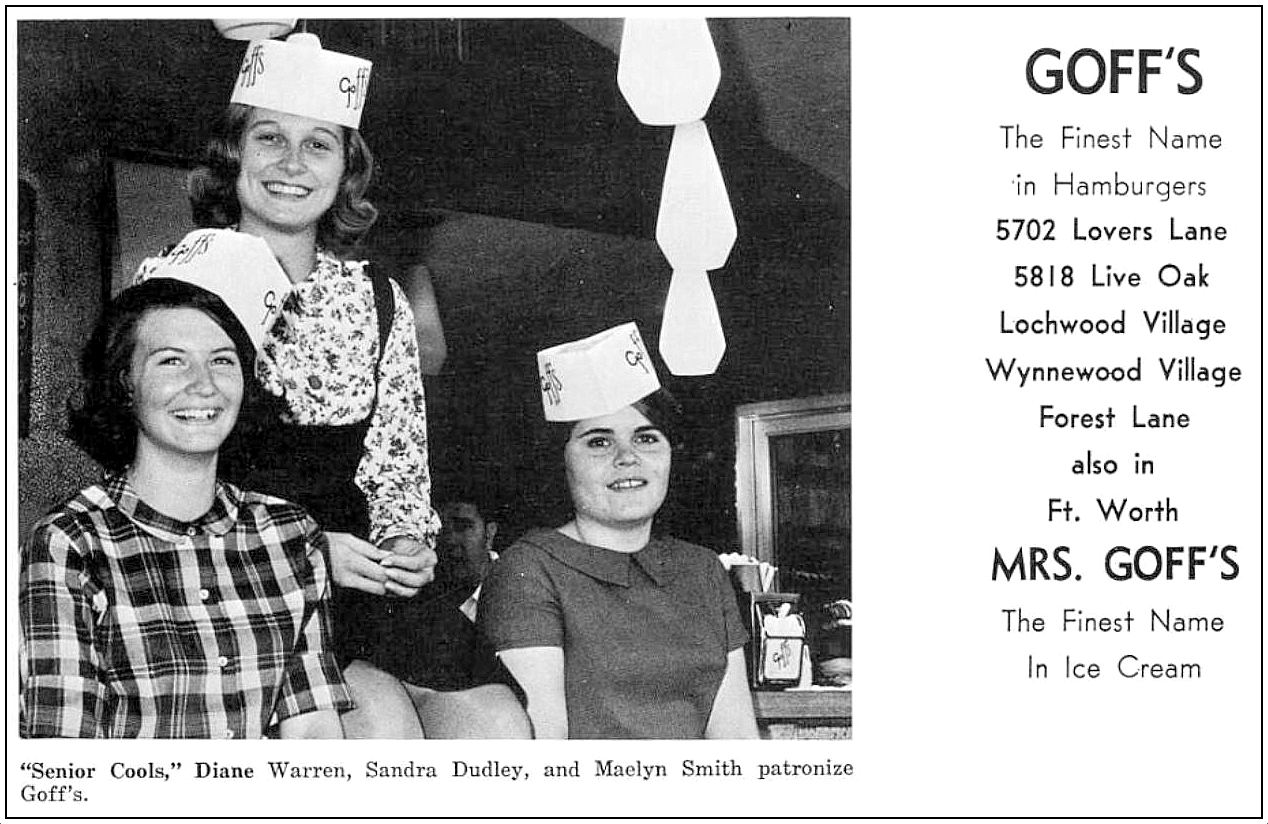
ad_HPHS_1966_goffs“Senior Cools” at Goff’s… (click for larger image)

by Paula Bosse

Yesterday I posted photos from the 1966 Highland Park High School Highlander yearbook — today I’m posting a lot of ads from the same yearbook, many of which include students posing at the businesses. Most of the ads are larger if you click them.

Above, Goff’s. My mother refused to patronize this establishment as the owner once said something disparaging about my shaggy-haired 10-year-old brother (Mr. Goff really didn’t like long hair on boys and men), so I’m one of the few native-born Dallasites who never had a Goff’s hamburger.

*

On the other hand, I enjoyed a lot of Ashburn’s Ice Cream as a kid — the locations on Knox and on Skillman. I can’t remember ever getting anything other than Butter Pecan.

ad_HPHS_1966_ashburns-ice-cream

*

Whittle Music Company. (I wrote about Whittle’s previously, here.)

ad_HPHS_1966_whittle-music-co

*

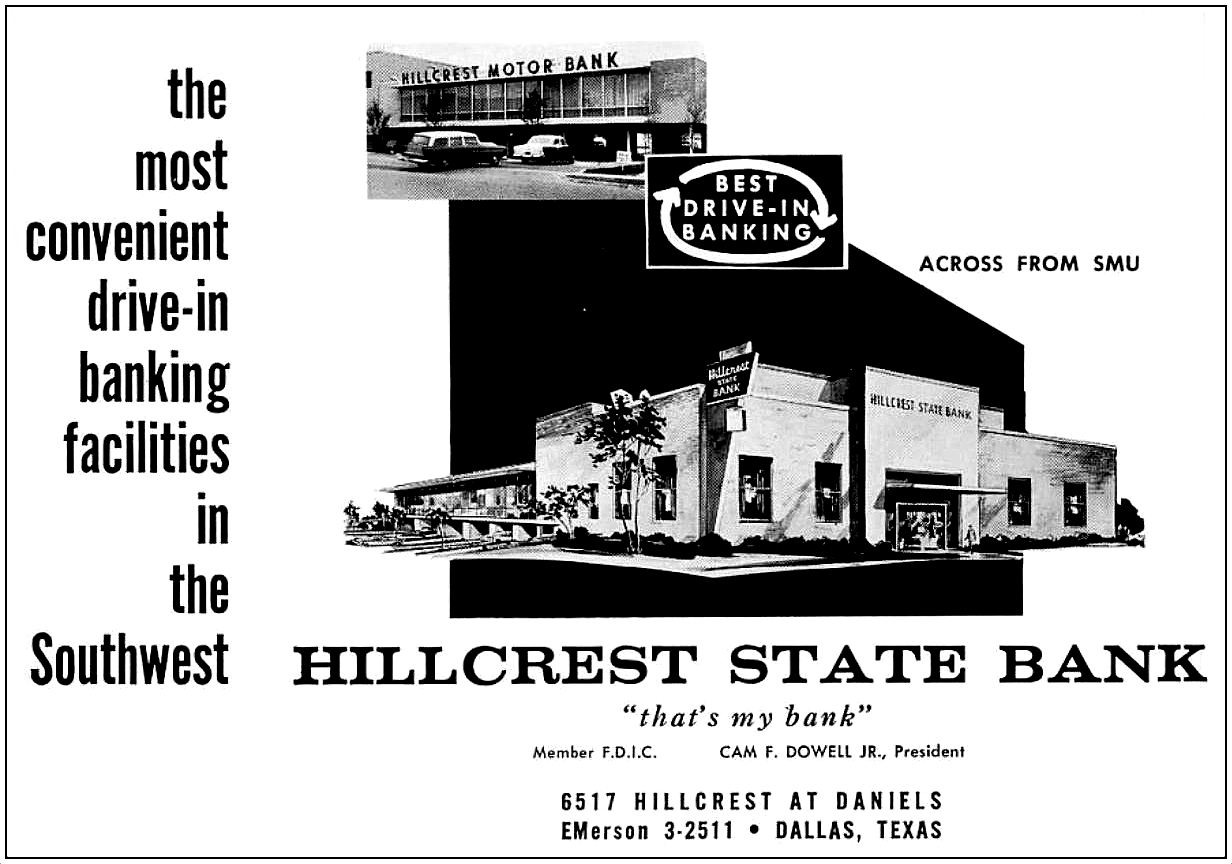
Hillcrest State Bank, designed by architect George Dahl.

ad_HPHS_1966_hillcrest-state-bank

*

M. E. Moses, Snider Plaza. I didn’t grow up in the Park Cities, but my parents both went to SMU and my mother worked in University Park for several years, so I spent a lot of time as a kid wandering around HP Village and Snider Plaza as a kid. And what kid didn’t love a dime store? I can remember where everything was at that Moses. The memory of that ramp between what I always thought of the “sunny side” of the store and the cave-like dark side of the store is a weird, fond memory. (For some reason I never imagined there was actually a person named “M. E. Moses.”)

ad_HPHS_1966_moses

*

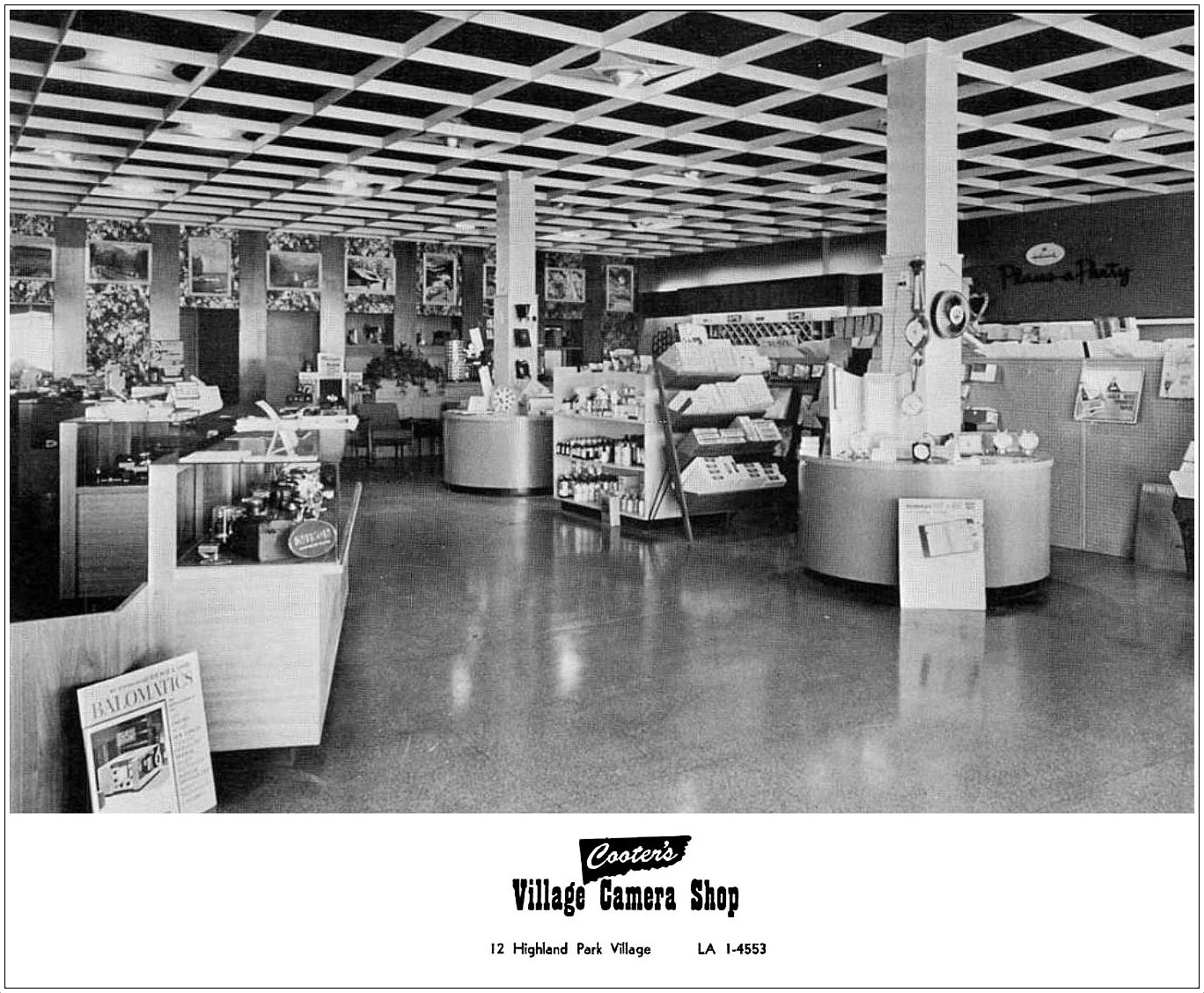
Cooter’s Village Camera Shop.

ad_HPHS_1966_cooters

*

Cerf’s.

ad_HPHS_1966_cerfs

*

Preston State Bank. I know that PSB was very early entering the credit card market — I remember my parents had a Presto-Charge card — but I’d never heard of this “Presteen” checking account geared to teenagers.

ad_HPHS_1966_preston-state-bank

*

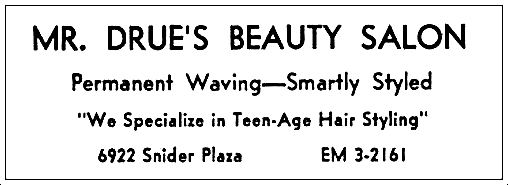
Mr. Drue’s Beauty Salon — “We Specialize in Teen-Age Hair Styling.”

ad_HPHS_1966_mr-drue

*

Dr Pepper. Frosty, man, frosty.

ad_HPHS_1966_dr-pepper

*

Bob Fenn Apparel for Men and Boys.

ad_HPHS_1966_bob-fenn

*

Young Ages.

ad_HPHS_1966_young-ages

*

Lou Lattimore.

ad_HPHS_1966_lou-lattimore

*

Roscoe White’s Corral, Easy Way Grill, and Westerner. (My family’s favorite neighborhood restaurant was the Corral.)

ad_HPHS_1966_corral_easy-way_westerner

*

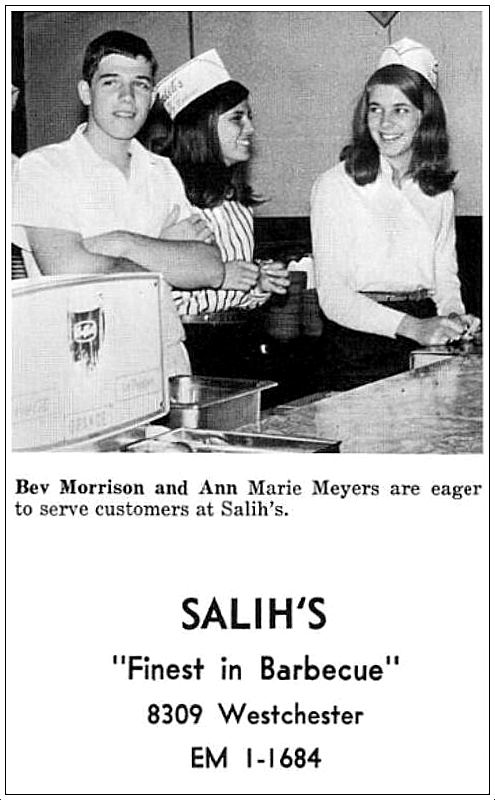
Salih’s in Preston Center.

ad_HPHS_1966_salihs

*

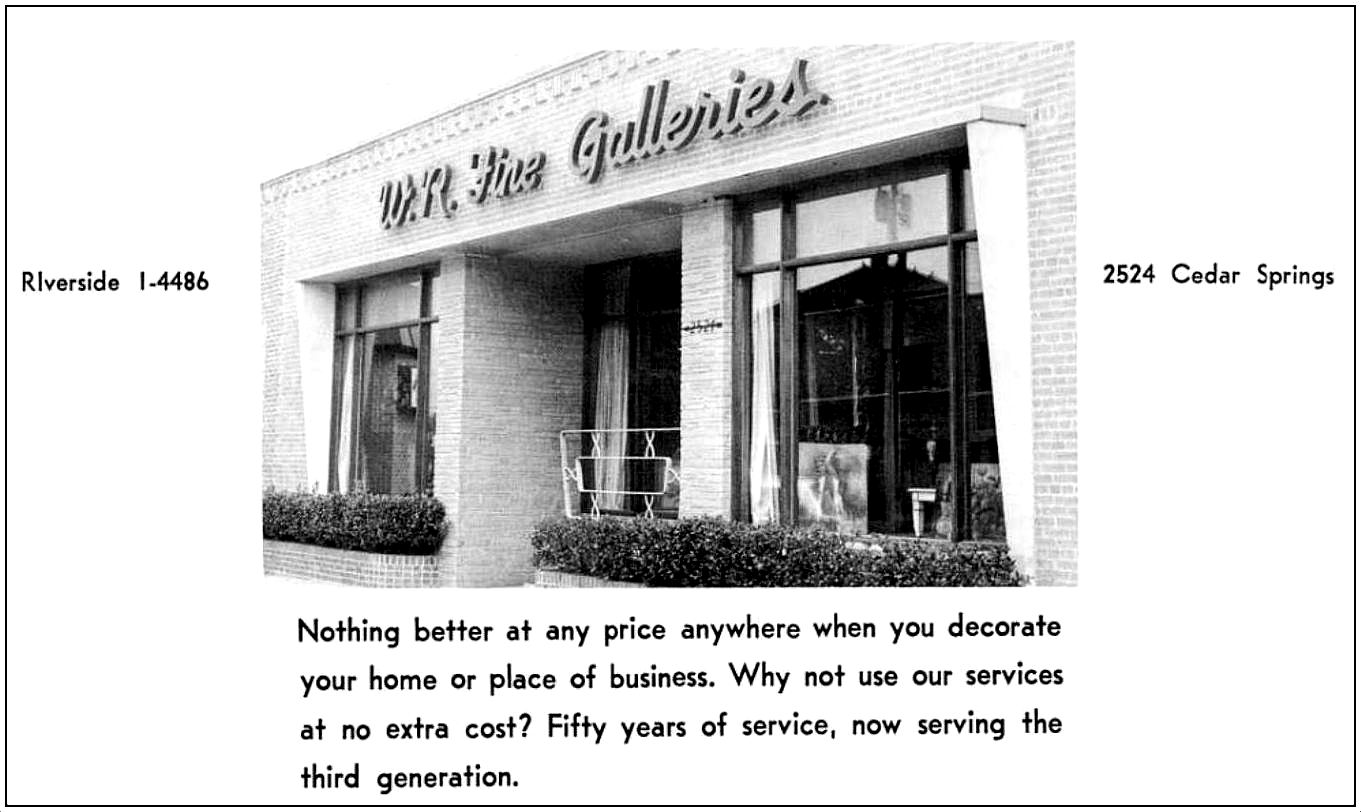
W. R. Fine Galleries. (This building is still standing on Cedar Springs.)

ad_HPHS_1966_fine-galleries

*

Dick Chaplin’s School of Social Dancing.

ad_HPHS_1966_dick-chaplin-school-dancing

*

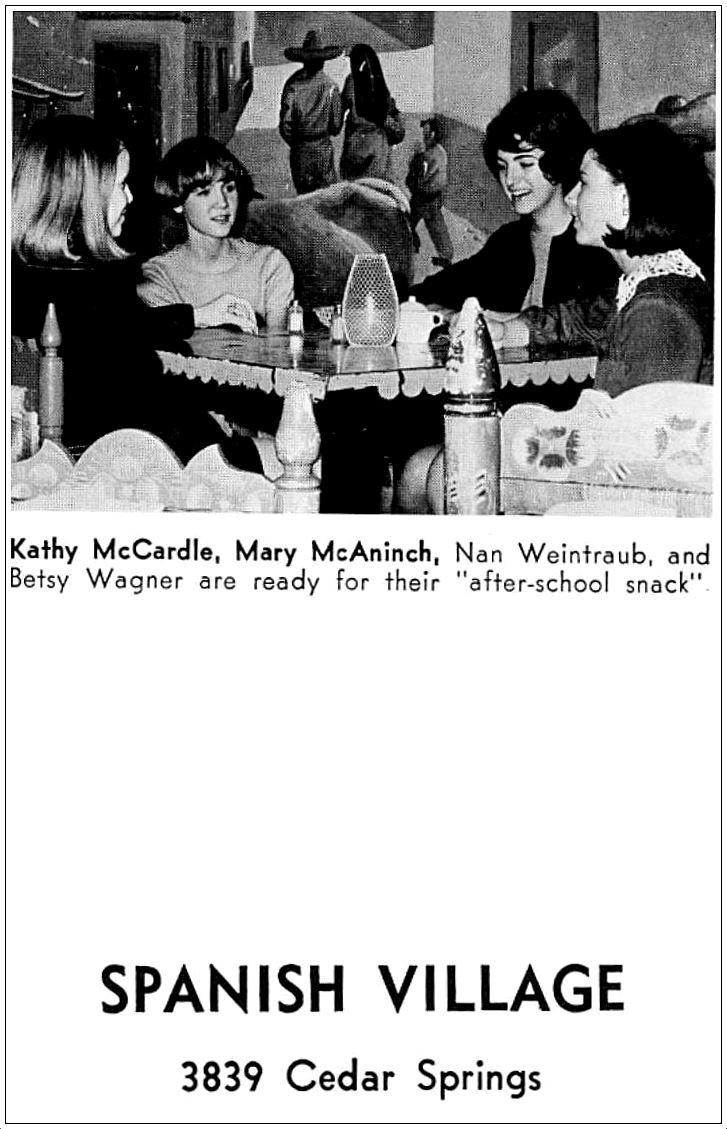
Spanish Village.

ad_HPHS_1966_spanish-village

*

Johnson Brothers Chevrolet. The daughter of one of the brothers was a close friend of my mother’s, and I remember visiting her parents’ house on St. Andrews  several times — that huge yard was pretty magical to me as a little girl.

ad_HPHS_1966_johnson-chevrolet

*

Highland Park Cafeteria.

ad_HPHS_1966_highland-park-cafeteria

*

Expressway Bowling Lanes.

ad_HPHS_1966_expressway-lanes_bowling

*

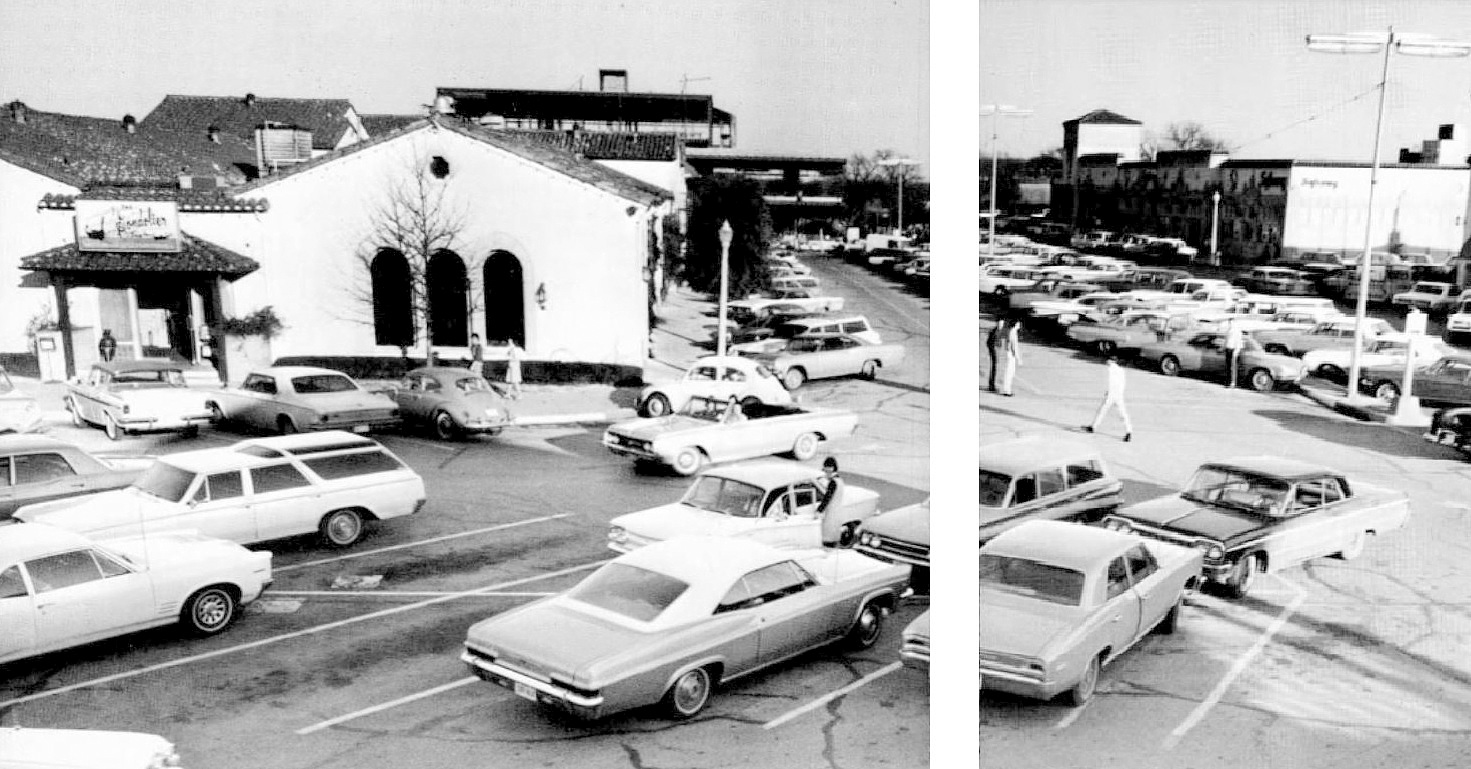
The Gondolier, 77 Highland Park Village. This photo was split across two pages, but I tried to piece it back together because this is a view you don’t see that often in a photo of Highland Park Village, looking east toward Preston. The space is currently occupied by Mi Cocina — see a similar view today, here.

ad_HPHS_1966-gondolier

*

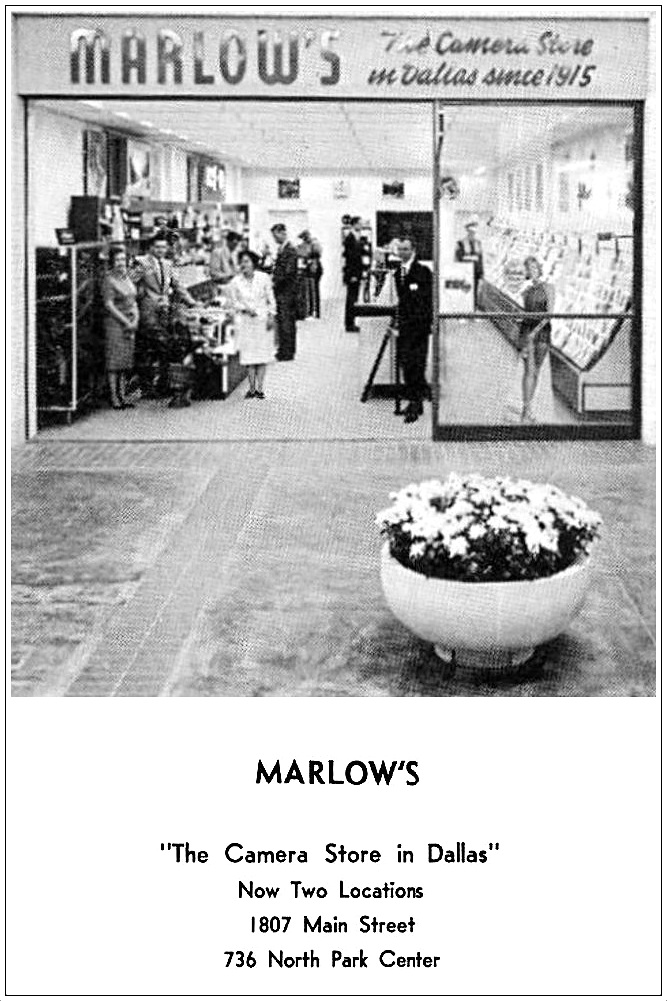
Marlow’s, “The Camera Store in Dallas Since 1915.”

ad_HPHS_1966_marlows-camera-store-northpark

*

NorthPark without the Melody Shop is like a day without sunshine.

ad_HPHS_1966_melody-shop

*

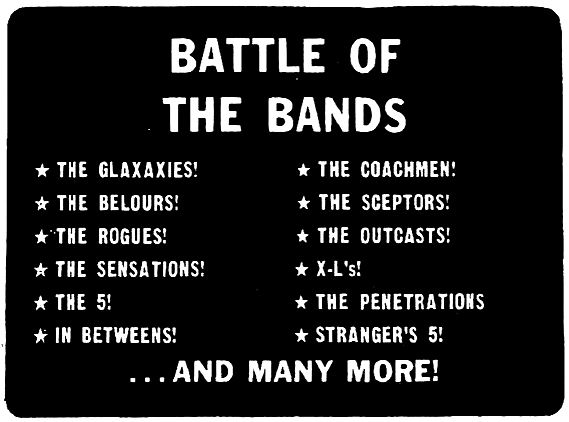
Speaking of music, here are a couple of ads placed by teen bands, something I’d never seen before — but what better way to market your band than to advertise in a high school yearbook?

After the Beatles first appeared on “The Ed Sullivan Show” in 1964, a million garage bands sprang up overnight. “Battle of the Bands” contests were ubiquitous. The two Dallas bands that had ads in the 1966 Highlander played all over town and participated in a few of these contests.

battle-of-the-bands_sept-1965
Sept., 1965

First, the Rogues — described in The Dallas Morning News as “a group of young socially prominent Dallas residents” (DMN, April 1, 1966): Rusty Dealey, Wirt Davis, Mitch Gilbert, Doug Bailey, and Mike Ritchey. “The Tuff Sound for Parties and Dances.”

ad_HPHS_1966_rogues

And the Outcasts (not to be confused with the cult-favorite garage band of the same name from San Antonio): Gary, Donny, David, Jim, and Wally. Dig that groovy background!

ad_HPHS_1966_outcasts

***

Sources & Notes

All ads are from the 1966 Highland Park High School Highlander yearbook.

The companion post — “Highland Park High School: Photos from the 1966 Yearbook” — can be found here.

Click ads to see larger images.

*

Copyright © 2017 Paula Bosse. All Rights Reserved.


Oak Cliff, The Beautiful Suburb — 1888

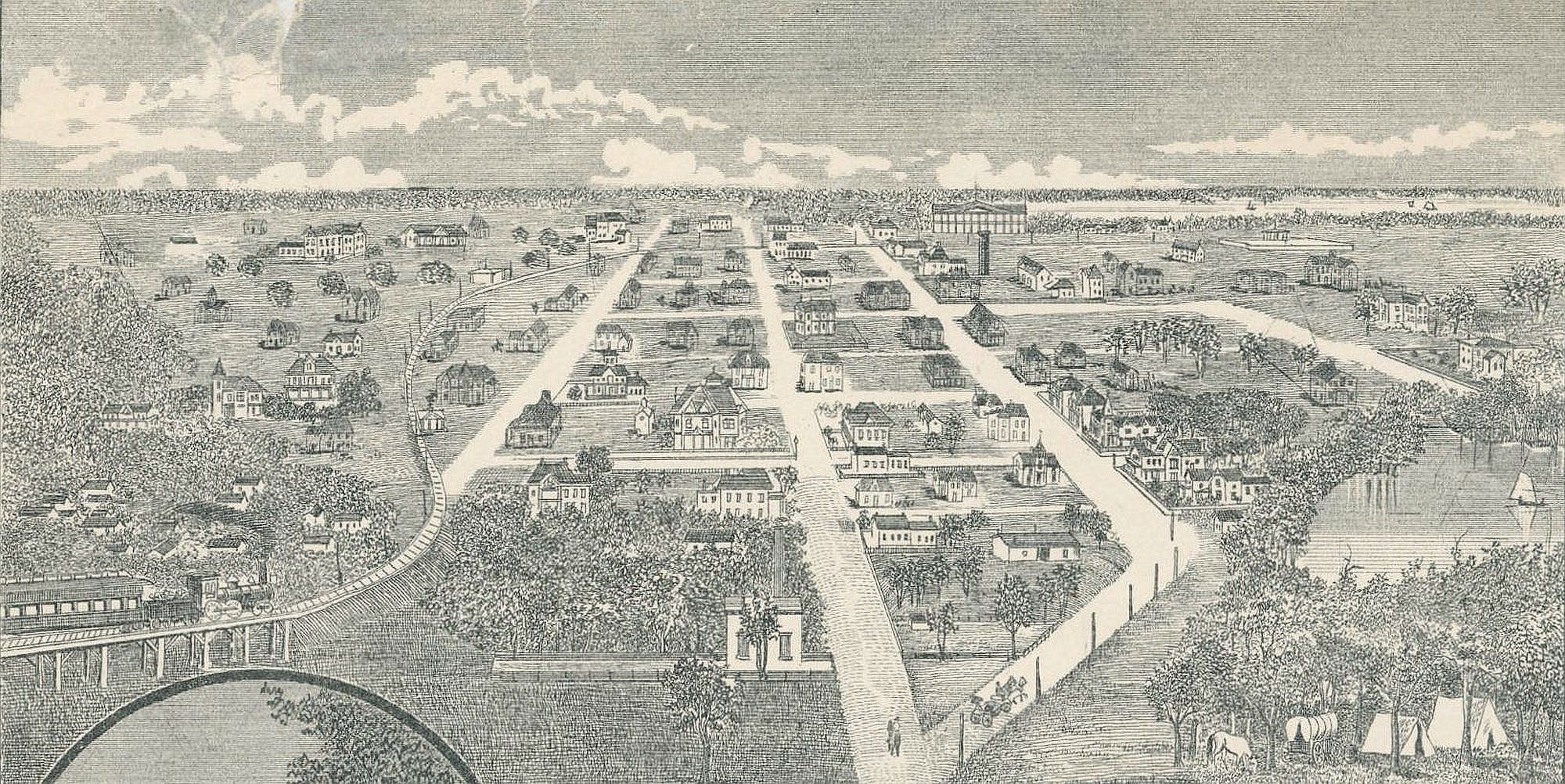
oak-cliff_1888_degolyer_SMU_illus_lgOak Cliff, early days… (click for larger image)

by Paula Bosse

The above view of Oak Cliff is taken from an 1888 broadside advertising land opportunities in Dallas’ most beautiful, healthful, and picturesque suburb. The text:

OAK CLIFF

This beautiful suburb of Dallas is situated on the south side of the river, on a chain of hills from 200 to 250 feet above and overlooking the city, and about three-fourths of a mile from the MERCHANTS’ EXCHANGE, being from any part of it within ten to twenty minutes’ walk from the business center, or eight to fifteen minutes’ drive, or five to ten minutes’ ride by the suburban cars, which run all the time from the court house, from 6 o’clock in the morning to 11 o’clock at night. Fare, five cents.

Oak Cliff has a first-class water works system, furnishing clear, pure spring water; good schools; broad, macadamized avenues and streets; lovely lakes and parks (from the pavilion, surrounding towns can be seen). Owing to its great altitude and topographical formation, perfect drainage is insured, and it is unexcelled in the Southwest as a healthful and picturesque residence site and educational center. 

Its superior accessibility to business, makes it the most desirable portion of the city to live in for the citizen of Dallas, whether he be poor, rich or of moderate means.

Within the past seven months, residences approximating in value one million dollars, costing from $1,000 to $45,000 each, have been built and contracted for in this popular suburb. A few choice lots remain unsold, and persons desiring a site for a home on easy terms will please call on or address

DALLAS LAND & LOAN COMPANY
Knepfly Building
Dallas, Texas, October 1, 1888

oak-cliff_1888_degolyer_SMU_typog

***

Sources & Notes

Images taken from a promotional broadside, which may be seen in full in a downloadable PDF here, from the collection of Texas Promotional Materials held by the DeGolyer Library, Central University Libraries, Southern Methodist University.

This drawing is similar to another Oak Cliff promotional piece (also from SMU’s vast collections) which I wrote about in the post “Thomas Marsalis’ Spectacular Oak Cliff Hotel: 1890-1945,” here.

Top image is much larger when clicked.

*

Copyright © 2017 Paula Bosse. All Rights Reserved.


Halloween Party? Don’t Forget the Dr Pepper! — 1947

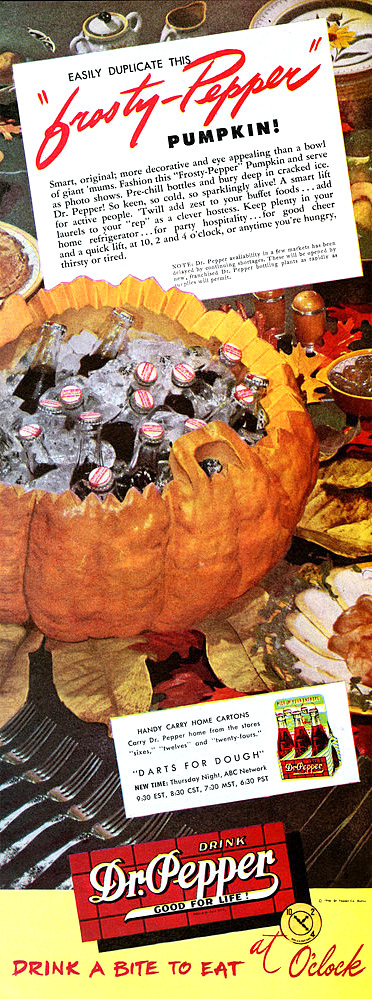
dr-pepper_halloween_1947_flickr“‘Twill add zest to your buffet foods…”

by Paula Bosse

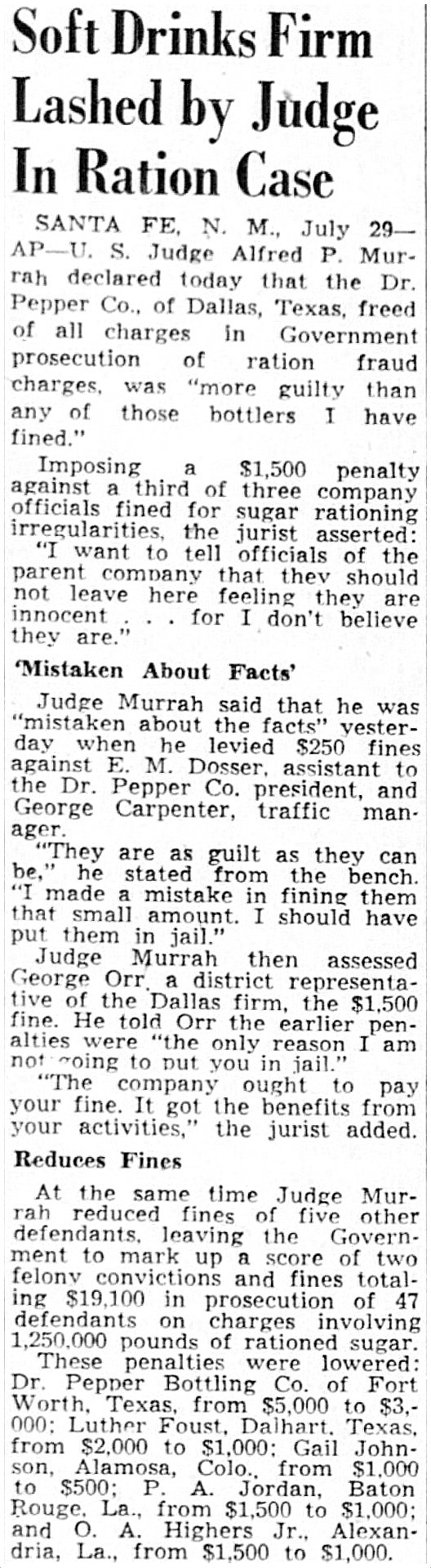
(While searching for a Halloween advertisement, I unexpectedly came across reports of a federal grand jury case brought against Dallas-based Dr Pepper for violating strict wartime sugar-rationing. Scroll down to read about the legal case.)

Happy Halloween! Might I propose an eye-catching party suggestion? The “Frosty-Pepper Pumpkin”! Hollow out a pumpkin, fill it with cracked ice, and load it up with bottles of Dr Pepper. Voilà!

The text of the ad, from the fall of 1947:

EASILY DUPLICATE THIS “frosty-Pepper” PUMPKIN!

Smart, original; more decorative and eye appealing than a bowl of giant ‘mums. Fashion this “Frosty-Pepper” Pumpkin and serve as photo shows. Pre-chill bottles and bury deep in cracked ice. Dr. Pepper! So keen, so cold, so sparklingly alive! A smart lift for active people. ‘Twill add zest to your buffet foods … add laurels to your “rep” as a clever hostess. Keep plenty in your home refrigerator … for party hospitality … for good cheer and a quick lift, at 10, 2 and 4 o’clock, or anytime you’re hungry, thirsty or tired. 

NOTE: Dr Pepper availability in a few markets has been delayed by continuing shortages. These will be opened by new, franchised Dr. Pepper bottling plants as rapidly as supplies will permit.

HANDY CARRY HOME CARTONS
Carry Dr Pepper home from the stores 
“sixes,” “twelves” and “twenty-fours.”
 
“DARTS FOR DOUGH”
NEW TIME: Thursday Night, ABC Network
9:30 EST, 8:30 CST, 7:30 MST, 6:30 PST

Drink Dr. Pepper
GOOD FOR LIFE!

DRINK A BITE TO EAT at 10, 2 and 4 o’clock

***

Sources & Notes

Ad found on Flickr, here.

“Darts for Dough”? I had to look that up. It was a radio game show involving quizzes and dart-throwing, created by Orval Anderson and Bert Mitchell at WFAA radio. It debuted in the summer of 1943 as a strictly local program, but it’s popularity was such that it moved to Hollywood in August, 1944 and — still run by the WFAA creators — it began to be broadcast “coast to coast” for several years, moving to television by 1950. It was originally developed in Dallas as a sponsorship vehicle for Dallas-based Dr Pepper and was frequently advertised as “Darts for Dough — The Dr Pepper Show.”

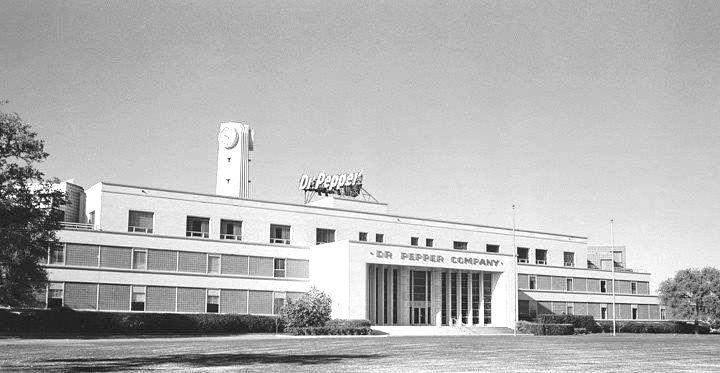
1947 was a big year for Dr Pepper — that was the year their beautiful (and sorely missed) plant opened at Mockingbird and Greenville.

dr-pepper-plant_pinterest

1947 was also a noteworthy year for the company, because of a large federal grand jury indictment which charged several corporations and individuals — including Dr Pepper and some of its bottlers and employees — with sugar-rationing violations (these “irregularities” appear to have begun in the last months of World War II, when wartime food rationing was still serious business). Black-market sugar! A district representative of Dr Pepper was assessed a small fine, but charges of conspiring to violate sugar-rationing regulations which were brought against the DP parent-company were ultimately dismissed, a ruling which angered Federal Judge Alfred P. Murrah, who seems to have been extremely unhappy about the dismissals, as can be read in his blistering statement below.

dr-pepper_sugar-rationing-case_waco-news-tribune_073047
AP story, via Waco News-Tribune, July 30, 1947

Two of the individuals charged in the case — New Mexico residents — received prison sentences in what was described as “the largest black market sugar operation on record,” involving over a million pounds of sugar.

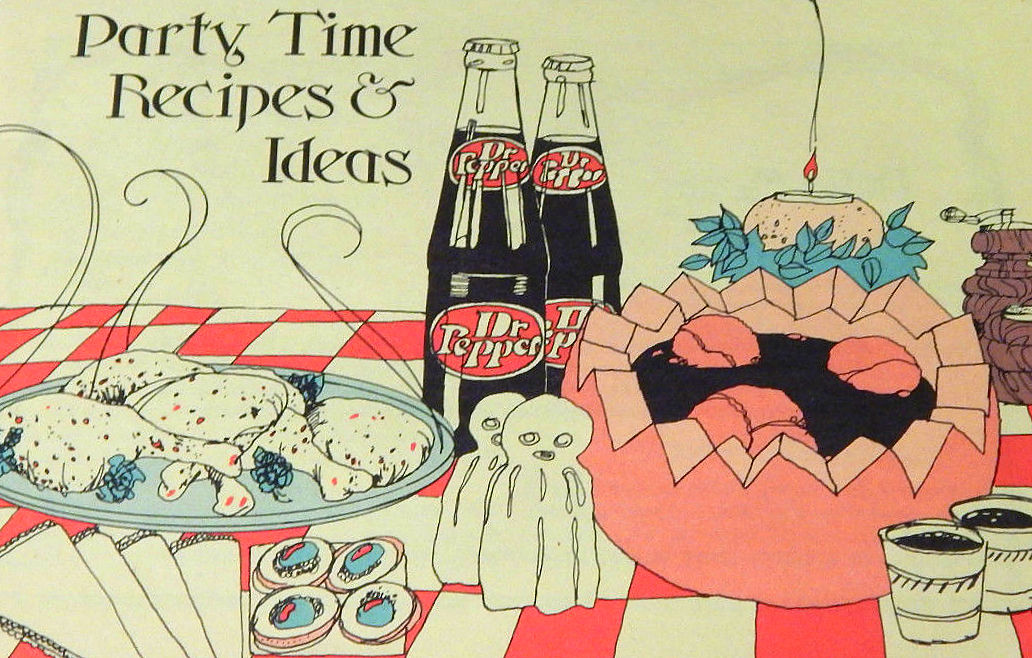
This “Happy Halloween!” post took a bit of an unexpected dark detour. Let’s cleanse our palate with something happier: another party idea with Dr Pepper and a hollowed-out pumpkin (found on eBay).

halloween_dr-pepper_booklet_ebay

More Halloween posts from Flashback Dallas can be found here.

*

Copyright © 2017 Paula Bosse. All Rights Reserved.


The Buell Planing Mill — 1901

buell-planing-mill_dallas-fire-dept-annual_1901_portalPews a specialty…

by Paula Bosse

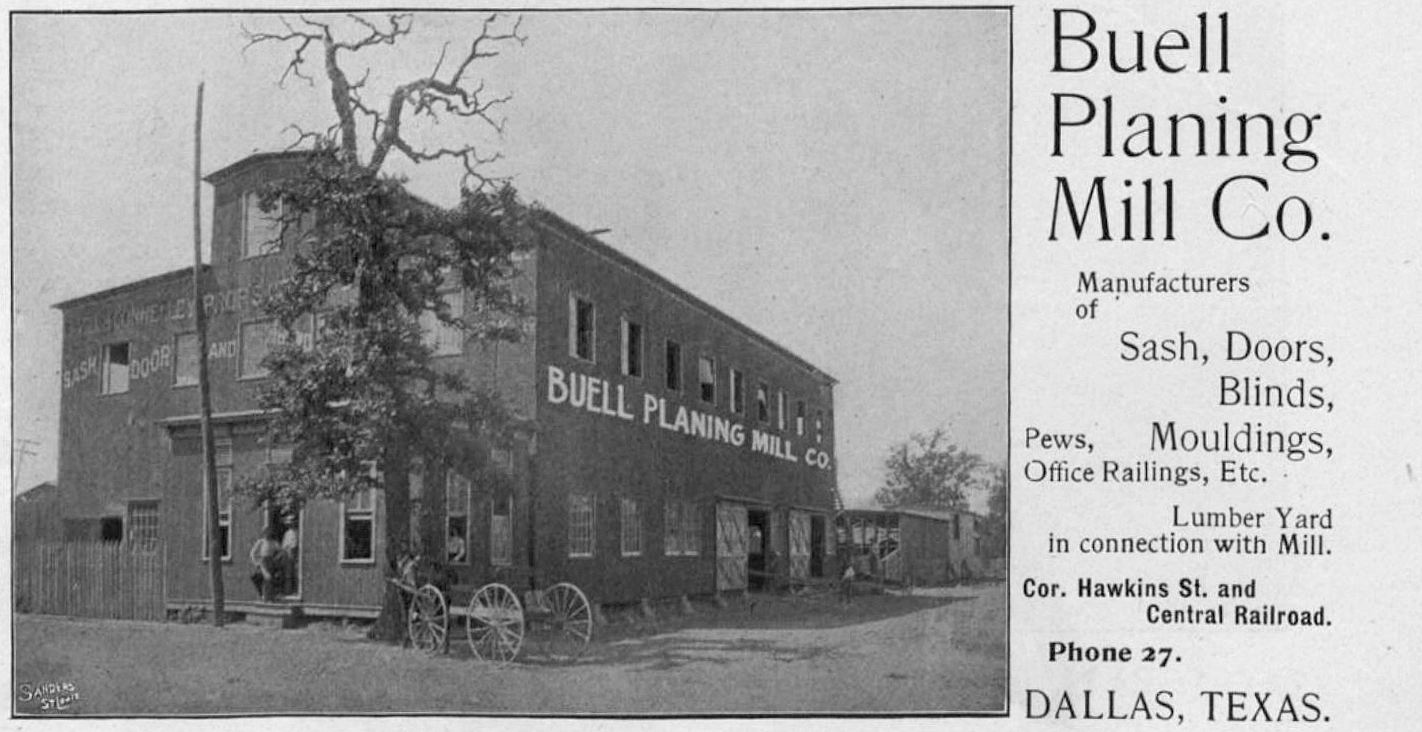
The Buell Planing Mill — originally the Buell & Connelly Planing Mill — was established in 1886 by F. T. Buell, a Canadian who came to Dallas as a teenager in 1877. The factory (seen above in an ad from 1901) was built in 1890 just west of the H&TC Railway tracks, at the southwest corner of Hawkins and Montezuma (a street which no longer exists but which ran between Bryan and Live Oak). The mill can also be seen in this ad from 1896:

buell_dallas-directory_18961896 Dallas city directory

The wood frame building burned down in a massive fire in November 1910, and a larger (concrete) factory was built on the same site (an approximate view of the mill’s location as seen today — just to the east of and slightly behind Crozier Tech — can be seen here). The company later became the Buell Lumber & Manufacturing Company in 1918, moved a few times (it left its Hawkins and Montezuma location for Hawkins and Swiss in the late 1940s), eventually became Buell & Co., and was still in business at least into the 1980s.

buell_buell-planing-lumber
Franklin Thomas Buell (1859-1938)

***

Sources & Notes

Ad from the Dallas Fire Department Annual, 1901, from the collection of the Dallas Firefighters Museum; it can be viewed on UNT’s Portal to Texas History site here.

To get an idea of what the surrounding neighborhood looked around the time that photo was taken, see the 1899 Sanborn map here; the 1921 Sanborn map shows the larger post-fire operation, here. Note the neighboring “Central High School”/Bryan Street High School (known more familiarly as Crozier Tech High School); over the years, thousands of high school students walked past (or might even have lived across from) this mill and lumber yard.

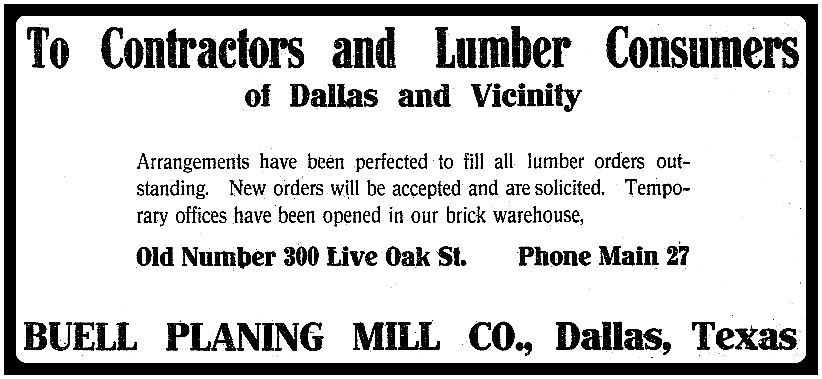
Read about the massive fire of Nov. 30, 1910 that destroyed many of the businesses and houses that surrounded the Buell mill in the Dallas Morning News account “East Dallas Fire Damage $75,000; Near Conflagration at Live Oak and Central Destroys Parts of Four Blocks” (DMN, Dec. 1, 1910) here. The Buell mill was deemed a “total loss” with damages amounting to more than $20,000 (equivalent to over half a million dollars in today’s money). Ads from several of the businesses affected were placed on the page this story appeared on. Below, the Buell ad.

buell-planing-mill_fire_dmn_120110

*

Copyright © 2017 Paula Bosse. All Rights Reserved.

Neiman-Marcus Welcomes You to the Fair with Jeweled Mementos and Picasso Paintings — 1948

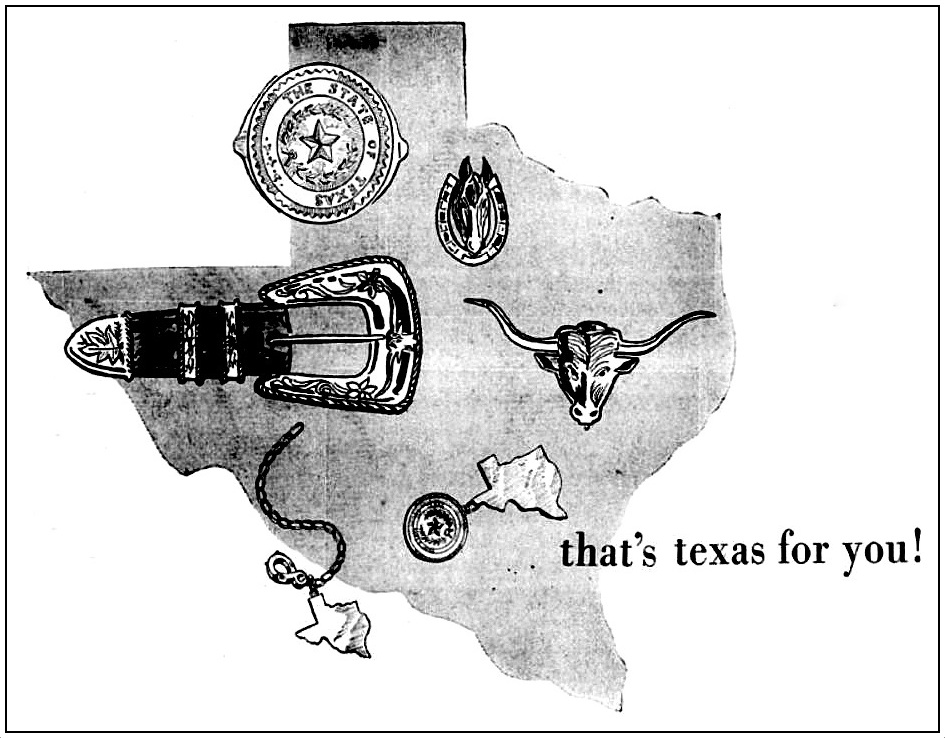
n-m_picasso_1948_fair_jewelryN-M’s 1948 “mementos of Texas…” (click for larger image)

by Paula Bosse

For many who come to Dallas from all across the state to visit the State Fair of Texas, a trip downtown to see the legendary Neiman Marcus department store is a must-see item on the itinerary. This was perhaps more the case years ago when the store was still owned by members of the Marcus family who were eager boosters of the annual event and placed several ads each year which graciously welcomed State Fair visitors to the city. For many years Neiman’s offered “souvenirs” for the tourists, ranging from relatively inexpensive Texas-centric knick-knacks to very expensive Texas-centric knick-knacks.

The 1948 N-M offerings can be seen below in an ad that boasts “A 14K gold welcome to Dallas and the State Fair!” (Click the ad below to see a larger image — to see an image of the ad copy alone, click here.)

ad-neiman-marcus_state-fair_1948_full

Here are the trinkets which no doubt wowed them back home in the nicer neighborhoods of Houston and Midland. (I’ve included ball-park prices in today’s money– according to the whiz-bangy Inflation Calculator — in parentheses.)

  • Texas Seal containing circular knife and file: $55 (about $550 in today’s money)
  • Gold belt buckle, made to order: $325 ($3,300)
  • Hand-tooled belt: $5 ($50)
  • Scarf clip, horse with ruby eyes and ruby studded collar: $500 ($5,100)
  • Hand-carved scarf pin, gold steer head with ruby eyes: $500 ($5,100)
  • Pocket key chain with Texas charm: $45 ($450)
  • Texas chain and Texas seal cuff links: $80 ($800)

For the cheap monogrammed hats, giant sunglasses, and salt water taffy, you’d have to head to Fair Park.

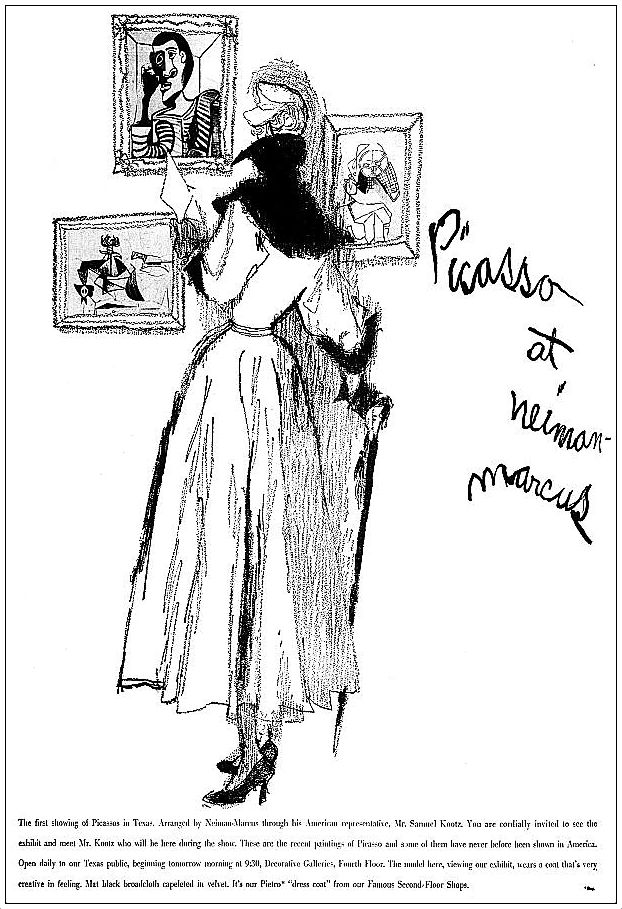
Another attraction at Neiman’s during the 1948 State Fair of Texas was an art exhibit: the first showing in Texas of original works by Pablo Picasso. The exclusive show was specifically scheduled to coincide with the State Fair and was prominently displayed on the 4th Floor of the store, in the Decorative Galleries. Twelve canvases — some never before seen in the United States — were “secured directly from Picasso’s studio at Antibes in Southern France,” via Samuel M. Kootz, Picasso’s rep in the U.S. Think about that for a second: in 1948 Pablo Picasso was the world’s most famous living artist, and there was an exhibit of his recent works — some never before seen in the United States — in a department store. In Texas. That was, as they say, a pretty good “get” for the soon-to-be President of the company, Stanley Marcus.

The Picasso exhibit was an early example of Neiman-Marcus’ dedication to bringing international arts and culture to Dallas — an idea which later manifested itself in the store’s Fortnight celebrations (which also ran to coincide with the State Fair in order to maximize publicity, foot traffic, and sales).

Stanley Marcus was an experienced buyer of art, and his relationship with Mr. Kootz was obviously warm — how else might one explain the inclusion of redrawn Picasso paintings (all of which appeared in the N-M show) in a store advertisement? Pretty ballsy. (Click ad below to see a larger image — the text alone can be seen larger here.)

picasso_n-m_1948

For those who might be interested, these are the first Picasso paintings ever publicly shown in Texas:

  • “Seated Woman” (1929)
  • “Sailor” (1943)
  • “Still Life with Mirror” (1943)
  • “Head” (1944)
  • “Still Life with Skull and Pitcher” (1945)
  • “Cock and Knife” (1947)
  • “Woman” (1947)
  • “Still Life with Coffee Pot” (1947)
  • “Owl and Arrow” (1947)
  • “Concierge’s Daughter with Doll” (1947)
  • “Blue Owl” (1947)
  • “The Glass” (1947)

Another art-world highlight in Dallas during the 1948 State Fair of Texas was the showing of Salvador Dali’s painting “Spain” at the Dallas Museum of Fine Arts in Fair Park (from the collection of Edward James, loaned by the Museum of Modern Art in New York). A Dallas Morning News headline — “Fair Interest to Divide Over Picasso and Dali” — seemed to imply that culturally-inclined Dallasites and/or fair-goers would have to choose one over the other in the battle of which famous Spanish artist-celebrity was most worthy of their attention: “Team Pablo” vs. “Team Salvador.” In regard to Dallas and its (somewhat late-blooming) openness to modern art, the first sentence of the article is interesting:

The simultaneous presence in Dallas during the period of the State Fair of Texas of original works by two of the world’s best-known living artists underscores heavily the swift progress toward cultural maturity in local thinking and planning. (Rual Askew, DMN, Oct. 3, 1948)

“Cultural maturity” and planning — both were in evidence in Dallas in the fall of 1948.

Thousands of Texans had their very first in-the-flesh glimpse of a Picasso canvas or a Dali painting in Dallas during the 1948 State Fair of Texas — either at a tony department store that sold $500 gold-and-ruby scarf pin “souvenirs,” or amongst the hot-dog-eating and roller-coaster-riding hoi polloi in Fair Park. That’s a pretty good reach for fine art.

It’s not all about the automobile shows!

***

Sources & Notes

Ads from October, 1948.

Click pictures to see larger images.

*

Copyright © 2017 Paula Bosse. All Rights Reserved.


Titche’s Discovers the Suburbs — 1961-1968

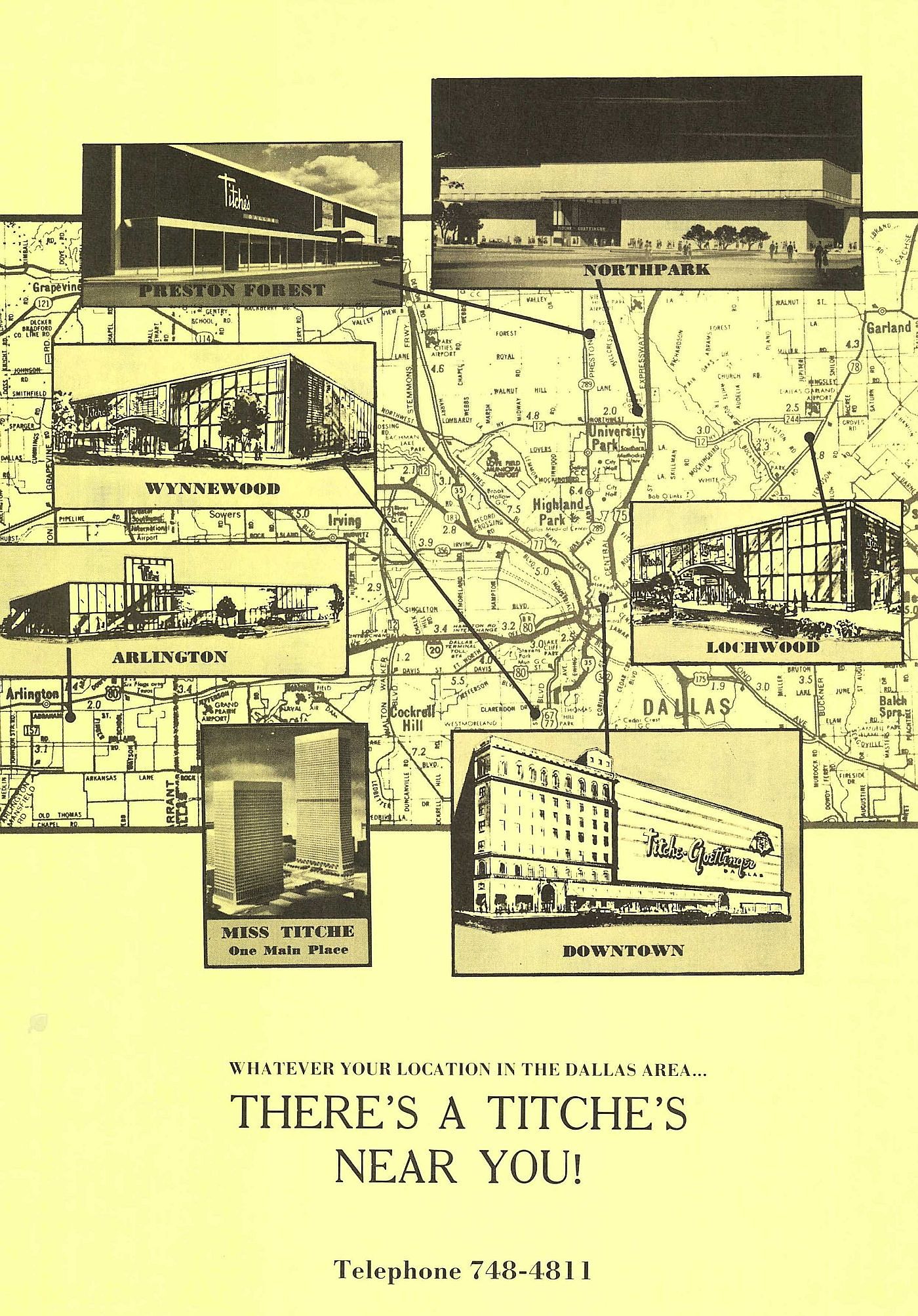
titches_dallas-stores_1969-directoryTitche’s has you covered… (click to see larger image)

by Paula Bosse

Edward Titche and Max Goettinger founded the Titche-Goettinger department store in Dallas in 1902, and in 1904 they moved into the new Wilson Building. In the late 1920s they built their own George Dahl-designed building at Main and St. Paul, which was greatly enlarged and expanded in 1955. The store was popular with downtown shoppers, and profits continued to rise. The next logical step was to open additional stores. It took a while (59 years), but in October, 1961 they opened three — three! — new suburban stores. How was that possible? Because Titche’s (or their then-parent company) purchased the Fort Worth department store chain The Fair of Texas, and several of its stores were re-christened as Titche’s stores (the others eventually became Monnig’s stores).

The ad above is from the 1969 Dallas city directory and shows that by 1969, there were seven Titche’s stores in the Dallas area. Titche’s bit the dust decades ago, and I have to admit that the only Titche’s store I actually remember ever being in was the one in NorthPark (and I might mostly be remembering Joske’s…). I had no idea about any of these other stores (other than the one at Main and St. Paul, which I wish I had been to!).

*

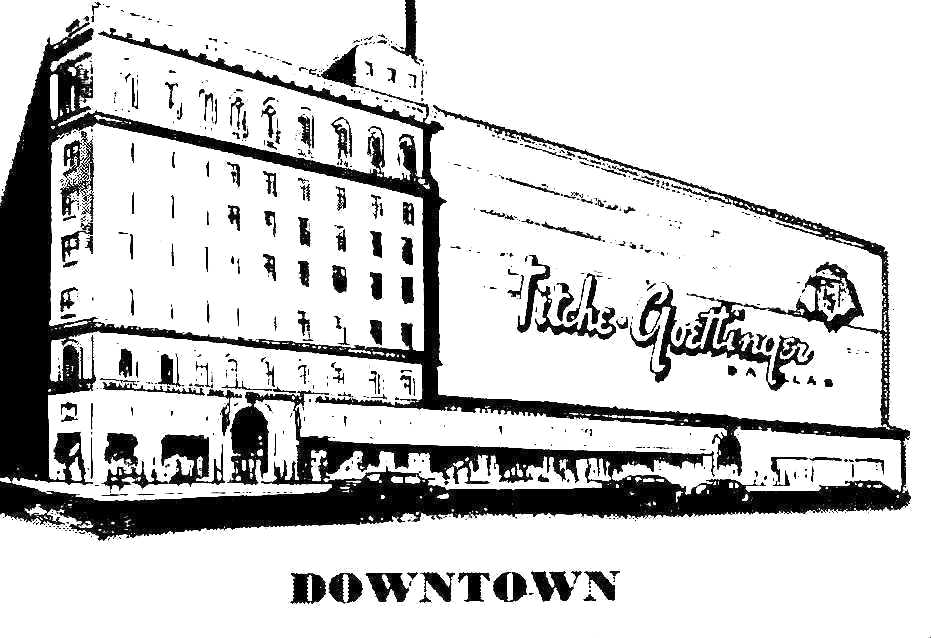
The oldest store in the ad above was the one on Main at St. Paul, still standing, still looking good (but, sadly, with that fab logo gone forever).

titches_1969-directory_downtown

*

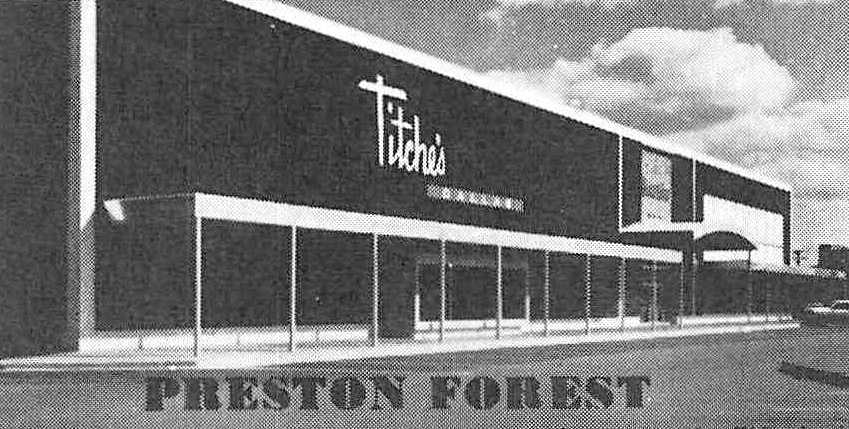
The second store was located in North Dallas in the Preston Forest Shopping Center, at the southeast corner of Preston Road and Forest Lane. When this opened as Titches’ first suburban store, the paint must still have been wet. It was originally built as a Fair of Texas store, with its opening scheduled for August, 1961. It was opened in October, 1961 as a Titche’s store — remodeled from the original Amos Parrish Associates of New York design (seen here, in a rendering). (The Fair version was much more interesting!)

titches_1969-directory_preston-forest

*

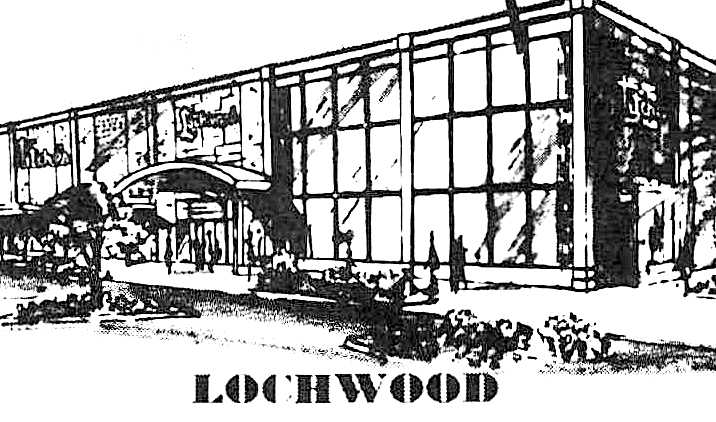
One week later (!), the next two stores opened on the same day: in the Wynnewood Shopping Village in Oak Cliff, and in the Lochwood Shopping Village on Garland Road in far East Dallas. These two stores had been Fair stores and had opened at the same time in August, 1960. The two drawings below look pretty much the same as the rendering of the pre-remodeled Preston Forest store (all designed by Amos Parrish Assoc.). (An interesting tidbit about the Lochwood location: when this store was built by The Fair of Texas — a department store with Fort Worth roots going back to the 1880s or 1890s — it was the first Fair store in Dallas. In honor of this hands-across-the-prairie moment of business expansion, a truckload of Fort Worth dirt was brought over and “mixed symbolically” with Dallas dirt at the 1959 Lochwood groundbreaking.)

titches_1969-directory_lochwood

titches_1969-directory_wynnewood

*

The Arlington store was also a former Fair store; it opened as Titche’s in July, 1963.

titches_1969-directory_arlington

*

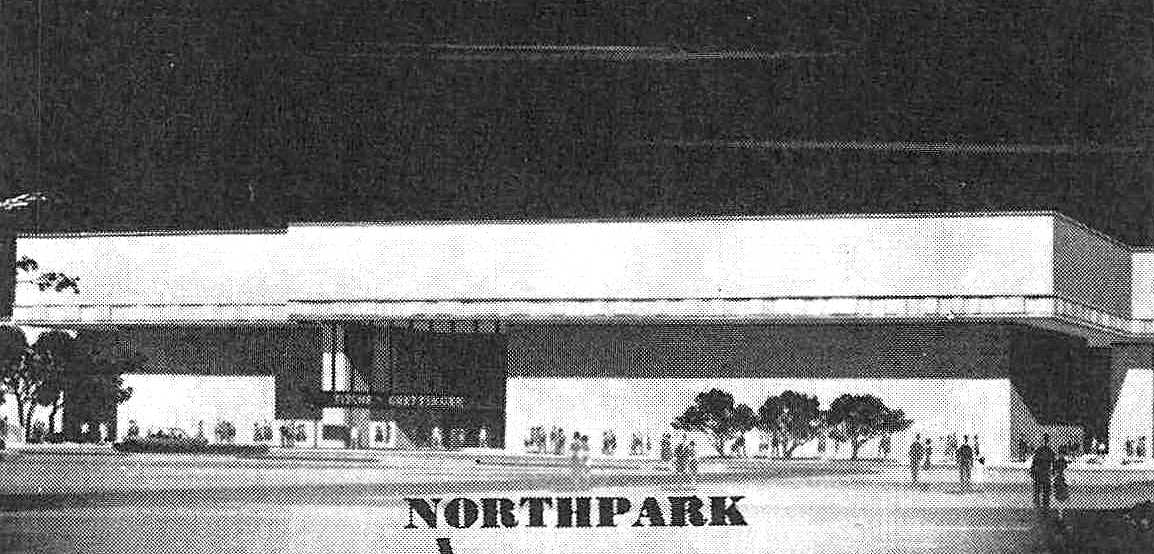
The NorthPark store — which occupied a quarter of a million square feet — was one of the first five stores to open in the brand new mall, in July 1965. NorthPark Center is known for its wonderfully sleek, clean, no-nonsense modern architecture (as seen below), but an early proposed Titche’s rendering from 1962 (seen here) looks a little fussy.

titches_1969-directory_northpark

*

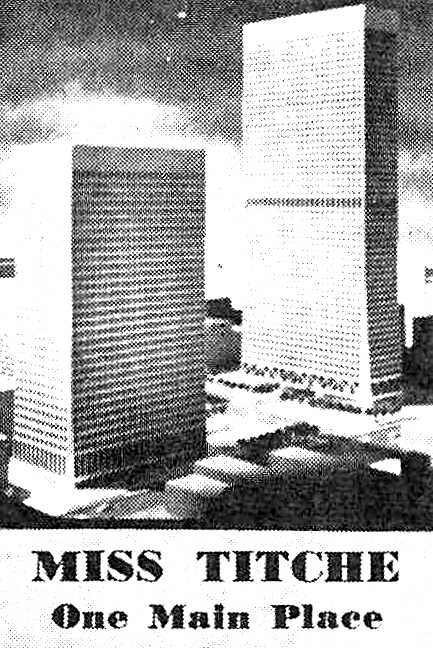
And, lastly, in this 1960s wave of expansion, a second downtown Dallas location was opened in the new One Main Place in December, 1968 in the form of “Miss Titche,” a concept-store created to appeal to “career girls” who worked downtown and enjoyed shopping during their lunch hours. It was located on the “plaza level” which sounds like it might have been part of the then-new underground tunnel system of shops. If newspaper ads are anything to go on, it looks like Miss Titche managed to hang on until at least 1975.

titches_1969-directory_one-main-place

*

Titche’s continued opening new stores into the 1970s, but in August, 1978, it was announced that Titches’ parent company, Allied Stores Corp., was changing the names of all Dallas-area Titche’s stores to “Joske’s.” The nine Titche’s stores operating until the changeover were the flagship store downtown, Preston Forest, Lochwood Village (which became The Treehouse in 1974), Wynnewood, Arlington, NorthPark, Town East, Irving, and Red Bird.

And, just like that, after 72 years, the name of one of Dallas’ oldest department stores vanished.

titches_logo_1963

***

Sources & Notes

Ad and details from the 1969 Polk’s Greater Dallas City Directory.

More on Titche-Goettinger can be found at the Department Store Museum, here.

Images larger when clicked.

*

Copyright © 2017 Paula Bosse. All Rights Reserved.


Weber’s Root Beer Stands: “Good Service with a Smile”

webers-root-beer_traces-of-texasFeeling parched?  (click for larger image)

by Paula Bosse

I’ve heard of these legendary root beer stands from family members, but, sadly, I missed their heyday, which seems to stretch from the 1920s to the 1950s. The photo above was taken around 1940 in Dallas at an unknown location. (The 1940 Dallas directory lists only two stands that year: at Greenville and Richmond — currently a 7-Eleven — and at 1119 N. Zang.)

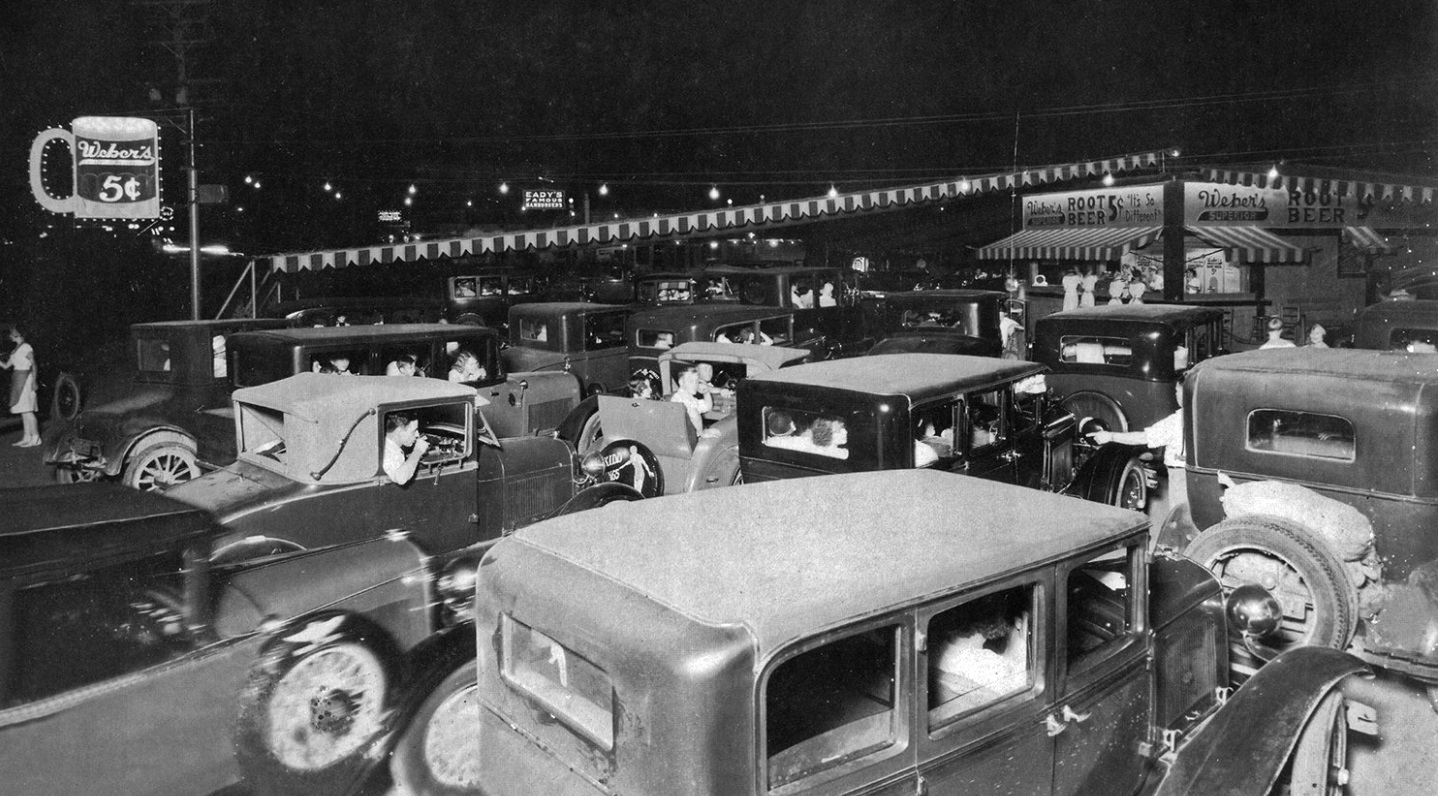
Here’s another photo, this one from 1930, taken at night, with a jam-packed lot filled with thirsty teenagers, rumble seats, and future jalopies.

webers_root-beer_traces-of-texas

In the photo above, a sign for Eady’s Famous Hamburgers can be seen in the background. This would seem to indicate that this photo was taken at one of the two locations where both Eady’s and Weber’s were neighbors: in Oak Cliff in the 1100 block of Zang, or near the Lower Greenville intersection of Greenville and Richmond. So it’s possible the two photos were taken at the same Weber’s Root Beer stand.

“It’s So Different”

ad-webers-root-beer_1930-dallas-technical-high-school-yrbk_frank-rogers

***

Sources & Notes

Top photo appeared on the fantastic Facebook page Traces of Texas. It was submitted by reader Shelly Tucker showing her aunt (second from left) working as a Weber’s carhop around 1940.

The second photo is from Traces of Texas’ Twitter feed; the source is unknown.

Ad is from the 1930 yearbook of the Dallas Technical High School (later named Crozier Tech); the photo is by the always-busy Dallas photographer, Frank Rogers.

*

Copyright © 2017 Paula Bosse. All Rights Reserved.


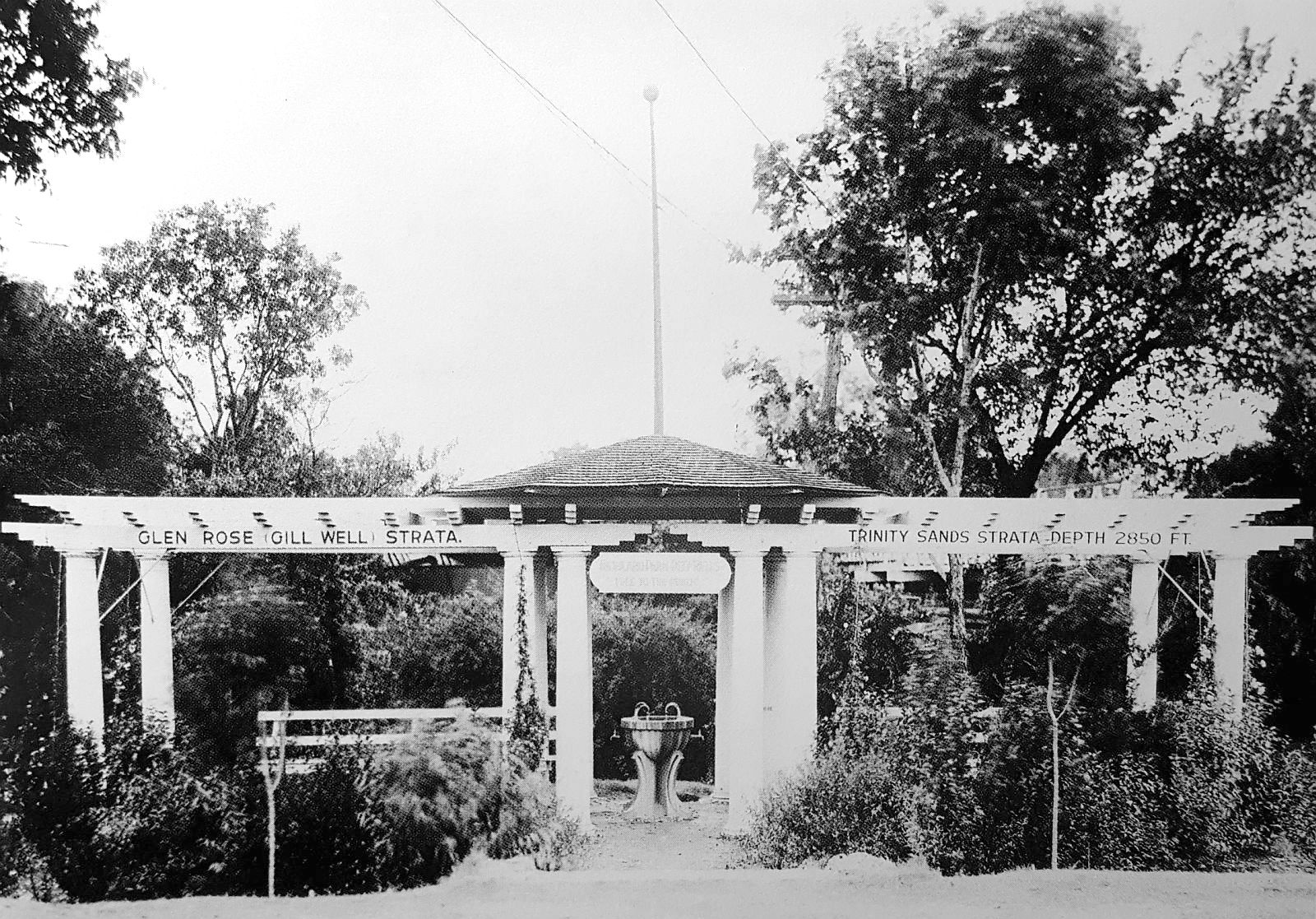
The Gill Well

gill-well_highland-park_dallas-rediscoveredThe Highland Park pagoda… (click for larger image)

by Paula Bosse

I never heard of the Gill Well growing up — in fact, it wasn’t until around the time I started this blog — about three or four years ago — that I first became aware of it. Though largely forgotten today, the Gill Well used to be a pretty big deal in Dallas: for years, early-20th-century entrepreneurs tried valiantly and persistently to capitalize on the mineral-heavy artesian water from this well — the plan was to use this hot spring water in order to turn Dallas (or at least Oak Lawn) into, well, “the Hot Springs of Texas.” We came so close!

So — Gill Well? Who, what, when, where, why, and how?

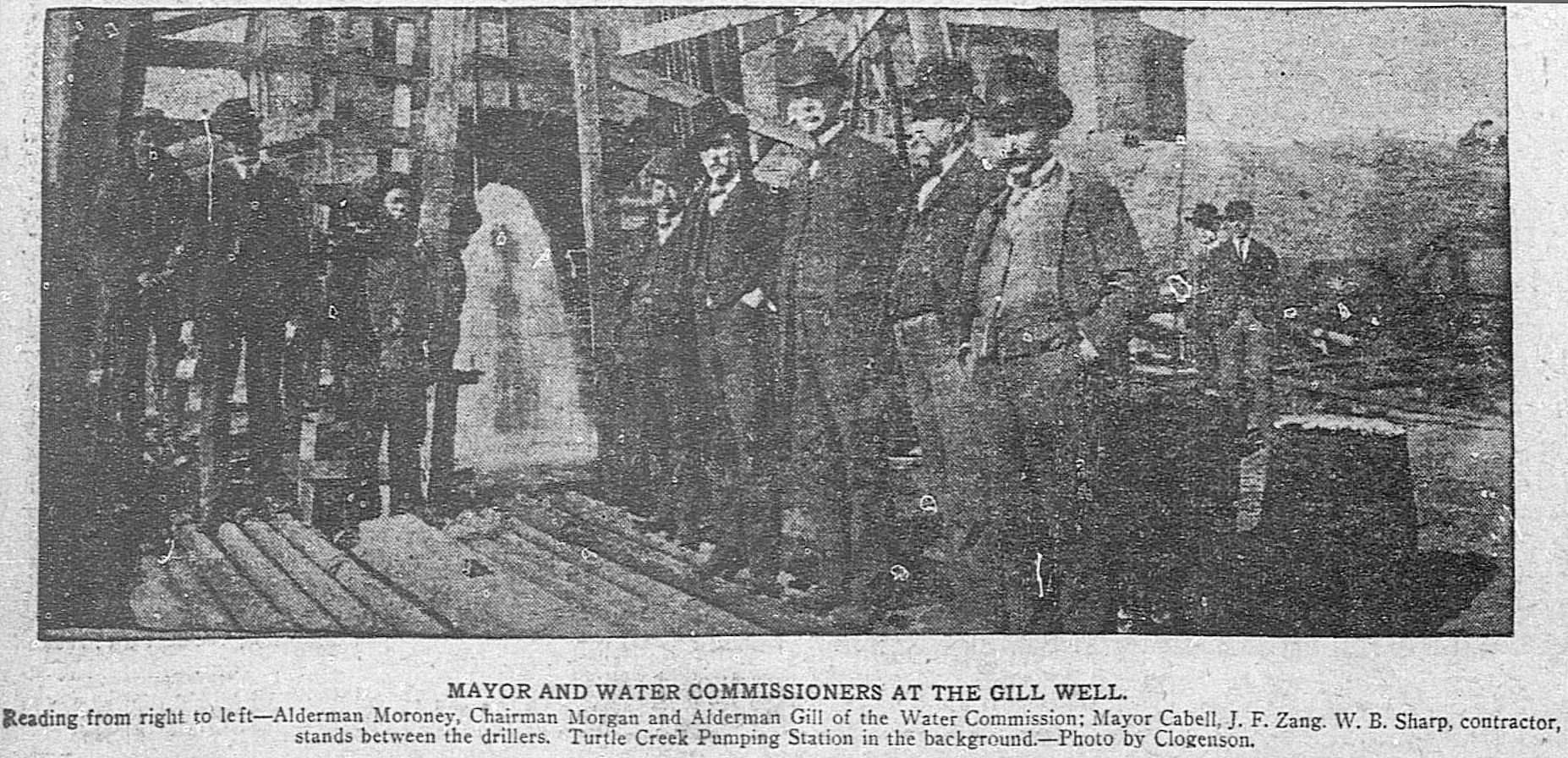
In 1902 city alderman and water commissioner C. A. Gill proposed sinking an artesian well near the Turtle Creek pumping station in order to determine if the flow of water in underground springs was sufficient to augment Dallas’ water supply (there was, at the time, another such test well being drilled in West Dallas). The City Council was on board and wanted this test well to be a deep well, “the deepest in the state — in order to settle once and for all the question as to whether or not there lies beneath the earth in this section a body of water, or ‘an underground sea,’ as some call it, of sufficient size to supply the needs of all the people” (Dallas Morning News, Aug. 6, 1902).

Fellow alderman Charles Morgan explained Gill’s proposition to the people of Dallas in a prepared statement to the Morning News:

By sinking artesian wells it is not intended to abandon the plans proposed to secure an adequate storage supply from surface drainage, but that the artesian wells shall augment the supply. We can not get too much water, but if we secure an ample artesian supply our storage basins will be reserve. There will be no conflict. We simply make success double sure. (Alderman Charles Morgan, DMN, Aug. 24, 1902)

The well was sunk in September or October of 1902 near the Turtle Creek pumphouse (which was adjacent to where a later station was built in 1913, the station which has been renovated and is now known as the Sammons Center for the Arts — more on the construction of that 1913 station and a photo of the older pumphouse can be found here); the drilling was slow-going and went on until at least 1904, reaching a depth of more than 2,500 feet. It’s a bit out of my area of expertise, but, basically, good, palatable artesian water from the Paluxy sands — water “free from mineral taint” — was found, but, deeper, a larger reservoir of highly mineralized “Gill water” — from the Glen Rose stratum — was found. That was good news and bad news.
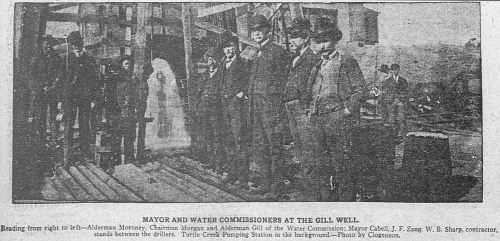
gill-well_dmn_120103Dallas Morning News, Dec. 1, 1903

The “bad news” came from the fact that a part of a pipe casing became lodged in the well, causing an obstruction in the flow of the “good” water from the Paluxy formation. Again, it’s a bit confusing, but the heavy flow of 99-degree-fahrenheit mineral water (which was corrosive to pipes) threatened to contaminate the “good” Paluxy water … as well as the water from the Woodbine formation from which most (all?) of the private wells in Dallas secured their water. (Read detailed geological reports on the well in a PDF containing contemporaneous newspaper reports here — particular notice should be paid to the comprehensive overview of the well and its problems which was prepared for the Dallas Water Commission by Engineer Jay E. Bacon and published in the city’s newspapers on May 10, 1905).

So what the City of Dallas ended up with as a result of this Gill Well was a highly dependable source of hot mineral water. But what to do with it? Monetize it!

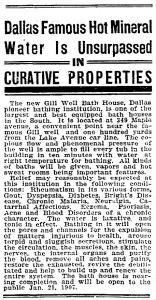
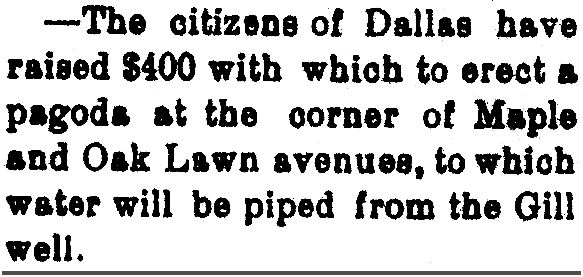
As part of the city’s water supply, the mineral water was made available to Dallas citizens free of charge: just show up at one of the handful of pagoda-covered dispensing stations with a jar, a bucket, or a flask, and fill up with as much of the rather unpleasant-smelling (and apparently quite powerful!) purgative as you could cart home with you. (For those who didn’t want to mingle with the hoi polloi, home delivery was available for a small fee.) One such “pagoda” was erected a short distance away, in front of the city hospital (Old Parkland) at Maple and Oak Lawn (the healthful water was also piped directly into the hospital for patient use).
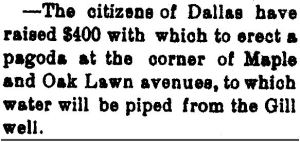
gill-well-parkland-pagoda_brenham-weekly-banner_040605
Brenham Weekly Banner, April 6, 1905

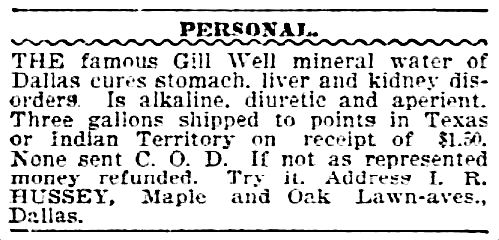
One man, however, began offering the water for sale beyond Dallas, hoping to cash in on the free-flowing tonic (see the mineral-content breakdown here), but the city clamped down on him pretty quickly as he was not an authorized agent. From his 1906 ad, one can see that the reputation of Gill water and its healing and restorative powers was already widely known.
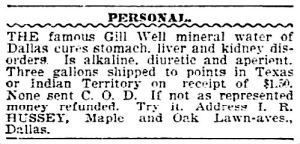
gill-well-water_dmn_080206
DMN, Aug. 2, 1906

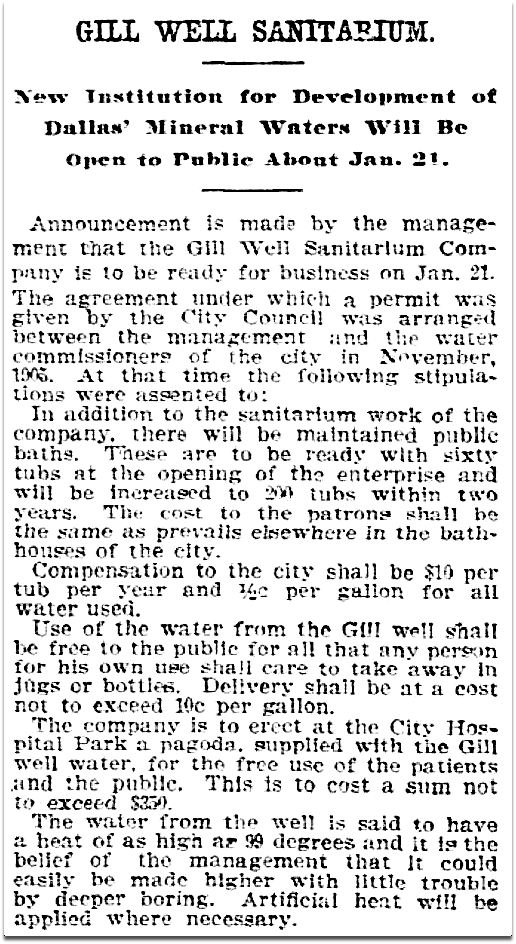
If the water was not to be sold, what was the City of Dallas going to do with it? It was decided to pipe the the water a short distance from the test well to nearby property adjacent to the land now occupied by Reverchon Park, then lease the access to the water to a capitalist who would build a sanitarium/spa where people could come to “take the waters” — to bathe in the naturally warm, mineral-heavy artesian water with mystical recuperative properties. The sanitarium would make money by charging its patrons for its services, and the city would collect a small annual income based on the number of the sanitarium’s bathing tubs and the amount of water used:

Compensation to the city shall be $10 per tub per year and one-half-cent per gallon for all water used. (DMN, Jan. 4, 1907)

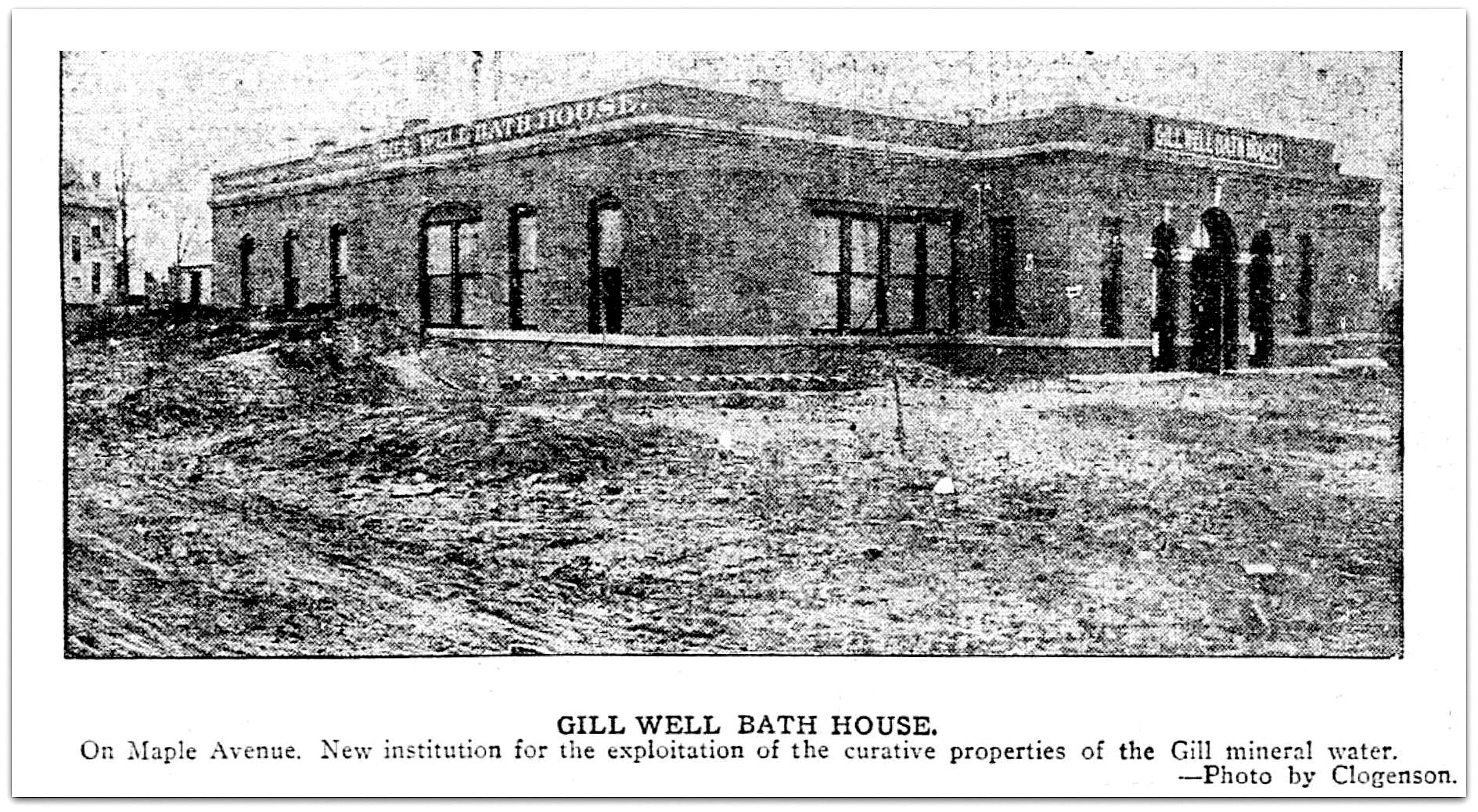
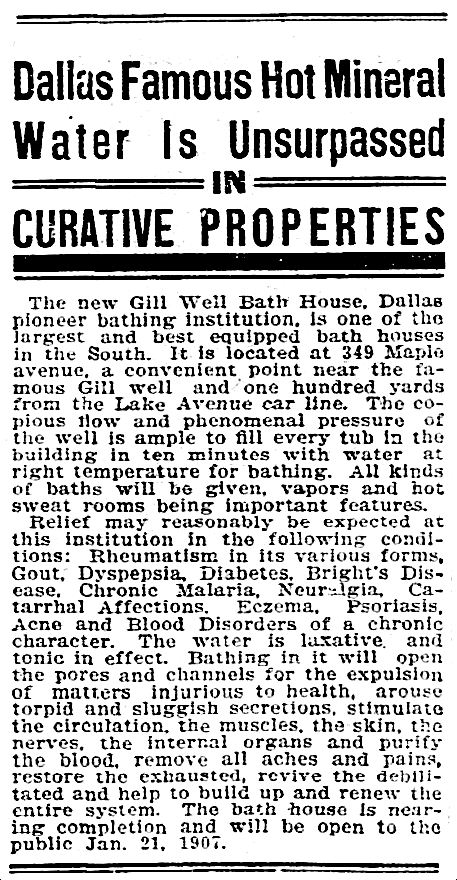
The Gill Well Sanitarium and bath house opened in January 1907, on Maple Avenue just north of the MKT Railroad (now the Katy Trail). (Most clippings and pictures in this post are larger when clicked.)
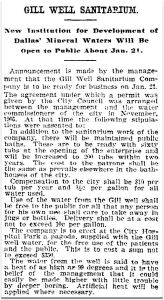
gill-well-sanitarium_dmn_010407DMN, Jan. 4, 1907

I searched and searched and searched for a picture of the building and, hallelujah, I finally found one, in the pages of The Dallas Morning News, taken by photographer Henry Clogenson. (This is the only picture I’ve been able to find of it, and, I have to say, it’s not at all what I expected the building to look like. It actually looks like something you’d see in a present-day strip mall.)
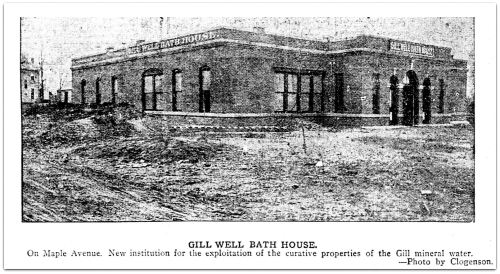
gill-well-sanitarium_dmn_011307_photoDMN, Jan. 13, 1907

gill-well-sanitarium_dmn_010607_ad
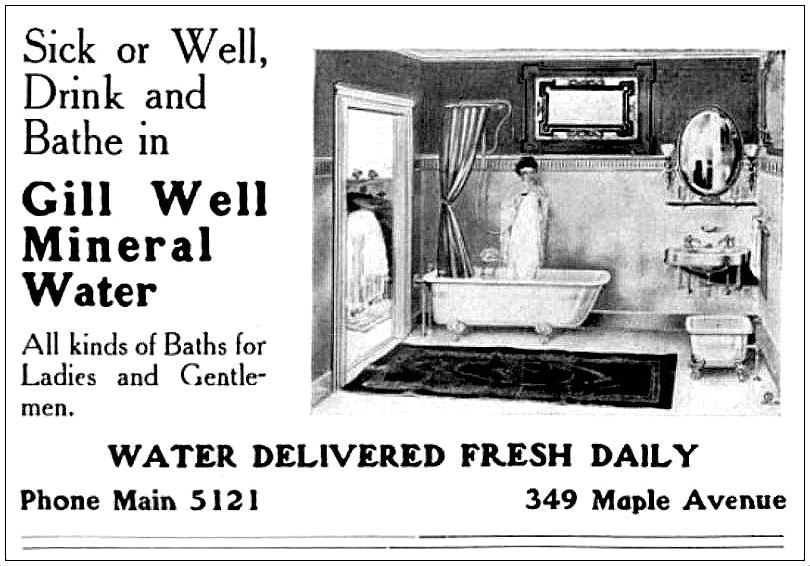
Advertisement, DMN, Jan. 6, 1907

Business at the new sanitarium was very good, and the public fountains/spigots at both the sanitarium property and a block or so away at the city hospital continued to be popular with residents who needed a boost or a “cure” and stopped by regularly for a sip or a pail of the free mineral water.
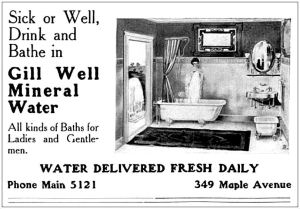
gill-well_ad_dallas-police-dept-bk_1910_portal1910 ad

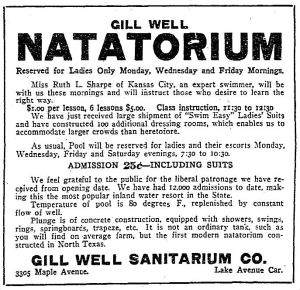
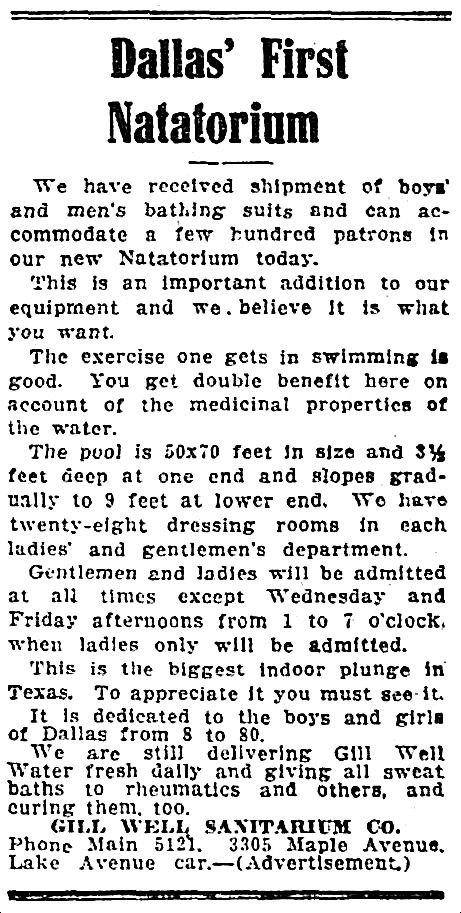
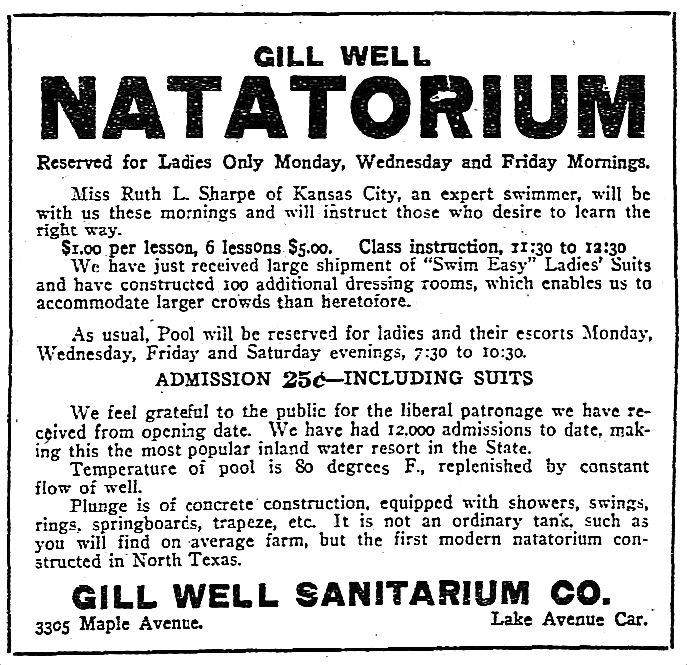
In 1912 a natatorium (an indoor swimming pool) was added and proved even more popular. It was open to men, women, and children; admittance and bathing suit rental was 25¢ (about $6.50 in today’s money). (Contrary to the headline of the ad below, it was not Dallas’ first natatorium — there was one near City Park on South Ervay by at least 1890 — but it was probably the first pool in the city filled with warm mineral water.)
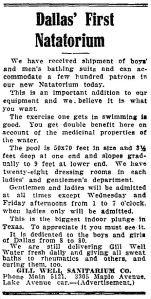
gill-well_natatorium_dmn_041412
DMN, April 14, 1912

gill-well-natatorium_dmn_070712
DMN, July 7, 1912

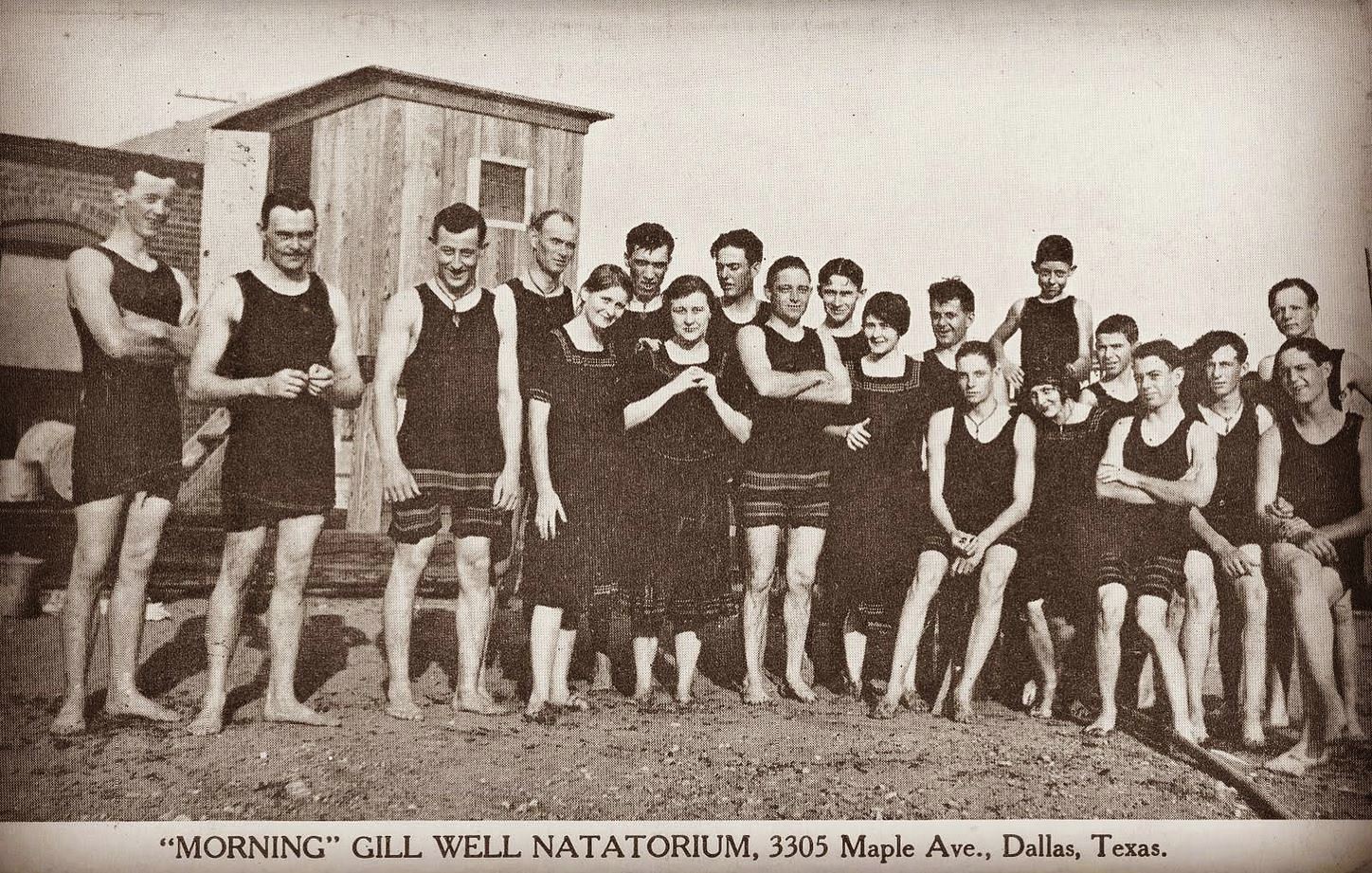
gill-well-natatorium_texas-swimming-and-diving-hall-of-fameCourtesy of the Texas Swimming and Diving Hall of Fame
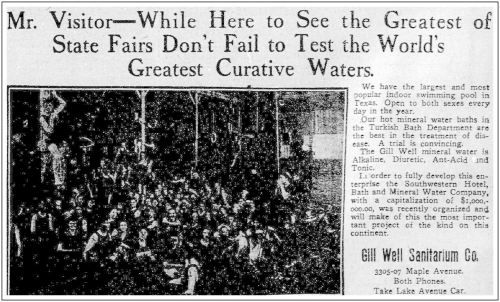
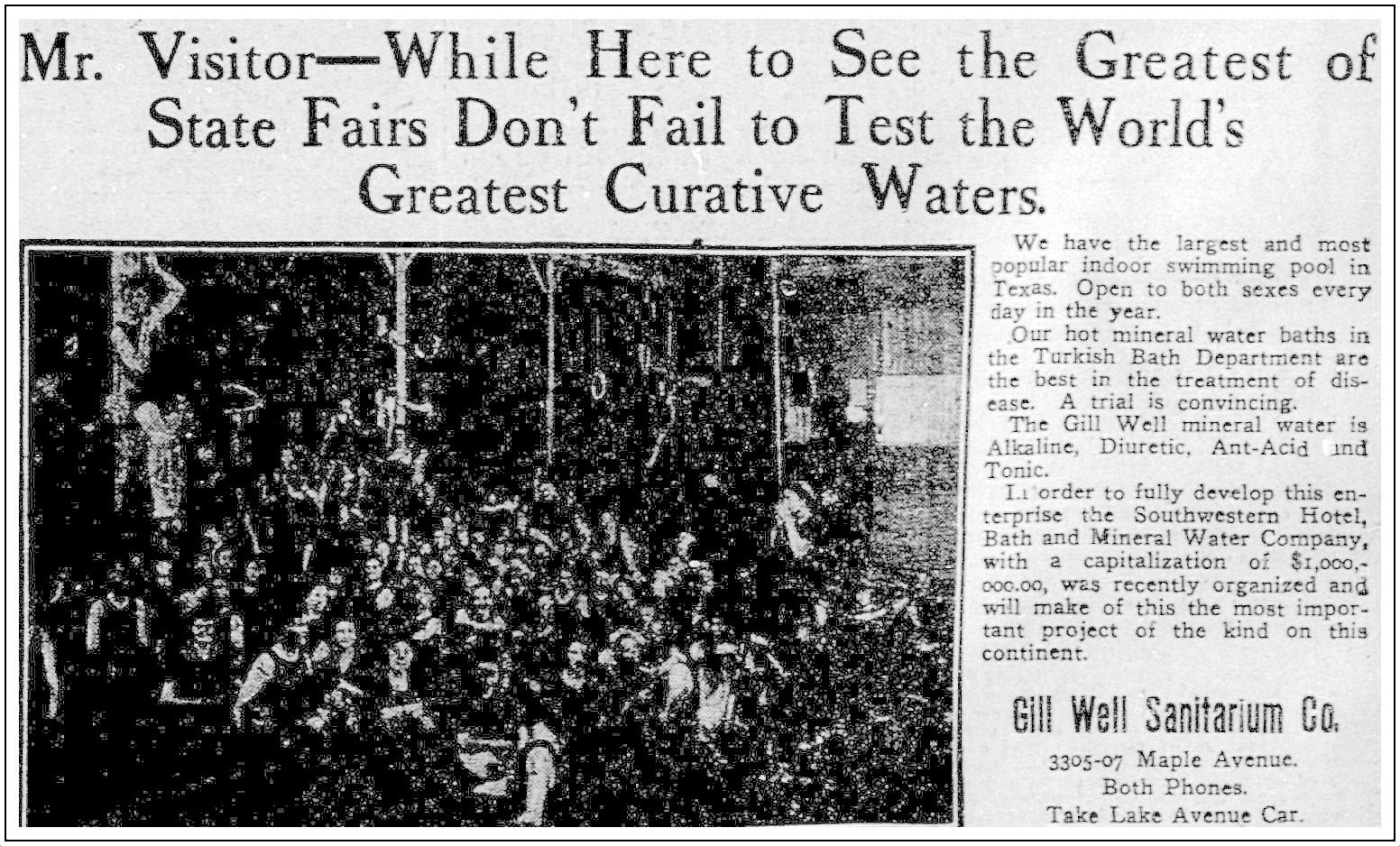
gill-well-natatorium_dmn_100612DMN, Oct. 6, 1912

The last paragraph of the ad above mentions a plan to pipe Gill water to a hotel downtown — not only would the Gill Well Sanitarium Company’s services be offered in the heart of the city amidst lavish hotel surroundings (instead of in Oak Lawn, way on the edge of town), but the company would also be able to compete with Dallas’ other (non mineral-water) Turkish baths — then they’d really be rolling in the cash. As far as I can tell, nothing came of the plan, but the men behind it were pretty gung ho, as can be seen in this rather aggressive advertorial from the same year:

ad-sanitorium-baths_blue-bk_1912The Standard Blue Book of Texas, 1912

All seemed to be going well with the sanitarium until the city and the Missouri, Kansas & Texas Railroad (the MKT, or the Katy) decided to remove the railroad’s grade crossings through the Oak Lawn area (all work which was to be paid for by the railroad). Double tracks were to be added and crossings were either raised or the streets were lowered. The crossings affected were Lemmon, Cedar Springs and Fairmount (where street levels were cut down to go under the tracks) and Hall, Blackburn, and Bowen (where tracks would be elevated). Also affected: Maple Avenue. (Read more about the MKT plan in the Dallas Morning News article from Aug. 23, 1918 — “Dallas Is Eliminating Four Grade Crossings” — here.)

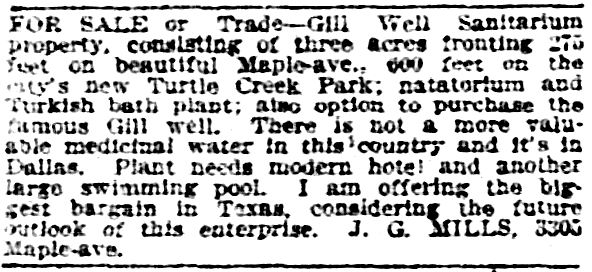
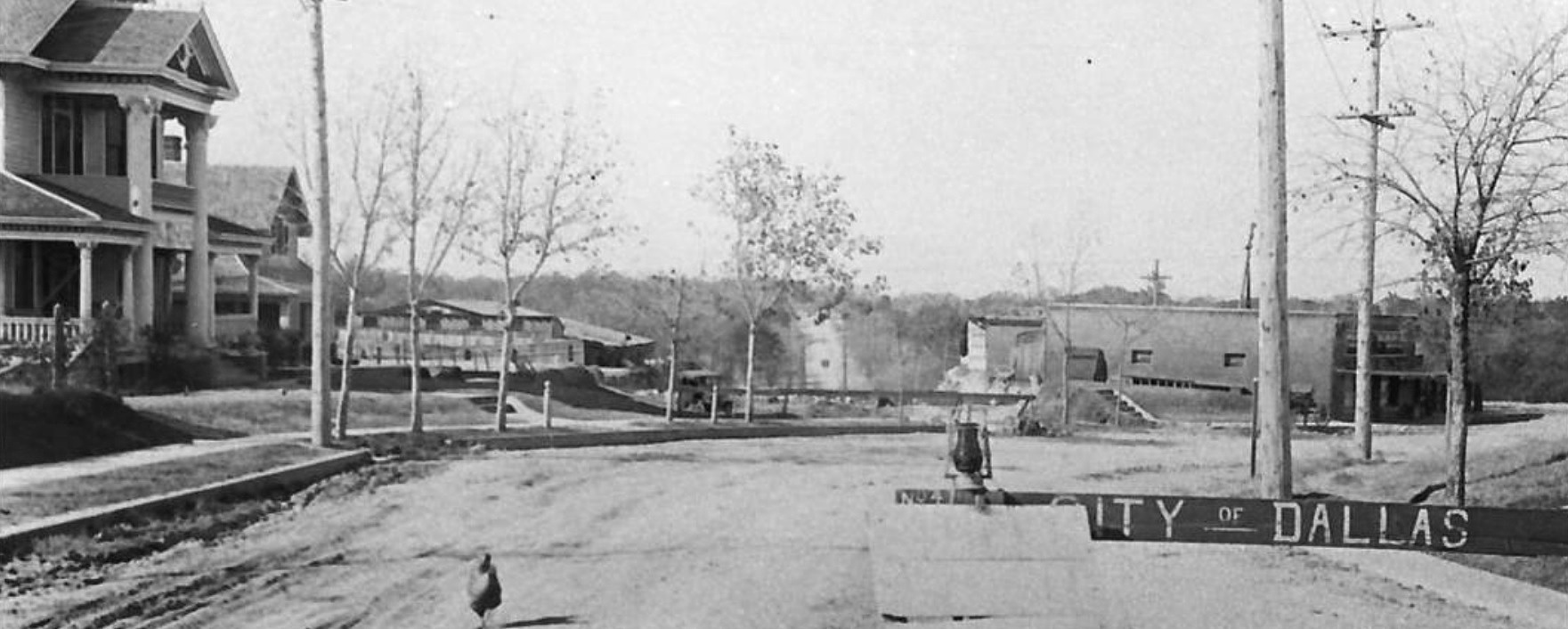
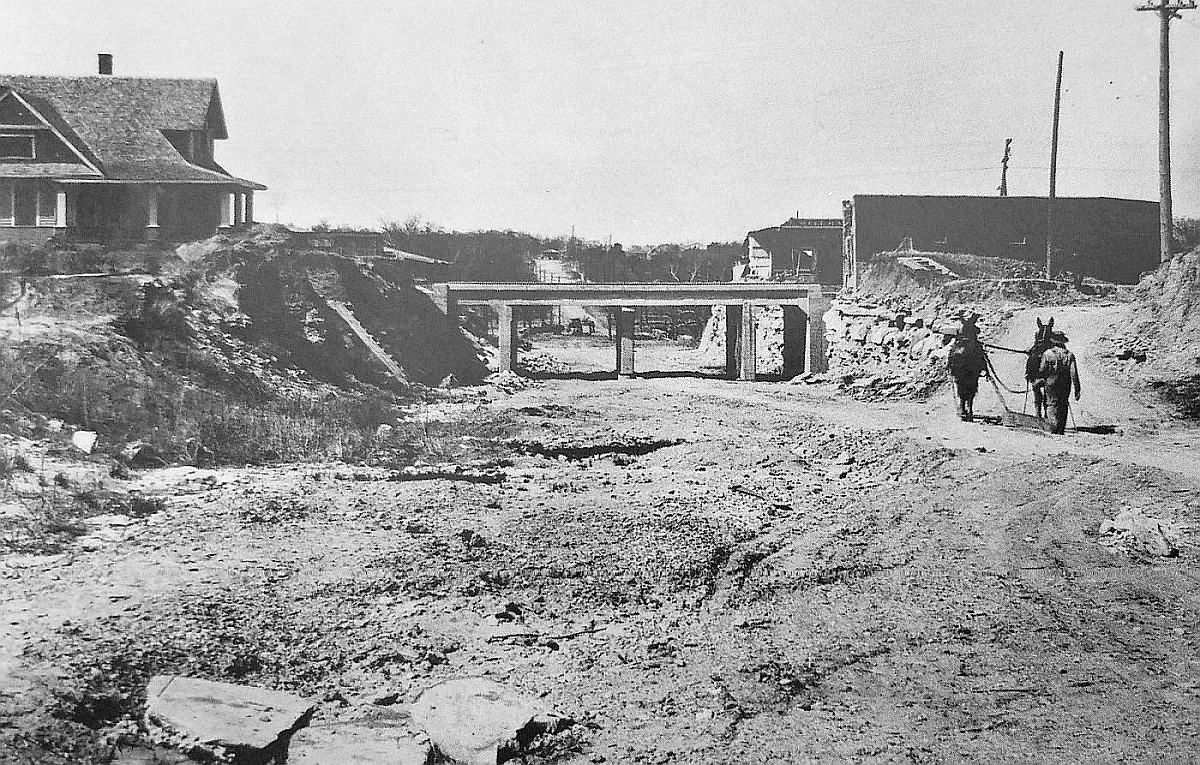
The Maple Avenue-Katy Railroad crossing had long been a dangerous area for wagons, buggies, and, later, automobiles. Not only was it at the top of a very steep hill (see what that general area north of that crossing looked like around 1900 here), but it also had two sharp curves. The decision was made to straighten Maple Avenue between the approach to the railroad crossing and Oak Lawn Avenue at the same time Maple was being lowered and the Katy track was being raised. (Read the announcement of this plan — “Straighten Maple Avenue Is Plan” — from the Nov. 29, 1917 edition of The Dallas Morning News, here.) The only problem — as far as the Gill Well Sanitarium was concerned — was that the straightened road would go directly through the sanitarium property. I don’t know if the long-time owner of the sanitarium, J. G. Mills, knew about this approaching dire situation, but in 1915 — just a few short months after boasting in advertisements that more than 50,000 patients had availed themselves of the sanitarium’s amenities in 1914 — he placed an ad seeking a buyer of the business (although, to be fair, he’d been trying to sell the company for years):
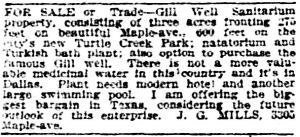
gill-well_dmn_080815_for-saleDMN, Aug. 8, 1915

(In the ad he states that the buyer had an option to purchase the actual well, but the city had never expressed any desire to sell either the well or the full rights to the water.)

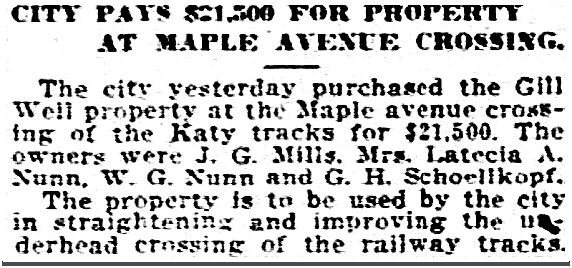
The Gill Well Sanitarium Co. appears to have been dissolved in 1916, but there was still hope that a sanitarium/hot springs resort could continue on the property. In 1917, interested parties petitioned the city to change its plans to straighten Maple, arguing that it would destroy any ability to do business on the site, but the city went forward with its plans, and in November 1919, the City of Dallas purchased the land from the group of partners for $21,500 (about $305,000 in today’s money).
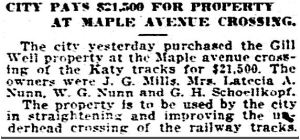
gill-well_dmn_111319
DMN, Nov. 13, 1919

The monetization of water from Dallas’ fabled Gill Well ended after ten years.

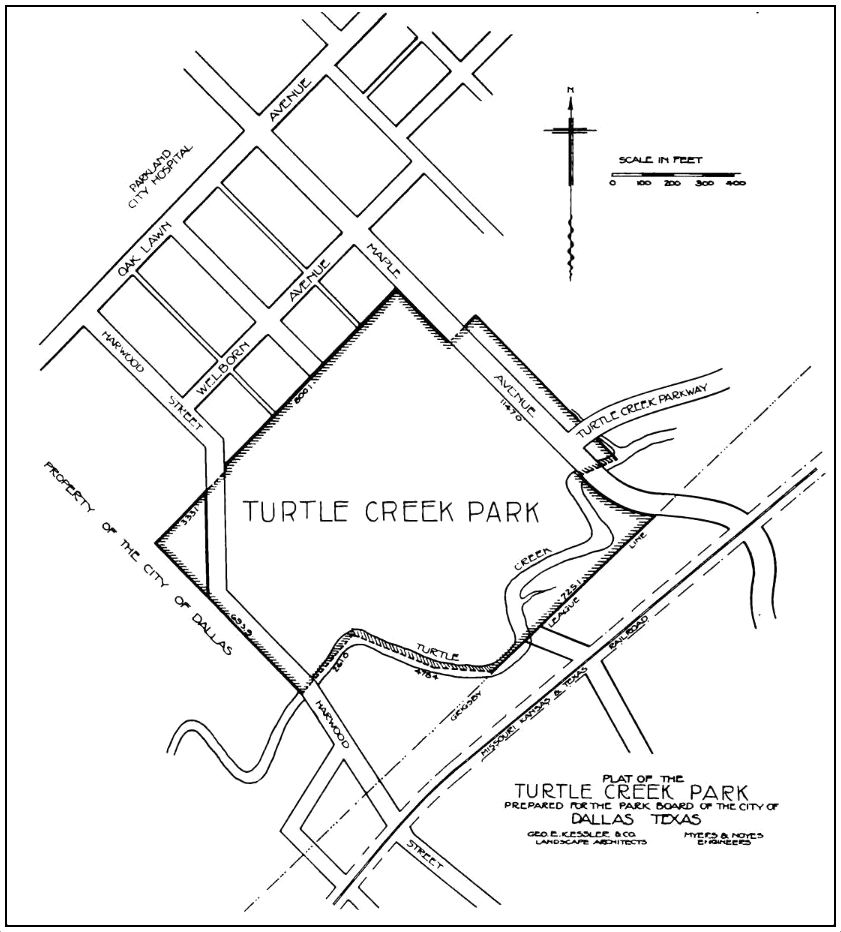
I had never heard of Maple Avenue being straightened. Below is a map of Turtle Creek Park (which became Reverchon Park in 1915), showing Maple’s route, pre-straightening — the main buildings of the sanitarium were in the bulge just west of Maple, between the Katy tracks and the boundary of the park.

reverchon-park_turtle-creek-park_map_1914-15
1915 map, via Portal to Texas History

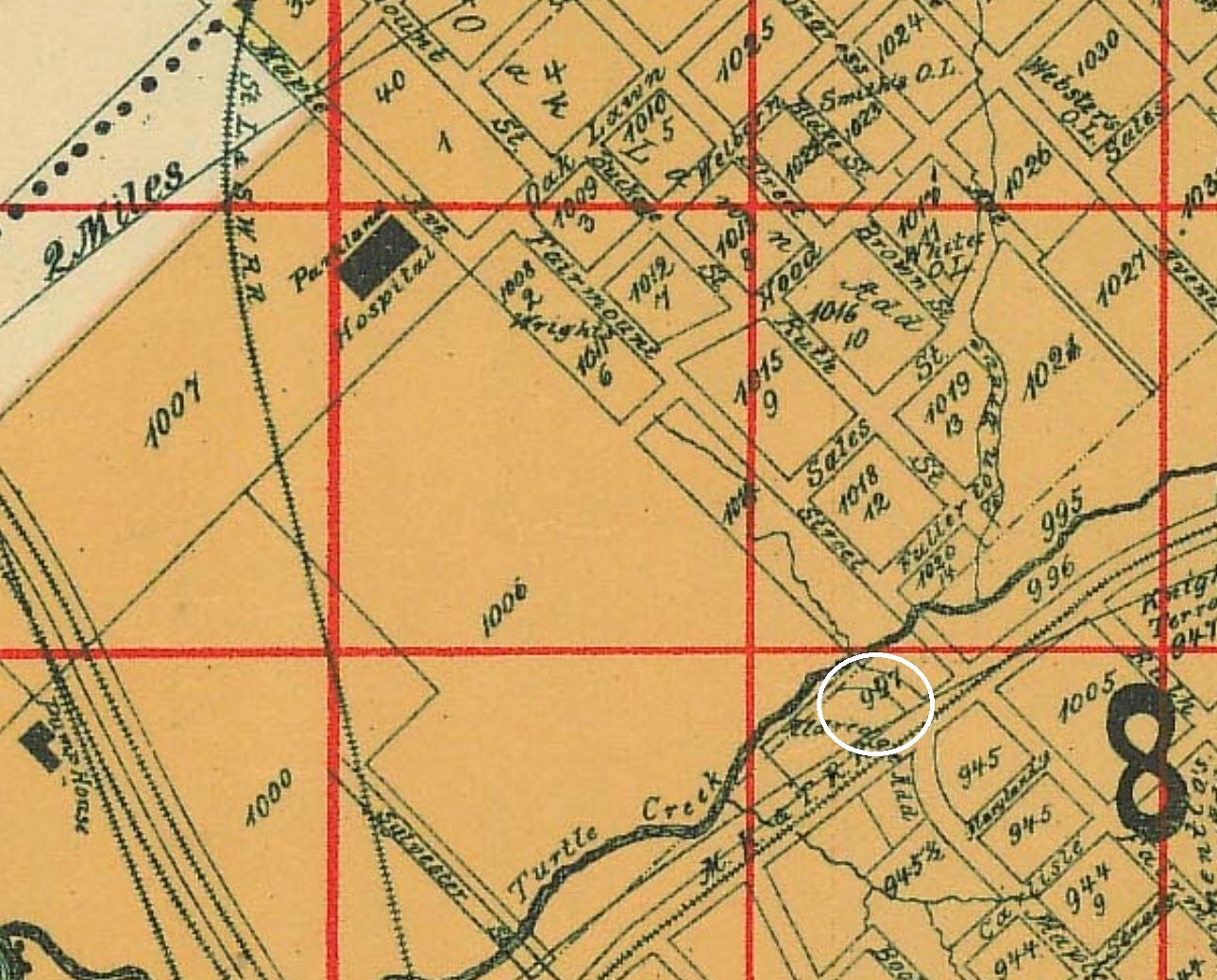
Another view can be seen in a detail from a (fantastic) 1905 map, with the approximate location of the Gill Well Sanitarium circled in white:
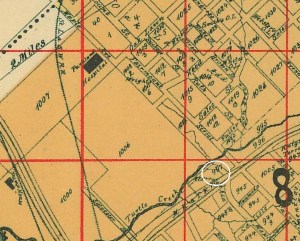
maple-ave_1905-map_portal_det_gill-wellWorley’s Map of Greater Dallas, 1905

A year or more ago I saw the photo below on the Big D History Facebook page but had no idea at the time what I was looking at: it apparently shows Maple Avenue in 1918, taken from about Wolf Street (probably more like Kittrell Street), which was then near the city limits, looking north. You can see the curve Maple makes and the steep hill — that large building at the right must be the sanitarium and/or the later-built natatorium.

maple-ave_road-construction_from-wolf_1918_big-d-history-FB

The photo below shows the road-straightening in progress, with the MKT bridge now spanning Maple Avenue.

maple-MKT_ca-1920_DPLDallas Public Library

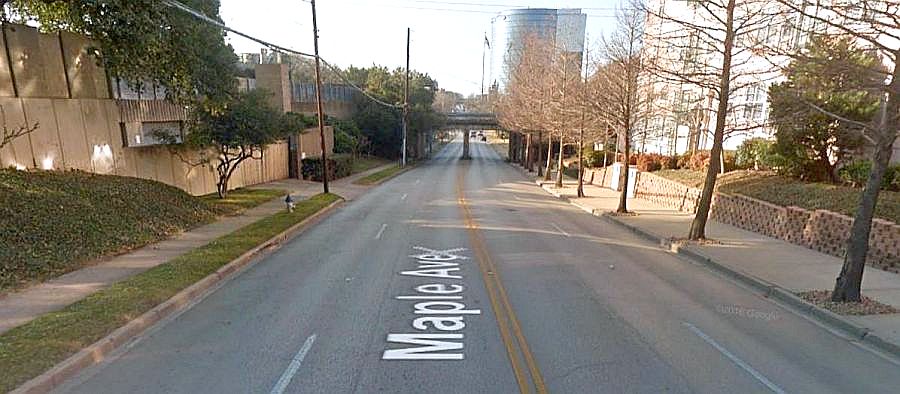
And here it is almost a hundred years later:
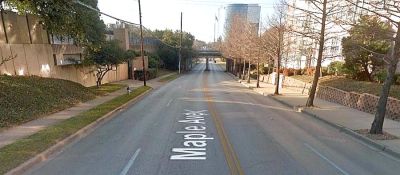
maple-MKT_google-street-view_2014Google Street View, 2014

So the Gill Well Sanitarium and Bath House was closed, the land was purchased by the City of Dallas, Maple Avenue was straightened, and, in the summer of 1923, the remaining abandoned buildings on the property were demolished. But that didn’t spell the end of the famous Gill Well water.

Highland Park’s “Gill Water” Pagoda

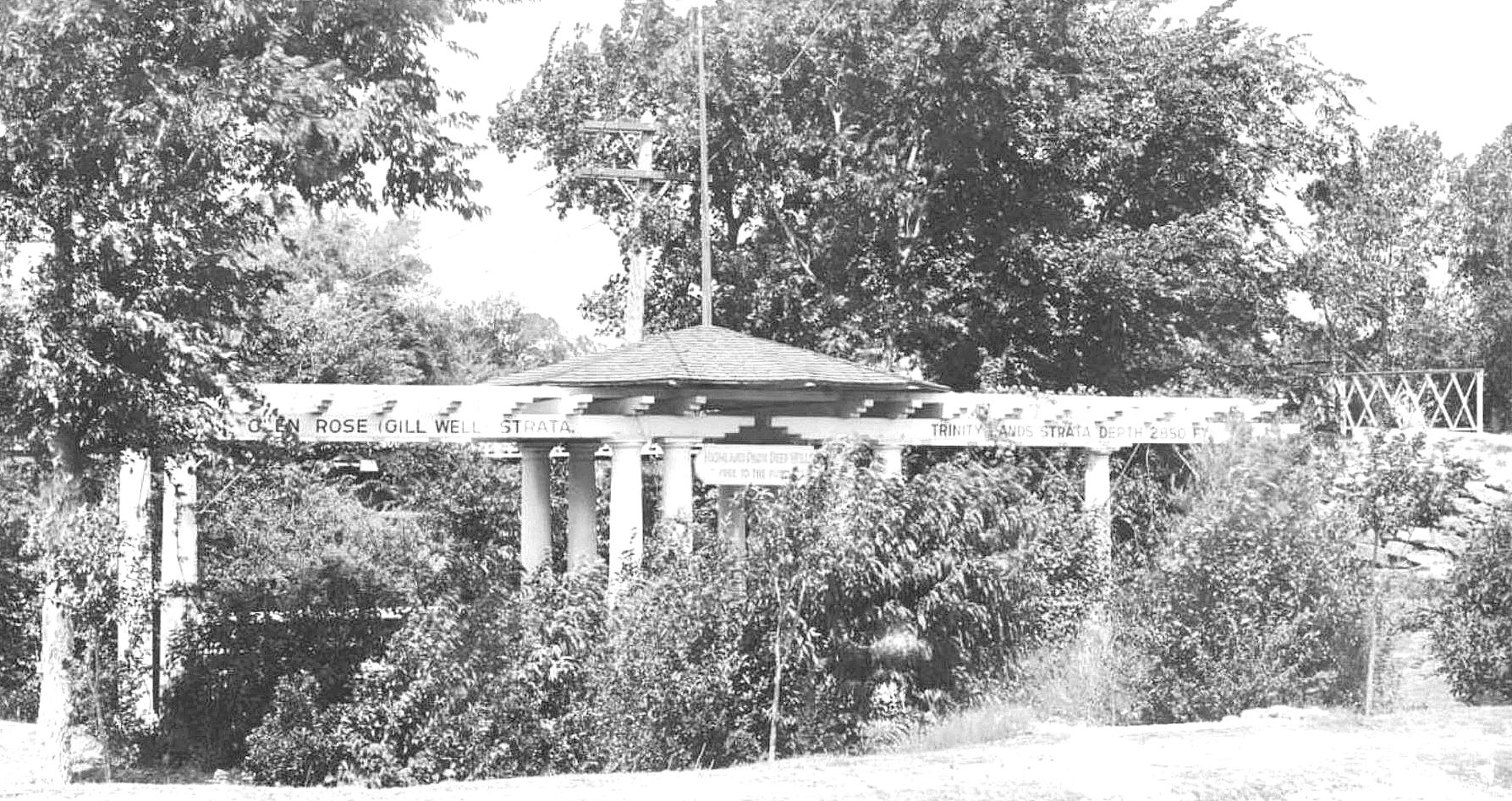
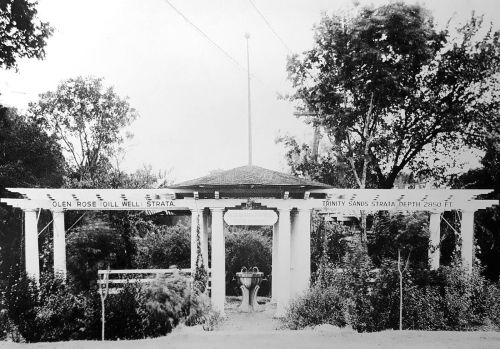
Around 1924, “Gill water” tapped from the Glen Rose Strata was made available to Highland Park, via a small “watering house” and drinking fountain on Lakeside Drive (at Lexington), a location which proved to be quite popular. The mineral water was a byproduct of Highland Park’s “deep well” which was drilled in 1924 to tap the pure artesian springs of the Trinity Sands Strata in order to augment the water supply of the City of Highland Park: in order to get down to the Trinity Sands, one had to pass through the Glen Rose Strata — I guess the HP powers-that-be figured they might as well tap the hot mineral water and offer their citizens access to it by building a small fountain and dispensing station. In 1928, the little “watering station” structure was spiffed up with the addition of a tile roof, attractive walkways, and drainage. The photo seen at the top of this post has frequently been misidentified as the Reverchon Park well, but it is actually the Highland Park “pagoda.” Here it is again:

gill-well_highland-park_dallas-rediscoveredfrom the book Dallas Rediscovered

It can be identified as the Highland Park location because of the photo below from the George W. Cook collection of historic Dallas photos from SMU’s DeGolyer Library — it shows what appears to be a later view of the same pagoda, now slightly overgrown. The steps to the bridge across Exall Lake and the bridge’s railing can be seen at the far right (the bridge led to the Highland Park pumping station, which can be seen on a pre-watering-station 1921 Sanborn map here).

gill-well_highland-park_cook-collection_degolyer_smuGeorge W. Cook Collection, SMU

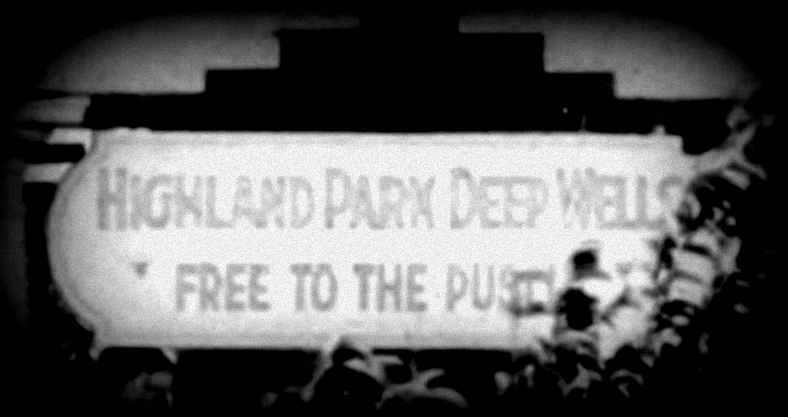
And, well, there’s the sign that reads “Highland Park Deep Wells — Free to the Public” — here’s a close-up:
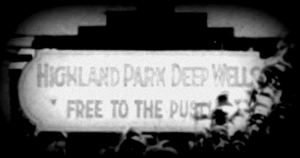
gill-well_highland-park_cook-collection_degolyer_smu_det

(The same sign from the top photo can be seen in a high-contrast close-up here.)

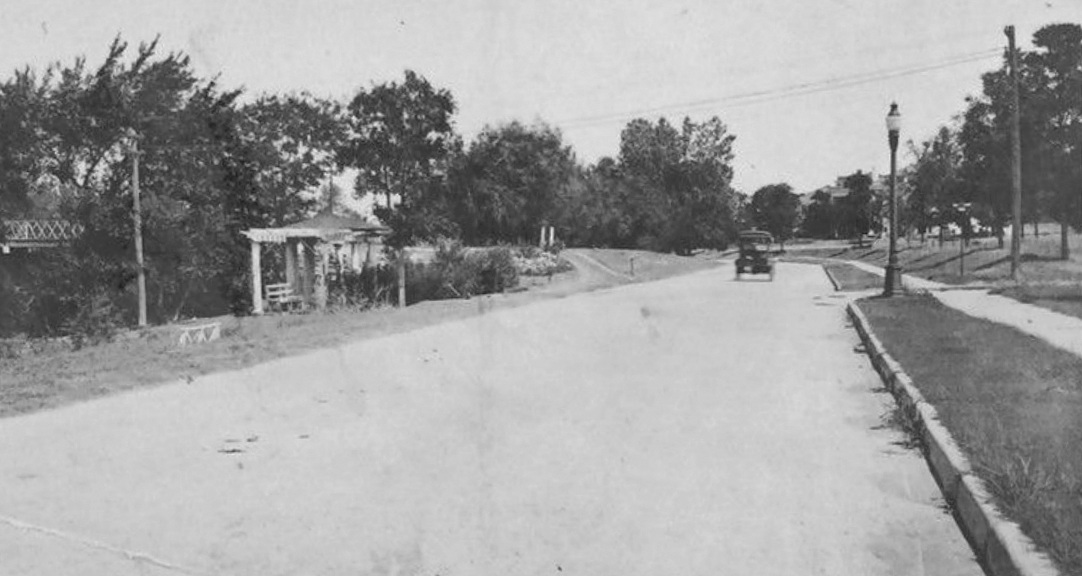
After seeing this photo, I realized that a photo I featured in a post from last year showed the pagoda in what looks like its earliest days, at Lakeside Drive and Lexington Avenue (the bridge can be seen at the left):
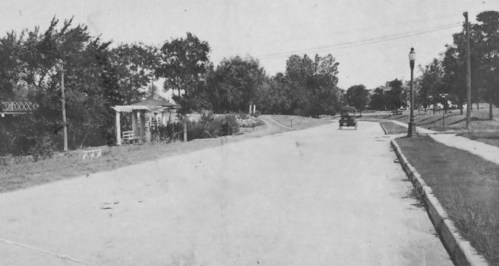
hp_lakeside-drive_rppc_ebayeBay

I was unable to find out when this HP pagoda bit the dust, but the location as seen today on Google Street View is here. (It’s pretty strange to think that a steady stream of people from all over Dallas drove to the Park Cities to fill up jugs with free mineral water; my guess is that the wealthy Lakeside Avenue residents weren’t completely enamored of the situation.)

Reverchon Park Pavilion

Even though the Gill Well Sanitarium Co. had dissolved in 1916, and the last traces of its buildings had been torn down in 1923, the famed well’s water didn’t disappear from the immediate Oak Lawn area. In February of 1925, the City of Dallas opened a $5,000 pavilion, “making up for twenty years indifference to what is said to be the finest medicinal water in the South” (DMN, Feb. 11, 1925). This pet project of Mayor Louis Blaylock seems to have continued to be a place for Dallasites to get their mineral water at least through the 1950s, according to online reminiscences. This 1925 “pavilion” is described thusly in the WPA Dallas Guide and History:

The water, which resembles in many respects the mineral waters of European resorts and is used in several county and city institutions, is carried to the surface in pipes and can be drawn from taps arranged around a semicircle of masonry near the entrance to the park. Here cars stop at all hours of the day and people alight to drink the water or to fill bottles and pails.

I have not been able to find a photograph of that post-sanitarium dispensing site. A 1956-ish aerial photo of Reverchon Park can be found here. I don’t see a “semicircle of masonry” in an area I assume would be located near Maple Avenue and the Katy tracks.

According to a comment on the DHS Archives Phorum discussion group, there was also a public spigot nearer to the original well, along Oak Lawn Avenue, across the street from Dal-Hi/P. C. Cobb stadium.

There is surprisingly little accurate information on the Gill Well online. I hope this overview helps correct some of the misinformation out there. If anyone knows of additional photos of the sanitarium and/or natatorium, please send them my way and I’ll add them to this post. If there are any photos of the Reverchon Park pavilion, I’d love to see those as well. There is a 1926 photo of the Highland Park location which shows two women and two girls filling receptacles — I am unable to post that here, but check the Dallas Morning News archives for the short article “Free Mineral Well Waters Popular” (DMN, May 29, 1926).

**

Incidentally, even though the wells have been capped, that hot mineral water is still there underground and could be tapped at any time. Dallas could still be the “Hot Springs of Texas”!

***

Sources & Notes

Top photo is from p. 199 of Dallas Rediscovered by William L. McDonald. The photo is incorrectly captioned as showing the location of the “Gill Well Bath House and Natatorium, c. 1904” — it is actually the Highland Park dispensing station at Lakeside Drive and Lexington Avenue in about 1928.

“Morning” postcard featuring healthy bathing patrons of the natatorium is from the collection of the Texas Swimming and Diving Hall of Fame and is used with permission.

Photo showing Maple Avenue, pre-straightening, is from the Big D History Facebook page; original source of photo is unknown.

Second photo of the Highland Park Gill Well location (with the vegetation looking a bit more overgrown) is from a postcard captioned “Drinking Bogoda [sic], deep mineral well in Highland Park, Dallas, Texas” — it is from the George W. Cook Dallas/Texas Image Collection, DeGolyer Library, Central University Libraries, Southern Methodist University; more information on this image is here.

Photo showing Lakeside Drive with the pagoda at the left is a real photo postcard captioned “Lake Side Drive in Highland Park” — it was offered last year on eBay.

Sources of all other clippings, ads, and maps as noted.

*

Copyright © 2017 Paula Bosse. All Rights Reserved.

The Square Dancing Craze in Big D — Late 1940s

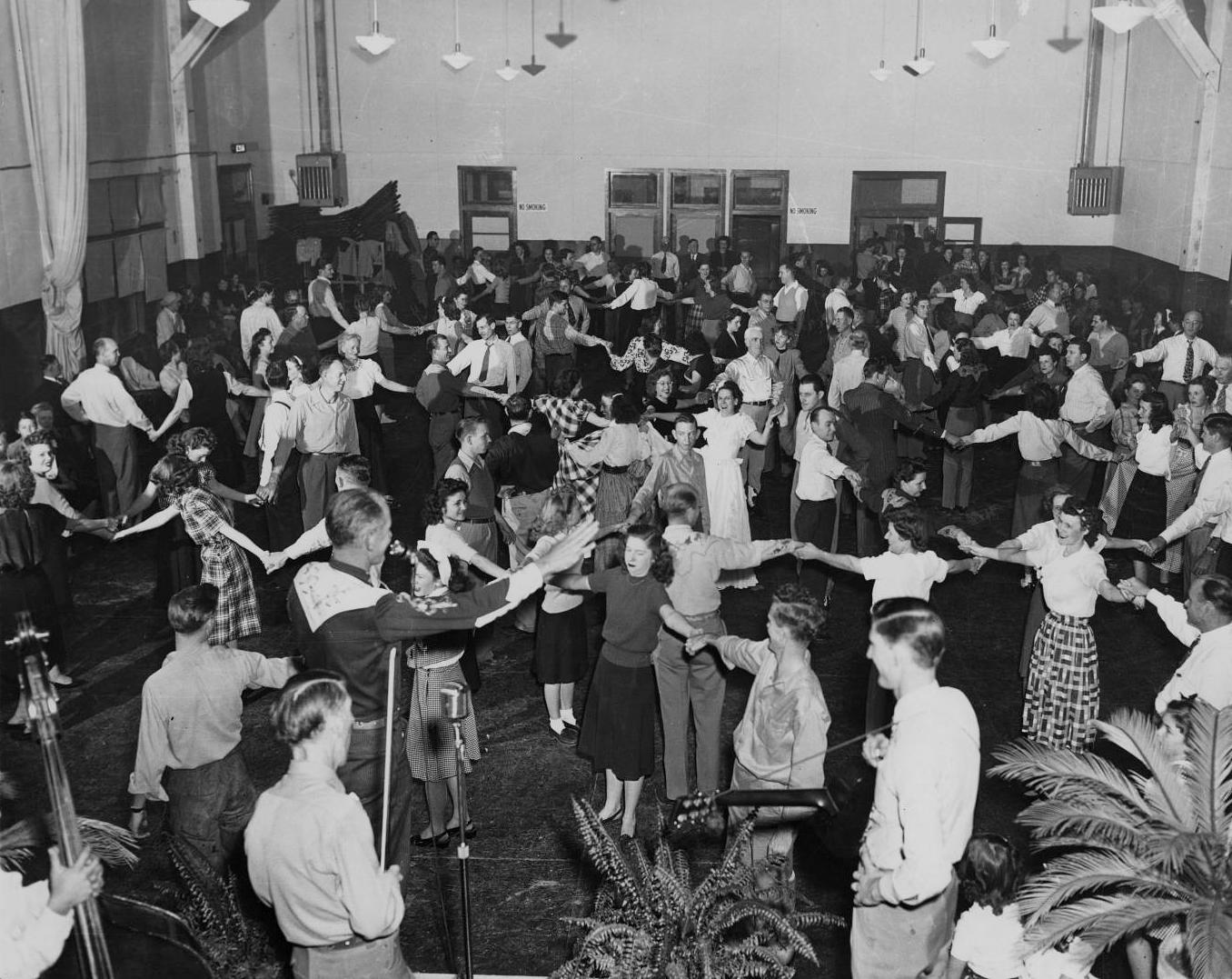
calamity-jane_premiere_-sam-bass_majestic-theatre_july-1949Hoedown at the Majestic, 1949…

by Paula Bosse

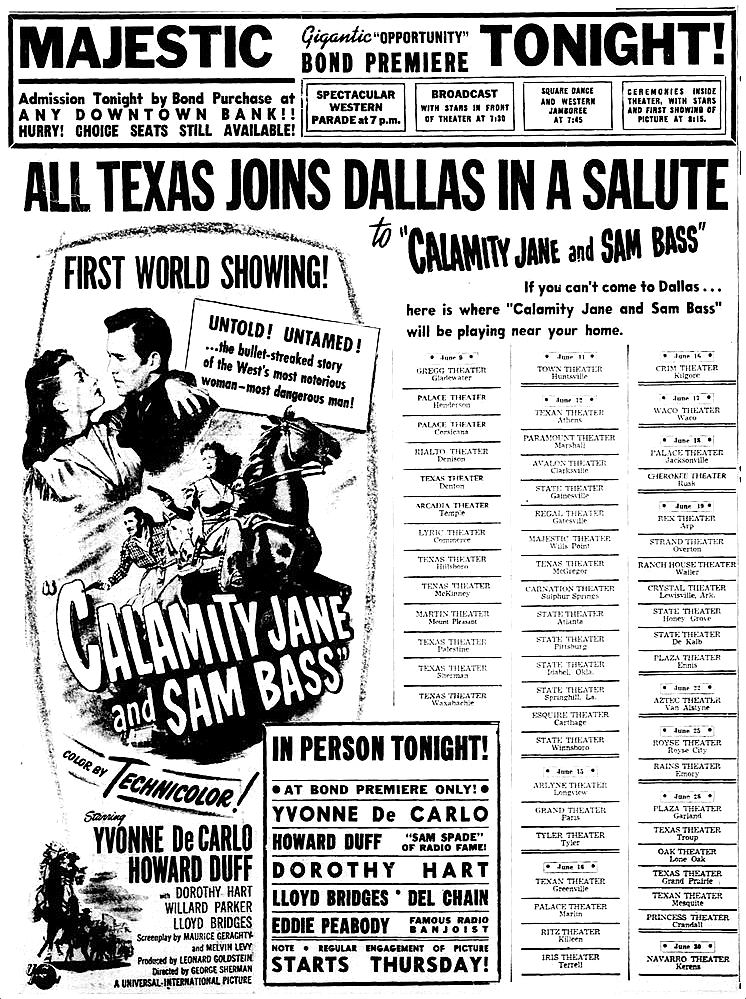
The photo above appeared in a show-biz trade publication showing part of the festivities which swirled around the world premiere of the movie “Calamity Jane and Sam Bass” starring Yvonne DeCarlo and Howard Duff at the Majestic Theatre on June 8, 1949. Several of the film’s stars made personal appearances and were made honorary deputies by Sheriff Bill Decker, sworn in by Judge Lew Sterrett (yes, Lily Munster was an honorary Dallas deputy sheriff!). There was a parade, a live show performed by the actors on the Majestic’s stage before the movie, a block party, and square dancing in Elm Street, with music provided by the Big D Jamboree band.

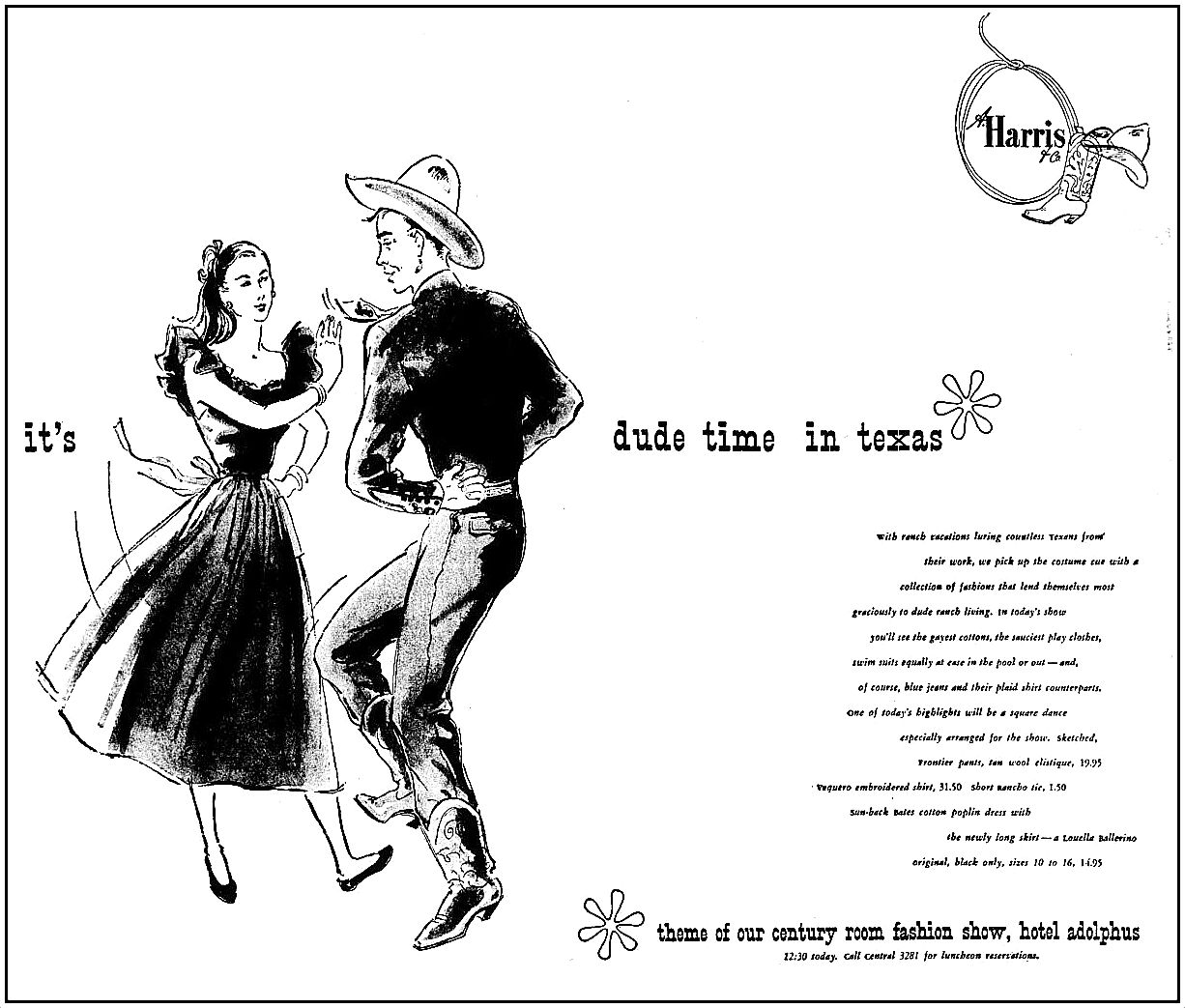
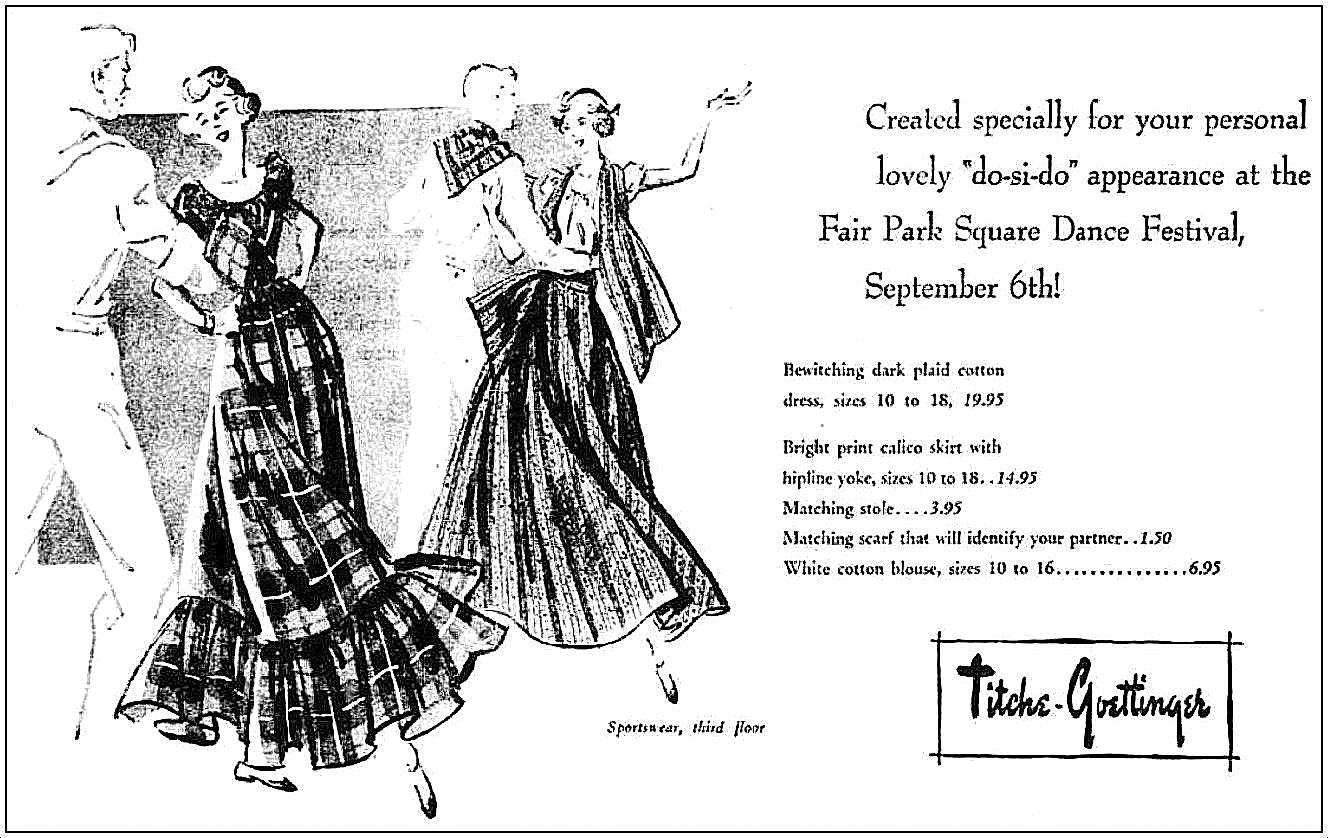
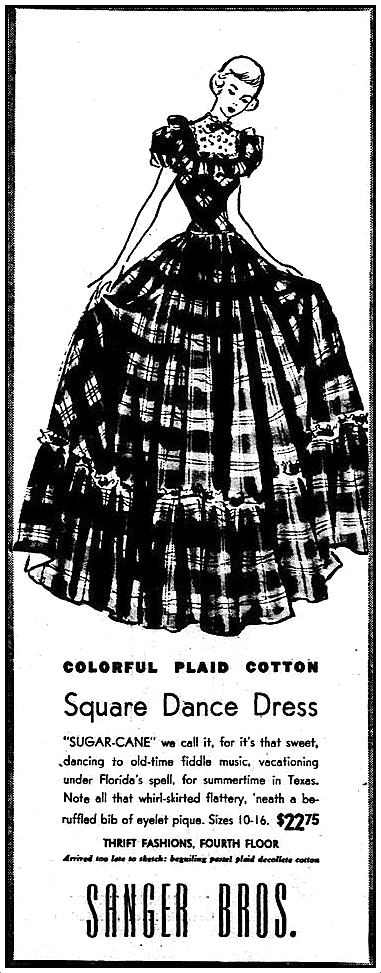
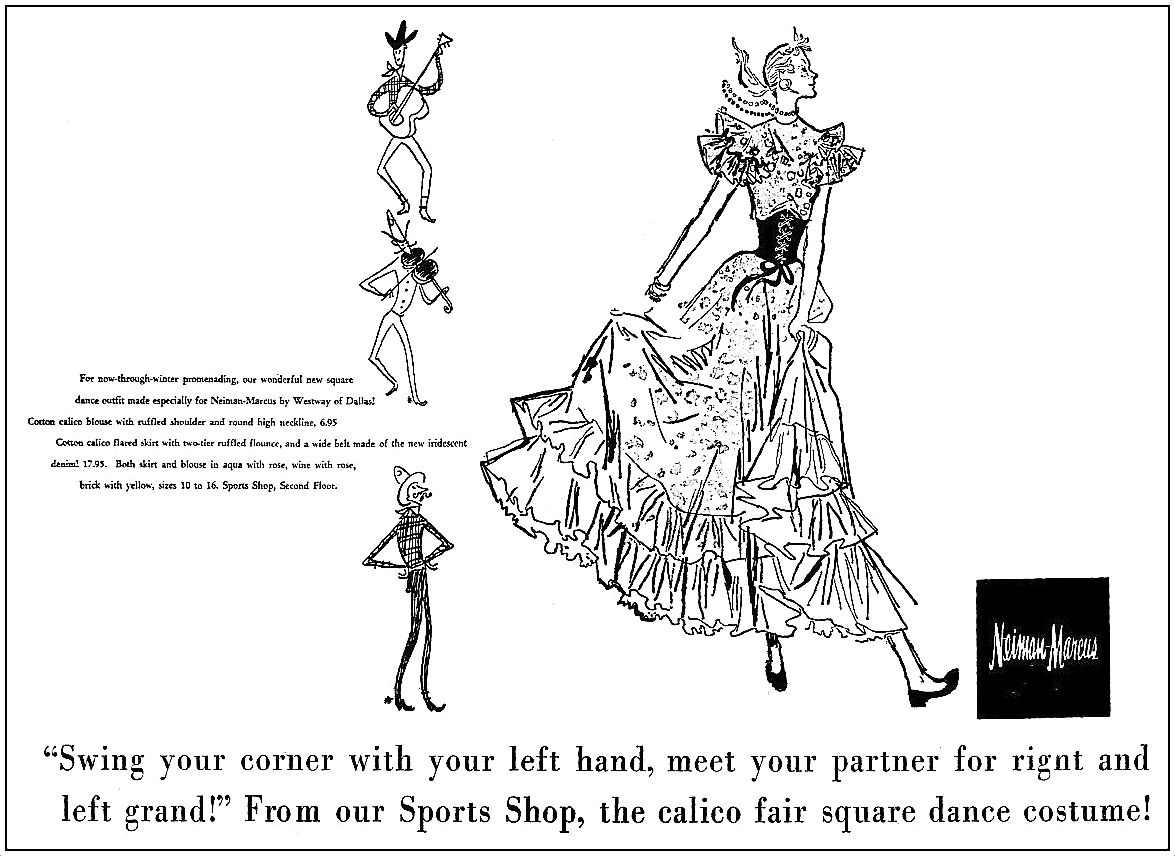
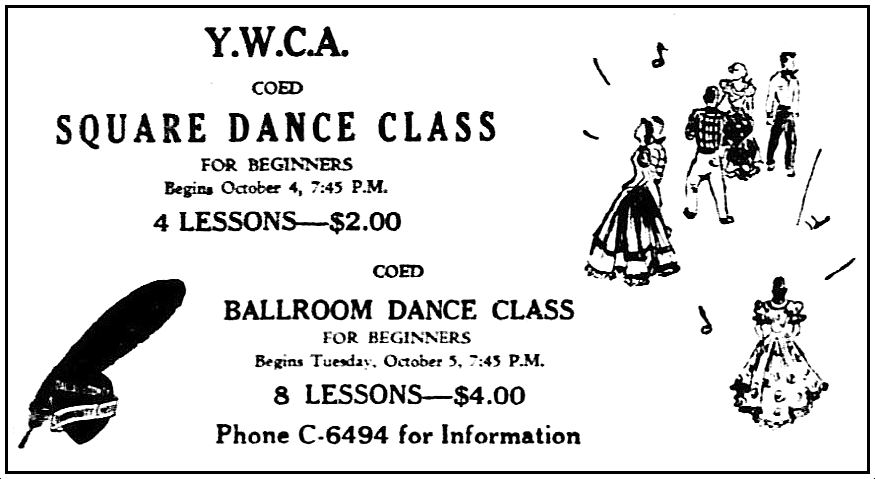
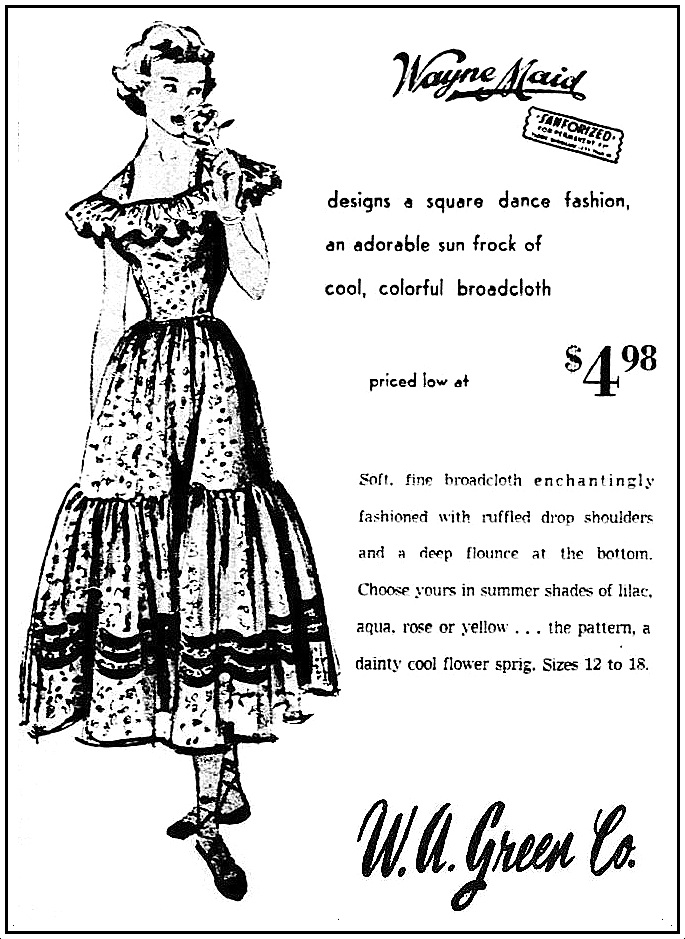
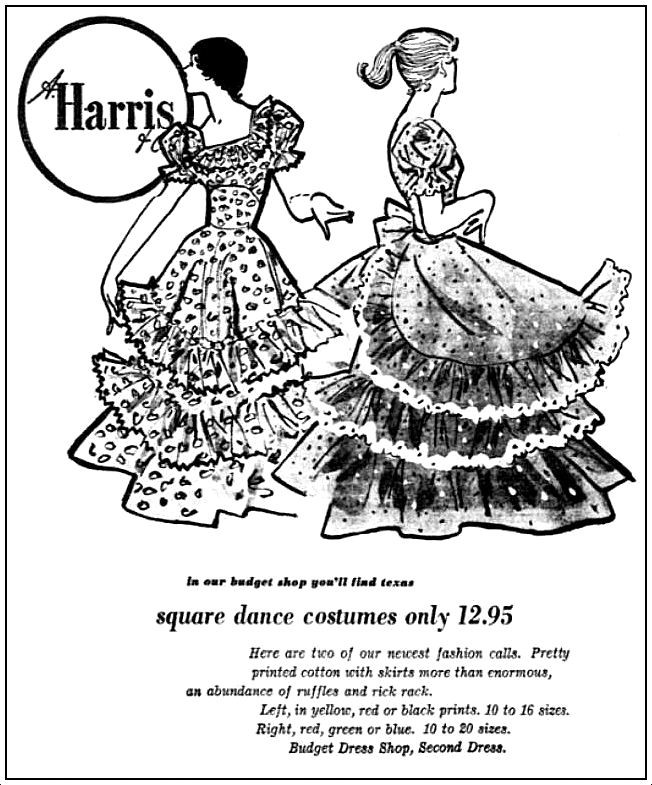
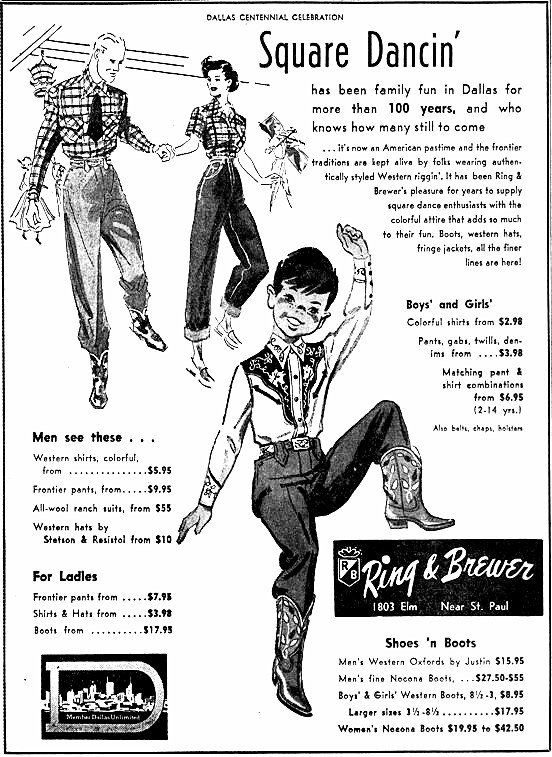
In 1949, as unlikely as it seems, square dancing was a HUGE fad which swept the country (or at least the Southwest). The peak years of the retro craze were probably 1948 to 1950, and its impact was pretty big locally, not only on the dance floor, but also in the fashion pages. When you see every major Dallas department store — even Neiman’s — selling calico and gingham square dance fashions … well, it’s big.

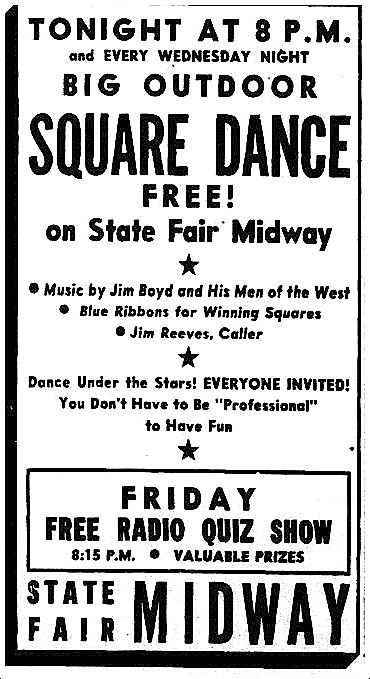
Not only were there lessons available everywhere, but there were clubs and weekly events all over town — every Wednesday in the summer of 1949, there was a big outdoor square dance held at the Fair Park Midway, with music courtesy of local celeb Jim Boyd.

I’m not sure when it stopped (…I’m assuming it has…), but for decades, a lot of us participated in square dancing as part of gym class in elementary school. This interesting throw-back take on physical fitness seems to have begun around 1950 or ’51. Not everyone was thrilled about this odd-but-charming grade-school rite of passage — some ultra-conservative communities complained, but the wholesome and old-timey dancing won out and became a standard part of Texas schools’ physical education curriculum.  Forget young people’s cotillions — most Texas children had their first experience dancing with a partner to the strain of a cowboy fiddle and a voice telling us to “allemande left” and “do-si-do.” And I’m sure we’re all better for it.

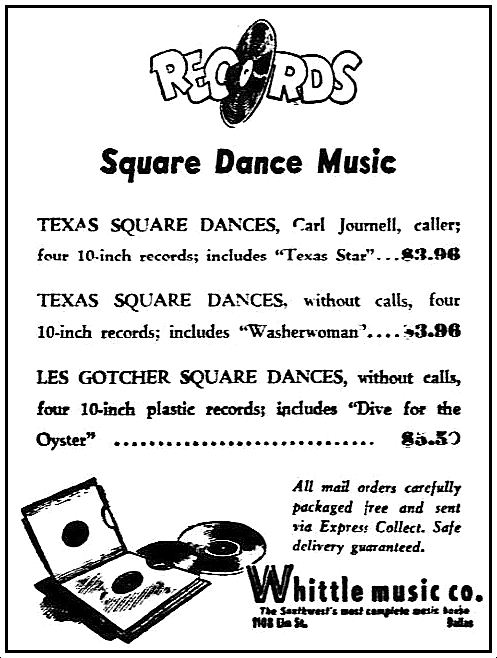
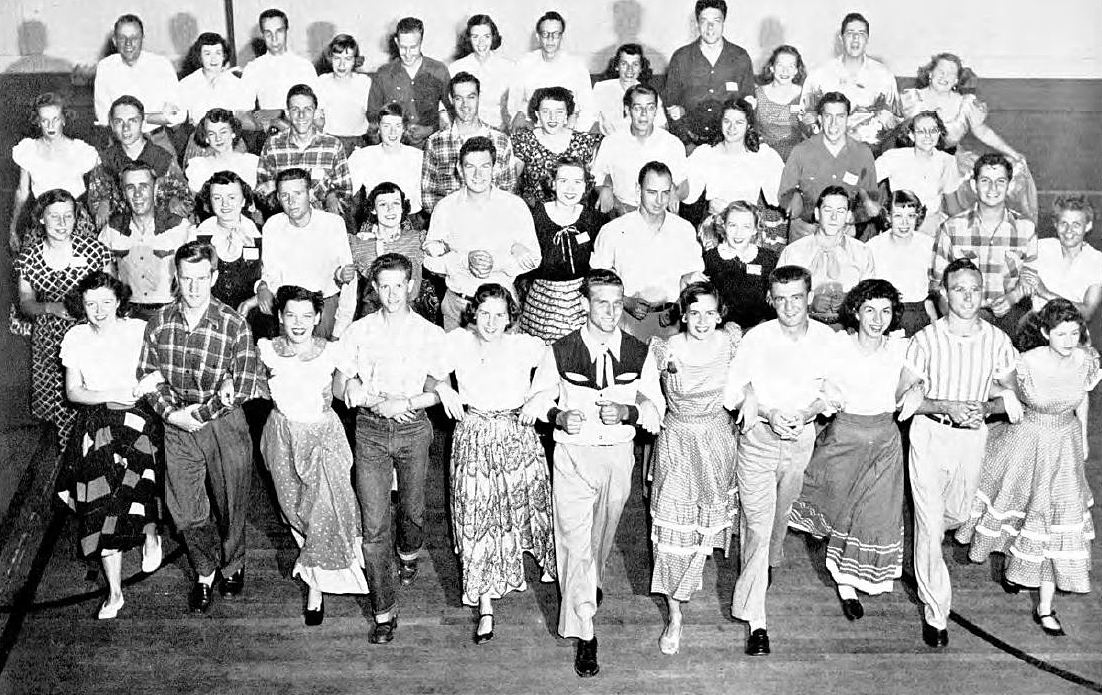
Here are a bunch of ads and things (click pictures to see larger images):

square-dance_la-reunion-place_squire-haskins_dallas-municipal-archivesSquare dance at La Reunion Place (Dallas Municipal Archives)

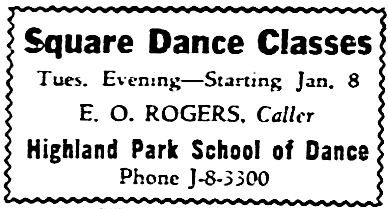
square-dance_jan-1946_highland-park
1946

square-dance_may-1947_a-harris
1947

square-dance_aug-1948_titches
1948

square-dance_jan-1948_sanger-bros1948

square-dance_oct-1948_neiman-marcus
1948

square-dance_april-1948_a-harris
1948

square-dance_oct-1948
1948

square-dance_dec-1950_e-m-kahn
1949

square-dance_june-1949_w-a-green
1949

square-dance_may-1949_fair-park-midway
1949

square-dance_nov-1949_a-harris
1949

square-dance_march-1949_whittles
1949

square-dance_oct-1949_a-harris
1949

square-dancing_promenaders_smu_1951-yrbk1951

Above, a photo of the Promenaders, a group of SMU students whose purpose is described in the 1951 yearbook as being “to promote the appreciation of square and folk dancing on this campus.” (Think you recognize any of those faces? See who’s in the photo here.)

dallas_ringandbrewer_1956
1956

***

Sources & Notes

Premiere of “Calamity Jane and Sam Bass” was held at the Majestic Theatre on June 8, 1949, and it seems to have been a pretty big deal. There was newsreel footage filmed that night — wonder if it’s floating around anywhere?

square-dance_calamity-jane_majestic_june-1949

Photo of the square dance taken at La Reunion Place is by Squire Haskins and is from the Dallas Municipal Archives; is can be seen on UNT’s Portal to Texas History site, here.

Photo of the SMU Promenaders square- and folk-dancing group is from the 1951 Rotunda, the yearbook of Southern Methodist University.

Jim Boyd was a country-western singer who appeared in a few Hollywood films and was a Dallas disc jockey for many years. He also appeared around town often as a performer and personality. Dallas filmmaker Hugh V. Jamieson, Jr. and director Milton M. Agins made a short film called “Saturday Night Square Dance” (made in either 1949 or 1950); it features Boyd and his Men of the West band, plus square dance groups Silver Spur Square Set and Thompson Square Dance Club. I can find nothing on the two groups, but it seems likely that this film was made in Dallas. The quality of the film uploaded to YouTube is not very good, but, who knows — you might see your parents or grandparents in there if they were big square dancers! You can watch it here.

All images larger when clicked.

*

Copyright © 2017 Paula Bosse. All Rights Reserved.
 

The Mosquito Bar

sargent_mosquito-nets_1908Relax without fear of being bitten by mosquitoes…

by Paula Bosse

The “mosquito bar” — the human’s defense against blood-thirsty mosquitoes (and other annoying pests) — had its heyday in the US in the second half of the 19th century and the first couple of decades of the 20th century, before screens for windows and doors were commonplace in American homes. They were particularly necessary in the hot and sweaty Southern US states which were routinely plagued with mosquitoes. A typical mosquito bar ad looked like this one from Dallas merchants Sanger Bros. (click ads and clippings to see larger images):

mosquito-bar_dallas-herald_080285_sanger-bros-ad-det
Dallas Herald, Aug. 2, 1885

(According to the Inflation Calculator, $1.00 in 1885 money would be worth about $27.00 in today’s money, adjusted for inflation.)

The first Dallas ad I found for mosquito bars was from 1877 — like the clipping above, it is also from a Sanger Bros. ad (in fact, Sanger’s seemed to be mosquito-bar-central for 19th-century Dallas).

mosquito-bar_sanger-bros-ad-det_dallas-herald_073177
Dallas Herald, July 31, 1877

mosquito-bar_sanger-bros-ad-det_dallas-herald_051478
Dallas Herald, May 14, 1878

mosquito-bar_screens_dallas-herald_052482_sanger-bros-ad-det
Dallas Herald, May 24, 1882

mosquito-bars_southern-mercury_070390Southern Mercury, July 3, 1890

screens_dallas-screen-co_1894
1894

Mosquito bars were usually draped over beds, canopy-style, but the painting above (“Mosquito Nets” by John Singer Sargent, 1908) shows “personal” net-covered armatures, perfect for genteel ladies to relax inside of and read (while trying to keep cool despite being weighed down by what must have been uncomfortably heavy clothing).

The mesh netting or fine muslin used to drape beds (and cover windows and doors) was generally white or pink, sometimes green. Once inside the canopied beds, the netting was tucked under the mattress in order to seal all potential entry points in the mesh-walled fortress and allow the thankful occupants inside to sleep unmolested by mosquitoes (or other biting and stinging insects).

mosquito-netting

These bars became fairly standard in hotels and in many homes of the time, but if one could not afford the luxury of sleeping inside one of these things, the sleeper would often resort to rubbing him- or herself with kerosene if they wished to avoid being bitten throughout the night.

mosquito-bar_dmn_100110_kerosene
Dallas Morning News, Oct. 1, 1910

As much of a godsend as the bars were, they had their problems. The fine material was easily torn, and sometimes the mesh was so tightly knit that ventilation (and breathing!) was not optimal. Also, it was not unusual for them to catch fire — there are numerous newspaper reports of the bars being ignited by candles or gas-burning lamps or by careless or sleepy smokers smoking inside the canopy.

mosquito-bar_dallas-herald_052481_fire
Dallas Herald, May 24, 1881
It was apparently a common precaution against midnight thievery for men who stayed in hotels to keep their money in the pockets of their pants and then fold the pants and place them beneath their pillows. The second line of defense was the mosquito netting tucked resolutely under the mattress of their canopied beds. The feeling was that a burglar would have to be pretty stealthy to breech a man’s mosquito bar and steal his pants from under his pillow without waking him. But never underestimate the Big City burglar (click article to see a larger image):

mosquito-bar_dmn_091088_theft
DMN, Sept. 10, 1888

After doors and windows began to be routinely covered with wire screens, the use of mosquito bars in homes and hotels waned, but their use continued in military encampments and hospitals, in recreational camping, and in swampy or tropical areas where the transmission of diseases like malaria and Dengue fever (transmitted by mosquitoes) posed health risks. Wire screens must have been a godsend.

ad-acme-screen-co_terrill-yrbk_1924Acme Screen Co., 1924

And if you don’t think that the prospect of a night without a mosquito bar (especially in the bayous of Louisiana…) wouldn’t inflame usually calmer heads, here’s a news story from 1910 about a man who shot a co-worker three times at close range because of a heated argument over which of them owned a mosquito bar. And this was in February! Lordy. Talk about your crime of passion. The moral of this story: do not mess with another man’s mosquito bar.

mosquito-bar_town-talk_alexandria-LA_022210_deadly-dispute
Town Talk (Alexandria, LA), Feb. 22, 1910

*

mosquito-bar_dmn_052812_couplet
DMN, May 28, 1912

***

Sources & Notes

The top painting by John Singer Sargent — titled “Mosquito Nets” (1908) — is from the Detroit Institute of Arts; more on the painting can be found here.

Photo of draped bed is from the “Mosquito Net” Wikipedia page, here.

Other clippings and ads as noted. Dallas Herald and Southern Mercury newspaper scans are part of the huge database of scanned historical Texas newspapers found at the Portal to Texas History (to see newspapers, click this link and filter by “Counties,” “Decades,” “Years,” etc. on the left side of the page, or search by keywords at the top).

This post was adapted from a post I wrote for my other (non-Dallas) blog, High Shrink — that post, “The Mosquito Bar,” can be found here (it includes some great additional photographs and illustrations).

*

Copyright © 2017 Paula Bosse. All Rights Reserved.