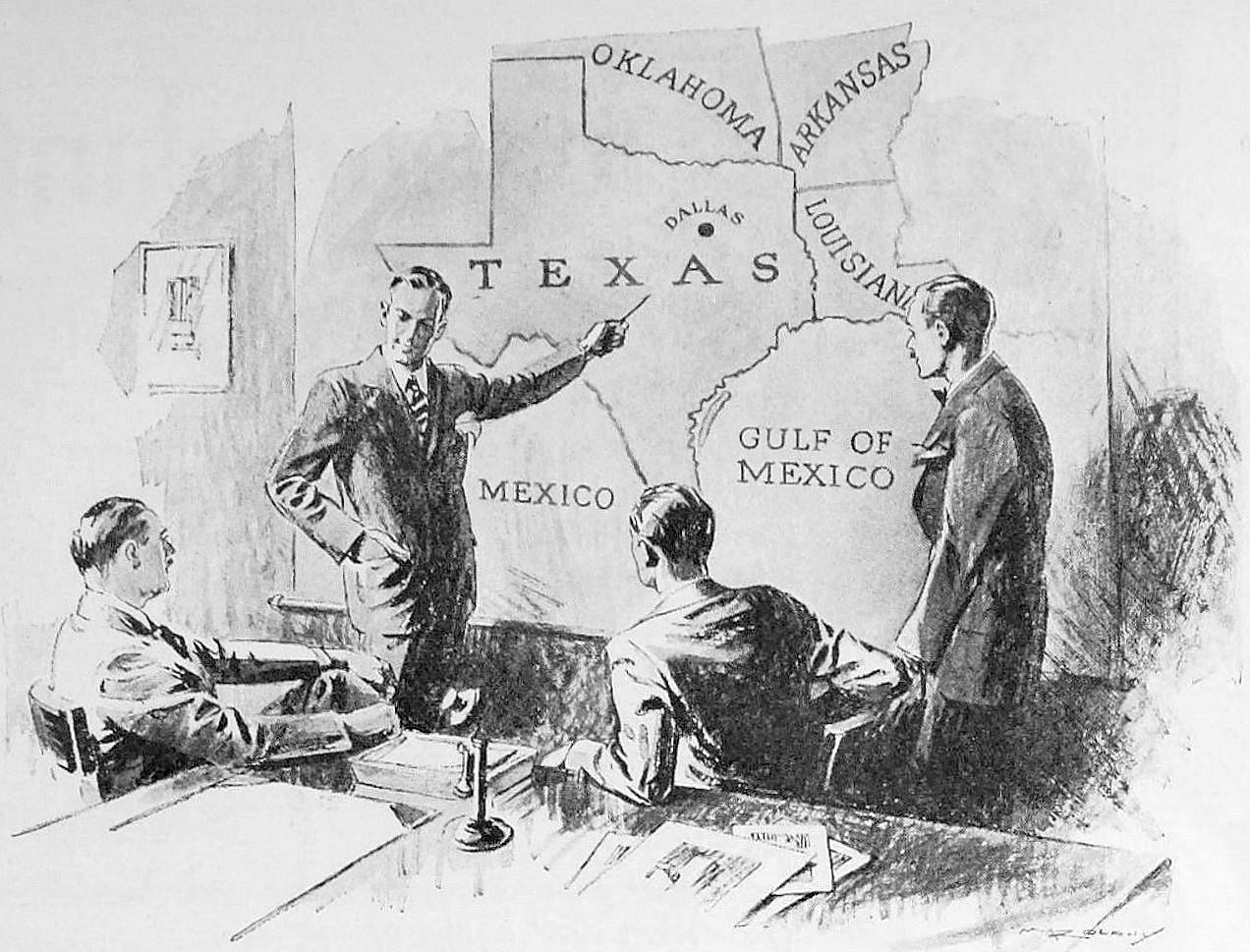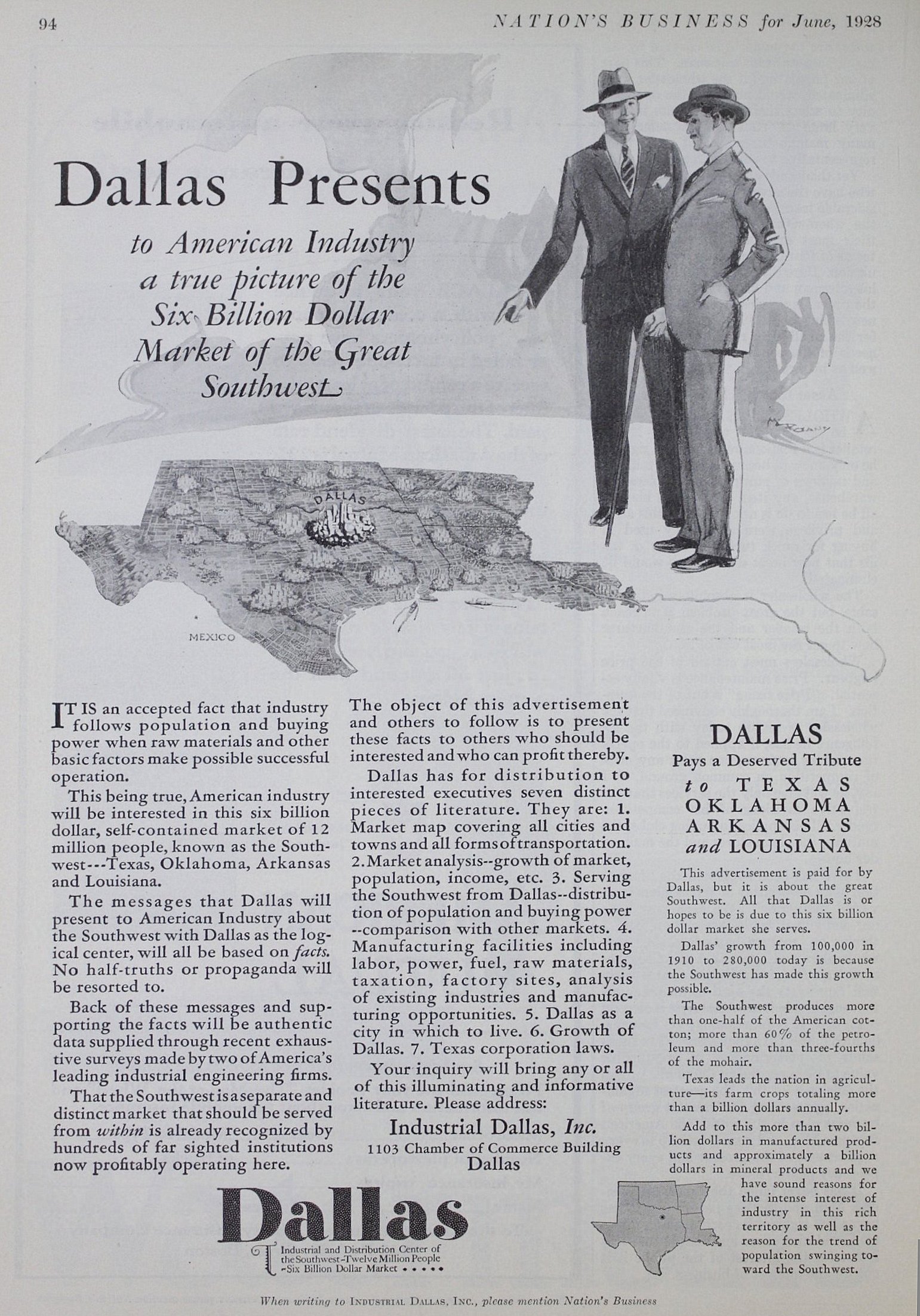
Industrial Dallas, Inc. was a nonprofit corporation formed by directors of the Dallas Chamber of Commerce to boost national awareness of Dallas’ favorable business climate and its role as a major hub of business and manufacturing in Texas and in the neighboring states Oklahoma, Arkansas, and Louisiana. The idea was to promote Dallas in a series of advertisements placed in national business-oriented magazines; the three-year campaign (1928-1931) had a budget of $500,000 (the equivalent of $7,000,000 in today’s money) and was led by banker and Dallas booster (and future mayor) R. L. Thornton. Despite the fact that this campaign coincided with the first years of the Great Depression, Industrial Dallas, Inc. was considered a success: it attracted hundreds of new companies to Dallas and firmly established the city’s national reputation as an important commercial center and as a dynamic young city offering limitless business opportunities.
*
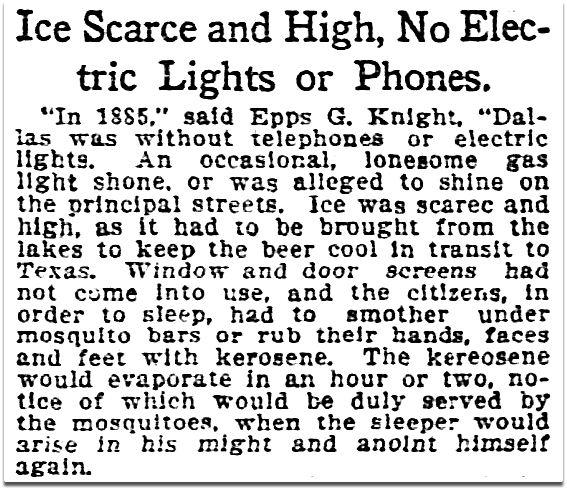
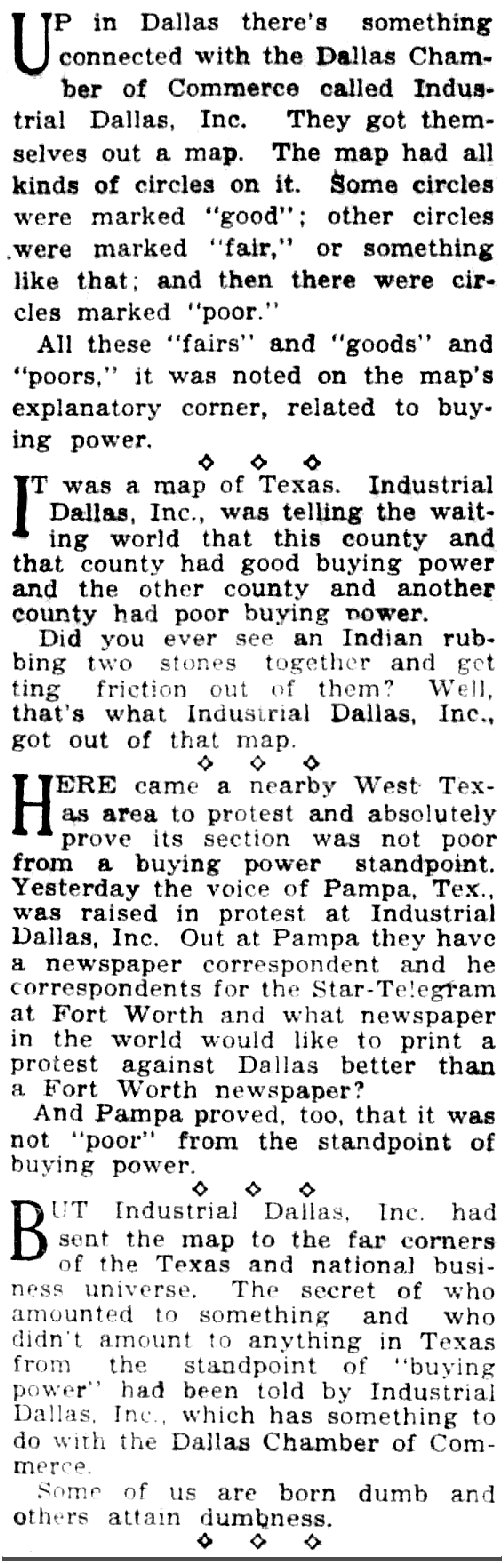
Not everyone was smitten with these Dallas ads, however. Texans who did business beyond the “acceptable” concentric circles of the Dallas, Inc. map were annoyed, as can be seen in this amusing piece by a writer for the Waco newspaper (click to see larger image).
Waco News-Tribune, Dec. 12, 1928
The map:
***
Sources & Notes
Two Industrial Dallas, Inc. ads appeared it the June 5, 1928 issue of the magazine Nation’s Business (the top illustration is a detail, the second is a full-page advertisement).
The ads were intended to run only three years — until spring of 1931 — but they continued to run until at least the very beginning of 1932. In 1959, Industrial Dallas, Inc. was resurrected for another publicity blitz (led by Dallas Power & Light president C. A. Tatum, Jr.), and ads again appeared in national publications for three years. One of this later series of ads can be seen here.
An interesting little sidebar about this campaign was that it was expressly credited with attracting the Firestone Tire and Rubber Co. to build a new “Master Super Service Station” at the northwest corner of Ross and Harwood in 1929 as part of the company’s multi-million-dollar national expansion program. The company purchased what was then the home of the Knights of Columbus, but it had been known since its construction around 1900 as the grand Conway residence, a palatial house designed by architect H. A. Overbeck for prominent lumber dealer J. C. Conway (it was the childhood home of his daughter Gordon Conway, a noted fashion illustrator). It was reported that after the Firestone Co. purchased the property, Harvey Firestone, Jr. had two carved mahogany mantels removed from the house and shipped to the home he was building “in the North.” It’s sad that such a lovely home (seen here) — not even 30 years old! — would be torn down to build a service station. But time and tide wait for no man. Especially in Dallas.
I have a surprisingly deep knowledge of classic country music. And it can all be traced back to sitting with my father every Saturday night as he watched the jam-packed lineup of country music TV shows on KTVT-Channel 11.
Followed by wrestling.
Which I also have a surprisingly deep knowledge of. If only by osmosis.
Thank you, Channel 11, for providing this bonding time with my father, which I didn’t really appreciate as a child, but I do now.
(And, yes, I’m happy that my antiquarian bookseller father and Comparative Literature-degree-holding mother often took our family to the Sportatorium to see both country music package-shows and wrestling matches. You can’t say our family wasn’t well-rounded.)
***
Sources & Notes
1969 ad from an odd little local publication (which probably used to belong to my father) called Country and Western — The Sound That Goes Around the World, published in DFW by PegAnn Production.
Newspaper ad from 1949. The “Freshie” ad campaign — featuring a Mrs.-Baird’s-Bread-obsessed kid — ran in Texas newspapers from about 1945 to 1953. More of the ads can be seen in the post “The ‘Freshie’ Ads for *-@!!@!* Delicious Mrs. Baird’s Bread — 1945-1953,” here.
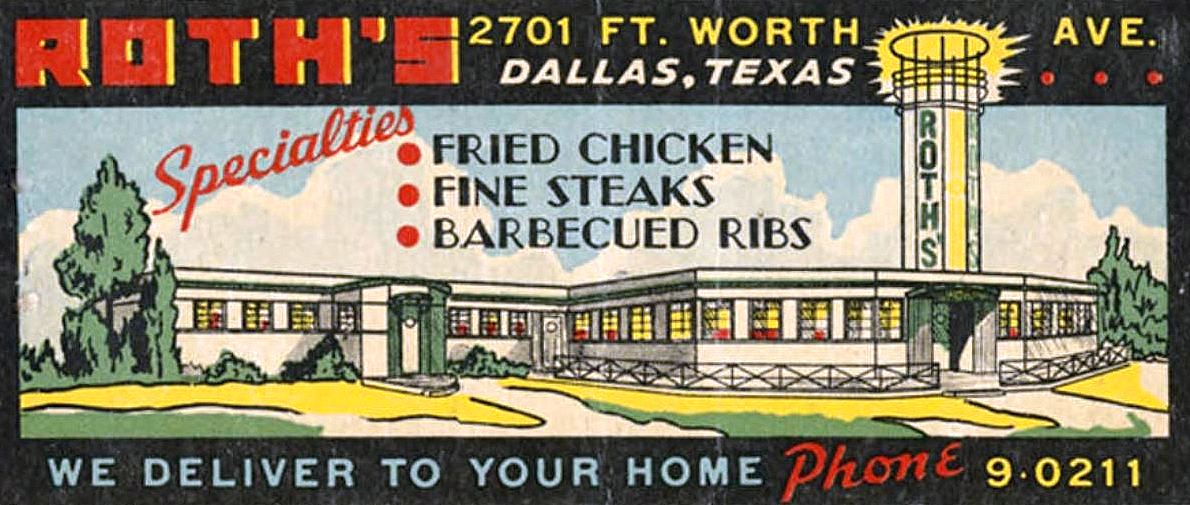
When I see a building like this, I always hope I can find a photo of it somewhere, but all I’ve been able to come up with is this energetic rendering from a 1940s matchbook cover. Roth’s (which was advertised variously as Roth’s Cafe, Roth’s Restaurant, and Roth’s Drive-In) was in Oak Cliff, on Fort Worth Avenue. It opened in about 1940 or ’41 and operated a surprisingly long time — until about 1967. When Roth’s opened, its address was 2701 Fort Worth Avenue, but around 1952 or ’53 the address became 2601. (I think the numbering might have changed rather than the business moving to a new location a block down the street.)
During World War II, Mustang Village — a large housing development originally built for wartime workers (and, later, for returning veterans and their families) — sprang up across Fort Worth Avenue from the restaurant. It was intended to be temporary housing only, but because Dallas suffered such a severe post-war housing shortage, Mustang Village (as well as its sister Oak Cliff “villages” La Reunion and Texan Courts) ended up being occupied into the ’50s. Suddenly there were a lot more people in that part of town, living, working, and, presumably, visiting restaurants.
As the 1960s dawned, Mustang Village was just a memory, and Roth’s new across-the-street neighbor was the enormous, brand new, headline-grabbing Bronco Bowl, which opened to much fanfare in September 1961. I don’t know whether such close proximity to that huge self-contained entertainment complex hurt or helped Roth’s business, but it certainly must have increased traffic along Fort Worth Avenue.
Roth’s continued operations until it closed in 1967, perhaps not so coincidentally, the same year that Oak Cliff’s beloved Sivils closed. Ernest Roth, like J. D. Sivils, most likely threw in the towel when a series of “wet” vs. “dry” votes in Oak Cliff continued to go against frustrated restaurant owners who insisted that their inability to sell beer and wine not only damaged their own businesses but also adversely affected the Oak Cliff economy. The last straw for Sivils and Roth may have been the unsuccessful petition drive in 1966/1967 to force a “beer election” (read about it here in a Morning News article from Aug. 17, 1966).
As far as that super-cool building seen at the top — I don’t know how long it remained standing, but when Roth’s closed, a mobile home dealer set up shop at 2601 Fort Worth Avenue, and mobile homes need a lot of parking space….
The building on the matchbook cover above is, unfortunately, long gone (as is the much-missed Bronco Bowl); the area today is occupied by asphalt, bland strip malls, and soulless corporate “architecture” (see what 2701 Fort Worth Avenue looks like today, here).
*
The man behind Roth’s was Ernest W. Roth, a Hungarian immigrant who had worked for many years as maître-d’ at the Adolphus Hotel’s tony Century Room. He decided to go out on his own, and around 1940, he and his business partner Joseph Weintraub (who was also his brother-in-law) opened the Oak Cliff restaurant which boasted two dining rooms (with a seating capacity of 350, suitable for parties and banquets), fine steaks, and, on the weekends, a live band and dancing. Ernest’s wife, Martha, and their son Milton were also part of the family business. When the restaurant opened, there wasn’t much more out there on the “Fort Worth cut-off,” but the place must have been doing something right, because Roth’s lasted for at least 27 years — an eternity in the restaurant business. It seems to have remained a popular Oak Cliff dining destination until it closed around 1967.
*
The real story, though, is the Roth family, especially Ernest’s mother, Johanna Roth, and even more especially, his older sister, Bertha Weintraub.
Johanna Rose Roth was born in 1863 in Budapest, where her father served as a member of the King’s Guard for Emperor Franz Josef. She and her husband and young children came to the United States about 1906 and, by 1913, eventually made their way to San Antonio. In the ’40s and ’50s she traveled by airplane back and forth between San Antonio and Dallas, visiting her five children and their families — she was known to the airlines as one of their most frequent customers (and one of their oldest). She died in Dallas in 1956 at the age of 92.
Johanna’s daughter Bertha Roth Weintraub had a very interesting life. She too was born in Hungary — in 1890. After her husband Joe’s death in the mid ’40s, a regular at her brother’s restaurant, Abe Weinstein — big-time entertainment promoter and burlesque club empresario — offered Bertha a job as cashier at the Colony Club, his “classy” burlesque nightclub located across from the Adolphus. She accepted and, amazingly, worked there for 28 years, retiring only when the club closed in 1972 — when she was 82 years old! It sounds like she led a full life, which took her from Budapest to New York to San Francisco to San Antonio to Austin and to Dallas; she bluffed her way into a job as a dress designer, ran a boarding house in a house once owned by former Texas governor James Hogg, hobnobbed with Zsa Zsa Gabor and Liberace, was a friend of Candy Barr, and, as a child, was consoled by the queen of Hungary. She died in Dallas in 1997, a week and a half before her 107th birthday. (The story Larry Powell wrote about her in The Dallas Morning News — “Aunt Bertha’s Book Filled With 97 Years of Memories” (DMN, Nov. 17, 1987) — is very entertaining and well worth tracking down in the News archives.)
Bertha Roth Weintraub
I feel certain that the extended Roth family found themselves entertained by quite a few unexpected stories around holiday dinner tables!
***
Sources & Notes
Matchbook cover (top image) is from the George W. Cook Dallas/Texas Image Collection, DeGolyer Library, Central University Libraries, Southern Methodist University; more info is here.
Photo of Bertha Weintraub is from The Texas Jewish Post (Feb. 15, 1990), via the Portal to Texas History, here.
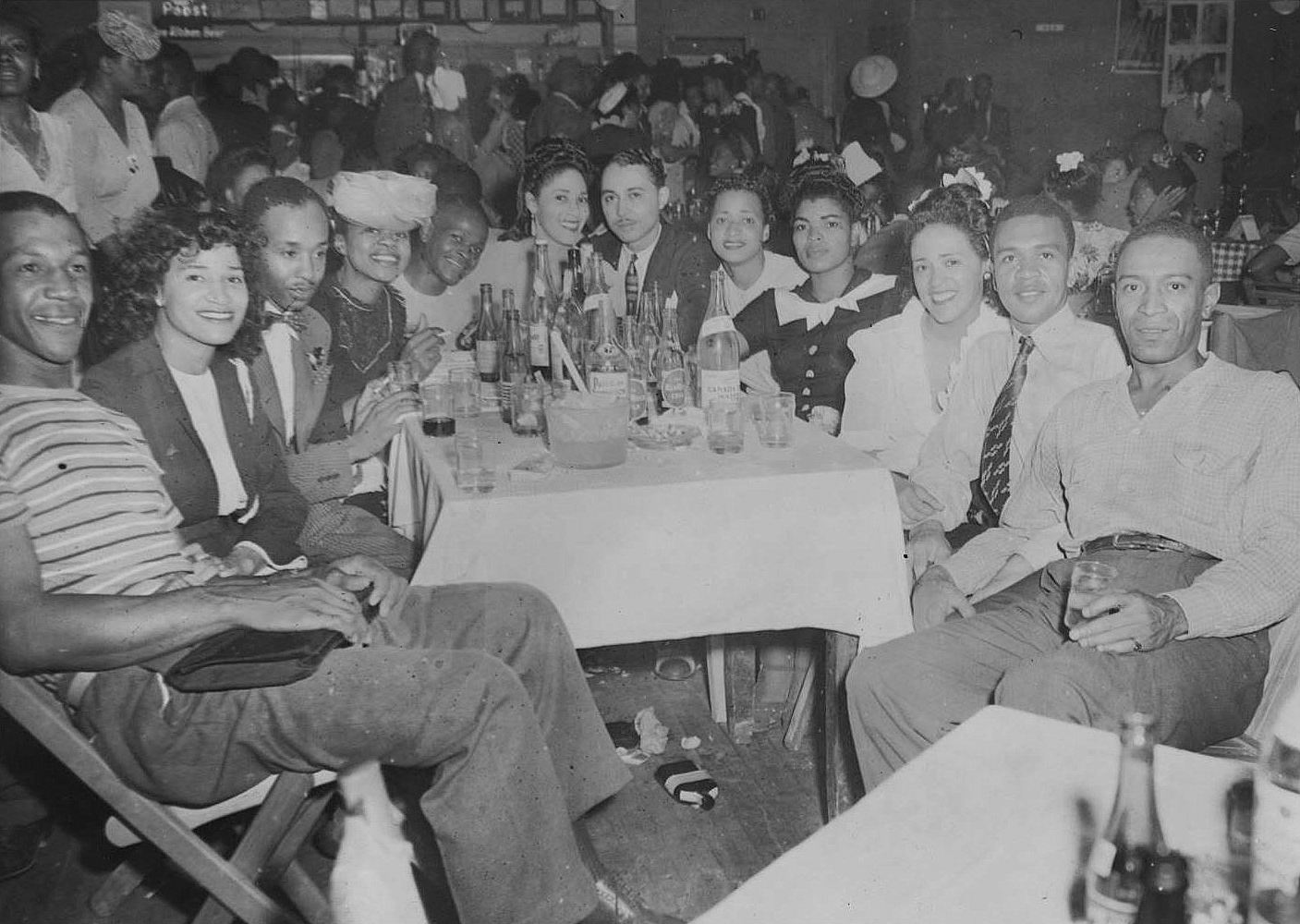
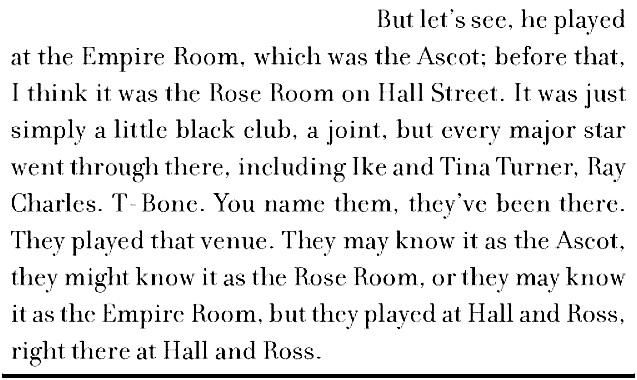
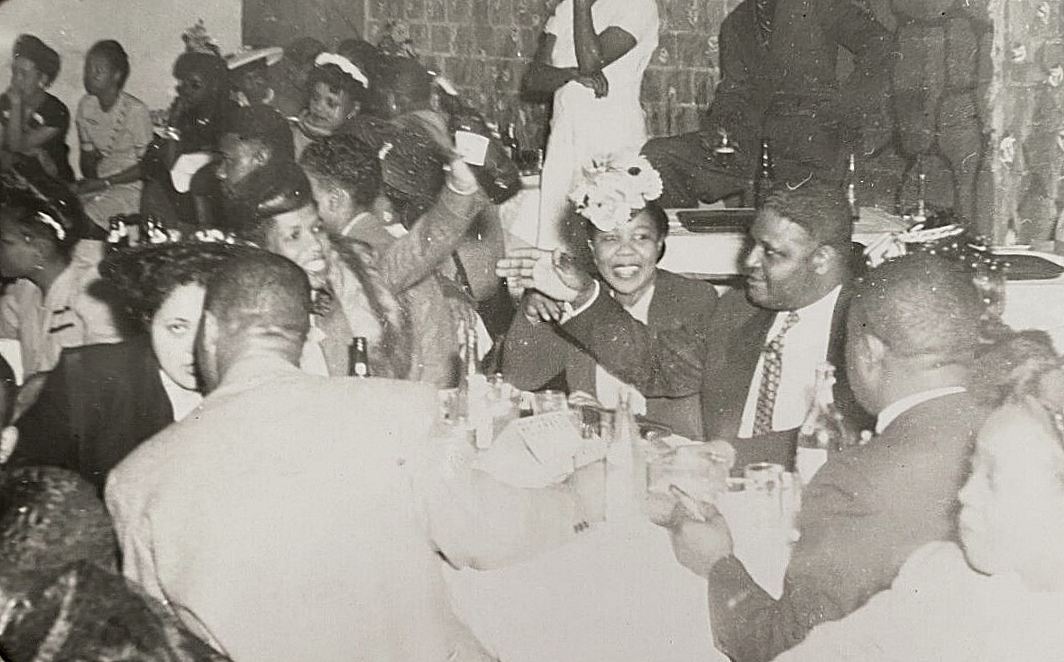
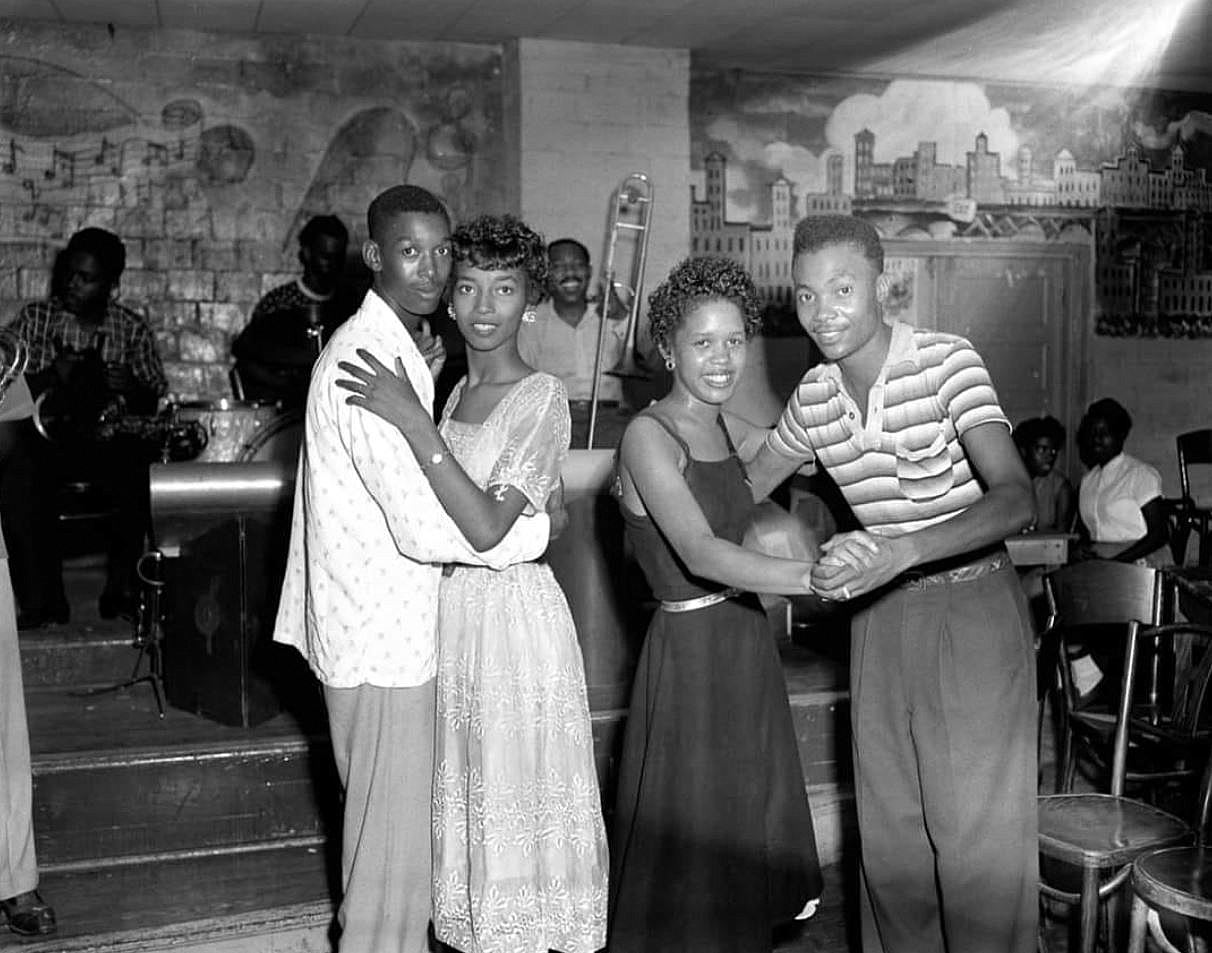
The photo above was taken at the Rose Ballroom at 1710 Hall Street (a few steps off Ross Avenue) in August, 1942. 1710 Hall was the home to a string of very popular black nightclubs: the Rose Ballroom (1942-1943), the Rose Room (1943-1951), the Empire Room (1951-1969) (not to be confused with the nightclub of the same name in the Statler Hilton), and the Ascot Room (1969-1975). There seems to have been some overlap of owners and/or managers and/or booking agents, but they all appear to have been very popular “joints” (as described by Freddie King’s daughter), where both big-name touring musicians as well as popular local acts played. Icons T-Bone Walker and Ray Charles were regulars (there are stories of Ray Charles sleeping on the Empire Room’s stage during the time he was living in Dallas in the ’50s). Everybody seems to have played there. Below, a quote from Wanda King, talking about her father, blues legend Freddie King — from the book Texas Blues: The Rise of a Contemporary Sound by Alan Govenar (all clippings and photos are larger when clicked):
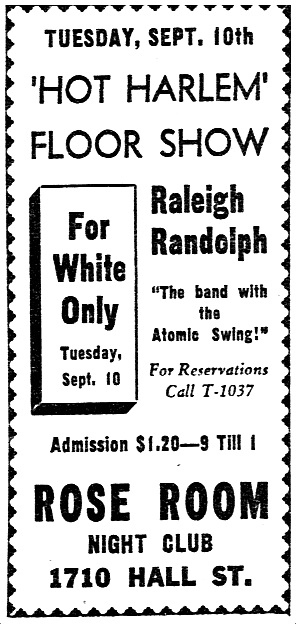
In the days of segregation, when Dallas police threatened to shut the club down if the owner allowed white patrons to mix with black patrons, the club scheduled “white only” nights where Caucasian audiences could see their favorite non-Caucasian performers. (Before these special club nights, which seem to have started in 1945, a revue would be taken “on the road” — over to the Majestic Theatre on Elm Street — to perform live onstage.)
1945
1946
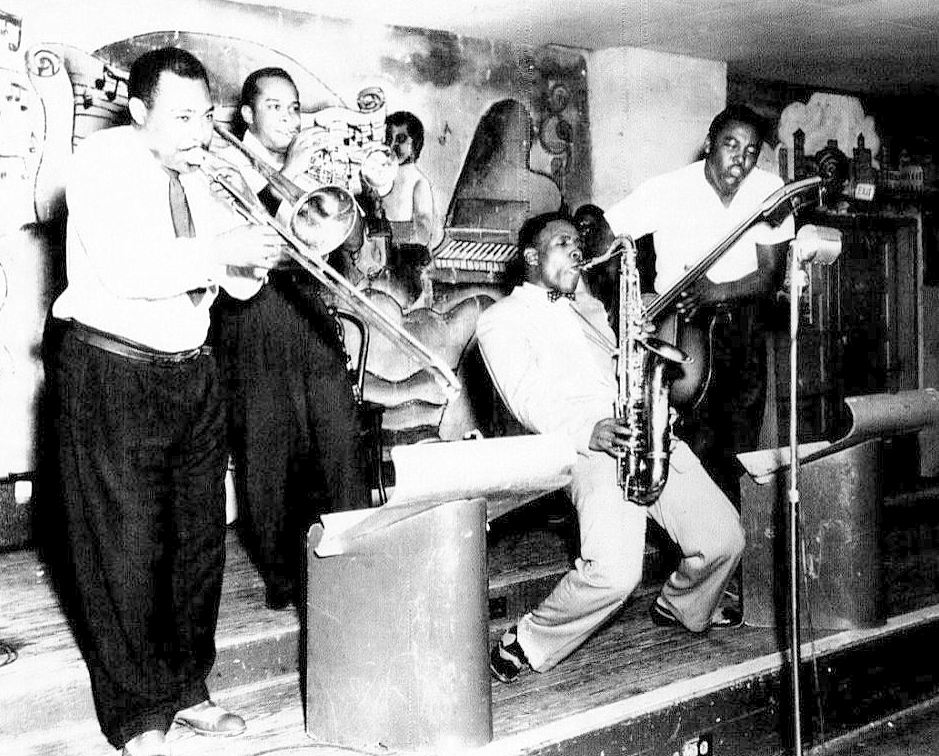
The photo up there at the top showed the audience — here’s the stage (1946 photo of the E F Band by Marion Butts, from the Marion Butts Collection, Dallas Public Library):
And here’s what the stage looked like when the club became the Empire Room (onstage is Joe Johnson in a 1954 photo by R. C. Hickman, taken from a great article about Hickman in Texas Highways, here):
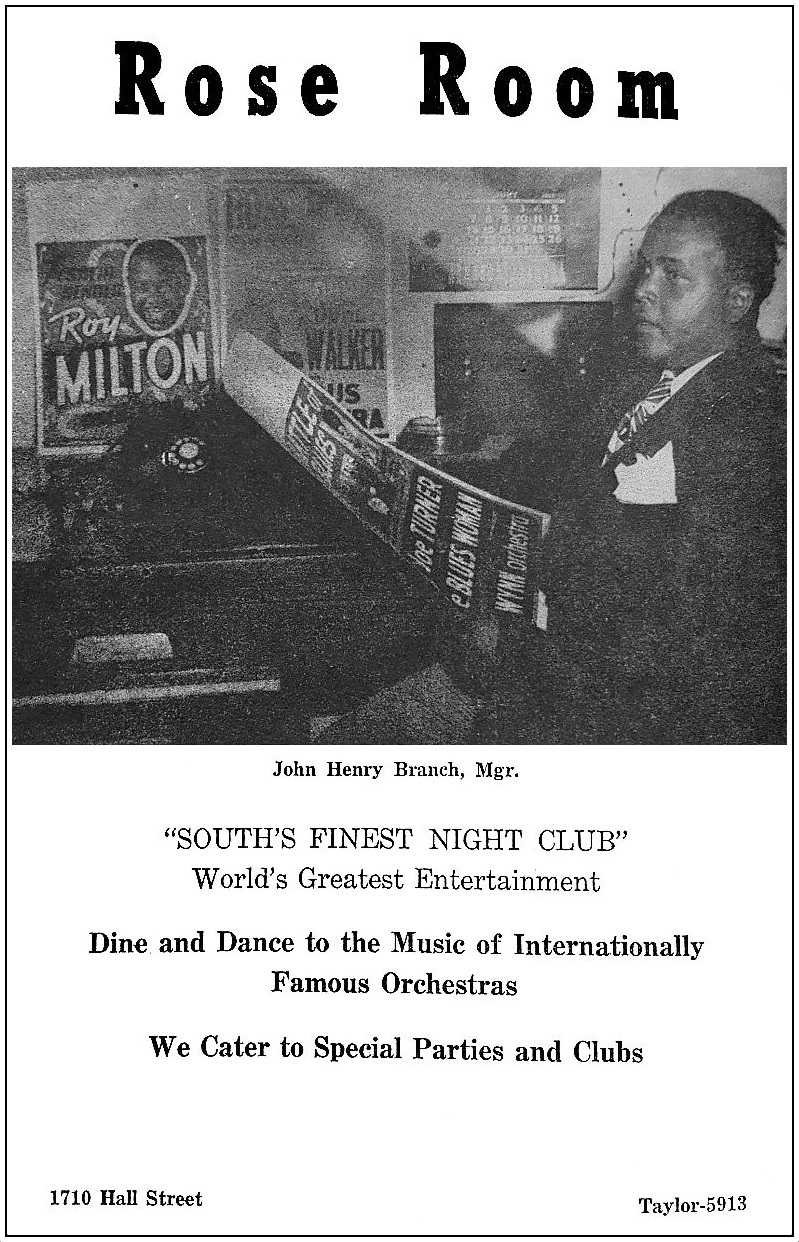
One thing that probably helped set the Rose Room/Empire Room apart from a lot of the other clubs in town at this time was the man who booked the shows — and who booked acts all over the area: John Henry Branch. The guy knew everyone. Here he is in an ad from 1947:
Aside from booking acts and musicians for black clubs, he also booked acts for white clubs — including Jack Ruby’s Carousel and Vegas clubs. In fact, Branch chatted with Ruby at the Empire Room the night before Ruby shot Oswald — Ruby had come in to check on a piano player Branch was booking for a gig at the Vegas Club in Oak Lawn. Branch supplied testimony to the Warren Report, and while it’s not all that riveting (because there wasn’t that much to tell), it’s still interesting to hear how Branch describes his own club and Ruby’s personality (“You can’t never tell about him — he’s a weird person.”) — you can read his testimony here.
I have to admit, I’d never heard of the Rose Room or the Empire Room before I saw the photo at the top of this post. I really missed out. So much fantastic music! And I missed it. It’s just another reminder that Dallas has an incredible music history.
from the Texas African American Photography Archive
1700 block of Hall Street, 1944-45 city directory
What’s at 1710 Hall these days? A vacant lot — soon to be developed, no doubt. Ross Avenue ain’t what it used to be….
eBay
Teen dance, Aug. 6, 1956 (photo by R. C. Hickman)
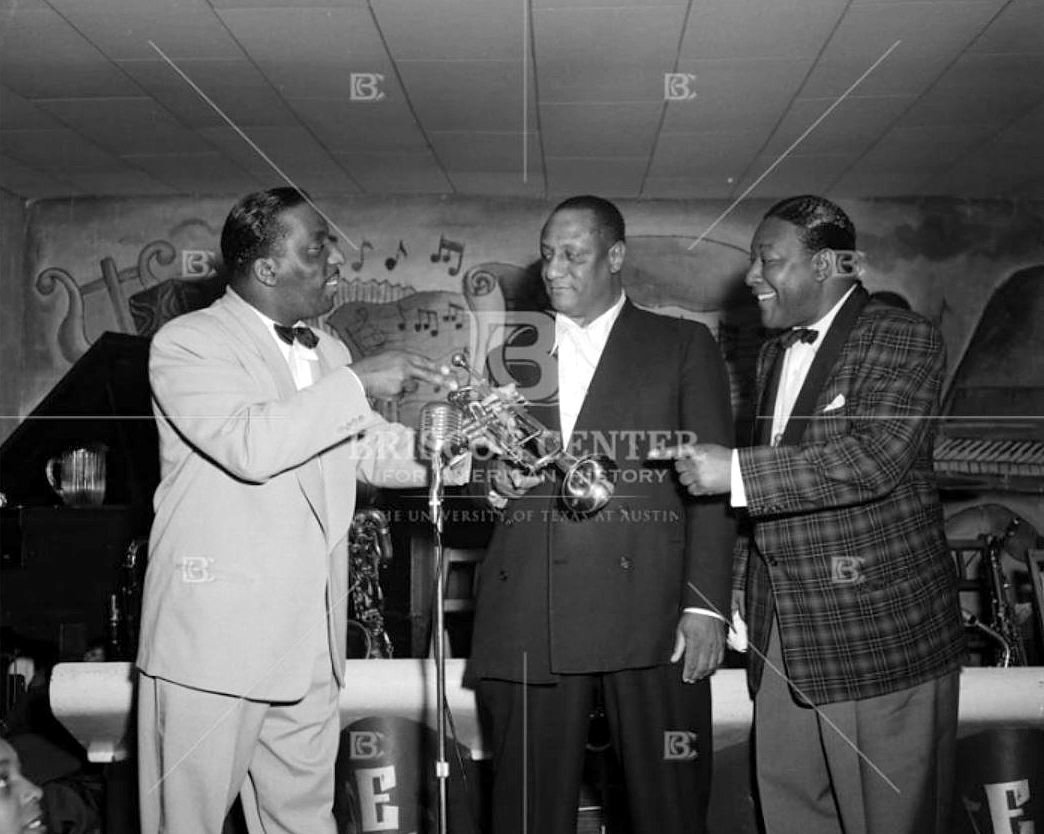
Apr. 23, 1951 (photo by R. C. Hickman, Briscoe Center, Univ. of TX)
**
UPDATE: After many fruitless attempts to find a photo of the exterior of this building, I stumbled across it in a 1973 filmed report from KERA, recently uploaded by the G. William Jones Film and Video Collection at SMU. Below is a screenshot showing the Ascot Room a couple of years before it finally closed, looking a little worse for wear. The 8-minute film (which you can watch here) shows tons of locations in the Black neighborhoods of South Dallas (along Forest Avenue/MLK Blvd.) and “North Dallas” (along Hall Street) — the Ascot Room can be seen briefly at the 1:46 mark. (More on this film can be found in the Flashback Dallas post “Black Dallas — 1973.”)
Ascot Room, 1973 (screenshot, Jones Collection, SMU)
***
Sources & Notes
Top photo from the George W. Cook Dallas/Texas Image Collection, DeGolyer Library, Central University Libraries, Southern Methodist University; more info on this photo is here. Someone has written this on the photo: “Aug. 42, Dallas, Rose Room” — in August, 1942 the club was known as the Rose Ballroom; it changed its name to the Rose Room in early 1943.
1973 screenshot is from a 1973 film (my guess is that it was broadcast on Channel 13’s “Newsroom”) from the KERA Collection, G. William Jones Film and Video Collection, Hamon Arts Library, Southern Methodist University.
Wanda King quote is from the book Texas Blues: The Rise of a Contemporary Sound by Alan Govenar (College Station: Texas A & M University Press, 2008).
Rose Room ad featuring John Henry Branch is from the 1947-48 Dallas Negro City Directory (with thanks to Pat Lawrence!).
More about the hopping Hall Street area can be found in the Flashback Dallas post “Life on Hall Street — 1947,” here.
I love ads from high school yearbooks — especially when they feature students. Here are several from the Bryan Adams 1961 and 1962 yearbooks. (Click the ads to see larger images.)
Above, the J. C. Penney store in Casa View at 2596 Gus Thomasson. Great ad! (1962)
Below, Jackson’s Sporting Goods in Casa Linda. (1962)
*
Gingham Girl Dance Studio on Northwest Highway (“We Also Feature Baton Lessons”). (1961)
*
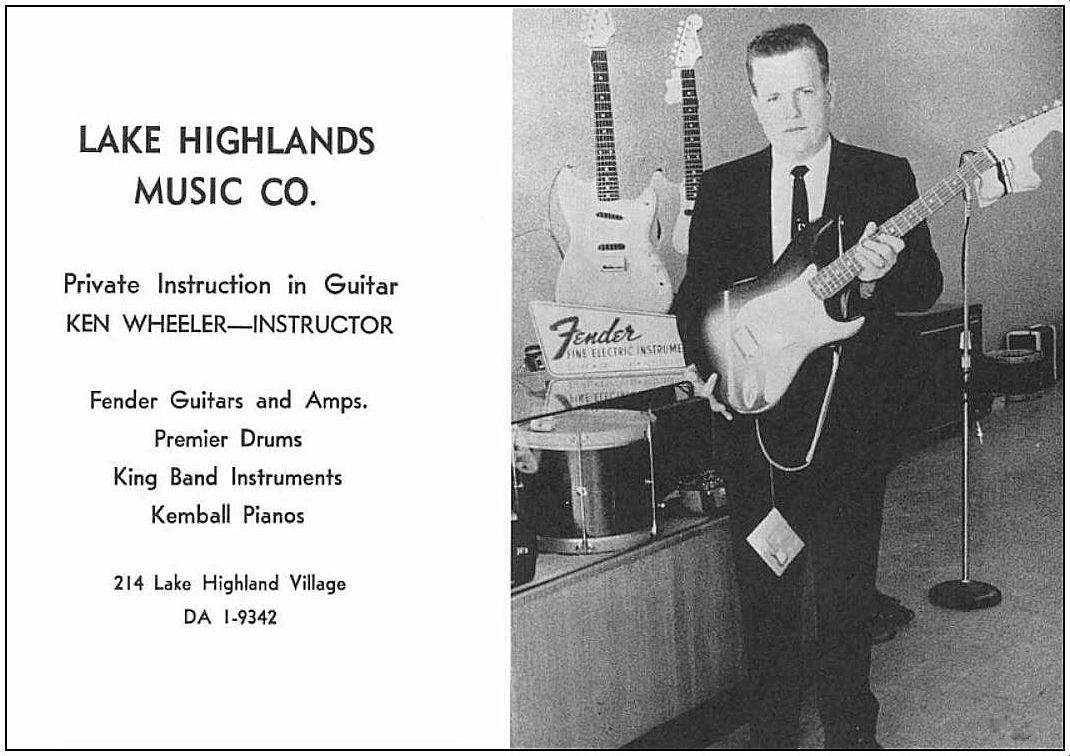
Lake Highlands Music Co. — guitar lessons by Ken Wheeler. (1961)
*
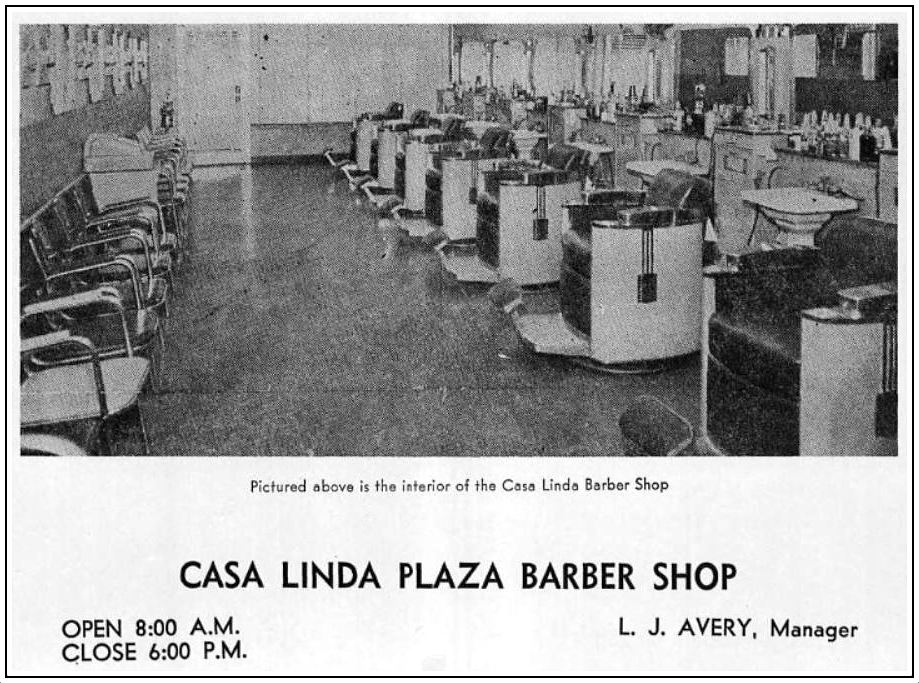
Casa Linda Barber Shop. (1962)
*
Ethel Shipp — female attire, from tots to teens and beyond; Casa Linda and Casa View. (1961)
*
Dallas Ice Arena — ice skating at Fair Park. (1962)
*
Cooter’s Village Camera Shop — Highland Park Village. (First ad 1961, second 1962)
*
Pop’s Spaghetti House (Frank Da Mommio and Pop Da Mommio), on Gaston, near Baylor. (1962)
*
Colbert’s in Casa Linda. (1962)
*
Stone’s Shoes, Northlake Shopping Center. (1962)
*
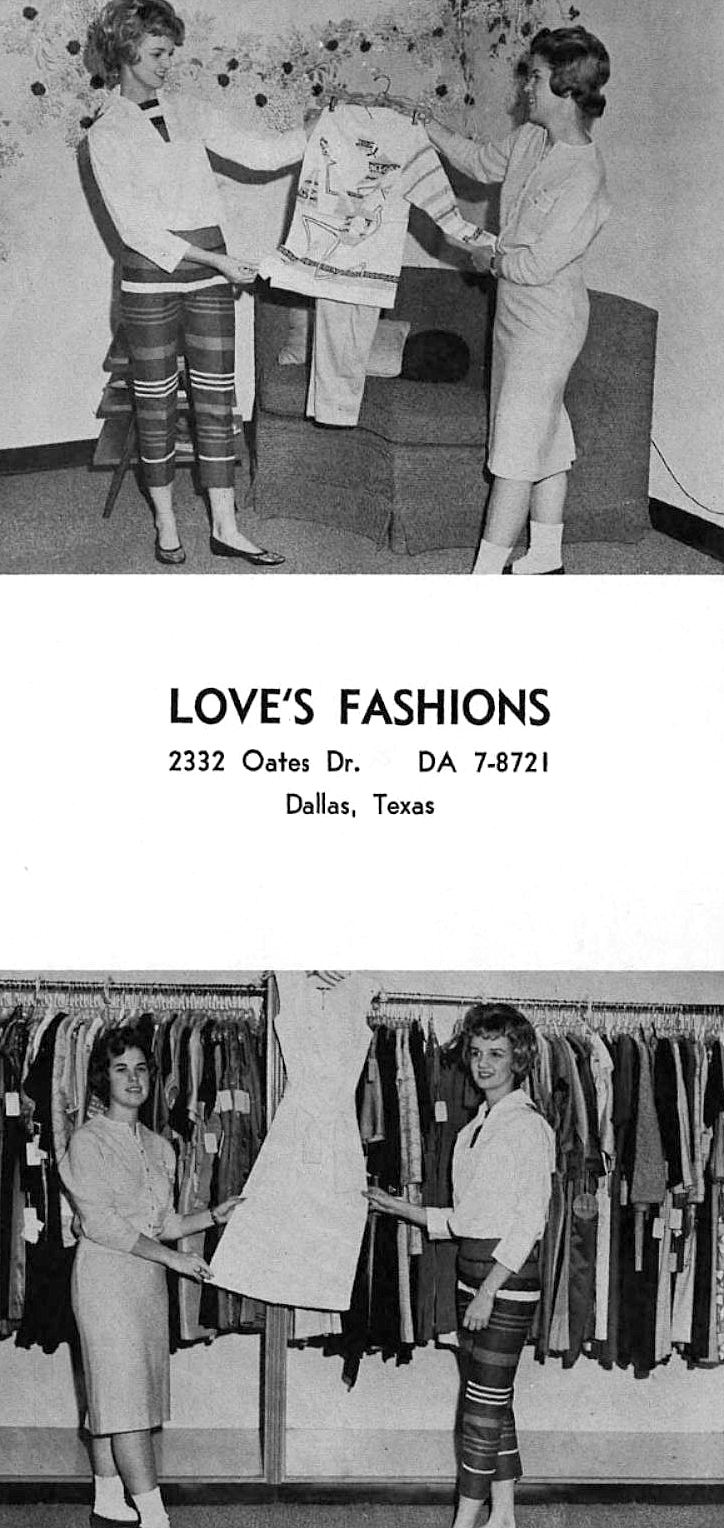
Love’s Fashions, on Oates. (Those striped pants are cool!) (1962)
*
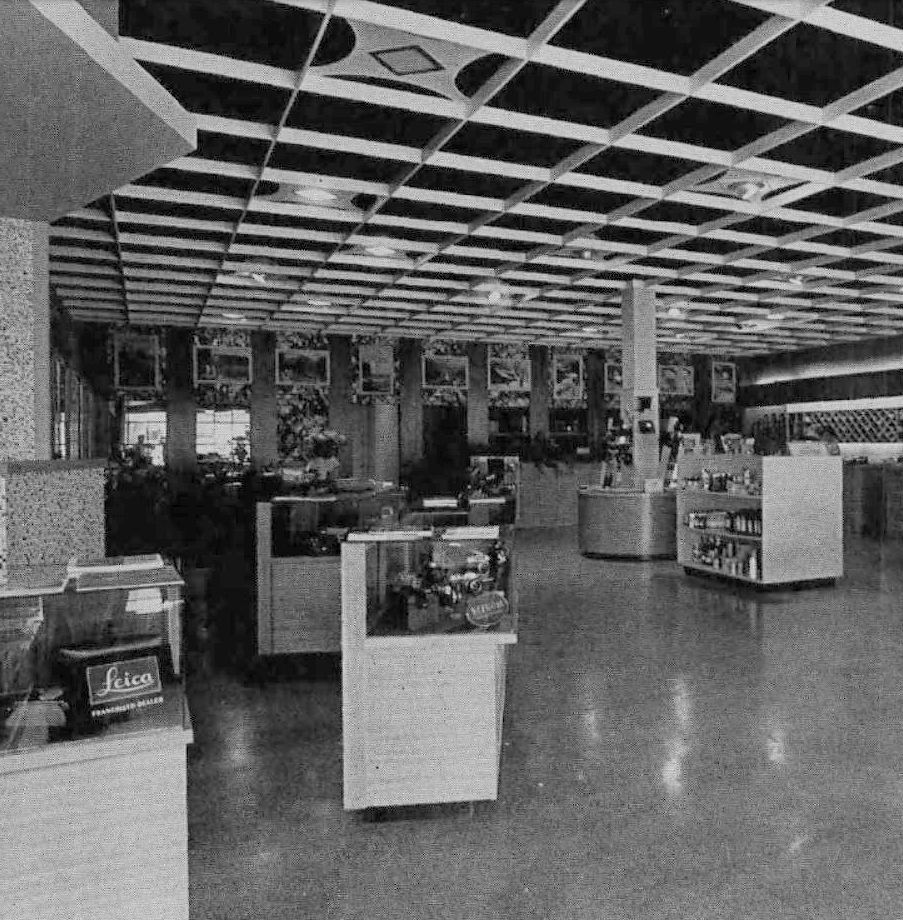
Smitty’s Party Room, Bakery, and Coffee Bar, also on Oates Drive. (1961)
*
KBOX and their happenin’ djs: Jerry Clemmons, Johnny Borders, Pat Hughes, Chuck Benson, Bill Holley, and Gary Mack. (1961)
*
And my favorite ad because of its association to greatness: Belvick Electric Company, Garland Road. Greatness? Here’s a hint: the proprietors are Jerry Dauterive and Buck Dauterive. Maybe it’s just because I watch a lot of television, but any fan of the classic animated show “King of the Hill” (created by Mike Judge, who lived in Garland for several years) will recognize the name “Dauterive” — as in Bill Dauterive, Hank Hill’s sad-sack friend. It’s such an unusual name and there are so many Dallas jokes in the show that I figured the men in this ad must have some sort of connection to the TV show. It turns out that the character is named for series writer-producer Jim Dauterive, a native Dallasite and … a Bryan Adams alum! And Buck was his father. According to an interview in White Rock Lake Weekly, Jim Dauterive liked to slip neighborhood references into the show: he named a character in the show “Gus Thomasson,” had Hank Hill direct someone to a liquor store near White Rock Lake, and even snuck in a mention of Louanns on Greenville. So there you have it! (Ad from 1961.)
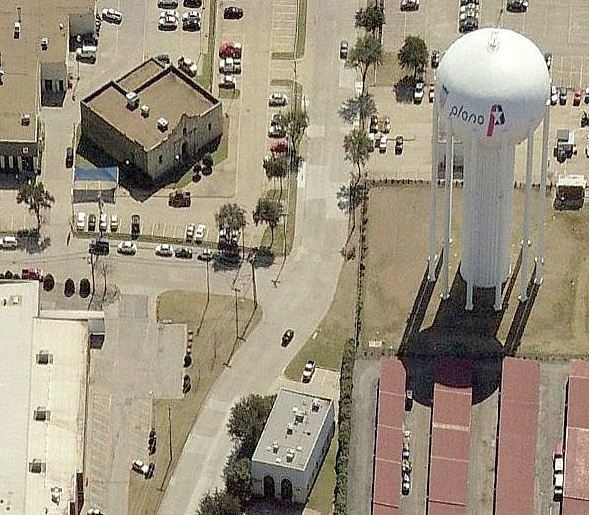
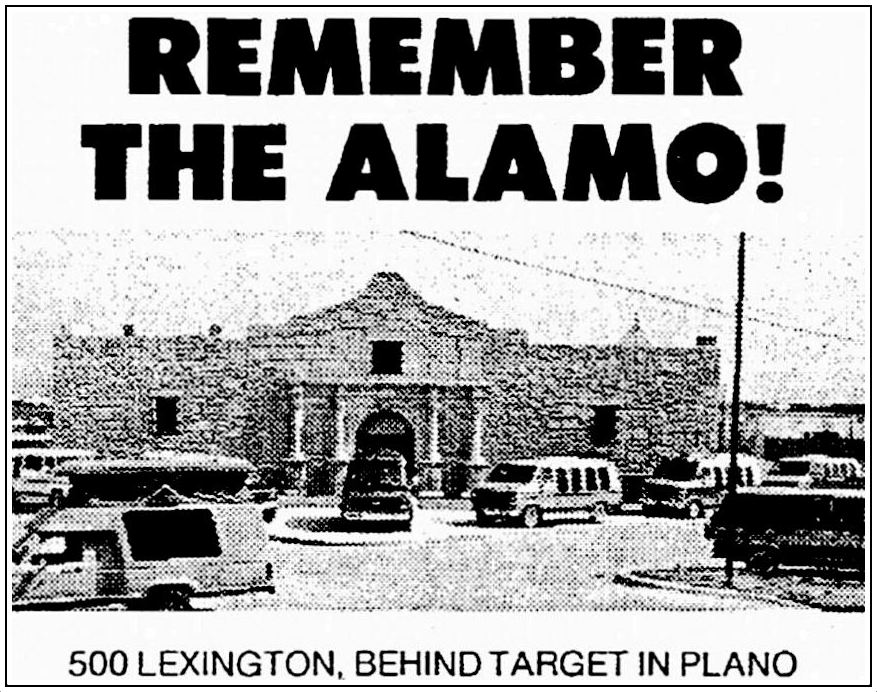
Today is Texas Independence Day. This time last year after posting a photo of the Alamo somewhere, I was informed that there was, in fact, an Alamo replica right here in DFW. I knew about the one(s) in Fair Park, but Plano? Yep, near 75 and Parker Road, at the corner of Lexington and Premier, just west of the highway. See a southward-looking aerial view on Google here; below is the same view, from Bing.
Bing Maps
Here it is at street level:
Bing Streetside
So, um, why is that there?
Not being up on my Plano history, and never having been aware of this, it took me a long time to find anything about it. Which is pretty surprising, because you’d think there would be all SORTS of articles about a very large replica of one of the most famous structures in the world (yes, I’m going to say “in the world”), standing right here in the Metroplex. And it’s been standing here for at least 35 years! I managed to find a couple of ads and an article about the building — it had started out as an arcade called the Alamo Fun Center and later became part of a car dealership — but I could never find out who built it or why. I thought I’d come back to it in a year — so I could post it on Texas Independence Day — and see if I could find more, looking with fresh eyes. So I tackled it again today, and, glory be, I’ve just discovered that Rick Saigling wrote a piece for Plano Magazine last November titled “Remember the Alamo Fun Center” which answered all of my questions (and had photos of the building when it was new).
The Plano Alamo was built in 1982 by brothers-in-law Nathan White and Gene Cason and other investors as a “fun center” to house a Texas-themed arcade featuring video games, miniature golf, etc. While popular with Plano kids, the Alamo Fun Center was not a successful venture, and it shut its ornately carved doors after only a relatively short time in business. There you have it. Thank you, Rick. I now have closure.
The earliest (only?) mention I found of the “Fun Center” was the ad below, which appeared in The Wylie News a short time before its grand opening in the summer of 1982. The ad seems to indicate that the name of this “western theme park” is Lone Star Recreation Park and Alamo Fun Center (click to see a larger image).
The Wylie News, July 29, 1982
A few months after the Alamo Fun Center opened, Larry Lange Cadillac moved to its new location on the adjacent property. I’m not sure exactly when it closed, but the Plano Alamo was taken by the advancing forces of Larry Lange Cadillac in 1983 or 1984. For whatever reason, the building remained (what Texan is going to demolish the Alamo?) and was incorporated into the Larry Lange business plan.
June, 1983
In May, 1984, the ad below announced the grand opening of the Larry Lange Adventure Center — the Alamo had been emptied of its batting cages and pizza ovens and had been transformed into an “Indoor Van Showroom Which is ‘As Large as Texas’!” (That doesn’t seem to have lasted very long.)
May, 1984
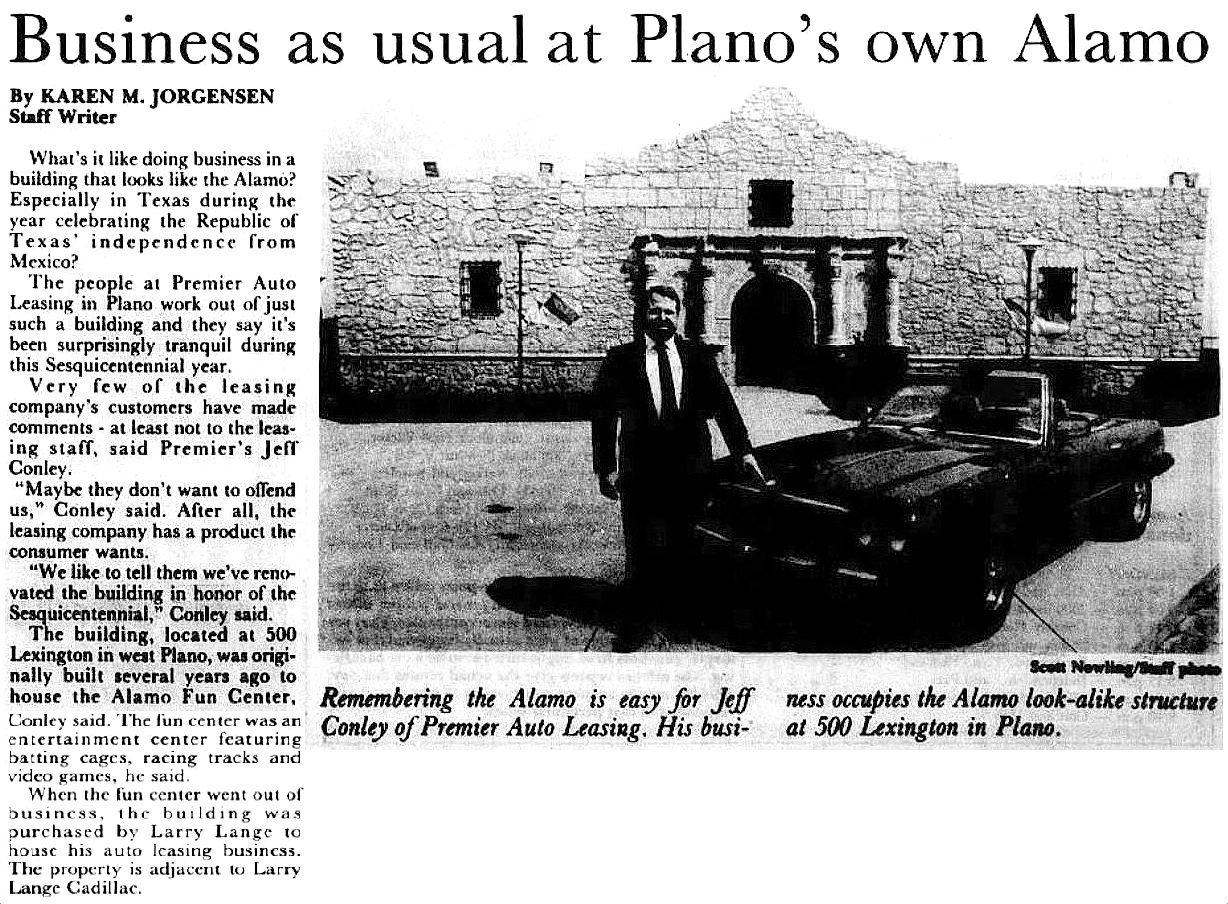
Two years later, in 1986 — the year of the Texas Sesquicentennial — The Plano Star Courier checked in with the then-current occupants of the hometown Alamo, Premier Auto Leasing, to see what it was like working in the Alamo. In Plano. An employee made the impossible-to-believe statement that very few people ever actually commented on the fact that they were leasing their vehicle from a company that occupied a building shaped like the Alamo.
Plano Star Courier, July 22, 1986
In 1999, Diane Jennings of The Dallas Morning News wrote a story on “mock Alamos” around the state. She checked in on the Plano location, then owned by Crest Cadillac, and found it was being used as a warehouse. The general manager, Michael Coston, was not a fan of the building for several reasons, not least of which was the replica’s design.
As a native Texan and history buff, he worries that the inaccurate construction may “deface the fame of the how-many-ever we say gave their lives there.” He is particularly irritated by the parapet, the rounded hump over the door, which most people associate with the Alamo facade, but which was actually added by the U.S. Army decades after the battle. (DMN, Feb. 28, 1999)
Today Crest Cadillac appears to have forsaken Plano for Frisco, but the property is still in the Crest auto family — it’s now occupied by Crest Volvo. But what of The Alamo? It’s now the home of Crest Collision, a body shop.
So there you have it, the story of Plano’s Alamo.
Instead of rushing out to get a Mirabeau B. Lamar tattoo to show my Texan-ness in these waning hours of Texas Independence Day, I’ve decided instead to post a few photos of the real Alamo, which, strangely enough, was also a neighbor to a car dealership, the Clifton George Ford Motor Co. Remember the Model-T!
Second-from-last photo by an unidentified photographer, circa 1918, from the E. O. (Eugene Omar) Goldbeck Photography Collection, Harry Ransom Center, The University of Texas at Austin; more information and a larger image may be found here.
Rick Saigling’s Plano Magazine article “Remember the Alamo Fun Center” (November 21, 2016) is here. It includes several photos of the Alamo Fun Center in 1982/83 and interviews with a former owner and employee. See a (large!) close-up of the unexpectedly ornate stone façade of the Plano Alamo here. (If you’re interested in Plano history, Rick’s also written a nice nostalgic piece, “I Remember When Plano Was a Sleepy Town,” here.)
The Jimi Hendrix Experience, Love Field, 4/20/69 (Jones Film Collection, SMU)
by Paula Bosse
One of the advantages of living in a major American city is that all the biggest entertainers visit at one time or another. Let’s take three of the biggest entertainers of 1969: Jimi Hendrix, Glen Campbell, and Tiny Tim. All were huge, and all came to Dallas. And, luckily for us, they were captured on film in interviews by reporters from WFAA-Channel 8.
For me, without question, the most exciting interview was the one with Jimi Hendrix, who, standing on the tarmac of Love Field with bandmates Mitch Mitchell and Noel Redding on April 20, 1969 (yes, 4/20…), gives a great, relaxed interview to a very lucky Channel 8 reporter, Doug Terry. (I love the look on Terry’s face throughout the interview.) Watch it here:
A few screenshots (click to see slideshow):
April 20, 1969, WFAA-Ch. 8 News (Jones Film Collection, SMU)
4/20/24 UPDATE: After several years of trying to contact the reporter, Doug Terry, I finally heard from him! Here are a few paragraphs from his email to me (used with his permission), with some interesting tidbits about how some of these interviews were conducted:
I was still a college student most of the time I worked at WFAA. I handed in my resignation after covering the north Texas pop festival in that same year. [Watch one of Doug’s Texas International Pop Festival reports from Lewisville here.] Your comment about being in a large city and its advantages was something that I did not fully grasp until years later. The access was wonderful, I saw Hendrix at least three times, on one occasion being in the dressing room with a camera when he warmed up for a show (that footage is nowhere to be found).
There are two aspects to mention about that interview. First, I was a weekend reporter and late night news anchor at Ch. 8 and I assigned myself to go interview him. In those days, one could call up the airlines when a notable person was coming in and they would give the flight number and arrival time. Amazing. Most of the people at the station at that time probably had no idea who Jimi was and wouldn’t have cared if they did know.
The other interesting point is the work of the photographer. Ordinarily, we did over the shoulder interviews, the camera to the back and side of the reporter. The fact that this was shot from the side made all the difference. As a shooter, he was not otherwise outstanding but this interview would be much less interesting if it had been shot in the traditional line-up sort of way. The two bandmates goofing around was distracting but great.
Thank you, Doug! I love this interview — I’m so glad you assigned yourself to the duty!
*
Jimi Hendrix appeared at least 4 times in Dallas:
Feb. 16, 1968: Fair Park Music Hall
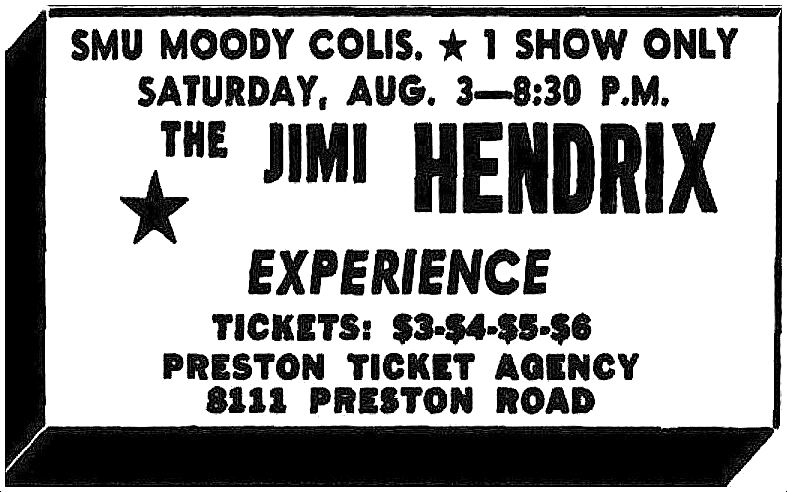
Aug. 3, 1968: Moody Coliseum, SMU
April 20, 1969: Memorial Auditorium (where he was headed after the Ch. 8 interview)
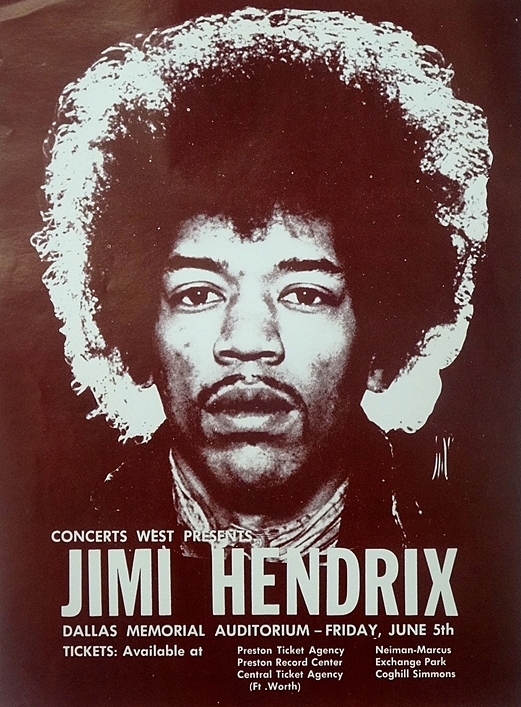
June 5, 1970: Memorial Auditorium
July 28, 1968
Two surprising errors (grammatical and factual) appear in a Neiman-Marcus tie-in ad (of sorts) which states that Jimi would be at Memorial Auditorium, rather than Moody Coliseum. Despite the error, it’s cool that Neiman’s was expanding its cultural horizons to include someone like Jimi Hendrix in one of its ads (which was featuring teen fashions, but still). N-M has always had its finger on the pulse of current fashions — and Jimi Hendrix was certainly fashionable.
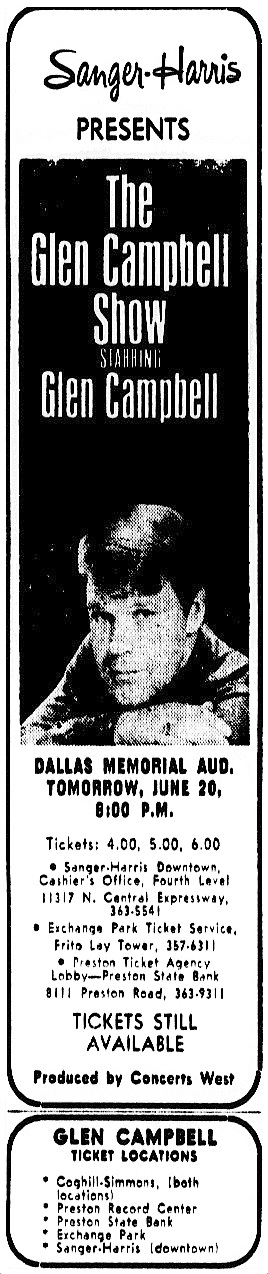
Glen Campbell was in town for several days in June, 1969. He arrived at Love Field on June 15 and was met by a “high-spirited throng” of teenage admirers. He was here to promote the release of the movie True Grit (in which he appeared with John Wayne), as well as to perform at Memorial Auditorium on June 19, 1969.
June 19, 1969
He was actually in Dallas the previous year, in March, 1968, to perform at the State Fair Music Hall with Bobbie Gentry. An interview with the pair begins at 3:57:
**
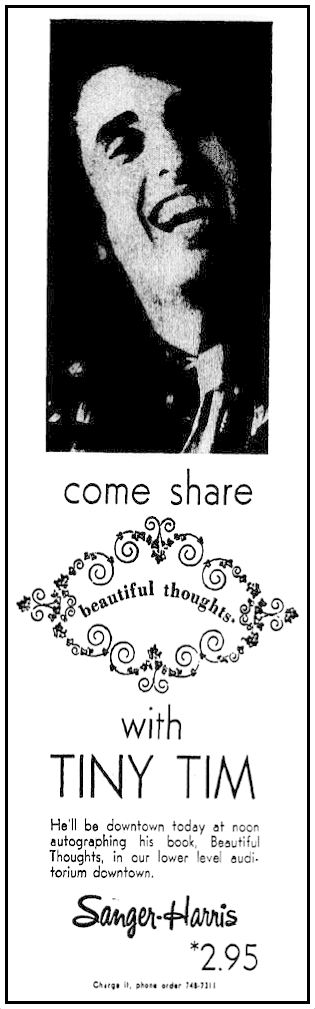
And Tiny Tim was in Dallas on June 17, 1969 to appear at a book-signing at the downtown Sanger-Harris department store. The signing was a bit more sedate than his previous visit to Dallas when he caused something of a riot on January 23, 1969 while making an appearance at the Melody Shop in NorthPark. I’m not sure what sort of crowd the Melody Shop thought they’d get for their little “autograph party,” but it’s safe to say they did not expect 5,000 over-excited teenagers. The news report the next day was peppered with words like “pandemonium,” “swarm,”“mob scene,” and “human wall.” (Read about that bizarre event here). His drawing power continued the next year when Tiny made his Dallas performing debut at … of all places … Abe Weinstein’s Colony Club, one of the city’s top “burlesque” houses. He was booked for an incredible 9-night run (!) in September, 1970. It was a major success. Dallas apparently loved Tiny Tim. And, of course, years later, Bucks Burnett’s Edstock and Burnett’s tiny Tiny Tim museum continued the Big D/Tiny Tim lovefest.
June 17, 1969
WFAA-Ch. 8 interview (screenshot)
***
Sources & Notes
Video is from the WFAA Newsfilm Collection, held at the Hamon Arts Library, Southern Methodist University; screenshots are from those clips. Any requests to license these clips (or any of the other thousands at SMU!) should be directed to curator Jeremy Spracklen.
4/20/24 UPDATE: Passages from former Channel 8 reporter Doug Terry are from an email to me on April 16, 2024, reprinted with his permission.
Hit the Dallas Morning News archives to find a little pre-Music Hall interview with Jimi Hendrix conducted by “YouthBeat Editor” Marge Pettyjohn: “A Real Experience” (DMN, Feb. 25, 1968). Her interview with Tiny Tim (“Magical Mystery Tour: On Meeting Tiny Tim,” DMN, Jan. 25, 1969) is also worth checking out, as is the Jean Kelly article “5,000 Kids Mob Tiny Tim” (DMN, Jan. 24, 1969).
While you’re in the archives, look for the interview with Glen Campbell at Love Field amidst the frenzied teenage girls: “High-Spirited Throng — Fans Mob Glen Campbell at Airport” by Maryln Schwartz (DMN, June 17, 1969).
Dallas teens loved Tiny Tim… (Sanger-Harris book-signing, June 1969)
by Paula Bosse
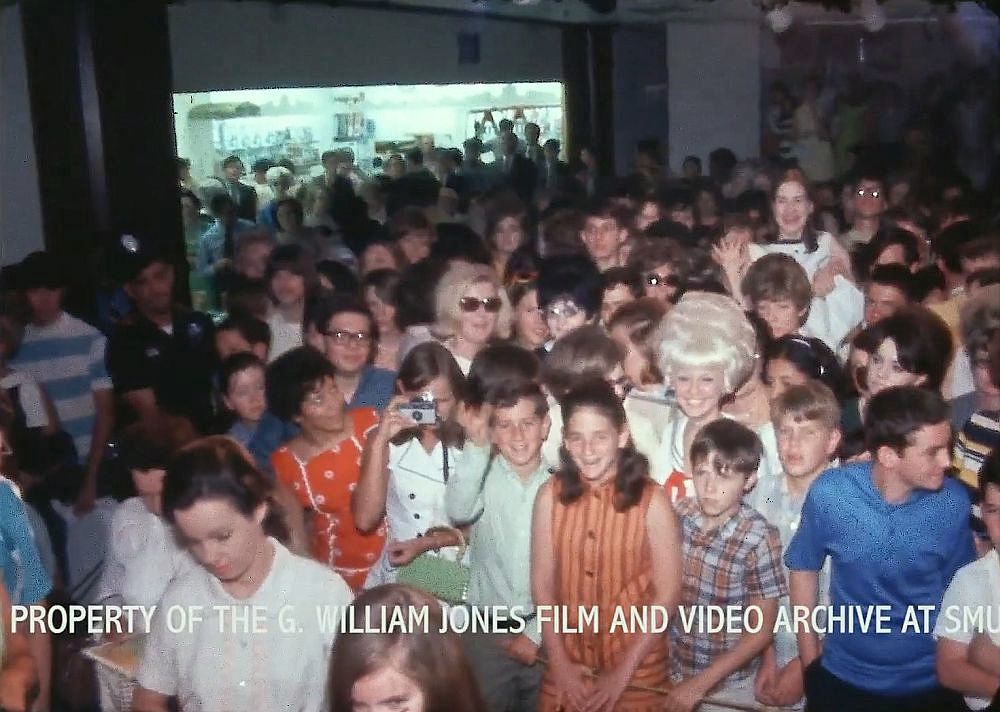
Tiny Tim — one of the most … unusual performers of the 1960s — was a hit with teenagers when he made his first appearance in Dallas at the Melody Shop in NorthPark mall on January 23, 1969. What had been expected to be a nice little autograph party which might attract a small number of fans and curiosity-seekers turned into something altogether unexpected.
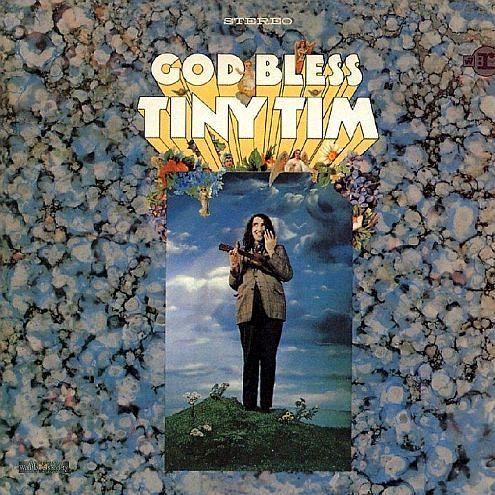
Tiny Tim (…”Tiny”? “Tim”? “Mr. Tim?”…) had the unlikeliest of hits during the hippie-era: “Tiptoe Through the Tulips,” a lilting little ukulele-accompanied song which had originally been a hit in 1929. Tiny Tim’s first few appearances on U.S. television must have caused a lot of heads to be scratched and/or jaws to be dropped. He was just kind of … weird. But gentle, and he seemed to be a genuinely nice fellow who just happened to have a penchant for songs from the megaphone-era of popular music. If you’ve never seen footage of a Tiny Tim performance, search for a clip of him on the Tonight show around 1968.
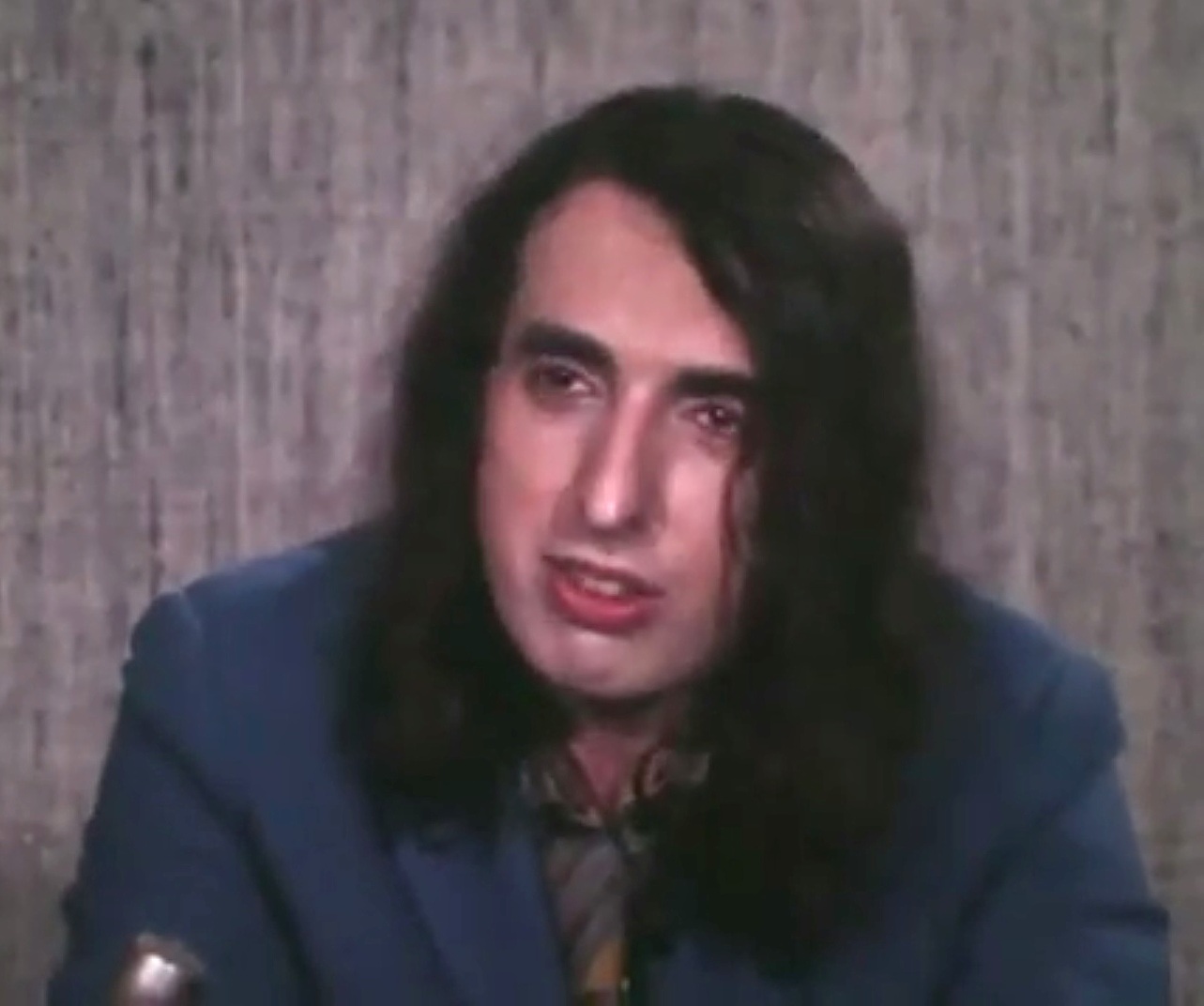
So anyway, Tiny was booked to do a little autograph party at the Melody Shop in NorthPark mall. I’m not sure what sort of crowd they thought they’d get, but it’s safe to say they did not expect 5,000 teenagers. The news report the next day was peppered with words like “pandemonium,”“swarm,” “mob scene,” and “human wall.” Who knew a 36-year-old man who strummed a ukulele and sang songs from the Victrola-age in a nasal falsetto would whip up that much enthusiasm amongst Texas teenagers?
My favorite description of the “riot” was this one:
Inside, a disheveled Tiny Tim was crouched on the floor behind a row of electric organs….. “Pretend he’s not in the store,” directed a manager. Tiny Tim, his shirttail out and his orange, green and brown tie twisted to the side, huddled alone on the floor. (“5,000 Kids Mob Tiny Tim,” Dallas Morning News, Jan. 24, 1969)
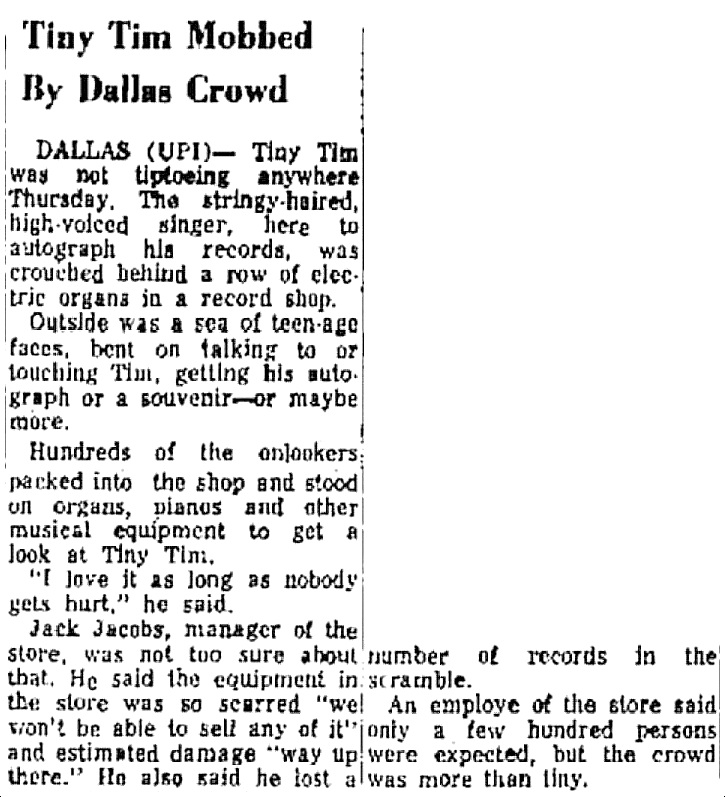
The story was even picked up by wire services. (Click article below to see a larger image.)
Amarillo Globe Times, Jan. 24, 1969
Tiny was back in Dallas a few months later, this time to do a book-signing at the downtown Sanger-Harris. (Yes! He wrote a book!)
June 17, 1969
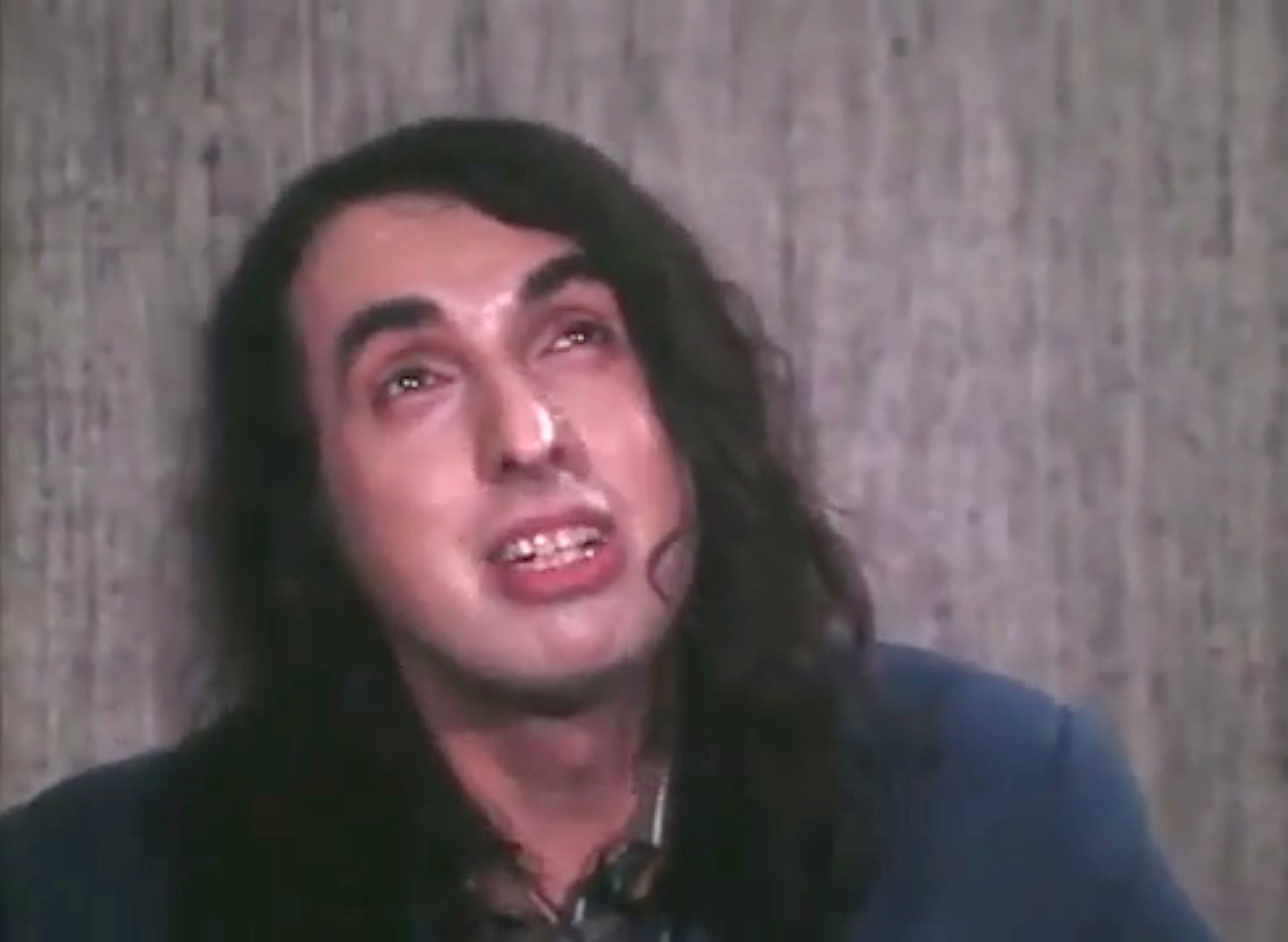
No riot was reported this visit, but Sanger’s still packed by fans who wanted a book signed by Mr. Tim (who signed with a pink quill pen). While in town, he give a little interview and an impromptu performance at a press conference (am I the only person who sees shades of Jeffrey Tambor here?):
*
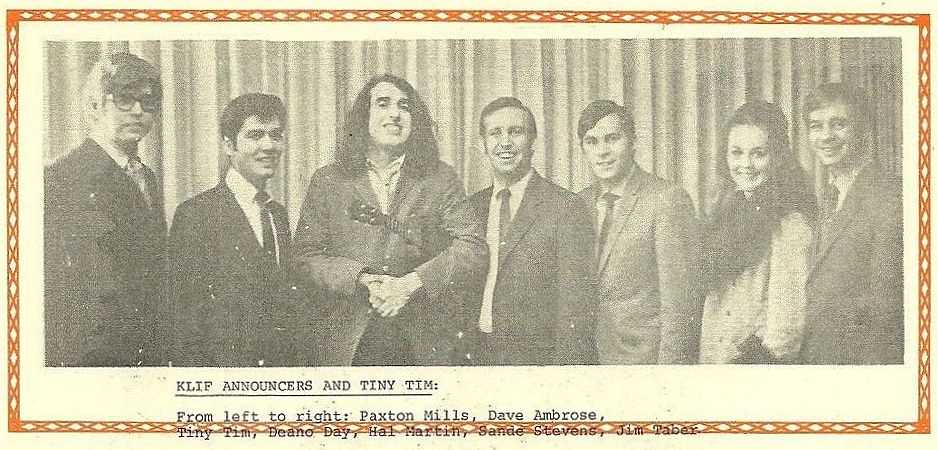
Also in 1969, he took time out to pose with KLIF on-air talent Paxton Mills, Dave Ambrose, Deano Day, Hal Martin, Sande Stevens (not sure if she worked for KLIF), and Jim Taber, seen below.
But wait, there’s more… he was back in Dallas in September, 1970 for a NINE-DAY engagement (two shows nightly) at Abe Weinstein’s famed downtown burlesque house. (I don’t know if the strippers took the time off while Tiny was in residence or if they might have entertained between his sets.) Here’s a clip from a press conference during that visit:
And, why not, here’s an early publicity photo of Herbert Khaury, the man who would one day become famous as the singer Bing Crosby once described as having (I paraphrase) a vibrato big enough to throw a Labrador through.
***
Sources & Notes
The 1969 Chanel 8 video is from the WFAA Newsfilm Collection held by the Hamon Arts Library, Southern Methodist University; it is posted on YouTube here (the first image and the three color photos of Tiny Tim are screenshots I captured from the video); the 1970 footage is from the same source and can be found on YouTube here.
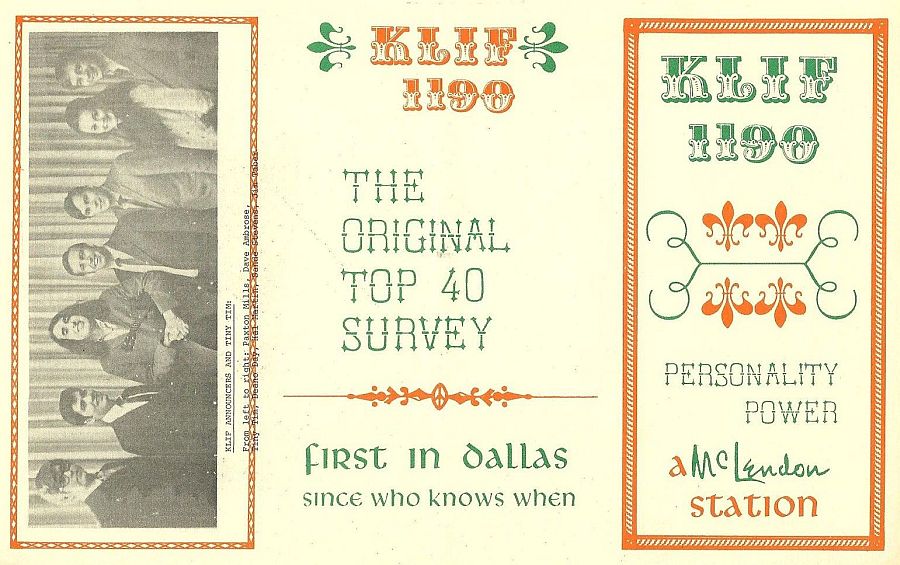
KLIF promotional material found on eBay several months ago. The back of the card lists the KLIF’s top 40 of the week, here.
Glamour shot of Mr. Khaury found somewhere on the internet.
One would be remiss in not mentioning Tiny Tim’s other ties to Dallas, namely his association with Bucks Burnett’s Edstock and Burnett’s tiny Tiny Tim museum from the 1990s. I’d link to articles in the Dallas Observer, but every time I go to the DO site my computer freezes. I encourage you to seek out these articles yourself.
More on Tiny’s January, 1969 visit to Dallas can be found in these Dallas Morning News articles:
“5,000 Kids Mob Tiny Tim” by Jean Kelly, with photo (DMN, Jan. 24, 1969)
“Magical Mystery Tour: On Meeting Tiny Tim” by Marge Pettyjohn, “YouthBeat” editor, with photo (DMN, Jan. 25, 1969)
Elm & Ervay, 89 years ago… (click for larger image)
by Paula Bosse
The photograph above is not the greatest quality, but it’s a photo I’ve never seen before. It shows the Palace Theatre in the 1600 block of Elm Street, just west of Ervay, with the well-known (and very large) Van Winkle’s Book Store in the background. One of the things that makes this photo so interesting is seeing the cumbersome support tower on top of the building holding up the ornate Palace sign. See what a slightly different Palace sign looked like the next year, lit up in neon, here.
The photo above was an amateur snapshot, taken to document the tour of the traveling live stage revue The Mikado of Jazz which played the Palace in late May of 1928. The photo below — which shows the revue’s stage manager and his wife standing on the sidewalk in front of the Palace — was taken at the same time.
Part of a sign visible behind them was probably advertising that the theater was “cooled by refrigerated air.” The ad at the bottom of this post includes this informative little tidbit:
COMFORTABLY COOL — ALWAYS!
Scientifically correct the Palace ventilation system refreshes you with cooled breezes issued from the ceiling. You are not chilled!
What was The Mikado of Jazz? It appears to have been a jazzed-up version of The Mikado — making Gilbert & Sullivan relevant to 1920s’ audiences — like Hamilton for the Jazz Age (“This is said to be the first time that any comic opera has been syncopated and presented with a stage band.” — Dallas Morning News blurb, May 20, 1928)
Also on the bill was the “world premiere” (?) of the film The Street of Sin, starring Emil Jannings and Fay Wray, a live stage orchestra, an organ player, and a Felix the Cat cartoon.
Texas Mesquiter (Mesquite), May 25, 1928
All at the Palace — “Dallas’ Greatest Entertainment!” Enjoyed at a comfortable temperature.
May 27, 1928
***
Sources & Notes
Photographs (taken in May, 1928) are from the Rene Irene Grage Photograph and Ephemera Collection, 1921-1930s, University of Washington Libraries, Special Collections: more information on the first photo (the view of the theater from across the street) is here; more info on the second photo is here.
For other posts that show the Palace in this era, see these posts:
“Next-Door Neighbors: The Palace Theater and Lone Star Seed & Floral — 1926,” here