Flashback : Dallas

A Miscellany: History, Ads, Pop Culture

Category: Advertisements

How To Access Historical Dallas City Directories Online

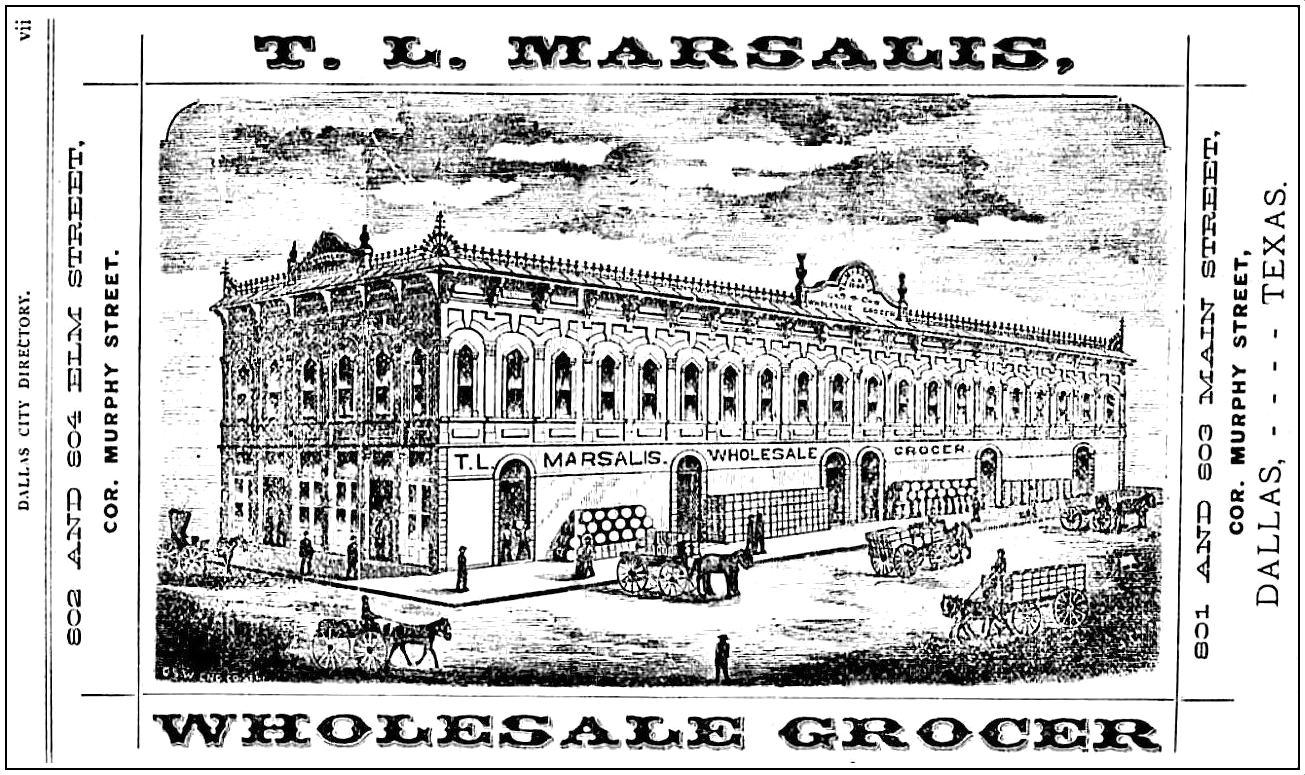
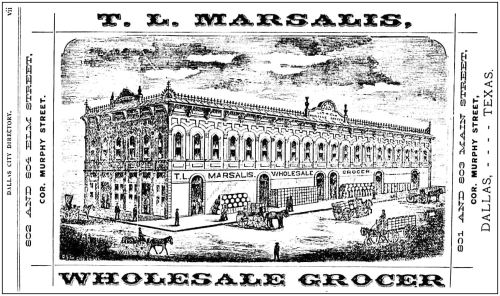
ad-marsalis-grocer_1883-directoryAd from the 1883 Dallas directory… (click for larger image)

by Paula Bosse

Two of the most important resources I use in delving into Dallas history are newspaper archives and city directories. A couple of years ago I wrote about how to access the indispensable online historical archive of The Dallas Morning News, beginning in 1885 (that post is here), but I haven’t written about how to use the equally important database(s) containing scans of Dallas city directories, beginning with the 1875 directory. 
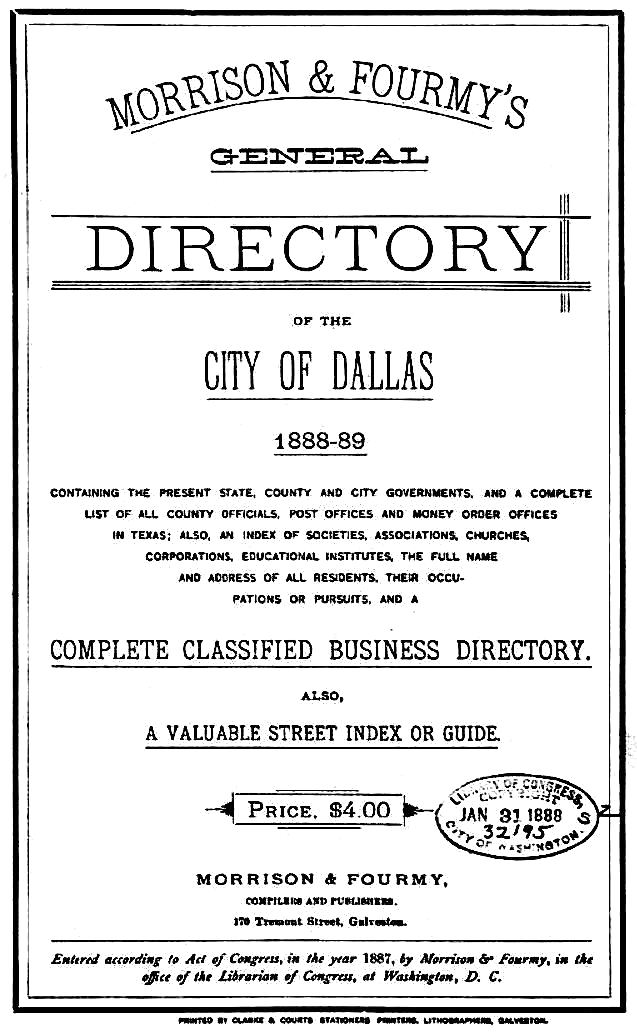
morrison-and-fourmys_1888-1889-dallas-directory_title-page1888-1889 Morrison & Fourmy’s Dallas directory

There are two ways to do this online: for free, and as part of a subscription (pay) service. I started out by accessing the directories through the Ancestry website, which you have to pay for/subscribe to. It was only recently that I discovered that (as far as I can tell) the exact same directories available on Ancestry are accessible through the Dallas Public Library website — for FREE. All you need is a library card. (You must be a resident of the City of Dallas in order to qualify for a library card. There is more about who can get a library and how one must do this — it requires physically going to a branch with proof of residency — I’ve included this information in that earlier post, here.) (There are a few free online sources which require no library card and no subscription — see those at the bottom of this post.)

Once you have your card and have registered for an account at the Dallas Public Library website, here’s what you do next:

  • Log into your account, here
  • Click on “DATABASES” at the top
  • Scroll down, click on “GENEALOGY”
  • Scroll down, click on “HERITAGEQUEST”
  • Click on “CITY DIRECTORIES” at the top (you will be able to search through many city directories from around the country, not just the ones from Dallas — and, as you can see, there are all sorts of other interesting databases here, too, such as census records, etc.)
  • Enter the name you’re looking for and, voilà.

*

So why are these directories so useful?

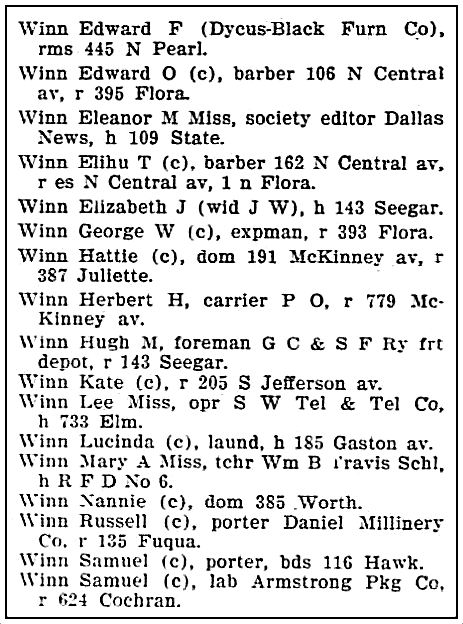
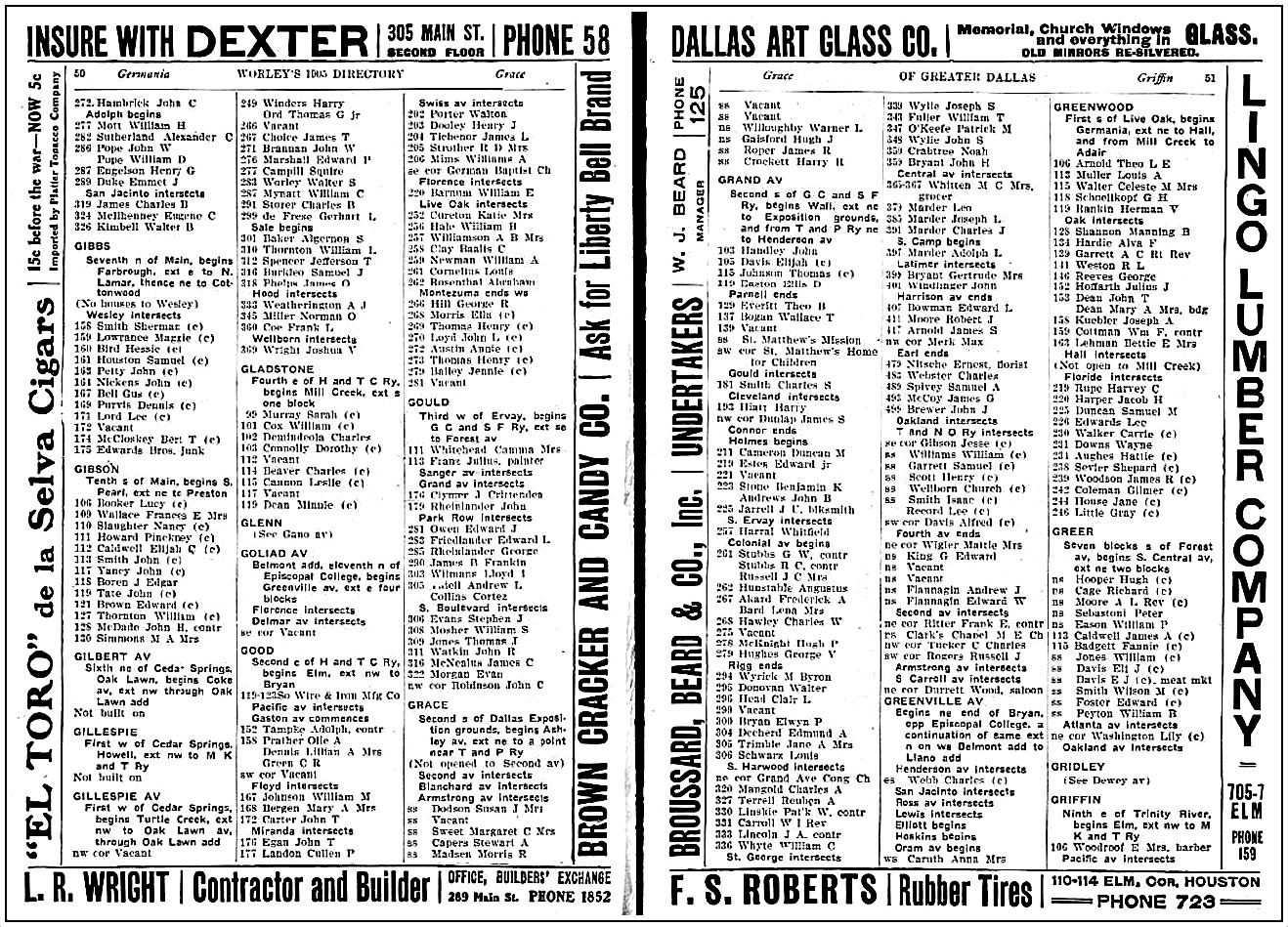
Not only can you determine when someone was living in the city, you can see where they lived, what their occupation was, the name of their spouse, and, in some cases, the race of the person (which, while somewhat disconcerting, can sometimes be quite helpful, especially if the person you are looking for has a common name — up until the ’20s or so, African-American residents and black-owned businesses were followed by “(c)”). (All images shown here are larger when clicked.)
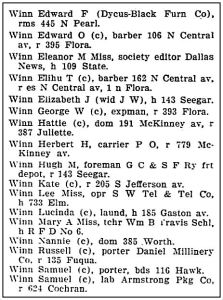
worleys_1907-directory
1907 Worley’s directory

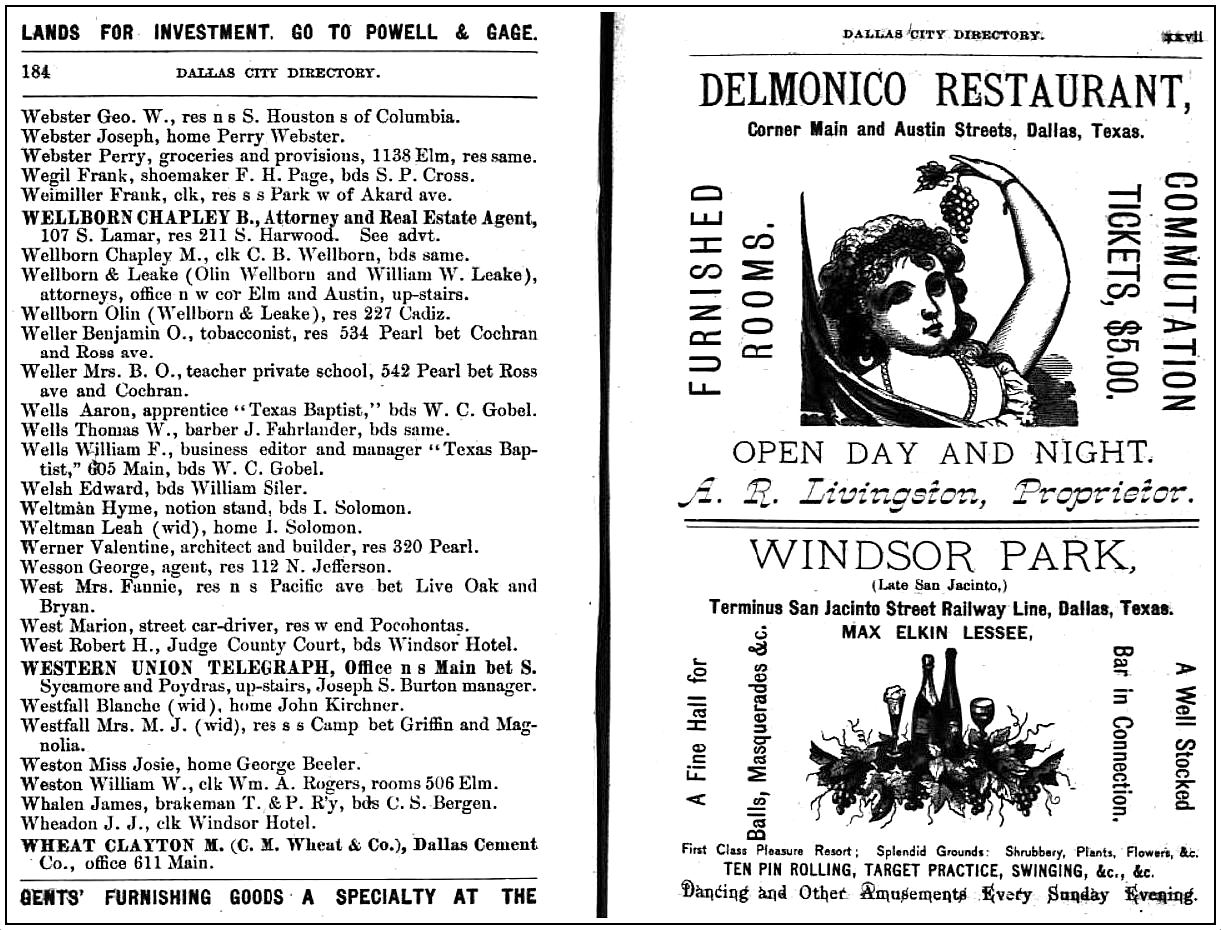
There are also ads, like the one at the top taken from the 1883 directory showing Thomas Marsalis’ wholesale grocery business. Ads are not only interesting, they can contain a lot of information, and, in some cases, a drawing or photograph of the business or proprietor.
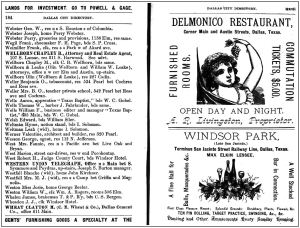
c-d-morrison-and-co_1878-dallas-directory
1878 C. D. Morrison & Co. directory

Typical business listings look like this:
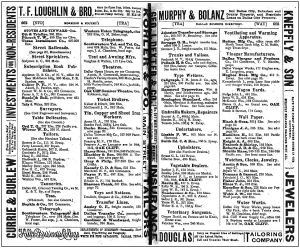
morrison-and-fourmys_1891-dallas-directory
1891 Morrison & Fourmy’s directory

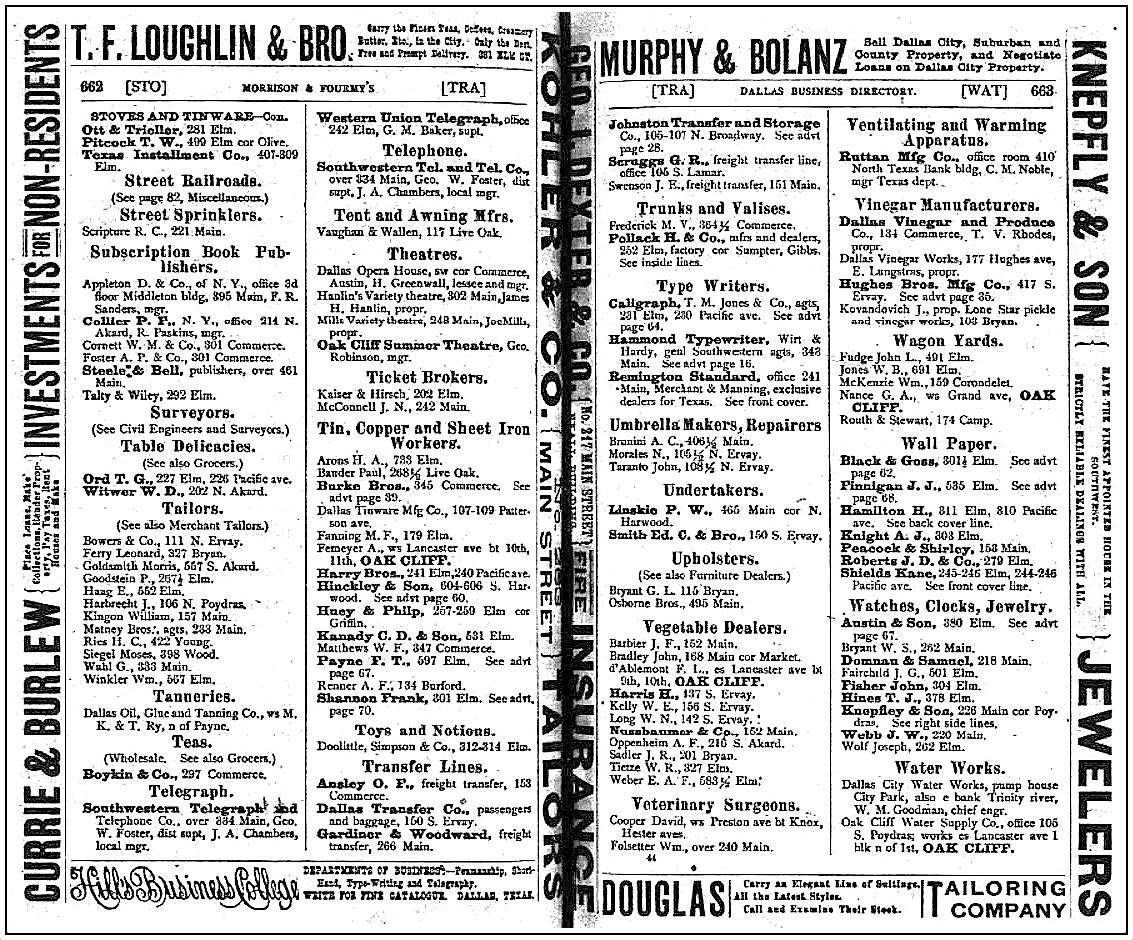
For me, one of the most useful things I find about these directories is the section containing the street directory. There are city directories covering more than 140 years of Dallas history, and there are a lot of street names you come across in researching a person or a place that no longer exist, have changed names, have the same name as a street in a different part of town (there used to be a lot of street names duplicated in Oak Cliff before it became part of Dallas), etc. These street guides tell you the names of everyone who lived/had businesses on the street (or at least the name of the head of the household or owner of the business), and it gives the names of all cross-streets. An address of 400 Main Street was not in the same location in 1950 as it was in 1900. (See this post on when and why Dallas street numbers changed.) One of the resources I use most is Jim Wheat’s easy-to-navigate list of street names from the 1911 directory (it’s faster and easier to use than one of the actual directories!), with links to the pertinent scanned page — these pages show you not only the 1911 address (which is often the same address used today) but they also show you what the address was BEFORE the number changed. I can’t tell you helpful this has been for me. (See an example here, which shows that before the number changed, 1400 Commerce was 324 Commerce.)

Pages from the 1905 street guide:
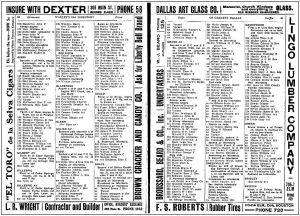
worleys_1905-directory_street-guide
1905 Worley’s directory

One bit of warning: many of the scanned directories that are online are only partial directories — and some years are missing altogether. The directories from the early 1940s, for instance, are a big headache: some have only 20 pages scanned — one wonders why they even bothered. Inevitably, the pages you need (and need badly) are ones that are not available to you, and you will, verily, let fly words your mother would not approve of. Sometimes you can get around the missing data by jumping to the street guide section or the business listings to see if useful info can be found there, but sometimes you are just going to be completely out of luck. This is when a trip to the Dallas Public Library (or possibly just a polite email to an ever-helpful librarian) will help you fill in the blanks, connect the dots, and get that swearing under control. I think they have a complete — or near-complete — set of city directories, either in hard-copy form or on microfilm. (UPDATE: Many of the incomplete directories mentioned above — issued  between 1936 and 1943 — are available fully-scanned, for FREE, at the Portal to Texas History. See link at bottom of post.)

You will find so much useful information in these directories that your head will spin. Right off  your neck. In a good way. But it’s also just enormous fun to browse them and imagine what the city used to be like in, say, 1889 when that year’s list of the city’s almost 150 saloons looked like this.

***

Sources & Notes

HeritageQuest is the service that provides access to scanned U.S. city directories to libraries across the country (it appears to be the same content the genealogy site Ancestry offers its members). This service is available free to holders of library cards. If you do not live in the City of Dallas, check to see if your local library system subscribes to this HeritageQuest database.

Here are a few other free online sources offering Dallas directory info — and these are available to everyone:

  • I’m updating this post on April 5, 2017 to include an INCREDIBLE selection of (from what I can tell) fully-scanned directories — twenty of them! This includes various years between 1902 and 1961 — including most issued between 1936 and 1941 (only partial scans of these editions are available through HeritageQuest/Ancestry, but here we can see complete directories). Thanks to the Dallas Public Library, everyone can access these Dallas city directories at the Portal to Texas History, here.
  • Another fully-scanned Dallas directory available online free for everyone can be found on Archive.org: the 1909 Worley’s directory is here.
  • Jim Wheat’s Dallas County, Texas Archives has all sorts of incredible stuff on his fantastic site, including links to directory information. Scroll down quite a ways on his main page here, and near the bottom in the left column you’ll see several listings under “Dallas City Directories.” Wheat manually transcribed a lot of these things himself, and those of us who research Dallas history owe the late Mr. Wheat a debt of gratitude. (UPDATE: The entire Roots Web website — not just Jim Wheat’s pages — has been down for several months. One can only hope his hundreds — if not thousands — of hours of work will someday be back online and once again accessible to researchers of Dallas history.)

*

Copyright © 2017 Paula Bosse. All Rights Reserved.


Shopping at Sears in Casa View

sears_casa-view_ext_squire-haskins_utaAppliance central… (click for larger image)

by Paula Bosse

I’m not in the Casa View area very often, but I was driving through last week and noted that a lot of the elements of the shopping center looked as if they were original to the buildings — specifically the little metal doo-dads along the top of the canopies over the sidewalks. I came across the photo above tonight and was happy to see those little doo-dads back when they were relatively new. The shopping center is a little confusing to me, but I think this is what that building pictured above looks like these days. (Why, why, WHY did someone think this “remodel” of the buildings was a good idea! Slapping on a new facade and removing the decorative metal doo-dads was an unfortunate decision.)

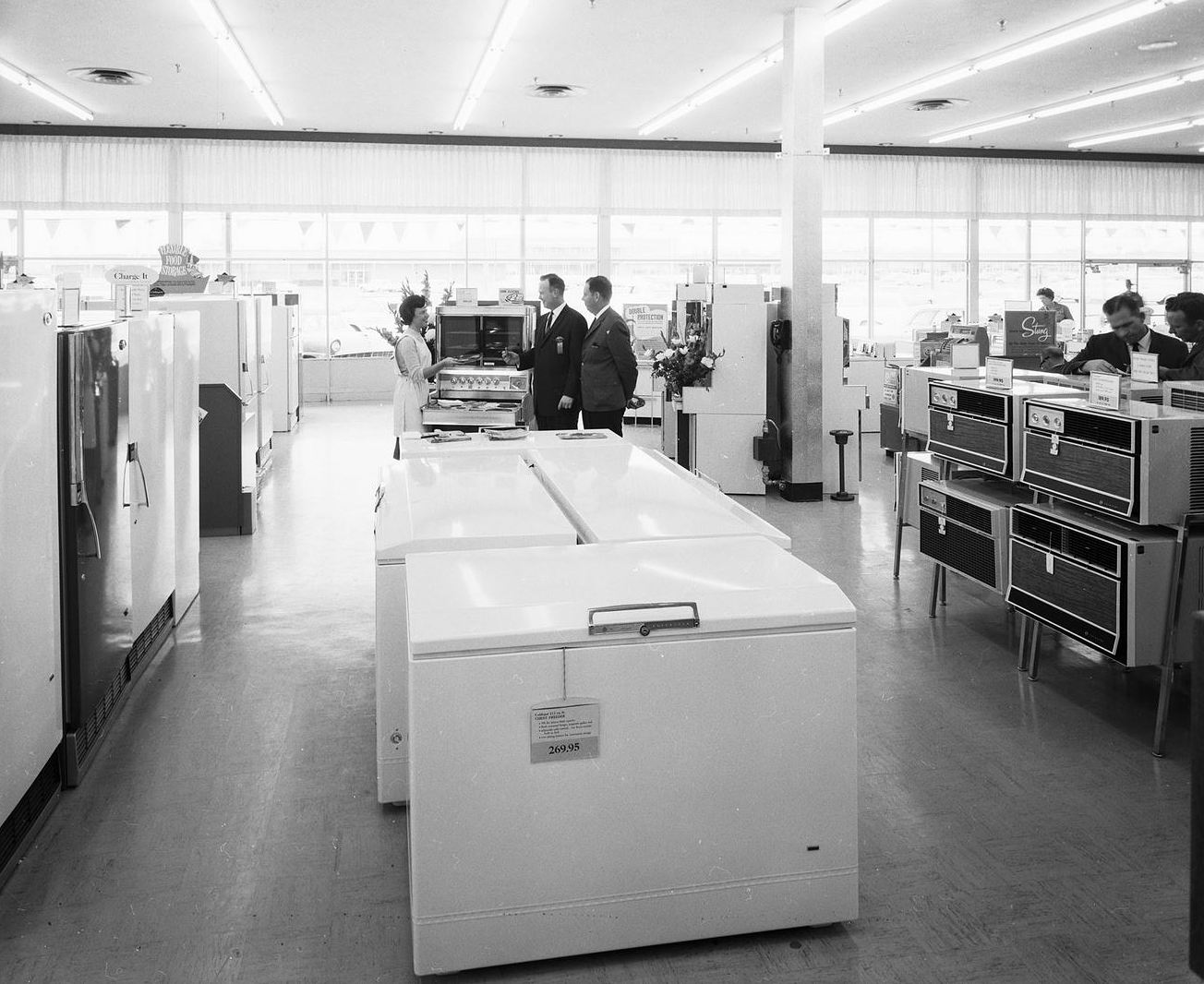
The Sears store pictured above is actually the second Sears in Casa View. The first store opened in October, 1956  at 2211 Gus Thomasson (here’s what the location of the first store looks like now — metalwork still there but that cool brick exterior has been painted over). It was Dallas’ fifth Sears store and opened in the still-under-development Casa View neighborhood. It wasn’t a full department store — its merchandise was limited mostly to appliances and automotive products. It was also a place to pick up catalog orders. (Click photos and ads to see larger images.)

ad-sears_casa-view_dmn_102556
Oct. 25, 1956

Apparently the store was so successful that in March, 1964, a brand new Sears opened up in a five-times-larger location (2310 Gus Thomasson) across the street — the photo at the top of this post was probably taken when it was in its first months.

sears_new-location_casa-view_dmn_031264-detMarch 12, 1964

Its interior — seen below in all its pristine, blinding whiteness — is fantastic. (Is that woman in the apron serving cookies she’s just baked?)

sears_casa-view_int_squire-haskins_uta

*

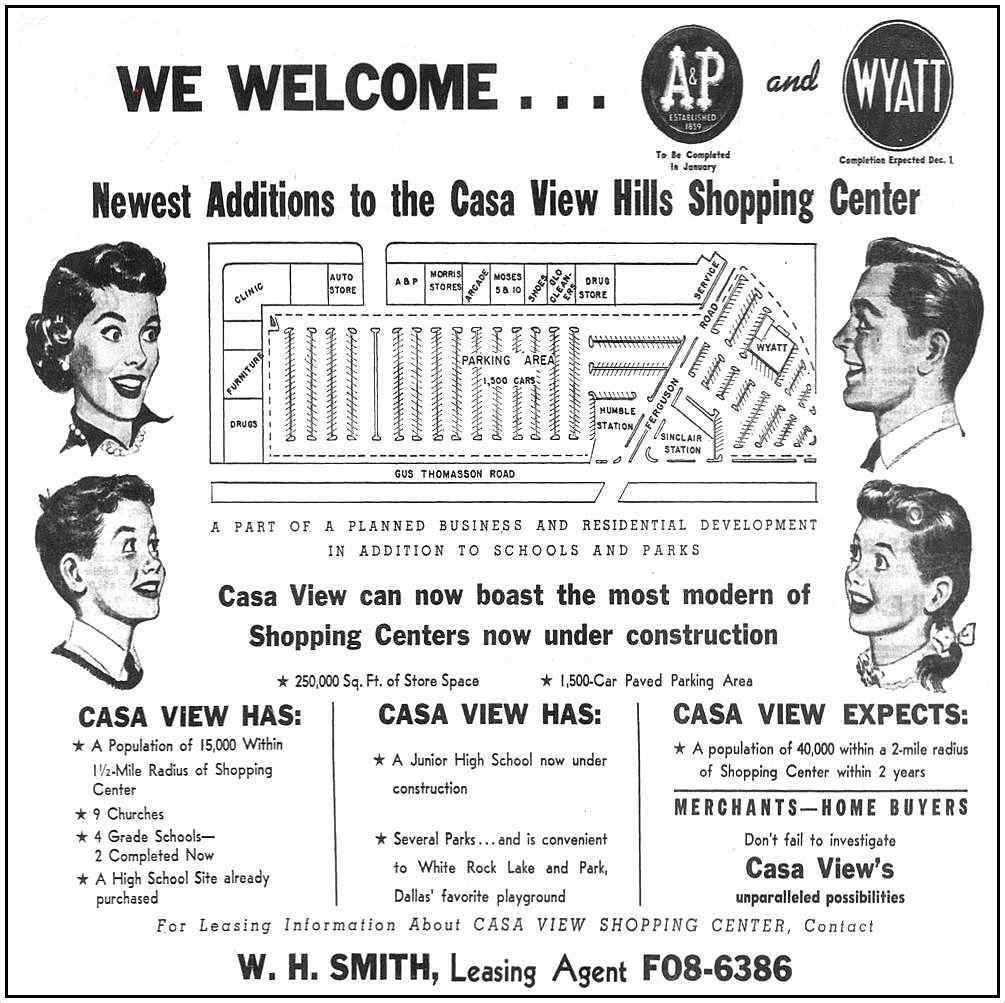
The reason I was confused by the shopping area is that it was built in phases. The first part was built in 1953 and was originally known as Casa View Hills Shopping Center. (Click the ad below to see a larger image.)

casa-view-shopping-center_dmn_100453
Oct. 4, 1953

But then the ownership changed hands in early 1955, and it was renamed Casa View *Village* and reopened in April under the new name.

In the meantime (I might have this chronology a bit out of whack), Casa View Center had been built in 1954, diagonally across the street. And then in 1955, construction began on an expanded Casa View Village. (This might have been its second expansion. Casa View was hopping in the mid-’50s!) And Sears had had stores in both Casa View Village and Casa View Center. It’s all kinda confusing.

The Casa View Shopping Center (I don’t know what its official name is these days, but I’m going with this) is looking a little ragged these days, but it still has a quirky charm, and I’m happy to see it still chugging along after 60 years.

***

Sources & Notes

Photos by Squire Haskins from the Squire Haskins Photography, Inc. Collection, UTA Libraries Special Collections. More info on the top photo showing the exterior of the Sears building can be found here; more info on the interior photo is here. (Click on the thumbnails on the UTA pages to see very large images.)

The Casa View Wikipedia page is here.

D Magazine has a “Dallas Neighborhood Guide” to Casa View here.

Dallas Morning News articles:

  • “Name Changed” (from Casa View Hills Shopping Center to Casa View Village) (DMN, March 13, 1955)
  • “Avery Mays Announces New Shopping Center” (expanded Casa View Village, with aerial photo) (DMN, Nov. 10, 1955)
  • “New Sears Opening in Casa View” (DMN, Oct. 11, 1956)

Other businesses once located in these shopping centers can be found in the post “Bryan Adams High School: Yearbook Ads from 1961 and 1962,” here.

Photos and clippings are larger when clicked.

*

Copyright © 2017 Paula Bosse. All Rights Reserved.
 

The Stage Door Restaurant: Elm Street’s “Home of Lox and Bagels” — 1965-1968

stage-door_youtube_1966A Reuben sandwich sings to me, like a siren to a sailor…

by Paula Bosse

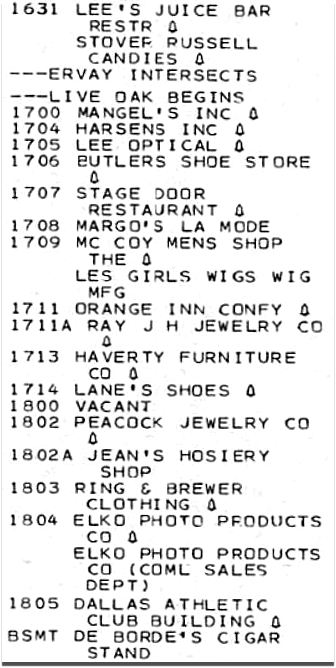
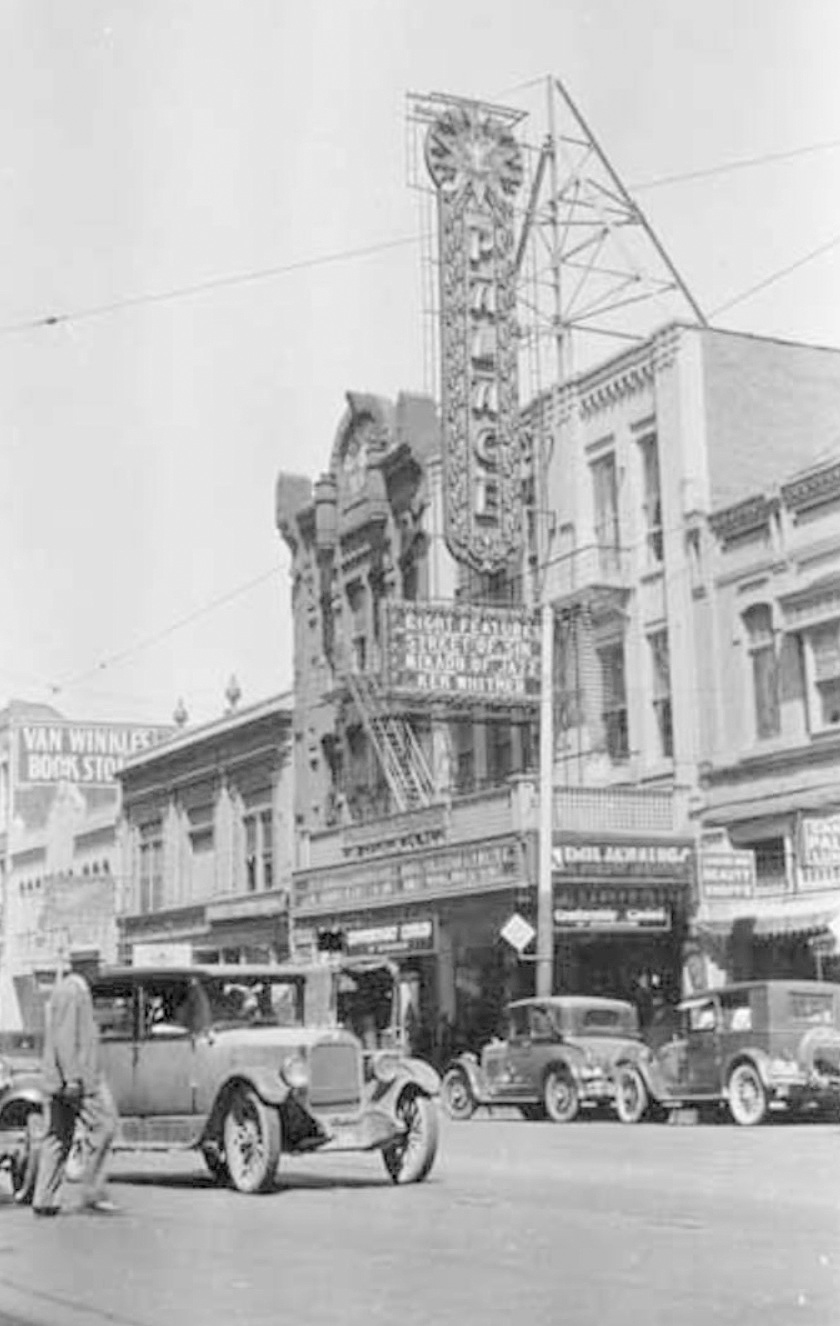
Why does Dallas have so few delis? Here’s one that seemed to be pretty popular in the 1960s: the Stage Door Restaurant and Delicatessen (and bakery), located at 1707 Elm, between the Palace Theater and the Dallas Athletic Club. It opened in June 1965 and lasted until the end of 1968 (when it was replaced by a restaurant called King Beef). I doubt there was any connection with the famous Stage Deli in New York, but manager Milton Stackel certainly had kosher cred of his own, having worked for twenty years at Grossinger’s, the legendary Jewish resort in the Catskill Mountains. I’m not sure how he found himself operating an eatery in downtown Dallas, Texas, but I’m glad he was here.

To any Milton Stackel-like entrepreneurs out there reading this:

DALLAS NEEDS DELIS!!


Authentic Jewish delicatessens!

Please!

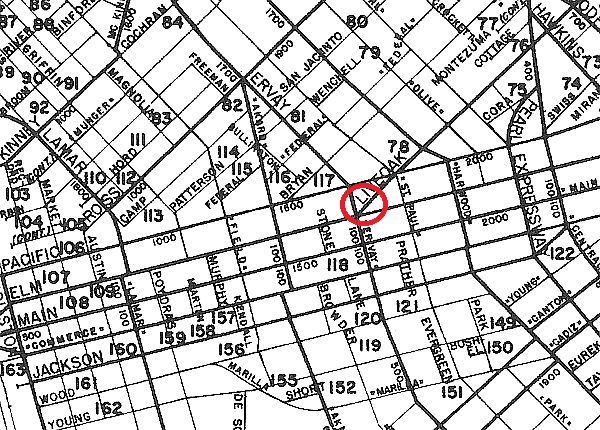
The apparently quite popular eatery was located at/near the old five-point Elm-Ervay-Live Oak intersection (seen here a dozen years earlier — the Stage Door would later be between Lee Optical and Haverty’s). There were two dining areas, one of which was The Playbill Dining Room which served an “international-type cuisine in a Gay Nineties atmosphere.” There was also a thriving take-out deli and the nearby bakery. And now? Come on, Dallas restaurateurs! Get to work!

*

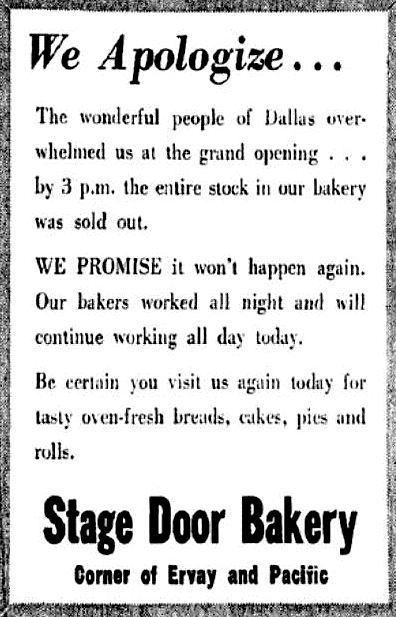
stage-door-bakery_dmn_060465
June 1965

stage-door-restaurant_texas-jewish-post_122365_portal
Texas Jewish Post, Dec. 23, 1965

This ad shows the bakery entrance next door.

stage-door-bakery_dmn_112465
Nov. 1965

stage-door_dmn_112564

stage-door-restaurant_texas-jewish-post_122365_portal-det
Texas Jewish Post ad detail, Dec. 23, 1965

stage-door_1707-elm_1952-mapsco
1952 Mapsco

stage-door_1966-directory
1966 Dallas directory

1700-block-elm_1966-directory
Elm Street, 1966 Dallas directory

***

Sources & Notes

Top image is a screengrab from a YouTube video, here, containing footage shot downtown by Lawrence W. Haas on Memorial Day, 1966.

Read more about the opening of the new business (and see a photo of the interior) in the Dallas Morning News article “Stage Door Restaurant Makes Debut in Dallas” (DMN, June 3, 1965).

*

Copyright © 2017 Paula Bosse. All Rights Reserved.

The White Rock Lake District: “Where Life Is Worth Living!” — 1926

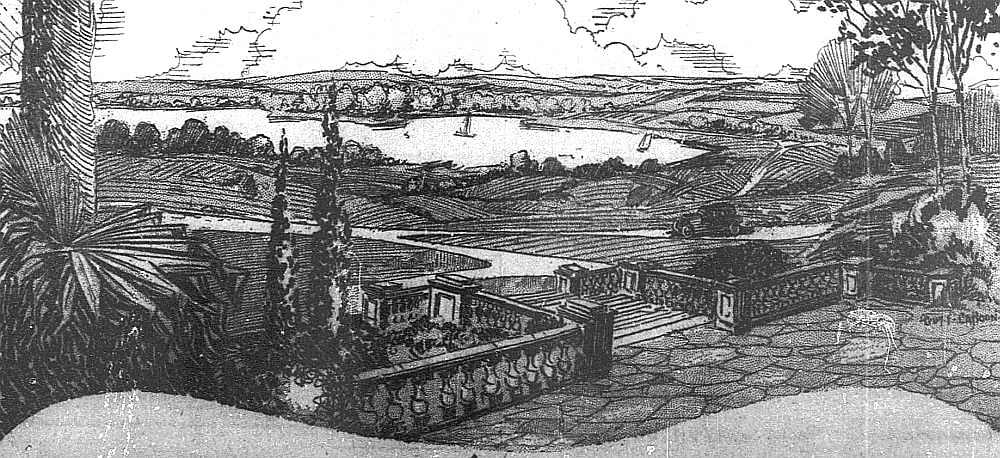
white-rock-lake-district_dmn_050226_detThe idyllic view from an East Dallas villa…. (click for larger image)

by Paula Bosse

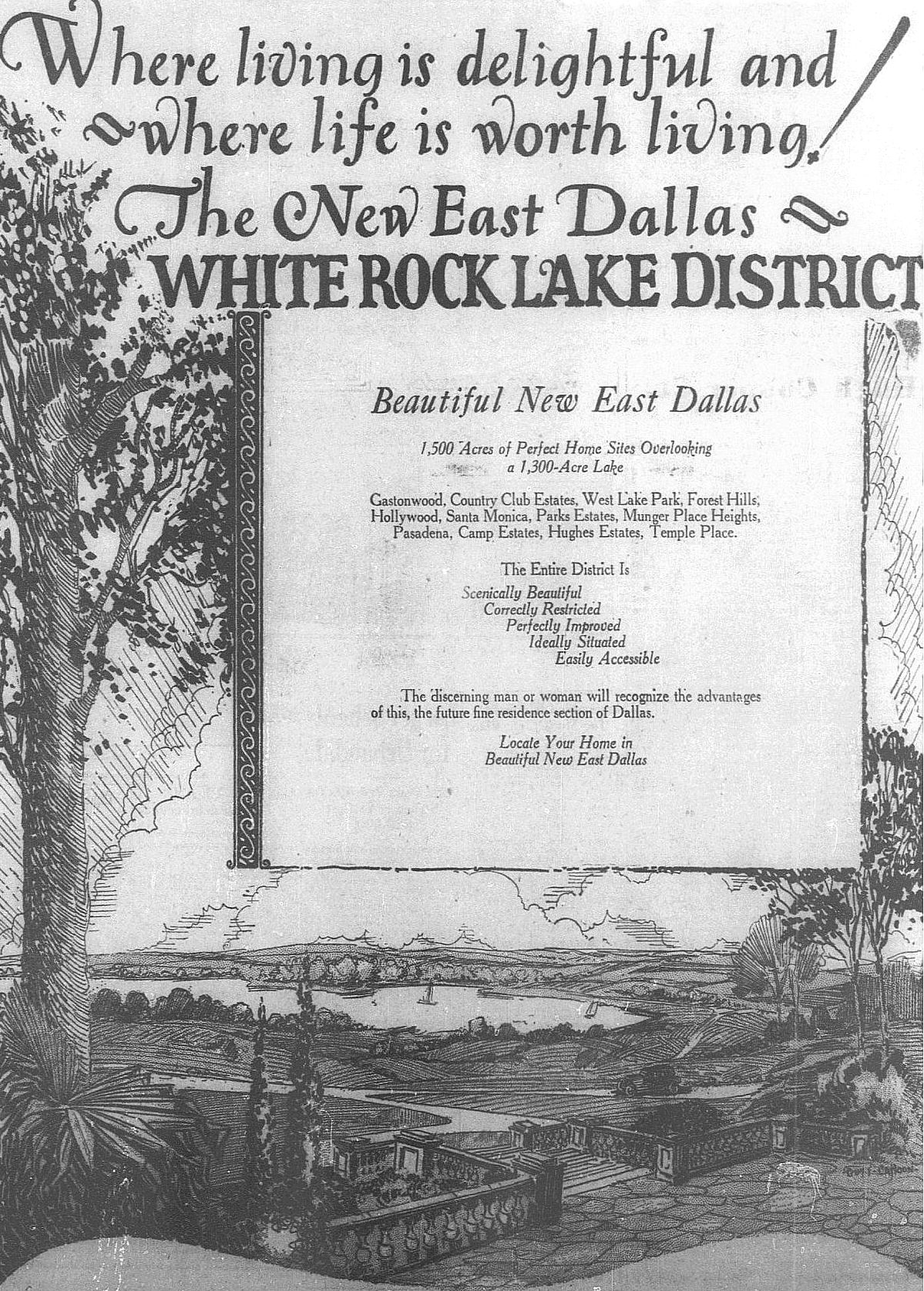
In 1926, East Dallas was in a frenzy of development. There were so many new neighborhoods: Gastonwood, Country Club Estates, West Lake Park, Forest Hills, Hollywood, Santa Monica, Parks Estates, Munger Place Heights, Pasadena, Camp Estates, Hughes Estates, Temple Place.

*

The New East Dallas
WHITE ROCK LAKE DISTRICT
Where living is delightful and where life is worth living!

white-rock-lake-district_dmn_050226

***

Sources & Notes

Ad from May, 1926. The detail — which shows a heart-stoppingly lovely vision of what might or might not have been a view from a home in the “White Rock Lake District” — is a Dallas I’ve never seen, but it’s one I’ll dream of.

To read a very informative article (or, I think it’s probably more of an “advertorial” written by a real estate company with land holdings in East Dallas), rifle through the Dallas Morning News archives until you find the article/advertisement titled “East Dallas Section Has Fast Growth” (DMN, May 2, 1926). As I said, it’s quite informative — with detailed info on the micro neighborhoods of East Dallas, many of which I’d never heard of.

*

Copyright © 2017 Paula Bosse. All Rights Reserved.

When the Circus Came to Town — 1886

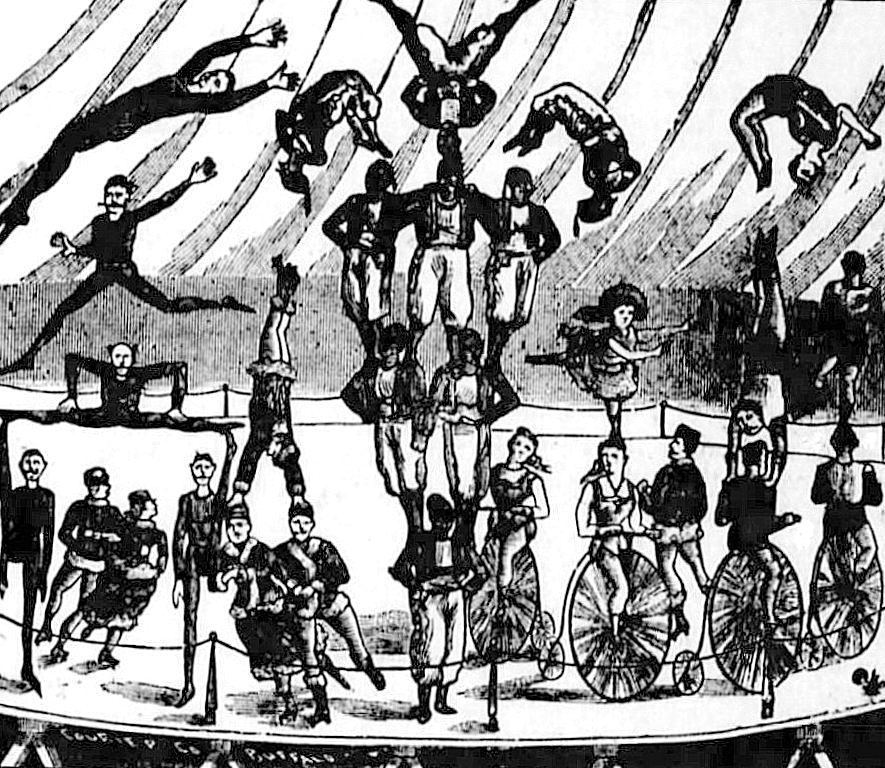
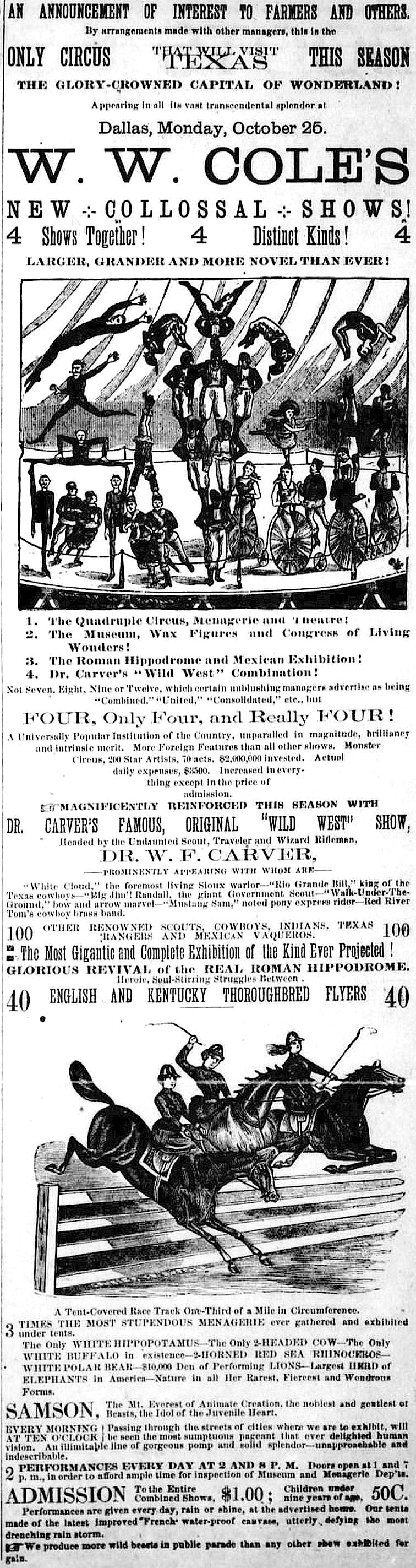
cole-circus_dallas-herald_101586-detI’m exhausted just looking at this…. (click for larger image)

by Paula Bosse

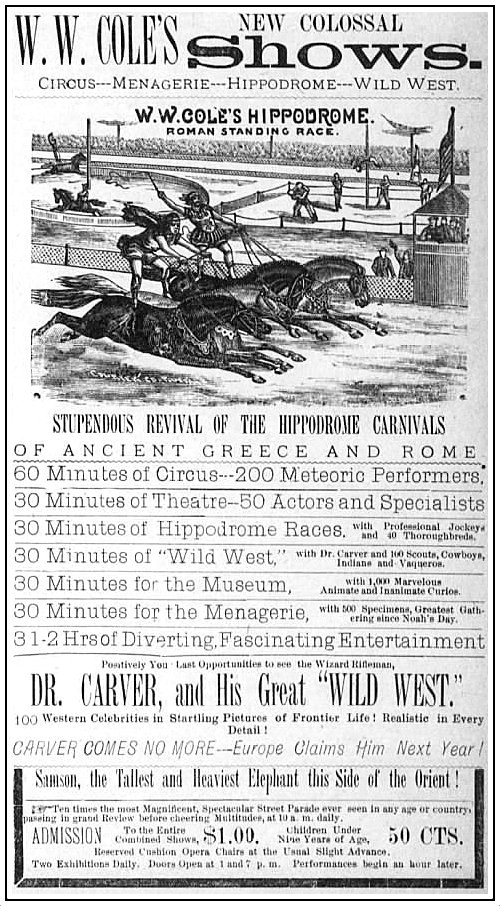
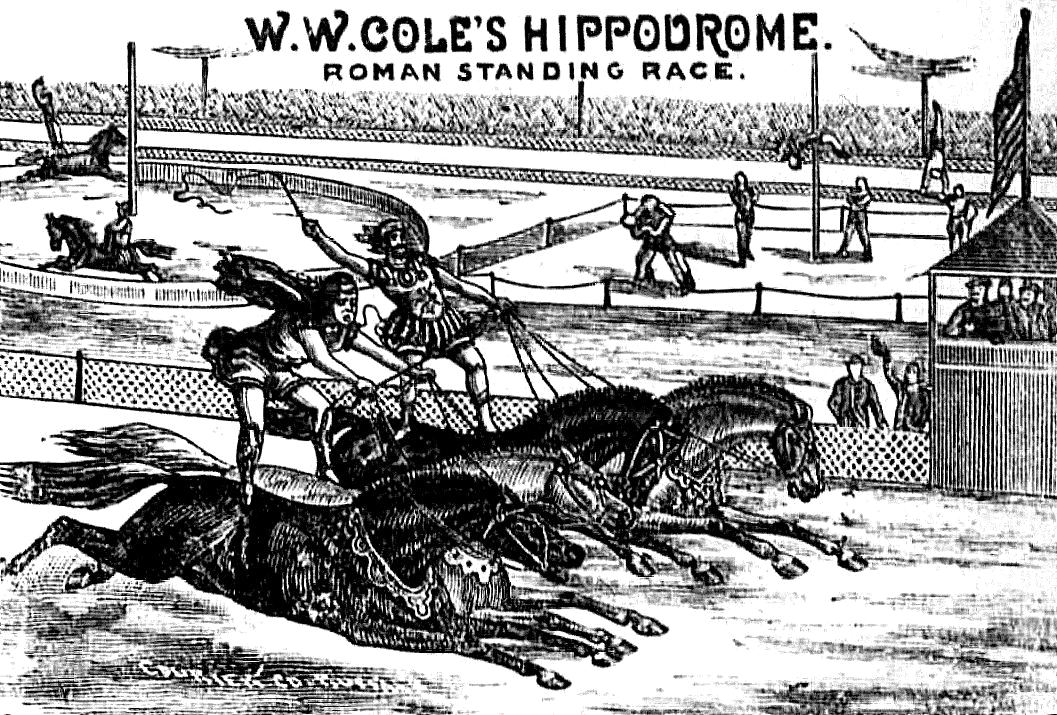
W. W. Cole brought his unbelievably jam-packed circus to Dallas at the end of October, 1886. That would have been big news all on its own, but also going on at the exact same time were two fairs. TWO! (This was when Dallas had competing state fairs battling each other across town.) I’m not sure how people handled all that entertainment. Circus attendance alone was reported at more than 16,000 for the Dallas engagement. That’s a lot.

One thing the Cole organization knew about was the power of adjectives. I can’t even begin to take apart this ad, so run your eyeballs over the intense, pop-eyed text and imagine what frontier Dallasites thought. Sit back and enjoy the “vast transcendental splendor” that was W. W. Cole’s extravaganza. (Click to see a larger image.)

ad_cole-circus_dallas-herald_101586Dallas Herald, Oct. 15, 1886

The circus appeared in Austin a few days later. This ad is also great.

cole-circus_austin-weekly-statesman_101486
Austin Weekly Statesman, Oct. 14, 1886

coles-circus_dmn_102486
Dallas Morning News, Oct. 24, 1886

circus_fairs_dallas-herald_102586
Dallas Herald, Oct. 25, 1886

The review:

coles-circus_dmn_102686
DMN, Oct. 26, 1886

Not everyone was impressed:

circus_dallas-herald_102686
Dallas Herald, Oct. 26, 1886

And then there was this weird little story. (I think the ending was tacked on by the writer as a joke. …I think.)

circus_somnambulist_dallas-herald_102686
Dallas Herald, Oct. 26, 1886

After all that excitement, it was probably a relief when the circus left town!

coles-circus-in-austin_dmn_110186DMN, Nov. 1, 1886

cole-circus_austin-weekly-statesman_101486_det

***

Sources & Notes

W. W. Cole’s Circus lasted forever — up until, apparently, last year! More here.

I’m never sure how much weight to give to the estimates of the Inflation Calculator, but when you plug the numbers into it, a dollar ticket for adults and a fifty-cent ticket for children would today equal somewhere in the neighborhood of twenty-five and thirteen bucks, respectively. That can’t be right, can it? You can’t argue that there was a lot going on in those French waterproof tents, but I can’t imagine people forking over that much when penny-candy was considered extravagant! But apparently 16,000 people happily forked! (W. W. Cole died a very, very, very wealthy man: when he shuffled off his moral coil in 1915, he left an estate of more than five million dollars — or, per the Inflation Calculator, more than 120 million dollars in today’s money.)

Click clippings to see larger images.

*

Copyright © 2017 Paula Bosse. All Rights Reserved.


“Classified System” Parking Stations — 1930s

classified-system_colteraIs that a ship? And an iceberg? (click for larger image)

by Paula Bosse

Here’s a cool little ad for what was basically a parking garage that also sold gas and tires (and which seems to have had a ship on top of its building … a building which might be shaped like … an iceberg?). This snazzy-looking garage was at 501 N. Akard (at Patterson) — it was one of several “Classified System” garages that dotted downtown from the early 1930s until at least the early ’70s. The Akard location was station No. 1.

Below, an ad from 1935 informing patrons that they could drive in, have tires installed, and pay for them sometime in the future — for as little as 50 cents a week (which would come out to about $35 a month in today’s money). “YOU DON’T NEED CASH.” (Click ad to see a larger image.)

classified-parking_dmn_061535
1935 ad

classified-parking_dmn_061535_det

I love the kooky design of the building, but that ship is just … odd. I like it, I just don’t get it. Maybe that’s the “classified” part.

***

Sources & Notes

Color image is a matchbook cover found on Flickr, here.

*

Copyright © 2017 Paula Bosse. All Rights Reserved.


Let the McClure Electric Co. Solve Your “Current Problems” — 1952

mcclure-electric-company_flickr_colteraThe lightning bolt on the sign is a nice touch…

by Paula Bosse

This is one of those idealized postcards from the ’40s and ’50s in which everything looks more pristine and perfect than was ever possible in real life. I love the postcard-version of this building, located at 2633 Swiss Avenue. And, glory be, it’s still standing — it just doesn’t look anywhere near as nice as it does in this postcard. (Why must people paint brick buildings? It looked so much better in 1952 when it was brand new. Today it looks like this.)

The McClure Electric Co. — which started life as the Emerson-McClure Electric Co. in 1922 — moved into their swanky new digs at Swiss and Cantegral in early 1952 and remained in business there until at least 1966. In the early ’70s, the building was home to Jim Dandy Fast Foods/Jim Dandy Fried Chicken for several years. Later, it appears that it might have been split up into office space. Currently it seems to be a fruit and vegetable produce company.

And that poor building has lost all its character.

*

mcclure-ad_dmn_0201521952 ad

swiss-cantegral_1952-mapsco
Swiss & Cantegral, 1952 Mapsco

***

Sources & Notes

Postcard found on Flickr.

More on the McClure company’s grand opening at this Swiss Avenue location can be found in the Dallas Morning News article “McClure Electric Company at Home in Modern Plant” (DMN, Feb. 1, 1952).

*

Copyright © 2017 Paula Bosse. All Rights Reserved.

“Dallas’ Dependable Business Climate” — 1959

ad-business-in-dallas_1959_photo-detThe “D” in “Big D” stands for “dinero”… (click for larger image)

by Paula Bosse

The booming Dallas skyline, captured by Squire Haskins on September 10, 1959, was used in a boosteriffic Chamber of Commerce-y statistics-filled ad.

“It’s exciting to live, do business, make money and grow in Dallas.”

ad-business-in-dallas_1959

***

This Industrial Dallas, Inc. ad appeared in the January, 1960 issue of Fortune magazine. I found it on eBay, here.

Images larger when clicked.

*

Copyright © 2017 Paula Bosse. All Rights Reserved.

Christmas Toy Sale at Sanger’s! — 1955

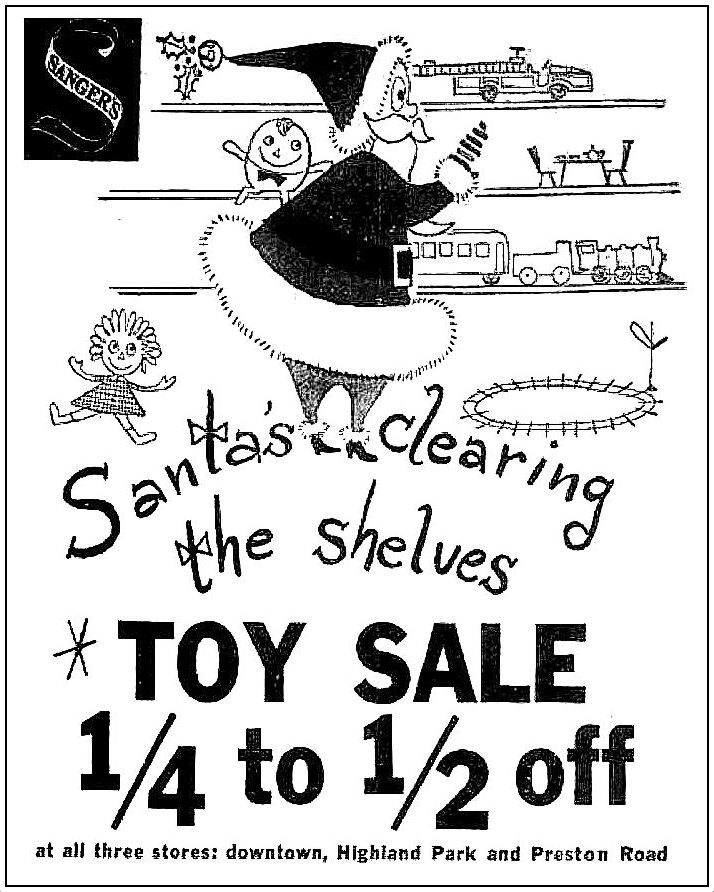
xmas_sangers_dmn_122255aBargains ahead: Santa’s clearing the shelves…

by Paula Bosse

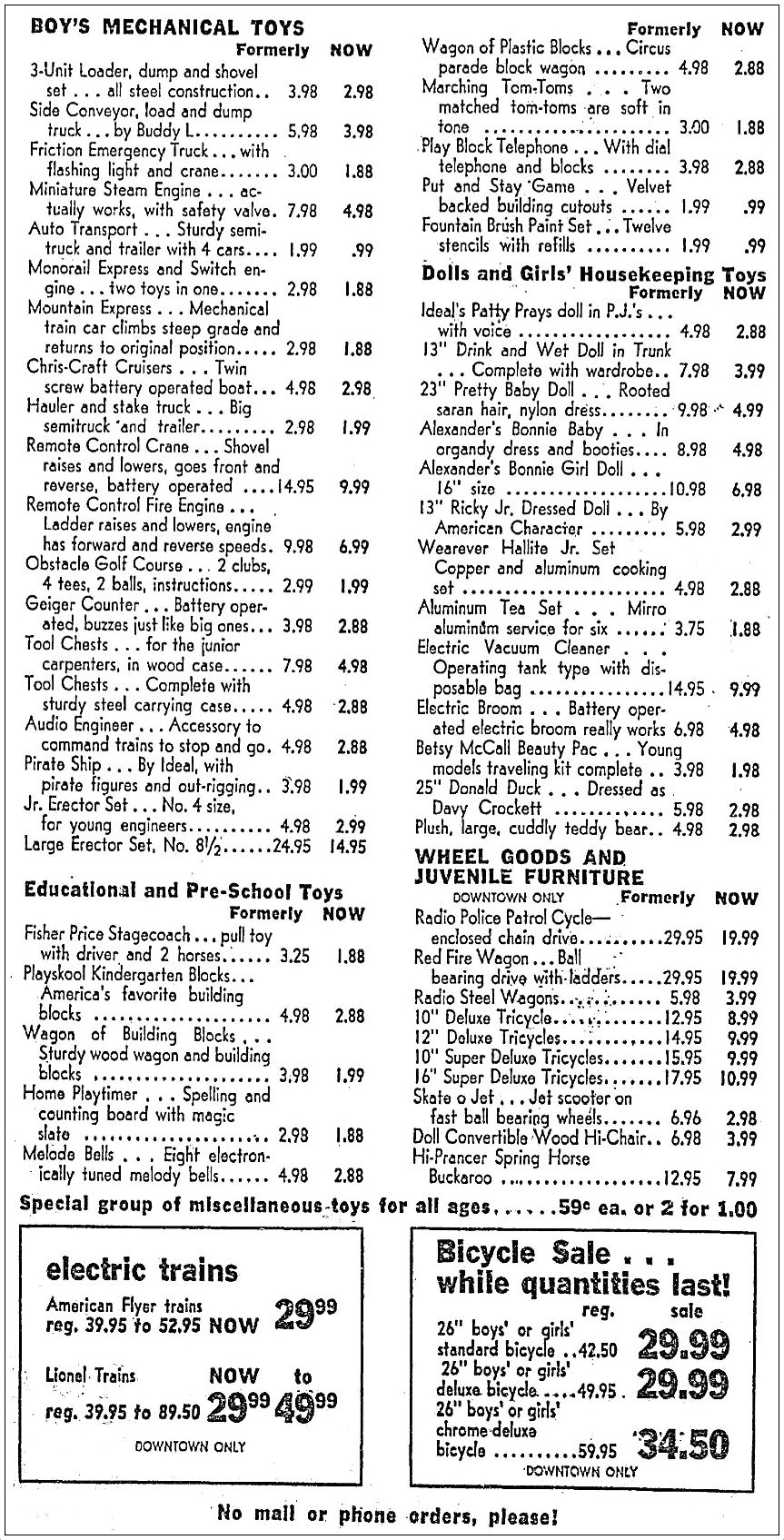
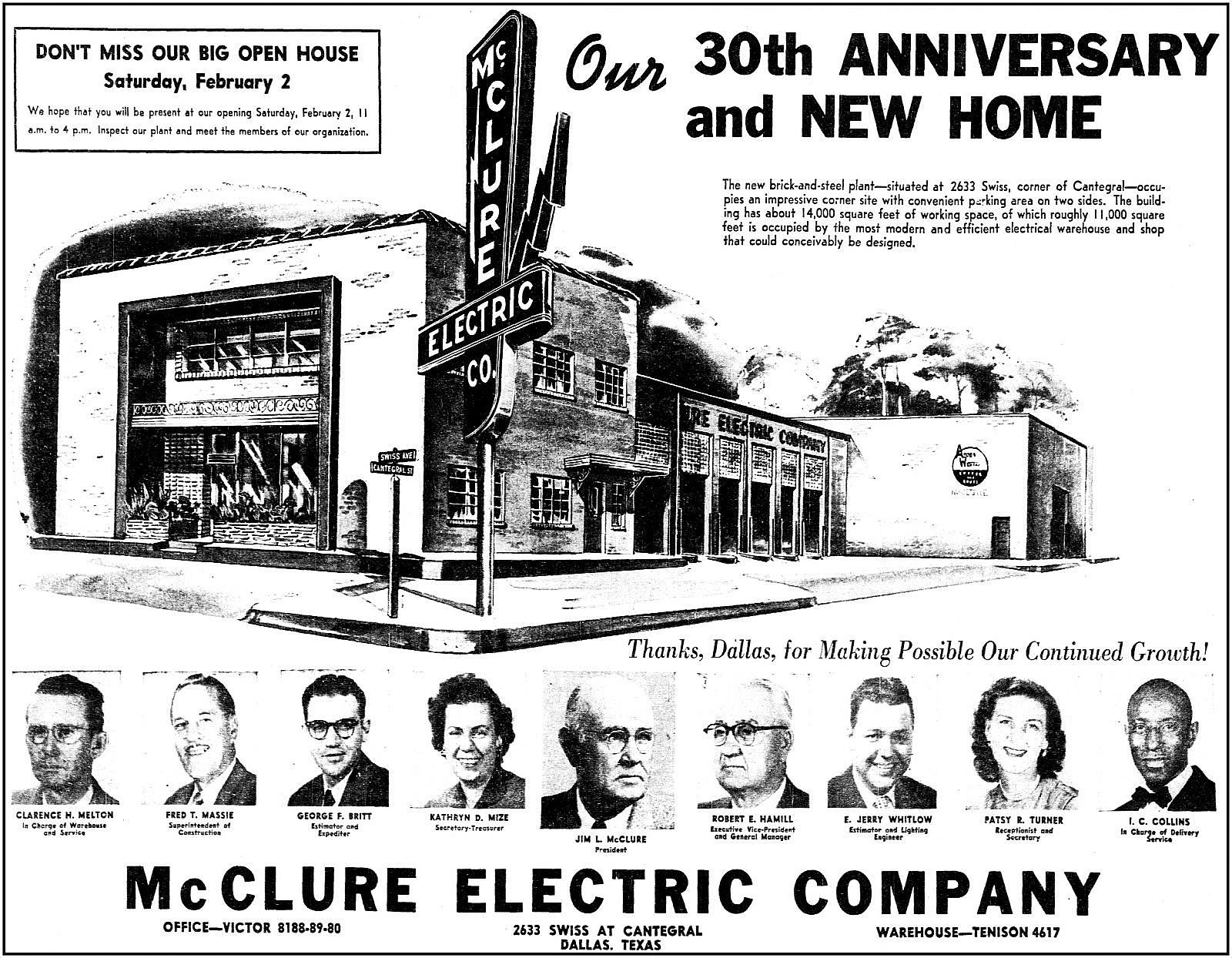
Look at all the toys that were on sale in the final days before Christmas — “at all three [Sanger’s] stores: downtown, Highland Park and Preston Road.” Need a “Ricky, Jr. doll”? A kiddie Geiger counter? A two-foot-tall Donald Duck toy dressed as Davy Crockett? Look no further — Sanger’s has it. (Click ad to see a larger image and take a walk down Childhood Toy Memory Lane.)
xmas_sangers_dmn_122255b

*

Copyright © 2016 Paula Bosse. All Rights Reserved.


Albert Einstein “Threw the Switch” in New Jersey to Open the Pan-American Exposition in Dallas — 1937

pan-american-expo_einstein_061237Einstein at the switch, June 12, 1937…

by Paula Bosse

Who knew? Albert Einstein, the world’s most famous physicist, helped open the Greater Texas and Pan-American Exposition. The exposition was held at Fair Park for 20 weeks, from June 12, 1937 to October 31, 1937, as a follow-up of sorts to the Texas Centennial (the city had built all those new buildings — might as well get their money’s worth!). I’m not quite sure how Einstein got roped into this, but looking at the photo above, he seemed pretty happy about what was, basically, a long-distance ribbon-cutting. Via telegraph.

The plan was for Professor Einstein to officially open the Pan-American Exposition by “throwing the switch” which would turn on massive displays of lights around Fair Park. He would do this from Princeton, New Jersey, where he lived, by closing a telegraph circuit which would put the whole thing in motion. Newspaper reports varied on where exactly Herr Einstein was tapping his telegraph key — it was either the study in his home, in his office, in a Princeton University administration building, or in the Princeton offices of Western Union (the latter of which was mentioned in only one report I found, but it seems most likely).

Einstein was a bona fide celebrity, and this was national news — newspapers around the country ran stories about it, and the ceremony was carried live on coast-to-coast radio. Almost every report suggested that Einstein’s pressing of the key in New Jersey would be the trigger that lit up the park in Texas, 1,500 miles away — which was partly correct. According to The Dallas Morning News:

Lights on the grounds will be turned on officially at 8:40 p.m. when Dr. Albert Einstein, exponent of the theory of relativity, presses a key in his Princeton home to fire an army field gun. With the detonation of the shell, switches will be thrown to release the flood of colored lights throughout the grounds. (DMN, June 10, 1937)

So on June 12, 1937 he pressed a telegraph key somewhere in Princeton, NJ, an alert was instantly wired to Dallas, an army field gun (in some reports a “cannon”) was fired, and that blast was the cue for electricians positioned around the park to throw switches to illuminate the spectacular displays of colored lights.

The Western Union tie-in gimmick was a success. Newspaper reports might have been a little purple in their descriptions, but from all accounts, those lights going on all at once was a pretty spectacular sight.

Dr. Albert Einstein, celebrated scientist, threw a switch that flashed a million lights over the 187-acre exposition park. The flash came at 8:40 o’clock and instantly the huge park became a city of a million wonders. Flags from a thousand staffs proclaimed their nationality [and] bands played the national airs of the nations of the Western Hemisphere as lusty cheers roared with thunderous approval. The Greater Texas and Pan-American Exposition was formally opened. It is on its way. (Abilene (TX) Reporter News, June 13, 1937)

The Dallas News describes the crowd as stunned into silence:

The waiting participants in the ceremonies at Dallas heard the results [of Einstein’s telegraph signal] when a cannon boomed. Electricians at switches around the grounds swung the blades into their niches and the flood of light awoke the colors of the rainbow to dance over the 187-acre park. Its breath taken by the spectacle, the crowd stood silent for a moment, and then broke into a cheer. (“Pan-American Fair Gets Off to Gay Start” by Robert Lunsford, DMN, June 13, 1937)

Many of the lighting designs and displays had been used the previous year during the Centennial, but, as with much of the attractions and appointments throughout the park, they were improved and spectacularized for the Pan-American Expo. And people loved what they saw.

Despite the multi-million dollar structures, air conditioning demos, works of art and other newfangled additions to the space, when people left the Centennial Exposition one thing was on everyone’s tongues, according to historical pollsters: the lights.

Positioned behind the Hall of State were 24 searchlights scaffolding into a crowned fan shape. “They all moved and were different colors,” says [Jim] Parsons [co-author of the book Fair Park Deco]. “It sounds gaudy, but people loved it.” The lights, he goes on to tell, were visible up to 20 miles away.

Considering most of the people who were visiting the fairgrounds were coming from rural farming communities with no electricity, the inspiring nature of those far-reaching beams makes a lot of sense. (Dallas Observer, Nov. 7, 2012)

Thanks for doing your part for Dallas history, Prof. Einstein!

pan-american-expo_esplanade_postcard

pan-american-expo_hall-of-state_postcard

pan-american-expo_patio-de-honor_ebay

Below, photos from the Texas Centennial, 1936. The multicolored lights could be seen from miles away — here’s what they looked like from downtown and from White Rock Lake.

centennial_pan-american_lights

skyline_downtown-to-fair-park_1936_GE-colln_museum-of-innovation-and-science

fair-park-lights_white-rock-lake

tx-centennial_night-scene_espalanade_hall-of-state_lights_ebay

tx-centennial_night_hall-of-state_lights_flickr_baylorvia Baylor University Flickr stream

tx-centennial_night_administration-bldg_lights_ebay

*

A look behind the scenes: “The general lighting effect is a battery of twenty-four 36-inch searchlights as powerful as the giants that flash from the dreadnoughts of Uncle Sam’s navy. Each searchlight will produce 60 million candlepower. Combined, the battery has a total candlepower of 1.5 billion. A 350,000-watt power generator will produce this colossal quantity of ‘juice.’” And the accompanying photo of the searchlight battery crew manning the candlepower:

tx-centennial_lights_southwest-business-mag_june-1936_photoSouthwest Business, June 1936

**

(All pictures and clippings are larger when clicked.)

einstein_pan-am-expo_denison-press_060937
Denison Press, June 9, 1937

*

einstein_pan-am-expo_waxahachie-daily-light_061137
Waxahachie Daily Light, June 11, 1937

*

einstein_pan-am-expo_denison-press_061437
Denison Press, June 14, 1937

*

einstein_pan-am-expo_medford-oregon-mail-tribune_062337
Medford (Oregon) Mail Tribune, June 23, 1937

*

einstein_pan-am-expo_vernon-daily-record_062437
Vernon Daily Record, June 24, 1937

*

pan-american-expo_drefuss-ad_dmn_061237
1937

pan-american-expo_sticker_1937_cowgirl

***

Sources & Notes

Top photo from the old Corbis site.

Black-and-white photos from the Centennial seen from Fair Park and White Rock Lake are from the Texas/Dallas History and Archives Division of the Dallas Public Library; the photo of the lights seen from downtown Dallas (titled “New skyline at night from Dallas, Texas”) is from the GE Photo Collection, Museum of Innovation and Science (more info on that photo is here).

Sources of other images and clippings cited, if known.

More on the Pan-American Exposition from Wikipedia, here, and from the fantastic Watermelon Kid site of all-things-Fair-Park, here.

*

Copyright © 2016 Paula Bosse. All Rights Reserved.