Flashback : Dallas

A Miscellany: History, Ads, Pop Culture

Category: HOF

The University Park Brown Books — An Unbelievable Resource!
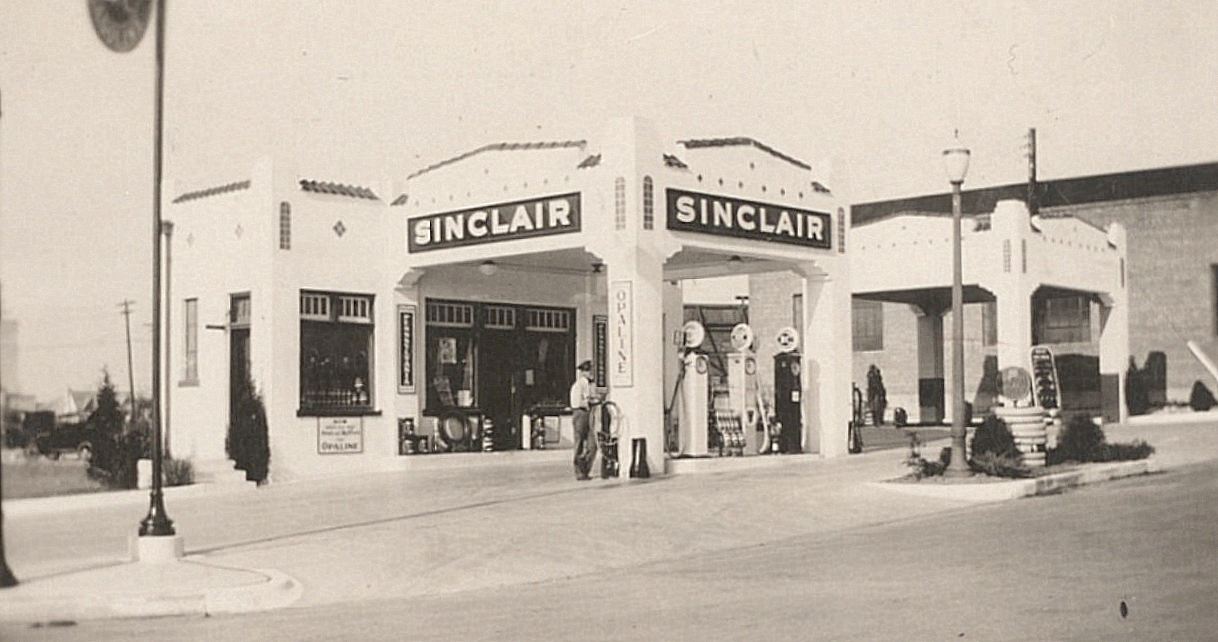
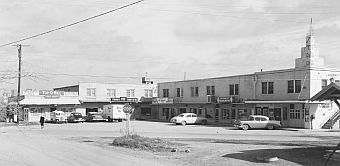
snider-plaza_brown-bks_university-park_6600-1934_sinclalirFill ‘er up in Snider Plaza, 1934

by Paula Bosse

You know how sometimes someone nonchalantly mentions something to you which should have been introduced by a fireworks display? That’s what happened when my friend Rod Hargrave sent me a link he had come across about a new online resource from the University Park Public Library: the city’s “Brown Books,” fully digitized. I made a note to check out the link when I had time but didn’t get to it for a week. I’m not the kind of person who uses “OMG,” but… O..M..G !! This is just unbelievably fantastic. 

Here’s the blurb form the University Park Public Library post

Brown Books at UP Public Library
March 2, 2022

Spend some time with one of the library’s newest resources! The City’s Brown Books contain thousands of subdivision records of individual construction permits for homes and some businesses across several decades. In these pages, you can find interesting and helpful information about the original structure. Data includes notations about square footage, construction date, original building price, along with details about the interior of the building and more. Over 98 percent of all documents include a photograph of the original structure.

PHOTOGRAPHS! Almost everything I looked up had a photo. I looked up addresses of places I’d written about – photos! I looked up businesses along Preston, Hillcrest, and Lovers Lane — photos! I looked at just about every business in Snider Plaza — photos! I even looked up the still-standing house my family lived in for a couple of years on Milton — photo! The earliest photos I found were from 1931. And all of this available to anyone with a computer — for free! Thank you, University Park Public Library!

And as the blurb says, not only are there photographs of the properties, but there is a whole history of the building, complete with renovation info, builder info, a drawing of the original footprint, etc. This includes tons of buildings which have been torn down — nothing ever dies in city/county records.

Below are some of the photos I found. Scroll down below them for instructions on how to access these records yourself on your computer.

*

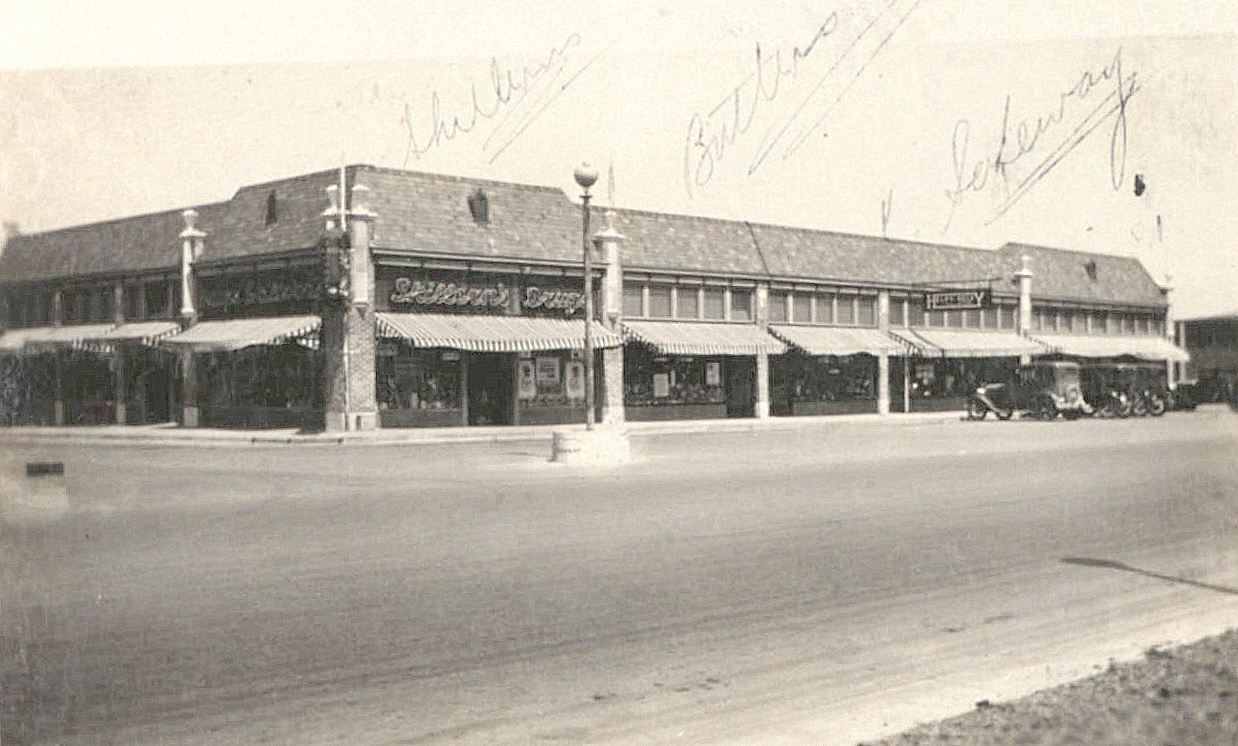
Here are a few photos of businesses on “the drag” — Hillcrest Avenue, across from SMU. (Click pictures to see larger images.)

6200 block of Hillcrest, at Granada (in 1931). (See this property’s Brown Books page here.)
6200-block-hillcrest_brown-bks_university park_1931

*

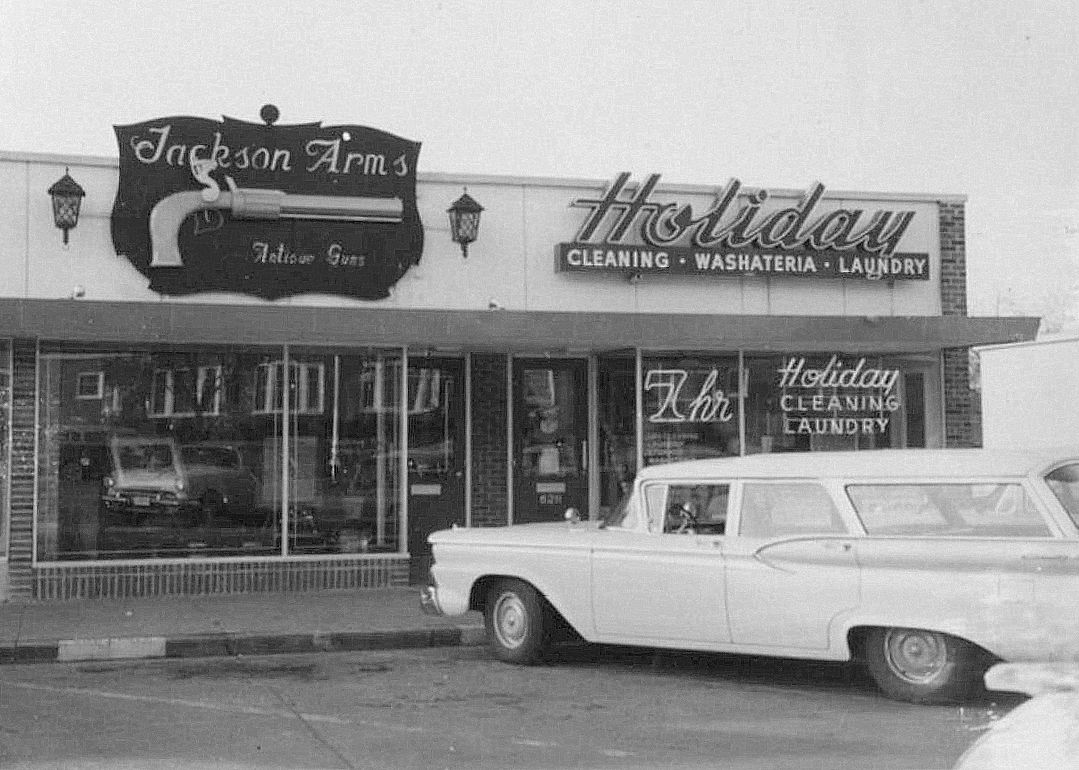
6209 Hillcrest (1959) — Jackson Arms, once my father’s home-away-from-home. (Brown Books page is here.)
6209-hillcrest_brown-bks_university park_1959_jackson-arms

*

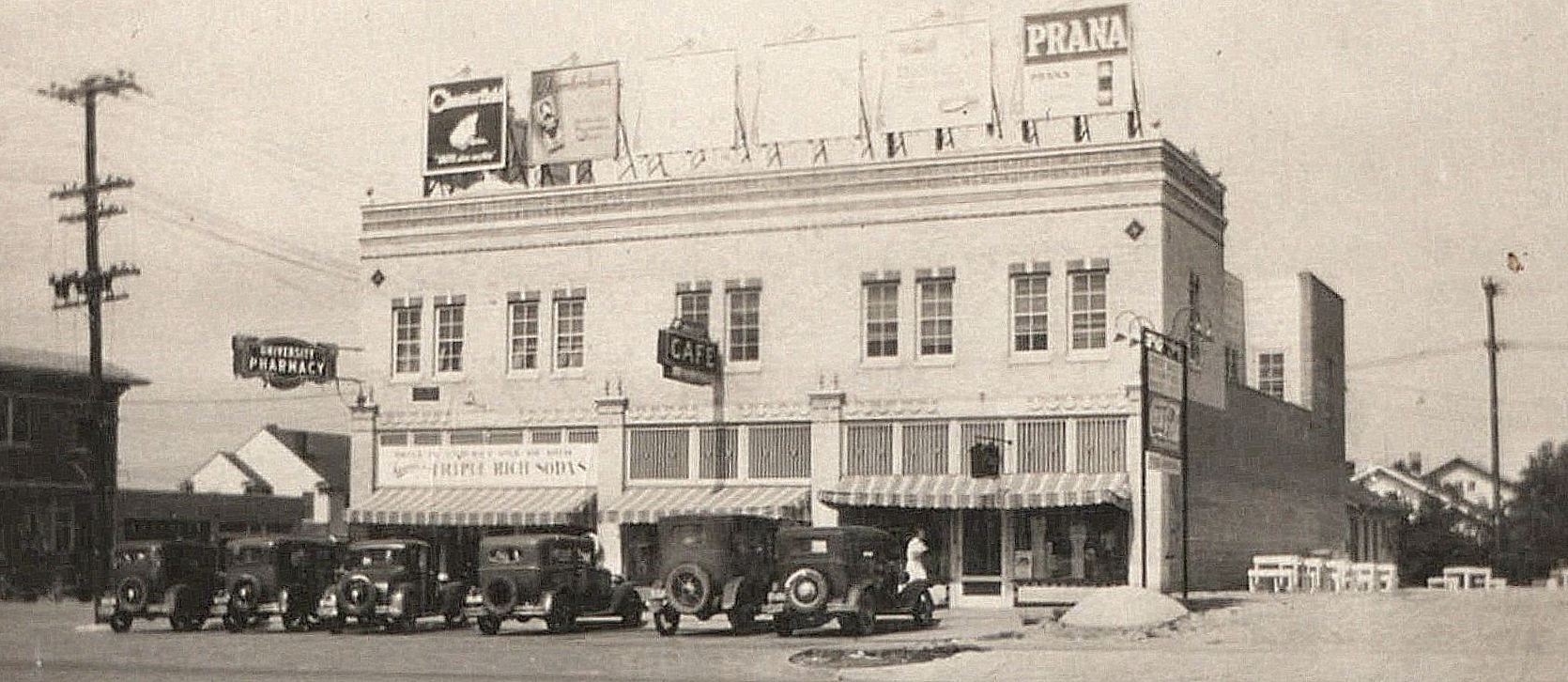
6401 Hillcrest, at McFarlin (1931). The Couch Building, which burned down a few years ago — I wrote about that building here. (Brown Books page is here.) I **LOVE** this photo. I love the billboards on top of the building.
6401-hillcrest_brown-bks_university park_1931_couch-bldg

*

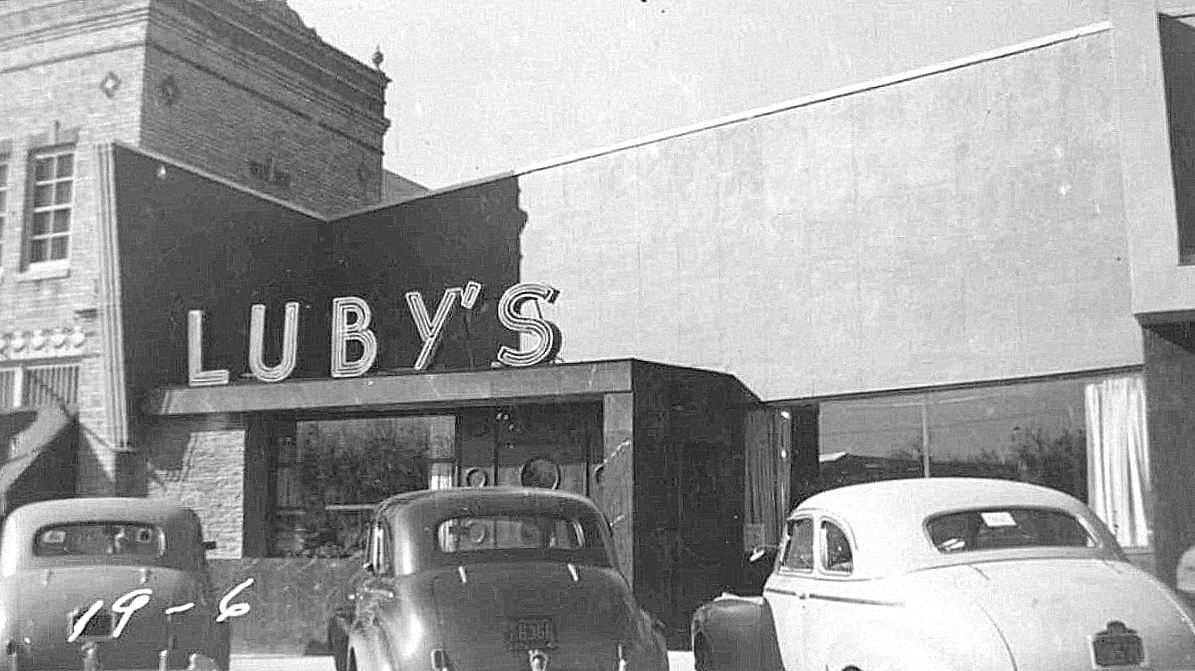
6407 Hillcrest (1948). Luby’s! What an interesting design. (Brown Books page is here.)
6407-hillcrest_brown-bks_univeristy-park_1948_lubys

*

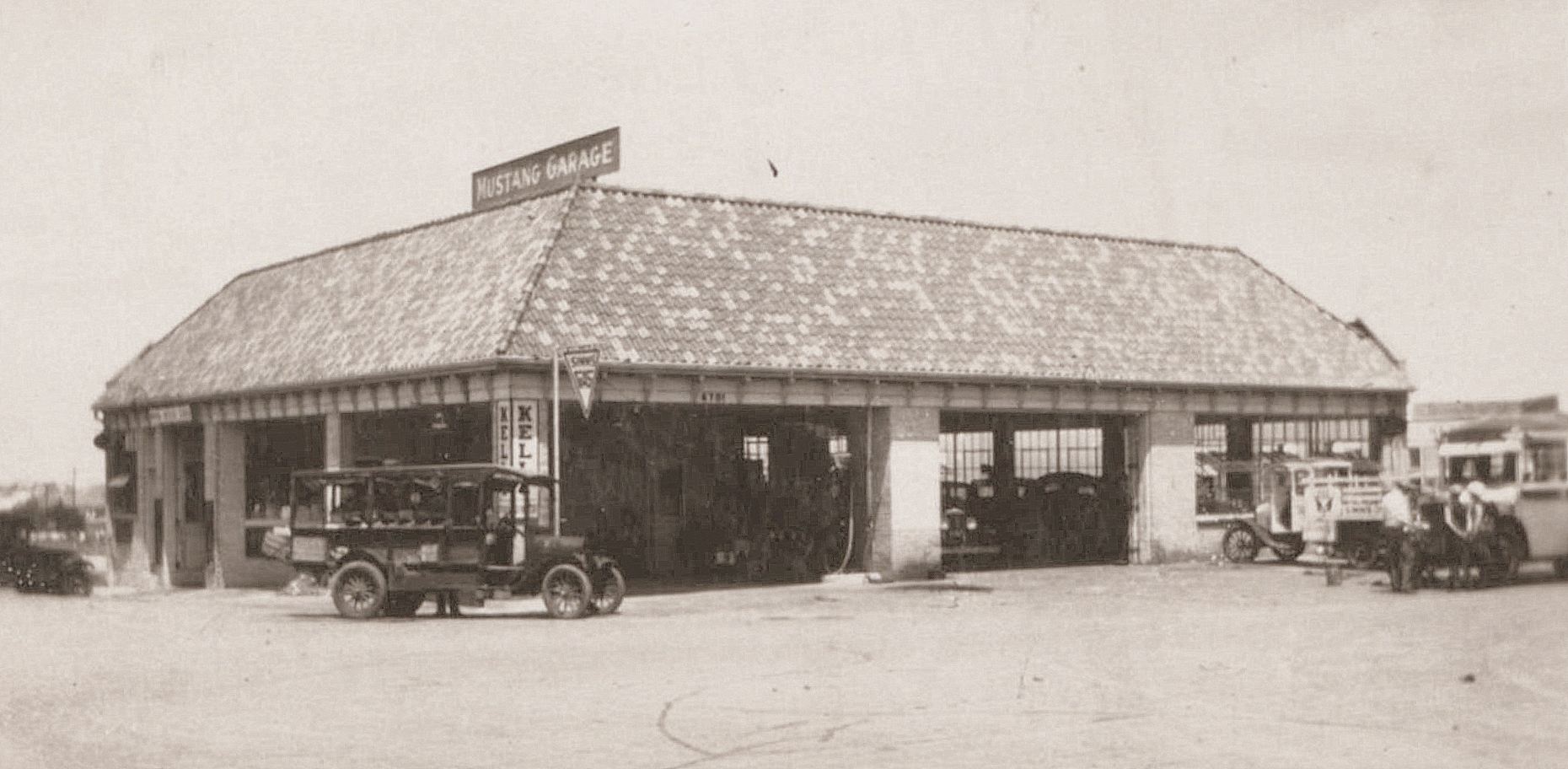
6601 Hillcrest (1931). The Mustang Garage — but instantly recognizable today as the home of JD’s Chippery and Cotton Island. (Brown Books page is here.)
6601-hillcrest_mustang-garage_brown-bks_university-park_1931

*

And, a few Snider Plaza highlights. First, the photo at the top of this post, the Sinclair service station at 6600 Snider Plaza (1934). (Brown Books page is here.)

*

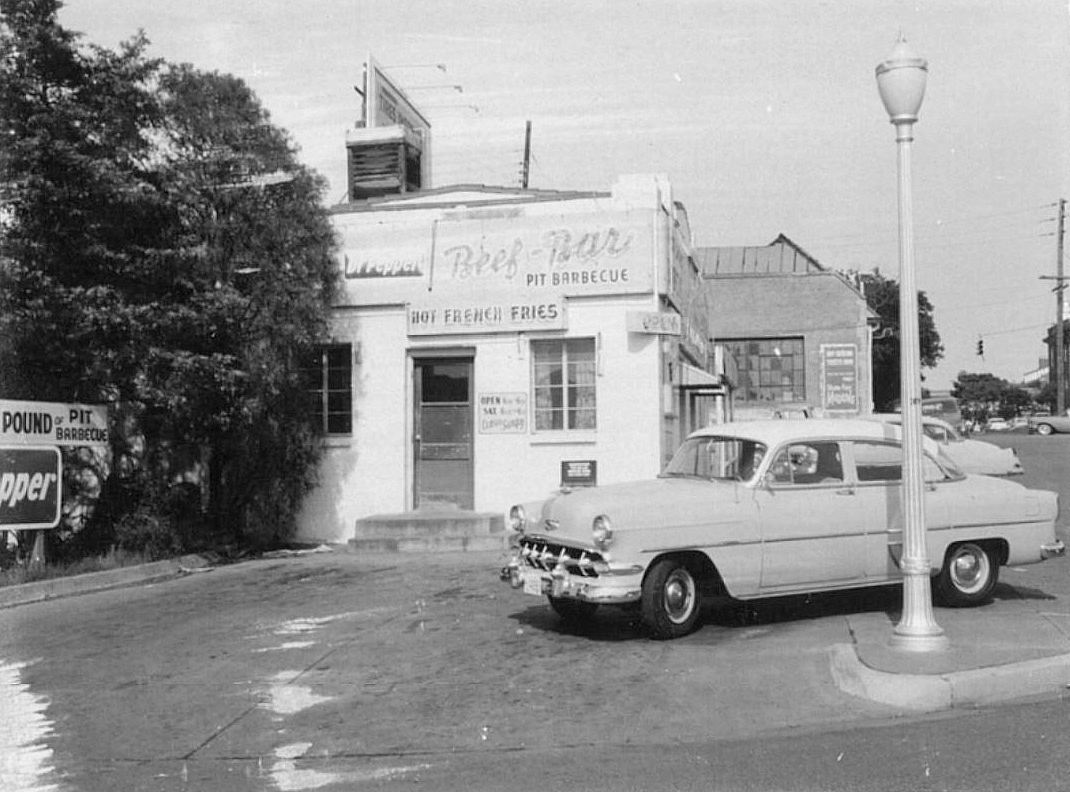
6600 Snider Plaza #313 (no date). The Beef Bar. (Brown Books page is here.) Another fantastic photo! BBQ in UP, before Peggy Sue (RIP).
snider-plaza_brown-bks_university-park_6600-313_nd_beef-bar-pit-barbecue

*

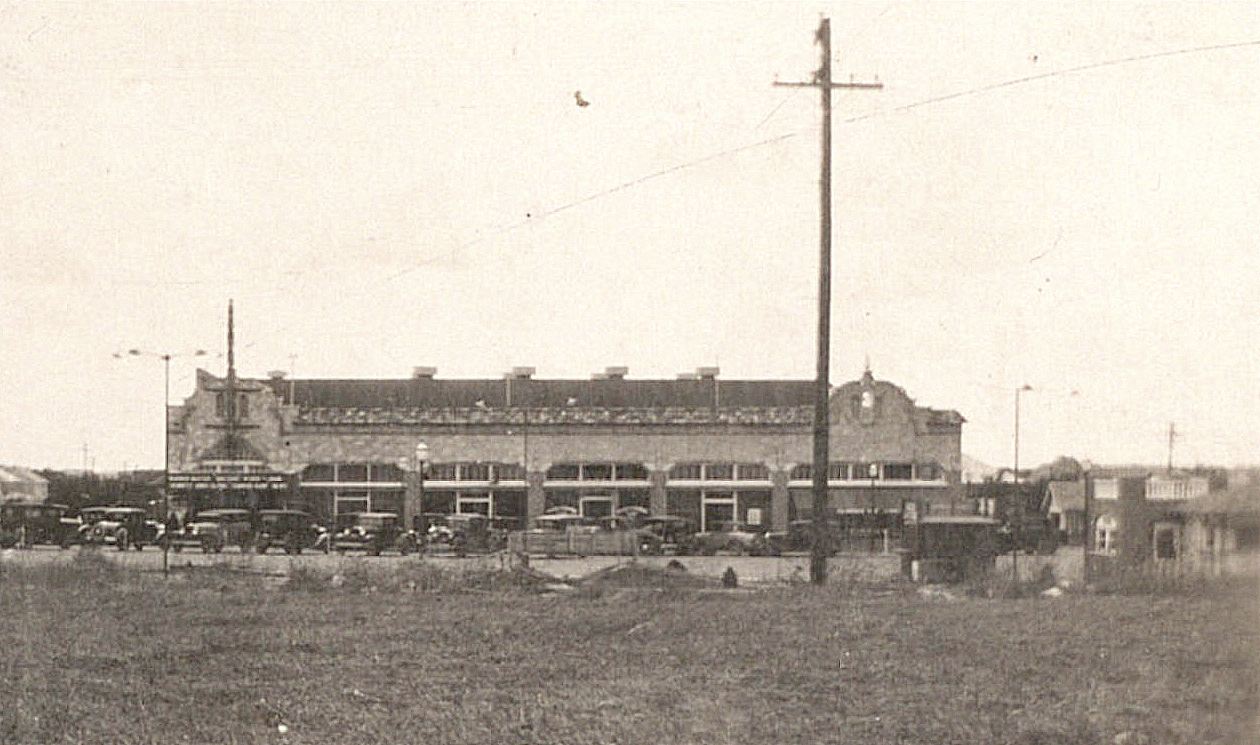
6701 Snider Plaza (1931). Including the Varsity Theater (at the far left) — I wrote about this cool building here. (Brown Books page is here.)
snider-plaza_brown-bks_university-park_6713_1931_movie-theater

*

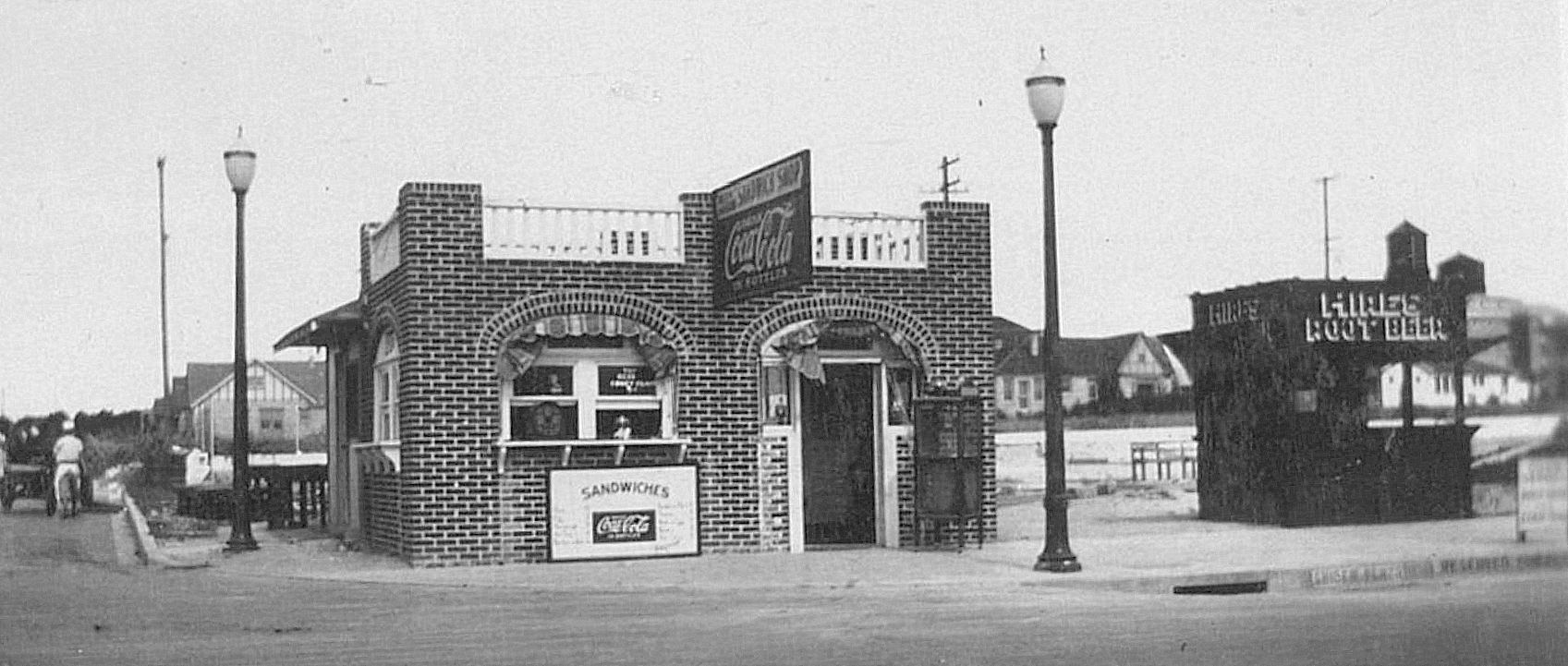
6730 Snider Plaza (1931). A sandwich shop and a Hires Root Beer stand. (Brown Books page is here.)
snider-plaza_brown-bks_university-park_6730_1931_sandwich-shop_hires-root-beer

*

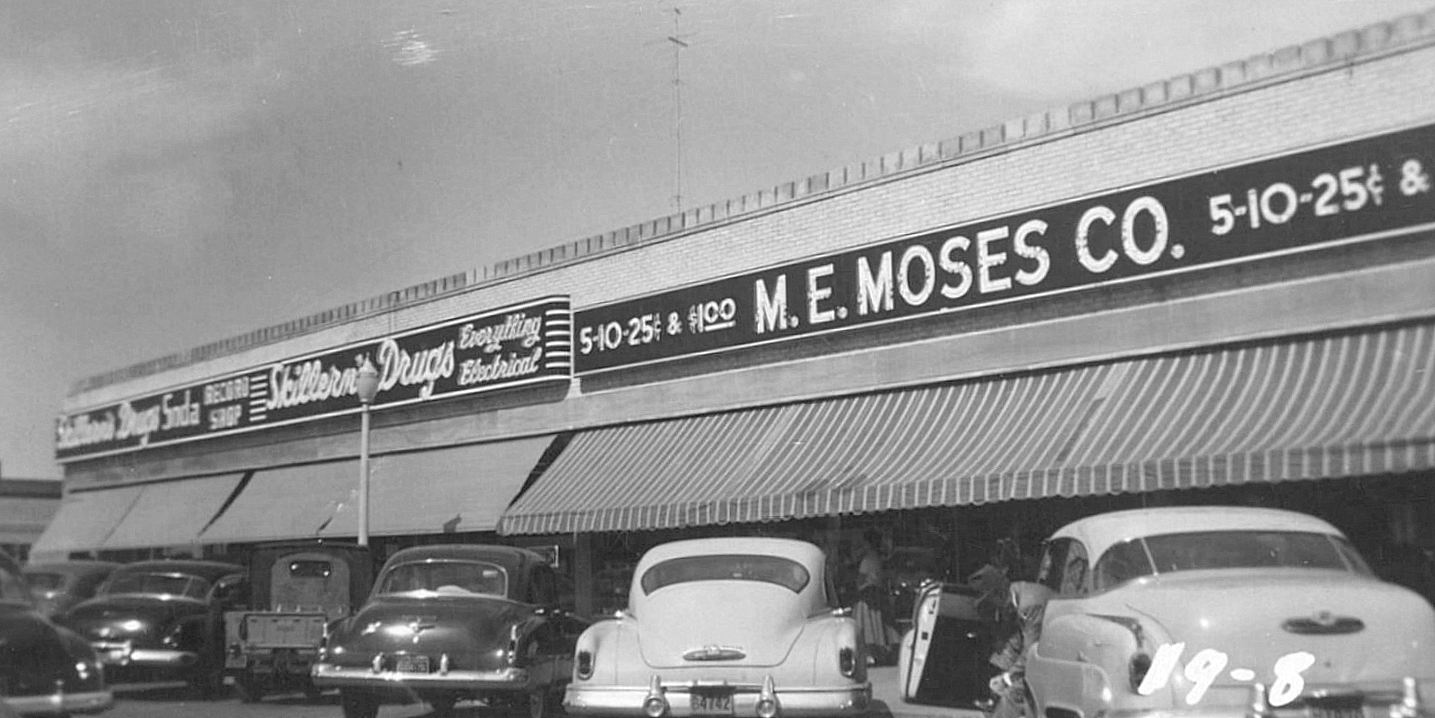
6828 Snider Plaza (1941). Skillern’s Drugs and M. E. Moses. (Brown Books page is here. After a facelift, another photo is here.) I remember spending a lot of time in that dime store when I was a kid — it had a weird change in floor level, which looks like it must have been where a wall had once separated it from the space Skillern’s occupied.
snider-plaza_brown-bks_university-park_6828_1941_moses_skillerns

*

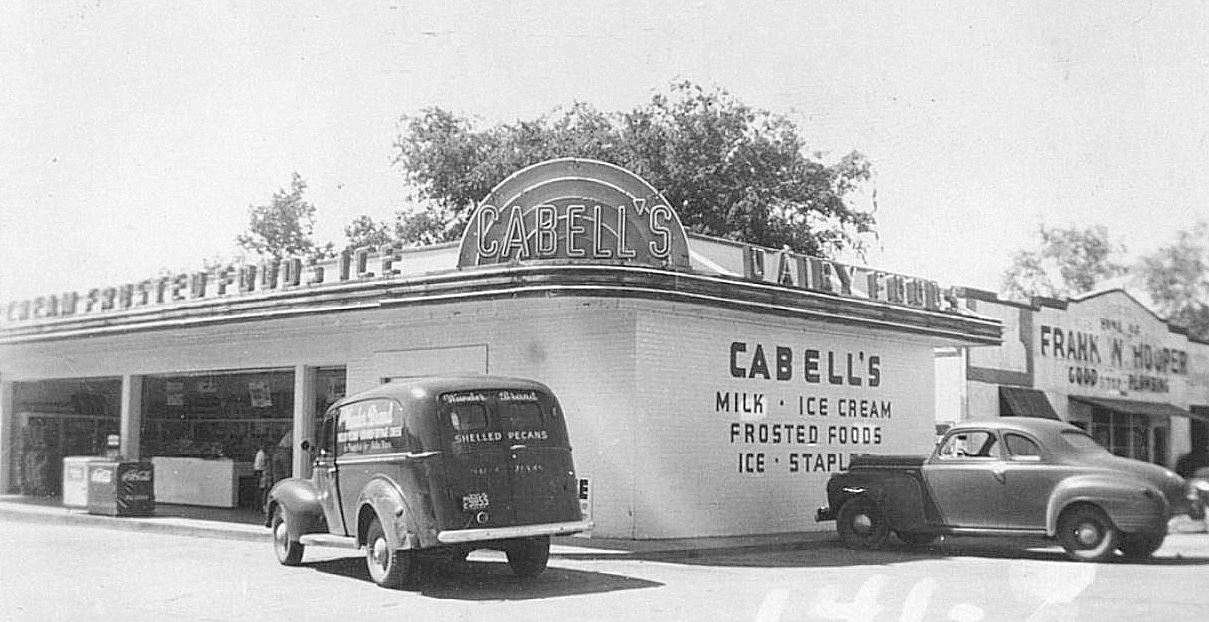
7001 Snider Plaza (1946). Cabell’s. (Brown Books page is here.)
snider-plaza_brown-bks_university-park_7001__1946_cabells

*

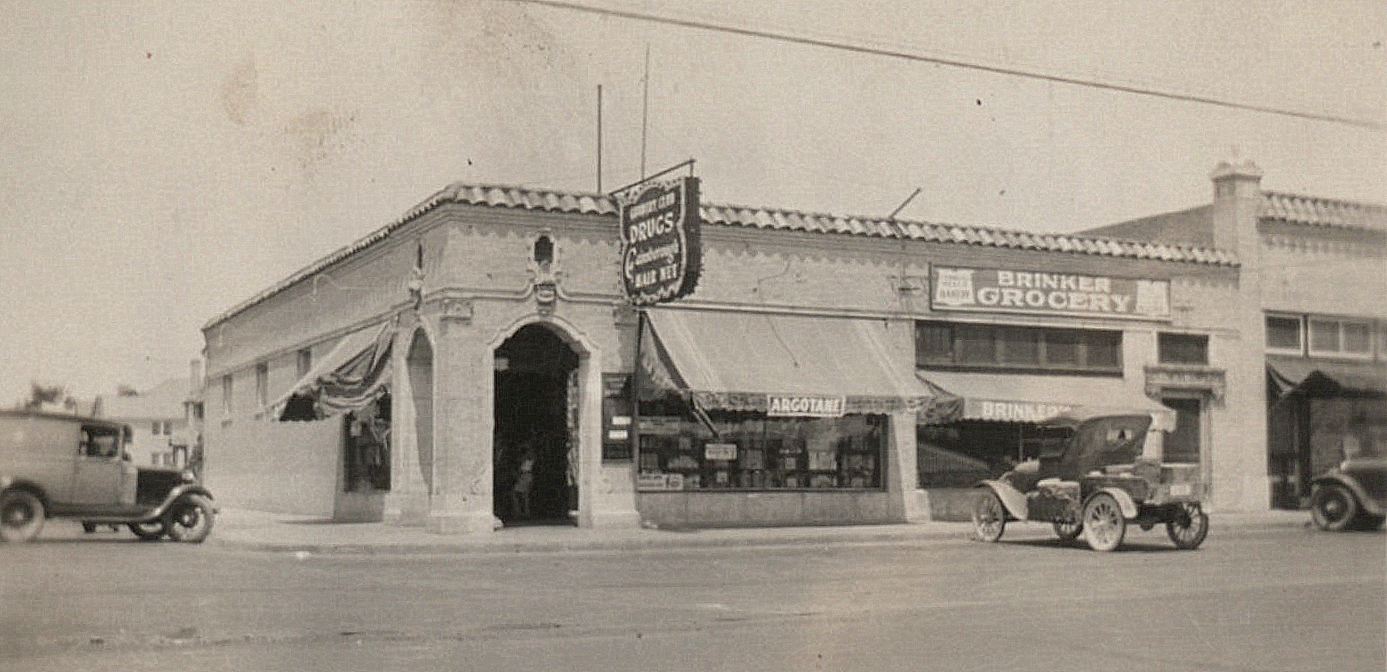
A quick jog over to 6001 Preston Road, at Normandy (1931). Country Club Pharmacy (it later moved to Inwood Road). (Brown Books page is here.) My mother worked for a few years as the office manager for the First Unitarian Church diagonally across from this drug store. When I was a kid hanging out waiting for my mother to finish work, I dropped a LOT of cash at the drug store on Archie comic books.
6001-preston_brown-bks_university-park_1931_drug-store

*

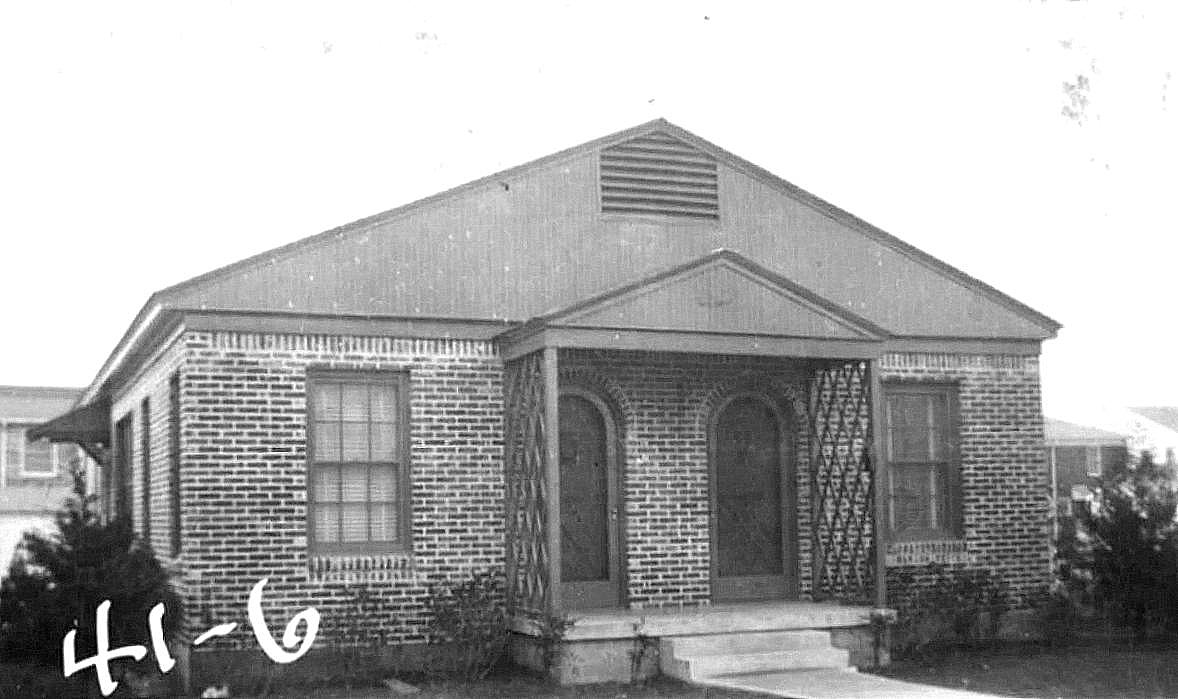
And, lastly, 4129 Lovers Lane (1947). A post-war duplex. (Brown Books page is here.) Every single time I drive down Lovers Lane, I always look forward to seeing this little house which has somehow managed to evade bulldozers. I love this house so much. And this is one of the very few times when I think that it has actually improved in appearance from its original design (see it today on Google Maps here). Hang in there, little house!
4129-lovers-lane_brown-bks_university-park_1947

**

FIND YOUR HOUSE! OR ANOTHER (AT LEAST PRE-1970s) BUILDING IN UNIVERSITY PARK.

  1. Go here. (This is the “welcome page” — if this doesn’t load, go to the UP Public Library blog post here and click through. If you get an error message, go back to “welcome page” and you should see the search page.)
  2. Enter the address (number + street name) you want to find in the search box. You can also just type in a street name, and it will bring up all addresses on that street. (I typed in “Binkley” and got 18 pages of results — seems like overkill, but they’re all in chronological address order.) This works if you enter “Snider Plaza” — take a tour through the Snider Plaza of yesteryear. Some addresses will have more than one sheet. And there’s TONS of info on each property. 

And that’s it! You’ve lost a day! Or several! 

UPDATE: It appears this resource is no longer accessible by the general public. I haven’t checked, but my guess is that it is available only to University Park residents who have a library card. Please say it isn’t so, UP Public Library!

Not 100% sure where the boundaries for University Park are? See a City of University Park map here.

Enjoy!

***

Sources & Notes

Absolutely everything you see here is from the University Park Public Library and the Brown Books in their collection. This is such an amazing resource. Thank you, UPPL and the City of University Park for digitizing these records and putting them online for all of us to use!

And thank you, Rod, for alerting me to this resource which I will be using constantly!

DOES DALLAS HAVE ANYTHING LIKE THIS??? IMAGINE!

snider-plaza_brown-bks_university-park_6600-1934_sinclalir_sm

*

Copyright © 2022 Paula Bosse. All Rights Reserved.
When SMU Theology Students Were Sprayed with Insecticide at a University Park Lunch-Counter Sit-In — 1961

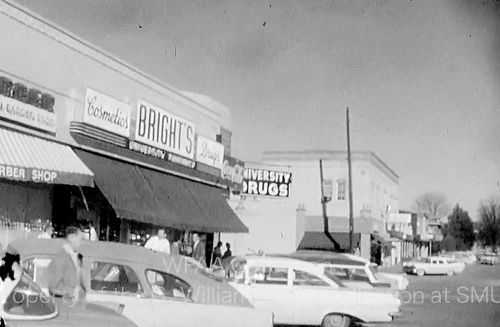
university-pharmacy-protest_WFAA_jan-1961_1Bright’s Drug Store, 6327 Hillcrest, University Park
by Paula Bosse

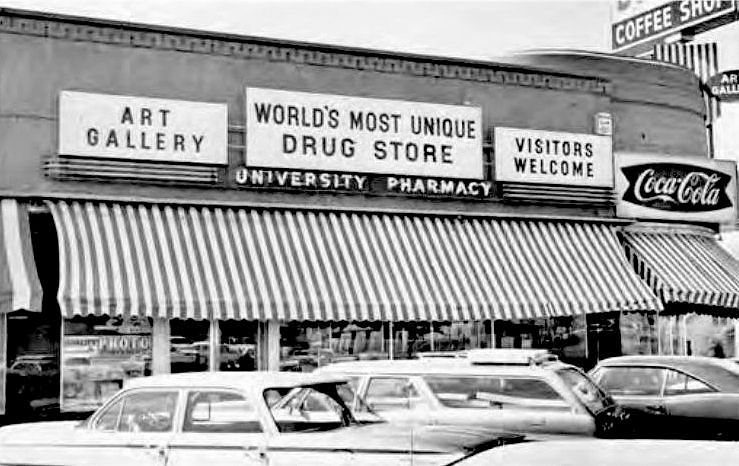
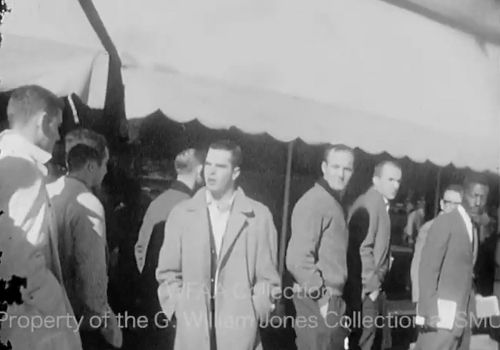
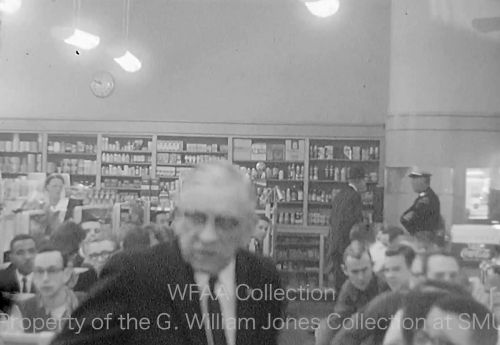
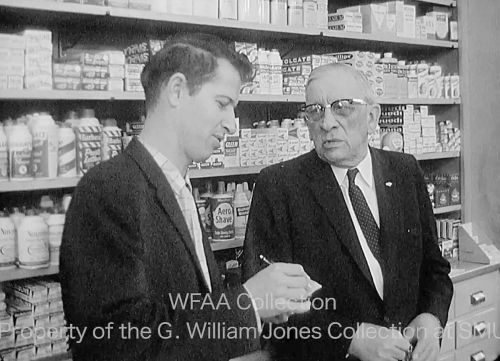
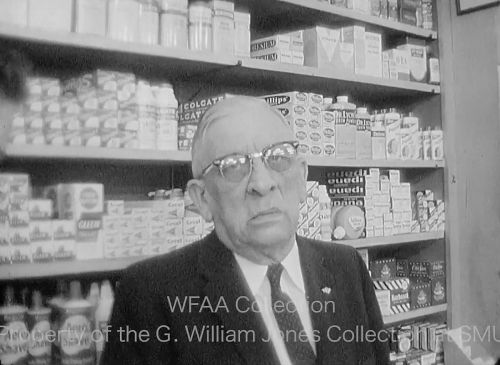
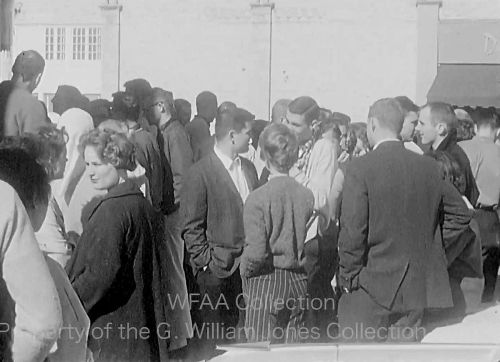
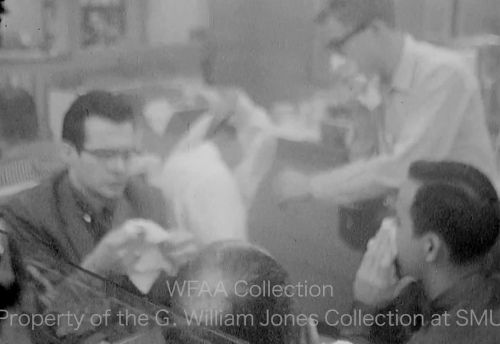
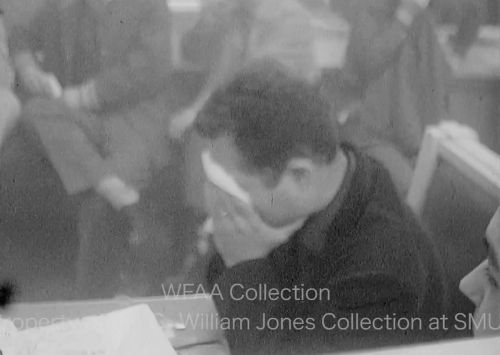
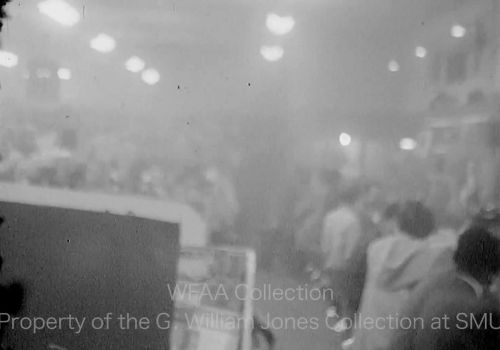
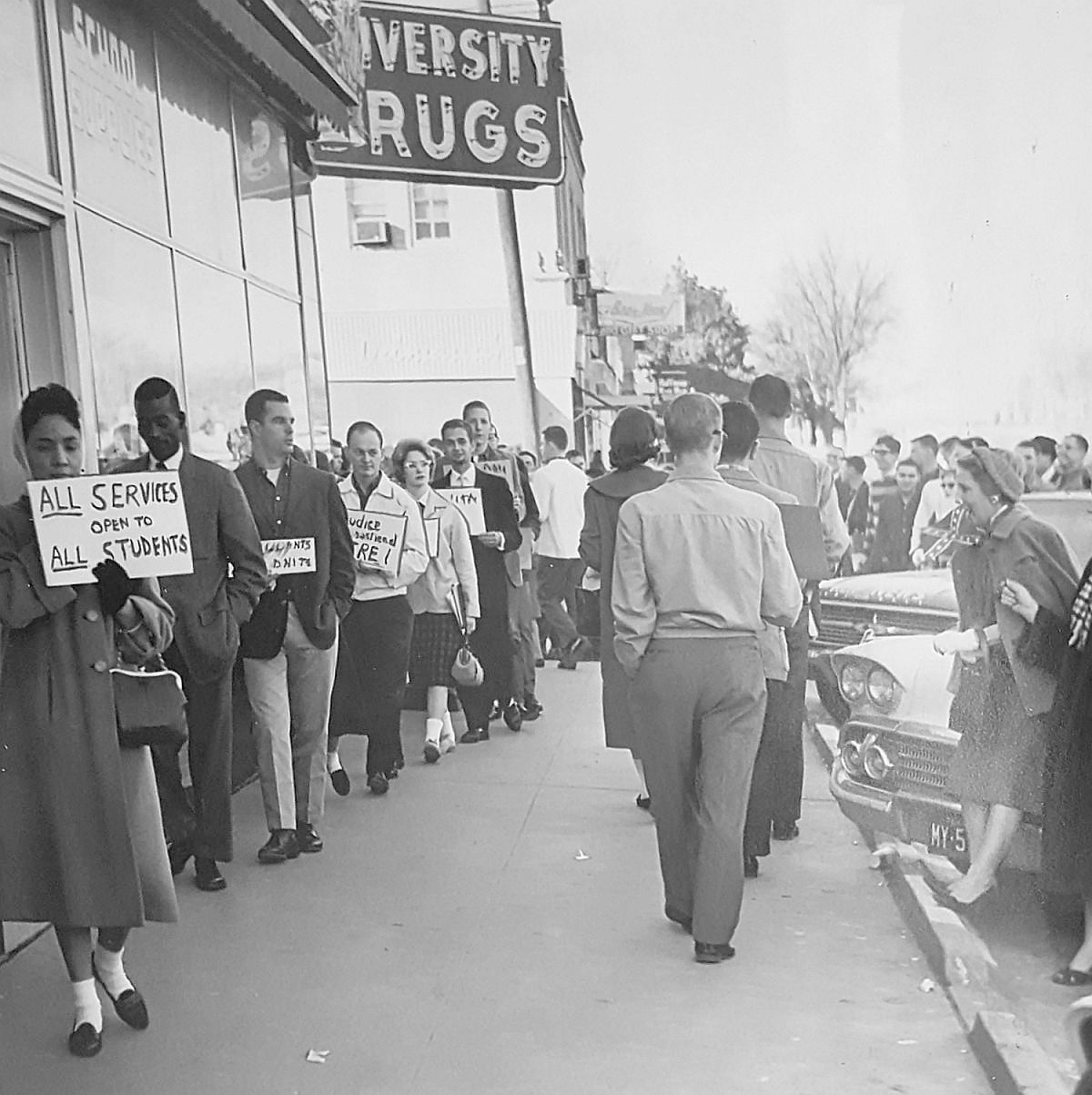
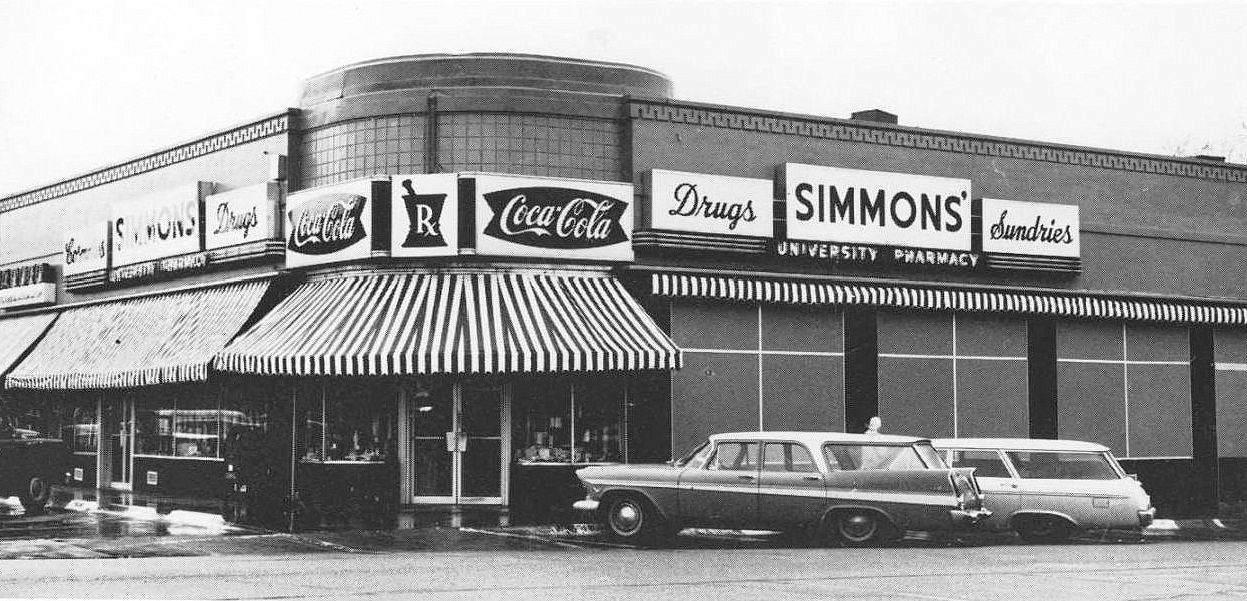
This week the G. William Jones Film & Video Collection at SMU posted another fantastic clip from their WFAA News archive on their YouTube channel. This one shows an incident I had heard about since I was a child. It shows a peaceful “sit-in” demonstration at the University Pharmacy at the southwest corner of Hillcrest and McFarlin, across from the SMU campus. The sit-in was organized by theology students at SMU’s Perkins School of Theology to protest the owner’s refusal to serve Black customers at his lunch counter. The student demonstration was conducted by a group of silent students — it was a peaceful protest without violence. Until, that is, the owner, pharmacist C. R. Bright, called in a fumigator to set off a cloud of insecticide inside the pharmacy in an extreme attempt to run off the protesters. The students did not leave until Bright closed the drug store. Many of the students then picketed in front of the business as anti-protester demonstrators showed up to heckle and jeer, some waving little Confederate flags handed out by Bright. My mother, who lived nearby at the time and had recently graduated from SMU (but was not a theology student) was there, and she says she can still feel the burn of that pesticide in her throat and says that no one present that day could believe a person would do what Bright did. (And she’s in it! She’s seen sitting at the counter, engulfed by a cloud of insecticide.)

Here is the silent clip from January 9, 1961 (the direct link on YouTube is here):


*

I took the photo below at an exhibit at the downtown Dallas Public Library in 2017. It shows the students outside the pharmacy as a crowd jeers at them.

university-drug-store_strike_DPL-exhibit_apr-2017via Dallas Public Library

In 1961, there were only 4 or 5 Black students attending SMU. Black students were allowed to attend only the theology and law schools — there were no Black undergraduates until 1962, when Paula Elaine Jones became the first African American full-time undergraduate student at SMU.

In 1961, African Americans were routinely refused service at white-owned establishments in Dallas (as they were in the rest of the Jim Crow South). The sit-in at the University Pharmacy was the result of a Black theology student being refused service at Bright’s lunch counter. There had been a small demonstration at the drug store a couple of nights before the one seen in the film above — it ended when Bright closed early. 

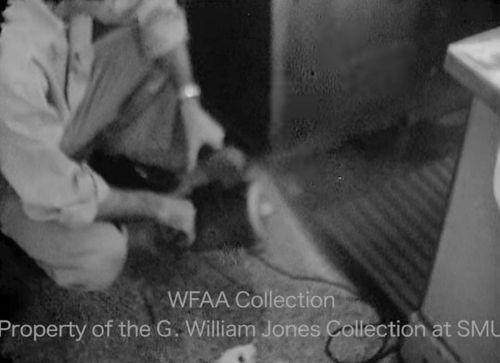
The sit-in that grabbed the headlines began around 10:00 on the morning of Monday, Jan. 9, 1961, when 60-75 SMU students, including Black theology students Earl Allen and Darnell Thomas, entered the drug store and sat silently at the counter and in booths. Allen and Darnell were refused service. In protest, the large group of students refused to leave. After about an hour, Bright was quoted by a WBAP news reporter as saying, “This is a good time to kill some cockroaches…” and called an exterminator service. When the exterminators arrived, they turned on fumigating machines inside the business, filling the place with clouds of kerosene-based insecticide which covered the students, the lunch counters, the dishes, the food, and the store’s merchandise. (Bright was a pharmacist, who was no doubt aware of potential physical harm this would cause.)

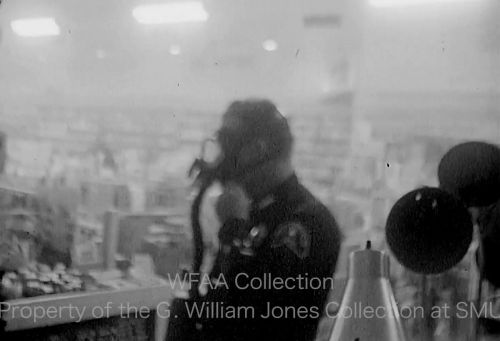
The students sat there, breathing through handkerchiefs and holding their ground, silent. A University Park policeman, Lt. John Ryan was there, but the police were not actively involved (although Ryan did have a handy gas mask). After half an hour, the students left when Bright closed the store. Bright re-opened an hour or two later (the lunch counter remained closed). Students silently picketed as hecklers jeered.
The SMU student newspaper — The SMU Campus — covered the sit-in. The article contained an unsurprising, unapologetic quote from the 75-year-old C. R. Bright: 

Bright steadfastly refuses to integrate his lunch counter. Says the drug store owner, “We are not serving them now and we’ll never serve them.” He continues to explain that it “is against my principle” and “I know it would wreck my business.” (The SMU Campus, Feb. 1, 1961)

Bright retired soon after and sold the business to an up-and-coming young whippersnapper named Harold Simmons, who went on to build a multi-multi-multi-million-dollar empire from that first business investment.

university-drug-store_smu-archivesvia DeGolyer Library, SMU

university-pharmacy_smu-rotunda_1965via 1965 SMU Rotunda

*

university-pharmacy-protest_WFAA_jan-1961_2

university-pharmacy-protest_WFAA_jan-1961_3

university-pharmacy-protest_WFAA_jan-1961_4_c-r-bright

university-pharmacy-protest_WFAA_jan-1961_5_c-r-bright

university-pharmacy-protest_WFAA_jan-1961_6

university-pharmacy-protest_WFAA_jan-1961_7

university-pharmacy-protest_WFAA_jan-1961_8

university-pharmacy-protest_WFAA_jan-1961_9

university-pharmacy-protest_WFAA_jan-1961_10

university-pharmacy-protest_WFAA_jan-1961_11_UP-policeman

*

UPDATE, BURY THE LEDE DEPT: Thanks to comments by two readers, I have learned that Christopher R. Bright was the father of former Dallas Cowboys owner H. R. “Bum” Bright. Oh dear.

***

Sources & Notes

All screenshots are from WFAA news footage from the WFAA News Film Collection, G. William Jones Film & Video Collection, Hamon Arts Library, Southern Methodist University; the clip has been posted to the SMU Jones Film channel on YouTube here.

Read coverage of the sit-in (as well as a critical editorial which called the protest “immoral”) in the Feb. 1, 1961 edition of The SMU Campus, the student newspaper — it can be accessed on the SMU Libraries website here, or it can be read in a PDF I’ve made, here

Read a lively account of the sit-in in a WBAP-Channel 5 news script here (via the Portal to Texas History).

For those with access to the Dallas Morning News archives, the incident is covered in an article by Jim Lehrer: “Protesting Students Sit In, Walk Picket Line at Store” (DMN, Jan. 10, 1961). 

Another great clip showing a historical lunch-counter protest in Dallas (the city’s first, I believe) in April of 1960 is also available on the SMU Jones Film YouTube channel — it can be viewed here. Here is a description of what’s happening in the footage: “Rev. Ashton Jones, a white minister from Los Angeles, and Rev. T. D. R. V. Thompson, Black pastor of the New Jerusalem Institutional Missionary Baptist Church, 2100 Second Avenue, together visit segregated lunch counters in downtown Dallas department stores; the peaceful sit-in protests take place at the counters of the Kress Department Store, the H. L. Green Department Store, and the Tea Room of Sanger Bros. department store. This was the first publicized demonstration against Dallas’ segregated eating establishments, and several members of the media — both white and African American — are covering the historic event (Silent).”

Lastly, in a related Flashback Dallas post, there was a previous University Pharmacy which was located, at separate times, on the northwest and southwest corners of Hillcrest and McFarlin — the owner of the very first University Pharmacy built the Couch Building, which can be seen in the background of the top photo of this post. That earlier post, “University Park’s “Couch Building” Goes Up In Flames (1929-2016),” can be found here. A pertinent 1965 photo from that post which shows Simmons’ University Pharmacy, the Couch Building, and the Toddle House (which was also the site of a 1961 sit-in by SMU students) can be seen here.

university-pharmacy-protest_WFAA_jan-1961_1_sm

*

Copyright © 2022 Paula Bosse. All Rights Reserved.

Black Dallas — 1973

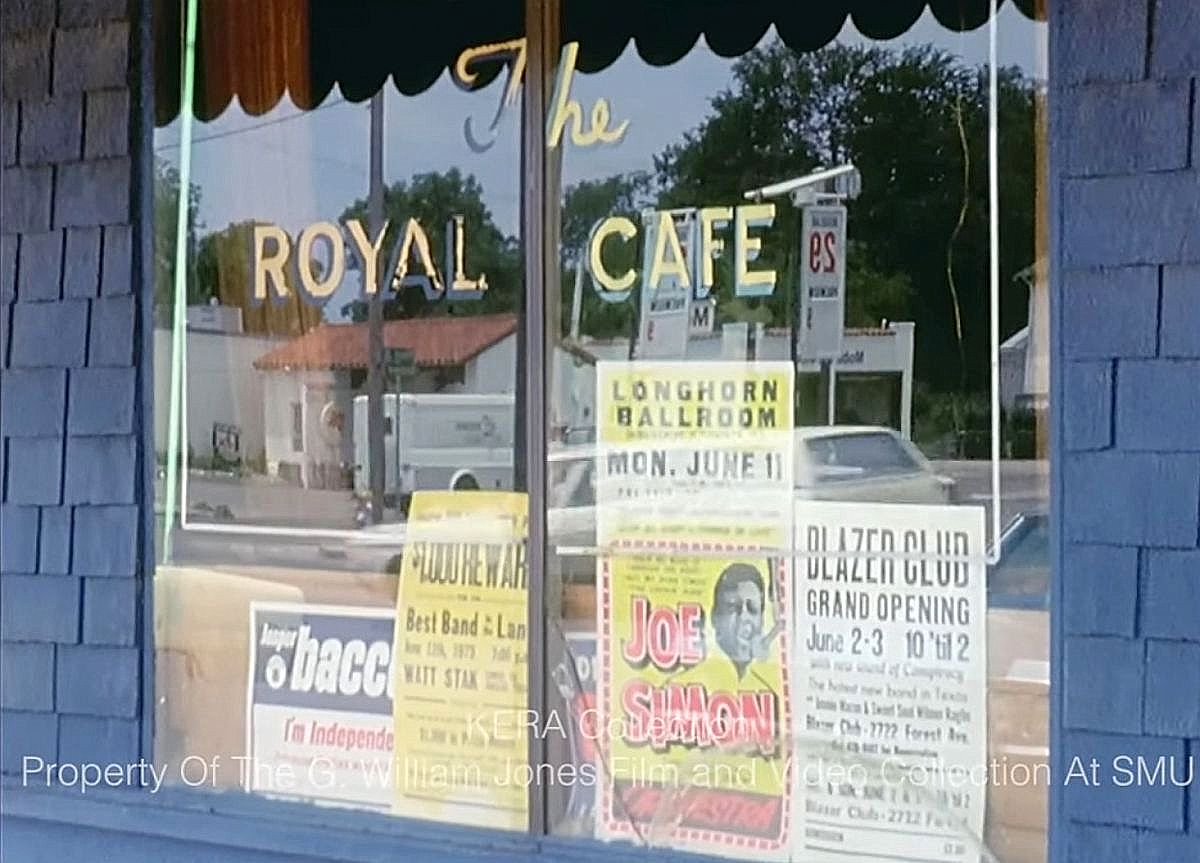
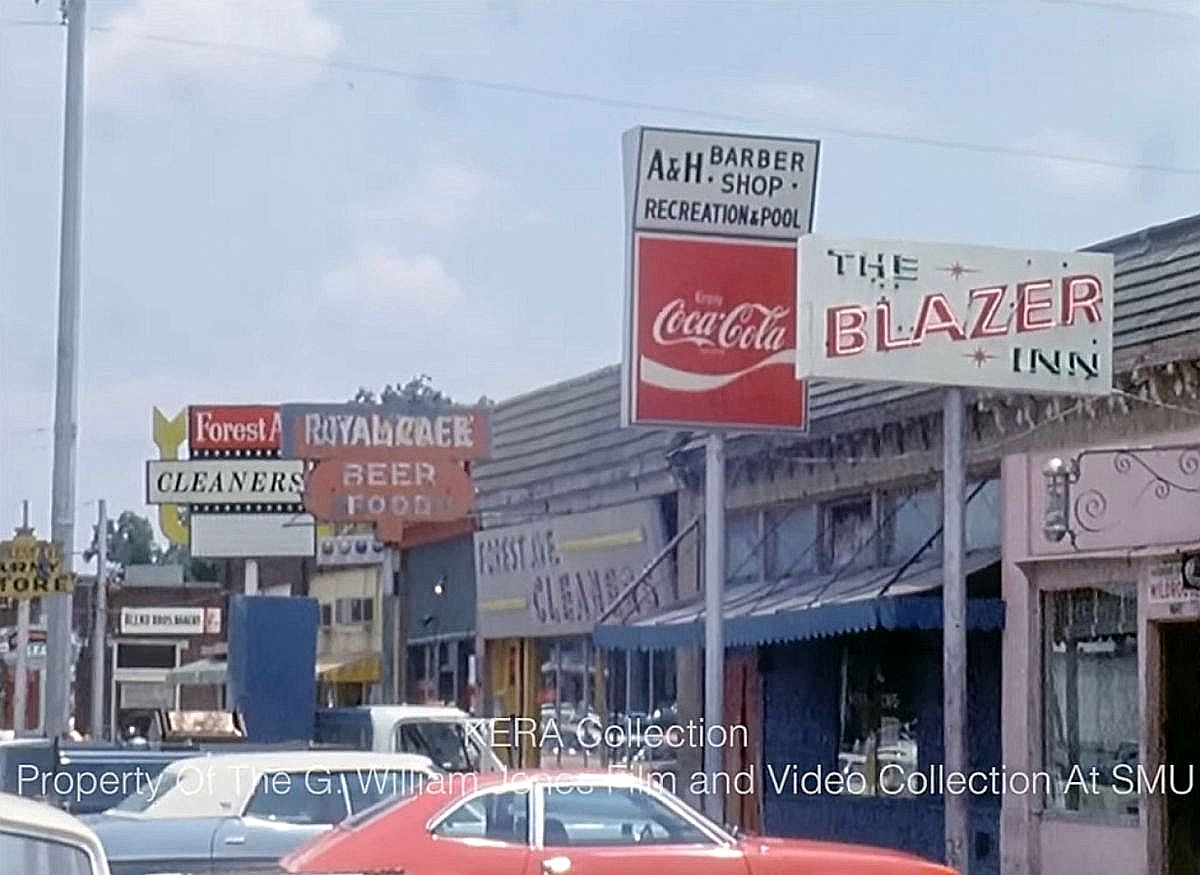
royal-cafe_june-1973_kera-collection_jones-collection_SMURoyal Cafe, 2726 Forest Avenue (now MLK Blvd.)

by Paula Bosse

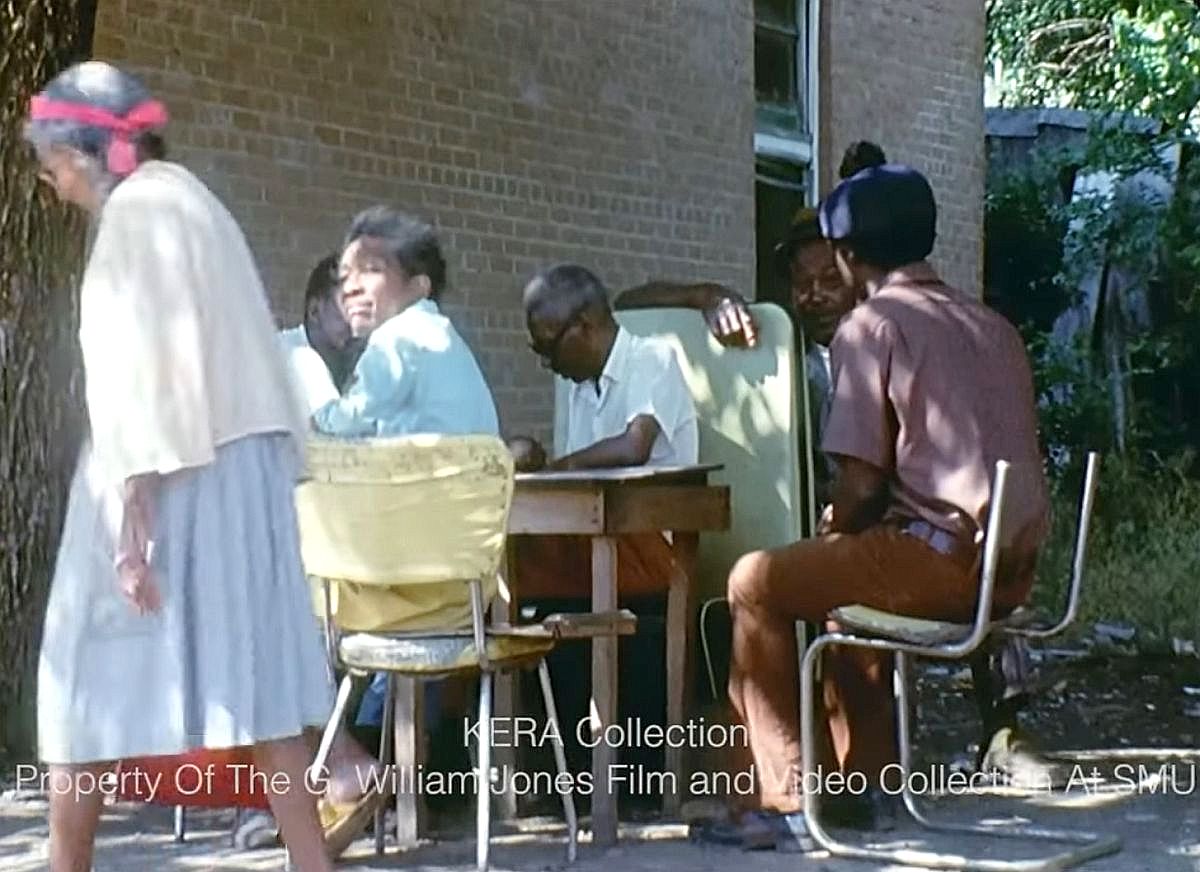
The G. William Jones Film and Video Collection at SMU is the gift that keeps on giving (see their YouTube channel here). In addition to their vast non-Dallas-history holdings, they are the repository of the WFAA news film archives, which is an incredible collection of local news segments from Channel 8. And now they’ve begun digitizing and uploading film from KERA-Channel 13. There are all sorts of clips posted on the YouTube channel so far — I really, really loved the Blackie Sherrod profile — and I’m not even a sports fan! My guess is that a lot of it comes from the legendary local news show Newsroom, including the one I’m writing about here.

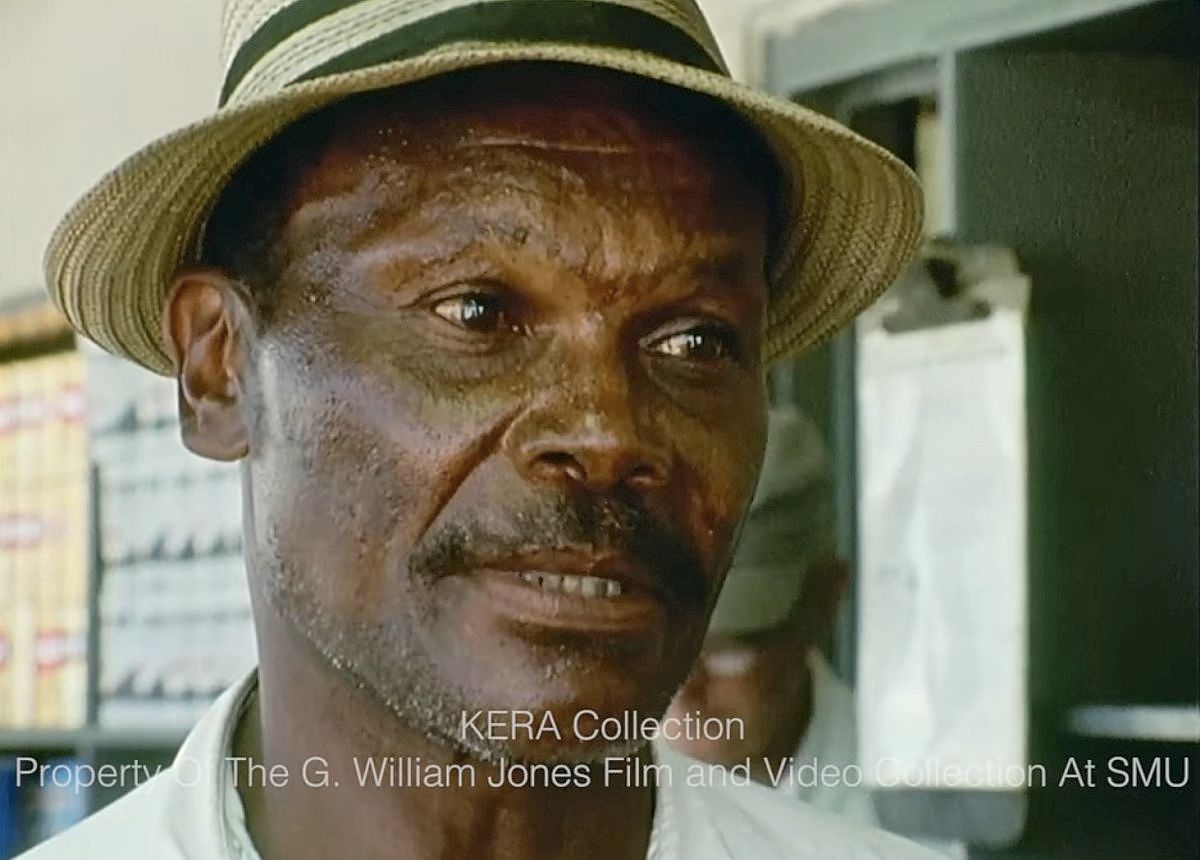
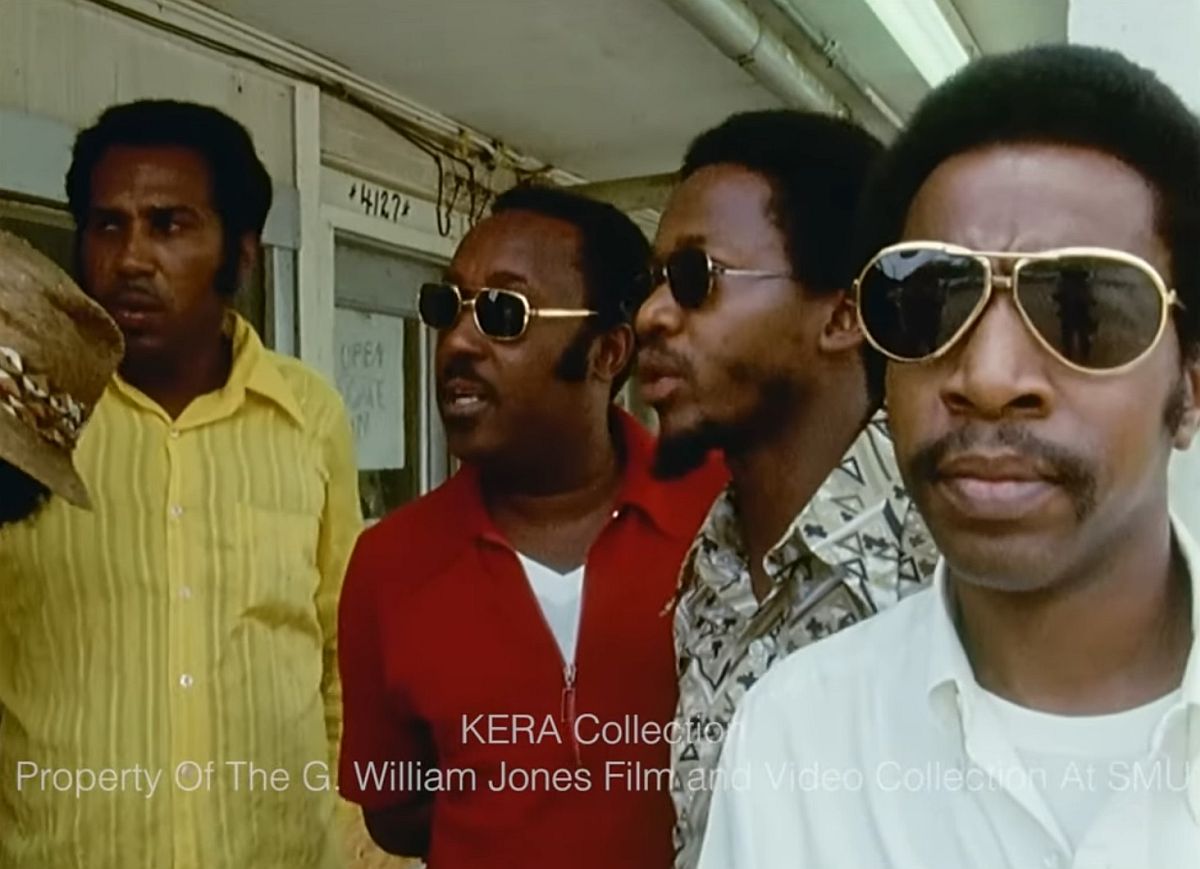
This story from 1973 was about a recent increase in crime in the Black neighborhoods of South Dallas and State-Thomas/Hall Street. Crime stories are pretty much the same decade in and decade out, but this piece is great because of the almost 8 full minutes of footage showing parts of town that the media largely ignored (ignores). I haven’t seen most of these areas as they existed when this piece was shot — many of these buildings don’t exist at all anymore. A couple of these places are “famous,” most are not. But this is just great. (Scroll to the bottom of the post for places and addresses seen in the film.)

*

I was particularly excited to see the exterior of the Ascot Room, which I wrote about in the Flashback Dallas post “1710 Hall: The Rose Room/The Empire Room/The Ascot Room — 1942-1975” — it was an important music club, but I had been unable to find any images of its exterior. Until now! Granted, it’s looking a bit long in the tooth in 1973, but this was so cool to see!

ascot-room_june-1973_kera-collection_jones-collection_SMUAscot Room (1710 Hall, at Ross)
*

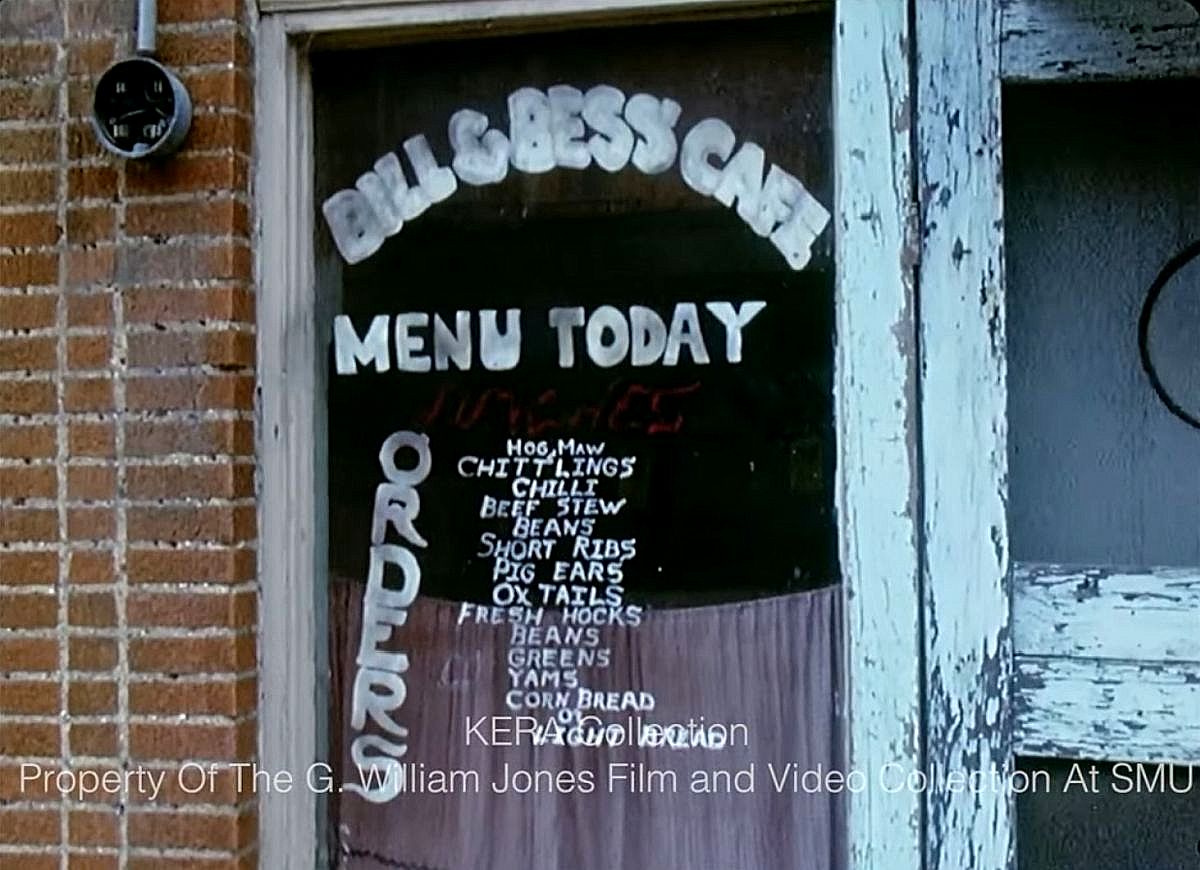
bill-and-bess-cafe_june-1973_kera-collection_jones-collection_SMUBill & Bess’ Cafe
*

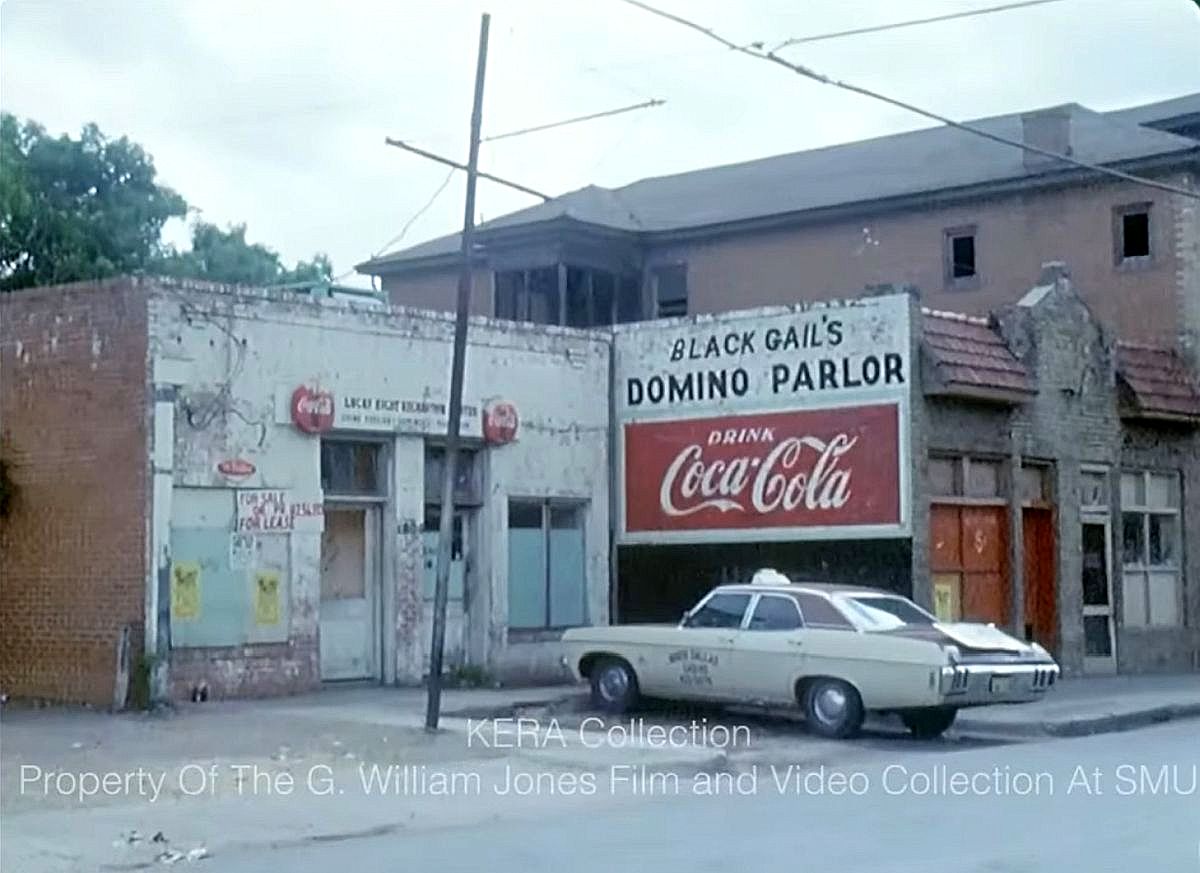
black-gails-domino-parlor_june-1973_kera-collection_jones-collection_SMULucky Eight Recreation Center (1804 Hall); Black Gail’s Domino Parlor
*

man-1_june-1973_kera-collection_jones-collection_SMU

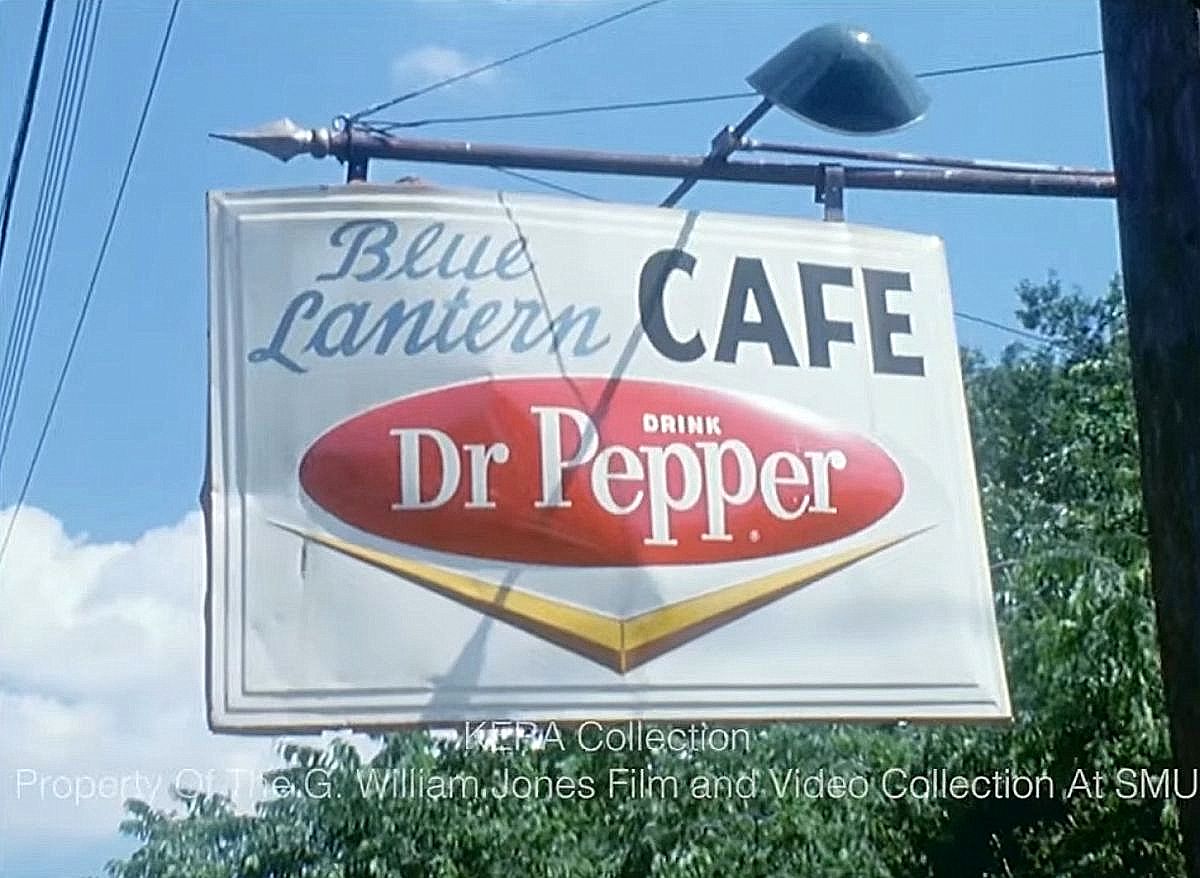
blue-lantern-cafe_june-1973_kera-collection_jones-collection_SMUBlue Lantern Cafe (1609 Hall)
*

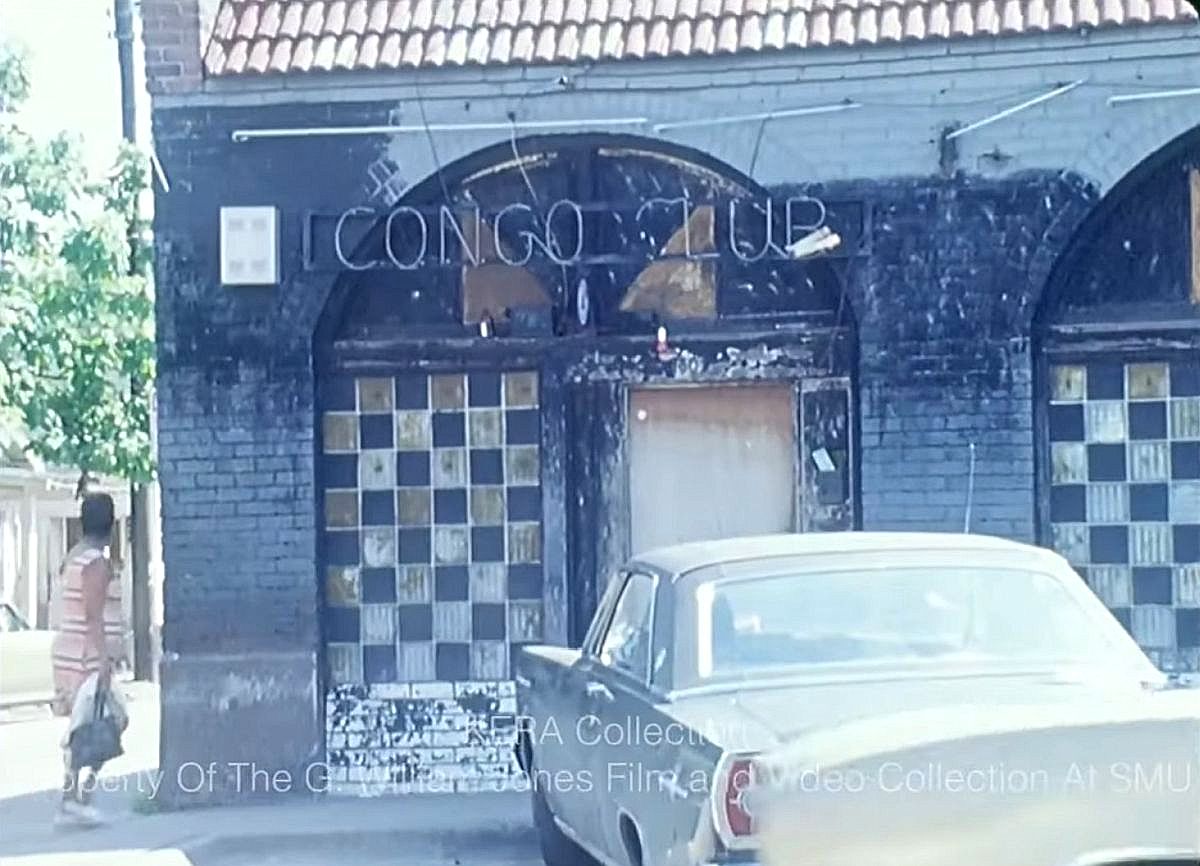
congo-club_june-1973_kera-collection_jones-collection_SMUCongo Club (1801 Hall, at Roseland)
*

domino-game_june-1973_kera-collection_jones-collection_SMU

e-tx-bbq_june-1973_kera-collection_jones-collection_SMUEast Texas Bar-B-Q/East Texan Barbecue (2311 Hall)
*

man_june-1973_kera-collection_jones-collection_SMU

forest-ave_june-1973_kera-collection_jones-collection_SMU2700 block of Forest Avenue (now Martin Luther King Jr. Blvd.)
*

hall-st_june-1973_kera-collection_jones-collection_SMU1700 block of Hall Street, north from Ross
*

houses_june-1973_kera-collection_jones-collection_SMU

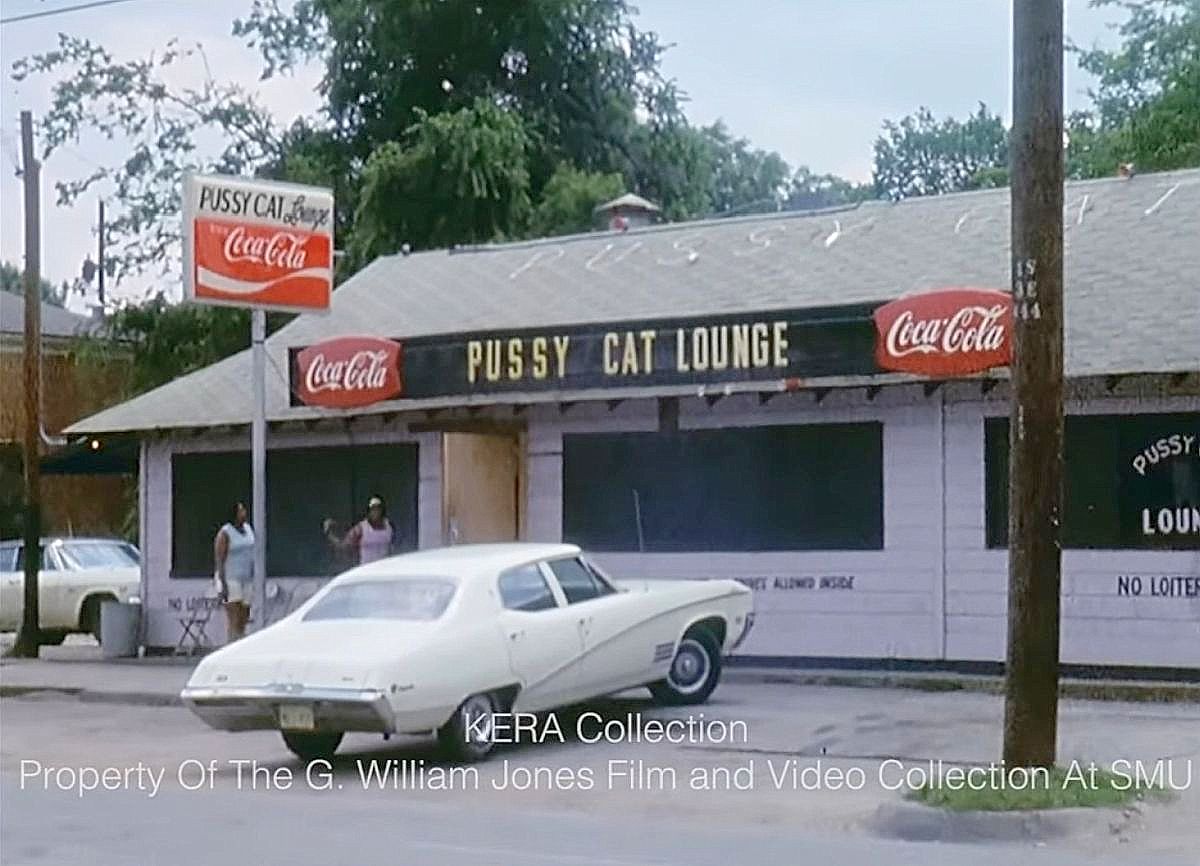
pussy-cat-lounge_june-1973_kera-collection_jones-collection_SMUPussy Cat Lounge (3410 Forest Ave. — now part of Fair Park)
*

men_june-1973_kera-collection_jones-collection_SMU

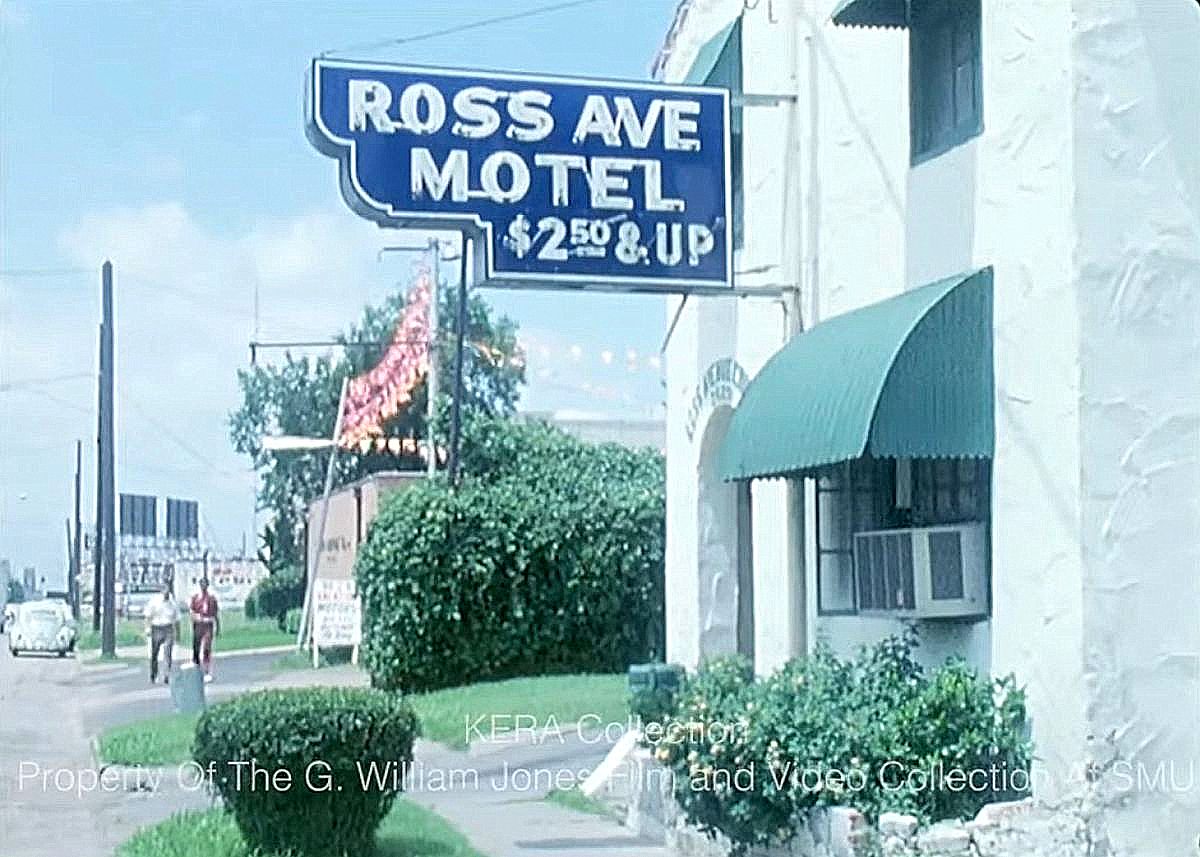
ross-avenue-motel_june-1973_kera-collection_jones-collection_SMURoss Avenue Motel (3629 Ross) — see what it looked like new here
*

south-blvd_june-1973_kera-collection_jones-collection_SMU2700 block of South Boulevard

Very cool! Thanks, SMU!

**

Here are some of the places seen in the film, with addresses (if I could find them), in the order they appear (several places make more than one appearance):

  • Pussy Cat Lounge:  3410 Forest Avenue (now MLK Blvd.)
  • Elite Theater (sign):  2720/2722 Forest Ave. (closed; originally the White Theater, which opened in 1934)
  • Blazer Inn:  2722 Forest (in the old theater)
  • A & H Barber Shop, Recreation, Pool:  2724 Forest
  • Royal Cafe:  2726 Forest
  • Royal Barber Shop:  1813 Hall
  • Soul Shop
  • Hall’s Hotel:  1809 1/2 Hall
  • Corner of Hall & Roseland
  • Busy Bee Cafe:  1612 Hall
  • Red Door
  • Black Gail’s Domino Parlor:  1802 Hall
  • Congo Club:  1801 Hall (at Roseland)
  • Ascot Room:  1710 Hall (at Ross)
  • East Texas Bar-B-Q (listed in directories as East Texan Barbecue):  2311 Hall
  • Mary’s Place
  • Bill & Bess’ Cafe
  • Watson’s Cafeteria:  1715 Hall
  • Jim’s Liquor:  1713 Hall
  • Alvacado Inn:  1726 Hall
  • Stewart Motors:  3509 Ross
  • Vacation Motors:  3623 Ross
  • Ross Avenue Motel:  3629 Ross
  • 1600 block of Hall, looking toward Ross
  • Your Thrift Shop:  1622 Hall (warehouse), 3302 Ross
  • Forest Avenue Store:  2716-A Forest
  • Hooper’s Jeweler:  2720 Forest
  • Front of old Elite Theater, then the Blazer Inn:  2722 Forest
  • 2700 block of South Blvd. shows homes at 2707 South Blvd. and 2711 South Blvd.
  • Liberty Bail Bond Service:  1611 Hall (Theodore Greer, bondsman)
  • Blue Lantern Cafe:  1609 Hall
  • Dallas Police Substation:  Bexar and Municipal streets

***

Sources & Notes

All images are screenshots from the YouTube video “KERA Report On Crime In Dallas — June 1973,” from the KERA Collection, G. William Jones Film and Video Collection, Hamon Arts Library, Southern Methodist University.

royal-cafe_june-1973_kera-collection_jones-collection_SMU_sm

*

Copyright © 2021 Paula Bosse. All Rights Reserved.

Ross Graves’ Cafe: 1800 Jackson — 1947

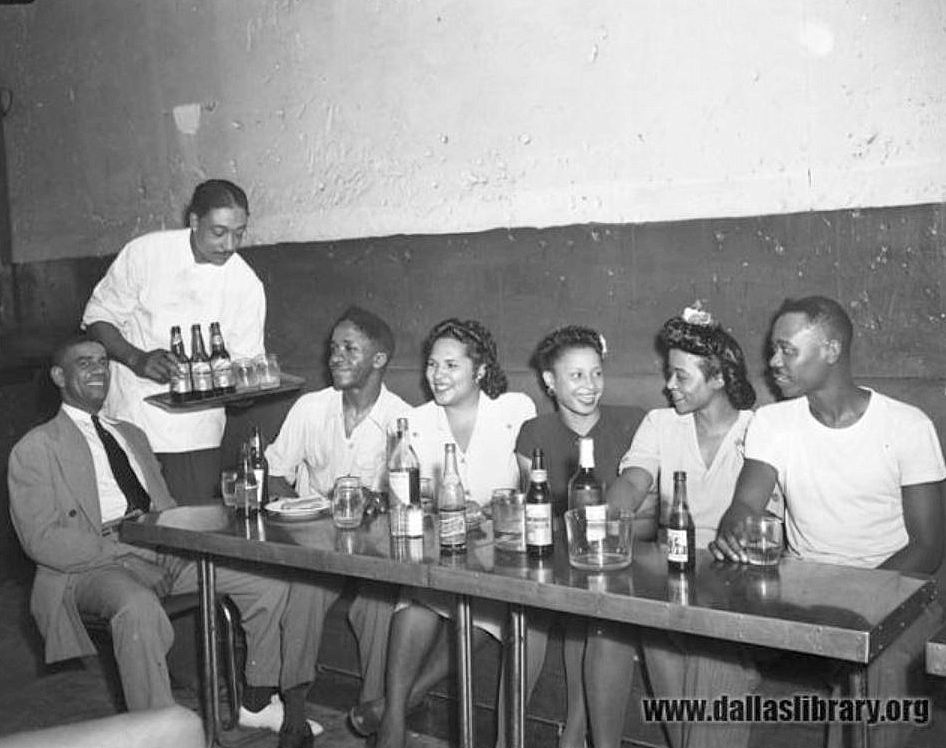
graves-cafe_marion-butts_dpl_1947_cashierGraves Cafe… (photo by Marion Butts/Dallas Public Library)

by Paula Bosse

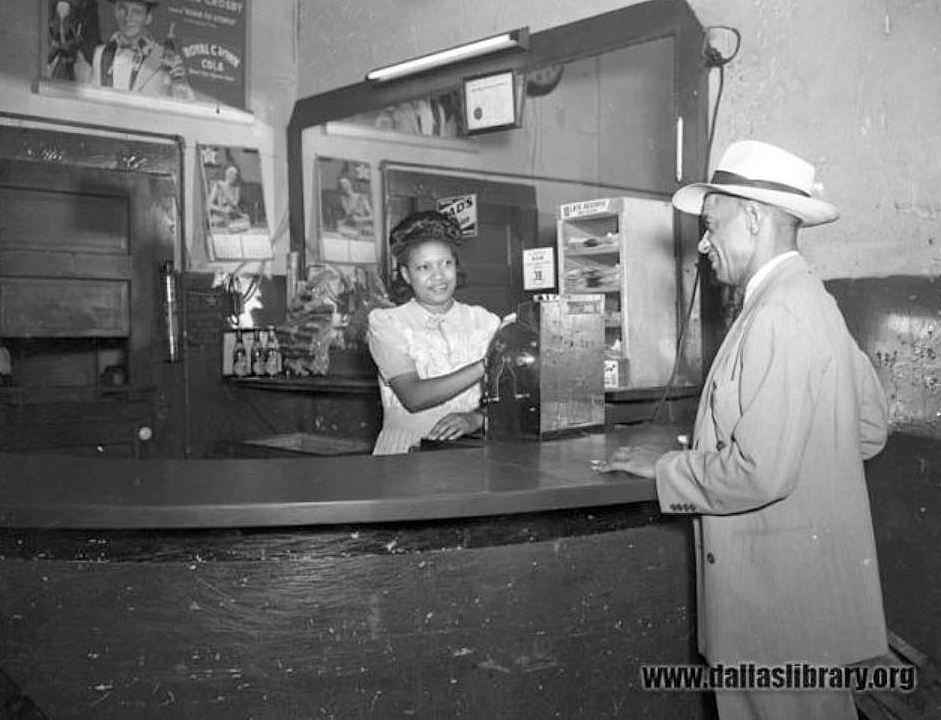
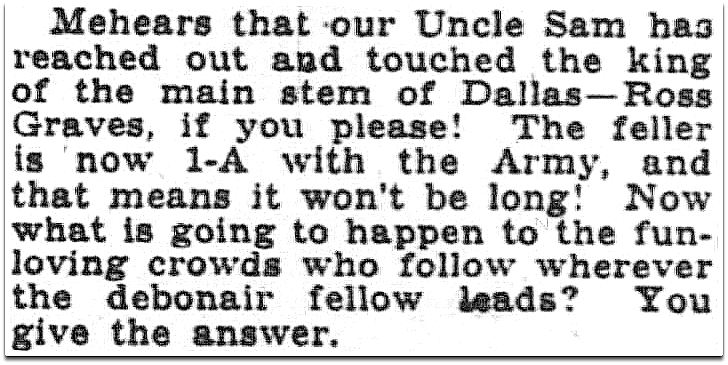
Ross Graves (1903-1973) seems to have been something of a successful bon vivant who dipped his toe into a variety of businesses catering to Dallas’ African-American community: he was the proprietor of, variously (and often simultaneously), a night club, a liquor store, a gas station, a barber shop, and, most successfully, a restaurant, which was in business for almost 20 years (sometimes referred to as Ross Cafe or Graves Place). Below is a photo from 1947 showing the Ross Graves Cafe at 1800 Jackson Street (at Prather) in downtown Dallas (we see the south side of Jackson, with the view to the west).

graves-cafe_1800-jackson_negro-directory_1947

This photo accompanied an ad with the following text:

graves-cafe_negro-directory_1947-48-text

He opened the cafe around 1937 and kept it going until 1955 when he “retired” (he also dabbled in dice-game-hosting at the cafe and was busted in 1954 on gaming charges — he was given a 2-year probated sentence the next year). (Also, the building was part of a large donation to the city in 1955 — more about that below.)

The photo at the top shows, I’m guessing, Mr. Graves standing at the cafe’s cash register with an employee in 1947. He’s also seen in the photo below.

graves-cafe_marion-butts_dpl_1947(photo by Marion Butts/Dallas Public Library)

**

I was originally intrigued by the photo of the exterior of the cafe — I couldn’t picture where it had been. But in trying to find out more about the building, I learned about the life of Ross Graves and came across some interesting little tidbits which paint a a picture of a fun-loving man with an active social life, lots of friends, and a healthy bank account. Below are a few clippings from the Pittsburgh Courier, a newspaper published in Pennsylvania which served as something of a national newspaper for Black America, with political, sports, and entertainment news from around the country. There was always news from Dallas in it — in fact, they had a local office here (3306 Roseland). There was even a Dallas-based society/gossip columnist named Mrs. O. J. Cansler (whose column had the rather unfortunate name of “Kolumn Komments”). She was quite frothy and wrote with the breathless excitement one expects in a society columnist. (I highly encourage anyone with a subscription to Newspapers.com to check out her “kolumn” — it’s a breath of fresh air to read about Dallas’ Black community presented in such a lively and fun manner (or in ANY manner, really — you weren’t going to find any of what she was writing about in the Dallas Morning News or the Dallas Times Herald). Especially interesting are mentions of long-forgotten clubs and nightspots where bands and performers from Dallas’ vibrant musical scene played. Here are a few appearances of Ross (and his wife, Ruby) from the pages of the Pittsburgh Courier.

*

1939_graves_pittsburgh-PA-courier_111139_kolumn-komments_o-j-cansler
Pittsburgh Courier, Nov. 13, 1939

Graves was 36 years old at the time.

*

1942_graves_pittsburgh-PA-courier_080842_toppin-the-town_columnPittsburgh Courier, Aug. 8, 1942

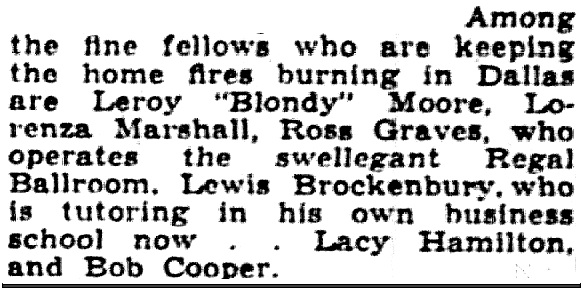
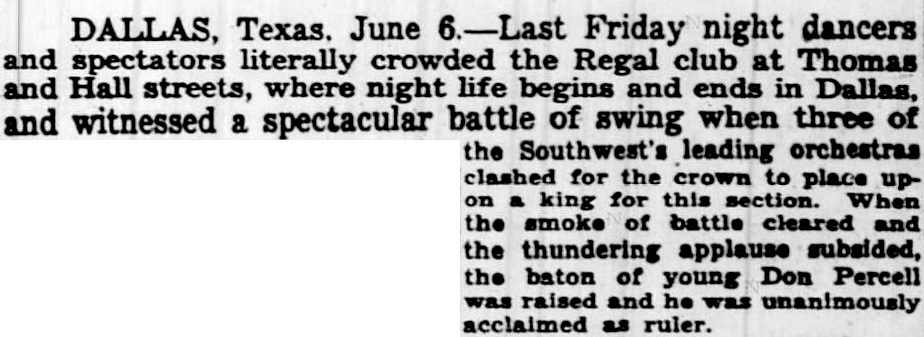
The Regal Ballroom (listed as the Regal Nite Club in city directories) was at 3216 Thomas, at Hall. It didn’t last very long, but while it did, it was, apparently, “swellegant”! Here’s a mention of it as the location of a swing band contest in 1940 (won by Don Percell):

graves_regal-club_pittsburgh-courier_060840Pittsburgh Courier, June 8, 1940

*

1942_graves_pittsburgh-PA-courier_101742_kolumn-komments_mrs-o-j-canslerPittsburgh Courier, Oct. 17, 1942

*

Graves’ second wife, Ruby Graves, was known for her “smart toggery.”

1944_graves_pittsburgh-PA-courier_101444_ruby-gravesPittsburgh Courier, Oct. 14, 1944

*

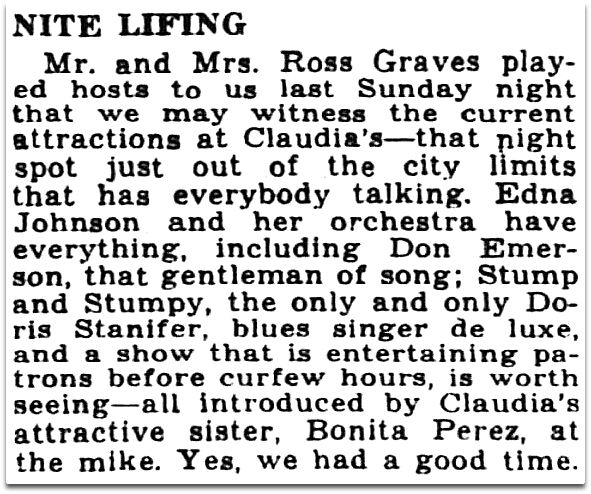
Ross and Ruby were quite the hosts:

1945_graves_pittsburgh-PA-courier_040745_kolumn-komments_mrs-o-j-canslerPittsburgh Courier, Apr. 7, 1945

I love this. This is the sort of thing you would never have read in the Morning News or the Times Herald. I want to know more about Claudia’s — “that night spot just out of the city limits that has everybody talking.”

*

graves-cafe_ad_pittsburgh-courier-051245Pittsburgh Courier, May 12, 1945

*

1946_graves_pittsburgh-PA-courier_062246_kolumn-komments_mrs-o-j-cansler
Pittsburgh Courier, June 22, 1946

Just popping up to NYC in their new Fleetwood to take in a boxing match. As one does.

**

Ross and Ruby eventually ended up living in a house on “swellegant” South Boulevard (2500 South Blvd.). At least one of their daughters was an Idlewild debutante, who made her debut in 1967 (read about the world of Black debutantes in 1937 Dallas here). Milam County native Ross Graves died on Dec. 4, 1973 at the age of 70. He had lived in Dallas for 50 years. And I bet he had a good time.

**

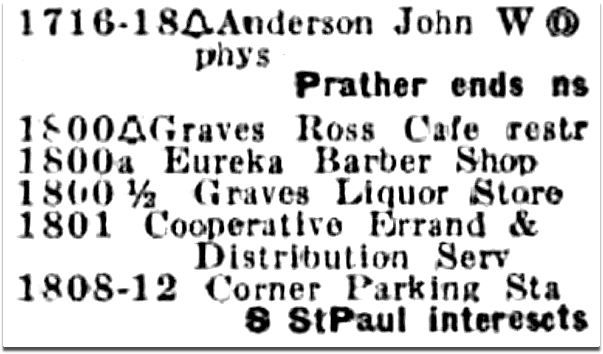
The location of Ross Graves’ Cafe was at 1800 Jackson Street, between Ervay and St. Paul, in a weird stretch of Jackson where two blocks were connected without a  break, in a row of buildings without an intersecting street. (The buildings are long gone, but the location can be seen on Google Maps here.) An interesting detail about these two blocks — the 1700 and 1800 blocks of Jackson Street — is that this property was owned by Dr. John W. Anderson, a prominent Black physician. After his death, his widow, Pearl C. Anderson, deeded the land to the Dallas Community Chest, the proceeds of which would be used to help needy Dallasites. (The donation was conservatively estimated at $200,000 at the time — about $2 million in today’s money). She donated the property in 1955, the same year Graves retired.

graves-cafe_dallas-directory-1947Jackson Street, 1947 Dallas city directory

***

Sources & Notes

Photos of the interior of Ross Graves’ Cafe are from the Marion Butts Collection, Dallas Public Library. Call Number for the top photo is PA2005-4/380.1; Call Number for the second is PA2005-4/380.2 (both are incorrectly identified as being in Deep Ellum).

The photo of the exterior of the cafe is from the Dallas, Texas Negro City Directory, 1947-1948 (many thanks to Pat Lawrence).

graves-cafe_marion-butts_dpl_1947_cashier_sm

*

Copyright © 2021 Paula Bosse. All Rights Reserved.

Nighttime Skyline — 1965

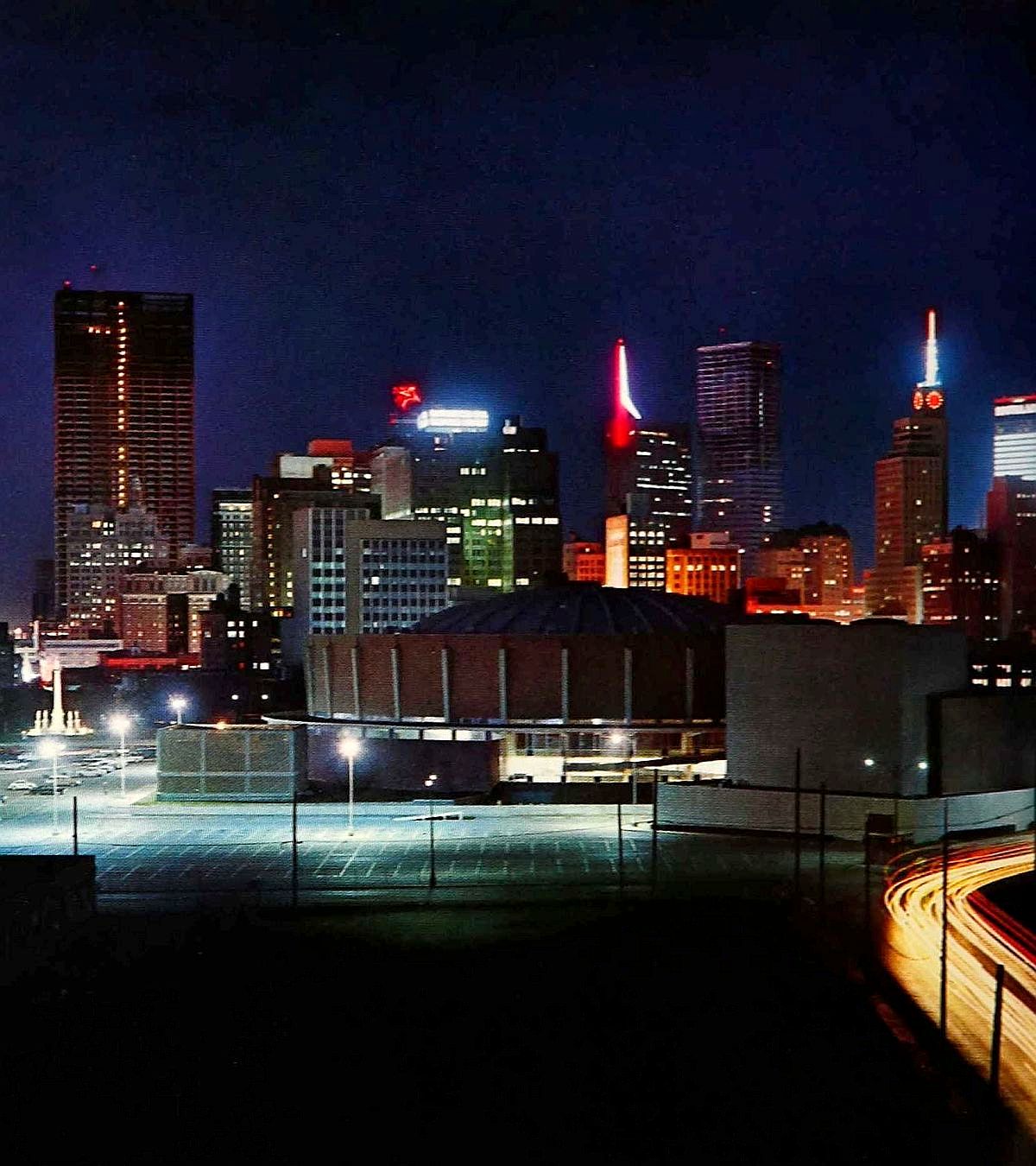
skyline_st-marks-yrbk_1965_dallas-power-and-lightAll. Lit. Up.

by Paula Bosse

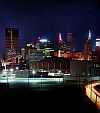
Dallas is always at its most impressive at night, as seen in this view to the northwest, with Memorial Auditorium in the foreground.

***

Sources & Notes

This photo, credited to Dallas Power & Light, appeared in the 1965 Marksmen, the yearbook of St. Mark’s School of Texas. It continued on another page, but I couldn’t fit the two parts together without an annoying gap. The second bit is below (click to see a larger image).

skyline_st-marks-yrbk_1965_dallas-power-and-light_b

See another cool photo from the same year in the Flashback Dallas post “Dallas Skyline at Night — ca. 1965.”

skyline_st-marks-yrbk_1965_dallas-power-and-light_sm

*

Copyright © 2021 Paula Bosse. All Rights Reserved.

Oak Cliff’s Star Theatre — 1945-1959

star-theatre_troy-sherrod-hist-dallas-theatres_DPLShow Hill, with the Star Theatre at right

by Paula Bosse

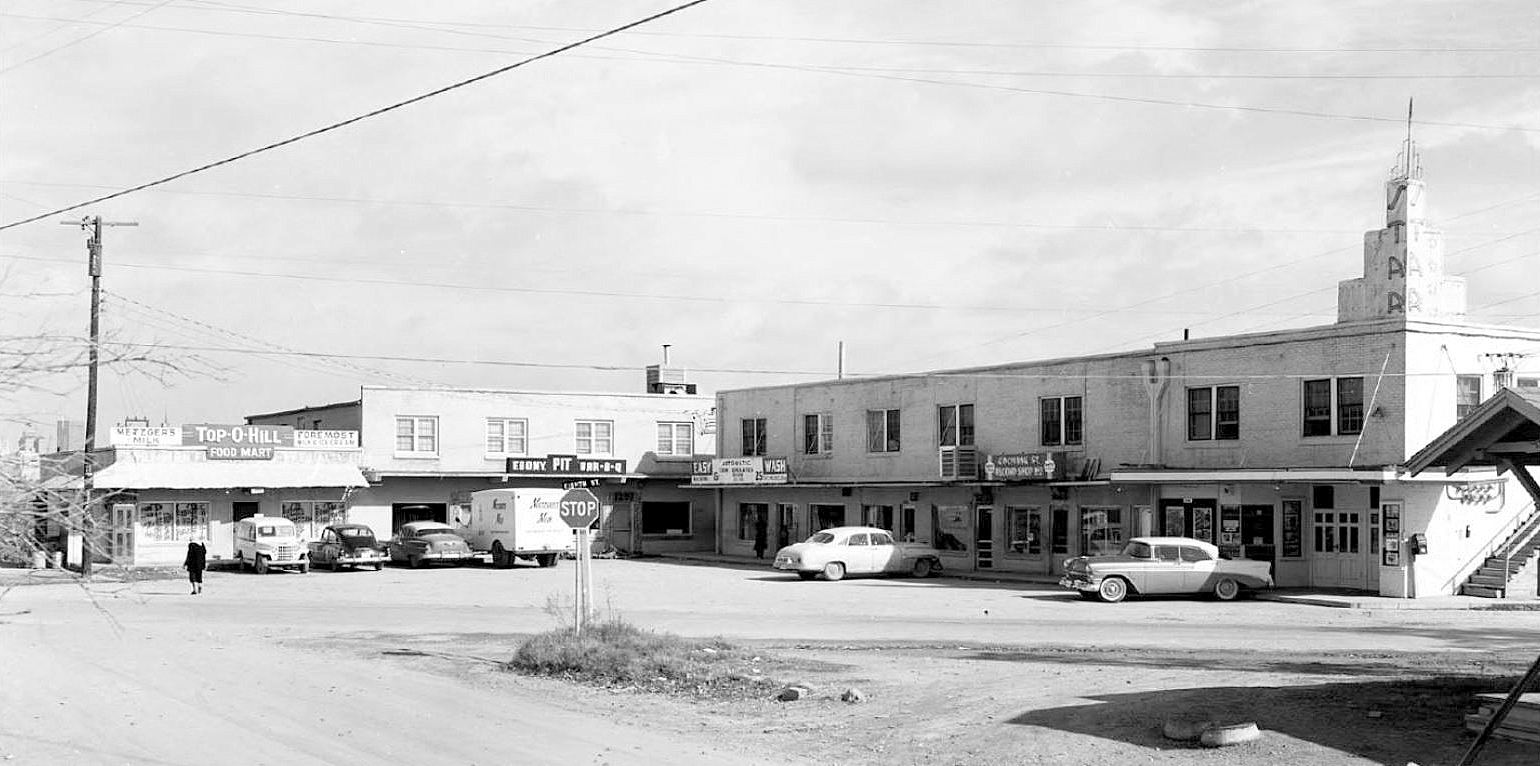
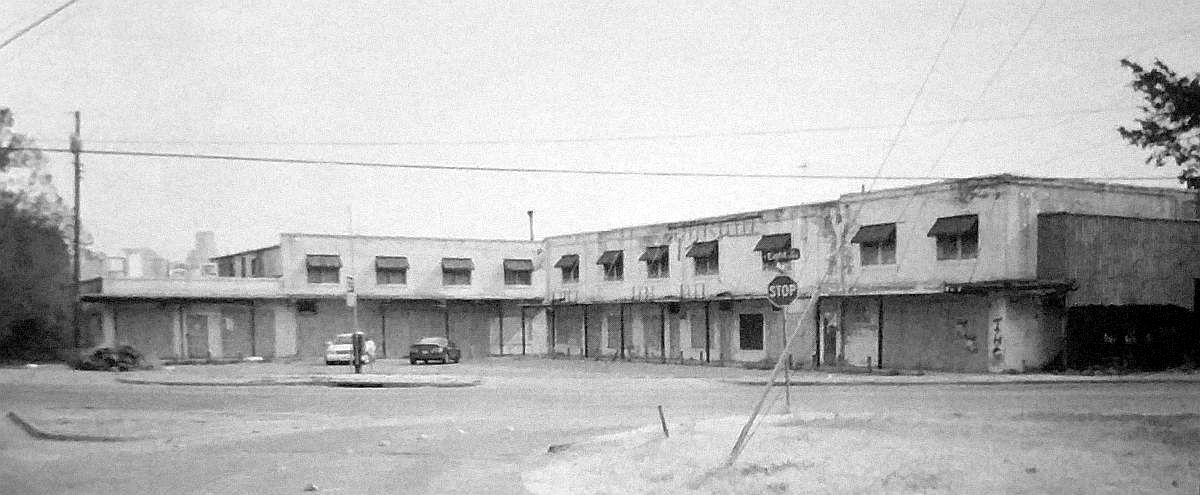
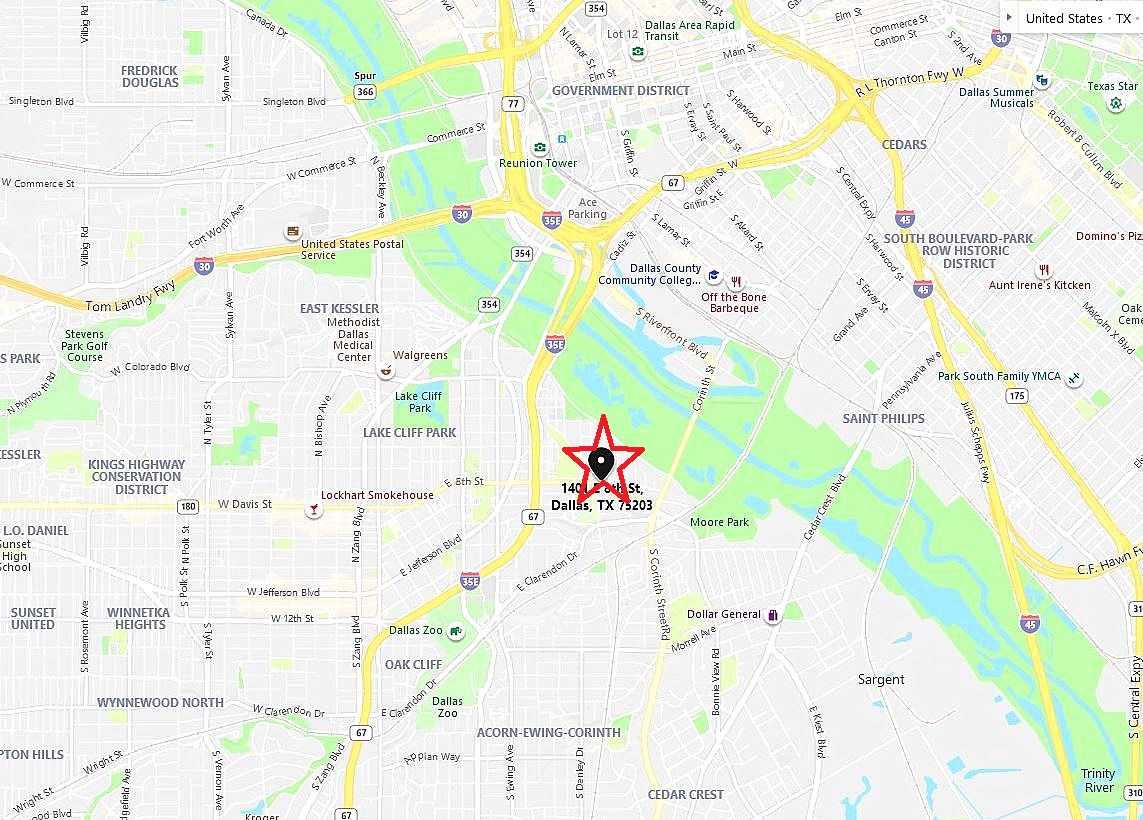
This is one of those photographs I could stare at all day long. It shows a shopping area in East Oak Cliff at the intersection of E. Eighth Street and N. Moore Street — this part of Oak Cliff was originally settled as a freedman’s town, and this photo shows an area between the Tenth Street Historic District and The Bottoms (or The Bottom) neighborhood (see a great map, here).

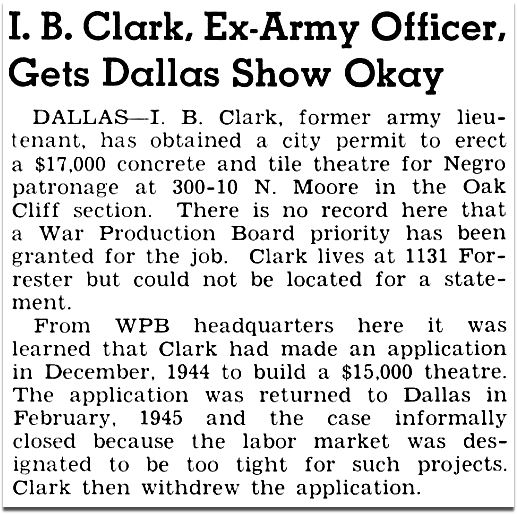
When these buildings were built in 1945 by I. B. Clark, it was an exclusively African-American part of Dallas. The anchor of this strip (which occupied what was described as both the 300 block of N. Moore and the 1400 block of E. Eighth) was the Star Theatre, which was, according to Mr. Clark, the only movie house for black customers in Oak Cliff.

star-theatre_boxoffice_042845
Boxoffice, April 28, 1945

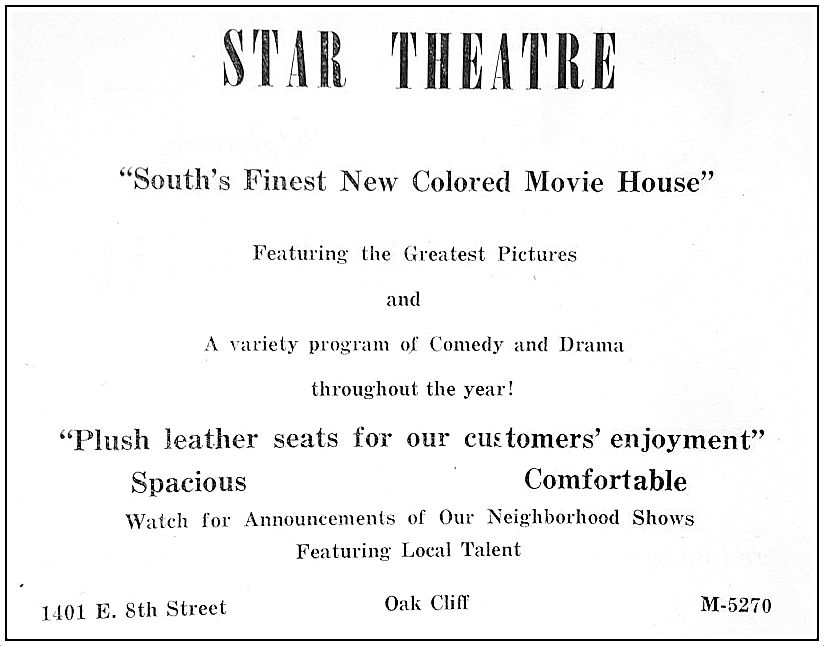
star-theatre_oak-cliff_negro-directory-1947-48_adDallas Negro Directory, 1947-48

I. B. Clark was a white businessman who lived on a ranch in Cedar Hill; he had owned the Southern Fireworks Company before the war and had frequently battled with Dallas lawmakers about the constitutionality of banning the selling and shooting of fireworks within the city limits.

In the undated photo above, businesses in the retail strip are the Top-O-Hill Food Mart, the Ebony Cafe (Pit Bar-B-Q), the Easy-Wash laundromat, the second location of the Cochran Street Record Shop, the Star Theatre, and hotel apartments.

This hub of businesses was popular with neighborhood residents, who referred to this area as “Show Hill” (for the picture show). I stumbled across a really wonderful 2018 oral history of Margaret Benson, who, in 1944, moved with her family to Dallas and attended N. W. Harllee Elementary School and both Lincoln High School and Madison High School. She describes these shops and says that whenever black entertainers such as Dinah Washington or Sister Rosetta Tharpe came to town, they frequently stayed in the apartments above these businesses, as hotel accommodations for African Americans were few and far between. (I loved the entire recording of Mrs. Benson reminiscing about living for most of her life in this area of Oak Cliff — the part where she specifically talks about “Show Hill” is at the 8:25 mark in the recording at the link above.)

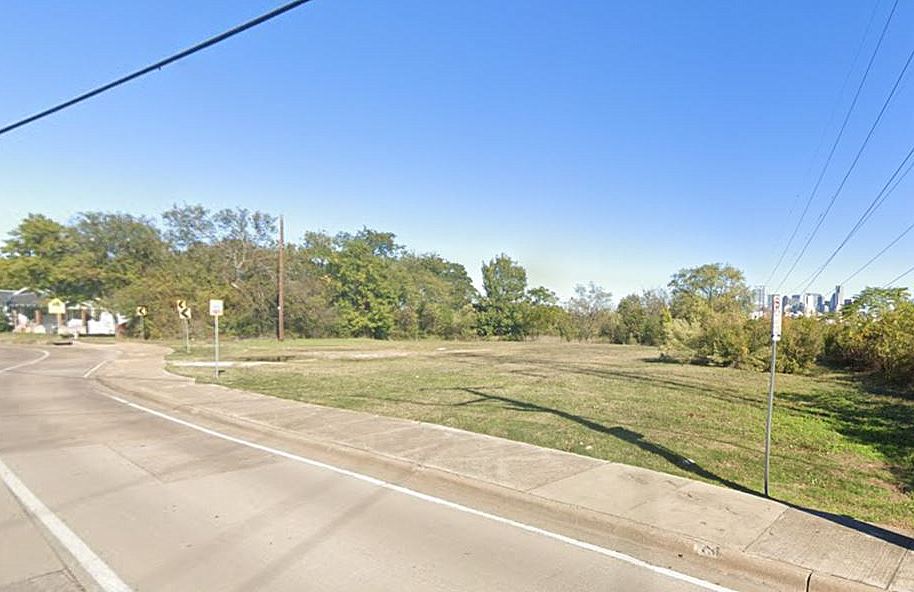
According to Dallas movie theater historian Troy Sherrod, the Star closed in 1959. Over time the area eventually declined and the remaining businesses closed. The strip, which was looking pretty down-at-its-heels in the 1990s, was demolished around 2000. The photo below shows the once-vibrant strip in its later days. (Three more photos, from 1999, can be found here — the addition of more apartments (the “Ebony Hotel Annex”) can be seen in the third one.)

star-theatre_mark-doty_lost-dallas
via Lost Dallas by Mark Doty

Here is what “Show Hill” vacant lot looks like today on Google Street View:

star-theatre_google-street-view-nov-2019Google Street View, 2019

star-theatre_bing-mapsBing Maps

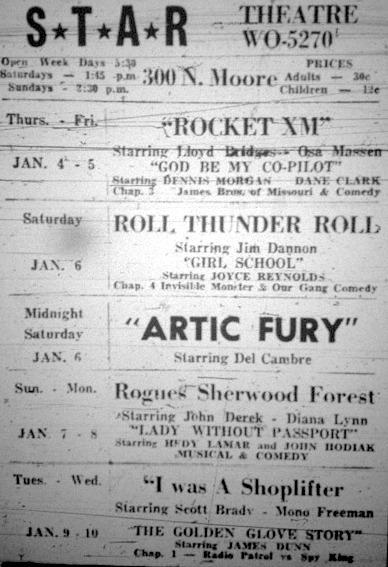
star-theatre_cinematreasures_advia Cinema Treasures

***

Sources & Notes

Top photo showing the Star Theatre is from the excellent book by D. Troy Sherrod, Historic Dallas Theatres (Arcadia Publishing, 2014); the photo is from the collection of the Dallas Public Library.

Second photo showing the dilapidated buildings is from another excellent book, Lost Dallas by Mark Doty (Arcadia Publishing, 2012).

The ad for the Star Theatre appeared in the Dallas, Texas Negro City Directory, 1947-1948 (many thanks to Pat Lawrence). The address for the theater was listed in various places as both 300 N. Moore and as 1401 E. Eighth.

If you have access to the archives of the Dallas Morning News, I encourage you to read “Inner-City Secret — The Bottoms Residents Say They Are Forgotten” by Bill Minutaglio (DMN, Aug. 28, 1994).

Also worth a read is Texas Tribune article “Dallas Neighborhood Established by Freed Slaves Fights to Keep Its History Alive” by Miguel Perez of KERA News.

More on the Tenth Street Historic District can be found on the City of Dallas website here.

Check out photos of a pop-up market on Show Hill in 2014 here.

Also, of related interest is the Flashback Dallas post “Movie Houses Serving Black Dallas — 1919-1922.”

Thank you to reader Jerry Richburg for contacting me with a question about this old strip shopping area — he remembered attending church services in one of the buildings and asked if I knew more about what had been there and if I might have a photo. Thanks, Jerry! You led me down the path to discovering a little pocket of Dallas history I was completely unaware of!

star-theatre_troy-sherrod-hist-dallas-theatres_DPL_sm

*

Copyright © 2020 Paula Bosse. All Rights Reserved.

Lone Wolf Gonzaullas: Texas Ranger, Dallas Resident

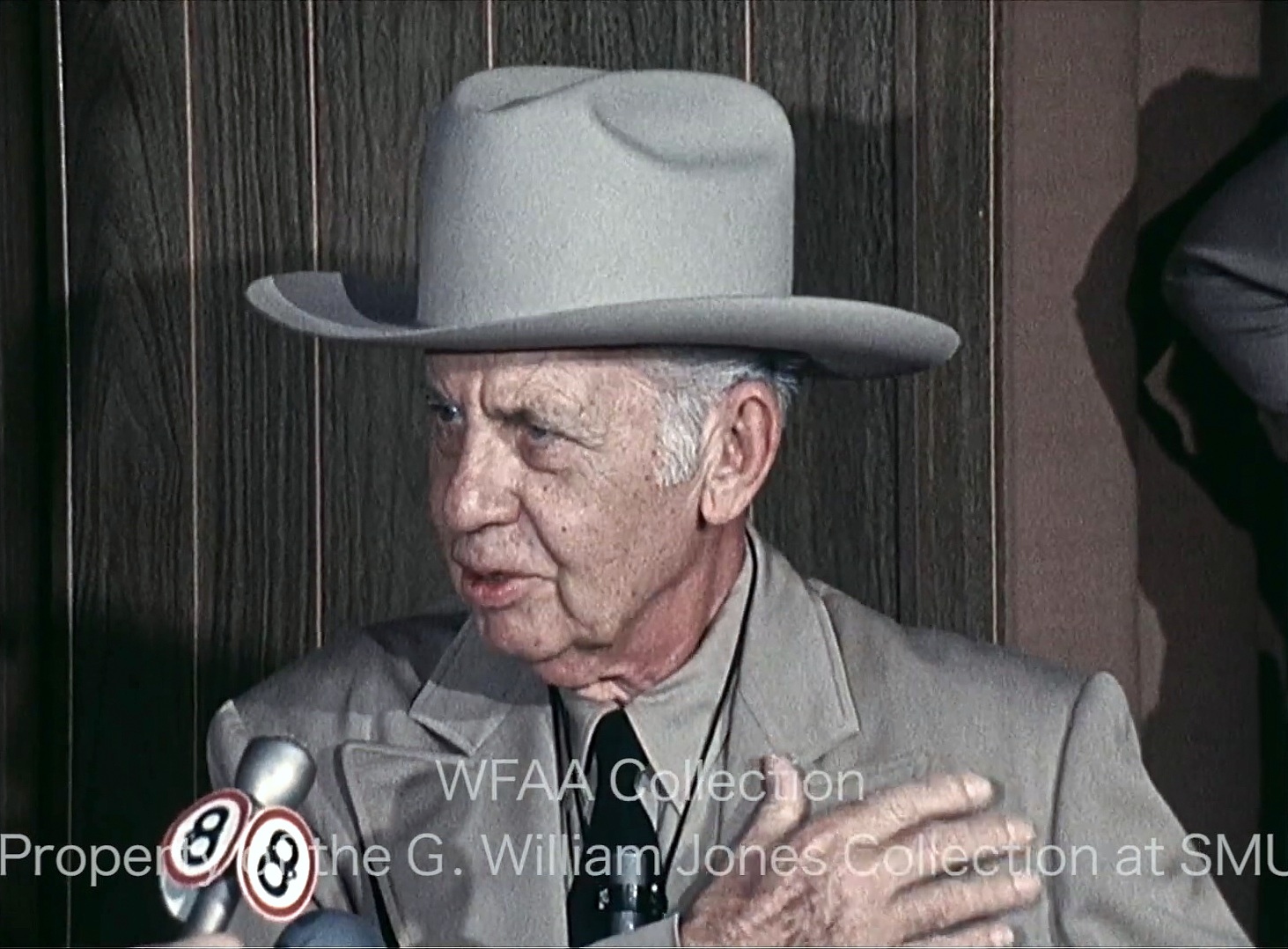
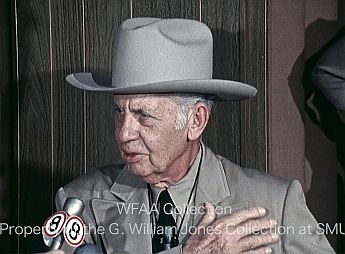
gonzaullas_march-1970_WFAA_jones-collection_SMU-aWhere the bullet grazed him… (1970)

by Paula Bosse

I had never seen footage of legendary Texas Ranger Manuel T. “Lone Wolf” Gonzaullas (1891-1977) until now. There is a short clip of him recounting a run-in with a man who shot him in WFAA-Channel 8 footage from March, 1970 (filmed at the Southwest Historical Wax Museum in Fair Park). Gonzaullas was a long-time resident of Dallas, from 1923 until his death in 1977, living for much of that time in Lakewood, in the 6900 block of Westlake.

*

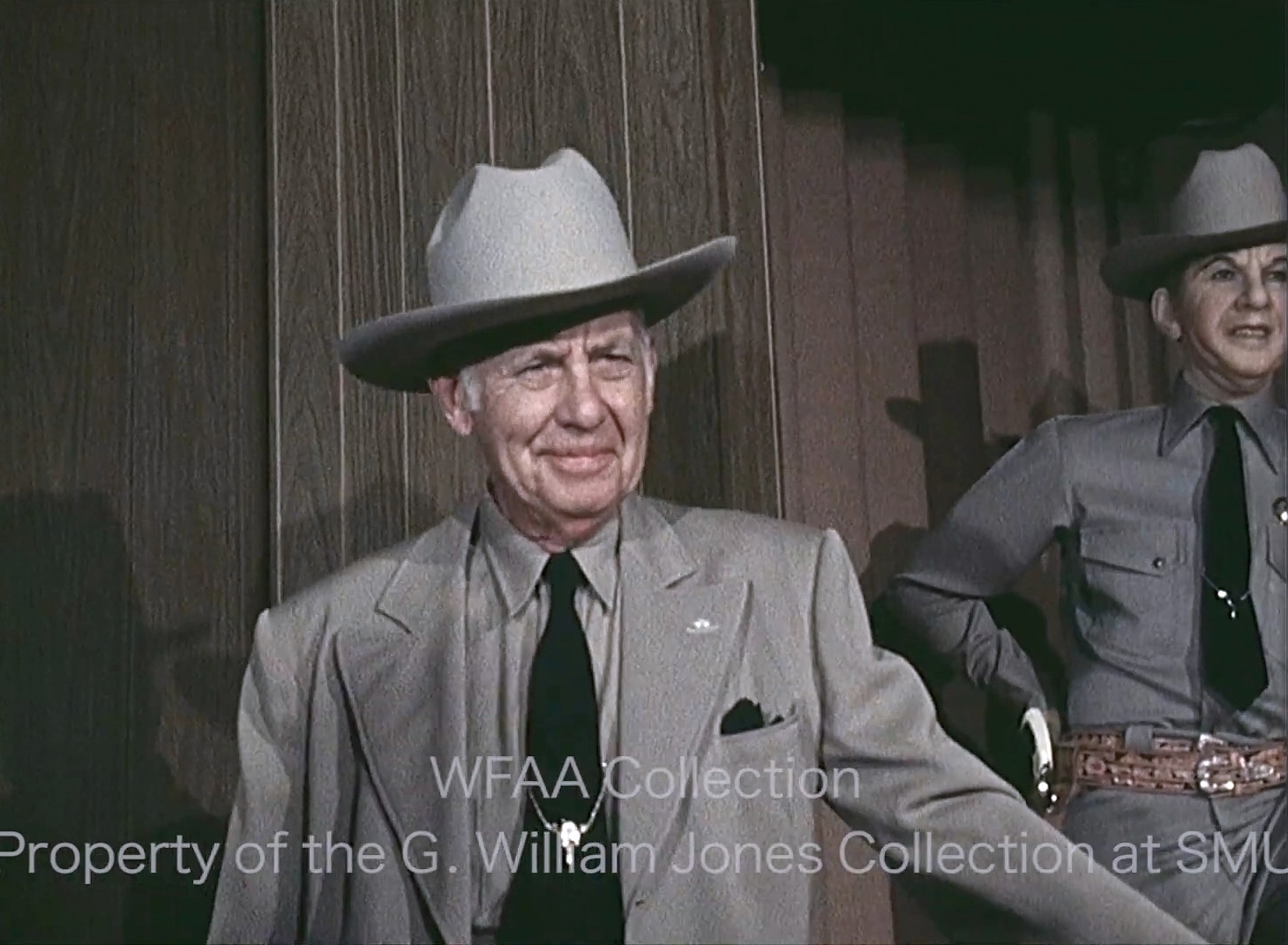
Here are a couple of screenshots from the news footage. In the first he is seen standing in front of his wax figure.

gonzaullas_march-1970_WFAA_jones-collection_SMU-b

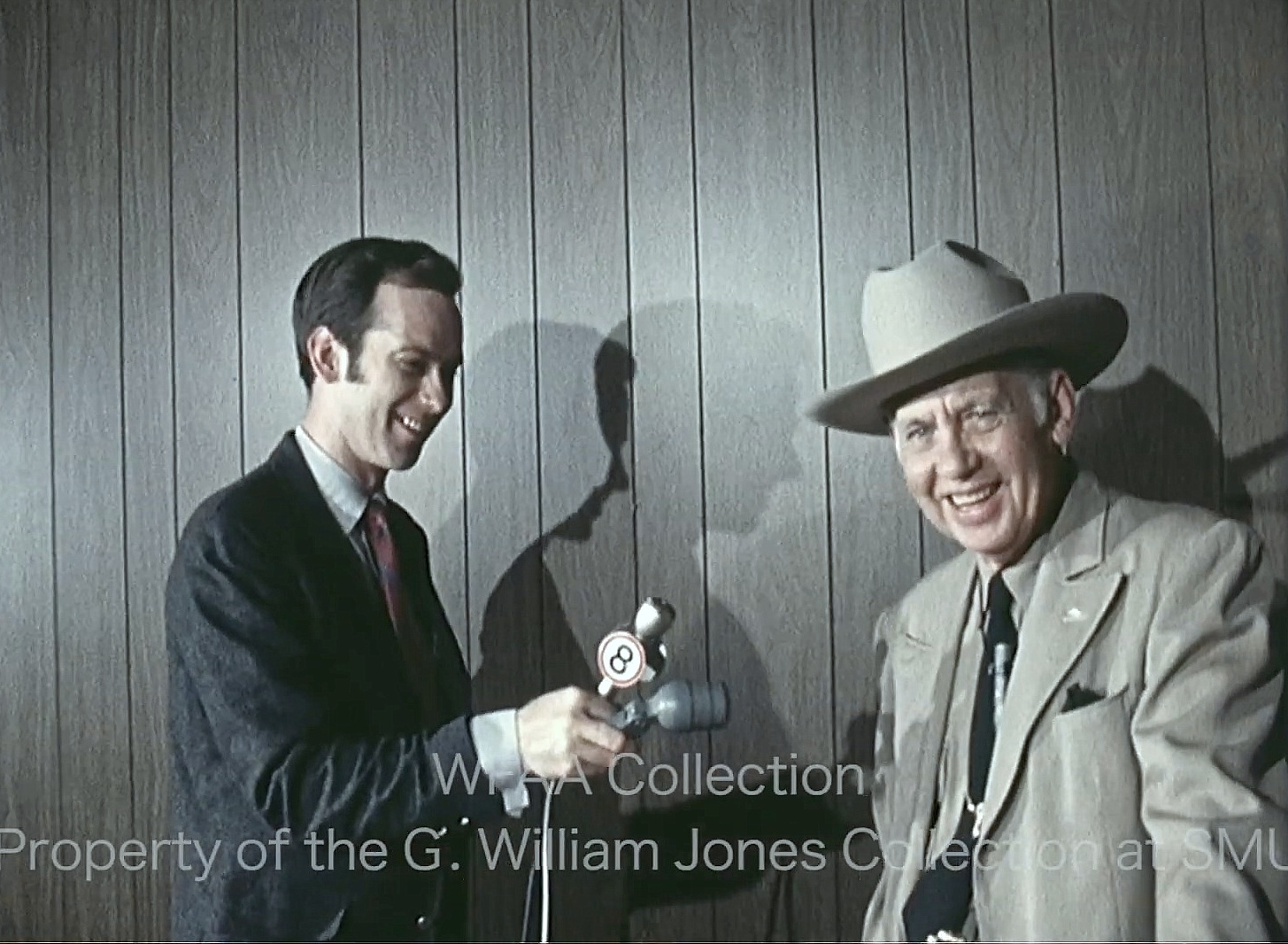
And in the second, he’s joking with WFAA-Channel 8 News reporter Phil Reynolds, who seems a little star-struck.

gonzaullas_march-1970_WFAA_jones-collection_SMU-c

*

Below are a few random Lone Wolf-related photos and articles. (There are tons of histories of Gonzaullas and the Texas Rangers out there — please hunt them down for specifics on his long and respected career in law enforcement. These are just a few things that I found interesting, some of which are of no historical importance!)

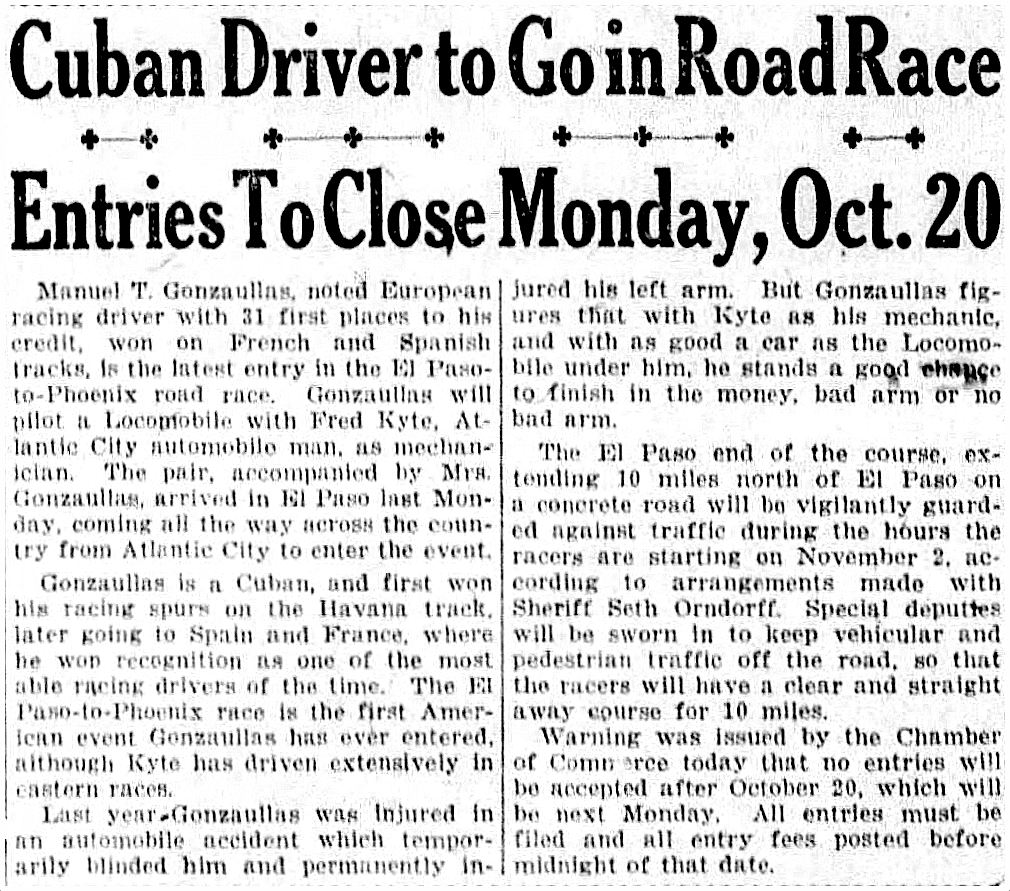
The earliest newspaper mention of Gonzaullas I could find was about his participation in an El Paso-to-Phoenix automobile road race in 1919. Biographers have noted that the colorful Gonzaullas sometimes embellished the truth, especially about his early days, and it’s interesting to note that in coverage of this race, Gonzaullas was described as being a “noted European racing driver” who had previously won 32 first-place finishes and 92 second-place finishes (!). The car he had entered in the race was a Locomobile, which he was reported to have driven to El Paso from Atlantic City. He was also identified as being “a Cuban […] who first won his spurs on the Havana track” (his birthplace is usually said to be Spain, where he was born to naturalized American citizens who were visiting that country at the time). He told the papers he had been left with temporary blindness and a permanently injured left arm in a previous auto accident — and another injury was about to come: he didn’t finish the El Paso-to-Phoenix race because his car suffered two debilitating mishaps, including one in which he was thrown from the car “and a blood vessel in his stomach was broken.” He was also said to be accompanied by “Mrs. Gonzaullas,” despite the fact that he did not marry Laura Scherer until April, 1920.

gonzaullas_road-race_el-paso-times_101619_cubanEl Paso Times, Oct. 16, 1919 (click for larger image)

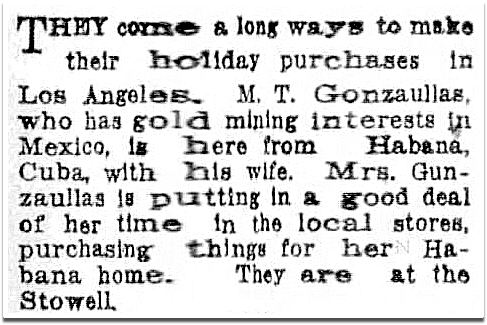
In December, 1919, Los Angeles newspapers reported that Mr. Gonzaullas, “who has gold mining interests in Mexico,” was in town, visiting from Havana. Accompanying him was “Mrs. Gonzaullas,” who was indulging in a shopping excursion. They were staying at the Hotel Stowell.

gonzaullas_los-angeles-evening-express_120319_cuba_mrs-gonzaullasLos Angeles Evening Express, Dec. 3, 1919

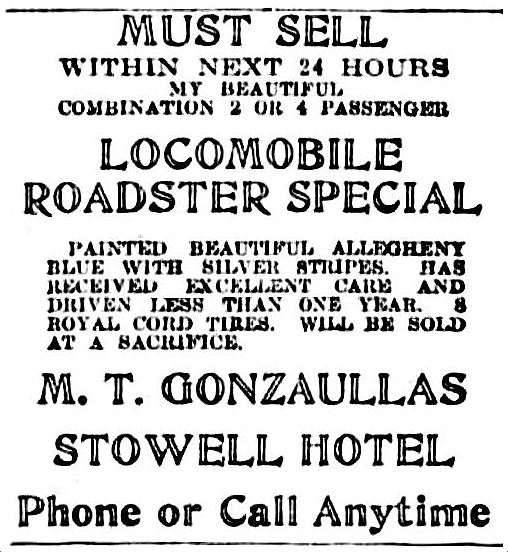
While at the Stowell (and about to return to Texas), Gonzaullas put a for-sale classified in the Los Angeles paper, saying that he “must sell within next 24 hours my beautiful combination 2 or 4 passenger Locomobile Roadster Special.” The Cuban’s racing days would seem to be ending.

gonzaullas_locomobile_los-angeles-evening-express_050820Los Angeles Evening Express, May 8, 1920

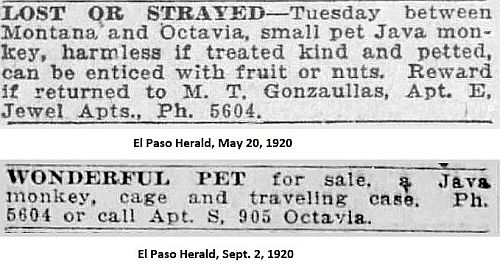
Less than two weeks later — and a month after finally marrying Laura in California — the newly wed Gonzaullas was back in El Paso, looking for a “lost or strayed” pet monkey. It appears the monkey was found (…or replaced…), but in September the Gonzaullases were selling their little “Java monkey,” along with its cage and traveling case. M. T. became “Lone Wolf” after he joined the Texas Rangers in 1920. Perhaps a monkey was not considered an appropriate pet for a lawman. (This is my favorite weird and obscure “Lone Wolf” tidbit.)

gonzaullas_el-paso-herald_1920-ads_monkey

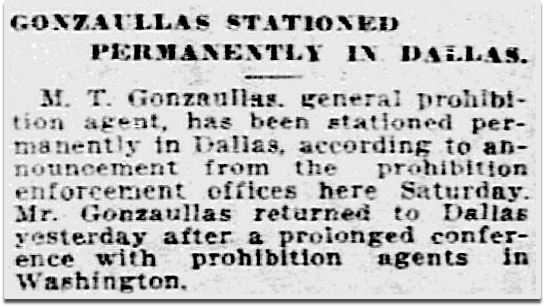
Gonzaullas was in and out of the Rangers throughout his career. In 1923, he moved to Dallas where he was stationed as a permanent prohibition agent (he busted a lot of booze-loving Dallasites).

gonzaullas_dmn_022523Dallas Morning News, Feb. 25, 1923

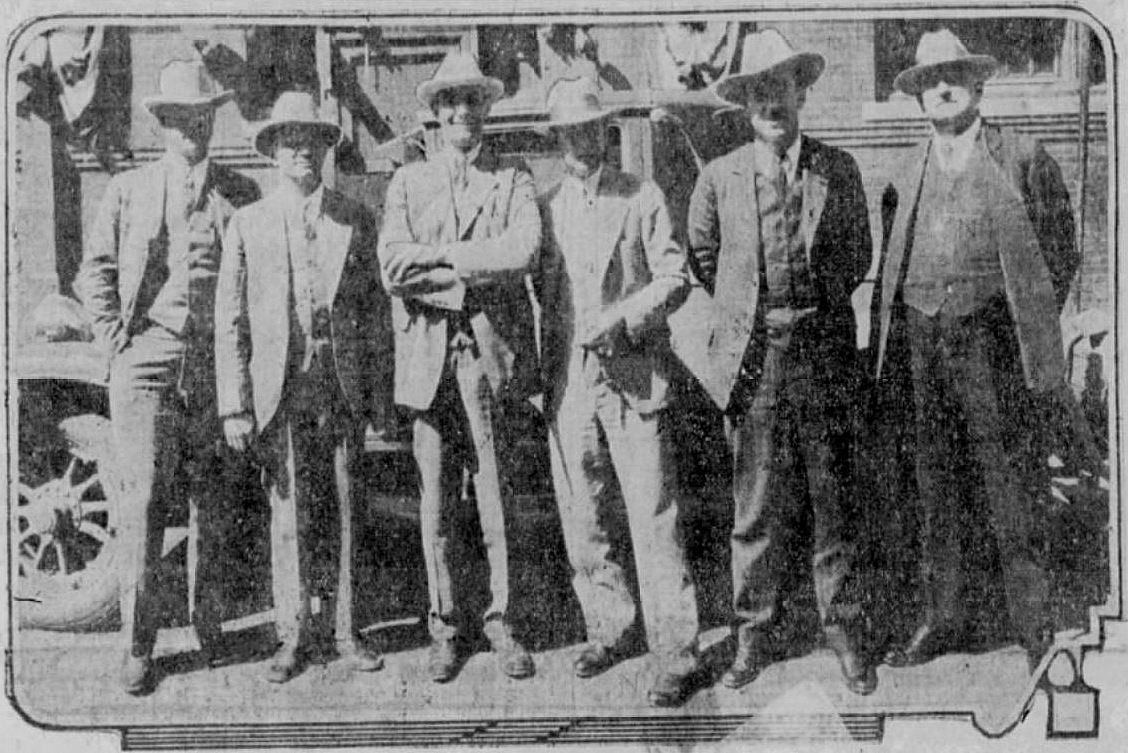
In 1929, Gonzaullas was a sergeant in the Texas Rangers, and the photo below captured the first time that the men of Company B had all been together at the same time in the same place — in Fort Worth. The caption for this photo: “Texas’ Guardians, United After 10 Years. Capt. Tom R. Hickman, Gainesville, brought Ranger Company B together Friday for the first time in more than 10 years. Here they are just before visiting the Southwestern Exposition and Fat Stock Show. Left to right, W. H. Kirby, Abilene; H. B. Purvis, Lufkin; Captain Hickman; Sergt. M. T. Gonzaullas, Dallas; Dott E. Smith, Abilene; and James P. Huddleston, Dallas.” (Fort Worth Record-Telegram, March 16, 1929) (Read the full story, “Ranger Company B Rides In to Stock Show” here.)

company-b_fw-record-telegram_031629Company B in Fort Worth, FW Record-Telegram, Mar. 16, 1929

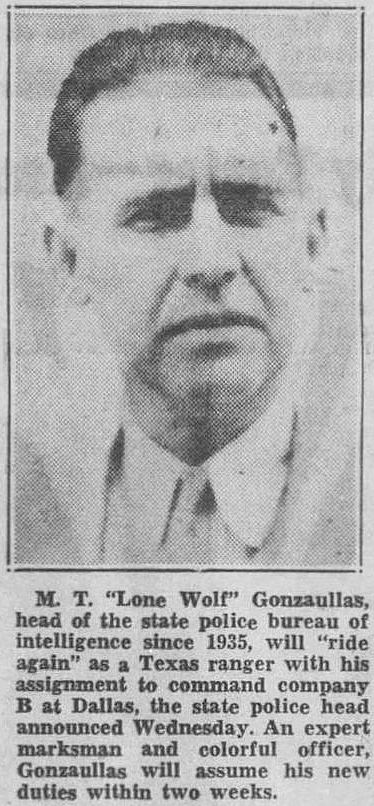
In 1933, the Texas Rangers were dissolved, later to re-emerge as part of the newly formed Department of Public Safety in 1935. Gonzaullas served for several years as the head of the DPS’s Bureau of Intelligence in Austin, a Texas version of the FBI. In 1940, he stepped down from that position to rejoin the Rangers. He took over command of his old Company B, which was stationed in Fair Park, and remained in that position for 11 years until his retirement.

gonzaullas_austin-statesman_021440_company-b_photoAustin Statesman, Feb. 14, 1940

gonzaullas_austin-american_021540_company-bAustin American, Feb. 15, 1940

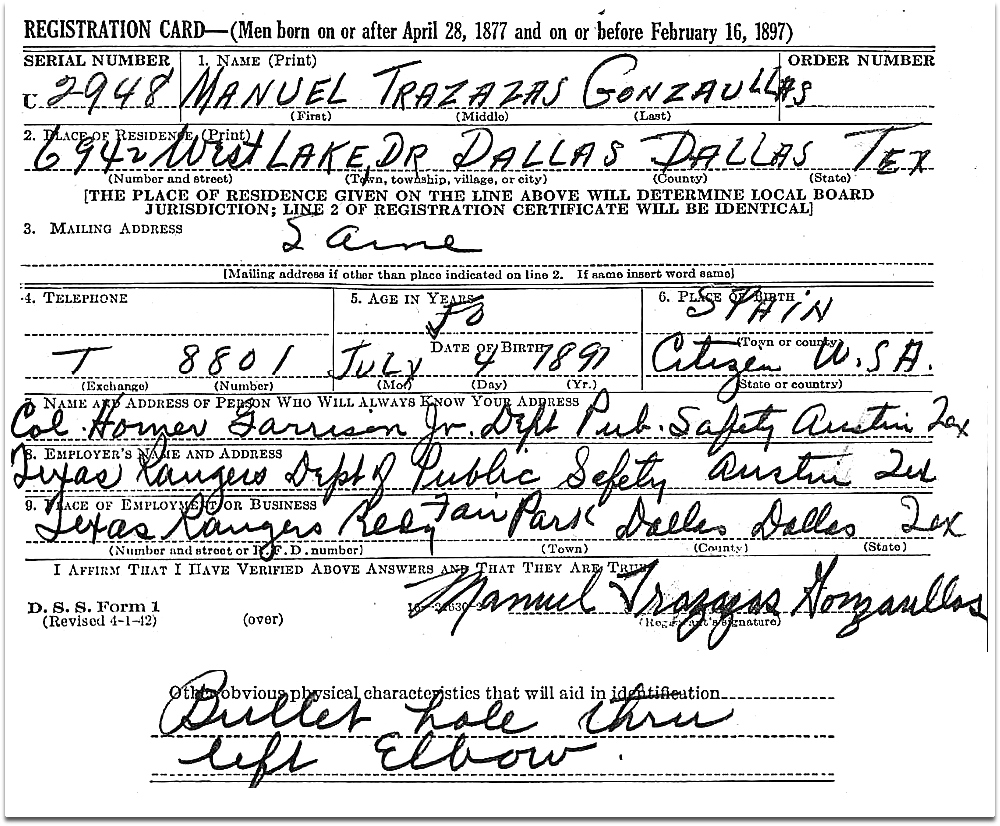
In 1942, at the age of 50, Gonzaullas filled out a registration card during World War II, as all men were required to do. (A distinguishing physical characteristic of a “bullet hole thru left elbow” was noted.) 

gonzaullas_ww2-registration-card-1942

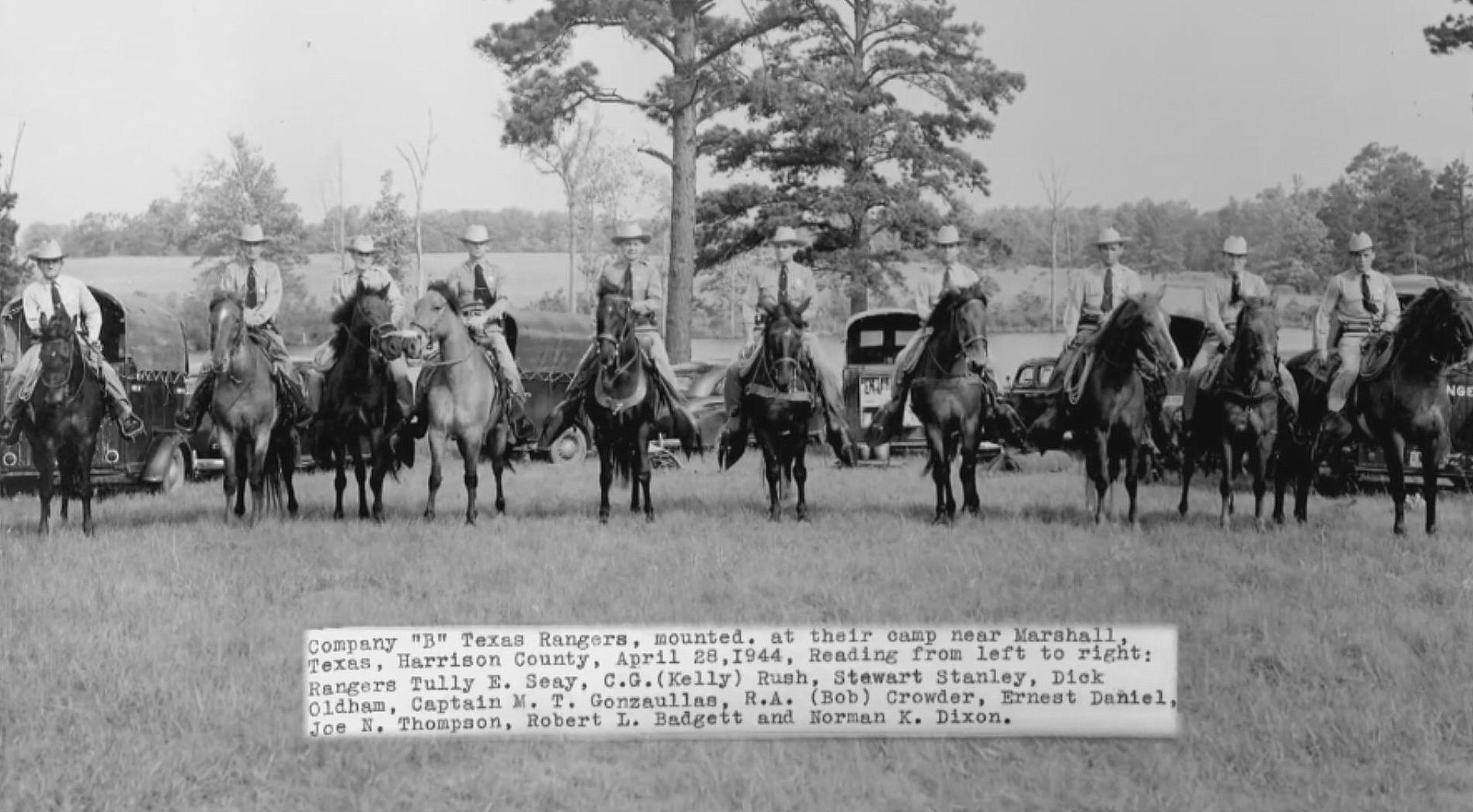
Below, a photo from 1944 showing mounted Texas Rangers of Company B in Marshall, Texas: (left to right) Tulley E. Seay, C. G. (Kelly) Rush, Stewart Stanley, Dick Oldham, Capt. M. T. Gonzaullas, R. A. (Bob) Crowder, Ernest Daniel, Joe N. Thompson, Robert L. Badgett, and Norman K. Dixon.

gonzaullas_texas-rangers_company-Bvia findagrave.com (same photo without text is at Portal to Texas History)

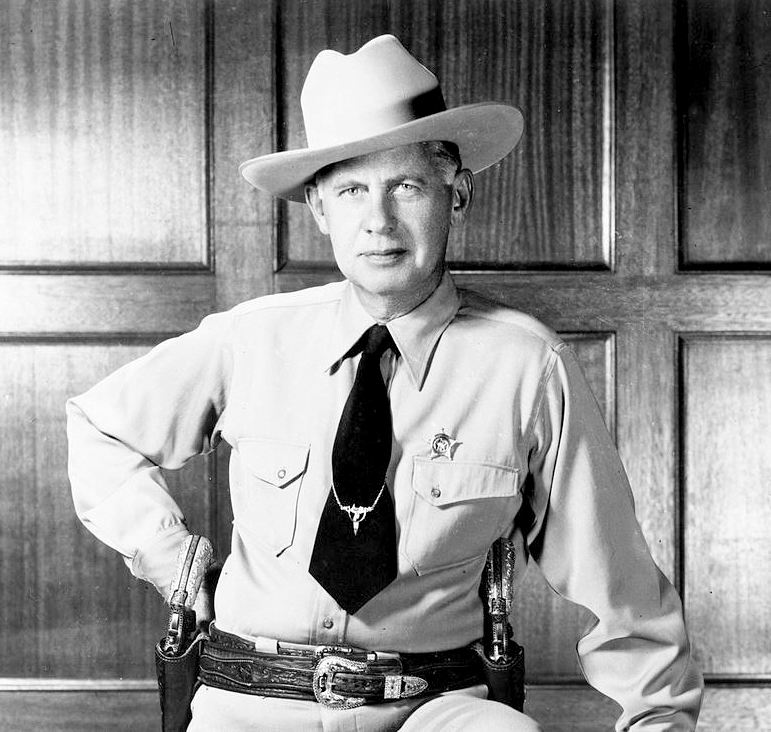
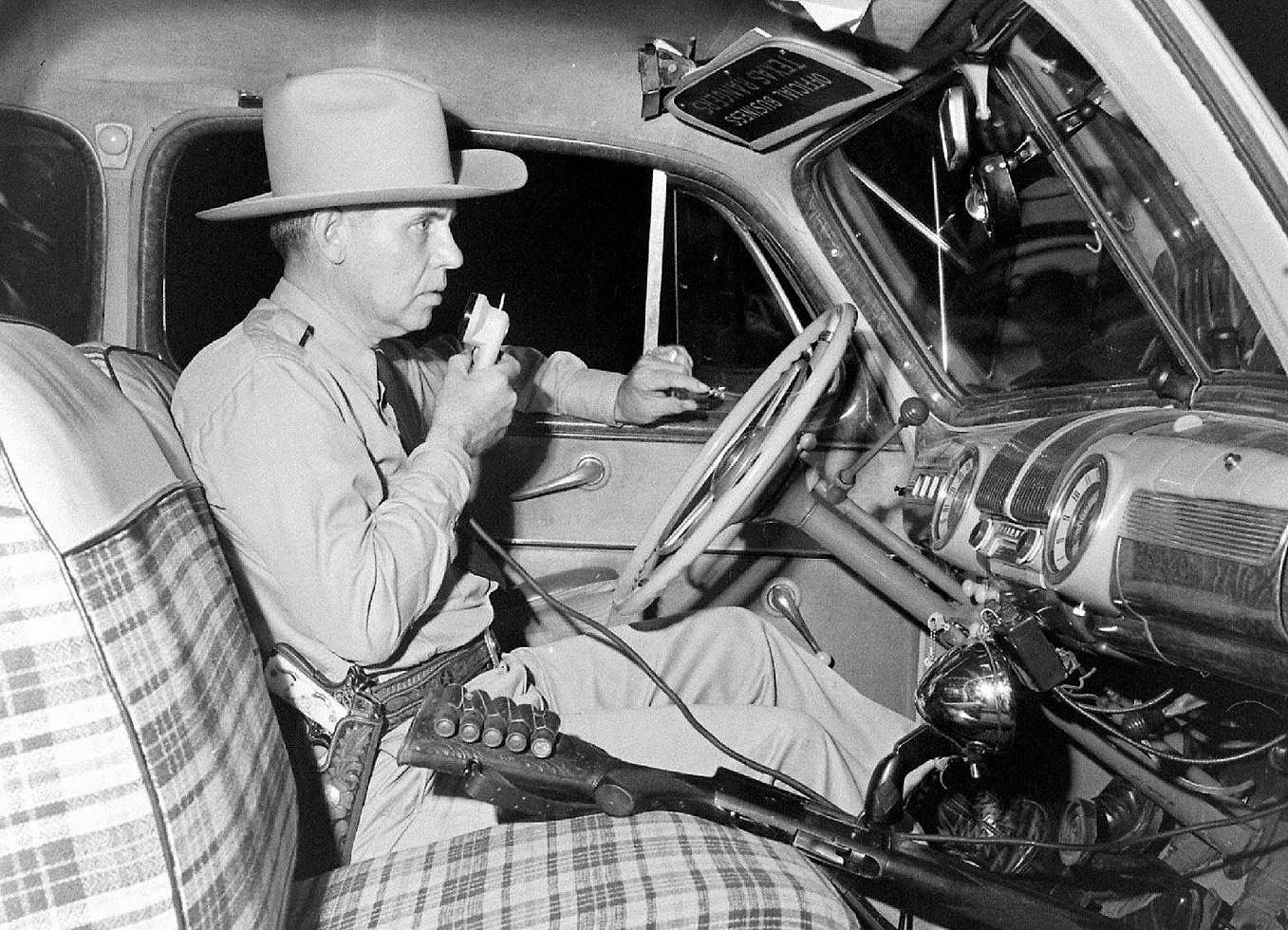
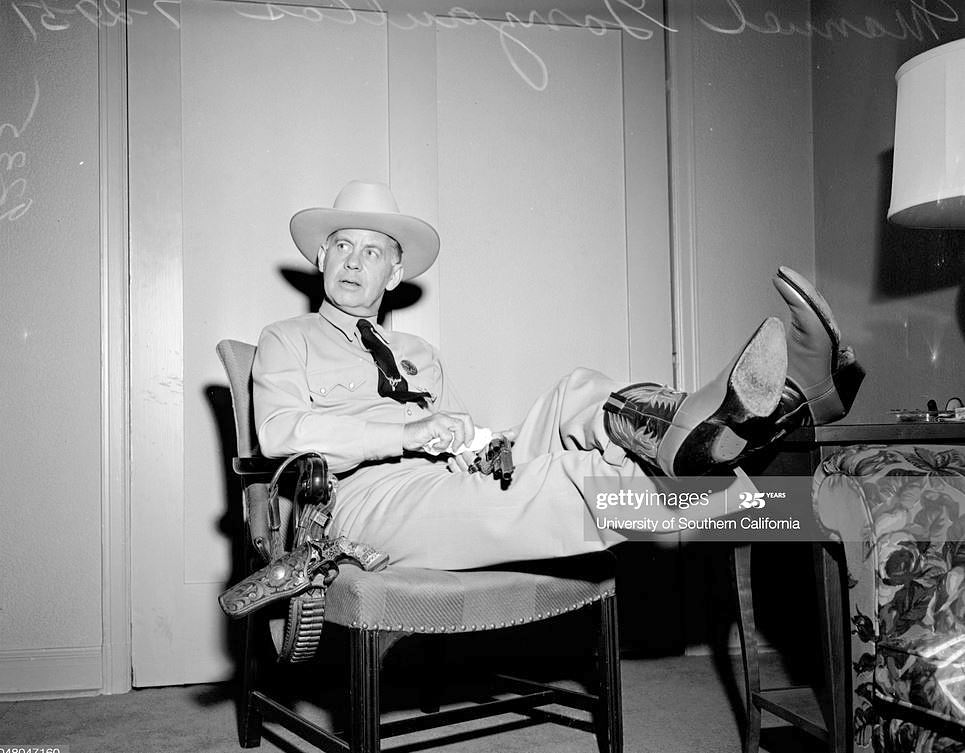
Capt. Manuel Trazazas Gonzaullas retired in July, 1951 and traveled between Dallas and Hollywood where he worked as a consultant on Western TV shows and films. He died in Dallas on Feb. 13, 1977 at the age of 85.

gonzaullas_manuel-t-lone-wolf

gonzaullas_find-a-gravevia findagrave.com

gonzaullas_getty-images_july-1951via Getty Images

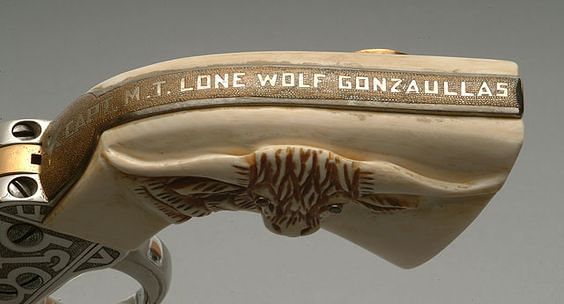
gonazaullas_pistol-grip

***

Sources & Notes

The first three images are screenshots of WFAA-Channel 8 news film shot in March, 1970, from the WFAA Collection, G. William Jones Collection, Hamon Arts Library, Southern Methodist University; the footage can be viewed on YouTube here

A brief biography of M. T. Gonzaullas can be found at the Handbook of Texas, here.

There were several comprehensive and entertaining articles and interviews which appeared around the country about Gonezaullas’ career when he retired. If you have access to newspaper archives, I would recommend the article “The ‘Lone Wolf’ Lays Down His Guns” by Don Hinga which appeared in The St. Louis Post-Dispatch on July 22, 1951.

gonzaullas_march-1970_WFAA_jones-collection_SMU-a_sm

*

Copyright © 2020 Paula Bosse. All Rights Reserved.

Magnolia Gas Station No. 110 — 1920

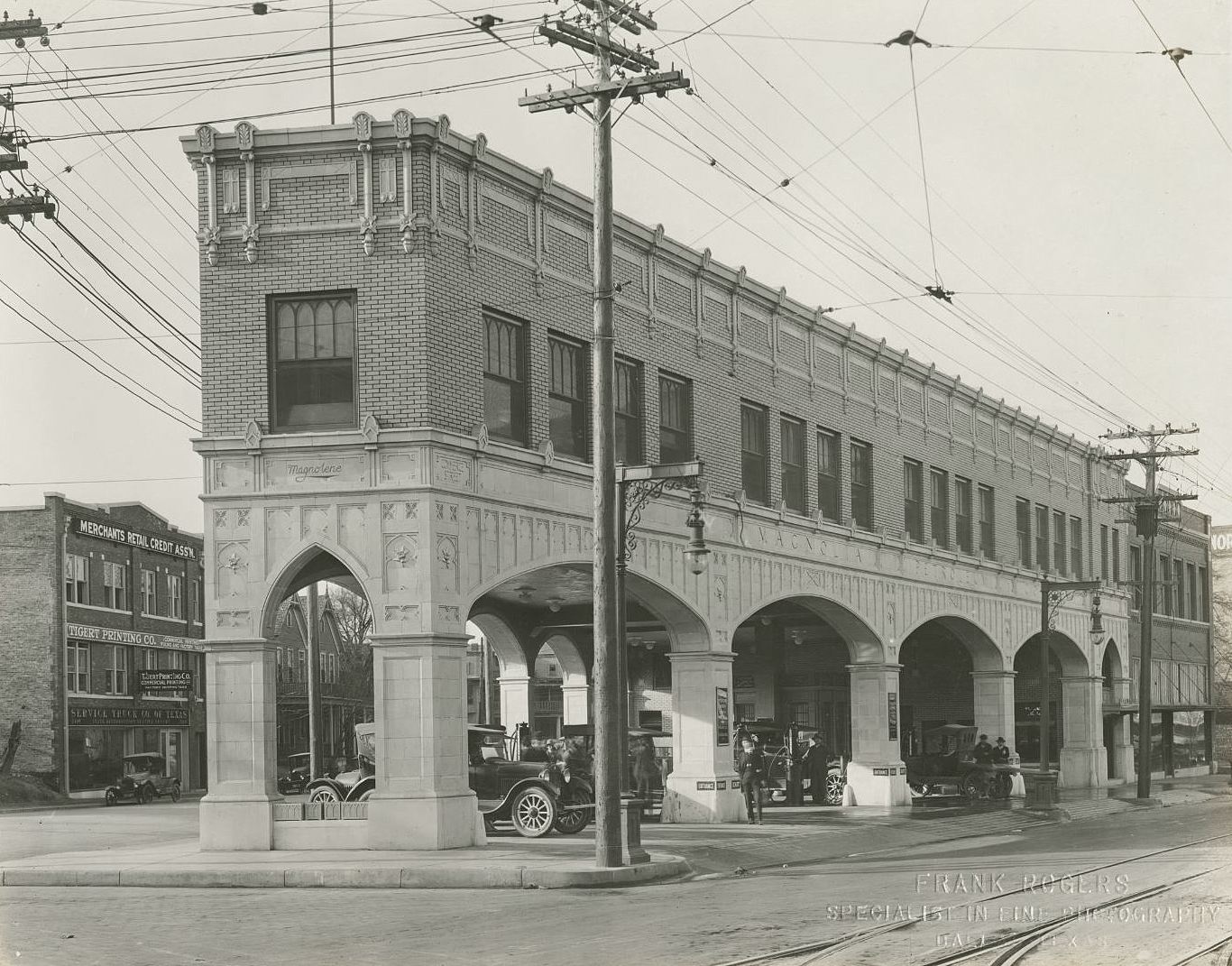
magnolia-gas-station_atlantic-terra-cotta-co-coll_UT_frank-rogersDallas’ finest filling station…

by Paula Bosse

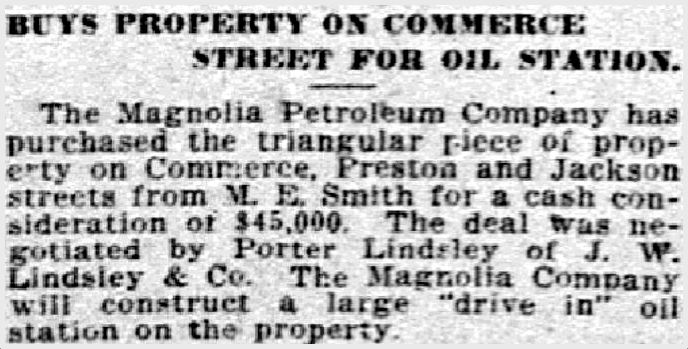
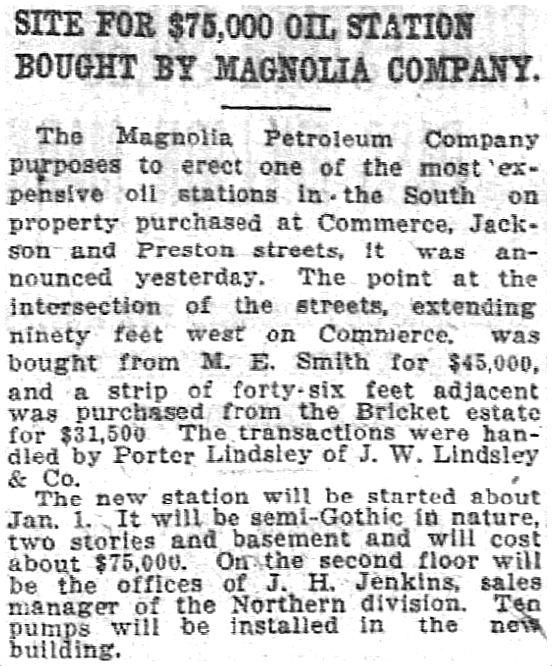
The building seen above turns 100 this year. You know it — you’ve probably said, “I love that building!” at some point in your life. It was built by the Magnolia Petroleum Co. on the triangular piece of land where Commerce Street, Jackson Street, and Cesar Chavez Blvd. meet (Cesar Chavez was originally Preston Street). Before the building’s construction, this intersection was known as “Five Points” — after its construction, it was known as “Pershing Square” (notable for its inconveniently placed middle-of-the-street horse- and dog-watering fountain, which I will write about in the future).

This distinctive brick and terra cotta “semi-Gothic” building was built in 1920, with two stories and a basement; Magnolia service station #110 was on the ground level, and regional offices of the company were above (the massive Pegasus-topped Magnolia Building had not yet been built). Lang & Witchell, Dallas’ premier architects, designed the building.

magnolia-petroleum-station_dmn_091919Dallas Morning News, Sept. 19, 1919

magnolia-petroleum-station_dmn_113019DMN, Nov. 30, 1919

After the 10-pump service station opened, The Dallas Morning News noted that there were 64 gas stations in Dallas (18 were Magnolia stations) — this station was the largest and most expensive to build. Cost of the land and construction was estimated at $175,00 — the equivalent today of about $2.5 million dollars.

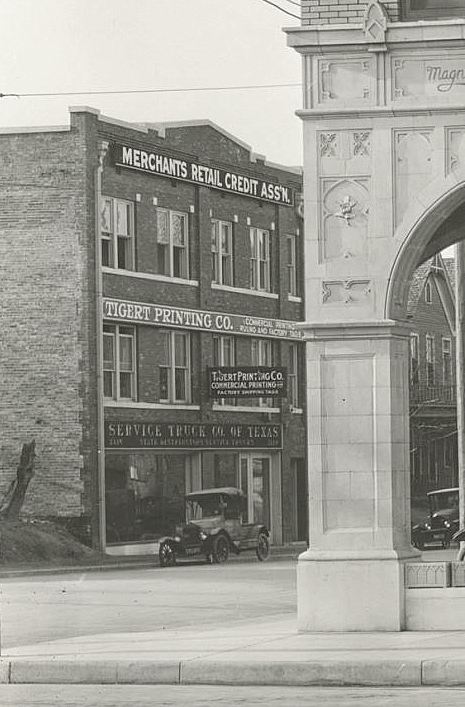
Businesses seen in the photo occupying the three-story building across the street at 2114-16 Jackson are Service Truck Co. of Texas, Tigert Printing Co., and Merchants Retail Credit Association. That building was sandwiched between residences (the house on the left is out of frame). All the way at the right of the photo is a glimpse of rooming houses. Across Commerce was an entire block of auto dealerships and auto supply houses (not seen in this photo). See the service station and environs on a 1921 Sanborn map here.

Let’s zoom in on this great Frank Rogers photo to see some of the details. First, a better look at that three-story office building on Jackson. (All photos are larger when clicked.)

magnolia-gas-station_atlantic-terra-cotta-co-coll_UT_frank-rogers_det-1

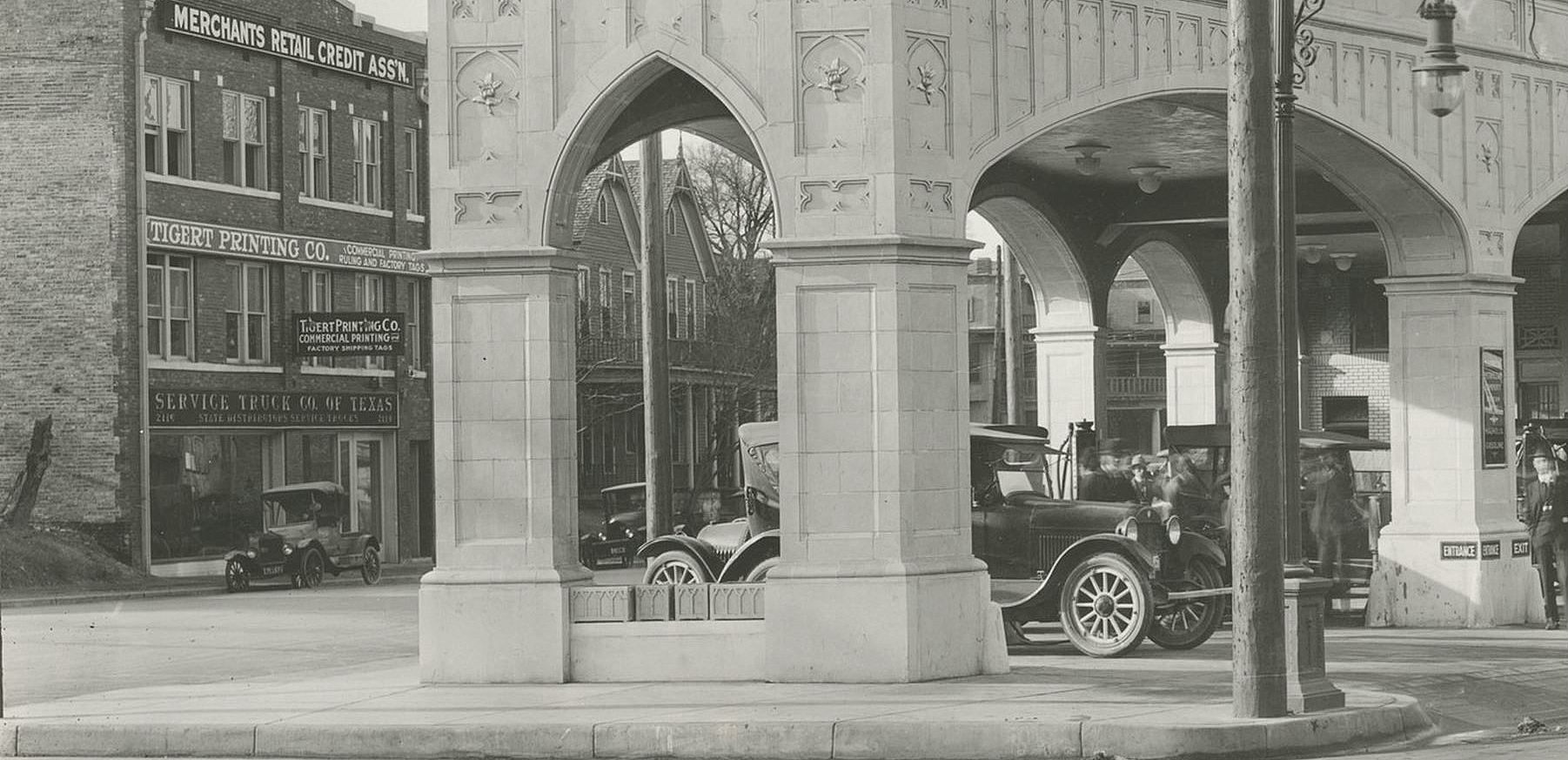
Pulling back a bit, you can see the rooming houses through the arches. You can also see details of the gas station as well as decorative elements of the exterior of the building, including sculptural depictions of magnolias. (I love this cropped detail. Taken out of context, you’d never guess you were looking at Dallas.)

magnolia-gas-station_atlantic-terra-cotta-co-coll_UT_frank-rogers_det-5

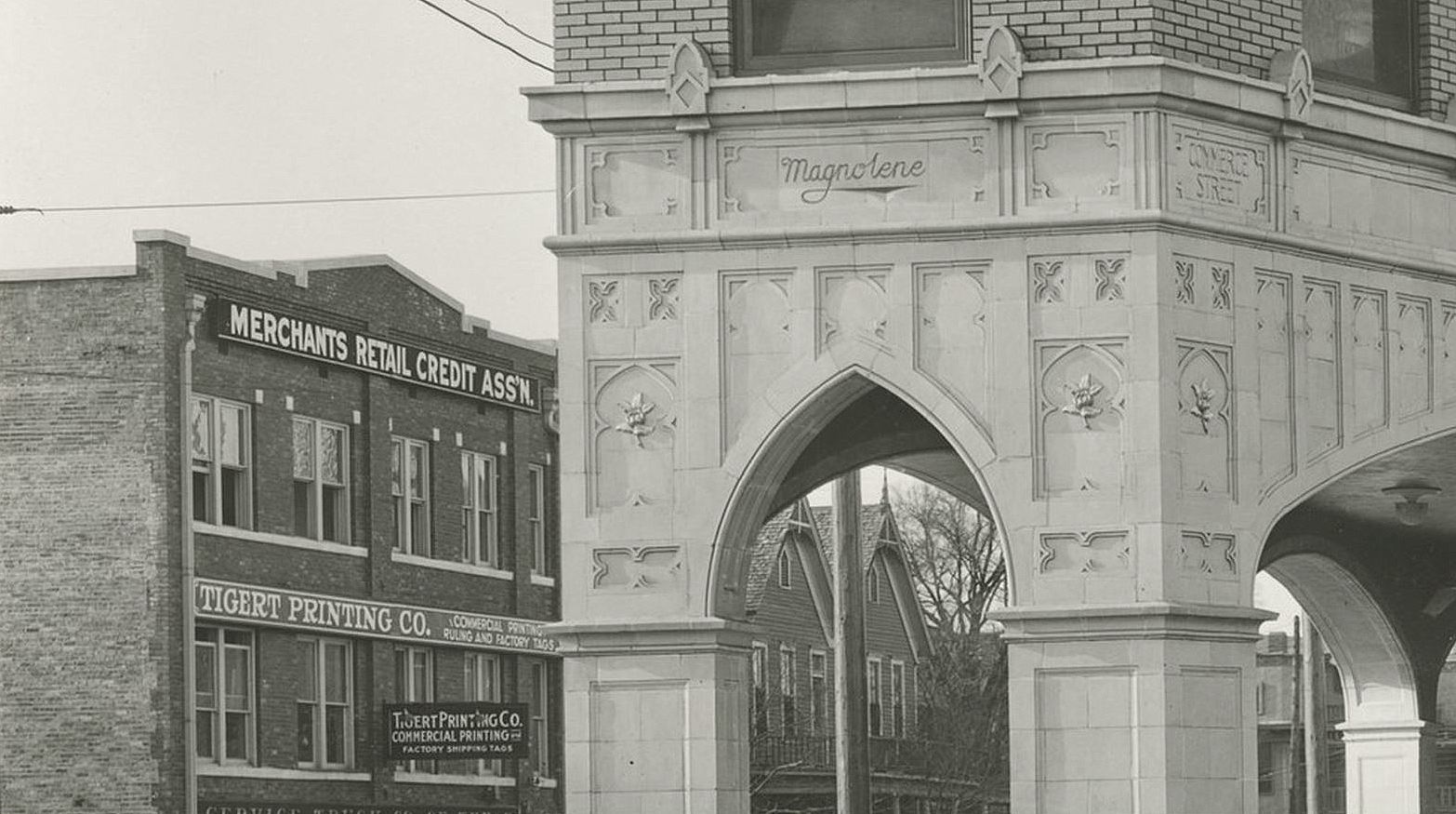
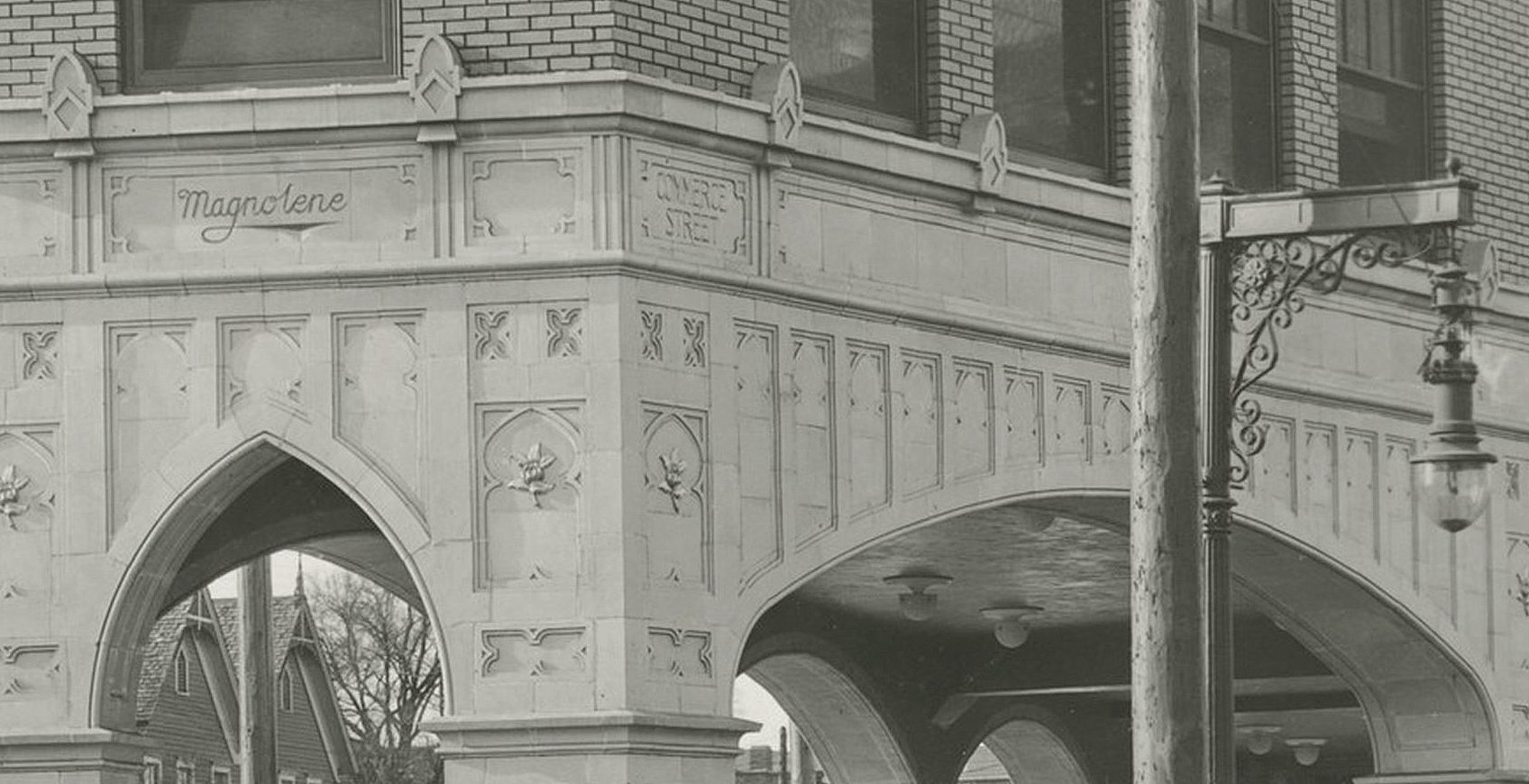
Moving up, you can see the word “Magnolene,” the Magnolia Petroleum Co.’s brand of motor oil; you can also see the words “Commerce Street” (“Jackson Street” is carved into the Jackson side of the building — see here).

magnolia-gas-station_atlantic-terra-cotta-co-coll_UT_frank-rogers_det-2

Here’s a closer look — “Magnolene” is, I think, long gone (as are those cool windows), but “Commerce Street” and “Jackson Street” live on today. Also, check out that very appealing street light. 

magnolia-gas-station_atlantic-terra-cotta-co-coll_UT_frank-rogers_det-3

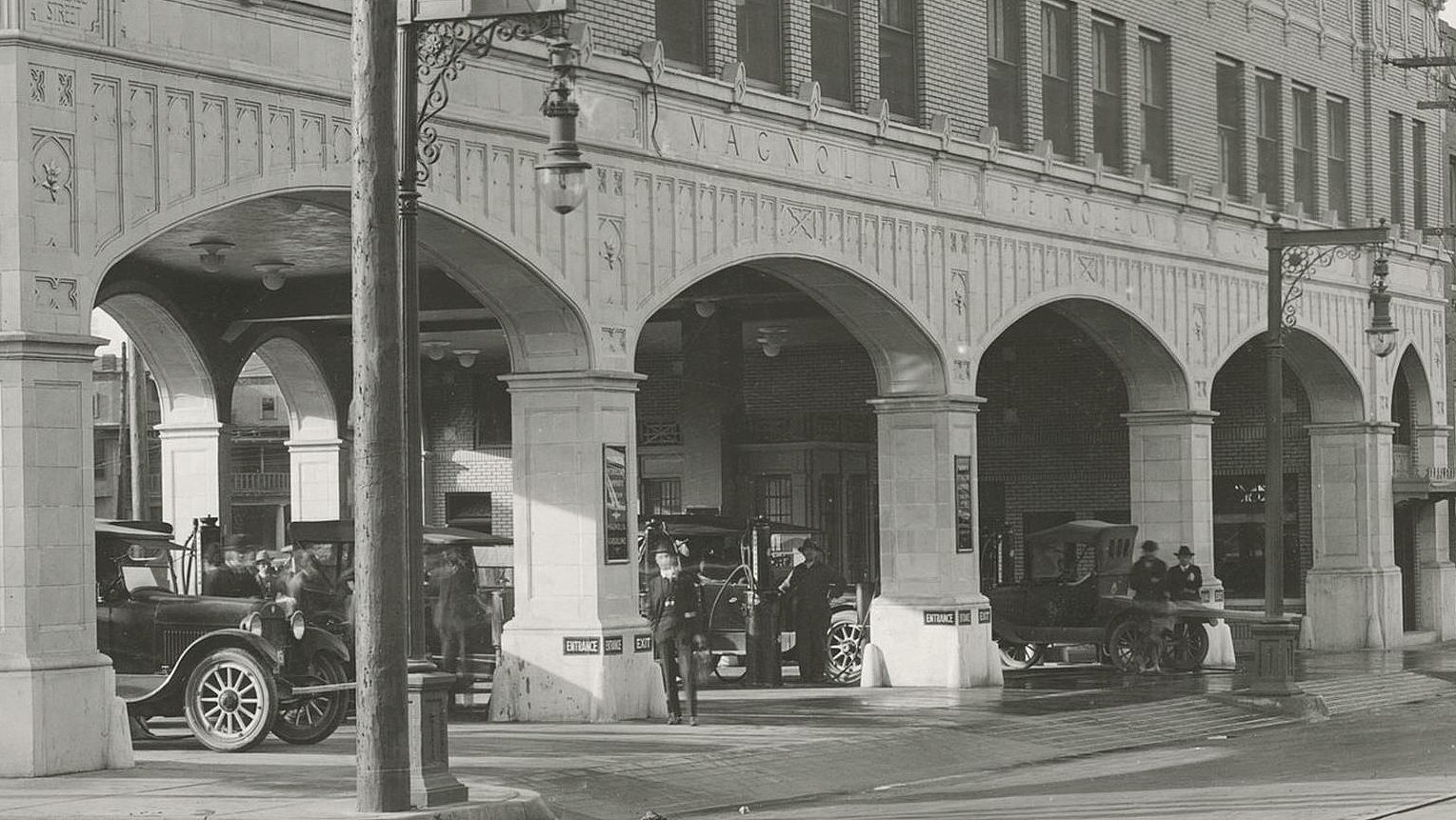
And another, closer look at the gasoline pumps and customers. There is so much incredible detail in the design of this building — when was the last time you saw such an aesthetically appealing gas station?

magnolia-gas-station_atlantic-terra-cotta-co-coll_UT_frank-rogers_det-6

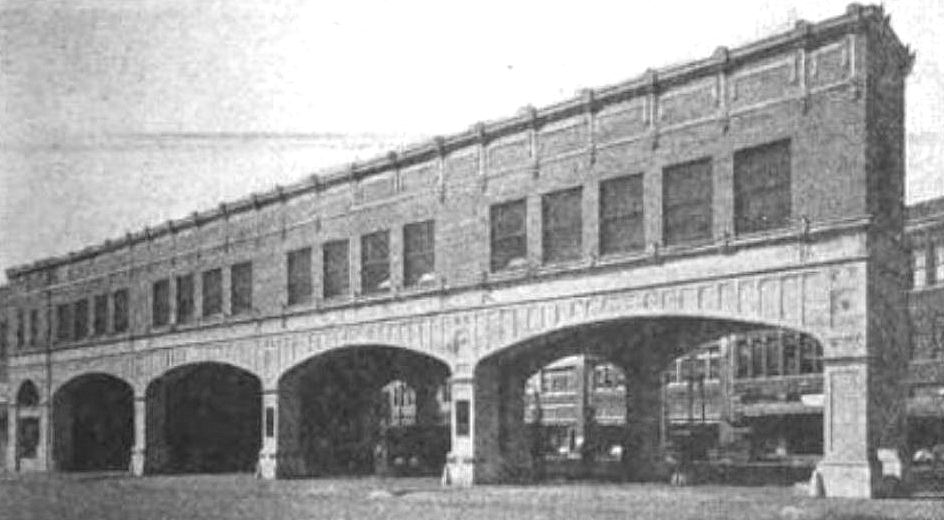
Here’s a photo from a 1922 ad for Atlanta Terra Cotta Co., which supplied several Magnolia stations in Texas with building materials — this was taken from the Jackson Street side (see the full ad here).

magnolia-petroleum-station_manufacturers-record_121422_ad-det

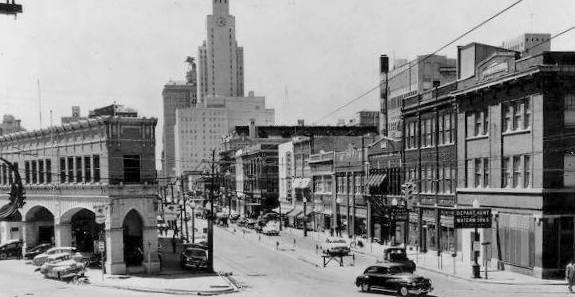
Here’s the building a couple of decades later:

magnolia-petroleum-station_KLIF-bldg_dallas-public-library_crop

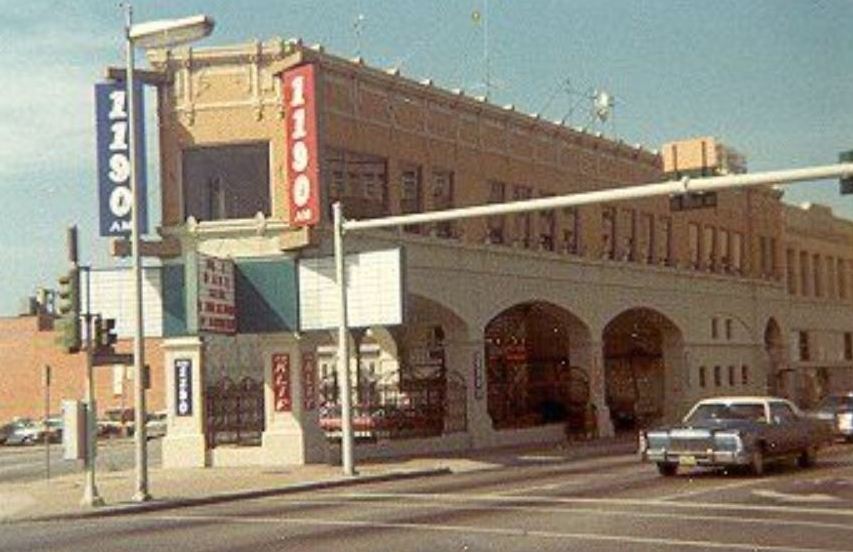
And here it is as many Dallasites remember it, as the studios of KLIF radio, “The Mighty 1190,” where the DJ’s booth was at the “point” and passersby could watch from the street. Later it was the home of the Dallas Observer for many years. (I’m not sure of the original source of this photo, but if anyone knows or has a better quality image, let me know!)

KLIF_color

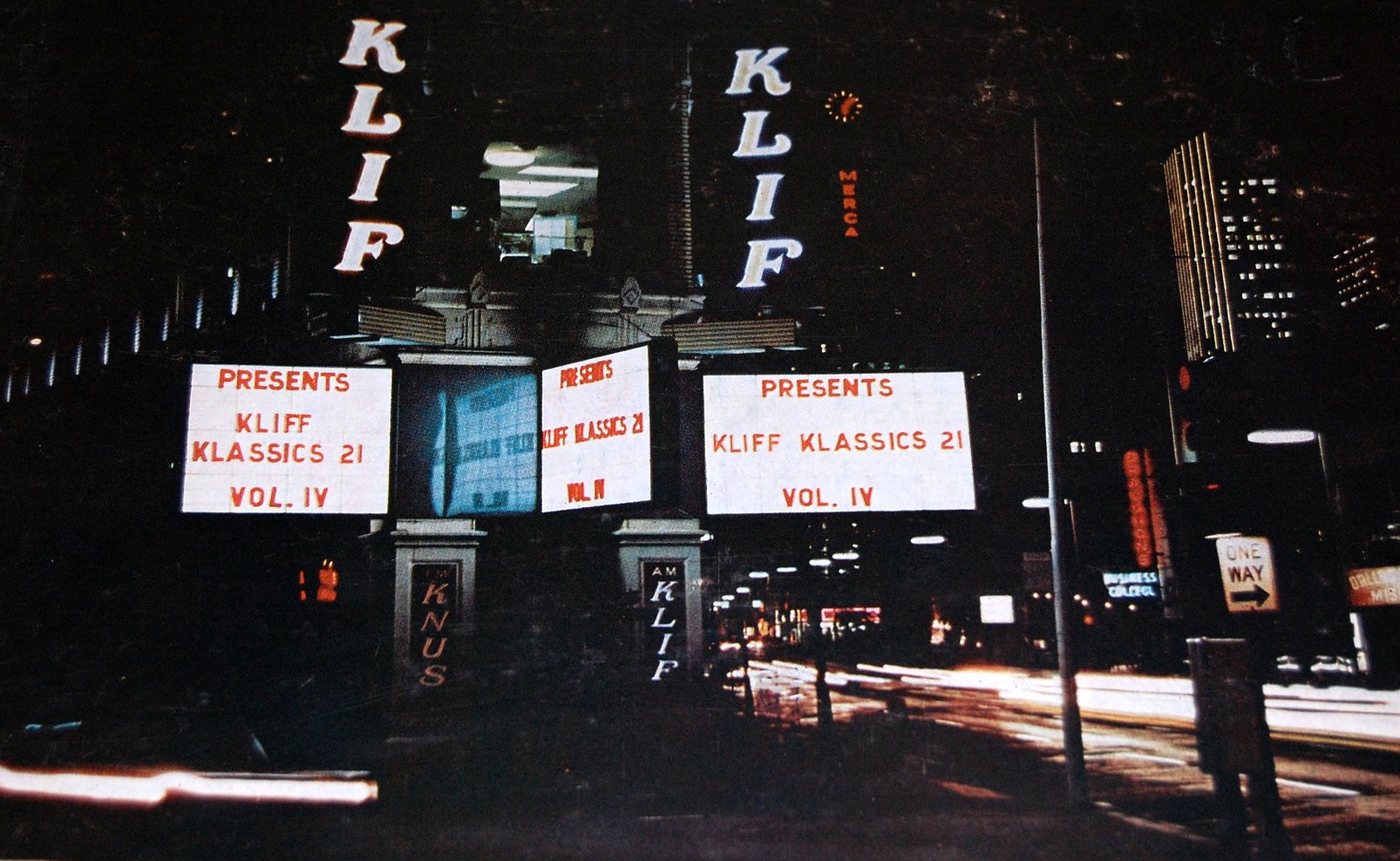
This shows the building a little earlier — it’s a cropped photo that appeared on the album cover “KLIF — KLIFF Klassics,” from about 1969 — you can see the DJ’s booth lit up.

klif_kliff-klassics_vol-iv_album-cover_ca-1969_flickr
via Flickr

Today the building is part of an “adaptive reuse” development called “East Quarter” — I read that the building was slated to house a restaurant (or two), but I don’t know what the current status of that project is.

It’s nice to know that a favorite building from my childhood is still around. Happy 100th!

***

Sources & Notes

Top photo is titled “Magnolia Filling Station, Pershing (Dallas, Tex.): exterior view of front entrance, corner perspective” by Dallas photographer Frank Rogers; it is from the Atlantic Terra Cotta Company Architectural records and photographs, 1914-1941, Architectural Terra Cotta, Alexander Architectural Archives, University of Texas Libraries, The University of Texas at Austin; more info can be found here.

The same photo appeared uncredited accompanying the Dallas Morning News article “Filling Stations of Dallas Are Finest” (DMN, April 10, 1921). 

The photo taken from the Jackson Street side is from an ad for the Atlanta Terra Cotta Co. which appeared in Manufacturers Record (Dec. 14, 1922). (The Atlanta Terra Cotta Co. of Georgia and the Atlantic Terra Cotta Co. of New York were separate companies but were under the same management.)

The photo from the 1940s/1950s is “[Pershing Square in downtown Dallas, Texas]” — I have cropped it; from the Ford Motor Company Building Collection, Dallas Public Library (call number: PA85-39/16).

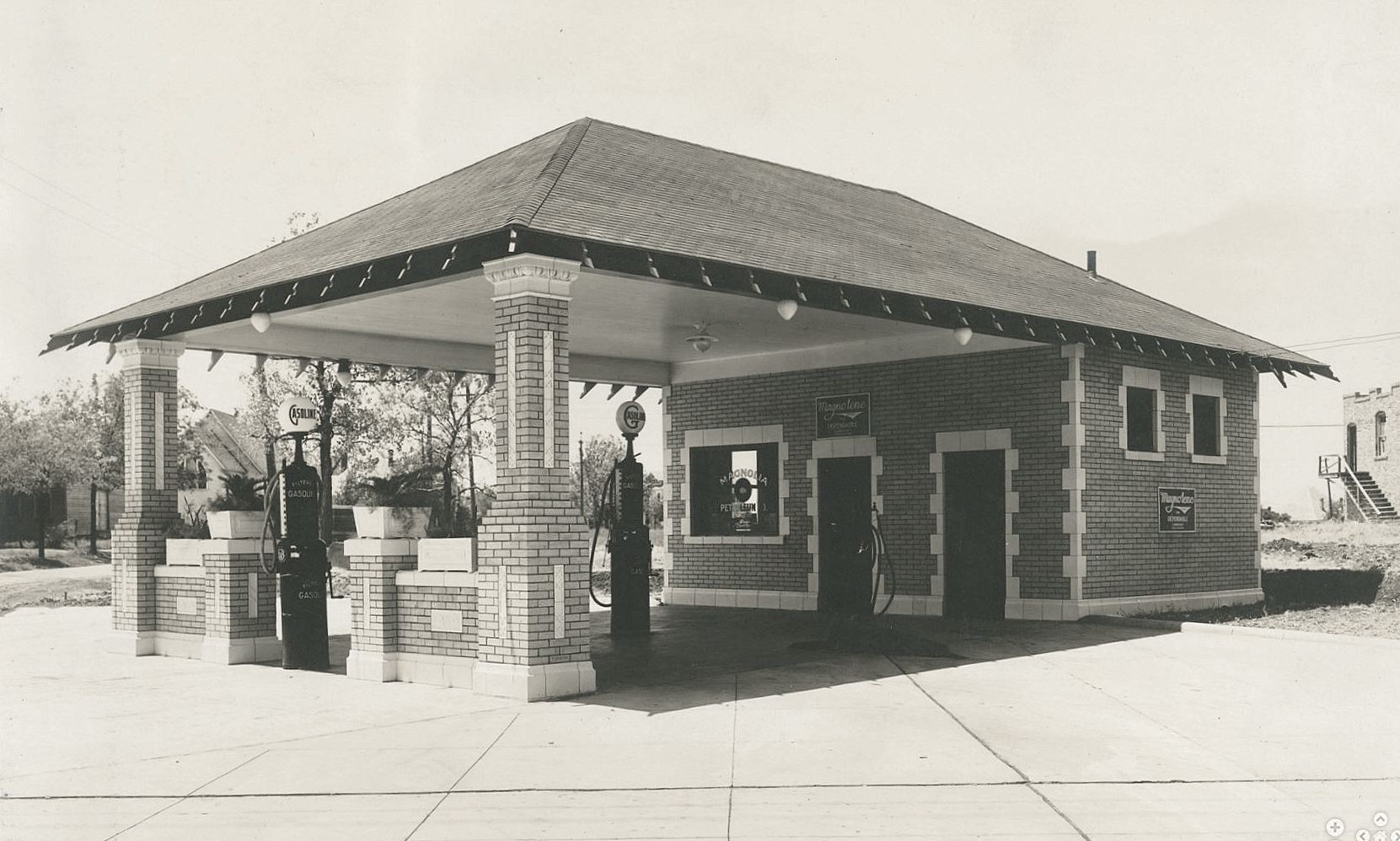
Here is another photo from the same collection as the main photo in this post — this shows another Magnolia filling station in Dallas, this one a smaller, more traditional station (more info here).

magnolia-filling-station_atlantic-terra-cotta-co-coll_UT

magnolia-gas-station_atlantic-terra-cotta-co-coll_UT_frank-rogers_sm

*

Copyright © 2020 Paula Bosse. All Rights Reserved.

West Jefferson Blvd. at Night

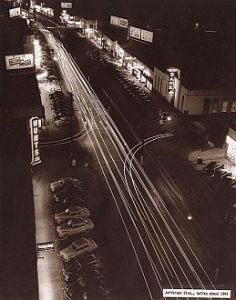
oak-cliff_jefferson-blvd_night_oldoakclifflodge_flickrW. Jefferson & S. Madison

by Paula Bosse

I love night-time views of a lit-up city, and this circa-1949 bird’s-eye view of West Jefferson Boulevard in Oak Cliff, looking east, is pretty cool. If this photo had a soundtrack, it would be moody and atmospheric saxophone music.

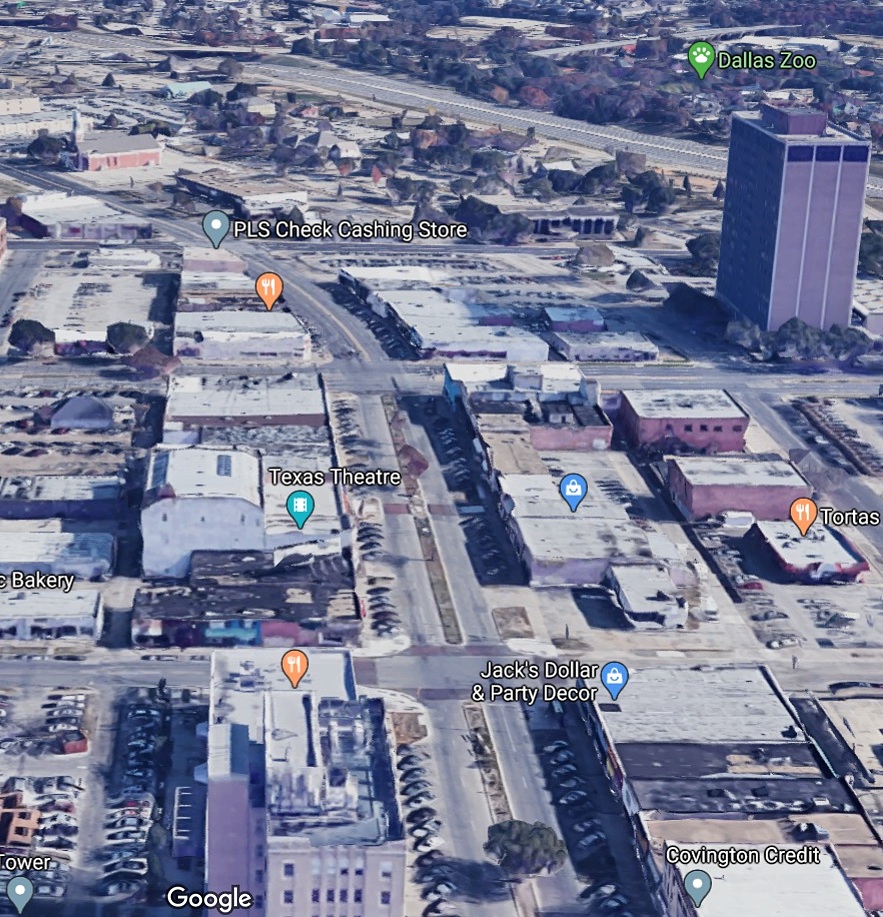
Hunt’s department store was at 303 W. Jefferson, and the Oak Cliff Bank & Trust Co. was at 250 W. Jefferson — S. Madison is the intersecting street in the center of the photo. At the upper left you can see the bright lights and triangular marquee of the Texas Theatre. Below is a view of the same street today, still recognizable.

oak-cliff_jefferson-blvd_google-aerialGoogle Maps

***

Sources & Notes

Top photo is from the Flickr photostream of OldOakCliffLodge, here.

oak-cliff_jefferson-blvd_night_oldoakclifflodge_flickr_sm

*

Copyright © 2020 Paula Bosse. All Rights Reserved.

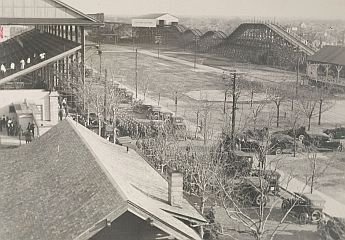
Marching to Mess — 1918

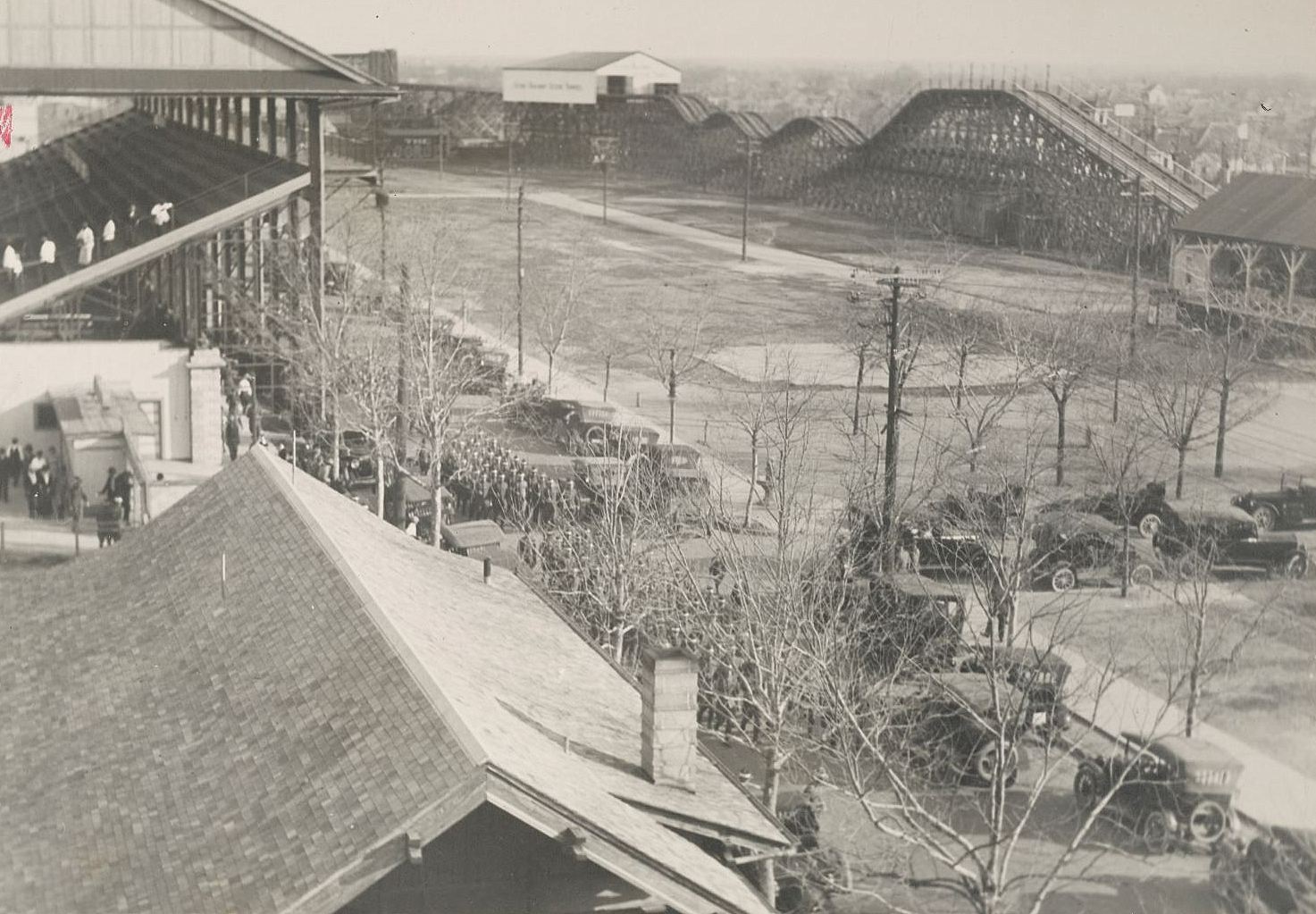
ww1_fort-dick_fair-park_marching-to-mess_roller-coaster_1918_natl-archivesNot your typical boot camp setting…

by Paula Bosse

Above, Camp Dick, an Air Service training camp which took over Fair Park during World War I. The War Department caption of this 1918 photo:
Camp Dick, Dallas, Texas: Men marching to mess after evening parade. Roof in foreground is the Officers’ house.

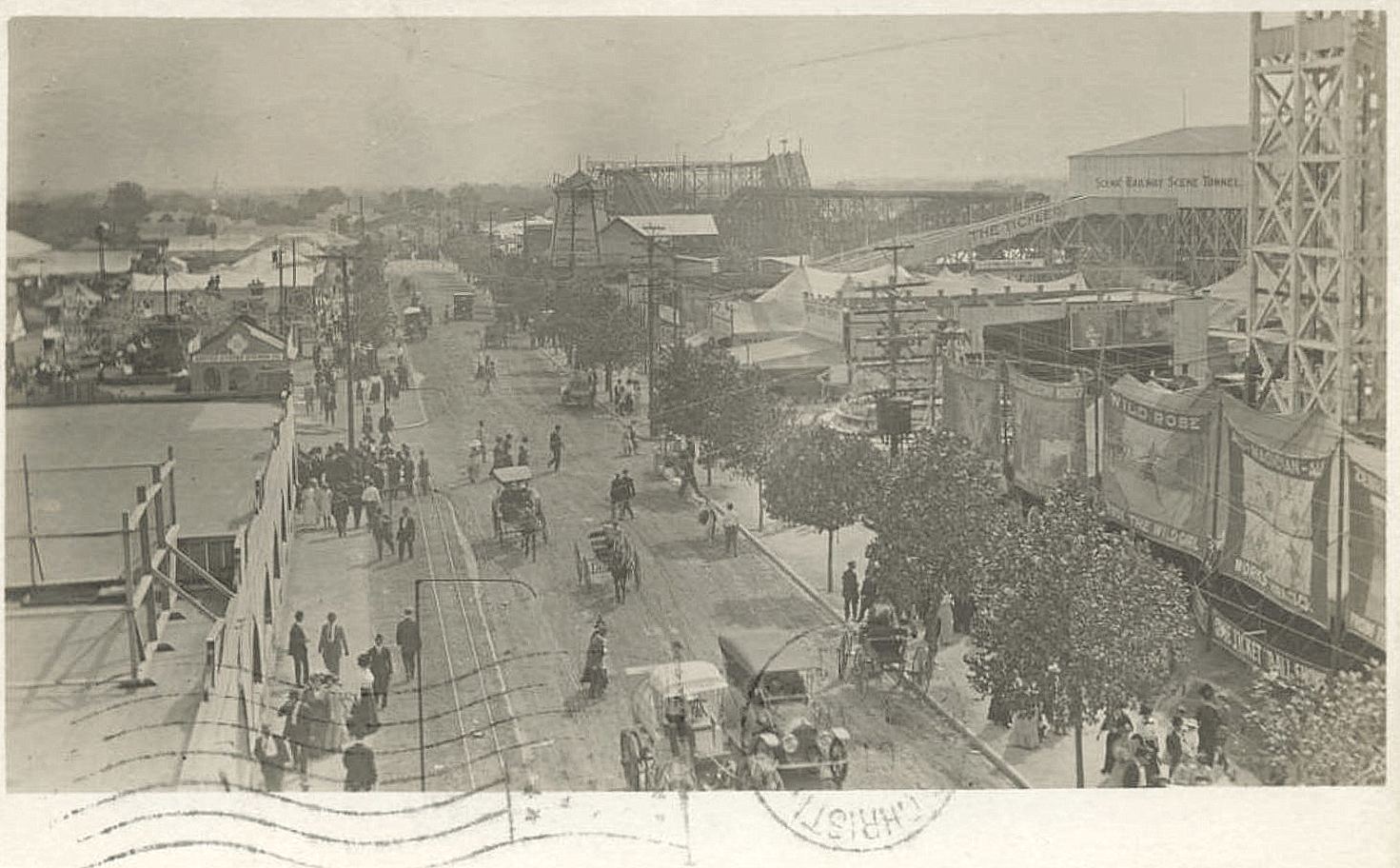
At the right is a roller coaster, a popular ride when the State Fair of Texas (rather than the U.S. military) is occupying the park.

Here’s a photo from 1911:

state-fair_street-scene_john-minor_1911_cook-colln_degolyer

When Preston Sturges trained at Camp Dick — well before he became a legendary Hollywood writer and director — he and his fellow cadets did not let that roller coaster go to waste. He wrote this in his autobiography, Preston Sturges by Preston Sturges:

Out on the parade ground, boys fell over from [the intense heat] all the time and had to be revived with cold water and a sponge. Nights we would climb up the shaky apex of the large roller coaster in the corner of the fairgrounds to try to find a breeze.

An unexpected perk of basic training.
***

Sources & Notes

Top photo is from the National Archives at College Park; more info is here.

State Fair photo is a real photo postcard, taken by John R. Minor, and is from the George W. Cook Dallas/Texas Image Collection, DeGolyer Library, SMU Libraries, Southern Methodist University; more info is here.
More Flashback Dallas posts on Camp Dick can be found here.

ww1_fort-dick_fair-park_marching-to-mess_roller-coaster_1918_natl-archives_sm

*

Copyright © 2020 Paula Bosse. All Rights Reserved.