Flashback : Dallas

A Miscellany: History, Ads, Pop Culture

Category: Leisure

Michael G. Owen, Jr. — Dallas Sculptor of Lead Belly

leadbelly_three-views_paul-l_yelp

by Paula Bosse

Above, three views of “Leadbelly,” the sculpted head of the blues legend, by Michael G. Owen, Jr., 1943.

Michael Owen (profiled here previously as the 15-year-old soap-sculptor who made headlines at the 1930 State Fair of Texas), was the youngest member of the group of artists loosely affiliated with the Dallas Nine group who were making a name for themselves in the 1930s and ’40s. He studied life drawing as a student of Olin Travis and painting as a student of Jerry Bywaters, but he was most proficient as a sculptor. He is best known for his award-winning 1943 bust of bluesman Lead Belly, a piece in the permanent collection of the Dallas Museum of Art (which can be seen in a 1951 DMFA catalog here).

In a 1950 letter to the (then-) Dallas Museum of Fine Arts, Owen recounted how Lead Belly sat for him in New York and sang “Goodnight Irene” as Owen worked on a clay model. Owen was living in Greenbelt, Maryland at the time, and Louisiana-born Lead Belly was living in New York City, but I’d like to think that the two men reminisced about their formative days in Dallas where Owen was a much-talked-about young artist and Lead Belly performed on the streets of Deep Ellum with Blind Lemon Jefferson.

I noticed in the newspaper article that the stone was called black Belgian marble. Actually it isn’t so exotic. It was quarried not far from Charlottesville, Virginia, and is called Black Serpentine. It was the first time I have ever heard of the stuff being black. If you’ll notice it seems quite a bit more crystalline than marble.

The way I happened to do the head went like this. A young fellow I had known in Dallas by the name of Ralph Knight had gone to New York a year or so after I went to Washington. He was interested in folk music and became acquainted with Leadbelly. It was at Ralph’s instigation that I did the head — he got me the stone, sent pictures (I first roughed out the head in clay at home in Greenbelt) and then arranged the sitting at his apartment in New York. Leadbelly sat for me one afternoon and I finished the clay model at that time. From that I worked out the stone cutting, only being able to work on it in my spare time. All in all it was about a full month’s work, I guess. During the time he was “sitting” for me (playing his guitar and singing) he played “Goodnight Irene,” but at that time the folk music devotees did not consider the tune “true folk music.” Still it pleased me when it became a popular song. It’s too bad Leadbelly couldn’t have lived to see himself gain such popularity. (Mike Owen in 1950, from a letter excerpted in the book Lone Star Regionalism, The Dallas Nine and Their Circle)

Sadly, Mike Owen’s career stalled soon after this 1940s artistic high point. He eventually settled in Oregon, where he was sidelined by multiple sclerosis. He died in 1976 at the age of 60.

owen-michael_1930s
Mike Owen in his early 20s

I’m not sure how often the piece is displayed at the Dallas Museum of Art, but it’s a wonderful work of art. When I saw it a couple of years ago, I just stood and stared at it for ages. It’s really fantastic. And it’s fitting that it resides here in Dallas where Michael Owen was once a part of a group of Texas artists whose influence continues to be felt today.

It also seems fitting to throw in this classic from Mr. Ledbetter, who, like Mike Owen, spent time honing his craft in Dallas:

lead-belly-wikipedia

***

Sources & Notes

“Leadbelly” sculpture by Michael G. Owen, Jr. is in the collection of the Dallas Museum of Art.

Photo of the artwork is by Paul L. as posted on Yelp.

Photo of Lead Belly from Wikipedia.

Quote from Mike Owen’s letter to the DMFA (April 11, 1950) can be found in the superb book Lone Star Regionalism, The Dallas Nine and Their Circle, 1928-1945 by Rick Stewart (Austin: Texas Monthly Press, Dallas Museum of Art, 1985) — the best book on Dallas art of this period.

Read the Handbook of Texas entry about Huddie Ledbetter (aka Lead Belly/Leadbelly) here.

Other Flashback Dallas posts on Owen:

  • Young Mr. Owen’s star-turn as the teenager who carved the WFAA transmitter plant from 8,400 pounds of Ivory Soap is here.
  • Owen’s monument to SMU Mustangs’ mascot Peruna, commissioned in 1937, is here.

UPDATE: Read about a recently discovered large painting by Owen up for auction in Dallas in 2019 here.

*

Copyright © 2014 Paula Bosse. All Rights Reserved.


The Dallas Athletics, Dallas’ First Soccer Team — 1908

soccer_dallas-athletics_dmn_122508-PHOTOThe Dallas Athletics, 1908

by Paula Bosse

Soccer — which the local newspapers insisted on calling “soccer football” — was introduced to Dallas as a local organized sport in 1908. The first appearance I can find discussing soccer in Dallas is this article, from the October 18, 1908 issue of The Dallas Morning News:

soccer_dmn_101808(Dallas Morning News, Oct. 18, 1908)

In 1908, Ernest Oates was a 32-year-old Yorkshireman from the north of England who had been in Dallas only a couple of years when, missing the football matches of his youth, he decided to organize a “soccer” team in Dallas. The sport was virtually unknown in Texas, but because Oates undoubtedly knew everyone in the city who had made their way to the United States from England, Scotland, Ireland, and Wales, he had no trouble organizing a team of experienced players. (Oates also helped introduce Dallas to cricket in 1933.)

After reports that the team had begun practicing at the Lake Cliff ballpark, there was news that another team was being formed in Dallas, this one to be coached by an apparently well-known American coach from St. Louis named William “King” Finnegan. This team seems to have had a harder time getting up and running (probably because Oates had snapped up all the good players). Even though they announced that they would be using Gaston Park as their home turf and practice would begin right away, it actually took them months to get a functioning team together.

Also at this time were vague rumblings of a Scotsman in Fort Worth — Duncan J. Livingston(e) — wanting to get a team going in Cowtown, but he was even slower in getting things organized than Finnegan was (Fort Worth wouldn’t have an official team until late 1909). Meanwhile, The Fort Worth Star-Telegram — whether out of jealousy or spite — couldn’t resist tossing sarcastic soccer-related zingers at Dallas’ attempts to popularize the esoteric sport:

soccer_fwst_111708_SARCASM(Fort Worth Star-Telegram, Nov. 17, 1908)

That bon mot was just a warm-up, though, to this offering, which dredged up (as it were) the recent devastating Trinity River flood:

soccer_fwst_112008(FWST, Nov. 20, 1908)

For a while it was looking as if Oates’ “eleven” would have no one to play with. But, unexpectedly, a team appeared —  one fielded by The Dallas Morning News, a team that only a few weeks earlier had been the newspaper’s baseball team! The men on the team had never played soccer, but, as a DMN report had it, “they were game.”

(The timing of the sudden appearance of this team seems a little odd. The Morning News had run several articles about the proposed Finnegan team having actually been organized and in possession of a full roster, but then … nothing more was heard of them. You can’t have a competitive spectator sport with only one side. Cue the WTF entrance of the deus ex machina soccer team full of baseball players.)

So there were really only two teams that played all of the soccer matches in that very short inaugural soccer season: the Dallas Athletics, led by Ernest Oates, and the Newspaper Association team, led by A. McKinnon.

The newspapers tried valiantly to drum up excitement among local sports fans, and they ran lengthy explanations of the game’s rules in an attempt to educated their readers, but I’m not sure how successful they were at either attempt. Tellingly, attendance figures were never reported (except to say that British matches in the UK had no problem attracting crowds of 100,000 fans). The two teams played several games, and the Athletics usually won.

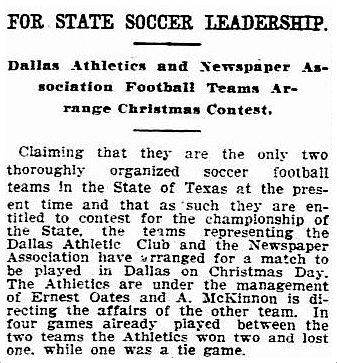
After only four games, the two teams announced that they would have a “state championship” match on Christmas Day. They claimed that they were “the only two thoroughly organized soccer football teams in the state of Texas” — who else would they play in a fight for the championship?

soccer_dmn_121208-state-champ(DMN, Dec. 12, 1908)

So they did. As expected, the Dallas Athletics won, 3-0. The “rugby football” team (which was also known as the Dallas Athletics) won their Christmas Day game as well, a fact that might help explain the cartoon below.

soccer_dmn_122708_CARTOON-KNOTT(DMN, Dec. 27, 1908 — cartoon by Knott)

“King” Finnegan (who, incidentally, had acted as referee for the championship game), disputed the whole “champion” thing, saying that his team, the Dallas Soccers, deserved a chance at the title (even though they had, thus far, played exactly zero games). The Athletics shrugged their shoulders and agreed to the challenge, and on New Year’s Day they trounced the Soccers, 6-0.

And so ended the first soccer season in Dallas. Fort Worth did eventually join the fray the next season, but it wasn’t pretty — they were badly beaten in their first few meetings with the mighty Dallas Athletics. Sorry ’bout that, Fort Worth. Don’t mess with Ernest Oates.

Here’s another photograph of Mr. Oates (front row, center) and the rest of his team. It’s been 106 years since soccer aficionados first started swearing that their sport will catch on in Dallas. And catch on big. And now you know when and where all that talk started: in 1908 with Ernest Oates and his Dallas Athletics.

dallas-athletics_dmn_120509-PHOTOThe Dallas Athletics, 1909

***

Sources & Notes

1908 team photo by Clogenson, from The Dallas Morning News, Dec. 25, 1908; 1909 team photo from the DMN, Dec. 5, 1909.

I’ve compiled a PDF containing most of the first few months’ news coverage of this whole new-fangled “soccer football” sport as it appeared in the pages of The Dallas Morning News and The Fort Worth Star-Telegram. I’m not much of a sports fan, but I actually found it very interesting to read chronological, contemporaneous reports of a new sport working its way into the city’s consciousness. I’ve left out the articles that explained AT LENGTH the rules of the game because my eyes (and soul) started glazing over. But the rest of it is here. My favorite headline is from an article about a mismatched game between Dallas and Fort Worth with the Fort Worth headline reading “Visitors Had More Experienced Men and Were in Better Condition” — yep, that’ll do it. There are a bunch of articles, stretching over a bunch of pages, but you might find them entertaining. The PDF can be found here.

**

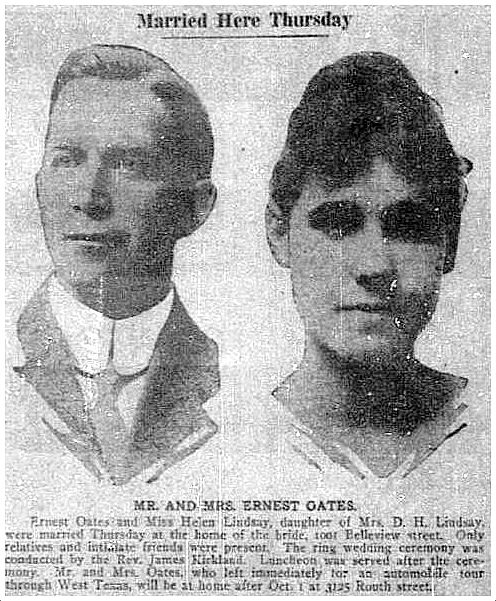
A photo of Ernest Oates (1875-1945) and his new (first) wife, the former Helen Lindsay in a wedding announcement (click for larger image).

soccer_dmn_092317-oatesDMN, Sept. 23, 1917

oates-ernest_ca-1930
Ernest Oates, 1930s

Oates was a stonemason and owned the Oates Stone Co. on Routh Street (at the MKT railroad). Below is an ad from 1922.

ad-oates-stone-work_1922-directory1922 Dallas directory

*

Copyright © 2014 Paula Bosse. All Rights Reserved.

Juneteenth at the Texas Centennial — 1936

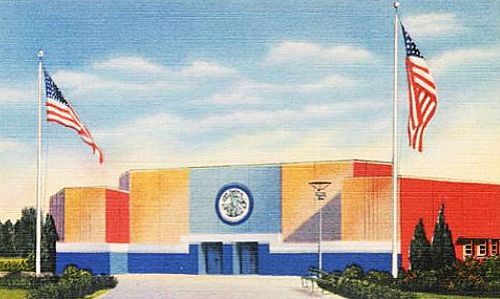
hall-of-negro-life_centennialThe Hall of Negro Life at the Texas Centennial Exposition, Fair Park

by Paula Bosse

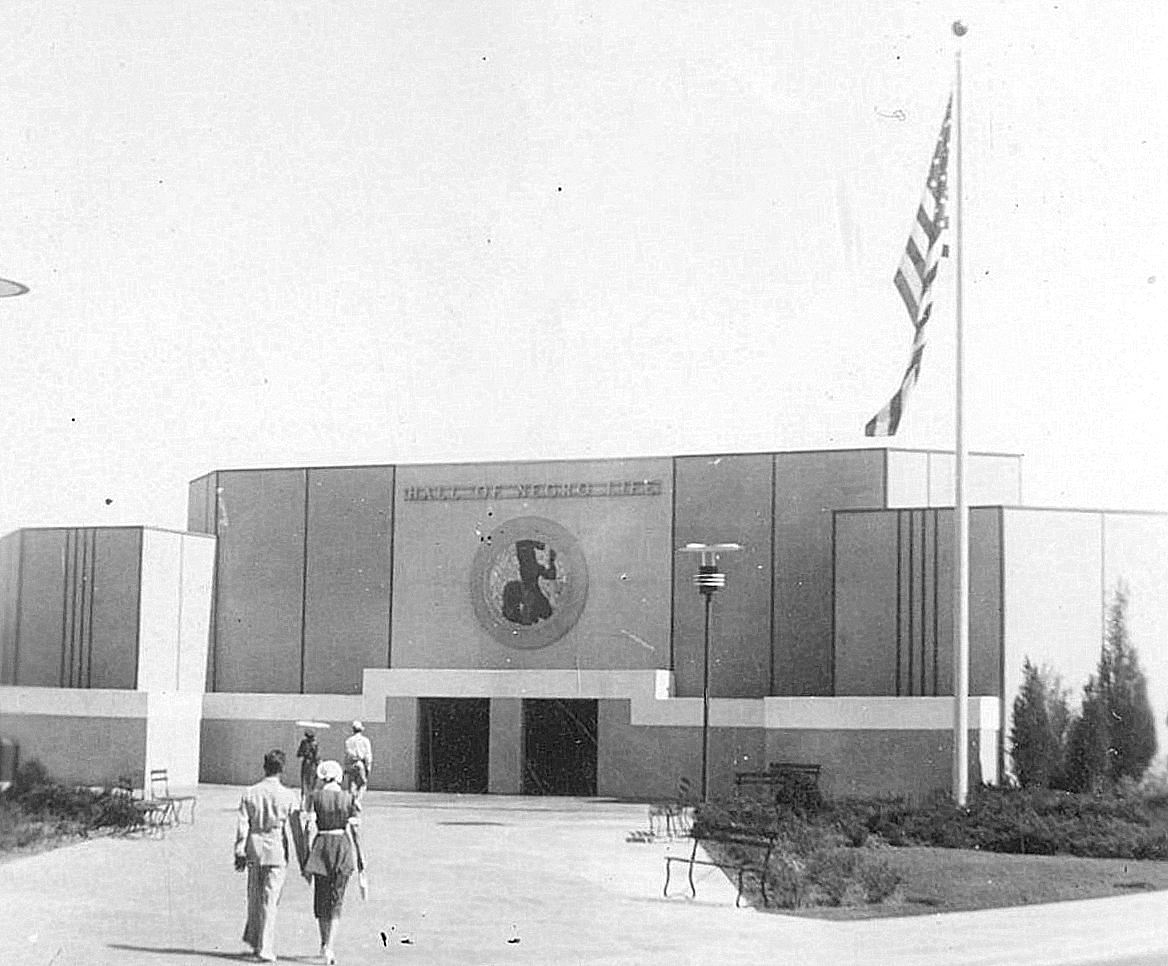
Juneteenth, the anniversary of the date that African American Texans learned they were freed from slavery, was celebrated at the Texas Centennial Exposition with a day of entertainment and exhibits. It was also the day that the Hall of Negro Life — a federally funded exhibition hall acknowledging and honoring the history and accomplishments of African Americans in the United States — was officially dedicated.

tx-centennial_hall-of-negro-life_portal

One of the more interesting things I’ve stumbled across is a drawing of the proposed building (published in J. Mason Brewer’s The Negro In Texas History in 1935). I don’t believe I’ve seen this before. It’s interesting to note the changes from original proposal to finished product.

hall-of-negro-life_proposed_the-negro-in-texas-history_1935

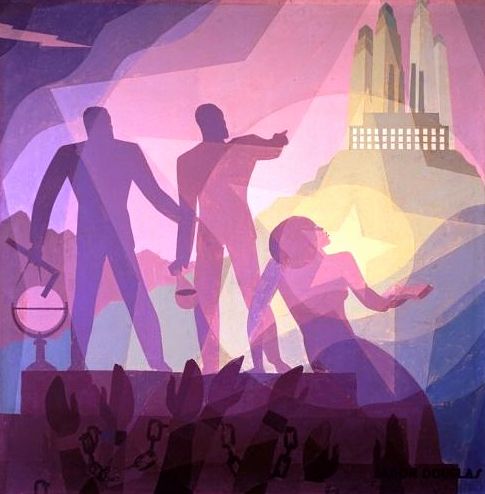
Among the large collection of art by black artists displayed in the Hall of Negro Life were four murals by the artist Aaron Douglas, depicting black history in Texas. Below are the two murals that survive, “Into Bondage” and “Aspiration.” These are incredible murals, and it must have been an emotional experience for those Juneteenth visitors in 1936 to be surrounded by all four powerful pieces in the lobby of a government-backed project that formally recognized the contributions of fellow African Americans.

aaron-douglas_into-bondage_1936_corcoran“Into Bondage” by Aaron Douglas, 1936 (Corcoran Gallery of Art)

aaron-douglas_aspiration_1936“Aspiration” by Aaron Douglas, 1936 (Fine Arts Museum of San Francisco)

***

Sources & Notes

Black-and-white photograph of the Hall of Negro Life from the Private Collection of Mary Newton Maxwell, Portal to Texas History, here.

Photo of proposed Hall of Negro Life from An Historical and Pictorial Souvenir of the Negro In Texas History, written by J. Mason Brewer (Dallas: Mathis Publishing Co., 1935).

“Into Bondage” by Aaron Douglas (1936) is from the collection of The Corcoran Gallery of Art.

“Aspiration” by Aaron Douglas (1936) is from the collection of The Fine Arts Museum of San Francisco. (There is an amazing interactive look at this painting here.)

More on the Hall of Negro Life, from the Handbook of Texas, here.

More on the Hall of Negro Life from The Crisis, the magazine of the NAACP, in the July, 1936 article “Negroes and the Texas Centennial” by Jesse O. Thomas, here.

How was this important Juneteenth celebration at the Texas Centennial covered by The Dallas Morning News? Well, the paper actually devoted a lot of space to the day’s events in a fairly lengthy article which appeared on June 20, 1936. I think the DMN editorial board probably thought they were being magnanimous in the amount of coverage given, but, really, the article — though brimming with a certain amount of probably well-intentioned jubilation — is so unremittingly racist that it’s actually shocking to see this sort of thing in print in a major newspaper. I encourage you to check out the article published on June 20, 1936 which carries the laboriously headlined and sub-headlined “Negroes Stage Big Juneteenth at Centennial; Dallas Eats Cold Supper and Cotton Patches Emptied as Thousands Inspect Magic City; Hall Is Dedicated; Dusky Beauties Prance; Cab Calloway Does His Stuff For Truckers.”

*

Copyright © 2014 Paula Bosse. All Rights Reserved.

Give a 15-Year-Old 8,400 Pounds of Soap and He’ll Carve You a Radio Transmitter — 1930

owen-michael_soap_1930a
Michael Owen, Jr., boy soap-carver 1930

by Paula Bosse

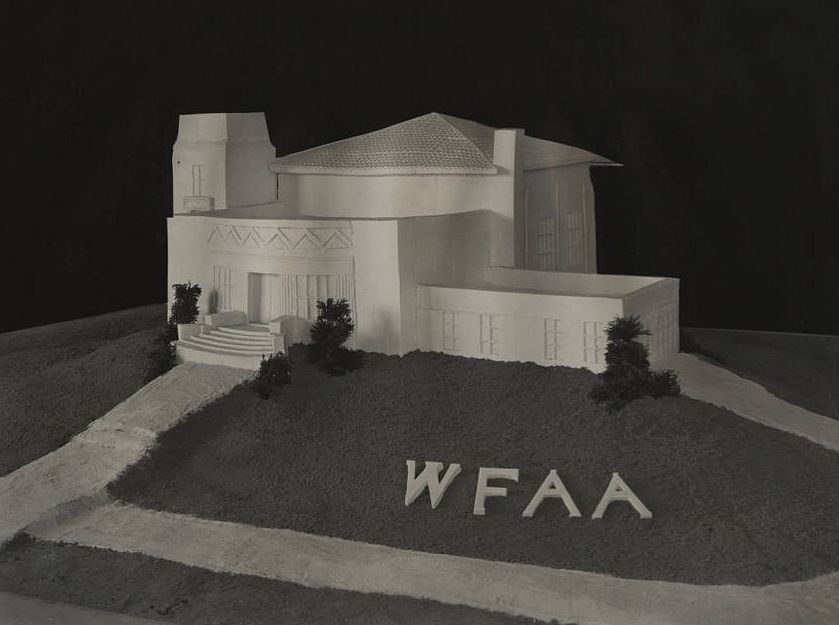
In 1930, 15-year-old sculptor Michael G. Owen, Jr. carved a replica of the WFAA transmitter building out of 8,400 pounds of Ivory soap. And why not? It was a big draw at that year’s State Fair of Texas.

Mike Owen, a student at well-to-do Highland Park High School (although Dallas artist Olin Travis, who had him as a pupil at about this time, described him as being “very poor”), had been sculpting all sorts of things, from the age of 3. He had begun winning awards when he was 13 or 14, one in an earlier “soap modeling” contest sponsored by Procter & Gamble. Not only did that soap-carving award result in young Mr. Owen being commissioned by Sanger Bros. to carve a model of the downtown skyline (I’m not sure this commission was ever actually completed), he was also asked to create an attraction for the State Fair: a replica-in-soap of the WFAA transmitter plant located on Northwest Highway near Grapevine (see a photo of the transmitter building and tower here). Owen worked from blueprints of the building and a bronze model supplied by the Belo Corporation (owner of WFAA), and Proctor & Gamble supplied the huge bars of Ivory soap (12 bars, each weighing 700 pounds). The finished piece was an “exact replica” of the 50,000-watt transmitter plant and was touted by Procter & Gamble as being the largest soap sculpture ever executed. It was a big hit at the 1930 State Fair of Texas.

Michael Owen went on to become a professional artist, with early enthusiastic support from Jerry Bywaters. He was associated with the Dallas Nine (and was, by far, the youngest member affiliated with that somewhat amorphous group), and I will address his more serious non-soap forays into the art world in a later post. But, first, back to soap!

The photo below shows Mike Owen’s finished product, which took him 12 days to complete.

owen_wfaa-soap_degolyerBelo Collection, DeGolyer Library, SMU

It’s difficult to tell what the size of the finished work was from this photo, but it was described as being five feet high and seven feet wide. So… big. When it was displayed at the fair it was, for some reason, bathed in blue light. After the 12 days it took Owen to complete this sculpture, I bet that kid was squeaky-clean and positively reeked of Ivory soap.

owen-michael_soap_1930b

owen-michael_soap_1930

***

Sources & Notes

Photo of Owen’s soap carving of the WFAA transmitter plant is from the Belo Records collection, DeGolyer Library. Central University Libraries, Southern Methodist University; more information on this photo can be found on the SMU website here.

Other Flashback Dallas posts on artist and sculptor Michael G. Owen, Jr.:

  • For a look at Owen’s professional career as a sculptor, see my post “Michael G. Owen, Jr., Dallas Sculptor of Lead Belly” here.
  • To read about the Peruna monument SMU commissioned him to produce in 1937 (when he had just turned 22), see my post here.

UPDATE: Read about a recently discovered large painting by Owen up for auction in Dallas in 2019 here.

*

Copyright © 2014 Paula Bosse. All Rights Reserved.


WFAA & WBAP’s Unusual Broadcasting Alliance

wfaa_wbap_transmitter_1941-sm

by Paula Bosse

wfaa-wbap_transmitter_1941

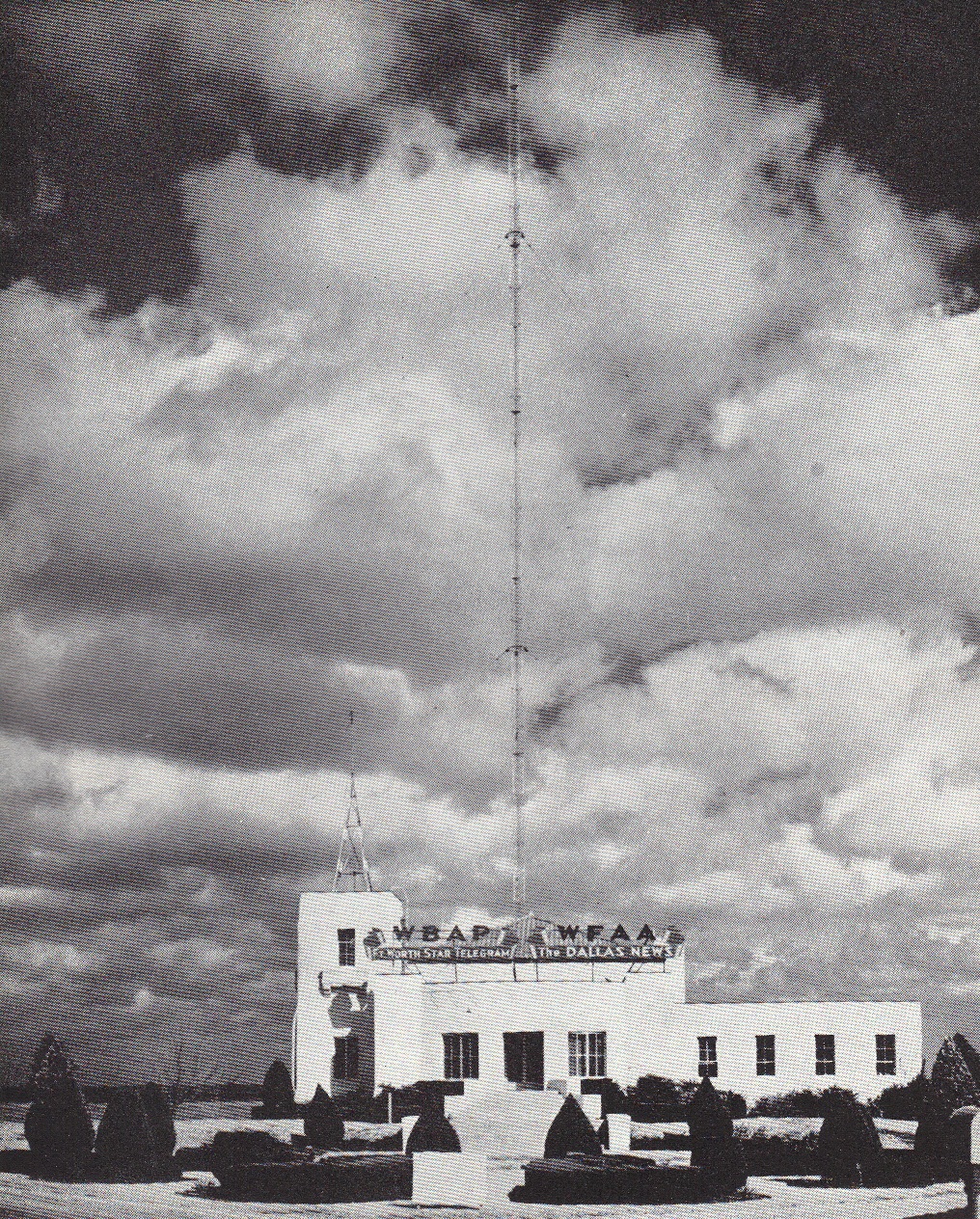
I looked at this photograph and thought, “That’s odd. Two competing radio stations from two competing newspapers from two competing cities used the same radio transmitter. How did that happen?” And then I read about the extremely unusual time-sharing arrangement that WFAA (which was owned by The Dallas Morning News) and WBAP (which was owned by The Fort Worth Star-Telegram) maintained for 41 years.

I’ll link to a story that fully explains this extraordinary arrangement, but, briefly, WFAA and WBAP both broadcast on two frequencies, trading off throughout the day. A typical schedule looked like this:

wfaa-wbap_schedule

The two frequencies were 570 and 800 (later 820) kilohertz on the AM band. When WFAA was broadcasting on 570, WBAP was broadcasting on 820. On the agreed-upon time, the stations would switch over to the other frequency. Back and forth. Over and over and over. All day long. They were independent stations with independent programming, network affiliations, on-air talent, and advertising departments. And this went on for FORTY-ONE YEARS! Until 1970! How had I never heard of this?

Apparently it wasn’t all that big a deal to the stations or the listeners. Things were getting a little strained by 1969, though, when WBAP went whole-hog into playing country music (and eventually became one of the most successful country stations in the United States). It was time to go their own ways. The split was amicable, and both stations felt that the unusual partnership had worked well for all concerned.

So why did this happen in the first place? Because of the 820 frequency. 820 was a clear channel frequency, which meant that the station that owned it could broadcast at an incredible 50,000 watts — enough to be heard all over the Western hemisphere; 570 boasted a measly 5,000 watts, and, as someone said, “people might hear you in Sherman … but maybe not.” Neither WFAA or WBAP wanted to give up the clear channel powerhouse, which is why their piggy-backing partnership lasted as long as it did. But, ultimately, WBAP got 820 and was a major broadcasting force to be reckoned with. WFAA radio got the short end of the stick and sputtered along at 570 on the AM dial for a few lackluster years but never recovered from losing its half-share of 820 AM. In the WFAA-WBAP showdown: Fort Worth 1, Dallas 0.

*

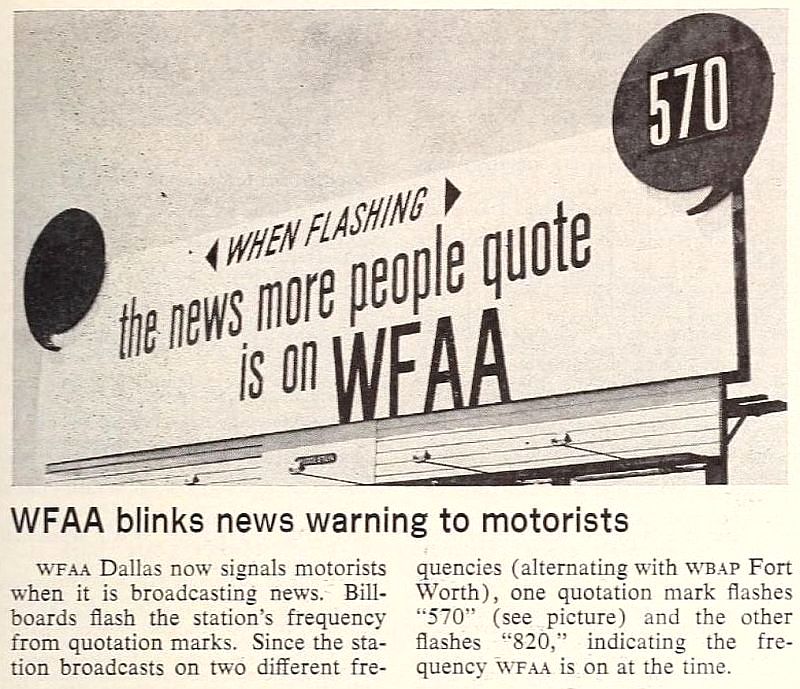
Look at this crazy billboard from 1963 — it flashed which frequency WFAA was currently broadcasting on.

WFAA-WBAP_broadcasting_042263Broadcasting, April 22, 1963

***

Sources & Notes

Photo of the transmitter building from WFAA, WBAP, KGKO Combined Family Album (Dallas-Fort Worth, 1941). Yes, there was actually a THIRD station involved in all of this for a while — KGKO out of Wichita Falls! Here’s an ad from the 1941-42 Texas Almanac, via the Portal to Texas History (click to see a larger image):

wfaa_kgko_tx-almanac_1941-42_portal

Sample schedule is from the definitive article on this bizarre broadcasting alliance: “You Have Half a Station, We Have Half a Station” — How WFAA in Dallas and WBAP in Fort Worth Shared Radio Frequencies for Four Decades by John Mark Dempsey, from the Spring, 1999 issue of Legacies magazine, which can and SHOULD be read, here.

For another photo of this transmitter building, see a previous post here.

*

Copyright © 2014 Paula Bosse. All Rights Reserved.


Cokesbury Book Store — 1959

cokesbury_dallas_1959

“For a summer of pleasure, grab a good book.”

*

Copyright © 2014 Paula Bosse. All Rights Reserved.

“I’ve Got the Dallas Blues and the Main Street Heart Disease”

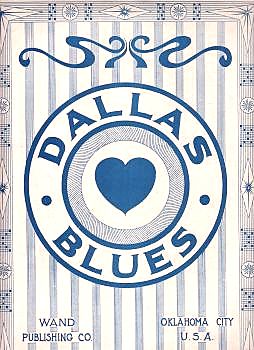
dallas-blues-sheet-music

by Paula Bosse

“Dallas Blues” is an important milestone in the history of blues music. I gather this may be debatable, but it is cited as being the first “true blues song” ever published (at least by sources on Wikipedia). Written sometime before 1909 by Hart A. Wand, a white musician in Oklahoma, “Dallas Blues” was published as an instrumental in 1912; in 1918, lyrics were added by Lloyd Garrett.

I have to admit, when I read the opening lyrics, I assumed it was your typical Dallas-inspired ditty about how Dallas is a cold and heartless city that will chew you up and spit you out:

When your money’s gone, friends have turned you down,
And you wander ’round just like a houn’ (a lonesome houn’),
Then you stop to say, ‘Let me go away
From this old town (this awful town).’

But then the next lines are:

There’s a place I know folks won’t pass me by,
Dallas, Texas, that’s the town I cry! (Oh hear me cry!)
And I’m going back, going back to stay
There till I die (until I die).

Ha! That was unexpected.

Below are a few versions of “Dallas Blues” — fast and slow, some with vocals, and one hot instrumental. Enjoy. I hope those juicy peaches are still hanging on your trees!

**

Ted Lewis’ version from 1931, with Fats Waller’s first vocal appearance on record and Benny Goodman on clarinet. Most of the lyrics have been left out, but this is great

*

Louis Armstrong’s recording, from 1929:

*

George Lewis’ slowed-down version:

*

And, lastly, Isham Jones’ instrumental version — this one is hopping!

***

Sources & Notes

Sheet music from an Art & Seek story on Texas Blues (with sound clips) by Jerome Weeks, here.

Wikipedia entry on the song, here.

Complete lyrics to the song, here.

I’ve got the Dallas Blues and the Main Street heart disease
(It’s buzzin’ ’round),
Buzzin’ ’round my head like a swarm of little honey bees
(Of honey bees).

Interested in Dallas-related blues songs? Check out my previous post “Deep Ellum / Deep Elm / Deep Elem Blues,” here.

*

Copyright © 2014 Paula Bosse. All Rights Reserved.

Irby-Mayes Ad With a Cameo by the Merc — 1948

ad-irby-mayes_merc_dmn_040148Landmark alert!

by Paula Bosse

An ad with the famous local building making a cameo.

It’s called PLATEAU
…the wonder fabric by Pacific Mills
that’s so perfect for our Texas weather. Suits of
[redacted??] look like regular weight worsted
…yet can be worn most every month of the year.
A new shipment exclusive at Irby-Mayes.

I love this 1948 ad. Irby-Mayes was located — where else? — in the Mercantile Bank Building!

*

Copyright © 2014 Paula Bosse. All Rights Reserved.

Night Life Along the Centennial Midway — 1936

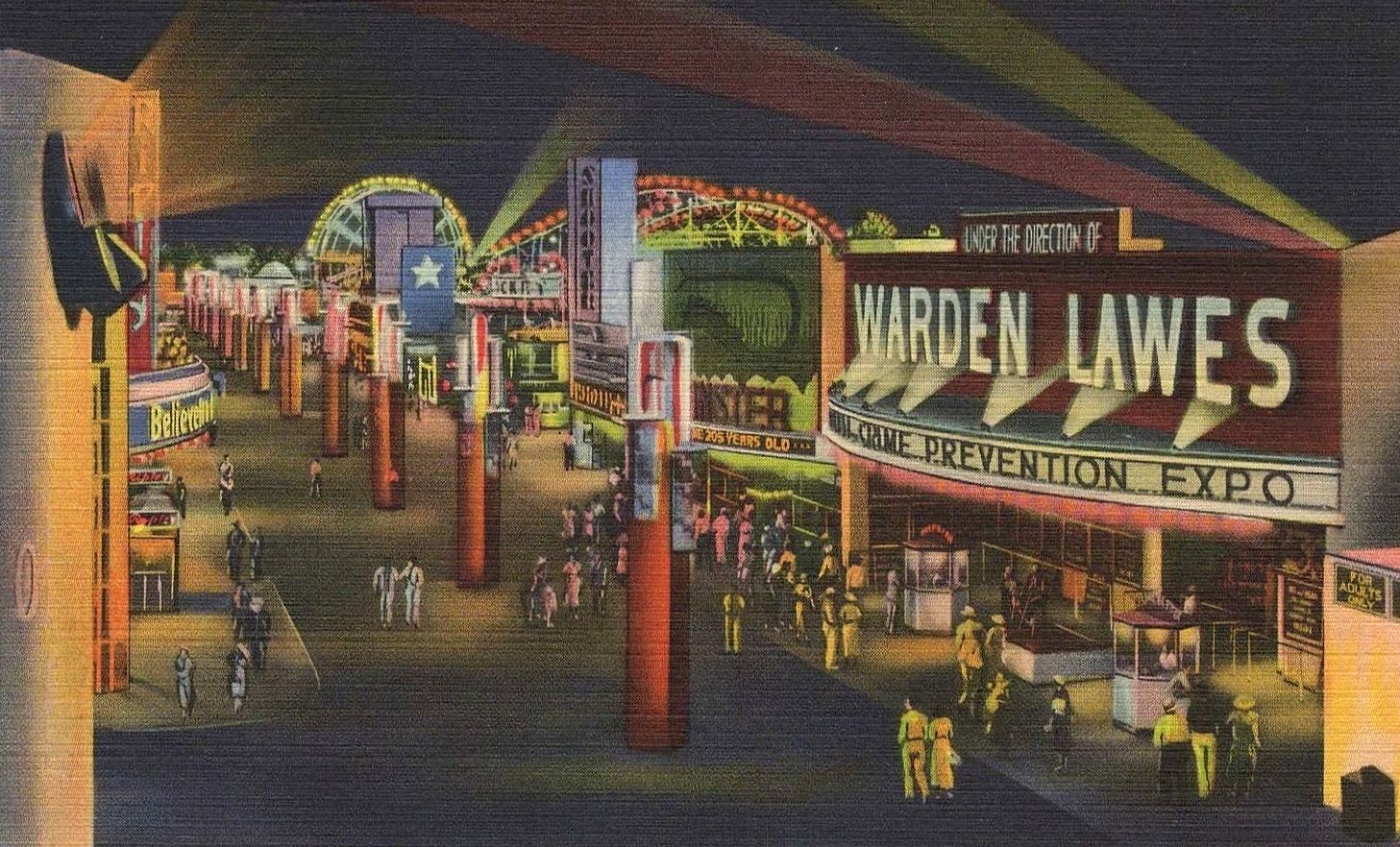
tx-centennial_night-midwayThe magical midway at night (click for larger image)

by Paula Bosse

Glamorous night shots as seen in not-quite-real-looking postcards from the 1930s and ’40s are among my favorites. And this shot, of the Texas Centennial Exposition Midway at night-time is so, so GREAT!

The text on the back of the card:

Night life in all its glory and glamour. Oddities, Animal Shows and Girl Shows to charm the most fastidious, along the Midway.

***

Compare to the shots of this stretch of the Midway from the other direction, in my previous post here.

Click picture for MUCH larger image!

*

Copyright © 2014 Paula Bosse. All Rights Reserved.

Forget the Ferris Wheel, Take a Ride in a Centennial Rickshaw — 1936

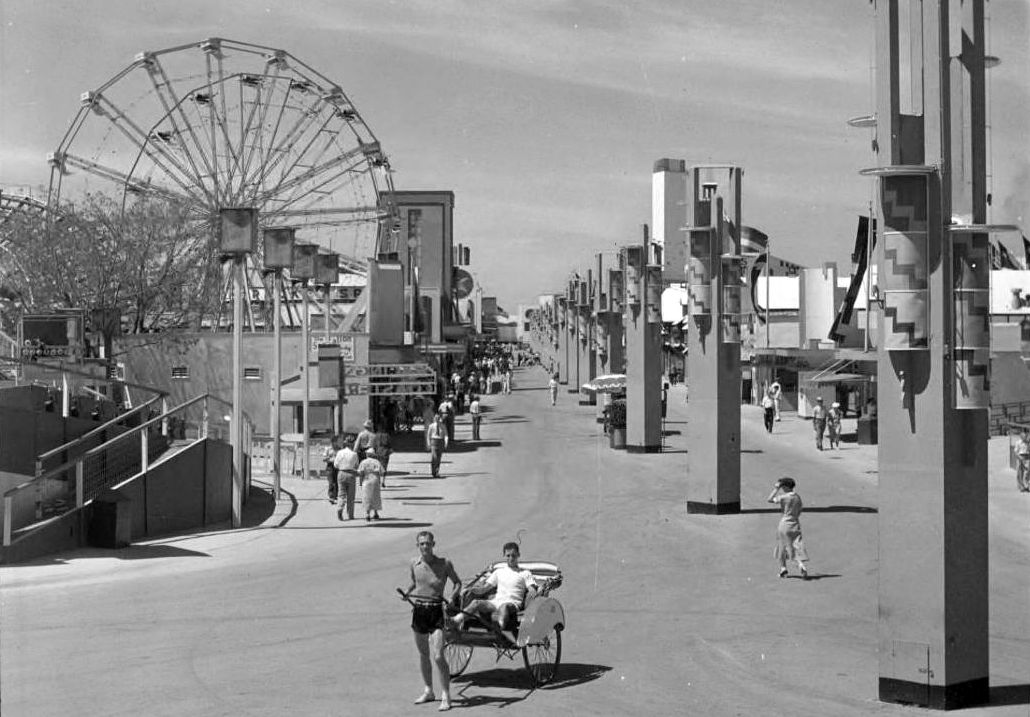
tx-centennial-midway_1936_ucrYour rickshaw awaits…

by Paula Bosse

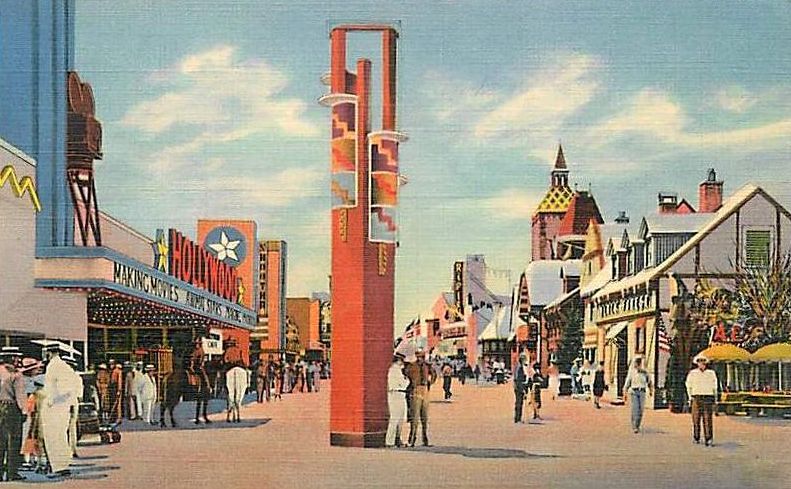
Here’s an odd photo of the Midway at Fair Park, taken in 1936. The whole thing feels a little weird. It’s just so … bright. And empty. It’s kind of bleak-looking for the glamorous Texas Centennial Exposition. And then there’s that rickshaw (?). What this scene needs is a little postcard-colorizing magic. Below, a similar scene, sans rickshaw.

fair-park_hollywood_centennial_midway

Better … but still kind of odd.

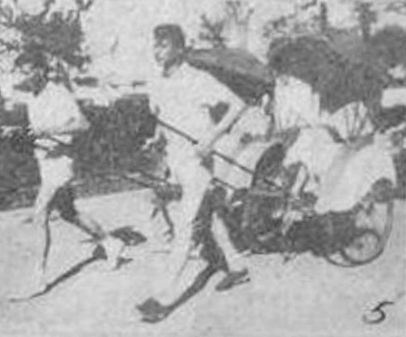
But back to that rickshaw. According to the the Treasury of Texas Trivia, Vol. II:

The Texas Centennial in Dallas had one feature that, considering its uncountable sights and sounds that one had to take in, may very well have been forgotten. College boys, as a means of earning tuition as well as keeping in shape, pulled foot-weary fairgoers from street to street and plaza to plaza in rickshaws during the 1936 celebration of our state’s one hundredth birthday.

rickshaw_tx-centennial-1936

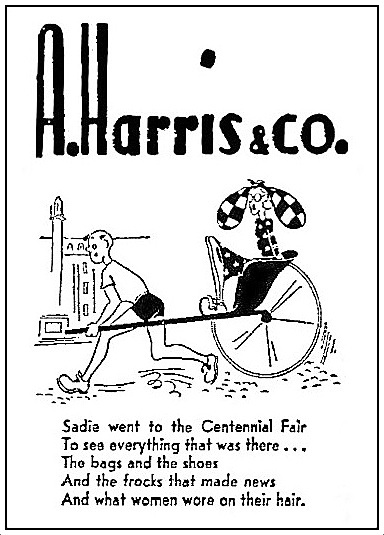
This exotic mode of transportation was even appearing in local advertisements — like this one, from an ad placed by the A. Harris department store:

ad-a-harris_centennial_rickshaw_dmn_052536_detA. Harris ad (det) , 1936

One of the most notable rickshaw-riders of the Dallas Centennial was none other than celebrated fan-dancer, Sally Rand, whose “Nude Ranch” show (check Google for risque film footage) at the competing Frontier Centennial Exposition in Fort Worth was packing them in in Cowtown. Even Sally had to come over and check out the Centennial. The photo below shows her autographing the shorts of one of the “ricksha-toters,” a lucky young man named Guy Johnsen. The caption of the July, 1936 news photo reads:

Sally Rand, who says she never knew success until she thought of taking her pants off, autographs those of Guy Johnson [sic], her ricksha toter, on a visit to the Texas Centennial Exposition at Dallas. With her is Mrs. Voln Taylor, Chairman of the Centennial Advisory Board.

centennial_rickshaw_sally-rand_cook-coll_smuCook Collection/DeGolyer Library/SMU

And now I know.

***

Sources & Notes

Top photo — titled “The Gay Midway of the Texas Centennial Exposition, Dallas” — from the Keystone-Mast Collection, UCR/California Museum of Photography, University of California at Riverside; see here.

Quote from Treasury of Texas Trivia, Vol. II by Bill Cannon (Plano: Republic of Texas Press, 2000).

Sally Rand photo (“Sally Rand Gives an Autograph”) from the George W. Cook Dallas/Texas Image Collection, DeGolyer Library, Central University Libraries, Southern Methodist University; more info on this photo is here. (Arne Miller “Guy” Johnsen — known later as “Swede” Johnsen — was a native South Dakotan who had left home and arrived in Dallas just in time for the Centennial, where he got a job pulling visitors around Fair Park in a rickshaw. This paragraph is from his 2005 obituary: “Raised on a farm in Volin, South Dakota, ‘Guy’ (as he was nicknamed by his mother), left home on a quest for better opportunities. In 1936, his travels found him pulling a rickshaw at the Dallas Centennial Fair. His claim to fame was pulling the famous and beautiful fan-dancer Sally Rand throughout the centennial fair grounds.” I guess a moment like that really stays with a person!)

To see this stretch of the Midway from the other direction — and AT NIGHT (!) — see my companion post here.

I find that — by complete coincidence — I’ve posted this on June 6th, the anniversary of the opening day of the Texas Centennial Exposition.

*

Copyright © 2014 Paula Bosse. All Rights Reserved.