Every time I come across this photo I clipped from an old Buddy magazine, I laugh. I don’t think I’ve ever considered the word “disgruntled” as an adjective to describe David Allan Coe, but I think we’d all be pretty disgruntled if we were the headliner at the Longhorn Ballroom, and they couldn’t even spell our name right on the marquee.
A disgruntled David Allan Coe points to the marquee with his name misspelled in front of the Longhorn Ballroom. Photo by Stoney Burns.
If you aren’t familiar with the excessively “colorful” David Allan Coe… well… you’re probably not a fan of the extreme side of Outlaw Country Music. I swear I heard “You Never Even Called Me by My Name” every single time I went to the Lakewood Landing, back when I went there a LOT. I hope it’s still on the jukebox. You can’t call yourself a true Texan unless you’ve sung along to this song in a packed bar. (You can listen to this legendary DAC song on YouTube here — listen all the way through!)
And speaking of Buddy, enjoy this Shiner Beer ad that appeared in its pages in 1975:
And still speaking of Buddy, I understand that all (…ALL!) (…or almost all…) back issues — going back to the first issue from July 1973 — are in the process of being fully scanned and will be coming soon to an internet near you. This is such an important cultural archive of Texas music (and Dallas music)! There is a very large selection of Buddy at the downtown Dallas Public Library, but there are gaps in the collection. I look forward to wandering through the back issues when the archive is up and running!
***
Sources & Notes
Photo of David Allen Allan Coe is by the legendary Stoney Burns; it appeared in a May 1975 issue of Buddy magazine. The Shiner ad is from an April 1975 issue of Buddy. Both issues are from the very large collection housed at the Dallas Public Library.
Buddy is still going strong, after 53 years. (And so is the 86-year-old DAC!)
Imagine what coulda been… (click for larger image)
by Paula Bosse
First off, apologies for the image quality of this advertisement. It’s from eBay (“He’s from Barcelona…”).
I thought it was an interesting ad, because I never knew that Bruce Springsteen played the Sportatorium, Dallas’ legendary wrestling mecca and off-and-on home to the Big D Jamboree. How had I never heard about this? (This was a show put together by local promoter Gene McCoslin, who had a long history with Willie Nelson.)
1974 was pretty early for Bruce to play in Dallas. He was starting to gain notice nationally, but he wasn’t a star yet. The tickets to the Sportatorium show were $4.50 in advance/$6.00 at the door (roughly $30 and $40 in today’s inflation-adjusted money). As it turns out, the show was canceled, because — hold onto yourselves — only 28 advance tickets had sold. …TWENTY-EIGHT.
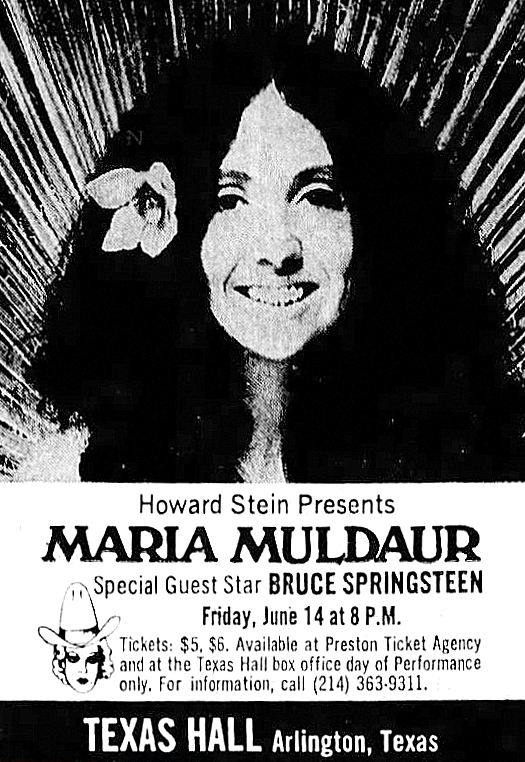
That show was scheduled for November 10, 1974. A few months earlier — in June 1974 — Bruce was, for some inexplicable reason, booked as the opening act for… Maria Muldaur (“Midnight at the Oasis”). That show was scheduled at the UTA campus in Arlington. The Dallas Morning News reported that Bruce was a last-minute no-show, claiming a bout with the flu, but, apparently, he was unhappy with the small turnout and just didn’t go on. (Trouper Maria, having lost her opening act, performed for nearly 2 hours, and got rave reviews.)
Fort Worth Star-Telegram, June 9, 1974
Springsteen’s first actual performance on a Dallas stage appears to have been sometime in the same year as those two ill-fated non-gigs: 1974. Freelance rock critic Kim Martin-Pierce remembered it: “He always had a troubled history here. [He was booked to play at the old Mother Blues nightclub, but] he sold so poorly at Mother Blues that they moved him over to Gertie’s on Lemmon Avenue. He didn’t draw well at all there either, but he gave the greatest performance I’ve ever heard in a small club.” (DMN, “Springsteen Finally Shows Big D Who’s Boss” by John Anders, Nov. 30, 1984, after Bruce’s two sold-out shows at Reunion Arena)
Sorry, Bruce, for the cold shoulder! I think Dallas eventually came around. But you missed out. Playing the Sportatorium would have been really, really cool. And those 28 people would still be talking about the most amazing show they had ever seen.
***
Sources & Notes
Top ad from the Dallas underground newspaper Iconoclast, Nov.8-15, 1974; found on eBay in April 2024.
This post appeared previously in a slightly different form on the Flashback Dallas Patreon page.
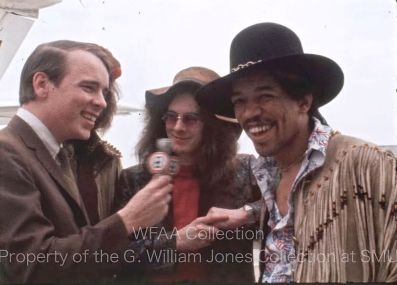
Today is 4/20 Day. An alternate (or parallel) way to celebrate the already alternative “holiday” is to mark the anniversary of one of Jimi Hendrix’s best interviews, on the Love Field tarmac on April 20, 1969, given to Dallas reporter Doug Terry (still a college student when he was at WFAA-Channel 8). The band was in Dallas for a show at Memorial Auditorium. It’s just a fantastic, laid-back, cool interview.
I had tried contacting Doug several years ago to let him know this clip was racking up the hits on YouTube, in case he wasn’t aware it was there, but I didn’t hear back from him until this week! He had seen the post I had written about this interview and wrote a bit about that momentous occasion in the email. He also adds some interesting behind-the-scenes tidbits I always find interesting (the following is used with Doug’s permission):
I was still a college student most of the time I worked at WFAA. I handed in my resignation after covering the north Texas pop festival in that same year. [Watch one of Doug’s reports from the Texas International Pop Festival here.] Your comment about being in a large city and its advantages was something that I did not fully grasp until years later. The access was wonderful, I saw Hendrix at least three times, on one occasion being in the dressing room with a camera when he warmed up for a show (that footage is nowhere to be found).
There are two aspects to mention about that interview. First, I was a weekend reporter and late night news anchor at Ch. 8 and I assigned myself to go interview him. In those days, one could call up the airlines when a notable person was coming in and they would give the flight number and arrival time. Amazing. Most of the people at the station at that time probably had no idea who Jimi was and wouldn’t have cared if they did know.
The other interesting point is the work of the photographer. Ordinarily, we did over the shoulder interviews, the camera to the back and side of the reporter. The fact that this was shot from the side made all the difference. As a shooter, he was not otherwise outstanding but this interview would be much less interesting if it had been shot in the traditional line-up sort of way. The two bandmates goofing around was distracting but great.
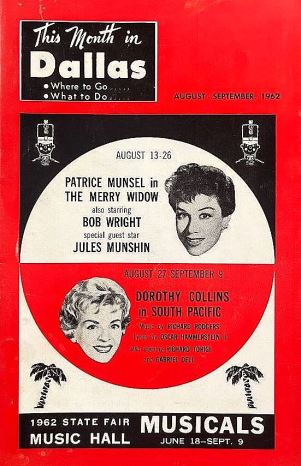
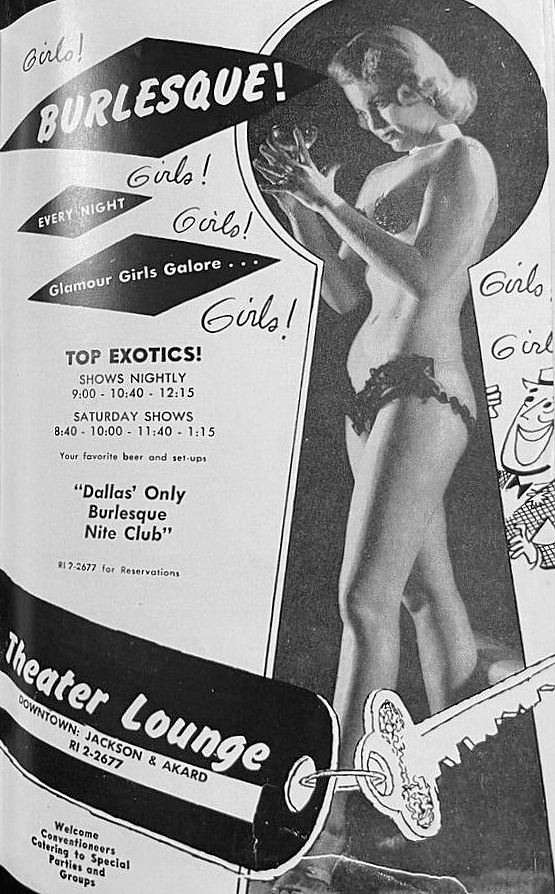
Downtown Dallas was a cool place for entertainment and dining in the early 1960s, from high-class clubs and lounges to famous and infamous strip joints (some of which were higher-class than others). A few months ago on eBay, someone scanned a bunch of pages of a magazine called This Month in Dallas (“Where to Go, What to Do”), which seems to have been aimed at the conventioneer or out-of-town visitor. (I’ve never heard of this publication, but I would LOVE to see more!)
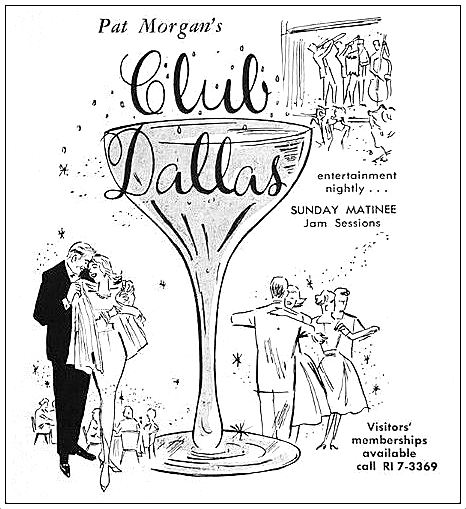
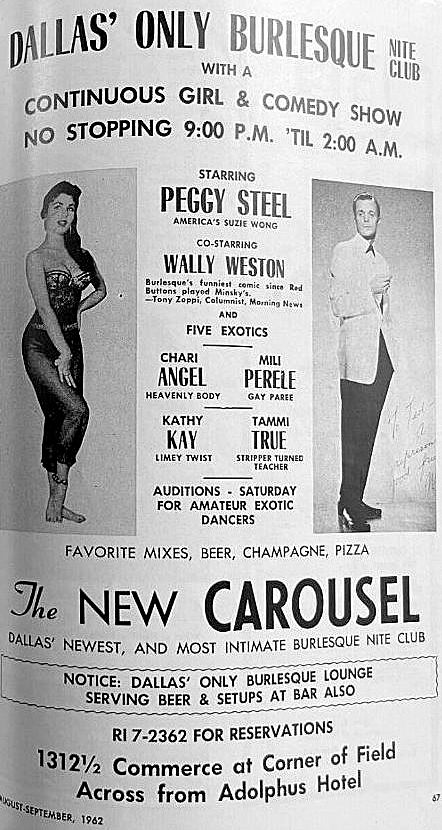
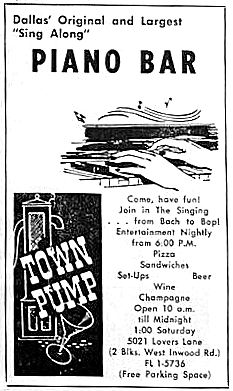
As far as image quality, I’m at the mercy of the person doing the scanning, but here are several of the ads featured in the eBay listing. All appeared in the Aug./Sept. 1962 issue of This Month in Dallas. (At the top, a detail from an ad for Club Dallas — the full ad is below.)
*
Let’s just do them alphabetically.
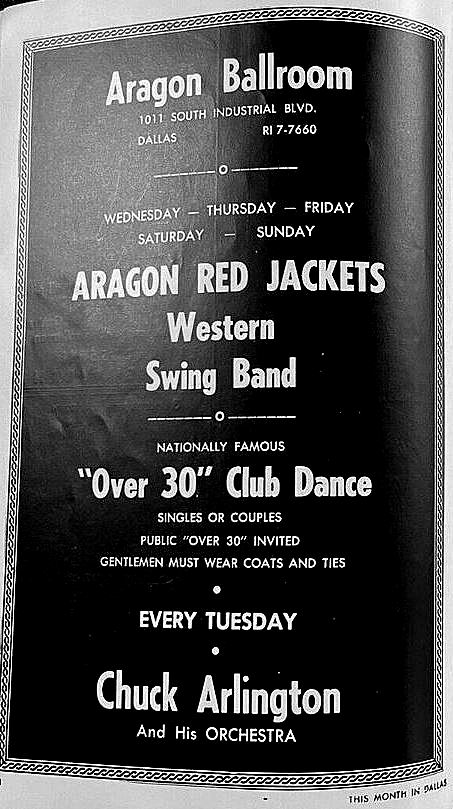
ARAGON BALLROOM, 1011 S. Industrial Blvd. (now S. Riverfront). Featuring the Aragon Red Jackets Western Swing Band, the “Over 30” Club Dance, and Chuck Arlington and His Orchestra.
*
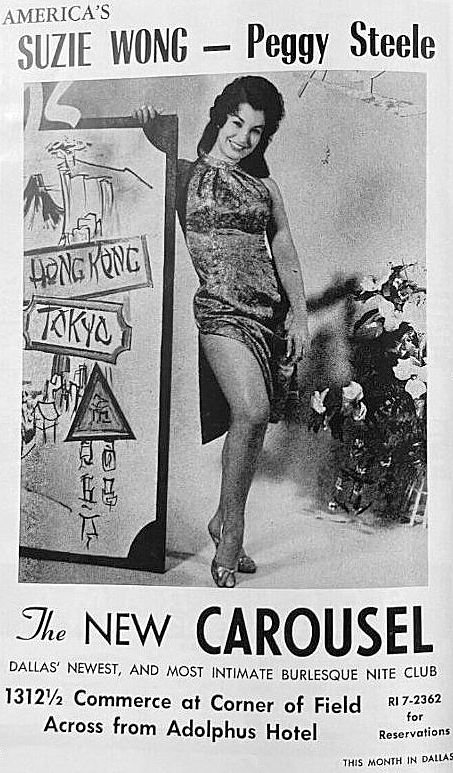
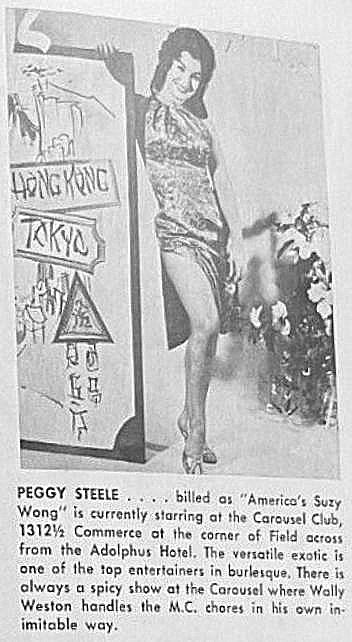
CAROUSEL CLUB (or “New” Carousel Club), 1312½ Commerce, at Field. Jack Ruby, proprietor. “Dallas’ Newest and Most Intimate Burlesque Nite Club.” This ad (the first of several) features stripper Peggy Steele, “America’s Suzie Wong.”
More CAROUSEL. “Dallas’ only burlesque nite club with a continuous girl and comedy show. No stopping, 9:00 PM ’til 2:00 AM.” “America’s Suzie Wong” is back, now spelled Peggy Steel. MC’d by comic Wally Weston.
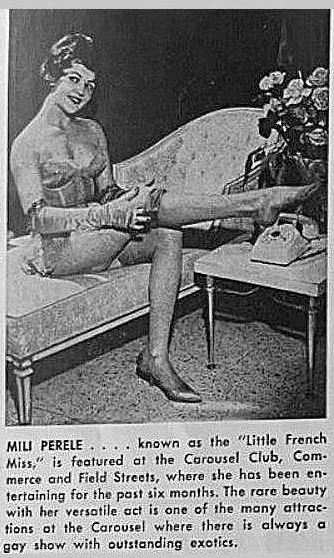
More CAROUSEL. Here’s Mili Perele, “the Little French Miss.”
More CAROUSEL. Heck, let’s throw in another Peggy Steel/e mention.
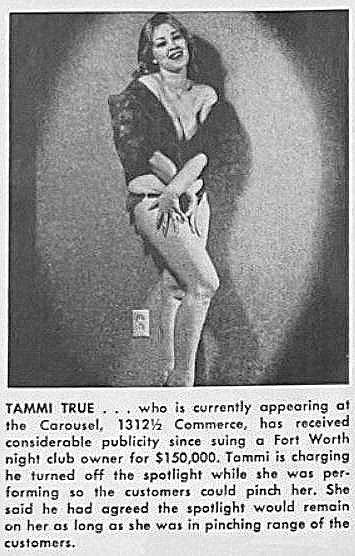
More CAROUSEL (Jack’s advertising budget was impressive). Tammi True, then in the midst of a pinching brouhaha.
*
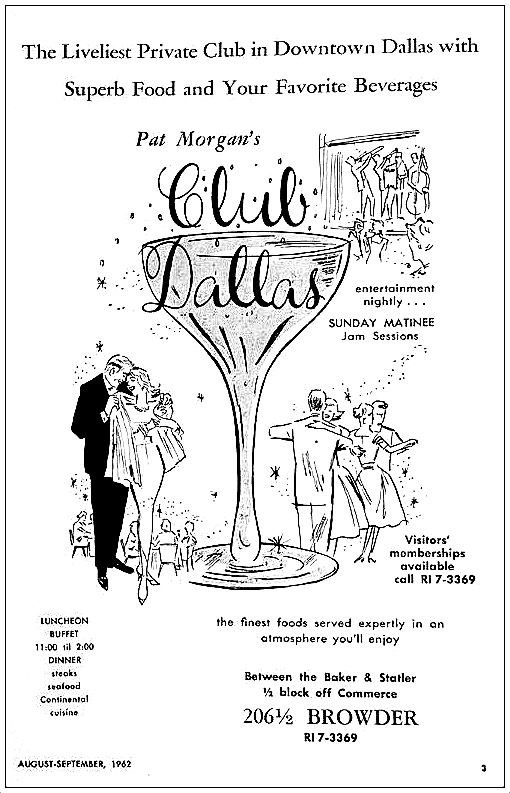
Pat Morgan’s CLUB DALLAS, 206½ Browder (just south of Commerce). I love this ad, but I’m not familiar with the establishment or Mr. Morgan. Looks like it opened in the summer of 1962 (“Owner Pat Morgan has eliminated the semi-nude waitresses and aims for the family trade” — Dallas Morning News, July 27, 1962), changed its name in September 1962 to simply “Pat Morgan’s,” and finally closed in February 1963. I bet he rued the day he dumped those semi-nude waitresses….
*
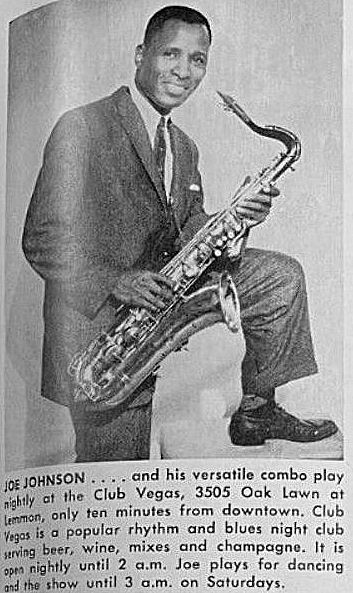
CLUB VEGAS, 3505 Oak Lawn. Yes, there was swinging nightlife beyond downtown. Club Vegas was famously owned by Jack Ruby’s sister, Eva Rubenstein. This club booked a lot of Black and Hispanic bands (for mixed audiences), including Joe Johnson and Trini Lopez. (I’ve been meaning to write about this place for the past 10 years!)
*
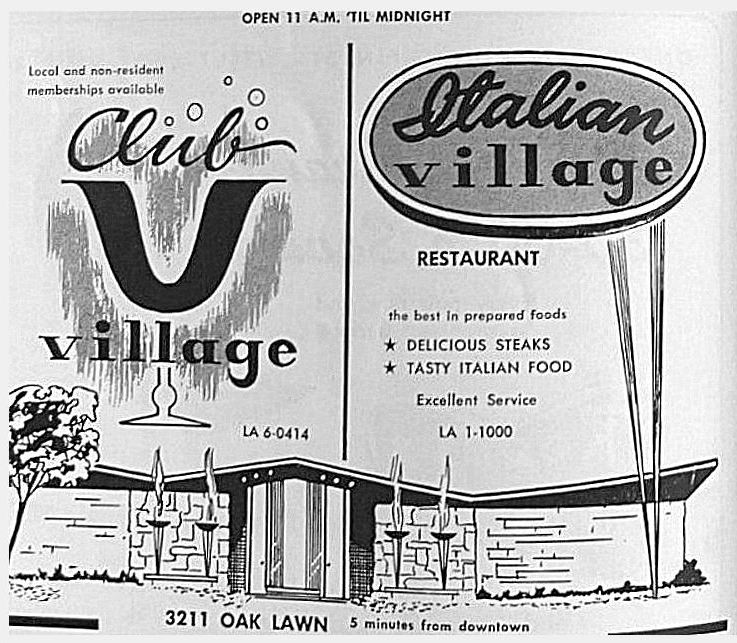
CLUB VILLAGE / ITALIAN VILLAGE RESTAURANT, 3211 Oak Lawn. Another happening place in Oak Lawn. I wrote and wrote and wrote about Sam Ventura’s Italian Village here.
*
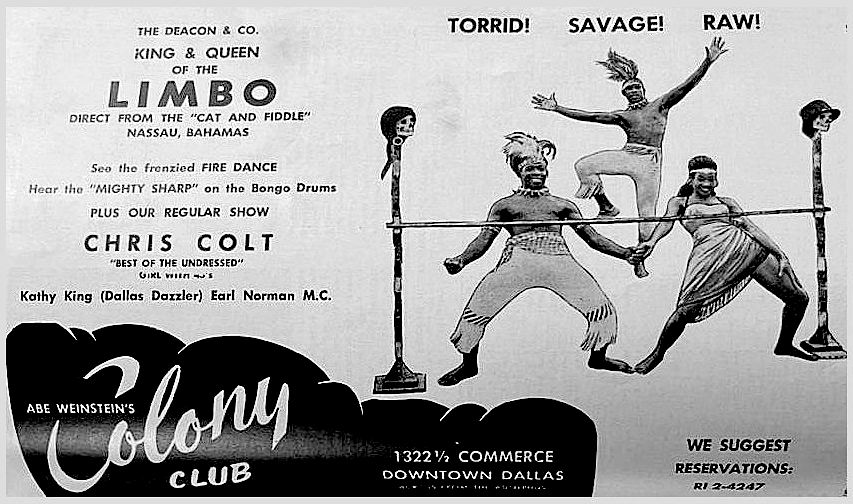
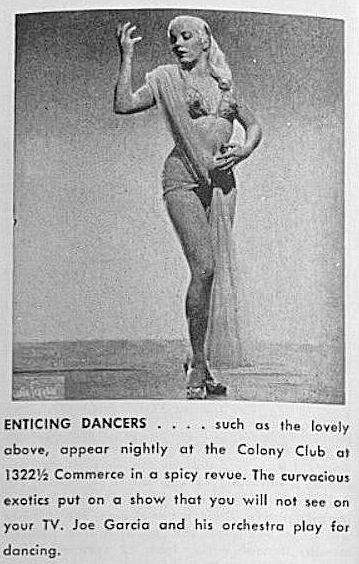
COLONY CLUB, 1322½ Commerce. Abe Weinstein, proprietor. The “high-class” strip joint. Also featured acts like Deacon & Co., King and Queen of the Limbo.
More COLONY CLUB. An unnamed exotic.
*
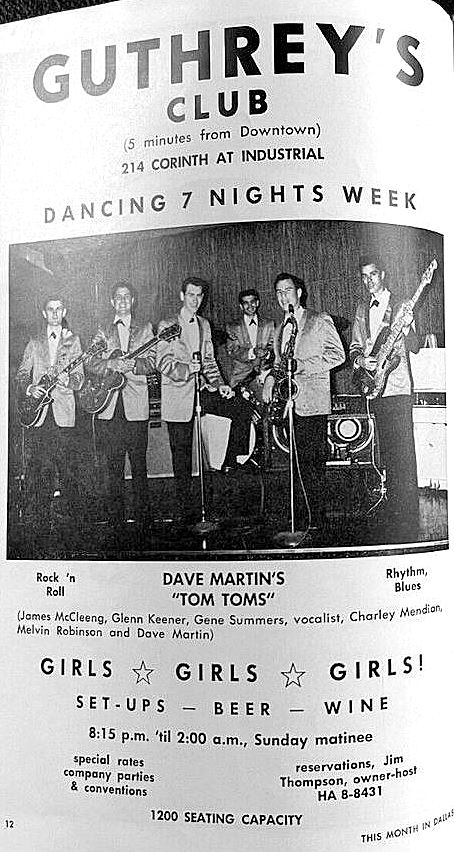
GUTHREY’S CLUB, 214 Corinth, at Industrial (now Riverfront). Very popular back in the day. “Girls! Girls! Girls! Set-ups, beer, wine.” This ad features Dave Martin’s Tom Toms (James McCleeng, Glenn Keener, Gene Summers — vocalist, Charlie Mendian, Melvin Robinson, and Dave Martin).
*
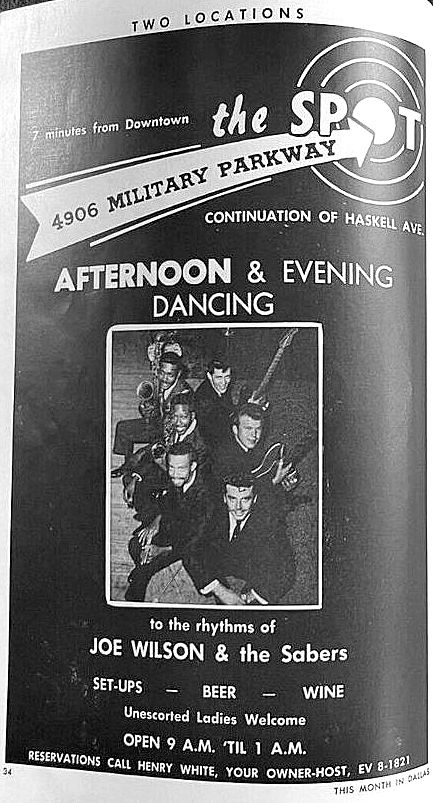
THE SPOT, 4906 Military Parkway. This ad features Joe Wilson & The Sabers.
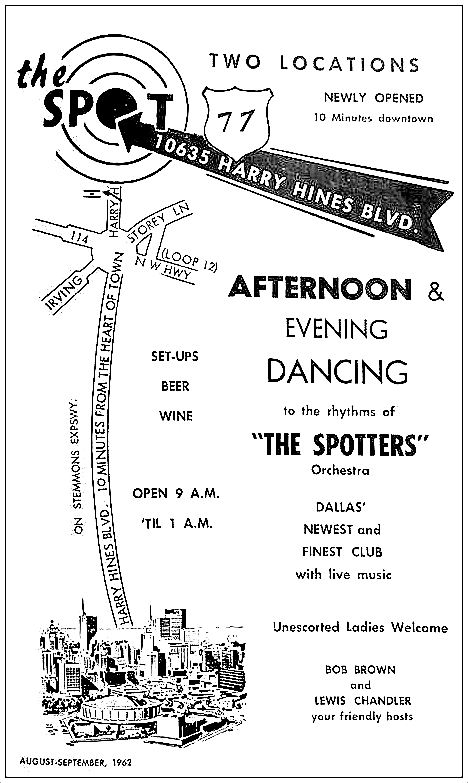
THE SPOT, the “other” location, 10635 Harry Hines. House band The Spotters.
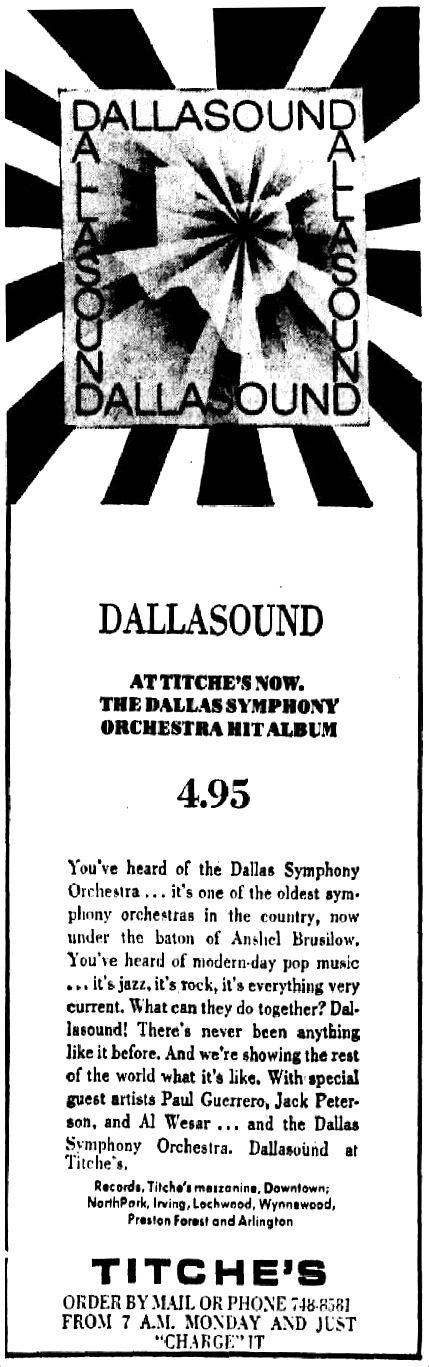
The Boston Symphony Orchestra had Arthur Fiedler and its popular-music offshoot, The Boston Pops. The Dallas Symphony Orchestra had Anshel Brusilow and The Dallasound.
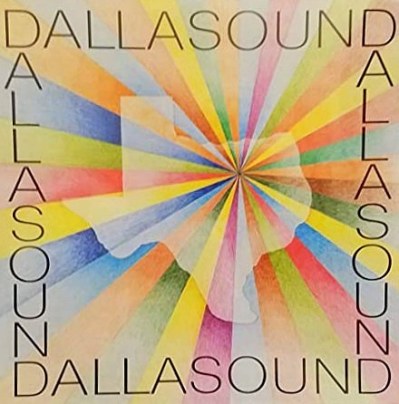
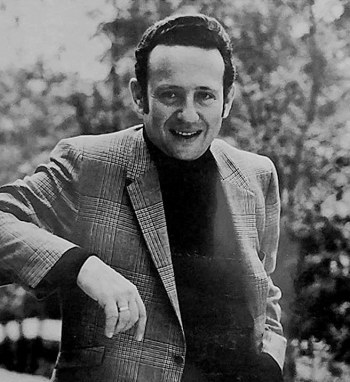
Brusilow, a Philadelphia native, came to Dallas in 1970 as the resident conductor of the Dallas Symphony Orchestra. The DSO was in financial straits at the time, so in a bid to increase the orchestra’s demographic reach, Brusilow borrowed Fiedler’s idea and formed his own “pops” orchestra, which played jazzy arrangements of pop songs and light classical music. He named this sideline project “The Dallasound.” It was very popular, but it didn’t improve the financial problems of the DSO, and Brusilow was gone after only 3 years. He then went on to accept a teaching a position at North Texas State University (now the University of North Texas). After 9 years at UNT, he began teaching at SMU’s Meadow School of the Arts in 1983. Brusilow died in 2018 — he spent the last 48 years of his life in Dallas.
*
Here are the liner notes for the Dallasound album (1971):
THE DALLAS SYMPHONY ORCHESTRA
One of America’s oldest orchestras, the Dallas Symphony Orchestra was founded in 1900. Through the years, it has served its community and the entire North Texas area with the finest in music from the greatest composers the world has known. From a modest beginning — with 35 members giving a handful of concerts a season — the Dallas Symphony Orchestra currently has 85 members and performs more than 160 concerts each season. Its membership would comprise a “Who’s Who” of some of the finest artists in the world.
With its reputation for the classics well-established, the Dallas Symphony Orchestra now adds another brilliant facet to its already illustrious history — the DALLASOUND — a new sound and a new concept in music making. A big band sound incorporating the latest and most exciting modern-day pop sounds – special arrangements of tunes by the Beatles, Simon and Garfunkel, Jim Webb and many others.
Featured as special guest artists on the first recording on the DALLASOUND Label are three outstanding jazz musicians from the Dallas area — Paul Guerrero on drums, Jack Petersen on guitar and Al “Little Al” Wesar on Fender bass. Arrangements are by one of the most gifted arrangers in the business — Wilfred Holcombe of Trenton, New Jersey. Not just stock orchestral arrangements, but the swingingest, rockingest big band arrangements around! Settle back and listen to some of the most exciting music you will ever hear made by a symphony orchestra!
ANSHEL BRUSILOW
Like many of the world’s great violinist/conductors, Anshel Brusilow laid aside his Stradivarius several years ago and took baton in hand in earnest. His extensive performing and conducting experience with three of the world’s greatest conductors — Eugene Ormandy, George Szell and Pierre Monteux — placed him in good stead on the podium. He came to Dallas after two extremely busy years and more than 300 concerts with the Chamber Symphony of Philadelphia, including five recordings with RCA Victor.
With him he brought the DALLASOUND and a new era for Dallas’s symphony orchestra. Completely at home with the standard symphonic fare, he is equally proficient when ” swinging” with the DALLASOUND. Thousands of Dallasites have been converted to the new sound a symphony orchestra can make, a fact which substantiates Anshel Brusilow’s theory that the Dallas Symphony Orchestra belongs to allthe people of a community and must therefore serve them in as many ways as it can. Thanks to Anshel Brusilow, the Dallas Symphony embarks on a new direction in music — the DALLASOUND!
The album’s musical offerings included arrangements of George Harrison’s “Something” and “My Sweet Lord,” The Carpenters’ “We’ve Only Just Begun,” The Doors’ “Light My Fire,” Tom Jones’ “It’s Not Unusual” and “Delilah,” and everyone’s favorite ubiquitous weird song from the late ’60s, “MacArthur Park.”
Anshel Brusilow
Titche’s ad, March, 1971
***
Sources & Notes
Images from the front and back cover of the DALLASOUND album were found on Amazon, here.
A really good interview with Anshel Brusilow can be found in the “High Profile” article by Marty Primeau (Dallas Morning News, July 17, 1983).
Dusty Hill, the legendary bassist of the legendary ZZ Top, died today. Born Joe Michael Hill in Dallas, Dusty lived in East Dallas and attended Woodrow Wilson High School. He dropped out before graduating and pursued a career as a musician, a decision which seems to have worked out pretty well for him.
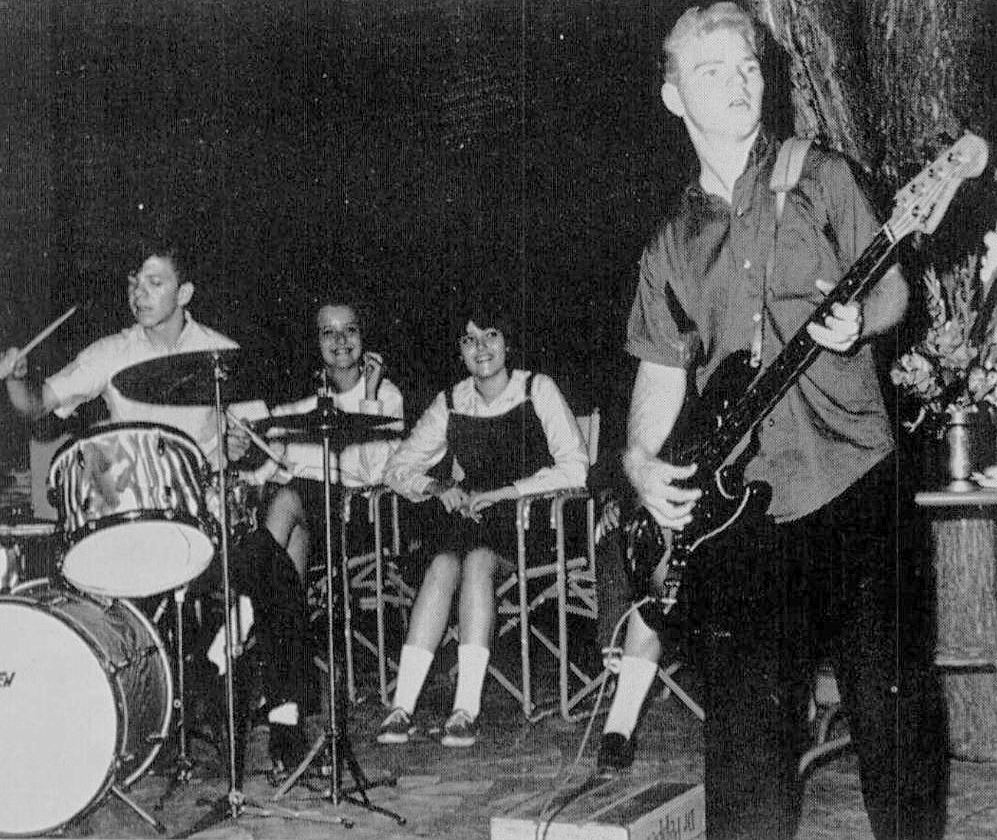
Above is a photo from the 1965 Woodrow yearbook when Dusty would have been 15 years old. The caption reads “The disappointment of the Bryan Adams loss was lessened by the lively music of Richard Harris and Dusty Hill.”
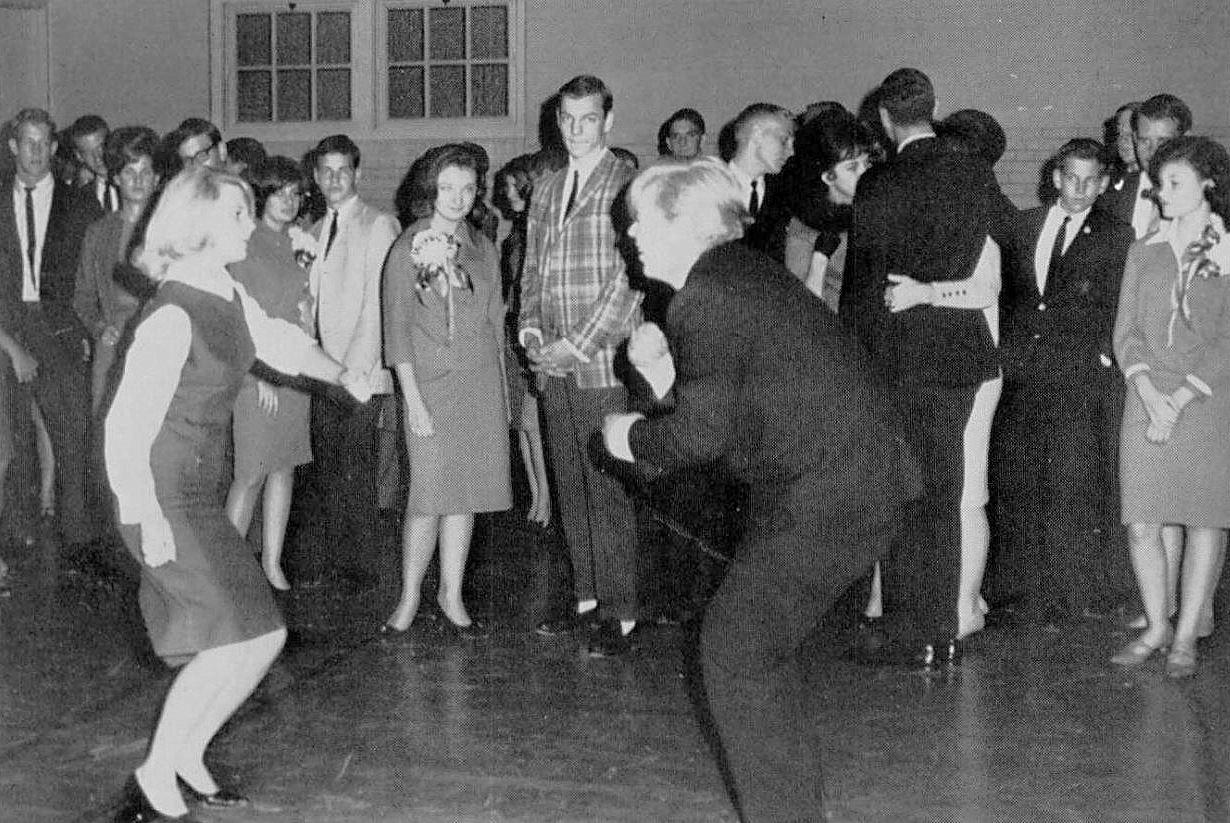
At the time of these photos, Dusty and Richard were playing around town in a band called The Dead Beats, a trio which also included Dusty’s older brother, Rocky Hill, who is seen below in a photo from the same yearbook, with the caption “At the homecoming dance, Rocky Hill and his date prove their skill at a modern dance called ‘The Dog.” Dusty, Rocky, and Richard would go on to form the band American Blues.
Rocky Hill, 1965
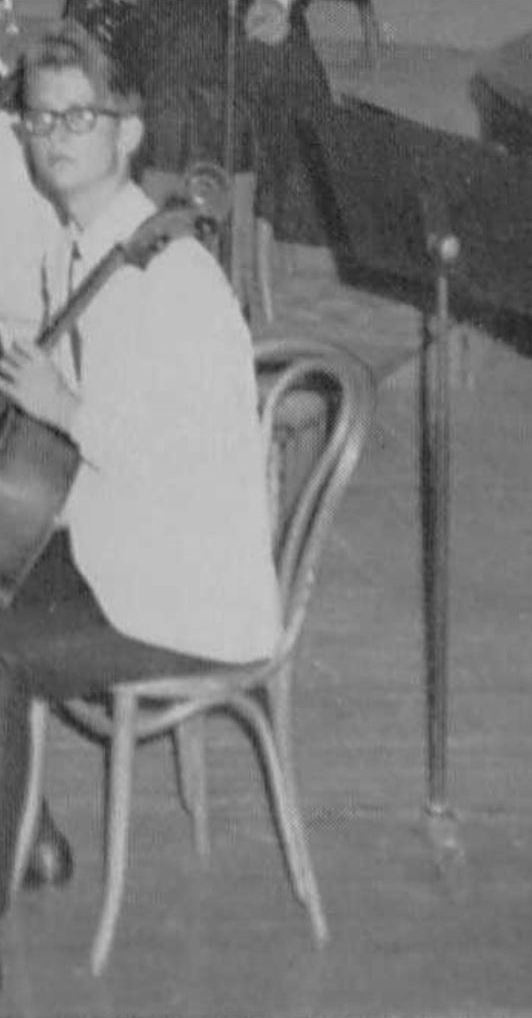
Dusty played cello in the Woodrow orchestra, so I went looking through the yearbook to see if I could find him. I think I might have — could this be him in an awkwardly cropped photo?
Young man with cello, 1965
*
RIP, Dusty. Thanks for the great music.
**
UPDATE: Thanks to reader Steve Roe who sent me an Oct. 29, 1964 clipping of “Dallas After Dark” (the Tony Zoppi column in The Dallas Morning News devoted to the city’s nightclub scene) which mentioned all three of the Woodrow boys seen above in photos which were taken at the time they were playing around town with their band The Dead Beats:
There’s a swinging new group in town billed as The Dead Beats, and they’ll be appearing through Sunday at the Jungle Dream on North Henderson. Rocky Hill plays lead guitar and Dusty Hill is the bassist. Little Richard Harris is a torrid drummer. The trio recently returned from Nashville and appeared at Louanns. The youngsters say they are America’s answer to The Beatles. How about that? (Dallas Morning News, Oct. 29, 1964)
How about that?! Talented and apparently aggressively confident teenagers! (Jungle Dream was located at 1823 N. Henderson, just north of Ross — a couple of doors from the old Louie’s — managed by Pat Carpenter.)
***
Sources & Notes
Photos from the 1965 edition of The Crusader, the yearbook of Woodrow Wilson High School.
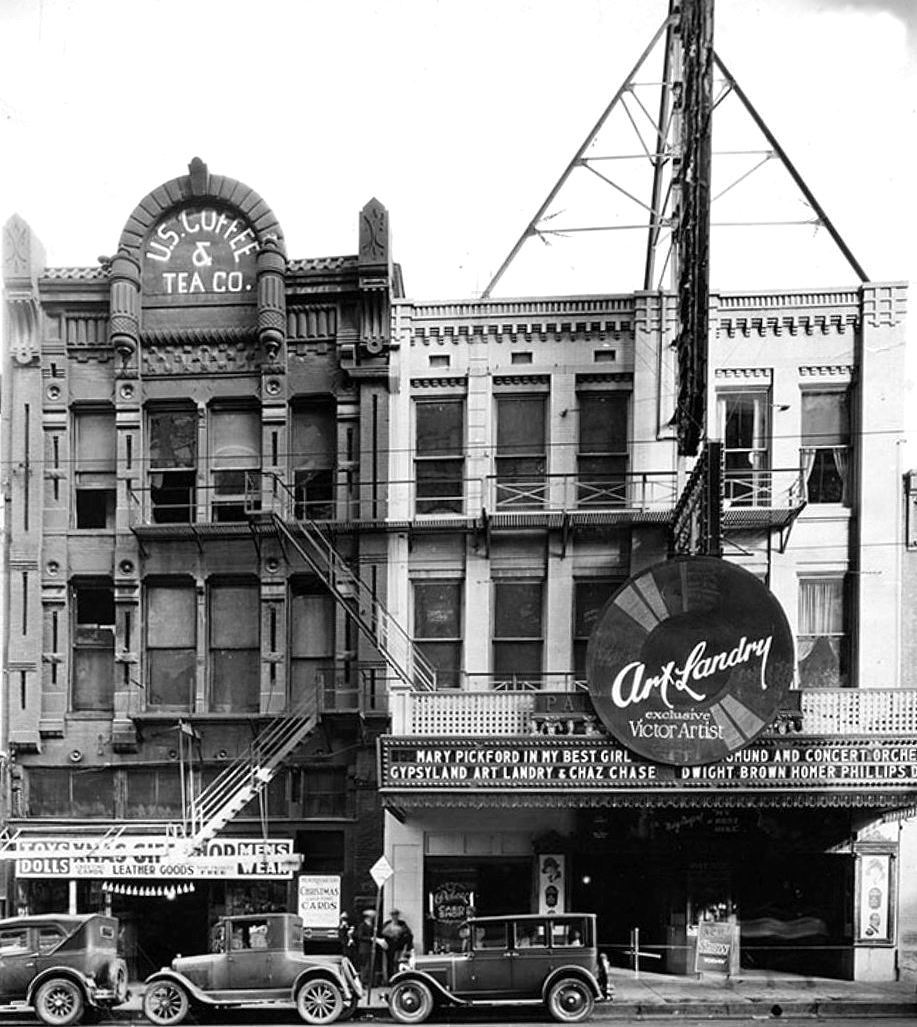
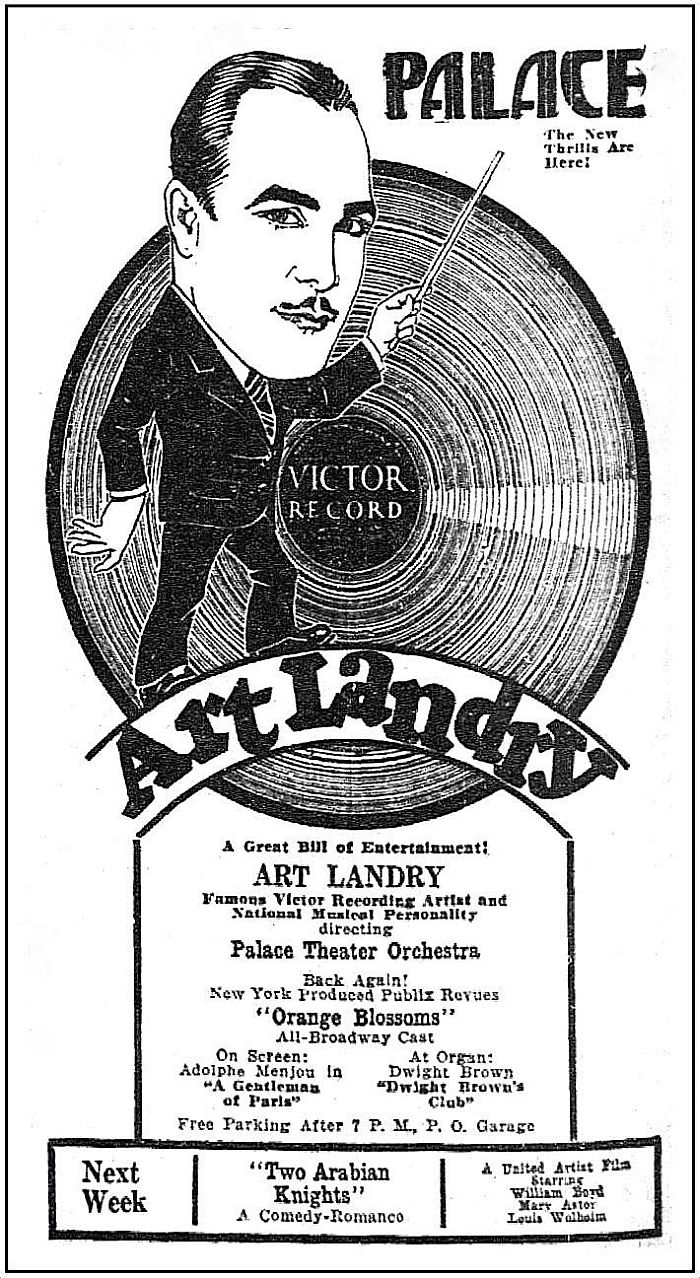
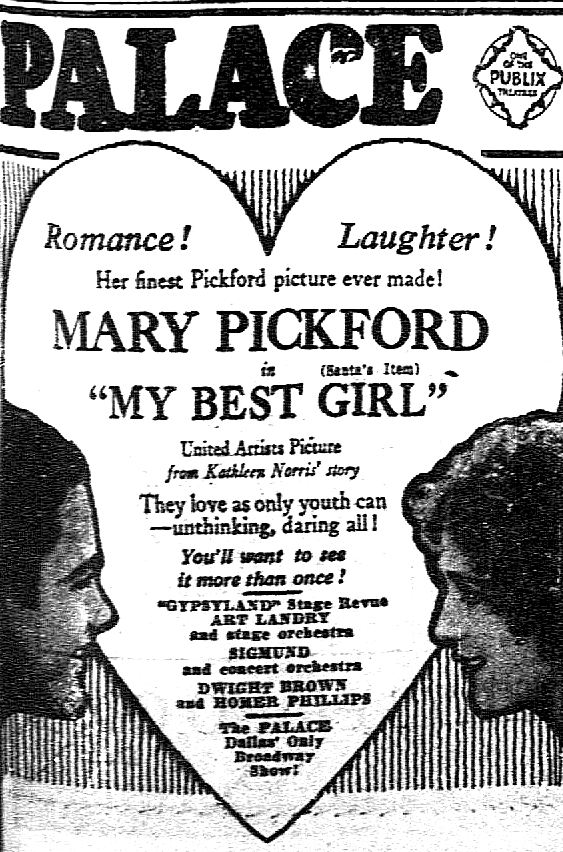
Great photo of the Palace Theatre on Elm and Ervay in November or December of 1927 (“My Best Girl” starring Mary Pickford opened at the end of November and ran for a week or two into the middle of December). The movie seems like a bit of an afterthought, though — I mean… ART LANDRY IS IN TOWN, and his giant 78 disc replica promotional sign is crowding out others on the marquee. The touring jazz-band leader (who insisted he did NOT play jazz music — “I became a bandmaster when jazz was jax. In those days noise was the objective. […] The day of jazz is gone….” ) was nestled here in Big D for the holiday season and was apparently well-received. (See another photo of the Palace from about this same time here.)
Nov. 13, 1927
Nov. 27, 1927
You know how when you get a new car you suddenly start seeing that same model everywhere? I’m like that with the U.S. Coffee & Tea Co. — seen right next door to the theater. (See it here, peeping around the Wilson Building in a squattier incarnation.)
***
Sources & Notes
Photo titled “[Palace Theatre, Art Landry exclusive Victor Artist]” — by Frank Rogers — is from the Ted C. Steinberg Collection, Dallas History and Archives Division, Dallas Public Library, call number PA2018-03-14 (the library has the date this photo was taken as Dec. 27, 1927, but “My Best Girl” was long-gone by then — it was probably taken on Nov. 27, the day after “My Best Girl” opened).
Quote from Art Landry about not being a jazz-band leader is from an interview with him in The Dallas Morning News (“Jazz Is Thing of the Past Says Palace’s New ‘Jazz Band’ Leader Who Specializes in Modern Music” — DMN, Nov. 12, 1927). I can’t find any other instances of early jazz music referred to as “jax” music. Can anyone point me to another reference?
I’ve recently posted lots of photos of black schools and black churches which appeared in the Official Directory: Dallas Negro Churches, Schools and Other Activities; Civic, Business, Fraternal, Social, Etc., an absolutely fantastic historical document (which is scanned in its entirety on the Portal to Texas History site here) — now I thought I’d post some of the businesses and people featured in the directory.
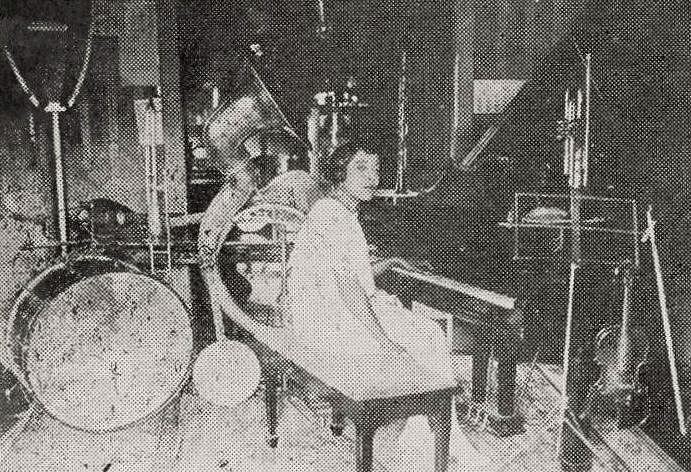
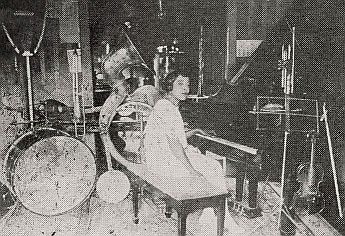
First is the woman seen above, Ella Rice Pratt (1893-1966) who was known professionally as “Madame Pratt” and seems to have taught an extremely wide range of musical instruments. According to this 1930 ad, she was “The only woman of her race in Texas who performs successfully upon two instruments at the same time.” (Most images are larger when clicked.)
1930
Her 1966 obituaries (one of which is here ) list a string of accomplishments, including having studied music at the New England Conservatory in Boston, toured as a concert pianist, trained a 30-piece touring orchestra, and opened what was described as “the first music studio in Dallas where Negro musicians could receive training on all instruments” (Dallas Morning News, Oct. 3, 1966). Not only was she a notable Dallasite, so were members of her family: her father, Charles A. Rice was a principal at Booker T. Washington High School (and is the namesake of Charles Rice Elementary School), her mother, Sally Rice, was the first supervisor of Griggs Park, and her husband, T. W. Pratt was a long-time principal in Dallas schools (at the time of this directory he was the principal of the Pacific Avenue School (he might be seen in this photo which also appeared in the 1930 Negro Directory). The Pratts lived at 3612 Thomas Ave., near Washington, where Madame Pratt also had her studio. (Her headstone in Lincoln Memorial Park has musical notes engraved on it.)
*
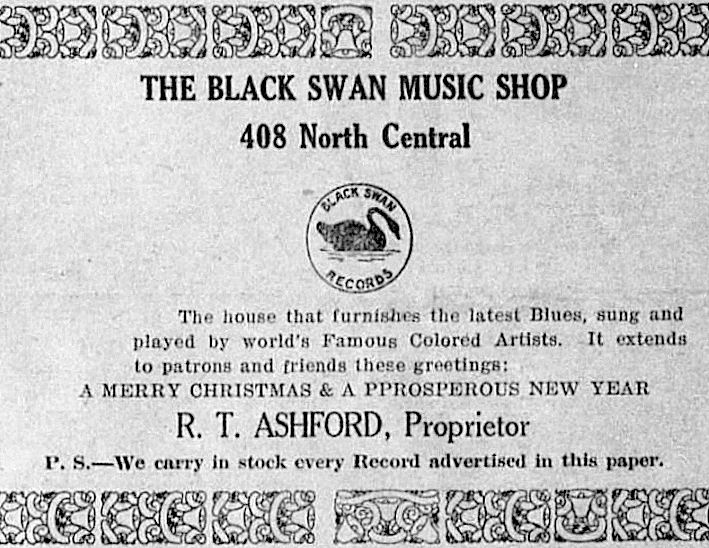
Speaking of music, R. T. Ashford was a prominent businessman (he was one of the founders of the Dallas Negro Chamber of Commerce) who owned R. T. Ashford’s Music Shop, a popular record store at 408 N. Central (at Swiss), just north of Deep Ellum. Before this 1930 directory was issued, Ashford had called his shop “Black Swan Music”(I’m not sure whether this was an “homage” to the Black Swan record label or some sort of partnership). Ashford’s store was apparently very popular and Ashford himself seems to have been taken seriously by record labels whenever he would recommend local talent (he appears to have figured prominently in Blind Lemon Jefferson’s recording career). Ashford moved from Central Avenue to Hall Street in 1931, but he was a Deep Ellum music and business fixture for many, many years. I think the location of Ashford’s record shop (if not the actual store) can be seen in this photo from 1919 (on the street-level floor of the Thorburn Broom & Brush building). (Fun fact, perhaps only to me: Ashford’s Music Shop was next door to a business proprietor named “Simpson.”)
1930
Dallas Express, Dec. 1923
*
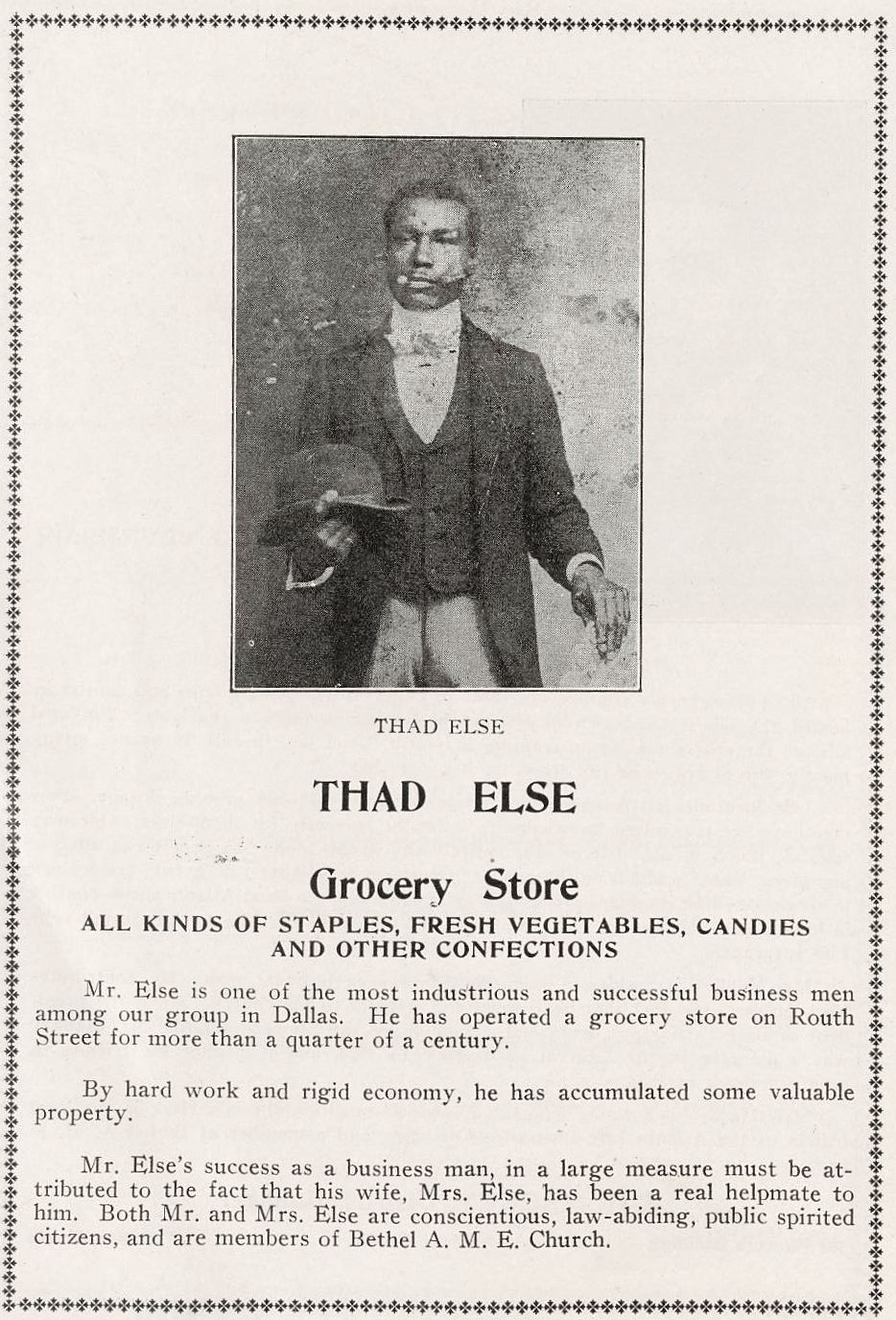
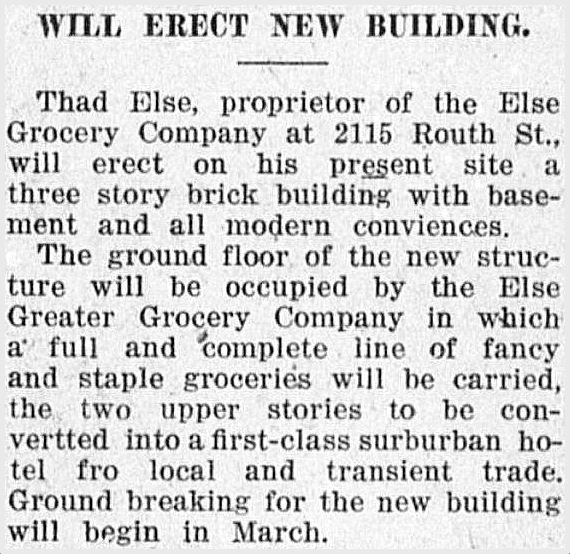
Another entrepreneur was Thad Self, whose main business seems to have been a grocery/general merchandise store on Routh Street south of Colby. He also owned a transfer company, a hotel/boarding house, a barber shop, a cafe, and at least one other general store. Most of his companies were located in buildings on the neighboring lots at 2113 Routh and 2115 Routh, one or both of which he appears to have purchased in 1913 for $100 (about $2,600 in today’s prices). He built a large three-story building on Routh in 1913 (which, according to this 1921 Sanborn map) was built over the Dallas Branch of the Trinity which snaked through downtown and the State-Thomas area — that basement was probably pretty damp.
1930
Dallas Express, Dec. 6, 1919
*
Speaking of hotels, one of the most prominent hotels in the era when blacks were not allowed to stay in “white” hotels by law was the Powell Hotel at 3115 State Street (between Ellis and Hugo), owned by D. H. Powell and his wife Susie. In May, 1929 Powell was issued a permit to tear down a frame house at 3115 State, and he built his 40-room hotel on the property soon after. The Powell Hotel was where almost every notable African-American visitor to the city stayed. By the late 1940s, Powell had built something of a hotel empire in Dallas with several locations. (I will have to write more about him in a future post!) I like this very early ad, from the 1930 directory, describing it as the “Powel Hotel & Pleasure Dome.” The photo shows a pleasant-looking place, but you and I and Kubla Khan and Coleridge would probably agree it’s no Xanadu.
Speaking of “resting places”… another essential element in any community is the funeral home. One of Dallas’ most prominent undertaking firms for black Dallas was the E. J. Crawford Funeral Home at 804 Good (now N. Good-Latimer, between Live Oak and Bryan), founded by Mr. Crawford in 1909. “The last word in funeralizing.”
1930
Dallas Express, Feb. 4, 1922
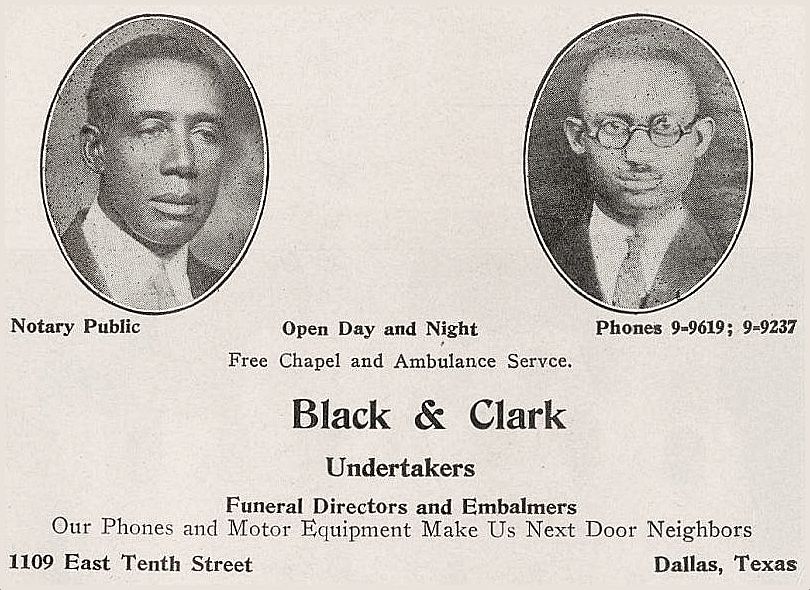
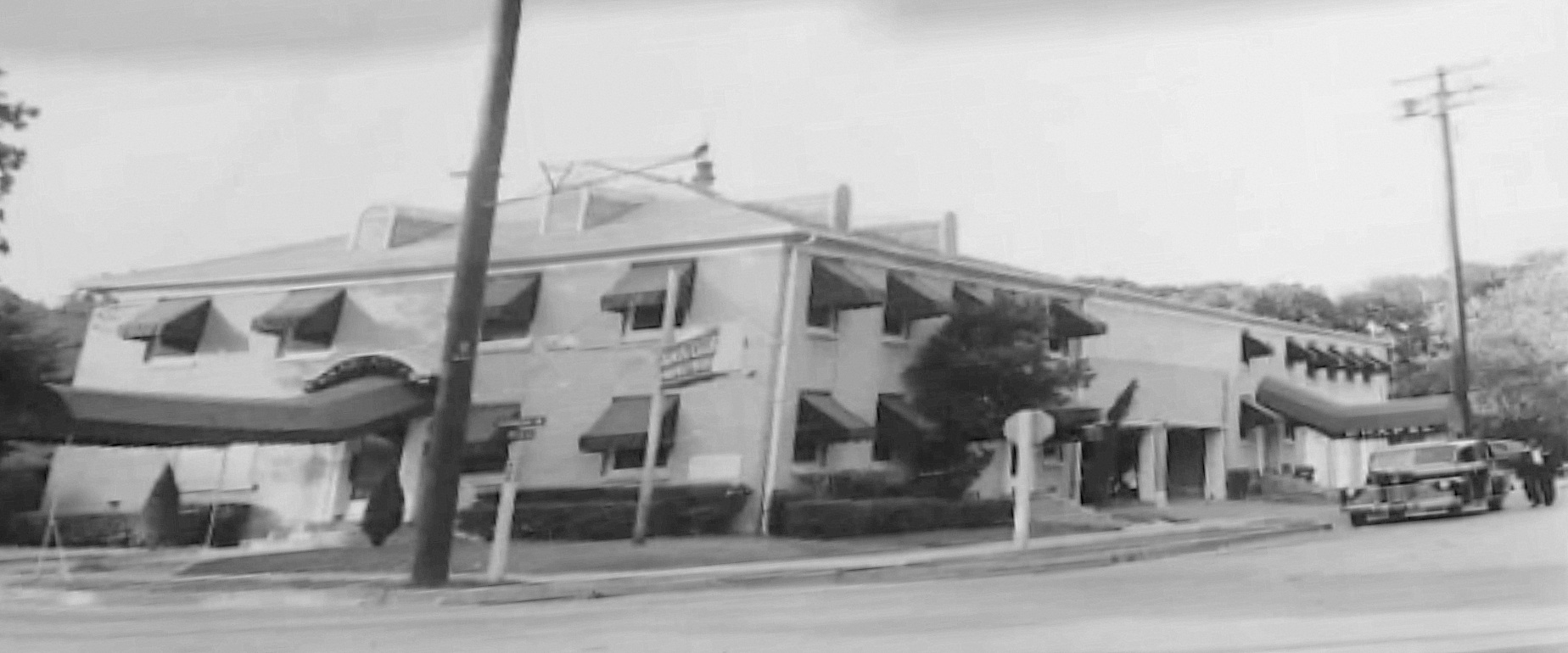
Another prominent funeral home/ambulance service was Black & Clark, founded originally around 1914 by S. C. Black; in 1927 he was joined by his nephew C. J. Clark. For years they were located in Oak Cliff, at 1109 E. Tenth St., west of what is now South R. L. Thornton, near Cliff Avenue. This funeral home is still in business, and there was recently a profile of the Dallas institution on Channel 5 News (watch it here).
1930
1802 N. Washington (woozy screenshot of photo in Ch. 5 news story)
*
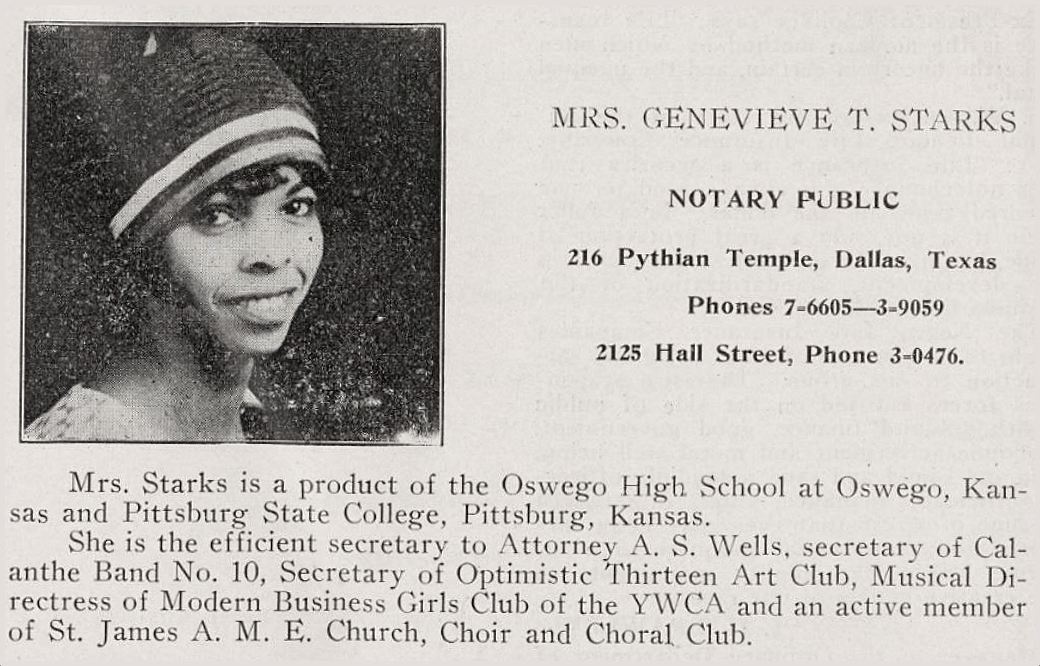
This is Genevieve T. Starks, a woman with a lot of extra-curricular activities! I love this photo.
1930
*
The G Clef Club was organized around 1921 by Lincolnia Hayes Morgan, music supervisor for Dallas’ (black) public schools. A blurb about the group appeared in The Crisis, the official publication of the N.A.A.C.P.: “The objects of the club are to assist worthy music students and to raise the music standard of the community” (June, 1921).
1930
*
A popular singing group was the Belt Sacred Quartette (comprised of J. J. Mollis, J. Poindexter, F. W. Grant, and N. Tisdale) — listen to their recording of “I Have Another Building” below.
1930
Blackwell (OK) Journal-Tribune, July 23, 1932
*
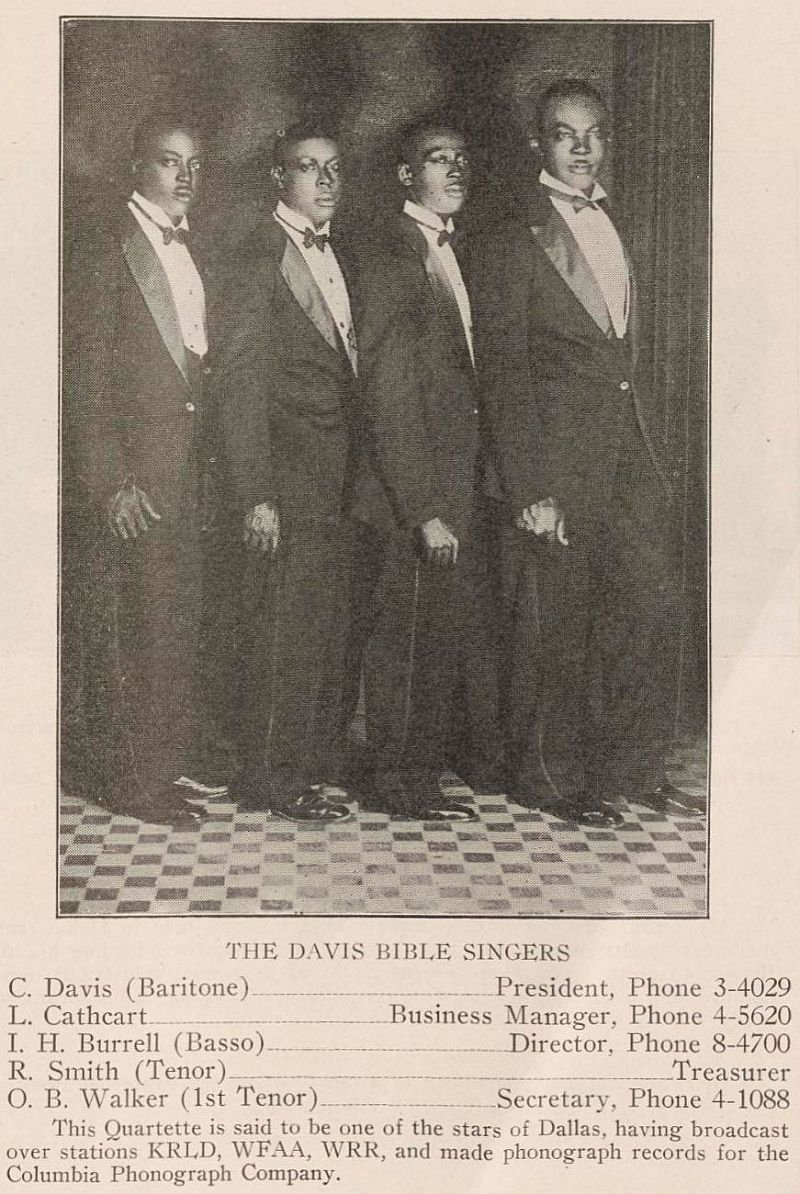
The Davis Bible Singers (C. Davis, I. H. Burrell, R. Smith, and O. B. Walker) seem to have been pretty popular, having appeared on KRLD, WFAA, and WRR radio. They even recorded for Columbia Records (listen to their great recording of “Daniel Saw the Stone” below).
1930
*
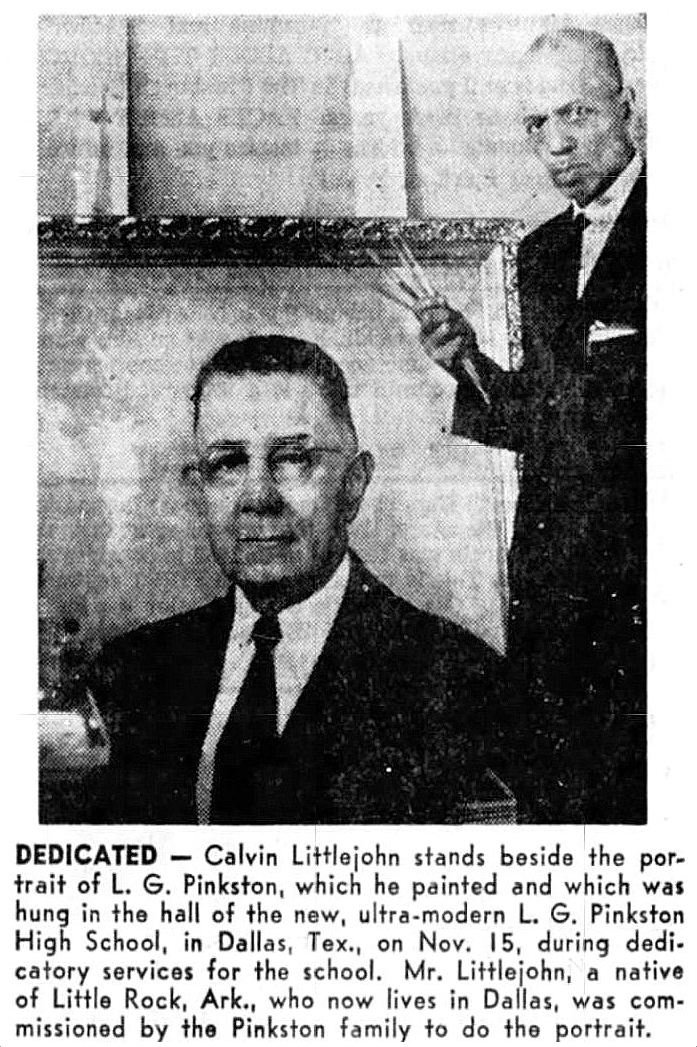
One of the most important doctors in Dallas in the 1920s and ’30s was Dr. Lee Gresham (L. G.) Pinkston (1883-1961), who opened the Pinkston Clinic at 3305 Thomas Avenue, between Hall and Central, in 1928 or 1929 (it made its first appearance in the 1929 city directory). In 1954, Pinkston — physician, surgeon, and civic leader — was one of the first five black doctors allowed to practice in a “white” Dallas hospital (St. Paul’s Hospital) — before that, the only hospital in Dallas where black doctors could practice was the Pinkston Clinic, which had 15 beds (32 beds were allotted for black patients at St. Paul’s in 1954). (See a photo of the five doctors here, Dr. Pinkston is seated.) A new West Dallas school — Pinkston High School — was named in Dr. Pinkston’s honor and opened in 1964, three years after his death.
1930
Dallas Historical Society
Below, a portrait of Dr. Pinkston with the artist, Calvin Littlejohn (whom I’d known only as a photographer previously), destined to hang in the new school.
Pittsburgh (PA) Courier, Nov. 28, 1964
***
Sources & Notes
All 1930 images are from Official Directory: Dallas Negro Churches, Schools and Other Activities; Civic, Business, Fraternal, Social, Etc. compiled by James H. Smith, 1930; from the Tarrant County Black Historical and Genealogical Society, via the Portal to Texas History. This fantastic resource is scanned in its entirety here.
See the two other Flashback Dallas posts which also use this wonderful directory as a source:
As another year crawls to an end, it’s time to collect the odd bits and pieces that have piled up over the past few months which struck me as interesting or funny or… whatever. I had nowhere else to put them, so they’re going here! (Most images are larger when clicked.)
**
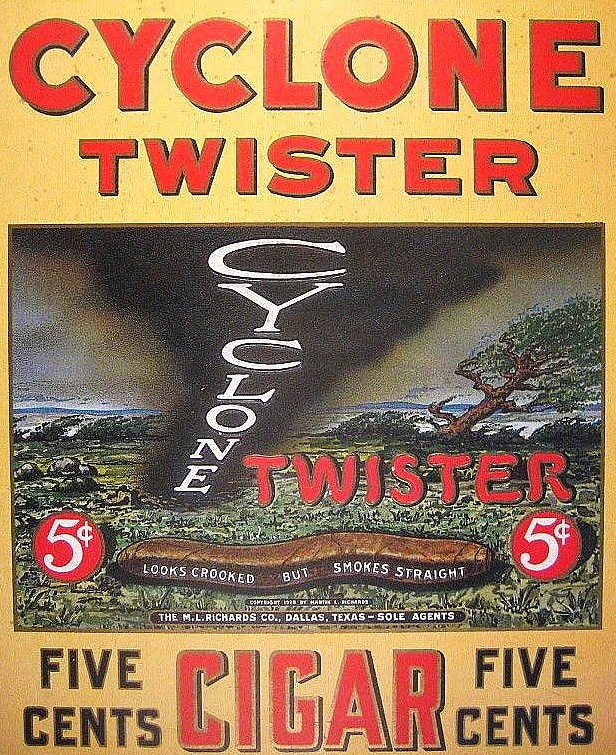
First up, the ad above for the “Cyclone Twister” 5-cent cigar, distributed by Dallas wholesaler Martin L. Richards in 1928. Note the shape of the cigar. “Looks crooked but smokes straight.” Probably looked a little strange when smoked. I guess it might help break the ice at parties. Found on eBay.
*
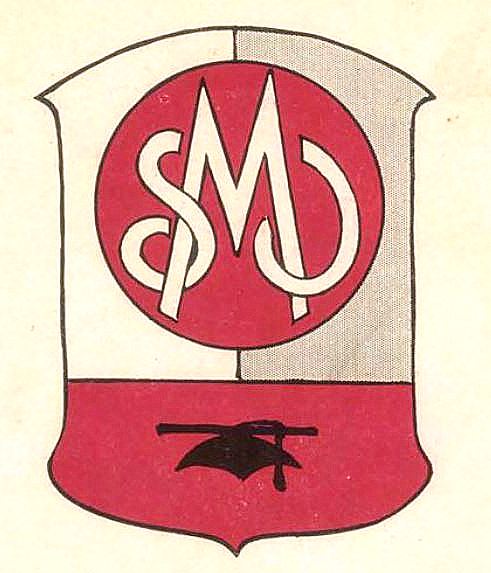
Here’s a nice little crest for SMU I’ve never seen — I’m not sure how long this lasted. From the 1916 Rotunda yearbook.
*
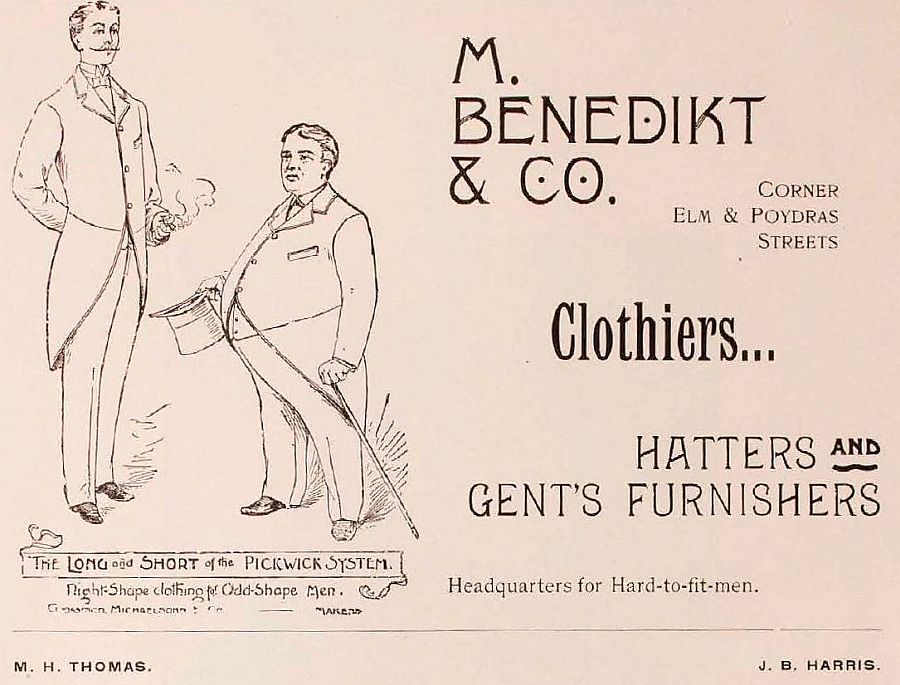
M. Benedikt & Co. was the “Headquarters for Hard-to-fit-men” — in other words, they specialized in “Right-Shape clothing for Odd-Shape Men.” Here are a couple of examples of what they might consider “odd-shape men” in an ad from 1899.
*
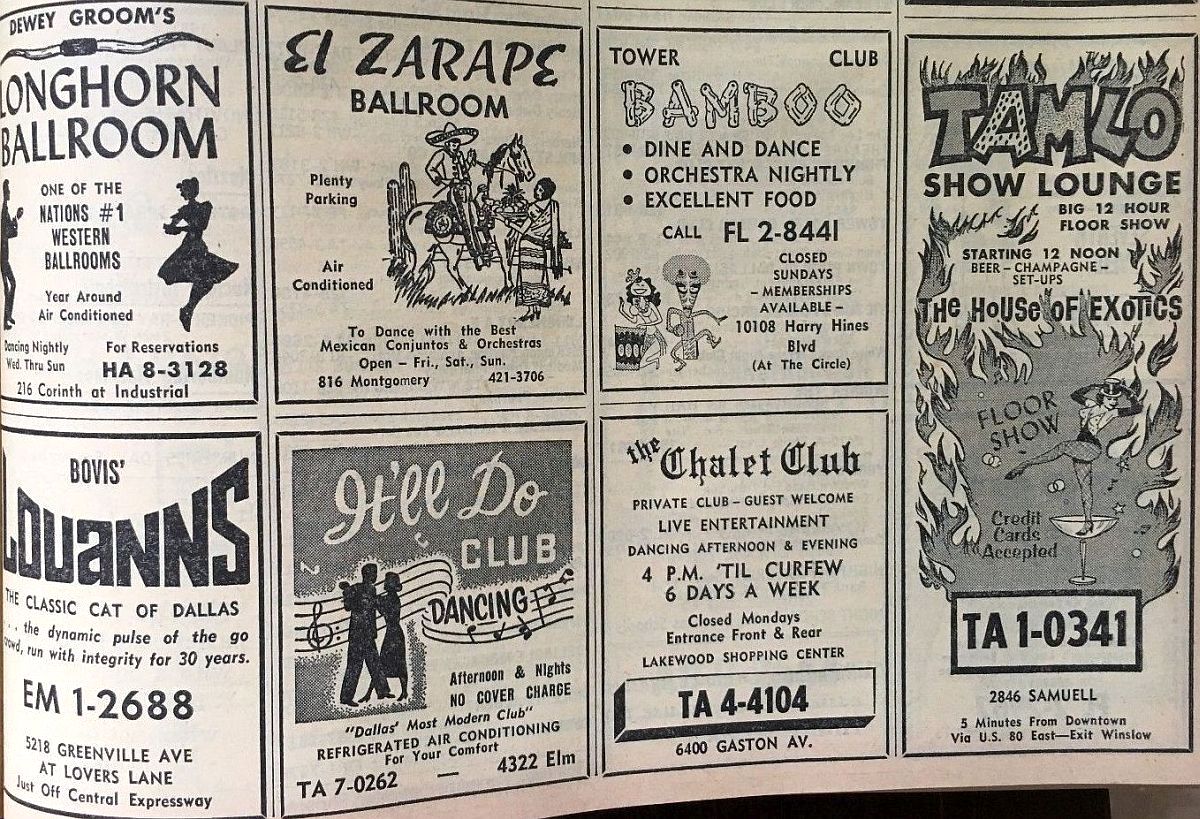
This is an interesting selection of ads from a 1968 edition of the Yellow Pages: Dewey Groom’s Longhorn Ballroom, Louanns, El Zarape Ballroom, the It’ll Do Club, the Bamboo Room at the Tower Hotel Courts, the Chalet Club, and the Tamlo Show Lounge (a couple of these show up in the…um… informative story “The Meanest Bars in Dallas” (D Magazine, July, 1975).
*
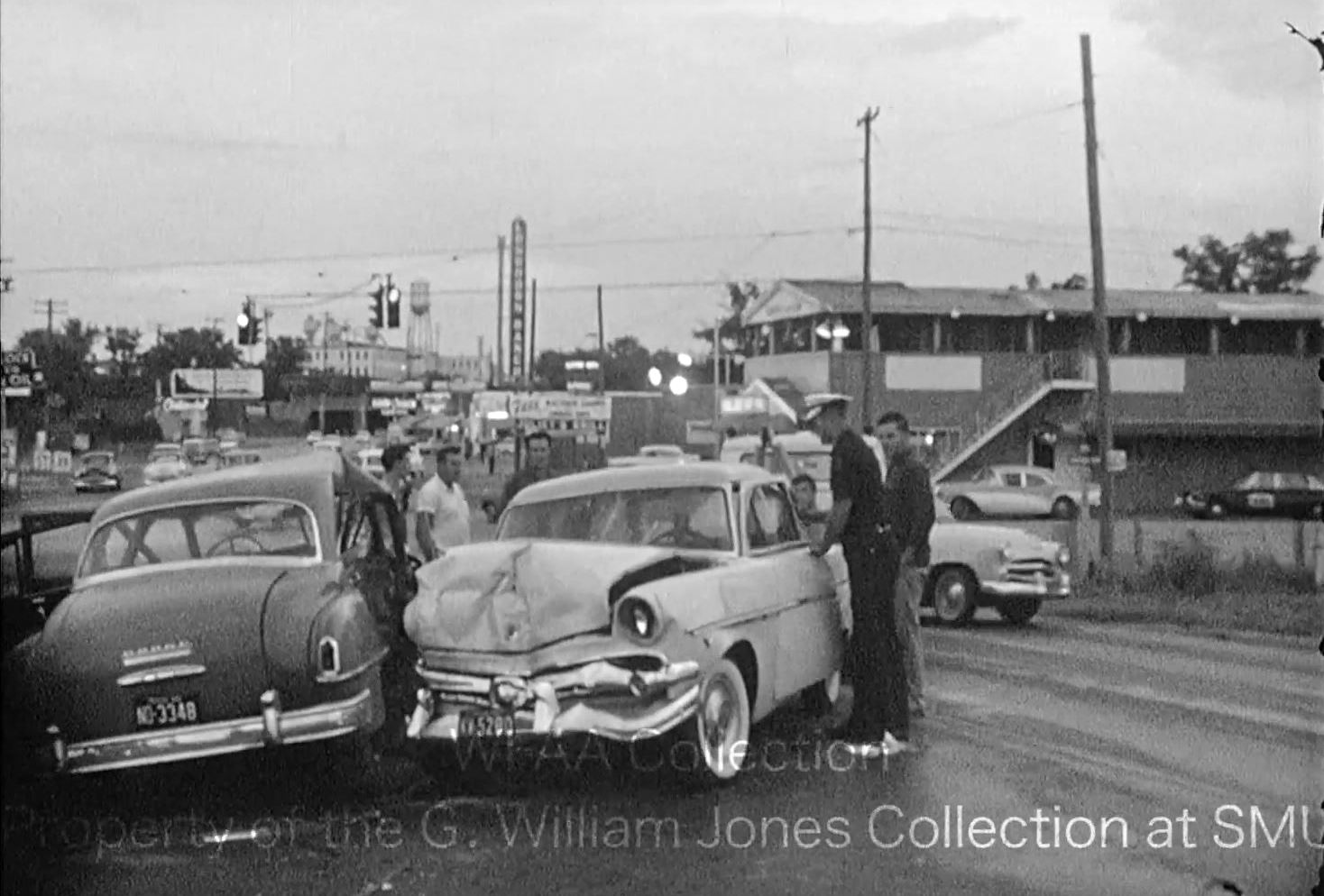
I’ve been working in the G. William Jones Film and Video Archives at SMU for the past few months, and this was something I came across while viewing a 1960 WFAA-Channel 8 News clip which made me really excited (it’s an awful screenshot, but, what the heck): while covering a car wreck at Corinth and Industrial, the Ch. 8 camera panned across the scene, and in the background, just left of center, was a very tall sign for the Longhorn Ranch, which I’d never seen before. Before it was the Longhorn Ranch it was Bob Wills’ Ranch House, and after it was the Longhorn Ranch it was the Longhorn Ballroom (more history of the legendary honky-tonk is in a Texas Monthly article here). So, anyway, it’s a fuzzy screenshot, but I think it’s cool. (The footage is from June, 1960 but the clip hasn’t yet been uploaded online.)
*
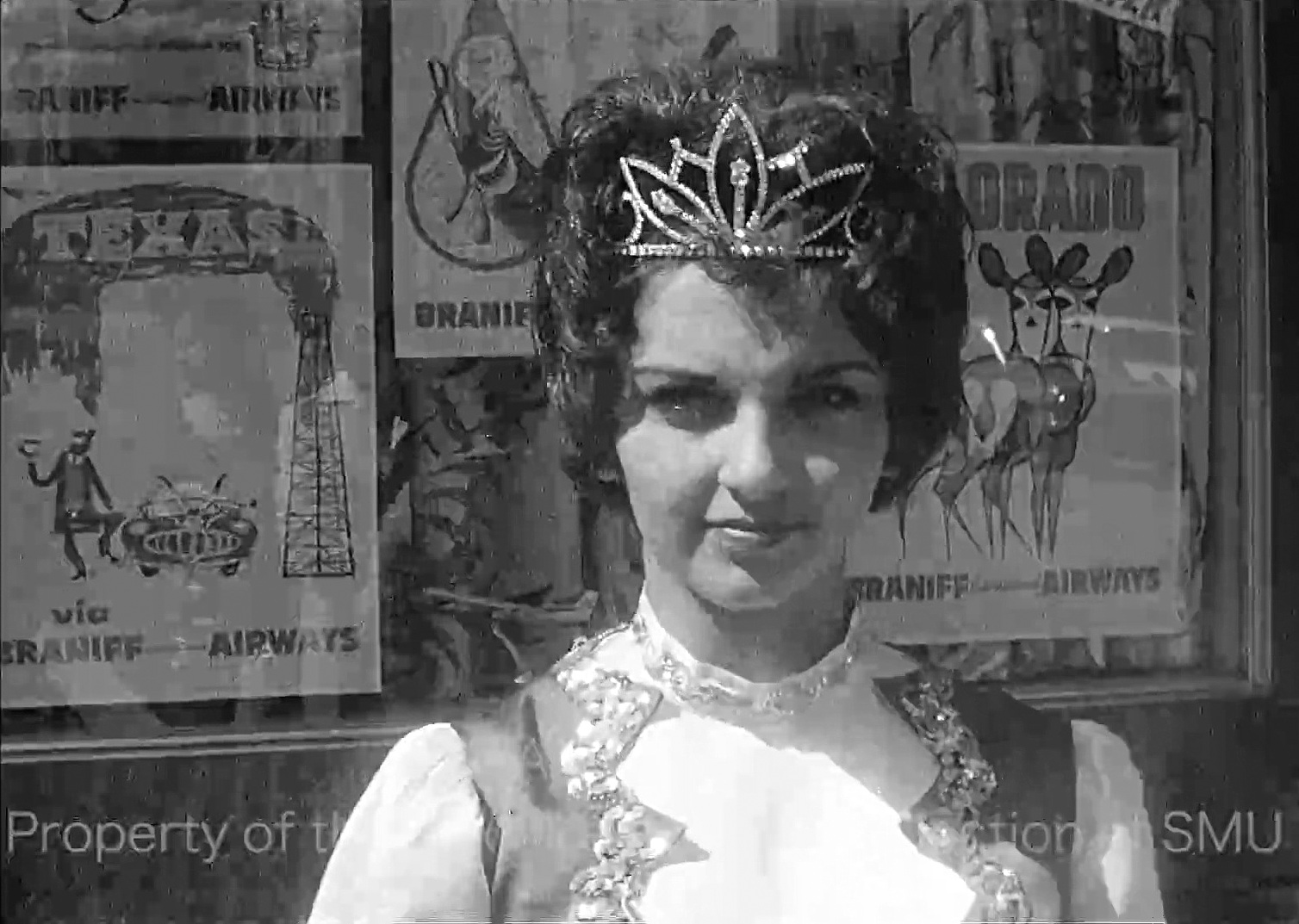
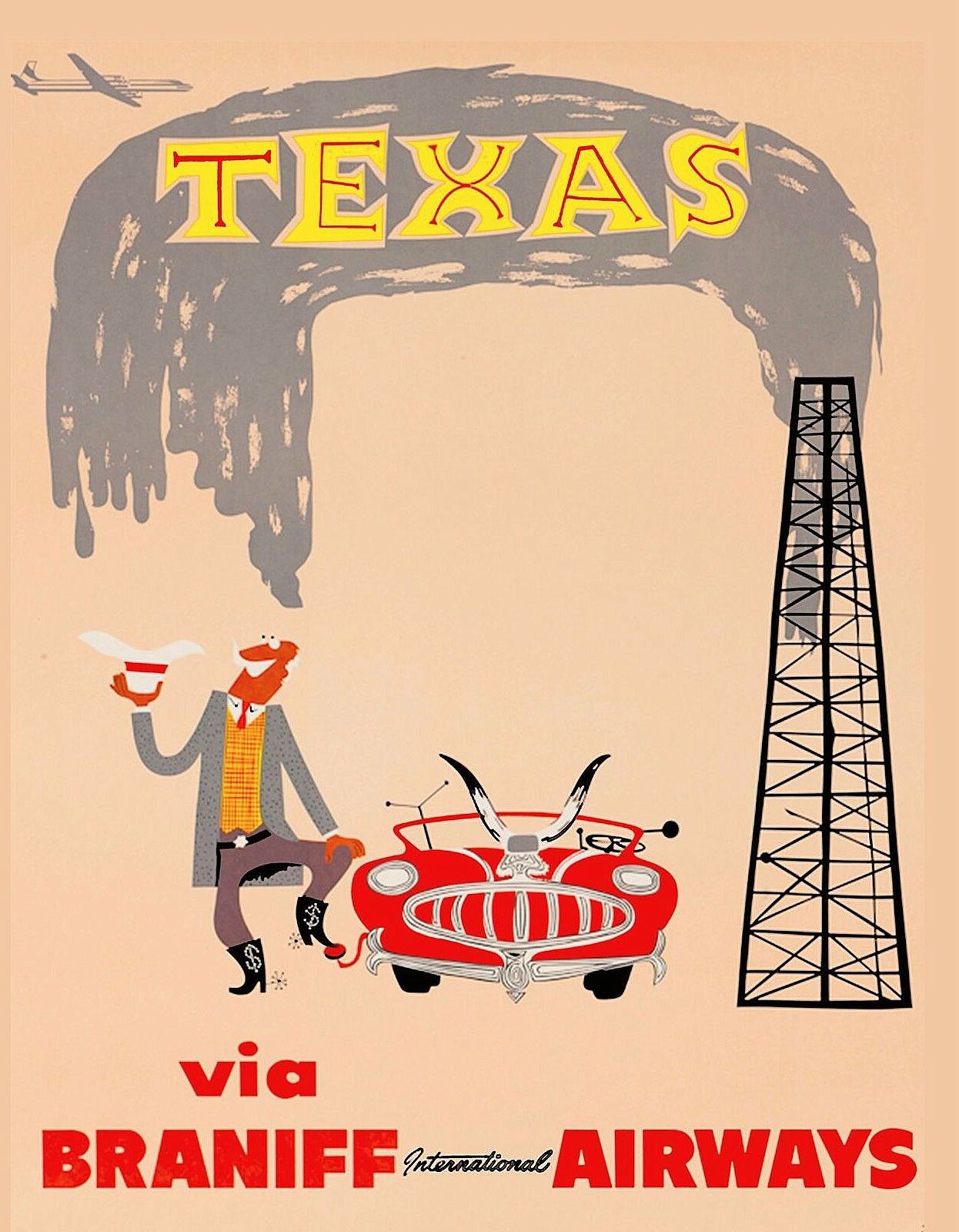
Speaking of WFAA footage in the Jones Film collection, there was some sort of story about comely young women in skimpy outfits handing out samples of some sort of food to passing pedestrians on Commerce Street (the one-minute clip is here). In addition to seeing sights associated with downtown streets in 1962 (including businesses such as Sigel’s and the Horseshoe Bar, as well as a large sign advertising the Theatre Lounge), I was really happy to see a few Braniff Airways posters in a window — I love those late-’50s/early-’60s Braniff travel posters! So here’s another screenshot and, below that, the Texas-kitsch poster I was so happy to see in color.
Braniff Airways, Inc., Copyright 1926 2019
*
I don’t have an image for it, but I was amused to learn that in 1969 the powers-that-be at the Texas Turnpike Authority nixed the suggestion that the Dallas North Tollway be renamed in honor of president Dwight D. Eisenhower, who had recently died — the idea was turned down because 1) new signage would have been very expensive, and 2) officials were afraid that “irreverent motorists” would inevitably refer to the toll road as the “Ike Pike” (I know I would have!).
*
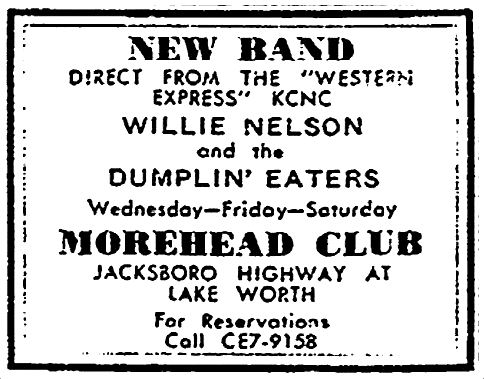
Not Dallas, but there’s always time for a little love for Fort Worth: here’s a nice ad from 1955 for a 22-year-old Fort Worth DJ named Willie Nelson, back when he was gigging out on the Jacksboro Highway with his band the Dumplin’ Eaters.
Fort Worth Star-Telegram, Sept. 9, 1955
*
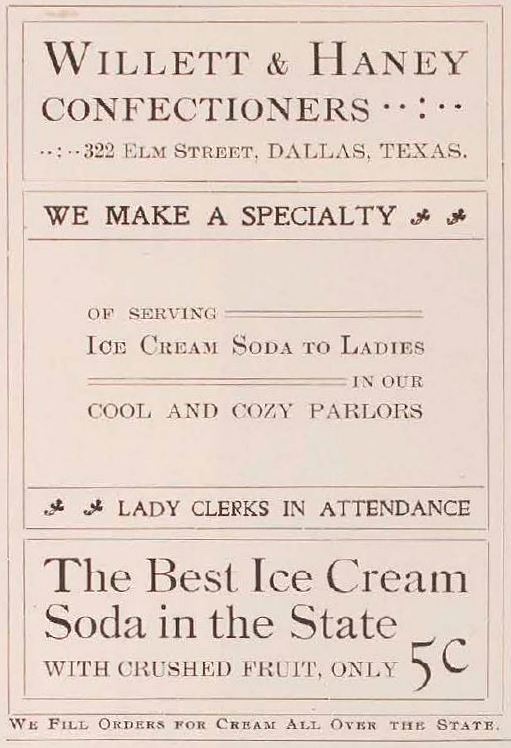
Apparently there was a time when ladies were uncomfortable patronizing an establishment in which m*n served them ice cream, so this ad from 1899 made sure to note that “lady clerks” were in attendance. (See the back side of the Willett & Haney Confectioners parlor a couple of years before this ad, when the “cool and cozy parlor” was located on Main Street — it’s at the far left in this circa-1895 photo detail from this post.) The parlor was owned by John B. Willett and John S. Haney, and in addition to ice cream and candy, their specialty was oysters, and I can only hope that there was some experimenting with new food combos involving mollusks, ice cream sodas, and crushed fruit.
*
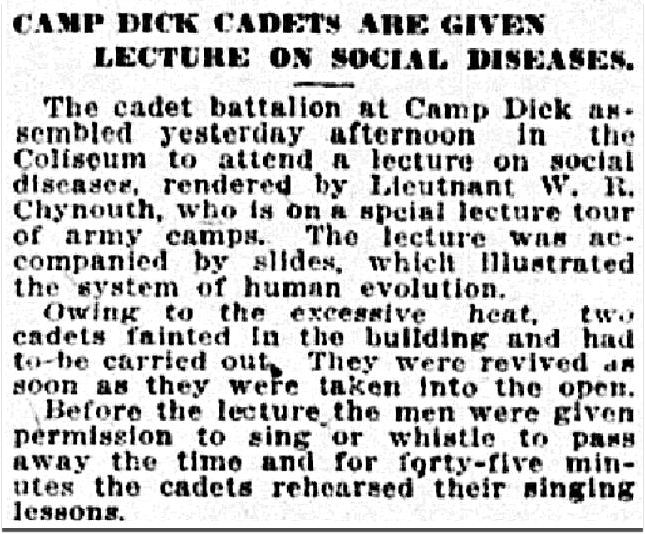
This is an odd little tidbit from The Dallas Morning News about a couple of cadets from Camp Dick (at Fair Park) and what happened to them when they attended a lecture on “social diseases.” (The jokes write themselves….) Who knew singing and whistling were so therapeutic”
DMN, Aug. 17, 1918
*
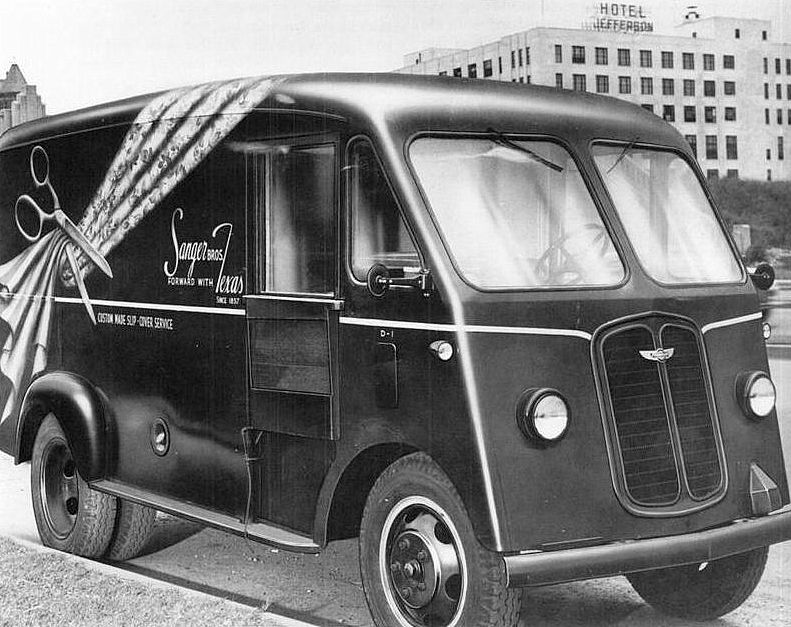
The caption for this photo (which appeared in the article “Going Downtown to Shop” by Jackie McElhaney, from the Spring, 2009 issue of Legacies): “In 1946, Sanger’s introduced a portable drapery shop. Two seamstresses sewed draperies in this truck while parked in the customer’s driveway.” Now that’s service!
“Forward with Texas,” 1947 ad detail
*
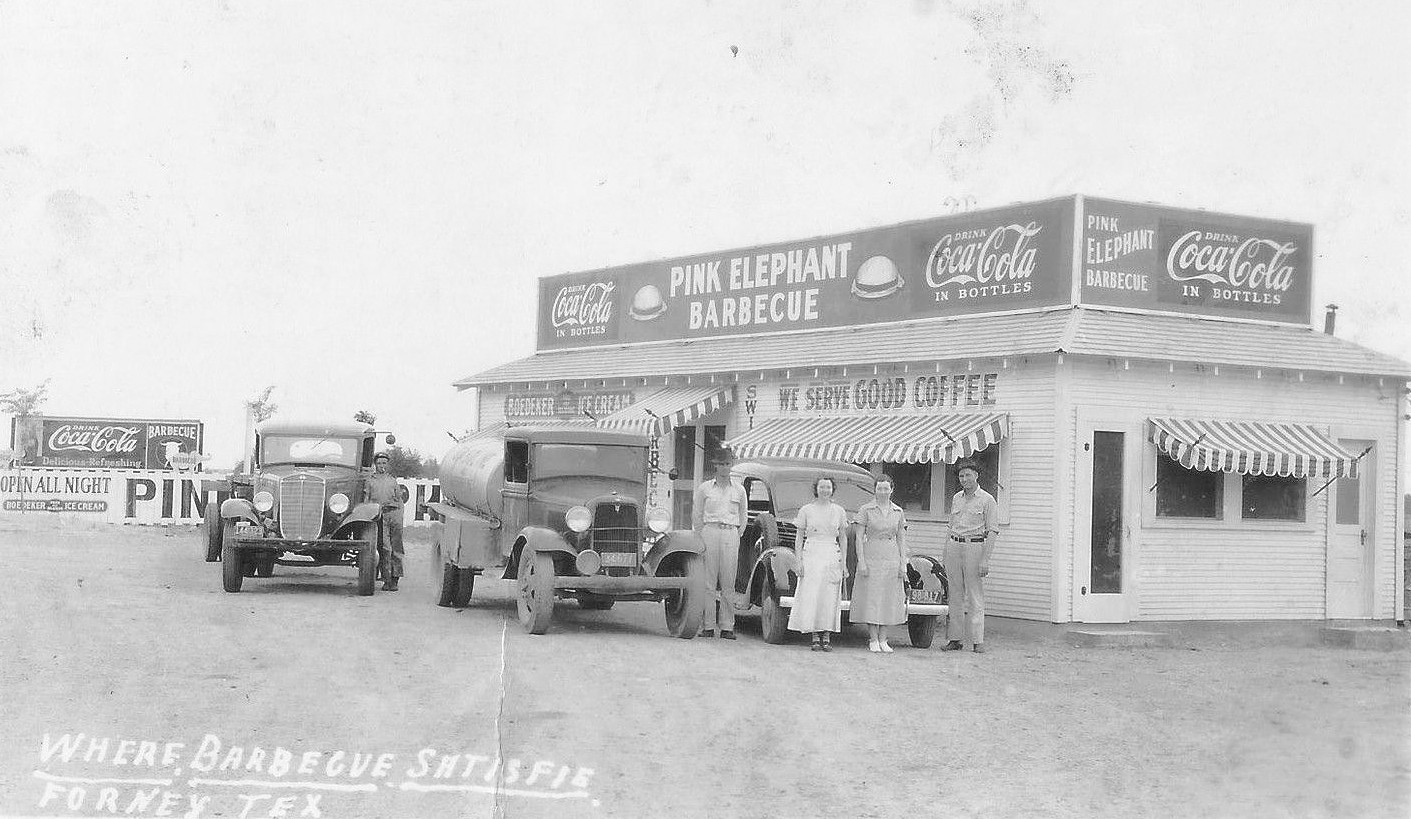
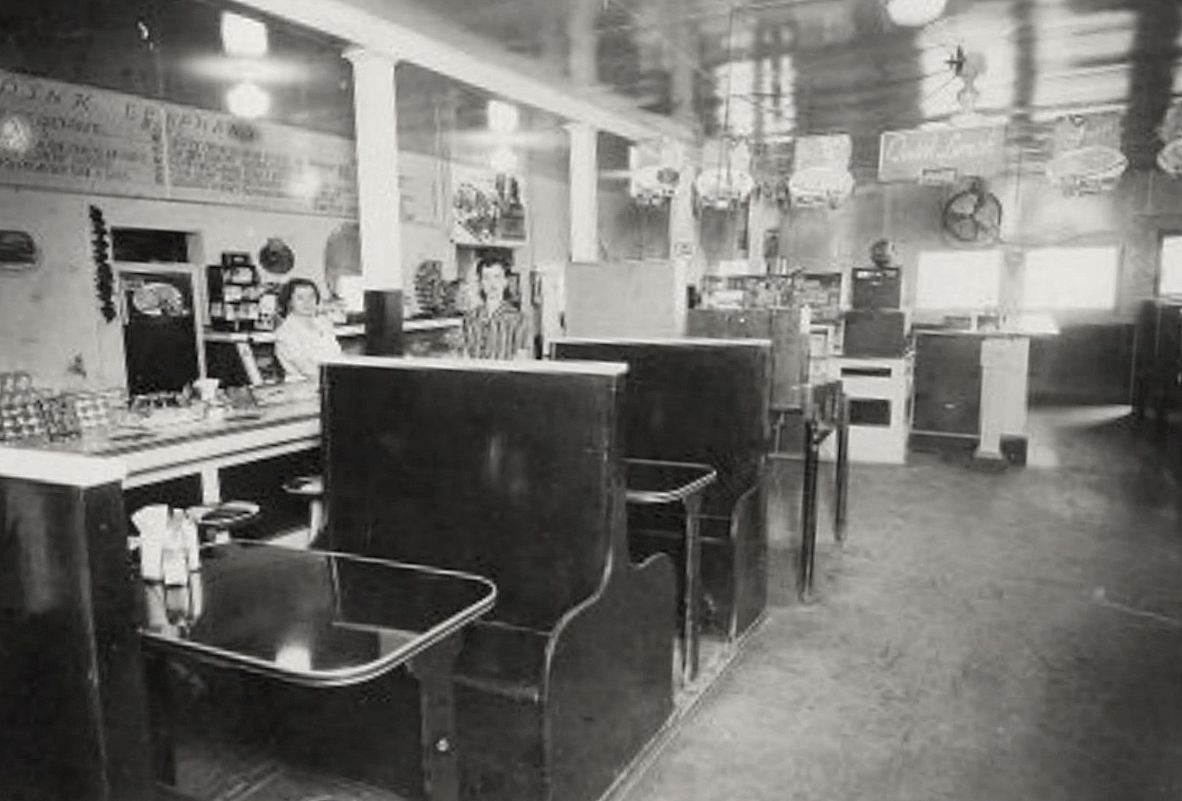
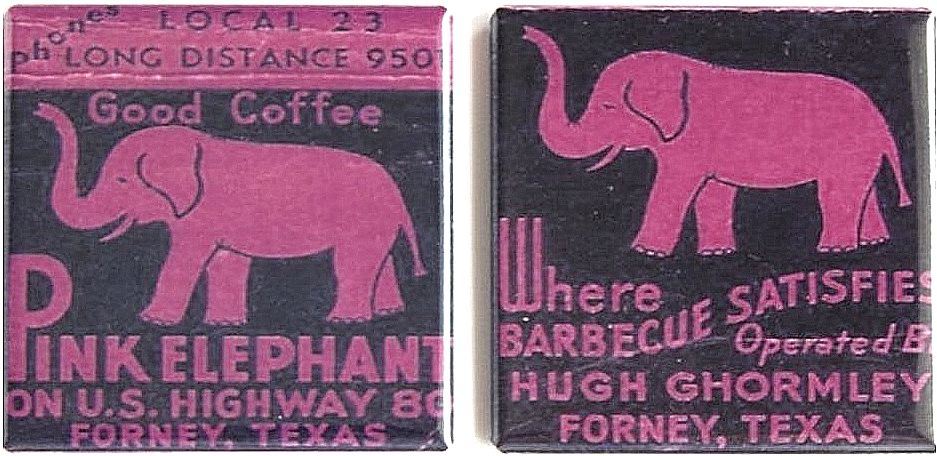
Two more. This first was a real-photo postcard I found on eBay. It shows the Pink Elephant cafe on Hwy. 80 in Forney (not Dallas, but pretty close!). I love the idea of Forney having a place called the Pink Elephant — it was quite popular and was in business from at least the 1930s to the 1950s. The card below was postmarked in 1936.
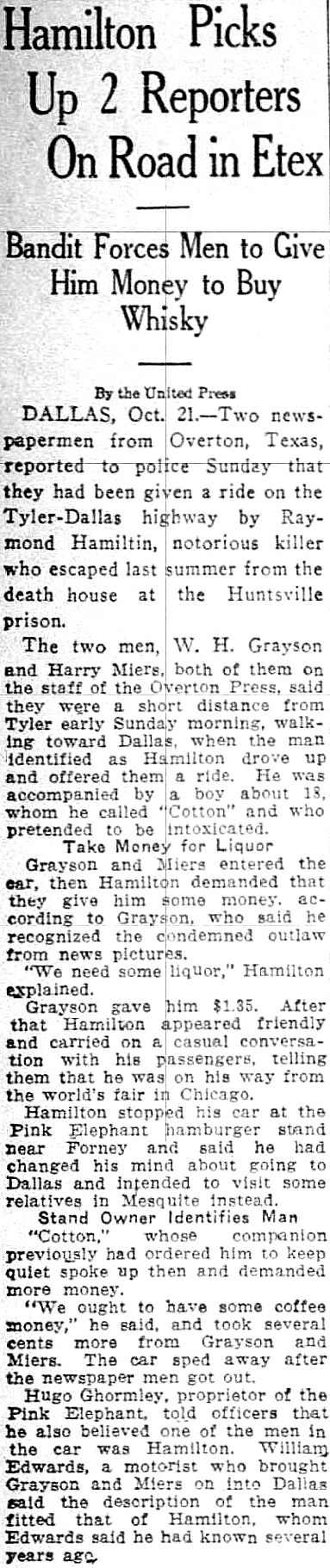
I wondered if the place was still around (sadly, it is not), and in looking for info about it found this interesting article from 1934 about outlaw Raymond Hamilton, the escaped killer who grew up in Dallas (…there’s the Dallas connection!) and was notorious for having been a member of Bonnie and Clyde’s “Barrow Gang.” (Click to read.)
Austin American, Oct. 22, 1934
*
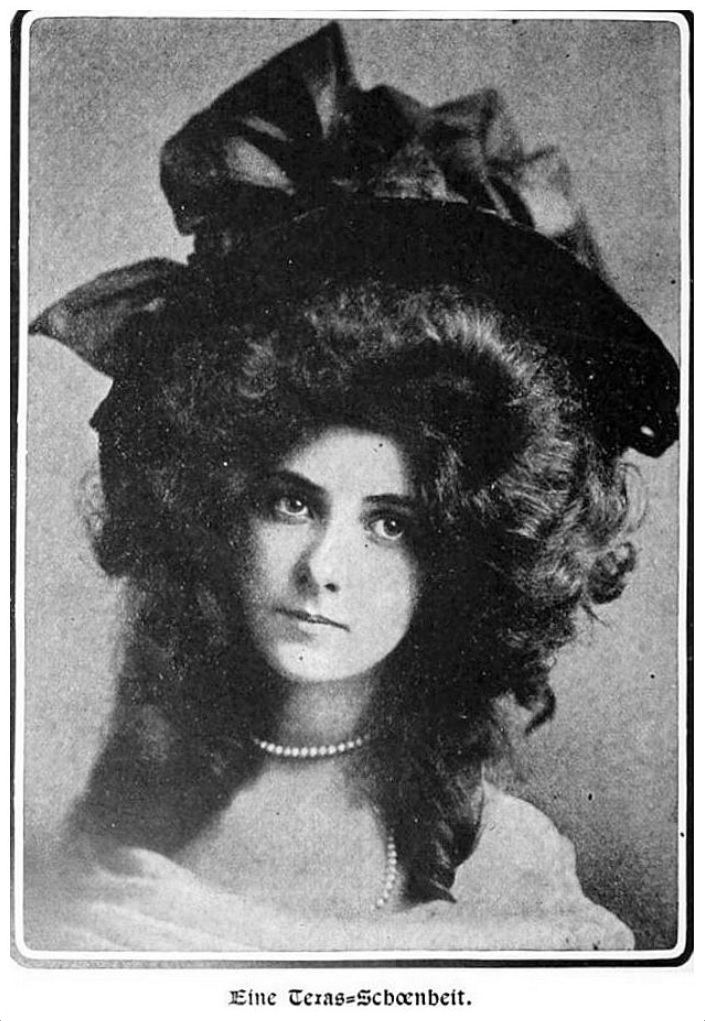
And, lastly, a photo of a young woman which appeared in a German-language magazine, captioned simply “Eine Texas Schönheit (A Texas Beauty).” Is the hair wearing the hat, or is the hat wearing the hair?
***
Previous installments of Flashback Dallas “Orphaned Factoids” can be found here.
Ann Richards drove my carpool. She and my mother swapped out driving kids to the First Unitarian Church Cooperative Preschool on Preston and Normandy in University Park. I’m not sure anyone in either family was an actual member of the church, but that preschool was one of the only co-ops in Dallas (it might have been the first), and it was a magnet for the more progressive parents in the city. The Unitarian Church was also a major gathering place in the 1960s and 1970s for those involved in women’s issues, liberal activism, and Democratic politics, including my mother and the future governor of Texas, Ann Richards. I remember hearing about Ann (she was always referred to as just “Ann”) throughout my entire childhood. My parents weren’t close friends with the slightly older Richardses, but my mother was a keen admirer of Ann and my father described her as “the funniest woman I’ve ever known.” I remember their home on Lovers Lane which always seemed to be crammed full of kids.
When Ann Richards lived in Dallas she was a self-described “housewife,” who, when she wasn’t busy raising her four children, was volunteering for Democratic candidates and causes. She was an active member of the North Dallas Democratic Women’s Club, a group which, in 1963, gained instant attention for the fundraiser show they wrote and performed called “Political Paranoia,” a satirical revue of politics, complete with sharp satire, broad comedy, song parodies, and ridiculous wigs and costumes. The show was such a huge success that follow-up standing-room-only shows were performed in 1964, 1965, 1966, and 1968. The shows were written and directed by Carolyn Choate, Ruthe Winegarten, and Ann Richards, and the cast consisted of the members of the NDDW. Ann’s portrayal of LBJ seems to have made lasting impressions on those who saw it.
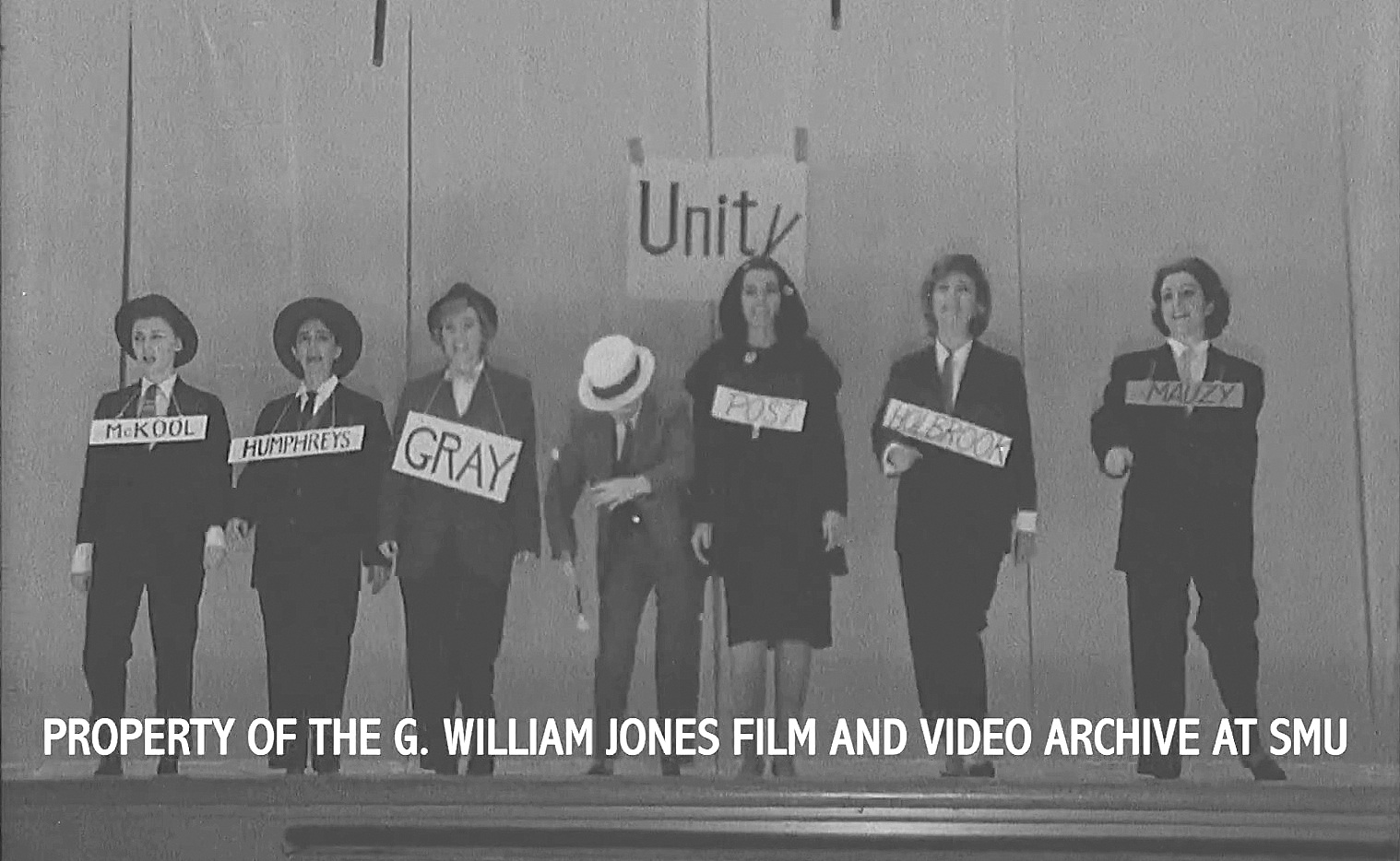
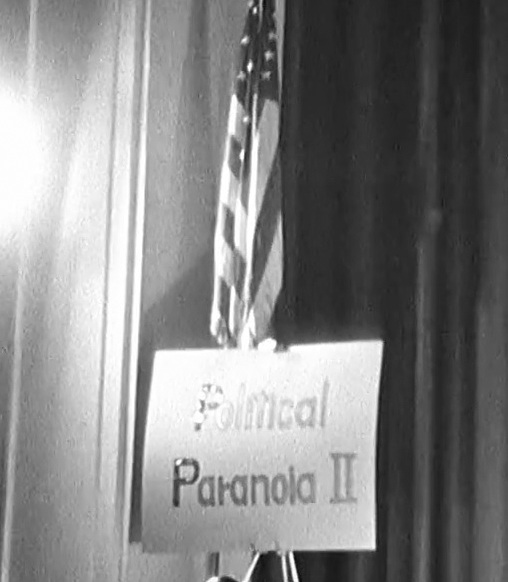
I have recently begun working on a project for the G. William Jones Film and Video Archive at SMU, and a reel of 16mm black-and-white film — with sound! — was discovered in the vault recently with no identifying information. Nothing. Nobody knows where it came from or how it ended up at SMU. But there it was: a lightly edited filmed document of the second installment of “Political Paranoia,” presented by the North Dallas Democratic Women in the auditorium of Hillcrest High School on May 16, 1964. I was sure Ann Richards would be in there somewhere — and she was! I was pretty excited by this “discovery” because this show has become something of a legendary touchstone in local Democratic politics. As far as I know, there is no other film footage of any of these shows. Not only that, this may well be the earliest footage of Ann Richards, the woman who would go on to become the governor of Texas (1991-1995) and one of the most celebrated women in politics and Texas culture. This is an amazing heretofore unknown historical document.
The show is full of smart sarcasm and “hey-kids-let’s-put-on-a-show” enthusiasm. The humor is more amusing than cutting, and these Democratic women were certainly not afraid of making fun of members of their own party. A lot of the hot topics of the day addressed in this show are lost to the mists of time, but that doesn’t take away from its entertainment value. This was a time when women had very little voice, impact, or power in politics, and the women here have firmly taken control of the reins and perform with an exuberance that crackles.
The 34-minute film — complete with odd jumps and abrupt cuts — has been uploaded by SMU in its entirety here:
*
Here are a bunch of screenshots. I don’t know who all of the performers are — I would love feedback and corrections from the public. At the bottom is a list of names of women who were involved with the NDDW, but as they were invariably identified as “Mrs. Husband’s Name,” I have no idea what most of their first names are! I am especially interested in identifying Ruthe Winegarten, one of the prime movers behind these shows (and also a Texas and women’s historian of note).
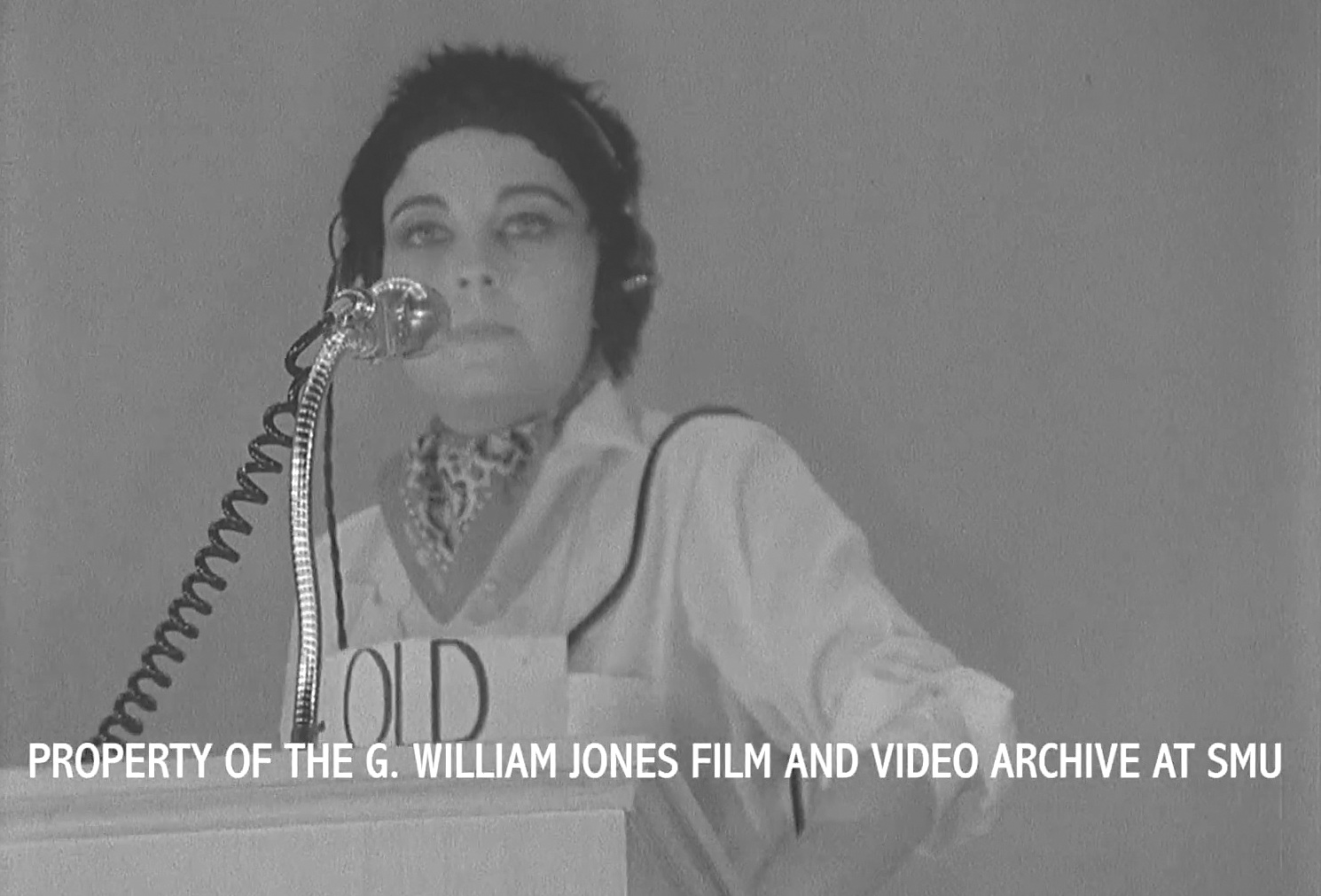
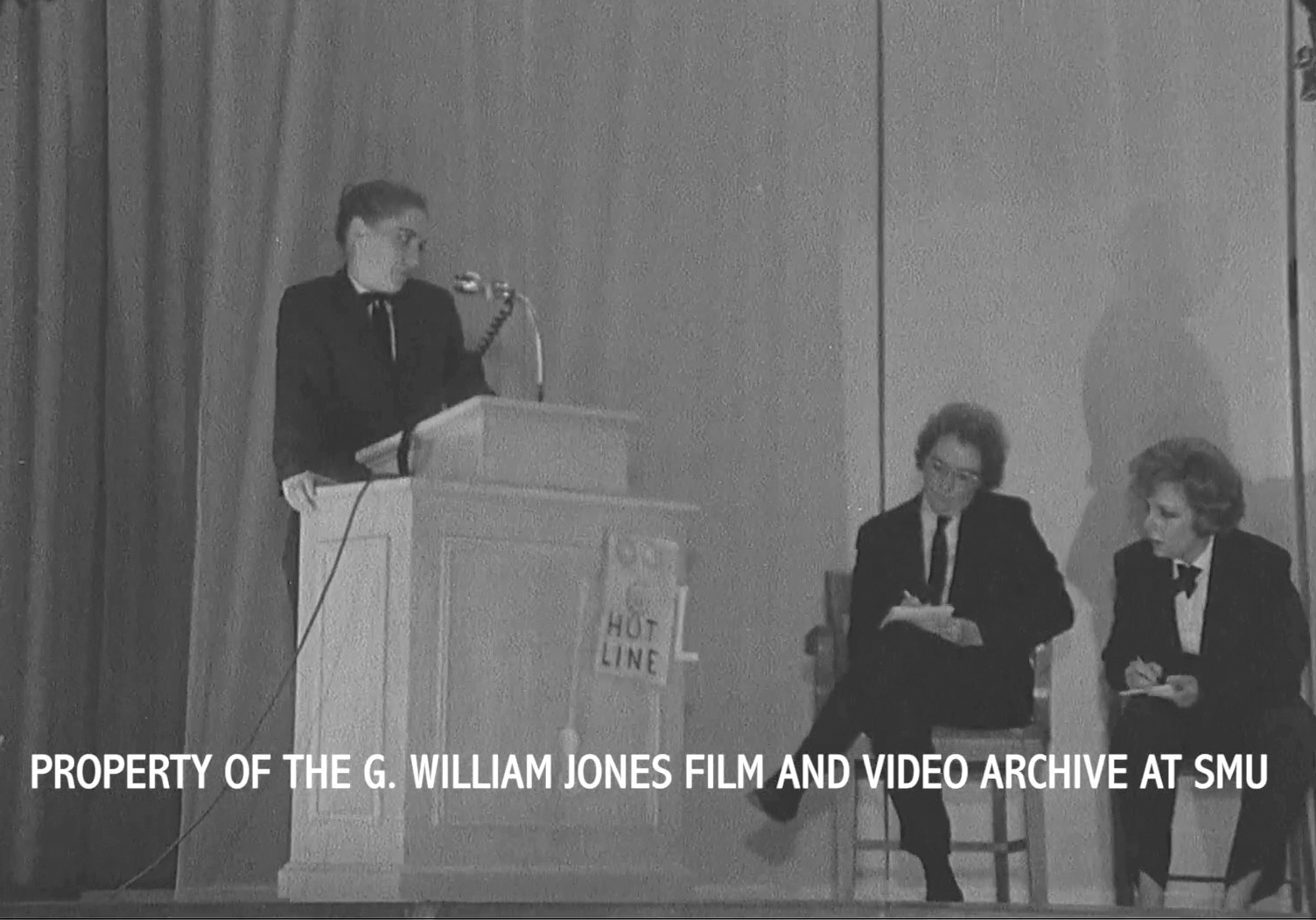
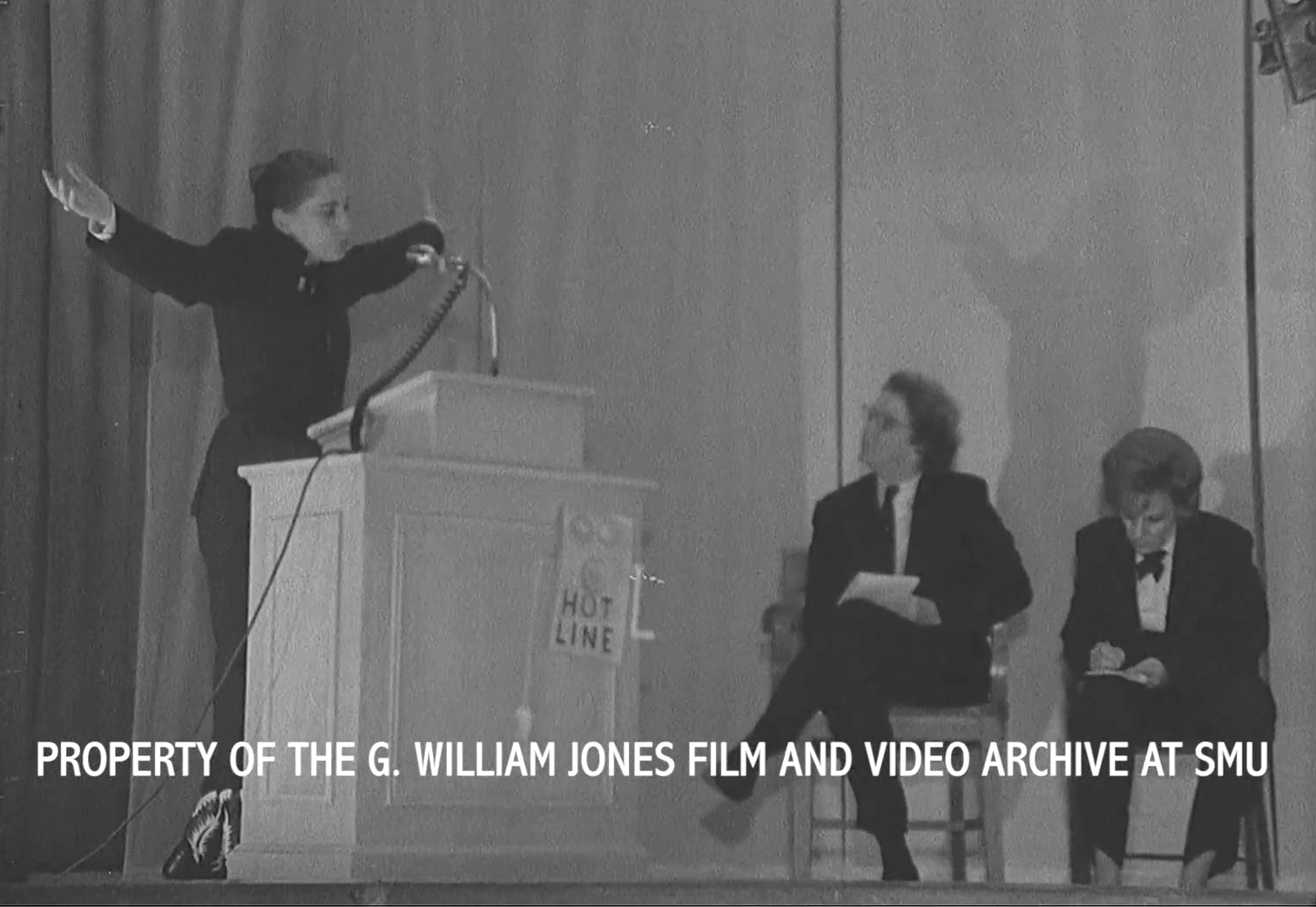
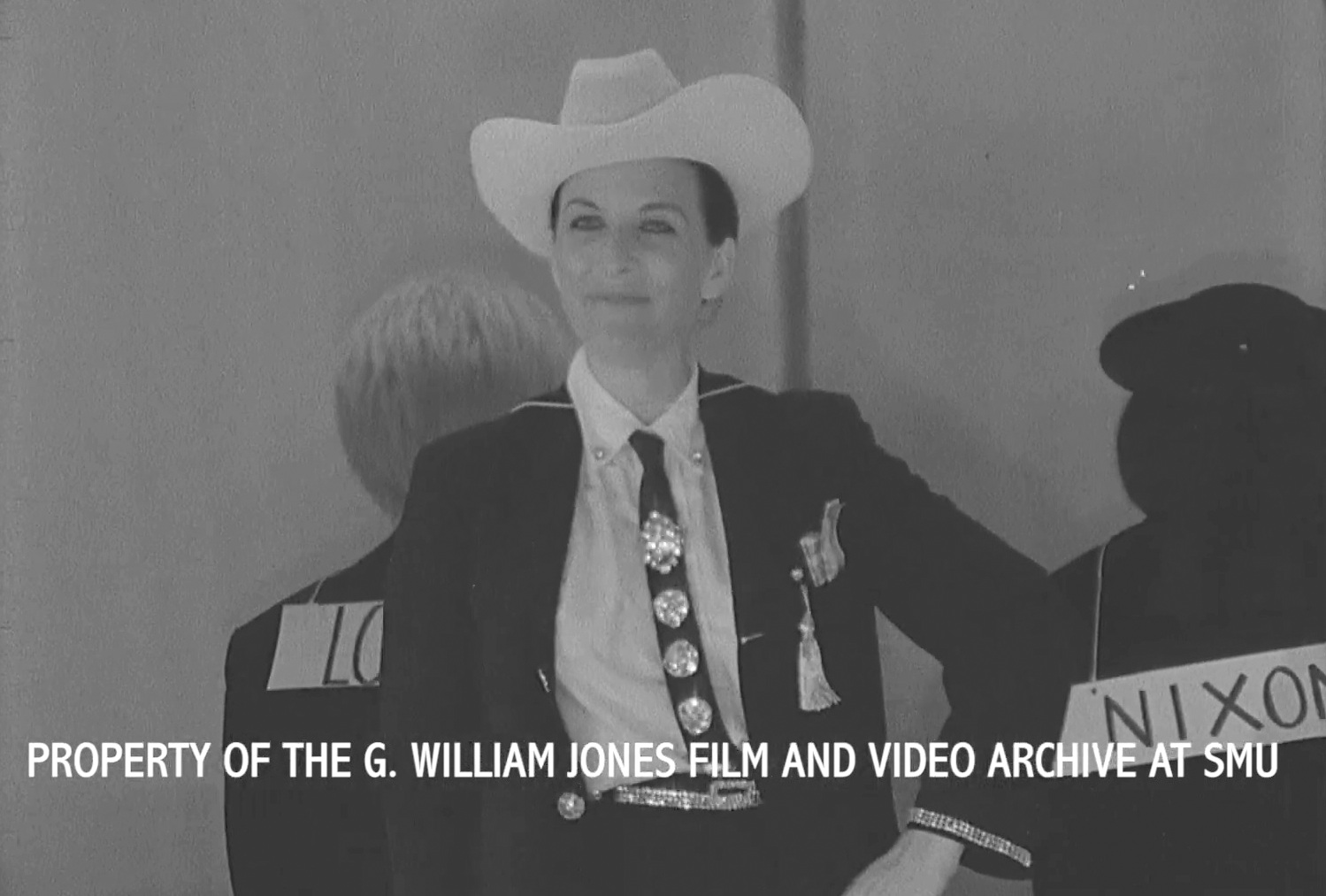
First, 30-year-old Ann Richards (or as she was identified in newspaper accounts, “Mrs. David Richards”) appearing as Gordon McLendon, Dallas media magnate, owner of KLIF, and one-time wannabe politician — “The Old Scotchman.” That voice is unmistakable.
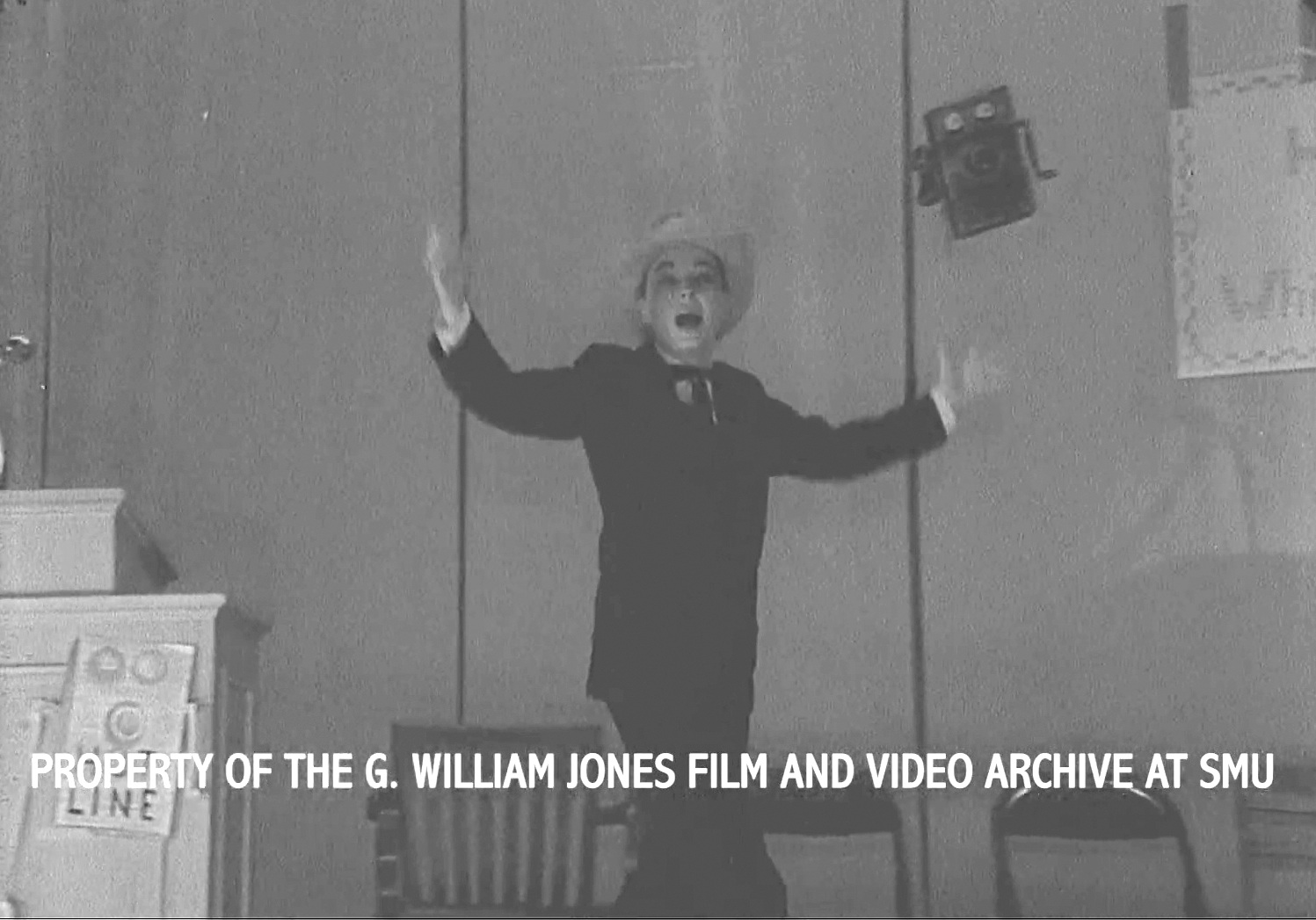
And here she is as LBJ:
Carolyn Choate, one of the writers and directors of “Political Paranoia,” wrote the music and performed many of the song parodies (she was also a contributor to the annual Dallas Press Club Gridiron Show).
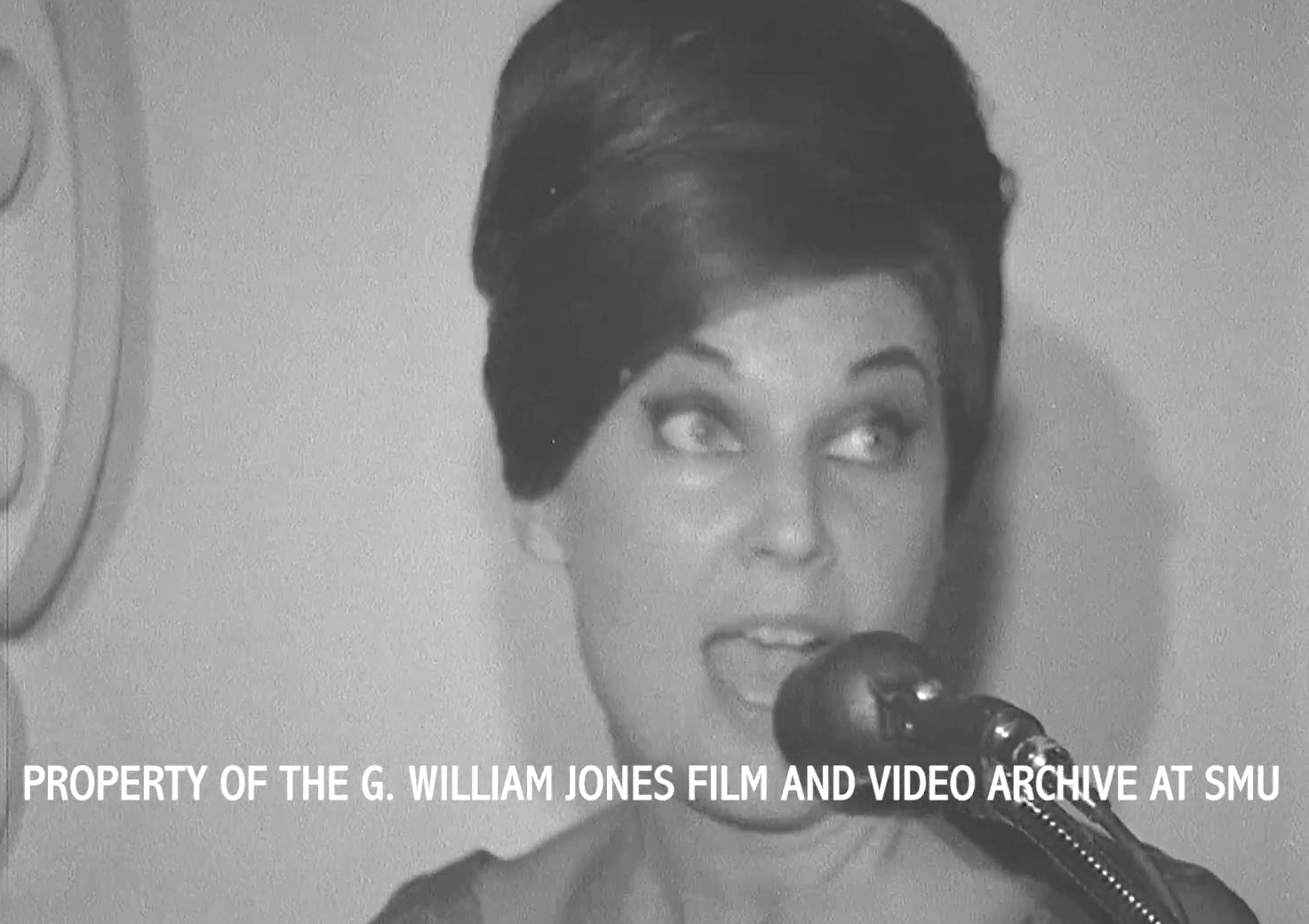
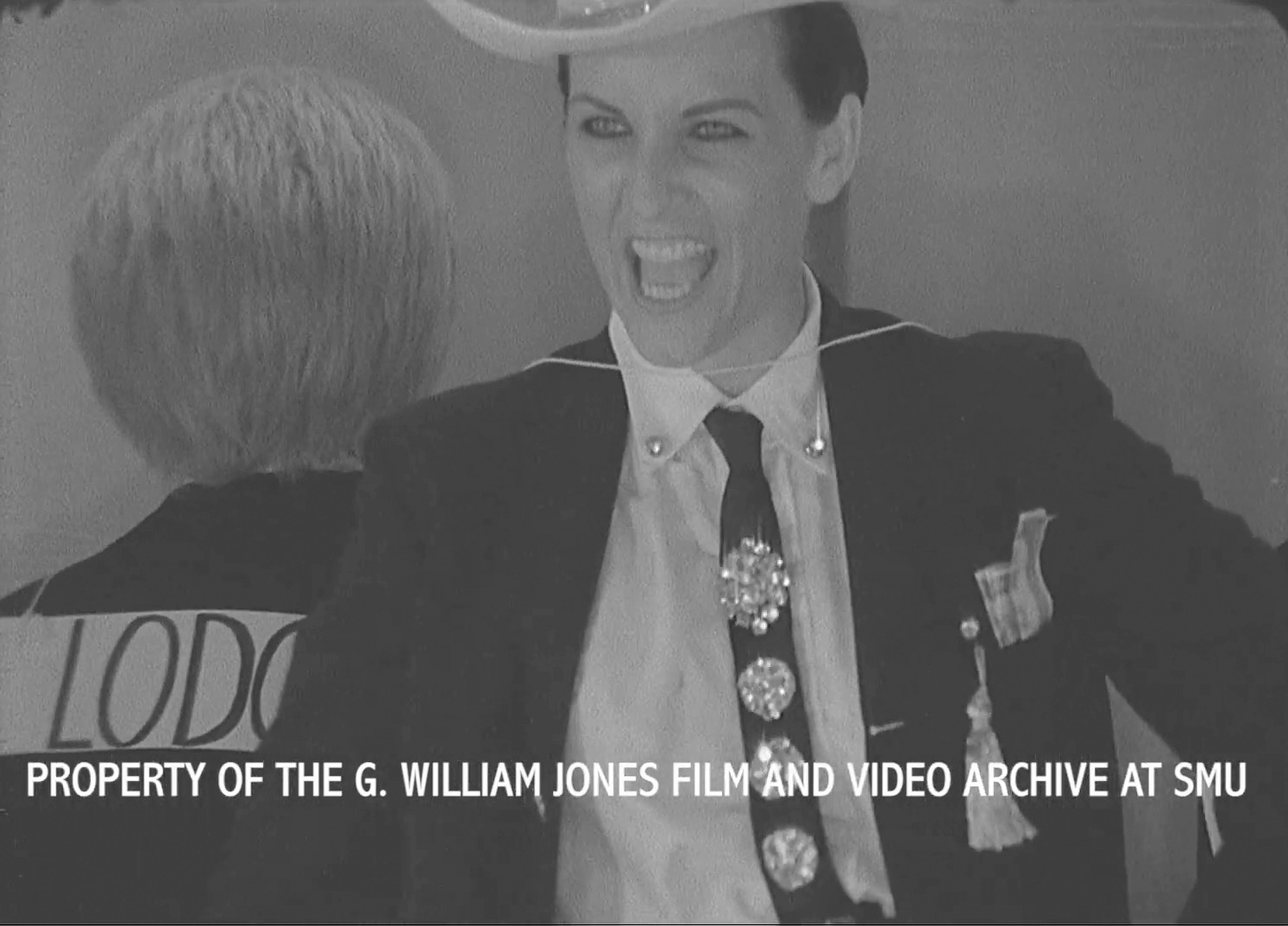
I was really interested to see Betty McKool, Ann’s longtime friend with whom she issued a famous series of annual jokey Christmas cards (which I wrote about in the post“The Legendary Christmas Cards of Ann Richards and Betty McKool”) — and here she is as Nelson Rockefeller at the 1964 Republican National Convention in what I thought was a really great, incredibly confident performance.
I’m not sure who the blonde with the glasses and ruffled shirt is, but she gives a spirited performance as Barry Goldwater at the Republican Convention. (Mrs. Ray Pearce portrayed Goldwater in the first “Political Paranoia,” so perhaps this is her revisiting the role.)
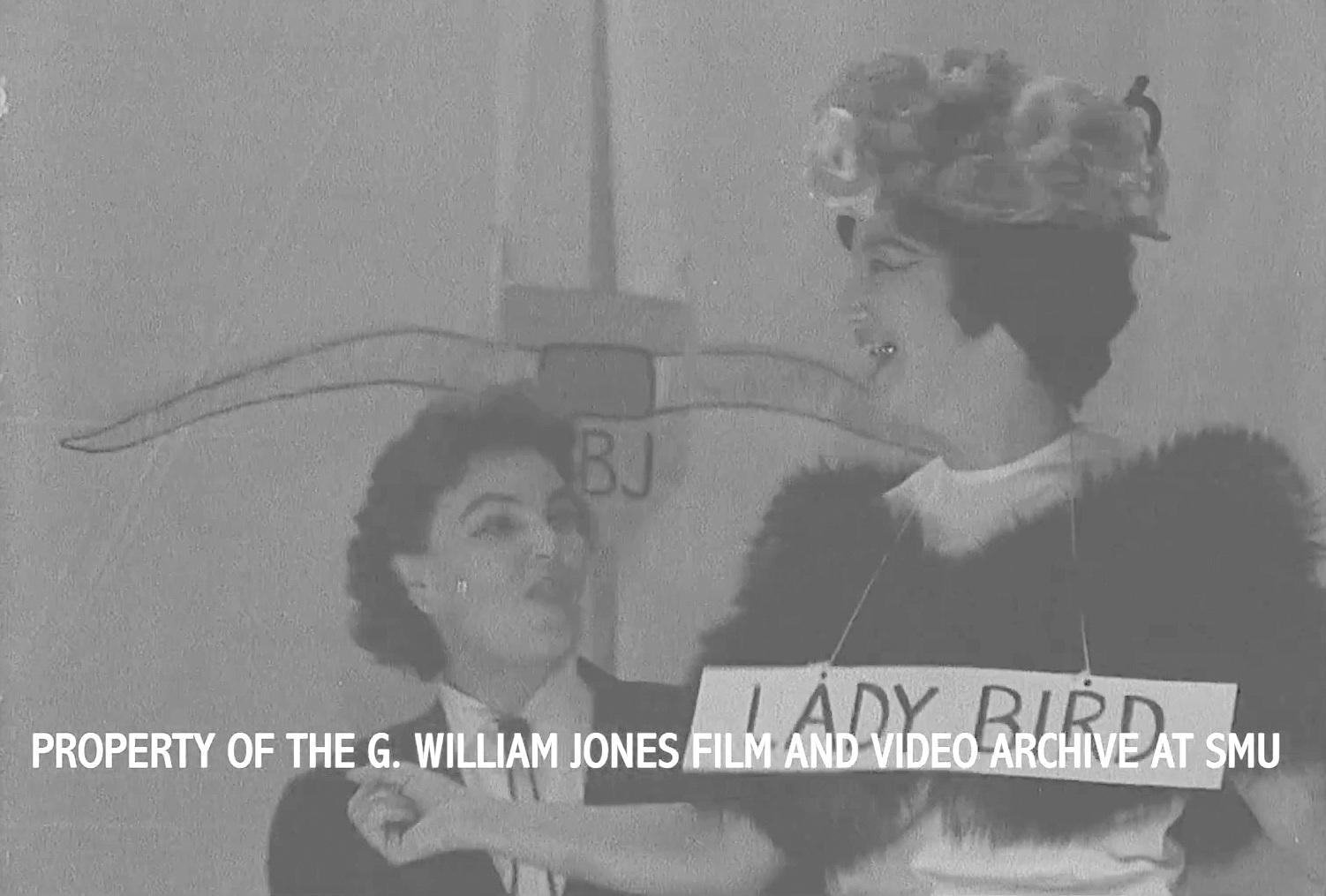
My preschool teacher (and, I believe, the founder of the Unitarian co-op school), Millie Seltzer, is seen below as Lady Bird Johnson. (There’s also a photo of her and Ann as Lady Bird and Lyndon from 1965’s “Political Paranoia III,” which is posted on the blog of Millie’s daughter’s here.)
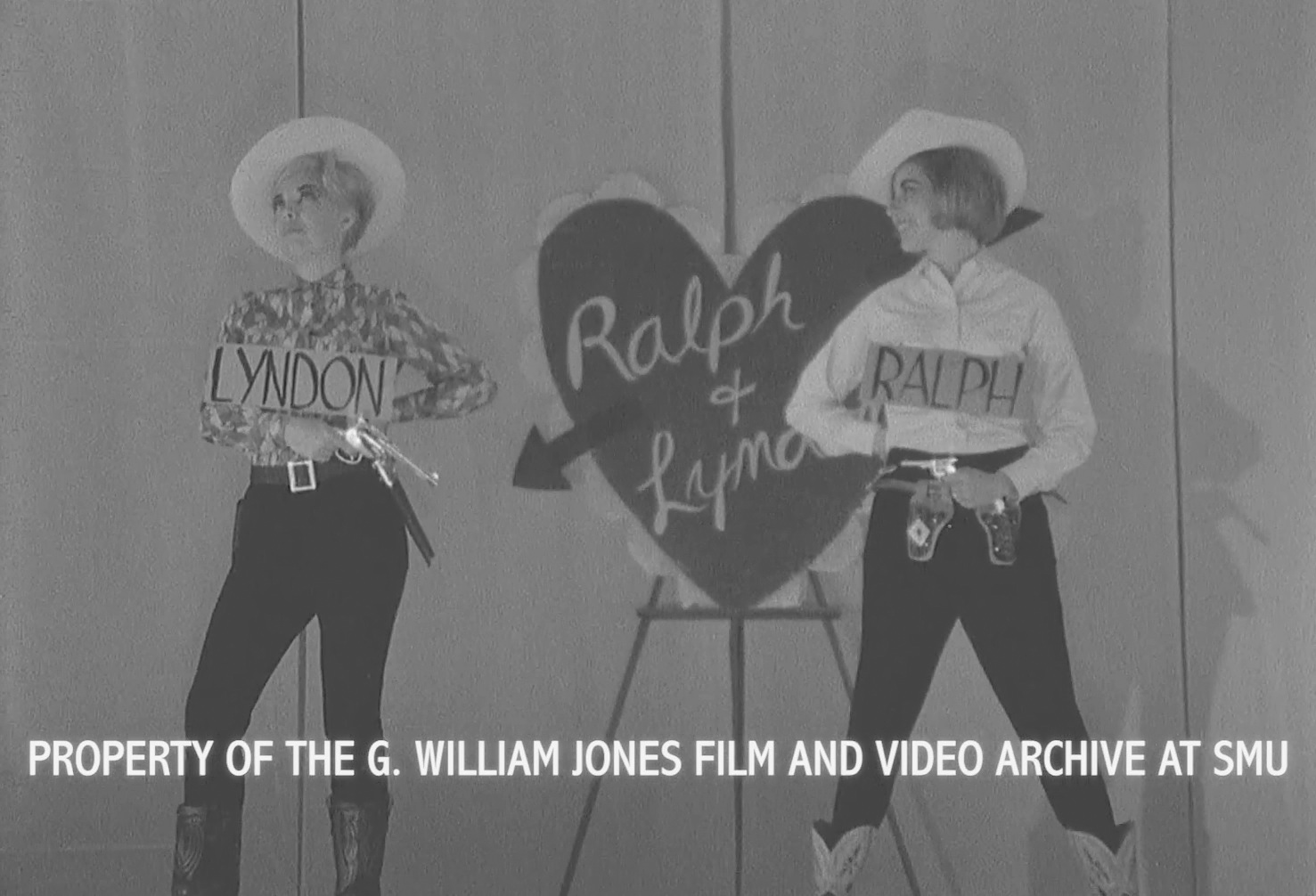
Speaking of Lady Bird, here’s Lyndon and Ralph Yarborough (I’m not sure who these women are, but “Lyndon” might be Mary Vogel).
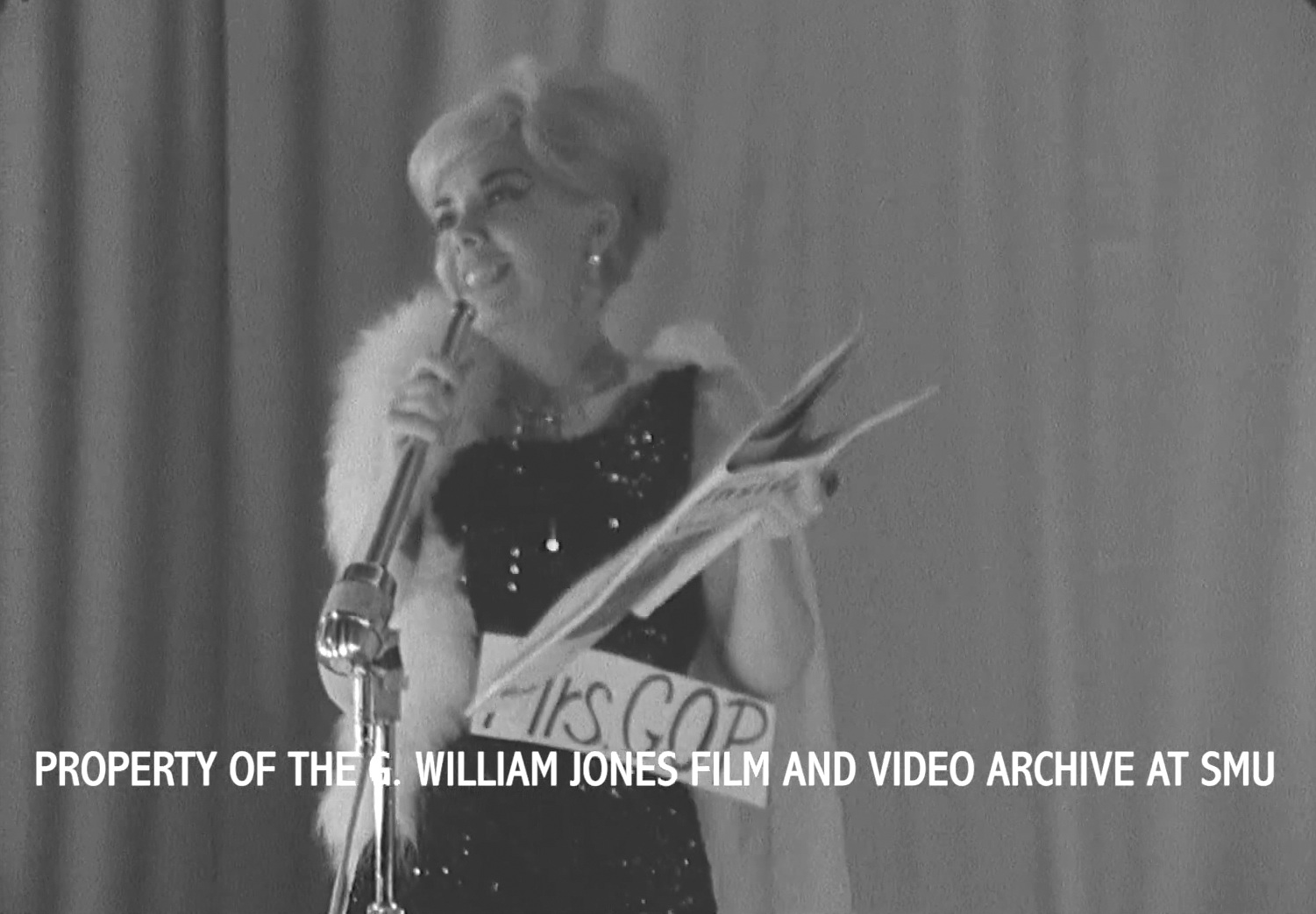
Possibly Mary Vogel again as “Mrs. GOP.”
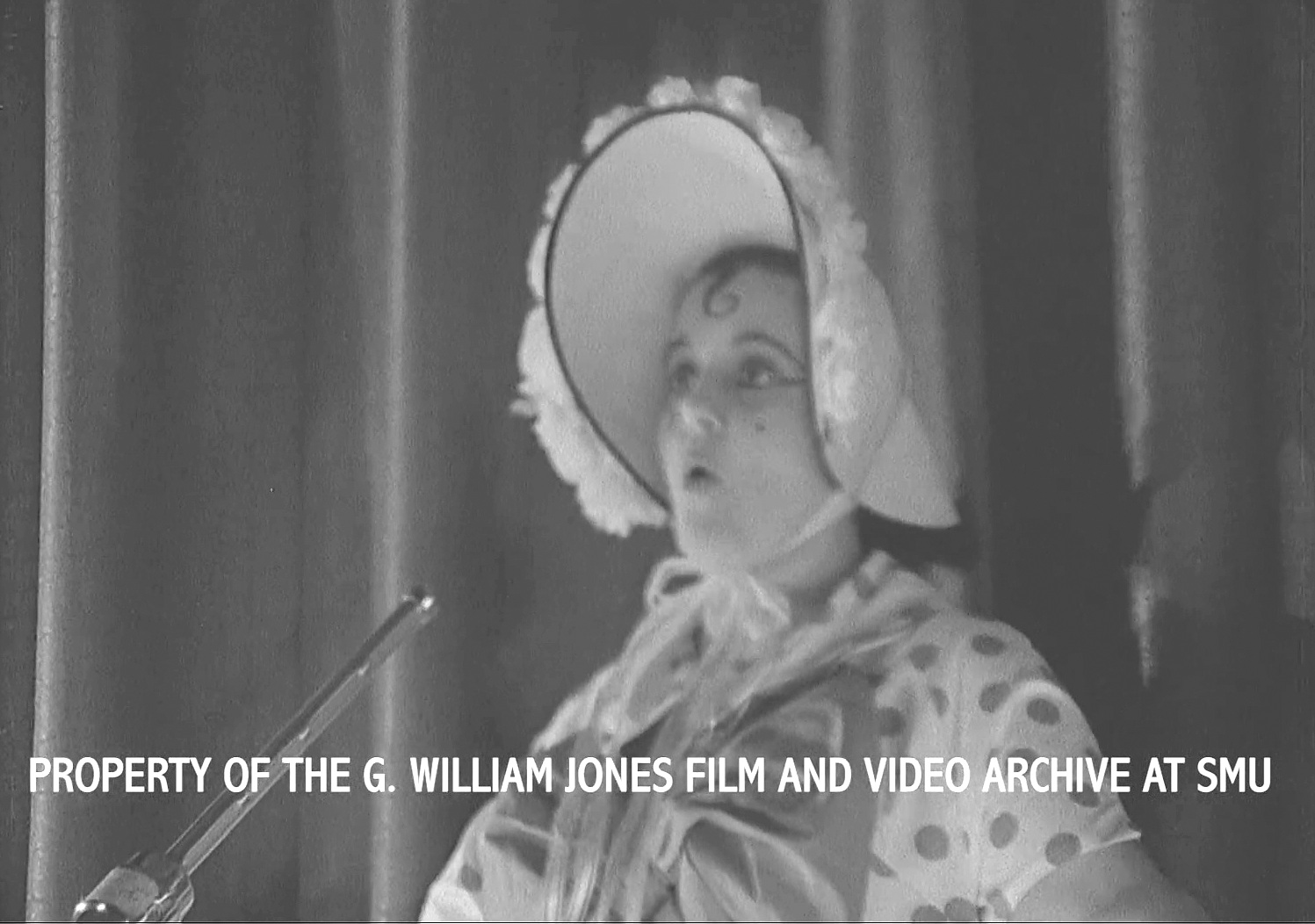
An unknown performer singing about John Connally.
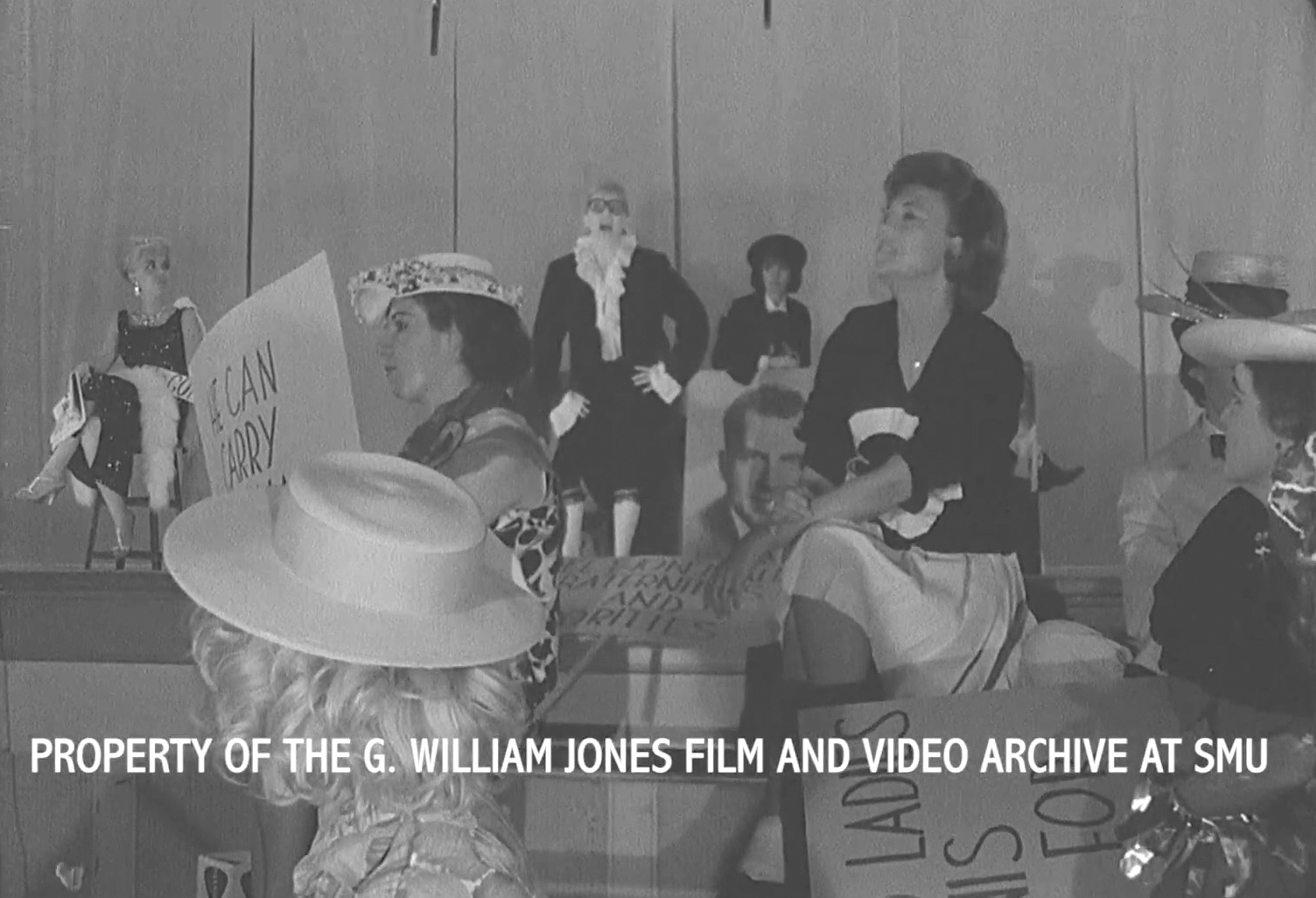
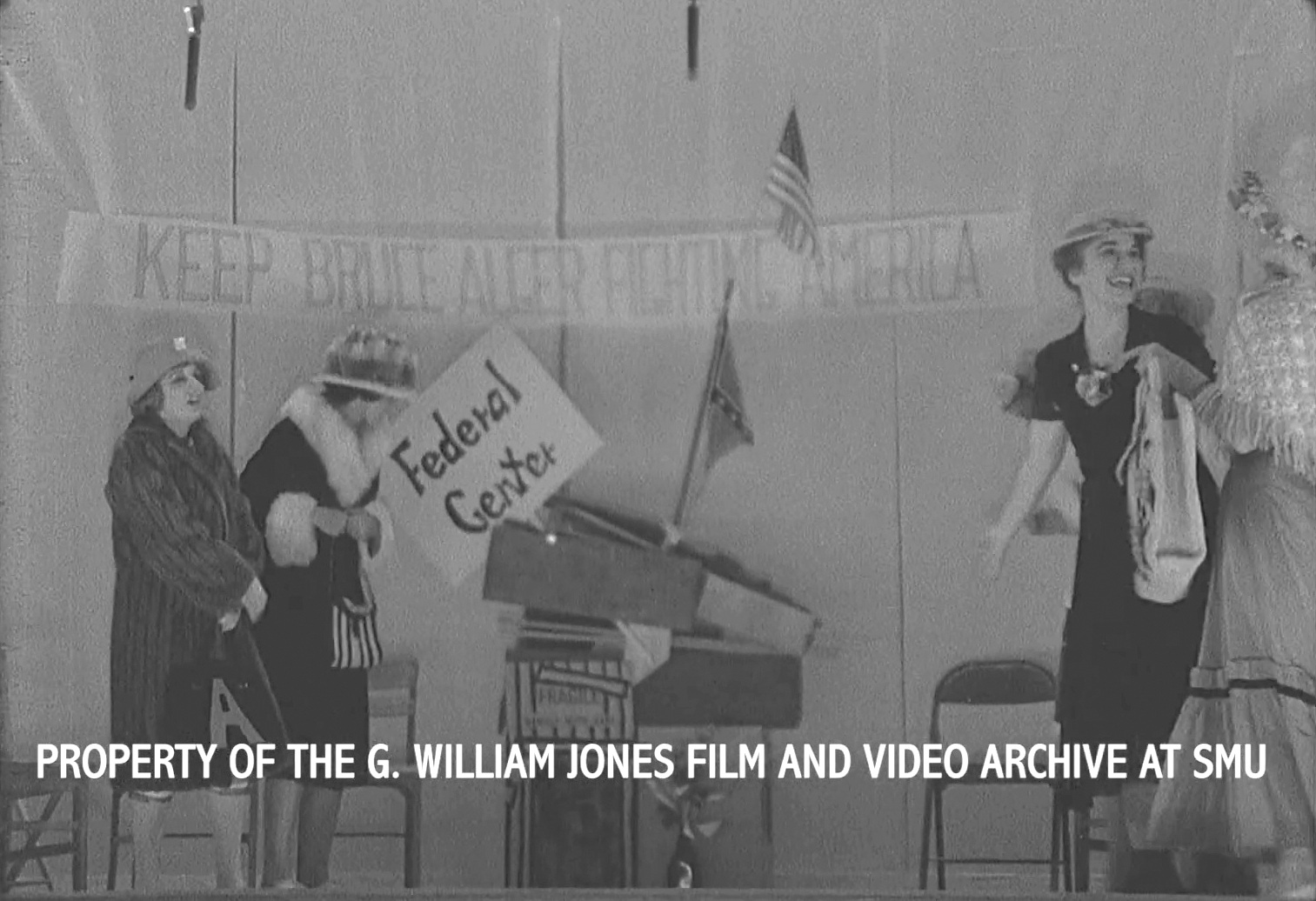
More unknown performers in “I Dreamed I Dedicated a Federal Center in 1994….”
…dedicated by Republican congressman Bruce Alger.
Again, possibly Betty McKool in the straw hat in the center (with someone else playing her husband, Mike McKool).
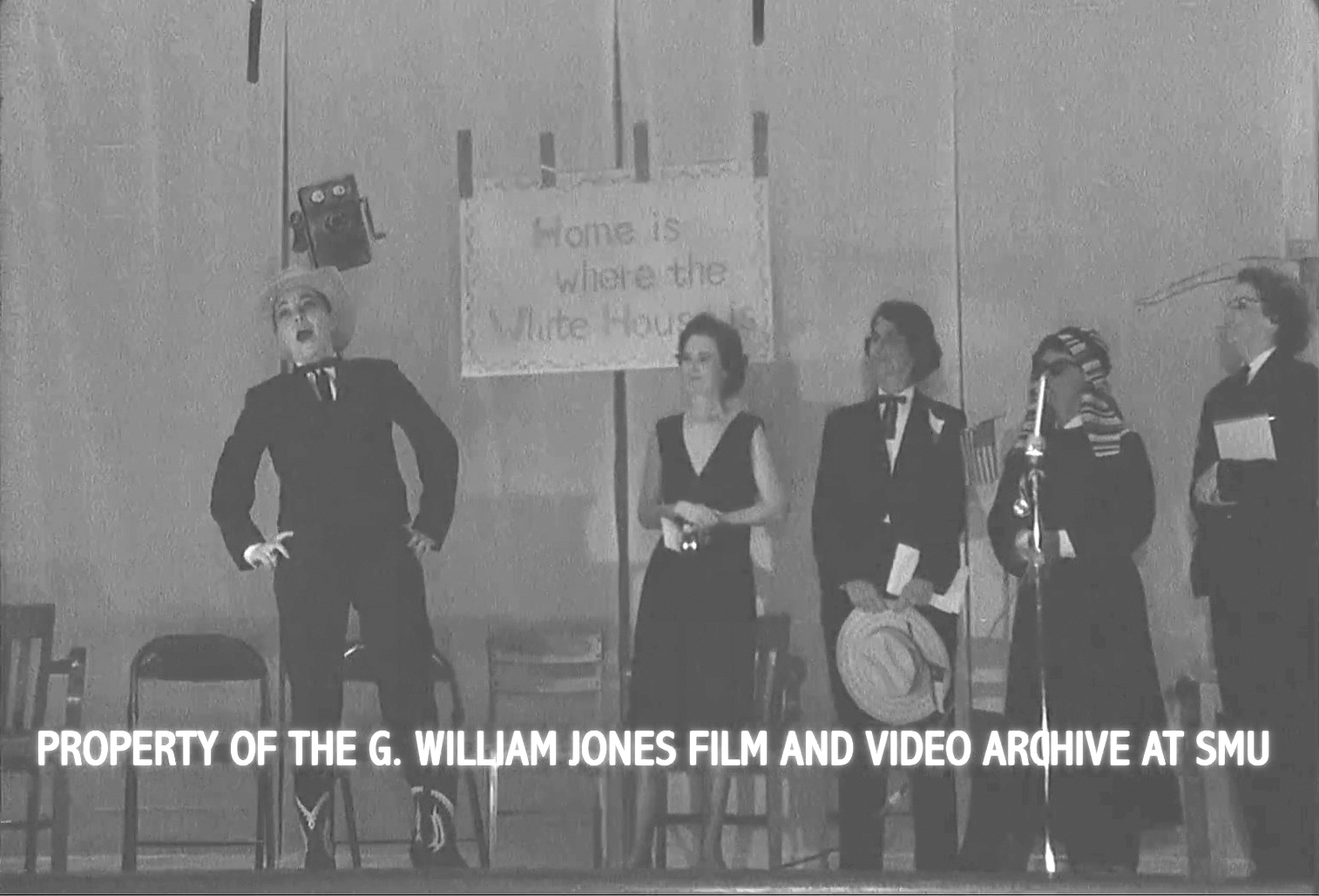
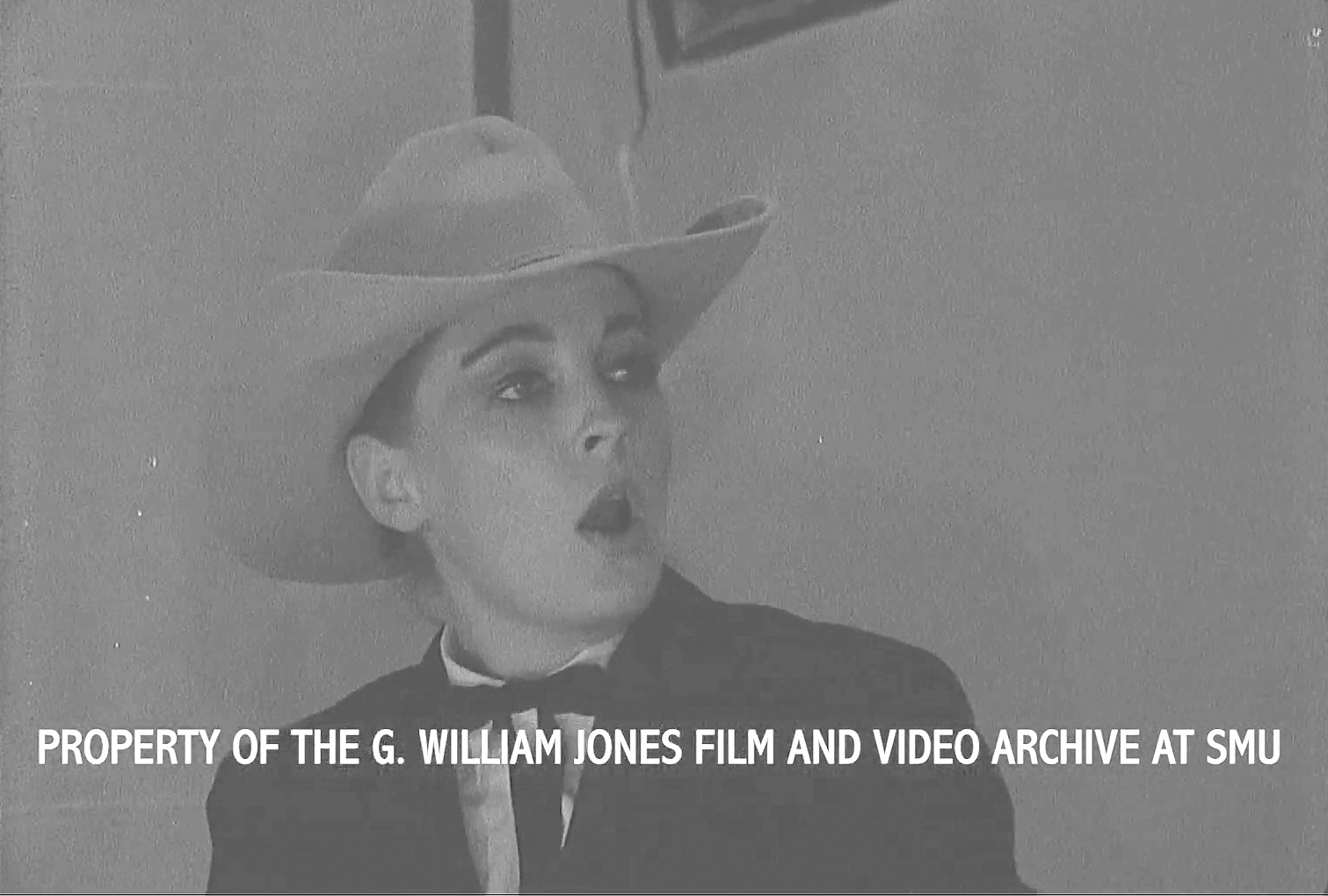
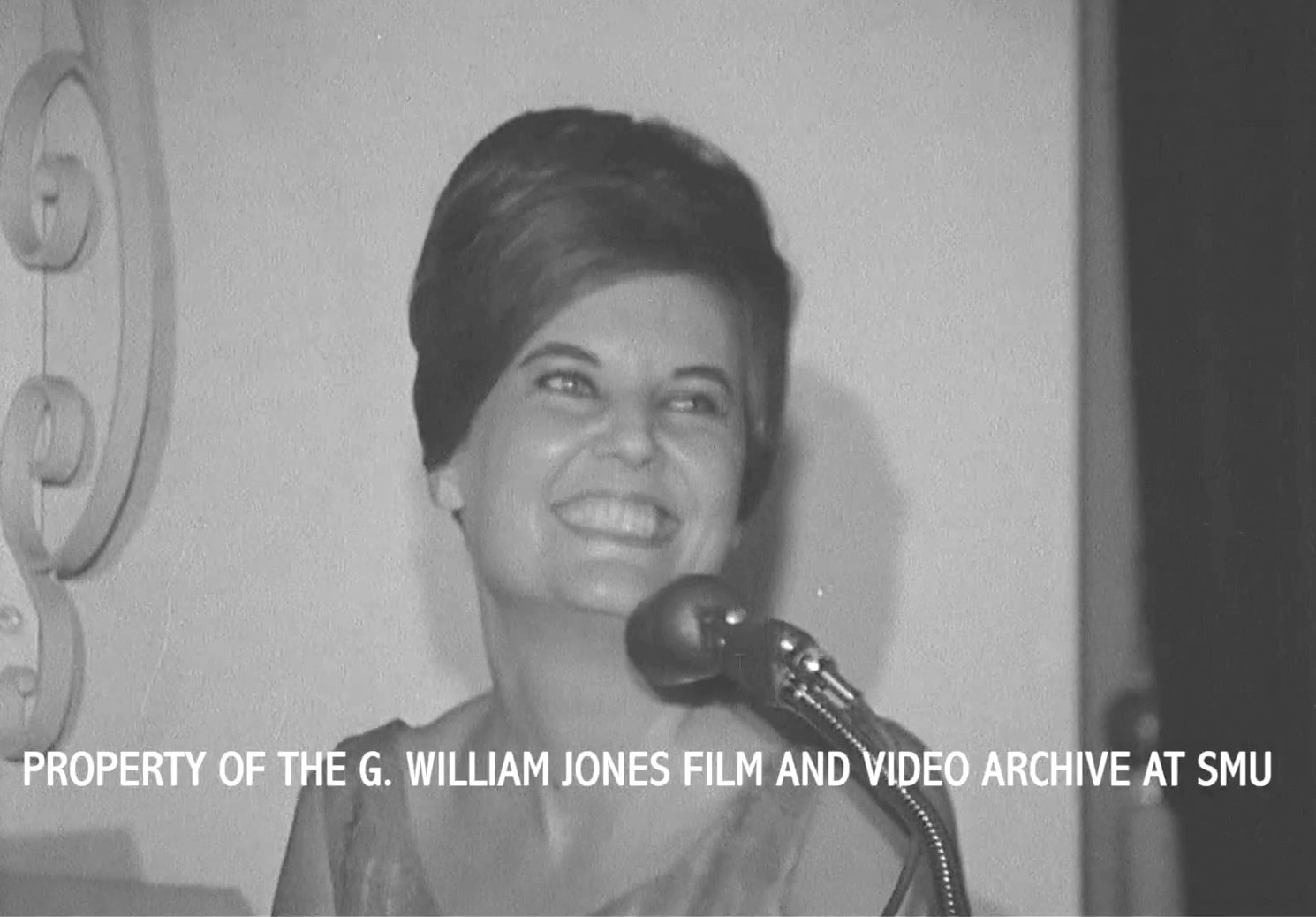
The cast, with leggy Joyce Schiff at the microphone (and Ann Richards behind her to the left, holding the cowboy hat).
*
“Political Paranoia II” May 16, 1964 Hillcrest High School auditorium
“Poop and patter from the Pedernales to the Potomac…” “The most talked-about show from Euless to Balch Springs…”
$1.50 for Democrats $7.67 for independents $25.00 for Republicans
**
Below is a list of women who were members of the North Dallas Democratic Women who were known to have participated in the 1963 and/or 1964 productions of “Political Paranoia,” either on stage or behind the scenes. If you recognize any of these women in the SMU film footage, please make note of a time-marker and let me know where you see them and I will update the info.
Written and directed by: Mrs. Alvin Winegarten (RUTHE WINEGARTEN) Mrs. David Richards (ANN RICHARDS) Mrs. Jim Choate (CAROLYN CHOATE)
Mrs. Mike McKool (BETTY McKOOL) Mrs. Holbrook Seltzer (MILLIE SELTZER) Mrs. Harry Weisbrod (BEA WEISBROD) Mrs. Herbert Schiff Jr. (JOYCE SCHIFF) Mrs. Philip Vogel (MARY VOGEL)
Mrs. Frederick Sparks (MERLENE SPARKS)
Mrs. Sam Whitten (VIRGINIA WHITTEN) Mrs. Harry Hoffman Mrs. Thomas L. Ford Mrs. Harold Polunsky Mrs. Kenneth Parker Mrs. Charles Webster Mrs. J. T. Mullenix Mrs. Forrest West Mrs. C. A. Hurst Mrs. Jack Cohan Mrs. Donald Fielding Mrs. Don Kise Mrs. Stanley Kaufman Mrs. Richard Sandow Mrs. Irwin Kaim Mrs. James Taylor Mrs. Ray Pearce Mrs. Daniel Rosenthal Mrs. Oscar M. Wilson Jr. Mrs. Earl Granberry Mrs. Jerome Meltzer
***
Sources & Notes
Screenshots are from “Political Paranoia II,” a filmed chronicle of the 1964 political revue written and performed by the North Dallas Democratic Women’s Club at Hillcrest High School on May 16, 1964; the origins of the film are unknown, but this copy is held by the G. William Jones Film and Video Archive, Hamon Library, Southern Methodist University. All thanks to Jeremy Spracklen and Scott Martin of the Jones Archive. The direct YouTube link is here.
Thanks also to Margaret Werry and Jean Ball for their help in identifying participants and for taking the time to share their memories of Dallas’ political past.
A good account of Ann Richards’ time in Dallas can be found in her autobiography, Straight from the Heart, My Life in Politics & Other Places (Simon & Schuster, 1989).

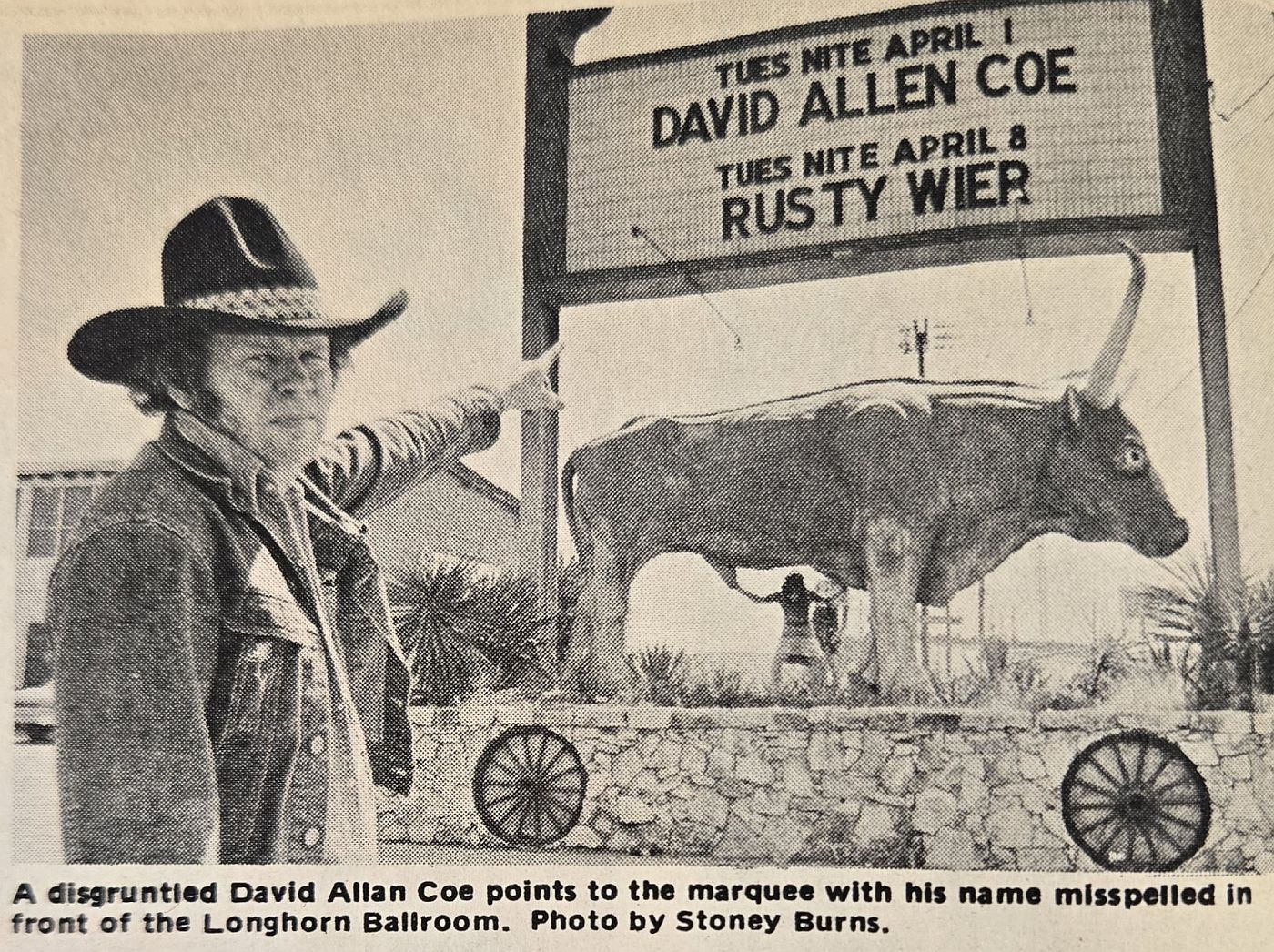 Photo: Buddy Magazine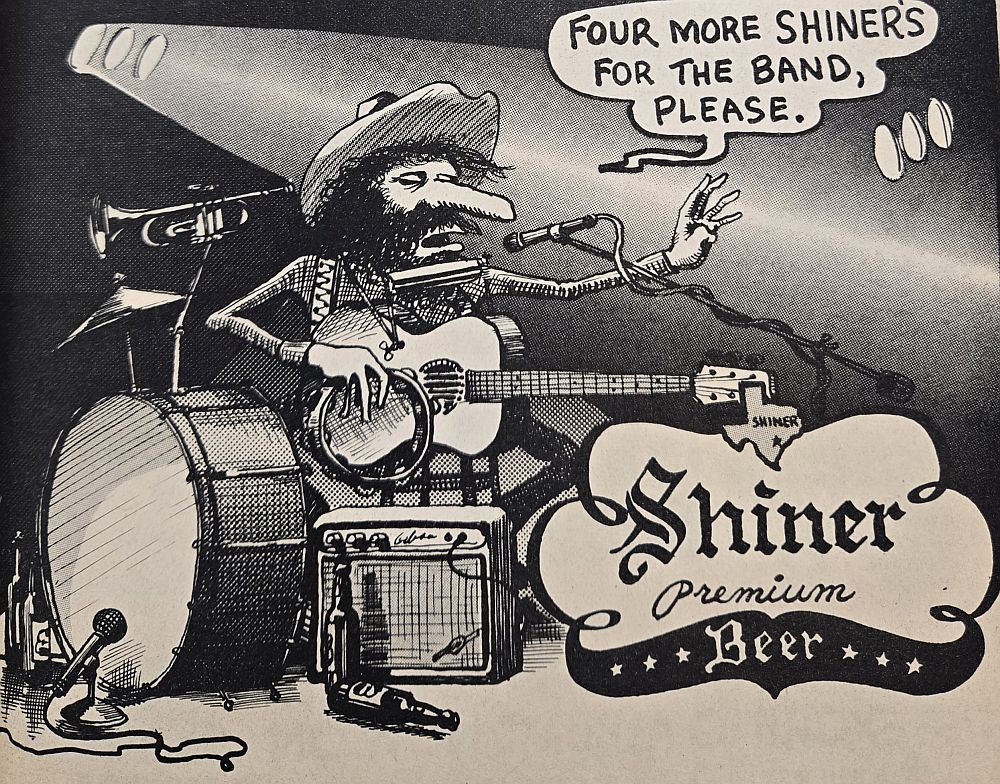





 Anshel Brusilow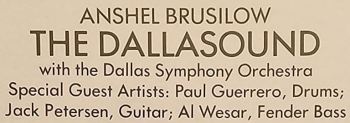
















 Flashback : Dallas