Flashback : Dallas

A Miscellany: History, Ads, Pop Culture

Category: Downtown

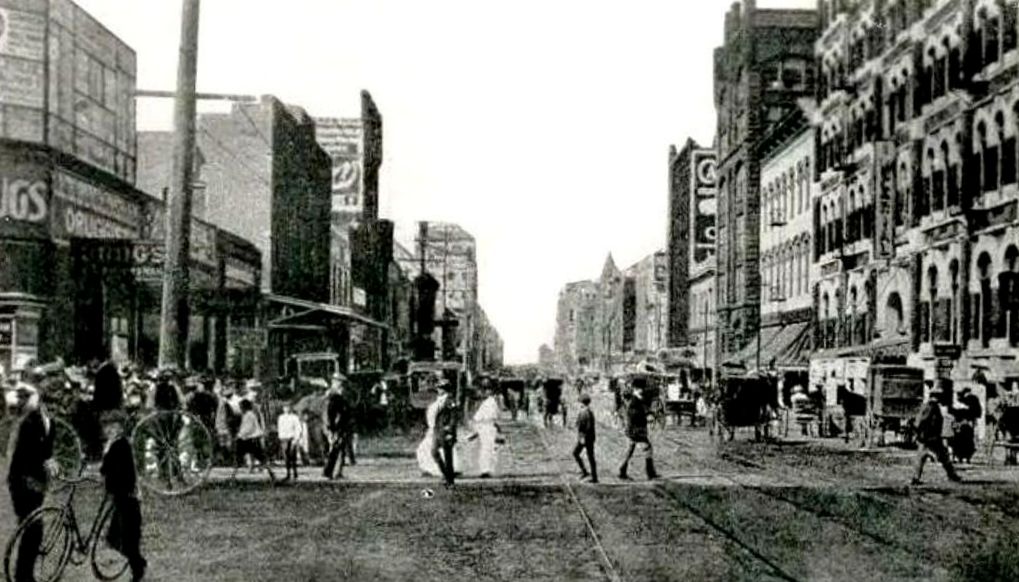
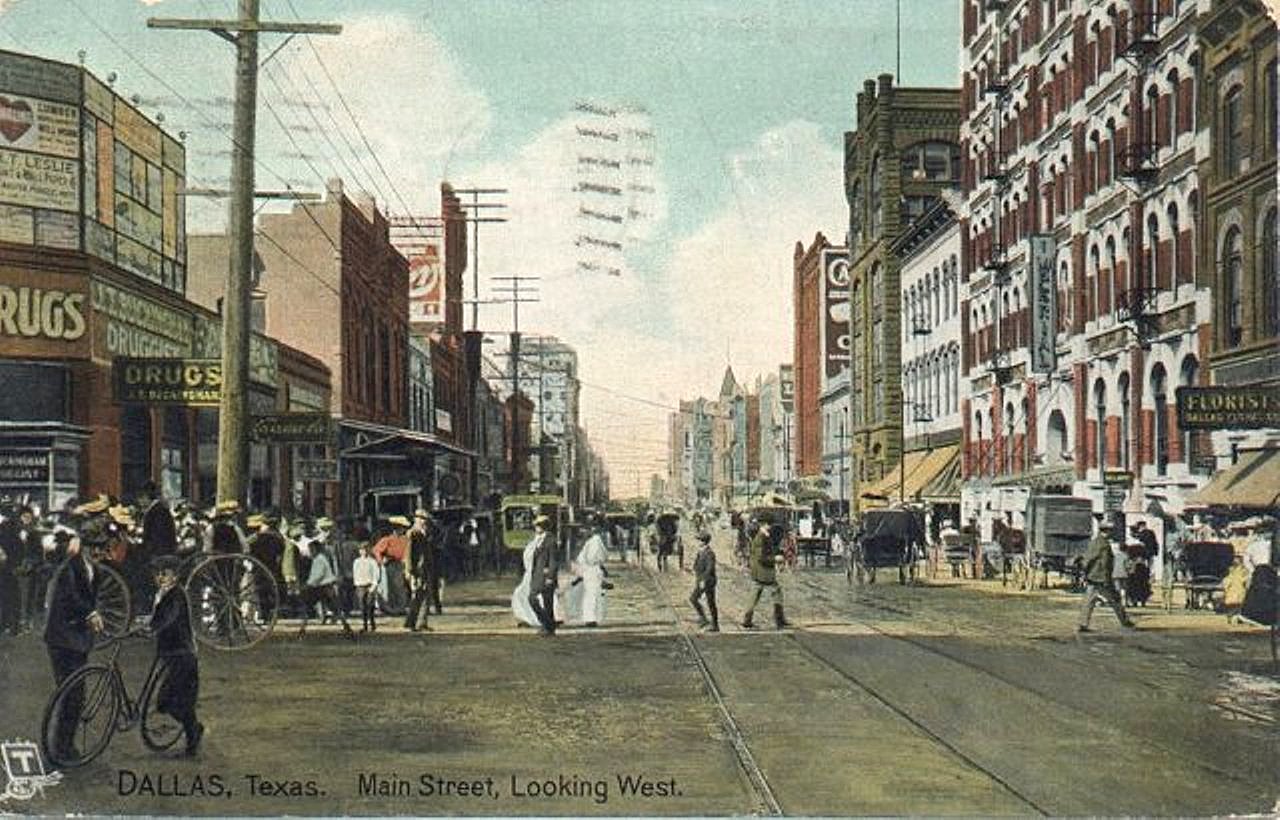
Crossing Main Street

main-looking-east_watermelon-kidLife in the Big City…

by Paula Bosse

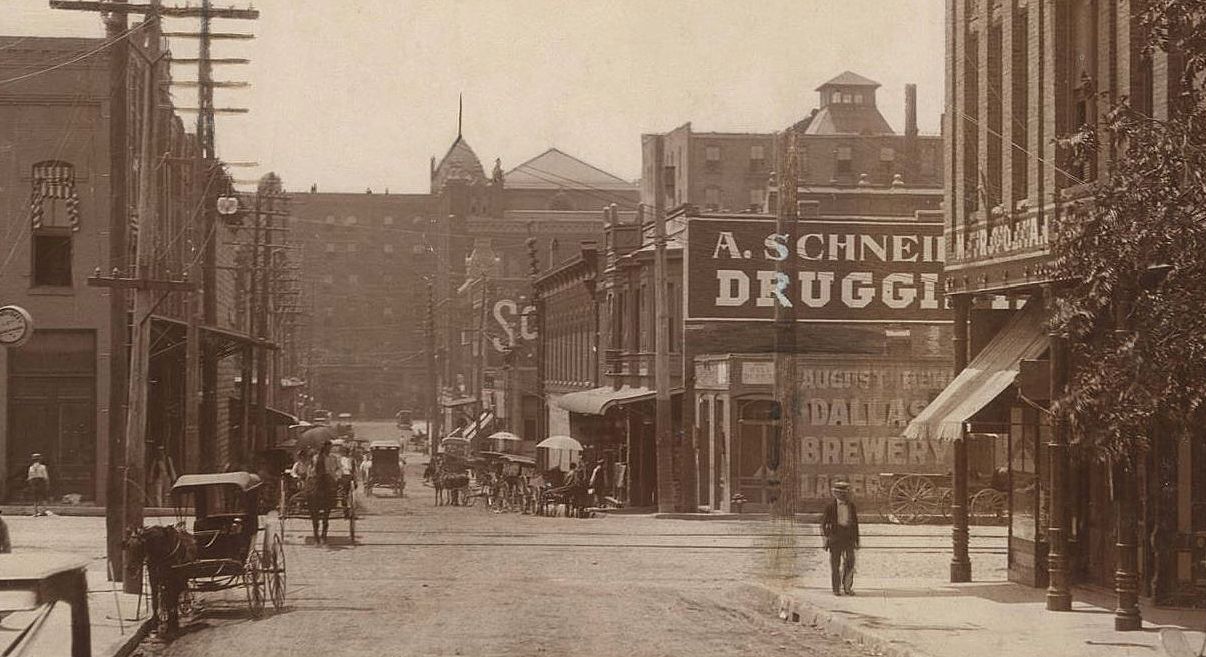
Turn-of-the-century traffic: buggies, bicycles, wagons, and people.

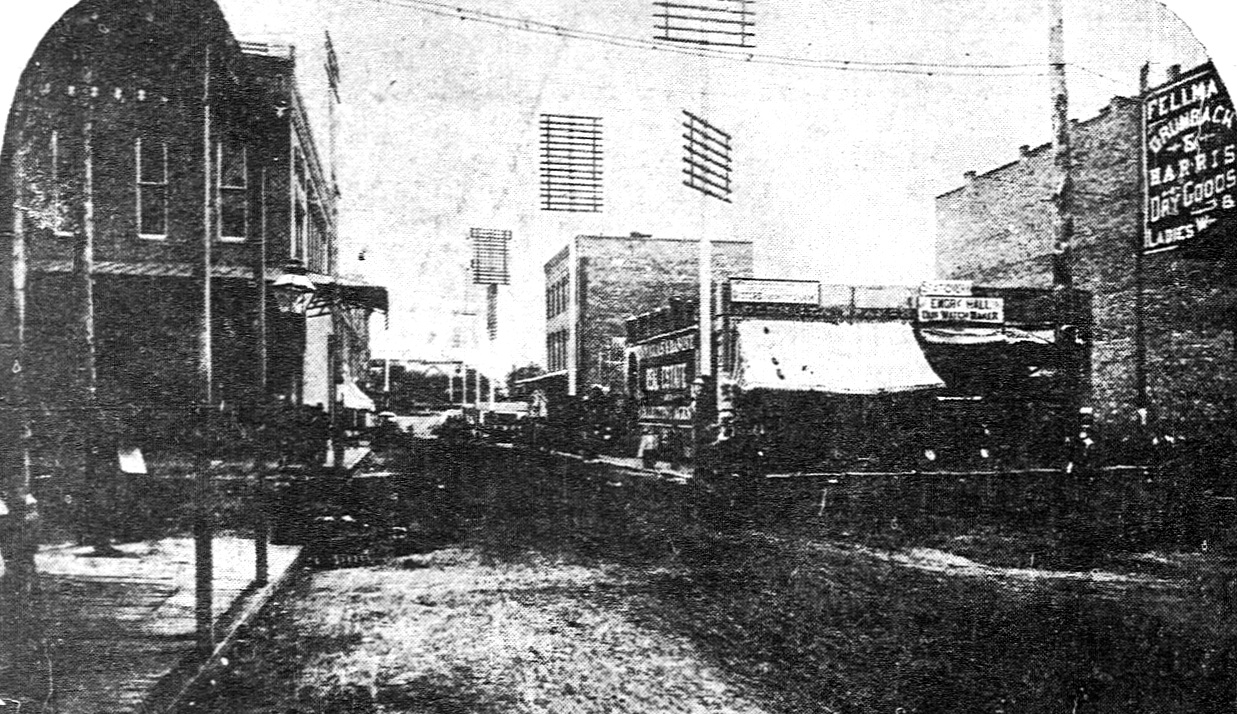
I first came across the image below in — of all places — a 1931 SMU yearbook and backtracked to finding the “color” postcard, above. The very grainy image (below) may just have been a black and white photo of this postcard rather than the original photograph, but it’s interesting to see them together. The yearbook identifies this as being Main and Akard, looking west on Main; it also dates it about 1906, but I think it’s earlier than that — there probably would have been evidence of automobiles on Main Street by then. Whenever it was, it seems like a pleasantly nostalgic frozen-in-time moment.

main-west-from-akard_smu-rotunda-1931***

Postcard at top from the Watermelon Kid’s great site, here.

Weird, blurry black and white image from the 1931 Southern Methodist University Rotunda yearbook.

Click pictures for larger images.

*

Copyright © 2015 Paula Bosse. All Rights Reserved.

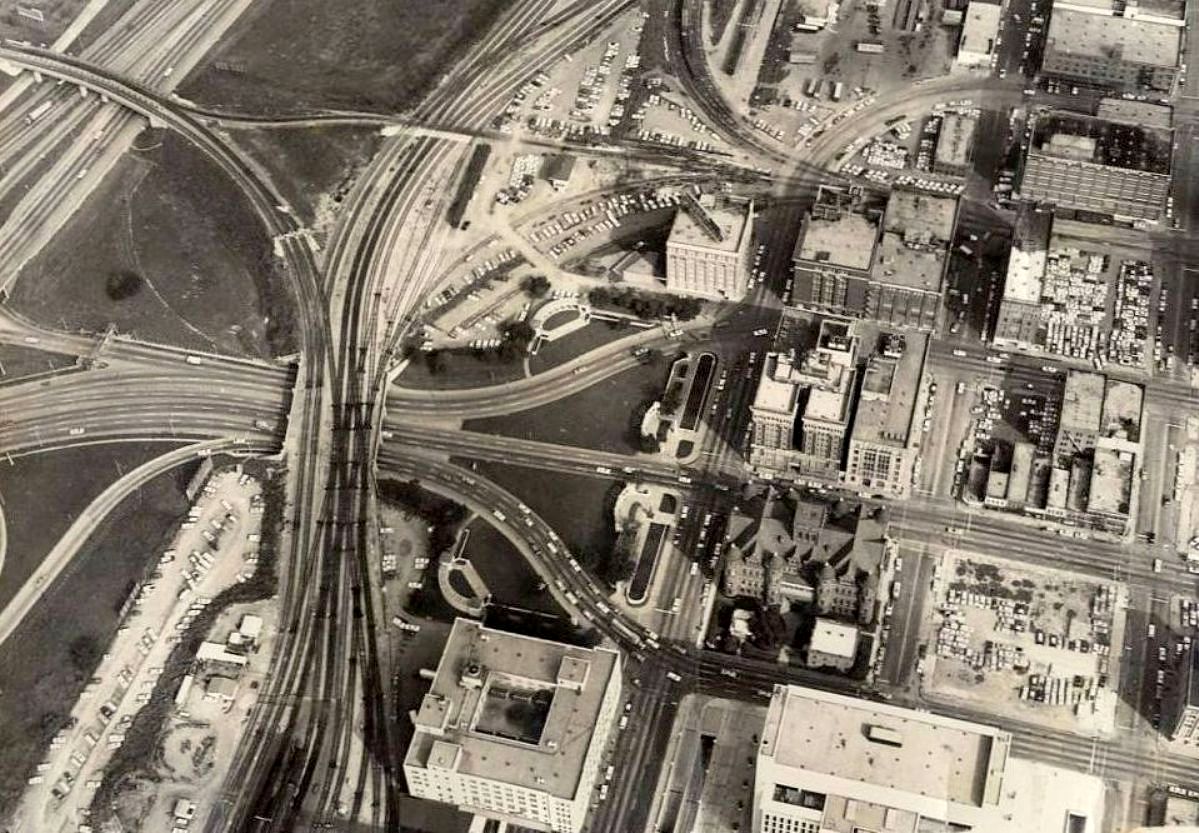
Dealey Plaza, From Above — 1960s

dealey-plaza-aerial_c1966_baylorPhoto by David Lifton (Baylor University)

by Paula Bosse

Photo showing a mid-to-late-’60s Dealey Plaza and downtown Dallas, with the block just east of the Old Red Courthouse cleared for the eventual construction of the John F. Kennedy Memorial.

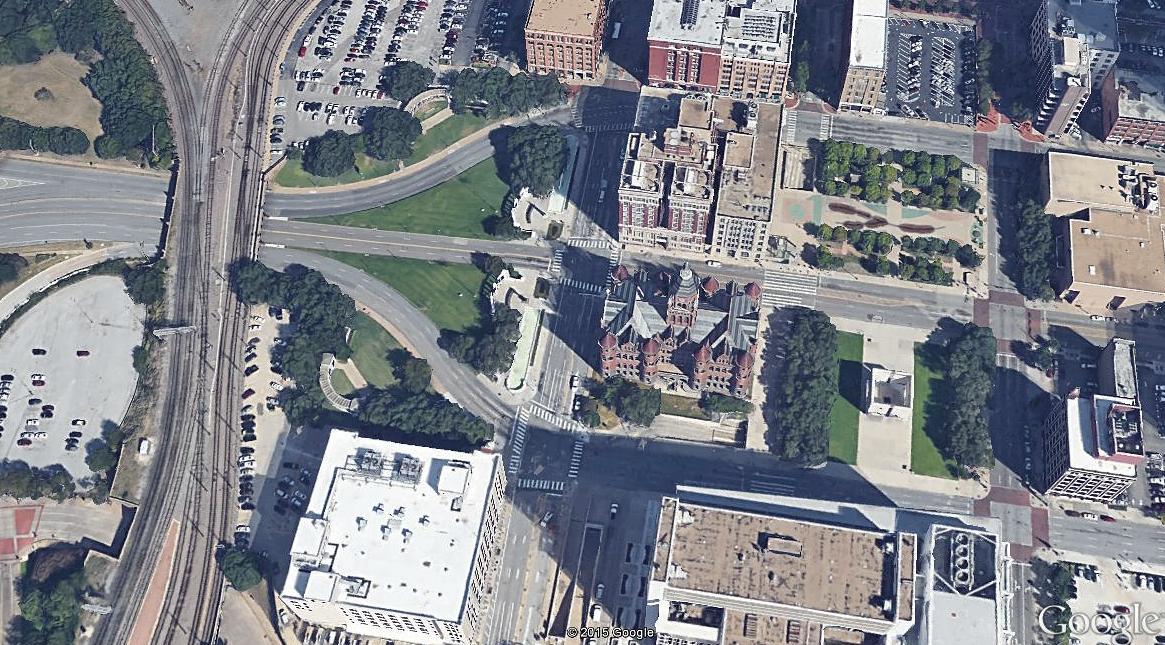
And today

dealey-plaza_google-earthGoogle Earth

***

Photo is by David Lifton, from the collection of Penn Jones, W. R. Poage Legislative Library, Baylor University, Waco, TX; it is accessible here. Lifton is an assassinationologist best known for his 1981 book Best Evidence: Disguise and Deception in the Assassination of John F. Kennedy.

Click pictures for larger images.

*

Copyright © 2015 Paula Bosse. All Rights Reserved.

“Male Fixings” and Horse Manure — Akard Street, ca. 1906

akard-looking-north_cook-colln_degolyer_smu_ca-1906George W. Cook Collection, SMU

by Paula Bosse

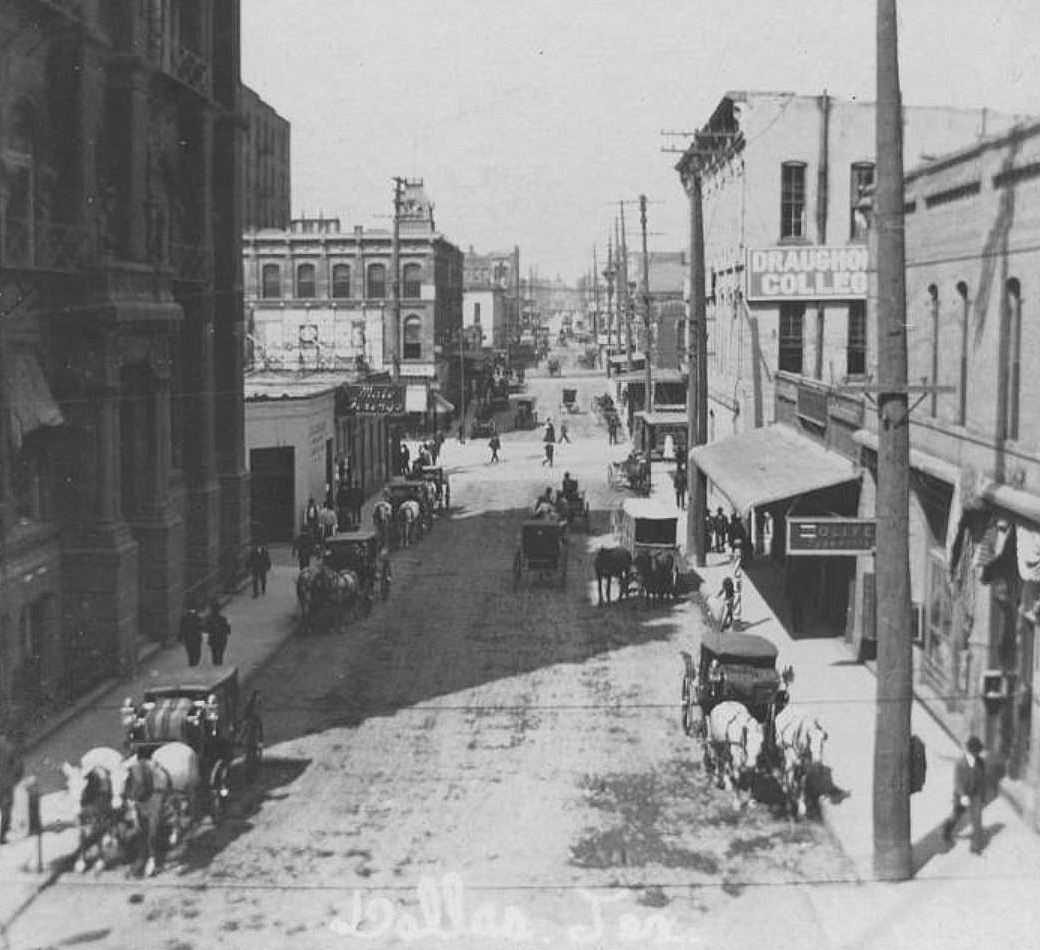
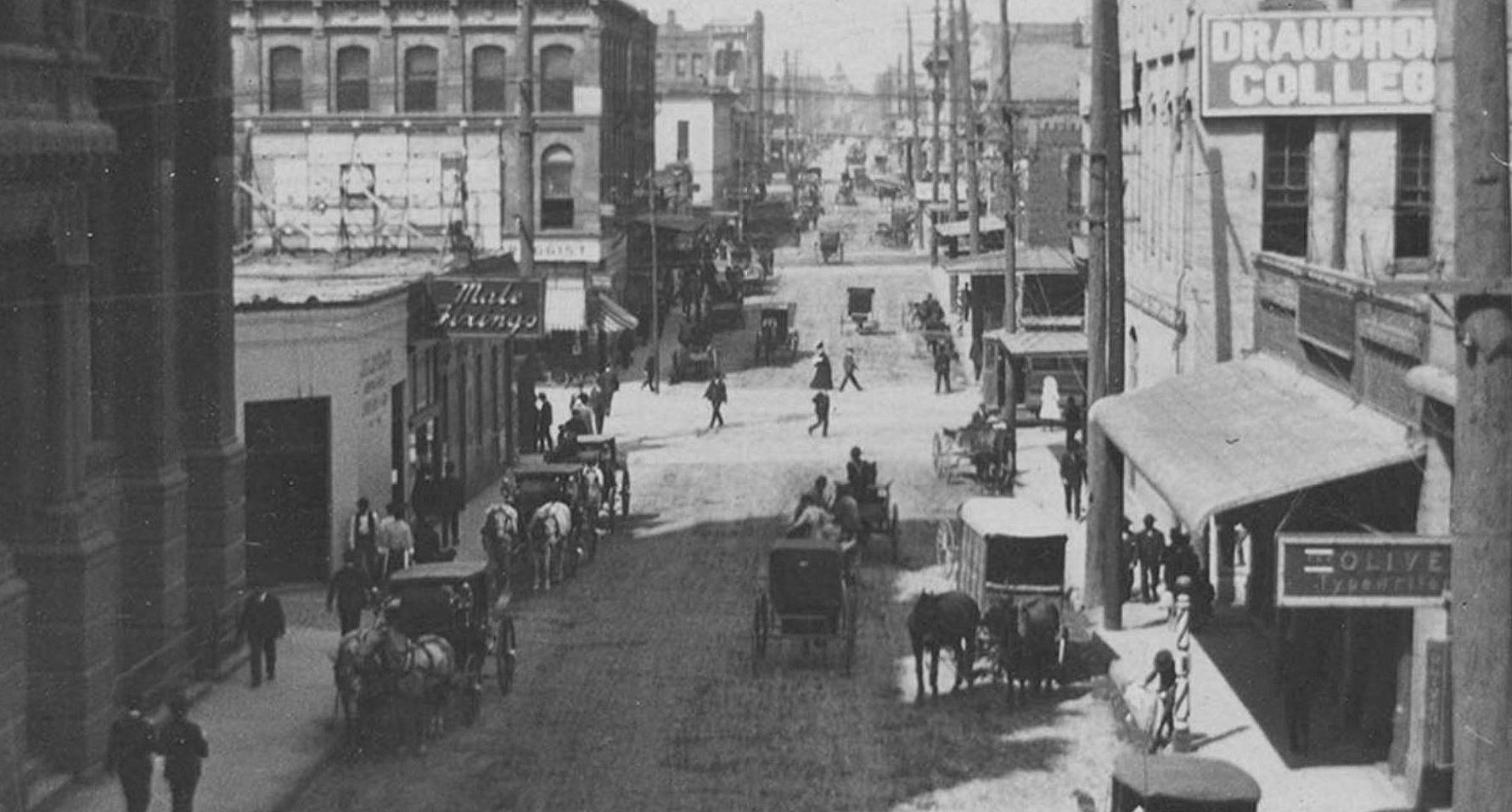
This great photograph shows Akard Street looking north from just south of Main. I especially like the sign for “Male Fixings” (a store selling men’s clothing accessories). Let’s zoom in to see that sign better (click photo to see a much larger image).

akard-looking-north_cook-colln_degolyer_smu_ca-1906-det

I also like the guy with the bicycle, next to the barber pole at the lower right, and the lone woman crossing the street. (There is a little girl in a white dress on the sidewalk on the right — about to cross Main — but everyone else in this photo is of the gender that might well patronize a business called “Male Fixings.”)

As indelicate as it may be to bring up the subject … I assume there were people employed to walk around the streets with shovels to clean up after all those horses? I’ve actually thought of this fairly often. It had to have been a major, major problem back then. I’ve just looked it up. The average horse pulling wagons and carriages produced, on average, 30+ pounds of manure and several gallons of urine daily, deposited willy-nilly whenever the need arose (which was often). Multiply that by hundreds. This article isn’t about Dallas, but I highly recommend “The Great Horse Manure Crisis of 1894” — you’ll learn way more about the subject than you may want to — read it here. That lady crossing the street? I bet she spent a good part of every day hiking her skirts and dodging dung.

*

UPDATE: I’ve updated the title to this post several times (you’ll notice that the URL of this post shows a different location and year). After spending time to pin down the date, it appears this photo was taken between 1906 and 1909, when the Draughon Practical Business College was located at the southeast corner of Main and Akard — and the Oliver Typewriter Agency was located at 114 South Akard. The original annotation of this photo says the view is Main Street, with Akard in the midground, but it appears this photo was taken just south of Main Street looking north on Akard. The photo is confusing because the Draughon’s sign is seen here on the Akard Street side, not the Main Street side. The main tip-off is the cupola seen atop the building standing at the northwest corner of Main and Akard — it is the Rowan Building, which housed the Marvin Drug Store, which I wrote about here.

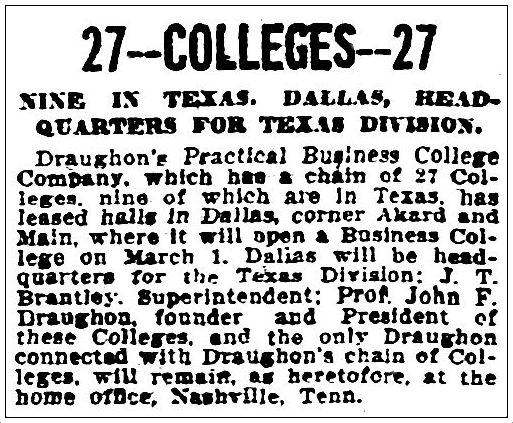
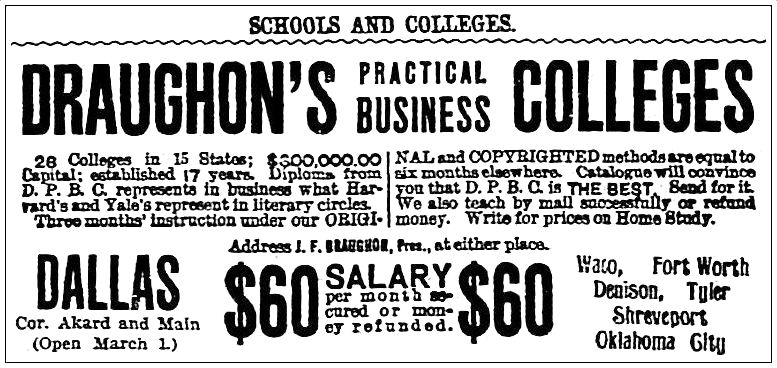
Draughon’s Practical Business College opened its first Dallas campus (but its 27th location across the major cities of the south) at the southeast corner of Main and Akard in March, 1906. By the time the 1910 city directory was printed, they had moved to another location (in fact, in their first ten years in Dallas they had moved five times!). I’m not sure how long the business college lasted in Dallas — at least through the 1970s, possibly longer — but the institution seems to still be in business after something like 130 years. (Click ads below to see larger images.)

draughon-business-school_dmn_0304061906

draughon-business-school_dmn_0315061906

***

This is another wonderful photo from the George W. Cook Dallas/Texas Image Collection, DeGolyer Library, Central University Libraries, Southern Methodist University; it can be accessed (and zoomed in on) here.

Another interesting article on the “manure problem” is “When Horses Posed a Public Health Hazard” — a blog post from The New York Times (which tantalizingly mentions herds of pigs roaming the streets of NYC) — read it here.

*

Copyright © 2015 Paula Bosse. All Rights Reserved.

Fly United to Chicago in Only Eight Hours!

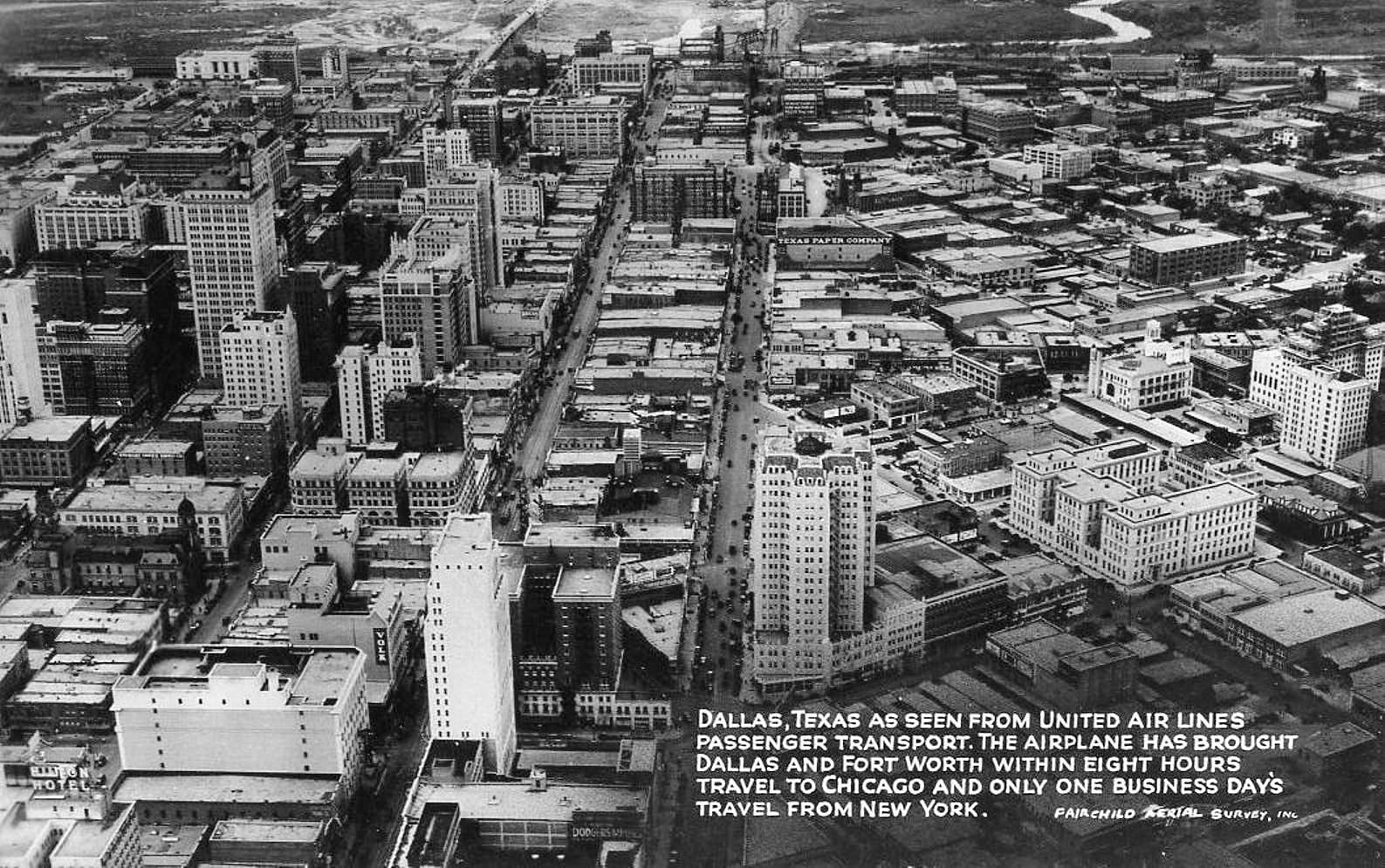
aeiral_united-air-lines_fairchild_ebay_rppcHow many buildings can you identify? (click for larger image)

by Paula Bosse

Dallas, Texas as seen from United Air Lines passenger transport. The airplane has brought Dallas and Forth Worth within eight hours travel to Chicago and only one business day’s travel from New York.

Back when it took all day to fly to New York from Dallas.

This is another great aerial photo by the Fairchild Aerial Survey company, probably taken by Lloyd M. Long. Date-wise? Late-1920s? Before the Trinity was straightened (beginning in 1928), with land being cleared in the area that would become Dealey Plaza? 1928-ish? Or could it have been the very early 1930s? The United Air Lines promotional postcard was issued around 1932 or 1933.

It wasn’t until 1933 that United introduced its new Boeing “twin motor airline transports” and boasted that they would finally “bring the city within eleven and a half hours of New York City” (Dallas Morning News, Aug, 16, 1933).

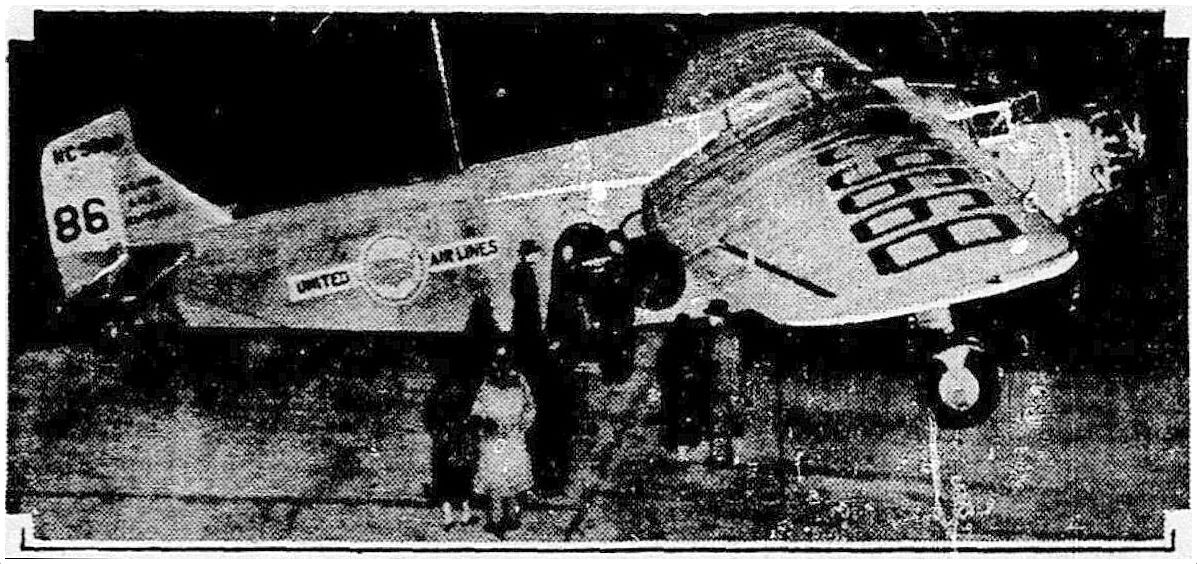
Below is a photo from a Dallas newspaper ad showing one of United’s planes from the earlier, more carefree days of 1932, when passengers were still trudging through the skies at a more leisurely pace.

united-air-lines_ad-det_dmn_110432United Air Lines ad, detail, 1932

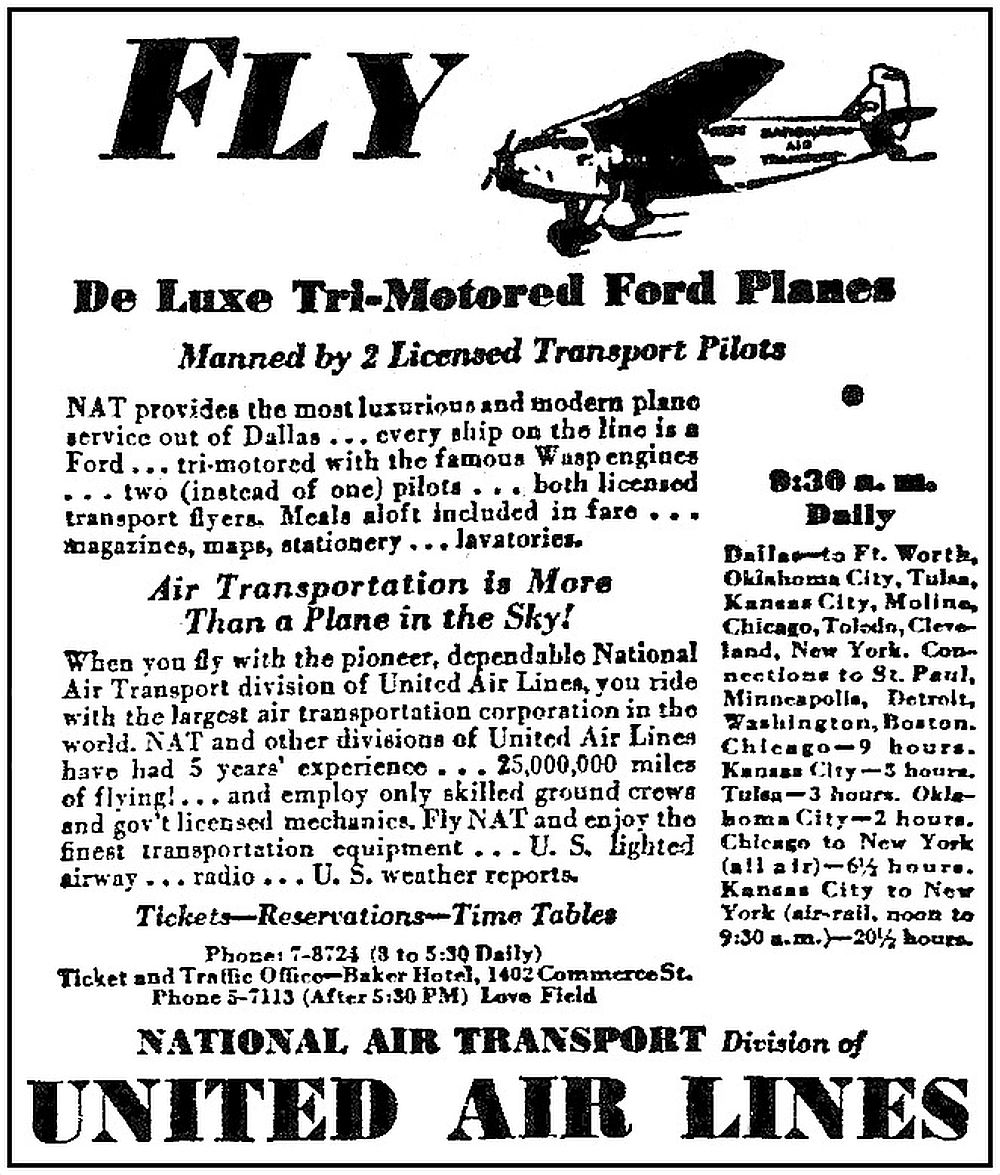
And an even earlier ad, from 1931, when a flight from Love Field to Chicago was nine hours long (today a direct flight from Love Field to Chicago takes about two hours and fifteen minutes). And if you wanted to continue to NYC, you had to board another plane and fly from Chicago to New York, adding another six and a half hours!

united-air-lines_dallas-to-nyc_1931
1931 ad

FLY

De Luxe Tri-Motored Ford Planes Manned by 2 Licensed Transport Pilots
 
NAT provides the most luxurious and modern plane service out of Dallas … every ship on the line is a Ford … tri-motored with the famous Wasp engines … two (instead of one) pilots … both licensed transport flyers. Meals aloft included in fare … magazines, maps, stationery … lavatories. 

Air Transportation is More Than a Plane in the Sky! 

When you fly with the pioneer, dependable National Air Transport division of United Air Lines, you ride with the largest air transportation corporation in the world. NAT and other divisions of United Air Lines have had 5 years’ experience … 25,000,000 miles of flying! … and employ only skilled ground crews and gov’t licensed mechanics. Fly NAT and enjoy the finest transportation equipment … U.S. lighted airway … radio … U.S. weather reports.

*

In an interesting side-note, the first pilot to fly a mail plane between Kansas City and Dallas (on May 12, 1926) was Richard Dobie, brother of Texas literary legend, J. Frank Dobie. In 1926 he flew a Curtiss Carrier Pigeon; in 1933, he’d worked his way up to the speedy and powerful Boeing. He flew for United for several years.

***

Sources & Notes

Top image is a promotional postcard, found on eBay.

Read more about the tri-motor airplane (manufactured by the Ford Motor Company and affectionately known as the “Tin Goose”) in the article “Ford’s Tri-Motor” by Edward J. Vinarcik (Advanced Materials and Processes, Oct. 2003) here.

All images larger when clicked.

*

Copyright © 2015 Paula Bosse. All Rights Reserved.


Akard Street Looking South, 1887-2015

akard_from-pacific_cook_degolyer_smu_ca1898-detAkard Street from Pacific, ca. 1898, via Cook Collection, SMU

by Paula Bosse

I realized the other day that I have an inordinate number of photographs and postcards showing Akard Street looking south — usually taken from Pacific or Elm, so I thought I’d collect them all together. Some of these aren’t dated, so they’re not in strict chronological order, but I’ve made a half-hearted attempt to make sure horse-and-buggy photos are before the men-in-straw-hat-boaters, which are before the women-in-Miss-Crabtree-dresses, which are before the cars-with-rounded-bodies. It might be easiest to just assume they are not in chronological order. (All photos are larger when clicked — a couple are really  big.)

*

The oldest is from 1887, when North Akard was still called Sycamore Street, and before the Oriental Hotel was built at Commerce and Akard in 1895.

akard_south-from-elm_1887

*

Next up, an incredible photo, taken around 1898, a detail of which appears at the top of this post. The Oriental Hotel can now be seen at the end of Akard, at Commerce, where Akard used to make a dog-leg turn before continuing south, giving the appearance of a dead-end street.

akard_from-pacific_cook_de-golyer_smu-ca1898via George W. Cook Collection, DeGolyer Library, SMU

*

Another, with the Adolphus Hotel (built in 1912) now on the right, across Commerce from the Oriental. The tall building across Akard from the Adolphus is the Southwestern Life Building. The Gentry photography studio was at the southeast corner of Elm and Akard from 1912, which is probably the date of this postcard image. Construction of the Busch Building (now known as the Kirby Building) began in December, 1912.

akard-elm_postcard_ebay_ca-1912via eBay

*

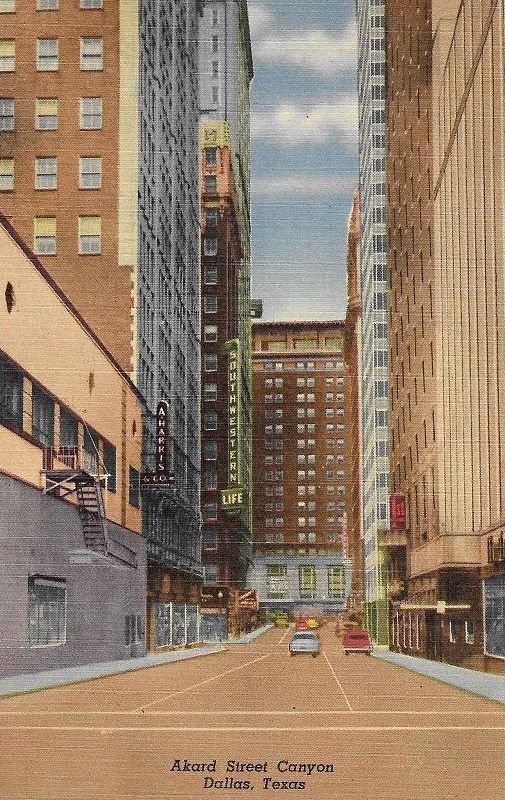
From 1925, with the new Baker Hotel having replaced the Oriental Hotel. This area was now being called “the canyon district” or “the canyon.”

akard_south-from-elm_1925

*

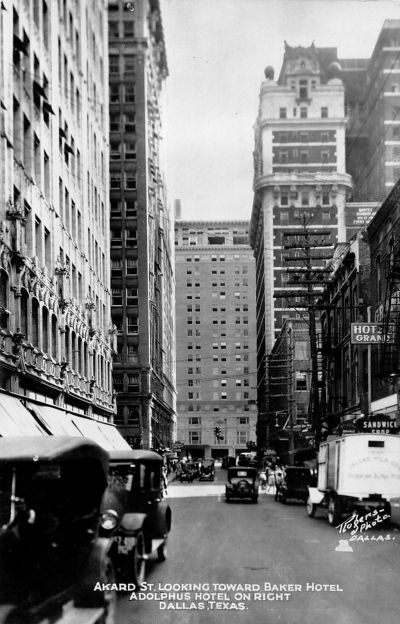
In this great Frank Rogers photo, the canyon walls are getting higher, with the Adolphus Hotel firmly anchoring the Commerce corner across from the Baker.
akard_baker-adolphus_postcard_rogers_ebayvia eBay

*

By the time this photo was taken in about 1936, Pegasus had become a part of the skyline, perched atop the Magnolia Petroleum Building. (Note the Queen Theater at the northeast corner of Elm and Akard.)

akard_pacific_1936_legacies-spring-1989via Legacies History Journal

*

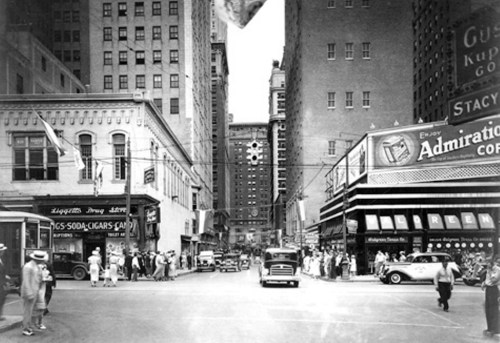
This photo is from the early- or mid-1930s — LOOK AT ALL THOSE PEOPLE.
akard-canyon_municipal-archives_dma-uncratedvia the DMA’s Uncrated blog

*

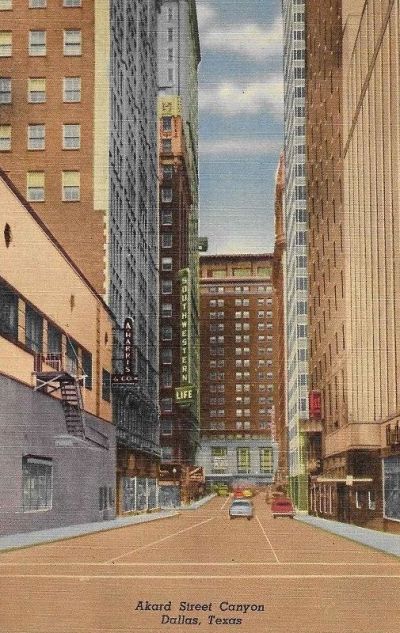
As opposed to this one, which has NO people in it.
akard-canyon_ebayvia eBay

*

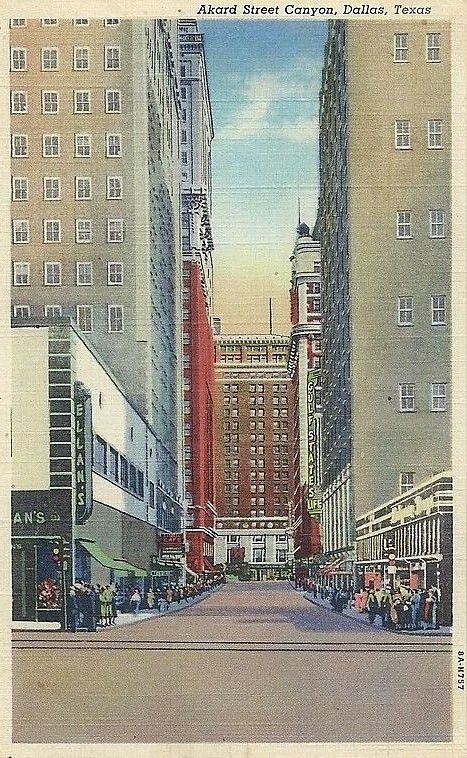
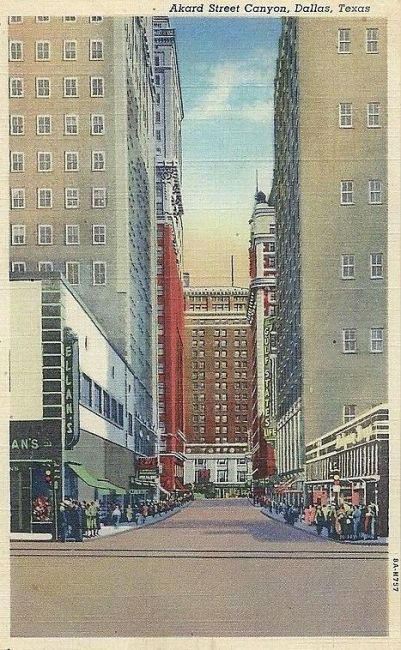
More canyon, this view showing the super-cool art-deco-y building at Elm and Akard with Ellan’s hat shop on the ground floor, late-1930s.
akard-st-canyon_ellans

*

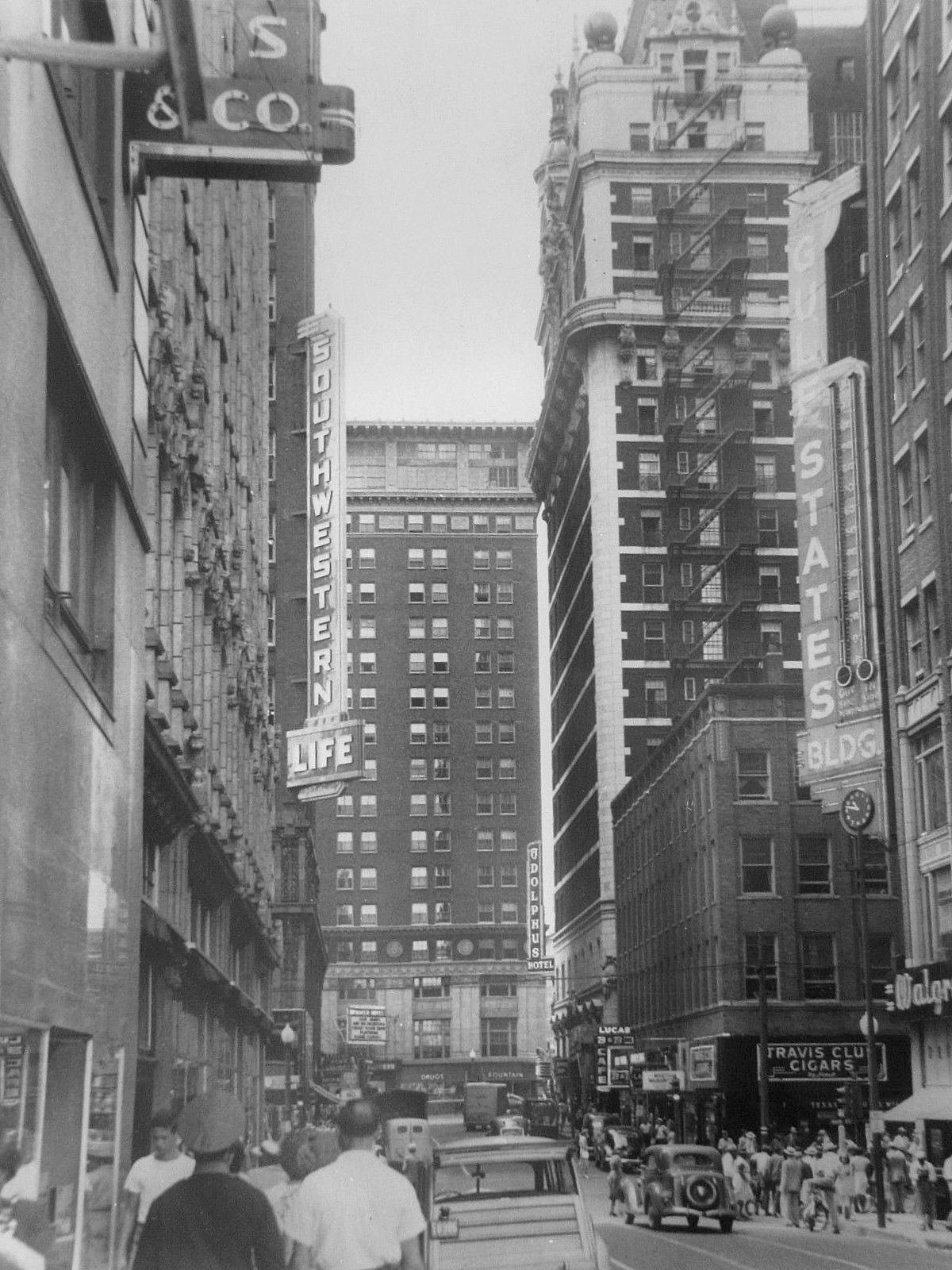
This candid photograph, a little deeper into the canyon, is one of my favorites. (Click to see a gigantic image.)

akard-looking-south_ebayvia eBay

*

From 1951 — a bit grainy, but a slightly closer view of the side of the Queen Theater at the left and the Mayfair department store, built in 1946, at the right:

akard_dpl_1951via Dallas Public Library

*

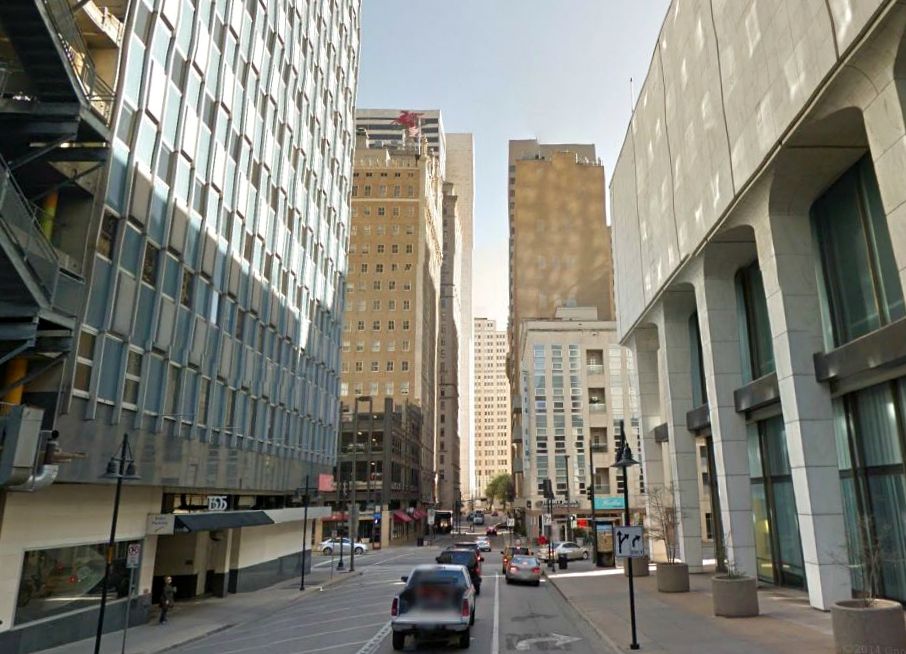
And, finally, today. Pegasus and the Adolphus are still there, but the Baker Hotel was demolished in 1980, replaced by the One AT&T Plaza/Whitacre Tower.

akard-looking-south_google_2015via Google Street View, 2014

***

Sources & Notes

The photo dated by SMU as “circa 1898” is titled “Akard Street from Akard and Pacific Avenue Intersection”; it is from the George W. Cook Dallas/Texas Image Collection, DeGolyer Library, Central University Libraries, Southern Methodist University, and it can be viewed here.

The circa 1936 photo showing Pegasus is from the Spring, 1989 issue of Legacieshere; it is from the Hayes Collection, Texas/Dallas Archives Division, Dallas Public Library, and is attributed to Denny Hayes.

The photo showing “ALL THOSE PEOPLE” is from the Dallas Museum of Art’s Uncrated blog — here — is from the Dallas Municipal Archives. They have the date as “1940,” but Liggett’s Drug Store was gone from Elm and Akard by 1936.

Other sources as noted.

Click pictures for larger images — sometimes MUCH larger images.

*

Copyright © 2015 Paula Bosse. All Rights Reserved.


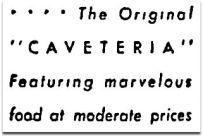
The Caveteria: “Marvelous Food at Moderate Prices”


caveteria_ebay
The finest in downtown basement dining (click for larger image)

by Paula Bosse

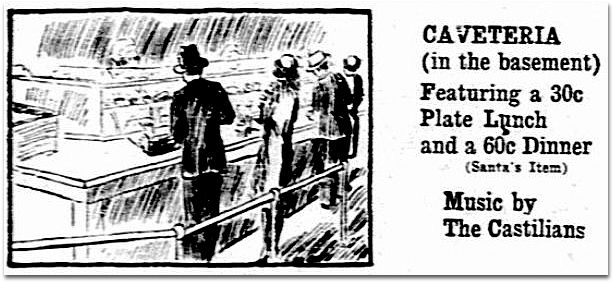
How could you NOT want to dine in a restaurant called a “Caveteria”? It was a cafeteria in the basement — the cave — of the swanky Baker Hotel, and it looks like it was a nice cheap place to grab a quick lunch downtown in the 1920s and 1930s.

caveteria_baker-hotel_postcard_ebay

*

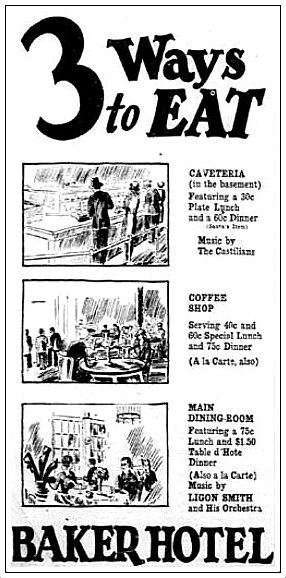
The Baker Hotel had “3 ways to eat”: one could eat cheap in the basement Caveteria (where, according to the Inflation Calculator, a 30-cent lunch in 1927 was the equivalent of about four bucks today), eat sort of cheap in the probably street-level coffee shop (lunch was about $6.75 there), and eat not cheap in the main hotel dining room (where lunch was over $10.00). (There was also the Peacock Terrace night club, well beyond reach of basement-dwelling diners.)

caveteria_dmn_120427

caveteria_dmn_120427-det1927

*

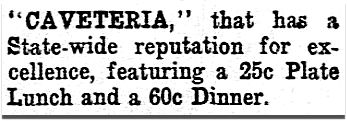
The price actually went down to a quarter by 1931 and had a “State-wide reputation for excellence.”

caveteria_dmn_020131DMN, Feb. 1, 1931

*

A year later the price was holding at 25 cents and it seems like a pretty good deal.

caveteria_dmn_021532DMN, Feb. 15, 1932

*

“The Original ‘Caveteria'” — accept no imitations! At least one other hotel in the Baker chain — the Gunter, in San Antonio — had a “Caveteria,” but apparently Dallas’ was first. In fact, the word and the hotel made their way into H. L. Mencken’s The American Language, Supplement One (see here).

caveteria_corsicana-daily-sun_031632Corsicana Daily Sun, Mar. 16, 1932

*

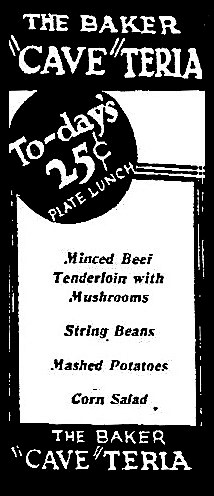
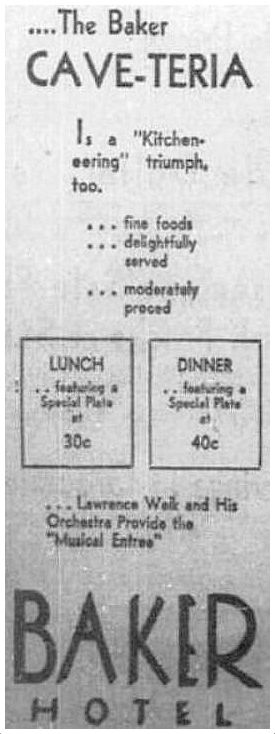
Oh yeah — live bands played while you ate your hearty meal of minced beef tenderloin. Even Lawrence Welk settled in for a stint as the “musical entree” in 1934.

caveteria_dmn_022234-lawrence-welkFeb., 1934

*

In 1942, the space once occupied by the Caveteria was turned over to the USO:

The Baker Hotel has provided the USO with what used to be the Caveteria in the basement of the hotel. It will be known as USO Club in the Cave. The entrance will be through the Akard Street entrance of the hotel.  (Dallas Morning News, Jan. 27, 1942)

*

And there it is — another place I wish I’d been able to visit.

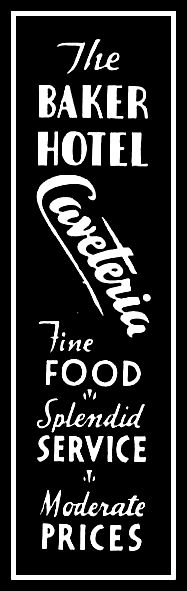
“Fine food. Splendid Service. Moderate prices.”

ad-baker-hotel-caveteria

***

Sources & Notes

Color postcards found on eBay.

The Baker Hotel opened in 1925 at Commerce & Akard on the site where the Oriental Hotel had previously stood, catty-corner from the Adolphus.

*

Copyright © 2015 Paula Bosse. All Rights Reserved.
 

The Magnolia Building, Pre-Pegasus — 1920s

magnolia-bldg_pre-pegasus_RPPC_smBeautiful!

by Paula Bosse

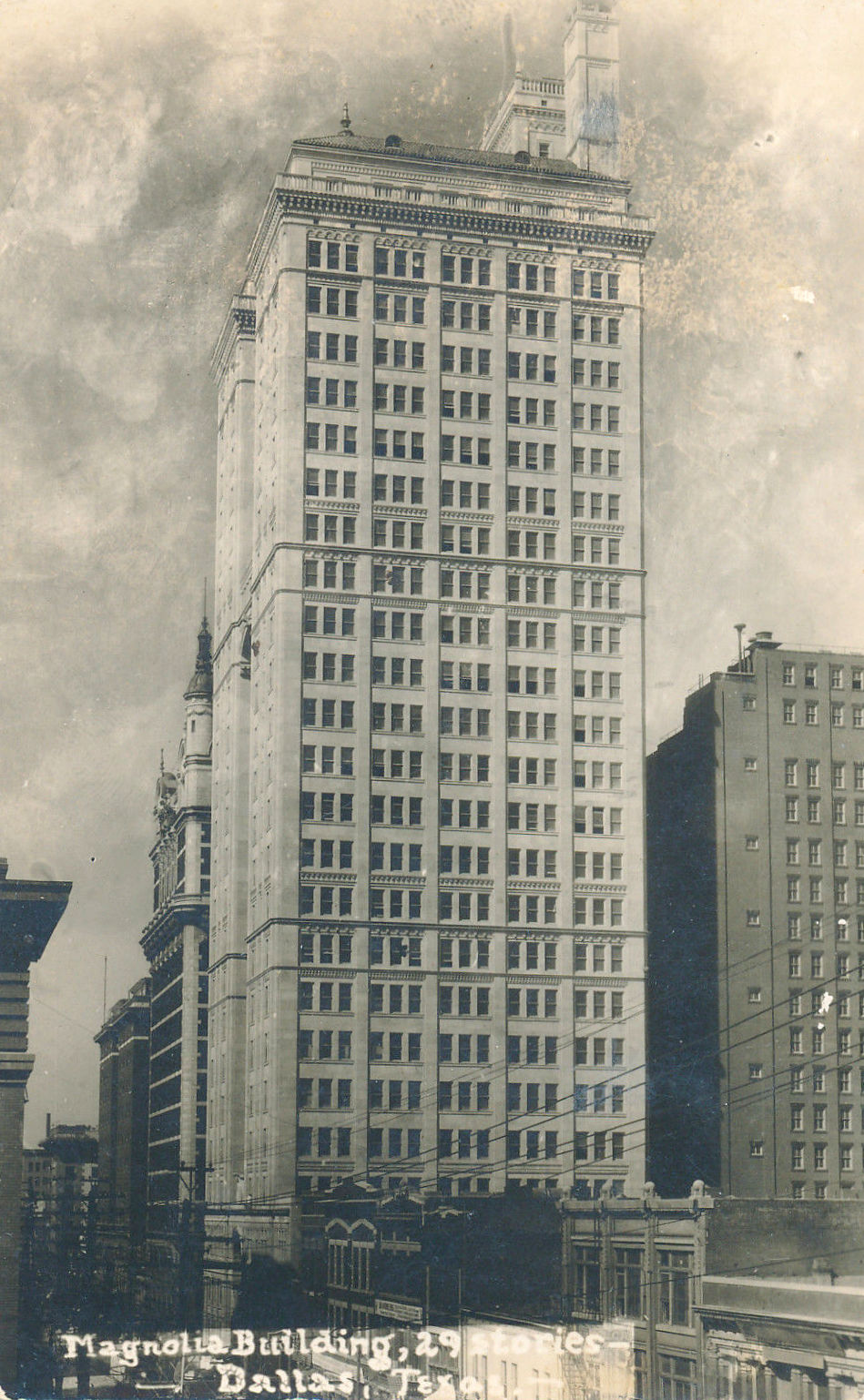
This is such a wonderful photo of the Magnolia Petroleum Building — even without Pegasus on top of it! When it opened in 1922, it was the tallest building in the state — all 29 stories of it. (It was so tall, apparently, that the photographer couldn’t get the whole building in the shot!) It certainly looks impressive — and impressively ominous — in this photograph. An added bonus is the beer-stein-shaped turret of the Adolphus Hotel peeking around at the left. Fantastic photo!

***

Sources & Notes

Photograph from a postcard found on eBay; written on the back is this message to folks back home in Oklahoma City: “Arrived at 11:30 PM. in this burg. It’s some big place, believe me.”

Brief history of what is now the Magnolia Hotel, is here. (Pegasus was not placed on top of the building until 1934.)

Some more Flashback Dallas posts featuring my favorite views of the Magnolia Building (with and without Pegasus):

  • here — photos showing the major change in the skyline between 1929 and 1939
  • here — incredible photo of the skyline taken from The Cedars, by Alfred Eisenstaedt
  • here — the Magnolia Bldg. lit up at night, with the Mercantile Bank Bldg. in the background
  • here — one of my favorite postcards of Dallas, showing the city at night, with Pegasus the highest point on the horizon

*

Copyright © 2015 Paula Bosse. All Rights Reserved.

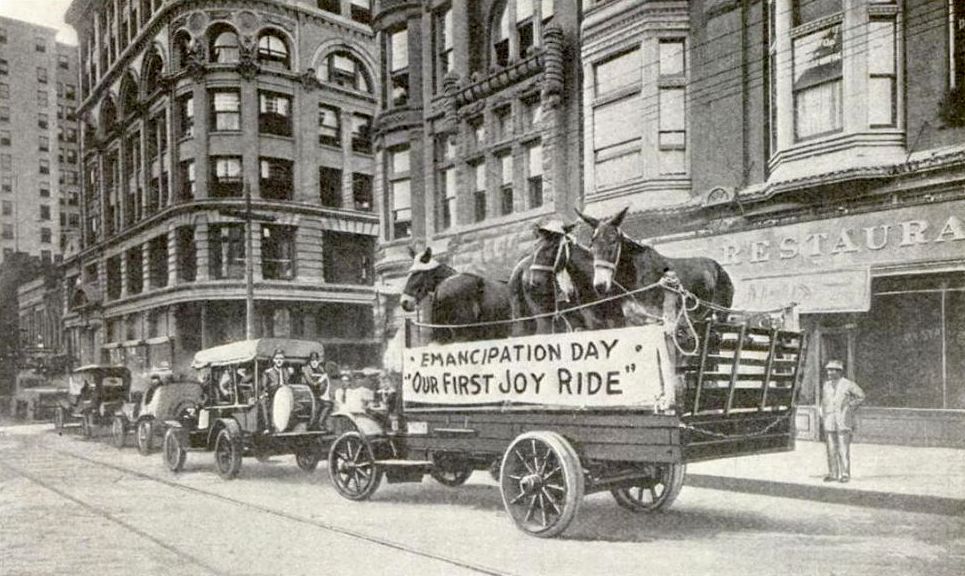
“Our First Joy Ride” — 1911

mule-joyride_pop-mechanics_jan-1912Mules taking a load off, Main & Ervay, 1911

by Paula Bosse

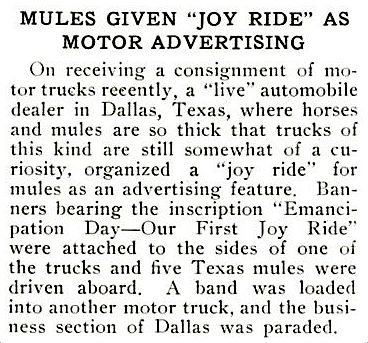
Flipping through the pages of a Jan. 1912 issue of Popular Mechanics — as one does — I came across a photo of a truckload of joyriding mules which was accompanied by this explanatory text:

mule-joyride_pop-mechanics_jan-1912-text

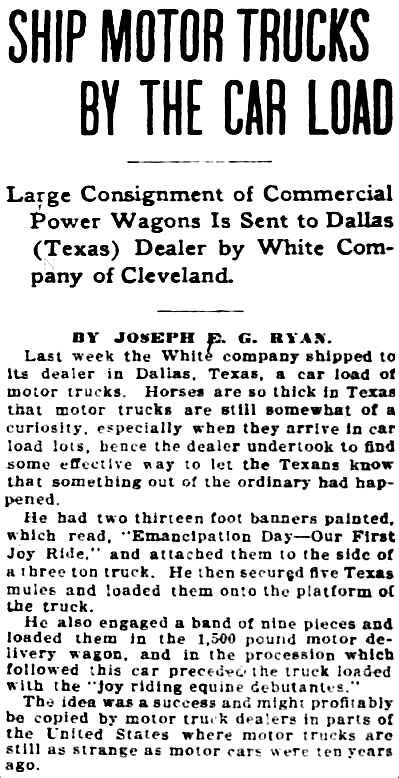
Ah, a publicity stunt. A Chicago newspaper offered a bit more background, and gave us the delightful phrase “joy-riding equine debutantes.”

mules_chicago-inter-ocean_102311Chicago Inter Ocean, Oct. 23, 1911

Another report added that the mules were “adorned with a collection of discarded women’s hats and bonnets elaborated with all the old ribbons, feathers and similar gee-gaws […] securely tied on with pink and red mosquito netting…. The procession was headed by Dallas’ most prominent business men in a brand new White 1912 ’30.'” (Automobile Topics magazine, Oct. 28, 1911)

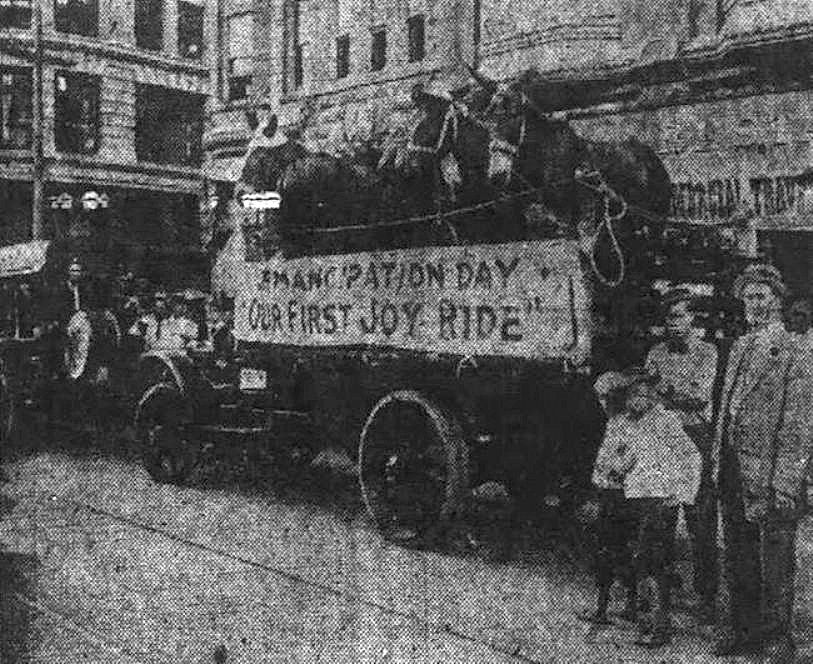
Despite the fact that this, let’s face it, pretty unusual “parade” happened on Main St., with apparent participation by “prominent businessmen,” I can find no mention of it in local newspapers. Maybe because it was a publicity stunt and there was no advertising fee collected by the papers. The story ran in a handful of newspapers (Chicago, San Francisco, Washington, DC), and the Washington Post ran the photo below under the headline “New Way to Advertise Motor Trucks.”

mules_washington-post_102211Washington Post, Oct. 22, 1911

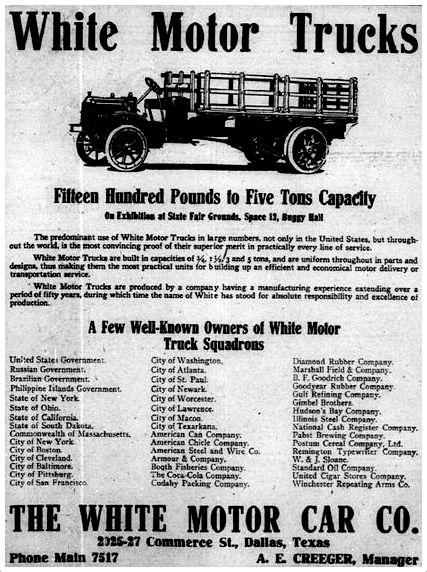
The White Motor Company (makers of the mule-laden truck) must have been quite taken with the unnamed entrepreneur’s banner, because they used the exact same wording on a banner draped on one of their trucks which was a featured attraction on Transportation Day at the 1915 Panama-Pacific International Exposition in San Francisco.

Let’s hope the original Dallas guy got a little something out of all this.

*

On further investigation into The Case of the Joyriding Mules, it appears that this was the brainchild of the General Manager of the White Motor Co., A. E. Creeger (or perhaps that of one of his gung-ho underlings). In a 1912 article in The Dallas Morning News, Creeger talks about the relatively soft truck market in Texas (!), and it’s easy to see why he was doing all he could to draw attention to his company’s line of trucks — even if it meant loading them up with “emancipated” livestock.

And here’s one of his ads from almost exactly one year after the mule stunt:

white-motor-co_dmn_101312Oct. 13, 1912

***

Sources & Notes

Top photo appeared in the January, 1912 issue of Popular Mechanics.

The “parade” (which took place sometime in the middle of October, 1911) is seen heading west on Main Street, just about to pass Ervay. The inescapable Wilson Building dominates the photo, with the tall, white Praetorian Building in the background. The restaurant at the right — at 1705 Main — was the California Restaurant, a Dallas eatery specializing in Chinese food since at least the 1890s.

*

Copyright © 2015 Paula Bosse. All Rights Reserved.

The Wilson Building & Its Tenants — 1908/1909

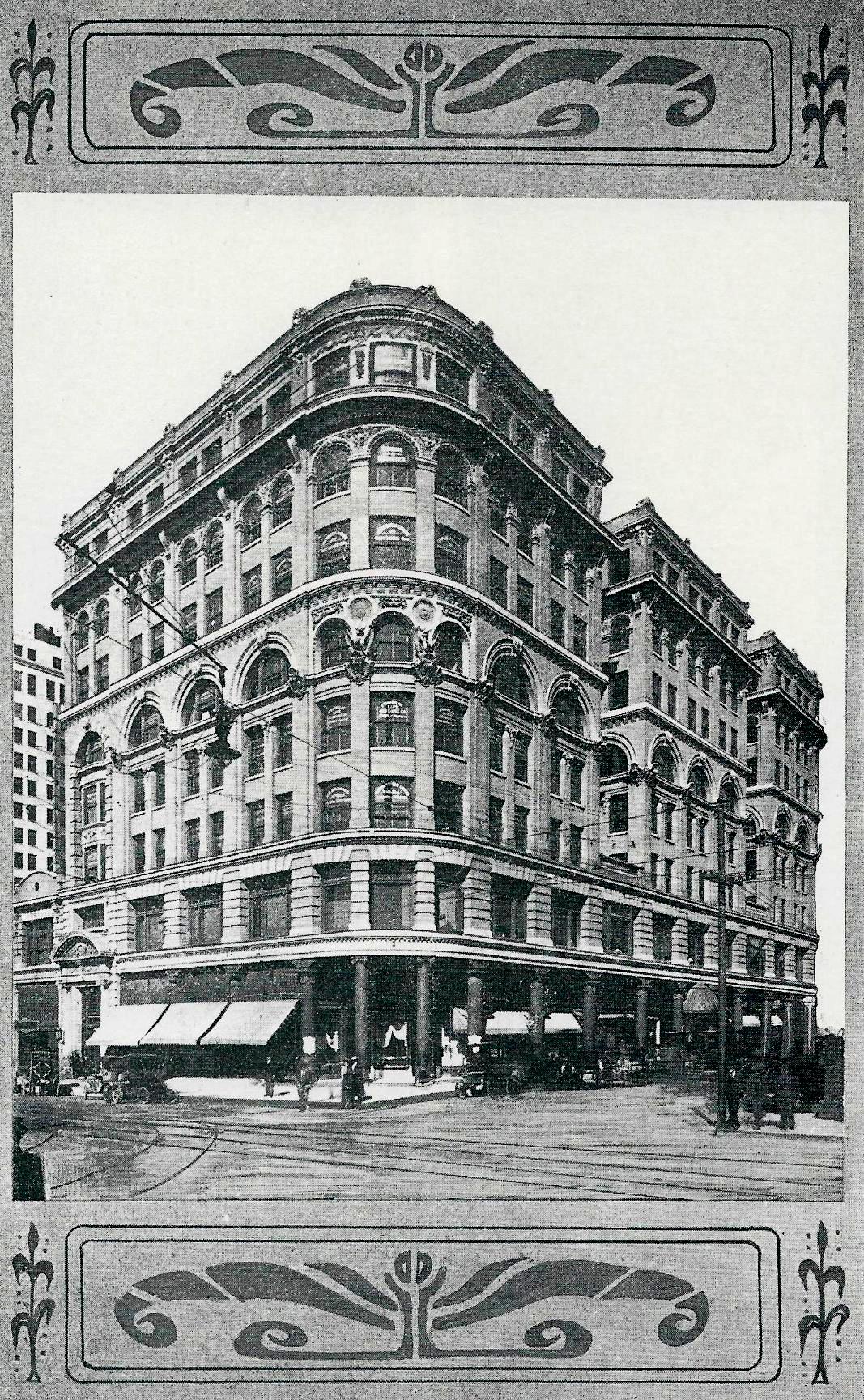
wilson-bldg_greater-dallas-illus-1908Forever & always, Dallas’ most beautiful building (click for larger image)

by Paula Bosse

I love the Wilson Building. Who doesn’t? Every time I realize it’s still standing, I’m actually kind of shocked. To find a 100-plus-year-old building still standing in Dallas is a rarity. If the wrecking ball ever strikes this building, there will definitely be hell to pay.

I’d never seen the above photo, which was published along with lovely art nouveau borders in the book Greater Dallas Illustrated, The Most Progressive Metropolis of the Southwest (1908). I’m fascinated by office buildings of the first half of the twentieth century that had business names painted on upper-floor windows. I always think of Sam Spade’s office.

sam-spade_sign-window

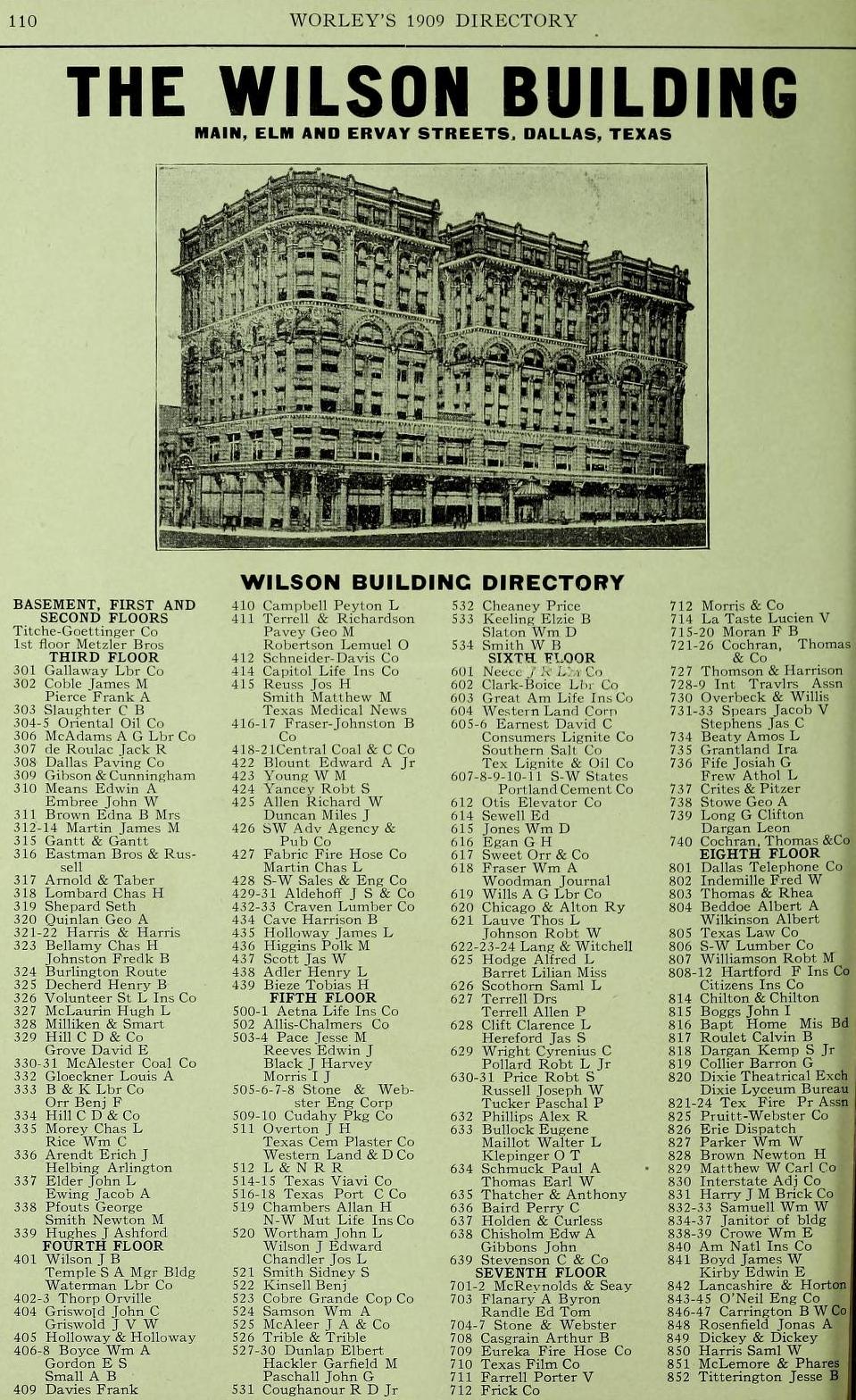
I was really hoping to find at least ONE detective agency in the Wilson Building at that time, but steep rents and a choosy leasing agent were probably working against such downmarket enterprises setting up shop in such a grand palace. Below is the list of occupants in the building at about the time the top photo was taken. Aside from the Titche-Goettinger department store occupying the basement and first two floors, Dallas’ premier office building was home to several important local business concerns, lots of insurance companies and agents, some notable architects (Lang & Witchell, C.D. Hill, Overbeck & Willis), and a surprising number of osteopaths (including Edna B. Brown, one of only two women specifically mentioned by name). (Click directory page for larger image.)

wilson-bldg-occupants_1909-directory

***

Photo of the Wilson Building from Greater Dallas Illustrated (Dallas: Friends of the Dallas Public Library, 1992 — originally published in Dallas in 1908). The Wilson Building is located on Main and Elm at Ervay.

It’s doubtful that it would fall victim to the wrecking ball, but the Wilson Building may not actually be protected from any possible future threat of demolition. For clarification, see the comment near the top of the comments section in this Dallas Morning News article on recent demolition in the same block, here.

Sam Spade image is a still from the 1941 Humphrey Bogart film The Maltese Falcon, based on Dashiell Hammett’s novel. (Poor Archer….)

Directory page from Worley’s 1909 city directory.

My previous post — “The Wilson Building Under Construction — 1902” — can be found here.

Click pictures for larger images.

*

Copyright © 2015 Paula Bosse. All Rights Reserved.

Main Street and Flags, Flags, Flags — ca. 1917

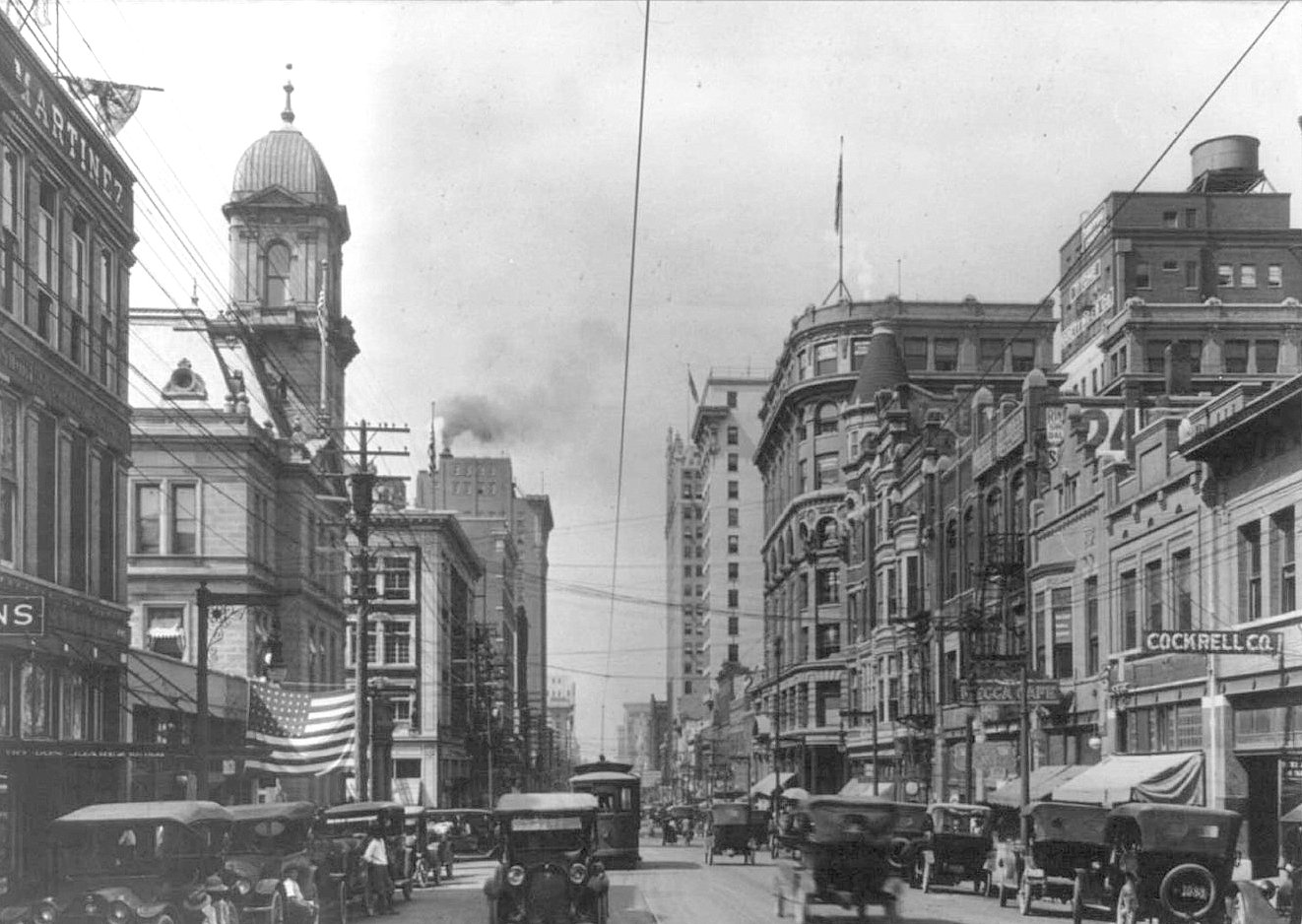
downtown_ca1917_LOCFind the flags! (click for larger image)

by Paula Bosse

This is a cool photo. I have no idea if it was taken anywhere around July 4th, but I post it today because today is July 4th, AND I see 5 — possibly 6 — American flags in this photograph of Main Street. The patriotism displayed here may have more to do with World War I than Independence Day, but why not post it on the 4th of July?

Enjoy the holiday!

***

Photo identified as “Texas, Dallas, 1917, Business section” by the Library of Congress; photo info here.

For the previous Flashback Dallas post “4th of July — Sweating in Formation,” which shows a parade from the 1870s or 1880s, click here.

*

Copyright © 2015 Paula Bosse. All Rights Reserved.