Flashback : Dallas

A Miscellany: History, Ads, Pop Culture

Category: Downtown

Elks-a-Plenty — 1908

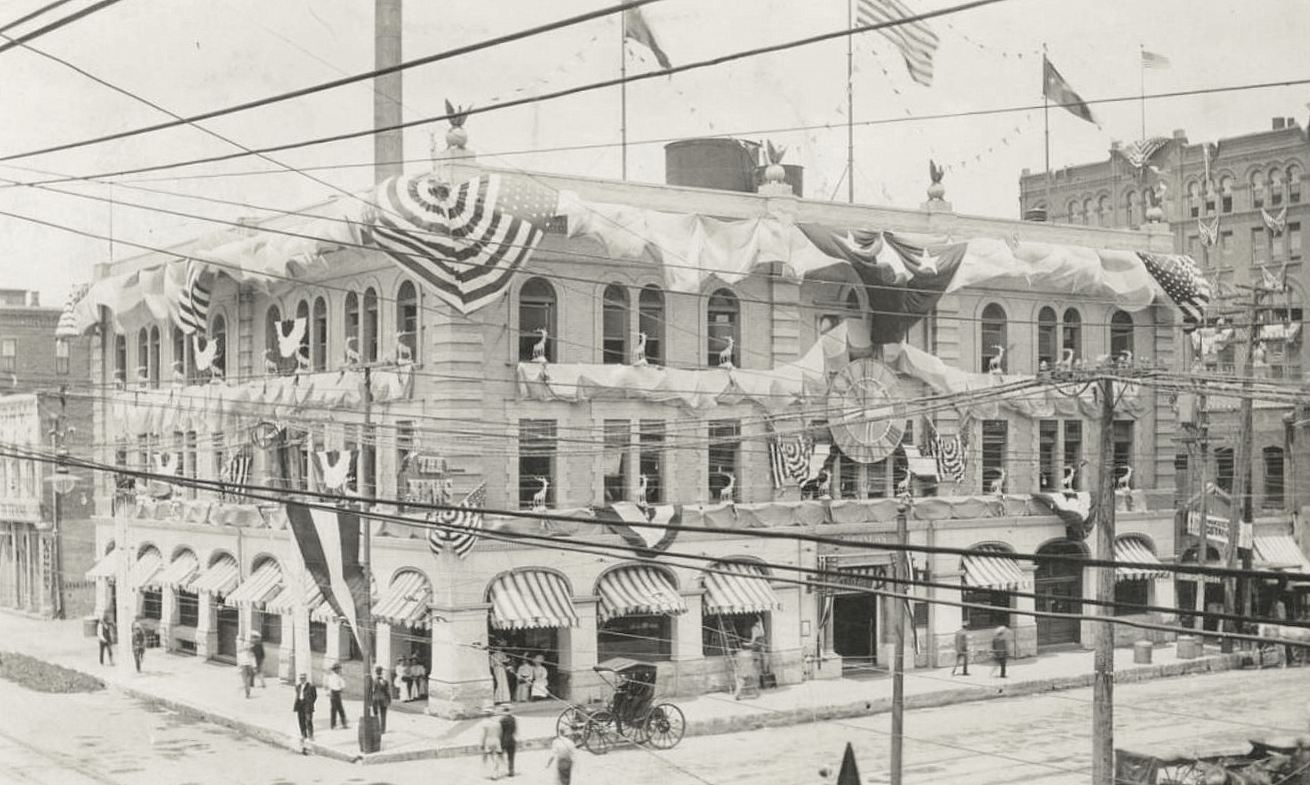
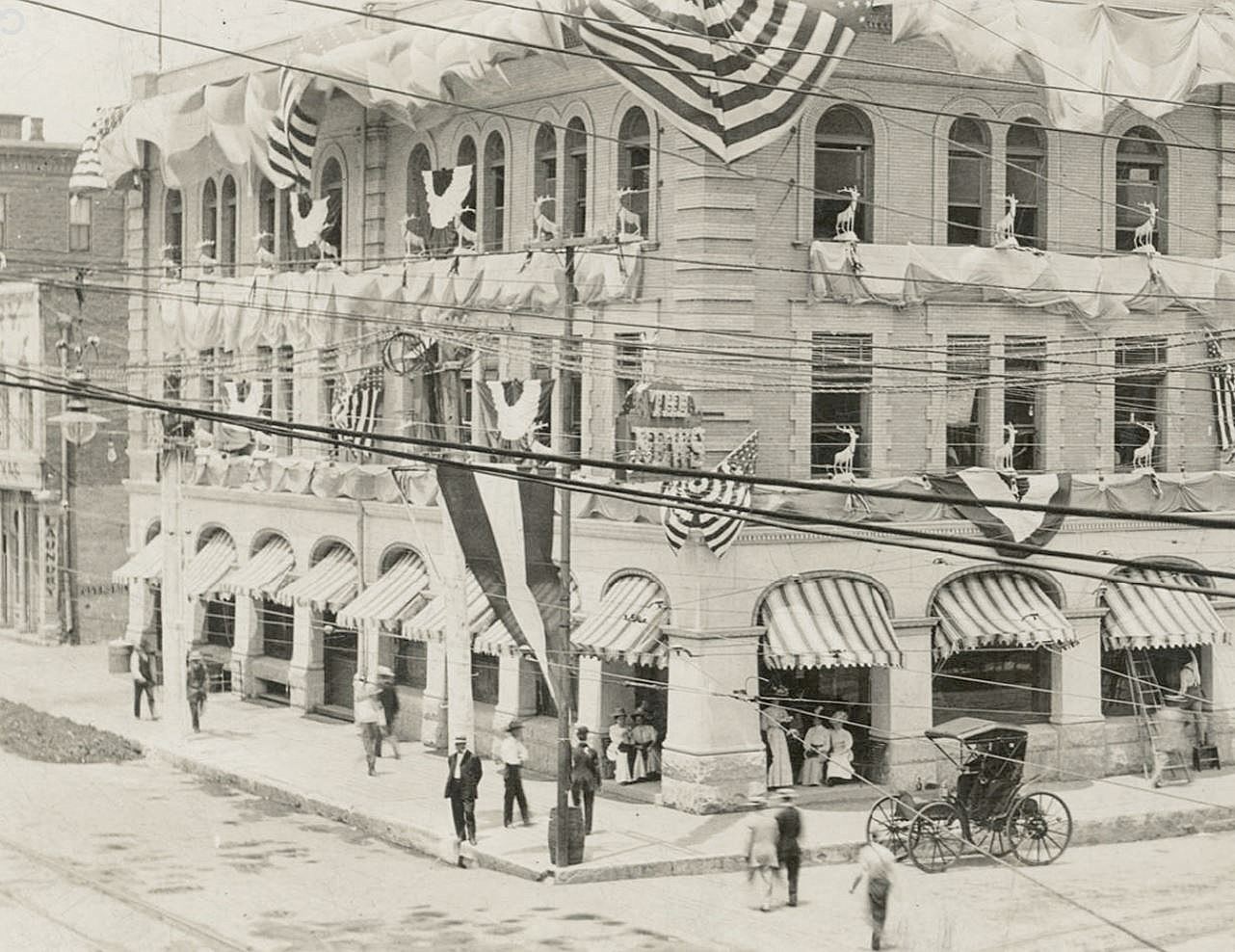
dmn-bldg_decorated-for-elks-convention_1908_cook-collection_SMU_fullBegirt with ruffles and studded with elks…

by Paula Bosse

Conventions have always been important to Dallas. One of the most important conventions ever to descend upon the city was the annual convention of the Benevolent and Protective Order of Elks in July 1908. There were approximately 38,000 attendees, but when you added to that number spouses and various others with business, social, or just looky-loo interests, it was estimated that more than 100,00 out-of-towners clogged the streets of our fair burg during the time of the convention. Dallas was a sizeable city in 1908, but the sudden swarming into town of 100,000 people (twice the actual population of the city!) must have been… challenging. (And profitable!)

Dallas welcomed the Elks with enthusiasm and open arms. Everyone knew they were coming, and everywhere there were splashes of the Elk colors, purple and white. A special (and later notorious) semi-permanent arch was erected to span Main Street at Akard. And businesses competed with one another to see who could decorate their building with the most spectacular and festive bunting.

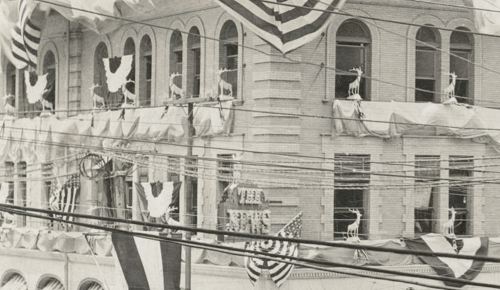
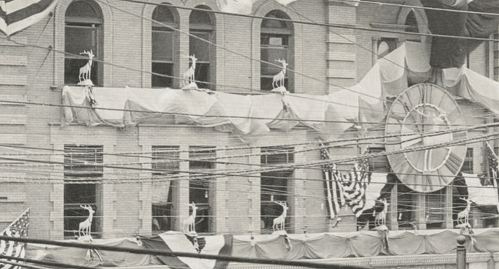
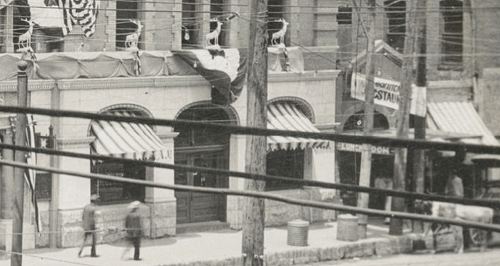
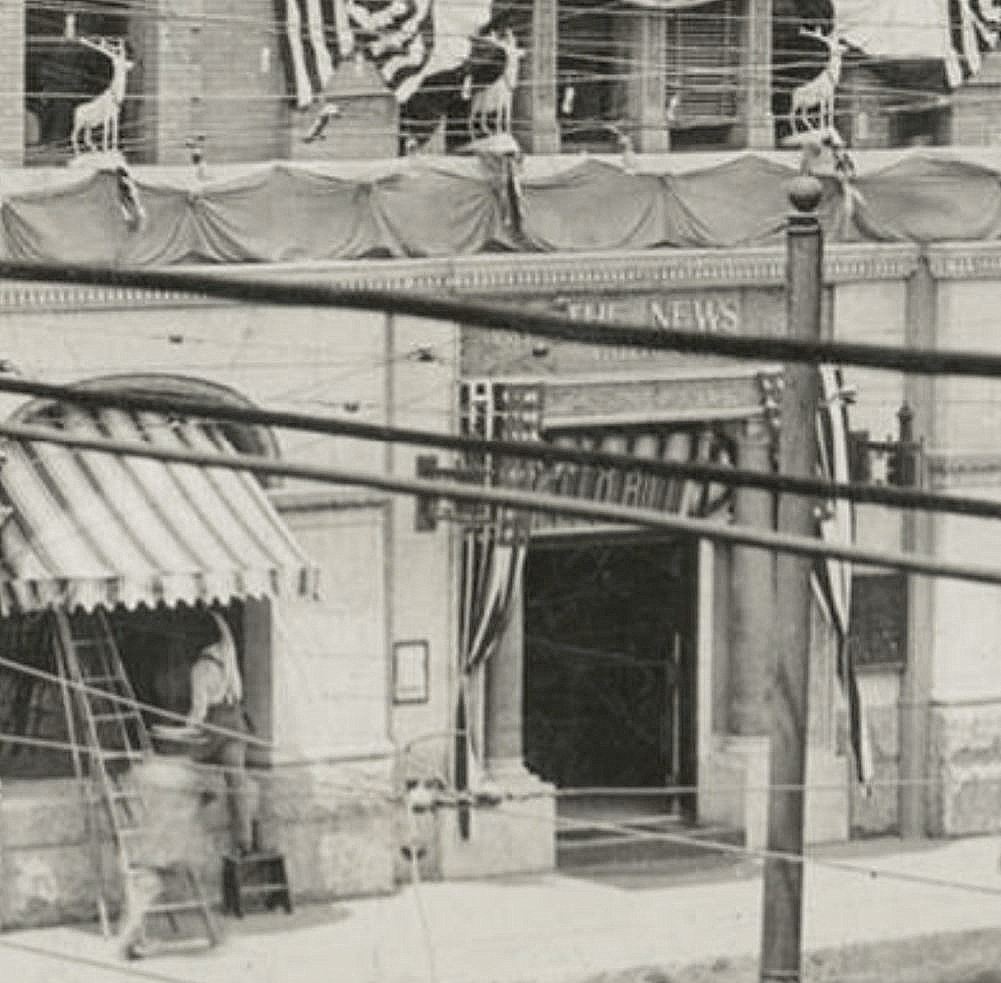
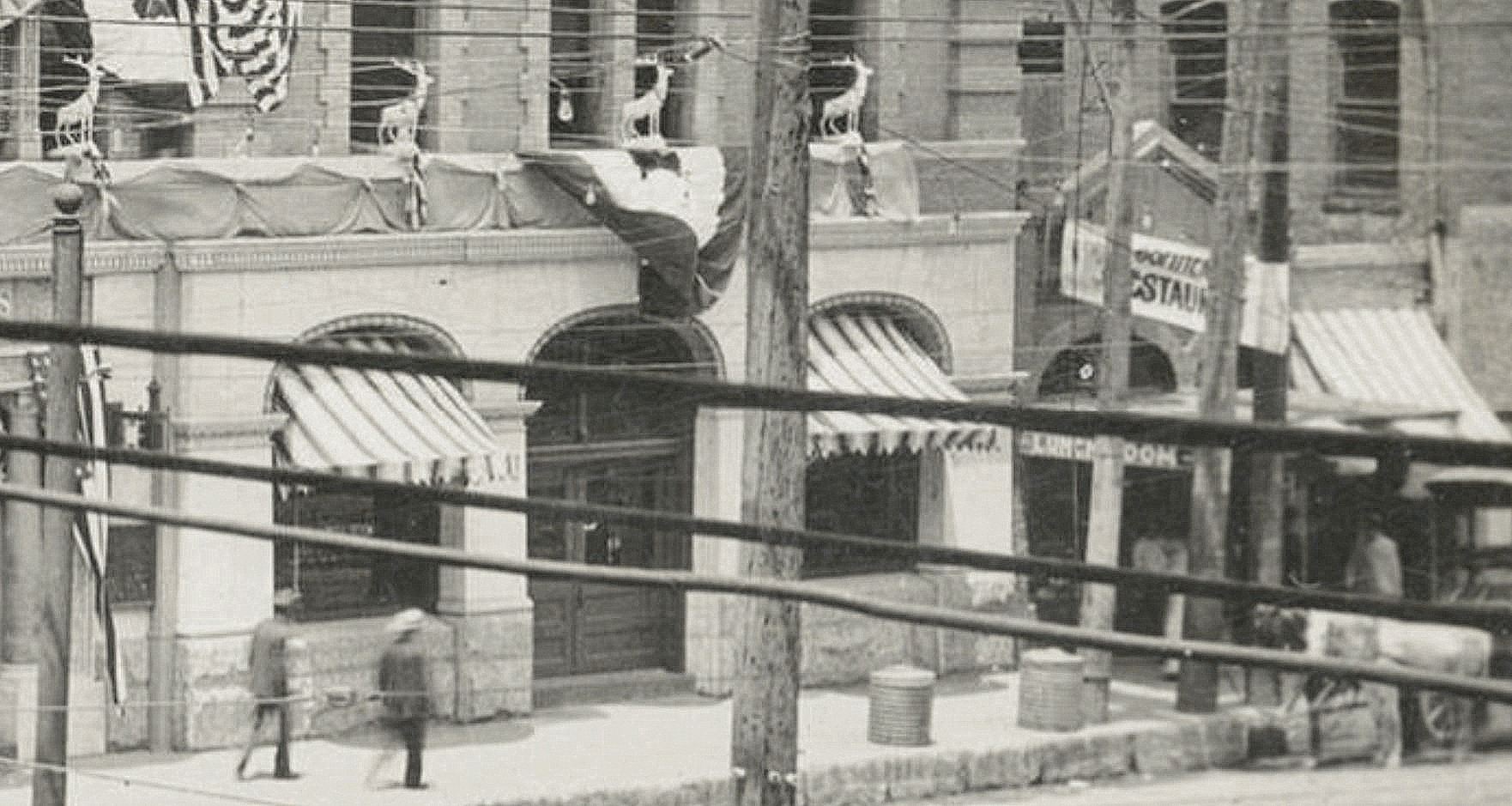
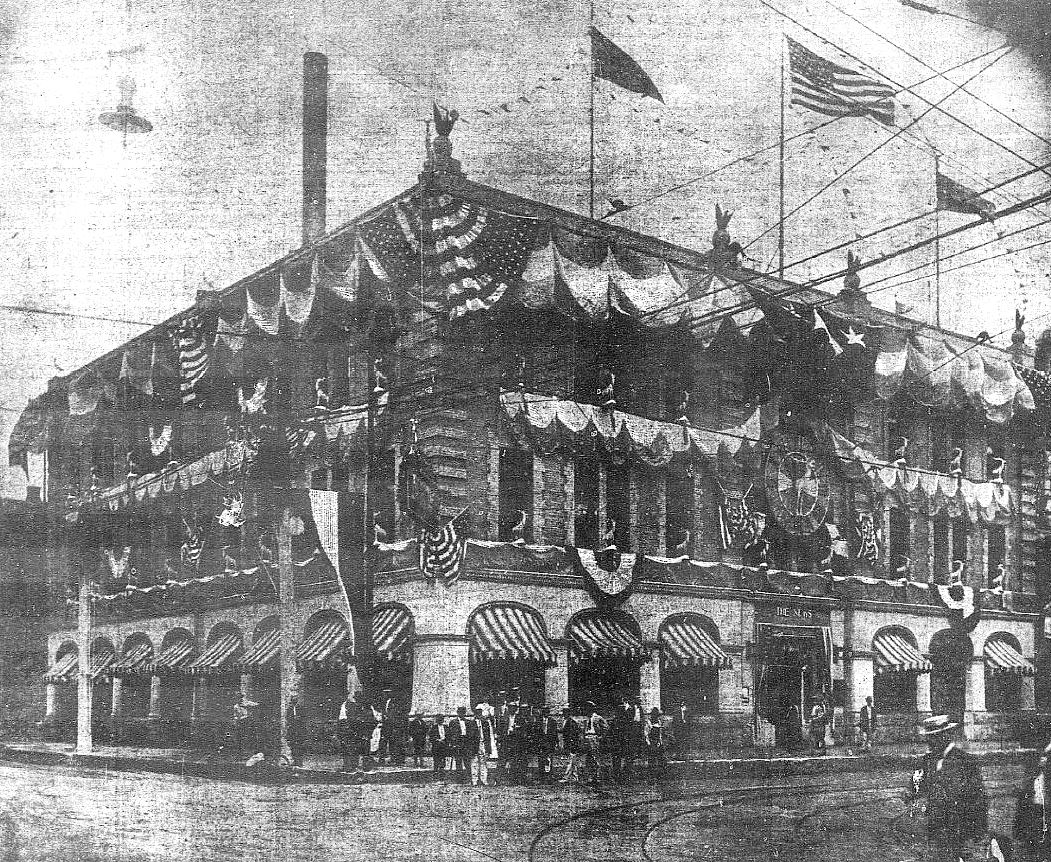
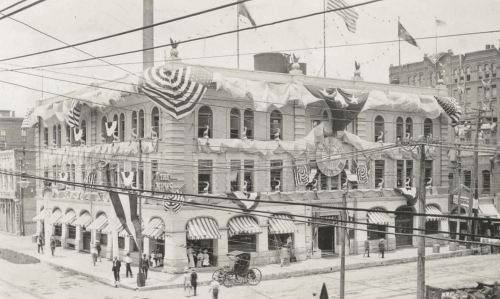
Above is a photo of the Dallas Morning News Building at the northwest corner of Commerce and Lamar, crammed full of flags, bunting, pennants, cowbells, lights, little statues of elks, medium-sized statues of elks, and large statues of elks. (There is an elk in every window.) It also had a large clock erected which was perpetually stuck at an Elk-y 11:00 and a parallelogram-shaped sign which lit up to flash the Elk greeting “Hello, Bill!” So… a lot. But what might seem like overkill — like The News was trying a little too hard to be noticed… the Elks loved it. LOVED IT. They loved it so much that they awarded the newspaper an award of $250 for the best decorated building in the city (that would be about $8,000 in today’s money!). Scroll down to read a breathless description of these decorations, with details of absolutely everything that was flapping, clanging, flashing, billowing, and throbbing at Commerce and Lamar in the summer of 1908. (I have to put this sentence from the article here because I love it so much: “To the bottom of each of these flags are attached small cowbells of different tones, so that with every strong whiff of wind there is a discordant but merry jingle.”)

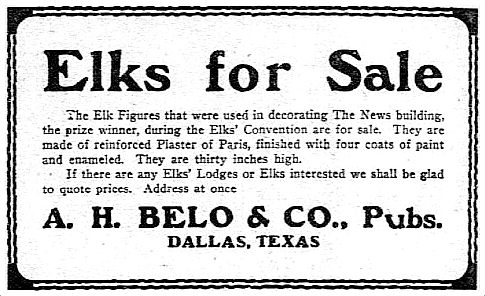
So, those elk statues. I mean… they’re fantastic. Little elks in every window, illuminated by a single electric bulb positioned “between the forefeet” of each mini-elk. And then there are the larger ones appearing to step out of — or off of — the building. But back to those little elks — are you wondering what happened to them after the conventioneers headed back home? Wonder no more!
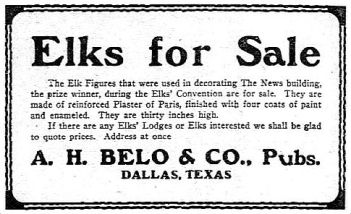
elks_news-bldg_belo-ad_071808Dallas Morning News, July 18, 1908

That would have been a great souvenir!

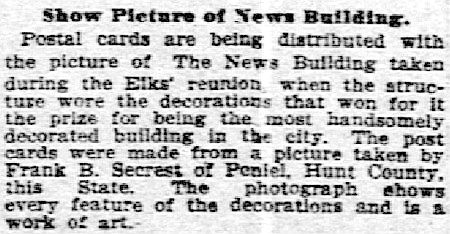
The photo at the top of this post (by Frank B. Secrest of Hunt County) was issued that summer as a postcard. The News did not miss an opportunity to mention it:
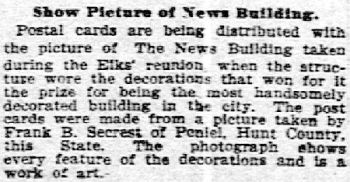
elks_news-bldg_dmn_080708DMN, Aug. 7, 1908

*

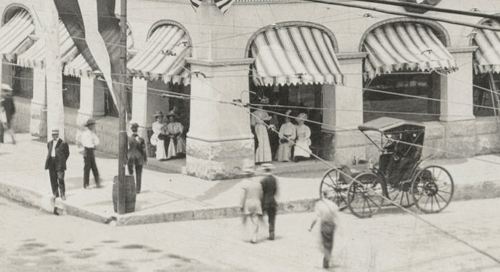
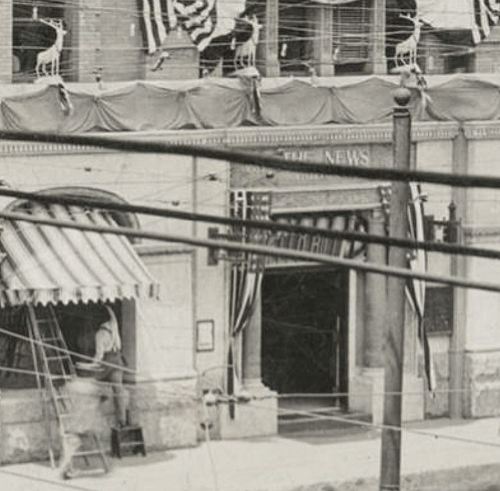
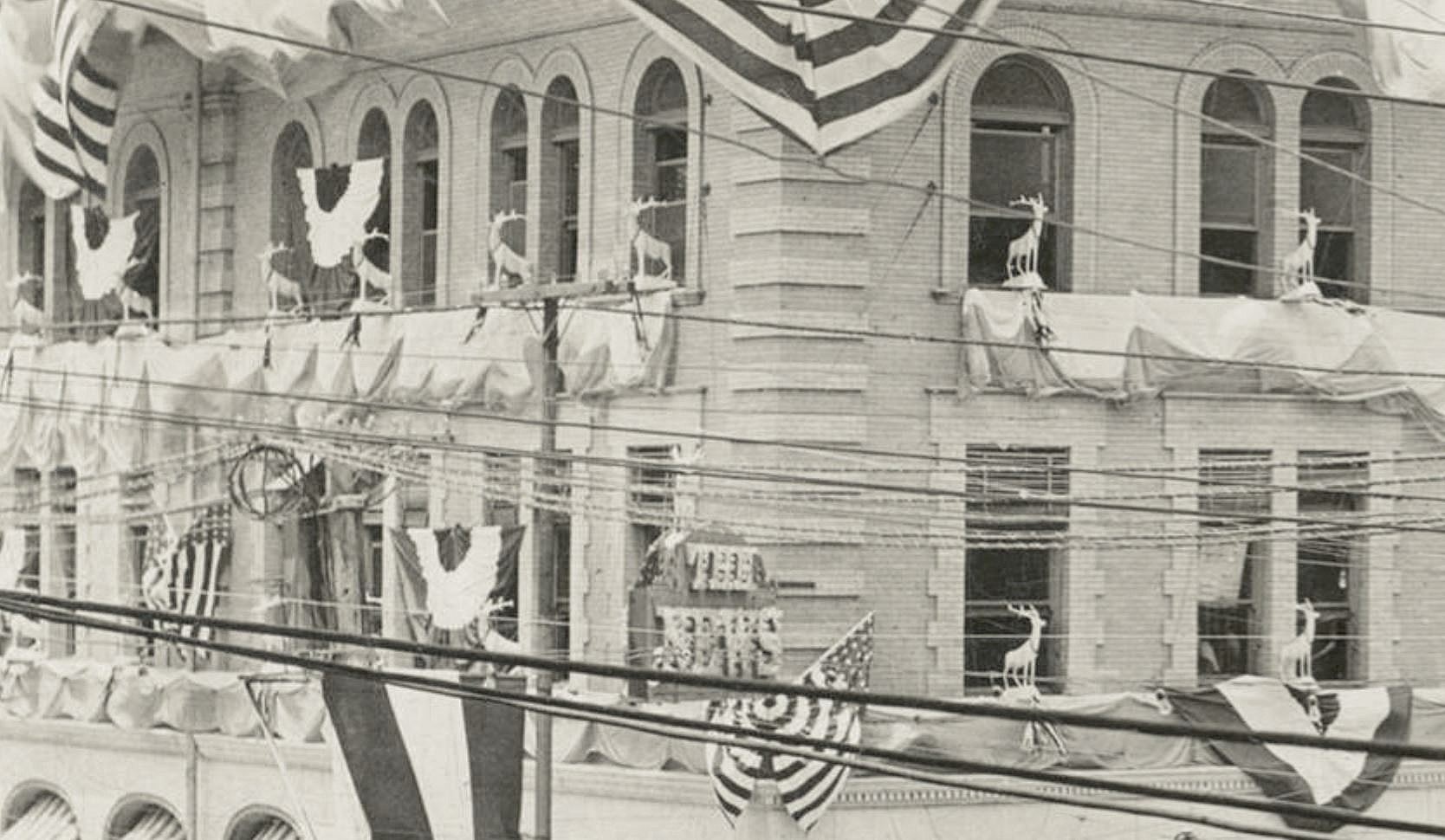
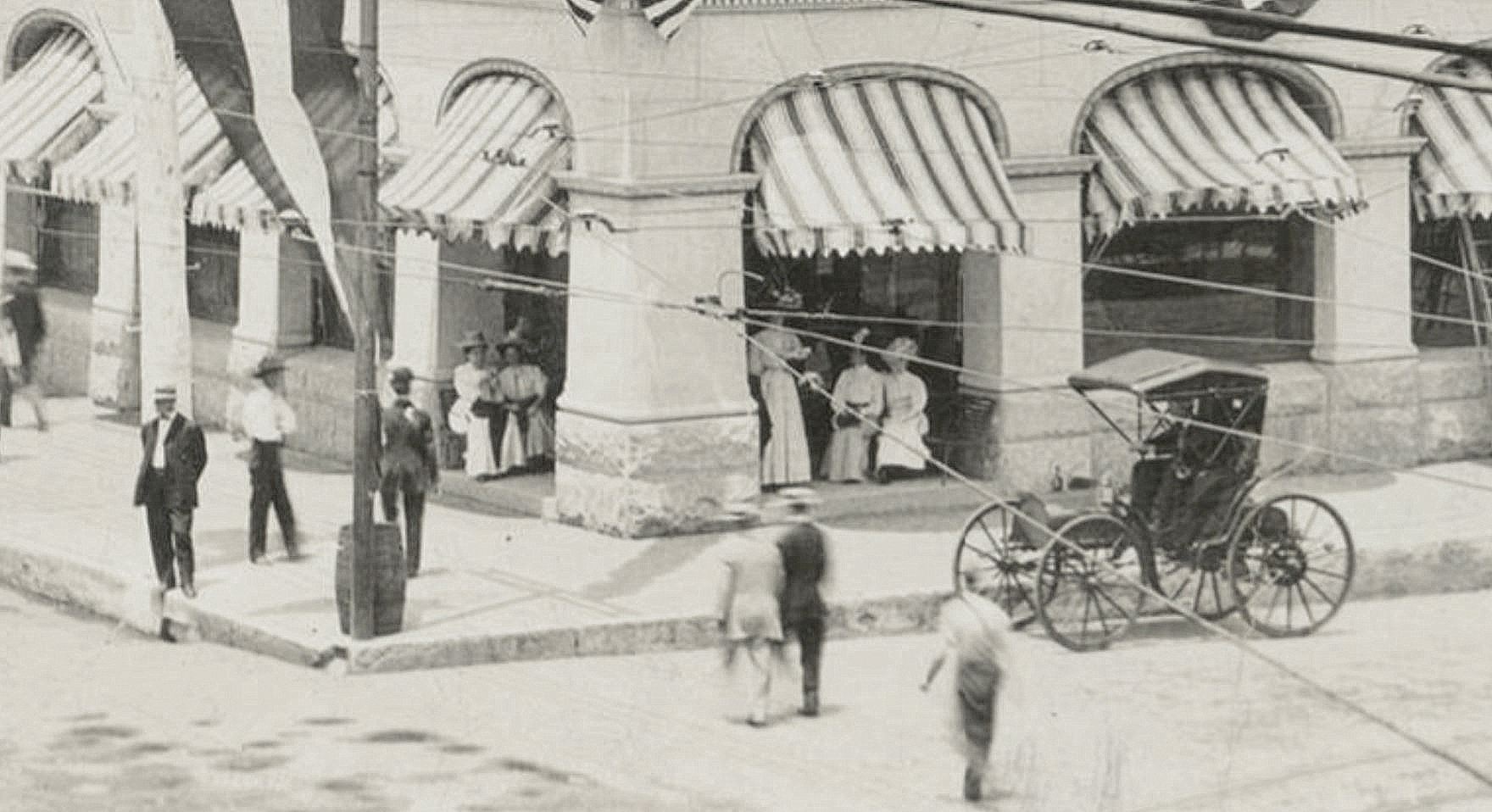
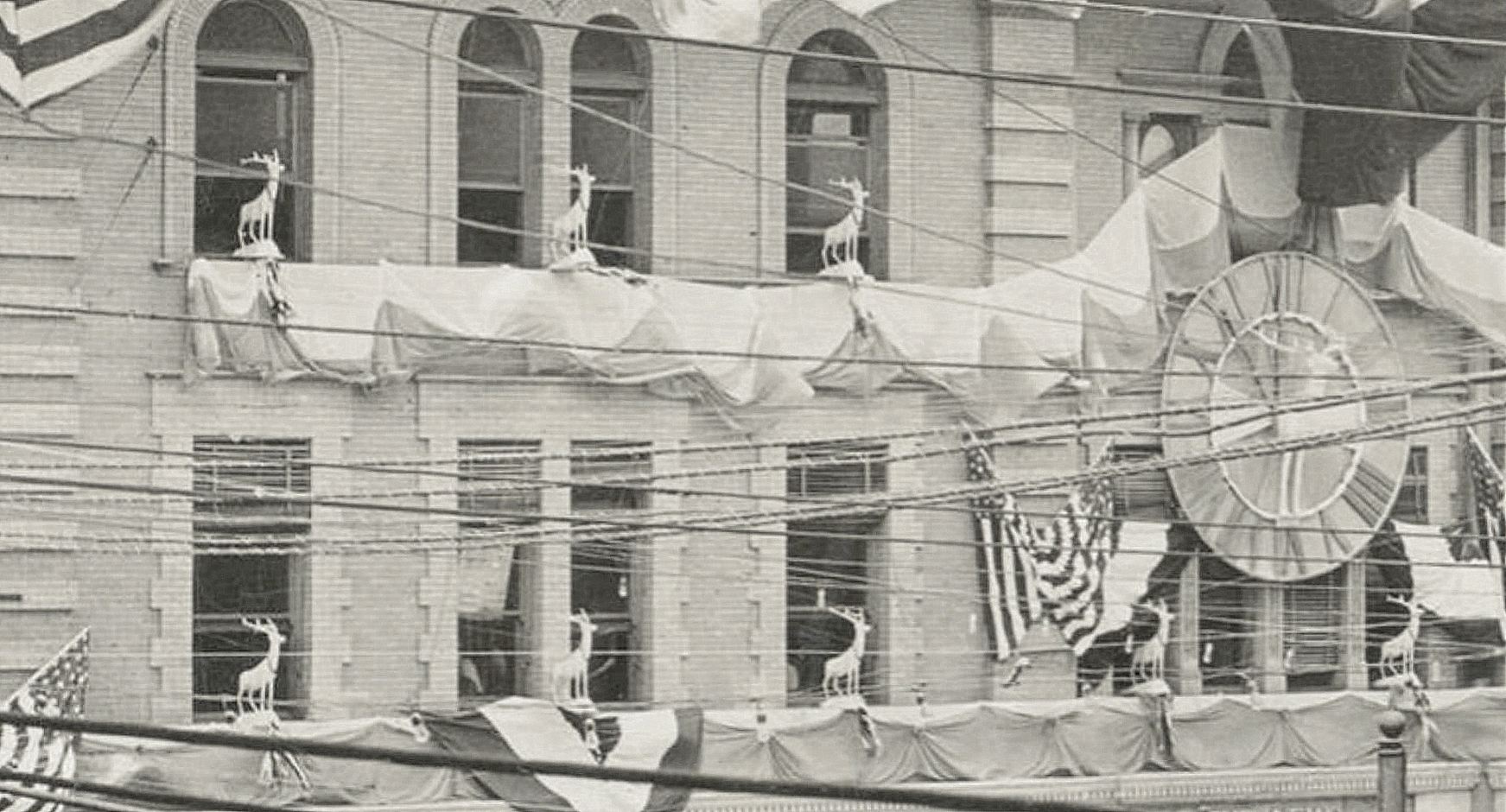
And because I love to zoom in on these sorts of photos, here are a few magnified details:
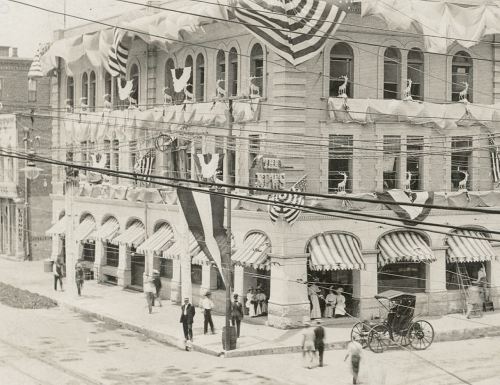
dmn-bldg_decorated-for-elks-convention_1908_cook-collection_SMU_det-2

dmn-bldg_decorated-for-elks-convention_1908_cook-collection_SMU_det-3

dmn-bldg_decorated-for-elks-convention_1908_cook-collection_SMU_det-4

dmn-bldg_decorated-for-elks-convention_1908_cook-collection_SMU_det-5

dmn-bldg_decorated-for-elks-convention_1908_cook-collection_SMU_det-6

dmn-bldg_decorated-for-elks-convention_1908_cook-collection_SMU_det-7

**

Here is a lengthy description of the decorations, from The Dallas Morning News — direct from the horse’s mouth:

To decorate The News Building in celebration of the coming of the Elks has been the labor of two men for more than a month, and of a dozen for two days: for, though it was only three days ago that the first bit of color appeared on the outer walls, the preparations were begun in the seclusion of a workshop early in June. The draping of the building with bunting and flags was done under the direction of W. T. Senter of the National Decorating Company of St. Louis, and of Edward A. Gebhard, librarian of The News. In working out their scheme they have used 4,200 yards of bunting, purple, white and purple, and twenty-four immense flags, and disposed of it in such artistic fashion as to avoid a sense of crowding.

PURPLE, WHITE AND PURPLE RUFFLES

The building is thrice begirt with big ruffles of purple, white and purple. But, to begin at the topmost, three large flags, one the United States, another the Texas and the other The News’ flag, float high above the Lamar street side of the building. To the bottom of each of these flags are attached small cowbells of different tones, so that with every strong whiff of wind there is a discordant but merry jingle. From one to the other of the flagstaffs hundreds of small pennants in the colors of the Elks flutter gayly in the breeze. Festooned from the heavy cornice which crowns the building are heavy folds of purple, white and purple so arranged that with every vagrant breeze it swells and sinks like the surface of water. Once on the Lamar street side, over the entrance, again at the corner and once on the Commerce street side this bunting is gathered around an immense United States flag, fashioned fan-shape. Poised on the cornice of the building at the corner, as if surveying the land preparatory of a leap, is the graceful figure of an elk, five and a half feet high, made out of plaster of Paris, painted and enameled until he glistens.

The two lower ledges of the building are draped in similar fashion, except that the streamers at these places are narrower than those that festoon the cornice. Above the main entrance on the Lamar street side and extending from below the second story to the third-story ledge is the piece de resistance. Here set in an embrasure of the building, is a clock dial twelve feet in diameter. The gilt letters marking the divisions of the circle are two feet high. The hands point to the hour of 11. The pure white head and shoulders of an elk seven feet high are shown in the center one foot forward, as if he were about to emerge from the fluffy mass of purple and white bunting that forms the background dial. On each side an immense flag is gathered in a way to make it fan-shaped. Circling the clock dial are six large incandescent lights.

WHOLE HERD OF ELKS

From the third-story corner of the building, above which stands a five and one-half foot Elk, as if surveying the country from a precipice, are festooned two twelve-foot flags that fall almost to the second-story ledge of the building. One is gathered around on the Commerce and the other on the Lamar street side. And there yet remains to speak of the most distinctive feature of the whole scheme of decoration. The News, in preparation for this event, had made a whole herd of elks. There are forty-two of them, each thirty-two inches tall, and one, mounted on a pedestal, stands poised from the ledge of every window in the building. They are pure white, made of plaster Paris, painted twice and then enameled. Between the forefeet of every one is an electric bulb. The elks are from models designed by Mr. Gebhard and were cast in The News Building.

BRILLIANT ILLUMINATION

Of course the whole building is brilliantly lighted. In addition to the electricity used ordinarily, which lights the exterior of The News Building pretty well, bulbs have been studded profusely midst the decorations and over the Lamar street entrance is a parallelogram of electric lights which illuminate the sign, “Hello, Bill!”

*

The article then launches into more self-promotion, with an, admittedly, interesting description of the layout of the News Building:

ATTRACTS GENERAL ATTENTION

The building of The News attracted general attention from the thousands of visiting Elks. Many expressed their surprise that a city the size of Dallas had such a complete, modern building and equipment, and the compliments concerning The News as a newspaper have been very pleasing.

The News Building has all the modern fireproof features. It occupies a space of 300×100, having three floors and a basement, the whole being used by the newspaper. Its business office is one of the handsomest in the State, and, as one visitor remarked, it looks more like a prosperous bank than the ordinary newspaper office.

The first floor is given up to the business and circulation departments, the press room and the mailing department. In the basement are the paper storage rooms and the power department. On the second floor are the editorial rooms, telegraph rooms and the general circulation department and the newspaper job department, besides the Employes’ Library and Recreation Room. On the third floor are the composing and the linotype rooms, the stereotype room and the engraving department.

INDIVIDUAL ELECTRIC MOTORS

Every piece of machinery in the house is operated by its own individual electric motor. Power is supplied from two immense engines and generators combined, the engine room being one of the show places in the building, having a metal ceiling and white glazed brick on the walls, with a cement floor. The press room contains two three-deck presses, one quadruple press and one sextuple press.

TWO DAILY NEWSPAPERS

The Dallas News is the offspring of The Galveston News, which was established in 1842. The two papers are under the same management. The publication offices of The News, Galveston and Dallas, 315 miles apart, are connected by special wires for interchange of news matter. The Galveston paper supplies the southern part of the State and the Louisiana border, while the other covers all North Texas and goes well into Arkansas, Oklahoma and New Mexico.

THREE SPECIAL TRAINS

For upward of a quarter of a century the two papers have operated at their own expense, every day in the year, three special newspaper trains, one running Galveston to Houston, one Dallas to Denison and the third Dallas to Fort Worth. The Dallas News covers hundreds of thriving towns throughout its territory, many of them before breakfast time, through its unrivaled facilities of distribution. Starting in 1885, The Dallas News has been a continuous success, and has achieved an enviable reputation wherever American newspapers are known. As an advertising medium it is in a class by itself so far as papers in this section of the country are concerned. Starting at 1885 with thirty-three classified ads in its Sunday issue, it now runs each Sunday about 2,000. It is a success because it is enterprising and because it is clean, both in its news columns and in its advertising columns; because it is fair-minded and because its efforts have always been uplifting from a moral and intellectual standpoint and fair to every interest.

*

And then it launches into many, many testimonials from Elk visitors on how much they love the decorations. This is the first. You get the idea.

J. T. McNulty of Baltimore, grand trustee of the Elks, prominent in National circles of the Knights of Columbus and a central figure in the Ancient Order of Hibernians of America, who has traveled largely and visited every State in the Union, being prominent in business and political circles said: “I have been to many conventions, my son, and have seen many decorations, but the one at The News plant, in my estimation ‘takes the cake,’ figuratively and literally speaking. It is the most unique, the most artistic and the most beautiful I have ever seen in all my attendance at conventions in this country, and I have attended many of them. I was agreeably surprised at the way Dallas has decorated, but nothing gave me such a shock of pleasurable surprise as the first sight I had of The News’ decorations.”

*

And this is the dark and grainy photo that ran with the article:
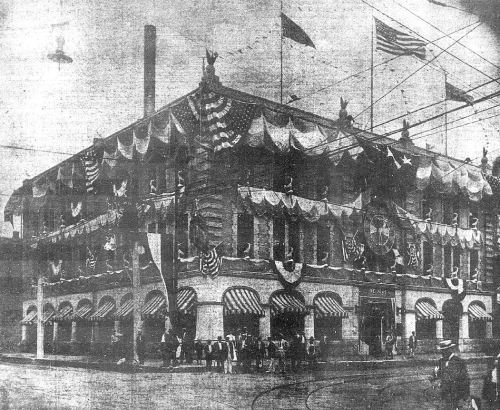
dmn-bldg_elks_dmn_071508_photoDMN, July 15, 1908

**

I kinda want an elk statue now. Also, according to the article, I now know the Morning News has its own flag. Can someone point me to more info?

**

Most of the larger downtown buildings went crazy with decorations, such as the Oriental Hotel (southeast corner of Commerce & Akard), seen here festooned up the wazoo. If you see a photo from 1908 with a Dallas building that’s looks like this, blame it on the Elks.

oriental-hotel_postcard_elks_1908_ebay

***

Sources & Notes

Top photo — titled “[The News, First Prize for Decorations, Dallas, Texas]” — is from the George W. Cook Dallas/Texas Image Collection, DeGolyer Library, Southern Methodist University; more info on this photograph (postcard) can be found here.

Lengthy quote is from the article “Dallas News Building Decorated In Honor of the Elk’s Grand Lodge Which Is Now Holding Its Annual Session and Grand Jubilee in This City,” The Dallas Morning News, July 15, 1908.

More Elks-related Flashback Dallas posts:

And more photos of this beautiful Dallas News Building can be found in these posts:

dmn-bldg_decorated-for-elks-convention_1908_cook-collection_SMU_full_sm

*

Copyright © 2022 Paula Bosse. All Rights Reserved.

The Fountain: “A Resort for Gentlemen” — ca. 1911

by Paula Bosse

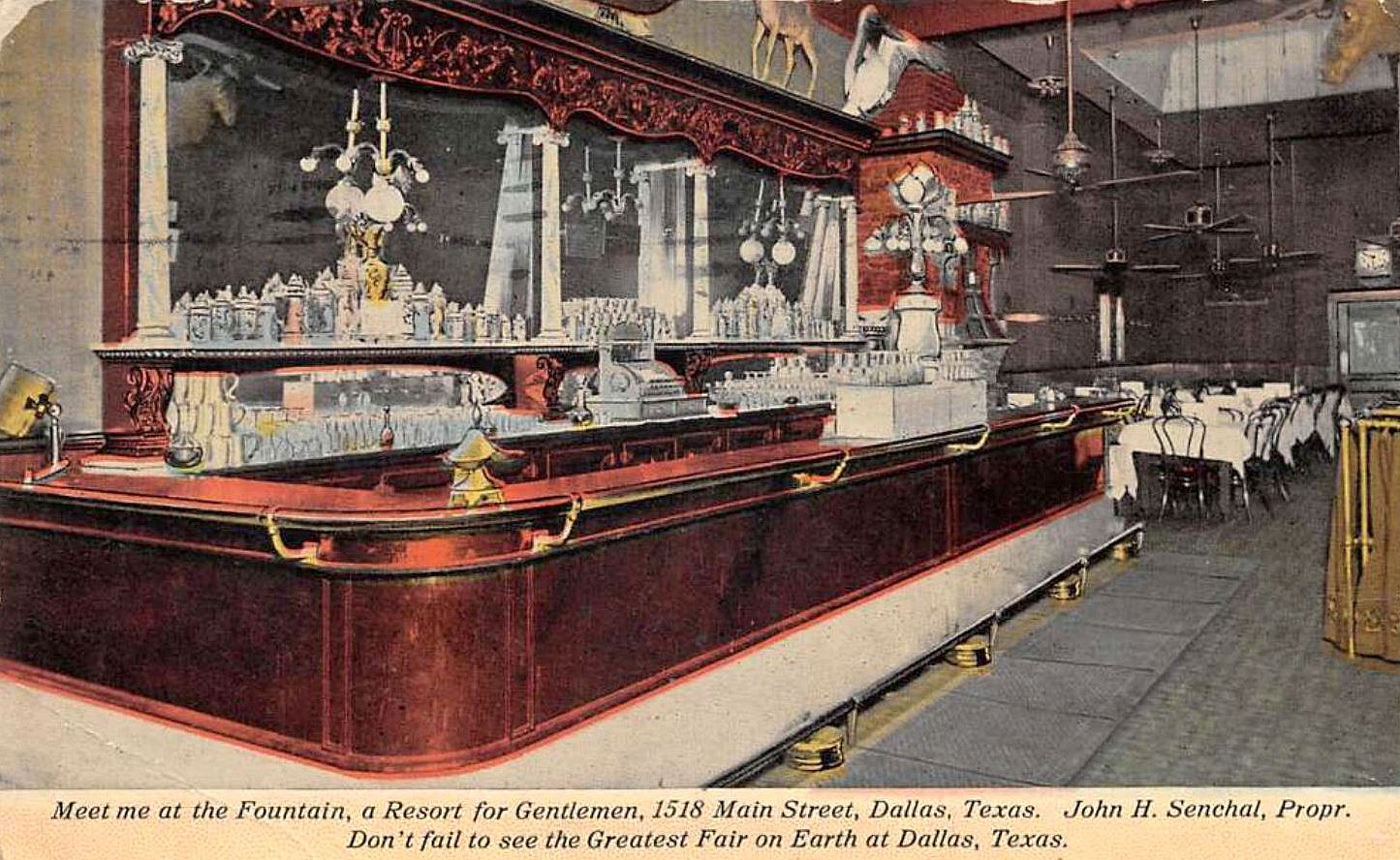
This postcard (which has a 1911 postmark) shows The Fountain, a well-appointed drinking establishment (not lacking in ceiling fans). The caption reads:

Meet me at the Fountain, a Resort for Gentlemen, 1518 Main Street, Dallas, Texas.
John H. Senchal, Propr.
Don’t fail to see the Greatest Fair on Earth at Dallas, Texas.

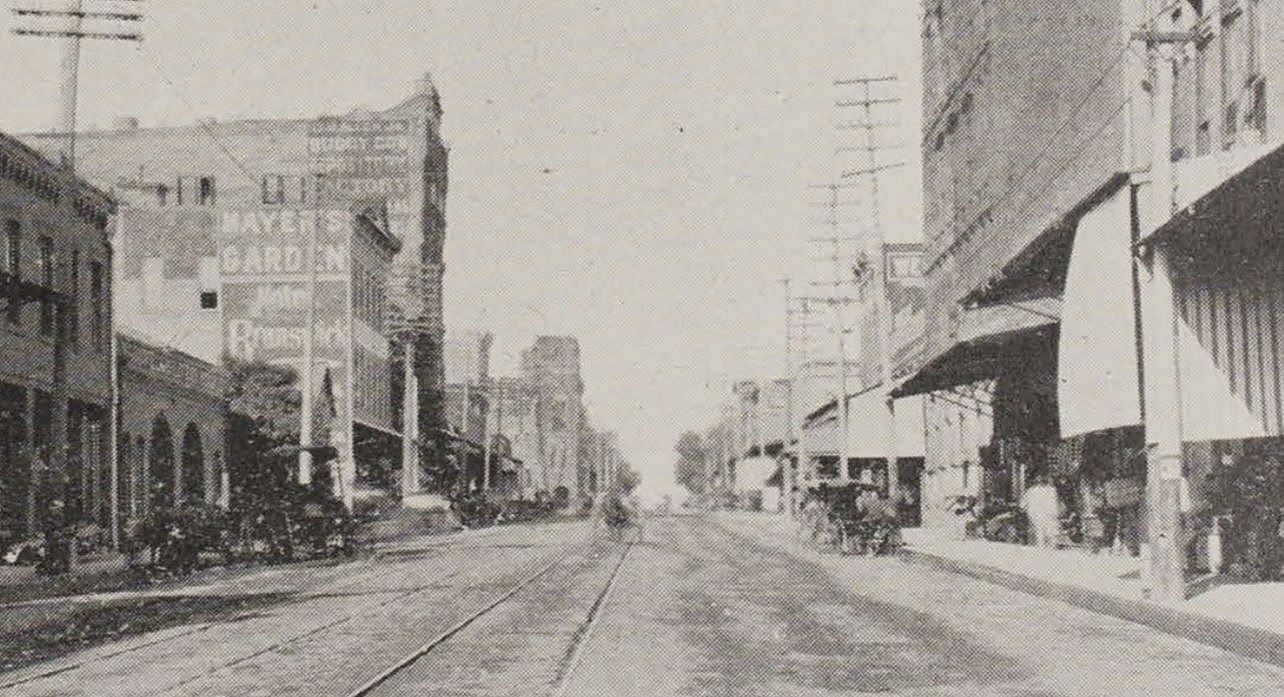
This bar-with-food was located on the south side of Main, steps away from the present location of Neiman Marcus. It was in the block seen in the picture below (it is just out of frame at the bottom right, next door to the Colonial Theater):

Main Street looking east from Akard

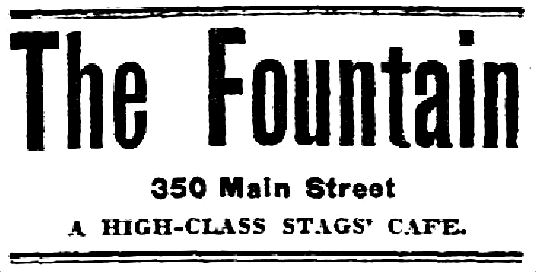
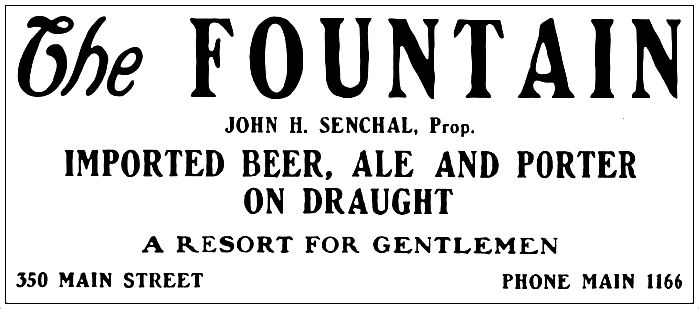
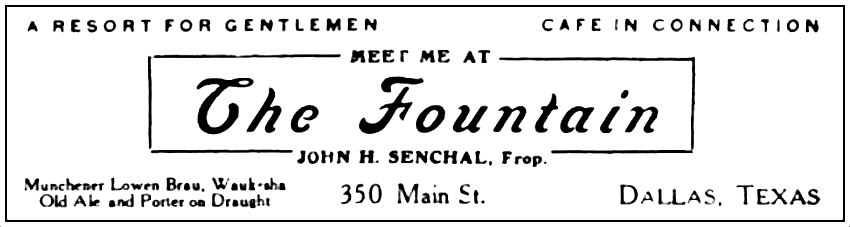
Its address was originally 350 Main — after the city-wide address change in 1911, it became 1518 Main. It appears to have opened in 1907 and was in business until at least 1918 (after Dallas voted to go “dry,” the former saloon became The Fountain Cafe). Here are a few early ads for the “High-Class Stags’ Cafe” in its early go-go “gentlemen’s resort” days: 

Dallas Morning News, Oct. 1907

Dallas directory, 1909

Dallas Police annual, 1910

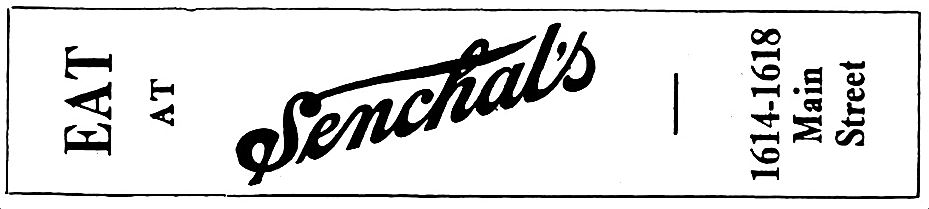
A few years later, the owner, John Henry Senchal, opened Senchal’s Buffet and Senchal’s Restaurant and Rathskeller at 1614-1618 Main.

Dallas directory, 1915

*

Johnnie Senchal — born in Galveston in 1875 to a French father and American mother — appears to have been a popular, civic-minded man’s-man. He frequently traveled with Dallas businessmen to other cities and states to act as a booster for the city. He also indulged in sporty activities such as being a regular wrestling referee and sponsoring horse races at the State Fair of Texas (in 1914 a $2,000 “Fountain Purse” was offered — in today’s money, more than $56,000!). One 1915 newspaper report said he was “probably the best known saloon man in the city.” He was very successful and was not hurting for money.

He also seems to have had a cozy relationship with members of the Dallas police department — a situation which is probably commonplace between saloon-owners and cops. One news story described how he had leapt to the defense of a policeman who was waylaid by a large group of men while he was walking prisoners to jail — a huge brawl broke out, and Senchal and the cop emerged victorious. Also — in a story which wasn’t fully explained — Senchal and another man ponied up $5,000 in bond money ($140,000 in today’s money!) for a Dallas policeman who was charged in the fatal shooting of a 17-year-old, Those are some strong ties between a saloonkeeper and the local constabulary, man.

In 1912 there was another confusing story concerning a man who had been arrested and convicted for being the owner/lessee/tenant of an establishment which was “knowingly permitted to be used as a place in which prostitutes resorted and resided for the purpose of plying their vocation. […] The house was a ‘disorderly house.’ Prostitutes resorted there and displayed themselves in almost a nude condition.” The man who was charged was seen there on a number of occasions “dancing with the prostitutes.” The man appealed his conviction because he had been charged with being the owner/lessee/tenant of this “bawdy house” — but the lessee/tenant was none other than Johnnie Senchal and another man. As far as I can tell, Senchal was not charged with anything regarding this case. 

But a couple of years later, in 1914, he was charged with running a “disorderly house” (a term often meaning a bordello or gambling den, but also meaning a place which is frequently the site of disturbances and is generally considered to be a public nuisance). It seems Johnnie and other were offering “cabaret” entertainment which might gotten out of hand. From The Dallas Morning News:

Alleging that the cabarets are conducted as “disorderly houses,” [charges were filed] on behalf of the State of Texas against owners of three restaurants in the downtown section. Affidavits accompanying the petitions alleged that women were allowed to drink at the places and to act in an unbecoming manner. (DMN, March 12, 1915)

I’m not sure exactly what constituted “an unbecoming manner,” but Johnnie Senchal was one of the men charged. At the very same time he was fighting this violation of the cabaret ordinance, it was reported that “an involuntary petition in bankruptcy has been filed in the United States court here against John Senchal and J. O. Walker, partners in the saloon business on Main Street. The petition was filed by local brewery agents and whisky houses” (DMN, June 20, 1915). Bankrupt! Even though he was apparently rolling in dough for years, he was rather ironically pushed to bankruptcy because he couldn’t pay his own bar tab.

And so Johnnie put the barkeeper’s life behind him. And I mean he REALLY put it behind him: he became a fervent speaker at Anti-Saloon League events, saying that having been forced out of the saloon game was actually a godsend — he was quoted as saying that his profits increased 75-80% when he stopped selling alcohol and became a full-time restaurateur. That seems unlikely, but that’s where he was in 1918, an improbable evangelist for Prohibition. 

Soon after, he and his family moved to Houston, where he opened a small cafe. On Oct. 9, 1929, after closing-time, Johnnie Senchal died in his cafe from a self-inflicted gunshot wound. He was 54 years old.

***

Sources & Notes

Postcard of The Fountain found on eBay.

Postcard of Main Street found on Flickr.

*

Copyright © 2022 Paula Bosse. All Rights Reserved.

S. Mayer’s Summer Garden, Est. 1881

mayers-garden_DPL_1885Roll out the barrel… (collection Dallas Public Library)

by Paula Bosse

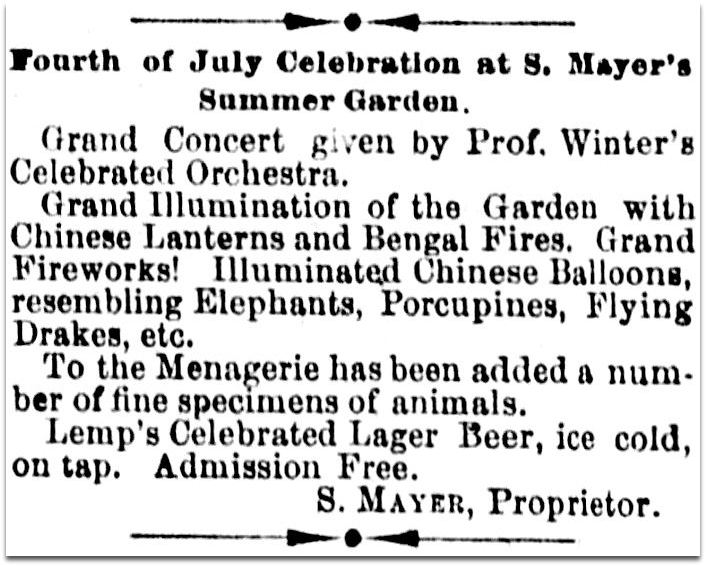
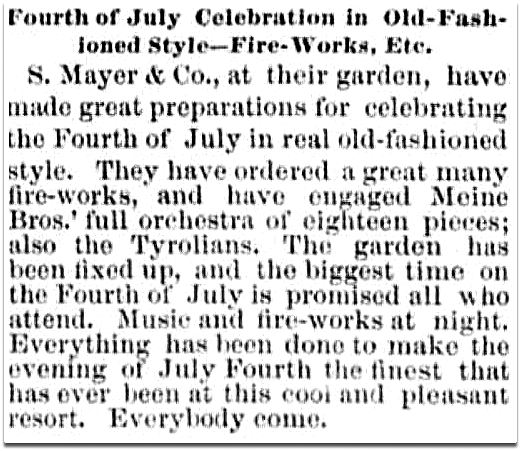
Today is the 4th of July. I had these two articles stuffed into bulging digital files:

4th-july_mayers_dallas-herald_070482
Dallas Herald, July 4, 1882

4th-of-july_dallas-herald_070384_mayer-gardensDallas Herald, July 3, 1884

I had seen the photo of Mayer’s beer garden posted above, but I didn’t really know anything about it.

Simon Mayer (1843-1924) was born in Germany/Prussia and came to the United States in 1866, first settling in Milwaukee. He came to Texas in 1869 where, as his obituary in The Dallas Morning News says, “he owned and operated the first brewery established in Fort Worth.” He moved to Dallas in 1871 and entered into business with pioneer Dallas brewer Charles Meisterhans. 

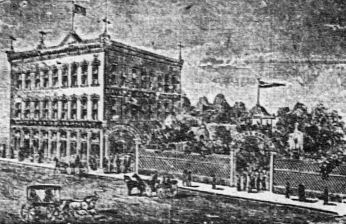
In December, 1881 he opened what would become one of Dallas’ foremost gathering places, Mayer’s Summer Garden. He built a 3-story-plus-basement building (at what would later be 1601-1603 Elm Street) and added a charming outdoor beer garden. It stood on the north side of Elm and looked directly down Stone Street (now Stone Plaza) toward Main. You can see it on an 1885 Sanborn map here.

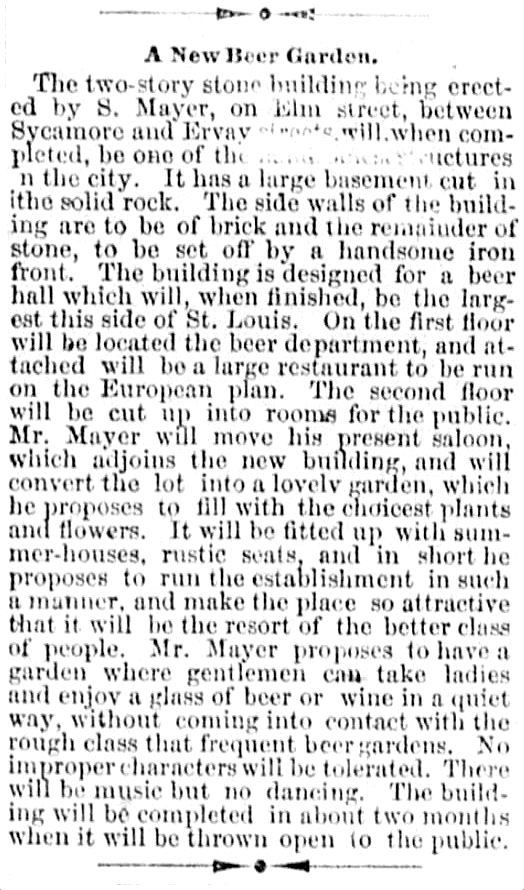
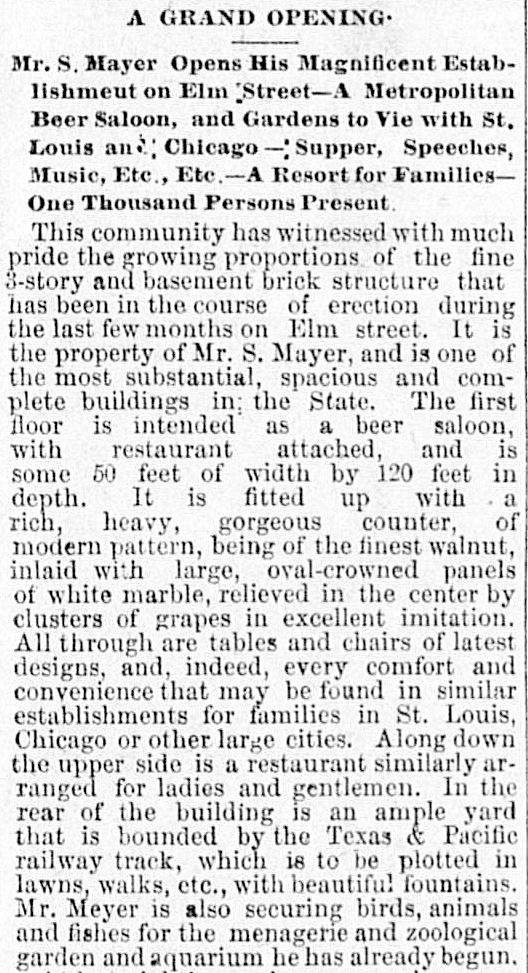
A 3-story building in Dallas in 1881 was nothing to sneeze at. He was putting a lot of money into it, and people were interested in its progress. The opening was touted in the paper for several months (click articles to see larger images):

mayers_dallas-herald_090181_constructionDallas Herald, Sept. 1, 1881

From the above article: “Mr. Mayer proposes to have a garden where gentlemen can take ladies and enjoy a glass of beer or wine in a quiet way, without coming into contact with the rough class that frequent beer gardens. No improper characters will be tolerated. There will be music but no dancing.”

mayers_dallas-herald_120981_to-openDallas Herald, Dec. 1, 1881

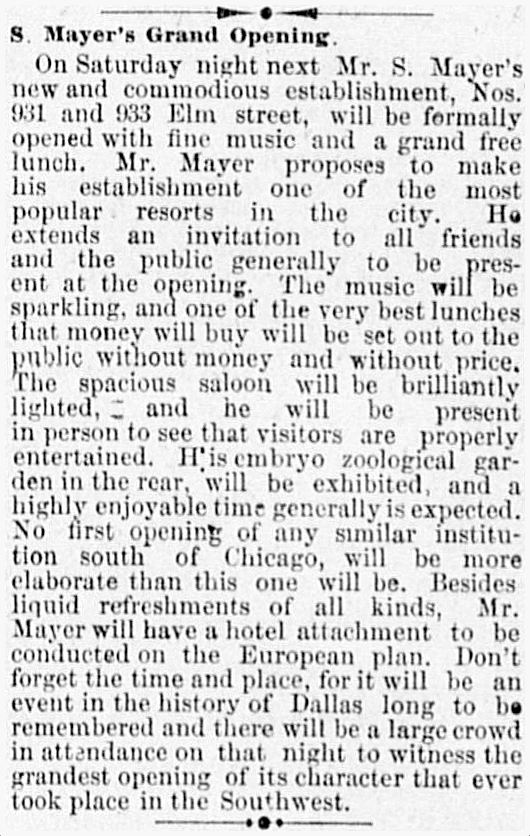
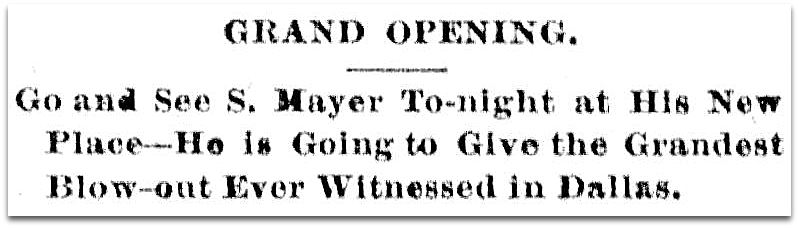
Finally. the opening was about to happen: “the grandest blow-out ever witnessed in Dallas” was promised (who knew “blow-out” was a term used in 1881?):

mayers_dallas-herald_121081_to-open_blow-outDallas Herald, Dec. 10, 1881

Over a thousand curious and thirsty Dallasites turned out.

mayers_dallas-herald_121181_grand-openingDallas Herald, Dec. 11, 1881

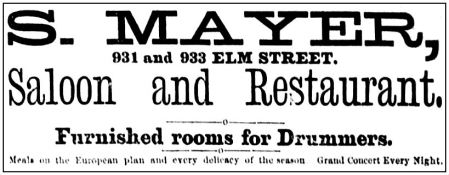
mayer_dallas-herald_121381_adDallas Herald, Dec. 13, 1881

(Don’t know what “drummers” are? Check it out.)

You might have noticed mention of zoological specimens. Yes, not only did this establishment offer a beer garden, a meeting hall, a hotel, a restaurant, a saloon, a performance space, and a lecture hall, it also had lots of animals in (and out of) cages — Dallas’ first zoo. He had alligators, birds, lions, eagles, prairie dogs, a Gila monster, a bear, and a pet crow. And a lot more. The bear escaped at least once — it wandered down the street and bit a guy who was making a commotion about a bear wandering down the street. But the bear was fairly easily recaptured and was waltzed back home along Elm Street without further incident. (Apparently, Mayer was a taxidermist by trade. One wonders how many of these creatures ended up stuffed and mounted and displayed in Herr Mayer’s home.)
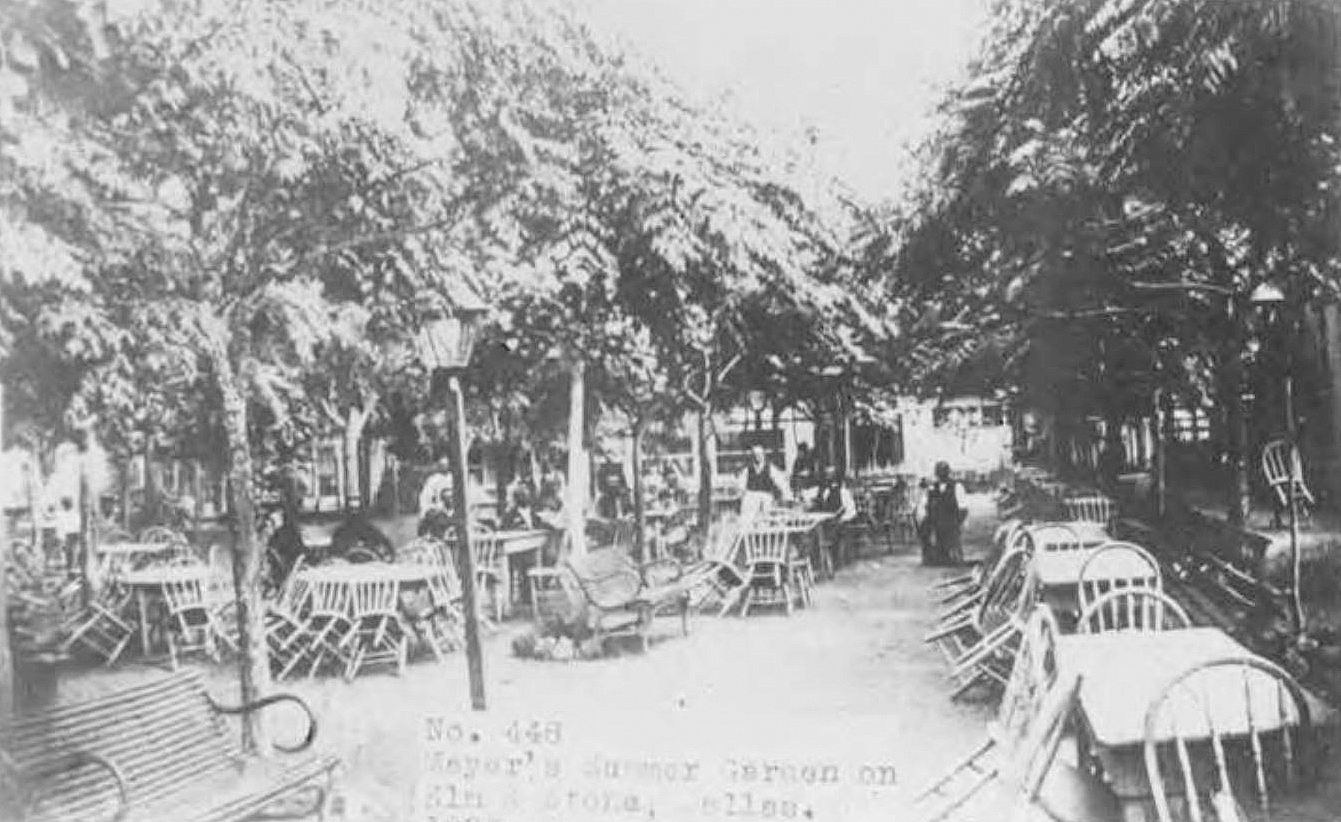
People flocked to the Summer Garden. They loved the outdoor beer garden with its trees and fountains and performing bands. …And alligators. Below is a, sadly, washed-out circa-1885 image of Mayer’s garden. It actually seems fairly cosmopolitan for a Texas city in the 19th century. (Although, on the other side of the trees at the right was a livery stable and a wagon yard, so I would assume the jovial tippling, socializing, and oom-pah music was accompanied by unpleasant smells that were hard to ignore.)

mayers-summer-garden_1885_degolyer-library_SMUMayer’s Garden, circa 1885 (via DeGolyer Library, SMU)

Mayer’s was one of the first businesses in Dallas (or, according to lore, THE first) to have electric lights — lights were switched on to great fanfare in August of 1882. Before that, Mayer utilized an interesting lighting technique I had never heard about: “Mr. Mayer had the latest thing in kerosene lamps. An attachment to the lamp sprayed kerosene on the blaze, making it much brighter” (Dallas Morning News, Sept. 14, 1924). (Perhaps the bear had escaped in fear for his life!)

mayers-garden_clifton-church_1894_degolyer-library_SMU_detca. 1894 (via DeGolyer Library, SMU)

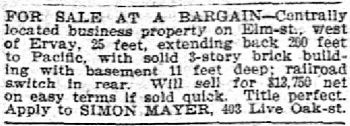
Mayer eventually closed his very popular business sometime in the 1890s after being unable to fight the “Sunday-closing” laws which forced him to close on his most profitable day of the week. By 1901, he placed the ad below and was selling the building.

mayers_dmn_112401_property-for-saleNov. 24, 1901

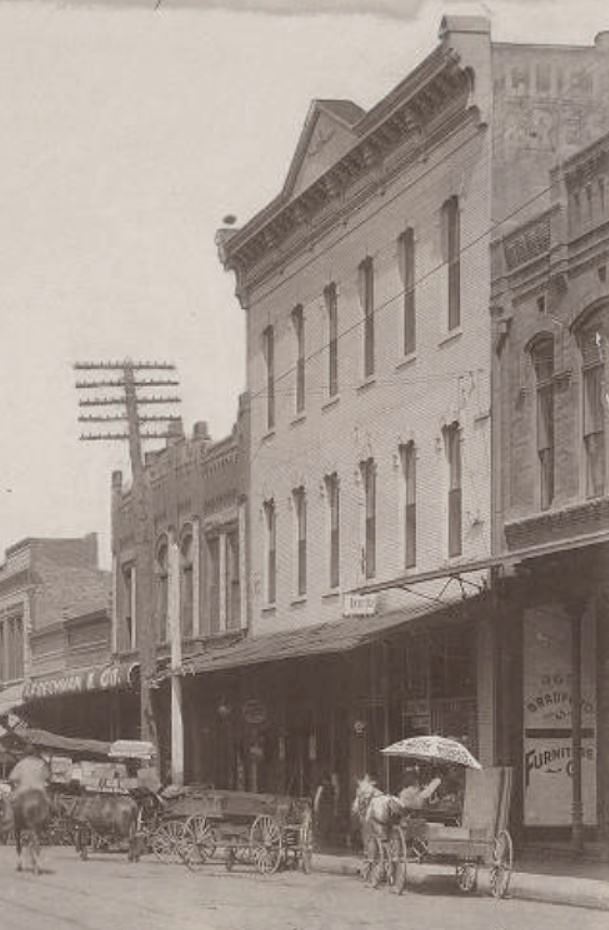
I’m not sure when the building was demolished — probably in the ’20s or ’30s. I just found a photo of the building as it looked about the time Mayer sold it (it was the Clifton Hotel for a while).

mayers_clifton-hotel_ca-1900_cook-coll_degolyer-library_SMU_cropped
No more garden, ca. 1900 (via DeGolyer Library, SMU)

The beer-garden era had ended. There were several in Dallas in the 1880s and 1890s, but Simon Mayer’s was perhaps the creme-de-la-creme. I mean, he had an eagle!

mayers-garden_icollector-comvia iCollector

mayers-garden_token_ebayvia eBay

mayers-garden_dmn_091424

***

Sources & Notes

Top photo — “[Mayer’s Beer Garden, Dallas, Texas”] — is from the Dallas Public Library (Call Number PA87-1/19-27-1).

The photo of the “garden” is titled “Mayer’s Summer Garden on Elm and Stone, 1885,” and it is from the Collection of Dallas Morning News negatives and copy photographs, DeGolyer Library, Southern Methodist University — more info can be found here. (There is another photo of the garden in this collection — it’s really hard to make out clearly, but I swear I see an alligator int he foreground. And maybe some other zoological specimens out of their cages. …Or not. It’s here.)

The photo showing Mayer’s around 1894 has been cropped from the original Clifton Church photograph, which appeared in his book Dallas, Texas Through a Camera (DeGolyer Library, SMU) — the full photo can be seen in the fully scanned book here.

The photo showing Mayer’s building in about 1900 has been cropped from “[Elm Street between Stone and Ervay Streets].” which is from the George W. Cook Dallas/Texas Image Collection, DeGolyer Library, Southern Methodist University — see the full photo here.

All articles and ads are from The Dallas Herald, editions of which are scanned in their entirety and can be found at the Portal to Texas History, here — thank you, University of North Texas!

A lot of colorful info can be found in Mayer’s obituary in the Dallas Morning News archives: “Simon Mayer, Early Dallas Entertainer — Death of Pioneer Brewer Recalls Pleasure Garden He Founded” (DMN, Sept. 14, 1924).

mayers-garden_DPL_1885_sm

*

Copyright © 2022 Paula Bosse. All Rights Reserved.

Autos, Autos Everywhere, and Not a Place to Park — 1971

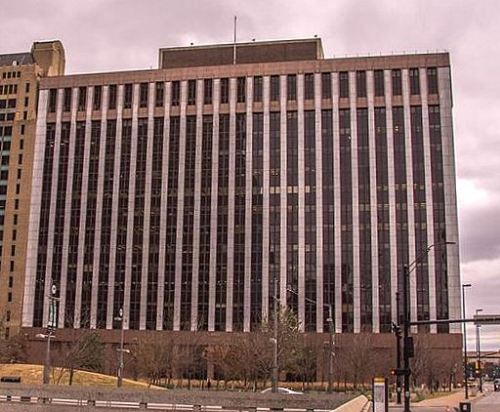
cabell-fed-bldg_flickr_wayne-hsieh
Earle Cabell Federal Bldg. / Wayne Hsieh, Flickr

by Paula Bosse

The other day I was looking for some information on the 1971 opening of the new 16-story Federal Center at 1100 Commerce Street (the name was changed to the Earle Cabell Federal Building in late 1973 to honor the former Dallas mayor and U.S. congressman). I came across the Dallas Morning News article “Center Augments Parking Woes” by Earl Golz (DMN, Jan. 12, 1971) which had a couple of surprising tidbits. The new federal building — which was expected to be occupied by more than 5,000 workers — had a grand total of 59 underground parking spaces. …Fifty-nine. FIVE-NINE. Let that sink in. This was a brand-new building. It’s not like they squeezed those pitifully few parking spaces under an existing building. This was in the plans. That’s a lot of car-pooling.

Three years earlier, in 1968, One Main Place opened at 1201 Main — it was more than twice as big as the Federal Building. When it opened, it was noted that there were 800 underground spaces (with a planned-but-never-realized massive underground parking garage for 4,000 cars, to go along with the never-realized Two Main Place and Three Main Place complex). But, somehow, by 1971, One Main Place’s parking had decreased to a mere 400 spaces, all of which were completely filled daily. I have images of panicky office workers constantly circling blocks in search of a place to park. Stories were rampant that parking-lot attendants were reserving weekly and monthly spaces in pay lots for exorbitant under-the-table cash transactions. 

How did this happen? Who would design such large modern buildings with such woefully inadequate parking? Were “interested parties” strong-arming architects or city planners to skimp on the parking? Is there such a thing as a big “parking-lot lobby”? (What am I saying? I’m sure there is.) Ever wonder why Dallas kept tearing buildings down in the early ’70s and replacing them with pay parking lots? I’m sure there were many reasons, but I saw more than one newspaper mention that parking lots (not garages, mind you — just lots) could be more profitable than aging buildings. It’s always seemed odd to me that there were (are) so many surface parking lots downtown, rather than multi-story garages. Imagine how much more money parking lot operators would be making with garages. Not that multi-story garages are in any way more desirable, aesthetically, but why didn’t land developers build garages which could accommodate so many more paying customers than these puny little lots? Some lot operators insisted that it benefitted everyone to have these lots — insisting that the buildings which once stood on the land were old and ugly eyesores which needed to be torn down, and that these lots were basically just placeholders until a fat-cat developer forked over multi-millions to build something tall and beautiful on it.

Was the lack of underground spaces in these two new buildings intentional? This would have been a weird way to force people to use public transportation. It might even have been a bit of strain on public transportation — the Dallas Transit System was already losing the fight against car-culture and downtown workers who lived in suburbia.

In the early ’70s, Dallas and Fort Worth were both experiencing a severe lack of downtown parking. In 1970 there had been a major excavation to build underground parking below the Old Red Courthouse — it was probably helpful, but it was just a band-aid on a much bigger problem.

A few of the city’s proposals to deal with these parking woes:

  • Dissuade people from bringing their cars downtown by significantly raising fees for parking lots and parking meters and to cut the time limit for parking (quickly approved by the City Council)
  • Build satellite lots outside the Central Business District where people could park and then bus into town (“Park and Ride” stations began, shakily, in 1973)
  • Investigate the use of “people-movers” in varying degrees of sci-fi futurism

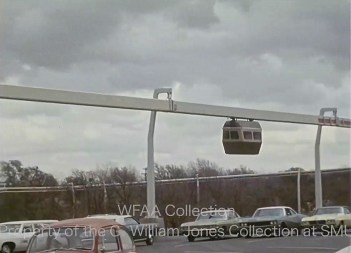
As far as “people-movers,” there were several automated transportation systems on drawing boards around the country at the time, a couple of which were being developed in the Dallas-Fort Worth area. There was the electrically powered monorail-like AirTrans — a joint project of Vought Aeronautics of Dallas and Varo Inc. of Garland — and there was the similar but less well-known Sky-Kar of Fort Worth. AirTrans was very successful and was first adopted by DFW Airport, but Sky-Kar seems to have fizzled out after the death of the company’s president in the early ’70s. 

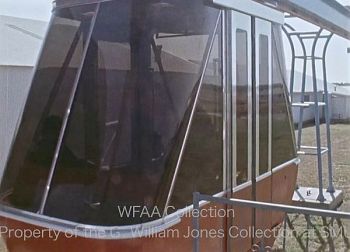
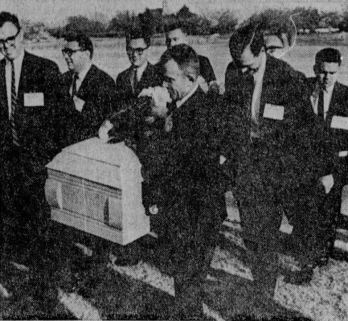
One of Sky-Kar’s salesmen was Paul Groody (he can be seen being interviewed in one of the kars in a WFAA clip from October 1970 here, with additional kar-footage here). Groody (who, in this interview, is a couple of months from full Asimov muttonchops) had, in the previous decade, gained some national notoriety as the funeral director who had been given the task of driving from Fort Worth to Dallas to pick up the body of Lee Harvey Oswald and “prepare” him for burial — because there were no pallbearers, he had to scrounge for volunteers among the reporters covering the interment. Because I may have no other opportunity to post this, below is the cute and compact Sky-Kar Transivator prototype from 1970. …Sky-Kar, we hardly knew ye.

sky-kar_wfaa_SMU_oct-1970WFAA Collection, Jones Collection, SMU

Below, Paul Groody, Sky-Kar rep (1970), and Paul Groody, funeral director for Lee Harvey Oswald’s burial (1963) (he is seen partially obscured, all the way at the back right, wearing glasses).

sky-kar_paul-groody_wfaa_SMU_oct-1970WFAA Collection, Jones Collection, SMU

oswald-funeral_FWST_1963
Fort Worth Star-Telegram

Equal time: see the Vought/Varo AirTrans prototype running on its test track in Garland in December 1970 here, along with interviews from company reps here.

airtrans-prototype_garland_wfaa_SMU_dec-1970WFAA Collection, Jones Collection, SMU

Hopes were that these people-mover systems would be used not only in airports but throughout the Central Business District and on sprawling college campuses, etc. Forget the flying cars. I’m waiting for my monorail. (And it’s probably still best to leave your automobile at home if you’re heading downtown.)

***

Sources & Notes

Top photo, “Earle Cabell Federal Building and Courthouse” (2019) by Wayne Hsieh — found on Flickr, here. (I have cropped it.)

Screenshots from Channel 8 news film posted on YouTube, from the WFAA Collection, G. William Jones Film and Video Collection, Hamon Arts Library, Southern Methodist University.

cabell-fed-bldg_flickr_wayne-hsieh_sm

*

Copyright © 2022 Paula Bosse. All Rights Reserved.

Elm & Ervay — Early ’60s

elm-and-ervay_looking-north_squire-haskins_DPLAn impressive collection of architectural styles

by Paula Bosse

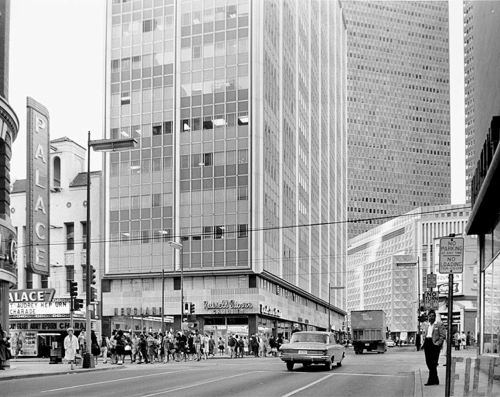
Three shots of N. Ervay. Above, looking north from Elm (Charade is playing at The Palace, dating this photo to late 1963 or early 1964).

A little closer in on the Mayflower Coffee Shop:

elm-and-ervay_looking-north_mayflower-coffee-shop_squire-haskins_1960_DPL

More Mayflower:

elm-ervay-live-oak_looking-north_mayflower-coffee-shop_squire-haskins_1960_DPL

***

Sources & Notes

All photos from the Dallas Public Library Dallas History and Archives Division.

First photo is “[View of Downtown Dallas looking north on North Ervay Street]” by Squire Haskins — Call Number PA2000-3/1404. Second photo is “[View of Downtown Dallas looking north]” by Squire Haskins — Call Number PA2000-3/1401. Third photo is “[View of Downtown Dallas looking north on Ervay Street]” — Call Number PA2000-3/115.

elm-and-ervay_looking-north_squire-haskins_DPL_sm

*

Copyright © 2022 Paula Bosse. All Rights Reserved.

Union Station Interiors — 1916

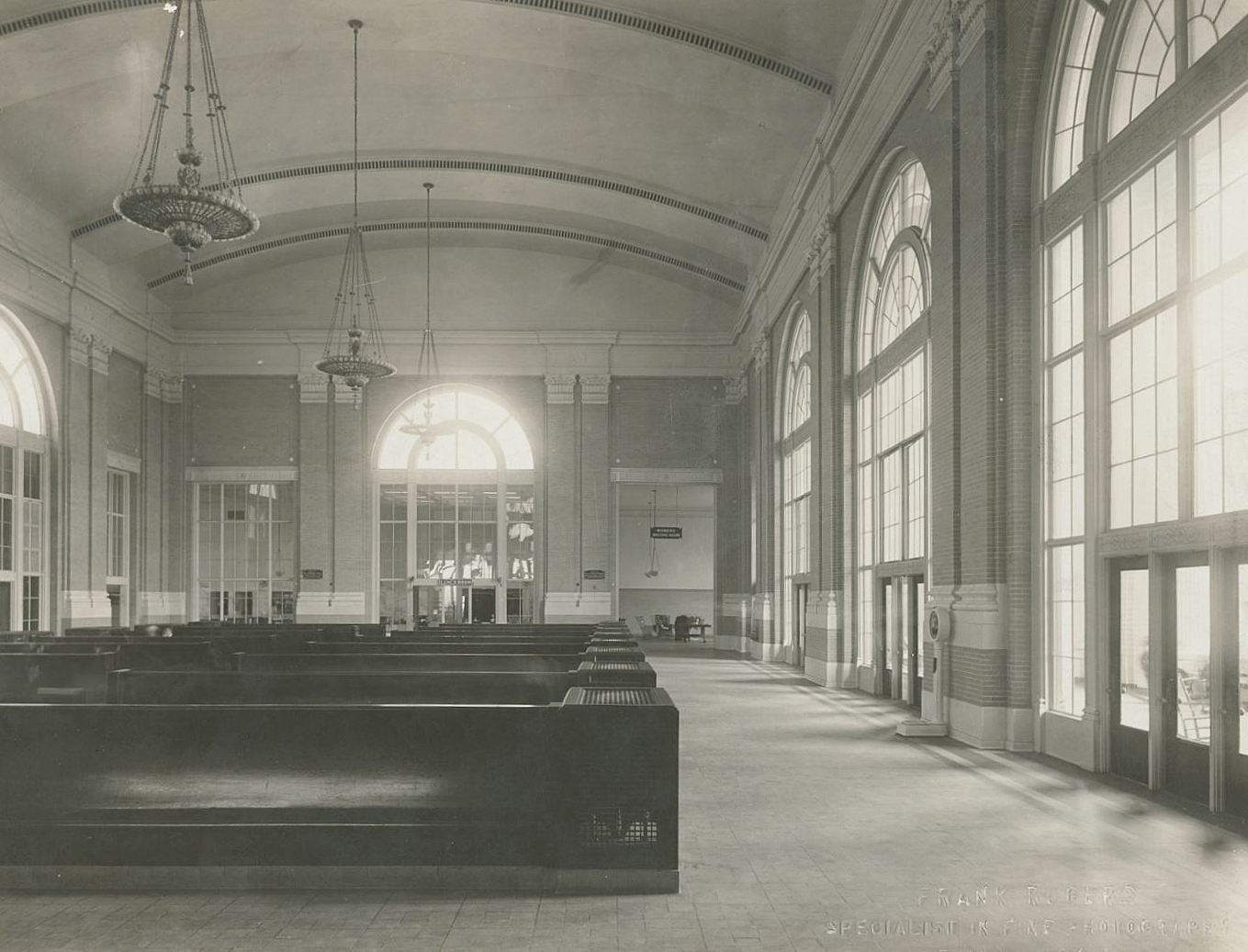
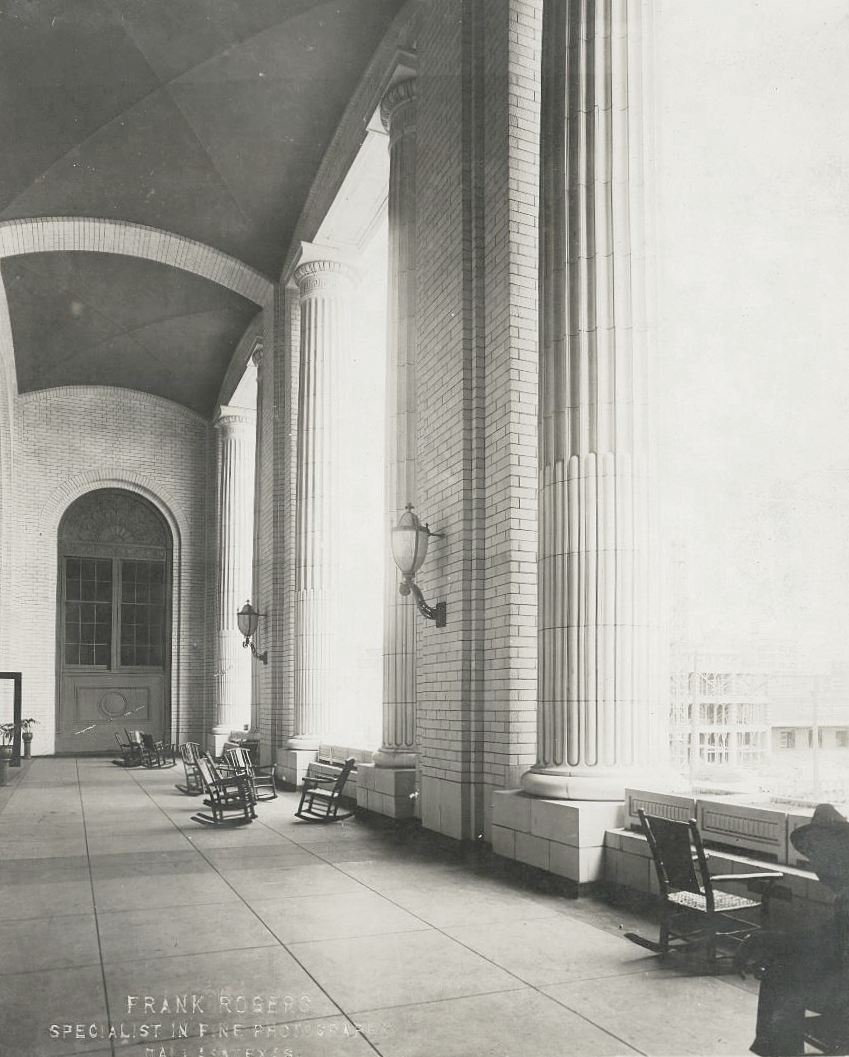
union-station_interior_atlantic-terra-cotta-co-coll_UT_frank-rogersA beautiful place to wait…

by Paula Bosse

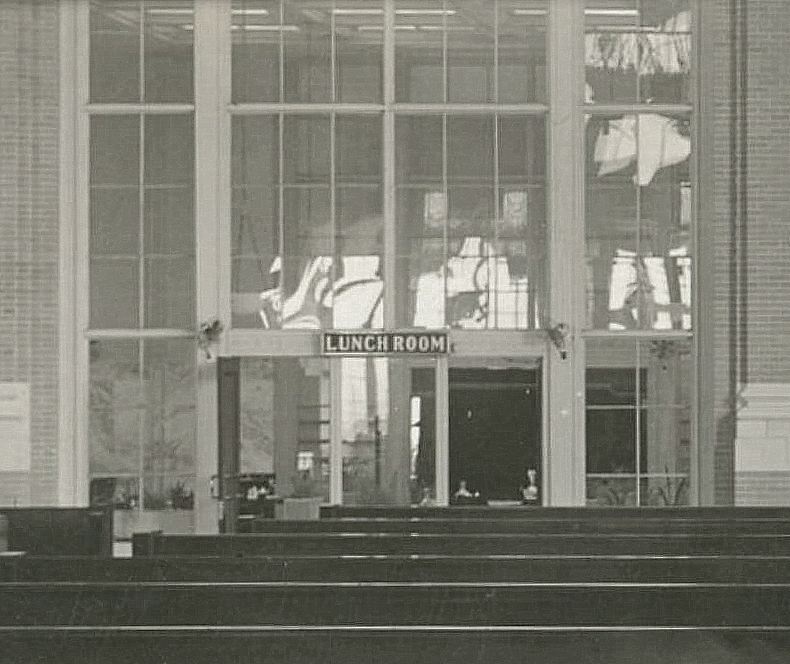
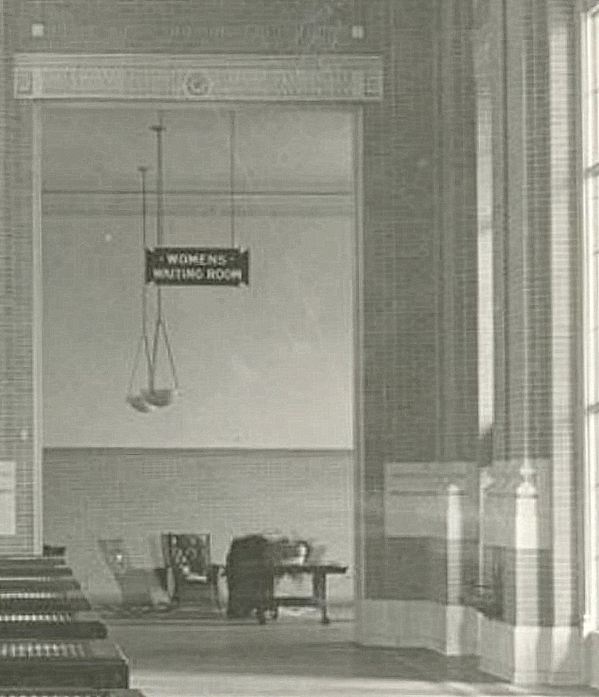
Above, a photo of the new “Union Depot,” completed in 1916 and, thankfully, still standing more than a century later. Below, a couple of details of the Lunch Room and the Women’s Waiting Room.

union-station_interior_atlantic-terra-cotta-co-coll_UT_frank-rogers_lunch-rm

union-station_interior_atlantic-terra-cotta-co-coll_UT_frank-rogers_womens-wtg-rm

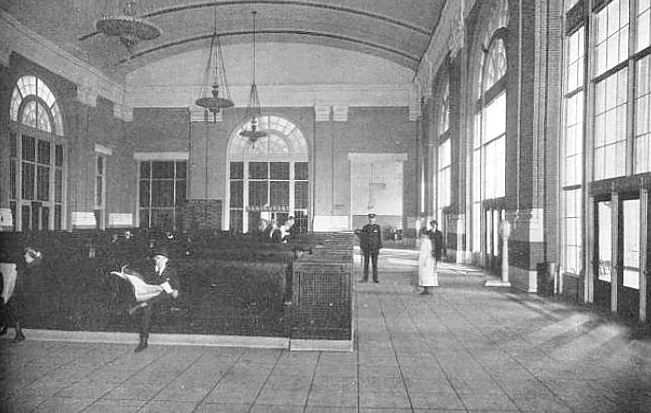
The same view as the top photo, but from 1922:

union-station-interior_1922

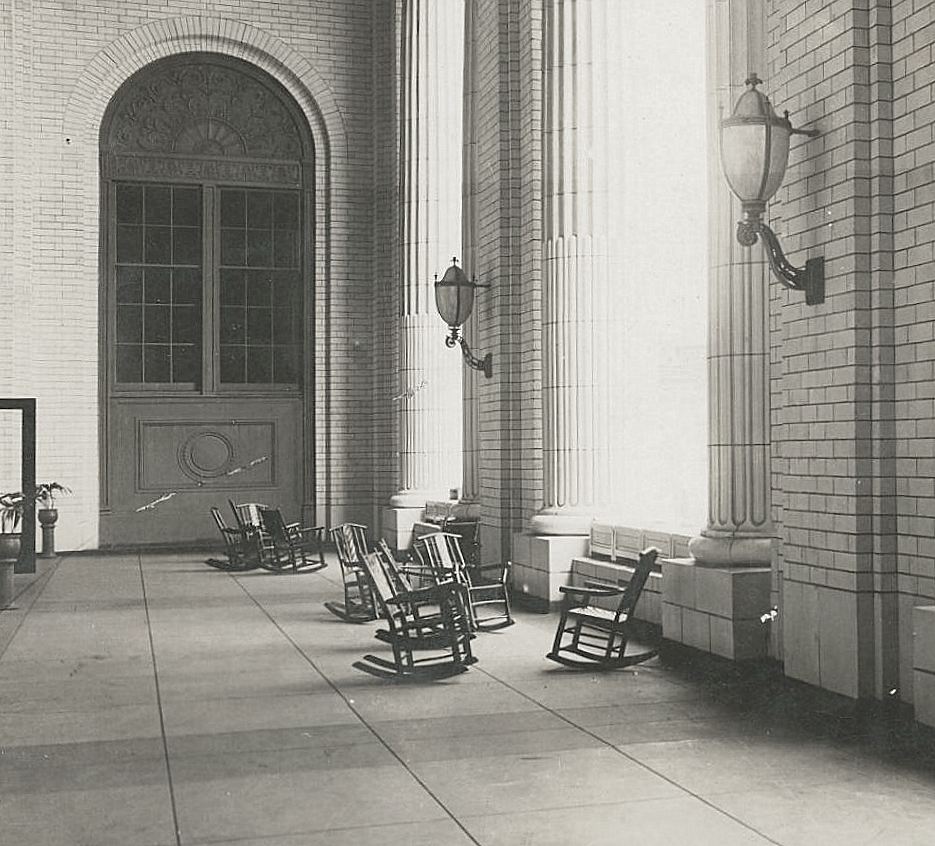
Back to 1916, in what I gather is a sort of interior/exterior shot showing another place to pass the time. What better, quaint way to wait for a train and take in a great, slightly elevated view, than in a rocking chair.

union-station_rocking-chairs_atlantic-terra-cotta-co-coll_UT_frank-rogers

And a slight zoom-in:

union-station_rocking-chairs_atlantic-terra-cotta-co-coll_UT_frank-rogers_det-1

Imagine those rocking chairs up there in those archways, between the columns.

union-station_dallas-city-of-the-hour_ca-1916_SMU

***

Sources & Notes

The two photos from 1916 (by Frank Rogers) are from the Atlantic Terra Cotta Company Architectural records and photographs, 1914-1941, Architectural Terra Cotta, Alexander Architectural Archives, University of Texas Libraries, The University of Texas at Austin — more info on these photos is here and here

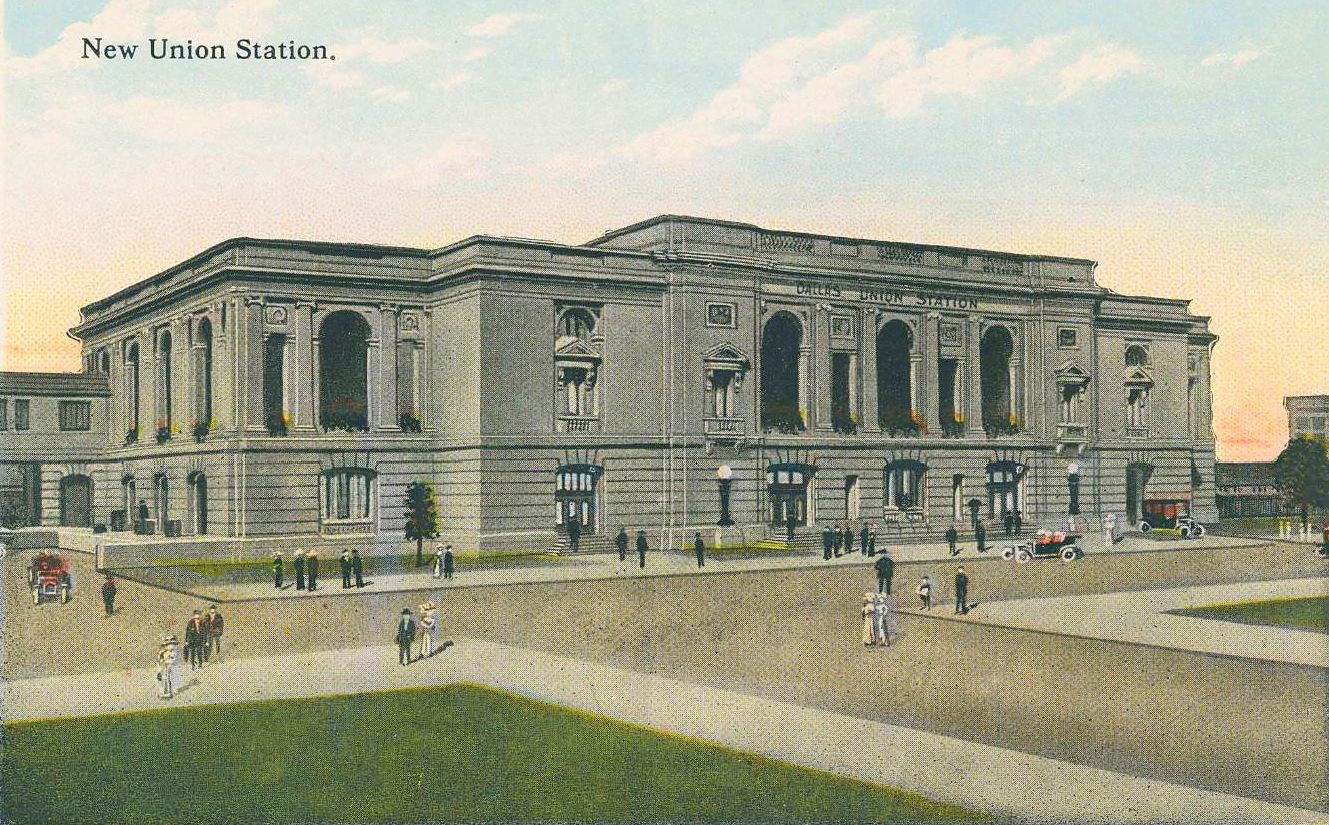
A couple of other images of the new Union Station can be seen in these Flashback Dallas posts:

union-station_interior_atlantic-terra-cotta-co-coll_UT_frank-rogers_sm

*

Copyright © 2022 Paula Bosse. All Rights Reserved.

19th-Century Sign-Painting and Real-Estating

smithson-harris_amer-petroleum-inst_smithsonian
Need signs and/or land?

by Paula Bosse

Above, a photo of Smithson & Harris, makers and painters of signs in the 1890s. The business — owned by Harry M. Smithson and W. H. Harris — was apparently at 209 S. Akard, which has been described as having been on the northeast corner of Akard and Commerce, later the site of the Magnolia Building. That address does not comport with 209 S. Akard as we know it today — that would be in the southwest block of S. Akard — south of Commerce and on the other side of the street. This is a sentence from Smithson’s obituary: 

Mr. Smithson operated a sign-painting and furniture repair shop in a one-story frame building where the Magnolia Building now stands at the northeast corner of Akard and Commerce. — Dallas Morning News, May 1, 1936

Another source repeats the same info. Below is an excerpt from the small booklet Dallas’ First Hundred Years, 1856-1956 by George H. Santerre. I’m guessing Santerre got his info from the very same obit (and perhaps embellished the importance of the two businesses pictured).

In 1895 Dallas’ merchants obtained their large store signs from Smithson & Harris, whose one-story frame establishment […] facing on Akard was located on the northeast corner of Commerce and Akard streets, the present site of Dallas’ Magnolia Building. The real estate offices of Palmer & McKay, through which many of Dallas’ real estate transfers were handled, adjoined the sign-painters location.

As far as that last little nod to Palmer & McKay (John R. Palmer and James C. McKay), I could find their real estate partnership in only one Dallas directory — 1891, when their office was located at 296 Main. I have no 1890 directory to check, but Palmer left a previous place of employment in 1889. “Palmer & McKay” had disappeared from Dallas directories by 1892, so my guess is that the photo is from about 1890.

As far as the address being 209 S. Akard — Dallas has renumbered and renamed so many streets over the years that it’s hard to keep track of everything. 

Dallas’ most prosperous and well-known sign-maker of this period was P. S. Borich. His shop was at 209 Sycamore (the street was later renamed N. Akard). But around 1890, “209 Sycamore” became, weirdly, 108 South Akard — right where the Magnolia Building was built. Borich was at 209 Sycamore/108 S. Akard until about 1900, when most of the individuals mentioned above had moved on to other professions. (You can see the confusing address numbering in the 1885 and 1892 Sanborn maps.)

borich_1889-dallas-directory1889 Dallas directory

So I’m not sure what’s going on in this photo of a building with the address “209.” 19th-century sublet?

(Incidentally, the Borich company eventually morphed into Texlite, the company that made Pegasus, the city’s symbol who lives atop, yes, the Magnolia Building. I wrote about Borich and Texlite in the post “Texlite, Borich, Pegasus.”

“Smithson & Harris” and “Palmer & McKay” were both very short-lived partnerships, lasting only a year or two. Wherever these businesses were located, it’s a cool photo.

***

Sources & Notes

Photo from the American Petroleum Institute Photograph and Film Collection, National Museum of American History, Archives Center; it is accessible via the Smithsonian Institution Online Virtual Archives, here. The back of the photo contains the notations “Magnolia Corner, 1896” and “Credit: Magnolia Petroleum Co.” …So much conflicting information. My head hurts.

Another copy of this photo is in the George A. McAfee photographs collection, DeGolyer Library, SMU Libraries, Southern Methodist University — more information on that copy is here (note: there is even more conflicting info in the description, but it also carries the “circa 1896” date).

I first saw the (cropped) photo in the 1931 Rotunda, the yearbook of SMU, from the collection at the DeGolyer Library, SMU Libraries, Southern Methodist University, here.

smithson-and-harris-signs_mcafee_degolyer_SMU_ca. 1890_sm

*

Copyright © 2022 Paula Bosse. All Rights Reserved.

Eula Wolcott’s Baker Hotel Book Shop & Rental Library, 1926-1942

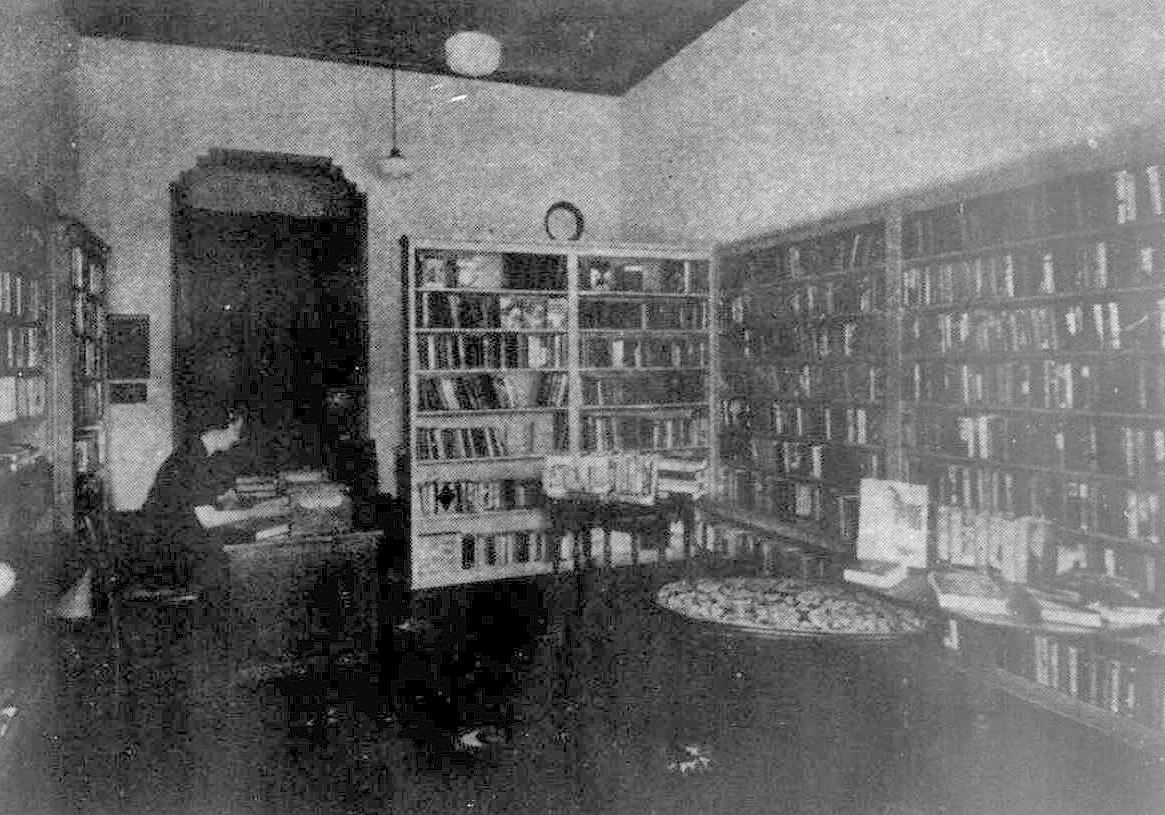
baker-hotel-book-shop_1934Eula Wolcott: bookseller, librarian (Publishers Weekly, 1934)

by Paula Bosse

Today is the birthday of my late father, Dick Bosse, owner of the Aldredge Book Store. I always try to post something bookstore-related on his birthday. This year: Miss Eula Wolcott’s Baker Hotel Book Shop & Rental Library, located inside the Baker Hotel.

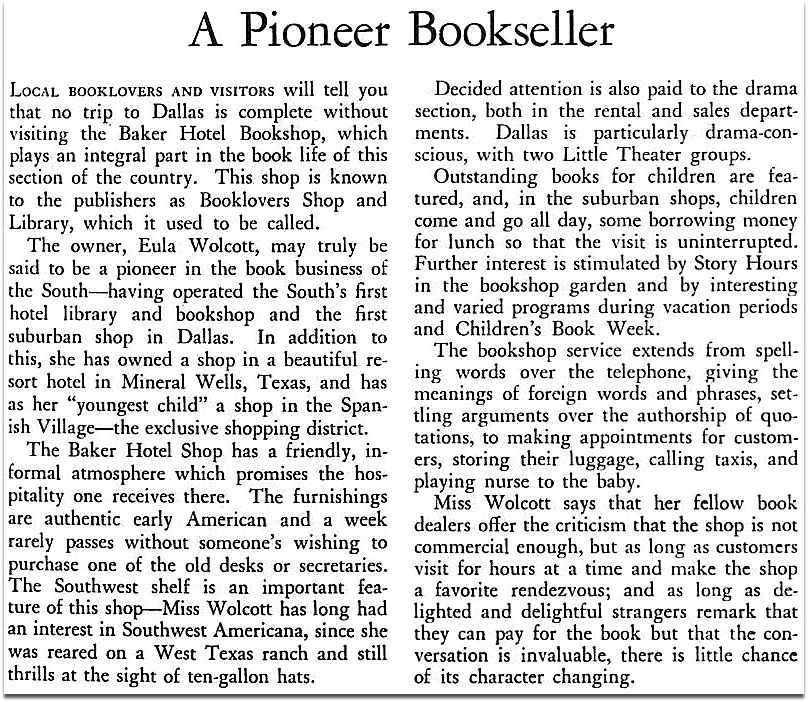
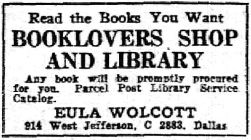
Eula Wolcott (1881-1962) was born in Waxahachie and had moved to Dallas by 1910. She appears to have had theatrical ambitions and studied voice and expression (she was billed as an “Experienced Concert Reader and Story Teller”). She opened a little book store and library in the early 1920s — the Booklovers Shop and Library was first on West Jefferson and later on Swiss Avenue. In 1926, she opened a similar shop inside the glamorous Baker Hotel, an enterprise she ran successfully until at least 1942 when another owner took over (she also apparently had a book shop inside the Baker Hotel in Mineral Wells). In 1931 she opened the rather confusingly-named “Baker Hotel Book Shop and Rental Library” in Highland Park — in the new “Spanish Village” (the original name for Highland Park Village). Below is a very enthusiastic profile from Publishers Weekly (click to see a larger image).

baker-hotel-book-shop_publishers-weekly_032434_eula-wolcott_textPublishers Weekly, March 24, 1934

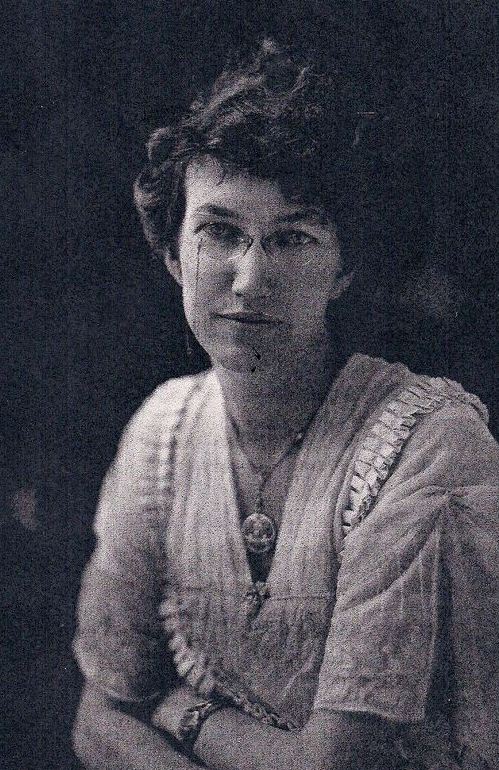
I wish the photo at the top had been better, because I’d love to get a good look at the decor. And Eula. I managed to find a photo of her.

wolcott-eula_ancestryEula Wolcott, via Ancestry.com

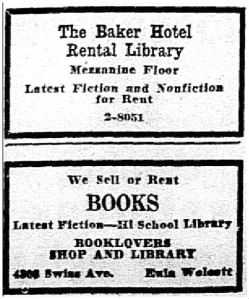
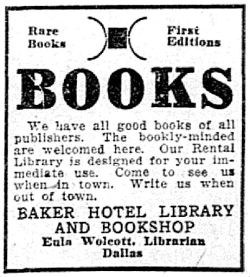
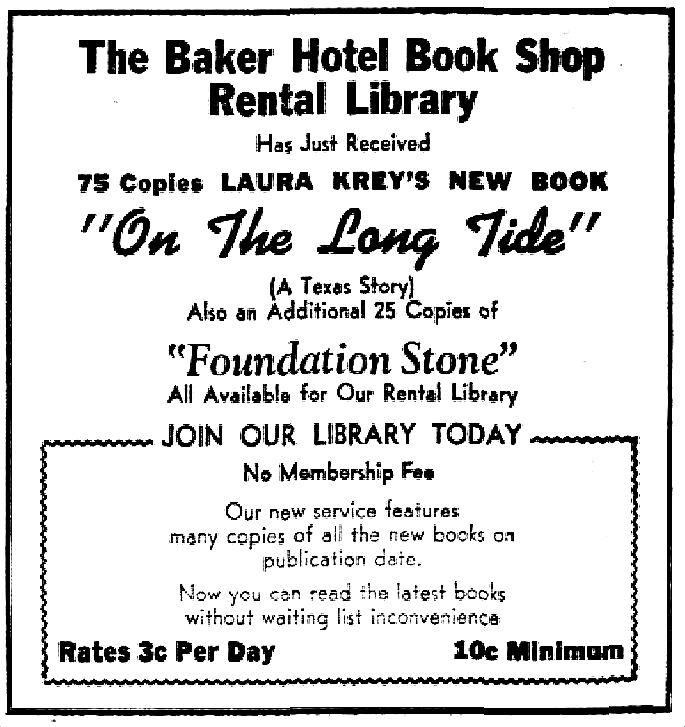
Here are a few ads:

booklovers_0420241924

baker-hotel_book-shop_DMN_oct-24-1926Two shops, one owner — 1926

baker-hotel_book-shop_1009271927

baker-hotel-book-shop_19371937

baker-hotel_book-shop_DMN_oct-25-19401940

She was active as a bookseller for many years and was also a familiar voice to radio listeners who tuned in to hear her book reviews on WFAA. 

One interesting piece of trivia about Eula’s hotel bookshop, shared with me by a former bookstore client of mine: the Baker Hotel Book Shop was the very first American bookstore that British author H. G. Wells ever visited. A lecture tour brought him to Dallas in 1940 — like many of the celebs of the day, he stayed at the Baker. I’m sure Eula was very happy to have Mr. Wells, a literary powerhouse, in her shop. Let’s hope he exhibited proper bookstore etiquette and purchased something!

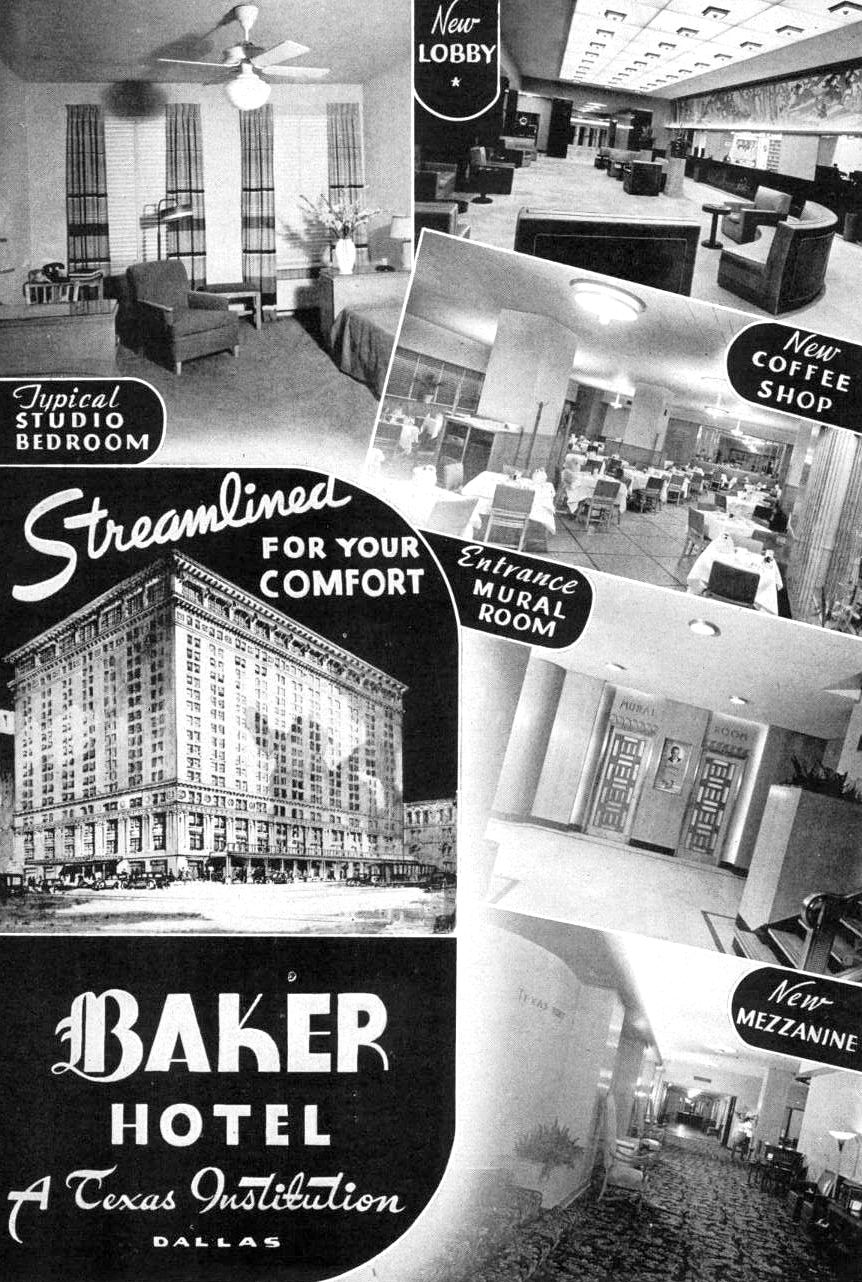
baker-hotel_mural-room_dallas-directory_1942Baker Hotel, circa 1940

***

Sources & Notes

Top photo and article from the trade magazine Publishers Weekly, March 24, 1934.

Read more Flashback Dallas articles on the Dallas bookstore scene here.

baker-hotel-book-shop_1934_sm

*

Copyright © 2022 Paula Bosse. All Rights Reserved.

Betty and Benny Fox, Sky-Dancing in Dallas — ca. 1935

fox-betty-benny_princeton-univ_nd
Betty & Benny, without a care in the world… 

by Paula Bosse

I often just wander aimlessly around the internet, hoping I’ll find something Dallas-related that I haven’t seen before. Last night I found this unusual photo in the Western Americana Collection of Princeton University, described as “View of a Texas city, possibly Dallas.” Okay. It didn’t strike me immediately as a familiar view of Dallas, but you’ve got appearances by Dallas Art Glass Co., Texas Hosiery, and Texas Paper Co. So, yeah. Dallas! I definitely haven’t seen this before. (Scroll down for the specifics of the location.)

Once I determined this was, in fact, Dallas, I tried to figure out what was happening — who (and why?!) were those two people waving from a tiny platform on top of a tall pole? I first thought “flagpole-sitting,” the weird fad of the 1920s which makes me uncomfortably acrophobic just thinking about it. But it was two people on a pole. Standing. Waving. I just kept looking at it, wondering how they got up there. And how were they going to get down (without plummeting)? Why were they there? Were they a couple? Were there husband-and-wife pole-sitters/-standers/-dancers/-wavers? So many questions.

My first hint was in a December, 1931 story in The Dallas Morning News about a young woman who seemed to have some name-recognition named Betty Fox who was, at the time of the article, perched atop a pole in Greenville, Texas, attempting to test her endurance and remain there for 100 hours. As one does. (When in Greenville….) So I searched for newspaper articles about “Betty Fox.” She was, indeed, a star in the pole-sitting world, entertaining large crowds and making personal appearances all around the country. Then I noticed that there seemed to be more than one “Betty Fox” out there. Hmm. And I had noticed that there had been a pole-sitter named Ben Fox who was a fairly serious flagpole-sitting champ. That was kind of a weird coincidence. Or was it? And then I found the article “Sky Dancers Betty and Benny Fox,” which helpfully explained that Benny and Betty were daredevil aerial dancers. They were originally billed as brother and sister, but as the article says, “they were not related. And Betty was not always the same person, nor was she actually named Betty.”

They traveled from city to city where they drew large crowds who watched them perform high in the sky on a tiny circular disc 24 inches in diameter (it later shrank to 18 inches in diameter). Their acrobatic “sky dance” (AKA “The Dance of Death”) apparently lasted for several hours. (There was an article I read from 1931 about “Betty” and a heretofore unknown other “sibling” named “Babe” Fox who defied a judge’s injunction to prohibit the two from engaging in a 100-hour marathon-dance stunt on a 35-inch platform, 50 feet in the air in cold, wet, and windy Texarkana. Seems like a bad idea, but, apparently, they didn’t die. (…Or maybe they did and just got a new “Betty” and “Babe” and carried on to the next gig.)

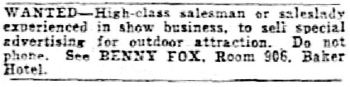
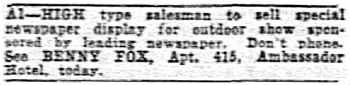
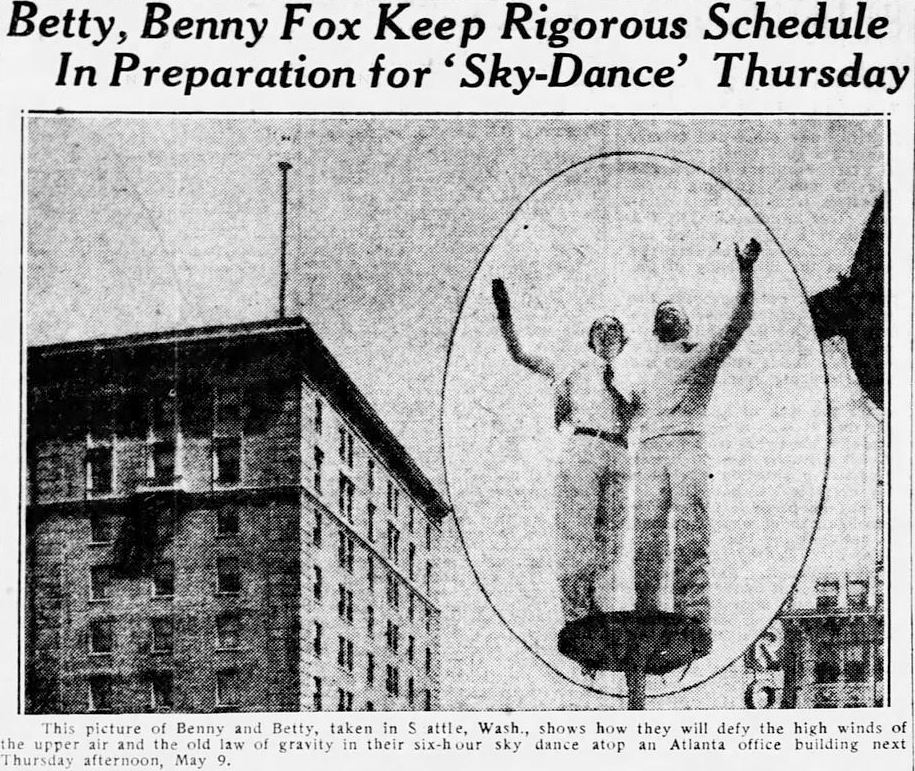
Princeton University estimated the date of the photo to be around 1930. I think it might have been 1935. The two classified ads below in which Benny seeks Dallas promoters for their local event, were from the end of 1935. (The event was sponsored by a Dallas newspaper — it obviously wasn’t the DMN, because there was no story about the Foxes in their pages.) The newspaper photo below the ads shows the then-current version of Betty and Benny, and they look like the couple in the Princeton photo. 

fox-benny_dmn_112735Dallas Morning News, Nov. 27, 1935

fox-benny_dmn_120735DMN, Dec. 7, 1935

fox_atlanta-constitution_050335Atlanta Constitution, May 3, 1935

Yes, that caption says they performed for SIX HOURS.

I’m not sure how long “Betty and Benny” lasted, but they were back in Dallas in 1957 performing at a week-long carnival in Wynnewood Shopping Center. I bet there were more “Bettys” than “Perunas.”

Here’s some newsreel footage of one of the Betty and Benny incarnations, doing their thing in Chicago. (Seriously, if you’ve got even a hint of a fear of heights, look away!!!)

*

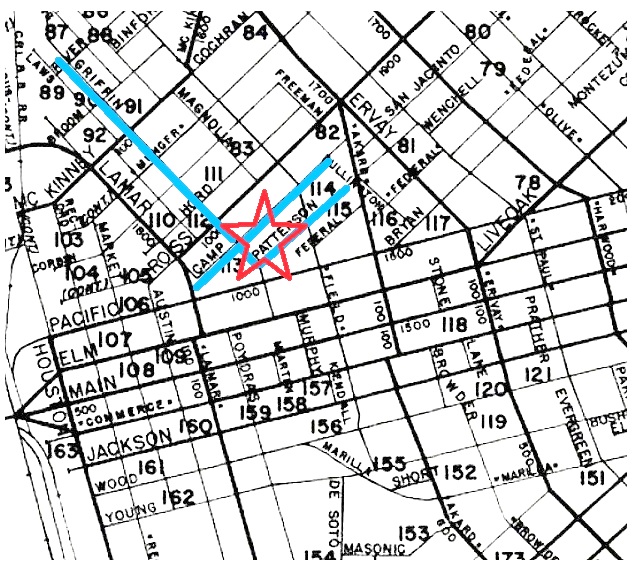
So where was that photo at the top taken? I’m estimating the camera was on the top of a building at, roughly, Griffin and Pacific, looking in a northerly direction. At the top right, the tall building farthest away is the First Methodist Episcopal Church (now First United Methodist) at Ross and Harwood. It’s hard to see any streets, but the two running diagonally are Camp and Patterson. A few addresses of businesses seen in the photo:

  • Dallas Art Glass Co.: 1408 Camp
  • Steger Transfer Co.: 1305 Camp
  • Texas Hosiery: 1200 Camp/1201 Patterson
  • Texas Paper Co.: 1200 Patterson, extending to Pacific

A 1921 Sanborn map is here. A detail from a 1952 Mapsco is below.

fox_mapsco_1952_camp-patterson-griffin1952 Mapsco (det)

*

I’m not sure why Princeton has this photo in their collection, but I really enjoyed reading about Benny and his “Bettys.”

***

Sources & Notes

Top photo — “View of a Texas city, possibly Dallas” — is from the Western Americana Collection, Princeton University Library Special Collections; more information on this photo can be found on the Princeton website here.

See several “action” photos of Benny and Betty from GettyImages here.

Read the very entertaining “Sky Dancers Betty and Benny Fox” by Alan E. Hunter, here.

Another story I wrote concerning an “endurance” stunt (which, like this one, also makes me feel a little panicky) is “Buried Alive at the Fair Park Midway — 1946.” 

fox-betty-benny_princeton-univ_nd_det

*

Copyright © 2022 Paula Bosse. All Rights Reserved.

Bud Biggs: 12 Watercolors of Dallas — ca. 1955

1-1956-january_dallas-mag_bud-biggs“Aerial View of Downtown Dallas” by Bud Biggs

by Paula Bosse

Back in 2018 I posted Christmas-themed magazine cover art by Dallas artist/illustrator Bud Biggs — it was one of my favorite images posted that year (see the post here). I knew that it had been one of the 12 monthly covers by Biggs used in 1956 for Dallas magazine, the Dallas Chamber of Commerce publication. Since then, I’ve managed to turn up all 12 watercolors. Some of them are going to look a little wonky with unfortunate glare patches — this is because I was unable to photograph them lying flat. I’ve done my best! I’ve paired them with the titles which were printed in the Dallas Morning News — I hope I’ve gotten the right titles with the right paintings. 

*

Above, “Aerial View of Downtown Dallas” by Bud Biggs (this painting appeared on the cover of the January, 1956 issue of Dallas magazine).

*

Below, “The Katy Round House” by Bud Biggs (February, 1956 cover)

2-1956-february_dallas-mag_bud-biggs

*

“Looking Up Pacific” by Bud Biggs (March, 1956 cover)

3-1956-march_dallas-mag_bud-biggs

*

“Ervay Street” by Bud Biggs (April, 1956 cover)

4-1956-april_dallas-mag_bud-biggs

*

“Ground-breaking, Dallas University” by Bud Biggs (May, 1956 cover)

5-1956-may_dallas-mag_bud-biggs

*

“Commerce Street” by Bud Biggs (June, 1956 cover) 

6-1956-june_dallas-mag_bud-biggs

*

“SMU Legal Center” by Bud Biggs (July, 1956 cover)

7-1956-july_dallas-mag_bud-biggs

*

“Central Expressway” by Bud Biggs (August, 1956 cover)

8-1956-august_dallas-mag_bud-biggs

*

Midway, State Fair of Texas” by Bud Biggs (September, 1956 cover)

9-1956-september_dallas-mag_bud-biggs

*

“Trinity Industrial District” by Bud Biggs (October, 1956 cover)

10-1956-october_dallas-mag_bud-biggs

*

“City Auditorium” by Bud Biggs (November, 1956 cover) — sadly, I was unable to find this one in color.11-1956-november_dallas-mag_bud-biggs_BW

*

“Main Street, Christmas Night” by Bud Biggs (used for the cover of the December, 1956 issue of Dallas and for the cover of the Christmas, 1959 issue of the Shamrock Oil & Gas publication, The Shamrock)

xmas_bud-biggs_shamrock-mag_1959_texas-tech

**

This series of 12 paintings won the “Best Covers of 1956” award from the American Association of Commerce Publications, and in 1958 all 12 of the original watercolors were purchased by Southwest Airmotive Company to be displayed in their new Love Field terminal. I have no idea where these paintings are today. I love them. 

*

Dallas native Bancroft Putnam “Bud” Biggs (1906-1985) attended Forest Ave. High School, SMU, and the St. Louis School of Fine Arts. He was primarily a commercial artist, working for Dallas artist Guy Cahoon before opening his own advertising studio. He produced fine art as well, specializing in watercolors, and was a respected art instructor. Below is an ad placed in the publication La Fiesta of Art (1957) to coincide with an art show in Highland Park Village. He is seen sitting at an easel. I had never heard of Bud Biggs before that Christmas post in 2018 — someone needs to round up his works and publish them!

biggs-bud_la-fiesta-of-art_1957_portal

***

Sources & Notes

Information on the 12 paintings is from the Dallas Morning News article “Art & Artists: Biggs Series Bought by Firm” by Rual Askew, Feb. 20, 1958.

2-1956-february_dallas-mag_bud-biggs_sm

*

Copyright © 2022 Paula Bosse. All Rights Reserved.