Flashback : Dallas

A Miscellany: History, Ads, Pop Culture

Category: Photographs

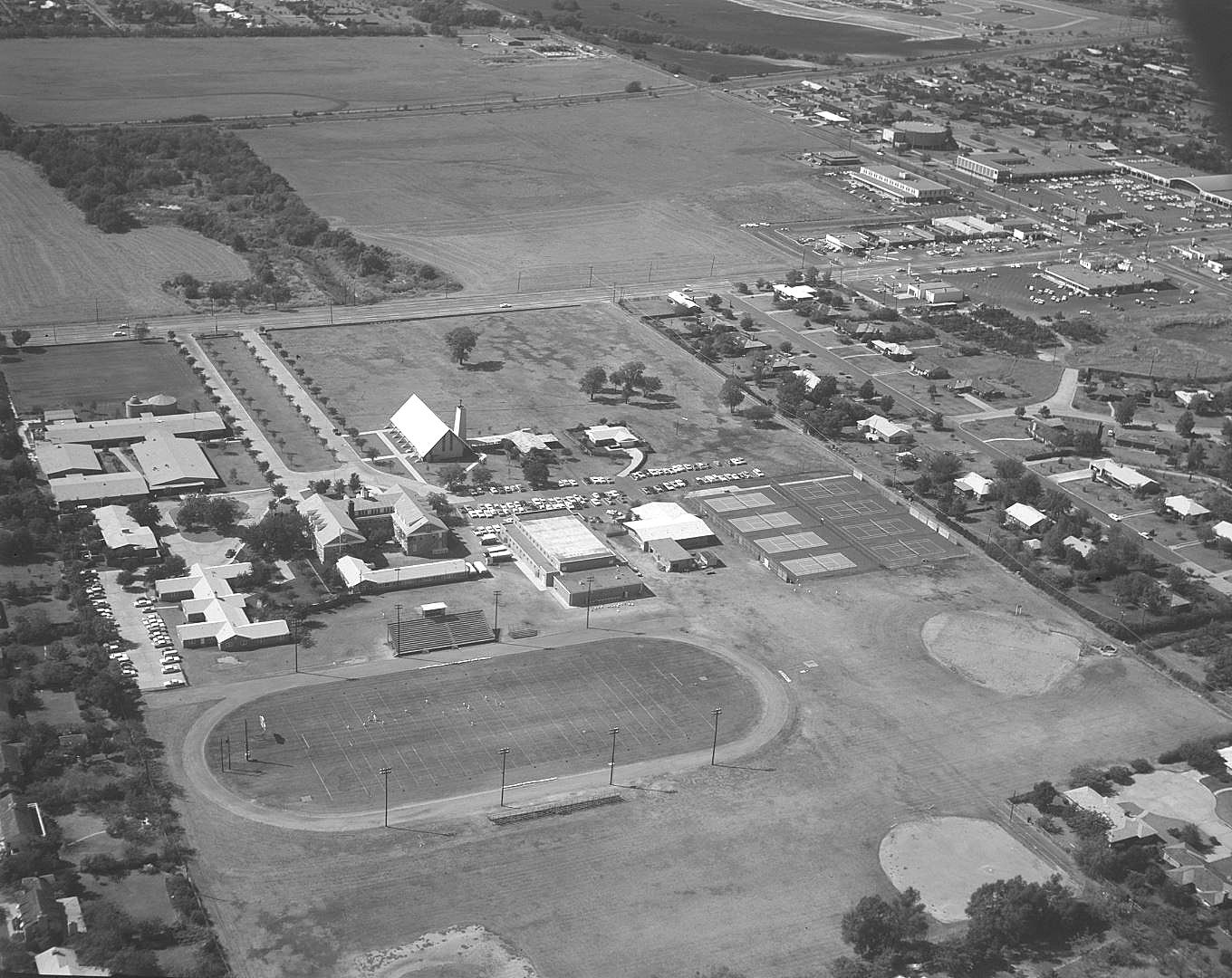
St. Mark’s From the Air

st-marks_preston-royal-to-the-west_squire-haskins_UTAGo west, young man…

by Paula Bosse

The photo above shows an aerial view of the St. Mark’s campus, with a view to the northwest. So. Much. Space. The horizontal road in the top third of the photo is Preston Road. In the top right corner, at 5923 Royal Lane, is the round St. Luke’s Episcopal Church, which was built in 1959. (I have learned only tonight that the architect of that church — and many other buildings around Dallas — was designed by architect William H. Hidell Jr., who studied with George Dahl. Hidell grew up in the same house I grew up in — several decades earlier. Small world.) Across the street from the round church is the Preston Royal fire station, built in 1958, and recently destroyed by a tornado (and which I wrote about here). This photo is undated, but it was obviously taken sometime after 1959. That amount of empty land is surprising. (If you really want to freak out about miles of nothing in North Dallas, check out this unbelievable photo of Preston and Valley View in 1958, pre-LBJ).

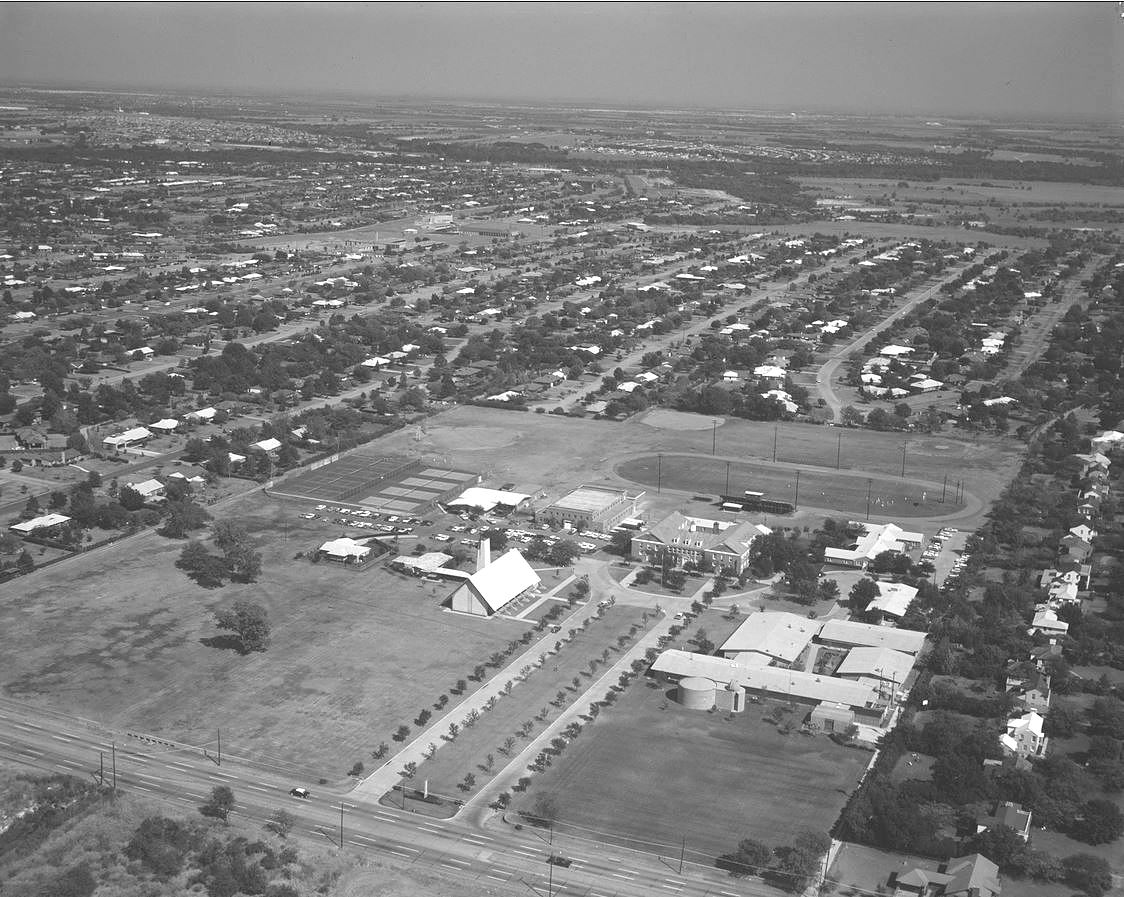
And here are two other St. Mark’s-centric photos from the same flight — all taken by Squire Haskins (see links below for very large images on the UTA website). Below, a view to the northeast:

st-marks-aerial_to-northeast_squire-haskins_UTA

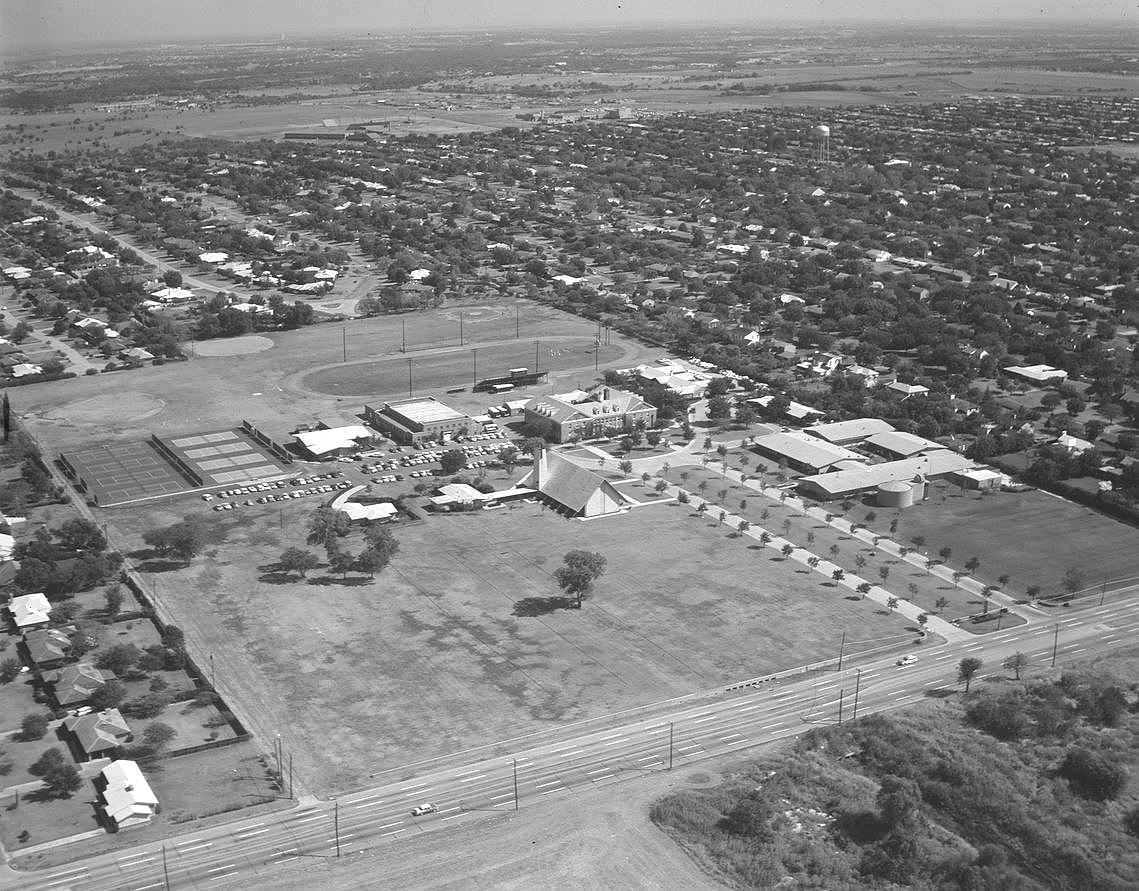
And a view to the southeast:

st-marks-aerial_to-southeast_squire-haskins_UTA

***

Sources & Notes

These three aerial photos are by Squire Haskins, from the Squire Haskins Photography Inc. Collection, University of Texas at Arlington Libraries. Read more information about these individual photos: the first one is here (view to the northwest); the second is here (view to the northeast); and the third is here (view to the southeast). Click the pictures on the UTA site to see really, really big images.

Please consider supporting the work I do at Flashback Dallas by funding me on Patreon, where I post exclusive content.

st-marks_preston-royal-to-the-west_squire-haskins_UTA_sm

*

Copyright © 2023 Paula Bosse. All Rights Reserved.

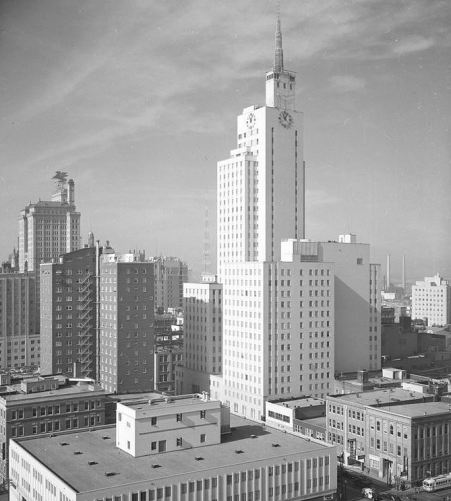
The Mercantile Bank Building — 1951

mercantile_squire-haskins_dec-1951_UTASquire Haskins Collection, UTA Special Collections

by Paula Bosse

Photo of one of my favorite downtown buildings, the Mercantile, taken by ace photographer Squire Haskins in December 1951. See a very large image of this at the UTA website, here. Zoom in and take a look around. Check out all the landmarks. You’ll probably find Waldo while you’re at it.

***

Sources & Notes

“Downtown Dallas — Mercantile Building” by Squire Haskins, taken on Dec. 11, 1951; from the Squire Haskins Photography, Inc. Collection, University of Texas at Arlington Libraries, Special Collections — more information can be found here. (I have slightly cropped the image.)

mercantile_squire-haskins_dec-1951_UTA_sm

*

Copyright © 2023 Paula Bosse. All Rights Reserved.

John W. Smothers’ Tin Shop, Hall & Floyd

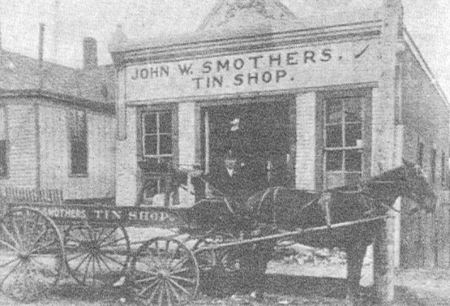
smothers-tin-shop_ebaySmothers (in car) and employees, ca. 1913

by Paula Bosse

John W. Smothers (1869-1925) came to Dallas from Huntsville, Missouri around 1890 to begin his career as a “tinner” working for a family friend/in-law, Frank T. Payne. By 1905, Smothers had married a girl from back home, had a child, and had apparently done well enough in the trade to buy a lot on College Ave. (now N. Hall St., in Old East Dallas) where he built his own tin-manufacturing shop, specializing in various sheet metal work. 

smothers_ad_1909-directory
1909 city directory ad

It looks like this business lasted until about 1918, when Smothers retired and sold the building to his old friend, F. T. Payne. It became a grocery store in 1919. Smothers died in 1925 at the age of 56 — his death certificate lists the cause of death, somewhat alarmingly, as “exhaustion and malnutrition” following a long illness — an extreme case of St. Vitus Dance

smothers_tin-shop_photo_ancestryvia Ancestry.com

Originally 212 N. College Ave., the address of Smothers’ tin shop became 912 N. College Ave. in 1911 when new addresses were assigned around the city. (See the location of the shop on a 1921 Sanborn map here.) It sat diagonally across the street from Engine Company No. 3, seen below in a photo from about 1901:

fire-dept_engine-co-3_gaston-and-college_1901Fire station, Gaston & College, ca. 1901

College Avenue was renamed and became Hall Street around 1946, and the address of the old tin shop building changed again, to 912 N. Hall Street, which is in the area now swallowed up by Baylor Hospital (see what 912 N. Hall looks like now on Google Street View, here).

***

Sources & Notes

Top photo found on eBay. A copy is also in the George W. Cook Dallas/Texas Image Collection, DeGolyer Library, Southern Methodist University — it can be accessed here. The SMU photo (apparently from the collection of Ralph Smothers, John’s son) has a notation on the back which reads “912 College Ave. <now Hall St.> about 1913 or 14? John Smothers [in car], [James E.] Curly Wilson left, Bob Critcher right.”

Photo of the fire station with the ghostly horse is by Clifton Church and is from the Dallas Fire Department Annual, 1901, which can be viewed in its entirety on the Portal to Texas History, here. (I used this image in my 2016 post “Dallas Fire Stations — 1901.”)

(“Tinner” was not an unusual word to have come across in the early part of the 20th century, but in the 1910 census, the enumerator was either confused or did not understand what was being said, because Smothers’ trade is listed as “tuner” — it looks like the enumerator then just made a weird leap to attempt to explain this and added “piano” under “General Nature of Business,” which Ancestry.com then repeats in its OCR-generated records. That “piano tuner” profession caused me a lot of confusion! To add insult to injury, OCR tells us that his occupation in 1900 was “turner,” and an illegible entry in the 1920 census transforms him into a “retired farmer”! Always approach census record information with a grain of salt — for many, many reasons!)

smothers-tin-shop_ebay_sm

*

Copyright © 2023 Paula Bosse. All Rights Reserved.

Pig Stand No. 2, Oak Cliff

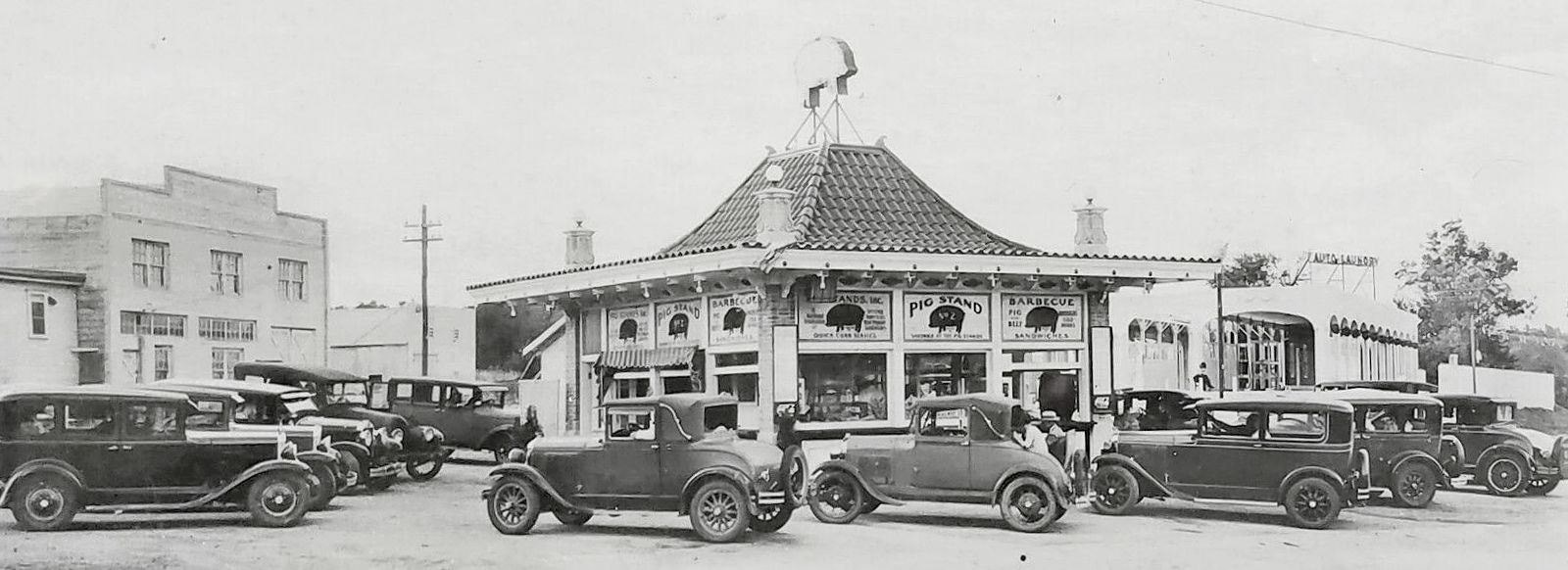
pig-stand-no-2_dallas_ebayWaiting in cars for pig sandwiches

by Paula Bosse

I’ve seen a cropped version of this photo, but not the full image. It’s great! I don’t mean to keep posting about restaurants, but seeing this photo was too good not to share. (As I type this, it’s available on eBay, here.)

It shows Pig Stand No. 2 at 1301 N. Zang in Oak Cliff, probably about 1928. It appears that this was the second “No. 2” — it was announced that this brand-new building had just begun construction in January 1928.

Work was started last week on the new Pig Stand, Zang’s Boulevard and Colorado Street, for the Pig Stands Company, a Dallas institution, now operating in 39 cities in 12 states. The ornamental building has been adopted as a standard design for the many future stands now contemplated over the country by this concern. In this building will be embodied modern sanitary features complying with all requirements and laws. It will be faced with brick and highly colored tile with ornamental stone trimmings and a clay tile sweeping roof in several shades. The exterior as well as the interior will be illuminated electrically with the cornice and ornaments decorated out in varied contrasting colors. The Pig Stands Co., starting less than five years ago with small capital, has developed into a national institution. Architects F. J. Woerner and Co. designed and will supervise this work, while M. W. McDade will have charge of the construction. (Dallas Morning News, Jan. 26, 1928)

At the right is the Oak Cliff/Tramway Auto Laundry at 1307 N. Zang.

pig-stand-no-2_dallas_ebay_det

I love the couple in the rumble seat!

***

Sources & Notes

Photo currently available for sale on eBay, here.

Read a history of Dallas’ Pig Stand empire — long considered to be the first-ever drive-in restaurants, a revolutionary contribution to American social culture — in the Texas Monthly article “The History of the Pig Stands” by Daniel Vaughn (Feb. 2015).

Architect Frank Woerner designed many notable commercial and residential buildings in Dallas, including the Stoneleigh Hotel, the Couch Building across from SMU, the old Union Depot in Deep Ellum, and the beautiful home of Max Rosenfield on South Boulevard.

pig-stand-no-2_dallas_ebay_det_sm

*

Copyright © 2023 Paula Bosse. All Rights Reserved.

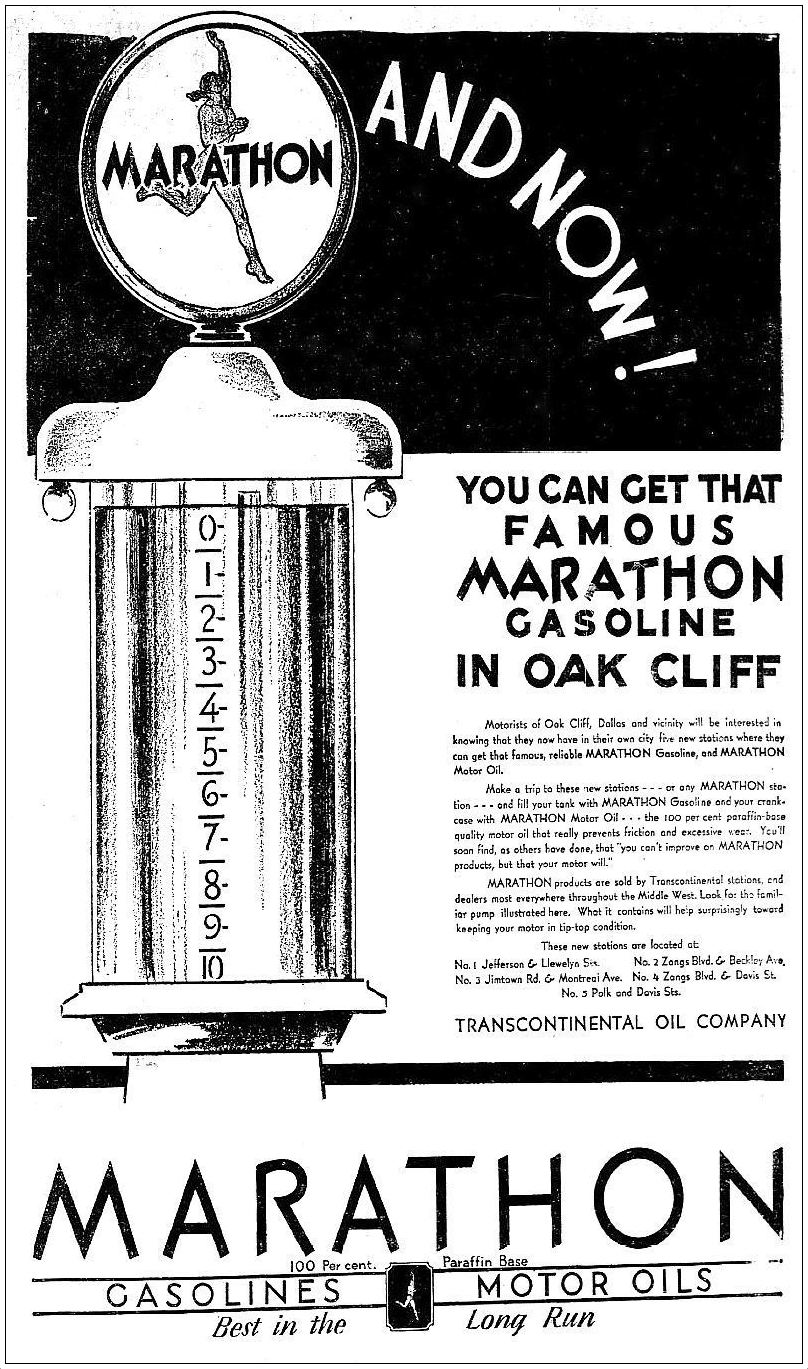
“You Can Get That Famous Marathon Gasoline in Oak Cliff” — 1930

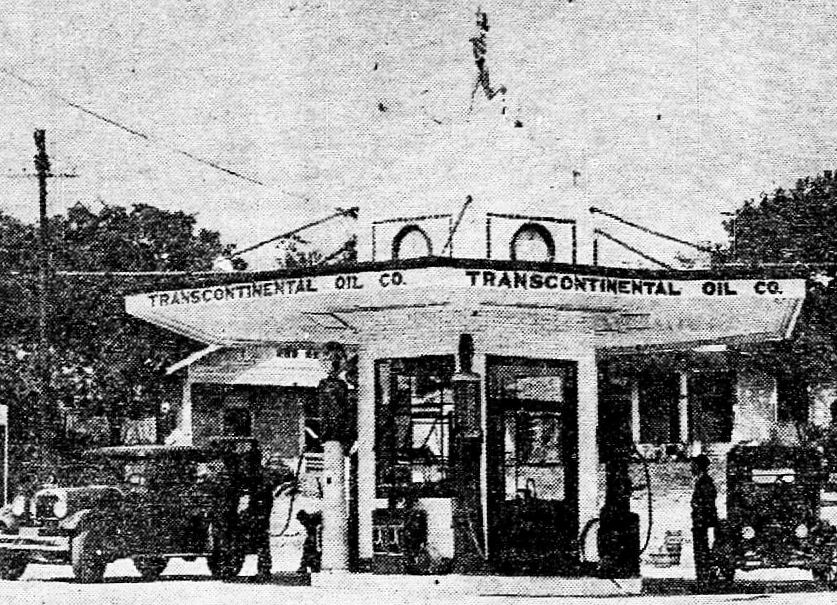
marathon_transcontinental-oil_gas-station_smithsonian_1930Somewhere in Oak Cliff, 1930, via Smithsonian Inst.

by Paula Bosse

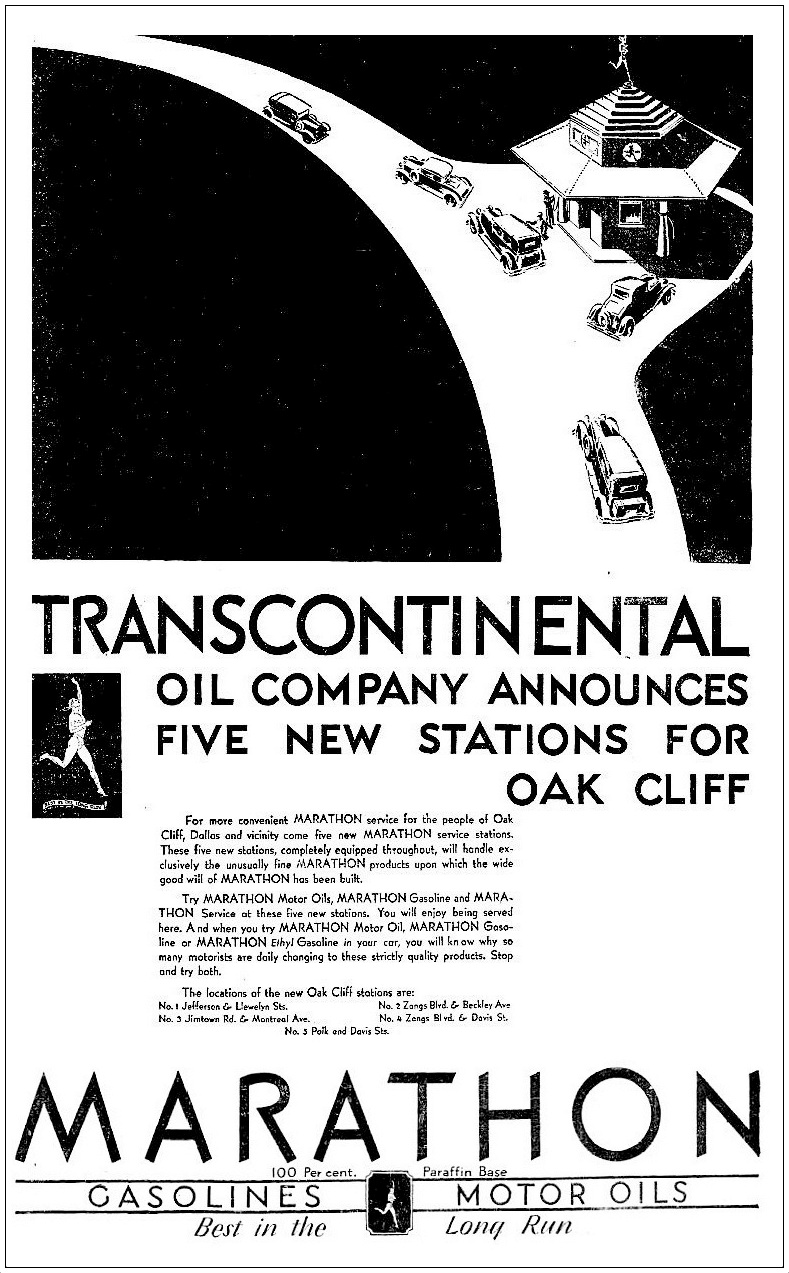
Rejoice, Oak Cliff residents of 1930: you’re getting five Marathon gas stations! I’m not sure why these stations were only in Oak Cliff and no other part of Dallas, but they were (a sixth station joined this elite group a year or so later).

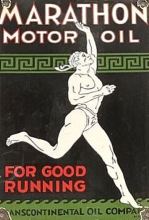
I have a fascination with old gas stations, but I have to admit I’m not familiar with Marathon Gasoline or Marathon Oil products or the Transcontinental Oil Co. (they  had a refinery in Fort Worth), but for whatever reason, the Marathon stations in Dallas — all emblazoned with an image of the Greek runner Pheidippides — appear to have faded away by about 1942 when I guess the last straggler finally crossed the finish lane, collapsed, and died. Farewell, Pheidippides.

The photo above shows one of those first 5 stations in Dallas. The location is not specified. 

Marathon stations in the O.C. in 1930:

marathon_transcontinental-oil_gas-station_050430_ad_det

  • No. 1: Jefferson & Llewellyn Sts. (539 W. Jefferson)
  • No. 2: Zangs Blvd. & Beckley Ave. (1111 N. Zang)
  • No. 3 Jimtown Rd. & Montreal Ave. (2120 W. Clarendon Dr.) (in 1931, residents petitioned the city to change the name of the street to “Clarendon” because they thought “Jimtown” was too déclassé)
  • No. 4: Zangs Blvd. & Davis St. (137 W. Davis — this was the station that lasted the longest, appearing to have closed by the time the 1942 city directory was published)
  • No. 5: Polk & Davis Sts. (938 W. Davis)
  • (No. 6: 1804 W. Jefferson)

It doesn’t look like any of the old buildings are still standing, but there IS one of the exact same design still standing in Miami, Oklahoma — a group restored it and even added period gas pumps (which someone later stole) — see it below. 

marathon-station_miami-okla_google-street-view_2016Miami, OK, Google Street View July 2016

Not all of the Dallas stations had the same design — a press release describes the stations of possessing “distinctive architecture.” Another of the Oak Cliff locations looked very different (and certainly more distinctive):

marathon_station_oak-cliff_1930
Somewhere in Oak Cliff, 1930

The one above is the same design seen in this local ad:

marathon_transcontinental-oil_gas-station_042730-adApril 1930

marathon_transcontinental-oil_gas-station_050430_adMay 1930

marathon_rec_ebay

marathon_ebay

***

Sources & Notes

Top photo is from the American Petroleum Institute Photograph and Film Collection, National Museum of American History, Archives Center, Smithsonian Institution — more info can be found here.

I seem to post a lot about gas stations. Here are a few notable posts:

marathon_transcontinental-oil_gas-station_smithsonian_1930_sm

*

Copyright © 2023 Paula Bosse. All Rights Reserved.

The Bullen Store, Exposition Avenue — 1896-1936

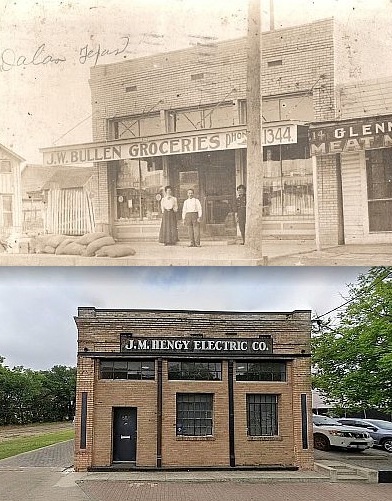
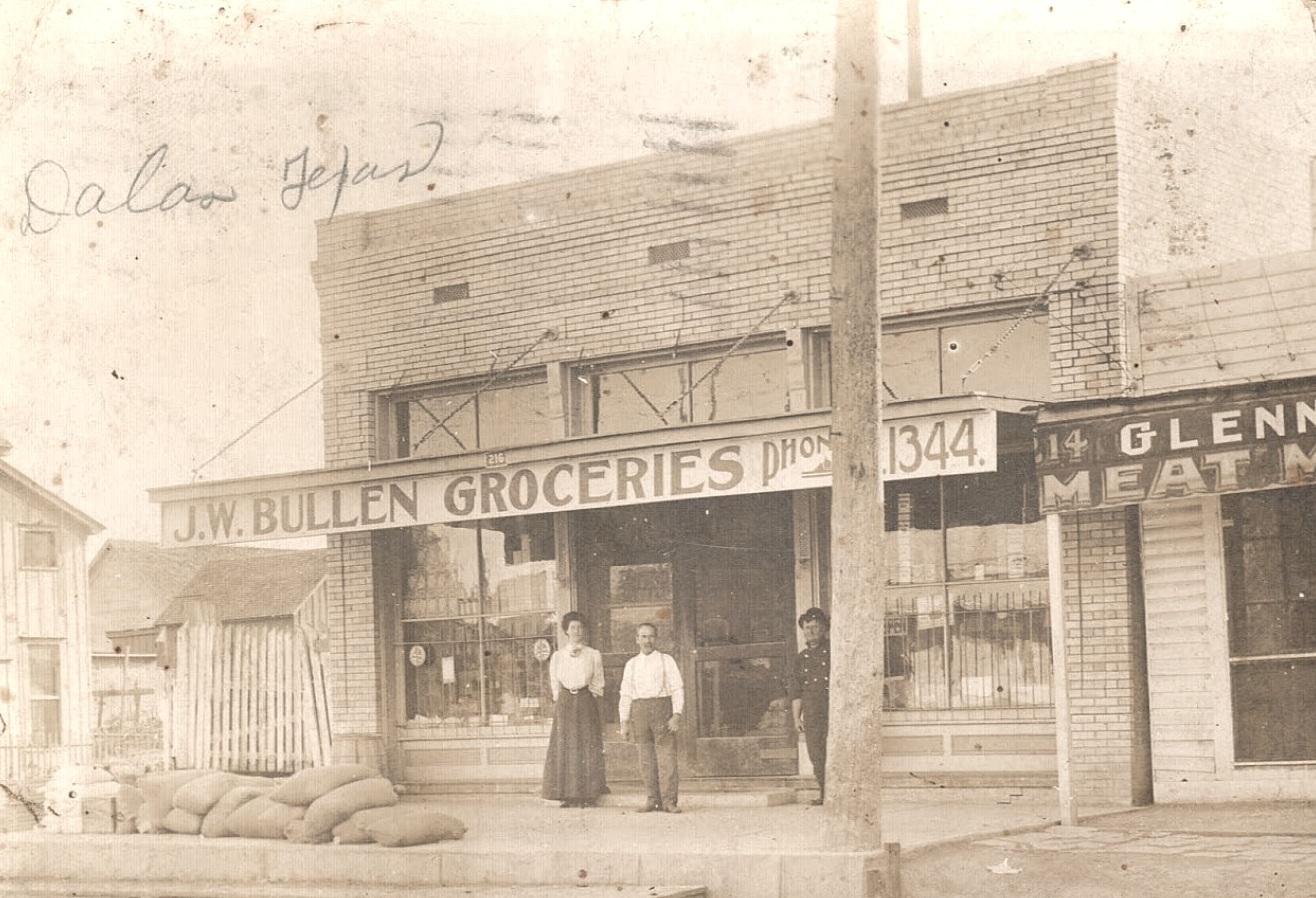
bullen-store_exposition-avenue_ca-1905Exposition Ave., ca. 1905 (photo: Bullen family, used with permission)

by Paula Bosse

If you’re reading this, you probably have a fascination with old buildings. When was it built? What had it been? How has it not been torn down? One such building — which, though interesting, doesn’t really strike one as particularly old — is the small building at 507 Exposition Avenue, a few blocks from Fair Park. Actually, the thing that jumped out at me was the sign on the building reading “J. M. Hengy Electric Co.” — back in 2015 I wrote a long post about the exceedingly litigious Hengy family (“F. J. Hengy: Junk Merchant, Litigant”) (J. M. was the grandson of F. J.). The Hengy Electric Co. was in business at that location from at least the 1930s until at least the 1960s. I’m not sure why the current owners kept this sign, but I’m glad they did, because it’s why I noticed it.

This building was most likely built in the 1890s, and it was home to a grocery store owned by J. W. Bullen (John Wesley Bullen Sr.), a Tennesse native who came to Texas in the late 1870s and, after a few years of farming in the area, settled in Dallas. He worked for the Santa Fe railroad for a while before opening this grocery on Exposition Avenue in the 1890s — easy to give directions to because the Gulf, Colorado and Santa Fe (GC&SF) Railway tracks ran right alongside the store. Bullen’s grocery was a neighborhood mainstay for at least 40 years. He retired in 1936, and he and his wife, Mary, eventually moved to California to live with their daughter. J. W. Bullen died in California in 1948, at the age of 89 — his life spanned the Civil War to the advent of television.

Below, J. W. Bullen is shown with his brothers, Thomas, James, and Joseph — he is at the bottom right.
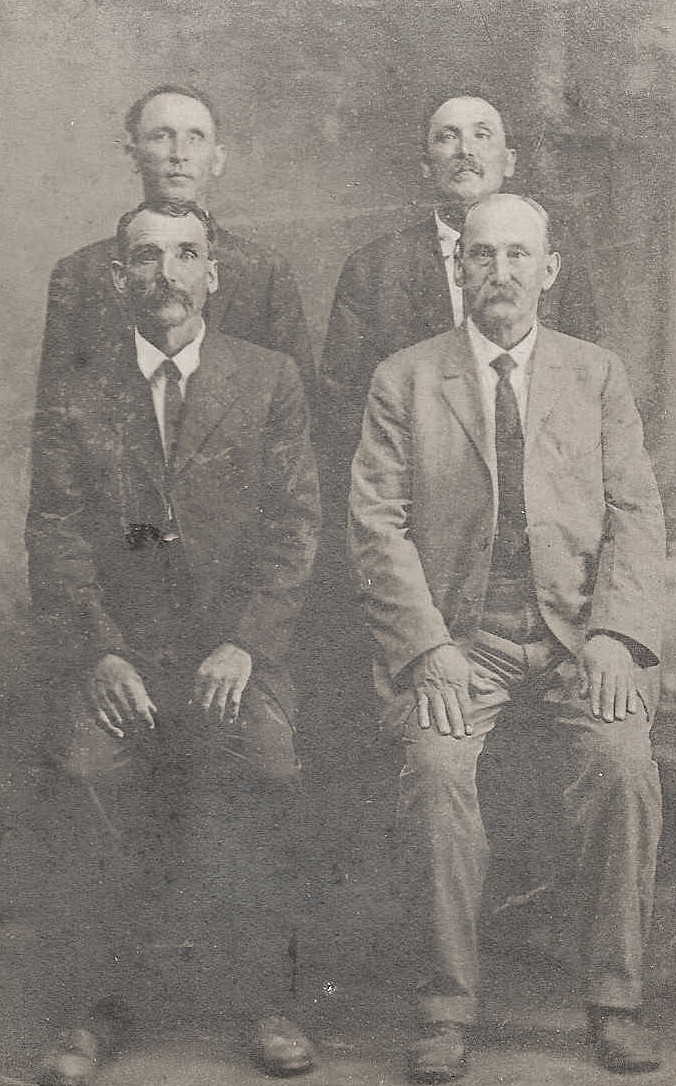
bullen-j-w_sitting-right_ancestryvia Ancestry.com

I came across the photo at the top of this post on the Dallas Historical Society discussion forum (“The Phorum”) back in 2017 (it’s taken 5½ years for me to finally write this!) — the thread is here. A Bullen relative posted this photo, and I was ecstatic to see it! It’s such a great image — I have never seen a photo of Exposition Park from this period. (I asked Mr. Bullen — the man who posted this photo — if I could reproduce it, and he very nicely gave me permission.)

I would guess that the photo dates from sometime around 1904-1906, when the Glenn Brothers meat market occupied the space next door (originally 214 Exposition and later 505 Exposition).
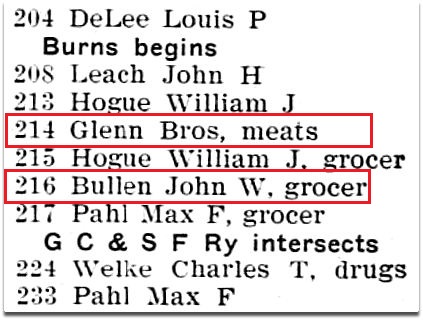
1905-directory_bullen-glenn-bros1905 Dallas city directory

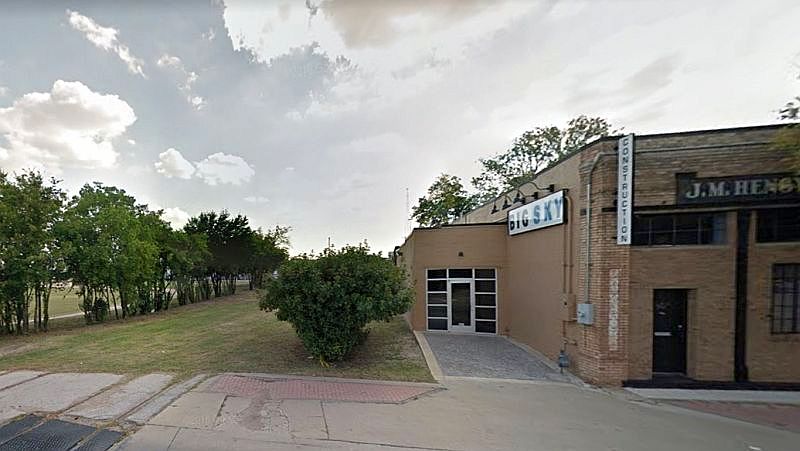
The Hengy business originally occupied the Glenn Bros. space for several years, from at least 1930. After Bullen’s retirement, Hengy moved into the larger space at 507 Exposition. Today it is occupied by Big Sky Construction.
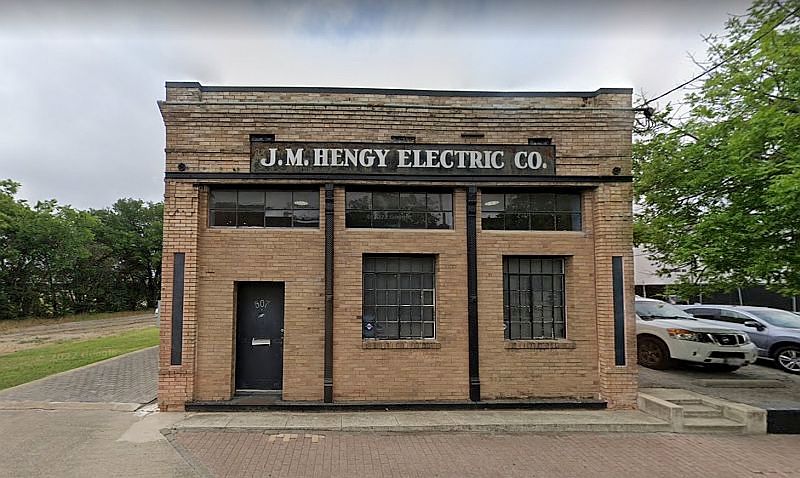
507-exposition_google-street-view_may-2022
Google Street View, May 2022

The railroad tracks have been pulled up, but below are two Google Street Views from 2012 showing where they once were — they couldn’t have been much closer to Bullen’s store! That’s got to have rattled the merchandise (and the store’s occupants) several times a day.
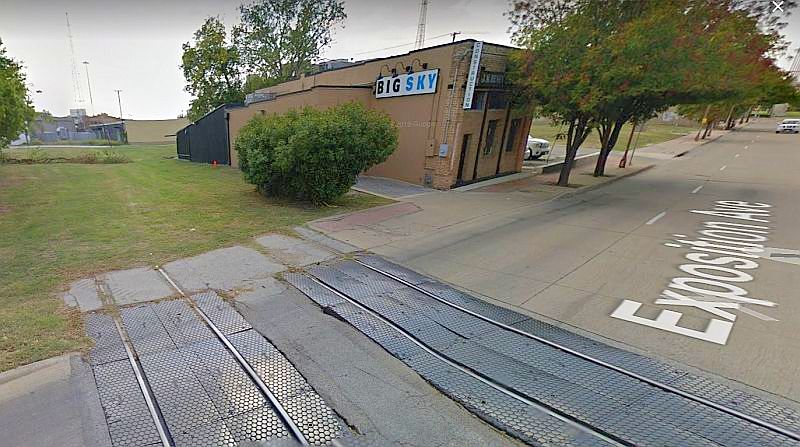
507-exposition_google-street-view_sept-2012Google Street View, Sept. 2012

507-exposition_google-street-view_sept-2012_bGoogle Street View, Sept. 2012

*

The address of Bullen’s store was originally 216 Exposition Avenue. After the citywide address change in 1911, it became 507 Exposition Avenue. The store was in business by at least 1896, but a newspaper article on the 62nd wedding anniversary of Mr. and Mrs. Bullen says that the business began in 1893. At this time, development of Exposition Park was exploding (see the 1889 ad I posted yesterday, here).
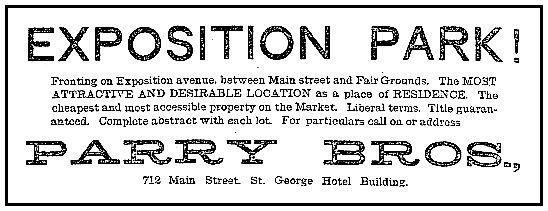
expo-park_ad_dmn_1012891889

If you look at Sanborn maps of this area (the 1899 map is here, the 1905 map is here, and the 1921 map is here) you see that almost all of the buildings in the area are houses (designated by the letter “D,” for “dwelling”). Having only ever known the area in recent times, it’s hard to imagine this ever having been an almost entirely residential neighborhood. And, back in the 1890s, it was also full of livestock.
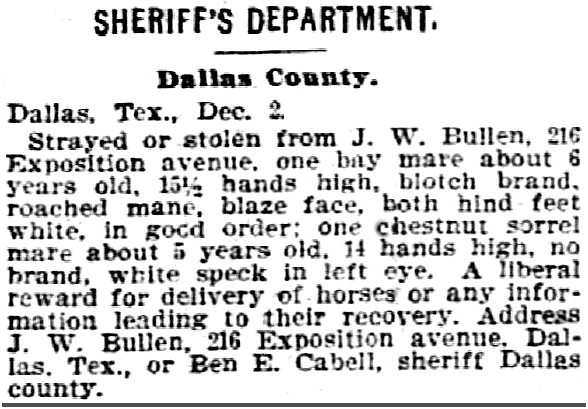
bullen_dmn_120397_stolen-horsesDallas Morning News, Dec. 3, 1897

*

Here’s a map of Dallas from 1898, with Bullen’s store way on the edge of the world, under the star.
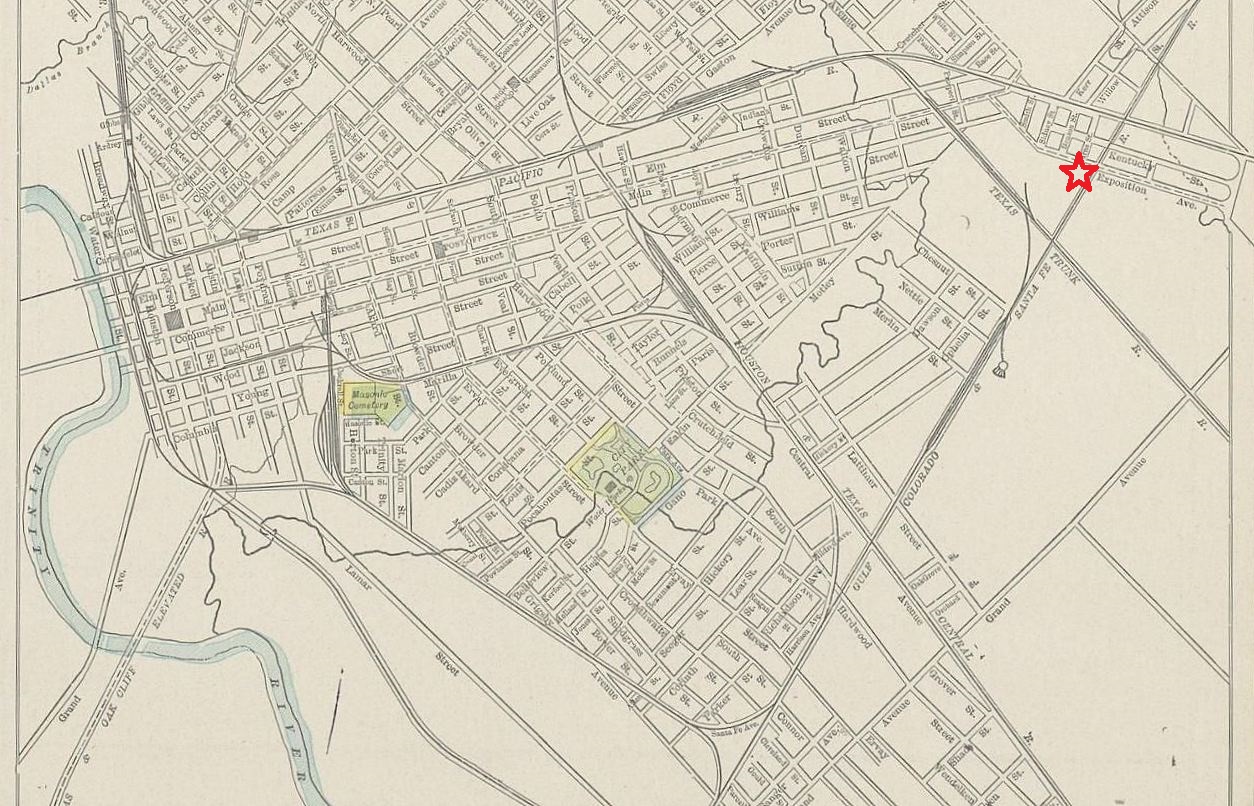
1898-map_bullen-store_expositionvia Portal to Texas History

*

507-exposition_then-now_ca-1905-2022

***

Sources & Notes

Photo is from the family collection of Joseph Bullen II, used with permission.

I would LOVE to see historical photos of the Expo Park area — from any time, really, but especially from the time it was primarily residential. If you have any photographs, please let me know!

See this building today on Google Street View, here.

Biographical information on J.W. Bullen from “J. W. Bullens Observe Their Anniversary” (Dallas Morning News, Nov. 22, 1942).

More Flashback Dallas posts on Exposition Park can be found here.

bullen-store_exposition-avenue_ca-1905_sm

*

Copyright © 2023 Paula Bosse. All Rights Reserved.

Triple Underpass — ca. 1936

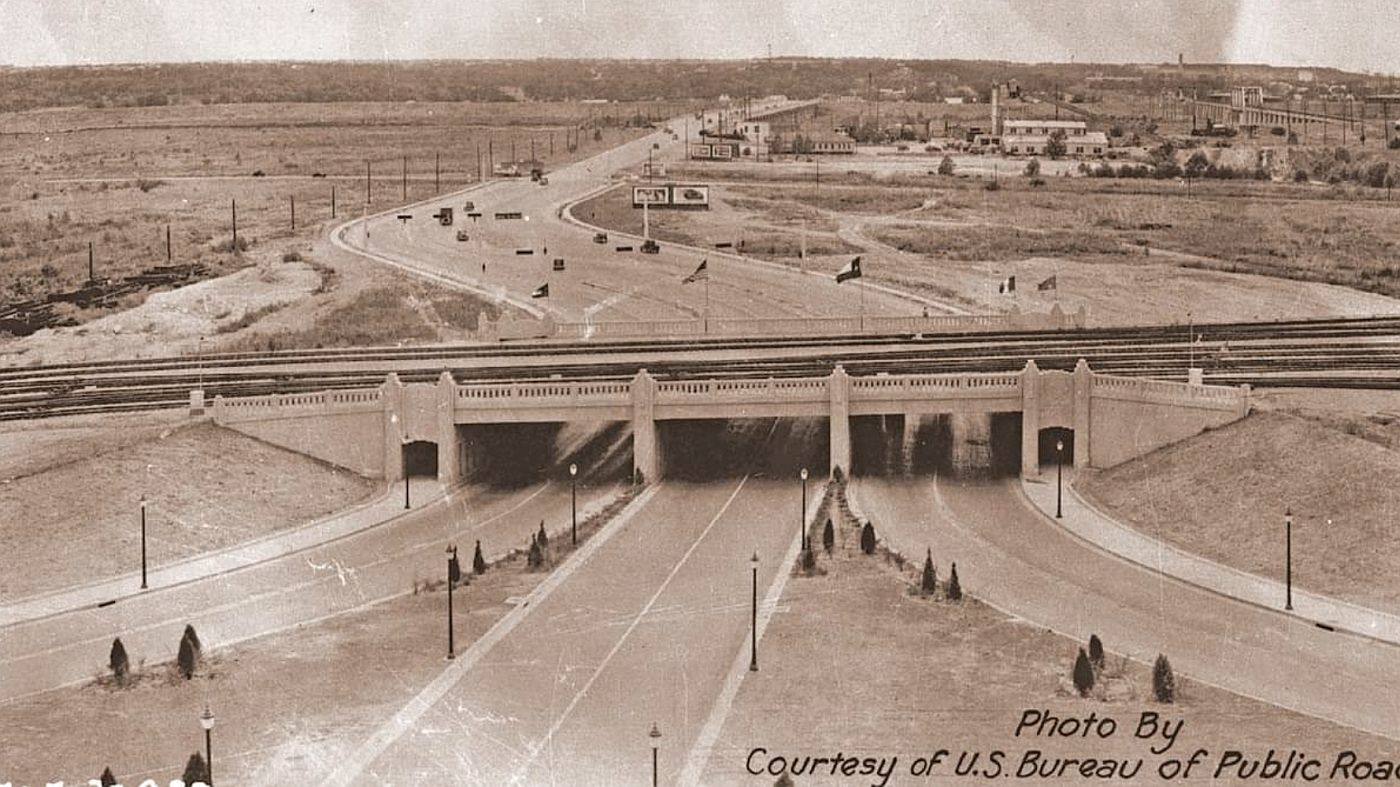
triple-underpass_ca-1936_us-bureau-public-roadsThe Gateway to Dallas, or the the Gateway to Oak Cliff?

by Paula Bosse

Above, a fantastic photo showing the new Triple Underpass, about 1936, with the view toward Oak Cliff. (Compare this with a similar view, from the 1950s, here.)

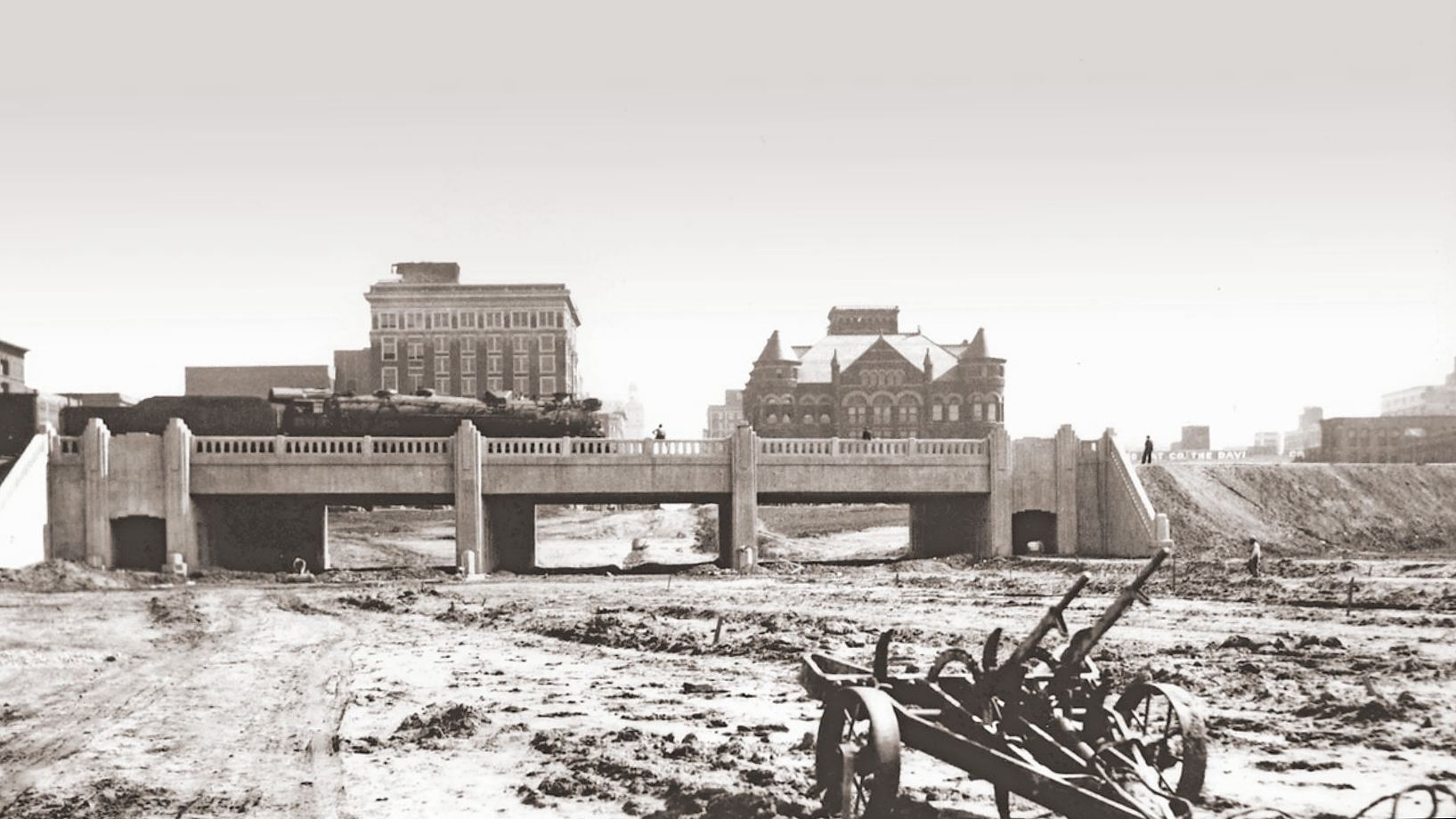
Below, a little earlier, with the view to the east, back toward town.

triple-underpass_construction_looking-east_austin-bridge-and-road-co

The triple underpass was built by the Austin Bridge & Road Company between 1934 and 1936, finishing up just in time to welcome the onslaught of visitors to the Texas Centennial Exposition. I encourage you to visit the company’s public Facebook post here, which includes these and other great photos of this Dallas landmark (including a “then and now” comparison and a history of their involvement in the project). Below is an excerpt from that post:

Once called the “Gateway to Dallas,” the triple underpass near Dealey Plaza was built by Austin Bridge Company and Austin Road Company starting in 1934. The underpass, a joint project with the Texas Highway Department and City of Dallas, created access to the western edge of downtown Dallas under the Union Terminal tracks. Contending with up to 80 trains a day complicated the job, requiring close cooperation with the railway companies. The triple underpass was hailed as a modern marvel, built of concrete with square balusters in a handsome art-deco style. It was unveiled with great excitement in 1936, during Texas Centennial celebrations.

***

Sources & Notes

Top image is a U.S. Bureau of Public Roads photo showing the new underpass, looking to the west.

Both photos and the excerpt are from a post on the Austin Bridge & Road Facebook page, which you can find here.

triple-underpass_ca-1936_us-bureau-public-roads_sm

*

Copyright © 2022 Paula Bosse. All Rights Reserved.

New Wheels for Margo Jones — 1955

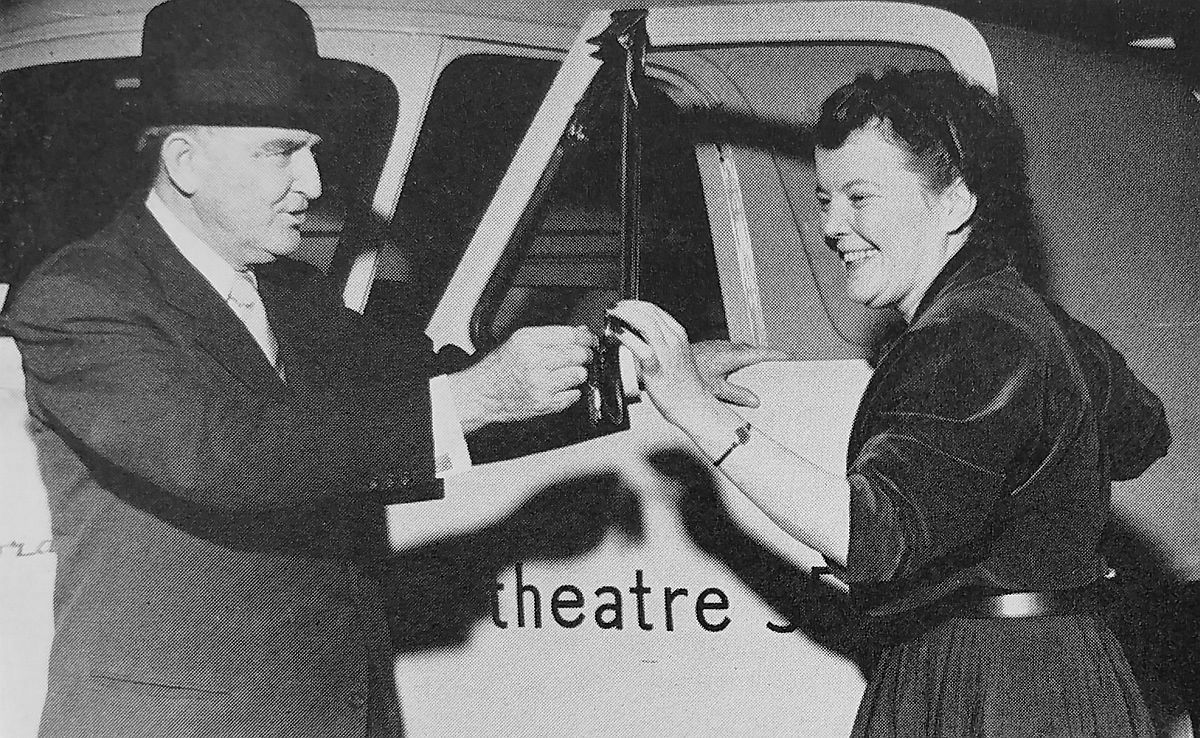
jones-margo_theatre-55_dallas-magazine_apr-1955DeWitt Ray and Margo Jones

by Paula Bosse

The photo above shows Dallas theater legend Margo Jones accepting the keys to a new Ford truck in March 1955. Below, the caption that appeared in the April 1955 issue of Dallas magazine:

GIFT FOR THEATRE ’55: Margo Jones, director of Theatre ’55, is shown as she accepts the keys to a new 1955 panel truck from DeWitt T. Ray, Dallas banker and member of Dallas Theatre ’55 board of trustees. The truck, gift of a group of 18 Dallas businessmen and civic leaders, will be used for transporting set furniture, props and other necessities for the theatre’s productions.

She looks very, very happy!

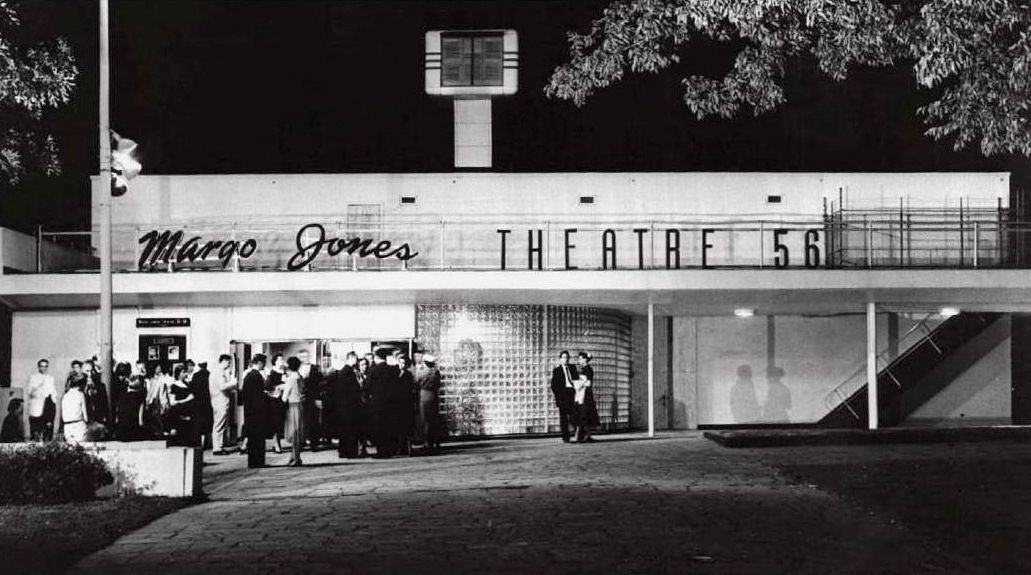
margo-jones_theatre-56_dpl

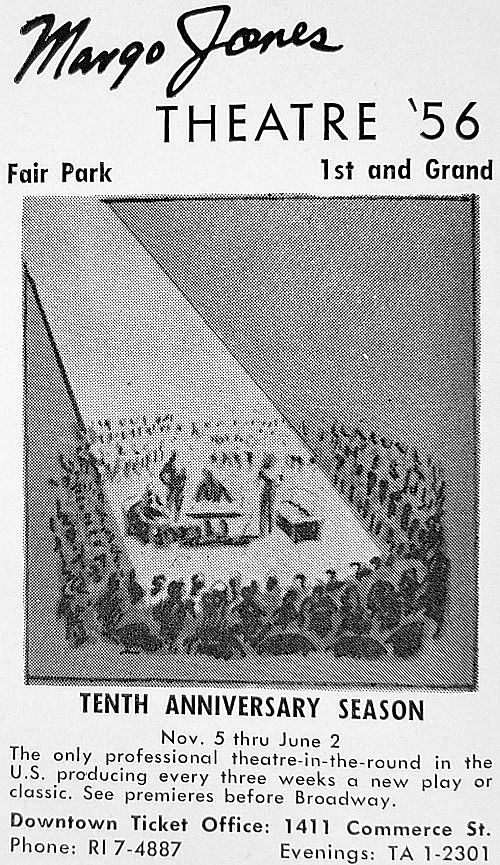
jones-margo_theatre-56_this-month-in-dallas_dec-1956_ad

***

Sources & Notes

Photo is from the April 1955 issue of Dallas, a periodical published by the Dallas Chamber of Commerce.

Photo of the exterior of the theater from the collection of the Dallas Public Library.

Ad from the Dec. 1956 issue of This Month in Dallas.

More on Margo Jones can be found in the following Flashback Dallas posts:

Watch “Sweet Tornado: Margo Jones and the American Theater,” the full documentary on Margo Jones produced by KERA-Channel 13, here.

jones-margo_theatre-55_dallas-magazine_apr-1955_sm

*

Copyright © 2022 Paula Bosse. All Rights Reserved.

East on Elm

elm-street_gentrys_city-of-dallas-websiteShouldn’t there be cars?

by Paula Bosse

There has been some heavy-duty editing to this post!

Here’s an interesting photo I stumbled across last night on the City of Dallas website. There wasn’t any information about it, but it appears to be a view to the east, taken from the 1400 block of Elm Street (where Exchange Place — originally Scollard Court — intersects). See what it looks like today on Google Street View here.

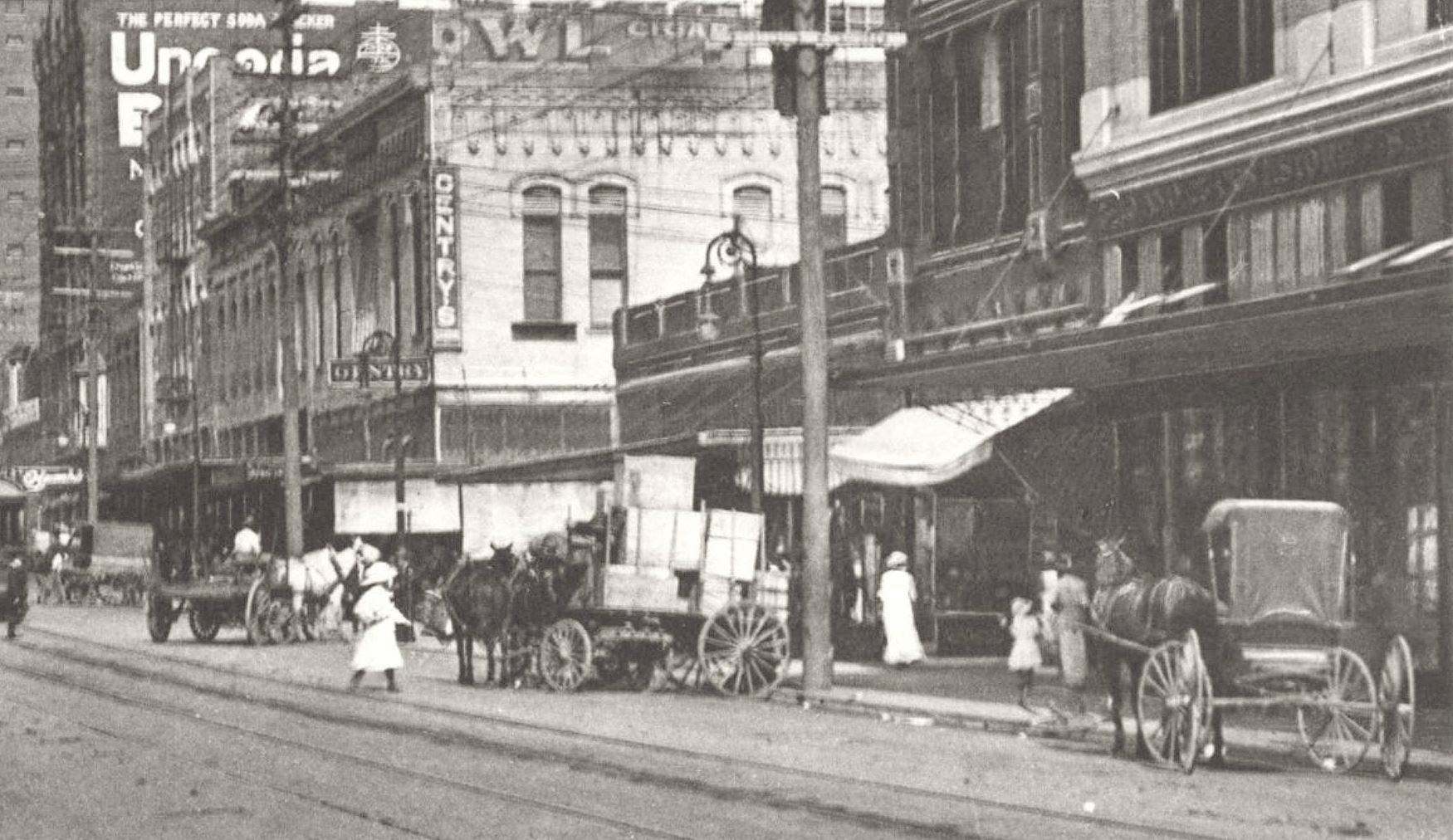
The main landmarks are what I call the Wilson Building Jr. (the tall dark building in the distance, located on Elm near Ervay), the Praetorian Building (the tall white building at the right, at Main and Stone), and L. W. Gentry’s photography studio in the middle of the photo at the right.

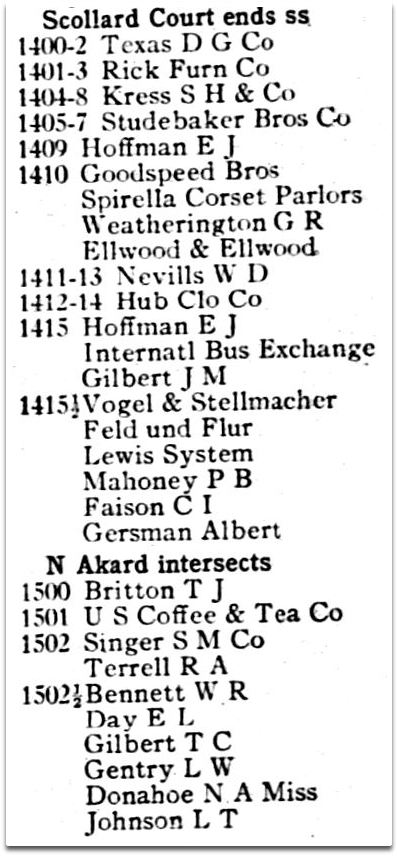
Gentry’s was upstairs at 1304 Elm from about 1904 until about 1911. In 1912, Gentry moved a block down the street to 1502 Elm, at Akard, where he took over the upstairs studio of photographer J. C. Deane. (I wrote about Deane and this building here.)

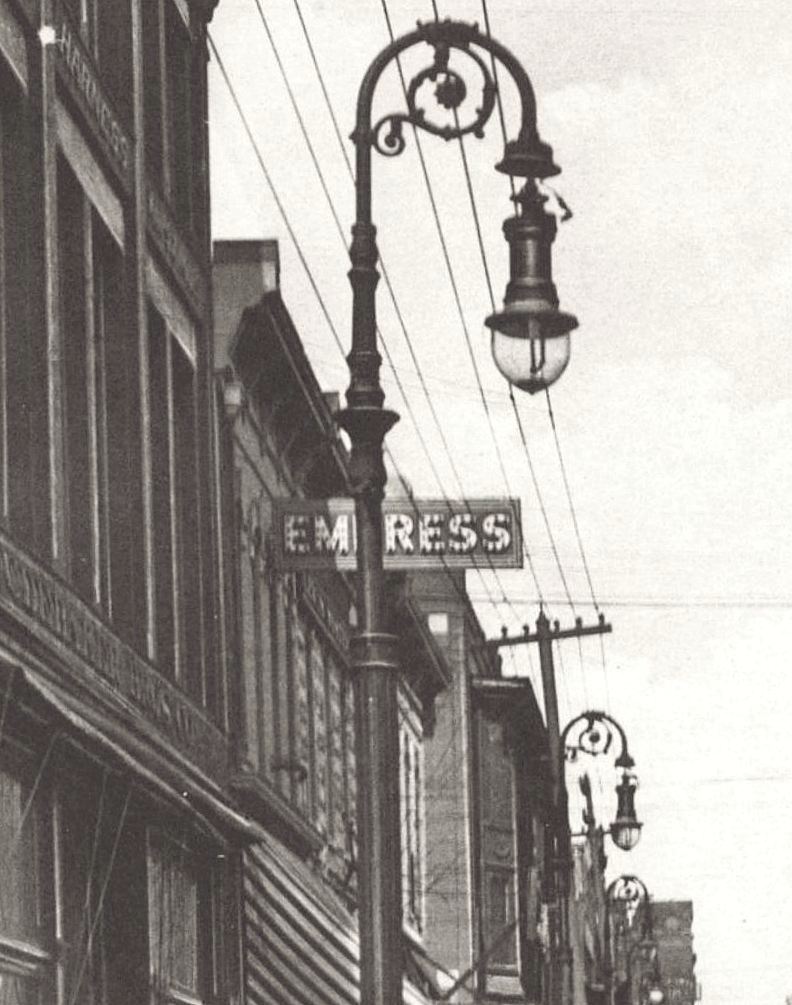
There is a sign reading “Empress” at the left. That was the Empress Theatre, which was at 1409 Elm from about 1912 to 1915. Directly across the street is a 3-story building with a sign for the Spirella Corset Parlors at 1410 Elm.

Back to the left, across the street, is the hard-to-read sign for Studebaker Bros. of Texas at 1405 Elm. Directly across the street is the new Kress Building (you can see part of the distinctive “K” from the company’s logo at the top right). Kress was at 1404-8 Elm — the building was erected in 1911 and opened that same year in November.

The “new Wilson Building” was also built in 1911, and Gentry’s took over the space above T. J. Britton’s store at Elm and Akard in 1912. And all these places appeared in the 1912 directory (except for the Empress, which was open in 1912 but might not have made the listing deadline). So I’m going to guess that this photo is from 1912 or 1913.

gentry_1912-directory_1502-ELM1912 Dallas directory, Elm Street

But this photo looks older than 1912. So many horses! The only vehicle not pulled by a horse in this photo is the streetcar. Where are the cars? In 1911, Dallas was pretty car-crazy — you’d expect to see at least ONE horseless carriage in there somewhere. It doesn’t sound like a lot, but in 1911, there were about one thousand automobiles registered in Dallas County, and the city was quickly becoming a major distribution hub for car companies (“Dallas Automobile Center of the Southwest,” Dallas Morning News, Dec. 31, 1911). (Check out this photo from 1911 taken a couple of blocks away. The only animals seen are actually riding IN an automobile!) Were cars banned from Elm Street? Seems unlikely. …I’m pretty sure I’m overthinking this.

(Ironically enough, the full entry for Studebaker Bros. which appears in the 1912 directory reads: “Carriages, wagons, buggies, street sprinklers, harness.” Nary a mention of an automobile. That arrived the following year.)

It might just be that I’ve had a very stressful couple of weeks, and it was really late when I originally wrote this. But I’ve had a refreshing night’s sleep, and I’m still fixating on this car thing. (Shouldn’t there be cars on Elm Street in 1912?) So I’m just going to stop looking at this photo, assume that it was snapped when all cars in the area were just out of frame, and wrap this thing up.

**

Here are a few zoomed-in details.

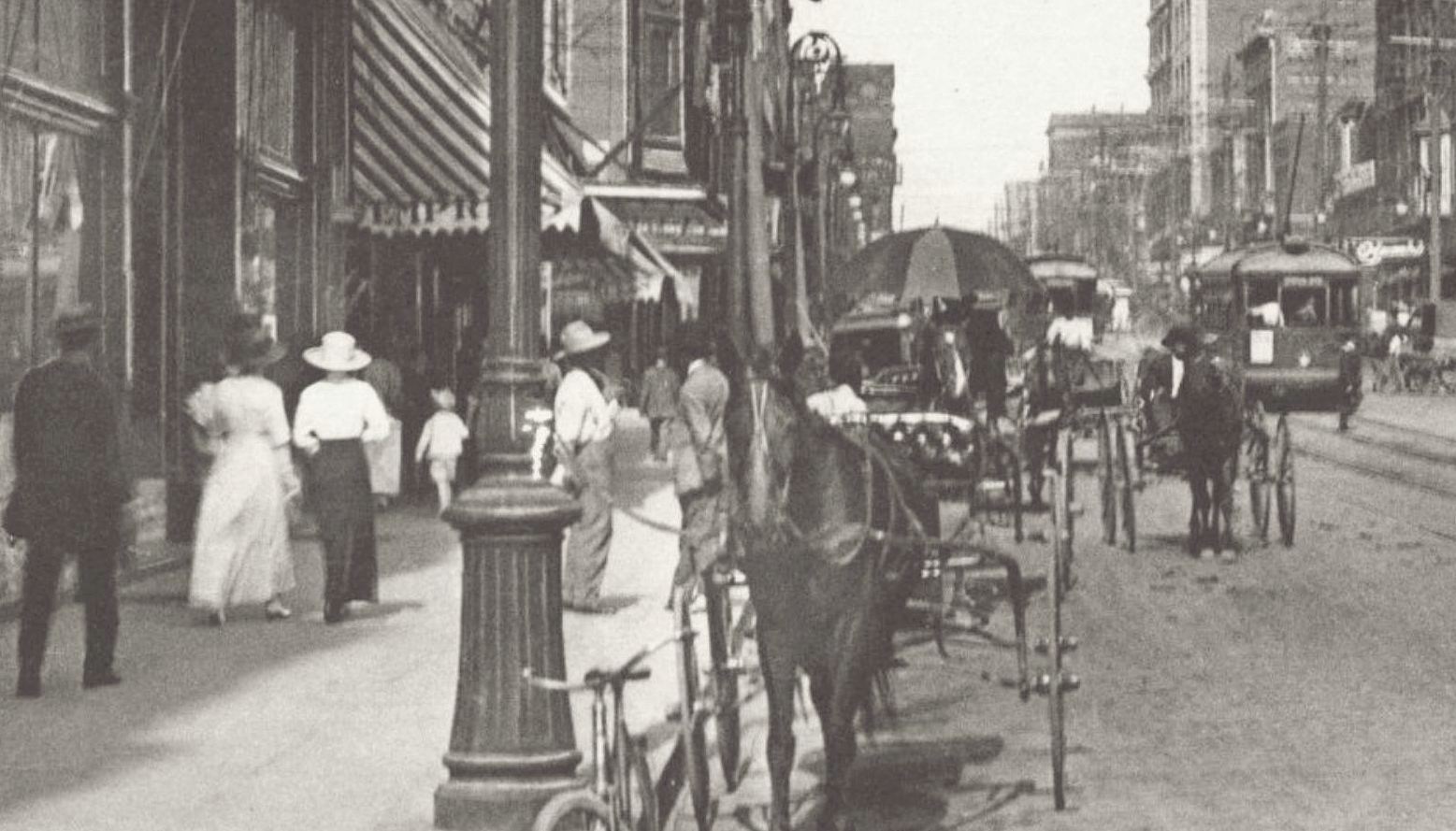
elm-street_gentrys_city-of-dallas-website_det1

elm-street_gentrys_city-of-dallas-website_det2

elm-street_gentrys_city-of-dallas-website_det3

I love these decorative lamp posts (more examples can be seen in a post I really enjoyed writing, “The Grand Elm Street Illumination — 1911”).

***

Sources & Notes

Photo found on the City of Dallas website, here (banner photo).

I have edited this after seeing the reader comment below. I realized that I was basing the original location on Lemuel W. Gentry’s first studio, which was a block or two west from the one seen in the photo. (I kept saying to myself, “That building looks so much like the one the Deane studio was in.” Because… it was the exact same building!) Thanks, NotBob.

Here’s a closer shot of Gentry’s studio around 1915 — on the southeast corner of Elm and Akard, right across the street from the new Queen Theatre. (This photo originally appeared in this post.)

queen_cinema-treasures

NOW we see cars!

elm-street_gentrys_city-of-dallas-website_sm

*

Copyright © 2022 Paula Bosse. All Rights Reserved.

Pacific Avenue Warehouse District

pacific-warehouse-district_ebayLooking west on Pacific, from about Good Street

by Paula Bosse

Wandering around the eBay “sold” archives, I came across this unusual photo taken in a not terribly scenic part of town. After checking addresses of these businesses in the 1932 city directory, it looks like the photographer (who appears to have been seated in a car) snapped this shot on N. Pacific Avenue, a block or so west from Good Street (now Good-Latimer). Deep Ellum-adjacent. The view is southwesterly, toward downtown. The businesses are mostly warehouses. See what this view looks like today, 90 years or so later, via Google Street View, here.

I was excited to see two familiar 19th-century buildings which I’ve written about and feel a weird kinship with: the abandoned and shuttered old Union Depot (which I wrote about here) and the Union Depot Hotel (which I wrote about here) — located about where Pacific takes a slight jog to the right. It’s like seeing old friends.

Here are some rather grainy magnifications of the eBay “snapshot” (click to see larger images).

*

Below: the Western States Grocery Co. was located at the southwest corner of Hawkins and Pacific. The Home Furnishings Co. was at 2301-2311 Elm Street (at Preston). Many of the buildings in this view (except for the 5-story-ish tall building straight ahead and to the right) can be seen in this 1921 Sanborn map. (Is that the pre-Pegasus Magnolia Building seen in the distance behind the 5-story building at the right? If so, that would mean that this photo was taken before 1934.)

pacific-toward-downtown_ebay_det-1

*

The building seen below in the foreground at the left is the old Union Depot. I’ve seen so many photos of this building — but it looks TINY here! Just across the street (railroad tracks) from it (in the building seen immediately below the “Radios” sign) is the old Union Depot Hotel. The H&TC railroad used to run between them — Central Avenue later (basically) became Central Expressway. I was really excited to see these two buildings.

The taller building seen in the background, behind the Hart Furniture sign, can be seen in this 1921 Sanborn map — the 5-story building at the southwest corner of Pacific and Preston was home to the Fulton Bag and Cotton Mills (another story was added around 1935).

pacific-toward-downtown_ebay_depot-and-hotel

*

The Combs Transfer & Storage Co., the Packer Transfer & Storage Co., and the Baldwin Piano Ware Room were all at 2507-2509 Pacific. It looks like the two buildings seen in this detail (the short one and the taller one) have somehow miraculously survived the insane redevelopment of everything on all sides of it (I’ve haven’t been to Deep Ellum in a few months, but these two buildings seem to be the ones which you can see in the most recent Google Street View). Also, looming like a ghostly whisper in the background (above “Combs”) is the Medical Arts Building.

pacific-toward-downtown_ebay_medical-arts-bldg

*

I wonder why someone decided to take this photo? I’m glad they did, because it’s not a view I’ve ever seen. I love finding photographs taken in places that most people wouldn’t think were interesting enough to document for posterity. Like this one. Thanks, anonymous photographer!

*

I just picked the closest historical map I had easy access to — the 1952 Mapsco. My guess is that the photograph is from the 1930s. The star is about where the photo was taken — just west of what is now Good-Latimer, just before Pacific becomes Gaston — with a view to the west.

pacific-toward-downtown_mapsco_19521952 Mapsco (det.)

***

Sources & Notes

Photo found on eBay — it looks like the item sold a couple of weeks ago, in Sept. 2022.

pacific-warehouse-district_ebay_sm

*

Copyright © 2022 Paula Bosse. All Rights Reserved.