Flashback : Dallas

A Miscellany: History, Ads, Pop Culture

Category: Transportation

The World’s Largest Santa & The Christmas Tragedy — 1953

santa_chevrolet_color_observerSanta considers a test-drive, 1953 (photo: Roy Addis)

by Paula Bosse

Back in 2010, Robert Wilonsky (now a reporter for The Dallas Morning News, but back then a reporter for The Dallas Observer) posted a 1950s-era photo of a giant Santa Claus sitting on the roof of a Dallas car dealership. Robert had found the photo on eBay and wondered what the story behind the promotional stunt might have been. The thing that sparked my interest (other than it being a giant Santa Claus — holding a full-size car in his lap!) was the fact that the dealership, Porter Chevrolet (which I’d never heard of), had been just around the corner from where I grew up — it was in the 5500 block of E. Mockingbird, right across from the old Dr Pepper plant, about where the Campisi’s parking lot is now. I, too, really wanted to know more about that huge Santa Claus that had once been hanging out so ostentatiously in my neighborhood.

At about the time when Robert’s post appeared in 2010, I had only recently discovered that the Dallas Morning News archives were available online. For free. All the way back to 1885! (All you need is a current library card from the Dallas Public Library, and you’re on your way to losing absolute days while reading about one fascinating thing after another.) I had just begun to dabble with searches in the archives, so this seemed like a great opportunity to test my research skills and see if there was more to the story. And there was! I sent Robert what I’d found, and he wrote a great follow-up, here (which has yet another photo of the giant Santa). And a year later he did another follow-up, this one including the color photo seen above, sent in by a reader.

This is just such a great and weird holiday-related bit of Dallas’ past, that I thought I’d revisit the story, especially since some of the links in the original Observer posts no longer work.

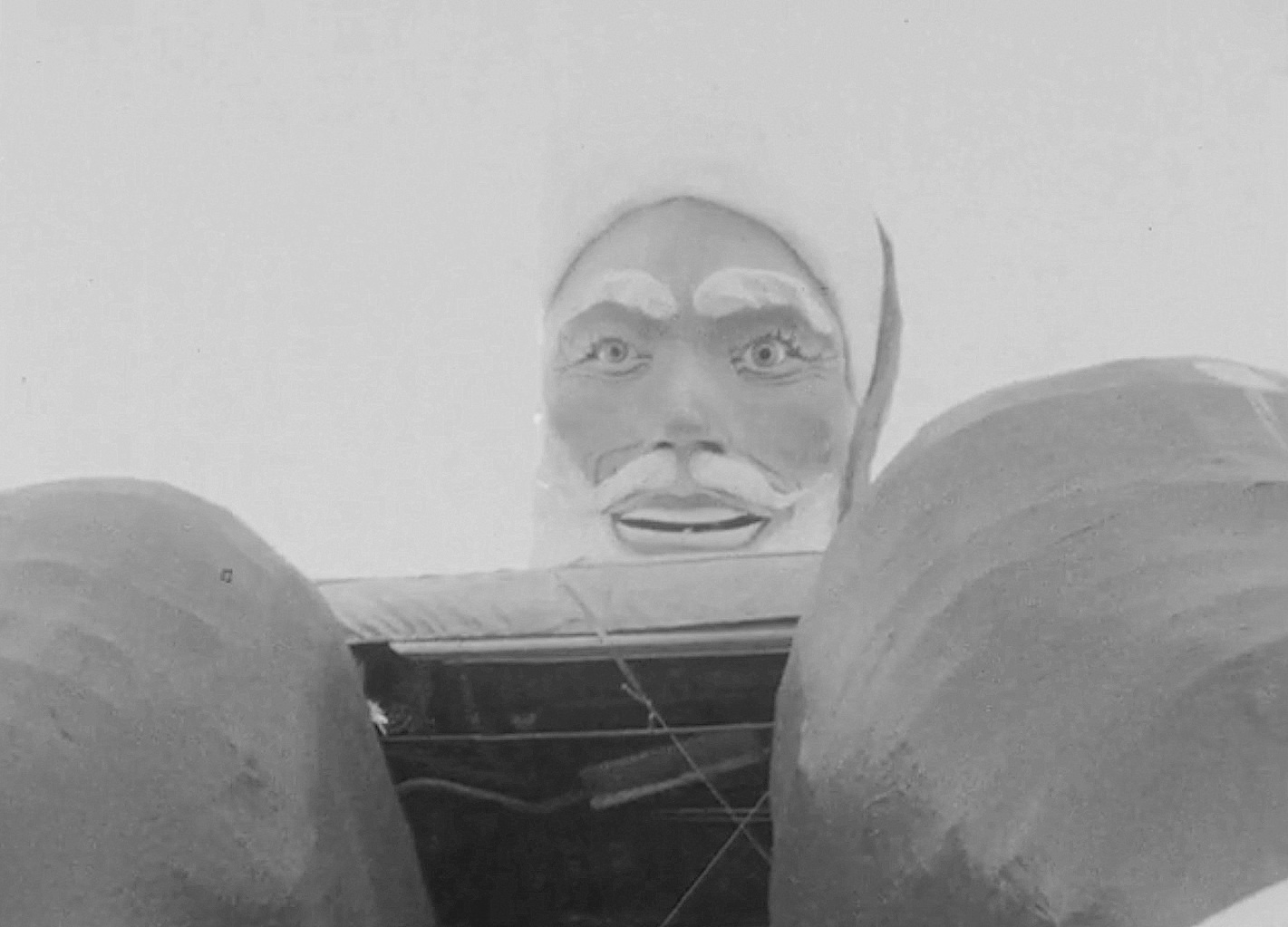
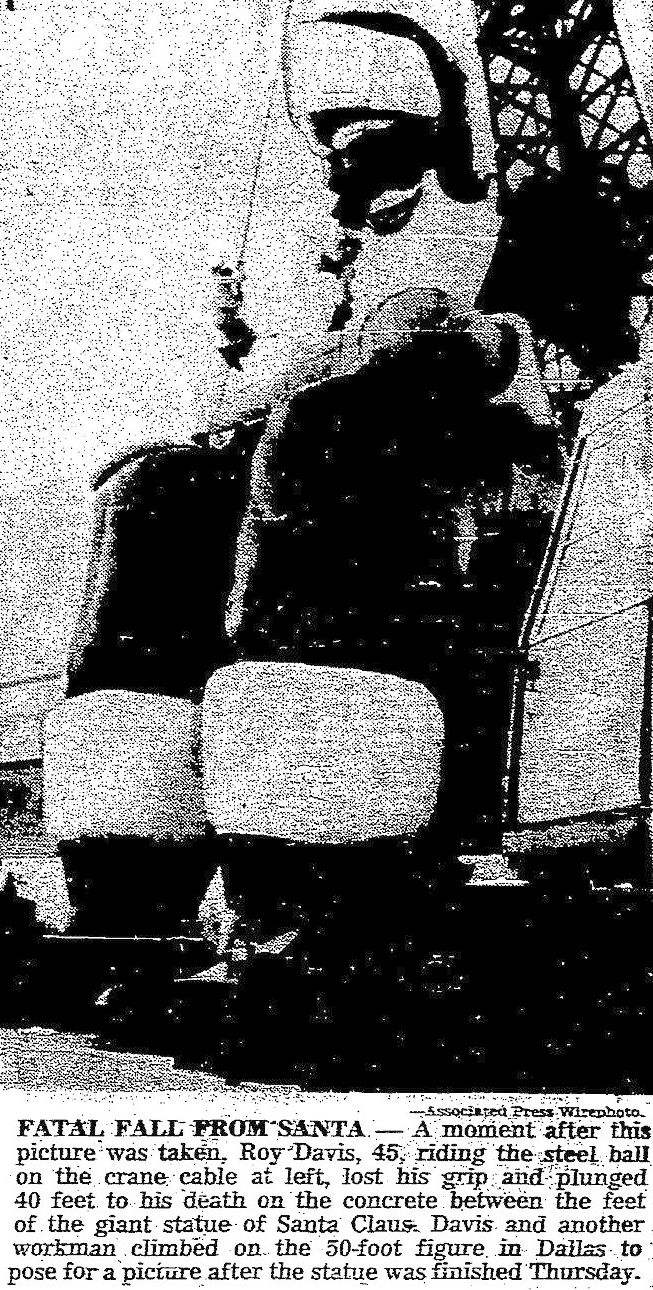
First, a quick re-cap (but, please, read Robert’s story, because you’ll enjoy  it, and it’s much more colorful than my quick overview here). During the 1953 Christmas season, Porter Chevrolet (5526 Mockingbird) commissioned Jack Bridges (the man who had previously made Big Tex (who was himself originally a giant Santa Claus)) to construct an 85-foot-tall steel-and-papier-mâché Santa Claus (he’d be that tall if he were standing) to sit on the dealership building and hold an actual 1954 Chevy in his lap. It was definitely a promotion that would grab people’s attention. The day the giant Santa was put in place, using a crane, a man whose company had done the installing (as they had with Big Tex), thought it would be a great opportunity to get a Christmas card photo of himself dangling from the crane next to Santa. The man, Roy V. Davis, was recovering from heart-related health problems, and, as it turned out, he experienced a “myocardial rupture” while hoisted 35 feet above the concrete parking lot. He lost his grip and fell to his death. This tragic news made the front page of local papers and was picked up by the Associated Press, but, oddly, it was never spoken of again. Giant Santa apparently remained at his perch throughout the holidays, but as far as I can tell, there was no further mention of Mr. Davis’ death — until Robert Wilonsky stumbled across the photo and wrote about it 57 years later.

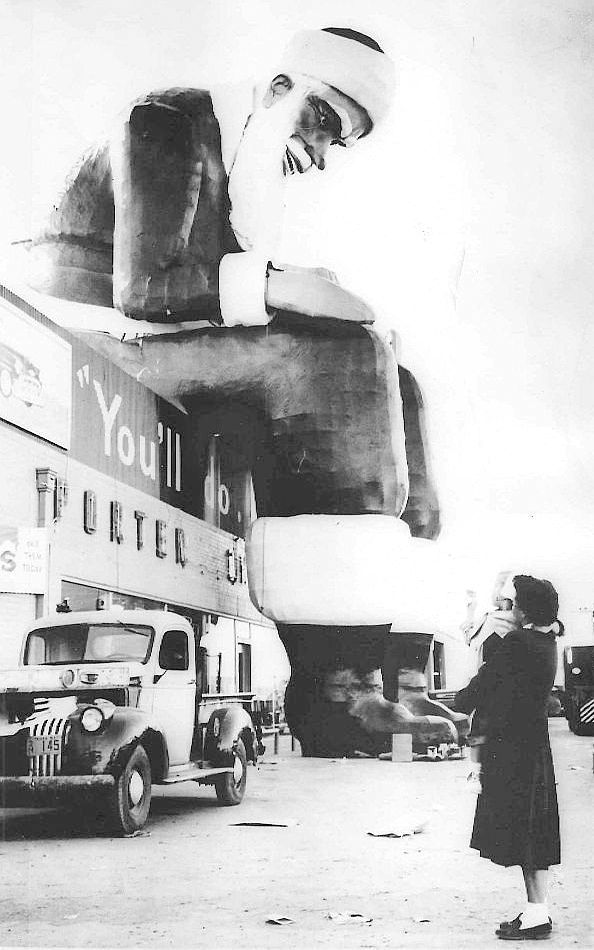
Below is the AP photo and blurb which ran nationally, showing Mrs. John Ashmore and her 4-year old daughter Ruth Ann looking up at the towering Santa Claus. 
santa_porter-chevrolet_news-photo_1953_PEB
Photo: Collection of Paula Bosse

The caption (click for larger image):

santa-claus_porter-chevrolet_caption

**

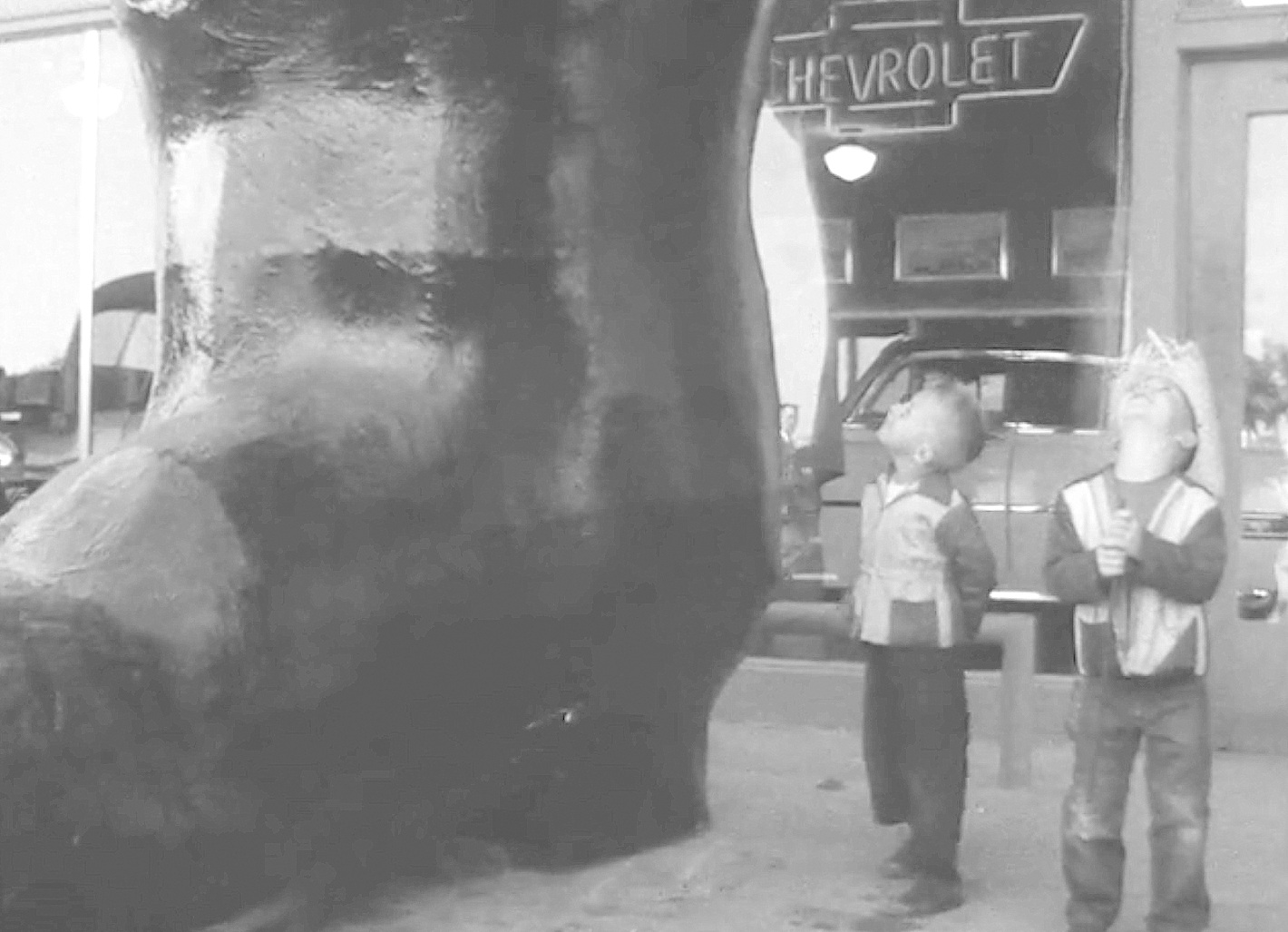
UPDATE: Okay this is VERY EXCITING — and also kind of chilling: there is WBAP-Channel 5 television news footage of the Giant Santa as well as the on-the-scene tragic aftermath of Mr. Davis’ accident. The Dec. 10, 1953 footage is without sound (the script the anchor read on the air as the film played during the newscast can be found here). The video starts off with children marveling at the giant Santa Claus but suddenly turns dark with shots of the bloody Mr. Davis being loaded onto a stretcher (helped by Jack Bridges, the man who built the giant Santa, seen wearing a beret and white coveralls). The one-minute clip titled “Worker Dies at Santa’s Statue” can be viewed on the Portal to Texas History site here.

Below are a few screen captures:
santa-kids_wbap-1_portal

santa-face_wbap-2_portal

santa-crane_wbap-3_portal

santa-dr-pepper-plant-ambulance_wbap-4_portal

**

santa_denison-press_122553Denison Press, Dec. 25, 1953

santa_FWST_121153_AP_photoFort Worth Star-Telegram, Dec. 11, 1953

santa_lubbock-avalanche_121153_APLubbock Avalanche, Dec. 11, 1953

***

Sources & Notes

Top color photo (which I’ve cropped) is by Roy Addis. It appeared in the Dallas Observer blog Unfair Park in Robert Wilonsky’s 2011 update to the previous year’s story — it was sent in by a reader who discovered it in his personal collection. To read that story, click here.

Wilonsky’s original Unfair Park post — which contained the photo he found on eBay — is here. And, again, his post containing “the rest of the story” is here. (Robert Wilonsky continues to write enthusiastically about Dallas — its past as well as its present — and his Dallas Morning News pieces are, quite frankly, where I get most of my news about what’s going on in the city. Thanks for the opportunity to be part of the unearthing of this story, Robert!)

The news photo of Mrs. Ashmore and her daughter is from the author’s personal collection.

The video is from the KXAS-NBC 5 News Collection, University of North Texas Libraries Special Collections, accessible on the Portal to Texas History site. The main page of the video is here (click picture to watch video in a new window).

Dallas Morning News articles on the giant Santa and the tragic accident:

  • “Santa Claus Turns Texan” (DMN, Sept. 23, 1953)
  • “Figure of Santa Claus Will Overshadow Tex” by Frank X. Tolbert, with photo of Jack Bridges (DMN, Nov. 18, 1953)
  • “Santa Claus Too Large For Trucks” (DMN, Nov. 29, 1953)
  • “Christmas Card Picture With Tragic Ending” (DMN, Dec. 11, 1953)
  • “Man Falls to Death Off Cable,” with photo of Roy V. Davis (DMN, Dec. 11, 1953)

UPDATE: Robert Wilonsky has written on the giant Santa in a new Dallas Morning News article, with some interesting new tidbits about Porter Chevrolet’s proposal to the City Council requesting permission to put this huge structure on top of the building. Read his 2017 update here. Robert keeps telling me we should write a book about this — or make a documentary. Which, of course, we should! After all these years now of visions of the giant Santa and sober thoughts of Roy Davis — more “real” now, having seen film footage of him bloody on that stretcher — I really do feel this is all part of some personal family Christmas lore, recounted every year around the table.

Pictures and clippings are larger when clicked.

*

Copyright © 2014 Paula Bosse. All Rights Reserved.
 

Interurbans: Freight Movers?

People-mover, above; freight-mover, below…

by Paula Bosse

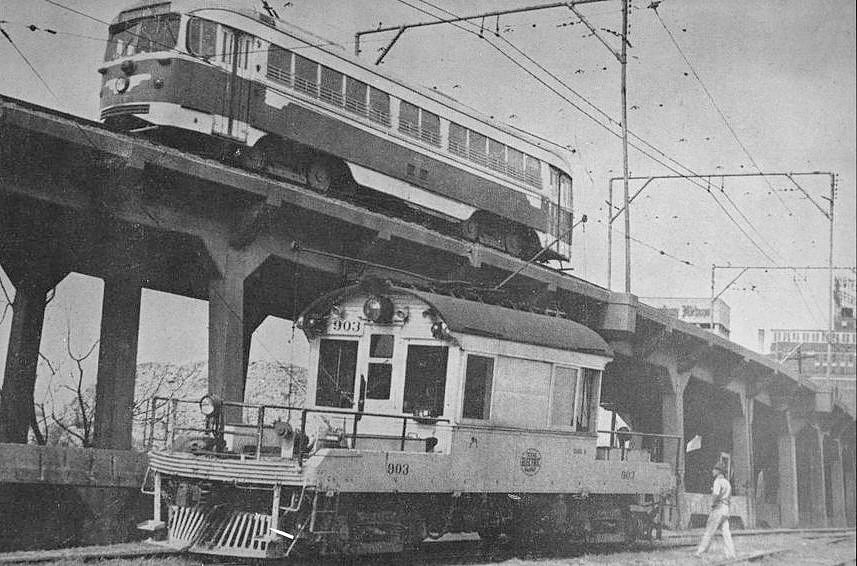
When I saw this photo, I had no idea what I was looking at — what was that odd-looking thing in the foreground? A couple of rail enthusiasts informed me that it was an interurban freight engine on rail tracks beneath the old elevated interurban/streetcar trestle that spanned the Trinity. This is the Dallas side, with the Dallas Morning News building and the Hotel Jefferson in the background, to the north. (You can see the tracks running right next to the DMN in a photo in a previous post, here.) According to one of the experts:

The interurban did some exchange of freight cars with the regular railroads and the exchange tracks were under the streetcar/interurban viaduct. This track merged with the streetcar tracks at the foot of the viaduct right next to the DMN.

The interurban, though primarily a mover of people, also hauled freight. With more than 200 miles of track across North Texas, the Texas Electric Railway was the largest interurban railway operator in the South. But its glory days were starting to wane as the popularity of automobiles increased. By the ’20s, freight-moving was added to the company’s services, generating welcomed revenue.

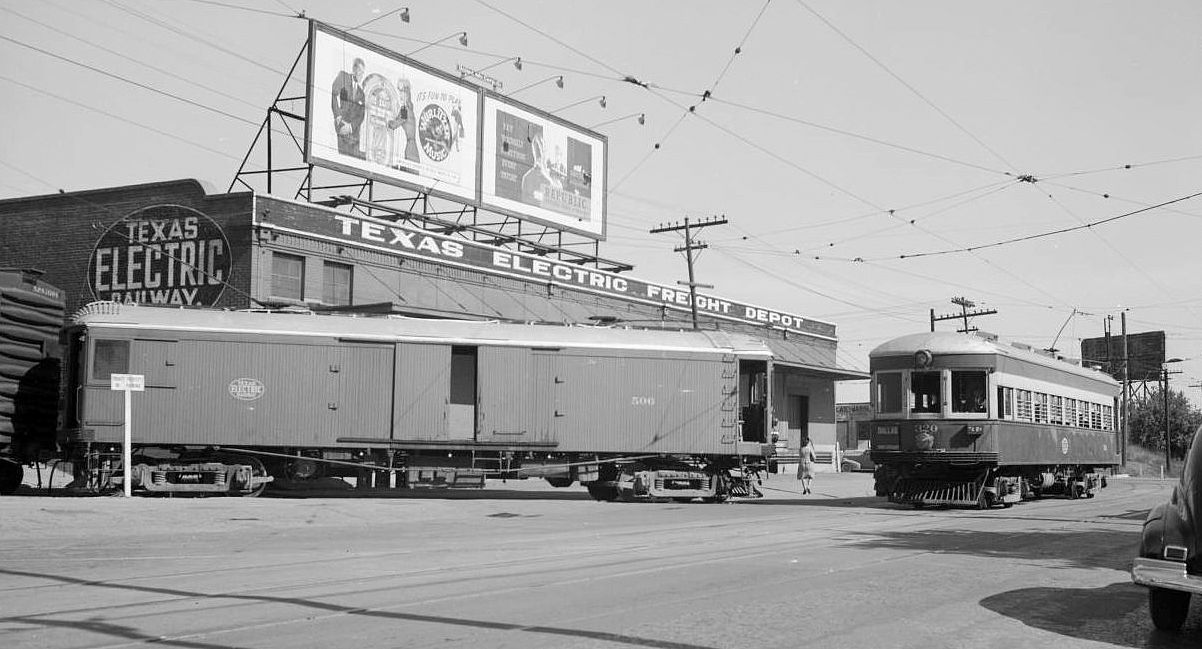
The interurban freight depot — seen below in 1946 — was located just east of Ferris Plaza. At the left, part of a railroad freight car is visible, in the middle, an interurban freight car, at the right, an interurban (passenger) streetcar, and at the far right, an automobile. And some crazy person walking.

freight_interurban_denver-pub-lib_1946

But the automobile eventually proved too popular, and more and more people began using trucks for hauling. After 40 years in business, the Texas Electric Railway interurban ceased operations in 1948.

*

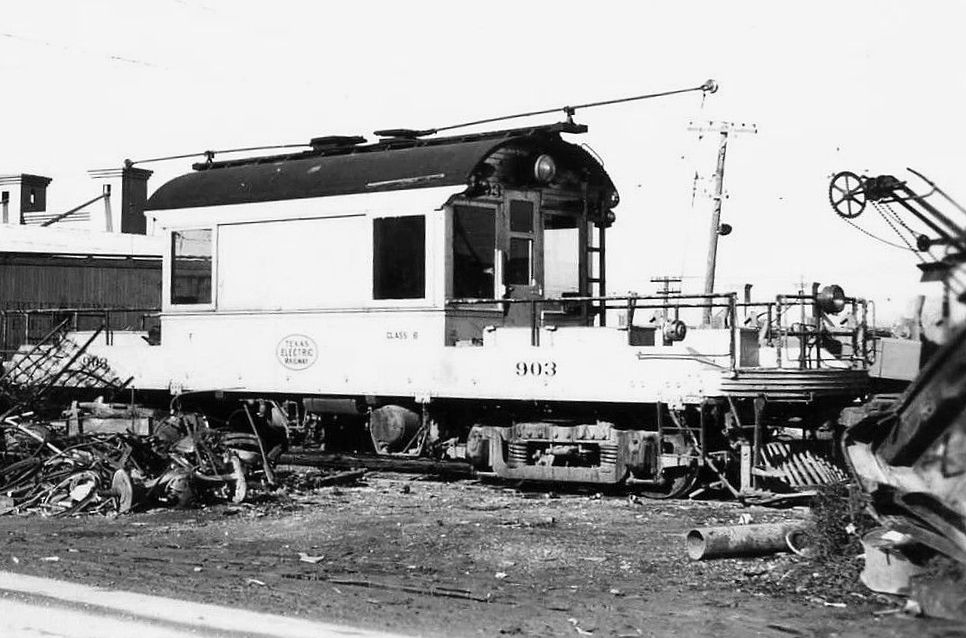
When searching around for possible other images of engine 903 (as seen in the top photo), I found it hanging out over on eBay — described as being in the “Waco car house yards” in 1944. Small world.

engine-903_ebay

***

Sources & Notes

Top image found on Flickr.

Photo of the freight depot taken by Robert W. Richardson on April 27, 1946; from the Western History/Genealogy Dept., Denver Public Library.

Bottom photo (cropped) from eBay..

Interurban freight operation Wikipedia entry here.

Texas Electric Railway: Handbook of Texas entry here; Wikipedia entry here.

MANY photos of various Texas Electric Railway freight motors and locomotives, here.

And, lastly, great photos from around Dallas in CERA’s “Texas Electric and the Journey to DART,” here.

(Thanks to Bob J. and Robert P. for their helpful info!)

*

Copyright © 2014 Paula Bosse. All Rights Reserved.
Urban Crisis: “The Walls Are Rising” — 1967

walls_lake_1967
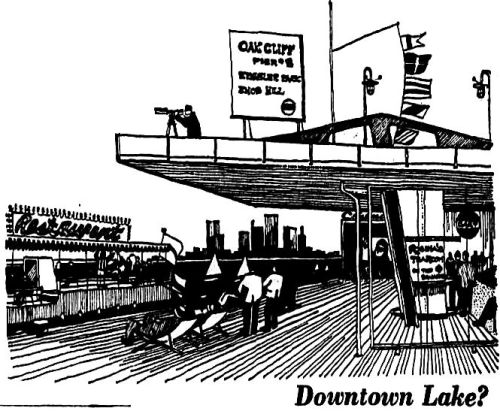
Oak Cliff Pier? Just one part of Dallas’ urban future as envisioned in 1967…

by Paula Bosse

In 1967, the Dallas chapter of the American Institute of Architects unveiled a project it had been working on under the sponsorship of the Greater Dallas Planning Council for over a year — a 40-minute color slide presentation with recorded narration called “The Walls are Rising,” directed by writer-photographer Ron Perryman of Austin. Enslie “Bud” Oglesby — one of Dallas’ top architects and the chairman of the committee behind the project — said of the film:

I saw here an opportunity to demonstrate the problems which poor planning bring and the results that can come from a sound, unified planning program…. (Fort Worth Star-Telegram, June 18, 1967)

The rather more urgent tone of the brochure that accompanied the film was a bit more dire:

We cannot afford to lose any more time in developing a coordinated plan to make Dallas a more beautiful and effective city, for all around us the walls are rising, the city is being built… We are designing by default instead of summoning our vitality, wealth resources, talents and human vision to create a design plan that will give Dallas quality and character all its own.

The goal of the project was to create awareness among city officials, planners, and designers (as well as among the public) of the immediate need to address the conscious physical design of the city in order to improve its future “livability.” The argument was that the city of Dallas was, in 1967, an unplanned and uncoordinated chaotic urban environment dominated by (and practically strangled by) the automobile; it was overwhelmed by traffic, noise, and visual clutter, and it lacked much-needed green spaces and personal “refuges.”

It was stressed that the film was not a plan, per se, but was, instead, an outline of suggestions that the AIA and the Greater Dallas Planning Council were proffering for discussion (and, one assumes, hoping would be implemented). Among their suggestions were the following (some of which have been adopted, but many of which have been “on the table” for decades now and which Dallas leaders continue to debate):

  • A 6-mile hike-and-bike trail from Turtle Creek to Reverchon Park
  • A rapid transit system (the report stressed that it would be urgently needed by 1980)
  • The creation of downtown parks
  • The development of downtown apartment housing
  • A centralized transportation hub (bus, rail, air)
  • The reduction in noise, visual clutter, and traffic
  • More “sensitive” freeway planning, which should be designed (or re-designed) for the driver and not for the automobile
  • More awareness of the pedestrian in designing downtown and neighborhood streets, especially in regard to safety and accessibility
  • Development of, yes, the Trinity River and its levees, including a downtown lake and sailboat-dotted marina, with apartments and a variety of entertainment and shopping venues lining the “shore”
  • And, most unexpectedly, a “scenic link” which would connect Fair Park to the Dallas Zoo, incorporating a sort of shuttle service between the two locations (and across the Trinity) via an elevated gondola ride (!)

As fun and fanciful as fresh ideas on getting to Oak Cliff are, the film seems to have been more of a warning of what the city’s future might be if it continued down its then-current path of … having basically no plan at all. The film started off by assaulting the viewer’s senses with several minutes of “blaring, cacophonous music” and a rush of chaotic images — and opened with the ominous words, “We are living in an accident.” The League of Women Voters issued a report in 1968 called “Crisis: The Condition of the American City” in which they described “The Walls Are Rising” as “a horror film.”

What sounds a bit like a sophisticated A/V presentation was screened for dozens and dozens and dozens of groups in the Dallas area between 1967 and about 1972: it was shown to various Chambers of Commerce, Rotary, Kiwanis, and Lions clubs, women’s groups, church groups, business groups, arts organizations, and on and on and on. The film would usually be introduced by an architect who would also lead a discussion and answer questions afterward. If you were a member of a civic or professional group in the late ’60s, chances are pretty good you saw “The Walls Are Rising.”

Which is why it’s so surprising that all traces of the film seem to have vanished in the intervening years. I contacted the Dallas Municipal Archives, the Texas/Dallas History & Archives Division of the Dallas Public Library, AIA Dallas, and Dallas Center for Architecture. Everyone was very helpful, but … nothing. Designs for Dallas and the later Goals for Dallas are better known projects, but it seems that there would be something connected with this film lying around somewhere. I’d love to see it. It sounds like it would be entertaining and informative … and depressing. We’ve come so far. …We haven’t come far at all.

**

walls_FWST_061867Fort Worth Star-Telegram, June 18, 1967 (click for larger image)

***

Sources & Notes

“The Walls Are Rising” was introduced to the Dallas public in Dorothie Erwin’s article, “A Design for Dallas Proposed,” which ran in the Feb. 12, 1967 edition of The Dallas Morning News. Additional descriptions of the film can be found in the article “A Courageous Look at Today’s City” by Larry Howell (DMN, May 3, 1968).

*

UPDATE: Jan. 9, 2015 — Great news! AIA Dallas has found the film and has scheduled a screening!

  • To read my follow-up post “‘The Walls Are Rising’ — FOUND!” click here.
  • To read Robert Wilonsky’s Dallas Morning News article on the newly-found film, click here.
  • For info on the AIA Dallas screening, click here.

UPDATE: Jan. 20, 2015 — The public screening and panel discussion at the Sixth Floor Museum was great! Read about it here.

UPDATE: May, 22, 2015 — AIA Dallas has digitized and uploaded the film to Vimeo. Watch the complete film here.

*

Copyright © 2014 Paula Bosse. All Rights Reserved.
 

A Downtown Gas Station! — 1949

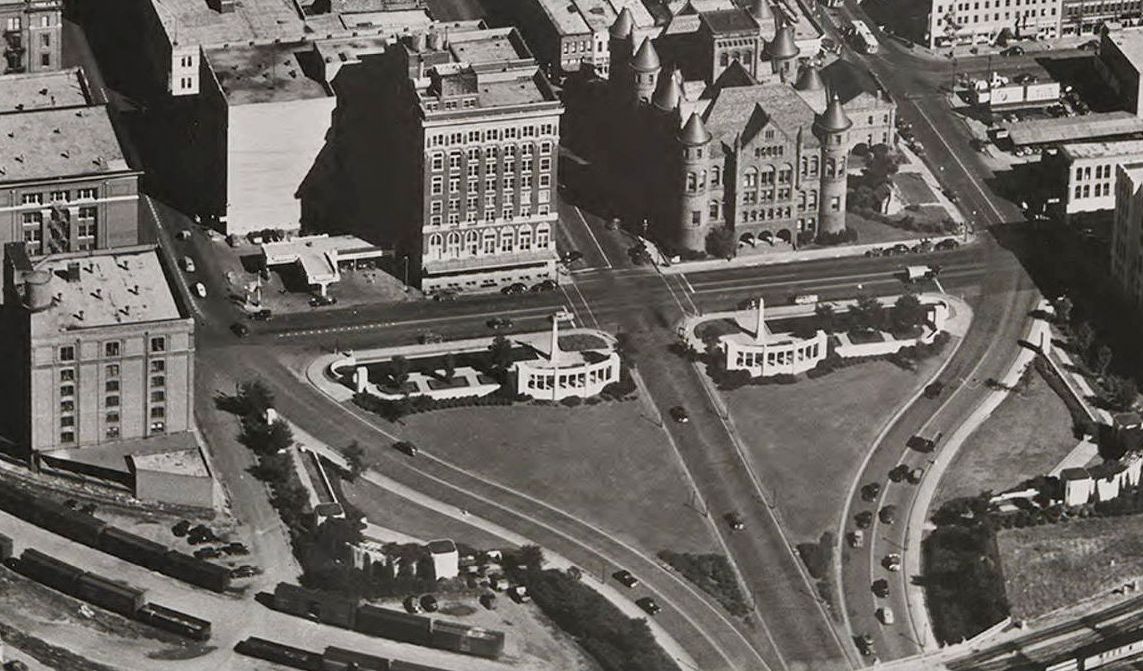
tyler-service-stn_degolyer_1949-det1Gas station at Elm & Houston! (click for larger image) (SMU Libraries)

by Paula Bosse

There was a time when gas stations populated the central business district in downtown Dallas. But now? I’m not sure I’ve ever seen a gas station in the heart of downtown. Which is probably why the station seen above (from a detail of a larger aerial view of downtown) stood out so much when I was looking at the photo. And it wasn’t located just anywhere downtown, but it was in the primo location opposite Dealey Plaza at the “gateway” to the city. It doesn’t fit in that space very well — it’s a corner crying out for a more substantial structure — but … wouldn’t it be nice to have an actual full-service gas station downtown again?

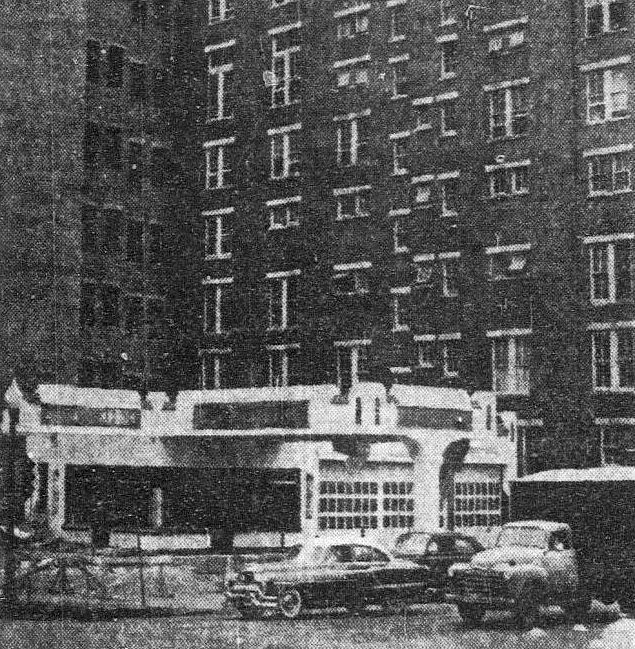
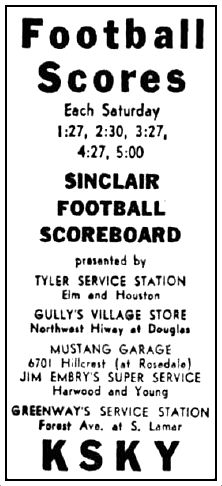
The Tyler Service Station (and before that the Longhorn Service Station) held down the corner at Elm and Houston streets in the 1940s but was demolished in 1953 to make way for the construction of the Records Building/Criminal Courts Building annex. And, hallelujah, I found a photo of the service station from ground-level — and it was pretty cool-looking!

gas-station_elm-and-houston_1950s

tyler-service-stn_dmn_100948Oct. 9, 1948

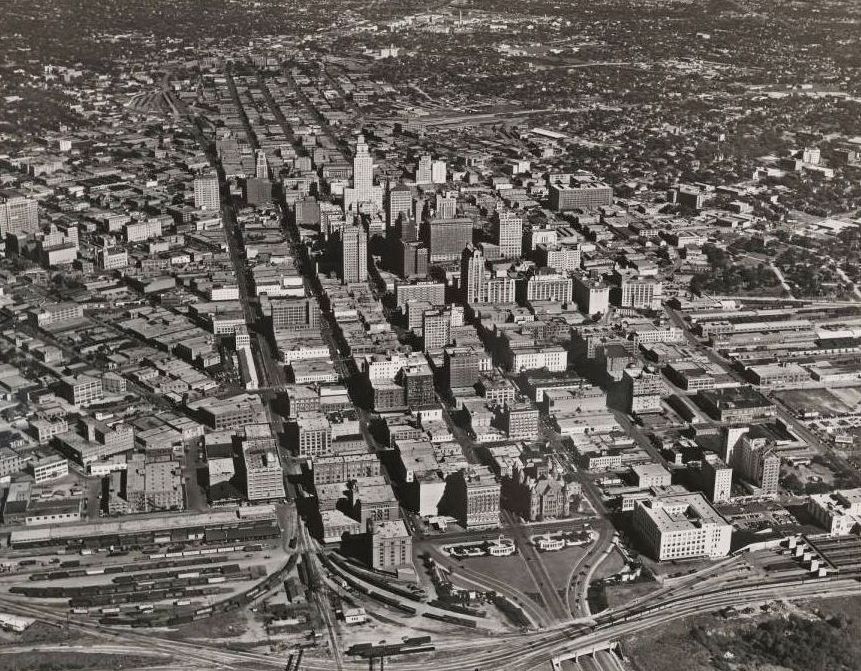
And, finally, here’s the original photo I saw in which that long-gone gas station jumped out at me, another wonderful photo by Lloyd M. Long, taken in May, 1949. You never know what odd things you’ll discover if you just take the time to explore.

downtown_degolyer_1949Aerial photo by Lloyd M. Long, 1949 (Foscue Map Library, SMU)

***

Sources & Notes

Lloyd M. Long photo (“Downtown Dallas, looking east”), from the Edwin J. Foscue Map Library, Central University Libraries, Southern Methodist University; it can be viewed here.

Click pictures for larger images.

*

Copyright © 2014 Paula Bosse. All Rights Reserved.
 

Refusing to Give Up One’s Seat Might Set Off a Melee — 1919

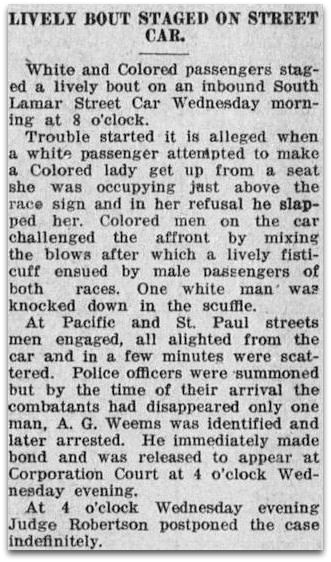
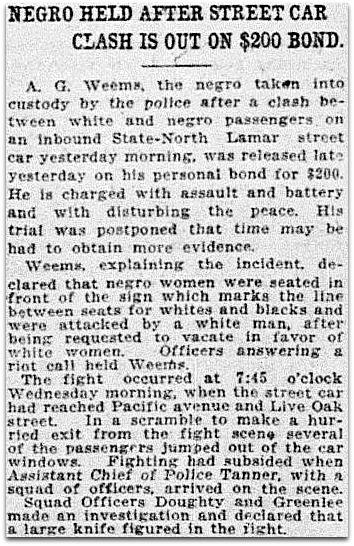
streetcar-fight_dal-express_100419The Dallas Express, Oct. 4, 1919

by Paula Bosse

On this, the anniversary of Civil Rights icon Rosa Parks‘ act of defiance in refusing to give up her seat on a bus to a white passenger in Alabama in 1955, it’s interesting to note a couple of accounts of similar incidents in Dallas, but 36 years earlier. And more violent.

The article above — which appeared in The Dallas Express, a weekly newspaper printed by and for Dallas’ black community — describes a melee (or “riot” as The Dallas Morning News called it) that occurred when an unnamed black woman refused to give up her seat (which was in the part of the streetcar reserved for white passengers) when a white man demanded that she move. When she steadfastly refused, he slapped her (!), and that set off a wild fight between black and white male passengers … on a moving streetcar! When the car stopped, everyone spilled out into the street and scattered. Only one person was arrested, Mr. A. G. Weems, a black businessman and former school teacher who was active in the black community and later represented African-American interests and residents as a member of the Negro Chamber of Commerce.

The Dallas Morning News also carried a report of the incident:

streetcar-fight_dmn_092519Dallas Morning News, Sept. 25, 1919

It sounds as if Weems could have gotten away, had he wanted, but perhaps he was making a statement.

In the previous months of 1919, there were several similar incidents reported in the pages of The Dallas Express. Sometimes altercations were a result of black passengers sitting in “whites-only” sections of streetcars, but sometimes trouble arose when the white section was full, and white passengers sat in the seats designated for black passengers:

streetcar-fight_dal-express_071219Dallas Express, July 12, 1919 (click for larger image)

There was also an incident that had occurred in February of that year in Birmingham, Alabama in which a white conductor was shot (and presumably killed) after he threatened to slap a black woman in a dispute over the fare. A black vigilante had appeared out of nowhere, shot the man, and disappeared into the night.

The antagonism, disgust, and violence caused by this “peculiar law of the Southland” continued until 1956 when the Supreme Court finally banned segregation on public transportation.

*

Copyright © 2014 Paula Bosse. All Rights Reserved.

JFK’s “Last Hour In Dallas” — 1963

JFK_poster

by Paula Bosse

How is a city supposed to respond when it is suddenly plunged into the international spotlight? Does it grieve and try to forget, or does it grieve and capitalize? Dallas has had over 50 years to deal with/come to terms with the assassination of President Kennedy, but sometimes it seems as if the City of Dallas is still shell-shocked and isn’t quite sure how to acknowledge it on an official level. Let’s face it, Dallas is known to the rest of the world for one thing: the Kennedy assassination (and perhaps the TV show, and maybe the Cowboys). Yes, we have the justly-renowned Sixth Floor Museum, but it took 26 years to open it!

The cottage industry that sprang up in the wake of the Kennedy assassination has been big business for decades, some of it generated by people who live in Dallas, but most of it by people who have probably never even been to Texas. Since 1963, the “assassination literature” (…and, yes, it’s called that) has mushroomed, with local contributions coming from Dallasites whose brush with the President before, during, or after the events of November 22, 1963 have probably been pored over by numerous people either trying to understand why what happened happened or by people searching for hidden conspiracy clues to explain what really happened.

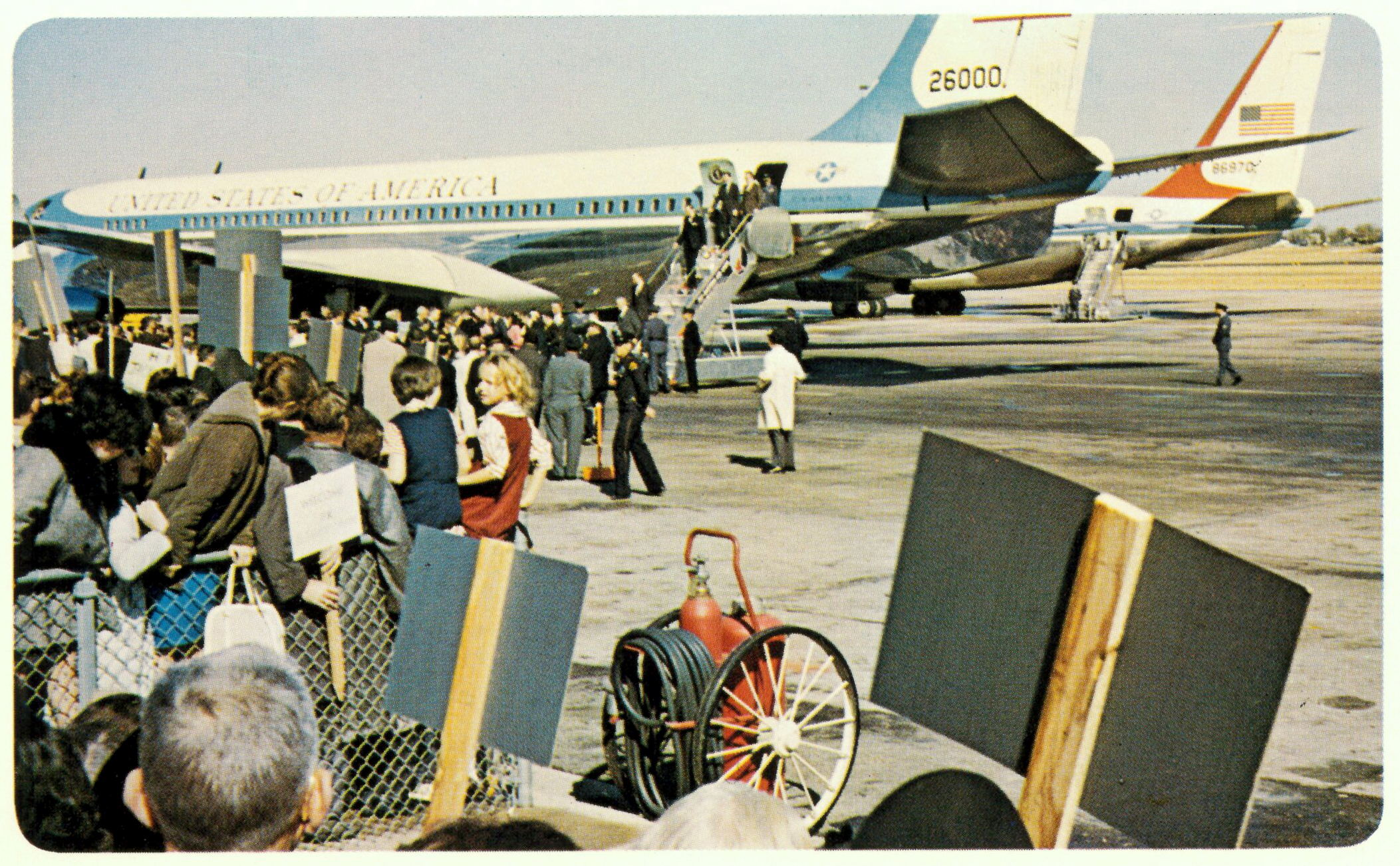
One local resident who added to the assassination literature was John E. Miller who took photos of the arrival of President and Mrs. Kennedy at Love Field and then apparently hot-footed it over to Parkland when the news of the shooting broke. These photos were issued as postcards in 1964 in a packet of 12. (Click pictures for larger images.)

JFK_envelope_frontAbove, the front of the envelope containing the cards; on the back: “A Real Picture Treat For Years To Come.”

JFK_card_01From the back of the card: “No. 1, Arrival of President’s Escort Plane at Love Field, Dallas, Texas.”

JFK_card_02“No. 2, Presidential and Escort Planes at Dallas’ Love Field landed shortly after this picture was taken.”

JFK_card_03“No. 3, President John F. Kennedy and party leaving airplane at Love Field. (Mrs. Kennedy — pink hat.)”

(UPDATE: The two little girls in the photos above and below are most likely Carolyn Jacquess, in blue, and Debby Massie, in red. Their little group arrived at the airport before the president’s plane arrived, walked through the terminal and out onto the tarmac, right to where the plane taxied up to the small crowd of about 100 people. Just like that. There was no special invitation, and, other than the chain-link fence, no real security.)

JFK_card_04“No. 4, President John F. Kennedy and Party in foreground at Dallas’ Love Field.”

JFK_card_05“No. 5, Vice-President Johnson, Governor Connally, Mrs. Kennedy (pink hat), other members of party at Dallas Love Field.”

JFK_card_06“No. 6, Vice-President Johnson, Governor Connally, Presidential Party and Newspaper Men, Love Field, Dallas.”

JFK_card_07“No. 7, Forming of Presidential Parade, Love Field, Dallas.”

JFK_card_08“No. 8, After Assassination, TV Unit arrives at Parkland Hospital in Dallas.”

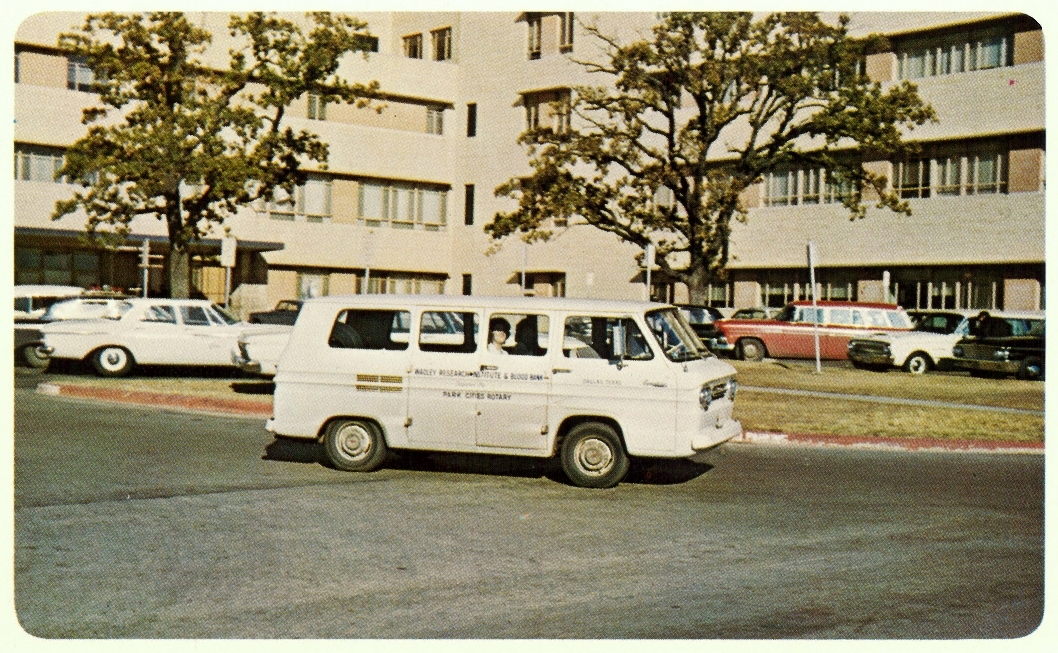
JFK_card_09“No. 9, Blood Bank Unit at Parkland Hospital on fatal day. Dallas, Texas.”

JFK_card_10“No. 10, Hearse carrying President John F. Kennedy’s body and Mrs. Kennedy from Parkland Hospital back to airplane at Love Field, Dallas.”

JFK_card_11“No. 11, Presidential plane awaiting President Kennedy’s body, Vice-President Johnson and Mrs. Kennedy, for return to Washington, D.C. (Note Presidential seal.)”

JFK_card_12“No. 12, Texas School Book Depository building from which authorities believe fatal shots were fired. (Note second window down on right corner of building.)”

***

Photos and captions © John E. Miller 1964, 3500 W. Davis, Dallas, Texas 75211. (Mr. Miller was a Dallas businessman who sold motor homes and trailers in Oak Cliff between 1945 and 1976. A photo of Mr. Miller is here).

Many thanks to “amyfromdallas” for scanning and contributing the images in this post. Thanks, Amy!

For other Flashback Dallas JFK-related posts, see here.

Click pictures for larger images.

*

Copyright © 2014 Paula Bosse. All Rights Reserved.
Dallas’ Ford Dealerships in the 1920s: Authorized for Your Protection

ford_dal-exp_091622-smAuthorized Ford dealers, 1922

by Paula Bosse

Dallas has always been a big car town, getting its first look at a “horseless carriage” way back in 1899 when E.H.R. Green sped into town at 15 m.p.h. and startled the citizenry. By 1903, The Dallas Morning News was bragging that Dallas had more privately owned cars than any other city its size in the South (“over 40”). By 1909, the Ford Motor Company had a Model T service center in the city, and in 1914, Ford opened an important regional assembly plant downtown (which later moved to more spacious digs on East Grand).

For many years, there were six — and only six — authorized Ford dealers in town. In several ads of the period, “automobilists” were stringently warned to avoid “bogus” agents offering counterfeit Ford parts. (Accept no knock-offs!) Below, the six authorized Ford dealers operating in Dallas in the 1920s. (All photos are larger when clicked.)

ford-dealer_fishburn_houston_dmn_101329Above, Fishburn Motor Company, 101 N. Houston St. Long gone, Dealey Plaza now occupies this site. Behind the building, at the right, is the Southern Rock Island Plow Company building, better known today as the School Book Depository.

ford-dealer_flippen_ross_dmn_101329The Flippen Auto Company, 1917 Ross Ave. The building took up part of the block now occupied by the Dallas Museum of Art.

ford-dealer_lamberth_dmn_101329Lamberth Motor Company, 3800 Main St. This building, not far from Fair Park, is at Main and S. Washington and later became part of the Fritos factory. With the building’s renovations over the years, it’s a little difficult to tell, but I think this building is still standing (and is the only one of these six buildings that has survived). To see what this building has looked like over the years, see my previous post, “3800 Main: Fritos Central,” here.

ford-dealer_morriss_lancaster_dmn_101329aThe John E. Morriss Company, 132 North Lancaster Ave., Oak Cliff. I’m not positive, but I think this may have been where Hector P. Garcia Middle School now stands.

ford-dealer_rose-wilson_ervay_dmn_101329Rose-Wilson Company, 1218 South Ervay St. In the Cedars, one block north of the Ambassador Hotel.

ford-dealer_shelton_main_dmn_101329J. H. Shelton & Company, 2311 Main St., at the very edge of Deep Ellum. The buildings seen here were right about where Central Expressway crosses over Main.

ford-logo_19221922

*

Copyright © 2014 Paula Bosse. All Rights Reserved.
 

Crossing the Trinity River Viaduct — 1946

streetcar-crossing-trinity_1946-denverpublibStreetcar on the Trinity River Viaduct (click for larger image)

by Paula Bosse

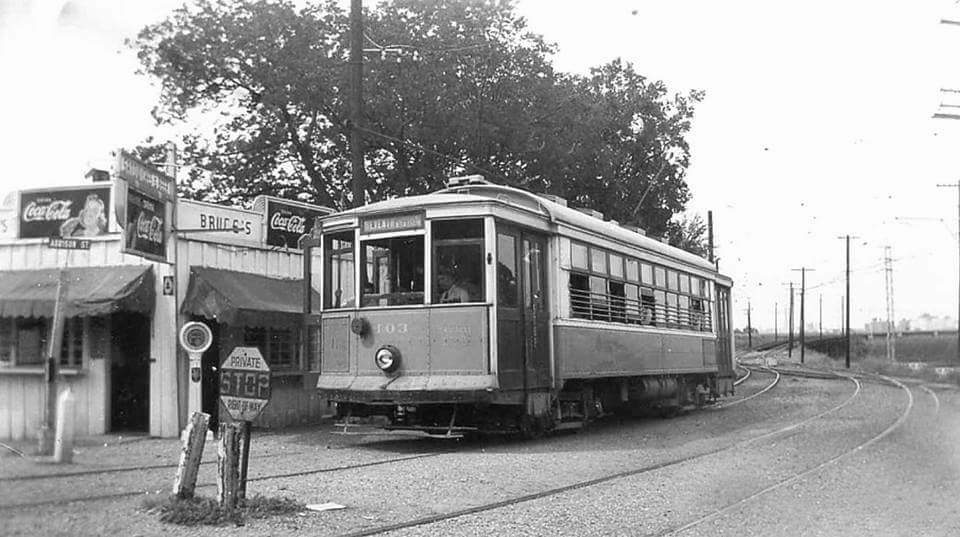
A few days ago I posted a photograph of a streetcar pulling into Oak Cliff, having just crossed the Trinity River Viaduct (link below). In this photo, we see what streetcars of the period looked like actually crossing the viaduct.

***

Photo by Robert F. Richardson, taken on June 5, 1946. From the Western History/Genealogy Dept., Denver Public Library, viewable here.

Photos of these double-ended streetcars taken from a distance present a bit of a Pushmi-Pullyu problem in determining which direction they’re heading, but if you enlarge the photo at the Denver Public Library link just above, you can see the silhouette of the operator at the eastbound end of the car, driving the car toward Dallas. UPDATE: I’m wrong! The car is moving toward O.C., not Dallas! That motorman silhouette is a figment of my imagination! See the comments below for tips on how an amateur like myself who’s never actually seen a streetcar can tell which direction one is moving. (Thanks, Bob and Bob for the correction!)

Streetcars ran back and forth across the Trinity River on a special trestle just south of the Oak Cliff Viaduct/Houston Street Viaduct. It had been in use since 1887 (through various renovations) and was demolished in the early 1970s to build the present-day Jefferson Street Viaduct. The streetcar shown is from the Dallas Railway & Terminal Co. fleet.

My previous post mentioned above, “Waiting for a Streetcar on a Sunny Winter Day in Oak Cliff — 1946,” contains a fantastic photo taken by the same photographer, four months earlier, showing people waiting for the approaching streetcar just after it’s crossed the river; that photo can be seen here.

*

Copyright © 2014 Paula Bosse. All Rights Reserved.
Waiting For a Streetcar on a Sunny Winter Day in Oak Cliff — 1946

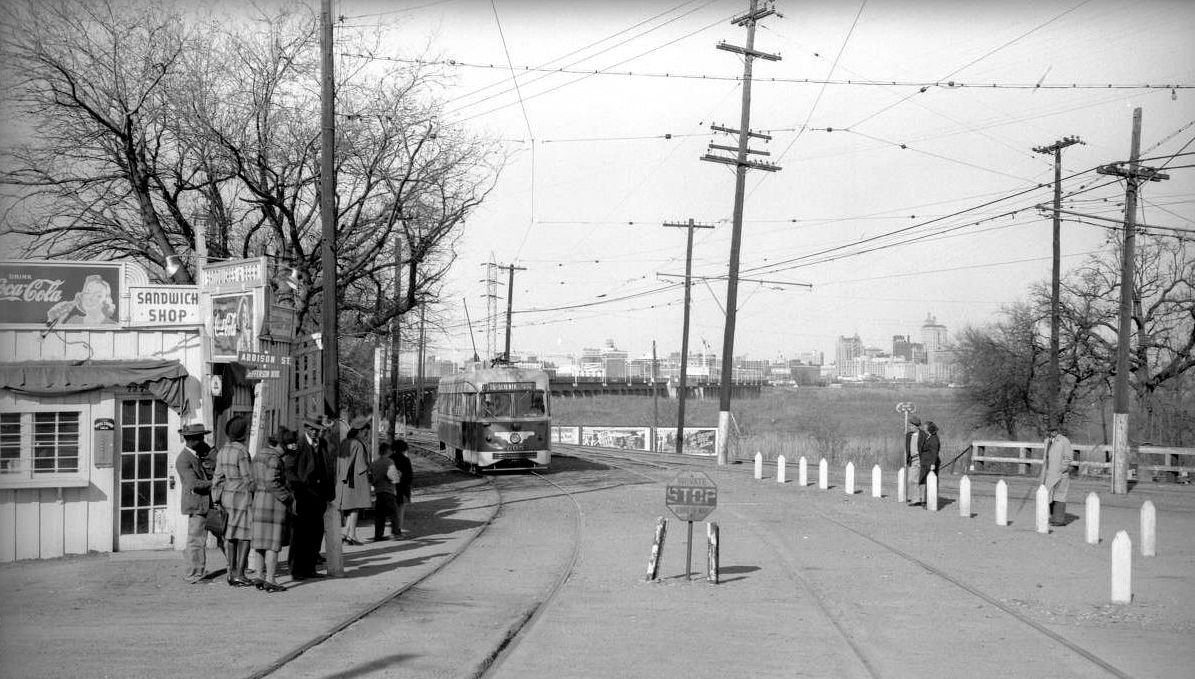
jefferson-addison_denver-pub-lib_1946Addison St. & Jefferson Blvd. in Oak Cliff — Feb., 1946 (click for larger image)

by Paula Bosse

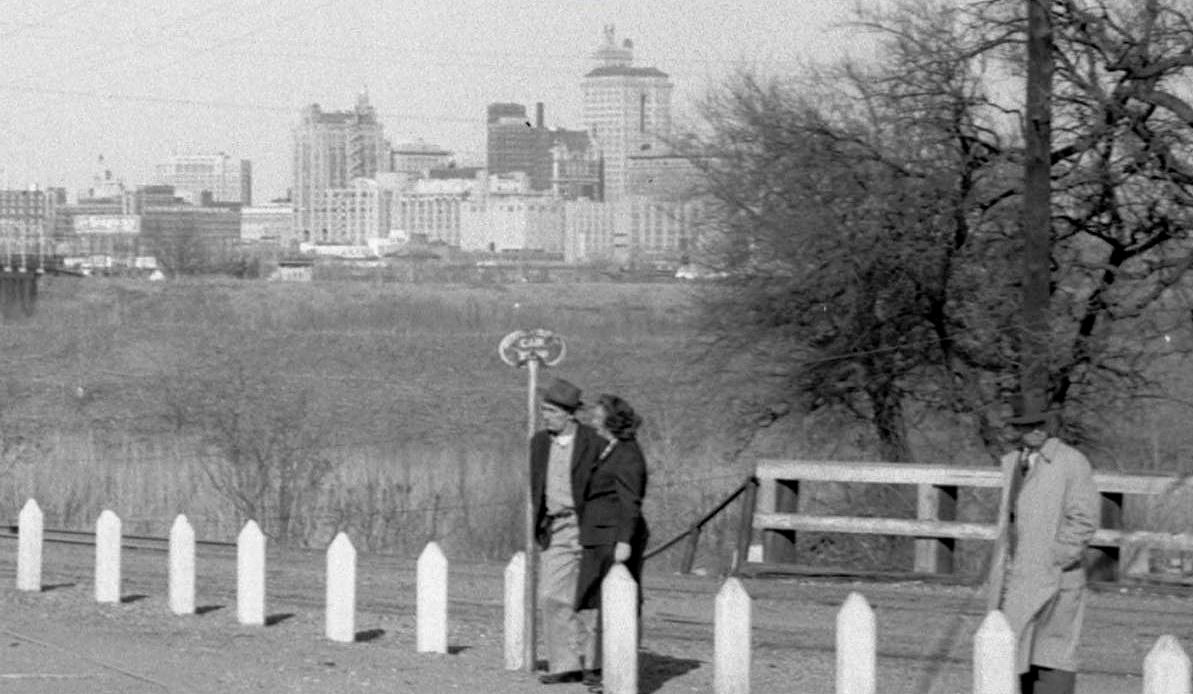
I love streetcars, photos from the 1940s, fashions of the ’40s, and views of the Dallas skyline. And here are all of these things, in one great, GREAT photograph. We see people waiting for the streetcar on a sunny Saturday in February, 1946 — in Oak Cliff, at E. Jefferson Blvd. and Addison St. The people at the left (outside Helen’s Sandwich Shop) are about to catch the car that has just crossed the Trinity River and head into Oak Cliff; the people on the right are waiting to go to Dallas. The Oak Farms Dairy is just out of frame at the top left, and Burnett Field is just out of frame at the bottom right. The Dallas skyline looms across the Trinity.

Below, I’ve zoomed-in a bit and cropped this fantastic photograph into two images to show, a bit more intimately, details of an ordinary moment in an ordinary day of ordinary people. What once was such a commonplace scene — people waiting for a streetcar or interurban — now seems completely out of the ordinary and quaintly nostalgic. (Nostalgic on its surface, anyway — not shown is the interior of the car which had specific black-only and white-only seating areas for passengers.) (As always, click for larger images.)

jefferson-addison-det1

jefferson-addison-det2

***

Photo by Robert W. Richardson, taken on February 2, 1946. From the Western History/Genealogy Dept., Denver Public Library, viewable here. More on rail enthusiast, writer, photographer, and preservationist Bob Richardson, here.

The same stop can be seen in this undated photo (source and photographer unknown):

oak-cliff-streetcar-stop_addison-jefferson

Streetcars ran back and forth across the Trinity River on a special trestle just south of the Oak Cliff Viaduct/Houston Street Viaduct. It had been in use since 1887 (through various renovations) and was demolished in the early 1970s to build the present-day Jefferson Street Viaduct.

To see a photo by the same photographer showing a streetcar actually on the trestle over the Trinity, see the post “Crossing the Trinity River Viaduct — 1946,” here.

Streetcar enthusiasts are incredibly, well, enthusiastic, and they keep precise track of where cars operated over their life spans. The car from the photo — Dallas Railway & Terminal Co. car #605 — was a PCC streetcar, built by the Pullman-Standard company in 1945; it was sold to the MTA in 1958 and was in operation in Boston for many years. See cool photos of the very same streetcar in operation over the years in both Dallas and Boston, here (scroll down to “605”). To see what the retired car looked like in 2002 — a bit worse for wear — click here.

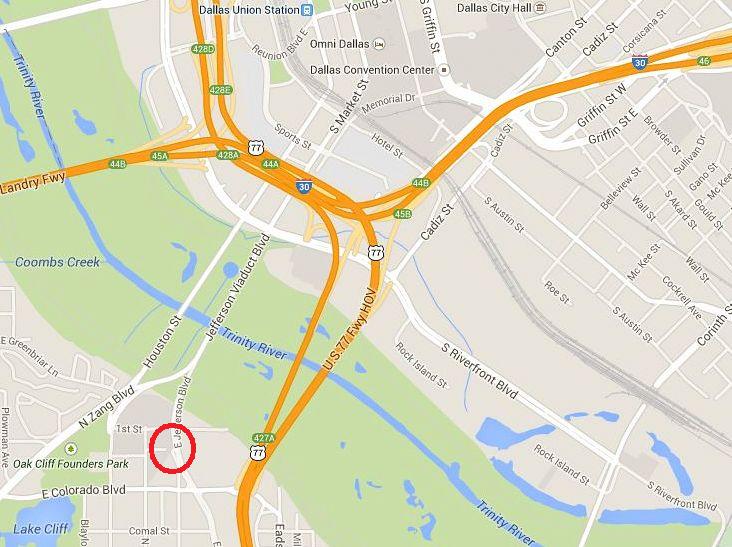
A distinctly less-wonderful view from roughly the same location, seen today, is here.

map_jefferson-addison_googleGoogle

Click pictures for larger images.

*

 Copyright © 2014 Paula Bosse. All Rights Reserved.

Ferris Plaza Waiting Station — 1925-1950

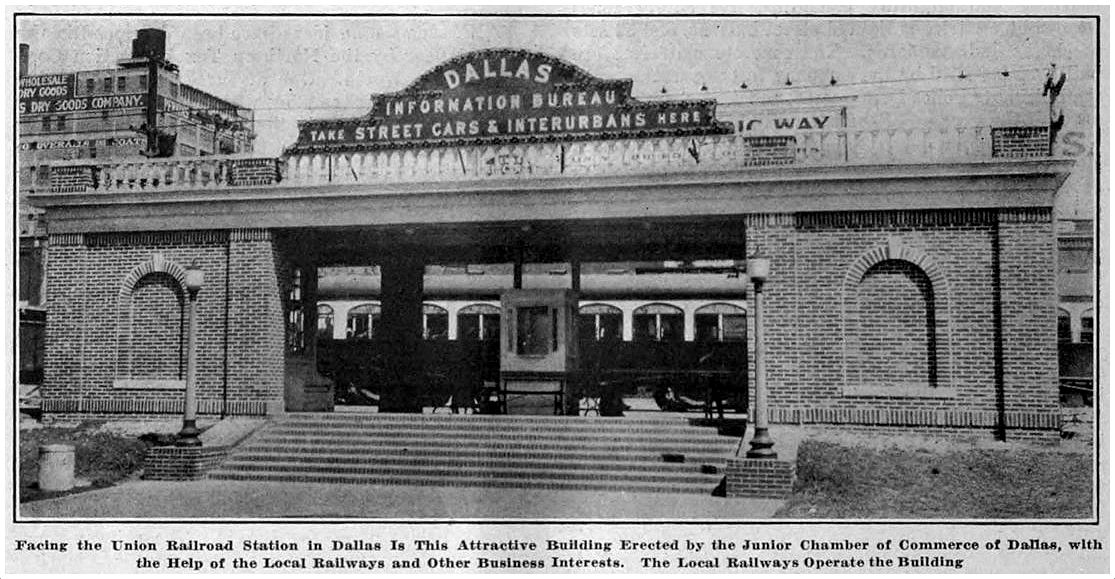
railway-info-bldg_1926From The Electric Railway Journal, 1926

by Paula Bosse

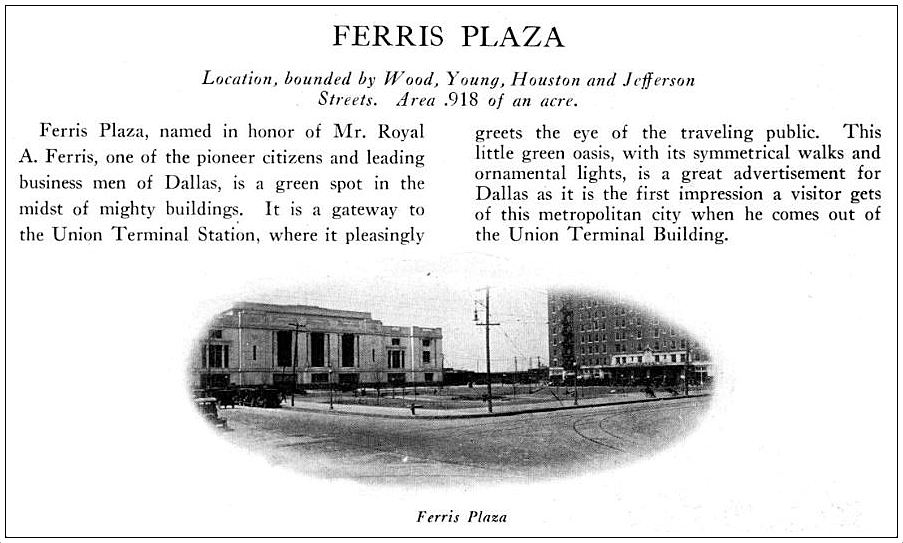
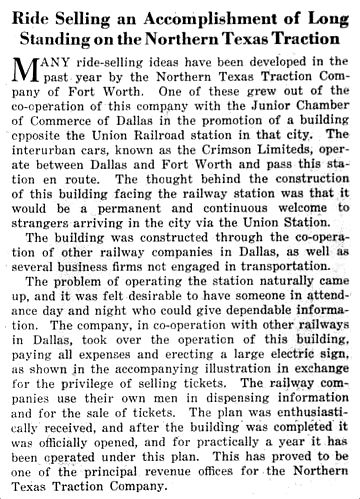
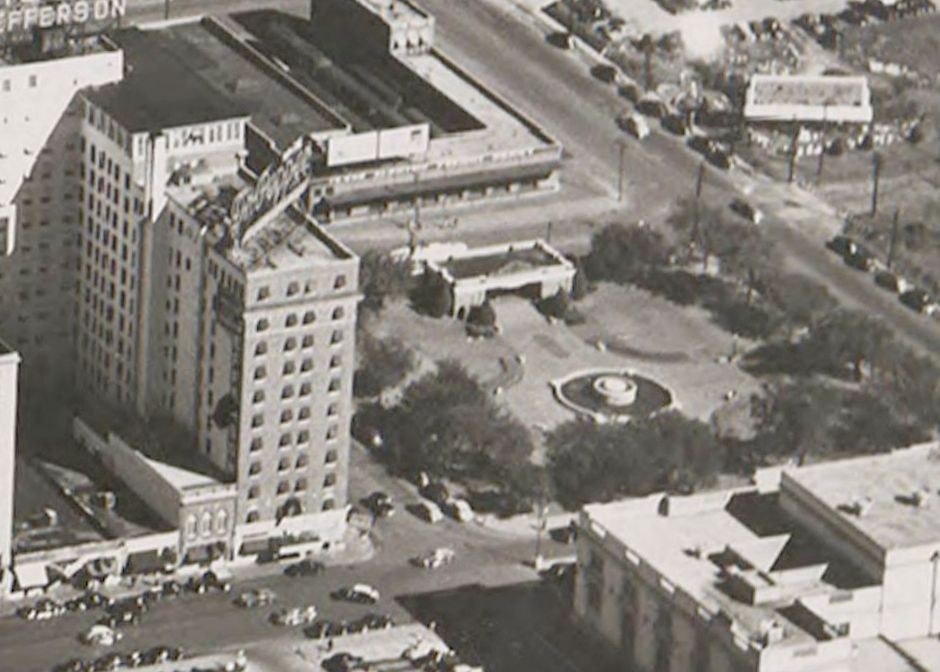
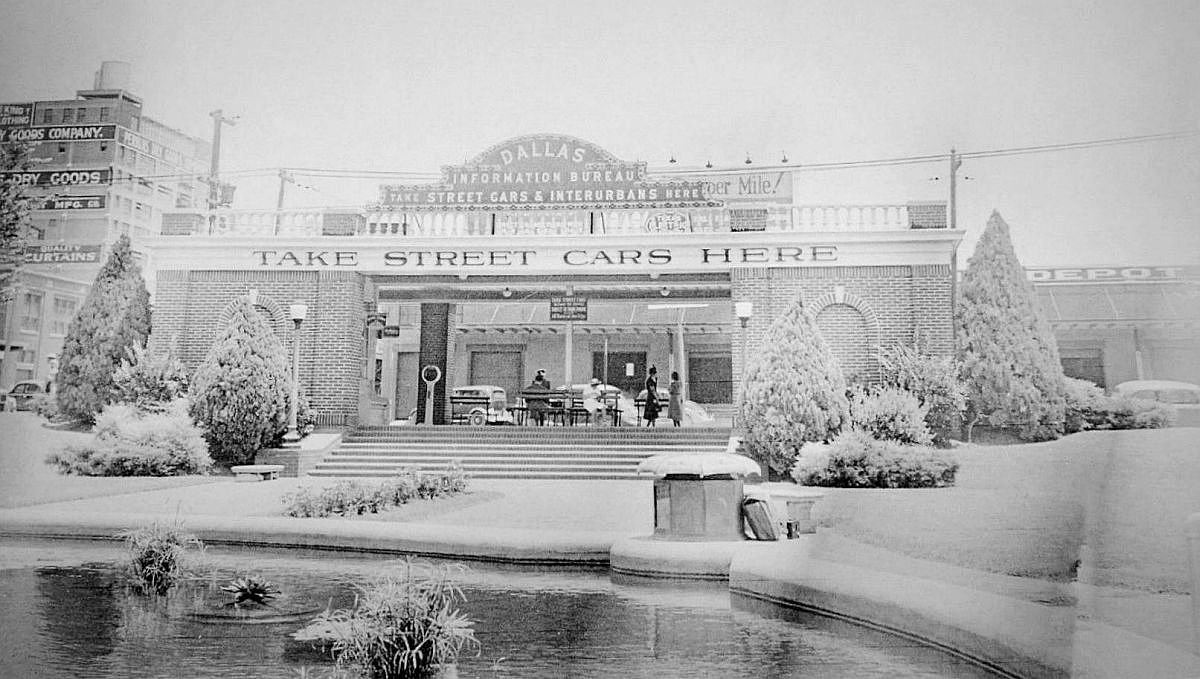
I came across the odd image above whilst digitally thumbing through a 1926 issue of The Electric Railway Journal (as one does…) and wondered what it was. It was definitely something I’d never seen downtown. Turns out it was a combination information bureau, covered stop in which to buy tickets for and await the arrival of interurbans and streetcars, a place to purchase a snack, and a location of public toilets (or, more euphemistically, “comfort stations”). It was located at the eastern edge of Ferris Park along Jefferson Street (which is now Record Street), with the view above facing Union Station. It was intended to be a helpful, welcoming place where visitors who had just arrived by train could obtain information about the city, and it was also a pleasant place to wait for the mass transit cars to spirit them away to points beyond. With the lovely Ferris Plaza (designed by George Dahl in 1925) between it and the front of the Union Terminal, this was considered The Gateway to the City long before Dealey’s Triple Underpass was constructed. (Click photos and articles to see larger images.)

ferris-plaza_park-and-playground-system_pubn_1921-23_portal

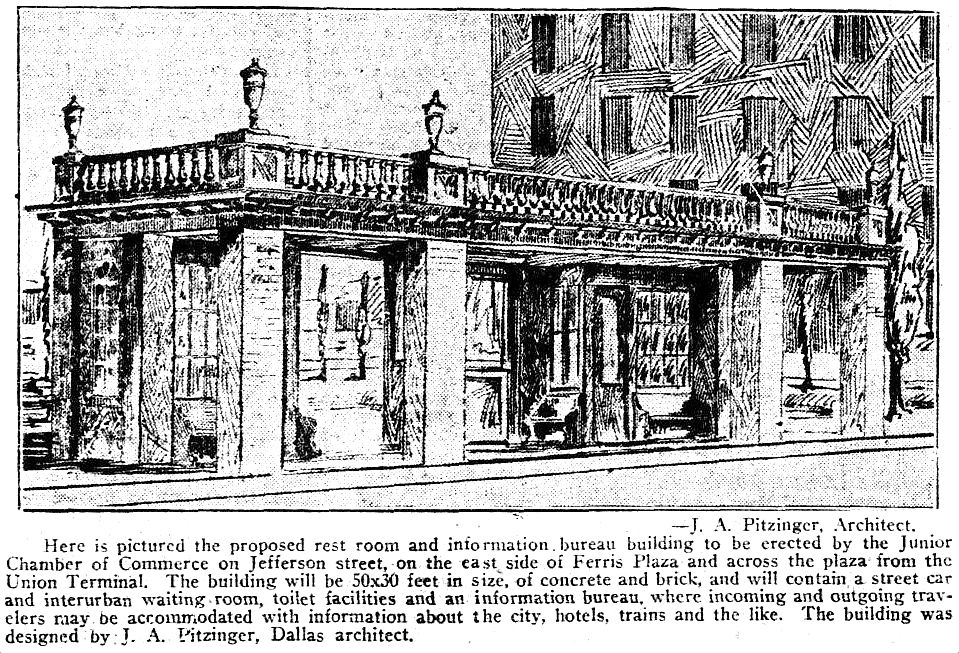
The “waiting station” was the brainchild of the Dallas Junior Chamber of Commerce which proposed the idea to the City of Dallas and, as it was to be built at the edge of a city park, the Park Board. The small (50 x 30) brick building — designed by Dallas architect J. A. Pitzinger — would cost $5,000 and would be paid for by funding from local businesses, including various transportation concerns (namely, the Northern Texas Traction Company). The “traction” companies would staff the information booth and sell tickets. The plans were accepted and permission was granted. Construction began in July, 1925, and the building was opened for waiting by October.

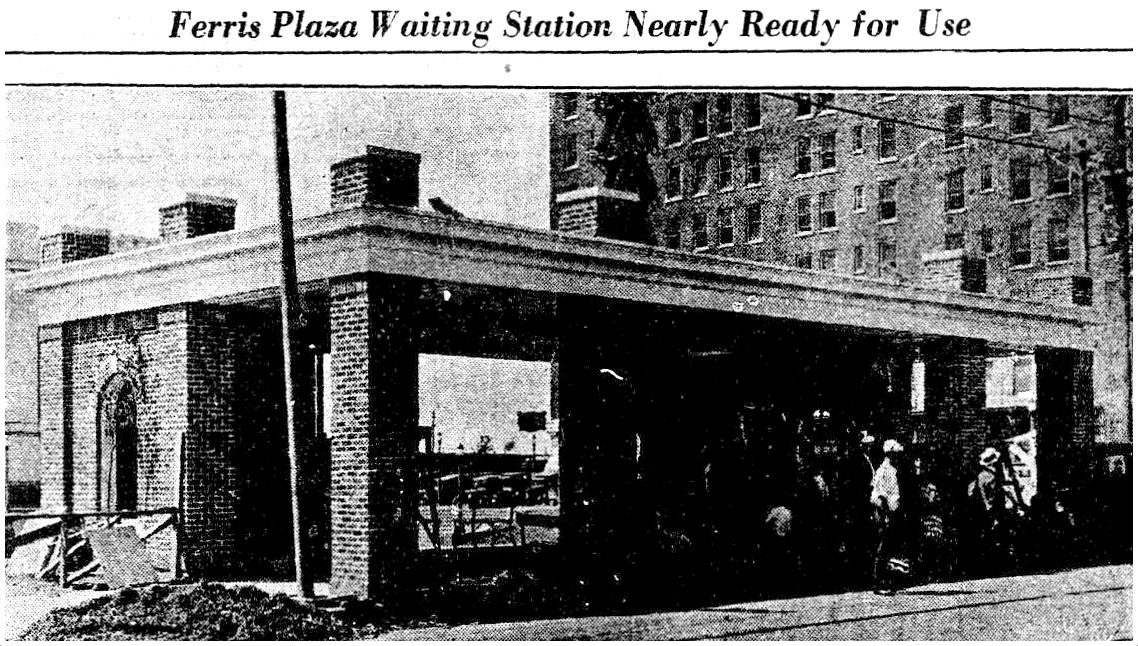
This improvement is the most recent of a number which have made of Ferris Plaza a beauty spot at the gateway of the city. Designed for a sunken garden, fringed with trees, the plaza is now adorned with a great fountain, illuminated with colored lighting at night, the gift of Royal A. Ferris. The new waiting station is in harmony with the general scheme of the plaza development, and combines beauty with utility. (Dallas Morning News, Sept. 20, 1925)

The little waiting station proved to be quite popular, and by the end of its first year the Northern Texas Traction Company (who operated interurban service between Dallas and Fort Worth) was very pleased, as interurban ticket sales at the station had become a solid source of company revenue. The Ferris Plaza station lasted a rather surprising 25 years. It was torn down in 1950, mainly because the interurbans had been taken out of service and there was no longer a need for it. Also, the park department was eager to get their park back and make it more “symmetrical.”

People would just have to wait somewhere else.

*

ferris-plaza-info-bureau_rendering_pitzinger_dmn_031625Architectural rendering by J. A. Pitzinger (DMN, March 16, 1925)

ferris-plaza-waiting-stn_dmn_092025Nearing completion (DMN, Sept. 20, 1925)

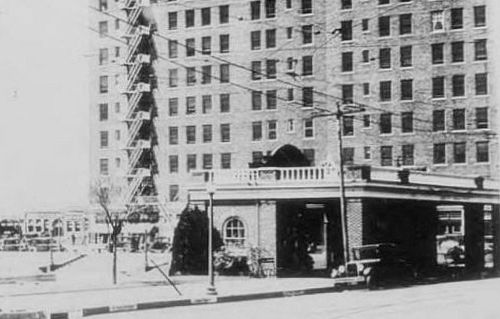
waiting-station_jefferson-hotel_degolyer-lib_SMU_croppedDeGolyer Library, SMU (cropped)

railway-info-bldg_1926_text_smThe Electric Railway Journal (Nov. 6, 1926)
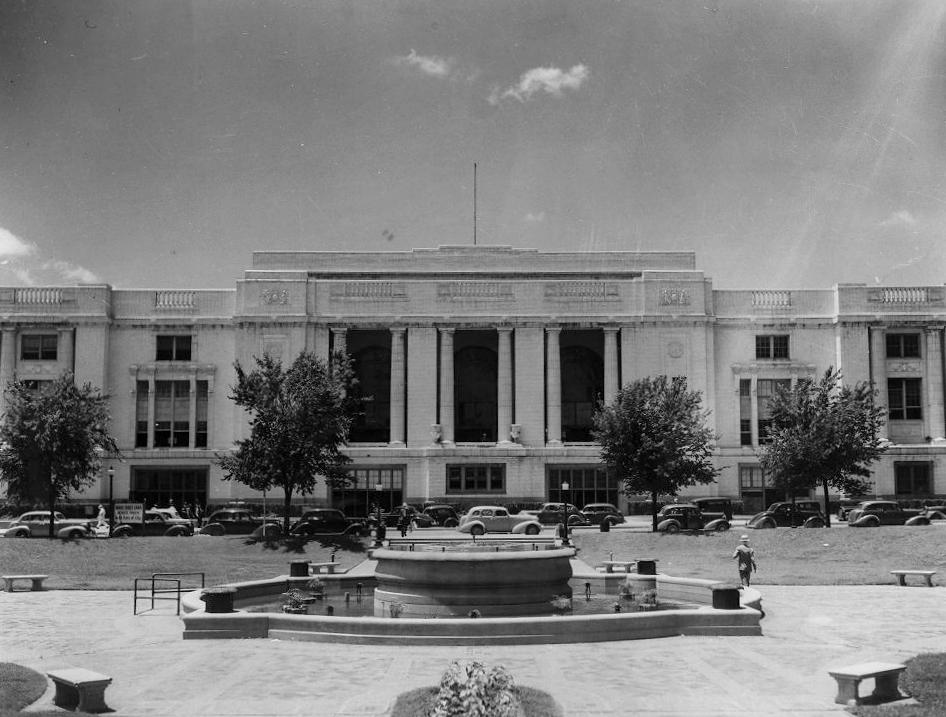
ferris-plaza_union-station_dpl_1936Union Station, 1936 — view from the “waiting station” (Dallas Public Library)

waiting-station_ebay

ferris-plaza_aerial_smu_c1949-det1949 aerial view, showing “waiting station” just above plaza’s circular fountain

***

Sources & Notes

Top photo from The Electric Railway Journal, Nov. 6, 1926.

Very early photo and description of Ferris Plaza is from Park and Playground System: Report of the Park Board of the City of Dallas, 1921-1923, via the Portal to Texas History, here.

Cropped image showing the waiting station with the Jefferson Hotel in the background is from the DeGolyer Library, SMU — more info is here.

Photograph of Union Station from the Texas/Dallas History and Archives Division of the Dallas Public Library.

Aerial photo showing Ferris Plaza is from a larger view of downtown by Lloyd M. Long (the original of which is in the Edwin J. Foscue Map Library collection of the Central University Libraries, Southern Methodist University, and which can be viewed here).

To read about the Ferris Park restoration project, see here.

For a few interesting and weird tidbits about the block that eventually became Ferris Plaza (including the fact that it was thought to be haunted and that it was once the site of a brothel), check out this page on Jim Wheat’s fantastic site.

*

Copyright © 2014 Paula Bosse. All Rights Reserved.