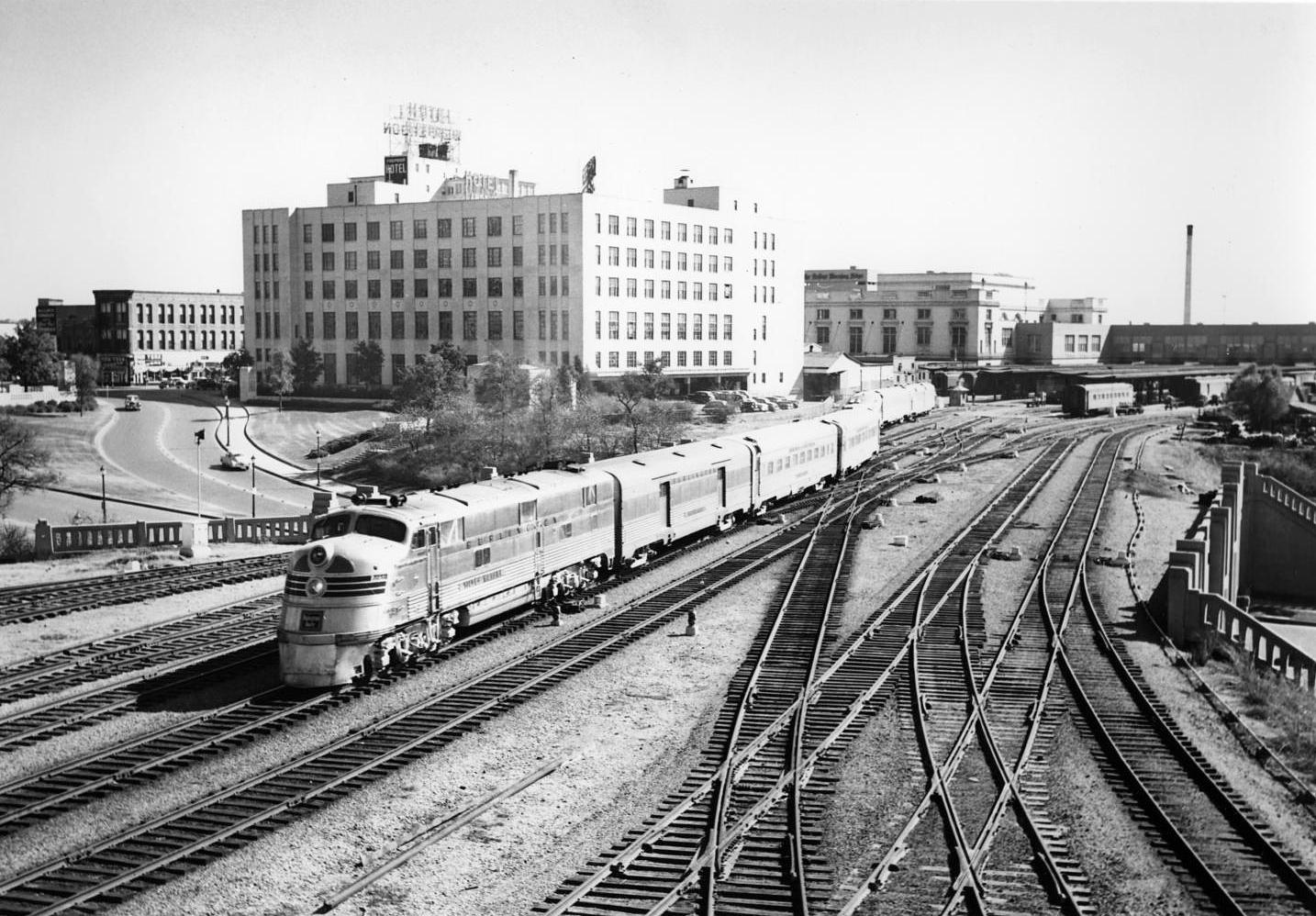
The SHZ heading out of Dallas… (click for larger image)
by Paula Bosse
The title pretty much says it all. The Sam Houston Zephyr passenger train is seen crossing over the Triple Underpass, heading out of Dallas. Next stop: Fort Worth. The Post Office Terminal Annex is the tall white building, the Jefferson Hotel is behind it (with the sign on its roof), and Union Station is in the background, just right of center, with the Dallas Morning News building peeking over its roofline. The Old Red Courthouse would be out of frame to the left.
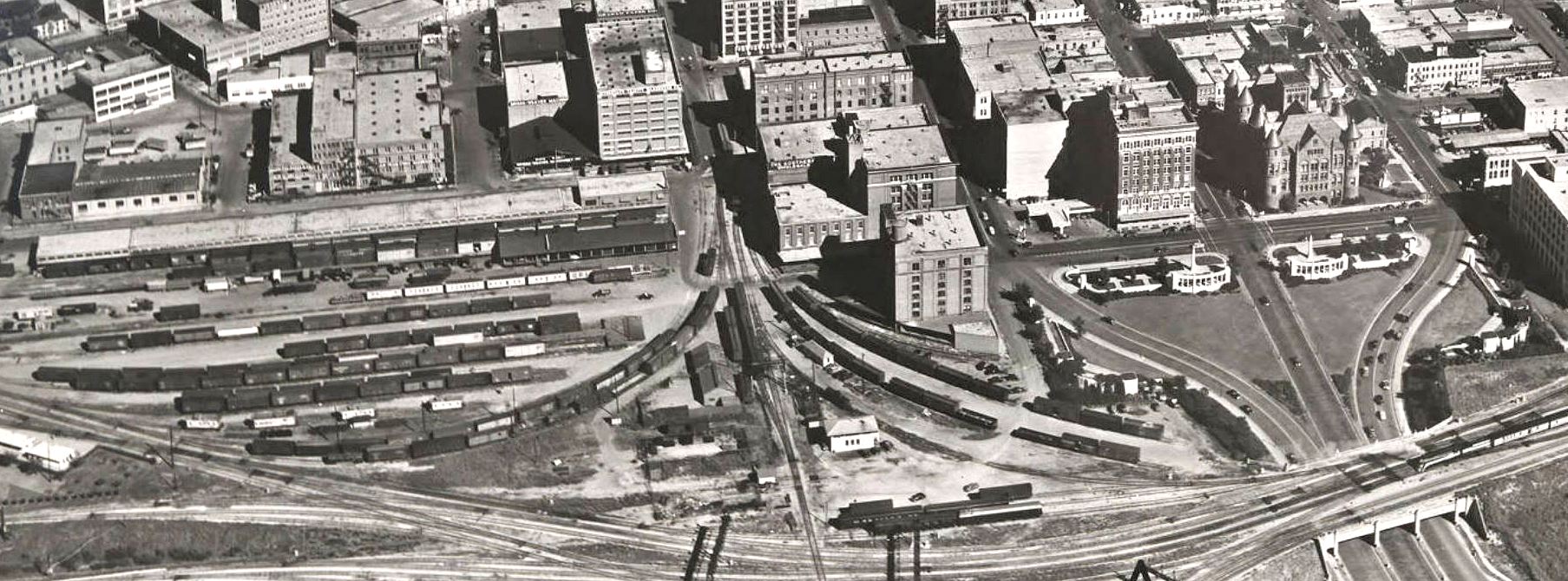
Below, a view of downtown from the west, with the Triple Underpass partially cut off at the very bottom, and Union Station just out of frame at the right.
In asking members of Facebook’s Texas Railroad History group about the top photo, Gerald Preas, one of the members, made this comment, full of interesting little tidbits (slightly edited by me):
The large building in the center is the USPO Terminal Annex. I started working there in August 1963. The buildings between TA and Union Station were part of Railway Express, used for sorting mail to and from RPO cars. That stack in back was the power station for Union Station — it had its own electric and water system, maybe sewage, too. I drank many times that cool sweet well-water. Notice cars around TA loading dock. I supervised that dock 1968/69 — we had to keep the area open. Now look where train is bending, people would park off ballast, but cars turning would swing out further and hit parked cars. That tree on the upper right led down grade to vacant parting lot. I was coming up that path when the President was shot.
***
Sources & Notes
Top photo shows the Fort Worth and Denver’s Sam Houston Zephyr train No. 4, northbound from Houston, leaving the Dallas Union Terminal Station, heading to Fort Worth. The photo was taken by Roger S. Plummer in 1950; photo from the Museum of the American Railroad, via UNT’s Portal to Texas History, here.
(Other photos of the Sam Houston Zephyr taken in Dallas — and one in Fort Worth — by Roger S. Plummer between 1949 and 1955 can be found on the Portal to Texas History site, here.)
Bottom image titled simply “Dallas, Texas” is an Aerial Photo Service postcard, from the George W. Cook Dallas/Texas Image Collection, DeGolyer Library, Central University Libraries, Southern Methodist University. I’ve edited the image a bit — see the original image and description here.
An aerial view of the same area today can be seen here, via Google.
A previous Flashback Dallas post on the stunningly beautiful Texas Zephyr can be found here.
Thanks to the members of the Texas Railroad History group on Facebook for their comments and help.
Train whistles don’t sound so lonesome in the daytime…
by Paula Bosse
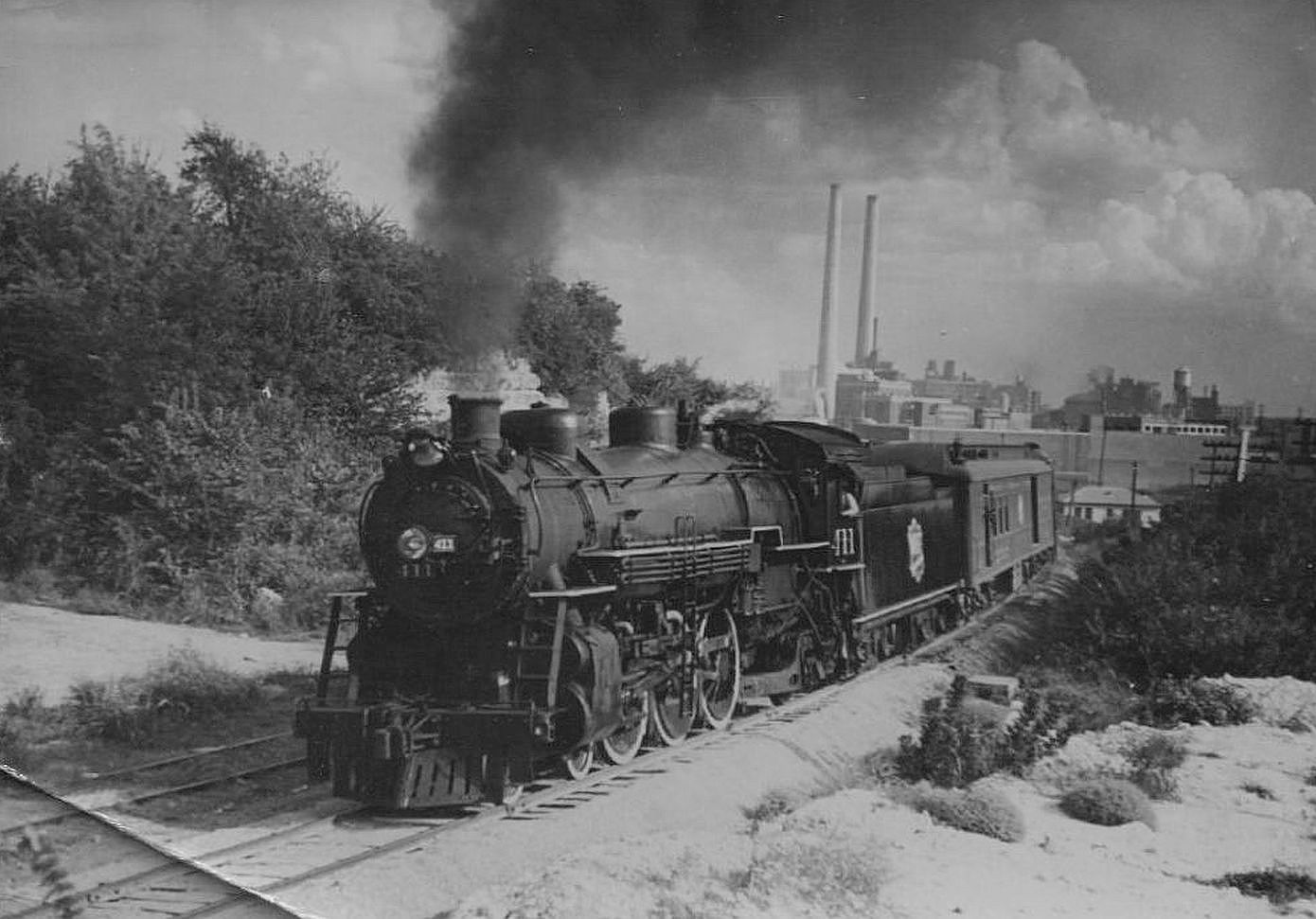
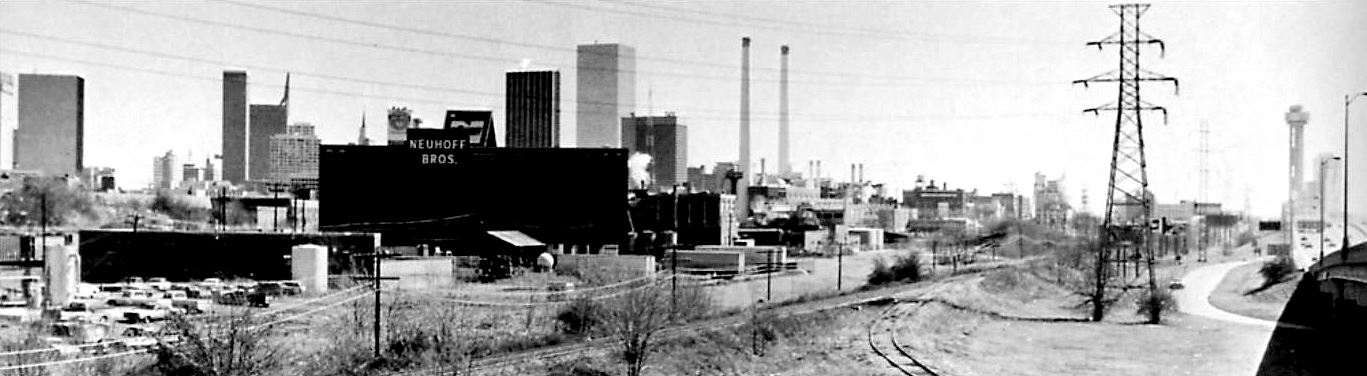
Above, an undated photo I came across on eBay a couple of months ago, showing a Missouri-Kansas-Texas train heading north from the Katy yard at the northwest corner of downtown. In the background are the twin DP&L smokestacks which were iconic landmarks until they were demolished in order to build the American Airlines Center and Victory Park. Below, a later photo taken from about the same location.
The area between Dealey Plaza and the Neuhoff meat packing plant was crammed with tracks; below is a detail from a mid-1940s aerial photo (click to see a larger image).
The M-K-T split about where the photo at the top was taken, as can be seen in the Sanborn map below (from 1927) between Turtle Creek and McKinney Avenue. One track headed north, the other cut through Oak Lawn and Highland Park (now the Katy Trail), crossing Mockingbird at the Dr Pepper plant near Central Expressway.
***
Sources & Notes
Top photo from eBay, with the photographer of this “vintage snapshot” credited as “Peter Stewart, Austin, Texas.” (There is a crease to the lower left corner.) It is undated, but when posted to the Texas Railroad History group on Facebook, commenters suggested mid-to-late-1930s to early ’50s. It’s a bit grainy, but the number on the engine appears to be 411.
The second photo, showing the Neuhoff plant and Reunion Tower, is from the collection of the Dallas Public Library.
The aerial shot is a detail from this photo by Lloyd M. Long, from the Edwin J. Foscue Map Library, Central University Libraries, Southern Methodist University.
The map detail is from the “key” page of the 1927 Sanborn Fire Insurance Map, here. Speaking of Sanborn maps, this one from 1921 shows M-K-T tracks galore behind the DP&L plant.
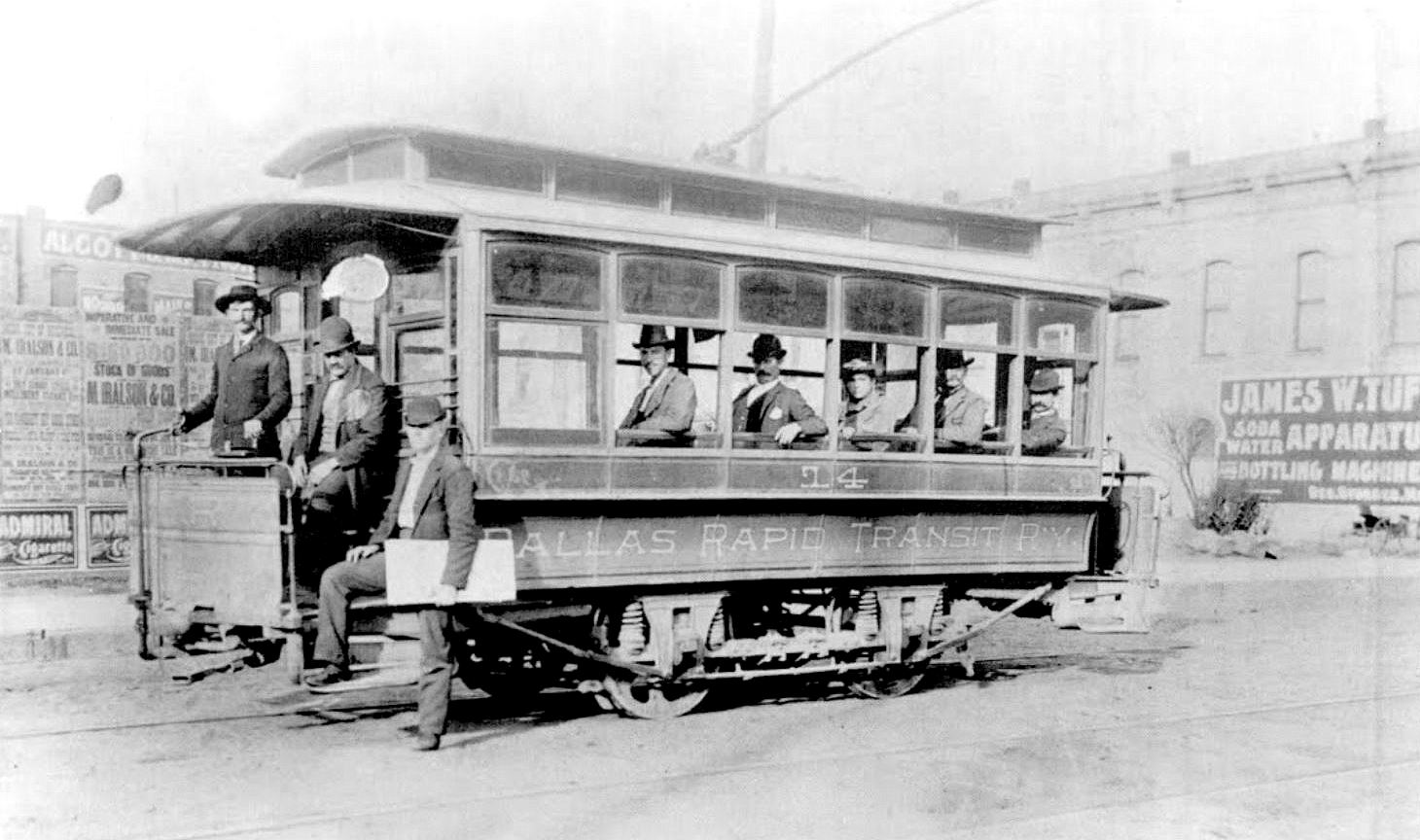
The Dallas Rapid Transit Railway chugged into town in 1888, going from charter to operation in seven months. And that included laying their own track. The “dummy” steam engine (a locomotive designed to appear more like a friendly little streetcar and less like a hulking locomotive) seen above, carried passengers from the Windsor Hotel at Commerce and Austin through South Dallas (via S. Lamar and Forest Ave., now MLK Blvd.) to Fair Park. It started business just in time to ferry crowds to the State Fair. The fare was 20 cents, which seems pricey, but this might have been “surge” pricing charged only during the “Greatest Fair and Exposition in the World.” (According to the Inflation Calculator, 20¢ in 1888 would be the equivalent to more than $5 in today’s money.)
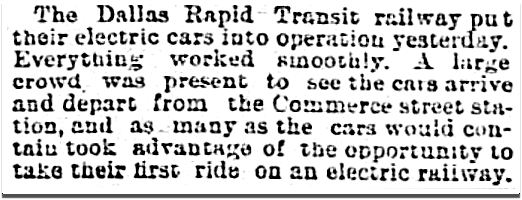
Dallas Morning News, Oct. 14, 1888
The new street railway was particularly appreciated by developers looking to sell land in southern Dallas, still considered a “suburb” in the 1880s. Residential streetcar service was essential to prospective builders and buyers, and as soon as the Rapid Transit line was up and running, its name was popping up in South Dallas real estate ads for additions with names like Chestnut Hill, Edgewood, and South Park.
DMN, March 16, 1889
In March of 1890 — after a year and a half of steady growth — the Dallas Rapid Transit Railway went electric, tossing out their old steam-powered cars (not even 18 months old!) for brand new, ultra-modern cars powered by electricity. (For a bit of perspective, parts of the country were still relying on the really old-fashioned mule-drawn streetcars.) Dallas’ first electric-powered streetcar hit the rails on March 9, 1890.
DMN, March 10, 1890
Understandably, the sight of these newfangled streetcars was quite the topic of fascinated conversation. How exactly did they work, anyway? The Dallas Morning News published an article with helpful information for the Dallasites of 1890 (and 2016!). (Click to see larger image.)
DMN, March 23, 1890
The photo below (which appears in the great book McKinney Avenue Trolleys) is a staged publicity photo with a woman at the helm, showing that the new electric streetcar was so easy to operate that “even a woman” could do it. In tow behind the sparkling new electric streetcar was the old, past-it steam car, with its engineer racing to try to catch up with the new technology. Get with it, man, it’s 1890!
Southern Traction, April 10, 1973 (via McKinney Avenue Trolleys)
Dallas Public Library photo (via McKinney Avenue Trolleys)
Initially, the track was only 4 miles long, but that had more than doubled soon after the switch to electric cars.
DMN, Oct. 1, 1890
Things seemed to be going well. The company was expanding, speeds were increasing, and … “No dust”!
DMN, Oct. 27, 1891
But … in 1894 the company went into receivership and was sold in December of that year for $35,000.
DMN, Dec. 5, 1894
It appears that the company struggled on under different owners and slightly different names through at least 1909, but instead of those twilight years being filled with reflective contemplation and bass fishing, they were spent mired in endless lawsuits.
But let’s not dwell on the sputtering end of a business — let’s look back to the beginning, when the H. K. Porter Co. of Pittsburgh, Pennsylvania was proud to show off its new light locomotive with the noiseless steam motor which was headed, full of hope and enthusiasm, for the little city that could, Dallas, Texas.
DMN, March 22, 1888
DMN, Sept. 10, 1888
**
The steam-powered Cyclone — seen at the top — went on an adventure through the streets of downtown in 1889 when, under a full head of steam, it jumped the tracks and kept on going down paved streets until it crashed into a curb on Main!
DMN, April 30, 1889
***
Sources & Notes
Image at the top (and bottom), “Dallas Rapid Transit, ‘Cyclone’ Locomotive No. 1,” from the George W. Cook Dallas/Texas Image Collection, DeGolyer Library, Southern Methodist University; more information here.
Read an interview with J. E. Henderson, president of the Dallas Transit Railway company, commenting on his new street railway (“The New Rapid Transit,” DMN, Oct. 14, 1884) here (yes, it IS difficult to read!).
The two photos of Dallas Rapid Transit electric streetcars are from the book McKinney Avenue Trolleys by Jim Cumbie, Judy Smith Hearst, and Phillip E. Cobb (Charleston: Arcadia Publishing, 2011). If you’re interested in this topic, this book seems pretty essential!
The history of early streetcars in Dallas can be read in the pages of the WPA Dallas Guide and Historyhere (scroll to the bottom of the page and continue to the following page).
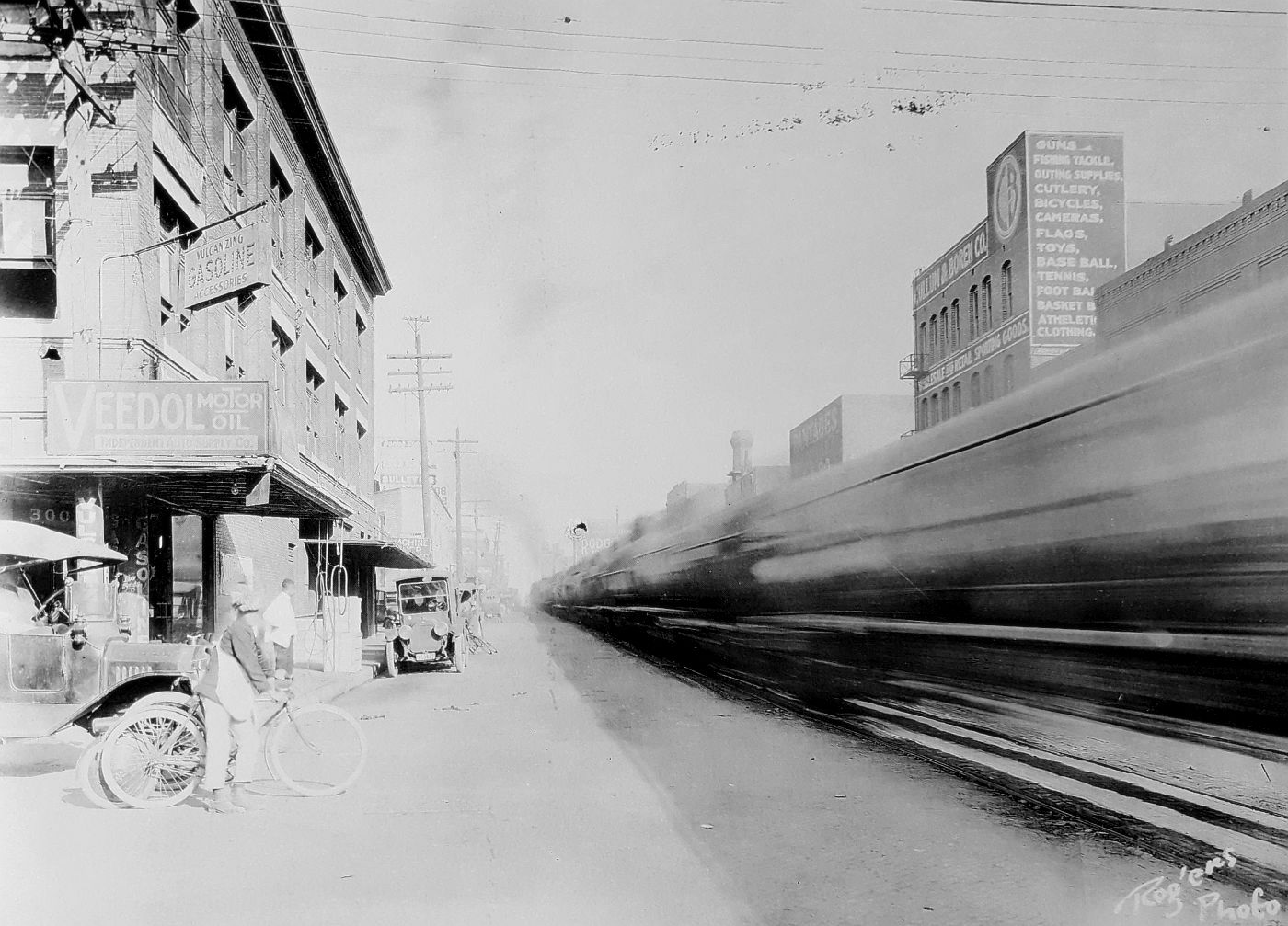
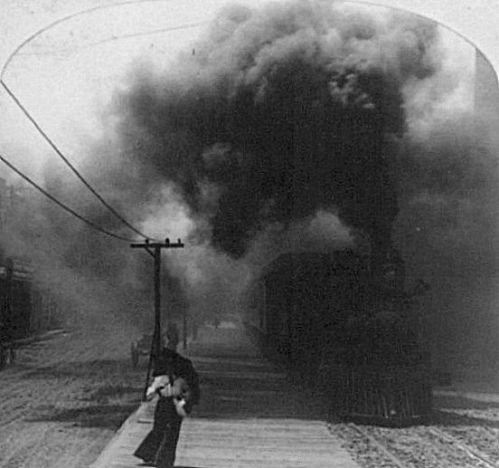
Some people don’t realize that Pacific Avenue used to be lined with the railroad tracks of the Texas & Pacific Railway (hence the name “Pacific”). When trains weren’t barreling down Pacific regularly, the thoroughfare was used by non-locomotive traffic like pedestrians, bicycles, horses, and automobiles. When a huge cinder-spewing train screamed through, everything came to a resigned halt until it passed by. I can’t even imagine what that was like. I wonder how many times people, horses, vehicles, etc. didn’t manage to get out of the way in time?
When Union Station opened in 1916, trains that had previously run through the central business district now went around it (which probably cut the number of people rushed to the hospital with train-related injuries substantially).
The photo above shows Pacific looking east from N. Akard, as a blur of a train whooshes by. The Independent Auto Supply Co. (300 N. Akard) is at the left, and, at the right, the back side of Elm Street businesses, including Cullum & Boren and, to its left, the Jefferson Theater, with “Pantages” painted on the side. (The Jefferson was the Dallas home of the Pantages Vaudeville Circuit from 1917 until 1920, the year the Pantages people bugged out for the greener pastures of the Hippodrome, leaving the Jefferson to start a new relationship with the Loew’s circuit people. At the end of 1925, the Jefferson Theater was actually renamed the Pantages Theater. …Kind of confusing.)
Below, Elm Street in 1918 — what the other side of those buildings looked like. Cullum & Boren’s “CB” logo can be seen painted on the side of its building. (Click photo for much larger image.)
But back to Pacific in its scary, sooty, T&P-right-of-way days. This is what things looked like in 1909.
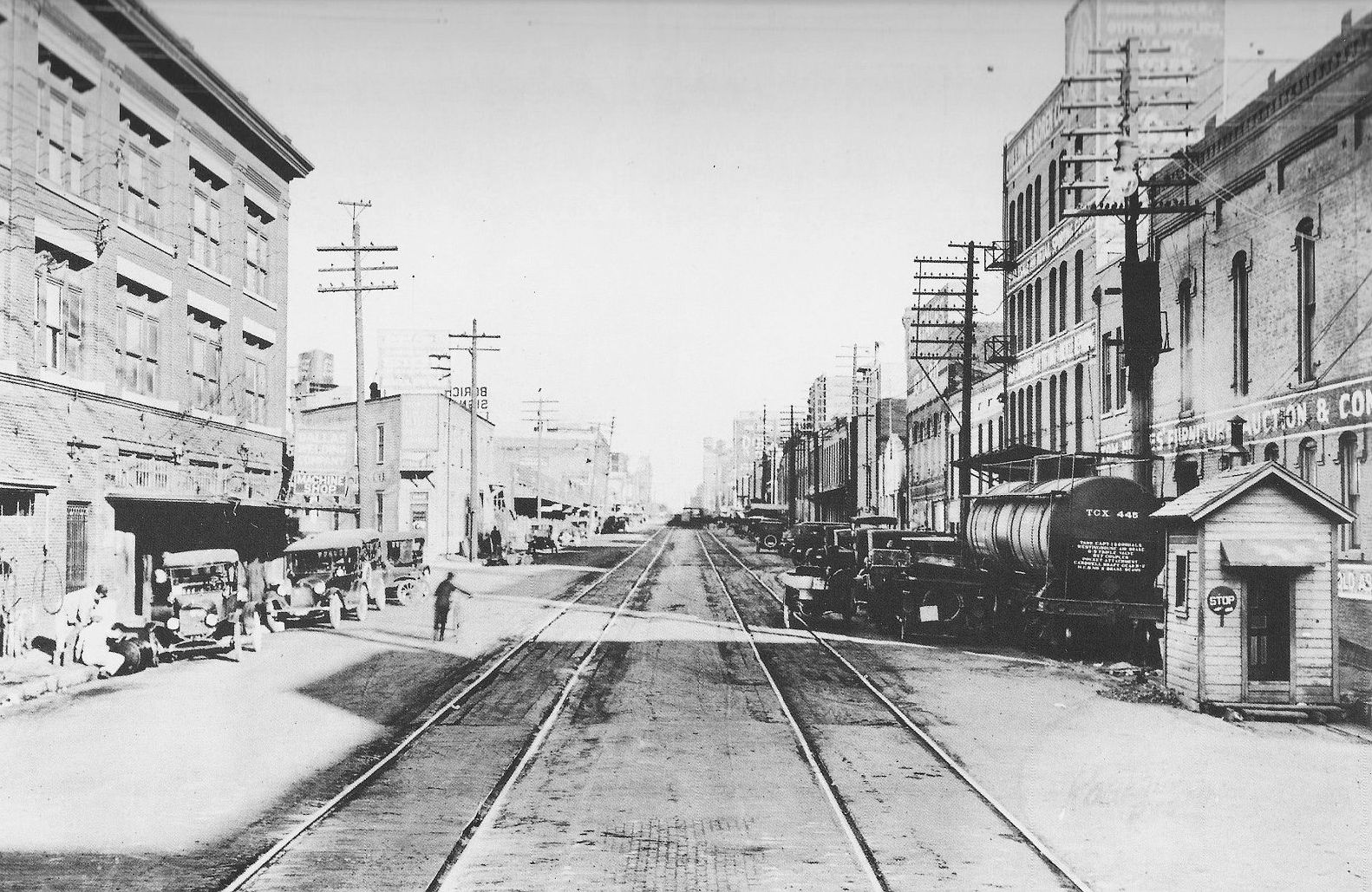
Fast-forward to 1920 — the trains had long stopped running, but the tracks remained, an eyesore and an impediment to traffic. (Cullum & Boren, again, at the right.)
And another one.
Thanks to the Kessler Plan, those unsightly tracks were finally removed from Pacific in 1923. Below, a photo from 1925. Big difference. Thanks, George Kessler!
***
Sources & Notes
Top photo (by Frank Rogers) from the book The Park Cities, A Photohistory by Diane Galloway (Dallas: Diane Galloway, 1989). The photo is credited to John Stull/R. L. Goodson, Jr., Inc./Consulting Engineers.
More info on the 1918 photo of Elm Street, which was featured in the post “Dallas’ Film Row — 1918,” here.
More info on the super-sooty Pacific Avenue photo, here.
The old Union Depot Hotel, about 1909 (click for larger image)
by Paula Bosse
Above, we see the hotel known originally as the Union Depot Hotel, built in 1898 across from the very busy old Union Depot, at the intersection of two major rail lines: the Houston & Texas Central (the H&TC, which ran north-south) and the Texas & Pacific (the T&P, which ran east-west). The tracks crossed at the intersection of Central and Pacific — streets named after the two railroads — in the area east of downtown we now call Deep Ellum. The hotel was on the southwest corner of that intersection.
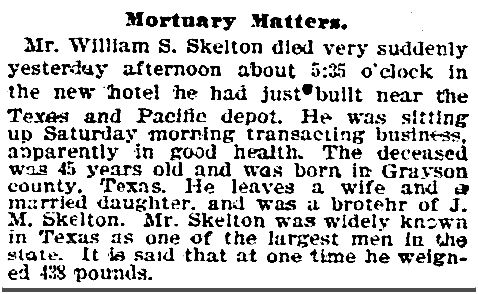
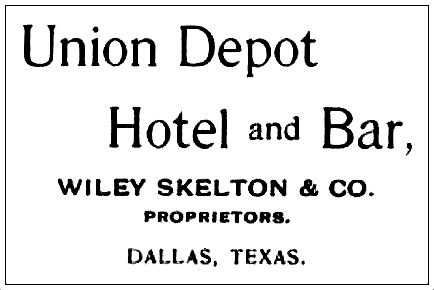
The large, two-story hotel (which also housed a popular cafe and bar) was built by William S. Skelton — more commonly known as Wiley Skelton — to cash in on the large number of travelers coming to Dallas via the bustling passenger depot right across the street. When it opened, it was charging a hefty two bucks a day (the equivalent of about $60.00 in today’s money) — a large-ish sum in 1899, but … location, location, location. This two-dollar-a-day rate to stay at Skelton’s hotel was the same as the base rate of Dallas’ ritziest, priciest hotels, The Windsor and The Oriental. How could Skelton’s “wrong side of the tracks” hotel charge similar rates as the city’s most elegant hotels? Convenience, convenience, convenience. The Union Depot Hotel could not have been more convenient to weary travelers unless it had been located inside the depot.
Houston Post, Jan. 25, 1899
Skelton was a popular and successful businessman (and noted saloon pugilist) who was known far and wide for his substantial physical bulk. He was a founding member of the city’s “fat men’s club” and was reported to be the heaviest man in the city. When he died suddenly at the age of 45 (probably not a huge surprise, as his obituary mentioned that his weight had, at one time, reached 438 pounds), his new hotel had been open only weeks (perhaps only days).
Dallas Morning News, Jan. 16, 1899
His unexpected death threw the running of the hotel into confusion. His brother (another famed “fighting fat man”) took over the business side of its operations and occasionally placed ads in the paper seeking a hard-to-find buyer.
1901 ad
DMN, Nov. 16, 1902
Eventually the hotel was sold, and it went through several owners and name changes over the years. Then, in 1916, a major catastrophe struck: brand new Union Station, which was waaaay on the other side of town, opened, consolidating passenger rail service to one depot, resulting in the shuttering of most of the city’s smaller depots. Location, location, location wasn’t such a great thing for the old Skelton hotel after this.
The hotel went through many changes over the years, but after the closing (and later razing) of the old Union Depot, it was on a general, inevitable, slide downward. By the time it was demolished in 1968 — when large swaths along Central Avenue were leveled to facilitate highway construction — the building was in disrepair and, apparently, long-vacant. It stood for 70 years.
*
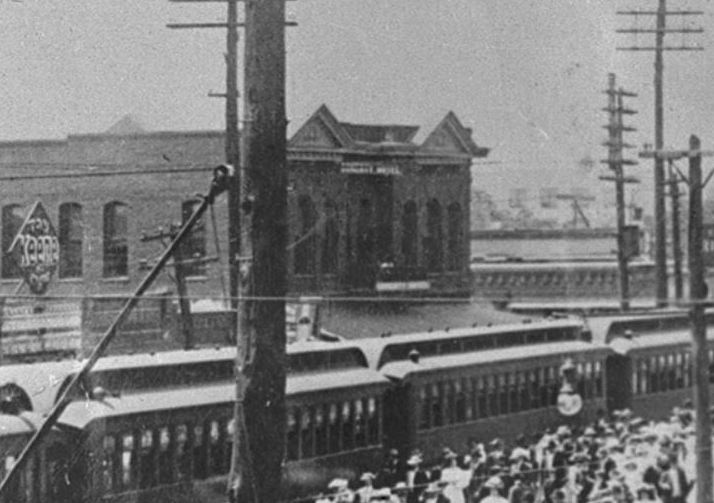
Below is a photo taken from Elm Street in 1908 or 1909, when the hotel (seen at the top left) was owned by Charles S. Conerty and named the Conerty Hotel (you can see the name on two signs, but you have to really zoom in to make them out). Conerty, an Irishman who had previously run bars, owned the hotel very briefly. By May of 1909, plagued with legal troubles stemming from his being charged with selling liquor on a Sunday, Conerty sold the hotel (which he seems to have been running as a boarding house), stating in his classified ad that he was “leaving city.” (He did not leave the city.) In 1910, with a new owner, the hotel was once again known as the Union Depot Hotel.
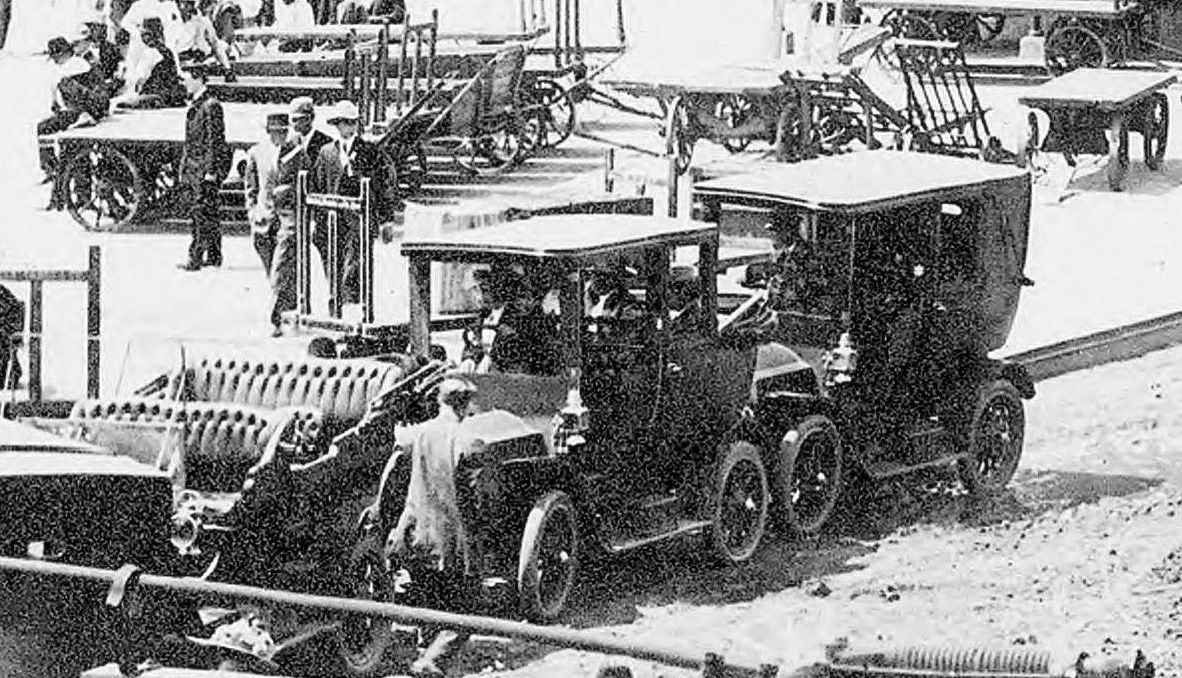
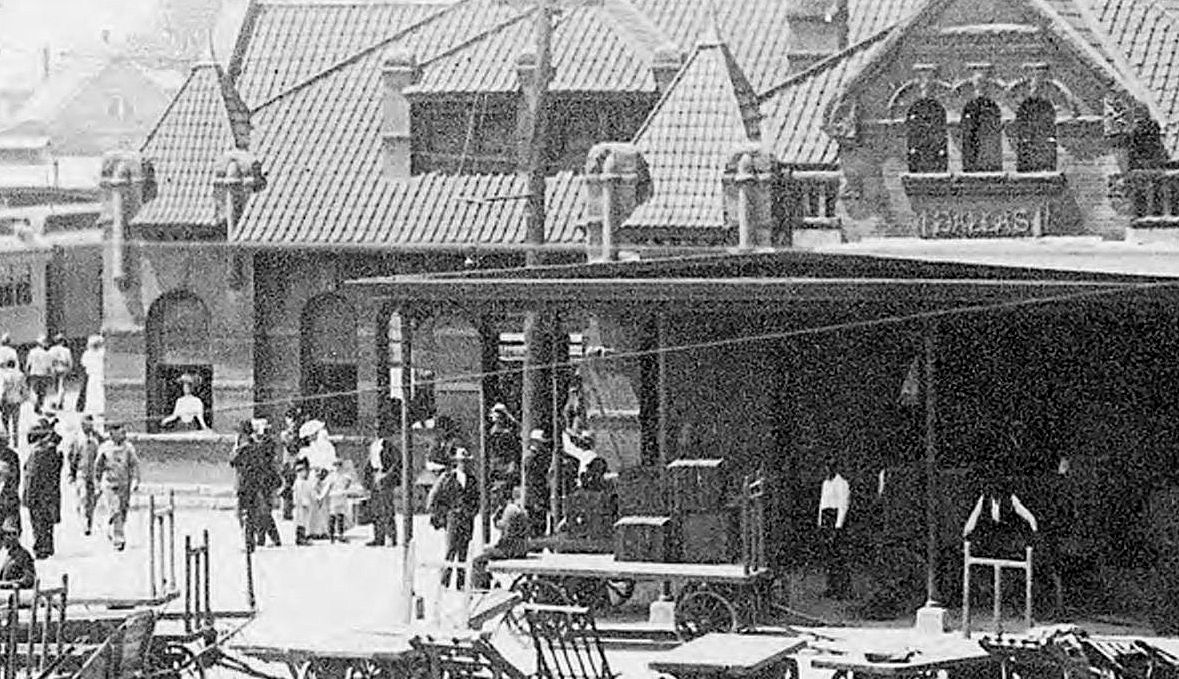
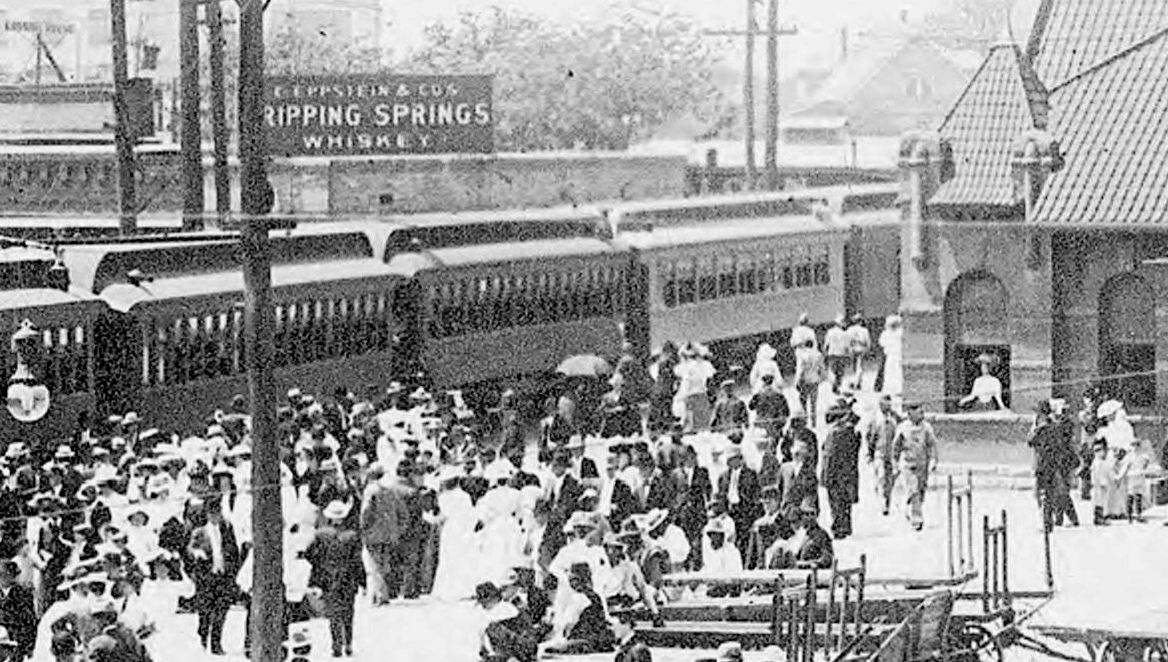
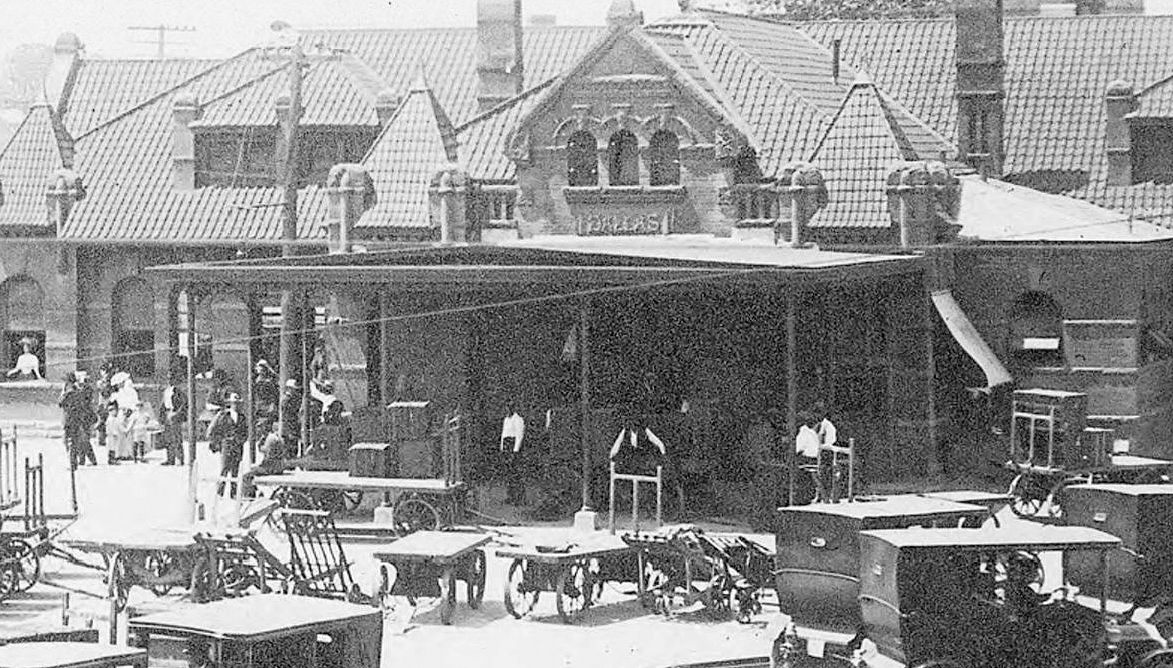
Back to the photo. Across Central Avenue from the hotel is the old Union Depot, where there was always a lot going on. Let’s look at the photo a little more closely. (Click photos to see larger images.)
Just seven or eight years after this photo was taken, all that human traffic was gone.
In the fall of 1968, having been vacant for years and counting down its final hours, Dallas Morning News writer Doug Domeier wrote about the old run-down hotel which had long outlived the passenger depot it had been built to serve (see the article “Demolition Leveling Once-Noisy Deep Elm,” DMN, Oct. 19, 1968). Domeier’s entertaining article about those early days includes memories of Lizzie Mae Bass, who once worked in the hotel’s cafe as a waitress and remembers when “horses back[ed] away in fright when a locomotive pulled in at the lively intersection linking the Houston and Texas Central with the Texas & Pacific.”
And today? You’d never EVER suspect that that patch of empty land at the edge of Deep Ellum was ever occupied by one of the city’s busiest train depots.
*
So where was it? Get a good visual idea of how things were laid out in the Sanborn map from 1905, here. Below is a street map that shows where the hotel was (red star) and where the train depot was (blue star). These days? Depressing. See it here (the view is looking north from Elm — the hotel would have been under the overpass, the train station straight ahead).
1952 Mapsco
It’s interesting to note that during the heyday of the Union Depot, the west side of the block of Central Ave. which ran between Elm and Pacific was the only block in this area not filled with black-owned businesses or residences. When the depot shut down and white-owned businesses moved out, the block began to fill with popular African-American establishments. It’s also interesting (to me, anyway!) to realize that the Gypsy Tea Room of the 1930s was just a few steps to the left of the hotel in the top photo. It took me forever to try to figure out where the Gypsy Tea Room had been — I wrote about it here.
***
Sources & Notes
Top photo is a detail of a larger photo, from the Squire Haskins Photography, Inc. Collection, University of Texas at Arlington Libraries; it is accessible here. The same photograph is shown in full farther down the post — this copy is from the DeGolyer Library, Central University Libraries, Southern Methodist University, and it is accessible here. The quality of both photos makes it difficult to zoom in on them with much clarity, but both sites offer very large images to view.
As mentioned above, an entertaining Dallas Morning News article full of historical info about the area around the depot is highly recommended: “Demolition Leveling Once-Noisy Deep Elm” by Doug Domeier (DMN, Oct. 19, 1968). (I’m not sure why the hotel is referred to as the “Grand Central Station Hotel” throughout — just substitute “Union Depot Hotel” whenever you come across that incorrect name.) The article also has a few paragraphs about the Harlem Theater which was also about to be torn down as part of what Domeier described as the “brutal change” then affecting Deep Ellum.
See a great early-’20s photo of the hotel building (the Tip-Top Tailors moved in around 1922) in the book Deep Ellum: The Other Side of Dallas by Alan Govenar and Jay Brakefield, here (the view is from Pacific to the southwest).
A related Flashback Dallas post — “The Old Union Depot in East Dallas: 1897-1935” — can be read here.
The Dallas Morning News, full speed ahead! (Belo Collection, SMU)
by Paula Bosse
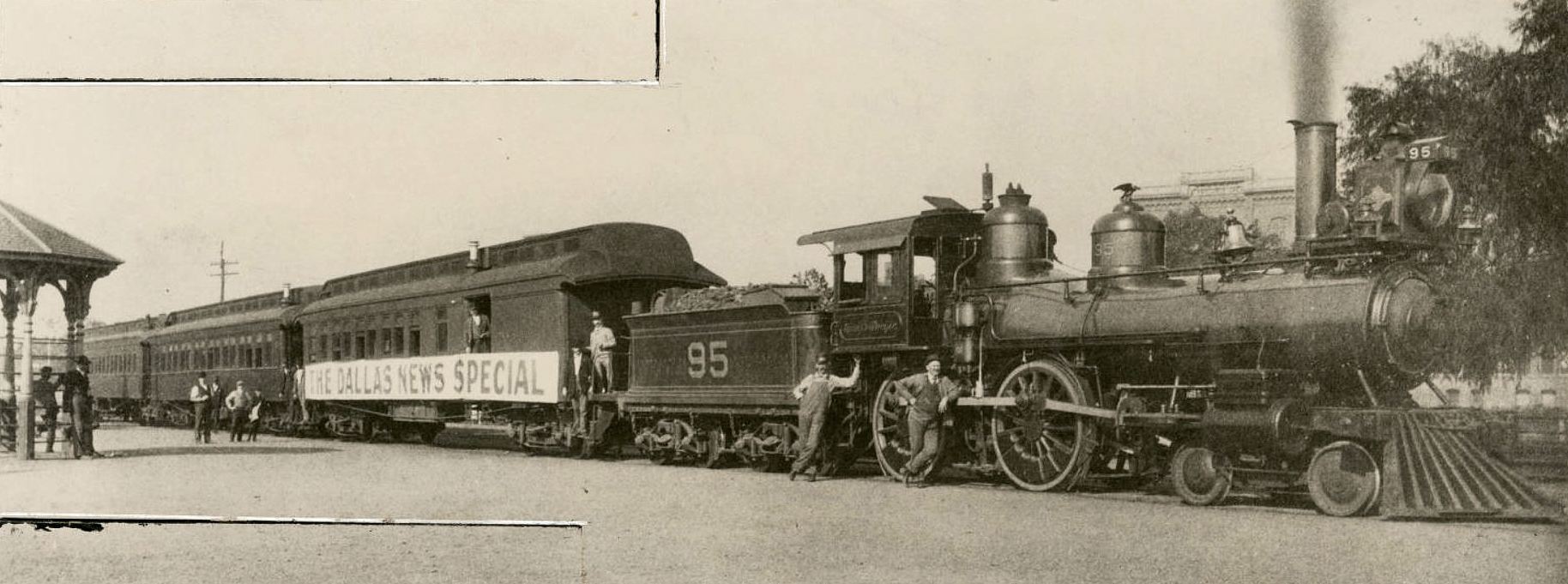
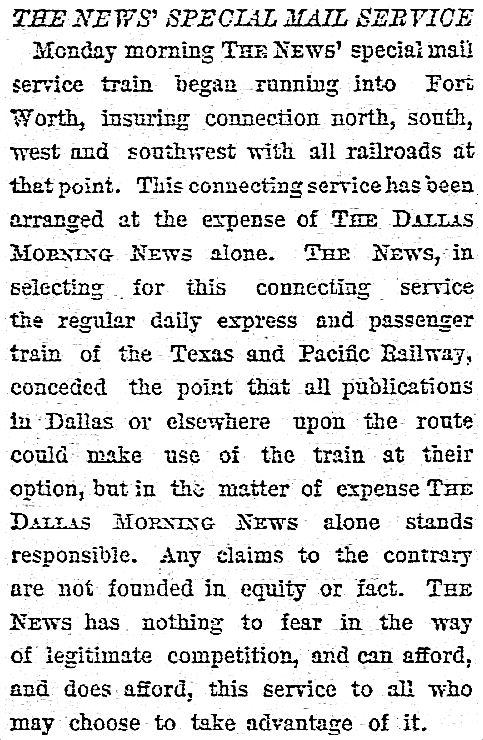
In October 1885, The Galveston News decided to launch a sister publication in Dallas, The Dallas Morning News. They sent 26-year-old George Bannerman Dealey to run it. Before that first month was up, go-getter Dealey had made a special arrangement with the Texas & Pacific railroad — “at considerable expense to The News” — to extend its route and pop into Dallas to pick up papers destined for its subscribers west of the city. (The photo at the top may or may not show that very first “Special Mail train.”)
DMN, Oct. 27, 1885 (click for larger image)
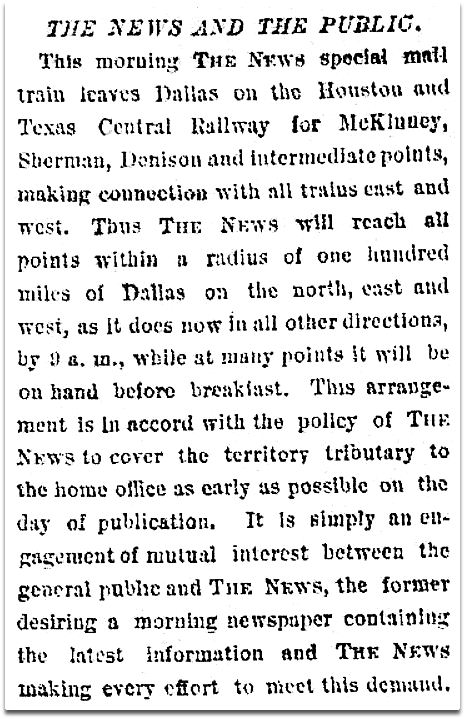
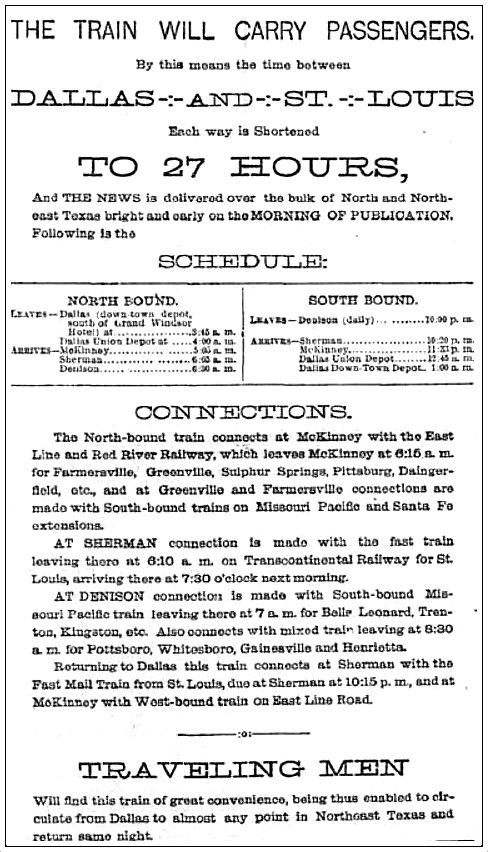
A year and a half later, The News one-upped itself and made the announcement that it would operate a special train to Denison — again, “at a vast expense.” This train would transport editions of the paper in the wee small hours in order to assure that The Dallas Morning News would actually BE a morning newspaper for as many of its subscribers as possible, whether they lived “within a block of the press” or a hundred miles away (DMN, Sept. 30, 1888). News-hungry Denisonians could read their papers over breakfast at the same time their Dallas counterparts did.
DMN, May 22, 1887
The train was dubbed by some “The Comet” (not to be confused with the MKT’s later Katy Komet). It was a “fast train” that carried passengers as well as newspapers along the Houston and Texas Central rails.
DMN, May 22, 1887
Not only was this a clever way to extend its reach and expand its circulation, but, as the Handbook of Texas notes, it also “enabled the paper to meet the threat of the St. Louis newspapers, which in 1885 had a larger circulation in North Texas than did any state paper.”
A rousing account of the first Dallas-to-Denison run appeared in the pages of both The Dallas News and The Galveston News (which often shared content). A link to that full story is below, but here are a few passages from an article written the next year, touting the wondrous success of the News Special, written as only a nineteenth-century newspaperman could write it (and the writer might well have been G. B. Dealey himself).
First, one encounters a mention of Plano in a more grandiose combination of words than one might expect, as the writer describes his pleasant pre-dawn train trip along the route.
Plano was reached before the drowsy god of day had wiped his eyes at the first yawn. He rolled over in his couch by the time it reached McKinney, and he was sitting on the side of it when the train was at Melissa. And here the mocking birds, with no ruddier iris upon their breast, but moved with the spirit that makes the burnished dove mourn out his love, made the air resonant with their chatter and their songs. Into Sherman and Denison the train plunged and the trip was done.
Um, yes. Then he breaks it down in a little more specifically. Actually, a LOT more specifically.
It starts. Two minutes are consumed at the Missouri Pacific crossing five miles out, two minutes at Caruth’s, five minutes for water, two minutes at Richardson, two minutes at the Cotton Belt crossing, three minutes at Plano, two minutes at Allen, three minutes at McKinney, two minutes at Melissa, fifteen minutes at Anna for a meeting point, three minutes at Van Alstyne, two minutes at Howe, five minutes at Sherman. Total forty-eight minutes. The distance between Sherman and Dallas is sixty-four miles. The time card calls for two hours and five minutes from Dallas to that point. Forty-eight minutes is consumed in stoppages. Anyone can make the calculations, sixty-four miles in seventy-seven minutes, and see the terrific speed that this train makes, has made for over a year, and made it without a single accident, and it is a good road — an awful good road — to make it over.
And then he congratulates his employer on giving even its most distant readers “an even whack.”
Is there anything like this in the history of newspapers? True, some of them in the north run special trains on special occasions, but THE NEWS stands without a rival in this sustained work of giving its remote patrons an even whack with its people of the city. (–The Dallas Morning News, Sept. 30, 1888)
Below, a train identified as this H&TC News Special to Denison, even though it looks remarkably similar to the T&P train (in the photo above) which may or may not have been that earlier 1885 mail train to Fort Worth. Dealey is identified as the man in the light-colored suit, standing on the steps (he also resembles the man in the top photo, but now with a full beard).
The train would slow down as it neared a small-town depot, and, without stopping, a man would toss bundles of papers from the train into the waiting arms of another man on the platform, who would then divide them up and hand them off to men and boys on horseback who would race to deliver them to stores and homes before breakfast.
The Dallas Morning News ran its hot-off-the-presses newspapers up to Denison for several decades on this train until, presumably, cheaper trucks were pulled into action. But did the rather less romantic trucks, rattling up to Grayson County, inspire the mockingbirds to “[make] the air resonant with their chatter and their songs” as had the noble locomotive speeding the news through the night? I think not.
*
Dallas News offices, via DeGolyer Library, SMU
***
Sources & Notes
Top photo, titled “The Dallas Morning News special train,” is from the Belo Records, DeGolyer Library, Central University Libraries, Southern Methodist University; it can be viewed here. It’s a bit confusing, but this may show the inaugural run of the DMN’s special train to Fort Worth on May 22 ,1885, along the Texas & Pacific Railway. If anyone has suggestions on where this photo may have been taken, please let me know.
I came across a cropped version of the second photo in the March 1976 issue of Texas Historian, with the caption: “The Comet, Dallas News special train operated between Dallas and Denison in 1887. G. B. Dealey, then Dallas News business manager, stands on first car platform.” The version seen above is from the George A. McAfee photographs collection, DeGolyer Library, Southern Methodist University here; it is titled ”The Dallas News Special (H&T.C.).”
If you’re into trains (and even if you’re not), you might enjoy reading the following three stories from The Dallas Morning News:
“Special Mail Service, Observations of a Staff Correspondent Along the Route” (DMN, Oct. 27, 1885), describing the new Fort Worth route and how The News convinced (i.e. paid) the Texas & Pacific Railway to include a stop in Dallas to load up on newspapers and haul them westward, can be read here.
“The News in North Texas, The Special Mail Train Service” (DMN, May 23, 1887), a rousingly written ride-along narrative, is here. (I would advise more fragile readers to skip to the next paragraph when they come across mention of a cute little calf — nineteenth-century journalism is not for the overly sensitive.)
“News Special Train, Between Dallas and Denison Before Day, Remarkable Record, But the Following Cheerful Narrative Tells the Whole Story, Extending Over Sixteen Months, Over Fifty Miles An Hour” (DMN, Sept. 30, 1888), another genuinely exciting and poetic account of the special train and its crew, again, probably written by Dealey, can be read here. The few sentences that are illegible at the bottom of the first column: “He rang it with jerks in town, he rang it clangingly at crossings, but away out in the solitudes of the country, softly and gently he would peal it slowly, as if he had quit; softly as if his head had dropped upon his bosom. Lyerly is promoted now. Lasher is on the regular passenger train, and R. R. Roe has beautifully and [evenly?] taken his place. But Gentry still sits upon his old seat on the right hand side and watches growing into beefhood the….”
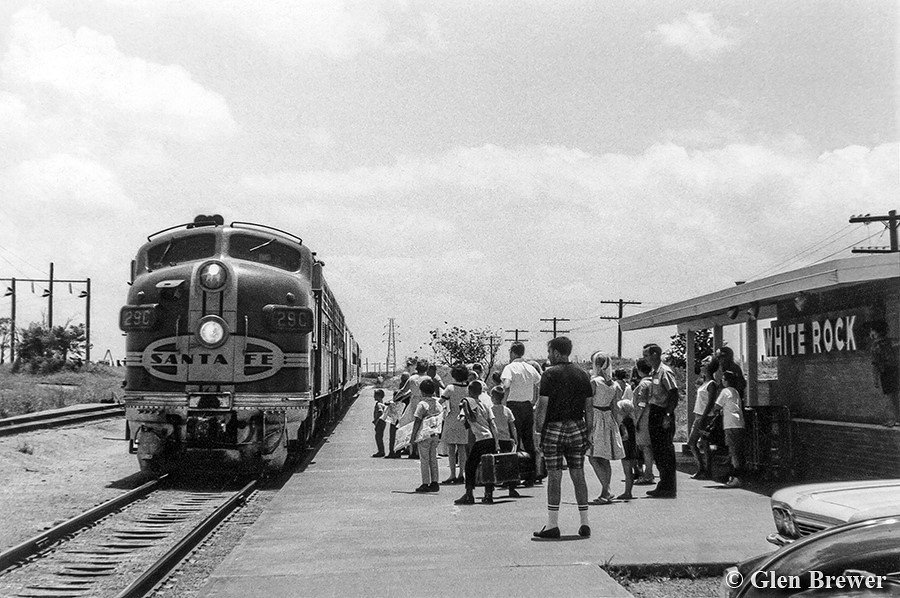
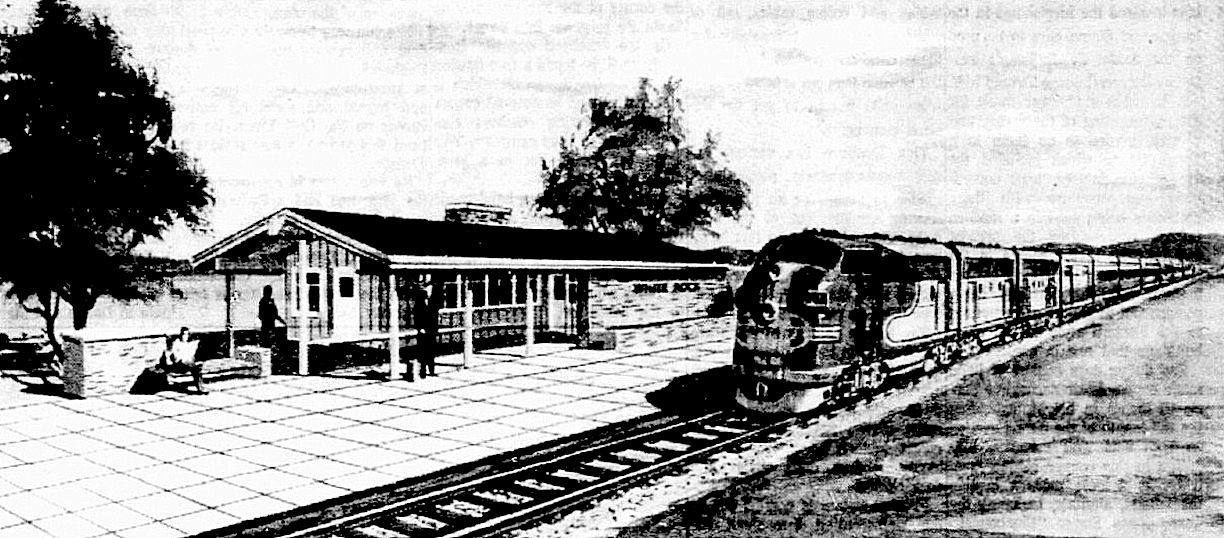
In the previous post, “White Rock Station,” I wrote about the opening of a new passenger depot that had been built to serve suburban travelers along the new stretch of Santa Fe track laid between Dallas and Denton in 1955, opening up direct through-travel to Chicago. This was big news, and as was the charming custom back then, when a new business endeavor opened or expanded, other businesses (often direct competitors) placed ads in the local papers to welcome them and wish them well.
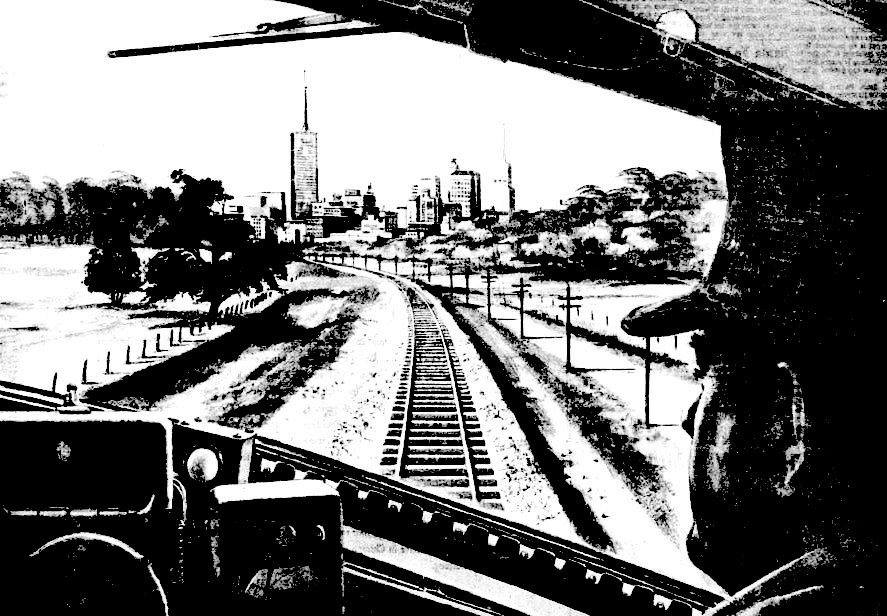
Here are a few of the ads that appeared in December, 1955 to promote/congratulate the new line. I’ve chosen these details of ads because they feature illustrations of the city’s skyline — I always love to see the Dallas skyline in ads, but I particularly like the style of commercial art from this period.
At the top is a detail from an ad placed by the Magnolia Petroleum Company, with the tag-line “Main Line to Progress.”
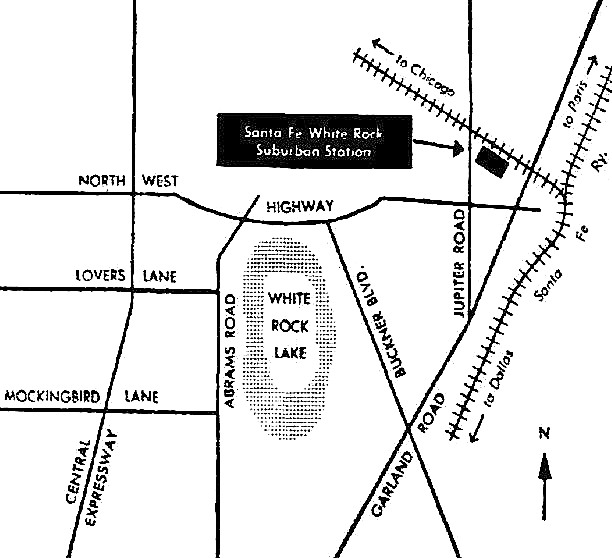
The White Rock passenger station — the Santa Fe railroad’s first suburban train depot built in the Southwest — opened on December 5, 1955 on Jupiter Road, about a quarter of a mile south of Kingsley (located mere steps across the Garland city line), a few miles northeast of White Rock Lake. It was the culmination of a $7,000,000 construction project in which two depots were built and 49.3 miles of new track was laid between Dallas and Denton (or, more specifically, between Zacha Junction — the area near Northwest Highway & Garland Road — and Dalton Junction, an area just northwest of Denton).
The new track — touted by a Santa Fe ad as being “the longest main line construction over new territory by any railroad in 25 years” — was important because it offered passengers from Dallas the ability to travel for the first time directly to Chicago without having to change trains. It also reduced freight line distances by 65 miles. The swanky streamlined Texas Chief shuttled passengers between Dallas’ Union Station and Chicago in about 19 hours — travel time between Union Station and the new White Rock Station was 25-30 minutes.
Santa Fe ad detail, Dec. 4, 1955
The breathless copy from the giant two-page advertising spread heralding the new line included the following description:
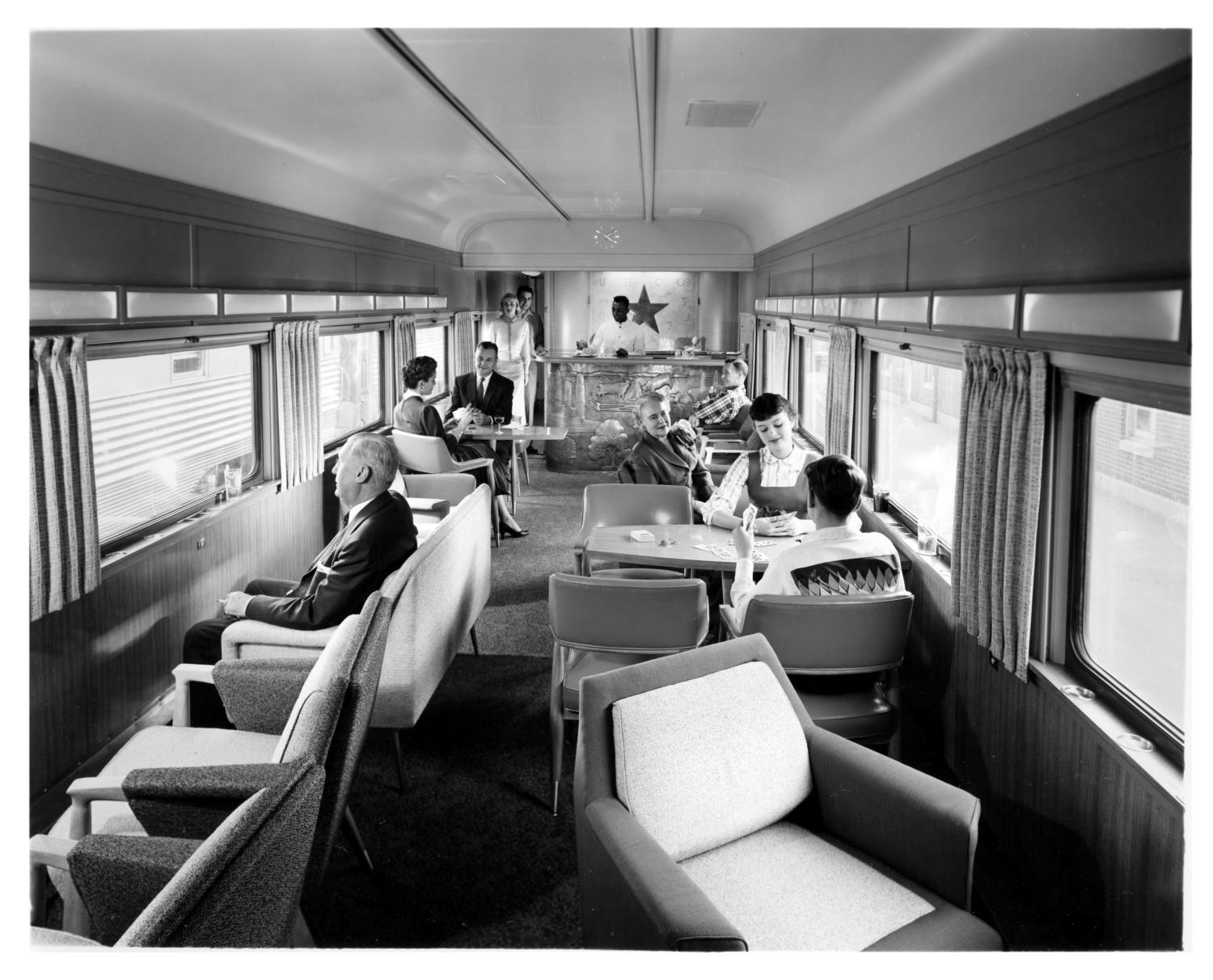
And just wait until you see the special lounge car and dining car on the Texas Chief — the last word in luxury in railroad equipment, decorated in the style and smartness indicative of Dallas…. A lounge decorated to please a Texan! Wide open and spacious feeling, with really comfortable modern sofas and chairs, casually grouped to make you want to relax. You’ll see the Star of Texas and famous cattle brands tooled into the rich leather back-bar — and Texas-inspired murals in hand-hammered copper. Even the walls are richly paneled — in smart, new frosted walnut. Just wait until you see it, you’ll say there’s nothing like it.
And here they are (click for larger images):
Below, the Texas Chief, pulling out of the station, heading north. (To see a grainy closeup of the station in the background, click here.)
Photo by Everette DeGolyer, Dec. 29, 1956, via SMU
UPDATE: Watch color home-movie film footage taken at the station in this clip from the Portal to Texas History (the pertinent footage begins at the 3:00 mark). More on this cool piece of film can be found in another Flashback Dallas post, here.
*
Interesting tidbit: the engine of the Texas Chief was christened at Union Station on Dec. 5, 1955 with a bottle of water from White Rock Lake! The caption of a photo of the christening in the Dallas Morning News read: “NEW STREAMLINER CHRISTENED — With a bottle of water from White Rock Lake, Mrs. Fred G. Gurley, wife of the Santa Fe Railway’s president, christens the new Dallas-Chicago Texas Chief in ceremonies Monday at the Union Terminal. At right is Miss Sandra Browning of Garland, who presented the local bottle of water,” (DMN, Dec. 6, 1955). Champagne? Pffft! We’ve got pure-dee White Rock Lake water!
And I found footage of that! Here is a screenshot of Mrs. Gurley wielding the bottle of East Dallas’ finest (as Miss Garland, Sandra Browning looks on).
And here is the short clip of the Texas Chief on Dec. 5, 1955, the day of its inaugural run from Dallas to Chicago — in color!. There are shots of the ceremonies at Union Station in Dallas, of the new White Rock Station, of the streamliner with the Dallas skyline behind it, and, possibly, footage from the other big ceremony in Denton.
The two photos showing the dining and lounge cars of the Texas Chief were taken around 1956; both are from the Museum of the American Railroad Collection, Portal to Texas History. Other photos of the Texas Chief from this collection can be seen here.
Photo of the Texas Chief pulling out of the White Rock Station was taken by Everette L. DeGolyer on Dec. 29, 1956; it is from the Everette L. DeGolyer Jr. Collection of United States Railroad Photographs, DeGolyer Library, Central University Libraries, Southern Methodist University. The photo (“Atchison, Topeka, and Santa Fe, Diesel Electric Passenger Locomotive No. 11, White Rock Station”) can be viewed here.
The two drawings, and a few quotes, are from large advertisements placed by the Santa Fe railroad to announce the opening of their new line.
The last photograph showing the station is dated “circa 1956” and credited to “Monaghan, M.D.”; it can be viewed on the Portal to Texas History site, here.
The YouTube video showing color footage of the Texas Chief’s inaugural festivities is titled “New railroad into Dallas. Archive film 93424,” from the Huntley Film Archives, here.
The photo of the commemorative railroad spike (“Spiked with Progress”) was sent to me by a man who had seen it for sale in an antique store in Ardmore, Oklahoma in 2020 (thanks, Joe!).
A 1962 map showing the location of the station is here. A present-day Bing map showing where the station was is here. A Google Street View image of the area today is (…if you must…) here.
An article on the construction of the Denton and Dallas (White Rock) depots — “Work on New Santa Fe Depot To Start Here” (Denton Record-Chronicle, July 13, 1955) — can be read here.
For anyone doing research into this specific new rail line, there was a 16-page section in The Dallas Morning News on Dec. 5, 1955 which was bursting with helpful info, civic pride, “welcome to the neighborhood” ads, and corporate puffery. There was an even larger (MUCH larger!) tribute to the sainted Santa Fe which consumed the entire Dec. 4, 1955 edition of The Denton Record-Chronicle (there was even a ghost image of a Santa Fe engine which covered page one).
As mentioned above, there is home-movie film footage taken at the station — more about this can be found in the Flashback Dallas post “White Rock Station (And a Helicopter Ride),” here.
And, lastly, check out a YouTube video of Henry Mancini’s version of Johnny Mercer’s “Atchison, Topeka & Santa Fe” — with loads of cool period film footage of train travel — here.
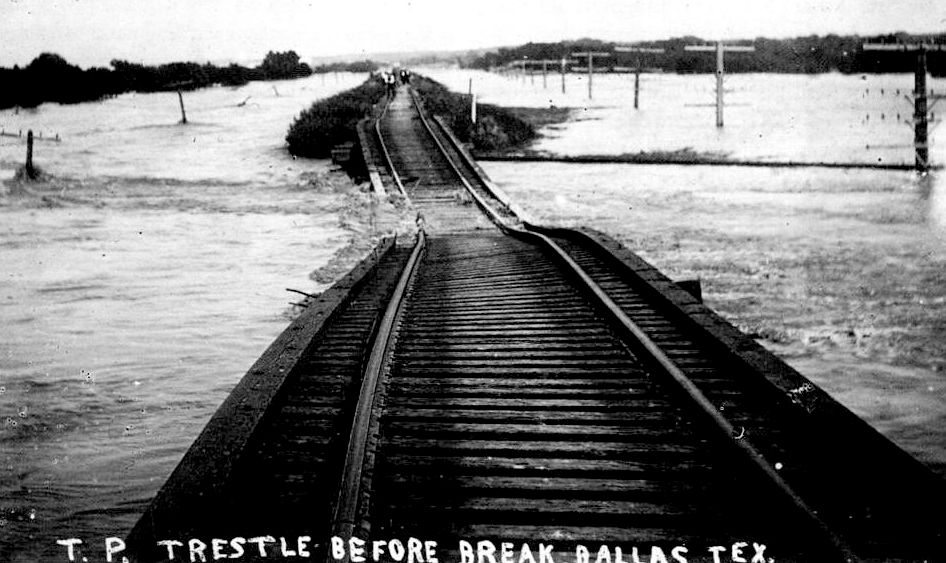
“T. P. Trestle Before Break, Dallas, Tex.” (click for larger image)
by Paula Bosse
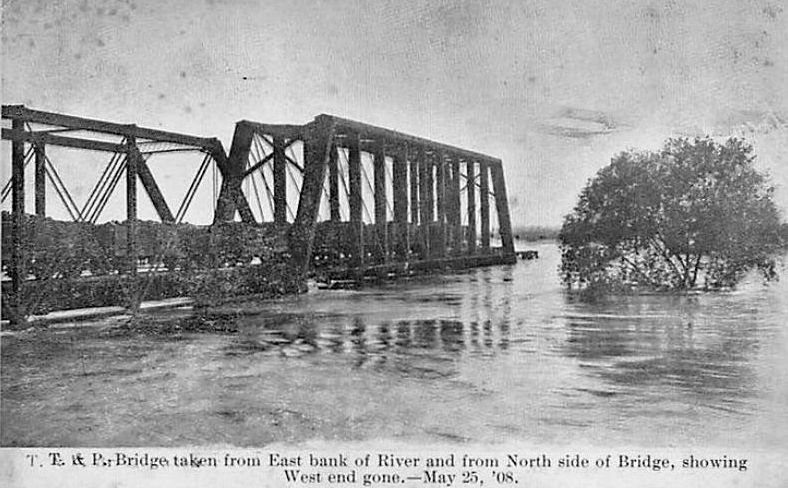
Above and below, photos of the Texas & Pacific railroad trestle spanning the Trinity River, destroyed during the great flood of May, 1908. Five people died in the flooding — in which the Trinity crested at an incredible 52.6 feet — and damage to property was unbelievable. The railroad trestle was just one of numerous victims of the worst flood Dallas has ever known.
***
Photo from the article “After the Deluge: The Impact of the Trinity River Flood of 1908” by Jackie McElhaney (Legacies, Fall, 1999), which you can read here.

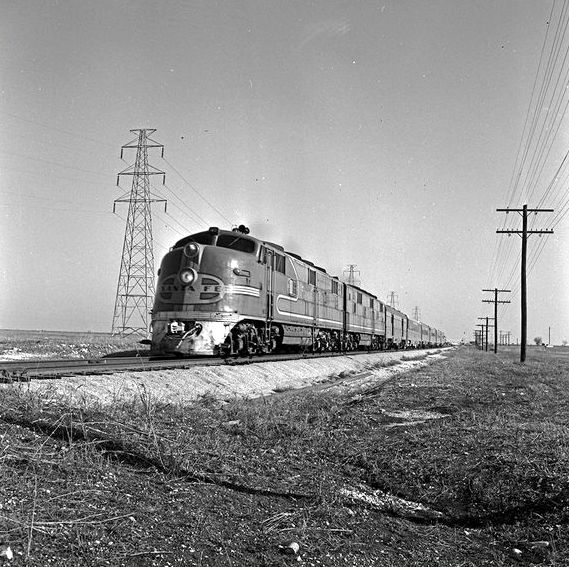
 The SHZ heading out of Dallas… (click for larger image)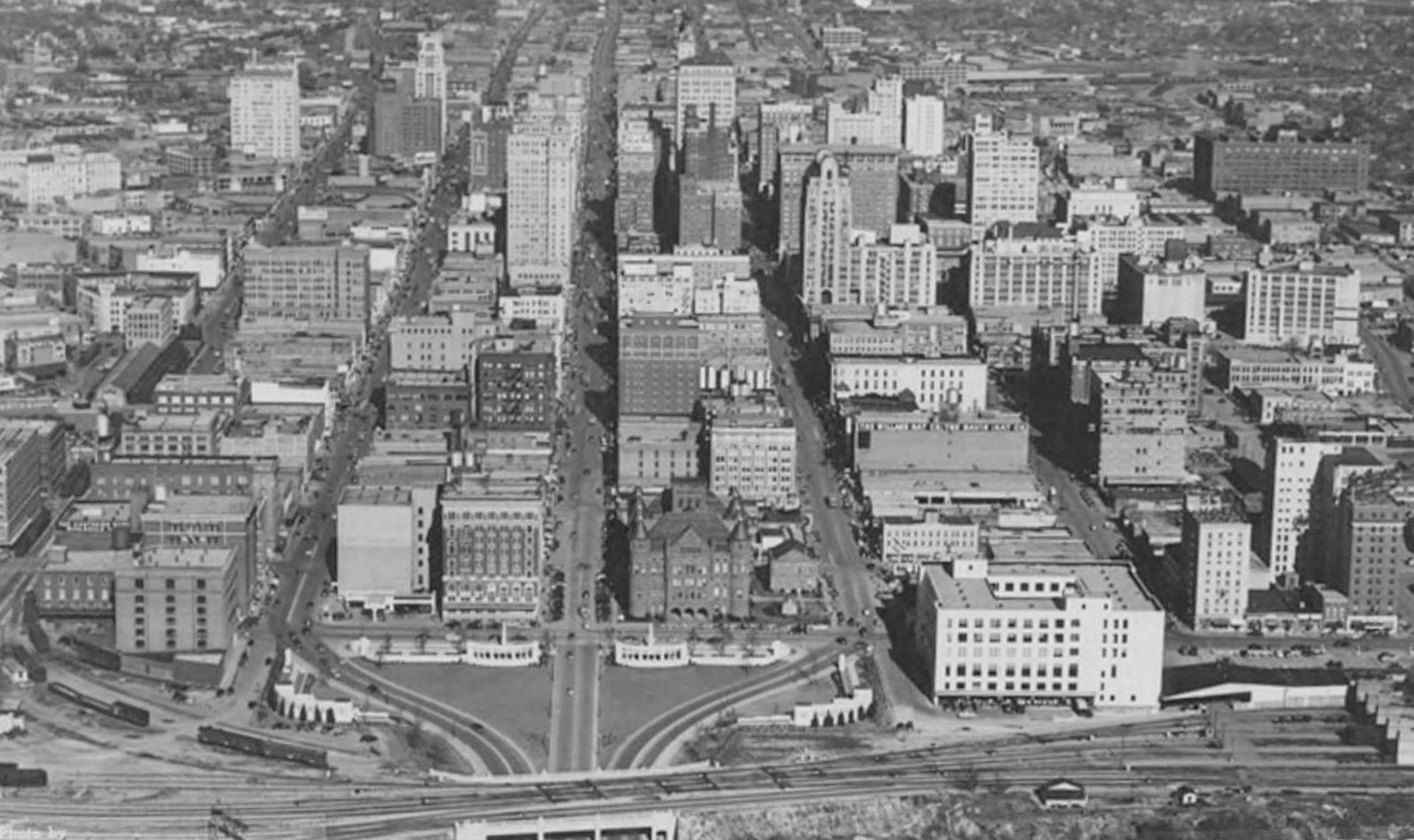



















 Flashback : Dallas