Flashback : Dallas

A Miscellany: History, Ads, Pop Culture

Category: Vault

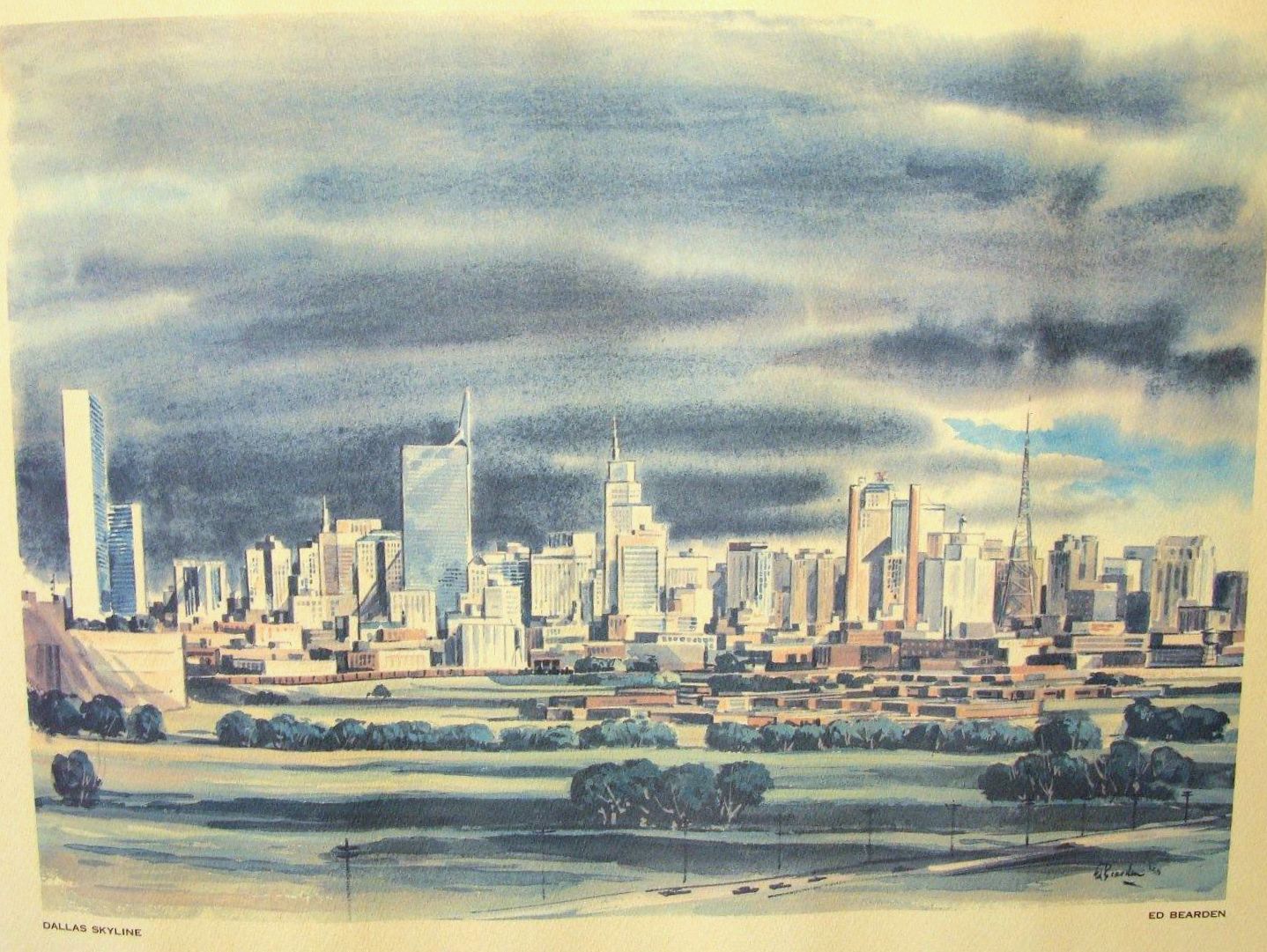
“Dallas Skyline” by Ed Bearden — 1958

dallas-skyline_ed-bearden“Dallas Skyline” by Ed Bearden (click for much larger image)

by Paula Bosse

Ed Bearden (1919-1980) was a Dallas painter who studied under Jerry Bywaters and Otis Dozier and was loosely affiliated with the Dallas Nine group of artists. He worked with Bywaters at the Dallas Museum of Fine Art as Assistant Director, and he helped found the Dallas Museum for Contemporary Arts. He also spent several years at SMU — both as a student and as a member of the faculty — until he decided to leave to focus on his own art career. In addition to working as a fine artist, he also owned a commercial art business.

The constantly changing Dallas skyline was a particular favorite subject of his, and he returned to it again and again. The one above is a personal favorite. I’m not sure why I feel so nostalgic when I look at it, except that I swear that I saw this print as a child at my father’s bookstore. It’s a Dallas I’ve never known, but one I wish I had.

***

Apologies for the wonky image, but I can’t find a better scan of it. I’m assuming this was first a watercolor, then issued as a lithograph, then maybe printed as a broadside or a loose plate in a book? The date in the lower right corner is very difficult to make out — it looks like either 1958 or 1959. I’m going with 1958. ‘Cause I’m like that.

A brief biography of Ed Bearden can be found here.

An unlikely gig came Bearden’s way when director George Stevens asked him to draw the storyboards for the film Giant, hoping that having a Texas artist do them would lend an air of authenticity to the look and feel of the movie (and, in fact, Bearden’s sketches were used as reference by makeup and wardrobe personnel). Read more about this interesting assignment on SMU’s Hamon Arts Library site, and see some of Bearden’s sketches from the set in Marfa, here.

*

Copyright © 2014 Paula Bosse. All Rights Reserved.

The Dallas Police Department & Their Fleet of Harleys — 1951

ad-harley-davidson_dpd_19511951 ad

by Paula Bosse

Group photo day!

Like so many cities all over the country — whether large or small — the motorcycle division of the Dallas Police Department is equipped with Harley-Davidsons exclusively. Effective traffic regulation is assured through the use of 35 solo Harley-Davidsons and 29 Servi-Cars. Traffic experts recognize that no other method matches motorcycles for efficiently handling so many phases of traffic control work and accident prevention.

***

Sources & Notes

1951 Harley-Davidson ad from… somewhere — probably eBay.

Back in 1910, the DPD was perfectly happy with Indian motorcycles, as can be seen in a previous post, “Dallas Motor Cycle Cops — 1910.”

*

Copyright © 2014 Paula Bosse. All Rights Reserved.

When the Spanish Influenza Hit Dallas — 1918

spanish-influenza_love-field_otis-historical-archives_nmhm_110618
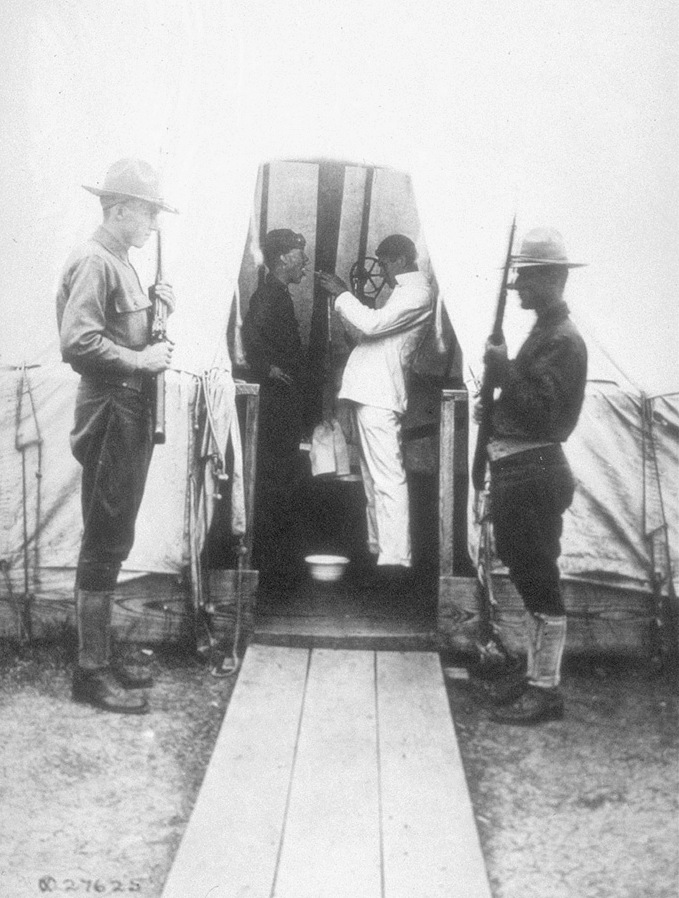
American Red Cross at Love Field, spraying soldiers’ throats, Nov. 6, 1918

by Paula Bosse

The Spanish Influenza pandemic of 1918-1919 caused as many as 50 million deaths worldwide — about 600,000 of which were in the United States (11 times greater than the number of American casualties during World War I). Locally, the influenza first hit the soldiers at Camp Bowie in Fort Worth in September, 1918. The flu spread quickly, and on Sept. 27, it was reported that there were 81 cases in the camp. Well aware of the devastation the flu had wrought in other U.S. cities, most notably at military camps, Fort Worth was, understandably, taking the situation seriously. Dallas leaders, on the other hand, were all-but pooh-poohing the need for concern. On Sept. 29, The Dallas Morning News had a report titled “Influenza Scare is Rapidly Subsiding” — the upshot was that, yeah, 44 reported cases of “bad colds” had been reported in the city, but there’s nothing to worry about, people.

In the opinion of the military and civil doctors, the Spanish Influenza scare is unwarranted by local conditions. The few cases of grip, it is claimed, are to be expected as the result of the recent rainy weather.

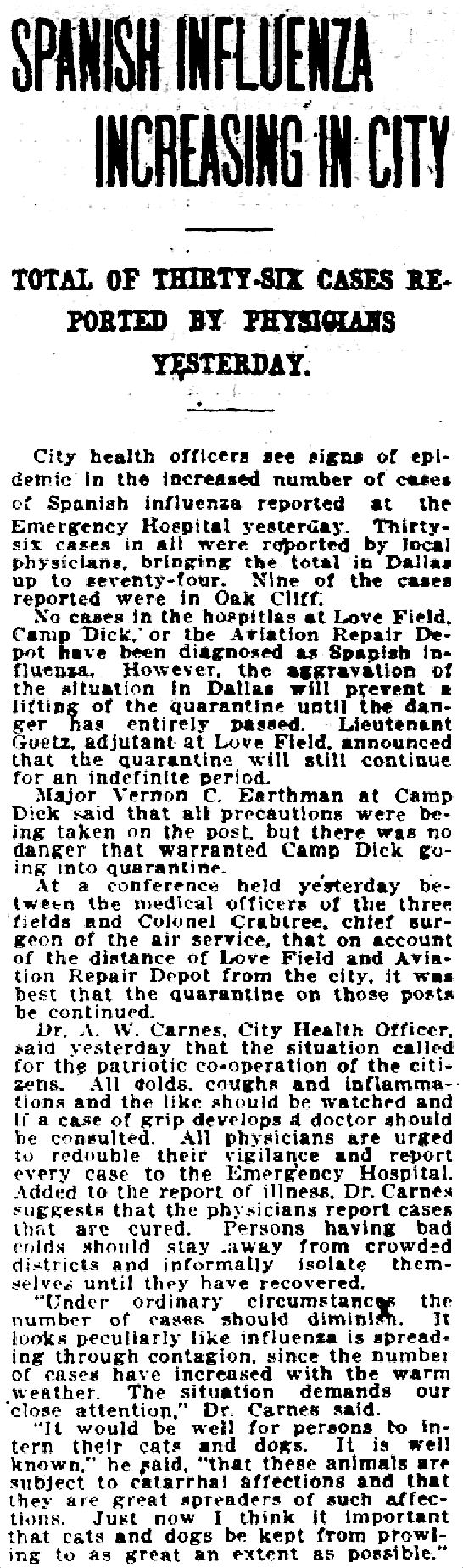
Just two days later, though, officials were jolted out of their complacency when the (reported) cases jumped to 74 (click for larger image):

spanish-influenza-dmn-100218DMN, Oct. 2, 1918 (click for larger image)

The months of October and November were just a blur: the city was plunged into an official epidemic. There was no known cure for the flu, so a somewhat ill-prepared health department preached prevention. People were encouraged to make sure their mouths were covered when they coughed or sneezed, and they were directed to not spit in the street, on streetcars (!), in movie theaters (!!), or, well, anywhere. (Handkerchief sales must have soared and spittoon sales must have plummeted.)

At one point or another, places where people gathered in large numbers — such as schools, churches, and theaters — were closed. Trains and streetcars were required to have a seat for every passenger (no standing, no crowding) (…no spitting). The number of mourners at funerals (of which there were many) was limited. And there was a major push for citizens to clean, clean, clean their surroundings in an attempt to make the city as sanitary as possible. Instructions appeared often in the newspapers.

spanish-influenza_dmn_101218_tipsDMN, Oct. 12, 1918

It was estimated that there were 9,000 cases of Spanish Influenza in Dallas in the first six weeks. By the middle of December, when the worst of the outbreak was over, it was reported that there had been over 400 deaths attributed to the Spanish Influenza and pneumonia in just two and a half months.

spanish-influenza_FWST_121118Fort Worth Star-Telegram, Dec. 11, 1918

As high as these numbers were, Dallas fared much, much better than many other parts of the United States.

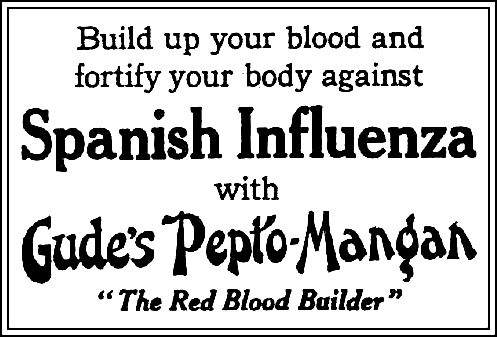
spanish-influenza_ad_dmn_101818_pepto-manganAd, DMN, Oct. 18, 1918

***

Sources & Notes

Photo at top was taken on November 6, 1918 and shows American Red Cross Workers spraying throats of military personnel based at Love Field in hopes of preventing the spread of the influenza. The photo is from the Otis Historical Archives, National Museum of Health and Medicine; I found it on the NMHM site, here. (Click photo for larger image.)

Ad for Pepto-Mangan (“The Red Blood Builder”) was one of a flood of medicines and tonics claiming to be effective in the fight against Spanish Influenza (none were).

For a detailed and remarkably well-researched, comprehensive history of the Spanish Influenza in Dallas, see the article prepared by the University of Michigan Center for the History of Medicine, here. It’s pretty amazing.

To read about the history of pandemics (including several good links regarding the Spanish flu), see the Flu.Gov site, here.

And, NO, Ebola is not transmitted like the flu. But it’s still good practice to cover your mouth when you cough or sneeze,wash your hands frequently, and never EVER spit in the street, because that’s just disgusting. ((This post was originally written in 2014 while Dallas was the center of the Ebola universe.))

More on the Spanish Influenza pandemic can be found in the Flashback Dallas post “Influenza Pandemic Arrives in Dallas — 1918.”

*

Copyright © 2014 Paula Bosse. All Rights Reserved.


“A Cavalcade of Texas” — Dallas, Filmed in Technicolor, 1938

“A Cavalcade of Texas”

by Paula Bosse

(SCROLL DOWN TO WATCH THE FILM CLIPS.)

Brought to my attention last night in a Dallas history group was the heretofore unknown-to-me full-length, Hollywood-slick travelogue called “A Cavalcade of Texas,” shot around the state in 1938 under the auspices of Karl Hoblitzelle in his capacity as chairman of the Texas World’s Fair Commission. (Hoblitzelle also built the Majestic Theater and founded the Interstate Theatre chain.)

“A Cavalcade of Texas” — a 49-minute full-color travelogue touting the beauty, history, natural resources, and industries of the state — was made to be shown at the New York World’s Fair, but because of a variety of production and logistical problems, the film was, instead released theatrically. John Rosenfield, the legendary “amusements” critic for The Dallas Morning News, was suitably impressed. After an early preview of the film, he wrote:

The picture should be a revelation to the outlanders who still think of Texas as the backwoods with a hillbilly civilization. (DMN, June 27, 1939)

Ha.

The film opened in Dallas in October of 1939 at, unsurprisingly, The Majestic, second on a bill with a Ginger Rogers film (which was fitting, as Ginger had begun her professional career at The Majestic as a teenager). The pertinent paragraph from Rosenfield’s official review is amusingly snippy:

“Cavalcade” shoots the Houston skyline as a bristling metropolitan acreage but hides the Dallas buildings behind the towering Magnolia Building. Maybe we are sensitive about it but we don’t feel that architectural justice has been done. The Fort Worth aspect is glorified more than it deserves. (DMN, Oct. 15, 1939)

(Sorry, Fort Worth!)

The Dallas scenes are only about 4 minutes’ worth of the whole film, but to see Dallas at this time in color — and moving — is kind of thrilling. The entire film is on YouTube, but I’ve bookmarked the two Dallas bits. First, after an interminable sequence on how fantastic things will be when we finally make that darn Trinity navigable, is a Dealey Plaza-less Triple Underpass, shots of Main Street (including the now partially obliterated 1600 block at the 17:52 mark, on the right), Fair Park (including a description of the Hall of State as “the Westminster Abbey of the New World” (!)), and a neon-lit Elm Street at night. (If you let it keep going, you’ll see “the Fort Worth aspect.”)

(I am having problems embedding this clip to begin at the 17:30 mark. If the above does not begin at the Dallas sequence, see it at YouTube, here.)

*

Twenty minutes later, the viewer is, for some reason, shown the Dallas Country Club with what I’m guessing are Neiman-Marcus models pretending to play golf.

(If the above does not begin at the Dallas Country Club sequence at 40:09, see it at YouTube, here.)

*

Those are just the Dallas bits — the whole film is an impressive undertaking, and it’s great to see documentary footage of this period in rich color, presented with incredibly high production values, in full Hollywood style.

cavalcade_101439_ad
Ad, Oct. 14, 1939 (click to see larger image)

***

Sources & Notes

“A Cavalcade of Texas” was directed, edited, and narrated by James A. Fitzpatrick and can be seen in full on YouTube, here.

Background on Karl Hoblitzelle can be read in information provided by the Handbook of Texas, here, and by the Dallas Public Library, here.

The wonderful and vibrant 1939 footage of downtown Dallas that was discovered on eBay a few months ago and “saved” by a group of preservation-minded Dallasites, which included Robert Wilonsky and Mark Doty, is one of my favorite Dallas-history-related stories of 2014. Watch that footage here.

*

Copyright © 2014 Paula Bosse. All Rights Reserved.

Panoramic View of the Entrance to the State Fair of Texas — 1908

state-fair_clogenson_1908_LOC“Texas State Fair, Main Entrance” by Clogenson, 1908 (click for larger image)

by Paula Bosse

Today is opening day of the State Fair of Texas. Always an anticipated annual event, this is what the crowded entrance to Fair Park looked like over a century ago — still pretty recognizable, especially the firehouse at the top left. Below is a detail of the first third or so of this amazing panoramic photo. For a gigantic image of the top photo, click here (and then keep clicking until it’s gotten as big as it’s going to get — and don’t forget to use that horizontal scroll bar!).

Below is the detail I’ve cropped from the larger photo, showing the Parry Avenue portion, with the still-standing firehouse at the top left.

Have fun at the fair, y’all!

state-fair_1908-detDetail showing Parry Avenue, looking north (click for larger image)

***

Sources & Notes

Original image titled “Texas State Fair, Main Entrance” by Clogenson, 1908, from the Library of Congress. Photo and details can be viewed at the LOC website here.

In case you missed the link above — and because it’s so fantastic and filled with such incredible detail — you really must see the really big image of that really big panoramic photo, HERE.

For other Flashback Dallas posts on the State Fair of Texas, click here.

For Flashback Dallas posts on the Texas Centennial, click here.

*

Copyright © 2014 Paula Bosse. All Rights Reserved.

W. W. Orr: Buggies, Phaetons, Carriages — “Everything on Wheels!”

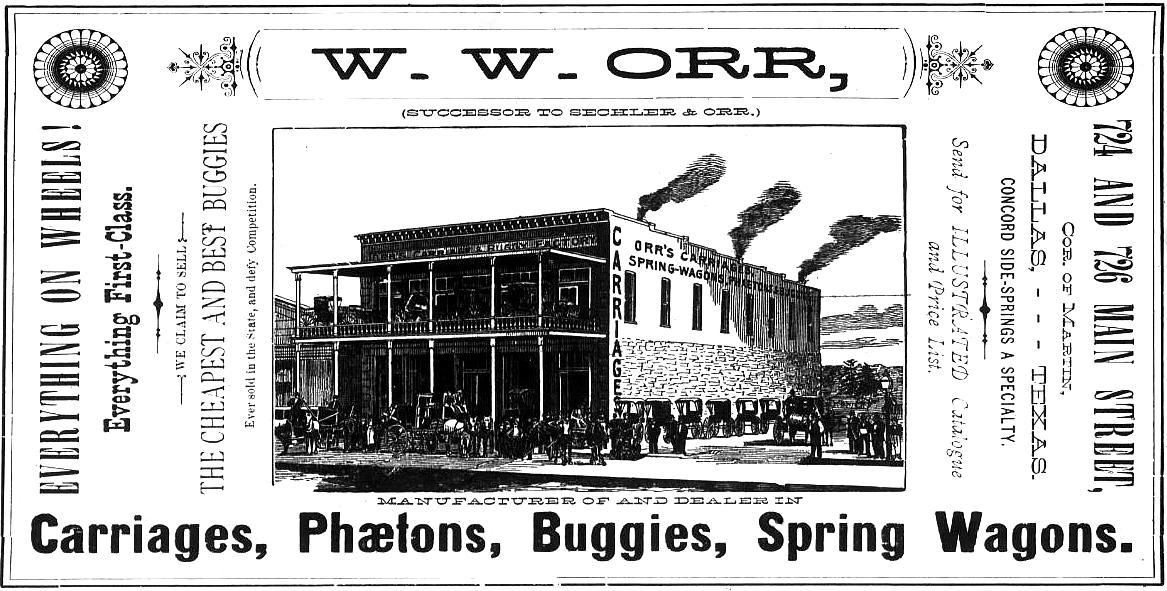
ad-orr-carriages_directory_1878-detW.W. Orr’s carriage business on Main St., 1878 (click for larger image)

by Paula Bosse

I came across the image above in the 1878 Dallas city directory, and my eye was immediately drawn to the novel open-air display of  buggies on the second floor of the building. I’ve never seen this before — the frontier version of the auto showroom!

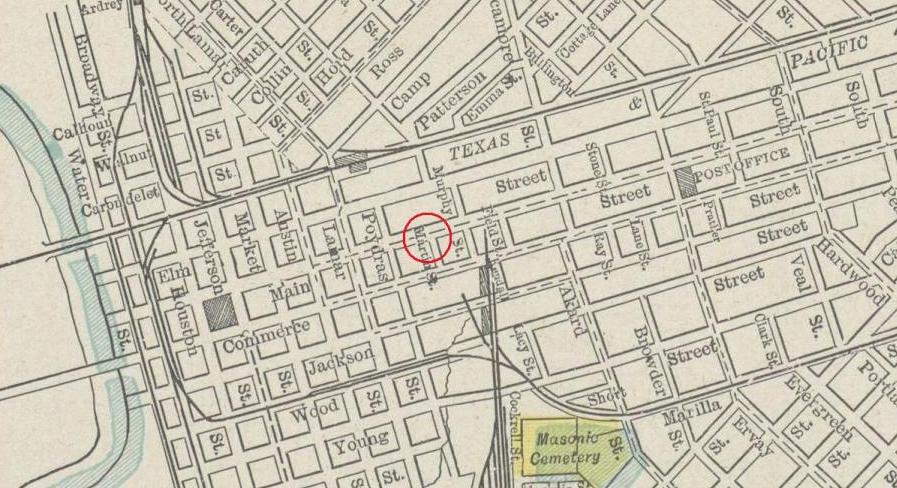
I hope this is a depiction of the actual shop owned by W. W. Orr at 724-726 Main Street (corner of Main and Martin — see map below) and not some sort of early augmented clip art. Orr ran a successful business selling buggies, phætons, and carriages, and he probably did have an imposing shop.

William Wallace Orr was born in Ohio, and after the Civil War he made his way to Texas, where he served for a short time as an East Texas postmaster before coming to Dallas where he and his wife, Amanda, operated a livery stable.

orr_dallas-herald_041973Dallas Herald, April 19, 1873

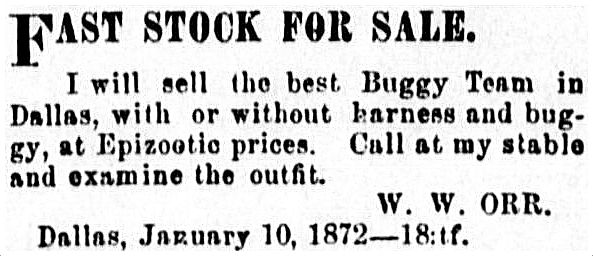
I’m not sure whether “epizootic” is used here as some sort of 19th-century tongue-in-cheek hard-sell advertising term (“His prices are INSANE!“) … or whether it means the horses have some sort of disease. I tend to think it’s the former.

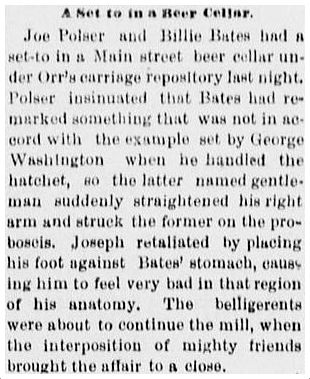
The carriage business, which had started by 1878, is notable (to me, anyway) because it was housed in a building with a basement — I wasn’t aware that basements really existed in Dallas at the time. Orr rented out the basement beneath his “carriage repository” as a beer cellar. If TV westerns are anything to go on, drunken brawls in most drinking establishments of the time were to be expected. What might not be expected is an account of a bar fight to be reported like this:

orr_cellar_dal-her_060278Dallas Herald, June 2, 1878

Regardless of what disreputable activities were going on in the cellar, it seems that Orr’s business of manufacturing and selling “everything on wheels” was a booming one.

orr_dal-her_060380Dallas Herald, June 3, 1880

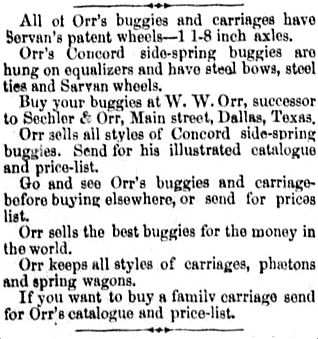
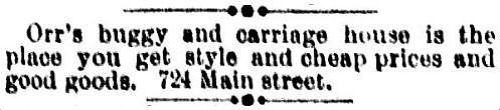
He had stylish conveyances, cheap prices, and good goods:

orr_dal-herald_081283Dallas Herald, Aug. 12, 1883

After the death of his wife in 1886 (she died of consumption at the early age of 42), Orr passed the business to his son. In poor health, he left Dallas for Mississippi, where he met a woman who nursed him back to health and whom he later married. After a few years of an apparently happy second marriage, W. W. Orr died in 1894. Cash savings, investments, and real estate holdings back in Dallas had left him a wealthy man, and, as might be expected, his family in Dallas was dismayed to learn that he had left his estate to his infant daughter in Mississippi. His three grown children from his first marriage were not happy, and they contested the will. (The case is covered exhaustively here. I think the baby daughter emerged victorious, but I’m not absolutely sure.)

It’s interesting that Orr and his first wife are buried side by side in Greenwood Cemetery. Amanda Melvine McQueen Orr has a large, ornate monument and headstone; W. W. has his name — and nothing else — carved into an unadorned marker. It would have been nice to have had a little a buggy in the corner. …Something.

orr-map_c1900

The location of Orr’s buggy and carriage house was at the corner of Main and Martin, shown above in a map from around 1900. (Click for larger image.)

And, below, is the full ad, with that incredible artwork! (Click it!)

ad-orr-carriages_directory_18781878

***

Sources & Notes

Illustrated ad from the 1878 Dallas city directory.

All other ads from The Dallas Herald, as noted.

Map is a detail from a map of Dallas, circa 1900, from the Portal to Texas History, here.

Amanda Orr’s headstone and memorial statuary can be seen in several photos here; W. W.’s sad unadorned slab can be seen here.

Phætons? They sound dangerous!

*

Copyright © 2014 Paula Bosse. All Rights Reserved.


Parade Day — 1909

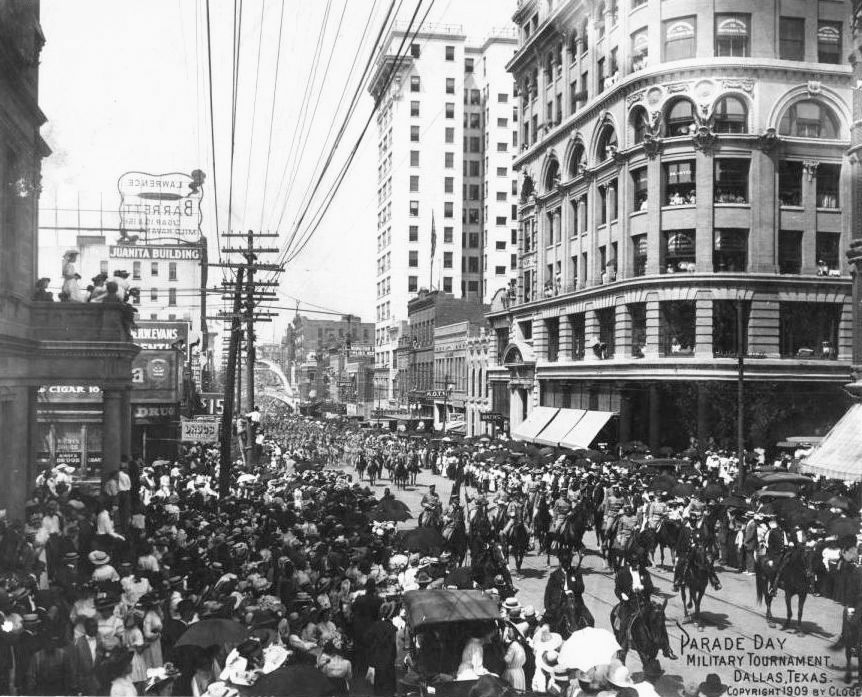
parade-day_1909_clogenson_degolyerMain Street looking west from Ervay, 1909

by Paula Bosse

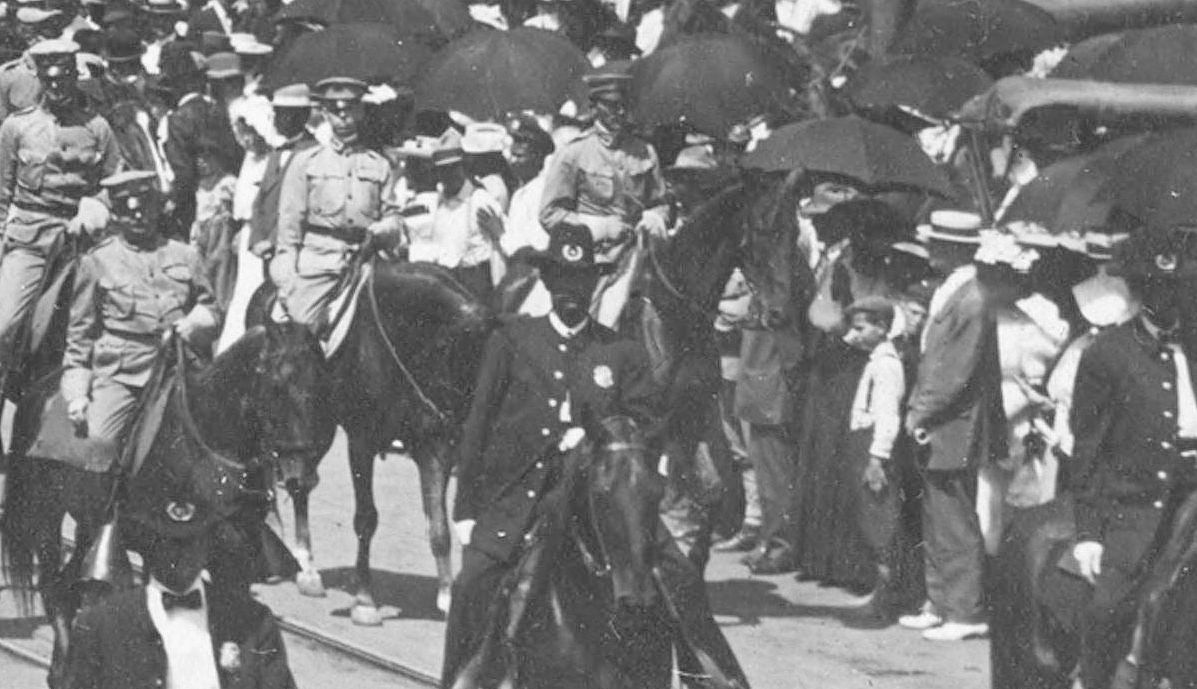
Sun-bronzed, khaki-clad soldiers representing the three important branches of the army, paraded through the city evoking the admiration of 60,000 persons who lined the streets all the way from Fair Park to the end of the downtown business district. (Fort Worth Star-Telegram, Aug. 24, 1909)

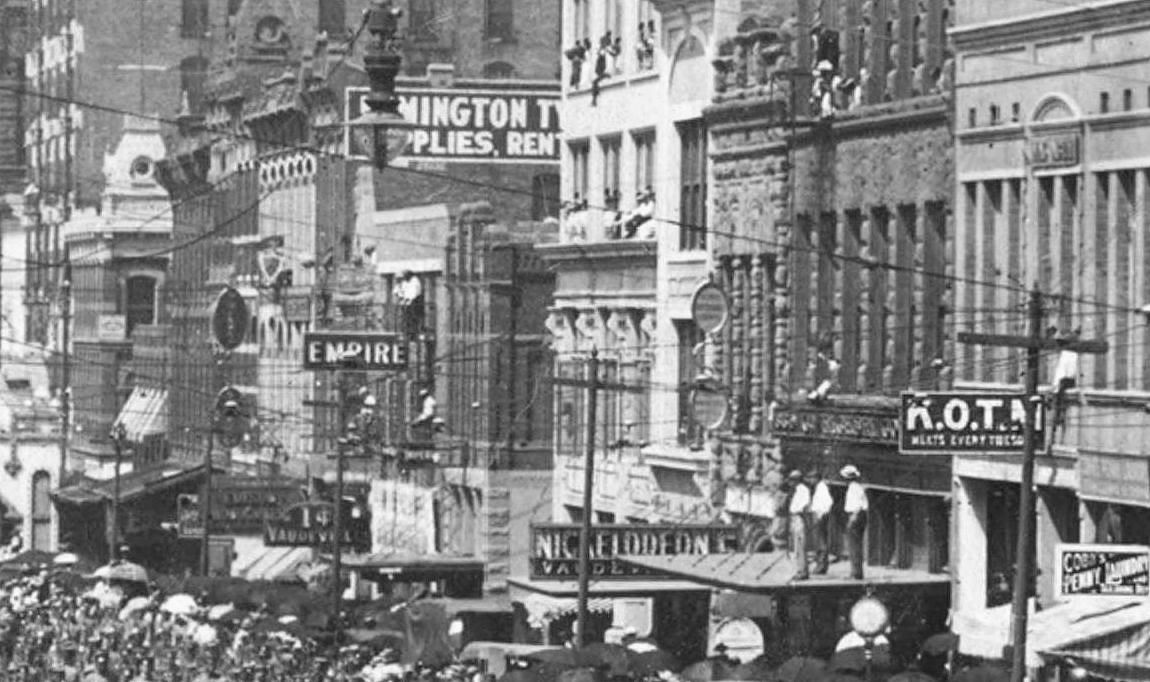
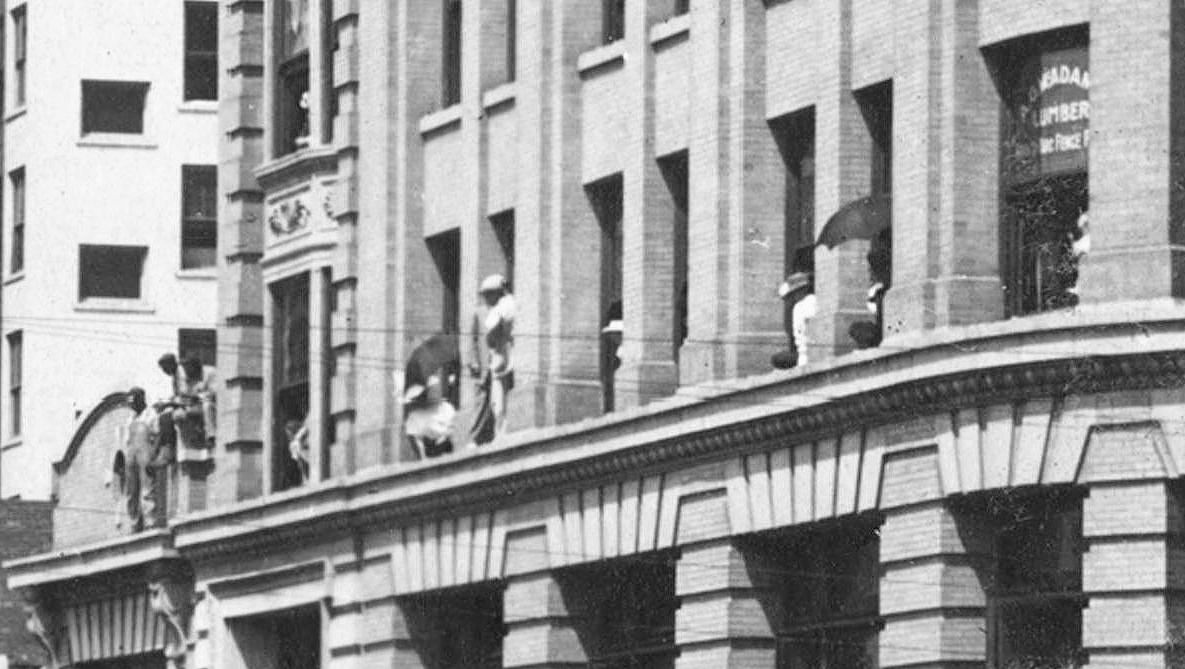
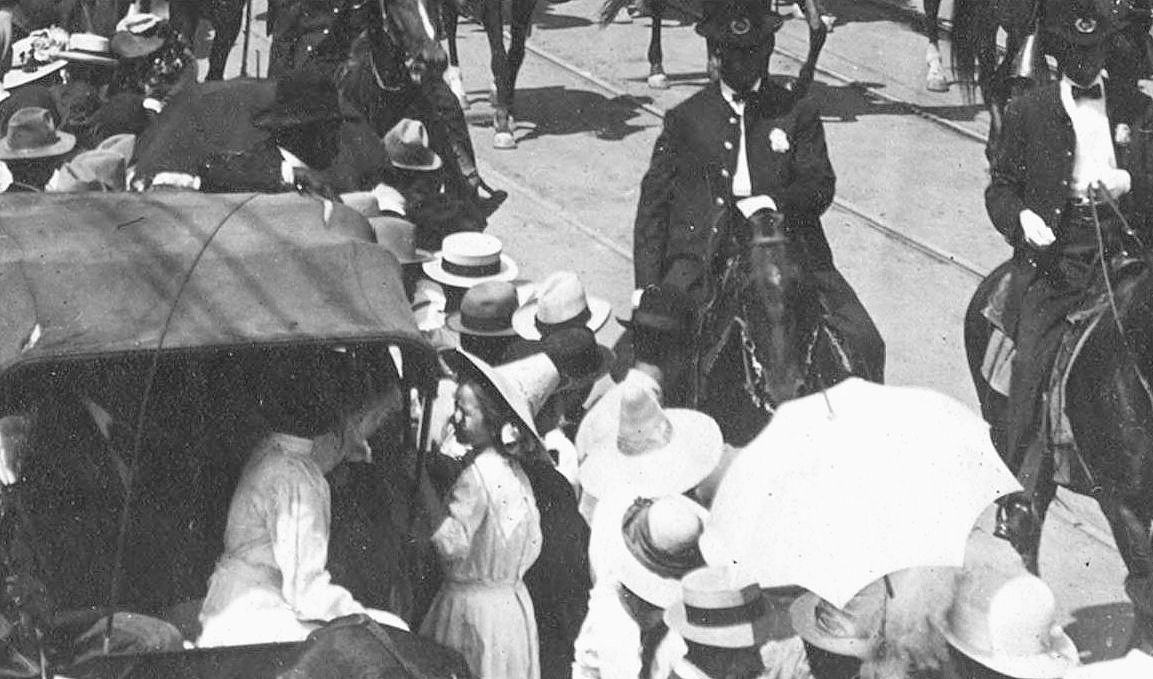
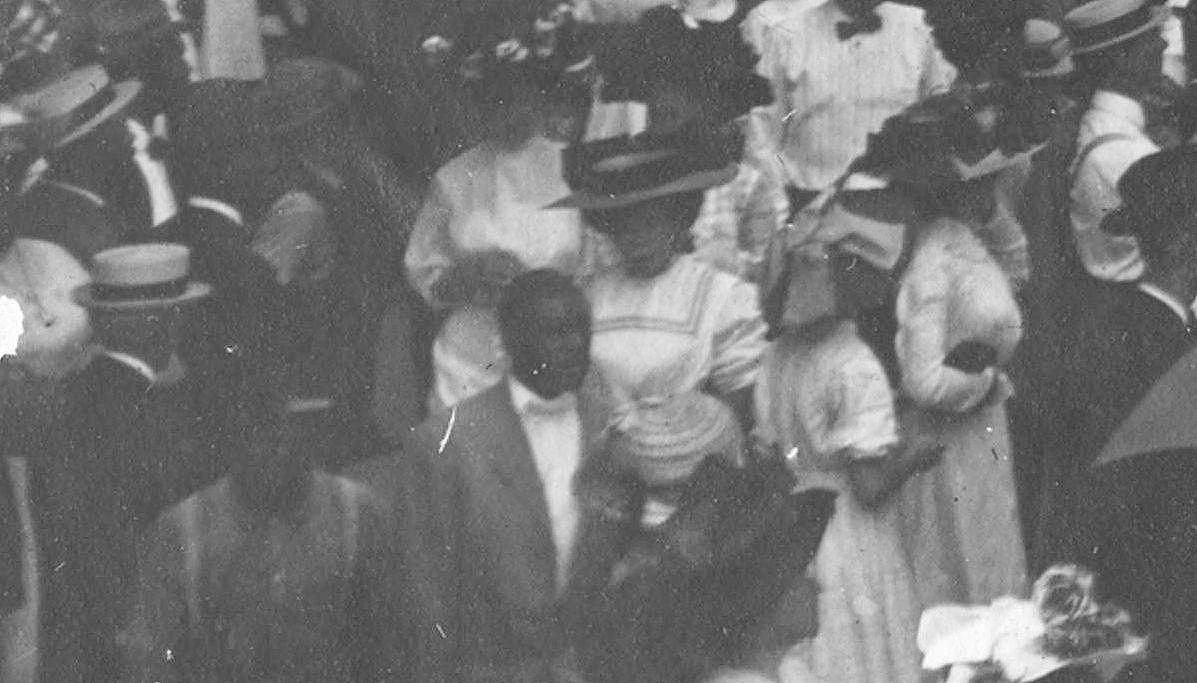
This is a GREAT photograph, looking west on Main Street from Ervay, with the Wilson Building in the foreground at the right, and, a few doors down, the tall white Praetorian Building at Stone Street. With so much going on in this photo, it’s a great opportunity to zoom in on the crowd and look a little more closely at the details. (All photos are much larger when clicked.)

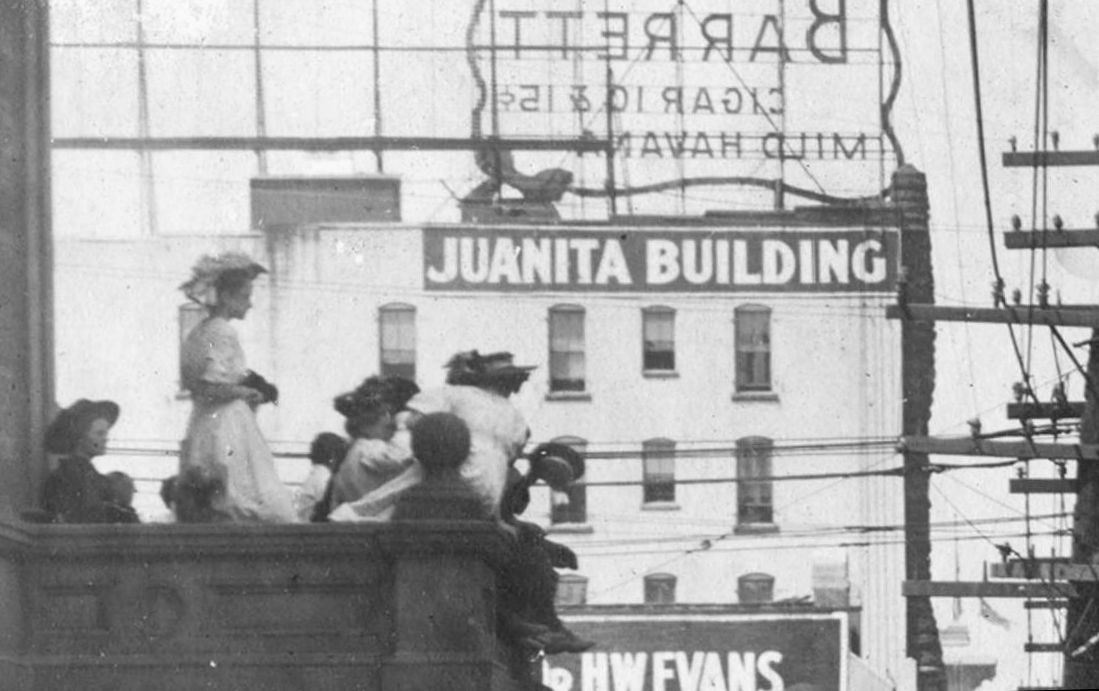
parade-day_1909_det1My favorite “vignette” from this photograph, with the Juanita Building in the background.

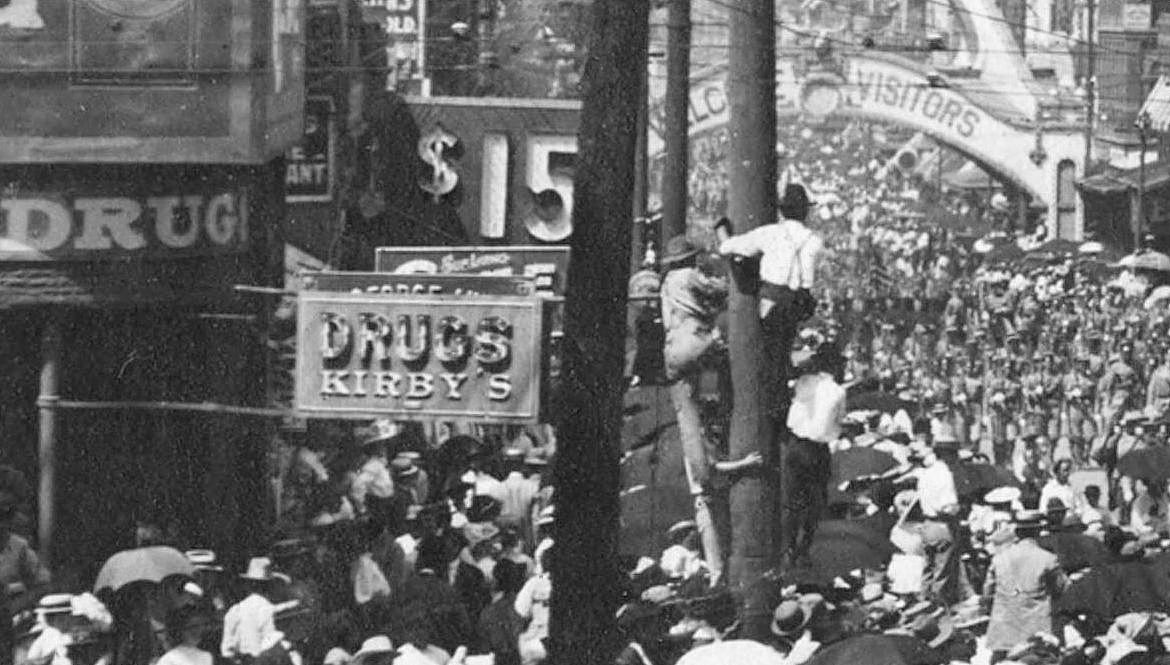
parade-day_1909_det2Dedicated parade-watchers. The Elk’s Arch welcoming visitors spans Main Street, a holdover from the 1908 Elk’s convention.

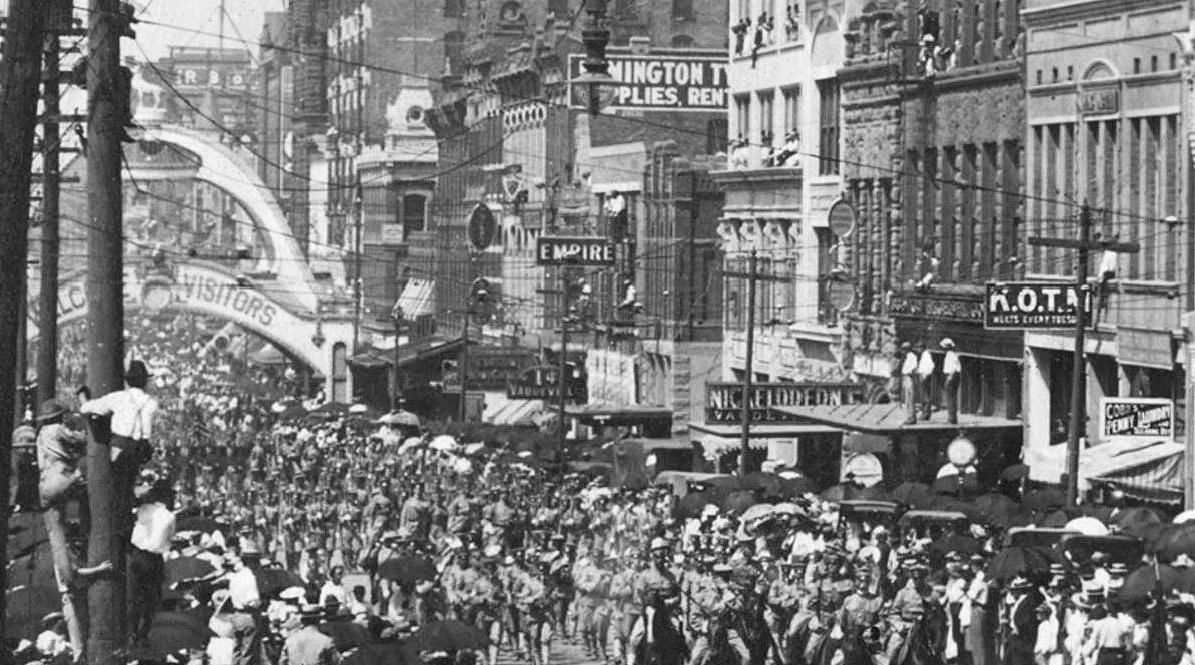
parade-day_1909_det3The dark-colored three-story building behind the three men in white shirts standing above the crowd (1611 Main) was demolished yesterday, Sept. 21, 2014. (A better view of the full building can be seen in the post “1611 Main Street — Another One Bites the Dust,” here.)

parade-day_1909_det4Note the vaudeville theaters.

parade-day_1909_det4aWorkers in the Wilson Building with a pretty great, unobstructed view.

parade-day_1909_det5When this photo was taken, Labor Day was fast approaching — that guy had two more weeks to wear those shoes.

parade-day_1909_det6Watching from shaded splendor.

parade-day_1909_det7Big hats, cinched waists, and African American bystanders.

***

Sources & Notes

Original photo by Clogenson, titled “Parade Day, Military Tournament, Dallas, Texas,” taken August 24, 1909; in the collection of the DeGolyer Library, Central University Libraries, Southern Methodist University. The photo can be viewed here.

Newspaper articles describing exactly who was involved in the parade and why it was happening can be read in the easily digestible report from the Fort Worth Star-Telegram, here, and the drier, more comprehensive report from The Dallas Morning News, here (each opens as a PDF). (This photo accompanied the DMN article.)

See other photos I’ve zoomed in on, here.

*

Copyright © 2014 Paula Bosse. All Rights Reserved.

Oak Cliff Trolley — 1895

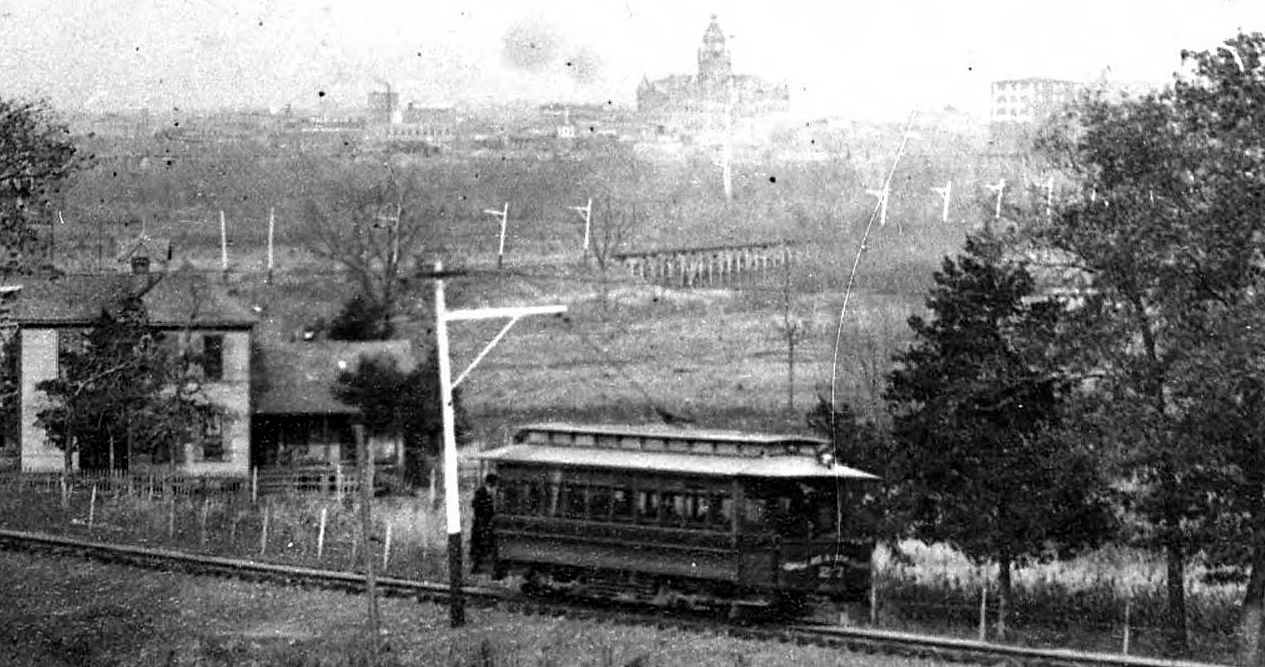
trolley_oak-cliff_stark_1895_hpl“Dallas from Oak Cliff” by Henry Stark, 1895/96 (click for larger image)

by Paula Bosse

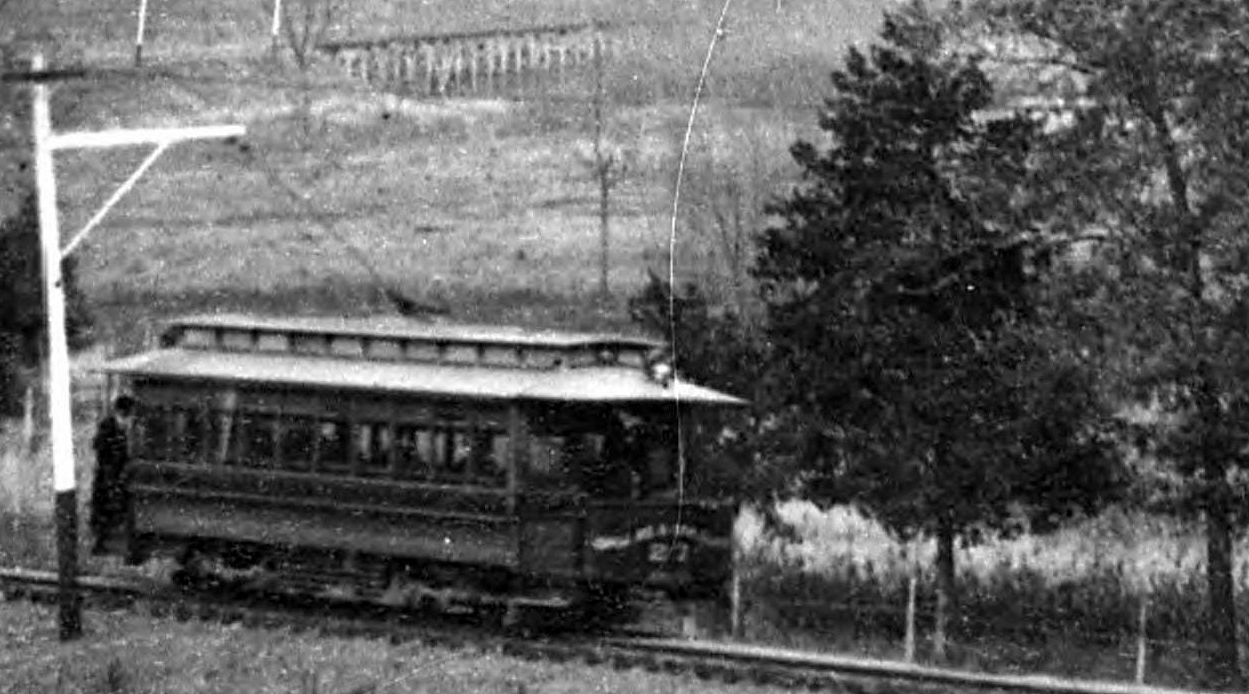
As present-day trolley service to Oak Cliff has been in the news in recent months, here’s a pastoral view of a little trolley chugging through the wilds of Oak Cliff in 1895. In the background, across the river, the still-fairly-new courthouse looms like a mirage. Below are a few details, magnified. (All images are much larger when clicked.) Enjoy!

trolley_oak-cliff_det1

trolley_oak-cliff_det2

trolley_oak-cliff_det3

trolley_oak-cliff_det4

***

Photo (labeled by the Houston Public Library as “Trolley moving through the woods”) is by Henry Stark, taken on a visit to Dallas in the winter of 1895/96; from the collection of the Houston Public Library — it can be viewed here.

For more on Henry Stark, see the previous post “Henry Stark’s ‘Bird’s Eye View of Dallas,'” here.

Other photos which I’ve “Zoomed In On the Details” can be seen here.

CLICK PHOTOS — REAL BIG.

*

Copyright © 2014 Paula Bosse. All Rights Reserved.

Highland Park High School — 1939

hphs_1939Highland Park High School

by Paula Bosse

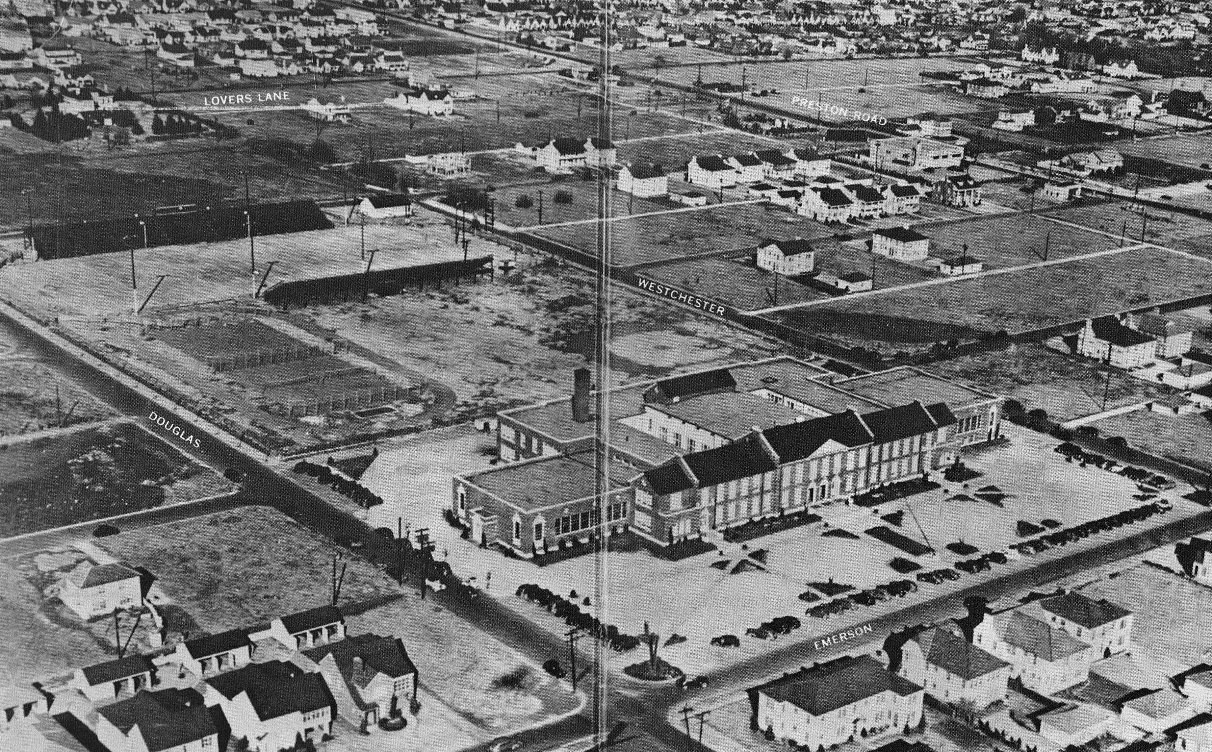
Great photo of the neighborhood around Highland Park High School (its second location — I had no idea), from the 1939 HPHS yearbook. I would have thought the Park Cities would have been built up more by then.

The description, from the back of the 1970s-era postcard this image appeared on:

In 1937, Highland Park High School moved to 4220 Emerson from its original home on Normandy. This aerial view — taken from a double-page spread in the 1939 Highlander — shows the entire physical plant of [the] High School. R. C. Dunlap was the President of the Highland Park District Board of Education that year.

Bounded by Emerson, Douglas, Lovers Lane and Westchester — covering five full city blocks — Highland Park High School looks, today, much as it did in 1939. Only the neighborhood has changed as it has continued to develop. Significant additions have been made to the educational facilities in order to keep teaching techniques right up to date.

Today, ninth, tenth, eleventh and twelfth graders from both Park Cities attend Highland Park High School — still recognized as one of the best educational institutions in the country.

***

Sources & Notes

Photo from the 1939 HPHS Highlander yearbook; later issued as a postcard as part of the Park Cities Bank “Heritage Series” in the 1970s. Thanks to the Lone Star Library Annex Facebook group for use of the image.

A very, VERY large scan of this image can be viewed here.

**

Here’s an awkwardly cropped photo of the first HPHS, from 1928 (click for larger image):

old-hphs_1928_crop

Another from the same series of postcards, issued in the 1970s. The description on the back:

Sunny days almost always found upperclassmen chatting on the front steps at High School. These photographs were taken from a 1928 copy of The Highlander — the Highland Park High School annual.

H. E. Gable was the superintendent that year. Ben Wiseman replaced E. S. Lawler as principal at the end of the school year.

The front steps at 3520 Normandy are still a gathering spot, but today’s students attend Highland Park Middle School — grades six, seven and eight. Senior High School moved to a new building at 4220 Emerson in 1937. Additions and remodeling have kept both of these educational facilities right up to the minute in technology and equipment.

*

Copyright © 2014 Paula Bosse. All Rights Reserved.

Happy 75th Anniversary, Stonewall!

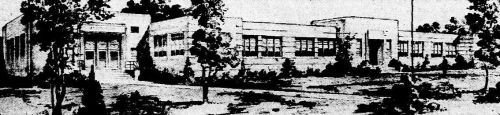
1938-stonewall-jackson-elementary-school_renderingStonewall Jackson Elementary School, 1938 rendering (click for larger image)

by Paula Bosse

Classes begin today for students in DISD schools, one of which is Stonewall Jackson Elementary School, located at Mockingbird and Matilda. Stonewall turns 75 years old this year (2014), and I’m proud to say it’s where I spent many years as a happy student. When I learned recently that the school had originally been built as a single-story building (instead of the two stories we know today), I was pretty surprised, and this little unknown nugget prompted me to look into the early years of my alma mater.

In the 1920s and ’30s, Dallas was expanding very quickly northward from Vickery Place, the residential neighborhood around Belmont and Greenville. As the area we now know as Lower Greenville and the M Streets was developed, the two elementary schools (Vickery Place School, then at Miller and McMillan, and Robert E. Lee, at Matilda and Vanderbilt) were soon filled to capacity. Building a new school to serve burgeoning “Northeast Dallas” was an immediate necessity. So in 1938, the city purchased a 9-acre chunk of land along Mockingbird, one block east of Greenville Avenue and right alongside the Denison interurban tracks that ran on Matilda (when I was growing up a couple of blocks away, I used to see remains of those tracks but didn’t know what they had been used for — I wrote about those tracks here and here). The land had been part of the vast Caruth land holdings.

The building was designed by architect C. H. Griesenbeck. It had eleven classrooms, a cafeteria, and an auditorium with a seating capacity of 400. Although originally built as a one-story building, Griesenbeck was mindful that expansion would be necessary in the future, and his design took into account that a second story would be added in the years to come. Construction began in late 1938 and was scheduled to be completed for the opening of the 1939-40 school year.

The name of the new school was decided upon a few months later:

“Stonewall Jackson’s name was chosen for the new school, Dr. Norman R. Crozier, superintendent, said because of the high ideals of Thomas Jonathan Jackson, one of the unique and romantic figures of the War Between the States, and as a companion to its nearest school, Robert E. Lee.” (Dallas Morning News, Feb. 1, 1939)

But if you’re going to sink a hundred thousand dollars into a school, you’ve got to have houses for families to live in to make sure your future student pool doesn’t run dry — and at that time very few houses had been built that far north. Cut to W. W. Caruth, Jr., son of the Caruth family patriarch who basically owned everything north of Mockingbird (Caruth owned a huge expanse of land once estimated at being over 30,000 acres). Not long after selling the land at Mockingbird and Greenville to Dr Pepper, Caruth fils began to develop the land around the then-under-construction school — he called the new neighborhood “Stonewall Terrace.”

The property went fast.
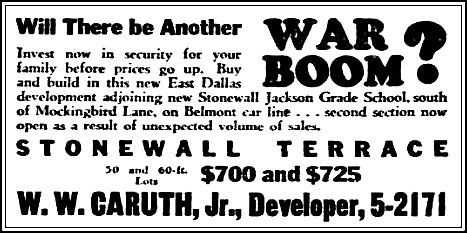
stonewall-terrace_dmn_092339September, 1939

As the neighborhood was taking shape and the construction of the school building was nearing completion, the school’s official boundaries were announced:

“Boundaries of the Stonewall Jackson School will be from the alley south of Morningside on the east side of Greenville Avenue and from the alley south of Mercedes on the west side of Greenville to the M-K-T Railroad on the north.” (DMN, Sept. 3, 1939)

Despite some problems with labor shortages, the school managed to open on time, on Sept. 13, 1939, the start of the new school year.

The school and the neighborhood grew quickly, and the number of students soon doubled. In 1950 the school board approved preliminary plans for an addition to the school. This addition (which would cost $369,000 and be handled by the architectural firm of Tatum & Quade) would include a first-floor wing with four classrooms, a gymnasium, and a lunchroom, and a second story containing eight classrooms, a library, and a music room. (The cost of construction would probably have been quite a bit more had the original architect not had the foresight to design the building with the expectation that a second story would be added in the future.)

The construction was substantial enough that it had to be done during the 1951-52 school year. Because the old lunchroom was being dismantled while the new wing was being built, students were required to bring their lunches the entire year. All they could get at school was milk. No fish sticks, no Salisbury steak, no chess pie. Just milk. Sorry, kids.

The new addition was completed in time for the beginning of the 1952 school year. And that’s the version of the building that stands today, looking pretty much unchanged.
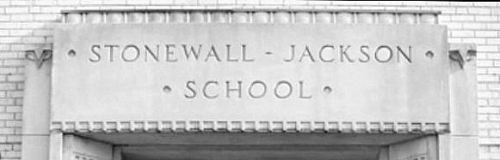
stonewall_front

It was a cool building then, and it’s a cool building now. It’s sad to see how much of the playing fields keep disappearing as ugly portable buildings take over, but the new garden is a great new addition — I wish they’d had that when I was there.

I really loved that school. When I was a student there, grades went from 1st to 7th, and I loved all seven years I spent there. Thanks for the great childhood memories, Stonewall. And Happy 75th Anniversary!
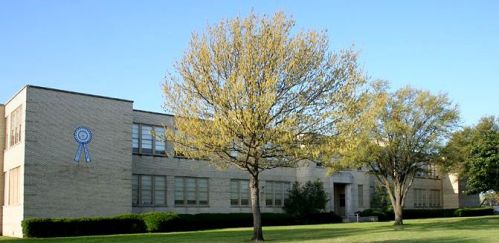
stonewall-nowPhoto: DISD

***

Sources & Notes

Top image is architect C. H. Griesenbeck’s architectural rendering of Stonewall Jackson Elementary School, originally a one-story building.

Here are a few articles to check out in the Dallas Morning News archives:

  • “$11,250 Offer Made for New School Site” (DMN, Oct. 26, 1938)
  • “Contracts for $104,150 Let on Northeast Dallas School” (DMN, Dec. 22, 1938)
  • “New Northeast Dallas School Named Jackson; Board Pays Tribute to Famous General” (DMN, Feb. 1, 1939)

And, yes, it probably sounds weird to outsiders, but students actually do call the school “Stonewall” — just like we call Woodrow Wilson High School (the high school Stonewall feeds into) “Woodrow.” It’s like a secret handshake.

Below, an undated photo from DISD’s Pinterest board (if you squint, you can see the Piggly Wiggly at the southwest corner of Mockingbird and Matilda).
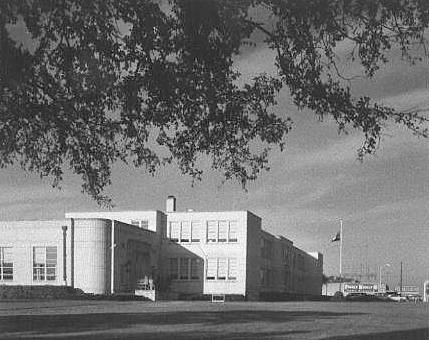
stonewall_DISD-pinterest

UPDATE: After years of controversy, Stonewall Jackson Elementary School will be rechristened “Mockingbird Elementary” in 2018. Whatever its name, it’s still a great school!

*

Copyright © 2014 Paula Bosse. All Rights Reserved.