Flashback : Dallas

A Miscellany: History, Ads, Pop Culture

Category: Zooming in on Details

Whimsy on Main Street — ca. 1906

by Paula Bosse

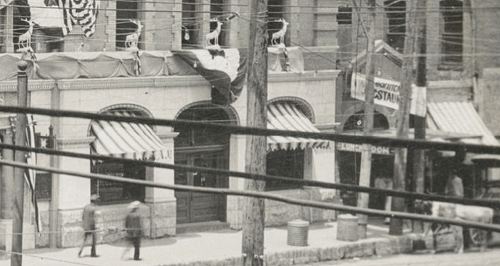
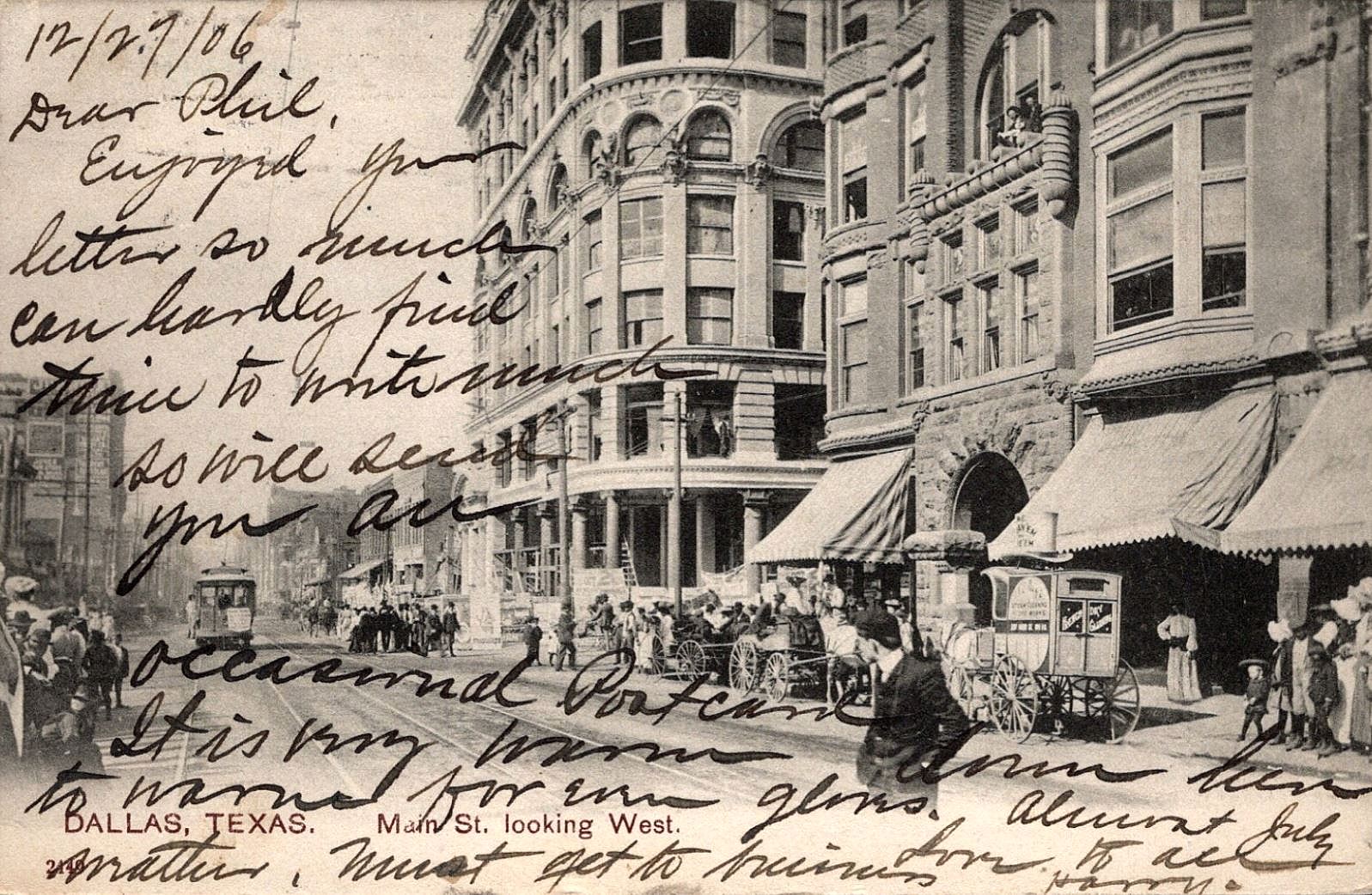
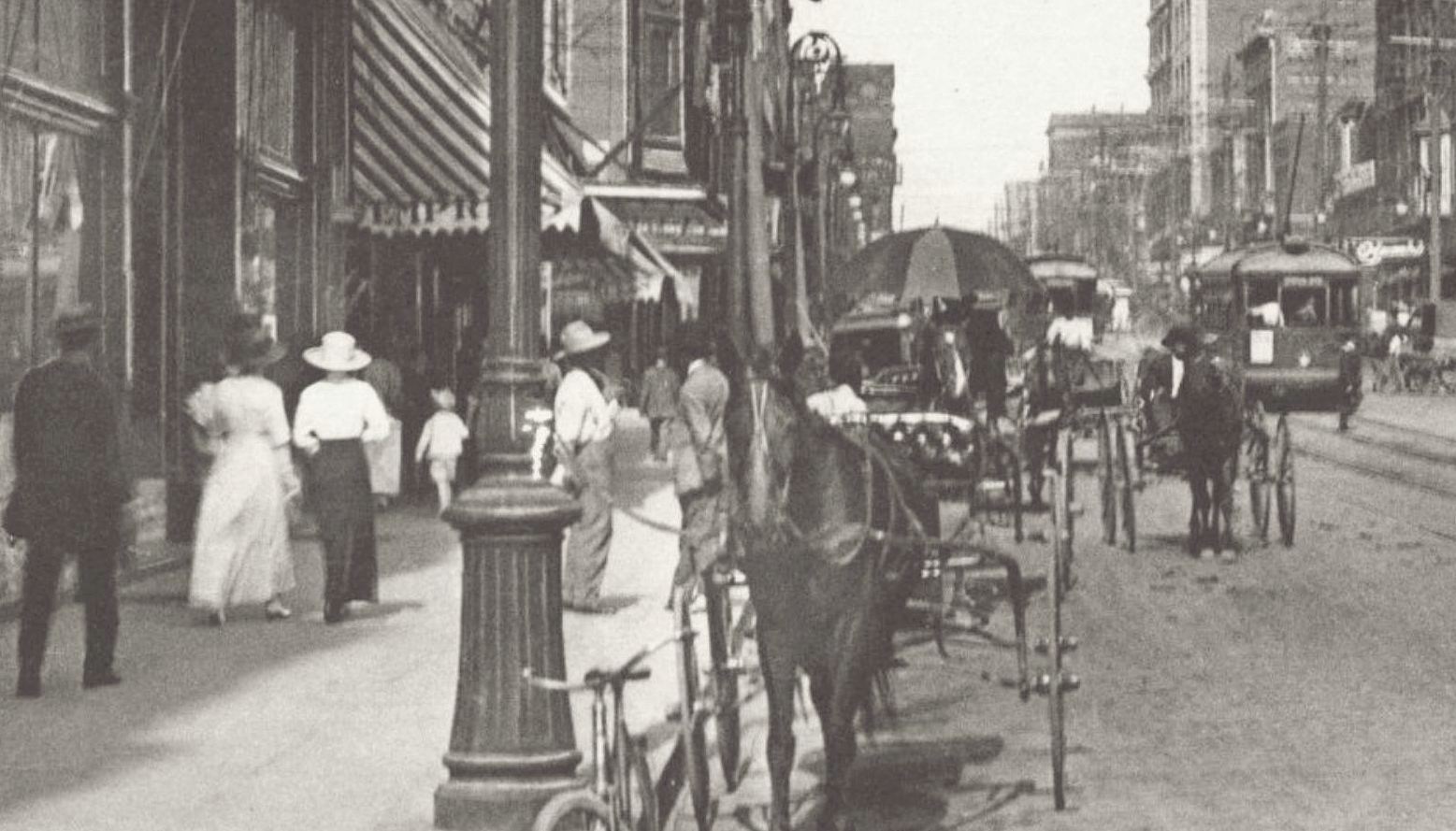
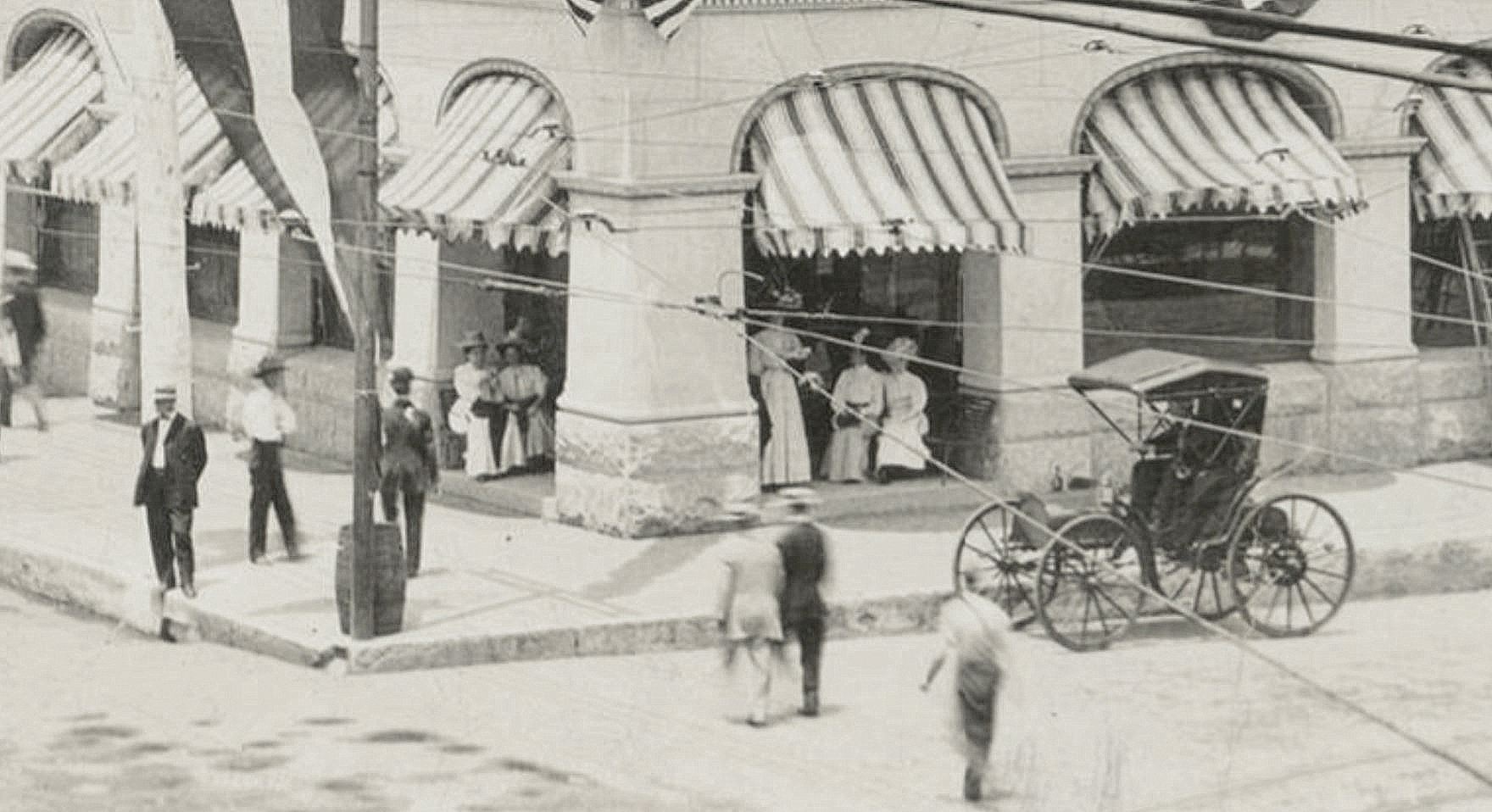
I’ve seen a lot of postcards with views of “Main St. looking West,” usually taken from about Ervay, with the Wilson Building as the architecturally impressive centerpiece. But I don’t think I’ve seen this one. I don’t know when the photo was taken, but it was mailed at the very end of 1906. It looks like the new Wilson Building (which opened in 1904) may still have construction work going on, at least on the ground floor.

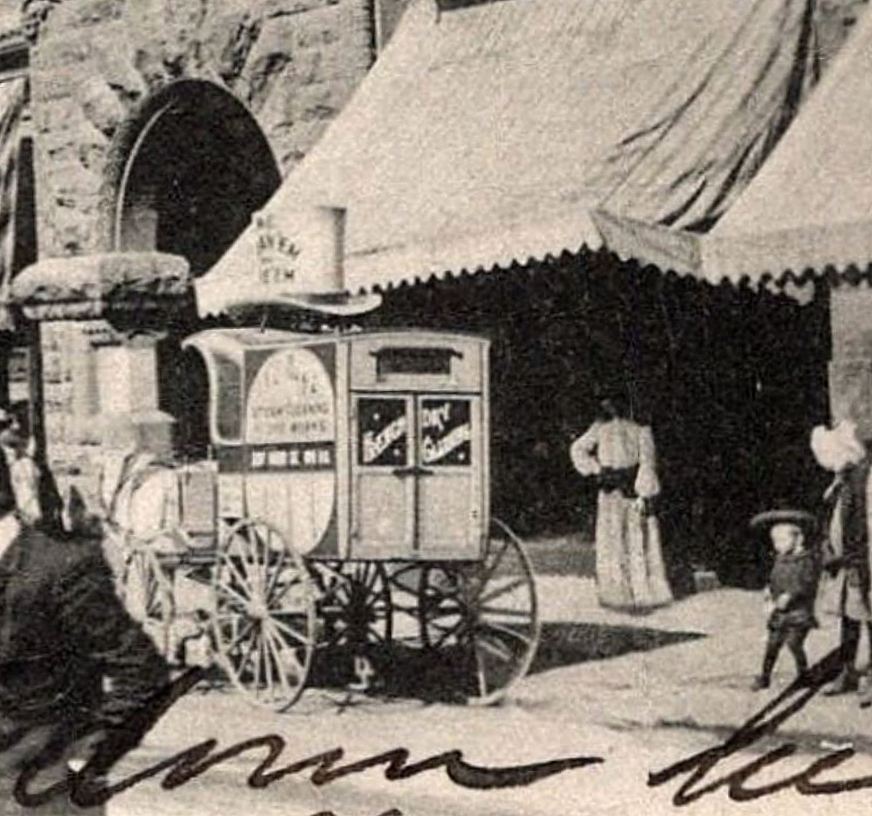
But “whimsical”? Take a look at the horse-drawn dry-cleaning-company delivery wagon on the lower right side of the card. It’s got a GREAT BIG TOP HAT on it! Maybe this sort of thing was popular in the early years of the 20th century, but I’ve never seen anything like this on the streets of Dallas in photographs or postcards of this period. Until now. I love it!

*

The postcard — written and mailed on December 27, 1906 — was addressed to “Master Phillip Wyman” in Yonkers, New York. The sender — identified only as “Harry” — sent this message to Phil, probably a young family member:

Dear Phil, Enjoyed your letter so much. Can hardly find time to write much so will send you an occasional postcard. It is very warm down here, to[o] warm for even gloves. About July weather. Must get to business. Love to all, Harry

Too warm for gloves — in December! Imagine! I bet Master Wyman — who was no doubt shivering up in Yonkers — had his young mind blown. (I wonder if he noticed the big top hat?)

***

Sources & Notes

Postcard from eBay.

*

Copyright © 2025 Paula Bosse. All Rights Reserved.

Downtown Mesquite — 1925

Meet you under the water tower… (photo: Dallas Public Library)

by Paula Bosse

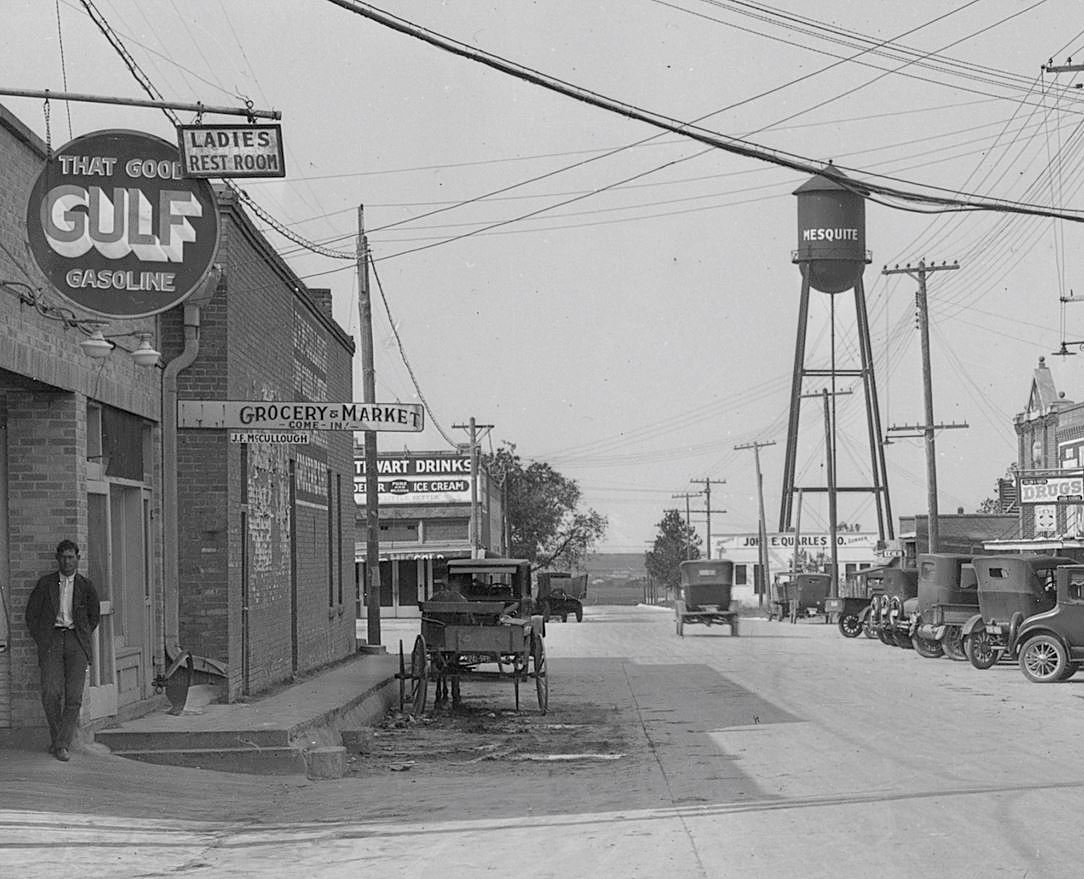
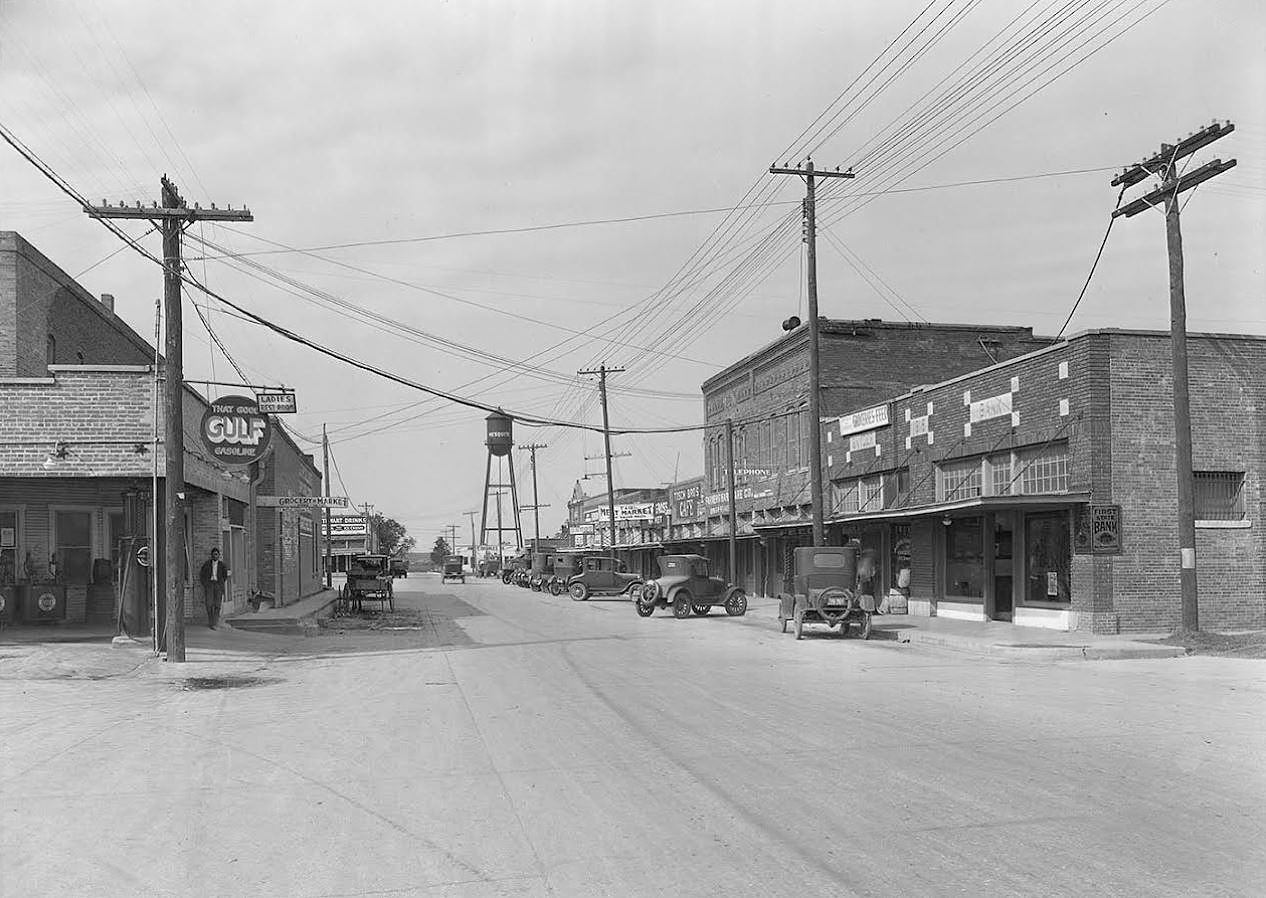
How about a little love for Mesquite, our neighbor friend to the east. I came across this great photo of Mesquite’s old downtown area in the library archives the other day. The full photo from 1925 — by Dallas photographer Frank Rogers — is below. A detail of the photo (which looks a perfect little photo all on its own) is above.

The building on the right side of the photo is the Snyder Bank Building (1915). It still stands at 201 West Main — see it today on Google Street View here.

Too bad that water tower is gone. But thanks for keeping the Snyder building, Mesquite!

***

Sources & Notes

This photo, “[Downtown Mesquite, Texas],” was taken by Frank Rogers in 1925. It is from the Frank Rogers Collection, Dallas History and Archives, Dallas Public Library; its call number is PA78-2/334.

*

Copyright © 2024 Paula Bosse. All Rights Reserved.

A Somber Armistice Day Observance — 1922

Veterans march in Dallas (Dallas Public Library)

by Paula Bosse

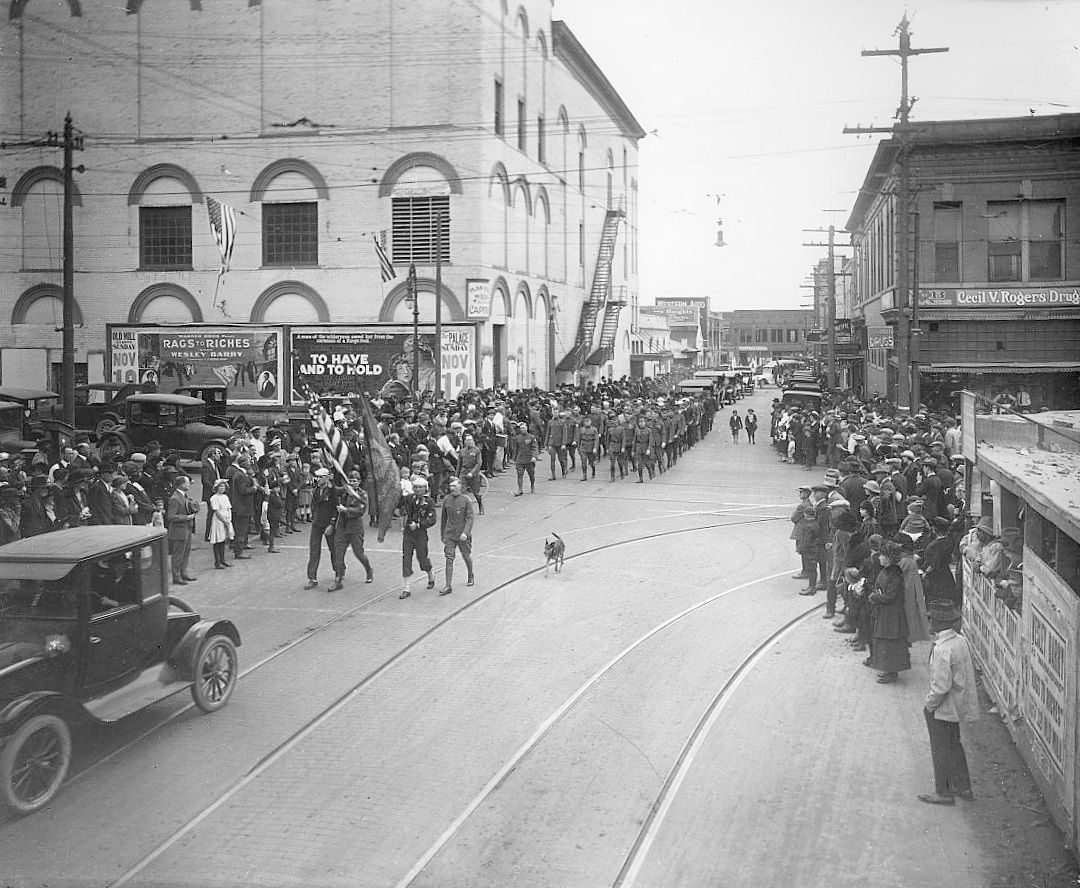
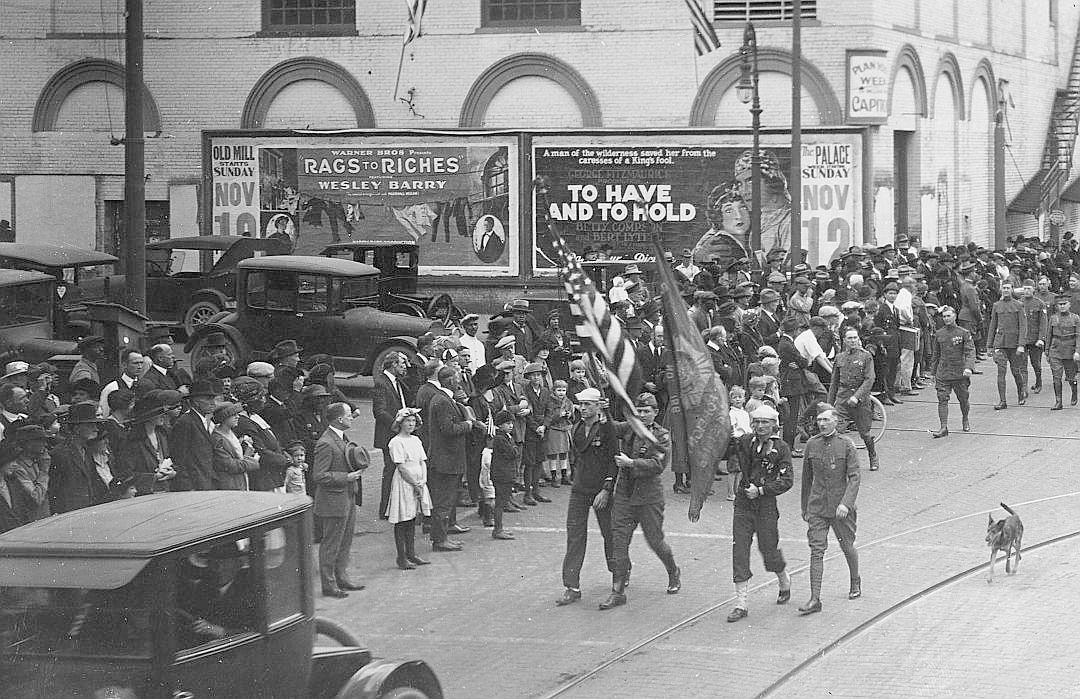
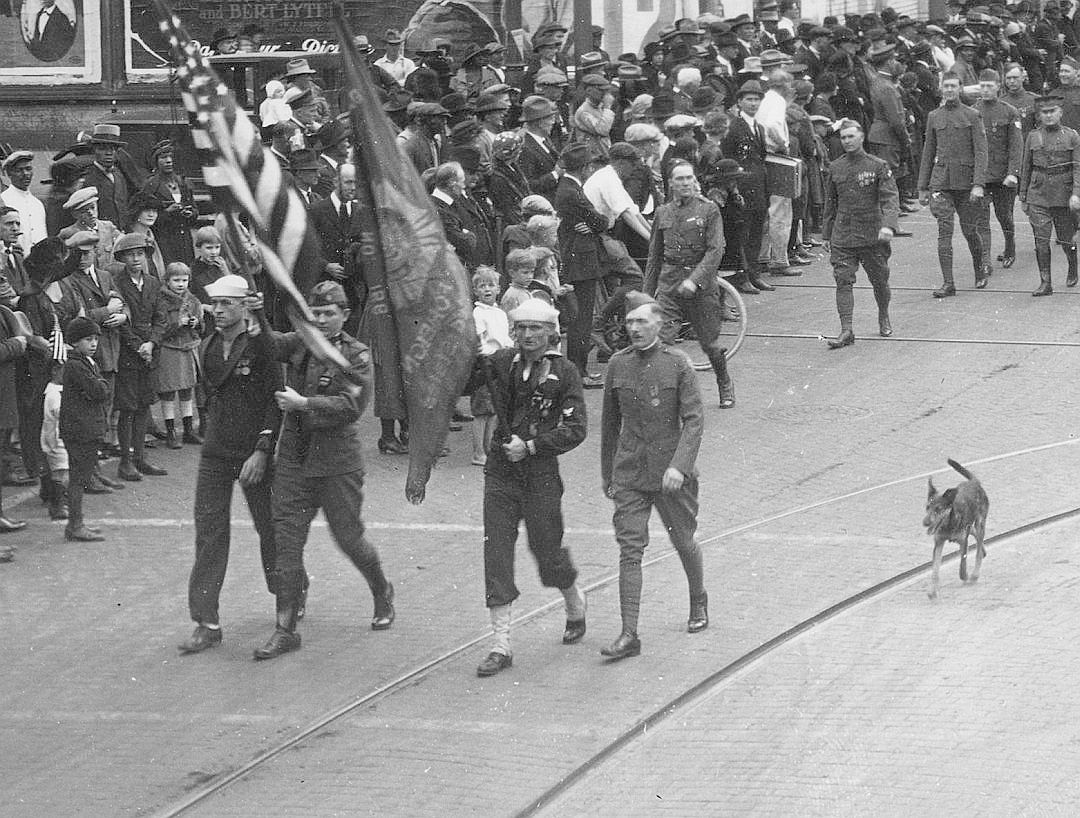
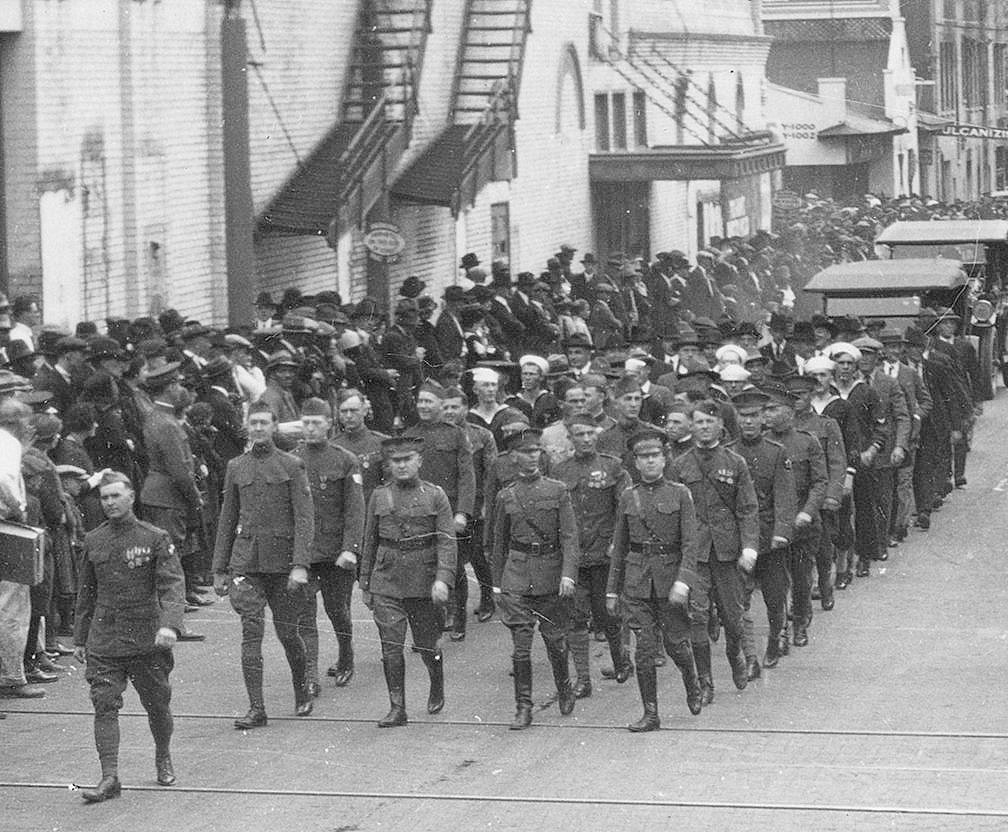
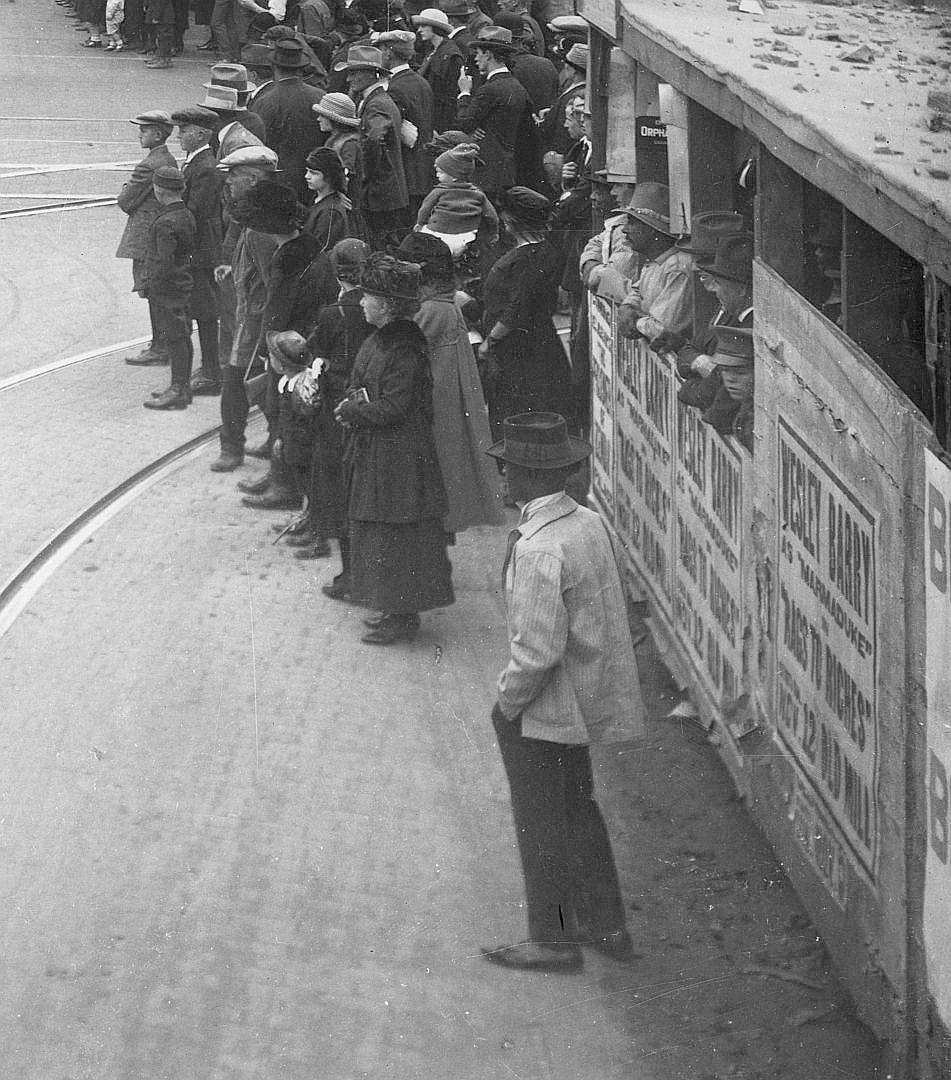
On November 11, 1922, Dallas observed the 4th anniversary of the end of World War I. The photo above, taken by Dallas photographer Frank Rogers, shows veterans of the devastating war marching north on Masten (N. St. Paul) from Main Street — they are headed to First Baptist Church for a special remembrance service.

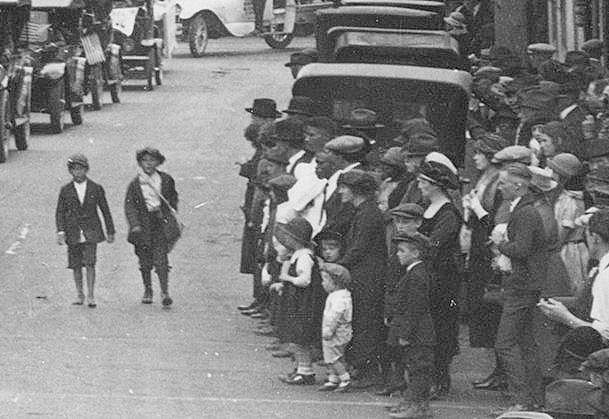
The crowd is somber, with the war still fresh in their memories. From The Dallas Morning News:

Soberly and without show of emotion Dallas celebrated Saturday, the fourth anniversary of the stilling of the guns of the World War. Their faces mirroring no more than idle curiosity, tens of thousands of men, women and children flowed lazily along the Main Street waiting for the parade of men who had been part of the glorious adventure, but there was no evidence of that high-racing blood that filled the hearts of Americans on Nov. 11, 1918. (Dallas Morning News, Nov. 12, 1922)

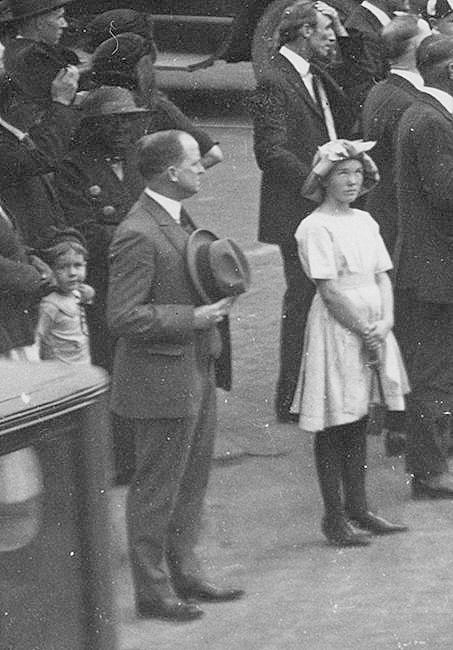
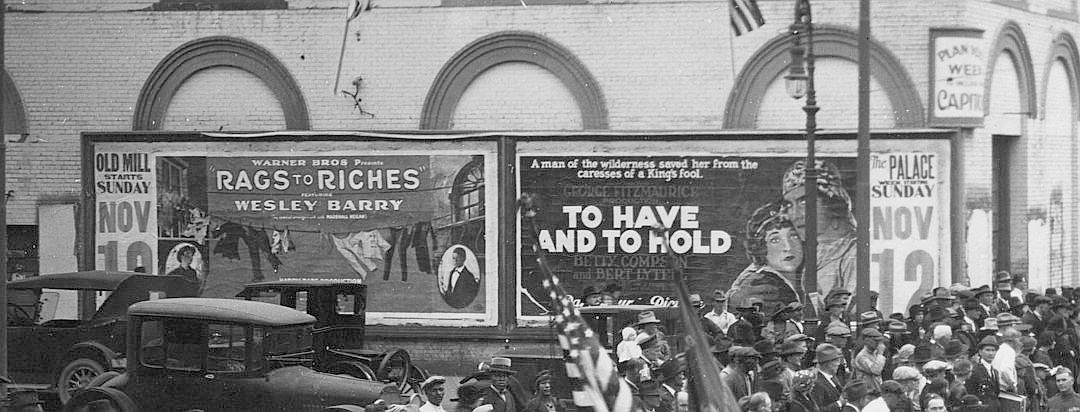
More details of the scene can be seen when zooming in on the photo and on the faces of the participants and the spectators (images are larger when clicked).

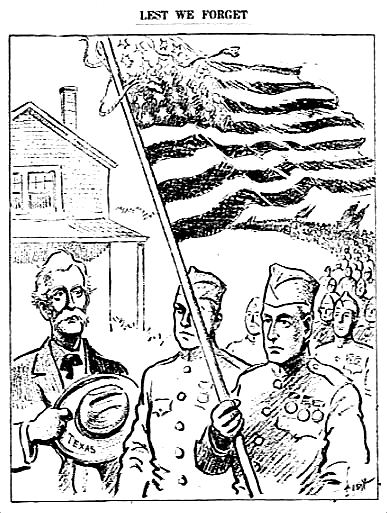
by John Knott, DMN, Nov. 11, 1922

***

Notes and Sources

Photo of the Nov. 11, 1922 Armistice Day parade is from the Frank Rogers Collection, Dallas History and Archives, Dallas Public Library (photo accession number is PA78-2-1003).

The address of the Cecil V. Rogers drug store was 1814 Elm Street. The movie posters for the silent films “Rags To Riches” (playing at the Old Mill) and “To Have and To Hold” (playing at the Palace) are posted on the back of the old Majestic Theatre (its second “temporary” location, which, I believe, had once been the old opera house — see the 1921 Sanborn map here). The cartoon is by Dallas Morning News cartoonist John Knott.

See other Flashback Dallas posts on Dallas and World War I here.

*

Copyright © 2024 Paula Bosse. All Rights Reserved.

Labor Day Weekend, 1952 (Redux)

labor-day_083152_denny-hayes_PA76-1-11420-002_webWaiting for the fun to start… (photo: Dallas Public Library)

by Paula Bosse

Happy Labor Day! Back in 2020 I wrote a post called “Labor Day Weekend, Union Bus Depot — 1952.” I really enjoyed writing that one, and I loved the main photo in it. It turns out that the photo I’m using in this post was taken only a couple of minutes before the one I used four years ago. I discovered this photo a few weeks ago and have been waiting for Labor Day to roll around. Which it has now done.

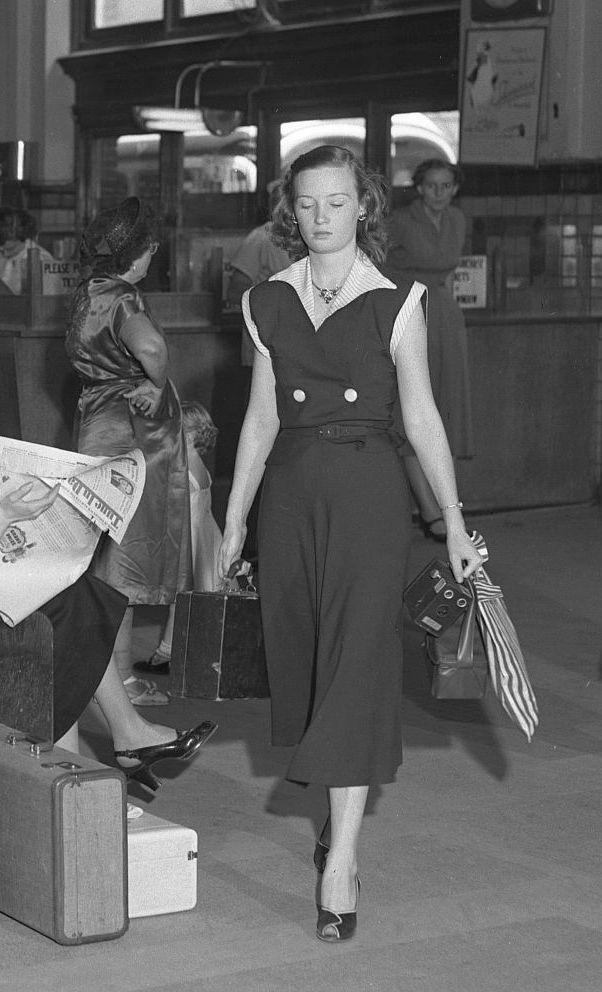
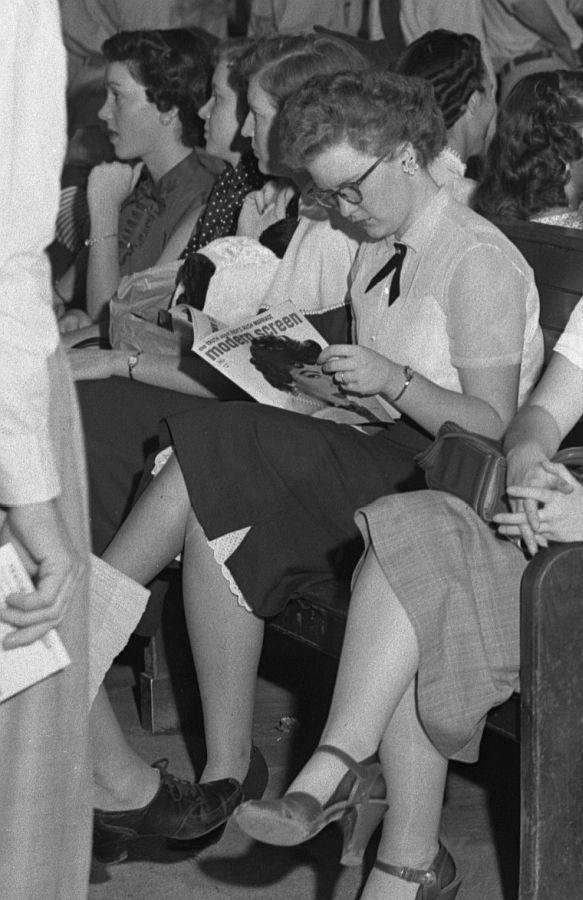
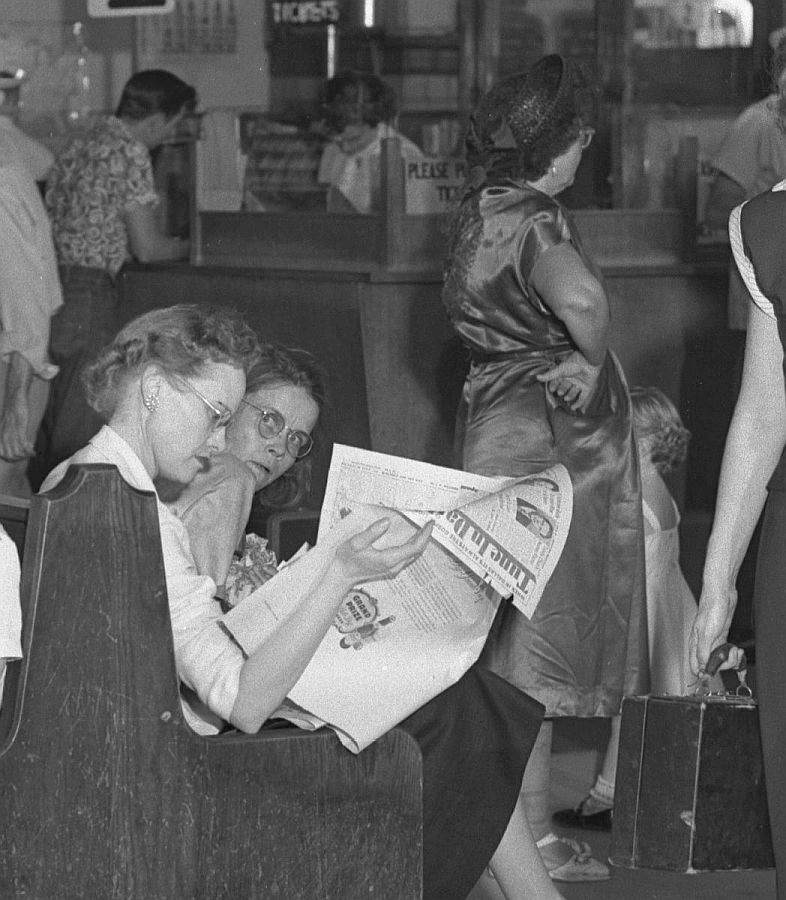
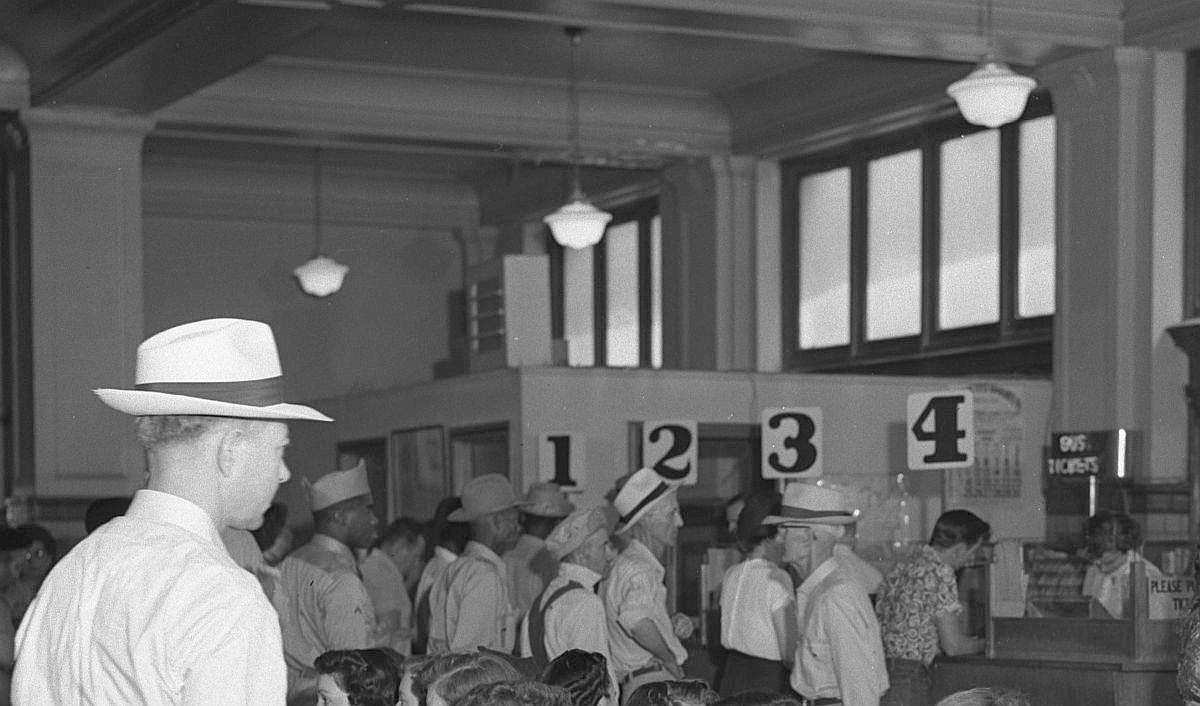
On August 31, 1952, Dallas photographer Denny Hayes took several photos of travelers waiting to be whisked away to someplace else. (With luck, someplace cooler.) These photos were taken at the Union Bus Depot in the Interurban Building. Let’s zoom in on this great people-packed photo.

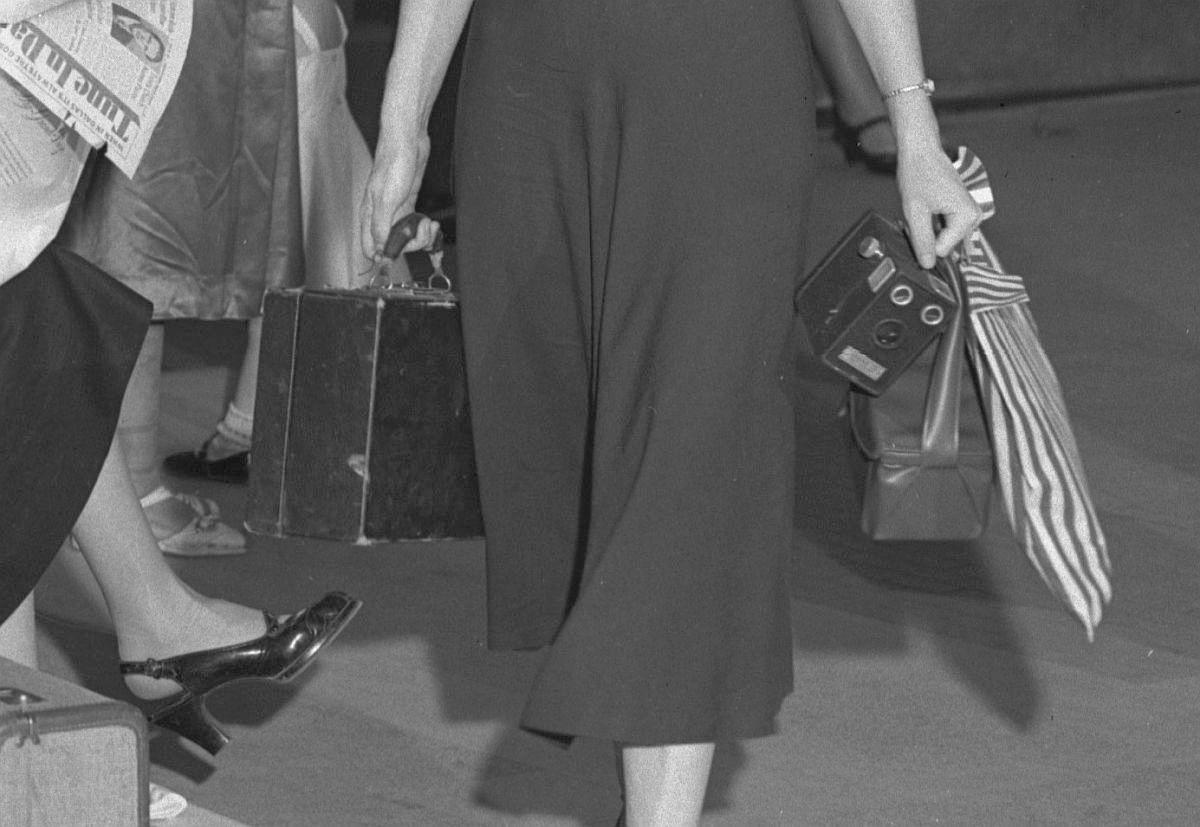
Everyone and everything pales in comparison to the young woman walking toward the camera. In her left hand she holds a box camera. She’s ready to take fun photos, if she ever gets out of that station.

labor-day_083152_denny-hayes_PA76-1-11420-002_woman

labor-day_083152_denny-hayes_PA76-1-11420-002_woman_camera

labor-day_083152_denny-hayes_PA76-1-11420-002_modern-screen

labor-day_083152_denny-hayes_PA76-1-11420-002_waiting

labor-day_083152_denny-hayes_PA76-1-11420-002_queue

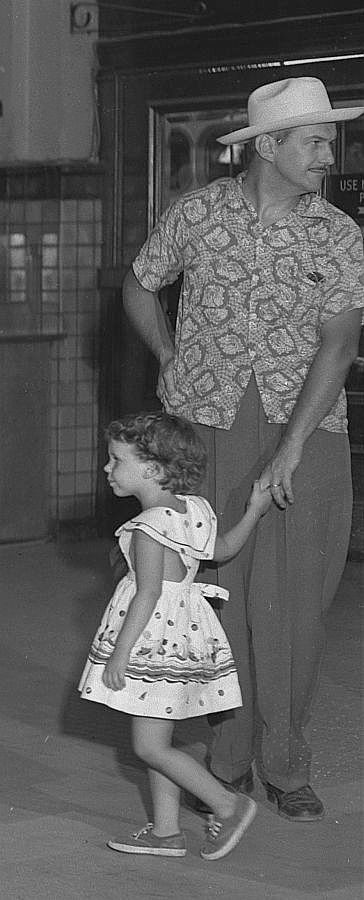
labor-day_083152_denny-hayes_PA76-1-11420-002_father-daughter

(If the man above looked any more like Harvey Korman, he’d be Harvey Korman.)

*

If you have the day off, I hope you enjoy it. And if you’re traveling somewhere, I hope you get there quickly!

***

Sources & Notes

Photo by Denny Hayes, from the Hayes Collection, Dallas Public Library, Dallas History and Archives; Call Number: PA76-1/11420-002.

See the companion post, “Labor Day Weekend, Union Bus Depot — 1952,” and see how many people made it into both photos.

labor-day_083152_denny-hayes_PA76-1-11420-002_web

*

Copyright © 2024 Paula Bosse. All Rights Reserved.

The South End “Reservation” Red-Light District — ca. 1907

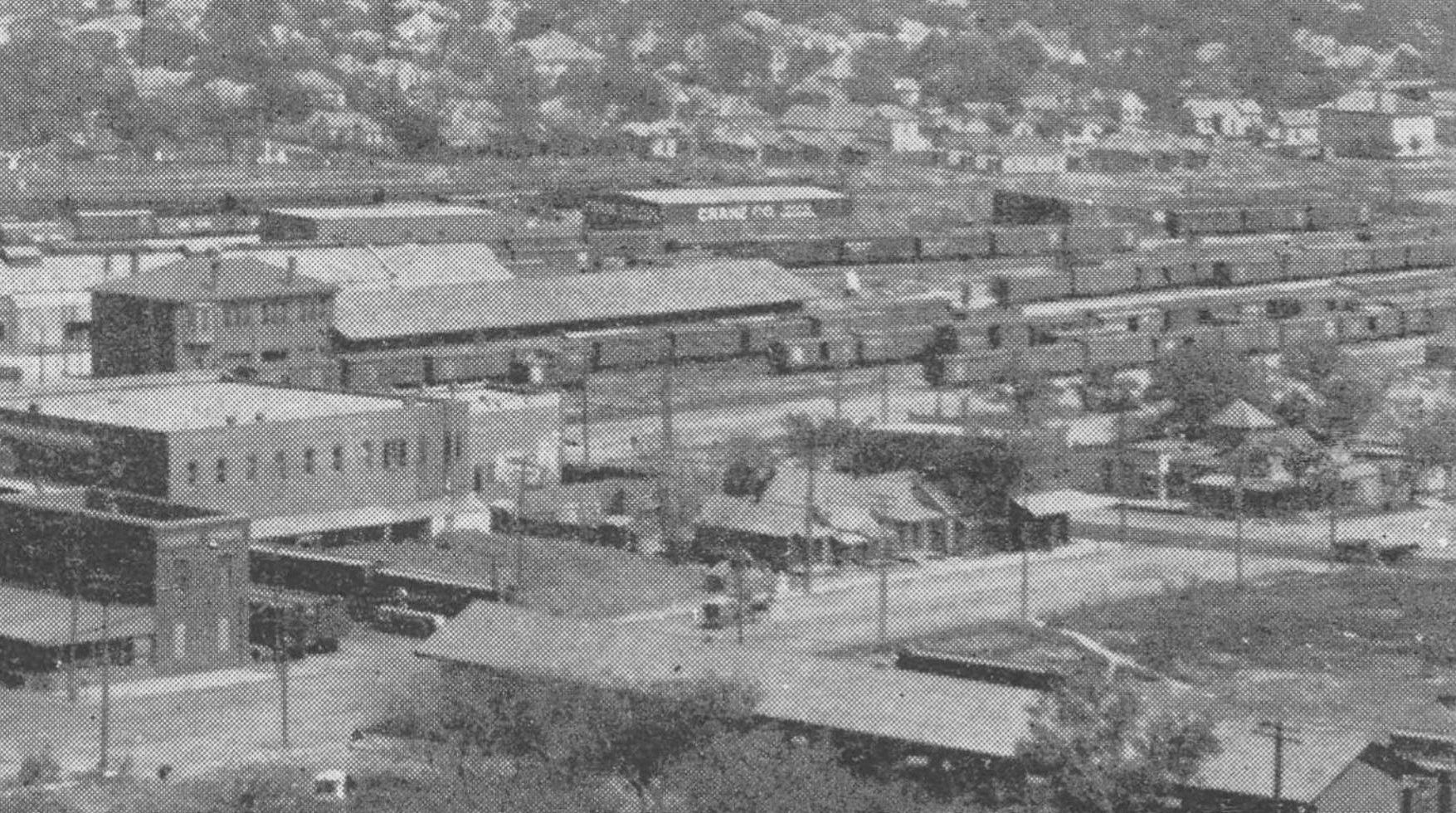
south-end_hobson-electric_southeast-from-courthouse_ca-1907_cook-collection_degolyer_SMUThere’s a lot going on here that you can’t see… (DeGolyer Library, SMU)

by Paula Bosse

I am reminded how much fun it is to just dive into something with no idea where you’re heading and end up learning interesting things you might have been unaware of had you not wondered, “What am I looking at?”

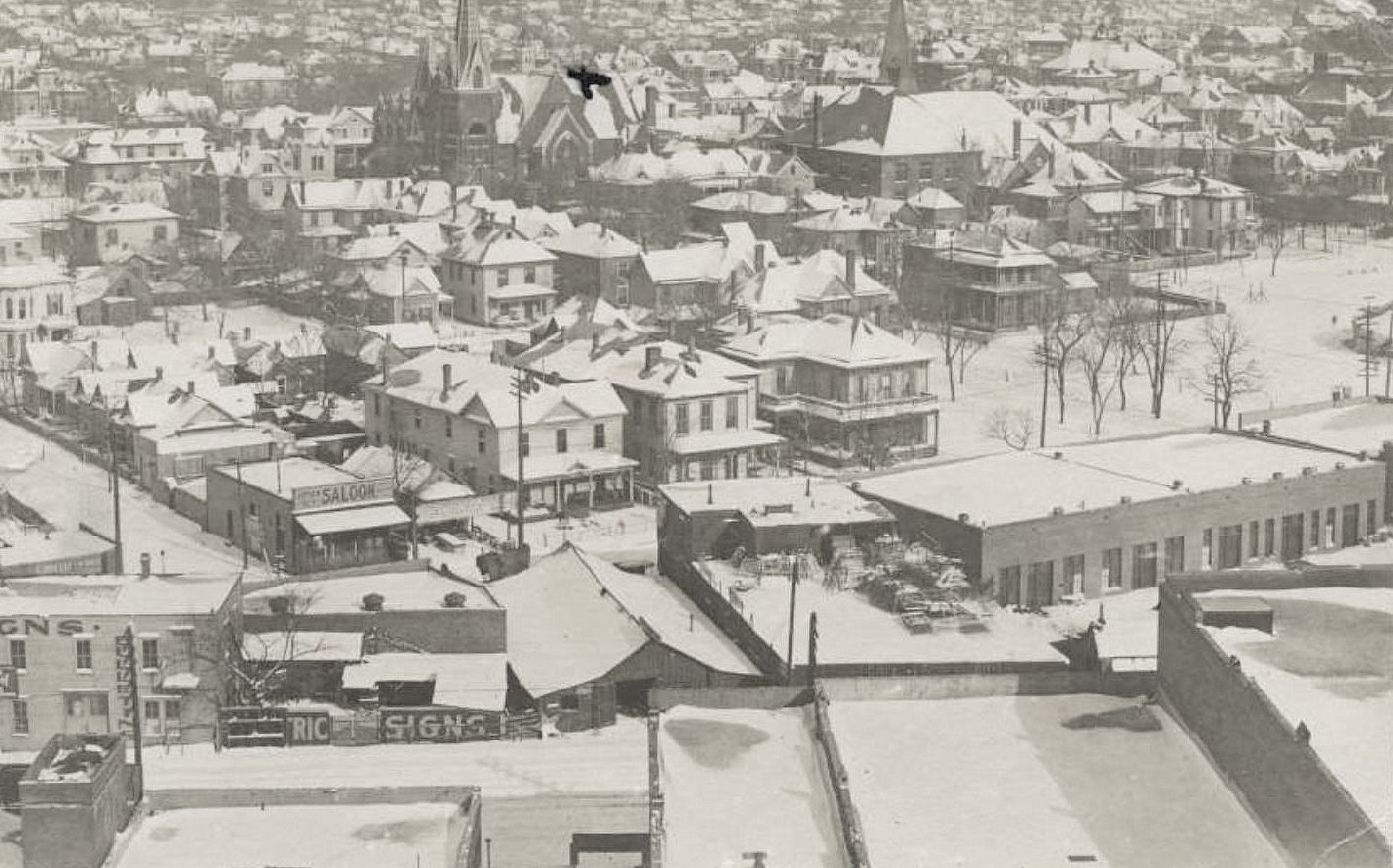
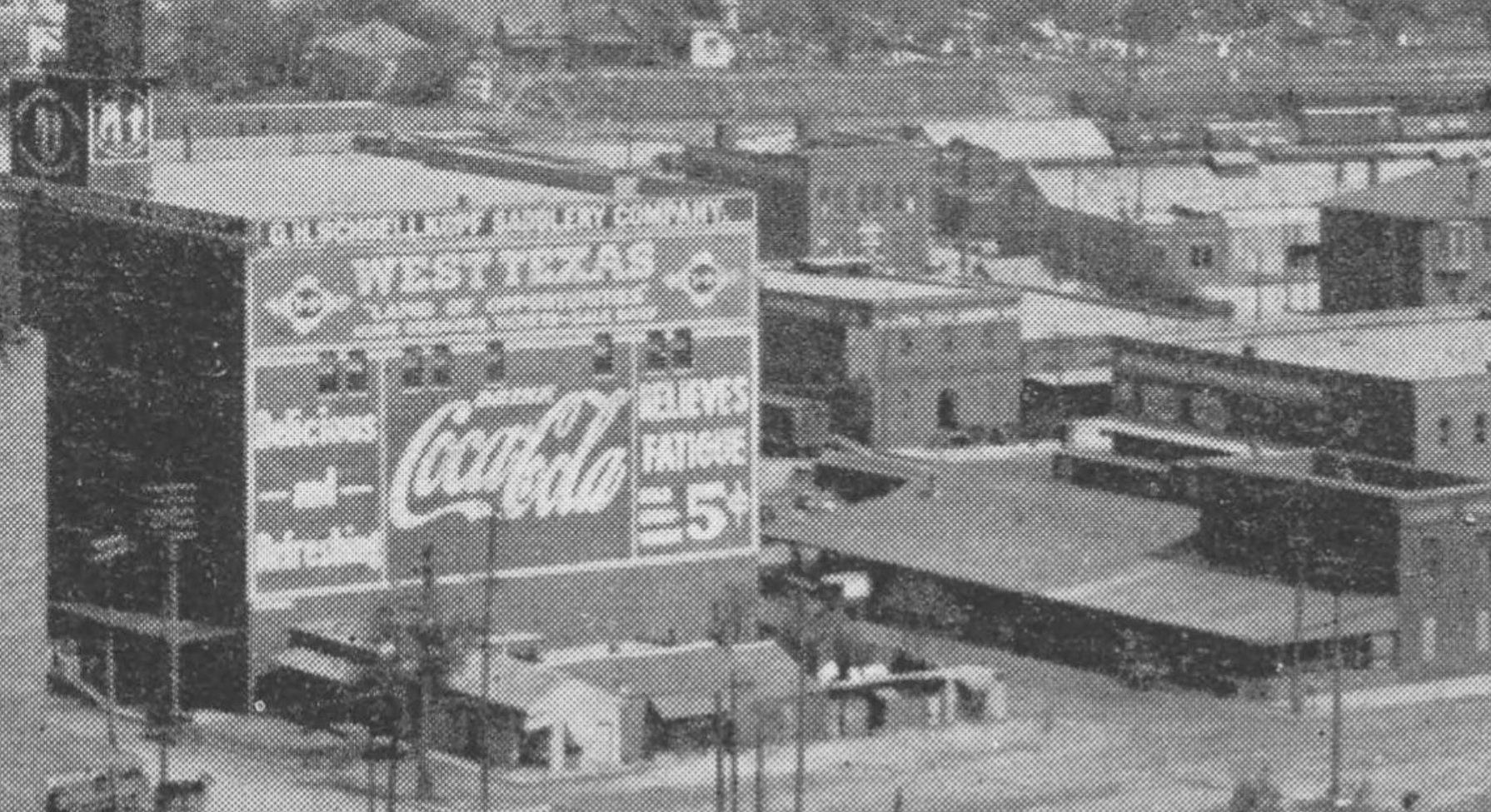
Yesterday I was working on a future post that involves the Hobson Electric Co., and I was looking for photos. The one above popped up in one of my favorite collections of historical Dallas photos, the George W. Cook Collection at SMU’s DeGolyer Library. I was looking for a post-1910 West End photo — this photo is identified as just that [the title has now been updated by the SMU Libraries], but the presence of the Schoellkopf Saddlery Co. building (center left, with the Coca-Cola ad on it) puts this location on the other side of the central business district — Schoellkopf was at S. Lamar and Jackson. Even knowing that, this scene didn’t look familiar at all.

I checked a 1907 city directory to find out the address of the Hobson Electric Co. before it moved to the West End in 1910 — it was located at 172-74 Commerce Street (in what is now the 700 block), between S. Market and S. Austin. The view here is to the southeast, probably taken from the courthouse.

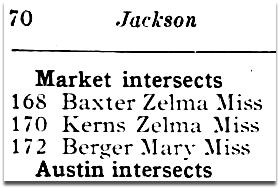
I don’t think I’ve seen this particular view before — it shows hardly any of the downtown area but shows instead the area to the south. I was really intrigued by the block of houses facing Jackson (between Market and Austin) — the block the horse-and-buggy is moving past, at the center right. The trees. The low buildings. That block really stood out. It was kind of quaint. Did people live there? While I had the 1907 directory open, I checked to see who the occupants were. (I just picked 1907 because the Hobson Co. changed its name from “Duncan-Hobson” around 1906, and it had moved away from Commerce by mid 1910.) Here were the occupants of those houses in 1907:

jackson-between-market-and-austin_1907-directory1907 Dallas directory

That seemed odd. Three single women occupying three separate houses, all next door to one other. There weren’t a lot of single women living in houses alone in 1907. Hmm. I checked all the directories between 1905 and 1910 to see who was living in that block. Every year, each of those houses showed a new occupant, and, with one exception, all were single woman (the exception was a man who owned a saloon across the street and who had faced charges at one point for “keeping a disorderly house”). …Okay. I got the picture.

I checked the Sanborn map from 1905 for this block and saw something I’d never seen before: the designation of a building with the letters “F.B.” What did that mean? Turns out, it means “Female Boarding House.” Or, less euphemistically… a brothel. Look at the map here (more maps are linked at the bottom of this post) to see the frankly ASTRONOMICAL number of “F.B.” buildings in this one small area. (There weren’t as many saloons — designated with “Sal.” — as I expected, but I’m pretty sure a lot of saloons in this area were operating illegally.)

You might have noticed that all of those F.B.s are south of Jackson. Not one of them is north of Jackson. This area — the southwestern part of downtown — was referred to at the time as the “South End” or “The Reservation” (some called this general area “Boggy Bayou,” but I think that was technically farther south). Its boundaries were, basically, S. Jefferson Street (now Record Street) on the west, Jackson on the north, S. Lamar(-ish) on the east, and beyond Young Street on the south. If you wanted to avail yourself of illicit things and engage in naughty behavior, this was the place for you: Ground Zero for a sort of wide-open, lawless Wild West. There were other red-light districts in Dallas (most notably “Frogtown,” which was north of downtown in the general area formerly known as Little Mexico) (does anyone still call this now-over-developed area “Little Mexico”?), but if you wanted the primo experience of one-stop-shopping for drinking, gambling, drugging, and “consorting with fallen women,” you were probably familiar with the South End, where all of these activities were tolerated and, for the most part, ignored by the police (they might mosey by if there were an especially egregious shooting or stabbing or robbery). In fact, this vice-filled area had been created by a helpful city ordinance in the 1890s. So, enjoy!

Prostitutes were allowed to ply their trade in this specified chunk of blocks because the city fathers felt that it would be best to keep all that sort of thing in one somewhat controllable area, away from the more reputable neighborhoods. But once a prostitute stepped outside the Reservation to sell something she shouldn’t have been selling… laws suddenly applied, and she’d be thrown in jail and/or fined. Do not step north of Jackson, Zelma!

So, at one time, Dallas had legal brothels. Depending on whose account you read, these houses of ill repute ranged from godawful “White Slavery” operations and bubbling cauldrons of sin and sleaze to, as Ted Dealey remembers in his book Diaper Days of Dallas (p. 74), “ultra-fashionable houses of prostitution” which attracted Big D’s moneyed movers and shakers. Something for everyone.

Eventually, people started to get really bent out of shape about this, and there was a big push to get these houses shut down — or at least moved out of the area. The Chief of Police reported to the City Council in 1906 that, among the many Reservation-related problems, the area was getting cramped because the railroads were buying up real estate in the area and kicking people out. The city-sanctioned no-man’s land was getting too small, so city officials needed to find a bigger place to move the red-light district to. The Chief thought that North Dallas (i.e. Frogtown) was “the most logical place” — except that residents of nearby swanky neighborhoods there were not at all keen on this. But that idea seemed to stick. It took several years to actually happen, but a relocation of sorts occurred, and the South End brothel-hotspot was pretty much scrubbed of all offending “disorderly houses” by 1910. (Frogtown bit the dust around 1913, after those unhappy well-to-do North Dallas neighbors complained bitterly, loudly, and effectively.)

So, anyway, I never expected to find such an exciting photograph! I wonder if the photographer took this photo as a way of documenting the very controversial, in-the-news, not-long-for-this-world Reservation, or whether it was just a nice scenic view. I have to think it was the former, because the Reservation was well-known to everyone, near and far, and this shot would have been an unusual vista to, say, reproduce for postcards (or at least postcards sold to the general public!). Whatever the case, I’ve never seen this view, and it’s really great — and it comes with an interesting slice of Dallas history. I had heard of the Frogtown reservation to the north, but I’d never heard of the South End reservation. And now I have. And here’s a photo of it!

Let’s bring back the neighborhood designation of “South End.” It was good enough for 1900, it’s good enough for today.

*

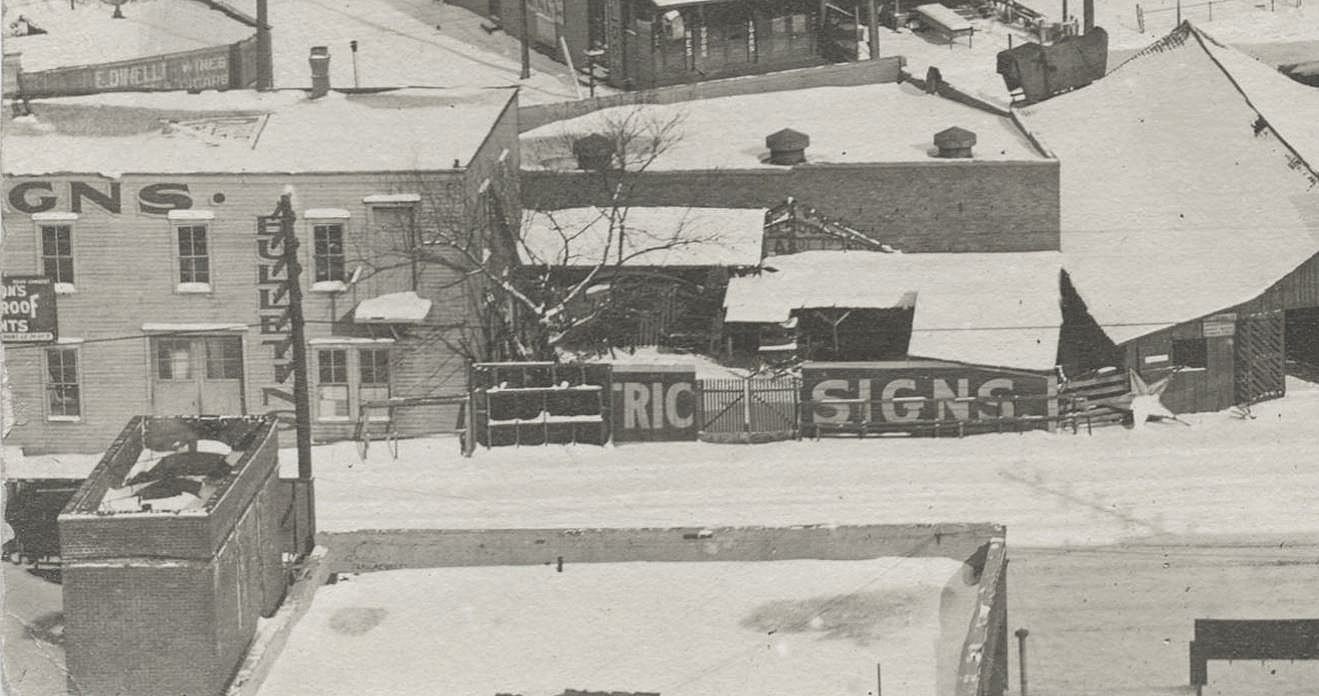
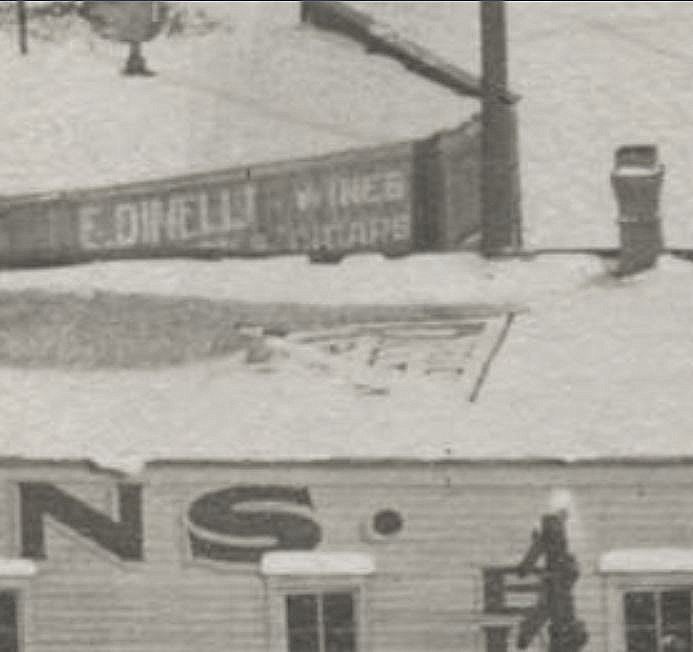
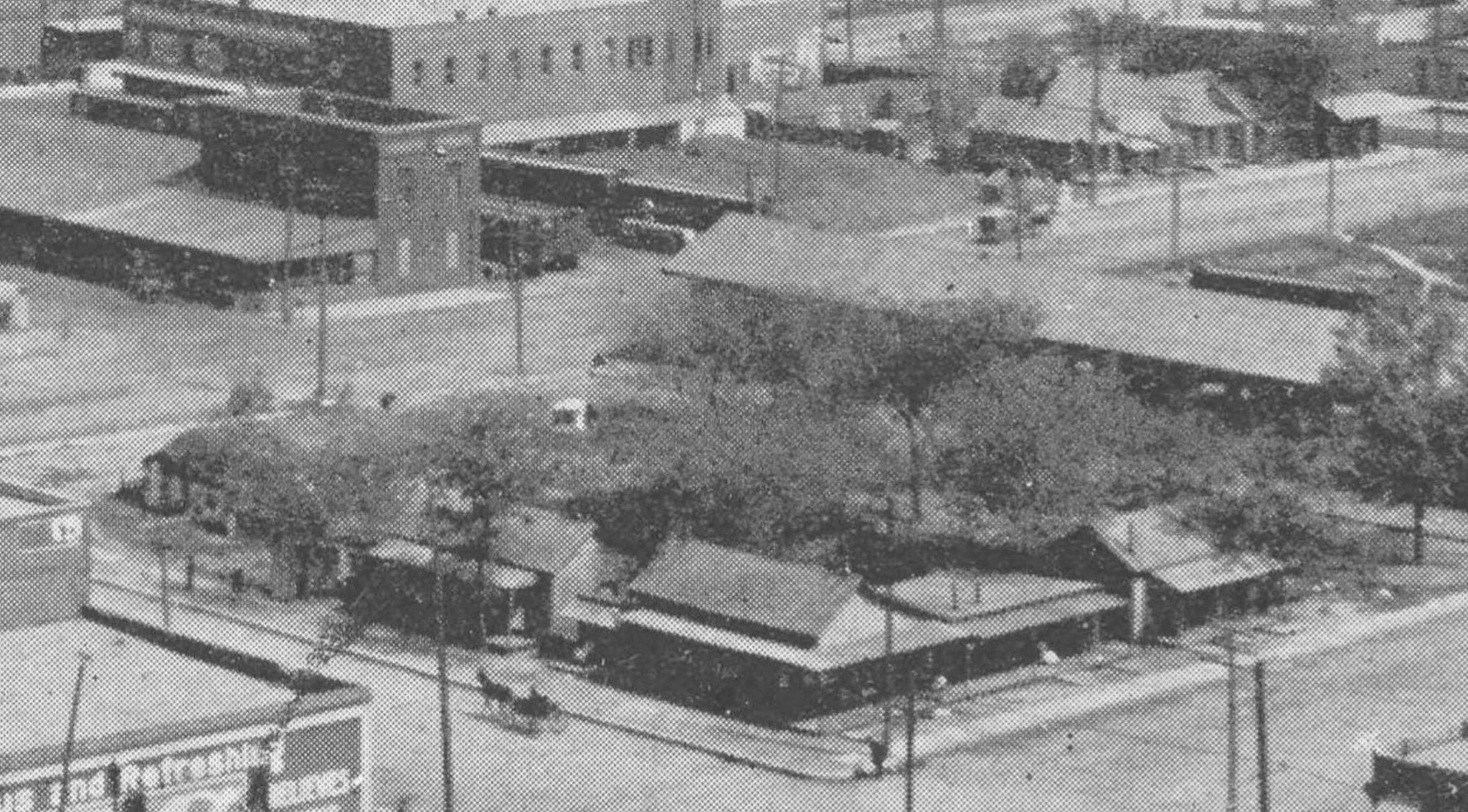
Here are a few zoomed-in details of the photo. Unless I’m imagining things, I think I can see women sitting on their porches, advertising their wares, as was the custom. (All images are larger when clicked.)

south-end_cook-collection_degolyer_SMU_det-1

*

south-end_cook-collection_degolyer_SMU_det-2

*

south-end_cook-collection_degolyer_SMU_det-3

*

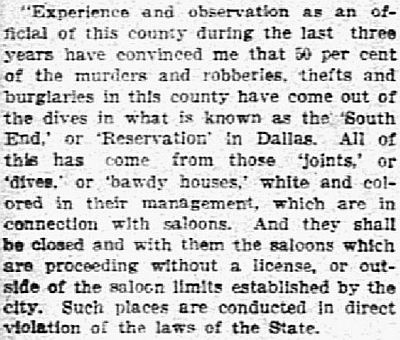
Below is an excerpt from a blistering directive to city lawmakers by W. W. Nelms, Judge of the Criminal District Court (from an article with the endless headline “Calls For Action; Judge Nelms Charges Police Chief, Sheriff and Grand Jurors; Warfare on Crime; Says Lawbreakers Shall Not Construe Statutes of State to Suit Themselves; Stop Murder and Robbery; Declares Harboring Places for Thugs, Thieves and the Like Must Be Destroyed,” Dallas Morning News, Oct. 15, 1907).

reservation_judge-w-w-nelms_DMN_101507DMN, Oct. 15, 1907

*

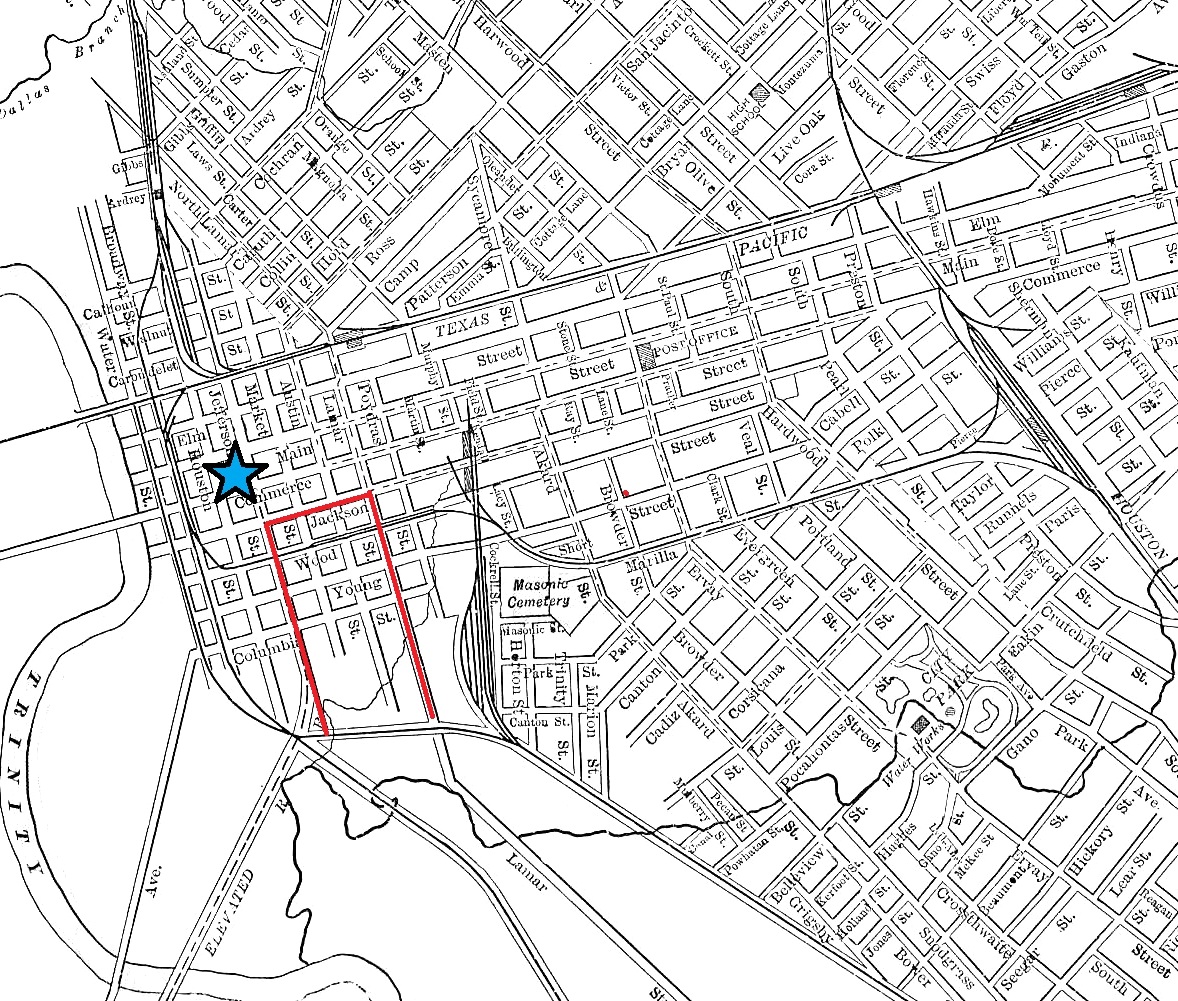
Below, the general area of the South End Reservation around 1907 (this map is from about 1898). The blue star is the Old Red Courthouse; the Reservation is bordered in red. In 1893, the original area was loosely designated as the area bounded by Jackson Street, Mill Creek, the Trinity River, and the Santa Fe railroad tracks, in which “women of doubtful character […] were not to be molested by police” (from “Passing of Reservation,” DMN, Dec. 11, 1904). As noted above, the area shrank over time, and the red lines show the general Reservation area about 1907, the time of the photo at the top.

south-end_reservation_1898-map_portalDallas map, ca. 1898 (det), via Portal to Texas History

***

Sources & Notes

Top photo — “[Jackson Street, Looking Southeast from the Courthouse, Including a Partial View of the South End ‘Reservation’]” (previously incorrectly titled “[Dallas West End District with View of Railroad Yards]”) — is from the George W. Cook Dallas/Texas Collection, DeGolyer Library, SMU Libraries and can be accessed here. (I appreciate SMU for responding to my request to re-title and re-date this photograph — it’s always worth notifying archival collections with corrections!) (And, as always, I WELCOME corrections. I make mistakes all the time!)

The 1905 Sanborn map I linked to above (Sheet 104) is here and seems to be the epicenter of the booming brothel trade; more evidence of this can be seen just south of that in Sheet 102; and it continues just east of that in Sheet 105 (it’s interesting to note the specially designated “Negro F.B.” bawdy houses). (Sanborn maps do not open well on cell phones — or at least on my cell phone. You may have to access these from a desktop to see the full maps. …It’s worth it.)

Read more about this whole “Reservation” thing in the lengthy and informative article “Not in My Backyard: ‘Legalizing’ Prostitution in Dallas from 1910-1913” by Gwinnetta Malone Crowell (Legacies, Fall 2010).

Also, there’s a good section on this (“Fallen Women”) in the essential book Big D by Darwin Payne (pp. 48-56 in the revised edition).

If you enjoy these posts, perhaps you would be interested in supporting me on Patreon for as little as $5 a month — in return, you have access to (mostly!) exclusive daily Dallas history posts. More info is here.

south-end_hobson-electric_southeast-from-courthouse_ca-1907_cook-collection_degolyer_SMU_sm

*

Copyright © 2024 Paula Bosse. All Rights Reserved.

East on Elm

elm-street_gentrys_city-of-dallas-websiteShouldn’t there be cars?

by Paula Bosse

There has been some heavy-duty editing to this post!

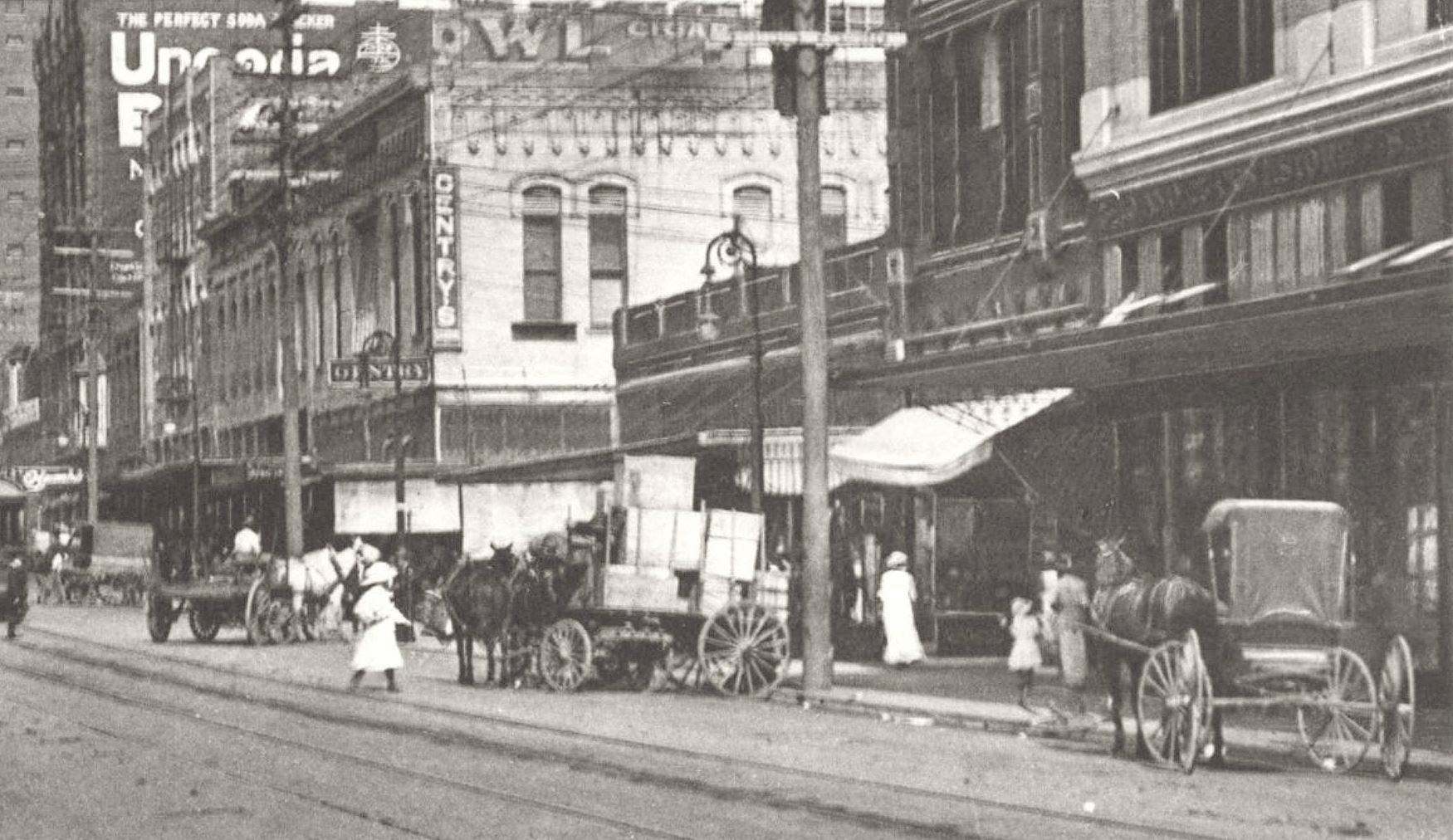
Here’s an interesting photo I stumbled across last night on the City of Dallas website. There wasn’t any information about it, but it appears to be a view to the east, taken from the 1400 block of Elm Street (where Exchange Place — originally Scollard Court — intersects). See what it looks like today on Google Street View here.

The main landmarks are what I call the Wilson Building Jr. (the tall dark building in the distance, located on Elm near Ervay), the Praetorian Building (the tall white building at the right, at Main and Stone), and L. W. Gentry’s photography studio in the middle of the photo at the right.

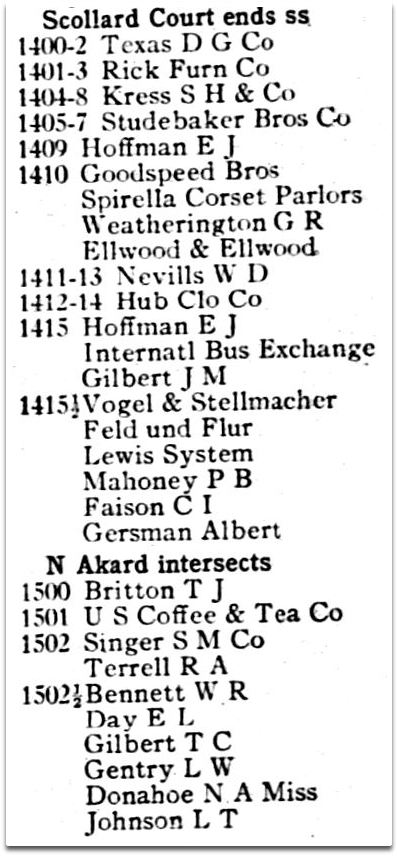
Gentry’s was upstairs at 1304 Elm from about 1904 until about 1911. In 1912, Gentry moved a block down the street to 1502 Elm, at Akard, where he took over the upstairs studio of photographer J. C. Deane. (I wrote about Deane and this building here.)

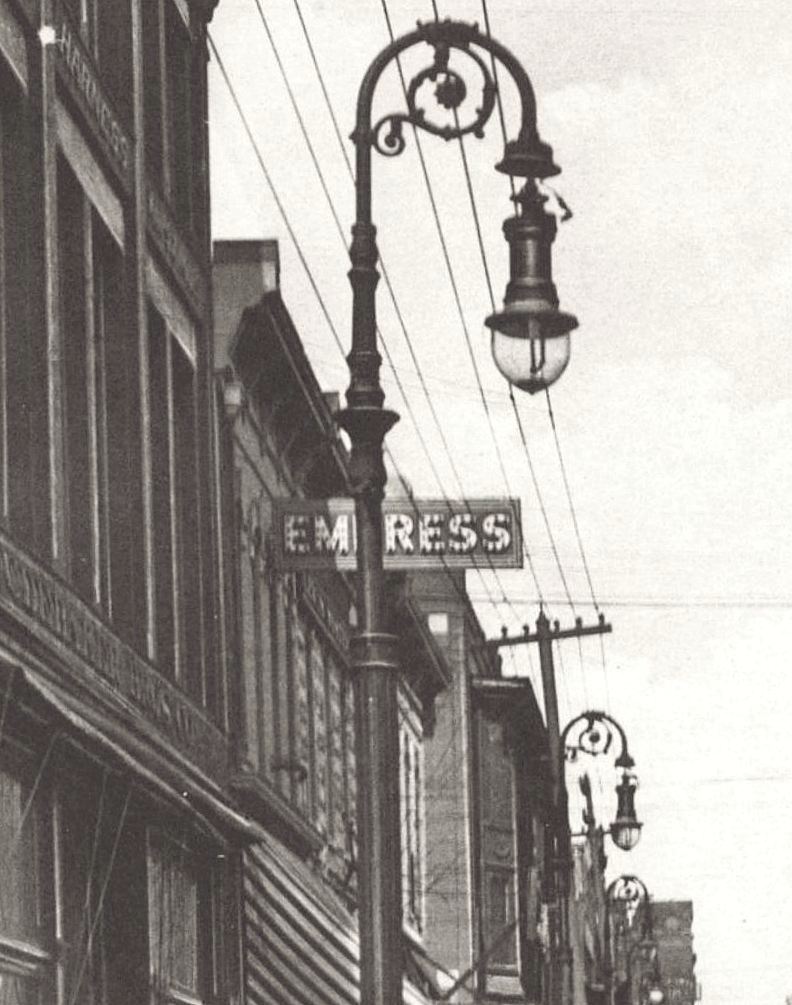
There is a sign reading “Empress” at the left. That was the Empress Theatre, which was at 1409 Elm from about 1912 to 1915. Directly across the street is a 3-story building with a sign for the Spirella Corset Parlors at 1410 Elm.

Back to the left, across the street, is the hard-to-read sign for Studebaker Bros. of Texas at 1405 Elm. Directly across the street is the new Kress Building (you can see part of the distinctive “K” from the company’s logo at the top right). Kress was at 1404-8 Elm — the building was erected in 1911 and opened that same year in November.

The “new Wilson Building” was also built in 1911, and Gentry’s took over the space above T. J. Britton’s store at Elm and Akard in 1912. And all these places appeared in the 1912 directory (except for the Empress, which was open in 1912 but might not have made the listing deadline). So I’m going to guess that this photo is from 1912 or 1913.

gentry_1912-directory_1502-ELM1912 Dallas directory, Elm Street

But this photo looks older than 1912. So many horses! The only vehicle not pulled by a horse in this photo is the streetcar. Where are the cars? In 1911, Dallas was pretty car-crazy — you’d expect to see at least ONE horseless carriage in there somewhere. It doesn’t sound like a lot, but in 1911, there were about one thousand automobiles registered in Dallas County, and the city was quickly becoming a major distribution hub for car companies (“Dallas Automobile Center of the Southwest,” Dallas Morning News, Dec. 31, 1911). (Check out this photo from 1911 taken a couple of blocks away. The only animals seen are actually riding IN an automobile!) Were cars banned from Elm Street? Seems unlikely. …I’m pretty sure I’m overthinking this.

(Ironically enough, the full entry for Studebaker Bros. which appears in the 1912 directory reads: “Carriages, wagons, buggies, street sprinklers, harness.” Nary a mention of an automobile. That arrived the following year.)

It might just be that I’ve had a very stressful couple of weeks, and it was really late when I originally wrote this. But I’ve had a refreshing night’s sleep, and I’m still fixating on this car thing. (Shouldn’t there be cars on Elm Street in 1912?) So I’m just going to stop looking at this photo, assume that it was snapped when all cars in the area were just out of frame, and wrap this thing up.

**

Here are a few zoomed-in details.

elm-street_gentrys_city-of-dallas-website_det1

elm-street_gentrys_city-of-dallas-website_det2

elm-street_gentrys_city-of-dallas-website_det3

I love these decorative lamp posts (more examples can be seen in a post I really enjoyed writing, “The Grand Elm Street Illumination — 1911”).

***

Sources & Notes

Photo found on the City of Dallas website, here (banner photo).

I have edited this after seeing the reader comment below. I realized that I was basing the original location on Lemuel W. Gentry’s first studio, which was a block or two west from the one seen in the photo. (I kept saying to myself, “That building looks so much like the one the Deane studio was in.” Because… it was the exact same building!) Thanks, NotBob.

Here’s a closer shot of Gentry’s studio around 1915 — on the southeast corner of Elm and Akard, right across the street from the new Queen Theatre. (This photo originally appeared in this post.)

queen_cinema-treasures

NOW we see cars!

elm-street_gentrys_city-of-dallas-website_sm

*

Copyright © 2022 Paula Bosse. All Rights Reserved.

Pacific Avenue Warehouse District

pacific-warehouse-district_ebayLooking west on Pacific, from about Good Street

by Paula Bosse

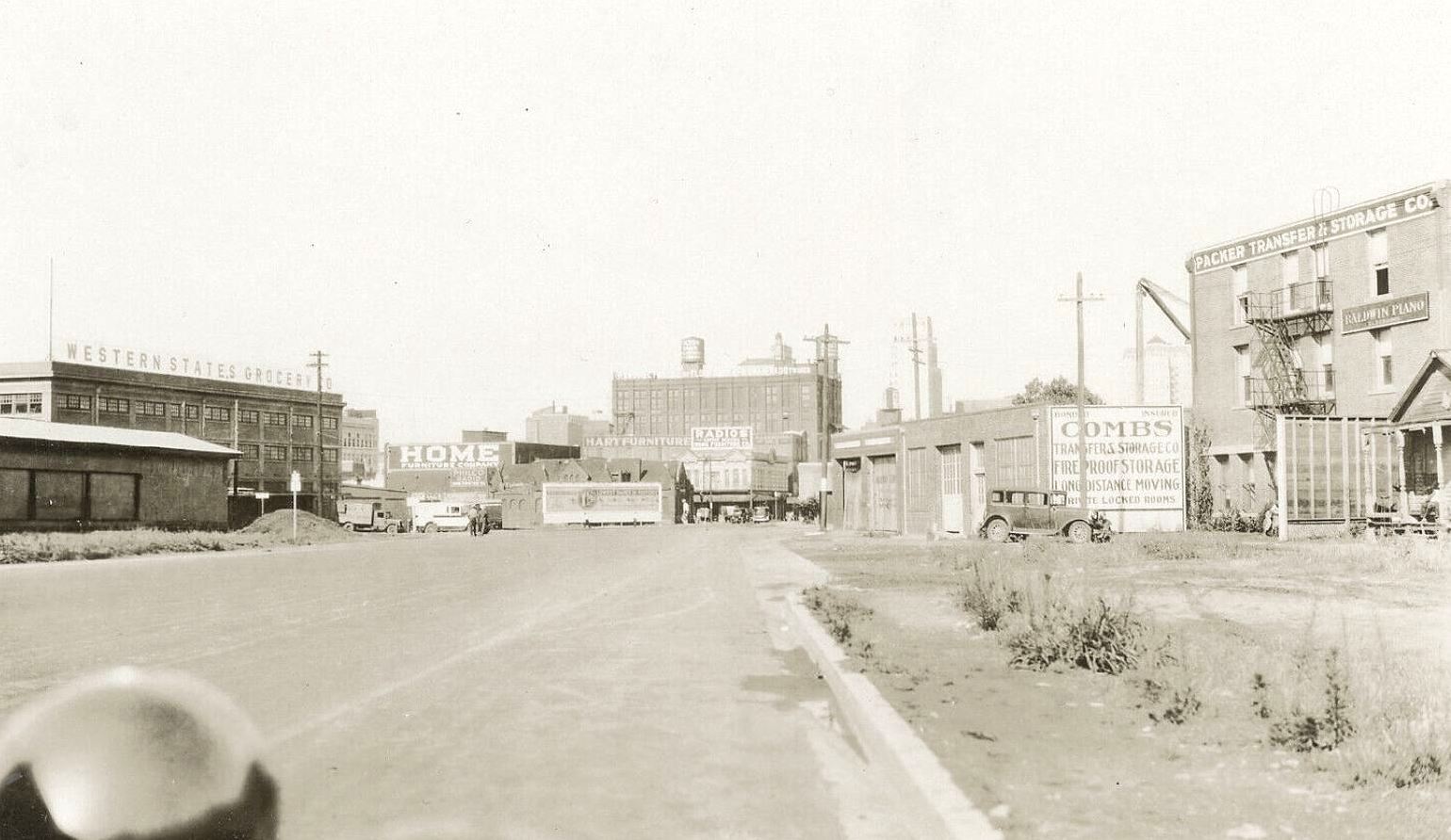
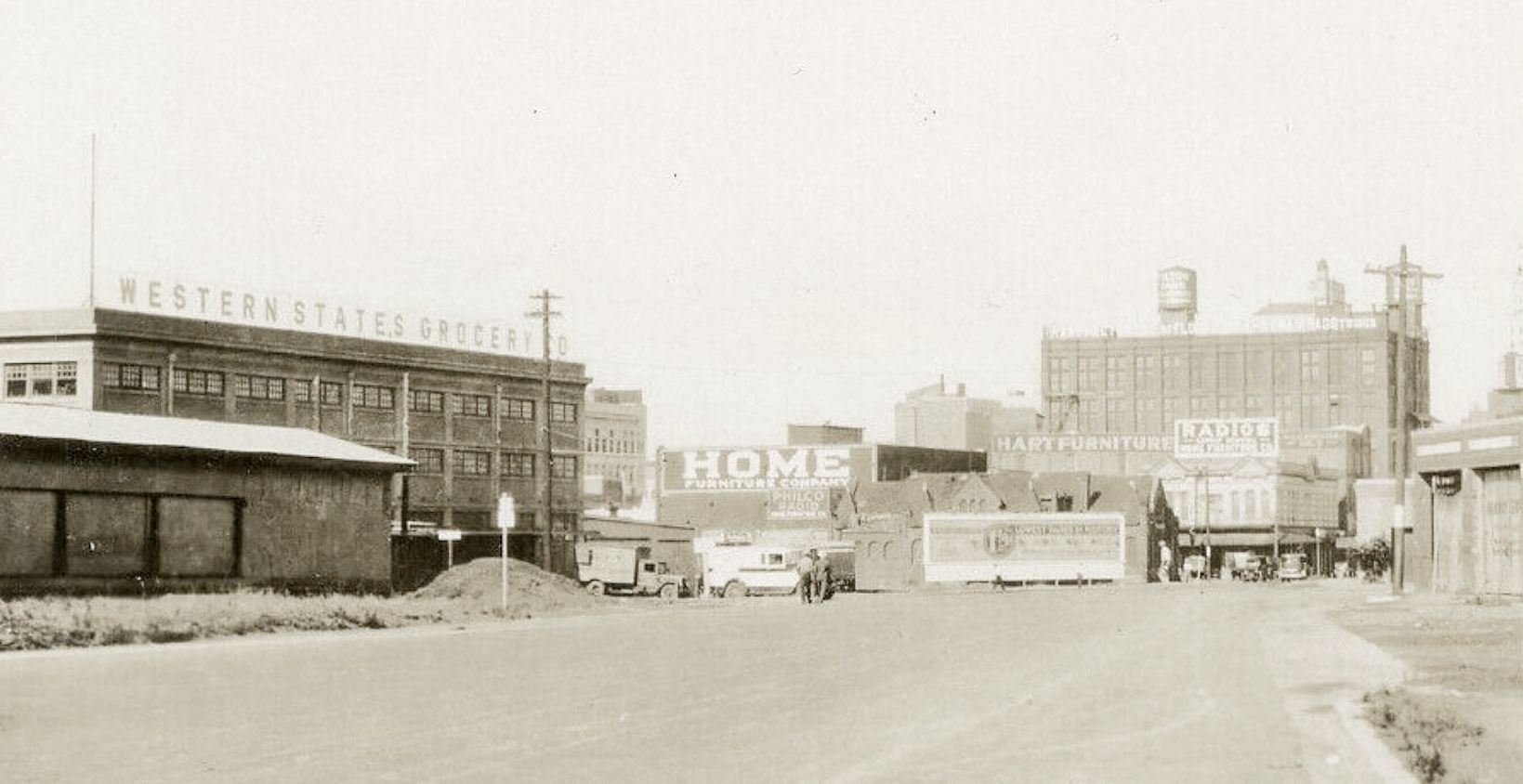
Wandering around the eBay “sold” archives, I came across this unusual photo taken in a not terribly scenic part of town. After checking addresses of these businesses in the 1932 city directory, it looks like the photographer (who appears to have been seated in a car) snapped this shot on N. Pacific Avenue, a block or so west from Good Street (now Good-Latimer). Deep Ellum-adjacent. The view is southwesterly, toward downtown. The businesses are mostly warehouses. See what this view looks like today, 90 years or so later, via Google Street View, here.

I was excited to see two familiar 19th-century buildings which I’ve written about and feel a weird kinship with: the abandoned and shuttered old Union Depot (which I wrote about here) and the Union Depot Hotel (which I wrote about here) — located about where Pacific takes a slight jog to the right. It’s like seeing old friends.

Here are some rather grainy magnifications of the eBay “snapshot” (click to see larger images).

*

Below: the Western States Grocery Co. was located at the southwest corner of Hawkins and Pacific. The Home Furnishings Co. was at 2301-2311 Elm Street (at Preston). Many of the buildings in this view (except for the 5-story-ish tall building straight ahead and to the right) can be seen in this 1921 Sanborn map. (Is that the pre-Pegasus Magnolia Building seen in the distance behind the 5-story building at the right? If so, that would mean that this photo was taken before 1934.)

pacific-toward-downtown_ebay_det-1

*

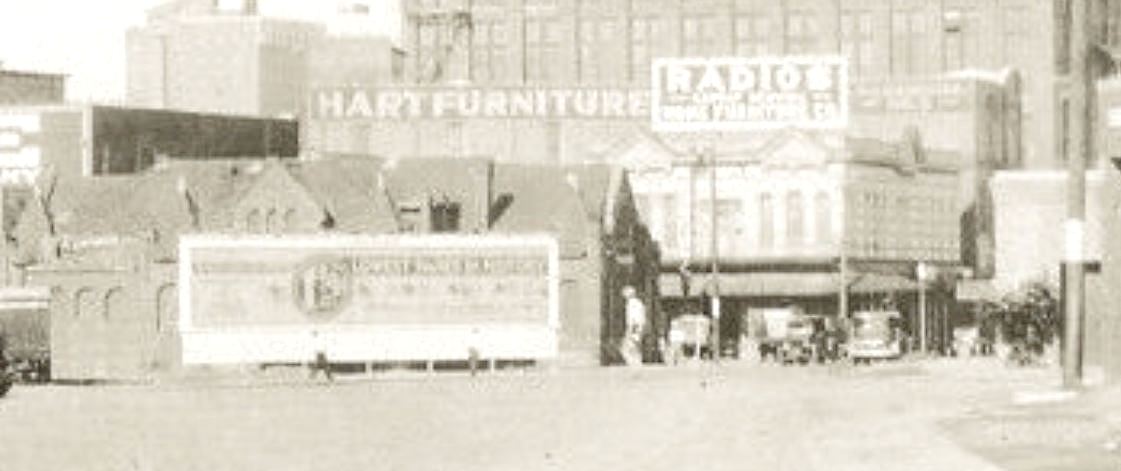
The building seen below in the foreground at the left is the old Union Depot. I’ve seen so many photos of this building — but it looks TINY here! Just across the street (railroad tracks) from it (in the building seen immediately below the “Radios” sign) is the old Union Depot Hotel. The H&TC railroad used to run between them — Central Avenue later (basically) became Central Expressway. I was really excited to see these two buildings.

The taller building seen in the background, behind the Hart Furniture sign, can be seen in this 1921 Sanborn map — the 5-story building at the southwest corner of Pacific and Preston was home to the Fulton Bag and Cotton Mills (another story was added around 1935).

pacific-toward-downtown_ebay_depot-and-hotel

*

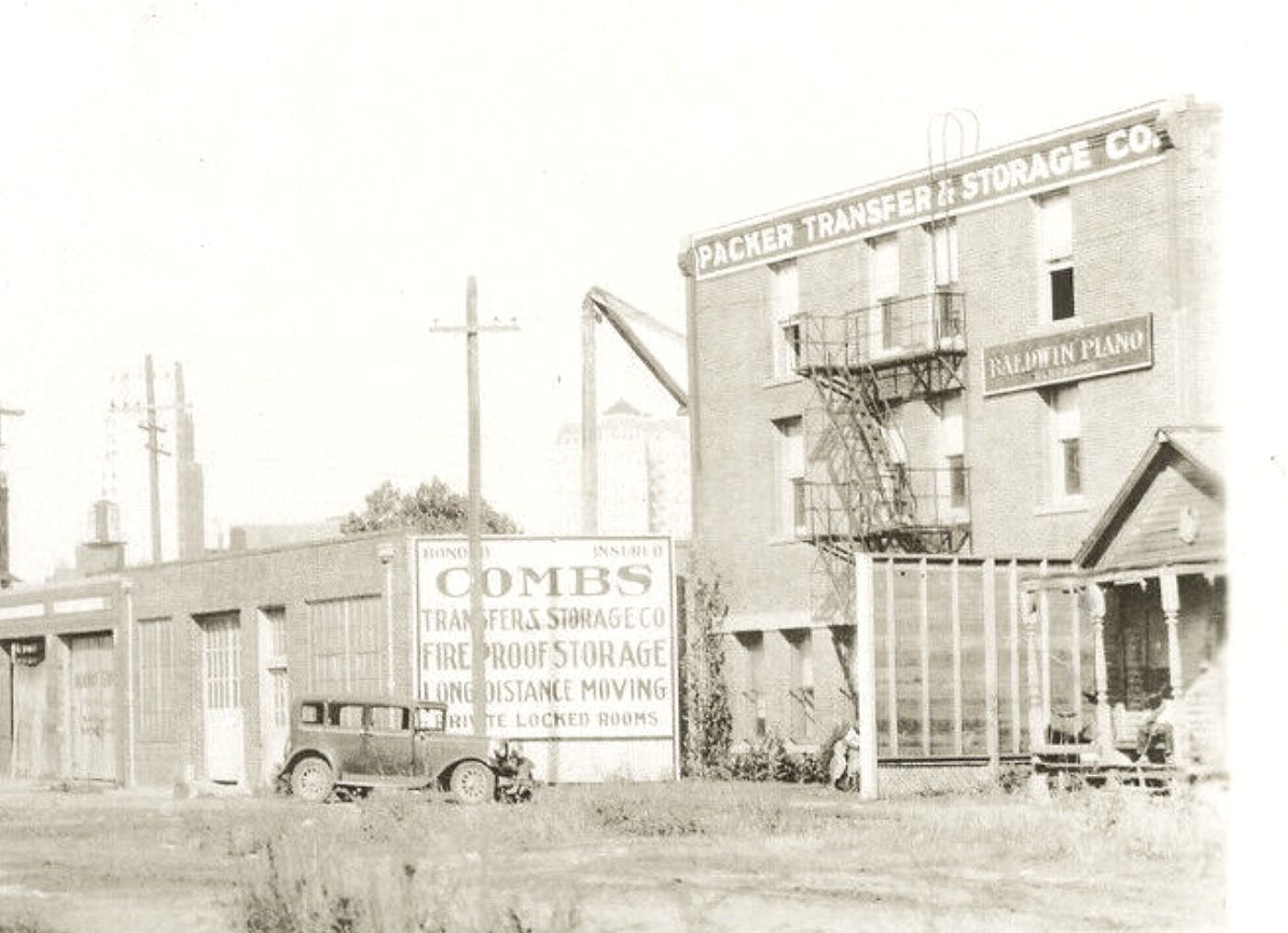
The Combs Transfer & Storage Co., the Packer Transfer & Storage Co., and the Baldwin Piano Ware Room were all at 2507-2509 Pacific. It looks like the two buildings seen in this detail (the short one and the taller one) have somehow miraculously survived the insane redevelopment of everything on all sides of it (I’ve haven’t been to Deep Ellum in a few months, but these two buildings seem to be the ones which you can see in the most recent Google Street View). Also, looming like a ghostly whisper in the background (above “Combs”) is the Medical Arts Building.

pacific-toward-downtown_ebay_medical-arts-bldg

*

I wonder why someone decided to take this photo? I’m glad they did, because it’s not a view I’ve ever seen. I love finding photographs taken in places that most people wouldn’t think were interesting enough to document for posterity. Like this one. Thanks, anonymous photographer!

*

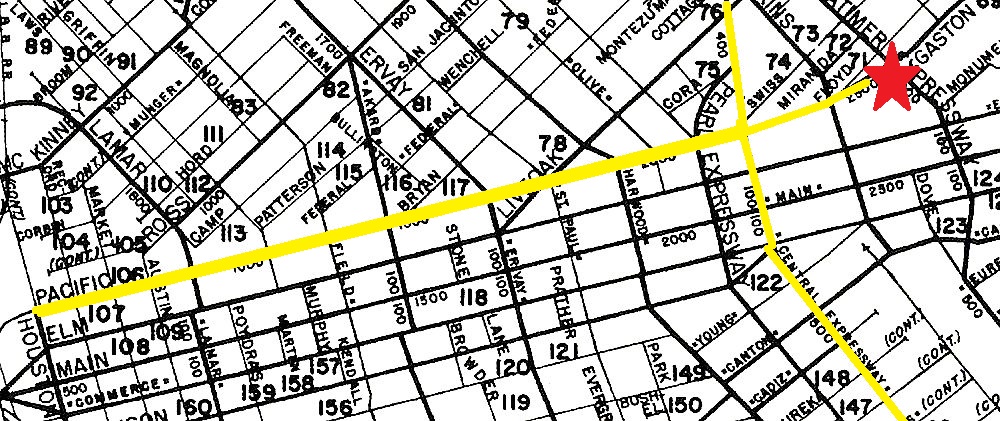
I just picked the closest historical map I had easy access to — the 1952 Mapsco. My guess is that the photograph is from the 1930s. The star is about where the photo was taken — just west of what is now Good-Latimer, just before Pacific becomes Gaston — with a view to the west.

pacific-toward-downtown_mapsco_19521952 Mapsco (det.)

***

Sources & Notes

Photo found on eBay — it looks like the item sold a couple of weeks ago, in Sept. 2022.

pacific-warehouse-district_ebay_sm

*

Copyright © 2022 Paula Bosse. All Rights Reserved.

Elks-a-Plenty — 1908

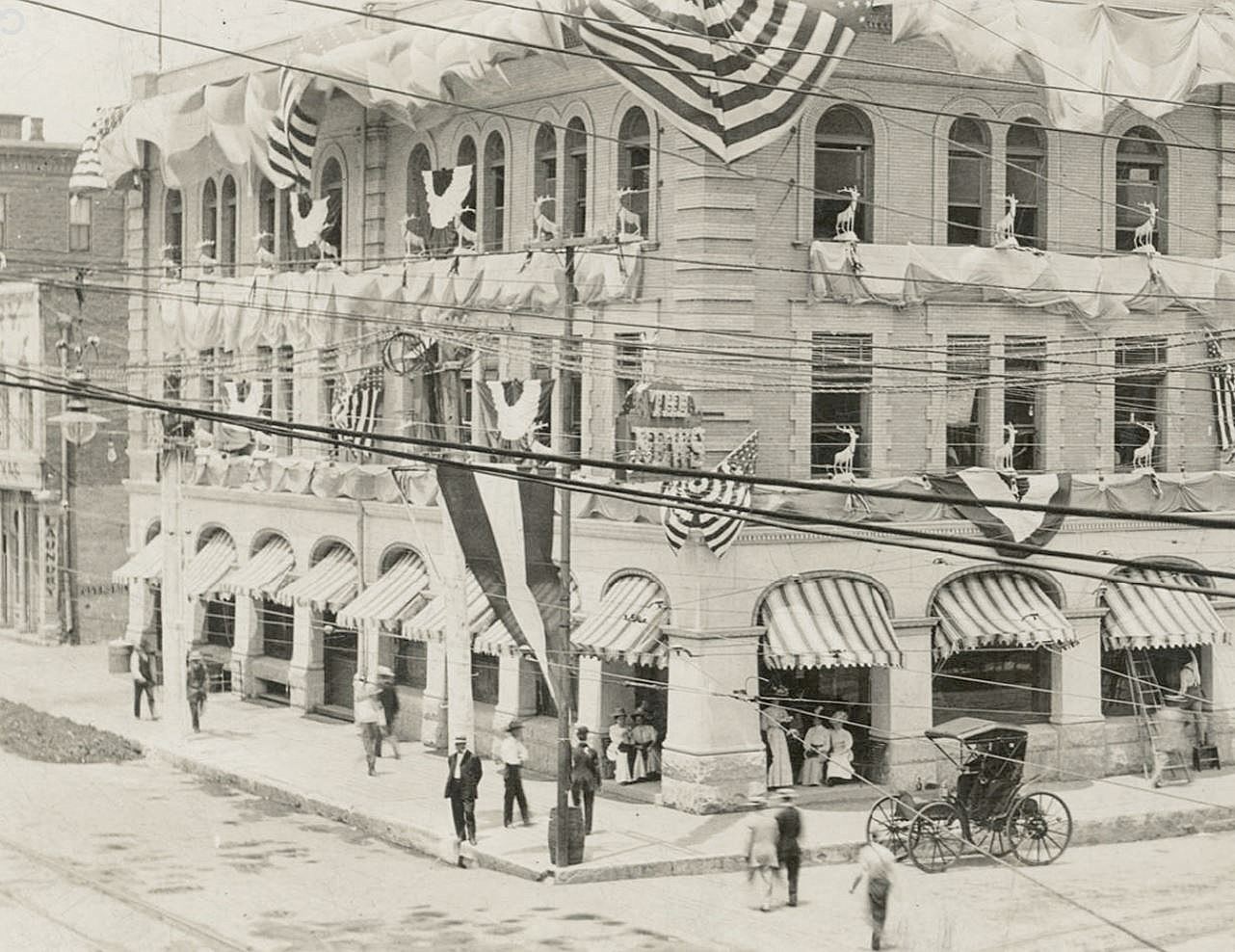
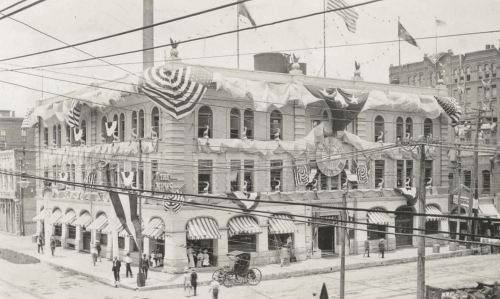
dmn-bldg_decorated-for-elks-convention_1908_cook-collection_SMU_fullBegirt with ruffles and studded with elks…

by Paula Bosse

Conventions have always been important to Dallas. One of the most important conventions ever to descend upon the city was the annual convention of the Benevolent and Protective Order of Elks in July 1908. There were approximately 38,000 attendees, but when you added to that number spouses and various others with business, social, or just looky-loo interests, it was estimated that more than 100,00 out-of-towners clogged the streets of our fair burg during the time of the convention. Dallas was a sizeable city in 1908, but the sudden swarming into town of 100,000 people (twice the actual population of the city!) must have been… challenging. (And profitable!)

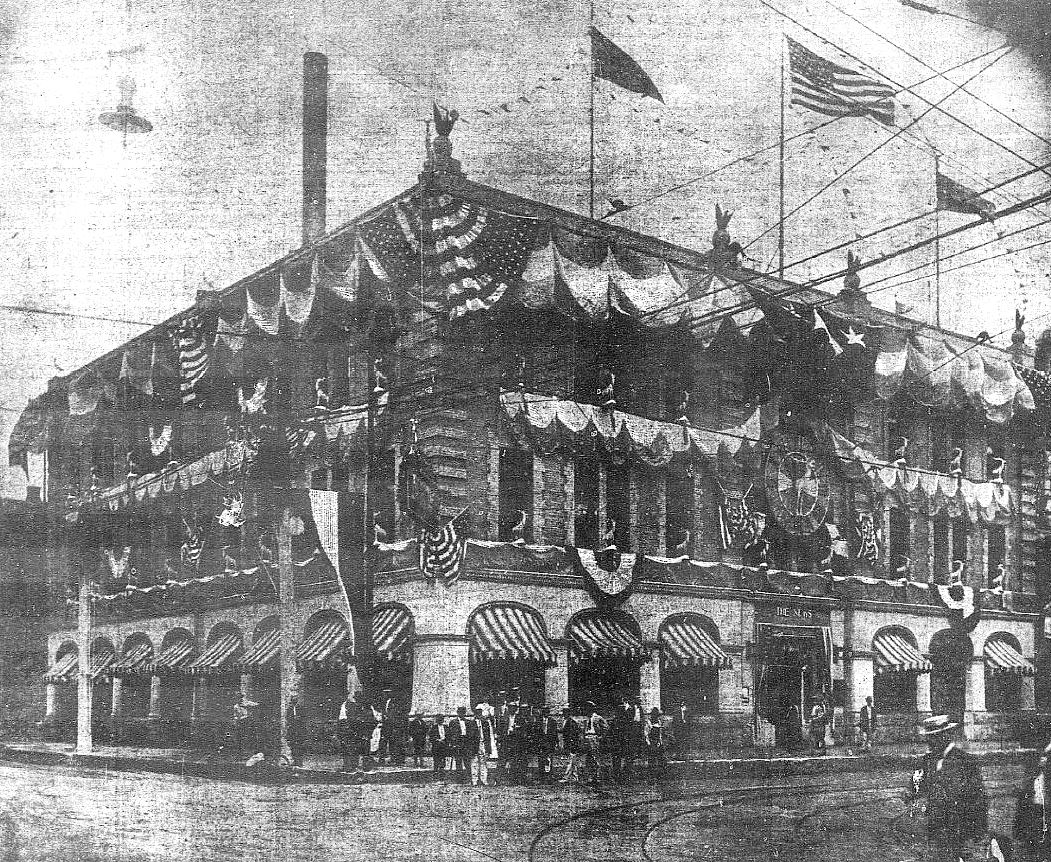
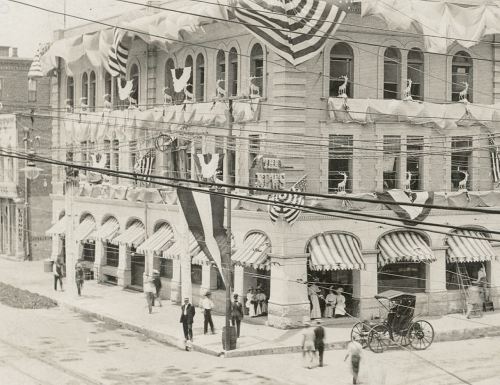
Dallas welcomed the Elks with enthusiasm and open arms. Everyone knew they were coming, and everywhere there were splashes of the Elk colors, purple and white. A special (and later notorious) semi-permanent arch was erected to span Main Street at Akard. And businesses competed with one another to see who could decorate their building with the most spectacular and festive bunting.

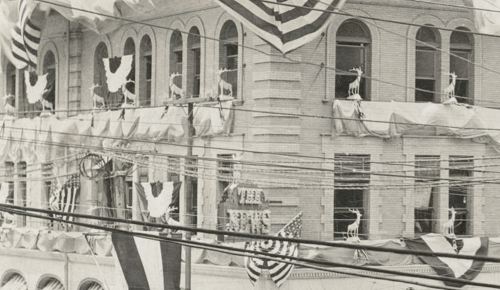
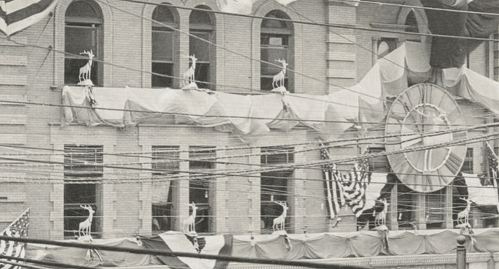
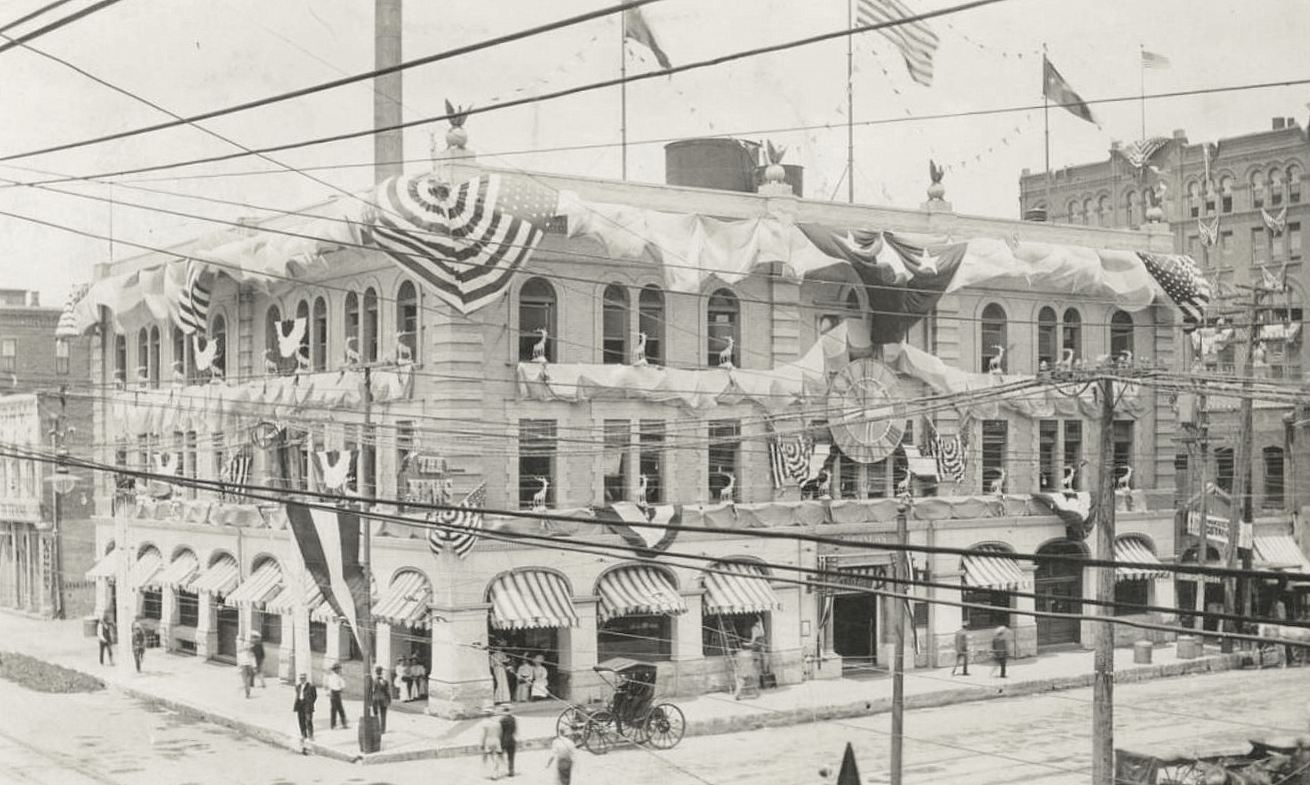
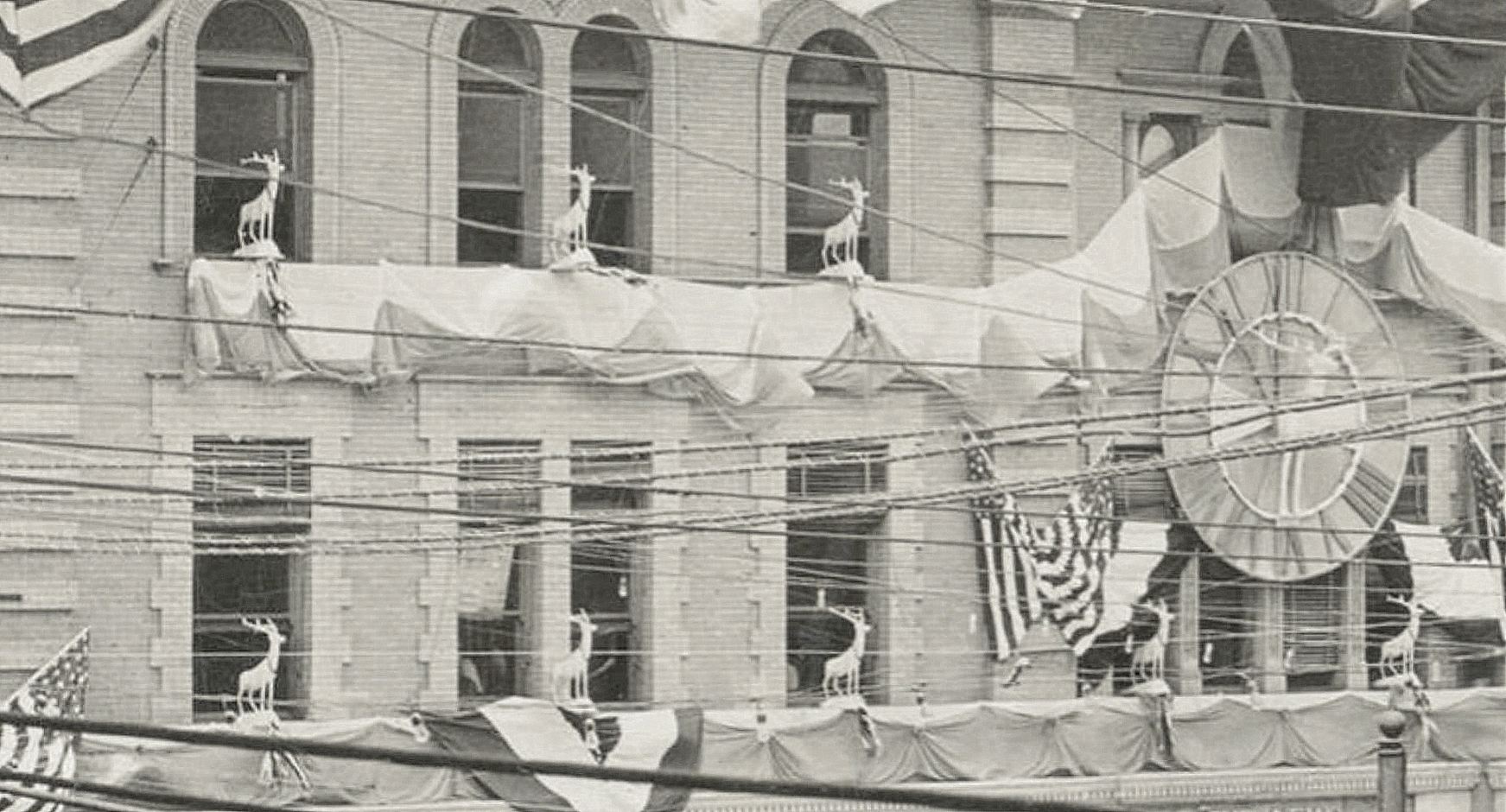
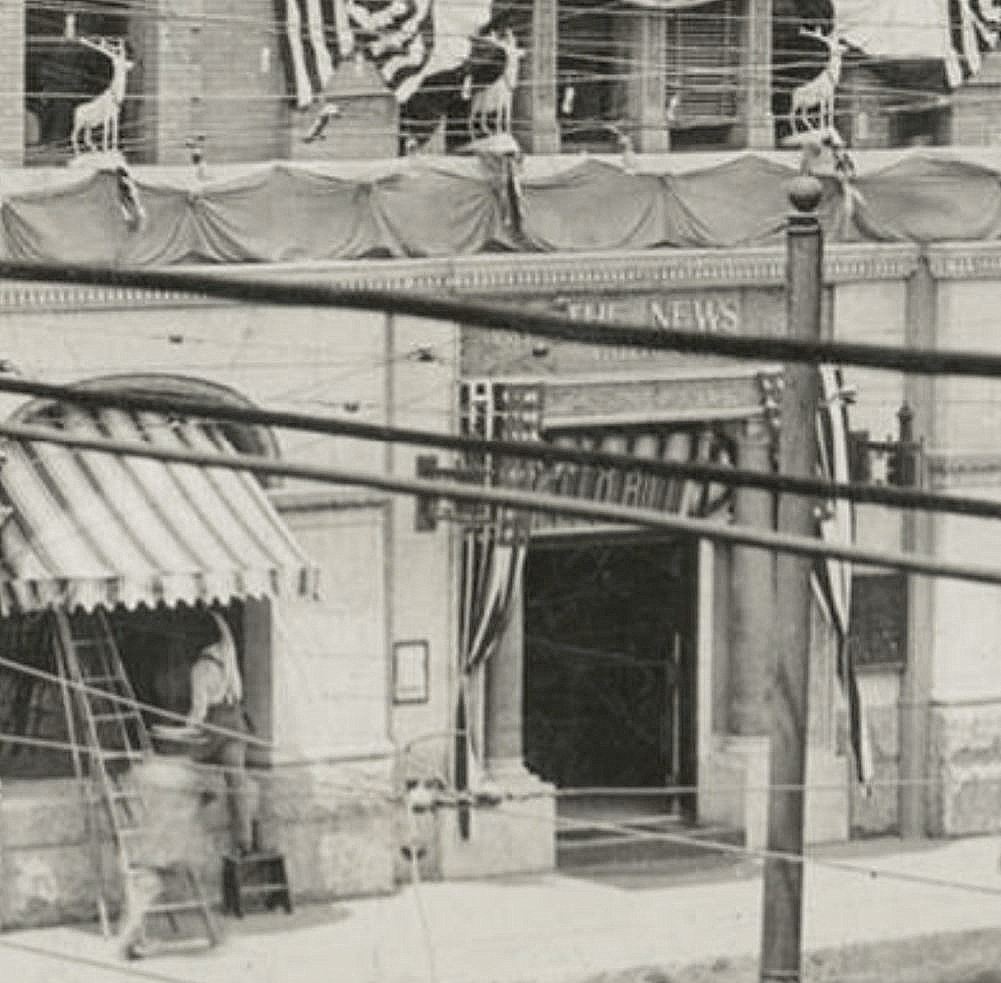
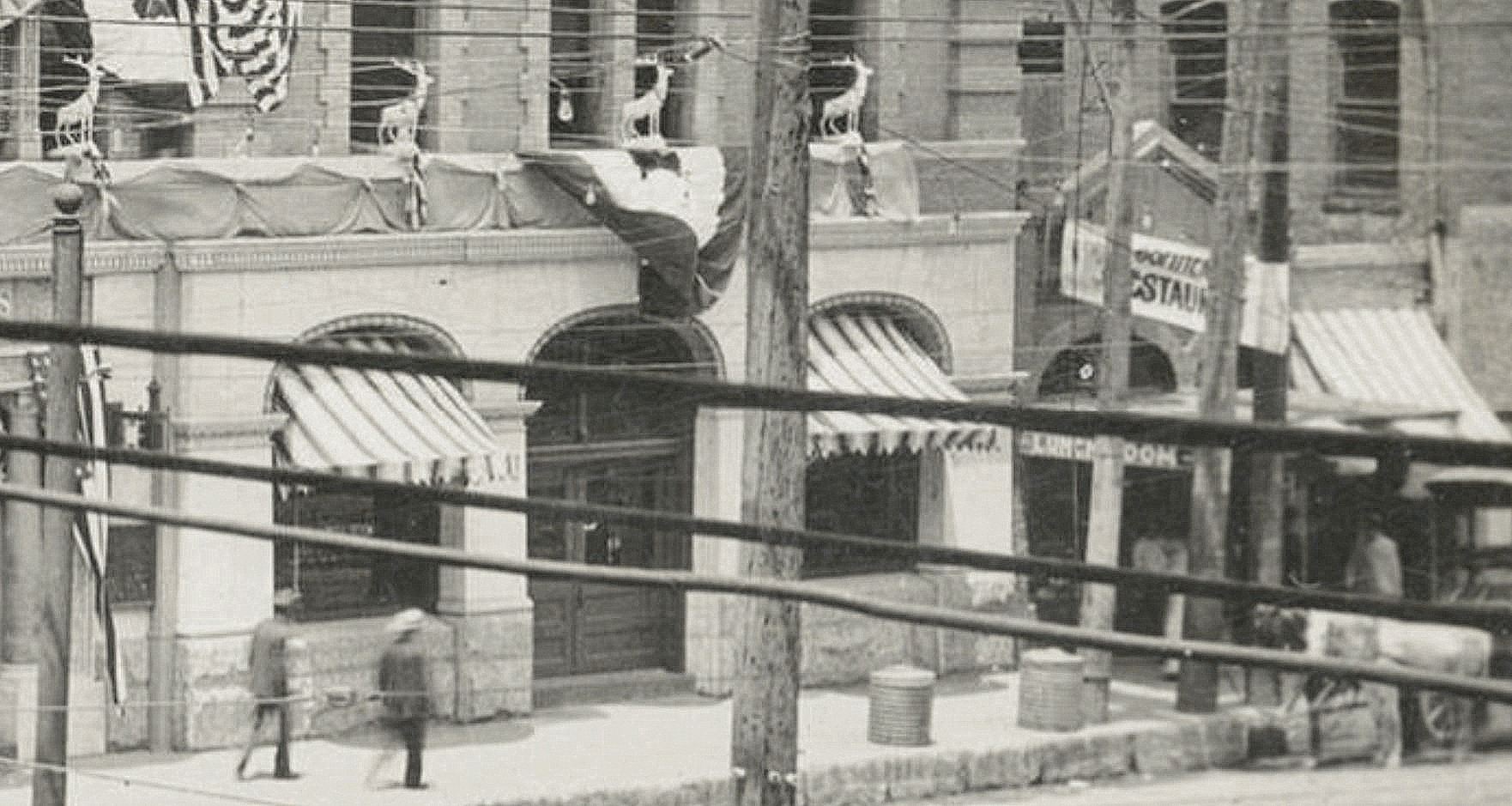
Above is a photo of the Dallas Morning News Building at the northwest corner of Commerce and Lamar, crammed full of flags, bunting, pennants, cowbells, lights, little statues of elks, medium-sized statues of elks, and large statues of elks. (There is an elk in every window.) It also had a large clock erected which was perpetually stuck at an Elk-y 11:00 and a parallelogram-shaped sign which lit up to flash the Elk greeting “Hello, Bill!” So… a lot. But what might seem like overkill — like The News was trying a little too hard to be noticed… the Elks loved it. LOVED IT. They loved it so much that they awarded the newspaper an award of $250 for the best decorated building in the city (that would be about $8,000 in today’s money!). Scroll down to read a breathless description of these decorations, with details of absolutely everything that was flapping, clanging, flashing, billowing, and throbbing at Commerce and Lamar in the summer of 1908. (I have to put this sentence from the article here because I love it so much: “To the bottom of each of these flags are attached small cowbells of different tones, so that with every strong whiff of wind there is a discordant but merry jingle.”)

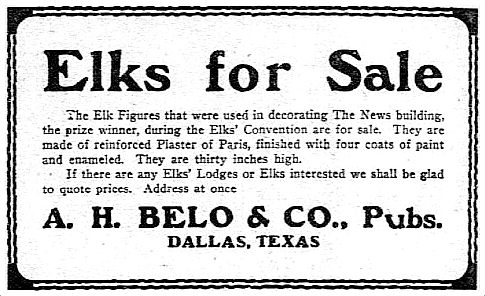
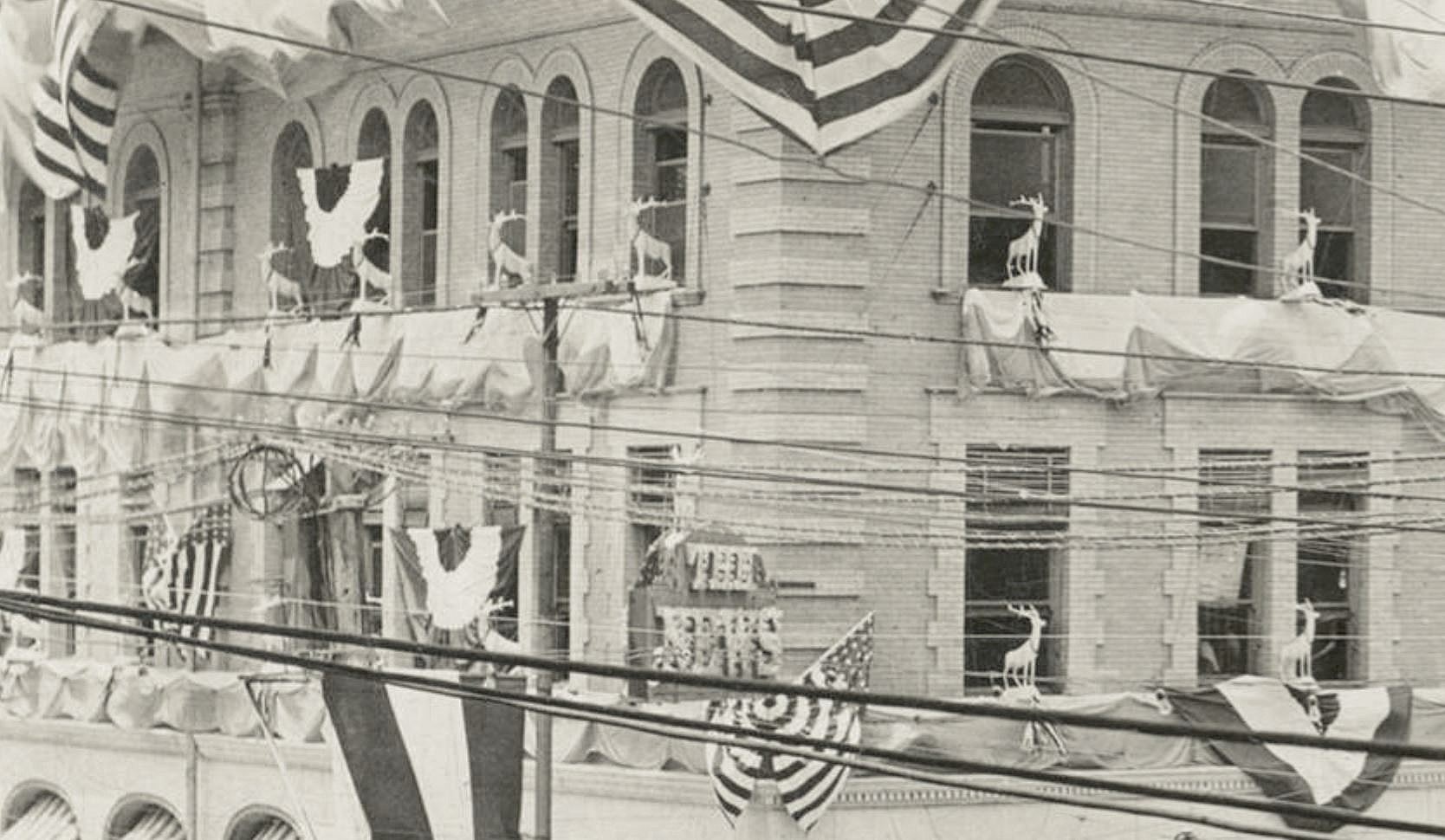
So, those elk statues. I mean… they’re fantastic. Little elks in every window, illuminated by a single electric bulb positioned “between the forefeet” of each mini-elk. And then there are the larger ones appearing to step out of — or off of — the building. But back to those little elks — are you wondering what happened to them after the conventioneers headed back home? Wonder no more!
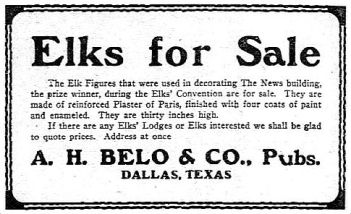
elks_news-bldg_belo-ad_071808Dallas Morning News, July 18, 1908

That would have been a great souvenir!

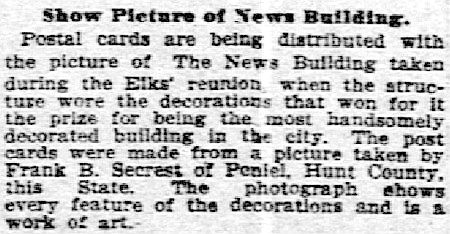
The photo at the top of this post (by Frank B. Secrest of Hunt County) was issued that summer as a postcard. The News did not miss an opportunity to mention it:
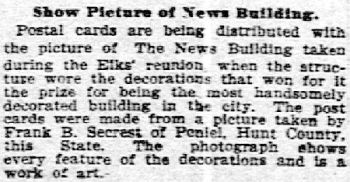
elks_news-bldg_dmn_080708DMN, Aug. 7, 1908

*

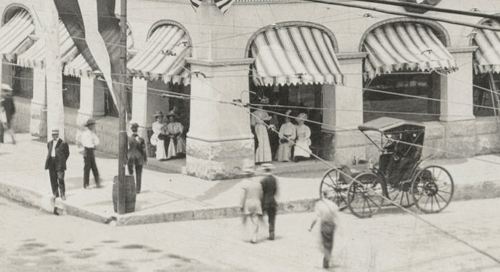
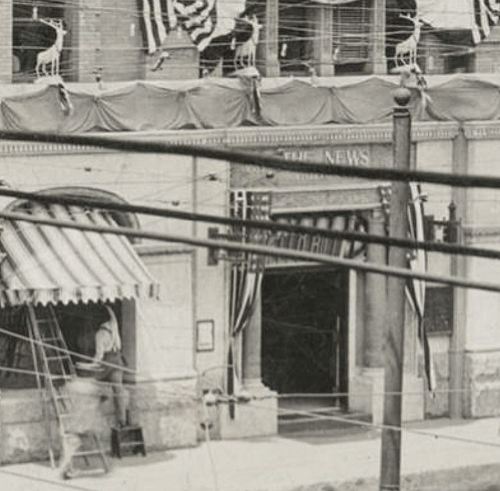
And because I love to zoom in on these sorts of photos, here are a few magnified details:
dmn-bldg_decorated-for-elks-convention_1908_cook-collection_SMU_det-2

dmn-bldg_decorated-for-elks-convention_1908_cook-collection_SMU_det-3

dmn-bldg_decorated-for-elks-convention_1908_cook-collection_SMU_det-4

dmn-bldg_decorated-for-elks-convention_1908_cook-collection_SMU_det-5

dmn-bldg_decorated-for-elks-convention_1908_cook-collection_SMU_det-6

dmn-bldg_decorated-for-elks-convention_1908_cook-collection_SMU_det-7

**

Here is a lengthy description of the decorations, from The Dallas Morning News — direct from the horse’s mouth:

To decorate The News Building in celebration of the coming of the Elks has been the labor of two men for more than a month, and of a dozen for two days: for, though it was only three days ago that the first bit of color appeared on the outer walls, the preparations were begun in the seclusion of a workshop early in June. The draping of the building with bunting and flags was done under the direction of W. T. Senter of the National Decorating Company of St. Louis, and of Edward A. Gebhard, librarian of The News. In working out their scheme they have used 4,200 yards of bunting, purple, white and purple, and twenty-four immense flags, and disposed of it in such artistic fashion as to avoid a sense of crowding.

PURPLE, WHITE AND PURPLE RUFFLES

The building is thrice begirt with big ruffles of purple, white and purple. But, to begin at the topmost, three large flags, one the United States, another the Texas and the other The News’ flag, float high above the Lamar street side of the building. To the bottom of each of these flags are attached small cowbells of different tones, so that with every strong whiff of wind there is a discordant but merry jingle. From one to the other of the flagstaffs hundreds of small pennants in the colors of the Elks flutter gayly in the breeze. Festooned from the heavy cornice which crowns the building are heavy folds of purple, white and purple so arranged that with every vagrant breeze it swells and sinks like the surface of water. Once on the Lamar street side, over the entrance, again at the corner and once on the Commerce street side this bunting is gathered around an immense United States flag, fashioned fan-shape. Poised on the cornice of the building at the corner, as if surveying the land preparatory of a leap, is the graceful figure of an elk, five and a half feet high, made out of plaster of Paris, painted and enameled until he glistens.

The two lower ledges of the building are draped in similar fashion, except that the streamers at these places are narrower than those that festoon the cornice. Above the main entrance on the Lamar street side and extending from below the second story to the third-story ledge is the piece de resistance. Here set in an embrasure of the building, is a clock dial twelve feet in diameter. The gilt letters marking the divisions of the circle are two feet high. The hands point to the hour of 11. The pure white head and shoulders of an elk seven feet high are shown in the center one foot forward, as if he were about to emerge from the fluffy mass of purple and white bunting that forms the background dial. On each side an immense flag is gathered in a way to make it fan-shaped. Circling the clock dial are six large incandescent lights.

WHOLE HERD OF ELKS

From the third-story corner of the building, above which stands a five and one-half foot Elk, as if surveying the country from a precipice, are festooned two twelve-foot flags that fall almost to the second-story ledge of the building. One is gathered around on the Commerce and the other on the Lamar street side. And there yet remains to speak of the most distinctive feature of the whole scheme of decoration. The News, in preparation for this event, had made a whole herd of elks. There are forty-two of them, each thirty-two inches tall, and one, mounted on a pedestal, stands poised from the ledge of every window in the building. They are pure white, made of plaster Paris, painted twice and then enameled. Between the forefeet of every one is an electric bulb. The elks are from models designed by Mr. Gebhard and were cast in The News Building.

BRILLIANT ILLUMINATION

Of course the whole building is brilliantly lighted. In addition to the electricity used ordinarily, which lights the exterior of The News Building pretty well, bulbs have been studded profusely midst the decorations and over the Lamar street entrance is a parallelogram of electric lights which illuminate the sign, “Hello, Bill!”

*

The article then launches into more self-promotion, with an, admittedly, interesting description of the layout of the News Building:

ATTRACTS GENERAL ATTENTION

The building of The News attracted general attention from the thousands of visiting Elks. Many expressed their surprise that a city the size of Dallas had such a complete, modern building and equipment, and the compliments concerning The News as a newspaper have been very pleasing.

The News Building has all the modern fireproof features. It occupies a space of 300×100, having three floors and a basement, the whole being used by the newspaper. Its business office is one of the handsomest in the State, and, as one visitor remarked, it looks more like a prosperous bank than the ordinary newspaper office.

The first floor is given up to the business and circulation departments, the press room and the mailing department. In the basement are the paper storage rooms and the power department. On the second floor are the editorial rooms, telegraph rooms and the general circulation department and the newspaper job department, besides the Employes’ Library and Recreation Room. On the third floor are the composing and the linotype rooms, the stereotype room and the engraving department.

INDIVIDUAL ELECTRIC MOTORS

Every piece of machinery in the house is operated by its own individual electric motor. Power is supplied from two immense engines and generators combined, the engine room being one of the show places in the building, having a metal ceiling and white glazed brick on the walls, with a cement floor. The press room contains two three-deck presses, one quadruple press and one sextuple press.

TWO DAILY NEWSPAPERS

The Dallas News is the offspring of The Galveston News, which was established in 1842. The two papers are under the same management. The publication offices of The News, Galveston and Dallas, 315 miles apart, are connected by special wires for interchange of news matter. The Galveston paper supplies the southern part of the State and the Louisiana border, while the other covers all North Texas and goes well into Arkansas, Oklahoma and New Mexico.

THREE SPECIAL TRAINS

For upward of a quarter of a century the two papers have operated at their own expense, every day in the year, three special newspaper trains, one running Galveston to Houston, one Dallas to Denison and the third Dallas to Fort Worth. The Dallas News covers hundreds of thriving towns throughout its territory, many of them before breakfast time, through its unrivaled facilities of distribution. Starting in 1885, The Dallas News has been a continuous success, and has achieved an enviable reputation wherever American newspapers are known. As an advertising medium it is in a class by itself so far as papers in this section of the country are concerned. Starting at 1885 with thirty-three classified ads in its Sunday issue, it now runs each Sunday about 2,000. It is a success because it is enterprising and because it is clean, both in its news columns and in its advertising columns; because it is fair-minded and because its efforts have always been uplifting from a moral and intellectual standpoint and fair to every interest.

*

And then it launches into many, many testimonials from Elk visitors on how much they love the decorations. This is the first. You get the idea.

J. T. McNulty of Baltimore, grand trustee of the Elks, prominent in National circles of the Knights of Columbus and a central figure in the Ancient Order of Hibernians of America, who has traveled largely and visited every State in the Union, being prominent in business and political circles said: “I have been to many conventions, my son, and have seen many decorations, but the one at The News plant, in my estimation ‘takes the cake,’ figuratively and literally speaking. It is the most unique, the most artistic and the most beautiful I have ever seen in all my attendance at conventions in this country, and I have attended many of them. I was agreeably surprised at the way Dallas has decorated, but nothing gave me such a shock of pleasurable surprise as the first sight I had of The News’ decorations.”

*

And this is the dark and grainy photo that ran with the article:
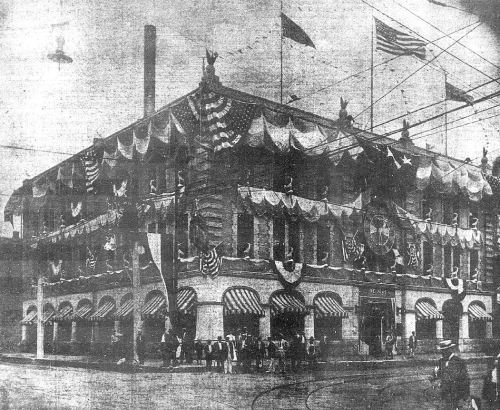
dmn-bldg_elks_dmn_071508_photoDMN, July 15, 1908

**

I kinda want an elk statue now. Also, according to the article, I now know the Morning News has its own flag. Can someone point me to more info?

**

Most of the larger downtown buildings went crazy with decorations, such as the Oriental Hotel (southeast corner of Commerce & Akard), seen here festooned up the wazoo. If you see a photo from 1908 with a Dallas building that’s looks like this, blame it on the Elks.

oriental-hotel_postcard_elks_1908_ebay

***

Sources & Notes

Top photo — titled “[The News, First Prize for Decorations, Dallas, Texas]” — is from the George W. Cook Dallas/Texas Image Collection, DeGolyer Library, Southern Methodist University; more info on this photograph (postcard) can be found here.

Lengthy quote is from the article “Dallas News Building Decorated In Honor of the Elk’s Grand Lodge Which Is Now Holding Its Annual Session and Grand Jubilee in This City,” The Dallas Morning News, July 15, 1908.

More Elks-related Flashback Dallas posts:

And more photos of this beautiful Dallas News Building can be found in these posts:

dmn-bldg_decorated-for-elks-convention_1908_cook-collection_SMU_full_sm

*

Copyright © 2022 Paula Bosse. All Rights Reserved.

Simms Super Service Station, Cedar Springs & Maple — 1930

simms-super-service-station_atlantic-terra-cotta-co-coll_UT_ca-1930Let us vulcanize your tires!

by Paula Bosse

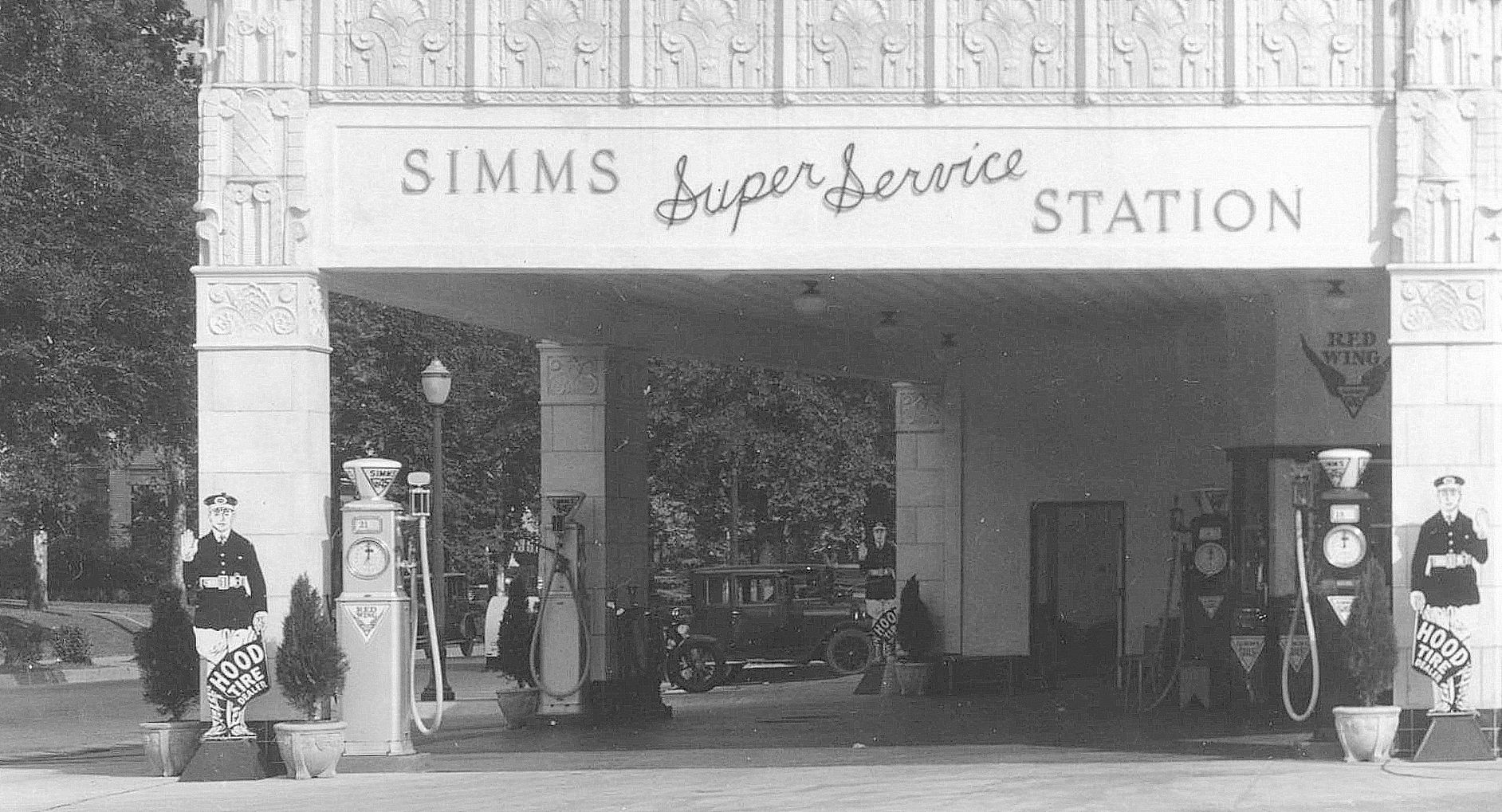
If you call yourself a “Super Service Station,” you’d better be pretty super. And the one in the photo above is pretty super. It opened in 1930 at the intersection of Cedar Springs and Maple (on the northernmost tip of the land now occupied by the Crescent). 

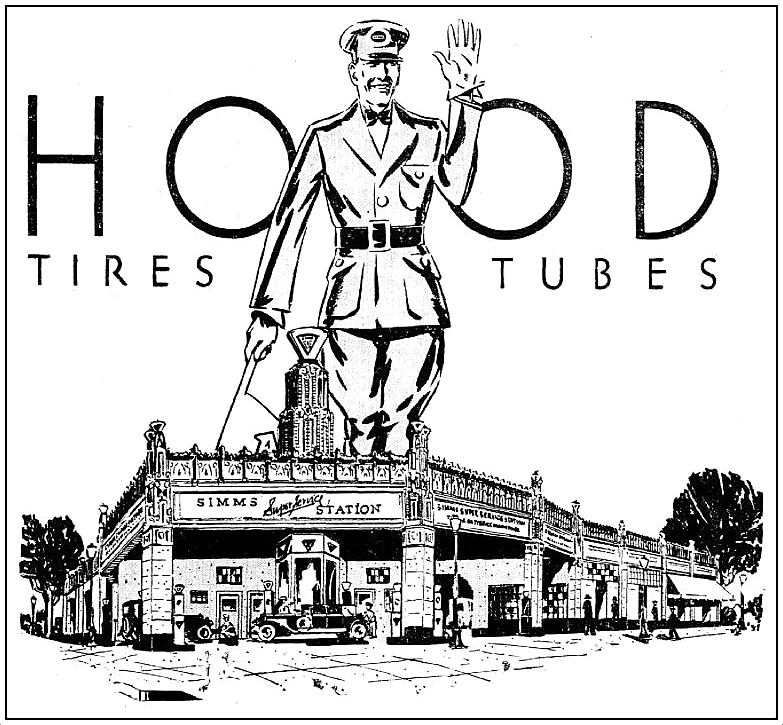
Construction of the station and attached retail spaces was announced in 1929 by the Dallas-based Simms Oil Company (headquartered in the Magnolia Building, with a refinery on Eagle Ford Road in West Dallas) — it was reported that the impressive building would cost about $40,000 (about $615,000 in today’s money). It would be the 34th Simms service station in the city but it would be the first SUPER service station. Its grand opening at the end of April, 1930 was a big event, broadcast over KRLD radio, with singers, music, and flowers for the ladies. No business was conducted during the grand opening — it was strictly an open house, offering prospective customers the opportunity to walk among the gas pumps and admire what the company called “the last word in service station art.”

simms_cedar-springs-maple_grand-opening_043030_detDetail from grand opening ad, April, 1930

The filling station will be equipped with ten electrically operated gasoline pumps. Every kind of automobile repairs and battery and tire vulcanizing service will be offered. (Dallas Morning News, Oct. 20, 1929)

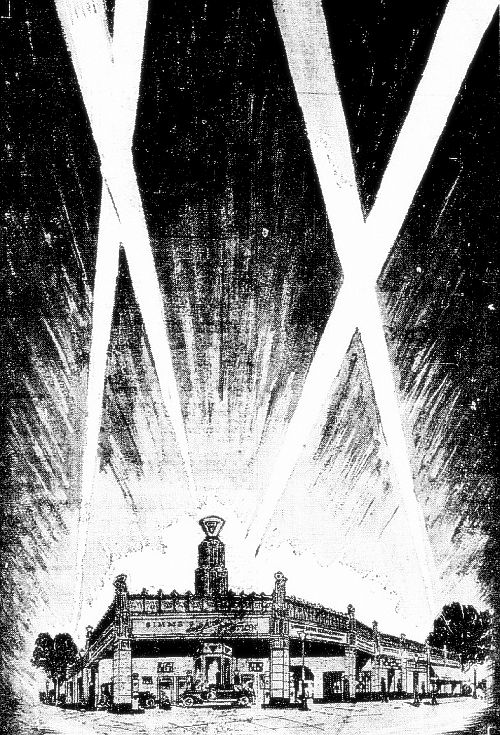
The building is of terra cotta in modernistic design with the well-known Simms color scheme of blue, white and red used. […] On top of the structure is a beacon bearing the Simms triangle. It will revolve with flood lights playing on it all the while. (DMN, April 27, 1930)

I never think of businesses of that period being open 24 hours a day, but this one was. Super!

**

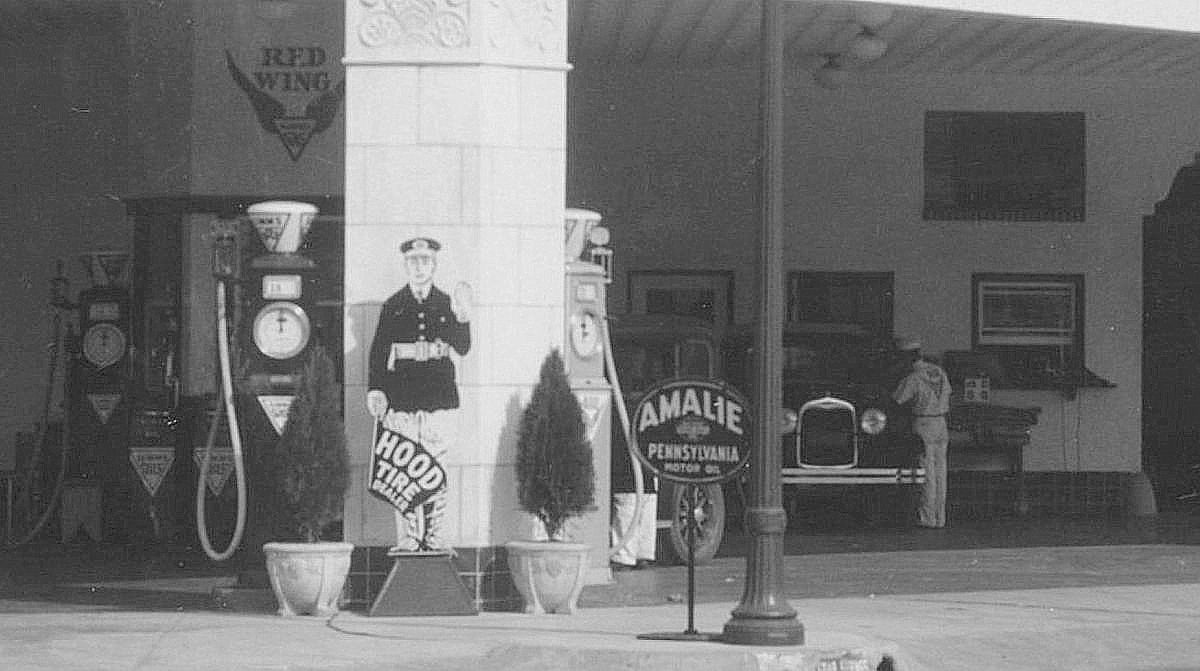
Here are a few zoomed-in close-ups of the top photo, which shows the Cedar Springs side of the building. (Click pictures to see larger images.)

At the left of this detail you can see a glimpse of Maple Avenue, which, at the time, was still lined with large, expensive homes.

simms_det_to-maple

*

In the shadows, a man who no doubt has prodigious vulcanizing skills.

simms_det_emp

*

In addition to housing a gas station, the building had 6 retail spaces — 3 on Maple and 3 on Cedar Springs. One of the businesses seen here places the date of this photo at 1930, when The Radio Shop was located at 2304 Cedar Springs (the next year it appears to have moved around to the Maple side of the building). Next to it is the Fishburn Oriental Cleaners at 2308 Cedar Springs. (The official address of the Simms station was 2623 Maple, but it was usually just listed as being at the southeast corner of Maple and Cedar Springs — after Simms, the building’s address was 2312 Cedar Springs.)

simms_det_truck_oriental-cleaners_radio-shop

*

Here’s a close-up of the company truck and an easy-to-remember number when you needed to call for help with a broken-down vehicle.

simms_det_simms-truck

And here it is in an ad. That motorcycle is cool. For some reason I really want that sidecar to be filled with sloshing gasoline.

simms_ad_082630_detAd detail, Aug. 26, 1930

*

And here’s the revolving rooftop beacon. (What looks like a spray of water is just damage to the surface of the photograph.) (…But a fountain on top of a gas station would be pretty amazing.)

simms_det_tower-cu

*

You know you’ve got a cool building if you can include an instantly recognizable line drawing of it in your ads.

simms_cedar-springs-maple_060330_detAd detail, June 3, 1930

*

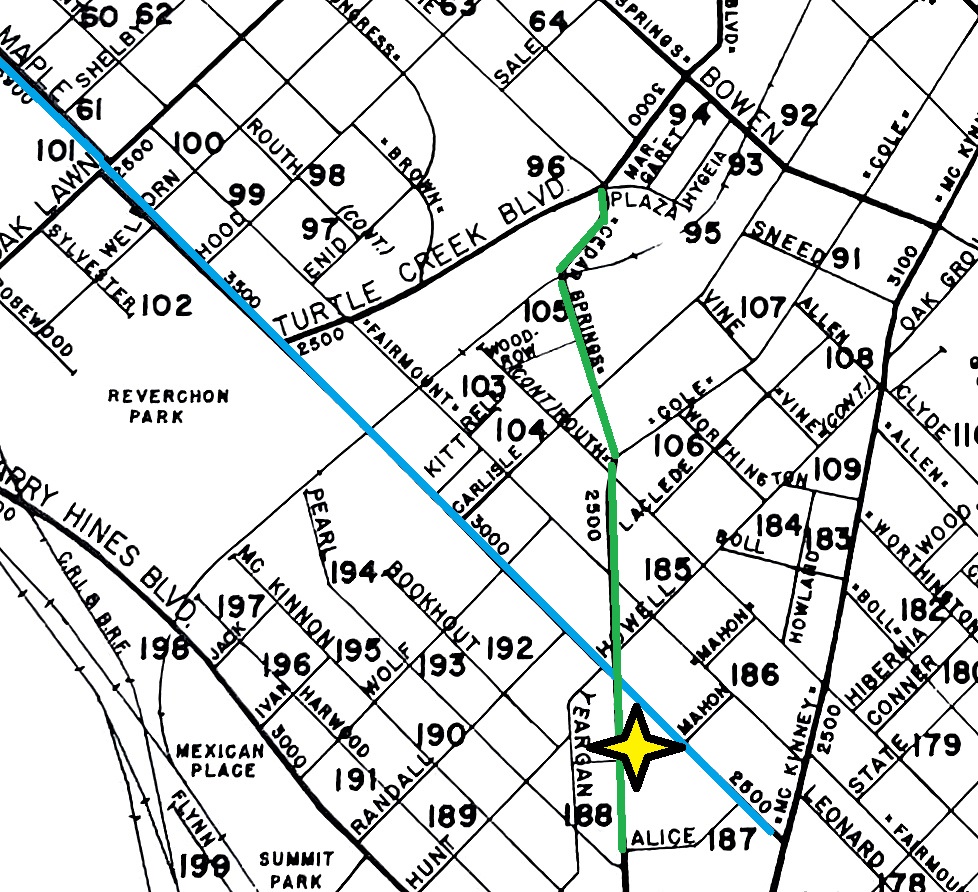
I think the company might have disappeared before the 1930s ended. Because this is the only “old” “modern” map I’ve got, here’s where the Simms gas station had been located, courtesy of a 1952 Mapsco.

cedar-springs-maple_1952-mapscoMapsco, 1952

*

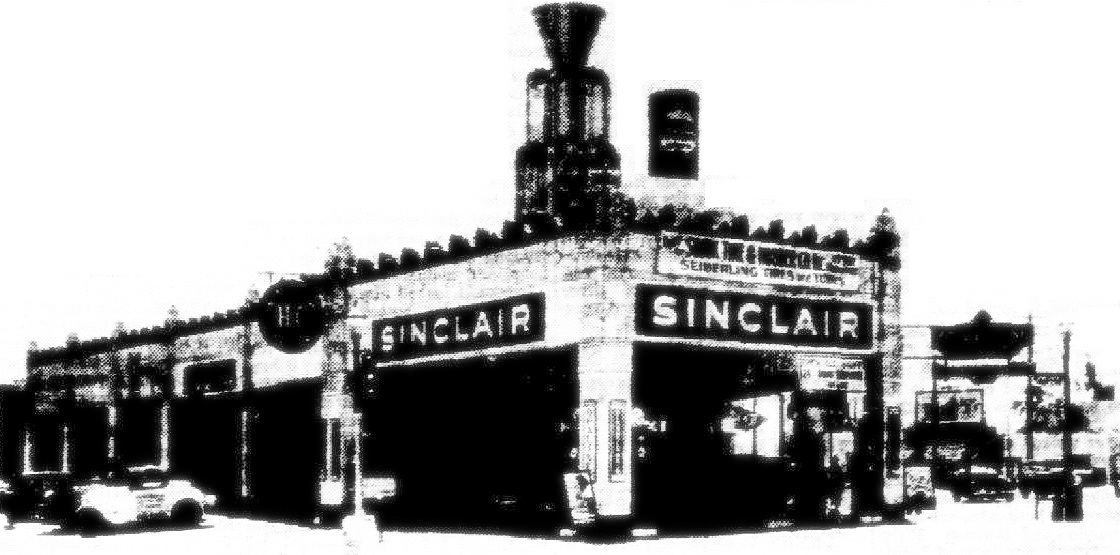
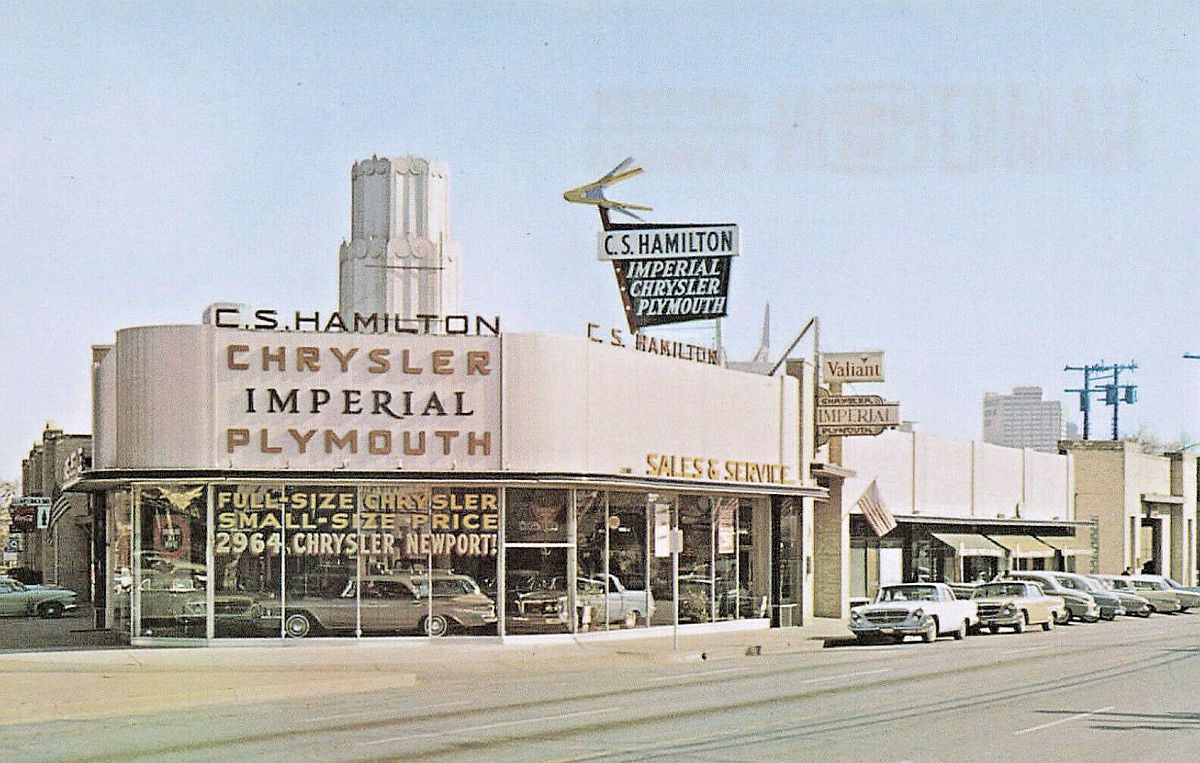
Here are a couple of later photos of the building, post-Simms. The first one is from a grainy Shook Tires ad from 1938. The color postcard is from the 1960s when it was the C. S. Hamilton Chrysler dealership. The beacon is still there but, surely, it was no longer beaconing (unlike the Republic Bank “rocket” seen in the background, which was beaconing big-time). (See below in the comments for a 1940s photo of the building.)

shook-tires_ad_2312-cedar-springs_051338Shook Tires, 1938

hamilton-car-dealership_cedar-springs-at-maple_ca-1962_ebayC. S. Hamilton Chrysler, ca. 1962

Mohr Chevrolet moved in around 1968.

mohr-chevrolet_1975-directory1975 Dallas directory
***

Sources & Notes

Photo — titled “Simms Oil Station (Dallas, Tex.): exterior view of front entrance, corner perspective” — is from the Atlantic Terra Cotta Company Architectural records and photographs, 1914-1941, Architectural Terra Cotta, Alexander Architectural Archives, University of Texas Libraries, The University of Texas at Austin; more info can be found here

simms-super-service-station_atlantic-terra-cotta-co-coll_UT_ca-1930_sm

*

Copyright © 2021 Paula Bosse. All Rights Reserved.

SMU Campus, An Aerial View from the North — 1940s

smu-campus_from-the-north_squire-haskins_UTA_nd(Squire Haskins Collection, UTA Libraries)

by Paula Bosse

When you see aerial views of the SMU campus, they’re usually looking to the north, toward Dallas Hall. Which is one reason this photo by ace photographer Squire Haskins is interesting. It’s also noteworthy because it shows “Trailerville,” the trailer camp set up on the campus from 1946 to 1953 for married war-vet students, and it also shows the pre-fab men’s dormitories, which look like army barracks. Housing in post-WWII Dallas was was very, very tight, and people had to make do and were crammed into all sorts of spaces. (See a very large image of this photo on the UTA website here.)

For reference, Mockingbird Lane is running horizontally at the top (I was wondering if that might have been the Mrs. Baird’s bakery (built in 1953) at the top left, but it’s not far enough east), Bishop Blvd. is in the center, and Hillcrest Avenue is at the right. And there’s also a whole lot of empty land — a startling sight if you’ve seen the present-day bursting-at-the-seams campus.

Here are a few blurry close-ups. First, Trailerville (which I’ve been meaning to write about for years!) — just northeast of Ownby Stadium:

smu-campus_from-the-north_squire-haskins_UTA_nd_det-2

Men’s dorms in temporary buildings which were removed in 1952/53:

smu-campus_from-the-north_squire-haskins_UTA_nd_det-1

And something that isn’t the Mrs. Baird’s Bread factory (scroll down to see what it was):

smu-campus_from-the-north_squire-haskins_UTA_nd_det-3

*

Thanks to the comments below by reader “Not Bob,” it appears that the photo of the long building at the top left corner — on the site later occupied by Mrs. Baird’s Bread — was once an armory for the 112th Cavalry (Troop A) of the Texas National Guard. The building was originally built in 1921 as the headquarters of the Wharton Motor Company, a short-lived automobile and tractor manufacturer. It appears to have closed by 1922 and the company was bankrupt by 1924. The 112th Cavalry (with about 40 horses) moved in at the end of 1927 — they were forced to move out by the end of 1930 because of neighbor complaints (and a lawsuit) about the horses being in such close proximity to residences. By the time of the photo above, it was the Town and Country food business which rented freezer-locker space to the public. Mrs. Baird’s Bread decided to build on the site in 1949 (with the intention, presumably, to raze the existing building) — construction began in 1952 and the factory opened in 1953 (incidentally, the factory was designed by legendary Dallas architect George Dahl). (I should write about the Wharton building sometime — it has an interesting history.) 
The commenter (“Not Bob”) also linked to a similar view of the campus in 1955, post-Trailerville:

smu_from-the-north_1955_degolyer-library_SMU_cropped(DeGolyer Library, SMU)

By then, Central Expressway had been built and Mrs. Baird’s was cranking out that delicious aroma that filled the neighborhood for decades:
smu_from-the-north_1955_degolyer-library_SMU_det-mrs-bairds

***

Sources & Notes

“Aerial view of the campus of Southern Methodist University, Dallas, Texas” is by Squire Haskins, from the Squire Haskins Photography Inc. Collection, University of Texas at Arlington Libraries; more information on this photo can be found here (click thumbnail photo to see larger image).

“1955 aerial view of campus from the north” — by William J. Davis — is from the collection of the DeGolyer Library, Southern Methodist University; more information on this photo is here.

smu-campus_from-the-north_squire-haskins_UTA_nd_sm

*

Copyright © 2021 Paula Bosse. All Rights Reserved.