Time for another installment of me-adding-new-stuff-to-old-stuff.
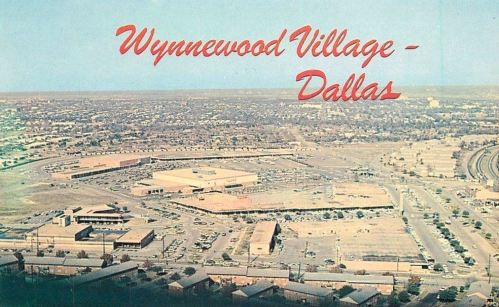
First up: this cool postcard of Wynnewood Village has been added to the post “Wynnewood.” (Source: the endless, depthless “internet”)
*
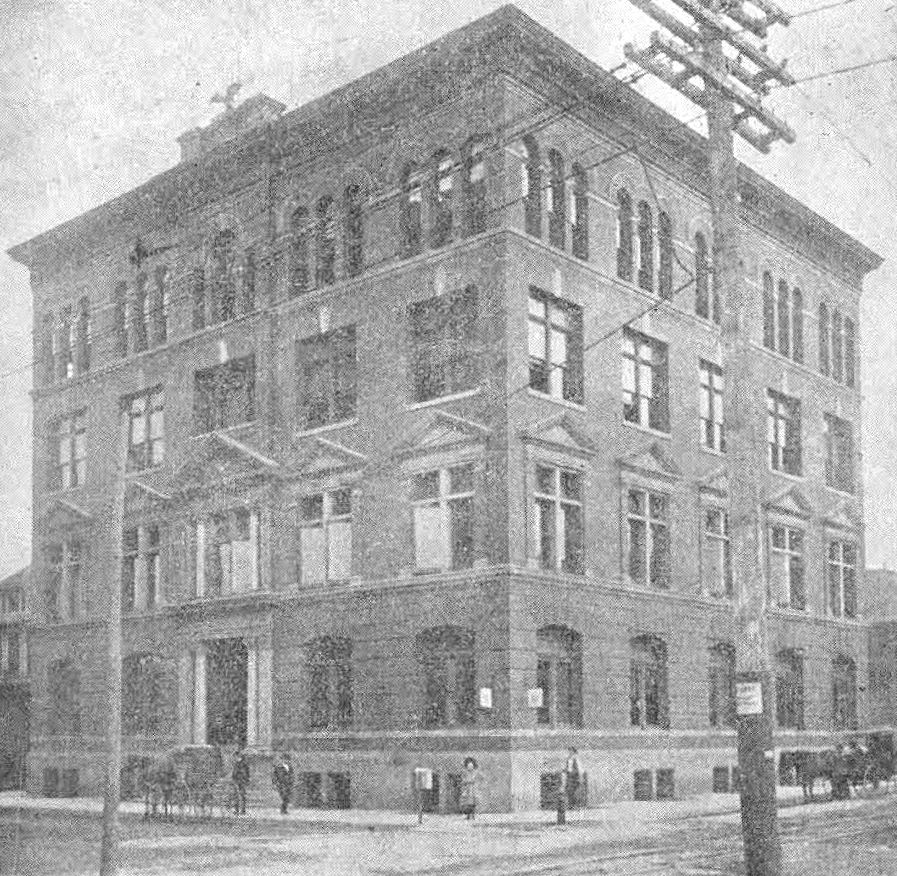
Below, this circa-1905 photo of the ever-popular, still-standing-in-the-West-End Brown Cracker Co. Building has been added to the liltingly-titled “Brown Cracker Co. Cracker Wrappers.” (Source: a promotional brochure titled “Come To Dallas,” DeGolyer Library, Southern Methodist University, here)
*
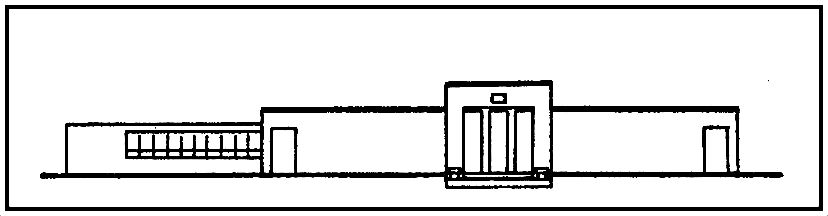
This proposed design for the Texas Centennial’s Hall of Negro Life is pretty cool and is interesting to compare to the building eventually constructed. It’s been added to “Juneteenth at the Texas Centennial — 1936.” (Source: An Historical and Pictorial Souvenir of the Negro In Texas History, written by J. Mason Brewer, 1935)
*
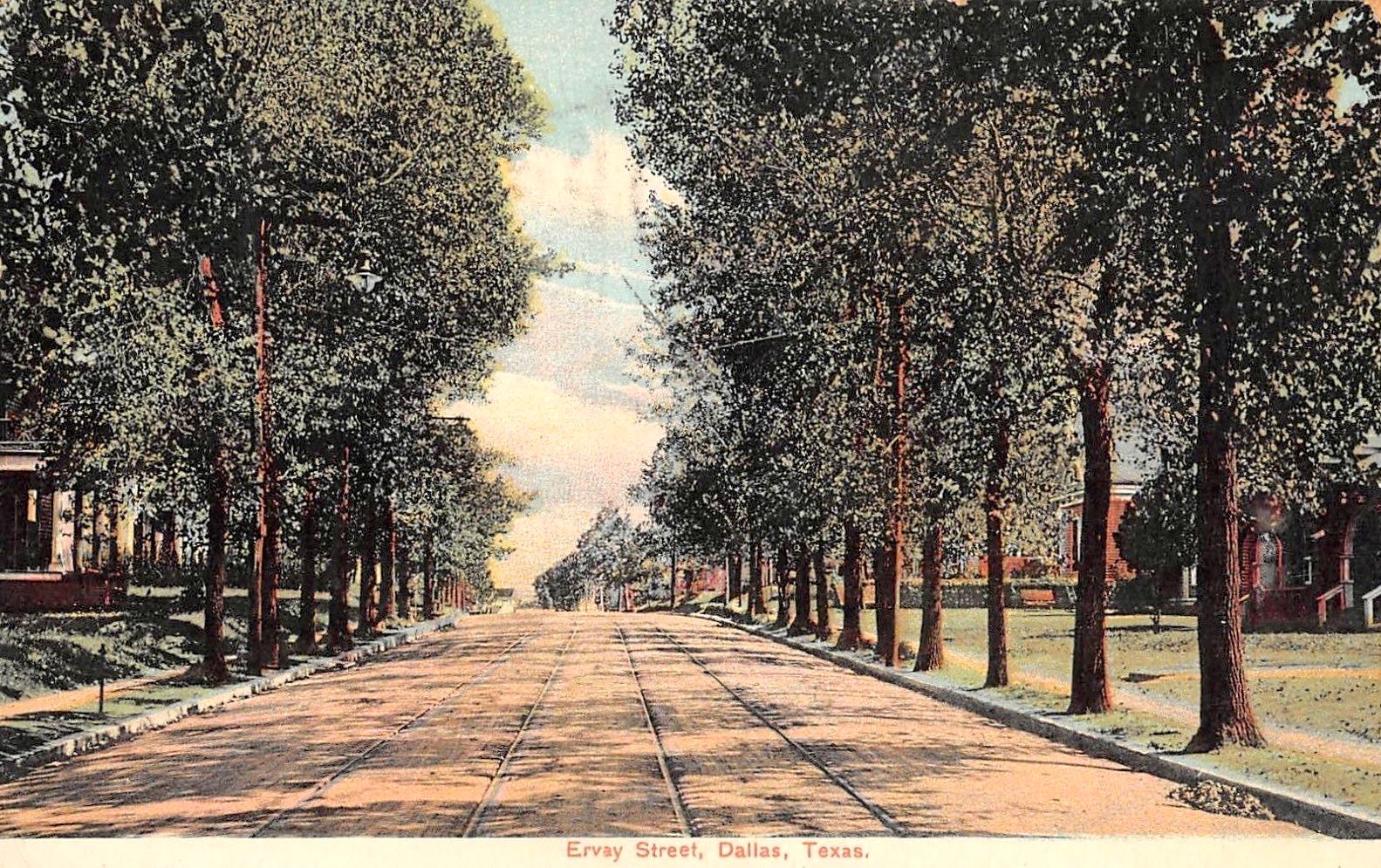
Another lovely postcard image of the formerly lovely South Ervay Street has been added to “Beautiful South Ervay Street — ca. 1910.” (Source: the aforementioned “internet”)
*
This 1887 photo of the Dallas Morning News’ special train which made morning delivery possible to far-flung-ish locales has been added to one of my personal favorite posts, “The Dallas News Special: Fast Train to Denison — 1887.” (Source: the George A. McAfee photographs collection, DeGolyer Library, SMU, here)
*
I love graphics like this simple line drawing of the 1936 Fair Park building which once housed the Dallas Museum of Fine Arts (now the Dallas Museum of Art). It adorned letterhead and DMFA publications. and has been added to the post “Summers and Lagoons — 1940s.”
*
This photo of the Adolphus Hotel’s barbershop has been added to the post“The Adolphus Hotel’s ‘Coffee Room’ — 1919.” I think that the barbershop and the “coffee room” might have occupied the same space — at different times. (Source: the Adolphus Archives; found in Historic Dallas Hotels by Sam Childers)
*
I just wrote about the 1928 Southwestern Bell Telephone Building — and I *just* ran across a photo of the original 1890s SWB building, which stood next to the newer building for many years. This circa-1905 photo has been added to “The New Southwestern Bell Telephone Co. Building — 1928.” (Source: “Come To Dallas,” DeGolyer Library, SMU, here)
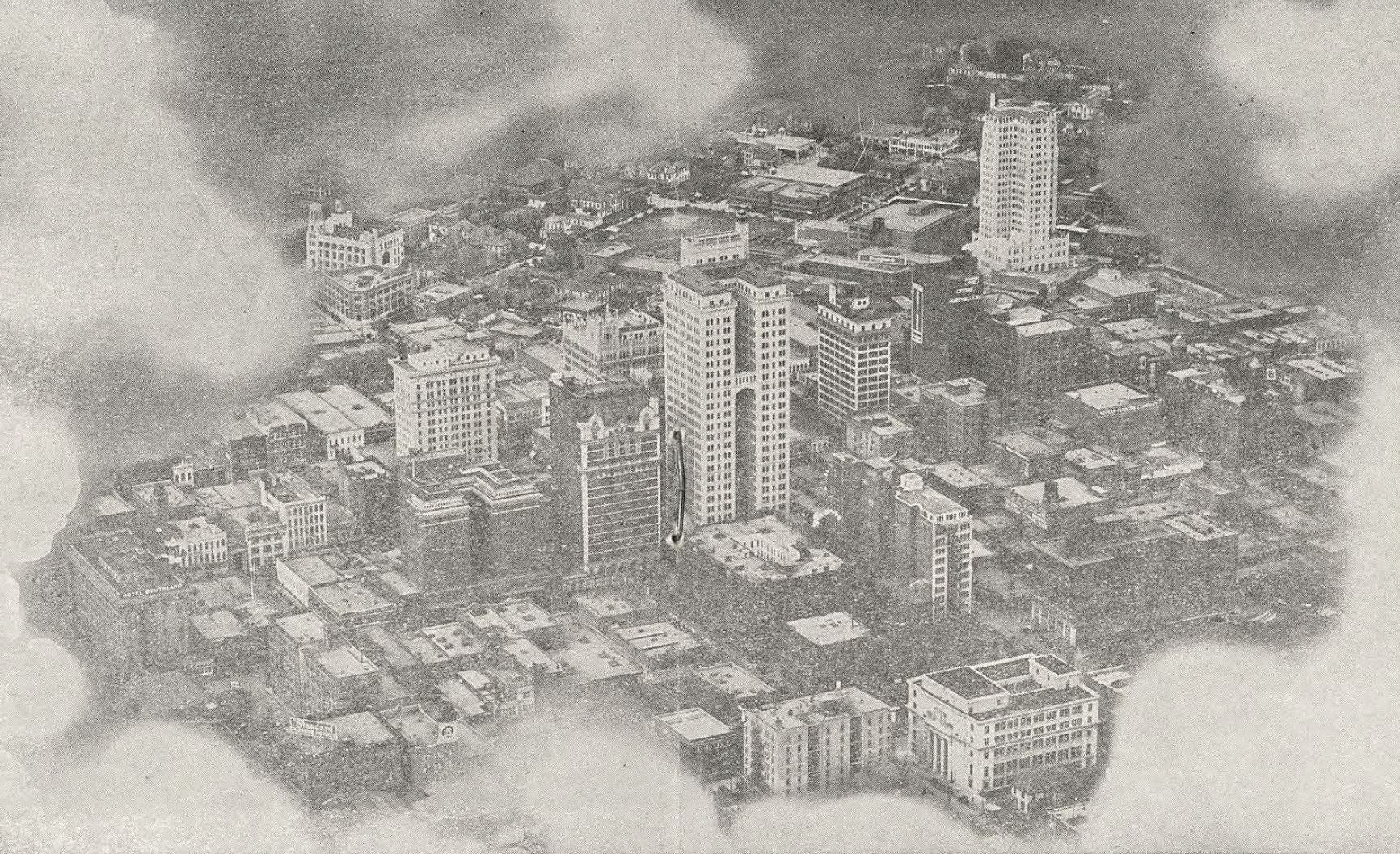
This wonderful, dream-like, “through the clouds” photo shows a growing, booming (pre-Pegasus) downtown Dallas.
***
Sources & Notes
Photo by the Fairchild Aerial Camera Corp., from the 1923 promotional brochure Dallas from A to Z (“Where Men Are Looking Forward”), published by the Dallas Chamber of Commerce (note the publication’s staple in the center of the photo). This brochure is in the collection of the DeGolyer Library, Southern Methodist University and can be viewed in its entirety here (click the “download” button to view or save the brochure).
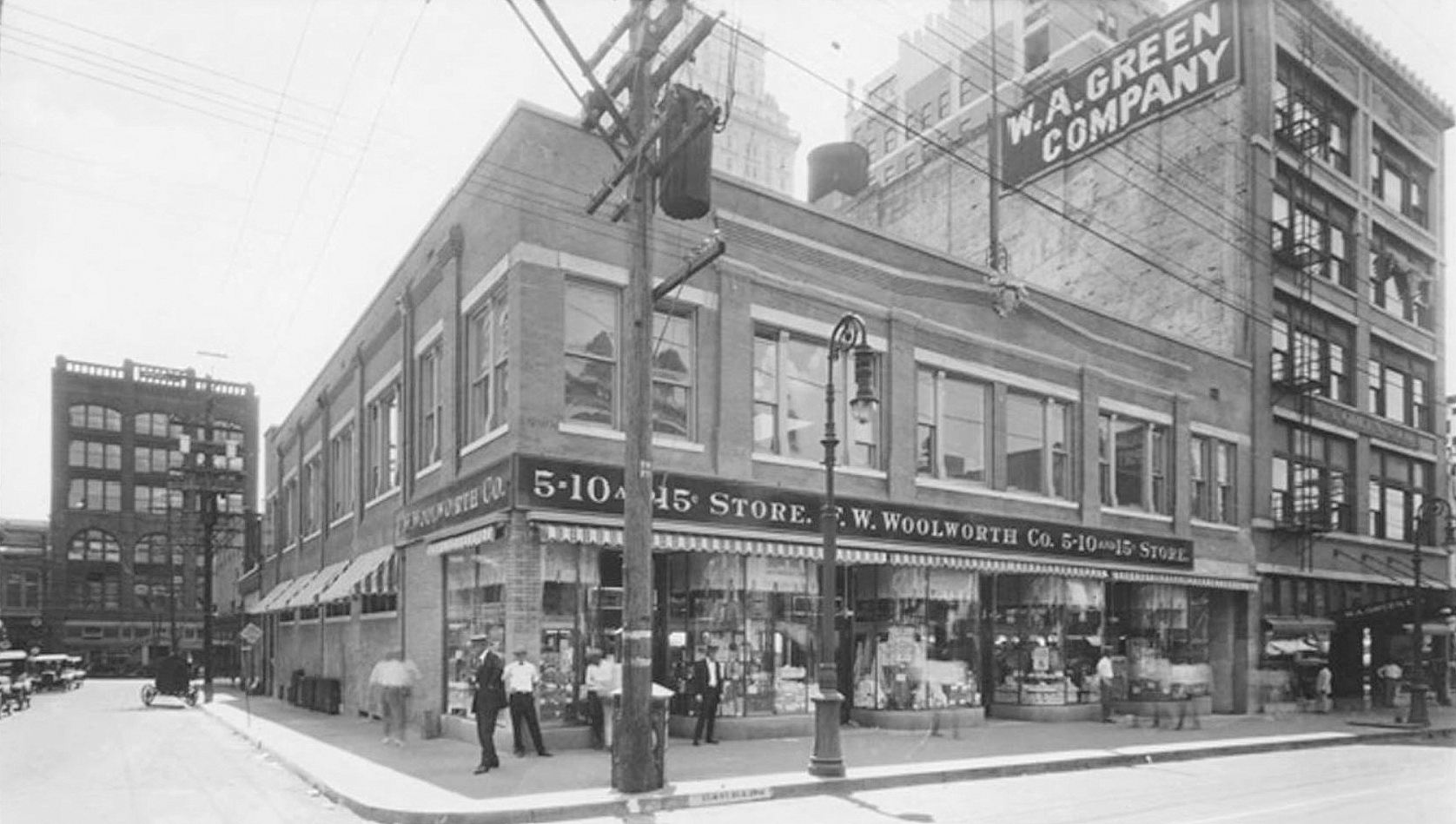
This pleasant photo was taken at Elm and Stone streets. On the left, straight ahead is the Juanita Building (later the Deere Building), on Main Street, and, on the right, the Woolworth and W. A. Green buildings (the latter two are still standing).
I’m quite taken with that lamp post. (See the same type of lamp post in two other photos of Elm Street here.)
This photo is from the George Andrew McAfee Collection at the DeGolyer Library, Southern Methodist University; more information about the photo can be found here. SMU’s descriptive title is: “F. W. Woolworth Company Store, 1520-1524 Elm Street, W. A. Green Company, 1516-1518 Elm Street Looking South at Intersection of Elm and Stone, Praetorian Building at Far Left, Deere Building at 1528-1530 Main (Six-Story Building) Is Visible at South End of Stone Street, Deere Building (Formerly Juanita Building), circa 1920.” (I have inadvertently cropped off the very edge of the Praetorian Building.)
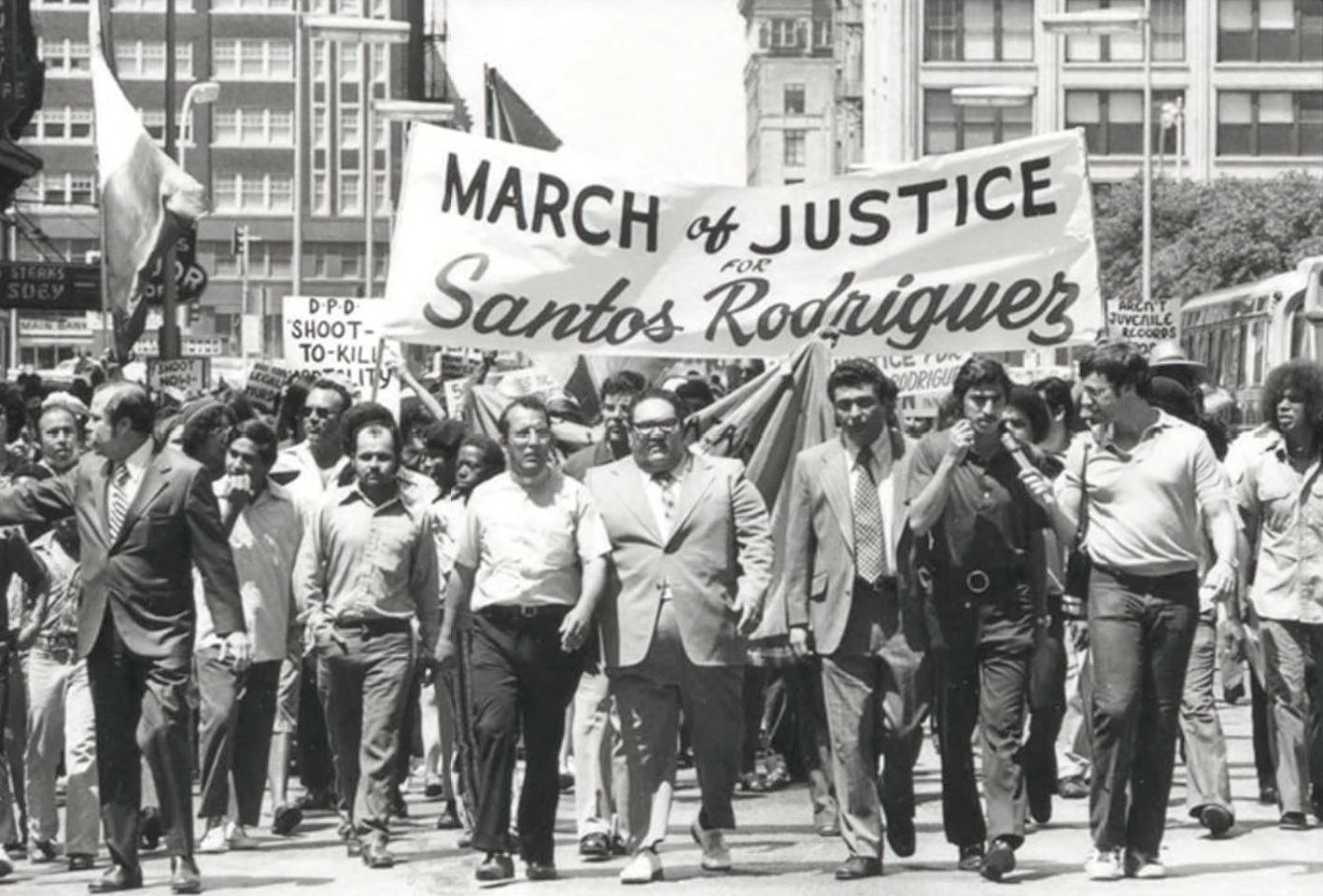
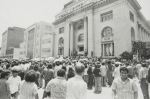
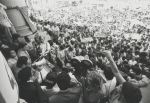
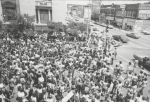
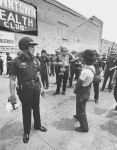
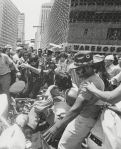
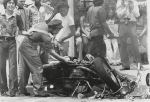
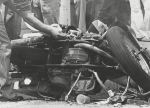
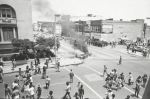
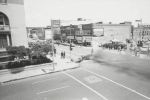
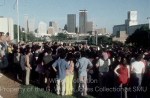
The March of Justice, July 28, 1973… (photo: Andy Hanson / SMU)
by Paula Bosse
In the wee hours of the morning of Saturday, July 24, 1973, 12-year-old Santos Rodriguez — who was handcuffed in the front seat of a police car — was shot in the head by a Dallas police officer attempting to coerce a confession in a deadly game of Russian roulette. Santos died instantly, as his 13-year-old brother — also handcuffed — watched in horror from the back seat. The shooting (which I wrote about here) set off an explosion of outrage in Dallas, with the bitterest and angriest coming from the Mexican American community.
Four days after Santos was killed, a “March of Justice for Santos Rodriguez” was scheduled to be held in downtown Dallas, beginning at the Kennedy Memorial and ending at City Hall (the old Municipal Building, at Main and Harwood). The event was to be a peaceful march to show the solidarity of the Hispanic community and to protest what many felt was racial prejudice within the Dallas Police Department.
The march down Main Street to City Hall was earnest, and the speeches at City Hall by Dallas activists and concerned civic leaders were impassioned calls to action. After the speeches, many of the marchers headed back to the Kennedy Memorial. About halfway back, they encountered another group of marchers.
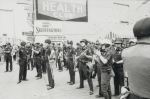
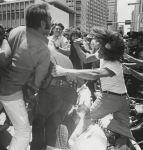
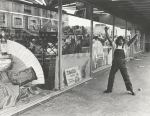
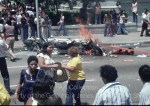
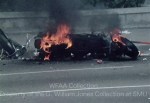
At some point, various groups described as “outside agitators” arrived. While the first crowd was listening to speeches at City Hall, a second (and perhaps later even a third) group of protestors assembled and began their own march to City Hall. These new arrivals (many said to be from Fort Worth and Waco) appear to have been the spark that set off what has been described as a “riot,” which erupted back at City Hall, with protesters attacking the police (who had been ordered to refrain from retaliation), breaking windows, and looting several downtown businesses. The image most emblematic of the day was a burning police motorcycle lying in the street just outside City Hall.
…[A]ll was havoc. A motorcycle was burning, a news vehicle was smashed, several officers injured and the sound of shattering glass filled the street… [T]he stench of burning rubber filled the air.” (“Police Taunted By Crowd” by Mitch Lobrovich, Dallas Morning News, July 29, 1973)
Luckily, there were few injuries, and the crowd dispersed after less than an hour.
A couple of days after the protest, the Rodriguez family issued this statement:
The Rodriguez family would only ask that when the people of Dallas hear the name Santos Rodriguez they think not of the unwanted violence that became associated with his name Saturday; but they think of the real Santos Rodriguez, a gentle and well-liked 12-year-old boy who had his life tragically taken from him.
*
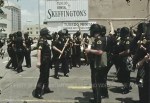
Below (and above), photos taken that day by Dallas Times Herald photographer Andy Hanson which were recently unearthed by curator Anne Peterson, from the collection of his photographs at SMU’s DeGolyer Library:
**
The only footage I’ve found of the actual march is this video, uploaded recently to YouTube by Mountain View College. It was apparently shot by a Dallas police officer. There is no sound. This is great. Thank you, Mountain View, for preserving this important historical moment.
* ***
Sources & Notes
Photos taken by Andy Hanson on July 28, 1973; from the Collection of Photographs by Andy Hanson, DeGolyer Library, Southern Methodist University. See the rest of the photos from this day, here. (Note: this does not appear to be the entirety of Hanson’s photos taken that day.) Read about the full Andy Hanson Collection at SMU, here.
Read “Honoring Santos Rodriguez” by Anne E. Peterson, Curator of Photographs at the DeGolyer Library (and the person who unearthed these Andy Hanson photos), here.
The YouTube video is titled “Santos Rodriguez 1973 News Footage,” with the description “Rare news footage taken during the 1973 protests in downtown Dallas following the tragic shooting death of 12 year old Santos Rodriguez by a Dallas Police officer. No audio.” I’d like to know more about the story behind this footage.
The coverage of the march(es) and ensuing riot is confusing. A couple of months after the march, Jose Antonio Gonzales wrote a fascinating and (seemingly) comprehensive report for The Fort Worth Star-Telegram on how the events developed and unfolded, with an almost moment-by-moment timeline and insight into the individuals involved. Read his fantastic job of reporting in the (awkwardly-titled) article “Chicano Leadership Unity Faulted in Study of Boy’s Death” (FWST, Sept. 16, 1973): part one is here; part two is here.
My previous post on Santos Rodriguez — “Santos Rodriguez, 1960-1973” — is here.
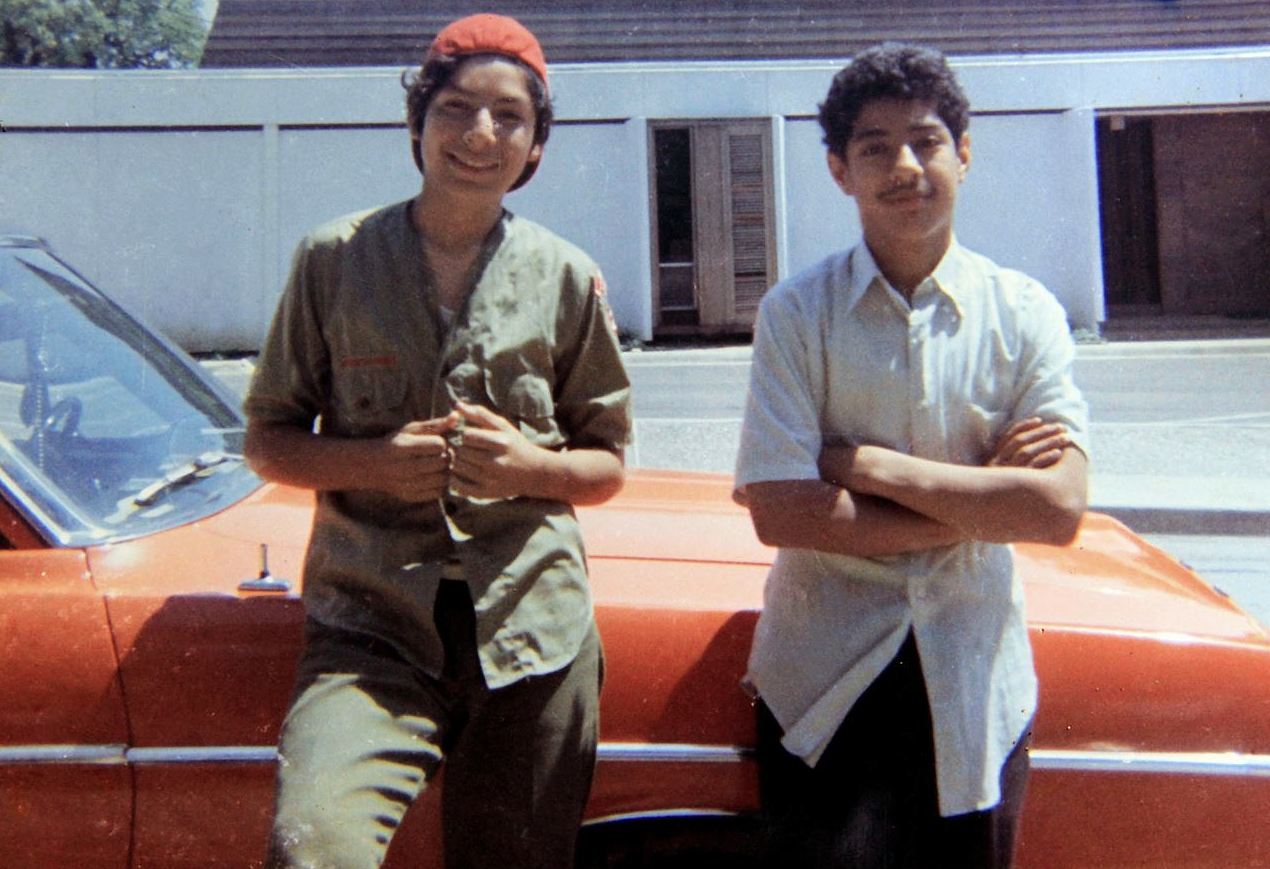
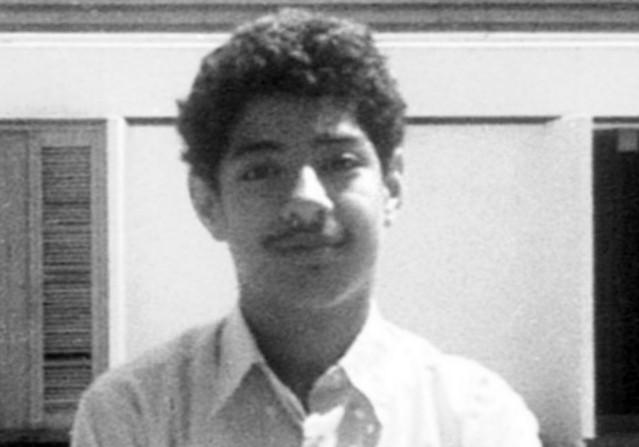
David and Santos Rodriguez (via Austin American-Statesman)
by Paula Bosse
Today is the anniversary of the tragic shooting of Santos Rodriguez, the 12-year-old boy who, on July 24, 1973, was shot in the head by a policeman as he and his 13-year-old brother David sat handcuffed in a police car. It shocked the city of Dallas in 1973, and it is still shocking today.
Santos and David had been awakened and rousted out of bed by Officers Darrell L. Cain and his partner Roy R. Arnold who were investigating a late-night burglary at a nearby gas station where money had been stolen from a cigarette machine — the boys matched a witness’ vague description. The boys said they had nothing to do with the burglary but were taken from their home as their foster-grandfather (an elderly man who spoke no English) watched, helpless, as they were handcuffed and placed in a squad car.
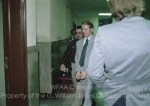
The boys were driven back to the scene of the burglary — a Fina station at Cedar Springs and Bookhout. Santos was in the front passenger seat, and Cain sat behind him in the backseat, next to David. Cain insisted the two boys were guilty and, in an attempt to coerce a confession, held his .357 magnum revolver to Santos’ head. He clicked the gun, as if playing Russian Roulette, telling Santos that the next time he might not be so lucky. The boys continued to insist they were innocent. And then, suddenly, Cain’s gun went off. Santos died instantly. Stunned, Cain said that it had been an accident. He and Arnold got out of the car, leaving 13-year-old David, still handcuffed, in the backseat of the police car — for anywhere from 10 minutes to half an hour — alone with his brother’s bloody body. (It was determined through fingerprint evidence that Santos and David did not break into the gas station that night.)
More in-depth articles about this horrible case can be found elsewhere, but, briefly, Cain (who had previously been involved in the fatal shooting of a teenaged African American young man named Michael Morehead) was charged with committing “murder with malice” and was found guilty. He was sentenced to 5 years in prison but ended up serving only two and a half years in Huntsville.
The killing of Santos Rodriguez sparked outrage from all corners of the city, but particularly in the Mexican American community. All sorts of people — from ordinary citizens to militant Brown Berets — organized and protested, persistently demanding civil rights, social justice, and police reform. If anything positive resulted from this tragic event, perhaps it was a newly energized Hispanic community.
**
I am ashamed to say that I was not aware of what had happened to Santos Rodriguez until I began to write about Dallas history a few years ago. This was an important turning point in the history of Dallas — for many reasons (namely in the Chicano movement, race relations, the fight for social justice, and an examination of Dallas Police Department procedure). Over the past week I’ve read a lot of the local coverage of the events of this case, and I’ve watched a lot of interviews of people who were involved, but perhaps the most immediate way I’ve experienced the events and emotions swirling about this case has been to watch television news footage shot as the story was unfolding. Thanks to the incredibly rich collection of TV news footage in the possession of the G. William Jones Film & Video Collection at SMU, I’ve been able to do that.
Below is footage shot by KDFW Channel 4, which has, most likely, not been seen since 1973. Some of it appeared in news reports, and some is just background B-roll footage shot to be edited into news pieces which would eventually air on the nightly news. The finished stories that aired do not (as far as I know) survive, but we have this footage. It’s choppy and chaotic and darts from one thing to the next, which is how a red-hot news story develops. Of particular interest is the short interview with 13-year-old David at 9:16 and the violent aftermath of what began as a peaceful march through downtown at 19:54.
A more comprehensive collection of the events — from just hours after the shooting to the conviction of Darrell Cain — can be found in this lengthy compilation of WFAA Channel 8 news footage. This and the Channel 4 footage are essential sources.
*
Santos Rodriguez (Nov. 7, 1960 – July 24, 1973)
***
Sources & Notes
Top photo is a family photo, from the Austin American-Statesman article “Is It Time for Dallas to Honor Santos Rodriguez?” by Gissela Santacruz, here.
My sincerest thanks to Jeremy Spracklen at SMU for alerting me to these two collections of important historical news footage from KDFW-TV/Ch. 4 and WFAA-TV/Ch. 8, both of which are held by the G. William Jones Film & Video Collection, Hamon Library, Southern Methodist University. (All screenshots are from these two videos.)
An excerpt from the 1982 KERA-produced documentary “Pride and Anger: A Mexican American Perspective of Dallas and Fort Worth” (the Santos Rodriguez case is discussed) is on YouTube here.
“Civil Rights in Black & Brown” is a fantastic oral history project by TCU. I watched several of the interviews focusing on Santos Rodriguez, but I was particularly taken with the oral history of Frances Rizo — her 2015 interview is in two parts, here and here.
More on the events surrounding the killing of Santos Rodriguez can be found at the Handbook of Texas History site, here.
My continuation of this story can be found at the Flashback Dallas post “Santos Rodriguez: The March of Justice” — 1973,” here.
Lordy, it was hot today. At one point I looked at my phone and it told me it was 112° (but thanks to the chill factor, it felt like a refreshing 110°). It’s 10:00 p.m. and it’s 100°. That’s too many degrees.
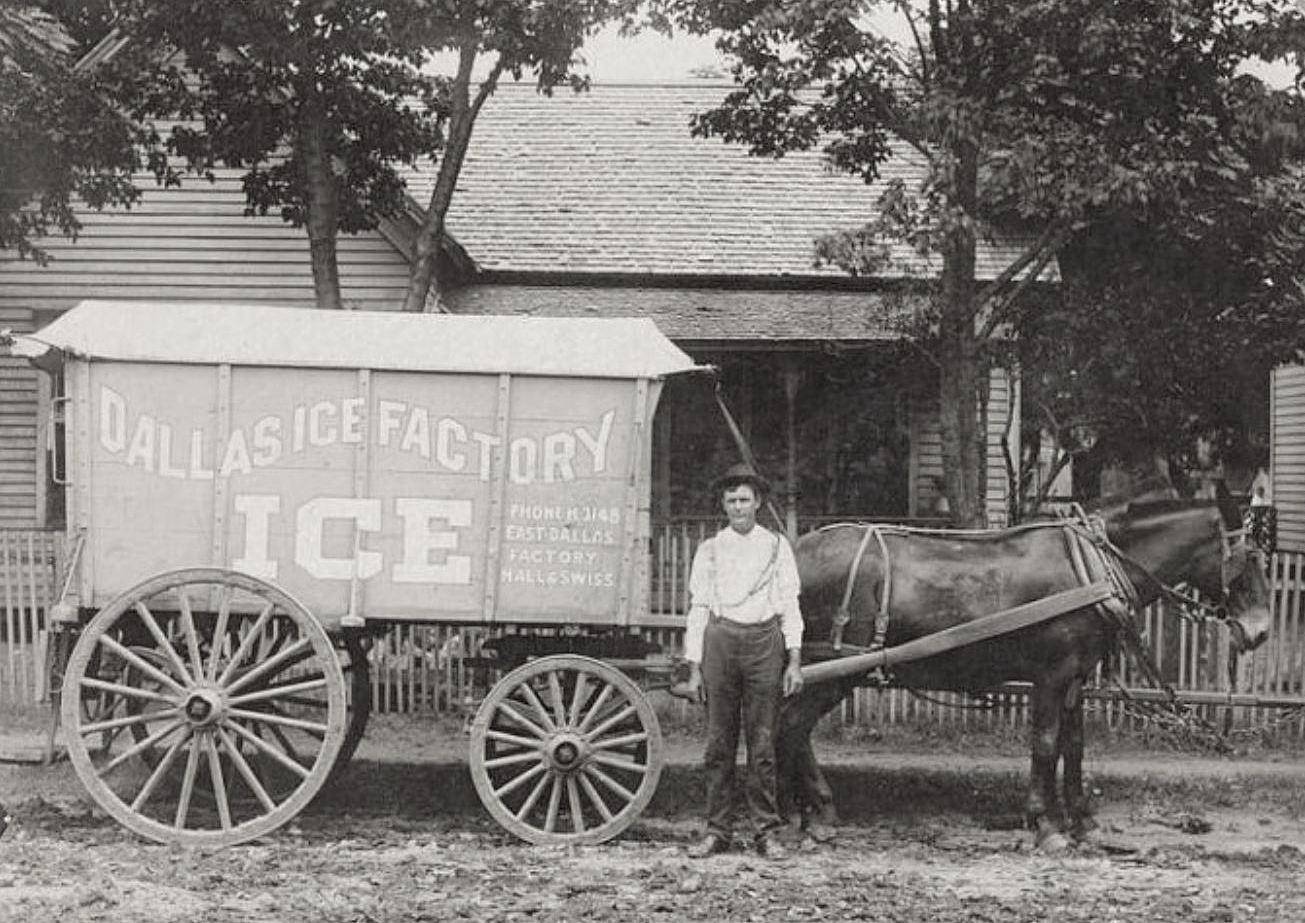
Above is a photo of a horse-drawn Dallas Ice Factory wagon and its driver. There was probably ice in there.
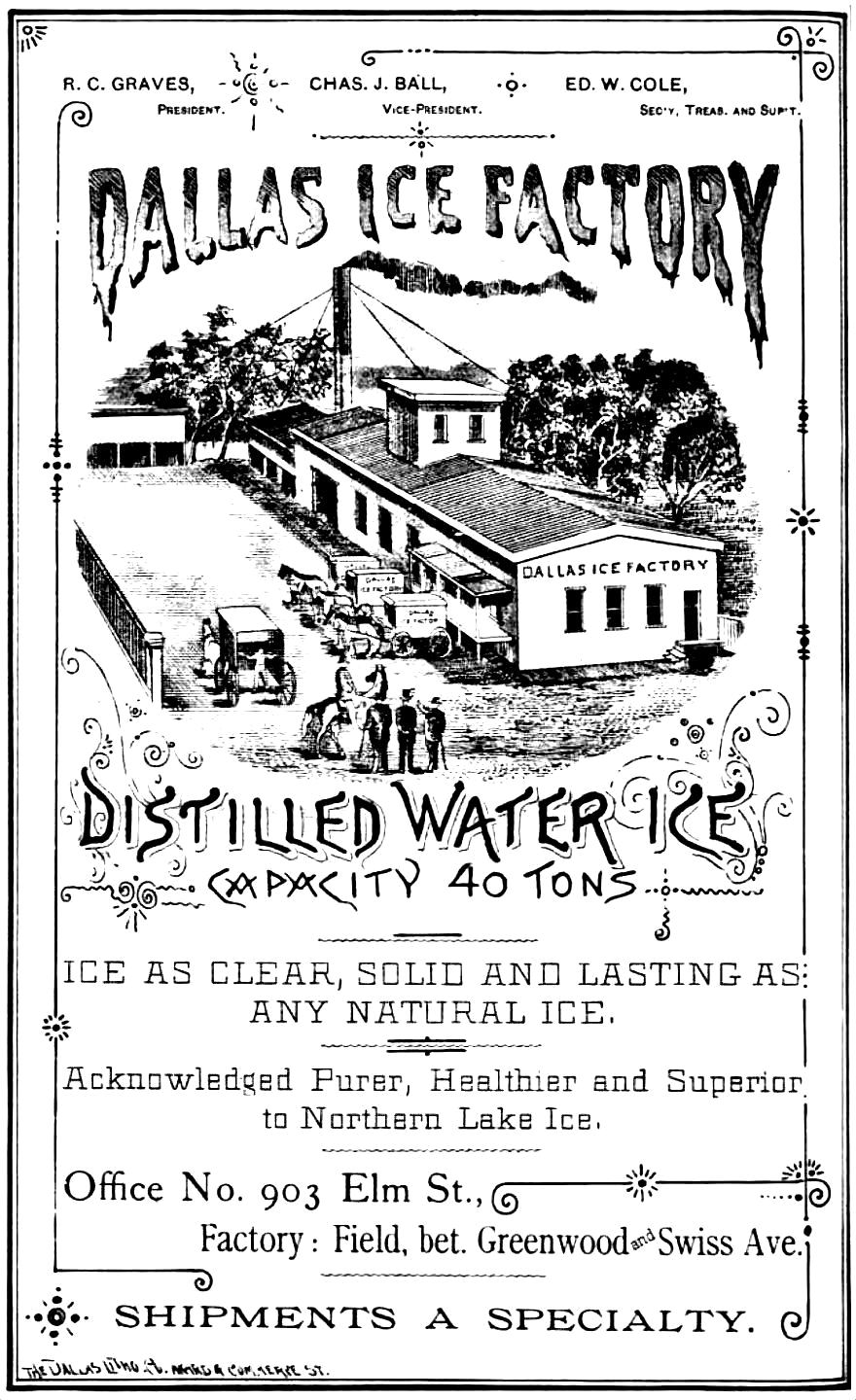
Here’s an ad from 1888 showing the factory:
1888 Dallas directory
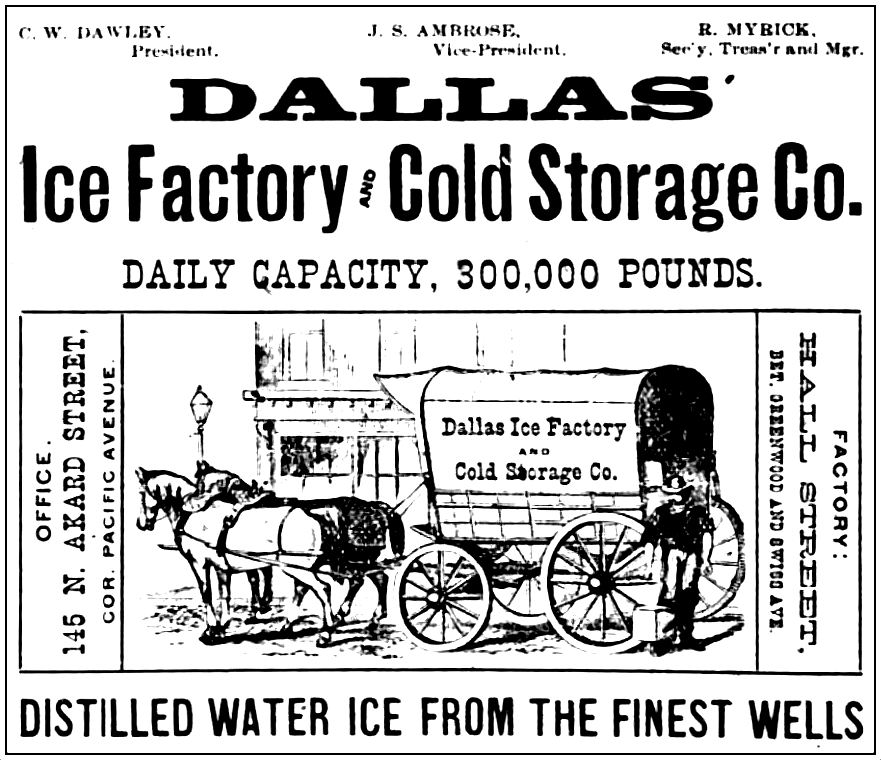
Here’s an ad from 1894 not showing the factory:
1894 Dallas directory
Here’s a link to an 1899 Sanborn map showing you where the Dallas Ice Factory was located (in Old East Dallas, at Swiss and Hall): link.
That’s about all I can muster. It’s too dang hot.
***
Sources & Notes
Photo from a 2011 eBay listing, reproduced in The Dallas Observer by Robert Wilonsky; now owned by Peter Kurilecz.
Ads from Dallas directories.
Heat from the sun.
And here’s an ice-factory-related post I actually did some work on, when I wasn’t feeling like a sweaty, limp dishrag (…a long, long time ago…): “Oak Lawn Ice & Fuel Co.”
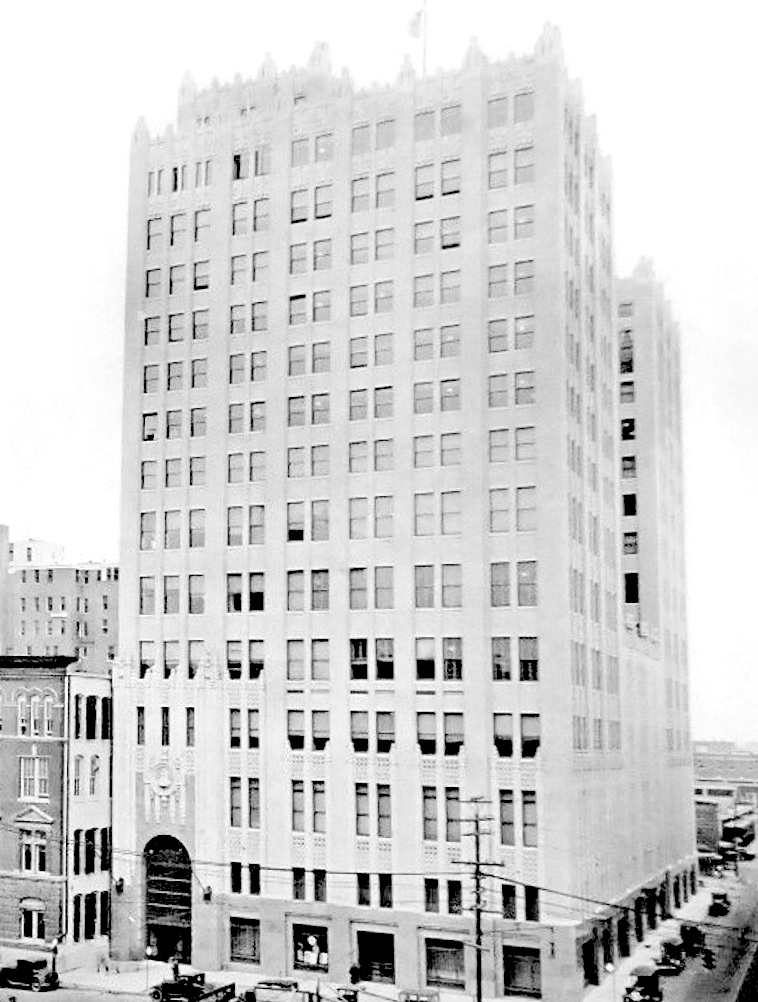
Above, the beautiful new Southwestern Bell Telephone Company building, photographed not long after its opening at the end of 1928. Designed by noted Dallas architects Lang & Witchell (in association with Southwestern Bell’s chief architect I. R. Timlin) the building took up almost an entire block on the east side of South Akard, between Jackson and Wood streets. Construction began in April 1927, and the building was finished and occupied in December 1928. It served as a regional hub, containing not only business offices, but also cumbersome telephone equipment which necessitated very high ceilings on some of the floors. (There were also downtown and suburban telephone exchanges which handled local calls, as well as the Haskell exchange which was handling long-distance traffic.)
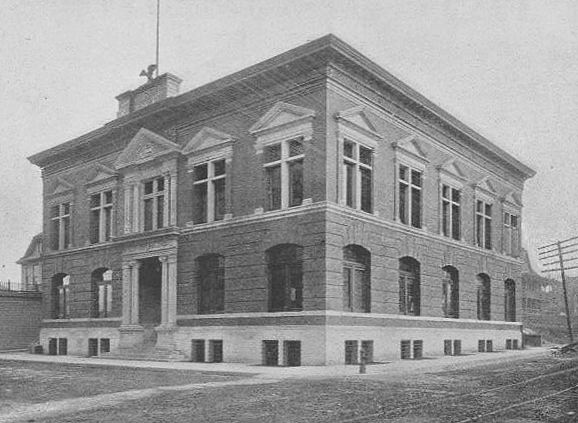
The photo above is interesting because it shows part of the building which this new “skyscraper” replaced. Designed by H. A. Overbeck, the previous telephone HQ (seen below sometime before 1899) was built on the corner of Akard and Jackson in 1897.
Here’s the same building in about 1905, with a couple of floors added:
The plan was to maintain the smaller building during the construction of the new building in order that operations would not be interrupted, then demolish it at a later date when expansion would take place. When construction of the new building was completed, the smaller building served primarily as the downtown exchange.
In 1929/1930, S. Akard was widened, which necessitated the condemnation or moving of several existing structures. Luckily, the new telephone building had been built far enough back from Akard to dodge any problems, but the smaller telephone building would have to be moved or demolished — it was moved: Southwestern Bell moved the 4-story, 4,200-ton building 18 feet eastward, at a cost of more than $75,000 (more than a million dollars in today’s money). The planning took six months, with elaborate schemes involving wooden cribbing, steel rods, jacks, rails, slackened power and telephone cables, and flexible joints for water mains. The actual move took 36 hours and was “so gradual that the workers inside [were] unaware of it” (Dallas Morning News, Aug. 18, 1929). There was no interruption of telephone service during this costly relocation. Quite a feat!
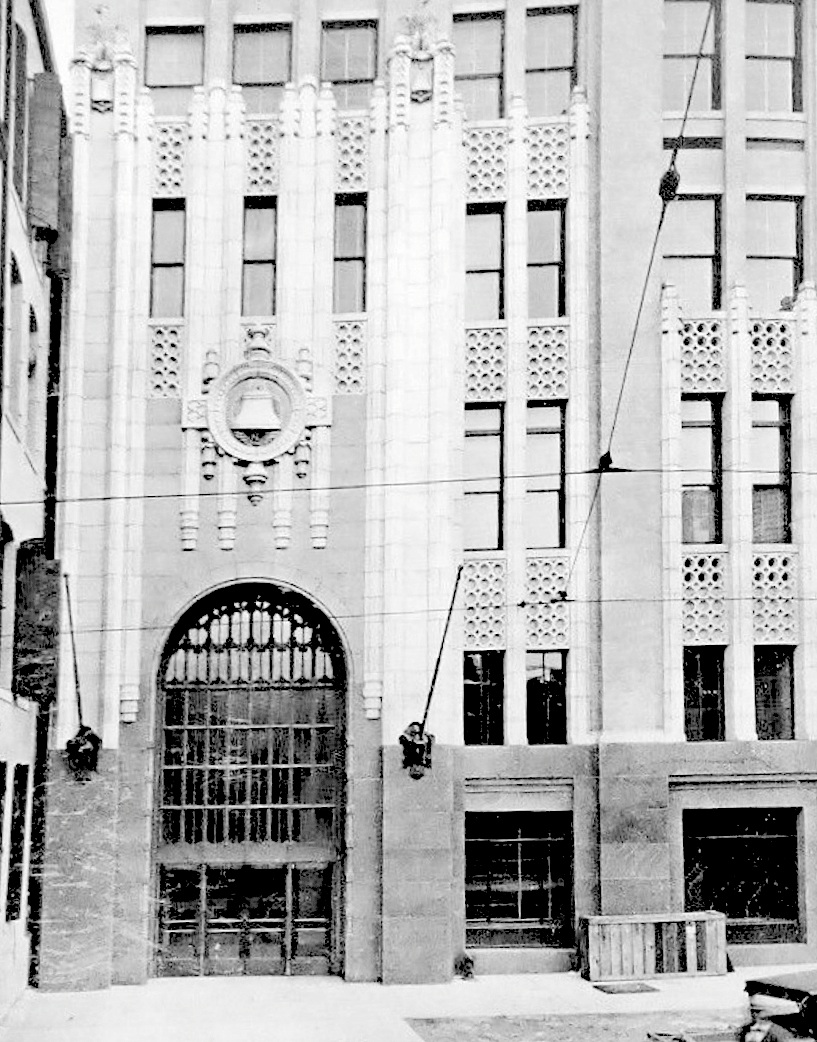
The building still stands — in amongst the humongous AT&T complex, but, sadly, one of the original features of the building is long gone: a large, ornate “bell” above the grand entrance (an entrance which is no longer quite so grand). Wonder what happened to it?
Below are a couple of other photos of the brand-new building, from a promotional booklet by the Atlantic Terra Cotta Co. The top photo had the following caption: “A most successful example of modern design in Atlantic Terra Cotta. The detail is carefully scaled and the design has the freshness of originality. Terra Cotta is light gray containing particles of mineral oxide and with an unglazed surface, a color and finish of particular character.”
“The main entrance shows an unusual and effective combination of Terra Cotta and granite. The bell design gives an appropriate and original touch.” (Click pictures to see larger images.)
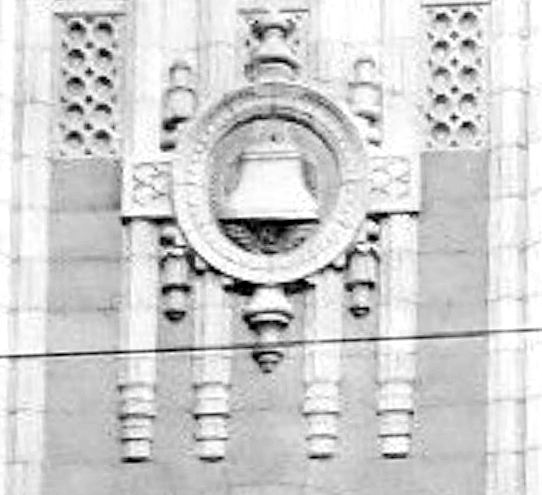
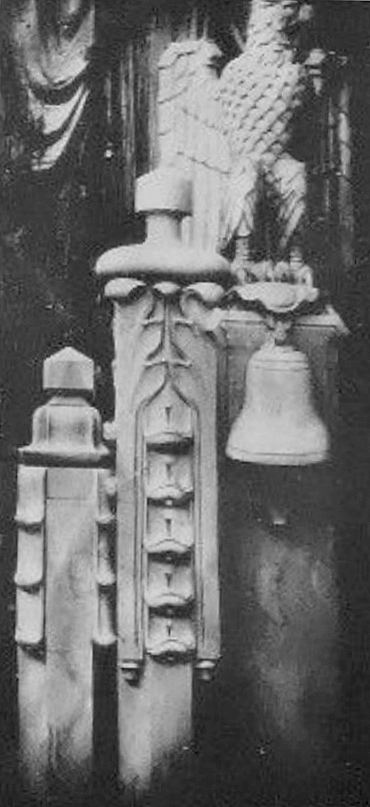
“The court of the Telephone Building for four stories is faced entirely with Atlantic Terra Cotta. A bell, guarded by a strongly modeled eagle, tops each pier.” I believe this is the Wood Street side — after many expansions and renovations, these details no longer remain. The bells and eagles are difficult to make out in this photo — here is a photo of the terra cotta company’s “shop model”:
Above, a postcard showing the S. Akard entrance, with Wood Street on the right. The only things still immediately recognizable about Lang & Witchell’s beautiful building are the repeating circular elements, the “court” along Wood, and the granite facing that wraps around the exterior of the ground floor. So much of the decorative detail is gone. No more bells, no eagles, no flash, no filigree. I hope the building’s interior decor has fared a bit better.
**
Added: In response to the comment below by elmwoodhobo, I thought I should add a tiny bit about a pertinent later razing, addition, and expansion.
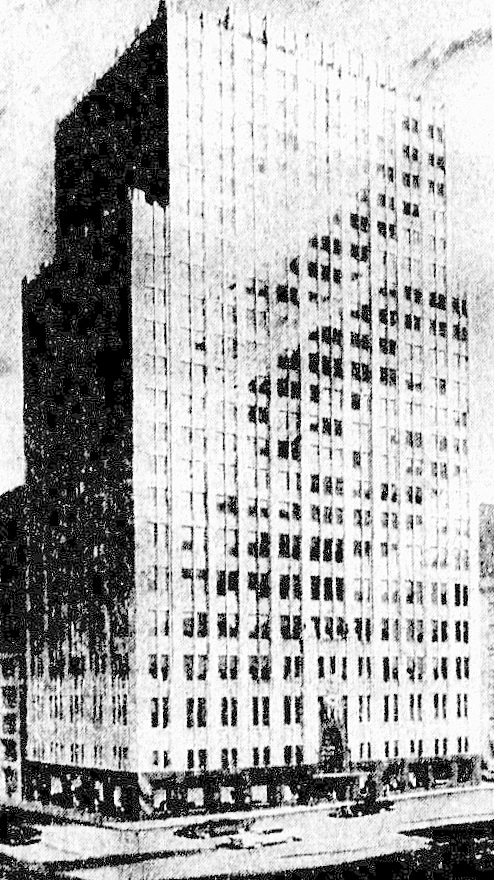
In May 1961 the old, 4-story telephone building, built in the 1890s at the corner of S. Akard and Jackson, was finally demolished to make way for a new 23-story addition to the SWB building. This addition was finished in 1963 (possibly 1964), substantially increasing the footprint of the Southwestern Bell headquarters. Square footage was further increased by the concurrent construction of eight new stories built atop the 1928 Lang & Witchell building. Below are drawings showing the original 1959 rendering by the architectural firm of Thomas, Jameson and Merrill, as well as an updated vision from January 1962, as construction was underway. A lot changed in those couple of years. (Click to see larger images.)
1959
1962
***
Sources & Notes
Top photos are from a promotional booklet titled Atlantic Terra Cotta (Vol. X, No. 3, June 1929), which features tons of cool photos of then-recent buildings constructed with that company’s product (including San Antonio’s stunning Smith-Young Tower — now the Tower Life Building — which I have to admit I’d never heard of). These photos were found on an eBay listing, and their quality is not the greatest, but I’ve never seen them, and this is just a small attempt to preserve them for posterity.
Photo of the original Southwestern Bell Building (2 stories) is from an ad in the Dallas Fire Department (1899) book — see the full ad in the book, scanned at the Portal to Texas History, here.
Photo of the original Southwestern Bell Building (4 stories) is from a promotional booklet titled Come To Dallas (Dallas: Dorsey Printing Co., ca. 1905); more info on this booklet (held by the DeGolyer Library, Southern Methodist University), is here.
A Google Street View here shows the building these days. It’s still standing — which is great — but its entrance has definitely lost most of its original grandeur.
More Flashback Dallas posts on Southwestern Bell doings:
Photo by Squire Haskins, 1963 (UTA Libraries, Special Collections)
by Paula Bosse
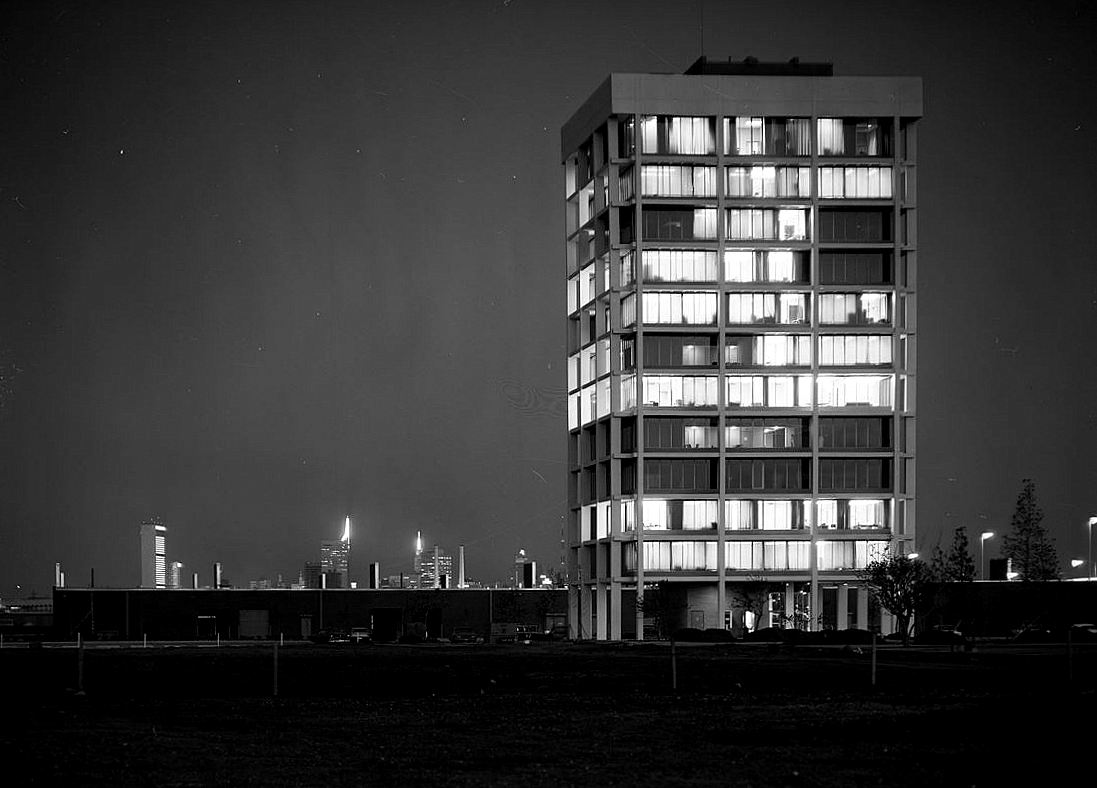
Another fantastic photo from premier Dallas photographer, Squire Haskins: the new Stemmons Tower (East), with the Dallas skyline serving as a dramatic nighttime backdrop. (See this photo really big at the UTA website, here.)
***
Sources & Notes
“Stemmons Tower with downtown Dallas, Texas in the background; photo taken at night,” by Squire Haskins, taken on April 19, 1963; from the Squire Haskins, Inc. Photography Collection, University of Texas at Arlington Libraries, Special Collections (more info on this photo can be found here).
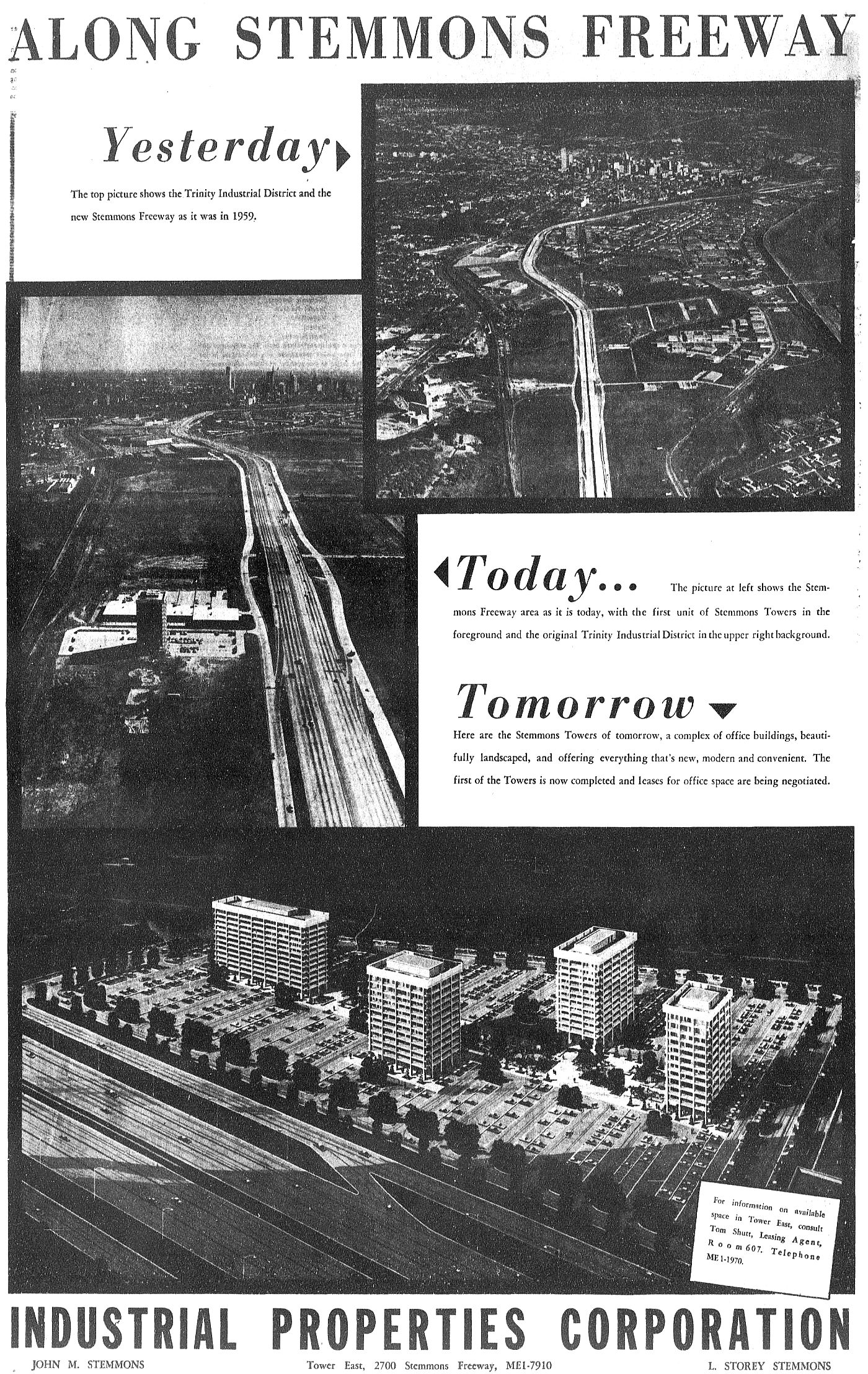
The first of several “towers,” construction of Trammel Crow’s Stemmons Tower East began in the summer of 1961 and was open and leasing by December 1962. This office complex was part of the grand vision of the Trinity Industrial District and the “Stemmons corridor” (click ad below to see a much larger image).
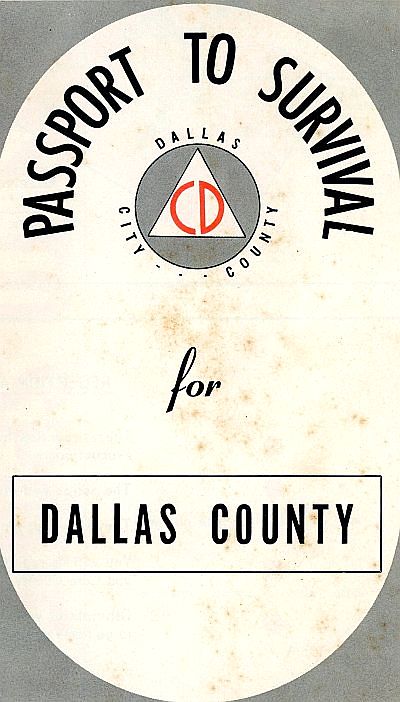
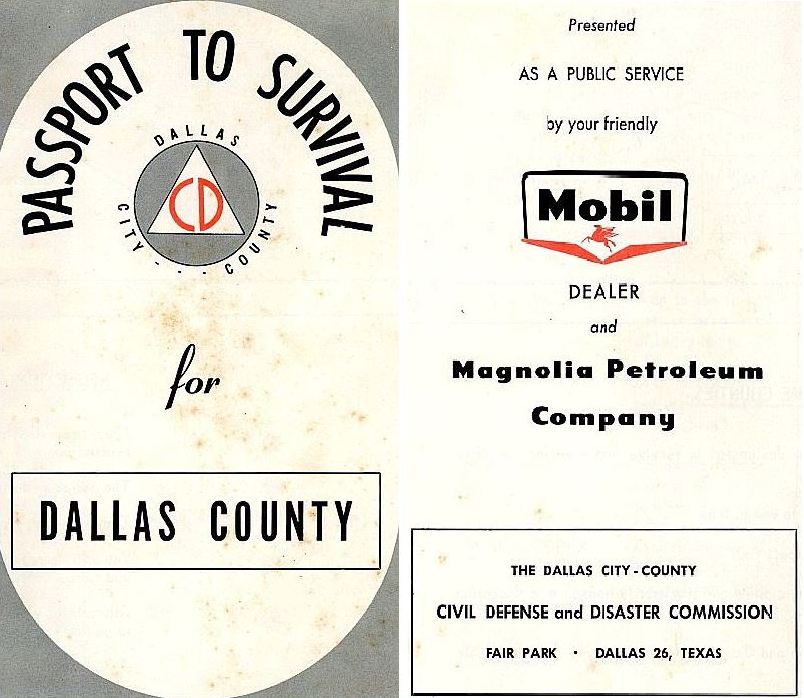
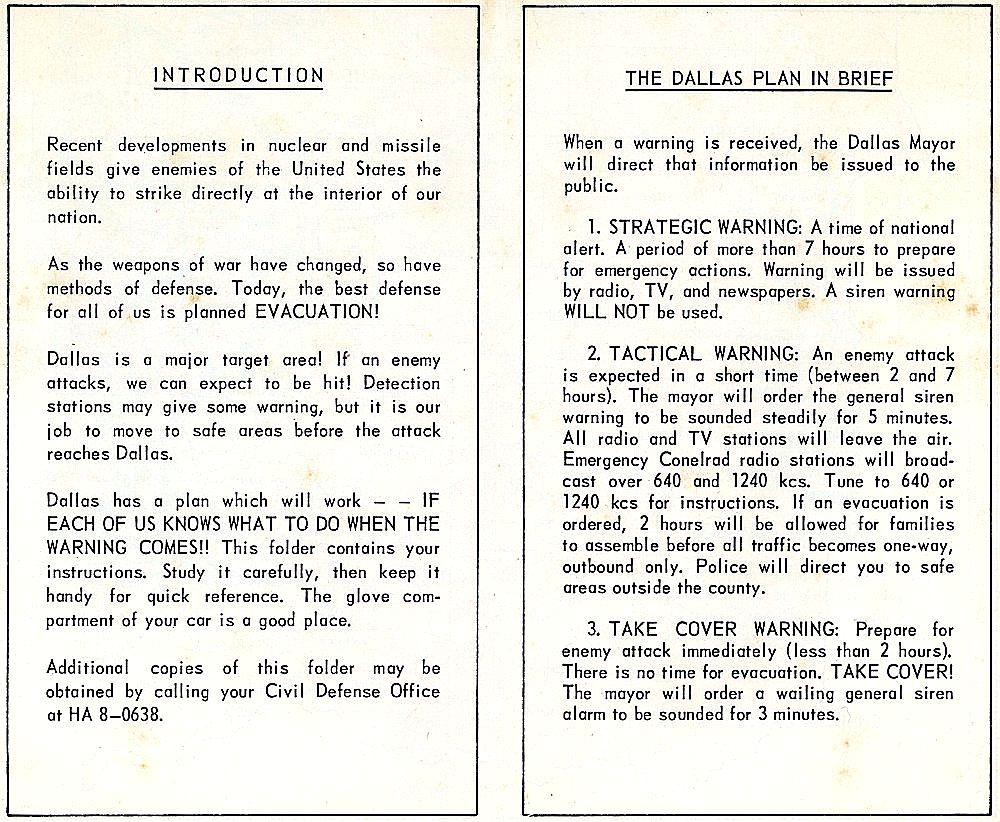
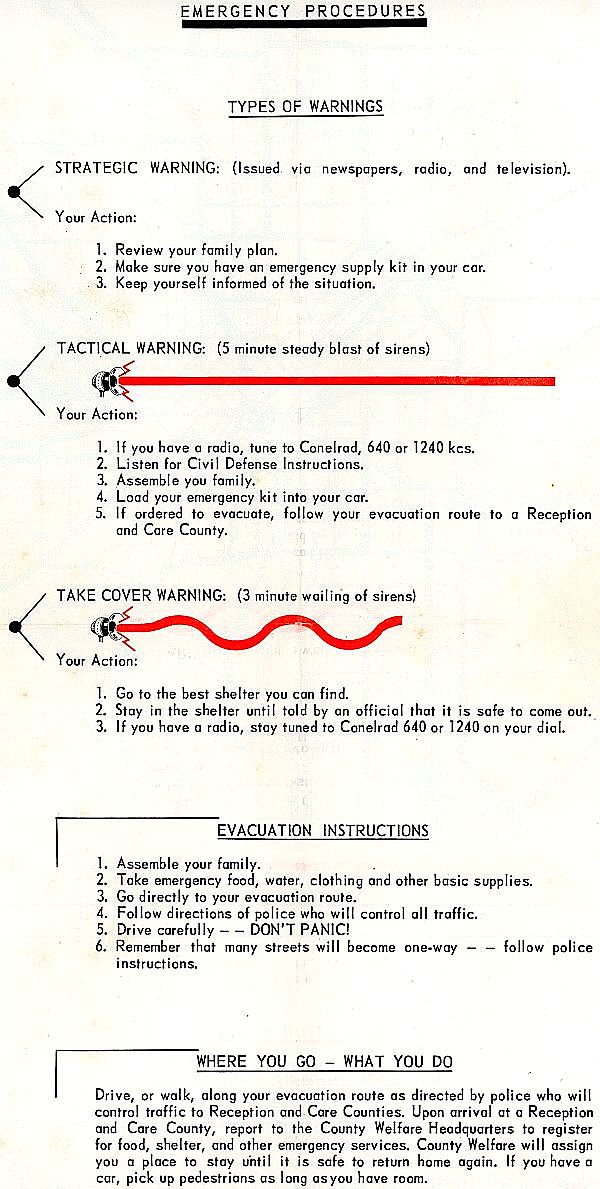
During the Cold War, the fear of nuclear attack was very real in the United States, reaching its peak of anxiety in the late 1950s and early 1960s. In 1958, the Dallas City-County Civil Defense Commission published a free informational pamphlet titled Passport to Survival, which contained evacuation maps for Dallas County, preparation tips, an emergency supply checklist, etc. Though the information contained in this publication could be applied to any disaster or emergency (nuclear-based or otherwise), it was printed a time when visions of Soviet atomic bombs were dancing in the heads of many concerned Americans. And this mild-mannered-looking pamphlet made sure you, Mr. and Mrs. Dallas County, knew that it was talking about a potential direct strike by nuclear missiles: “DALLAS IS A MAJOR TARGET AREA!” (See images from this pamphlet at the end of this post.)
The arrival of Passport to Survival (“presented as a public service by your friendly Mobil dealer and Magnolia Petroleum Company”) was heralded by a newspaper ad in November, 1958 (its eye-catching “DISASTER CAN HIT DALLAS!” artwork is seen above). (The full ad — with an exhortative letter by Commission chairman John W. Mayo, addressed to the people of Dallas — can be seen here.) I’m not sure how much “survival” there would be in case of a nuclear attack, but, like a good Boy Scout, one should at least be prepared.
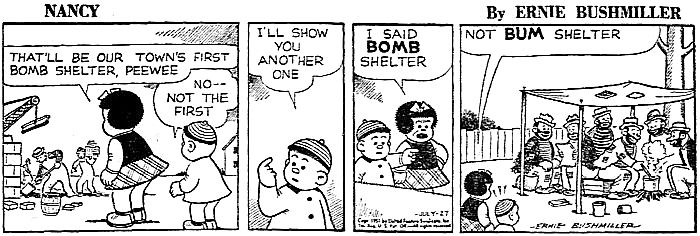
Backyard bomb shelters were necessary in Britain during World War II and saved countless lives during the almost nightly German air raids (I wrote about these shelters on another blog, here), but it was a new concept to post-war America. It wasn’t long, though, before bomb shelters became all the rage in the early ’50s as the Cold War heated up. If it’s becoming a common reference-point on the country’s funny-pages, it’s hit mainstream acceptance.
“Nancy” by Ernie Bushmiller, July 27, 1951
I’m not sure how many people were building these shelters, but they were certainly talking about them. When Highland Park Village announced their new underground parking garage in 1953, owners Flippen-Prather made sure to note that the two subterranean parking levels (the lowest of which was 20 feet below street level) would not only accommodate 300 vehicles, but, if needed, it could serve as a bomb shelter for 3,500 very well-dressed Park Cities residents seeking refuge.
But what really caused the mania for nuclear fallout shelters to reach its zenith was the Bay of Pigs Invasion in April of 1961. In May, 1961, ground was broken for construction of the $180,000 Civil Defense Emergency Operating Center at Fair Park (the first such center in Texas), adjacent to the Health and Science Museum. The underground bunker was to serve as a government operating and communications center for Dallas County in the event of a nuclear attack or natural disaster. It would house about 30 people (which would include the mayor and other city officials) and would be stocked with provisions for 14 days. It had its own water supply, electric generators, radios, and telephones. It was built to withstand a 20-megaton nuclear blast three miles away (i.e. downtown, where, presumably, the mayor and other city officials would be working when the 20-megaton bomb lit up Big D). When not in use as a shelter, it was to be maintained by the Health and Science Museum staff, and operated as a center for survival training. For many years it was open to the public, seven days a week. (It’s worth noting that the Civil Defense headquarters in Dallas was also located in Fair Park, at the building housing radio station WRR.)
The man behind the everything-you-need-to-know-about-Civil-Defense website CivilDefenseMuseum.com did a really interesting video walk-through of the surprisingly large decommissioned (if that’s the correct word to use here) Fair Park shelter in 2013:
*
1961 was THE year if you wanted to get into the bomb-shelter business. There was even a three-day “Fallout Survival Show” at Market Hall. You couldn’t open the pages of a magazine or newspaper without seeing ads for personal bomb shelters.
Some of the ads were kind of cozy:
Sept., 1961
Some were not:
Sept., 1961
Again, not all that many people were actually building them, but everyone was certainly talking about them. But in just a few short months … no one cared anymore. The ads disappeared. A lot of people who had been trying to sell them went broke. Those who survived (as it were) repurposed their products as “storm shelters” — turns out tornadoes were more of a pressing threat to Dallasites than Russian A-bombs.
Public shelters, however, didn’t disappear. In September, 1962, the very first public fallout shelter in Dallas was officially designated: the Southland Life Insurance Building could accommodate a staggering 30,000 people in the event of disaster. (The plan for this shelter was actually announced in 1954, and the Southland Center opened in 1959, but the official designation was not made until 1962.)
In 1966, Dallas had more than 300 official shelters, able to house 971,000 people:
…323 buildings in the city have been approved as shelters. The owners and managers of 204 of them have entered into agreements with the federal government and with the city to permit their use in emergencies as public shelters…. Shelters in Dallas can house 971,000 persons. Many of the buildings are permanently stocked with water, food supplies and medical supplies sufficient to sustain about 300,000 people for approximately two weeks. (“Maps at Fire Stations To Pinpoint Shelters,” Dallas Morning News, March 9, 1966)
Some of the permanent provisions kept in these places were water, food, “fortified crackers,” hard candy, bandages, iodine, and Geiger counters.
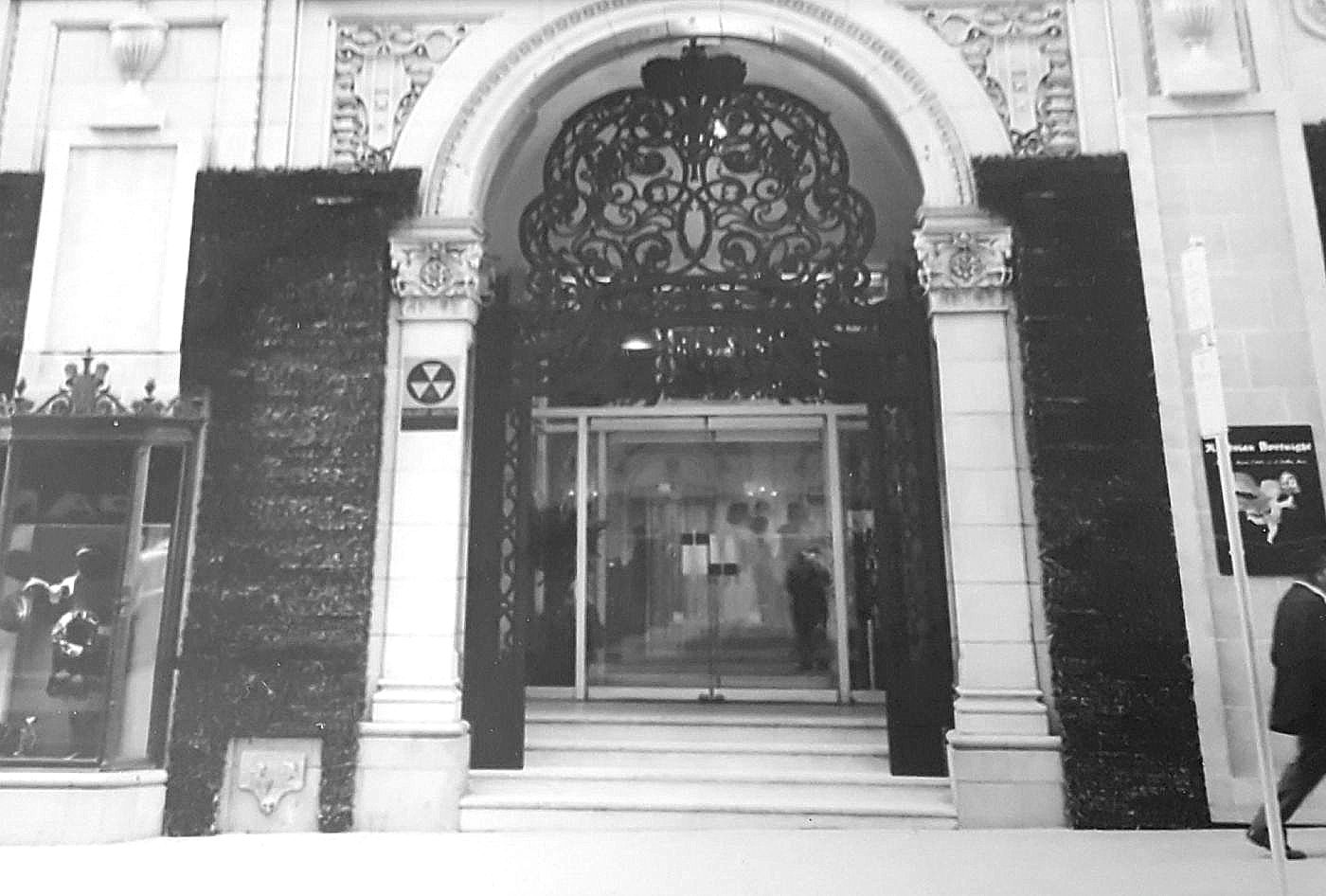
As one might expect, many of the city’s fallout shelters were in downtown buildings, their exteriors adorned with official Civil Defense signage. My favorite? Neiman-Marcus, of course, seen below in 1965, decorated for the Austrian Fortnight.
Neiman-Marcus, the most elegant bomb shelter in town…
If I were able to choose where to huddle during a nuclear attack, I think I’d choose Neiman’s. I’m sure Mr. Stanley made sure his basement was comfortable, tasteful, and well-appointed. …And one would have to expect he wouldn’t have had his guests living off hard candy and fortified crackers.
**
Below are images from the 1958 publication Passport to Survival (thanks to Jeff Hanning for his original scans, which precipitated this post) — all images are larger when clicked.
“Introduction” / “The Dallas Plan in Brief” (more information of CONELRAD is in this YouTube video):
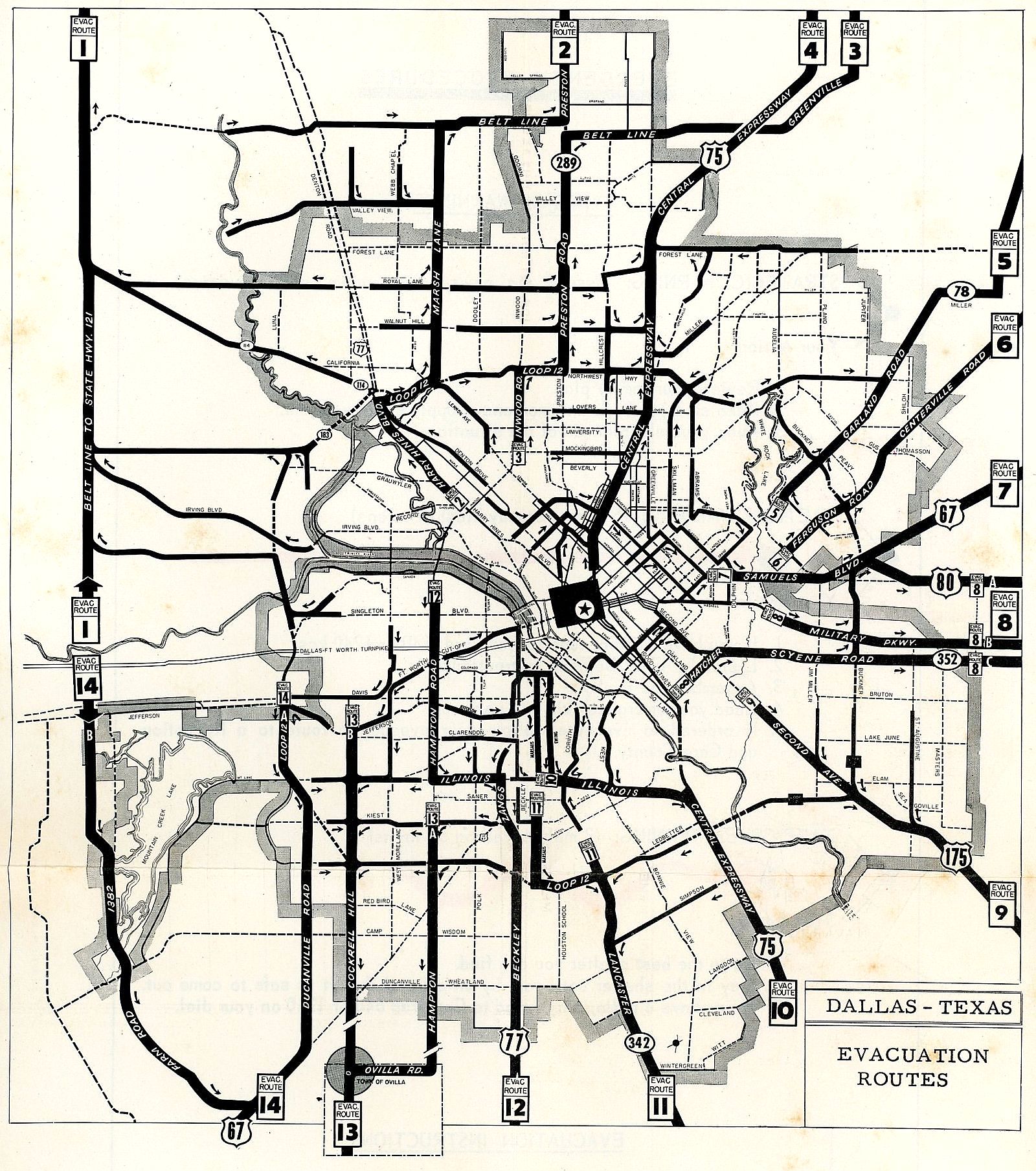
“Evacuation Routes.” (This plan did not sit well with the citizens of Grand Prairie as they were not included in the evacuation plans of either Dallas County or Tarrant County — this seems to have been a particularly odd oversight, seeing as Grand Prairie was a military aviation hub — home to Hensley Field and Chance Vought — and a likely target if DFW were attacked. As an editorial in the Grand Prairie Daily News-Texan stated somewhat bitterly: “Dallas seems to have it all sewed up.”) (Also interesting in these evacuation plans was that the county was divided into four divisions, the boundaries of which corresponded to school districts: District I covered the Dallas Independent School District, Division III covered the Highland Park Independent School District, District IV covered the “Negro Unit,” and District II covered every other school district in Dallas County not covered in the other divisions.)
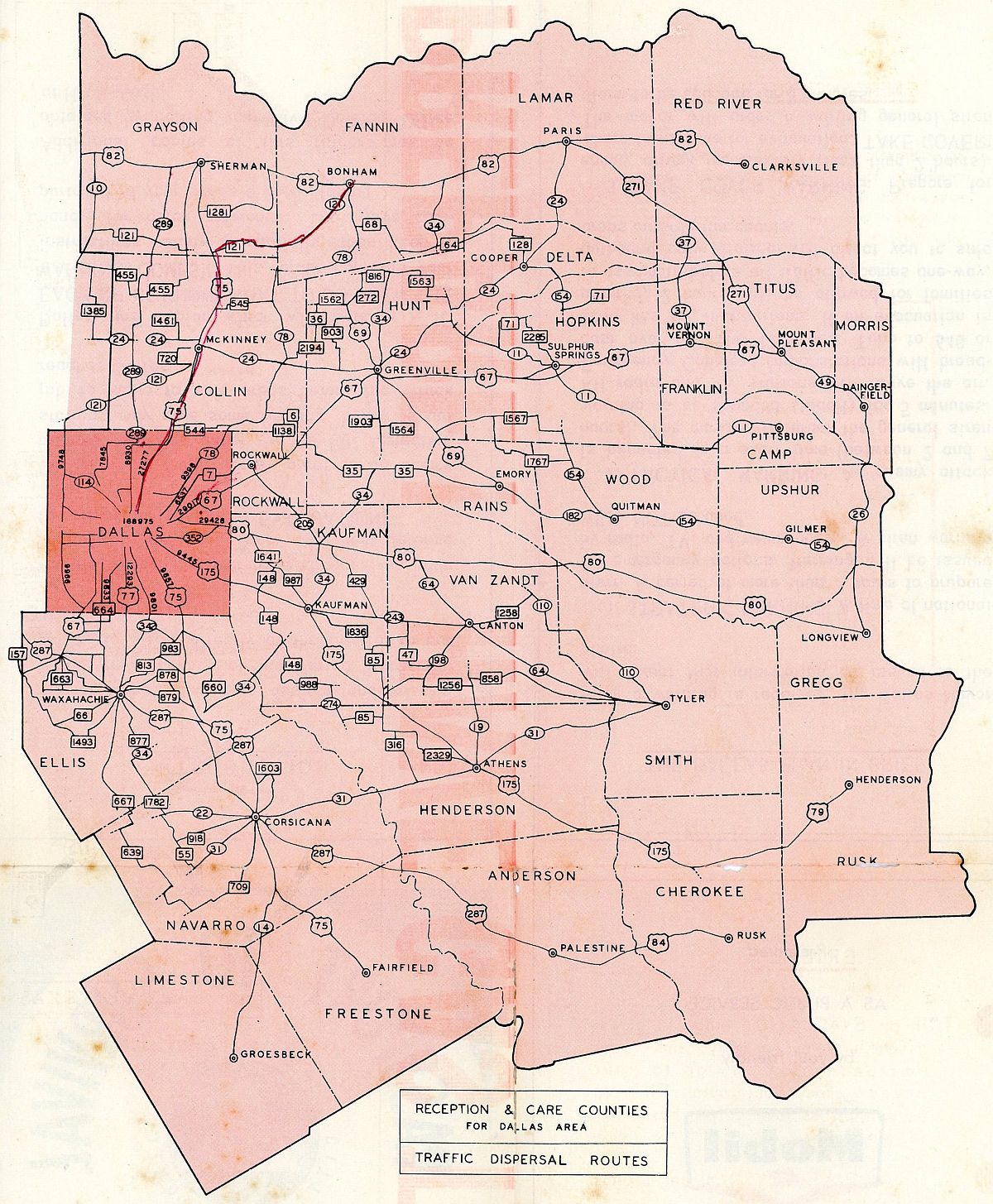
“Reception & Care Counties For Dallas Area Traffic Dispersal Routes” (the person who owned this pamphlet was planning to hightail it to Bonham):
“Emergency Procedures”:
“Emergency Supply Kit” (do NOT forget the can opener!) / “Taking Cover”:
***
Sources & Notes
Thanks again to Jeff Hanning for sending me scans of his Passport to Survival, Dallas County pamphlet.
The photo of Neiman-Marcus is from the DeGolyer Library at SMU. The above image is a really bad photo I took as a reference photo for a project I was working on at SMU last year. The actual photograph in the DeGolyer collection is, of course, much better! Apologies to the DeGolyer Library! I would link to the photo in SMU’s online database, but a scan of that particular photo is not available.
As mentioned above, if you’re interested in Civil Defense in Dallas, the CivilDefenseMuseum.com site is where you need to be. There’s TONS of stuff there. In addition to the great video walk-though of the old Fair Park shelter, there are also several pages of photos here (click through all the pages by following the links at the bottom of each page).
More on the history of United States Civil Defense, here.
And two stories from the Lakewood Advocate on Dallas’ Civil Defense shelters and preparedness can be found here and here.
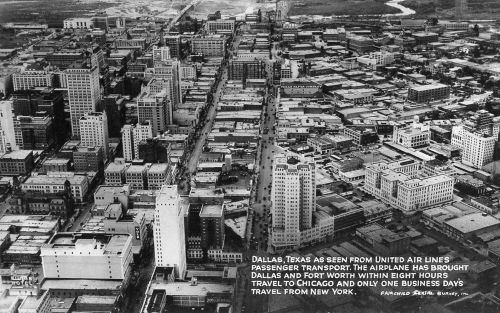
See a large image of this great aerial view of downtown and appreciate how much flight times have been pared down over the past 85 years or so in the 2015 Flashback Dallas post “Fly United to Chicago in Only Eight Hours!,” here.

 Welcome to Wynnewood…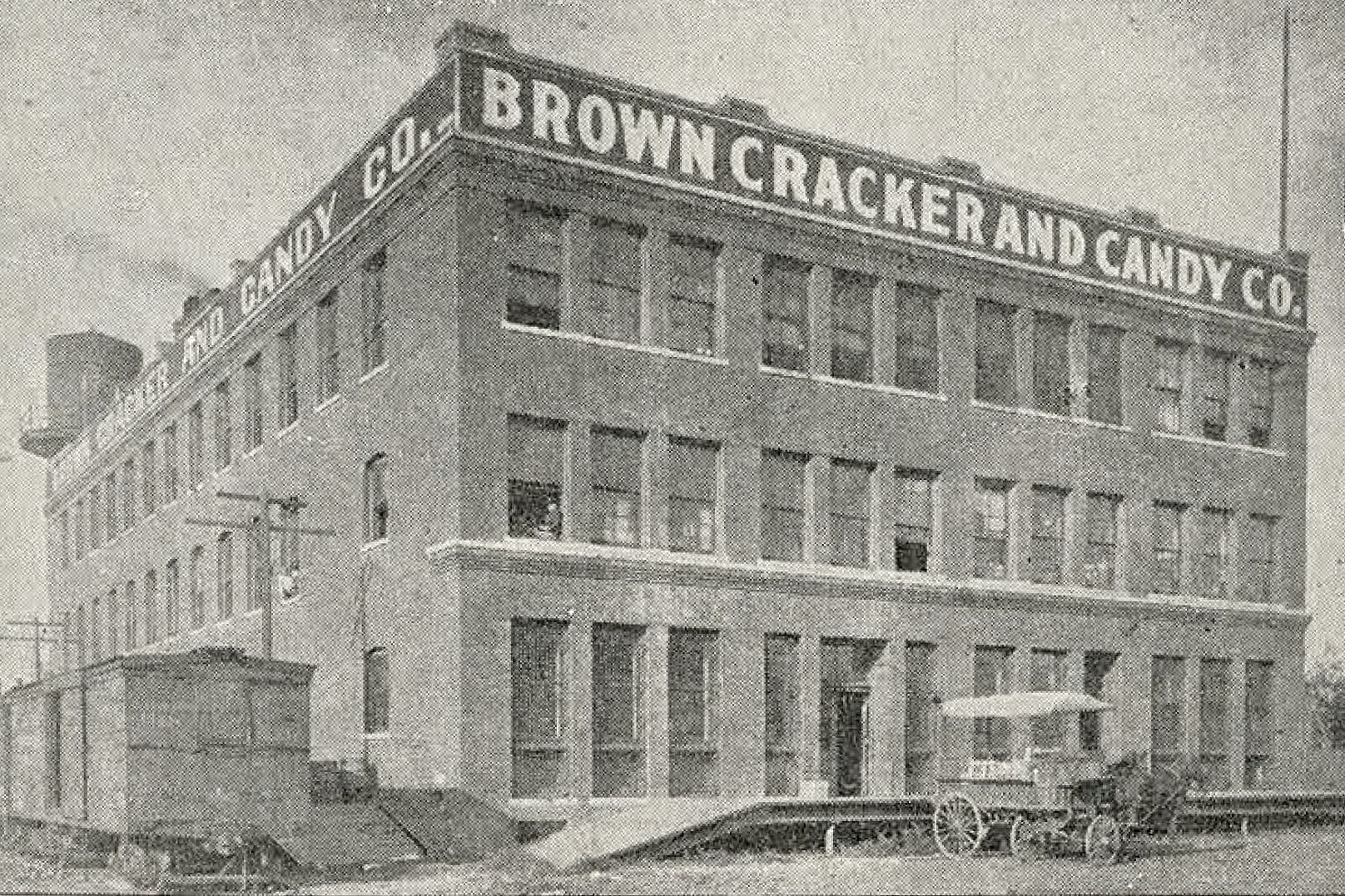
















 Flashback : Dallas