Flashback : Dallas

A Miscellany: History, Ads, Pop Culture

Tag: Historic Dallas

Oakland Cemetery

oakland-cemetery_postcard

by Paula Bosse

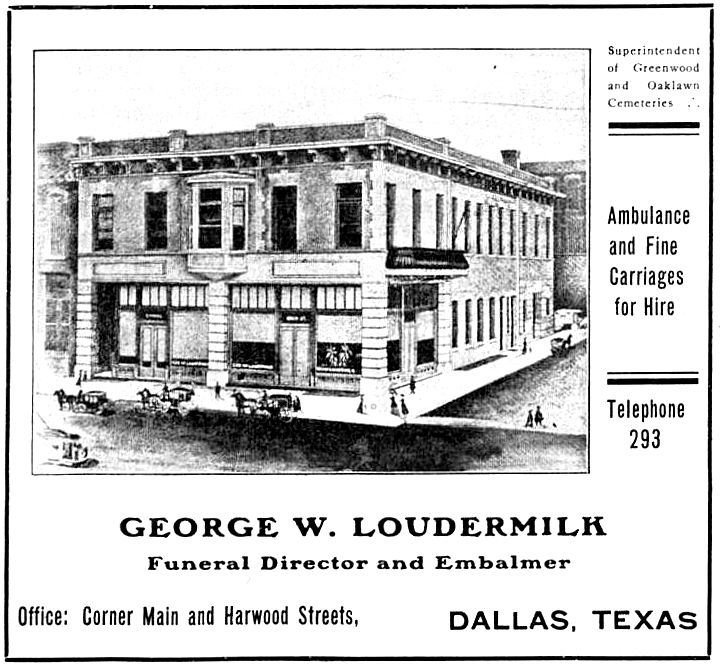
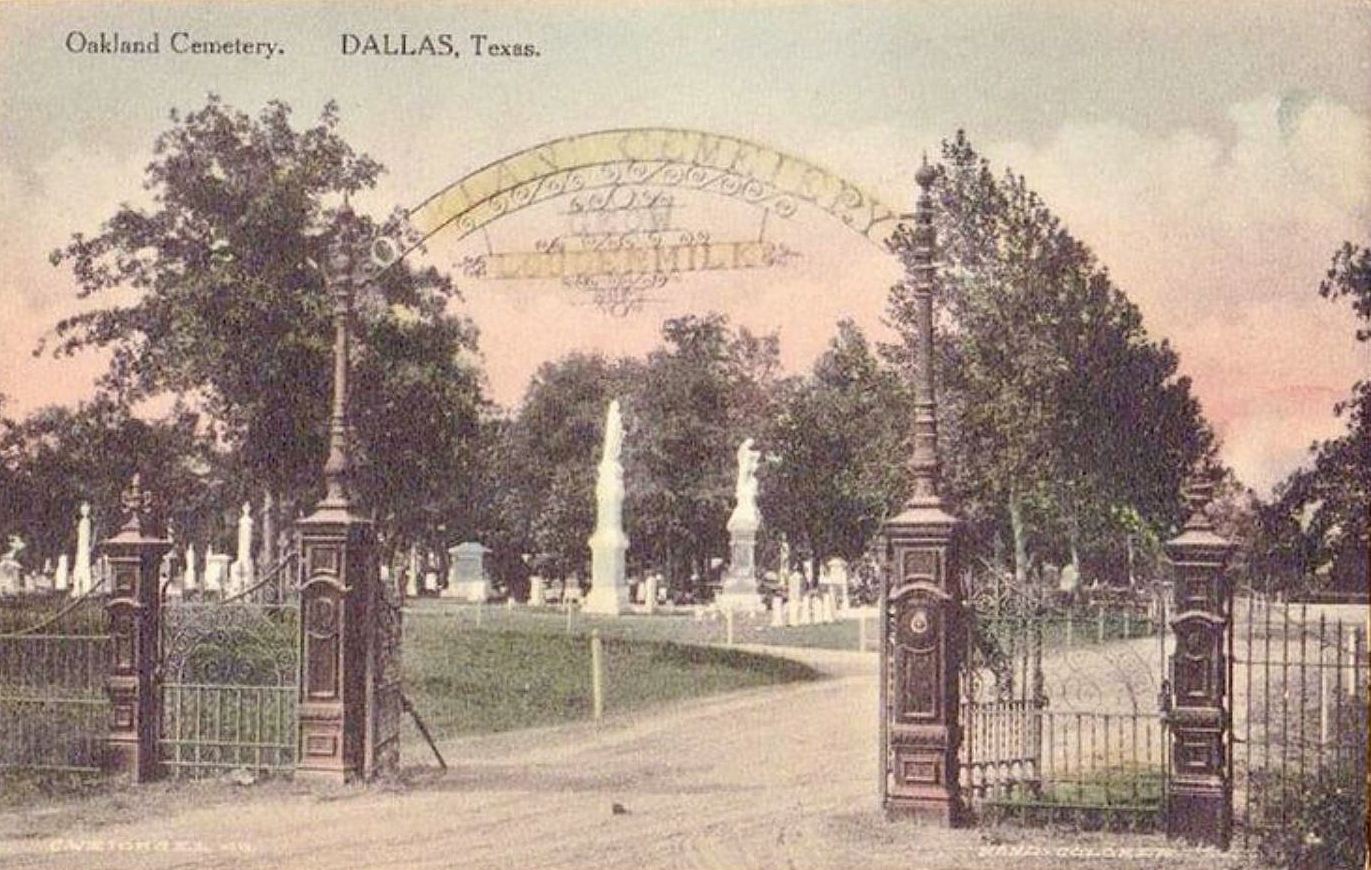
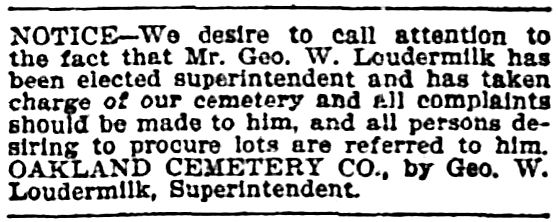
A beautiful postcard showing the gates of Oakland Cemetery emblazoned with the name of one of Dallas’ most prominent funeral directors, George W. Loudermilk.

oakland_loudermilk_dmn_060102Dallas Morning News, June 1, 1902

ad-loudermilk-funeral-home_19061906 ad

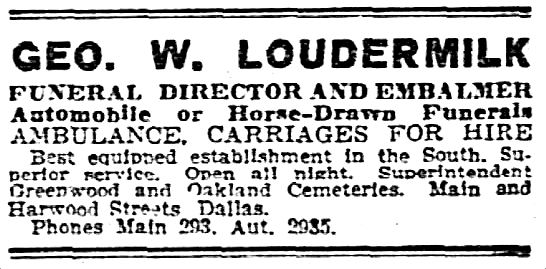
loudermilk_dmn_071912DMN, July 19, 1912

***

Sources & Notes

More on historic Oakland Cemetery, in South Dallas:

  • Wikipedia, here
  • Dallas Genealogical Society, here
  • Oakland Cemetery website, here
  • A lovely YouTube video filled with photographs of the cemetery and its markers, here

You can explore parts of the cemetery by touring via Google Street View, here.

*

Copyright © 2018 Paula Bosse. All Rights Reserved.

From the Vault: Historical Accuracy vs. Sex Appeal at the Pan-American Exposition — 1937

aztec_greencastle-indiana-daily-banner_080437_smA tense situation in Fair Park…

by Paula Bosse

The four-and-a-half-month Greater Texas and Pan-American Exposition, held at Fair Park in 1937, was the extravagant Latin-themed follow-up to the previous year’s even more extravagant Texas Centennial celebration. A bitter disagreement about whether the reenactment of an Aztec human sacrifice would star a man or a woman pitted the Mexican Consul (who insisted on a male warrior in a bid for historical accuracy) against a profit-minded director (who just wanted a sexy, flesh-baring girl to draw the crowds). Things got pretty tense. Read about this politically-charged contretemps in the 2015 Flashback Dallas post “When a Virgin Sacrifice at Fair Park Almost Caused an International Incident — 1937,” here. One of my favorite weird slices of Dallas history.

*

Copyright © 2018 Paula Bosse. All Rights Reserved.

From the Vault: Interurban vs. Streetcar

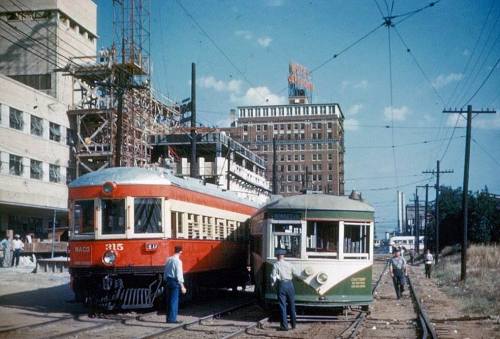
interurban-vs-streetcar

by Paula Bosse

I love this color photo of a street-rail mishap, looking north on Record Street from inside what would one day be called Communications Center. More on the logistics can be found at the original post from 2014, “Interurban vs. Streetcar,” here.

*

Copyright © 2018 Paula Bosse. All Rights Reserve

Casa Magnetica

six-flags_casa-magnetica_postcard_flickrHow often is juggling mind-blowing? It was here! (click for larger image)

by Paula Bosse

Every year my aunt and her fun friend Shirley took my brother and me to Six Flags Over Texas. This was the ’70s, so some of the original hard-to-believe attractions were already gone (helicopter and stagecoach rides?! — see a promotional video of the park from 1965 here), but it was still when the place was an actual “theme” park — an amusement park originally suggested by aspects of Texas history. The sections of the park represented the six flags that have flown over Texas (see a map here). One of those sections was the Spanish section, the location of two of my favorite Six Flags attractions: the log ride and Casa Magnetica.

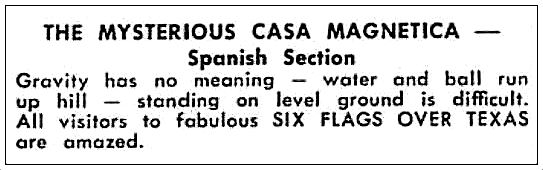
Casa Magnetica was the hard-to-wrap-your-brain-around tilted house (newspaper articles reported it was built at either a 24.6-degree angle or a 34-degree angle) which made you feel completely disoriented, especially if you’d just stepped in from the blinding blast of 110-degree heat and were feeling a bit queasy from one too many Pink Things. I loved it. Things rolled uphill, you couldn’t stand up straight, and your brain was mighty confused. The text from the back of the postcard seen above:
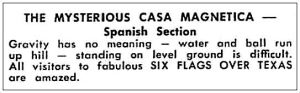
six-flags_casa-magnetica_postcard_back

Casa Magnetica was introduced very early in Six Flags’ history — it debuted in the second season, 1962, and it was a huge hit. Here is how the SFOT marketing team described it in press releases at the time. (Clippings and images are larger when clicked.) Imagine what it would have been like to have been the architect of this place!
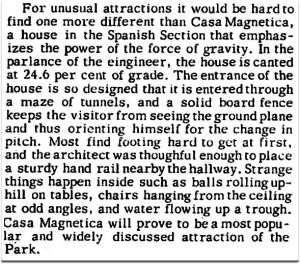
six-flags_casa-magnetica_daily-news-texan_042262Six Flags Gazette, April 22, 1962

six-flags_casa-magnetica_daily-news-texan_042962_text
Six Flags Gazette, April 29, 1962

As far as new attractions, the weird little house was the biggest hit of the 1962 season.
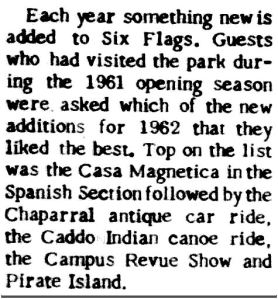
six-flags_casa-magnetica_daily-news-texan_042063
Six Flags Gazette, April 20, 1963

Here it is, under construction, in late 1961 or early 1962:
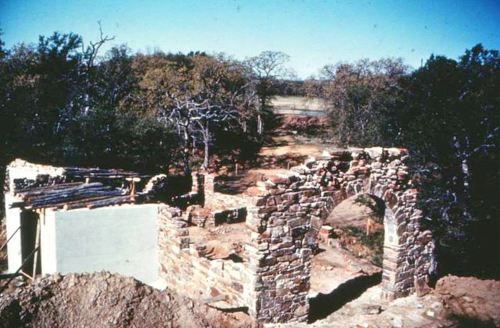
casa-magnetica_under-construction_history-of-six-flags-FB-group

And, later, with a teenage “hostess” sitting under its Spanish-mission-inspired arch.
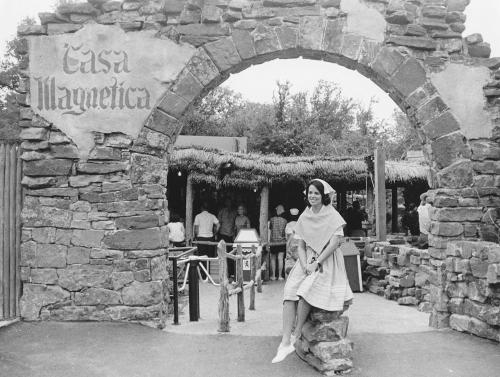
casa-magnetica_six-flags-FB-page

*

six-flags_casa-magnetica_daily-news-texan_052762

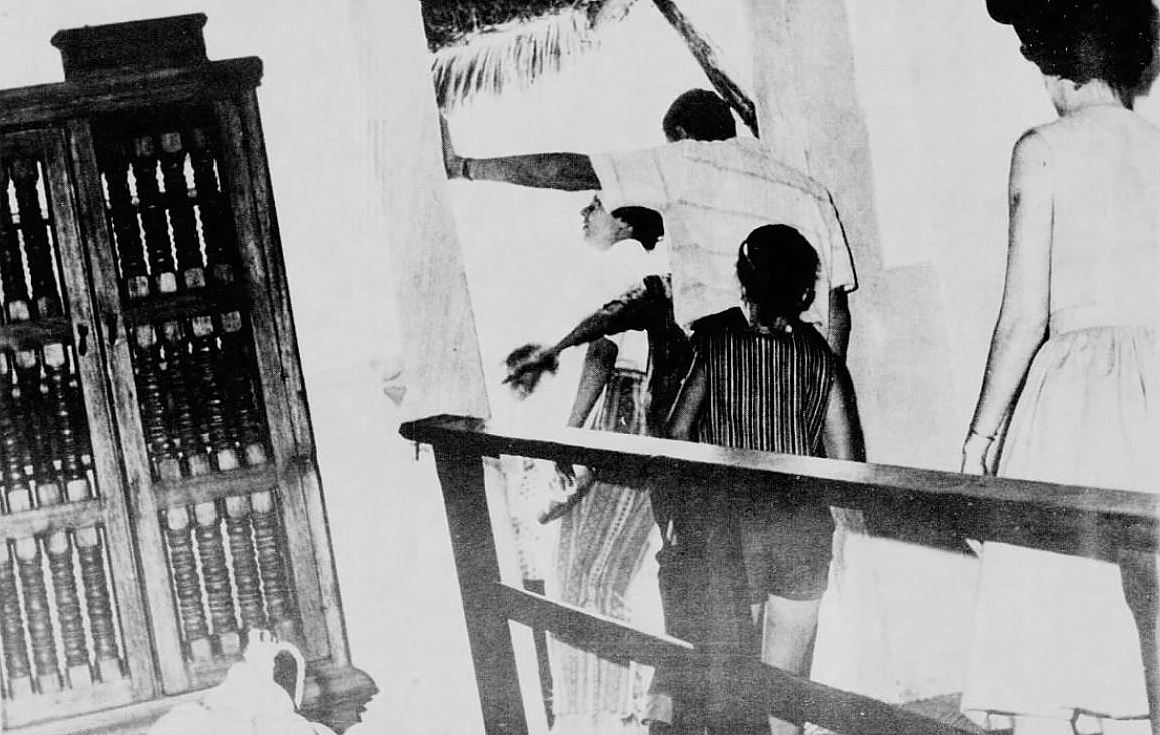
The caption of the photo above: “WHICH ONE’S STRAIGHT? — It’s hard to tell in the Casa Magnetica in the Spanish section. It’s difficult to keep from leaning the wrong way in this house where water seems to run uphill. Notice in the lower left of the picture how the basketful of goodies seems to be hanging instead of sitting.” (Six Flags Gazette, May 27, 1962)

*

six-flags_casa-magnetica_daily-news-texan_042962

Caption: “SOMETHING WRONG? — Six Flags hostesses find that the law of gravity doesn’t seem to apply in Casa Magnetica.” (Six Flags Gazette, April 29, 1962)

*

six-flags_casa-magnetica_irving-daily-news-texan_04262

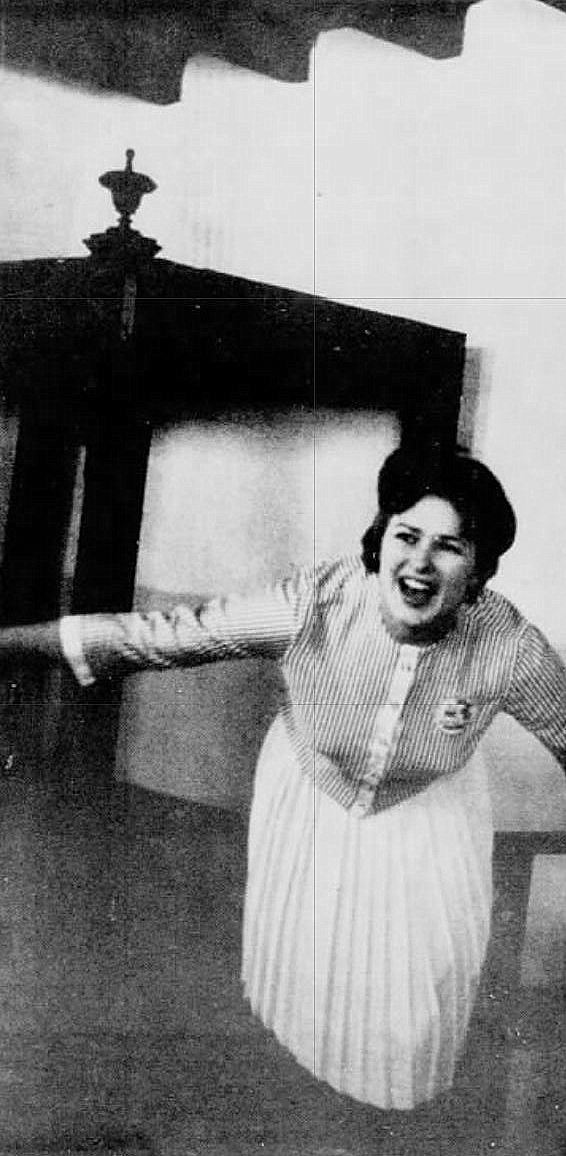
Caption: “LEMME OUT! — In Casa Magnetica, a house in the Spanish Section of Six Flags which defies gravity, this hostess gets a little panicky when the 34-degree slant proves too much for her.” (Six Flags Gazette, April 26, 1962)

***

Sources & Notes

Postcard at top from Flickr.

Articles and captioned photos are from the Six Flags Gazette, a seasonal supplement that appeared in both the Grand Prairie Daily News-Texan and the Irving Daily News-Texan during the early years of Six Flags.

Photo of Casa Magnetica under construction in the scrubby Arlington landscape is from the History of Six Flags Facebook group, posted there by the administrator Michael Hicks, submitted to Flashback Dallas by reader Brian Gunn (thank you, Brian!).

The photo of the Six Flags “hostess” sitting outside the entrance to Casa Magnetica is from the Six Flags Over Texas Facebook page, here (it appears with a photo of the Chaparral Antique Cars, the second-most popular attraction introduced in the 1962 season).

Read the “spiel” you’d hear when you visited Casa Magnetica, here.

And, in case you missed it above, I highly encourage you to watch the 6-minute Six Flags Over Texas promotional film from 1965 at the Texas Archive of the Moving Image (TAMI) website here (Casa Magnetica is seen briefly at the :45 mark). Watch it full-screen!

More Flashback Dallas posts on Six Flags Over Texas can be found here.

*

Copyright © 2018 Paula Bosse. All Rights Reserved.


R. S. Munger’s Cotton Gin Manufactory

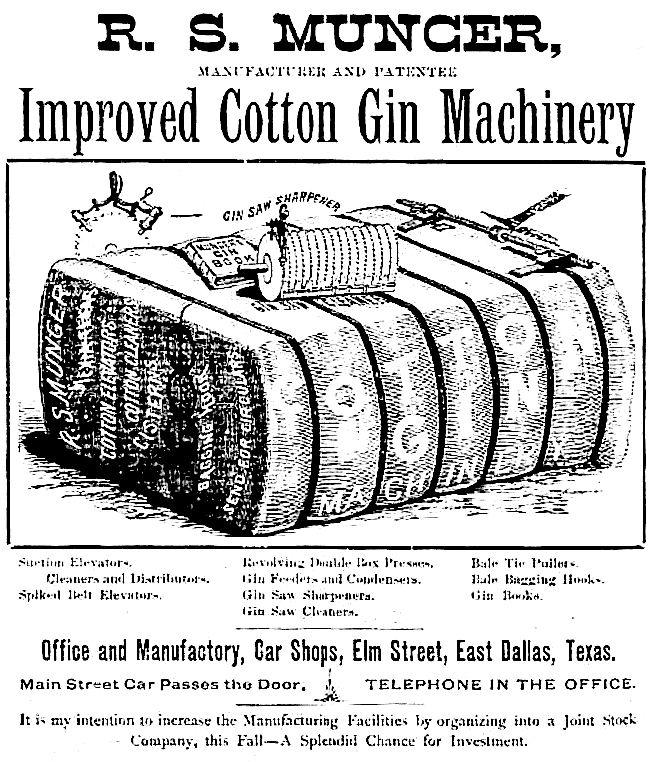
munger-improved-cotton-gin_1889-dallas-directory_detElm & Trunk, the early years (detail of an ad from 1889)…

by Paula Bosse

When R. S. Munger moved to Dallas from Mexia around 1885, even he probably had no idea how revolutionary his patented inventions would become to the world of agriculture — he had several patents, but his “improved” cotton gin was hailed as the most significant advance in cotton ginning since Eli Whitney’s original invention. Munger had been producing his equipment for a while in Mexia, but he knew that in order for his company to grow, he would have to move to a larger city, one served by the all-important railroad. He arrived in 1885 and moved into an existing “East Dallas” building owned by the wealthy banker (and former cotton farmer…) William H. Gaston (who later became an officer of the company).

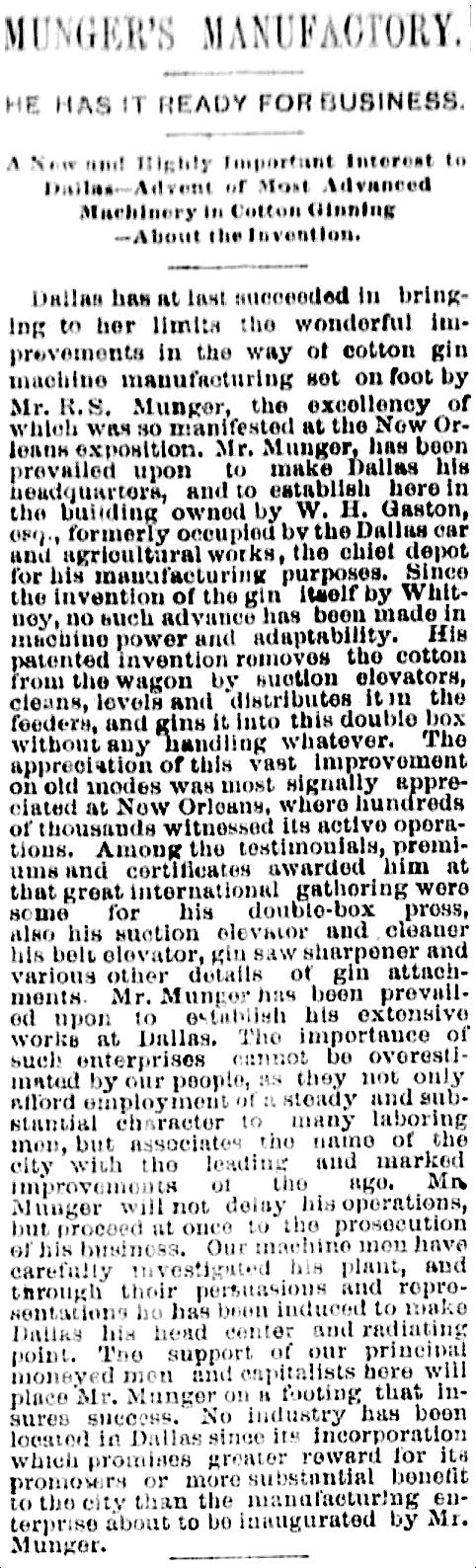
The following article appeared in an 1885 edition of the Dallas Herald. It is bulging with superlatives and grand statements which actually weren’t exaggerations: because of Munger’s relocation to Dallas and his products’ massive success, the city became a national hub of agricultural machinery manufacturing. This had a huge impact on Dallas’ economic development, and the unnamed writer of this article deserves credit for his prescient words. (Click to see larger image.)

munger_to-dallas_dallas-weekly-herald_052885Dallas Weekly Herald, May 28, 1885

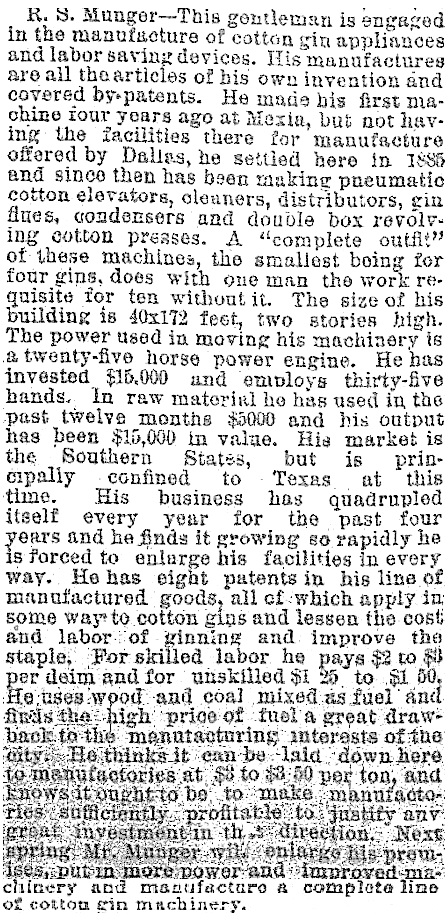
Another article describes just what Munger’s “improvements” were and also has a description of his factory — the heart of which was a 25 horsepower engine (a quick Google search tells me that 25hp is the size of a standard outboard motor engine).

munger_dmn_092886
Dallas Morning News, Sept. 28, 1886

A very early want-ad:

munger_dmn_072886_very-early-ad
DMN, July 28, 1886

(You can read about Mr. Munger’s career accomplishments in A History of Greater Dallas, published in 1909, here, and in the Handbook of Texas entry here.)

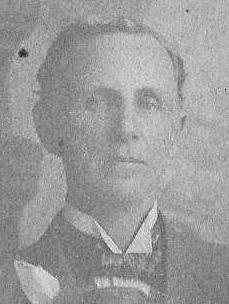
munger-r-s_find-a-graveR. S. Munger (1854-1923)

Fast-forward to today: the factory which Munger began in Dallas in the 1880s is somehow still standing and is known by most as the Continental Gin Building.

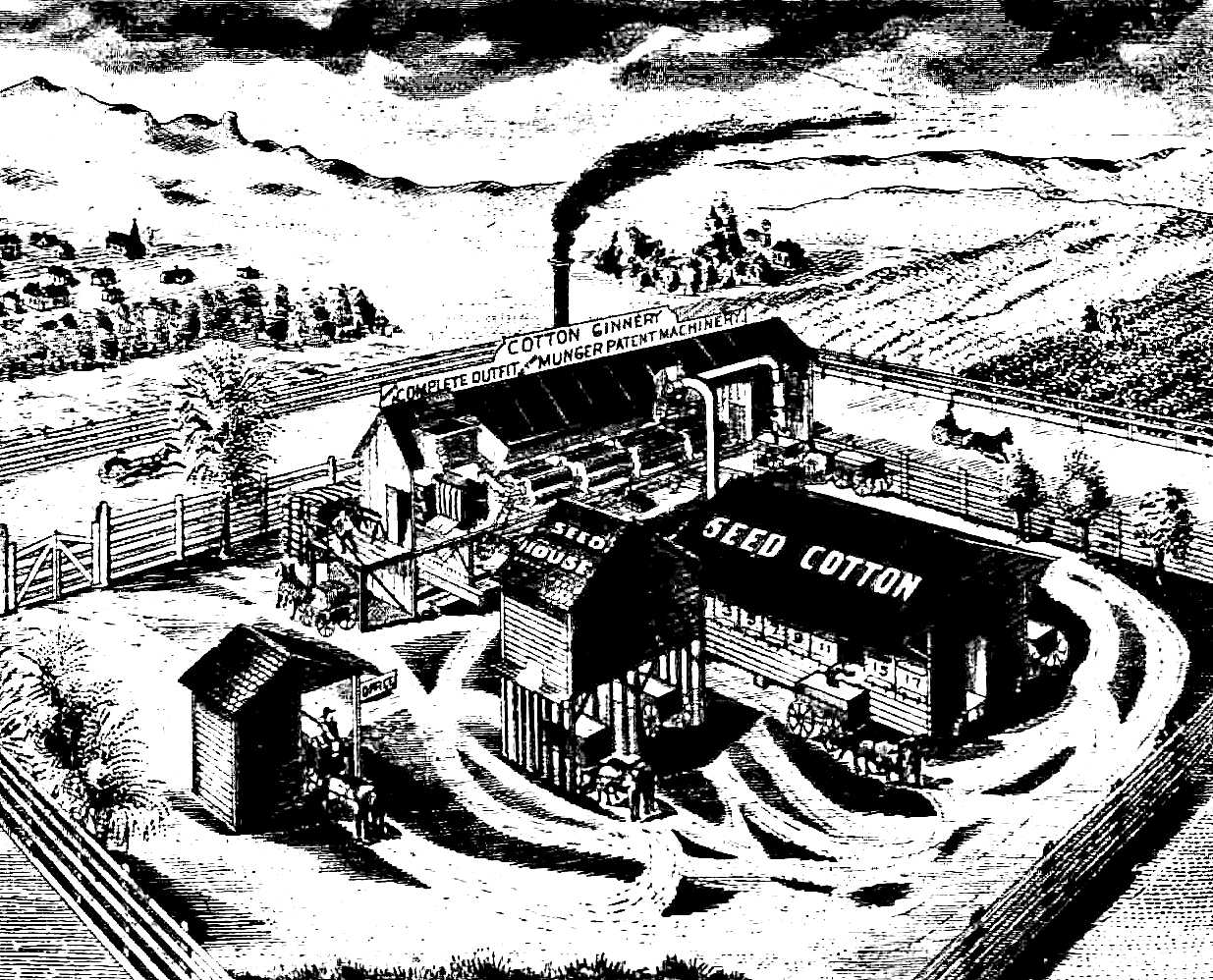
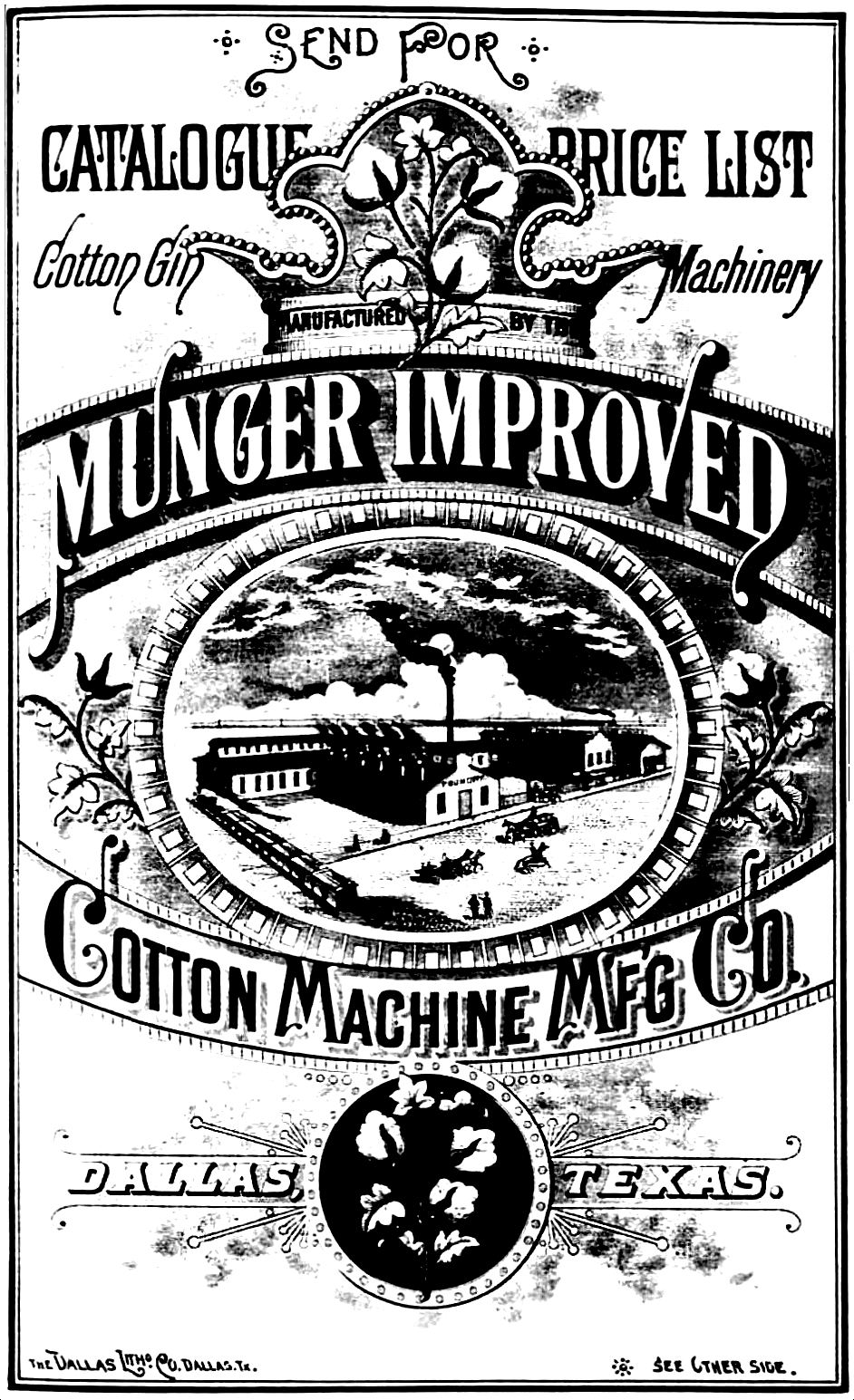
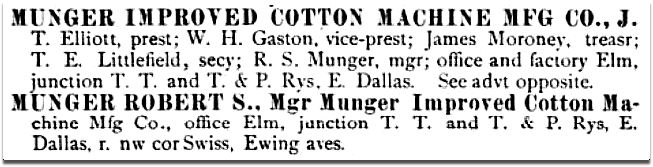
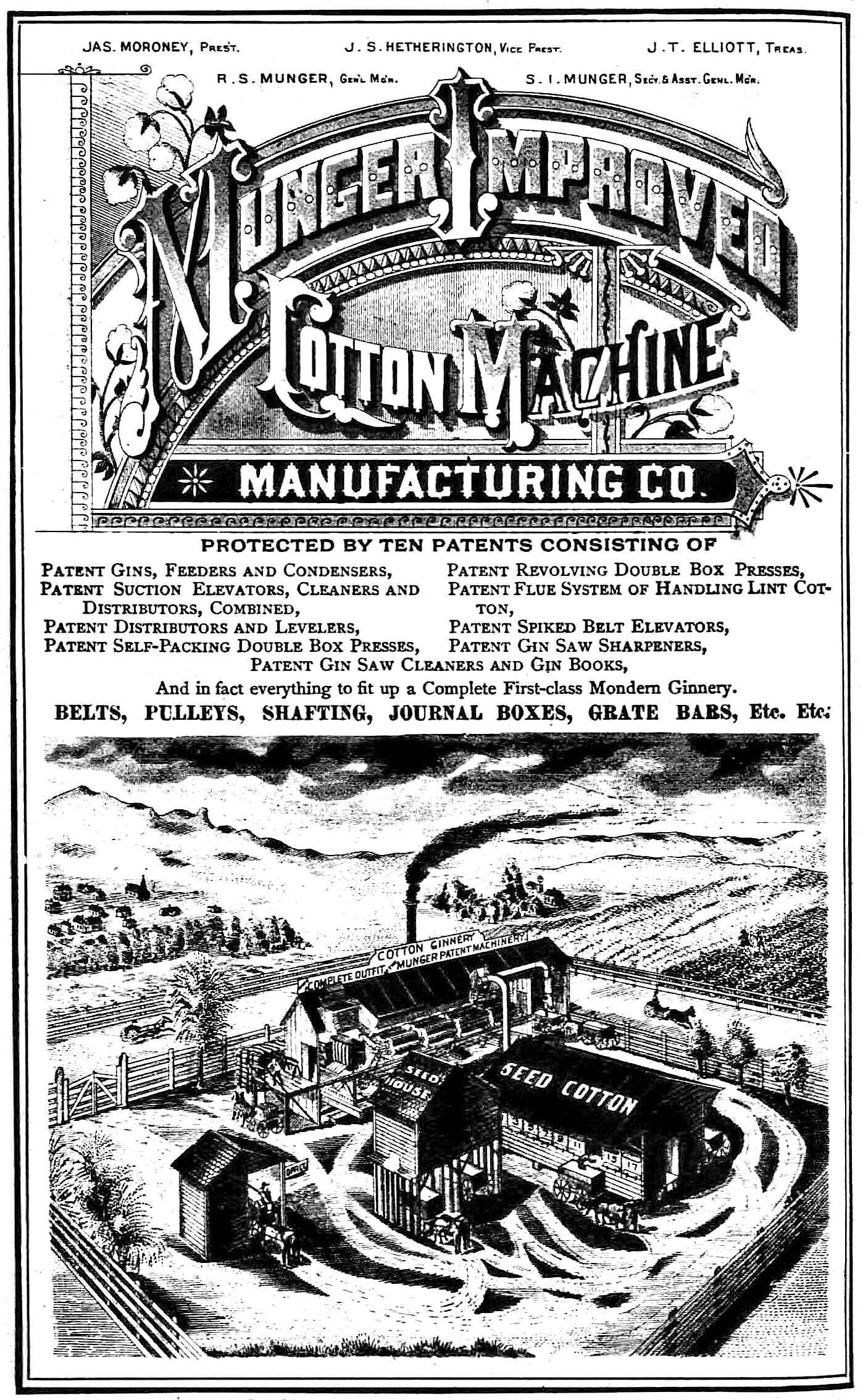
Here are a few very early ads of Munger’s cotton-gin-manufacturing empire, from city directories (the illustrated ads are full-page, which even in 1886 cost a pretty penny).

munger-improved-cotton-gin_1886-dallas-directory_listingDallas city directory, 1886

munger-improved-cotton-gin_1886-dallas-directory_aDallas city directory, 1886

munger-improved-cotton-gin_1886-dallas-directory_bDallas city directory, 1886

munger-improved-cotton-gin_1888-dallas-directory_listingDallas city directory, 1888

munger-improved-cotton-gin_1889-dallas-directoryDallas city directory, 1889

***

Sources & Notes

Photo of Robert Sylvester Munger from Find-a-Grave.

All other sources noted.

An aerial view of the complex of former Continental Gin Co. buildings can be seen via Google here.

More on the Continental Gin Company can be found in these Flashback Dallas posts:

*

Copyright © 2018 Paula Bosse. All Rights Reserved.
 

From the Vault: Texas Baptist Memorial Sanitarium/Baylor Hospital: 1909-1921

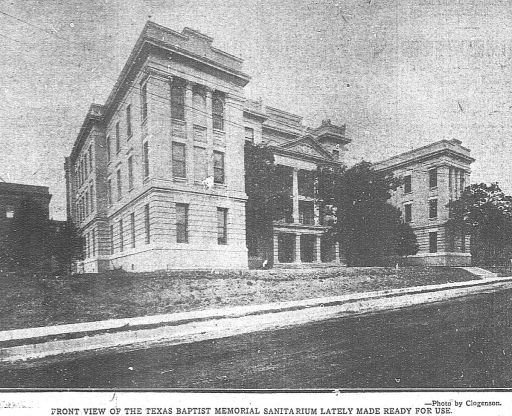
baylor-hospital_exterior_dmn_111009_clogenson

by Paula Bosse

The photo above appeared in The Dallas Morning News in November, 1909, shortly after the official opening of the new buildings of the Texas Baptist Memorial Sanitarium (the name would later be changed to Baylor Hospital). The buildings seen here faced Junius Street, in Old East Dallas. See several photos and postcards of these early days at the post “Baylor Hospital — 1909-1921,” here. (Scroll down to the bottom of that page for links to read the breathlessly enthusiastic article that accompanied the photo above.)

*

Copyright © 2018 Paula Bosse. All Rights Reserved

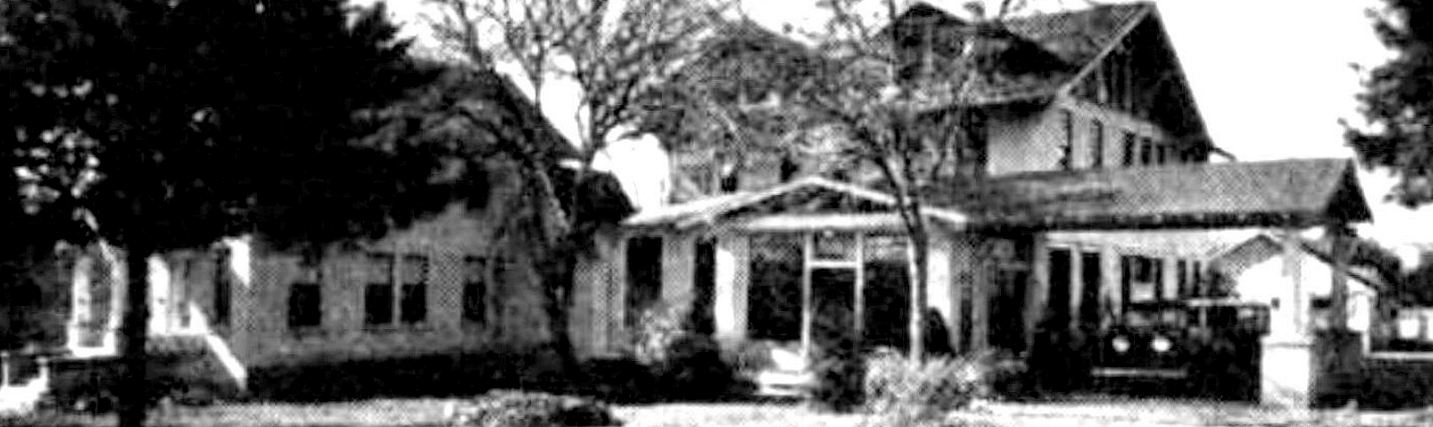
“The Cedars” Maternity Sanitarium, Oak Cliff — ca. 1923-1944

cedars-maternity-sanitarium_texas-state-journal-of-medicine_oct-1933_portalA “seclusion home for unwed mothers”…

by Paula Bosse

The rather blurry photo above shows a “maternity sanitarium” for unwed mothers, where “unfortunate women” could spend their days in seclusion until their babies were born there on the premises. The home/sanitarium was called “The Cedars” and was located on N. Ravinia Drive in the Beverly Hills area of Oak Cliff; when it opened, it was just outside the Dallas city limits. (It has nothing to do with The Cedars area south of downtown; its name may have had something to do with the name of a nearby street which intersected Ravinia. …Or it might have been located near a cedar grove. …Or it might have been used to subliminally suggest famed Cedars-Sinai Hospital.)

The sanitarium was opened around 1923 by Mrs. Lillie Perry (1876-1929), a woman who might have had some personal experience with the “fallen women” she cared for, as it appears she might have had a child out of wedlock herself. When she died in 1929, her daughter Lillian Hanna took over the running of the sanitarium. Lillian died in 1938, and that seems to have been around the time that the home became part of the Volunteers of America organization, which, among its many social services, provided maternity care for women and also assisted in adoption placement. The last mention I saw of “The Cedars” was in 1944.

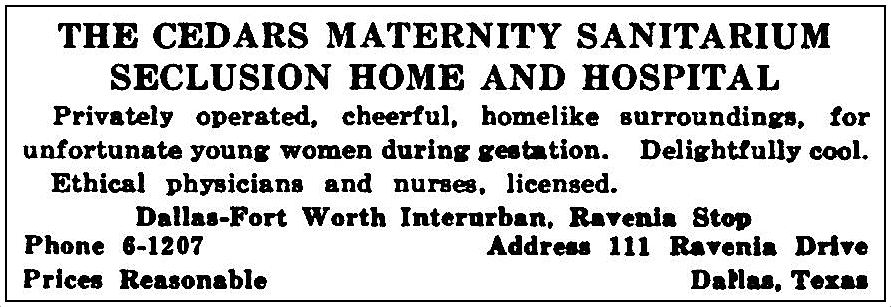
The photo above appeared in an ad placed in the Oct., 1933 issue of the Texas State Journal of Medicine with the accompanying text (for larger images, click pictures and clippings):

cedars-maternity-sanitarium_tx-state-journal-of-medicine_oct-1933_portal_text
1933

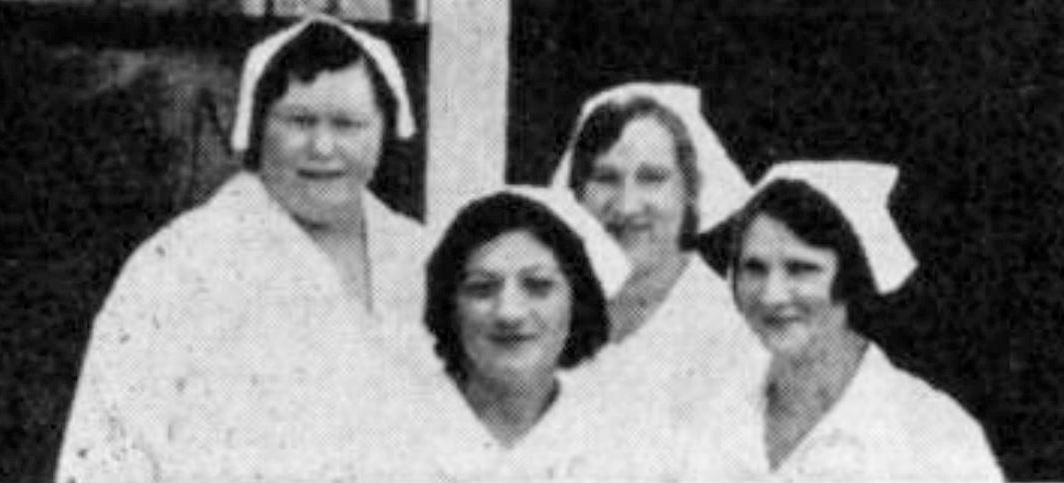
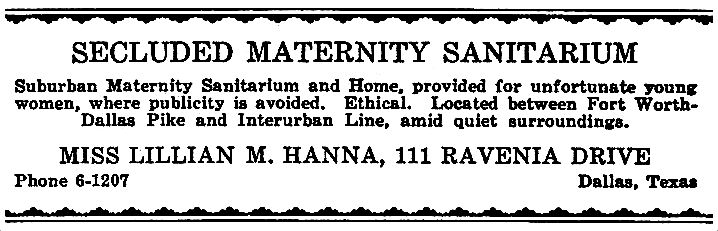
Another ad, featuring friendly-looking nurses, appeared in the same issue, a few pages earlier:

cedars-maternity-sanitarium_tx-state-journal-of-medicine_oct-1933_portal_nurses

cedars-maternity-sanitarium_tx-state-journal-of-medicine_oct-1933_portal_nurses_text1933

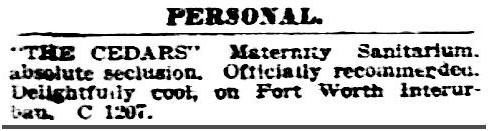
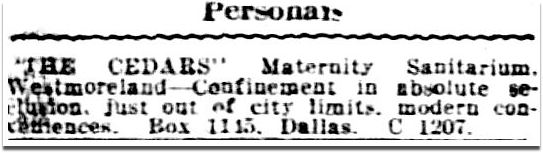
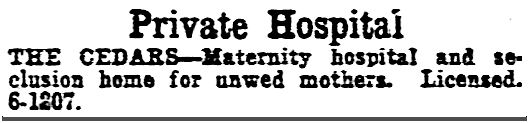
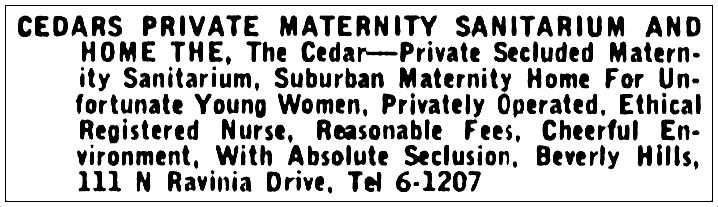
Below are a few discreet newspaper ads for The Cedars which appeared over the years in the “personals” section of the classifieds.

cedars-maternity-home_dmn_070623
1923

cedars-maternity-home_dmn_042724_westmoreland
1924

cedars-maternity-home_dmn_1006291929

cedars-maternity-home_dmn_0105311931

cedars-maternity-home_dmn_0418341934

1937_cedars-maternity-sanitarium
Listing from the 1937 Dallas city directory

***

Sources & Notes

Ads from the Texas State Journal of Medicine appeared in the October, 1933 issue, which can be found scanned in its entirety on the Portal to Texas History site, here.

Homes for “unwed mothers”/”unfortunate girls”/”fallen women” were generally places families sent their daughters in order to avoid the social stigma that unmarried girls and women faced when pregnant. They just kind of “disappeared” for several months and had their babies in secret, often feeling pressured to put their children up for adoption. An interesting Salon article on the topic is “The Children They Gave Away” by Sarah Karnasiewicz.

More on the Beverly Hills neighborhood of Oak Cliff can be found in articles from Heritage Oak Cliff and Preservation Dallas.

Thanks to Patricia M. who wrote to ask me a question about this place. I’ve learned a lot of interesting things about Dallas I would never have thought to look into were it not for obscure questions from readers. Like this one! Thanks, Patricia!

*

Copyright © 2018 Paula Bosse. All Rights Reserved.
The “Blue House” Lives

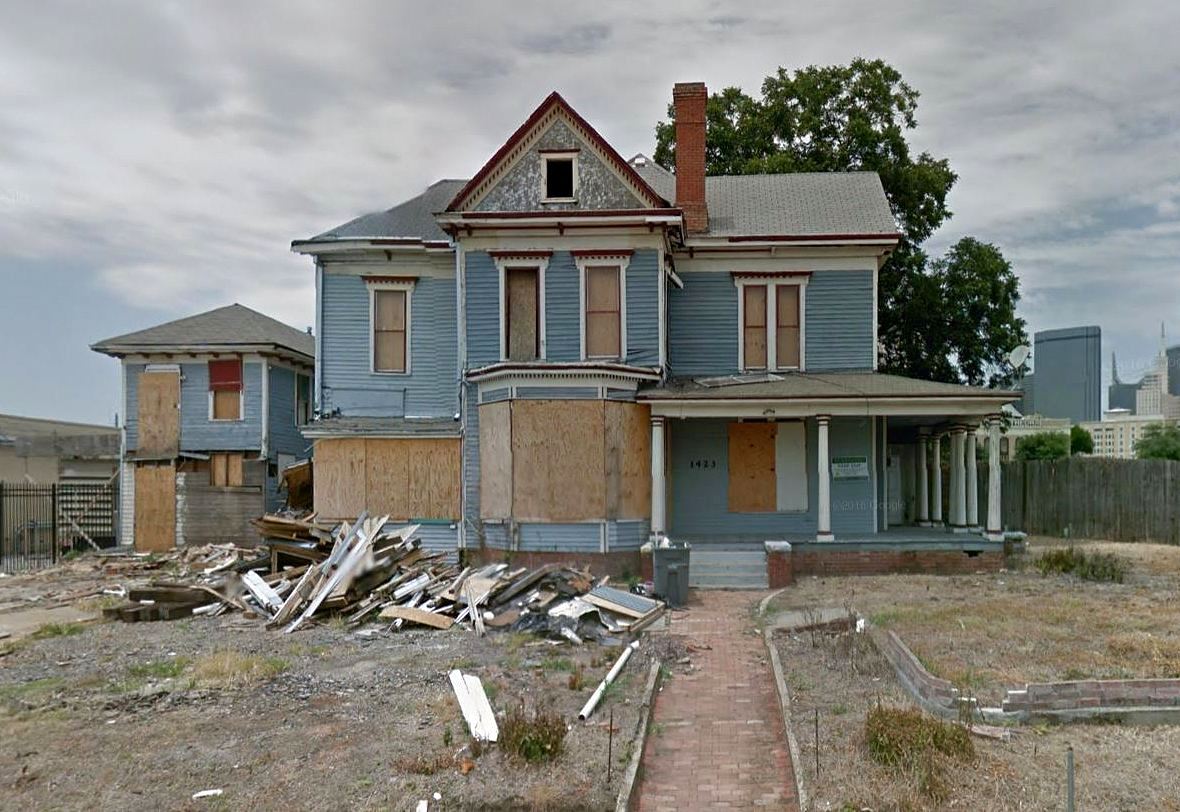
blue-house_google_july-2016July, 2016 / Google Street View

by Paula Bosse

In January, 2016, news of an endangered 19th-century house in The Cedars, the area just south of downtown, was in the news: it was to be torn down in order to put in a parking lot. I followed Robert Wilonsky’s stories on it in The Dallas Morning News and read about it in online history and preservation groups, but there didn’t seem to be a lot mentioned about the history of the house. Who built it? And when? I decided to see if I could find the answers. I’d written about the history of houses and buildings and figured it wouldn’t take that long to find the answers, but it actually took a lot longer than I’d thought. But the detective work was fun, and I was surprised by how much research one can do without ever needing to walk away from one’s computer. So much now is within our digital reach: historical city directories, maps, newspaper archives, and genealogical information.

After a marathon session of using everything mentioned above, plus referring to a couple of Dallas-history-related books, I eventually traced real estate transfers back to the man who appears to have built the house: Max Rosenfield, around 1885. I excitedly messaged Robert Wilonsky at 4:58 a.m., knowing that he would be interested to learn this new info (especially as the man who built the house was the father of one of the most noteworthy arts critics in The Dallas News’ long history), and he passed the news on to his readers. (My step-by-step process of researching the house which once stood in a posh residential area of the city is in the post “The Blue House on Browder,” here.)

The house’s fate has been in limbo for a couple of years, but now the 133-year-old “Blue House” will be moved in pieces to its new home half a mile away (at Browder and Beaumont) where it will be reassembled and restored.

The move begins TOMORROW — April 3, 2018. The public is invited to a ceremony in which comments will be made and then the house will begin the move to its new home. For Preservation Dallas’ details on when and where, information on the event can be found here.

Enjoy your new home, Blue House!

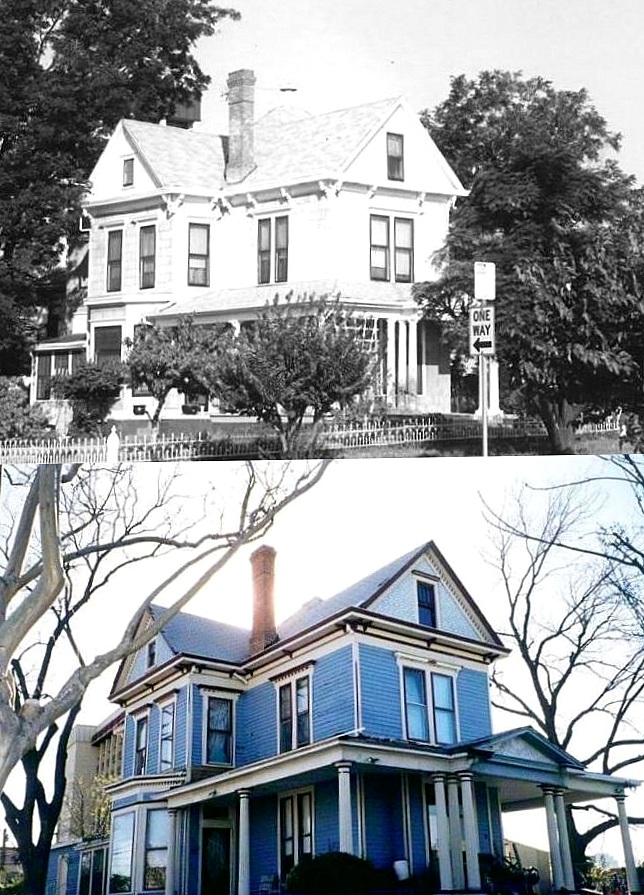
blue-house_then-and-now

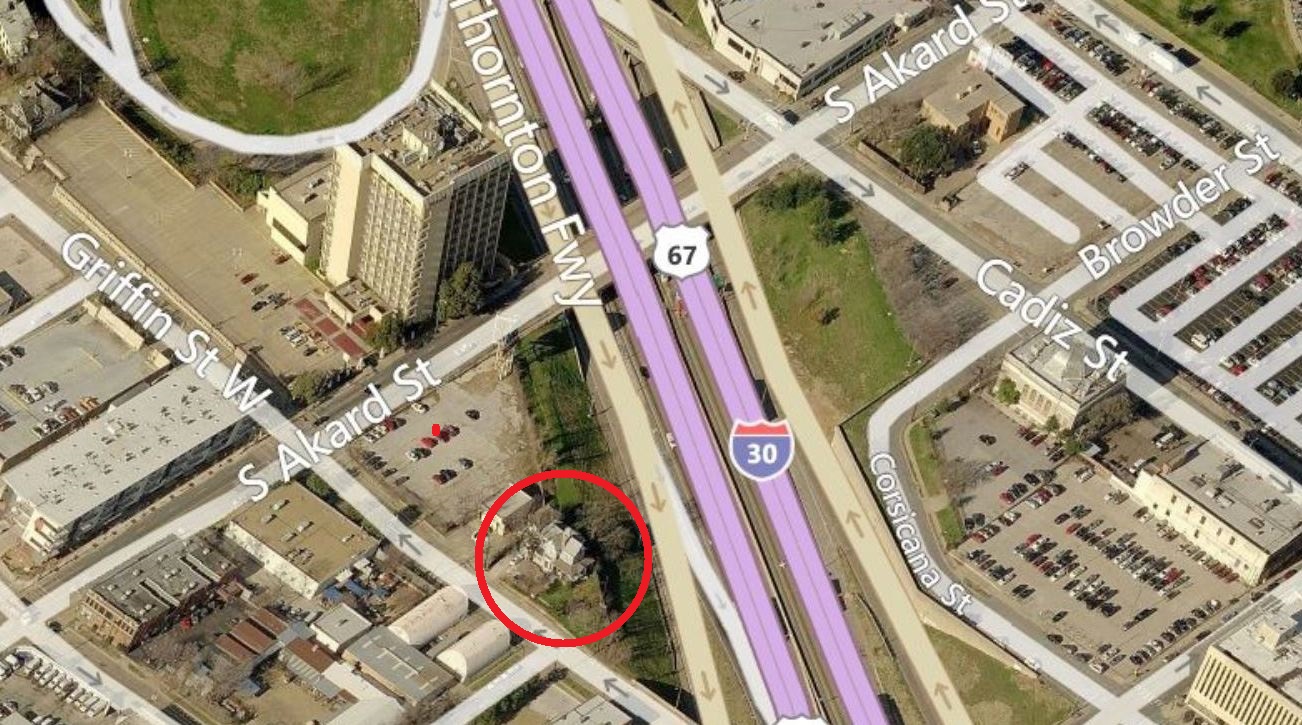
browder-house_bing

**

UPDATED: More on how the actual move went and an interview with the new owner of the house can be found at Candy’s Dirt, here.

Below is footage of the first part of the move — the disassembly — captured by D Magazine:

***

Sources & Notes

Top photo from Google Street View, July, 2016. (This view from Griffin is actually the side of the house — the front originally faced Browder Street, which no longer continues at that block.) Aerial view from Bing Maps.

Black-and-white photo of the house is from Preservation Dallas; color photo below it is from Homeward Bound, Inc. (used with permission), taken in about 2000.

Read the saga of the fight to save the house and how it will be moved in Robert Wilonsky’s Dallas Morning News article “One of Dallas’ oldest homes, built in the Cedars in the 1880s, ready for its new life on a new lot” (DMN, March 29, 2018), here.

My original step-by-step post on tracking down the history of the house — “The Blue House on Browder” — is here.

Click pictures to see larger images.

*

Copyright © 2018 Paula Bosse. All Rights Reserved.


A Few Photo Additions to Past Posts — #7

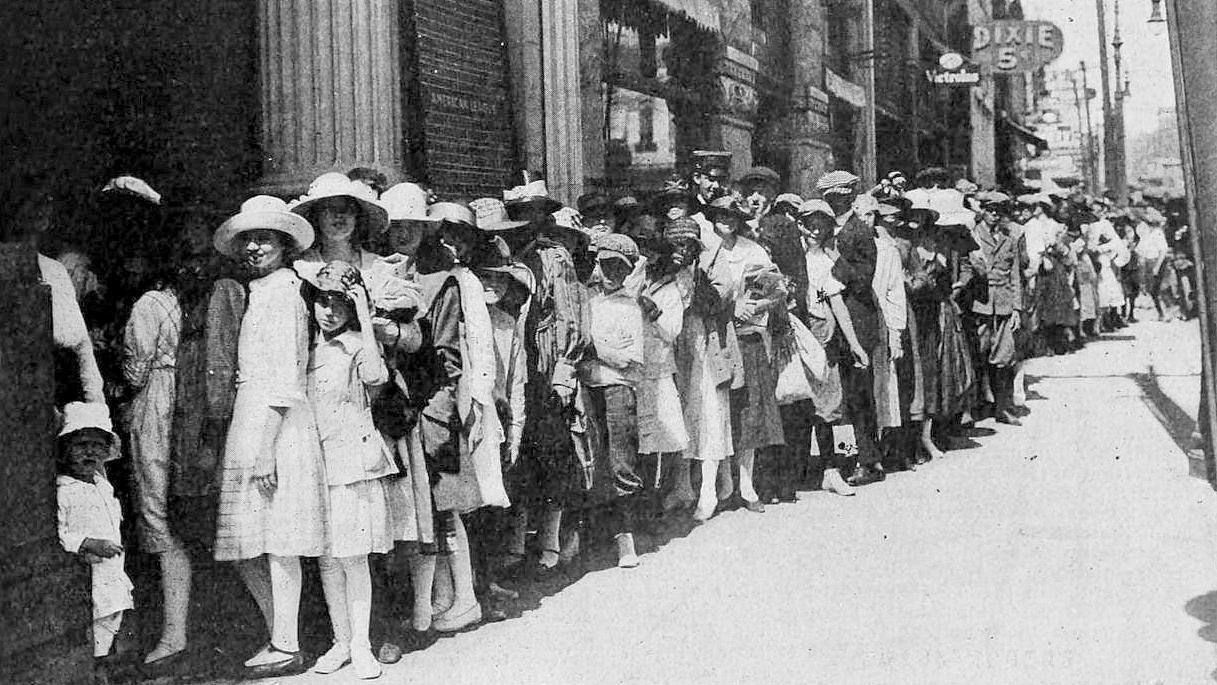
hippodrome_dixie_elm-street_moving-picture-world_062218Standing in line for a movie, 1918… (click for larger image)

by Paula Bosse

I’m always coming across photos and information regarding subjects I’ve already written about, and sometimes I find new things I want to add to old posts.

Like the photo above. I had originally used a cropped version which I had found on the Cinema Treasures website, but this one was larger, and I found it at the original source, describing what was going on. This photo from 1918 shows (mostly) children standing in line to see a World War I-related movie at the Hippodrome Theatre, with the line reaching past the nearby Dixie Theatre. They had participated in a clever marketing strategy which encouraged school children to write essays about why the United States was at war with Germany (first prize: $20 in gold!). The photographer was standing on Elm about where Field is, looking east (which today looks like this). I’ve added this photo to the post “Three of Dallas’ Earliest ‘Photoplay Houses’ — 1906-1913.” (Source: The Moving Picture World magazine, June 22, 1918)

*

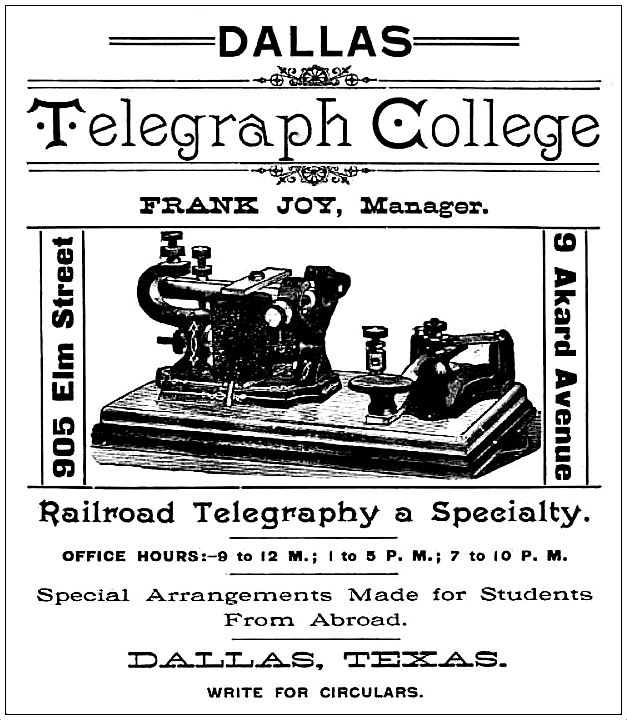
Below, a nice early ad (1889) for Dallas Telegraph College. I’ve added it to the post Start Your Brilliant Career at Dallas Telegraph College — c. 1900.” (Source: 1889 Dallas directory)

dallas-telegraph-college_1889-directory

*

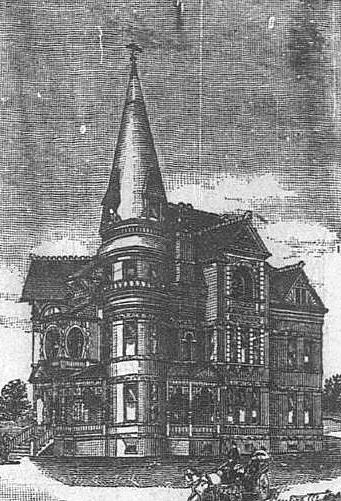
The grand Thomas L. Marsalis house seen below was built in 1889 — the same year that the Dallas Telegraph College was setting up shop downtown. The house, built in Oak Cliff (which was not yet part of Dallas), reportedly cost $65,000 (more than $1,750,000 in today’s money); it was, apparently, never occupied, and it was under foreclosure just a few short years after its construction. I’ve added this drawing of a house that I never tire of looking at to the post The Marsalis House: One of Oak Cliff’s ‘Most Conspicuous Architectural Landmarks.'” (Source: Dallas Morning News)

marsalis-house_drawing

*

The roots of Dallas’ Buell Planing Mill reach back to 1886 — it once sat near-ish to the old Dallas High School (aka Crozier Tech). This 1896 ad is a nice companion to a photo in the post The Buell Planing Mill — 1901.” (Source: 1896 Dallas city directory)

buell_dallas-directory_1896

*

I have very fond memories of the old downtown Dallas Public Library, and I’ve always loved the building, so I was relieved to hear that the Dallas Morning News had made the long-vacant building its new HQ. This postcard of the George Dahl-designed building is pretty strange because of the depiction of the sculpture on an exterior wall  — an artwork that people either loved or loathed (I’m afraid I include myself in the latter category). It’s not the fabled “naked” figure envisioned by the artist which had caused such controversy, but it’s some weird version of sort of what the sculpture ended up looking like (here). (Postcard manufacturers have deadlines, and the finalized sculpture must not have been completed before those cards had to hit the streets.) The sculpture was titled “Youth In the Hands of God,” and if those are the hands of God, um…. I’ve added this postcard image to the post George Dahl’s Sleek Downtown Library — 1955″ — mostly for my own amusement. (Source: “the internet”)

dallas-public-library_dahl_postcard

*

As one might imagine, my blog gets tons of JFK assassination-related hits — simply because I write about Dallas history. Assassination-ologists are often more interested in arcane aspects of Dallas history that those of use who actually grew up and/or live here. One such post that continues to get more hits than it might actually warrant (not that the subject isn’t interesting, but it’s not THAT interesting) is the awkwardly titled “Nardis of Dallas: The Fashion Connection Between ‘The Dick Van Dyke Show’ and the Kennedy Assassination.” (Nardis was a Dallas garment manufacturer who had in its employ for many years one Mr. Abraham Zapruder. And, yes, there actually was a Dick Van Dyke Show connection.) ANYWAY, I’m adding these two late-’50s/early-’60s Squire Haskins photos of the plant at 410 S. Poydras (at Wood Street) because they’re cool. (Source: Squire Haskins Photography Inc. Collection, University of Texas at Arlington Libraries, Special Collections — the exterior shot is here, the interior shot is here. The ad is a detail from a 1954 ad which appeared in The Texas Jewish Post.)

nardis_squire-haskins_UTA_wood-and-poydras

AR447-R812

nardis_texas-jewish-post_122354

*

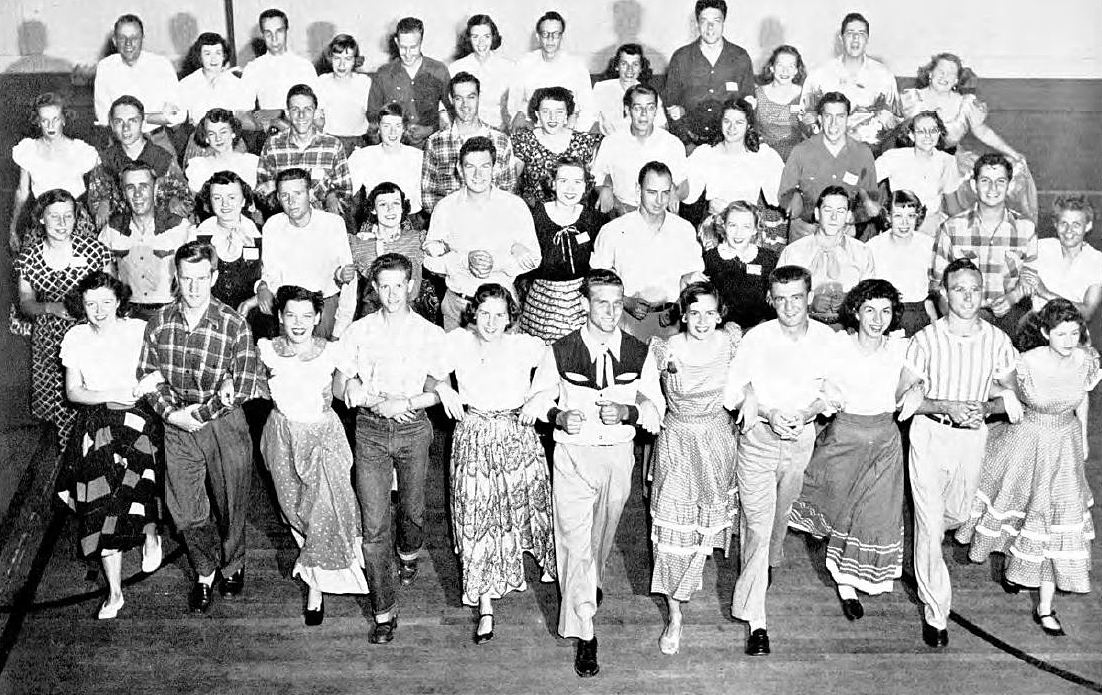
I really enjoyed writing about the strange square-dancing fad that swept the county in the late 1940s and early 1950s, affecting everyone from those in rural communities to Neiman-Marcus customers. I’m adding this photo from the 1951 SMU yearbook which shows the well-dressed “Promenaders,” a group whose purpose is described in the yearbook as being “to promote the appreciation of square and folk dancing on this campus.” I’m adding this to the post The Square Dancing Craze in Big D — Late Forties.” (Source: Southern Methodist University Rotunda, 1951. If you think you might recognize one of these Promenaders, the members of the group seen in this photo can be found here.)

square-dancing_promenaders_smu_1951-yrbk

*

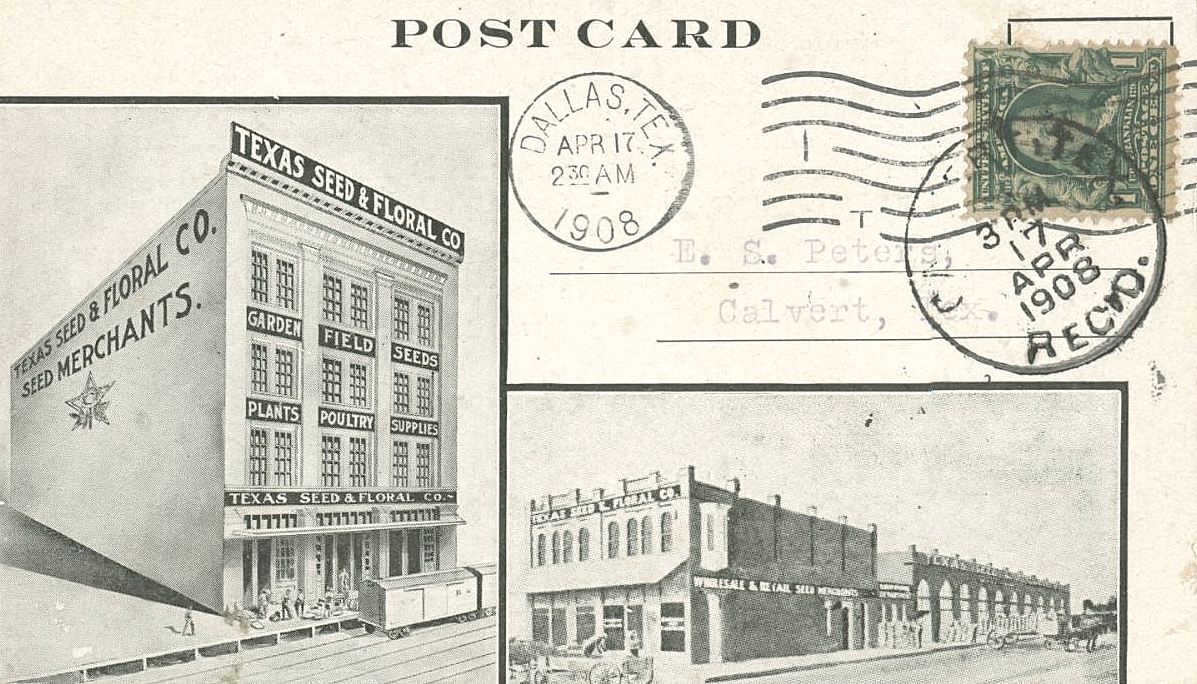
Below, a postcard of the Texas Seed & Floral Co., which later became the Lone Star Seed & Floral Co., located at the northwest corner of Elm and Ervay. In 1921 the beautiful Palace Theater opened up right next door, and I actually ended up writing about the seed company because a tiny part of it can be seen in a 1926 photo of the Palace. (The left image on the postcard shows the Pacific Avenue location; the one at the lower right is the Elm Street location, with a view looking north on Ervay.) Might as well add it to the post Next-Door Neighbors: The Palace Theater and Lone Star Seed & Floral — 1926.” (Source: Dallas Heritage Village via the Portal to Texas History)

texas-seed-and-floral_1908_portal

*

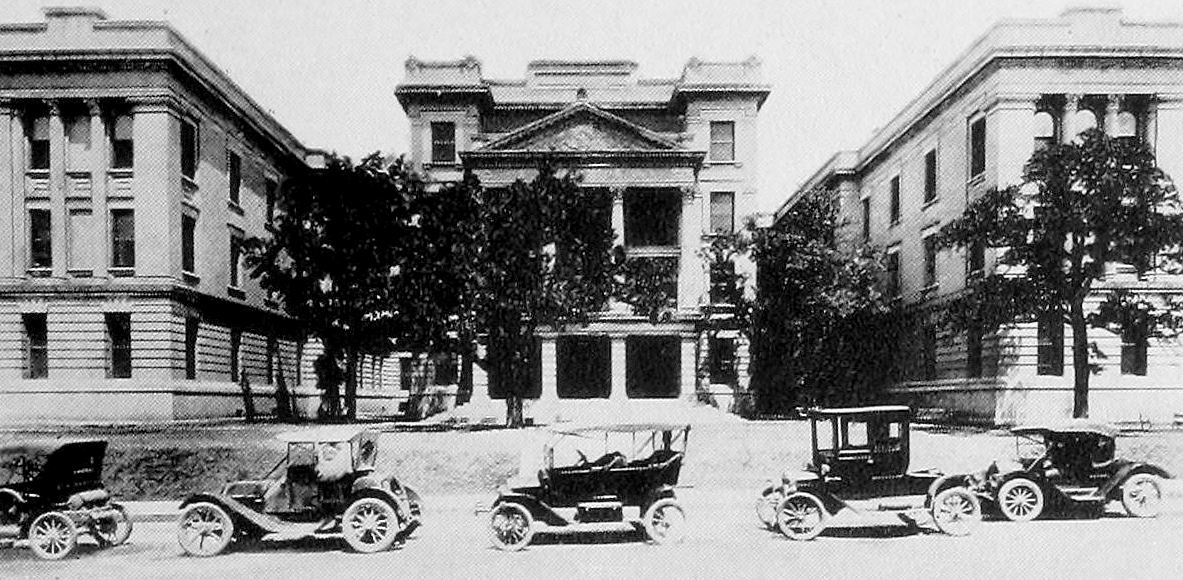
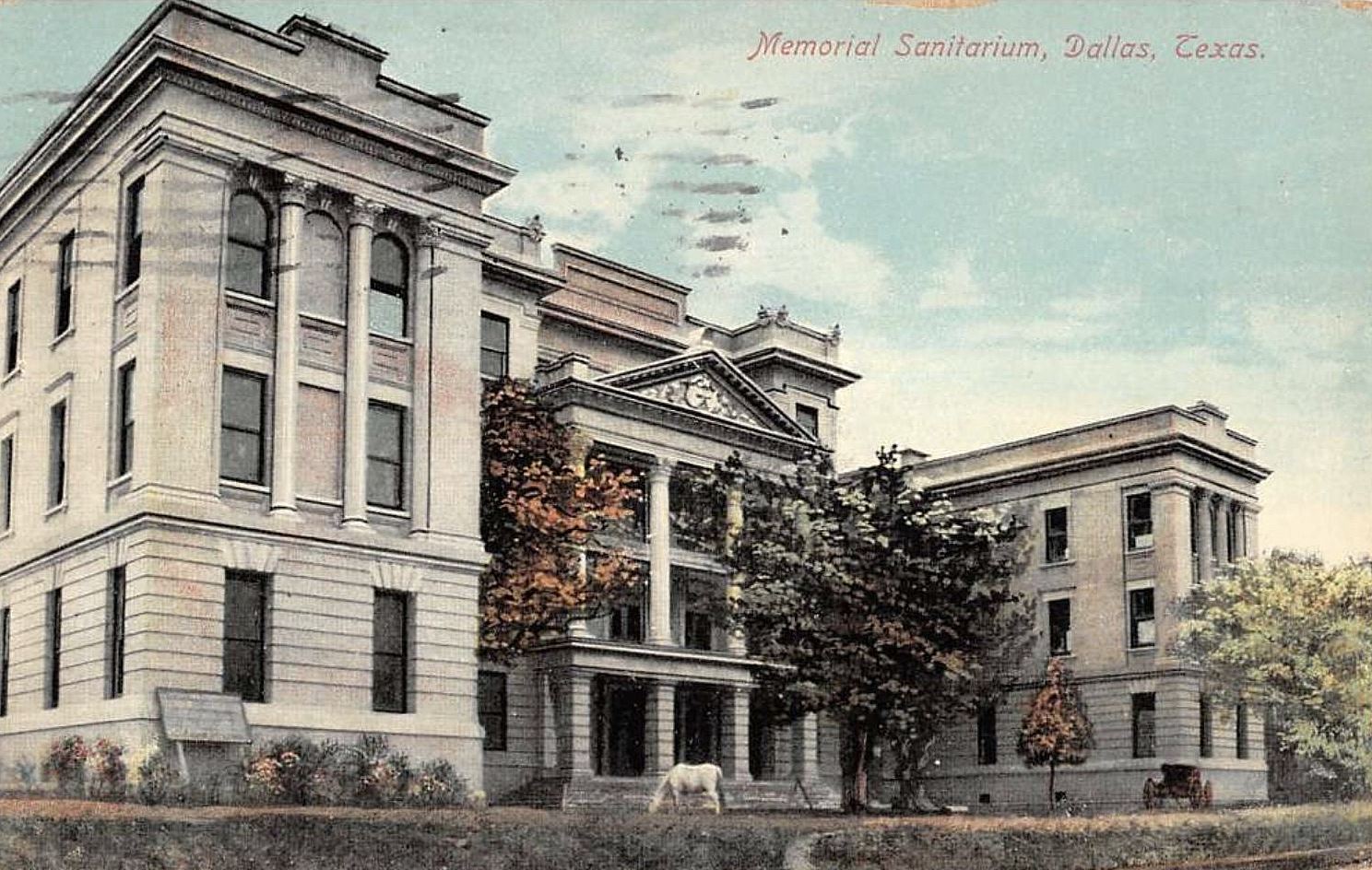
Below, a cool photo of the Texas Baptist Memorial Sanitarium (later renamed “Baylor Hospital”), with some pretty great automobiles parked out front on Junius Street. I’ve just added three photos and three postcard views of Baylor to the post Baylor Hospital —  1909-1921.” Basically, I’ve just written an entire new post — the original post consisted of one image and one sentence — so go see all the new stuff populating this 2014 post. (Source: The circa-1915 black-and-white photo is from the 1917 Baylor University yearbook; the postcard — that horse! — is from eBay.)

baylor_baylor-univ-waco-yrbk_the-round-up_1917

baylor_horse_postmarked-1911_ebay

*

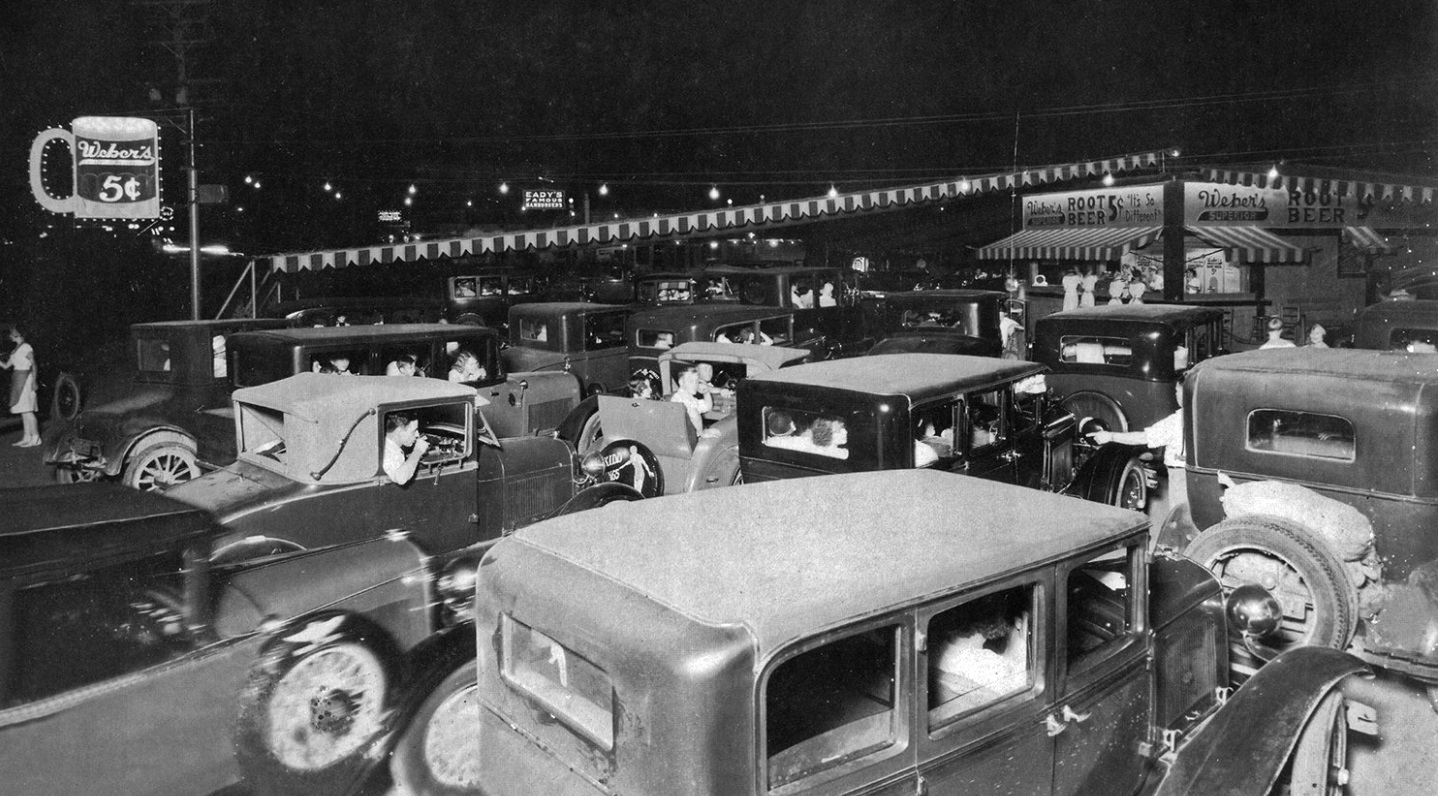
And lastly, a fantastic photo showing a Weber’s Root Beer stand on a busy night, with a parking lot full of thirsty teenagers, rumble seats, and future jalopies. In the background is a sign for Eady’s Famous Hamburgers, which would indicate that this photo was taken at one of the two locations where both Eady’s and Weber’s were neighbors: in Oak Cliff in the 1100 block of Zang, or near the Lower Greenville intersection of Greenville and Richmond. I’ve added this to the post “Weber’s Root Beer Stands: ‘Good Service with a Smile.'” (Source: Traces of Texas Twitter feed; original source unknown)

webers_root-beer_traces-of-texas

*

Copyright © 2018 Paula Bosse. All Rights Reserved.


From the Vault: Nolan Ryan’s Extreme High-Carb Breakfast at the Sheraton — 1972

nolan-ryanAnticipation…

by Paula Bosse

Why was future-Texas Ranger Nolan Ryan being served 302 pancakes at the Sheraton on September 26, 1972? Find out why in the 2015 Flashback Dallas post “Nolan Ryan’s Celebratory Pancake Breakfast — 1972,” here.

Happy (belated) Opening Day!

*

Copyright © 2018 Paula Bosse. All Rights Reserved.