Flashback : Dallas

A Miscellany: History, Ads, Pop Culture

Category: 1910s

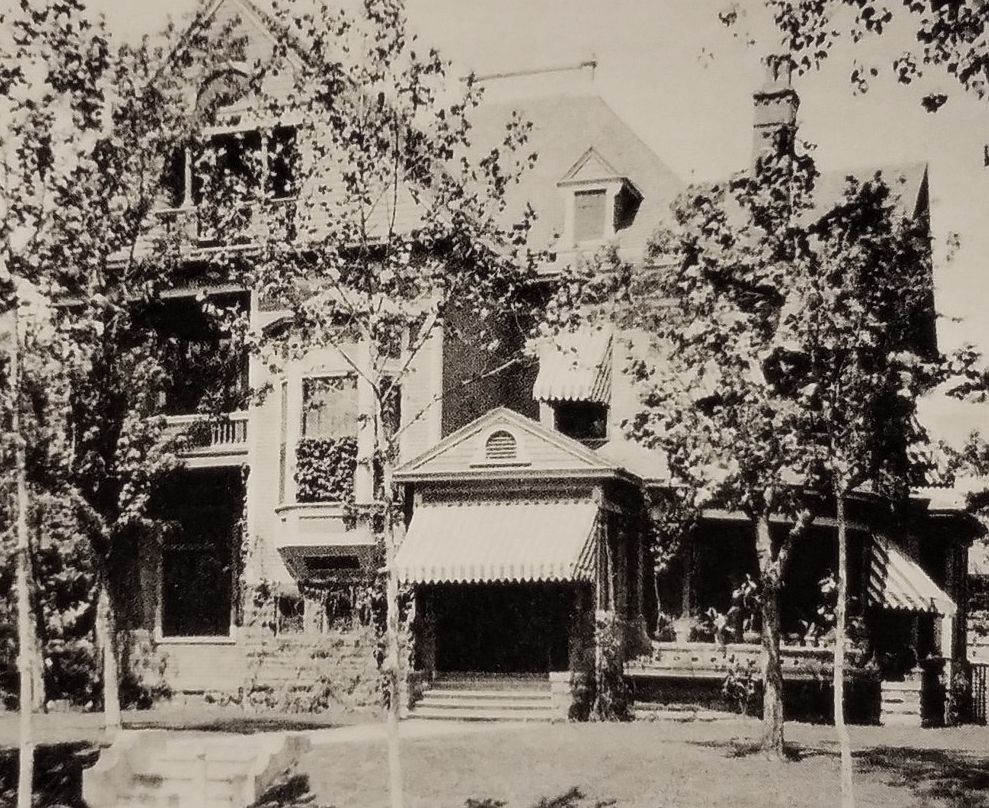
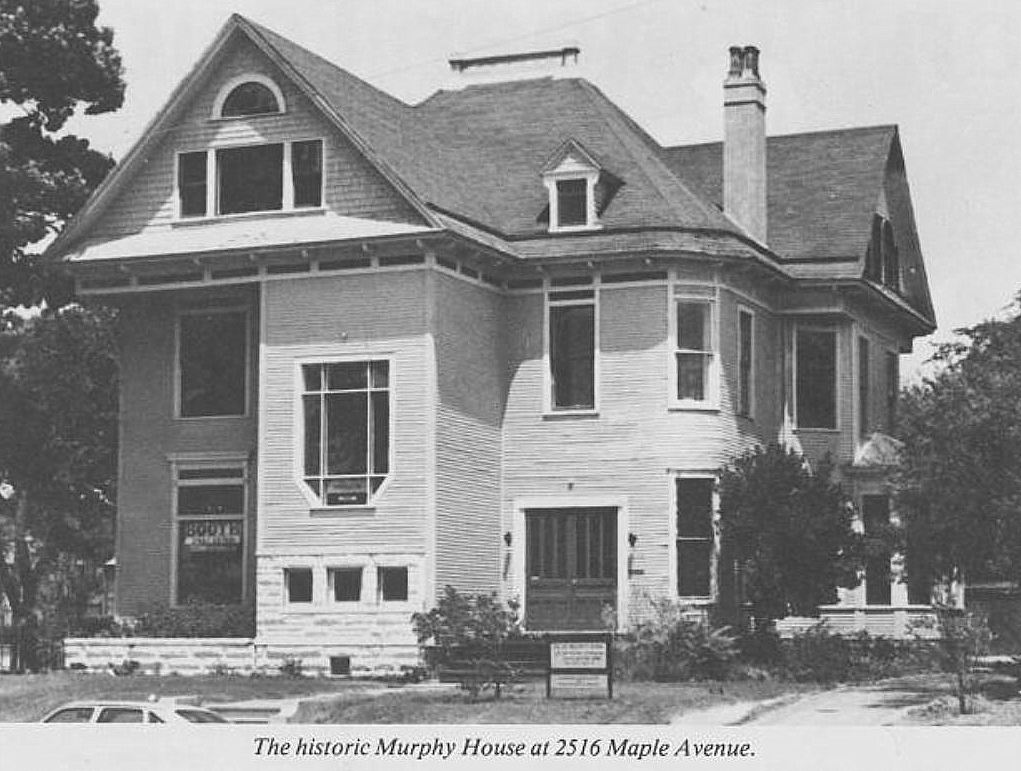
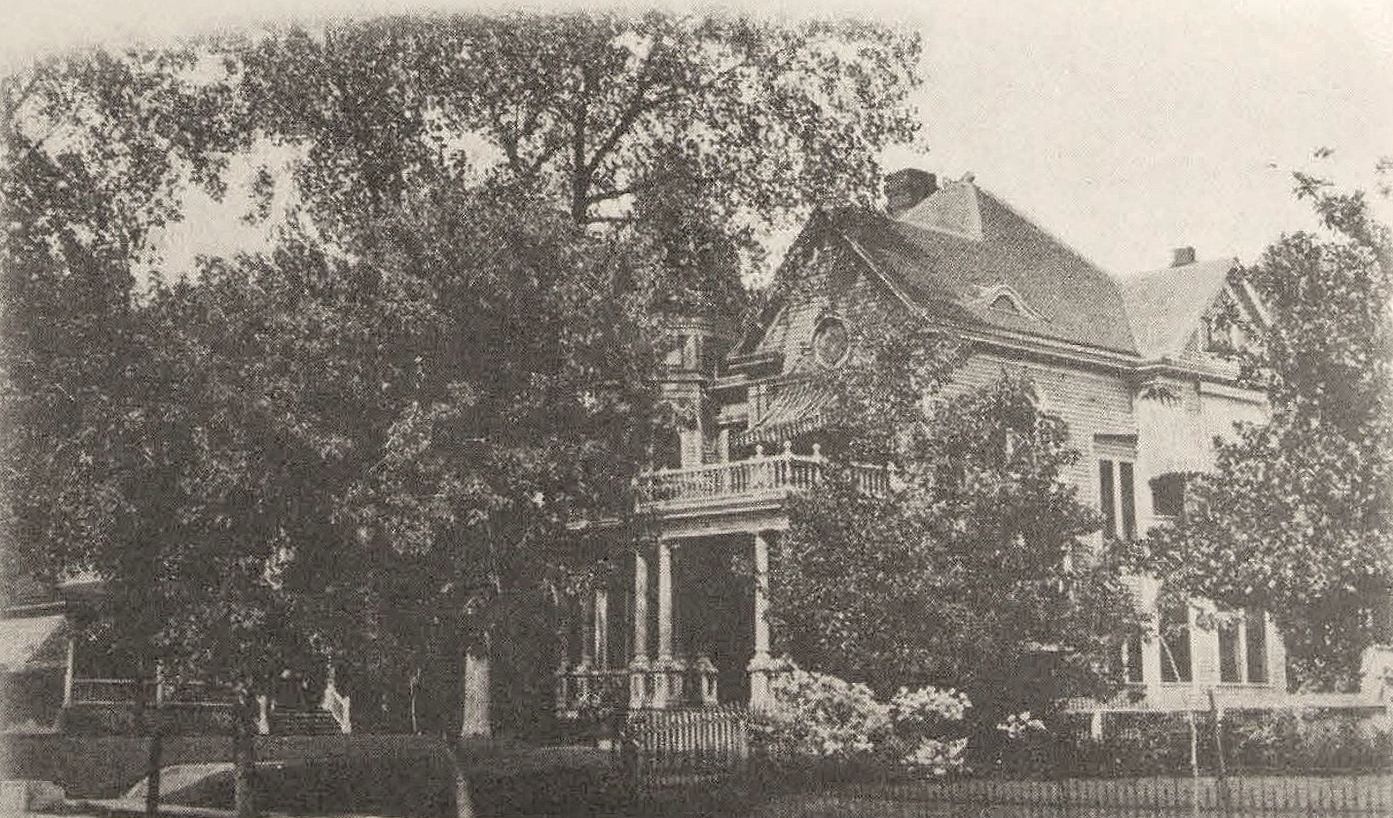
The Murphy House — Maple Avenue

murphy-house_ca-1910_dallas-rediscovered-DHS
154 Maple Avenue (2516 Maple Avenue), circa 1910

by Paula Bosse

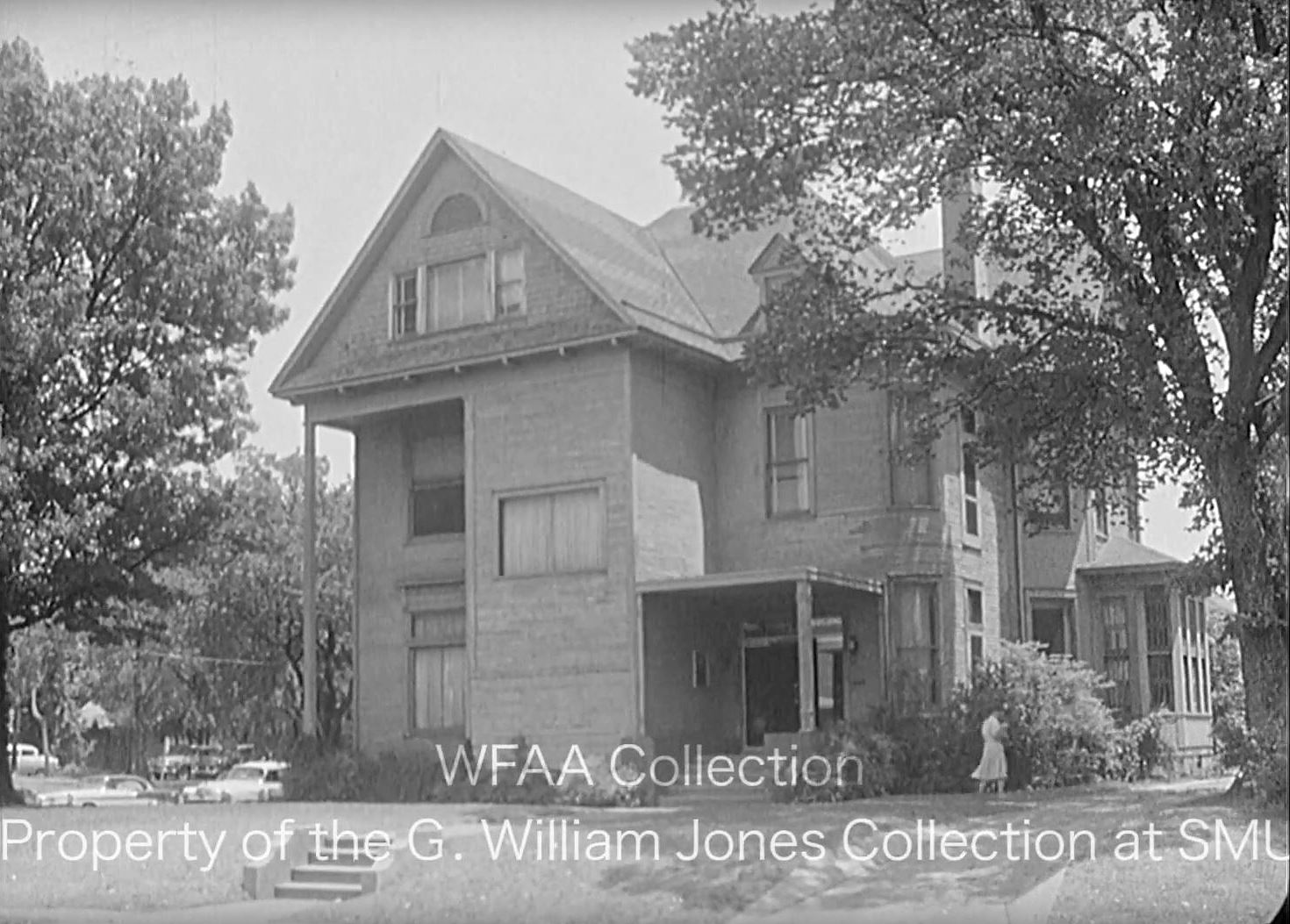
I posted a screenshot of a “mystery house” (here) to see if anyone could figure out where it was — and a few people identified it! The screenshot was from a June, 1960 WFAA Channel 8 news piece on an embezzlement case against the owner of the insurance business that was then occupying the old house — it was the home of the State National Life Insurance Company at 2516 Maple Avenue. And I don’t know what happened with its “remodeling” along the way, but… yikes. Someone did an unbelievably bad job!

According to a 1947 Dallas Morning News article (see “Sources & Notes” at bottom of page), the house was built in 1897. The address then was 154 Maple Avenue, back when Maple Avenue was lined with very nice homes, occupied by well-to-do families who would later move to Highland Park. You can see the house at the corner of Maple and Mahon (which for a while was called Martin) on the 1899 Sanborn map here, the 1905 map here, and the 1921 map here

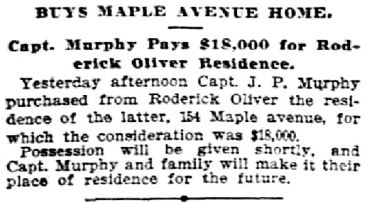
I’m not sure who built it, but in 1901 it was occupied by banker Roderick Oliver who sold it to Capt. John P. Murphy in 1906 for $18,000 — or $500,000 in today’s money. Murphy was the legendary pioneer real estate man of Dallas. He started his real estate company in 1874 and was joined by partner Charles F. Bolanz in 1884 — Murphy & Bolanz was the premier real estate company in the city for decades. 

murphy-house_dmn_051806Dallas Morning News, May 18, 1906

The house stayed in the Murphy family for many years. In 1947 the house was elaborately restored by three women (two of whom were Murphy’s daughters) who opened it as The Laurels, an elegant location for weddings and receptions. The house had been slated for sale and demolition, but the women thought that the old house would serve brides well, as “the highlight of any young girl’s life is her marriage, and few places in Dallas offer a suitable environment for such an occasion,” said one of the women (DMN, Oct. 5, 1947). The Laurels appears to have been in business only through the end of 1948 — about a year; a classified ad shows that it had become a boarding house “for young working people” soon after.

It seems to have been sold in the 1950s when it became home to various businesses. After the embezzlement interlude, it was, among other things, a theme club called The Haunted House in the 1960s, community radio station KCHU in the ’70s, and an antique shop in the ’80s.

Below is how it looked in June of 1960 as it was passing into receivership. A news story described it thusly: “…a big house that is a study in contradictions. Outside, flat green paint peels and cracks, gentility sliding headlong toward an ‘arty’ disrespectability” (“Old House on Maple Services Insurance Empire,” Dallas Morning News, June 9, 1960). It looked pretty sad.

mystery-house-1960
1960, G. William Jones Collection, SMU

In the mid-’70s, it became the headquarters of community radio station KCHU (90.0 FM). (Watch Channel 13 story on KCHU on YouTube here.)

kchu_murphy-house_KERA_dec-1975_screenshot1975, G. William Jones Collection, SMU

kchu-sign_kera_dec-1975_SMU

It was spiffed up a bit in the early ’80s for the antique shop, Booth Galleries, but it still looked weird, like someone had sheared off the sides of the house, removing any and all character.

murphy-house_2515-maple_historic-dallas-mag_fall-1980_portal_photo
1980, Historic Dallas, via Portal to Texas History

Then — saints preserve us! — the gods smiled down and Claire Heymann bought the decrepit old house (which was waiting for its all-but-inevitable date with the wrecking ball) and worked absolute miracles to transform the house into the stunningly beautiful Hotel St. Germain, located across from the Crescent. This is one instance where a restoration/renovation actually improves on the original! I’ve loved this redone building — Dallas’ first bed and breakfast inn — since it first appeared in 1991. Long may it stand. Thank you, Claire!

hotel-st-germain_google_2017
2018, Google Street View

hotel-st-germain_google-street-view_2019
2019, Google Street View

***

Sources & Notes

Top photo showing the home of John P. Murphy, circa 1910, is from Dallas Rediscovered by William McDonald, with photo credited to the Dallas Historical Society.

The Dallas Morning News article “Early Dallas Home Restored for Weddings” (DMN, Oct. 5, 1947) states that the house was built in 1897. “The Laurels” was opened by Murphy’s daughters Mrs. Louise Boyce Sanford and Mrs. Eugene P. Locke in partnership with Mrs. Dorothy Doran Walker.

murphy-house_ca-1910_dallas-rediscovered-DHS_sm

*

Copyright © 2019 Paula Bosse. All Rights Reserved.

Private Education in Dallas — 1916

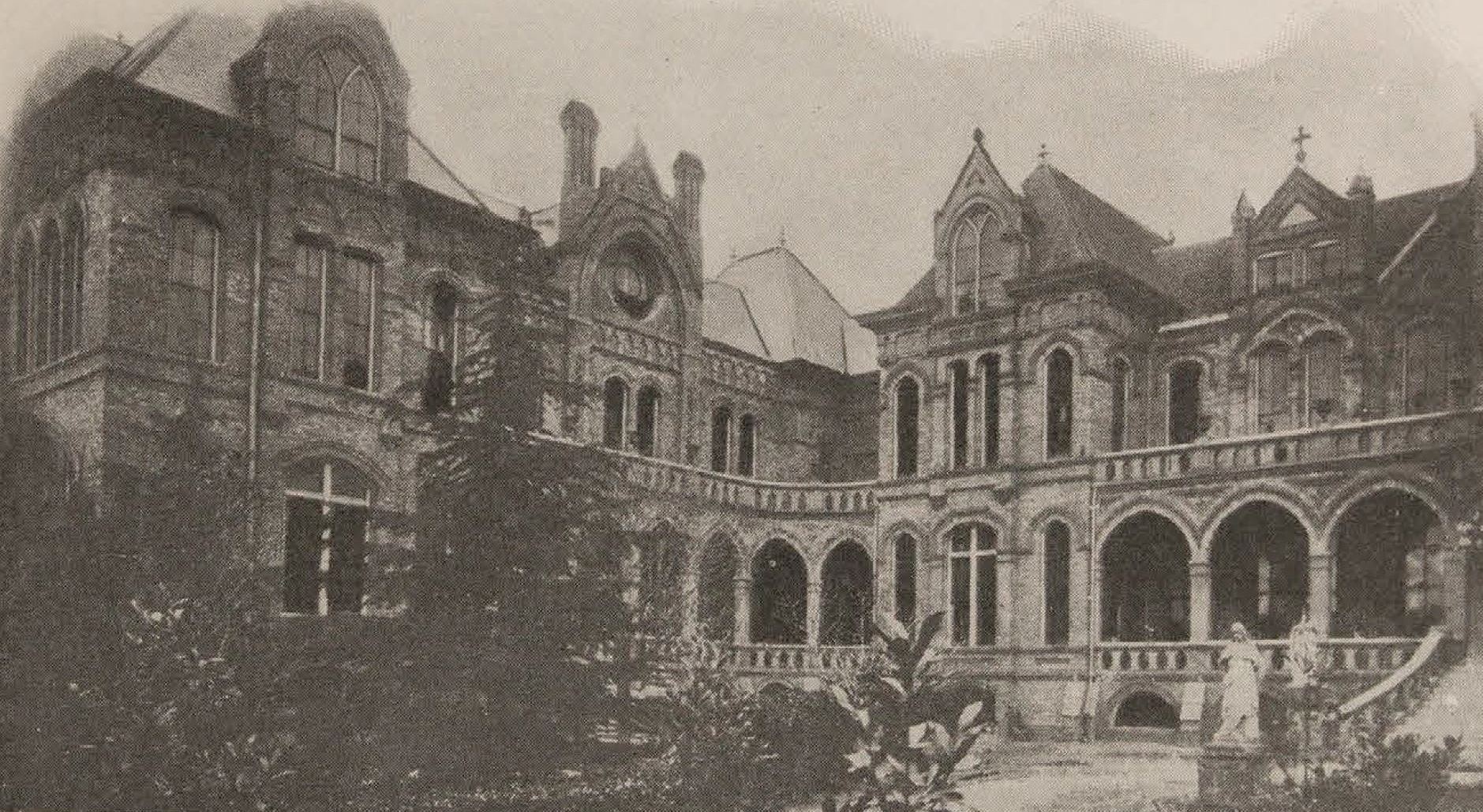
dallas-educational-center_ursuline_ca-1916_degolyer-library_smu_photoThe looming Ursuline Academy in Old East Dallas

by Paula Bosse

Here is a collection of photos and mini-histories of several of the top private schools that Dallas parents were ponying up their hard-earned cash for in 1916. Some were boarding schools, some were affiliated with churches, some were rooted in military discipline, some were medical schools, and some were places to go to receive instruction on the finer things in life, such as music and art. Sadly, only one of these buildings still stands. But two of the schools in this collection have been operating continuously for over 100 years (Ursuline and Hockaday), and two more are still around, having had a few name changes over the years (St. Mark’s and Jesuit). Here’s where the more well-to-do girls and boys of Dallas (…and Texas — and many other states) were sent to become young ladies and gentlemen. 

**

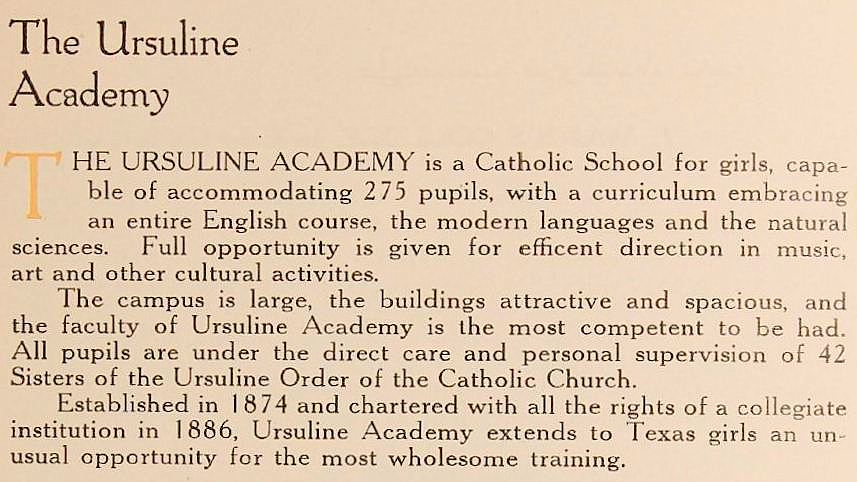
THE URSULINE ACADEMY (above) — Mother Mary Teresa, superioress — the block bounded by Live Oak, Haskell, Bryan, and St. Joseph. This school for girls and young women was established in Dallas by the Ursuline Sisters in about 1874 — and it continues today as one of the city’s finest institutions. The incredible gothic building was… incredible. So of course it was demolished (in 1949, when the school moved its campus to its present-day North Dallas location). See what it looked like at its Gothic, grandiose height in a previous Flashback Dallas post here.

dallas-educational-center_ursuline_ca-1916_degolyer-library_smu

*

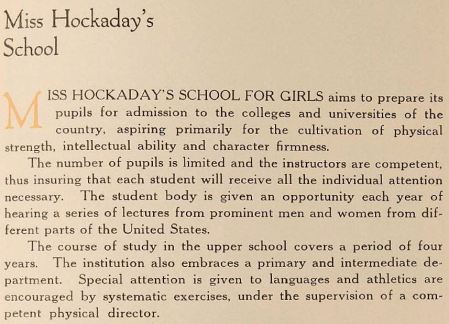
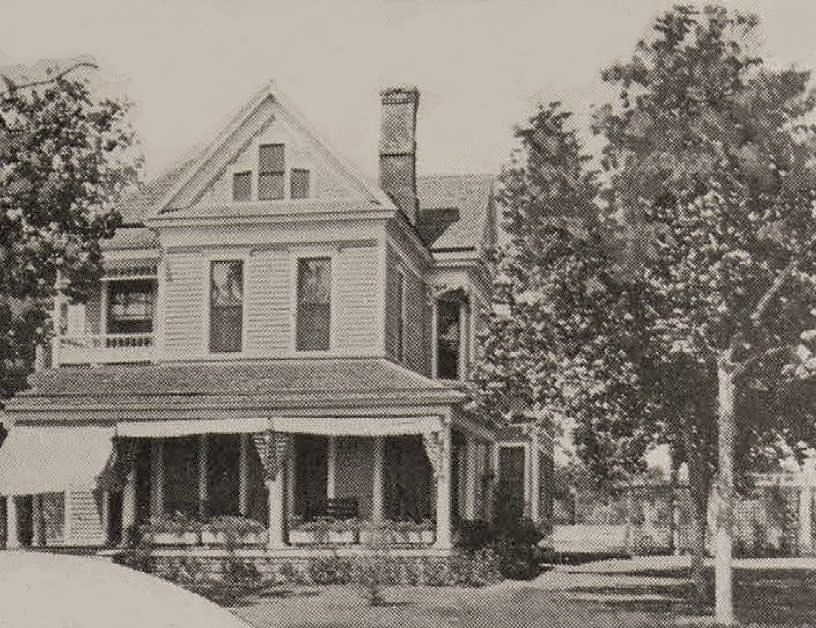
MISS HOCKADAY’S SCHOOL FOR GIRLS — Miss Ela Hockaday, principal — 1206 N. Haskell. Hockaday was (and is) the premier girl’s school of Dallas society — like Ursuline, it is still going strong (and, like Ursuline, it moved away from East Dallas and is now located in North Dallas). In 1919, three years after these photos were taken, Miss Hockaday would buy the former home of Walter Caruth, Bosque Bonita, set in a full block at Belmont and Greenville in the Vickery Place neighborhood — there she built a large campus and cemented her place as one of the legendary educators in Dallas history. (In 1920, Hockaday’s annual tuition for boarding students eclipsed even the hefty tuition of The Terrill School for Boys: Miss Hockaday had parents lined up to pay her $1,000 a year — now the equivalent of about $13,000 — to educate and refine their daughters at her prestigious institution.)
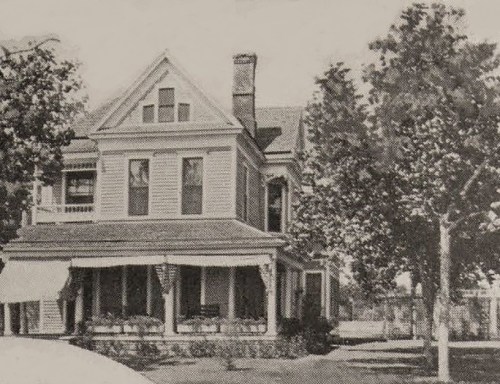
dallas-educational-center_hockaday_ca-1916_degolyer-library_smu

dallas-educational-center_hockaday_tennis_ca-1916_degolyer-library_smu

dallas-educational-center_hockaday_ca-1916_degolyer-library_smu_text

*

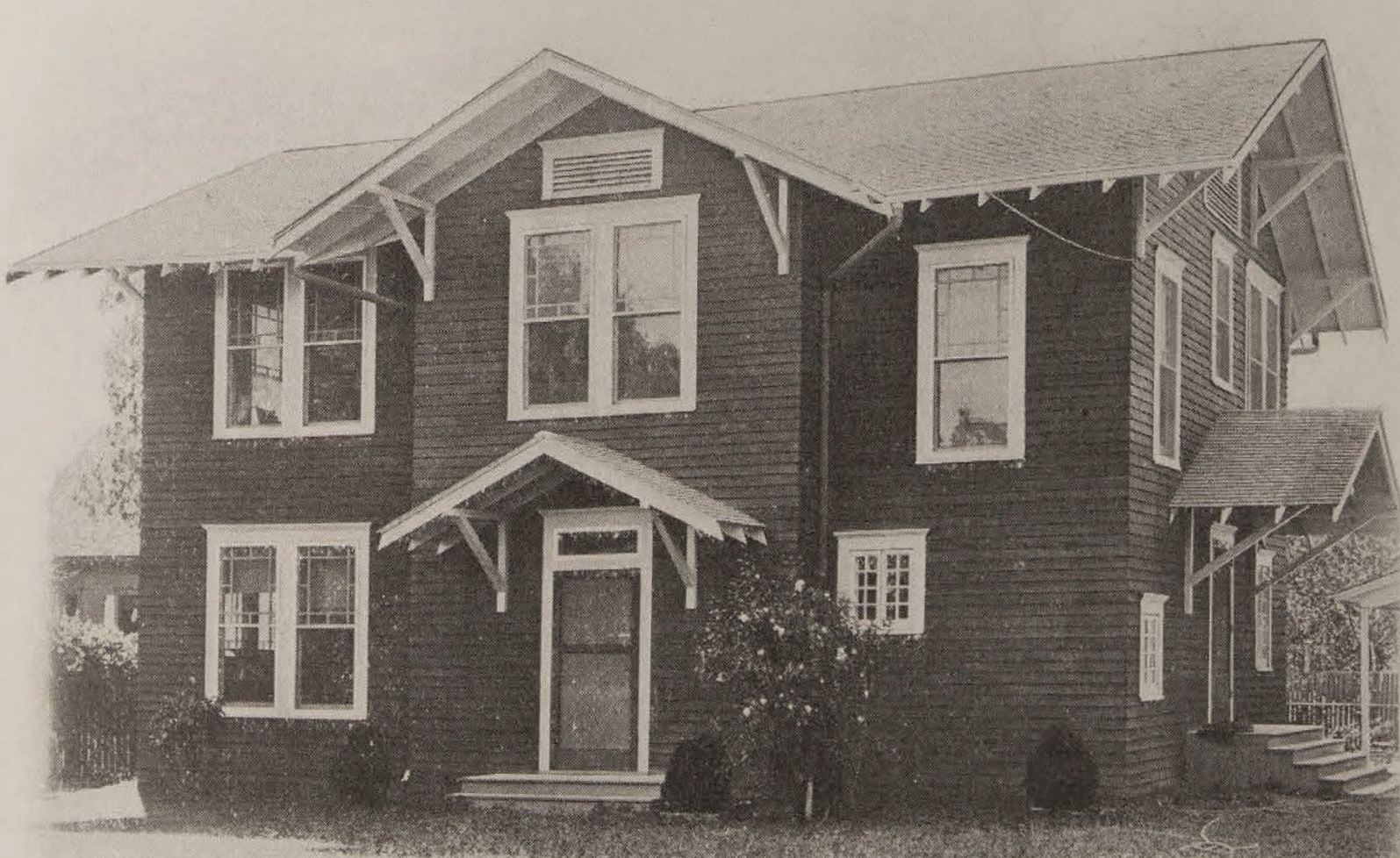
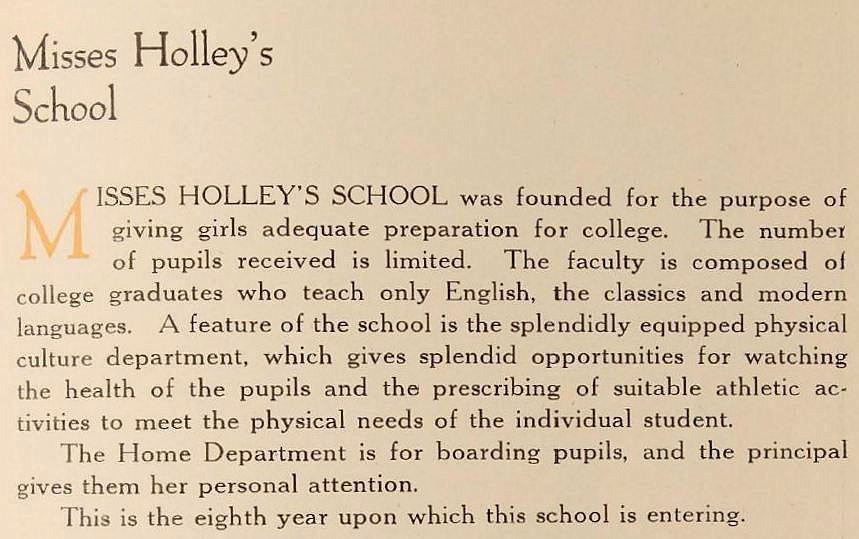
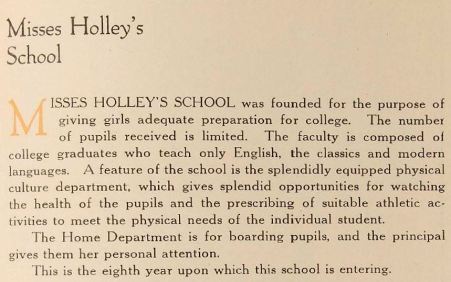
MISSES HOLLEY’S SCHOOL FOR GIRLS — Miss Frances Holley and Miss Josephine Holley, principals — 4528 Ross Avenue (at Annex). Another somewhat exclusive school that catered to young society ladies was the Holley school, established in 1908 by the two Holley sisters, who limited their student body to only 35 girls. The school (which is sometimes referred to as “Miss Holley’s School” and “Holley Hall” — and which was located behind the sisters’ residence) closed in 1926.
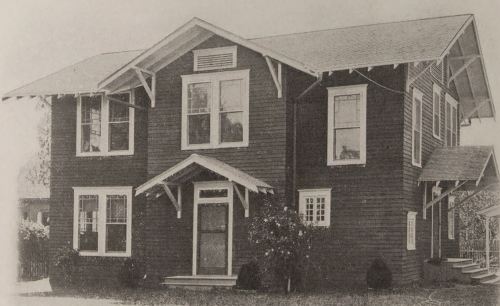
dallas-educational-center_holleys-school_ca-1916_degolyer-library_smu

dallas-educational-center_holleys-school_ca-1916_degolyer-library_smu_text

*

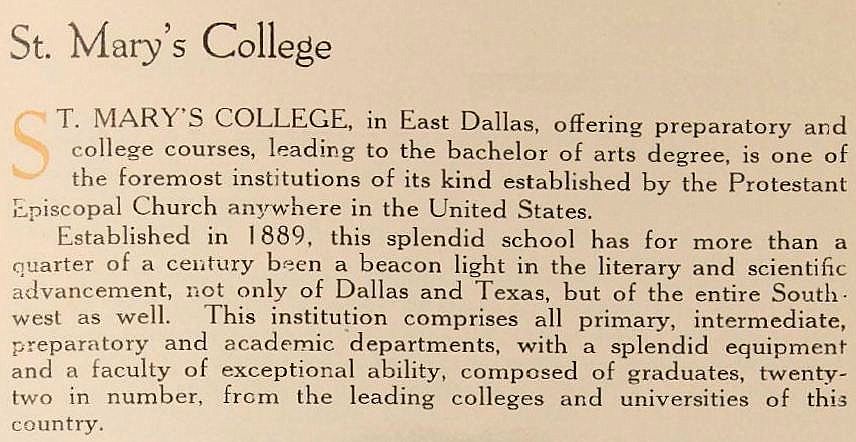
ST. MARY’S COLLEGE — Miss Ethel Middleton, principal — Garrett and Ross Avenue.  This Episcopal-Church-associated boarding and day school for girls and young ladies was one of the Southwest’s leading institutions of learning for young women. When established in 1889, it was built outside the city limits on a “hill” — back then the area around the school was often referred to as “College Hill.”
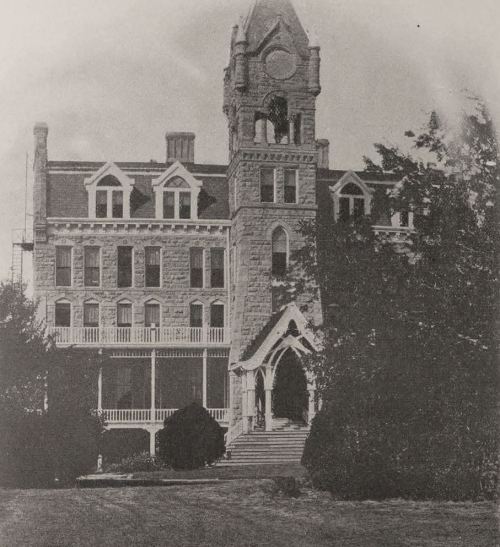
dallas-educational-center_st-marys_b_ca-1916_degolyer-library_smu

dallas-educational-center_st-marys_ca-1916_degolyer-library_smu

dallas-educational-center_st-marys_ca-1916_degolyer-library_smu_text

*

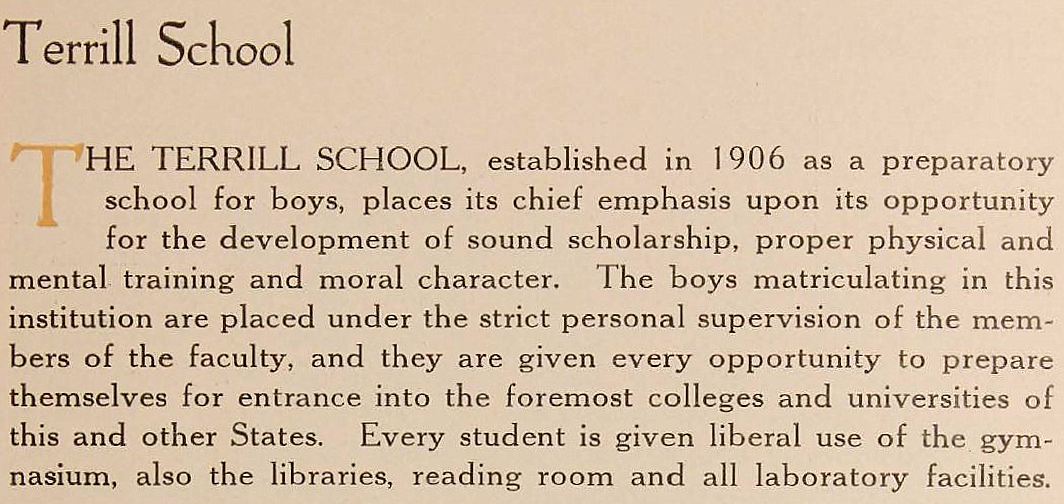
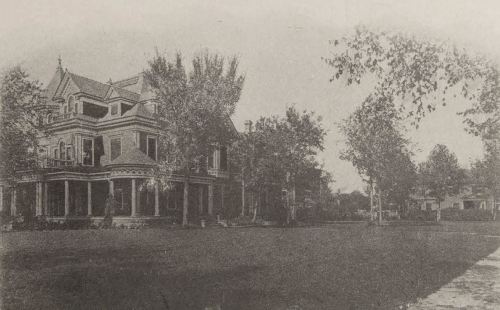
THE TERRILL SCHOOL FOR BOYS — M. B. Bogarte, head master — 4217 Swiss Avenue (at Peak). The exclusive boys school in Dallas (which, after several mergers, continues today as St. Mark’s); the cost of a year’s tuition for boarding students in 1920 was $850 — the equivalent of about $11,000 — a very pricey school back then. More on the Terrill School can be found in previous Flashback Dallas posts here and here.
dallas-educational-center_terrill-school_ca-1916_degolyer-library_smu

dallas-educational-center_terrill-school_ca-1916_degolyer-library_smu_info

*

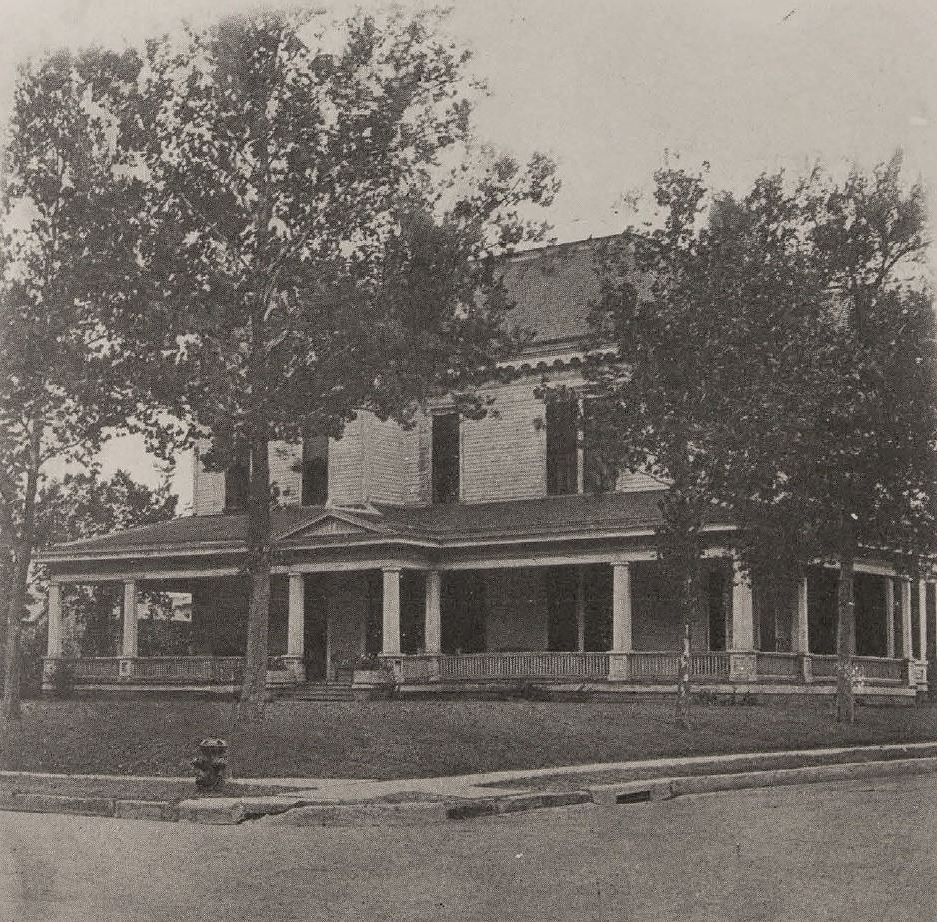
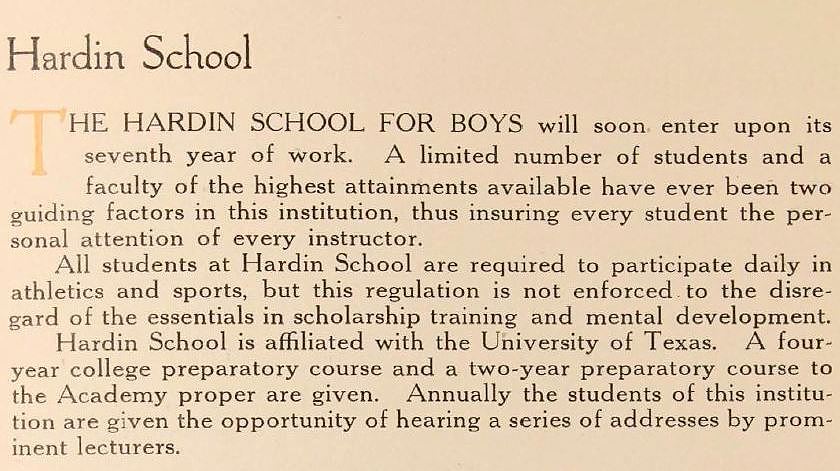
THE HARDIN SCHOOL FOR BOYS — J. A. Hardin, principal — 4021 Swiss Avenue. This prep school was affiliated with the University of Texas. It was located for a while in downtown Dallas and for a time at the location seen below in Old East Dallas, but in 1917 it either bought out and merged with the Dallas Military Academy or that school went out of business, because the Hardin School settled into the military academy’s location, which had been Walter Caruth’s old home, Bosque Bonita, at Belmont and Greenville, where boys were marching around doing drills until Miss Hockaday moved in two years later in 1919.

dallas-educational-center_hardin-school_ca-1916_degolyer-library_smu_photo

dallas-educational-center_hardin-school_ca-1916_degolyer-library_smu

*

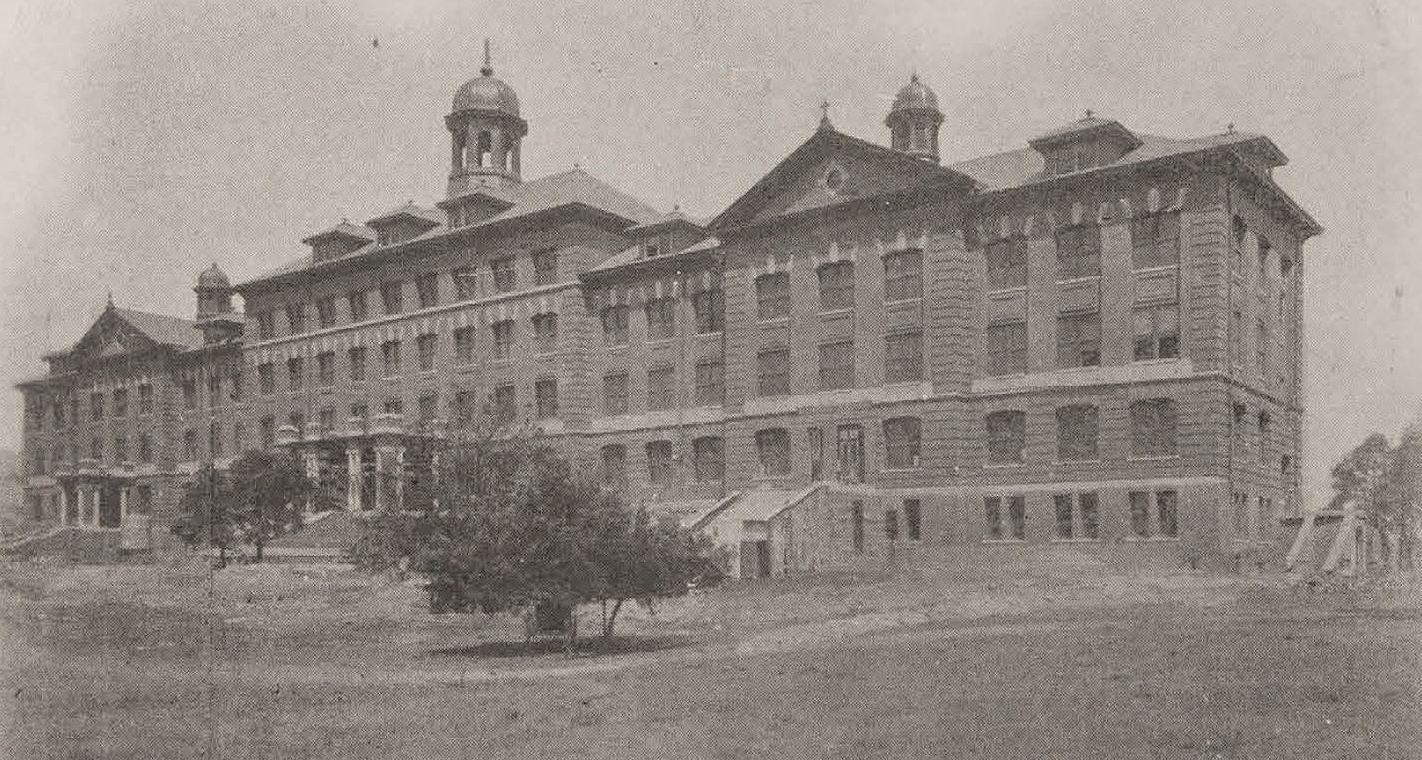
DALLAS MILITARY ACADEMY AND SCHOOL OF ENGINEERING — C. J. Kennerly, superintendent — Belmont & Greenville Ave. This “practical school for manly boys” opened up in 1916 in a large house which had been built by Walter Caruth in the area now known as Lower Greenville. The Dallas Military Academy lasted for only one year until the large house became home to the Hardin School for Boys in 1917 (and, two years later in 1919, it became the longtime home of the Hockaday School). If you didn’t click on the link for it above, now’s your chance to read more about the history of Caruth’s grand house, Bosque Bonita, here.

dallas-educational-center_pre-hockaday_dallas-military-academy_ca-1916_degolyer-library_smu

dallas-educational-center_pre-hockaday_dallas-military-academy_ca-1916_degolyer-library_smu_text

*

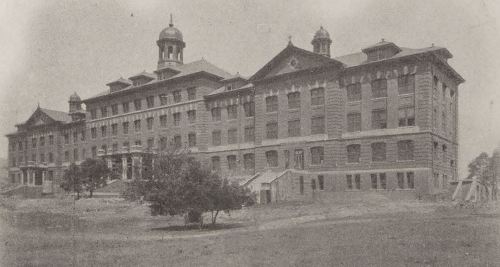
UNIVERSITY OF DALLAS — Very Rev. P. A. Finney, president — Oak Lawn Ave. & Gilbert. When it opened in 1906, this school was known as Holy Trinity College; its name was changed to the University of Dallas in 1910. The University of Dallas closed in 1928 because of lack of money; it was later known as Jesuit High School until Jesuit moved to North Dallas — the grand building was demolished in 1963. (See an aerial view of this huge building here.)
dallas-educational-center_univ-of-dallas_trinity_jesuit_ca-1916_degolyer-library_smu_photo

dallas-educational-center_univ-of-dallas_trinity_jesuit_ca-1916_degolyer-library_smu

*

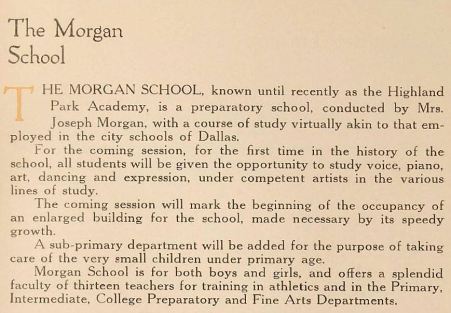
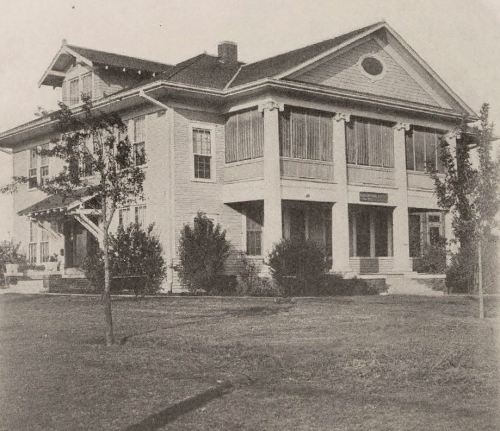
THE MORGAN SCHOOL (formerly the Highland Park Academy) — Mrs. Joseph Morgan, principal — 4608 Abbott. A co-ed school.
dallas-educational-center_morgan-school_b_ca-1916_degolyer-library_smu

dallas-educational-center_morgan-school_ca-1916_degolyer-library_smu

dallas-educational-center_morgan-school_ca-1916_degolyer-library_smu_text

*

POWELL TRAINING SCHOOL — Nathan Powell, president — Binkley & Atkins (now Hillcrest) in University Park. I believe this is the only building in this post still standing — more can be read in the earlier post “Send Your Kids to Prep School ‘Under the Shadow of SMU’ — 1915,” here. (That is, in fact, a bit of the very, very young SMU campus seen in the distance at the bottom right.)

dallas-educational-center_powell-school_ca-1916

dallas-educational-center_powell-school_ca-1916_info

*

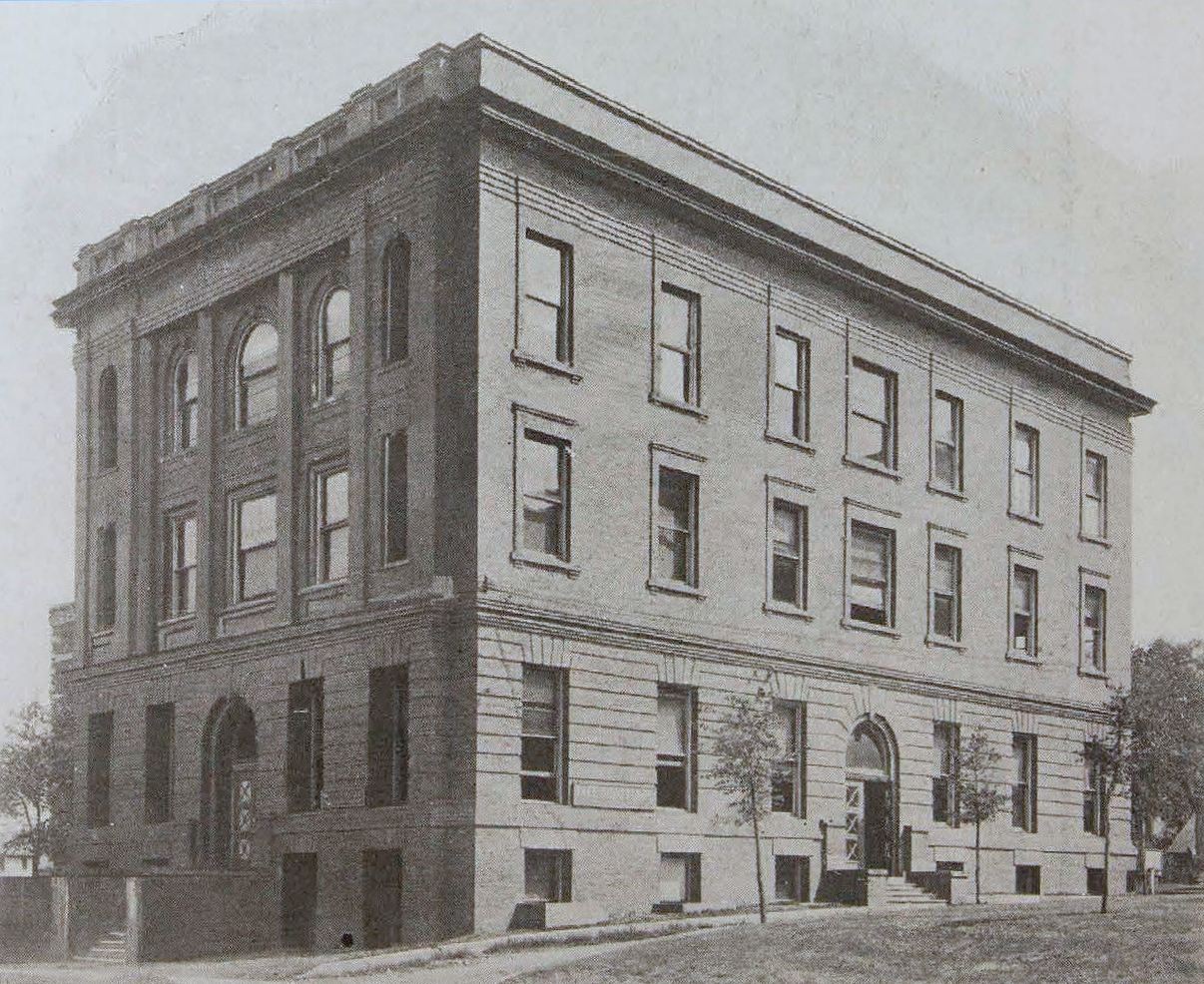
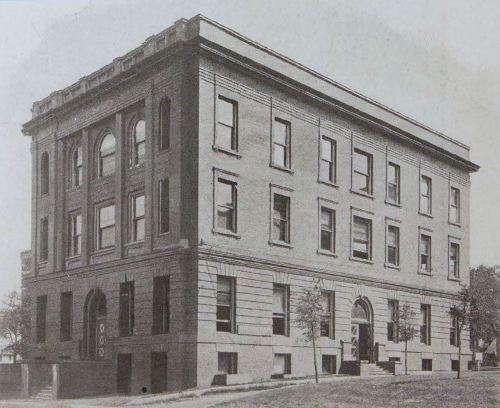
BAYLOR MEDICAL COLLEGE — E. H. Cary, dean — 720 College Ave. (now Hall Street).
dallas-educational-center_baylor-medical-college_ca-1916_degolyer-library_smu_photo

DALLAS POLYCLINIC/POST-GRADUATE MEDICAL SCHOOL — John S. Turner, president — S. Ervay & Marilla (affiliated with Baylor Medical College).

dallas-educational-center_dallas-polyclinic_ca-1916

dallas-educational-center_baylor-medical-college_ca-1916_degolyer-library_smu

*

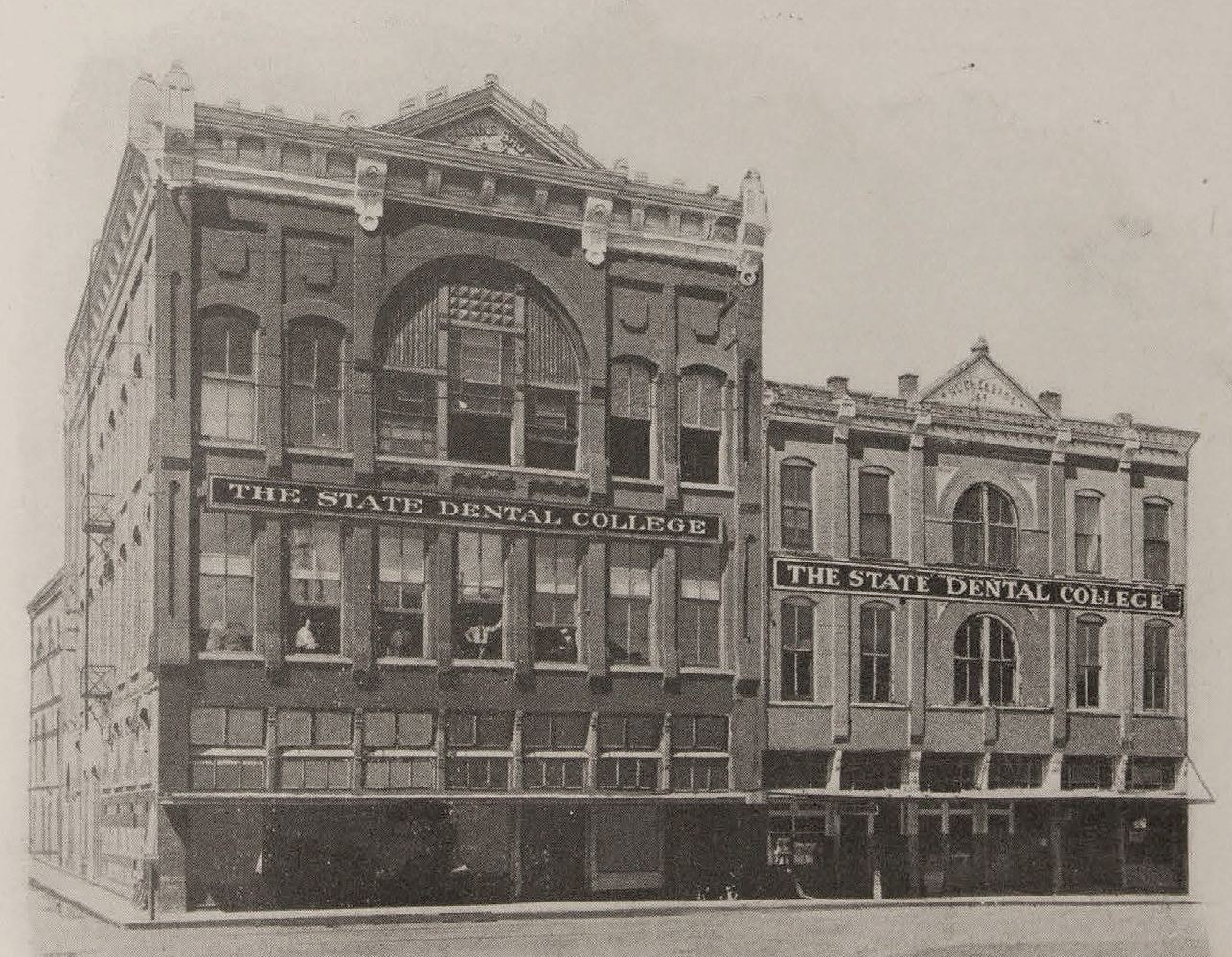
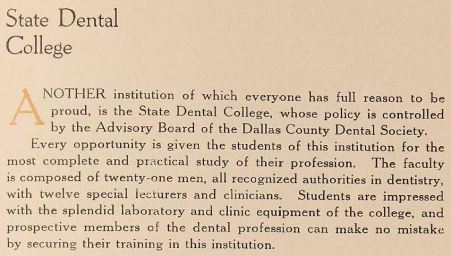
STATE DENTAL COLLEGE — 1409 ½ South Ervay, across from the Park Hotel (more recently known as the Ambassador Hotel).

dallas-educational-center_state-dental-college_ca-1916_degolyer-library_smu_photo

dallas-educational-center_state-dental-college_ca-1916_degolyer-library_smu

*

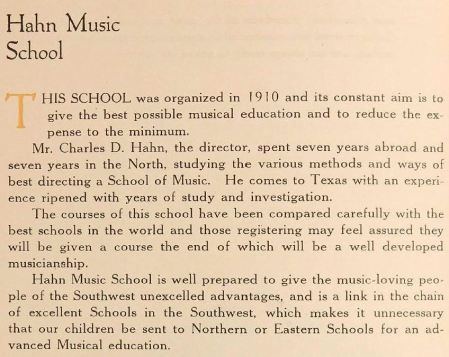
HAHN MUSIC SCHOOL — Charles D. Hahn, director — 3419 Junius. 

dallas-educational-center_hahn-music-school_ca-1916_photo

dallas-educational-center_hahn-music-school_ca-1916

*

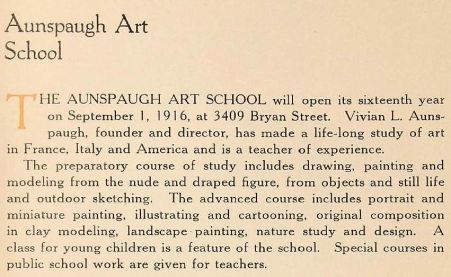
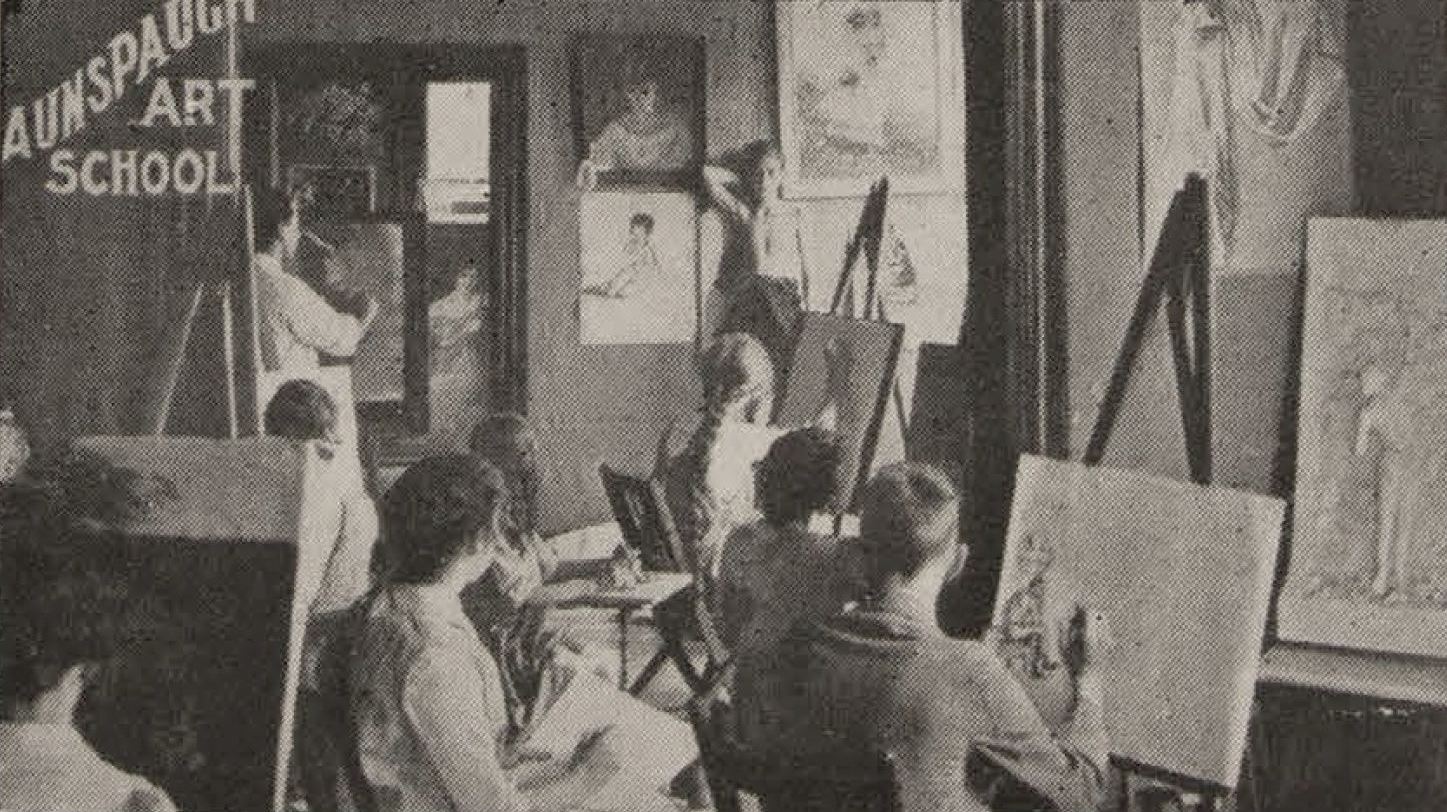
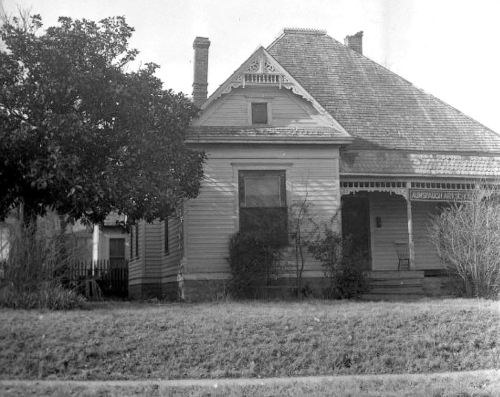
AUNSPAUGH ART SCHOOL — VIvian Aunspaugh, director — 3409 Bryan. A well-established Dallas art school for 60 years. Miss Aunspaugh died in 1960 at the age of 90 and was said to have been giving lessons until shortly before her death. (The photo below of the exterior is the only one here not from about 1916 — that photo is from 1944.)

dallas-educational-center_aunspaugh_interior_ca-1916_degolyer-library_smu

aunspaugh-art-school_james-bell_1944_DHSvia Dallas Historical Society

dallas-educational-center_aunspaugh_ca-1916_degolyer-library_smu

*

dallas-educational-center_ca-1916_degolyer-library_smu

dallas-educational-center_front-cover_ca-1916_degolyer-library_smu

***

Sources & Notes

All images (but one) from the booklet “Dallas, The Educational Center of the Southwest” (published by the Educational Committee, Dallas Chamber of Commerce, and Manufacturers Association, Dallas, ca. 1916), from the collection of the DeGolyer Library, SMU Libraries, Southern Methodist University; more information on this publication — and a full digital scan of it — can be found at the SMU site, here.

The exterior photo of the Aunspaugh Art School is from the Dallas Historical Society, taken in 1944 by Dallas resident James H. Bell; more information on this photo is at the DHS site, here.

dallas-educational-center_aunspaugh_interior_ca-1916_degolyer-library_smu_sm

*

Copyright © 2019 Paula Bosse. All Rights Reserved.


A Few Random Postcards

methodist-hospital_postcard_1944_ebay

by Paula Bosse

Here are a few totally random postcard images, pulled from bulging digital file folders.

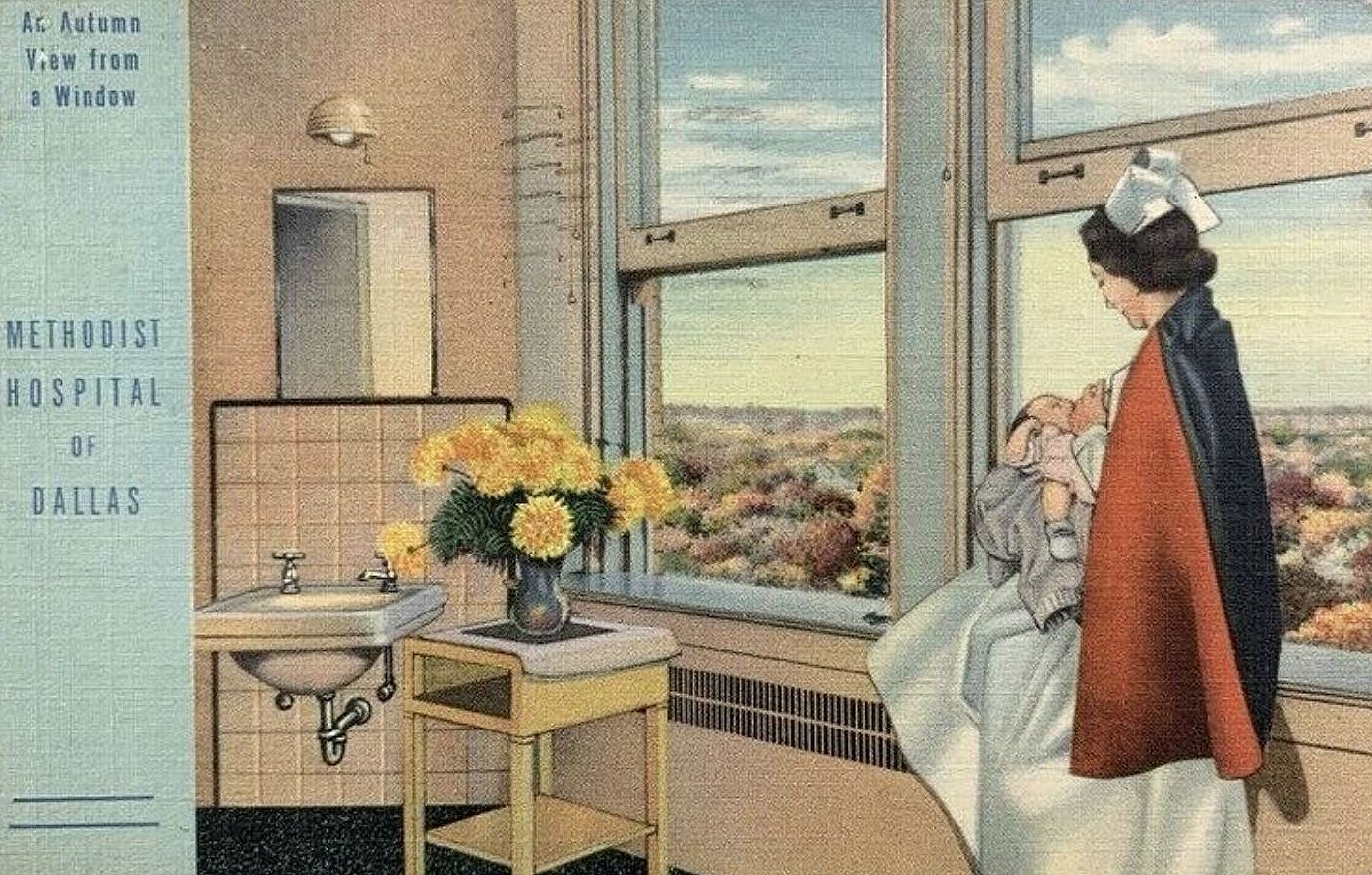
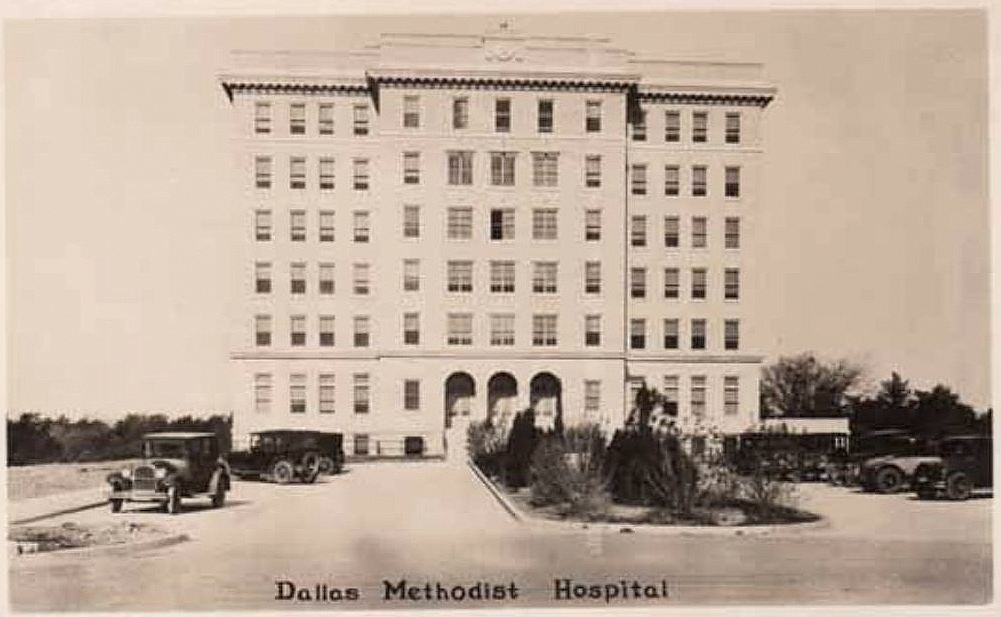
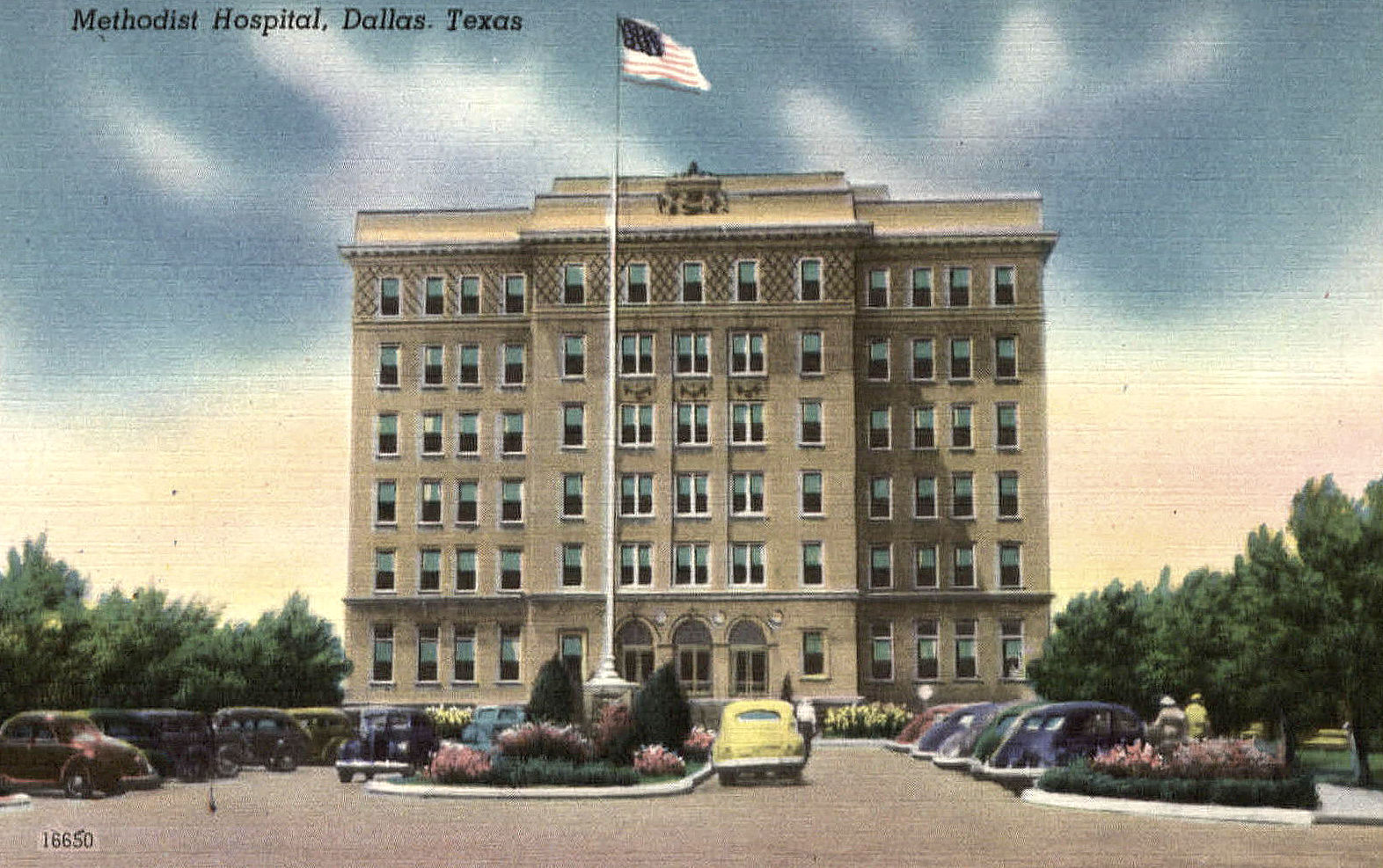
Above, an unusual postcard for Methodist Hospital — “An Autumn View From a Window.” The hospital was located in Oak Cliff at 301 Colorado Street — built in 1927, demolished in 1994. The card is postmarked 1944. Below are two other images.

methodist-hospital_rppc_ebay

methodist-hospital

*

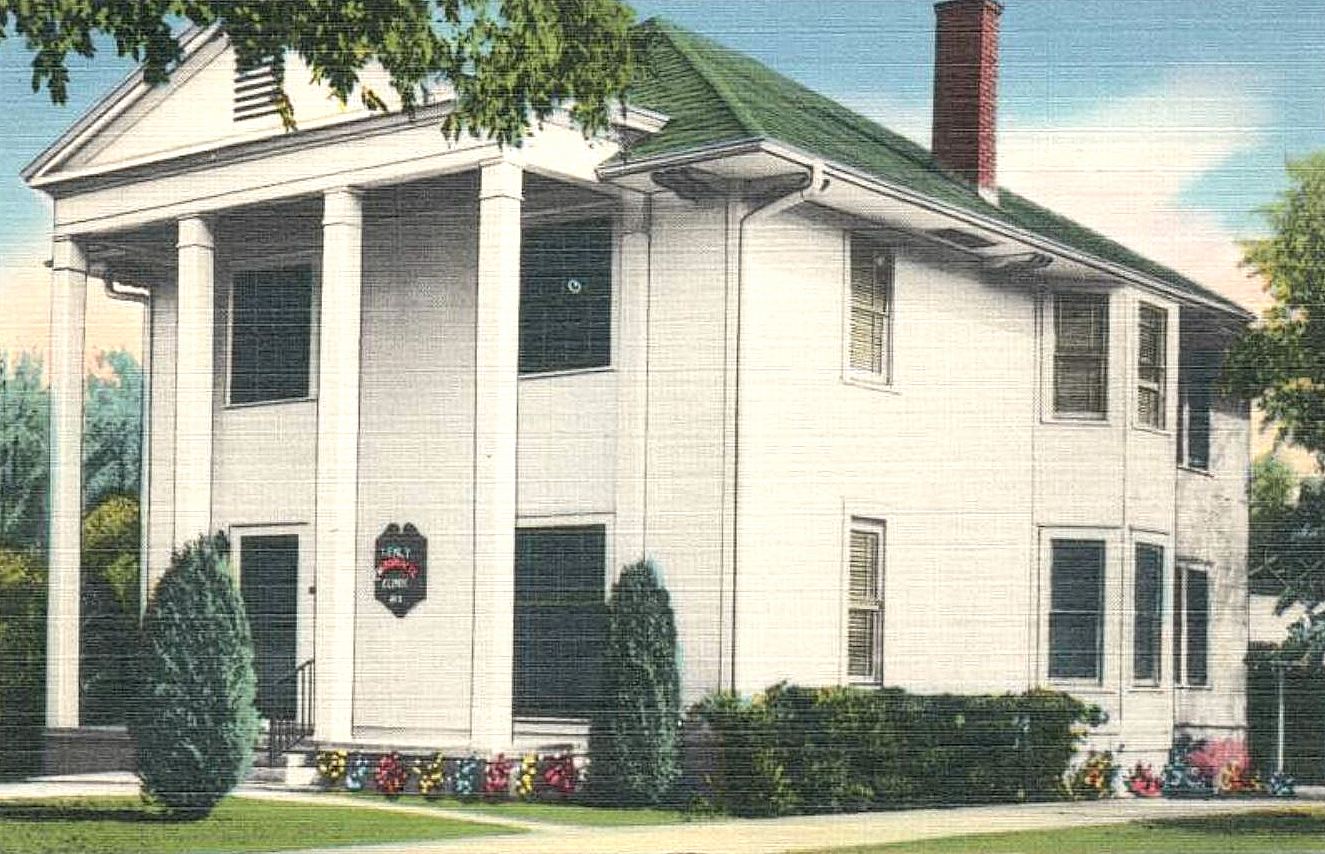
Below, the Lemly Chiropractic Clinic of Dr. F. Lee Lemly at 808 N. Bishop in Oak Cliff (this was also the residence of his family). The house is still standing.

lemley-chiropractic_808-n-bishop_ebay

*

A circa-1910s pretty view of City Park (part of which still hangs on as the site of Dallas Heritage Village in The Cedars):

city-park_postcard_clogenson_ebay

*

Another postcard from The Cedars/South Dallas, once home to a large, vibrant Jewish community, this one shows the Colonial Hill home of insurance man Sidney Reinhardt (1864-1924) at 277 South Boulevard (now renumbered as 1825 South Blvd.). The house was built around 1907, and this postcard appeared before 1911. The house — in what is now designated as the South Boulevard-Park Row Historic District — still stands.

south-blvd_now-1825_sidney-reinhardt_postcard_1910_ebay

*

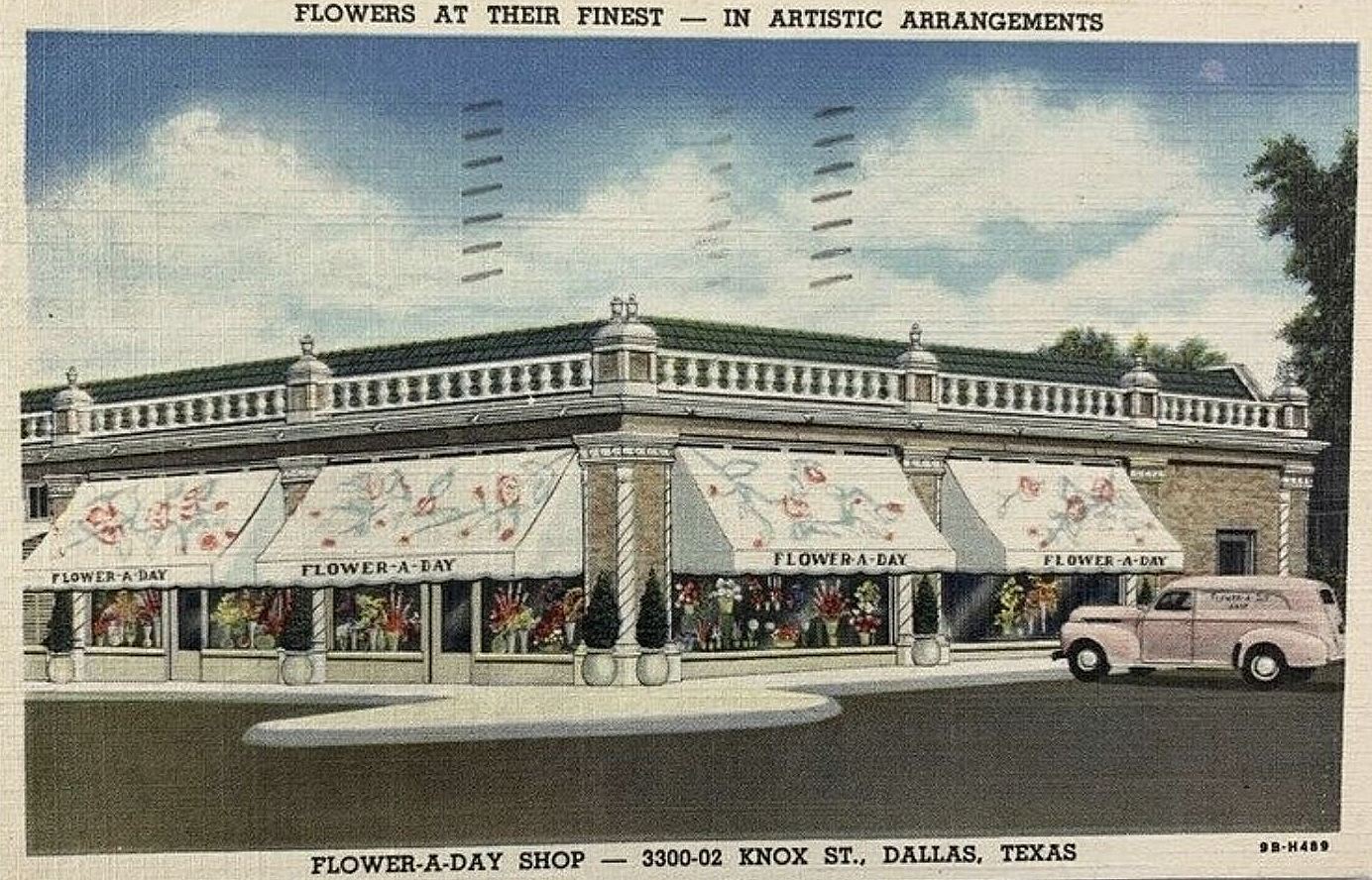
Here’s the Flower-A-Day Shop at the corner of Knox and Travis; the building is still there, but it’s nowhere near as charming today as it was when this postcard was mailed in 1955.

flower-a-day_knox-and-travis_postmarked-1950_ebay

*

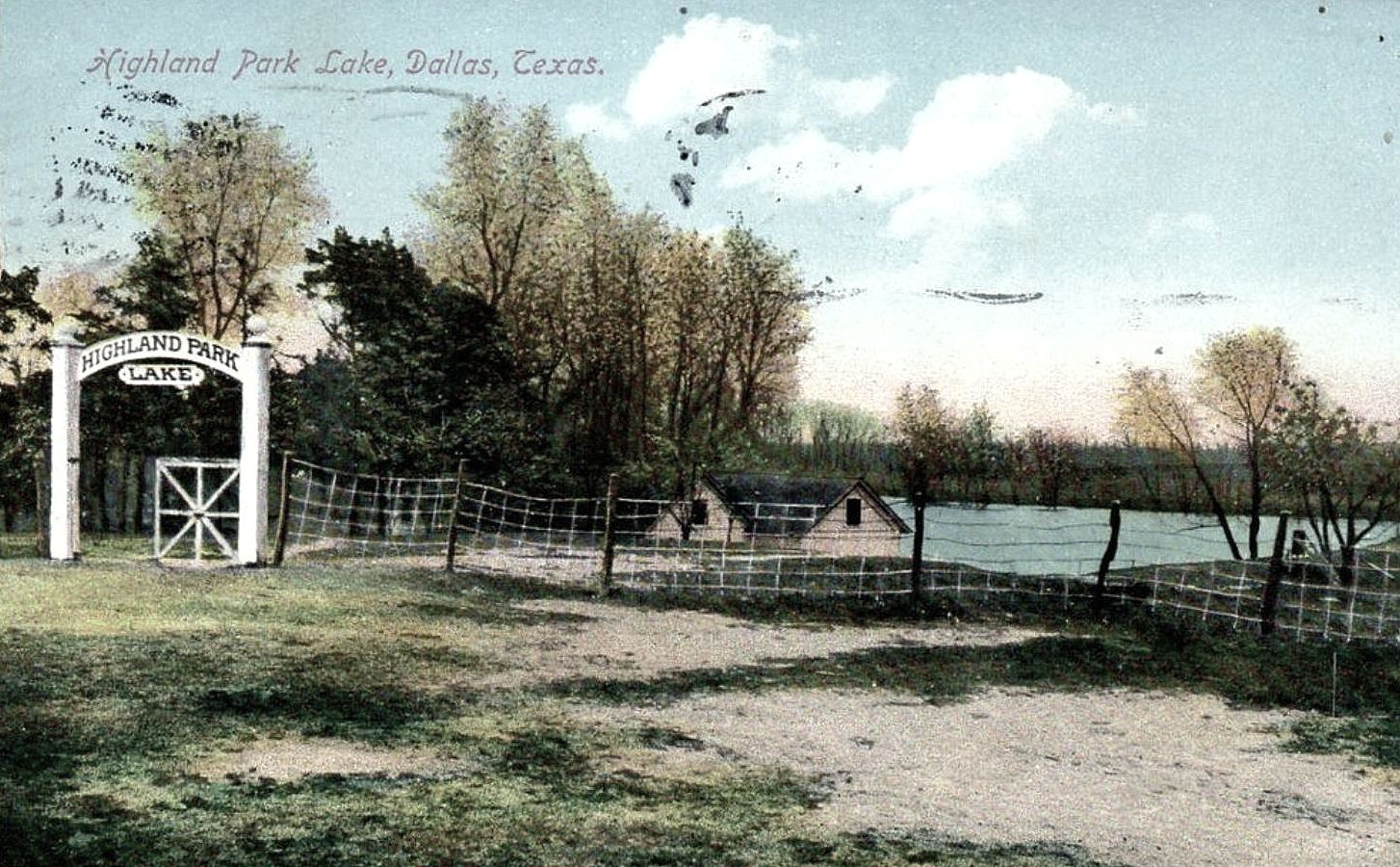
And, lastly, “Highland Park Lake,” now Exall Lake. In fact, it was originally Exall Lake, as it was on the property of Henry Exall, who created the lake by damming Turtle Creek. The lake was a favorite recreation spot way out of town. It seems to have become “Highland Park Lake” after John Armstrong had taken over the property with an eye to developing what eventually became Highland Park. I’ve actually never heard of “Highland Park Lake,” but it was still being referred to as that in the 1960s — I’m not sure when it reverted to “Exall Lake” (or where exactly this photo was taken), but it remains one of Highland Park’s beauty spots. 

highland-park-lake_postcard

***

Sources & Notes

Most of these postcards were found on eBay.

methodist-hospital_postcard_1944_ebay_sm

*

Copyright © 2019 Paula Bosse. All Rights Reserved.
First Presbyterian Church — 1960

first-presbyterian-church_downtown_squire-haskins_UTA_022960

by Paula Bosse

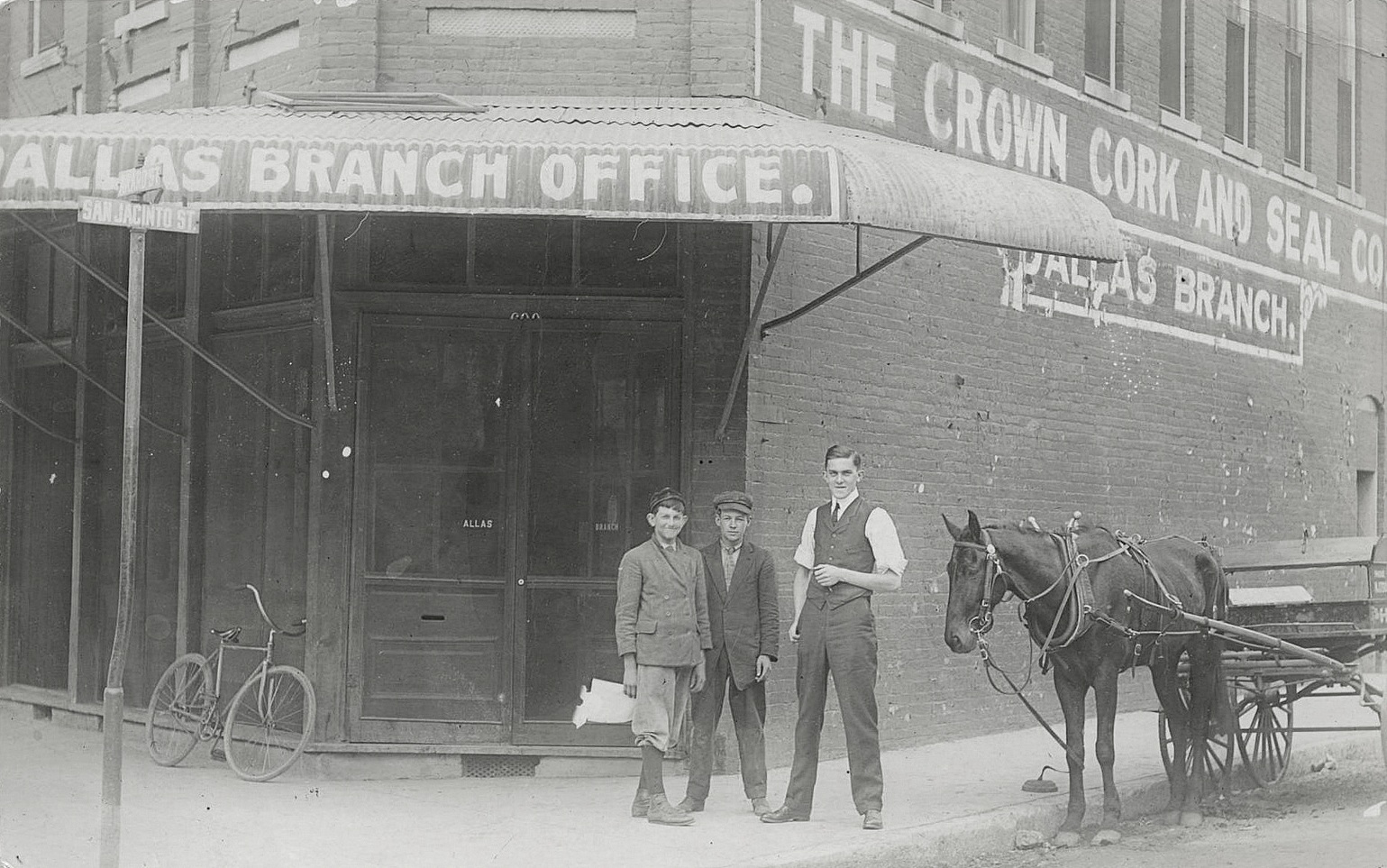
Above is another wonderful photo by Dallas photographer Squire Haskins. It captures an interesting view of the First Presbyterian Church in downtown Dallas (Harwood and Wood streets), with background cameos by bits of the Statler Hilton, the Lone Star Gas Building, whatever the building is next to the Lone Star Gas Building, and the Southland Life Building.

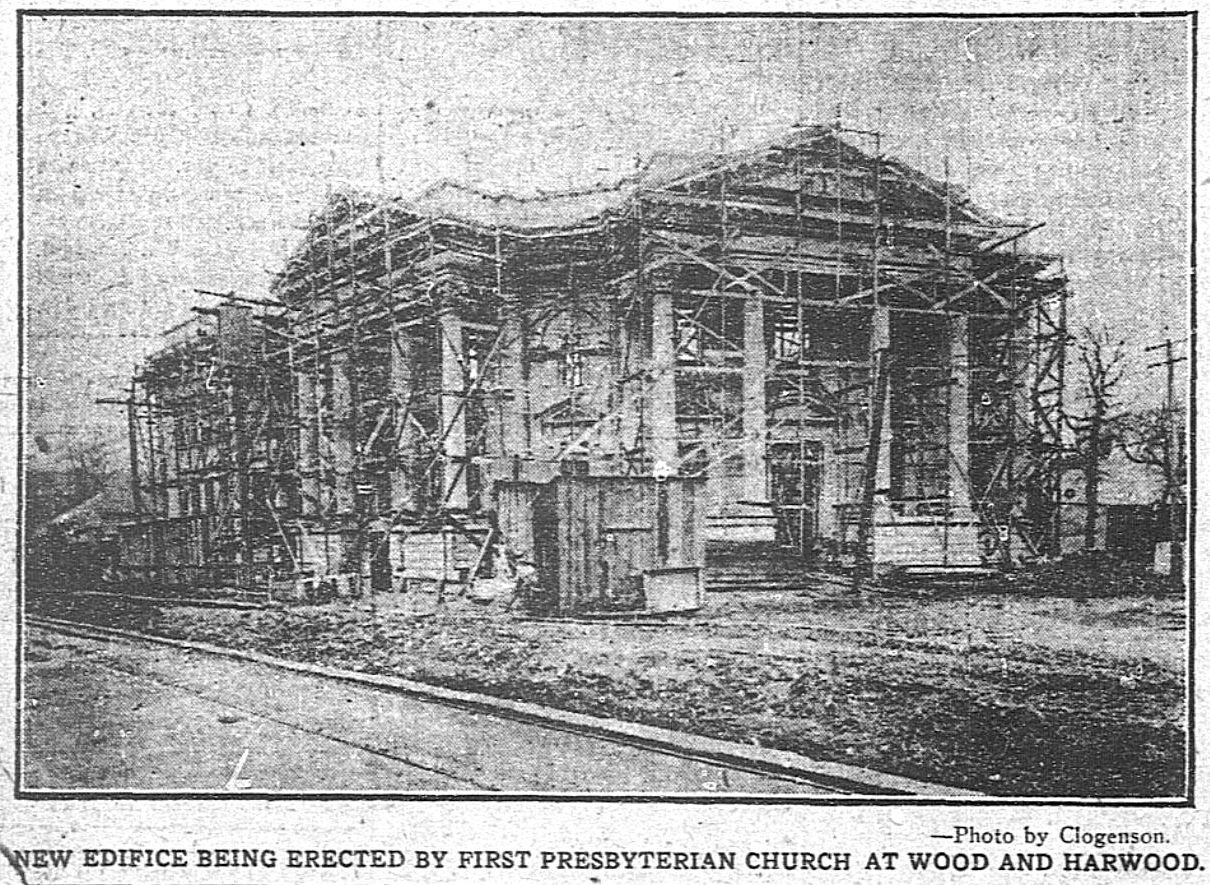
I’m not sure why Haskins took this particular photo (on February 29, 1960), which seems to focus on the church’s parking lot, but a few days after this photo was taken the church celebrated the 47th anniversary of the move from their previous location at the northeast corner of Main and Harwood by recreating the two-block march which the 1,000-member-strong congregation took back in 1913 from the old church to the brand new one. The recreated march included participation of 88 church members who had made the original march in 1913. The first services were held in the new church on March 2, 1913.

And it still looks beautiful.

*

Below, the previous home of the First Presbyterian Church, built in the 1880s, at the  northeast corner of Main and Harwood.

first-presbyterian-church_LOC
via the Library of Congress

The dome-less new church in December, 1911 (construction of the copper dome was “almost complete” in March, 1912):

presbyterian_first-presbyterian-church_under-construction_dmn_123111_clogensonDallas Morning News, Dec. 31, 1911

Completed, and wowing them on picture-postcard stands.

‏first-presbyterian-church_ca-1916

***

Sources & Notes

Top photo — “First Presbyterian Church, downtown Dallas, Texas” — by Squire Haskins, taken on Feb. 29, 1960; it is from the Squire Haskins Photography, Inc. collection, University of Texas at Arlington Libraries, Special Collections, UTA. More info on this photo (and a larger image) is here.

Read an exhaustive account of the new church’s design features in the Dallas Morning News article “First Presbyterian Church Completed” (DMN, March 2, 1913), here.

Read a history of the First Presbyterian Church in Dallas, from 1856 to 1913, in an article which is dominated by a photo of the Main and Harwood building and titled “Will Be Abandoned As Church Property After Sunday Services” (DMN, Feb. 21, 1913), here.

Two more very early photos of the First Presbyterian Church can be found in the Flashback Dallas post “Dallas in “The Western Architect,” 1914: City Buildings and Churches” (scroll down to #6).

first-presbyterian-church_downtown_squire-haskins_UTA_022960_sm

*

Copyright © 2019 Paula Bosse. All Rights Reserved.


State Fair of Texas, Miscellaneous Tidbits from Its History

state-fair-of-texas_pennant_ebay_crop

by Paula Bosse

The State Fair of Texas is, once again, in full swing. Here are a few random SFOT images and ads from the past.

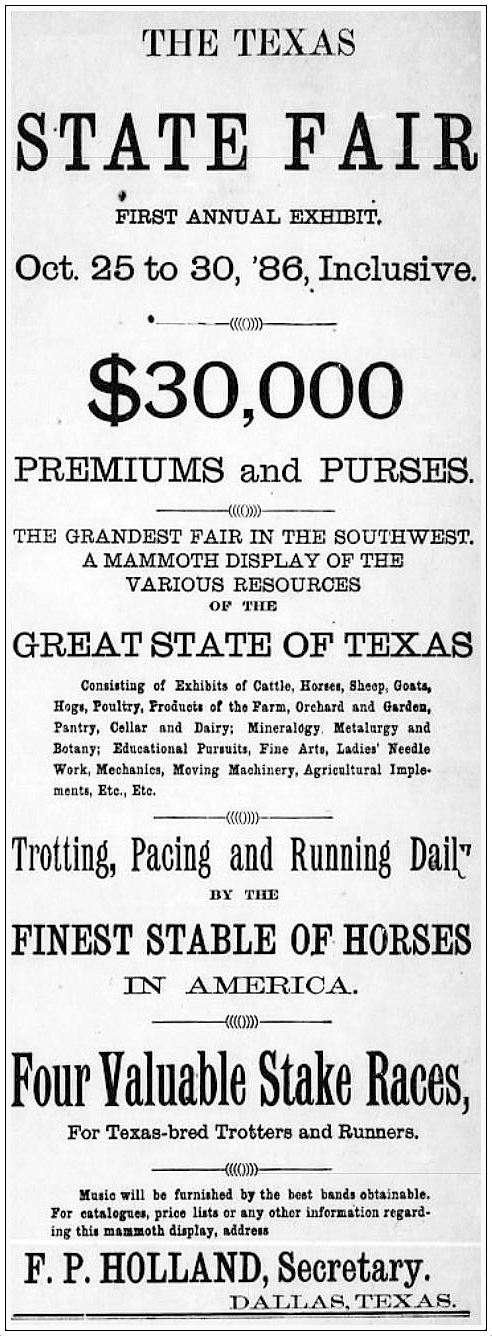
First up, an ad for the very first state fair in Dallas, in 1886. Almost unbelievably, this “Dallas State Fair” (held on 80 acres of land now known as Fair Park) was one of two competing state fairs held in the city that year — the other one was the “Texas State Fair,” which was held about three miles northeast of the courthouse on a 100-acre site roughly about where Cole Park is near present-day North Dallas High School. The two state fairs ran concurrently, and both were smash hits. The “Dallas State Fair and Exposition” eventually became the State Fair of Texas in 1904. Below are the ads for those competing two fairs. (Click to see a larger image.)

state-fair_first_dallas-herald_100986
The East Dallas fair, Dallas Herald, Oct. 9, 1886

texas-state-fair_fairland_dallas-herald_102086
The North Dallas fair, Dallas Herald, Oct. 20, 1886

*

One of the original buildings built for the 1886 Dallas State Fair was the massive Exposition Building, designed by architect James Flanders. On a site devoted to the career of Flanders, the architect recalled this project many years later: “The progress of the work on the structure was watched by most people with a degree of curiosity far more intense than is excited by the loftiest skyscraper in these days when people have no time to wonder. Such an apparition on the bald prairie attracted crowds of the curious from far and near on Sundays.”

state-fair_exposition-bldg_ca-1890s

Above, the huge Exposition Hall, enlarged from its initial design, which, in 1886 was reported to contain 92,000 square feet of unrivaled exhibition space. Unfortunately, the wooden buildings seen above burned to the ground in the early hours of July 20, 1902. The blaze was so intense that “the whole of the city was lit up with the brilliancy of the sunrise” and that “flames rose to such great height that they were seen as far west as Fort Worth, where it was thought the whole city of Dallas was burning” (Dallas Morning News, July 21, 1902). More on this building can be found on the Watermelon Kid site, here.

Below, the Exposition Building can be seen from the fairgrounds racetrack in a photo published in 1900 in an issue of The Bohemian magazine (via the Fort Worth Public Library).

fairgrounds_racetrack_bohemian_1900_fwpl

*

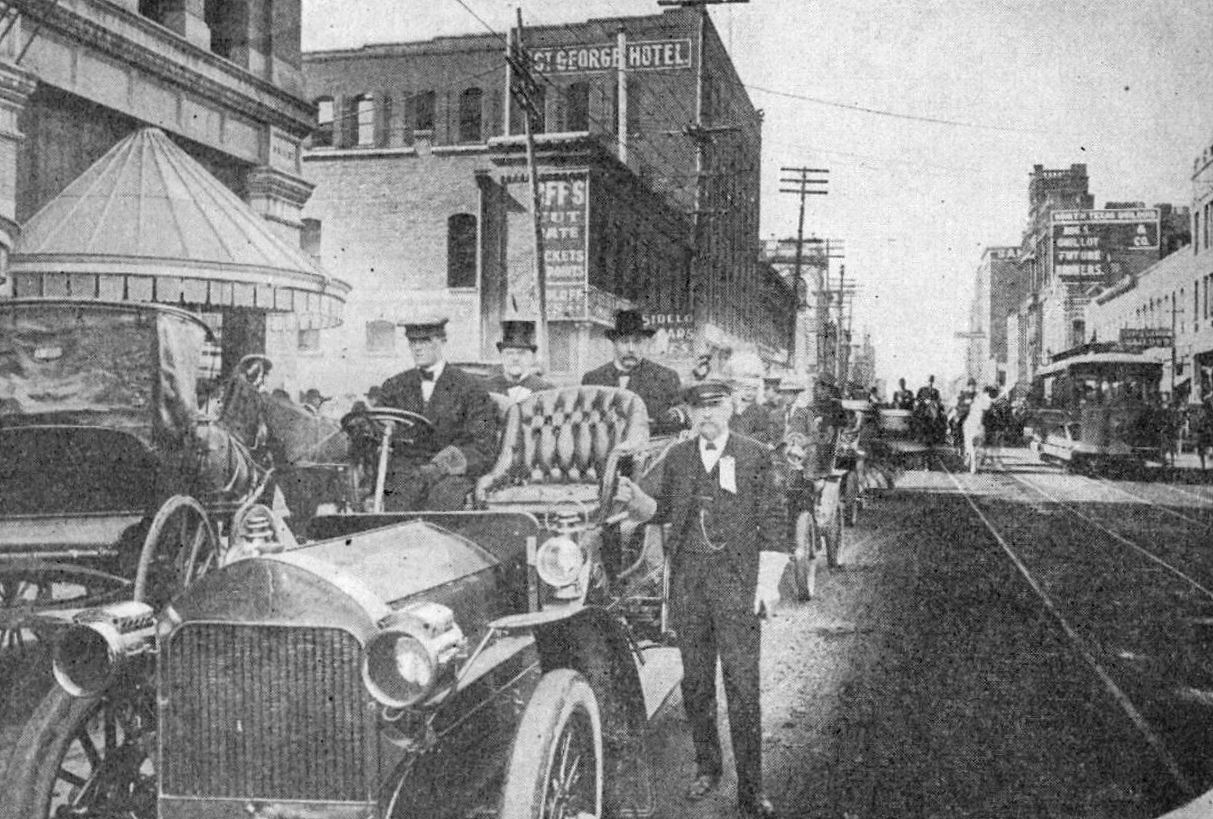
A moment from the opening day parade festivities of the 1903 fair is captured in the photo below, with the following caption from the 1941-42 edition of the Texas Almanac: “Gov. S. W. T. Lanham (in rear seat of pioneer horseless carriage) in opening day parade for 1903 State Fair of Texas formed on Main Street. Fair President C. A. Keating was seated beside him, and Secretary John G. Hunter of Board of Trade is seen standing beside the gasoline buggy.”

state-fair_opening-day_1903_tx-almanac_1941-42_portal
Main Street, looking west, via Portal to Texas History

*

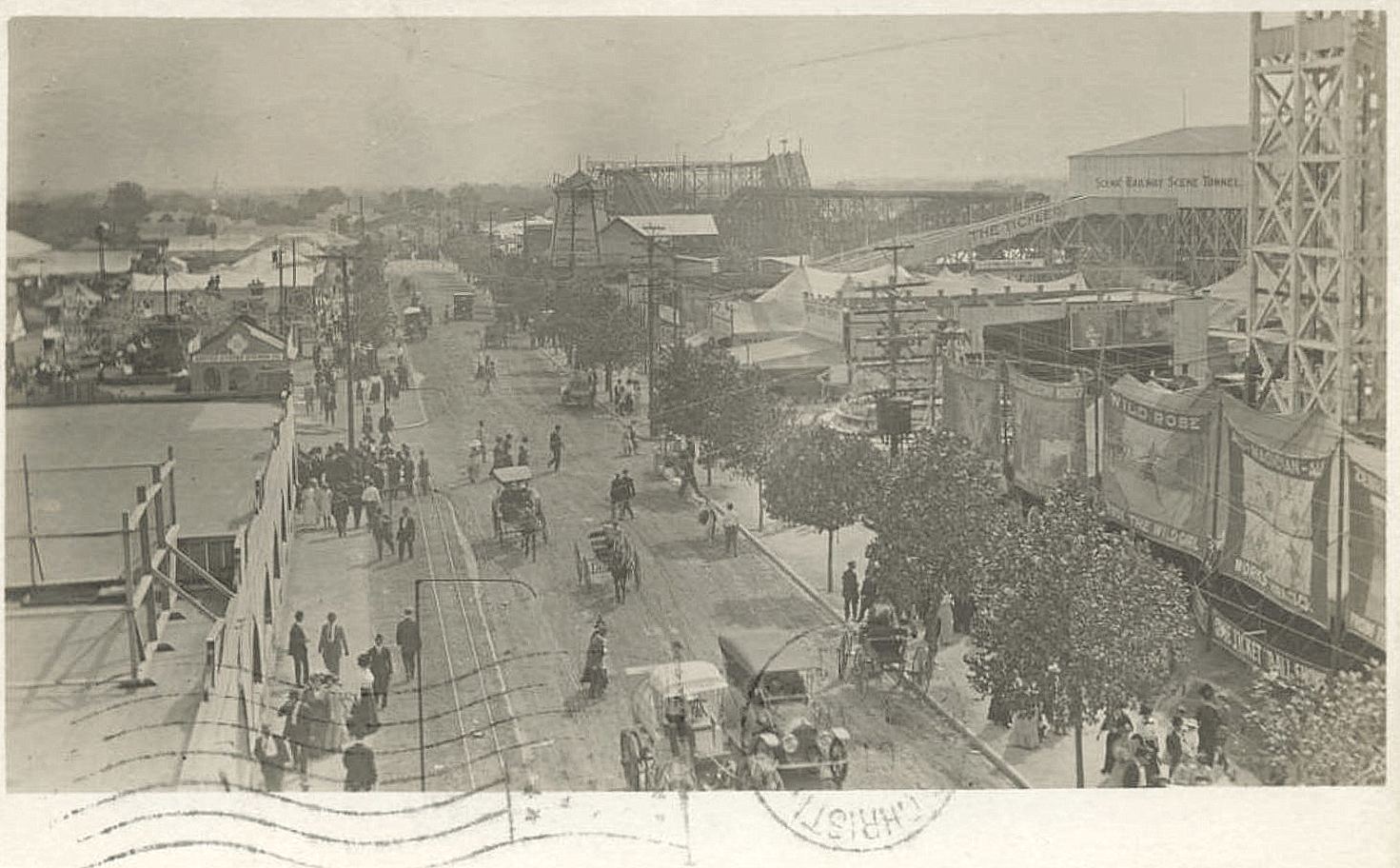
Here is a 1911 view of the state fair midway taken by John R. Minor, Jr. in a real-photo postcard. (More on Mr. Minor is here; more images of the Shoot the Chutes water ride can be found here.)

state-fair_street-scene_john-minor_1911_cook-colln_degolyer
via George W. Cook Collection, DeGolyer Library, SMU

*

From the 1920s, an ad for Clayco Red Ball gasoline (“It’s RED in color”). I’m always a sucker for ads containing photos or drawings of Dallas landmarks, and here we see the entrance to Fair Park. (Why was the gas red? Why not? It was the brainchild of Dallas advertising man Wilson W. Crook, Sr. who needed a way to make this Oklahoma gas different. He remembered that during his WWI days in France that higher quality airplane fuel was colored red to distinguish it from regular gasoline. When the gas was introduced to Dallas in August, 1924, he devised a promotion that gave away 5 gallons of this gas to every red-headed person who showed up at participating service stations.)

ad-red-ball-gas_state-fair_dmn_101224-det

ad-red-ball-gas_state-fair_dmn_101224Clayco Red Ball ad, Oct. 1924

*

If we’re talking about the State Fair of Texas and we’ve come to the 1930s, there’s a pretty good chance there’s going to be a photo from the Texas Centennial. And, looky here: a nice shot of concessionaires waiting for thirsty patrons at the Centennial Exposition in 1936. A couple of nickels could get you a Coke and a phone call.

sfot_concessionaires_coke_unt_portal_1936via Portal to Texas History

*

During World War II the State Fair was on hiatus. Here’s an ad from the 1941-42 Texas Almanac pre-closure, with a nice pencil sketch of the Esplanade and Hall of State:

state-fair_tx-almanac_1941-42

state-fair_tx-almanac_1941-42_det

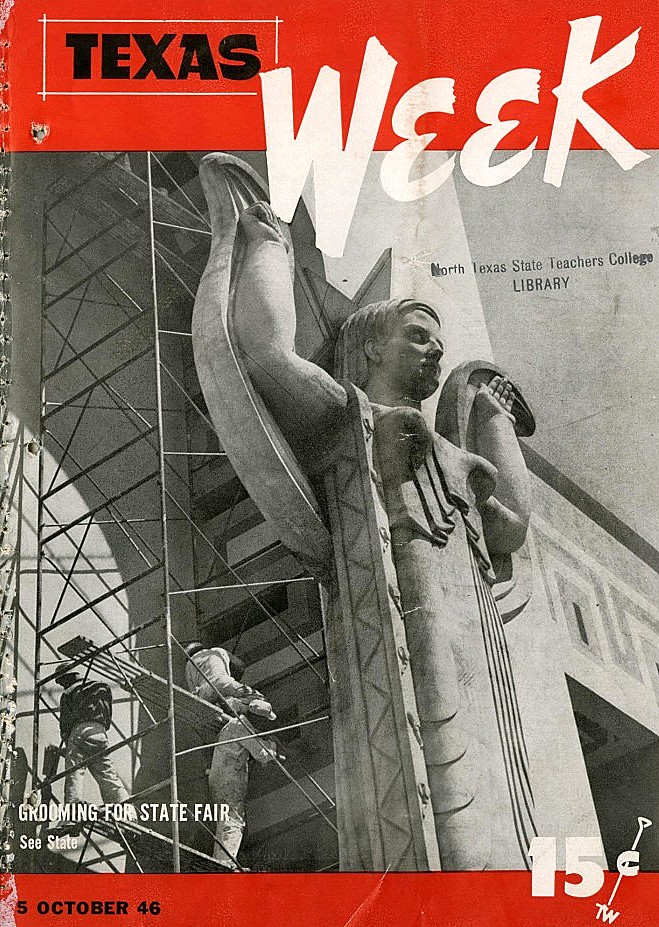
And a 1946 magazine cover story on the imminent reopening of the fair:

state-fair_texas-week-mag_100446_portal_cover
via Portal to Texas History

*

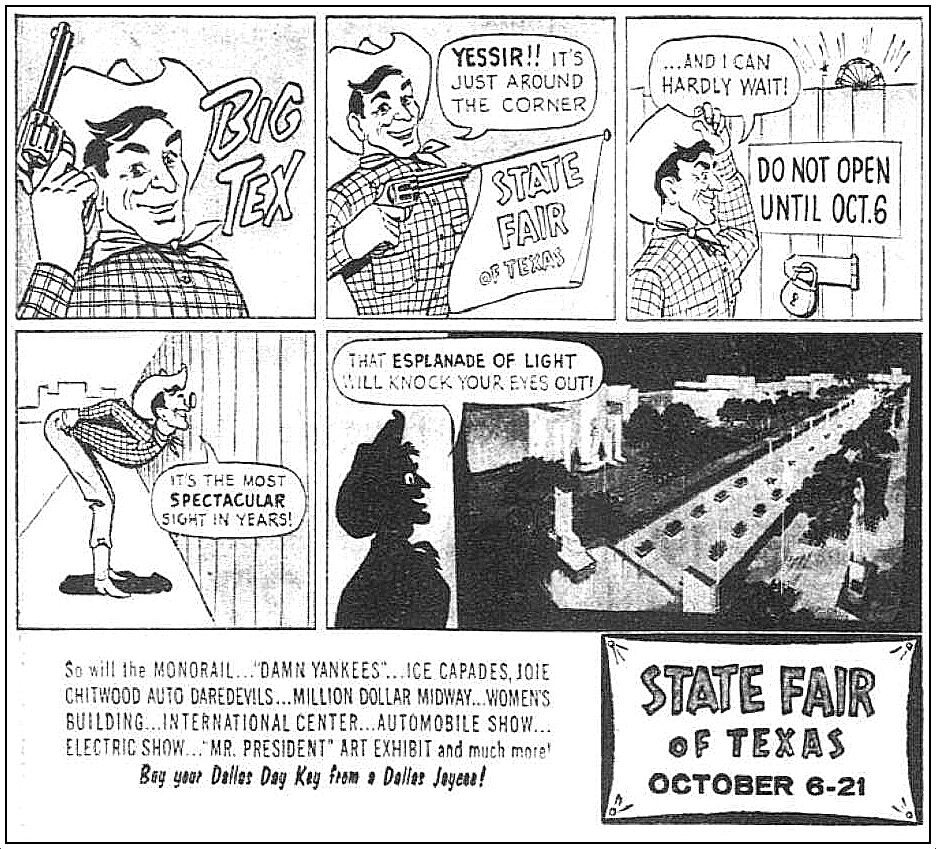
In 1956 Big Tex warned/assured you that the Esplanade lights would “knock your eyes out.”

state-fair_big-tex-ad_092456

*

Speaking of Big Tex and lights knocking your eyes out, in the 1960s Big Tex was memorialized on the side of a downtown building, like a giant bow-legged Lite-Brite.

sfot_big-tex_illuminated_1960s

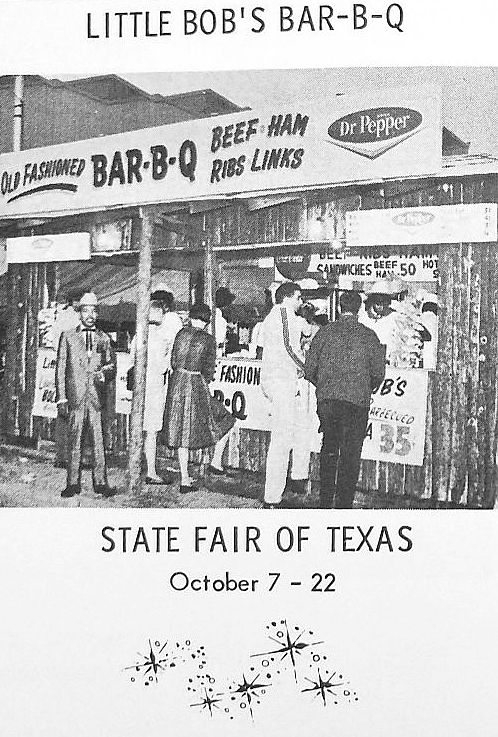
Back at Fair Park, Huey P. Nash was supplying fair throngs with barbecue from his Little Bob’s Bar-B-Q stand. In 1964, Nash was the first African-American vendor to be granted a food concession at the State Fair. Little Bob’s (which I believe is still in business) was, at the time of this 1967 ad, located in South Dallas at 4203 S. Oakland (now Malcom X), at the corner of Pine. (Ad is from the 1967 Souvenir Program of the 74th Annual Session of the Missionary Baptist General Convention of Texas; more photos from this publication can be seen here.)

sfot_little-bobs-bbq_baptist-convention-program_1967_photo

sfot_little-bobs-bbq_baptist-convention-program_oct-1967

The 1960s also gave us the Swiss Skyride, which replaced the Monorail (which, when it was introduced in 1956, was the first commercially operated monorail in the United States). The Swiss Skyride was erected in Fair Park in August, 1964, and the 6-minute ride debuted a few months later at the 1964 State Fair of Texas.

state-fair_swiss-sky-ride_tinkle-key-to-dallas_1965_replaced-monorail_
via Lon Tinkle’s children’s book Key to Dallas (1965)

sfot_swiss-skyride_FWST_101864

sfot_swiss-skyride_FWST_100964

*

state-fair-of-texas_pennant_ebay_crop_sm

*

Copyright © 2019 Paula Bosse. All Rights Reserved.

Worth Street, A Century Ago

worth-street_461_rppc_1908_ebay“A hearty welcome awaits…” (click for larger image)

by Paula Bosse

Above is a photograph of the new home of traveling salesman Everett F. Bray (1873-1915) and his wife Erminia Connor Bray (1874-1962); they had moved to Dallas in 1907 with their young children Everita and Melville. The picture-postcard is dated Aug. 28, 1908 and was sent to a friend with Erminia’s message:

Dearie, I hope it won’t be very long before I can have the pleasure of entertaining you in my Dallas home. […] A hearty welcome awaits you at 461 Worth St. Dallas any old time.

worth-street_461_rppc_1908_ebay_msg

The 1905 Sanborn map of this Old East Dallas neighborhood (which, more specifically, is in OED’s Peak’s Suburban Addition) can be found here (461 is an empty lot, near the upper right corner). After the city-wide address-change of 1911, the 400 block of Worth became the 4400 block. As is the case with many of the houses in this neighborhood, Erminia’s house still stands. …But with a whole lot more vegetation.

worth-street_google-street-view_20162016 Google Street View

*

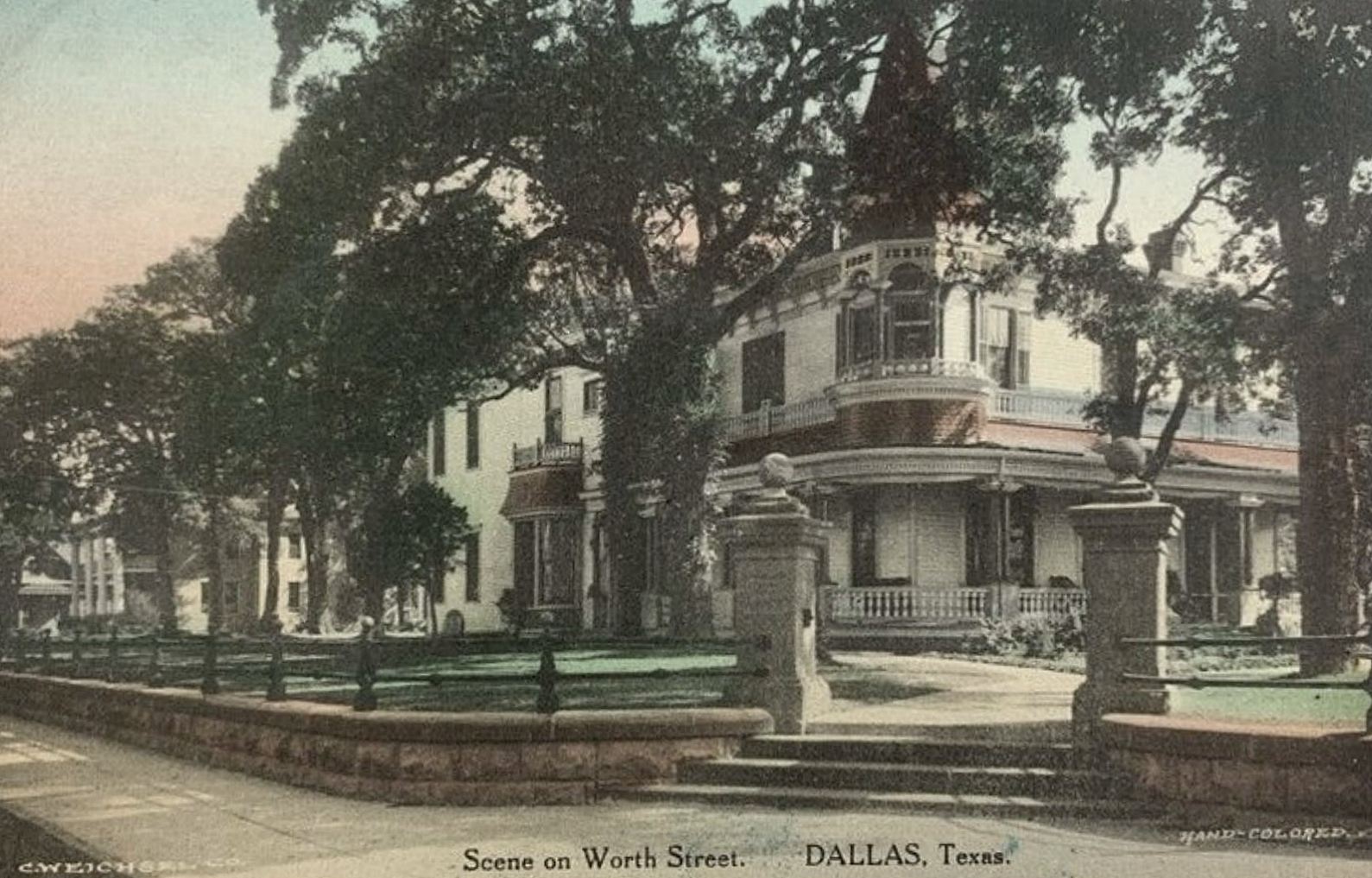
Worth Street — which stretches through Junius Heights, Munger Place, and Peak’s Suburban Addition — may be a bit funkier these days, but there are still many beautiful homes lining the street. Below are a couple of postcards from a century ago, well before the “funky” era.

worth-street_postcard_weichsel_ebay

worth-street_corner_postcard_weichsel_ebay

**

After I posted the top image on Instagram, a person (whose handle is @uneik_image_inc) made this interesting comment:

We have painted quite a few houses on Worth Street! Interesting fact: lots of these homes are built on Bois D’Arc tree stumps for foundation piers and a solid 85% are still standing and being lived in!

***

Sources & Notes

All postcards are from eBay.

The Brays had moved from their Worth Street home by 1915 when 41-year-old Everett Bray was killed in an automobile accident. Erminia — known as “Minnie” — lived almost 50 years longer than her husband, dying in Duncanville in 1962 at the age of 88.

worth-street_461_rppc_1908_ebay_sm

*

Copyright © 2019 Paula Bosse. All Rights Reserved.


The Wilson Building and the *New* Wilson Building — 1911

wilson-bldg_titches_postcard
Elm and Ervay… (click for larger image)

by Paula Bosse

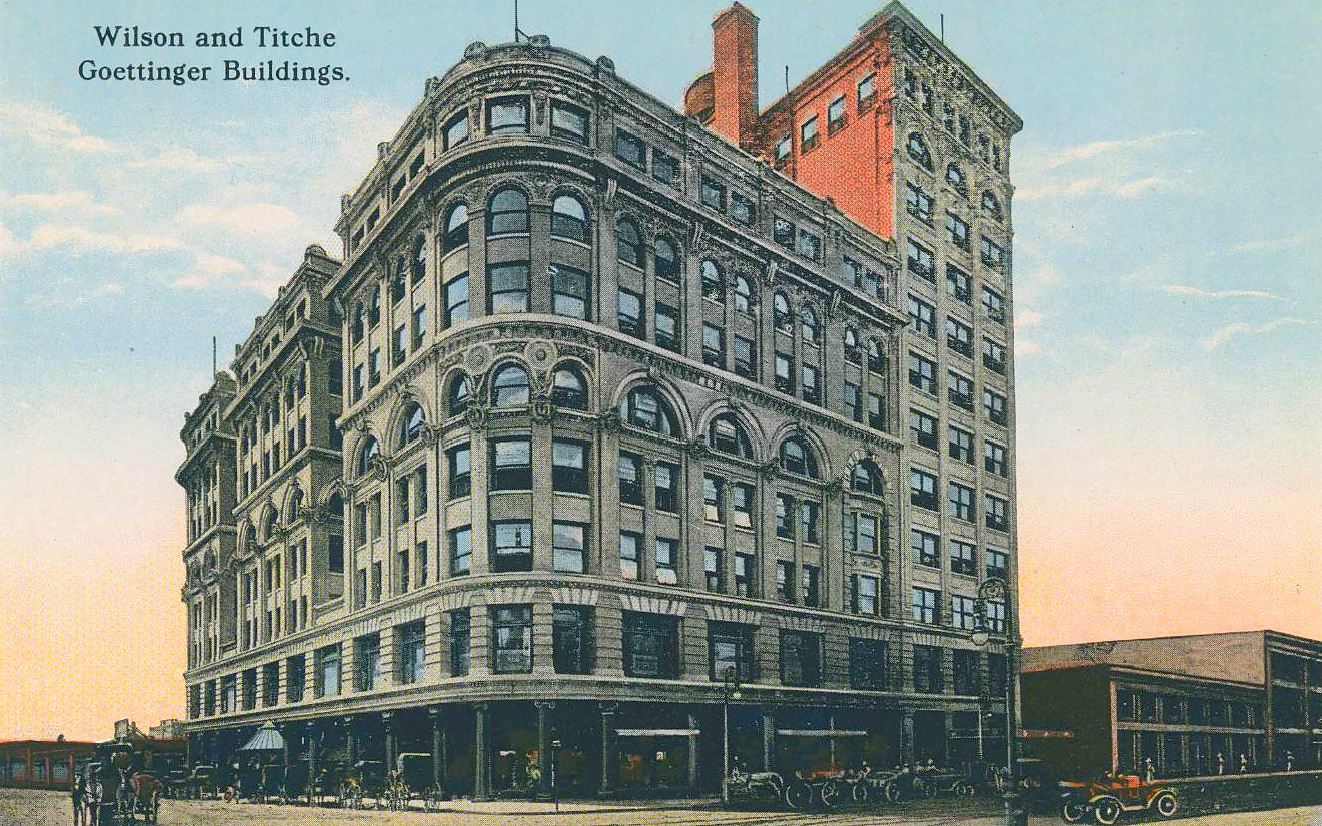
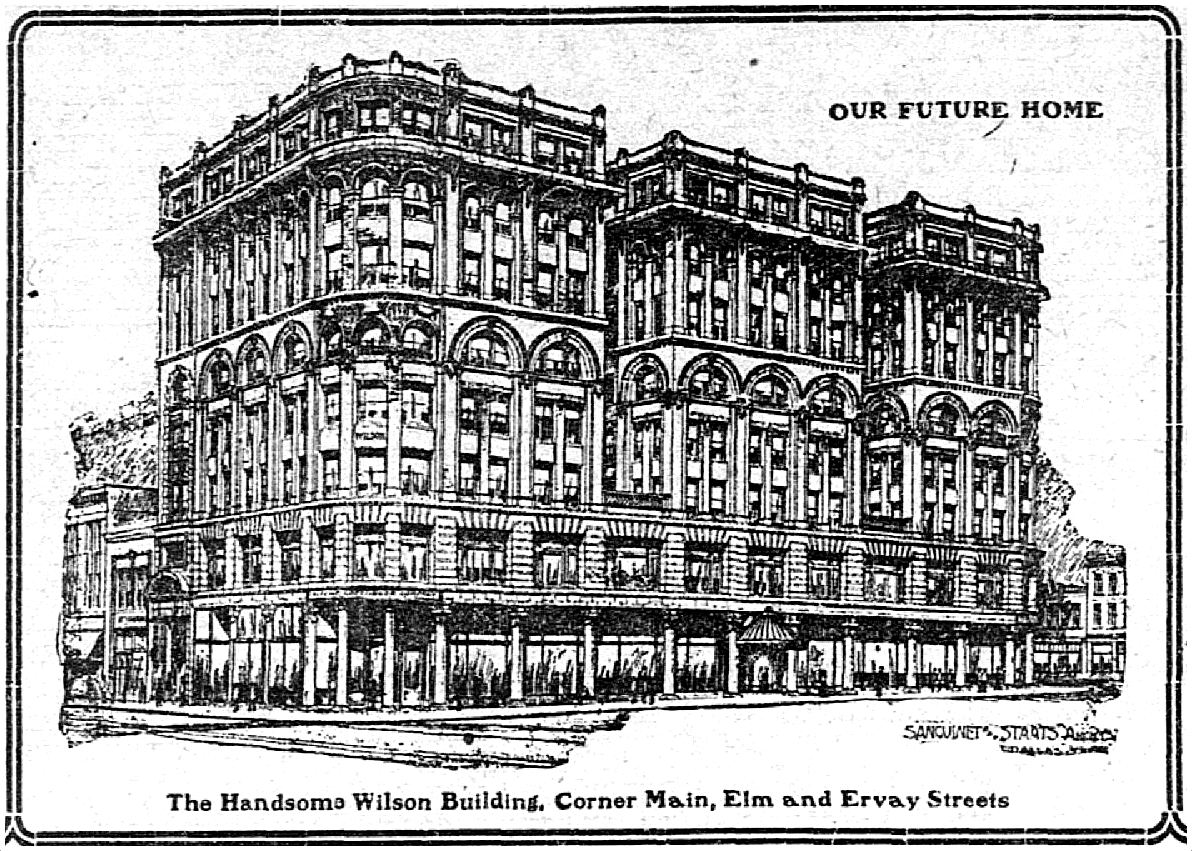
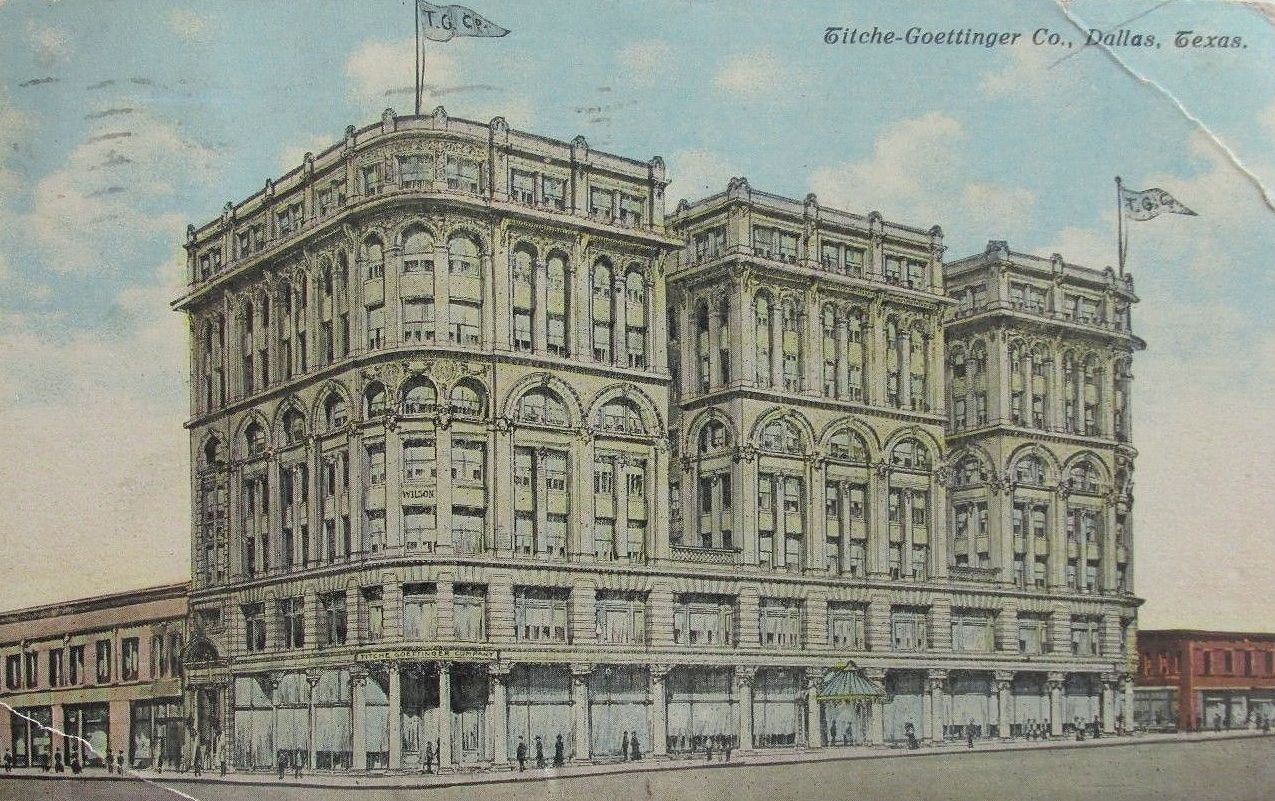
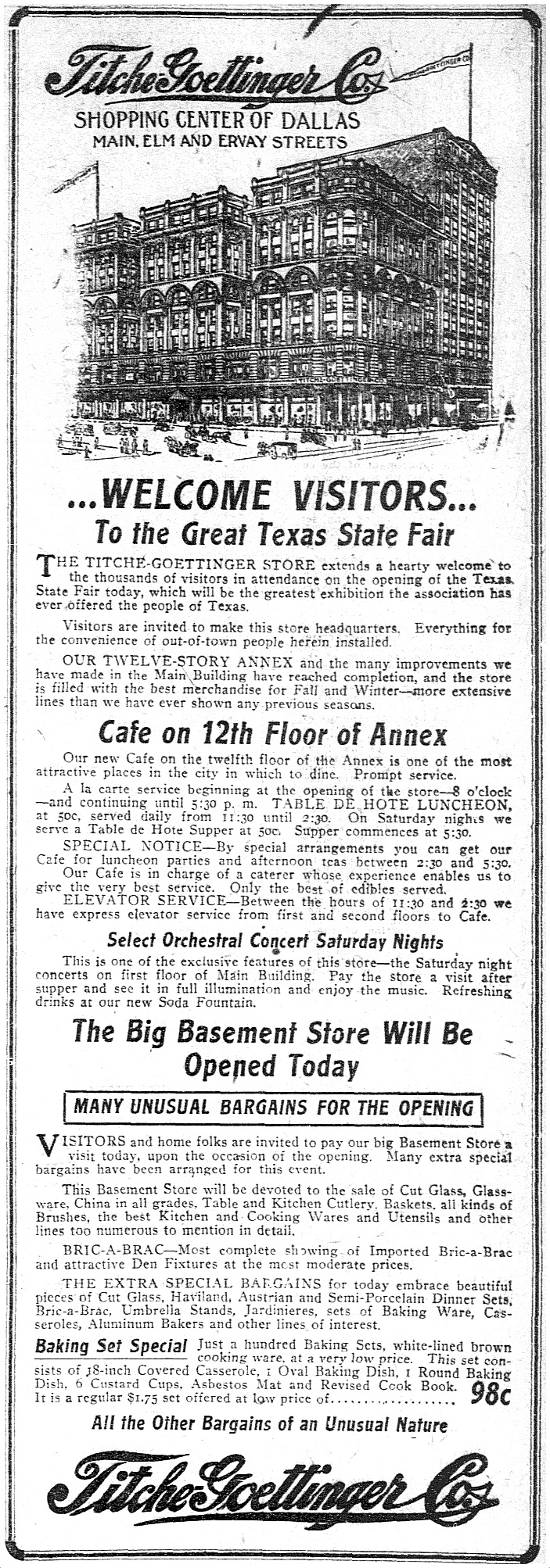
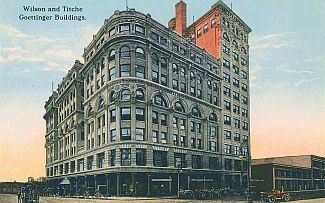
This beautiful postcard shows the original eight-story Wilson Building, built by J B. Wilson in 1902-1904, and its twelve-story companion, which was known as both the “New Wilson Building” and the “Titche-Goettinger Annex” when it was built in 1911. Remarkably, both buildings are still standing at Main-Ervay-Elm. (The view above is looking southwest, with Ervay at the left, and Elm at the right. See this view today on Google Street View here.)

The original building — surely one of Dallas’ most beautiful landmarks — was the home of the Titche-Goettinger department store (which occupied the first two floors and the basement) as well as an important downtown office building. Until seeing this postcard, I had no idea there was a porte-cochère facing Ervay (it can be seen above at the left, under the parasol-like canopy).

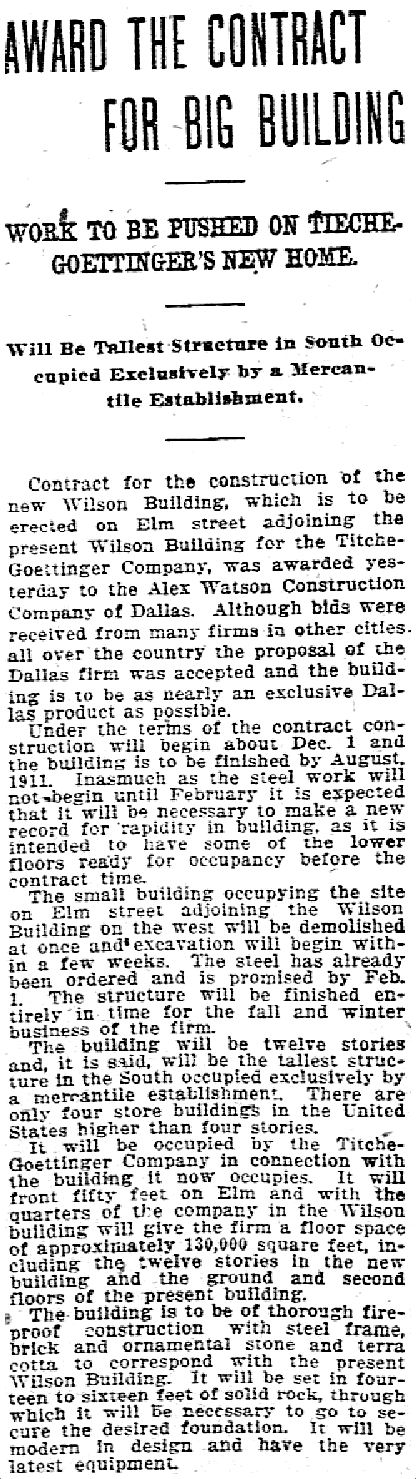
By 1910 Titche’s was so successful that it needed to expand, and it was decided that a new “skyscraper” would be built right next door — the department store would continue to occupy its space in the “old” Wilson Building but would also take over the new building (occupying all twelve floors!). According to The Dallas Morning News, the new building would be “the tallest structure in the South occupied exclusively by a mercantile establishment. There are only four store buildings in the United States higher than four stories” (DMN, Nov. 13, 1910).

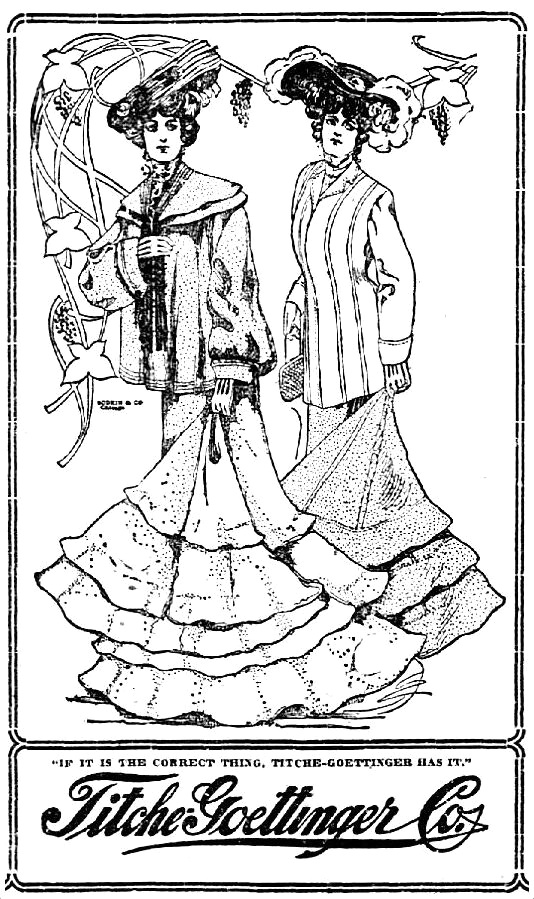
Below are a couple of details from a “coming soon” ad from Titche-Goettinger in September, 1903, showing a drawing of the building (still under construction) from the Fort Worth architectural firm Sanguinet & Staats. (All images are larger when clicked.)

wilson-bldg_titches_092703_coming-soon_ad-det_1DMN, Sept. 27, 1903

wilson-bldg_titches_092703_coming-soon_ad-det_2DMN, Sept. 27, 1903

titche-goettinger_wilson-bldg_postcard_postmarked-1912

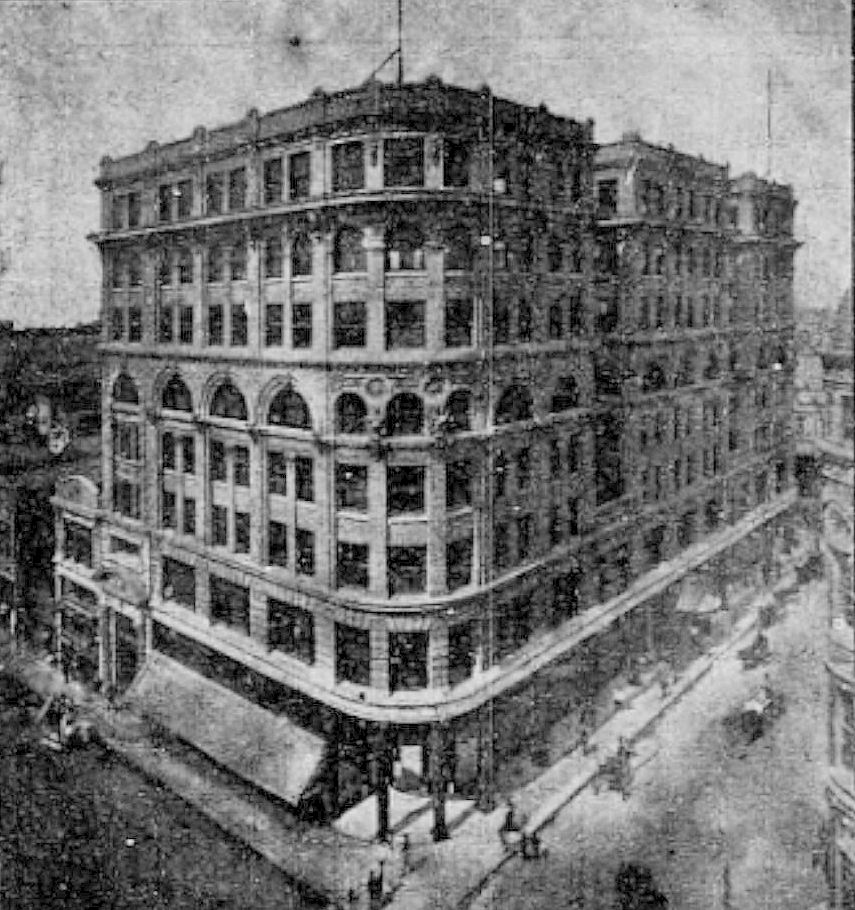
The two photos and article below ran in The Dallas Morning News on March 13, 1904 under the headline “Completion of the Great Eight-Story Wilson Building in Dallas.” The caption of the photo immediately below read “This view was taken from the postoffice, and is the first to show the entire Ervay street front.”

wilson-bldg_dmn_031304_newly-completed_clogenson

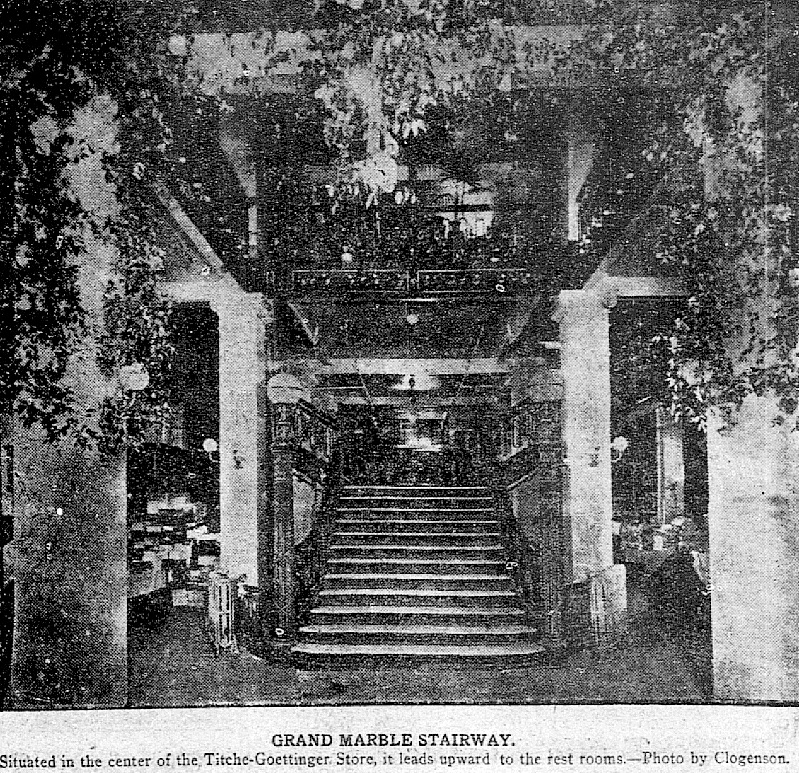
Although the quality of the image below isn’t great, it’s interesting to see this “grand marble stairway,” a feature which was removed in 1911 while the new “annex” was under construction, in order to give Titche’s even more room. The grand staircase was replaced by elevators. (The “rest rooms” referred to in the caption were more “lounge” than bathroom — a place where ladies could sit, relax, and even jot off a few letters as they recovered from their bout of intense shopping.)

wilson-bldg_dmn_031304_grand-stairway_clogenson

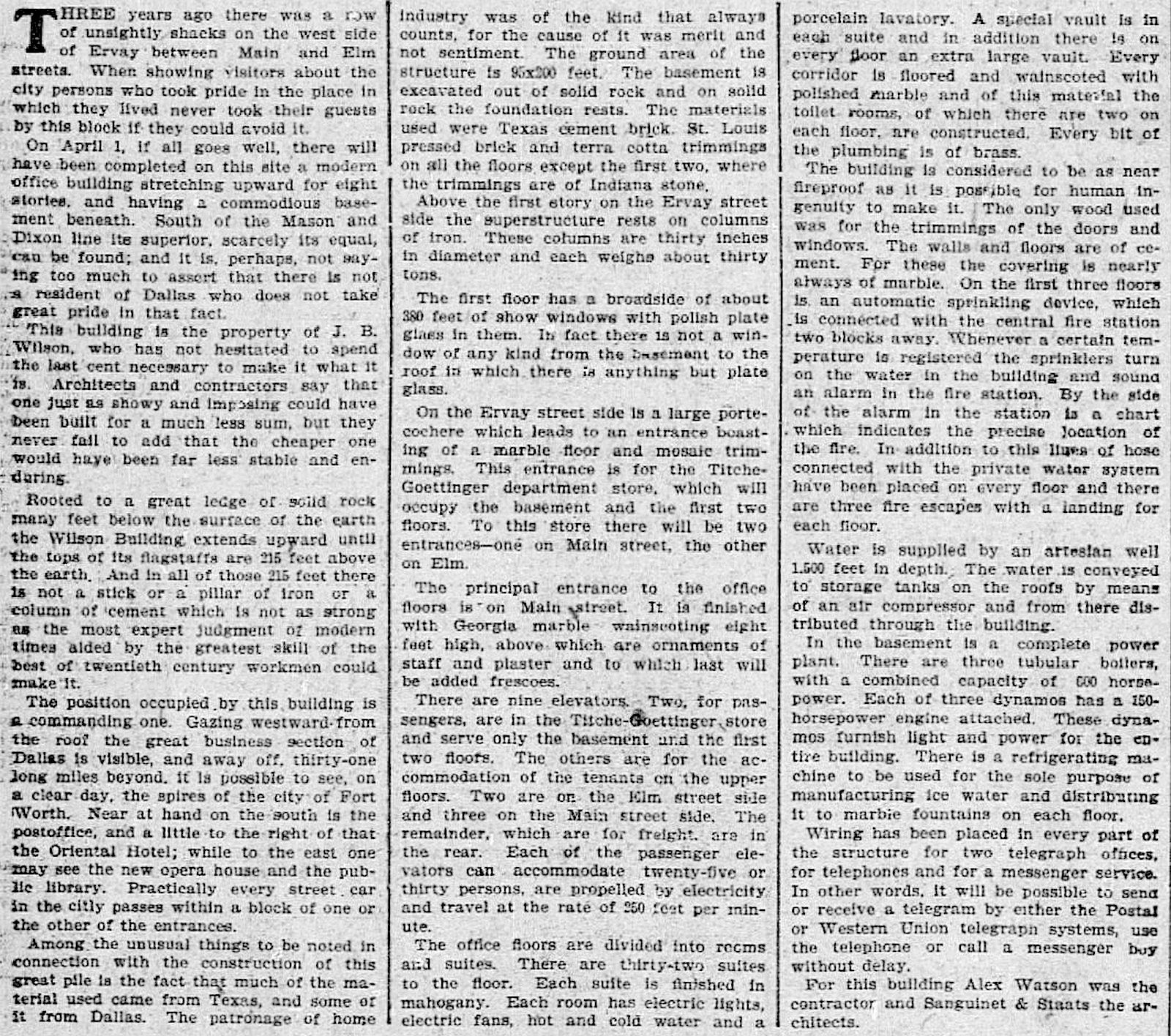
The accompanying article (click to read):

wilson-bldg_dmn_031304_completed_textDMN, March 13, 1904

Jump forward six years to the announcement of the “new” Wilson Building:

wilson-bldg_expansion_dmn_111310DMN, Nov. 13, 1910

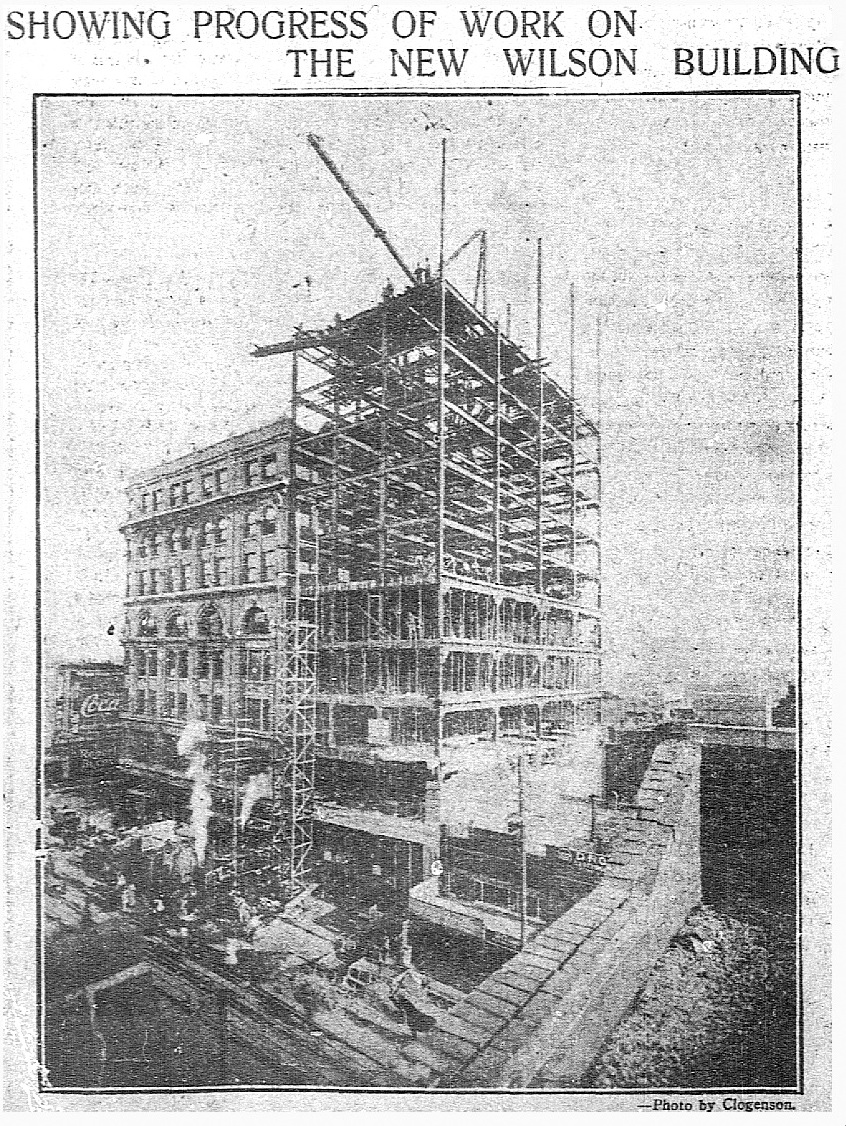
Here it is under construction:

wilson-bldg_expansion_dmn_032811_clogensonDMN, March 28, 1911

They rushed to be ready to open in time to dazzle State Fair of Texas visitors — and they made it:

wilson-bldg_titche-annex_101411DMN, Oct. 14, 1911

And, below, the completed building, in a photo looking east on Elm (this photo shows one of the brand new street lights written about in the post “The Grand Elm Street Illumination — 1911”). (See this view today on Google Street View, here.)

wilson-bldg_expansion_dmn_121611_clogensonDMN, Dec. 16, 1911

*

wilson-bldg_titches_postcard_sm

***

Sources & Notes

See photos of the original building under construction in the Flashback Dallas post “The Wilson Building Under Construction — 1902.”

I love looking at Sanborn maps. See what was going on at Main-Ervay-Elm in 1899 (before any Wilson buildings), in 1905 (one year after the arrival of the first one), and in 1921 (ten years after the annex went up).

*

Copyright © 2019 Paula Bosse. All Rights Reserved.

Butler Brothers Building, As Seen From the Praetorian

butler-brothers_looking-from-praetorian_postcard_ebayButler Brothers, in its natural habitat… (click for larger image)

by Paula Bosse

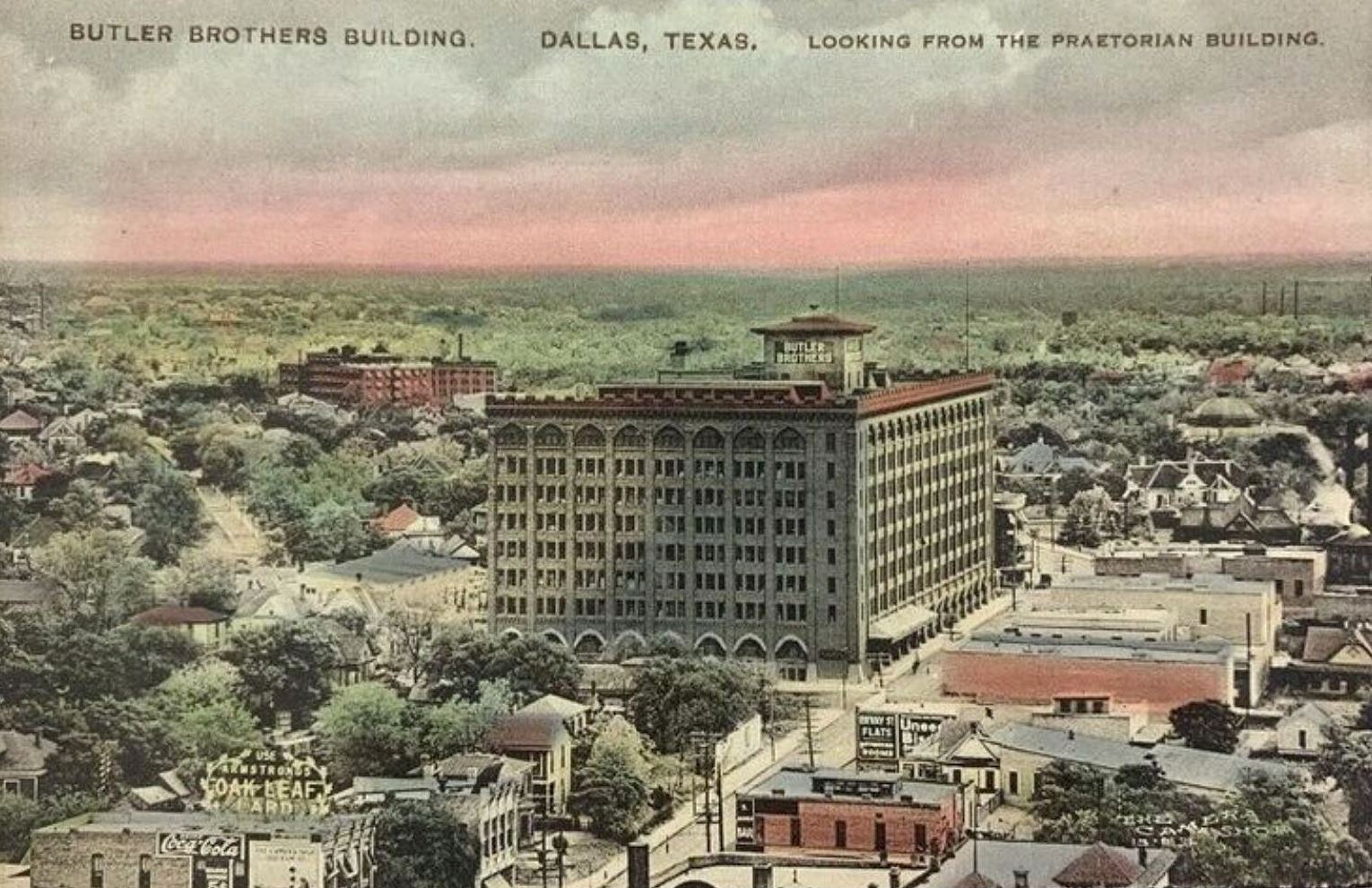
Today, a wonderful postcard image showing the Butler Brothers building, built in 1910/1911 and still standing at South Ervay, between Young and Marilla, across the street from the present-day City Hall). It’s set in the middle of businesses, residences, and lots of greenery. The view is from the Praetorian Building at Main and Stone (which, at the time was the tallest building in Dallas, but which is no longer standing).

Here’s another view of mammoth Butler Brothers building, in a detail from a panoramic photo of the Dallas skyline in 1913 (see the full photo here):

1913-pano-4

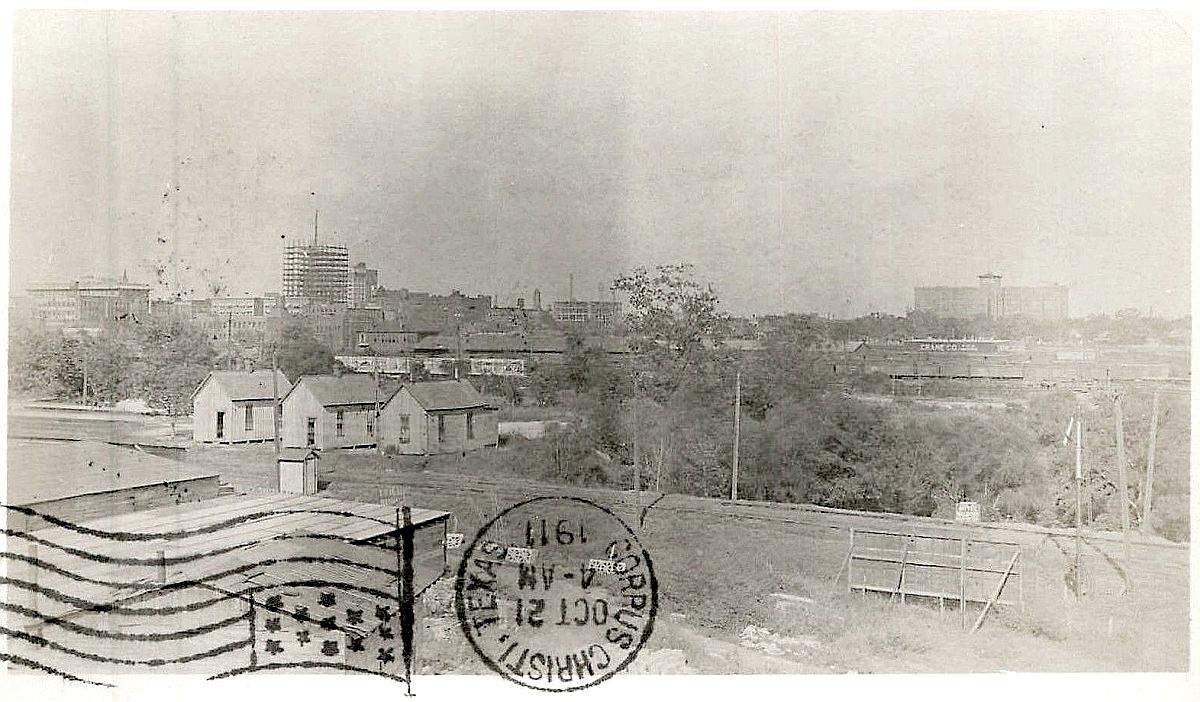
And another view from a RPPC photo taken by John R. Minor Jr. in 1911 (showing the Adolphus under construction?).

skyline-view_butler-bros_rppc_1911_ebay_front_john-minorvia eBay

***

Sources & Notes

Colorized postcard found in an old eBay listing.

Source info on black-and-white panoramic photo detail is at the original post, “‘New Dallas Skyline’ — 1913,” here.

More on the construction of Butler Brothers can be found in this post (scroll down to #6).

*

Copyright © 2019 Paula Bosse. All Rights Reserved.

The Grand Elm Street Illumination — 1911

elm-street_illuminated_night_rppc_ebay

by Paula Bosse

As most of Dallas has now clawed its way back into the world of full electric power after last weekend’s surprise “weather event” (…although, as I write this another big storm is passing through the area), I thought this image might be a timely one. It’s from late 1911 and shows Elm Street with its brand new electric street lights, the installation of which prompted Dallas boosters to dub the street “The Great White Way.” The view is from Ervay, looking west.

1910-1911 was a time of remarkable growth in Dallas. Construction had been started or completed on three important downtown buildings (the Adolphus Hotel, the Southwestern Life Building, and the Butler Brothers building); the historic Oak Cliff viaduct was nearing completion; the dam at the city’s new White Rock reservoir was in operation; and — lo and behold! — ornamental electric street lights (with underground conduits) had been installed along Elm Street, from Market to Harwood.

The buzzword in municipal governments of large American cities at that time was “ornamental street lighting.” What was it? According to The Dallas Morning News:

“Ornamental street lighting” contemplates just what the term signifies. Instead of somewhat indiscriminate and often far from attractive methods of lighting the streets of a city, the adoption of a systematic plan by which, with the placing of uniform lights of pleasing design at regular intervals, a street is not only illuminated, but is ornamented as well. (DMN, Nov. 5, 1910)

The article went on to say that this type of street lighting was an essential element of a progressive and prosperous city (which Dallas most certainly was): not only did it help beautify the city, it also increased property values and helped to decrease crime. …And Dallas leaders really, really wanted it. They just didn’t want to pay for it. Somehow, an agreement was struck in which the cost of the materials, installation, and maintenance of these “ornamental street lights” would be paid for by Elm Street merchants and/or property owners; after one year, the City would take possession of the lights and assume responsibility for their upkeep. Seems like a novel way to fund a city project.

Dallas’ first “ornamental” lights and poles (which, because I like details like this, were painted a soothing olive green) were topped with “bishops’ crooks” (or “shepherd’s crooks”) fashioned in wrought iron, with the lamps suspended from the gooseneck bend. Just over 100 of the magnetite arc lights were installed along Elm, staggered on opposite sides of the street to maximize the illumination’s reach.

The electric lamps will be of a type entirely new in Texas and will give a steady white light that will be more pleasant than the flutter of the common arc light. […] One lamp of 2,000 candlepower will be placed on each pole. (Dallas Morning News, Sept. 14, 1911)

The project was delayed for several months for a variety of reasons (not least of which was the fact that the first shipload of iron poles was mysteriously “lost at sea” as it was en route from New York to Galveston…), but the festive grand unveiling was finally held on September 30, 1911, just in time for Dallas to show off another civic accomplishment to out-of-town visitors who would soon be streaming into town to attend the State Fair of Texas. Dallas’ “Great White Way” thrilled all who beheld it and blazed proudly every night from sunset to midnight. Business owners on Main and Commerce streets were envious of all that fresh, new, well-distributed light over on Elm, and it wasn’t long before those streets had also replaced their garish and old-fashioned, fluttering, stuttering arc lights with the brash new ornamental lights.

Here is a photo of what the lights looked like in December, 1911 (the photo shows the new 12-story Wilson Building annex):

wilson-bldg_expansion_dmn_121611_clogenson

Below are examples of what these street lights looked like a few years after they had been introduced in 1911 (the first two are details of photos from a post found here, and the third one is a detail of a photo taken in front of the Queen Theatre at Elm and Akard in 1914). (UPDATE: I’ve just found a TON of these lamp posts in the historic “Wilson block” area along Swiss Avenue!! See one on Google Street View here.)

street-light_det-2

street-light_det-1

elm-st-ornamental-street-light_elm-akard_queen-theatre_ca-1914

*

Read the progress report on the installation of the new lighting system (all images are larger when clicked):

elm-street_illuminated_dmn_091411_detailsDMN, Sept. 14, 1911

Excited anticipation of the soon-to-be “Great White Way” was building:

elm-street_illuminated_dmn_092711DMN, Sept. 27, 1911

Sanger Bros. was one of the many businesses celebrating the arrival of the ornamental lighting. On the day the lights were to debut in downtown Dallas, the department store ran an ad which invited Dallasites to dine in their “lofty” seventh-floor cafe and, afterwards, stroll along the well-lit thoroughfare and soak up the brand new illumination:

elm-street_illuminated_093011_sangers-ad_detSept. 30, 1911, the night the lights were turned on

Below is the News’ report of the inaugural switch-flipping. (Missing from the article was the fact that someone had been stabbed that night as crowds jostled each other in the streets and along the sidewalks, climaxing with the perp being chased for several blocks before being apprehended; all of this had happened under the glow of the expensive, new, very-bright, law-enforcement-aiding artificial light — that new lighting system was already paying off!)


elm-street_illuminated_dmn_100111
DMN, Oct. 1, 1911

elm-street_illuminated_night_rppc_ebay_sm

***

Souces & Notes

Postcard showing “Grand Elm Street Illumination, Compliments of the Camera Shop” is from an old eBay listing. (There is also a copy in the George W. Cook Collection at SMU’s DeGolyer Library, here — you can zoom in a bit more for details, even though, ironically, it’s still pretty difficult to make much out in the shadows. A line from the postcard message reads, “This is a photo of Elm Street at night — pretty swell I think.”)

Businesses seen on the right side of the photo are the Texas Seed & Floral Co. and the Lontos Cafe, which were located near the northwest corner of Elm and Ervay (years later, this was the appoximate site of the Palace Theatre); the Wilson Building (then the Titche-Goettinger department store) is either wholly out of frame at the extreme left, or is only partially visible.

In 1911 — before the ornamental lights were installed — Dallas had something like 1,000 electric (and a few gas) street lights in operation around the city; the arrival of the brighter and more aesthetically appealing Brave New Luminescence of Elm Street’s “Great White Way” spelled the inevitable phasing-out of the old-fashioned arc lights.

Read about how Dallas responded to the 1912 lighting of the Oak Cliff viaduct, the world’s longest concrete bridge, at the bottom of this post.

*

Copyright © 2019 Paula Bosse. All Rights Reserved.

Theaters at 1517 Elm: The Garden, The Jefferson, The Pantages, The Ritz, and The Mirror — 1912-1941

garden-theatre_ca-1912_ebayThe Garden Theatre, ca. 1912

by Paula Bosse

The photo above shows the Garden Theatre, located at 1517 Elm, on the north side of the street, between Akard and Stone Street. It was opened in the fall of 1912 by partners W. J. Brown and R. J. (Ray) Stinnett (who also operated the Cycle Park Theatre at Fair Park). The Garden was a vaudeville stop for touring companies.

1912_garden-theatre_variety_sept-1912Variety, Sept. 1912

It was one of many local theaters which simulcast World Series baseball games via telegraph updates, in the days before radio and TV (I wrote more about this fascinating subject here).

1912_garden-theatre_101612Oct. 16, 1912

As seen in the top photo, the Garden Theatre sat between the Pratt Paint & Paper Co. and the Roderick-Alderson Hardware Co.

garden-theatre_1913-directory_1517-elm1913 Dallas city directory

The photo at the top was found on eBay, with the seller-provided date of 1912. Zooming in, one can see a placard in front of the theater advertising the appearance of the Hendrix Belle Isle Musical Comedy Company (misspelled on the sign as “Henndrix”) — for many years this troupe toured with a production called “The School-Master”/”School Days,” the very production seen here on offer to audiences at the Garden. (Read a review of a 1912 Coffeyville, Kansas performance of the troupe’s bread-and-butter act here.)

garden-theatre_ebay_det

In April, 1913 Brown and Stinnett split, with Brown taking the Cycle Park action and Stinnett keeping the Garden (and a handful of other theaters).

On March 8, 1915 the theater changed its name and reopened as the Jefferson Theater. As the ad below stated, “This is the only theater in Dallas presenting popular players in repertoire […] Not moving pictures.”

1915_jeffersosn-theater-opens_dmn_030715March 7, 1915

I’m not sure where the “Jefferson” name came from, but….

jefferson-theater_061115June 11, 1915

The photo below shows the Jefferson with an unusual olde-English-style half-timbered facade — I doubt that lasted long. The photo is undated, but the marquee advertises vaudeville mainstays Kasmir & Co. (Sophie Kasmir — or Sophia Kasmir — was a prima donna of note) and comedians Howard & Lewis.

theater_jefferson-theater_RPPC_ebayeBay

There were a few back-and-forths as far as operators and leases of the Jefferson, but in 1923, Ray Stinnett “sold” (or probably more accurately sub-leased) the theater in order to concentrate on his other (bigger! better! brighter!) venture, the next-door Capitol Theater, but he reacquired it in 1925 and renamed it the Pantages. (This has caused confusion, with some thinking it had become the Pantages earlier — the confusion is understandable, as the Jefferson was affiliated with the Pantages vaudeville circuit between 1917 and 1920, and during that time the word “Pantages” appeared prominently on the theater’s marquee, but it was still the Jefferson. See a photo from May, 1925, showing the Jefferson from the Pacific side here, after it had become a Loew’s-affiliated theater.)

The Jefferson became the Pantages Theater on December 27, 1925, when Stinnett opened the newly remodeled venue which offered vaudeville stage acts as well as motion pictures. (All images are larger when clicked.)

pantages-opening_122725Dec. 27, 1925

That incarnation didn’t last too long. Goodbye, Pantages, hello, Ritz. The Ritz Theater opened on October 14, 1928, operated by the R & R (Robb & Rowley) chain but leased from Stinnett. The first film shown was “The Lights of New York,” the first all-talking feature-length movie.

1928_ritz_101028Oct. 10, 1928

1928_ritz_101328
Oct. 13, 1928

1928_ritz_101528Oct. 15, 1928

Below, a 1929 photo showing the 1500 and 1600 blocks of Elm Street, the heart of Theater Row: seen here are the Ritz, Capitol, Old Mill, and Palace theaters (the regal Queen was a few doors west of the Ritz, at the corner of Elm and Akard).

ritz_capitol_old-mill_palace_photo_sherrodphoto from “Historic Dallas Theatres” by D. Troy Sherrod

A postcard showing the Ritz (and neighbors) a couple of years later, in 1931:

ritz_capitol_old-mill_palace_postcard_cinematreasures

But the Ritz didn’t last all that long either — a little over three years.

1931_ritz-mirror_120831Dec. 8, 1931

In 1931 the theater was acquired by the Hughes-Franklin company (as in Howard Hughes, the super-rich Texan who had an obsession with Hollywood). The plan was to renovate the building and rename it the Mirror, “a duplicate, in so far as possible, of the famous Mirror Theater of Hollywood. A feature will be the extensive use of mirrors in the lobby and foyer” (Dallas Morning News, Nov. 29, 1931).

mirror_motion-picture-times_122931Motion Picture Times, Dec. 29, 1931

The Mirror Theater opened at 1517 Elm on Christmas Day, 1931.

1931_mirror_122531
Dec. 25, 1931

Theater Row, 1936:

theater-row_mirror_march-1936

More Elm Street:

mirror-capitol-rialto-palace-melba-majestic_theater_row_night_big

The Mirror chugged on for several years as a second-run house, apparently less and less profitable as the years passed. On August 4, 1941 the theater burned down in an early-morning fire. The property owner, Vice Admiral Adolphus Andrews, decided against rebuilding.

mirror-fire_variety_081341Variety, Aug. 13, 1941

Here’s the same view as seen above, only now the space next to the Capitol is a nondescript one-story retail building. (The Telenews, a theater showing newsreels, opened in November 1941.)

telenews_missing-mirror-post-fire_capitol_postcard

Below, a photo from around 1942, the first time in 30 years without a theater at 1517 Elm Street.

theater-row_by-george-mcafee_degolyer_SMUphoto via the DeGolyer Library, SMU

***

Sources & Notes

Top photo of the Garden Theatre is from an old eBay listing.

More Flashback Dallas posts on Dallas theaters can be found here.

*

Copyright © 2019 Paula Bosse. All Rights Reserved.