Flashback : Dallas

A Miscellany: History, Ads, Pop Culture

Category: 1910s

The Grand Elm Street Illumination — 1911

elm-street_illuminated_night_rppc_ebay

by Paula Bosse

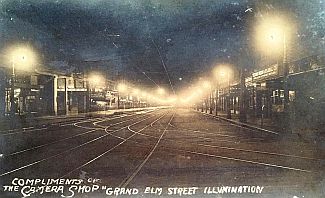
As most of Dallas has now clawed its way back into the world of full electric power after last weekend’s surprise “weather event” (…although, as I write this another big storm is passing through the area), I thought this image might be a timely one. It’s from late 1911 and shows Elm Street with its brand new electric street lights, the installation of which prompted Dallas boosters to dub the street “The Great White Way.” The view is from Ervay, looking west.

1910-1911 was a time of remarkable growth in Dallas. Construction had been started or completed on three important downtown buildings (the Adolphus Hotel, the Southwestern Life Building, and the Butler Brothers building); the historic Oak Cliff viaduct was nearing completion; the dam at the city’s new White Rock reservoir was in operation; and — lo and behold! — ornamental electric street lights (with underground conduits) had been installed along Elm Street, from Market to Harwood.

The buzzword in municipal governments of large American cities at that time was “ornamental street lighting.” What was it? According to The Dallas Morning News:

“Ornamental street lighting” contemplates just what the term signifies. Instead of somewhat indiscriminate and often far from attractive methods of lighting the streets of a city, the adoption of a systematic plan by which, with the placing of uniform lights of pleasing design at regular intervals, a street is not only illuminated, but is ornamented as well. (DMN, Nov. 5, 1910)

The article went on to say that this type of street lighting was an essential element of a progressive and prosperous city (which Dallas most certainly was): not only did it help beautify the city, it also increased property values and helped to decrease crime. …And Dallas leaders really, really wanted it. They just didn’t want to pay for it. Somehow, an agreement was struck in which the cost of the materials, installation, and maintenance of these “ornamental street lights” would be paid for by Elm Street merchants and/or property owners; after one year, the City would take possession of the lights and assume responsibility for their upkeep. Seems like a novel way to fund a city project.

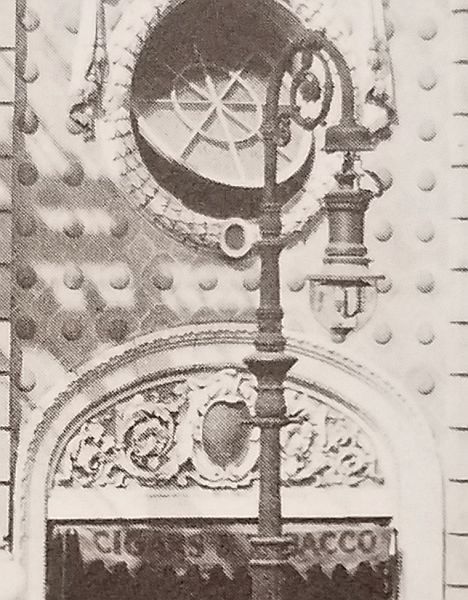
Dallas’ first “ornamental” lights and poles (which, because I like details like this, were painted a soothing olive green) were topped with “bishops’ crooks” (or “shepherd’s crooks”) fashioned in wrought iron, with the lamps suspended from the gooseneck bend. Just over 100 of the magnetite arc lights were installed along Elm, staggered on opposite sides of the street to maximize the illumination’s reach.

The electric lamps will be of a type entirely new in Texas and will give a steady white light that will be more pleasant than the flutter of the common arc light. […] One lamp of 2,000 candlepower will be placed on each pole. (Dallas Morning News, Sept. 14, 1911)

The project was delayed for several months for a variety of reasons (not least of which was the fact that the first shipload of iron poles was mysteriously “lost at sea” as it was en route from New York to Galveston…), but the festive grand unveiling was finally held on September 30, 1911, just in time for Dallas to show off another civic accomplishment to out-of-town visitors who would soon be streaming into town to attend the State Fair of Texas. Dallas’ “Great White Way” thrilled all who beheld it and blazed proudly every night from sunset to midnight. Business owners on Main and Commerce streets were envious of all that fresh, new, well-distributed light over on Elm, and it wasn’t long before those streets had also replaced their garish and old-fashioned, fluttering, stuttering arc lights with the brash new ornamental lights.

Here is a photo of what the lights looked like in December, 1911 (the photo shows the new 12-story Wilson Building annex):

wilson-bldg_expansion_dmn_121611_clogenson

Below are examples of what these street lights looked like a few years after they had been introduced in 1911 (the first two are details of photos from a post found here, and the third one is a detail of a photo taken in front of the Queen Theatre at Elm and Akard in 1914). (UPDATE: I’ve just found a TON of these lamp posts in the historic “Wilson block” area along Swiss Avenue!! See one on Google Street View here.)
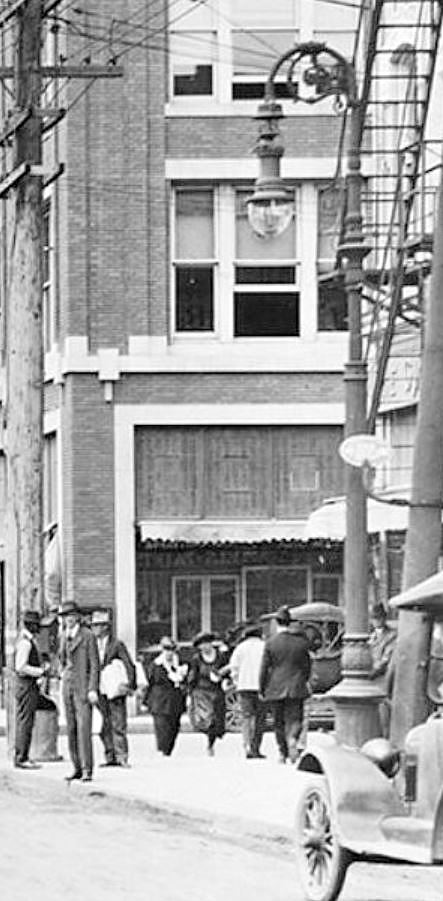
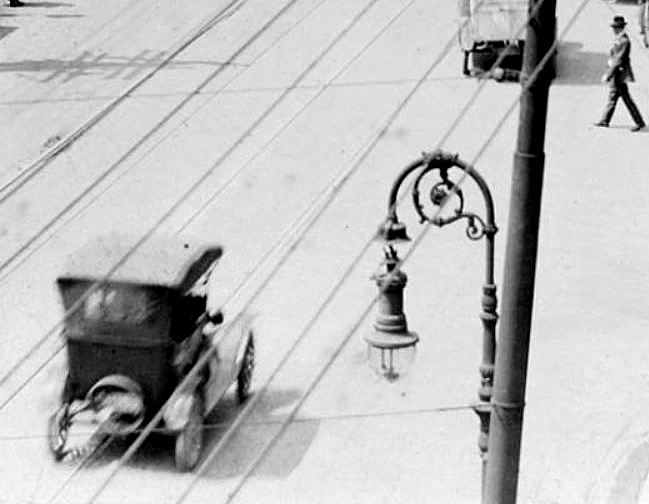
street-light_det-2

street-light_det-1

elm-st-ornamental-street-light_elm-akard_queen-theatre_ca-1914

*

Read the progress report on the installation of the new lighting system (all images are larger when clicked):
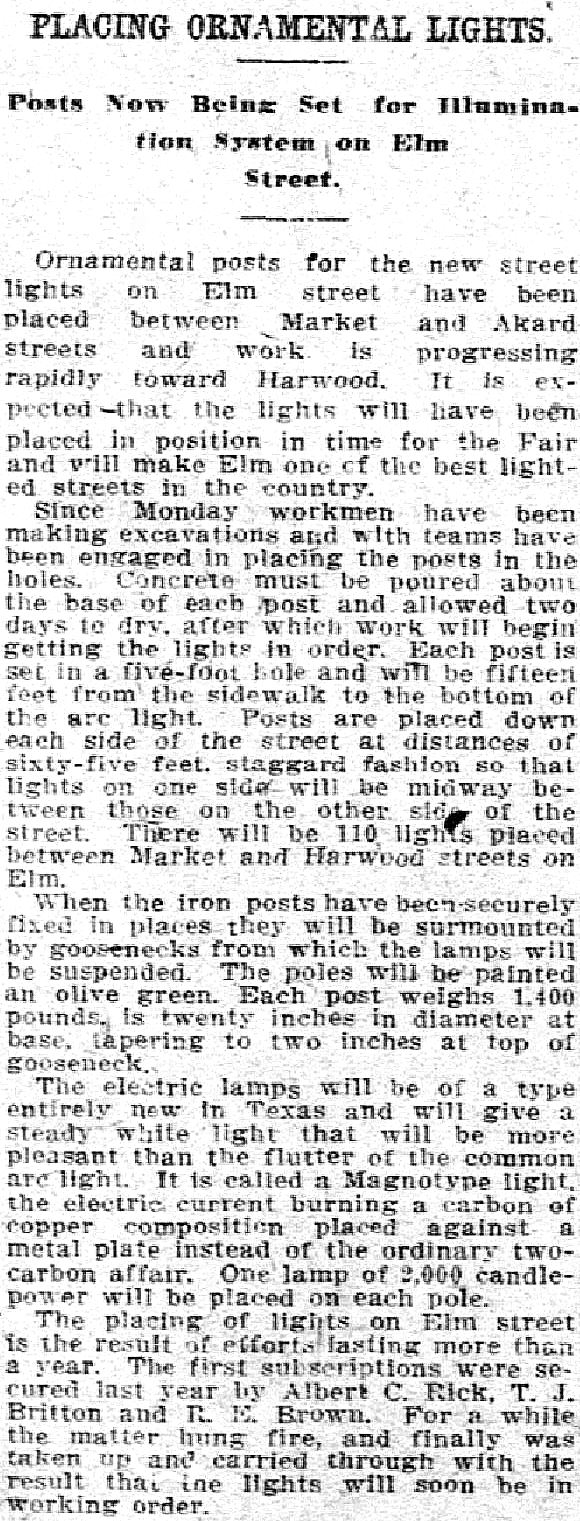
elm-street_illuminated_dmn_091411_detailsDMN, Sept. 14, 1911

Excited anticipation of the soon-to-be “Great White Way” was building:
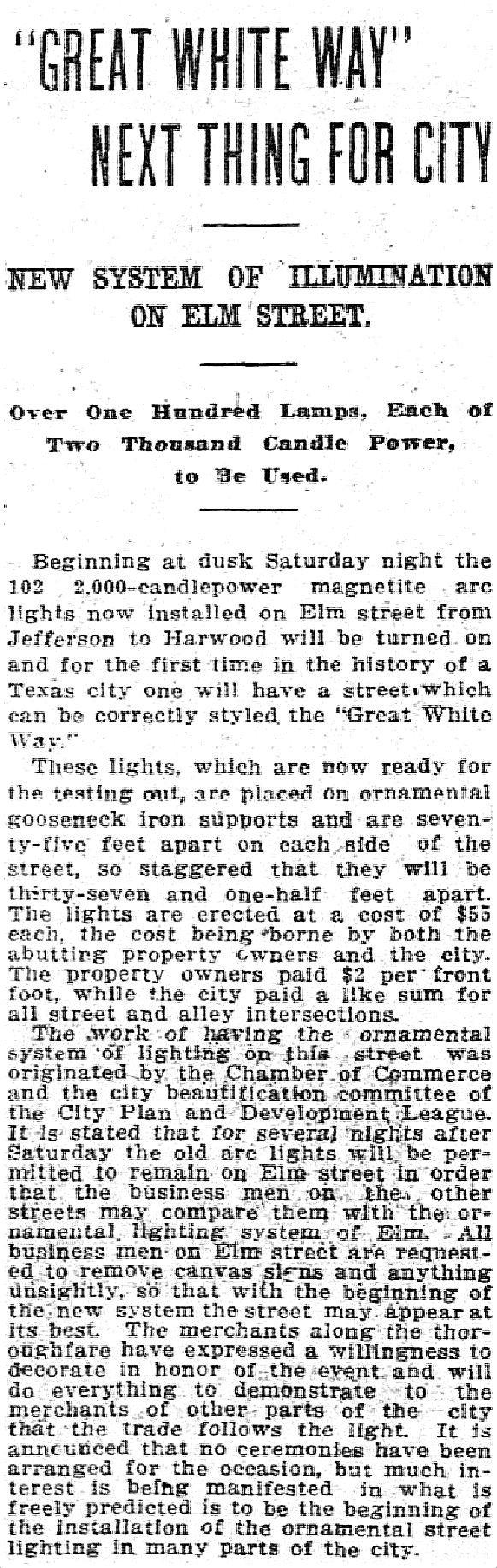
elm-street_illuminated_dmn_092711DMN, Sept. 27, 1911

Sanger Bros. was one of the many businesses celebrating the arrival of the ornamental lighting. On the day the lights were to debut in downtown Dallas, the department store ran an ad which invited Dallasites to dine in their “lofty” seventh-floor cafe and, afterwards, stroll along the well-lit thoroughfare and soak up the brand new illumination:
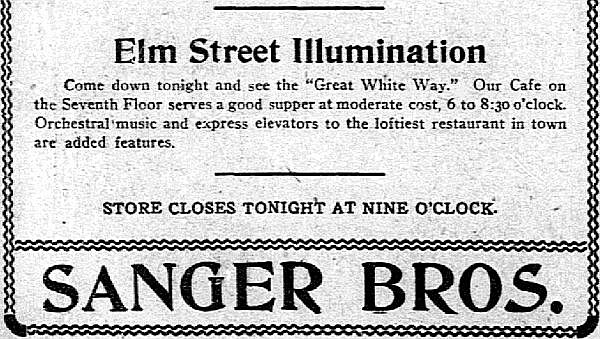
elm-street_illuminated_093011_sangers-ad_detSept. 30, 1911, the night the lights were turned on

Below is the News’ report of the inaugural switch-flipping. (Missing from the article was the fact that someone had been stabbed that night as crowds jostled each other in the streets and along the sidewalks, climaxing with the perp being chased for several blocks before being apprehended; all of this had happened under the glow of the expensive, new, very-bright, law-enforcement-aiding artificial light — that new lighting system was already paying off!)


elm-street_illuminated_dmn_100111
DMN, Oct. 1, 1911

elm-street_illuminated_night_rppc_ebay_sm

***

Souces & Notes

Postcard showing “Grand Elm Street Illumination, Compliments of the Camera Shop” is from an old eBay listing. (There is also a copy in the George W. Cook Collection at SMU’s DeGolyer Library, here — you can zoom in a bit more for details, even though, ironically, it’s still pretty difficult to make much out in the shadows. A line from the postcard message reads, “This is a photo of Elm Street at night — pretty swell I think.”)

Businesses seen on the right side of the photo are the Texas Seed & Floral Co. and the Lontos Cafe, which were located near the northwest corner of Elm and Ervay (years later, this was the appoximate site of the Palace Theatre); the Wilson Building (then the Titche-Goettinger department store) is either wholly out of frame at the extreme left, or is only partially visible.

In 1911 — before the ornamental lights were installed — Dallas had something like 1,000 electric (and a few gas) street lights in operation around the city; the arrival of the brighter and more aesthetically appealing Brave New Luminescence of Elm Street’s “Great White Way” spelled the inevitable phasing-out of the old-fashioned arc lights.

Read about how Dallas responded to the 1912 lighting of the Oak Cliff viaduct, the world’s longest concrete bridge, at the bottom of this post.

*

Copyright © 2019 Paula Bosse. All Rights Reserved.

Theaters at 1517 Elm: The Garden, The Jefferson, The Pantages, The Ritz, and The Mirror — 1912-1941

garden-theatre_ca-1912_ebayThe Garden Theatre, ca. 1912

by Paula Bosse

The photo above shows the Garden Theatre, located at 1517 Elm, on the north side of the street, between Akard and Stone Street. It was opened in the fall of 1912 by partners W. J. Brown and R. J. (Ray) Stinnett (who also operated the Cycle Park Theatre at Fair Park). The Garden was a vaudeville stop for touring companies.

1912_garden-theatre_variety_sept-1912Variety, Sept. 1912

It was one of many local theaters which simulcast World Series baseball games via telegraph updates, in the days before radio and TV (I wrote more about this fascinating subject here).

1912_garden-theatre_101612Oct. 16, 1912

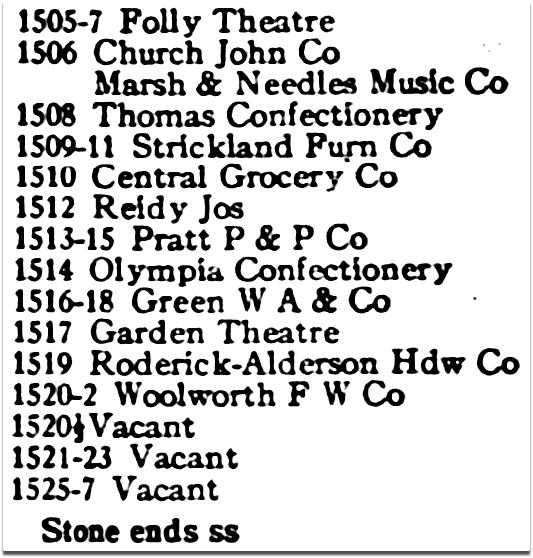
As seen in the top photo, the Garden Theatre sat between the Pratt Paint & Paper Co. and the Roderick-Alderson Hardware Co.

garden-theatre_1913-directory_1517-elm1913 Dallas city directory

The photo at the top was found on eBay, with the seller-provided date of 1912. Zooming in, one can see a placard in front of the theater advertising the appearance of the Hendrix Belle Isle Musical Comedy Company (misspelled on the sign as “Henndrix”) — for many years this troupe toured with a production called “The School-Master”/”School Days,” the very production seen here on offer to audiences at the Garden. (Read a review of a 1912 Coffeyville, Kansas performance of the troupe’s bread-and-butter act here.)

garden-theatre_ebay_det

In April, 1913 Brown and Stinnett split, with Brown taking the Cycle Park action and Stinnett keeping the Garden (and a handful of other theaters).

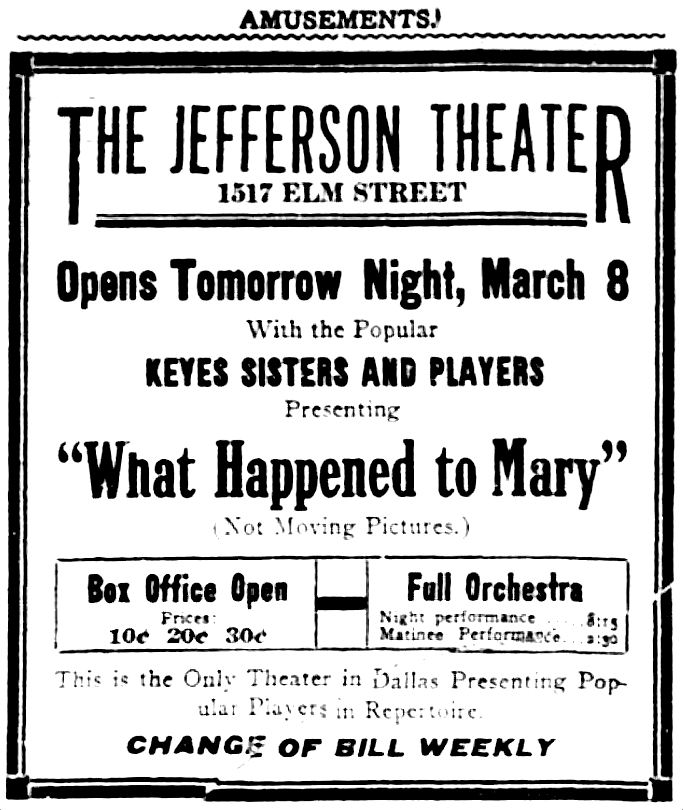
On March 8, 1915 the theater changed its name and reopened as the Jefferson Theater. As the ad below stated, “This is the only theater in Dallas presenting popular players in repertoire […] Not moving pictures.”

1915_jeffersosn-theater-opens_dmn_030715March 7, 1915

I’m not sure where the “Jefferson” name came from, but….

jefferson-theater_061115June 11, 1915

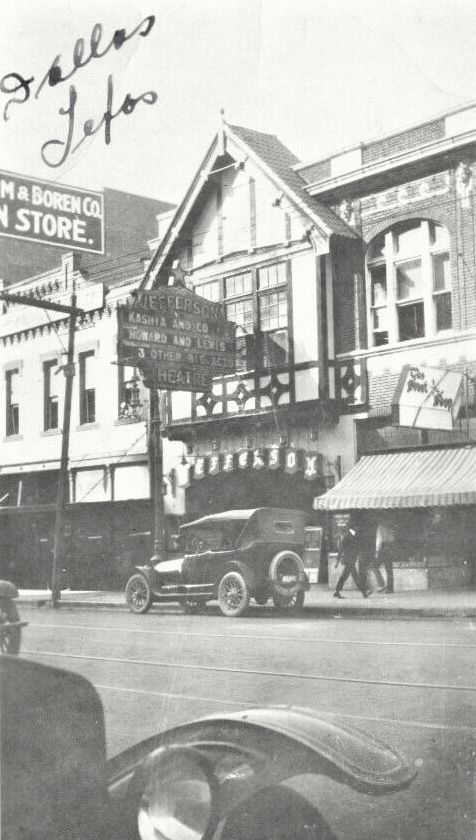
The photo below shows the Jefferson with an unusual olde-English-style half-timbered facade — I doubt that lasted long. The photo is undated, but the marquee advertises vaudeville mainstays Kasmir & Co. (Sophie Kasmir — or Sophia Kasmir — was a prima donna of note) and comedians Howard & Lewis.

theater_jefferson-theater_RPPC_ebayeBay

There were a few back-and-forths as far as operators and leases of the Jefferson, but in 1923, Ray Stinnett “sold” (or probably more accurately sub-leased) the theater in order to concentrate on his other (bigger! better! brighter!) venture, the next-door Capitol Theater, but he reacquired it in 1925 and renamed it the Pantages. (This has caused confusion, with some thinking it had become the Pantages earlier — the confusion is understandable, as the Jefferson was affiliated with the Pantages vaudeville circuit between 1917 and 1920, and during that time the word “Pantages” appeared prominently on the theater’s marquee, but it was still the Jefferson. See a photo from May, 1925, showing the Jefferson from the Pacific side here, after it had become a Loew’s-affiliated theater.)

The Jefferson became the Pantages Theater on December 27, 1925, when Stinnett opened the newly remodeled venue which offered vaudeville stage acts as well as motion pictures. (All images are larger when clicked.)

pantages-opening_122725Dec. 27, 1925

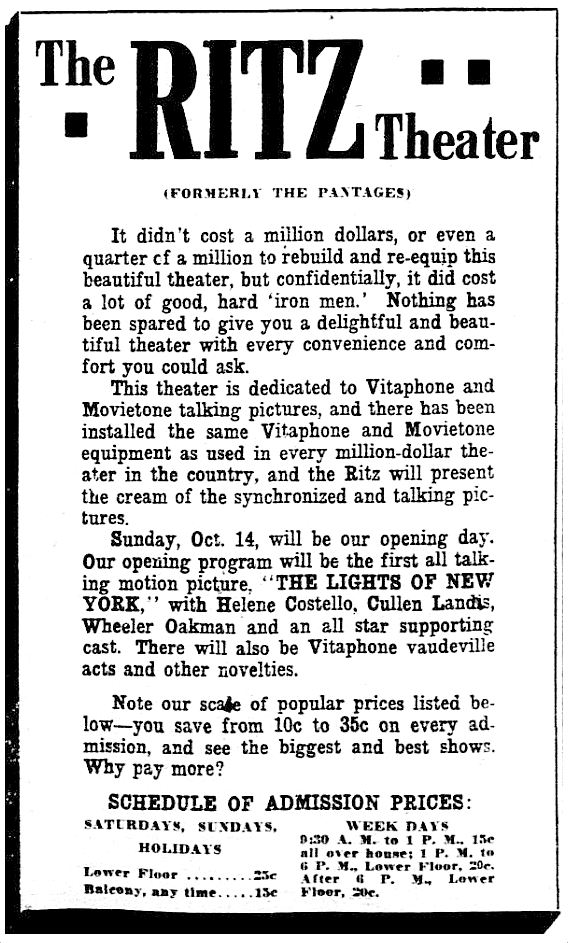
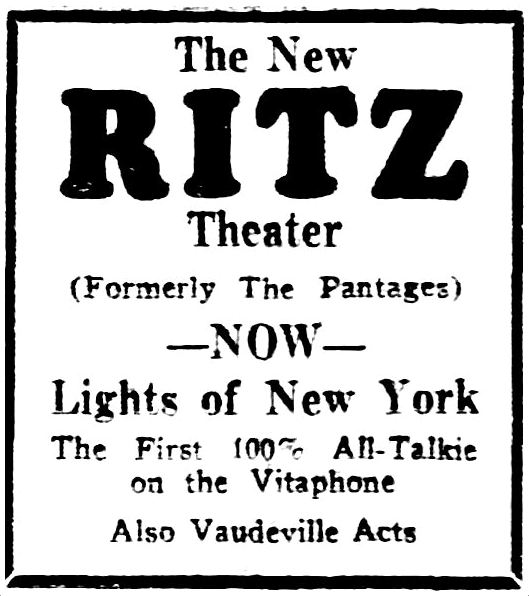
That incarnation didn’t last too long. Goodbye, Pantages, hello, Ritz. The Ritz Theater opened on October 14, 1928, operated by the R & R (Robb & Rowley) chain but leased from Stinnett. The first film shown was “The Lights of New York,” the first all-talking feature-length movie.

1928_ritz_101028Oct. 10, 1928

1928_ritz_101328
Oct. 13, 1928

1928_ritz_101528Oct. 15, 1928

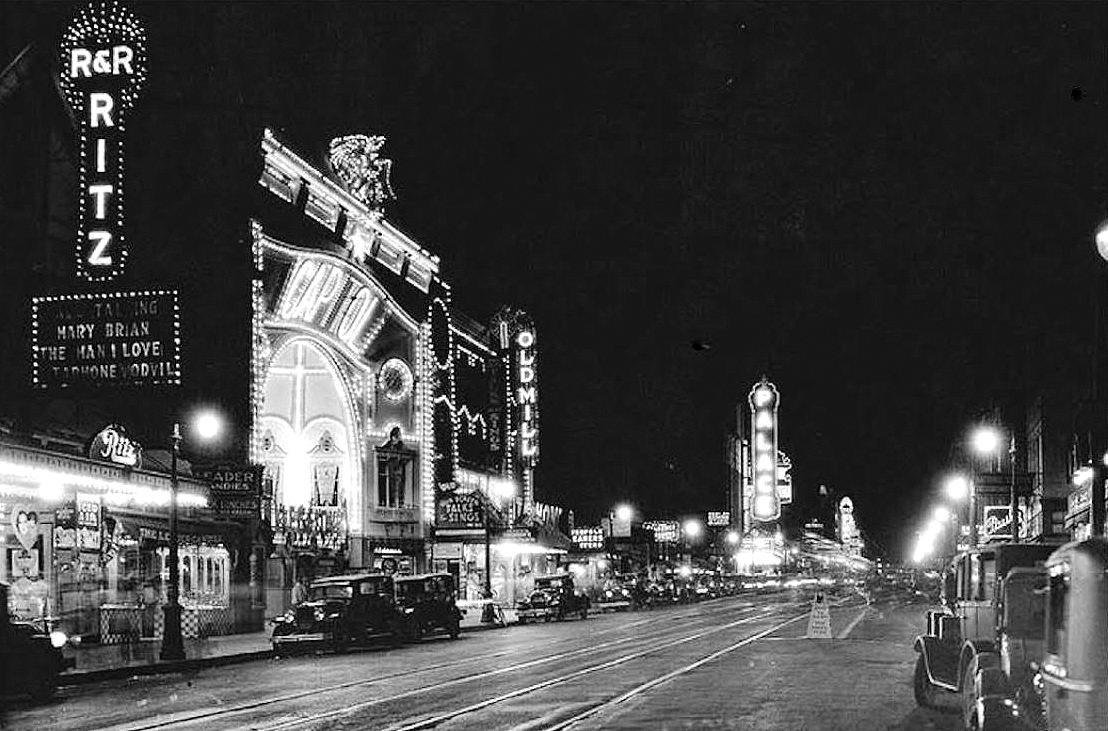
Below, a 1929 photo showing the 1500 and 1600 blocks of Elm Street, the heart of Theater Row: seen here are the Ritz, Capitol, Old Mill, and Palace theaters (the regal Queen was a few doors west of the Ritz, at the corner of Elm and Akard).

ritz_capitol_old-mill_palace_photo_sherrodphoto from “Historic Dallas Theatres” by D. Troy Sherrod

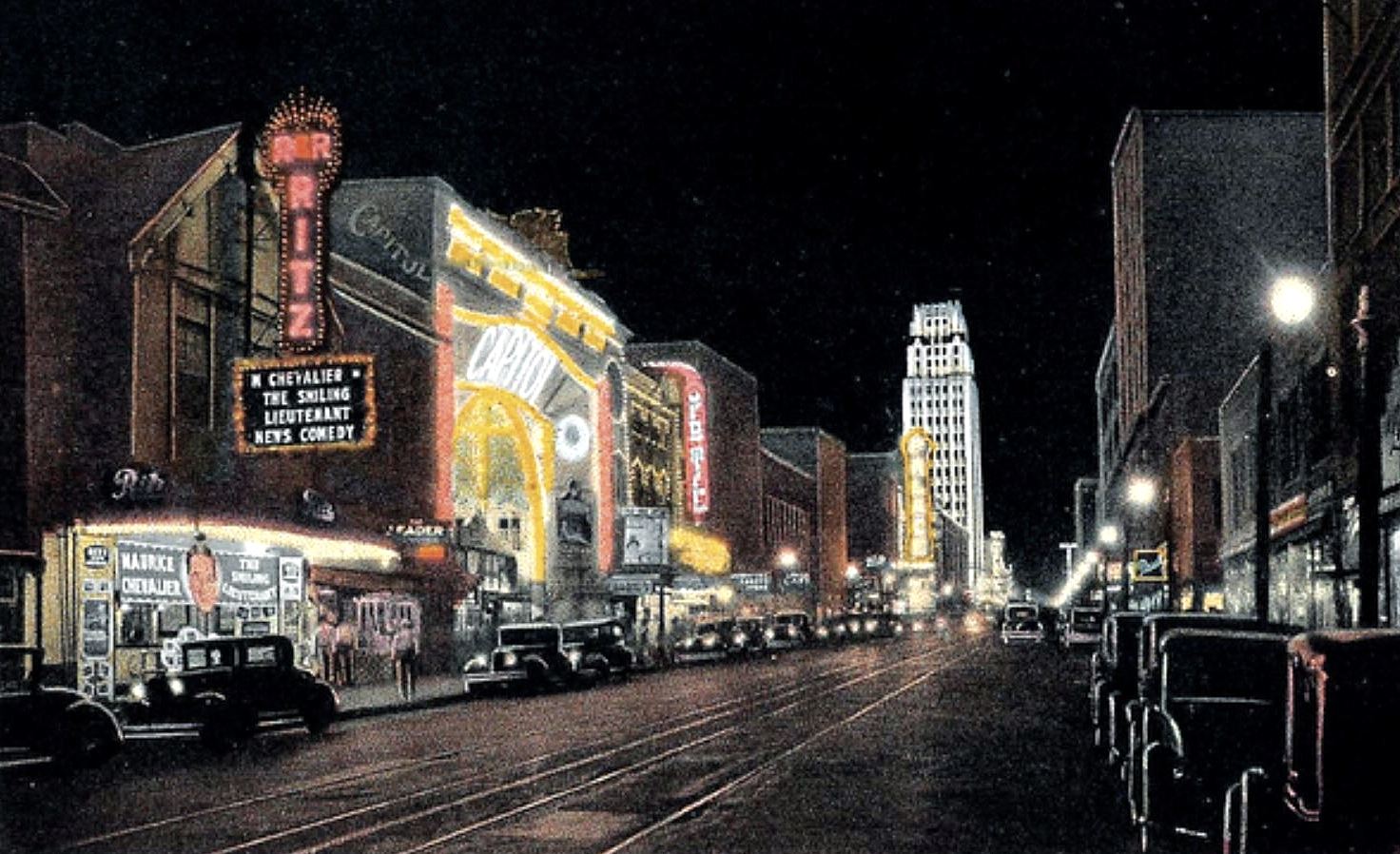
A postcard showing the Ritz (and neighbors) a couple of years later, in 1931:

ritz_capitol_old-mill_palace_postcard_cinematreasures

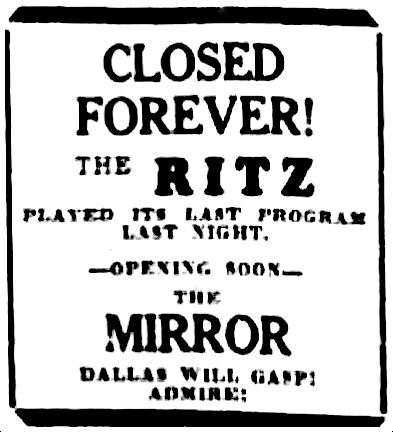
But the Ritz didn’t last all that long either — a little over three years.

1931_ritz-mirror_120831Dec. 8, 1931

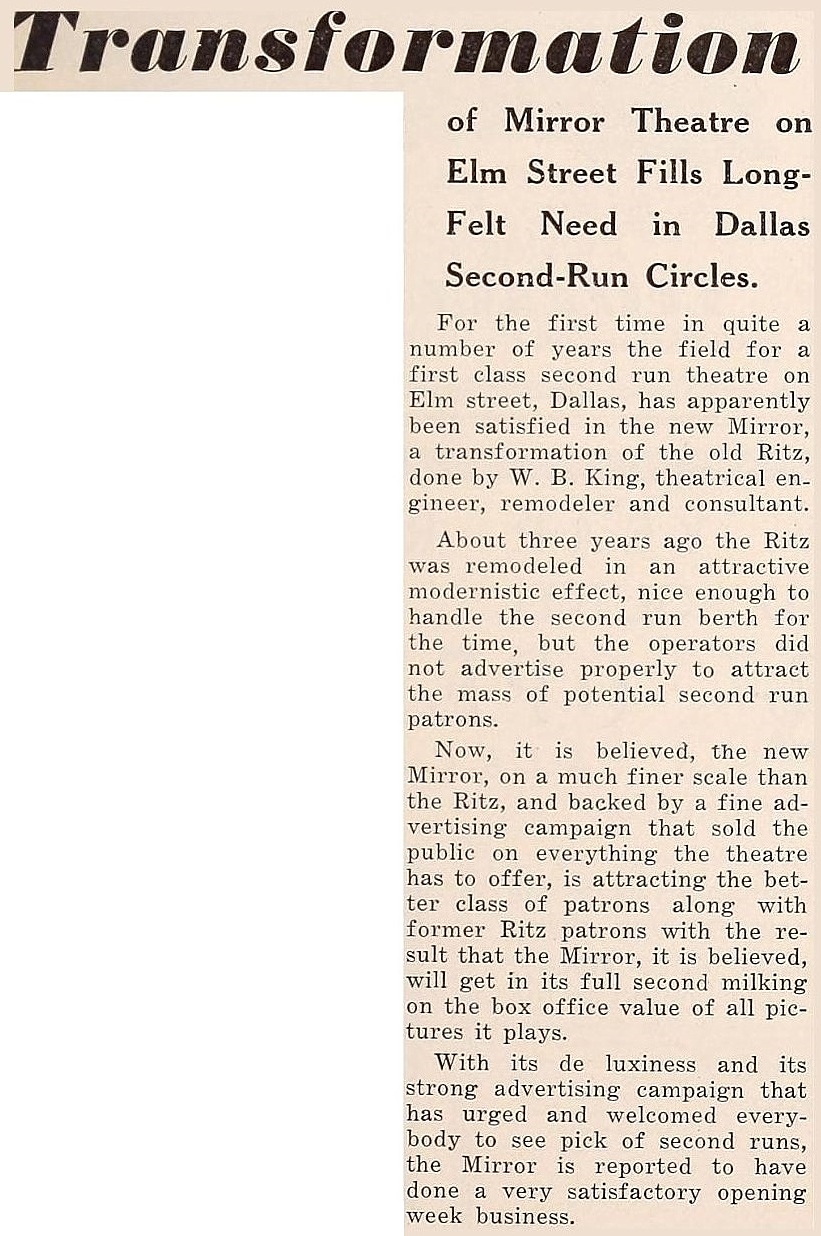
In 1931 the theater was acquired by the Hughes-Franklin company (as in Howard Hughes, the super-rich Texan who had an obsession with Hollywood). The plan was to renovate the building and rename it the Mirror, “a duplicate, in so far as possible, of the famous Mirror Theater of Hollywood. A feature will be the extensive use of mirrors in the lobby and foyer” (Dallas Morning News, Nov. 29, 1931).

mirror_motion-picture-times_122931Motion Picture Times, Dec. 29, 1931

The Mirror Theater opened at 1517 Elm on Christmas Day, 1931.

1931_mirror_122531
Dec. 25, 1931

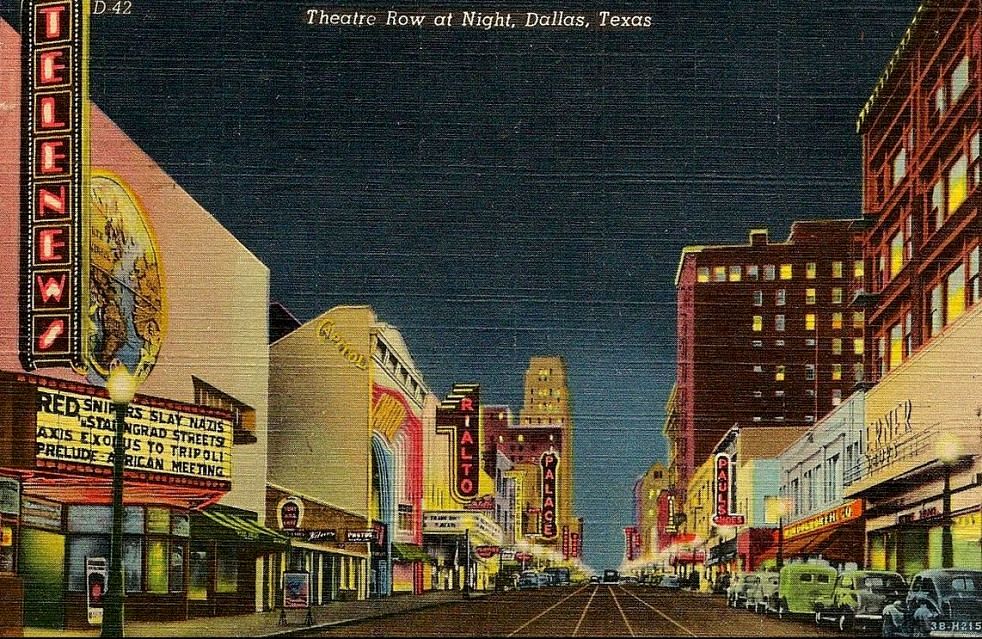
Theater Row, 1936:

theater-row_mirror_march-1936

More Elm Street:

mirror-capitol-rialto-palace-melba-majestic_theater_row_night_big

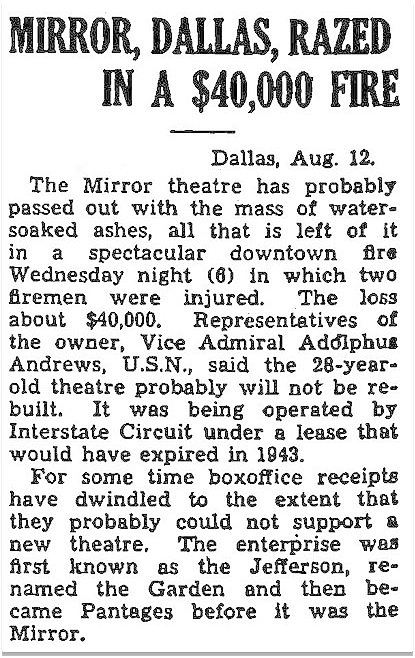
The Mirror chugged on for several years as a second-run house, apparently less and less profitable as the years passed. On August 4, 1941 the theater burned down in an early-morning fire. The property owner, Vice Admiral Adolphus Andrews, decided against rebuilding.

mirror-fire_variety_081341Variety, Aug. 13, 1941

Here’s the same view as seen above, only now the space next to the Capitol is a nondescript one-story retail building. (The Telenews, a theater showing newsreels, opened in November 1941.)

telenews_missing-mirror-post-fire_capitol_postcard

Below, a photo from around 1942, the first time in 30 years without a theater at 1517 Elm Street.

theater-row_by-george-mcafee_degolyer_SMUphoto via the DeGolyer Library, SMU

***

Sources & Notes

Top photo of the Garden Theatre is from an old eBay listing.

More Flashback Dallas posts on Dallas theaters can be found here.

*

Copyright © 2019 Paula Bosse. All Rights Reserved.

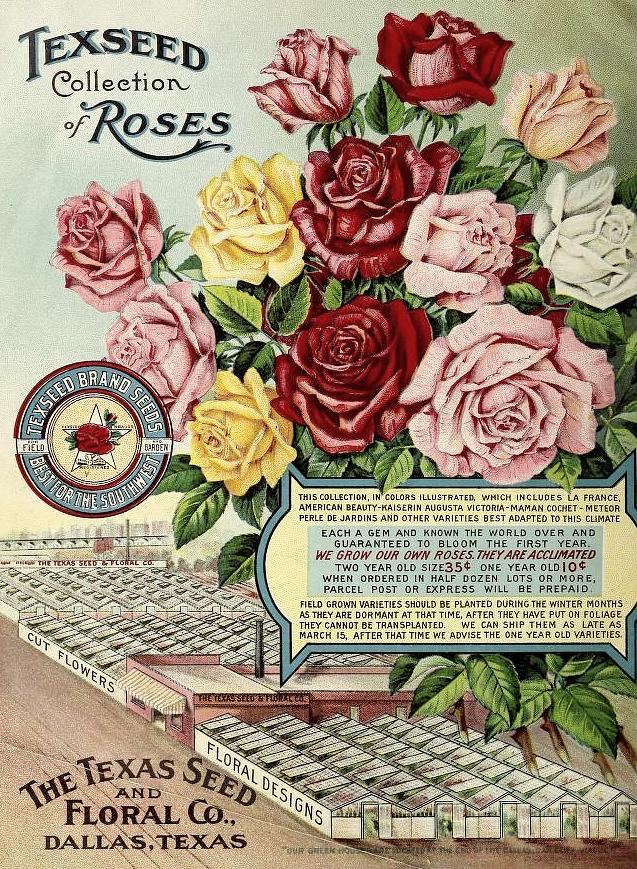
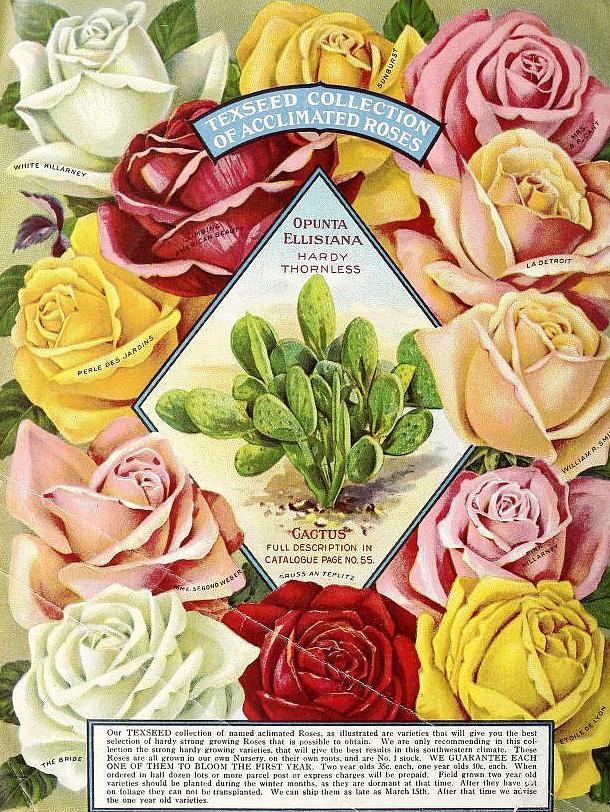
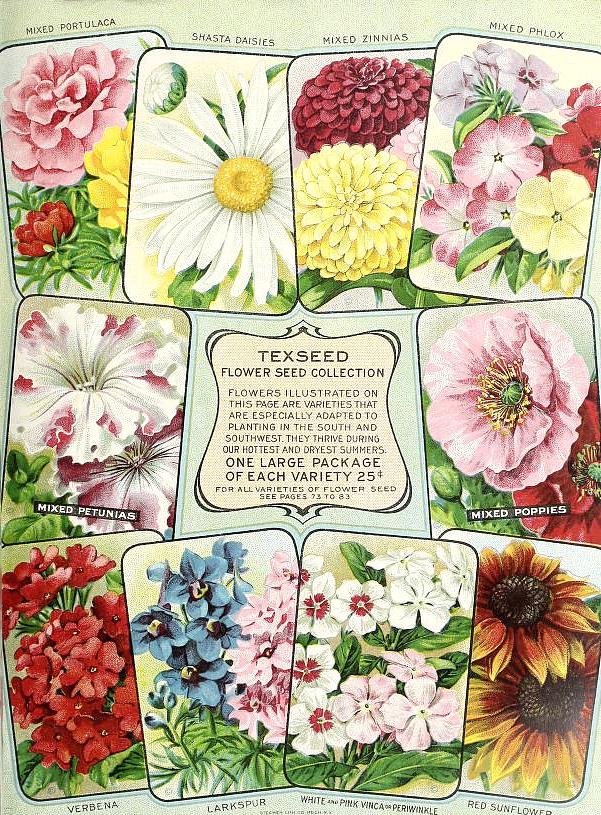
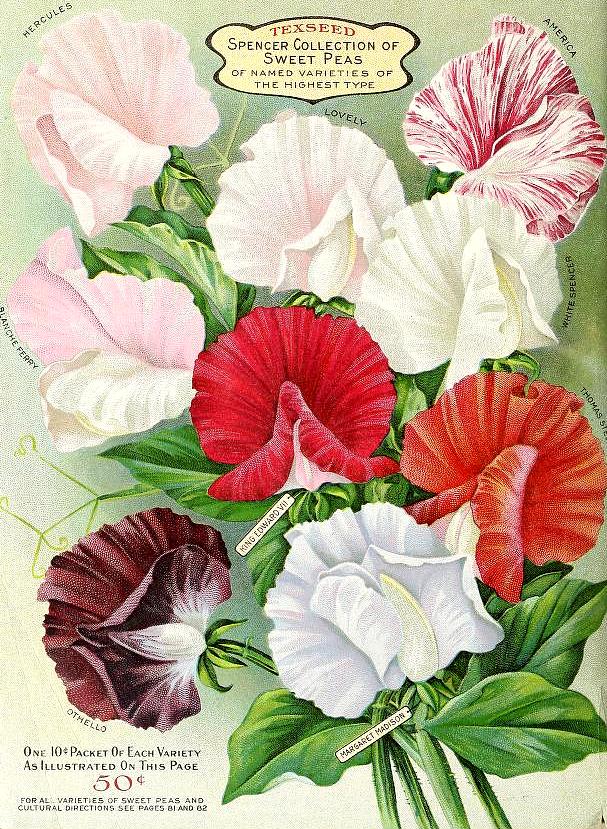
Spring, Brought to You by The Texas Seed & Floral Co.

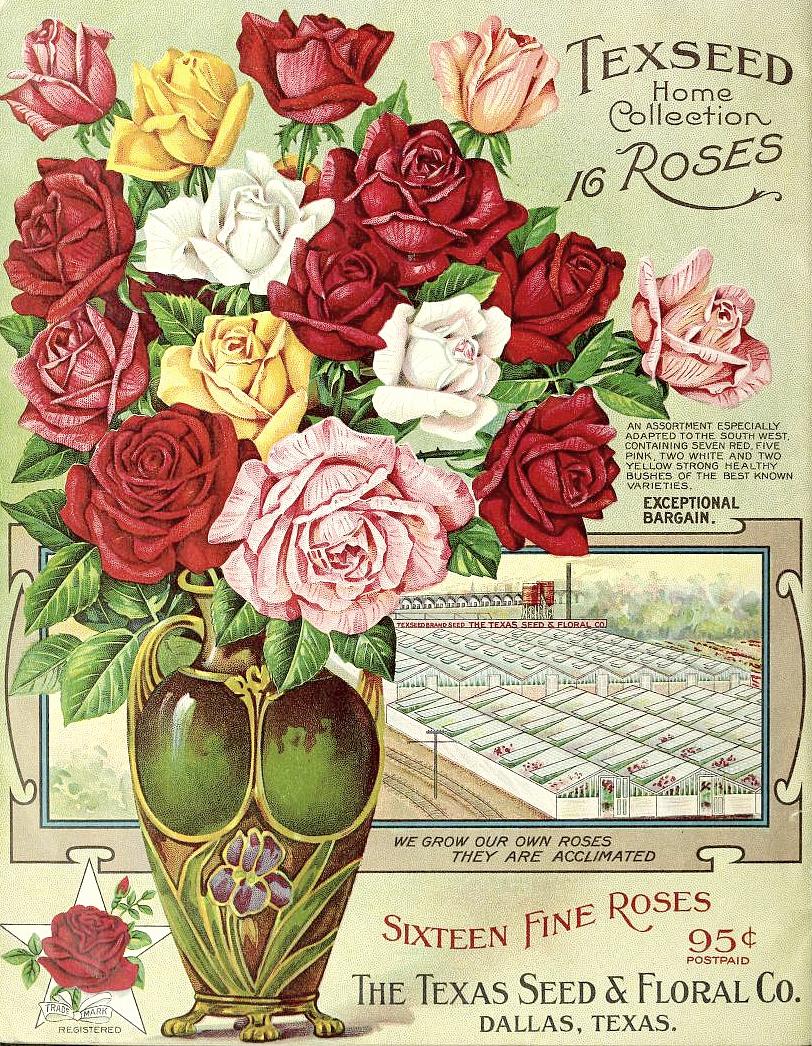
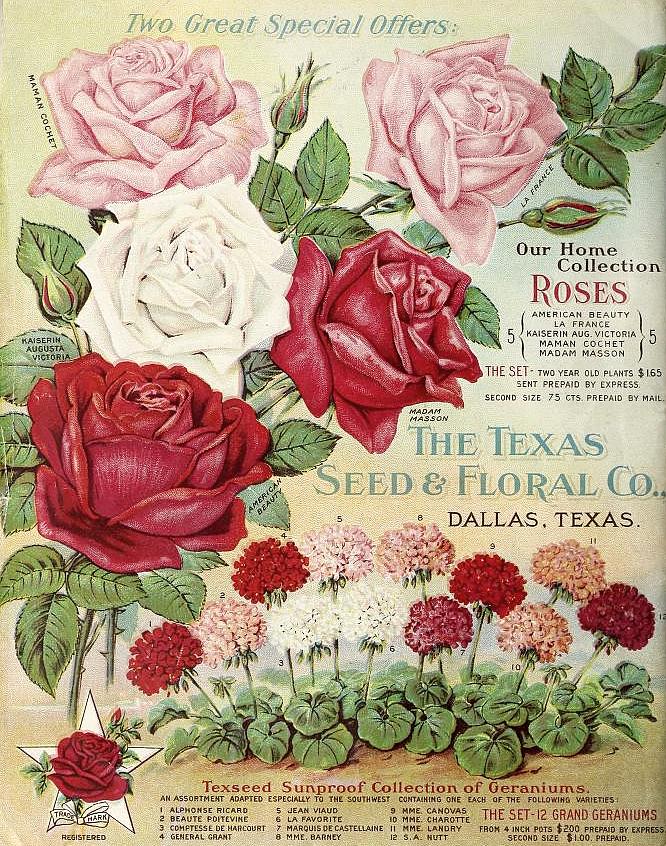
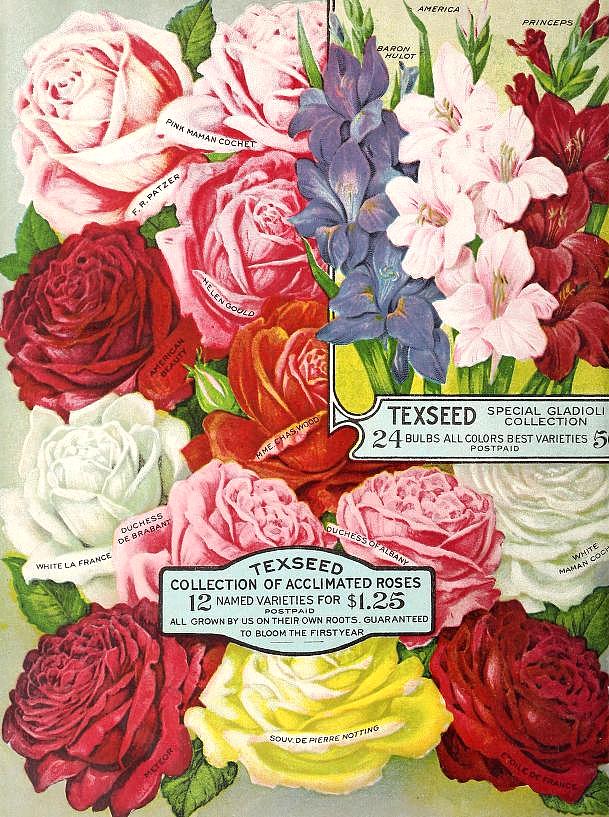
1913_tx-seed-floral_1913_rosesThe Texseed Home Collection, 1913

by Paula Bosse

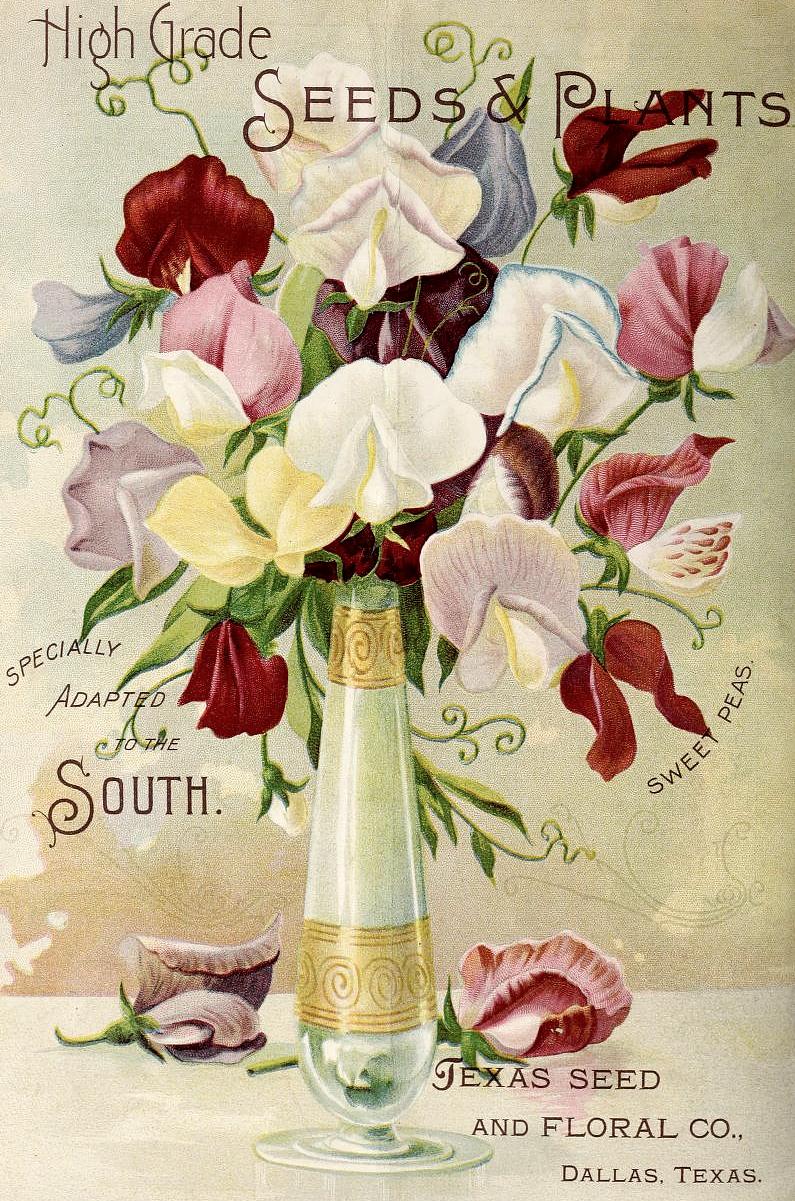
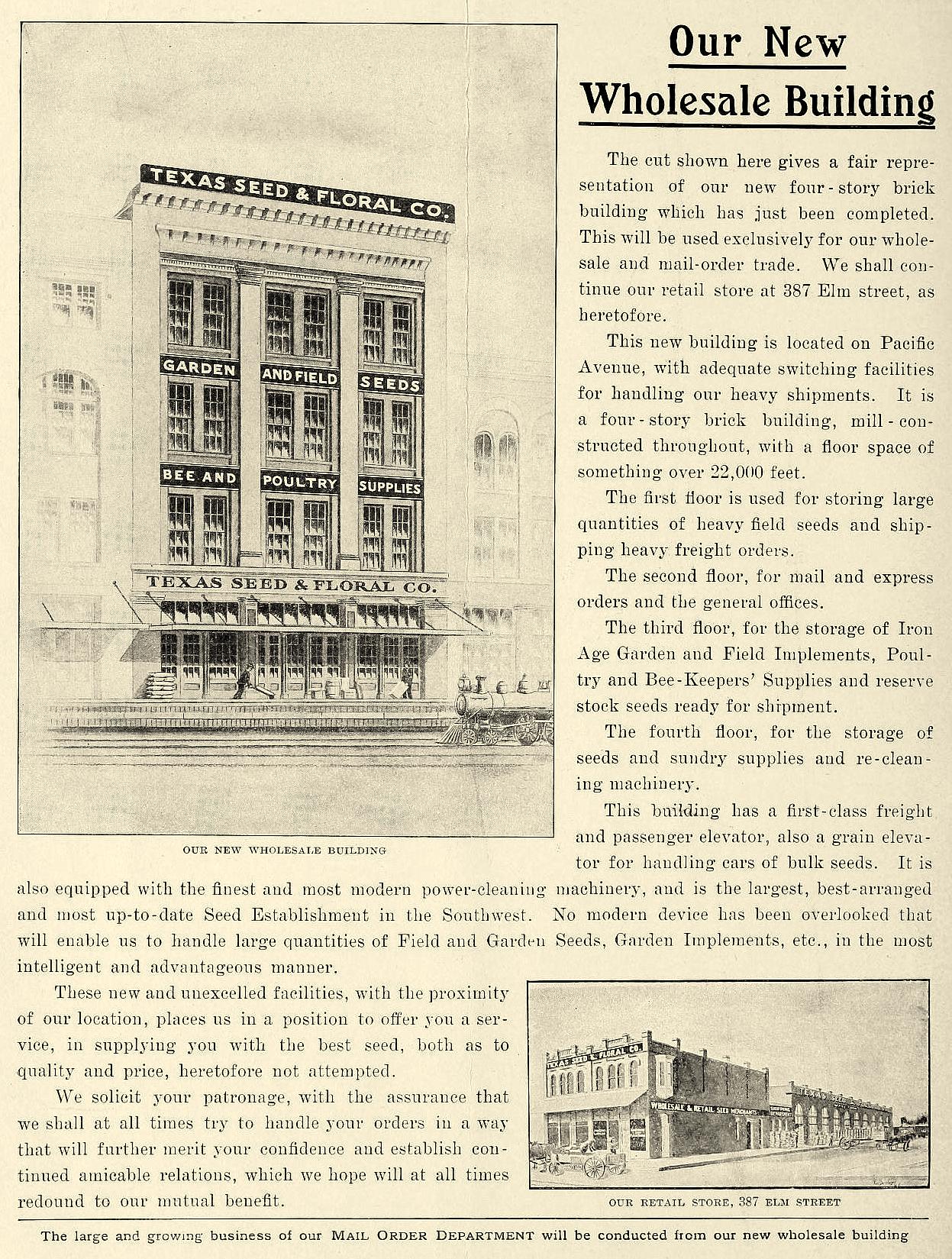
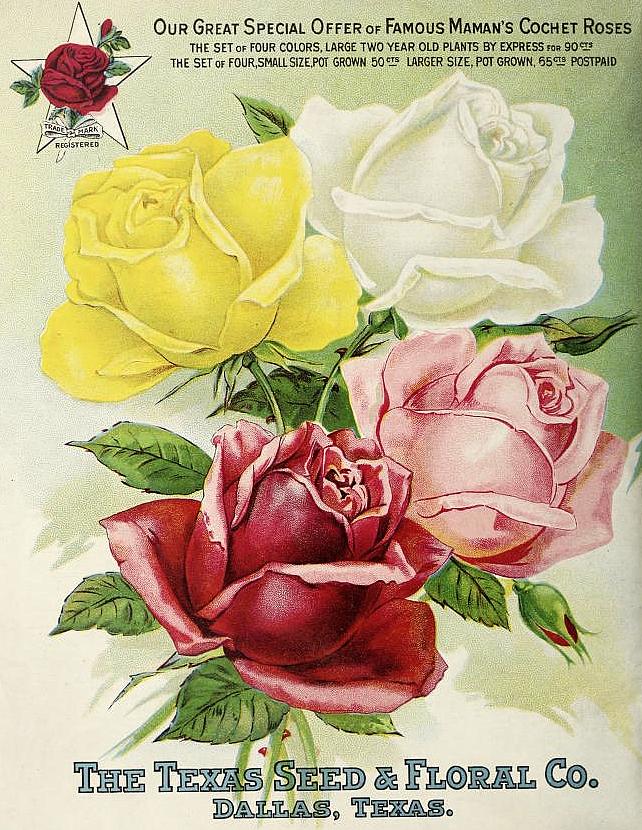
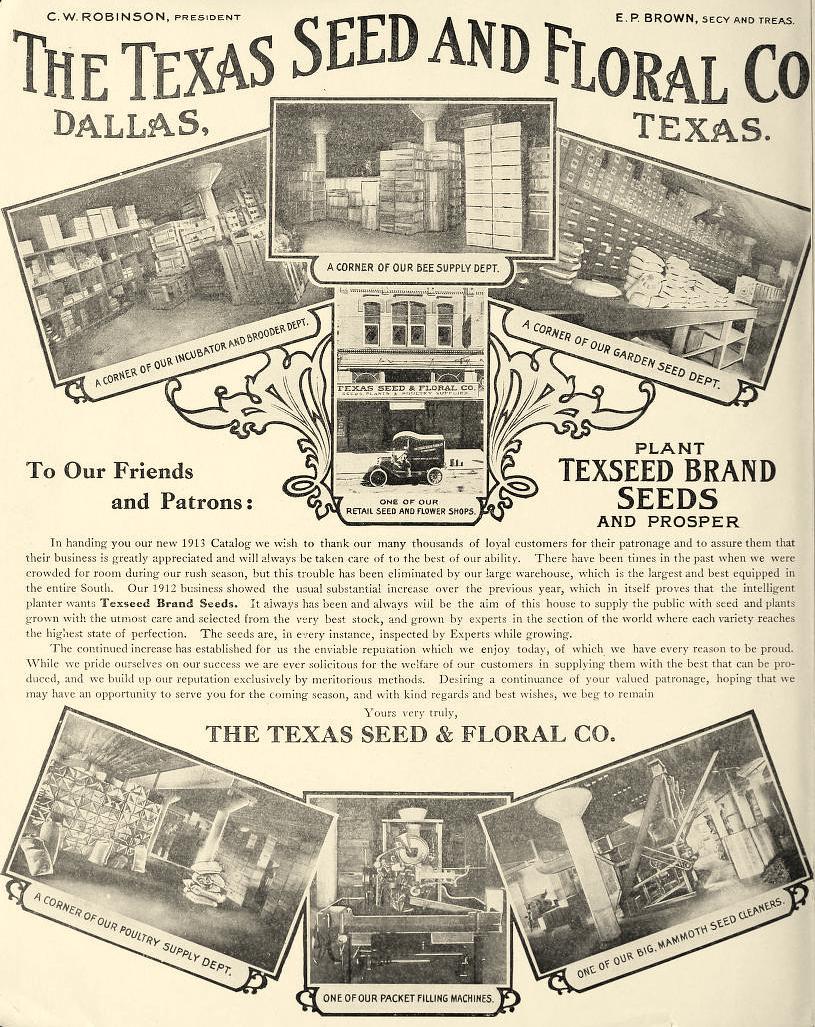
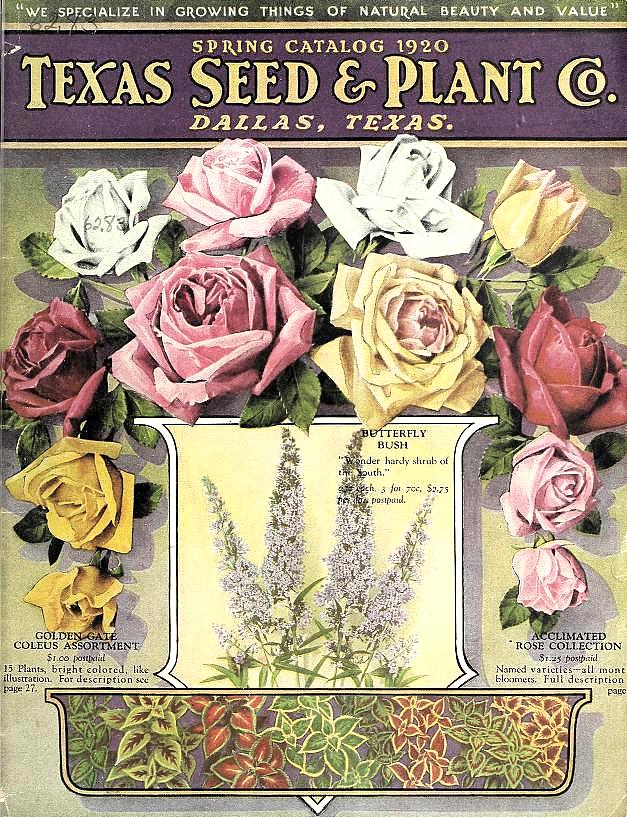
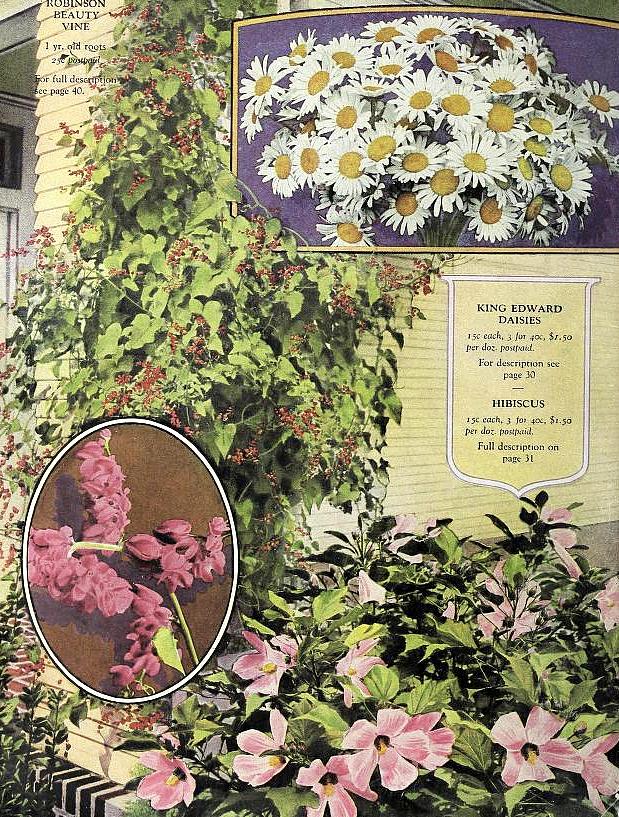
In honor of Spring’s arrival, I give you a collection of lovely illustrated covers from the Texas Seed & Floral Company’s seed catalogs. The company was established in Dallas around 1885 and was located for many years at the northwest corner of Elm and N. Ervay, with offices and a warehouse opening onto Pacific’s railroad tracks. (See photos of the interior of the business — later renamed Lone Star Seed & Floral — in the post “Next-Door Neighbors: The Palace Theater and Lone Star Seed & Floral — 1926.”)

Happy Spring! (All images are larger when clicked.)

1896_tx-seed-floral_1896_flowers1896

1906_tx-seed-floral_1906_stores1906

1911_tx-seed-floral_1911_roses1911

1912_tx-seed-floral_1912_roses1912

1913_tx-seed-floral_1913_store1913

1915_tx-seed-floral_1915_roses1915

1916_tx-seed-floral_1916_roses1916

1917_tx-seed-floral_1917_flowers1917

1917_tx-seed-floral_1917_flowers_a1917

1917_tx-seed-floral_1917_roses1917

1920tx-seed-floral_1920_flowers1920

1920_tx-seed-floral_1920_daisies1920

*

Below is the citation for the company from the book Greater Dallas Illustrated, published in 1908.

Texas Seed & Floral Co.

The great progress which has been made in agricultural and horticultural lines in the southwest has resulted in an ever increasing demand for a high quality of seeds, and to meet this demand many reliable seed houses have been established, among which is the Texas Seed & Floral Co., whose retail store is at 387 Elm street, and whose office and warehouse department is at 311-313 Pacific avenue. The line of seeds carried in stock includes all kinds of garden and flower seeds as well as field seeds, their leading brand being known under the name of “Texseed,” and they have the exclusive right to sell this brand in the southwest.

The company was established in 1885 and it is recognized as the largest seed house in the southwest, and its beautifully illustrated catalogue, which tells all about the best seeds for the southwestern planter, can be had upon request. R. [Robert] Nicholson is the secretary of this company, and the active manager of its affairs. He is of Scottish birth and has resided in Dallas for thirty years. He is a member of the Commercial Club, and is an Elk. Ably assisting him is F. J. Poor who comes to this firm from Kansas City.

***

Sources & Notes

All images from the Internet Archive.

*

Copyright © 2019 Paula Bosse. All Rights Reserved.

Rugged Highland Park

highland-park_charles-arnold_postcard_postmarked-1909

by Paula Bosse

Two views of Turtle Creek, wending through Highland Park. The view above is from a postcard mailed to East Hampton, Long Island in 1909 (“Haven’t seen this but it must be true. Pretty good for Texas…”); the view below is from about 1915, the year Highland Park was incorporated (the photo appears to show the same three children seen in my earlier post, “Wading in Turtle Creek, 100 Years Ago”). (Both images of the bluff-lined creek are larger when clicked.)

dallas-educational-center_turtle-creek_ca-1916

***

Sources & Notes

Top image is from a C. Weichsel postcard titled “Woodland Scene. Highland Park. Dallas, Tex.” (photo possibly by Charles A. Arnold). Another image of this postcard can be seen on the cover of the Fall, 2015 issue of Legacies (here); the story it illustrates is “Attempts to Annex the Park Cities,” here.

The black-and-white photo (captioned “Highland Park”) is from a booklet on Dallas education, published around 1916.

*

Copyright © 2019 Paula Bosse. All Rights Reserved.
 

Make Dallas the City of Mercy — 1919

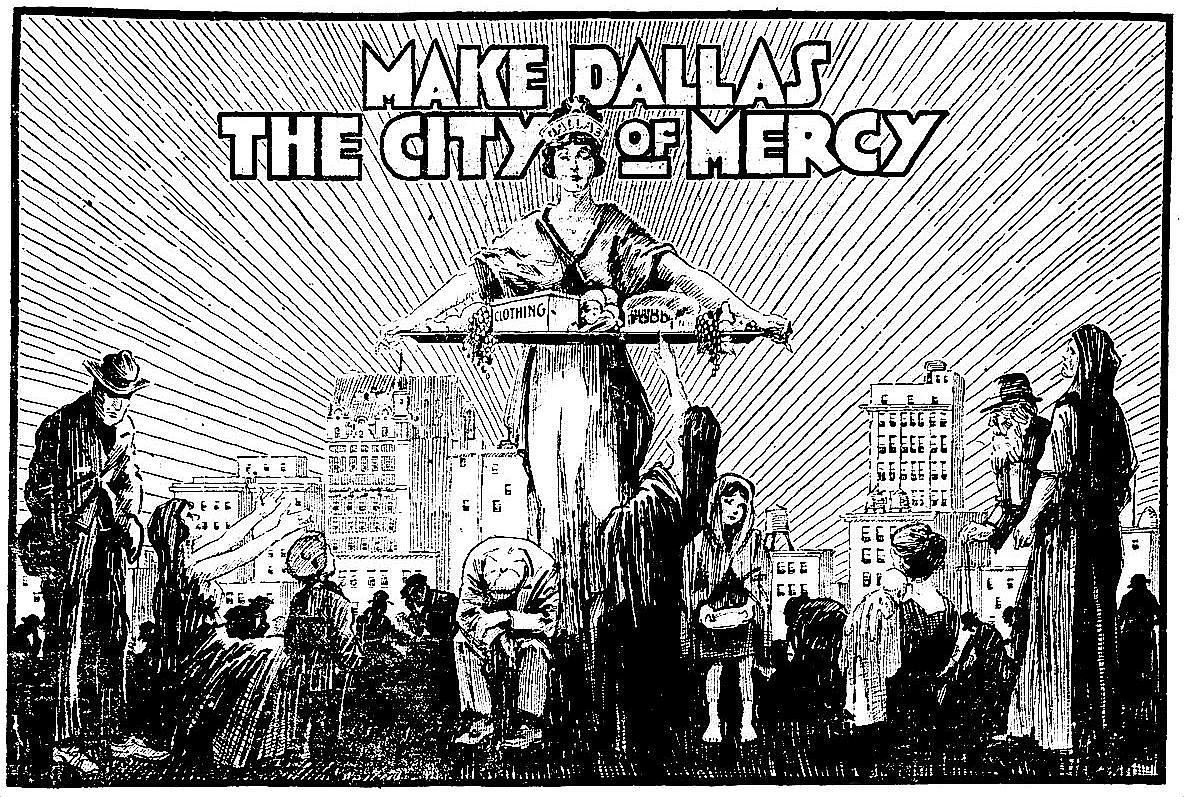
city-of-mercy_dmn_102019_ad_welfare-week_charity

by Paula Bosse

This seems to be a nice way to start the new year — by featuring a charitable appeal from a group called The Welfare Council of Dallas, which helped to raise funds annually for organizations in need of monetary assistance from the public.

Many are the appeals to our generosity today. Here, however, is our closest and deepest obligation. These represent the charity that begins at home. These are the forces that are driving misery and want from our city — building always a brighter and better future for Dallas.

**

The following nine groups — all of which aided needy children and families — were the ones chosen in 1919 as organizations which would be part of the city-wide “Welfare Week” appeal (the illustration above and the text below are from a large ad that appeared in Dallas newspapers in October, 1919):

THE UNITED CHARITIES during the last year have ministered to 12,226 individuals; 4,452 visits were made to homes to which their attention had been called; 734 cases for continued relief were opened; 152 such cases from the preceding year were given further aid; 562 destitute wanderers were furnished with homes, food and clothing, and suitable employment found for as many of them as possible; 834 cases of sickness or accident or taking care of, some for periods as long as six months; 116 persons were furnished transportation to their home or to places where their health could be restored ; 85 were aided in gaining admission to State institutions; 55 cases of tuberculosis were given extended relief; 82 wives, deserted by their husbands, and 37 widows with children were given food and shelter until proper arrangements for their care could be made by their relatives.

THE DALLAS GRADUATE NURSES’ BABY CAMP cared for and gave necessary medical and surgical attention to 178 babies during the last year. The mortality was 25, certainly a low figure, considering the uniformly serious nature of the cases treated. The Camp is under the direct charge of three doctors and seven nurses, and no baby is permitted to leave the Camp until permanently cured. The average stay of the little patients is five weeks. Besides the cases treated at the Camp over 100 formulae were furnished to outside cases. The Baby Camp is open to ALL Dallas babies who are in bad health. [Read a history of the Baby Camp here.]

THE DALLAS COUNTY HUMANE SOCIETY is the founder and conductor of “Hope Cottage,” a home for illegitimate and deserted babies, where an efficient staff of nurses devote their time to providing these little ones with an opportunity to begin honorable lives. Hope Cottage averages from ten to twenty inmates all the time, as they are kept only until suitable homes for adoption can be found. The placing of orphaned children in private homes is another branch of the work. This agency also investigated 1,390 cases of reported abuses of children; 389 of these investigations were followed by prompt action: 299 homes were visited; 16 children were sent to the Detention Home, and 18 cases of delinquents received attention; 3,246 cases of abuse to dumb animals were investigated. [A similar “shelter for unfortunate women and children” was the Salvation Army’s Neighborhood Home on McKinney Avenue.]

THE DALLAS KINDERGARTEN AND NURSERY ASSOCIATION has conducted four stations during the year – the Clara Chaison Kindergarten at the Neighborhood House on Cedar Springs Road, the South Dallas Kindergarten near Trinity Play Park, the Cora Street Nursery, formerly under the supervision of the City Federation of Women’s Clubs, and the Alamo Nursery at Hickory and Alamo streets. The average enrollment at all stations was 205. In connection with each station a day nursery is maintained where mothers with employment may leave their young children from 7 a.m. to 6 p.m. An average of fifty mothers take advantage of these nurseries each day, and a bath, wholesome dinner, nap and play constitute the day’s program. [A similar nursery, specifically for the black community, was the Dallas Day Nursery.]

THE INFANTS’ WELFARE AND MILK ASSOCIATION, striving for better health and cleaner living conditions for children, distributed 81,828 pints of milk; visited 7,885 homes; treated 3,489 children in medical and 469 in dental clinics. The nurses at the stations gave treatment to 1,160 cases. In addition to these, 202 prenatal cases were given attention, 31 obstetrical cases disposed of and 80 bacteriological examinations were made. Twenty babies were sent by the Association to the Baby Camp and 14 to the City Hospital, while co-operation was given to other organizations in 724 cases. [From another ad: “Sick babies of many races and creeds, but all future Dallasites, find new health in [these] clinics.” More on milk stations here.]

THE DALLAS STREET AND NEWSBOYS’ CLUB, “Big Brother Work” Headquarters, is the one bright spot in many a young Dallas urchin’s life. The club rooms, at 1907 Jackson street, half inexpensive, though adequate, equipment for sports and games, reading and like activities. There are dormitory rooms for boys temporarily “on their own,” which accommodations can be paid for according to the boy’s ability to pay. A few steps from the building is the back door at the Y.M.C.A., and three times each week the Club descends upon the swimming pool en masse. The directors of the Club do not confine their work to headquarters, however, but look to the welfare of its members at work, play, school and even in their homes. [The life of a newsboy — often an orphan under the age of 10 — was not an easy one.]

ST. MATTHEW’S HOME FOR CHILDREN, by placing its finances for the coming year in the hands of the Welfare Council, adds a valuable and deserving institution to the list of member agencies. Although the property is owned by the Episcopal Church, the managing board is non-sectarian, the Home is absolutely non–sectarian in its activities and no child is excluded on account of its faith or that of its parents. At present the capacity is limited to forty little ones, and any child between the ages of 4 and 12 years may be admitted.

THE DALLAS COUNCIL OF BOY SCOUTS is the other new member agency. The work done by this organization and developing manhood in boys of all classes of society entitles it to our fullest support. Its influence extends into every home, school, factory and business office in the city. Its nominal dues for membership permit any boy, no matter how poor, to join and take a full share in the activities and benefits of the organization.

THE EMPTY STOCKING CRUSADE is an organization whose year’s activities culminate in providing Christmas cheer – warm clothing, fruit, toys and other tokens of happiness for little ones. It carries cheer into homes of the city to whose children the season of universal good will would otherwise bring nothing, and into the orphanages. Last Christmas 6,902 children were provided for.

city-of-mercy_dmn_101719_ad_welfare-week_charity_det

***

Sources & Notes

More on Dallas’ early charitable movements can be found in the article “The Forgotten Frontier: Dallas Women and Social Caring, 1895-1920” by Elizabeth York Enstam (Legacies, Spring, 1989), here.

*

Copyright © 2019 Paula Bosse. All Rights Reserved.

Armistice Day Centennial

wwi_cook-collection_degolyer-library_SMU

by Paula Bosse

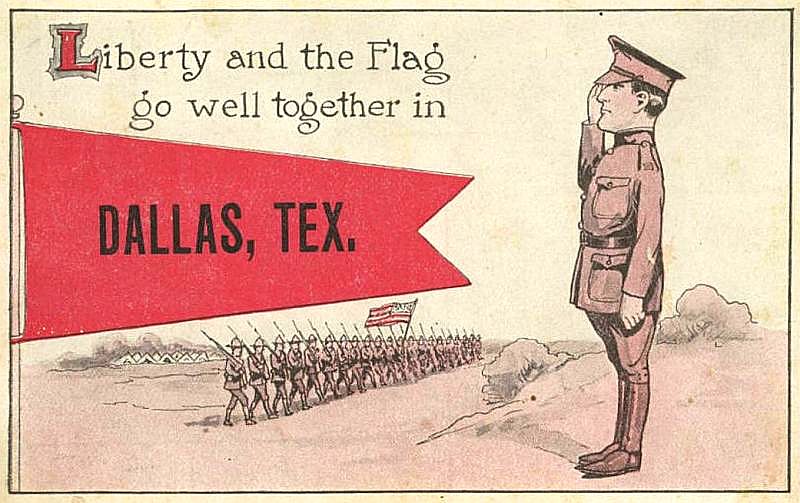
Today we observe the 100th anniversary of the end of World War I, with sincere hopes we never again see a war with such devastating loss of life. Read how Dallas celebrated news of the armistice in the Flashback Dallas post “Armistice! — 1918,” here. More posts on Dallas and WWI can be found here.

***

Sources & Notes

“Liberty and the Flag go well together in Dallas, Tex.” postcard is from the George W. Cook Dallas/Texas Image Collection, DeGolyer Library, SMU Libraries, Southern Methodist University; more information on this item may be found here.

*

Copyright © 2018 Paula Bosse. All Rights Reserved.
Stop at the Delmonico — ca. 1919

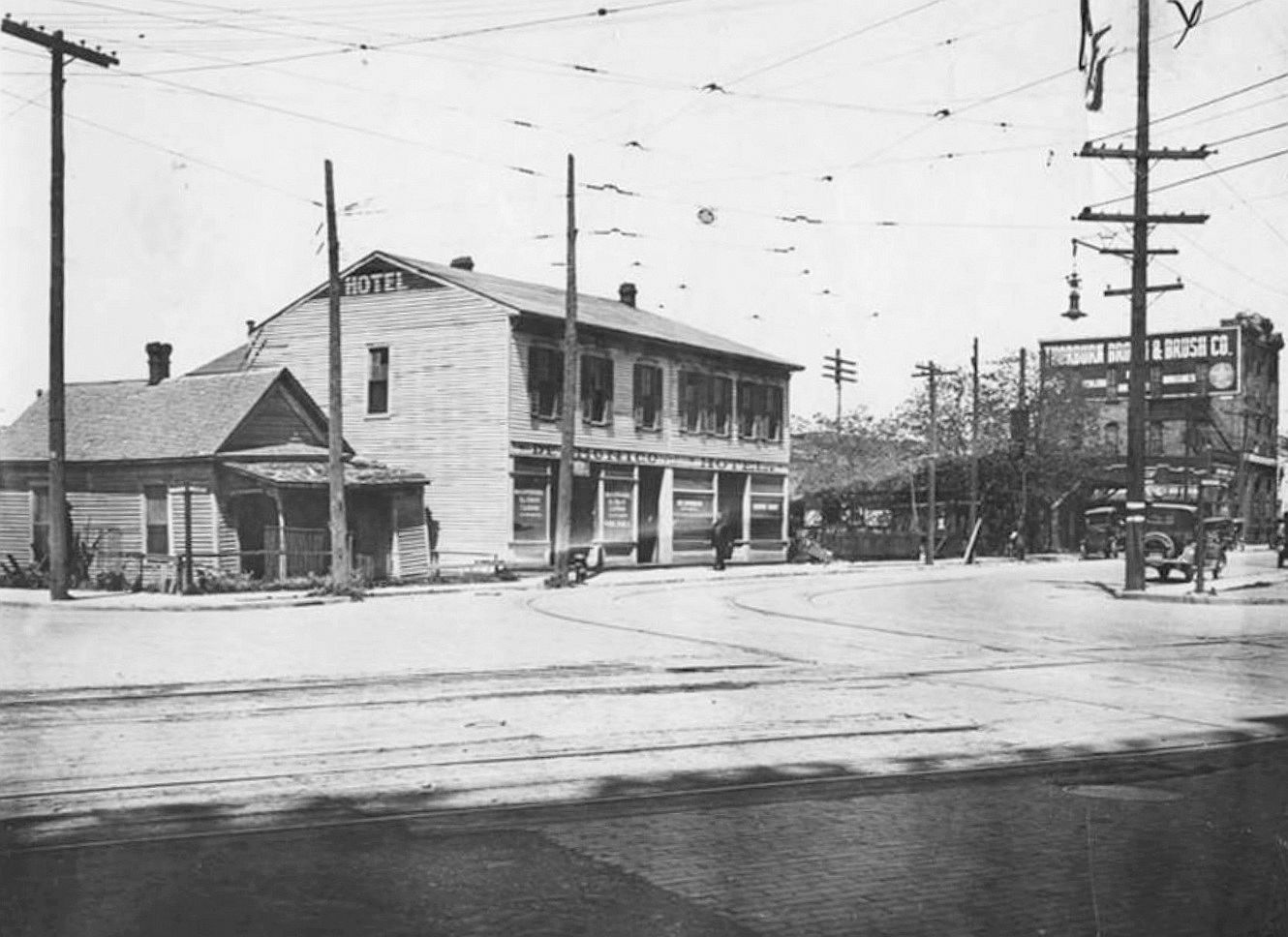
delmonico-hotel_degolyer_SMU_ca-1919The Delmonico Hotel & Thorburn Broom factory… (click for larger image)

by Paula Bosse

How does one refer to the area just above Pacific and Central, where Swiss once crossed Central? “Deep Ellum-adjacent”? “Far North Deep Ellum”? The “Extreme Western Edge of Old East Dallas”? It was very close to the old union railroad depot, where the T&P and H&TC tracks crossed (about where Pacific and Central crossed). It was once a bustling area, but after the depot closed in the ‘teens, it didn’t bustle so much anymore. 

The photo above — looking to the northeast and taken about 1918 or 1919 — shows the Delmonico Hotel (at 2309-2311 Swiss Avenue) and, to the right, the Thorburn Broom & Brush Co. factory (2405-2409 Swiss). (See the Swiss Avenue occupants of these two blocks as listed in the 1919 Dallas directory here.) The street that runs between the two blocks is Central Ave. The railroad tracks running horizontally at the bottom of the photo run along Pacific, and the streetcar tracks curve up and to the right to run along Swiss.

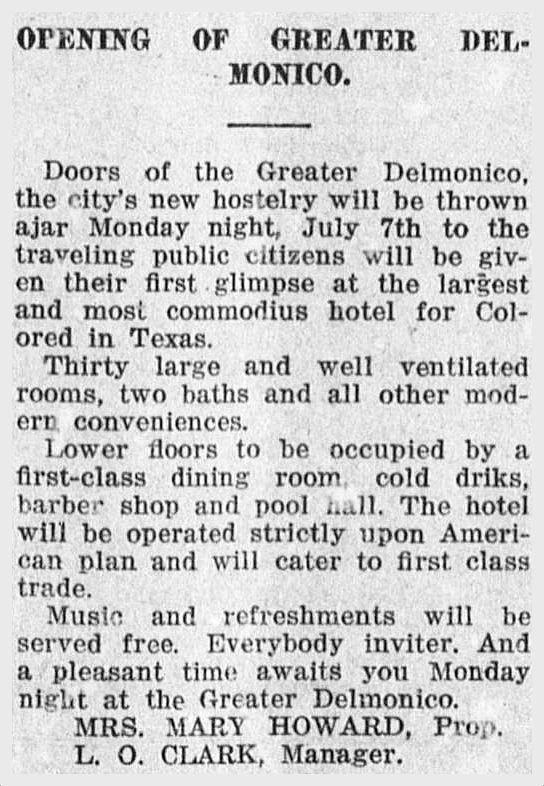
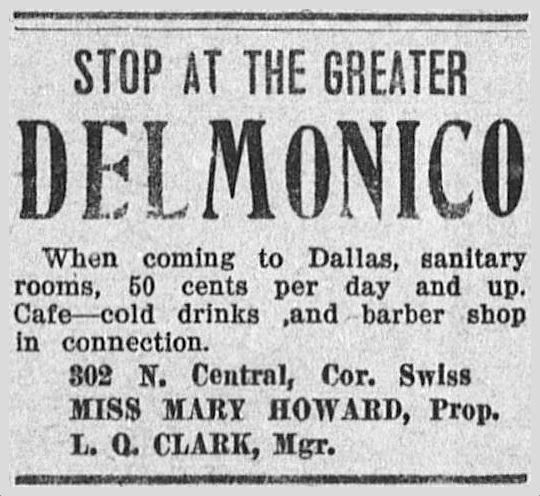
The Delmonico Hotel was at this location for only a couple of years until it moved a block around the corner, facing Central — the new, larger “Greater” Delmonico opened in July, 1919, occupying the upper floor at 302 Central. The proprietress of both locations was Miss Mary Howard (later Mrs. L. O. Clark). Miss Howard was, apparently, an enterprising African American woman who ran what was described in Dallas’ premiere black newspaper as “the largest and most commodious hotel for Colored in Texas… [catering] to first class trade” (Dallas Express, July 5, 1919). It remained in business at its second location on Central Ave. until 1927 or 1928.

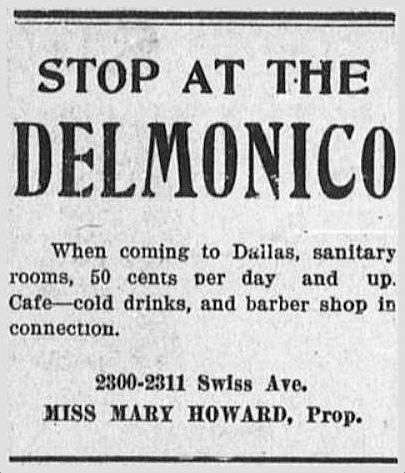
delmonico-hotel_dallas-express_011119Dallas Express, Jan. 11, 1919

Above, an ad for the hotel’s first location (the address should read “2309-2311 Swiss”). Below, a nice article on the opening of the second location on Central.

delmonico-hotel_dallas-express_070519_NEW-greater-delmonicoDallas Express, July 5, 1919

delmonico-hotel_dallas-express_082319Dallas Express, Aug. 23, 1919

It’s interesting that the 1919 Dallas directory has a business listing for this hotel (the first location, the one seen in the photo) — it is the sole hotel for “colored” patrons listed (denoted with the letter “c” — you can see the list of hotels from the 1919 directory here).

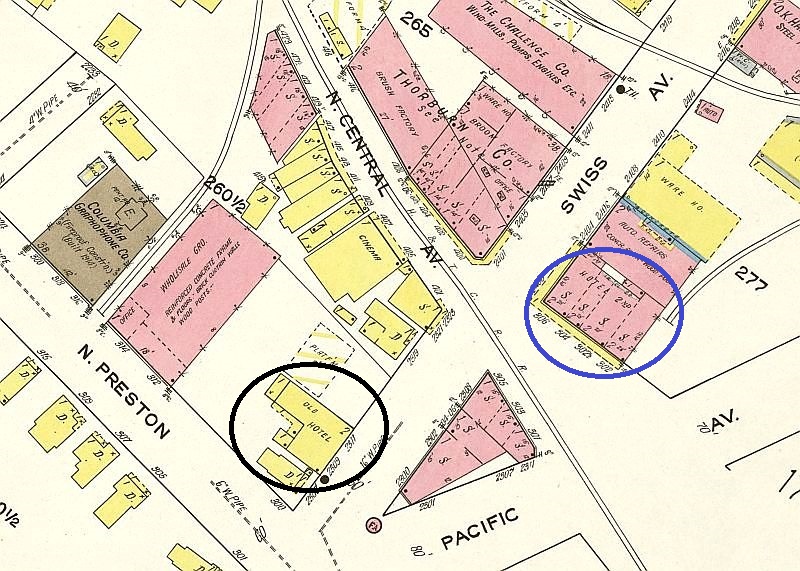
The first location can be seen in this detail of a 1921 Sanborn map, circled in black; the second location is circled in blue; the Thorburn Co. broom factory at Swiss and Central is labeled. (All images are larger when clicked.)

delmonico_swiss-central_sanborn_1921-sheet-14-det

The 2300 block of Swiss is no longer there — it is now empty land beneath the elevated North Central Expressway. The 2400 block (where the broom factory stood) is still there and is the site of a self-storage business (the Thorburn factory once stood here, across from the Lizard Lounge).

*

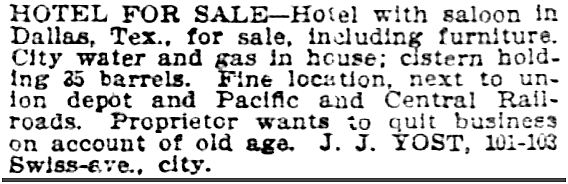
The large white building housing the Delmonico appears to have been built in 1889 by Swiss-born John Jacob (“J. J.”) Yost, who soon opened the Bear Hotel, which seems to have been a popular rooming house/hotel for German immigrants. By 1902 Yost was looking for a buyer for the hotel (“with saloon”) and placed the ad seen below (an ad which appeared not too long after a court notice appeared in the papers showing  that Yost had been found guilty of operating a “disorderly house” (a brothel) and had been fined $200, which was a huge fine at the time).

bear-hotel_dmn_042602_for-saleDallas  Morning News, April 26, 1902

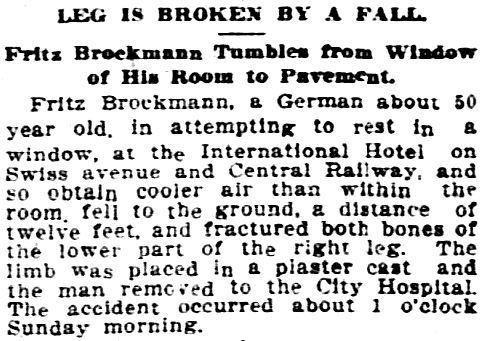
As Yost described it, the hotel really was in “a fine location” — just a block or two from a very busy passenger-train depot. Perhaps he was asking too much for it, but the Bear Hotel appears to have remained in operation until 1906, when it became the International Hotel (which was in business until 1918 when the hotel became the Delmonico, the first of these hotels to be owned by an African American for a strictly black (segregated) clientele). Below is an amusing (or terrifying) news tidbit from 1909 about a guest at the International Hotel. When you find yourself asking “what did people do before air-conditioning?” remember what happened to poor Fritz Brockmann:

international-hotel_dmn_070509
DMN, July 5, 1909

**

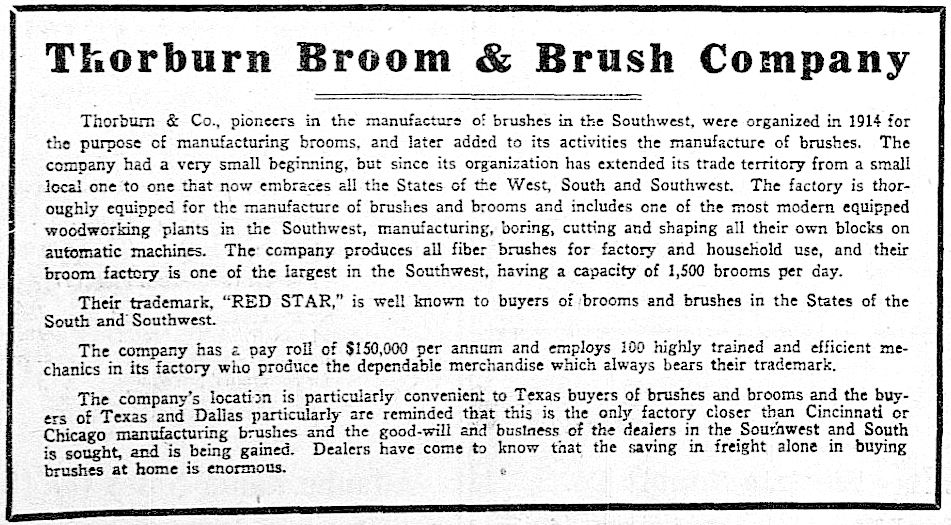
The Thorburn Broom & Brush Co. manufactured … brooms and brushes in their factory seen at the right in the photo above. A few bristly factoids about the company were included in a Chamber of Commerce-like series of ads from 1922.

thorburn-broom-brush_june-1922June, 1922

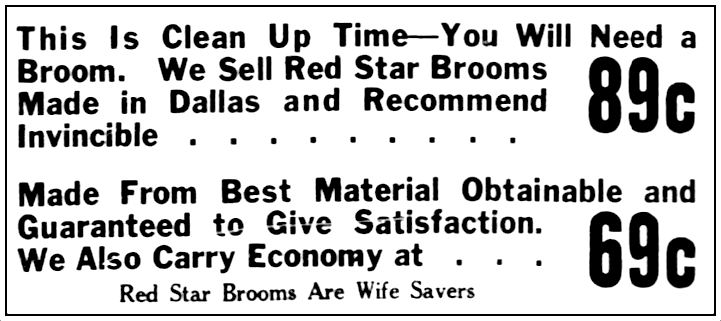
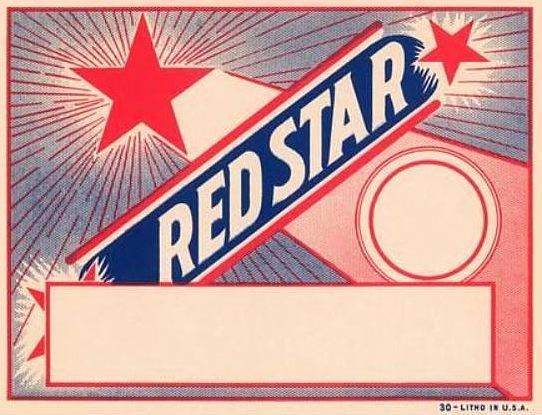
Thorburn’s marquee brand seems to have been the trademarked Red Star brooms (“Red Star brooms are Wife Savers”).

thorburn_red-star-brooms_1924Piggly Wiggly ad, 1924

red-star-broom-label

***

Sources & Notes

Top photo — titled “[Swiss Avenue at Central and the Houston and Texas Central Tracks]” — is attributed to George A. McAfee and is from the DeGolyer Library, SMU Libraries, Southern Methodist University; more information on this photo may be found here.

More info about the old Union Depot — which was one block south from the location seen in the photo above — can be found in these Flashback Dallas posts:

  • “The Old Union Depot in East Dallas: 1897-1935,” here
  • “The Union Depot Hotel Building, Deep Ellum — 1898-1968,” here
  • “The Gypsy Tea Room, Central Avenue, and The Darensbourg Brothers,” here

*

Copyright © 2018 Paula Bosse. All Rights Reserved.

The State Fair of Texas Over the Decades

state-fair-of-tx_midway_kodachrome_1961_ebaySFOT midway, 1961… (click for larger image)

by Paula Bosse

The history of the State Fair of Texas is also the history of Dallas — if you live in Dallas, you know a lot about the fair, if only by osmosis. Here are a few images from the decades since the fair began in 1886.

Below, from 1889, a sedate advertisement for the Texas State Fair and Dallas Exposition (from The Immigrant’s Guide to Texas, 1889). (All images are larger when clicked.)

state-fair_imm-gd_1889

*

A great-looking poster from 1890, colorful and exciting:

sfot_poster_1890

*

A midway in its infancy, in the aughts. (I wrote about the “The Chute” water ride, here.)

shoot-the-chute_postcard_ca-1906

*

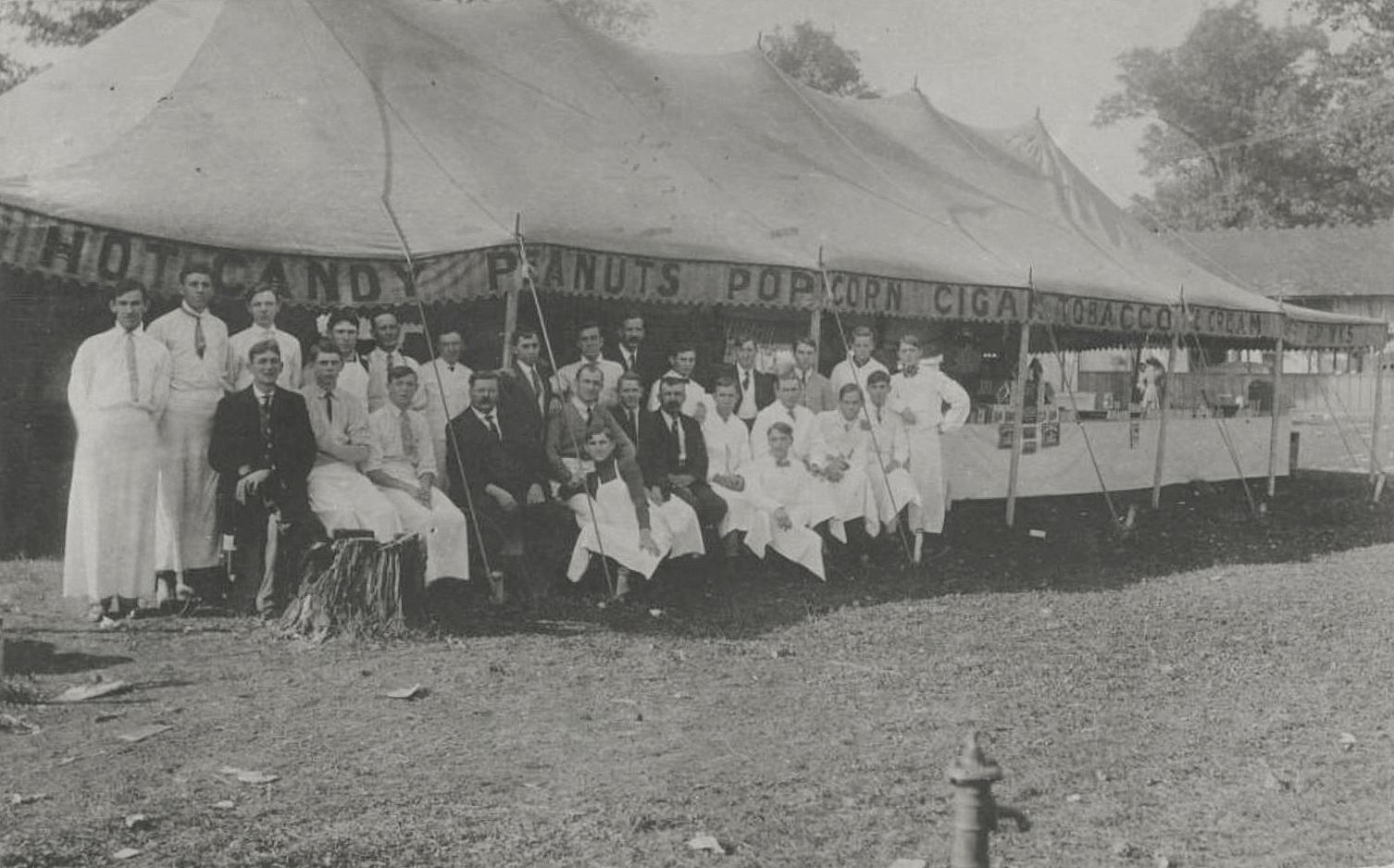
Here’s a group photo showing the food vendors at the 1910 fair. No corny dogs in 1910, but plenty of candy, peanuts, popcorn, ice cream, and, sure, why not, cigars and tobacco.

state-fair-concessionaires_1910_cook-colln_degolyervia George W. Cook Collection, DeGolyer Library, SMU

*

In the 1920s, Fair Park looked a lot smaller:

fair-park_mcafee_degolyer_SMU_ca-1920s
via George A. McAfee Collection, DeGolyer Library, SMU

Here’s a handy 1922 map of the grounds, from the fine folks at Caterpillar (don’t miss those tractors!) — you can see where the people in the photo above are walking.

state-fair-map_caterpillar_ad_1922

*

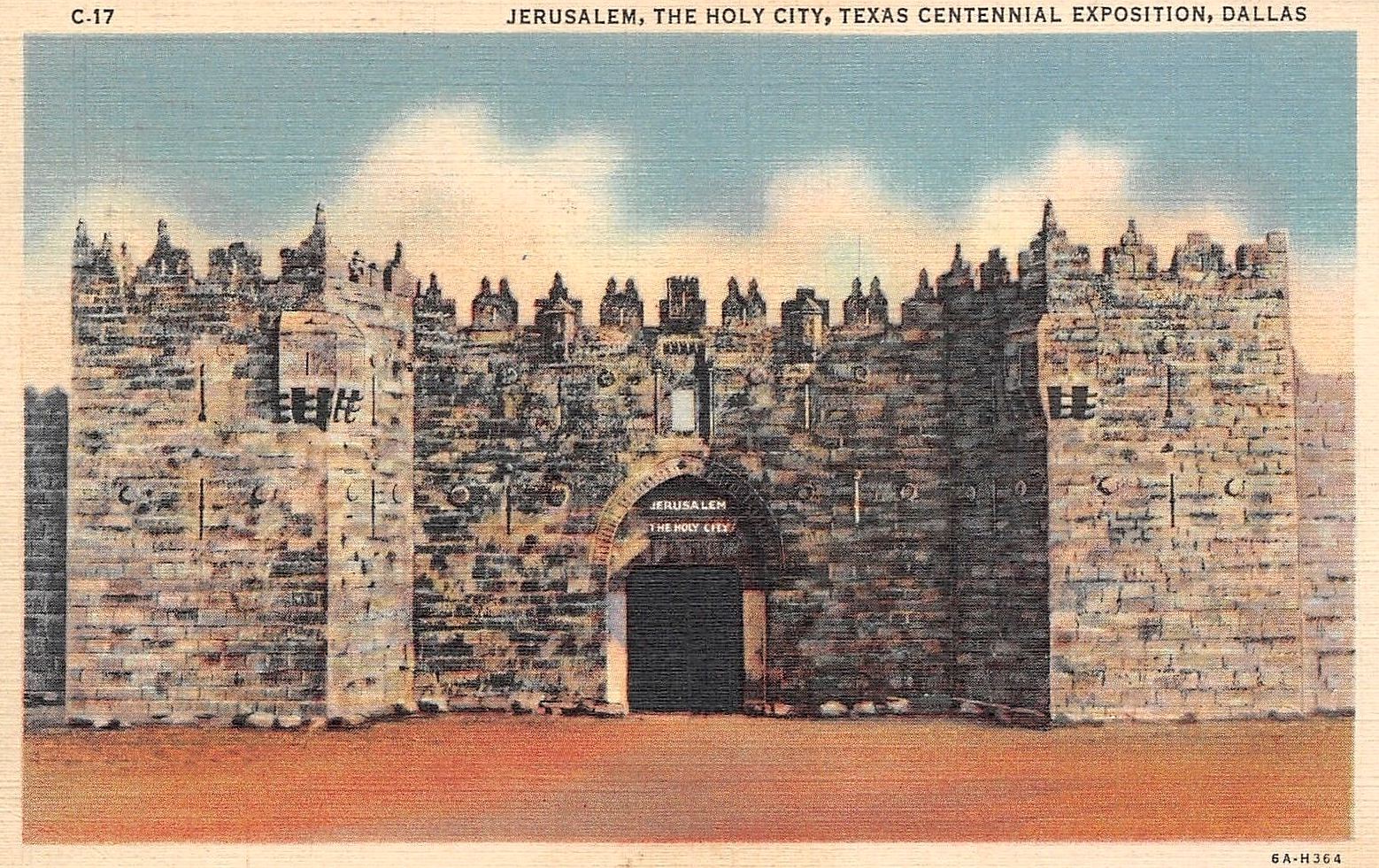
If it’s 1936, it’s gotta be the Texas Centennial — and here’s an exhibit I’d never heard of: Jerusalem, The Holy City. This was one of many exhibits at the Texas Centennial previously seen at the 1933 Chicago World’s Fair, where it apparently had attracted more than one million visitors. In the weeks leading up to the Centennial’s opening, it was described thusly: “The Holy City will contain a collection of religious artworks and other material. The entrance will represent the Damascus gate of Jerusalem. No admission will be charged but donations will be asked visitors” (Dallas Morning News, May 17, 1936).

tx-centennial_jerusalem-the-holy-city_postcard

*

The State Fair of Texas was not held during much of World War II, but it was back in 1946, with Tommy Dorsey, Gypsy Rose Lee, and Jackie Gleason.

state-fair_sept-1946_ad-cow
Sept., 1946

*

Neiman-Marcus was at-the-ready in 1950 with suggestions on stylish footwear for ladies wanting to trudge around the Fair Park midway in heels.

For the Million-Dollar Midway — For taking in this famous “main drag” of the State Fair — get into our famous-maker midway heel shoes. Most everybody — after walking a block or two in them — says they’re worth a million! Have all the comfort of low heels, plus the high-heel’s way of making your ankles look prettier.

sfot-neiman-marcus_ad_101650October, 1950

*

The 1960s were certainly colorful, and this is a great color photo from 1961 (currently available on eBay as a 35mm Kodachrome slide) — it’s the photo at the top of this post, but in order to cut down on unnecessary scrolling, I’ll slide it in again right here:

state-fair-of-tx_midway_kodachrome_1961_ebay

*

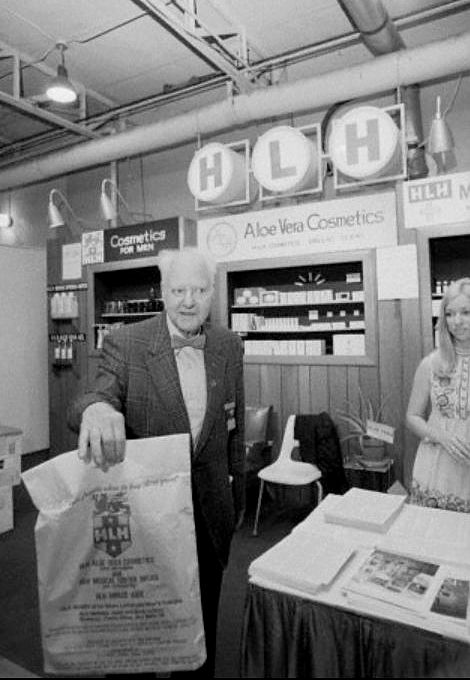
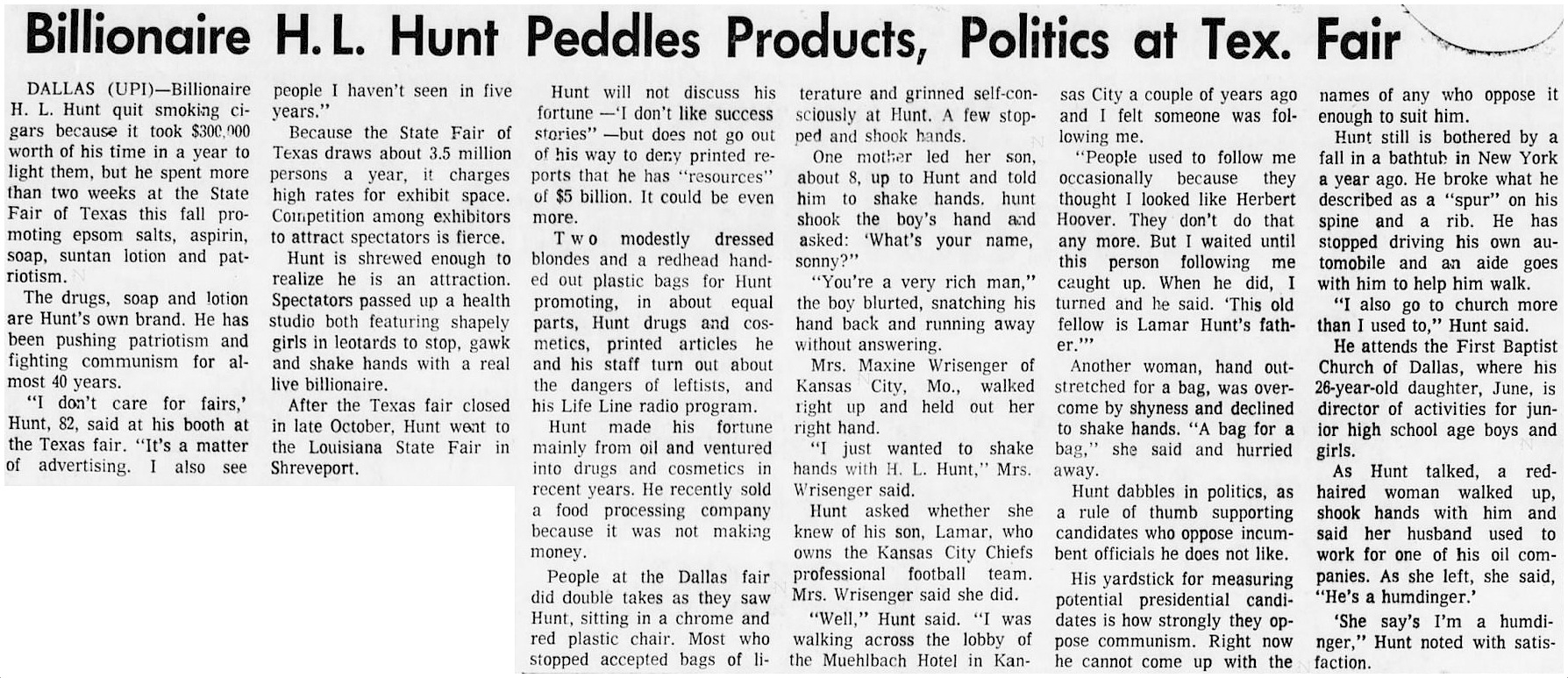
The 1970s was a weird decade, and what better way to start off a weird decade than with 80-something-year-old oil tycoon (and eccentric Dallas resident) H. L. Hunt handing out cosmetics at a booth at the State Fair? Hunt — whom Frank X. Tolbert described as “probably the world’s only billionaire health freak” — manufactured a line of cosmetics and other products containing aloe vera, the wonder elixir. Imagine seeing the world’s richest man handing out plastic goodie-bags to awe-struck passersby. Like I said, weird.

h-l-hunt_state-fair_1971

hunt_state-fair_pomona-progress-bulletin_CA_111471Pomona (CA) Progress-Bulletin, Nov. 14, 1971 (click to read)

*

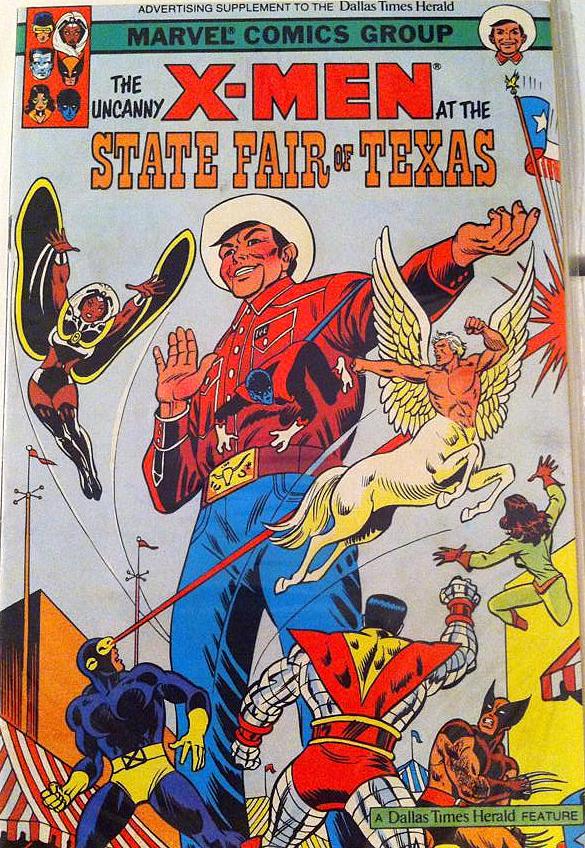
And, finally, the 1980s. A century after the State Fair of Texas began, the X-Men came to Big D to do whatever it is they do — and The Dallas Times Herald got a cool little advertising supplement out of it. (If this appeals to you, check out when Captain Marvel came to Dallas in 1944, here, and when Spider-Man came to Dallas in 1983, here.)

sfot_xmen_comic-book_1983

***

Sources & Notes

Sources (if known) are noted.

All images are larger when clicked.

I wrote a similar State-Fair-of-Texas-through-the-ages post a few years ago: “So Sorry, Bill, But Albert Is Taking Me to the State Fair of Texas,” here.

*

Copyright © 2018 Paula Bosse. All Rights Reserved.
Dallas Is For Lovers

fair-park_lovers-lane_postcard

by Paula Bosse

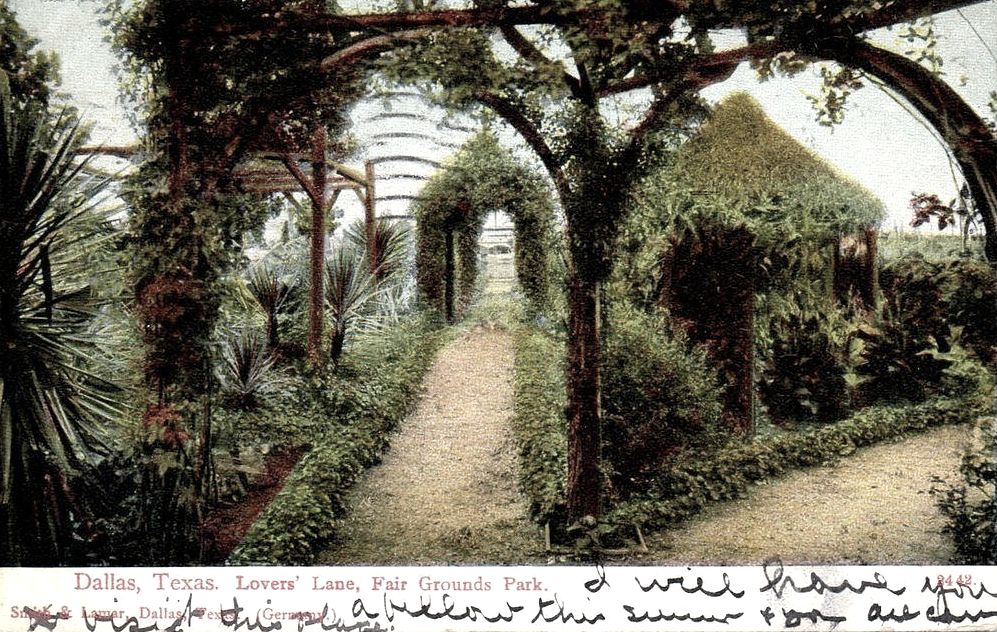
The postcard above shows “Lovers’ Lane, Fair Grounds Park,” and contains the following message to the card’s recipient:

I will have you a fellow this summer & you all can visit this place.

Aw. That’s a true friend.

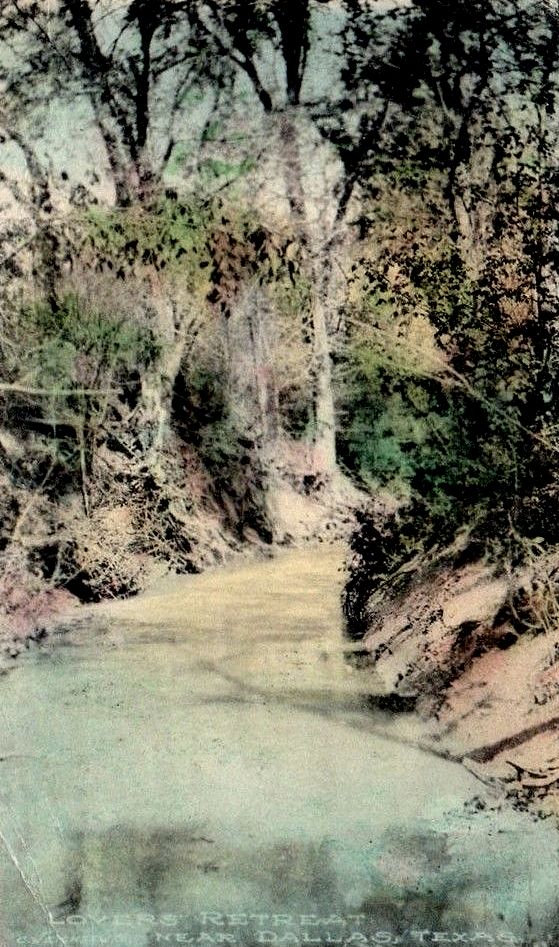
Below, another postcard from about the same time (around 1910), this one showing “Lovers’ Retreat, Near Dallas, Texas.”

lovers-retreat_postcard_ebay

This might be any old “romantic” place called “Lovers’ Retreat,” but at the time of this card’s publication, Lovers’ Retreat in Palo Pinto County, near Mineral Wells, was a well-known destination for Sunday drives, picnics, camping, church retreats, and family reunions. At 100 miles from Dallas, it would be stretching things to say this view is “near Dallas,” but postcards are sometimes not completely truthful.

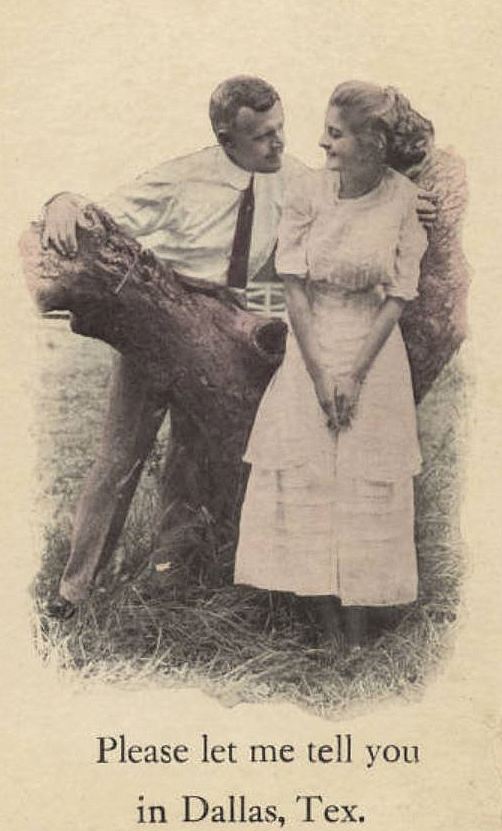
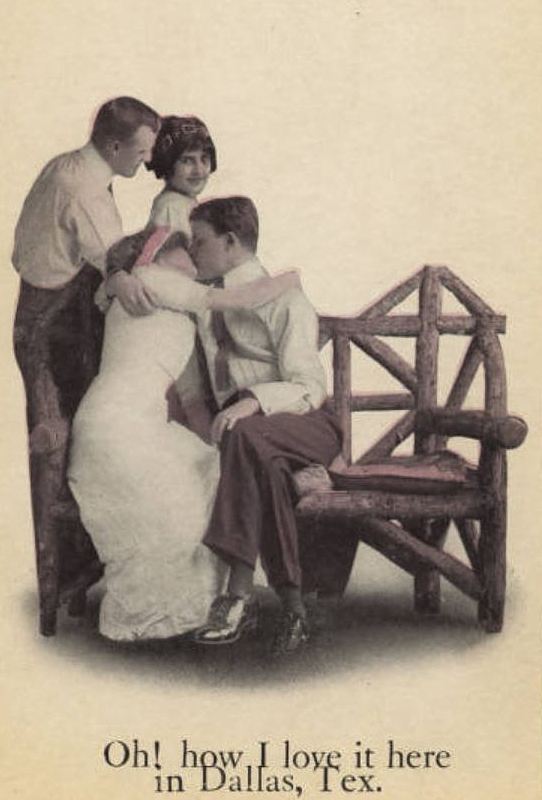
And for postcards that just strip away any confusion about local flora and fauna, let’s just cut to the chase. “Please let me tell you in Dallas, Tex.”

lovers-two_cook-collection_degolyer_smu

“Oh! How I love it here in Dallas, Tex.”

lovers-four_cook-collection_degolyer_smu

Speaking of lovers’ lanes, I’m not sure where that one at Fair Park (in the top postcard) was, but there were several “lovers’ lanes” around the city. The thoroughfare we know today as Lovers Lane was apparently known for years as a secluded place popular with couples looking for places in which to “spoon.” In a Dallas Morning News article, writer Kenneth Foree reminisced about the days when “it was nothing but a narrow black dirt road winding between two rows of bois d’arc trees.” He commented that “at times you could find lovers under nearly ever tree in Lovers Lane. They would park there in buggies in the early days, later in cars.” In the same article, Margaret L. Pratt, head of the Dallas Public Library’s Texas history department, remembered that “when Southern Methodist University was young and virtually treeless, students would often walk to nearby Lovers Lane for a shady hand-in-hand stroll” (“Walk a Miracle Mile” by Helen Bullock, DMN, Sept. 10, 1961).

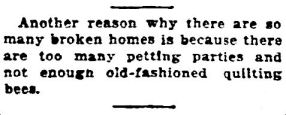
When the 1920s hit, “lovers lanes” around the country became hot topics of conversation. This was the “Jazz Age” and the era of the outrageous flappers — a time which an older, disapproving generation saw as scandalous and lacking in respect for propriety or morals. They felt that young women, in particular, were not acting at all “ladylike.” Suddenly the term “petting parties” was all over the newspapers. Young people (…and older people) were making out at parties, in movie theaters, and, especially, in cars parked at night along out-of-the-way country roads. Things were heading to hell in a handbasket.

petting-parties_dmn_022222DMN, 1922

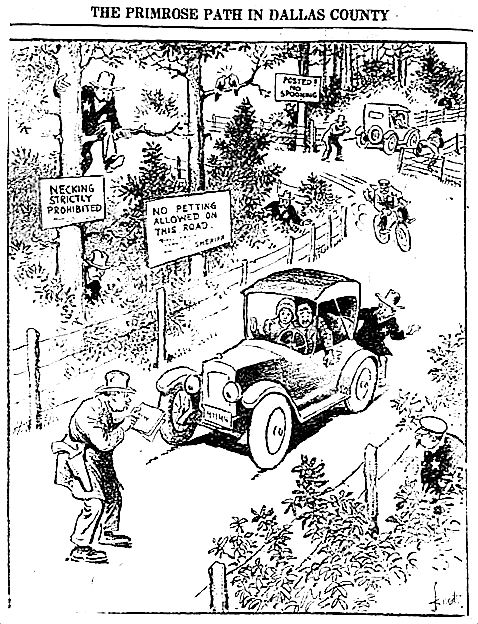
When a Dallas deputy sheriff commented to the local newspapers in 1924 that these open-air necking sessions were out of control, the mayor, Louis Blaylock, said, “It’s getting so a man can not take his sweetheart out on the country road to court her or to propose to her…. Most of the folks celebrating their silver and golden anniversaries in Dallas can look back upon the time when the Lemmon avenue road and Mocking Bird Lane were the causes of all the trouble…. Things aren’t so much worse now than when I was a boy” (DMN, May 23, 1924). Mayor Blaylock — who was born in 1849 — was 74 years old at the time. The deputy sheriff was Not Amused (read his response, reprinted in the Sulphur Springs Daily News-Telegram, here). The mayor laughed off the deputy’s concerns, saying, “I believe that most of [this] talk is purely political and if my memory serves me right we experience this epidemic about every two years, just about election time,” (DMN, May 30, 1924).

primrose-path-lovers-lane_may-1924(click to see larger image)

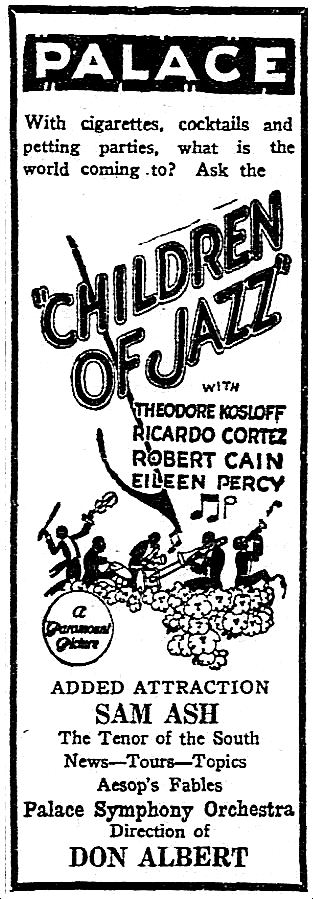
Despite the mayor’s pooh-poohing of the situation, petting-party outrage remained in the headlines throughout the ’20s … until the public’s attention turned to the next thing to be outraged about. Good for those scandalous pre-Code movies, though!

children-of-jazz_dmn_july-1923“Children of Jazz” at the Palace, 1923

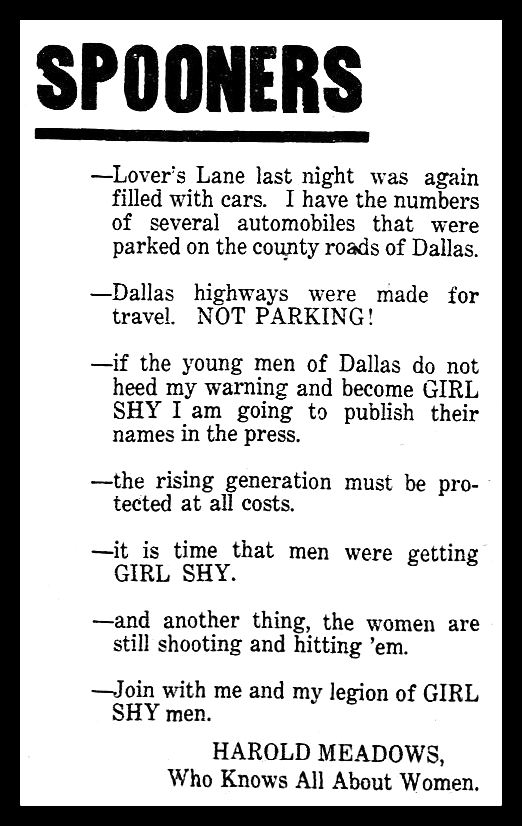
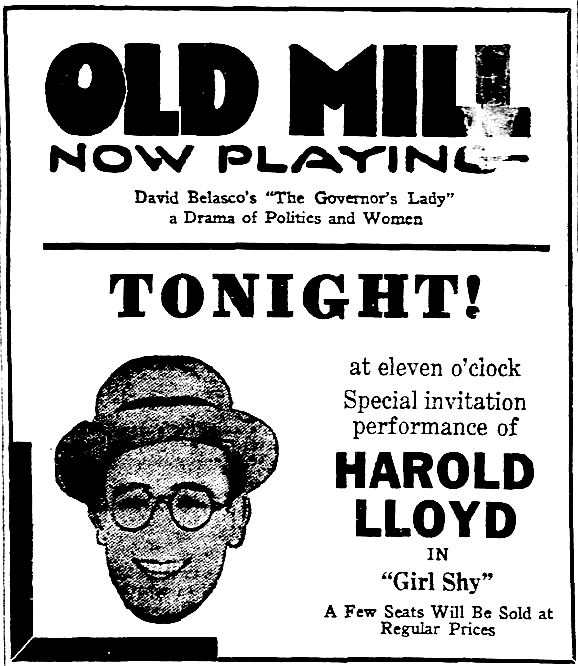
Below is a clever promotion for a movie called “Girl Shy” in which Harold Lloyd played a character named Harold Meadows (“who knows all about women”). It is addressed to the “spooners” of Dallas and is not identified as being an ad for movie.

lovers-lane_dmn_052024May 20, 1924

lovers-lane_dmn_052324
“Girl Shy” at the Old Mill, May 23, 1924

***

Sources & Notes

Top two postcards are currently for sale here and here.

The two postcards featuring amorous couples are from the George W. Cook Dallas/Texas Image Collection, DeGolyer Library, SMU Libraries, Southern Methodist University; more information on these postcards can be found here and here.

A photo of young frolickers frolicking at Lovers’ Retreat in Palo Pinto County can be found on the Portal to Texas History website here.

Read about petting parties in an article from NPR, here.

Speaking of amorous activities in automobiles, check out my previous Flashback Dallas post, “No Necking Along Country Roads Until Bonnie & Clyde Are Killed or Captured — 1934.

*

Copyright © 2018 Paula Bosse. All Rights Reserved.


Dallas in “The Western Architect,” 1914: City Buildings and Churches

parkland-hospital_western-architect_july-1914

by Paula Bosse

The 7-part Flashback Dallas series of buildings and houses featured in the Dallas issue of The Western Architect finally comes to an end! What I thought would be a quick and painless way to share tons of cool Dallas photos I’d never seen has turned into a seemingly endless dive into the research of a whole slew of buildings, most of which I knew very little (if anything) about. I feel like I’ve been through an immersive, three-week course in “Lang & Witchell”!
This final installment features buildings built by the city (mostly fire stations) and a few churches — six of these eight buildings are still standing. Today’s star architects are Hubbell & Greene.

*

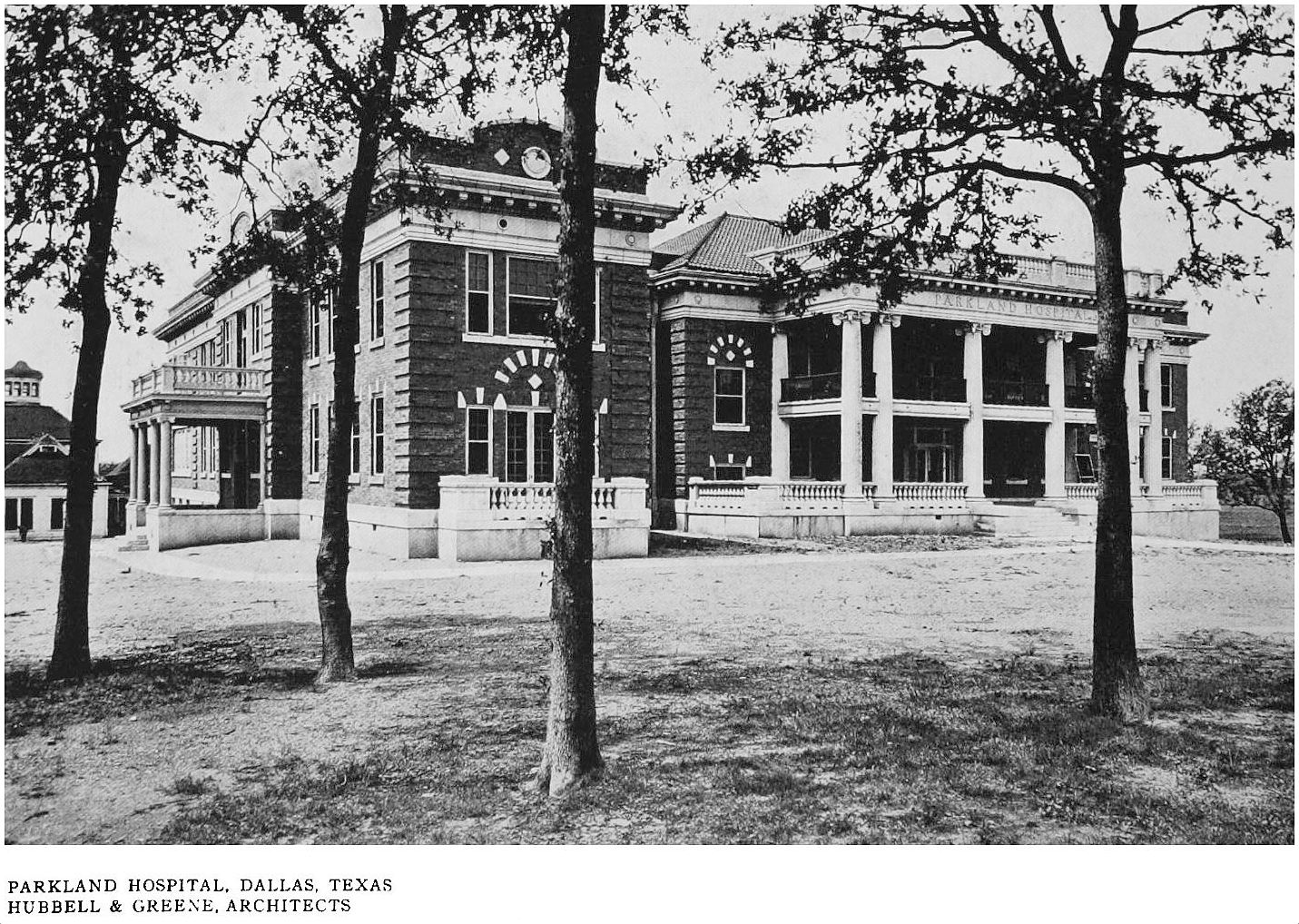
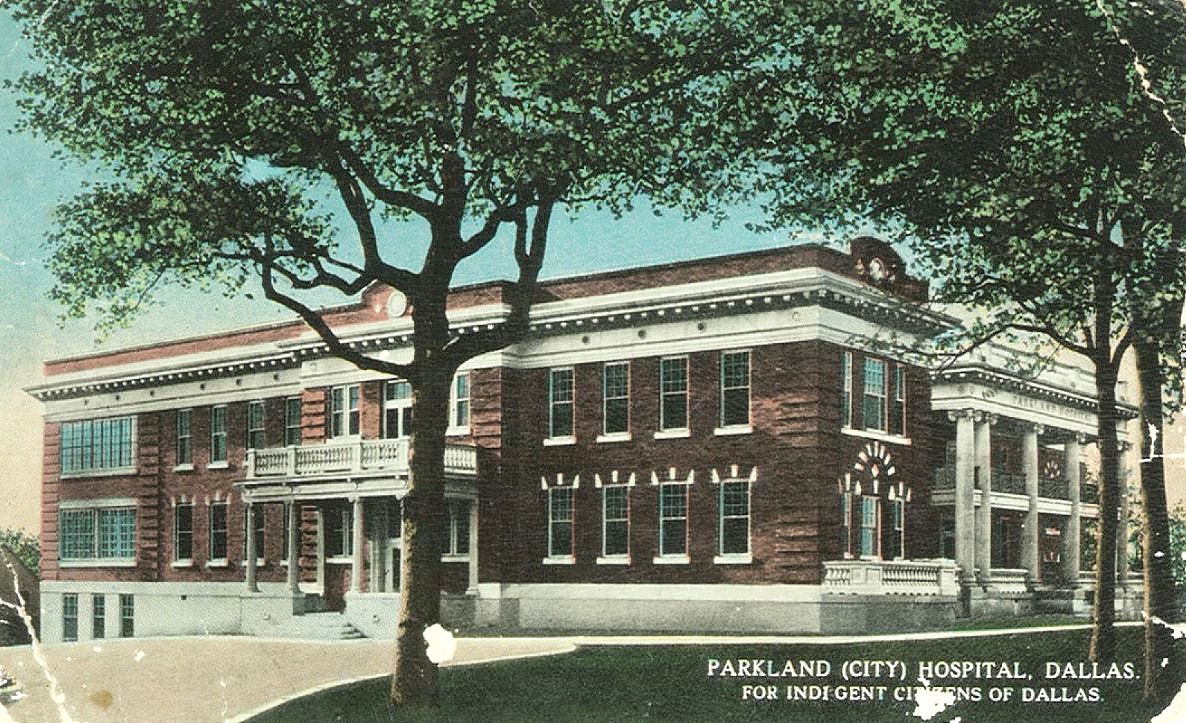
1.  PARKLAND HOSPITAL (above), Oak Lawn & Maple avenues, designed by Hubbell & Greene. This new, sturdy, brick “city hospital” was built in 1913 on the beautiful park-like 20-acre-site of the previous city hospital (the old wood frame building — built in 1894 — was cut in pieces and moved farther back on the property, “across a ravine” — it was reassembled and for a time housed patients with chronic and contagious diseases and was the only institution in Dallas at the time that served black and Hispanic patients — part of this old building can be seen at the left in the background of the photo above). The new hospital was “entirely fireproof” and was built with very little wood  — other than the doors, trim, and banister railings, it was all steel, cement, reinforced concrete, plaster, and brick. The original plans called for two wings, but the city had to put construction of the second wing on the backburner until funds became available. As it was, this one-wing hospital (with beds for 100 patients) cost in excess of $100,000 ($2.5 million in today’s money). The building still stands but is barely visible these days behind a wall, trees, and dense shrubbery — it is surrounded by a huge, recently-built complex of similarly-styled buildings. (See it on a 1921 Sanborn map, here.) (All images are larger when clicked.)

parkland_psotcard_1914_pinterest
postcard dated 1914, via Pinterest

*

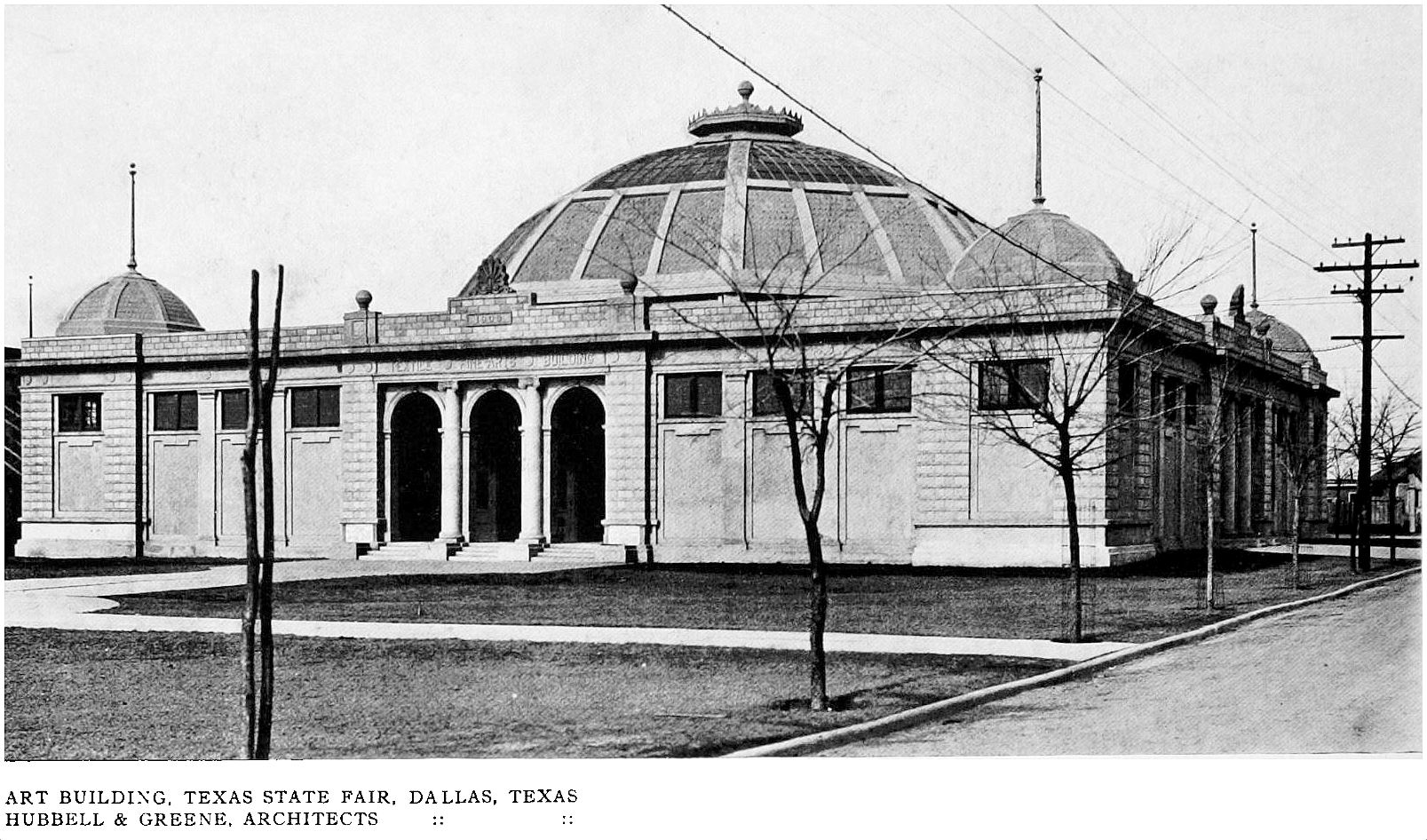
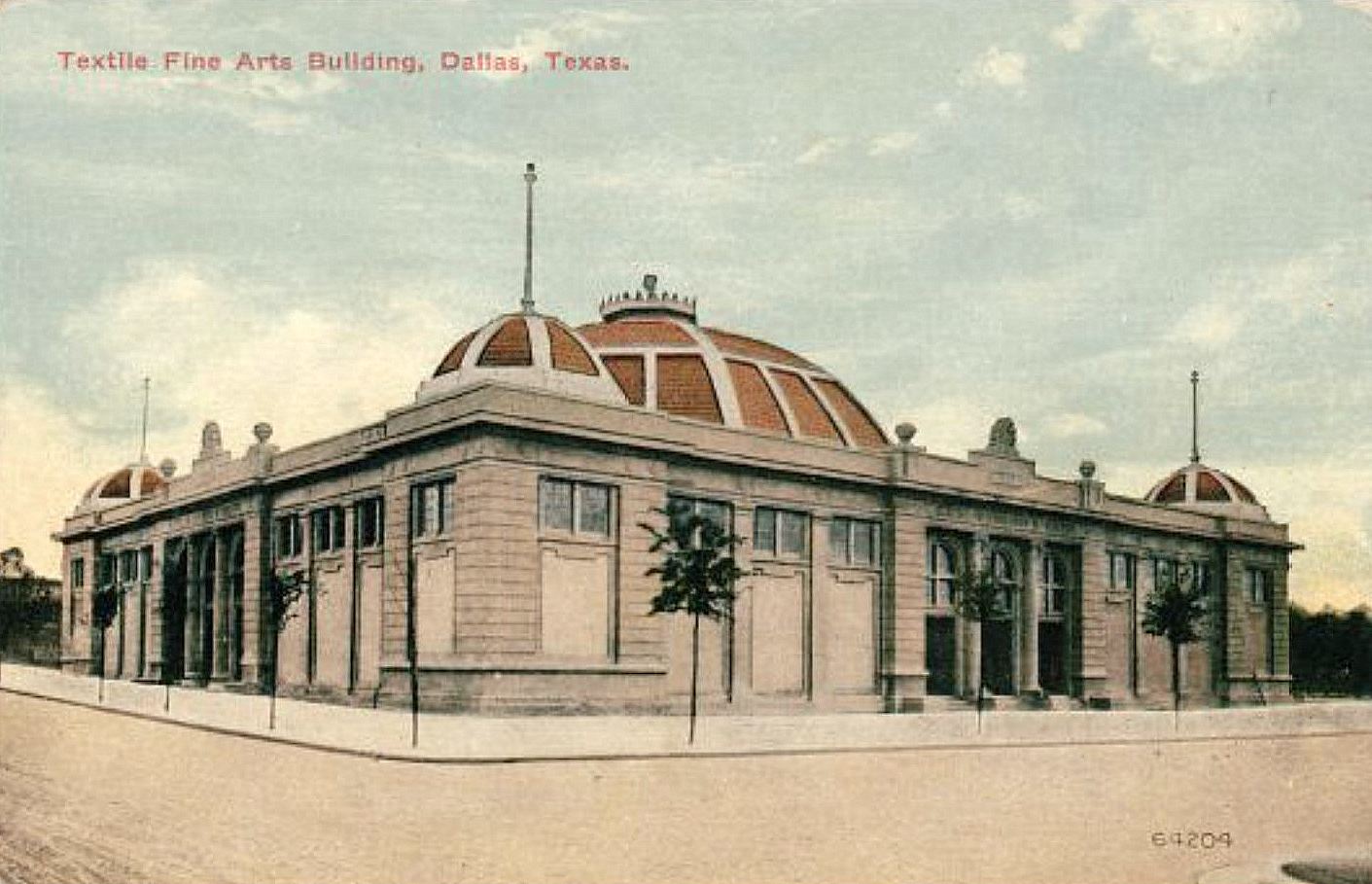
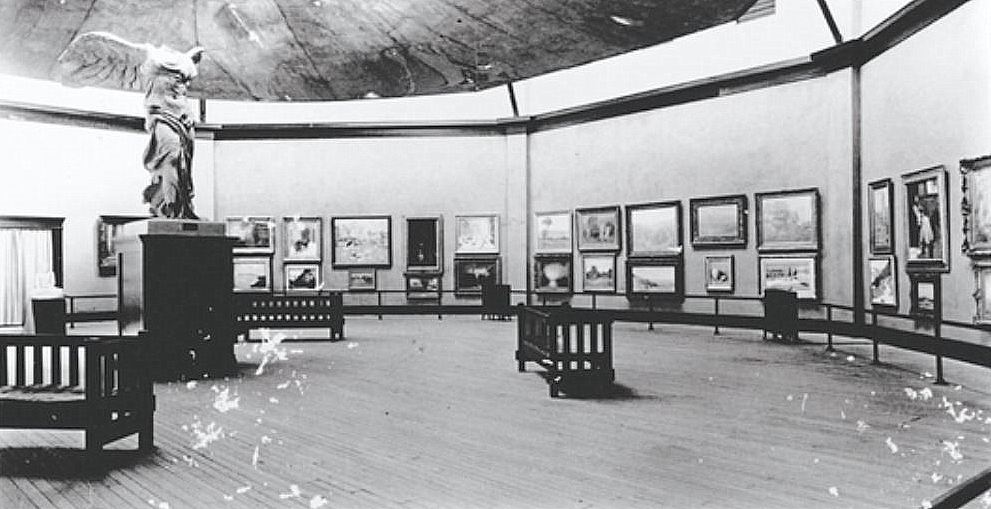
2.  ART BUILDING, Fair Park, designed by Hubbell & Greene. Known as the Art & Ladies’ Textile Building when it was erected in 1908, this domed building gave Dallas its first public art museum. No longer would the 14 paintings owned by the Dallas Art Association (including works by Childe Hassam and Robert Henri) be relegated to being displayed (when staff was available) in a room in the public library. The building was initially built as a nod to “ladies” and was the place where textile crafts and artworks were displayed during the State Fair (Texas artist Julian Onderdonk was given the task of beating the bushes in New York City for works to be loaned for display in this building during the fair). The art gallery was set in the rotunda — a sort of gallery within a gallery — while textiles and other exhibits were shown in the outer area of the octagonal building. One interesting bit of trivia about the construction of this building is that it was built largely of cement blocks — 70,000, according to newspaper reports. In order to facilitate construction, a “cement block plant” was set up on the grounds in Fair Park, turning out hundreds of blocks a day, which were then laid out to “season” in the sun. (Incidentally, this building was under construction during the historic flood of 1908 — which the newspaper refers to as “the recent high water,” and the bad weather was slowing the construction process.) The building is no longer standing, but it seems to have lasted at least through the end of 1956. It stood just inside the Parry Avenue entrance, to the left, next to the Coliseum (now the Women’s Building) — the site is now occupied by a parking lot directly behind the D.A.R. house. (See it on a 1921 Sanborn map, here.)

fair-park_art-bldg_western-architect_july-1914

fair-park_textile_fine-arts-bldg_postcard

art-and-textile-bldg_dma_uncrated_interior
via Dallas Museum of Art blog “Uncrated”

*

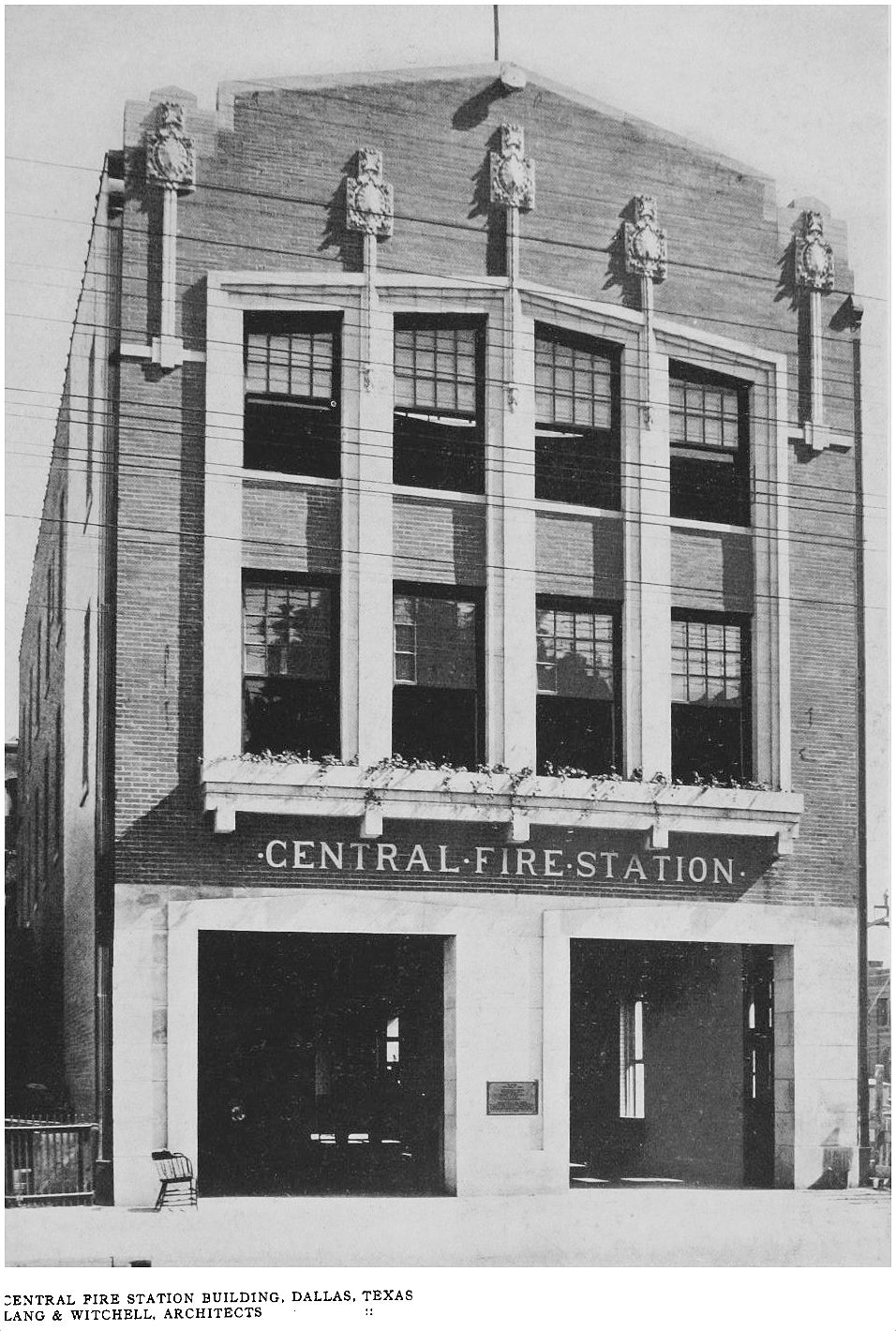
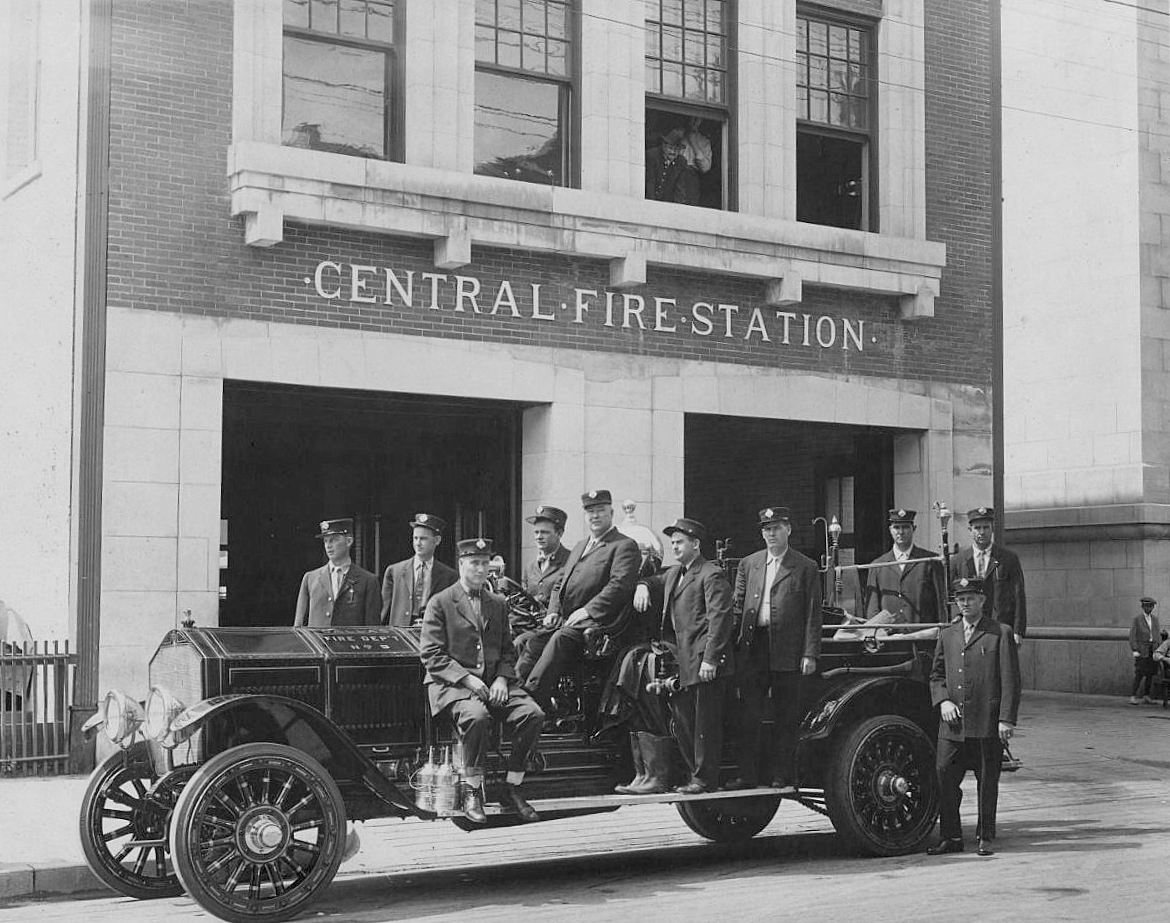
3.  CENTRAL FIRE STATION, 2012 Main Street (adjoining the Municipal Building), designed by Lang & Witchell. When Adolphus Busch acquired the land Dallas’ City Hall and central fire station sat on (in order to build his Adolphus Hotel), there was a sudden springing to action to build new homes for both displaced entities. The new location for the firehouse was in an already-standing building facing Main, adjacent to the new Municipal Building — it became the new headquarters for the Dallas Fire Department in 1913. It was, I believe, the first Dallas firehouse built without horse stalls, as it housed only motorized firefighting vehicles. The building’s use as a fire station ended in the 1920s; it was thereafter used by other municipal offices: for a while in the 1930s its third floor was used as a women’s jail, and for many years it was the site of Dallas’ corporation court. It looks like the building is still there, but I’m unsure of its current use. (See it on a 1921 Sanborn map, here.)

firehouse_central-fire-station_western-architect_july-1914

central-fire-station_dallas-firefighters-museum_portalDallas Firefighters Museum, via Portal to Texas History

*

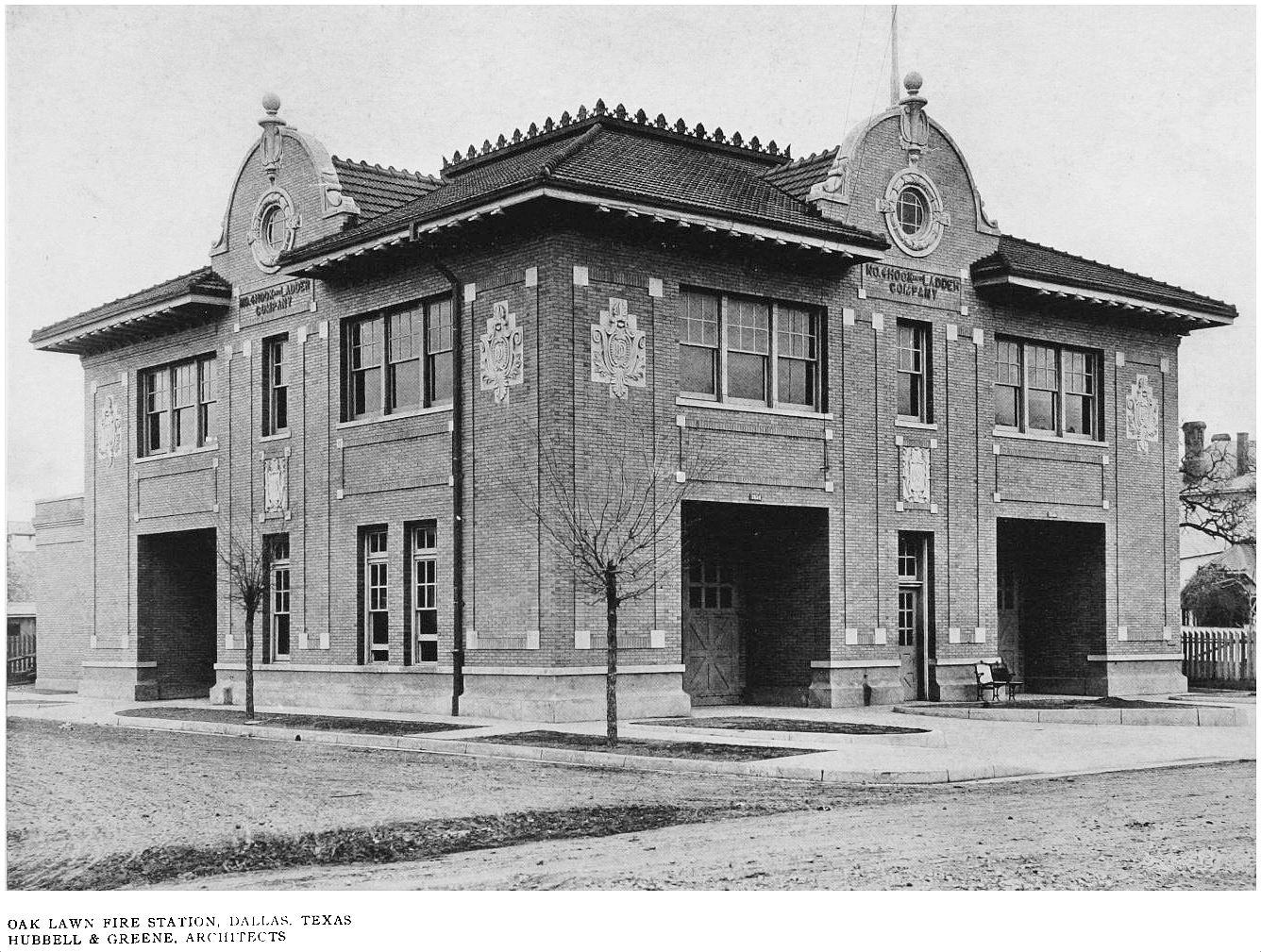
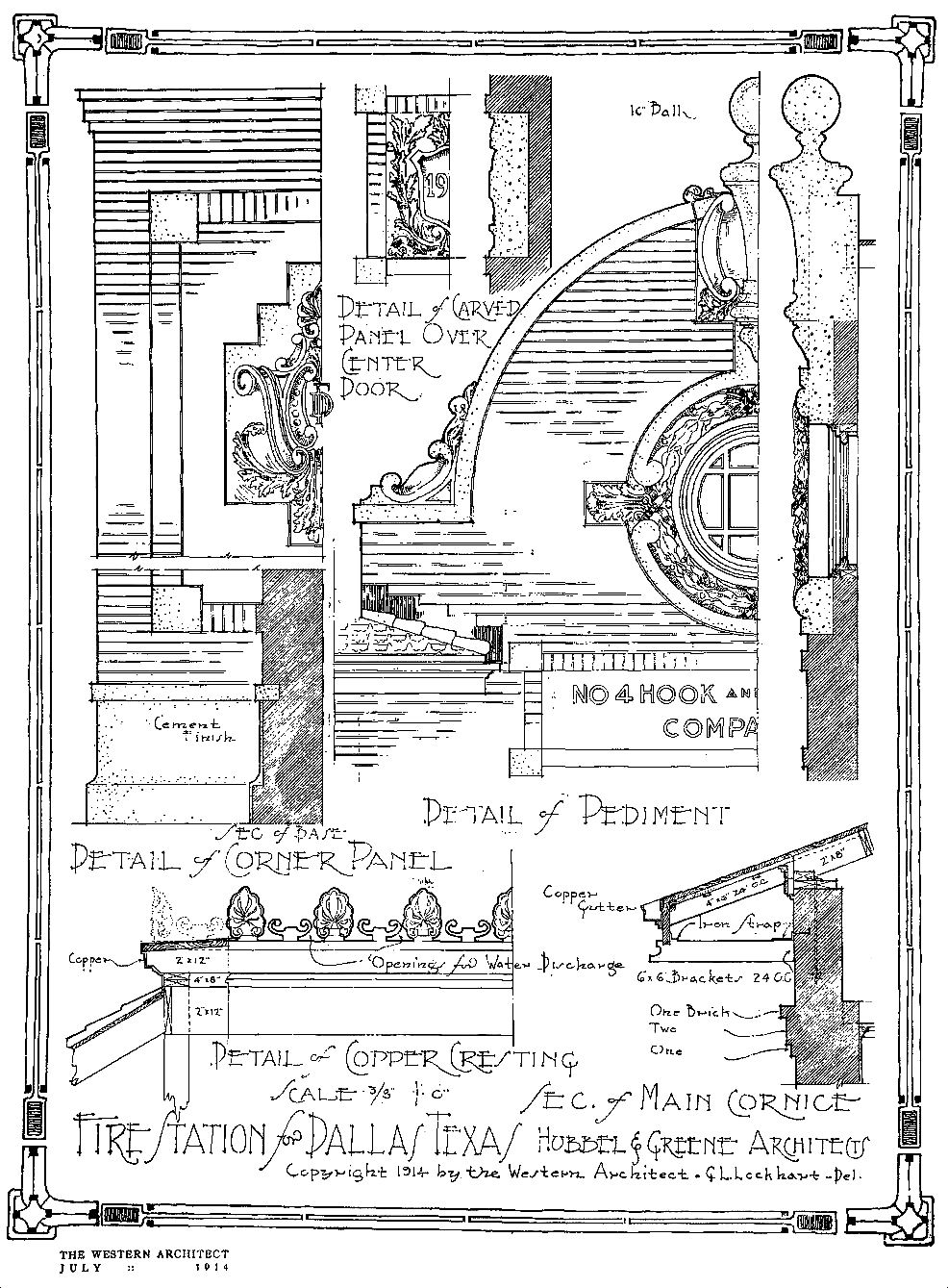
4.  OAK LAWN FIRE STATION, Cedar Springs & Reagan, designed by Hubbell & Greene. This still-active firehouse (!) — Dallas’ first “suburban” fire station — was built in 1909 as the home of No. 4 Hook and Ladder Company. When construction of the building was announced, it was described as being a gray brick structure topped by a roof of “cherry red Spanish tiling.” It was — and still is — a beautiful building. (I’ve written about this firehouse previously, here.) (See it on a 1921 Sanborn map, here.)

firehouse_oak-lawn_western-architect_july-1914

firehouse_oak-lawn_western-architect_july-1914_architectural-details_2

*

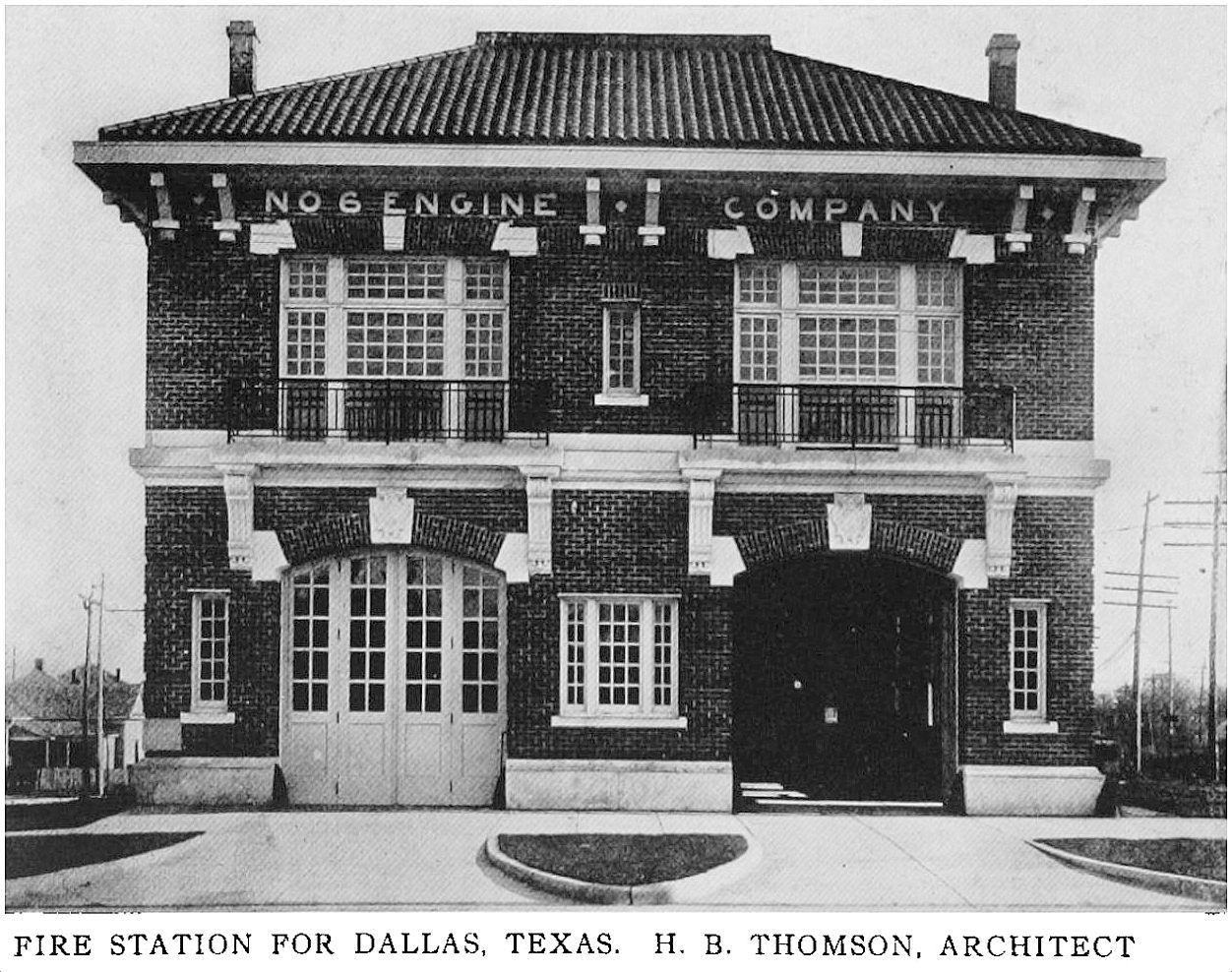
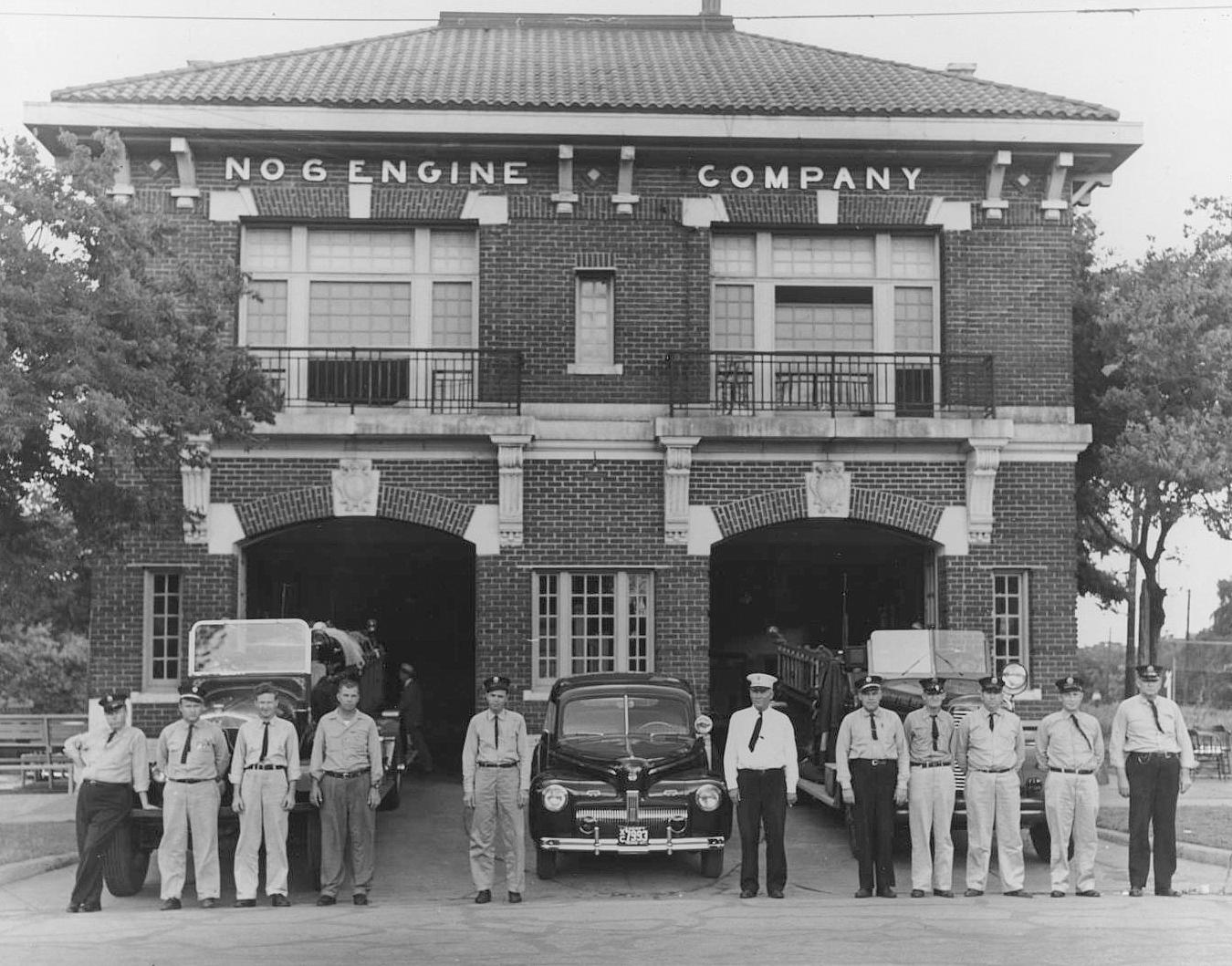
5.  NO. 6 ENGINE COMPANY, Forest Avenue (now MLK Blvd.) & Kimble, South Dallas, designed by H. B. Thomson. This South Dallas fire station was built in 1913 and was in service until 1955 when it was demolished to make way for the “South Central Expressway” (see more photos in a previous post on this, here). (See it on a 1922 Sanborn map, here.)

firehouse_no-6-engine_western-architect_july-1914

fire-department_no. 6_forest-ave-mlk
Dallas Firefighters Museum, via Portal to Texas History

*

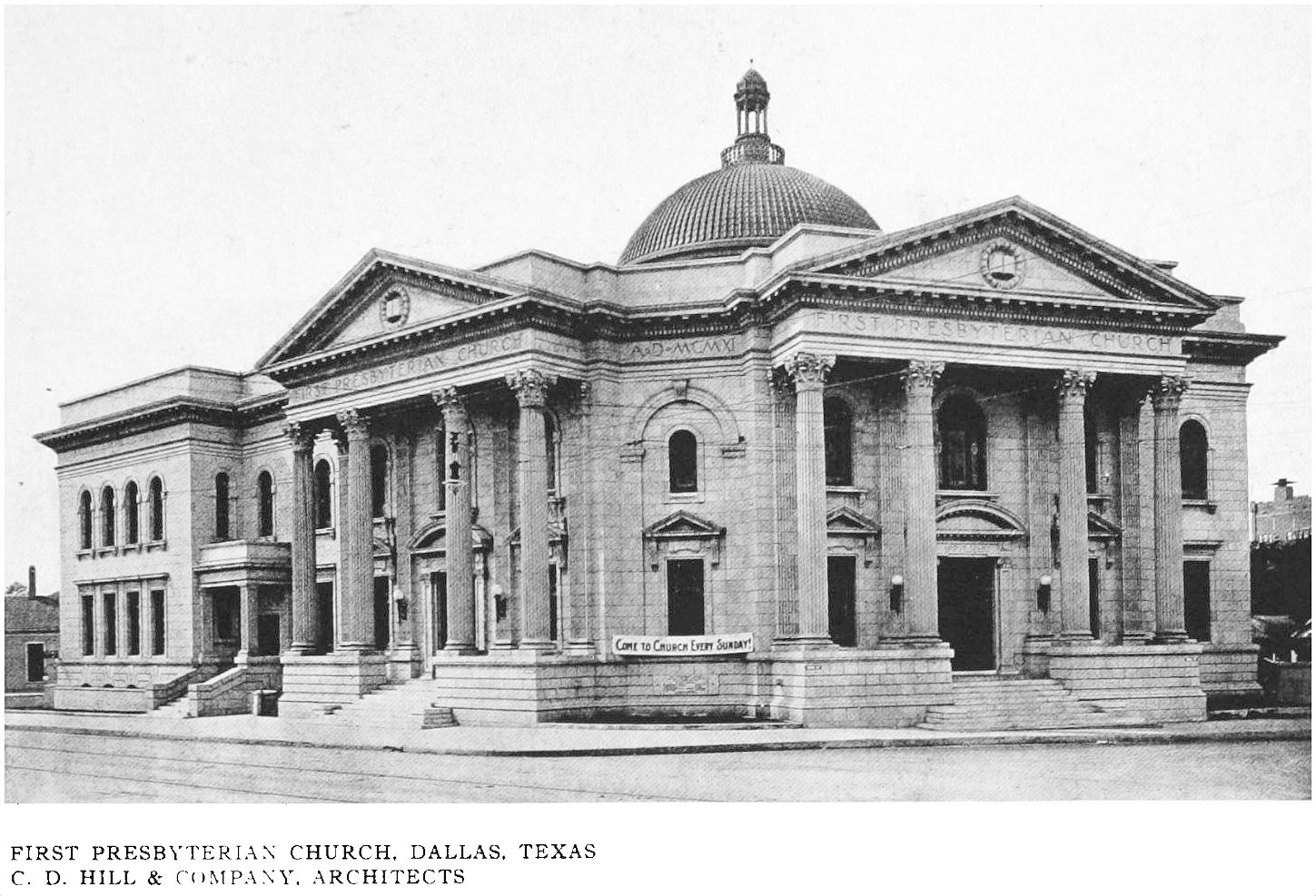
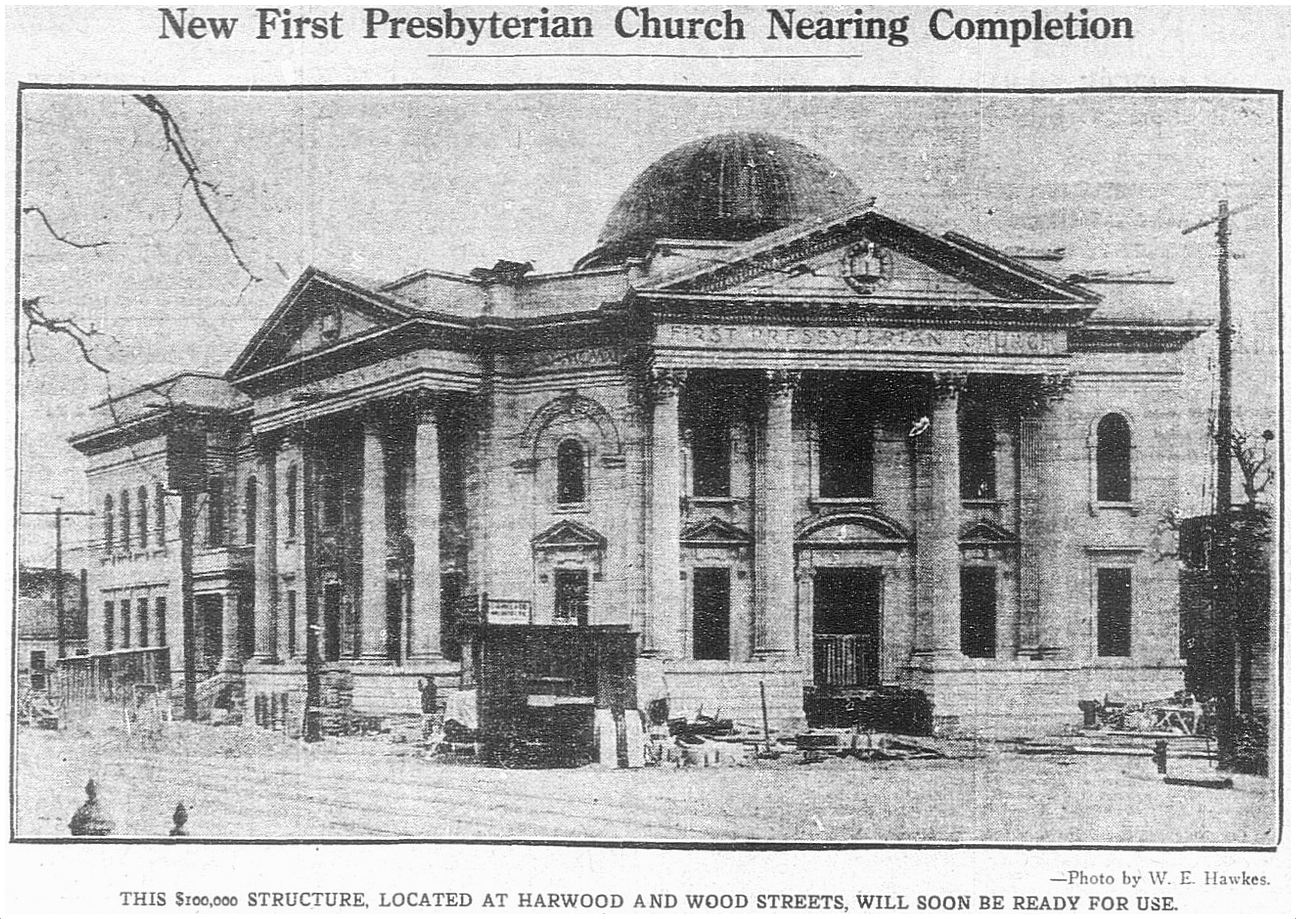
6.  FIRST PRESBYTERIAN CHURCH, S. Harwood & Wood, designed by C. D. Hill. Built in 1911-12, this impressive building boasted “the largest monolith columns in the city” (a claim which might have been surpassed by architect Hill’s be-columned Municipal Building built soon after this church, two blocks away — and rivaled by Hubbell & Greene’s Scottish Rite temple, one block away). Still standing and much expanded, the church is still looking great. (See it on a 1921 Sanborn map, here.)

first-presbyterian-church_western-architect_july-1914

first-presbyterian-church_dmn_032412Dallas Morning News, March 24, 1912

*

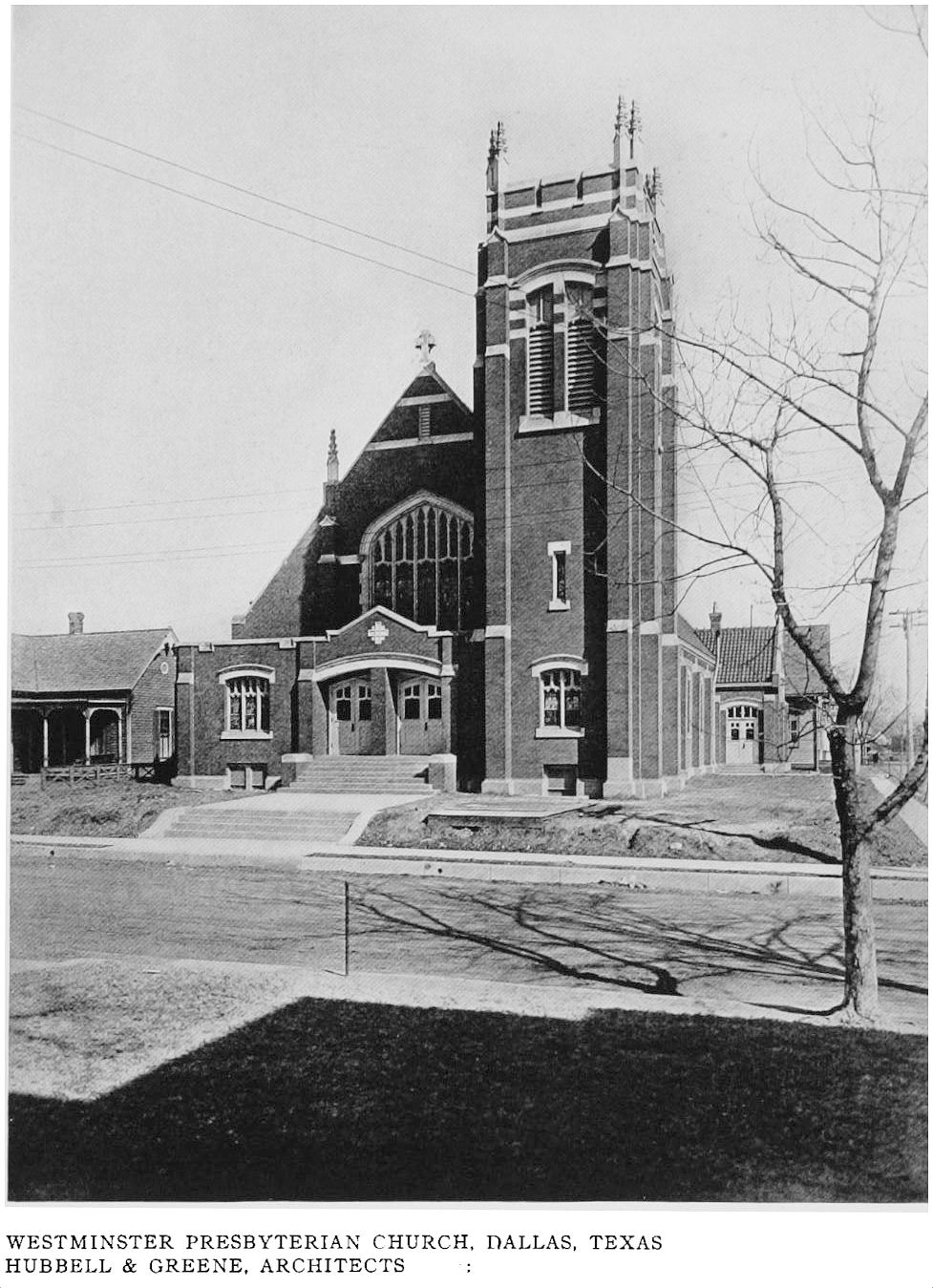
7.  WESTMINSTER PRESBYTERIAN CHURCH, 2700 Fairmount (at Mahon), designed by Hubbell & Greene. Before looking this one up, I had no idea what part of town this church was in — I was surprised to see it was in the area now known as “Uptown” … and it’s still standing. This congregation (organized in 1892) had occupied churches in the McKinney Avenue/State-Thomas area for several years before this church was built in 1910-11. When the congregation moved to their current location on Devonshire in the 1940s, the building was taken over by Memorial Baptist Church. When that congregation was dissolved, the church was given — for free! — to the First Mexican Baptist Church (Primera Iglesia Bautista Mexicana). After several decades, they, too, eventually moved to a new location, and the old church has had a variety of occupants come and go. (Read about its recent past — and see tons of photos — at Candy’s Dirt, here.) (See it on a 1921 Sanborn map, here.)

westminster-presbyterian-church_western-architect_july-1914

westminster-presbyterian-church_websitevia Westminster Presbyterian Church website

*

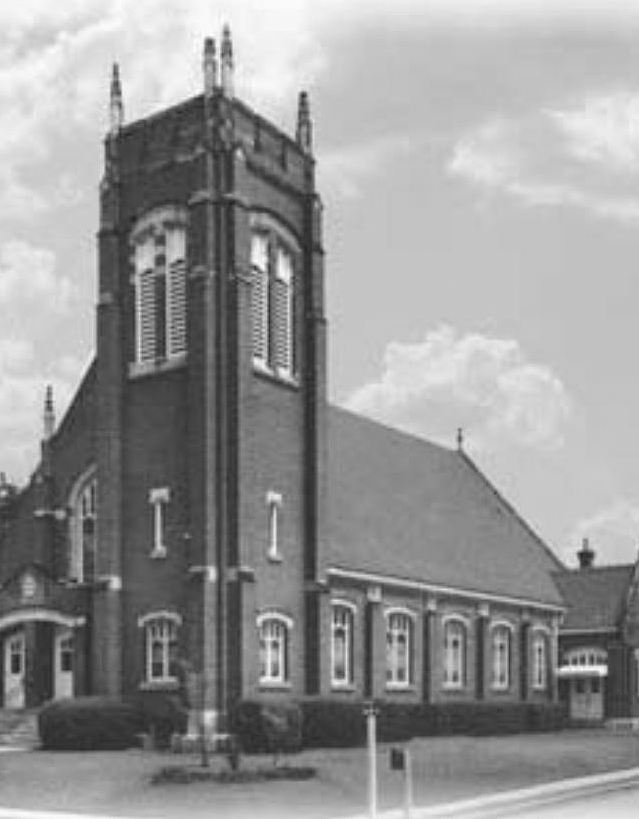
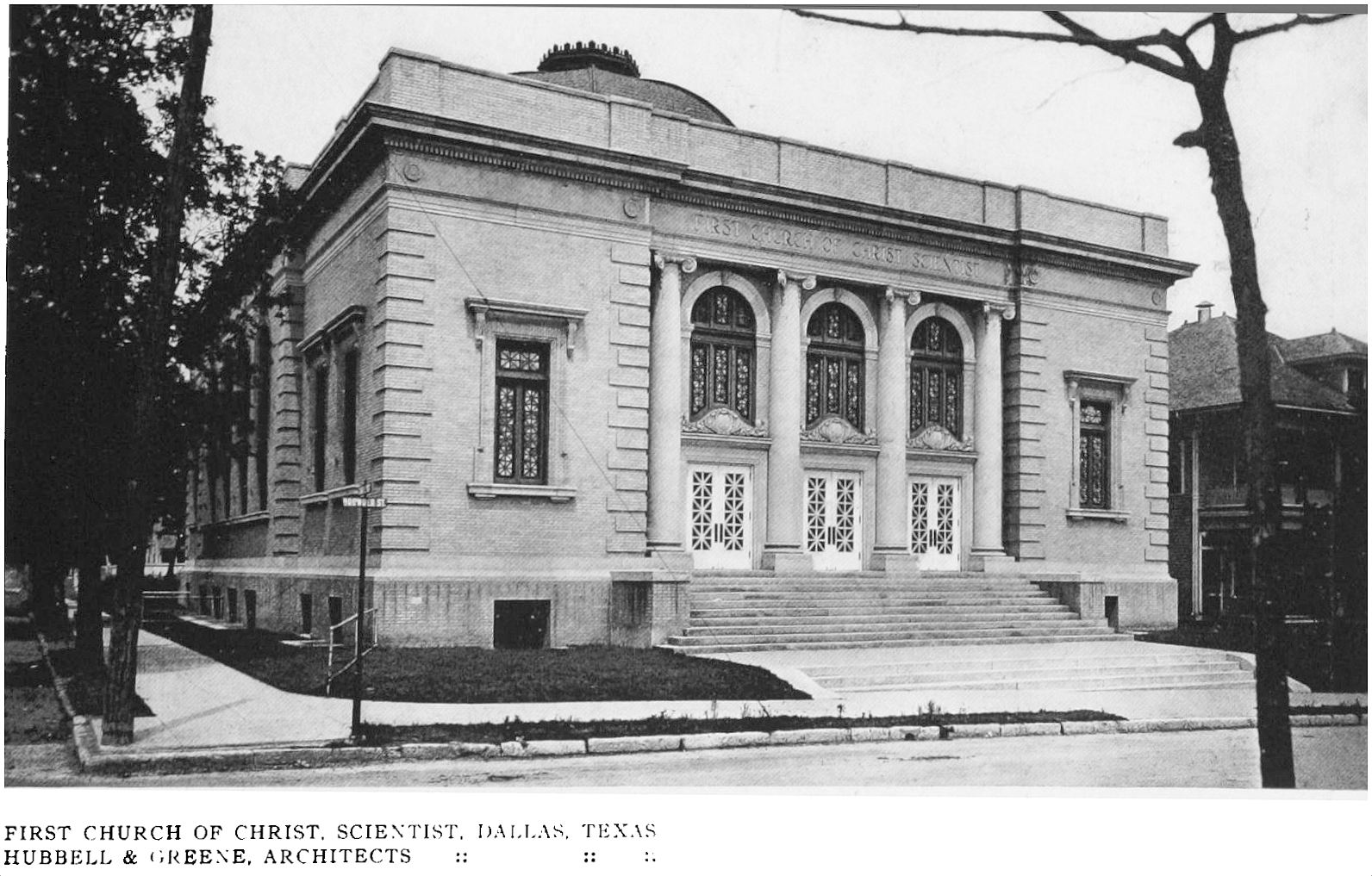
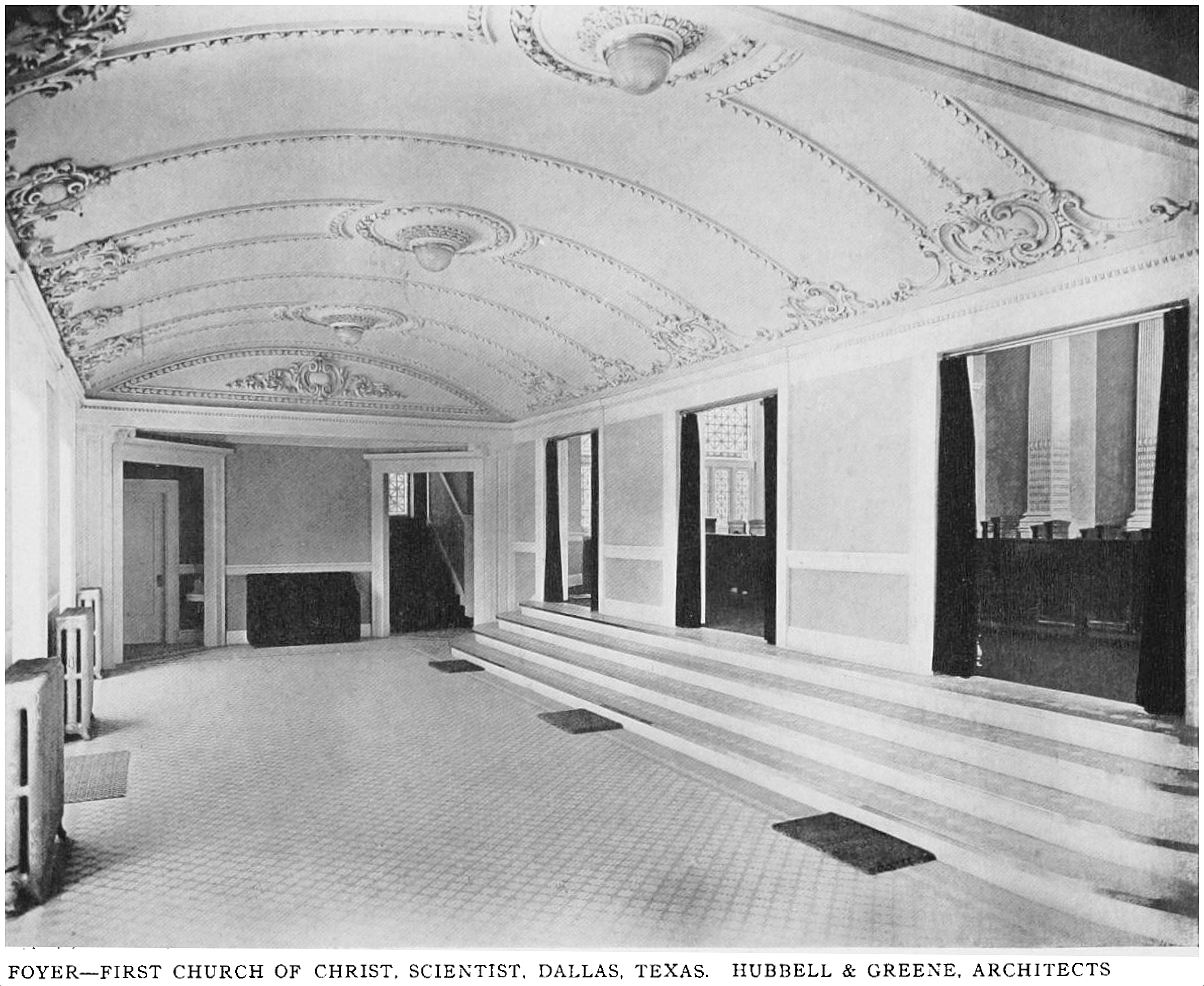
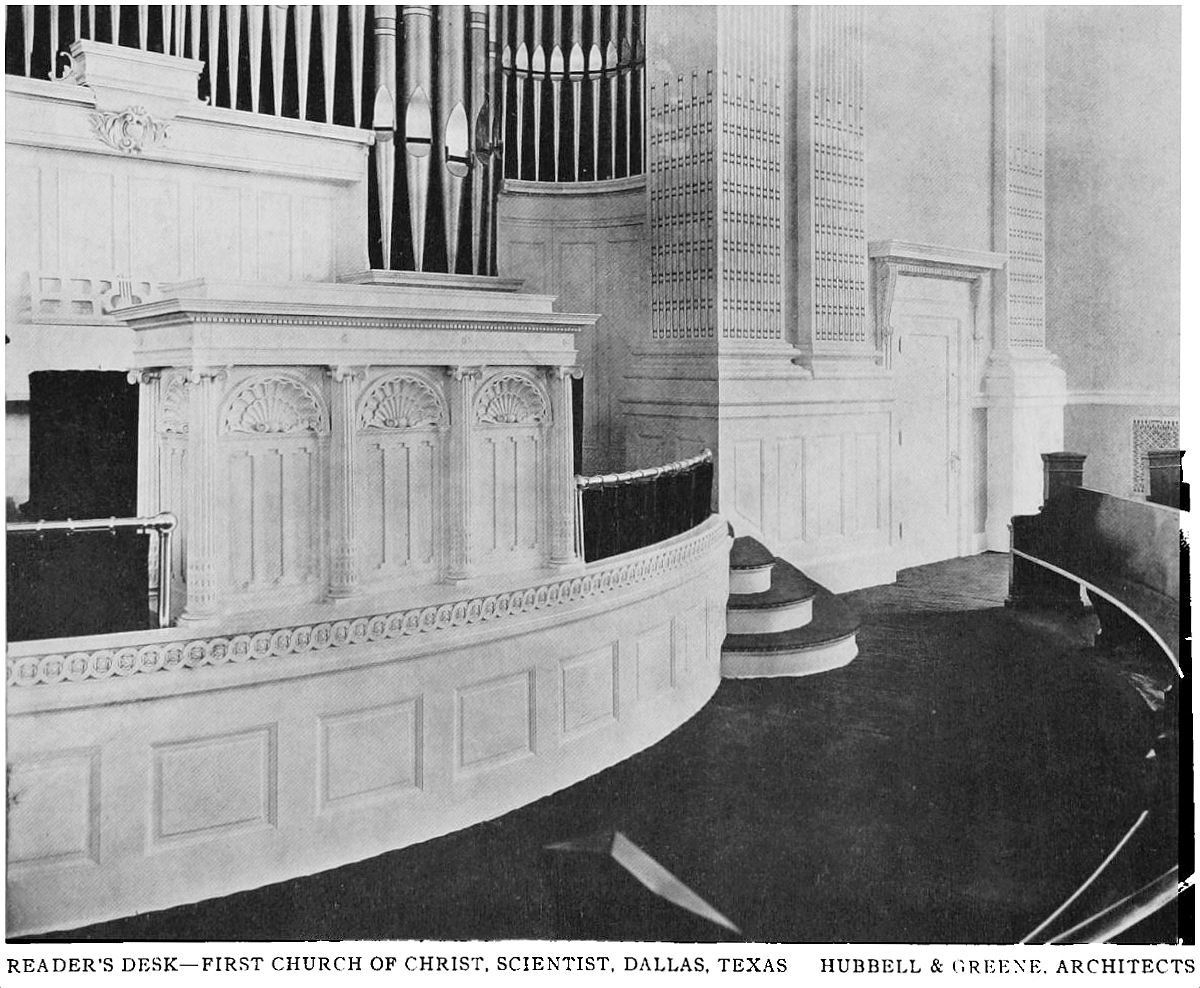
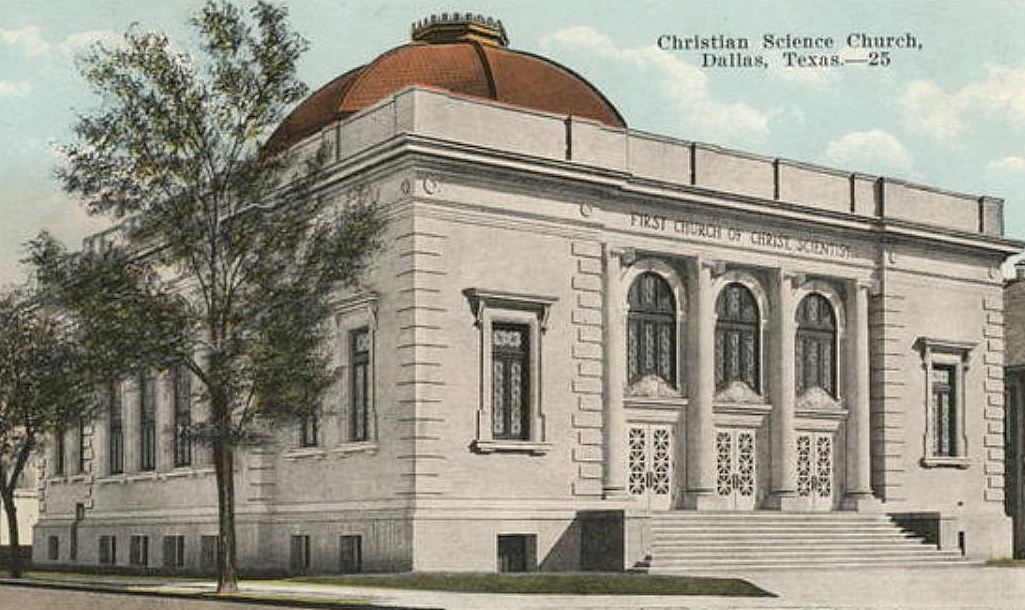
8.  FIRST CHURCH OF CHRIST, SCIENTIST, corner of Cadiz & Browder, designed by Hubbell & Greene. This Christian Science church was built in 1910 on the southern edge of downtown for $100,000 (over 2.5 million dollars in today’s money). Following its days as a Christian Science church, it has had secular and non-secular occupants. It still stands (as a lonely building in what is mostly a sea of parking lots), and it is currently a house of worship once again. (See it on a 1921 Sanborn map, here.)

first-church-of-christ-scientist_western-architect_july-1914_exterior

first-church-of-christ-scientist_western-architect_july-1914_foyer

first-church-of-christ-scientist_western-architect_july-1914_readers-desk

christian-science-church-postcard

**

And that concludes this 7-part series featuring photos from the 1914 all-Dallas issue of the trade publication The Western Architect, which can be viewed in its entirety (with additional text), here (jump to p. 195 of the PDF for the July, 1914 scanned issue).

***

Sources & Notes

The Western Architect, A National Journal of Architecture and Allied Arts, Published Monthly, July, 1914. This issue, with text and critical analysis in addition to the large number of photographs, has been scanned in it entirety by the University of Illinois at Urbana-Champaign as part of its Brittle Books Program — it can be accessed in a PDF, here (the Dallas issue begins on page 195 of the PDF). Thank you, UIUC!

In this 7-part series:

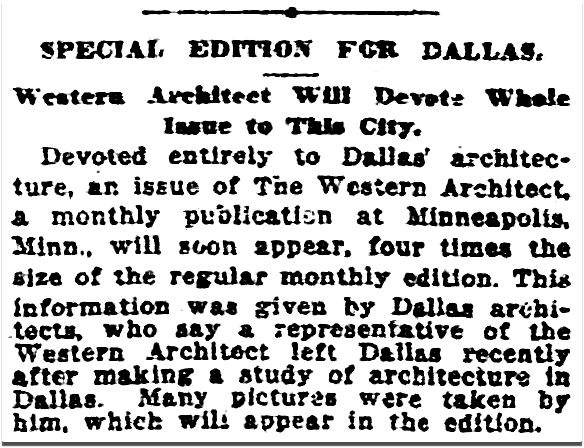
western-architect-in-dallas_dmn_060414
Dallas Morning News, June 4, 1914

*

Copyright © 2018 Paula Bosse. All Rights Reserved.