Flashback : Dallas

A Miscellany: History, Ads, Pop Culture

Category: 1940s

Sivils Drive-In, An Oak Cliff Institution: 1940-1967

sivils_tichnorOak Cliff’s landmark hangout (click for larger image)

by Paula Bosse

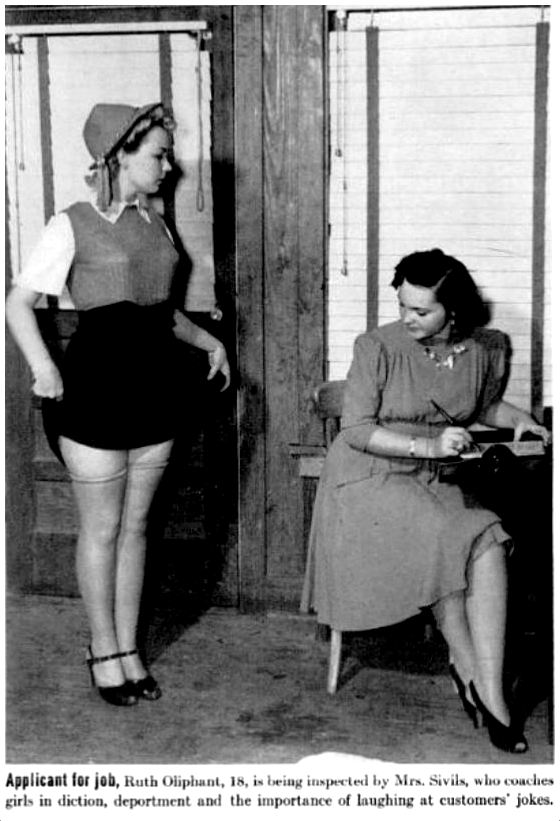
When J. D. Sivils (1907-1986) and his wife, Louise (1918-2006), brought their “Sivils” restaurant to Dallas in June 1940, their Houston drive-in of the same name had already been featured as a Life magazine cover story, garnering the kind of incredible national publicity that any business owner would have killed for! And all because of their carhops — “comely, uniformed lassies” whom Mrs. Sivils insisted on calling “curb girls” (which might have a slightly different connotation these days…). Life — never a magazine to overlook pretty young girls in sexy outfits — not only devoted a pictorial to the “curb girls,” they also put one of them (Josephine Powell of Houston) on the cover, wearing the Sivils’ uniform of (very, very short!) majorette’s outfit, plumed hat, and boots.
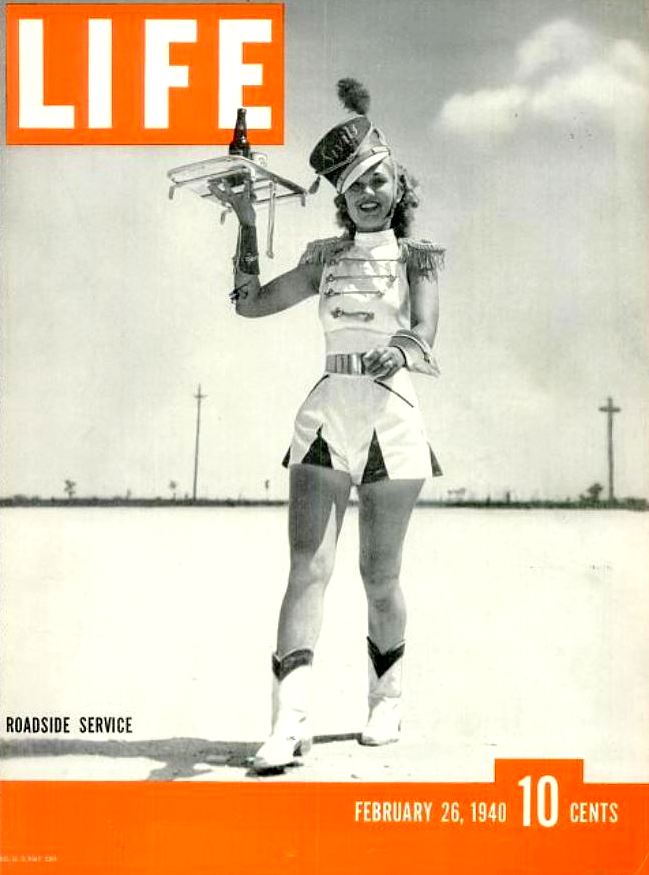
sivils_houston_life-mag_022640Feb. 26, 1940

louise-sivils_life-magazine_1940Louise Sivils and a prospective “curb girl” (Life)

Four months after the blitz of national attention the drive-in received from the Life story, Sivils came to Dallas. The drive-in was located in Oak Cliff at the intersection of West Davis and Fort Worth Avenue on “three acres of paved parking space.”

sivils-map

The day the drive-in opened, a photo of the not-yet-legendary Sivils appeared in The Dallas Morning News (see “Sivils to Open Dallas Place Thursday,” DMN, June 27, 1940). Other than this, there is surprisingly little in the pages of The News about this drive-in’s opening — surprising because it became such a huge part of the lives of Oak Cliff’s teens in the ’40s, ’50s, and ’60s. It’s one of those places that seems to have reached almost mythic proportions on the nostalgia scale.

Sivils didn’t quietly sneak into town, though. Take a look at this very large, very expensive newspaper ad, which ran the day before OC’s soon-to-be favorite hang-out opened. (Click for larger image.)
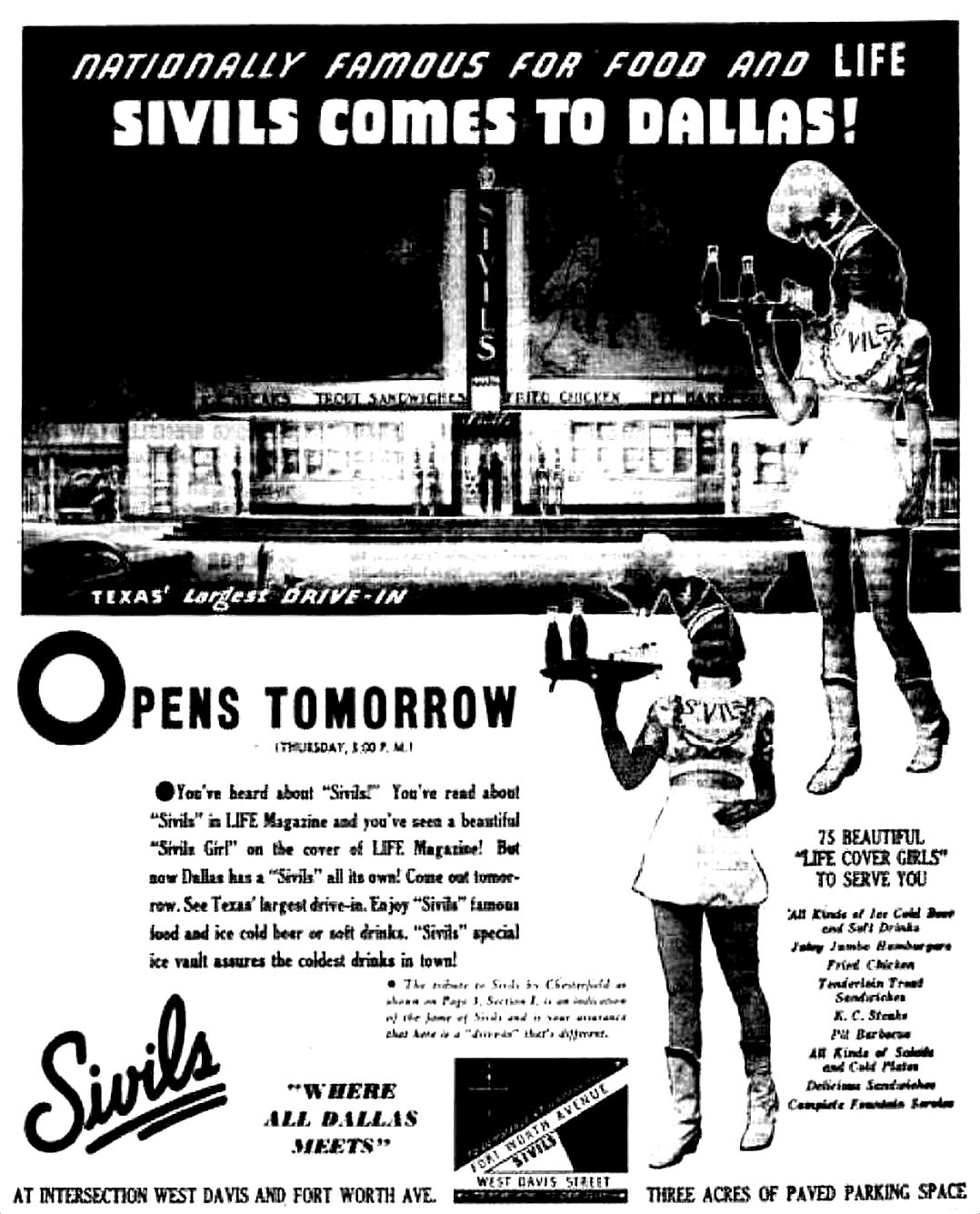
sivils_dmn_062640_lgJune 26, 1940

*

Nationally Famous for Food and LIFE
SIVILS COMES TO DALLAS!

Texas’ largest drive-in
Opens tomorrow

(Thursday 3:00 PM)

You’ve heard about “Sivils”! You’ve read about “Sivils” in LIFE Magazine and you’ve seen a beautiful “Sivils Girl” on the cover of LIFE Magazine! But now Dallas has a “Sivils” all its own! Come out tomorrow. See Texas’ largest drive-in. Enjoy “Sivils” famous food and ice cold beer or soft drinks. “Sivils” special ice vault assures the coldest drinks in town!

75 Beautiful “LIFE Cover Girls” to Serve You

All Kinds of Ice Cold Beer and Soft Drinks
Juicy Jumbo Hamburgers

Fried Chicken
Tenderloin Trout Sandwiches
K.C. Steaks
Pit Barbecue
All Kinds of Salads and Cold Plates
Delicious Sandwiches
Complete Fountain Service

Sivils – “Where All Dallas Meets”
At intersection West Davis and Fort Worth Ave.
Three Acres of Paved Parking Space

*

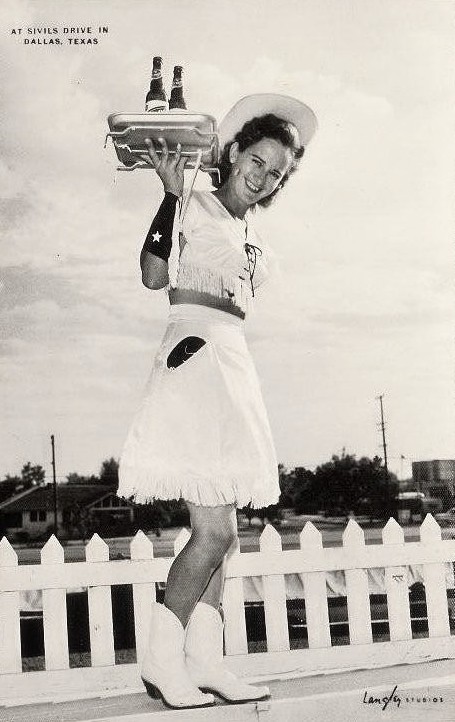
100-150 “curb girls” were employed by Sivils at any given time in those early days, and it was open 24 hours a day. The place was hopping. Sounds fantastic. Wish I’d seen it.

sivils_matchbook_coltera-flickrvia Flickr

sivils_carhop_postcard_ebay
eBay

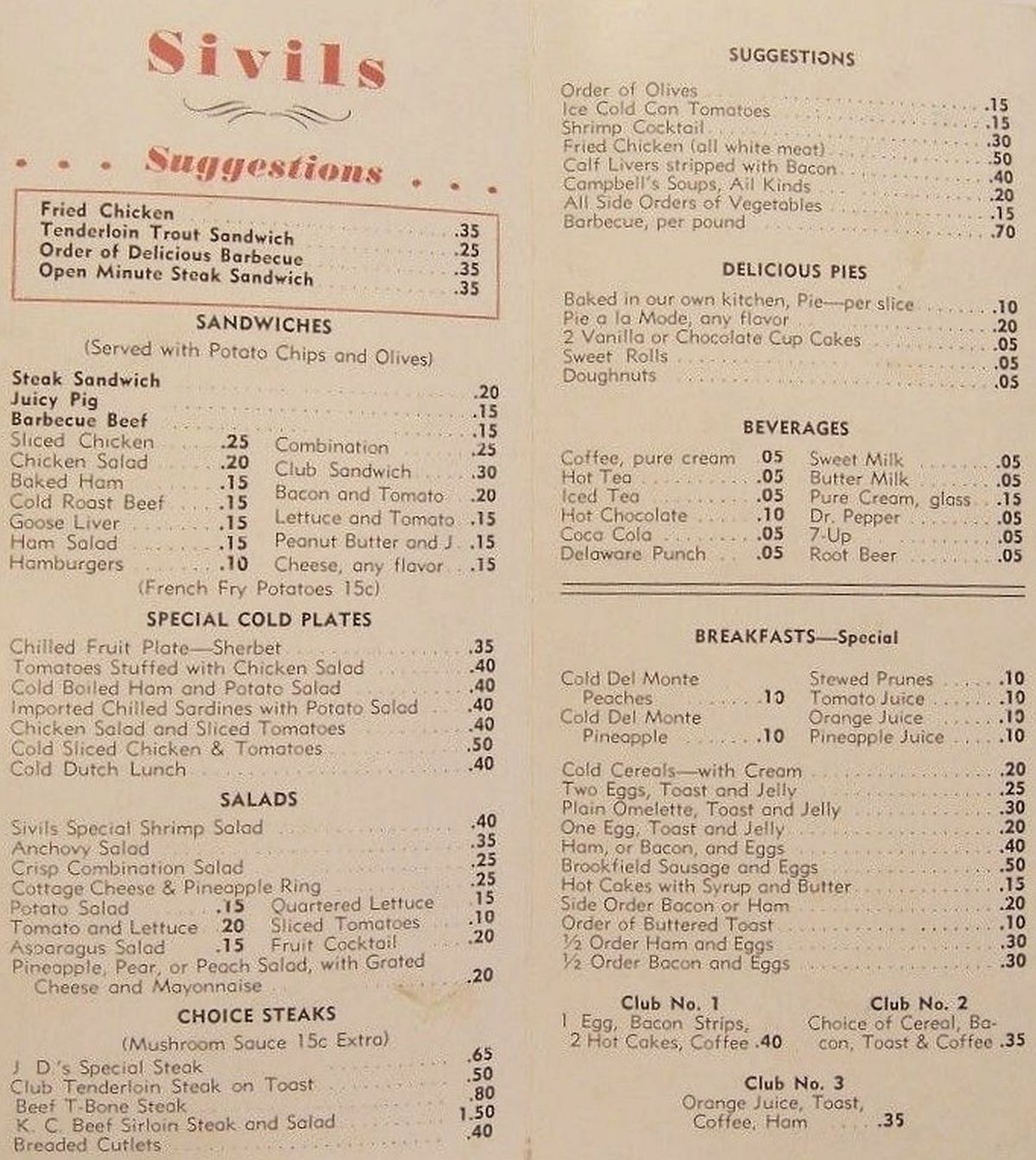
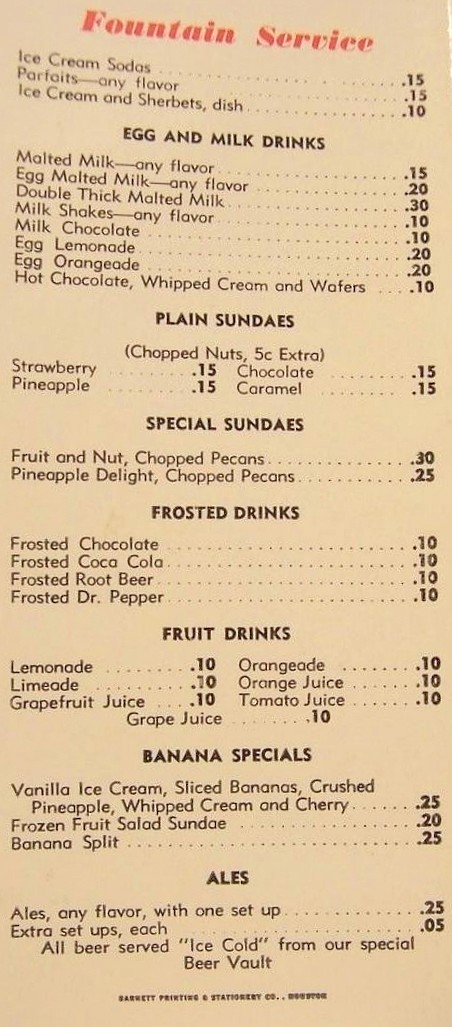
Below, a scanned menu (click to see larger images):

sivils-menu_1940s_ebay_cover

sivils-menu_1940s_ebay_b

sivils-menu_1940s_ebay_avia eBay

***

Sources & Notes

Top postcard from the Boston Public Library Tichnor Brothers Postcard Collection on Flickr, here.

Read the 4-page Life article (and see several photos of the Houston “curb girls”) here (use the magnifying glass icon at the top left to increase the size of the page).

Interesting quote from that article:“They work in 7½-hour shifts, six days a week, for which they get no pay but average $5 a day in tips.” Doesn’t sound legal…. (The Inflation Calculator tells us that $5 in 1940 money is equivalent to just over $83 in today’s money.)

Sivils closed in 1967, possibly because Mr. and Mrs. Sivils wanted to retire, but it seems more likely that Oak Cliff’s being a dry area of Dallas since the 1950s was killing its business. Check out the News article “Big Head Expected as Oak Cliff Beer Issue Foams” by Kent Biffle (DMN, Aug. 17, 1966) which appeared just months before another election in which the “drys” outvoted the “wets.” (More on Oak Cliff’s crazy wet-dry issues, here.)

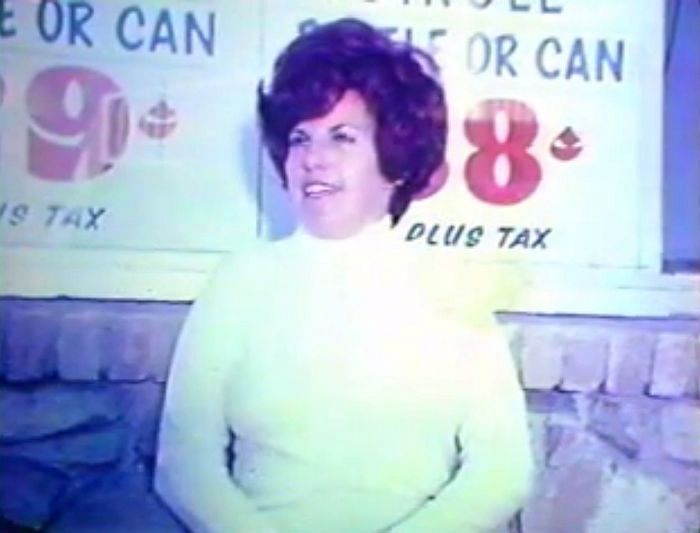
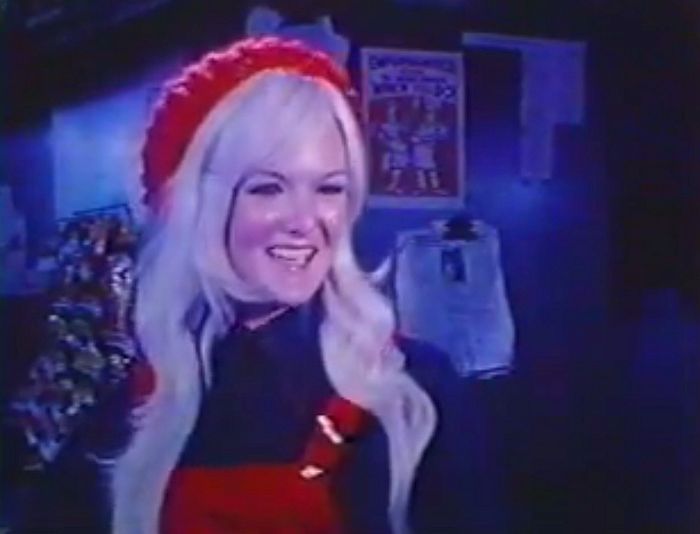
J. D. Sivils was interviewed in a short documentary about Dallas carhops, filmed in the early 1970s. In it, he talks about the early days of Sivils and — best of all — there is film footage galore of the drive-in from his collection. Watch it in my previous post — “‘Carhops’ — A Short Documentary, ca. 1974” — here. (Below a screenshot of Sivils from the film.)

sivils-carhops-film

Read the article “Carhops, Curb Service, and the Pig Sandwich” by Michael Karl Witzel (Texas Highways, Oct. 2006) in a PDF, here (increase size of article with controls at top of page).

Another Flashback Dallas post on drive-in culture — “Carhops as Sex Symbols — 1940” — is here.
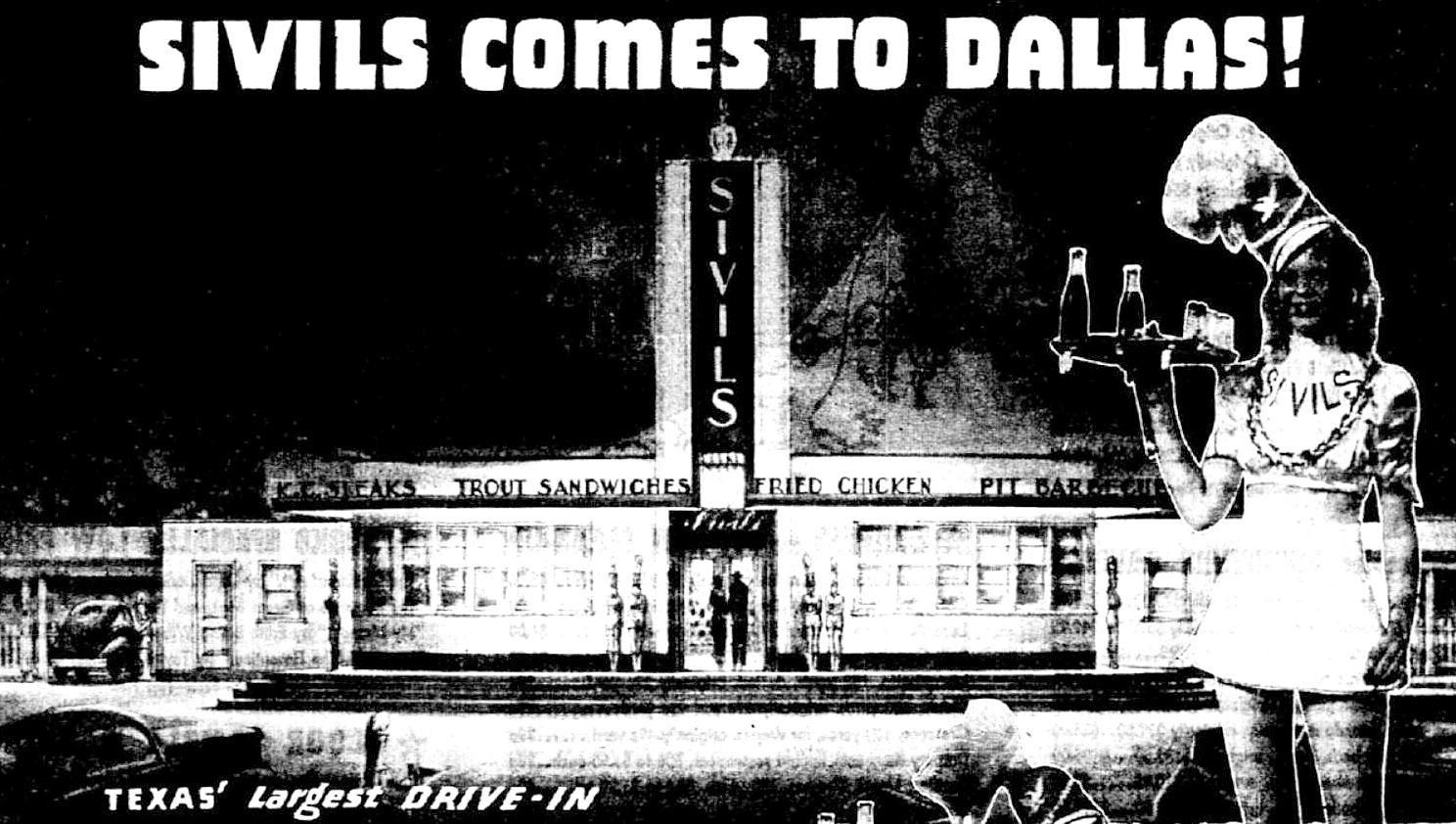
sivils_dmn_062640-det

Click pictures for larger images.

*

Copyright © 2015 Paula Bosse. All Rights Reserved.

“Carhops” — A Short Documentary, ca. 1974

carhops_title
Schlitz on its way…

by Paula Bosse

The carhop is an oddly American invention — and it began here in Dallas in the 1920s, with boys and young men serving customers in cars at J. G. Kirby’s Pig Stand drive-in restaurants. In 1940, Sivils hit Dallas, but this time with young women as servers — young women in skimpy outfits. There was no looking back — from then on, pretty girls showing a lot of leg and hoping for big tips carried trays of food, soft drinks, and beer to cars full of waiting customers.

One of the few remaining “old school” drive-ins is Keller’s on Northwest Highway, still doing good business today. Around 1974 or 1975, SMU film teacher Pat Korman made a short documentary about Dallas carhops past and present (the result, it seems, of reading a Dallas Morning News article by Rena Pederson). He interviewed B. J. Kirby (owner of Kirby’s steakhouse on Lower Greenville and son of Jesse Kirby, founder of the Pig Stand pig-sandwich empire, which, as legend has it, had the very first carhops), J. D. Sivils (owner of Sivils drive-ins, who, along with his wife, was an important figure in the evolution of curb-side dining), and Jack Keller (owner of Keller’s Hamburgers). The three businessmen reminisce about the early days of drive-in restaurants in Dallas as a lot of cool historical film footage unspools and photographs from the ’20s to the ’50s are flashed on the screen. Also interviewed are four women carhops who were working at Keller’s at the time, talking about their jobs.

It’s a cool film. Big cotton-candy hair, accents you wish were still around, and cans and cases of Schlitz, Schlitz, Schlitz.

The 14-minute film is in two parts on YouTube. Here is the first part:

*
And here is the second part:

*
Below, screenshots of the interviewees.

sandy-carhopsSandy

shirley-carhopsShirley (as of Jan. 2015, she’s been a fixture at Keller’s for 50 years!)

rita-carhopsRita

nancy-carhopsNancy

kirby_carhopsB. J. Kirby

sivils-carhopsJ. D. Sivils

keller-carhopsJack Keller

kellers-menu-board_carhopsNo. 5 — 80¢

***

Sources & Notes

“Carhops” — filmed sometime in the early ’70s — was directed by Patrick Korman, shot by Ron Judkins, and produced by Don Pasquella. It premiered at Jesuit High School in April 1976. The film is on YouTube in two parts, here and here. (By the way, if you look at the YouTube comments under part two, you’ll see a comment from Sandy herself. She’s still looking good in the avatar photo.) (The music at the beginning and end of the film is great! I’m pretty sure it’s the legendary steel guitarist Ralph Mooney and the equally legendary guitarist James Burton; I love those guys! I urge to go get a copy of their album “Corn Pickin’ and Slick Slidin.'”)

Rena Pederson is thanked in the credits. She wrote a great article in The Dallas Morning News called “Carhops Fading, Those Were the Days” (Aug. 25, 1974) — she interviewed many of the same people seen in the film.

The Keller’s Northwest Highway location celebrates its 50th anniversary this year. Shirley — one of the carhops featured in the film — has worked there since it opened in 1965. As of Jan. 2015, she was still there! Go by and see her! Check out a Lakewood Advocate story on Shirley, here.

Also, take a look at a Dallas Morning News article on Keller’s 50th anniversary, here — scroll down to the slideshow to check out some great photos from its early days.

Read about sexy male carhops who plied their trade in skimpy outfits — a short-lived fad in Dallas inspired by the success of drive-ins like Sivils — in my previous post “Carhops as Sex Symbols — 1940,” here.

*

Copyright © 2015 Paula Bosse. All Rights Reserved.

“A Day at the State Fair of Texas” — A Color Film of the 1941 Fair

title-cardOfficial SFOT-produced movie (via Texas Archive of the Moving Image)

by Paula Bosse

TAMI — Texas Archive of the Moving Image — is a great repository of old films shot in and around Texas. Its site boasts streaming newsreels, PSAs, commercials, home movies, etc. — one of these films is the 11-minute short “A Day at the State Fair,” an “official” film produced by the Jameson Film Co. of Dallas for the State Fair of Texas, directed by Curt Beck and starring two young local actors, Charmayne Smith and Harry Bleeker. The SFOT made these short movies primarily to promote the fair, and they were often shown in theaters around Texas and in neighboring states, sandwiched between other cinematic entertainment. They were also used for educational purposes and were shown to both students and civic groups. This official film was shot at the 1941 state fair for the purpose of promoting the fair the next year, but it may actually never have been shown anywhere, as the 1942 State Fair of Texas was cancelled “due to war.”

I am unable to embed the film here — to view it in its entirety on the TAMI site, click here. (Make sure to click the “full screen” square just to the left of the speaker icon below the frame.)

Below are some (admittedly grainy) screenshots from the film. It’s fun to see these pre-War shots of the fair in color (inconsistent though that color is). Click pictures for larger images.

*

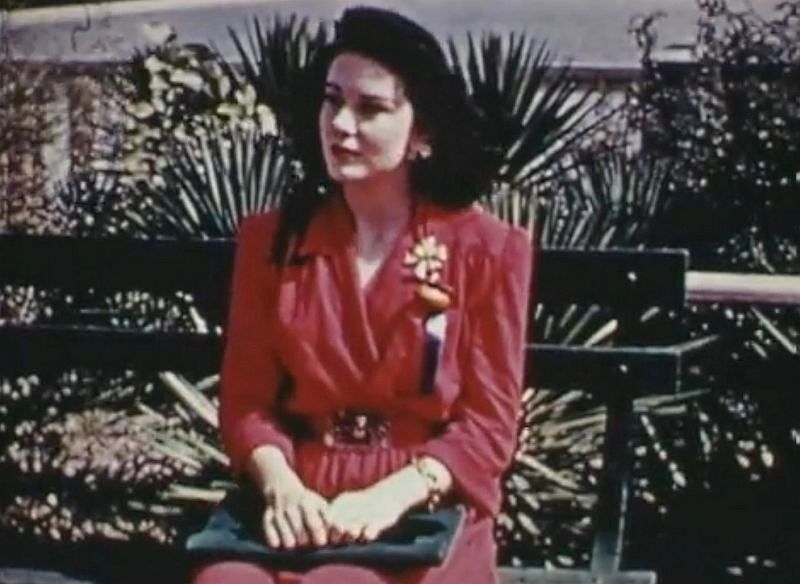
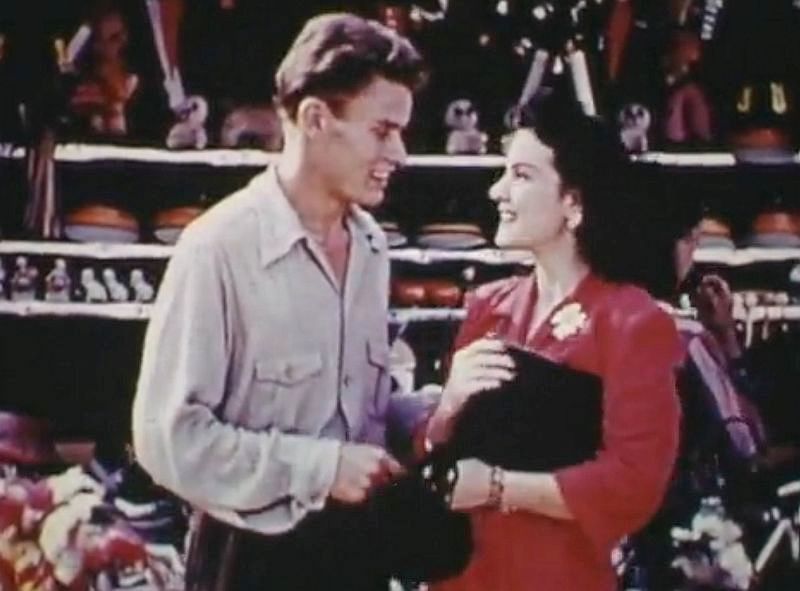
The film follows two young people who meet on a blind date and tour the fair. The young woman was played by Charmayne Smith, a Forest High School graduate who became both Miss Dallas and Miss Texas, and, at the time of this film, was studying acting at the Dallas Little Theater.

charmayne

Her date was played by Harry Bleeker, also an actor with the Dallas Little Theater. (I like the peek at Parry Ave. in the background.)

harry-bleeker

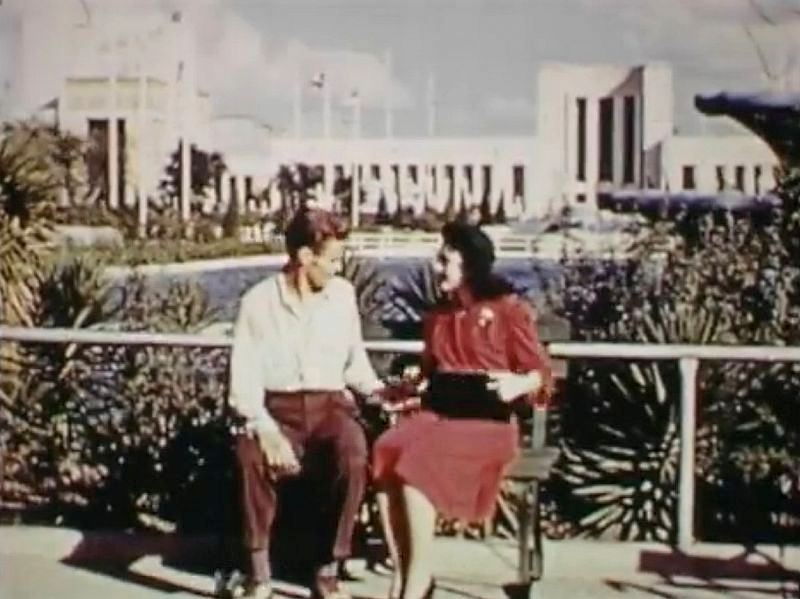
They “met cute” at a Fair Park bench.

bench

They went to the Midway.

midway

They looked at rides and made pithy observations.

rocket

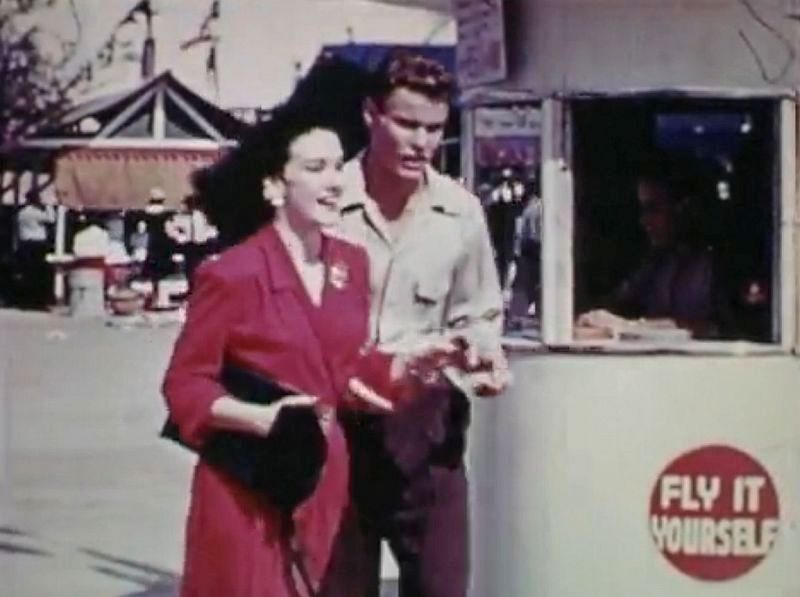
They bought tickets to an “aeroplane” ride, a ride so exciting it made Charmayne go “Whee!”

tickets

They listened to a freak show barker.

freak-show

Which, the closer you got, didn’t look all that freak-filled, unless you count the sight of a sullen girl holding a snake as being terribly “strange and unusual.” (I’m a sucker for sideshow banners, and this was my favorite shot of the film. The man in the crowd who has turned around to face the camera is more unsettling than anything on that stage — including the accordion!)

freak-show_1941-state-fair-of-texas

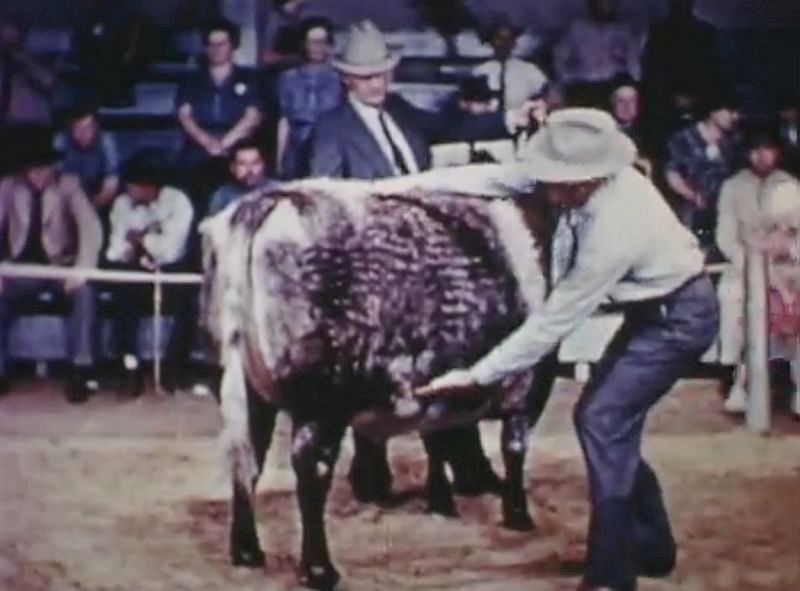
Harry and Charmayne went in and out of buildings, looked at different exhibits, rattled off facts-a-plenty, and extolled the greatness of Texas. And no way were they going to miss the livestock events. A state fair’s gotta have livestock. Like this almost perfectly rectangular Beef Shorthorn.

beef-shorthorn

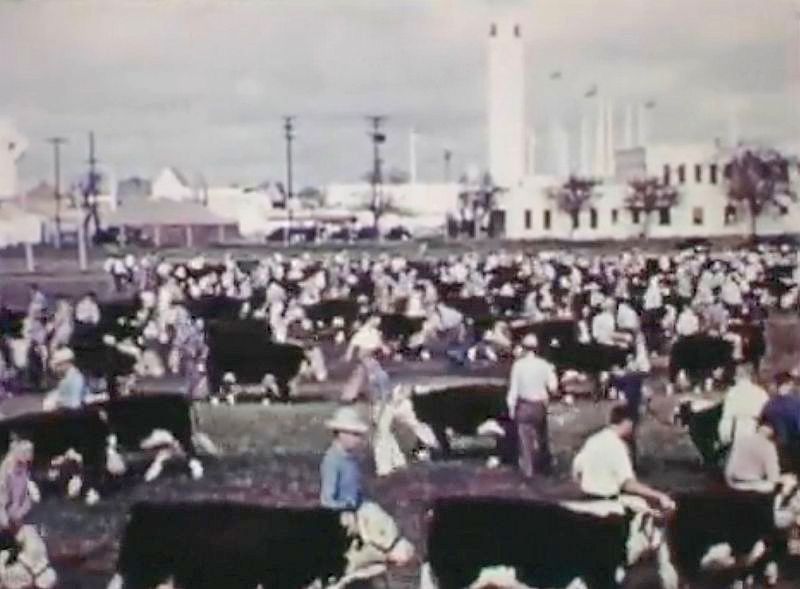
And these parading Herefords.

herefords

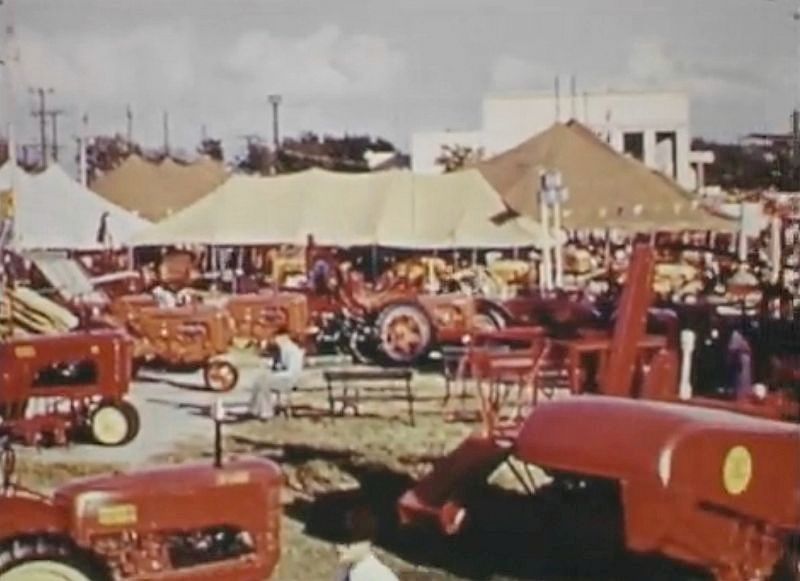
Also seen: tractors, tractors, tractors.

tractors

They took in a “petroleum exhibit” and exclaimed how fabulous it was. (In real life, Charmayne Smith and Harry Bleeker and other Dallas Little Theater actors were part of this exhibit during the 1941 fair.) If only this little car were real and had been seen at the automobile show!

petroleum-exhibit

They moseyed through the Dallas Museum of Fine Arts and viewed the art in the Texas General Exhibition. (Eugene Trentham’s cloud-filled painting, “August Landscape” — winner of the year’s top prize —  can be seen here.)

dmfa

Then, tuckered out, Charmayne tells Harry it’s probably time that she should head home. Harry offers to drive her home and suggests they return that night for more fair fun!

harry-charmayne

They leave, happy, headed for Parry Ave. (and, perhaps, whiskey, across the street).

parry

*

This wasn’t all that Harry and Charmayne saw. There was also a monkey, goats, sheep, horses, the Ice Capades, a beauty contest, jars and jars of preserved fruit, a lady handing out Hi-Ho crackers, the Hall of State, and more. Watch the film. It’s great to see 70-plus-year-old footage of Fair Park — and it’s also nice to hear people talk with Texas accents (something getting rarer every day in Dallas). Again, you can watch the film here.

***

Sources & Notes

The TAMI home page is here; the page featuring this short film is here. Thank you, TAMI, for uploading and sharing this and all the other cool stuff on your site! (The film is currently identified as being made in 1939, but everything points to this being filmed at the 1941 State Fair of Texas.)

These SFOT-produced films were an important promotional tool to entice visitors to the fair. In the months leading up to the opening of the SFOT, these films were shown in hundreds of Texas movie theaters, in theaters in contiguous states, and in thousands of schools throughout the Southwest.

Charmayne Smith (1921-1965) entered and won a lot of beauty contests while in high school and during her time at both the University of Texas and at SMU. An Oct. 12, 1941 captioned photo of Miss Smith mentions that she had been participating in the filming of (color) footage shot around the 1941 SFOT which would be used “for educational and promotion purposes before next year’s exposition.”

I was unable to find anything about Harry Bleeker, other than a mention in a 1941 Dallas Morning News article about the petroleum exhibit seen in the film. Chances are pretty high he served in World War II.

In the film, Charmayne and Harry visit the Third Texas General Exhibition (1941) at the Dallas Museum of Fine Arts. The grand prize in the oil painting division went to Eugene Trentham, a UT art instructor at the time, fresh off a Guggenheim Fellowship.

Click pictures for larger images!

*

Copyright © 2015 Paula Bosse. All Rights Reserved.
 

Dunking For Apples at a Halloween Night “Spooks’ Party”

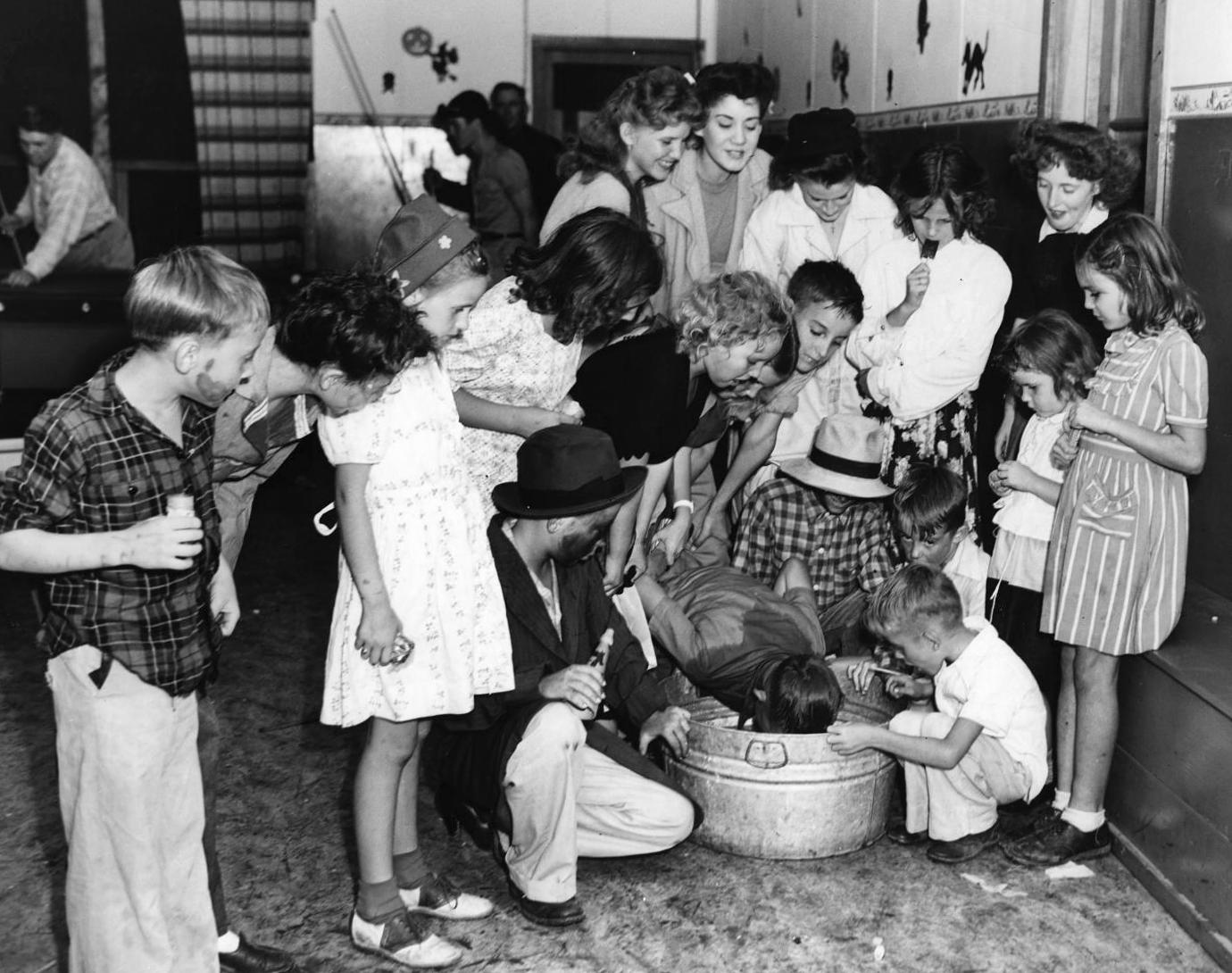
halloween-party_dallas-parks_portalKids used to really have to WORK for those treats!

by Paula Bosse

In an effort to steer young revelers to safe Halloween festivities, the Dallas Park and Recreation Department organized parties in community centers around Dallas in the 1930s and ’40s. One of those parties (in an unidentified location) can be seen above, in a photograph titled “Dunking for Apples — Hallowe’en Night — October 31 at Spooks Party.”

The party’s apple-bobbing is in full swing. All eyes are on the dunker, who has obviously been hard at work, dunking down well past his shoulders. A couple of young hobos appear to be in attendance, both with prominent five o’clock shadows. Even though the party is for children, the adults seem to be having more fun than the kids, but perhaps this is early in the evening. And the party’s not just for the small-fry — there’s a pool game going on in the background, providing dunk-free entertainment for dads (and other men who might have wandered in).

Happy Halloween! Dunk responsibly!

***

Sources & Notes

This photograph comes from the Dallas Municipal Archives, accessed through the Portal to Texas History, here. The photographer is Harry Bennett. The photo is undated, but it looks like it is from the early 1940s. These city-sponsored parties appear to have started in the late-1930s as a way to keep children out of mischief and away from the riotous celebrations downtown (which I wrote about previously, here).

More Halloween photos from the Dallas Park and Recreation Department collection, taken by Harry Bennett — perhaps taken the same year, perhaps at the same location — can be seen here.

Click picture for larger image.

*

Copyright © 2015 Paula Bosse. All Rights Reserved.

“The Fair Is In the Air — Let’s Go!”

state-fair_1923Look at this 1923 typeface!

by Paula Bosse

Here we are again in the final days of another State Fair of Texas. Why not take a look at a few random images of the fair over the years. (Click pictures for larger images.)

First, from 1900, the entrance to the fairgrounds. (It appears to be the same view as the top postcard seen in a previous post, here, just a few steps inside the archway.)

fairgrounds-main-entrance_bohemian_1900_fwplFort Worth Public Library

*

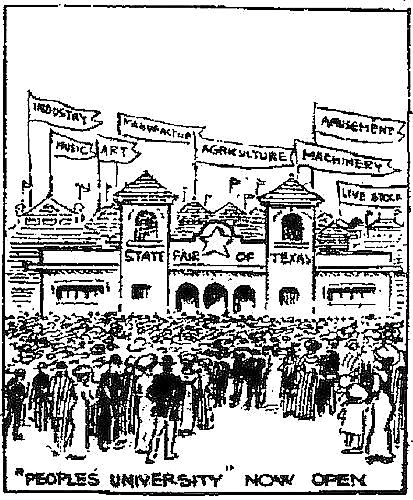
A cartoon from The Dallas Morning News in 1912 — “The People’s University.” Remember, it’s not just about Ferris wheels and candy apples.

state-fair_dmn_102012-cartoonDMN, Oct. 20, 1912

*

1921. Don’t miss The Whip.

state-fair_1921

*

From the Texas Centennial in 1936, a shot of a remarkably spotless Midway. (Am I the only one who would have paid to see the “28-Ft. Monster” do battle with whatever freakish specimens were ensconced within the walls of the Ripley’s Believe It Or Not building?)

tx-centennial-midway_1936_ebay

*

During World War II, no fair was held between 1942 and 1945. “Not until the boys come home, will there be another State Fair of Texas.”

state-fair_wwii_tx-almanac_1945-46

*

By the ’50s, everything was back to normal. Big Tex had arrived, and this ad promises “She’s a LULU in ’52.” Martin & Lewis and whatever a Thrillcade was!

state-fair_dmn_092552_lg

*

And, lastly, an aerial view of the Midway from 1966. Now this IS all Ferris wheels and candy apples. (To watch a short collection of color footage from the damp 1967 SFOT — including a sad, rainy parade downtown — click here.)

state-fair_1966_UNTUniversity of North Texas

***

Sources & Notes

1900 photo of the entrance to the fair is from The Bohemian magazine (1900) in the collection of the Fort Worth Public Library (those perforations in the photo are the FWPL’s).

1921 photo — I’m afraid I have no source on this one.

1936 postcard of the Centennial Midway is from eBay.

Patriotic WWII ad is from the 1945-1946 Texas Almanac.

Photo of the 1966 Midway is from the University of North Texas University Libraries blog, here.

My previous collection of SFOT photos over the decades appeared in the post “So Sorry Bill, But Albert Is Taking Me To The State Fair of Texas,” here.

Other Flashback Dallas posts on the State Fair of Texas are here; posts specifically on the Texas Centennial are here.

Again … some of these pictures are pretty dang big — when in doubt, click ’em!

*

Copyright © 2015 Paula Bosse. All Rights Reserved.
 

Trinity Heights: The Tallent Furniture Studio and The Sunshine Home

tallents-furniture-store_oak-cliff_tichnorVermont & South Ewing… (click for larger image)

by Paula Bosse

The postcard image above shows a bird’s eye view of a few blocks in the Trinity Heights neighborhood of Oak Cliff, from the late 1940s. As I looked at it, I wondered a) what does this intersection look like now, b) what is that unlabeled building that looks like a jail behind the furniture store, and c) what was Tallent’s Furniture Studio?

Tallent’s Furniture Studio, owned by Raymond E. Tallent, was located at 815 Vermont Avenue.

tallent_dmn_010350-obit-photo

tallents-ad_dmn_081256-det1956

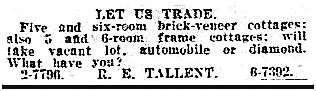
Not only did it house a furniture store, but it also served as an office for Tallent’s real estate business. According to Tallent’s obituary, he came to Dallas in 1920 and started his real estate business five years later. Starting out, he’d’ve been happy to trade you property for diamonds. “What have you?”

tallent_dmn_042928-real-estate-adApril, 1928

The first mention I found for the furniture store is this Christmas ad from 1947.

tallents_ad_121147Dec., 1947

Tallent died in January of 1950 at the age of 53. Both of his businesses continued after his death, and the furniture store was still going in the late 1960s.

So, nothing out of the ordinary — just a small business, like thousands of other small Dallas businesses. Probably the most interesting thing about Tallent was that he had the good taste to have that great promotional postcard made. That strange little building behind the store was a lot more interesting.

*

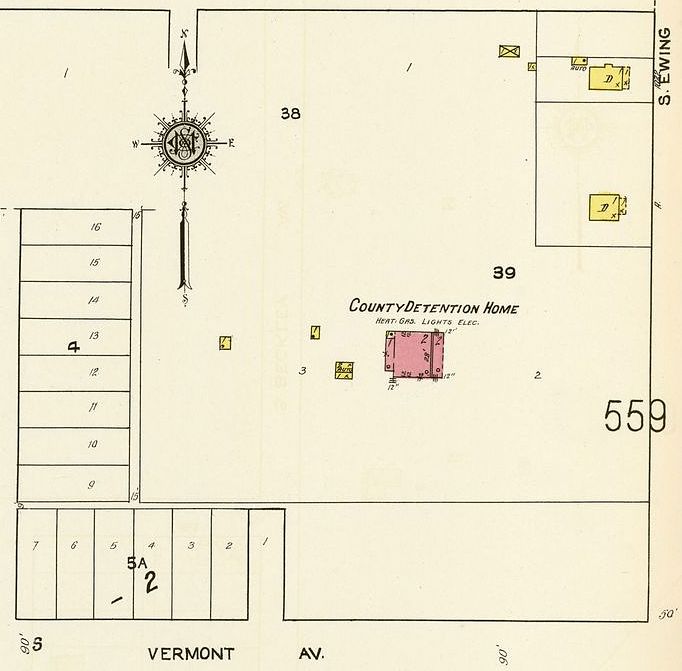
What was that building? The first time it popped up on a Sanborn map was 1922: it was identified as a “County Detention Home” (click for larger image).

detention-home_sanborn_19221922 Sanborn map detail — see full page here

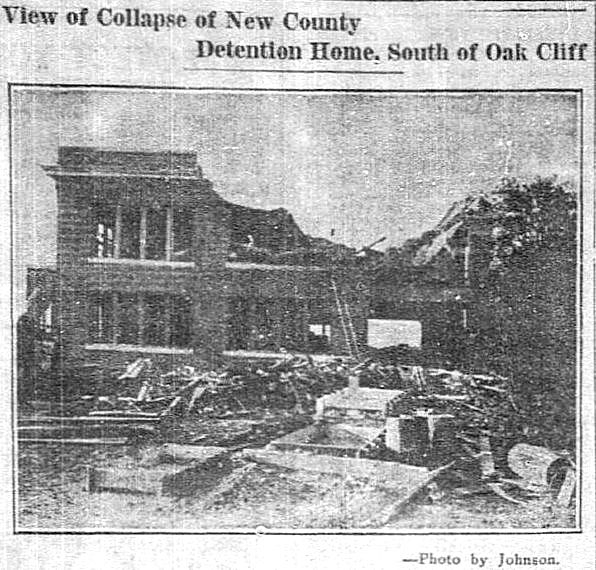
Despite its name, the “detention home” was not a correctional facility for juvenile delinquents, but it was a home for dependent children who had been made wards of Dallas County because of neglect or abandonment or because parents had died or were simply unable to care for them. This detention home was built in 1917 at 1545 South Ewing (“south of Oak Cliff”). During its construction in 1917, its roof collapsed, killing one of the workers.

detention-home-collapse_dmn-041317Dallas Morning News, Apr. 13, 1917

The home was almost immediately overcrowded, and its superintendents were constantly scrambling for an increase in funding. Children, ranging in age from toddlers to teenagers, lived there as long as they needed — some for a few months, some for several years. They attended nearby schools, and even though they were wards of the court and were living in an institution, the people who ran the place tried to make it as home-like as possible. In January, 1934, the name of the county facility was changed to the much more cheerful “Sunshine Home.”

In 1950, the Sunshine Home received $165,000 in bond money for improvements and expansion, adding modern structures to the large campus but still retaining the original two-story red brick building built in 1917.

In 1975, the Dallas County Sunshine Home and the Girls’ Day Center merged, and the former Sunshine Home was renamed Cliff House.

In 2014, the 28,000-square-foot property on just under five acres was put up for sale, and in early 2015 plans for a charter elementary school were approved.

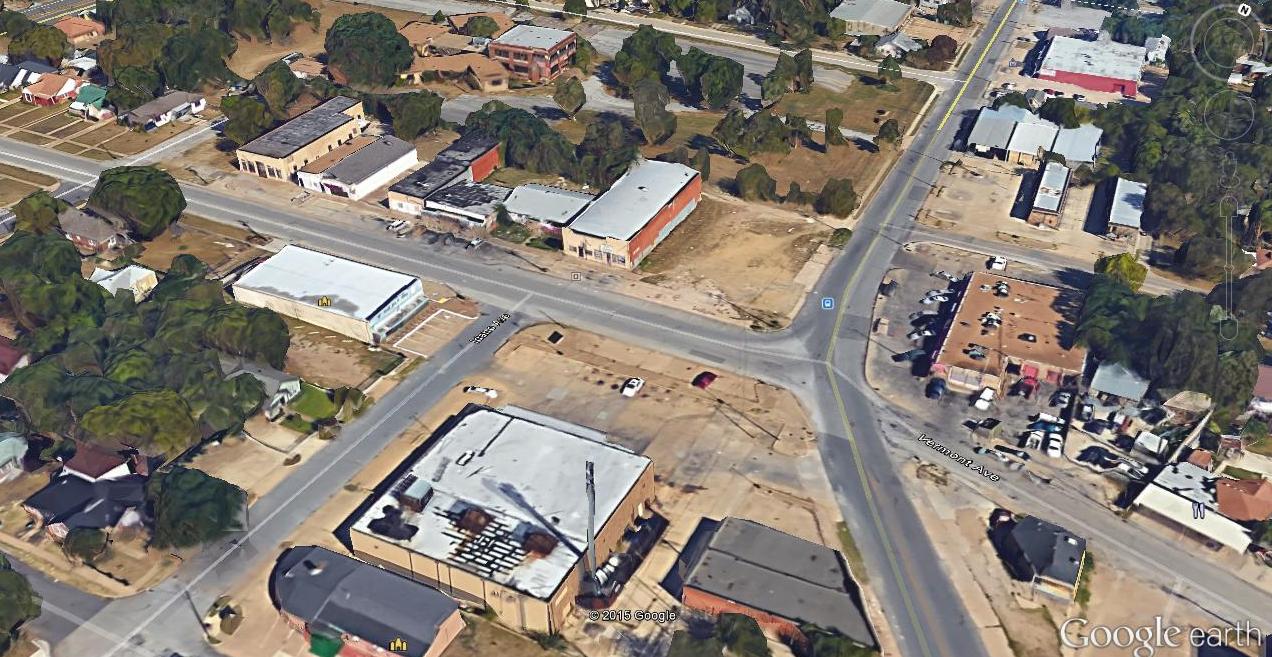
Below, a Google Earth image of the same view as the postcard featuring Tallent’s Furniture Studio, captured before the old Sunshine Home buildings had been demolished (click for larger image).

tallent_birdseye-google-earthGoogle Earth

The view is remarkably similar to the one taken more than 65 years earlier. A little bleaker these days, perhaps, but certainly still recognizable.

***

Sources & Notes

Top postcard is from the Boston Public Library Tichnor Brothers Postcard Collection; it is viewable here.

Information on the plans for the KIPP Truth Academy submitted to the City of Dallas (with interesting illustrations/maps on pages 10 and 11) can be found in a PDF, here.

A recent Google Street View of this block of Vermont Avenue can be seen here. The Tallent furniture store occupied the building to the left of the Vermont Grocery.

The heart-tugging article “For All Loving Care Bestowed, Sunshine Home, Space Small, Needs Much to Cheer Children” (DMN, July 24, 1941) — written by popular Dallas Morning News columnist Paul Crume — describes daily life in the Sunshine Home and can be found in the Dallas Morning News archives.

A then-and-now comparison (click for larger image):

tallent_then-now

*

Copyright © 2015 Paula Bosse. All Rights Reserved.


“Dallas … Undisputed Medical Center” — 1946

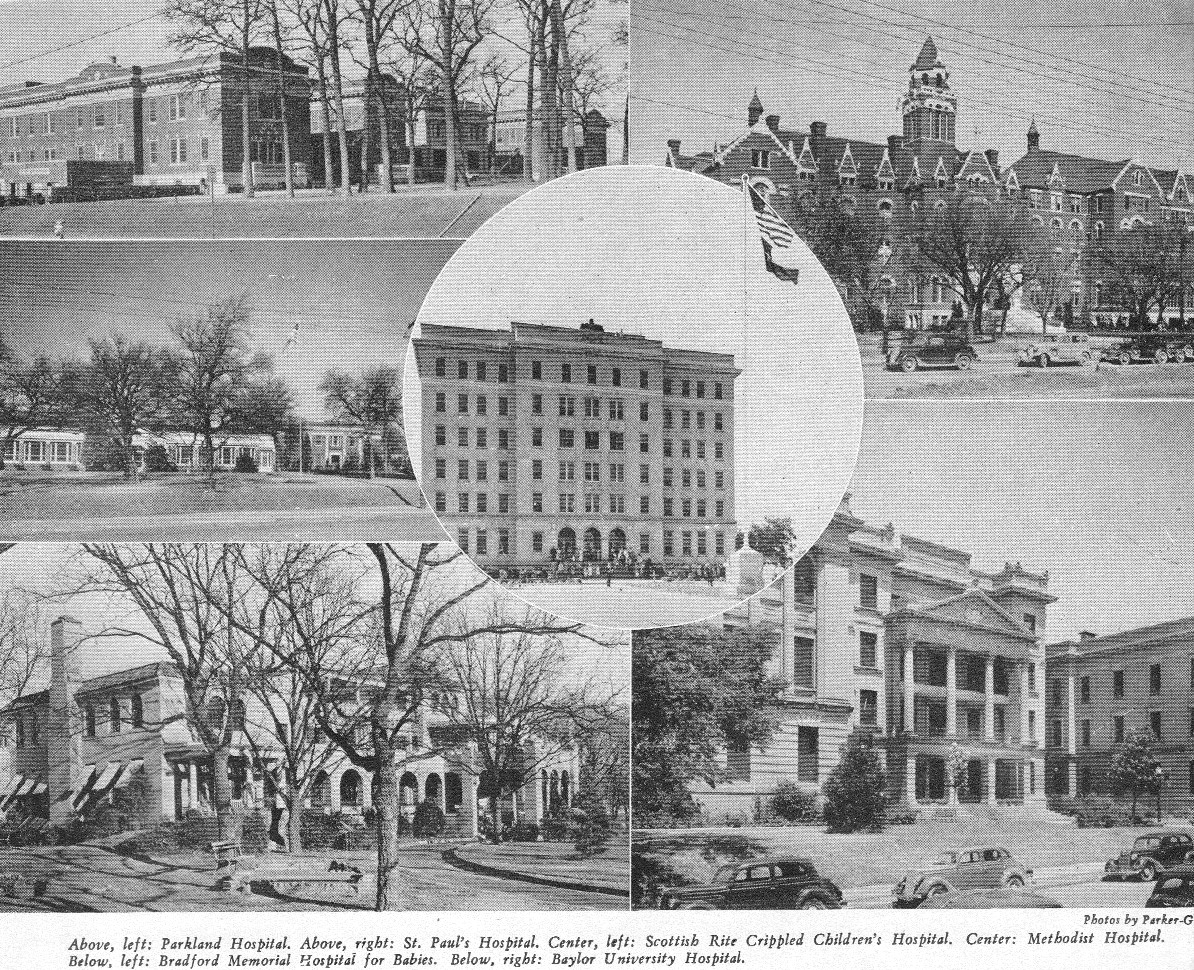
medical-centers_so-this-is-dallas_ca-1946_smSix of the city’s top facilities (click picture for larger image and caption)

by Paula Bosse

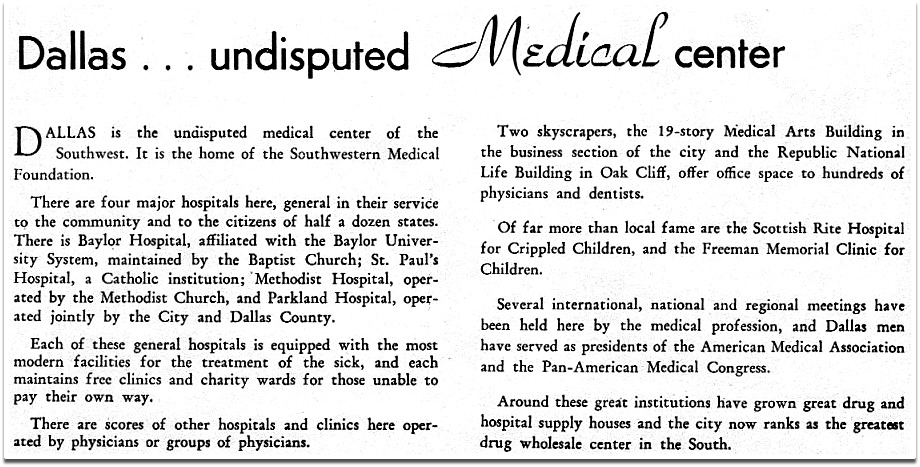
The photos above and the text just below are from a publication from about 1946 which was prepared for potential newcomers to the city in order to encourage them to move their businesses and/or residences to Dallas. This page focuses on the city’s superior medical centers, including Parkland Hospital, St. Paul’s Hospital, Scottish Rite Crippled Children’s Hospital, Methodist Hospital, Bradford Memorial Hospital for Babies, and Baylor University Hospital.

medical-centers_so-this-is-dallas_ca-1946-text

Locations of these and other “Hospitals and Dispensaries” can be found in this clipping from the 1946 Dallas city directory:

hospitals_1946-directory

***

Sources & Notes

Photo collage and text from “So This Is Dallas,” edited by Mrs. E. F. Anderson (Dallas: The Welcome Wagon, ca. 1946); photographs by Parker-Griffith.

Hospital listings from the 1945-46 Worley’s Greater Dallas (Texas) City Directory.

*

Copyright © 2015 Paula Bosse. All Rights Reserved.

Ebby Halliday, 1911-2015

ebby_1957_big-d_cowboy-hat_via-candys-dirt
Ebby in Big D, 1957… (photo: Ebby Halliday Realtors)

by Paula Bosse

(Feb. 2019: This post has been expanded since its original publication on Sept. 9, 2015.)

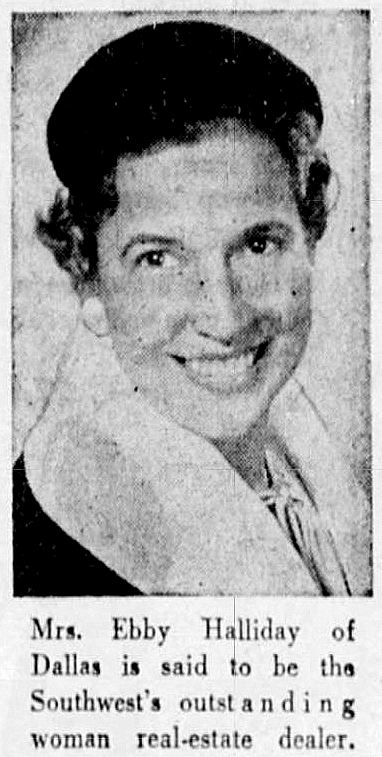
Ebby Halliday — the Dallas realtor known instantly by just her first name — died September 8, 2015 at the age of 104. Ebby was not only stunningly successful in the world of Dallas real estate, she was also something of a pioneer in paving the way for other women to establish and find great success in business. There are several obituaries that will present a more complete overview of her life (see links at the bottom of this post), so I’ll just post a few odds and ends that have caught my attention.

*

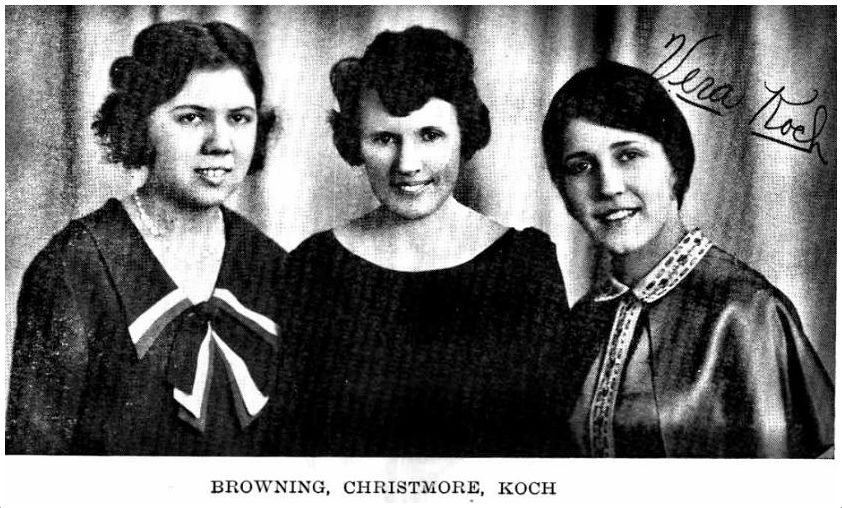
Vera Lucille Koch grew up in Kansas, and according to her 1929 Abilene High School yearbook, she was inordinately active in all sorts of clubs and sports. Here are a couple of photos from that yearbook (most images are larger when clicked); the first one shows her with the debate team.

ebby_debate-club_AHS-1929

And the second one shows her with her “Forensics” teammates (she excelled in reading competitions, although I’m not exactly sure what that means, as most “forensics” events involve debating). Rather amazingly, this scanned yearbook has her signature!

ebby_forensics-team-reading_AHS-1929

These two extra-curricular activities served her well in her later career — she obviously learned a lot about the effectiveness of persuasion at an early age.

After school, she spent several years working in department stores selling women’s fashions (including a stint in Omaha, where a vivacious young Vera can be seen in a  fantastic photo posted by D Magazine here). Ultimately she arrived in glamorous Dallas around 1938, where she began life as a Dallasite managing the women’s hat department at the downtown department store W. A. Green. Most accounts have her entering the real estate business while still selling hats, soon after the war — almost by a fluke. Legend has it that one of her customers mentioned to her husband, famed oilman Clint Murchison, that he might want to utilize Ebby’s sense of style by having her decorate a few of his newly-built houses in Far North Dallas in order to increase sluggish sales; she was apparently so successful at this that she decided to pursue selling houses on her own and eventually established her own realty company.

*

I’ve always wondered about the name “Ebby” — what was it short for? Ebby Halliday is the only Ebby I’ve ever heard of. Turns out that she made the name up, sometime between graduating from high school in Kansas and coming to Dallas. In a 1983 Dallas Morning News interview, she explained how Vera Lucille Koch became “Ebby Halliday”:

“I was selling hats when one of the buyers who I admired a great deal told me I had to get rid of  Vera Lucille. She said it was the silliest name she’d ever heard. I needed something more sophisticated. I thought about it and came up with the name Ebby. That sounded very, to me, like I had a lot of class.” (DMN, Sept. 25, 1983)

The  paragraph ended with two sentences added by the writer of the article:

The name Halliday came from an early first marriage. That husband is now deceased.

The somewhat dismissive tone of those last two lines is interesting, because that husband, Claude W. Halliday — whom she appears to have married in 1947 (although an earlier marriage license for the couple had been issued in 1945 in New York) — is almost non-existent in newspaper searches. C. W. Halliday (1908-1965) was described in a 1957 article about Ebby as being “engaged in an investment and building corporation.” In his 1965 obituary, C. W. was described as “head of C. W. Halliday Realtors and a partner in Ebby Halliday Realtors.” When C. W. died in 1965 — several years he and Ebby had divorced (and the same year Ebby married Maurice Acers) — it was Ebby who acted as informant on his death certificate. Mr. Halliday’s real estate career began about 1946, a year or so before Ebby opened her own retail millinery business. Ebby and C. W.’s marriage lasted for over 12 years, but most traces of him seem to have vanished into the ether.

But back to the name “Ebby.” When the former Vera Lucille Koch arrived in Dallas around 1938 to work at the W. A. Green department store, she was listed in the city directory as “Mrs. Vera Eberhardt.” I’m not sure where the “Mrs.” came from (had she been married before she arrived in Dallas?), but it’s certainly easy to see that “Ebby” probably came from “Eberhardt,” a name which was either a husband’s surname or the name she described as having created for herself because it sounded sophisticated.

eberhardt_vera_ebby_1939-directory1939 Dallas directory

In June, 1940, 29-year-old Ebby married KRLD broadcaster Royce H. Colon. Their marriage lasted only a few years, but it was during this time that the city directory shows her using the name “Ebby” professionally, while still working at Green’s.

colon_ebby_1940
Mrs. Royce Colon, 1940

colon_1941-directory
1941 Dallas directory

colon_1942-43-directory1942-43 Dallas directory

In Mr. Colon’s 1975 obituary it was stated that he had begun his career in real estate (with Majors & Majors Realtors) at a time which would have coincided with the years he and Ebby were married. This is to take nothing away from Ebby’s incredible accomplishments, but if that were the case, it seems that she might have had some (at least rudimentary) background in real estate before Clint Murchison asked her to spiffy-up some new houses he was having trouble unloading. It’s possible she may have entered her new profession with more in her quiver than simply a flair for interior decoration. Ambition may have seemed unladylike and immodest for a “career gal” in the 1940s, even for someone as independent and focused as Ebby. I wonder if her “origin story” might have been softened a bit to play down her ambition? Whatever the case, it didn’t take Ebby long to make her mark on the world of Dallas real estate, and, in so doing, establishing for herself a national reputation as both a top realtor as well as a major inspiration and mentor for women in business. 

Below is the type of article about Ebby Halliday’s accomplishments which ran constantly throughout her career. (Most images in this post are larger when clicked.)

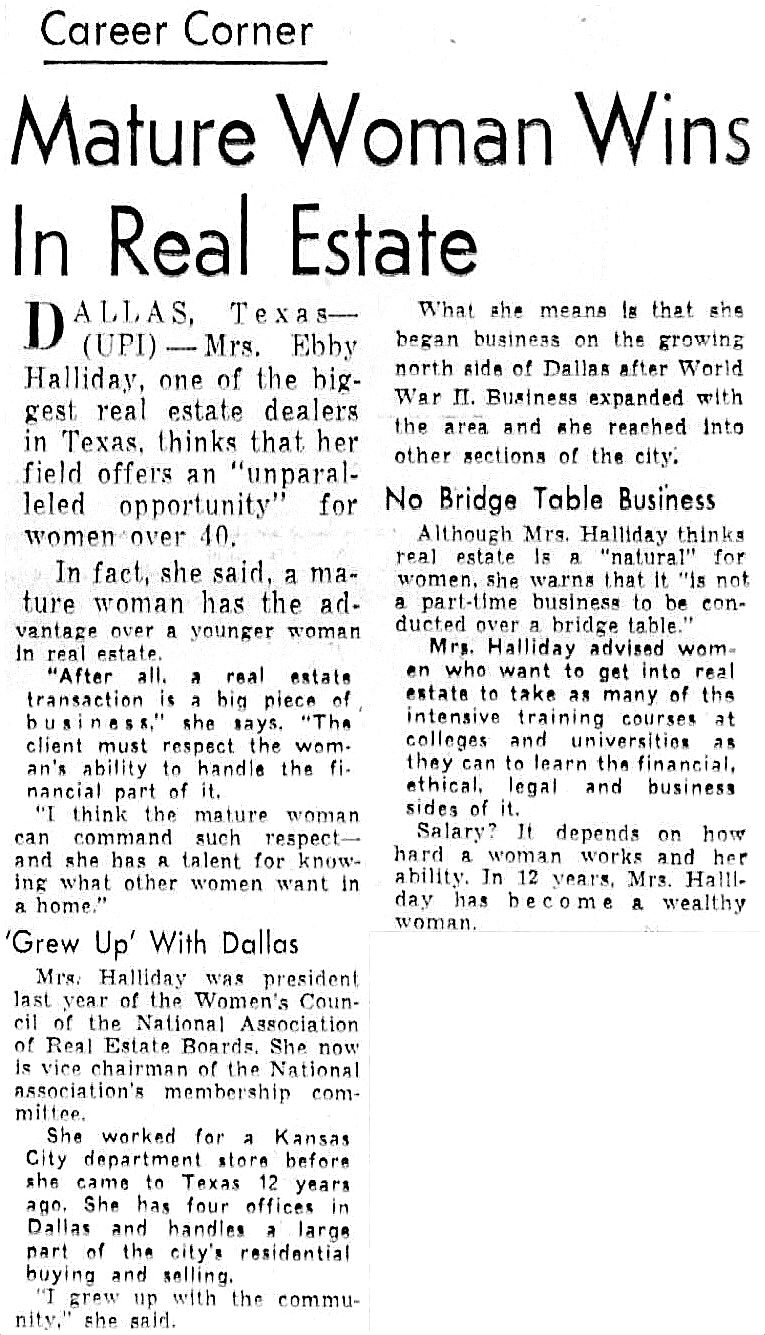
ebby-halliday_tennessean_090758_upi-wire-story
The Tennessean, Nashville, TN, Sept. 7, 1958

*

But back to that hat shop.

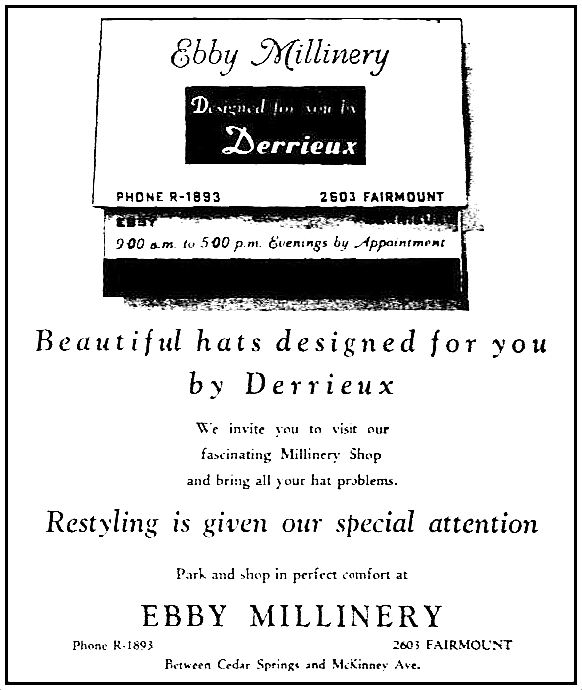
The first mentions I found for the shop Ebby Millinery (one of several boutique shops which operated in the still-beautiful old home at 2603 Fairmount), were in August, 1947 — an article in The Dallas Morning News described the shop as having “opened recently.” Ebby (who had recently become Mrs. C. W. Halliday) opened the shop in partnership with Dallas hat designer Annabelle Derrieux Bradley.

ebby-millinery_081047
Aug. 10, 1947

The shop’s bold decoration sounds … bold:

…Ebby Millinery’s French Room is decorated with bottle green walls and carpets and accented with striped drapes of deep shocking pink and chartreuse. The designing room has a touch of the Victorian with frilly white curtains and oversized wallpaper roses against a bottle-green background. (DMN, Aug. 20, 1947)

ebby-millinery_102647
Oct. 26, 1947

When Ebby decided to pursue her new real estate business full-time, Derrieux and her husband took over the shop and eventually renamed it Derrieux Hats.

*

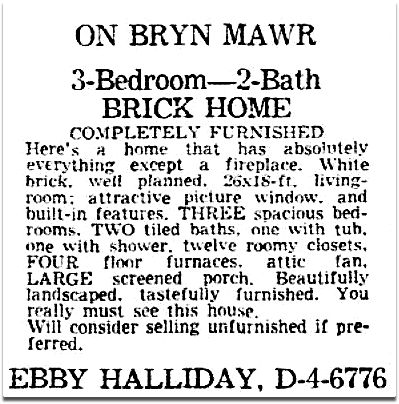
The first real estate ad I could find that featured Ebby’s name is this one, from 1948:

ebby_dmn_080548DMN, Aug. 5, 1948

And she was off like a rocket.

**

Below are a few photos of Ebby I’ve come across which I particularly like.

ebby_1956_charm_via-candys-dirt1956, Charm magazine (“the magazine for women who work”) (via Candy’s Dirt)

*

ebby-halliday_louisville-KY-courier-journal_092257Louisville (KY) Courier-Journal, Sept. 22, 1957

*

ebby-halliday_austin-statesman_012566
Austin Statesman, Jan. 25, 1966

*

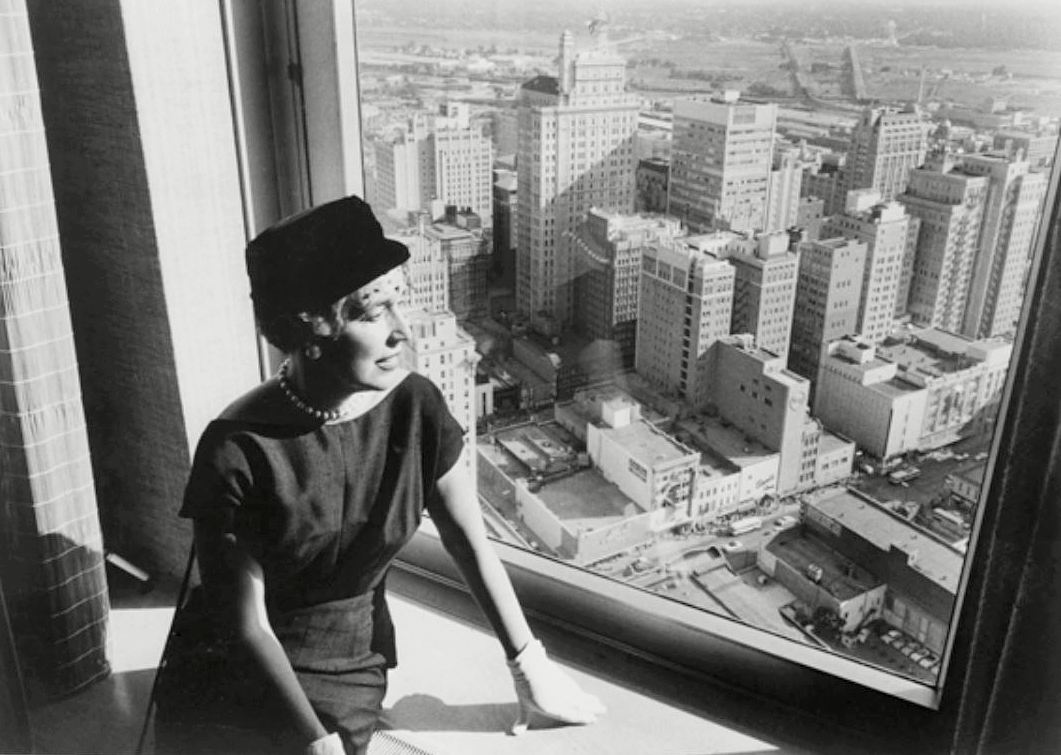
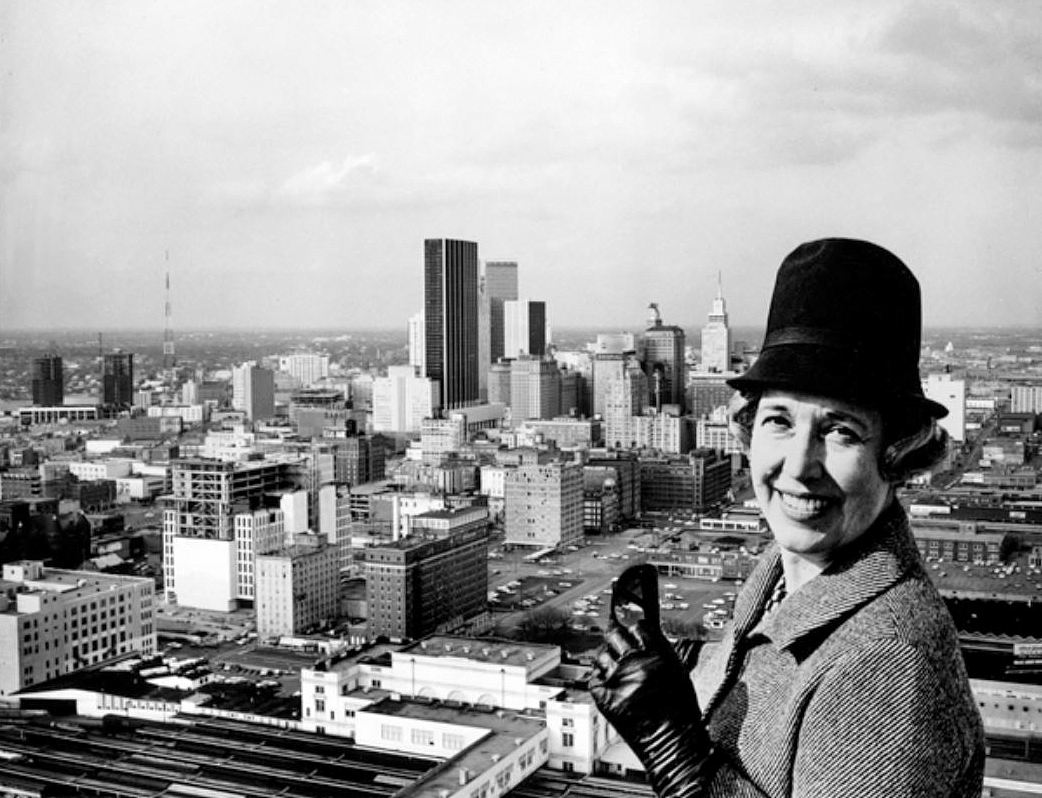
ebby_dallas-skyline1966 (via Candy’s Dirt)

This photo is interesting because a version of it appears in the May 15, 1966 edition of the Sydney Morning Herald under the headline “The Texas Millionairess” with one slight difference: instead of posing above the Dallas skyline, she is shown posing above the Sydney skyline while on a trip to Australia.

*

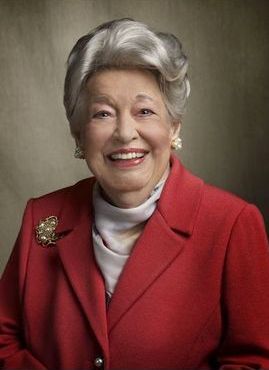
And here she is in later days: the undisputed grand dame of Dallas real estate. RIP, Ebby.

ebby_wfaa

***

Sources & Notes

Top photo is one of three in this post which appeared in a Candy’s Dirt slideshow here (slideshow photos are from the archives of Ebby Halliday Realtors — there are tons of great photos there!).

Highschool photos of Vera Koch are from the 1929 yearbook of Abilene (Kansas) High School.

Ebby Halliday Acers died Tuesday, Sept. 8, 2015. A few of the online obituaries/tributes in the local media:

  • Dallas Morning News, here
  • Dallas Business Journal, here
  • D Magazine, here
  • Ebby Halliday Realtors website, here

A great article on a typical day at work for the 96-year-old Halliday (!) appeared in D Magazine in July, 2007; read Candace Carlisle’s article “Ebby Halliday: The Woman Who (Still) Sells Dallas,” here.

*

Copyright © 2015 Paula Bosse. All Rights Reserved.


Akard Street Looking South, 1887-2015

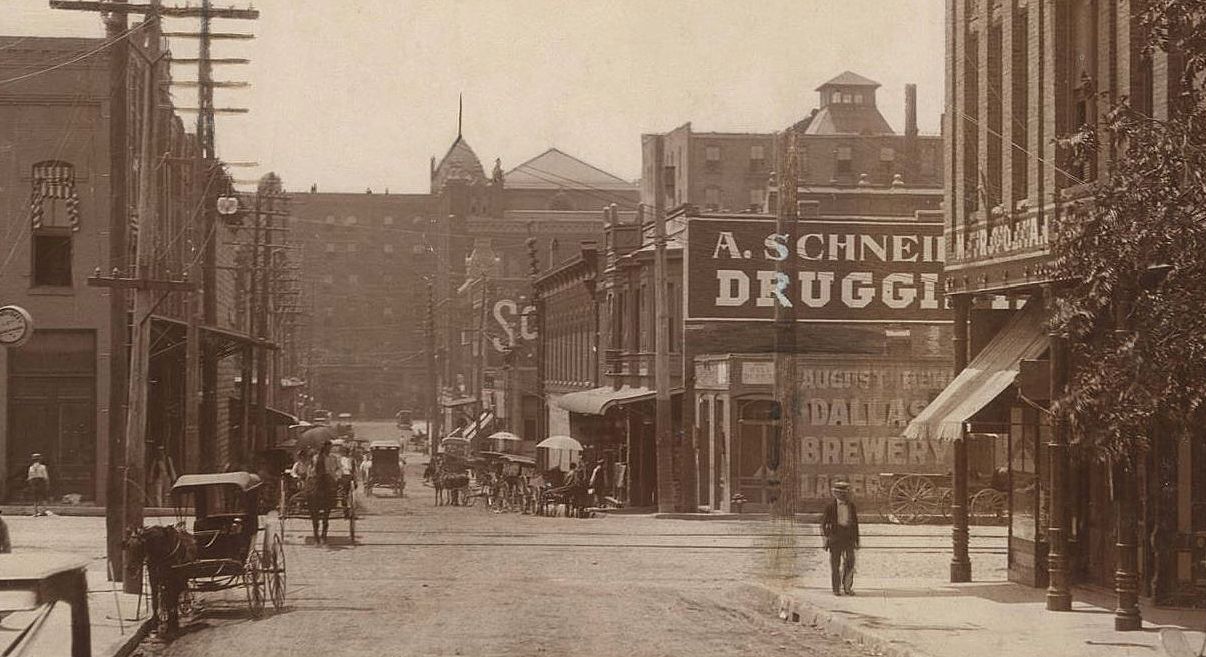
akard_from-pacific_cook_degolyer_smu_ca1898-detAkard Street from Pacific, ca. 1898, via Cook Collection, SMU

by Paula Bosse

I realized the other day that I have an inordinate number of photographs and postcards showing Akard Street looking south — usually taken from Pacific or Elm, so I thought I’d collect them all together. Some of these aren’t dated, so they’re not in strict chronological order, but I’ve made a half-hearted attempt to make sure horse-and-buggy photos are before the men-in-straw-hat-boaters, which are before the women-in-Miss-Crabtree-dresses, which are before the cars-with-rounded-bodies. It might be easiest to just assume they are not in chronological order. (All photos are larger when clicked — a couple are really  big.)

*

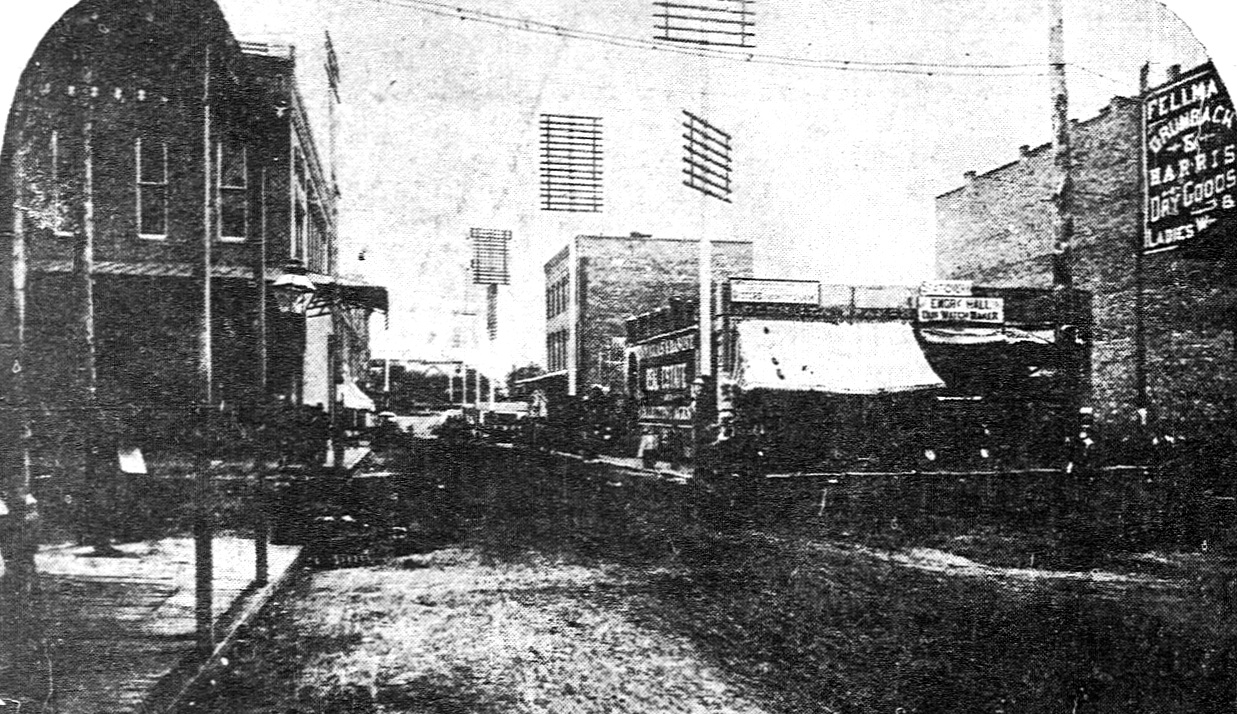
The oldest is from 1887, when North Akard was still called Sycamore Street, and before the Oriental Hotel was built at Commerce and Akard in 1895.

akard_south-from-elm_1887

*

Next up, an incredible photo, taken around 1898, a detail of which appears at the top of this post. The Oriental Hotel can now be seen at the end of Akard, at Commerce, where Akard used to make a dog-leg turn before continuing south, giving the appearance of a dead-end street.

akard_from-pacific_cook_de-golyer_smu-ca1898via George W. Cook Collection, DeGolyer Library, SMU

*

Another, with the Adolphus Hotel (built in 1912) now on the right, across Commerce from the Oriental. The tall building across Akard from the Adolphus is the Southwestern Life Building. The Gentry photography studio was at the southeast corner of Elm and Akard from 1912, which is probably the date of this postcard image. Construction of the Busch Building (now known as the Kirby Building) began in December, 1912.

akard-elm_postcard_ebay_ca-1912via eBay

*

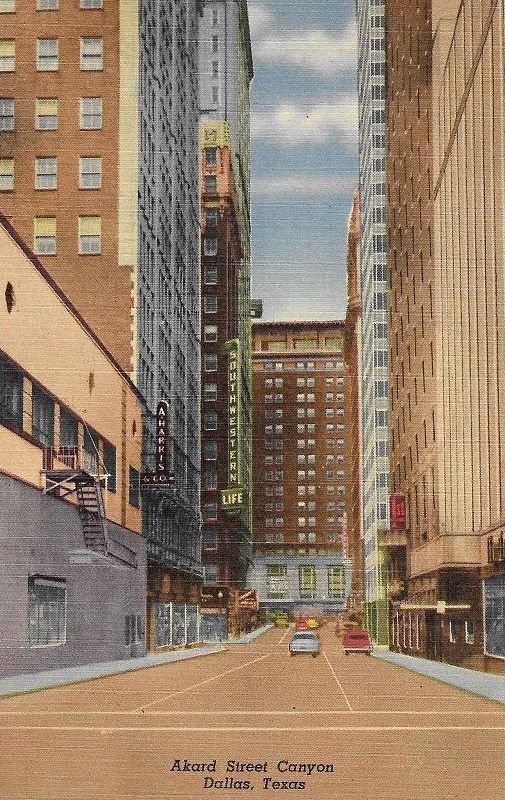
From 1925, with the new Baker Hotel having replaced the Oriental Hotel. This area was now being called “the canyon district” or “the canyon.”

akard_south-from-elm_1925

*

In this great Frank Rogers photo, the canyon walls are getting higher, with the Adolphus Hotel firmly anchoring the Commerce corner across from the Baker.

akard_baker-adolphus_postcard_rogers_ebayvia eBay

*

By the time this photo was taken in about 1936, Pegasus had become a part of the skyline, perched atop the Magnolia Petroleum Building. (Note the Queen Theater at the northeast corner of Elm and Akard.)

akard_pacific_1936_legacies-spring-1989via Legacies History Journal

*

This photo is from the early- or mid-1930s — LOOK AT ALL THOSE PEOPLE.

akard-canyon_municipal-archives_dma-uncratedvia the DMA’s Uncrated blog

*

As opposed to this one, which has NO people in it.

akard-canyon_ebayvia eBay

*

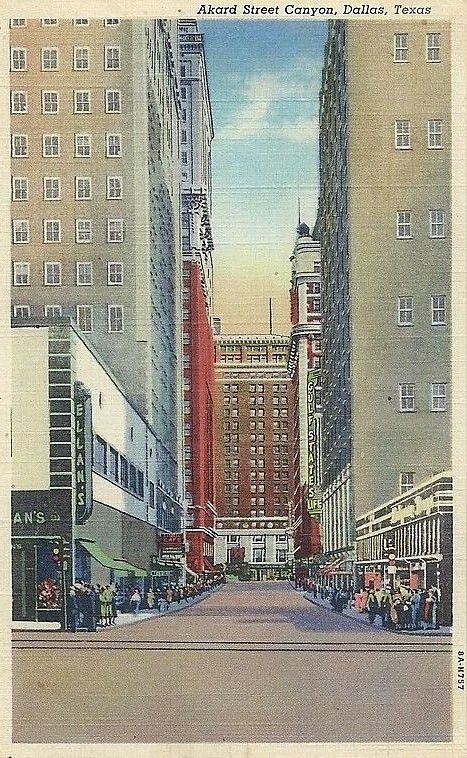
More canyon, this view showing the super-cool art-deco-y building at Elm and Akard with Ellan’s hat shop on the ground floor, late-1930s.

akard-st-canyon_ellans

*

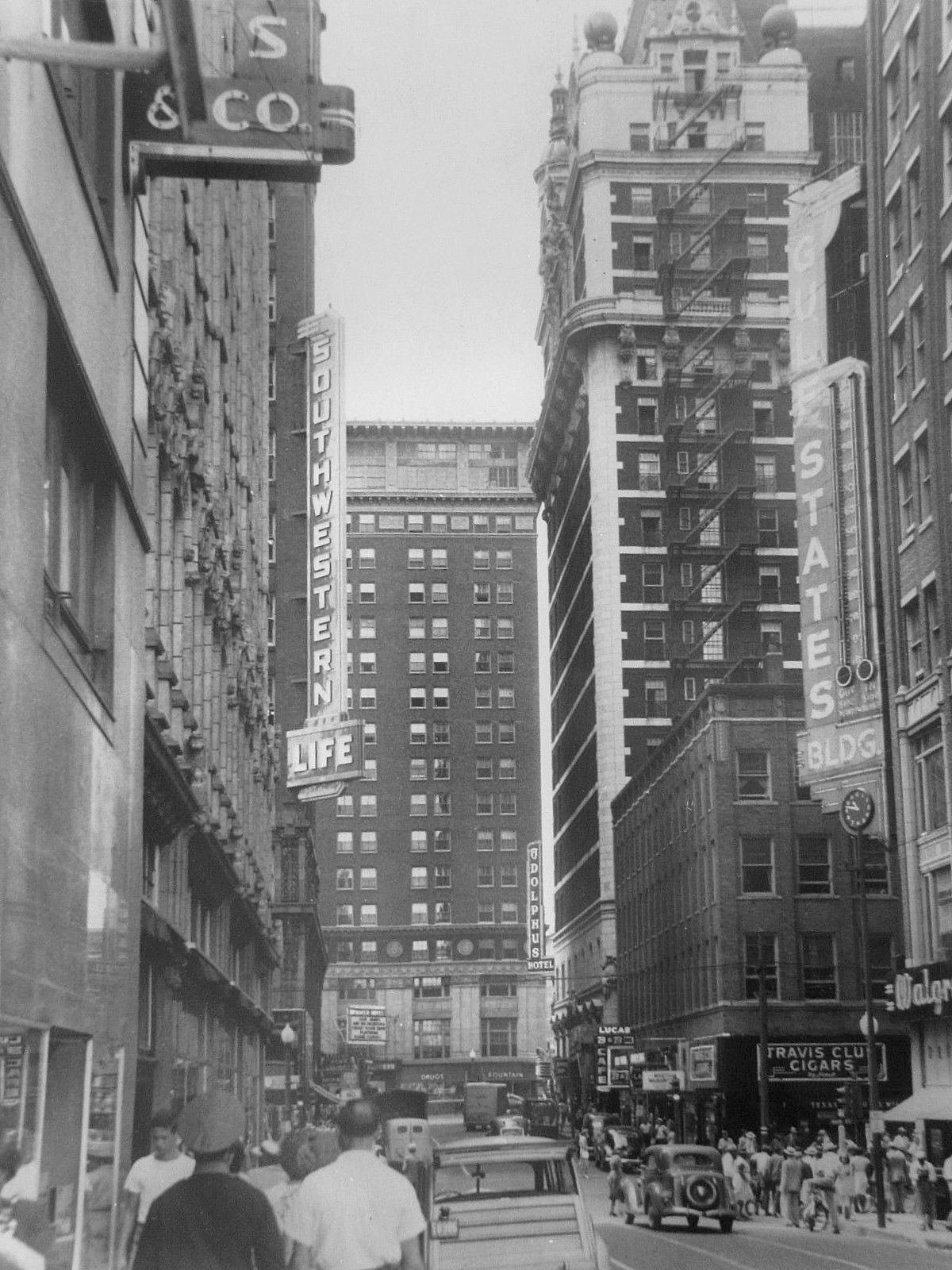
This candid photograph, a little deeper into the canyon, is one of my favorites. (Click to see a gigantic image.)

akard-looking-south_ebayvia eBay

*

From 1951 — a bit grainy, but a slightly closer view of the side of the Queen Theater at the left and the Mayfair department store, built in 1946, at the right:

akard_dpl_1951via Dallas Public Library

*

And, finally, today. Pegasus and the Adolphus are still there, but the Baker Hotel was demolished in 1980, replaced by the One AT&T Plaza/Whitacre Tower.

akard-looking-south_google_2015via Google Street View, 2014

***

Sources & Notes

The photo dated by SMU as “circa 1898” is titled “Akard Street from Akard and Pacific Avenue Intersection”; it is from the George W. Cook Dallas/Texas Image Collection, DeGolyer Library, Central University Libraries, Southern Methodist University, and it can be viewed here.

The circa 1936 photo showing Pegasus is from the Spring, 1989 issue of Legacieshere; it is from the Hayes Collection, Texas/Dallas Archives Division, Dallas Public Library, and is attributed to Denny Hayes.

The photo showing “ALL THOSE PEOPLE” is from the Dallas Museum of Art’s Uncrated blog — here — is from the Dallas Municipal Archives. They have the date as “1940,” but Liggett’s Drug Store was gone from Elm and Akard by 1936.

Other sources as noted.

Click pictures for larger images — sometimes MUCH larger images.

*

Copyright © 2015 Paula Bosse. All Rights Reserved.


Teatro Panamericano / Cine Festival — 1943-1981

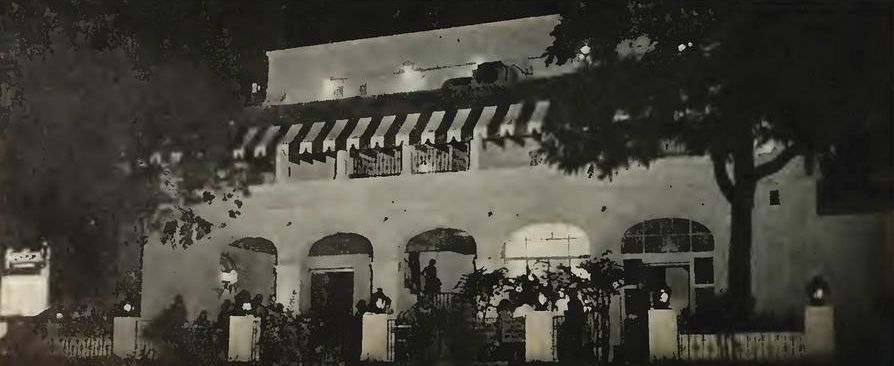
teatro_villasana_1950sEl Panamericano (click for larger image) (Villasana)

by Paula Bosse

In 1937, Joaquin José (J. J.) Rodriguez opened the first theater in Dallas to show Spanish-language movies. It was the Azteca, at 1501 McKinney Avenue, one block away from the still-there El Fenix. He soon changed the name to the Colonia and later to El Patio.

colonia_1938-directory1938 city directory

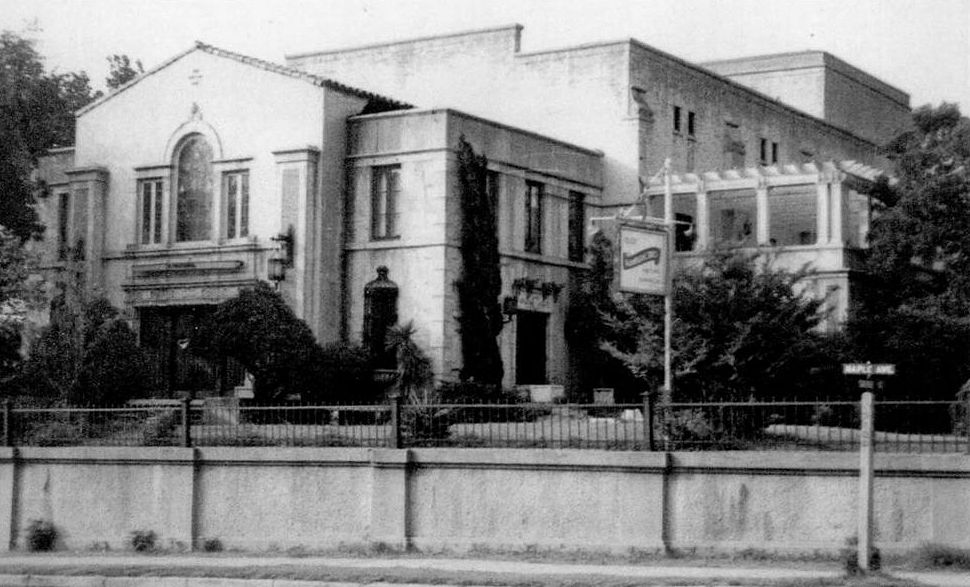
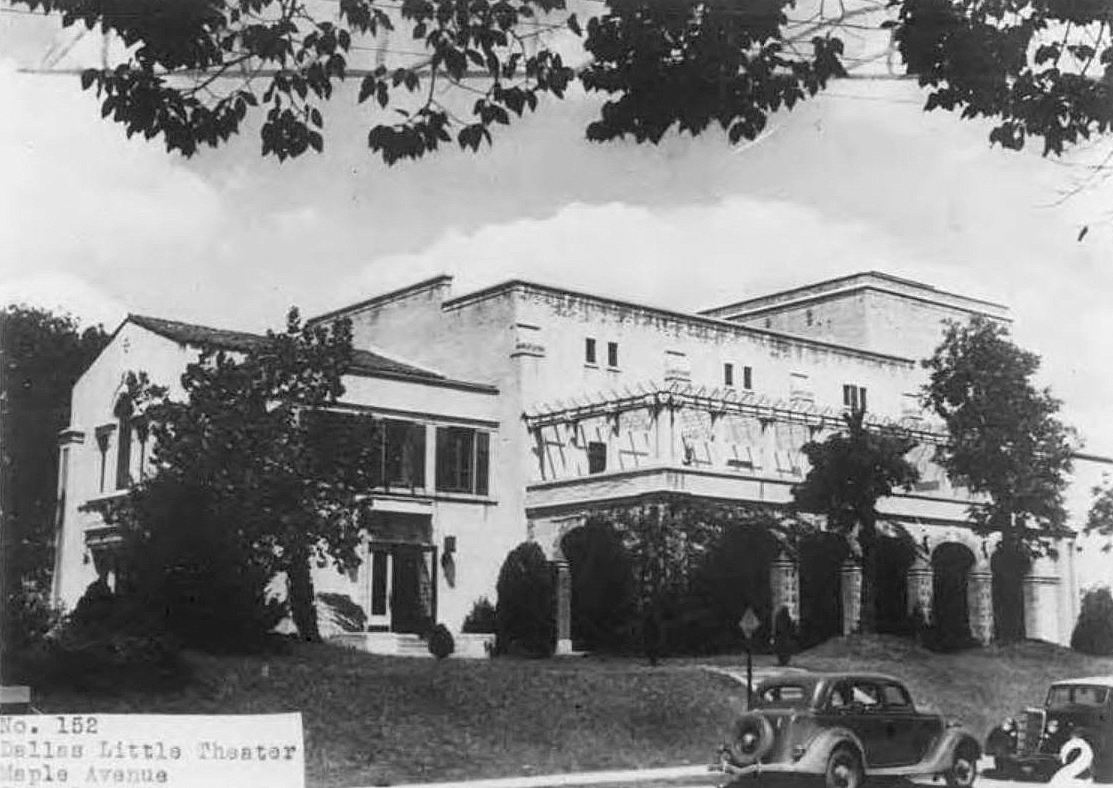
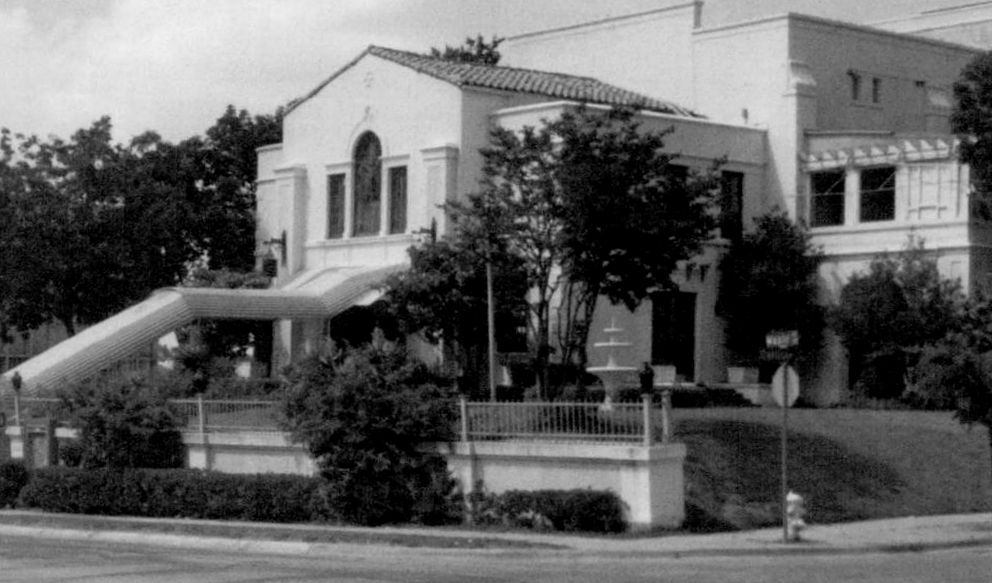
Even though a journalist later described this theater as being “dingy” and “unprepossessing” (DMN, July 31, 1944), the theater was quite successful, little surprise as the Hispanic community of the day was sorely underserved in almost every way. This endeavor was so successful that in the fall of 1943, the 36-year old entrepreneur made a big, BIG move: he bought the stunning and palatial Maple Avenue building that once housed the famed Dallas Little Theatre, an amateur theatrical group that had burst on the scene in 1927, but which had fallen on hard times in recent years.

dallas-little-theater_degolyer-lib_SMU1930s

Rodriguez raised the necessary $35,000 (equivalent to almost half a million dollars in today’s money), bought the beautiful building at 3104 Maple, and renamed it Teatro Panamericano. The angle of the article that appeared in The Dallas Morning News on Sept. 22, 1943 announcing the new theater had the new moviehouse as being a boon to students and Anglo members of the community who might need to brush up on their Spanish rather than as a welcomed entertainment venue for the “Mexican colony” living and working in the adjacent Little Mexico neighborhood.

El Panamericano was an immediate success and soon became not only a place to see movies, but also a place for Dallas’ Spanish-speaking community to meet and mingle, with PLENTY of room for all sorts of events. (It was so big that Rodriguez and his family lived in back. He also had TWO offices and more storage space than he had things to store in it. No skimping on the parking lot either — one ad touted an acre of parking space.)

The theater’s importance to the Hispanic community of Dallas was both cultural and social:

For Mexican-Americans growing up in Dallas during the ’50s and ’60s, the films at El Panamericano, were a link with their historical and cultural heritage. For some, it would be their only exposure to cultural ties; for those whose families were stressing their Americanization by using only English in the home, it was a chance to practice their Spanish. (“Festival Fades, but Mexican Movies Thrive,” DMN, Aug. 9, 1981)

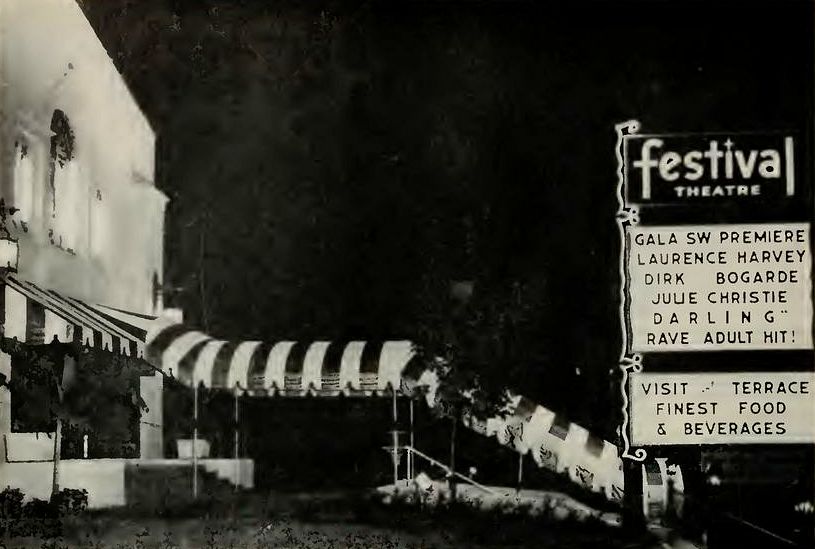
After more than 20 years of running a successful theater that catered to his core niche audience, Rodriguez was persuaded to change the theater’s focus. Mexican families had slowly moved out of the neighborhood, many to Oak Cliff where the Stevens Theater on Fort Worth Avenue had begun showing Spanish-language movies in the early ’60s and had siphoned off a large portion of Rodriguez’s audience. In 1965 the Panamericano became an arthouse cinema which showed mostly subtitled European films (and, later, underground and cult movies) — these were movie bills which were clearly aimed at college students and an upper-class Anglo audience. The Panamericano became the splashy Festival Theatre.

festival_box-office-mag_112265BoxOffice magazine, Nov. 22, 1965

An indoor-outdoor restaurant — the Festival Terrace — was added, and it boasted of being “the only theater in the history of Texas with a wine and beer license.”

festival_box-office-mag_112265-restaurantBoxOffice magazine, Nov. 22, 1965

teatro_villasana_1960s1960s (Villasana)

As impressive as the Festival and its array of films were, the theater struggled, and Rodriguez later called this period a “big mistake.”

“As soon as I could, I changed it back to the way it was before. In fact, I lost money on that deal.” (DMN, Aug. 9, 1981)

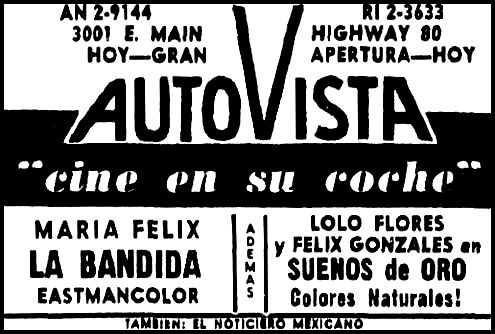
Another unusual misstep for Rodriguez at this time was his decision to open a drive-in that showed only Spanish-language films. What sounded like a great idea was another surprising failure for Rodriguez. Despite its non-stop advertising in the first half of 1965, the wonderfully-named Auto-Vista (located in Grand Prairie) lasted less than a year.

auto-vista_dmn_032565“Cine en su coche”! (March, 1965)

Rodriguez’s new-old Spanish-language theater — now the Cine Festival — was still popular, but it never regained its former glory. Rodriguez retired in 1981 and sold the property. Despite efforts by preservationists to save the beautiful Henry Coke Knight-designed building, it was demolished a few months later — in early January, 1982 — in the dead of night under cover of darkness (… that happens a lot in Dallas…). A nondescript office building was later built in its place.

J. J. Rodriguez died in 1993 at the age of 86, almost exactly 50 years after opening one of the most important entertainment venues for Dallas’ Hispanic population. He was a respected leader in the community and was for many years president of the Federation of Mexican Organizations, an organization he helped found in the 1930s. His theater was both culturally important and beloved by its patrons.

*

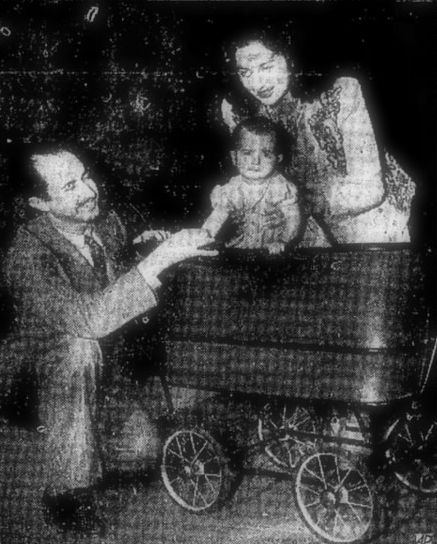
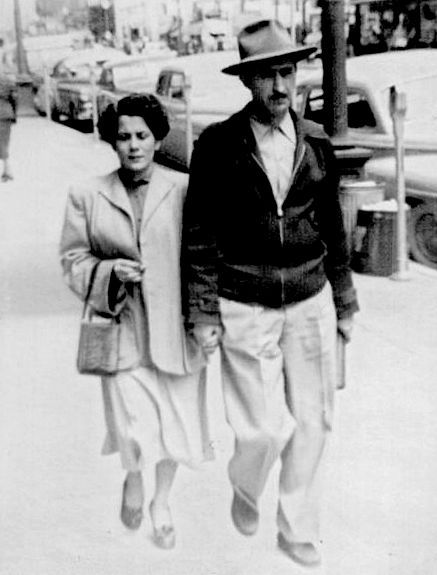
pampa-news_AP-073044J. J. with daughter and wife (Pampa News, July 30, 1944) AP photo

rodriguez_villasana_downtown_1940sWith his wife, Maria, downtown 1940s (Villasana)

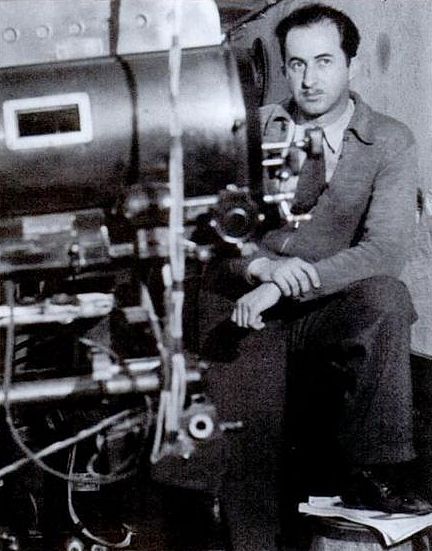
rodriguez_villasana_1950sIn the projection booth, 1950s (Villasana)

*

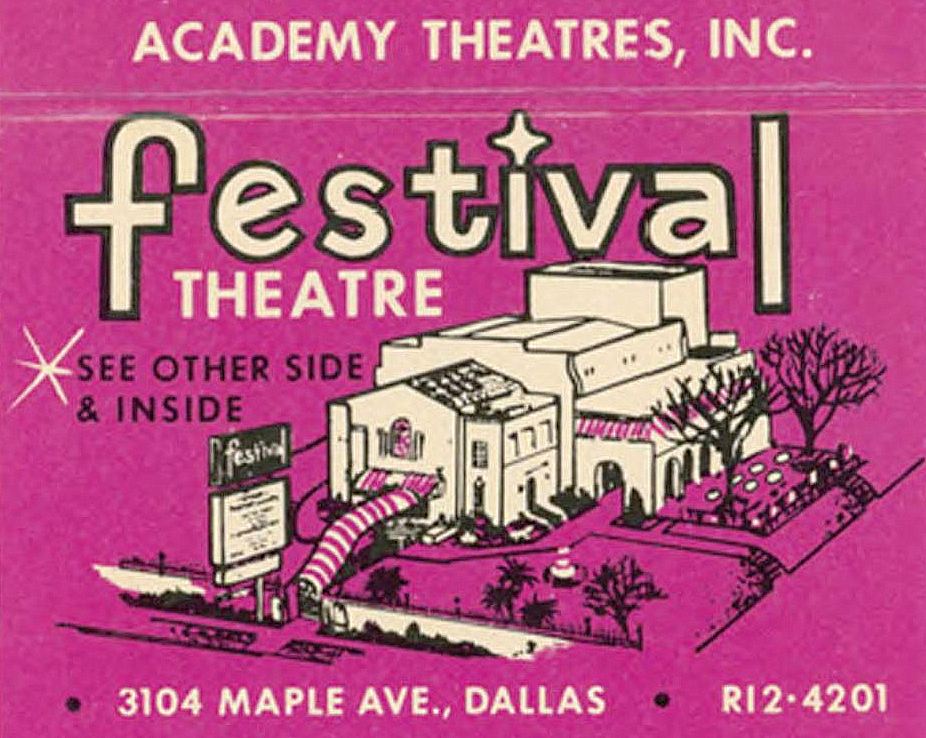
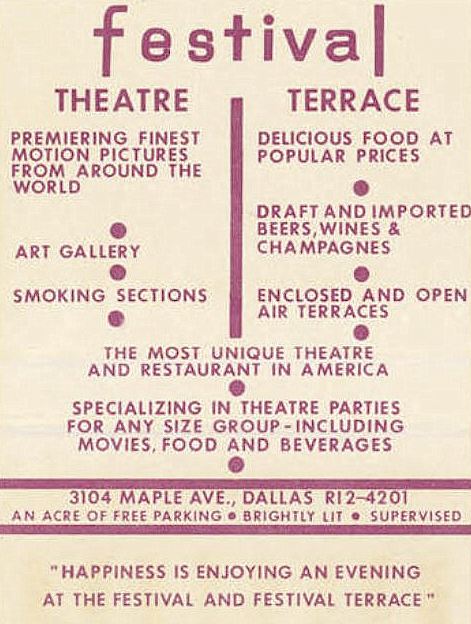
The matchbook cover image below gives an indication of how large the theater was. The building at 3401 Maple — at the corner of Carlisle, across Maple from the Maple Terrace — was gigantic.

festival-theatre_cook-collection_degolyer_smu_matchbook-cover

festival-theatre_cook-collection_degolyer_smu_matchbook-insideMatchbook via George W. Cook Collection, SMU

In a Dallas Phorum discussion (here), the space was described thusly:

It was an interesting building with an outdoor terrace restaurant, a full proscenium stage, rehearsal space downstairs below the stage, dressing rooms, shop/storage areas, and even a puppet theatre built into a wall in the balcony lobby area.

To see what the corner of Maple and Carlisle looks like now, click here (have a hanky ready). Can you imagine how wonderful it would be to still have that elegant building and still see it in use as a theater and restaurant?

**

In what may well be research overkill, I thought it was odd that there was an Azteca Theatre at 1501 McKinney a year before Rodriguez owned it. I wondered if, in fact, Rodriguez had owned the first Spanish-language movie theater in Dallas, or whether that distinction belonged to Ramiro Cortez (whose name is often misspelled as Ramiro Cortes). It seems that Cortez’s theater might have featured live performances rather than motion pictures. Like Rodriguez, Cortez had ties to Dallas entertainment — read about him here.

azteca_1937-directory1937 city directory

***

Sources & Notes

Photos with “Villasana” under them are from the book Dallas’s Little Mexico by Sol Villasana (Charleston, SC: Arcadia Publishing, 2011); all are from the personal collection of Mariangel Rodriguez. More photos of J. J. Rodriguez can be seen here (click “Next” on top yellow bar).

The full article from the Nov. 22, 1965 issue of the industry journal, BoxOffice, includes additional photos and information and can be seen here and here.

All other images and clippings as noted.

Articles on J. J. Rodriguez and his theaters which appeared in The Dallas Morning News:

  • “Pan-American Theater to Aid Spanish Study” (DMN, Sept. 22, 1943)
  • “Teatro Panamericano” by John Rosenfield (DMN, Oct. 12, 1943)– coverage of opening night festivities
  • “Maple Location Regains Swank” by John Rosenfield (DMN, Sept. 18, 1965) — about the change from El Panamericano to the arthouse Festival Theater
  • “Festival Fades, but Mexican Movies Thrive: Theater Owner Says Adios to Film Business” by Mercedes Olivera (DMN, Aug. 9, 1981) — about the closing of the Festival Theater
  • “Encore No More” (DMN, Jan. 4, 1982) — photo of the partially demolished theater
  • “Rites Set for Hispanic Leader J. J. Rodriguez — He Co-Founded Federation of Mexican Organizations” by Veronica Puente (DMN, Sept. 26, 1993) — Rodriguez’s obituary

“Dallas Theater Owner Is One-Man Pan-American Agency” — a syndicated Associated Press article by William C. Barnard — can be read here.

Read about Teatro Panamericano at Cinema Treasures, here.

Read about the competing Stevens Theater in Oak Cliff on Fort Worth Avenue, here.

*

Copyright © 2015 Paula Bosse. All Rights Reserved.