Flashback : Dallas

A Miscellany: History, Ads, Pop Culture

Category: Food

Happy Mother’s Day from Mrs. Baird’s Bread — 1949

mothers-day_mrs-bairds_freshie_dmn_050649

by Paula Bosse

Sure hope Mom can handle all that gluten!

Happy Mother’s Day!

***

Sources & Notes

Newspaper ad from 1949. The “Freshie” ad campaign — featuring a Mrs.-Baird’s-Bread-obsessed kid — ran in Texas newspapers from about 1945 to 1953. More of the ads can be seen in the post “The ‘Freshie’ Ads for *-@!!@!* Delicious Mrs. Baird’s Bread — 1945-1953,” here.

*

Copyright © 2017 Paula Bosse. All Rights Reserved.


The “Freshie” Ads for *-@!!@!* Delicious Mrs. Baird’s Bread — 1945-1953

freshie_dmn_111546
Geez, Picasso, get a grip… “YUM!”

by Paula Bosse

There’s nothing like cartoon swearing. The reader is likely to translate those random symbols into words that are probably a lot filthier than was intended by the cartoonist. …Probably.

Here are a few examples of this, found, surprisingly, in cartoon ads for wholesome Mrs. Baird’s Bread. This ad campaign — which, as far as I can tell, lasted from 1945 to 1953 — consisted of a one-panel comic called “Freshie,” illustrated for most of its lifespan by Harry Walsh. There were close to a hundred of these panels produced. (That’s a lot of bread-based humor some poor advertising copywriter had to come up with.) They were often placed directly on the comics page, alongside Pogo, Li’l Abner, and Rex Morgan M.D. “Freshie” was the name of the child with the unwavering/disturbing obsession with Mrs. Baird’s Bread. (UPDATE: I now see that the “Freshie” cartoon ad concept was used all across the country, for various brands of bread. Oh, Freshie, your love for Mrs. Baird’s bread was just for show, wasn’t it?)

Not all of them had cursing — in fact I think it might be just these four. Still, it’s a little unexpected. What would Mrs. Baird think? (Click to see larger images.)

freshie_dmn_122845
Dec. 28, 1945

freshie_dmn_060748
June 7, 1948

freshie_dmn_113049
Nov. 30, 1949

*

Copyright © 2016 Paula Bosse. All Rights Reserved.


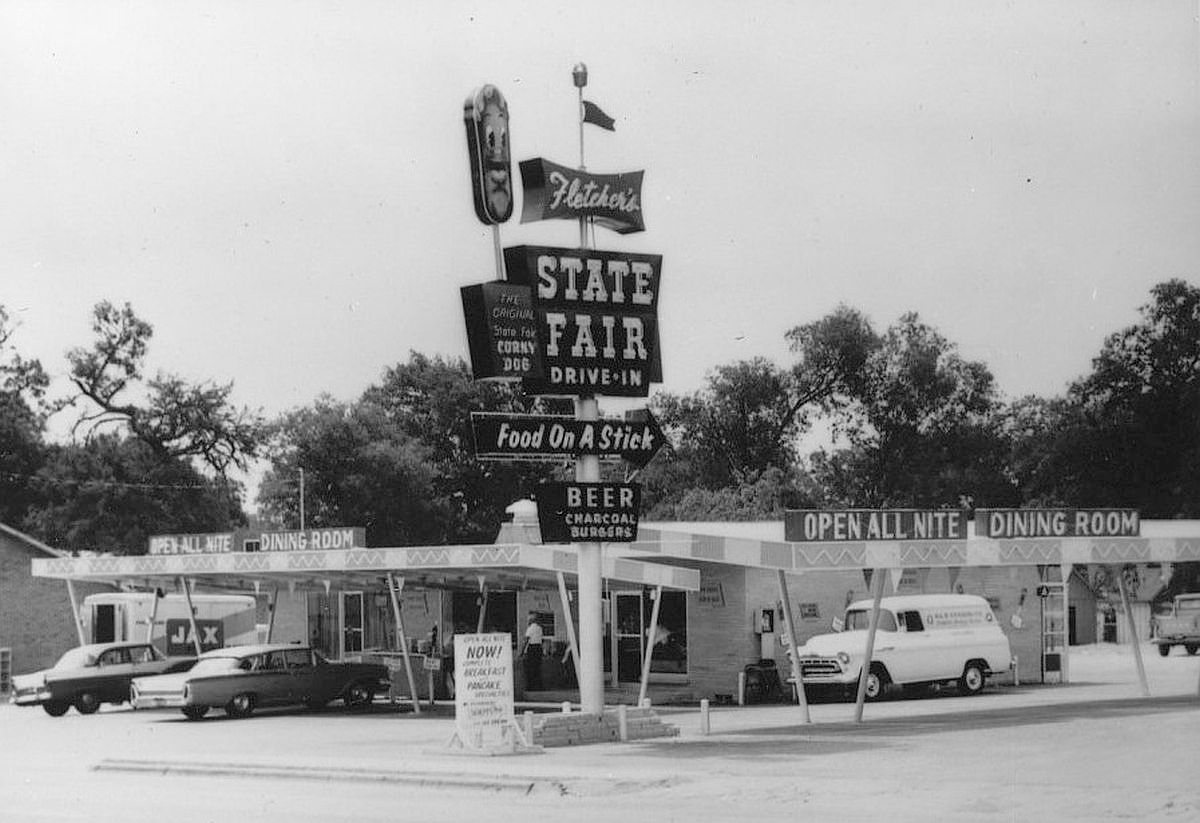
Fletcher’s State Fair Drive-In — 1960-1963

fletchers-state-fair-drive-in_DHSFood-on-a-stick, open all nite

by Paula Bosse

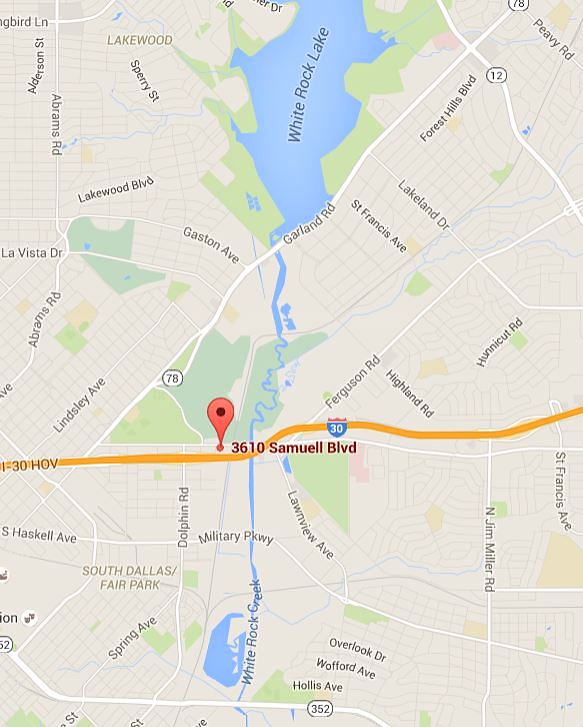
The legendary Fletcher’s Corny Dog once had its own drive-in! You didn’t have to wait until the State Fair of Texas rolled around to get your favorite “food on a stick” fix — you just needed to head to 3610 Samuell Boulevard, across from the Tenison Golf Course.

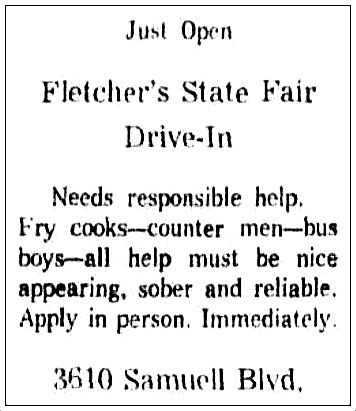
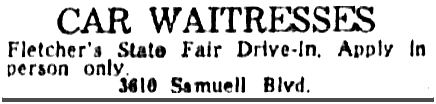
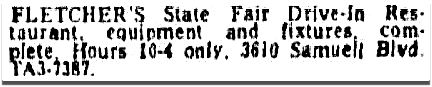
Sadly, there was a lot of drive-in and tavern competition along Samuell back then (Keller’s was practically next door!), and the State Fair Drive-In seems to have lasted only a little over three years, from the spring of 1960 to the fall of 1963.

I’d love to see this around NOW! Come on, Fletcher’s family: bring this back!

*

fletchers_dmn_051560May , 1960

fletchers_dmn_062960June, 1960

fletchers_dmn_102463_for-sale
Oct., 1963

***

Sources & Notes

Top photo from the Dallas Historical Society.

An article on Neil Fletcher’s new restaurant and a photo of the interior can be found in the archives of The Dallas Morning News: “State Fair Drive’In Fixtures Designed, Installed by Bab’s” (DMN, June 12, 1960).

After the Fletcher’s Drive-In closed, it was replaced by a Red Coleman liquor store, and was most recently a club, El Palmeras. Google Street View shows the shabby neighborhood these days, here.

3610-samuall_googleGoogle Maps

An entertaining interview with the late Neil Fletcher appeared in the Oct. 1982 issue of D Magazine, here.

A Travel Channel video focuses on the famed corny dog, here.

A previous Flashback Dallas post about that same stretch of Samuell Blvd. — “Red’s Turnpike Open-Air Dance: An East Pike/Samuell Blvd. Joint — 1946” — is here.

UPDATE: I’ve received many comments that Fletcher’s had several short-lived drive-thru restaurants which started popping up in the mid-’80s. More on the franchise plans can be read in the article “Fletcher and Firm Very Much Alive” by Donna Steph Hansard (DMN, Aug. 5, 1984).

*

Copyright © 2016 Paula Bosse. All Rights Reserved.

“The Pause That Refreshes at the Texas Centennial” — 1936

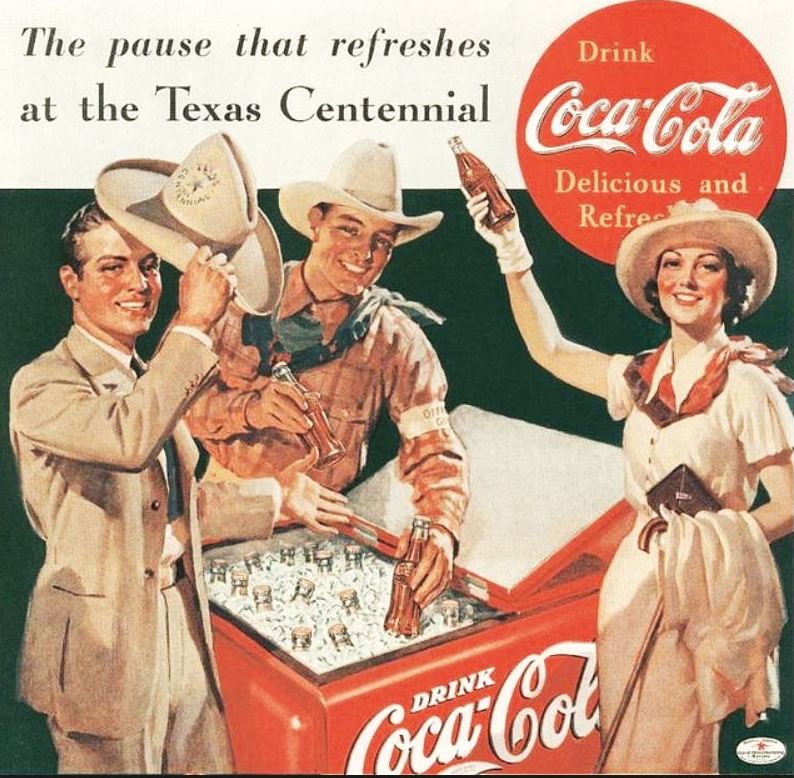
tx-centennial_coke-ad_pinterestBelly on up to the Coke cooler, pardner… (click for larger image)

by Paula Bosse

What do Stetson-wearing Texans enjoy drinking more than sarsaparilla? Coca-Cola, of course!

This ad led me to discover that the Coca-Cola Bottling Company of Dallas set up a working mini bottling plant in Fair Park during the Texas Centennial, costing a cool $60,000 and taking up 4,100 square feet of the Varied Industries Building. 100 bottles a minute were produced, destined for thirsty customers who bought the five-cent drinks there at the plant or at concession stands around the park. A photo accompanying a Dallas Morning News blurb about the mini bottling plant — which will be marked by a thirty-foot electric tower brought from the Century of Progress…” (DMN, Feb. 6, 1936), looked like the stunning Century of Progress photo seen here.

tx-centennial_coca-cola_ebay_1936

***

Top ad found on Pinterest; full ad found on eBay.

The “Varied Industries Building” apparently burned down in 1942 and was replaced in 1947 by the Automobile Building.

*

Copyright © 2016 Paula Bosse. All Rights Reserved.

School Lunches of Yesteryear

lunch-ladies_frontier-top-tier_dplMorning prep work: the calm before the storm

by Paula Bosse

Above, Dallas lunch ladies shelling what looks like black-eyed peas for an unidentified school’s midday meal. I can’t say I’ve ever imagined lunchroom employees ever doing something like this. In the 1920s and ’30s, schools used fresh foods when they could, but they were definitely using a lot of canned fruits and vegetables, too. All this effort — and all these women — for peas.

In a quick search for what school lunch menus were like in the late ’20s and early ’30s, here were a few delicacies that would never be found in a school cafeteria these days:

  • Roast veal
  • Sardine sandwiches
  • Creamed onions
  • “Italian hash”
  • Banana and peanut salad
  • Salmon loaf
  • Tongue salad
  • Stuffed dates
  • Prune whip/prune salad/prune pudding

Yummy!

***

Sources & Notes

Photo from the Texas/Dallas History & Archives Division, Dallas Public Library.

*

Copyright © 2015 Paula Bosse. All Rights Reserved.

Sivils Drive-In, An Oak Cliff Institution: 1940-1967

sivils_tichnorOak Cliff’s landmark hangout (click for larger image)

by Paula Bosse

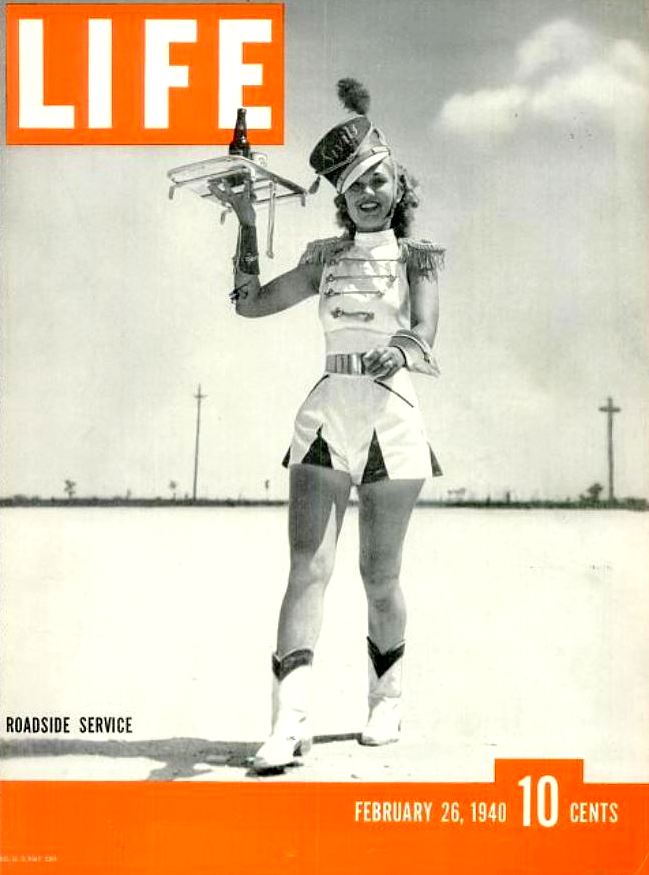
When J. D. Sivils (1907-1986) and his wife, Louise (1918-2006), brought their “Sivils” restaurant to Dallas in June 1940, their Houston drive-in of the same name had already been featured as a Life magazine cover story, garnering the kind of incredible national publicity that any business owner would have killed for! And all because of their carhops — “comely, uniformed lassies” whom Mrs. Sivils insisted on calling “curb girls” (which might have a slightly different connotation these days…). Life — never a magazine to overlook pretty young girls in sexy outfits — not only devoted a pictorial to the “curb girls,” they also put one of them (Josephine Powell of Houston) on the cover, wearing the Sivils’ uniform of (very, very short!) majorette’s outfit, plumed hat, and boots.

sivils_houston_life-mag_022640Feb. 26, 1940

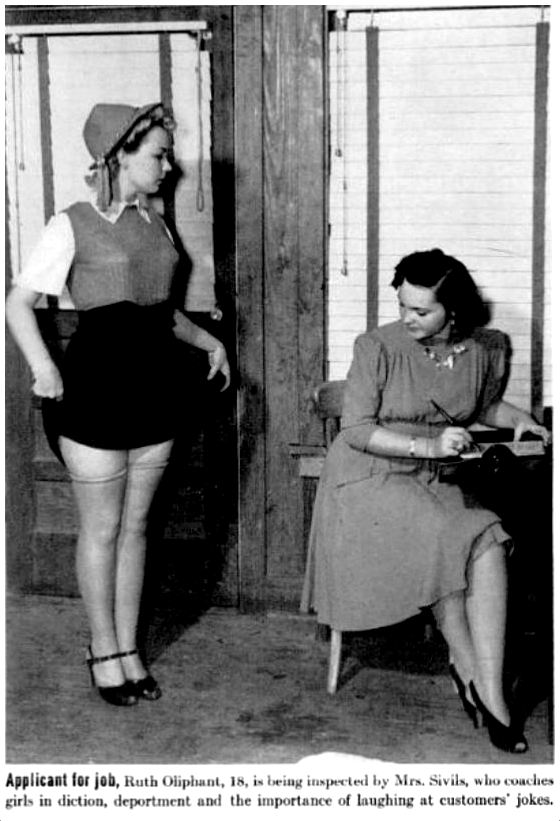
louise-sivils_life-magazine_1940Louise Sivils and a prospective “curb girl” (Life)

Four months after the blitz of national attention the drive-in received from the Life story, Sivils came to Dallas. The drive-in was located in Oak Cliff at the intersection of West Davis and Fort Worth Avenue on “three acres of paved parking space.”

sivils-map

The day the drive-in opened, a photo of the not-yet-legendary Sivils appeared in The Dallas Morning News (see “Sivils to Open Dallas Place Thursday,” DMN, June 27, 1940). Other than this, there is surprisingly little in the pages of The News about this drive-in’s opening — surprising because it became such a huge part of the lives of Oak Cliff’s teens in the ’40s, ’50s, and ’60s. It’s one of those places that seems to have reached almost mythic proportions on the nostalgia scale.

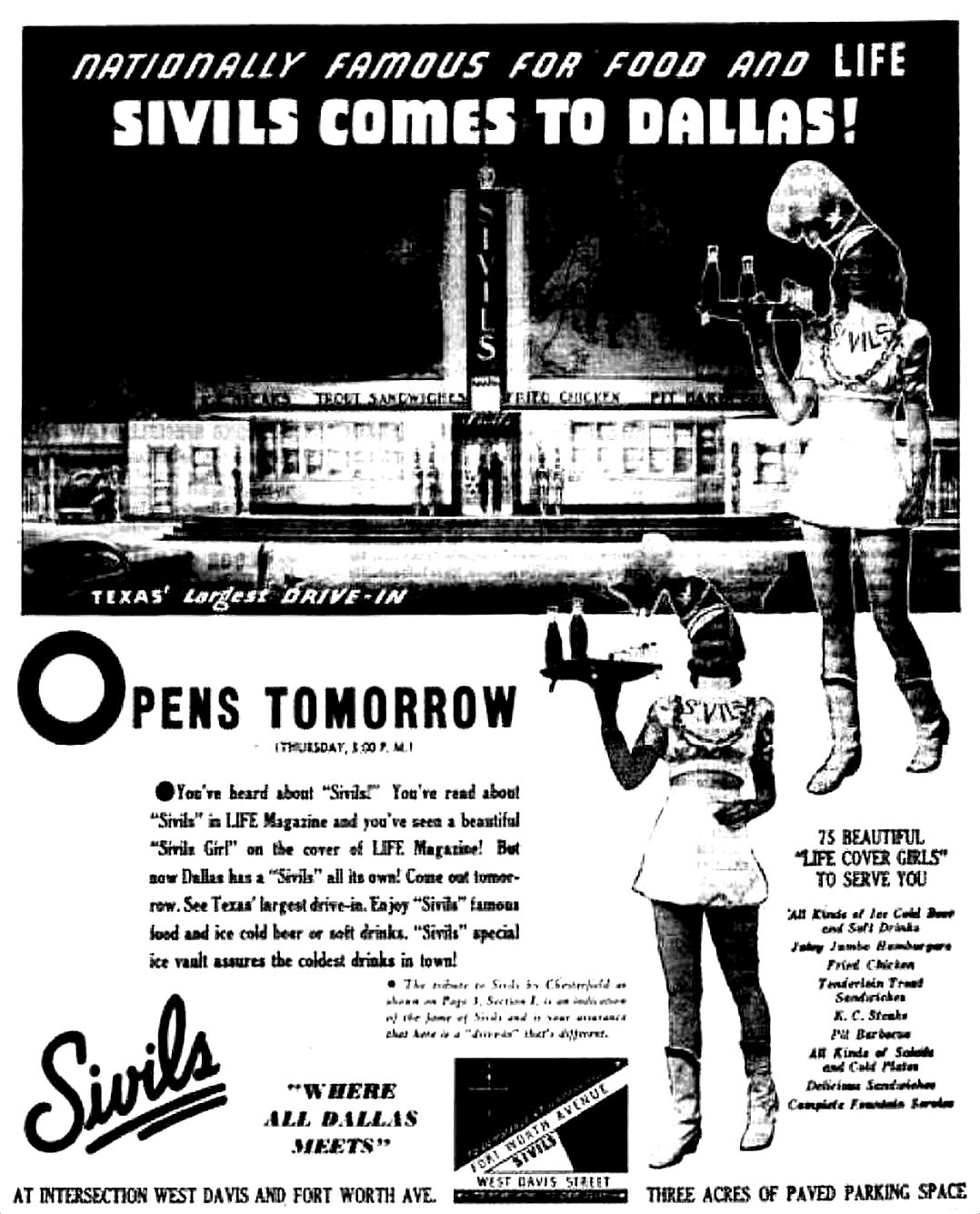
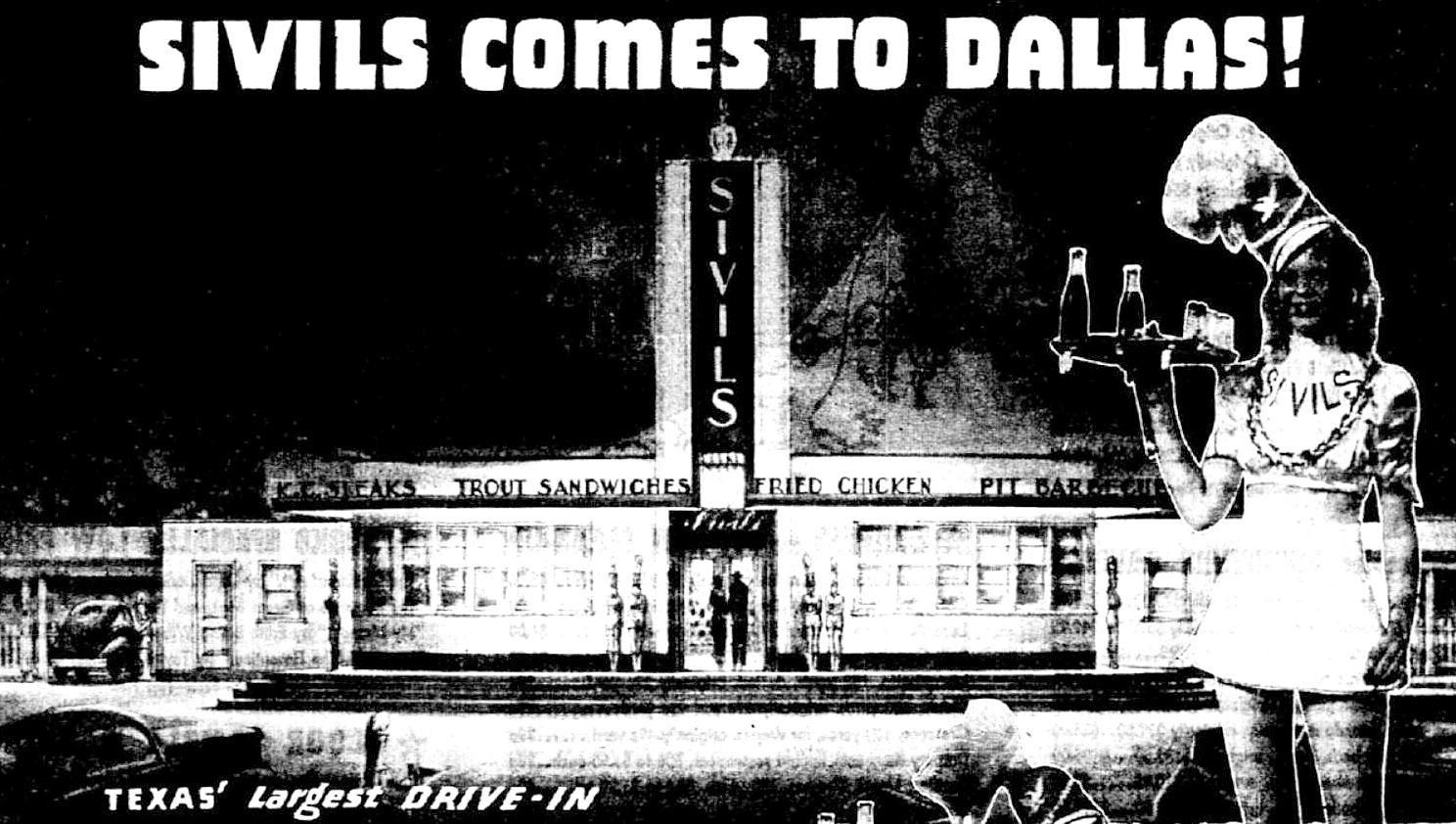
Sivils didn’t quietly sneak into town, though. Take a look at this very large, very expensive newspaper ad, which ran the day before OC’s soon-to-be favorite hang-out opened. (Click for larger image.)

sivils_dmn_062640_lgJune 26, 1940

*

Nationally Famous for Food and LIFE
SIVILS COMES TO DALLAS!

Texas’ largest drive-in
Opens tomorrow

(Thursday 3:00 PM)

You’ve heard about “Sivils”! You’ve read about “Sivils” in LIFE Magazine and you’ve seen a beautiful “Sivils Girl” on the cover of LIFE Magazine! But now Dallas has a “Sivils” all its own! Come out tomorrow. See Texas’ largest drive-in. Enjoy “Sivils” famous food and ice cold beer or soft drinks. “Sivils” special ice vault assures the coldest drinks in town!

75 Beautiful “LIFE Cover Girls” to Serve You

All Kinds of Ice Cold Beer and Soft Drinks
Juicy Jumbo Hamburgers

Fried Chicken
Tenderloin Trout Sandwiches
K.C. Steaks
Pit Barbecue
All Kinds of Salads and Cold Plates
Delicious Sandwiches
Complete Fountain Service

Sivils – “Where All Dallas Meets”
At intersection West Davis and Fort Worth Ave.
Three Acres of Paved Parking Space

*

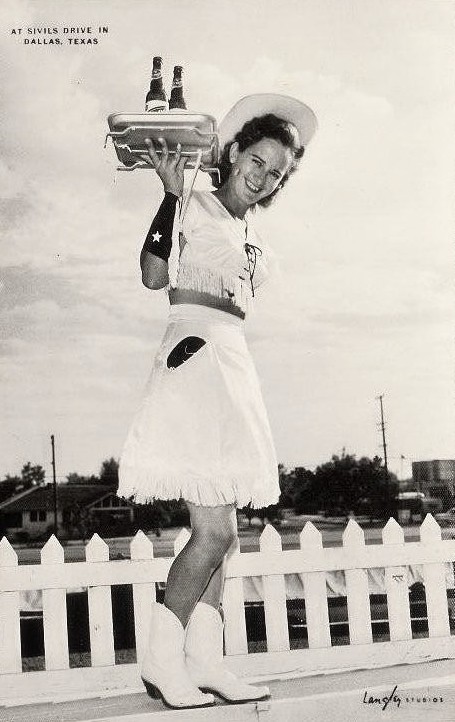
100-150 “curb girls” were employed by Sivils at any given time in those early days, and it was open 24 hours a day. The place was hopping. Sounds fantastic. Wish I’d seen it.

sivils_matchbook_coltera-flickrvia Flickr

sivils_carhop_postcard_ebay
eBay

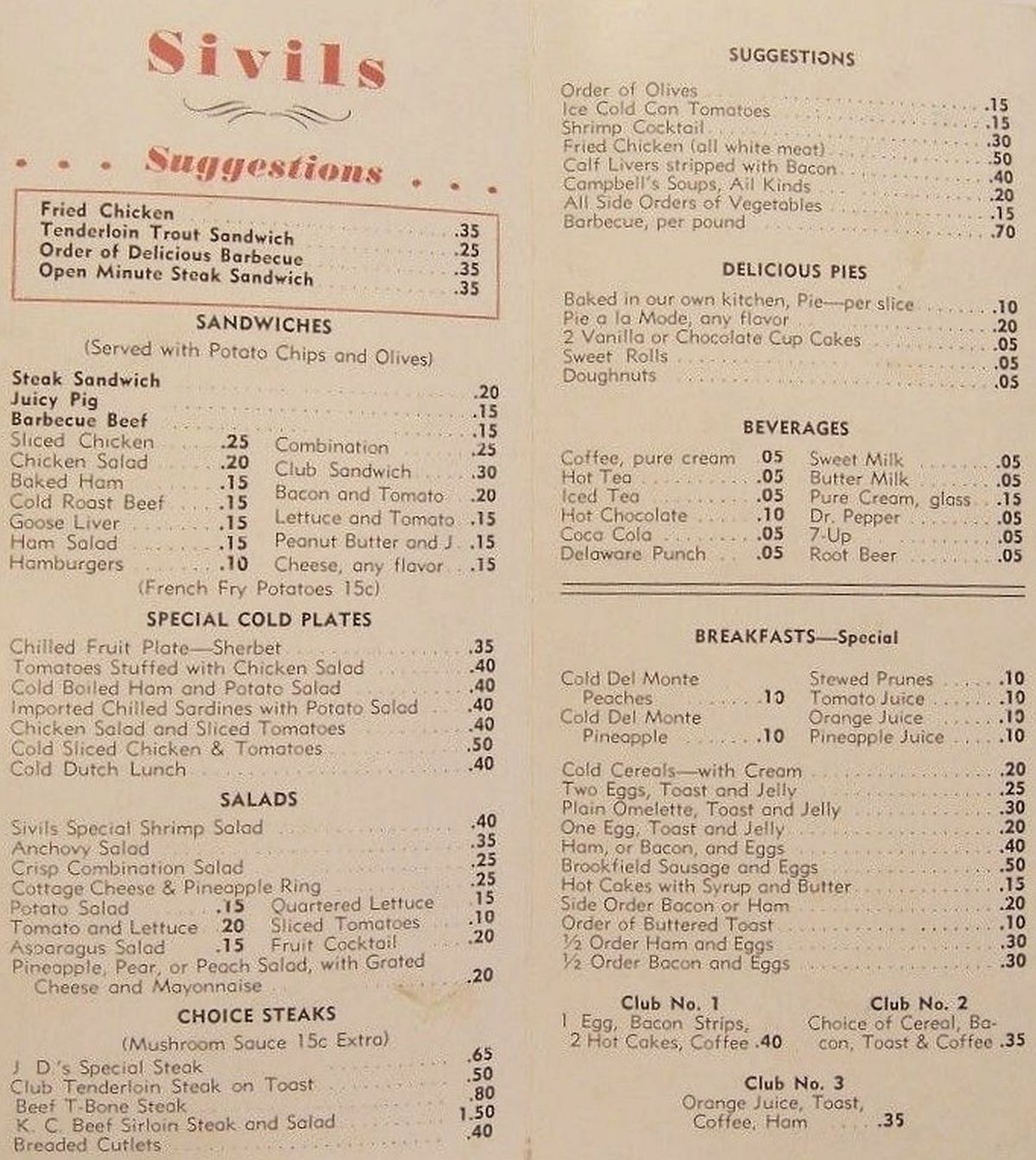
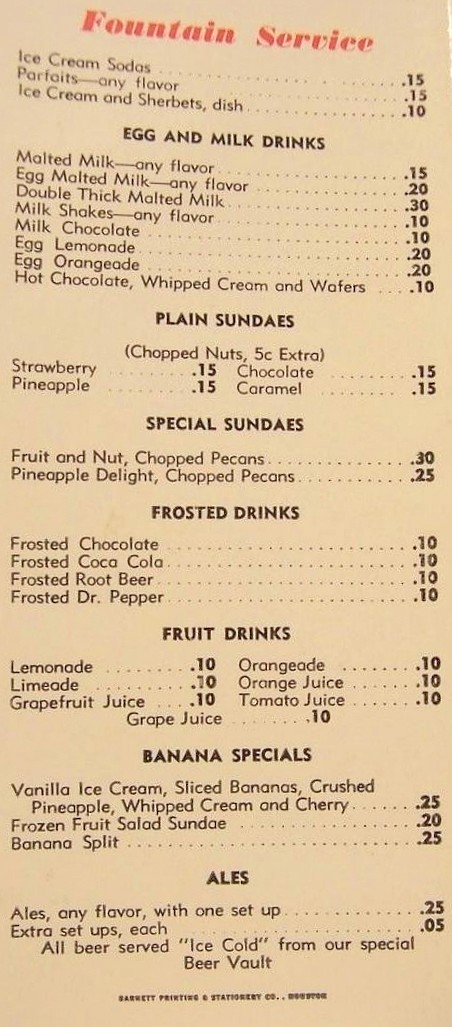
Below, a scanned menu (click to see larger images):

sivils-menu_1940s_ebay_cover

sivils-menu_1940s_ebay_b

sivils-menu_1940s_ebay_avia eBay

***

Sources & Notes

Top postcard from the Boston Public Library Tichnor Brothers Postcard Collection on Flickr, here.

Read the 4-page Life article (and see several photos of the Houston “curb girls”) here (use the magnifying glass icon at the top left to increase the size of the page).

Interesting quote from that article:“They work in 7½-hour shifts, six days a week, for which they get no pay but average $5 a day in tips.” Doesn’t sound legal…. (The Inflation Calculator tells us that $5 in 1940 money is equivalent to just over $83 in today’s money.)

Sivils closed in 1967, possibly because Mr. and Mrs. Sivils wanted to retire, but it seems more likely that Oak Cliff’s being a dry area of Dallas since the 1950s was killing its business. Check out the News article “Big Head Expected as Oak Cliff Beer Issue Foams” by Kent Biffle (DMN, Aug. 17, 1966) which appeared just months before another election in which the “drys” outvoted the “wets.” (More on Oak Cliff’s crazy wet-dry issues, here.)

J. D. Sivils was interviewed in a short documentary about Dallas carhops, filmed in the early 1970s. In it, he talks about the early days of Sivils and — best of all — there is film footage galore of the drive-in from his collection. Watch it in my previous post — “‘Carhops’ — A Short Documentary, ca. 1974” — here. (Below a screenshot of Sivils from the film.)

sivils-carhops-film

Read the article “Carhops, Curb Service, and the Pig Sandwich” by Michael Karl Witzel (Texas Highways, Oct. 2006) in a PDF, here (increase size of article with controls at top of page).

Another Flashback Dallas post on drive-in culture — “Carhops as Sex Symbols — 1940” — is here.

sivils_dmn_062640-det

Click pictures for larger images.

*

Copyright © 2015 Paula Bosse. All Rights Reserved.

“Carhops” — A Short Documentary, ca. 1974

carhops_title
Schlitz on its way…

by Paula Bosse

The carhop is an oddly American invention — and it began here in Dallas in the 1920s, with boys and young men serving customers in cars at J. G. Kirby’s Pig Stand drive-in restaurants. In 1940, Sivils hit Dallas, but this time with young women as servers — young women in skimpy outfits. There was no looking back — from then on, pretty girls showing a lot of leg and hoping for big tips carried trays of food, soft drinks, and beer to cars full of waiting customers.

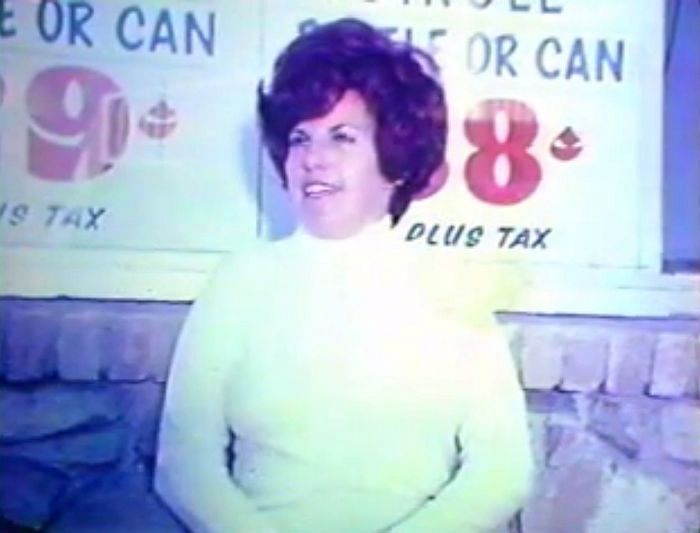
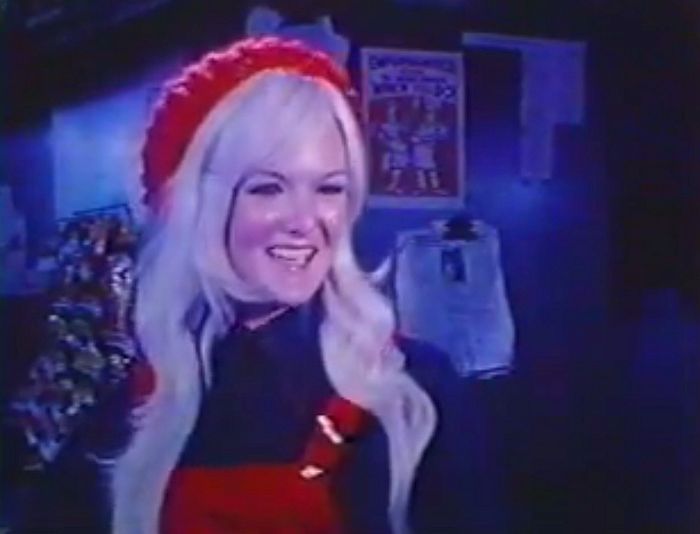
One of the few remaining “old school” drive-ins is Keller’s on Northwest Highway, still doing good business today. Around 1974 or 1975, SMU film teacher Pat Korman made a short documentary about Dallas carhops past and present (the result, it seems, of reading a Dallas Morning News article by Rena Pederson). He interviewed B. J. Kirby (owner of Kirby’s steakhouse on Lower Greenville and son of Jesse Kirby, founder of the Pig Stand pig-sandwich empire, which, as legend has it, had the very first carhops), J. D. Sivils (owner of Sivils drive-ins, who, along with his wife, was an important figure in the evolution of curb-side dining), and Jack Keller (owner of Keller’s Hamburgers). The three businessmen reminisce about the early days of drive-in restaurants in Dallas as a lot of cool historical film footage unspools and photographs from the ’20s to the ’50s are flashed on the screen. Also interviewed are four women carhops who were working at Keller’s at the time, talking about their jobs.

It’s a cool film. Big cotton-candy hair, accents you wish were still around, and cans and cases of Schlitz, Schlitz, Schlitz.

The 14-minute film is in two parts on YouTube. Here is the first part:

*
And here is the second part:

*
Below, screenshots of the interviewees.

sandy-carhopsSandy

shirley-carhopsShirley (as of Jan. 2015, she’s been a fixture at Keller’s for 50 years!)

rita-carhopsRita

nancy-carhopsNancy

kirby_carhopsB. J. Kirby

sivils-carhopsJ. D. Sivils

keller-carhopsJack Keller

kellers-menu-board_carhopsNo. 5 — 80¢

***

Sources & Notes

“Carhops” — filmed sometime in the early ’70s — was directed by Patrick Korman, shot by Ron Judkins, and produced by Don Pasquella. It premiered at Jesuit High School in April 1976. The film is on YouTube in two parts, here and here. (By the way, if you look at the YouTube comments under part two, you’ll see a comment from Sandy herself. She’s still looking good in the avatar photo.) (The music at the beginning and end of the film is great! I’m pretty sure it’s the legendary steel guitarist Ralph Mooney and the equally legendary guitarist James Burton; I love those guys! I urge to go get a copy of their album “Corn Pickin’ and Slick Slidin.'”)

Rena Pederson is thanked in the credits. She wrote a great article in The Dallas Morning News called “Carhops Fading, Those Were the Days” (Aug. 25, 1974) — she interviewed many of the same people seen in the film.

The Keller’s Northwest Highway location celebrates its 50th anniversary this year. Shirley — one of the carhops featured in the film — has worked there since it opened in 1965. As of Jan. 2015, she was still there! Go by and see her! Check out a Lakewood Advocate story on Shirley, here.

Also, take a look at a Dallas Morning News article on Keller’s 50th anniversary, here — scroll down to the slideshow to check out some great photos from its early days.

Read about sexy male carhops who plied their trade in skimpy outfits — a short-lived fad in Dallas inspired by the success of drive-ins like Sivils — in my previous post “Carhops as Sex Symbols — 1940,” here.

*

Copyright © 2015 Paula Bosse. All Rights Reserved.

Nolan Ryan’s Celebratory Pancake Breakfast — 1972

nolan-ryan© Bettmann/CORBIS

by Paula Bosse

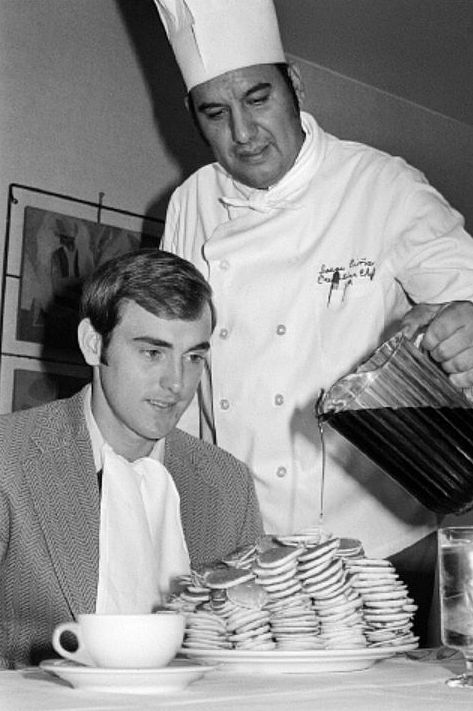
In 1972, future baseball hall-of-famer and Texas Rangers legend Nolan Ryan (then a California Angel) was photographed in Dallas as he sat mesmerized by a platter of 302 silver-dollar pancakes and an iced-tea-sized pitcher of syrup. The celebratory breakfast was served to him at the Sheraton Dallas the morning after he became only the sixth pitcher in major league history to strike out more than 300 batters in a season. (His opponents the previous night — September 25, 1972 — had been the Rangers, the team he would one day play for and preside over as president and CEO.)

The UPI Telephoto wire photo ran on Sept. 27, 1972 above the following caption:

302 PANCAKES — Ever wonder what 302 strikeouts in a season will get you? If you’re a batter, you may lose your job, but if you’re a pitcher like Nolan Ryan, left, of the California Angels, [you] will at least get 302 silver dollar pancakes. This was the breakfast that awaited Ryan Tuesday after his 3-hit, 12-strikeout win over the Texas Rangers Monday. The executive chef at the Sheraton Dallas [Isaac Pina] produced the breakfast for the Alvin native, a former New York Met, who is the sixth pitcher in major league history to strike out more than 300 batters in one season.

Twelve strike-outs!

ryan_FWST_092672Fort Worth Star-Telegram, Sept. 26, 1972

Judging by the expression on his face at the next day’s breakfast table, it’s pretty obvious the 25-year old Nolan Ryan enjoyed his triumph.

***

Sources & Notes

Photo ©Bettmann/CORBIS. The photo is also seen on this page, from The Guardian, which shows a collection of really great historic baseball photos — a bit of a surprise, coming from a British newspaper!

The photo was published in newspapers around the country; the quoted wire copy appeared in the Sept. 27, 1972 edition of The Waxahachie Daily Light.

To read a passage from the book Nolan Ryan’s Pitcher’s Bible in which he writes about the importance of his high-carb breakfasts (Day One: Pancakes…), see here.

The Wikipedia entry on Nolan Ryan is here; his stats are here.

*

Copyright © 2015 Paula Bosse. All Rights Reserved.


Dallas’ Kosher Delis — 1921

fram_passover_jewish-monitor_040821

by Paula Bosse

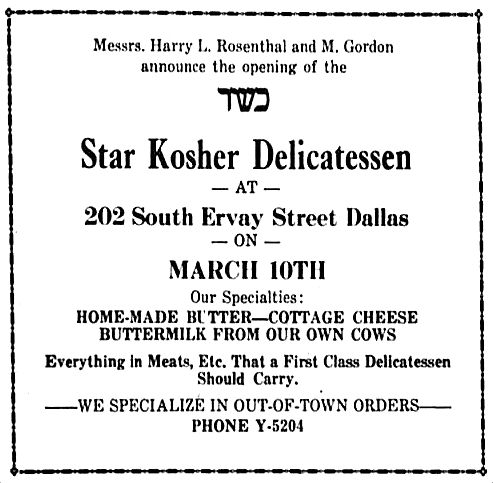
Dallas once had a lot of mom-and-pop Jewish delicatessens and markets. Would that that were true today….

Here are a few ads from the pages of the Fort Worth-based Jewish Monitor (the “Leading Jewish Journal of the Great Southwest”) from April, 1921, published in the lead-up to Passover.

chicago-deli_jewish-monitor_040821

sterns-deli_jewish-monitor_040821

star-deli_jewish-monitor_040121

goldin-meat-mkt_jewish-monitor_040821

***

All ads from The Jewish Monitor, April 8, 1921 (except for the Star Kosher Delicatessen ad, which was from the April 1, 1921 edition). The April 8 edition of the paper can be viewed in its entirety at the Portal to Texas History site, here.

As this is Passover, my previous related post, “The Margules Family’s Passover Seder,” can be read here.

*

Copyright © 2015 Paula Bosse. All Rights Reserved.


Carhops as Sex Symbols — 1940

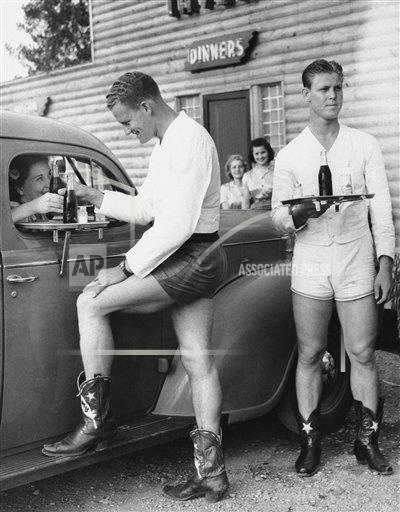
male-car-hops_AP_1940“At your service, ma’am…” / AP Photo

by Paula Bosse

In 1940, Dallas was in a tizzy about the sudden fad of scantily-clad “girl carhops.” This scourge had made its way to Dallas from Houston (brought to Oak Cliff by the enterprising husband and wife team behind Sivils Drive-In), and in April of 1940, it was a newspaper story with, as it were … legs. For a good month or two, stories of sexy carhops were everywhere.

The girls started wearing uniforms with very short skirts — or midriff-baring costumes with cellophane hula skirts. Some of the women reported an increase in tips of $25 or more a week — a ton of money for the time.

The public’s reaction ranged from amusement to outrage. There were reports of community matrons who reported the “indecent” attire to the police department and demanded action. Other women were annoyed by the objectification of young womanhood. Lawmakers in Austin discussed whether the practice of waitresses exposing so much extra skin posed a health risk to consumers.

But it wasn’t until a woman from Oak Cliff piped up that something actually happened. She complained that she didn’t want to look at girls’ legs when she stopped in at her local drive-in — she wanted to look at men’s legs. Drive-in owners thought that was a GREAT idea, and the idea of the scantily-clad male carhop was born.
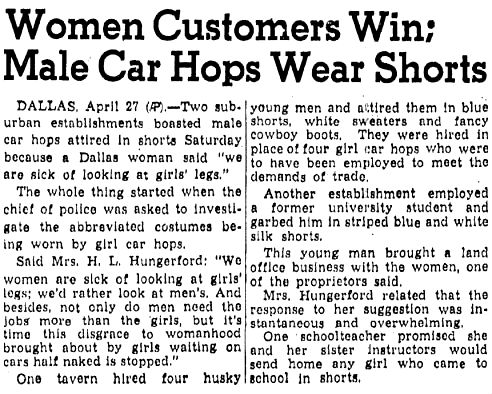
carhops_FWST_042840Fort Worth Star-Telegram, Apr. 28, 1940 

One might think that the woman behind this “equal ogling” campaign was sort of proto-feminist, until you get to the part where she said that the whole girl carhop thing was “wrong socially and economically and should not be tolerated” (DMN, Apr. 27, 1940) — not because of the skin flashed, but because men needed jobs, not girls. And that also raised hackles. Two married women who had been carhops wrote to the Dallas News to speak up for these girls and women who were “at least coming nearer to making a living wage than at any other time of their existence. […] The girl carhops are either supporting their family or sharing the expenses. […] Why all the storm about a leg? It is nothing more than you see at a movie and a vaudeville” (DMN, May 5, 1940).

The photo at the top ran in newspapers around the country with the headline: “Adonis and Apollo of Roadside Bring Trade to Daring Stand.”

First large roadside stand Friday to bow to the demand of Dallas women and feature husky young male carhops in shorts was the Log Lodge Tavern at Lemmon and Midway where four six-footers found jobs. Above, in blue shorts, white sweatshirt and cowboy boots, Joe Wilcox serves Pauline Taylor who smiles her approval of the idea. Bound for another car is James Smith, at right.

April, 1940 must have been a slow news month, because this story really got around (click to see a larger image).
sexy-carhops_corsicana-daily-sun_042740Corsicana Daily Sun, April 27, 1940

One intrepid reporter even tracked down a Texas Ranger (!) to ask his opinion, to which the Ranger replied, “…letting those roadside glamor boys wear boots is nothing more than a slam at the state. People think of booted Texans as men, not as fancy-panted carhops.” The whole article, below, is pretty amusing.
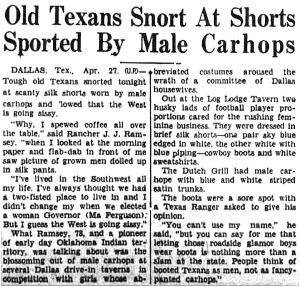
sexy-carhops_anniston-AL-star_042840Anniston (AL) Star, April 28, 1940

There were other male carhops around town, some not quite so hunky. This guy — game as he was — really needed to reconsider his outfit.
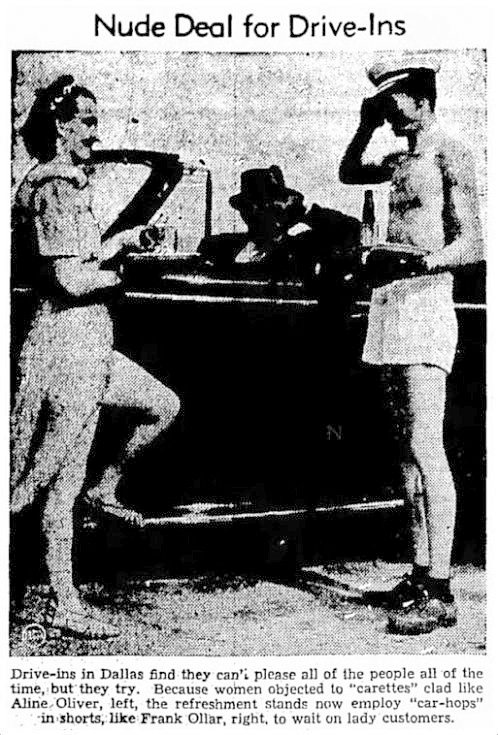
carhops_xenia-ohio-daily-gazette_050340Xenia (Ohio) Daily Gazette, May 3, 1940

But back to the female carhops and their siren-like hold over their male customers. This was, by far, the best story to hit the wires:
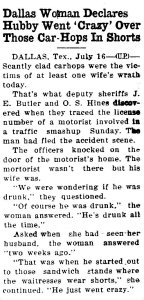
sexy-carhops_waxahachie-daily-light_071640
Waxahachie Daily Light,  July 16, 1940

***

Sources & Notes

Top image from the Associated Press, 1940. 

The Log Lodge Tavern was located at 7334 Lemmon Avenue, which was across from Love Field and adjacent to the Log Lodge Tourist Court. It was located approximately where the red circle is below, on a page from the 1952 Mapsco (click for larger image).
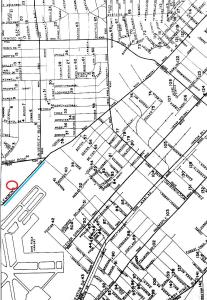
lemmon-ave_mapsco-1952

Check out these related articles from The Dallas Morning News:

  • “Skimpiest Costumes Bring Biggest Wages” (DMN, April 24, 1940)
  • “Women To Fight Girl Carhops; Slogan: Let Us See Men’s Legs” (DMN, April 26, 1940)
  • “Adonis and Apollo of Roadside Bring Trade to Daring Stand” (DMN, April 27, 1940)
  • “Word For Carhops Grass Skirts And All” (letter to the editor) (DMN, May 5, 1940)
  • “Went Crazy Over Car Hops, Wife Says of Fugitive” (DMN, July 16, 1940)

UPDATE: This has been a weirdly popular post — it’s gotten thousands and thousands of hits and even resulted in a short radio interview on Dallas’ public radio station, KERA. I don’t really add anything new to this story, but if you’d like to listen to the interview conducted by Justin Martin, it is here.

If you like what you’ve seen on Flashback Dallas, please consider supporting me on Patreon, where for as little as $5 a month, you can receive all-new updates several times a week (if not daily!). More information can be found at Patreon, here.

*

Copyright © 2015 Paula Bosse. All Rights Reserved.