Flashback : Dallas

A Miscellany: History, Ads, Pop Culture

Category: Downtown

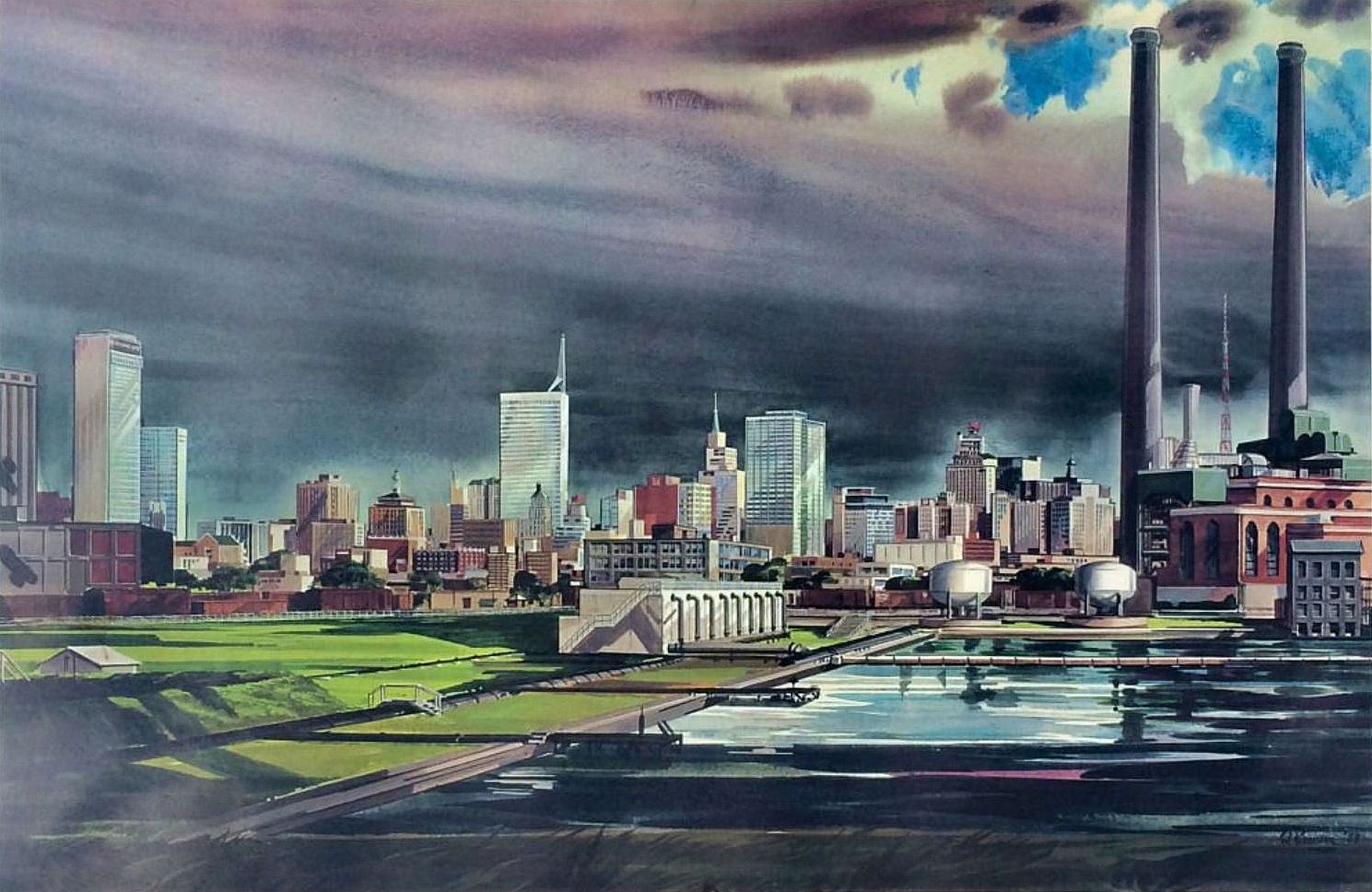
“Dallas Skyline: Late Afternoon From Stemmons Freeway” by Ed Bearden — 1959

bearden_dallas-skyline-late-afternoon-from-stemmons-freeway_litho_1959Skyline and power plant… (click for larger image)

by Paula Bosse

I think the 1950s Dallas skyline is my favorite Dallas skyline. This lithograph by Dallas artist Ed Bearden shows all the usual superstars — the Southland Life Building, the Medical Arts Building, the Republic Bank Building, the Mercantile, the Magnolia — but it also shows a building that doesn’t often find its way into artistic renderings of the city’s skyline: the Dallas Power & Light plant (which was demolished several years ago and is now the site of the American Airlines Center). It looks really great here, with its familiar twin steamstacks and its oasis-like “spray pond” shimmering in the foreground. In fact, the presence of the DP&L plant is my favorite element of this artwork. The beauty of that workhorse industrial plant gives those fancy skyscrapers a run for their money!

This same view from the Stemmons of today looks like — brace yourself — this.

***

Sources & Notes

Lithograph by Ed Bearden; image from an auction listing on the Live Auctioneers site, here. (Thanks, “Not Bob,” for alerting me to this great artwork!)

See another Bearden skyline seen from a similar vantage point, here.

More on the cool-looking DP&L plant and its twin smokestacks can be found in these Flashback Dallas posts:

  • “DP&L’s Twin Smokestacks,” here
  • “A New Turbine Power Station for Big D — 1907,” here

*

Copyright © 2017 Paula Bosse. All Rights Reserved

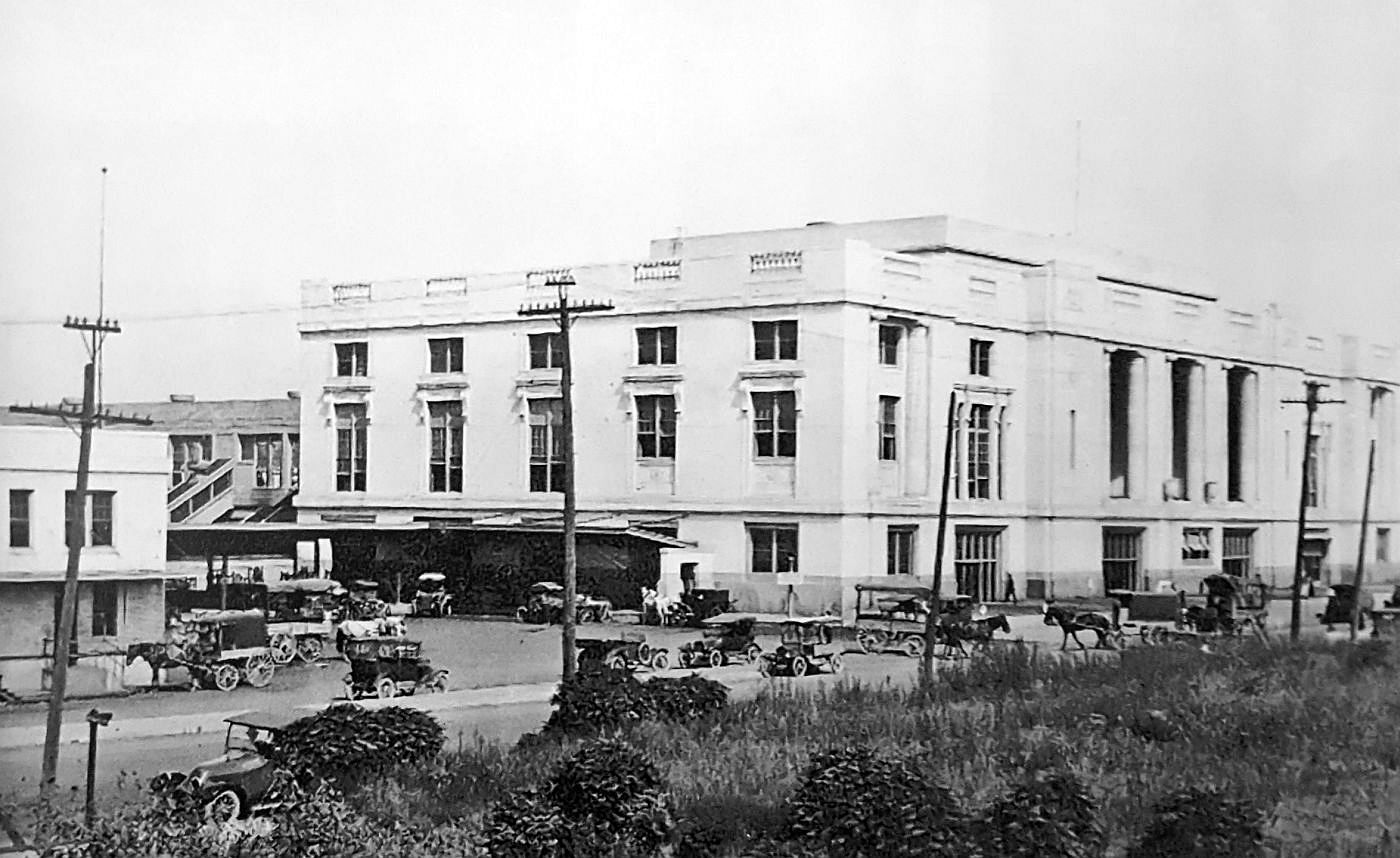
Union Station — ca. 1916

union-station_ca-1916A century ago… (click to see larger image)

by Paula Bosse

A new Union Station, bustling with activity, as seen across a scrubby vacant lot which, today, is the home of the Dallas Morning News building at S. Houston and Young. See the view today, here.

The photo shows the baggage shed which used to be on the south side of the building as well as the passenger bridge heading to and from the trains, with steps leading down to the platforms. See the details on the Sanborn map from 1921 here.

Union Station has weathered some difficult times and suffered from neglect after the golden age of train travel ended, but after recent extensive renovation/restoration, the historic landmark looks as good as new!

*

Copyright © 2017 Paula Bosse. All Rights Reserved.


The Whittle Music Building — ca. 1956

whittle-music_elm-and-murphy_flickr_red-oak-kidSouthwest corner of Elm & Murphy…

by Paula Bosse

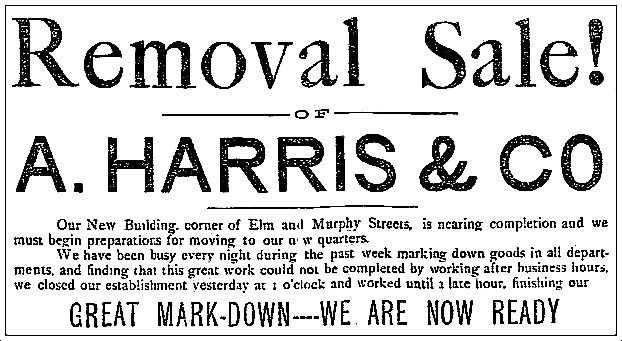
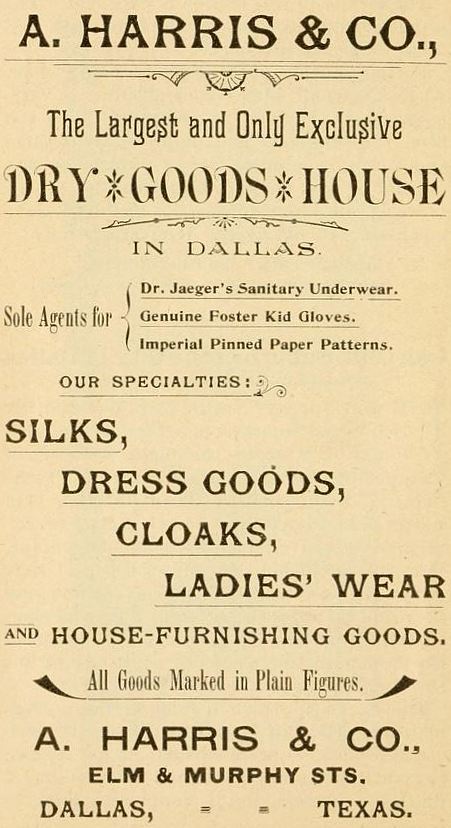
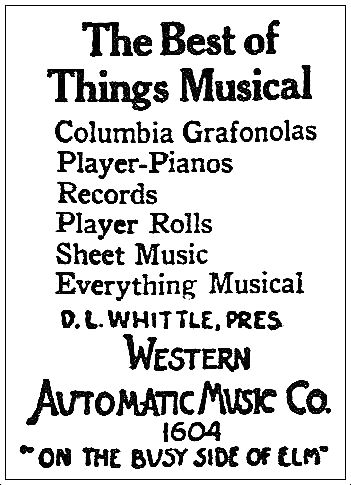
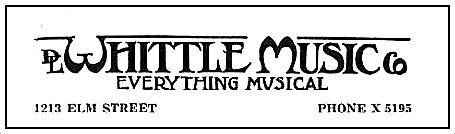
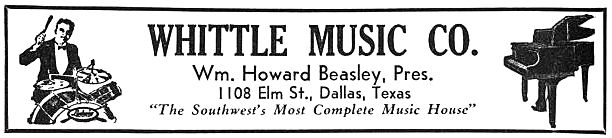
Above, the very attractive home of the Whittle Music Co., which sat at 1108 Elm Street on the southwest corner of Elm and Murphy. It was built as a two-story building in 1892 for the A. Harris Co., one of Dallas’ earliest department stores. A third floor was added in 1899. A. Harris Co. eventually outgrew the building, and, around 1914, it moved into several floors of the Kirby Building. In August, 1941, the Whittle Music Co. moved in from their previous nearby location. The company which sold “everything musical” (instruments, radios, phonographs, records, sheet music, etc.) was happy to move into the larger building, which included a basement, an auditorium for performances, meetings, and recitals, and several large display windows to better feature their large selection of pianos (the building was apparently the first store in Dallas designed to include large windows in which to prominently display merchandise to passersby).

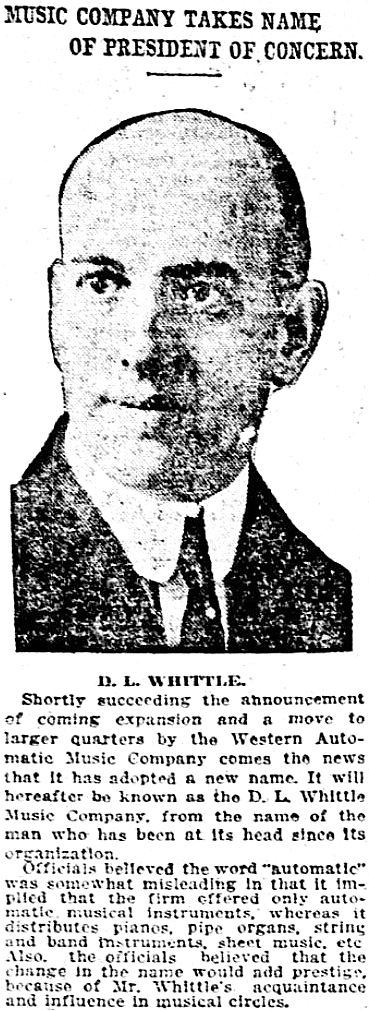
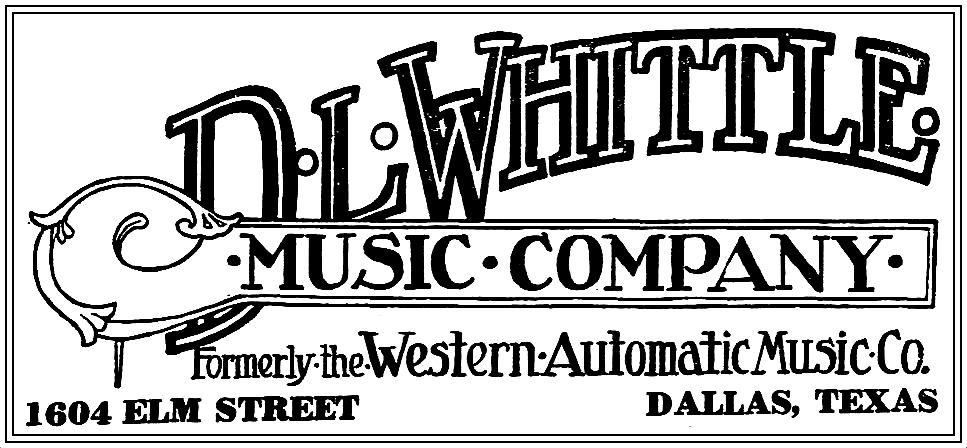
D. L. Whittle (1879-1970) came to Dallas in 1912 and was involved in several businesses (including selling Wurlitzer pipe organs and co-owning the Crystal Theater). He became president of Western Automatic Music Co. (which sold electric player pianos) and eventually changed the name to the D. L. Whittle Music Co. A few years later he sold the business to Howard Beasley who decided to keep the Whittle name. (See the 1968 Sam Acheson interview with Whittle at the bottom of this post for more information about Mr. Whittle and his memories of Dallas in the ‘teens.)

Whittle’s became one of Dallas’ premier music companies, selling instruments and recorded music, offering lessons, hosting performances, etc. According to a Dallas Morning News article by Kent Biffle, customers included Van Cliburn and Arthur Rubinstein, and “Al Jolson once sold tickets to one of his own shows” at the store’s ticket window (DMN, May 31, 1964).

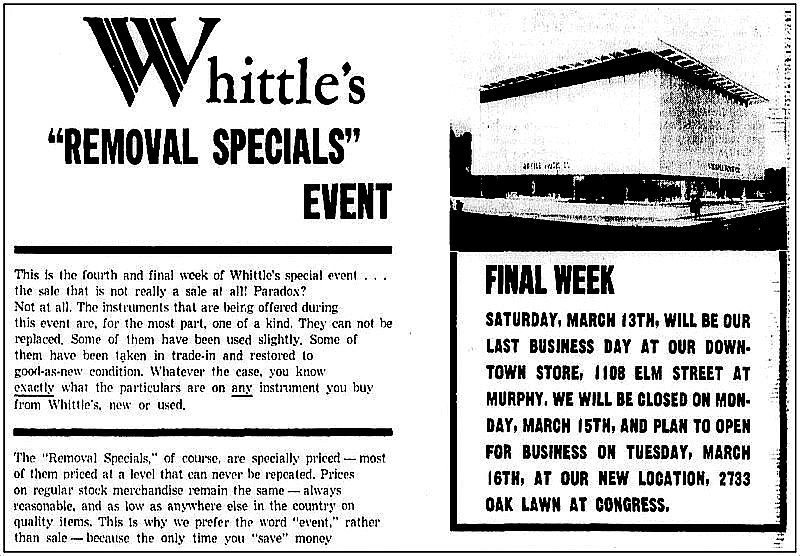
Business was flourishing and all was going well, until the early 1960s when it was announced that the block the building was on (as well as other adjacent blocks) was set to be bulldozed to make way for the construction of One Main Place. Interestingly, Whittle’s and the Dallas, Texas Corp. (developers of One Main Place) agreed to a land swap: the music company would get land in Oak Lawn and a fancy new building built on it in exchange for the Elm Street property. Only after Whittle’s had taken occupancy of their new home would the 63-year-old building be demolished. (Seems like a pretty sweet deal for the Whittle company — perhaps the fact that D. L. Whittle was a major stockholder of the Texas Bank & Trust Co. — which had ties to the One Main Place project — was a factor.)

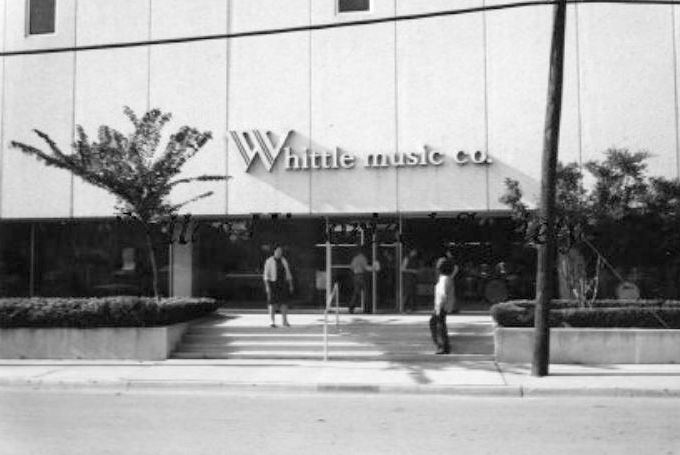
Whittle’s moved into its new location at 2733 Oak Lawn in March, 1965. Not only was it a nice new building, it also finally had “ample parking.” Whittle’s ceased operations sometime in … the ’80s? … but the George Dahl-designed building still stands, here.

I’ve never been a huge fan of One Main Place, but it was a VERY BIG DEAL in the late ’60s. It was envisioned as an entire complex — One Main Place, Two Main Place, and Three Main Place — but only one building was ever built. Yeah, we got another tall building out of the deal (the symbol of “dynamic growth!”), but the view of the attractive three-story building in the photo at the top of this post is, let’s face it, far more aesthetically pleasing than the same view today. Sorry, little building. I wish you’d survived.

*

Most images and clippings are larger when clicked.

harris_moving_dmn_112092Nov. 20, 1892

harris_souvenir-gd-dallas_1894
1894

harris_dmn_070299
1899

whittle_dmn_092318
1918

whittle_dmn_110219
1919

whittle-music-co_logo_dmn_110219
1919

ad-whittle-music_1922-directory1922

ad-whittle-music_bryan-street-high-school_1927-yrbk1927

ad-whittle-music_tx-almanac-1945-461945

whittle_dmn_030765_final-week-downtown
March, 1965

***

Sources & Notes

Original source of photo at top is unknown — I found it on Flickr, here. The Oliver Luggage Co. appears to have been a next-door neighbor for only a year or two, beginning in 1956.

I was one of thousands of school children who bought instruments and sheet music from Whittle’s on Oak Lawn. I always liked going into that cool building. I had no idea George Dahl designed it. It looks like the Dallas Historical Society has the Whittle Music Co. collection. You can see a ton of thumbnail images here. Here are a couple of those thumbnails blown up (apologies for the picture quality) — the Oak Lawn store:

whittles_sign-exterior_oak-lawn_dhs

whittles_parking-lot_dhs

whittle-music-co_ad

*

Copyright © 2017 Paula Bosse. All Rights Reserved.

Main Street’s Varied Modes of Transport — ca. 1909

main-street_tsha-meeting-1977_portalPowered by oats, electricity, and gasoline…

by Paula Bosse

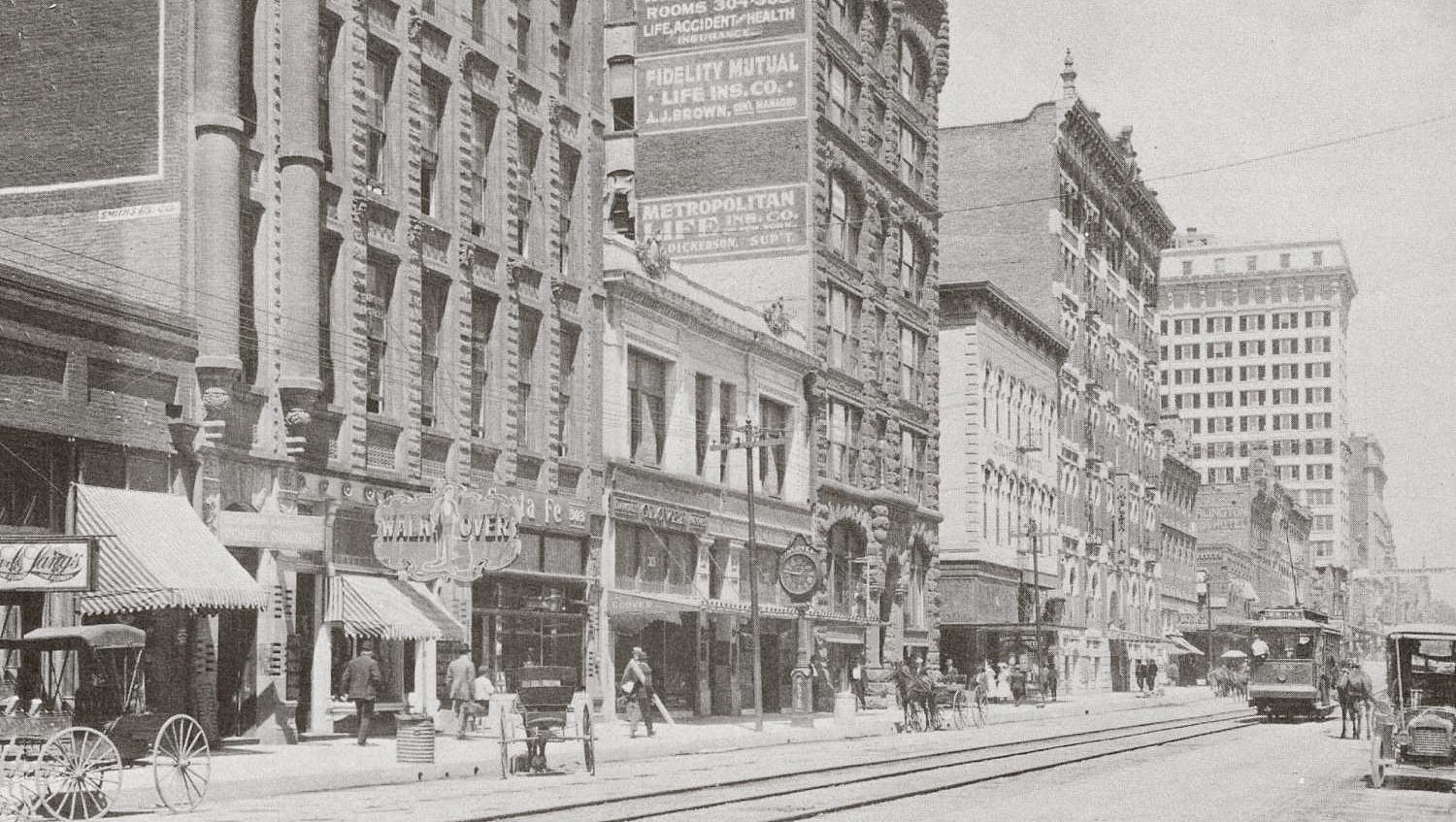
Here’s Main Street, looking east, from about Field. This is another of those odd photos showing streets shared by horse-drawn buggies and automobiles. And an electric streetcar. The days of those horses clip-clopping down Main Street were running out. (And I’m sure the horses were much relieved.)

This photo was taken sometime between 1909, when the Praetorian Building opened (it’s the tall white building in the background, with the Wilson Building behind it at the other end of the block), and 1911, when the street numbers changed (you can see the address of “303” next to the words “Santa Fe” — the Gulf, Colorado & Santa Fe Railway offices were at 303 Main Street in the 1909 city directory).

Also seen in this photo are the tall Scollard Building (the one with the advertising painted on its side) and, one building away, the Imperial Hotel.

See what it looks like now, here.

***

Sources & Notes

Photo from a pamphlet for the Texas State Historical Association’s annual meeting in Dallas in 1977, found on the Portal to Texas History, here. Sadly, the photo was printed in sepia ink, which, argh. As always, if you know of a sharper image, please let me know!

*

Copyright © 2017 Paula Bosse. All Rights Reserved.

Commerce & Ervay, Looking East

commerce-ervay_east_flickr-colteraEven then a busy downtown intersection…

by Paula Bosse

Above, Commerce Street, looking east from Ervay, with the old Post Office/Federal Building on the northeast corner (replaced by the Mercantile Bank Building in the early 1940s). In the background, at the right side of the photo, the Metropolitan Business College, at Commerce and St. Paul.

See a view of Commerce looking west in 1913 — showing the Metropolitan Business College in the foreground and the new Adolphus Hotel a few blocks away, here.

Another eastward-looking view — from about 1895, when the post office was still pretty new — is here.

And the present-day Google Street View of Commerce and Ervay looks like this.

***

Sources & Notes

I’m not sure of the original source of this photograph, but I found it on Coltera’s Flickr stream (I didn’t save the link and I can’t find it again). If anyone knows of a sharper image of this photo, I’d love to see it!

*

Copyright © 2017 Paula Bosse. All Rights Reserved.

At the Palace: The Streets of Sin and The Mikado of Jazz — 1928

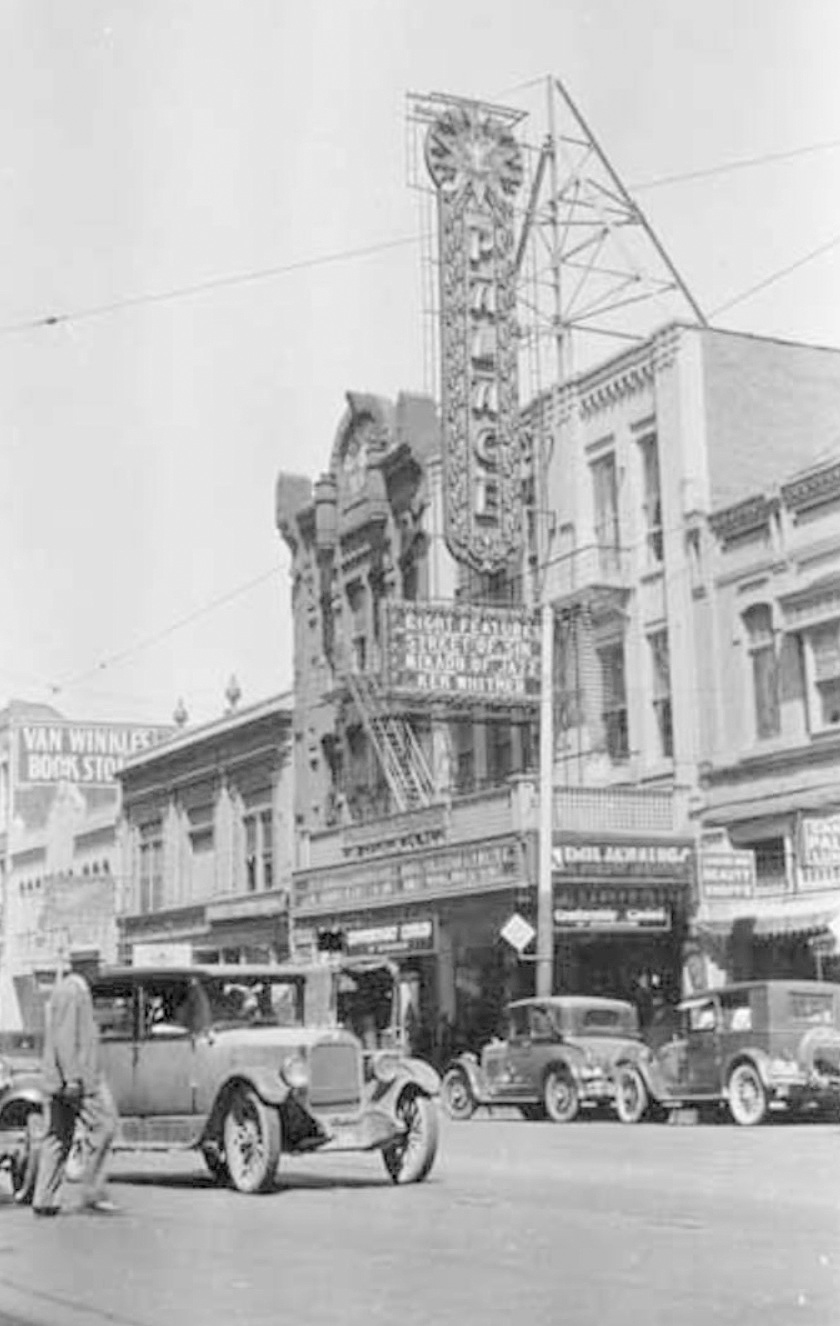
palace-theater_052628_univ-of-washington-librariesElm & Ervay, 89 years ago… (click for larger image)

by Paula Bosse

The photograph above is not the greatest quality, but it’s a photo I’ve never seen before. It shows the Palace Theatre in the 1600 block of Elm Street, just west of Ervay, with the well-known (and very large) Van Winkle’s Book Store in the background. One of the things that makes this photo so interesting is seeing the cumbersome support tower on top of the building holding up the ornate Palace sign. See what a slightly different Palace sign looked like the next year, lit up in neon, here.

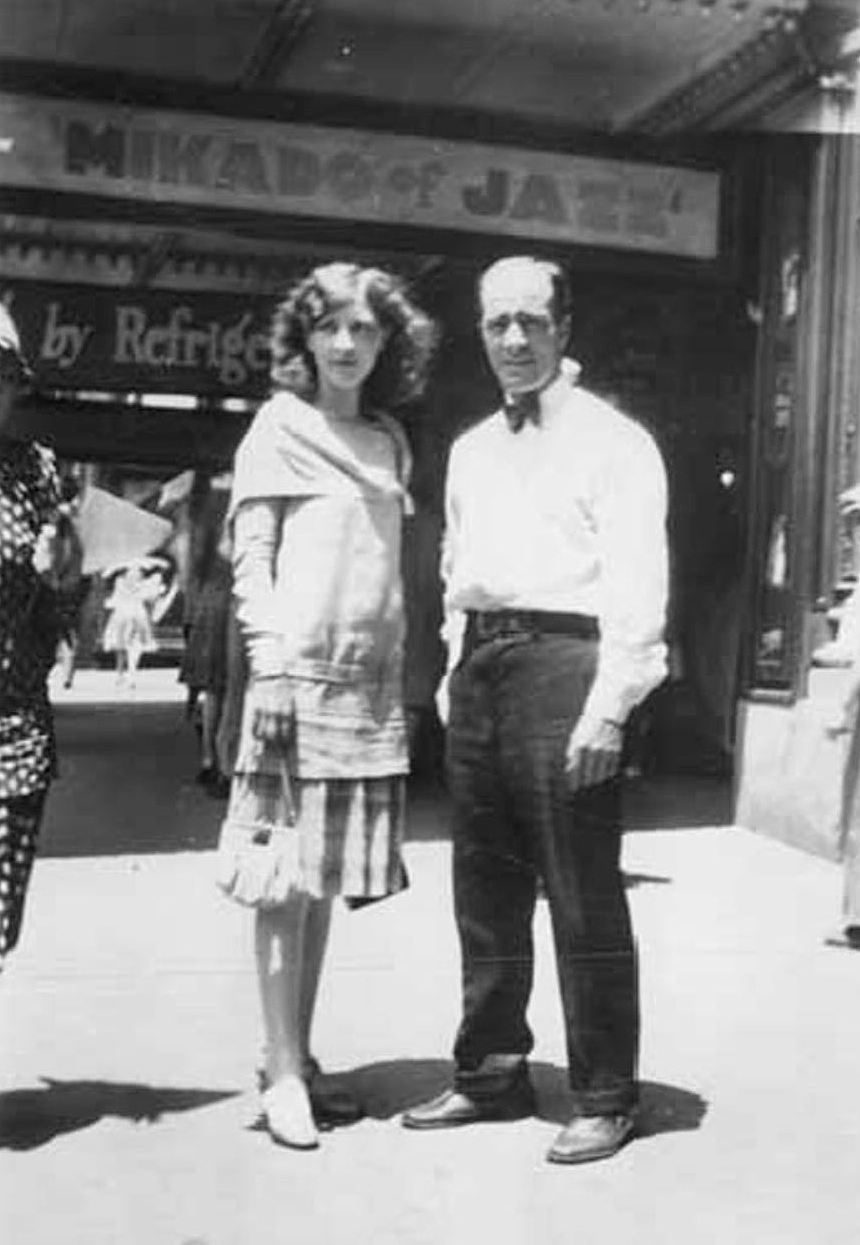
The photo above was an amateur snapshot, taken to document the tour of the traveling live stage revue The Mikado of Jazz which played the Palace in late May of 1928. The photo below — which shows the revue’s stage manager and his wife standing on the sidewalk in front of the Palace — was taken at the same time.

palace-theater_052628_univ-of-washington-libraries_sidewalk

Part of a sign visible behind them was probably advertising that the theater was “cooled by refrigerated air.” The ad at the bottom of this post includes this informative little tidbit:

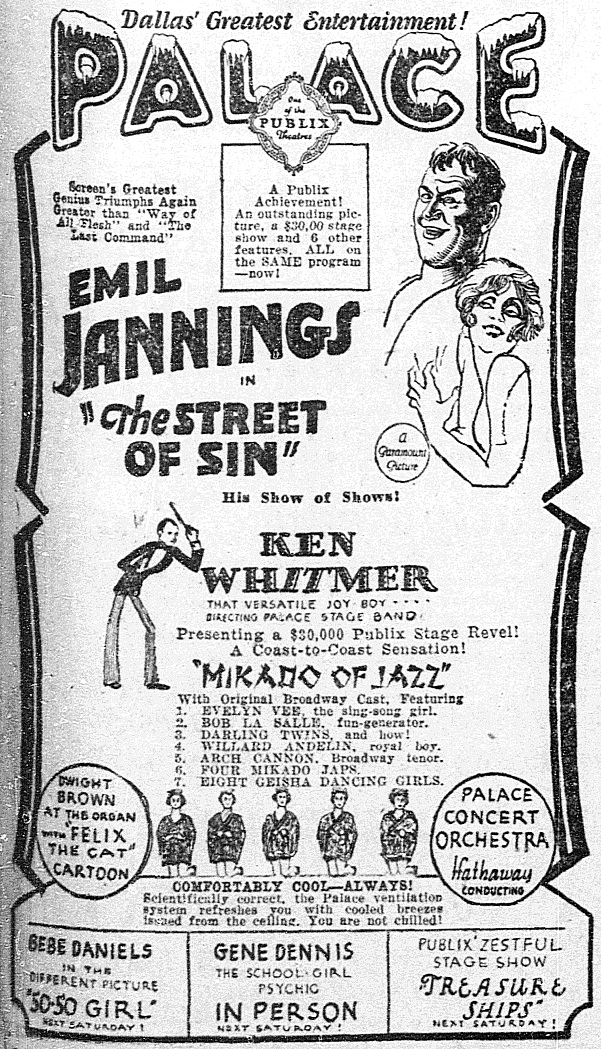
COMFORTABLY COOL — ALWAYS!

Scientifically correct the Palace ventilation system refreshes you with cooled breezes issued from the ceiling. You are not chilled!

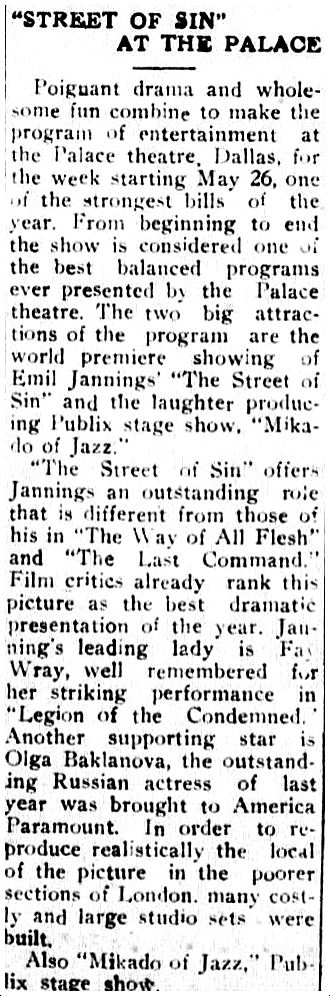
What was The Mikado of Jazz? It appears to have been a jazzed-up version of The Mikado — making Gilbert & Sullivan relevant to 1920s’ audiences — like Hamilton for the Jazz Age (“This is said to be the first time that any comic opera has been syncopated and presented with a stage band.”Dallas Morning News blurb, May 20, 1928)

Also on the bill was the “world premiere” (?) of the film The Street of Sin, starring Emil Jannings and Fay Wray, a live stage orchestra, an organ player, and a Felix the Cat cartoon.

mikado-of-jazz_texas-mesquiter_052528
Texas Mesquiter (Mesquite), May 25, 1928

All at the Palace — “Dallas’ Greatest Entertainment!” Enjoyed at a comfortable temperature.

palace_mikado-of-jazz_dmn_052728
May 27, 1928

***

Sources & Notes

Photographs (taken in May, 1928) are from the Rene Irene Grage Photograph and Ephemera Collection, 1921-1930s, University of Washington Libraries, Special Collections: more information on the first photo (the view of the theater from across the street) is here; more info on the second photo is here.

For other posts that show the Palace in this era, see these posts:

  • “Next-Door Neighbors: The Palace Theater and Lone Star Seed & Floral — 1926,” here 
  • “Dazzling Neon, Theater Row — 1929,” here

Click photos and clippings to see larger images.

*

Copyright © 2017 Paula Bosse. All Rights Reserved.

The Stage Door Restaurant: Elm Street’s “Home of Lox and Bagels” — 1965-1968

stage-door_youtube_1966A Reuben sandwich sings to me, like a siren to a sailor…

by Paula Bosse

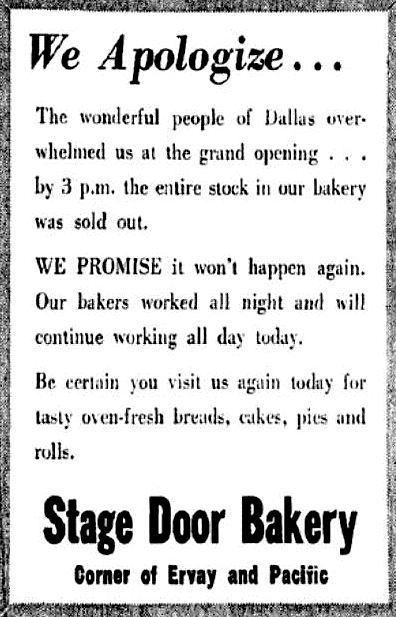
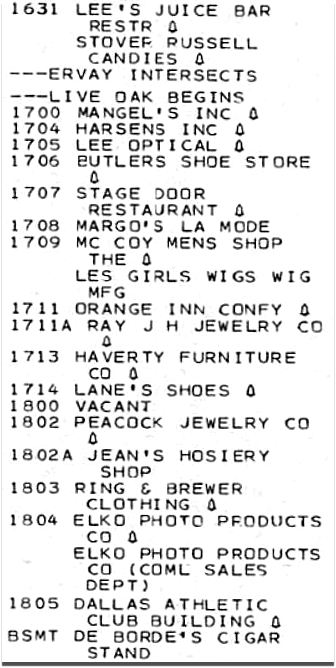
Why does Dallas have so few delis? Here’s one that seemed to be pretty popular in the 1960s: the Stage Door Restaurant and Delicatessen (and bakery), located at 1707 Elm, between the Palace Theater and the Dallas Athletic Club. It opened in June 1965 and lasted until the end of 1968 (when it was replaced by a restaurant called King Beef). I doubt there was any connection with the famous Stage Deli in New York, but manager Milton Stackel certainly had kosher cred of his own, having worked for twenty years at Grossinger’s, the legendary Jewish resort in the Catskill Mountains. I’m not sure how he found himself operating an eatery in downtown Dallas, Texas, but I’m glad he was here.

To any Milton Stackel-like entrepreneurs out there reading this:

DALLAS NEEDS DELIS!!


Authentic Jewish delicatessens!

Please!

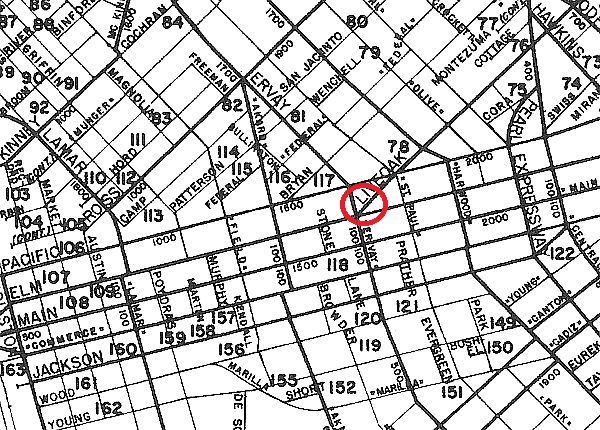
The apparently quite popular eatery was located at/near the old five-point Elm-Ervay-Live Oak intersection (seen here a dozen years earlier — the Stage Door would later be between Lee Optical and Haverty’s). There were two dining areas, one of which was The Playbill Dining Room which served an “international-type cuisine in a Gay Nineties atmosphere.” There was also a thriving take-out deli and the nearby bakery. And now? Come on, Dallas restaurateurs! Get to work!

*

stage-door-bakery_dmn_060465
June 1965

stage-door-restaurant_texas-jewish-post_122365_portal
Texas Jewish Post, Dec. 23, 1965

This ad shows the bakery entrance next door.

stage-door-bakery_dmn_112465
Nov. 1965

stage-door_dmn_112564

stage-door-restaurant_texas-jewish-post_122365_portal-det
Texas Jewish Post ad detail, Dec. 23, 1965

stage-door_1707-elm_1952-mapsco
1952 Mapsco

stage-door_1966-directory
1966 Dallas directory

1700-block-elm_1966-directory
Elm Street, 1966 Dallas directory

***

Sources & Notes

Top image is a screengrab from a YouTube video, here, containing footage shot downtown by Lawrence W. Haas on Memorial Day, 1966.

Read more about the opening of the new business (and see a photo of the interior) in the Dallas Morning News article “Stage Door Restaurant Makes Debut in Dallas” (DMN, June 3, 1965).

*

Copyright © 2017 Paula Bosse. All Rights Reserved.

“Classified System” Parking Stations — 1930s

classified-system_colteraIs that a ship? And an iceberg? (click for larger image)

by Paula Bosse

Here’s a cool little ad for what was basically a parking garage that also sold gas and tires (and which seems to have had a ship on top of its building … a building which might be shaped like … an iceberg?). This snazzy-looking garage was at 501 N. Akard (at Patterson) — it was one of several “Classified System” garages that dotted downtown from the early 1930s until at least the early ’70s. The Akard location was station No. 1.

Below, an ad from 1935 informing patrons that they could drive in, have tires installed, and pay for them sometime in the future — for as little as 50 cents a week (which would come out to about $35 a month in today’s money). “YOU DON’T NEED CASH.” (Click ad to see a larger image.)

classified-parking_dmn_061535
1935 ad

classified-parking_dmn_061535_det

I love the kooky design of the building, but that ship is just … odd. I like it, I just don’t get it. Maybe that’s the “classified” part.

***

Sources & Notes

Color image is a matchbook cover found on Flickr, here.

*

Copyright © 2017 Paula Bosse. All Rights Reserved.


“Dallas’ Dependable Business Climate” — 1959

ad-business-in-dallas_1959_photo-detThe “D” in “Big D” stands for “dinero”… (click for larger image)

by Paula Bosse

The booming Dallas skyline, captured by Squire Haskins on September 10, 1959, was used in a boosteriffic Chamber of Commerce-y statistics-filled ad.

“It’s exciting to live, do business, make money and grow in Dallas.”

ad-business-in-dallas_1959

***

This Industrial Dallas, Inc. ad appeared in the January, 1960 issue of Fortune magazine. I found it on eBay, here.

Images larger when clicked.

*

Copyright © 2017 Paula Bosse. All Rights Reserved.

Traffic at Ross and Pearl — 1920s

ross-and-pearl_galloway_park-citiesLooking northeasterly on Ross from N. Pearl (click for larger image)

by Paula Bosse

The photo above shows the intersection of Ross and Pearl. The streetcar tracks ran along Pearl. We’re looking northeasterly on Ross. To the left, out of frame, would be the Sacred Heart Cathedral (renamed Cathedral Santuario de Guadalupe in 1977). The photo comes from Diane Galloway’s wonderful book The Park Cities, A Photohistory. Her caption:

Traffic jams such as this one at Ross and Pearl Streets during the twenties encouraged Dallasites to pack up and move to newer developments away from the city.

With the crowd of people at the left, I think the traffic in this photo might have been caused by church-going motorists. The license plates on the cars seem to match those from 1927 and 1928 (links to license-plate-dating sites at bottom of post).

That impressive house at the top left with the pointed turret? At the time of this photograph, it was the George A. Brewer Undertaking Company. Like the two-blocks-away Belo Mansion, which was converted into the Loudermilk-Sparkman funeral home in 1926 (seen here), this spectacular house was once a private residence. It was built by Charles F. Carter (1848-1912), a wealthy cotton merchant, sometime between 1892 and 1895. It took up a huge lot at what is now the northeast corner of Ross and Crockett (see it at the bottom left of the 1921 Sanborn map, here). Here’s what the house looked like, circa 1894. (All pictures are larger when clicked.)

carter-house_church_dallas-through-a-camera_ca-1894_SMU

And, below, you can just see part of the house in a 1910 photo of the new-ish Cathedral at the corner of Ross and Pearl.
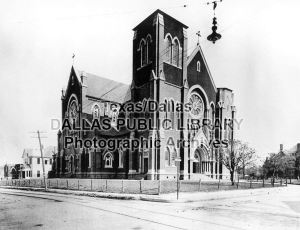
 sacred-heart-cathedral_1910_dpl

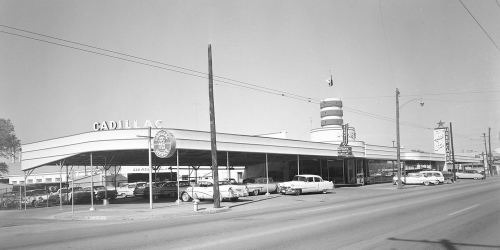
In 1920 or ’21 the Brewer Undertaking Co. moved into this house at 2303 Ross Avenue and operated as one of the city’s most prominent funeral homes until 1931 when they moved into a new location farther down Ross. When Brewer moved out, the beautiful house was demolished. In its place … a used car lot. Argh. In 1940, Lone Star Olds (later Lone Star Cadillac) moved in, eventually bought up the whole block, and became one of Dallas’ legendary car dealerships. It moved from its Ross Avenue location in 1985.
lone-star-cadillac_ross-ave_squire-haskins_uta

*

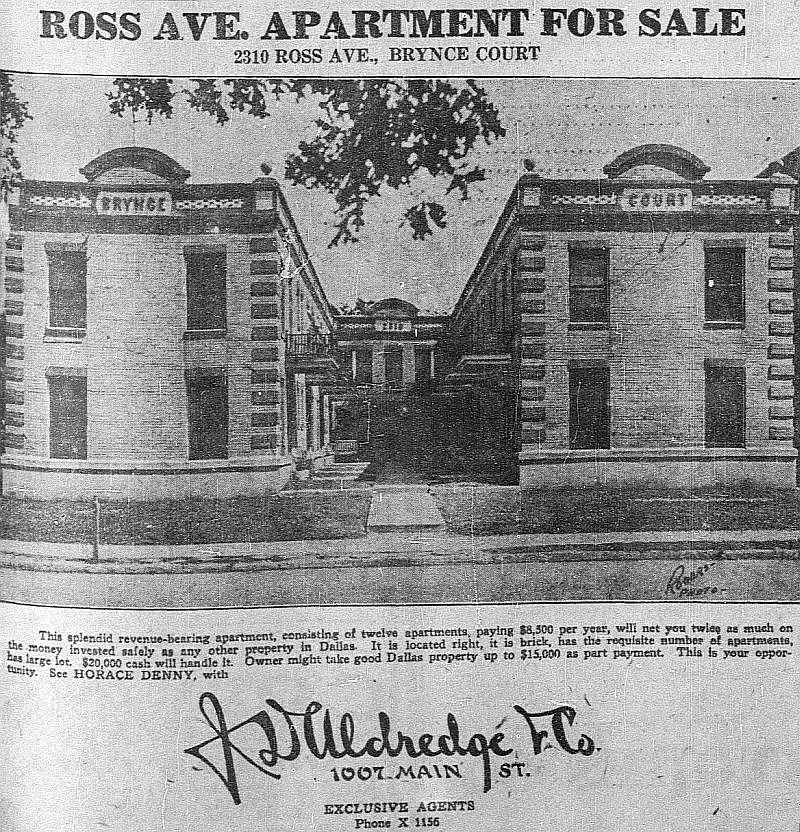
Also, even though it isn’t really visible in the top photo, across the street from the old Carter house — at 2310 Ross — was Brynce Court, a u-shaped apartment building. I haven’t been able to verify this, but The Dallas Morning News had a blurb about the “First Apartments” in the city which read as follows:

Dallas’ first apartment complex was a two-building development at 2310 Ross Ave. Built in 1919 [note: it appears to have been built in 1912], Brynce Court was the first set of apartments housed in more than one building.” (DMN, Jan. 7, 1984)

I mention this because it’s a cool little factoid, but also because I stumbled across a photo of it in an ad while looking for info on Lone Star Olds-Cadillac. So I have to show it. Surprisingly, this apartment block (which probably looked a lot less charming after fifty years) stood at that location until at least 1964.

brynce-court_dmn_051521
Dallas Morning News, May 15, 1921

brynce-court_dmn_042212
DMN, April 22, 1912

*

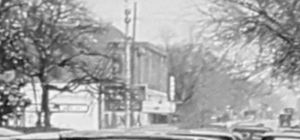
I always like to look at things in the background of old photos. Here’s an extremely blurry magnified detail from the top photo, showing a two-story building of shops and businesses at Ross and Leonard. Included in these businesses is the Imperial Drug Store — it’s a little hard to make out, but the vertical sign with white letters appears to read “DRUGS” (this building can be seen in the 1921 Sanborn map mentioned above).
ross-pearl_dallas-rediscovered_det

Below, the businesses and residences along Ross Avenue — between  N. Pearl and Leonard — from the 1927 Dallas directory.

ross-avenue_1927-directory

Ross and Pearl these days looks nothing like that top photo. See what the same view looks like today, via Google Street View, here. At least the Cathedral lives on.

***

Sources & Notes

Top photo from Diane Galloway’s book The Park Cities, A Photohistory (Dallas: privately published, 1989); from the collection of John Stull/R. L. Goodson, Jr., Inc., Consulting Engineers.

Photo of the C. F. Carter House is from the book Dallas, Texas Through a Camera, a collection of photos by Clifton Church.

Photo of the Cathedral of the Sacred Heart from the Dallas Public Library, taken in 1910.

(Cropped) photo of Lone Star Cadillac by Squire Haskins from the Squire Haskins Photography, Inc. Collection, University of Texas at Arlington Special Collections; more info is here (click thumbnail on UTA page to see much larger image).
Info on dating Texas license plates can be found here (PDF), here, and here. (If the first link doesn’t open, Google “The History of Texas License Plates.” It’s a report issued by the Texas Department of Transportation. It’s 255 pages long (!) and it’s exhaustive!)

Click pictures to see larger images.

*

Copyright © 2016 Paula Bosse. All Rights Reserved.