Flashback : Dallas

A Miscellany: History, Ads, Pop Culture

The “Blue House” Lives
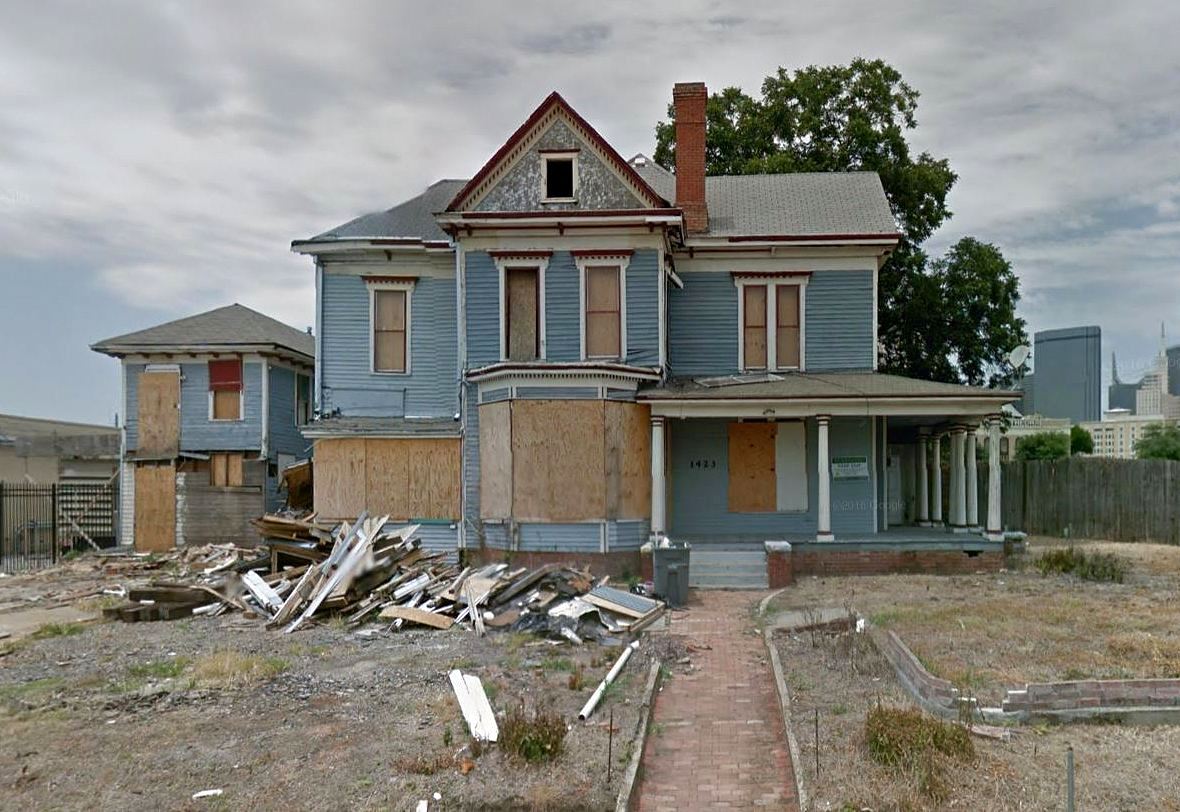
blue-house_google_july-2016July, 2016 / Google Street View

by Paula Bosse

In January, 2016, news of an endangered 19th-century house in The Cedars, the area just south of downtown, was in the news: it was to be torn down in order to put in a parking lot. I followed Robert Wilonsky’s stories on it in The Dallas Morning News and read about it in online history and preservation groups, but there didn’t seem to be a lot mentioned about the history of the house. Who built it? And when? I decided to see if I could find the answers. I’d written about the history of houses and buildings and figured it wouldn’t take that long to find the answers, but it actually took a lot longer than I’d thought. But the detective work was fun, and I was surprised by how much research one can do without ever needing to walk away from one’s computer. So much now is within our digital reach: historical city directories, maps, newspaper archives, and genealogical information.

After a marathon session of using everything mentioned above, plus referring to a couple of Dallas-history-related books, I eventually traced real estate transfers back to the man who appears to have built the house: Max Rosenfield, around 1885. I excitedly messaged Robert Wilonsky at 4:58 a.m., knowing that he would be interested to learn this new info (especially as the man who built the house was the father of one of the most noteworthy arts critics in The Dallas News’ long history), and he passed the news on to his readers. (My step-by-step process of researching the house which once stood in a posh residential area of the city is in the post “The Blue House on Browder,” here.)

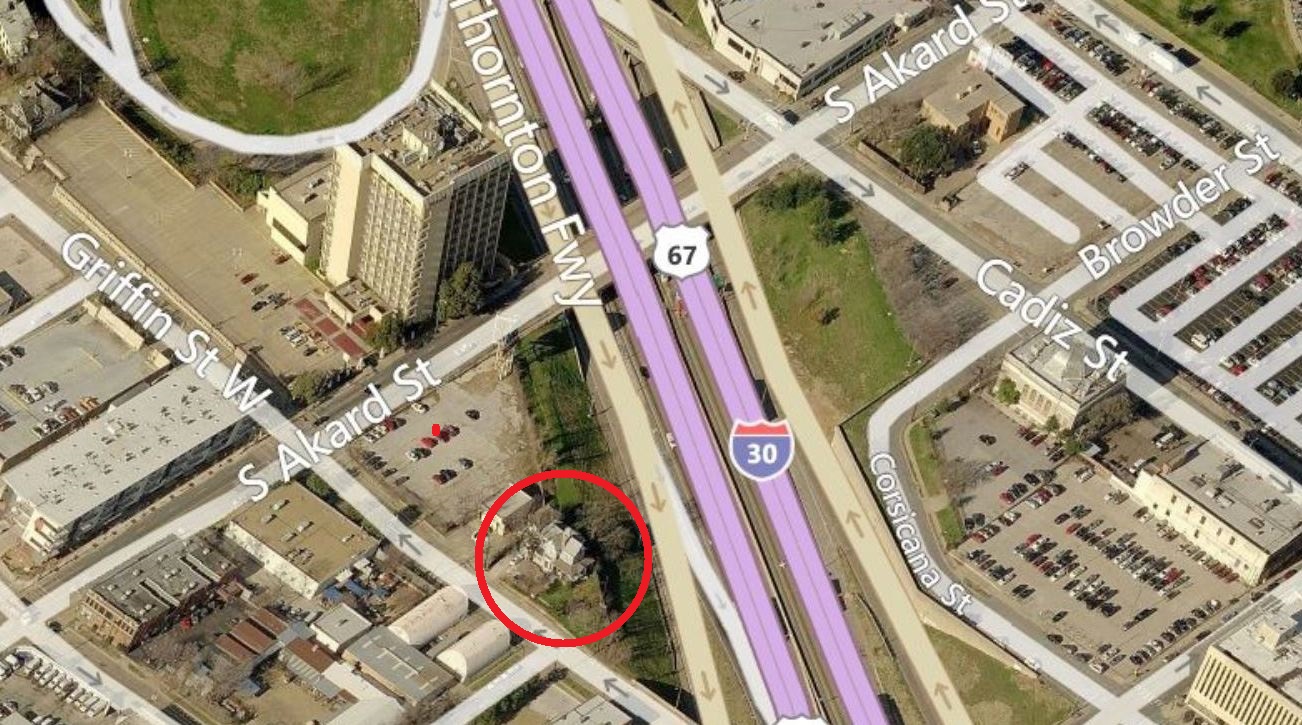
The house’s fate has been in limbo for a couple of years, but now the 133-year-old “Blue House” will be moved in pieces to its new home half a mile away (at Browder and Beaumont) where it will be reassembled and restored.

The move begins TOMORROW — April 3, 2018. The public is invited to a ceremony in which comments will be made and then the house will begin the move to its new home. For Preservation Dallas’ details on when and where, information on the event can be found here.

Enjoy your new home, Blue House!
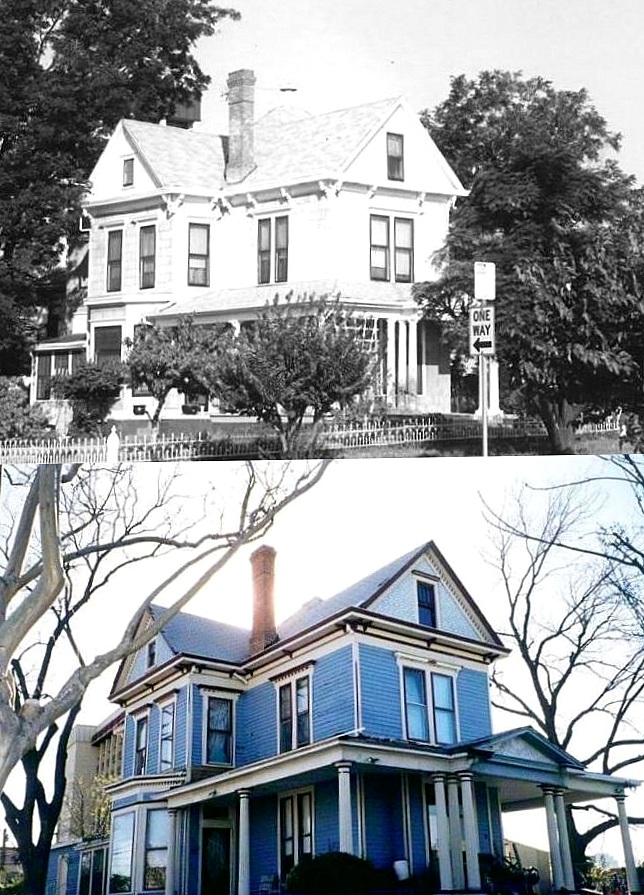
blue-house_then-and-now

browder-house_bing

**

UPDATED: More on how the actual move went and an interview with the new owner of the house can be found at Candy’s Dirt, here.

Below is footage of the first part of the move — the disassembly — captured by D Magazine:

***

Sources & Notes

Top photo from Google Street View, July, 2016. (This view from Griffin is actually the side of the house — the front originally faced Browder Street, which no longer continues at that block.) Aerial view from Bing Maps.

Black-and-white photo of the house is from Preservation Dallas; color photo below it is from Homeward Bound, Inc. (used with permission), taken in about 2000.

Read the saga of the fight to save the house and how it will be moved in Robert Wilonsky’s Dallas Morning News article “One of Dallas’ oldest homes, built in the Cedars in the 1880s, ready for its new life on a new lot” (DMN, March 29, 2018), here.

My original step-by-step post on tracking down the history of the house — “The Blue House on Browder” — is here.

Click pictures to see larger images.

*

Copyright © 2018 Paula Bosse. All Rights Reserved.
 

A Few Photo Additions to Past Posts — #7

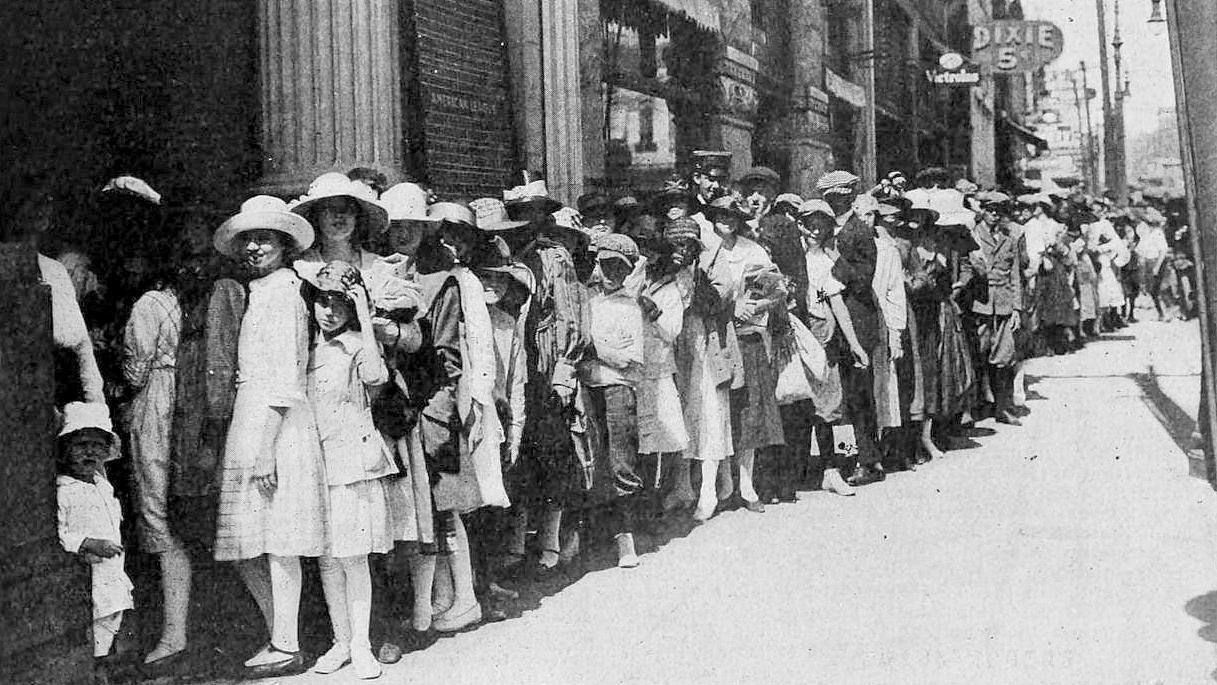
hippodrome_dixie_elm-street_moving-picture-world_062218Standing in line for a movie, 1918… (click for larger image)

by Paula Bosse

I’m always coming across photos and information regarding subjects I’ve already written about, and sometimes I find new things I want to add to old posts.

Like the photo above. I had originally used a cropped version which I had found on the Cinema Treasures website, but this one was larger, and I found it at the original source, describing what was going on. This photo from 1918 shows (mostly) children standing in line to see a World War I-related movie at the Hippodrome Theatre, with the line reaching past the nearby Dixie Theatre. They had participated in a clever marketing strategy which encouraged school children to write essays about why the United States was at war with Germany (first prize: $20 in gold!). The photographer was standing on Elm about where Field is, looking east (which today looks like this). I’ve added this photo to the post “Three of Dallas’ Earliest ‘Photoplay Houses’ — 1906-1913.” (Source: The Moving Picture World magazine, June 22, 1918)

*

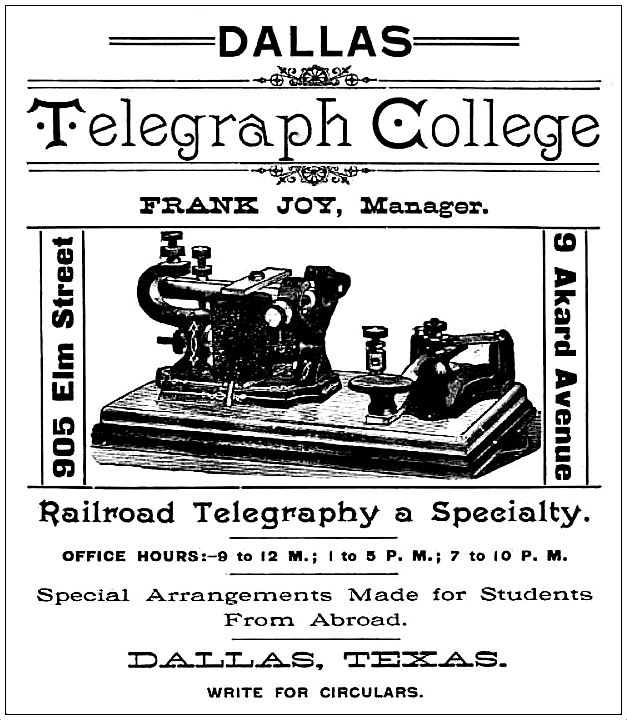
Below, a nice early ad (1889) for Dallas Telegraph College. I’ve added it to the post Start Your Brilliant Career at Dallas Telegraph College — c. 1900.” (Source: 1889 Dallas directory)

dallas-telegraph-college_1889-directory

*

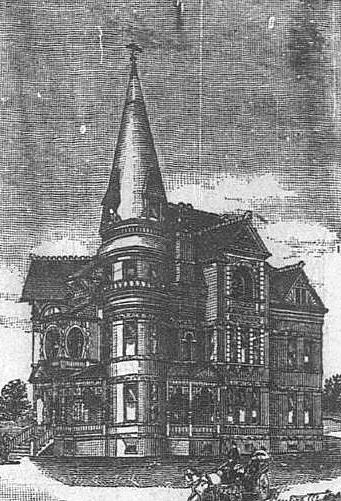
The grand Thomas L. Marsalis house seen below was built in 1889 — the same year that the Dallas Telegraph College was setting up shop downtown. The house, built in Oak Cliff (which was not yet part of Dallas), reportedly cost $65,000 (more than $1,750,000 in today’s money); it was, apparently, never occupied, and it was under foreclosure just a few short years after its construction. I’ve added this drawing of a house that I never tire of looking at to the post The Marsalis House: One of Oak Cliff’s ‘Most Conspicuous Architectural Landmarks.'” (Source: Dallas Morning News)

marsalis-house_drawing

*

The roots of Dallas’ Buell Planing Mill reach back to 1886 — it once sat near-ish to the old Dallas High School (aka Crozier Tech). This 1896 ad is a nice companion to a photo in the post The Buell Planing Mill — 1901.” (Source: 1896 Dallas city directory)

buell_dallas-directory_1896

*

I have very fond memories of the old downtown Dallas Public Library, and I’ve always loved the building, so I was relieved to hear that the Dallas Morning News had made the long-vacant building its new HQ. This postcard of the George Dahl-designed building is pretty strange because of the depiction of the sculpture on an exterior wall  — an artwork that people either loved or loathed (I’m afraid I include myself in the latter category). It’s not the fabled “naked” figure envisioned by the artist which had caused such controversy, but it’s some weird version of sort of what the sculpture ended up looking like (here). (Postcard manufacturers have deadlines, and the finalized sculpture must not have been completed before those cards had to hit the streets.) The sculpture was titled “Youth In the Hands of God,” and if those are the hands of God, um…. I’ve added this postcard image to the post George Dahl’s Sleek Downtown Library — 1955″ — mostly for my own amusement. (Source: “the internet”)

dallas-public-library_dahl_postcard

*

As one might imagine, my blog gets tons of JFK assassination-related hits — simply because I write about Dallas history. Assassination-ologists are often more interested in arcane aspects of Dallas history that those of use who actually grew up and/or live here. One such post that continues to get more hits than it might actually warrant (not that the subject isn’t interesting, but it’s not THAT interesting) is the awkwardly titled “Nardis of Dallas: The Fashion Connection Between ‘The Dick Van Dyke Show’ and the Kennedy Assassination.” (Nardis was a Dallas garment manufacturer who had in its employ for many years one Mr. Abraham Zapruder. And, yes, there actually was a Dick Van Dyke Show connection.) ANYWAY, I’m adding these two late-’50s/early-’60s Squire Haskins photos of the plant at 410 S. Poydras (at Wood Street) because they’re cool. (Source: Squire Haskins Photography Inc. Collection, University of Texas at Arlington Libraries, Special Collections — the exterior shot is here, the interior shot is here. The ad is a detail from a 1954 ad which appeared in The Texas Jewish Post.)

nardis_squire-haskins_UTA_wood-and-poydras

AR447-R812

nardis_texas-jewish-post_122354

*

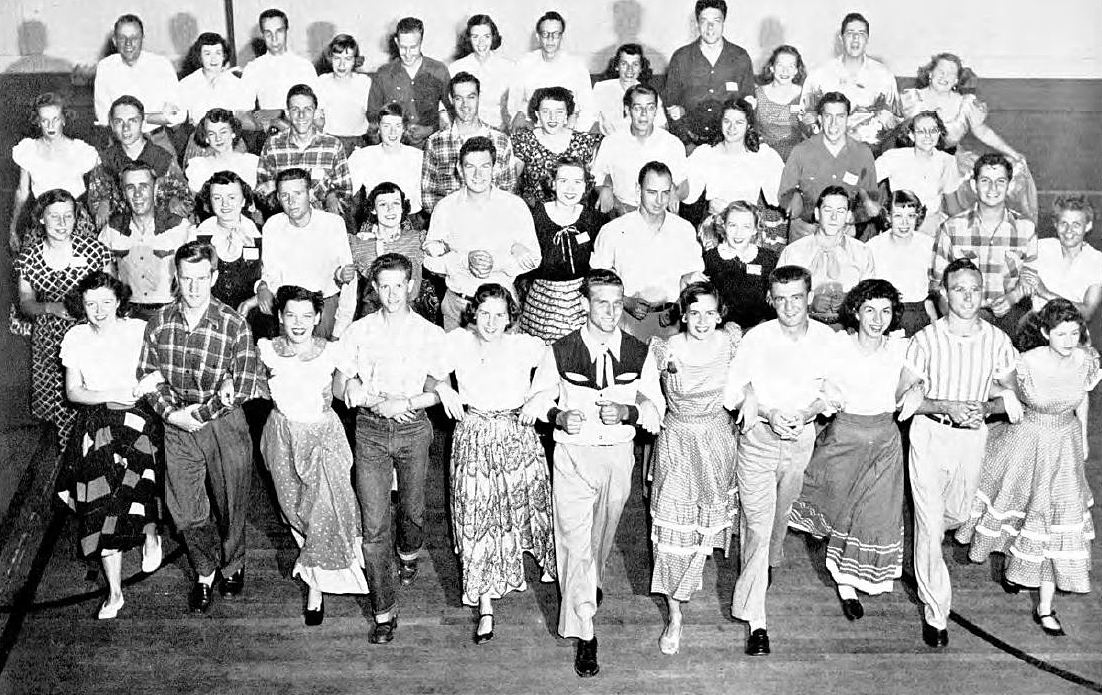
I really enjoyed writing about the strange square-dancing fad that swept the county in the late 1940s and early 1950s, affecting everyone from those in rural communities to Neiman-Marcus customers. I’m adding this photo from the 1951 SMU yearbook which shows the well-dressed “Promenaders,” a group whose purpose is described in the yearbook as being “to promote the appreciation of square and folk dancing on this campus.” I’m adding this to the post The Square Dancing Craze in Big D — Late Forties.” (Source: Southern Methodist University Rotunda, 1951. If you think you might recognize one of these Promenaders, the members of the group seen in this photo can be found here.)

square-dancing_promenaders_smu_1951-yrbk

*

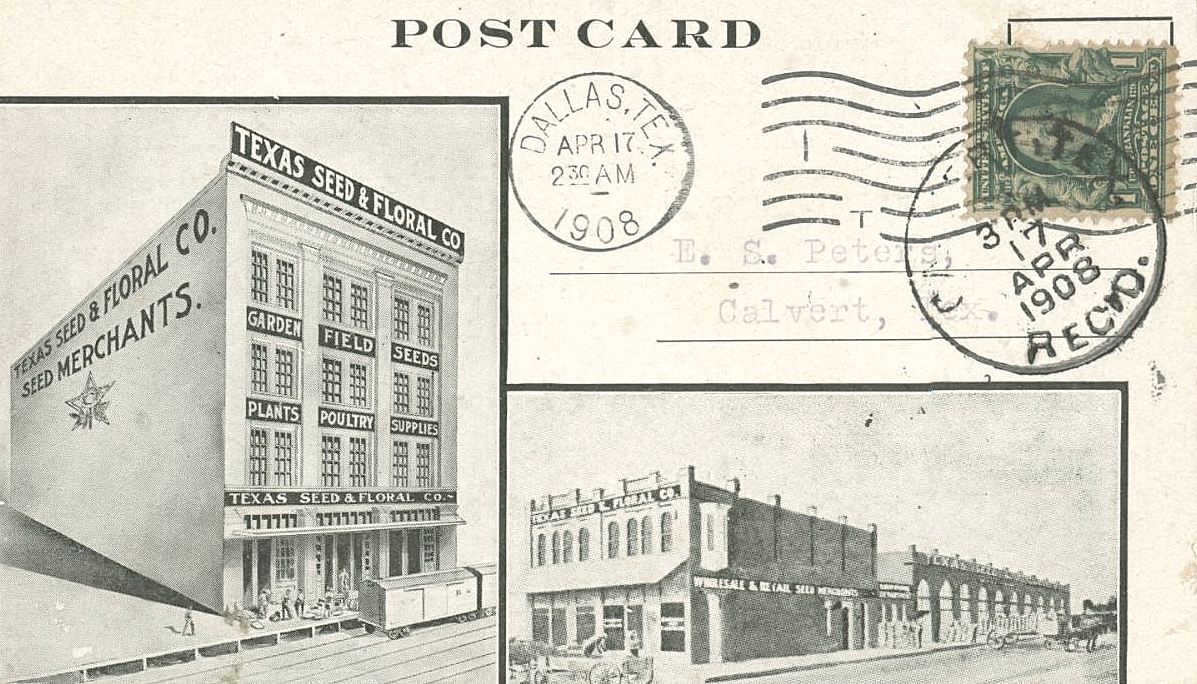
Below, a postcard of the Texas Seed & Floral Co., which later became the Lone Star Seed & Floral Co., located at the northwest corner of Elm and Ervay. In 1921 the beautiful Palace Theater opened up right next door, and I actually ended up writing about the seed company because a tiny part of it can be seen in a 1926 photo of the Palace. (The left image on the postcard shows the Pacific Avenue location; the one at the lower right is the Elm Street location, with a view looking north on Ervay.) Might as well add it to the post Next-Door Neighbors: The Palace Theater and Lone Star Seed & Floral — 1926.” (Source: Dallas Heritage Village via the Portal to Texas History)

texas-seed-and-floral_1908_portal

*

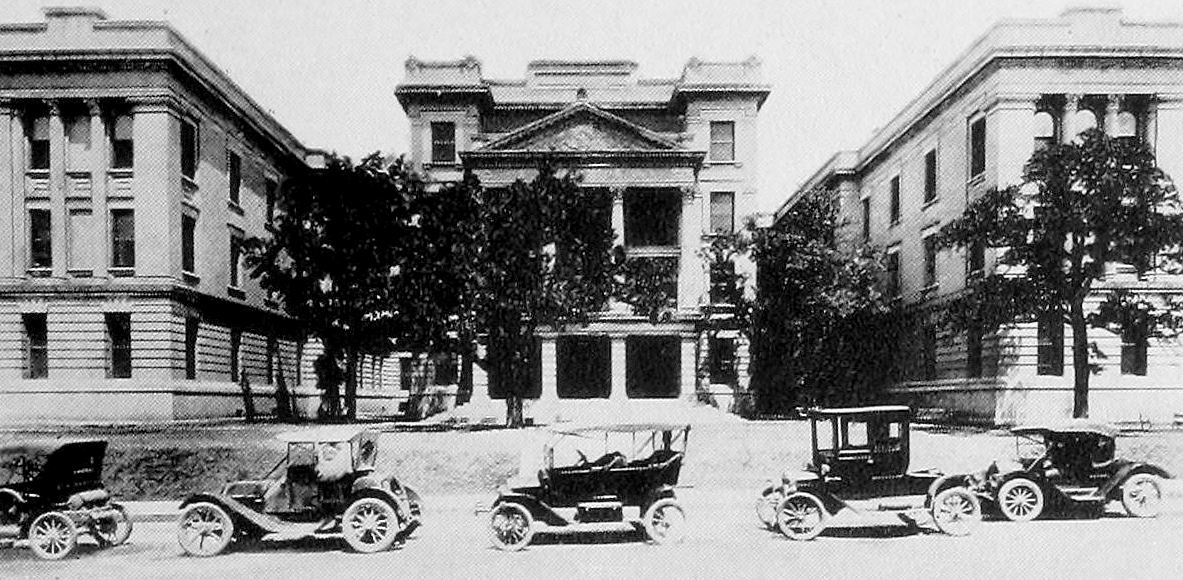
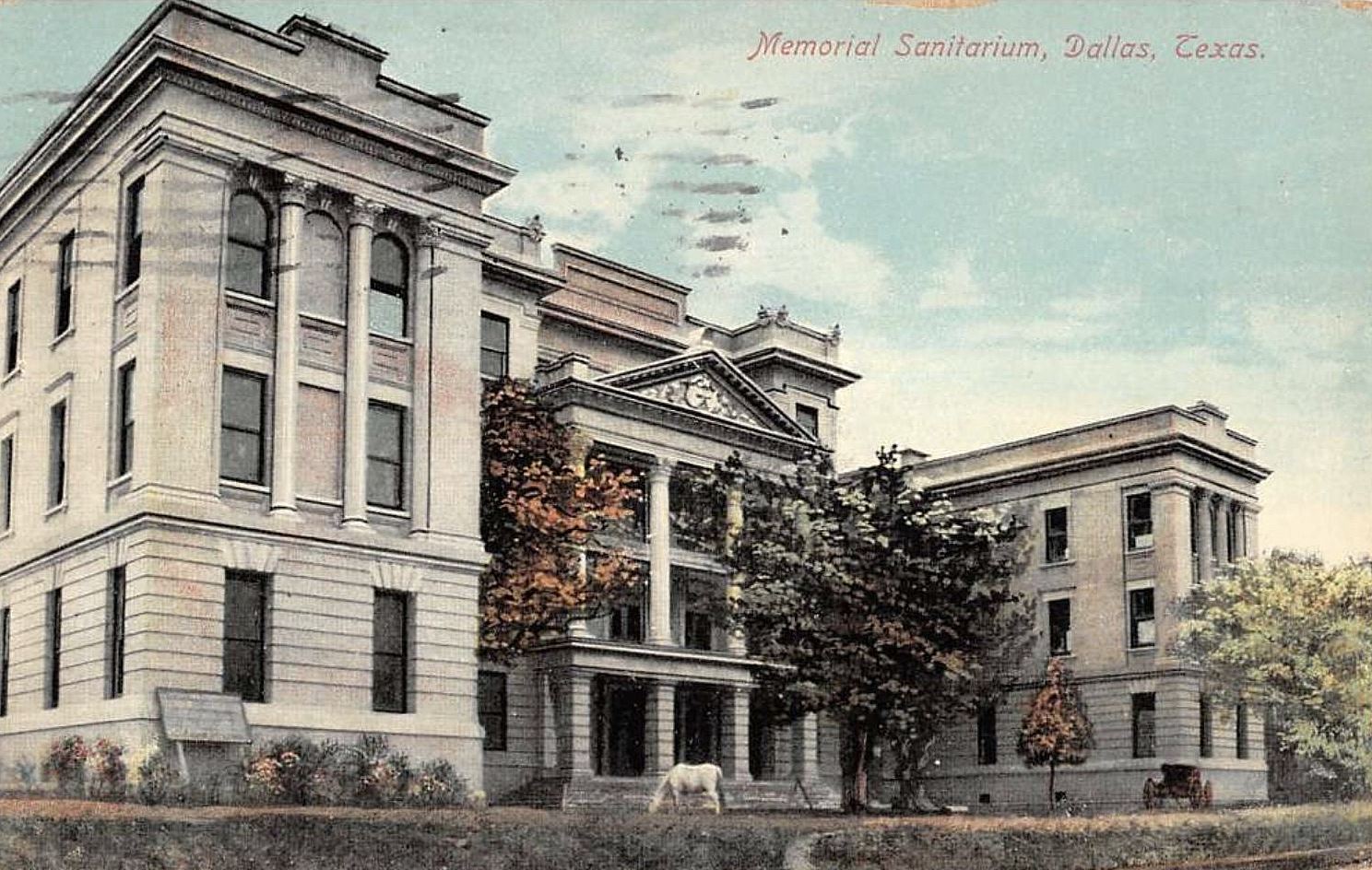
Below, a cool photo of the Texas Baptist Memorial Sanitarium (later renamed “Baylor Hospital”), with some pretty great automobiles parked out front on Junius Street. I’ve just added three photos and three postcard views of Baylor to the post Baylor Hospital —  1909-1921.” Basically, I’ve just written an entire new post — the original post consisted of one image and one sentence — so go see all the new stuff populating this 2014 post. (Source: The circa-1915 black-and-white photo is from the 1917 Baylor University yearbook; the postcard — that horse! — is from eBay.)

baylor_baylor-univ-waco-yrbk_the-round-up_1917

baylor_horse_postmarked-1911_ebay

*

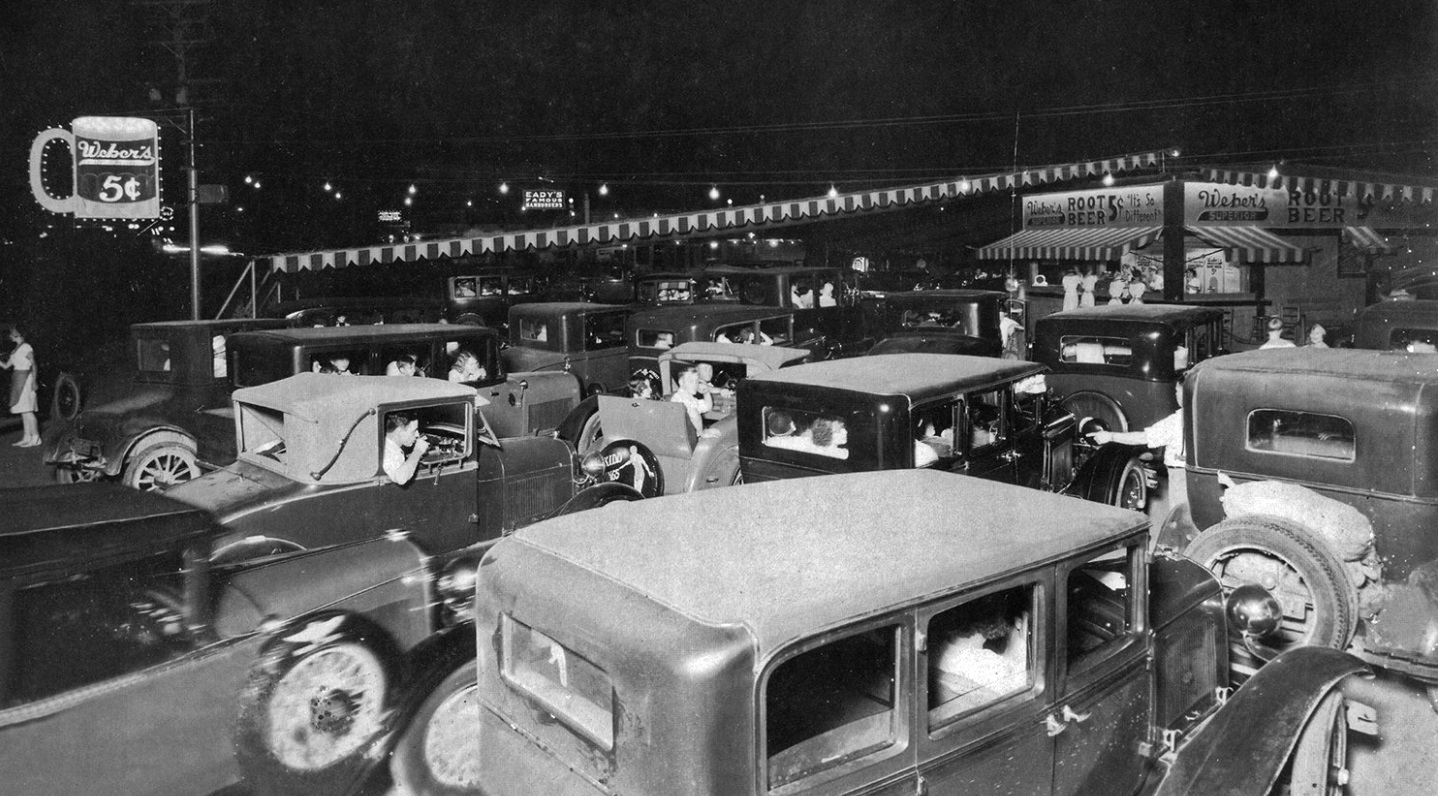
And lastly, a fantastic photo showing a Weber’s Root Beer stand on a busy night, with a parking lot full of thirsty teenagers, rumble seats, and future jalopies. In the background is a sign for Eady’s Famous Hamburgers, which would indicate that this photo was taken at one of the two locations where both Eady’s and Weber’s were neighbors: in Oak Cliff in the 1100 block of Zang, or near the Lower Greenville intersection of Greenville and Richmond. I’ve added this to the post “Weber’s Root Beer Stands: ‘Good Service with a Smile.'” (Source: Traces of Texas Twitter feed; original source unknown)

webers_root-beer_traces-of-texas

*

Copyright © 2018 Paula Bosse. All Rights Reserved.
 

From the Vault: Nolan Ryan’s Extreme High-Carb Breakfast at the Sheraton — 1972

nolan-ryanAnticipation…

by Paula Bosse

Why was future-Texas Ranger Nolan Ryan being served 302 pancakes at the Sheraton on September 26, 1972? Find out why in the 2015 Flashback Dallas post “Nolan Ryan’s Celebratory Pancake Breakfast — 1972,” here.

Happy (belated) Opening Day!

*

Copyright © 2018 Paula Bosse. All Rights Reserved.
 

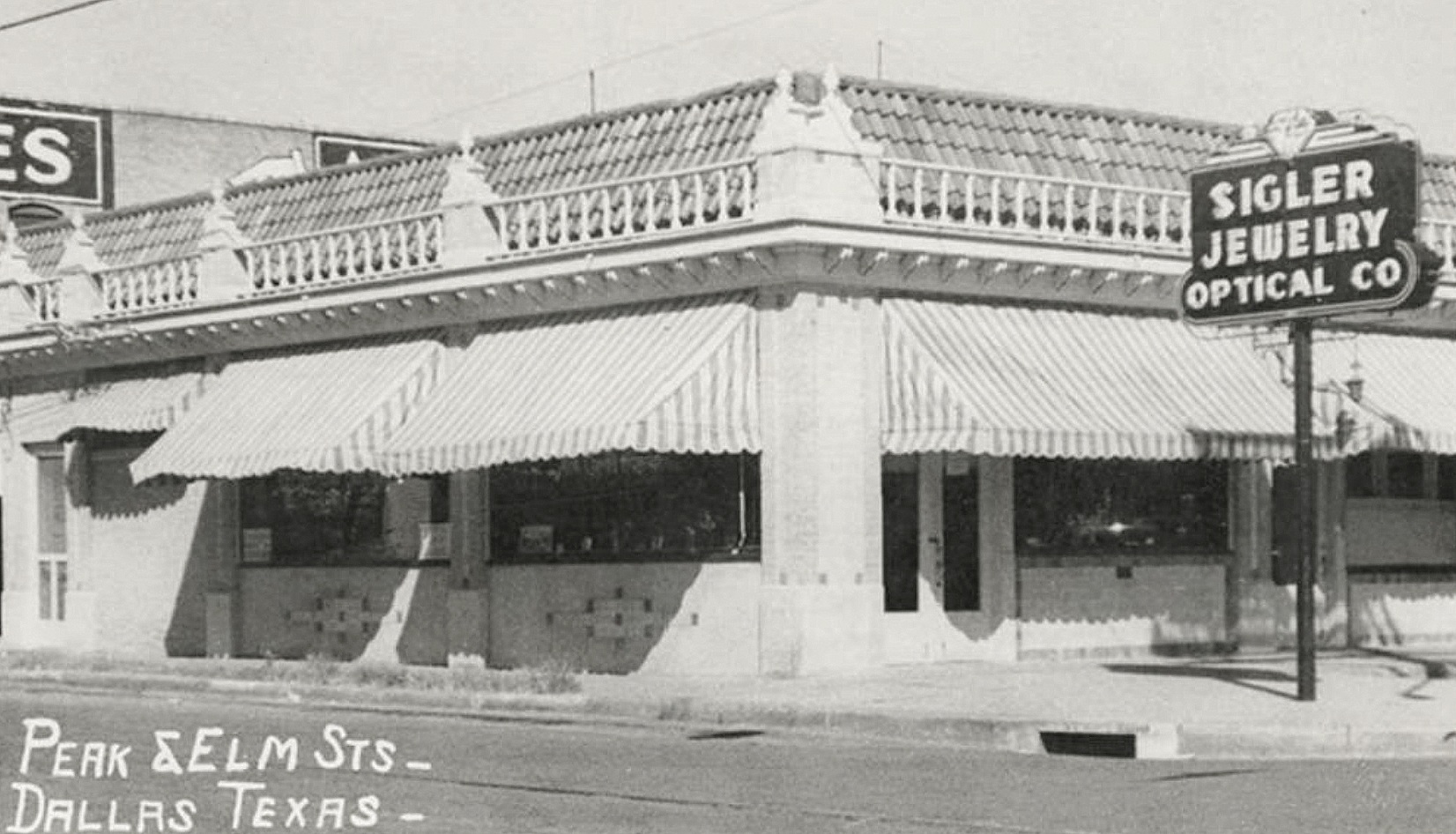
The L. P. Sigler Jewelry Store, Peak & Elm

peak-and-elm_cook-collection_degolyer_SMUNorth Peak & Elm, southeast corner… (click for larger image)

by Paula Bosse

Dr. Lough Phillip Sigler (1884-1951) was an optometrist who moved to Dallas from Denton County in 1908; the following year he opened a jewelry and watch store inside an Old East Dallas pharmacy at 4301 Elm Street, at the northeast corner of Elm and North Peak, eventually expanding into the adjoining storefront. In 1930 he moved across the street into a brand new building at the southeast corner of Peak and Elm: 132 N. Peak, seen in the photo above.

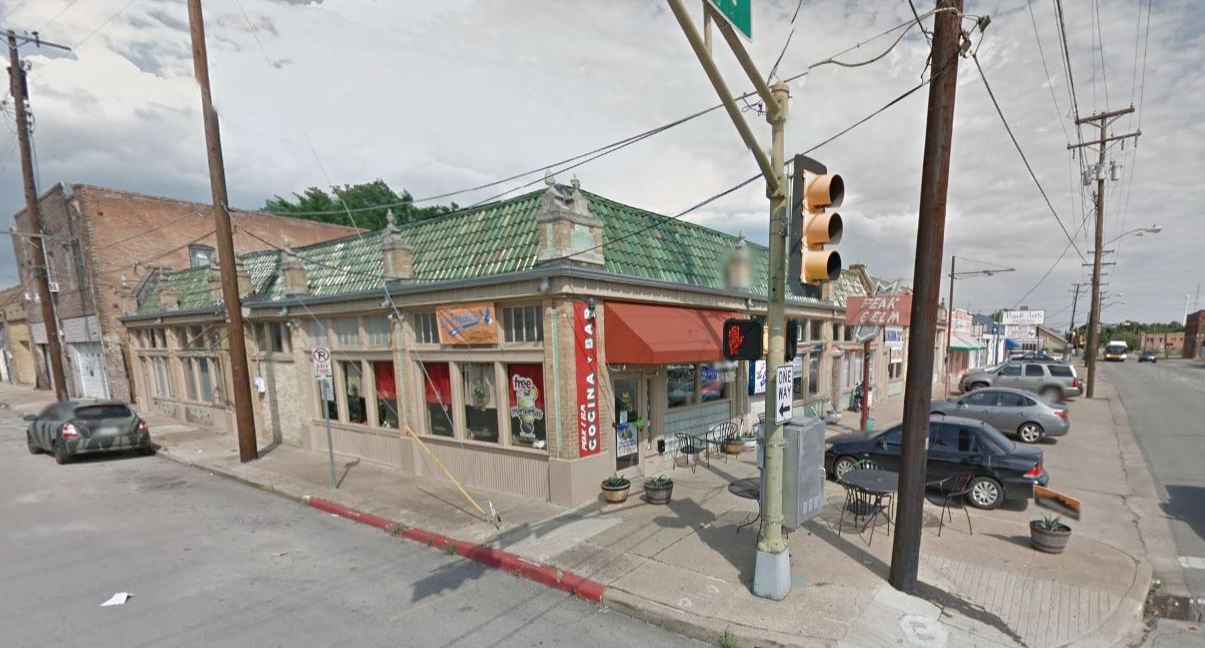
This type of neighborhood retail strip of shops and cafes was a common site throughout the city, and there are several still standing, most of which I’ve seen in Old East Dallas and Oak Cliff. I love these strips, and, thankfully, the one seen in the photo still stands.

peak-and-elm_googleGoogle Street View, 2016

The jewelry company founded by Dr. Sigler had an amazingly long life: the store opened at Peak and Elm in about 1910 (at the northeast corner) and remained in business (at the southeast corner) until well into the 1970s. The business which currently stands at 132 N. Peak is a very charming Mexican restaurant called Peak & Elm Cocina y Bar (check it out!).

***

Sources & Notes

Top image — “Peak & Elm Sts.” — is from a real photo postcard in the George W. Cook Dallas/Texas Image collection, DeGolyer Library, Central University Libraries, Southern Methodist University; more information on this photo can be found here.

If I had to guess the date of the image, I’d guess around 1930 when Sigler moved into the new location. The strip appears to have been built in 1929, with its first tenants showing up in the 1930 city directory. See it today on Google Street View, here.

Just as an interesting historical note, directly across Peak from Sigler’s jewelry store were car barns and machine shops for some of the city’s electric railway streetcars — they can be seen in a 1922 Sanborn map here. Those blocks are currently occupied by Dallas Area Rapid Transit facilities.

The 1922 map showing blocks occupied by Mr. Sigler’s store(s) is here (his first location at 4301-03 Elm is seen, but the building which housed his later store at 132 N. Peak is not seen as it would not be built for another seven or eight years). 

*

Copyright © 2018 Paula Bosse. All Rights Reserved.


From the Vault: Garrett Park

garret-park_color

by Paula Bosse

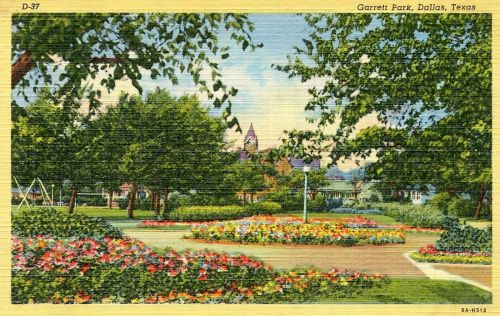
Springtime! This postcard of Garrett Park screams springtime. The park is still there, between Lowest Greenville and Munger Place, it just doesn’t look anything like this anymore. I’ve updated the 2014 Flashback Dallas post “Garrett Park Aburst in Spring Flowers” with new text and a few new images, here.

*

Copyright © 2018 Paula Bosse. All Rights Reserved.


The Eccentric Medford Compound On the Old Eagle Ford Road: 1945-1950

medford_trinity-cafe_west-dallas_FB_dallas-historyYou need it, he’s got it…

by Paula Bosse

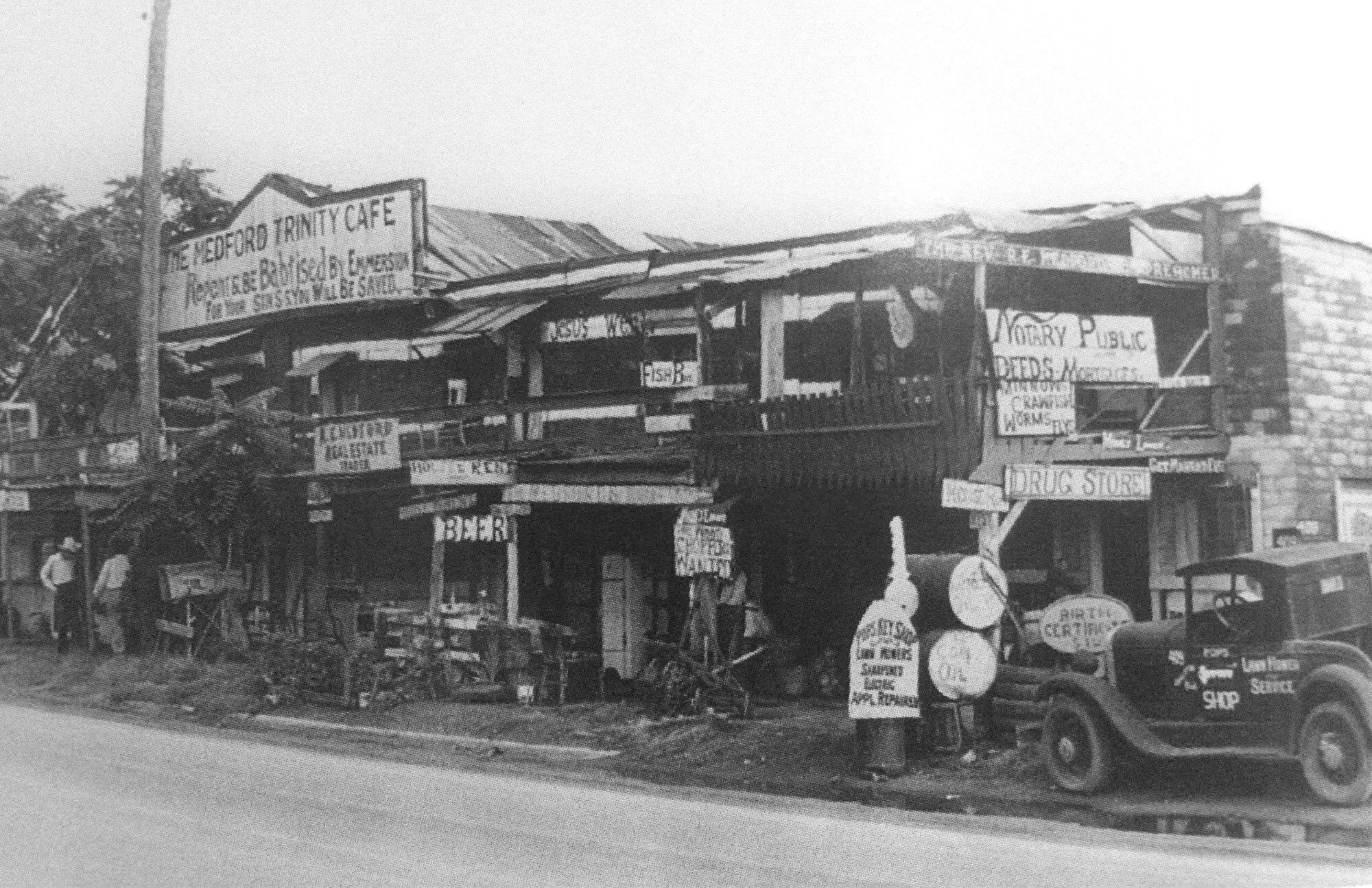
Above, 409-413 Singleton Blvd. in West Dallas, not long after the name of the street had been changed from Eagle Ford Road. The name-change happened in 1942 because of “unfavorable incidents in the past which had been associated with Eagle Ford Road” (The Dallas Morning News, April 26, 1942) — “Singleton” was Vernon Singleton, a former Oak Cliff County Commissioner. Today, this area is part of the super-hipstery Trinity Groves neighborhood; the block seen in the photo is now mostly occupied by a parking lot and looks like this.

Back then, “Eagle Ford Road” would have conjured up all sorts of unsavory images of bad behavior and illegal activities, and, even now, one tends to think immediately of the area’s most notorious exports: Bonnie and Clyde. Immediately after World War II, the population of West Dallas (an area which would not become part of the City of Dallas until its annexation in December 1952) was about 12,000, and its residents were generally poor and living in substandard housing with inadequate water and drainage and little in the way of sanitary facilities.

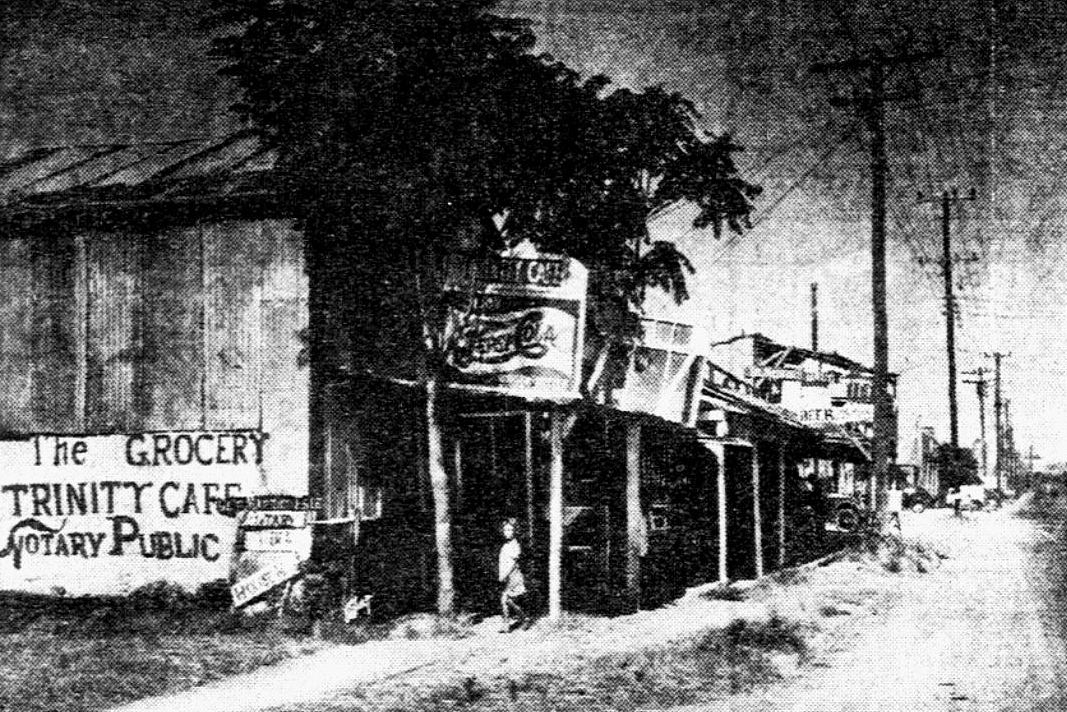
The “complex” above — which consisted of, basically, the Trinity Cafe, a grocery/drug/dry-goods store, and a residence — was perhaps a bit more colorful than most of the businesses that lined Eagle Road/Singleton Blvd. in post-war West Dallas. The property was owned by Richard Elbert Medford (1864-1950), who, as one of the signs says, was also known as “The Rev. R. E. Medford, Preacher” (I’m not sure if he was an actual ordained minister or just a self-styled preacher). In 1944 or 1945 — after several years of selling mattresses — Medford took over the collection of rickety buildings seen in the photo above and began to sell a wide-ranging collection of unrelated stuff and painted a lot of signs. He remained in business there until his death in 1950 at the age of 86 (the cause of death was “senile exhaustion” which I gather means “died of old age”).

The signage in the photo is … well … it’s fantastic. It’s verging on Outsider Art. Medford offered everything, including (but not limited to):

  • Real estate
  • Beer
  • Notary Public services (deeds, mortgages, birth certificates…)
  • Keys
  • Appliance repair
  • Lawn mowers
  • Oil
  • Fish bait (minnows, crawfish, worms, and “flys”)

He also offered religious advice (“Repent & Be Babtised By Emmersion For Your Sins You Will Be Saved”).

Mr. Medford’s personal life was not a happy one, and perhaps the unrelenting family dramas caused him to become more and more eccentric as the years went by. Many of his children found themselves caught up in the crime and violence West Dallas had become known for.

  • One teenage son was shot and wounded during an attempted robbery in 1930, two months before one of his daughters married at the age of 13.
  • Another son, who was 11 years old, was killed when he attempted to intervene in a fight between his sister and her husband and was fatally kicked in the abdomen by his brother-in-law.
  • Another son was a habitual criminal who committed an eye-popping range of crimes and was in and out of city, county, state, and federal correctional facilities throughout his life. (This son, Homer, was also married for a short time to the ex-wife of Clyde Barrow’s brother L. C. Barrow, but that marriage hit the skids when she shot Homer, sending him to the hospital with critical — but not fatal — wounds.)
  • And in 1951, after Rev. Medford’s death, the son who had been shot in 1930 while attempting to break into a store in Irving, shot and killed his wife and young son before killing himself.

So, yeah, Rev. Medford’s life was a rough one, and there were definitely some dark days in hardscrabble West Dallas. I’d like to think his store, plastered with its kooky signs, offered him some respite from the incessant melodramas percolating all around him.

medford_trinity-cafe_west-dallas_1940sSingleton Blvd., late 1940s, not yet part of Dallas

*

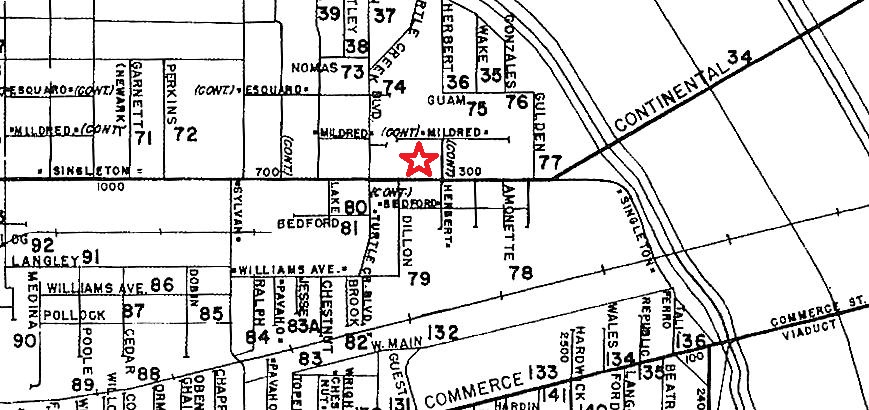
The location of the Medford house/cafe/store, seen on a 1952 Mapsco (click for larger image).

medford_1952-mapsco1952 Mapsco

***

Sources & Notes

I came across the photo years ago on the Dallas History Facebook group. There was no source, but there appears to be a copy of this photograph in the Jim Doster Collection at the Dallas Public Library titled “Meford [sic] Trinity Cafe on Singleton Blvd.,” incorrectly dated as 1930 (call number PA97-7/147). I’m sure a higher resolution image of this would offer up quite a few amusing details and discoveries.

*

Copyright © 2018 Paula Bosse. All Rights Reserved.

From the Vault: Irish Eyes Are Not Smiling Long — Pat Hannon’s 101 Bar

101-bar_ca-1917

by Paula Bosse

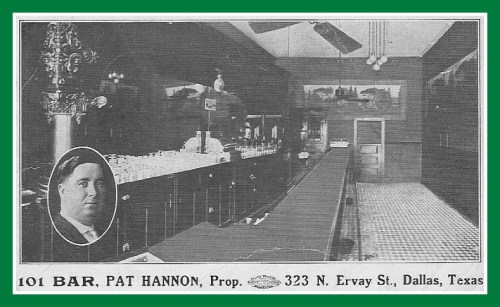
It’s St. Patrick’s Day, and though this story about the 101 Bar on N. Ervay is only vaguely St. Patrick’s-y, it’s going to have to do. Read about Pat Hannon’s supremely bad timing in opening a bar, in the 2016 Flashback Dallas post “The 101 Bar: Patrick Hannon, Prop. — ca. 1917,” here.

Sláinte, y’all.

*

Copyright © 2018 Paula Bosse. All Rights Reserved.

The Ray Hubbard Estate, Lakewood

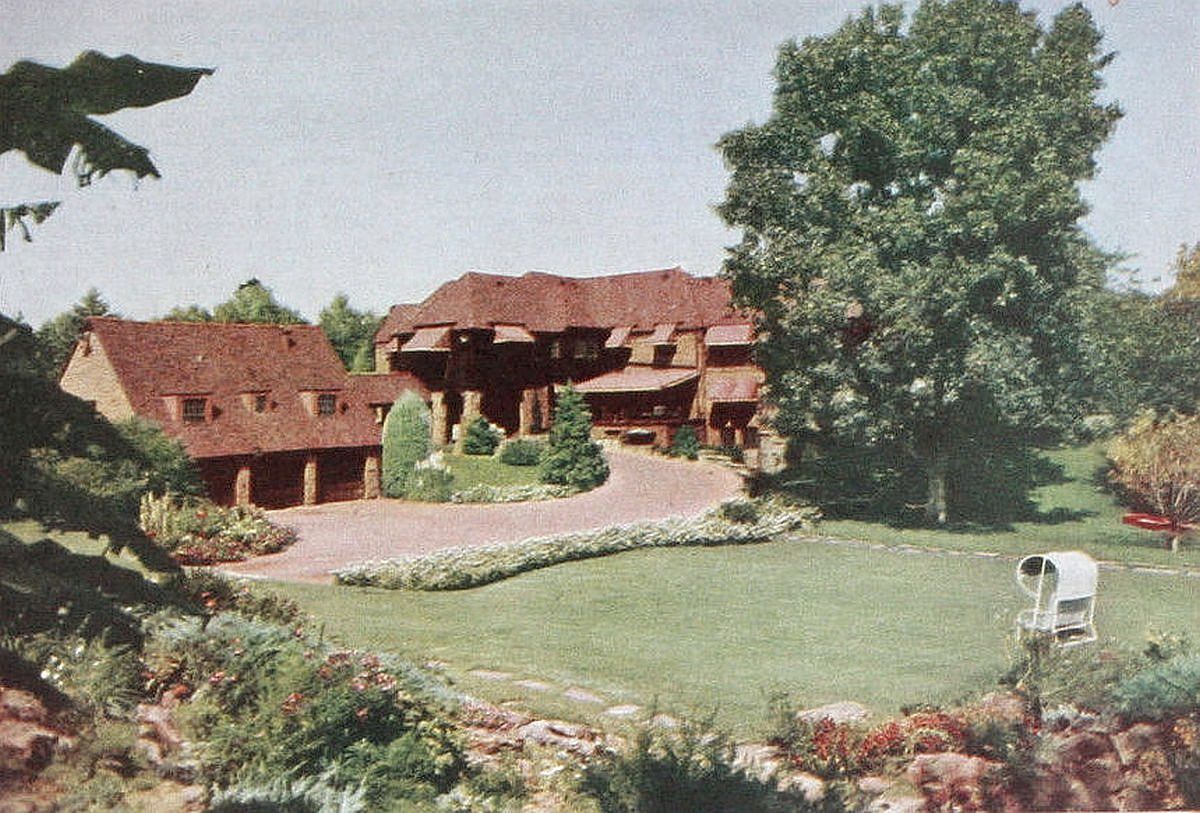
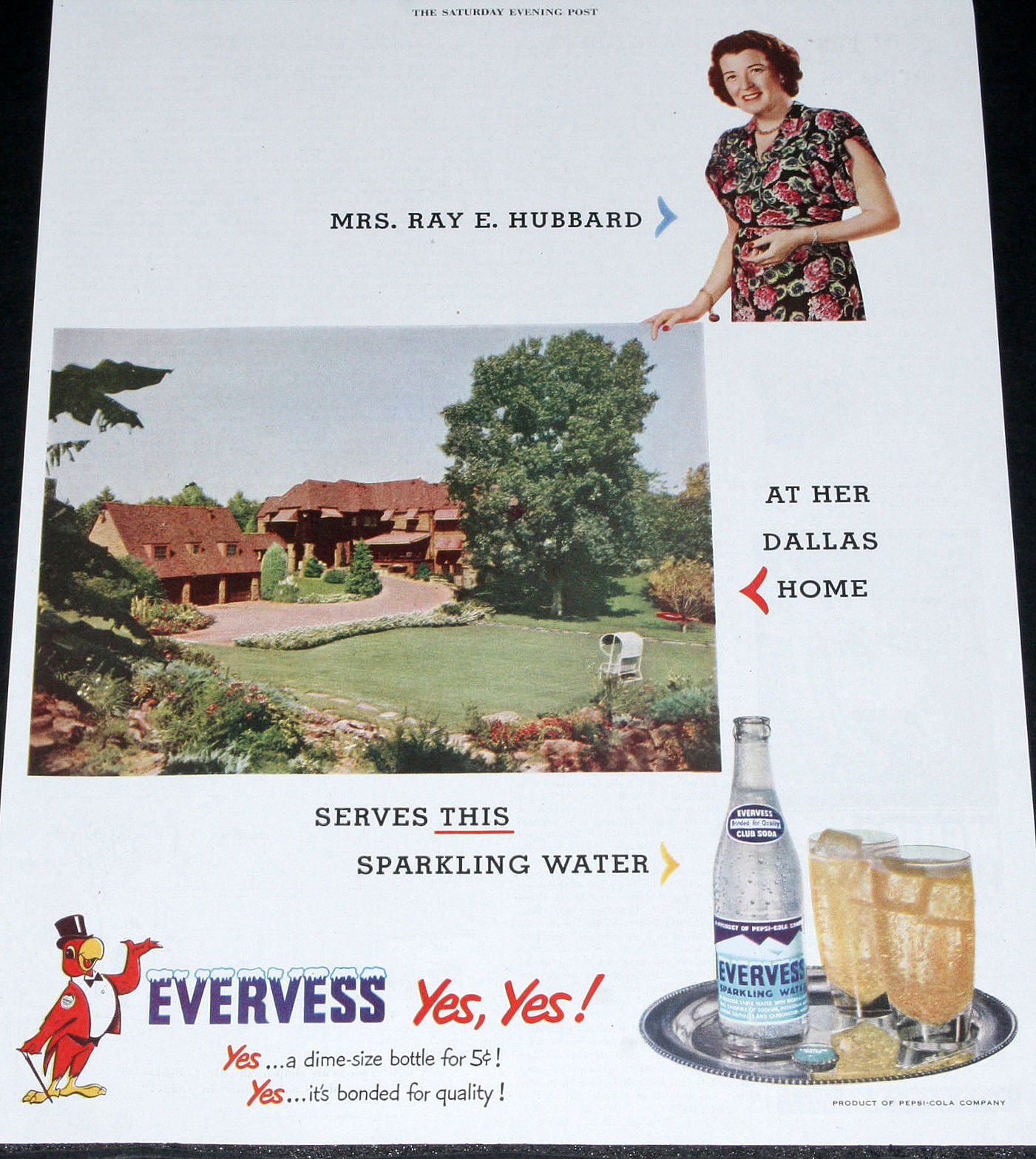
ad-evervess_mrs-ray-hubbard_1948_detA country estate in the heart of Lakewood, 1948… (click for larger image)

by Paula Bosse

Lakewood has a lot of beautiful homes — large and small — but the (very large) Raymond E. Hubbard estate at the corner of Lakewood Boulevard and Brendenwood Drive is quite the show-stopper. Built in 1934, the two-and-a-half-acre property is about a mile from White Rock Lake and was known for years for its spectacular landscaping and gardens, much of which was the personal handiwork of owner Ray Hubbard (1893-1970). Hubbard amassed his wealth as an independent oilman during the boom years, but he was known in his later life for his lengthy tenure as president of the Dallas Park Board.

From a 1938 Dallas Morning News article:

Mr. Hubbard is that phenomenon known as a natural tiller of the soil. In the short space of two years he has taken a barren hill and transformed it into a blaze of beauty in the form of a rock garden he designed himself. In the symphony of color, he has even had the subtlety to plant a few onions because there is a blue-green cast to the leaves of the onion that is found in no other plant. Carnations, pansies and pinks mingle in profusion as well as a thousand other oddities you have never seen the likes of  before. (“Edens in Preview,” DMN, April 10, 1938)

In 1948, his wife, Janet Hubbard, was seen in an ad for Evervess Sparkling Water, with photos of both Mrs. Hubbard and a view of the impressive “backyard” of their Lakewood home. (Click ad to see larger image.)

ad-evervess_mrs-ray-hubbard_1948Saturday Evening Post, 1948

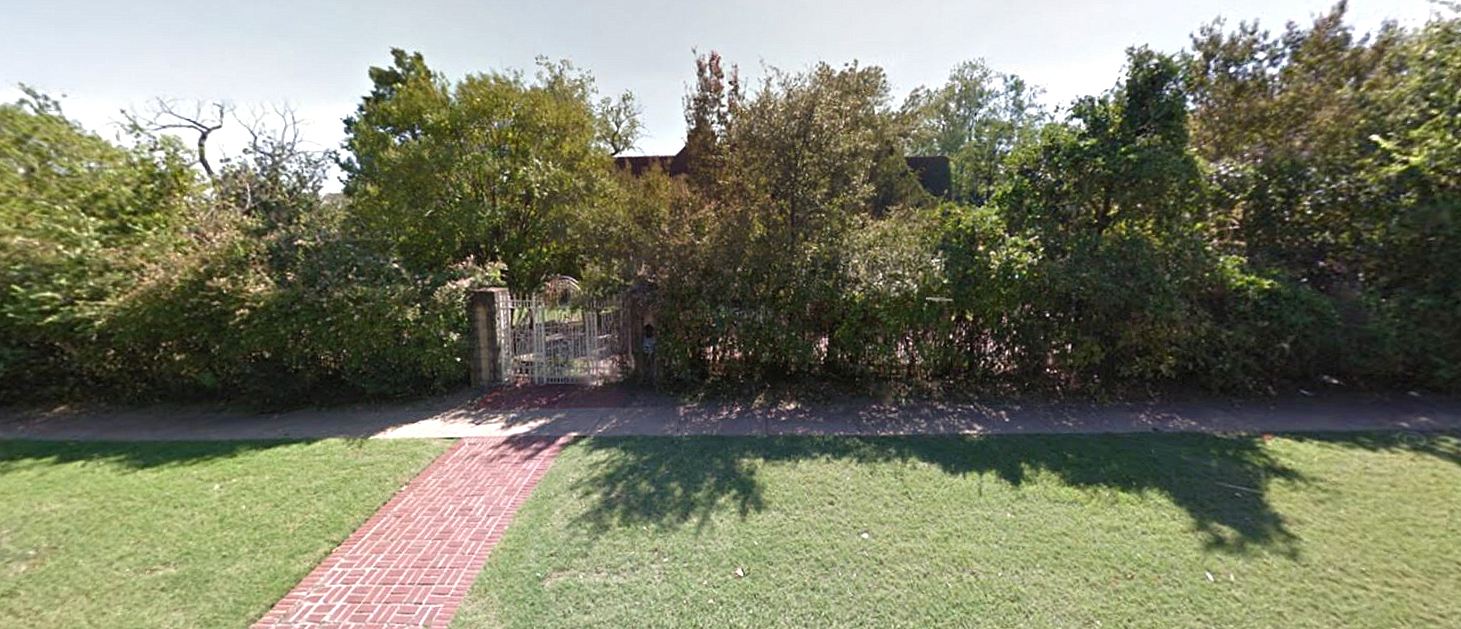
I came across this ad a few years ago but had no idea where the house was located or who Ray Hubbard was, other than the probable namesake of the lake which bears his name (the Rockwall-Forney reservoir was named Lake Ray Hubbard in January, 1967, in honor of Hubbard’s devotion to civic affairs and his decades-long service to Dallas parks). I was surprised to learn that this was the somewhat mysterious and foreboding-looking house I’d passed years ago, looking run-down and deserted, surrounded by overgrown shrubs and bushes. The 2012 Google Street View looked like this:

hubbard-house_google-street-view_oct-2012Google Street View, Oct. 2017

Back then the overgrown approach to the house looked like this, and was probably something of a thorn in the side of the Lakewood Boulevard residents.

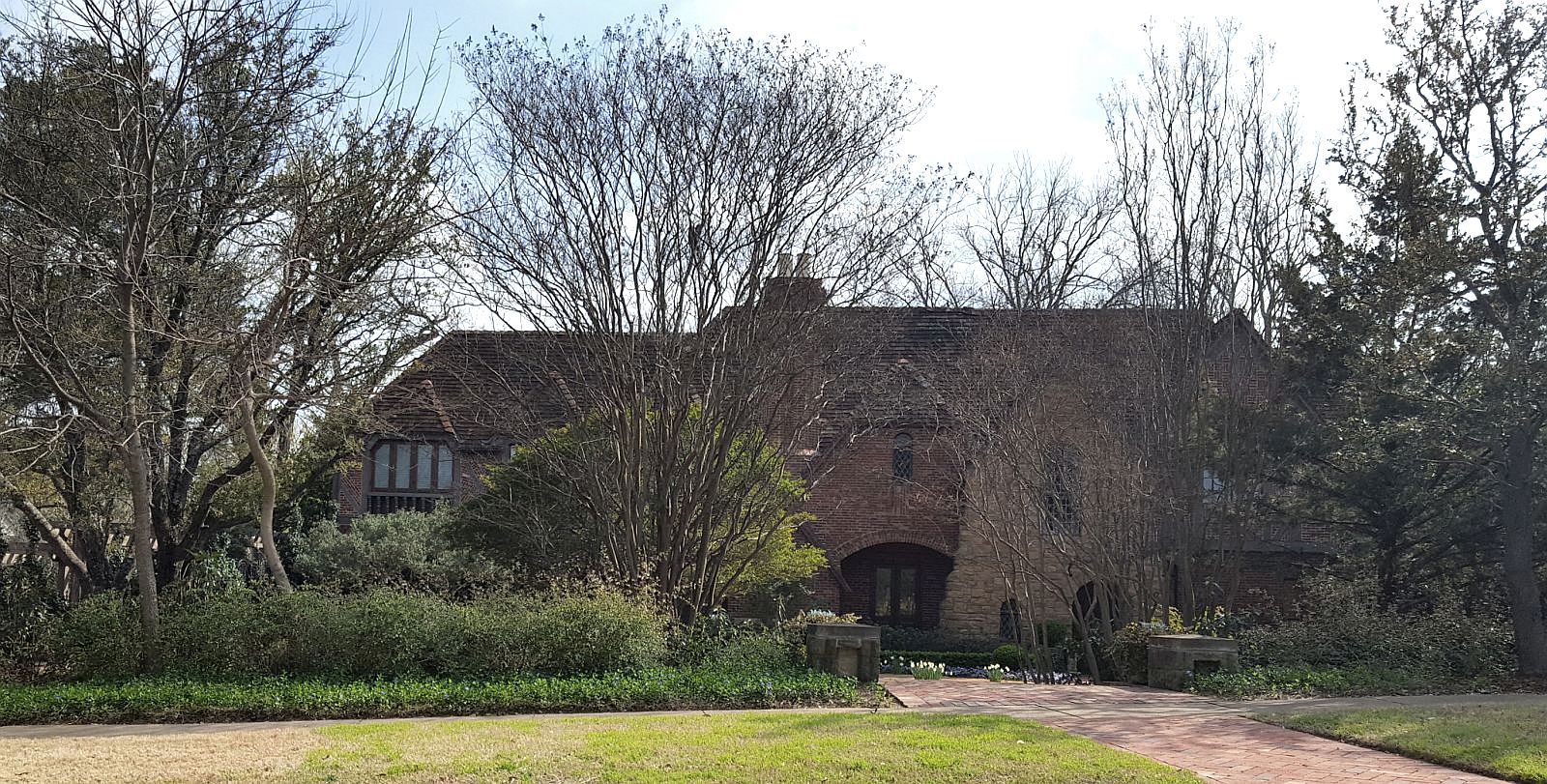
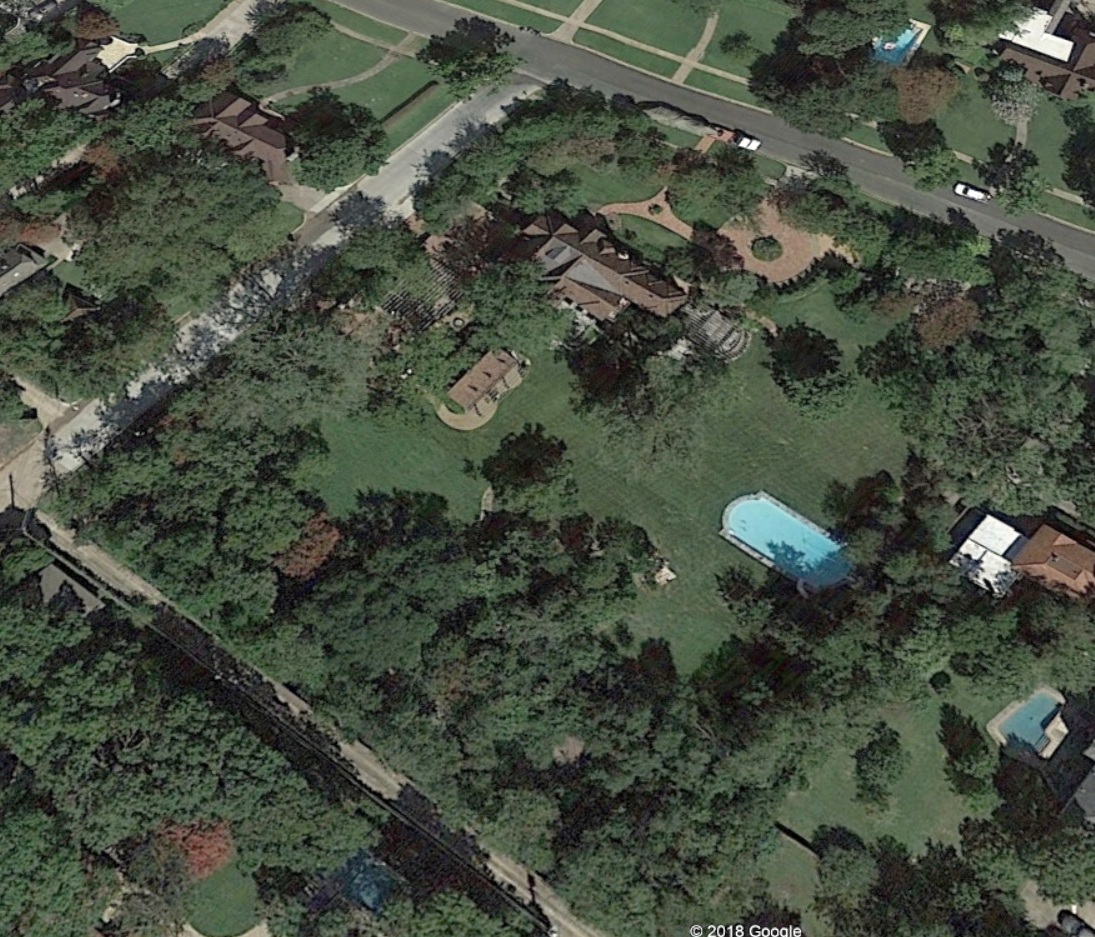
Since Google Street View was so out-of-date, I decided to drive by the house today to see what it looked like in 2018. It’s beautiful!

hubbard-house_lakewood-blvd_031519_PBphoto: Paula Bosse

The reason for the transformation? The property was bought and restored by Hunter Hunt (grandson of one-time richest man in the world — and White Rock Lake resident — H. L. Hunt) and his wife, Stephanie Hunt. And they did a wonderful job! If I had some, I’d raise a toast to the couple with an ice-cold glass of Evervess Sparkling Water!

ray-hubbard-estate_google-earth_2017
Google Earth, 2017

*

hubbard_ray-e-hubbard_find-a-grave

Even though I now know who Ray Hubbard was, I’ll probably still find myself unintentionally (and, okay, sometimes intentionally) calling the lake named after him “Lake Ray Wylie Hubbard” (another former Dallas resident of note, but we’ll leave that for another time…).

***

Sources & Notes

Ad found on eBay. This image is from an item offered several years ago, but as luck would have it, another seller has it for sale right now, here. Perhaps if you’re friends with Hunter and Stephanie Hunt, this would make a nice stocking stuffer. (This Evervess advertisement seems to have been part of a 1948 ad campaign featuring society women, their homes, and their favorite sparkling water: another ad, featuring Mrs. Homer Lange and her Chicago home, can be seen here.)

Photo of Ray E. Hubbard is from Find-a-Grave; read a biographical sketch about Mr. Hubbard’s life on the site, here. Not included in this information was that during Hubbard’s 27 years heading the Park Board (1943-1970), the Dallas park system expanded from 4,400 acres to more than 15,000 acres, and the number of parks increased from 54 to 150.

Read about Stephanie and Hunter Hunt and their Hunt Institute at SMU, here.

If anyone knows the original architect of the Hubbard house, please let me know!

For more on Lakewood Boulevard, I really enjoyed the 1992 Lakewood Advocate article “Lakewood Boulevard’s First Resident Looks Back On the Area’s Development; Mrs. Barnett’s Late Husband, Marshall, Built the First House on Lakewood Boulevard in the 1920s,” here.

See a 1932 view of the 7100 block of Lakewood Blvd. (with White Rock Lake at the end of the street), here; this photo was taken two years before the construction of the Hubbards’ house, which would  be built three blocks to the west (Dines and Kraft photo from the Flashback Dallas post “‘Reminiscences: A Glimpse of Old East Dallas,'” here).

*

Copyright © 2018 Paula Bosse. All Rights Reserved.
The Heart of Big “D”: Akard & Commerce

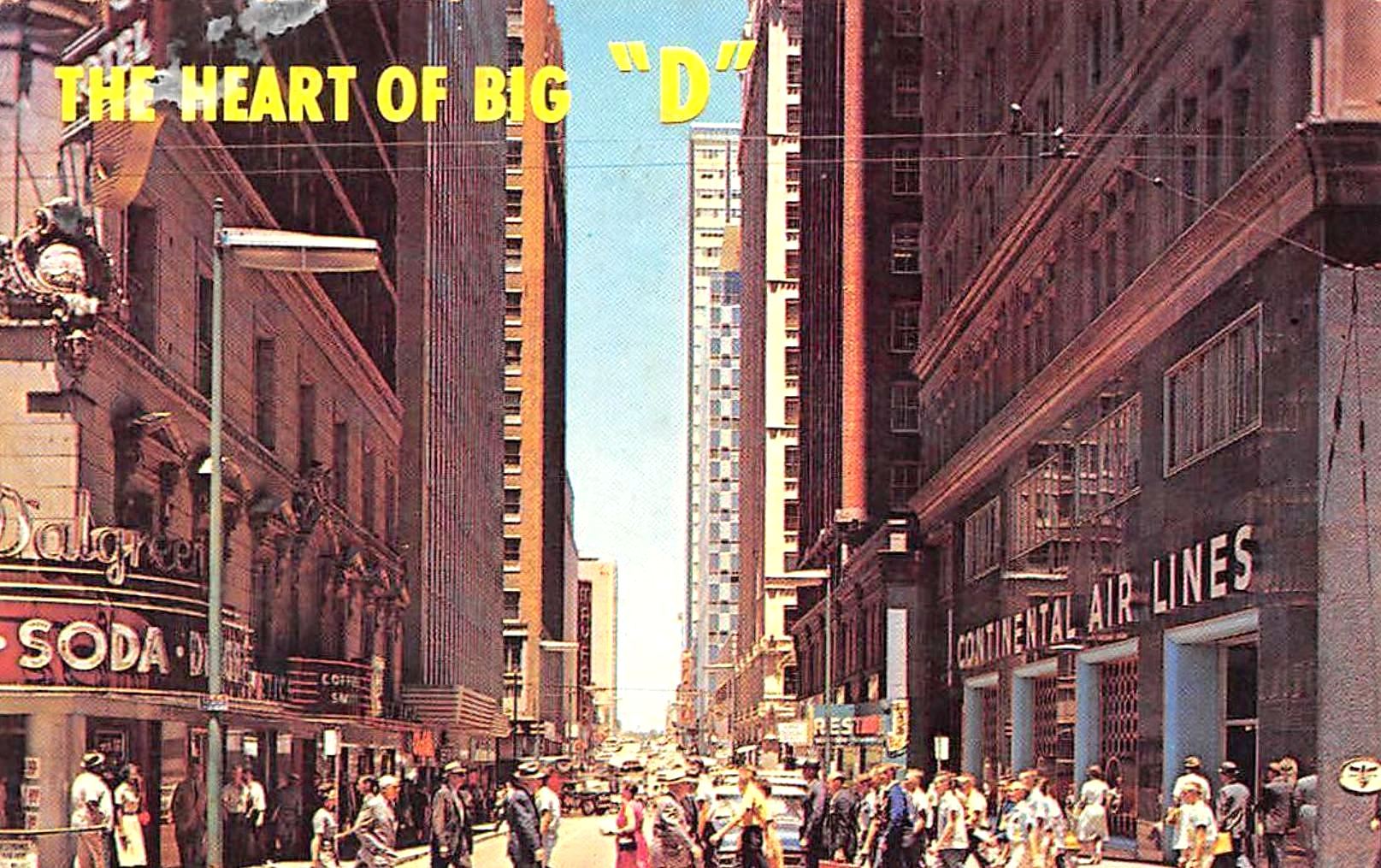
downtown_heart-of-big-d_postcard_akard-commerceLooking up the “canyon”… (click for larger image)

by Paula Bosse

A postcard view of Akard, looking north from Commerce; the “canyon” is anchored at the south end by the Baker Hotel (behind the photographer), the Walgreens in the Adolphus Hotel building, and the Continental Air Lines ticket office in the Magnolia Building.

Looks like a hot, painfully sunny day in the canyon. Personally, I’d get out of the sun and hit that soda fountain….

***

Sources & Notes

This postcard is currently being offered on eBay, here. The seller is in Transylvania.

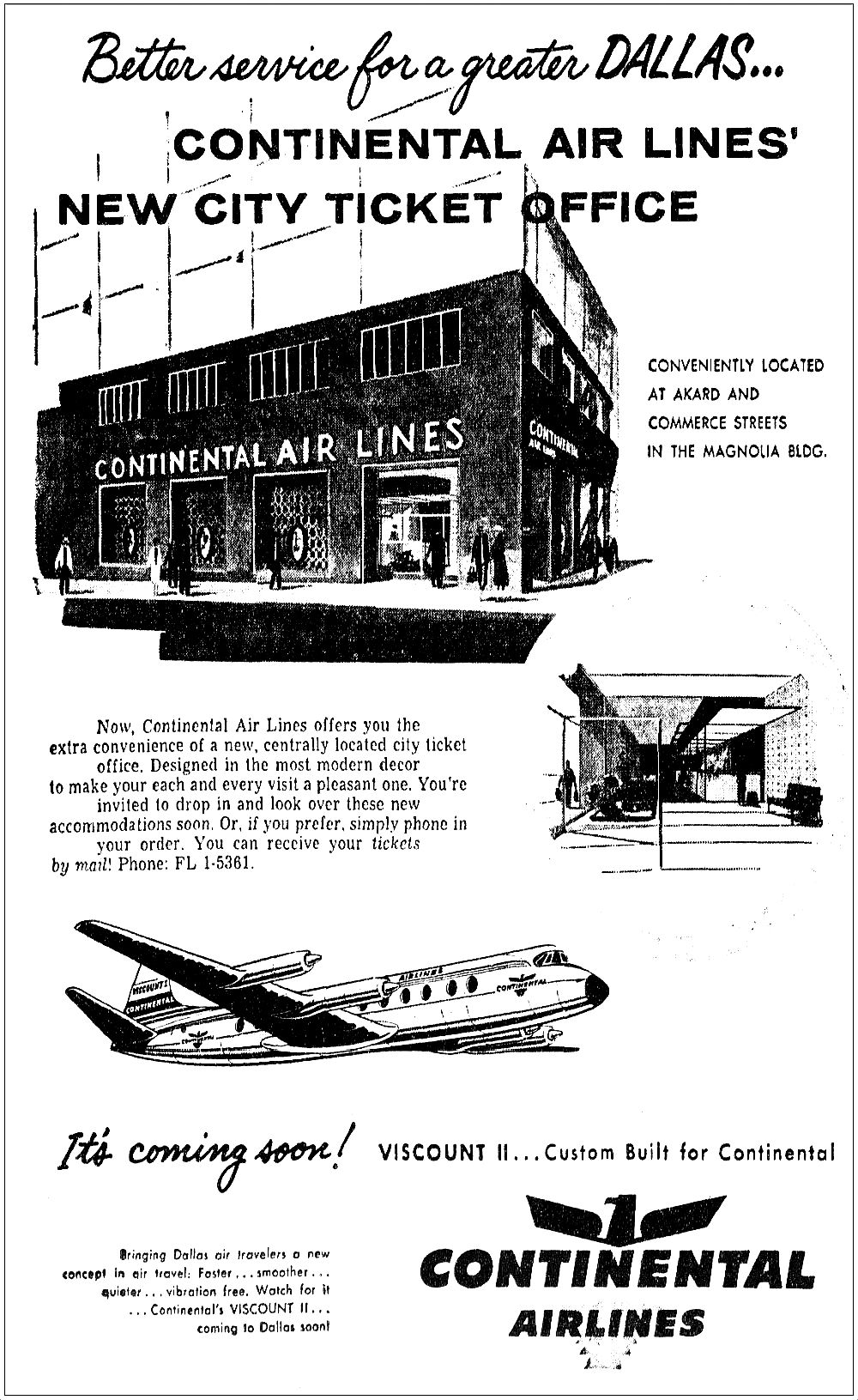
The Continental Air Lines ticket office opened in the Magnolia Building in early 1958 (click for larger image).

continental-air-lines_jan-1958
January, 1958

For more info on the buildings that lined the “canyon,” see the Flashback Dallas post “The ‘Akard Street Canyon’ — ca. 1962,” here.

*

Copyright © 2018 Paula Bosse. All Rights Reserved.
 

From the Vault: Film Row at Night

theater-row_night_telenews

by Paula Bosse

Lined with movie theaters and dazzling neon, Elm Street never looked more vibrant than it did in its cinema-centric heyday of the 1930s through the 1950s.

Check out four fantastic postcard views of Dallas’ Theater Row/Theatre Row/Film Row/Movie Row in a Flashback Dallas post from 2014, “Theatre Row — A Stunning Elm Street at Night.

*

Copyright © 2018 Paula Bosse. All Rights Reserved.