Flashback : Dallas

A Miscellany: History, Ads, Pop Culture

Category: Photographs

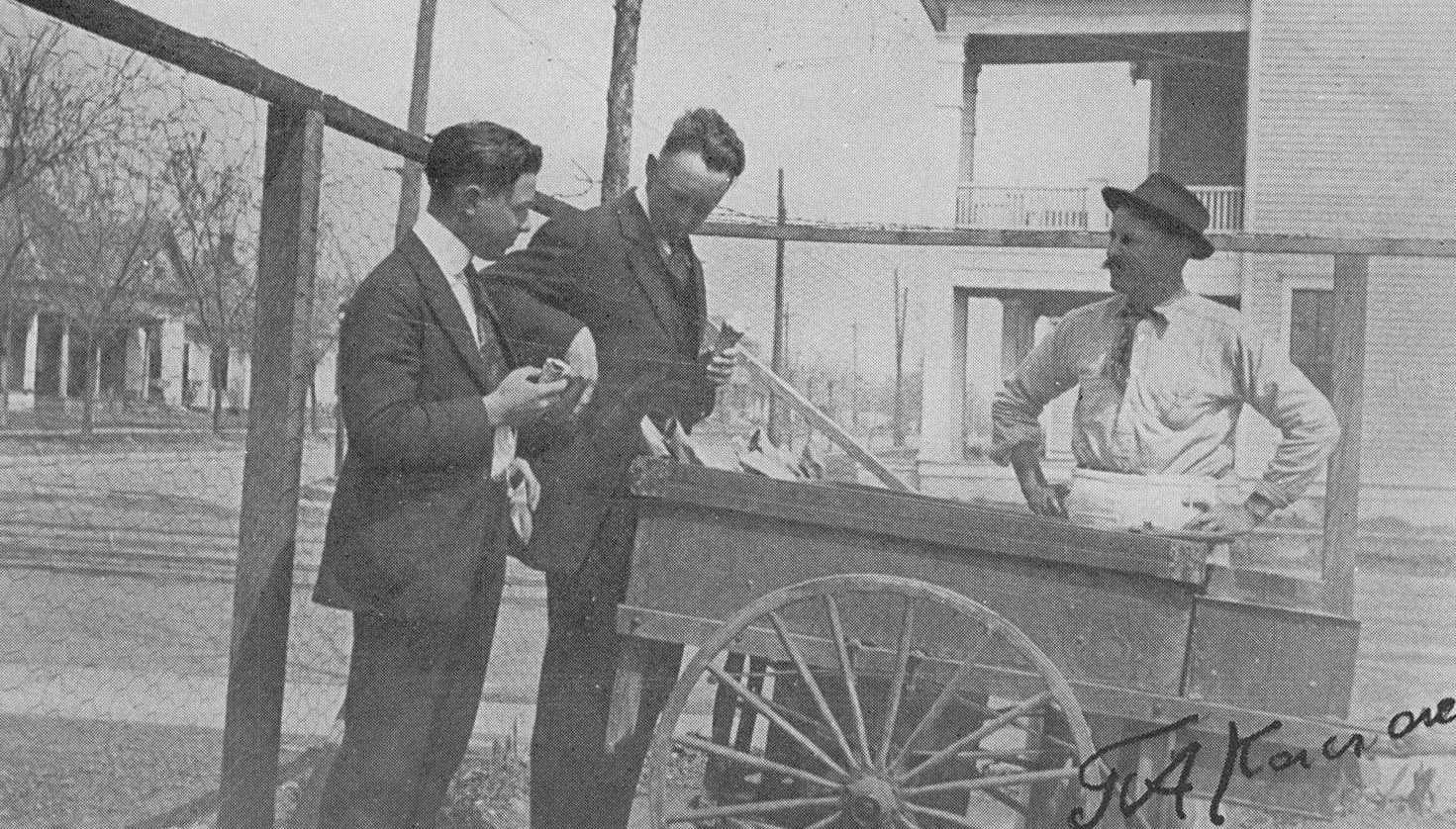
George Cacas, The Terrill School’s Greek Ice Cream Man — 1916

terrill_ice-cream_yrbk_1916-cacasPrep-school boys & the ice cream man, 1916

by Paula Bosse

I love this photo. It shows two students from the Terrill School for Boys, buying ice cream from George Cacas, a Greek immigrant. I’m not sure of the exact location of the photo, but I would assume it is either in front of, next to, or very nearby the Terrill School, which was located at Swiss and Peak. It appeared in the school’s 1916 yearbook accompanying an “interview” with Mr. Cacas, whom the boys apparently (and one hopes affectionately) called “Spaghetti” (click for larger image):

terrill_ice-cream_cacas_1916-yrbk_text

Another photo of Mr. Cacas, from the previous year’s yearbook (click for larger image):

spaghetti_terrillian_1915

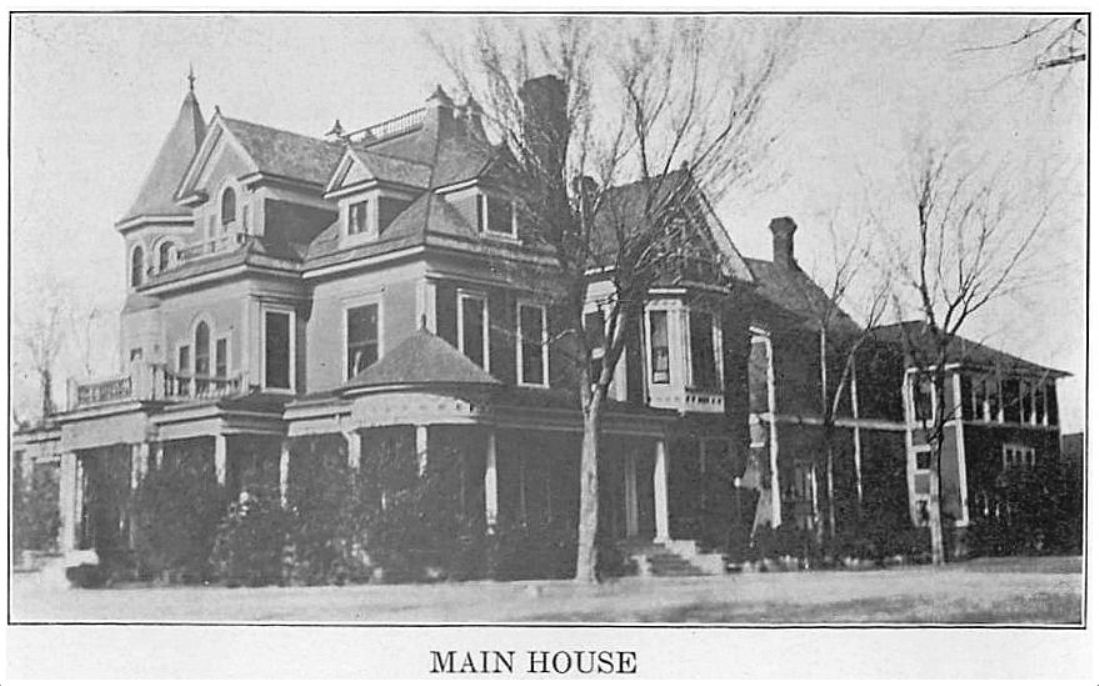
The Terrill School was established in 1906 and was one of the city’s early important prep schools for boys. (Incidentally, the Terrill School shared a fenceline with the prestigious Miss Hockaday’s School for Girls for many years — I’ll be writing more on this convenient arrangement in the future!) Below, two photos showing three of the campus’ many buildings, from about the same time as the one featuring Mr. Cacas.

terrill-school_main-house_yrbk_1919_lg

terrill-school_recitation-hall_phelps-hall_yrbk_1919Recitation Hall on the left; Phelps Hall, right — 1919

terrill-yrbk_19281928

***

Sources & Notes

Top photo and interview from the 1915-1916 Terrillian, the Terrill School yearbook; photos of the “Main House” and two campus buildings from the 1918-1919 Terrillian.

The Terrill School for Boys was located in Old East Dallas at 4217 Swiss Avenue, from 1906 to about 1930. It then moved to Ross Avenue for a few years and was eventually merged with a couple of other schools to form St. Mark’s School of Texas — more on that from the St. Mark’s website, here.

terrrill_school_bingLocation on present-day map (Bing)

The name “Cacas” didn’t seem right for a Greek surname — and the signature at the bottom of the photo looks like it might have been George’s, with his last name beginning with a “K.” But George’s family’s name was, in fact, spelled “Cacas,” as seen here in the city directory from 1915. I wonder if they spelled it “Cacas” back in Sparta?

cacas_directory_1915

*

Copyright © 2015 Paula Bosse. All Rights Reserved.

MLK in DFW — 1959

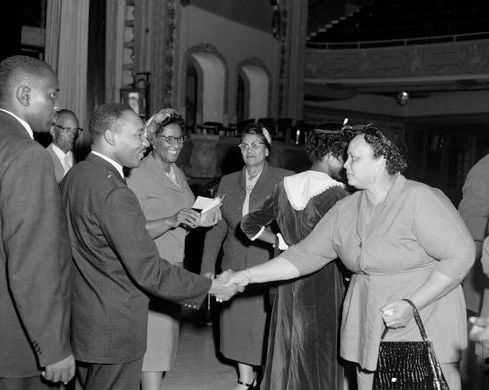
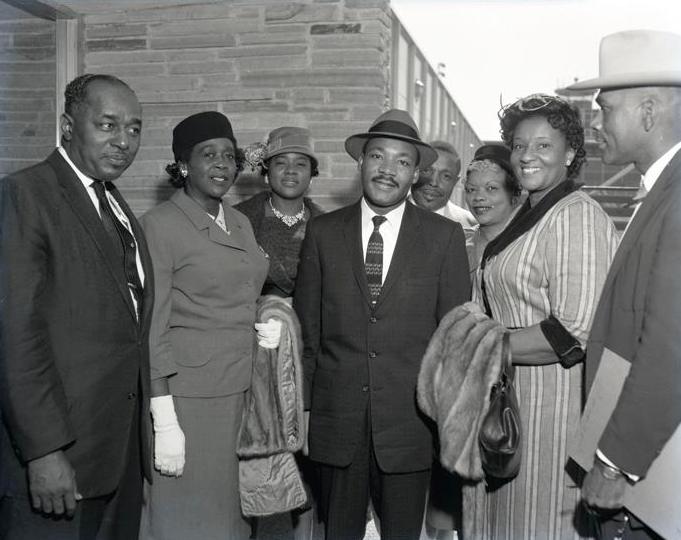
mlk-DFW-102259_calvin-littlejohn_briscoeDr. Martin Luther King, Jr. in DFW (photo © Calvin Littlejohn Estate)

by Paula Bosse

A couple of photos of Dr. Martin Luther King, Jr. on a quick trip to Dallas and Fort Worth in late October, 1959, taken by the wonderful Fort Worth photographer Calvin Littlejohn. The above photo is from Oct. 22, 1959 and was, I believe, taken after his speech at the Majestic Theatre in Fort Worth. Below, a photo of Dr. King taken at Love Field.

mlk_love-field_calvin-littlejohn_1959

***

Sources & Notes

Top photo by Calvin Littlejohn, from the Littlejohn Photographic Archive, Dolph Briscoe Center for American History. Mr. Littlejohn took several photos of Dr. King that visit, the locations of which are listed here — giving a good indication of the itinerary of the visit. I saw no mention or coverage of this visit in either The Dallas Morning News or The Fort Worth Star-Telegram.

Second photo from the TCU Press Facebook page.

A nice overview of Calvin Littlejohn’s career and a few of his photographs can be found here.

*

Copyright © 2015 Paula Bosse. All Rights Reserved.


Dallas’ “Courthouse Complex”

courthouse-complex_tinkle_key-to-dallas_1965-drawingEarly-’60s vision of the “courthouse complex”

by Paula Bosse

Let’s all be thankful that the Old Red Courthouse is still with us, because there was serious talk in the ’50s and ’60s of razing it to make way for a more modern downtown and a more efficient use of space. Lon Tinkle wrote the following in the mid-’60s:

courthouse-complex_tinkle_key-to-dallas_1965Excerpt from Lon Tinkle’s “The Key to Dallas” (1965)

Tinkle’s next paragraph: “It is not that Dallas doesn’t care. It does. But it has to grow into this experience of great cities, and it will.”

*

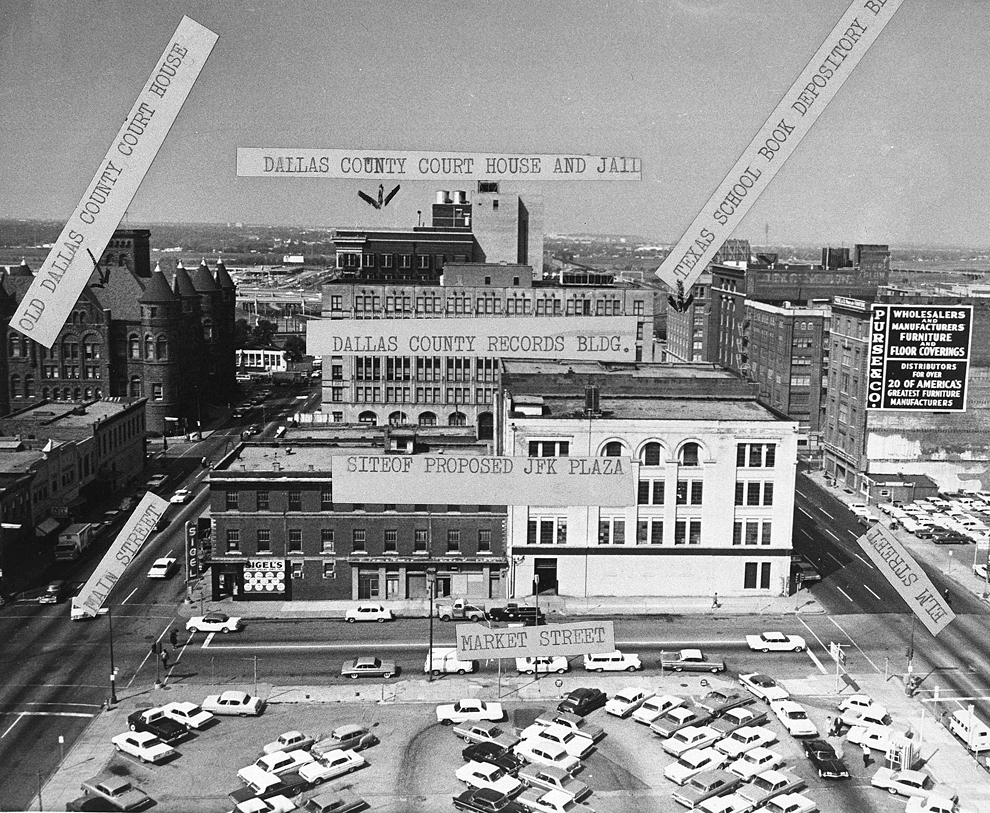
Here’s what the eastern boundary of the “courthouse complex” looked like in 1964. (Incidentally, the first Kennedy memorial site was chosen in April, 1964, and it was to be in the block immediately to the east of the Records Building, the one seen in the center of this photo. Sometime in the next few months, the location was changed to the block immediately east of the Old Red Courthouse.)

Ferd Kaufman, AP

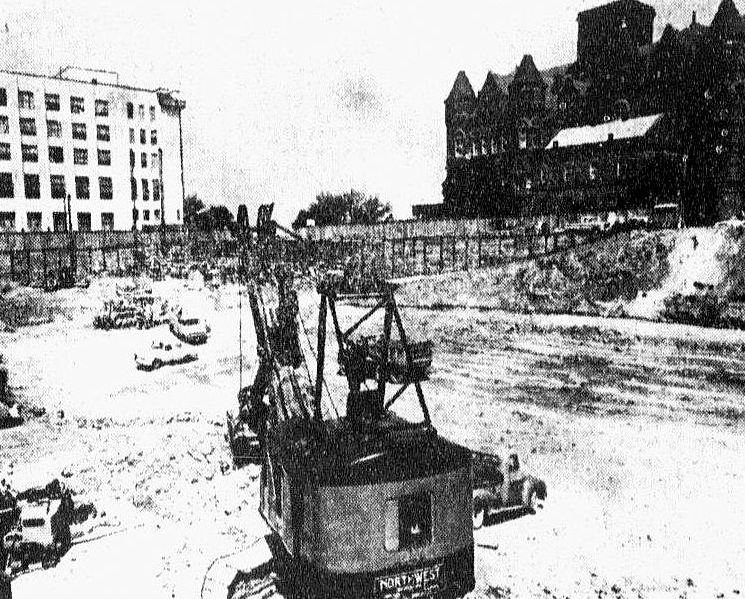
Here’s what the southern boundary looked like when construction of the new Dallas County Courthouse began in the spring of 1963:

courthouse-construction_early-1963

And here’s the “complex” today.

courthouse-complex_google

Old Red isn’t going anywhere!

**

UPDATE: After posting this on the Flashback Dallas Facebook page, a person commented about having worked across the street during the new courthouse’s construction.

On the night of June 19, 1964, a massive fire broke out on the upper floors of the new courts building, which was then under construction. There were 130 firefighters and more than 30 pieces of equipment on the scene according to newspaper accounts. The commenter wrote the following, in clipped sentences, telegram-style:

“I started to work 1963 at Terminal Annex. The Court House under construction, razed by fire shortly thereafter, heat from fire made us work away from windows. There was no thought of leaving building as mail had to make connections to railroads.”

First thing: Wow. The postal creed in action. Wonder if the workers got hazard pay? Or at least a W.C. Fields “hearty handclasp.”

Secondly: I had never seen the phrase “razed by fire” before. It’s not really accurate here, because only the upper floors were destroyed, but the cinematic quality of the phrase is pretty cool. I’ll have to file the phrase away to be used as the title for my memoirs, even if it doesn’t really apply to anything I’ve ever done or experienced. Can’t sacrifice a good title.

Thirdly: I continue to realize just how exceedingly dull my life is.

***

Sources &  Notes

Top image and text is from Lon Tinkle’s wonderful The Key to Dallas (Philadelphia/New York: J. B. Lippincott Co., 1965), an extremely informative book for young people. The drawing is by Dallas artist Bud Biggs (his signature is seen in the reproduction of this drawing in the Aug. 1961 issue of Dallas magazine).

Labeled image of the area in question, looking west, is an Associated Press photo by Ferd Kaufman, taken in 1964. I used this previously in the post “Where To Put That Kennedy Memorial? — 1964.”

Aerial view is a current one, from Google Maps.

*

Copyright © 2015 Paula Bosse. All Rights Reserved.

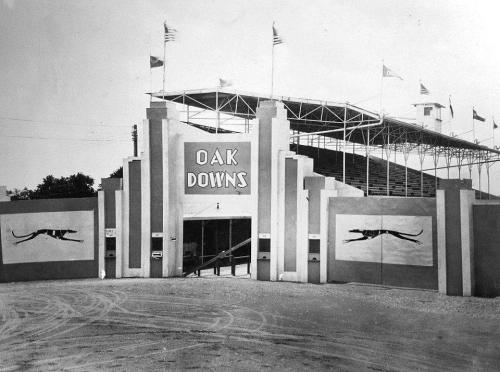
Oak Downs: Dallas’ Brief Flirtation with Greyhound Racing

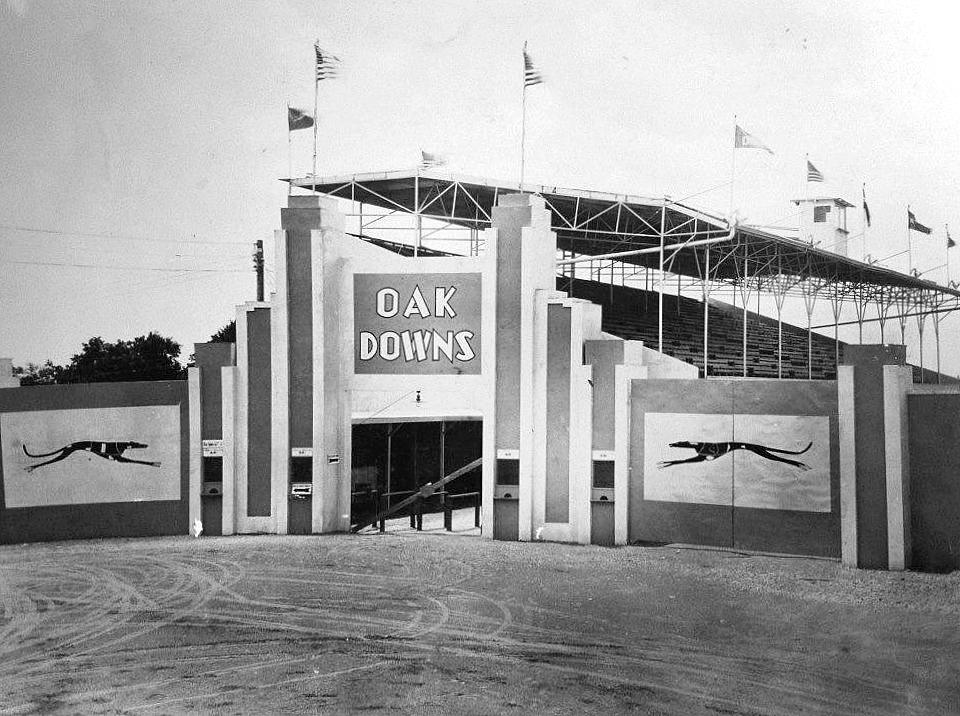
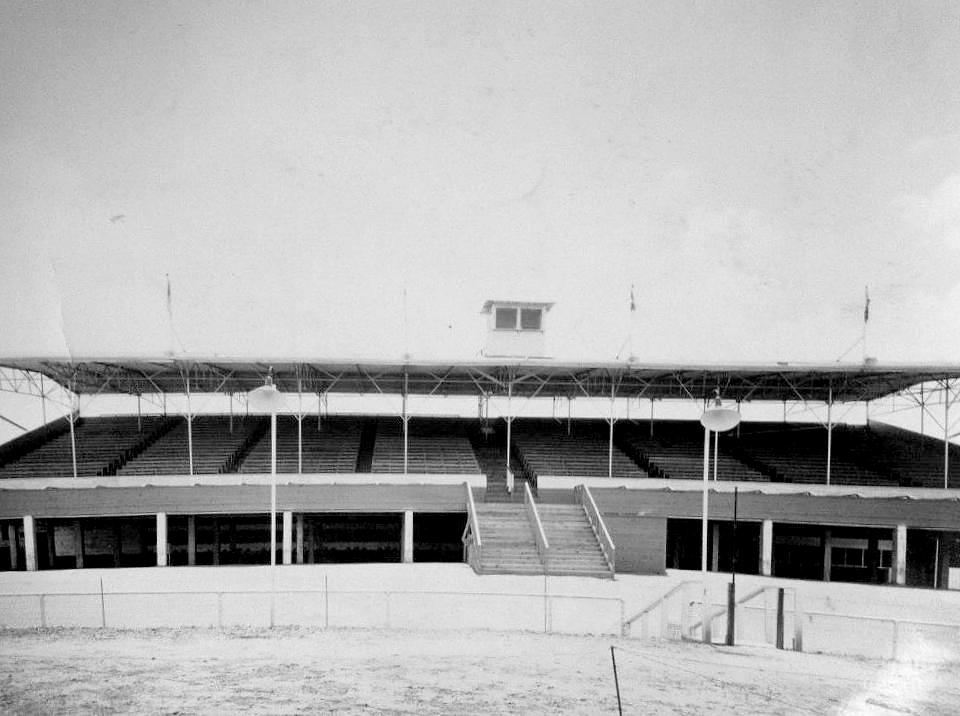
oak-downs_hurst_bwOak Downs greyhound track, ca. 1935 (photo courtesy Robert Hurst)

by Paula Bosse

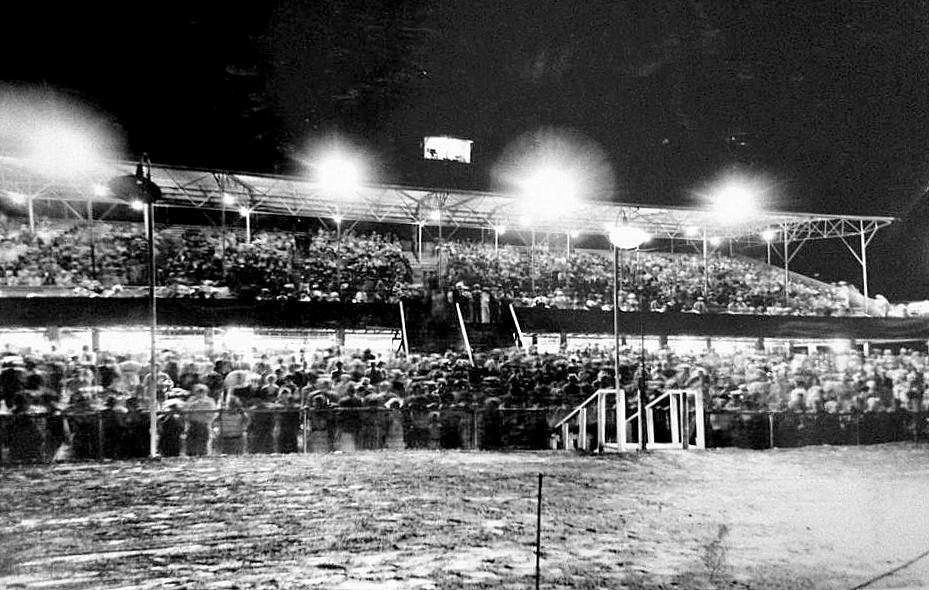
Robert Hurst has shared three great photos with me: the one above, and the two below. They show Oak Downs, a greyhound racing track that he thought might have been in Oak Cliff. A dog track? In Dallas? That was news to me. Mr. Hurst came across the photos a few years ago when going through the belongings of his grandparents, Lt. Col. and Mrs. C. W. Newman. As far as he knew, they had no particular interest in dog racing, and he wasn’t sure why they would have been in possession of photos of a greyhound track. I was a little hesitant to delve into anything having to do with dog racing, but these wonderful photographs piqued my interest. (For the faint of heart, this post focuses almost exclusively on the somewhat vague and constantly changing laws on parimutuel betting in Texas, with very little on the troubling aspects of greyhound racing.)
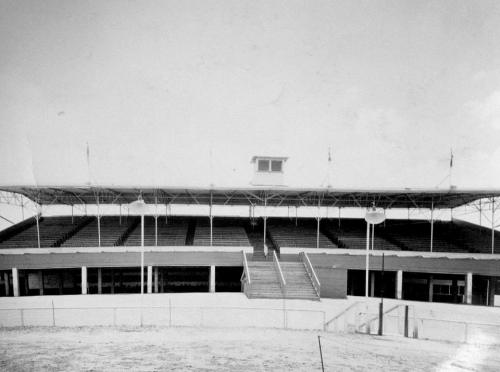
oak-downs_grandstand_day_hurst_bwGrandstand, daytime (click for larger image) (courtesy Robert Hurst)
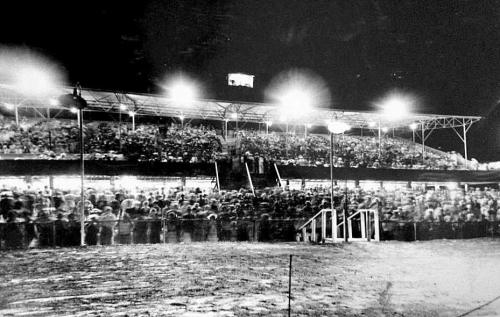
oak-downs_grandstand_night_hurst_bwGrandstand, nighttime (courtesy Robert Hurst)

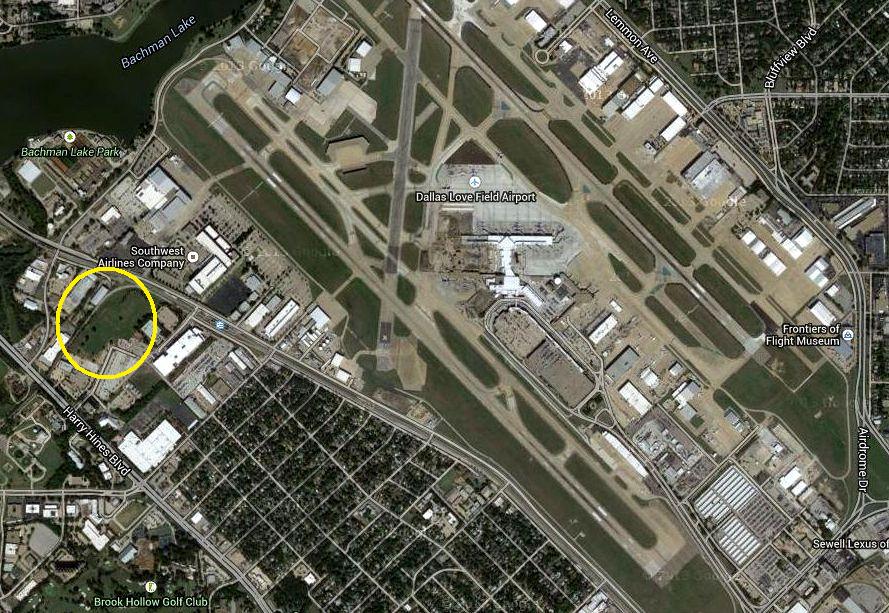
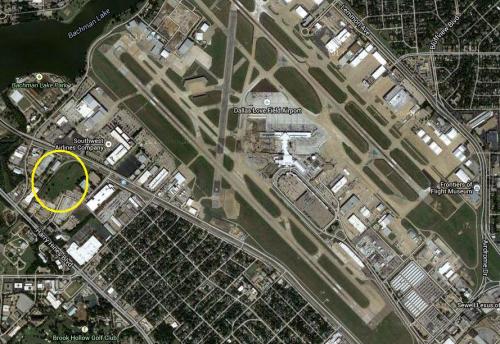
The track was located not in Oak Cliff, but right across the street from Love Field — an area that was “north of the city” in the 1930s. It was to the west of the airfield, with the address listed, popularly, as Maple Avenue, but officially as Denton Drive (just north of Burbank Road).
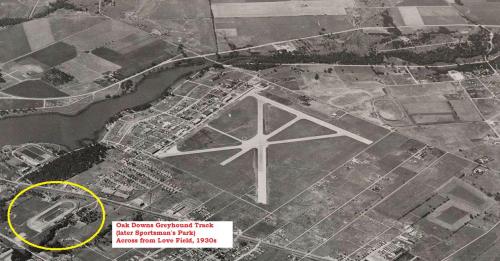
aerial_oak-downs_smu-foscue_1930s1930s (Edwin J. Foscue Map Library, SMU)
aerial_oak-downs_google2014 (Google Maps)

*

The first mention I can find of greyhound racing in Dallas was in 1898 at events held at the Fair Park horse racing track — the “sport” then was “coursing.” I don’t want to go into it, but live hares and jackrabbits were used, and it didn’t end well for them. (Competitive coursing is, I believe, now illegal in Texas, but open-field coursing is considered hunting and is legal.)

The first professional greyhound racing track to take the “blood” out of “blood sport” by utilizing an electric rabbit lure, was in California in 1919. The first track in the Dallas area to use an electric rabbit seems to have been one that opened near Grand Prairie in 1928; the news stories made sure to mention that there would be no wagering going on because, unlike other states where dog racing had been going on for some time and was quite popular as a gambling sport, parimutuel betting was not legal in Texas. Racing at that early track doesn’t seem to have lasted very long — probably because the spectators were not allowed to wager on the contests. Another track opened just outside Fort Worth at Deer Creek in 1934 (right after Texas had legalized betting on horse races in 1933), but, again, it doesn’t seem to have lasted long.

So, in the early ’30s, Texas was not really a hot-bed of dog racing enthusiasts. What was popular was horse racing — the two most popular tracks in the area were the Fair Park track in Dallas, and Arlington Downs in Arlington. The state legislature had voted in 1933 to allow parimutuel betting on horse races, hoping to raise revenue in the dark days of the Depression. People might not have been able to afford a new pair of shoes, but they managed to scrounge up money to bet with. Gambling on horse races was big business. But betting on dog races? Was it legal, too? It sounds like the law was surprisingly vague. Dog racing was not expressly written into law as being illegal — but people just seemed to understand it to be illegal. Proponents of greyhound racing — the so-called “Sport of Queens” — were adamant that they would force the state to address the issue and clarify the law — they would sue if they had to. A track in San Antonio had taken its case to a State Court of Appeals (after having been shut down by local authorities), and the court ruled that parimutuel wagering at dog tracks in Texas was not illegal. A precedent had bet set, and a few dog racing tracks began to open around the state, their owners and operators feeling they were relatively safe from prosecution.

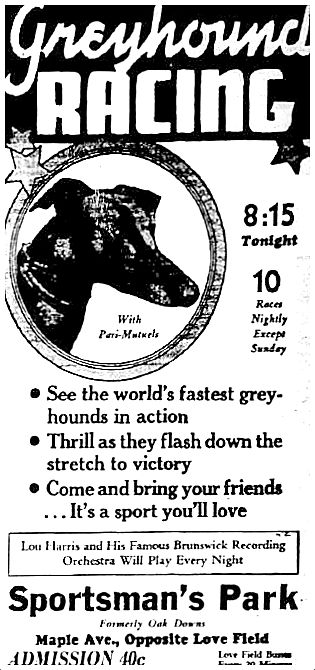
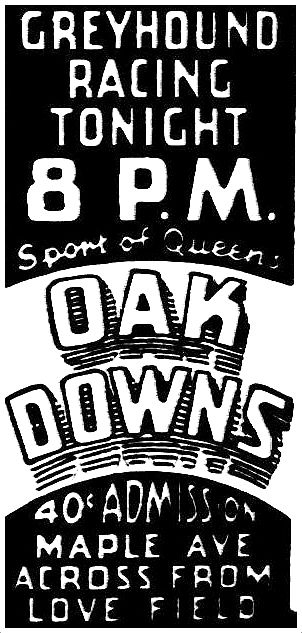
In early 1935, 31-year old Winfield Morten, a “wealthy sportsman” who owned several businesses and a lot of Dallas real estate, decided he’d open a greyhound track on his 40 acres of land along Maple Ave./Denton Dr., just west of Love Field. He received his state business charter in May, 1935 (just days after the San Antonio ruling), and he made plans to open his dog racing “plant” — Oak Downs — in June. As they said back then, “pari-mutuel betting would be fully in vogue.”

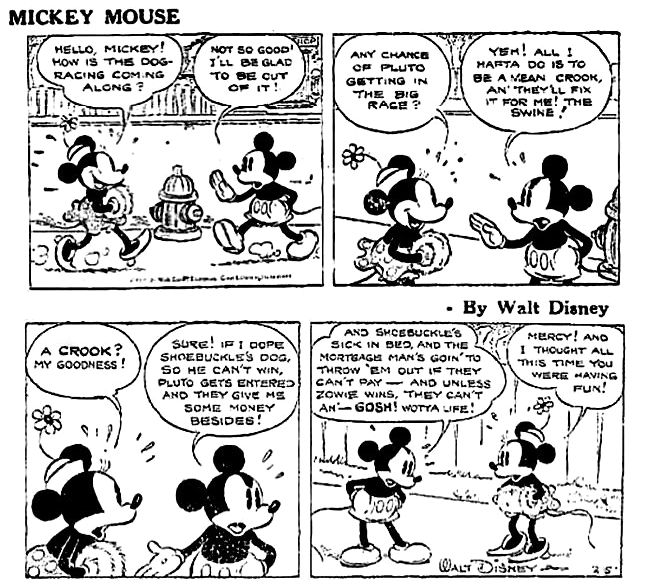
Many people did not want a dog racing track in Dallas (or anywhere in Texas, really). Owners of horse tracks (and the powerful people who were in bed with them) feared that they’d lose some of that sweet gambling moolah to the upstart “dogmen.” Outside the racing world, there was the fear/expectation that with dog tracks would come the inevitable gambling and sleazy criminal element. (Dog racing was generally seen as somehow more unsavory and déclassé than horse racing, which is odd, because the horse racing industry has never been known as a squeaky-clean one.) Also, apart from the gambling-related issues, many people were probably aware of (and disturbed by) persistent accusations of animal mistreatment. Interestingly, at this same time — during the first few months of 1935 — none other than Mickey Mouse was involved in a comic strip story arc that lasted several weeks in which he was hanging out at a dog track training his dog Pluto for a race. It wasn’t long before the comic strip (which was usually full of typical comic strip silliness and gentle humor) turned surprisingly dark, and Mickey found himself involved in a world of doping, gambling, extortion, and threatened violence (!). If Walt and Mickey were against the evils of dog racing, shouldn’t everybody be? I wonder if the strip was reflecting public opinion or shaping public opinion?
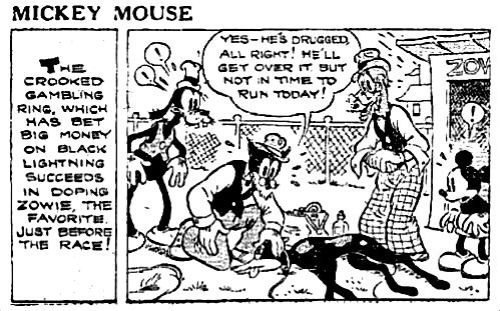
mickey_021935Poor Zowie! (Originally run Feb. 19, 1935)
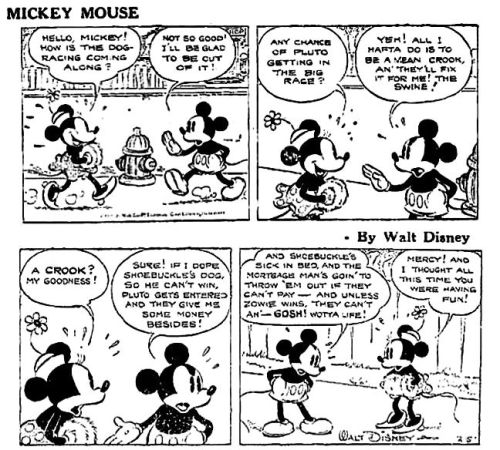
mickey_020535Mickey’s in a tough spot (click to enlarge) (Feb. 5, 1935)

Not only was the prospect of a “seedy” dog track unpalatable for many in an image-conscious city gearing up for its upcoming Centennial-Exposition-moment in the national spotlight, but there were those who were still convinced that gambling on anything but horse races in Texas was illegal — despite what the appeals court had ruled in the San Antonio case. Several interested district attorneys from around the state petitioned the State Supreme Court for a definite ruling. In the meantime, Dallas D.A. Robert L. Hurt and Dallas County Sheriff Smoot Schmid (greatest name in law enforcement EVER) threatened to shut down the not-yet-opened Oak Downs if it allowed wagering. Battle lines were drawn, and both sides believed they were in the right.

Track manager Jack Thurman said the city’s threats didn’t scare him. He’d open as scheduled, with plans for a full season of 48 days of racing (every day but Sunday), sleek hounds, an electric rabbit, and full-tilt betting. The day before Oak Downs was scheduled to open, its operators wisely obtained an injunction against Hurt (and, basically, the Sheriff’s Department and the Texas Rangers), which prevented the track from being shut down — they would open without fear of incident, under full legal protection of a court order. Not a happy guy, Hurt said he would file a motion to dissolve the injunction … immediately!

Oak Downs opened on June 18, 1935 to a large crowd of curious spectators, most of whom had never seen a dog race. The betting windows were open, but there was little betting. There were problems with the electricity in the stadium on opening day — the electric-powered rabbit that the greyhounds chased was not running on full power, and it moved so slowly that it was caught in two separate races by the probably confused dogs. (The second night there was too much juice, and the rabbit shot away from the pack so quickly that the dogs lost sight of it and just stopped running altogether. Hard to have a race if the dogs don’t actually run.) But the crowd seemed happy, and they weren’t overly concerned by the glitches happening there at the track or by the political and legal wranglings that were swirling downtown.

The crowds and the betting increased over the next few days, hinting at a rosy future for the track’s operators. But the races and the attendant wagering continued for only eleven days. The United States Fifth Circuit Court of Appeals refused to interfere with the wishes of State law enforcement — and State law enforcement wanted Oak Downs to cease with the gambling. So there was no more parimutuel betting at Oak Downs. After trying to struggle by without the sexy allure of betting — left with nothing but exhibition races and weird novelty events involving dog-riding monkeys — Oak Downs was forced to close its season prematurely on June 29.

Bye-bye, abbreviated inaugural season. No more betting on Doctor Snow, or Dixie Lad, or Rowdy Gloom, or Miss Cutlet, or Pampa Flash, or Billie Hobo, or Blond Hazard, or Mellow Man. Oh, Mellow Man, we hardly knew ye.

In February, 1936, Morten applied to the Texas Racing Commission for permission to race horses at his track, but the idea was quickly shot down by the Dallas City Council. The very profitable horse track at Fair Park was out of commission for 1936 as it was being used as part of the Centennial Exposition. Privately owned at the time, the track was leased to the Centennial Corporation, and the City Council — the members of which were no doubt on very friendly terms with the Fair Park track owner — felt it would be “unfair” to allow a competitor to horn in on the massive profits to be had. So … no dice (…as it were).

By September of 1936, Morten changed Oak Downs’ name to Sportsman’s Park and brought in new operators (including a former Texas Ranger). Oak Downs had joined other dog tracks in a new round of legal action which was slowly working its way through the courts. Without any ruling yet from the Supreme Court, they ignored an injunction that had been filed against them and defiantly opened up their betting windows again. Four of the men were fined and jailed briefly for contempt of court. But after months of mixed messages and conflicting rulings from various judges around the state, confused and fed-up lawmen were unsure of the actual legality of dog track betting, and, grudgingly, they allowed the wagering at Oak Downs to continue as they, too, awaited a high court decision.

As reported in Texas newspapers, on Oct. 28, 1936 the Texas Supreme Court finally ruled on the matter of whether or not dog racing could be wagered on legally in the state of Texas:

We do not find any provision in the penal code defining gaming which can be construed to include dog racing or betting on dog racing. It is not a game prohibited by law. […] This court is fully conscious of the pernicious and unwholesome effects upon society of betting on dog races and keeping premises for dog racing where betting is allowed, but the proper agency for the suppression of those wrongs is the Legislature, and until it sees proper to further legislate in the matter, the courts are without power to suppress these evils by injunction.

In other words, the Texas House and Senate were going to have to take up the issue if they really wanted to do away with legalized betting on dog races (which they did), because it was their fault that they hadn’t been specific enough when they wrote their original law.

So betting was back “in vogue” once again. And now with absolutely no threat of arrest. The remainder of the 1936 season continued without problems, and when the 1937 season opened in April, it was “the first greyhound meet in Dallas free of danger of being interfered with by law enforcement agencies” (DMN, April 22, 1937), but … as there were bills to outlaw betting on dog racing AND horse racing percolating through the current Texas legislature, it was thought that the 1937 season might also be the last season of racing in Texas.

In May, 1937, Governor James V. Allred addressed the Texas Congress, urging them to repeal the current law allowing parimutuel gambling on horse racing (with the knowledge that this would almost certainly also apply to the outlawing of dog racing, as that bill had just passed the House and was headed to the Senate). Here are a couple of passages from his speech, a transcription of which appeared in newspapers throughout the state on May 28, 1937:

I do not know how to state in words a stronger case for repeal of the race track gambling law than I have already given to this Legislature from time to time. I have quoted Washington, Franklin, Blackstone, Shakespeare, Brisbane, McIntyre and the Holy Bible. I have pointed out the living evidence of undesirables, of doping, of thuggery, of embezzlement, of bank failures, of suicides, and narcotic rings. Each month of the life of this law sees addition to the numbers of these human tragedies….

And, finally, a mention of the evils of racing with regard to the animals themselves:

There is no record of a horse ever being doped except to run a race. All the races ever run are not worth the agony and cruelty dealt even one of these poor, helpless beasts! I appeal to all who love good horses, I appeal to all who believe in preventing cruelty to animals to join with me in demanding that this law be repealed.

Allred’s lengthy and impassioned speech — which addressed every argument the pro-gambling forces were wont to … trot out … must have touched a few nerves (with both the public and the politicians), because in June, both bills passed with huge margins. (The bill outlawing the betting on dog racing passed in the Senate 22-1 and in the House 109-12. With passage of the new law, betting on dog races could now incur a fine of up to $500 and a jail term of up to ninety days; the penalty of “keeping a place of betting on dogs” was two to four years in the state penitentiary.)

So no more parimutuel betting in Texas. No more dog racing. No more horse racing.

And that was that for the state’s dog tracks. What was next for Oak Downs … er, Sportsman’s Park? Three words: “midget auto racing” (i.e. the racing of very small cars, not the racing of cars operated by very small drivers).

Besides the regular auto races, two added events give promise of furnishing fans with a few thrills as well as a laugh or two. Fast cowponies will be featured in a half-mile sprint with a race for roosters rounding out the show. Winner of the cowpony race will receive $15, while the winning rooster will be rewarded with $5. Entries are open to any and all owners of ponies or roosters. (Dallas Morning News, Aug. 27, 1937)

Somehow I don’t think five-buck-purse rooster races figured into Mr. Morten’s big dreams back at the beginning of 1935.
ad_oak-downs_0622351935

*

ad-dmn_0422371937

***

Sources & Notes

Top three photos of Oak Downs greyhound racing track used by kind permission of Robert Hurst. He came across them several years ago in the belongings of his grandparents, Lt. Col. Campbell Wallace (C. W. “Bub”) Newman and Martha Price Newman. Col. Newman was a cavalry officer who served in WWI, WWII, and Korea; between WWI and WWII, he worked in Dallas as a contractor and was employed for a time at Oak Downs where he worked in track operations. (That’s why he had these photos!) [And by no means do I mean to imply that this career military man was involved in any sort of shady goings-on. In fact, from what I can tell, Oak Downs seems to have been run by a fairly “clean” group of people. The perception/reputation of dog racing at the time wasn’t great, but nothing I’ve read about this track suggests that anything unscrupulous was going at the track, behind the scenes, or amongst the personnel who worked there.] He was also an avid polo player and was a good friend (and polo teammate) of Winfield Morten who owned the track. Many thanks, Mr. Hurst, for the use of these wonderful photos!

Black and white aerial view of the Love Field/Bachman Lake area was taken by Lloyd M. Long in the 1930s; photo is from the Edwin J. Foscue Map Library, Southern Methodist University. The unlabeled photo (a detail of which is used above) can be accessed here; a labeled version of this photo (with some streets and buildings identified) can be accessed here.

I highly encourage people to see out the transcript of Governor James V. Allred’s FANTASTIC impassioned speech before members of the Texas House and Senate, which appeared in newspapers around Texas on or around May 28, 1937. As far as politics is concerned, I’m the most cynical person in the world, but this is an incredible speech.

More on the history of parimutuel gambling in Texas from Wikipedia, here.

An explanation of just what parimutuel betting is, is here.

Parimutuel racing was legalized again in Texas in 1987. The current state of racing in Texas can be read about in the Dallas Morning News article “A Last Hurrah for Texas Horse Racing” (May 3, 2014) by Gary Jacobson, here.

I’m quite honestly shocked to learn that greyhound racing is legal in the state of Texas. There seems to be really only one active track with live racing in the state (in South Texas), and the only upside to this appalling fact is that attendance has been in steep decline for years.

*

Copyright © 2015 Paula Bosse. All Rights Reserved.

Year-End List! My Favorite Photos Posted in 2014

jefferson-addison-det1Waiting for a streetcar in Oak Cliff, 1946 (detail) (click for larger image)

by Paula Bosse

Another list! Here are my favorite photographs that I’ve posted over the past year. I’ve looked at and searched for more photos of Dallas in the past year than I have in all the other years of my life combined. Looking at historic images has always fascinated me, but when you’re looking at historic images of your hometown, it’s kind of thrilling (and it can also be depressing to see the things we’ve lost). For photo sources and credits — and to read the posts these photos originally appeared in (which are chock-full of interesting things, I promise!) — click the titles in the list below. (Most of the photos I post are usually much larger when clicked — some are gigantic!) Enjoy!

***

1. “Waiting For a Streetcar on a Sunny Winter Day in Oak Cliff — 1946.” My favorite photo of the year is the one posted above. It is a cropped image from a larger photo (which I also love) which was included in the post linked above. I’ve stared at this photo for so long that I feel I was there. I love everything about this photo.

***

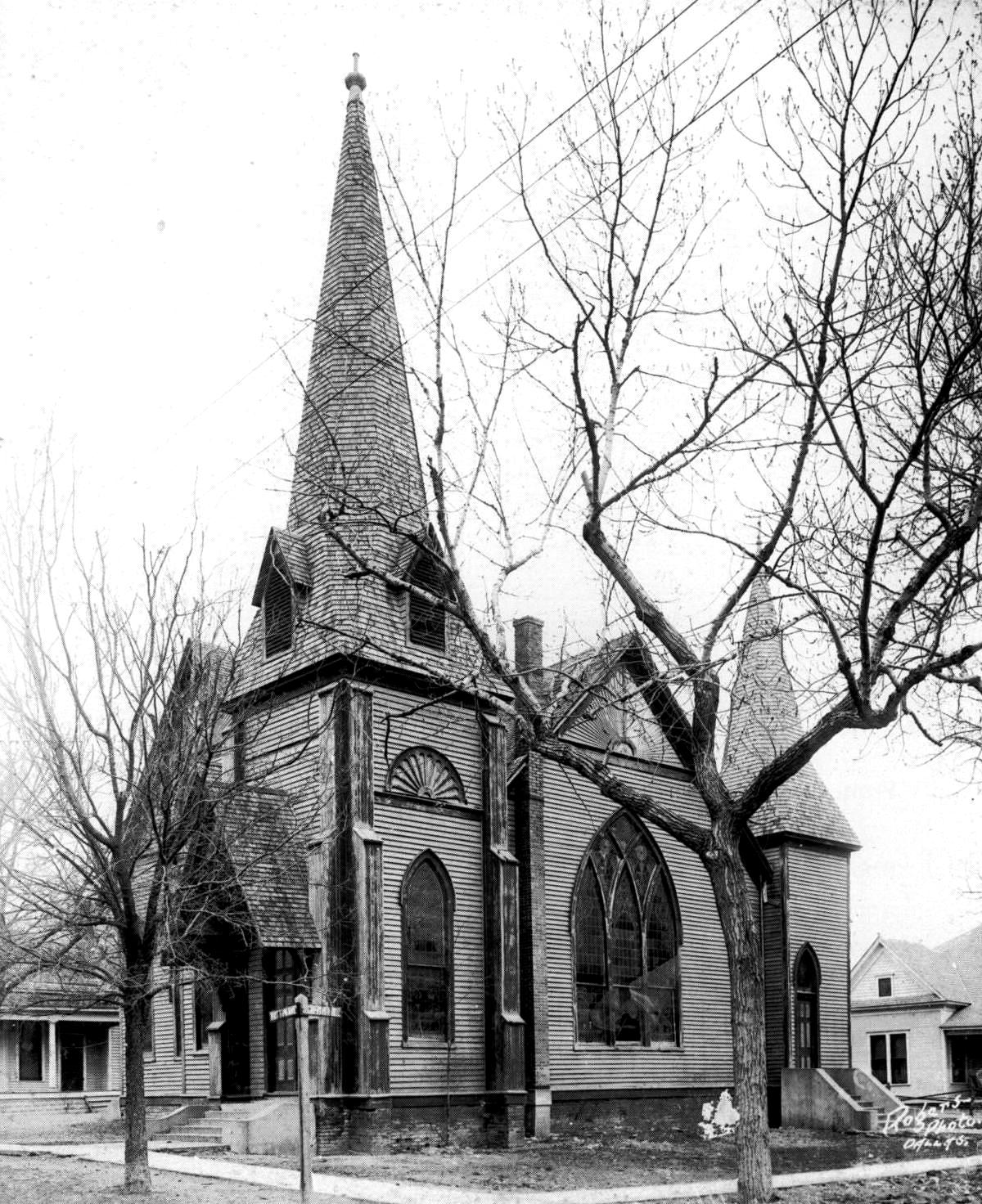
2. “Oak Cliff Presbyterian Church, Organized 1890.” I’ve come back to linger over this photo time and time again. It’s perfect.

oak-cliff-presbyterian_sm***

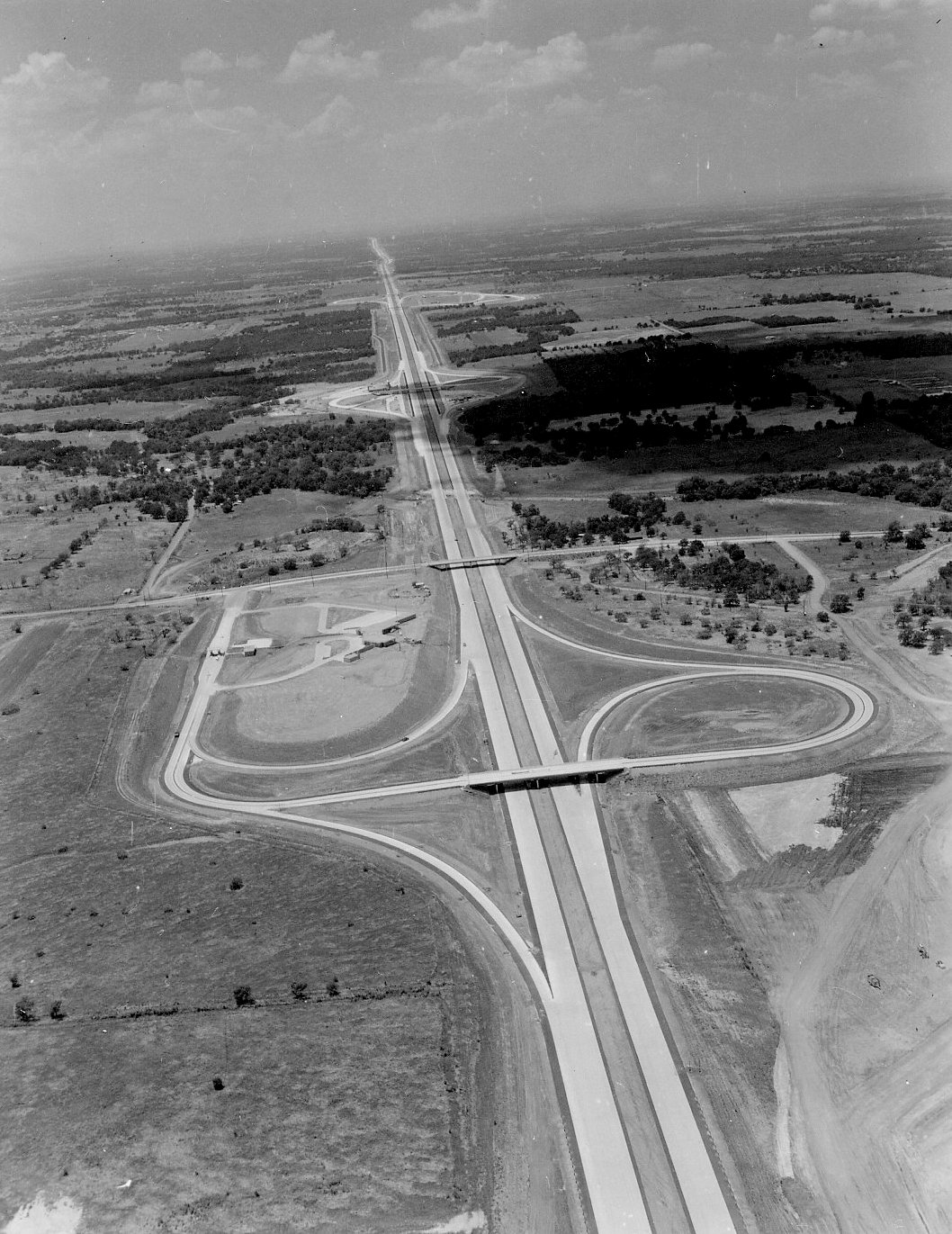
3. “The DFW Turnpike, Unsullied by Traffic, Billboards, or Urban Sprawl — 1957.” Just a fantastic, dreamy shot. I love the way the highway disappears into the distance. Imagine driving from Dallas to Fort Worth in 1957 on a road where billboards were not allowed and along which there were exactly two restaurants (for travelers who couldn’t make the full 30-minute drive without needing to stop for a meal). This shot, looking west, shows Arlington, right where Six Flags is today. Times change, man.

turnpike_west-from-360_1957***

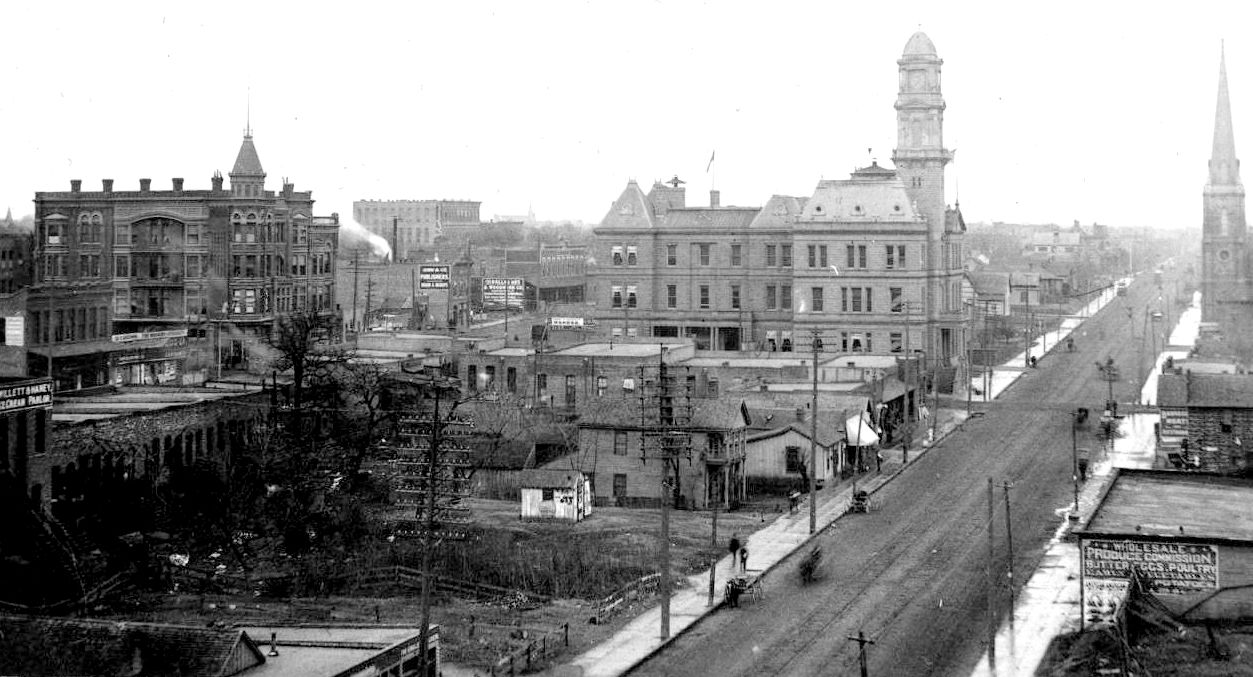
4. “Henry Stark’s ‘Bird’s Eye View of Dallas’ — 1895/96.” Without question, this is the most popular thing I’ve posted this year. I love this photo. It’s even better zoomed in on. Check out the original post to see this photo broken into four magnified crops — that’s when this photo goes from being merely “interesting” to being “incredibly interesting”!

stark_downtown_1895-96_hpl***

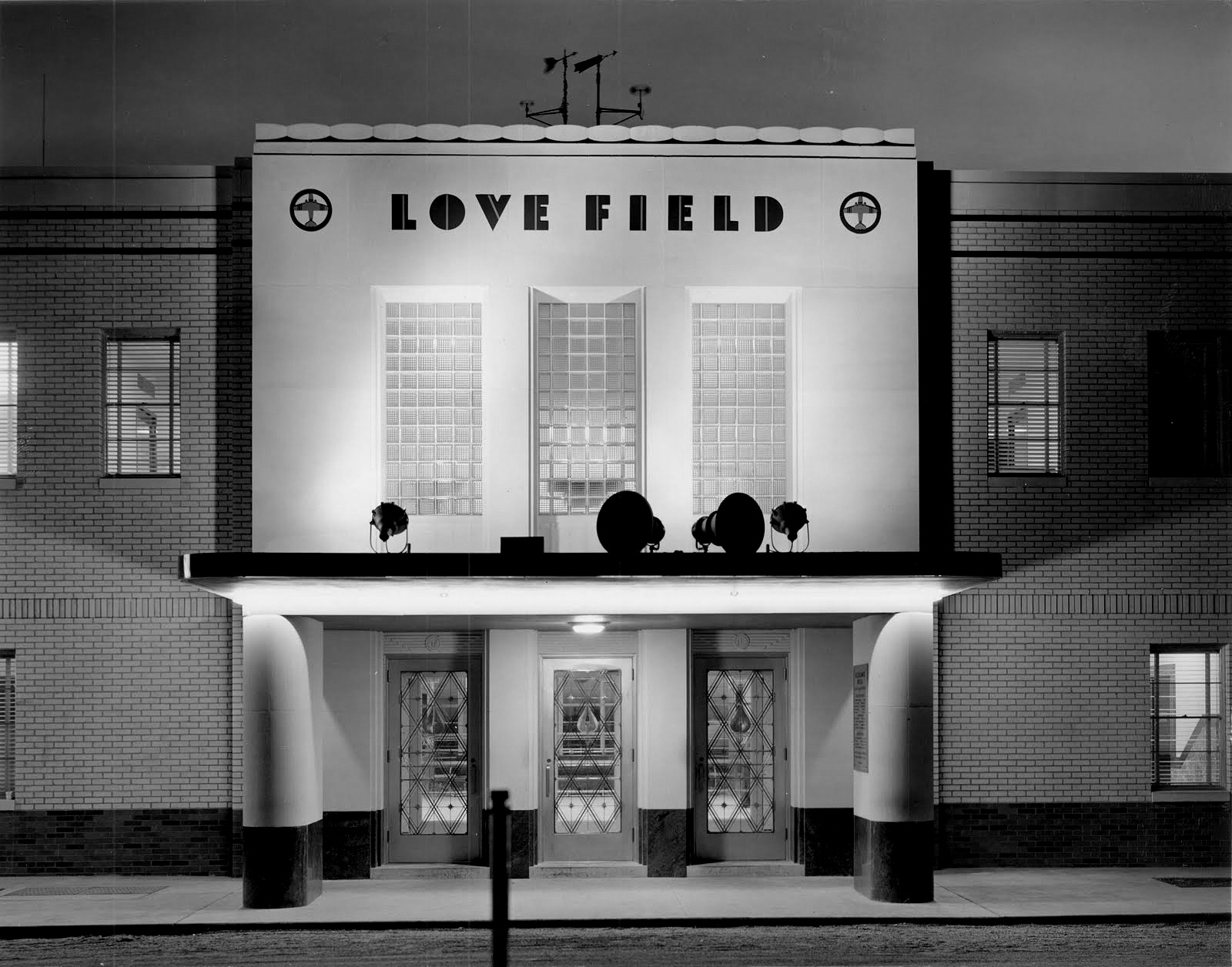
5. “Swooning Over Love Field — 1940.” Be still, my heart!

love-field_1940***

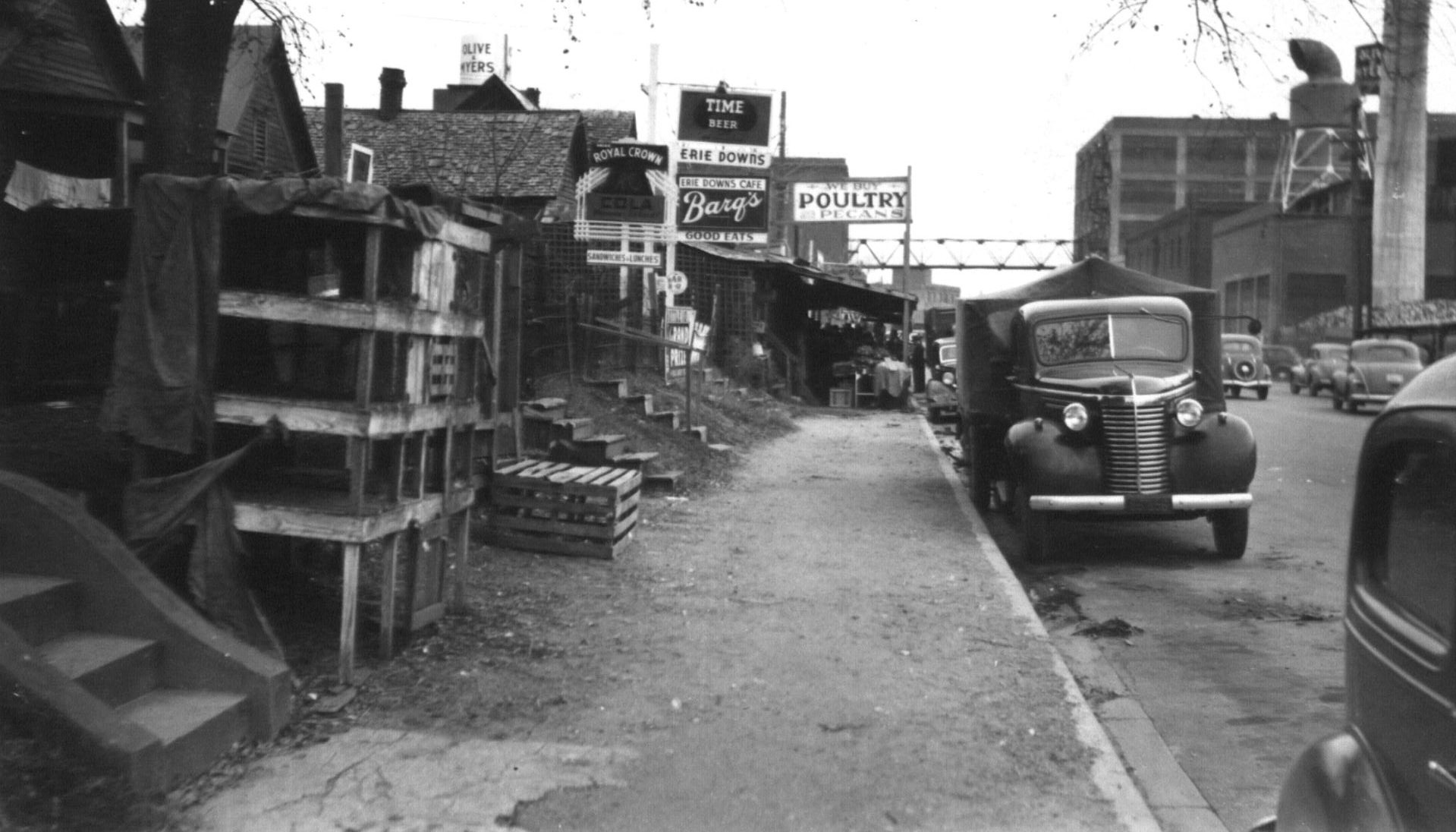
6. “Canton Street: Poultry, Pecans, and Future Luxury Lofts.” I LOVE this photo. I had no idea the Farmers Market area ever looked like this. See post for what this same view looks like today.

2200-canton_farmers-mkt_portal***

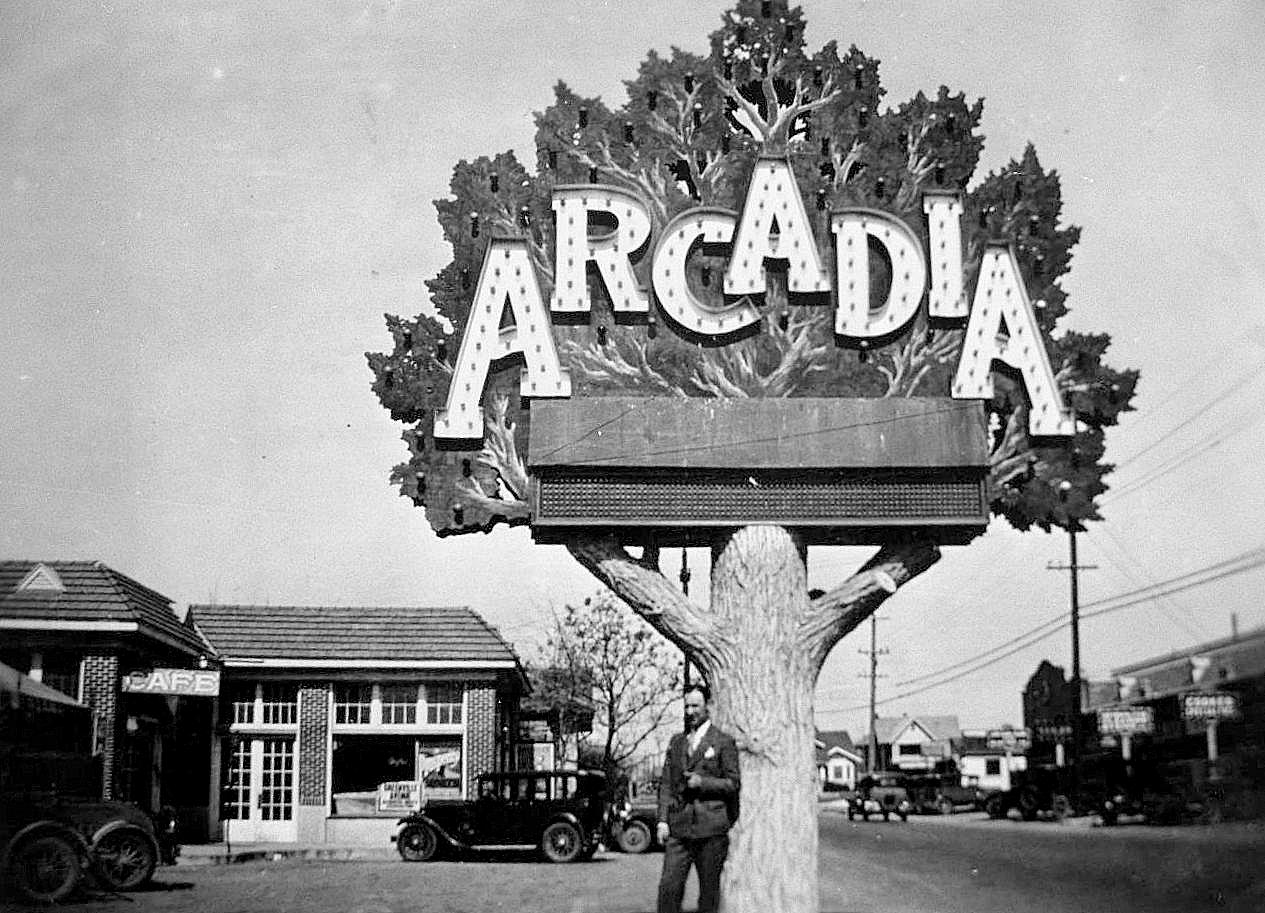
7. “The Arcadia Theater Sign You’ve Never Seen.” This is especially wonderful to me because it shows Lower Greenville (the area I grew up in) back in the late ’20s/early ’30s — and it’s still recognizable today. This “tree” was a movie marquee that lit up at night, and it must have been quite a sight 85-or-so years ago.

***

8. “The Oak Cliff Viaduct & The Weird Composite Photo –1912.” My favorite component is the panoramic view of the city, but click the link to see what weird Franken-photo this (along with an incredible shot of the viaduct) got turned into!

dallas-panorama-skyline_1912_LOC***

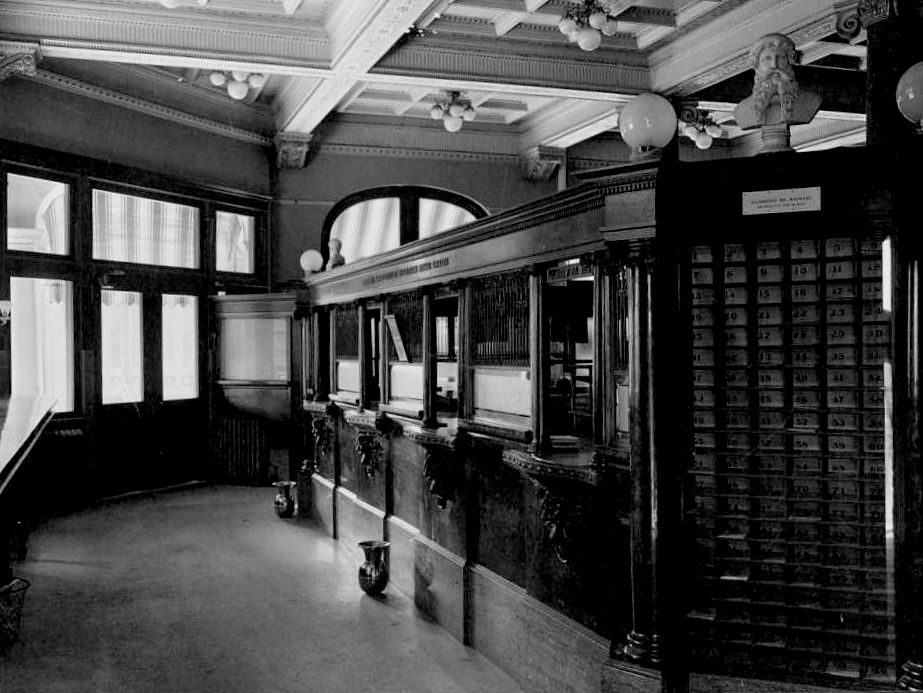
9. “The Dallas Morning News Lobby — 1904.” Other than the spittoons, I wish places still looked like this. Read about those special mail boxes at the link.

dmn-lobby_c1903_degolyer***

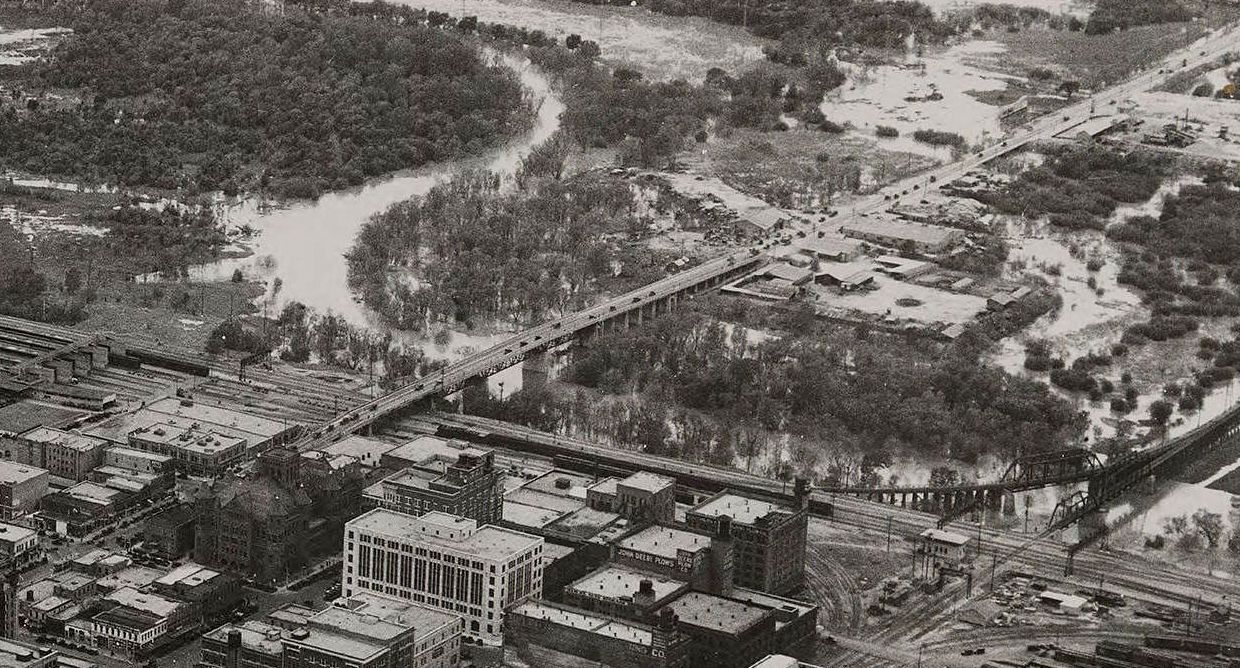
10. “The Trinity River at the City’s Doorstep.” I was born and raised in Dallas, but I was only vaguely aware that the Trinity River had been “straightened,” which is one of the reasons this is such an amazing image for me (see the original post to see the larger photo this has been cropped from).

downtown_trinity_ca1920s_smu_foscue-det***

11. “A Lost Photo of Director Larry Buchanan, Celebrated ‘Schlockmeister’ — 1955.” One of my “discoveries” that got me all excited when I found it but which only a handful of other people will appreciate. If you know who Larry Buchanan is, you’ll probably smile at this. If you don’t know who he is, you should! Hie yourself over to this post and read why he’s important to the history of Dallas!

buchanan-katy-camera_1955***

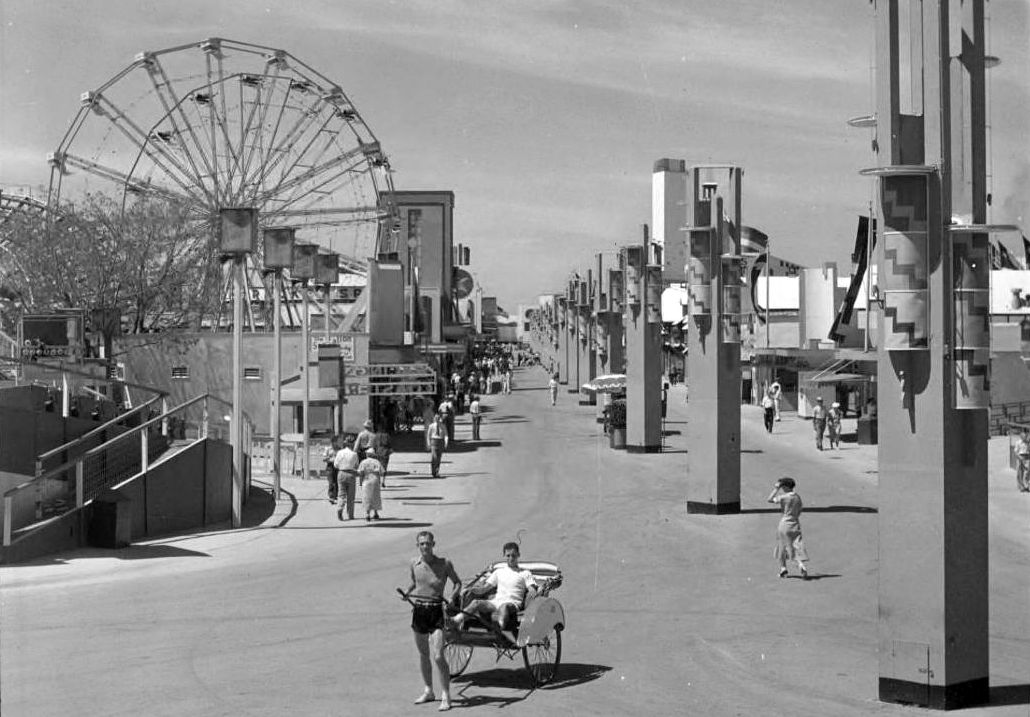
12. “Forget the Ferris Wheel, Take a Ride in a Centennial Rickshaw — 1936.” Yeah, seeing a rickshaw at the State Fair midway is kind of weird, but it’s not nearly as weird as this photo feels. I always think of “The Prisoner” when I see this. Bleak. And … odd.

tx-centennial-midway_1936_ucr***

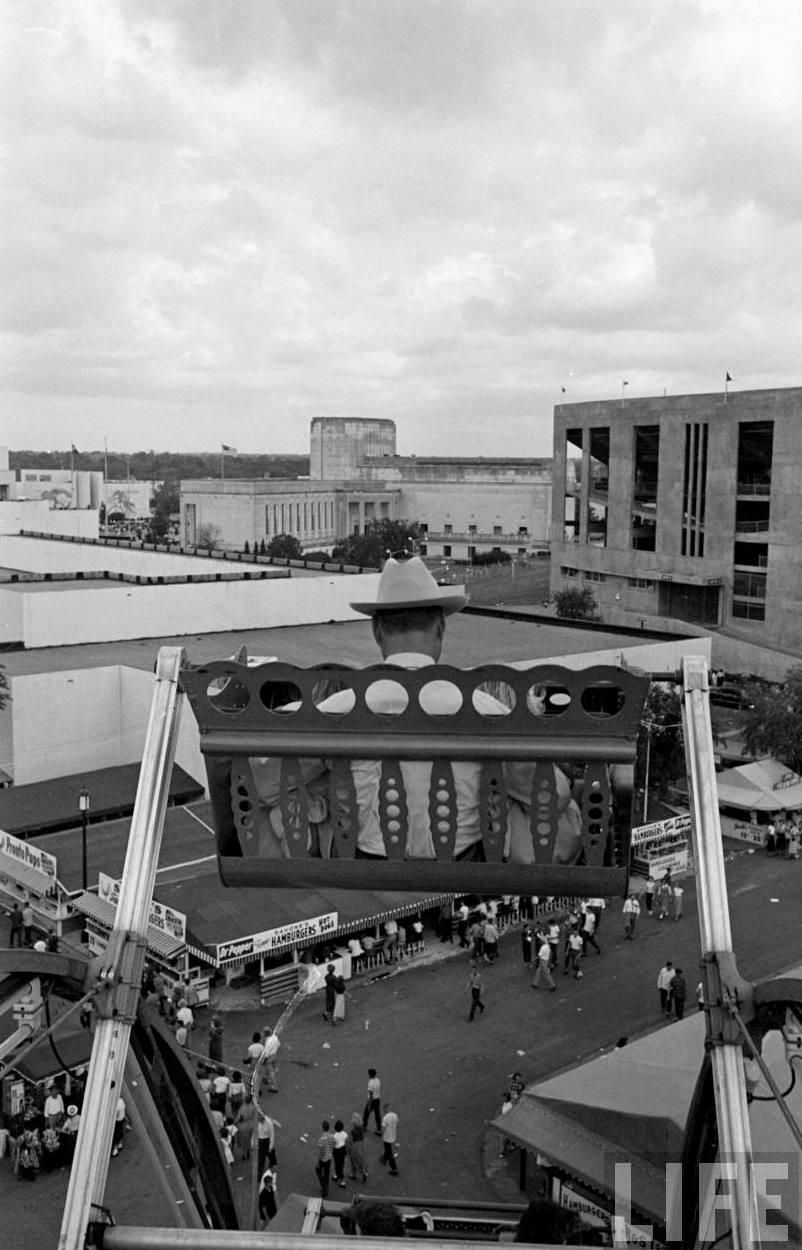
13. “‘Life’ at the State Fair of Texas — 1951.” And speaking of Ferris wheels, this may be my favorite photo ever of the State Fair of Texas.

fair-park-midway_life_1951***

Runner-Up: ALL of the photos I’ve “zoomed in on” — I love the surprising vignettes hidden in photos. I love them all, but I’m particularly fond of one that shows Ervay & Main (“There are Eight Million Stories in the Naked City… — ca. 1920”). This is one of 14 (!) parts of the photo I zoomed in on, this one showing a woman sitting at a window in the Neiman’s building, watching the hustle and bustle below on Ervay. Click on the link above to see the original photo (and all the “vignettes”). For other photos I’ve “zoomed in on,” see them here.

5-ervay

*

For all the “Year-End Best of 2014” lists, click here.

*

Copyright © 2014 Paula Bosse. All Rights Reserved.


The World’s Largest Santa & The Christmas Tragedy — 1953

santa_chevrolet_color_observerSanta considers a test-drive, 1953 (photo: Roy Addis)

by Paula Bosse

Back in 2010, Robert Wilonsky (now a reporter for The Dallas Morning News, but back then a reporter for The Dallas Observer) posted a 1950s-era photo of a giant Santa Claus sitting on the roof of a Dallas car dealership. Robert had found the photo on eBay and wondered what the story behind the promotional stunt might have been. The thing that sparked my interest (other than it being a giant Santa Claus — holding a full-size car in his lap!) was the fact that the dealership, Porter Chevrolet (which I’d never heard of), had been just around the corner from where I grew up — it was in the 5500 block of E. Mockingbird, right across from the old Dr Pepper plant, about where the Campisi’s parking lot is now. I, too, really wanted to know more about that huge Santa Claus that had once been hanging out so ostentatiously in my neighborhood.

At about the time when Robert’s post appeared in 2010, I had only recently discovered that the Dallas Morning News archives were available online. For free. All the way back to 1885! (All you need is a current library card from the Dallas Public Library, and you’re on your way to losing absolute days while reading about one fascinating thing after another.) I had just begun to dabble with searches in the archives, so this seemed like a great opportunity to test my research skills and see if there was more to the story. And there was! I sent Robert what I’d found, and he wrote a great follow-up, here (which has yet another photo of the giant Santa). And a year later he did another follow-up, this one including the color photo seen above, sent in by a reader.

This is just such a great and weird holiday-related bit of Dallas’ past, that I thought I’d revisit the story, especially since some of the links in the original Observer posts no longer work.

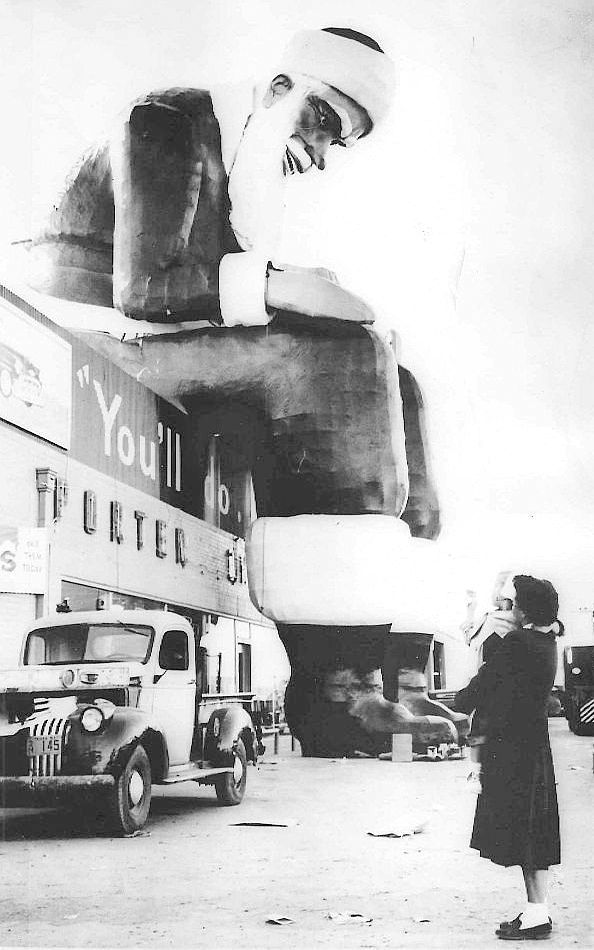
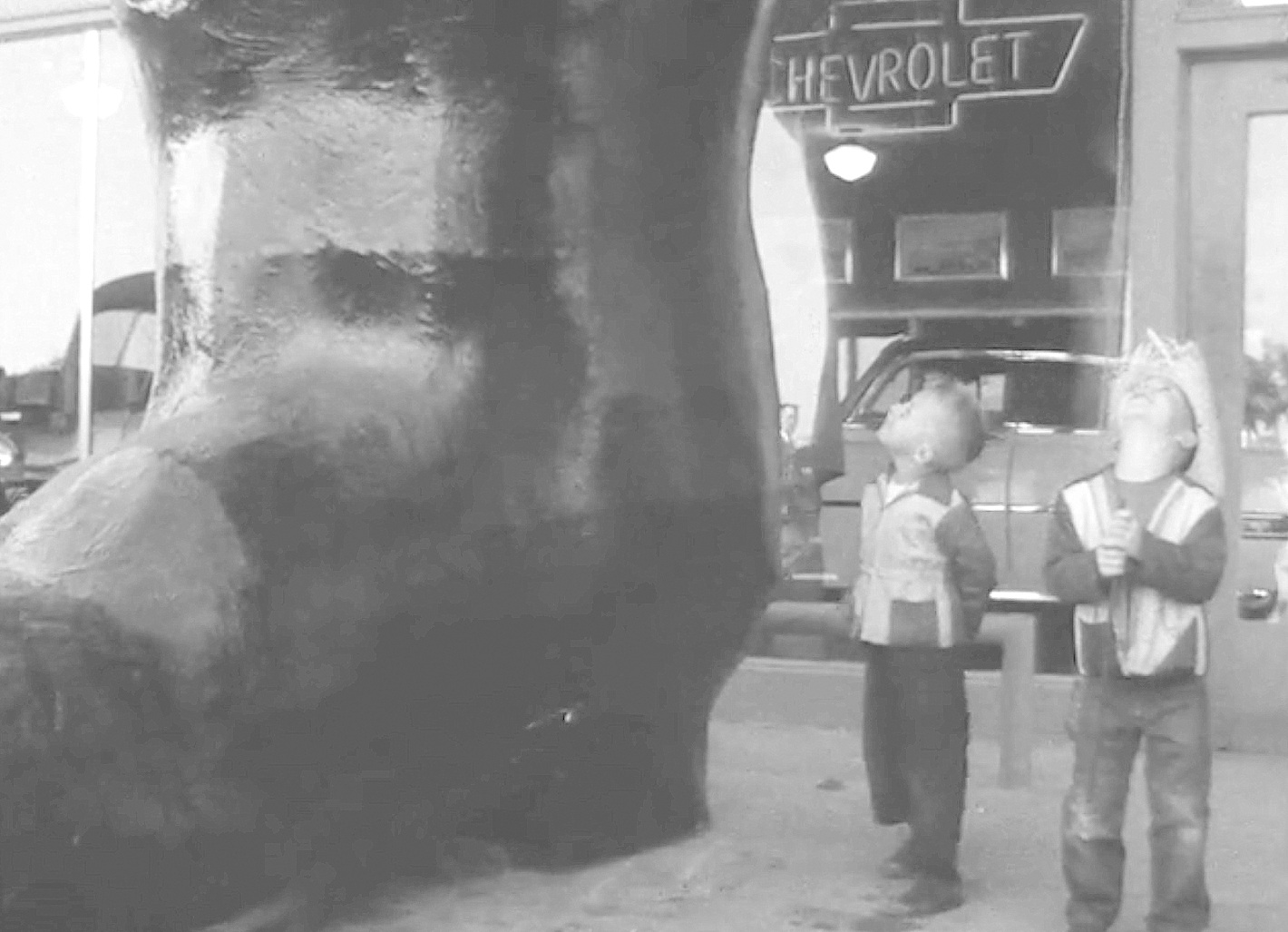
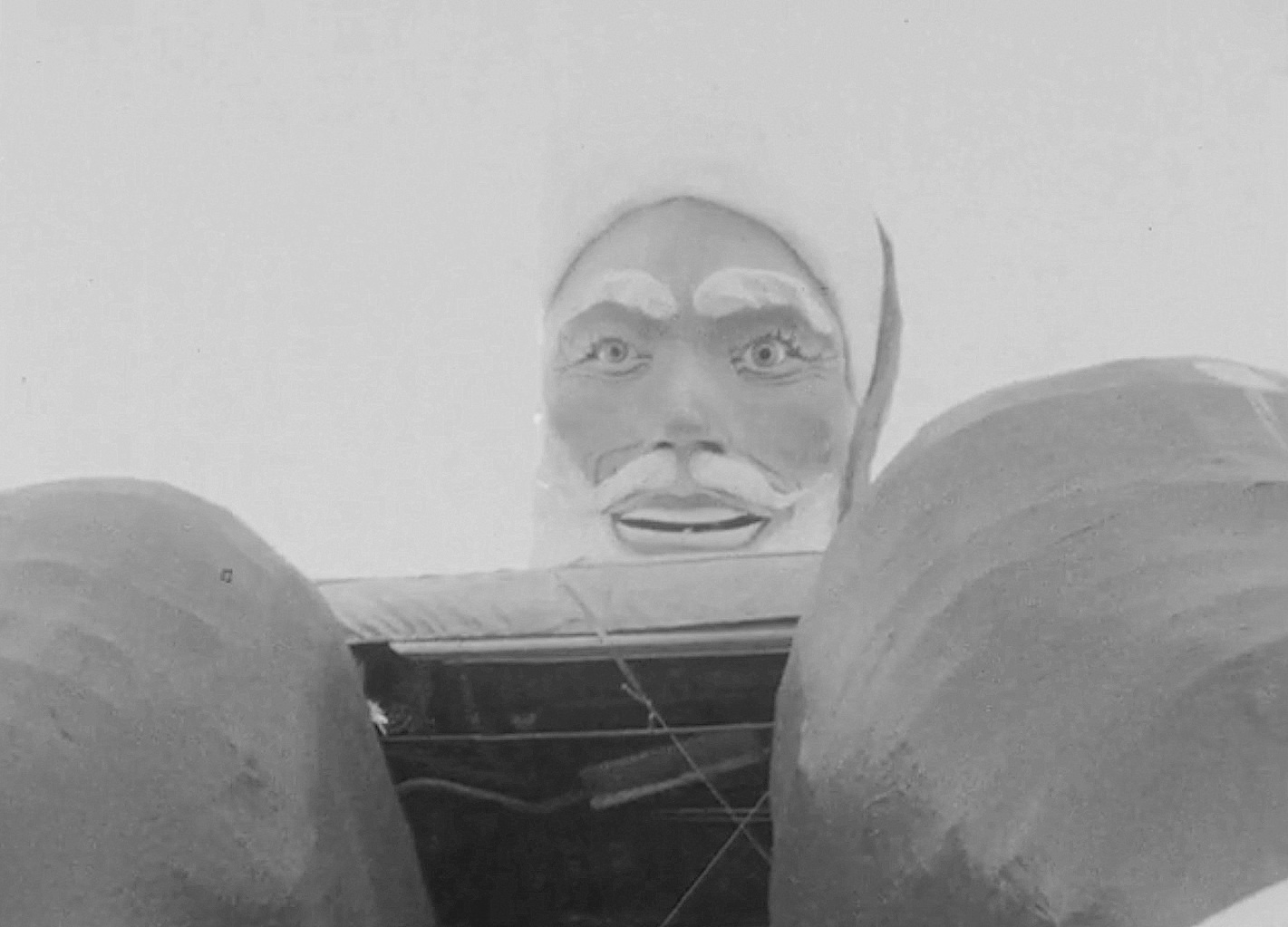
First, a quick re-cap (but, please, read Robert’s story, because you’ll enjoy  it, and it’s much more colorful than my quick overview here). During the 1953 Christmas season, Porter Chevrolet (5526 Mockingbird) commissioned Jack Bridges (the man who had previously made Big Tex (who was himself originally a giant Santa Claus)) to construct an 85-foot-tall steel-and-papier-mâché Santa Claus (he’d be that tall if he were standing) to sit on the dealership building and hold an actual 1954 Chevy in his lap. It was definitely a promotion that would grab people’s attention. The day the giant Santa was put in place, using a crane, a man whose company had done the installing (as they had with Big Tex), thought it would be a great opportunity to get a Christmas card photo of himself dangling from the crane next to Santa. The man, Roy V. Davis, was recovering from heart-related health problems, and, as it turned out, he experienced a “myocardial rupture” while hoisted 35 feet above the concrete parking lot. He lost his grip and fell to his death. This tragic news made the front page of local papers and was picked up by the Associated Press, but, oddly, it was never spoken of again. Giant Santa apparently remained at his perch throughout the holidays, but as far as I can tell, there was no further mention of Mr. Davis’ death — until Robert Wilonsky stumbled across the photo and wrote about it 57 years later.
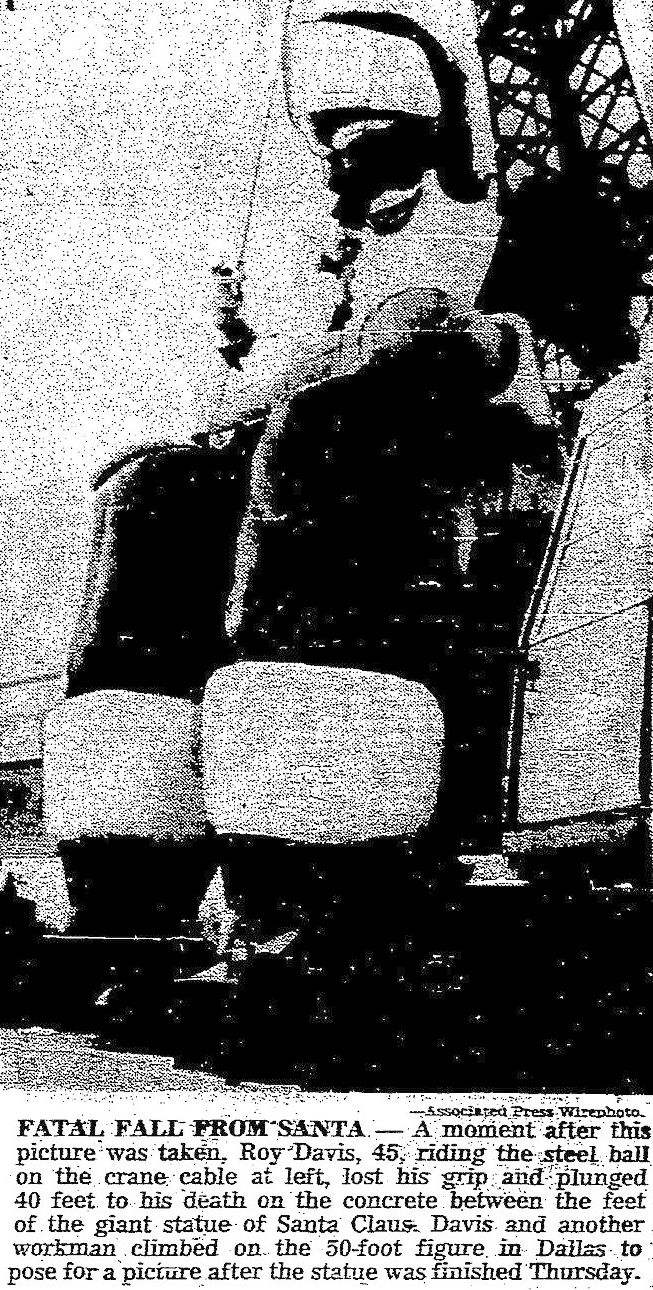
Below is the AP photo and blurb which ran nationally, showing Mrs. John Ashmore and her 4-year old daughter Ruth Ann looking up at the towering Santa Claus. 

santa_porter-chevrolet_news-photo_1953_PEB
Photo: Collection of Paula Bosse

The caption (click for larger image):

santa-claus_porter-chevrolet_caption

**

UPDATE: Okay this is VERY EXCITING — and also kind of chilling: there is WBAP-Channel 5 television news footage of the Giant Santa as well as the on-the-scene tragic aftermath of Mr. Davis’ accident. The Dec. 10, 1953 footage is without sound (the script the anchor read on the air as the film played during the newscast can be found here). The video starts off with children marveling at the giant Santa Claus but suddenly turns dark with shots of the bloody Mr. Davis being loaded onto a stretcher (helped by Jack Bridges, the man who built the giant Santa, seen wearing a beret and white coveralls). The one-minute clip titled “Worker Dies at Santa’s Statue” can be viewed on the Portal to Texas History site here.

Below are a few screen captures:

santa-kids_wbap-1_portal

santa-face_wbap-2_portal

santa-crane_wbap-3_portal

santa-dr-pepper-plant-ambulance_wbap-4_portal

**

santa_denison-press_122553Denison Press, Dec. 25, 1953

santa_FWST_121153_AP_photoFort Worth Star-Telegram, Dec. 11, 1953

santa_lubbock-avalanche_121153_APLubbock Avalanche, Dec. 11, 1953

***

Sources & Notes

Top color photo (which I’ve cropped) is by Roy Addis. It appeared in the Dallas Observer blog Unfair Park in Robert Wilonsky’s 2011 update to the previous year’s story — it was sent in by a reader who discovered it in his personal collection. To read that story, click here.
Wilonsky’s original Unfair Park post — which contained the photo he found on eBay — is here. And, again, his post containing “the rest of the story” is here. (Robert Wilonsky continues to write enthusiastically about Dallas — its past as well as its present — and his Dallas Morning News pieces are, quite frankly, where I get most of my news about what’s going on in the city. Thanks for the opportunity to be part of the unearthing of this story, Robert!)

The news photo of Mrs. Ashmore and her daughter is from the author’s personal collection.

The video is from the KXAS-NBC 5 News Collection, University of North Texas Libraries Special Collections, accessible on the Portal to Texas History site. The main page of the video is here (click picture to watch video in a new window).

Dallas Morning News articles on the giant Santa and the tragic accident:

  • “Santa Claus Turns Texan” (DMN, Sept. 23, 1953)
  • “Figure of Santa Claus Will Overshadow Tex” by Frank X. Tolbert, with photo of Jack Bridges (DMN, Nov. 18, 1953)
  • “Santa Claus Too Large For Trucks” (DMN, Nov. 29, 1953)
  • “Christmas Card Picture With Tragic Ending” (DMN, Dec. 11, 1953)
  • “Man Falls to Death Off Cable,” with photo of Roy V. Davis (DMN, Dec. 11, 1953)

UPDATE: Robert Wilonsky has written on the giant Santa in a new Dallas Morning News article, with some interesting new tidbits about Porter Chevrolet’s proposal to the City Council requesting permission to put this huge structure on top of the building. Read his 2017 update here. Robert keeps telling me we should write a book about this — or make a documentary. Which, of course, we should! After all these years now of visions of the giant Santa and sober thoughts of Roy Davis — more “real” now, having seen film footage of him bloody on that stretcher — I really do feel this is all part of some personal family Christmas lore, recounted every year around the table.

Pictures and clippings are larger when clicked.

*

Copyright © 2014 Paula Bosse. All Rights Reserved.


Interurbans: Freight Movers?

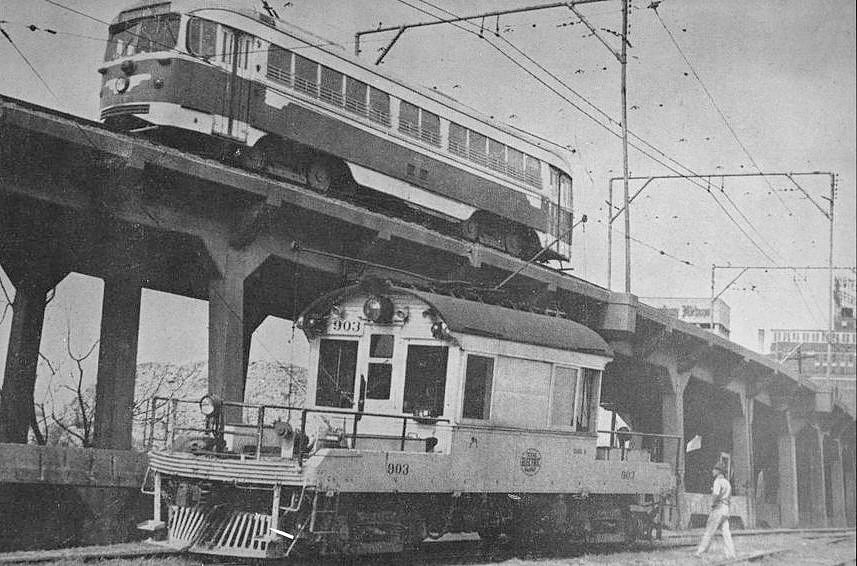
People-mover, above; freight-mover, below…

by Paula Bosse

When I saw this photo, I had no idea what I was looking at — what was that odd-looking thing in the foreground? A couple of rail enthusiasts informed me that it was an interurban freight engine on rail tracks beneath the old elevated interurban/streetcar trestle that spanned the Trinity. This is the Dallas side, with the Dallas Morning News building and the Hotel Jefferson in the background, to the north. (You can see the tracks running right next to the DMN in a photo in a previous post, here.) According to one of the experts:

The interurban did some exchange of freight cars with the regular railroads and the exchange tracks were under the streetcar/interurban viaduct. This track merged with the streetcar tracks at the foot of the viaduct right next to the DMN.

The interurban, though primarily a mover of people, also hauled freight. With more than 200 miles of track across North Texas, the Texas Electric Railway was the largest interurban railway operator in the South. But its glory days were starting to wane as the popularity of automobiles increased. By the ’20s, freight-moving was added to the company’s services, generating welcomed revenue.

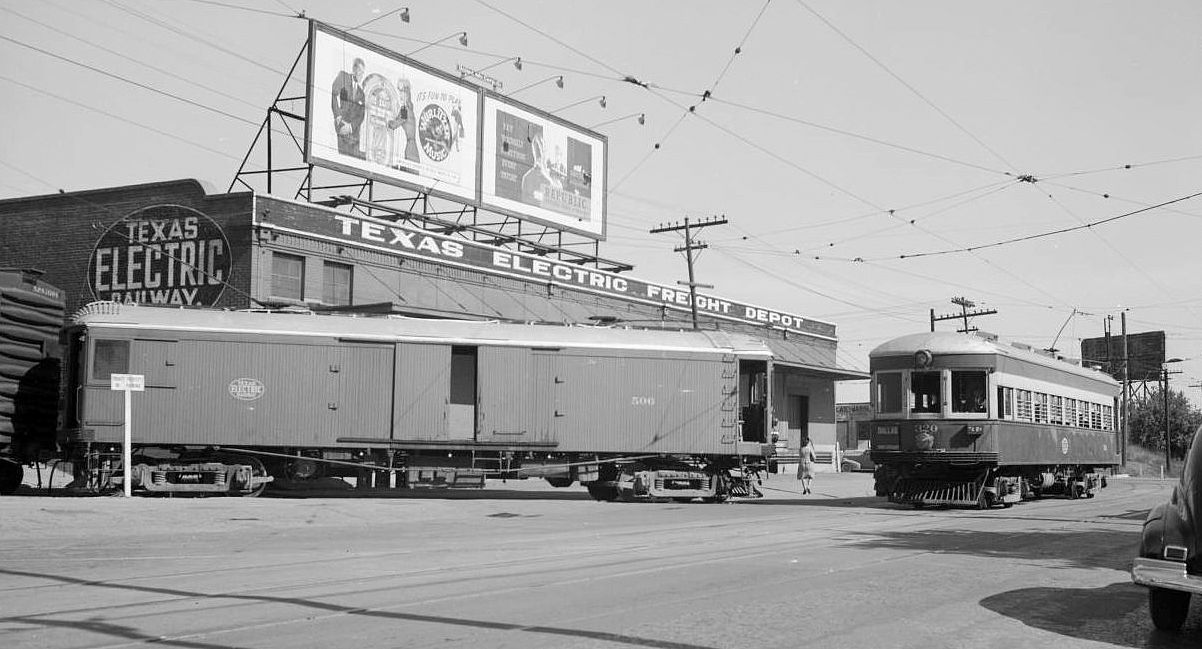
The interurban freight depot — seen below in 1946 — was located just east of Ferris Plaza. At the left, part of a railroad freight car is visible, in the middle, an interurban freight car, at the right, an interurban (passenger) streetcar, and at the far right, an automobile. And some crazy person walking.

freight_interurban_denver-pub-lib_1946

But the automobile eventually proved too popular, and more and more people began using trucks for hauling. After 40 years in business, the Texas Electric Railway interurban ceased operations in 1948.

*

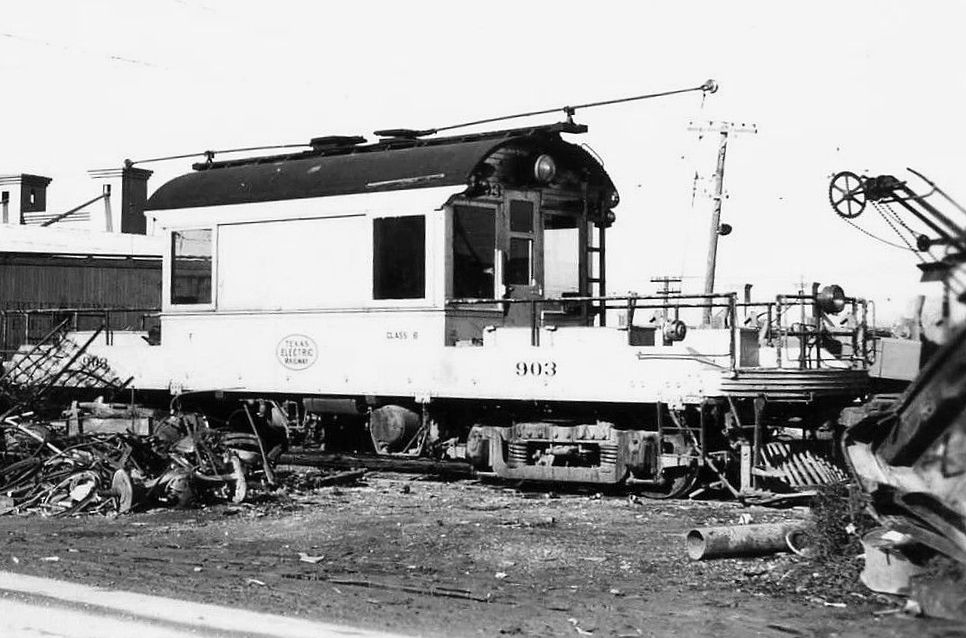
When searching around for possible other images of engine 903 (as seen in the top photo), I found it hanging out over on eBay — described as being in the “Waco car house yards” in 1944. Small world.

engine-903_ebay

***

Sources & Notes

Top image found on Flickr.

Photo of the freight depot taken by Robert W. Richardson on April 27, 1946; from the Western History/Genealogy Dept., Denver Public Library.

Bottom photo (cropped) from eBay..

Interurban freight operation Wikipedia entry here.

Texas Electric Railway: Handbook of Texas entry here; Wikipedia entry here.

MANY photos of various Texas Electric Railway freight motors and locomotives, here.

And, lastly, great photos from around Dallas in CERA’s “Texas Electric and the Journey to DART,” here.

(Thanks to Bob J. and Robert P. for their helpful info!)

*

Copyright © 2014 Paula Bosse. All Rights Reserved.

Baylor Hospital — 1909-1921

baylor_postcardClassic cars on Junius Street… (click for larger image)

by Paula Bosse

I originally thought the street in front of Baylor Hospital in this postcard was Gaston. But Baylor originally faced Junius Street (see it on a 1921 Sanborn map here), and, in fact, its address was 3315 Junius for many years. I had no idea.

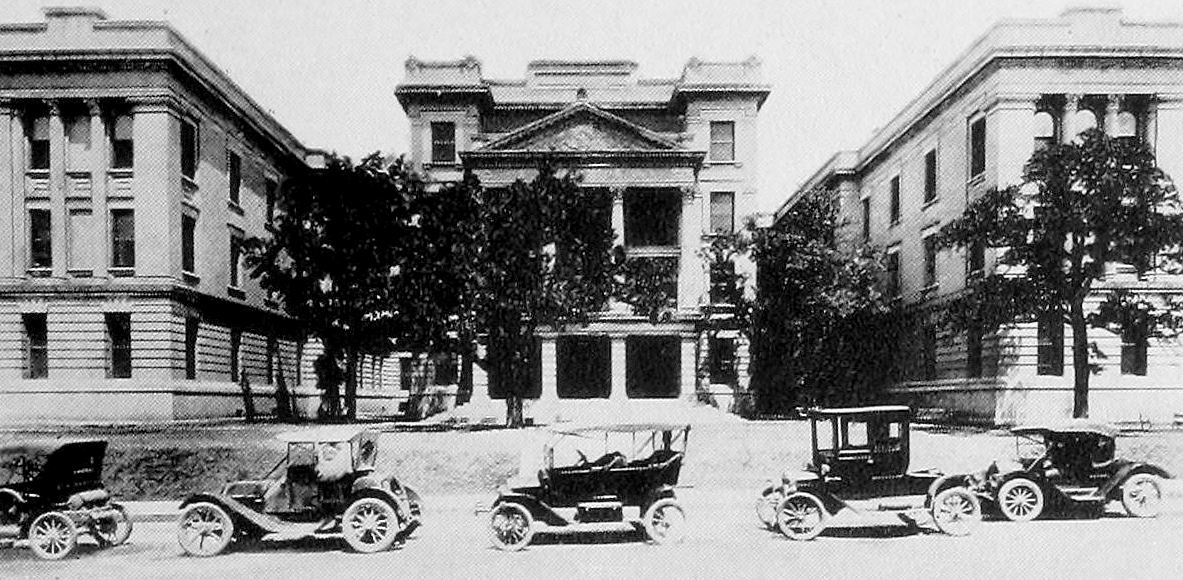
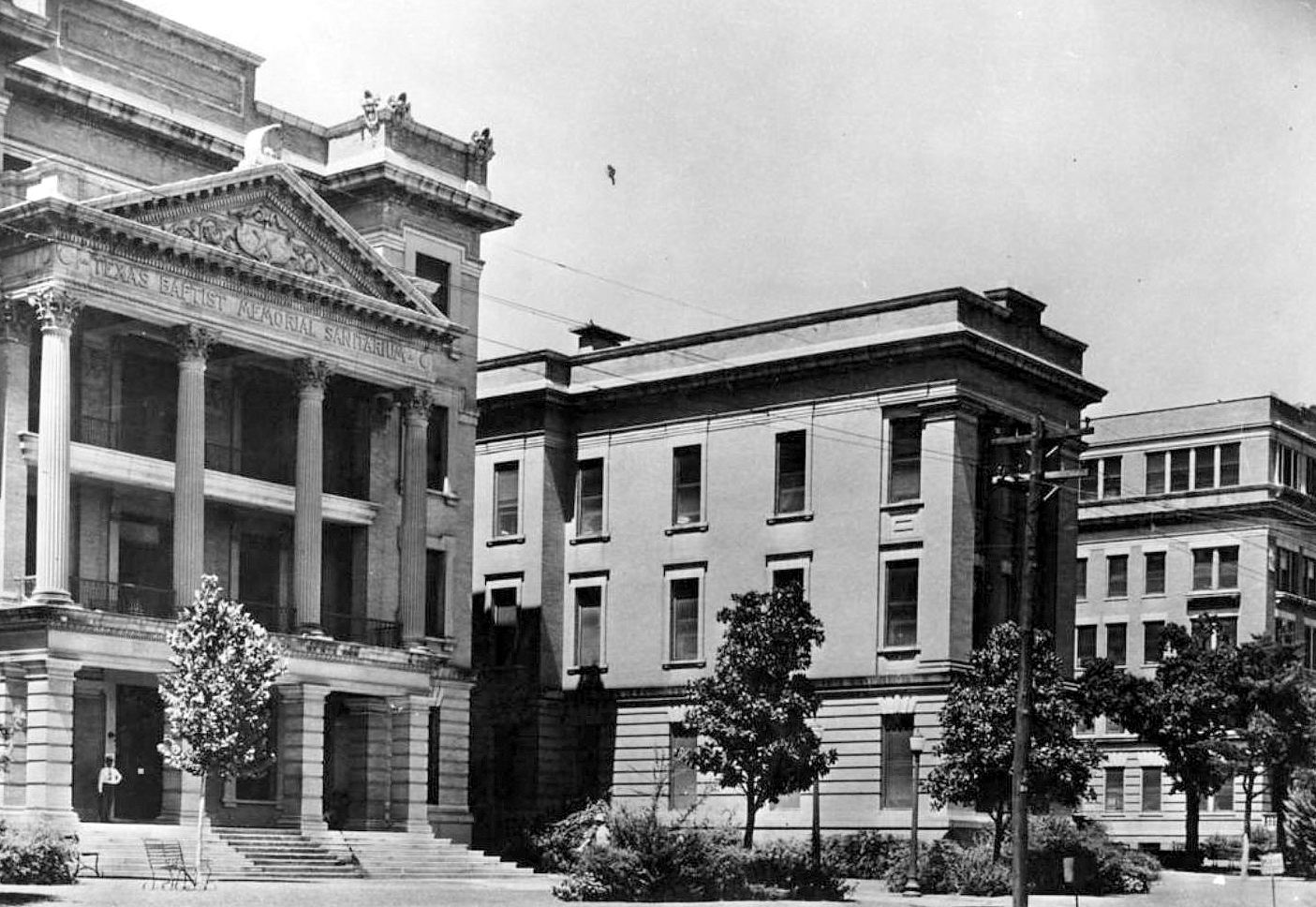
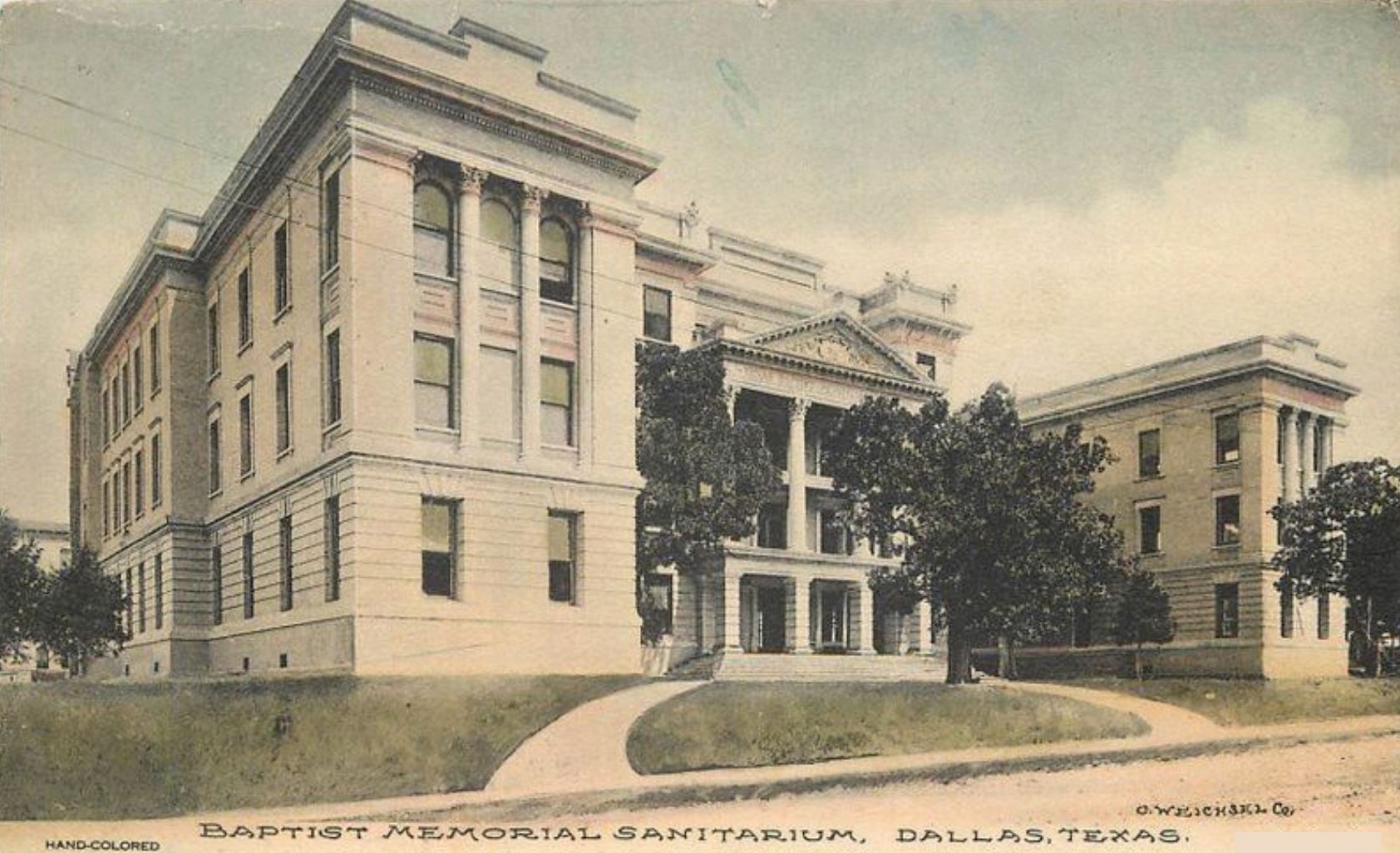
Below are a few more photos and postcards of the medical facility which eventually grew into Baylor Hospital (its Dallas roots go back to 1903, but the buildings seen in these images — buildings designed by noted Dallas architect C. W. Bulger & Co. — were built around 1909). Originally known as the “Texas Baptist Memorial Sanitarium,” it changed its name to the more familiar “Baylor Hospital” in 1920/1921 (and later became “Baylor University Hospital” in 1936). (More on the timeline of Baylor Hospital can be found here and here.)

baylor_postmarked-1919_ebaypostmarked 1919

Dig those cars.

baylor_baylor-univ-waco-yrbk_the-round-up_19171915

baylor-hospital_baptist-sanitarium_postcard

baylor_tx-baptist-memorial-sanitarium_ca-1912_UTSW-libraryca. 1912 (photo: UT Southwestern Library)

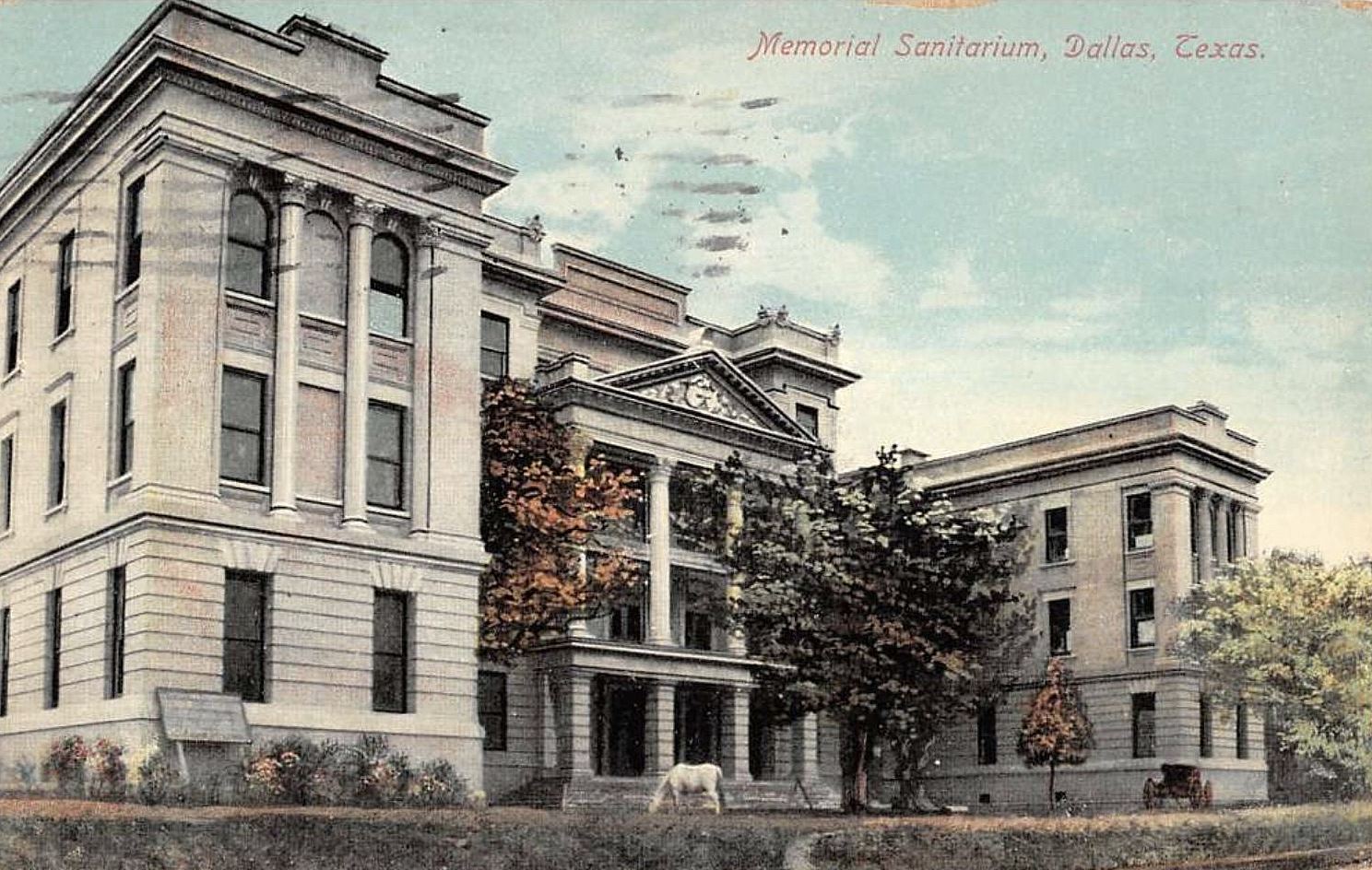
This is my favorite one: no cars, but there’s a horse grazing at the entrance!

baylor_horse_postmarked-1911_ebaypostmarked 1911

The postcard below was postmarked 1909, the year these new buildings opened. No cars, no horse, no people. 

baylor_postmarked-1909_ebay1909

And here is the brand new sanitarium, in a photograph that appeared in The Dallas Morning News less than a month after its official opening.

baylor-hospital_exterior_dmn_111009_clogensonDMN, Nov. 10, 1909

***

Sources & Notes

Postcards found on eBay.

The first black-and-white photo is from the 1917 Round-Up, the yearbook of Baylor University in Waco; the same image (uncolorized) appears in the digital archives of UT Southwestern, here, with the date 1915.

The second black-and-white photo is from the UT Southwestern Library archives, here.

The name-change of the Texas Baptist Memorial Sanitarium to Baylor Hospital was proposed in Nov. of 1920 and formally approved by the Board of Trustees of Baylor University in Waco on January 16, 1921. More about the major changes happening to the medical facility/facilities affected can be found in the article “Medical Center For Dallas Is Authorized by Texas Baptists” by Silliman Evans (Fort Worth Star-Telegram, Nov. 13, 1920), here.

Read a detailed description of the Texas Baptist Memorial Sanitarium in the Dallas Morning News article “Baptist Memorial Sanitarium, Just Completed at Dallas, Represents an Investment of More Than Four Hundred Thousand Dollars” (DMN, Nov. 10, 1909), here and here. There are several photographs taken inside and outside (and on top of) the brand new buildings.

*

Copyright © 2014 Paula Bosse. All Rights Reserved.

Brook Hollow Country Club — 1940s

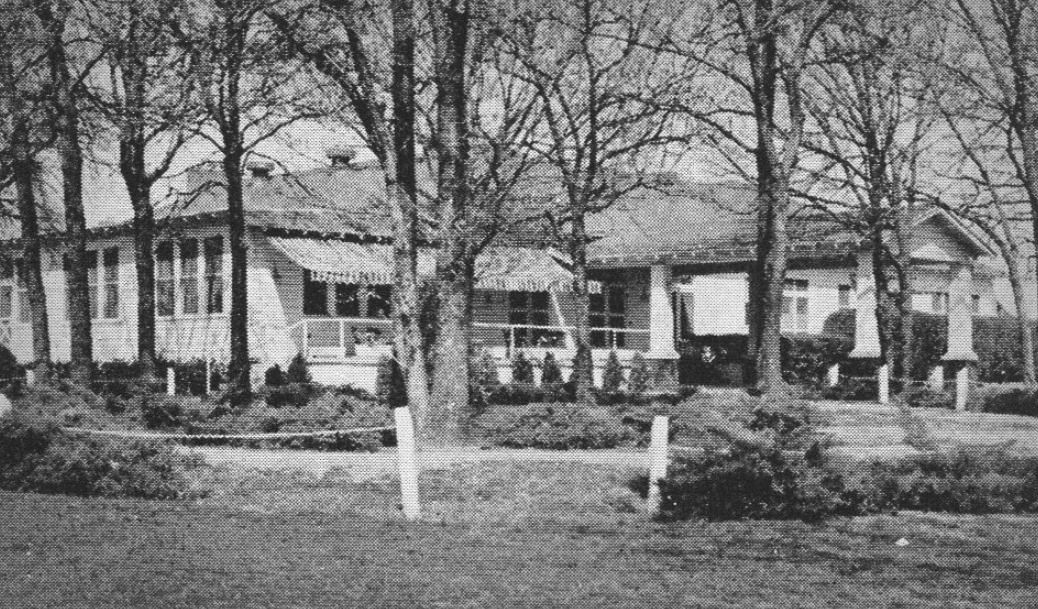
brook-hollow-country-club_1940sA modest clubhouse…

by Paula Bosse

A photo of Brook Hollow Country Club from a 1940s guide for newcomers. This photo is from a page of the area’s country clubs. This looks positively quaint.

***

Sources & Notes

From an early edition of “So This Is Dallas,” a guide for new residents of Dallas — this edition is from the early ’40s. Thanks to the Lone Star Library Annex Facebook group for loan of the image.

The Brook Hollow Golf Club is a bit swankier these days. The official site is here.

*

Copyright © 2014 Paula Bosse. All Rights Reserved.

Back When Bookstore Fixtures Were a Thing of Beauty! — 1940s

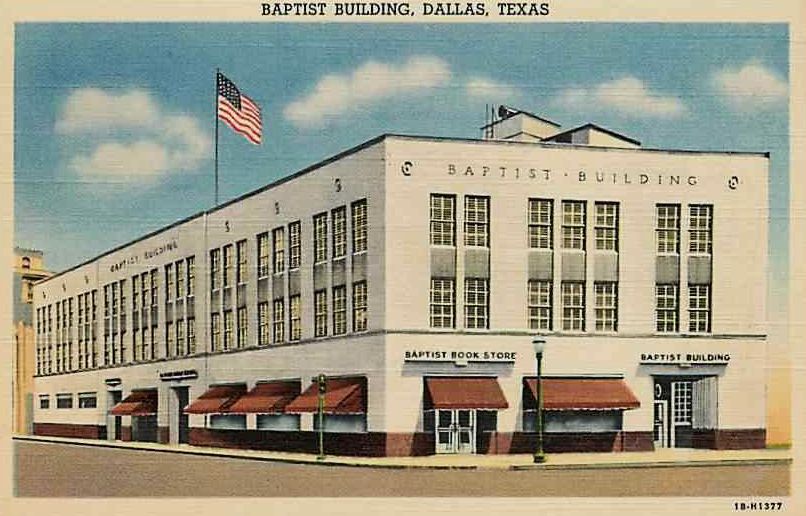
baptist-book-storeErvay & Pacific — “Book Corner” (click for larger image)

by Paula Bosse

In July of 1941 the Baptist Building opened at Ervay and Pacific. Part of the ground floor (“the Book Corner”) was occupied by the Baptist Book Store, which sold mostly religious material, but which also stocked dictionaries (“and other items of similar nature”) and children’s books (“We have books for every type and age of juvenile from the Picture Books of Children from three to five to the vigorous youth wanting stories of the romantic west”). The ad below appeared in a booklet put together to welcome newcomers to the city, about 1946:

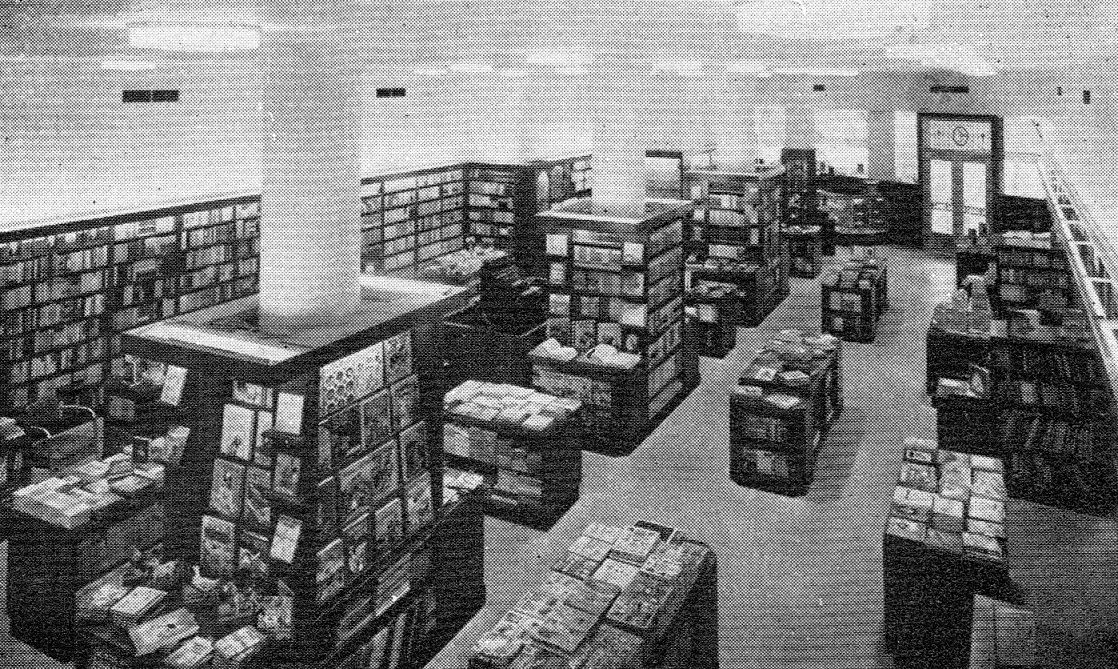
baptist-book-store_ca1946(click for larger image of bookstore interior)
*

Having grown up in a family-run bookstore (and having worked in various other bookstores for a large chunk of my life), I’m always fascinated by old photos of bookstore interiors, and this one is just great. (Click the image above to see the photo of the store much larger.) I’m particularly fascinated by the fixtures encircling the pillars — I’m not sure I’ve ever seen the problem handled in such a sophisticated way. And is that recessed lighting shining down on the slatwalls? This is a really wonderful-looking bookstore. The only thing that looks out of place is what appears to be an old-fashioned chunky cash register, center left. Everything else in this photo makes the bookseller in me practically giddy with nostalgia.

baptist-book-store_dmn_092847-det

***

Ad is from a publication called “So This is Dallas” published by “The Welcome Wagon.” It is undated but is probably from immediately after the war. This slim booklet was printed for several years in slightly different editions for people who were considering a move to Dallas or for people who had just moved here. These booklets are wonderful snapshots of the time, with everything the prospective Dallasite would need: facts, photos, and ads.

Bottom image is a detail from a 1947 ad.

*

I am fascinated by photographs of vintage bookstore interiors — especially Dallas bookstore interiors, of which there are precious few to be found. I would love to see any photos of Dallas bookstores before, say, 1970. If you have any, please send them my way! My contact info is in the “About/Contact” tab at the top of the page. Thanks!

*

Copyright © 2014 Paula Bosse. All Rights Reserved.