Flashback : Dallas

A Miscellany: History, Ads, Pop Culture

Category: Cedars

Dallas in “The Western Architect,” 1914: Businesses
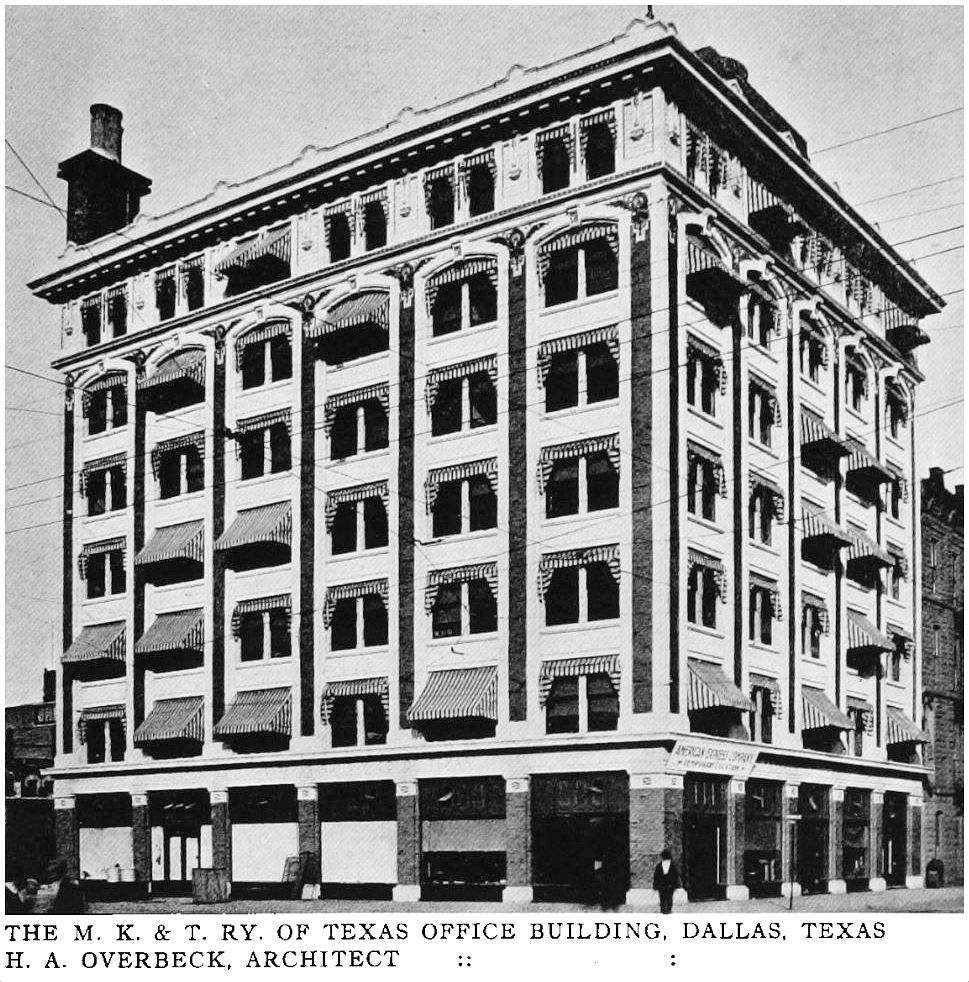
mkt-bldg_western-architect_july-1914

by Paula Bosse

The continuing week-long look (…well, it looks like that’s going to be more like a two- or three-week-long look…) at the Dallas buildings featured in the July, 1914 issue of The Western Architect plods on. Today: business buildings. Nine of these ten buildings are, remarkably, still standing (some are even still recognizable!), and, as seems to be the trend with architecture of this period in Dallas, the powerhouse firm of Otto Lang and Frank Witchell dominates.

*

1.  MKT BUILDING / KATY BUILDING, Commerce & Market, designed by architect H. A. Overbeck (who also designed the nearby Criminal Courts Building). This building (seen above) was built in 1912 as the general offices of the Missouri, Kansas & Texas Railway; it has been spiffed up in recent years and is one of my favorite downtown buildings. An article appearing at the time the offices opened described the building as being faced with dark brick (“gun metal shade”) and light colored terracotta. The wide-angle photo below, which shows employees in front of the new building, is interesting because of the buildings seen to the left and right (all images in this post are larger when clicked). (See the building on a 1921 Sanborn map here.)
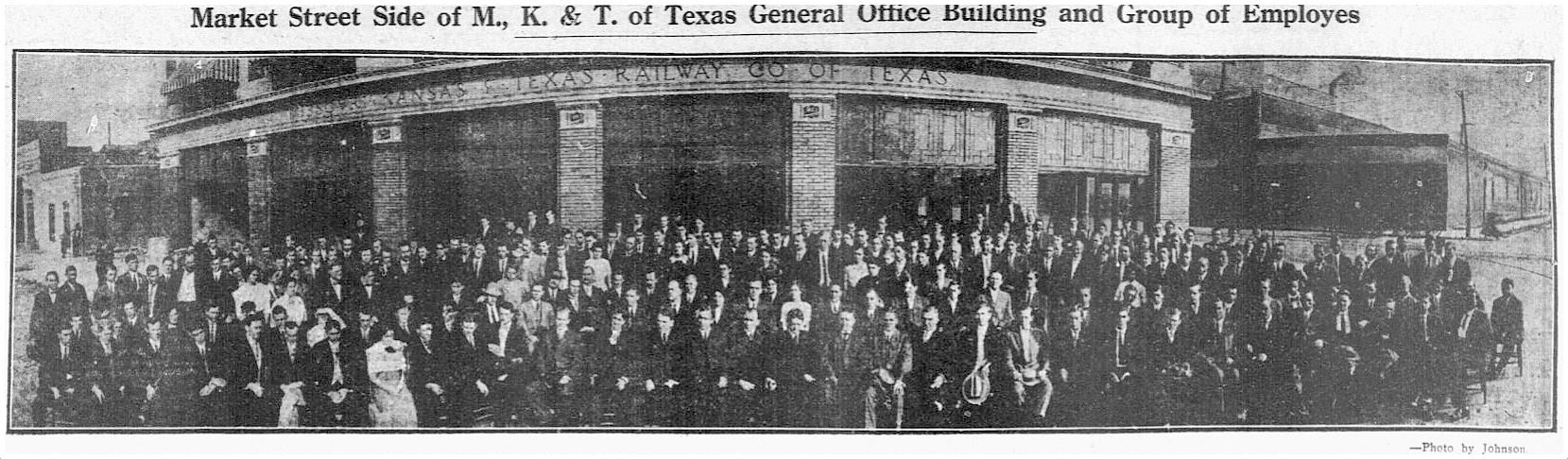
mkt-bldg_dmn_120112_employees-new-bldgDallas Morning News, Dec. 1, 1912

*

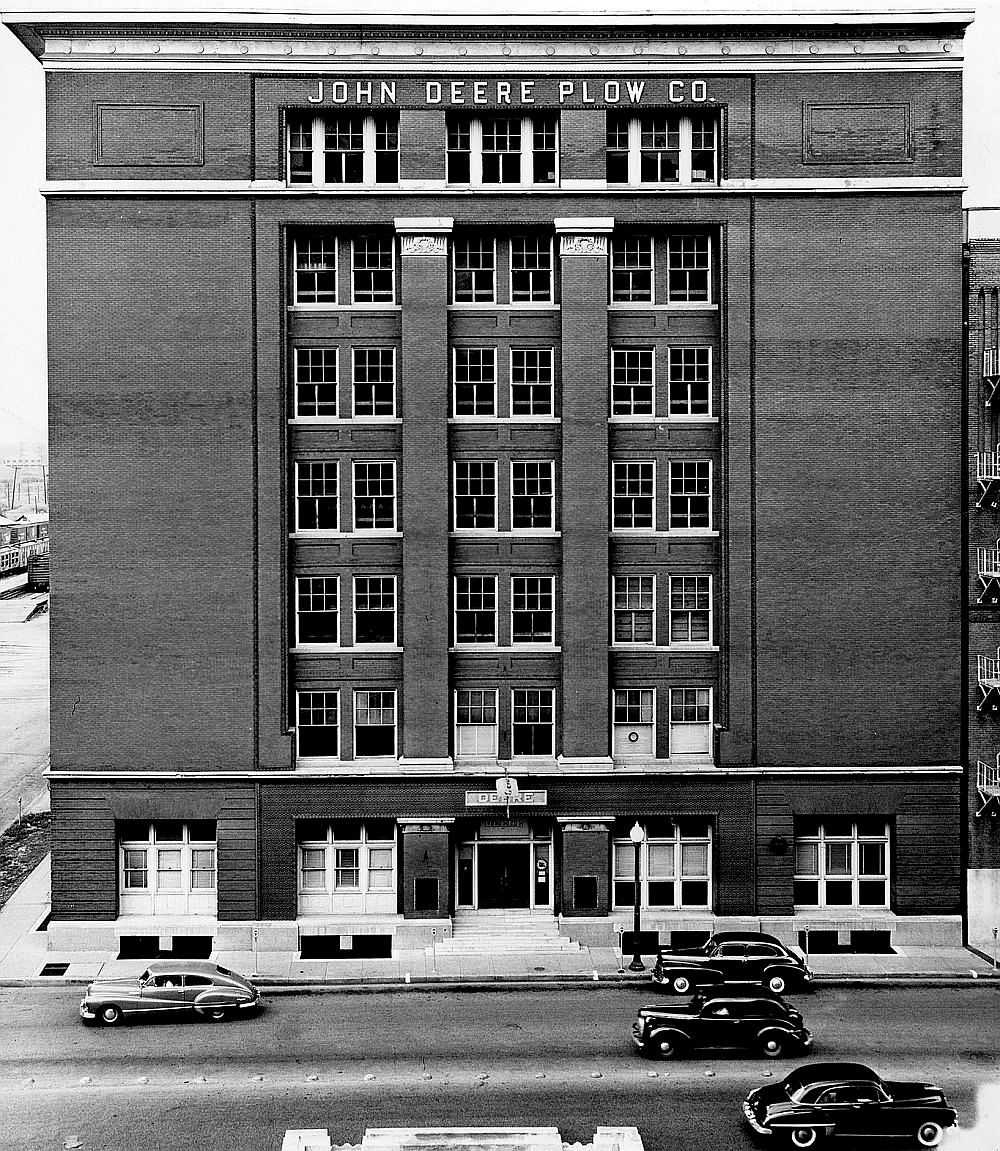
2.  JOHN DEERE BUILDING, 501 Elm Street (northeast corner of Elm & Houston), designed by Hubbell & Greene. This building was built about 1901/1902 for the Kingman Texas Implement Co. (construction permits were issued the same week in 1901 as its also-still-standing-across-the-street-neighbor, the Southern Rock Island Plow Co., better known as the Texas School Book Depository). It is thought to be the earliest example of Sullivan-esque architecture in Dallas. The John Deere Plow Co. moved into the building around 1907 and built the warehouse, which extends back to Pacific. After the Deere Co. moved out, it was the home of apparel manufacturing and wholesaling offices for many years. (See it on a 1921 Sanborn map, here.)
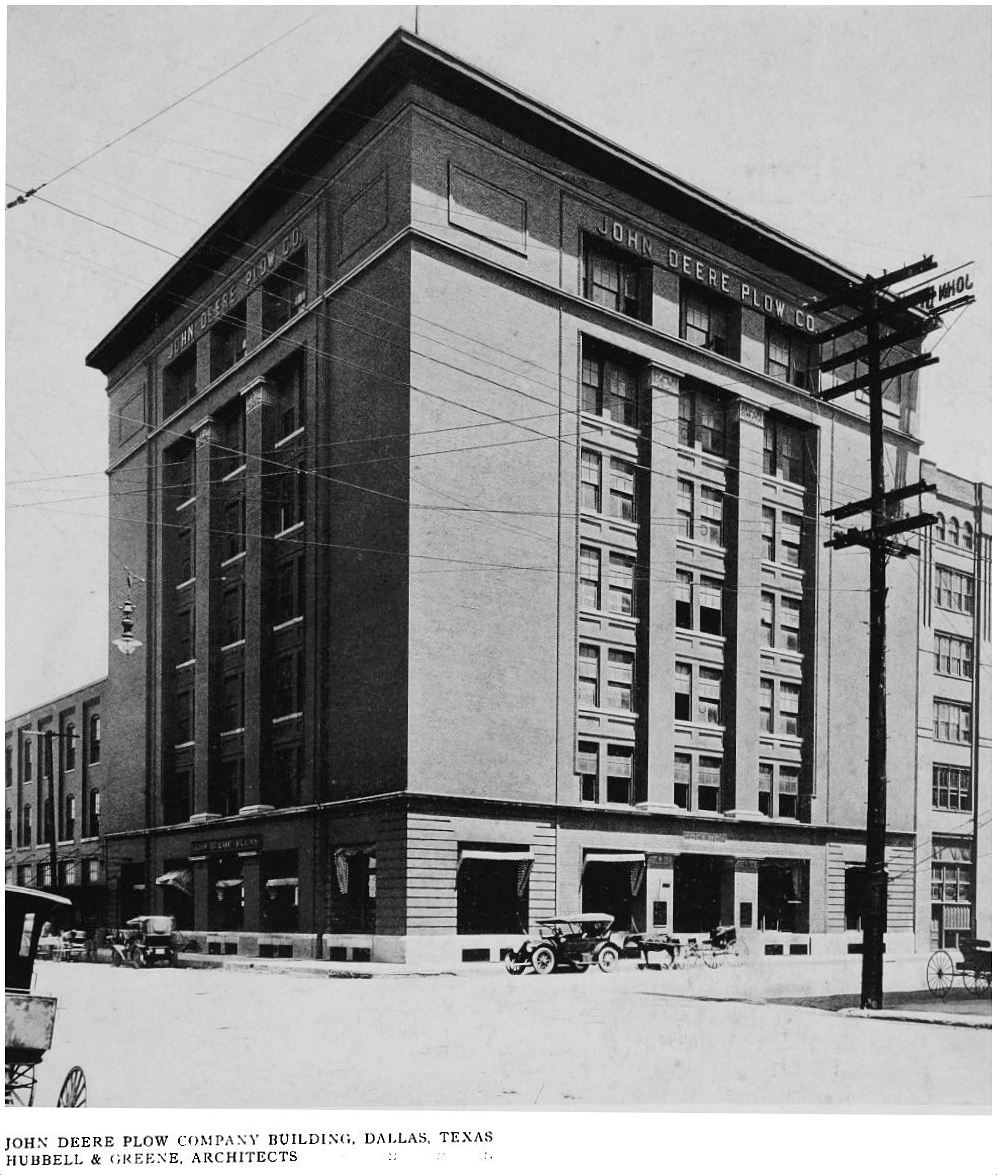
john-deere-bldg_western-architect_july-1914

john-deere-building_flickr_colteraca. 1949, via Flickr

*

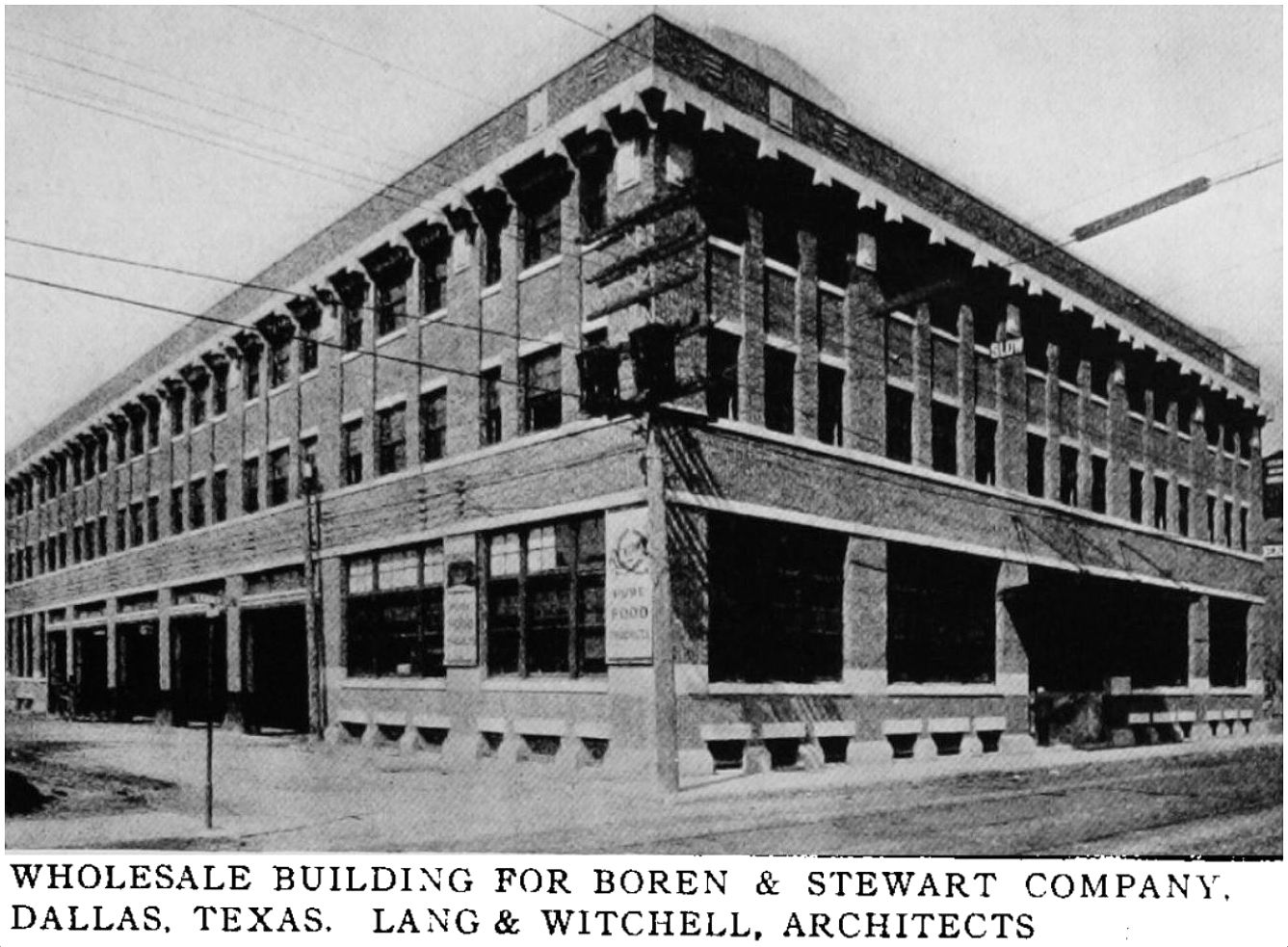
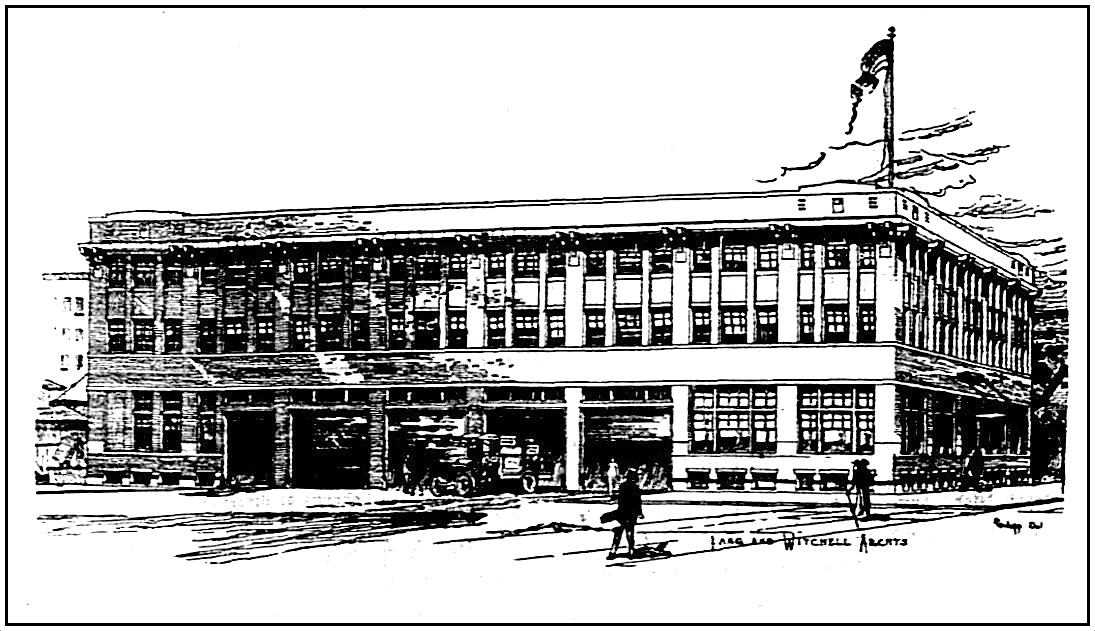
3.  BOREN & STEWART BUILDING, 1801 N. Lamar (at Hord), designed by Lang & Witchell. This attractive building was built in 1913 in what is now the Historic West End District — the building is still standing. Boren-Stewart, billed in ads at this time as “Dallas’ oldest grocery house,” had been established in the late 1880s by Robert H. Stewart and Benjamin N. Boren. At the time of the construction of this new building, its president was R. H. Higginbotham (whose Swiss Ave. house was also featured in The Western Architect); its treasurer was A. W. Cullum, who would go on to form the Tom Thumb grocery store chain. (See it on a 1921 Sanborn map here.)
boren-and-stewart_western-architect_july-1914

boren-stewart_lang-and-witchell-drawing_dmn_083013Lang & Witchell drawing, 1913

*

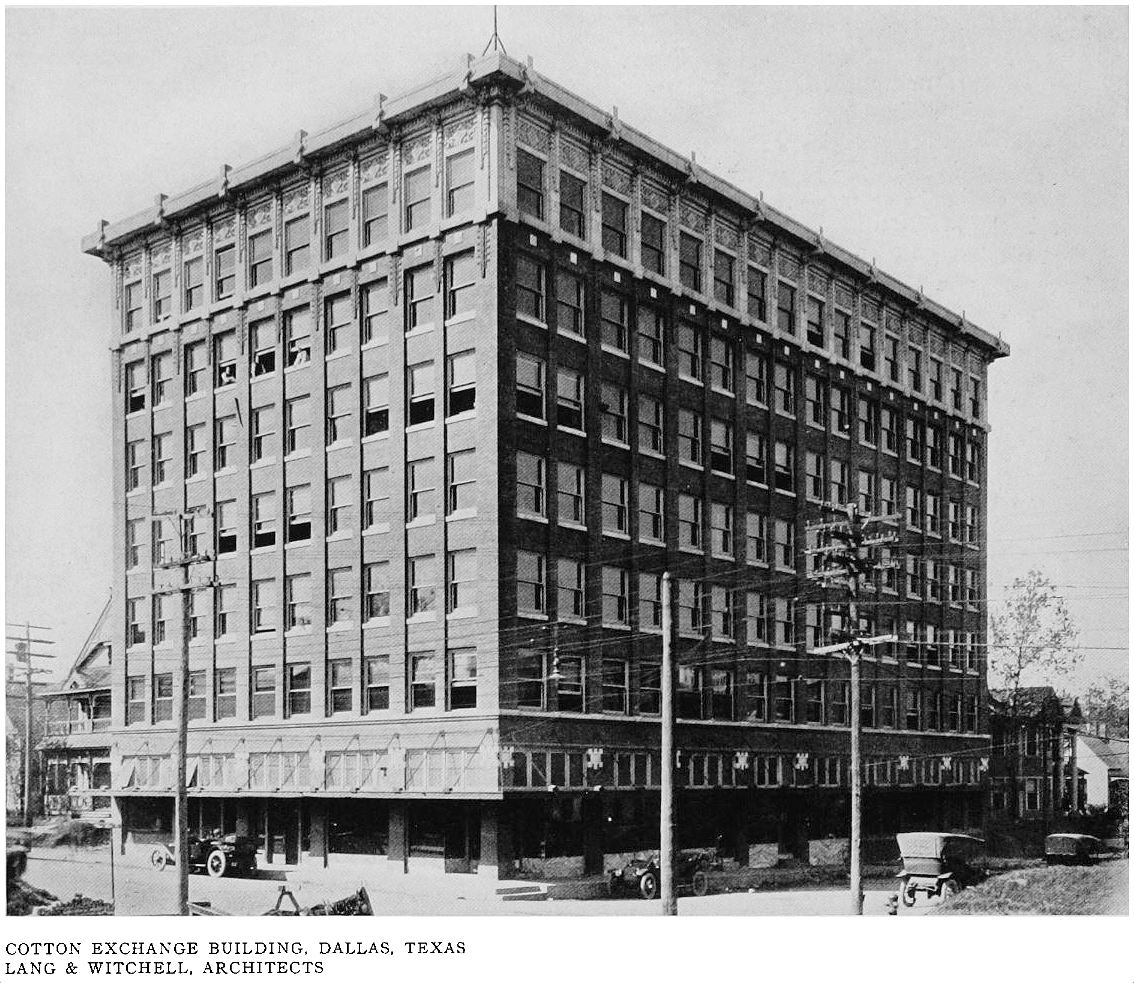
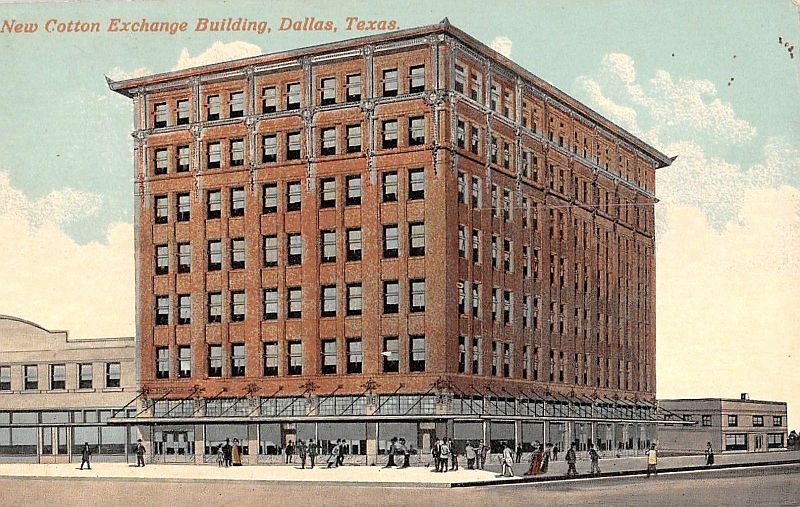
4.  COTTON EXCHANGE BUILDING, 401 S. Akard (southwest corner of S. Akard & Wood), designed by Lang & Witchell. Built in 1911, this was the hub of the cotton market in Dallas, a city which, in a 1912 article in The Dallas Morning News, was described as “the greatest and largest interior cotton market in the world, handling cotton worth $100,000,000 per year” (about 2.7 billion dollars in today’s money!). The Dallas Cotton Exchange was handling up to one-third of the cotton grown in Texas and Oklahoma. This handsome building was vacated by the cotton people in 1926 when their much larger new exchange building went up at St. Paul and San Jacinto. (Read about the Dallas cotton traders unhappiness with not being acknowledged as one of the country’s most important exchanges in a March 20, 1912 article in The Dallas Morning News here.) (See this building on a 1921 Sanborn map here.) This is the only building in this group of ten that is no longer standing — the site is now occupied by a parking lot.
cotton-exchange-bldg_western-architect_july-1914

cotton-exchange-building_postcard_ebay

*

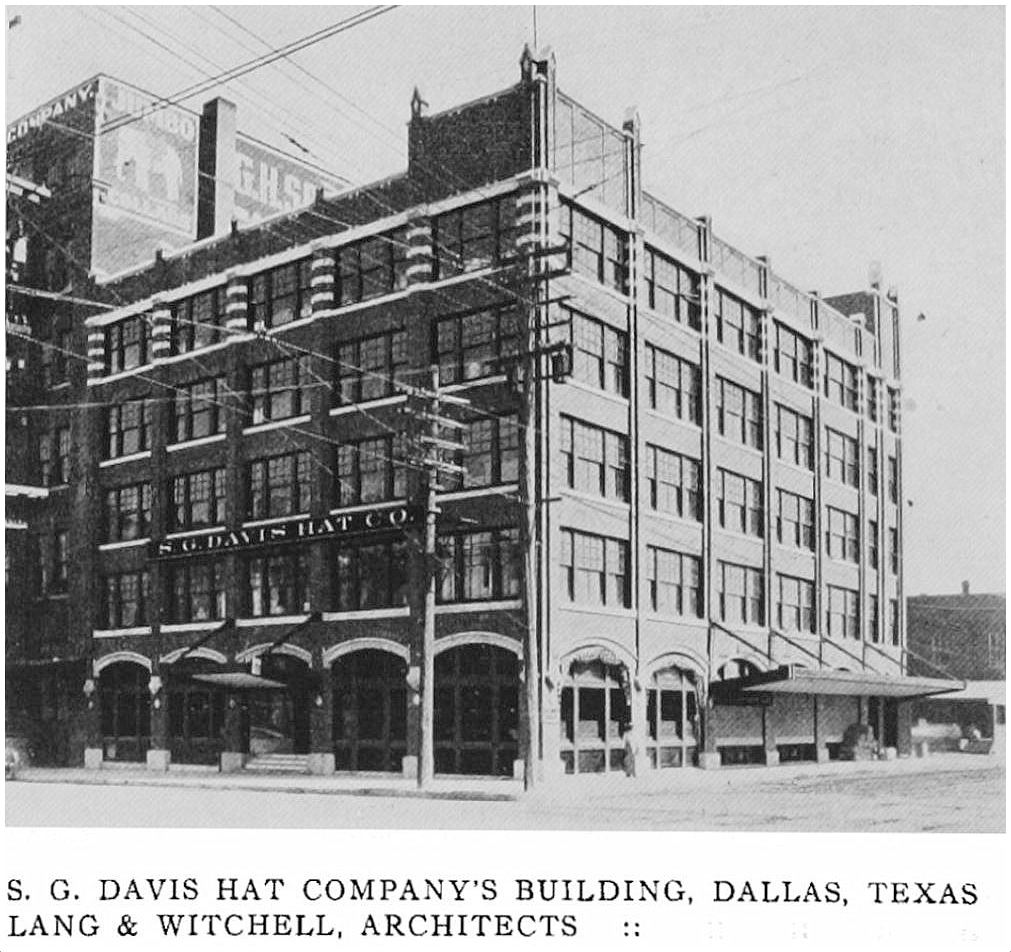
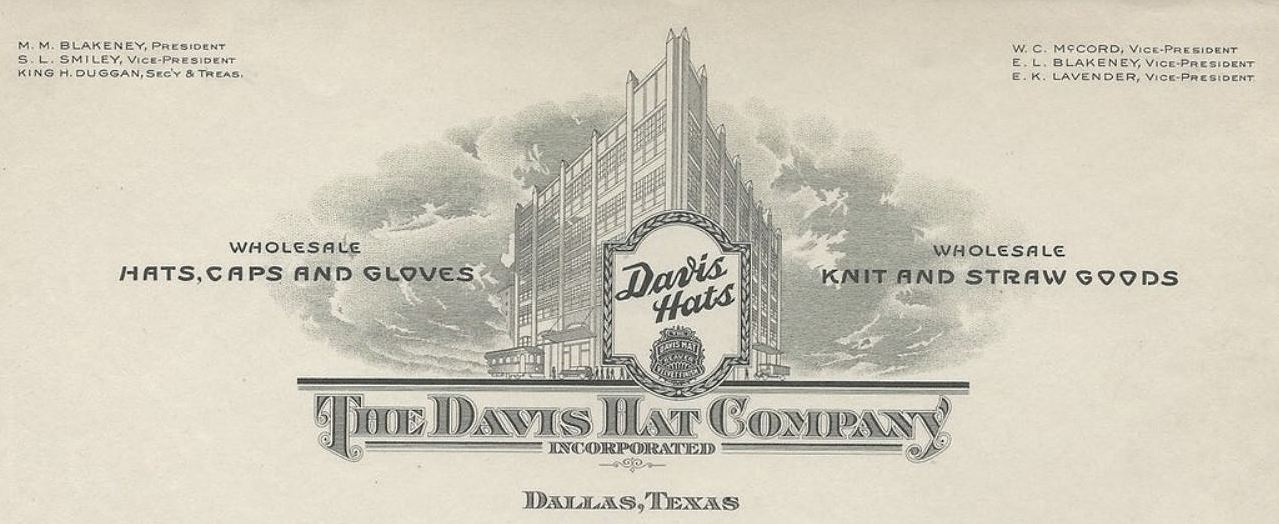
5.  S. G. DAVIS HAT CO. BUILDING, 800 Jackson St. (southeast corner of Jackson and S. Austin), designed by Lang & Witchell. When it was built in 1913 it was advertised as “facing the new Union Depot” (which hadn’t yet been built and was three blocks away). The Davis Hat Company — a manufacturer and wholesaler of men’s hats — was established in Dallas in 1900. This building might be familiar to many people for its “Office Equipment Co. sign painted on the back exterior. (See the location of this building on a 1921 Sanborn map, here.)
davis-hat-co-bldg_western-architect_july-1914

davis-hat-co-building

*

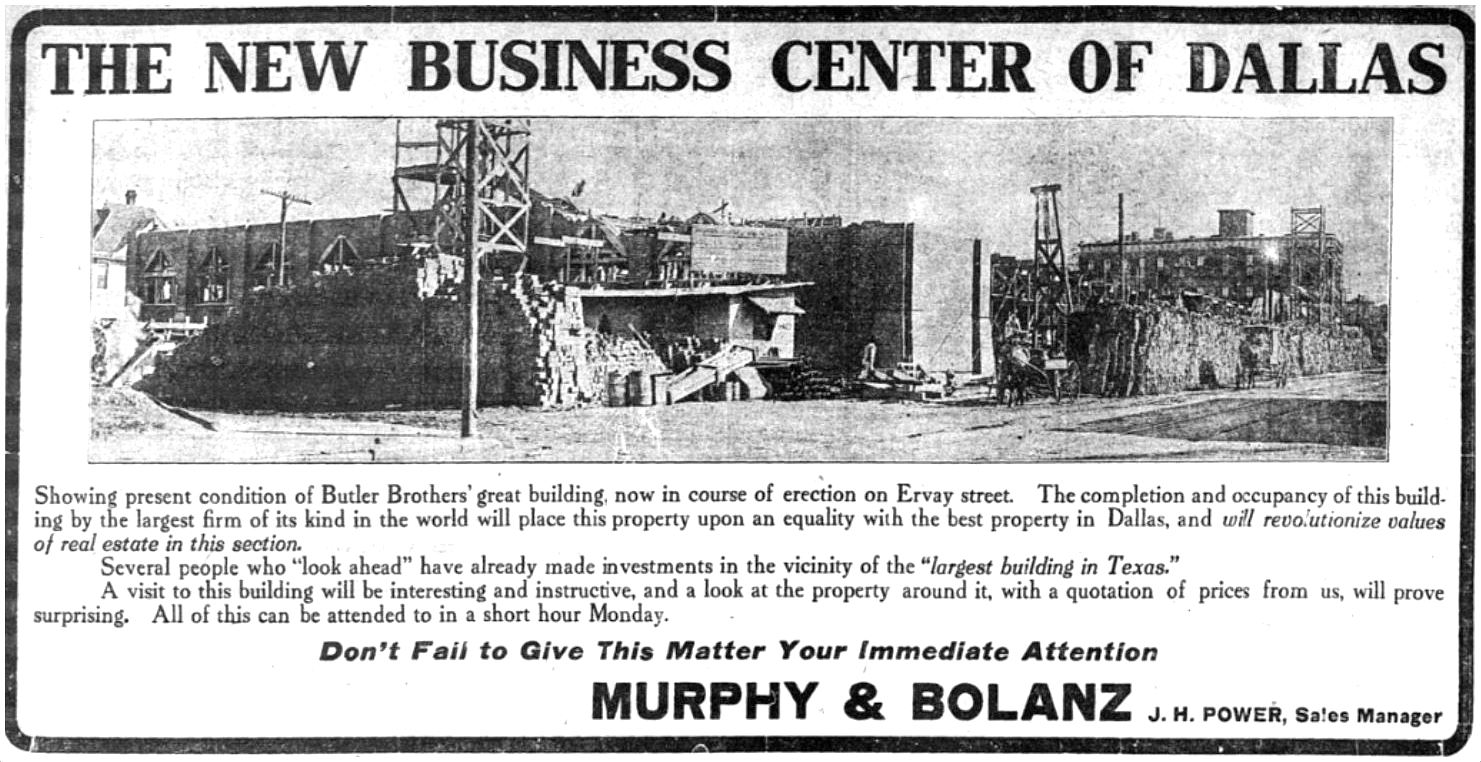
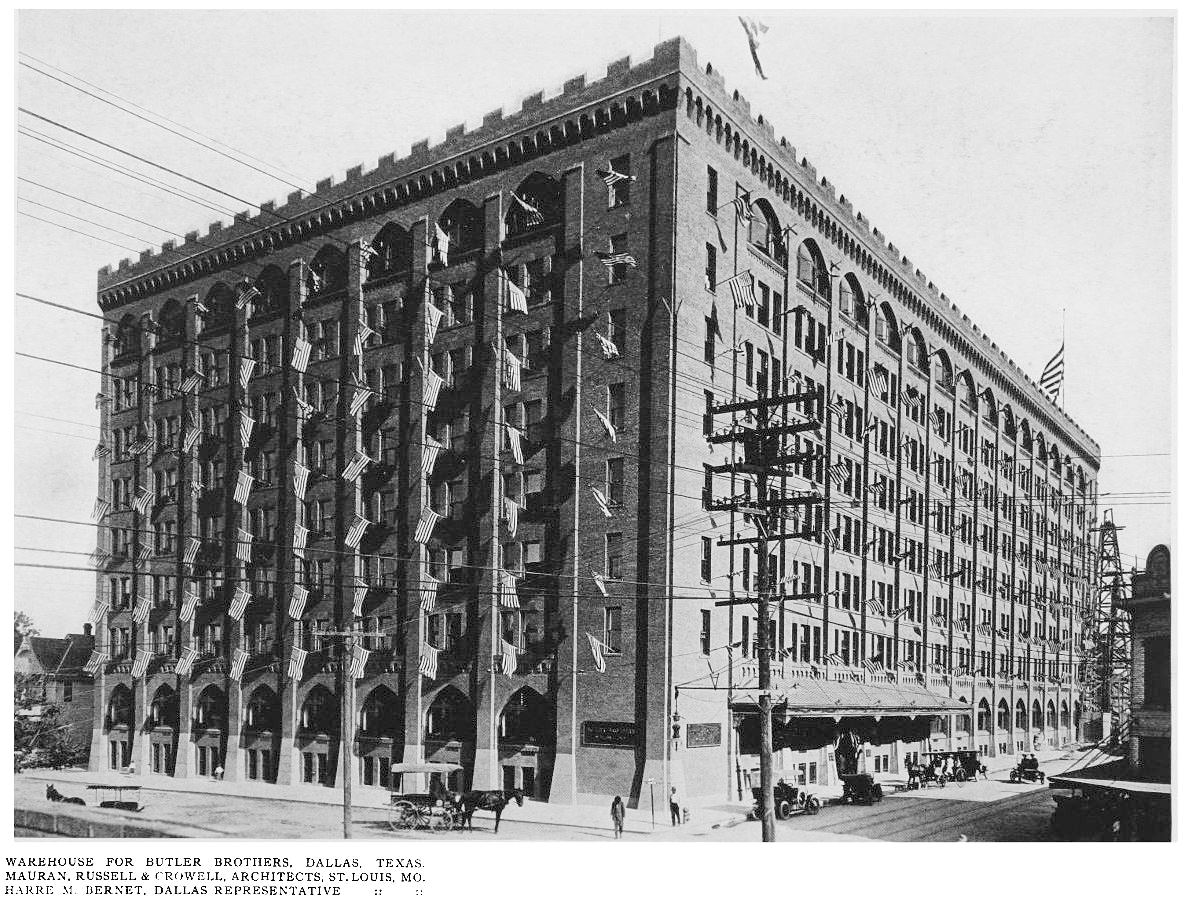
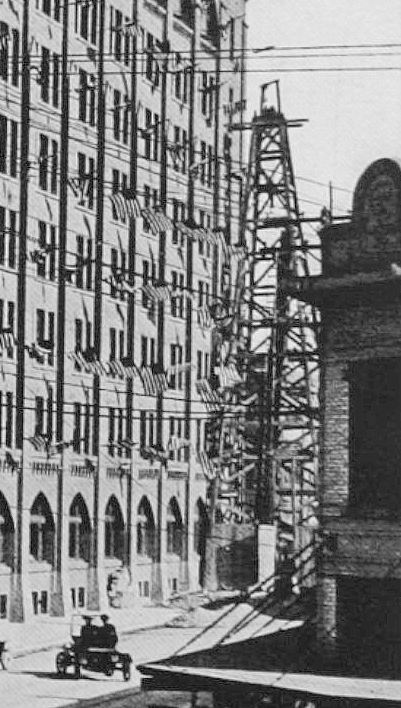
6.  BUTLER BROTHERS, 500 S. Ervay (between Young and Marilla, immediately east of City Hall), designed by Mauran, Russell & Crowell Architects (Harre Bernet, Dallas representative). This massive building (11 acres of floorspace before any additions were made) was one of the branches of the Chicago company which was known at the time as the largest wholesale business in the world. Construction began in 1910 (see a photo of the work in progress, by Vilbig Brothers Construction, here) and, over the years, various additions were made. When Butler Bros. sold the building in 1951, it had grown to 670,000 square feet and soon became home to the newly branded Merchandise Mart. The building still stands (as residences), but it doesn’t look a lot like it did a century ago: it was apparently resurfaced in the 1960s and currently sports a regrettable exterior color, which makes it look a bit like a large Hampton Inn. (See it on a 1921 Sanborn map, here.)
butler-brothers_western-architect_july-1914

It even had its own artesian “deep well.”
butler-brothers_det_western-architect_july-1914

butler-brothers_ad_110610November, 1910

*

7.  “STORE AND FLAT BUILDING,” northwest corner of West Jefferson & Tyler, designed by C. A. Gill. Luckily I recognized this building — because I love it and have written about it before — because, otherwise, there’s very little to go on to determine its location. It was built in 1911 or 1912 for use as retail establishments on the ground floor and apartments (“flats”) and the occasional doctor’s offices on the second floor. Still looking good in Oak Cliff. (See it on a 1922 Sanborn map, here.)
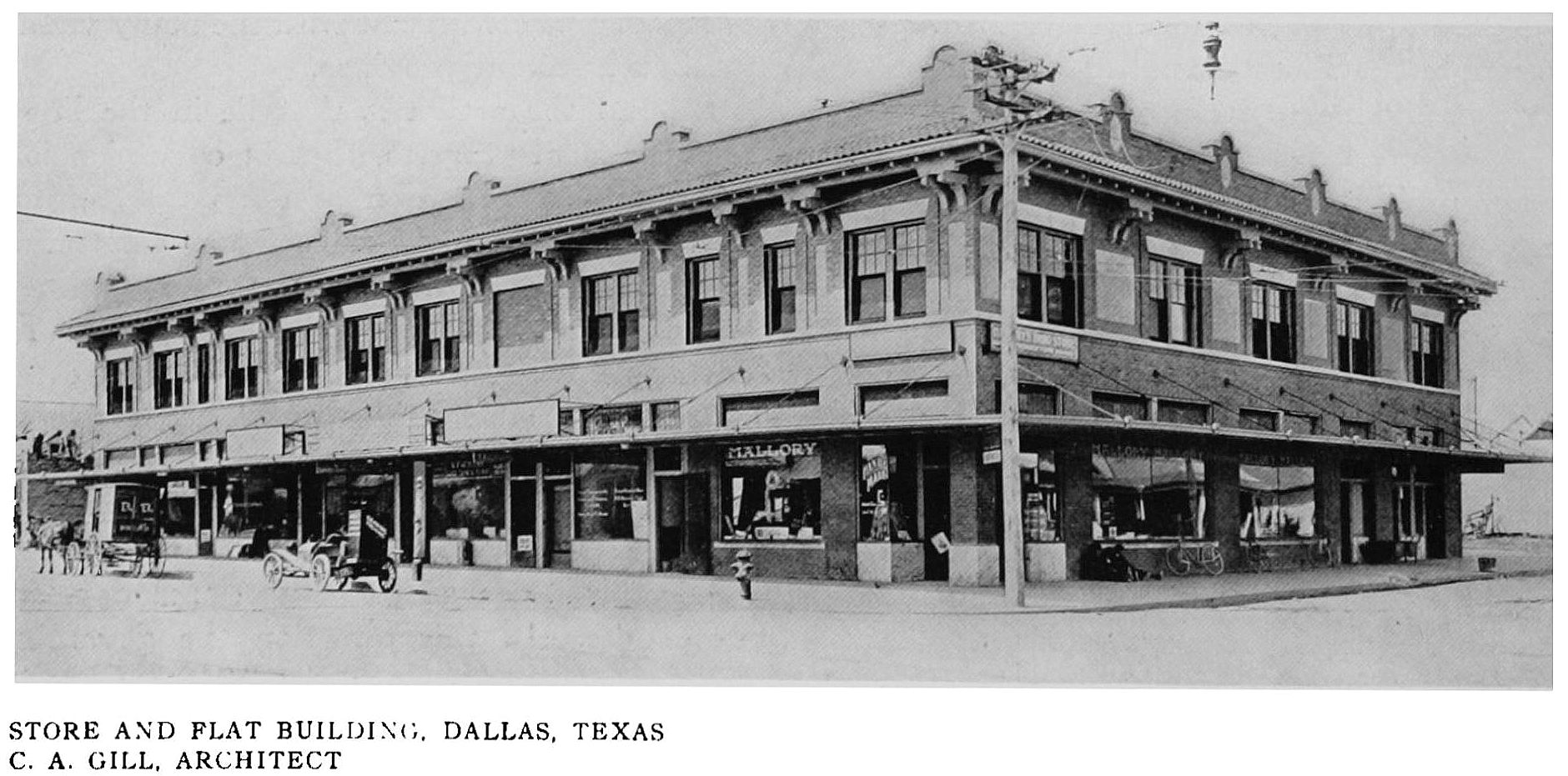
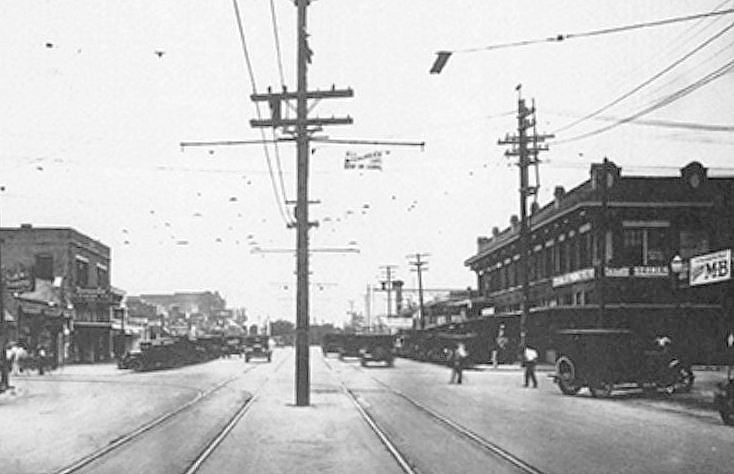
oak-cliff_mallory-drugstore_western-architect_july-1914

oak-cliff_jefferson-tyler_1929_oak-cliff-advocate_DPL1929 (Dallas Public Library photo, via Oak Cliff Advocate)

*

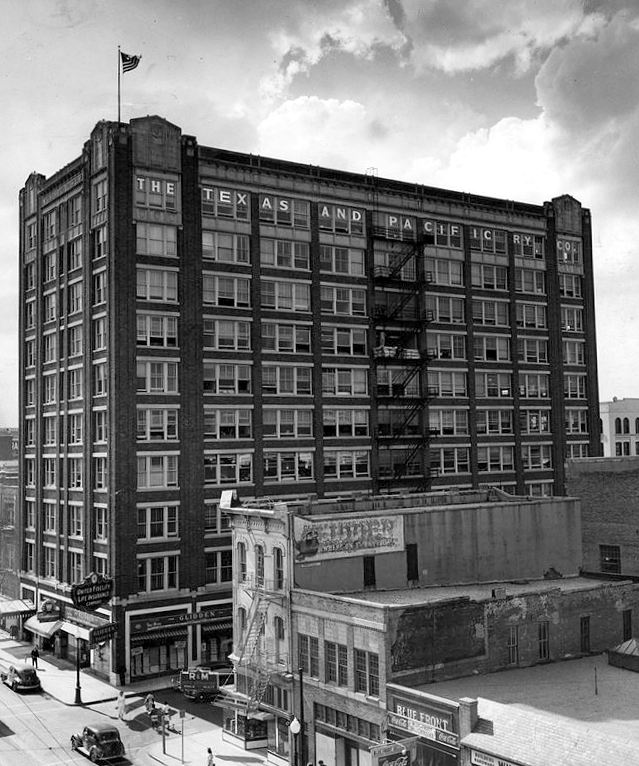
8.  HUEY & PHILP BUILDING, 1025 Elm Street, designed by Lang & Witchell. Built in 1913-1914 for the Huey & Philp hardware company (founded in Dallas in 1872 by Joseph Huey and Simon Philp) — this building is still standing, but you’d probably never ever guess it. First off, it looks nothing like it once did: it’s much taller now and it was one of the many downtown buildings that went through bizarre refacings in the 1950s and ’60s — beautiful buildings were stripped of all their character and uglified, for reasons I can’t fathom. Anyway, the other reason it’s hard to believe this is the same building is that, when it was built, it sat on the northwest corner of Elm and Griffin; now it sits on the northeast corner. How does something like that happen? In the 1960s, Griffin was “realigned” and widened, in order to provide a north-south artery through downtown’s west side — part of this road construction meant that Griffin suddenly cut right through the 1000 block of Elm (it also did away with poor little Poydras Street). The old Griffin can still be seen in the Griffin Plaza walkway (here — with the old Huey & Philp/Texas & Pacific building to the left, now a hotel and looking nothing like the century-old building it is). Crazy. Huey & Philp closed its retail business in 1934 but continued for several decades as wholesalers. (Read more about this building at Noah Jeppson’s Unvisited Dallas site, here. And see a street-level early-1920s photo in the UTA collection here, with the Sanger’s building in the background at the left.) (See it on a 1921 Sanborn map, here.)
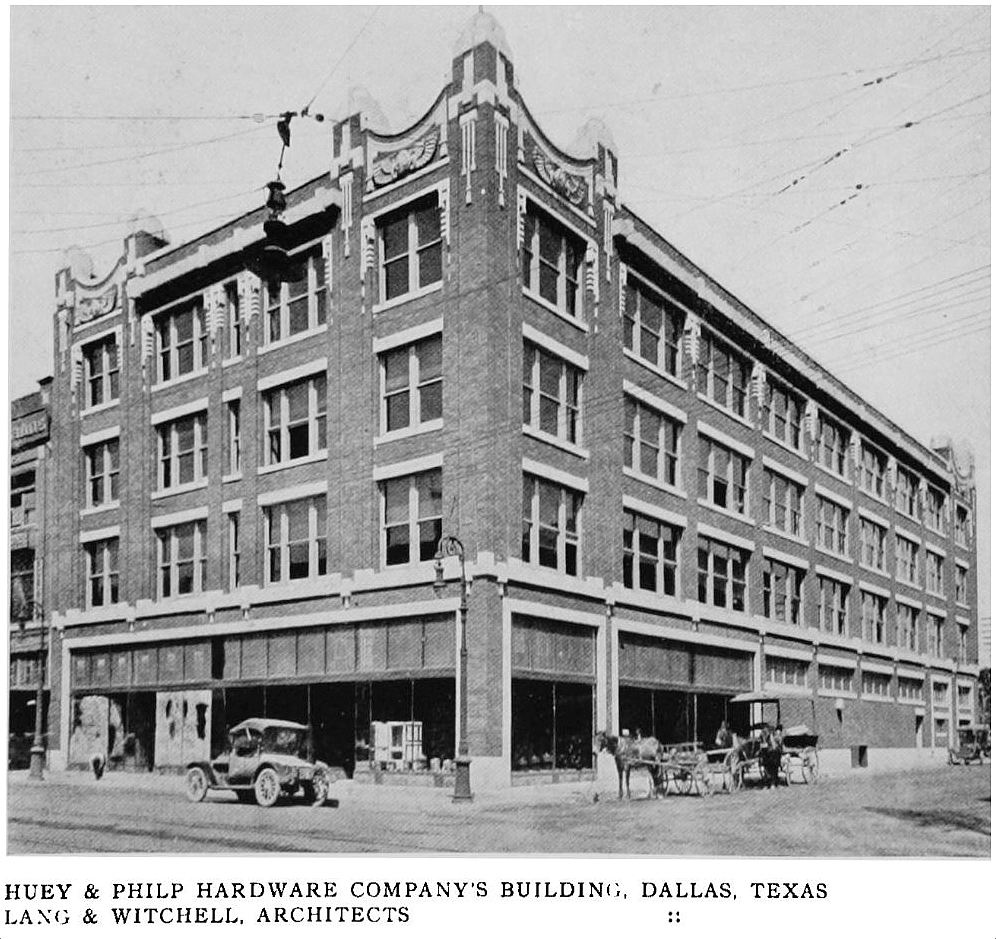
huey-and-philp_western-architect_july-1914

huey-philp_unvisited-dallasvia Unvisited Dallas

*

9.  SANGER BROTHERS BUILDING, Main & Lamar, designed by Lang & Witchell. One of the earliest Dallas business institutions (the Sanger brothers arrived in Dallas in the 1870s, at about the same time as Simon Philp), Sanger’s slowly acquired a ton of downtown real estate (for warehouses, etc.), but this building — their retail department store — was their centerpiece, and it grew and grew over the years. The expansion(s) of 1909 and 1910 included the addition of two floors to their already 6-story building, the building of a new 8-story addition which went up at the corner of Main and Lamar, and then when that was completed in 1909, another addition matching the rest of the store was built on the Elm Street side, resulting in a store taking up half a block of prime real estate (they would eventually own the entire block). More than a century later — now as part of El Centro College — the building still looks good. (See it on a 1905 Sanborn map, here, and a 1921 map, here.)
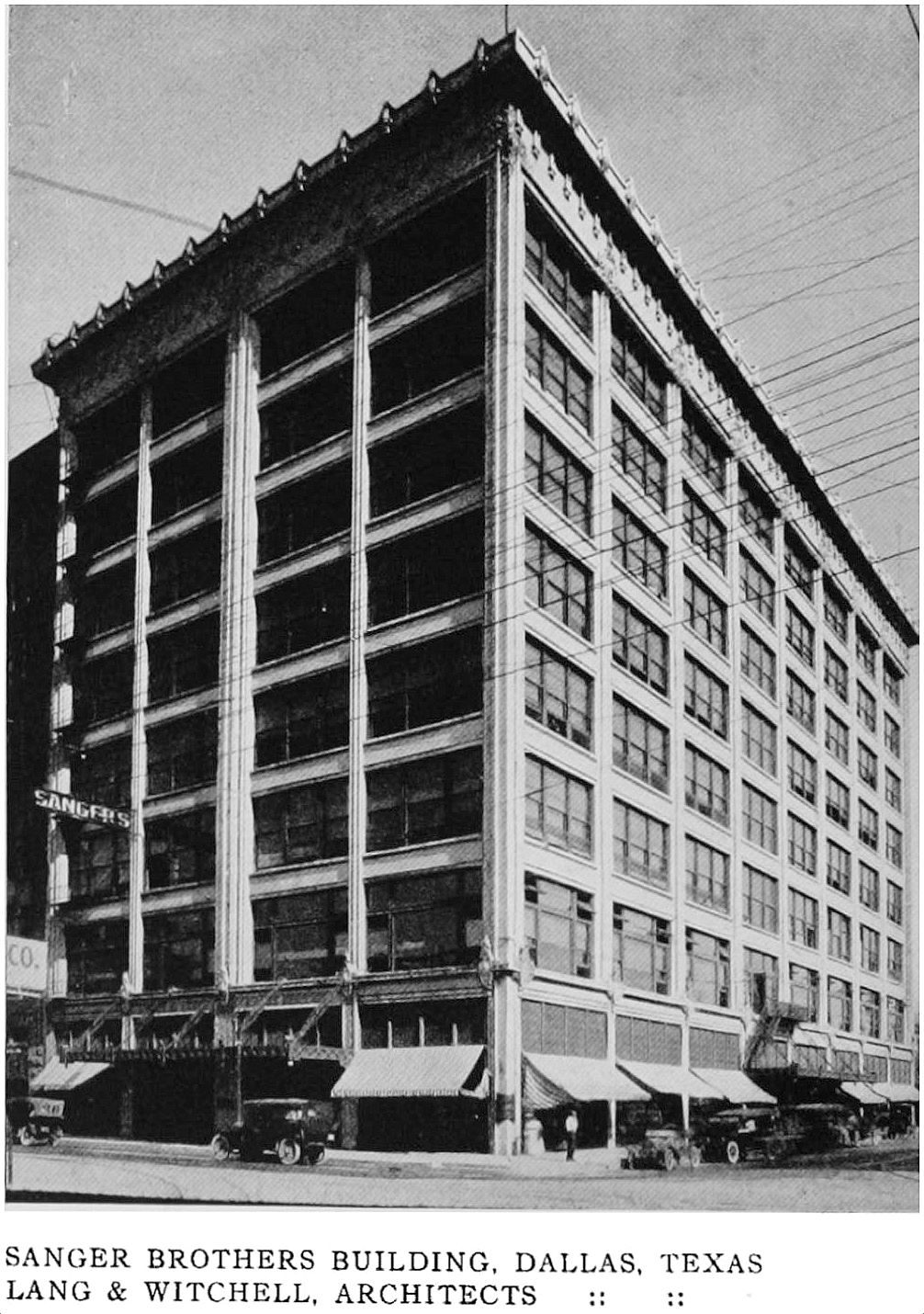
sanger-bros-bldg_western-architect_july-1914

Here’s what it looked like before this flurry of construction began:
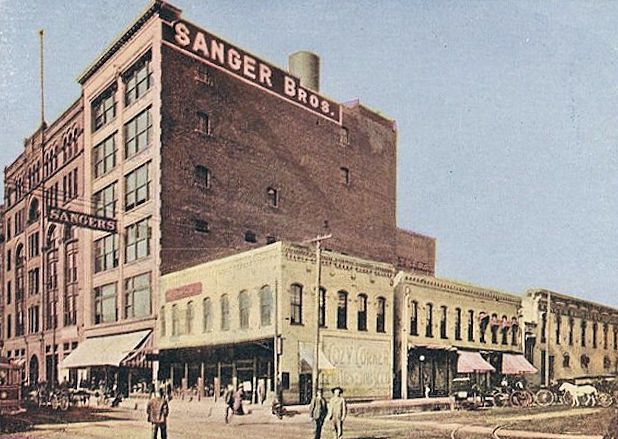

sangers-bros-postcard

*

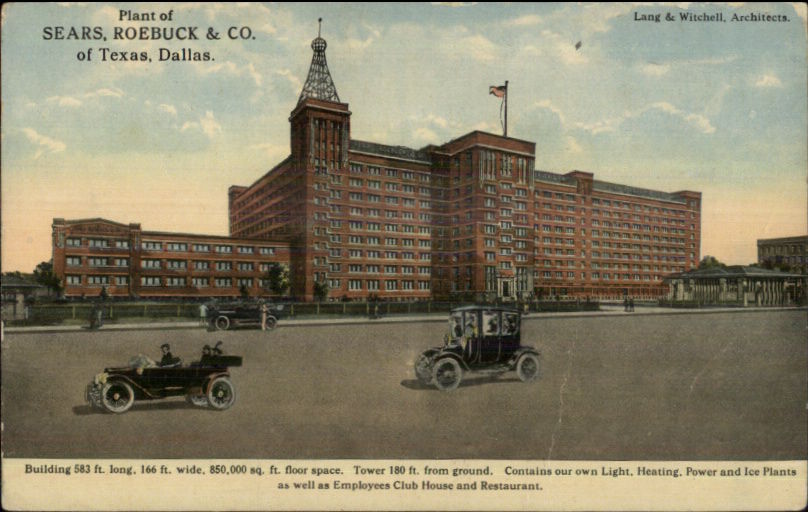
10.  SEARS, ROEBUCK & COMPANY OF TEXAS WAREHOUSE AND CLUB HOUSE, S. Lamar & Belleview, designed by Lang & Witchell. When Sears, Roebuck & Co. decided to open their first branch outside of Chicago, their choice was Dallas. A huge warehouse was built along South Lamar in 1910. Then, in 1912 a second huge warehouse was built. And, in 1913 a third one. This growth was pretty spectacular. All three of these buildings were designed by Lang & Witchell (building 3 is the one seen below). The massive Sears complex is now known as South Side on Lamar, and it’s beautiful. (More on this clubhouse is here.) (See the Sears buildings in a 1921 Sanborn map, here.)
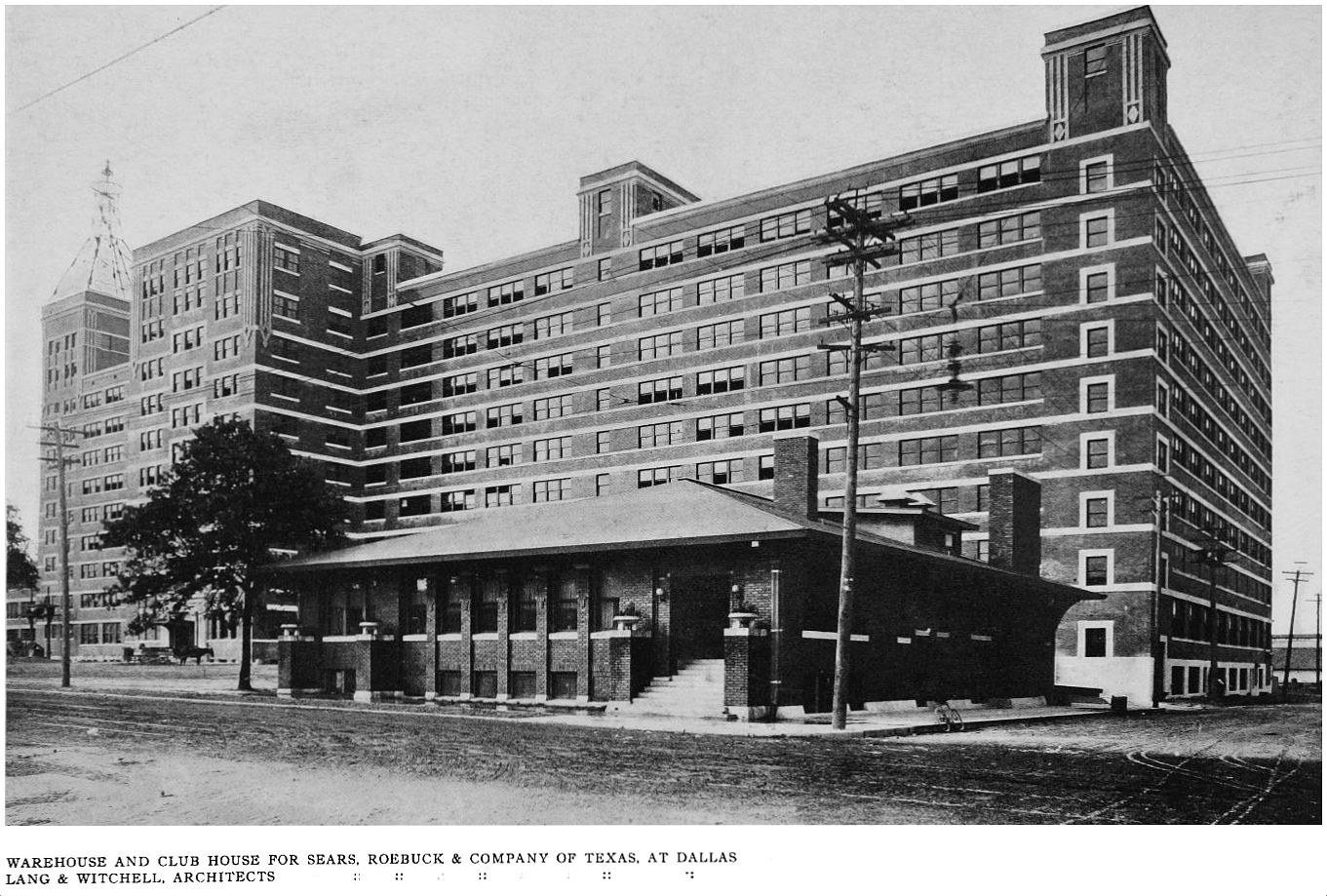
sears-warehouse_western-architect_july-1914

sears-roebuck_postcard_ebay

**

Next: the Adolphus Hotel.

***

Sources & Notes

The Western Architect, A National Journal of Architecture and Allied Arts, Published Monthly, July, 1914. This issue, with text and critical analysis in addition to the large number of photographs, has been scanned in it entirety by the University of Illinois at Urbana-Champaign as part of its Brittle Books Program — it can be accessed in a PDF, here (the Dallas issue begins on page 195 of the PDF). Thank you, UIUC!

In this 7-part series:

*

Copyright © 2018 Paula Bosse. All Rights Reserved.
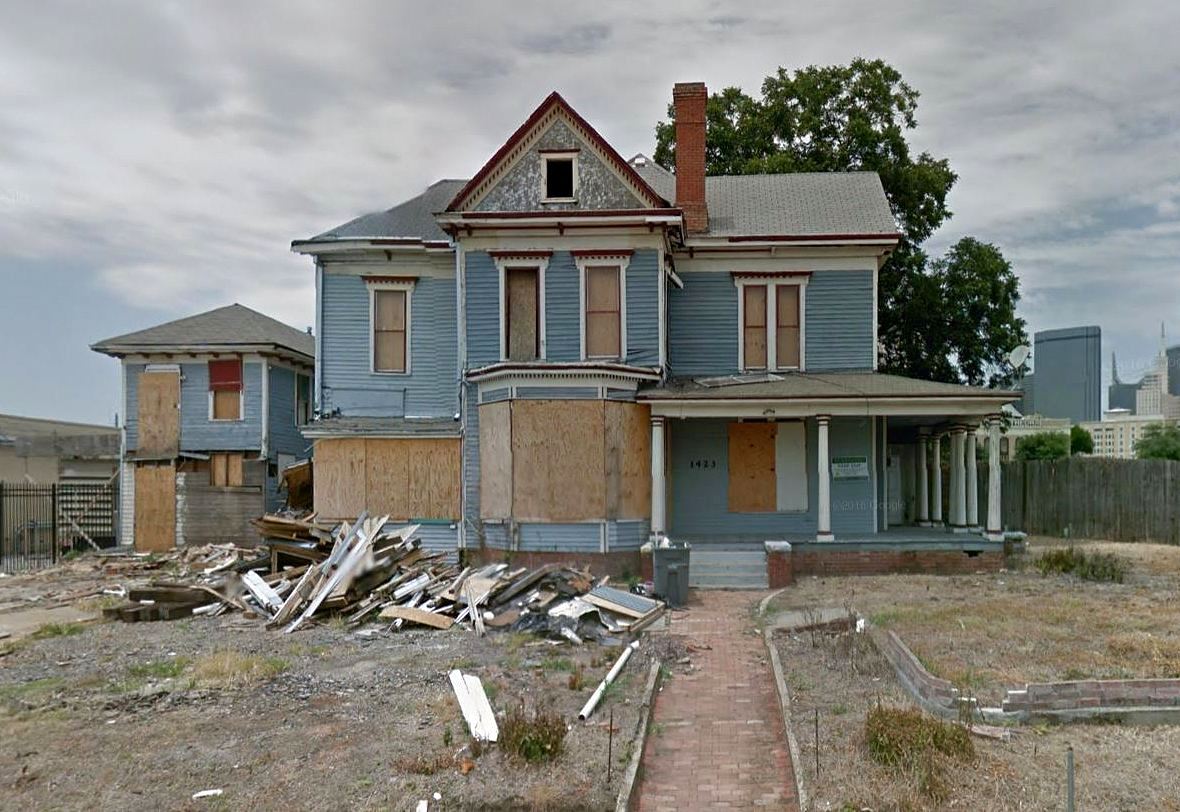
 

The “Blue House” Lives

blue-house_google_july-2016July, 2016 / Google Street View

by Paula Bosse

In January, 2016, news of an endangered 19th-century house in The Cedars, the area just south of downtown, was in the news: it was to be torn down in order to put in a parking lot. I followed Robert Wilonsky’s stories on it in The Dallas Morning News and read about it in online history and preservation groups, but there didn’t seem to be a lot mentioned about the history of the house. Who built it? And when? I decided to see if I could find the answers. I’d written about the history of houses and buildings and figured it wouldn’t take that long to find the answers, but it actually took a lot longer than I’d thought. But the detective work was fun, and I was surprised by how much research one can do without ever needing to walk away from one’s computer. So much now is within our digital reach: historical city directories, maps, newspaper archives, and genealogical information.

After a marathon session of using everything mentioned above, plus referring to a couple of Dallas-history-related books, I eventually traced real estate transfers back to the man who appears to have built the house: Max Rosenfield, around 1885. I excitedly messaged Robert Wilonsky at 4:58 a.m., knowing that he would be interested to learn this new info (especially as the man who built the house was the father of one of the most noteworthy arts critics in The Dallas News’ long history), and he passed the news on to his readers. (My step-by-step process of researching the house which once stood in a posh residential area of the city is in the post “The Blue House on Browder,” here.)

The house’s fate has been in limbo for a couple of years, but now the 133-year-old “Blue House” will be moved in pieces to its new home half a mile away (at Browder and Beaumont) where it will be reassembled and restored.

The move begins TOMORROW — April 3, 2018. The public is invited to a ceremony in which comments will be made and then the house will begin the move to its new home. For Preservation Dallas’ details on when and where, information on the event can be found here.

Enjoy your new home, Blue House!

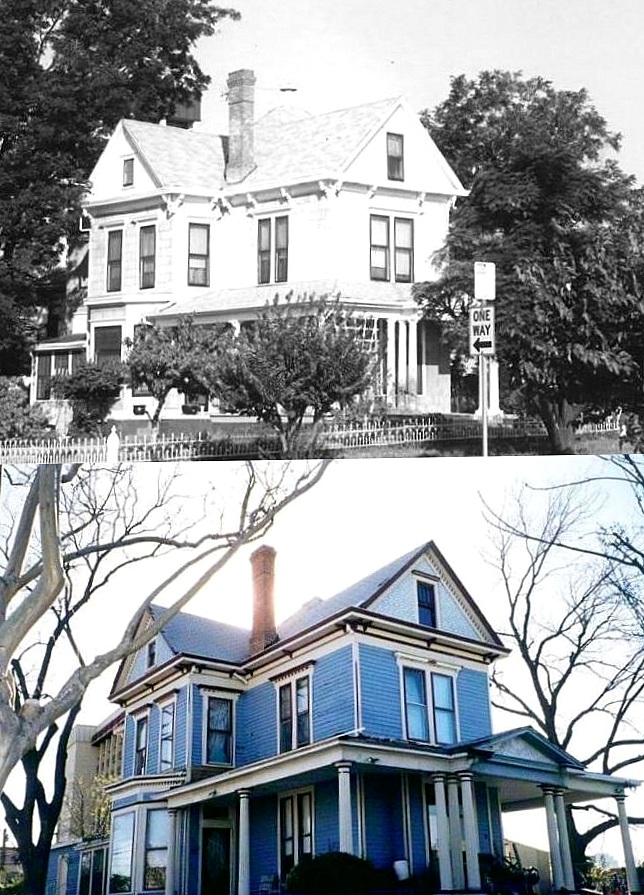
blue-house_then-and-now

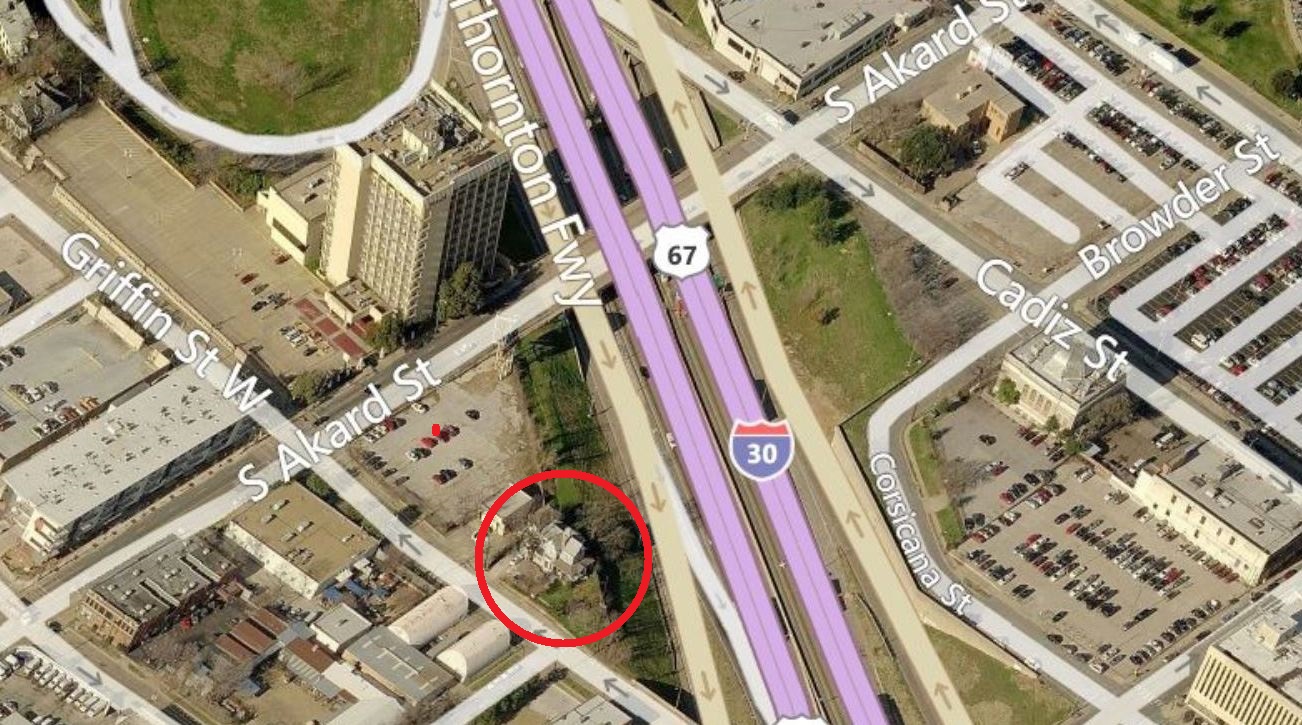
browder-house_bing

**

UPDATED: More on how the actual move went and an interview with the new owner of the house can be found at Candy’s Dirt, here.

Below is footage of the first part of the move — the disassembly — captured by D Magazine:

***

Sources & Notes

Top photo from Google Street View, July, 2016. (This view from Griffin is actually the side of the house — the front originally faced Browder Street, which no longer continues at that block.) Aerial view from Bing Maps.

Black-and-white photo of the house is from Preservation Dallas; color photo below it is from Homeward Bound, Inc. (used with permission), taken in about 2000.

Read the saga of the fight to save the house and how it will be moved in Robert Wilonsky’s Dallas Morning News article “One of Dallas’ oldest homes, built in the Cedars in the 1880s, ready for its new life on a new lot” (DMN, March 29, 2018), here.

My original step-by-step post on tracking down the history of the house — “The Blue House on Browder” — is here.

Click pictures to see larger images.

*

Copyright © 2018 Paula Bosse. All Rights Reserved.
 

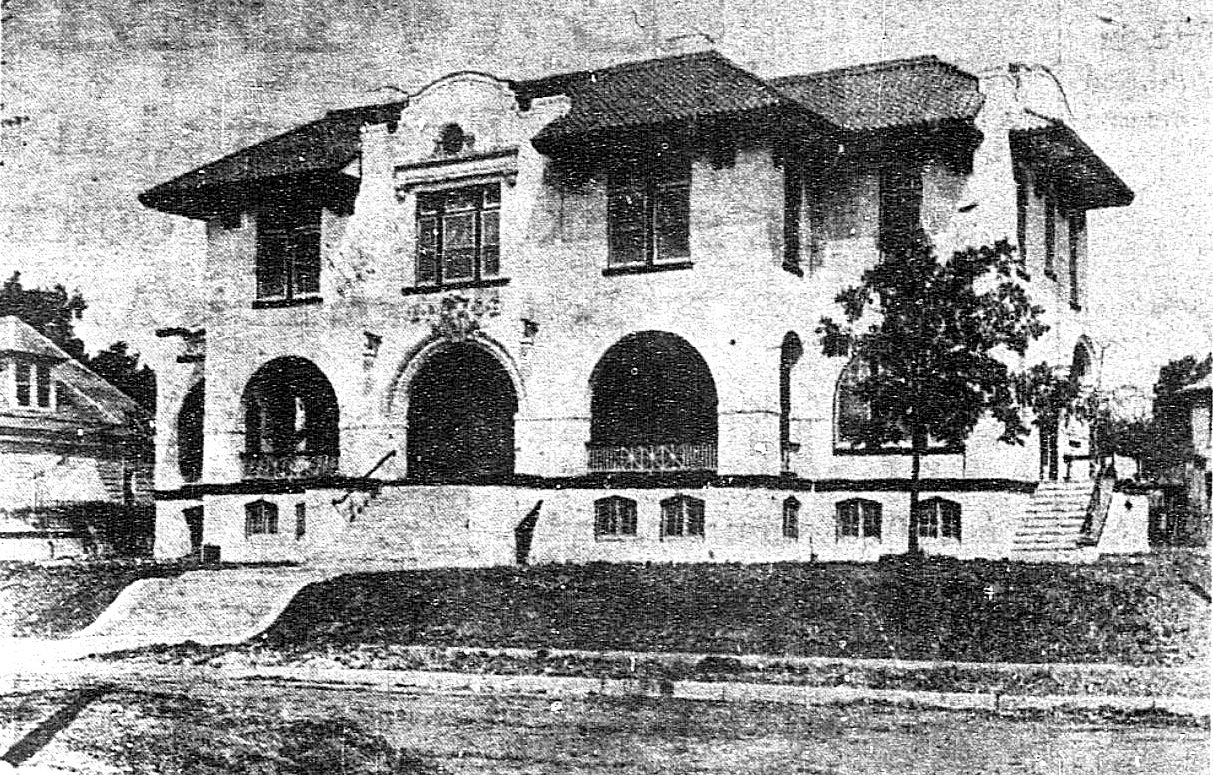
The Elks Lodge, Pocahontas & Park

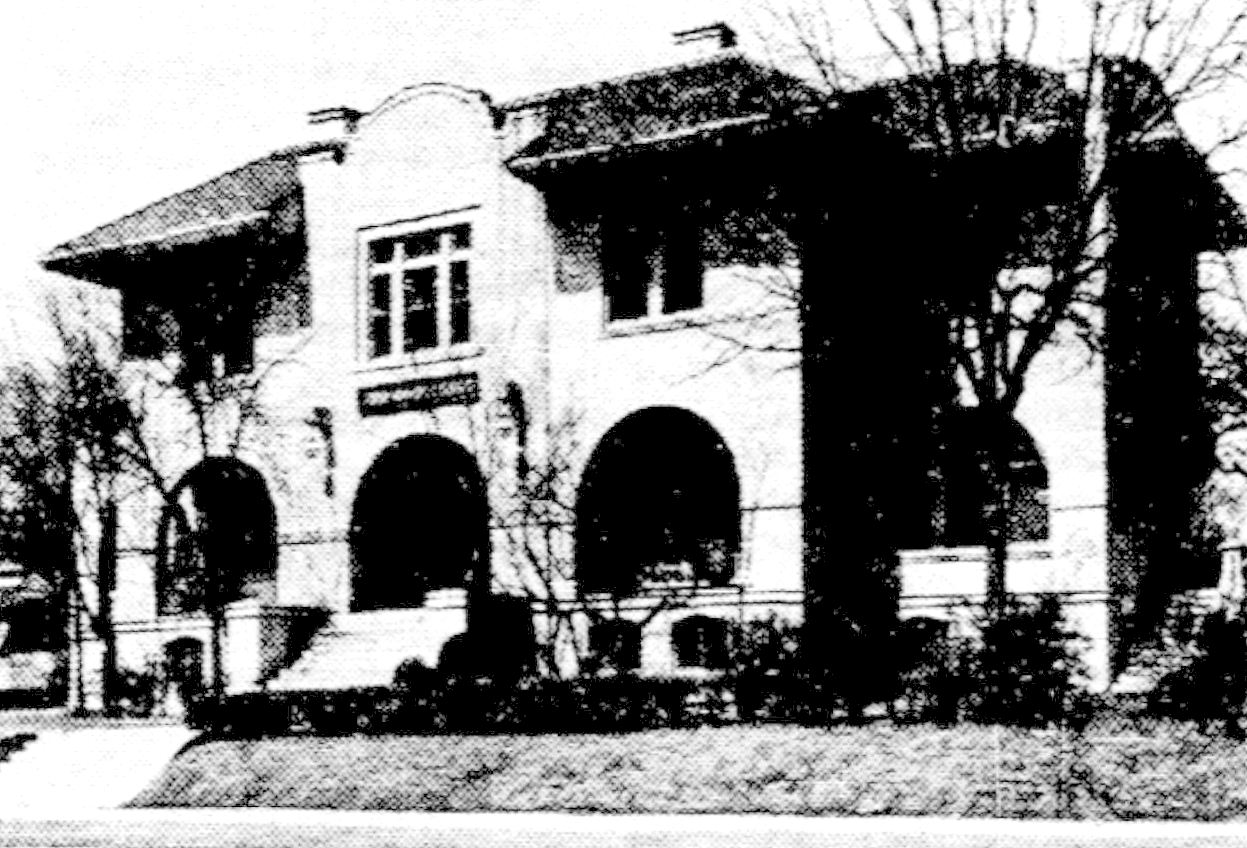
elks-lodge_postcard1817 Pocahontas Street, 1914 (click for larger image)

by Paula Bosse

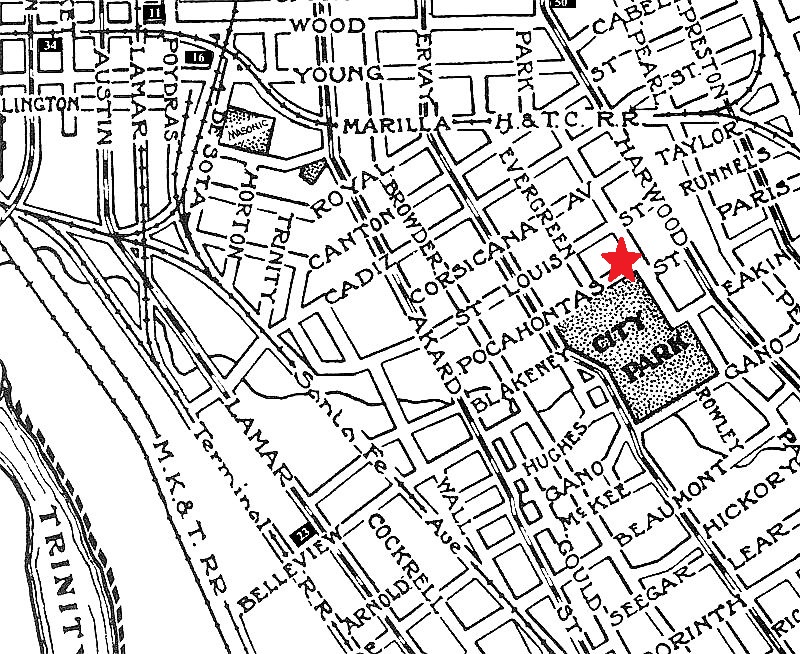
The postcard image above shows the lovely Dallas Elks Lodge No. 71 which once stood at 1817 Pocahontas, at the northwest corner of Pocahontas Street and Park Avenue in the Cedars area, just south of downtown — it had a spectacular view of City Park, which it faced.  Designed by architect H. A. Overbeck (the man behind the still-standing Dallas County Jail and Criminal Courts Building and the long-gone St. Paul’s Sanitarium), the lodge was built in 1914; the land and the construction of the lodge cost $45,000. Surprisingly, this lodge served the Elks for only six years — they returned downtown, where they took over and renovated the old YWCA building on Commerce Street.

The building on Pocahontas became another clubhouse when it was purchased in 1920 by a group of Jewish businessmen who opened the exclusive Progress Club/Parkview Club (read about the building’s acquisition in a May 14, 1920 article in The Jewish Monitor, here); in 1922 the 65 members of the Parkview Club presented the clubhouse to the Young Men’s Hebrew Association (YMHA). In 1927, use of the building had expanded, and it became the Dallas Jewish Community Center and the headquarters of the Jewish Welfare Federation — in fact, this was the home for these organizations for more than thirty years, until 1958 when the move was made to the new Julius Schepps Community Center in North Dallas. The building ultimately fell victim to the construction of R. L. Thornton Freeway and was demolished in the early 1960s.

But back to the Elks. The Benevolent and Protective Order of Elks was a social club/fraternal order founded in New York in 1868. Dallas Lodge No. 71 was chartered on January 28, 1888 — it was the first Elks Lodge in Texas and one of the oldest clubs in Dallas. And, after 130 years, it’s still around, now located in Lake Highlands. There aren’t a lot of things that have lasted that long in this city!

*

Below, the Overbeck rendering of the Elks’ new home (click for larger image)

elks_dmn_120213_new-lodgeDallas Morning News, Dec. 2, 1913

*

A week before its official dedication on Sept. 7, 1914:

elks-lodge_dmn_083014DMN, Aug. 30, 1914

*

Colorized and made into an attractive postcard:

elks-club_new_postcard

*

In the 1930s, when it was the Jewish Community Center:

jewish-community-center_1817-pocahontas_1930s

*

Where it was:

elks-lodge_ca-1912-map_portal1912-ish map detail

Also, see it on the 1921 Sanborn map (as “B.P.O.E. Home”) here.

**

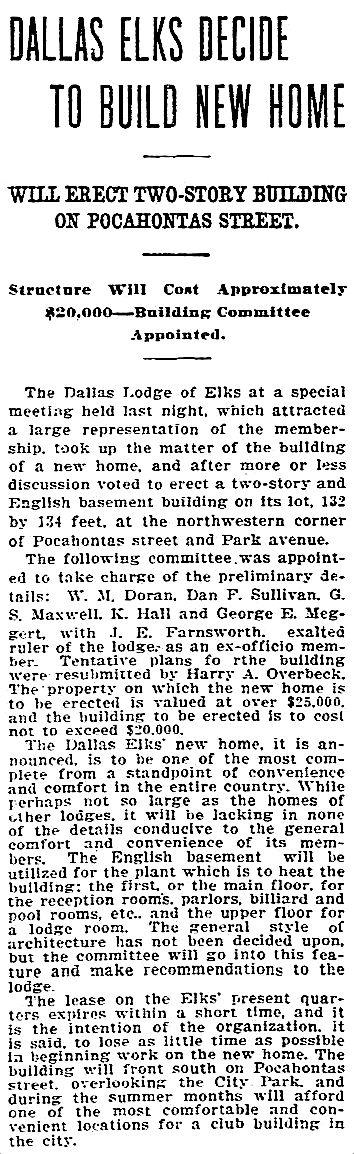
The announcement of plans for the construction of the Pocahontas Street lodge:

elks_dmn_112313_new-lodgeDMN, Nov. 23, 1913

And its dedication, on Sept. 7, 1914:

elks_dmn_090814_new-homeDMN, Sept. 8, 1914

***

Sources & Notes

Source of postcards unknown. Other images and clippings as noted.

The 1888 report of the first meeting of the Dallas Elks Lodge No. 71 can be read in the Dallas Morning News article “Order of Elks in Dallas; A Lodge Instituted Here Yesterday” (DMN, Jan. 29, 1888), here.

A history of the various Elks’ locations in Dallas between the 1880s and the 1920s can be found in the article “Elks Plan To Have Modern Club Home” (DMN, July 30, 1922), here.

elks_dmn_012903DMN, Jan. 29, 1903

*

Copyright © 2018 Paula Bosse. All Rights Reserved.
Beautiful South Ervay Street — ca. 1910

ervay_coltera_flickrStreet life in South Dallas

by Paula Bosse

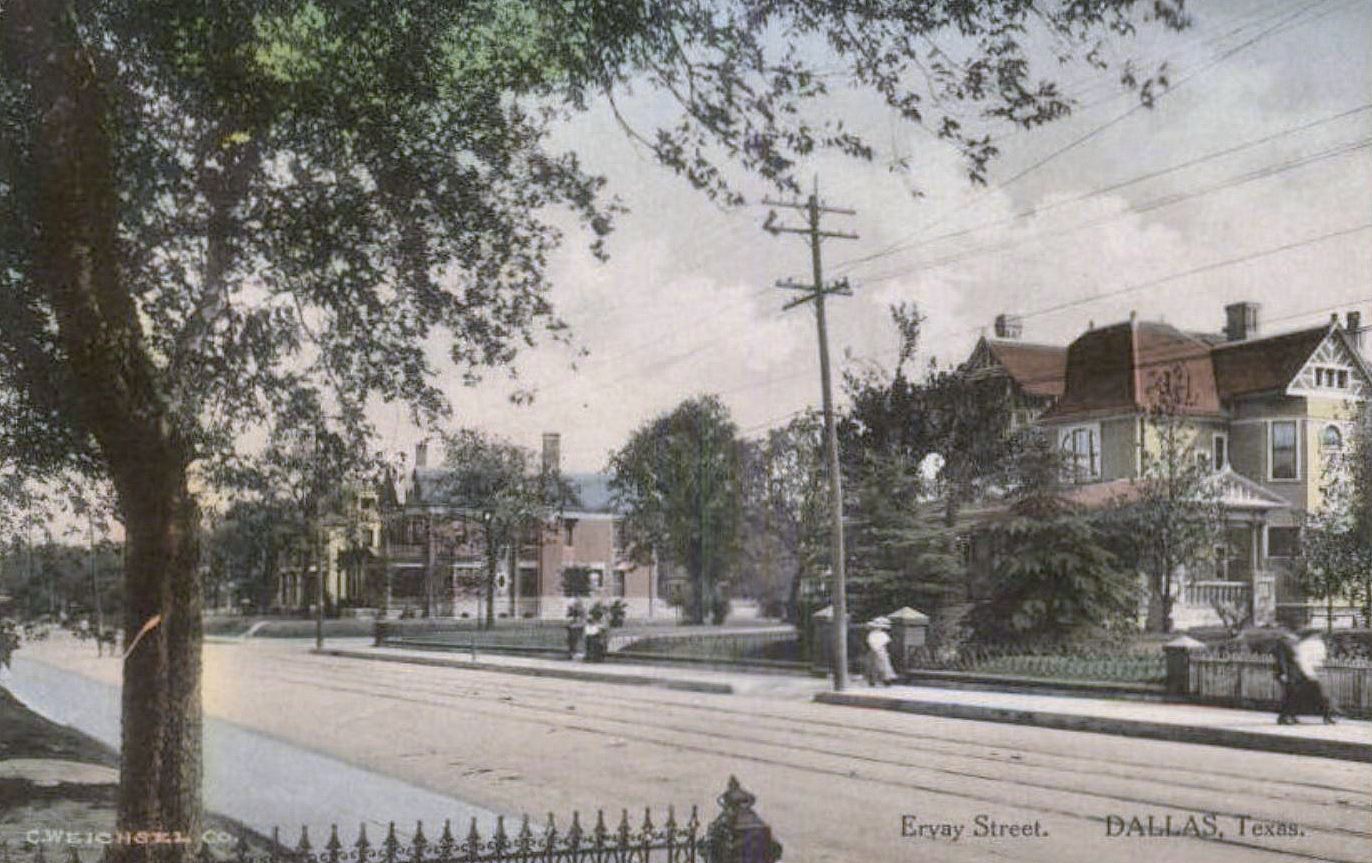
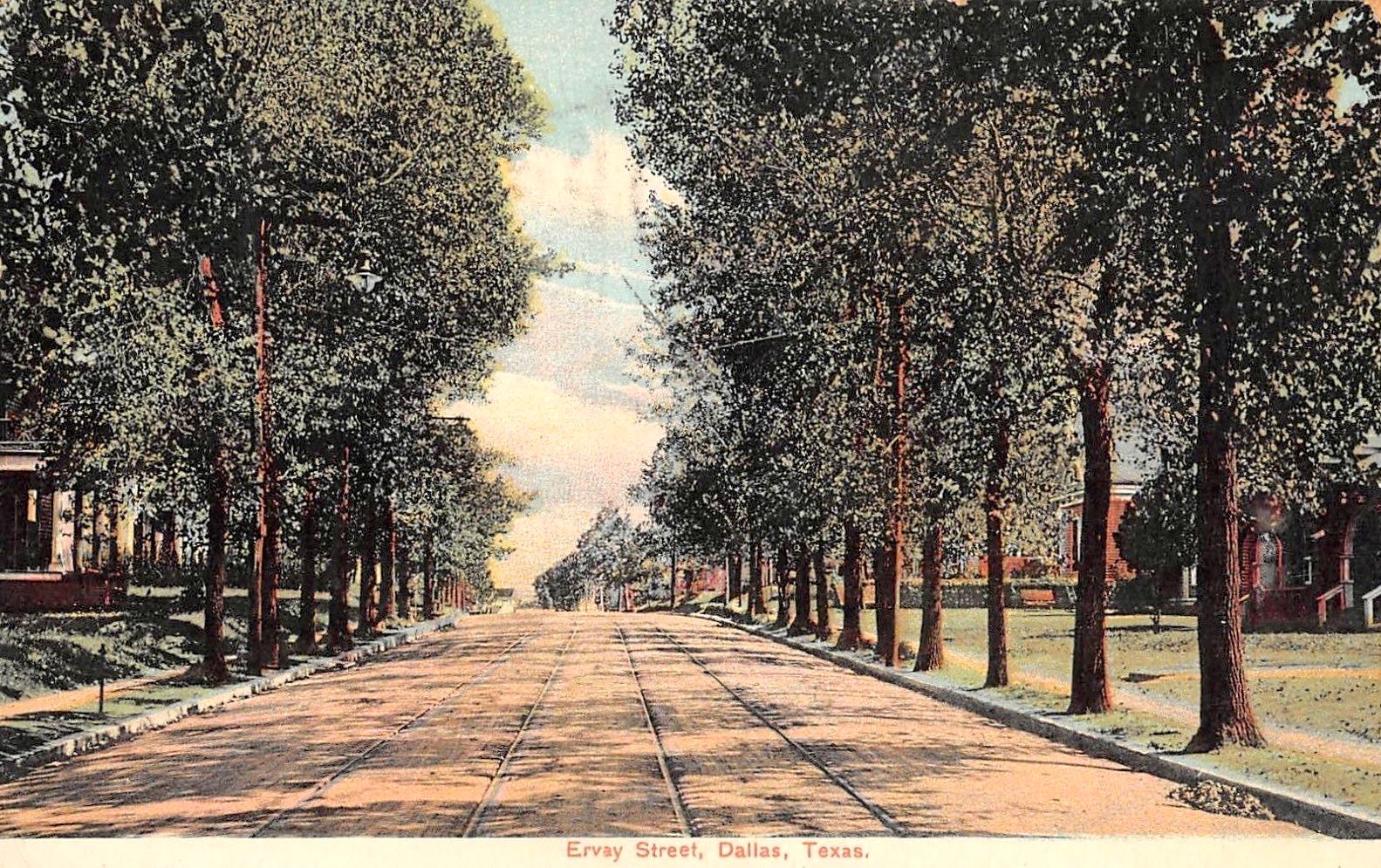
Today, a few hand-colored postcards from around 1910 showing the lovely houses that used to line Ervay Street in South Dallas. Hard as it is to believe today, the stretch of South Ervay from just outside the central business district down to its end at Forest Avenue (now Martin Luther King, Jr. Blvd.), was once a very nice area where many of the city’s most fashionable and well-to-do Jewish families (and, later, African American families) lived. The intervening century has not been kind to South Dallas. I’m not sure of the location in the postcard above, but it certainly looks like a very pleasant neighborhood — one that no longer exists in this mostly blighted area.

*

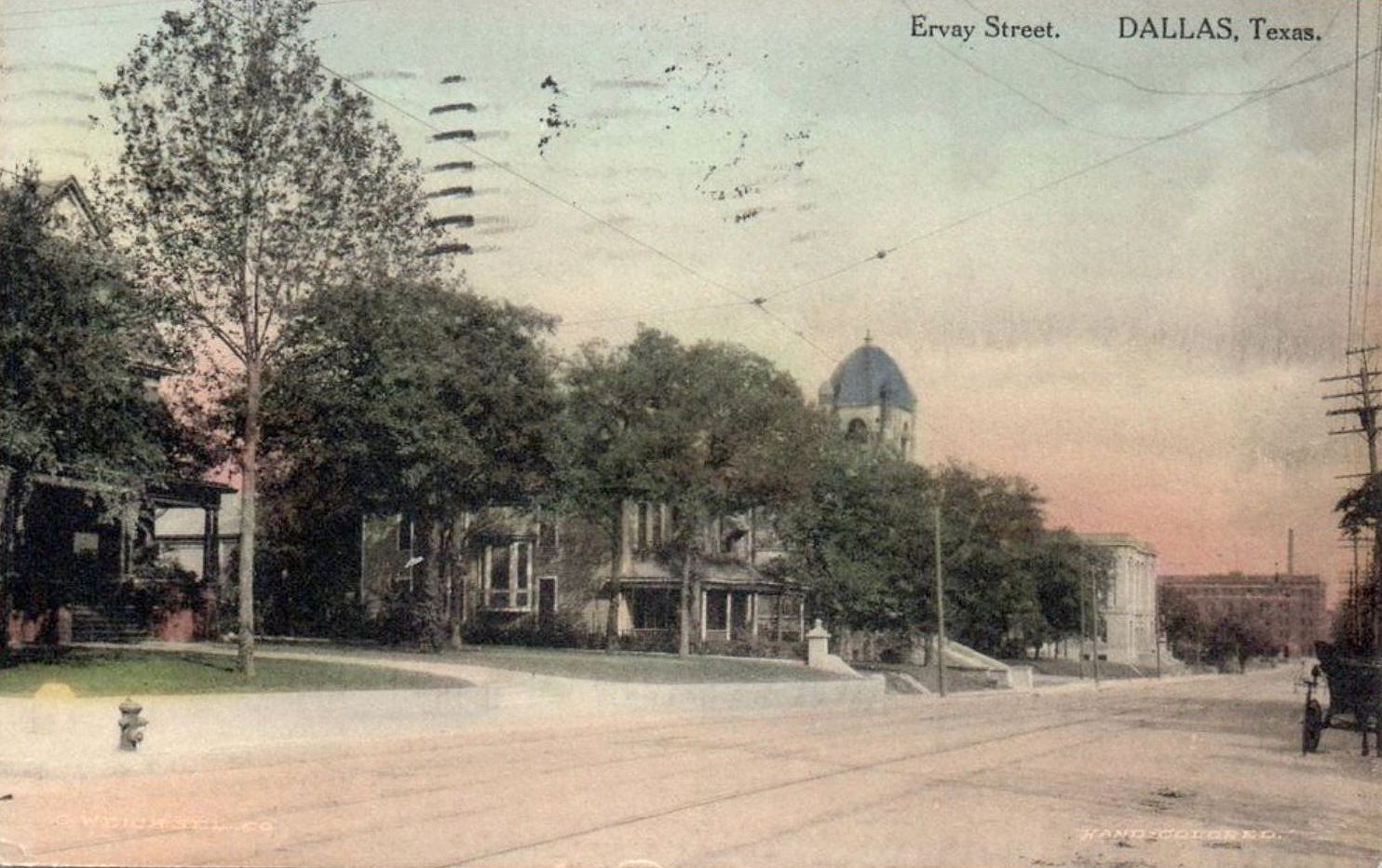
Below, S. Ervay looking south. The rounded top of Temple Emanu-El can be seen at the left. The light-colored building in the next block was the Columbian Club. The hotel most recently known as the Ambassador (which burned down three years after I originally wrote this post) is set back on a curve of the street and is hidden by the Columbian Club. The red building is the Hughes candy plant (still standing). A Google Street View of this area today can be seen here.

ervay-street_ebay

*

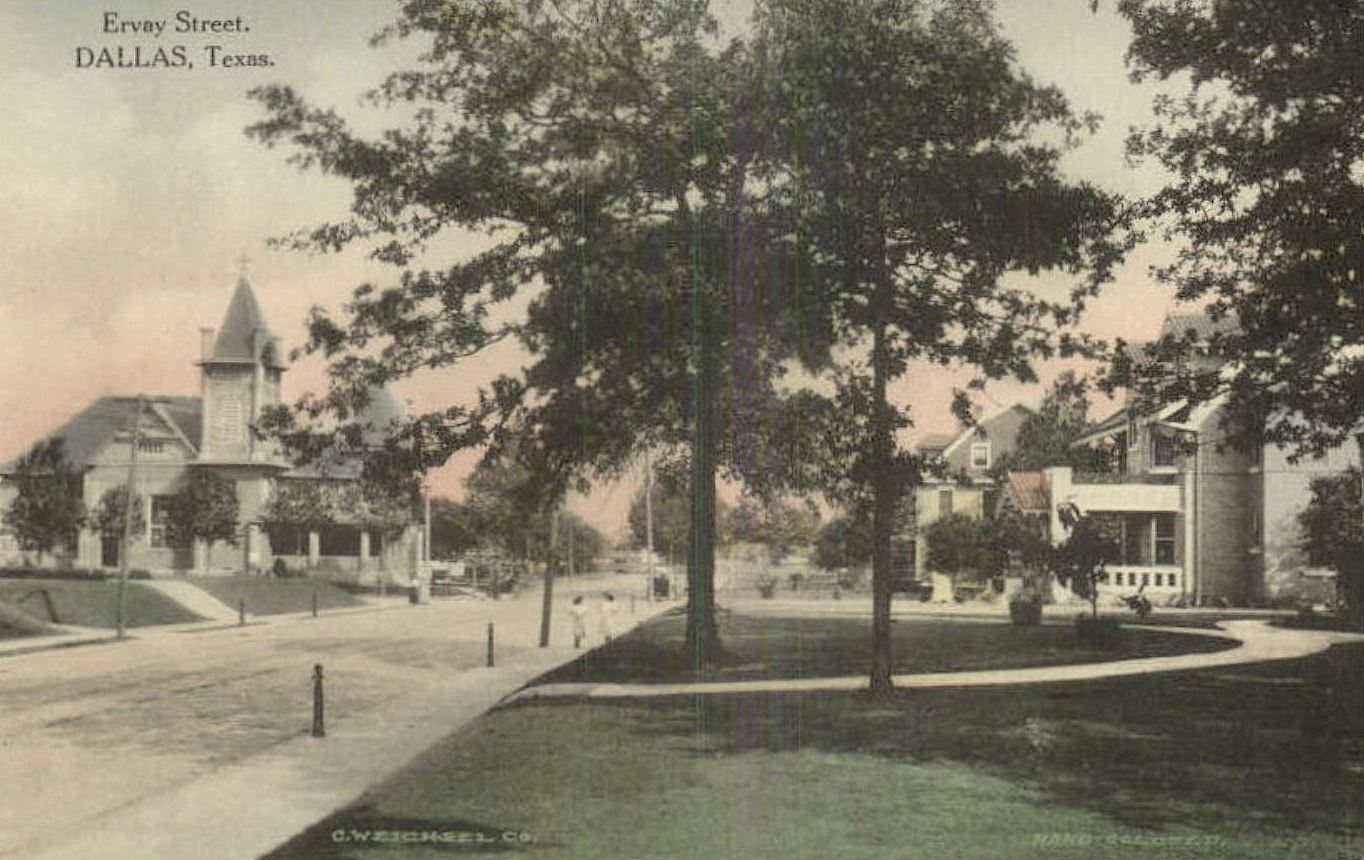
Below, we see a view still looking south, but now much farther down Ervay, almost to Forest Avenue (now MLK). The church on the left is the James Flanders-designed Ervay Street Methodist Episcopal Church (South), built in 1908 at the corner of corner of Ervay and South Boulevard — it’s interesting that a Methodist church was located in the center of Dallas’ largest Jewish residential neighborhood. (More on the church from a Dallas Morning News article from July 1, 1908, here. See this area on a 1922 Sanborn map here.)

ervay-residence_coltera

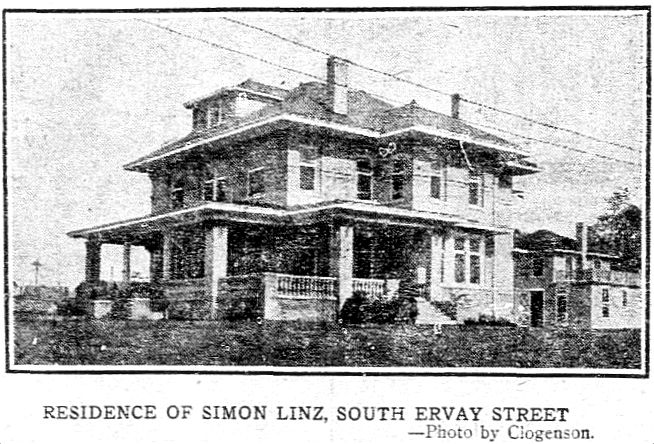
Not seen in the view above is one house worth mentioning. The house — just out of frame at the left, with the steps leading up to it, was the home of Simon Linz, of Linz Jewelers fame. Here is what the Linz house looked like in 1908:

linz-house_dmn_010108Dallas Morning News, Jan. 1, 1908

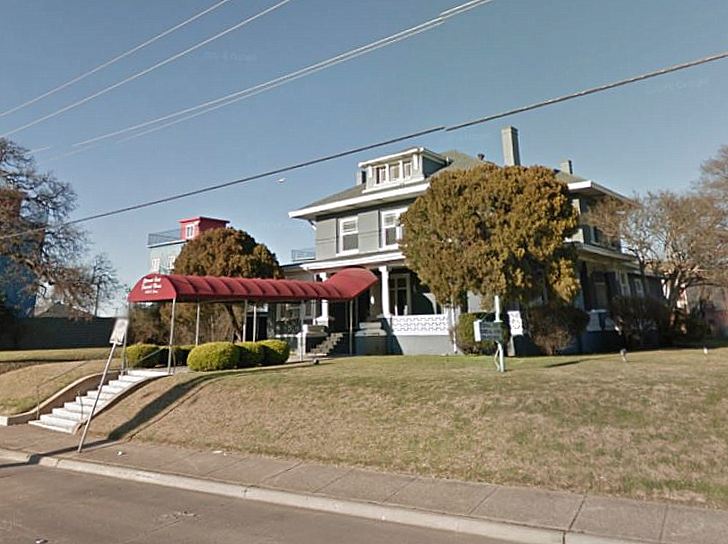
Remarkably, this house is still standing. It is currently a funeral home at 2830 S. Ervay. The present-day image below, showing the pretty house and the neatly landscaped yard, is a little deceptive; see what the Google Street View looks like just south — where the Flanders church once stood — here. (If you’re up to it, reverse the Google view and move back toward town.)

linz-house_2830-828-s-ervay_google
Google Street View

Hold on, little house!

This was once such a beautiful part of Dallas….

ervay_postcard_clogenson_postmark-1908

**

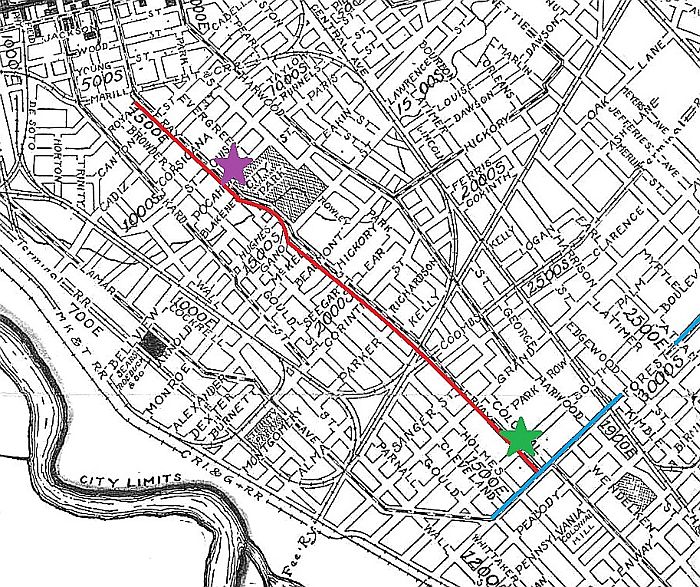
Below, a detail of a 1919 map showing S. Ervay down to Forest. The purple star shows the location of Temple Emanu-El and the Columbian Club. The green star shows the location of the Linz house and the Ervay St. Methodist Episcopal church. (Click for larger image.)

e-ervay_map_1918_portal
1919 map via Portal to Texas History

 ***

Sources & Notes

First and third postcards are from Flickr: here and here. Others found on eBay.

*

Copyright © 2016 Paula Bosse. All Rights Reserved.
Dallas Fire Stations — 1901

fire-dept_engine-co-3_gaston-and-college_1901Fire horse in Old East Dallas relaxing between calls (click for larger image)

by Paula Bosse

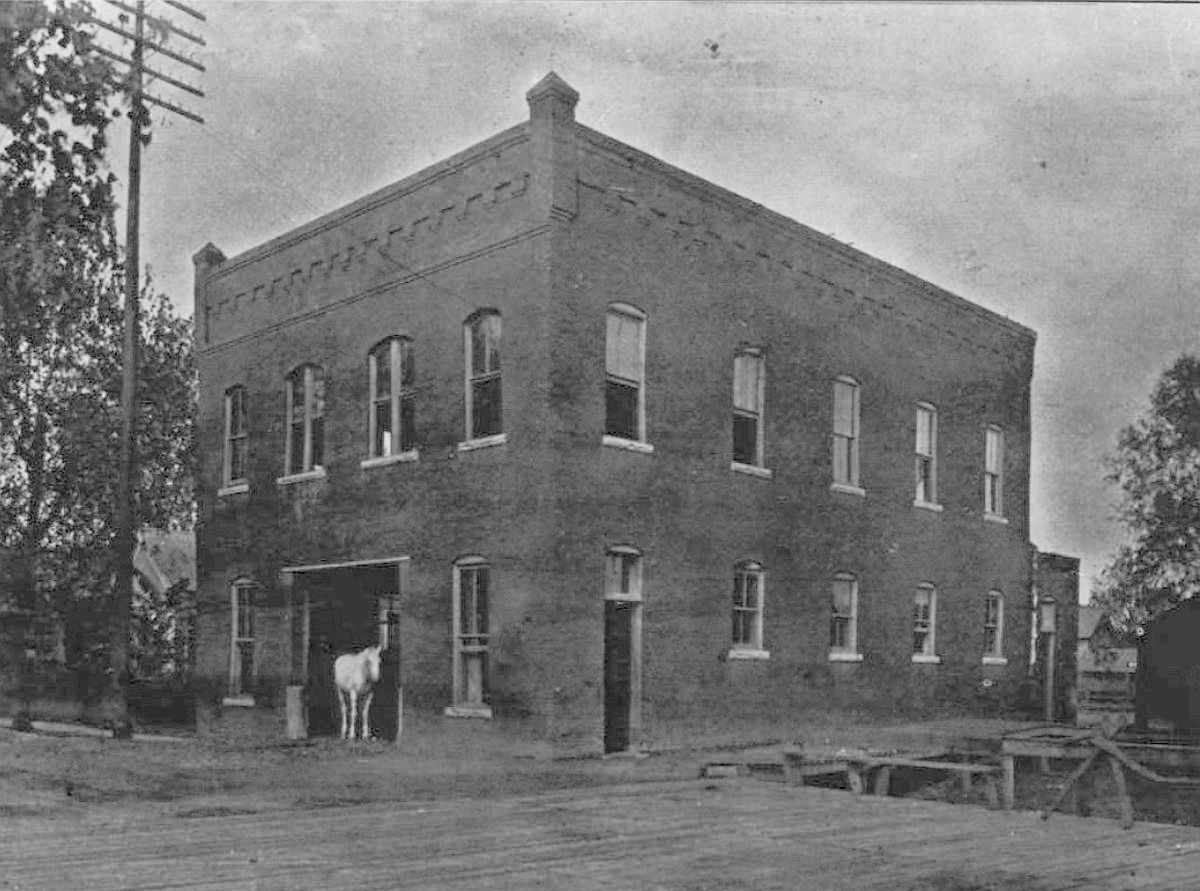
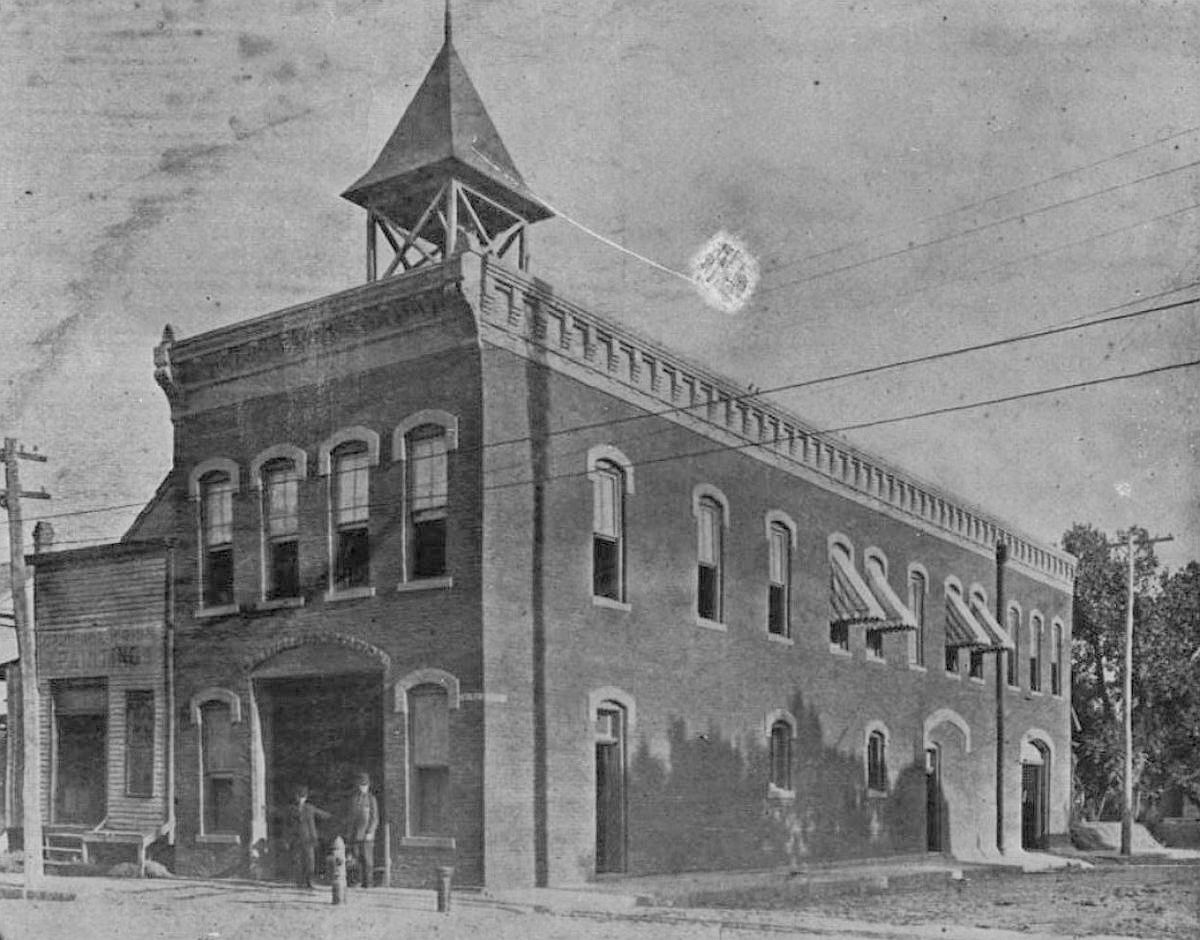
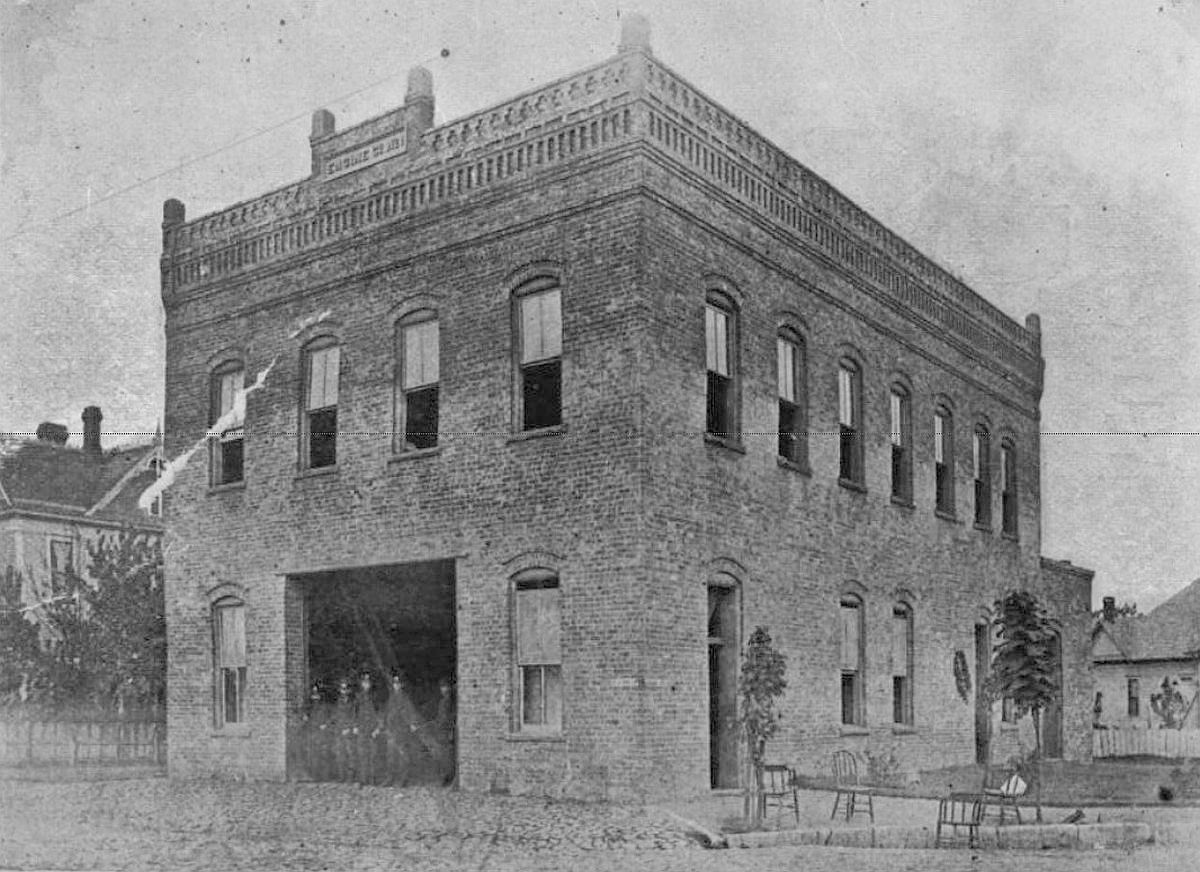
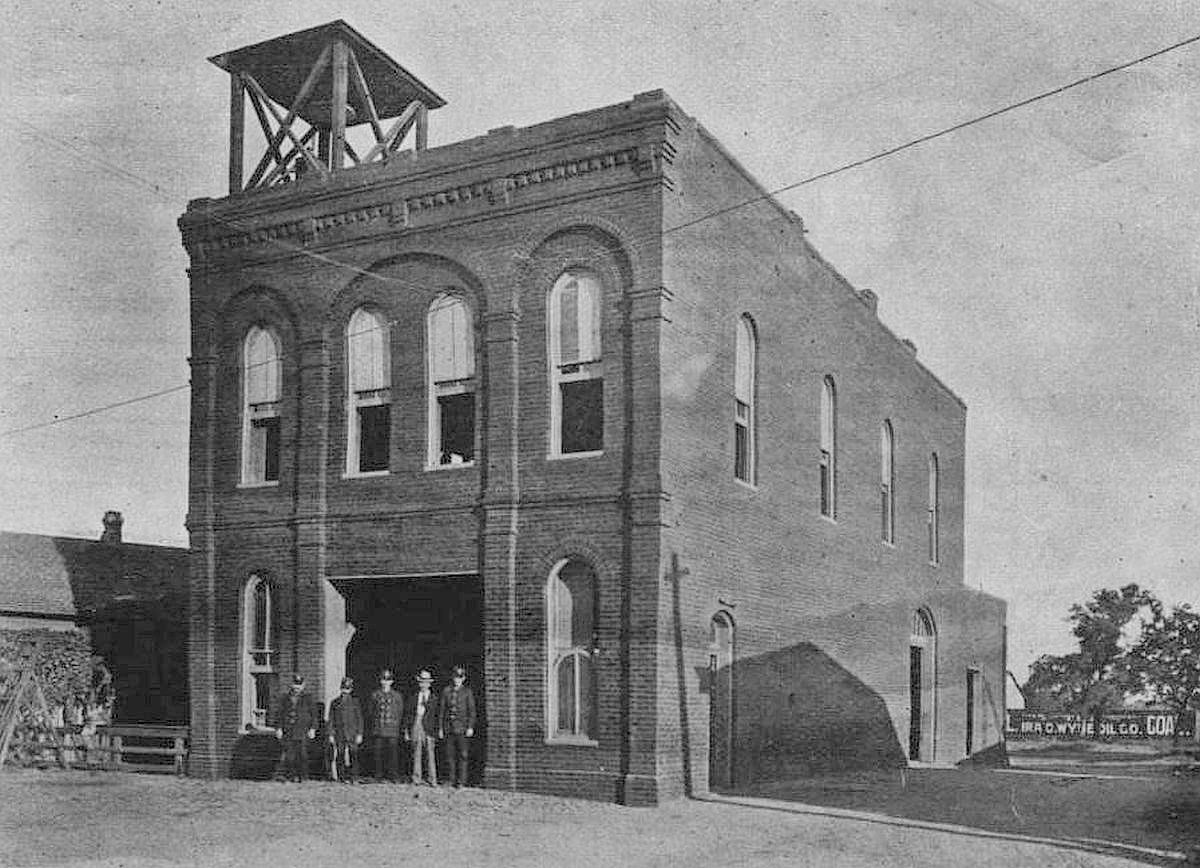
A few turn-of-the-century photos of Dallas’ fire stations, from a 1901 photographic annual. These seven firehouses were built between 1882 and 1894. One of these buildings is, miraculously, still standing on McKinney Avenue, in the heart of Uptown.

*

At the top, Engine Co. No. 3, at Gaston and College Avenues. In service: January, 1892. Equipment: an Ahrens Steamer, capacity 750 gallons per minute, and a Cooney Hose Carriage. See it on a 1905 Sanborn map here; see the present location (Gaston and Hall) here. (And since I just used it a few days ago, here’s a 1921 Sanborn map, showing Mill Creek running right through the property.)

*

fire-dept_central-station_main-harwood_1901

Above, Central Fire Station, Main and Harwood Streets. In service: October, 1887. Equipment: a double-sixty-gallon Champion Chemical Engine and a City Hook and Ladder Truck. See it on a 1905 Sanborn map here; see the present location here (the site of the old City Hall/Municipal Building).

*

fire-dept_mckinney-leonard_engine-co-1_1901

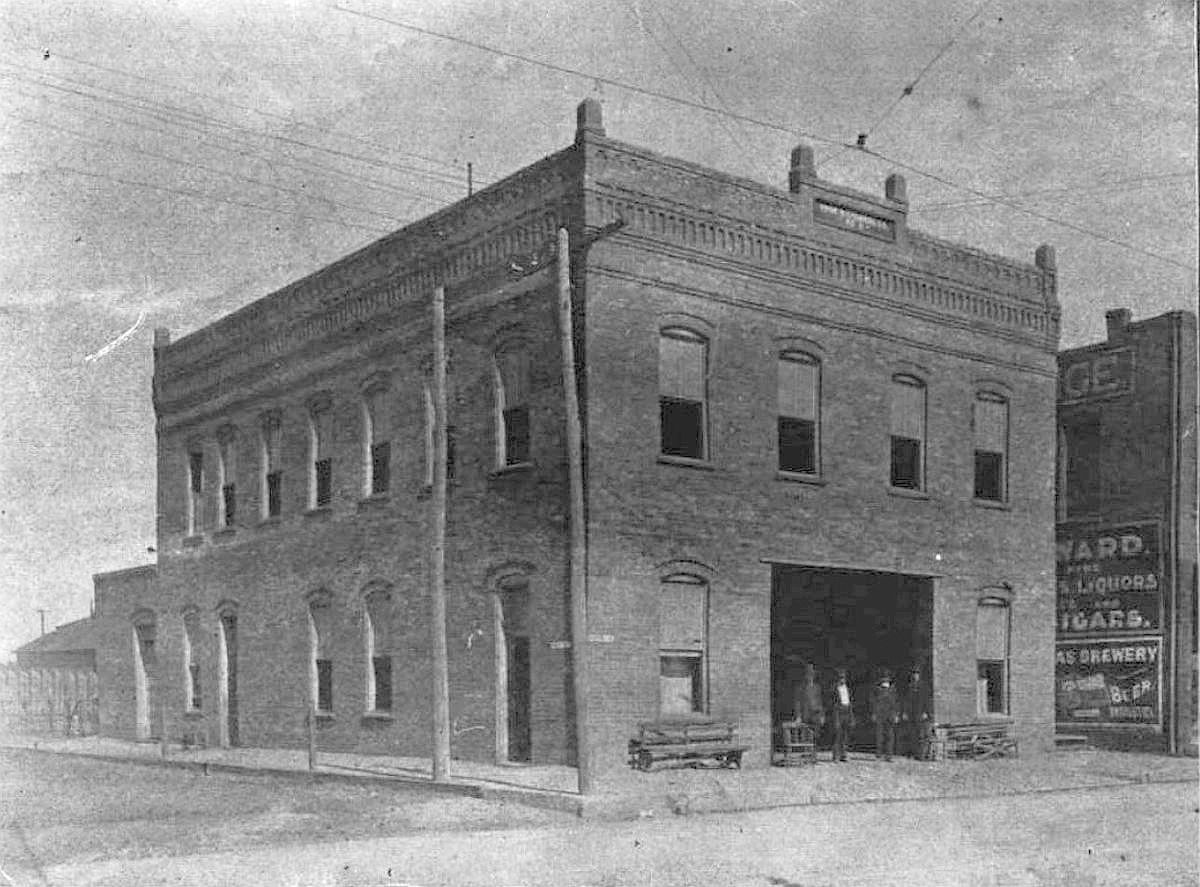
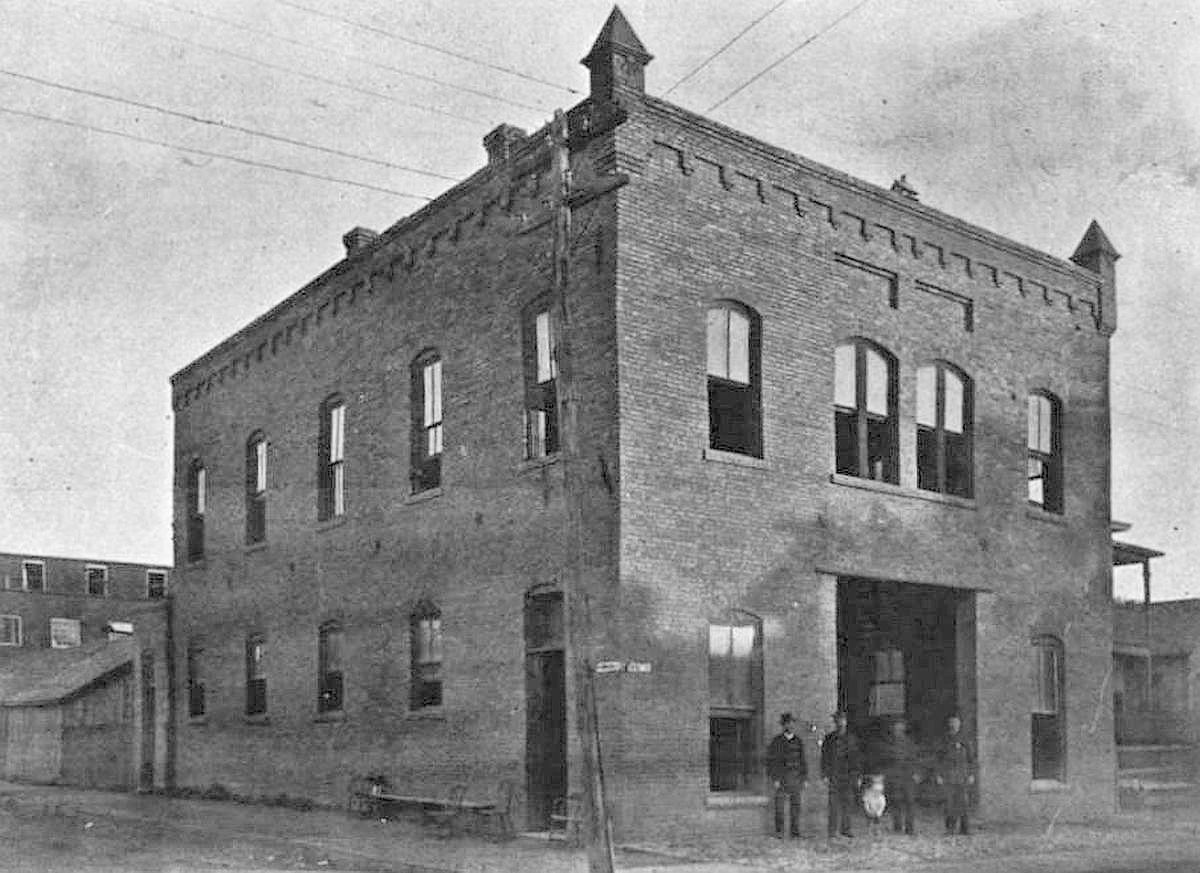
Engine Co. No. 1, McKinney Avenue and Leonard. Equipment: an Ahrens Steamer, 750 gallons per minute, and a Cooney Hose Carriage. In service: August, 1894. See it on a 1905 Sanborn map here; see the present location here. NOTE: This is the only one of these firehouses still standing. I wrote about it here.

UPDATE: Well, sort of. Thanks to a comment on Facebook, I researched this station a bit more and found that it was rebuilt and modernized at the end of 1909 — using materials from the original building seen above, built on the same plot of land. So instead of being 122 years old, the building on McKinney today is a mere 106 years old.

*

fire-dept_commerce-hawkins_engine-co-2_1901

Engine Co. No. 2, Commerce and Hawkins Streets. In service: January, 1882. Equipment: an Ahrens Steamer, capacity 750 gallons per minute, and a Cooney Hose Carriage. See it on a 1905 Sanborn map here; see a shot-in-the-dark guess at a present location here.

*

fire-dept_ervay-kelly_hose-co-2_1901

Hose Co. No. 2 and Chemical Co. No. 2, Ervay Street and Kelly Avenue. In service: September, 1894. Equipment: a Cooney Hose Carriage and double-sixty-gallon Champion Chemical Engine. See it on a 1905 Sanborn map here; see the present location here (right behind where the word “Cedars” is).

fire-dept_bryan-hawkins_hook-and-ladder-1_1901

Hose Co. No. 1 and Hook and Ladder Co. No. 1, Bryan and Hawkins Streets. In service: January, 1893. Equipment: Preston Aerial Truck with 75-foot extension ladder, and a Cooney Hose Carriage. See it on a 1905 Sanborn map here; see the approximate present location here.

*

fire-dept_commerce-akard_engine-co-4_1901

Engine Co. No. 4, Commerce and Akard Streets, next door to the City Hall. In service: August, 1894. Equipment: an Ahrens Steamer, capacity 1,100 gallons per minute, and a Cooney Hose Carriage. See it on a 1905 Sanborn map here; see the present location here (just out of frame at the right was the City Hall; the block is now the site of the Adolphus Hotel).

*

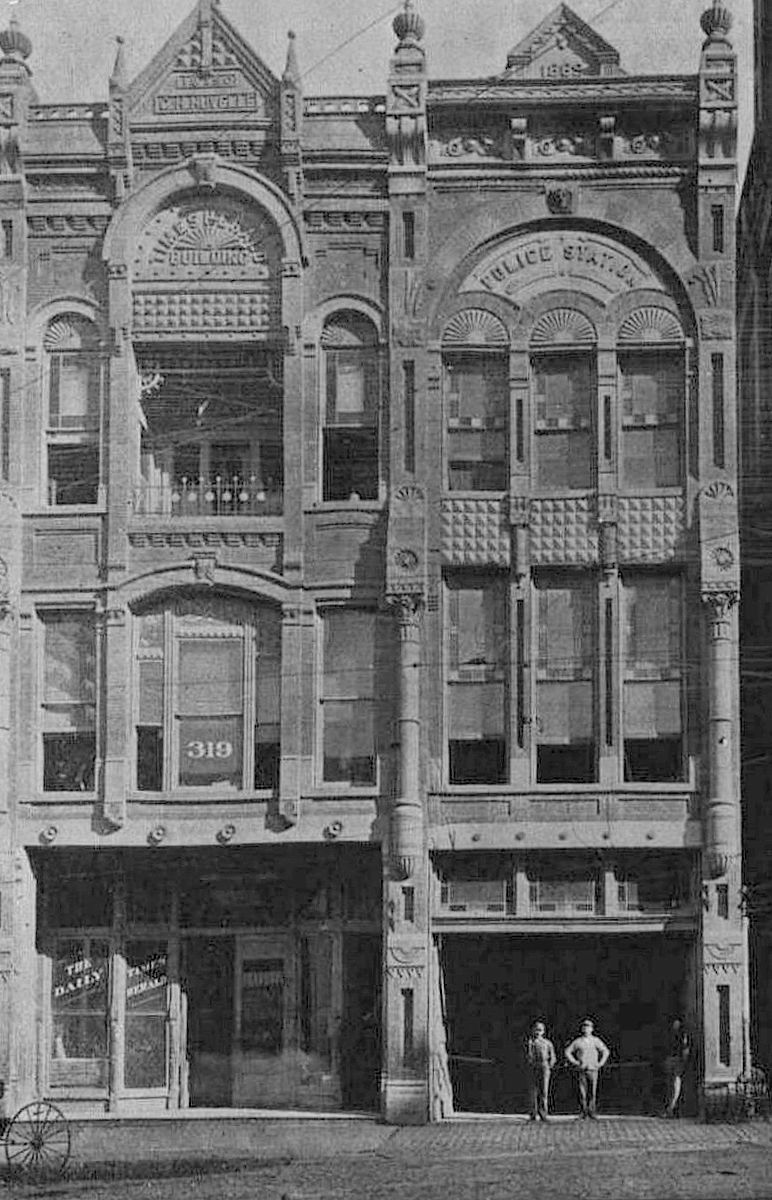
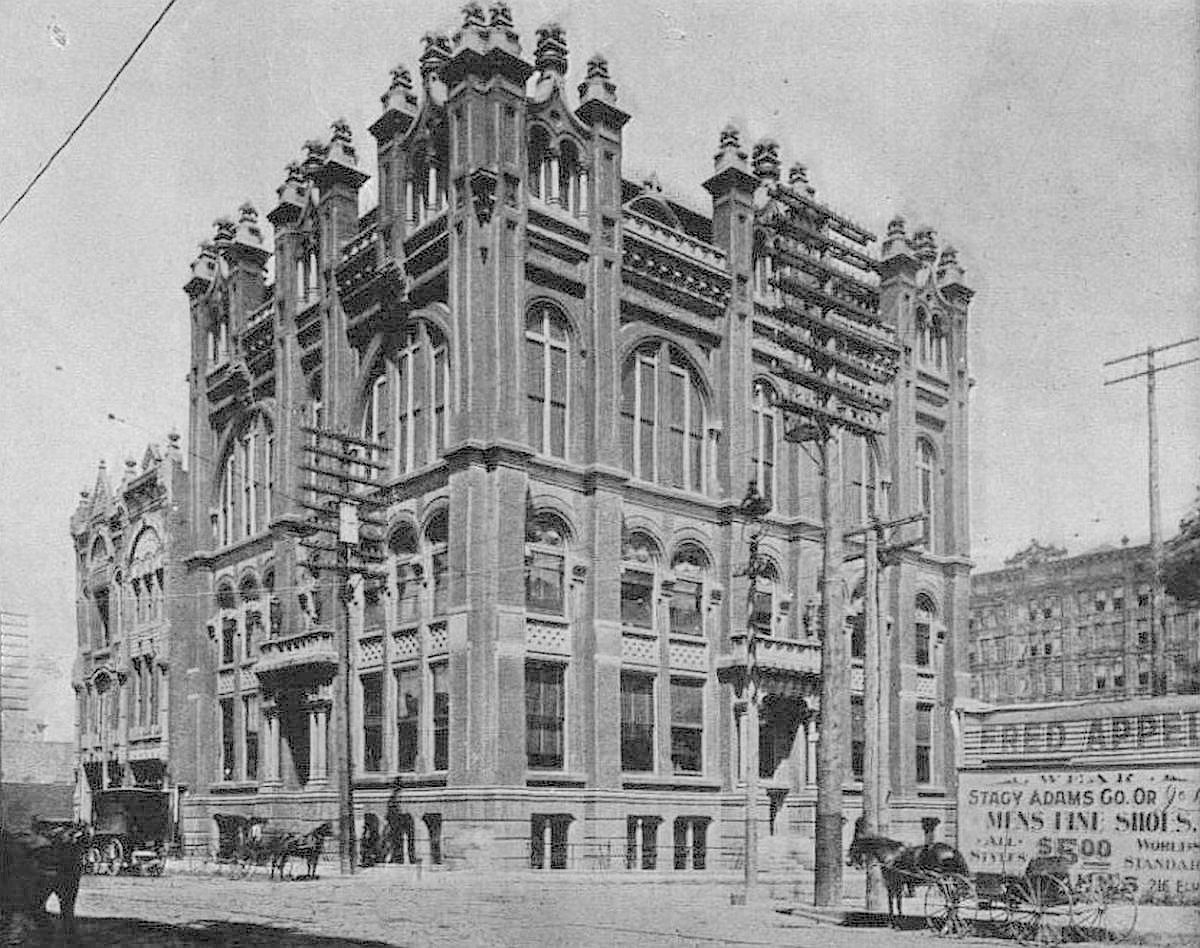
city-hall_1901_fire-dept-annual_portal

City Hall, Commerce and Akard Streets, now the location of the Adolphus Hotel. Half of the shorter building to the left housed the police department and Engine Co. No. 4.

*

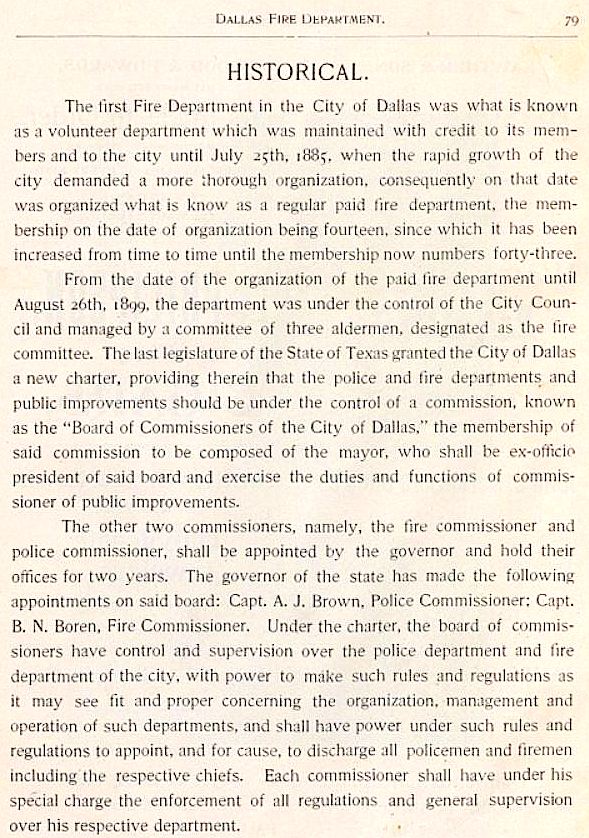
The “Historical” page from the book (click to read).

fire-dept-hist_dallas-fire-dept-annual_1901_portal

**

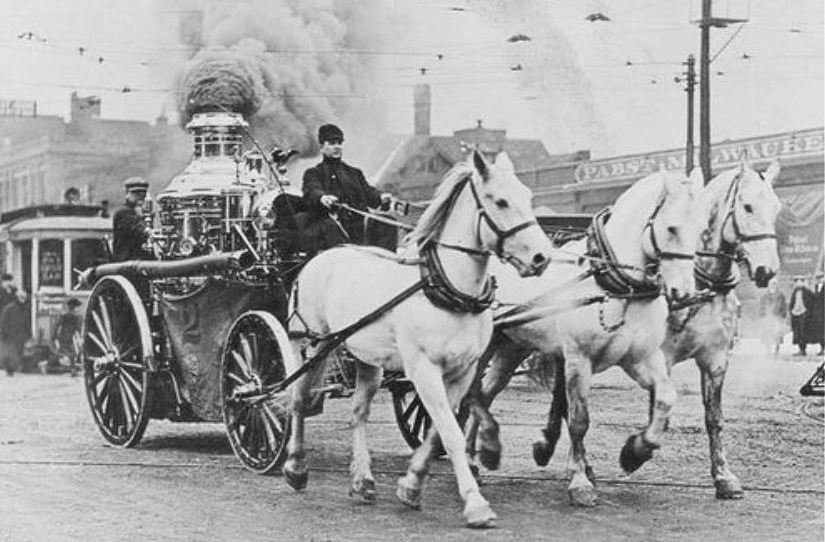
Since there is no sign of the actual equipment in these photos, here’s what horse-drawn steam engines (Ahrens steamers) looked like at this time. (Photo from the Wisconsin Historical Society).

fire-steam-engine_wisconsin-hist-soc

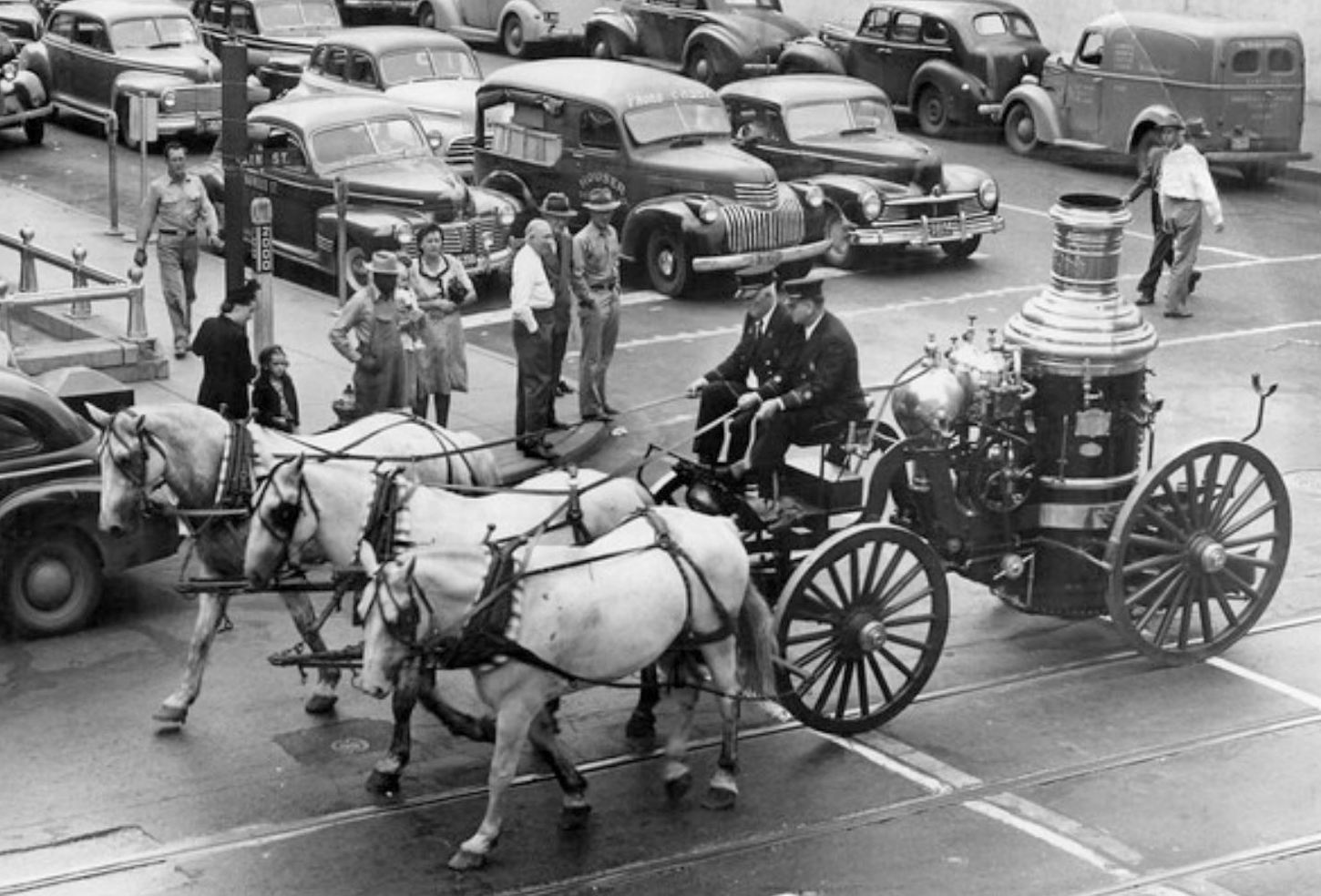
UPDATE: I found this photo on Flickr, showing equipment from those early days being driven through the streets of Dallas during a fire prevention parade.

fire-department_pumper_flickr_coltera

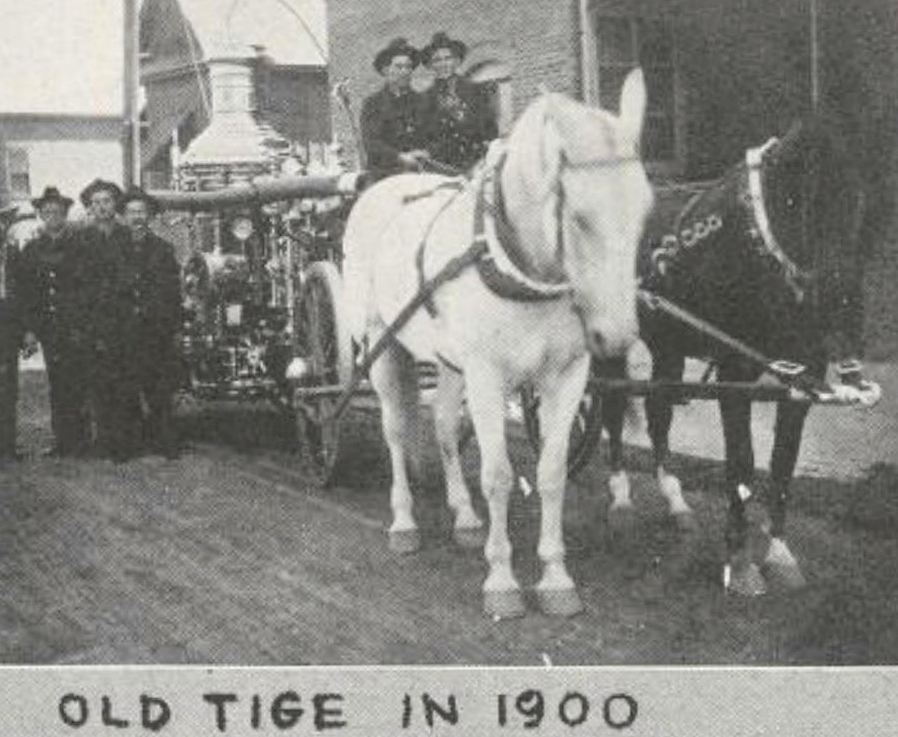
UPDATE: Lo and behold, a photo from 1900 of Old Tige, the 600 gallons-per-minute steam pumper, built in 1884, which was in service with the Dallas Fire Department until 1921. (Old Tige can be seen in the Firefighters Museum across from Fair Park.) Found at the Portal to Texas History.

old-tige_1900_fire-dept-bk_1931_portal

***

Sources & Notes

Photos by Clifton Church, from the Dallas Fire Department Annual, 1901, which can be viewed in its entirety on the Portal to Texas History, here.

A contemporary map of Dallas (ca. 1898) can be viewed on the Portal to Texas History site, here.

More Flashback Dallas posts on historic Dallas firehouses can be found here.

All photos larger when clicked.

*

Copyright © 2016 Paula Bosse. All Rights Reserved.

The Blue House on Browder

blue-house_homewardboundinc_2000
The Rosenfield house, in about 2000 (photo courtesy Homeward Bound, Inc.)

by Paula Bosse

Perhaps you’ve been following the recent brouhaha over the plans to demolish one of the last remaining 19th-century residences in the Cedars area, south of downtown — Robert Wilonsky of The Dallas Morning News has been covering the story here and here and here. The house is in terrible disrepair, but it has the beautiful details of the period, and it’s obvious that it was once a lovely house in a well-to-do neighborhood. Preservation Dallas posted this in-better-days photo on their Facebook page:

browder-house_preservation-dallas-FB-page

I thought I’d see what I could find about the history of the house — mainly I wanted to see if I could find who built it and when.

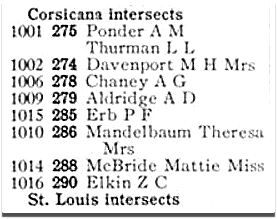
The house currently has the address 1423 Griffin, but before highways were built and streets were moved around, its address was 1015 Browder. Dallas changed almost every address in 1911, so I checked Jim Wheat’s very helpful scan of that year’s directory which tells us both the new and the old addresses of houses and businesses and also shows what cross-streets those addresses are between.

browder-house_1911-directory1911 directory, Browder Street

The original address of the Blue House was 285 Browder Street, between Corsicana and St. Louis. In 1911, P. F. Erb was living there.

Next, I checked the Sanborn maps. The earliest Sanborn map I could find which actually showed this part of Browder was the one from 1892. Here’s a detail showing the two-story frame house on the northwest corer of Browder and St. Louis, with Browder running horizontally along the top. The address is 285 Browder. (The house next to it is 169 St. Louis — more on that house later.)

sanborn_1892_285-browder_nw-corner-st-louis_sanborn-1892_sheet-21

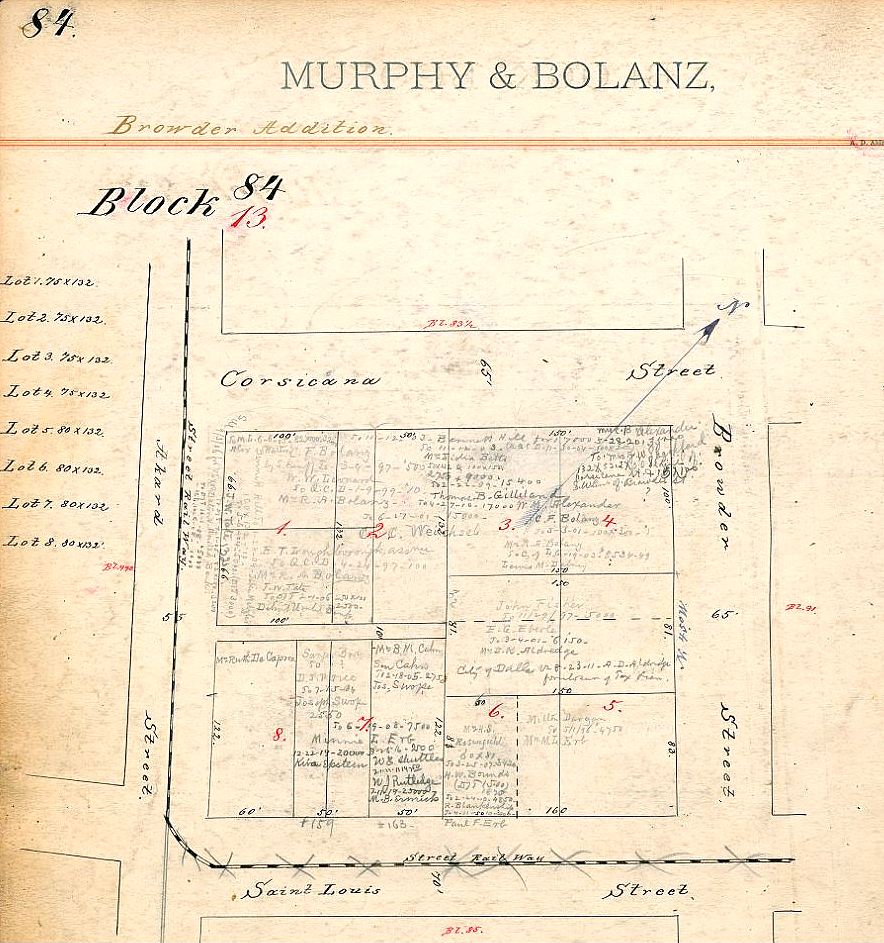
When you look at the full-page map this detail comes from (here), you’ll see larger numbers in the middle of the blocks. The block I’m interested in is block 84. Then I hopped over to the Murphy & Bolanz block book to see what I could find there. (I haven’t actually used this block book much, mostly because my old computer would not work with the plug-in required to view the pages, and it takes a while to figure out what you’re looking at.) When I clicked on “Block 84” in the index, I found this (click for larger image):

murphy-bolanz_block-13_block-84

Here’s the detail of the pertinent block:

murphy-bolanz_det

The names and other assorted scrawls indicate title change (I think). This page was very helpful, because it told me that this block was originally part of Browder/Browder’s Addition, and it was originally classified as Block 13. The lot in question is Lot 5 (and probably Lot 6, because Erb’s name shows up under both. So now I had terms to search on.

And then it was just a tedious slog through the Dallas Herald archives (not to be confused with the Dallas Times Herald archives), the Dallas Morning News archives, and old city directories. Here’s what I found.

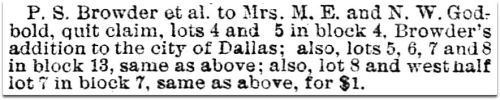
First mention of this particular parcel of land was in The Galveston News on March 24, 1883. P. S. Browder, a Browder family executor, transferred a lot of property — including the two lots I was interested in — to Mr. & Mrs. Nathan Godbold as part of a quitclaim deed (I’m probably not using the correct terminology here…). For one dollar.

1883-march_browder_galveston-news_032483_QUIT-CLAIMGalveston News, Mar. 24, 1883

A few inches of print over, the record shows that Godbold immediately sold Lots 5 and 6 to Dallas real estate czar Charles Bolanz (misspelled below). For $1,000.

1883-march_browder_galveston-news_032483_to-bolanzGalveston News, Mar. 24, 1883

A few months later, in July, it was reported that Bolanz had sold the adjoining two lots to T. S. Holden, a young man who worked as a salesman for a wholesale grocery firm but seemed to be engaged in land speculation on the side. (It’s a little odd that Bolanz sold it so quickly for a $200 loss, but I’m sure there was probably more to the story.)

1883-july_browder_galveston-news_070283_HOLDENGalveston News, July 2, 1883

At some point, these two lots were sold to Max Rosenfield, another young man who was buying up land in the hopes that its value would increase. From Dallas Rediscovered by William L. McDonald:

“The year 1884 also saw the opening of a new housing subdivision by two Jewish real estate speculators, Gerson Meyer and Max Rosenfield. Their development, bounded by Akard, Corsicana, Browder, and St. Louis streets, was sold primarily to Jewish families who had begun to arrive as early as 1872 as part of the ‘Corsicana crowd’ — the terminal merchants who followed the construction of the H&TC.”

[I couldn’t find anything else about this block being a “sub-division,” but there definitely was a “Rosenfield & Meyer’s Addition” in East Dallas as early as 1886 — see the bottom of this post for more information on Gerson Meyer and the Murphy & Bolanz map of their East Dallas addition.]

In the 1886 city directory, Max Rosenfield is listed as residing at 1118 Browder, which may well have been an address that lasted for a very, very short time — Browder is a very short street, and I wonder if Rosenfield was renumbering addresses in his new development. It does appear to be Lot 5 of the block he and Meyer were developing, though. (Henrietta Rosenfield, widow of Jonas Rosenfield, was Max’s mother, and she lived with or near Max for several years.)

1886_rosenfield_1886-directory_1118-browder1886 Dallas directory

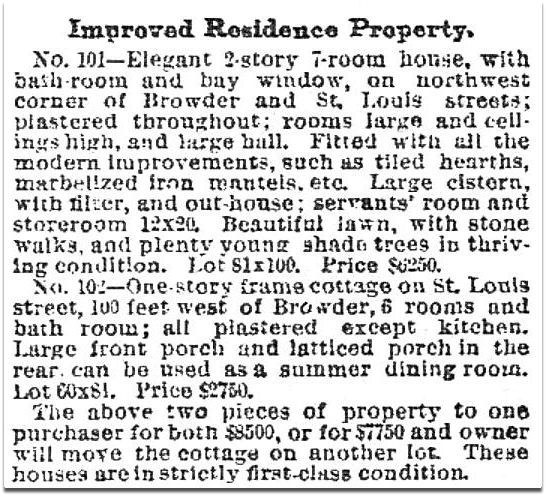
In early 1887, a For Sale ad appeared in the Herald — real estate agents Ducker  & Dudleigh were offering what appears to be Lots 5 and 6. By this time, houses had been built on both lots. (The  numbers 101 and 102 are confusing here, but the property being offered is the lot at the northwest corner of Browder and St. Louis and the lot adjoining it.) The price for the two-story house on Lot 5 was $6,250, which the Inflation Calculator adjusts to being about $166,000 in today’s money, taking into account inflation (but not taking into account Dallas’ outrageous real estate prices!).

1887_browder_dmn_050887-FOR-SALEDMN, May 8, 1887 (click for larger image)

It doesn’t look like either property sold, because a few months later, the 1888 directory showed Max still living in the Lot 5 house facing Browder and mother Henrietta living in the Lot 6 house at 169 St. Louis.

1888_rosenfield_1888-directory1888 Dallas directory

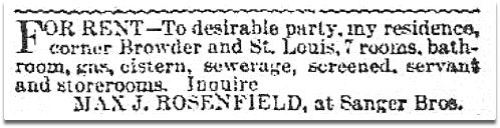
Rosenfield placed a For Rent ad in the paper in Feb. of 1889, offering his corner house on Browder.

1889_rosenfield_dmn_021389DMN, Feb. 13, 1889

This appears to have been when businessman Milton Dargan moved in. He is listed as moving into the house at about this time in the addenda section of late changes for the 1889 directory (directories were usually compiled in the year before they were actually published).

1889_dargan_1889-addenda-listing1889 Dallas directory

In that same directory, Rosenfield had moved in with his mother in the adjoining property.

1889_rosenfield_1889-directory1889 Dallas directory

At some point Dargan bought the corner house. Henrietta continued to live in the St. Louis-facing house until about 1892, when she moved in with Max at his new home on Akard.

And, finally, the “285” address shows up in a directory, in 1891.

1891_dargan_1891-directory1891 Dallas directory

Paul F. Erb bought the Browder house from Dargan in 1896 (he also bought the adjoining Lot 6 house facing St. Louis in 1910).

1897_erb_1897-directory1897 Dallas directory

And we’re back to Paul Erb, seen in the 1911 directory listing old and new addresses at 1015/285 Browder.

browder-house_1911-directory1911 Dallas directory

Yay!

**

That was a long way to go to establish a chain of ownership. (I’m sure it would have been faster and easier to have consulted city records.)

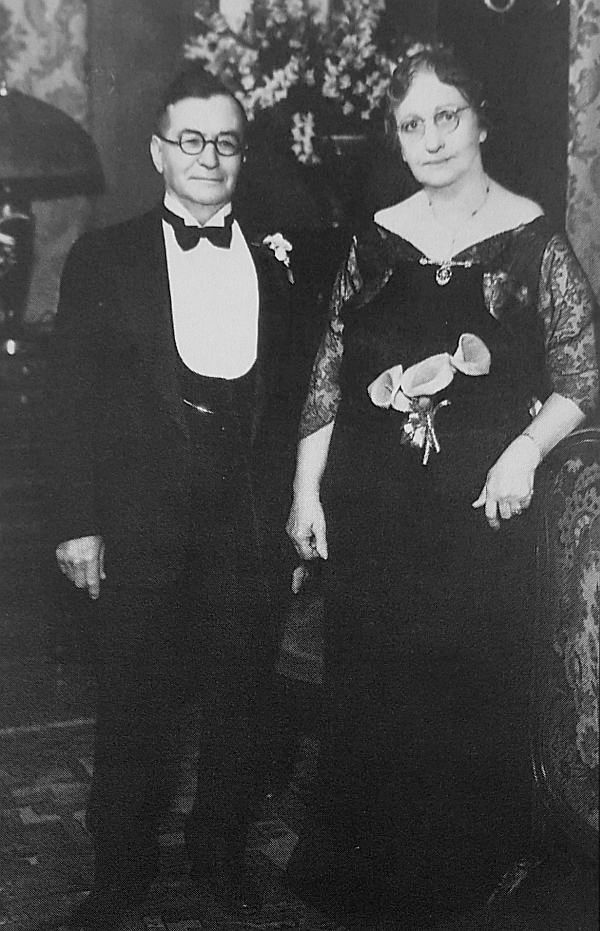
So. Without access to building permits, it looks as if Max Rosenfield (who, by the way, was the father of John Rosenfield — born Max John Rosenfield, Jr. — legendary arts critic for The Dallas Morning News) was the person who built the 130-year-old house now going through the process of probably being torn down soon. It appears to have been built in 1884 or 1885. In a 1935 Dallas Morning News article celebrating the 50th wedding anniversary of Mr. and Mrs. Max Rosenfield, the house is mentioned: “…their first home, a house built by Mr. Rosenfield and still standing on the northwest corner of Browder and St. Louis streets…” (see the article “Mr. and Mrs. M. J. Rosenfield To Observe 50th Anniversary,” DMN, Jan. 6, 1935).

Below is a photo of Max Rosenfield and his new bride, Jenny, probably taken the same year the house was built, 1885-ish, when Max was 26 years old.

rosenfields_ca-1885_ancestry

Thank you for building such a pretty  house, Mr. Rosenfield. Maybe some magnanimous person with deep pockets can have it moved to a new location and restore it to its former loveliness.

rosenfield-max_1935Mr. and Mrs. M. J. Rosenfield, on their 50th anniversary

**

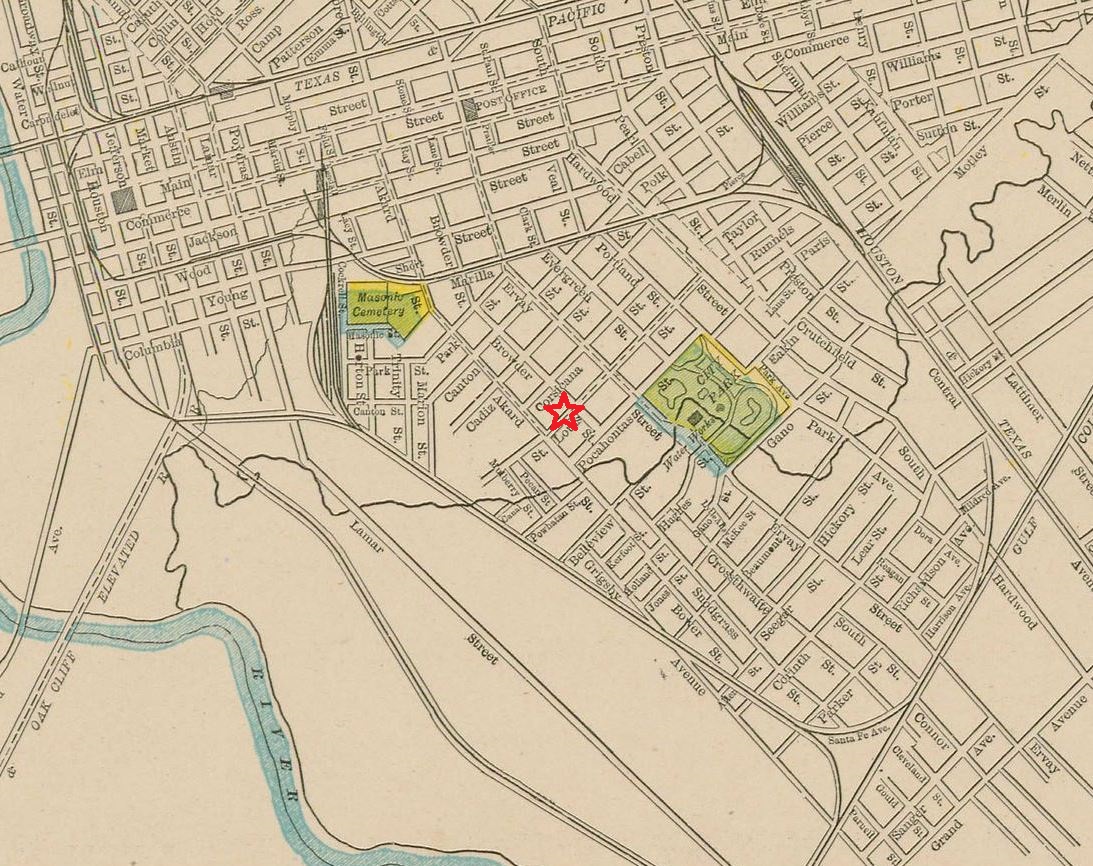
Here’s a detail of an 1893 map of the area, with the house in question marked.

browder-house_1893-map

And here’s the lonely little house in its present hemmed-in location.

browder-house_bingBing Maps

***

Sources & Notes

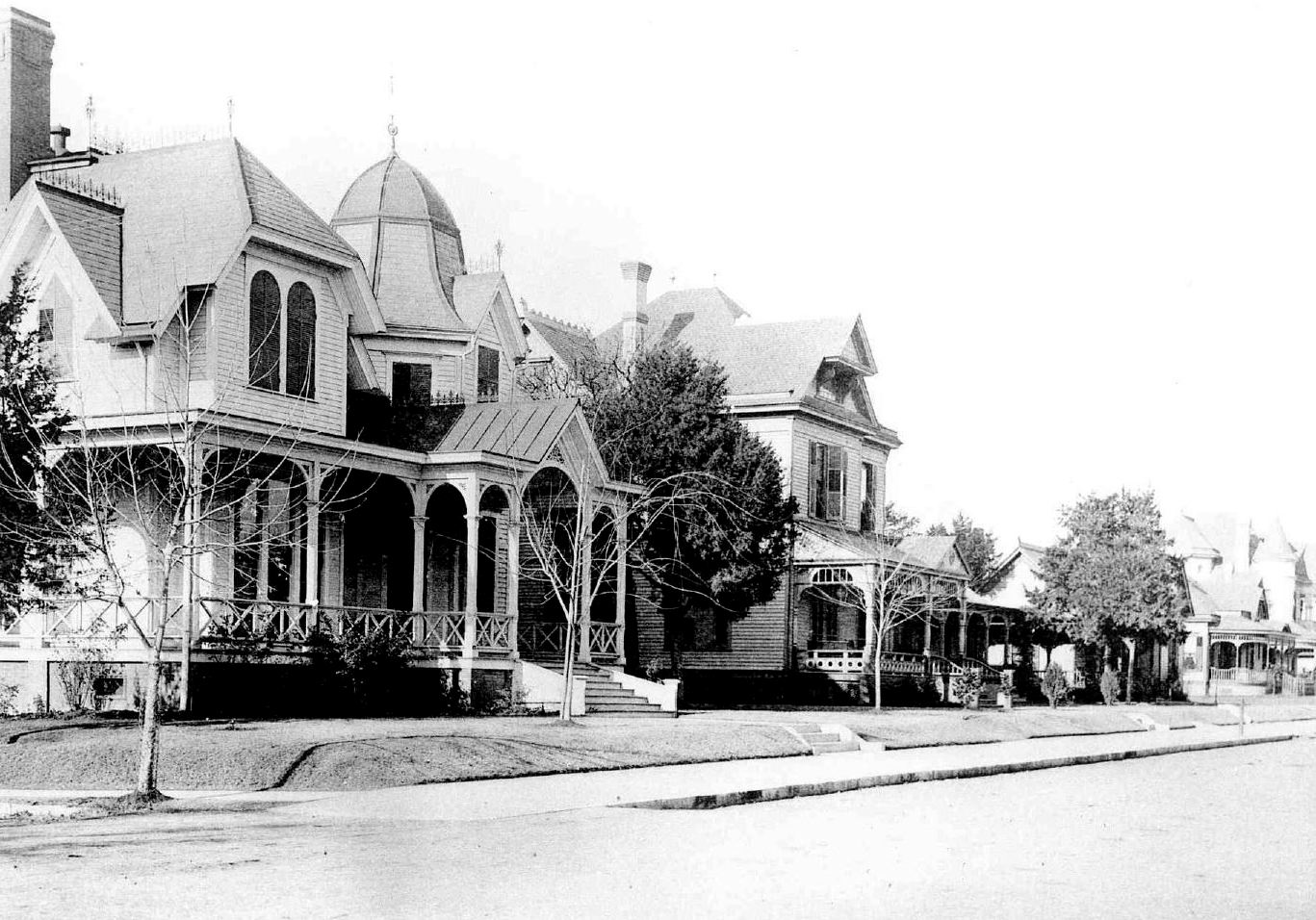
Top photo, taken around 2000, from Homeward Bound, Inc., used with permission. Homeward Bound, Inc. took over the house in 1986 (and owned it until October, 2015) for use as Trinity Recovery Center, a substance abuse treatment center. The organization tried hard to save the house, but, according to Homeward Bound, Inc. Executive Director Douglas Denton, when they approached Dallas’ Landmark Commission in the 1990s, “they were not interested in the building.” Thanks to Mr. Denton for allowing me to use this photo, which shows the beauty of the old house better than any other photo of it that I’ve seen. He points to the photo below as an example of what this Cedars neighborhood once looked like. The caption for the photo in McDonald’s Dallas Rediscovered (p. 125): “Looking north toward downtown along Browder Street near the corner of Cadiz, 1895. These homes, built in the early 1890s, began to be razed in the late 1930s and early 1940s for parking space in the expanding business district.” (Photo: Dallas Public Libary)

browder-near-cadiz_ca1895

This would have been about two blocks from the Rosenfield house. Imagine what that neighborhood once looked like!

Watch a news report on the outcry over the possible demolition of this house on the WFAA website, here.

The Dallas Morning News article on the 50th wedding anniversary of Mr. and Mrs. Max Rosenfield in which it is mentioned that Max built the house (“…their first home, a house built by Mr. Rosenfield and still standing on the northwest corner of Browder and St. Louis streets…”) is “Mr. and Mrs. M. J. Rosenfield To Observe 50th Anniversary” (DMN, Jan. 6, 1935).

Photo of the Rosenfields as a newly married couple found on Ancestry.com.

50th anniversary photo of Mr. and Mrs. Rosenfield is from the book John Rosenfield’s Dallas by Ronald L. Davis (Dallas: Three Forks Press, 2002).

All other sources as cited.

Max J. Rosenfield died in 1935 at the age of 76. His very interesting obituary (probably written by his son, John Rosenfield, amusements editor of The Dallas Morning News), can be found in the Dec. 2, 1935 edition of The News: “M. J. Rosenfield, Business Leader Many Years, Dies.”

It’s worth trying to figure out how to use the Murphy & Bolanz block books, courtesy of the Texas/Dallas History and Archives Division of the Dallas Public Library. Background on these very useful books can be found here.

If I’ve made any mistakes or have drawn any incorrect assumptions, please let me know!

browder-house_then-now

*

UPDATE: Max Rosenfield developed a real estate partnership with Gerson Meyer, both of whom worked for Sanger Bros. department store. They bought and sold real estate (often to fellow Sanger’s employees), apparently as a lucrative side-business (Rosenfield even conducted his real estate transactions from his Sanger Bros. office). They apparently had acquired enough land by 1886 to have their own “addition” — “Rosenfield and Meyer’s Addition” in East Dallas. The earliest mention I found of it was this ad from May, 1886.

rosenfield-and-meyer-addition_dmn_052786DMN, May 27, 1886

Their addition was in East Dallas. Below, the map from the Murphy & Bolanz block book (click for larger image):

rosenfield-and-meyers-addition_murphy-bolanz

Gerson Meyer (a Jewish German immigrant, just a couple of years older than Rosenfield), moved to St. Paul, Minnesota in 1897 and continued working for several years in men’s clothing.

If something looks too small, click it!

*

Copyright © 2016 Paula Bosse. All Rights Reserved.
 

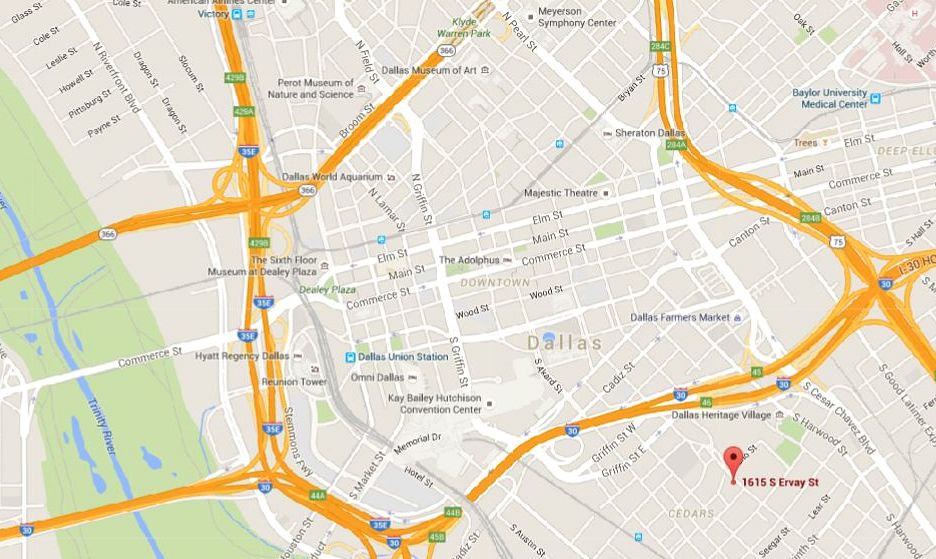
1615 South Ervay: The Eagle Apartment Building

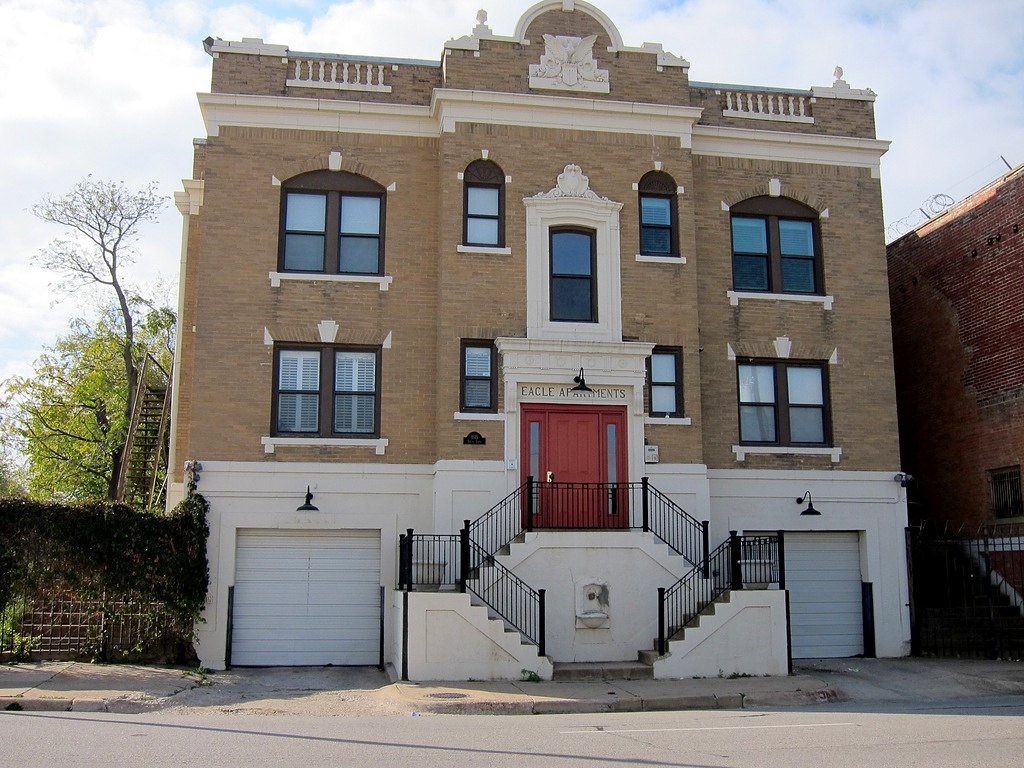
1615-s-ervay_zillowThe Eagle, today (click for larger image) / Photo: Zillow

by Paula Bosse

Whenever I drive along South Ervay, I always slow down — or pull over — to take a look at this building. It doesn’t look like anything else around it, and I’ve wondered about it from the first time I saw it.

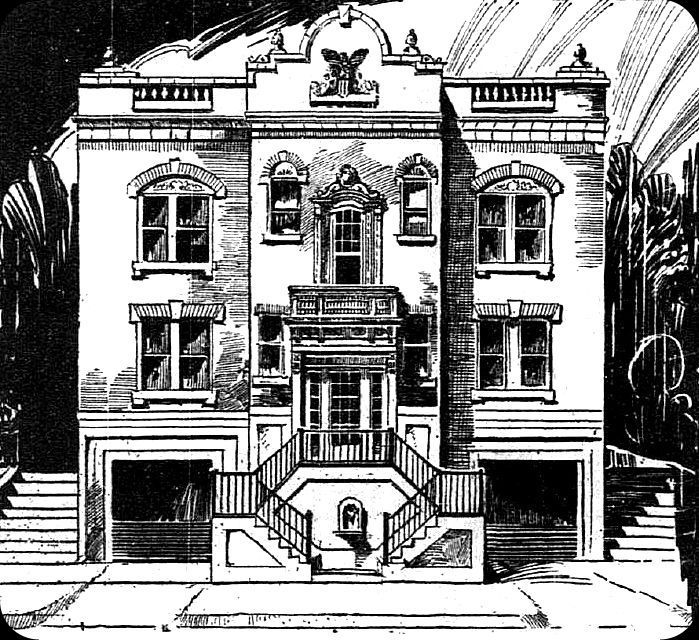
It was built in 1924 and was announced in a newspaper advertorial beneath the headline “New Apartment Building on South Ervay Street to Have Garage Space in Basement.” It was accompanied by a drawing of a fairly grand-looking building.

1615-s-ervay_dmn_0622241924

This new apartment building at 1615 South Ervay street, now being completed by George Kean, embodies many new and novel features in the construction of buildings of this character, one of these being provision of garage space for tenants in the basement. The building will contain eight four-room apartments and sixteen two-room efficiency apartments. J. W. Lindsley & Co. are leasing agents, and contract has been given to Sanger Bros. for furnishings of the building.

A basement garage for a small apartment building like this was pretty unusual for the time. And when they said Sanger’s was supplying the furnishings, they meant everything from furniture down to bed linens and kitchen utensils!

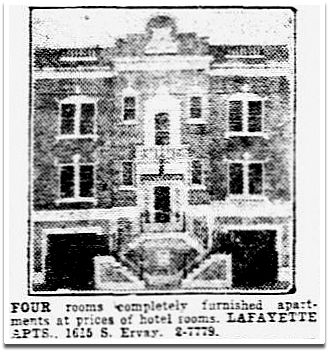
The first “for rent” ads began appearing a week after this announcement. Below, the photo and text of an ad from June 29, 1924.

eagle-apts_dmn_062924-deteagle-apts_dmn_062924-textJune, 1924

Hey, I’d take a look!

But renting’s for chumps — how about owning the entire building? (“Can care for 50 cars”!)

eagle-apts_dmn_080324Aug., 1924

Below, an ad with rates and a bit more info (it sounds like all units had a Murphy bed — even the apartments with a bedroom):

eagle-apts_dmn_071225July, 1925

They were kind of pricey. According to the Inflation Calculator, prices in today’s money would be about $825-$900 for a 2-room efficiency, and about $1,225-$1,375 for a 4-room apartment.

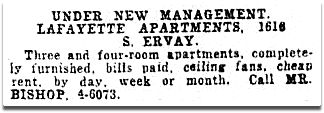
By the fall of 1931, the building had changed hands, was under new management, and had been re-named. It was now the Lafayette Apartments, and units were now being rented “by day, week or month.”

lafayette_dmn_100131Oct., 1931

lafayette-apartments_dmn_101532Oct., 1932

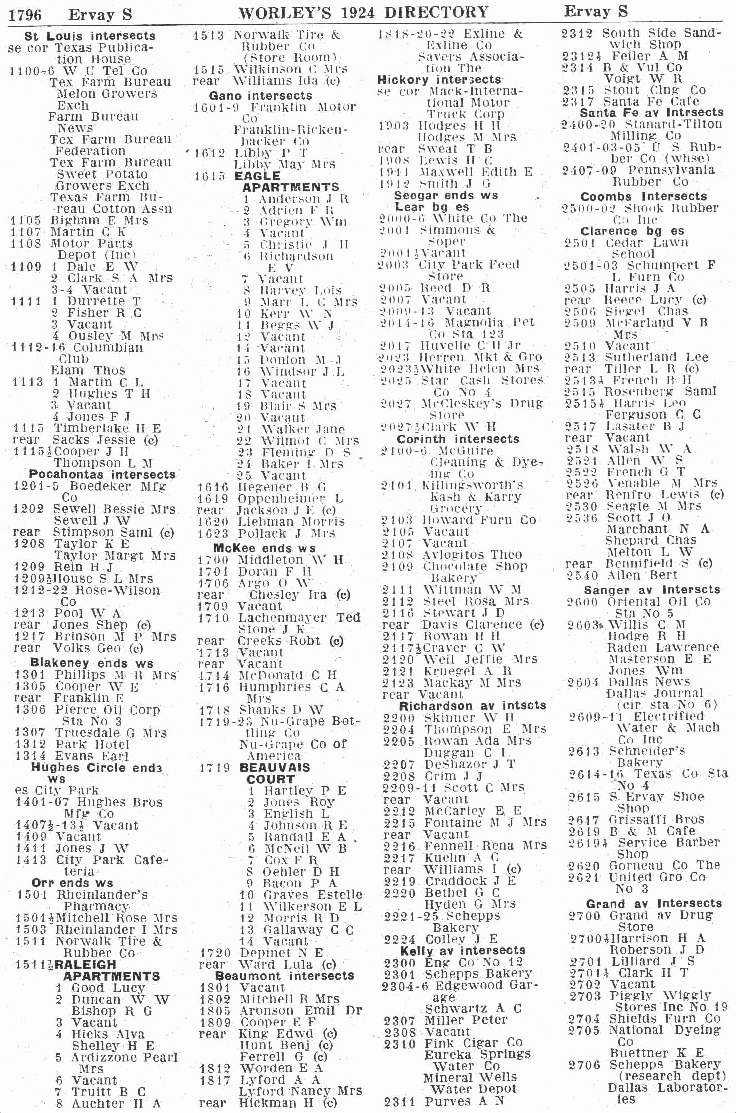
Today this stretch of South Ervay is not the crowded and busy thoroughfare it once was. Though there were several businesses and small industrial buildings, it was also a residential area, lined with houses, apartment buildings, and the large Park Residence Hotel (better known in recent years as the Ambassador Hotel). The Eagle apartment building is in the 1600 block of South Ervay — when it opened in 1924, there were also apartment buildings in the 1500 and 1700 blocks. It’s interesting to take a look at a page from the 1924 city directory to see who and what occupied this South Ervay neighborhood in 1924 (click for larger image):

south-ervay_1924-directory1924 Dallas directory

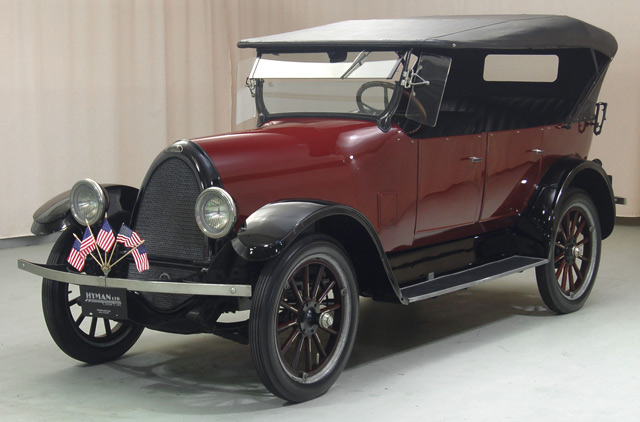
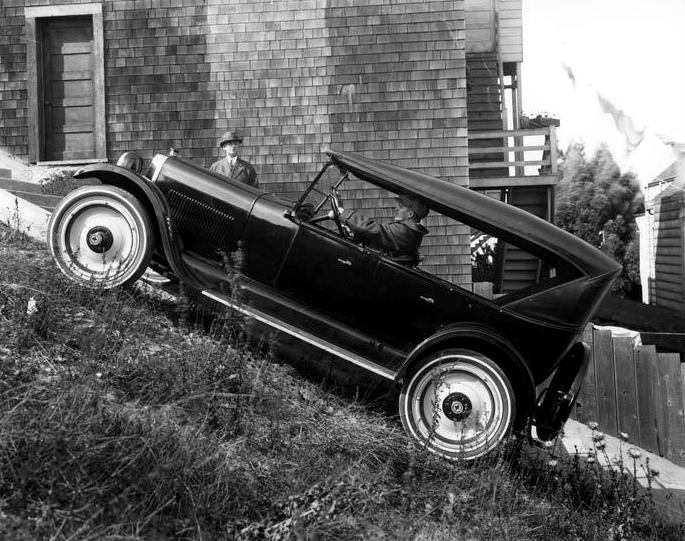
The building right next door to the Eagle Apartments was the Franklin-Rickenbacker Motor Co., a car dealership (part of the word “Franklin” can be seen painted on the brick wall in the 1924 photograph). For context, here are the automobiles that would have been for sale next door to the Eagle when it opened.

1924-franklin_secondchancegarage1924 Franklin

1924-rickenbacker1924 Rickenbacker

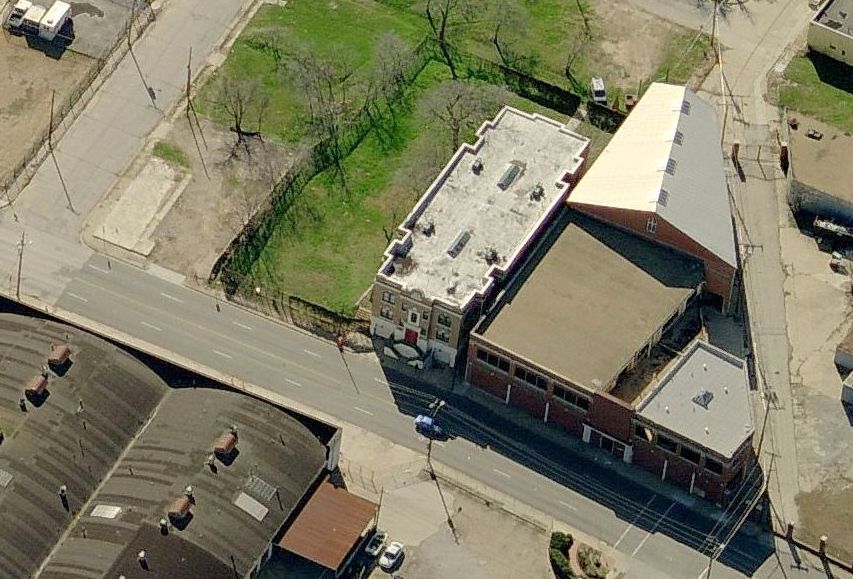
Today, people are still living in 1615 South Ervay. I’m not sure how many condominiums are in the building, but if you search around on the internet, you can find several real estate listings that show what various of the units look like inside. They’re very nice! It’s a much larger building than I realized, as can be seen in this aerial view.

south-ervay_bingBing

I love that red door. Here’s to the continued revitalization of South Dallas and The Cedars!

***

Sources & Notes

Top photo from Zillow.

Photo of the Franklin automobile from SecondChanceGarage.com, here. I found the Rickenbacker photo on a Rickenbacker guitar site which froze my computer and which shall remain unlinked; more photos of Rickenbacker cars (as well as a history of the company) can be found here (the car was named after WWI flying ace Eddie Rickenbacker, a cousin of the guitar maker).

1615 S. Ervay is located catty-corner to Old City Park/Dallas Heritage Village, near the intersection of S. Ervay and Gano streets.

1615-s-ervay_googleGoogle

Street view of the building, looking north on Ervay toward downtown, here.

*

Copyright © 2015 Paula Bosse. All Rights Reserved.
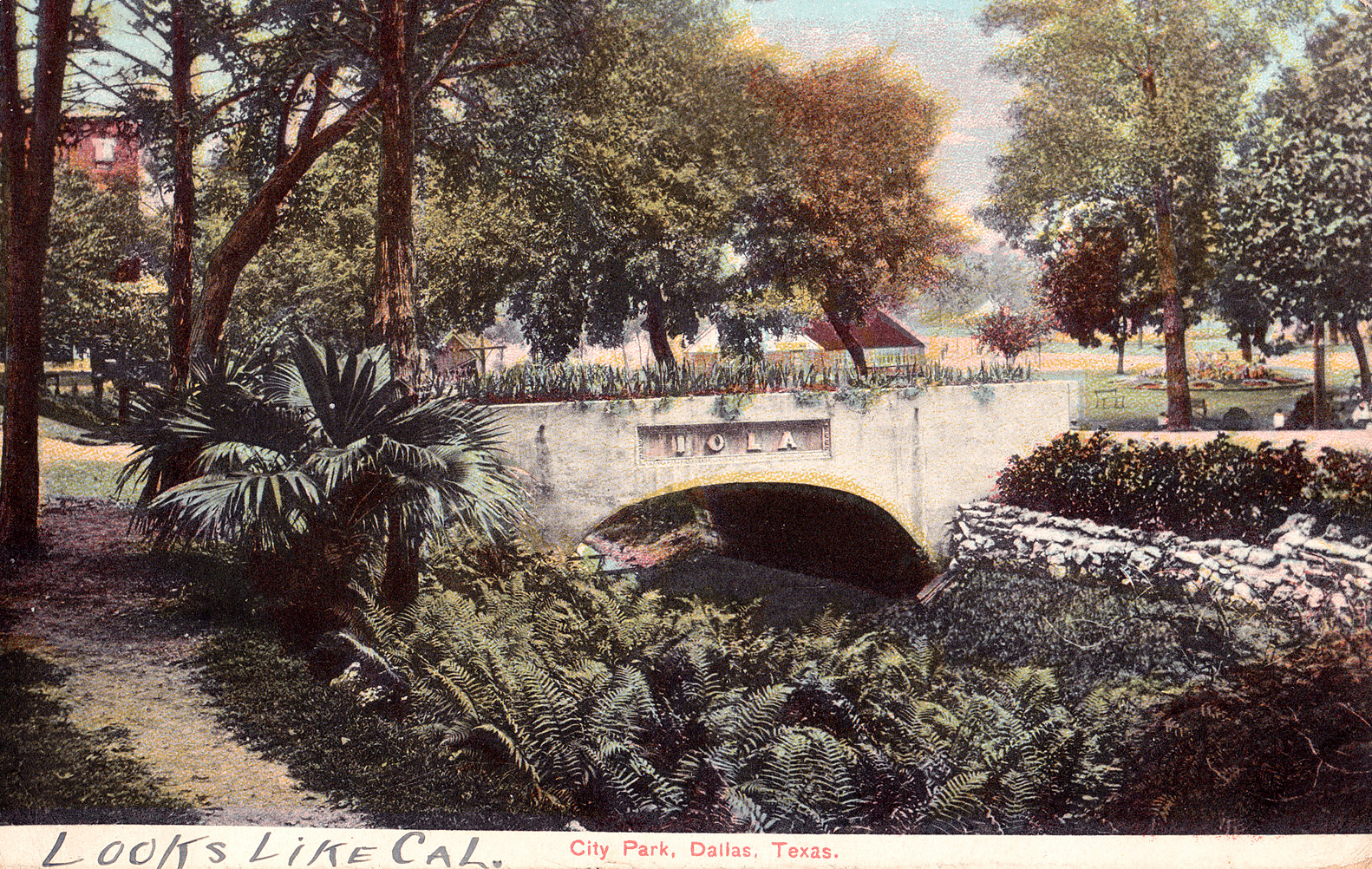
Iola Bridge

iola-bridge_city-park_ca-1908“Looks like California…” — City Park, ca. 1908

by Paula Bosse

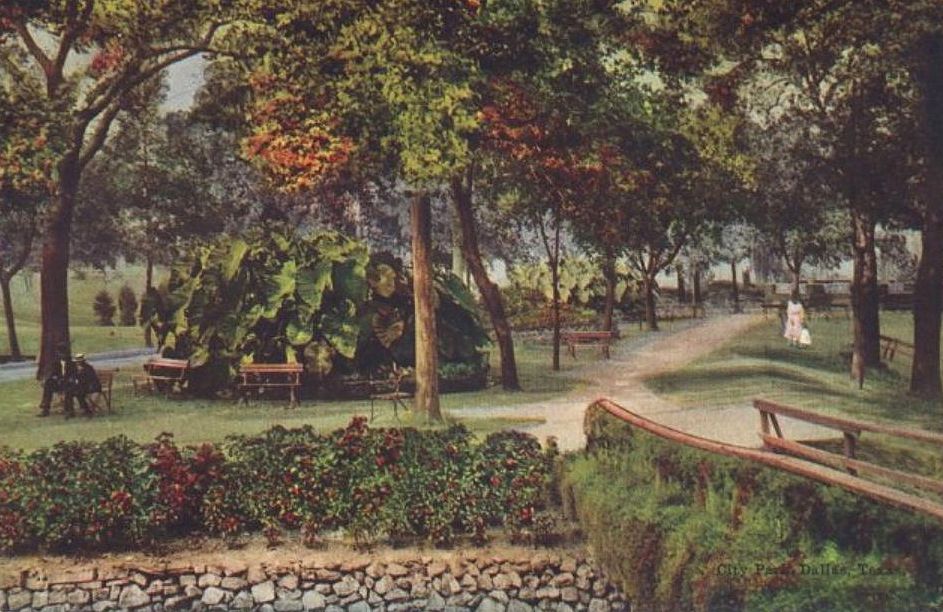
Old postcards of (Old) City Park always seem kind of mysterious to me. I’m fascinated by photos of what was, for many years, Dallas’ only park. It was very big and beautifully landscaped — and it was one of the things about the city that those of earlier generations were most proud of. The postcard views above and below are from the early days of the twentieth century, and, sadly, those views don’t exist anymore — it’s hard to believe they EVER existed here. Even though there’s a hint of what you might see at Reverchon Park, there’s little else about these images that looks like the Dallas of today. What a shame!

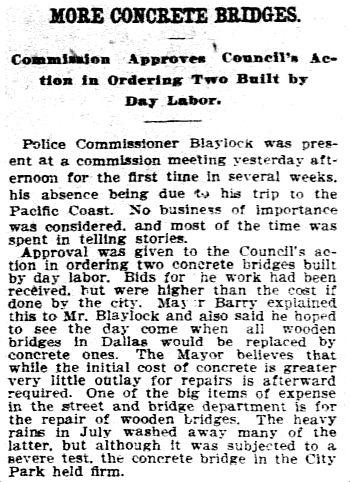
But what’s the story behind the attractive little “Iola” bridge? Built in 1905, it was, apparently, Dallas’ first (or possibly second) concrete bridge. The Iola bridge was far sturdier than the wooden bridges around Dallas, and a concrete bridge also required very little upkeep. In fact, this little bridge “of ornamental design” is actually kind of important — it was often cited by city planners and commissioners when discussing the construction of future bridges around the city.

concrete-bridges_dmn_081005Dallas Morning News, Aug. 10, 1905

It seems wooden bridges were being washed away almost as often as Dallas courthouses were burning down. In a letter that appeared in The News on Feb. 21, 1911, it was noted that, while wooden bridges were “under constant repair,” the concrete Iola bridge “has not required one dollar of outlay […] during its six years of existence.” So … cheaper and sturdier. Bye-bye, wooden bridges!

But “Iola”… where did that name come from? I thought it might have been the name of a wife or mother of a mayor or planner, but I suspect it was merely the name of the company that donated the cement for the bridge’s construction, the Iola Portland Cement Company. The company’s canny “civic donation” ultimately paid off BIG for them in the end. Not only did they supply the cement to build that first very pretty little bridge in a very pretty park, they also, ultimately, got whopping new orders from the city for all those new concrete bridges that began to be built — including, less than ten years later (when the Iola company’s West Dallas plant had been sold to the TEXAS Portland Cement Co.), the Trinity River-spanning Oak Cliff/Houston Street viaduct, which, when it opened in 1912, was the longest concrete bridge in the WORLD! And it all began with that unassuming bridge in scenic City Park, just south of the central business district.

*

iola-bridge_watermelon-kid

iola-bridge_dmn_100921aDMN, 1921

Below, a couple of views showing the charming and rather more rustic wooden bridges in the park.

bridge_city-park_watermelon-kid

wooden-bridges_city-park_watermelon-kid

iola-cement_directory-1905Ad from the 1905 Dallas directory

***

Sources & Notes

Top postcard found somewhere on the internet. All other postcards from The Watermelon Kid — here.

Black and white photo by Victor H. Schoffelmayer appeared in The Dallas Morning News on Oct. 9, 1921; it was one of several photographs of the Iola bridge, taken by members of the Dallas Camera Club.

A Dallas Morning News article from July 14, 1905 detailing the new improvements to City Park (including the concrete bridge) can be read here. (I don’t think the really wonderful-sounding “cascade” was ever built — and that’s a pity, because it sounds like it would have been beautiful!)

*

Copyright © 2015 Paula Bosse. All Rights Reserved.
Random Still-Standing Buildings Featured in Ads From 1929

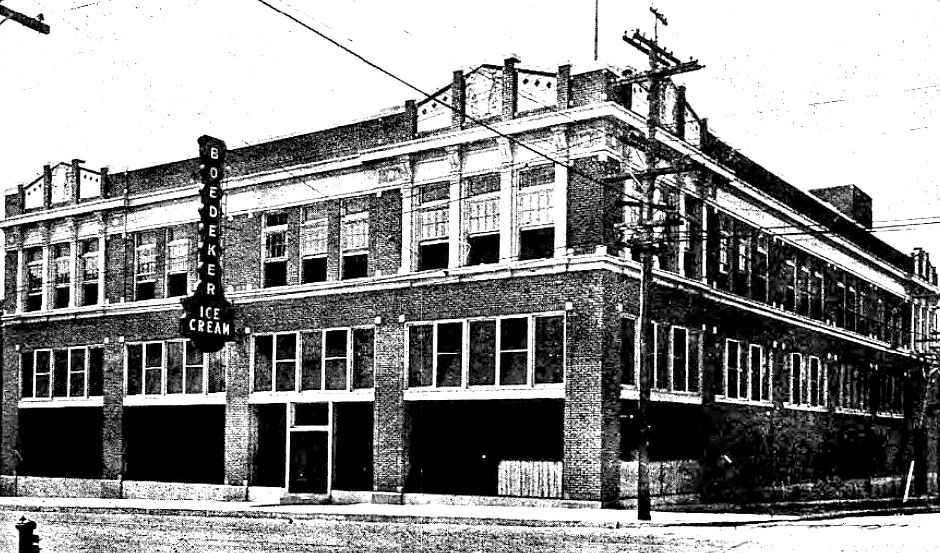
ad-boedeker-ice-cream_1929-directoryS. Ervay & Griffin — still there! (click to see larger image of building)

by Paula Bosse

I’ve always had a fascination for old advertisements. Ads for local products and businesses are particularly interesting and can be quite informative — especially those that feature photographs of the businesses being advertised. I always get an exciting little jolt when I see a still-standing building that I recognize in a 50-, 60-, or 70-year-old ad. Below are a few ads from 1929 — 86 years ago! — featuring buildings that have somehow survived the wrecking ball. Not all of them are architecturally interesting, but they’ve all seen a lot more than you and I have. Click the ads below to see larger images of the buildings.

*

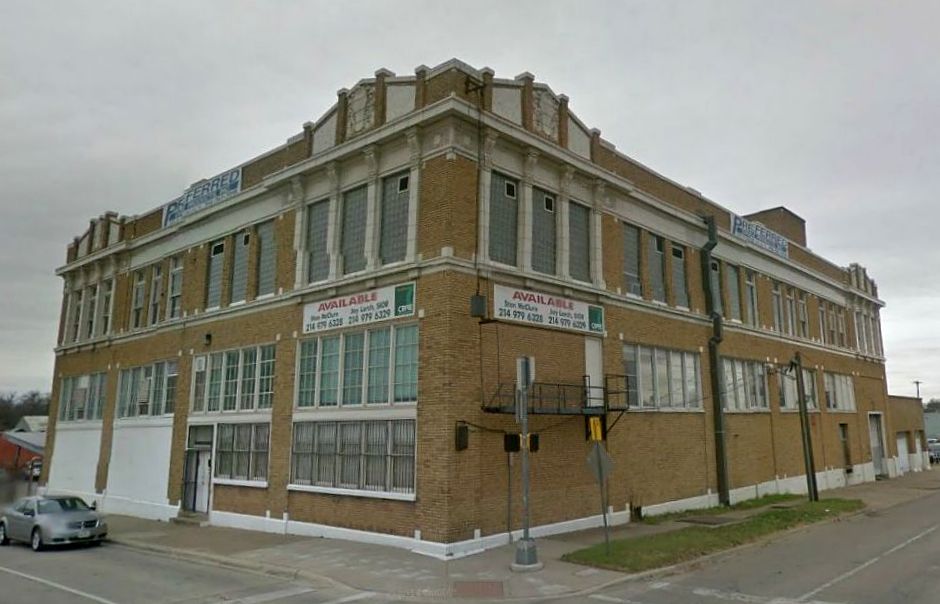
Above, the Boedeker Ice Cream plant — the “finest in the South,” located at S. Ervay & Griffin (1201 S. Ervay). The company was founded in 1887 by German Frederick Boedeker, the first ice cream manufacturer in Dallas. This building was built, I believe, around 1921. I’m not sure what’s in there these days (if anything), but here  is it today, via Google Street View:

ad-boedeker-ice-cream_now_google

UPDATE: Apparently there are plans afoot — read about them here.

*

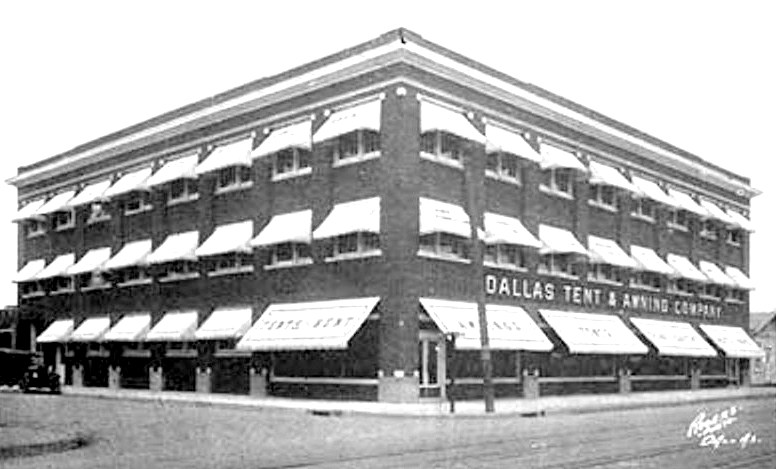
Next, the Dallas Tent & Awning Company at 3401 Commerce.

ad-dallas-tent-awning_directory_1929(click to see larger image of building)

This very successful company moved several times to larger and larger spaces, until they decided to build their own showroom and manufacturing plant in 1921. A 1922 Chamber of Commerce ad described the building as “a three-story modern building, 100 feet square with a warehouse in the rear which covers 40,000 square feet, Commerce and Race streets.” They manufactured tents, awnings, automobile tops, tire covers, and seat covers.

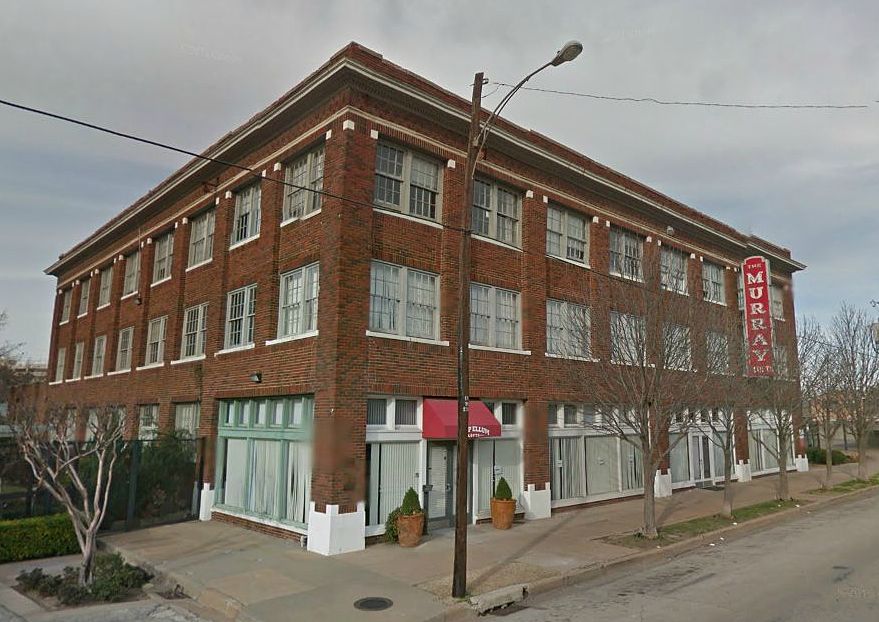
Here it is today, the cool-looking Murray Lofts, between Deep Ellum and Exposition Park:

murraylofts

(I’m not sure if the house in this ad was in Dallas, but I hope so! What a beautiful house! A larger image is here.)

*

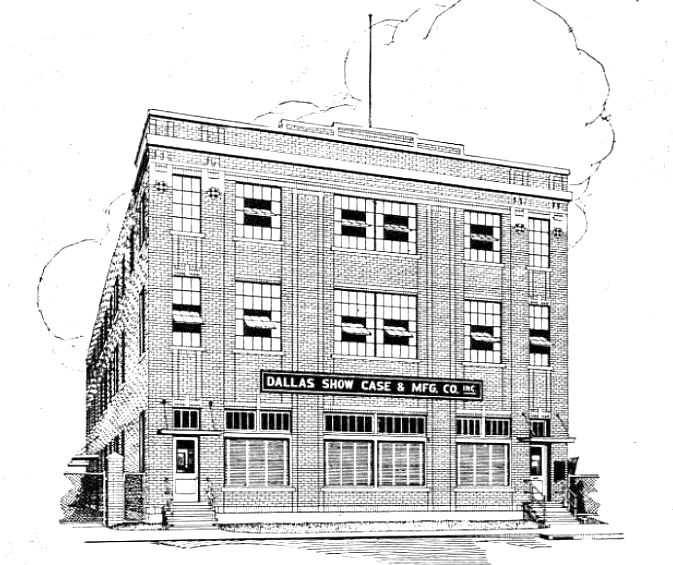
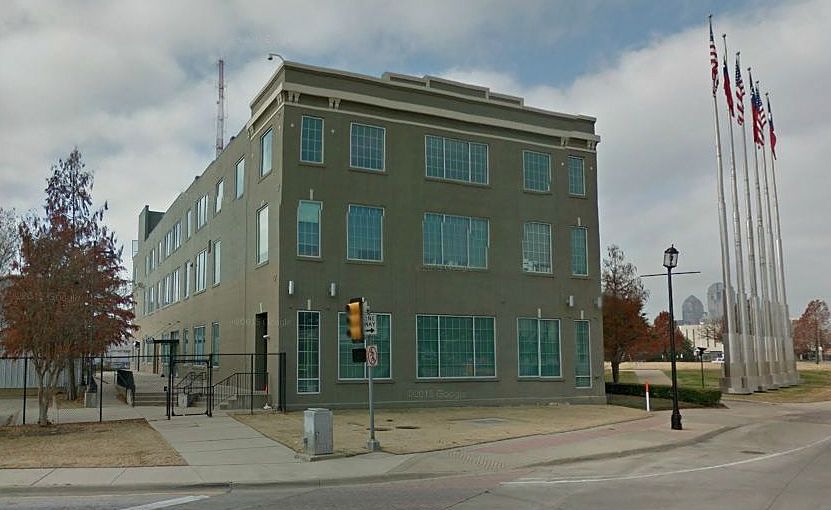
Next, the Dallas Show Case & Mfg. Co. at 329-337 Exposition.

ad-dallas-show-case_directory_1929(click to see larger image of building)

According to a 1962 interview with Otto Coerver — the son of the company’s founder — the factory was built in 1920 just blocks from Fair Park — a location so far “out in the country” that there was no city electric service. Since its founding in 1880, the company had manufactured “bank, office and store fixtures, showcases, hardwood floors and special household and church furniture.” The building still stands, but I’m not sure who occupies it these days.

ad-dallas-show-case_now_google

*

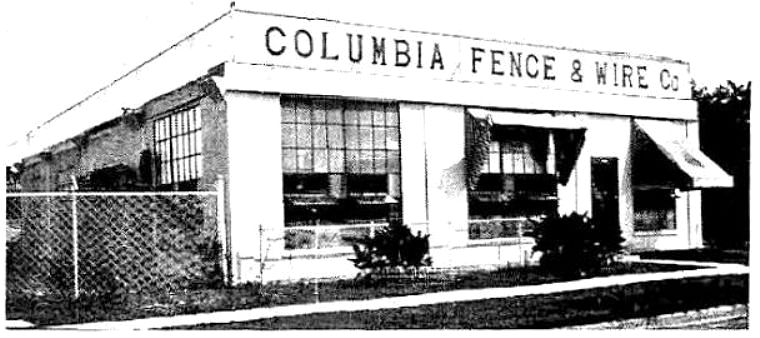
And, lastly, the Columbia Fence & Wire Co. at 3120 Grand Avenue.

ad-columbia-fence-wire_directory-1929sm(click to see larger image of building)

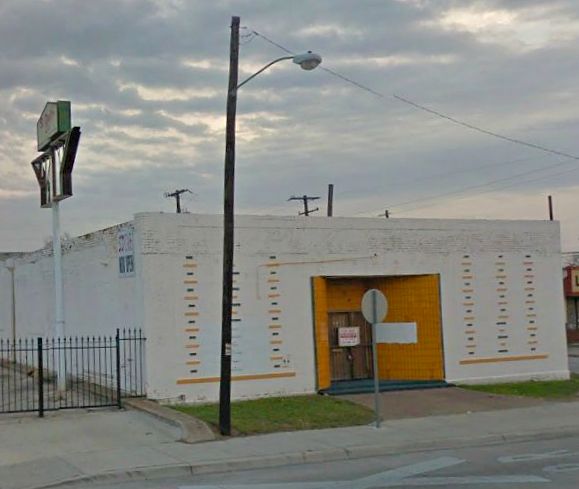
Though it’s been there since at least 1922, this building is one that I have to admit I probably wouldn’t shed a tear over were it to be demolished. Still, it’s been around a lot longer than I have, and I have to admire the fact that it’s managed to hang on for so many years.  After the Columbia Fence & Wire Co. moved on, the building was occupied by a succession of light industrial businesses. In the 1970s it must have gone through quite a renovation, because it became home to a string of discos, including the short-lived Lucifer’s (owned by Dallas Cowboy Harvey Martin), the Plush Pup, and Papa Do Run Run. Below, the current Google street view (the sign above the vacant building says “S. Dallas Cafe”):

ad-columbia-fence-wire_now_google

 ***

Sources & Notes

All ads from the 1929 city directory. (Apologies for the muddy images. Whenever I post these directory ads, they look great before they’re posted, then something happens during the uploading process, and … argh.)

Present-day images from Google Street View.

A continuation — “MORE Random Still-Standing Buildings Featured in Ads From 1929” — can be found here.

*

Copyright © 2015 Paula Bosse. All Rights Reserved.

Always Have a Bucket of Water Nearby — 1890s

fire-dept_ervay-kelly_hose-co-2_1901Hose Co. No. 2, S. Ervay at Kelly, ca. 1901… (click for larger image.)

by Paula Bosse

fire-signals_souv-gd_1894

Dallas used to burn down a lot. Here is a handy tip sheet for residents and visitors printed in 1894, about the time the above photo was taken. I’m sure everyone in the city knew where the alarm boxes were and what the various signals meant. When to relax, and when to run. When to hold ’em, and when to fold ’em.

fire-boxes_fire-alarm-signals_souvenir-gd_18941894 (click for larger image.)

***

Sources & Notes

Top photo of Hose Co. #2/Fire Station #12 from The Dallas Firefighters Museum, found on the Portal to Texas History site.

List of fire alarm boxes from Souvenir Guide of Dallas. A Sketch of Dallas and Dallas County, their resources, business enterprises, manufacturing and agricultural advantages (Dallas: D.M. Anderson Directory Company, 1894).

*

Copyright © 2014 Paula Bosse. All Rights Reserved.